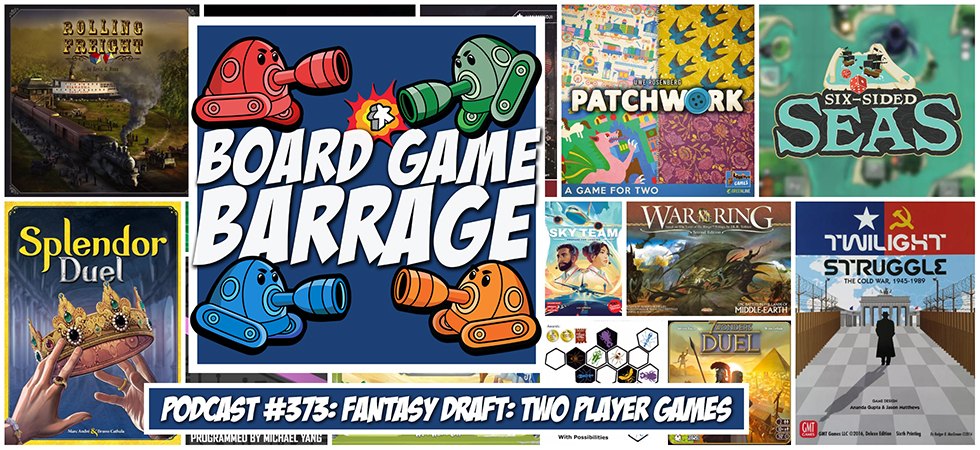
It’s been a while since we’ve done one of these! Bored from our recent bouts of co-operative board game drafting, this week’s episode sees the return to the competitive format, where we pit our games against one another, and let you decide who did it best. This week, two player games. Also… did we mention you can win $50 just by voting? Before we revel in democracy, we also talk about Rolling Freight, and Six-Sided Seas.
If you don’t want to miss an episode, please subscribe on Apple Podcasts/Google Podcasts/Stitcher/Spotify, or add our RSS feed to your favourite app. Reviews and subscriptions really help us and would be greatly appreciated! To download the episode directly, click here.
If you’d like to discuss anything in the episode, please do so in the comments below, visit our BoardGameGeek guild, join our Discord, or Facebook Group! Any feedback is also always helpful. If you’d like to show your support for the show, we also have a Patreon with some fun rewards, and a merch store!
Timecodes:
02:35 – Rolling Freight 13:19 – Six-Sided Seas 18:02 – Two player games draft 22:15 – War of the Ring: Second Edition 23:59 – Lost Cities 25:12 – 7 Wonders Duel 25:59 – Android: Netrunner 28:56 – Hanamikoji 29:57 – Sky Team 31:20 – Patchwork 32:17 – Codenames: Duet 33:41 – Hive 35:25 – Twilight Struggle 36:05 – Watergate 39:07 – Toy Battle 39:50 – Compile: Main 1 40:41 – Confusion: Espionage and Deception in the Cold War 44:15 – Splendor Duel
Thank you to Heart Society for generously letting us use What’s On Your Mind, Kid? from their album Wake the Queens.
Editor’s note: GAMA is one of the sponsors of the BoardGameWire newsletter and an advertiser on the site.
Hobby games trade body GAMA has moved swiftly to appoint Foam Brain Games boss Andrew Zorowitz as acting executive director, just nine days after interim head Melinda Prickett revealed she was leaving the organisation.
Zorowitz’s appointment came in the wake of a “rapid response meeting” called by GAMA’s board on October 26 after it learned of Prickett’s impending departure – which left the association facing another unexpected leadership change amid its ongoing struggle to appoint a permanent executive director.
GAMA said Zorowitz will take on the role for six months, overseeing day-to-day operations and preparations for both GAMA Expo and Origins Game Fair while the organisation’s board continues its search for a permanent executive director.
His appointment marks a departure from GAMA’s approach to executive leadership over almost two decades, during which its two long-serving executive directors, John Ward and John Stacy, and more recent interim heads Prickett and Zaria Davis all had backgrounds outside the tabletop games industry.
He has also been closely involved in GAMA’s events for several years, contributing to educational programming at both GAMA Expo and Origins, and serving on the GAMA Expo Site Selection Committee which helped decide on the trade show’s move to Baltimore.
GAMA said Zorowitz would step away from many of his responsibilities at Foam Brain Games during his tenure, although it has not specified which duties he will retain or what arrangements, if any, will govern potential conflicts between his two roles.
The organisation’s elected board is responsible for selecting the executive director, rather than the appointment being determined through a vote of GAMA’s wider membership.
GAMA has not said whether Zorowitz was selected through a competitive process, whether he will be eligible for the permanent position, or whether his six-month appointment could be extended.
Zorowitz’s term as acting executive director is currently due to end in early May 2027, after GAMA Expo’s debut show in its new Baltimore home, but before Origins Game Fair takes place in June.
His appointment came two days before Prickett’s scheduled departure on November 6 – less than 14 months after she joined GAMA as its first chief operating officer, and just under six months after she stepped up to become interim executive director.
GAMA’s former interim executive director and COO Melinda Prickett
Zorowitz’s arrival means GAMA has now had four people leading its executive operations in the space of a year, following Stacy’s departure, the appointment of leadership consultant Zaria Davis as interim executive director in November, and Prickett’s subsequent assumption of the role in May. GAMA initially said it expected to find a permanent replacement for Stacy by spring 2026.
GAMA board president Meredith Placko and secretary Tiffany Reid told BoardGameWire last week that the board was working through a short list of people to bring in a new interim executive director “very soon”, adding that the goal was to “make sure GAMA Expo and Origins are a success, and the overall day to day running of the organization is met”.
They added that the board had also interviewed “a strong candidate” for the permanent position and had been in negotiations with them, but said that “ultimately it did not work out”.
“Because of that we will need to begin the search again”, they said, adding that the board was seeking RFPs from firms specialising in hiring executives in the trade association and member organization sectors.
The pair said at the time that they could not comment on why Prickett’s notice period was so short, or whether she had been a formal candidate for the permanent executive director role.
Zorowitz’s appointment comes at a particularly important time for GAMA’s two major conventions.
The organisation’s professional trade show, GAMA Expo, has experienced rapid growth in recent years and is in the midst of preparations for its first show in a larger venue in Baltimore after three years in Louisville, Kentucky.
Origins Game Fair, which is set to return to Columbus in June, has struggled to recover its pre-pandemic attendance, however, with visitor numbers falling 2.5% this year to 18,700 – the show’s first annual decline since Covid-19, and still below its 2019 record of 20,642.
That event could face further pressure next year from the launch of PAX Unplugged Houston, a new tabletop gaming convention scheduled to take place just 12 days after Origins, which could potentially force publishers and exhibitors to choose between the two shows.
Zorowitz said of his new role, “I’m excited to work with the GAMA team and support two shows that have been an important part of my own experience in this industry.
“GAMA Expo and Origins both mean a lot to me, and I know they mean equally as much to our members. I’m looking forward to helping make GAMA Expo’s move to Baltimore a success, prepare for Origins and support a strong transition when a full-time executive director is hired.
“I’ve had the pleasure of working with many of the fantastic GAMA staff members over the past several years, and I am excited to help lead them as the board looks for a new permanent executive director.
“I think Melinda and the board have built a great foundation of what this organization should strive to be, and I am glad I get to continue to help keep the ship moving forward steadily in the interim.”
GAMA’s latest leadership shake-up on the executive side also follows a period of significant change for the organisation’s elected board.
Ross Thompson, who was elected as vice president following Placko’s elevation to president, has now also resigned from the board after just over six months in the position.
Thompson only joined GAMA’s board in October last year, winning a special election to replace former secretary Monica Rasso, who had stepped down after five years as a director.
His resignation means the organisation will now hold its second special election for the same Media & Events board seat in little more than a year.
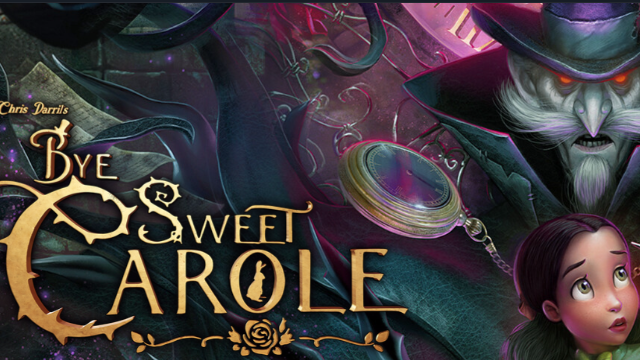
England, Anfang des 20. Jahrhunderts: Während die Frauenbewegung das Land aufrüttelt, verschwindet die junge Carole Simmons spurlos aus dem Waisenhaus Bunny Hall. Ihre Freundin Lana Benton macht sich auf die Suche und stößt dabei auf weit mehr als ein gewöhnliches Verschwinden. Das Waisenhaus wird von Kaninchen heimgesucht, und hinter seinen Mauern öffnet sich der Weg in das märchenhaft-düstere Reich Corolla. Die Geschichte ist das Herzstück des Spiels und lebt von der Mischung aus Zeichentrick-Märchen und Horror.
Optisch ist Bye Sweet Carole ein Ausnahmespiel. Jede Szene ist von Hand gezeichnet und wirkt wie aus einem klassischen Disney-Zeichentrickfilm. Man sieht in jedem Frame, wie viel Arbeit darin steckt, was in der heutigen schnellebigen Zeit bewundernswert ist.
Gespielt wird klassisch in 2D-Seitenansicht. Im Mittelpunkt stehen Rätsel, bei denen man oft Gegenstände und Hinweise miteinander kombinieren muss. Die Steuerung ist nicht die präziseste, passt für diese Art Spiel aber völlig.
Der Einstieg ist allerdings holprig. Man verliert anfangs schnell den Überblick, wo man was tun muss, und wird dabei auch noch von der bösen Köchin verfolgt und getötet. Ein etwas linearerer Start hätte geholfen, um in Spiel und Geschichte hineinzufinden. Trotz der wunderschönen Optik hat mich das Spiel emotional nicht richtig gepackt. Die Zwischensequenzen sind zwar meisterhaft stimmungsvoll umgesetzt aber irgendwie hab ich das im Gameplay nicht so richtig mehr gespürt.
Ein Wermutstropfen für Ultrawide-Nutzer: 3440×1440 wird nicht unterstützt, maximal sind 2560×1440 mit schwarzen Balken links und rechts bei einer UWQHD Auflösung möglich. Bei einem komplett handgezeichneten Spiel ist das aber nachvollziehbar.
Wer handgezeichnete Animation liebt und etwas Geduld für den holprigen Einstieg mitbringt, bekommt ein optisches Kunstwerk. Wer vor allem eine packende Geschichte sucht, wird vielleicht nicht ganz abgeholt.
von Hand gezeichnet, einfach nur schönlangsam wird es etwas gruseligHilfe, ich bin im Keller gefangen, wie komme ich hier raus?Zwischensequenz – Sturz aus großer Höhe
I love a different style and focus of wargame. A game that takes a look at an important but somewhat obscure or rarely addressed historical topic, such as espionage or intelligence, and creates a gaming experience tailored around the events to highlight and evoke the difficulties and tension that would have been present. In January 2026, GMT Games announced such a game in Checkpoint Charlie, which is a solo or cooperative game focused on SIS espionage missions in Berlin in the 1960’s designed by Russell Brown. We have posted an interview with Russel and it was very well received and he has now agreed to create a series of History Behind the Cards to highlight the events of the 1960’s Cold War struggle in West Germany but also to share aspects about the game play and how it models the history.
*Note: The cards highlighted in this series and their event text, as well as any pictures used showing any of the various components, are still in the design and development process and as such event effects and text might still change prior to final development and publication.Also the art and layout of the cards are only for playtest purposes at this point and the game will enter the art department as it nears publication.
History Behind the Cards – Checkpoint Charliefrom GMT Games – Card #10 Moscow Rules
“Moscow rules meant watch your back. London rules meant cover your arse.”
This quote from Mick Herron’s book, Slow Horses, may be what many people think of when the term Moscow Rules is used today, but there’s a bit more to it than that. Moscow rules were an unwritten set of procedures – spycraft protocols – to keep in mind when operating on the KGB’s home turf. Moscow Rules may have also been used as a cautionary declaration, a spy’s call to arms. In John Le Carrè’s spy novels, George Smiley lets his colleagues know that exceptional caution is warranted just by saying, “Moscow Rules.”
Moscow Rules could include communicating with extra caution, or in code. It could mean keeping a better eye out for someone following you, or being ready to defend yourself. But at its core, it meant that you were effectively operating in enemy territory and could no longer trust the people and places you once took for granted.
In Checkpoint Charlie, the Moscow Rules Event Card puts all of your assets on high alert, giving them a Tradecraft Marker if they don’t already have one. It also adds the Papers Item to the Mission, assuming that your assets dig deeper into their resources, perhaps pulling out old false identities reserved for emergencies. If you’re playing the campaign game, the Moscow Rules Card is not removed when it occurs, so it can show up on almost any mission.
In the next article in this series, we will take a look at ________.
In my opinion, this game looks extremely interesting and I am very much excited to learn more about it. I am appreciative to Russell and his efforts to bring us these cards and to write these entries to share with our readers. I am also very glad that this topic is being covered in a game and look forward to playing this one day soon.
Big month of games incoming! I was able to easily find games to share with you and I am excited for you to get this one in your inboxes. This month, I was able to find 37 games to share (including the 3 from our sponsor PHALANX and with 1 entry including 2 games), with 20 of those being newly announced pre-orders and 14 being new releases. I was also able to find 5 games being offered on Crowdfunding platforms Gamefound and Kickstarter.
Again this month, we have a sponsor for the Wargame Watch post in PHALANX, who is the maker of fantastic wargames such as U-BOOT, Hannibal & Hamilcar, Freedom!, Purple Haze, Total Domination, Iron, Blood, Snow and Mud,A Very Civil Whist, 1944: Race to the Rhine, Fire in the Sky and more. We have really never had a bad experience with any of their games and have really loved many of them!
They have a lot of great games upcoming and in the pipeline and are always developing new titles for pre-order or funding on Gamefound.
One of their more exciting recent offerings is a group of similar subject games set in the Pacific Theater of Operations during World War II. I personally love PTO wargames and these both look extremly interesting. These include 2 separate titles 1943: Race to Rabaul and Tora Tora Tora!. We did an interview with Volko Ruhnke who designed 1943: Race to Rabaul earlier this summer and you can check that out on the blog at the following link: https://theplayersaid.com/2026/06/15/interview-with-volko-ruhnke-designer-of-1943-race-to-rabaul-from-phalanx/
Both of these games are beautiful and look very good and you are in luck as both can still be pre-ordered on the Gamefound page listed in the interview or by clicking the picture to the right.
They also have Sovereign: Shōgun, which is a new game in the Sovereign Series that includes one of my favorites in Bretwalda. This game was funded on Gamefound earlier this year and is a massive undertaking with a ton of content and add-ons that can create a massive game, both in its playability and replayability as well as its options for players. You can also still pre-order on the Gamefound page by clicking the picture below.
They have several other projects in the works including Independence, Saga, Lords of the North, Dust in the Wind and Lords of Heaven all planned for near future pre-order/crowdfunding campaigns or fulfillment.
One more thing before we get to this month’s games. Bill Molyneaux does this fundraising calendar of the Battlefield museums and historical sites on the East Coast for Toys for Tots and I wanted to share that with you so you can look at buying one.
1. The Great Escape from Sound of Drums Currently on Gamefound
If you like historical themed games that focus on challenging objectives, cooperative play and teamwork then I have a great game to introduce you to this month. I have known about this game’s existence for a while now. In fact, I saw a prototype last fall while attending Spiel Essen, but recently it was officially announced on Gamefound with a campaign kickoff of October 20th. The game is called The Great Escape and is designed by Philip duBarry, the designer of one of my favorite cooperative historical games in Black Orchestra. The Great Escape is based on a true story and shares the account of the escape attempt by Allied soldiers from the infamous Stalag Luft III POW Camp during WWII. The game is a cooperative or solitaire experience for 1-5 players and is just beautifully produced.
From the game page, we read the following:
On the moonless night of March 24, 1944, Allied prisoners emerged from a tunnel ending outside the fence of Stalag Luft III. They silently crawled the remaining feet over frozen ground to the cover of the surrounding forest. The men who escaped wore carefully-tailored civilian clothes and carried suitcases, intricate identification papers, German money to purchase train tickets, and several days of food.
76 prisoners escaped before the German guards sounded the alarm. A furious effort to recapture the prisoners ensued, and all but three were found. In an unprecedented move and in clear violation of the Geneva Conventions, Hitler ordered 50 of the recaptured prisoners to be secretly executed. The escape cost the Germans hundreds of thousands of man hours and countless resources meant for the war, delivering a devastating blow to German morale.
Now the wire waits again. The ground is stark and cold, the guards are watchful, and the forest beyond the fences offers both salvation and deadly risk. Will you dig far enough, plan carefully enough, and seize the right moment before the alarm sounds?
Behind the barbed wire of Stalag Luft III, time is measured in whispered plans, and the constant threat of discovery. In The Great Escape, you and your fellow Allied air force officers must organize the camp, gather scarce materials, craft civilian clothes and forged papers, dig secret tunnels beneath the perimeter, invent ingenious devices, and carefully time your escapes—all while guards conduct ever-more-ruthless searches and the Gestapo tightens its grip. Draw on the unique skills of legendary officers, trade with compromised guards, execute daring Escape Plans, and keep the tunnels hidden. Every action risks drawing Trouble. If the Gestapo locks down the camp before twelve soldiers slip into the forest under cover of night, the attempt has failed. Outsmart the search parties. Carry on the war from behind the wire. Help twelve men escape, and you will have struck a blow that echoes far beyond the fences of Stalag Luft III.
The Great Escape is a cooperative board game for 1–5 players, designed by Philip duBarry. Play time is 60–90 minutes and is recommended for ages 12 and up.
As of November 1st, the Kickstarter campaign has funded and raised €34,416 ($38,601 in US Dollars) toward its €12,500 ($13,942 in US Dollars) funding goal with 598 backers. The campaign will conclude on Monday, November 9th at 6:00pm EDT.
2. Fix Bayonets! Volume III: 1806: Auerstädt from Tactical Workshop Currently on Gamefound
Last year, I became aware of a new edition of a very interesting looking Napoleonics game series called Fix Bayonets! designed by Frederic Delstanches. That game was 1811: Albuera Second Edition from Tactical Workshop, which was originally released in 2020. Since that time, Frederic has been busy and designed the 2nd volume in that series called 1809: Talavera. Due to the success of these efforts, Tactical Workshop now is embarking on a new project in the series called 1806: Auerstädt that covers the Battle of Jena–Auerstädt fought on October 14, 1806, near Jena and Auerstädt, Germany being the decisive engagement of the War of the Fourth Coalition.
From the game page, we read the following:
1806: Auerstädt is a tabletop wargame that allows you to recreate this astounding asymmetrical battle of the War of the Fourth Coalition, face to face with another player or as a solitaire experience.
Take command of the French III Corps under Maréchal Davout, one of Napoléon’s best commanders, and attempt to reproduce his astounding victory against a vastly superior force! If you like a challenge, you can instead lead the Prussian Royal Army and rewrite history, overcoming your poor leadership and frail morale, by overwhelming an opponent half your size with your mighty manpower and cavalry superiority.
I want you know the backstory of this new boutique publisher and will share that here:
Tactical Workshop is a small, family owned and operated entity that started as non-profit and that we expanded into a small business last year with the success of 1811: Albuera. We are established as a LLC in Orlando, Florida and have an antenna in Yokohama, Japan. We started using the “print on demand” model in 2019 by publishing play aids for various other games then designing our first two boxed games: 1811: Albuera and 1810: Bussaco. Despite good reviews, the games were not selling well due to the very high prices required by the model. The only way to expand was to produce our games using a professional game printer. We successfully launched and funded 1811: Albuera Second Edition in 2025 and 1809: Talavera here on Gamefound. This is our third professionally printed game in the series.
I own the first 2 volumes in the series, and while I have yet to play them because we just received them, I can attest to the production quality and the great amount of components that come in the box.
As of November 1st, the Kickstarter campaign has funded and raised $8,553 toward its $6,000 funding goal with 145 backers. The campaign will conclude on Monday, November 30th at 12:00am EDT.
3. Aces & Armor – Spitfire: Battle of Britain & North Africa from PKB Games Currently on Kickstarter
A few years back, we backed a very interesting looking miniatures based board game set in World War II called Aces & Armor from PKB Games. We played it last year and very much enjoyed the combat system as well as the way units gain experience and become more effective. That game did very well on Kickstarter and PKB Games is back with a new addition to the series called Aces & Armor – Spitfire: Battle of Britain & North Africa that is currently on Kickstarter.
From the game page, we read the following:
Aces & Armor – Spitfire: Battle of Britain & North Africa is a tactical World War II strategy game set across Britain, France, and the North African desert. Players command combined forces of aircraft, tanks, and infantry, including iconic units such as the Supermarine Spitfire, and must use the strengths of their different units and the battlefield terrain to their advantage.
During the game, players maneuver their forces, engage enemy units in combat, and develop experienced units over the course of the battle. Combat takes into account factors such as unit type, attack strength, armor, damage, experience, formation, and terrain, making the positioning and composition of an army an important part of each engagement.
I think that the most interesting part of this new entry into the Aces & Armor Series is the ability to play this entry with the original.
Spitfire can be played as a standalone game for one or two players, or combined with the original Aces & Armor to create larger battles with up to five players. Players compete or cooperate according to the chosen scenario, and win by completing its specified victory objectives before the opposing side does.
The production is also top notch and the miniatures are very well done. I will add here that there is an option to have them pre-painted so they will look that much better.
As of November 1st, the Kickstarter campaign has funded and raised $184,526 toward its $11,172 funding goal with 1,035 backers. The campaign will conclude on Thursday, November 12th at 2:59am EST.
4. Dragon Ships & Iron Knights: Three Battles from the Year 1066 from Legion Wargames
I have always loved the games that come from small boutique publisher Legion Wargames. Their offerings are always on interesting and lesser gamed topics and they always seem to have great looking art as well. I also know that when I buy one of their games, I am supporting a great guy in owner Randy Lein and also the stable of great designers that they have relationships with. This month, I saw a new pre-order game offered in their Customer Pre-Order Program called Dragon Ships & Iron Knights:Three Battles from the Year 1066, which takes a look at 3 separate battles in England and Scotland that had major impacts on the course of those countries. The game is designed by Norm Smith and is a hex and counter game that appears to be more on the tactical level.
From the game page, we read the following:
Dragon Ships & Iron Knights is set of three, 2-player, tactical level wargames covering the battles that shaped the future of England for centuries to come. The game includes the following battles:
The Battle of Hastings
The Battle of Stamford Bridge
The Battle of Gate Fulford
Each battle includes its own map and rulebook and comes with 3 maps measuring 17″ x 22″, 3 sheets of unit counters/markers and 3 player aids.
If you are interested in Dragon Ships & Iron Knights: Three Battles from the Year 1066, you can pre-order a copy for $53.00 from the Legion Wargames website at the following link: https://www.legionwargames.com/legion_DGS.html
5. Traces of Tunisia from VUCA Simulations
This month we get 2 new pre-order games from VUCA Simulations. The first of these is Traces of Tunisia and I am always in the mood for a good North African Theater wargame. The games I have played on this theater are always very, very good and I love the struggle with the harsh North African terrain and the importance of supply. Traces of Tunisia is a part of the Traces of Series of operational level wargames that have included titles such as Traces of War, Traces of Hubris and Traces of Victory. This system works really well and is a chit-pull activation system that keeps you on your toes and always fretting over the order of the chits during any given round.
From the game page, we read the following:
At the conclusion of the North African campaign, German and Italian forces found themselves squeezed into the mountainous, canalized terrain of Tunisia. Facing advancing Anglo-American and Free French forces from the west and British veterans from the east, the Axis fought a desperate campaign of operational counter-strikes and delaying actions to hold the Mediterranean gateway.
Traces of Tunisia puts you in command of this critical operational struggle.
Take control of the Axis bridgehead forces or the Allied armies in a tense operational-level game of command activation, logistics tracing, and maneuvering across compartmentalized terrain.
Allied player: Coordinate multinational forces, leverage expanding air power, manage supply lines, and push rapidly toward Tunis and Bizerte before time runs out.
Axis player: Utilize inner lines, mount dangerous armored counter-offensives, destroy infrastructure, and prolong the campaign to deny the Allies an early springboard into Europe.
Every decision matters—overextend into mountain choke points without logistics, and your spearheads will be isolated; hesitate, and enemy air superiority will paralyze your operations.
The game is designed for fans of Operational level wargames, WWII North African history, chit-pull activation systems and players who value clarity of rules combined with strong thematic immersion.
6. Gateway to Falaise – Caen-Normandy 1944 from VUCA Simulations
The 2nd new pre-order game offered this month from VUCA Simulations is another dandy. The first thing that caught my eye was the beautiful yet simple cover and the way that the smoke and other elements form a camouflage pattern. Just gorgeous! The game is called Gateway to Falaise: Caen-Normandy 1944 and is a part of the Formation Series. The game is designed by Andrew Glenn.
From the game page, we read the following:
Following the D-Day landings, the Allies faced a desperate, grinding war of attrition in the bocage and open fields of Normandy. To break the deadlock and trap the German forces, the British, Canadian, and Allied forces launched a series of high-stakes operational pushes aimed at capturing the strategic hubs of Caen and Falaise.
Gateway to Falaise puts you in command of this crucial campaign—the second installment in the Formation Series.
Command the Allied forces attempting to smash through entrenched defenses, or take control of the German defenders fighting desperately to hold the line and delay the Allied advance.
Allied player: Plan concentrated armored and mechanized pushes, deploy massive artillery and air support, navigate restrictive terrain, and strain the Axis defenses to force a complete breakout.
German player: Utilize superior tactical positions, manage precious armor and elite formations, execute timed counterattacks, and inflict maximum casualties to stall the Allied momentum.
Every decision matters—overextend into prepared anti-tank zones, and your spearhead will be wiped out; hesitate, and the opportunity to trap the enemy slips away.
Built on an engaging formation-based system, the game balances strategic planning with operational friction:
Dynamic formation activation keeps both players constantly engaged and simulates the uncertainty of command.
Combined arms warfare seamlessly integrates infantry, armor, engineering assets, heavy artillery, and air/naval support.
Fast-resolving combat maintains high tension while reflecting realistic unit attrition and tactical consequences.
Streamlined operational rules allow for swift gameplay without sacrificing historical depth.
7. Eagles of 1807 – Volume I: Winter from Fellowship of Simulations
A good Napoleonic wargame is always welcome at my table. The grandiose uniforms, fantastic cavalry charges, focus on experience of soldiers and the like are what I have always thought of first when I think about the subject. Fellowship of Simulations has a new offering this month that is a part of their Eagles of France Series called Eagles of 1807 – Volume I: Winter. This game focuses on 3 major engagements during the winter of 1807 including Pultusk, Golymin and Eylau.
From the game page, we read the following:
The Eagles of France Series is back in force! This master box covers 3 battles. Pultusk and Golymin: December 26th 1806, the two armies are struggling in a sea of mud. They collided in two locations. At Pultusk, Lannes engaged a larger force. At Golymin, the Russians played a delaying action.
Then came Eylau and the bloodbath in the snow.
The game includes these 3 battles, including historical variations and what ifs.
In addition, the full order of battle of both armies for winter 1806 is available. This will allow even more flexibility to test alternative scenarios. Also, unused counters might be used for future expansions with additional battles.
If you are interested in Eagles of 1807 – Volume I: Winter, you can pre-order a copy for €99,00 ($110.29 in US Dollars) from the Fellowship of Simulations website at the following link: https://www.fsimgames.com/en/eagles-of-1807-winter-box/
8. Peace 1905: Ending the Russo-Japanese War from Fort Circle Games
In 2023, while attending SDHistCon in San Diego, we sat down with Maurice Suckling to get a look at his new game called Peace 1905: Ending the Russo-Japanese War from Fort Circle Games. We have enjoyed many of Maurice’s designs including Hidden Strike: American Revolution, Chancellorsville 1863, 1565 Siege of Malta and Crisis: 1914 and very much enjoy how his mind takes a historical event and wraps mechanics around it to create an experience that helps players in understanding the situation. Peace 1905 deals with the negotiations between the Japanese and Russians at the end of the Russo-Japanese War. The game was very good and plays in about 30-45 minutes.
From the game page, we read the following:
By August 1905 the Russo-Japanese War had been raging for 18 months, with over a million soldiers, sailors, and engineers in arms, it had cost the lives of between 100,000 to 200,000 participants and brought death and destruction to civilians. The war had seen the sinking of the Russian Pacific and Baltic fleets, and the great sieges at Port Arthur and Mukden. The world was shaken by the emphatic rise of Imperial Japan as a land and naval power. Russia had been blooded and humiliated.
But Russia was not yet done. Although both sides were financially exhausted it was Russia who continued to funnel troops into the war, while Japan’s manpower reserves were depleted. The war might yet continue, with further loss of life and property, and protracted instability in the Far East. With this would come the risk of further Russian humiliation. Both sides needed a way out. The door to that way out was opened by US President Theodore Roosevelt when he invited delegations of both sides to Portsmouth, New Hampshire – to a peace conference through August 1905. But with the sides so far apart on numerous key issues – the Russian Czar had stipulated no territorial concessions or reparation payments, and the Japanese Emperor wanted exactly those things and much more – what real hope was there that both sides could find a mutually satisfactory resolution?
In history, the answer is found in the Treaty of Portsmouth, a complex and significant diplomatic achievement, for which, for his part in facilitating and assisting, President Roosevelt was the first American to receive the Nobel Peace Prize. In Peace 1905, you – the players – will have Roosevelt’s assistance, but the work of successfully negotiating is down to you. Will you end the war, and bring a peace your governments approve of, or will the conference end in failure, and the war ignite again?
Here is a link to our interview with Maurice Suckling designer of Peace 1905 from Fort Circle Games during our trip to SDHistCon in 2023:
If you are interested in Peace 1905: Ending the Russo-Japanese War, you can pre-order a copy for $60.00 from the Fort Circle Games website at the following link: https://www.fortcircle.com/peace-1905/
9. Commands & Colors: American Civil War from GMT Games
The Commands and Colors Series is a simplified and introductory wargaming system designed by Richard Borg. The system is fairly simple and uses a deck of Command Cards, which can be classified as Section cards and Tactics cards, that are used to take actions with various groups of units on a hex board that is divided into 3 sections, including the Left, Center and Right. There are also custom Battle Dice that represent hits, retreats and special actions. The units on the field of battle are made up of figures or blocks. The series have volumes representing various different historical periods, including both modern and ancient, and I have found that there is something to like in the series for anyone’s taste. We have played every volume in the series and very much had a good time with the series and its mechanics. It is just a very solid and easy to play system for new wargamers and old. Recently, GMT announced a new entry to the series focused on the American Civil War called Commands & Colors: American Civil War designed by series mastermind Richard Borg.
From the game page, we read the following:
By design, Commands & Colors: American Civil War is not overly complex. Although this version does have slightly more detail than its earlier brothers, the Classic Battle Cry board game from 1999 or Battle Cry 150th Civil War Anniversary Edition released in 2010, yet at its heart, the game is still not overly complex. If you are already familiar with the core game from one or both of these earlier editions, you will recognize most of the rules and game play. Yet, over 25 years since the original design, we have taken the opportunity to once again enhance the game’s historical feel in order to immerse players even more fully in the experience of moving and fighting troops on a stylized American Civil War battlefield.
The game is based on the highly successful Commands & Colors game system, where the Command cards drive movement while creating a “fog of war,” and the battle dice resolve combat quickly and efficiently. Commands & Colors: American Civil War, however, introduces a number of new game concepts and has slightly modified some rule sections, all of which will add additional historical depth. All these enhancements plus the new deck of Civil War Combat cards will provide even the most veteran Battle Cry player with many new play experiences and challenges.
The scale of the game fluctuates, which allows players to effectively portray some of the larger American Civil War battles, as well as smaller size skirmish actions. In some scenarios, an infantry unit may represent an entire brigade, while in others a unit may only represent a few companies of soldiers. Still the tactics of the period that you will need to execute to gain victory conform remarkably well to the advantages and limitations inherent to Civil War Armies of the day and the battlefield terrain features on which they fought.
The battles showcased in the core game scenario battle booklet feature a stylized battlefield map that emphasizes the important terrain features and highlight the historical deployment of forces in scale with the game system. There are 70 new scenarios that complement the group of updated 30 Battle Cry scenarios previous presented.
A word of advice, if I may be so bold. Even the previously-presented scenarios, now with the rule updates and a new deck of combat cards, are totally worth revisiting.
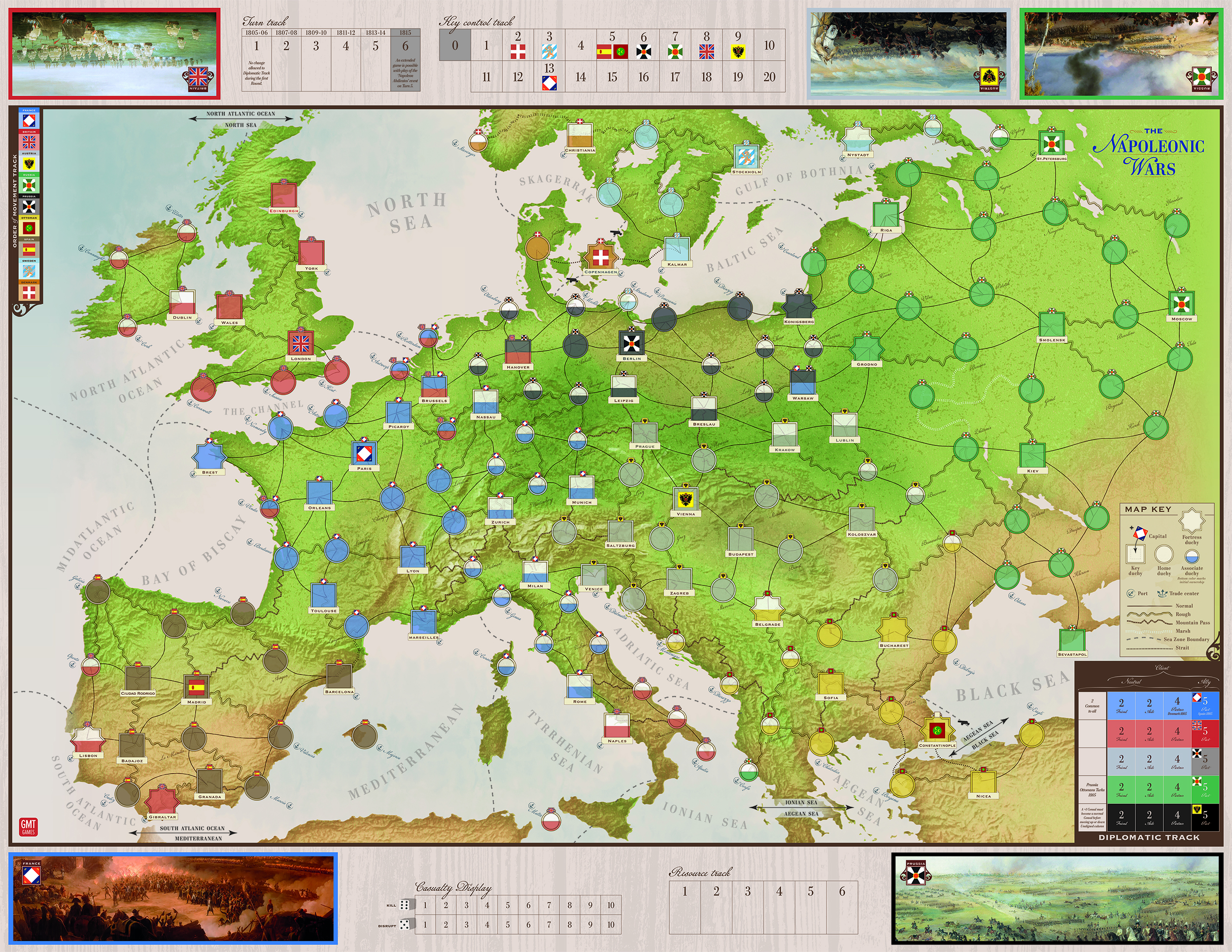
10. The Napoleonic Wars 25th Anniversary Edition from GMT Games
Over the past couple of years, GMT Games has had a focus on bringing back and upgrading several of their most classic games in either Deluxe Editions or the Anniversary Editions. These are not just straight reprints and typically involved new and upgraded components, cover art, board art and rules changes, corrections or upgrades. I own and have played several including For the People 25th Anniversary Edition, SPQR Deluxe Edition and Silver Bayonet 25th Anniversary Edition. These volumes are a great way to get older classic and out of print wargames back into the hands of players both old and new. Recently, GMT announced their newest Anniversary Edition; The Napoleonic Wars 25th Anniversary Edition designed by Mark McLaughlin.
From the game page, we read the following:
The first edition of The Napoleonic Wars was published in 2002. A second edition was published six years later and a double-sized, two-cardboard-map was made available in between. Now, thanks to the tireless work of developer Gareth Williams, who GM’ed the WBC tournament for over a decade, we are ready to bring you a 25th Anniversary Edition that will put an exclamation mark on this game’s history.
Over two hundred competitive games have been analyzed to give birth to what will be the 3rd edition of the rulebook. Likewise, about a third of the cards have been edited for clarity or balance. Six brand-new cards were also added. What hasn’t changed though is the possibility to relive the epics of Napoleon’s conquests at a strategic level with up to five players, each trying to carve up a place for their nation when 1815 comes around or when the infamous Peace Roll succeeds!
A complete graphics redesign by Wouter Schoutteten brings the game to modern standards. We are pulling out all the stops and making no compromises to production quality. The goal has always been clear: this is a deluxe edition, not an overpriced collector’s edition. We want each and every one of you to be able to enjoy this Mark McLaughlin classic at its best.
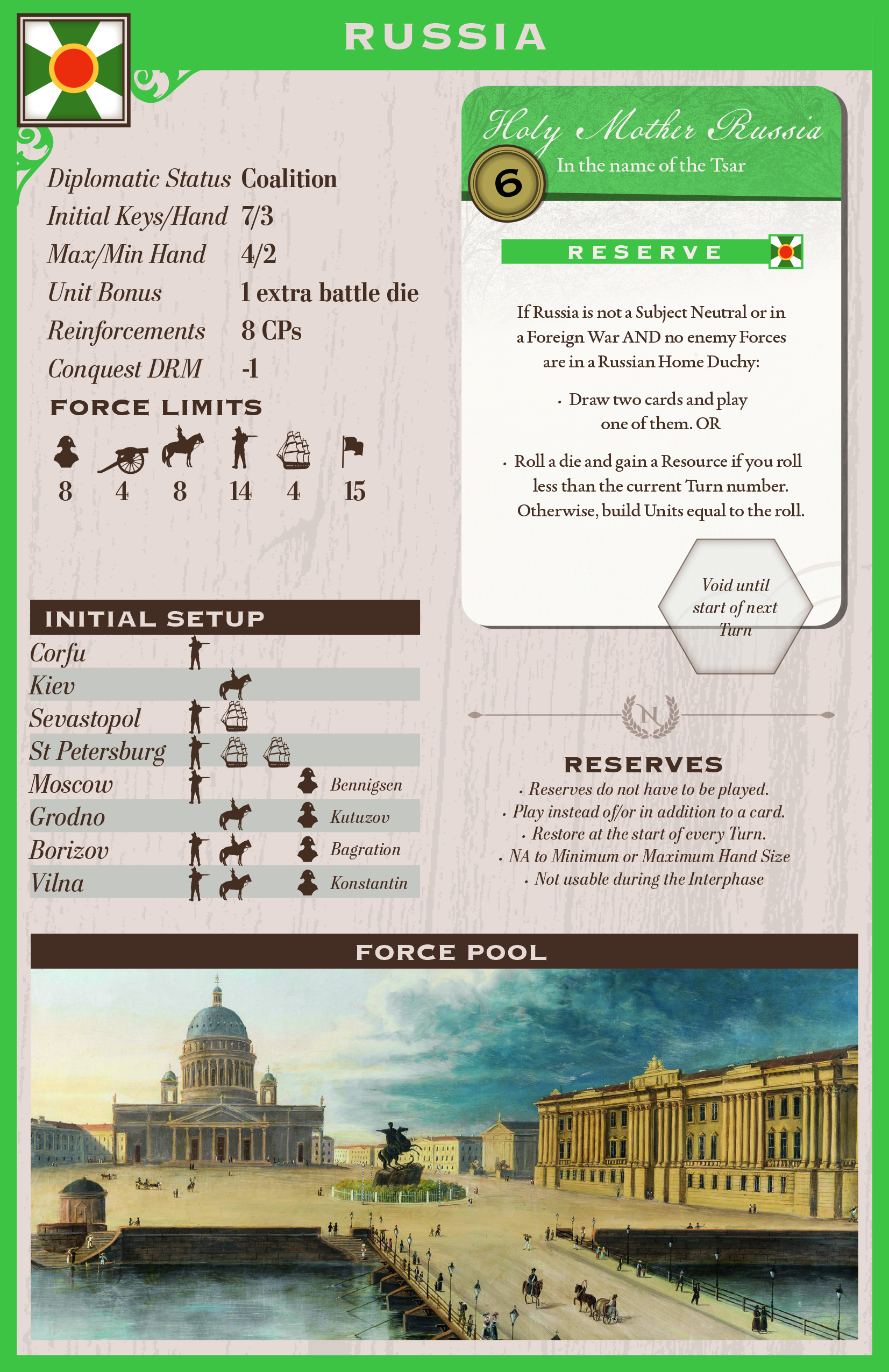
The HQ Displays now include a setup visual aid on the back. Each also features a force pool with a painting of their nation’s capital, to remind players of what they are ultimately defending!
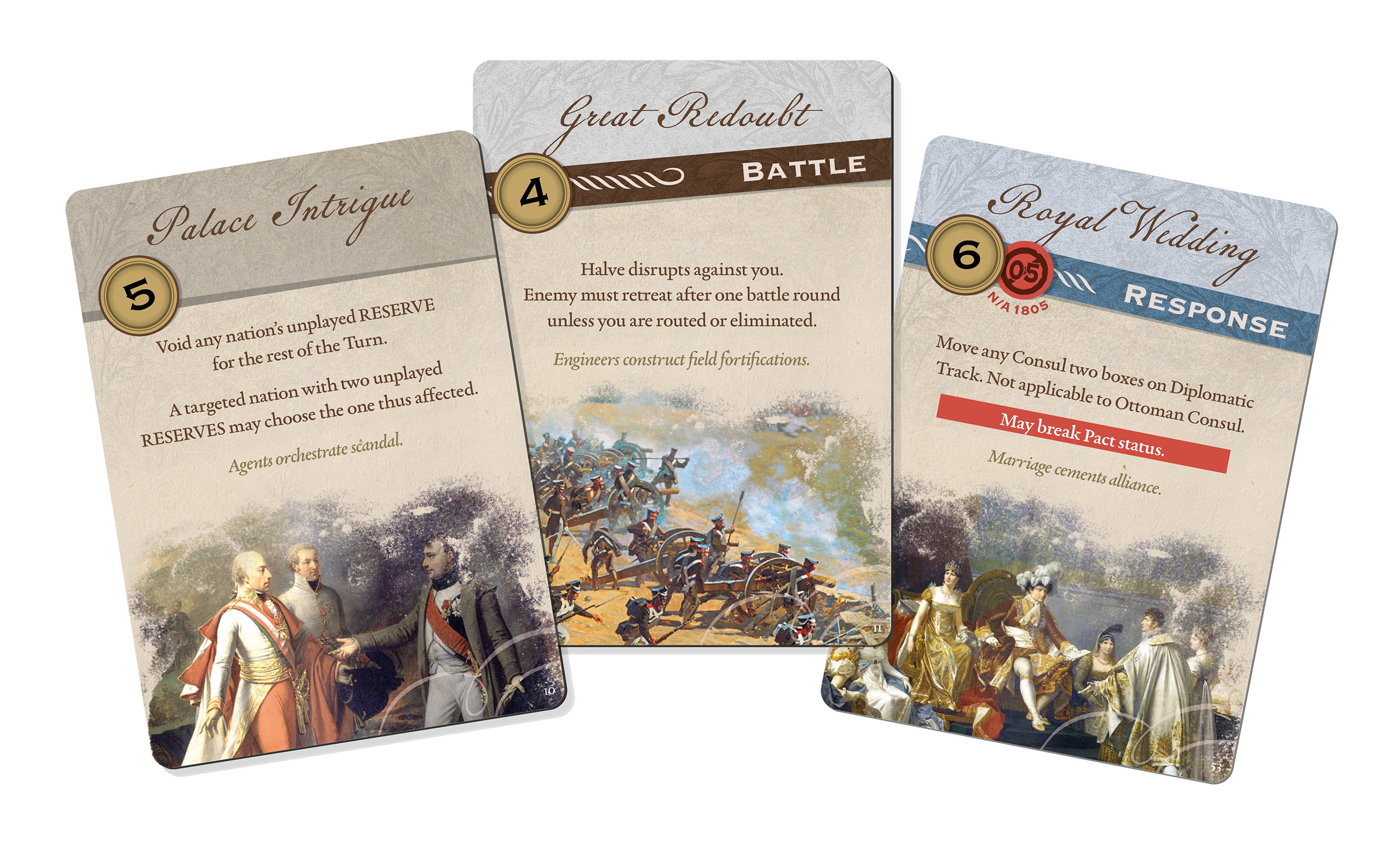
While the black and white had its charm, cards now feature full-color artwork from the painting masterpieces of the era.
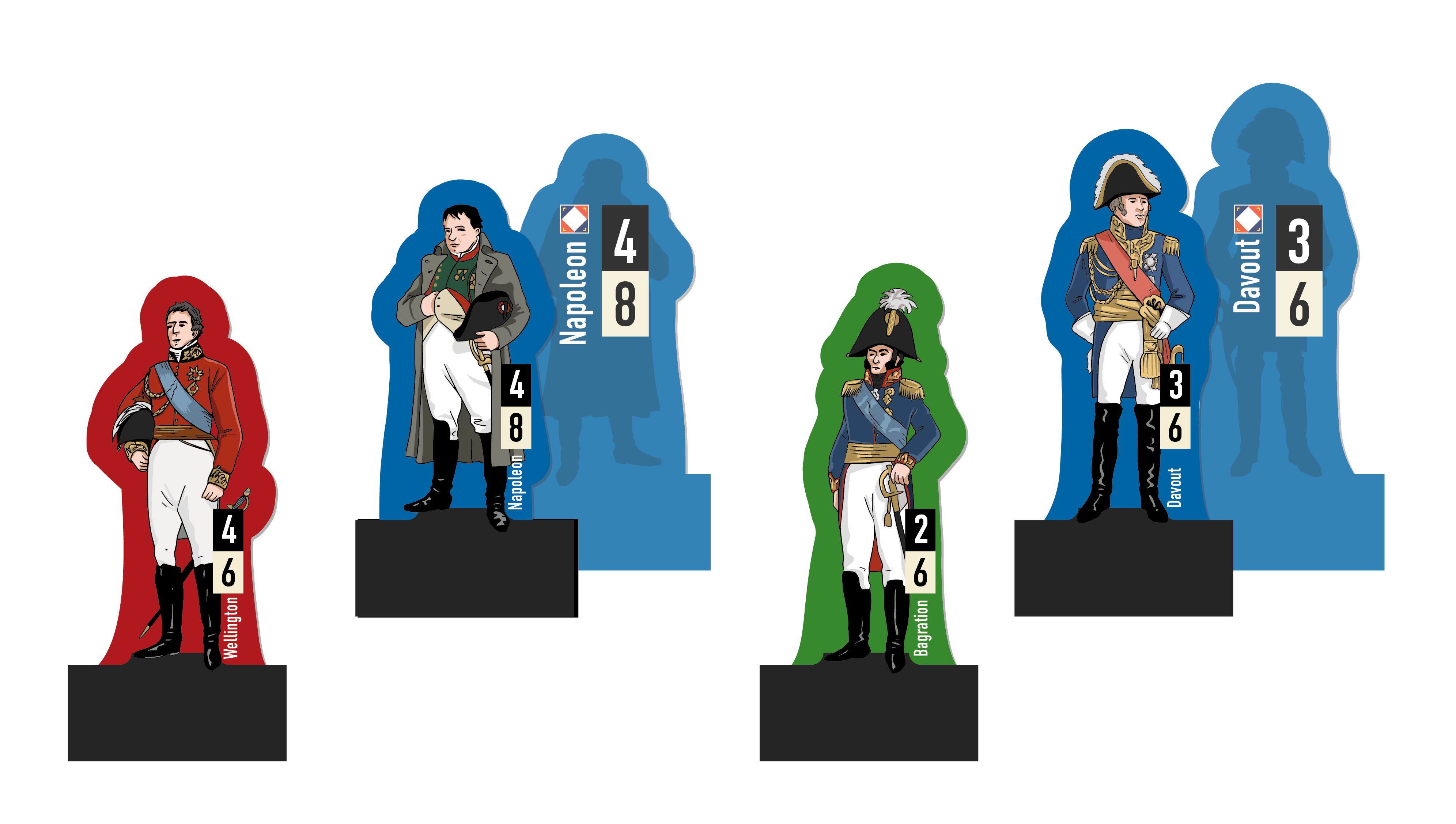
Nine major leaders such as Blücher, Davout and Bagration join Napoleon and Wellington in having a unique portrait for both their counter and standee. Oh and these leader standees will now be custom-cut!
Whether you’re a veteran of The Napoleonic Wars or you have been waiting a long time for us to reprint it, don’t miss out on your chance to get this acclaimed multiplayer game! Hours of fun await rewriting history!
I am truly impressed by this version of an Anniversary Edition and very much look forward to seeing it in real life. We have played this game once and very much enjoyed it although the balance seems a bit questionable in my mind as France, understandably, is very powerful.
11. Commands & Colors: Ancients Expansion 1: Greece & Eastern Kingdoms 4th Printing from GMT Games
This is the 2nd entry that deals with the Commands & Colors Series and is just a straight reprint, with known errata included as well. And any wargame has made it to 4th Printing should tell you something about the quality of that game. Commands & Colors: Ancients Expansion 1: Greece & Eastern Kingdoms 4th Printing is the next entry in the venerable series to get another reprint and Ancients is one of my favorite entries.
From the game page, we read the following:
Some of you have already discovered that Commands & Colors: Ancients is much more than a game. It is an expandable game system that allows players to fight a host of historical Ancient battles.
The Greeks & Eastern Kingdoms is the first expansion to Commands & Colors: Ancients. The armies of Philip, Alexander and the Successors meet the hosts of Persians, Scythians and Indians to the east. In this expansion, you will find historical scenarios that focus on the hoplites of classical Greece fighting off the invading Persian army at Marathon and Plataea; epic battles from the Peloponnesian War, the rise of Macedon and Alexander’s battles of Gaugamela, Issus and Granicus against the Persians; and battles involving Alexander’s successors. With your Greeks you will be able to turn west and battle the Carthaginians in Sicily, or as King Pyrrhus at Heraclea and Ausculum, battle the Romans.
In this first expansion, we showcase over 20 scenarios (the package includes over 300 new unit blocks and stickers you need to fight out these battles). Now, that is a lot of history, but we can do this because Commands & Colors: Ancients is, by design, a unique historical game system that will allow players to effectively portray stylized Ancient battles that play to a conclusion in less than an hour.
The battle dice resolve combat quickly and the command cards provide an element of luck that creates a fog of war and presents players with both challenges and opportunities for victory. Yet the tactics you need to execute conform remarkably well to the advantages and limitations inherent to the various Ancient units, their weapons, terrain and the history.
12. Commands & Colors: Napoleonics Expansion 1: The Spanish Army 5th Printing from GMT Games
My favorite volume in the Commands & Colors Series is C&C: Napoleonics hands down. I think that the reason for this is the unit variety represented in the game as well as the various extra army expansion packs that were released after the base game came to market. The 2nd Commands & Colors Series reprint offered this month is Commands & Colors: Napoleonics Expansion 1: The Spanish Army 5th Printing
From the game page, we read the following:
The Spanish Army is the first expansion for Commands & Colors: Napoleonics.
At the time of the Napoleonic Wars, Spain was only a shadow of its former power. Spanish troops and leaders, as many Napoleonic historians point out, performed badly on a large number of occasions. Yet there are a number of battles, Bailen, Tamames, Alcaniz and San Marcial where the Spaniards fought valiantly and gained victory. Ironically, the point most historians overlook is the fact that the Spanish armies constituted a threat that the French simply could not ignore. As good as Wellington’s Anglo-Portuguese field army was, that army faced multiple French armies. They could only defeat one French army at a time. The Spanish Armies and the accompanying guerrilla warfare against French troops tied down the remainder, allowing the Anglo-Portuguese army to ultimately emerge victorious.
In this expansion you will find 18 historical scenarios that focus on Peninsular battles fought by the Spanish army from 1808 to 1813, plus all the new units you’ll need to field for these engagements.
1808
Bailén – July 19 1808 Zornoza – October 31, 1808 Gamonel – November 7, 1808 Espinosa – November 11, 1808 Somosierra – November 30, 1808
1809
Medellin – March 28, 1809 Alcaniz – May 23, 1809 Maria – June 6, 1809 Talavera (Spanish Flank) – July 28, 1809 Tamames – October 13, 1809 Ocano (Cavalry Action) – November 18, 1809 Ocano – November 19, 1809 Alba de Tormes – November 28, 1809
1811
Barrosa (French Attack) – March 5, 1811Albuera – May 16, 1811
1813
Vitoria (Hill’s Attack) – June 21, 1813 San Marcial – August 31, 1813 Ordal Cross – September 13, 1813
The quality of Spanish troops varied, from very poor to good, and the Spanish National Unit Reference Card presents a wealth of subtle unit characteristics that set the Spanish Army apart from all other Coalition armies that opposed Napoleon. Command of the Spanish Army, therefore, will truly challenge even the most experienced Commands & Colors: Napoleonics player.
13. Labyrinth 3″ Game Box 2026-27 Reprint from GMT Games
One of the problems with a successful game series is the concept of growth. As a game does well, and more and more copies are sold and the buzz continues to build and grow, the inevitable happens and expansions come out for that game. These expansions not only add new and interesting mechanics and content to an already great game but they add stuff that you must store in the game box. And this stuff can multiply and get out of hand really quickly outgrowing the box that the original game was published in. Such is the case with Labyrinth as it has now had 2 published expansions, including The Awakening and The Forever War, and about a year ago we got the 3rd expansion The Rise of Al-Qaeda announced. 3 game expansions will add up and will not fit into the 2″ original box. So, GMT has offered a reprint of their Labyrinth 3″ Game Box on P500…and the price is very, very affordable.
From the game page, we read the following:
We’ve listened to those of you who asked us to put the Labyrinth 3″ Box back up on the P500 list to help you with storage of the game’s modules. So to accomodate you, and all those players who own earlier editions of Labyrinth and would like to get a deeper box, we are now reprinting a 3″ deep box via P500.
14. SCSDrive on Kharkov: Gallop, Star and the Backhand Blow from Multi-Man Publishing
One of my favorite hex and counter wargame series is the Standard Combat Series from Multi-Man Publishing. The series is a classic with simple rules, typically 6-10 pages of exclusive rules, solid move and fight mechanics and good solid design that always creates and fun and interesting way to take a look at operational level wargames typically set in World War II. We have played about 8 of the games in the series and own many more but it is a staple on our shelves and recently MMP announced the newest volume in the series called Drive on Kharkov. Drive on Kharkov takes a look at 3 separate but related battles on the East Front including the Soviet twin offensives, Operation Gallop and Operation Star, as well as the German counter-offensive referred to as von Manstein’s “Backhand Blow”. Once announced, I couldn’t mash the pre-order button any quicker and you should do the same.
From the game page, we read the following:
Drive on Kharkov is a Standard Combat Series (SCS) game covering the Soviet twin offensives, Operation Gallop and Operation Star, as well as the German counter-offensive (von Manstein’s “Backhand Blow”) that ended the Soviet winter offensive of 1942-43. Intended to cut off retreating Axis divisions in the south and capture Kharkov and the Donbas region, Operations Gallop and Star initially met with good success. However, the hasty nature of the offensives coupled with a poor supply situation slowed progress, and the Axis forces recovered and finally unleashed a counteroffensive that retook substantial ground and set the stage for Kursk, the last Axis offensive on the Eastern Front.
The game covers this pivotal post-Stalingrad dueling offensives at the operational scale. Each turn represents 2-3 days. Each hex is 5 kilometers wide. Soviet units are generally brigades and regiments with cavalry divisions. Axis units are mostly battalions with a few Kampfgruppen (KG) and regiments.
Game specific rules include HQs at the Soviet Army and German Corps level, artillery and air strikes, divisional refits, and mud that hampered operations late in the campaign. This famous battle comes alive with SCS where you can see if you can do as well as a Field Marshal von Manstein or Colonel General Vatutin.
If you are interested in SCSDrive on Kharkov: Gallop, Star and the Backhand Blow, you can pre-order a copy for $45.00 from the Multi-Man Publishing website at the following link: https://mmpgamers.com/drive-on-kharkov-p-471
15. BCS The Breaking Point: Battle of France and Belgium, May, 1940 from Multi-Man Publishing
As affectionate as I am about the Standard Combat Series, I may have a greater love for the Battalion Combat Series as the scale of the game and the way it integrates and connects positioning and supply into the results of combat is just superb. And those dreaded SNAFU Rolls that will get you if you don’t watch out or if you push your troops too far. MMP also announced a new entry to this series called The Breaking Point: Battle of France and Belgium, May, 1940
From the game page, we read the following:
The Breaking Point is a Battalion Combat Series (BCS) game depicting the critical point in the Battle of France. The Phoney War between France and Germany ended abruptly when panzers raced through the Ardennes Forest. France replied, executing their Dyle Plan, by advancing into their neighboring neutral countries to meet the threat . Believing it would take the Germans a week to cross the wooded and rough terrain, the French advanced their reserves hoping to form a cohesive defensive line. The Germans emerged from the Ardennes in two days, setting up a race to the Meuse River. Who will get there first? Will the French arrive in force and stop the enemy from crossing? Will the Germans vault over the river into the French heartland? The decisions and actions ultimately decided the fate of France and Belgium.
The game covers this unique and often misunderstood campaign in splendid detail. Not just focusing on Sedan where Guderian crossed, the game covers the length of the main German drive. It spans from the armored feint north of the Meuse River leading to the biggest tank battle to date at Hannut; to the crossing at Dinant where Erwin Rommel’s initial exploits were demonstrated; to Monthermé where a panzer division was held up by French Colonial troops; and finally to Sedan the French finally met its breaking point leading to the struggle for Stonne, and ultimately the breakout to the English Channel. Game specific rules capture important aspects like bridge blowing, bridge construction, tank breakdowns, Dyle Defensive Plans, and French Battle Doctrine. The intent is to reflect the historic capabilities and limitations of both sides without heavy handed rules or one built on myths.
Extensive research was done, including original French and German sources, to correctly depict the forces involved as well as how each sides’ doctrines drove how they could be used effectively. The French and Belgians fought bravely and were executing a post-WWI defensive strategy. This was compared to the dynamic tactics of the Germans, where brashness and sometimes outright insubordination wasn’t necessarily the winning factor, but rather luck. This fascinating and complex campaign can be explored by players in the way that only BCS can show.
If you are interested in BCS The Breaking Point: Battle of France and Belgium, May, 1940, you can pre-order a copy for $90.00 from the Multi-Man Publishing website at the following link: https://mmpgamers.com/the-breaking-point-p-472
16. Until the Bitter End 3 Print ‘n Play Wargame from Matt White Currently on Kickstarter
Several years ago, we posted an interview with Matt White, who is a very talented graphic artist and budding game designer, that focused on his artistic talents and love of tanks. He has since designed several very interesting small scale print and play wargames, with his most recent series being a World War II tactical wargame series for 1-2 Until the Bitter End. He has had multiple entries in the series including British Airborne versus the German Wehrmacht called Until the Bitter End, Until the Bitter End – US Airborne and Until the Bitter End – Tanks. His most recent offering in the series is called Until the Bitter End 3 and is currently being crowdfunded on Kickstarter.
From the game page, we read the following:
Welcome to Until the Bitter End 3, a World War 2 wargame. This is the third and latest game in the series and a print and play game for solitaire and two-players. This is a standalone game in my series of WW2 print and play games. You don’t need to have played the first games – everything is included (you simply need to print it all out and need a regular six sided dice and a pencil).
The game is quick to setup and play, it takes around 30 minutes to play a game and requires very little space.
Example of the game setup ready to play – one of the smaller scenarios on just one map, with only a few counters needed.
The game sets a small squad of American Airborne against their German enemies in a series of small skirmish scenarios. The game’s counters (or chits) each represent an actual soldier with the gameplay being in the thick of man-to-man combat.
American forces preparing to assault the German defended church.
Key Features
Each counter represents an individual soldier with unique artwork.
Rules and multiple scenarios for 2 player and separate unique rules and scenarios for Solitaire play.
Geomorphic maps and scenarios so you can decide the gameplay length from 30 minutes to a couple of hours.
Third release in the series with a robust and play tested core rule set, with easy to learn mechanics that have depth of tactical play.
Easy to print out and construct with just a few sheets of paper and only a few counters needed to start.
This is a print and play game with the PDF containing all the rules, scenarios, maps, player aids and counters required to play. You’ll need to print them out, mount the maps and counters to card and provide your own pencil and a regular six sided dice. We have kept the maps and counters to a few sheets (of either Letter or A4 size) so very inexpensive and quick to print out and mount.
One of the best parts of these print ‘n play games designed by Matt is the art. He has a real skill and creates some very memorable counters, drawings and maps that create a great deal of thematic immersion into the battles and makes it very nice to simply look at. The games are also great but his art is superb!
As of November 1st, the Kickstarter campaign has funded and raised $1,615 toward its $172 funding goal with 63 backers. The campaign will conclude on Tuesday, November 17th at 4:00pm EST.
17. The Struggle for Union from Compass Games
A good sweeping Grand Strategic wargame is always welcome on my table! I love the experience of managing armies and entire fronts and the decisions that come with that including supply, logistics, politics and even war production and economic issues. And when the game is set during the American Civil War, I am very interested. One of Compass Games new offerings on pre-order is The Struggle for Union designed by Mark Melenovsky.
From the game page, we read the following:
Command the armies of the Union or Confederacy in a sweeping Civil War simulation that blends grand strategy, operational maneuver, and battlefield tactics. Build armies, manage production, and pursue your own path to victory as history unfolds across an open-ended sandbox campaign. Uncertainty reigns supreme. Fog of War conceals enemy intentions, Activation Chits create the friction and delays of command, and distant armies may “March to the Sound of the Guns” to reinforce a desperate battle underway.
When armies collide, the action shifts to an immersive Battle Board where leadership, terrain, reserves, and timing determine victory or defeat. Every battle becomes a dramatic test of skill, nerve, and command. The result is a richly historical Civil War experience where no two campaigns unfold the same way.
The Struggle for Union provides players with more of a sandbox approach to a Civil War simulation. To that end, Basic Resource Points (or Production Points) allow players to build their forces as they see fit and craft their own approaches to winning the game and have fun going down different force pool paths. Another fundamental decision was to enable players to accomplish the historical progress of the war with the least amount of rule exceptions. It was an important aspect of the design to have common rules and tables that governed most game elements, so once players learn them, they can be applied to most game situations.
Best played by 2–4 players, each playing a combination of Union and Confederate Eastern and Western Theaters.
18. Ten Years of Glory: The Tide Turns Against Philip II, 1589-1598 from Compass Games
The No Peace without Spain Series is a very interesting series from Compass Games, which is a family of card-driven, strategic-level wargames designed by Don Herndon and other contributors such as Kris Van Beurden that sets out to simulate major early-modern European conflicts from the late 17th through the mid-18th centuries. There is now a new volume in the series called Ten Years of Glory: The Tide Turns Against Philip II, 1589-1598 that was just announced and it is designed by Kris Van Beurden.
From the game page, we read the following:
Ten Years of Glory is a two-player, card-driven wargame using the No Peace without Spain system, depicting the turn of the tide in the Eighty Years’ War. During ten years (from 1589 to 1598), while the Spanish Empire was distracted by events in France, the Dutch Republic conquered territories which even today are still part of the Netherlands. One player represents the Habsburg family, while the other player represents the Anti-Habsburg Alliance.
The point-to-point map covers the Netherlands and Northern France, the traditional “cockpit” of Europe. Will Henri IV defeat the Catholic League and end the French Wars of Religion once and for all? Will Maurice of Nassau reunite the Netherlands? Where will Philip II send his most trusted and capable general, the Duke of Parma? It is up to you to answer all these questions and more!
During the designer’s research for No Peace for Thirty Years and the Eighty Years’ War (a personal favorite period of history) in general, his eyes were drawn to this little-known period of time, the Ten Years. Immediately prior to this period, the Dutch Revolt had almost been eradicated, and the Dutch Republic reduced to little more than the province of Holland, while after ten Anni Mirabiles, its Stadtholder Mauritz was able to give the Netherlands (almost) its current borders with Germany and Belgium.
Meanwhile, following the assassination of the French King Henri III, his protestant heir Henri of Navarre faces opposition from the Catholic League in a land weakened by the seven previous Wars of Religion. In between these two theaters, the Duke of Parma is governor of the Spanish Netherlands and receives conflicting orders from the Spanish King Philip II, who wants him both to support the Catholic League and defeat the Dutch Revolt. Ten Years of Glory is an asymmetric game. The Alliance player begins with a small section of the map while, historically, they ended with three quarters of the map in their hands. For this reason, the Alliance player is forced to win an Automatic Victory in order to win the game in a grand manner.
19. Brotherhood & Unity: War in Bosnia and Herzegovina 1992-1995 Reprint from Compass Games
Not many games out there that cover the Bosnian War of 1992-1995 and this one is a very good game that does just that. Brotherhood & Unity: War in Bosnia and Herzegovina 1992-1995 Reprint is now available to pre-order a gain and this game really is worth it. To me, this is a perfect CDG that is made for 2-3 players and should be played by 3 for the best and most immersive exprience.
From the game page, we read the following:
Brotherhood & Unity is a 2-3 player card driven wargame which depicts the war in Bosnia and Herzegovina from 1992-1995 (“Bosnian War”). The game shows all of the major events: from the siege of Sarajevo (shown in separate, detailed map), to the ferocious battles for the Posavina corridore, and desperate defense of the Bosniak enclaves. Main features are: Point-To-Point movement system, play driven by Strategy Cards, quick combat resolution (no CRT), streamlined rules and fast gameplay. Interaction between warring sides (Bosniaks, Serbs and Croats) creates an intensive and exciting gameplay experience.
Player’s military strength fluctuates based on historical facts, with Serbs starting superior in all aspects, and Bosniaks struggling to organize an effective fighting formation. Military units represent Brigades – standard military formations of the time, ranging from 1500-2000 soldiers. They have different combat and movement values (based on historical data), which forces players to use different tactics for different opponents. Majority of these units are non-motorized infantry formations (moving only several spaces per round), but with the use of special offensive cards players can increase their mobility and surprise the opponents.
The game simulates three distinct sides in the war: Bosniaks, Serbs and Croats – with no clear border separating them. That provides an interesting set of choices to players: to attack or to fortify, whom to ally with, and when to change sides. That leads to many turnarounds and pragmatical alliances with former enemies – as was historically the case.
Each player gets a deck of Strategy Cards, simulating a variety of historical events. The player starts an action round by playing a Strategy Card from his hand. A card can be played as an event (Combat Card, Offensive, Interrupt, Foreign Units and Other) or as one of the game actions (Movement, Attack, Strategic Redeployment, Diplomatic Action or Reinforcement). The events and card values have been carefully created to mimic the historical events and choices. Since each game uses only a part of the available card deck, players can’t be certain which cards will be drawn during the game. That creates a “card fog-of-war” and makes the game more replayable.
Game uses Strategic Will point system to keep track of the victories and losses, and to determine the final score. It is affected by a number of things: capturing or losing regions, capturing or losing key spaces, eliminating or losing units, and as a result of events. One of the most important aspects of the game is capturing player’s own key regions – which were different for each side, and which reflects the different aims the each side had.
20. Eastern Front Operational Battles from Compass Games Currently on Kickstarter
The classic qadrigame is a solid way of getting lots of content into a box and also packaging similar battles with the same rules set in an easy and accessible method. I love these quads and am very glad to see they are still alive and kicking. This month, Compass Games launched a quad designed by John Thiessen called Eastern Front Operational Battles and it includes Pincers, Operation Fridericus, Orel Salient and Operation Rumaiantsev.
From the game page, we read the following:
In May of 1942, portions of the Red Army were to attack the German 6th Army, as mandated by Stalin. This was to be a pincers type attack, enveloping Kharkov. The Germans coincidentally were planning an assault in May against the salient which formed the southern base of the Soviet May offensive. The Red Army struck first, and five days later the German attack commenced. These double offensives are what are covered in “Pincers” and “Operation Fredericus”. As the German Zitadelle offensive of 1943 was winding down, the Soviets launched a major attack of their own on the northern part of the Kursk area. Then on August 3 the Soviets attacked the southern part of the Kursk area. “Orel Salient” and “Operation Rumiantsev” cover these actions.
Eastern Front Operational Battles use the same basic rule set in all four games as one would expect in a quad game. The rules are accessible and straight forward for playability, and at the same time, all aspects, such as movement rates, combat outcomes, and so on, are based on historical analysis. All of the games play at the operational level. Units are mostly regiments/brigades and divisions in the 1942 games, and divisions and corps in the 1943 games.
There are also a few interesting small units in the mix. In the 1943 games, the Germans have a small number of the “animal” units available: Hornisse, Tiger, Brummbar, as well as Ferdinands (later called Elefants). There are a few Hungarian, Romanian, and Italian units that take part in the action. Both sides have a number of armored, motorized, and cavalry units in their orders of battle, so that movement and breakthroughs are frequent possibilities. Headquarters allow units within range to benefit from a number of characteristics. Airpower is represented with players able to give CRT column shifts and to attack various ground targets. Some randomized special events affect play. The system isn’t complex, and there are a few optional rules that are available if players want to add some chrome.
Gamers should find that ease of play and realistic modeling coexist in this system. All four games in Eastern Front Operational Battles can be for two players, and they are also readily accessible for solitaire play.
As of November 1st, the Kickstarter campaign has funded and raised $6,139 toward its $2,500 funding goal with 67 backers. The campaign will conclude on Thursday, November 10th at 8:10pm EST.
New Release
1. Fragile Crown, Hard Battle – Battle of Shrewsbury: July 21, 1403 from High Flying Dice Games
As you have heard me say before, small format wargames on lesser gamed subjects are always welcome at my table. High Flying Dice Games seems to specialize in these type of games and this month have 2 very interesting looking games on vastly different subjects.
The first is Fragile Crown, Hard Battle – Battle of Shrewsbury: July 21, 1403, which takes a look at the Battle of Shrewsbury between rebel forces of the Percy’s and Lancastrian’s.
From the game page, we read the following:
The rule of Lancastrian King Henry IV was precarious following his overthrow of his cousin, King Richard II in 1399. Richard had assumed the English crown at a young age following the sudden death of his father, the Black Prince, leading to Richard becoming the heir to the English throne following the death of his grandfather, Edward III. However, his regency fed the young king’s paranoia and narcissism, turning Richard II into a feared tyrant that bankrupted the realm and brought it to the brink of civil war. Henry’s usurpation of his cousin’s rule was seen as a liberation by many. However, the Percy family resented the Lancastrian house’s rise to power, as well as King Henry IV’s seeming reluctance to support them in the face of growing Scottish incursions and damaging raids into their estates.
Henry Percy, nicknamed “Hotspur”, at first supported Henry IV’s takeover of the English throne and was a long friend of his eldest son and now Prince of Wales, Henry V. In 1402 Hotspur won a major victory against the Scots, capturing many of their nobles and the Scottish King. King Henry IV demanded that all the Scottish nobles and King be turned over to him so he could arrange some sort of peace treaty. Hotspur, who had not been paid by either Richard II or Henry IV for his part in defending the realm (the monarchy was broke and Parliament reluctant to pay the bills), badly needed the ransoms his high-born prisoners would fetch from the Scots. By the summer of 1403, Hotspur’s patience was at an end and Hotspur and his supporters rose in revolt. The rebel forces of the Percy’s (about ten thousand) and Lancastrian’s (about fourteen thousand) met near the town of Shrewsbury and fought in one of the bloodiest battles in English history. Can you do as well or better than your historical counterpart?
If you are interested in Fragile Crown, Hard Battle – Battle of Shrewsbury: July 21, 1403, you can order a copy for $20.95 from the High Flying Dice Games website at the following link: https://www.hfdgames.com/shrew.html
2. Falling Skies – Operation Rolling Thunder March-December, 1965 from High Flying Dice Games
The 2nd game offered this month from High Flying Dice Games is a modern wargame that deals with airpower and the bombing campaign in Vietnam called Falling Skies – Operation Rolling Thunder March-December, 1965. I just love these type of airwar games that focus on routes and avoiding SAM’s and the like as they always create a very tense and interesting experience as you go about trying your best to avoid detection and attack.
From the game page, we read the following:
After the Gulf of Tonkin Resolution was passed on August 10, 1964, full American intervention in the Vietnam Conflict was inevitable. The Joint Chiefs of Staff and Secretary of Defense, Robert McNamara, believed they had a war winning strategy with massive air strikes against targets in North Vietnam and the “Ho Chi Minh Trail”, the route through Laos and Cambodia that funneled men and material to Communist forces in South Vietnam. Dubbed Operation Rolling Thunder, phased airstrikes against targets that progressively worked their way closer to Hanoi and Haiphong, would convince the North Vietnamese government of the futility of waging war against South Vietnam and encourage them to seek a negotiated peace settlement.
Trusting that the policy of regulated and judicious use of force that was used successfully in the Cuban Missile Crisis would also lead to victory here in Vietnam, Operation Rolling Thunder was launched weeks before the first US ground troops were to land at Danang. However, the historical result was far from what was anticipated in Washington, DC, and presaged the frustration and tragedy of a war that would last another ten years, America’s defeat and humiliation, and the fall of South Vietnam.
If you are interested in Falling Skies – Operation Rolling Thunder March-December, 1965, you can order a copy for $20.95 from the High Flying Dice Games website at the following link: https://www.hfdgames.com/skies.html
3. First Man in Rome – Strategikon Book II: The Civil War and the Fall of the Republic from Thin Red Line Games
If you are a monster wargame fan then you are probably familiar with Thin Red Line Games and the genius behind the madness Fabrizio Vianello. They are a small but passionate publisher and my favorite thing about them is that Fabrizio speaks in his military jargon so fluently that it is such a thematic boost to the games they produce. Over the past couple of years, we have posted interviews with Fabrizio covering their Cold War Gone Hot games called Die Festung Hamburg and In a Dark Wood as well as the first game in a new Ancients series called The Fate of All: Alexander’s Campaign Against the Persian Empire. Following along in that Strategikon Series is the new volume called First Man in Rome that was recently published.
From the game page, we read the following:
Citizens, the creation of the great mosaic depicting the beleagured civil war between Caius Iulius Caesar and Cneo Pompeius Magnus continues!
As already discussed in the Senate, we intend to represent the entire civil war, from the crossing of the Rubicon in 49BC to the defeat of the last Pompeian forces in Spain in 45BC. So it’s not just a glimpse of this epic confrontation, but the whole struggle for the greater good of the Res Publica.
I can now share some details on the map, almost at its conclusion. The map will be probably divided in six parts, each one with the size of a “standard” map. Due to the enormous extension of the conflict, the scale has been increased from 30km to 60km per hex, and the rules will be adjusted accordingly.
If you are interested in First Man in Rome– Strategikon Book II: The Civil War and the Fall of the Republic, you can order a copy for €150.00 ($167.19 in US Dollars) from the Thin Red Line Games website at the following link: https://trlgames.com/prodotto/first-man-in-rome/
4. Song for War: Mediterranean Theater from Invicta Rex Games
While attending Buckeye Game Fest in the spring of 2022, we met two new designers who had a very cool looking prototype copy of their new game setup in the War Room called Song for War: Mediterranean Theater. Chris Helm and Seth Stigliano were really nice guys who obviously had put a ton of time into their game and it was immediately evident that this was going to be a different experience. Unfortunately, because of our crazy schedule of events and already committed to games, we were unable to sit down and play the game but got a crash course into the design as well as a good look at the awesome components.
The game had an initial Kikcstarter that they pulled and made some changes to with a 2nd Kickstarter in April 2025. The campaign funded and it is now available for purchase. I got my copy last week and it looks really great.
From the game page, we read the following:
Song for War is a tabletop strategy game based in the contested regions of southern Europe, north Africa, and the Mediterranean Sea during World War II. Representing one of four nations, players must work together as the Allies (US or Great Britain) or Axis (Germany or Italy). Players have the option to set strategy, move units, attack and defend as individual nations or simultaneously as the Allied or Axis team. Innovative mechanics allow players to deploy their land, sea, and air units strategically as combined forces, with faster units moving first and more often, followed by heavy units with stronger firepower. Take strategic objectives, control shipping lanes and resupply, deploy new technologies and units, and recreate historical events to defeat the enemy and win the day.
One of the best parts is the asymmetry built into the design for each of the nations. This gives the game some feeling of reality versus everyone just having the exact same units with the exact same abilities. I also am really interested in each nations’ special units and want to see how these things work and feel as the game is played.
Fellow content creator Zilla Blitz did a preview for the game in 2023 and you can check that out at the following link:
If you are interested in Song for War: Mediterranean Theater, you can learn more about the project on the game page at the Invicta Rex Games website at the following link: https://www.invictarex.com/songforwar
Be aware that the link wasn’t working as of yet but should be functional shortly.
5. 1066: Year of Destiny from Legion Wargames
As mentioned above, I love Legion Wargames and their games as they are just good! The 2nd game they had this month was called 1066: Year of Destiny and covers the chaotic wars around successors to King Edward in January 1066.
From the game page, we read the following:
1066: Year of Destiny is a three player game covering the various claimants to the crown of England following the death of Edward the Confessor in January 1066.
The players fulfill the roles of Harald Hardrada, Harold Godwinson and William of Normandy. The game is split into 4 phases each of which is designed to illustrate a key component in determining who takes the crown.
Firstly there is a Pre-Invasion Political Event phase (PIPE) which is designed to showcase the political intrigue that took place prior to the death of Edward. During this phase the players can gain additional support from other leaders and regions and, crucially, they can gain additionally legitimacy from various monarchs, religious bodies and events. Many events are outside their control; death of the Aethling, Scandinavian Wars and the activities of Tostig but they will also be crucial. This simple game preamble will provide an infinite variety of starting points to be played out on the map itself. In addition this phase can be a time of acquiring operational and tactical chits to use advantageously later.
Legitimacy is central to the game. Unless a player gains an automatic victory then a players legitimacy level will be key in determining who has won the war. As well as during the PIPE phase it can also be changed by winning and losing battles and by taking controlling of areas on the map.
However before the Operational phase there are the perils of the sea crossings. When to sail is a crucial decision by both William and Hardrada. Go early and the weather should be kinder, go later and you can recruit more troops. Lady luck, in the form of stormy seas can destroy the best laid plans, in addition the prevailing winds can prevent you invading, even when you are ready to go (as occurred to William). If a crossing goes badly wrong, or you lose an early decisive battle your claim lies in shreds. Don’t despair – ‘Become a Dane’. A player can abandon their attempt, as William or Hardrada, and instead take up the cause of Sweyn of Denmark and try and gain the throne for the Danes (they historically invaded in 1069). It won’t be easy winning as the Danes but it means you are still in the game.
The first week in September is a dangerous time for Harold as the Fyrd stand down to collect the harvest, is this the time to strike? , will the weather conditions be in your favour. In the operational players move around the map of England to gain control of areas and improve their legitimacy as well as deciding when to strike to win a decisive battle against one of the two opponents. The operational phase is a real ‘rock, paper, scissors’ problem. How to square the problems of keeping your forces concentrated to win battles, spreading them out to take control of areas whilst keeping them feed without turning areas into wastelands.When battle is joined them the action is transferred to a battle board where the individual characteristics of the differing armies is highlighted. The longer you stay on the battlefield the bigger the loss if you are defeated; often the losses from pursuit are greater than the losses from the battle itself. Winning and losing battles result in big legitimacy swings which can decide the game.
Never before has this iconic campaign been gamed with all four key facets illustrated (politics, invasion, operational campaign and battles). There are a number of very good battle games but not much for the operational phase and nothing showing the political interplay or the perils of the sea crossings themselves. The victory conditions for each player differ slightly, requiring differing strategies for each side. Sweyn of Denmark is waiting in the wings. The game system will determine if he arrives or not. Leave London inadequately protected and he will take it and without it neither William or Harold can win a decisive victory.
6. Bear Trap: The Soviet-Afghan War, 1979-1989 from GMT Games
A few years ago, GMT announced a very cool looking game designed by Paul Daniels covering the Soviet-Afghan War from 1979-1989 called Bear Trap. The game was described as a block wargame that used a similar system to what was used in the design for Sekigahara: The Unification of Japan.
From the game page, we read the following:
Bear Trap is a quick-playing, low-complexity 2-player block wargame covering the Soviet-Afghan War (1979-1989).
In the Soviet–Afghan war, Insurgent groups—including the mujahideen—fought a guerrilla war against the Soviet 40th Army and the Democratic Republic of Afghanistan (DRA) government. The game begins shortly after “Operation Storm-333” was executed at the end of 1979—in this coup, Hafizullah Amin (General Secretary of the People’s Democratic Party of Afghanistan) was killed, and Babrak Karmal, a Soviet loyalist, replaced him. By putting the Brezhnev Doctrine into practice, the Soviets sought to prop up the sympathetic local government and “solve the Russian Ice-lock Problem” while the Insurgents sought to expel the secularist government and foreign invaders.
Although the two sides in this conflict were fundamentally different in a variety of ways, they also faced some parallel challenges. For instance, they struggled to maintain loyalty. For the Soviets and the DRA, the DRA armed forces merely offered an opportunity for a paycheck, and there were cases where conscripts in the Soviet Army defected to the Mujahideen (e.g. Kazbek Hudalov). For the Insurgents, propaganda, threats, and promises to family drew would-be combatants away, as did injuries suffered from landmines and attacks on villages. Both sides also struggled to puncture the fog of war, not being able to secure reliable intel about force deployment and strength. And both faced various challenges around supply, communication, and coordination. Both sides needed to react to shifting strategies and developments over this decade long Cold War proxy war, where the landscape upon which it was fought presented many unique challenges.
Bear Trap is a spiritual successor to Sekigahara—building on the same core system. In both games, each player has their own deck of cards; players spend cards from their hand to activate areas or in combat to commit units to battle. This means fans of Sekigahara will find learning Bear Trap easy, but the feel and experience of the games are highly divergent. In addition to the difference in topics covered, other differences include:
In Bear Trap, forces are represented by blocks, stickered side hidden from the opponent, and the orientation of a block determines its disposition (i.e. the orientation of a block dictates whether it’s mobilized, fortified, disordered, poised to offer fire support to a battle initiated by friendly units, or ready to ambush enemy units). The orientation of a block also determines which battles it can join, whether card play is required to commit it to battle, and whether it can be moved or activated.
Bear Trap features an area-based map, rather than the point-to-point style found in Sekigahara.
The sequential combat system popularized in Sekigahara is utilized in Bear Trap, adapted to suit the setting. This includes the use of ‘loyalty challenges,’ making Bear Trap simulate the proneness of (for instance) Afghan forces to defect.
Bear Trap is, like Sekigahara, first and foremost a 2-player game—but Bear Trap includes a unique solo mode, built around a card assisted flowchart bot.
Bear Trap has fewer blocks than Sekigahara, and each player has fewer card types (‘suits’) in their decks.
Bear Trap introduces ‘strategy’ cards—powerful event cards. Although it would be misleading to label Bear Trap a deck-building game, players will add 2 cards from a pool specific to their side each time they reshuffle their deck.
Bear Trap is not a “clone” of Sekigahara—they are very different games with differences in topic, feel, and mechanism, despite having an underlying shared game system. Bear Trap is also a more asymmetric game than Sekigahara. Although Bear Trap is a slight step up in complexity (relative to Sekigahara), the mechanics remain simple, and Bear Trap can be completed in 2-3 hours.
7. Battle Line: Medieval 2nd Printing from GMT Games
Following on in this reprint trend this month, Battle Line: Medieval2nd Printing is now shipping. This is one of those famous classic wargames designed by Reiner Knizia that is very well thought of but that is a smaller, card based game that is portable and very approachable.
From the game page, we read the following:
Now in its 12th GMT printing, designer Reiner Knizia’s Battle Line is our #2 all-time best-selling game! This new re-themed version of Battle Line is a two-player strategy card game built around the theme of Medieval warfare. This Medieval-themed version of Battle Line features 60 beautiful new cards by illustrator Roland MacDonald, as well as 10 full-color tactics “wildcards” that give players extra flexibility and choices and help make each new battle wildly different from the last.
Battle Line: Medieval takes about 30 minutes to play. To win, you must create powerful formations along your side of the line of battle that are superior to those of your enemy. Victory goes to the player who wins 5 of the 9 battle flags (an envelopment) or three adjacent flags (a breakthrough). Based on Reiner Knizia’s original design published in Germany as Shotten-Totten,Battle Line: Medieval enhances and expands that game system to give players even more tactical options and gut-wrenching decisions.
Battle Line: Medieval is a beautiful game that will delight competitive strategy game players and also serve as an great introductory game for new or young gamers.
I own the Deluxe Edition of this one, which was released in 2018 and it is a beautiful monster with around 6 full counter sheets and 6 double sided maps with 19 scenarios. There is a lot of game here! I have only played the game on Vassal though with a few of the scenarios and have really enjoyed it. I must admit that this one is very deep and there are a lots of rules and exceptions based on the different units that are included in each scenario. I do feel that the rules could use some work but that concern does not sway me away from saying this system and the game itself are fantastic!
The game system really emphasizes the important role of command on the ancients battlefield. Leaders are the most important counters in the game and consequently without leader’s order, the player will find that their very powerful and important phalanx and legions will not be able to take any actions, even moving closer to the enemy.
One of my favorite rules from the game is the all important initiative. When in battle, the player will hold the initiative if you force your opponent to act first and can react on every move. Also, leaders are activated in their initiative rating order from lowest to highest. Leaders can issue individual orders up to their initiative rating to the units in command radius, or if specifically called for in the scenario, activate a whole line of units. Leader may also gain momentum, trying to take turn after the turn if passing their initiative checks. The game is really very playable, with some exceptions for rules that just are not as clear as they need to be, but this system takes into account what was most important on the battlefields of the ancient world.
From the game page, we read the following:
We are proud to bring SPQR back in print in a new and expanded 5th Edition. This edition will not only include the scenarios from the Barbarian module but also the six scenarios of The Hammer of God module published in C3i magazine and an updated version of the Battle of Pydna originally published in the SPQR Player’s Guide. Perhaps the most significant change to the original SPQR and Scenario Pack scenarios is the inclusion of the setups to play with the Simple GBoH 2nd Edition rules!
The game will feature a new edition of the rulebook incorporating all known errata and numerous clarifications based on player feedback. Known errata on the Player Aid cards have been addressed. The Game Turn Track Display will be replaced by a Rout Point Tracking card (which includes a Game Turn Track) in the same style as that in Great Battles of Julius Caesar. There are no changes to the maps. Minor errata on a few of the counters will be addressed and the counters associated with the early C3i Marathon scenario will be replaced with counters for the Pydna scenario along with additional counters to eliminate several counter substitutions.
Due to the increased content, the most significant change to the components is a restructuring of the previous edition’s three scenario/module books into three scenario books arranged chronologically.
I will play SPQR at anytime and I know that there are other games out there that have a better following but for me Herman and Berg were a magnificent team to create these very interesting and unique scenarios.
9. SPQR Deluxe 5th Edition Update Kit from GMT Games
If you already own SPQR (and let me tell you that you should and we will need to talk later), and feel that you are going to miss out with these improvements, then never fear! GMT Games has you covered with their SPQR Deluxe 5th Edition Update Kit.
From the game page, we read the following:
The SPQR Deluxe 5th Edition Update Kit allows owners of the 2008 and 2018 printings of SPQR Deluxe Edition to use the maps and counters from those games with the new content (see the SPQR Deluxe 5th Edition listing for details).
Components:
One Rulebook
Three Chronological Scenario Books (The Rise of Rome, The 2nd Punic War, and Rome and the Successors)
10. Small Battles of the American Revolution Volume I: The Battle of Cowpens from GMT Games
While attending the World Boardgaming Championships 2 years ago, I was able to meet up with Dave Stiffler (acting as Developer on the project) and Bruno Sinigaglio who is the designer to get an early look at the upcoming debut release in the Small BoAR Series called The Battle of Cowpens.
I didn’t get any pictures because they didn’t have the components along to show but learned a lot about the design and how it changes the Battles of the American Revolution Series from GMT Games. First off, the scale is the major difference as it is 1/8th of the scale used in the normal series. This means 25 yard hexes and 2-3 men per counter. They also have included both rifle fire and musket fire which is a change as musket fire is simply an abstracted part of the close combat mechanic in BoAR. They also have added some new mechanics to account better for things like morale and being shaken or even shattered.
But then recently I got a chance to play the game in its final form while attending the Gaming the American Revolution 250 Camden Event put on by GMT Games and it was absolutely golrious.
From the game page, we read the following:
Two critical battles were considered turning points in the American Revolutionary War: the Battle of Saratoga in New York and the Battle of Cowpens in South Carolina. The Battle of Cowpens was a catalyst to a series of events that led eventually to the surrender of the British at Yorktown. Small BoAR Volume I, The Battle of Cowpens, puts players directly into the milieu of this decisive contest.
The goal of the Small BoAR design concept is to include small yet critical battles that otherwise do not fit the scale of the historically simulating and highly successful Battles of the American Revolution (BoAR) system designed by Mark Miklos. This new system, aptly termed Small Battles of the American Revolution (Small BoAR), was designed by Bruno Sinigaglio working closely with Mark Miklos to preserve the continuity and popularity of the original Battles of the American Revolution game system.
Although extremely important to the history of the Revolutionary War, the Battle of Cowpens involved slightly over 1000 participants per side. In the Battles of the American Revolution system, which represents 100 men per strength point, this would equate to only ten or so combat factors per side. The scale for the battle of Cowpens, on the other hand, is 12 men per strength point, or one-eighth that of the BoAR system. The map scale is also correspondingly reduced to 25 yards per hex from the BoAR scale of 200 yards per hex. The time scale is approximately four minutes per turn as compared with one hour per turn in BoAR.
I think that one of the best parts of this new series, aside from the size and scope of the battles covered being smaller, is that they have not just rested on their laurels and reproduced the BoAR System but have added new mechanics and elements to better deal with these battles and to model the smaller scale battles.
Although Army Morale, the game-within-the-game in BoAR, is faithfully preserved in Small BoAR, and the Small BoAR sequence of play resembles that of BoAR and will look familiar to anyone who has played games in the original series, certain novel elements appropriate to the new scaling have been added. These include:
The ability to designate cavalry units in reserve
Artillery Fire conducted both offensively and defensively
Simultaneous ranged musket Fire as a complement to ranged rifle fire
A Cavalry Reserve Phase where units designated in Reserve may charge after the normal Close Combat Phase
And Opportunity Card Management
We recently did a video interview with designer Bruno Sinigaglio and here is a link to that video:
If you are interested in Small Battles of the American Revolution Volume I: The Battle of Cowpens, you can order a copy for $75.00 from the GMT Games website at the following link: https://www.gmtgames.com/p-1140-the-battle-of-cowpens.aspx
11. Cards & Command: The Western Front – United Kingdom vs. Germany and Cards & Command: The European Theater – United States vs. Germany from Jason Smith (Self-Published)
As I was finishing up this post, and still looking through the internet for anything I could find, I came upon a really interesting looking little WWII card based wargame called Cards & Command. I love a good card based game and started to check out their shop and it looked to be really pretty good and I very much loved the art style and graphic design. The game is designed by Jason Smith and self published so you won’t find any big website with glitz and glamor. But, the game does look really pretty interesting and there are 2 separate games including Cards & Command: The Western Front – United Kingdom vs. Germany and Cards & Command: The European Theater – United States vs. Germany. I bought copies of both of the games and they should arrive here in about 10 days.
From the game page, we read the following:
A World War II strategy card game designed for ages 14+. Take command of a World War II battlefield as you lead either the German or British forces in an intense battle of strategy, tactics, and firepower. Deploy infantry, tanks, artillery, and air support, outthink your opponent with clever manoeuvres, and make every dice roll count as you fight to eliminate the enemy commander.
With quick setup, fast-paced turns, and endless strategic possibilities, Cards & Command delivers the thrill of commanding a WWII army without the complexity of a lengthy war game.
Cards & Command is the ultimate WWII strategy card game — and the perfect gift for any history buff or board game lover.
Game Features
– Fast-paced gameplay — sessions typically last 15 minutes to 1 hour
– 2–4 players — battle head-to-head in Germany vs. the United Kingdom, or team up for 2v2 warfare
– Compact box — easy to take anywhere and play on the move
– Authentic WWII-inspired units — command iconic tanks, aircraft, infantry, and specialist troops
– Tactical depth — combine unit abilities, positioning, reinforcements, and dice-based combat to outmanoeuvre your opponent
Choose Your Army
United Kingdom
Command British forces and deploy iconic WWII units, including the legendary Spitfire, the formidable Churchill tank, and elite Special Air Service troops.
Germany
Lead German forces into battle with powerful units such as the fearsome Tiger tank, the Bf 109 fighter aircraft, and Fallschirmjäger paratroopers.
United States
Lead American forces into battle with iconic WWII units, including the versatile Sherman tank, the powerful P-51 Mustang fighter aircraft, and elite US Army Rangers. Use American firepower, tactical coordination, and combined-arms warfare to take control of the battlefield.
Germany
Command German forces and deploy formidable WWII units, including the fearsome Tiger tank, the Bf 109 fighter aircraft, and Fallschirmjäger paratroopers. Use powerful units and calculated tactics to break through enemy defences and eliminate the opposing commander.
Choose your side, build your army, and prepare for battle. Every unit has a role to play, and every decision could turn the tide of war.
If you are interested in Cards & Command: The Western Front – United Kingdom vs. Germany and Cards & Command: The European Theater – United States vs. Germany, you can order copies for $39.00 each from the Cards & Command Etsy Shop at the following link: Cards and Command
12. Firepower Strike Volume 1: The Siege of Midpoint Station Hammer Bastion from Blue Panther
In July 2019, in the “Before the Plague Times” when life was simpler, I had the pleasure of meeting designer Keith Tracton at the World Boardgaming Championships in Pennsylvania. He was showing off his new game at the time World At War 85: Storming the Gap and it was a thing of beauty! Since that time, we have seen Keith design a follow up effort to World at War 85 in the Blood and FuryExpansion and he has a Sci-Fi wargame called Raider Drop Zone. Recently I caught wind that he was working on another Sci-Fi wargame with Blue Panther called Firepower Strike Volume 1: The Siege of Midpoint Station Hammer Bastion, which is set in the same universe as his Raider Drop Zone.
From the game page, we read the following:
The Firepower Strike Series offers epic-scale two-player stand alone science fiction ground combat games. The series, set in the Firepower Pass universe, pits ground forces of the Terran Corporate Consolidation against the aggressive Procyonese Concordat and their alien allies, the Kraken.
Hammer Bastion shows one quadrant of the assault on the crucial walled-and-shielded starport of Midpoint Station, currently enduring its third siege–this time by the Procyonese Concordat First Line Army forces aided by curtain-wall-climbing, Kraken “Dragoon” warriors.
As the Terran command your mission is to simply defend the northwestern walls of Midpoint Station, centered on the Hammer Bastion.
As the Procyonese commander, you must coordinate a massive ground force to assault and overcome the Hammer Bastion’s formidable defenses, with the ultimate objective of destroying the station’s central spire containing the station’s critical shield-projecting tower.
If you are interested in Firepower Strike Volume 1: The Siege of Midpoint Station Hammer Bastion, you can order a copy for $85.00 from the Blue Panther website at the following link: https://www.bluepantherllc.com/products/hammer-bastion
13. Flames Across the Valley 2nd Edition from Bill Molyneaux Games
There is a need for introductory wargames in our hobby that can be used to teach the concepts of wargames to new players. Very few designers focus on this area but Bill Molyneaux is one of those as he has designed several very good introductory wargames over the years including Bloody Mohawk from Lock ‘n Load Publishing, Savage Wilderness from Lock ‘n Load Publishing, Battle of Brandywine from Fast Play Wargames, Horns of the Buffalo from Fast Play Wargames and most recently The Battle of Wyse Fork from Bill Molyneaux Games (with codesigner Kim Meints). Recently, he has worked on a 2nd Edition of one of his early games from 1993 with a new designer named Ron Toelke called Flames Across the Valley 2nd Edition.
From the game page, we read the following:
October 1780. The American rebels and the British army battle for control of Scholarie, New York. Whoever captures this settlement can turn the tide of the war. The fate of New York is in your hands.
The New York frontier, a place of peaceful valleys and rich farms, has been the scene of savage warfare since the beginning of the American Revolution. British soldiers, dispossessed Loyalists, and their Indian Allies seek to bring fear and ruin to the “breadbasket” of the rebellious American colonies. The settlers and their families, with the aid of some Continental soldiers, struggle to preserve their homes from the invaders.
Flames Along the Valley recreates the raid on the Schoharie Valley in October, 1780, by British forces under Sir John Johnson. Three forts guard the valley, places of refuge and defense. Can the forts be taken and destroyed, the defenders scattered? Will the militia and Continental troops stand fast against the enemies of liberty? Can the invaders be prevented from burning every barn and house in sight? Return to the cold and snowy day of October 17,1780 to once more do battle.
Flames Across the Valley: Second Edition is a reworking of the game that was first released in 1993 by Chatham Hill games and Ron Toelk. This “second edition” was started by Bill Molyneaux and the late historian Paul A. Supley, whom this game is dedicated to. Mr. Molyneaux would like to thank Mr. Ron Toelk for the right to use his work for this updated version.
As usual, thanks so much for reading along and sticking with me this month as I navigated through the many websites and game pages looking for new and interesting games to share.
Finally, thanks once again to this month’s sponsor PHALANX!
Mouthwashing hatte mich schon vor dem Konsolenrelease interessiert. Der Indie-Erfolg des schwedischen Studios Wrong Organ hat ganz spannende Merchartikel, die ein „spaßiges“ Setting versprechen.
Nach der Havarie ihres Raumschiffs Tulpar sitzen fünf Besatzungsmitglieder fernab jeglicher Hilfe im Weltraum fest. Während die Vorräte immer knapper werden und die Isolation zunehmend an ihren Nerven zehrt, wachsen Misstrauen und Paranoia innerhalb der Gruppe. Die angespannte Lage bringt alte Konflikte und persönliche Abgründe ans Licht und droht, die ohnehin fragile Gemeinschaft endgültig auseinanderbrechen zu lassen.
Das Spiel erzählt die Geschichte der fünf Charaktere nicht chronologisch, sondern in mehreren miteinander verschachtelten Zeitebenen. So springen wir immer wieder in die Zeit vor dem Zusammenstoß, danach und in eine spätere Ebene. Man sieht oder spielt also Konsequenzen, bevor man die eigentliche Ursache erfährt. Nach und nach bauen wir so das Puzzle der wirklich durchdachten, spannenden und doch tiefen Geschichte zusammen. Dabei darf man nicht vor recht verstörenden Szenen zurückschrecken.
Spielerisch ist es eher ein First-Person Walkingsimulator mit kleinen Adventureaufgaben und Rätseln in einem PS2 Grafikstil. Das passt atmosphärisch und wird durch einen großartigen ambiet , industrial Soundtrack hervorragend ergänzt.
So lohnen sich die 2-3 Stunden nicht unbedingt als Spiel, aber als Erfahrung. Mouthwashing lässt einem hinterher Youtube-Videos schauen, die noch einmal eine Analyse der Story versuchen und uns Bedeutungen erklären. Es bleibt im Kopf und ich bin gespannt auf die kommende Verfilmung.
Stubenscore: 8,2 / 10
Die Gänge im Schiff kennt man irgendwann. Doch die Wahnvorstellungen nehmen zu.Auf der Krankenstation ist die Lage nicht toll. Wer liegt dahinten?Jemand, den man als lustige Stoffpuppe auch kaufen kann.Nicht der beste Mensch auf den Schiff.Das namensgebende Mundwasser. Aber geht es nur um Mundwasser?Stimmung ist am Anschlag. Mouthwashing bleibt im Kopf.
Was machen ein Elfenprinz und ein Haufen Red Caps zusammen in einer Gruppe bei Warcrow? Die neue narrative Kampagne will diese Frage beantworten. Im brandneuen Action Pack: Quest for Elfleen stellen sich General Nuada und seine Truppe aus goblinähnlichen Kreaturen, den Red Caps, jeder Konfrontation, um Nuadas Ziele zu erreichen.
If you want to read more ratings of historical leaders like this, I strongly recommend you subscribe to the blog – all new posts in your inbox right when they go live!
Some caveats ahead: The presidents will be rated by the knowledge of their time. If they or their contemporaries could not have known about the effects of something, I will not use my hindsight to mark it as a mistake of theirs. The assessment is focused on their conduct as president, but includes their life after holding the office (in which they will still be regarded in the public eye as (ex-)presidents).
Now, to the system itself: There are three policy field categories (foreign, domestic, and economic policy) and three more general ones (vision, pragmatism, integrity). A president can earn from one to five stars in each category (for a total sum of up to 30). In detail, the president is assessed as follows:
Foreign policy: Did the president increase US influence in the world and the security of Americans at home? Did the president wield US power responsibly and with positive results for the regions affected (the latter counting for a greater deal in times of US power being great)?
Domestic policy: Did the president increase the liberty of Americans to express themselves and to participate in the political process? Did the president promote domestic security and shape the framework for fair justice dealing with offenses?
Economic policy: Did the president facilitate the prosperity and economic security of Americans (including in the mid- and long-term)? Was the president’s economic policy based on mutual benefit of those involved or did it unduly burden one side?
Vision: Did the president have an idea of what the United States and the world (the latter counting for more in times of US influence being great) should look like beyond the immediate future? Did the president’s policies steer the United States (and, if applicable, the world) in this direction?
Pragmatism: Did the president succeed in seeing his policy through from inception to completion? How well did the president manage the support from Congress, society, the administration, the media (the latter counting for more in more recent years)?
Integrity: Did the president understand the office as a means to benefit himself, special interest groups, the entire country, or another community? Did the president respect the boundaries of the office?
Wilson’s Life
Receiving and Providing Education
Thomas Woodrow Wilson was born on December 28, 1856 as the son of a Presbyterian pastor in Staunton, Virginia. Wilson grew up in several states of the American South before, during, and after the Civil War. He would be the only American president who had been a citizen of the Confederacy.
Wilson became a lawyer, but found it not to his liking. Instead, he pursued graduate studies in political science with a dissertation on Congressional government at Johns Hopkins University. His PhD, awarded in 1886, makes him to this day the only US president with such an academic distinction. Even though Wilson had never bothered to take a trip from Baltimore to Washington, D.C., to see the object of his study in action, his dissertation was well received. Atypically for a southerner, he advocated for a strong federal government. At the end of his graduate studies, Wilson married Ellen Louise Axson, who came from a southern clergy family like himself.
Wilson’s academic career led him to teach at several universities. Eventually, he became president of Princeton University in 1902. He took the university out of the grip of Presbyterian traditionalists, appointed the first Catholic and Jewish professors, but worked vigorously against the enrolment of Black students. Wilson turned Princeton into one of America’s leading teaching and research institutions, fueled by the large contributions of outside donors which he attracted. At the same time, Wilson advocated – in often fiery rhetoric – for the independence of the university; a contradiction he could never resolve. Both his administrative reforms and his powerful oratory aroused interest in him political circles; and Wilson put out feelers to the Democratic Party.
To the Presidency
The Democrats, perennially shut out of national office since the Civil War, were in dire need of fresh candidates. Wilson seemed like an ideal fit to party bosses due to his reputation as a natural conservative with progressive credentials. He ran for governor of New Jersey in 1910 and was the first Democrat to be elected to the office in 18 years.
Woodrow Wilson was consistent in his support for labor reforms.
Anyone who believed Wilson to be a conservative at heart was swiftly disabused of the notion once he took office. He directed his energy to labor, electoral, and education reform. Within his first two years in office, Wilson had gained nationwide fame as a progressive leader.
That made him a contender for the 1912 presidential election. His campaign was ably run by the Texas businessman Edward M. House, and Wilson entered the 1912 Democratic National Convention second only to Speaker of the House James “Champ” Clark. When Clark gained the support of New York’s Tammany Hall political machine, that threw the liberal wing of the party, led by three-time presidential nominee William Jennings Bryan, into Wilson’s arms. Wilson gained his party’s nomination and went on to run against a split Republican Party in the general election: Incumbent president William H. Taft represented the party’s conservative wing, former president Theodore Roosevelt mounted a progressive challenge. As the Republican vote split, Wilson’s 42% of the popular vote were enough to give him a landslide victory in the electoral college.
Edward M. House ran Wilson’s election campaign, would conduct European diplomacy on Wilson’s behalf during and after World War I. He took great liberties in his diplomatic assignments and would be summarily sacked.
Reforms and Interventions
Wilson started the presidency where he had left off the governorship – with an ambitious domestic reform program. To clinch the reforms, he broke with the tradition that separated the executive and legislative branches of the American government: Wilson was the first president to appear before Congress since John Adams, a precedent which has since become standard practice. In another momentous move, Wilson focused his efforts to build legislative majorities on mobilizing his own party (which held both the Senate and the House), ignoring the Republican opposition. With these measures, Wilson enacted far-reaching economic reforms:
He replaced tariffs with a federal income tax as the chief source of federal revenue.
He established the Federal Reserve system to stabilize the heretofore decentralized, fragile American finance world.
His Antitrust Act clarified that unions and collective bargaining did not constitute a breach of freedom of contract.
Other Wilsonian reforms were less progressive: Wilson introduced segregation in several federal institutions including the Navy Department and the Post Office.
The worst imaginable day for Woodrow Wilson: Having to speak not one, but two people of color with opinions!
Wilson’s belief in a racial hierarchy also carried over into his foreign policy. During his presidency, the United States intervened in Mexico (twice), Nicaragua, the Dominican Republic, and Haiti (where a new constitution imposed on the country reintroduced the forced labor of corvée). The most momentous of these interventions took place in Mexico, where a US-backed coup had brought the authoritarian Victoriano Huerta to the presidency shortly before Wilson’s own accession to power. Wilson opposed Huerta and first imposed an arms embargo on Mexico, then landed forces in the Mexican port of Veracruz. The intervention did not shift the political situation in Mexico, and US forces left Veracruz after seven months of occupation in November 1914.
Wilson’s rhetoric accompanying the intervention was based on lofty principles, but he applied them rather flexibly: He argued both for imposing and for lifting the arms embargo with the “standards of neutrality”; and he justified both beginning and ending the intervention on moral grounds – the former with his commitment to constitutional government, the latter with Mexico’s right to national self-determination.
Self-determination – easy to define in the Americas (no intervention in other countries’ domestic affairs), but a thorny issue in the often ethnically diverse European countries at the Versailles peace negotiations.
Neutrality, Honor, and Prosperity
While the United States had been busy in Mexico, a much bigger conflict had erupted in Europe – the Great War. Over the next years, Wilson pursued a course which would allow the United States to maintain three competing objectives – neutrality, honor, and prosperity.
Wilson was driven by an honest desire to keep the United States out of the war. That did not mean that he was indifferent to its outcome. His sympathies lay clearly with the Allies. Every few months, his administration launched a peace initiative which would invariably come to nothing as they demanded very different things from the belligerents: The Allies were given the idea that Wilson wanted them to win victories before a peace should be negotiated, the Central Powers presented with unacceptable demands (like the cession of Alsace-Lorraine from Germany to France as a precondition for a peace conference).
Honor was an even trickier business than neutrality. Wilson demanded that the belligerent parties adhered to the London Declaration concerning the Laws of Naval War (which none of them had ratified), but in practice complied with the British violations of the Declaration – the harassment of neutral (including American) trade and the blockade of the German coast – while he denounced the German violations – submarine warfare. When a German submarine sunk the British ocean liner Lusitania shortly before it arrived in Liverpool with its cargo of ammunition for the Western front as well as over a thousand passengers – 128 of them American citizens – Wilson was outraged. He declared in a note to the German government that he would hold Germany responsible for any damages to American citizens and property. Secretary of State William Jennings Bryan resigned after the incident, believing Wilson endangered American neutrality with his hardline insistence on German (but not British) respect for trade rights.
“Global Trade” is a mildly isolationist strategy card in Versailles 1919: You focus on industrial growth (icon to the left), your own national happiness (third icon from the left), and try to not have the world blow up (bonus for regions with low unrest, icon to the right).
That brings us the third leg on which Wilson’s stool rested: While he never mentioned prosperity (much unlike neutrality and honor), it was a major motive for his wartime policies. In August 1914, Wilson had publicly opposed bonds for the Allies to be raised by American banks, but when the banks started issuing them, he did not contest it. Consequently, the American economy was effectively mobilized for the Allied cause: US goods were bought with money from US bonds. Allied victory thus became a national interest for the United States to see the bonds repaid.
In the short term, Wilsons’s hard line was successful. He forced Germany to comply with his notions of naval law while the American economy boomed from the war trade to the Allies. America reaped all the benefits of the war at none of the costs.
That made Wilson a strong contender for re-election in 1916. The Democratic Party touted his foreign policy success with “He Kept Us Out of the War” (a slogan which had been adopted without consulting Wilson). Still, Wilson’s main advantage of 1912 – the split Republican field – had evaporated. To beat his Republican opponent Charles Evans Hughes, he had to make inroads in states where Democrats had not fared well over the last decades. As Wilson feared that the new women voters in many of the western and midwestern states might take objection to his marriage to Edith Bolling Galt – just a year after his first wife Ellen had died – he tried to balance it out with publicly supporting women’s suffrage. While we do not have electoral statistics by gender for 1916, Wilson’s strong showing (for a Democrat) in the West and Midwest indicates that his strategy worked. In the end, Wilson’s victory in California by the hair’s breadth of 3,773 voters decided the presidential contest in his favor.
Women’s suffrage remained in the waiting room for a long time thanks to Wilson.
Into the War
In Wilson’s second term, his three-way balancing act between neutrality, honor, and prosperity became ever more precarious. One of them had to give – and the most likely candidate seemed neutrality, whose meaning Wilson had stretched beyond recognition anyway. Ironically, that happened just as Wilson made his first attempt to put pressure on the Allies (by withholding bonds if they did not agree to a peace conference).
Germany, unaware of any rifts between the US and the Allies, played the elephant in the diplomatic China shop again in January 1917: The German Foreign Secretary Arthur Zimmermann secretly instructed the German embassy in Mexico to sound out the Mexicans for an alliance in case the United States entered the war. Two weeks later, Germany resumed unrestricted submarine warfare in the British home waters again. Wilson felt he could not honorably back down from his hardline position of American trade and travel rights which he had taken in 1915, and broke off all diplomatic relations to Germany. A few days later, British naval intelligence relayed the contents of the “Zimmermann Telegram” to Wilson. Its release helped inflame American public opinion against Germany, but the essential decision had been made already: America would enter the war as an “associated power” on the Allied side. Congress voted in favor of a declaration of war at Wilson’s request on April 6, 1917.
Militarily, the United States was a dwarf in 1917. Safe itself due to large oceans and weak neighbors, its armed forces had been minuscule since the end of the Civil War. Expanding and training them would take time. And economically, the awesome might of America had been mobilized for the Allied cause anyway. Thus, the American war entry mattered little for the course of the war in the short term.
It did, however, have immediate domestic repercussions: On the one hand, government spending exploded. The expenses which the federal government accrued in the 19 months of war from April 1917 to November 1918 would exceed those of almost 130 years since the founding of the country. And Wilson cracked down on perceived opponents of the war: The Espionage Act made interference with military operations or recruitment illegal, which in practice meant that any kind of anti-war activism could – and often did – send the protester to prison. “Illoyal” publications were banned from postal transport which made them practically unavailable at any distance from their printing.
Preparing for the Post-War World
In the meantime, the war raged on. Wilson’s initial lofty rhetoric of a “war without victory” by which the world would be “made safe for democracy” had been largely superseded by the gritty requirements of military buildup and diplomatic compromises with the Allies. The day-to-day realpolitik of the Allies suffered a heavy blow when the October Revolution took Russia out of the Allied coalition in late 1917; and Wilson was subsequently also replaced as the leading visionary by a certain Vladimir Lenin whose radical rejection of imperialist war (along with capitalism as a whole) proved popular with the European masses after three years of carnage – and they set Russia to seal a deal with Germany and leave the war for good.
The second-worst imaginable day for Woodrow Wilson: Having to speak to a person of color with opinions and being usurped as the leading thinker on peace!
Wilson countered by laying out his vision for the post-war world before Congress on January 8, 1918: The Fourteen Points contained a mix of specific territorial changes and universal principles – the freedom of navigation and trade, disarmament, the rejection of secret diplomacy, and the founding of a “general association of nations”.
Wilson’s views condensed into one strategy card: Bonuses for containing Germany, self-determination to various nations, having Japan and Italy sign the Treaty of Versailles (and presumably joining the League of Nations), and for controlling issues pertaining to the League of Nations.
By summer 1918, American forces had arrived in Europe in substantial numbers. They contributed to turning the tide on the Western Front, and their ever-growing numbers (which matched the British and neared the French) and excellent supply situation convinced the German High Command that the war could not be won anymore. The German generals abandoned the sinking ship. Their civilian successors applied for a peace on the basis of the Fourteen Points.
Wilson, meanwhile, urged the American voters to consider the 1918 midterm elections as a plebiscite on his policies, especially the post-war order he had formulated. The voters soundly rejected him by giving majorities in both houses to the Republicans for the first time in eight years.
Germany and the Allies agreed to an armistice on the Western Front on November 11, 1918. While Germany’s new parliamentarian leaders dealt with the turmoil in their new republic, the Allies met on the outskirts of Paris to negotiate the peace treaty, chief of them the “Big Four” France, Britain, Italy, and the United States. Wilson attended the Versailles negotiations in person, which made him the first US president to leave the country on official business. After he had alienated the Republicans by his adversarial rhetoric before the 1918 midterms, he snubbed them even further by not including a single Republican senator in his delegation.
All of Wilson’s political goals merged at the Versailles peace negotiations. He wanted a new world order which would provide for long-term peace: “I am playing for a hundred years hence”, he told those who asked him why he would forgo short-term American gains. And the US was indeed different as the country did not angle for territorial enlargement – unlike the other major countries, which sought colonial expansion (especially Britain and France in the Middle East and Africa) or direct annexations of regions bordering their mainland (especially France along the Rhine and Italy in the Alps and on the Dalmatian coast). Wilson held mixed views on the territorial changes in Europe, but supported colonial expansion, especially where it benefitted European imperial powers rather than imperial Japan (another expression of his racial views).
Japan, the only non-white major nation at the Versailles peace conference, pushed hard to include a racial equality clause in the League of Nations. Wilson would have none of it.
Make no mistake: The US had direct material interests at stake as well. On the one hand, Wilson’s interest in free trade aligned with American business wanting to sell goods in the European markets, on the other, American finance expected the war bonds to be repaid. In the view of the European debtors, that required large reparations from Germany, so that the vanquished would pay for the costs of the war.
The Iron Bank… er, J.P. Morgan will have its due.
Wilson’s most cherished goal, however, was the establishment of that “association of nations” outlined in the Fourteen Points. In an ironic repudiation of the other principles of the Fourteen Points, Wilson engaged in the secret diplomacy horse-trading of Versailles, making large concessions to the wishes of the other Big Four nations for territorial enlargement, to get them to agree to what would become the League of Nations.
Here the card does not quite grab the nuances of the issue: The “One State, One Vote” camp at least partially had a special notion of it – Britain pushed hard (and eventually was confirmed) in securing a vote not only for its European part, but also for the four settler dominions Canada, Australia, New Zealand, and South Africa, as well as for its colonial possession India. Wilson, a supporter of the British Empire, was sympathetic to this arrangement.
In June 1919, the negotiations were concluded and the Treaty of Versailles presented to Germany. The Germans engaged in some naïve protests and then signed anyway, as the only alternative of resuming hostilities was utterly impossible for the country. Wilson’s task now was to convince his own countrymen that America must join the League of Nations.
The Struggle for Ratification
Initially, popular support for the League was high in America. However, the Senate which needed to ratify the Treaty for America to join the League was not on board with Wilson:
A small part of the senators, the “Irreconcilables”, was adamantly against the Treaty. Some of the Irreconcilables were adherents to America’s traditional isolationist foreign policy, others came from (or were supported by) groups which had been against the United States’s entry into the war (chiefly German-Americans and Irish-Americans), a third subset were Republicans eager to get back at Wilson for the hostility he had shown them at least since 1918.
A larger, but not sufficiently large group were Wilson’s loyal supporters, who wanted ratification of the Treaty without any changes.
Lastly, the largest group were not opposed to the Treaty as such, but wanted changes which would confirm Congress’s sovereignty on foreign policy decisions, ensure that no territorial mandates could be forced on the United States, and that the Monroe Doctrine would be confirmed and its interpretation left to the United States alone.
The fear that America could be forced into militarily intervening on behalf of the League enraged the skeptics of the Treaty of Versailles, but Wilson was adamant on the issue.
Wilson once more relied on public pressure. He embarked on a speaking tour to advocate for the Treaty. When a bipartisan majority of senators, led by Republican Henry Cabot Lodge, put forward a proposal for a Treaty with amendments in November 1919, Wilson rejected it, and the proposal could not find a two-thirds majority in the senate against Wilson’s allies and the Irreconcilables. By then, Wilson had suffered a stroke and was physically unable to partake in competition for hearts and minds in either the Senate or the public arena. The Treaty of Versailles would never be ratified, and America never joined the League of Nations.
The Final Years
Wilson prepared for another presidential run in 1920 (the Twenty-second Amendment limiting presidents to two terms would only be passed under Harry S. Truman). His party, however, had enough of him and chose Ohio governor James M. Cox as their candidate – a mixture of a turn from Wilson’s policies and the simple truth that his poor health made him barely able to discharge the duties of his office in the present, let alone for another four years. Wilson, undeterred by his defeats in 1918 and 1919, framed the 1920 election once more as a plebiscite on his policies, specifically the League of Nations. The American voters had enough of them and gave the Republican party in the person of Warren G. Harding the presidency and enlarged its majorities in both the House and the Senate. The end of Wilson’s presidency also marked the end of the Progressive Era of sweeping in the United States.
Isolationism, or, as Wilson’s successor Warren G. Harding phrased it, “normalcy”, consisted in a retreat to domestic happiness (right), a booming economy (left), and not getting too involved with other countries (bonus VP for self-determination icons and Japan and Italy not signing the Treaty). Notice that Self-Determination appears both on this strategy card and the 14 Points one, which represent diametrically opposed views within American politics.
Four years later, Woodrow Wilson considered another presidential run. Yet just a few days after he had laid out his program, he died on February 3, 1924.
The Rating
Foreign policy:
Woodrow Wilson really pushed America on the global stage with the entry into World War I. From then on, no matter of great importance in the world has been decided without the United States, very much in line with Wilson’s programmatic thinking. His practical policies, however, were disjointed. His interventionism in Latin America infringed on the locals’ freedoms (up to the point of practically reintroducing slave labor in Haiti), but did not come at a high cost for the United States. The entry into World War I, on the other hand, prioritized export opportunities and especially the travel rights of the affluent few over the lives of the American soldiers who then had to defend those rights and opportunities. Despite all these costs, it is hard to find a positive foreign policy outcome for the United States besides its increased global stature.
Rating: 2 out of 5.
John Maynard Keynes is well-known for his scathing criticism of the economic provisions in the Treaty of Versailles, but he also had a few choice words for Wilson’s negotiating skills at Versailles: “[T]he President had thought out nothing; when it came to practice his ideas were nebulous and incomplete. He had no plan, no scheme, no constructive ideas whatever for clothing with the flesh of life the commandments which he had thundered from the White House. He could have preached a sermon on any of them or have addressed a stately prayer to the Almighty for their fulfillment; but he could not frame their concrete application to the actual state of Europe. […] [H]is mind was slow and unadaptable. […] There can seldom have been a statesman of the first rank more incompetent than the President in the agilities of the council chamber.”
Domestic policy:
By 1920, most Americans were less free than they had been eight years before. Wilson’s expansion of segregation shut down opportunities for African Americans, his wartime policies of censorship and oppression limited the traditional American freedom of expression. Women’s suffrage, the great enfranchisement, was brought about during Wilson’s time, but his support for the cause was minimal.
Rating: 1 out of 5.
Economic policy:
Wilson’s early economic reforms (federal income tax replacing tariffs, the Federal Reserve System, and the Antitrust Act) benefitted consumers, workers, and the economy as a whole. Later, Wilson’s interpretation of neutrality meant that the United States enjoyed a long war boom as a supplier of goods to the Allies. This prosperity came with risks, as it relied on the Allies winning the war and eventually being able to repay their loans, which would become a major matter of contentment after the war and endanger both the American and the global economy.
Rating: 4 out of 5.
Vision:
Wilson redefined the presidency. He strengthened the executive and established the president as lawmaker-in-chief, a change which has held up until today.
He looked far beyond the day-to-day issues of politics. While his idea of a liberal internationalist global order was discredited when he left office, and remained so for the next twenty years, it was rehabilitated by Franklin D. Roosevelt and Harry S. Truman. As these later presidents had more political common sense than Wilson, they were able to form them into a bipartisan consensus which only eroded in recent years.
Rating: 4 out of 5.
Pragmatism:
Wilson parlayed his electoral triumph in 1912 into a sweeping reform agenda, which he got through Congress by mobilizing his own party and cowing the opposition with the force of his public oratory. He later found out that there were limits to speaking from the bully pulpit. His electoral success ran out in 1918, and his stubborn intransigence made it impossible for him to reach compromise in Congress. Wilson would rather be right and achieve none of his goals than concede a little and receive a lot – a distinctly unpolitical trait for a politician.
Rating: 2 out of 5.
Integrity:
Wilson was driven by an honest commitment to better his country, and through the means of it, the world. His practical politics were not always this clean. His appointments were often based on loyalty rather than merit, he treated his political opponents as enemies and traitors, and he clung to power even when his health limited his ability to discharge the duties of his office to the point that even his cabinet pondered if to declare him unfit.
Rating: 2 out of 5.
Overall:
Woodrow Wilson was one of the greatest visionaries in the White House. The completion of his visions was left to others due to his own lack of political skills. The great principles for which he strove – prosperity for all, free trade, eternal peace – were mixed with his authoritarian tendencies and his hostility to his political opponents as well as non-whites. His presidency contains the sublime and the ignoble, and calling it middling is charitable.
How would you rate Wilson? Let me know in the comments!
Further Reading
The most recent full-length biography of Wilson is O’Toole, Patricia: The Moralist. Woodrow Wilson and the World He Made, Simon & Schuster, New York City, NY 2018.
For a snappy, but nuanced biography, see Berg, Manfred: Woodrow Wilson. Amerika und die Neuordnung der Welt. Eine Biographie [Woodrow Wilson. America and the Reshaping of the World. A Biography], C.H. Beck, Munich 2017 (in German).
As always when it comes to American presidents of the 20th century, see the respective chapter in Leuchtenburg, William E.: The American President. From Teddy Roosevelt to Bill Clinton, Oxford University Press, Oxford 2015, pp. 70-116.
The Twelfth Battle is a solitaire wargame that simulates the Central Powers offensive in Italy that began on October 24, 1917, with an all-out assault around the town of Caporetto. Using gas and stormtroopers, German and Austro-Hungarian formations assaulted the Italian defensive lines along the Isonzo River and around the town of Caporetto, creating a huge breach in their positions. Hundreds of thousands of Italian troops, demoralized and fatigued from the first eleven attritional battles along the Isonzo, were made casualties or surrendered.
Nach unserer Preview können wir nun antlich einen Blick in das Grundregelwerk werfen. Einen Blick in den Krieg zwischen Ameisen und Asseln, auf die versklavten Bienen und die vielfältigen Lebensräume. Wir betrachten Würfelpools, Robustheitsproben, Berufe und die Launen der Königin. Und vieles ist lediglich eine Frage der Haltung.
With this My Favorite Wargame Cards Series, I hope to take a look at a specific card from the various wargames that I have played and share how it is used in the game. I am not a strategist and frankly I am not that good at games but I do understand how things should work and be used in games. With that being said, here is the next entry in this series.
#100: KSM from Labyrinth: The War on Terror, 2001-? from GMT Games
Labyrinth: The War on Terror, 2001-? from GMT Games is a 2-player asymmetrical Card Driven Game that pits the mighty and powerful United States military and all of its various antiterrorist agencies against the Jihadists in the Middle East whose sole goal is to spread terror, sow the seeds of deceit and ultimately destroy Western civilization. The game is a Card Driven Game where the cards contain Operation Points or Events and each turn the player must strategize and use their cards to their best ability in order to effect the state of the board and further their individual and asymmetric victory conditions. But the game is raw and is tied to the actual events of the early 2000’s as the United States was reeling to recover from the terrorist attacks in New York.
In the game, the Jihadist player is working to destabilize the Middle East through a series of clandestine activities such as destroying stability, toppling governments and forcing the US to react to their actions. One of their biggest strategies is to work to place what are called Plots out on the board in order to destabilize but also to generate local support and funding for their activities from the populace. If left alone, these Plots will go off at the end of a round and cause trouble that will then have to be cleaned up by the US player over the next turn. In order to uncover these Plots, the US player will have to play a 3 Ops card to take the Alert Action and different from most other actions there is no die roll required and the the Plot removal is automatic. But, the cost is steep as a 3 Ops card is pretty rare and spending it on this action is very painful. Jihadists use these Plots to force the US player to have to stamp out fire after fire rather than working to reform and stabilize governments to create allies. And when these Plots appear, the player’s long-term strategy will have to be put aside and a focus will have to change from managing regime change and the Global War on Terror (GWOT) posture to dealing with urgent plots. The KSM card is a very powerful tool in this game as it allows for the US player to remove Plots from an Ally or non-Muslim country but also to replace this investment with drawing 2 cards to replace it. This is specifically tied to the intel that was obtained from the capture of Khalid Sheik Mohammad and how it was then used to defuse several ongoing plots. The Jihadist player also gains a pretty large benefit as they will be allowed to place a Plot Marker into a non-Islamist Rule country with a cell. The process of successfully placing a Plot can be very challenging for the Jihadist player as it takes the play of a card for Operations points, uncovering a cell in a country and then rolling a die equal to or less than that country’s Governance Level to then place a face-down Plot Marker. This takes the need for a roll away and makes the placement of a Plot an automatic success.
I think that one of the other important distinctions and differences with the KSM card is that it is a 3 Ops Neutral Card that can be played by either side but when played by the US player for the event, it will be removed from the game while when being played for the Jihadist portion of the event it will remain and be able to be used in a later turn when it is drawn again. This reflects the important role that KSM played in al-Qaeda’s plans and if allowed to stay at large he will continue to plan and execute plots across the globe.
Khalid Sheik Mohammed was a member of Osama bin Laden’s militant organization al-Qaeda, and was specifically in charge of leading al-Qaeda’s propaganda operations from around 1999 until late 2001. Mohammed was captured on March 1, 2003 in the Pakistani city of Rawalpindi by a combined operation of the U.S. Central Intelligence Agency (CIA) and Pakistan’s Inter-Services Intelligence (ISI). Immediately after his capture, Mohammed was taken to secret CIA prison sites in Afghanistan, then Poland, where he was interrogated by U.S. operatives. By December 2006, he had been transferred to military custody at Guantanamo Bay detention camp. Sensationally nabbed in Pakistan, alleged 9/11 mastermind Khalid Sheikh Mohammed was photographed for the world in a disheveled state immediately after his capture—symbolizing an apparent laying low of the once mighty al-Qaeda network. According to his US captors, he later provided information that thwarted other attacks.
Mohammed is widely regarded as the chief planner of the September 11 attacks. The United States government has alleged that he further participated in planning Richard Reid’s shoe bombing attempt to attack an airliner, the 2002 Bali bombings in Indonesia, the 1993 World Trade Center bombing, the murder of Daniel Pearl and various foiled attacks as well as numerous other crimes. These claims have been criticised by others, such as military prosecutor Moe Davis and journalist Andrew Brown, as inadmissible due to being obtained through torture. He was charged in February 2008 with war crimes and murder by a U.S. military commission at the Guantanamo Bay detention camp, which could carry the death penalty if convicted. A 2008 decision by the United States Supreme Court had also drawn into question the legality of the methods used to gain such admissions and the admissibility of such admissions as evidence in a criminal proceeding.
This image shows Khalid Sheikh Mohammed, the self-proclaimed mastermind of the September 11 terrorist attacks, photographed shortly after his capture during a joint raid in Rawalpindi, Pakistan, on March 1, 2003.
In the next entry in this series, we will take a look at Constantinople Sends Aid Core Event from The Shores of Tripoli from Fort Circle Games.
Nach der Pilgerreise haben die meisten Gläubigen wunde Füße, sind aber beseelt von der Erfahrung (vgl. Daniel Bernsen über diese Analogie). Das Gefühl wurde mir von den meisten, die ich in den vergangenen Tagen in den heiligen Hallen getroffen habe, bestätigt.Zu den wunden Füßen trug wohl auch der enorme Umfang der Messe bei. Die Superlative wurden bereits im Bericht zur Pressekonferenz genannt.
Drei Tage SPIEL 2026 liegen hinter mir. Na gut, zumindest fast, denn der dritte Messetag war noch einmal gut gefüllt. Am Morgen ging es zum Presstag bei Queen Games, danach standen Gespräche, Begegnungen und natürlich auch ein paar Partien auf dem Programm. Und ehe ich mich versah, war es auch schon wieder Zeit, die Heimreise anzutreten.
Aber der Reihe nach. Denn auch am dritten Tag gab es einiges zu entdecken – und einen Trend, der mir inzwischen immer deutlicher auffällt.
Big Box oder Mini-Schachtel: Dazwischen gibt es kaum noch etwas?
Der Morgen begann bei Queen Games mit dem Presstag. Neben den Neuheiten des Verlags hatte ich dabei auch Gelegenheit, mir die Entwicklung im aktuellen Brettspielmarkt etwas genauer anzuschauen. Ein Eindruck zieht sich für mich mittlerweile durch die Messe: Bei den Schachtelgrößen scheint es zunehmend zwei Extreme zu geben.
Luxus pur – Labyrinth Chronicles
Auf der einen Seite stehen die Big Boxen. Große Schachteln, viel Material und gerne auch eine Ausstattung, bei der man sich fragt, ob man für das Spiel eigentlich noch einen eigenen Tisch anbauen muss. Queen Games kennt sich damit bekanntlich bestens aus.
Auf der anderen Seite werden Spiele immer kleiner. Der koreanische Verlag playte Games ist dafür ein gutes Beispiel. Bekannte und neue Spielideen werden in kompakte Formate gepackt, die wenig Platz benötigen und sich auch gut mitnehmen lassen.
Und Queen Games? Der Verlag kann offenbar beides.
Mit Alhambra und Kingdom Builder wurden zwei bekannte Titel geschrumpft. Das ist durchaus interessant, denn beide Spiele haben sich längst einen Namen gemacht und benötigen keine große Vorstellung mehr. Sie zeigen, dass man auch etablierte Brettspiele noch einmal anders präsentieren kann. Gerade bei älteren Titeln könnte ein kompakteres Format dafür sorgen, dass sie wieder stärker ins Blickfeld rücken – oder ihren Weg zu Menschen finden, die bisher noch keinen Zugang dazu hatten.
Ob Mini-Schachtel oder Big Box: Am Ende muss natürlich das Spiel überzeugen. Aber ich finde es spannend, wie unterschiedlich Verlage inzwischen mit dem Thema Verpackung und Präsentation umgehen. Vielleicht ist das auch eine Reaktion auf die stetig wachsenden Spielesammlungen. Schließlich ist irgendwann selbst das größte Regal voll. Und trotzdem möchte man immer noch ein weiteres Spiel mit nach Hause nehmen. Ein Dilemma, das Brettspielfans nur zu gut kennen dürften. 😉
Stefan Feld: Zwei bekannte Spiele kehren zurück
Bei Queen Games gab es außerdem Neuauflagen von zwei Spielen aus dem Werk von Stefan Feld: Beijing, früher unter dem Titel Im Jahr des Drachen bekannt, und Manila, das zuvor als Amerigo erschienen ist.
Bei Beijing wurde das Grundspiel nicht grundlegend verändert. Stattdessen gibt es zusätzliche Module, mit denen sich das Spiel erweitern lässt. Das finde ich einen interessanten Ansatz. Wer das ursprüngliche Spiel kennt und mag, bekommt damit im Kern das vertraute Erlebnis, kann aber bei Bedarf weitere Elemente ergänzen.
So muss eine Neuauflage nicht zwangsläufig alles auf den Kopf stellen. Manchmal reicht es, ein bewährtes Spiel etwas flexibler zu machen und zusätzliche Möglichkeiten anzubieten. Gerade bei einem Titel, dessen Grundmechanismen bereits funktionieren, kann das eine gute Lösung sein.
Anders sieht es bei Manila aus. Hier wurde deutlich umfangreicher Hand angelegt. Das Spiel wurde komplett überarbeitet und weiterentwickelt. Es handelt sich also nicht einfach um eine neue Schachtel für einen alten Titel, sondern um eine Neuauflage, bei der wesentlich mehr verändert wurde.
Ich finde diese beiden Ansätze spannend, weil sie zeigen, wie unterschiedlich man mit dem Erbe eines bekannten Spiels umgehen kann. Das eine bleibt seinem Ursprung weitgehend treu und lässt sich durch Module erweitern. Das andere wird grundlegend überarbeitet und neu gedacht.
Für Fans von Stefan Feld dürfte es jedenfalls interessant sein, diese beiden Titel wieder auf dem Radar zu haben. Und für alle, die die Originale nicht kennen, bietet sich die Gelegenheit, die Spiele in ihrer neuen Form kennenzulernen.
Die SPIEL ist auch ein großes Wiedersehen
Nach dem Termin bei Queen Games ging es für mich wieder hinaus in die Hallen. Ein bisschen treiben lassen, hier und da schauen, ein paar Gespräche führen – und natürlich die Menschen treffen, die man auf einer Messe unbedingt sehen möchte.
Ich habe mich mit meiner Spielerunde getroffen und auch Daniel von Board Game Circus wiedergetroffen. Genau das ist für mich einer der besonderen Aspekte der SPIEL: Es geht eben nicht ausschließlich darum, möglichst viele Neuheiten zu entdecken und auszuprobieren.
Die Messe ist auch ein riesiges Klassentreffen der Brettspielszene. Man begegnet Menschen, mit denen man sonst nur online Kontakt hat, trifft alte Bekannte und schafft es endlich einmal wieder, in Ruhe miteinander zu quatschen. Oder zumindest so lange, bis der nächste Termin wartet oder jemand mit einem interessanten Spiel um die Ecke kommt.
Manche dieser Begegnungen ergeben sich ganz spontan, andere sind lange geplant. Und nicht selten bleibt man irgendwo länger hängen als gedacht. Das gehört für mich einfach dazu.
Gerade weil die Tage auf der Messe so vollgepackt sind, schätze ich diese Momente sehr. Es ist schön, Menschen zu treffen, die die gleiche Begeisterung für unser Hobby teilen. Und manchmal sind es genau diese Gespräche, die einem neben den Spielen besonders in Erinnerung bleiben.
The Mix: Drinks mixen und die eigene Engine aufbauen
Am Mittag hatte ich dann noch Gelegenheit, The Mix bei HABA zu spielen. Auf den ersten Blick handelt es sich um ein recht klassisches Eurogame, das mit einem Worker-Placement-Mechanismus arbeitet. Thematisch geht es allerdings nicht um den Aufbau einer mittelalterlichen Siedlung, die Entwicklung einer Zivilisation oder die Bewirtschaftung eines Bauernhofs. Stattdessen stehen Drinks und ihre Zutaten im Mittelpunkt.
Wir sammeln Zutaten oder kaufen sie ein, mixen daraus Getränke und versuchen gleichzeitig, unsere eigene Engine aufzubauen. Mit der Zeit sollen die Abläufe effizienter werden, die eigenen Möglichkeiten wachsen und die Produktion der Drinks immer besser funktionieren.
The Mix erscheint bei HABA
Das ist im Kern ein vertrautes Spielprinzip, bekommt durch das Thema aber einen durchaus charmanten Anstrich. Statt Ressourcen für irgendeine abstrakte Produktion zu verwalten, steht man hier sinnbildlich hinter der Bar und versucht, den Laden zum Laufen zu bringen.
Besonders interessant fand ich den Mechanismus, über den das Spielende ausgelöst wird. Denn The Mix endet nicht einfach nach einer festgelegten Anzahl von Runden. Entscheidend ist vielmehr, dass eine bestimmte Menge an Drinks gemixt wurde.
Dadurch entsteht ein spannender Zielkonflikt: Investiere ich zunächst in bessere Fähigkeiten und baue meine Engine aus, damit ich später effizienter arbeiten kann? Oder versuche ich, möglichst schnell viele Drinks fertigzustellen und damit das Ende des Spiels herbeizuführen?
Wer zu lange an der eigenen Engine schraubt, riskiert, dass die Partie vorbei ist, bevor sich die Investitionen richtig auszahlen. Wer dagegen zu früh auf Tempo setzt, lässt möglicherweise wertvolle Möglichkeiten liegen.
Zusätzlich bringt jeder Barkeeper eigene Spezialfähigkeiten mit. Und auch die Playerboards lassen sich asymmetrisch gestalten, wodurch unterschiedliche Ausgangssituationen und Herangehensweisen möglich werden.
Das sind genau die Elemente, die ein vermeintlich klassisches Eurogame interessant machen können. Die Grundmechanismen sind vertraut, aber die Mischung aus Engine Building, individuellem Spielstil und einem variablen Spielende sorgt dafür, dass man sich Gedanken über das eigene Tempo machen muss.
Ich bin gespannt, wie sich The Mix nach weiteren Partien entwickelt. Der erste Eindruck war jedenfalls interessant – und allein die Idee, sich in einem Brettspiel einmal um Drinks statt um Getreide, Holz und Stein zu kümmern, ist eine angenehme Abwechslung.
Vroom: Ein Autorennen, bei dem man nicht einfach Gas geben kann
Deutlich ungewöhnlicher ging es bei Vroom zu. Ein kooperatives Autorennspiel? Das klingt zunächst einmal ein wenig seltsam. Schließlich verbindet man Autorennen normalerweise damit, dass jeder möglichst schnell ins Ziel kommen und die Konkurrenz hinter sich lassen möchte.
Bei Vroom müssen wir dagegen gemeinsam einschätzen, wie sich das Rennen entwickeln wird. Und das ist kniffliger, als es zunächst klingt.
Eine feste Rennstrecke gibt es nicht. Stattdessen spielen wir fünf Geschwindigkeitskarten aus. Das Besondere daran: Die eigenen Karten kennt jeweils nur die Person, die sie auf der Hand hat. Die anderen müssen also einschätzen, welche Geschwindigkeit wohl gefahren wird und wo das jeweilige Auto am Ende landen könnte.
Mit jeder ausgespielten Karte wird das entsprechende Auto nach vorne bewegt. Dabei sind wir völlig frei darin, wie weit wir es nach vorne schieben. Selbst mit einer Karte, die lediglich eine 1 zeigt, kann ich mein Auto also sehr weit nach vorne bewegen – wenn ich davon überzeugt bin, dass es am Ende weit vorne landen muss.
Das klingt erst einmal nach einem ziemlich absurden System. Wozu gibt es schließlich Geschwindigkeitswerte, wenn ich mich beim Ziehen der Autos nicht zwingend daran halten muss?
Vrooom ist echt ungewöhnlich
Der Kniff liegt in der gemeinsamen Einschätzung. Wir müssen uns überlegen, welche Karten die anderen wohl haben, welche Positionen realistisch sind und wie sich das Rennen insgesamt entwickeln könnte. Gleichzeitig müssen wir unsere eigenen Entscheidungen so treffen, dass am Ende ein möglichst gutes Gesamtergebnis herauskommt.
Sobald fünf Karten ausgespielt wurden und mindestens ein Auto die Ziellinie überquert hat, endet das Rennen. Dann werden die Geschwindigkeitskarten addiert. Die höchste Summe gewinnt Platz eins, die niedrigste Summe landet auf dem letzten Platz.
Damit wird aus dem vermeintlich simplen Autorennen ein Spiel über Einschätzung, Kommunikation und das richtige Gespür für die Mitspielenden. Man weiß eben nie ganz genau, was die anderen vorhaben und wie weit sie ihre Autos tatsächlich bewegen werden.
Mein erster Vergleich ging in Richtung The Mind oder Take Time – nur eben auf Speed. 😄 Auch hier müssen wir versuchen, gemeinsam ein Gefühl für die Situation zu entwickeln, ohne sämtliche Informationen zu kennen. Bei Vroom kommt dann noch die Dynamik des Rennens hinzu.
Ich finde die Idee jedenfalls ziemlich ungewöhnlich. Ein Autorennen, bei dem es nicht einfach darum geht, möglichst schnell zu fahren, sondern bei dem wir gemeinsam herausfinden müssen, wie schnell die anderen wohl unterwegs sind. Das klingt erst einmal schräg, funktioniert am Tisch aber tatsächlich.
Und es zeigt einmal mehr, dass man mit einer ungewöhnlichen Idee und wenigen Regeln ein Spiel schaffen kann, das ordentlich Gesprächsstoff liefert.
Ein Besuch bei Noctis Spiele – und Vorfreude auf den Advent
Zum Abschluss meiner Entdeckungstour habe ich noch bei Noctis Spiele vorbeigeschaut. Dort gibt es auch in diesem Jahr wieder einen Adventskalender, auf den ich durchaus neugierig bin.
Diesmal dreht sich alles um Zeitungsausschnitte, mit deren Hilfe man ein Verbrechen aus der Zeit von Sherlock Holmes aufklären muss. Das klingt für mich nach einer schönen Idee für die Adventszeit. Statt jeden Tag einfach nur ein Türchen zu öffnen und eine kleine Überraschung herauszunehmen, wird man selbst zum Ermittler und versucht, aus den vorhandenen Informationen die richtigen Schlüsse zu ziehen.
Gerade solche Formate können eine schöne Abwechslung sein. Man beschäftigt sich über mehrere Tage hinweg mit einem Fall, sammelt Hinweise und versucht, die einzelnen Puzzleteile zu einem Gesamtbild zusammenzusetzen.
Ob der Kalender am Ende hält, was die Idee verspricht, wird sich zeigen. Ich bin jedenfalls gespannt, wie die Geschichte aufgebaut ist und wie gut sich die Zeitungsausschnitte als Ermittlungswerkzeug eignen.
Für mich war das ein schöner letzter Programmpunkt, bevor sich der Messetag langsam dem Ende entgegenneigte.
Das war’s mit der SPIEL 2026
Und dann war es tatsächlich schon wieder vorbei. Am frühen Abend ging es für mich zurück ins normale Leben. Drei Tage voller Termine, Begegnungen, Gespräche und neuer Spieleindrücke liegen hinter mir.
Natürlich habe ich längst nicht alles gesehen, was die Messe zu bieten hatte. Das ist bei der Größe der SPIEL auch kaum möglich. Selbst wenn man sich noch so viel vornimmt, bleibt am Ende immer etwas übrig, das man verpasst hat. Ein Verlag, den man nicht mehr geschafft hat. Ein Spiel, das man unbedingt ausprobieren wollte. Oder ein Gespräch, für das einfach keine Zeit mehr war.
Aber das gehört dazu. Die SPIEL ist eben kein gemütlicher Spaziergang durch eine überschaubare Ausstellung, sondern ein ziemlich intensiver Ausflug in die Welt der Brettspiele.
Jetzt heißt es erst einmal: Spiele sichten, Regeln lesen und lernen. Denn mit den vielen Eindrücken ist es ja nicht getan. Die mitgebrachten und entdeckten Spiele wollen schließlich auch auf den Tisch kommen. Und ich freue mich tatsächlich darauf, mich in Ruhe mit den Neuheiten zu beschäftigen, ohne ständig auf die Uhr schauen oder zum nächsten Termin hetzen zu müssen.
Das passt auch ganz gut zur Jahreszeit. Draußen wird das Wetter zunehmend ungemütlich, die Tage werden kürzer und die Abende laden wieder dazu ein, es sich am Spieltisch gemütlich zu machen.
Eigentlich also der perfekte Zeitpunkt, um die Messe nachwirken zu lassen und sich durch die neuen Spiele zu arbeiten.
Die SPIEL 2026 ist für mich damit zwar vorbei, die Brettspielsaison geht aber gerade erst richtig los. Und ich habe so eine Ahnung, dass in den kommenden Wochen noch einige spannende Partien auf mich warten.
Jetzt muss ich nur noch herausfinden, wo ich die ganzen Schachteln unterbringen soll. Aber das ist ein Problem für einen anderen Tag. 😉
I love a different style and focus of wargame. A game that takes a look at an important but somewhat obscure or rarely addressed historical topic, such as espionage or intelligence, and creates a gaming experience tailored around the events to highlight and evoke the difficulties and tension that would have been present. In January 2026, GMT Games announced such a game in Checkpoint Charlie, which is a solo or cooperative game focused on SIS espionage missions in Berlin in the 1960’s designed by Russell Brown. We have posted an interview with Russel and it was very well received and he has now agreed to create a series of History Behind the Cards to highlight the events of the 1960’s Cold War struggle in West Germany but also to share aspects about the game play and how it models the history.
*Note: The cards highlighted in this series and their event text, as well as any pictures used showing any of the various components, are still in the design and development process and as such event effects and text might still change prior to final development and publication.Also the art and layout of the cards are only for playtest purposes at this point and the game will enter the art department as it nears publication.
History Behind the Cards – Checkpoint Charlie from GMT Games – Card #9 Daily Military Train
This is one of the cards I added to Checkpoint Charlie based on conversations with my local coffee shop spy, John (see Card #7). I had assumed most significant traffic from West Germany to Berlin used the autobahn corridor from Checkpoint Alpha at Helmstedt, across East Germany, to Checkpoint Bravo in Berlin. However, the military trains, of which there were three – American, French and British – ran every day, back and forth along roughly the same corridor as the automobile traffic. The US Military Duty Train, which my friend John rode, let out at the station in Charlottenburg and is the basis for this Event Card. It was primarily used by US military personnel, but other people associated with the military could get permission to ride.
Cars full of East German police, or vopos, kept vigilant watch over the autobahn access route, but it was more difficult to keep track of the train and whether western passengers were jumping off illegally somewhere in East Germany, or East German citizens were boarding the train as it slowed for one of its scheduled stops along the way, getting free passage into West Berlin. To solve this problem, all doors on the train were chained and padlocked for the duration of the four-hour journey across East Germany. In Checkpoint Charlie, the Daily Military Train Event assumes that the KGB has been tipped off to the arrival of some interesting person or item on the next train and move to intercept. Charlottenburg Safehouse is placed under surveillance and the Nugget Marker, already detected, is placed there. This can be a useful diversion for your assets, or it can draw KGB agents right into the center of your mission.
The Berlin Military Train operated by the Royal Corps of Transport.
In the next article in this series, we will take a look at Moscow Rules.
In my opinion, this game looks extremely interesting and I am very much excited to learn more about it. I am appreciative to Russell and his efforts to bring us these cards and to write these entries to share with our readers. I am also very glad that this topic is being covered in a game and look forward to playing this one day soon.
Viel Fantasy und auch etwas Science-Fiction, das hat der Uhrwerk Verlag auf der SPIEL als Neuheiten dabei. Es geht von den Straßen Night Citys bis in nach Aventurien. Ein System ist bald nicht mehr so einfach bei Uhrwerk zu bekommen. Bis Jahresende können Science-Fiction-Fans noch zuschlagen.
Frage in die Erwachsenen-Kinderspiel-Runde: Lest ihr eigentlich in der Regel die Story zum Spiel? Für mich macht das sogar einen Teil des Spiels aus und ich lese sie super gerne…
Shownotes
Nur noch fünfmal schlafen, dann ist es so weit: Die Messe in Essen startet. Unser Weg nach Essen findet allerdings hier schon ein Ende, denn wir haben es wieder geschafft. 45 inhaltliche Folgen sind im Kasten und ausgestrahlt. Hört hier das Abschlussgespräch der beiden Personen aus dem Hintergrund: Spielevater Oli und Johannes vom Ministerium für Brettspielspaß.
Datum der Aufnahme: 14.10.2026
Online seit: 17.10.2026
Feedback
Wer den Beeple Talk unterstützen möchte: Die Freude ist groß, falls Ihr den Podcast bei z.B. Apple Podcasts rezensiert oder bewertet. Für alle jene, die Apple Podcasts nicht verwenden, gibt es die Plattform Panoptikum, auch dort kann eine Empfehlung ausgesprochen und bewertet werden, aber auch ein eigenes Podcasthörerprofil erstellt werden. Und natürlich freuen wir uns auch über Bewertungen auf all den anderen Plattformen, über die Podcasts gehört werden können.
Ganz besonders toll ist natürlich, falls Ihr Euren Mitspielern vom Beeple Talk erzählt.
Über den Beeple Talk
Der Beeple Talk ist mit allen Episoden unter dem folgenden Link erreichbar. Ziel ist es, Episoden mit wechselnden Themen rund um Brett- und Kartenspiele zu machen. Zum Beeple Talk treffen sich regelmäßig einige Mitglieder von Beeple, dem Brettspiel-Blogger-Netzwerk.
Beeple Talk – Der monatliche Podcast von Beeple – https://www.beeple.de
Podcast-Plattformen
Natürlich findet sich der Beeple Talk auf den bekannten Plattformen für Podcasts, insbesondere Apple Podcasts.
Beeple Talk auf Apple Podcasts – https://itunes.apple.com/de/podcast/beeple-talk/id1449578291?l=en.
Der Beeple Talk ist ein kostenfreies Format. Solltest Du für das Hören auf Deiner bevorzugten Plattform eine Gebühr zahlen müssen, so erfolgt dies ohne unsere Zustimmung. Wir sind und bleiben kostenfrei zu empfangen.
Fehlt Dir auf Deiner bevorzugten Plattform der Beeple Talk, freuen wir uns über einen Hinweis.
Beeple Chat
Die Kanäle des Beeple Brettspiel-Blogger-Netzwerks betreiben einen Discord-Server, auf dem sich eine tolle Community täglich über Brettspiele austauscht. Falls Ihr dazukommen möchtet, diesem Link folgen oder eine E-Mail senden.
 Anmelden