Taking its roots from SPI’s Central Front and NATO: Division Commander, In a Dark Wood is the fourth module of the C3 series, focused on Command, Control and Communication and pioneered by Less Than 60 Miles – one of the five nominees for the 2019 Charles Roberts Awards as Best Post-WW2, Cold War, & Hypothetical Era Board Wargame.
Several typical wargame mechanics have been reinterpreted, and both sides must fight three equally dangerous foes: the enemy, their own plan and time. Even a simple action can quickly turn into a disaster when facing an opponent using more efficiently the real key to victory: the OODA Loop theorized by John Boyd in the early ‘80s and used today as the basis for several military doctrines.
Crusade and Revolution: The Spanish Civil War 1936-1939 Deluxe 2nd Edition is a card-driven point-to-point movement strategic-operational wargame that covers all the Spanish Civil War (1936-1939). Its rules are based on Ted Raicer’s Paths of Glory. Each player takes command of one of the sides (Nationalist or Republican), and looks after all the aspects that involve a war including mobilization, recruitment, movement of troops, offensives and construction of defenses. There are also historical events that must be taken into consideration, thinks such as foreign military aid, international policy, change of Republican Government, etc.
The Battle of Champion Hill game is called The Road to Vicksburg and uses the Blue & Gray System. It was included in Strategy & Tactics Magazine Issue #103.
The May 16, 1863 Battle of Champion Hill was the largest, bloodiest, and most significant action of Grant’s Vicksburg Campaign. 32,000 advancing Union soldiers met 23,000 Confederates in a fierce struggle for a vital crossroads roughly halfway between Vicksburg and Jackson, Mississippi. The field was dominated by bald Champion Hill, from which Confederate artillery opened fire on the Union army at 9:45 A.M. The first Federal assault on the hill drove the Southerners back with bayonets and clubbed muskets. As the Union soldiers tried to reform and consolidate their gains, they were swept away by a counterattack led by John Bowen’s Missourians and Arkansans. Ulysses S. Grant ordered more men towards the hill and Bowen’s Confederates were themselves driven off, compelling a general retreat. Southern Brig. Gen. Lloyd Tilghman was killed while directing a desperate rearguard action that enabled most of the Confederate army to escape towards Vicksburg. The decisive Union victory at Champion Hill was instrumental in forcing the Confederates out of the open field and into a doomed position inside the walls of Vicksburg.
Operation Dragoon: The 2nd D-Day Solitaire Travel Game is a fast-playing corps and division-level operational solitaire game of the Operation Dragoon campaign from the initial invasion that hit the beaches on August 15th to the conclusion of the decisive Battle of Montelimar on August 29th.
As the Allies of the US VI Corps, French II Corps, and US/British/Canadian 1st Airborne Task Force advance, a column of German units of the Nineteenth Army, led by the powerful 11th Panzer Division, is marching up the Rhone River valley to escape envelopment and destruction at Montelimar.
The Allied player, aided by air support and bands of French Forces of the Interior (FFI), must eliminate as many German divisions as possible while ensuring the critical ports of Marseilles and Toulon are quickly seized.
Drop Zone: Southern France is a company-level wargame covering the Allied airborne assault that spearheaded Operation Dragoon, which was the invasion of Southern France or the Second D-Day on August 15, 1944. The history behind this operation is really very interesting as early on the morning of D-Day, the allied First Airborne Task Force (1st ABTF) parachuted a dozen miles behind the Riviera landing beaches to seize key towns and road junctions, to prevent the German occupation forces from counter-attacking the amphibious landing, and to facilitate the advance of Allied forces. The 4:00 AM parachute drop was badly scattered due to an unexpected dense fog bank that blanketed the battlefield. Drop Zone: Southern France covers the first two days of this airborne operation in six game turns, when the American and British paratroopers and glider-men fought surrounded and alone, supported only by French resistance bands. This game is very good and is just a solid wargame.
In Aces & Armor from PKB Games players take the role of a general (United States, Russia or Germany) in this complex (but easy to learn) strategy game. In addition to attack strength and armor of your troops, their tactical setup, combat experience, damage and terrain have a decisive influence on the outcome of the battle. Since each unit brings its own strengths, you must cleverly assemble your army to win the victory over your opponents. The game can be played either cooperatively or competitively and has a dedicated solitaire mode. The game uses detailed miniatures with many different unit types and has a high re-playability due to the variable start setup. The combat system is involved and a bit complex and depends on type of unit, combat damage, experience, strategic formation, terrain and armor (known from highly rated game Trench Club).
The American Civil War was the bloodiest conflict and a defining event in the history of the United States. The tragedy of the conflict was amplified by the fact the battles were brutally fought with Napoleonic tactics while using new and more lethal weaponry. As a result, over the course of nearly four full years of war, roughly 700,000 Americans were wounded or killed in battle along with another 400,000 soldiers dying from disease.
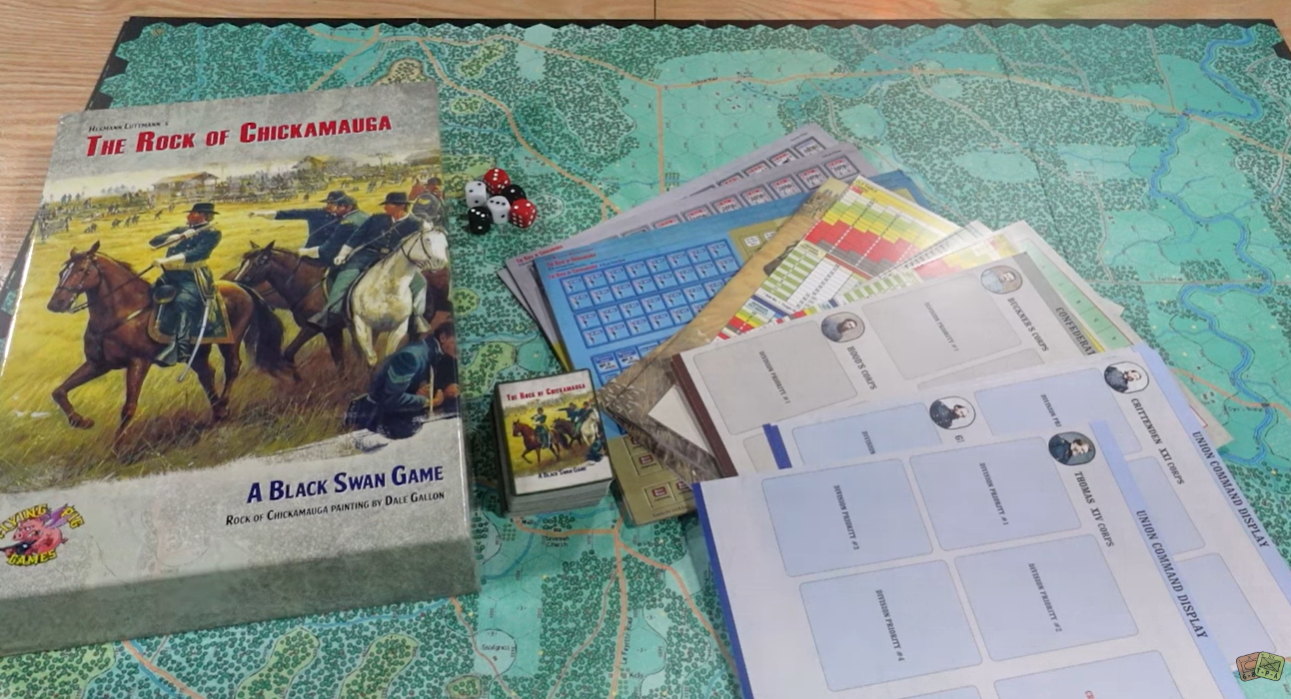
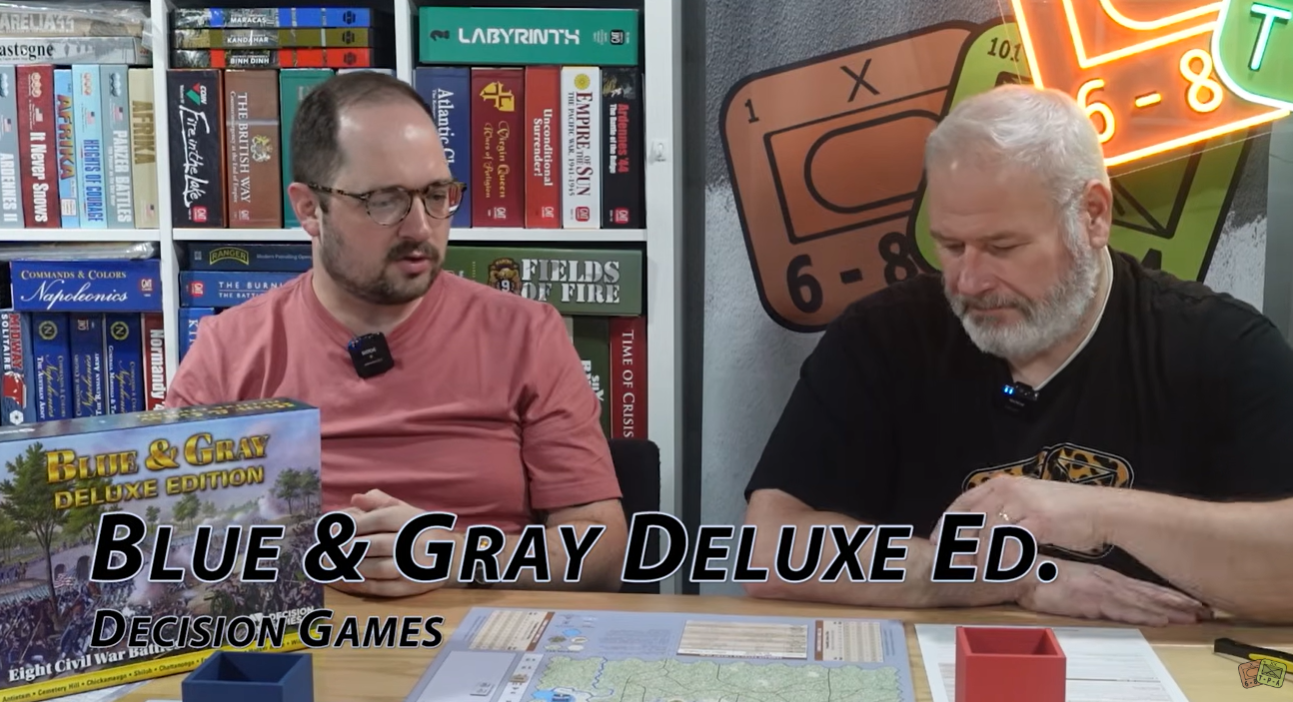
Blue & Gray Deluxe Edition consists of the original eight games from the SPI Blue & Gray I & II Quadrigames. The battles depicted are among the most important of the American Civil War: Shiloh, Antietam, Fredericksburg, Chancellorsville (Hooker & Lee), Gettysburg (Cemetery Hill), Chickamauga, Chattanooga, and The Battle of the Wilderness.
The game mechanics used in this series are based on the well-received Borodino/Napoleon at Waterloo system. Terrain is a significant factor, with everything from rolling farmland to untracked wilderness represented. Battles will often see a back-and-forth struggle for control of critical terrain. Rules for night turns are also provided. A standard set of rules are used, common to all eight games, while each game also has its own set of exclusive rules, historical set-ups, and player and design notes—all from the original SPI games.
Blue & Gray Deluxe Edition features new artwork, double-sided mounted game boards, enlarged counters, player aid cards, numerous optional rules gleaned from other game editions, and new variant counters and markers for use with several variants from Moves and Strategy & Tactics magazines. Reintroduce yourself to these classic games from SPI’s golden era and refight some of the best-known battles of the American Civil War which decided the fate of a nation at war with itself.
On August 7, 1539 the last resistance of the Spanish garrison of the Albanian village of Castelnuovo (Novi for the Turks) ceased. After 22 days of open trench and more than a month of combats, skirmishes, assaults and bombardments, the last Spanish defenders fulfilled the destiny they promised themselves when they rejected the offers of surrender that, according to the rules of war, Jareidin Barbarossa, admiral of the Ottoman fleet and general in chief of the operation, had made to them. The city and its fortifications, rather meager and outdated, had been taken by the forces of the Holy League in October 1538, so as not to close the campaign with the bad taste of the naval defeat at Preveza. Fourteen companies of Spanish infantry under the command of D. Francisco Sarmiento de Mendoza y Manuel, some 3,500 soldiers, were garrisoned there for the winter. The following summer brought a tide of 54,000 Turks and a fleet of 200 sails before its walls. After Venice’s defection from the League, there was no possibility of naval relief and the Spanish command authorized capitulation, however Sarmiento and his men decided to respond to Barbarossa’s offer with the phrase “Come whenever you want”, which sealed their fate.
In Castelnuovo 1539, two sides face each other in a desperate battle: the town and its fortifications will eventually yield to Turkish power, but the question is, at what cost? In Castelnuovo we will manage our army with wooden pieces in vertical with sticker, where we will not be able to see the type of unit of the opponent. The board is divided into areas and we will have other types of units such as cannon batteries, walls, bastions, trenches, etc. The confrontations will be made by rolling 6-sided dice and a deck of cards for each side, allowing us to play them to give orders, improve the fighting, dig trenches and special events.
Drop Zone: Southern France is a company-level wargame covering the Allied airborne assault that spearheaded Operation Dragoon, which was the invasion of Southern France or the Second D-Day on August 15, 1944. The history behind this operation is really very interesting as early on the morning of D-Day, the allied First Airborne Task Force (1st ABTF) parachuted a dozen miles behind the Riviera landing beaches to seize key towns and road junctions, to prevent the German occupation forces from counter-attacking the amphibious landing, and to facilitate the advance of Allied forces. The 4:00 AM parachute drop was badly scattered due to an unexpected dense fog bank that blanketed the battlefield. Drop Zone: Southern France covers the first two days of this airborne operation in six game turns, when the American and British paratroopers and glider-men fought surrounded and alone, supported only by French resistance bands. This game is very good and is just a solid wargame.
Crisis: 1914 is a game of international brinkmanship – if you back down too soon, you lose. If you back down too late you lose. But you have hawks and doves in your cabinet and in your government, and out of these conflicting views you must somehow formulate a coherent response to the crisis to win the day and prevent war.
There are 3 interrelated concepts at the heart of Crisis: 1914: Prestige, Tension, and Diplomatic Pressure (DP). Diplomatic Pressure (DP) is how you score Prestige. Tension is how you lose. Every card has a DP value. You apply DP by playing cards. The player with the most Diplomatic Pressure at the end of a turn earns Prestige points. There are other ways of scoring Prestige points too, but this is the most important one. Prestige is how you win. The player with the most Prestige at the end of the game is the winner.
While this game is not necessarily a wargame, but more of a war themed Euro game with a bit of negotiation and tension as you build your tableau of cards, we had a great time with it and really feel that the game is a bit under the radar of folks and should be one of those games that is played at conventions as it seats up to 5 players and is really quite good.
War Story: Occupied France is a co-operative narrative game for one to six players set in World War II occupied France that captures the stakes and tension of espionage and resistance warfare. Your team of covert operatives is all that stands between the infamous German officer Heidenreich and the systematic destruction of French Resistance forces in Morette.
Through three replayable story missions, you must exploit the specialties of your chosen agents to uncover information, enlist allies, and obtain weaponry. Engage occupying forces on tactical encounter maps where careless positioning could cost your agents’ lives. Remember, no plan survives contact with the enemy…and time is running out.
In early 2024, Worthington Publishing announced a unique 2-pack of games on Kickstarter that were marketed as easy to play travel friendly solitaire games. And you know that I love a good solitaire wargame! And when I heard that these games were small, even portable, then I was even more interested. One of the games covered the Pacific Theater of WWII called Pacific War 1942 Solitaire and the other covers the War of 1812 called (you guessed it) War of 1812 Solitaire. These games are designed by Mike and Grant Wylie and each game has 4 pages of rules, a beautiful mounted board and double sided counters. I played both and really very much enjoyed the experience.
A few years ago, after playing all of the games in the Great Statesmen Series, we heard of a new game in the series from a designer not named Mark Herman and I was immediately interested and intrigued as we have had so much fun with Churchill, Pericles and Versailles 1919. Congress of Vienna from GMT Games is a diplomatic card driven wargame based on Churchill and is the 4th game in the Great Statesmen Series. The game is set during the years of 1813-1814 and sees players take on the role of the main characters of the struggle between the Napoleonic Empire and the coalition of Russia, Austria, and Great Britain with their Prussian, Spanish, Portuguese, and Swedish allies. We played the game recently while attending Buckeye Game Fest and then played a full campaign again while attending the World Boardgaming Championships and absolutely were amazed at the changes and innovations to the system introduced by the designer Frank Esparrago.
Day 3 started off a bit slow as we dragged in the morning getting ready and didn’t get out the door till around 8:15am and after breakfast didn’t make it to the War Room until almost 9:00am. But, upon arrival we got right to gaming by setting up Cross Bronx Expressway from GMT Games with Russ Wetli from Cardboard Conflicts as our third.
Cross Bronx Expressway is the 3rd game in the Irregular Conflicts Series and attempts to simulate the socio-economic processes of urban development, and the human costs that result, as a competitive city-builder with collective loss conditions in the South Bronx between 1940 and 2000, with their unique faction pursuing their own goals while cooperating to keep the borough viable. Through a card driven sequence of play, they will work to solve the economic challenges facing the area by building infrastructure and organizations, forming coalitions, mitigating the multitude of issues facing the vulnerable population, and managing resources to stay out of debt.
Cross Bronx Expressway is a very interesting and engaging way to learn about the history of American cities as an economic simulation of sorts. Players will have to deal with the conflicting incentives and complex factors shaping urban life and together determine the fate of the Bronx.
We very much enjoyed this one and felt like it was very insightful and thematically connected with the subject and the times to create a very brain melting but interesting experience. I felt like I really had no idea what I was doing…but very much liked it.
We ended up losing the game as it is semi-cooperative and players can lose together due to bankruptcy or the overcrowding of prisons that will lead to higher social difficulties. But we learned a lot and I very much look forward to playing this one again.
We then played our 1st game of the interesting COIN Series like game Werwolf: Insurgency in Occupied Germany, 1945-1948 from Legion Wargames with Dave (a new friend from Michigan) and Gary of Ardwulf’s Lair. The game is designed by Clint Warren-Davey and Benjamin Feine and is an alternate history game, but the story that is presented is entirely plausible. Werwolf was a real underground guerrilla group, comprised of SS and Hitler Youth members. It was intended to lead an insurgency against the invading Allies and Soviets when it became clear that Germany was losing the war in a conventional sense in the mid-1940’s. They did in fact have a few successes and American intelligence officer Frank Manuel said that the Werwolves were prepared “to strike down the isolated soldier in his jeep, the MP on patrol, the fool who goes a-courting after dark, the Yankee braggart who takes a back road.”
The game allows players to take on the role of the occupying Soviets and Western Allies along with this Werwolf insurgency and the Edwlweiss insurgency.
After about 3 hours we finished 3 decks and the Werwolf Insurgency was declared the winner. All had a good time and I am looking forward to taking this to WBC in July and playing again.
I then sat down with Tim Densham with Catastrophe Games and he gave me a look at several of their planned upcoming games. These will all go on Kickstarter in order to fund the publication.
First was a look at War Cabinet, which is an economic and logistics focused take on WWII in the European Theater of Operation.
Next was Afghanistan: Decades of Strife, which is an area control game in the Conflict of Wills Series.
Then we got a look at Brothers of the Sword: Baltic Crusades which is set in 1100 AD.
All of these games will be coming to Kickstarter in the next 6-8 months and I am very much interested in them all. I was able to shoot a 30 minute video interview with Tim with more details and that’ll be on the channel soon.
We then sat down with Steve Jones from Blue Panther and Hermann Luttmann to play the new Dawn of the Zeds Designer Edition which will be available for pre-order in May and will be published at the end of July.
You know well the original Dawn of the Zeds from Victory Point Games and this has now had the rights reacquired by Hermann who is working with Steve to bring it back to life with new art, a new combat system with custom dice and some new characters. We played for about an hour and had the same fun we have always had with the game and I am very much looking forward to this new edition.
We shot a 20 minute video with Hermann and that’ll be up on the channel soon.
We then played our final game of the night, a 4-player game of War of the Ring: The Card Game from Ares with Cullen and Bad Russ. This is a game that I have had on my shelf for a few years, even purchasing all of the various expansions to date, but just have not had a chance to get it played…until now.
This was our 1st play and while it took us a good amount of time to get comfortable with the mechanics, and about 3 hours to play the entire game, we all had a great time and very much enjoyed what it was doing. The art in the game is just amazing and the game play is smart, with lots of bluffing and gamesmanship on how to play and manage your limited cards. Just a very solid multi-player card game.
It is now well after midnight and I am tired. Sorry for the brevity of my comments about the games but it’s just too late.
Tomorrow we have a full 6-player game of Here I Stand from GMT Games at 9:00am and then an evening role playing game with a WWII historical RPG called War Stories from Firelock Games. Should be a blast!
With the Hammer is an asymmetric wargame covering the German Peasants War in Thuringia in 1525 along with the exploits of one of its most famous protagonists – Thomas Müntzer. With the Hammer comes with wooden pieces, counters, 2 rulebooks, and historical commentary by Professor Andrew Drummond, and a 22×17 inch map.
Each player is a peasant or a noble; the peasants win as a team, or the nobles win as a team. There is no true solitaire system, but like most wargames, it can be soloed two-handed.
Operation Barclay is a 2-player game of low/medium complexity about the intelligence war between the Allies and their Abwehr counterparts in the Mediterranean Theater of WWII in 1942-1943. Operation Barclay puts players in the shoes of competing military intelligence directors who are attempting to mask or learn the truth about the Allied invasion plans for 1943. The Abwehr must attempt to learn where the Allies intend to land next. The London Controlling Section (LCS), the core intelligence agency responsible for Allied intelligence, must prevent the Abwehr from discovering the truth.
The LCS player uses a variable set-up, placing tiles face down to establish where in the Mediterranean a primary and a secondary offensive will occur. Over the course of the six game months, the Abwehr player attempts to win sufficient evidence tokens to be able to turn enough of these tiles face-up to reveal where the Allied offensives will come.
To win evidence tokens, players build hands of five cards to take tricks, similar to poker. While having the best hand will secure two evidence tokens, correctly betting after each player reveals the first three cards of each hand on who will have the best five-card hand is worth three evidence tokens.
Further, players have ways to manipulate the decks from which they draw. They may create a double-cross deck, allowing them to leave cards useful to them face down in a deck to draw from when they choose later — unless the other player takes those cards instead…but perhaps the player who planted those cards was bluffing and hoping the other player would waste their draw on a useless card. Alternatively, players may draw from their own dedicated deck to augment their hands with unique abilities inspired by historical figures, events, and capabilities. The LCS has access to Ultra — decrypts of German codes — but this alone will not be enough if it’s not used carefully.