Peter and Will are back with their most famous style of battle report – a War of the Ring one! Beer, laughs and banter ensue.
One day, when the Esoteric Order of Gamers finally comes to its natural end and all about it and concerning it is forgotten, one thing may be remembered – the battle report videos documenting games of War of the Ring between myself and my old gaming buddy, Will. It‘s been quite a while since I’ve had the opportunity to film one, but the day has finally arrived! So grab yourself your beverage of choice, get comfortable someplace where you won’t be interrupted by any non-gamer who just might not understand, relax, and enjoy this hugely fun new session of my favourite board game, War of the Ring!
Making high quality tabletop gaming content at the EOG takes time and money. Please consider becoming a Patreon supporter or making a donation so I can continue this work! Thankyou!
Day 4 dawned early and we are really tired. I actually felt like I had slept, although I didn’t fall asleep last night until about 1:30am, but just didn’t feel refreshed and had very little energy. I am a Wargamer and I simply sucked it up and got downstairs where we had breakfast with friends including Russ, Cullen and Hermann Luttmann. We imbibed in the buffet eating more pieces of bacon than someone should in a fortnight and made it to the War Room a bit before 9:00 where we started setting up for our annual 6-player game of Here I Stand from GMT Games.
Playing with us was Russ (France), Cullen (Ottomans), Bill Simoni (Papacy), James (England) with me (Protestants) and Alexander (Hapsburgs).
Not sure what Russ was doing with his hand and Alexander never smiles!
We simply love Here I Stand and have played the game at least 15 times and it just gets better every single time. If you don’t know, Here I Stand: Wars of the Reformation, 1517–1555 is a grand-scale Card Driven Game that simulates the political and religious struggles in Europe during the period covering 1517-1555 referred to as the Reformation. It is designed primarily for six players, each controlling a major power with unique, asymmetric goals and mechanics and is best with max players.
The game takes place over up to 9 turns, but for us a majority of our plays have lasted 4-5 turns with our longest play being today as we finished the game in 6 turns. Each of the turns represent approximately 4 years of historical time. The game utilizes a Card-DrivenGamesystem where players spend cards for their Command Points to perform actions like moving armies or building fleets or for the unique historical event described on the text of the card.
The game is very asymmetrical in its gameplay as each of the factions plays a different game based on its historical role and will win via amassed VP’s that are earned in vastly different ways such through piracy (Ottomans), building of chateaus (France), New World Exploration (England, Hapsburgs, France) and through battles. The Papacy and Protestants will wage a religious war over the souls of European Christians to either sway spaces to Catholicism or Protestantism. But one of my favorite parts is the Diplomacy and making of secret deals between the players to help out their goals.
With that being said our game started off with the nailing of the 95 Theses to the door of the church at Wittenberg and as the Protestants I have never seen a worse opening as I was only able to switch 3 spaces in Wittenberg, Brandenburg and Leipzig. Not a good start at all for the Protestants but I was undaunted, although I said many curses under my breath and to the gamers at the table, and quickly got my self under control and was determined to recover.
A look at one of the poorest starts of all time for the Protestants.
I worked hard over the next few turns to spread the faith and was quickly able to get most of Germany under control and take over 4 of the Electorates which gave me units that would help me continue to spread toward France and England.
It was amazing to see Bill Simoni and the Papacy and I go at it as we held many theological debates, ultimately each of us disgracing a debater and gaining VP, and for me to have the full Bible translated into German during Turn 2 quickly followed by the translation into English by Turn 3. I had made a deal with England for him to play a card that favored me in exchange for a concerted effort to get the Protestant faith rooted in England so he could gain some VP.
Meanwhile the Ottomans got out the Barbary Pirates card early and had built a sizable fleet of corsairs causing France and England to loan the Hapsburgs several boats to combat this green menace in the Mediterranean.
Also several colonies were formed in the New World and ultimately Alexander’s Hapsburgs were able to circumnavigate the globe and score several important VP.
During this time, the Protestants and Papacy were fighting tooth and nail but my dice rolling, and innate ability to win ties, allowed me to build a sizable lead in the religious war. I was in very good shape when the Schmalkaldic League card was played turning the Protestants into a military power and then changing the other players focus to then declare war one and begging to attack my fortified Electorates to take away VP I had earned by having both religious and political control in 5 of the 6.
As we came into turn 5, I was at 24 VP and ultimately came up shy of a victory by 1 point at the time. I had been able to take over the entirety of England and change every space and also get about 5-6 spaces in France. but now the Papal Bull came to play and Bill fought me back and forth with him taking over 3-4 spaces followed by me reclaiming 3-4 spaces. It was beautiful game of back and forth and I used every tool at my disposal to fight him including The Wartburg card to stop the untimely excommunication of Luther before he could attempt to embarrass one of my lesser debaters.
Then England gained ground as a healthy Edward was born and he gained 5 VP and then took over a key from France to get close to my score going into Tuen 6.
At that point it was dog pile the winner as everyone declared war on the Protestants and came after my Electorates but I was able to stave them off and ultimately never lost down to lower than 4 controlled which retained 8 VP for me and allowed me to finish the Bible translation in French and take a sizable lead in VP.
The game came down to the last card play as England and my Protestants tied at 25 VP and I won on tiebreakers as I had the most VP in the turn prior. What a fantastic game that took us over 9 hours to play!
We were all wasted and went to dinner at a nearby bar called The Flat Iron Grill and had a very enjoyable meal. We decided to not play the WWII RPG War Stories and might till tomorrow night as we were all a bit brain dead.
We played about 5 scenarios of the beautiful and very fun trick taking game called The Lord of the Rings Trick Taking Game: The Two Towers from Office Dog. This is a standalone continuation to The Lord of the Rings: The Fellowship of the Ring Trick-Taking Game, with several play modes including solo, 2-player, and 4-player and we did the 4-player version. It is a cooperative card game that follows the narrative of J.R.R. Tolkien’s second book through 18 unique, story-driven chapters.
The game functions as a “must-follow” trick-taker, where players must play a card of the led suit if they have one; otherwise, the highest card of the led suit wins the trick. Unlike many traditional trick-taking games, players work together to meet individual character goals simultaneously to progress through the story. And they s game is very tough with the new edition adding in several very tough challenges as the addition or orc cards that have no function but if lead because you have no other choice lead to a loss. Just great and thinky fun that is very relaxing and frankly very fun to play.
Examples of 2 characters which each have a unique goal that must be completed during the scenario.
This was a perfect way to end the day and we actually made it back to our room at 9:30pm allowing me time to write this post and get in near before midnight.
Tomorrow is our last day and we have big plans as we will be playing Imperial Elegy from VUCA Simulations (a kind of Here I Stand style CDG on the rise and fall of European empires from the 1850’s through WWII), Bretwalda from PHALANX (an Ameritrash combat game set in medieval England) and then a night cap of the RPG War Stories that we didn’t get to this evening. See you tomorrow night!
Day 3 started off a bit slow as we dragged in the morning getting ready and didn’t get out the door till around 8:15am and after breakfast didn’t make it to the War Room until almost 9:00am. But, upon arrival we got right to gaming by setting up Cross Bronx Expressway from GMT Games with Russ Wetli from Cardboard Conflicts as our third.
Cross Bronx Expressway is the 3rd game in the Irregular Conflicts Series and attempts to simulate the socio-economic processes of urban development, and the human costs that result, as a competitive city-builder with collective loss conditions in the South Bronx between 1940 and 2000, with their unique faction pursuing their own goals while cooperating to keep the borough viable. Through a card driven sequence of play, they will work to solve the economic challenges facing the area by building infrastructure and organizations, forming coalitions, mitigating the multitude of issues facing the vulnerable population, and managing resources to stay out of debt.
Cross Bronx Expressway is a very interesting and engaging way to learn about the history of American cities as an economic simulation of sorts. Players will have to deal with the conflicting incentives and complex factors shaping urban life and together determine the fate of the Bronx.
We very much enjoyed this one and felt like it was very insightful and thematically connected with the subject and the times to create a very brain melting but interesting experience. I felt like I really had no idea what I was doing…but very much liked it.
We ended up losing the game as it is semi-cooperative and players can lose together due to bankruptcy or the overcrowding of prisons that will lead to higher social difficulties. But we learned a lot and I very much look forward to playing this one again.
We then played our 1st game of the interesting COIN Series like game Werwolf: Insurgency in Occupied Germany, 1945-1948 from Legion Wargames with Dave (a new friend from Michigan) and Gary of Ardwulf’s Lair. The game is designed by Clint Warren-Davey and Benjamin Feine and is an alternate history game, but the story that is presented is entirely plausible. Werwolf was a real underground guerrilla group, comprised of SS and Hitler Youth members. It was intended to lead an insurgency against the invading Allies and Soviets when it became clear that Germany was losing the war in a conventional sense in the mid-1940’s. They did in fact have a few successes and American intelligence officer Frank Manuel said that the Werwolves were prepared “to strike down the isolated soldier in his jeep, the MP on patrol, the fool who goes a-courting after dark, the Yankee braggart who takes a back road.”
The game allows players to take on the role of the occupying Soviets and Western Allies along with this Werwolf insurgency and the Edwlweiss insurgency.
After about 3 hours we finished 3 decks and the Werwolf Insurgency was declared the winner. All had a good time and I am looking forward to taking this to WBC in July and playing again.
I then sat down with Tim Densham with Catastrophe Games and he gave me a look at several of their planned upcoming games. These will all go on Kickstarter in order to fund the publication.
First was a look at War Cabinet, which is an economic and logistics focused take on WWII in the European Theater of Operation.
Next was Afghanistan: Decades of Strife, which is an area control game in the Conflict of Wills Series.
Then we got a look at Brothers of the Sword: Baltic Crusades which is set in 1100 AD.
All of these games will be coming to Kickstarter in the next 6-8 months and I am very much interested in them all. I was able to shoot a 30 minute video interview with Tim with more details and that’ll be on the channel soon.
We then sat down with Steve Jones from Blue Panther and Hermann Luttmann to play the new Dawn of the Zeds Designer Edition which will be available for pre-order in May and will be published at the end of July.
You know well the original Dawn of the Zeds from Victory Point Games and this has now had the rights reacquired by Hermann who is working with Steve to bring it back to life with new art, a new combat system with custom dice and some new characters. We played for about an hour and had the same fun we have always had with the game and I am very much looking forward to this new edition.
We shot a 20 minute video with Hermann and that’ll be up on the channel soon.
We then played our final game of the night, a 4-player game of War of the Ring: The Card Game from Ares with Cullen and Bad Russ. This is a game that I have had on my shelf for a few years, even purchasing all of the various expansions to date, but just have not had a chance to get it played…until now.
This was our 1st play and while it took us a good amount of time to get comfortable with the mechanics, and about 3 hours to play the entire game, we all had a great time and very much enjoyed what it was doing. The art in the game is just amazing and the game play is smart, with lots of bluffing and gamesmanship on how to play and manage your limited cards. Just a very solid multi-player card game.
It is now well after midnight and I am tired. Sorry for the brevity of my comments about the games but it’s just too late.
Tomorrow we have a full 6-player game of Here I Stand from GMT Games at 9:00am and then an evening role playing game with a WWII historical RPG called War Stories from Firelock Games. Should be a blast!
(This is not intended to spoil things, but it will mention things that could be construed as such if you want to be totally surprised. You have been warned).
Slay the Spire is a “Roguelike1” you are trying to get through a procedurally generated dungeon and beat the boss. But combat and character progression was inspired by Dominion. You get better by adding cards to your deck (and removing bad cards from your deck). There are non-card based ways of getting stronger, like artifacts that grant you abilities (sometimes in combat, sometimes in the “master board” to borrow a phrase from Titan) or potions.
And Slay the Spire was massively influential. Right now I’m seeing ads on steam for Roguelike games but “using poker instead of dominion” (Balatro) or what not. Most are clear cash-in knock offs (though I’m told Balatro was good). So many (like me) were waiting anxiously to get their hands on the new version … Slay the Spire II has over 500,000 people playing concurrently.
But given that Mega Crit (the developers) were aware of Dominion and other popular games (and frequently drop in Easter eggs)2, I wondered what mechanisms would show up in Slay the Spire 2.
What I’ve noticed so far:
Card Forging
In the first Slay the Spire, cards could be upgraded (“Foo” could become “Foo+”), and any Strike that was upgraded was the same. Typically some numbers on the card got better (and each card could only be upgraded once, with one exception). But StS2 has Card Forging. Cards can still be upgrade, but each card now has a slot that can add an “enchantment” and these enchantments are not specific to the card, but uniform. So if you say there are ~300 cards, in STS v1 there were 600 cards (300 base cards, 300 upgraded). If you keep the exact same cards in STS v2, but now there are X enchantments3 which means there are up4 to 600 times X valid card combos. And now a Foo could be Foo(+) and Enchantment-A or -B, -C, -D, etc.
And (some) enemies put negative enchantments on cards.
As a fan of combinatorics, love it. I’m wondering if they were inspired by Mystic Vale or Dice Forge or Dice Realms (or just thought of it independently). They didn’t go “whole hog” on it (at least, not in this version) but for the amount of programming of a few artifacts they’ve greatly increased the decision space.
Card Evolution
Arguably just a riff on card forging, these are cards that go into your deck in one form but can be triggered into a different form (usually via the masterboard). I took one of these quests (picking up a useless card that would be removed with a big reward later) and then at the final fight realized I’d never actually went to a space to evolve the card, which actually took a bit of work on my part.
Cooperative Play
Still haven’t tried it, but no doubt they were thinking of this even before the Slay the Spire board game. This required a ton of programming5 (unlike the card forging). Not much to say.
Alternate Masterboard Paths
This is probably pretty common in games, but just as in the Lord of the Rings expansion you can sometimes skip some location boards for others, now in StS II there are alternate acts. (I am not sure if you can control them, though. It’s more of a variety). I didn’t actually register this the first few times it happened, only when I saw some new regular (non-elite) encounters and wondered about it did I realize that “Acts” were switching between games. This is pretty common in expansions, though.
I don’t know if I’ll notice (or think of) more, but we’ll see….
Also — on an admin note, I have created a category for “Slay the Spire” (as well as tagging articles), so you can now click on that for articles. Most of the obvious ones should be in that category by now, but a few stragglers may not be.
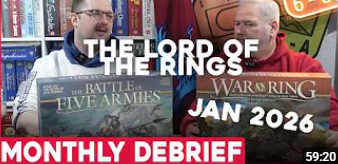
The January 2026 Monthly Debrief Video, which is the 1st episode in Season 6 of this series, saw us discussing the games of The Lord of Rings. We both love the writings of J.R.R. Tolkien and The Lord of the Rings Series including The Hobbit and other books such as The Silmarillion and Unfinished Tales. As we thought about this topic, we were very surprised by the number of games set in Middle Earth and were quite excited to share them.
Also, as usual, we covered the games we played in January, as well as the games we plan to play in February.
We will remind you here that we are fortunate to be continuing our relationship with Noble Knight Games as the sponsor for our Monthly Debrief Video series. In case you don’t know, Noble Knight Games specializes in hard to find games but also carry all the new releases. But what makes them truly unique is that you can find some of the rarest games, long out of print games, hand made games, imported games from overseas, etc. Thanks to them for their sponsorship and we hope that you will consider them first when looking for the games we cover.
When news broke three months ago that board game giant Asmodee had been named manager of the hugely lucrative Middle-earth licence for tabletop games and accessories, questions naturally abounded within the industry about what that would mean for other publishers hoping to create The Hobbit or Lord of the Rings-based titles. Luke Peterschmidt, the tabletop veteran tasked with running the Middle-earth operation at Asmodee, sat down with BoardGameWire at Spiel Essen following the announcement to outline his vision for the IP, what they want from publishers in terms of pitches, and how they hope to prove naysayers of the deal wrong.
—
BoardGameWire:Hi Luke! So a good place to start would be: what were you doing prior to becoming Head of Active Category Management at Asmodee?
Luke Peterschmidt: Before this I was the senior vice president of all the tabletop games for Asmodee, which meant that I ran all of the studios in what we call the tabletop vertical. We have lifestyle – that’s our hardcore games. We have our social games, which are like our lighter party games, and then all the stuff most people think of as tabletop games – so that would be Space Cowboys, Rebel, Office Dog, Z-Man, there’s seven or eight others. So my job was to run all those studios.
I guess the major question about this is how will it work, specifically in terms of third parties coming to you guys saying: “I’ve got a lot of the Rings game. How do we progress?”
Yeah, that’s a great question. Can I back up and answer a different question first? Existing Lord of the Rings games – because there’s a lot of Lord of the Rings games that are not Asmodee that are out right now – nothing changes for them. They still work through [former Embracer Group arm Middle-earth Enterprises]. The thing that will change for them is that we, as Asmodee, in this new role are going to start doing activations, marketing activations, where we will include everybody, whether they’re part of the ‘new regime’ after the deal or the regime before. We have no interest in making anybody’s life worse, or cancelling anybody else’s game.
So that’s the past, backwards. Looking, forward – anybody who wants to pitch us a game, who’s a publisher, can come to us and pitch us a game. My team is publisher agnostic. Asmodee gets no points for an Asmodee studio pitching us a game – and on the distribution side, because Asmodee does a lot of distribution as well, if you use Asmodee distribution, you get no extra points. Our job is to make the right number of Middle-earth games at the right pace, so that every game has space to breathe, and there is a Middle-earth game or gaming accessory for every type of game.
Asmodee games set in the Hobbit and Lord of the Rings universe from the last 25 years
That’s the mission, and no part of that mission says, “and Asmodee makes all the games”. So at this show at [Spiel Essen], in fact, the meeting right before this was a game designer pitching us a game which was not an Asmodee pitch. It was a great pitch. That was a designer pitching us. So we told that designer, that was a good idea, we think, but you need to go find a publisher, because we’re going to work with publishers, not individual designers, right? So if you’re a game designer out there: go find a publisher first, and then have the publisher come and pitch to us.
In the case where a good game designer comes to us, we will introduce them to publishers, we will introduce them to our own studios – who may or may not have time or competency for that type of game. Because our studios right now, if they were to add something to their list, they’d have to pull something sort of ‘off the wall’. Our bandwidth isn’t infinite, and they have their own strategies that have been in place a long time.
So a publisher pitches to us, they would show us the games, they’d show us maybe the art style they’re going with – which we can talk about more later – they would show us their ideal release date. The ideal release date will probably never be the date they actually release on. Not because of their schedule, because of our schedule. That thing I said about not having things stack on top of each other, we can’t let everyone say “and I’m releasing at Essen”, or there’ll be four Lord of the Rings games in Essen, right? That’s not fair to any of them. We need every game to have a chance to succeed.
So we will then take our calendar and we’ll start mapping releases on that calendar that we think is the right pace: not too much, nothing’s too close to each other thematically, nothing’s too close to each other visually. You know, we’re never gonna let people run two crowdfunding campaigns at the same time, from two publishers. That would be bad.
So do you anticipate it being, say: one big euro a year, one trick taker, etc?
That’s a great question that I don’t have a good answer for right now. We are in the process of building our calendar, and then we’re going to sit down with [Middle-earth Enterprises], because although we represent Middle-earth as sort of the first group of people to organize what pitches get through, they’re still going to make the final decision, right? But we need a confidence level of like 95% that if something gets past us, and Middle-earth doesn’t say, yes, we’ve failed – or there’s something we didn’t know, like just an old, pre-existing deal that we didn’t know about. That’s our hope.
So the right number of games, we’re still working on, right number of gaming accessories we’re still working on. Some games will be region specific, probably, I don’t know for sure, but someone might come to us with a publisher who says, like, you know, we’re really, really big in Armenia. Great: you can have Armenian rights, this Armenian game, but you have no distribution outside of there. So they would be sort of on their own timeline – they’re not gonna compete with much.
We have some experience recently with the studio internally for releasing a series of Lord of the Rings games. We started with the trick taking game, and then we did the Pandemic game, and then the hobbit game, and those games are very similar to the concept we’re going with now, pacing wise: all those games are different. All those games have been successful, by the way: like, they’ve all had a chance to be successful, which is great. So we’re going to be rational. And one of the reasons Middle-earth picked us for this deal is they trust our experience in the space. My team is not that large, but if I need an opinion about how to do press, I can talk to this guy. If I needed an opinion about some lifestyle game that maybe I’m not an expert in, I can just call someone and go, ‘hey, roleplaying team, help me out here. Is this great? It feels great to me’.
Game pieces from Lord of the Rings: Fate of the Fellowship
This does give Asmodee a lot of power, obviously. And there is the potential for conflicts, if, for example, a third-party publisher brings a Lord of the Rings trick taking game to you next year, and it’s very, very good.
Well, we wouldn’t say yes to it because we have a successful one – not our successful one – but we have a successful one in the marketplace. If someone brought us a game that was a direct competitor for War of the Ring, and War of the Ring is still doing well, we’d probably say no to that too. I think people are right to… it’s reasonable for them to not trust the things I’m saying. And I hope that in the next couple of months we will prove to the world that we mean what we say, because we’ll be announcing our first group of licensees. And, we have a lot of work on the back end, just ticky tack stuff like getting our contracts ready and making sure all that works, and ironing out some smooth processes that are boring to everybody but required by everybody, that might slow that down [Note: this interview was conducted at the end of October 2025, and those announcements are still yet to be revealed].
But when those announcements come out, I think people are going to be happy to understand that it’s not just that we will work with external people, but we will also work with smaller companies. Middle-earth has a long tradition of working with microscopic licensees – like, they have a licensee that makes honey only from the flowers grown on The Hobbit set. They have a licensee in Minneapolis that makes guitar effects pedals. They make two different effects pedals, and they probably sell a handful – I don’t know what their sales are, I have no idea. And they’re amazing, and they’re handcrafted and built, right? We don’t want to lose that magic. This is a handcrafted brand – a lot of people feel this brand in their bones. I will never not be impressed by the love for this brand. The level of knowledge super fans have is out of this world. It’s just impressive.
It’s good to hear you say that. And obviously there has to be a lot of trust and goodwill on your side if it’s going to work.
We got to build it up! We got to build it up, yeah, we got to – we’ve got to walk the walk.
But the initial reaction from some people within the industry I spoke to was ‘Well, that just means Asmodee are going to call all the shots, we’re not going to get a look in now’. Like, on paper, fine, yeah, there’s a process, but in reality, you’re going to win out if there’s ever any conflict.
It is absolutely fair to have that thought in your head, and it’s our job to prove that thought wrong. And I mean literally nothing I say, I think, could convince anybody other than action. So yeah, it’s got to be the action, we’ve got to follow it up. And look, we’re an industry of tremendous companies. Like, I love Asmodee, it makes amazing games. I spent many, many, years here working on amazing Lord of the Rings games for people. But there’s amazing games in this hall from everybody. Like, they’re amazing.
What does your ideal slate look like then, at the end of 2026?
Oh, games take so many years to make that the first deals we will be announcing, those games won’t come out for two and a half years, like: games take two and a half years to make. So we will be announcing a slate of who we’re signing and maybe what those games are if the publisher chooses to say, you know, in a reasonable number of months, if you didn’t include the holiday months. Because this interview is in October – we’ve got Thanksgiving in the United States, and we’ve got Christmas coming up, and everyone takes vacations in those months, so the back and forth slows down to a crawl. But yeah, I’m hoping to have something fairly soon that we can talk about: but please write off most of November and December, because everyone’s taking all their vacation days that they haven’t taken yet. American companies aren’t like European companies, where you all take a month off in August. We all don’t take any vacation, and at the end of the year, we go, if we don’t take it right now, we’re never getting it [laughs]. And they slam it all into November and December. And I’m talking about myself [laughs].
You’ve touched upon this already, but I get the sense it’s gonna be a real balancing act. To some extent, if you print more Lord of the Rings games, you make more money because they’re very popular, and people want them, and they want different types. But that’s a tough tightrope to walk, in not accidentally making too many, right?
Yes. And I frame this as: Lord of the Rings is the grandfather of all fantasy IPs. We had this term when I used to work decades ago at Wizards of the Coast, called the JOTWA, which was just another Tolkein world, right? And there’s so many. We don’t think, when we look at the games in the hall here and we see medieval fantasy themed games: we’ll never say there’s too many of those, right? There’s a game about a tavern, there’s a game about building a castle, there’s a game about… whatever. In my mind, if all of those medieval games that we don’t see as competing now… they’re all using Middle Earth elements now, they’re all using elves, they’re all using dwarves. They might call their hobbits halflings, but they’re all there.
So I’m not too worried about too many Lord of the Rings games. I’m worried about too many Lord of the Rings games that are too similar. So when you said trick-taking game pitching, that would be such a quick no for me, and it’d be such a quick no because there’s already one of those, and it’s doing well, and that game deserves time to breathe. I come from a game design background and I would be furious if I had a successful game, and then another game got launched that was mechanically close, appeals to the same person. And there are a lot of types of games that don’t exist for Lord of the Rings. Is there a big, heavy, euro Lord of the Rings game somewhere out there? I don’t know of one, right? There’s just space. Is there a kids game? Has anyone taken a funny shot at Lord of the Rings? Like, I don’t know – Hobbit breakfast! I want someone to bring these pitches.
Cards from The Fellowship of the Ring: Trick-Taking Game
This raises an interesting point, though. So obviously you’re accepting pitches, but when you have ideas such as this, is there license for you to reach out to publishers and say ‘look, we’d actually like this type of Lord of the Rings game made’?
I am so happy you asked that question. So my team is called the active category management team, and the difference is that we are active. When we get to a place – we’re not there yet, because we’re still getting our processes in place – we will actively reach out to partners and say, ‘We need a game like this, and we think you have particular skills in games like that’. Now we might make that reach out, and it’ll take three years before you’ll see a product. And we might take that reach out, and they might just say no. But absolutely: we are actively looking for people for both games and game accessories. Actively is the key word – that’s why we’re here. We’re not waiting. You know, most people that do licensing wouldn’t be at this show accepting pitches. They’d be at home waiting for a phone call from someone who’s interested. My name was on that press release so that people could reach out and contact me and say, I want a meeting. And they did, because turns out, gamers and Lord of rings, that Venn diagram is a bullseye.
And how’s that turned out during this Spiel Essen so far?
We’ve had a lot of pitches – and I can’t talk about the pitches themselves, but there are trends. And it’s so interesting that the trends in games… if you look at games as culture, the culture of today, the stresses of today, are absolutely affecting the styles of game pitches we saw, it’s super interesting. And in a year, I’m gonna write a blog post, and we’ll do another interview, and I’ll explain what I’m talking about. I can’t ruin the confidentiality of the game pitches, but it’s really interesting.
Maybe you can’t talk about this, but I’ll try. So you mentioned heavy euro, which, you know, God yes, that’d be awesome – is there a market for that? I’ve spoken to other publishers in this show who’ve specifically said heavy euros – big, expensive, heavy euros – that the market’s just not really there at the moment. Some will sell, but the market isn’t there. And actually smaller family-plus games, smaller box games, that’s the economic climate we’re in, and that’s really what budgets people have. Is that a concern for you? Or do you just see what turns up?
I think I may be ‘tinted’ by Asmodee’s thought process, which I agree with. I would like to have games at all price points all the time, because at some point the pendulum is going to swing, and we’re never going to guess that right. The odds of us guessing it right are low, and because it takes three years for every euro – probably even longer, right? – I’m not going to say no to that idea, as long as there’s not one in the market. Because in three years, that market may have moved. And look, everyone says low price games sell – until it’s something that people are passionate about. Our recent launch of Fate of the Fellowship, the Pandemic game, sold out almost everywhere – and it’s really expensive. So there’s a market for games. It might not be big, but it’s bigger than honey and guitar pedals [laughs]. Which I love – and I will be buying those guitar pedals.
So what element of this deal just hasn’t been talked about yet?
Oh, great, yes, thank you. Okay, this is a literary license. So if you’re out there and you want to make something that looks like the movie, then we would not be the right people to come people to. But more importantly, that means we are open to alternative art styles, and artists, and we are even okay with people taking little elements of the book – well, Middle-earth is okay with taking little elements of the book – and developing them out further. Like, we don’t want to make five ‘throw the ring in the volcano’ games every year, right?
I would love to see – I’m just going to tell you the kinds of games I’d want to be pitched to me. I would like to have pitched to me games that take small elements of the IP and develop them with focus. A Prancing Pony game. A game about, you know, some spot on the map that if you’re a huge Lord of the Rings fan, you know, but if you’re not, you don’t. Let’s talk about it, let’s get deep into it. Some stuff out of the appendices of the third book – those rights get a little bit weird, but they’re available and we can do really fun stuff. There’s a game that is currently in the works that has done some amazing things with the IP, that real fans will be like, ‘Oh, this is different, this is a thing’. So yeah, I think there’s lots of room for different takes on the IP, and don’t expect visual similarity. I want these studios or these external publishers to be able to create a visual look that… you might walk down an aisle and see six Lord of the Rings games, but you’re going to point at one and go, that’s the one from Kosmos, right? That’s the one from whatever, or that’s my favorite art style, you know? Like, I love the art on Flamecraft. I’d love to see, I don’t know what that looks like for The Lord of the Rings, but that’d be pretty cool!
I think the trick taking game is probably a really good example there, because the art on that is incredible and really makes the game sing. It’s a great game, but I was playing a looking at the cards yesterday and thinking ‘this is fantastic’ – the armour on Gimli the dwarf, for example, where it’s chain mail, but it’s just like swishing circles in that stained glass style?
I love the art on that game. I was working on that game early on when I ran that studio, and we picked that style not just for, like, the style, but we picked it because we knew stained glass was the thing that survives in temples for a long time. And we feel like Lord of the Rings survives like a temple for a long time. So we went deep into it with that one. But it was different: no one confused it with a Fantasy Flight product, right? And that’s the goal, and we want to see that. The original drawings – most people don’t know this – the original drawings of Gandalf, he was like, kind of a pudgy dude. Legolas, you know, he’s, he’s a mix of two types of elves, which means there’s a 50/50 chance he has straight white hair or curly brown hair – it’s just that the movie showed him a straight white hair. Somebody wants to do a Legolas with curly hair, bring it. That’s literally, that’s your interpretation.
I haven’t had anything pitched from roleplaying games, and there’s a roleplaying game that exists now from Free League that’s really good. [Crowdfunding and miniatures] pitched us an idea, there’s an idea there. We’ve got a couple of pitches for miniatures and crowdfunding from a couple different places. But, everyone has to earn their spot. And I gotta be fair to that team, that team is pretty new here. Not new in experience level – I mean, it’s David Preti, he’s done tremendous things in crowdfunding – but they’re pretty new in the Asmodee world. And we are a big company, and it usually takes a little while to find your place.
Any publishers interested in pitching a Middle-earth game to Asmodee can do so by emailing METTGlicensing@asmodee.com.
Der Designer/Autor Matt Leacock gehört wohl zu den bekanntesten und einflussreichsten Schaffern der Brettspielszene. Mit seinem kooperativen Dauerbrenner Pandemie (mittlerweile als Pandemic internationalisiert) sowie dessen Erweiterungen, Ablegern und Legacy-Varianten hat er mehrmals die Brettspielwelt quasi revolutioniert. Das wurde ihm für das Grundspiel u.a mit Platz 20 der Bestenliste auf BGG gedankt und sogar mit Platz 1 für die Legacy-Variante. Von dieser sind zum Zeitpunkt des Erscheinens dieses Tests alle 3 Varianten in den Top 100 vertreten.
Das Pandemic-System ist dabei so spannend wie einfach und trifft häufig genau den Nerv zwischen Zugänglichkeit und Spannung, ohne dabei zu überfordern. Zwar konnte keiner der Ableger mich so überzeugen wie das Grundspiel mit seinen Erweiterungen – sie waren schlicht alle zu einfach – sie zeigten jedoch, wie wandelbar der Mechanismus mit ein paar Anpassungen sein kann. Und nun kommt der Meister persönlich zurück mit einem neuen Titel, der keine geringere als die Herr der Ringe-IP trägt und – selbstverständlich – auf dem Pandemic-System beruht. Oder dieses zumindest adaptiert. Kann diese neueste Anwandlung stärker überzeugen, als es die vorherigen Ableger taten?
Krieg der Ringe
Kommen wir gleich zur Sache und verlieren nur wenige Worte über das Thema: Herr der Ringe sollte jedem geläufig sein. Wir spielen kooperativ die Gemeinschaft des Rings und müssen diesen letztendlich in die Flammen des Schicksalsberges werfen, um zu gewinnen. Genauer gesagt muss Frodo dies tun. Wie im Film. Und wie im Buch. Der Weg dorthin ist das beschriebene Abenteuer und wird uns durch einen hervorragenden, automatisierten Gegenspieler (Sauron) erschwert.
Dabei dreht sich das Spiel aber nicht nur um den Ringträger. Wie in der Quellgeschichte auch tobt ein Krieg in Mittelerde und dieser wird hier mit dem Ringen um Zufluchten (das sind Spieler-Festungen) und Schattenfestungen dargestellt. Verlieren wir eigene, verlieren wir auch Hoffnung und laufen Gefahr, das Spiel so zu verlieren. Erobern wir welche, erlangen wir neue Hoffnung und erkaufen Frodo Zeit, sich dem Schicksalsberg zu nähern. Diese beiden Ebenen gibt es also auch im Spiel und sie funktionieren wahnsinnig gut miteinander!
Unter seinem Auge…
Frodo muss sich vor Saurons wachem Auge versteckt bewegen und ist dadurch sehr langsam. Zwar können ihm andere Spieler bei der Bewegung helfen, doch auch diese müssen stets darauf achten, ihn versteckt zu halten.
Sauron jedoch ist unablässig auf der Suche nach Frodo und nähert sich ihm immer weiter an. Dazu schickt er ihm seine Nazgûl auf dem Tarnumhang, die bei der Suche helfen. Es sind die einzigen dreidimensionalen Figuren im Spiel und schweben auf ihren Standees bedrohlich über dem Spielfeld. Je mehr Nazgûl hinter Frodo her sind, desto wahrscheinlicher ist es, dass sie ihm auf die Spur kommen.
Um das zu verhindern, können ihm seine Gefährten helfen, und zwar indem sie sich in dem zuvor genannten Krieg engagieren. Starten wir irgendwo eine Schlacht gegen die Schattentruppen, zieht das nämlich den Blick Saurons auf sich und Frodo wird spürbar entlastet. Noch dazu hat jeder Held einige sehr nützliche Fähigkeiten, sodass man am liebsten alle mitnehmen möchte.
Doch das geht nicht: Jeder Spieler darf nur (und muss) zwei Helden spielen. Ja, richtig gelesen! Jeder Spieler ist in einer Kombination aus 2 Helden unterwegs und muss deren Fähigkeiten mit denen anderer kombinieren. Die Gemeinschaft bestand nunmal nicht aus nur 1-5 Helden und alle waren für die Geschichte wichtig. Dabei muss man noch 5 Aktionen (einmal 1 Aktion und einmal bis zu 4 Aktionen) auf seine Helden aufteilen. Da gibt es schon Denkstoff durchzukauen!
Tausche Anonymität gegen Bedrohung
Wenn man Pandemie eines vorwerfen könnte, dann dass der Mechanismus immer sehr kühl rüberkam. Man bekämpft eben anonyme, gesichtslose Krankheitserreger, die im Original nicht einmal einen Namen hatten. Man bekämpfte schlicht so etwas wie die „Gelbe Seuche“, sammelte Proben (was ohne die Erweiterung „Im Labor“ noch recht mechanisch wirkte) und war dann irgendwann hoffentlich am Ziel des Impfstoffs.
Beim Schicksal der Gemeinschaft fühlt es sich spürbar anders an. Die Nazgûl, das große (riesige!) Auge, die Truppen, die in nicht enden wollenden Scharen nach Mittelerde strömen. Dagegen fühlt man sich als kleiner Held ziemlich unterlegen. Und das ist gut so! Ganz im Gegensatz zu anderen Ablegern der Pandemie-Serie spürt man hier in jeder Runde die Bedrohung. Die Mechanik tritt hier noch stärker in den Hintergrund und das Spiel schafft eine Atmosphäre, die man auch außerhalb der Pandemie-Welt mit nur einem Wort zusammenfassen kann: episch!
Der Uruk Hai steckt im Detail
Dabei ist das Spiel definitiv komplexer als seine Vorgänger. Es gibt mehr zu bedenken, allein schon durch die zwei Helden pro Spieler. Es gibt mehr unterschiedliche Aktionen zur Auswahl, auch wenn deren Ausführung diesmal schwieriger zu erreichen ist. Das tauschen von Karten zum Beispiel ist jetzt zwar nur noch an eine Region und nicht mehr an ein Land/eine Stadt gebunden, dennoch fällt die Bewegung gerade mit Frodo so schwer, dass man schon genau planen sollte. Darüber hinaus hat sich das Spiel den „Wegezoll“ von Klong! geliehen und bietet nun bestimmte Wege, die die Abgabe einer bestimmten Ressource bedingen.
Dafür aber wurde das Spiel auch an anderer Stelle konsequent vereinfacht: Es gibt nun nur noch eine Sieg- und eine Niederlagebedingung: Frodo darf nicht die Hoffnung verlieren und muss – nachdem die Gemeinschaft gemeinsam 3 Quests erledigt hat – den Ring in die Lava werfen. That’s it! Es gibt kein „Wenn es keine Würfel mehr gibt…“, oder „Wenn dieser Kartenstapel aufgebraucht ist…“, oder „Wenn es zum X. Ausbruch kommt…“. Und das tut dem Spiel sehr gut, weil es eben die Komplexität an anderer Stelle aufbaut.
Lohnt sich das Spiel für Pandemie-Experten?
Du kennst dich mit Pandemie bereits sehr gut aus? Super! Dann möchte ich noch ein paar Worte speziell für dich schreiben, damit Du das Spiel besser einzuordnen weißt: Das Schicksal der Gefährten ist sicherlich der Pandemie-Ableger, der sich am weitesten vom Original entfernt. Und das ist gut so!
Neben der neuen Hoffnungs-Leiste ist z.B. anders, dass wir Truppen bewegen – diese sind quasi schon vergleichbar mit einer Barbarenhorde in „Untergang Roms“. Neu ist allerdings, dass wir eigene Truppen aus bis zu 4 unterschiedlichen Heeren über das Schlachtfeld steuern – quasi 4 Gegenmittel, die erstmalig tatsächlich auf dem Spielfeld sichtbar sind und aktiv eingesetzt, angeworben und bewegt werden müssen.
Dazu kommt natürlich die gesamte Mechanik des Rings, den Nazgûl, dem Auge Saurons, etc. – das alles ist etwas, das bisher so in keinem Pandemie zu finden war. Also eine weitere Ebene oben drauf, die massiv zur Spannung beiträgt.
Was ist dagegen geblieben? Die Mechanik der „Infektionskarten“ ist in Grundzügen identisch. Zwar sind die Karten nun angenehm groß (80 x 120 mm) und bieten Optionen, als alter Pandemie-Hase erkennt man deren Funktion sofort. Genau so die allgemeine Rundenstruktur: Führe 4+1 Aktionen mit deinen Helden aus, ziehe 2 Gefährtenkarten und decke „Infektionskarten“ entsprechend der aktuellen Bedrohung auf.
Innerhalb des Gefährtenstapels findet man wie üblich die Ereigniskarten. Die in diesem Fall extrem thematisch sind und sich oft an einprägsamen Szenen und Wendepunkten der Filme orientieren, beispielsweise dem Marsch der Ente.
Auch die „Epidemiekarten“ (hier „Der Himmel verfinstert sich-Karten“) sind mit von der Partie. Sie funktionieren allerdings ein wenig anders als im Original. Der brisante Punkt dort ist, dass die unterste Karte des Stapels gezogen wird und quasi als neuer Brandherd ins Spiel kommt, der die Spieler zwingt neu zu denken – für mich die Glanzleistung von Pandemie. Hier fällt diese „unterste Karte des Stapels“ weg, weil „Schicksal“ nicht so zufällig sein möchte. Die Schattenkarten geben ganz genau an, wo eine neue Ork-Armee aufgestellt wird. Da nie alle dieser Karten dieses Typs im Spiel sind, bieten sie also auch genügend Varianz.
Die Helden an sich sind wesentlich vielschichtiger als im Vorgänger, denn jeder von ihnen hat mindestens 2 individuelle Aktionen und erinnern daher eher an die voll entwickelten Charaktere in der Endphase eines Legacy-Ablegers. Dass man davon auch noch stetig zwei hat, ist ebenfalls ein Novum, welches das Spiel komplexer macht.
Fazit zu Herr der Ringe – Das Schicksal der Gemeinschaft
Das Schicksal der Gemeinschaft hat mich beeindruckt! Es ist der erste Kandidat in der Pandemie-Reihe, der es schaffen könnte gegen das Original zu bestehen.
Was das Spiel für mich aber vor allem auszeichnet, ist die Atmosphäre. Ich möchte fast sagen: Das Spiel fühlt sich an wie ein „Ringkrieg“ für einen Abend unter der Woche.
Neben dem Original ist dieser Titel bereits jetzt ein fester Bestandteil meiner Sammlung, da tut auch kein Abbruch, dass die Immersion etwas darunter leiden könnte, nicht nur einen Helden zu spielen.
Die Produktionsqualität rundet für mich das Gesamtpaket ab: In Zeiten von Plastik über Plastik und Boxen so groß, dass man ein eigenes Lager dafür bräuchte, kommt dieses Spiel mit einer angenehmen Schachtelgröße, nur einer Handvoll Token, einem bombastisch guten Würfelturm und sogar einer Packanleitung für Karten in Sleeves daher. Besser geht es kaum!
Kein Spiel ist für Jedermann. Ob Herr der Ringe – Das Schicksal der Gemeinschaft etwas für euch ist, entscheidet allein ihr.
Es steht „Herr der Ringe“ drauf und es ist auch „Herr der Ringe“ drin. Das Thema fühlt sich so stark an als wäre das Spiel drum herum erdacht worden. Für Koop-Spieler einen Blick definitiv wert, für Fans der Vorlage ein No-Brainer!
2. Material
Hochwertige Tokens, ein hochwertiger Würfelturm, der sogar ohne Leim sicher zusammenhält, dicke Karten, ein funktionales Insert, das den Namen verdient und sogar Karten in Sleeves sowie den Würfelturm berücksichtigt. Annehmbare 3D-Miniaturen für die Nazgûl. So muss ein modernes Brettspiel aussehen! Und wem die Truppen-Meeple zu klein sind, dem möchte ich mit auf den Weg geben: Eigentlich waren das mal Würfelchen und man muss sie auch nicht alle auf die Füße stellen.
3. Optik
Wow! Das Spiel ist wunderschön gestaltet. Vom Spielbrett über die Karten bis hin zu den Easter Eggs auf den Schaugrafiken. Überall findet sich Thematisches, jede Lücke ist gefüllt mit ikonischen Szenen aus der Geschichte, ohne überladen zu wirken. Ein richtiges Kunstwerk!
4. Setup
Der Aufbau von Pandemie-Spielen war schon immer ein wenig aufwändiger. Schon im Original musste man 9 Städte infizieren, je nach Schwierigkeitsgrad unterschiedliche Stapel bilden, diese individuell mischen und aufeinanderlegen, um den Nachziehstapel zu bilden. Das ist nichts, was einen überfordert, aber es ist eben viel zu mischen und auszulegen. Das Schicksal der Gemeinschaft ist da nicht wirklich anders. Den Kritikpunkt, das Spielbrett sei unübersichtlich sehe ich zwar nicht, da es für mich sauber in die großen Regionen aufgeteilt ist. Und nach 2-3 Runden hat man auch die entlegensten Orte gefunden. Aber allein die Start-Platzierung der Truppen braucht schon ein paar Minuten. Hilfreich war da der Hinweis der Anleitung, wie viele Truppen später in den jeweiligen Vorräten neben dem Spielbrett übrig sein müssen. So kann man schnell überprüfen, ob noch irgendwo ein Meeple auf dem Spielbrett fehlt.
5. Spieleranzahl
Das Spiel lässt sich von 1 bis 5 Spielern spielen. Solo hat es einen sehr interessanten Mechanismus, in dem man 4 Helden nach einander spielen muss – also jeweils einen pro Zug – und quasi als 5. Helden Frodo dabei hat, für den man jede Runde nur 1 Aktion ausgeben darf. Eine spannendere Alternative!
Mit 5 Spielern hat das Spiel natürlich seine Längen… Es steigen mit jedem Spieler die Möglichkeiten und damit auch das Diskussionspotenzial. Zwar hat das Spiel durch die Menge an Helden und deren Aktionen eine geringere Anfälligkeit für Alpha-Spieler, aber es hätte auch kein Problem gegeben, das Spiel nur für 1-4 Spieler zuzulassen. Der Sweet-Spot dürfte bei 3 Spielern liegen.
Jedoch darf man nicht vergessen, dass sich die Charaktere alle nützlich anfühlen. Im Gegensatz zu Pandemie aber nicht immer nur namenlose Saubermann-Experten sind. Beispielsweise Gollum ist u.a. sehr stark, hat aber auch ein paar Fallstricke, die es zu beachten gilt (um nicht zu Spoilern). Es macht schon Spaß, die Möglichkeiten der verschiedenen Helden zu nutzen und Kombinationen zu finden, die einem das Leben leichter machen.
Dass die Helden im Gegensatz zum Vorgänger nicht mehr nur einen einzigen Nutzen/Usecase haben, sondern diverser eingesetzt werden können, bringt frischen Wind mit. So sind Merry und Pippin sowohl dafür gut, um Ringgeister von Frodo wegzulocken. Sie sind für ihn aber auch essenziell, um durch ihre lockere Art etwas Hoffnung zu schöpfen.
6. Zugänglichkeit
Sicherlich haben das proppenvolle Spielbrett und die thematischen Ortsnamen so ihre Tücken. Vor allem, wenn man nicht „vom Fach“ ist. Da verliert man schneller den roten Faden, als Frodo den Ring aufsetzen kann (was er übrigens tatsächlich im Spiel kann!). Allerdings legt sich das recht schnell. Natürlich hätte das Spiel auch ein größeres Spielfeld und größere Meeple vertragen können, aber so ist es zumindest zu beinahe jedem Tisch kompatibel.
Positiv ist zu nennen, dass das Spiel ebenfalls alles tut, um eine Einstiegshürde möglichst klein zu halten: Übersichtskarten für die Orte, tolle Spielhilfen für die Handlungsoptionen, Abbildungen des Spielmaterials (z.B. Helden-Figuren) neben dem Artwork, um sie besser zuordnen zu können, eine temporäre Ablage für die gezogenen Schattenkarten, um nicht mit deren Anzahl durcheinander zu kommen. Gemessen am Umfang dieses Spiels wurde da schon ein sehr guter Job gemacht.
So ein paar Details fehlen dann aber doch, z.B. was passiert, wenn der Stapel der Gemeinschaftskarten oder der Vorrat an Schattentruppen erschöpft sind – denn dann verliert man nicht einfach wie im normalen Pandemie, sondern muss Frodos Hoffnung pro nicht gezogener Karte/Figur um 1 senken. Das hat zwar fast denselben Effekt wie sofort zu verlieren, kann aber manchmal den so dringend nötigen letzten Spielerzug ermöglichen. Das Spiel ist komplex, aber es macht auch vieles richtig, um den Einstieg zu erleichtern.
7. Spieltiefe
Quasi 2 Spiele in einem – ein Hidden Movement-Spiel gegen die AI und ein taktisches Armeen-Spiel gegen dieselbige? Super! Mir machte es besonders viel Spaß, dass die Helden nun endlich interessanter sind als in den Vorgängern. Das liegt nicht nur daran, dass sie filmische Vorbilder haben, die Kopfkino entstehen lassen. Sondern dass sie mehr sind als „One hit wonders“ mit nur einer einzigen Funktion. Das zwingt mich zum nachdenken.
Zusätzlich kommen die „Wegezoll“-Regeln mit ins Spiel, die mich nicht einfach beliebig über die Karte stolpern lassen. Es gibt wesentlich mehr zu bedenken als in Pandemie, bei einem annähernd ähnlichen Regelkonstrukt. Gefällt mir sehr gut!
8. Spieldauer
Die Quintessenz von Punkt 7 beeinflusst auch Punkt 8: Das Spiel sollte definitiv länger dauern als ein Pandemie und ist wahrscheinlich auch anstrengender zu spielen, weil es mehr zu beachten gibt. Nun soll aber der Großvater nicht immer die Messlatte für den Enkel sein… Wichtig ist, ob das Spiel die gesamte Spieldauer über spannend bleibt. Und das tut es!
Die Fluffigkeit ist dann leider in voller Spielerzahl nicht mehr ganz gegeben, weil die Kooperation dann doch öfter in Diskussionen mündet, statt in Aktionen.
9. Downtime
Eigentlich gibt es keine Downtime bei Pandemie, weil jeder immer und überall mit den anderen Spielenden beratschlagen kann, darf und sollte. Stillere Naturen mögen das vielleicht nicht so, aber das ist eine eher individuelle Geschichte. Eigentlich gibt es immer etwas zu tun oder zu planen, sodass man stetig involviert ist.
10. Preis
Zur Zeit der Erstellung dieses Tests kostete das Spiel rund 69 €. Nicht wenig Geld, liegt aber ungefähr auf dem Niveau der Legacy-Ableger. Es kommt dafür aber mit riesig viel Varianz und tollem Material daher. Und es ist im Gegensatz zu Legacy-Spielen unendlich oft spielbar. Hier fühlt man sich definitiv nicht um sein Geld betrogen.
Ergebnis
Mit 44/50 Punkten erreicht Herr der Ringe – Das Schicksal der Gemeinschaft die Bewertung „Ausgezeichnet“!
Dieses Spiel ist von der Webseite Boardgamefan.de ausgezeichnet worden.
The Pandemic system has spawned quite a few games now, and while I’m not a big fan of co-operative games, I hoped that The Lord of the Rings: Fate of the Fellowship would be different enough to offer a new and, for me, better, experience. And all the elements are here to make a more compelling game – it just seems that co-ops still aren’t for me.
The Lord of the Rings: Fate of the Fellowship boils the books down to a series of objectives you must complete before the final push to drop the Ring into the Crack of Doom. These can be mixed and matched to create scenarios that concentrate on various parts of the tale – for example, the taking of Isengard and the battles in Rohan – or you can just choose a random set of them. Each player controls two characters and must complete 4 actions with one, and 1 action with the other, on each of their turns. Your hand of region cards has icons on them that allow you to pay for some of those actions or get dice re-rolls. At the end of each player’s turn, a number of shadow cards are drawn according to the threat level, and these cards dictate the movement of troops along battle lines on the board as they head inexorably towards the strongholds of the good guys, or move the Eye of Sauron and the Nazgûl around the map. Occasionally, Skies Darken cards will pop up that, among other things, instruct you to shuffle the shadow card discards and put them back on top of the deck, in true Pandemic fashion.
I appreciate that this game is an interesting and very thematic evolution of the Pandemic system, but unfortunately I find the constant maintenance required by that system – moving the troops around the map in little conga lines, shuffling the cards back on top of the deck – pulls me out of the game’s theme. I sometimes found myself in situations where I had nothing I could do with my characters (probably my poor playing, but still…) Crucially, I simply can’t seem to get excited about winning or losing against a game system rather than real-life opponents. And finally, while the included dice tower is a solid, attractive bit of gimmickry, I found the game’s graphic design lacking a unified direction and a little bit amateurish. So in the end, while I can definitely see why this game has been reviewed so well and why so many people will love it, after a couple of plays, I realised it just wasn’t for me and I decided to sell it on to someone who would enjoy it more.
For more detail, check out my video review! And of course, you can find this summary in my amazing rules app, Tabletop Codex.
All we have to decide is what to do with the time that is given to us
Peter unboxes The Lord of the Rings: Fate of the Fellowship by Z-Man Realms!
Pandemic is a game that doesn’t really excite me much anymore, and I’ve played the spin-off Clone Wars and been underwhelmed. But this new evolution of the system by Matt Leacock has received great reviews and I’m very much looking forward to trying it out. In the meantime, here’s an unboxing, partial graphic design critique, and at the end, a tip to make the spectacular dice tower look even better!
Making high quality tabletop gaming content at the EOG takes time and money. Please consider becoming a Patreon supporter or making a donation so I can continue this work! Thankyou!

 Anmelden