With this My Favorite Wargame Cards Series, I hope to take a look at a specific card from the various wargames that I have played and share how it is used in the game. I am not a strategist and frankly I am not that good at games but I do understand how things should work and be used in games. With that being said, here is the next entry in this series.
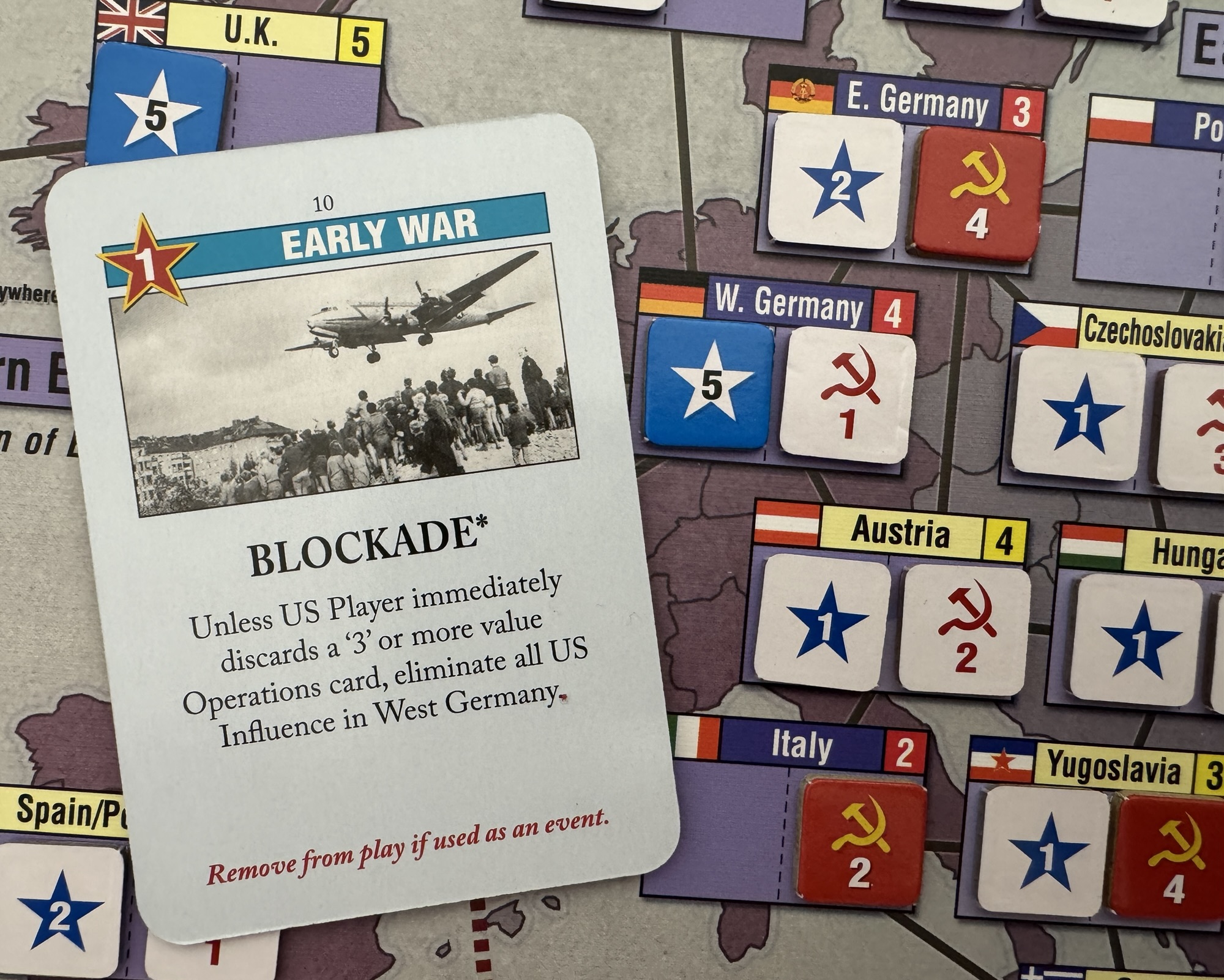
#69: Blockade from Twilight Struggle: The Cold War, 1945-1989 from GMT Games
Twilight Struggle is a 2-player game simulating the forty-five year ideological struggle known as the Cold War between the Soviet Union and the United States which can be played in 2-3 hours. The entire world is the stage on which these two countries “fight” to make the world safe for their own ideologies and way of life. The game starts right after the end of World War II in the midst of the ruins of Europe as the two new “superpowers” of the world squabble over what is left and ends in 1989, when only the United States remained standing.
The map is a world map of the period, where players move units and exert influence in attempts to gain allies and control for their superpower. The beauty of the CDG system used here is that each decision of whether to use a card for the event or the operations value is a struggle as if it is the other side’s event, it might go off hurting you very badly. There are mechanics to allow for the ignoring or cancelling of some of the best cards for your opponent in a side game within the game called The Space Race as well as nuclear tensions, with the possibility of game-ending global thermonuclear war (Shall we play a game, anyone?). I have played TS about 30 times and love it more and more with each sitting. The game makes me sweat, cringe, jump with joy and bite my fingernails. To me, a game that can do all of that in one sitting is worth the price.
One of my favorite type of cards from the game are those that force an action upon your opponent, such as discarding a card, reducing the Ops from card plays or causing them to have to make other plans than what they were working toward. These type of cards are more reactionary but definitely cause issues and mimic the various non-military focused strategies and tactics used during the Cold War. One of the most famous events from the early history of the Cold War is that of the Berlin Blockade. And there is a specific card that pays homage to the event in the game called Blockade. Blockade is an Early War Soviet Card that has an Ops Value of 1, which makes the card more valuable to be used for the printed event versus for the Ops.
When played, the card requires the US Player to immediately discard a 3 Ops or more value card from their hand or the consequence of not doing so will see all US Influence being removed from West Germany. This is a tough choice. Being early in the game, it is possible for the US to rebuild in West Germany and replace the lost influence over time if they do not wish to discard such as high value card. But, herein lies the real key to the Blockade cards use. The Soviet Player, who should be paying attention to not only their hand but also the card plays of the US Player, should try to use this card later in a turn once the US Player has played a majority of their cards in order to ensure that the event text can be realistically be achieved. If played quickly during a turn, the chances of the US Player being able to discard the required 3 Ops or great value card is higher and the card play will not generate any meaningful difference on the board state. I also would recommend a 2 card strategy here as the Soviet Player should be holding in their hand a high Ops card to be able to follow up this action with the placement of Influence into West Germany on their very next play. But, the real value to a card such as Blockade is that it forces the US Player to consider what cards are out there and to play around their negative effects as much as possible. Due to the nature of the game, and the randomness of card draws, having an expendable high Ops card ready and able to be discarded just in case of the play of Blockade is not really feasible. Also, remember that in Twilight Struggle that opponent events on cards that you play will go off and Blockade being drawn by the US Player can be bad as it will require them to play the event as you cannot discard a 1 Ops card to get rid of its negative effect in the Space Race Track due to the minimum requirement being a 2 Ops card. So the moral of the story here is that both players need to consider and plan for the play of or the mitigation of damage from Blockade.
The Berlin Blockade, which lasted from June 1948–May 1949, was a major Cold War crisis where the Soviet Union blocked all land and water access to West Berlin to attempt to force Western Allies out. The Soviet Union was taking this action as a means of retaliation against the introduction of the new Deutschmark currency. The US and Britain responded with the massive Berlin Airlift, flying over 2.3 million tons of food, fuel and supplies to the city. At the peak of the Airlift, a plane landed in West Berlin every 30 seconds. The blockade failed and the Soviets lifted it on May 12, 1949, after realizing the Allied Airlift could sustain the city for an extended period of time, marking a significant victory for the West in the ideological struggle. This event led to the acceleration of the division of Germany into East and West and the deepening of Cold War tensions.
Day 3 started off a bit slow as we dragged in the morning getting ready and didn’t get out the door till around 8:15am and after breakfast didn’t make it to the War Room until almost 9:00am. But, upon arrival we got right to gaming by setting up Cross Bronx Expressway from GMT Games with Russ Wetli from Cardboard Conflicts as our third.
Cross Bronx Expressway is the 3rd game in the Irregular Conflicts Series and attempts to simulate the socio-economic processes of urban development, and the human costs that result, as a competitive city-builder with collective loss conditions in the South Bronx between 1940 and 2000, with their unique faction pursuing their own goals while cooperating to keep the borough viable. Through a card driven sequence of play, they will work to solve the economic challenges facing the area by building infrastructure and organizations, forming coalitions, mitigating the multitude of issues facing the vulnerable population, and managing resources to stay out of debt.
Cross Bronx Expressway is a very interesting and engaging way to learn about the history of American cities as an economic simulation of sorts. Players will have to deal with the conflicting incentives and complex factors shaping urban life and together determine the fate of the Bronx.
We very much enjoyed this one and felt like it was very insightful and thematically connected with the subject and the times to create a very brain melting but interesting experience. I felt like I really had no idea what I was doing…but very much liked it.
We ended up losing the game as it is semi-cooperative and players can lose together due to bankruptcy or the overcrowding of prisons that will lead to higher social difficulties. But we learned a lot and I very much look forward to playing this one again.
We then played our 1st game of the interesting COIN Series like game Werwolf: Insurgency in Occupied Germany, 1945-1948 from Legion Wargames with Dave (a new friend from Michigan) and Gary of Ardwulf’s Lair. The game is designed by Clint Warren-Davey and Benjamin Feine and is an alternate history game, but the story that is presented is entirely plausible. Werwolf was a real underground guerrilla group, comprised of SS and Hitler Youth members. It was intended to lead an insurgency against the invading Allies and Soviets when it became clear that Germany was losing the war in a conventional sense in the mid-1940’s. They did in fact have a few successes and American intelligence officer Frank Manuel said that the Werwolves were prepared “to strike down the isolated soldier in his jeep, the MP on patrol, the fool who goes a-courting after dark, the Yankee braggart who takes a back road.”
The game allows players to take on the role of the occupying Soviets and Western Allies along with this Werwolf insurgency and the Edwlweiss insurgency.
After about 3 hours we finished 3 decks and the Werwolf Insurgency was declared the winner. All had a good time and I am looking forward to taking this to WBC in July and playing again.
I then sat down with Tim Densham with Catastrophe Games and he gave me a look at several of their planned upcoming games. These will all go on Kickstarter in order to fund the publication.
First was a look at War Cabinet, which is an economic and logistics focused take on WWII in the European Theater of Operation.
Next was Afghanistan: Decades of Strife, which is an area control game in the Conflict of Wills Series.
Then we got a look at Brothers of the Sword: Baltic Crusades which is set in 1100 AD.
All of these games will be coming to Kickstarter in the next 6-8 months and I am very much interested in them all. I was able to shoot a 30 minute video interview with Tim with more details and that’ll be on the channel soon.
We then sat down with Steve Jones from Blue Panther and Hermann Luttmann to play the new Dawn of the Zeds Designer Edition which will be available for pre-order in May and will be published at the end of July.
You know well the original Dawn of the Zeds from Victory Point Games and this has now had the rights reacquired by Hermann who is working with Steve to bring it back to life with new art, a new combat system with custom dice and some new characters. We played for about an hour and had the same fun we have always had with the game and I am very much looking forward to this new edition.
We shot a 20 minute video with Hermann and that’ll be up on the channel soon.
We then played our final game of the night, a 4-player game of War of the Ring: The Card Game from Ares with Cullen and Bad Russ. This is a game that I have had on my shelf for a few years, even purchasing all of the various expansions to date, but just have not had a chance to get it played…until now.
This was our 1st play and while it took us a good amount of time to get comfortable with the mechanics, and about 3 hours to play the entire game, we all had a great time and very much enjoyed what it was doing. The art in the game is just amazing and the game play is smart, with lots of bluffing and gamesmanship on how to play and manage your limited cards. Just a very solid multi-player card game.
It is now well after midnight and I am tired. Sorry for the brevity of my comments about the games but it’s just too late.
Tomorrow we have a full 6-player game of Here I Stand from GMT Games at 9:00am and then an evening role playing game with a WWII historical RPG called War Stories from Firelock Games. Should be a blast!
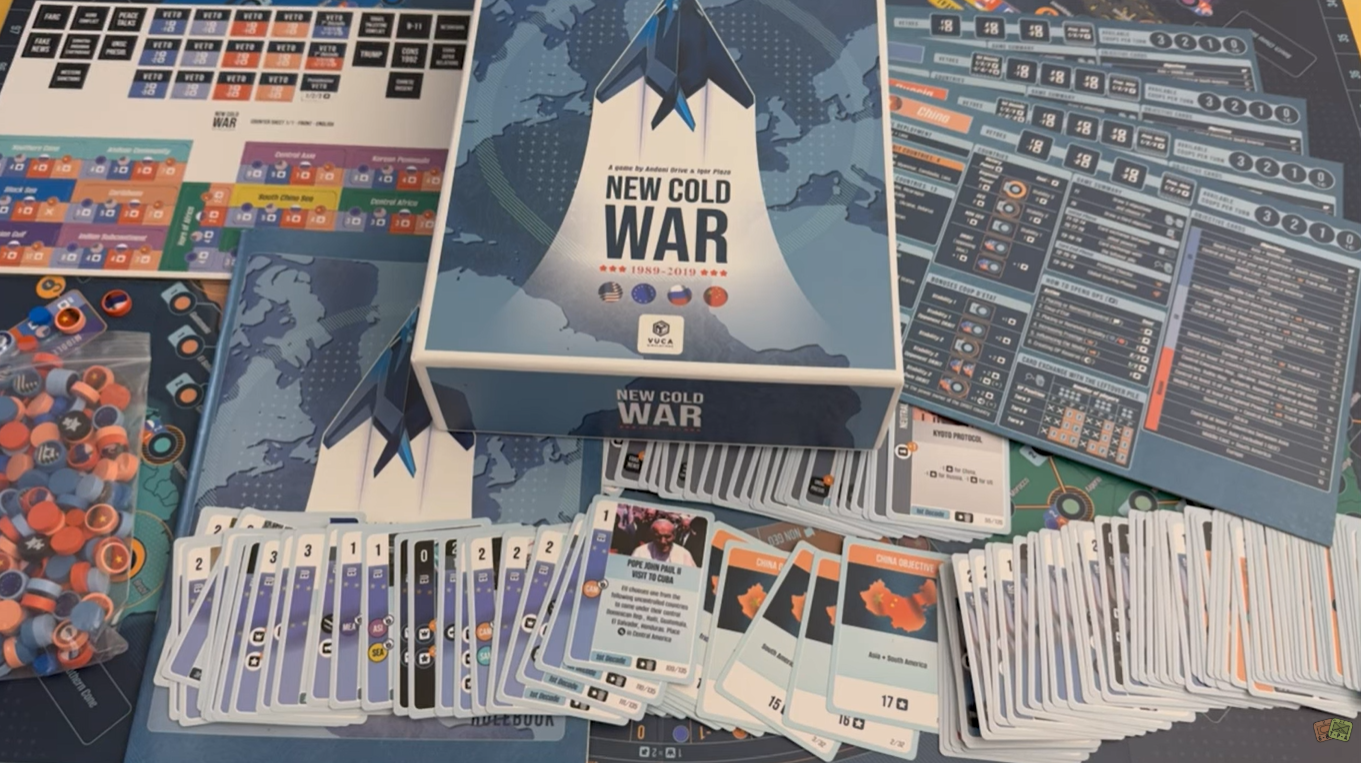
New Cold War: 1989-2019 is a Card-Driven Game based in the most important geopolitical events from 1989 to 2019. Players lead one of the four great powers (Russia, China, US, EU) in their fight for the new world order. Initially, the confrontation is between the red bloc, consisting of Russia and China and the blue bloc, comprising the United States and the European Union. However, each player must also prioritize their own strategy, as only one power can emerge victorious at the end of the game. Therefore, this game starts with cooperation between allied powers in the early stages but becomes entirely competitive as the moment of final victory approaches.
New Cold War utilizes a Card-Driven game mechanic. Players strive to attain victory by gaining international prestige, dominating the media and increasing their control of countries and different regions of the world. Other key factors to manage include military force and United Nations Security Council vetoes. Players’ strategies are determined by a series of hidden objectives they must pursue to achieve victory.
The game accommodates three or two-player versions and includes a solitaire mode through a system of bots.
I love a different style and focus of wargame. A game that takes a look at an important but somewhat obscure or rarely addressed topic such as espionage or intelligence. And this past month, GMT Games announced such a game in Checkpoint Charlie, which is a solo or cooperative game focused on SIS espionage missions in Berlin in the 1960’s designed by Russell Brown. I have reached out to Russell and he was more than willing to provide some great insight into his design.
*Keep in mind that the design is still undergoing playtesting and development and that any details or component pictures shared in this interview may change prior to final publication as they enter the art department.
Grant: Russ welcome to our blog. First off please tell us a little about yourself. What are your hobbies? What’s your day job?
Russell: Happy to be here to talk about Checkpoint Charlie! My wife and I live in a lovely town called Waukesha, just outside Milwaukee. I retired a little early from a career as a software developer and went back to the University of Wisconsin to study creative writing. That led to my main hobby, which is writing science fiction novels. On most days, I leave my house, walk to downtown Waukesha, and write at a local university library or public library or down at my favorite coffee shop. Basically, I’m livin’ the dream.
Grant: What motivated you to break into game design? What have you enjoyed most about the experience thus far?
Russell: I’ve done a lot of freelance writing for tabletop RPG publishers, but what got me interested in historical game design was solitaire bots. A couple years ago, I found a bot for Command and Colors: Ancients created by Paulo Miranda, and I had a blast playing against it. I expanded it for Samurai Battles and had fun with that. I decided to create a full bot, with no decisions made by the player, for one of my favorite games, Here I Stand. It took months, but I ended up with deck-based bots for each power that had their own personality and did some basic negotiating with the players and the other bots. In my last game against them, as France, I came in fourth. After that, I made full bots for Talon and Combat Commander: Europe. The next step was to develop a solitaire game from scratch, and the idea of a game about espionage in Berlin had been bouncing around in my head for decades. What have I enjoyed most about the experience? The answer is strange, but I think I actually miss being a programmer. Game development uses those same parts of my brain. It’s very different than writing novels.
Grant: What is your upcoming game Checkpoint Charlie about?
Russell:Checkpoint Charlie is about managing British Secret Intelligence Service espionage missions in early 1960’s Berlin. You play as a case officer, a mastermind if you will, not an individual agent. It’s inspired as much by the fictional works of authors like John le Carré as it is by accounts of actual espionage operations. If you’re familiar with le Carré’s novels, you play as George Smiley, not one of his field agents.
Grant:What games have you used as inspiration for your design?
Russell: That’s a tough one. I struggled to find a game mechanic that evokes the feel I want, a lack of complete control over agents and the situation. I’ve probably been more inspired by computer games with simultaneous movement, maybe something like RimWorld, than by any particular boardgame.
Grant: What is important to model or include in a game about the British Secret Intelligence Service?
Russell: The first question is, who is the player supposed to be? I didn’t want to model the experience of an individual field agent. What fascinated me most about accounts of these missions, including faithful fictional accounts, is the way all the assets work together and adapt to a changing situation. I want the player to experience that, all within the context of secrecy, of trying to not be discovered and compromised. To fully experience that, the player has to be a case officer, a person leading and coordinating the mission. What that means, however, is that the player doesn’t have full control of every individual action taken by every agent.
Grant: What challenges did the subject cause for the design? How have you overcome them?
Russell: I’ll limit my answer to what I think were the two biggest challenges. The first was creating a game in which the player doesn’t have complete control, but still has enough agency to successfully complete a tough mission and feel like they did something amazing. We’re working on an article about this for the Inside GMT blog, but the solution mostly comes down to the card draw movement mechanic. Most of the movement and actions that take place on the map of Berlin happen based on which card the player chooses from the draw area. That one choice triggers the movement of up to five assets and KGB agents and also affects where surveillance and intel appear on the map. The second challenge was making a game about missions taking place in secret over hours or days, with fictional agents, feel at least somewhat historical. I hope we accomplished this by using actual locations on the map and including historical events to anchor the missions in this period.
Grant: What type of missions do players undertake?
Russell: I hope Checkpoint Charlie will be perceived as a “toolkit” game. For me that means there are enough components there, and enough interacting mechanics to be able to create many different missions that feel unique. Specifically, there are missions that are basically pick up and deliver with a KGB agent on your tail, missions where you set a trap for a KGB agent by planting a piece of tempting intelligence, a mission where you have to cross the Berlin Wall to deliver instructions to a dissident Russian scientist, and a mission where you have to protect a Soviet defector and get him safely to the airport with identification papers in hand. If you play Checkpoint Charlie in campaign mode, you’ll uncover evidence of a mole in your station and run another mission to get them to expose themselves. Every mission requires you to worry about the basics of moving assets around on the map, but beyond that each mission is unique. There are twelve missions included, and so far, we haven’t run out of interesting ways to combine all the elements provided in the game.
Grant: How does the game work in its cooperative mode?
Russell: When playing solitaire, the player has four cards in their hand. With two players, each player gets three cards, and with three players, only two. However, each player contributes one of their cards to a shared hand available to all players. In this way, each player always has four cards to choose from. This also helps reduce the issue of a player holding a card that’s important for the mission, but it isn’t their turn when it’s needed. The game also includes optional secure communications rules, where players cannot discuss plans or strategy or future game states except when they exhaust a meeting token to pause the game and have a discussion.
Grant: How do players work together?
Russell: The players are all working toward the same mission objectives, taking turns going through the turn sequence. They work together by having the same plan so they’re not working against each other. They work together by being smart about which cards they contribute to the shared hand. In secure communications mode, players have to save their meeting tokens for those critical moments when they’re presented with a new challenge or it’s clear that the existing plan has gone off the rails. The cards contributed to the shared hand are even more important in secure communications mode, because they can signal basic agreement on a plan without having to call a meeting.
Grant: As a solitaire game how does the bot work? What are its priorities and how does it make decisions?
Russell: The opposition basically emerges from two mechanics in the game. The first is the surveillance pawns placed in locations around the map. These appear when a surveillance card is drawn from the mission deck and they are placed based on which cards are showing in the draw area. When an asset moves into a location under surveillance and fails a save roll, they become detected, along with any items they carry. The second mechanic is the movement of KGB agents on the map. They move around based on which card the player takes from the draw area, in the same way that the player’s asset’s move. Running into a KGB agent almost guarantees an asset will be detected. In addition, when an asset or item is detected, every KGB agent gets a free move every turn and converges on that asset or item. If a detected asset or item is ever in the same location as a KGB agent at the end of a player turn, they are compromised and removed from the mission. There are some very simple priority rules governing which location KGB agents will move to if they have a choice, but otherwise the logic of how they move is the same as for the player’s own assets.
Grant: What type of experience does the game create for players?
Russell: I think the word is “constrained,” or maybe “desperate.” The game is designed to make players feel like they don’t have much control of the situation, when in fact they do have enough to successfully complete the missions. Toward the end of a mission, when the players look at the cards in their hands and the draw area and see that there is a path to victory, despite the fact that their key agent has been detected and KGB agents are closing in, I want them to breathe out and realize they haven’t truly relaxed for thirty minutes.
Grant: What decision points face players?
Russell: Good question. Players will feel, with good reason, that the most important decision they make each turn is which of the two cards they take from the draw area. That decision effects so many parts of the game, and often involves making difficult tradeoffs. But players also make many other decisions each turn. When assets and KGB agents move, they often have a choice of two destination locations, and the player can usually decide between them. The player also must decide which card to play at the start of their turn, and this can significantly impact the outcome of everything that follows. The player can spend Intel cubes to look ahead at the next card, or to improve the odds of a detection save. They decide when an asset picks up or drops an item. In a multi-player game, they choose cards to add to the shared hand and decide when it’s necessary to call a secret meeting.
Grant: What is the layout of the board?
Russell: First, I need to point out that this is all just my own prototype artwork for playtesting. The two most important areas on the board are the map of Berlin and the card draw area. The map is roughly a five by four grid of iconic locations connected by travel lines. It’s made up of sixteen locations in West Berlin and four in East Berlin, on the other side of the Berlin Wall. The player’s assets will move around this map, gathering intel, interacting with items and other assets to complete the mission, and hopefully avoiding detection. The KGB agents also move around this map and are the players’ primary adversaries. Below the map is the card draw area, a row of five face-up cards representing locations, items or assets. Above each card location is a spot for a chit representing one of the moving tokens on the map – the assets and KGB agents. The draw area is the core mechanic of the game, determining where assets and KGB agents move, where surveillance and intel cubes are placed, and even where some historical events take place. In addition to these two areas, the board also contains locations for intel collected by either side, as well as unused surveillance pawns available to the KGB.
Grant: Why was a point to point layout of locations your choice for the board?
Russell: Checkpoint Charlie evolved from a smaller card game in which the player built up the map of Berlin by placing cards in a grid, so I think that led to a point to point map. It’s also important for the paths between locations to be immediately clear and easy to process for the players, since they’re often calculating which is the shortest path between two locations. Perhaps the main reason we’ve stuck with this layout, instead of say, going to an actual map of the city divided into regions, is that it allows us to highlight iconic locations Instead of entire neighborhoods. Assets move from Checkpoint Bravo to the Berlin Hilton, or from Café Adler to the Tiergarten. It allowed us to give the whole game a more narrative feel.
Grant: What is the purpose of the draw area at the bottom of the board?
Russell: The basic mechanic is that players can only draw one of the two cards on the ends of this row of five cards, and then all the other cards shift before refilling the empty position. No card stays in the same location from turn to turn. This is important, because these cards are used to determine where tokens move on the map. Each card location can have a chit above it corresponding to an asset or KGB agent on the map, and every turn, after the cards shift, that asset or KGB agent moves toward the location, item, or asset depicted on the card below their chit. In this example, the Dentist token will move to Mehringplatz, because that’s the card below her chit. Jester will move one location closer to Checkpoint Charlie, and Svetlova, the KGB agent, will move one location closer to the 1958 Rambler item currently at RAF Gatow. In addition to their role in moving tokens on the map, each card also has an effect printed on the bottom that applies whenever that card is showing in the draw area. As cards are drawn and new cards replace them, these effects come and go and can have significant impacts on the mission. Finally, the five cards in the draw area are also used to determine where surveillance pawns and intel cubes are placed.
Grant: How does the game use cards?
Russell: Cards are used for a few different systems in the game. When they are showing in the draw area, they determine where assets and KGB agents move, apply special effects to their depicted location, item or asset, and are used to place surveillance and intel. When a card is in a player’s hand, or in the shared hand in a cooperative game, they are only used for the played effect printed at the top of the card. There are also cards in the mission deck used to trigger historical events and the placement of surveillance pawns and intel cubes.
Grant: What types of cards are included?
Russell: The three most important types of cards, and the only cards that will ever end up in the draw area or a player’s hand, are location, item, and asset cards. The draw deck for the mission, referred to as the mission deck, contains one card for each of the twenty locations on the map, plus one card for each asset and item involved in the mission. The mission deck will also include a variable number of surveillance cards, intel cards and event cards, depending on the mission.
Grant: Can you provide us with a few examples of the cards and explain their uses?
Russell: Certainly. Let’s start with the location card for Checkpoint Bravo. On the map you’ll find the Checkpoint Bravo location at the bottom left. In reality, this was the main entry point for road traffic coming into West Berlin from West Germany, and it was actually a much busier crossing than Checkpoint Charlie. The name and the image on the card make it easy to match it to its corresponding location on the map. At the top of the card is the played effect. This is what happens when the player plays the card at the start of their turn, and it generally isn’t optional. At the bottom of the card is another printed effect. This is the active effect and applies as long as the card is showing in the draw area. The Checkpoint Bravo card is actually quite powerful. It moves a KGB Agent of the player’s choice one location closer to Checkpoint Bravo. The active effect of this card is very good, as well. As long as the card is showing in the draw area, the player may spend an intel cube to make a detected asset entering Checkpoint Bravo become undetected.
Next let’s look at the Papers card, arguably one of the most important items in the game. This card will only appear on missions that include the Papers item marker. If a detected asset has picked up this item and is carrying it, playing this card can make them undetected. For some missions, the active effect at the bottom of this card is even more important. Dotted travel lines on the map cross over the Berlin Wall and assets normally can’t traverse them, but while this card is showing in the draw area, an asset carrying this item can cross into East Berlin, or back.
Finally, let’s look at an event card. This is the Powers Abel Exchange card. It represents the 1962 CIA prisoner exchange of Soviet spy Rudolph Abel for captured U.S. U-2 aircraft pilot Francis Gary Powers at Glienicke Bridge, as depicted in the movie Bridge of Spies. When this card is drawn, it has the printed effect and then is set aside for reference. Event cards never stay in the draw area or go into a player’s hand.
Grant: What types of missions confront the players?
Russell: I’ve mentioned a few, but others include transferring intelligence documents through a dead drop to throw off enemy agents, making sure a West German Stasi agent finds evidence that the KGB has infiltrated the West German secret police, using radio receivers and any means necessary to gather intel from East Berlin, and planting a bug on the other side of the Berlin Wall.
Grant: What happens when a mission fails or succeeds?
Russell: If you’re playing a single mission, completing the objectives of the mission means you’ve won. There are no victory points, just success or failure. If you’re playing through missions as part of the campaign, then whether you win or lose a mission may determine which missions you’re assigned in the future. If you successfully deliver instructions to the dissident Russian scientist, then at some point you’ll be assigned a mission to cross into East Berlin and extract him to the West. If you failed to deliver the instructions, you’ll be assigned a different mission. Most importantly, your score in the campaign game is based on how many of your eight missions you complete successfully. Losing a mission also typically implies that one or more of your assets were compromised, which may limit their availability for future missions.
Grant: How is victory obtained in the game?
Russell: Each mission has one or more specific objectives that must be completed. As soon as those conditions are satisfied, the players immediately win. Conversely, there are one or more conditions that immediately end the mission in failure. In the campaign game, the player is rated based on how many missions they completed successfully.
Grant: What role do intel cubes play? How are they acquired and what do they offer?
Russell: Intel cubes represent intelligence available in the city that is pertinent to the mission. This could be coded signals, special documents, or known informants. Missions typically start with a couple intel cubes already on the map, and every time an intel card is drawn from the mission deck, an intel cube is placed on the location represented by the rightmost card in the draw area. Whenever one of the player’s assets moves into a location with an intel cube, the cube is collected and can be spent by any player during their turn for various benefits. For example, spending a cube allows the player to look at the next card in the mission deck. When a KGB agent enters a location with an intel cube, that cube is placed in the next box of the numbered KGB Intel track, and mission-specific events are triggered when specific numbers are filled. For instance, a mission may specify that another KGB agent is added to the map when the KGB Intel track reaches space 3.
Grant:What role does surveillance play?
Russell: Each time a surveillance card is drawn during a mission, a location in the draw area is placed under surveillance, signified by a red surveillance pawn. This means KGB surveillance resources have been allocated to that location. Some card effects remove surveillance pawns, while others place locations under surveillance. Each mission has a limited number of surveillance pawns, so when surveillance is added in one location, it may be removed from somewhere else. When an asset moves into a location under surveillance, they must roll a 10-sided die and pass a save or become detected. Some locations improve this roll, as do some items, and some assets are just better at avoiding detection. Some event markers, like demonstrations, also affect this save. As I mentioned earlier, once an asset is detected, KGB agents will move toward them and they will soon find themselves compromised and removed from the mission.
Grant:How does the campaign system work?
Russell: Players undertake eight of the twelve missions and are rated based on how many are successful. The set of missions assigned depends on success or failure of some of the earlier missions. Some of the intel cubes gathered during one mission may carry over to the next, and compromised assets may have to sit out a mission or two. Any historical events that occur are also removed from the campaign so they’re not repeated in later missions.
Grant: What do you feel the game models well?
Russell: I think Checkpoint Charlie shows that the mission is going to move forward one way or another. You have to guide it and use what resources you have to nudge it back on track when it strays. You can try to force it by drawing cards that always move your favorite asset to their best location, but that probably means your other assets are going to stumble into a KGB agent, or the KGB agents are going to gather too much intel and trigger some unwanted event. This is a game about making intelligent tradeoffs and using what control you do have to mitigate the bad effects when there aren’t any good choices.
Grant: What has been the experience of your playtesters?
Russell: The pleasant surprise for me has been how quickly they adapt to the way their assets and the KGB agents move. Compared to other games with movement points or action points or an activation system, Checkpoint Charlie is very different. They’ve figured out the whole draw, shift, move process within a couple turns. It is different, but it’s actually fairly simple. It has also been fun to see them view the components of the game, and particular card events, as part of a narrative. The game is telling a story.
Grant: What are you most pleased about with the design?
Russell: I’ve played this game a lot, in all of its iterations. I’ve been through all of the missions many times, and then played through them all again to make sure we didn’t break them after we adjusted some rule or changed the effects on a couple cards. What pleases me most is that when I play this game, even after playing it all those times, I still really enjoy it.
Grant: What other designs are you contemplating or already working on?
Russell: I’m working on solitaire bots for Virgin Queen and for Combat Commander: Pacific. I have three board game designs in various stages. The first and farthest along is Allied Advance, a small, one-hour solitaire game where the player commands allied forces in Europe from the capture of Monte Cassino to the fall of Berlin. The second is Gilgamesh, a three-player game of Mesopotamia’s Early Dynastic Period, where the winner is the ruler whose reign inspires the most memorable epic. The third is Bletchley Park, a two-player game that spans all of World War II in Europe, with one player as the axis commanders encoding the details of large military operations, and the other as allied observers and codebreakers trying to undermine those operations without revealing which codes they’ve broken. It’s going to be a lot of fun figuring out the bot for that one.
Thank you. I’m grateful that I had this chance to answer your questions.
In my opinion, this game looks extremely interesting and I am very much excited to learn more about it. I am so glad that this topic is being covered here and look forward to playing this one day soon.
Two weeks ago, we’ve looked at the first period of Soviet liberalization under Nikita Khrushchev from the 1950s on. While these reforms ended the era of Stalinist totalitarianism, they petered out when Khrushchev lost interest in them and was eventually overthrown and replaced by the more conservative Leonid Brezhnev. It would take another generation until a new Soviet leader, Mikhail Gorbachev, would undertake another broad reform program. These reforms – like last time, in the realms of domestic, foreign, and economic policy – are the subject of this article. Of course, you’ll also find a few board games in it!
Freer Press, Freer Elections
The Soviet Union’s political landscape had ossified under Brezhnev. This stagnation (or, if you want to phrase it more positively, hyperstability) also ruled out any experiments after Brezhnev’s death in 1982, and so the Politburo selected his loyal lieutenant Yuri Andropov. Unfortunately, Andropov was already 68 and severely ill then. He died in 1984, to be succeeded by another Brezhnevite stalwart, Konstantin Chernenko, who was similarly afflicted and even older (72 at his accession). Chernenko died in 1985. The rapid succession of aging Soviet leaders is poignantly captured in the contemporary joke: Margaret Thatcher calls Ronald Reagan: “It’s a pity you didn’t come to the funeral of the Soviet general secretary. Marvelous. A great spectacle. I’m totally going again next year.”
Cover of the English-language edition of Kremlin. Unfortunately, fake Cyrillic was once more irresistible, and so the R in Kremlin has been replaced with a Я (which would make the word Kyaemlin).
Another quasi-contemporary (1986) satirical take on the Soviet gerontocracy is Kremlin (Urs Hostettler, Fata Morgana): Players support the various Politburo members in the hopes of advancing those they have influence with to the top jobs, but many a hopeful candidate will die of stress and old age before realizing their ambitions.
After Chernenko’s death, even the most conservative Politburo members saw the need for a different tack: They elected Mikhail Gorbachev as their new leader in 1985, a real baby at age 54. Gorbachev’s reformist leanings were well-known, but he proceeded cautiously in his first year. As with Khrushchev, the big programmatic changes were first announced at a Party Conference of the Communist Party of the Soviet Union.
Gorbachev’s first slogan for his reforms was glasnost (openness). That included sweeping changes to Soviet citizens’ freedom of expression: Gorbachev encouraged the Soviet press to scrutinize politics instead of simply parroting the party line. Dissidents were released from prison. Even non-state-sponsored demonstrations were allowed – a powerful tool to express malcontent with the government. Of course, these reforms undermined the power base of the Communist Party – but Gorbachev hoped that he could steer the ship of state in the new environment and might even benefit from a freer populace.
Even more radical were Gorbachev’s institutional reforms, usually referred to as perestroika (restructuring): The Communist Party’s monopoly on power was cut off by establishing the Congress of People’s Deputies as an independent parliament, and while the first elections in 1989 were not fully free, it was the first time that Soviet citizens could select from several candidates in a contested election. Gorbachev himself chose to base his power no longer on his role as General Secretary of the Communist Party, and instead was elected President of the Soviet Union by the Congress of People’s Deputies in 1990.
This nascent democratization drive – eventually rather envisioned than enacted – makes for the most powerful card in the last phase (1985—1991) of the Cold-War-in-a-nutshell which is Twilight Squabble (David J. Mortimer, AEG): It’s a bit of speculation on the internal and external legitimacy and attractiveness a more democratic Soviet Union could have enjoyed.
Speaking of external legitimacy and attractiveness: Gorbachev’s policies (and he himself) would prove immensely popular in the West… after he had weathered the initial suspicion. Gorbachev began to advocate for a return to détente soon after he assumed office, but US president Ronald Reagan assumed this to be a Soviet ploy. Only after Gorbachev had met Reagan at the 1986 Reykjavík summit did the president believe Gorbachev’s intentions to be genuine.
In the following years, the two of them agreed on far-reaching mutual disarmament, most notably the Intermediate-Range Nuclear Forces (INF) Treaty. Gorbachev’s immutable advocacy for arms reduction is reflected in Wir sind das Volk! – 2+2 (Richard Sivel/Peer Sylvester, Histogame) as his event card cannot be used for the arms race.
Besides the lofty realms of nuclear arms reduction, Gorbachev also had more grounded problems to deal with: The Soviet Union had invaded Afghanistan in 1979 to prop up the failing pro-Soviet government there and had been embroiled since then in a costly and futile counter-insurgency. As the Soviet military could not present Gorbachev with a convincing roadmap on how to win the war, he decided to pull the Soviet forces out in 1988. By that time, the unsuccessful war had undermined the Soviet government’s legitimacy which had rested on its status as a military superpower, exacerbated by the new avenues of political expression open to disaffected citizens – the mothers of Soviet soldiers who fought (or had died) in Afghanistan were among the first to form associations, to pressure the government, and to protest.
In that sense, it is surprising that the withdrawal from Afghanistan can still net the Communist player points in 1989 (Jason Matthews/Ted Torgerson, GMT Games) – but the general principle holds true: The later the Soviets withdraw, the more their failure in Afghanistan becomes an asset to the opponents of Communist power.
Finally, Soviet power was the rock on which the Communist governments in Eastern Europe rested. Whenever they had been challenged – most importantly in Hungary in 1956 and Czechoslovakia in 1968 – Soviet tanks had quashed the dissent. This limited sovereignty within the Eastern bloc had been the central tenet of Soviet foreign policy, after 1968 named the Brezhnev Doctrine. Gorbachev adopted a new approach: He would not militarily intervene in Eastern Europe anymore. Instead, the countries of the Warsaw Pact were free to “do it their way” – thus humorously called the Sinatra Doctrine.
Finally, Gorbachev’s reform agenda of perestroika also aimed to transform the Soviet economy. All Soviet leaders had engaged in some kind of economic reforms, so Gorbachev’s activity did not seem very surprising… until observers inside and outside of the Soviet Union realized how radically it would change the tenets of the Soviet economy, traditionally based on central planning, large state-owned companies, and very limited contacts with the outside world.
First, Gorbachev gave the state-owned companies much more leeway over what to produce and how to set prices. These market incentives were supposed to improve efficiency, but clashed with the existing structures.
Undeterred, Gorbachev went a step further and loosened the restriction on private enterprises. More Soviet citizens could start their own store or workshop and offer goods and services at their own responsibility.
Then, Gorbachev allowed for joint ventures with Western companies (provided the Soviet part owned a majority share), and even let them set up dependencies in the Soviet Union – the famous first McDonald’s restaurant in the Soviet Union opened in January 1990.
The End of the Cold War and the Collapse of the Soviet Union
Gorbachev’s daring move to end hostilities with the West was an unqualified success. In late 1989, he and US president George H.W. Bush could merrily declare together that the Cold War was over.
The consequences of Gorbachev’s foreign policy reverberated through the Eastern Bloc: The allied Communist regimes of Central and Eastern Europe were swept away in 1989.
Early in a game of 1989: The Democrat (blue) has already taken power in Poland and Hungary. It will be difficult for the Communist (red) to stop the ever-growing blue tide. From the Rally the Troops! implementation.
The Perestroika and Glasnost event in Wir sind das Volk! – 2+2 neatly shows the way in which Gorbachev’s reforms put stress on the system: On the one hand, it increases Soviet dominance and makes socialism more attractive (lower two icons). However, it also increases unrest in East Germany (fist icons).
Within the Soviet Union, the political freedoms granted allowed citizens to demand more freedoms. These centrifugal effects became particularly visible as most of the non-Russian republics soon had nationalist independence movements which began to eat away the Soviet Union from its ethnic fringes. Gorbachev responded by proposing a looser federation between the Soviet Republics.
The political reforms also had negative interaction with the economic reforms: On the one hand, the flurry of changes created new inefficiencies; on the other, the increased freedom of the press highlighted economic problems no matter if they were new or had existed for centuries. As Soviet economic performance thus both objectively worsened and also became more obvious to the average citizen, Gorbachev’s legitimacy eroded.
Hardliners within the Communist Party couped against Gorbachev in August 1991 to prevent the loose federation between the Soviet Republics. A coup might also spell the end for the player in the solo game Gorbachev: The Fall of Communism (R. Ben Madison, White Dog Games). It’s a States of Siege game with a twist: Whenever the marker on any of the five paths (four of which refer to various ethno-national groups in the Soviet Union, the fifth represents the Communist Party) reaches the center, the game is not lost immediately, but a coup is staged: If Gorbachev has enough elite support to weather it, he goes on to fight another day.
In history, that was not the case: While the coup failed, it made Gorbachev a lame duck. The supporters of reforms turned away from him and toward his erstwhile ally Boris Yeltsin (who had cut a much more dashing figure during the coup), and away from the Soviet Union and toward their respective ethno-national identities. Gorbachev resigned as president and the Soviet Union was dissolved in December 1991.
The most influential work on Gorbachev’s time in office and his policies remains Brown, Archie: The Gorbachev Factor, Oxford University Press, Oxford 1996.
A magisterial mosaic of Soviet social, economic, and cultural life is Schlögel, Karl: The Soviet Century. Archaeology of a Lost World, Princeton University Press, Princeton, NJ 2023.
For the age of hyperstability before Gorbachev (and the discussion if it was an age of stability or stagnation), see the essays (in German, but with English abstracts) in: Belge, Boris/Deuerlein, Martin (eds.): Goldenes Zeitalter der Stagnation? Perspektiven auf die sowjetische Ordnung der Brežnev-Ära, Mohr Siebeck, Tübingen 2014.
On the transformative last third of the 20th century in Russian history, see Kotkin, Stephen: Armageddon Averted. The Soviet Collapse, 1970-2000, Oxford University Press, Oxford 2001.
On the end of the Cold War, see Dockrill, Saki Ruth: The End of the Cold War Era. The Transformation of the Global Security Order, Hodder, London 2005.
For the Soviet intervention in Afghanistan, see Braithwaite, Rodric: Afgantsy. The Russians in Afghanistan, 1979—1989, Oxford University Press, Oxford 2011.
This year has been a bit of a blur for me with work, personal commitments and family matters and I just feel like I have not been giving much attention to the blog. But, I am back now and ready to get right back to it with the next entry in our Wargame Watch feature. This month, I was able to find 18 games to highlight! Of that total, 3 games were offered on Crowdfunding.
Founded by industry veterans Ryan Heilman and Wes Crawford, Wharf Rat Games is a Baltimore-based publisher dedicated to high-quality, light-to-medium-weight games. Our mission is to deliver engaging historical, sci-fi, and fantasy themes that can be played in under 90 minutes, making them accessible to both casual and experienced players.
Featured Title:A Forlorn Hope by Hermann Luttmann
Wharf Rat Games is thrilled to announce their debut title, a revitalized vision from legendary designer Hermann Luttmann.
The History: Originally pitched over a decade ago as the mechanical precursor to the hit In Magnificent Style, this game returns to Hermann’s original vision of WWI trench warfare. Here is a link to the Rat Chat show where Hermann discusses the history of In Magnificent Style:
The Gameplay: A solo or 1–3 player cooperative experience using a tense push-your-luck mechanic. Players command a regiment charging across No Man’s Land, balancing bold advances against the threat of becoming pinned under relentless enemy fire.
The Content: Features six scenarios covering iconic battles such as The Somme, Verdun, and The Lost Battalion.
Wharf Rat Games is gearing up to launch their Backerkit campaign on February 10th. Early Bird Special: Back the game on the first day to get it for just $69, a savings of $20 off the MSRP!
You can connect with Wharf Rat Games on the following social media outlets:
1. A Forlorn Hope from Wharf Rat Games Coming to Backerkit on February 10th
Wharf Rat Games is a new publisher recently started by the dynamic duo of Ryan Heilman and Wes Crawford. I have interviewed both of these guys a few times for their own designed games and also hung out with them quite a bit at conventions including Buckeye Game Fest in April 2024 and the World Boardgaming Championships in August 2024. I am really happy for them that they have taken this plunge and created their own publishing company. I know they know games. Have been in the industry for a while now and also have great connections with many designers and would be designers and I am sure that they will bring many quality offerings to our tables over the next decade plus.
But there is more than just their introduction here as they have signed their first game and it is from a designer we all know and love – Hermann Luttmann. A Forlorn Hope places solo players or up to three cooperative players in command of a battalion charging across No Man’s Land to capture enemy trenches during World War I. Success requires careful balancing of bold advances and timely retreats to avoid casualties, maintain cohesion, and keep troops from becoming pinned under relentless enemy fire. Over a decade ago, Hermann pitched a groundbreaking design to Alan Emrich at Victory Point Games—a push-your-luck mechanic within a wargame framework, originally set in the WWI trenches. While the concept was well-received, Alan suggested a Civil War theme instead, leading to the creation of In Magnificent Style, based on Pickett’s Charge at Gettysburg. This game went on to be published by Victory Point Games and later by Worthington Publishing.
From the game page, we read the following:
A Forlorn Hope is an abstract simulation wargame of a typical trench assault, modeling those attacks that were conducted during the First World War (1914-1918). The player represents an attacking regiment of troops consisting of three battalions, with each battalion made up of two or three assault companies (depending on the number of players).
The game uses a “press-your-luck” design philosophy that will challenge you with tough decision-making and risk-taking throughout the game. The goal is for the player(s) to drive their forces across No Man’s Land in the quickest and most efficient manner possible to achieve the best level of victory.
A Forlorn Hope is designed both for solitaire and multiplayer co-operative play. Numerous scenarios are included, starting with a basic assault scenario (which is ideal for learning the intricacies of the game system), then adding multiple historically-based scenarios simulating actual battles from World War I that offer a slightly more complex and layered gaming experience. Each scenario features singular aspects of the historical battle it is simulating, and each will therefore be a unique gaming experience.
The project is set to launch on Tuesday, February 10th.
2. Napoleon at War Deluxe Edition from Decision Games
Over the past couple of years, Decision Games has been going back through their catalog and doing these Deluxe Editions of several of their games including Red Dragon Green Crescent Deluxe Edition in 2024 and Blue & Gray Deluxe Edition in 2025. They now have tabbed several more games for this game treatment and the first that I will share is Napoleon at War Deluxe Edition.
From the game page, we read the following:
Napoleon at War Deluxe Edition reprints the original SPI QuadriGame consisting of four separate battles, each among the most important of the Napoleonic Wars: Marengo, Jena-Auerstadt, Wagram, and the Battle of Nations at Leipzig. This new deluxe edition has a full-color instruction booklet, new counter and map artwork, with 9/16” counters, two back printed 22” x 25.5” mounted game boards, and new player aid cards. The basic rules to all four games in the Napoleon at War Series are standardized. Each game has its own exclusive rules, which include historical set up and reinforcements, special rules, player’s notes, and commentary by the game’s designer. The game mechanics used in this series are based on the popular Borodino-Napoleon at Waterloo game system. The scale of each game ranges from 400 to 800 meters per hex, while each game turn represents between one and two hours of real time. Units range in size from demi-brigades through divisions, with each strength point representing between 250 and 350 men or an equivalent amount of artillery.
Movement is sequential and single-phased. Zones of control are rigid, and combat is mandatory between adjacent opposing units. Stacking is limited to one unit per hex. The Combat Results Table is relatively uncertain, with odds of 4 to 1, or better, necessary to ensure at least a “Defender Retreat” result. Terrain ranges from the Austrian parade grounds south of Wagram to the rough and forested battlegrounds of Jena-Auerstadt. Game length varies from the five-turn First Day Scenario of the Battle of Nations to the 20 game turn Grand Battle Scenario of that same game which simulates the entire three- and one-half-day Battle of Leipzig, the largest battle of the Napoleonic Wars.The games, though graphically enhanced from the originals, remain the same. Now enhance your enjoyment with this new deluxe edition of another SPI classic!
3. Year of the Rat Vietnam 1972 Deluxe Edition from Decision Games
The 2nd game that is being offered up for pre-sale with a new Deluxe Edition is Year of the Rat Vietnam 1972, which was originally designed by John Prados and now redesigned by Joseph Miranda.
From the game page, we read the following:
On 30 March 1972 the North Vietnamese Army (NVA) launched its “Easter Offensive” into South Vietnam, attempting to either win the war decisively or improve the North’s negotiating position at the Paris Peace Talks. Surprised by the large-scale attack, the Army of the Republic of Vietnam (ARVN) rallied, and supported by US airpower, launched counterattacks into the fall, finally repulsing the Communist offensive.
Year of the Rat Deluxe Edition recreates that decisive campaign. Powerful NVA divisions operate alongside Viet Cong regiments and decoys, evading the ARVN while striking quickly at vital towns and bases. ARVN elite airborne, ranger, and marine units respond, creating a tense asymmetrical contest of big unit battles and hard-fought sieges, with increasing American airstrikes and worsening NVA supply capabilities.
This Deluxe Edition enhances the original, acclaimed SPI game design (published during the campaign) with a half-century of research and analysis, providing updated orders of battle and terrain analysis. Three scenarios and fifteen order of battle variants cover a wide range of game options, including operations into Laos and Cambodia.
Additional features include:
• New graphics on enlarged maps and counters
• Expanded Allied airmobile operations and units
• NVA divisional reorganization and tank regiments
• Full 1971–72 US order of battle
• Australian, Royal Thai, Cambodian, and Khmer Rouge forces
• Vietnamese and US Navy riverine units
• ARVN base camps and regional forces
• Extensive optional rules
Year of the Rat Deluxe Edition offers you the opportunity to explore and make decisions in a campaign that changed the course of war and peace.
4. 1812: The Campaign of Napoleon in Russia Deluxe Edition from Decision Games
The third and final game getting a facelift from Decision Games is 1812: The Campaign of Napoleon in Russia Deluxe Edition.
From the game page, we read the following:
Napoleon invaded Russia with 600,000 troops of which only about 110,000 escaped in organized formations. The largest factor in this enormously deadly campaign was supply. The ability of a Napoleonic army to supply itself depended heavily on the surrounding countryside. Areas were stripped of resources to supply the army, which had to move or starve within a very short period. 1812 Deluxe Edition treats this difficulty of command as a central point, through the game’s area depletion system.
1812 Deluxe Editionupgrades the original SPI 1812 Strategic Area Map Game with a full-color rulebook and player aid cards, new artwork, larger counters and an enlarged map on a mounted game board.
Players must battle attrition, supply, and enemy forces to win. 1812 offers three scenarios, starting in June, late August, and early October, each with free and historical set-up options. Optional rules add leaders and fortresses, while new variant rules provide additional leaders, battle plans, and elite guard forces. Other than adding the variant rules, and incorporating clarifications and known errata, no major changes have been made to the original SPI rules.
1812 Deluxe Edition provides you the opportunity to see if Russia falls to Napoleon’s conquest, or survives, spelling the eventual doom of the Napoleonic Empire. Open this new deluxe edition and see if you can change history.
I love a different style and focus of wargame. A game that takes a look at an important but somewhat obscure or rarely addressed topic such as espionage or intelligence. And this month, GMT Games announced such a game in Checkpoint Charlie, which is a solo or cooperative game focused on SIS espionage missions in Berlin in the 1960’s.
From the game page, we read the following:
Checkpoint Charlie is a solitaire or cooperative game of British Secret Intelligence Service (SIS) espionage missions in Berlin in the early 1960s.
West Berlin is an isolated outpost of the Western Powers in the center of the German Democratic Republic (East Germany). East Berlin, on the other side of the Berlin Wall, is a base of operations for Soviet KGB agents and the Stasi secret police. This is a city of spies, a focal point of worldwide espionage in the growing Cold War. In this game, you send your assets (agents) on missions and use your influence and foresight to help them complete objectives before they are detected and compromised by KGB agents. As you play through these missions, you will:
Ensure that an important defector gets safely out of the city.
Make contact with a dissident Russian scientist on the other side of the Berlin Wall.
Gather intelligence in East Berlin and return safely to the West
Entrap a troublesome KGB agent with tempting intelligence.
Sow distrust between KGB and Stasi agents.
Identify a Soviet mole among your SIS agents and wait for them to reveal themselves.
Can you accomplish all of this in secret, as the very public events of the Cold War change the political landscape of Berlin itself?
This is a game about your assets staying one step ahead of the KGB and completing missions without being detected. Each mission starts with a different cast of assets and KGB agents, a set of items that may help complete the mission, and multiple historical events that can change the situation. Victory conditions are specific – getting an asset out of the city, making contact with a new source, or even crossing the Berlin Wall to gather important intelligence and returning without getting caught. There are no victory points or turn limits in Checkpoint Charlie, just objectives your assets must complete before they are compromised or overwhelmed by the growing web of KGB surveillance. The game map includes iconic locations like Checkpoint Charlie, Glienicke Bridge (the “Bridge of Spies”), and the notorious Berlin Hilton, each with unique game effects. You will manage a hand of cards that represent assets, items, and locations on the map. On your turn, you’ll play a card to influence the situation, and when you take a card from the Draw Area to refill your hand, every SIS asset and KGB agent in the city will move and take actions based on which card you chose. New Intel may appear on the map, locations may be placed under KGB surveillance, and Event cards may affect specific locations.
In Checkpoint Charlie, you are not a field agent. You are a planner, a director monitoring the situation but limited in how much you can directly intervene. That sense of influencing the situation but often just having to watch as events unfold is created by the core mechanic of Checkpoint Charlie: the Draw Area below the map. This area contains five face-up location, asset, or item cards. Chits representing each of the tokens on the city map (your SIS assets and the KGB agents) are placed above each of the cards in the Draw Area. After playing a card from your hand, you will draw a card from either end of the Draw Area, and then the remaining four cards will shift left or right to fill the empty position before a new card is drawn to fill the row. In this way, every card in the Draw Area shifts one space whenever you draw a card. This is important because every token in Berlin then moves closer to the location, asset, or item on the card directly below their chit. In the example below, the cards have shifted and the empty spot has been filled. Now the Dentist will move to Mehringplatz. Jester will move one location closer to Checkpoint Charlie, and KGB Agent Svetlova will move toward the 1958 Rambler at RAF Gatow.
This game looks extremely interesting and I am very much excited to learn more about it. I am going to reach out to the designer Russ Brown to get some more information to share.
6. Here I Stand 500th Anniversary Reprint Edition 3rd Printing from GMT Games
Here I Stand is one of the greatest Card Driven Games I have ever played, and we have played a lot in our time. I have played this game more than 10 times and found each experience to be simply sublime, even though it takes 10-12 hours to play. The game now has a 3rd Printing of the Deluxe 500th Anniversary Edition and you need to get you a copy and find someone to play with.
From the game page, we read the following:
Here I Stand: Wars of the Reformation 1517-1555 is the first game in over 25 years to cover the political and religious conflicts of early 16th Century Europe. Few realize that the greatest feats of Martin Luther, Jean Calvin, Ignatius Loyola, Henry VIII, Charles V, Francis I, Suleiman the Magnificent, Ferdinand Magellan, Hernando Cortes, and Nicolaus Copernicus all fall within this narrow 40-year period of history. This game covers all the action of the period using a unique card-driven game system that models both the political and religious conflicts of the period on a single point-to-point map. There are six main powers in the game, each with a unique path to victory.
If you own the original (non-500th Anniversary edition) Here I Stand, here are the upgrades you will find in the deluxe 500th anniversary edition. Enhancements include: 6 brand new cards added to the deck, including Thomas More, Thomas Cromwell, Rough Wooing, and Imperial Coronation. Revisions to over 15 existing cards including Copernicus, Master of Italy, and Machiavelli to allow for more exciting in-game play and additional possibilities for diplomatic deals. A new Chateau construction table is now used to resolve France’s Patron of the Arts home card plays. Several Virgin Queen rule updates are incorporated back into Here I Stand, affecting minor power activation, piracy, space trading, and foreign wars.
There also is included the special 2-player variant which pits the Protestants versus the Catholics in a modified form of the game. But it is still good and this is how we first played the game.
7. Special Component Pack for The Last Hundred Yards Vol. 5: For King & Country from GMT Games
If you didn’t know we really enjoyed The Last Hundred Yards very much as well as Volume 2: Airborne Over Europe. The system is extremely interesting for a tactical game and uses some novel elements in regards to how victory points are scored including a focus on time and casualties. Really an excellent system! Now, even though there are 5 total volumes that have been released, including most recently Volume 5 For King & Country, Mike Denson has forged ahead with an interesting expansion called a Special Component Pack.
From the game page, we read the following:
We are offering this Special Pack for players who purchased The Last Hundred Yards Volume 5: For King & Country because the necessary modules to play all the missions are not currently available. This pack includes all components (German counters and maps) necessary to make Volume 5 a Stand-Alone Game. With this Pack, players will be able to play every mission included in the module.
Components included in the for King and Country Special Zip Lock Pack:
7 double-sided geomorphic maps (14 maps total)
1 full color Rules booklet (latest edition) (44 pgs.)
8. Dice in the Dirt: A Tactical Print and Play Skirmish Game from Michael Shane Mecham Currently on Kickstarter
Recently, I have really been enjoying several Print and Play solitaire wargames. They are inexpensive, easy to create and setup and then most of them have some really engaging and interesting gameplay. This month, I came across a new offering called Dice in the Dirt: A Tactical Print and Play Skirmish Game designed by Michael Shane Mecham and I jumped on it pretty quickly.
From the game page, we read the following:
Dice in the Dirt is a fast, tactical print-and-play skirmish game for two players.
Each player commands a six-soldier squad fighting over a dense, modular battlefield where pressure, positioning, and timing matter more than raw firepower. The game uses blind-bag activation, suppression mechanics, and standard dice to create tense, unpredictable engagements.
Dice in the Dirt is not about killing fast—it’s about pressure. Suppression locks soldiers in place. Actions are scarce. Timing matters more than firepower. Victory comes from forcing your opponent to waste precious moments under fire.
This is a complete, digital-only release designed for quick setup and focused play.
It really seems pretty interesting and the best part about these Print and Play games is that the cost of entry is so low that it is worth taking a chance on. I am a backer and look forward to playing this one.
As of February 1st, the Kickstarter campaign has funded and raised $521.00 toward its $100.00 funding goal with 32 backers. The campaign will conclude on Friday, February 6, 2026 at 9:57am EST.
9. Battle Decisions: Kriegsspiel from Catastrophe Games Currently on Kickstarter
Catastrophe Games is a small publisher who just really puts out interesting games. I have played several of their games and enjoyed them all. Recently, they announced a new game called Battle Decisions: Kriegsspiel designed by Paul LaFontaine.
From the game page, we read the following:
Battle Decisions: Kriegsspiel is a basic Kriegsspiel kit in a box. You will have everything you need to play a game of Kriegsspiel: a map and counter sheet for the umpire and two players, along with a very basic resolution system.
This game benefits from hundreds of hours of face to face and online playtesting, with the system refined to allow an experienced umpire to launch and complete a simple scenario in just over an hour.
The scenario book runs scenarios across time: while most of the scenarios focus on the 19th century, it also shows how to run modern skirmishes (WW2) while allowing ancient battles as well (Alexandria versus the Persian Empire)
But wait, you might ask, how can you run so many and various scenarios off one central Europe map? What Paul did was take the central element of the battle and found a location on the map that most represents the fight. This is an elegant way to allow a single map to be used for multiple battles.
Kriegsspiel began as a past time for Prussian nobles. Eventually a version was presented to their king who then required its use for training Prussian officers. Many attribute some of the Prussian success in the 1870 Franco-Prussian war to the widespread use of the Kriegsspiel amongst the Prussian officer corps.
After the war Kriegsspiel games were used by many nations to train their leaders. Now the descendants of the original Kriegsspiele live on in the form of software driven exercises for staffs at various levels. However the focus on command and control is still the key factor in these modern games.
Battle Decisions: Kriegsspiel offers players a chance to return to form of the original games, with simple counters and maps, allowing players to forge their own tactics and plans.
As of February 1st, the Kickstarter campaign has funded and raised $3,313.00 toward its $500.00 funding goal with 55 backers. The campaign will conclude on Monday, February 2, 2026 at 7:00pm EST.
10. Operation Overlord from VUCA Simulations
VUCA Simulations is a new company on the scene the last few years and they are coming out with some really great looking games. We have played several of their games and always have a great experience with them. One of their newest pre-order offerings is called Operation Overlord designed by Clem. It covers the D-Day invasion and as usual looks to be of the highest quality and production.
From the game page, we read the following:
Operation Overlord is a deep, historically grounded strategic wargame that simulates the Normandy invasion and the critical battles that followed from June to August 1944. One player commands the Allied SHAEF forces, planning and executing the largest amphibious operation in history, while the opposing player takes the role of Oberbefehlshaber West, defending the Atlantic Wall and attempting to delay the Allied advance long enough to alter the course of the war.
Rather than focusing on tactical skirmishes, Operation Overlord operates at the operational–strategic level, where timing, logistics, intelligence, and command structure are decisive. Players maneuver divisions and army corps across a detailed map of Normandy, manage supply networks and reinforcements, execute historical and fictional operations, and influence battles through doctrine, supports, and event cards.
Each month begins with high-level planning: the Allied player secretly schedules strategic and special operations, while the German player designates key cities as Festungen, to be held at all costs. Weekly turns then unfold through intelligence gathering, supply allocation, reinforcement arrivals, and alternating unit activations that combine maneuver and combat into a tense, fluid system. Fog of war is maintained through hidden unit values and simultaneous combat card reveals, ensuring constant uncertainty and meaningful decision-making.
Victory is not measured simply by territory, but by time and consequences. The German player is unlikely to drive the Allies back into the sea—but every week gained has far-reaching implications for morale, resources, and other fronts of the war. Likewise, an Allied breakthrough ahead of schedule can dramatically reshape history. Each scenario and campaign outcome includes historically reasoned consequences that frame the result within the broader context of World War II.
With multiple scenarios (June, July, August, and a full campaign), robust asymmetry, and a strong emphasis on planning and operational art, Operation Overlord offers a demanding and rewarding experience for players seeking a serious, historically informed wargame.
If you are interested in Operation Overlord, you can pre-order a copy for €107,99 ($118.79 in US Dollars) from the VUCA Simulations website at the following link: https://vucasims.com/products/operation-overlord
11. Kawanakajima 1561: Battles of the Sengoku Jidai from Serious Historical Games
A few years ago, a new company called Serious Historical Games released the first in a new series of games focused on the Sengoku Jidai period and the battles of the time. This game was called Nagashino 1575 & Shizugatake 1583: Battles of the Sengoku Jidai and it is part of the Age of the Warring States Series. Since that time they have released Volume 2 and now are getting Volume 3 ready for pre-sale, which focuses on the battle of Kawanakajima in 1561. These games are excellent and overall, the quality of the production is amazing, especially the counters and the colors used for the various clan banners.
From the game page, we read the following:
Kawanakajima 1561, the most epic battle of Sengoku Jidai, is the third volume in the Sengoku Jidai series. The game features a one-sided area map measuring 23.1 × 33.1 inches (59.4 × 84 cm), 216 beautifully illustrated counters, and a 24-page bilingual rulebook (English & French). It also includes two player aids and two scenarios: one historical and one alternative.
The scale represents 300–400 meters per area, 30 minutes per turn, and 500–1,000 men per counter. A full game lasts 2 to 4 hours and is ideally suited for two players. Kawanakajima 1561 is an area-movement wargame designed to deliver intense, fast-paced engagements.
Prepare for swift and brutal battles, where maneuver, timing, and tactical decisions are the keys to victory.
The Battle of Kawanakajima (1561) was fought between the armies of Uesugi Kenshin and Takeda Shingen, the Fourth Battle of Kawanakajima is one of the most famous clashes of Japan’s Sengoku period. Renowned for its daring maneuvers, sudden attacks, and legendary duels, it epitomizes the art of war practiced by rival daimyo at the height of samurai warfare.
If you are interested in Kawanakajima 1561, you can pre-order a copy for 60,00 € ($71.46 in US Dollars) from the Serious Historical Games website at the following link: Kawanakajima 1561 – Serious Historical Games
New Release
1. They Came In Threes! The Final Word in Solo Sci-Fi Madness from Tiny Battle Publishing
I love a good Sci-Fi solo game and have played quite a few over the years. But one that still sticks out in my mind is Attack of the 50 Foot Colossi! from Tiny Battle Publishing, which is designed by Hermann Luttmann. Recently, I saw where Tiny Battle Publishing was offering a multi-pack of these Sci-Fi games and I wanted to share it with you. The multi-pack is called They Came In Threes! The Final Word in Solo Sci-Fi Madness that contains 3 full solo games including Space Vermin from Beyond!, Invaders from Dimension X! and the aforementioned Attack of the 50 Foot Colossi!.
From the game page, we read the following:
They came from beyond time, beyond reason… and they brought friends.
Strap in, Commander—this is the ultimate solo sci-fi slugfest! They Came In Threes! cranks the chaos to maximum warp. For the first time ever, three of designer Hermann Luttmann’s bizarre, brain-busting solo science fiction games are gathered in one battle-scarred box. Lead brave Galactic Marines against interdimensional horrors, titanic biomech monstrosities, and insectoid swarms that shouldn’t exist—but definitely do.
This deluxe package includes:
• Invaders from Dimension X! – A reality-warping solo game where your foes don’t follow logic… or sanity.
• Attack of the 50 Foot Colossi! – Massive, rock-like entities stomp across a doomed world. Can you outwit their merciless programming?
• Space Vermin from Beyond! – Bugs. Big ones. Hungry ones. And they’re coming for your outpost in waves.
• A Slick New FAQ & Scenario Book – Includes 3 scenarios, 8 counters for Invaders from Dimension X and an FAQ for each title.
Each game offers fast, intuitive solo play with unpredictable enemies, evolving scenarios, and that signature “what the heck just happened?” flavor. Whether you’re repelling alien warlords, dodging titanic footfalls, or holding the last line against a tide of teeth and slime, They Came In Threes! delivers old-school thrills in glorious technicolor terror. Three games. One box. Unlimited weirdness.
Attack of the 50 Foot Colossi!
I have played the Attack of the 50 Foot Colossi! game and have done the following Action Point posts on the blog:
2. Field Commander: Robert E. Lee from Dan Verssen Games
I have had various communications on social media with a fledgling designer named Vince Cooper over the past few years as he has embarked on a design odyssey for a few different wargames. Both he and I share an affinity for the designs of David Thompson and especially for the Valiant Defense Series. Through these online communications, I became aware of Vince’s first design called Field Commander: Robert E. Lee. I have played several of the games in the series including Field Commander: Alexander and Field Commander: Rommel and enjoyed them both. So my interest has been immediately sparked for this game. The game had a successful Kickstarter campaign last year and is now shipping and available for purchase.
From the game page, we read the following:
Field Commander – Robert E. Lee builds on the design and gameplay of Field Commander – Napoleon (currently ranked #97 in the Wargames category on BGG!!) to put the player firmly in control of the Army of Northern Virginia during the American Civil War, with the Union forces controlled by an AI.
The game includes 5 campaign and to keep the campaigns decision-heavy and focused on the critical aspects, some of the dates for the games noted may be different to the historical dates of a longer campaign. The campaigns include:
3. Battle Hymn Vol. 2 – Shiloh and Bentonville from Compass Games
We really enjoyed our play experience with Battle Hymn Volume 1: Gettysburg and Pea Ridge from Compass Games in 2019. The rules were very approachable with lots of good details that were based in history, a good combat system that keeps the battle interesting and engaging but is simply withering and the game evokes a lot of emotions. I played as the CSA and it was heart breaking knowing the outcome and seeing what those men would have encountered going against those formidable Union defenses as they had the high ground and were not going to give it up easily. The newest volume in this series is now out and is called Battle Hymn Volume 2 – Shiloh and Bentonville.
From the game page, we read the following:
Battle Hymn Volume 2 is the long-anticipated sequel game release to Volume 1 and includes two complete games: Shiloh and Bentonville. Battle Hymn is the new brigade-level system based upon the latest research into Civil War combat. This new entry introduces an extension map for Gettysburg (Volume 1) for a complete alternative history of the entire battle. Designed by Charles S. Roberts Award-winning designer Eric Lee Smith.
Shiloh: The First Great Battle depicts the two-day battle of Shiloh. (4 Scenarios & 1 Full Campaign)
On April 7th and 8th of 1862, the Battle of Shiloh was fought in Tennessee along a sluggish river and centered on a church called Shiloh. America would never be the same. The first day of battle harvested more casualties than all of America’s previous wars combined. It got worse. While the Confederates caught Grant’s army off guard, he stood his ground; reinforcements arrived, and he counter-attacked and won the battle. As a reward, he was demoted. But Lincoln spared Grant his career, and the result is history.
Bentonville: The Last Great Battle simulates the final major battle of the war. (4 Scenarios)
Outside Goldsboro, North Carolina, on March 19th, 1865, Confederate forces under General Joseph Johnston made one last desperate attempt to destroy one wing of Sherman’s army. The Confederates caught them by surprise, and it was a close-run thing for an afternoon, but it ended in tragedy and defeat for Joe Johnston. It was the last major battle of the war and a needless pity.
Gettysburg 1862 is pure conjecture and simulates a completely hypothetical battle. (1 standalone Scenario, 2 new Scenarios combining Vol 2 with Vol 1)
The lost order was never lost, Antietam never happened, and the Confederates entered Gettysburg a year early, facing George McClellan rather than George Meade. Stonewall Jackson is alive; the cavalry for both sides are there, and the meeting engagement happens along different lines.
Also includes rules to modify existing scenarios to add the new map to Vol 1 Scenarios & Full Campaign.
4. Sensuikan: Japanese Fleet Submarines, 1941-45 from Compass Games
Another solitaire game…..from Gregory M. Smith? Wow, he is a machine! Sensuikan: Japanese Fleet Submarines in WW2, 1941-1945 is a solitaire, tactical level game that places you in command of a Japanese Fleet submarine from Pearl Harbor until the end of the war in 1945. After choosing a class, your mission is to conduct special missions as assigned by the Combined Fleet. The player will take their submarine on assigned missions with the objective to complete said missions, as opposed to necessarily sinking merchant vessels (although that is sometimes an objective). You will be advancing your crew quality and increasing your commander’s rank and awards—all while remembering you have to make it home amidst diminishing odds of survival as the war progresses.
From the game page, we read the following:
A fascinating historical addition to Sensuikan is three new modules: the Aircraft Module, the Midget Sub Module, and the Kaiten (suicide torpedo) Module. These modules facilitate play if a player is assigned to a submarine that is equipped with one of these special capabilities. The system is packed with rich technical detail based on the various submarine classes used by Japan. There are no less than 17 classes of submarine to choose from. These include:
Types A, B, C
Junsen (3 classes)
Kirai-Sen Class
Kaidai (5 classes)
Type B. 3 and Type C. 3
Sen-Toku and Sen-Taka Classes
Type A (Modified)
The different classes have historical equipment, sometimes including aircraft in watertight hangars, midget submarines, and later in the war, suicide torpedoes. You may be assigned to special missions based on your class’s capabilities – perhaps a midget submarine attack on Pearl Harbor or Australia, the bombing of the U.S. west coast, or possibly even an attack on the Panama Canal.
But, as with Greg’s best solitaire games, this game doesn’t just focus on the hardware you use to complete missions but the crew also plays a pivotal role as they have skills and can advance with experience throughout the campaign.
…the human aspect of the war is captured as the submarine Commander (the player) and his crew can improve over time via skills acquisition. In addition to having combat modules to facilitate ease of play, the game includes a major change by including the “Major Event” markers that track the war’s progress and possibly involve the player in supporting the Major Events as they occur.
5. A Distant Plain: Insurgency in Afghanistan 4th Printing from GMT Games
As you may know from my previews and reviews, I love the COIN Series of games by GMT Games. They are a fantastic vehicle to allow me personally to engage in the struggles throughout history between great powers and those that are considered rebels or traitors. Each of the volumes that I have personally played is a highly enjoyable delve into the time period depicted. The game mechanics are so well designed, that I am allowed to totally immerse myself not only in the theme, but actually in the philosophy, mindset, motivations and direction of each of the factions. A Distant Plain is no different for me and I am truly pleased with this game and love it. And am not surprised at all that it has now had a 4th Printing as it really is just that good.
From the game page, we read the following:
Afghanistan—scene of tribal, ethnic, colonial, and Cold War conflict across the ages. Into this cockpit dropped a multinational post-9/11 coalition to root out al-Qaeda and replace the hardline-Islamist Taliban regime that harbored it. A quick invasion and regime change portended quiet reconstruction and good governance, but it was not to be so. In their sanctuary across Pakistan’s border, the Taliban rebuilt for an insurgency that would ensnare the Coalition in the tangle of Afghan rivalries, shifting allegiances, and warlordism that the West could at first only distantly grasp. A Distant Plain teams Volko Ruhnke, the award-winning designer of LABYRINTH—The War on Terror, with Brian Train, a designer with 20 years’ experience creating influential simulations such as Algeria, Somalia Interventions, Shining Path, and many others.
A Distant Plain features the same accessible game system as GMT’s recent Andean Abyss but with new factions, capabilities, events, and objectives. For the first time in the Series, two counterinsurgent (COIN) factions must reconcile competing visions for Afghanistan in order to coordinate a campaign against a dangerous twin insurgency:
As the Coalition, how will you secure popular support for an Afghan Government that cares more about corrupt patronage and control than legitimacy? Your high-tech forces are capable, but your publics are pressuring you to keep your footprint small: how will you stabilize this complex country and get out?
As the Government, how can you run the country when your foreign partners continually redirect your war effort? You can reshape Afghanistan’s human terrain by encouraging the resettlement of millions of refugees, and your Coalition-trained forces are potentially the most numerous of any faction. But they are unsteady, and your war chest is not your own: how will you keep your allies’ firepower in-country long enough to ensure that you are the top dog once they leave?
As the Taliban, how will you come back against the potent forces arrayed against you? Islamism, Pashtun ethnic solidarity, and your Pakistani friends behind you will help you recruit and move with ease amidst the enemy. But not all Afghanistan is Pashtun, its warlords are treacherous allies at best, your fighters are seasonal, and Pakistan’s word is ever uncertain: can you sting the occupier and his puppets to reawaken Islamic revolution without drawing an unrelenting fire upon yourself?
As the Warlords, how will you secure your traditional ways against the intrusive centralizers of Kabul and the Taliban? You profit from the country’s lucrative opium crop, and your money can talk loudly to the Government’s venal officials. But your fighters have neither the equipment of the Coalition, the numbers of the national army and police, nor the fanaticism of the Taliban: how will you block this latest cast of combatants from unifying the country and imposing their rule on you?
Afghanistan is not Colombia!
A Distant Plain adapts familiar Andean Abyss mechanics to the conditions of Afghanistan without adding rules complexity. A snap for COIN Series players to learn, A Distant Plain will transport them to a different place and time. New features include:
Coalition-Government joint operations.
Volatile Pakistani posture toward the conflict.
Evolution of both COIN and insurgent tactics and technology.
Government graft and desertion.
Coalition casualties.
Afghan returnees.
Pashtun ethnic terrain.
Multiple scenarios.
A deck of 72 fresh events.
As with each COIN Series volume, players of A Distant Plain will face difficult strategic decisions with each card. The innovative game system smoothly integrates political, cultural, and economic affairs with military and other violent and non-violent operations and capabilities. Terror, drug trafficking and eradication, highway extortion and sabotage, drone strikes, and many more options are on the menu.
6. Men of Iron Volume VI: Purgatorio: Battles between the Guelphs and Ghibellines from GMT Games
There are some systems that are just very playable. They are well designed, cover an interesting historical period or happening and have very interesting mechanics to boot. Such a series is the Men or Iron Series designed by Richard Berg. We played the new Tri-Pack in 2020 and really enjoyed the system. It was just really playable and ultimately created some great narratives. Since that time, we got a copy of Volume V Norman Conquests but have yet to play it (I am actually clipping the counters right now). This new volume is set in Italy and looks to be really good!
From the game page, we read the following:
The struggle between monarchs in Europe, particularly between the Holy Roman Emperor and the Pope, would spawn well over a hundred years of conflict in Italy. The Investiture Controversy caused a split between the Italian city states and even the people within the city states. Guelph was the name given to those who supported the Papacy—while the Ghibellines were the supporters of the Holy Roman Empire. Guelph cities tended to be farther away from the Papal States and closer to the Holy Roman Empire, and Ghibelline cities tended to be farther away from the Holy Roman Empire and closer to the Pope’s temporal power.
Battles raged across Italy from the mid-1100’s to the mid-1300’s with both sides ending up on top at one time or another. This sixth Men of Iron game (Men of Iron Volume VI: Purgatorio: Battles between the Guelphs and Ghibellines) covers some of those battles: beginning with Frederick Barbarossa trying to recapture rebelling provinces in Italy in the late 12th century, taking a spin through the 13th century with a few battles that spelled the end of direct Hohenstaufen rule of Italy, and ending with a war that myth says was fought over the theft of a bucket from one city by another!
The battles include: Legnano 29 May 1176 – Frederick Barbarossa fights the Lombard League for control of northern Italy.
Cortenuova 27 November 1237 – Frederick II, grandson of Barbarossa, tangles with the second Lombard League for control of northern Italy.
Montaperti 4 September 1260 – Florence and Sienna fight one of the bloodiest battles in medieval Italy—as seen on TV, or in GMT’s Inferno!
Benvento 26 February 1266 – Manfred, King of Sicily, dies in battle in southern Italy against Charles I, King of France, earning Charles I the title King of Sicily.
Tagliacozzo 23 August 1268 – Conradin III, King of Jerusalem, is captured and executed after a battle in southern Italy against Charles I, King of France and Sicily.
Campaldino 11 June 1289 – Florence and Arezzo fight in northern Italy. Famous Italian poet Dante Alighieri fought in the battle. Later, his brand of Guelph would lose power in Florence, and he would be forced into exile.
Zappolino 15 November 1325 – Modena and Bologna fight, not over an oaken bucket stolen from a well, but over a long standing feud replete with raids and reprisal that had occurred almost a century.
7. Infernal Machine: Dawn of Submarine Warfare from GMT Games
Jerry White is one of our favorite designers. He focuses on mostly solitaire wargames but he is very good at what he does and has a real talent for making a playable game out of any historical situation. Over the past couple of years, titles likes Atlantic Chase, Storm Above the Reich and Skies Over Britain have been released by GMT and are simply fantastic games that tell a great narrative. A few years ago, his newest title was announced that covers the development of submarine warfare during the American Civil War and is in partnership with Ed Ostermeyer called Infernal Machine: Dawn of Submarine Warfare. This game looks great and I am very much looking forward to playing it.
From the game page, we read the following:
Infernal Machine: Dawn of Submarine Warfare is a solitaire board game that casts the player in the role of inventor/entrepreneur in mid -19th century America. The game is set during a historical moment when the business environment has gotten rather dynamic – it is the tumultuous landscape of the American Civil War. The player’s task is to design, build, and put to use a submarine during that war.
Infernal Machine can be played either in scenario form or campaign. In a campaign, you can choose the city or port where the project’s machine shop will be located. Since construction materials and labor costs money, your role as entrepreneur comes into play as you seek out Investors to join your team; their cash will provide the funds that help your Fishboat take shape. As Inventor, your design gives form and substance to the size and shape of your submarine, and to its capabilities. Will it carry a snorkel? Will its prow have a spar-mounted torpedo as the primary weapon?? Will it tow a captive mine instead? Will it have dive planes? Will it be powered by the muscle strength of a crew cranking the propeller or will you install a boiler engine?
To bring blueprints to life, you will need to hire Mechanics, whose engineering expertise keeps your infernal machine’s construction on schedule. Once assembly is complete, your Mechanics can join the crew, using their repair capability to keep the machinery and the vessel running smoothly. Journeymen can also lend a hand on the shop floor and inside the Fishboat, while Sailors bring nautical know-how as well as sheer brawn.
While your machine shop is busy getting started with the submarine’s construction, the game reminds you that the war drags on, and it is an unstable business environment. Prices for materials and labor fluctuate. Current events can affect your construction schedule and your machine shop’s performance. Public, and even personal circumstances may force your hand. You may decide to push your Fishboat into the water before you feel it is optimal, or push your crew into battle with little training. So many decisions. Where do you turn and how do you find out what you need to know?
As usual, thanks so much for reading along and sticking with me this month as I navigated through the many websites and game pages looking for new and interesting games to share.
Finally, thanks once again to this month’s sponsor Wharf Rat Games!
With this My Favorite Wargame Cards Series, I hope to take a look at a specific card from the various wargames that I have played and share how it is used in the game. I am not a strategist and frankly I am not that good at games but I do understand how things should work and be used in games. With that being said, here is the next entry in this series.
#62: Romanian Autonomy from Twilight Struggle: Red Sea – Conflict in the Horn of Africa from GMT Games from GMT Games
We all love Twilight Struggle….and if you say you don’t, you really do but just want to be different or are a contrarian! The game is phenomenal and has done very well for GMT Games with 8 Printings as well as the Turn Zero Expansion and now a series of smaller geographically focused spin off games starting with Twilight Struggle: Red Sea – Conflict in the Horn of Africa. Twilight Struggle: Red Sea deals with just two regions located in the Horn of Africa including Africa and the Middle East. The game uses the familiar Twilight Struggle formula of Cards with both Events and Operations Points that can be used by players to perform Coups, do Realignment Rolls or place Influence in an effort to gain control of the most Countries in the Regions to score Victory Points and win the game. The game is fast, furious and only lasts 2 hands of cards (unless you choose to play the special 3 Turn variant) so there isn’t a lot of time to mess around and players must be focused on what they are trying to accomplish. The best thing about the game is that it plays in 45 minutes as compared to 3-4 hours for Twilight Struggle.
The next card we will take a look at in this series is the special Romanian Autonomy, which is a unique card that doesn’t play from the deck but starts with the US player and resembles one of the classic cards from the original Twilight Struggle called The China Card. And if you have played Twilight Struggle, you know about the China Card. The China Card is a 4 Ops Value Card that can be held by the player in addition to their hand limit thereby giving them an extra card to use. But the card also has a special ability where if the player uses the card for 4 Ops to place Influence only in Asia, it will grant the player +1 Ops Value to use in placing one additional Influence. The China Card also grant’s the player who holds the card at the end of Turn 10 a +1 VP bonus.
In Twilight Struggle: Red Sea, the China Card has been replaced by the Romanian Autonomy Card. This card is not as powerful as the China Card but definitely creates some new opportunities and challenges for the player playing the card. The Romanian Autonomy Card can effect their Ops Value from cards by +1 during the Turn that they play it if they are behind on the Victory Point Track and also grants +1 VP to the player holding the card during Final Scoring. I think this is a really interesting concept and I think was included as a sort of catchup mechanic due to the short nature of the game. I look forward through more plays to seeing how its addition changes things and whether it is overpowered or just right. Once again, a small and subtle change to the game to create a new and interesting experience for the avid fan of Twilight Struggle or players who are new to the system.
Nicolae Ceaușescu visiting Africa during the Cold War.
During the Cold War, particularly under Nicolae Ceaușescu (1965–1989), Romania maintained a distinct, active presence in Africa, including the Horn of Africa, as part of a strategy to distance itself from Soviet influence, gain international prestige, and foster economic exchanges. While major powers like the Soviet Union and Cuba directly intervened in regional conflicts (such as the Ogaden War), Romania focused on building “fraternal” socialist relations through diplomatic, economic, and technical assistance, often operating with a degree of autonomy from the Warsaw Pact. Romania’s actual African strategy in the Horn of Africa, outlined in its 2023 Africa Strategy, emphasizes partnership, peace, development, education, and security cooperation, not territorial autonomy. Romania aimed to be a bridge between Europe and Africa, strengthening ties through cultural exchange, economic projects, and increased diplomatic presence in strategic capitals like Addis Ababa and Nairobi. Under its former communist regime, Socialist Republic Romania pursued economic independence and influenced African nations, but this was distinct from seeking autonomy within Africa. The phrase “Romanian autonomy in the Horn of Africa” is a game term with strategic implications within the game, while Romania’s real-world engagement with Africa is about broader diplomatic and economic partnerships

 Anmelden