Anmelden


My Favorite Wargame Cards – A Look at Individual Cards from My Favorite Games – Card #100: KSM from Labyrinth: The War on Terror, 2001-? from GMT Games
With this My Favorite Wargame Cards Series, I hope to take a look at a specific card from the various wargames that I have played and share how it is used in the game. I am not a strategist and frankly I am not that good at games but I do understand how things should work and be used in games. With that being said, here is the next entry in this series.
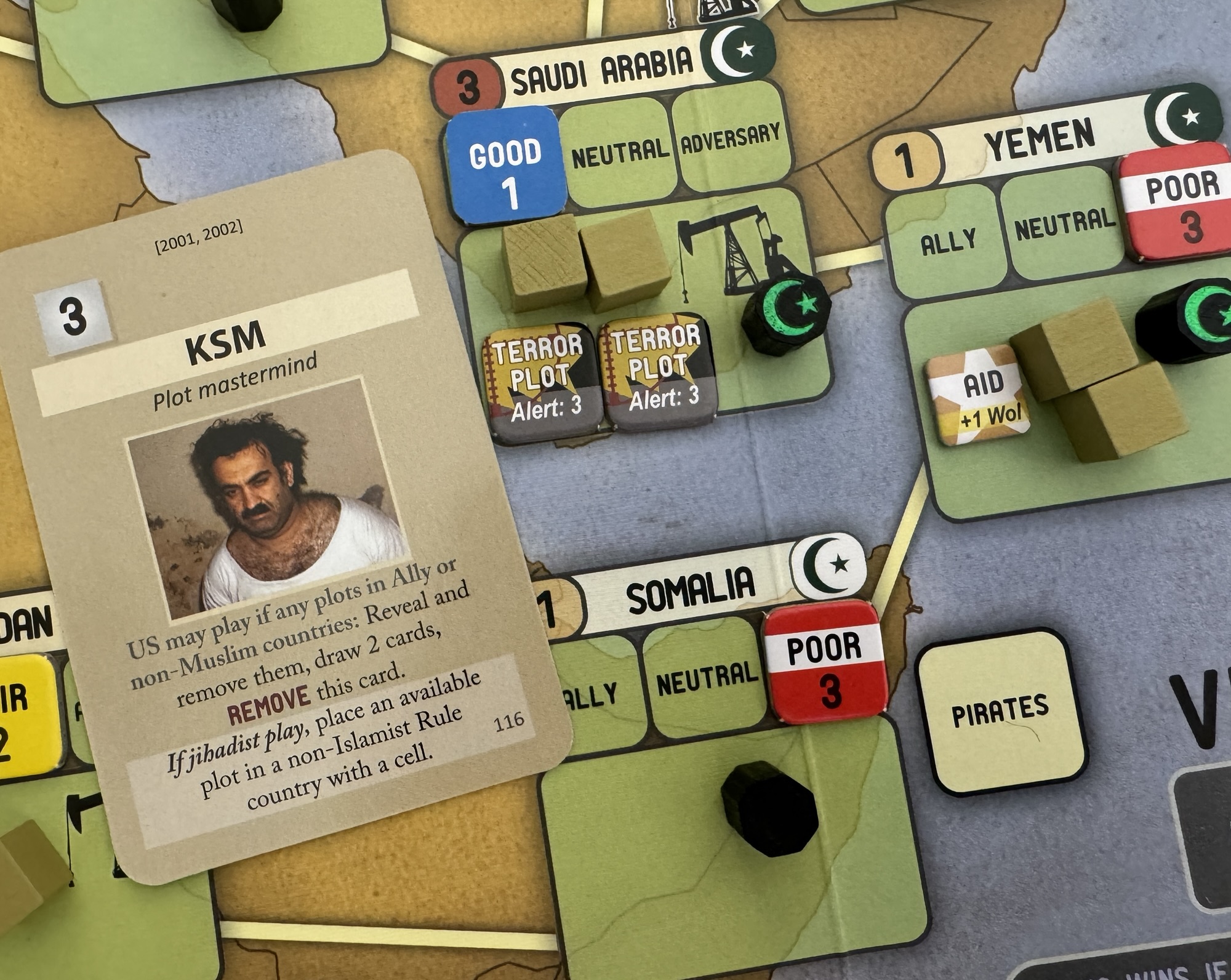
#100: KSM from Labyrinth: The War on Terror, 2001-? from GMT Games
Labyrinth: The War on Terror, 2001-? from GMT Games is a 2-player asymmetrical Card Driven Game that pits the mighty and powerful United States military and all of its various antiterrorist agencies against the Jihadists in the Middle East whose sole goal is to spread terror, sow the seeds of deceit and ultimately destroy Western civilization. The game is a Card Driven Game where the cards contain Operation Points or Events and each turn the player must strategize and use their cards to their best ability in order to effect the state of the board and further their individual and asymmetric victory conditions. But the game is raw and is tied to the actual events of the early 2000’s as the United States was reeling to recover from the terrorist attacks in New York.

In the game, the Jihadist player is working to destabilize the Middle East through a series of clandestine activities such as destroying stability, toppling governments and forcing the US to react to their actions. One of their biggest strategies is to work to place what are called Plots out on the board in order to destabilize but also to generate local support and funding for their activities from the populace. If left alone, these Plots will go off at the end of a round and cause trouble that will then have to be cleaned up by the US player over the next turn. In order to uncover these Plots, the US player will have to play a 3 Ops card to take the Alert Action and different from most other actions there is no die roll required and the the Plot removal is automatic. But, the cost is steep as a 3 Ops card is pretty rare and spending it on this action is very painful. Jihadists use these Plots to force the US player to have to stamp out fire after fire rather than working to reform and stabilize governments to create allies. And when these Plots appear, the player’s long-term strategy will have to be put aside and a focus will have to change from managing regime change and the Global War on Terror (GWOT) posture to dealing with urgent plots. The KSM card is a very powerful tool in this game as it allows for the US player to remove Plots from an Ally or non-Muslim country but also to replace this investment with drawing 2 cards to replace it. This is specifically tied to the intel that was obtained from the capture of Khalid Sheik Mohammad and how it was then used to defuse several ongoing plots. The Jihadist player also gains a pretty large benefit as they will be allowed to place a Plot Marker into a non-Islamist Rule country with a cell. The process of successfully placing a Plot can be very challenging for the Jihadist player as it takes the play of a card for Operations points, uncovering a cell in a country and then rolling a die equal to or less than that country’s Governance Level to then place a face-down Plot Marker. This takes the need for a roll away and makes the placement of a Plot an automatic success.
I think that one of the other important distinctions and differences with the KSM card is that it is a 3 Ops Neutral Card that can be played by either side but when played by the US player for the event, it will be removed from the game while when being played for the Jihadist portion of the event it will remain and be able to be used in a later turn when it is drawn again. This reflects the important role that KSM played in al-Qaeda’s plans and if allowed to stay at large he will continue to plan and execute plots across the globe.
Khalid Sheik Mohammed was a member of Osama bin Laden’s militant organization al-Qaeda, and was specifically in charge of leading al-Qaeda’s propaganda operations from around 1999 until late 2001. Mohammed was captured on March 1, 2003 in the Pakistani city of Rawalpindi by a combined operation of the U.S. Central Intelligence Agency (CIA) and Pakistan’s Inter-Services Intelligence (ISI). Immediately after his capture, Mohammed was taken to secret CIA prison sites in Afghanistan, then Poland, where he was interrogated by U.S. operatives. By December 2006, he had been transferred to military custody at Guantanamo Bay detention camp. Sensationally nabbed in Pakistan, alleged 9/11 mastermind Khalid Sheikh Mohammed was photographed for the
world in a disheveled state immediately after his capture—symbolizing an apparent laying low of the once mighty al-Qaeda network. According to his US captors, he later provided information that thwarted other attacks.
Mohammed is widely regarded as the chief planner of the September 11 attacks. The United States government has alleged that he further participated in planning Richard Reid’s shoe bombing attempt to attack an airliner, the 2002 Bali bombings in Indonesia, the 1993 World Trade Center bombing, the murder of Daniel Pearl and various foiled attacks as well as numerous other crimes. These claims have been criticised by others, such as military prosecutor Moe Davis and journalist Andrew Brown, as inadmissible due to being obtained through torture. He was charged in February 2008 with war crimes and murder by a U.S. military commission at the Guantanamo Bay detention camp, which could carry the death penalty if convicted. A 2008 decision by the United States Supreme Court had also drawn into question the legality of the methods used to gain such admissions and the admissibility of such admissions as evidence in a criminal proceeding.
In the next entry in this series, we will take a look at Constantinople Sends Aid Core Event from The Shores of Tripoli from Fort Circle Games.
-Grant