Normale Ansicht

My Favorite Wargame Cards – A Look at Individual Cards from My Favorite Games – Card #73: Russian Leader Tsar Alexander I from Congress of Vienna from GMT Games

Von: Grant
15. April 2026 um 14:00

With this My Favorite Wargame Cards Series, I hope to take a look at a specific card from the various wargames that I have played and share how it is used in the game. I am not a strategist and frankly I am not that good at games but I do understand how things should work and be used in games. With that being said, here is the next entry in this series.

#73: Russian Leader Tsar Alexander I from Congress of Vienna from GMT Games

Congress of Vienna from GMT Games is a diplomatic card driven wargame based on Churchill and is the 4th game in the Great Statesmen Series. The game is set during the years of 1813-1814 and sees players take on the role of the main characters of the struggle between the Napoleonic Empire and the coalition of Russia, Austria, and Great Britain with their Prussian, Spanish, Portuguese, and Swedish allies. Congress of Vienna has two different but related phases including the conference table where players first debate over the control of issues germane to the factions and the period of the war and second these issues are then used on the battlefield to recruit units, attack and take overall command of battles. The players will be playing cards from their hands to “debate” over the various issues that were placed on the table, which include all types of things such as Military Operations, Recruitment, who will lead the combined Coalition forces (Generalissimo), Future of French Government, British Financial Aid, Liberalism vs. Absolutism, Austrian Neutrality and several other issues, and then later the players will use their accumulated Resources gained from the issues to enact action on the Military Map and do things like mobilize troops, place Military Support Markers and the ultimately to conduct warfare.

The game relies on cards and cards can be used to negotiate, i.e. move an issue to your National Track. Cards can provide a particular issue with positive and negative DRM’s depending on which nation plays them and can also be traded with another player during the Diplomacy Phase. Certain cards are better than others for debating an issue moved by another player; and finally, if they are saved for the War Phase, staff cards can be used to modify dice rolling in battles. These are very versatile cards and the players will have to learn them and their benefits in order to be effective at the game.

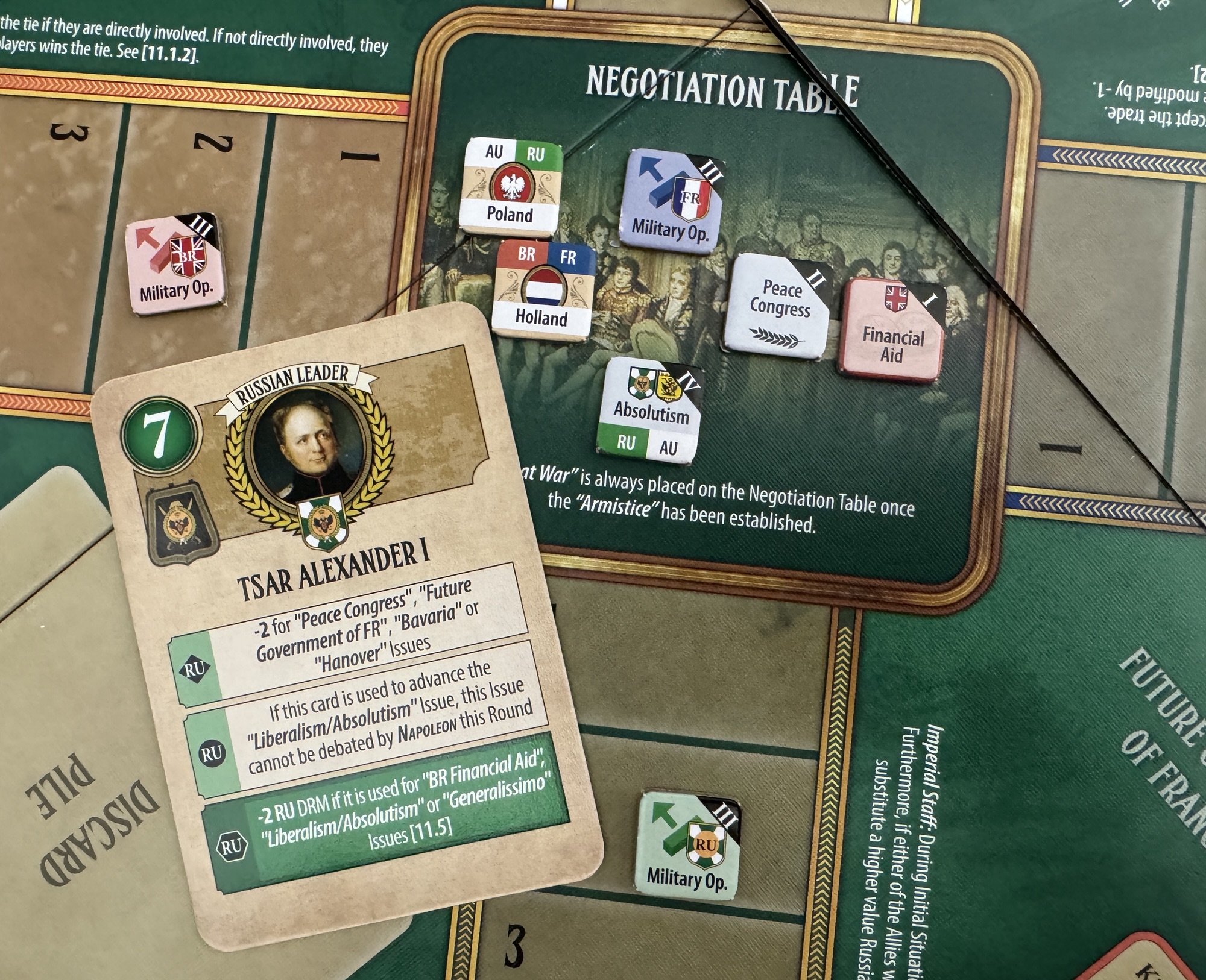
In this entry, we are going to take a look at the Russian Leader Tsar Alexander I card. The fist thing that you may notice about this Leader Card is that is that it has no benefit for military operations, meaning that Tsar Alexander is watching the war from the sidelines and not directly involved like Napoleon, but does have a potential negative effect if used on certain Issues. But his power lies in the ability to utilize his 7 value to influence issues significantly on the Negotiating table. Particularly, Tsar Alexander I is an ardent believer in the philosophy of Absolutism and wants to retain his crown as the leader of Russia. This concept is played out in the game between the great powers of the time, including Russia and Austria for Absolutism, and the more democratic players including Britain and France for Liberalism. On the board appears this Liberalism/Absolutism Track, which provides the players an opportunity to debate over the Liberalism/Absolutism Issue and gain various advantages and Victory Points from the track. On this Liberalism/Absolutism Track, Europe’s post-war governing philosophy is fought over. This is a double track in green and red with a common At Start area for the use of 2 pawns. Tracks for Liberalism (red: Britain/France) and Absolutism (green: Russia/Austria) each have four boxes and an assigned total Victory Point amount. In order to score the VP from this track though, the player scoring must have their philosophical leaning portion of the track occupying a space at least 1 box ahead of their opponent. Also, if they want to score the maximum Victory Points listed at the top, they have to occupy the top box and their opponent cannot occupy theirs. For the Russia player, this should be a huge part of their strategy as 5VP is nothing to sneeze at in this game. But, in order to do that they will most likely have to try to go first and use Tsar Alexander and his 7 value to try and move that Issue up the track to end under their control. If an Issue every reaches a Track’s Seat, meaning the 7th space, or more after any declared debate is calculated in, then that Issue is considered to be secured and can no longer be moved through negotiation during future rounds. This reminds me a bit of the way that I always plan to use Joseph Stalin in Churchill, to go first and then bring the hammer down on the A-Bomb Research Issue. Getting control of this Absolutism/Liberalism Issue at least 4 times is very important for the Russian player and they will need to utilize this ability as much as possible. But remember that there is a penalty called the “Meddling Tsar” Rule where if Tsar Alexander is used for the negotiation of the British Financial Aid, Liberalism/Absolutism or the Generalissimo Issues, it will inflict a -2 DRM on all battles involving 1 or more Russian units during the upcoming War Phase. This is quite a cost and the player should carefully consider if and when they use the ability throughout the game. If the turn is expected to contain little to no combat for Russian units, then it is safe to use but if France is being aggressive and pushing on Poland and Prussia you might want to consider not going after the Liberalism/Absolutism Issue this turn and instead focus on Recruitment and Military Operation Issues.

The other part of this ability is that if Tsar Alexander I is used to move the Liberalism/Absolutism Issue then Napoleon cannot be used to Debate that movement. I would say that this is not an issue though as typically the France player will be using Napoleon on the battlefield for his DRM abilities.

I also like the historical and personality connection between this card and the game. At the top of the card you will notice that if you use Tsar Alexander I to negotiate the Peace Congress, Future Government of France, Bavaria or Poland Issues, that you will gain a -2 on his value bringing it from a 7 down to a 5. I think that this ability really highlights the philosophy and view of the Tsar regarding the time. He doesn’t believe that France should get to continue to exist as a main player in the power structure of the time and definitely doesn’t want to see France become more democratic. But, he also has a feeling that Bavaria and Poland are Russian vassals and should not be allowed to be turned to any other side’s allegiance. If he has to be used in this manner to defend or negotiate these issues I feel like the -2 Value penalty really shows that leaning in his thinking and probably causes him to be more brunt and less diplomatic thereby losing some of his influence in the court of opinion. Ultimately, Tsar Alexander I thought that monarchy is a noble and viable alternative to the crude and materialistic mob mentality of republicanism and the abilities of his Leader Card definitely cement that view.

After playing now a few times, I am here to say that Congress of Vienna is probably my favorite game in the Great Statesmen Series. I believe that this game has matured the system and made it something that is more than where it started. Congress of Vienna is very much more like a true wargame and was extremely interesting. We are still learning and need to keep playing this one but I did enjoy what it was that we were doing.

Alexander I, nicknamed “the Blessed”, was Emperor of Russia from 1801, the first King of Congress Poland from 1815, and the Grand Duke of Finland from 1809 to his death in 1825. He ruled Russia during the chaotic period of the Napoleonic Wars.

The eldest son of Emperor Paul I and Sophie Dorothea of Württemberg, Alexander succeeded to the throne after his father was murdered. As prince and during the early years of his reign, he often used liberal rhetoric but continued Russia’s absolutist policies in practice. In the first years of his reign, he initiated some minor social reforms and in 1803–04 major liberal educational reforms, such as building more universities. Alexander appointed Mikhail Speransky, the son of a village priest, as one of his closest advisors. The over-centralized Collegium ministries were abolished and replaced by the Committee of Ministers, State Council, and Supreme Court to improve the legal system. Plans were made, but never consummated, to set up a parliament and sign a constitution. In contrast to his westernizing predecessors such as Peter the Great, Alexander was a Russian nationalist and Slavophile who wanted Russia to develop on the basis of Russian rather than European culture.

In foreign policy, he changed Russia’s position towards France four times between 1804 and 1812, shifting among neutrality, opposition, and alliance. In 1805 he joined Britain in the War of the Third Coalition against Napoleon, but after suffering massive defeats at the battles of Austerlitz and Friedland, he switched sides and formed an alliance with Napoleon in the Treaty of Tilsit and joined Napoleon’s Continental System. He fought a small-scale naval war against Britain between 1807 and 1812 and took Finland from Sweden in 1809 after Sweden’s refusal to join the Continental System. Alexander and Napoleon hardly agreed, especially regarding Poland, and the alliance collapsed by 1810. Alexander’s greatest triumph came in 1812 when Napoleon’s invasion of Russia descended into a catastrophe for the French. As part of the winning coalition against Napoleon, he gained territory in Poland. He formed the Holy Alliance to suppress the revolutionary movements in Europe, which he saw as immoral threats to legitimate Christian monarchs.

During the second half of his reign, Alexander became increasingly arbitrary, reactionary, and fearful of plots against him; as a result, he ended many of the reforms he had made earlier on in his reign. He purged schools of foreign teachers, as education became more religiously driven as well as politically conservative. Speransky was replaced as advisor with the strict artillery inspector Aleksey Arakcheyev, who oversaw the creation of military settlements. Alexander died of typhus in December 1825 while on a trip to southern Russia. He left no legitimate children, as his two daughters died in childhood. Neither of his brothers wanted to become emperor. After a period of great confusion (that presaged the failed Decembrist revolt of liberal army officers in the weeks after his death), he was succeeded by his younger brother, Nicholas I.

We have done 2 videos on this game including the following RAW Video after out 1st play at Buckeye Game Fest in May 2025:

We then did the following full Review Video after our 2nd play at WBC last July:

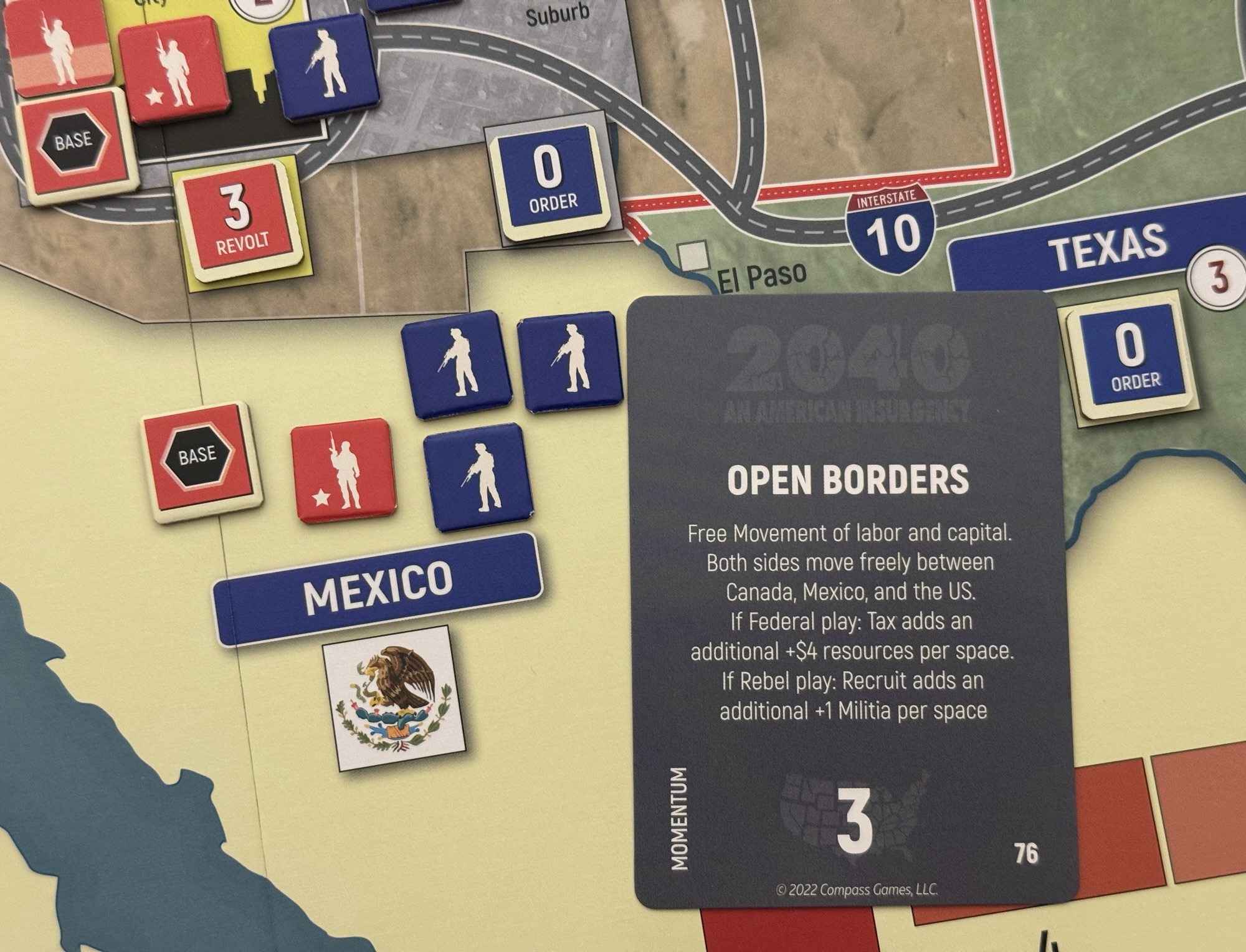
In the next entry in this series, we will take a look at Open Borders from 2024: An American Insurgency from Compass Games.

-Grant

My Favorite Wargame Cards – A Look at Individual Cards from My Favorite Games – Card #72: Commodus from The Wars of Marcus Aurelius: Rome 170-180CE from Hollandspiele

Von: Grant
07. April 2026 um 14:00

With this My Favorite Wargame Cards Series, I hope to take a look at a specific card from the various wargames that I have played and share how it is used in the game. I am not a strategist and frankly I am not that good at games but I do understand how things should work and be used in games. With that being said, here is the next entry in this series.

#72: Commodus from The Wars of Marcus Aurelius: Rome 170-180CE from Hollandspiele

The Wars of Marcus Aurelius: Rome 170-180CE is a solitaire only game that uses cards similarly to a CDG to simulate the strategic level struggle of the Romans led by Marcus Aurelius to stave off the invasions of Germanic tribes and Sarmatian raiders as they encroach on Roman territory across the Danube River. That’s the history. And it is really well integrated. The game play is very fun, strategic, with lots of decision points about what to do and what cards to use, and it is really challenging.

In the game, the Roman player has a deck of Roman Cards that can be used for the printed events for various effects or that can be discarded to take any number of actions such as attack a Barbarian army or Off-Map Conflict enemy, advance the marker on the Imperium Track, add two Level 1 Forts to any eligible map spaces, flip one Level 1 Fort to a Level 2 Fort among several other actions. Sometimes the printed events in the game are just more powerful than discarding a card for just 1 action so you have to pay attention to this economy and make sure you get the most out of your cards. Now, keep in mind, sometimes discarding a good card whose ability is not right for the current situation you find yourself in is part of the game but you have to use these cards wisely to do well in the game.

The game uses two separate decks of cards including the Barbarian Deck (Green) and The Roman Deck (Red). Both of the decks are made up of 50 cards each but each have very different purposes. The Barbarian Deck is used to determine the actions of the invading Germanic tribes as well as events that effect the war effort including mutinies, plague and the will of the people. While the Roman Deck provides the resources and events that are used by the Roman player to mount a defense against the invasions and to fight back each of the different barbarian tribes. There are unique cards called Late War Cards in the deck that will be held out until the start of the 175CE turn at which time they will be mixed in with the cards to form a new Late War Deck. There are also special cards that are marked with an asterisk that if played for the event will be discarded from the game to form what is called a History Pile.

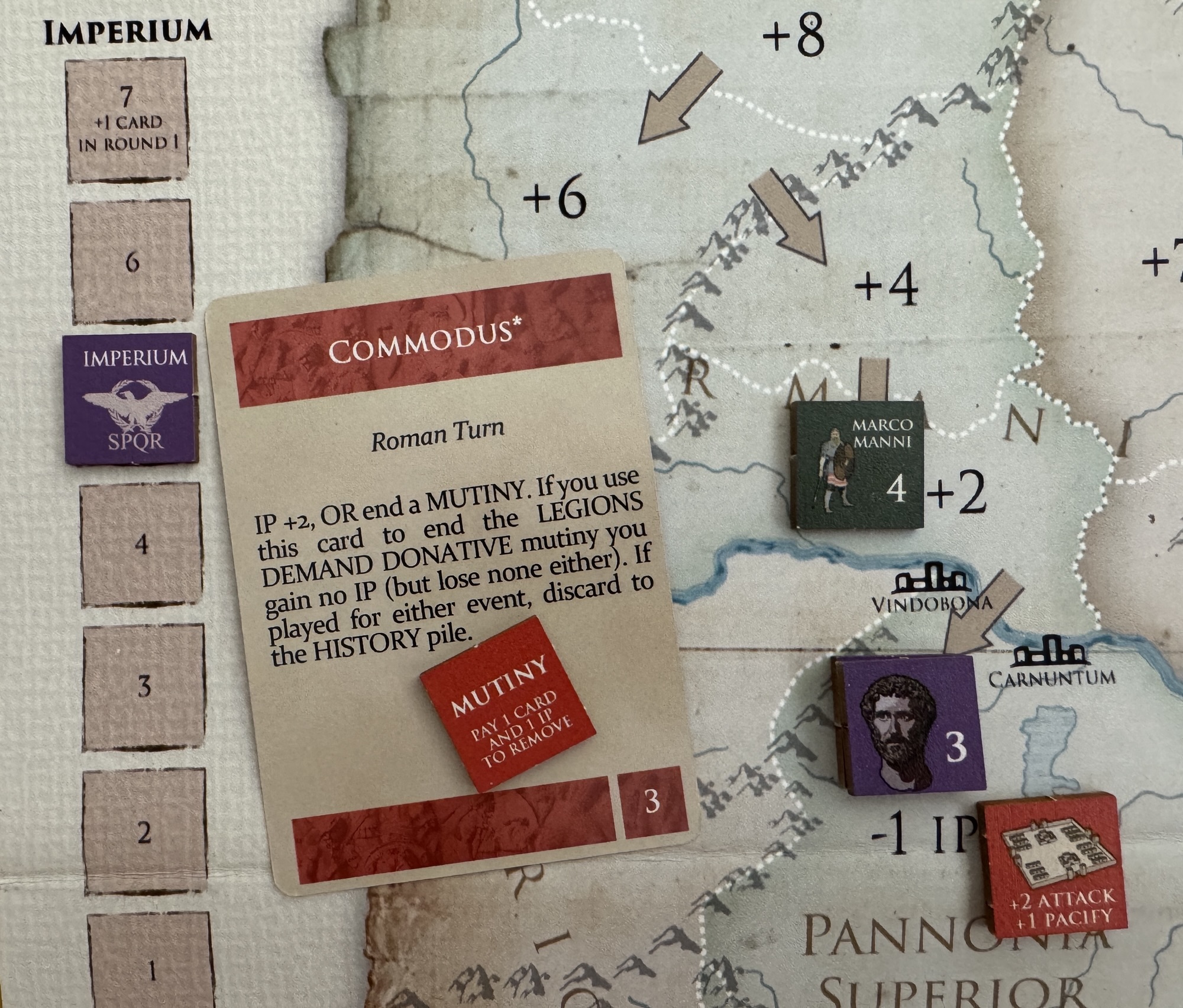
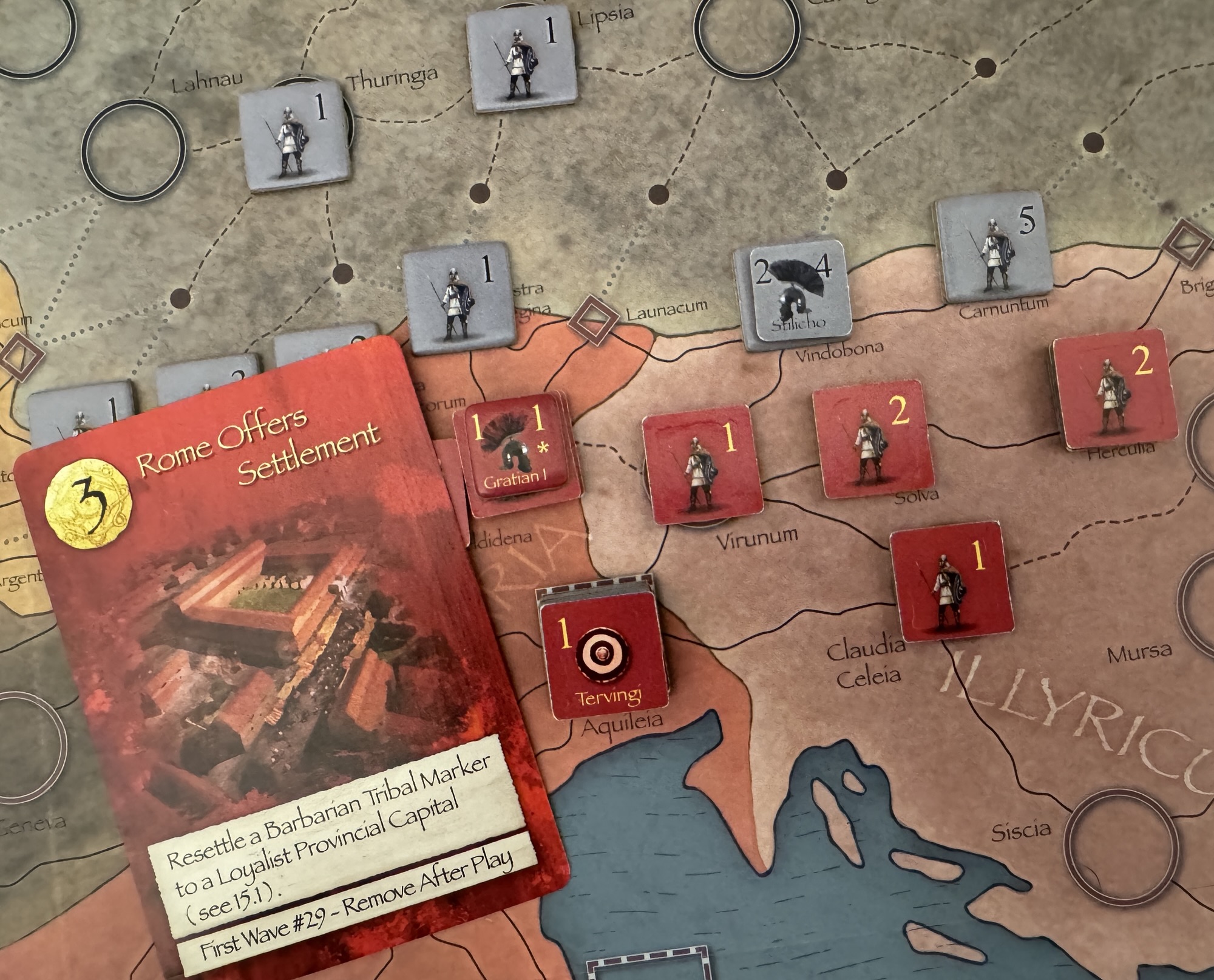
In this entry, we will focus on the Roman Card Commodus, which provides some opportunity to shore up your failing Imperium Points or even cancel an ongoing Mutiny of your troops on the board. In my first 5 or 6 plays of the game, the most common way that I lost was by allowing the Imperium Point Track to reach zero, which results in Marcus Aurelius being usurped and the player immediately losing the game. I was confounded and very frustrated about why I couldn’t prevent this from happening! I could see the end coming but struggled with keeping that Track above water. There are a few cards included in the Roman Deck that provide increases to the Imperium Track and I highly recommend you take these type of events when they come into your hand rather than discarding these cards to take another action, that might seem important at the time, but in the end these events are just too efficient to pass on. Commodus will provide you an option. This option is taking the +2 IP or another type of action such as ending a Mutiny (very important as it usually takes you discarding a card and losing an IP) or drawing two cards to add to your hand (imagine if you can only draw that Local Guides card you have been looking for or the Ambush that you need to take on the Quadi in their Home space). It becomes a choice of “either/or” and I am here to tell you the only reason the “or option” is provided is to lure you away from the real prize in that of gaining the +2 IP. Please listen to my advice and take the +2 IP. You will thank me in the end! Remember, that the concept of Imperium Points (IP) represent the Emperor’s overall political authority and stability in Rome. If the IP track ever reaches zero, the player immediately loses due to usurpation. Points are lost from specific card events, barbarian surges, and certain combat results, requiring players to prioritize special events to gain them back

Commodus was Roman emperor from 177 to 192AD, first serving as nominal co-emperor under his father Marcus Aurelius and then ruling alone from 180AD. Commodus’s sole reign is commonly thought to mark the end of the Pax Romana, a golden age of peace and prosperity in the history of the Roman Empire.

Commodus accompanied his father during the Marcomannic Wars in 172AD and on a tour of the Eastern provinces in 176AD. The following year, he became the youngest emperor and consul up to that point, at the age of 16. His solo reign saw less military conflict than that of Marcus Aurelius, but internal intrigues and conspiracies abounded, goading Commodus to an increasingly dictatorial style of leadership. This culminated in his creating a deific personality cult, including his performances as a gladiator in the Colosseum. Throughout his reign, Commodus entrusted the management of daily routine affairs to his palace chamberlain and praetorian prefects, namely Saoterus, Perennis, and Cleander. Roman soldiers and the general populace generally liked Commodus during his reign, largely because he was popular with the masses and focused on lavish spending rather than costly foreign wars. He was adored for presenting himself as a masculine, gladiatorial Hercules, though the Senate despised him

Commodus was assassinated by the wrestler Narcissus in 192AD, ending the Nerva–Antonine dynasty. He was succeeded by Pertinax, the first claimant in the tumultuous Year of the Five Emperors.

I shot a playthrough video for the game and you can watch that at the following link:

I also followed that up with a full video review sharing my thoughts:

In the next entry in this series, we will take a look at Russian Leader Tsar Alexander I from Congress of Vienna from GMT Games.

-Grant

My Favorite Wargame Cards – A Look at Individual Cards from My Favorite Games – Card #71: The Wartburg from Here I Stand: Wars of the Reformation, 1517-1555 from GMT Games

Von: Grant
31. März 2026 um 14:00

With this My Favorite Wargame Cards Series, I hope to take a look at a specific card from the various wargames that I have played and share how it is used in the game. I am not a strategist and frankly I am not that good at games but I do understand how things should work and be used in games. With that being said, here is the next entry in this series.

#71: The Wartburg from Here I Stand: Wars of the Reformation, 1517-1555 from GMT Games

Here I Stand: Wars of the Reformation 1517-1555 is an experience packaged in a game that attempts to boldly cover the political and religious conflicts of early 16th Century Europe. The game focuses on the struggle of religious reformers such as Martin Luther, John Calvin and Ulrich Zwingli as they battle the Papacy for changes in their views of God and religion. But it is more than just the Holy War as it deals with the other European countries involved in the affairs of the time including France, England, the mighty Hapsburg Empire and the Ottoman Empire in the east. They all played a role in the process of the Reformation and the design brilliantly weaves this all together into an interesting and engaging experience. The game also covers other plot lines and events of the period, including wars, marriages and ascendancies to thrones, using a unique Card Driven Game (CDG) system that models both the political and religious conflicts of the period.

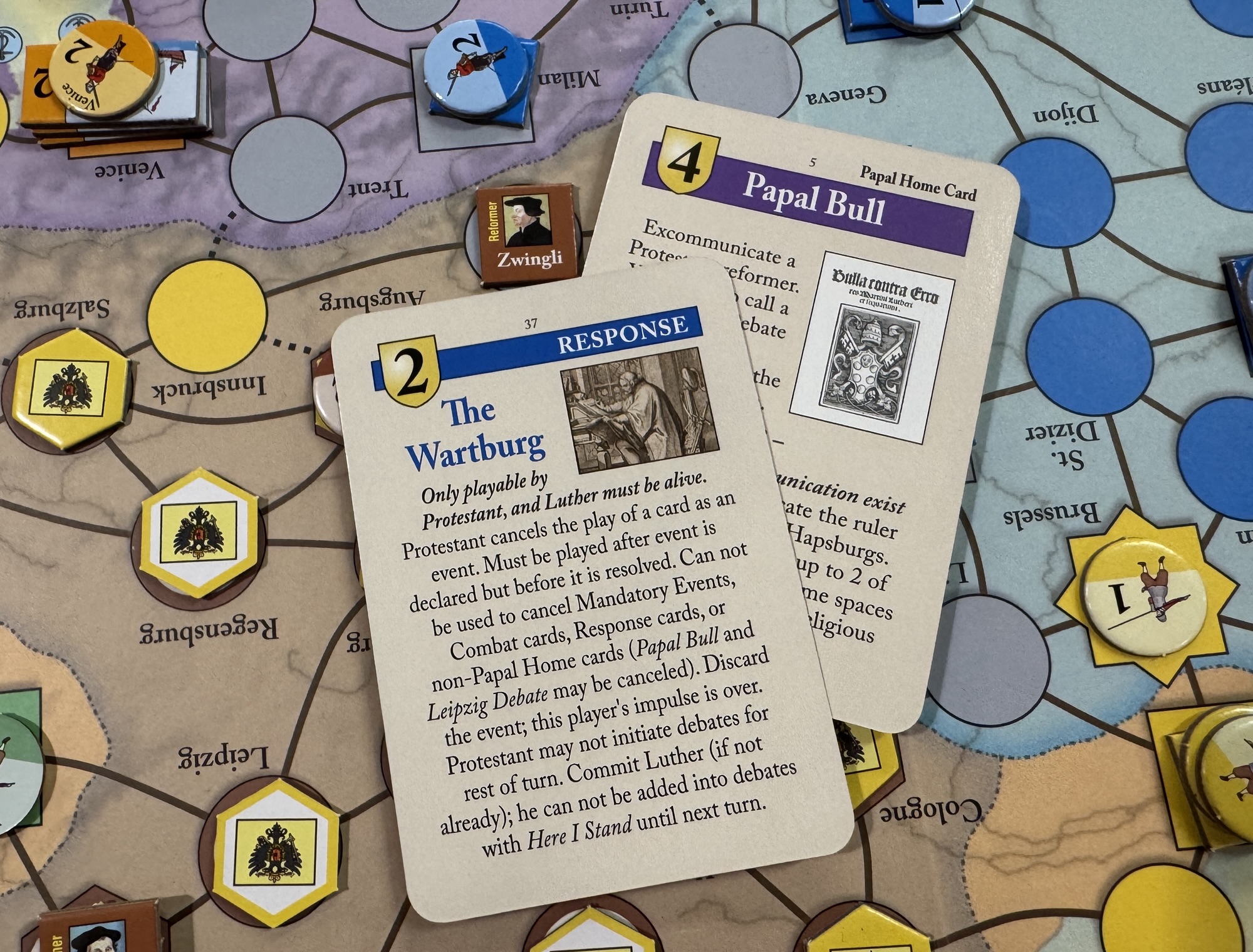
Today, I want to take a look at a very interesting Response card in The Wartburg. Response cards in Here I Stand are event cards that can be played out of turn to interrupt the actions of an opponent or provide immediate reactions to specific game events. Response cards are often used to negate, mitigate, or enhance events and combats, and they may be played during an opponent’s impulse, provided the text allows for this asynchronous timing. These cards also tend to have specific pre-requisites that must be met in order to play the card and The Wartburg states that the card is “only playable by Protestants, and Luther must be alive”. The card itself allows the Protestant player to cancel the play of a card as an event but cannot cancel a Mandatory Event. The card however can cancel the play of the Papal Bull or Leipzig Debate Papal Home Cards, which is probably the way that the card will mostly be used. The card will not only cancel the play of the event but will also end the impulse of the player playing the card. This can be very powerful and when played at the right time can be a game saver for the Protestant player.

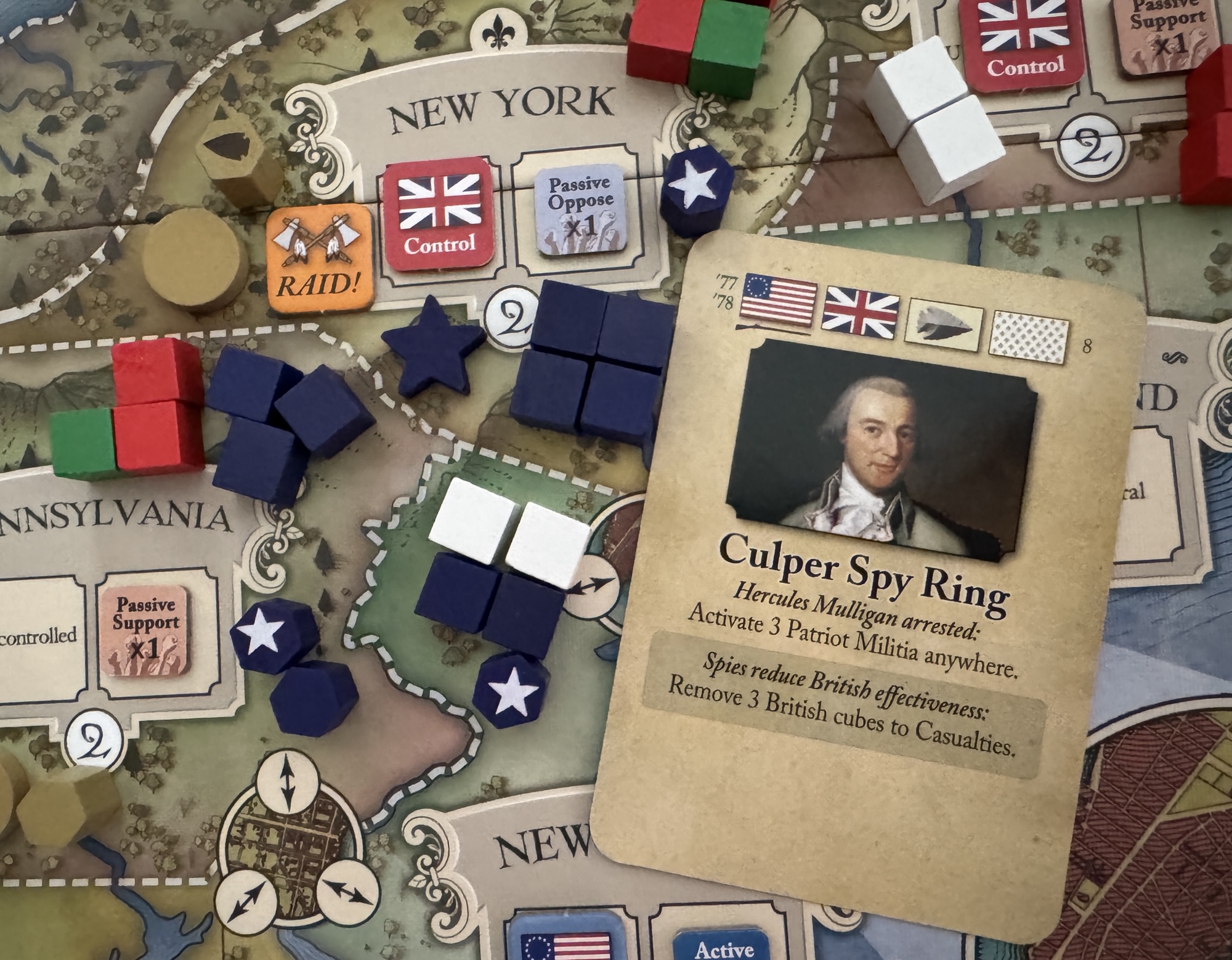
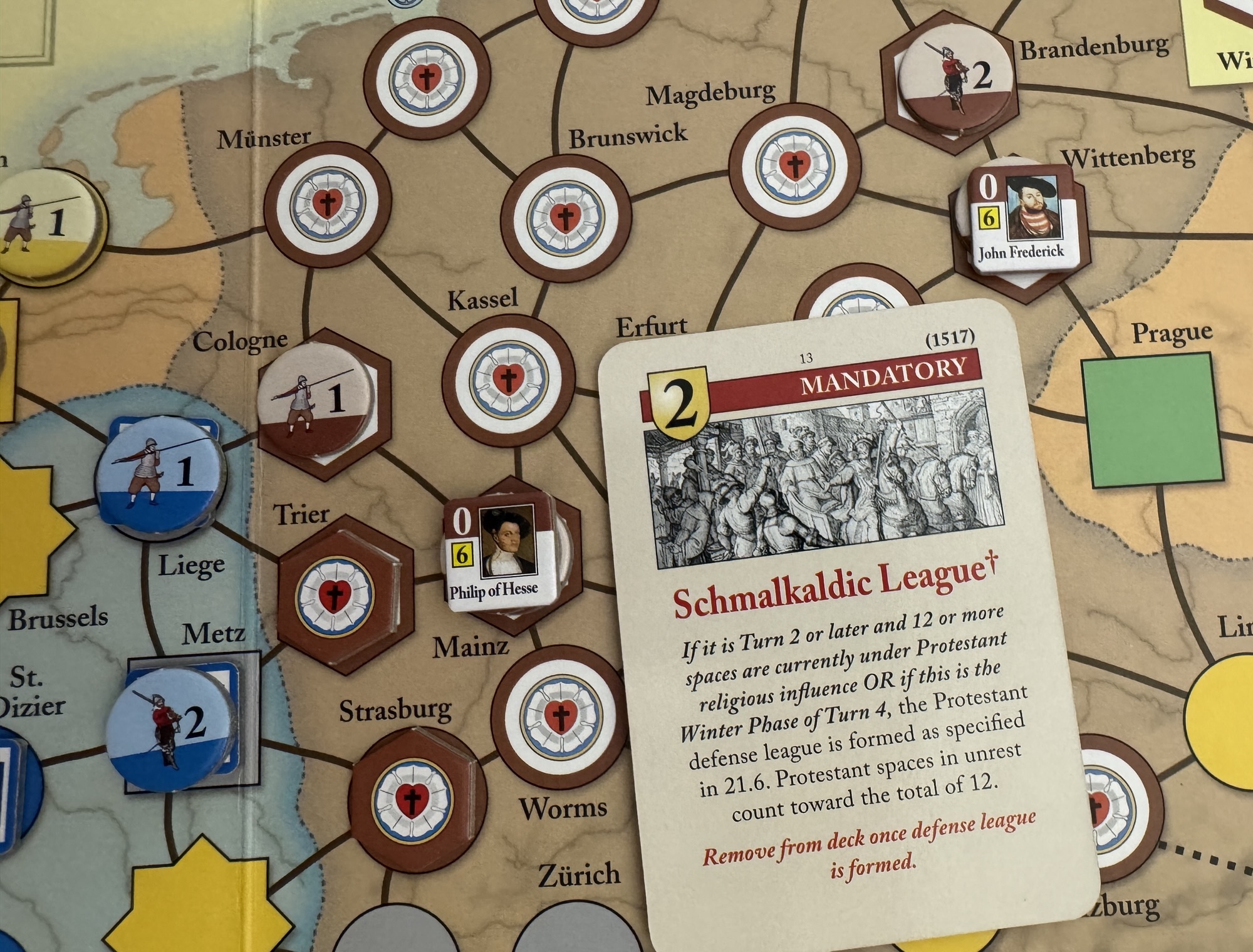
For example, in our most recent play at Buckeye Game Fest, I was playing as the Protestants and Bill Simoni as the Papacy. After the forming of the Schmalkaldic League and the Protestants changing into a military power, the focus of the other players turned toward me as I was doing well and near victory. They all then decided to declare war on the Protestants and began to advance upon and attack my fortified Electorates to take away VP I had earned by having both religious and political control in 5 of the 6 as the League was formed. As we came into turn 5, I was at 24 VP and ultimately came up shy of a victory by 1 point at the time. I had been able to take over the entirety of England and change every space and also get about 5-6 spaces in France, but now the Papal Bull came to play and Bill fought me back and forth with him taking over 3-4 spaces followed by me reclaiming 3-4 spaces. It was a beautiful game of back and forth and I used every tool at my disposal to fight him including The Wartburg card to stop the untimely excommunication of Zwingli before he could attempt to embarrass him in a debate. That card play at that very time saved me or most likely he would have used Eck who is his best debater against Zwingli who is just average and I would have lost leading to him being burnt at the stake giving him VP or by allowing him to turn over a few of my hard fought converted spaces back to Catholicism.

The only problem with this card is that it commits Luther so he will be unavailable to be chosen directly to debate during the rest of the turn. But this was a small price to pay at that time and ultimately led to me being able to hold on through the end of Turn 6 where I won a Protestant victory on the tie breaker with England.

Martin Luther stayed at Wartburg Castle from May 1521 to March 1522 under the alias “Junker Jörg” (Knight George) to hide from papal and imperial authorities. During these 300 days of protective custody, he translated the New Testament into German in just 11 weeks, wrote numerous theological works, and grappled with spiritual turmoil. His greatest accomplishment at Wartburg Castle was his translating of the New Testament from Koine Greek into German, which laid the foundation for a unified German language and made the Bible accessible to ordinary people. He also wrote numerous works, including Against Latomus and several tracts. He began his attack on monastic vows during this time, arguing they were contrary to faith. Luther used his time in exile for intense study and writing, referring to his stay as his “Patmos”, referring to the Apostle John’s exile to the Island of Patmos in 95AD. While here though he also experienced significant psychological distress and temptation. According to legend, he threw his inkwell at the devil during a confrontation, leaving a stain on the wall. His exile was organized by Frederick the Wise after the Diet of Worms and the stay was designed to keep Luther safe from those looking for him, ensuring the survival of his reform movement.

In the next entry in this series, we will take a look at Commodus from The Wars of Marcus Aurelius: Rome 170-180CE from Hollandspiele.

-Grant
My Favorite Wargame Cards – A Look at Individual Cards from My Favorite Games – Card #70: Mohawks from Wilderness War: The French & Indian War, 1755-1760 from GMT Games

Von: Grant
24. März 2026 um 13:00

With this My Favorite Wargame Cards Series, I hope to take a look at a specific card from the various wargames that I have played and share how it is used in the game. I am not a strategist and frankly I am not that good at games but I do understand how things should work and be used in games. With that being said, here is the next entry in this series.

#70: Mohawks from Wilderness War: The French & Indian War, 1755-1760 from GMT Games

One of my fondest memories of our wargaming journey was our initial experience with the full campaign game of Wilderness War from GMT Games. We were 2 very inexperienced wargamers and we slogged through a 9-hour marathon play over a few days that ended in a 0-0 tie of all things. That’s right, the game ended in a tie, even though we both had a card in hand, but I was unable to use mine to activate Levis, which was my only potential Victory Point scoring force, and Alexander’s forces were in too tenuous a position or too wounded to risk an open battle for VP’s. You would think that this would have turned us off to the game but on the contrary it made me fall in love with asymmetric wargames and the Card Driven Game mechanic with its use of Action Points and events to wage war on the North American continent. The end score of our game really followed the tension of the game, and the blunders on the side of the British that counter balanced their various successes.

All in all, this game was excellent to play and we both highly recommend it. The two factions play extremely differently which leads to many intricate and reactive strategic decisions. The British have many powerful forces with their Highlanders and cannon while the French have access to better leaders and mobile troops and Indian allies who can run around the frontier raiding and burning settlements for VP’s. Laying siege and assaulting really feels like it should, and avoiding battle until you are ready is something that is integral to maintaining a strong presence on the board. You cannot always get into every possible fight as you will not survive the attrition of these battles. The deck plays really well, and as you don’t have to worry about the opponents events in your hand going off, the management aspect is much simpler yet very engaging as there are always reaction cards you can play or cards that you want to hold onto for that perfect moment.

In previous posts in this series, we have discussed the importance of the players of both sides gaining the trust and services of the indigenous Indian denizens of North America in the fight. The French and British can both use the Indian recruitment cards, including cards such as Iroquois Alliance, Northern Indian Alliance and Western Indian Alliance, to recruit, restore, and move native allies to gain victory points through raids and controlling of territory. The French hold a significant advantage with more access to a greater number of Indian auxiliaries, and will be using these cards to launch early raids, while the British can recruit specialized units like their Mohawk or Cherokee allies. 

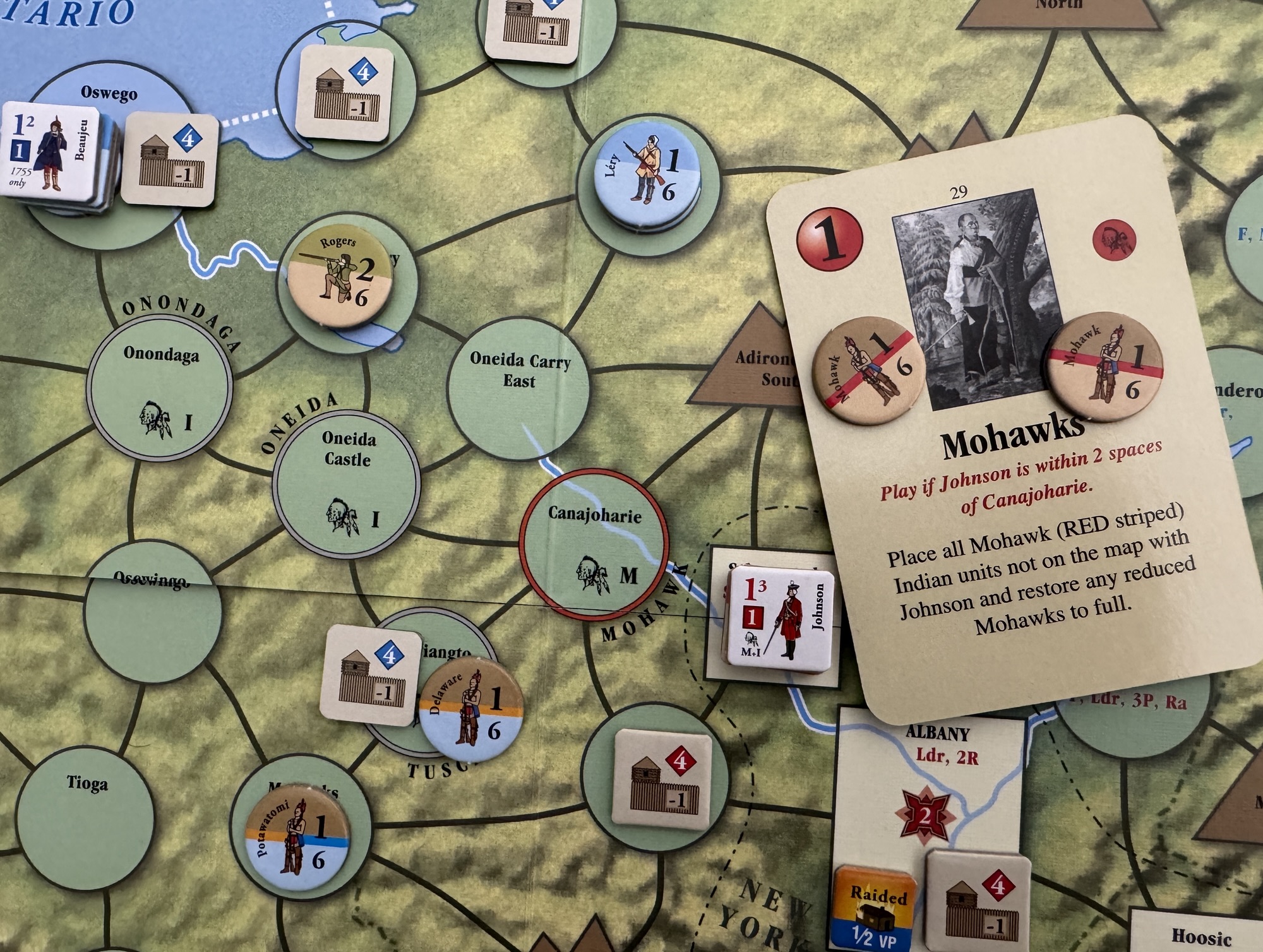
In this entry, we will take a look at the British card Mohawks. Mohawks is one of those cards that has a pre-requisite qualifying condition to play the card. In this case, the qualifier is that the leader Johnson must be located on the board within 2 spaces of Canajoharie, which was a Mohawk village located in upstate New York. As long as he is within the required 2 spaces, the card can be played to bring out onto the board the Red striped Mohawk Indian units. These must be placed with Johnson and the other added benefit is that any reduced Mohawks on the board can be flipped to their full side. These pro-British units can only be recruited by the British player and their arrival in New York can be a huge boon to the British as the French and their Indian allies will be raiding the villages and settlements up and down the frontier regularly during the game as one of their most dependable sources of Victory Points. These Mohawk allies can spread out around the area and intercept incoming raids before they can occur. Remember that Indian allies in Wilderness War are not powerful combat units and are best used to raid and prevent other tribes from raiding.

I very much love the thematic connection here as in order to attract the Mohawk Indians as your allies you must have someone that they trust in the area and this is Johnson. Sir William Johnson was a pivotal British superintendent of Indian Affairs whose deep integration into Mohawk society secured the crucial Mohawk Nation alliance for the British during the French and Indian War. By living among them, learning their language, and marrying Mohawk women, he maintained the Iroquois Covenant Chain and led Mohawk warriors in key victories. This is one of the great things about these Card Driven Games and their use of the cards to deliver the bits and bobs of history to enlighten our understanding and to expand our knowledge of the period.

As a young man, Johnson moved to the Province of New York to manage an estate purchased by his uncle, Royal Navy officer Peter Warren, which was located in territory of the Mohawk, one of the Six Nations of the Iroquois League. Johnson learned the Mohawk language and Iroquois customs, and was appointed the British agent to the Iroquois. Johnson commanded Iroquois and colonial militia forces against the French and their allies during the war and was later commissioned a major-general for his role in the British victory at the Battle of Lake George in 1755. His capture of Fort Niagara from the French in 1759 brought him additional renown. Throughout his career as a British official among the Iroquois, Johnson combined personal business with official diplomacy, acquiring tens of thousands of acres of Native land and becoming very wealthy.

In the next entry in this series, we will take a look at The Wartburg from Here I Stand: Wars of the Reformation, 1517-1555 from GMT Games.

-Grant

My Favorite Wargame Cards – A Look at Individual Cards from My Favorite Games – Card #69: Blockade from Twilight Struggle: The Cold War, 1945-1989 from GMT Games

Von: Grant
17. März 2026 um 16:31

With this My Favorite Wargame Cards Series, I hope to take a look at a specific card from the various wargames that I have played and share how it is used in the game. I am not a strategist and frankly I am not that good at games but I do understand how things should work and be used in games. With that being said, here is the next entry in this series.

#69: Blockade from Twilight Struggle: The Cold War, 1945-1989 from GMT Games

Twilight Struggle is a 2-player game simulating the forty-five year ideological struggle known as the Cold War between the Soviet Union and the United States which can be played in 2-3 hours. The entire world is the stage on which these two countries “fight” to make the world safe for their own ideologies and way of life. The game starts right after the end of World War II in the midst of the ruins of Europe as the two new “superpowers” of the world squabble over what is left and ends in 1989, when only the United States remained standing.

The map is a world map of the period, where players move units and exert influence in attempts to gain allies and control for their superpower. The beauty of the CDG system used here is that each decision of whether to use a card for the event or the operations value is a struggle as if it is the other side’s event, it might go off hurting you very badly. There are mechanics to allow for the ignoring or cancelling of some of the best cards for your opponent in a side game within the game called The Space Race as well as nuclear tensions, with the possibility of game-ending global thermonuclear war (Shall we play a game, anyone?). I have played TS about 30 times and love it more and more with each sitting. The game makes me sweat, cringe, jump with joy and bite my fingernails. To me, a game that can do all of that in one sitting is worth the price.

One of my favorite type of cards from the game are those that force an action upon your opponent, such as discarding a card, reducing the Ops from card plays or causing them to have to make other plans than what they were working toward. These type of cards are more reactionary but definitely cause issues and mimic the various non-military focused strategies and tactics used during the Cold War. One of the most famous events from the early history of the Cold War is that of the Berlin Blockade. And there is a specific card that pays homage to the event in the game called Blockade. Blockade is an Early War Soviet Card that has an Ops Value of 1, which makes the card more valuable to be used for the printed event versus for the Ops.

When played, the card requires the US Player to immediately discard a 3 Ops or more value card from their hand or the consequence of not doing so will see all US Influence being removed from West Germany. This is a tough choice. Being early in the game, it is possible for the US to rebuild in West Germany and replace the lost influence over time if they do not wish to discard such as high value card. But, herein lies the real key to the Blockade cards use. The Soviet Player, who should be paying attention to not only their hand but also the card plays of the US Player, should try to use this card later in a turn once the US Player has played a majority of their cards in order to ensure that the event text can be realistically be achieved. If played quickly during a turn, the chances of the US Player being able to discard the required 3 Ops or great value card is higher and the card play will not generate any meaningful difference on the board state. I also would recommend a 2 card strategy here as the Soviet Player should be holding in their hand a high Ops card to be able to follow up this action with the placement of Influence into West Germany on their very next play. But, the real value to a card such as Blockade is that it forces the US Player to consider what cards are out there and to play around their negative effects as much as possible. Due to the nature of the game, and the randomness of card draws, having an expendable high Ops card ready and able to be discarded just in case of the play of Blockade is not really feasible. Also, remember that in Twilight Struggle that opponent events on cards that you play will go off and Blockade being drawn by the US Player can be bad as it will require them to play the event as you cannot discard a 1 Ops card to get rid of its negative effect in the Space Race Track due to the minimum requirement being a 2 Ops card. So the moral of the story here is that both players need to consider and plan for the play of or the mitigation of damage from Blockade.

The Berlin Blockade, which lasted from June 1948–May 1949, was a major Cold War crisis where the Soviet Union blocked all land and water access to West Berlin to attempt to force Western Allies out. The Soviet Union was taking this action as a means of retaliation against the introduction of the new Deutschmark currency. The US and Britain responded with the massive Berlin Airlift, flying over 2.3 million tons of food, fuel and supplies to the city. At the peak of the Airlift, a plane landed in West Berlin every 30 seconds. The blockade failed and the Soviets lifted it on May 12, 1949, after realizing the Allied Airlift could sustain the city for an extended period of time, marking a significant victory for the West in the ideological struggle. This event led to the acceleration of the division of Germany into East and West and the deepening of Cold War tensions.

In the next entry in this series, we will take a look at Mohawks from Wilderness War: The French & Indian War, 1755-1760 from GMT Games.

-Grant

My Favorite Wargame Cards – A Look at Individual Cards from My Favorite Games – Card #68: Usurper Emperor from Barbarians at the Gates, The Decline and Fall of the Western Roman Empire 337 – 476 from Compass Games

Von: Grant
05. März 2026 um 14:00

With this My Favorite Wargame Cards Series, I hope to take a look at a specific card from the various wargames that I have played and share how it is used in the game. I am not a strategist and frankly I am not that good at games but I do understand how things should work and be used in games. With that being said, here is the next entry in this series.

Card #68: Usurper Emperor from Barbarians at the Gates, The Decline and Fall of the Western Roman Empire 337 – 476 from Compass Games

Barbarians at the Gates, The Decline and Fall of the Western Roman Empire 337 – 476 from Compass Games is a Card Driven Game for two players set during the final hundred plus years of the Western Roman Empire as the Barbarian tribes in the north came down with a vengeance as they clashed with civilization and carved out their place amongst it. The time period covered in the game is from the death of Constantine the Great (337 AD) to the deposition of the last Western Roman Emperor by Odoacer in 476 AD. The Roman player will command the Roman Legions loyal to the failing central authority and those Germanic peoples who have settled peacefully inside the Roman Empire, while the Barbarian player leads Usurper Emperors, and controls the migrations of the Germanic peoples, who are the Barbarians at the Gates. This game is really quite good and feels very much like a wargame even though it is a Card Driven Game. There are lots of opportunities for troop movement, combat and maneuver. And I really liked that. The game is a Card Driven Game and the use of cards is all important and very well done. Each player has their own unique deck of cards that are used and these cards are sometimes removed from those decks when played for an event and also new cards will be added to the deck after each turn. The cards played during a player’s impulse which are not used for the Event are then used for their Operation Points value. These Operation Points can be used for many purposes including Activating a leader, Forced Marches, Raiding, Reinforcement, Migration and Successful Usurpation.

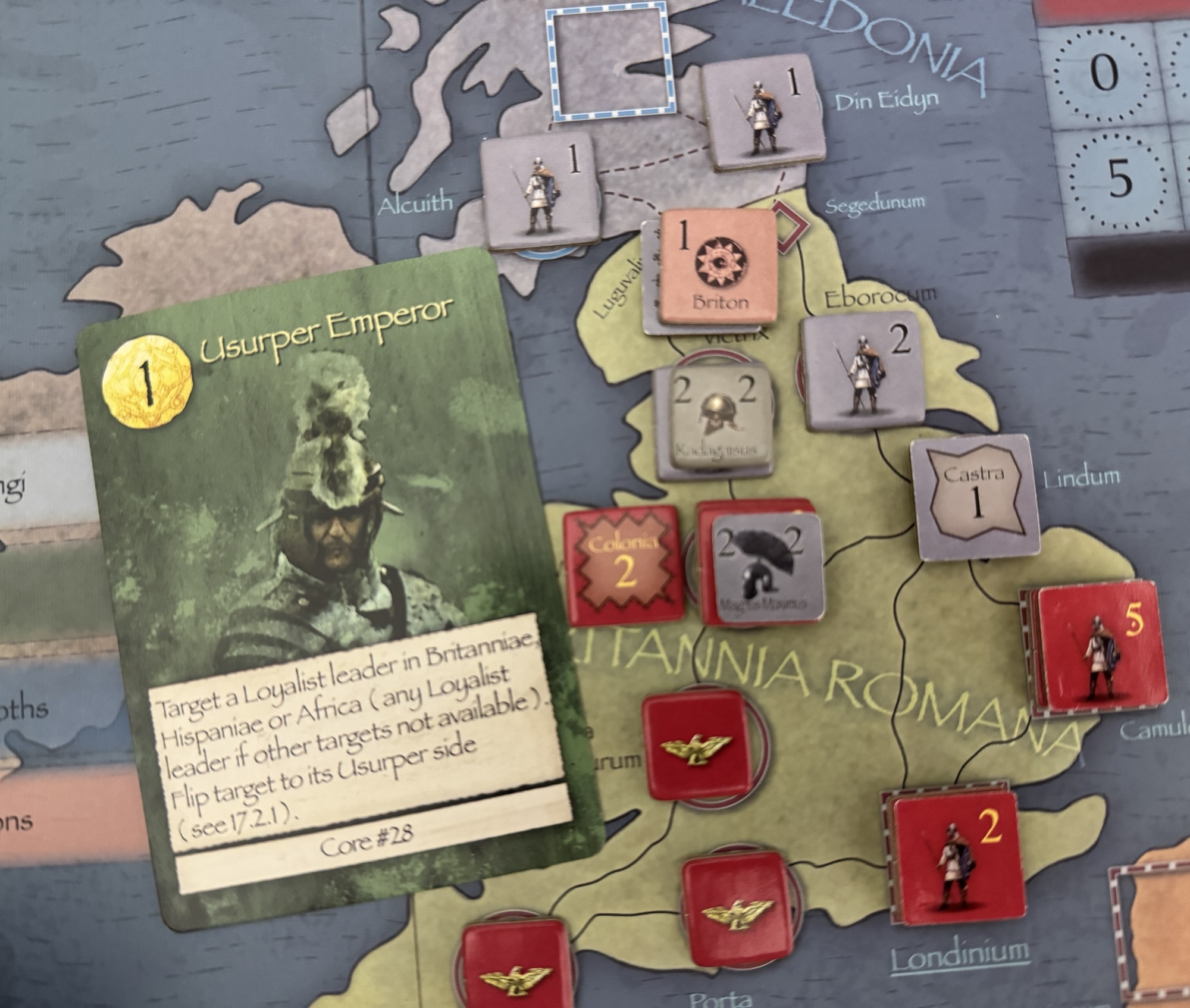
The real trick to the cards is to plan out how you are going to use them to your advantage but also how best to use them. Activating Leaders is very important as you can then move them to attack, defend, change control of areas and other actions. Activating a leader depends on their strategy rating (the lower the strategy rating, the better). When a leader activates from a card, they receive a number of Action Points which can be used for movement (1 over highway, 2 over rough or river connections, 3 over strait or for naval movement), continuation after battle (a kind of advance after combat), changing control over unfortified spaces and sieges of fortified spaces. But the cards also are very mean spirited. What do I mean by this? Well, in our first play, I was carefully using my cards to build up my armies to fend off the initial attacks of the Barbarian hordes. I also had begun to build somewhat of a super stack as well to attempt to foray into England and take on the Barbarians there. As I did this building up, I was unaware of the nasty nature of some of the cards. Some of the cards, both for the Barbarians and Romans, allow a play that will turn a single leader and their entire stack into either a Usurper or a Pacified Barbarian Settlement. Both are equally nasty and you have to keep in mind that you can have your best armies simply taken from you and turned to your enemy.

Some of the cards, both for the Barbarians and Romans, allow a play that will turn a single leader and their entire stack into either a Usurper or a Pacified Barbarian Settlement. Both are equally nasty and you have to keep in mind that you can have your best armies simply taken from you and turned to your enemy. Because of this, the Roman player has to decide whether they will group Combat Units under a single leader in order to face the mighty Barbarian challengers at the Gates in which case he risks that leader to Usurp, or to disperse these troops over several stacks never allowing a single leader to amass too many CU but on the other hand also never having a true striking force to attack with. There is an exception here though as an Emperor leader cannot Usurp and you don’t have to worry about that but this is also dangerous as you can lose that Emperor.

Likewise, once they have an Usurper leader on the board the Barbarian player will try to group all Usurper CU with this leader (in order to keep this force strong and in order to allow their Barbarian CU, leader and tribes to march unopposed into the Empire). This creates a very real and historical danger as the Barbarian player is incentivized to do what an Usurper would historically have done and empty the border garrisons in order to march on Rome.

These type of cards are extremely strong and a situation can occur in which most of the Romans still on the board are Usurper leaders and CU. But there is an action that allows for the Roman player to counter these cards and that is the Successful Usurpation action. If the Barbarian player over does it with the Usurper powers, the Roman player can simply steal these conquests by swapping the Roman power for the Usurper power. This in effect has the Usurpation process succeed and the former Usurper leader now becomes the true Emperor!

Usurper emperors in history, particularly in Ancient Rome, were rulers who seized their power illegitimately, often times via a military rebellion rather than legal succession, and were labeled “tyrants” if defeated, or emperors if successful. They were most common during crises and times of turmoil, such as the “Year of the Four Emperors” in 69 AD following the suicide of Nero, often relying on legionary support and issuing their own coins to legitimize authority. 

Emperor Galba by Paulus Moreelse (left); with Emperor Marcus Salvius Otho by Gerrit van Honthorst (center left); with Emperor Vitellius by Hendrick Goltzius (center-right); and Emperor Vespasian (far right).

Usurpation was common during the whole imperial era; virtually all imperial dynasties rose to power through usurpation and conspiracies. The “imperial office” established by Augustus never defined an stable system of succession, and emperors often had to rely solely on military power to survive.

In the Eastern Roman Empire (395–1453), rebellion and usurpation were so notoriously frequent as compared to medieval West, where usurpation was rare, that the modern term “byzantine” became a byword for political intrigue and conspiracy. 

Here is a look at our unboxing video:

We also did a video review and you can watch that at the following link:

I also wrote a First Impressions post on the game and you can read that at the following link: https://theplayersaid.com/2022/11/08/first-impressions-barbarians-at-the-gates-the-decline-and-fall-of-the-western-roman-empire-337-476-from-compass-games/

In the next entry in this series, we will take a look at Blockade from Twilight Struggle: The Cold War, 1945-1989 from GMT Games.

-Grant

My Favorite Wargame Cards – A Look at Individual Cards from My Favorite Games – Card #67: Frederick Douglas from Votes for Women from Fort Circle Games

Von: Grant
24. Februar 2026 um 14:00

With this new My Favorite Wargame Cards Series, I hope to take a look at a specific card from the various wargames that I have played and share how it is used in the game. I am not a strategist and frankly I am not that good at games but I do understand how things should work and be used in games. With that being said, here is the next entry in this series.

#67: Frederick Douglas from Votes for Women from Fort Circle Games

Votes for Women is a very interesting card-driven game that covers the American Women’s Suffrage Movement from 1848-1920, culminating in the ratification of the Nineteenth Amendment which granted women the right to vote. The game is a 2-player game, that has a fully developed solitaire mode with an “Oppobot” and offers a cooperative mode for those who don’t wish to play as they Opposition. The Suffragist player will have to push Congress to propose the Nineteenth Amendment, and then focus on campaigning to have a minimum of 36 states to ratify the Amendment. The Opposition side will try to prevent Congress from proposing the amendment and failing that to have 13 states reject the amendment.

The game uses cards in a fairly traditional CDG way as there are events that can be be taken or the cards can be played to do things like Campaign, Organize or Lobby Congress. Each card has a specific Card Era that is used to create of the each players’ Draw Decks. Late cards will be on the bottom of the deck, Middle cards will be in the middle of the deck and Early cards will be on the top of the deck. The Suffragist and Opposition decks each have one Start card that will be placed in the player’s hand at the start of the game. Some Event Cards have a prerequisite and some of the cards require a player to roll a 6-sided die and only take the the action on a roll of 3-6. Otherwise, the Event Card is discarded with no effect. The cards in this game are also steeped in historical details, from the name of the events that tie back to specific individuals or happenings, to major moments in the struggle. This game is about the history of the struggle for the right to vote and it is very good!

I like to see Votes for Women as a game primarily as it uses some really fun and lite methods to determine the majority control in various states. One of the goals of the game is for either side to place out their influence cubes in the states in order to collect State cards that provide unique and sometimes very powerful free ways to add more influence or otherwise change the level of influence in states. This goal also leads all the way to the end game as if when the 19th Amendment is ratified in Congress because the Suffragist player used their cards to place out support cylinders in Congress each of the states can have their support for the amendment decided at that time if there are 4 or more influence cubes of either side in that state. If there are 4 cubes in a state at that time either a green check mark will be placed, representing support for the 19th Amendment or an orange X will be placed meaning the state voted against.

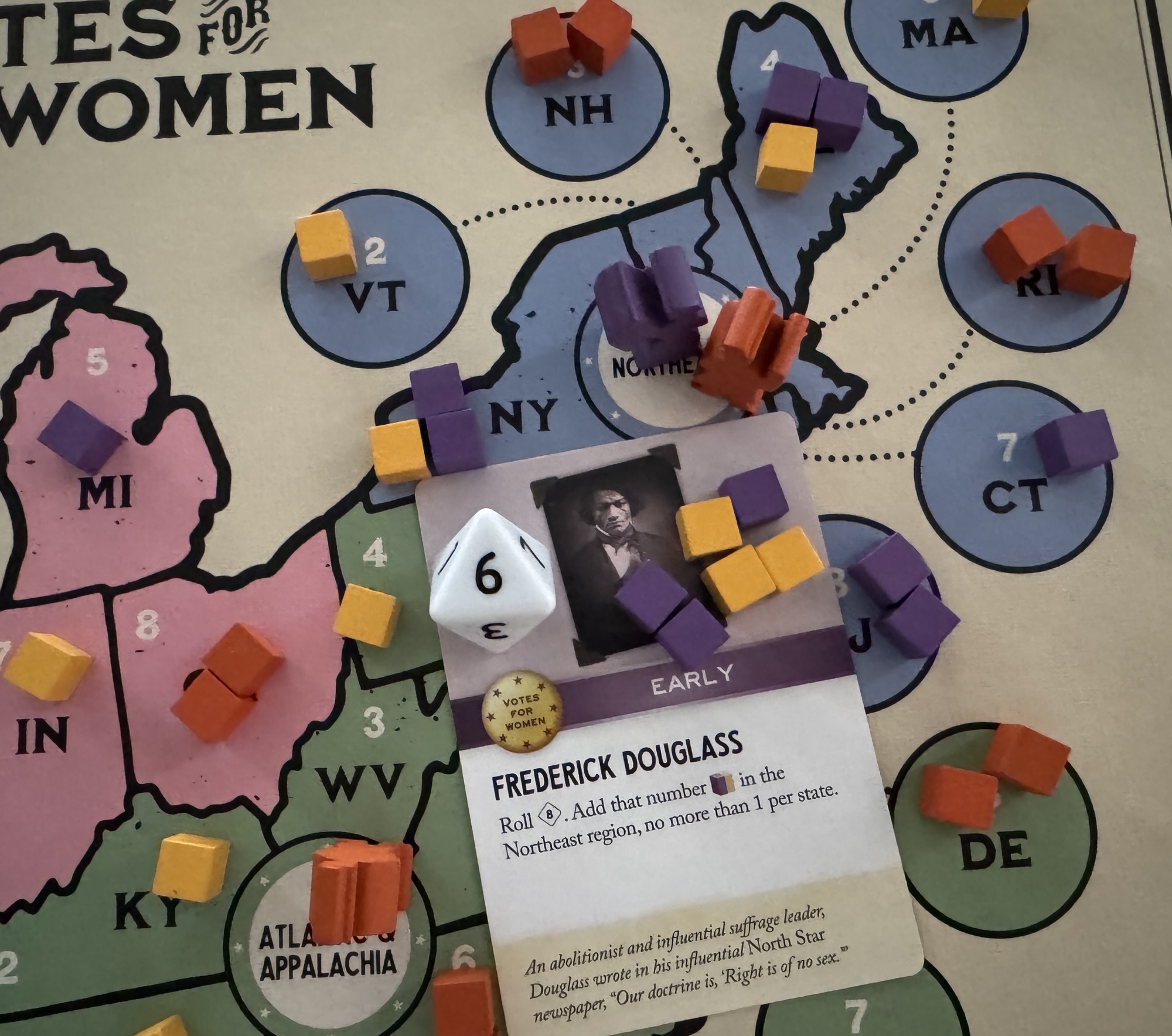
The Frederick Douglas card is one of these methods used to shake things up a bit and give the Suffragist player a chance to push their luck and roll the die to see how many influence cubes they can place. The card text instructs the player to roll a D8 (the game uses D6’s, D8’s and D12’s) and then add that number of influence cubes in the Northeast region, which includes states such as New York, New Jersey, Vermont, New Hampshire, Maine, Massachusetts, Rhode Island and Connecticut. The key limiter here though is that no more than 1 cube per state can be placed. The other thing about placing these influence cubes is that you can use 1 cube to remove a cube of the opposing player. This action does not allow you to then place one of your cubes in the state if that action would remove the only Opposition cube in the state…but nice try!

Frederick Douglass was a staunch, lifelong advocate for women’s suffrage, viewing it as an essential component of human equality, famously declaring “Right is of no sex”. As a key ally to suffragists like Susan B. Anthony and Elizabeth Cady Stanton, he supported the cause for over four decades, including crucial support at the 1848 Seneca Falls Convention.

In an issue of the North Star published shortly after the convention, Douglass wrote:

In respect to political rights, we hold woman to be justly entitled to all we claim for man. We go farther, and express our conviction that all political rights which it is expedient for man to exercise, it is equally so for women. All that distinguishes man as an intelligent and accountable being, is equally true of woman; and if that government is only just which governs by the free consent of the governed, there can be no reason in the world for denying to woman the exercise of the elective franchise, or a hand in making and administering the laws of the land. Our doctrine is, that “Right is of no sex.”

Douglass continued to support the cause of women after the 1848 convention. In 1866 Douglass, along with Stanton and Anthony, founded the American Equal Rights Association, an organization that demanded universal suffrage. Though the group disbanded just three years later due to growing tension between women’s rights activists and Africa-American rights activists, Douglass remained influential in both movements, championing the cause of equal rights until his death in 1895.

Here is a link to our full video review of the game:

We also published an interview on the blog with the designer Tory Brown and you can read that at the following link: https://theplayersaid.com/2020/09/07/interview-with-tory-brown-designer-of-votes-for-women-from-fort-circle-games-currently-on-kickstarter/

In the next entry in this series, we will take a look at Usurper Emperor from Barbarians at the Gates, The Decline and Fall of the Western Roman Empire 337 – 476 from Compass Games.

-Grant

My Favorite Wargame Cards – A Look at Individual Cards from My Favorite Games – Card #66: Harwood’s Intuition from The Hunt from Salt & Pepper Games

Von: Grant
19. Februar 2026 um 14:00

With this My Favorite Wargame Cards Series, I hope to take a look at a specific card from the various wargames that I have played and share how it is used in the game. I am not a strategist and frankly I am not that good at games but I do understand how things should work and be used in games. With that being said, here is the next entry in this series.

Card #66: Harwood’s Intuition from The Hunt from Salt & Pepper Games

I have played several hidden movement games over the years and enjoyed them all. Some of these titles have included wargames such as They Come Unseen from Osprey GamesSniper Elite: The Board Game from Rebellion Unplugged and Bomber Command from GMT Games as well as a few board games including Hunt for the Ring from Ares Games. The concept of moving cautiously, attempting to evade pursuers, all while trying to locate and acquire or destroy objectives makes for a very interesting gaming experience. These situations can make for some really tense games that cause your head to ache and your wits to be tested. But they rely on some bluffing as well. Trying to force your opponent to anticipate where they think you should be and then trying not to be there. A really great mechanic in board games but not always easy to pull off and make for a very playable and interesting game. In 2022, we played a new design from Matthias Cramer and Engin Kunter that took this hidden movement concept and put it into a historically based game about the struggle over control of the South Atlantic between the British Royal Navy and the German Kriegsmarine during the early years of World War II called The Hunt from Salt & Pepper Games.

The Hunt is a Card Driven Game where the German player has to attempt to stay hidden while trying to sink merchant shipping as the Royal Navy hunts for them throughout the South Atlantic. The players each have asymmetric actions to use to accomplish their missions and each has a tough time doing what they have to do. But, if they manage their cards wisely, using them as effectively as possible, they can successfully either evade their pursuer or catch their prey.

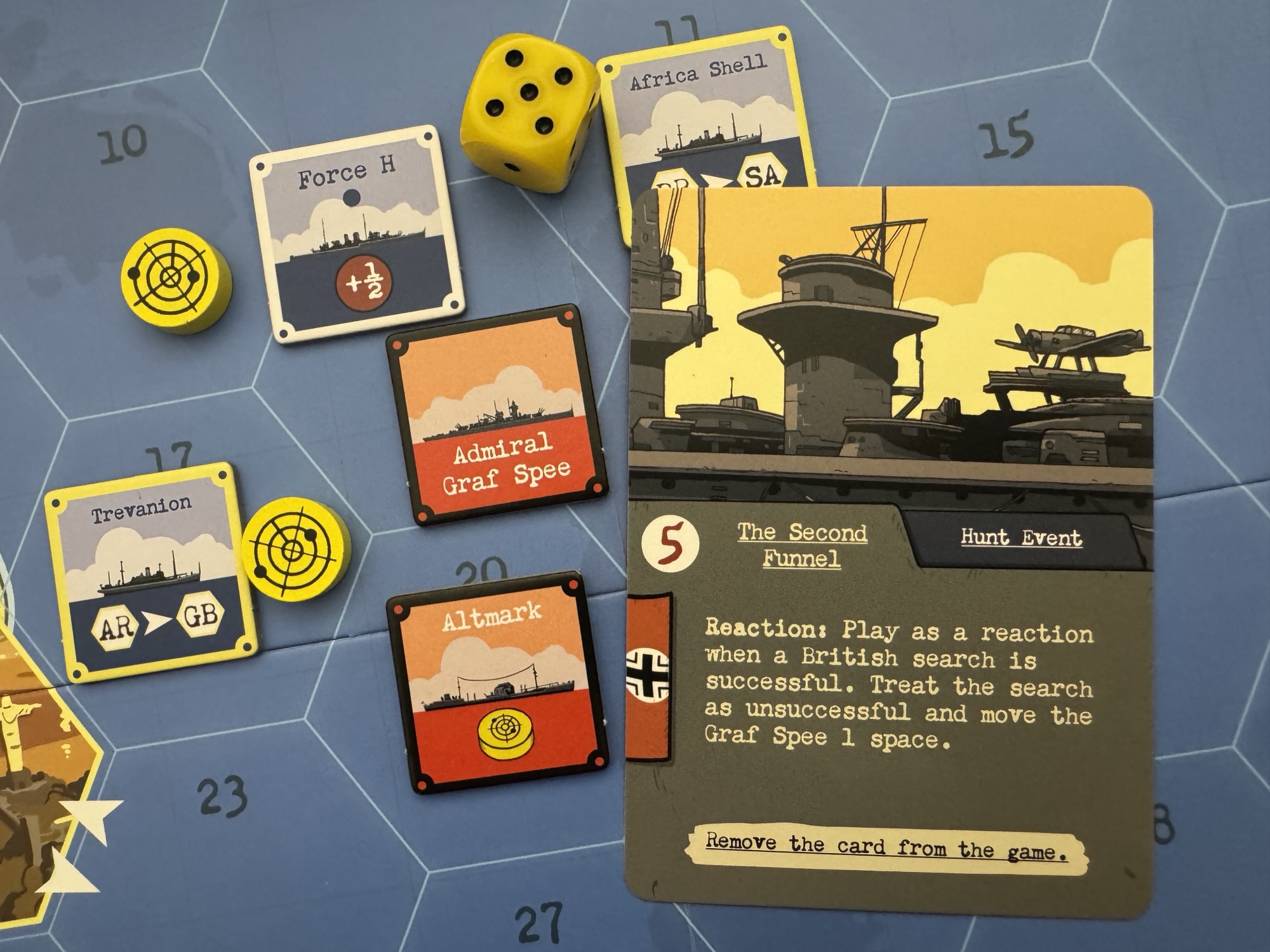
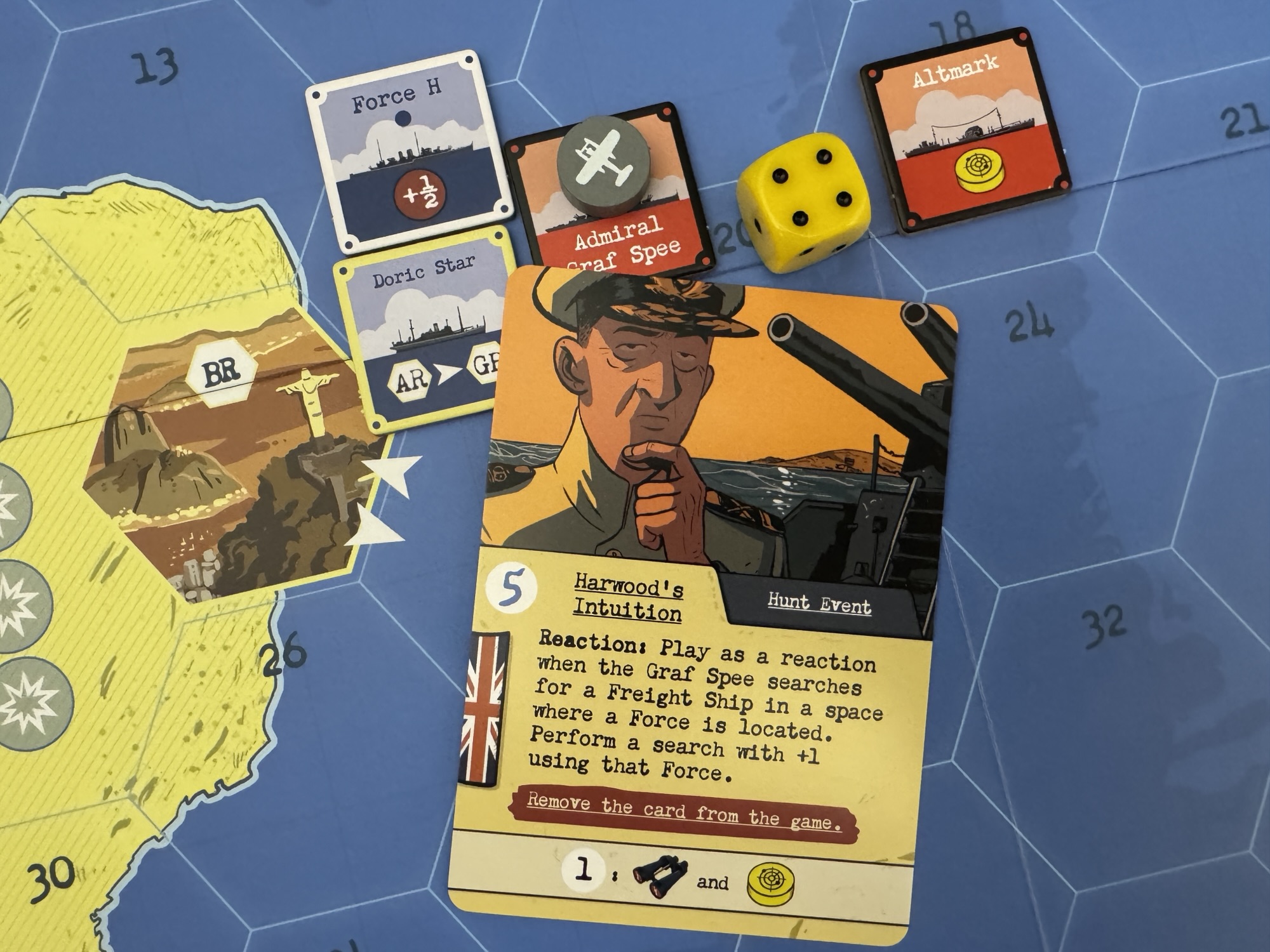
In today’s post, we will take a look at the very useful British card Harwood’s Intuition. Harwood’s Intuition is a 5 Ops card, which makes it a very important card in the British deck as it allows for the taking of 2-3 actions in a single turn, but for which there is an even more important use as an ambush by playing it as a Reaction to a German action. If the German player ever searches for a Freight Ship in a space where there is a British Task Force, and Harwood’s Intuition is played as a reaction, the British will get a free Search action with a +1 DRM to the roll. Normally, a Search requires a 5+ on a d6 to be successful, but with this bonus +1 that will mean success on a 4+ which is a 50/50 proposition. And remember, the point of the game for the British is to find and sink the Graf Spee at the Battle of the River Plate. Such as tasty surprise card for the British! I know that when I play as the Germans, I have to always keep in the back of my mind that this card exists and that if there is a Force present, I have a risk of being ambushed. This is one of the elements that makes this game so good.

The Battle of the River Plate was fought in the South Atlantic on December 13, 1939 and was officially the first British naval battle of World War II. In the months leading up to this infamous date, due to several successful sinkings of merchant shipping by the Graf Spee, the Royal Navy was ordered by Admiral Sir Henry Harwood Harwood to keep observation between Medanos and Cape San Antonio located off the coast of Argentina south of the River Plate estuary. In the lead up to the climactic final battle, following various raider-warning radio messages from the merchantman Doric Star, which was sunk by Admiral Graf Spee off South Africa, Harwood suspected that the raider would try to strike next at the merchant shipping off the River Plate estuary between Uruguay and Argentina. He ordered his squadron to steam toward the position 32° south, 47° west. Harwood chose that position, according to his dispatch, because it was the most congested part of the shipping routes in the South Atlantic and therefore the point at which a raider could do the most damage to enemy shipping. A Norwegian freighter saw Admiral Graf Spee practicing the use of her searchlights and radioed that her course was toward South America; the three available cruisers of Force G rendezvoused off the estuary on December 12th and conducted maneuvers.

Though generally considered a river, the River Plate has been considered by some geographers as a large bay or a marginal sea of the South Atlantic. Principally this is due to the River Plates enormous width, if we are considering it a river the widest in the world, with a maximum width of about 140 miles. Acting as the marine border between Argentina and Uruguay, the River Plate was a main artery of maritime trade and a gateway into the interior of the South American continent.

It was here that Harwood predicted the German raider would strike and his assumption made sense. The River Plate’s Estuary acted as a natural bottleneck for ships with perilous tides and sandbanks additionally hampering any ability for a British Merchant vessel to escape the guns of a German raider. So it was near the Estuary of the River Plate that Harwood’s H.M.S Exeter, Ajax and Achilles would make their stand. With their force concentrated here, on December 12th preparations were made and tactics drawn up in anticipation for an arriving adversary and to spring the trap and catch the elusive Admiral Graf Spee off-guard and send her to the bottom.

Here also is a link to our full video review of the game:

We also published an interview on the blog with the designers Matthias Cramer and Engin Kunter and you can read that at the following link: https://theplayersaid.com/2023/03/13/interview-with-matthias-cramer-and-engin-kunter-designers-of-the-hunt-from-salt-pepper-games-coming-to-gamefound-march-15th/

In the next entry in this series, we will take a look at Frederick Douglas from Votes for Women from Fort Circle Games.

-Grant

My Favorite Wargame Cards – A Look at Individual Cards from My Favorite Games – Card #65: Georgi Zhukov from Churchill: Big 3 Struggle for Peace from GMT Games

Von: Grant
10. Februar 2026 um 14:00

With this My Favorite Wargame Cards Series, I hope to take a look at a specific card from the various wargames that I have played and share how it is used in the game. I am not a strategist and frankly I am not that good at games but I do understand how things should work and be used in games. With that being said, here is the next entry in this series.

#65: Georgi Zhukov from Churchill: Big 3 Struggle for Peace from GMT Games

The players in Churchill: Big Three Struggle for Peace take on the roles of Churchill, Roosevelt, or Stalin during World War II as they maneuver against each other over the course of 10 Conferences that determine who will lead the Allied forces, where those military forces will be deployed, and how the Axis will be defeated. The player whose forces collectively have greater control over the surrendered Axis powers will win the peace and the game.

Churchill is not necessarily a wargame, but more of a political conflict of cooperation and competition. Over the course of the 10 historical conferences from 1943 till the end of the war this mechanic and much of the design should not be taken literally. Before and after each conference small groups of advisors and senior officials moved between the Allied capitals making the deals that drove the post war peace. These advisors and senior officials are represented by cards with an assigned numeric value that represents an amount of influence. Each conference sees one of a group of issues nominated for inclusion in the conference for debating and discussion. The issues categories include: Theater leadership changes, directed offensives, production priorities, clandestine operations, political activity, and strategic warfare (A-bomb). Each of the historical conference cards independently puts some number of issues, such as directed offensives or production priorities, metaphorically on the table, while the players nominate an additional 7 issues. The best part of the design is the conference table and stress and tension that comes from fighting over each and every issue. No one issue is a game breaker and no one issue will outright win the peace for you. But, each issue is key to the game as they unfold and change the landscape across which you are battling. Not landscape of terrain and defenses, but pit falls, traps and dead ends.

As I have mentioned, the Staff Cards are the engine for the game and the players must utilize their asymmetric abilities to the best of their ability in order to come out on top of the heap at the end of the game. These Staff Cards represent real period personalities of advisors, political officers and generals, who had the ear of the leaders and could go about working behind the scenes to move an issue into the limelight. Each player will utilize these cards to win those issues and each card provides either a bonus for a specific attribute or, in rare occasions, a negative modifier.

Today, we will take a look at one of my favorite type of cards from the game in the Chief of Staff Cards and specifically look at the Soviet Chief of Staff Georgi Zhukov who was the Deputy Supreme Commander in Chief of the Red Army. Each of the Chief of Staff Cards have a random numeric value in addition to a bonus for a certain attribute. The random numeric value is determined from rolling a 6 sided die and then using that number as the card’s base value. In Zhukov’s case, he is good with Production Issues and will grant a +1 strength toward moving these issues on the conference table. I like to think that this random determination of the Chief of Staff Card’s strength represents the internal power struggle with each of the nations leaders and those closest to them. In the case of Soviet Premier Stalin and his relationship with Zhukov they maintained a tense, professional, and ultimately strained relationship defined by mutual need during World War II, followed by postwar jealousy and suspicion. While Stalin relied on Zhukov as his top military commander to secure victory on the battlefield, he grew paranoid of the Marshal’s immense popularity and influence, leading to his ultimate demotion. And this random nature of the card’s strength reflects this well as sometimes they would agree and they could make great progress while other times they did not and there was tension and difficulty in their cooperation.

Georgy Konstantinovich Zhukov was born on December 1, 1896 and was a Soviet military leader who served as a top commander during World War II and achieved the rank of Marshal of the Soviet Union. During World War II, Zhukov served as deputy commander-in-chief of the armed forces under leader Joseph Stalin, and oversaw some of the Red Army’s most decisive victories. He also served at various points as Chief of the General Staff, Minister of Defence and a member of the Presidium of the Communist Party (Politburo).

Born to a poor peasant family near Moscow, Zhukov was conscripted into the Imperial Russian Army and fought in World War I. He served in the Red Army during the Russian Civil War, after which he quickly rose through the ranks. In summer 1939, Zhukov commanded a Soviet army group to a decisive victory over Japanese forces at the Battles of Khalkhin Gol, for which he won the first of his four Hero of the Soviet Union awards, and in 1940 he commanded the Soviet invasion of Bessarabia and Northern Bukovina in Romania. In February 1941, Stalin appointed Zhukov as chief of the General Staff of the Red Army.

Following the German invasion of the Soviet Union in June 1941, Zhukov lost his post as chief of staff after disagreeing with Stalin over the defense of Kiev. Zhukov, often in collaboration with Aleksandr Vasilevsky, was subsequently involved in the Soviet actions at Leningrad, Moscow, Stalingrad, and Kursk. He held the title of deputy commander-in-chief of the armed forces from August 1942, and was promoted to Marshal of the Soviet Union in January 1943. He participated in the planning of Operation Bagration in 1944, and in 1945 commanded the 1st Belorussian Front as it led the Vistula–Oder Offensive into Germany, where he oversaw the Soviet victory at the Battle of Berlin. In recognition of Zhukov’s key role in the war, he was chosen to accept the German Instrument of Surrender and to inspect the 1945 Moscow Victory Parade. He also served as the first military governor of the Soviet occupation zone in Germany from 1945 to 1946.

After the war, Zhukov’s popularity caused Stalin to see him as a potential threat. Stalin stripped him of his positions and relegated him to military commands of little strategic significance. After Stalin’s death in 1953, Zhukov supported Nikita Khrushchev’s bid for leadership, and in 1955, he was appointed Defense Minister and made a member of the Presidium. In 1957, Zhukov lost favor again and was forced to retire. He never returned to a top post, and died in 1974. Zhukov is remembered as one of the greatest Russian and Soviet military leaders of all time.

In the next entry in this series, we will take a look at Harwood’s Intuition from The Hunt from Salt & Pepper Games.

-Grant

My Favorite Wargame Cards – A Look at Individual Cards from My Favorite Games – Card #64: Guns of August from Paths of Glory: The First World War, 1914-1918 from GMT Games

Von: Grant
03. Februar 2026 um 14:00

With this My Favorite Wargame Cards Series, I hope to take a look at a specific card from the various wargames that I have played and share how it is used in the game. I am not a strategist and frankly I am not that good at games but I do understand how things should work and be used in games. With that being said, here is the next entry in this series.

#64: Guns of August from Paths of Glory: The First World War, 1914-1918 from GMT Games

Paths of Glory is widely thought to be a masterpiece on WWI and after just a few plays of the game, both in person and online on the fabulous Rally the Troops!, I can definitely see why people feel that way. Even though we are novices, the game is just that good and really tells the story of the fruitless efforts of both the Entente and Central Powers as they bashed their heads against each other over control of Europe. The game is long and you generally are going to have to play this one over a long weekend to get it all in and enjoy it properly but it is just such as great tool to understand the complexities of the struggles of trench warfare, supply and the balance of attacking versus taking a breath and regrouping. I really enjoyed the mix of historical events and the choices that I had to wage the war in a way that I felt was appropriate. But, my message to everyone who plays this game is beware of supply. Even in our few plays, supply has been an issue and we have had to make sure we didn’t make a few fatal mistakes that would get us in trouble. I want it to be clear here. I am not good at this game…at all and the nuances of supply and how to play have just eluded me as I continue to make the same errors game after game. But it is really good and I look forward to each new play with enthusiasm and am excited about the chance to get to learn more about this fascinating war that was so very fruitless.

I am going to use snips of the board from Rally the Troops! in this post so it might look a bit different from my normal posts.

With that being said, generally in every single game the Central Powers will start out by playing their Guns of August card. Guns of August is a crucial, high-stakes opening event for the Central Powers on Turn 1, enabling an immediate, powerful, and historical offensive against France and Belgium.

The Guns of August is a 3/4 OPs card that is placed into the CP player’s hand at the outset and gives them the initiative immediately. First off, the card destroys the fortress at Liège and then gives a massive mobilization effort booster by moving 2 German Army counters from their starting spaces including the German 1st and 2nd Armies and then activating them both to attack along with the German 3rd Army who is located at the start of the game setup in Koblenz.

This gives the CP player 2 choices about how to start the war with this attack. They can focus on the British Expeditionary Force located in Brussels or the French 5th Army located in Sedan. The allows the CP to destroy the Liège fortress, advance armies, and immediately attack or pressure the British Expeditionary Force (BEF) and French forces. In my humble opinion, the BEF is the real target here as this unit cannot be replaced or rebuilt and its removal opens up the path for the Germans to take on the fortress at Antwerp.

While the Guns of August card play is an aggressive move, it does somewhat ensure Austria-Hungary can survive potential Russian pressure as the Allied player will have to quickly use their precious resources to fill the gaps created by this opening attack rather than using them to bolster the Russians in the east or to build up the Serbians a bit in the south to prolong the fall of Belgrade. Paths of Glory is a large part about resource management and the constant pressure to continue offensive momentum and rebuild troops through the use of Replacement Points and events to bring on additional troops is a major problem for both sides. You can only attack for so long before you will burn yourself out and will have to spend time to recover and get ready for the next turn’s offensives. Using the Guns of August cards efficiency will free up resources to use elsewhere.

There are alternative openings with the card that can be considered. If not using Guns of August for the event, the CP player can use 1 OP to destroy the Liège fort, allowing them to conserve the card for later or pivot to a more defensive strategy, such as defending the Rhine.

In the end, I would recommend the hammer approach versus any other use of the card as it will really put the pressure squarely on the Allies to do something about what you have just accomplished. In the picture to the right is the normal outcome of these attacks as you can see the BEF is reduced and the French 5th Army has broken and is now replaced by a smaller Corps counter that cannot really do anything offensively and is just there to protect the back side of the Maginot Line from being caught out of supply.

The Guns of August (published in the UK as August 1914) is a 1962 book centered on the first month of World War I written by Barbara W. Tuchman. After introductory chapters, Tuchman describes in great detail the opening events of the conflict. The book’s focus then becomes a military history of the contestants, chiefly the great powers.

The Guns of August provides a narrative of the earliest stages of World War I, from the decisions to go to war up until the start of the Franco-British offensive that stopped the German advance into France. This led to four years of trench warfare. The book discusses military plans, strategies, world events, and international sentiments before and during the war.

The book was awarded the Pulitzer Prize for General Nonfiction for publication year 1963, and proved very popular. Tuchman later returned to the subject of the social attitudes and issues that existed before World War I in a collection of eight essays published in 1966 as The Proud Tower: A Portrait of the World Before the War, 1890–1914.

In the next entry in this series, we will take a look at Georgi Zhukov from Churchill: Big 3 Struggle for Peace from GMT Games.

-Grant

My Favorite Wargame Cards – A Look at Individual Cards from My Favorite Games – Card #63: Militia from Stilicho: Last of the Romans from Hollandspiele

Von: Grant
29. Januar 2026 um 14:00

With this My Favorite Wargame Cards Series, I hope to take a look at a specific card from the various wargames that I have played and share how it is used in the game. I am not a strategist and frankly I am not that good at games but I do understand how things should work and be used in games. With that being said, here is the next entry in this series.

#63: Militia from Stilicho: Last of the Romans from Hollandspiele

Stilicho: Last of the Romans is a very well designed and interesting solo experience that plays in 60-90 minutes. But, due to the unforgiving nature of the random card draws and its reliance on dice luck, that admittedly can be mitigated through cagey card play and proper decisions, the game can be over very quickly. In fact, my very first play a few years ago lasted only 2 rounds and was over in about 15 minutes. Remember that the historical Stilicho only made it to Round 3! The cards are at the heart of the game here and make it a very tense and decision filled experience. Having to analyze each card, measuring its utility against the board state and what pressing matters the player must address while also fretting over having to discard a good Event Card that just isn’t useful at this point in time to take an action can be really agonizing. I think that this design works even better than its predecessor Wars of Marcus Aurelius.

The cards are a form of multi-use cards, as most Card Driven Games are, as they can either be used for the printed events on the cards or simply to be discarded to take one of a number of actions available to the player. It is important to read every aspect of the card thoroughly as some cards have multiple effects, differing effects depending on what the state of the game is or whether one Barbarian has surrendered or may have several prerequisites to that card being allowed to be played.

There are some events that are too important to your efforts to ever discard to take an action as they provide you with such great benefit and are more efficient than taking individual actions. Don’t get me wrong though the playability of a card is always dependent on when in the course of the game the card is drawn. An example of what I am talking about is the Militia Roman Card.

During the game, some cards will cause Unrest Markers to be placed on the various tracks that wind their way through the provinces. These Unrest Markers represent the erosion and weakening of Roman control, the spread of fear throughout the populace due to the threat of usurpers and ultimate civil war as well as the logistical difficulties of defending against barbarian incursions. They act as a critical, accumulating threat that, if left unchecked, can lead to widespread revolts, which are one of the primary ways a player loses the game. Unrest Markers are placed in Dioceses when specific enemy cards (particularly the Vandals) are activated or reach the end of their movement tracks. If a Diocese already contains an Unrest Marker when a new one is triggered, it indicates increasing instability, requiring the player to flip an existing, lower-level Unrest Marker to its “Revolt” side. Unrest/Revolt Markers increase the difficulty of battles in that province. When attacking or defending in a affected Diocese, the marker adds to the enemy’s strength. Also, a major loss condition in the game is having too many Revolt Markers on the board simultaneously. Managing and removing these markers is essential for survival. Unrest Markers are placed in a specific order across the board—starting from Hispania and moving through Gallia to Italia—which dictates the geographic spread of the crisis. Players must spend valuable actions (usually by discarding cards) or use specific Event Cards such as the Militia card to remove these counters from the board. 

Before the late 2nd century BC, Rome used a citizen militia or levy of property-owning men aged 16–46, serving unpaid during summer campaigns. Organized by wealth, they formed three lines—hastatiprincipestriarii—and provided their own equipment. They were crucial for seasonal defense and expansion, as well as for patrolling and safeguarding supply lines, trade routes and newly conquered territories, ultimately transitioning to a professional army after 107 BC. The citizen troops were grouped into maniples based on age and wealth, with the poorest acting as light-armed skirmishers (velites). Service was typically restricted to the annual campaign season, often ending with the Festival of the October Horse on 19 October. The militia employed a three-line, checkerboard formation to allow for tactical flexibility. Due to many reasons, the militia system was phased out after 107 BC in favor of a full-time, professional army, although conscription remained as a, mostly unpopular, option for raising forces.

I wrote a series of Action Points on the various aspects of the game and you can read those at the following links:

Action Point 1 – the Mapsheet focusing on the three Fronts down which your enemies advance, but also covering the different spaces and boxes that effect play such as the Olympius Track, Game Turn Track, Army Box, Leader Box and Recovery Box

Action Point 2 – look at the cards that drive the game and examine the makeup of both the Enemy Deck and the Roman Deck.

Action Point 3 – look into the Roman Phase and examine how cards are discarded to take one of nine different actions.

Action Point 4 – look at a few examples of Battles and how they are resolved.

Action Point 5 – look at a few points of strategy that will help you do better in the game.

I shot a playthrough video for the game and you can watch that at the following link:

I also followed that up with a full video review sharing my thoughts:

In the next entry in this series, we will take a look at Guns of August from Paths of Glory: The First World War, 1914-1918 from GMT Games.

-Grant

My Favorite Wargame Cards – A Look at Individual Cards from My Favorite Games – Card #62: Romanian Autonomy from Twilight Struggle: Red Sea – Conflict in the Horn of Africa from GMT Games

Von: Grant
20. Januar 2026 um 14:45

With this My Favorite Wargame Cards Series, I hope to take a look at a specific card from the various wargames that I have played and share how it is used in the game. I am not a strategist and frankly I am not that good at games but I do understand how things should work and be used in games. With that being said, here is the next entry in this series.

#62: Romanian Autonomy from Twilight Struggle: Red Sea – Conflict in the Horn of Africa from GMT Games from GMT Games

We all love Twilight Struggle….and if you say you don’t, you really do but just want to be different or are a contrarian! The game is phenomenal and has done very well for GMT Games with 8 Printings as well as the Turn Zero Expansion and now a series of smaller geographically focused spin off games starting with Twilight Struggle: Red Sea – Conflict in the Horn of AfricaTwilight Struggle: Red Sea deals with just two regions located in the Horn of Africa including Africa and the Middle East. The game uses the familiar Twilight Struggle formula of Cards with both Events and Operations Points that can be used by players to perform Coups, do Realignment Rolls or place Influence in an effort to gain control of the most Countries in the Regions to score Victory Points and win the game. The game is fast, furious and only lasts 2 hands of cards (unless you choose to play the special 3 Turn variant) so there isn’t a lot of time to mess around and players must be focused on what they are trying to accomplish. The best thing about the game is that it plays in 45 minutes as compared to 3-4 hours for Twilight Struggle.

The next card we will take a look at in this series is the special Romanian Autonomy, which is a unique card that doesn’t play from the deck but starts with the US player and resembles one of the classic cards from the original Twilight Struggle called The China Card. And if you have played Twilight Struggle, you know about the China Card. The China Card is a 4 Ops Value Card that can be held by the player in addition to their hand limit thereby giving them an extra card to use. But the card also has a special ability where if the player uses the card for 4 Ops to place Influence only in Asia, it will grant the player +1 Ops Value to use in placing one additional Influence. The China Card also grant’s the player who holds the card at the end of Turn 10 a +1 VP bonus.

In Twilight Struggle: Red Sea, the China Card has been replaced by the Romanian Autonomy Card. This card is not as powerful as the China Card but definitely creates some new opportunities and challenges for the player playing the card. The Romanian Autonomy Card can effect their Ops Value from cards by +1 during the Turn that they play it if they are behind on the Victory Point Track and also grants +1 VP to the player holding the card during Final Scoring. I think this is a really interesting concept and I think was included as a sort of catchup mechanic due to the short nature of the game. I look forward through more plays to seeing how its addition changes things and whether it is overpowered or just right. Once again, a small and subtle change to the game to create a new and interesting experience for the avid fan of Twilight Struggle or players who are new to the system.

Nicolae Ceaușescu visiting Africa during the Cold War.

During the Cold War, particularly under Nicolae Ceaușescu (1965–1989), Romania maintained a distinct, active presence in Africa, including the Horn of Africa, as part of a strategy to distance itself from Soviet influence, gain international prestige, and foster economic exchanges. While major powers like the Soviet Union and Cuba directly intervened in regional conflicts (such as the Ogaden War), Romania focused on building “fraternal” socialist relations through diplomatic, economic, and technical assistance, often operating with a degree of autonomy from the Warsaw Pact. Romania’s actual African strategy in the Horn of Africa, outlined in its 2023 Africa Strategy, emphasizes partnership, peace, development, education, and security cooperation, not territorial autonomy. Romania aimed to be a bridge between Europe and Africa, strengthening ties through cultural exchange, economic projects, and increased diplomatic presence in strategic capitals like Addis Ababa and Nairobi. Under its former communist regime, Socialist Republic Romania pursued economic independence and influenced African nations, but this was distinct from seeking autonomy within Africa. The phrase “Romanian autonomy in the Horn of Africa” is a game term with strategic implications within the game, while Romania’s real-world engagement with Africa is about broader diplomatic and economic partnerships

In the next entry in this series, we will take a look at Militia fromStilicho: Last of the Romans from Hollandspiele.

-Grant
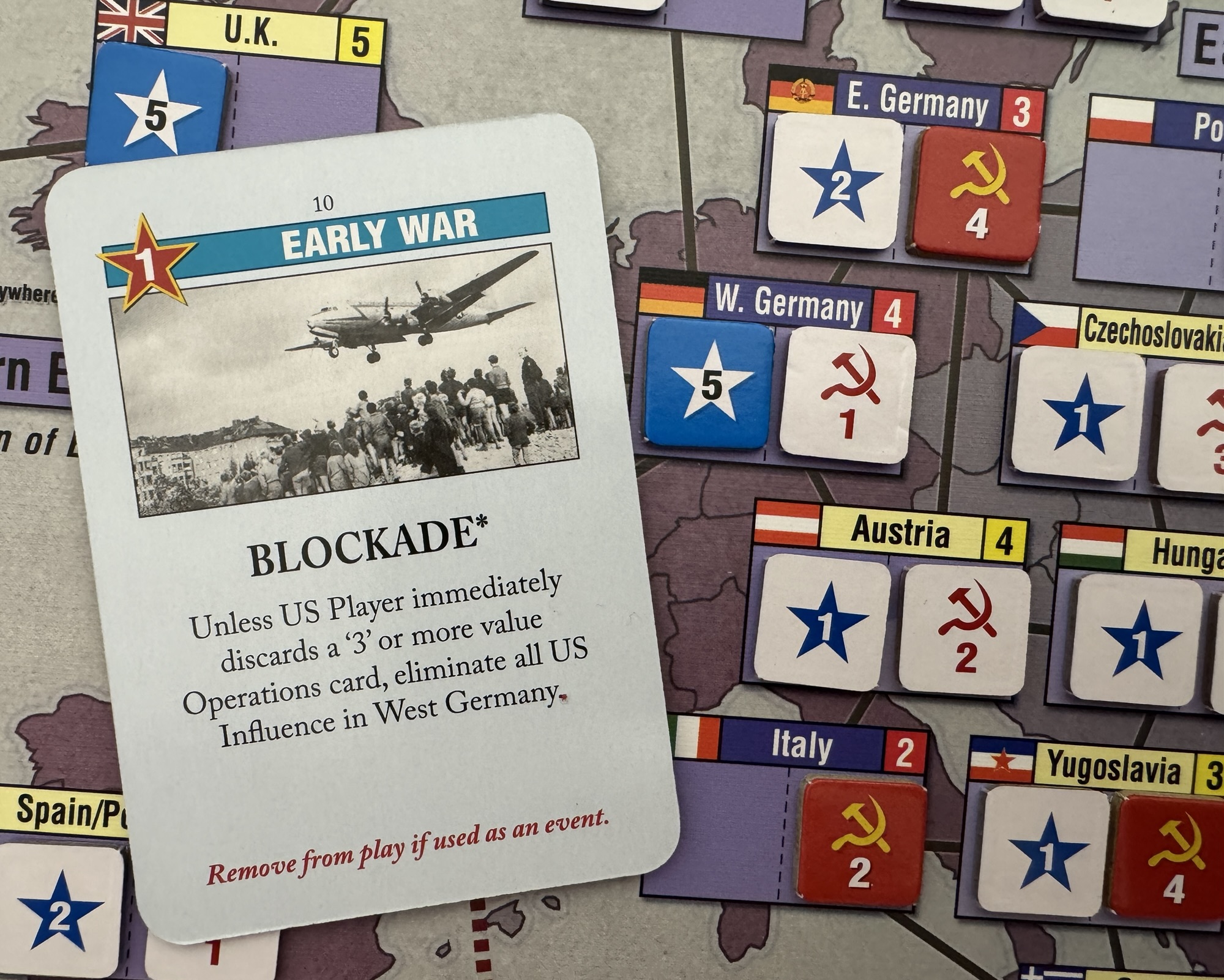
My Favorite Wargame Cards – A Look at Individual Cards from My Favorite Games – Card #61: Mobile Vulgus Time of Crisis: The Age of Iron and Rust Expansion from GMT Games

Von: Grant
13. Januar 2026 um 14:00

With this My Favorite Wargame Cards Series, I hope to take a look at a specific card from the various wargames that I have played and share how it is used in the game. I am not a strategist and frankly I am not that good at games but I do understand how things should work and be used in games. With that being said, here is the next entry in this series.

#61: Mobile Vulgus from Time of Crisis: The Age of Iron and Rust Expansion from GMT Games

I really love Time of Crisis from GMT Games. This is a very light, introductory wargame that is just plain fun to play. I have been playing it a ton on the Rally the Troops! online platform and really enjoy it no matter what the outcome of those games are. One card that I enjoy using is called Mobile Vulgus, which is a 3 value Populace Card that really can be a devious way to usurp your enemies. This card was added to the game in The Age of Iron and Rust Expansion and is one of those cards that is very situational but very good.

As you know, Time of Crisis is a back and forth game that sees players pitted against each other for the control of provinces and ultimately a change in the player who wears the purple robes of Emperor and sits on the throne in Italia. This process is carried out as players play Populace cards to garner Influence points that are then used to Replace a sitting Governor. The problem with the process is the dice. Now, I know what you are saying. Typically, as long as you roll a 2+ on a d6 it is considered a success and garners you a vote but my luck dictates that I will roll multiple 1’s on a roll where you are looking for a number higher than 1. So, if you can somehow get the dice out of the equation, you are better off. Along comes the fantastically powerful card Mobile Vulgus.

Why exactly do I consider this card so good? Well, you don’t have to rely on rolling dice to get what you want…simple as that. The power is maybe not as efficient as I would like it to be, as you will have to take a Replace Governor Action later to seat your Governor, but it is guaranteed. First off, the card allows you to target a province in which you wish to Replace the current sitting Governor. You normally would play Populace cards to create a number of Influence Points that you would then use to roll 1d6 per point. With Mobile Vulgus you simply play a certain amount of Populace cards to create a total amount of Influence that allows you to overcome their current support level. In the picture above, you can see that the current support level for the Blue Governor in Gallia is at 2. You will also notice though that the Blue General is located in the Provincial Capital with a sizeable army. This army will add to the number of Influence points you will have to spend to reduce that support.

As we examine the Blue General’s stack of forces, we see that he has 3 units under his control, 2 full strength Legions (XIV Gemina and X Gemina) as well as a lone Militia. These 3 units will add to the amount of Populace Influence points that must be spent to effect the support level of the province. Because there are 3 units, we will add those 3 units to the current support level of 2 to bring our target to reduce to 5. In simpler terms 2 for the current support level + 3 for the units in the provincial capital. This then successfully reduces the support level to 1. Remember, that if using a normal Replace Governor action, you would have been rolling 5 dice (1d6 per Populace Influence point spent) and would have needed to roll 2+ and garner 7 votes (calculated by doubling the current support level and then adding in +1 vote needed for each unit in the capital). You couldn’t have possibly done that using only the two cards shown and would have had to play at least one more Populace card with at least 2 Influence points to get to roll 7 dice!

Mobile Vulgus is a Latin phrase that means “the fickle crowd”, referring to the changing nature, opinions and reactions of the general public or an audience, which is a derivation of the English word “mob”.  It literally denotes a movable public, or the unstable crowd and recognizes the inconstancy of popular taste and the ease with which clever politicians can influence the great mass of voters. In game terms, the support of the people can sometimes falter as easily as it can be encouraged.

If you are interested, I wrote a full review for Time of Crisis and you can read that at the following link: https://theplayersaid.com/2017/09/04/the-most-recent-fruits-of-wargame-hybridization-a-review-of-time-of-crisis-the-roman-empire-in-turmoil-235-284-ad-from-gmt-games/

We also posted a full review video and you can watch that at the following link:

In the next entry in this series, we will take a look at Romanian Autonomy from Twilight Struggle: Red Sea – Conflict in the Horn of Africa from GMT Games from GMT Games.

-Grant

My Favorite Wargame Cards – A Look at Individual Cards from My Favorite Games – Card #60: French Leader Napoleon from Congress of Vienna from GMT Games

Von: Grant
06. Januar 2026 um 14:00

With this My Favorite Wargame Cards Series, I hope to take a look at a specific card from the various wargames that I have played and share how it is used in the game. I am not a strategist and frankly I am not that good at games but I do understand how things should work and be used in games. With that being said, here is the next entry in this series.

Card #60: French Leader Napoleon from Congress of Vienna from GMT Games

Congress of Vienna from GMT Games is a diplomatic card driven wargame based on Churchill and is the 4th game in the Great Statesmen Series. The game is set during the years of 1813-1814 and sees players take on the role of the main characters of the struggle between the Napoleonic Empire and the coalition of Russia, Austria, and Great Britain with their Prussian, Spanish, Portuguese, and Swedish allies. Congress of Vienna has two different but related phases including the conference table where players first debate over the control of issues germane to the factions and the period of the war and second these issues are then used on the battlefield to recruit units, attack and take overall command of battles. The players will be playing cards from their hands to “debate” over the various issues that were placed on the table, which include all types of things such as Military Operations, Recruitment, who will lead the combined Coalition forces (Generalissimo), Future of French Government, British Financial Aid, Liberalism vs. Absolutism, Austrian Neutrality and several other issues, and then later the players will use their accumulated Resources gained from the issues to enact action on the Military Map and do things like mobilize troops, place Military Support Markers and the ultimately to conduct warfare.

The game relies on cards and cards can be used to negotiate, i.e. move an issue to your National Track. Cards can provide a particular issue with positive and negative DRM’s depending on which nation plays them and can also be traded with another player during the Diplomacy Phase. Certain cards are better than others for debating an issue moved by another player; and finally, if they are saved for the War Phase, staff cards can be used to modify dice rolling in battles. These are very versatile cards and the players will have to learn them and their benefits in order to be effective at the game.

In this entry, we are going to take a look at the French Leader Napoleon card, which is one of the more powerful cards in the game. There is actually quite a bit of information found on the card but it all has a purpose and clearly explains when it provides bonuses when used on the various issues such as Minor Country Issues, French Recruitment as well as its various Dice Roll Modifiers during combat. This card is very powerful and must be used at the appropriate times for what the player is trying to do. Early in the game, the card can be used for its French Recruitment ability to gain new troops, the French will then gain 2 additional Units to use. When used during the Diplomacy Phase to effect the location of issues at the conference table, if used to move any issue it will provide a free French Military Operations Marker to be used on the battlefield to cause units to attack. The uses of Napoleon are many and players will need time to best understand when and where to use his abilities. But, his most impactful use is on the battlefield where he will grant various DRM’s depending on what French army he is commanding. If used with the Grande Armée, he will grant a massive +6 DRM while when being used for the Army of the Elbe he will only grant a +3 DRM. As the games wears on, and the Allies are at the gates of Paris, if used in defense he will grant a -3 DRM to the Allies attacking. These choices are very important and the correct choices will need to be made at the right time to be successful.

After playing now a few times, I am here to say that Congress of Vienna is probably my favorite game in the Great Statesmen Series. I believe that this game has matured the system and made it something that is more than where it started. Congress of Vienna is very much more like a true wargame and was extremely interesting. We are still learning and need to keep playing this one but I did enjoy what it was that we were doing.

Jacques-Louis David – The Emperor Napoleon in His Study at the Tuileries

Napoleon Bonaparte (1769-1821) was a French military and political leader who rose to power during the French Revolution (1789-1799), became Emperor of the French (1804-1814/1815), and conquered much of Europe through brilliant, though costly, military campaigns, leaving a lasting legacy as one of history’s most famous and controversial figures, known for his strategic genius and ambition. He implemented significant legal reforms like the Napoleonic Code but ultimately faced defeat and exile, cementing his image as a complex figure of power and downfall. 

Born on the island of Corsica to a family of Italian origin, Napoleon moved to mainland France in 1779 and was commissioned as an officer in the French Royal Army in 1785. He supported the French Revolution in 1789 and promoted its cause in Corsica. He rose rapidly through the ranks after winning the siege of Toulon in 1793 and defeating royalist insurgents in Paris on 13 Vendémiaire in 1795. In 1796, he commanded a military campaign against the Austrians and their Italian allies in the War of the First Coalition, scoring decisive victories and becoming a national hero. He led an invasion of Egypt and Syria in 1798, which served as a springboard to political power. In November 1799, Napoleon engineered the Coup of 18 Brumaire against the French Directory and became First Consul of the Republic. He won the Battle of Marengo in 1800, which secured France’s victory in the War of the Second Coalition, and in 1803, he sold the territory of Louisiana to the United States. In December 1804, Napoleon crowned himself Emperor of the French, further expanding his power.

We have done 2 videos on this game including the following RAW Video after out 1st play at Buckeye Game Fest in May 2025:

We then did the following full Review Video after our 2nd play at WBC last July:

In the next entry in this series, we will take a look at Mobile Vulgus from Time of Crisis: The Age of Iron and Rust Expansion from GMT Games.

-Grant

My Favorite Wargame Cards – A Look at Individual Cards from My Favorite Games – Card #59: Sullivan Expedition vs. Iroquois and Tories from Liberty or Death: The American Insurrection from GMT Games

Von: Grant
30. Dezember 2025 um 14:00

With this My Favorite Wargame Cards Series, I hope to take a look at a specific card from the various wargames that I have played and share how it is used in the game. I am not a strategist and frankly I am not that good at games but I do understand how things should work and be used in games. With that being said, here is the next entry in this series.

Card #59: Sullivan Expedition vs. Iroquois and Tories from Liberty or Death: The American Insurrection from GMT Games

In case you didn’t know, I love Liberty or Death: The American Insurrection! This is my 2nd favorite volume in the COIN Series and is such a fantastic game filled with the history of my favorite historical period the American Revolutionary War. Liberty or Death was the COIN Series’ first foray into non-modern warfare and takes us to the 18th Century and the days of the Brown Bess musket, the 18 pound siege cannon and nice and tidy formations better suited for a gentleman’s war. The focus of the game is the struggle of the American Patriots against their mother British government as they have made their intentions clear to become independent with the Declaration of Independence. The game is a multi-faction treatment of the American Revolution, which includes the Patriots and their allies the French against the British and their reluctant allies the Indians.

Liberty or Death is a 1 to 4 player game focused on all aspects of the struggle including financing operations with Rabble Rousing, infiltrating British held cities to Skirmish, blockading major cities with the mighty French fleet, Raiding the frontiers with the Indian nations, the spread of propaganda to build support for the revolution, fort building and small scale battles. So, with this short description you can see that this game is not a “traditional” wargame but does contain some armed conflict. So a game about the American Revolution that isn’t focused on battle you say? How can that be? Well, I will tell you that this game is probably a perfect representation of the multifaceted struggle that wasn’t necessarily decided on the field of combat, but by the little actions of many behind the scenes characters. Yes battle will decide the control of major areas of the board and decide the fate of troops as they must be concerned about being in supply through a network of forts but the game is so much more than just rolling some dice and consulting a CRT!

The battles of the frontier during the American Revolutionary War were brutal and continuous. The Indians of the time were concerned with the intrusions of and continual westward expansion of the colonists onto their sacred lands and could see that this was going to be a continual struggle for them and their people. The colonists long had disrespect and disdain for the primitive savage peoples of North America and their frontier settlements continually encroached on the Indian lands taking valuable forested area for hunting from them. This created lots of tension and lead to atrocities being committed by both sides as a means to stop the other side. The game is based on a continual struggle over winning the hearts and minds of the people to their cause and forcing compliance or swaying toward revolution. So for the Indians, they want the colonists to embrace their role as a colony of England and not want to become independent. This stance for the Indians is in response to the attitude of the crown toward westward expansion and interloping into the Indian homeland, namely that the crown didn’t want colonists going west. This is not because the Indians believe that the crown values them anymore than the colonists do. But, that they believe that the crown will not encroach on their land due to King George III’s Proclamation of 1763. I also feel that it represents a feeling by the colonists of their level of safety on the frontier and which side will better protect them from raiding and reprisals by the Indians for this encroachment. 

The Sullivan Expedition card in Liberty or Death is one that has the exact same effect for all sides; that of being used to remove either a Fort (if being played by the British/Indian side) or a Village (if being played by the Continental/French alliance). Actually, either side can use the card to remove a Fort and I have found that this is how it is mostly used but the power of removing one of these 2 items cannot be minimized. Normally, during battles, the last removed pieces in a space are the Forts or Villages as attackers must defeat all present pieces to remove their fortified locations. This can take multiple attacks and see lots of actions and resources invested into it when this simple card can do that work in one fell swoop. I have said this before but the really great part of these Card Assisted (or Card Driven) games is that rules can be broken or ignored by the play of certain cards and Sullivan Expedition is one of these rule breaking/bending cards. The card is tied to the history of the conflict and can only be used in 1 of 3 locations being either New York, Northwest or Quebec. These are areas where the Indian faction typically builds up their Villages as this is one of their Victory Conditions being the number of Villages that Indians have on the board as compared to the Patriot Forts. This is not a straight numerical comparison of the 2 sides total but involves some math. Not hard math but math nonetheless. The Victory Condition is actually Indian Villages (the tan discs) less 3 is greater than Patriot Forts. So, let’s say the Indian player has 7 Villages on the board and the Patriot player has just 3 Forts. The mathematical formula would be 7 – 3 = 4 > 3. This would equate to this part of the Victory Condition being met for the Indians. But, the designer and development team made it so you don’t have to do math. There is no great need to calculate the “+3” mathematically since the Indian Villages and Patriot Forts tracks on the map do it for you visually. The Forts Track is offset by 3 holding “boxes” (circles/stars) compared to the Villages track, so if the “lowest” (or “south-most”, or whatever you want to call it) empty Village circle on the Village track is “below” (or “south of”) the lowest empty Fort star on the Forts track the Indians are ahead in their victory condition.

On the surface, this Victory Condition seems simple. But, it is a bit deceiving as these Indian Villages are not easy to build, they actually take a multi-step process that will consume many rounds of turns to accomplish but it is mainly complex because you can only ever build 2 such Villages in any 1 Province. The protected Indian Preserves of Quebec, Florida, Southwest and Northwest can hold a total of 8 Villages for a total able to be somewhat safely built without great concern for attack and removal coming in at 8. The Indians have a total of 12 available Villages and generally start the game in most setups and scenarios with 0-6 Villages already built but this is cancelled out by an existing number of Patriot Forts being built on the board of between 4-7. Thus, this card is a really powerful situational card but an interesting card nonetheless.

The Sullivan Expedition  was a United States military campaign under the command of General John Sullivan during the American Revolutionary War, lasting from June to October 1779, against the four British-allied nations of the Iroquois (also known as the Haudenosaunee). The campaign was ordered by George Washington in response to the Iroquois and Loyalist destruction of American settlements in Wyoming Valley, Pennsylvania and Cherry Valley, New York. The military campaign had the aim at the time of “the total destruction and devastation of their settlements.” 4 Continental Army brigades carried out a scorched-earth campaign in the territory of the Iroquois Confederacy in what is now central New York.

Map showing the route of the Sullivan Expedition in 1779.

The expedition was largely successful, with 40 Iroquois villages razed and their crops and food stores destroyed. The campaign drove just over 5,000 Iroquois to Fort Niagara seeking British protection, and depopulated the area for post-war settlement. Some scholars argue that it was an attempt to annihilate the Iroquois and describe the campaign as a genocide, although this term is disputed. Today this area is the heartland of Upstate New York, with thirty-five monoliths marking the path of Sullivan’s troops and the locations of the Iroquois villages they razed dotting the region, having been erected by the New York State Education Department in 1929 to commemorate the 150th anniversary of the expedition.

If you are interested in learning more about the various Victory Conditions for the Indians as well as a bit about their Commands and Special Activities, you can read this entry in the COIN Workshop Series on the blog: https://theplayersaid.com/2023/01/17/coin-workshop-liberty-or-death-the-american-insurrection-from-gmt-games-indians-faction/

In the next entry in this series, we will take a look at French Leader Napoleon from Congress of Vienna from GMT Games.

-Grant

❌