Normale Ansicht

My Favorite Wargame Cards – A Look at Individual Cards from My Favorite Games – Card #77: Schmalkaldic League from Here I Stand: Wars of the Reformation, 1517-1555 from GMT Games

Von: Grant
12. Mai 2026 um 14:00

With this My Favorite Wargame Cards Series, I hope to take a look at a specific card from the various wargames that I have played and share how it is used in the game. I am not a strategist and frankly I am not that good at games but I do understand how things should work and be used in games. With that being said, here is the next entry in this series.

#77: Schmalkaldic League from Here I Stand: Wars of the Reformation, 1517-1555 from GMT Games

Here I Stand: Wars of the Reformation 1517-1555 is an experience packaged in a game that attempts to boldly cover the political and religious conflicts of early 16th Century Europe. The game focuses on the struggle of religious reformers such as Martin Luther, John Calvin and Ulrich Zwingli as they battle the Papacy for changes in their views of God and religion. But it is more than just the Holy War as it deals with the other European countries involved in the affairs of the time including France, England, the mighty Hapsburg Empire and the Ottoman Empire in the east. They all played a role in the process of the Reformation and the design brilliantly weaves this all together into an interesting and engaging experience. The game also covers other plot lines and events of the period, including wars, marriages and ascendancies to thrones, using a unique Card Driven Game (CDG) system that models both the political and religious conflicts of the period.

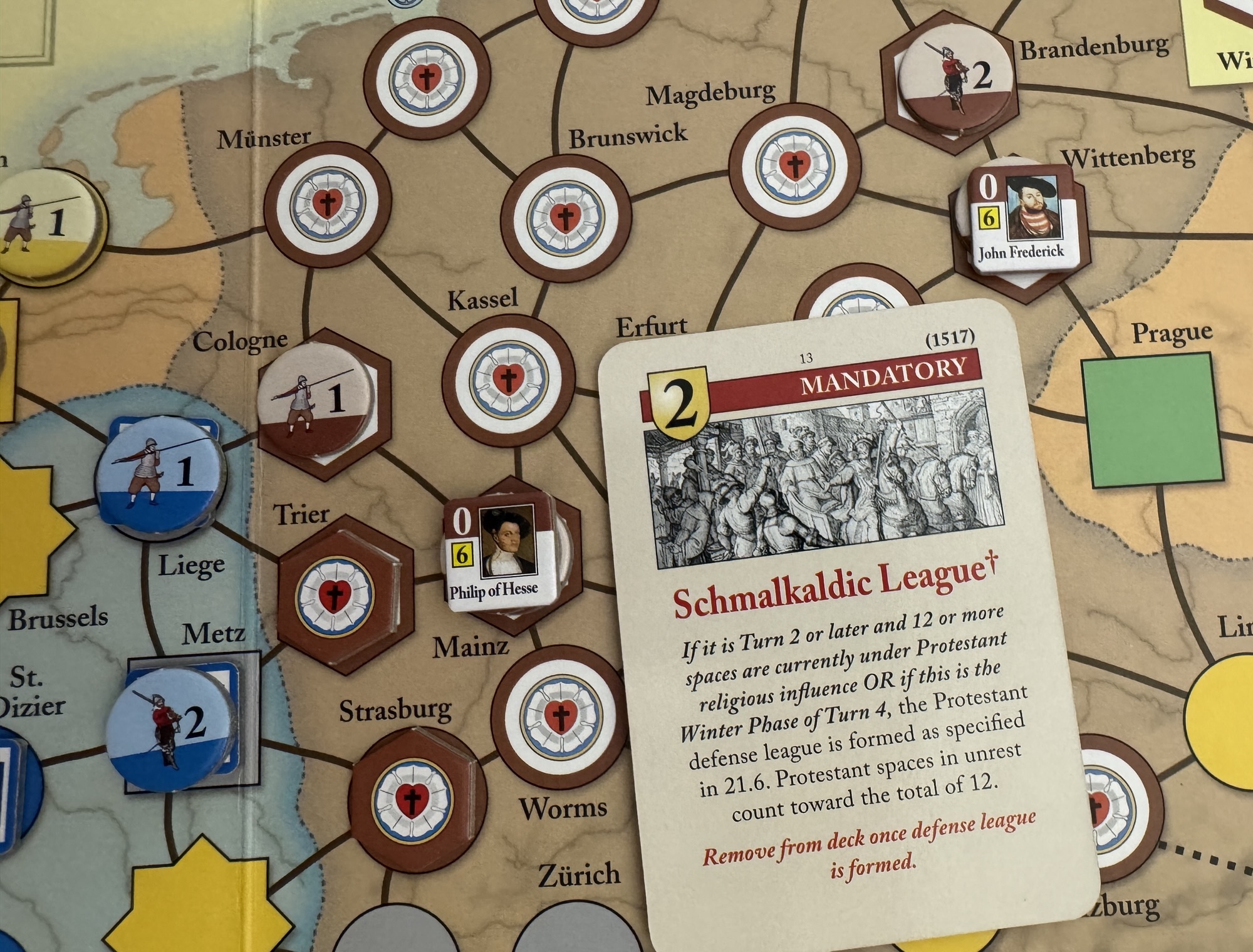
Today, I want to take a look at a very interesting Mandatory Event card that really shakes things up for the Protestant player in the Schmalkaldic League. This Mandatory Event basically transforms the Protestant player and changes their focus slightly as they now become somewhat of a military power. I use the term “military power” here lightly as they really are not that powerful and this event is really more of a wet blanket thrown onto their spiritual bonfire as they now will have to worry about gearing up for attacks from their neighbors to try and take away their victory points through wresting control of their Electorates from them, which grant extra Victory Points. The Schmalkaldic League Mandatory Event is only triggered when the Protestant has religious influence in 12+ spaces from Turn 2 on, or if not, then automatically by the end of Turn 4.

The Protestant player gaining the ability to create and command military units, including both regulars and mercenaries, is somewhat of a boon as you can now move your troops around the board gaining additional dice for Conversion attempts if those units are adjacent and also the electorates under Protestant religious control, specifically those marked as Protestant home spaces, instantly come under Protestant political control and grant 2 VP for each Electorate up to a maximum of 12 VP total if all 6 are under control. Talk about a turning point…albeit a turning point with some difficulties. The leaders granted to the Protestants are also not very good and do not gain extra dice during combat and frankly cannot command large armies. These leaders include John Frederick and Philip of Hesse.

John Frederick I of Saxony by Lucas Cranach the Younger.

Frankly, I try my best to hope and pray that the Schmalkaldic League card doesn’t come out during the first 4 turns and then will be triggered only during the Winter Phase of Turn 4. This gives the Protestant player some time to expand and attempt to get all of those important VP generating Electorates under their control to set themselves up nicely. But once it happens you will find that you are spending your scarce resources in the form of Command Points on things like recruiting units, moving those units and preparing for attacks. This takes away from your ability to focus solely on spreading the faith and can be a real drag on that effort. But, you take the good with the bad in this game and I have learned to deal with it over the years and turn it into something that benefits me.

The Schmalkaldic League was a military alliance of Lutheran principalities and cities within the Holy Roman Empire during the mid-16th century. It received its name from the German town of Schmalkalden, where the group was founded in 1531. Although created for religious motives soon after the start of the Reformation, its members later came to have the intention that the League would replace the Holy Roman Empire as their focus of political allegiance. While it was not the first alliance of its kind, unlike previous formations, such as the League of Torgau, the Schmalkaldic League had a substantial military to defend its political and religious interests.

The League’s members agreed to provide 10,000 infantry and 2,000 cavalry for their mutual protection. They rarely provoked the Holy Roman Emperor Charles V directly but confiscated church land, expelled bishops and Catholic princes and helped spread Lutheranism throughout northern Germany.

Martin Luther planned to present to the League the Smalcald Articles, a stricter Protestant confession, during a meeting in 1537. He attended the critical meeting in 1537 but spent most of his time suffering from kidney stones. The rulers and princes even met in the home at which Luther was staying. Though Luther was asked to prepare the articles of faith that came to be known as the Smalcald Articles, they were not formally adopted at the time of the meeting, but in 1580, they were included in the Book of Concord.

In the next entry in this series, we will take a look at Hamburger Hill from Fire in the Lake: Insurgency in Vietnam from GMT Games.

-Grant
My Favorite Wargame Cards – A Look at Individual Cards from My Favorite Games – Card #71: The Wartburg from Here I Stand: Wars of the Reformation, 1517-1555 from GMT Games

Von: Grant
31. März 2026 um 14:00

With this My Favorite Wargame Cards Series, I hope to take a look at a specific card from the various wargames that I have played and share how it is used in the game. I am not a strategist and frankly I am not that good at games but I do understand how things should work and be used in games. With that being said, here is the next entry in this series.

#71: The Wartburg from Here I Stand: Wars of the Reformation, 1517-1555 from GMT Games

Here I Stand: Wars of the Reformation 1517-1555 is an experience packaged in a game that attempts to boldly cover the political and religious conflicts of early 16th Century Europe. The game focuses on the struggle of religious reformers such as Martin Luther, John Calvin and Ulrich Zwingli as they battle the Papacy for changes in their views of God and religion. But it is more than just the Holy War as it deals with the other European countries involved in the affairs of the time including France, England, the mighty Hapsburg Empire and the Ottoman Empire in the east. They all played a role in the process of the Reformation and the design brilliantly weaves this all together into an interesting and engaging experience. The game also covers other plot lines and events of the period, including wars, marriages and ascendancies to thrones, using a unique Card Driven Game (CDG) system that models both the political and religious conflicts of the period.

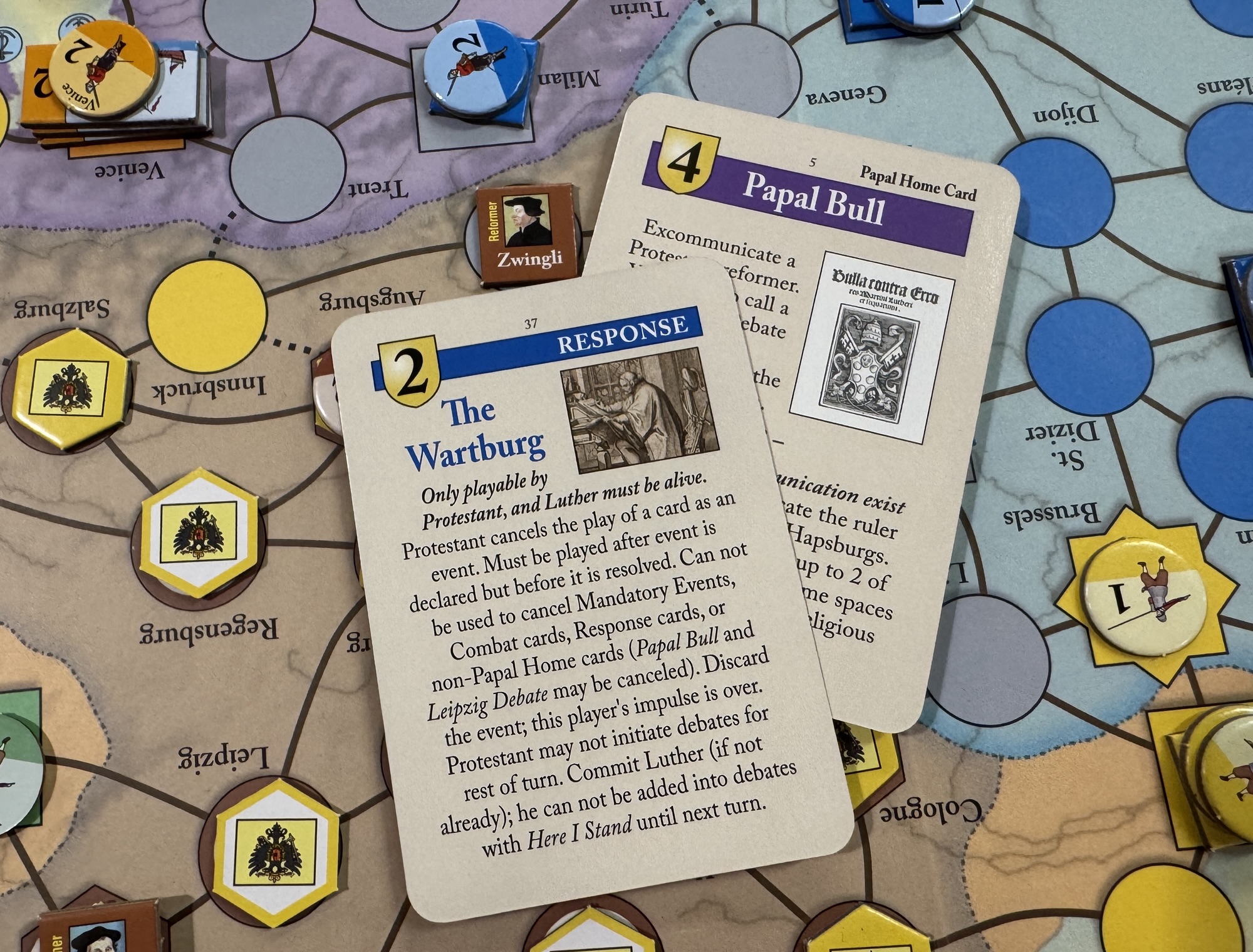
Today, I want to take a look at a very interesting Response card in The Wartburg. Response cards in Here I Stand are event cards that can be played out of turn to interrupt the actions of an opponent or provide immediate reactions to specific game events. Response cards are often used to negate, mitigate, or enhance events and combats, and they may be played during an opponent’s impulse, provided the text allows for this asynchronous timing. These cards also tend to have specific pre-requisites that must be met in order to play the card and The Wartburg states that the card is “only playable by Protestants, and Luther must be alive”. The card itself allows the Protestant player to cancel the play of a card as an event but cannot cancel a Mandatory Event. The card however can cancel the play of the Papal Bull or Leipzig Debate Papal Home Cards, which is probably the way that the card will mostly be used. The card will not only cancel the play of the event but will also end the impulse of the player playing the card. This can be very powerful and when played at the right time can be a game saver for the Protestant player.

For example, in our most recent play at Buckeye Game Fest, I was playing as the Protestants and Bill Simoni as the Papacy. After the forming of the Schmalkaldic League and the Protestants changing into a military power, the focus of the other players turned toward me as I was doing well and near victory. They all then decided to declare war on the Protestants and began to advance upon and attack my fortified Electorates to take away VP I had earned by having both religious and political control in 5 of the 6 as the League was formed. As we came into turn 5, I was at 24 VP and ultimately came up shy of a victory by 1 point at the time. I had been able to take over the entirety of England and change every space and also get about 5-6 spaces in France, but now the Papal Bull came to play and Bill fought me back and forth with him taking over 3-4 spaces followed by me reclaiming 3-4 spaces. It was a beautiful game of back and forth and I used every tool at my disposal to fight him including The Wartburg card to stop the untimely excommunication of Zwingli before he could attempt to embarrass him in a debate. That card play at that very time saved me or most likely he would have used Eck who is his best debater against Zwingli who is just average and I would have lost leading to him being burnt at the stake giving him VP or by allowing him to turn over a few of my hard fought converted spaces back to Catholicism.

The only problem with this card is that it commits Luther so he will be unavailable to be chosen directly to debate during the rest of the turn. But this was a small price to pay at that time and ultimately led to me being able to hold on through the end of Turn 6 where I won a Protestant victory on the tie breaker with England.

Martin Luther stayed at Wartburg Castle from May 1521 to March 1522 under the alias “Junker Jörg” (Knight George) to hide from papal and imperial authorities. During these 300 days of protective custody, he translated the New Testament into German in just 11 weeks, wrote numerous theological works, and grappled with spiritual turmoil. His greatest accomplishment at Wartburg Castle was his translating of the New Testament from Koine Greek into German, which laid the foundation for a unified German language and made the Bible accessible to ordinary people. He also wrote numerous works, including Against Latomus and several tracts. He began his attack on monastic vows during this time, arguing they were contrary to faith. Luther used his time in exile for intense study and writing, referring to his stay as his “Patmos”, referring to the Apostle John’s exile to the Island of Patmos in 95AD. While here though he also experienced significant psychological distress and temptation. According to legend, he threw his inkwell at the devil during a confrontation, leaving a stain on the wall. His exile was organized by Frederick the Wise after the Diet of Worms and the stay was designed to keep Luther safe from those looking for him, ensuring the survival of his reform movement.

In the next entry in this series, we will take a look at Commodus from The Wars of Marcus Aurelius: Rome 170-180CE from Hollandspiele.

-Grant

Buckeye Game Fest 2026 Daily Debrief Series – Day 4

Von: Grant
14. März 2026 um 03:57

Day 4 dawned early and we are really tired. I actually felt like I had slept, although I didn’t fall asleep last night until about 1:30am, but just didn’t feel refreshed and had very little energy. I am a Wargamer and I simply sucked it up and got downstairs where we had breakfast with friends including Russ, Cullen and Hermann Luttmann. We imbibed in the buffet eating more pieces of bacon than someone should in a fortnight and made it to the War Room a bit before 9:00 where we started setting up for our annual 6-player game of Here I Stand from GMT Games.

Playing with us was Russ (France), Cullen (Ottomans), Bill Simoni (Papacy), James (England) with me (Protestants) and Alexander (Hapsburgs).

Not sure what Russ was doing with his hand and Alexander never smiles!

We simply love Here I Stand and have played the game at least 15 times and it just gets better every single time. If you don’t know, Here I Stand: Wars of the Reformation, 1517–1555 is a grand-scale Card Driven Game that simulates the political and religious struggles in Europe during the period covering 1517-1555 referred to as the Reformation. It is designed primarily for six players, each controlling a major power with unique, asymmetric goals and mechanics and is best with max players.

The game takes place over up to 9 turns, but for us a majority of our plays have lasted 4-5 turns with our longest play being today as we finished the game in 6 turns. Each of the turns represent approximately 4 years of historical time. The game utilizes a Card-Driven Game system where players spend cards for their Command Points to perform actions like moving armies or building fleets or for the unique historical event described on the text of the card.

The game is very asymmetrical in its gameplay as each of the factions plays a different game based on its historical role and will win via amassed VP’s that are earned in vastly different ways such through piracy (Ottomans), building of chateaus (France), New World Exploration (England, Hapsburgs, France) and through battles. The Papacy and Protestants will wage a religious war over the souls of European Christians to either sway spaces to Catholicism or Protestantism. But one of my favorite parts is the Diplomacy and making of secret deals between the players to help out their goals.

With that being said our game started off with the nailing of the 95 Theses to the door of the church at Wittenberg and as the Protestants I have never seen a worse opening as I was only able to switch 3 spaces in Wittenberg, Brandenburg and Leipzig. Not a good start at all for the Protestants but I was undaunted, although I said many curses under my breath and to the gamers at the table, and quickly got my self under control and was determined to recover.

A look at one of the poorest starts of all time for the Protestants.

I worked hard over the next few turns to spread the faith and was quickly able to get most of Germany under control and take over 4 of the Electorates which gave me units that would help me continue to spread toward France and England.

It was amazing to see Bill Simoni and the Papacy and I go at it as we held many theological debates, ultimately each of us disgracing a debater and gaining VP, and for me to have the full Bible translated into German during Turn 2 quickly followed by the translation into English by Turn 3. I had made a deal with England for him to play a card that favored me in exchange for a concerted effort to get the Protestant faith rooted in England so he could gain some VP.

Meanwhile the Ottomans got out the Barbary Pirates card early and had built a sizable fleet of corsairs causing France and England to loan the Hapsburgs several boats to combat this green menace in the Mediterranean.

Also several colonies were formed in the New World and ultimately Alexander’s Hapsburgs were able to circumnavigate the globe and score several important VP.

During this time, the Protestants and Papacy were fighting tooth and nail but my dice rolling, and innate ability to win ties, allowed me to build a sizable lead in the religious war. I was in very good shape when the Schmalkaldic League card was played turning the Protestants into a military power and then changing the other players focus to then declare war one and begging to attack my fortified Electorates to take away VP I had earned by having both religious and political control in 5 of the 6.

As we came into turn 5, I was at 24 VP and ultimately came up shy of a victory by 1 point at the time. I had been able to take over the entirety of England and change every space and also get about 5-6 spaces in France. but now the Papal Bull came to play and Bill fought me back and forth with him taking over 3-4 spaces followed by me reclaiming 3-4 spaces. It was beautiful game of back and forth and I used every tool at my disposal to fight him including The Wartburg card to stop the untimely excommunication of Luther before he could attempt to embarrass one of my lesser debaters.

Then England gained ground as a healthy Edward was born and he gained 5 VP and then took over a key from France to get close to my score going into Tuen 6.

At that point it was dog pile the winner as everyone declared war on the Protestants and came after my Electorates but I was able to stave them off and ultimately never lost down to lower than 4 controlled which retained 8 VP for me and allowed me to finish the Bible translation in French and take a sizable lead in VP.

The game came down to the last card play as England and my Protestants tied at 25 VP and I won on tiebreakers as I had the most VP in the turn prior. What a fantastic game that took us over 9 hours to play!

We were all wasted and went to dinner at a nearby bar called The Flat Iron Grill and had a very enjoyable meal. We decided to not play the WWII RPG War Stories and might till tomorrow night as we were all a bit brain dead.

We played about 5 scenarios of the beautiful and very fun trick taking game called The Lord of the Rings Trick Taking Game: The Two Towers from Office Dog. This is a standalone continuation to The Lord of the RingsThe Fellowship of the Ring Trick-Taking Game, with several play modes including solo, 2-player, and 4-player and we did the 4-player version. It is a cooperative card game that follows the narrative of J.R.R. Tolkien’s second book through 18 unique, story-driven chapters.

The game functions as a “must-follow” trick-taker, where players must play a card of the led suit if they have one; otherwise, the highest card of the led suit wins the trick. Unlike many traditional trick-taking games, players work together to meet individual character goals simultaneously to progress through the story. And they s game is very tough with the new edition adding in several very tough challenges as the addition or orc cards that have no function but if lead because you have no other choice lead to a loss. Just great and thinky fun that is very relaxing and frankly very fun to play.

Examples of 2 characters which each have a unique goal that must be completed during the scenario.

This was a perfect way to end the day and we actually made it back to our room at 9:30pm allowing me time to write this post and get in near before midnight.

Tomorrow is our last day and we have big plans as we will be playing Imperial Elegy from VUCA Simulations (a kind of Here I Stand style CDG on the rise and fall of European empires from the 1850’s through WWII), Bretwalda from PHALANX (an Ameritrash combat game set in medieval England) and then a night cap of the RPG War Stories that we didn’t get to this evening. See you tomorrow night!

-Grant

❌