
Normale Ansicht

My Favorite Wargame Cards – A Look at Individual Cards from My Favorite Games – Card #77: Schmalkaldic League from Here I Stand: Wars of the Reformation, 1517-1555 from GMT Games

Von: Grant
12. Mai 2026 um 14:00

With this My Favorite Wargame Cards Series, I hope to take a look at a specific card from the various wargames that I have played and share how it is used in the game. I am not a strategist and frankly I am not that good at games but I do understand how things should work and be used in games. With that being said, here is the next entry in this series.

#77: Schmalkaldic League from Here I Stand: Wars of the Reformation, 1517-1555 from GMT Games

Here I Stand: Wars of the Reformation 1517-1555 is an experience packaged in a game that attempts to boldly cover the political and religious conflicts of early 16th Century Europe. The game focuses on the struggle of religious reformers such as Martin Luther, John Calvin and Ulrich Zwingli as they battle the Papacy for changes in their views of God and religion. But it is more than just the Holy War as it deals with the other European countries involved in the affairs of the time including France, England, the mighty Hapsburg Empire and the Ottoman Empire in the east. They all played a role in the process of the Reformation and the design brilliantly weaves this all together into an interesting and engaging experience. The game also covers other plot lines and events of the period, including wars, marriages and ascendancies to thrones, using a unique Card Driven Game (CDG) system that models both the political and religious conflicts of the period.

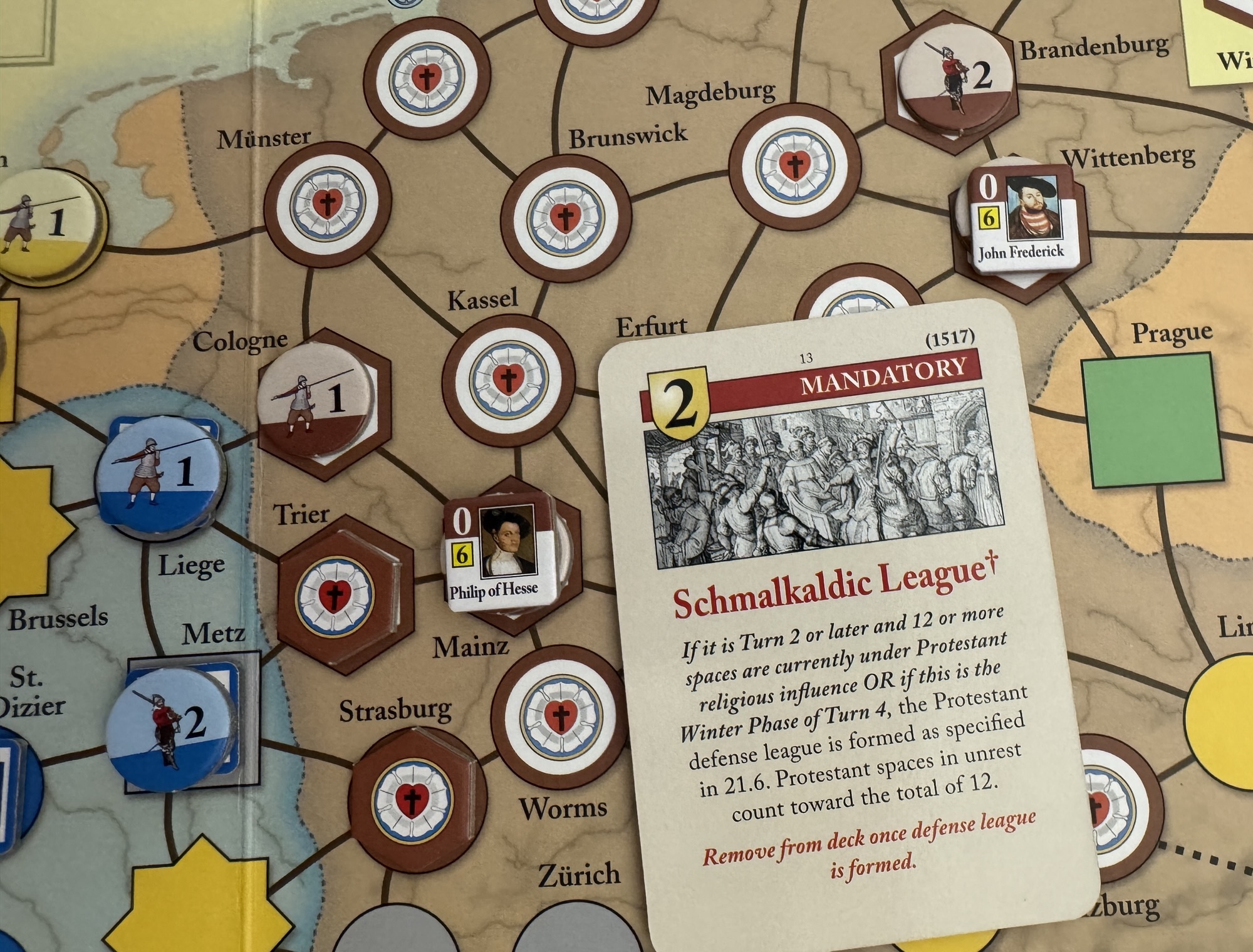
Today, I want to take a look at a very interesting Mandatory Event card that really shakes things up for the Protestant player in the Schmalkaldic League. This Mandatory Event basically transforms the Protestant player and changes their focus slightly as they now become somewhat of a military power. I use the term “military power” here lightly as they really are not that powerful and this event is really more of a wet blanket thrown onto their spiritual bonfire as they now will have to worry about gearing up for attacks from their neighbors to try and take away their victory points through wresting control of their Electorates from them, which grant extra Victory Points. The Schmalkaldic League Mandatory Event is only triggered when the Protestant has religious influence in 12+ spaces from Turn 2 on, or if not, then automatically by the end of Turn 4.

The Protestant player gaining the ability to create and command military units, including both regulars and mercenaries, is somewhat of a boon as you can now move your troops around the board gaining additional dice for Conversion attempts if those units are adjacent and also the electorates under Protestant religious control, specifically those marked as Protestant home spaces, instantly come under Protestant political control and grant 2 VP for each Electorate up to a maximum of 12 VP total if all 6 are under control. Talk about a turning point…albeit a turning point with some difficulties. The leaders granted to the Protestants are also not very good and do not gain extra dice during combat and frankly cannot command large armies. These leaders include John Frederick and Philip of Hesse.

John Frederick I of Saxony by Lucas Cranach the Younger.

Frankly, I try my best to hope and pray that the Schmalkaldic League card doesn’t come out during the first 4 turns and then will be triggered only during the Winter Phase of Turn 4. This gives the Protestant player some time to expand and attempt to get all of those important VP generating Electorates under their control to set themselves up nicely. But once it happens you will find that you are spending your scarce resources in the form of Command Points on things like recruiting units, moving those units and preparing for attacks. This takes away from your ability to focus solely on spreading the faith and can be a real drag on that effort. But, you take the good with the bad in this game and I have learned to deal with it over the years and turn it into something that benefits me.

The Schmalkaldic League was a military alliance of Lutheran principalities and cities within the Holy Roman Empire during the mid-16th century. It received its name from the German town of Schmalkalden, where the group was founded in 1531. Although created for religious motives soon after the start of the Reformation, its members later came to have the intention that the League would replace the Holy Roman Empire as their focus of political allegiance. While it was not the first alliance of its kind, unlike previous formations, such as the League of Torgau, the Schmalkaldic League had a substantial military to defend its political and religious interests.

The League’s members agreed to provide 10,000 infantry and 2,000 cavalry for their mutual protection. They rarely provoked the Holy Roman Emperor Charles V directly but confiscated church land, expelled bishops and Catholic princes and helped spread Lutheranism throughout northern Germany.

Martin Luther planned to present to the League the Smalcald Articles, a stricter Protestant confession, during a meeting in 1537. He attended the critical meeting in 1537 but spent most of his time suffering from kidney stones. The rulers and princes even met in the home at which Luther was staying. Though Luther was asked to prepare the articles of faith that came to be known as the Smalcald Articles, they were not formally adopted at the time of the meeting, but in 1580, they were included in the Book of Concord.

In the next entry in this series, we will take a look at Hamburger Hill from Fire in the Lake: Insurgency in Vietnam from GMT Games.

-Grant

Buckeye Game Fest 2026 Daily Debrief Series – Day 4

Von: Grant
14. März 2026 um 03:57

Day 4 dawned early and we are really tired. I actually felt like I had slept, although I didn’t fall asleep last night until about 1:30am, but just didn’t feel refreshed and had very little energy. I am a Wargamer and I simply sucked it up and got downstairs where we had breakfast with friends including Russ, Cullen and Hermann Luttmann. We imbibed in the buffet eating more pieces of bacon than someone should in a fortnight and made it to the War Room a bit before 9:00 where we started setting up for our annual 6-player game of Here I Stand from GMT Games.

Playing with us was Russ (France), Cullen (Ottomans), Bill Simoni (Papacy), James (England) with me (Protestants) and Alexander (Hapsburgs).

Not sure what Russ was doing with his hand and Alexander never smiles!

We simply love Here I Stand and have played the game at least 15 times and it just gets better every single time. If you don’t know, Here I Stand: Wars of the Reformation, 1517–1555 is a grand-scale Card Driven Game that simulates the political and religious struggles in Europe during the period covering 1517-1555 referred to as the Reformation. It is designed primarily for six players, each controlling a major power with unique, asymmetric goals and mechanics and is best with max players.

The game takes place over up to 9 turns, but for us a majority of our plays have lasted 4-5 turns with our longest play being today as we finished the game in 6 turns. Each of the turns represent approximately 4 years of historical time. The game utilizes a Card-Driven Game system where players spend cards for their Command Points to perform actions like moving armies or building fleets or for the unique historical event described on the text of the card.

The game is very asymmetrical in its gameplay as each of the factions plays a different game based on its historical role and will win via amassed VP’s that are earned in vastly different ways such through piracy (Ottomans), building of chateaus (France), New World Exploration (England, Hapsburgs, France) and through battles. The Papacy and Protestants will wage a religious war over the souls of European Christians to either sway spaces to Catholicism or Protestantism. But one of my favorite parts is the Diplomacy and making of secret deals between the players to help out their goals.

With that being said our game started off with the nailing of the 95 Theses to the door of the church at Wittenberg and as the Protestants I have never seen a worse opening as I was only able to switch 3 spaces in Wittenberg, Brandenburg and Leipzig. Not a good start at all for the Protestants but I was undaunted, although I said many curses under my breath and to the gamers at the table, and quickly got my self under control and was determined to recover.

A look at one of the poorest starts of all time for the Protestants.

I worked hard over the next few turns to spread the faith and was quickly able to get most of Germany under control and take over 4 of the Electorates which gave me units that would help me continue to spread toward France and England.

It was amazing to see Bill Simoni and the Papacy and I go at it as we held many theological debates, ultimately each of us disgracing a debater and gaining VP, and for me to have the full Bible translated into German during Turn 2 quickly followed by the translation into English by Turn 3. I had made a deal with England for him to play a card that favored me in exchange for a concerted effort to get the Protestant faith rooted in England so he could gain some VP.

Meanwhile the Ottomans got out the Barbary Pirates card early and had built a sizable fleet of corsairs causing France and England to loan the Hapsburgs several boats to combat this green menace in the Mediterranean.

Also several colonies were formed in the New World and ultimately Alexander’s Hapsburgs were able to circumnavigate the globe and score several important VP.

During this time, the Protestants and Papacy were fighting tooth and nail but my dice rolling, and innate ability to win ties, allowed me to build a sizable lead in the religious war. I was in very good shape when the Schmalkaldic League card was played turning the Protestants into a military power and then changing the other players focus to then declare war one and begging to attack my fortified Electorates to take away VP I had earned by having both religious and political control in 5 of the 6.

As we came into turn 5, I was at 24 VP and ultimately came up shy of a victory by 1 point at the time. I had been able to take over the entirety of England and change every space and also get about 5-6 spaces in France. but now the Papal Bull came to play and Bill fought me back and forth with him taking over 3-4 spaces followed by me reclaiming 3-4 spaces. It was beautiful game of back and forth and I used every tool at my disposal to fight him including The Wartburg card to stop the untimely excommunication of Luther before he could attempt to embarrass one of my lesser debaters.

Then England gained ground as a healthy Edward was born and he gained 5 VP and then took over a key from France to get close to my score going into Tuen 6.

At that point it was dog pile the winner as everyone declared war on the Protestants and came after my Electorates but I was able to stave them off and ultimately never lost down to lower than 4 controlled which retained 8 VP for me and allowed me to finish the Bible translation in French and take a sizable lead in VP.

The game came down to the last card play as England and my Protestants tied at 25 VP and I won on tiebreakers as I had the most VP in the turn prior. What a fantastic game that took us over 9 hours to play!

We were all wasted and went to dinner at a nearby bar called The Flat Iron Grill and had a very enjoyable meal. We decided to not play the WWII RPG War Stories and might till tomorrow night as we were all a bit brain dead.

We played about 5 scenarios of the beautiful and very fun trick taking game called The Lord of the Rings Trick Taking Game: The Two Towers from Office Dog. This is a standalone continuation to The Lord of the RingsThe Fellowship of the Ring Trick-Taking Game, with several play modes including solo, 2-player, and 4-player and we did the 4-player version. It is a cooperative card game that follows the narrative of J.R.R. Tolkien’s second book through 18 unique, story-driven chapters.

The game functions as a “must-follow” trick-taker, where players must play a card of the led suit if they have one; otherwise, the highest card of the led suit wins the trick. Unlike many traditional trick-taking games, players work together to meet individual character goals simultaneously to progress through the story. And they s game is very tough with the new edition adding in several very tough challenges as the addition or orc cards that have no function but if lead because you have no other choice lead to a loss. Just great and thinky fun that is very relaxing and frankly very fun to play.

Examples of 2 characters which each have a unique goal that must be completed during the scenario.

This was a perfect way to end the day and we actually made it back to our room at 9:30pm allowing me time to write this post and get in near before midnight.

Tomorrow is our last day and we have big plans as we will be playing Imperial Elegy from VUCA Simulations (a kind of Here I Stand style CDG on the rise and fall of European empires from the 1850’s through WWII), Bretwalda from PHALANX (an Ameritrash combat game set in medieval England) and then a night cap of the RPG War Stories that we didn’t get to this evening. See you tomorrow night!

-Grant

Farewell 2025 – Historical Games!

29. Dezember 2025 um 17:07

Games + History = Life.

Here are the three that gave me most life this year!

You can read all of the Farewell 2025 posts here:

©Rodger B. MacGowan.

Time of Crisis (Wray Ferrell/Brad Johnson, GMT Games)

I love a good ancient game. The Greeks and Romans provide not only ample literary and archaeological sources (which are the basis for any decent scholarship, and consequently, for games which take their history seriously), but also the right touch of drama to go with it. Yet while everyone know about the drama of the Greeks defying the Persian Empire or Rome’s struggle with Hannibal, late antiquity gets short shrift in popular media, games included. Time of Crisis does its part to remedy that, shedding light on the crisis of the third century in the Roman Empire which saw no fewer than 19 emperors in the fifty years the game covers (with several dozen co-emperors, emperors of secessionist empires, and anti-emperors who never gained legitimacy on top).

My red legions have moved into Italia and proclaimed me emperor. I am directly threatened by Blue’s strong army in Gallia, and might also get in conflict with Green which has invested into the infrastructure of Macedonia and Thracia. Yellow has been playing their own game, carefully building a large, but thinly defended dominion on the southern shores of the Mediterranean. From the implementation on Rally the Troops!

Time of Crisis is by no means a simulation. However, it does give you an idea of the sheer chaos of civil war, external invasions, social and economic upheaval, and quasi-constant usurpation… and it does so in a very entertaining way, daring you to wreck the Roman Empire in an enjoyable short evening.

©Columbia Games.

Julius Caesar (Grant Dalgliesh/Justin Thompson, Columbia Games)

Did I say I love ancient games? Here’s exhibit B.

Julius Caesar takes two players to the final years of the Roman Republic, when Caesar and Pompey struggled for mastery of Rome. While the rules are the same for both sides, they play very differently: Caesar commands high-quality veterans of his Gallic campaigns, concentrated in Gaul (both transalpine and cisalpine), whereas Pompey’s more numerous, but greener troops are spread out all over the Mediterranean. Caesar will thus have an edge attacking… and attack he must, as the initial score (measured by control of objective cities) is 7-1 in Pompey’s favor.

Caesar has successfully taken Italy, Egypt, and parts of the Greek east. Now Pompey must threaten Massilia (on the southern coast of Gaul) or Byzantion and Antichia in the east. From the implementation on Rally the Troops!

That does not mean, though, that Pompey is only digging in. Pre-emptive movements to take victory cities and move to more defensible positions are indispensable, and the edge of Caesar’s attacks can often be blunted by spoiling attacks or distractions elsewhere… and should Caesar take the lead, Pompey must take more risks and go on the offensive anyway. Either way, Julius Caesar is always a thrilling experience.

And my favorite historical game of the year was…

©Rodger B. MacGowan.

Here I Stand (Ed Beach, GMT Games)

Here I Stand is no newcomer to these lists. In fact, it has been on there a record five times already, winning in 2018 and 2020. I guess that means that Here I Stand is doing a few things right… for example:

  • Accessibility: Yes, I know. The game has a 48-page rulebook and takes all day. But for all that, as long as you have one person knowing the rules well, newbies can be eased into the game because the first turn is a bit of a “try out the mechanics of your faction” phase and there are several powers whose field of operations (geographical and thematical) is limited in the beginning (the Protestants, England, and the Ottomans). I played a six-player game early this year in which there were three newbies and they competed just fine.
  • Diplomacy: A tricky thing in games. Some games only let you do all kinds of non-binding deals (and then people normally don’t do them because the stakes for betrayal are so high). Others only allow very specific, strictly binding things, which also restricts diplomacy a lot. Here I Stand has found the happy middle ground of making some things binding, but not others, and giving most powers something they can trade to any other power (sometimes only a juicy card event played in their favor).
  • Ratching Up Tension: It’s no rocket science, but I love the way that Here I Stand makes the game tenser with every round. You need 25 VP to win, and most of them come from the control of “keys” (that is, objective cities) – so, whenever you gain one, another player loses one. Yet there are also other victory points which are permanent (ranging from winning a war over discovering something in the New World to disgracing an opponent debater)… and thus the overall VP count rises and rises, until “The Papacy might score 25 VP this round, let’s hold them back” has given way to “England, the Protestants, and the Ottomans might score 25 VP this round, and the Hapsburgs threaten a military auto-win”. It is exhilarating!
  • The Big Picture: Here I Stand has a thousand little pieces (literally and figuratively) – Tyndale, the translator of the English bible, the conquest of the Incas, the corsairs of Algiers. Yet all these little stones form a magnificent mosaic. Playing the game you will realize how things that you never connected in your mind influenced each other – for example, if Tyndale holds his own in the difficult early stages of English Protestantism, that might encourage the Papacy and the Hapsburgs to end the intra-Catholic war with France. The Hapsburgs might then invest more in the New World, and a successful conquest might give them the means to take the offensive in the Mediterranean against the corsairs and fleets under the banner of the Ottoman sultan. I love when a game makes these connections.
The yellow Hapsburg fleets converge on Barbarossa, the Sultan’s admiral.

And what were the historical board games that you most enjoyed this year? Let me know in the comments!

Farewell 2025 – Historical Games!

29. Dezember 2025 um 17:07

Games + History = Life.

Here are the three that gave me most life this year!

You can read all of the Farewell 2025 posts here:

©Rodger B. MacGowan.

Time of Crisis (Wray Ferrell/Brad Johnson, GMT Games)

I love a good ancient game. The Greeks and Romans provide not only ample literary and archaeological sources (which are the basis for any decent scholarship, and consequently, for games which take their history seriously), but also the right touch of drama to go with it. Yet while everyone know about the drama of the Greeks defying the Persian Empire or Rome’s struggle with Hannibal, late antiquity gets short shrift in popular media, games included. Time of Crisis does its part to remedy that, shedding light on the crisis of the third century in the Roman Empire which saw no fewer than 19 emperors in the fifty years the game covers (with several dozen co-emperors, emperors of secessionist empires, and anti-emperors who never gained legitimacy on top).

My red legions have moved into Italia and proclaimed me emperor. I am directly threatened by Blue’s strong army in Gallia, and might also get in conflict with Green which has invested into the infrastructure of Macedonia and Thracia. Yellow has been playing their own game, carefully building a large, but thinly defended dominion on the southern shores of the Mediterranean. From the implementation on Rally the Troops!

Time of Crisis is by no means a simulation. However, it does give you an idea of the sheer chaos of civil war, external invasions, social and economic upheaval, and quasi-constant usurpation… and it does so in a very entertaining way, daring you to wreck the Roman Empire in an enjoyable short evening.

©Columbia Games.

Julius Caesar (Grant Dalgliesh/Justin Thompson, Columbia Games)

Did I say I love ancient games? Here’s exhibit B.

Julius Caesar takes two players to the final years of the Roman Republic, when Caesar and Pompey struggled for mastery of Rome. While the rules are the same for both sides, they play very differently: Caesar commands high-quality veterans of his Gallic campaigns, concentrated in Gaul (both transalpine and cisalpine), whereas Pompey’s more numerous, but greener troops are spread out all over the Mediterranean. Caesar will thus have an edge attacking… and attack he must, as the initial score (measured by control of objective cities) is 7-1 in Pompey’s favor.

Caesar has successfully taken Italy, Egypt, and parts of the Greek east. Now Pompey must threaten Massilia (on the southern coast of Gaul) or Byzantion and Antichia in the east. From the implementation on Rally the Troops!

That does not mean, though, that Pompey is only digging in. Pre-emptive movements to take victory cities and move to more defensible positions are indispensable, and the edge of Caesar’s attacks can often be blunted by spoiling attacks or distractions elsewhere… and should Caesar take the lead, Pompey must take more risks and go on the offensive anyway. Either way, Julius Caesar is always a thrilling experience.

And my favorite historical game of the year was…

©Rodger B. MacGowan.

Here I Stand (Ed Beach, GMT Games)

Here I Stand is no newcomer to these lists. In fact, it has been on there a record five times already, winning in 2018 and 2020. I guess that means that Here I Stand is doing a few things right… for example:

  • Accessibility: Yes, I know. The game has a 48-page rulebook and takes all day. But for all that, as long as you have one person knowing the rules well, newbies can be eased into the game because the first turn is a bit of a “try out the mechanics of your faction” phase and there are several powers whose field of operations (geographical and thematical) is limited in the beginning (the Protestants, England, and the Ottomans). I played a six-player game early this year in which there were three newbies and they competed just fine.
  • Diplomacy: A tricky thing in games. Some games only let you do all kinds of non-binding deals (and then people normally don’t do them because the stakes for betrayal are so high). Others only allow very specific, strictly binding things, which also restricts diplomacy a lot. Here I Stand has found the happy middle ground of making some things binding, but not others, and giving most powers something they can trade to any other power (sometimes only a juicy card event played in their favor).
  • Ratching Up Tension: It’s no rocket science, but I love the way that Here I Stand makes the game tenser with every round. You need 25 VP to win, and most of them come from the control of “keys” (that is, objective cities) – so, whenever you gain one, another player loses one. Yet there are also other victory points which are permanent (ranging from winning a war over discovering something in the New World to disgracing an opponent debater)… and thus the overall VP count rises and rises, until “The Papacy might score 25 VP this round, let’s hold them back” has given way to “England, the Protestants, and the Ottomans might score 25 VP this round, and the Hapsburgs threaten a military auto-win”. It is exhilarating!
  • The Big Picture: Here I Stand has a thousand little pieces (literally and figuratively) – Tyndale, the translator of the English bible, the conquest of the Incas, the corsairs of Algiers. Yet all these little stones form a magnificent mosaic. Playing the game you will realize how things that you never connected in your mind influenced each other – for example, if Tyndale holds his own in the difficult early stages of English Protestantism, that might encourage the Papacy and the Hapsburgs to end the intra-Catholic war with France. The Hapsburgs might then invest more in the New World, and a successful conquest might give them the means to take the offensive in the Mediterranean against the corsairs and fleets under the banner of the Ottoman sultan. I love when a game makes these connections.
The yellow Hapsburg fleets converge on Barbarossa, the Sultan’s admiral.

And what were the historical board games that you most enjoyed this year? Let me know in the comments!

❌