
Normale Ansicht

My Favorite Wargame Cards – A Look at Individual Cards from My Favorite Games – Card #61: Mobile Vulgus Time of Crisis: The Age of Iron and Rust Expansion from GMT Games

Von: Grant
13. Januar 2026 um 14:00

With this My Favorite Wargame Cards Series, I hope to take a look at a specific card from the various wargames that I have played and share how it is used in the game. I am not a strategist and frankly I am not that good at games but I do understand how things should work and be used in games. With that being said, here is the next entry in this series.

#61: Mobile Vulgus from Time of Crisis: The Age of Iron and Rust Expansion from GMT Games

I really love Time of Crisis from GMT Games. This is a very light, introductory wargame that is just plain fun to play. I have been playing it a ton on the Rally the Troops! online platform and really enjoy it no matter what the outcome of those games are. One card that I enjoy using is called Mobile Vulgus, which is a 3 value Populace Card that really can be a devious way to usurp your enemies. This card was added to the game in The Age of Iron and Rust Expansion and is one of those cards that is very situational but very good.

As you know, Time of Crisis is a back and forth game that sees players pitted against each other for the control of provinces and ultimately a change in the player who wears the purple robes of Emperor and sits on the throne in Italia. This process is carried out as players play Populace cards to garner Influence points that are then used to Replace a sitting Governor. The problem with the process is the dice. Now, I know what you are saying. Typically, as long as you roll a 2+ on a d6 it is considered a success and garners you a vote but my luck dictates that I will roll multiple 1’s on a roll where you are looking for a number higher than 1. So, if you can somehow get the dice out of the equation, you are better off. Along comes the fantastically powerful card Mobile Vulgus.

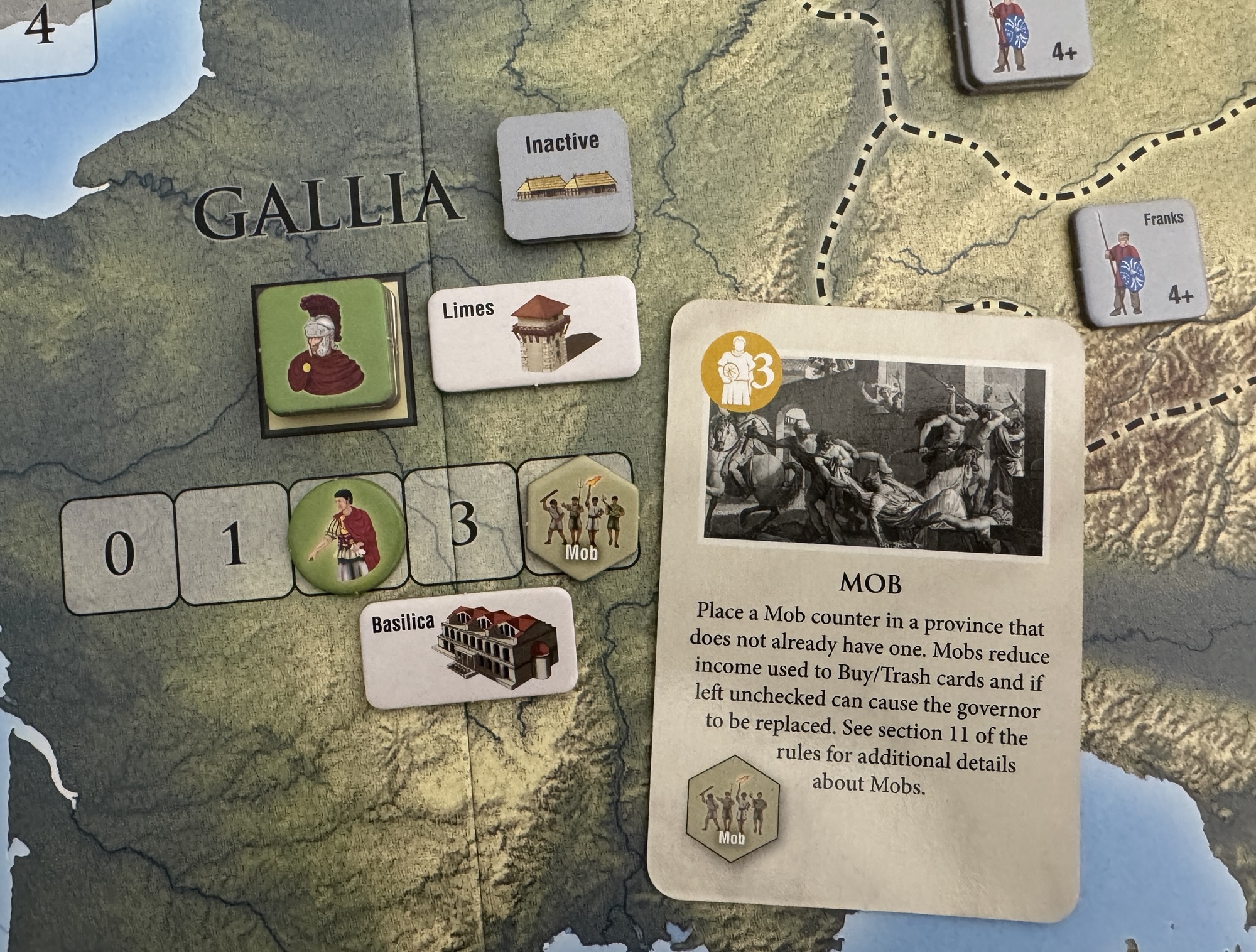
Why exactly do I consider this card so good? Well, you don’t have to rely on rolling dice to get what you want…simple as that. The power is maybe not as efficient as I would like it to be, as you will have to take a Replace Governor Action later to seat your Governor, but it is guaranteed. First off, the card allows you to target a province in which you wish to Replace the current sitting Governor. You normally would play Populace cards to create a number of Influence Points that you would then use to roll 1d6 per point. With Mobile Vulgus you simply play a certain amount of Populace cards to create a total amount of Influence that allows you to overcome their current support level. In the picture above, you can see that the current support level for the Blue Governor in Gallia is at 2. You will also notice though that the Blue General is located in the Provincial Capital with a sizeable army. This army will add to the number of Influence points you will have to spend to reduce that support.

As we examine the Blue General’s stack of forces, we see that he has 3 units under his control, 2 full strength Legions (XIV Gemina and X Gemina) as well as a lone Militia. These 3 units will add to the amount of Populace Influence points that must be spent to effect the support level of the province. Because there are 3 units, we will add those 3 units to the current support level of 2 to bring our target to reduce to 5. In simpler terms 2 for the current support level + 3 for the units in the provincial capital. This then successfully reduces the support level to 1. Remember, that if using a normal Replace Governor action, you would have been rolling 5 dice (1d6 per Populace Influence point spent) and would have needed to roll 2+ and garner 7 votes (calculated by doubling the current support level and then adding in +1 vote needed for each unit in the capital). You couldn’t have possibly done that using only the two cards shown and would have had to play at least one more Populace card with at least 2 Influence points to get to roll 7 dice!

Mobile Vulgus is a Latin phrase that means “the fickle crowd”, referring to the changing nature, opinions and reactions of the general public or an audience, which is a derivation of the English word “mob”.  It literally denotes a movable public, or the unstable crowd and recognizes the inconstancy of popular taste and the ease with which clever politicians can influence the great mass of voters. In game terms, the support of the people can sometimes falter as easily as it can be encouraged.

If you are interested, I wrote a full review for Time of Crisis and you can read that at the following link: https://theplayersaid.com/2017/09/04/the-most-recent-fruits-of-wargame-hybridization-a-review-of-time-of-crisis-the-roman-empire-in-turmoil-235-284-ad-from-gmt-games/

We also posted a full review video and you can watch that at the following link:

In the next entry in this series, we will take a look at Romanian Autonomy from Twilight Struggle: Red Sea – Conflict in the Horn of Africa from GMT Games from GMT Games.

-Grant

Farewell 2025 – Historical Games!

29. Dezember 2025 um 17:07

Games + History = Life.

Here are the three that gave me most life this year!

You can read all of the Farewell 2025 posts here:

©Rodger B. MacGowan.

Time of Crisis (Wray Ferrell/Brad Johnson, GMT Games)

I love a good ancient game. The Greeks and Romans provide not only ample literary and archaeological sources (which are the basis for any decent scholarship, and consequently, for games which take their history seriously), but also the right touch of drama to go with it. Yet while everyone know about the drama of the Greeks defying the Persian Empire or Rome’s struggle with Hannibal, late antiquity gets short shrift in popular media, games included. Time of Crisis does its part to remedy that, shedding light on the crisis of the third century in the Roman Empire which saw no fewer than 19 emperors in the fifty years the game covers (with several dozen co-emperors, emperors of secessionist empires, and anti-emperors who never gained legitimacy on top).

My red legions have moved into Italia and proclaimed me emperor. I am directly threatened by Blue’s strong army in Gallia, and might also get in conflict with Green which has invested into the infrastructure of Macedonia and Thracia. Yellow has been playing their own game, carefully building a large, but thinly defended dominion on the southern shores of the Mediterranean. From the implementation on Rally the Troops!

Time of Crisis is by no means a simulation. However, it does give you an idea of the sheer chaos of civil war, external invasions, social and economic upheaval, and quasi-constant usurpation… and it does so in a very entertaining way, daring you to wreck the Roman Empire in an enjoyable short evening.

©Columbia Games.

Julius Caesar (Grant Dalgliesh/Justin Thompson, Columbia Games)

Did I say I love ancient games? Here’s exhibit B.

Julius Caesar takes two players to the final years of the Roman Republic, when Caesar and Pompey struggled for mastery of Rome. While the rules are the same for both sides, they play very differently: Caesar commands high-quality veterans of his Gallic campaigns, concentrated in Gaul (both transalpine and cisalpine), whereas Pompey’s more numerous, but greener troops are spread out all over the Mediterranean. Caesar will thus have an edge attacking… and attack he must, as the initial score (measured by control of objective cities) is 7-1 in Pompey’s favor.

Caesar has successfully taken Italy, Egypt, and parts of the Greek east. Now Pompey must threaten Massilia (on the southern coast of Gaul) or Byzantion and Antichia in the east. From the implementation on Rally the Troops!

That does not mean, though, that Pompey is only digging in. Pre-emptive movements to take victory cities and move to more defensible positions are indispensable, and the edge of Caesar’s attacks can often be blunted by spoiling attacks or distractions elsewhere… and should Caesar take the lead, Pompey must take more risks and go on the offensive anyway. Either way, Julius Caesar is always a thrilling experience.

And my favorite historical game of the year was…

©Rodger B. MacGowan.

Here I Stand (Ed Beach, GMT Games)

Here I Stand is no newcomer to these lists. In fact, it has been on there a record five times already, winning in 2018 and 2020. I guess that means that Here I Stand is doing a few things right… for example:

  • Accessibility: Yes, I know. The game has a 48-page rulebook and takes all day. But for all that, as long as you have one person knowing the rules well, newbies can be eased into the game because the first turn is a bit of a “try out the mechanics of your faction” phase and there are several powers whose field of operations (geographical and thematical) is limited in the beginning (the Protestants, England, and the Ottomans). I played a six-player game early this year in which there were three newbies and they competed just fine.
  • Diplomacy: A tricky thing in games. Some games only let you do all kinds of non-binding deals (and then people normally don’t do them because the stakes for betrayal are so high). Others only allow very specific, strictly binding things, which also restricts diplomacy a lot. Here I Stand has found the happy middle ground of making some things binding, but not others, and giving most powers something they can trade to any other power (sometimes only a juicy card event played in their favor).
  • Ratching Up Tension: It’s no rocket science, but I love the way that Here I Stand makes the game tenser with every round. You need 25 VP to win, and most of them come from the control of “keys” (that is, objective cities) – so, whenever you gain one, another player loses one. Yet there are also other victory points which are permanent (ranging from winning a war over discovering something in the New World to disgracing an opponent debater)… and thus the overall VP count rises and rises, until “The Papacy might score 25 VP this round, let’s hold them back” has given way to “England, the Protestants, and the Ottomans might score 25 VP this round, and the Hapsburgs threaten a military auto-win”. It is exhilarating!
  • The Big Picture: Here I Stand has a thousand little pieces (literally and figuratively) – Tyndale, the translator of the English bible, the conquest of the Incas, the corsairs of Algiers. Yet all these little stones form a magnificent mosaic. Playing the game you will realize how things that you never connected in your mind influenced each other – for example, if Tyndale holds his own in the difficult early stages of English Protestantism, that might encourage the Papacy and the Hapsburgs to end the intra-Catholic war with France. The Hapsburgs might then invest more in the New World, and a successful conquest might give them the means to take the offensive in the Mediterranean against the corsairs and fleets under the banner of the Ottoman sultan. I love when a game makes these connections.
The yellow Hapsburg fleets converge on Barbarossa, the Sultan’s admiral.

And what were the historical board games that you most enjoyed this year? Let me know in the comments!

Farewell 2025 – Historical Games!

29. Dezember 2025 um 17:07

Games + History = Life.

Here are the three that gave me most life this year!

You can read all of the Farewell 2025 posts here:

©Rodger B. MacGowan.

Time of Crisis (Wray Ferrell/Brad Johnson, GMT Games)

I love a good ancient game. The Greeks and Romans provide not only ample literary and archaeological sources (which are the basis for any decent scholarship, and consequently, for games which take their history seriously), but also the right touch of drama to go with it. Yet while everyone know about the drama of the Greeks defying the Persian Empire or Rome’s struggle with Hannibal, late antiquity gets short shrift in popular media, games included. Time of Crisis does its part to remedy that, shedding light on the crisis of the third century in the Roman Empire which saw no fewer than 19 emperors in the fifty years the game covers (with several dozen co-emperors, emperors of secessionist empires, and anti-emperors who never gained legitimacy on top).

My red legions have moved into Italia and proclaimed me emperor. I am directly threatened by Blue’s strong army in Gallia, and might also get in conflict with Green which has invested into the infrastructure of Macedonia and Thracia. Yellow has been playing their own game, carefully building a large, but thinly defended dominion on the southern shores of the Mediterranean. From the implementation on Rally the Troops!

Time of Crisis is by no means a simulation. However, it does give you an idea of the sheer chaos of civil war, external invasions, social and economic upheaval, and quasi-constant usurpation… and it does so in a very entertaining way, daring you to wreck the Roman Empire in an enjoyable short evening.

©Columbia Games.

Julius Caesar (Grant Dalgliesh/Justin Thompson, Columbia Games)

Did I say I love ancient games? Here’s exhibit B.

Julius Caesar takes two players to the final years of the Roman Republic, when Caesar and Pompey struggled for mastery of Rome. While the rules are the same for both sides, they play very differently: Caesar commands high-quality veterans of his Gallic campaigns, concentrated in Gaul (both transalpine and cisalpine), whereas Pompey’s more numerous, but greener troops are spread out all over the Mediterranean. Caesar will thus have an edge attacking… and attack he must, as the initial score (measured by control of objective cities) is 7-1 in Pompey’s favor.

Caesar has successfully taken Italy, Egypt, and parts of the Greek east. Now Pompey must threaten Massilia (on the southern coast of Gaul) or Byzantion and Antichia in the east. From the implementation on Rally the Troops!

That does not mean, though, that Pompey is only digging in. Pre-emptive movements to take victory cities and move to more defensible positions are indispensable, and the edge of Caesar’s attacks can often be blunted by spoiling attacks or distractions elsewhere… and should Caesar take the lead, Pompey must take more risks and go on the offensive anyway. Either way, Julius Caesar is always a thrilling experience.

And my favorite historical game of the year was…

©Rodger B. MacGowan.

Here I Stand (Ed Beach, GMT Games)

Here I Stand is no newcomer to these lists. In fact, it has been on there a record five times already, winning in 2018 and 2020. I guess that means that Here I Stand is doing a few things right… for example:

  • Accessibility: Yes, I know. The game has a 48-page rulebook and takes all day. But for all that, as long as you have one person knowing the rules well, newbies can be eased into the game because the first turn is a bit of a “try out the mechanics of your faction” phase and there are several powers whose field of operations (geographical and thematical) is limited in the beginning (the Protestants, England, and the Ottomans). I played a six-player game early this year in which there were three newbies and they competed just fine.
  • Diplomacy: A tricky thing in games. Some games only let you do all kinds of non-binding deals (and then people normally don’t do them because the stakes for betrayal are so high). Others only allow very specific, strictly binding things, which also restricts diplomacy a lot. Here I Stand has found the happy middle ground of making some things binding, but not others, and giving most powers something they can trade to any other power (sometimes only a juicy card event played in their favor).
  • Ratching Up Tension: It’s no rocket science, but I love the way that Here I Stand makes the game tenser with every round. You need 25 VP to win, and most of them come from the control of “keys” (that is, objective cities) – so, whenever you gain one, another player loses one. Yet there are also other victory points which are permanent (ranging from winning a war over discovering something in the New World to disgracing an opponent debater)… and thus the overall VP count rises and rises, until “The Papacy might score 25 VP this round, let’s hold them back” has given way to “England, the Protestants, and the Ottomans might score 25 VP this round, and the Hapsburgs threaten a military auto-win”. It is exhilarating!
  • The Big Picture: Here I Stand has a thousand little pieces (literally and figuratively) – Tyndale, the translator of the English bible, the conquest of the Incas, the corsairs of Algiers. Yet all these little stones form a magnificent mosaic. Playing the game you will realize how things that you never connected in your mind influenced each other – for example, if Tyndale holds his own in the difficult early stages of English Protestantism, that might encourage the Papacy and the Hapsburgs to end the intra-Catholic war with France. The Hapsburgs might then invest more in the New World, and a successful conquest might give them the means to take the offensive in the Mediterranean against the corsairs and fleets under the banner of the Ottoman sultan. I love when a game makes these connections.
The yellow Hapsburg fleets converge on Barbarossa, the Sultan’s admiral.

And what were the historical board games that you most enjoyed this year? Let me know in the comments!

Farewell 2025 – New-to-Me Games!

21. Dezember 2025 um 18:42

As the year comes to a close, I’ll do my usual end-of-year posts: My personal top three in a range of categories. As tradition commands, we’ll begin with the games that I played for the first time this year. Here are the best three.

You can read all of the Farewell 2025 posts here:

On the box: A close finish! ©Days of Wonder.

Heat: Pedal to the Metal (Asger Harding Granerud/Daniel Skjold Pedersen, Days of Wonder)

I’m not much of a Formula 1 fan – from my point of view, nothing much happens during the races (after the start, that is), and in many years, even the championship as such is a bore because one driver/car combo is just too dominant. (This year has been excitingly different in that regard.)

In the box: Another close finish!

Heat, however, takes just the exciting parts of racing and puts them together in an enthralling package of evocative mechanisms – downshifting before corners (and upshifting afterward), and the delicate balance of how to deal with the psychological stress on the driver and the physical stress on the car (the eponymous heat). And as the main planning phase is done simultaneously, there’s minimal downtime even with the full six players.

I love the warm yellow which is so evocative of southern India. ©GMT Games.

Vijayanagara (Cory Graham/Mathieu Johnson/Aman Matthews/Saverio Spagnolie, GMT Games)

I’m excited to learn new things from and with games. One topic I knew next to nothing about is the 14th century in India. That, however, has changed a bit now due to Vijayanagara, a COIN-lite treatment of the collapse of the Delhi Sultanate’s hegemony under the challenge of invasion from the north (Timur’s Mongols) and centrifugal forces in the south (the nascent Bahmani Kingdom and Vijayanagara Empire). Every game of Vijayanagara tells a variation of that story.

The Delhi Sultanate (black) is under heavy pressure from the Vijayanagara Empire (yellow) and the Bahmani Kingdom (turquoise). From the implementation on Rally the Troops!

I was happy to play several games of this intriguing debut design with my fellow board game bloggers Dave from Dude! Take Your Turn and Michal from The Boardgames Chronicle.

And my favorite new-to-me game of the year is…

A classic Rodger B. MacGowan cover. ©Rodger B. MacGowan.

Time of Crisis (Wray Ferrell/Brad Johnson, GMT Games)

Chaos – some games hate it, others, like Time of Crisis, embrace it. Whoever wants to be Roman emperor in the tumultuous third century must be prepared to deal with a whole whirlwind of challenges: Angry mobs want to drag your governors into the gutter, Barbarian tribes stand ready to cross the border into your provinces, and, worst of all, the rest of the Roman elite wants to be emperor, too, and will gleefully take whatever you possess.

Red has declared himself emperor! Yet Yellow runs a compact dominion in the east, ready to move into Italy or break away from the empire. From the implementation on Rally the Troops!

I have been thwarted in my imperial aspirations by my fellow bloggers Alexander and Grant from The Players’ Aid as well as Dave and Michal, and have been loving every minute of it. Time of Crisis has been my most-played game overall this year (with 14 individual plays of it), and rightly takes the crown in this category.

What were your favorite new-to-me games this year? Let me know in the comments!

Farewell 2025 – New-to-Me Games!

21. Dezember 2025 um 18:42

As the year comes to a close, I’ll do my usual end-of-year posts: My personal top three in a range of categories. As tradition commands, we’ll begin with the games that I played for the first time this year. Here are the best three.

You can read all of the Farewell 2025 posts here:

On the box: A close finish! ©Days of Wonder.

Heat: Pedal to the Metal (Asger Harding Granerud/Daniel Skjold Pedersen, Days of Wonder)

I’m not much of a Formula 1 fan – from my point of view, nothing much happens during the races (after the start, that is), and in many years, even the championship as such is a bore because one driver/car combo is just too dominant. (This year has been excitingly different in that regard.)

In the box: Another close finish!

Heat, however, takes just the exciting parts of racing and puts them together in an enthralling package of evocative mechanisms – downshifting before corners (and upshifting afterward), and the delicate balance of how to deal with the psychological stress on the driver and the physical stress on the car (the eponymous heat). And as the main planning phase is done simultaneously, there’s minimal downtime even with the full six players.

I love the warm yellow which is so evocative of southern India. ©GMT Games.

Vijayanagara (Cory Graham/Mathieu Johnson/Aman Matthews/Saverio Spagnolie, GMT Games)

I’m excited to learn new things from and with games. One topic I knew next to nothing about is the 14th century in India. That, however, has changed a bit now due to Vijayanagara, a COIN-lite treatment of the collapse of the Delhi Sultanate’s hegemony under the challenge of invasion from the north (Timur’s Mongols) and centrifugal forces in the south (the nascent Bahmani Kingdom and Vijayanagara Empire). Every game of Vijayanagara tells a variation of that story.

The Delhi Sultanate (black) is under heavy pressure from the Vijayanagara Empire (yellow) and the Bahmani Kingdom (turquoise). From the implementation on Rally the Troops!

I was happy to play several games of this intriguing debut design with my fellow board game bloggers Dave from Dude! Take Your Turn and Michal from The Boardgames Chronicle.

And my favorite new-to-me game of the year is…

A classic Rodger B. MacGowan cover. ©Rodger B. MacGowan.

Time of Crisis (Wray Ferrell/Brad Johnson, GMT Games)

Chaos – some games hate it, others, like Time of Crisis, embrace it. Whoever wants to be Roman emperor in the tumultuous third century must be prepared to deal with a whole whirlwind of challenges: Angry mobs want to drag your governors into the gutter, Barbarian tribes stand ready to cross the border into your provinces, and, worst of all, the rest of the Roman elite wants to be emperor, too, and will gleefully take whatever you possess.

Red has declared himself emperor! Yet Yellow runs a compact dominion in the east, ready to move into Italy or break away from the empire. From the implementation on Rally the Troops!

I have been thwarted in my imperial aspirations by my fellow bloggers Alexander and Grant from The Players’ Aid as well as Dave and Michal, and have been loving every minute of it. Time of Crisis has been my most-played game overall this year (with 14 individual plays of it), and rightly takes the crown in this category.

What were your favorite new-to-me games this year? Let me know in the comments!

Half-Year Gaming Report, 2025

29. Juni 2025 um 16:38

2025 is in the distant future, right? …nope, that’s right now. Actually, it’s halfway over already. So here are some snapshots from my board gaming in the first six months of this year.

The Raw Numbers

Let’s start with a statistical overview (as of June 29):

  • I’ve played 23 different games (slightly up compared to last year at this point).
  • 9 of them were new to me (also slightly up).
  • These 23 games resulted in a total of 52 plays (lower than last year, but higher than 2023)
  • The month in which I played most games was January (with 17 plays), the months with the fewest plays March and April (4 each).
  • Of the 23 different games, 17 are historical. These account for 43 of the plays (twice the games, three times the plays compared to last year).
  • Just one of the plays was solo (utterly collapsing from last year’s 17).
  • 32 of the 52 plays were digital, which makes for a digital majority for the first time since getting out of the pandemic in 2022.

The overall trend this year for me has been more digital and more historical gaming – or, from the other side, less on-the-table casual gaming. There are a few reasons for that, including me being mostly homebound for several months taking care of our cat which requires medication twice daily.

Most importantly: She continues to live a happy cat life (except for the few minutes in the morning when she has to take a pill that tastes very bitter)!

Besides that, I’m happy for the gaming I got so far this year. Here are some highlights.

BochumCon

Very early this year, I did in fact go to a convention – and what a convention it was! BochumCon is a small invite-only convention focusing on longer, more complex games (often with a historical theme) organized by designer Matthias Cramer. I got to play (among other things) two games of Weimar (Matthias Cramer, Capstone Games/Skellig Games/Spielworxx), one of Here I Stand (Ed Beach, GMT Games), and the very clever Heat (Asger Harding Granerud/Daniel Skjold Pedersen, Days of Wonder)… and I got to chat, connect, and laugh with a lot of nice people!

Ottomans at Vienna!
Monarchists in Essen!
Cars on the race track!

Rally the Troops!

I play more digitally these days because I lack some face-to-face opportunities, but I also play more digitally because the offers have gotten very good. My main platform is the admirable Rally the Troops! which allows you to play a variety of historical board games (especially block and card-driven games) in a visually appealing, rules-enforcing manner in your browser for free. I’ve used it to get back to old favorites like 1989 (Jason Matthews/Ted Torgerson, GMT Games) or Maria (Richard Sivél, Histogame) as well as to try out games about which I’ve heard my friends rave for years… for example, the game which I’ve played most often this year so far.

Austria (white) has recovered and is pressing Prussia (blue) hard in Silesia (east) as well as in the western reaches of Prussia proper. From the Maria implementation on Rally the Troops!

Julius Caesar (Grant Dalgliesh/Justin Thompson, Columbia Games)

One of my discoveries of last year – so much strategy and bluffing with so little rules overhead!

Pompeius (gold) holds Spain, Africa, and Sicily; but Caesar’s (red) march through the east all the way to Egypt proved decisive. From the implementation on Rally the Troops!

The struggle between Caesar and Pompeius for mastery of the Roman Republic requires sharp wits, calm nerves, and a little bit of luck when you cast the die crossing the Rubicon. The games are dynamic and play out in a variety of ways – sometimes, your armies stalk each other in the east, sometimes, you slug it out in bloody battles in Spain, and sometimes, amphibious landings turn erstwhile quiet regions into sudden flashpoints. May the gods favor you… but not too much.

I’ve played Julius Caesar around a dozen times since December last year, and it hasn’t lost its charm.

And, to finish this post, here are two new discoveries of mine on Rally the Troops!:

Vijayanagara (Cory Graham/Mathieu Johnson/Aman Matthews/Saverio Spagnolie, GMT Games)

I’m excited to learn new things from and with games. One topic I knew next to nothing about is the 14th century in India. That, however, has changed a bit now due to Vijayanagara, a COIN-lite treatment of the collapse of the Delhi Sultanate’s hegemony under the challenge of invasion from the north (Timur’s Mongols) and centrifugal forces in the south (the nascent Bahmani Kingdom and Vijayanagara Empire).

My yellow Vijayanagara Empire has a few strongholds in the south, and, with the Delhi Sultanate (black) currently busy fending off the Mongols (red) in the north, will have some breathing space… yet the Bahmani Kingdom (turquoise) might fill the power vacuum. From the implementation on Rally the Troops!

Time of Crisis (Wray Ferrell/Brad Johnson, GMT Games)

Chaos – some games hate it, others, like Time of Crisis, embrace it. Whoever wants to be Roman emperor in the tumultuous third century must be prepared to deal with a whole whirlwind of challenges: Angry mobs want to drag your governors into the gutter, Barbarian tribes stand ready to cross the border into your provinces, and, worst of all, the rest of the Roman elite wants to be emperor, too, and will gleefully take whatever you possess. I have been thwarted in my imperial aspirations by my fellow bloggers Dave, Grant, and Michal, and have been loving every minute of it.

My (red) emperor sits in Italia, yet the yellow pretender empire seems to be the most dynamic faction right now. From the implementation on Rally the Troops!

What have the first six months of 2025 brought to you in gaming? – Let me know in the comments!

Games Referenced

Weimar (Matthias Cramer, Capstone Games/Skellig Games/Spielworxx)

Here I Stand (Ed Beach, GMT Games)

Heat (Asger Harding Granerud/Daniel Skjold Pedersen, Days of Wonder)

1989 (Jason Matthews/Ted Torgerson, GMT Games)

Maria (Richard Sivél, Histogame)

Julius Caesar (Grant Dalgliesh/Justin Thompson, Columbia Games)

Vijayanagara (Cory Graham/Mathieu Johnson/Aman Matthews/Saverio Spagnolie, GMT Games)

Time of Crisis (Wray Ferrell/Brad Johnson, GMT Games)

❌