Normale Ansicht

My Favorite Wargame Cards – A Look at Individual Cards from My Favorite Games – Card #72: Commodus from The Wars of Marcus Aurelius: Rome 170-180CE from Hollandspiele

Von: Grant
07. April 2026 um 14:00

With this My Favorite Wargame Cards Series, I hope to take a look at a specific card from the various wargames that I have played and share how it is used in the game. I am not a strategist and frankly I am not that good at games but I do understand how things should work and be used in games. With that being said, here is the next entry in this series.

#72: Commodus from The Wars of Marcus Aurelius: Rome 170-180CE from Hollandspiele

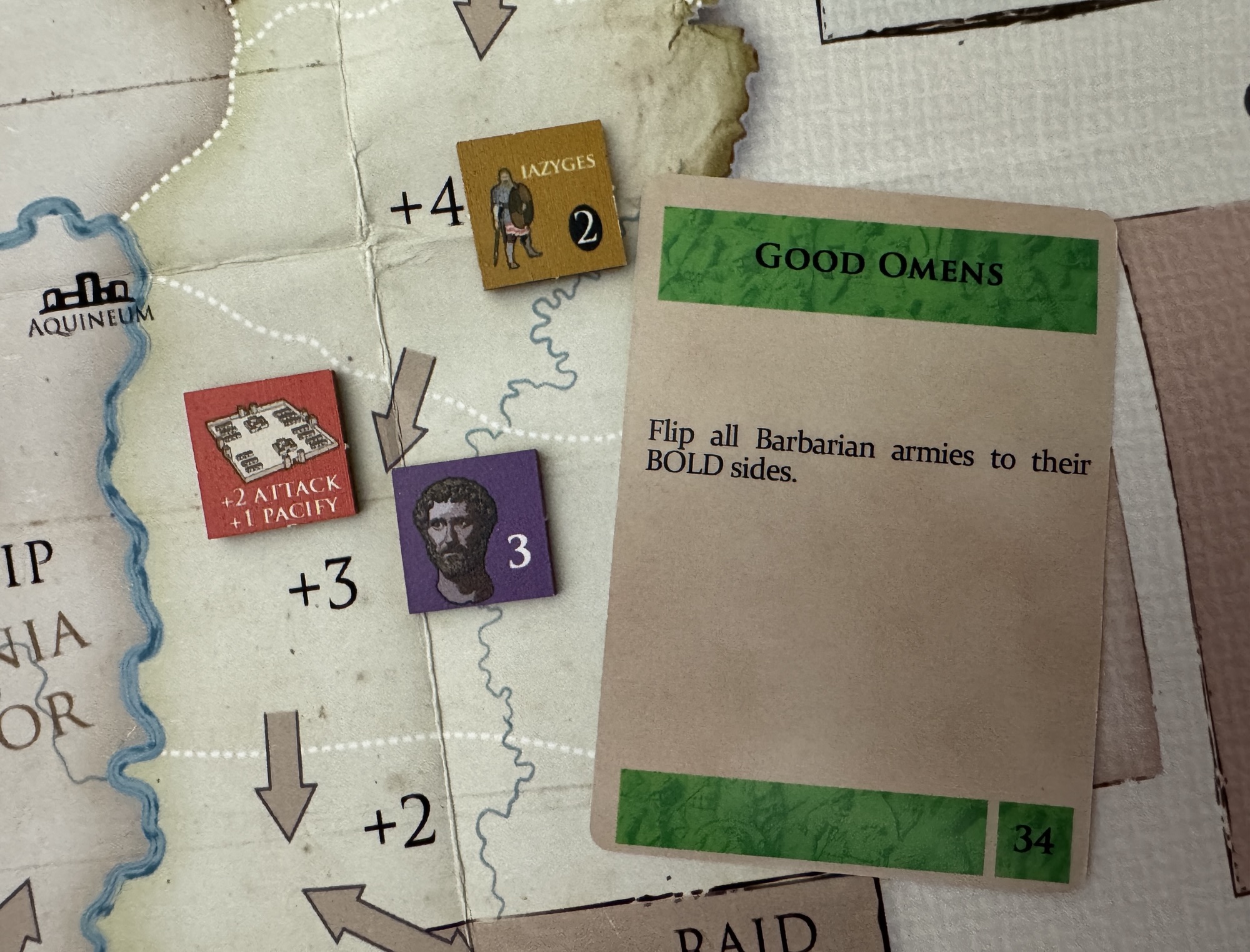
The Wars of Marcus Aurelius: Rome 170-180CE is a solitaire only game that uses cards similarly to a CDG to simulate the strategic level struggle of the Romans led by Marcus Aurelius to stave off the invasions of Germanic tribes and Sarmatian raiders as they encroach on Roman territory across the Danube River. That’s the history. And it is really well integrated. The game play is very fun, strategic, with lots of decision points about what to do and what cards to use, and it is really challenging.

In the game, the Roman player has a deck of Roman Cards that can be used for the printed events for various effects or that can be discarded to take any number of actions such as attack a Barbarian army or Off-Map Conflict enemy, advance the marker on the Imperium Track, add two Level 1 Forts to any eligible map spaces, flip one Level 1 Fort to a Level 2 Fort among several other actions. Sometimes the printed events in the game are just more powerful than discarding a card for just 1 action so you have to pay attention to this economy and make sure you get the most out of your cards. Now, keep in mind, sometimes discarding a good card whose ability is not right for the current situation you find yourself in is part of the game but you have to use these cards wisely to do well in the game.

The game uses two separate decks of cards including the Barbarian Deck (Green) and The Roman Deck (Red). Both of the decks are made up of 50 cards each but each have very different purposes. The Barbarian Deck is used to determine the actions of the invading Germanic tribes as well as events that effect the war effort including mutinies, plague and the will of the people. While the Roman Deck provides the resources and events that are used by the Roman player to mount a defense against the invasions and to fight back each of the different barbarian tribes. There are unique cards called Late War Cards in the deck that will be held out until the start of the 175CE turn at which time they will be mixed in with the cards to form a new Late War Deck. There are also special cards that are marked with an asterisk that if played for the event will be discarded from the game to form what is called a History Pile.

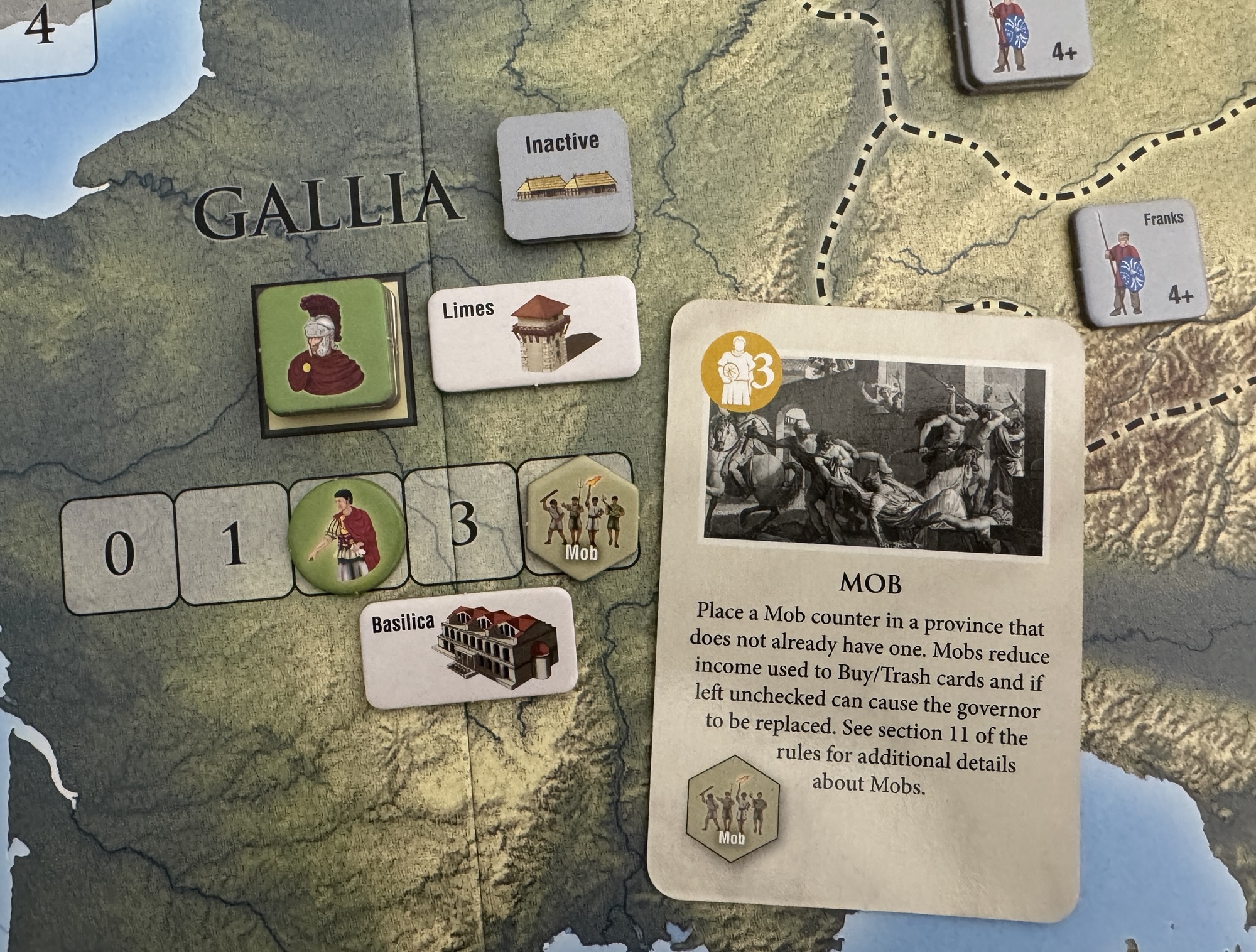
In this entry, we will focus on the Roman Card Commodus, which provides some opportunity to shore up your failing Imperium Points or even cancel an ongoing Mutiny of your troops on the board. In my first 5 or 6 plays of the game, the most common way that I lost was by allowing the Imperium Point Track to reach zero, which results in Marcus Aurelius being usurped and the player immediately losing the game. I was confounded and very frustrated about why I couldn’t prevent this from happening! I could see the end coming but struggled with keeping that Track above water. There are a few cards included in the Roman Deck that provide increases to the Imperium Track and I highly recommend you take these type of events when they come into your hand rather than discarding these cards to take another action, that might seem important at the time, but in the end these events are just too efficient to pass on. Commodus will provide you an option. This option is taking the +2 IP or another type of action such as ending a Mutiny (very important as it usually takes you discarding a card and losing an IP) or drawing two cards to add to your hand (imagine if you can only draw that Local Guides card you have been looking for or the Ambush that you need to take on the Quadi in their Home space). It becomes a choice of “either/or” and I am here to tell you the only reason the “or option” is provided is to lure you away from the real prize in that of gaining the +2 IP. Please listen to my advice and take the +2 IP. You will thank me in the end! Remember, that the concept of Imperium Points (IP) represent the Emperor’s overall political authority and stability in Rome. If the IP track ever reaches zero, the player immediately loses due to usurpation. Points are lost from specific card events, barbarian surges, and certain combat results, requiring players to prioritize special events to gain them back

Commodus was Roman emperor from 177 to 192AD, first serving as nominal co-emperor under his father Marcus Aurelius and then ruling alone from 180AD. Commodus’s sole reign is commonly thought to mark the end of the Pax Romana, a golden age of peace and prosperity in the history of the Roman Empire.

Commodus accompanied his father during the Marcomannic Wars in 172AD and on a tour of the Eastern provinces in 176AD. The following year, he became the youngest emperor and consul up to that point, at the age of 16. His solo reign saw less military conflict than that of Marcus Aurelius, but internal intrigues and conspiracies abounded, goading Commodus to an increasingly dictatorial style of leadership. This culminated in his creating a deific personality cult, including his performances as a gladiator in the Colosseum. Throughout his reign, Commodus entrusted the management of daily routine affairs to his palace chamberlain and praetorian prefects, namely Saoterus, Perennis, and Cleander. Roman soldiers and the general populace generally liked Commodus during his reign, largely because he was popular with the masses and focused on lavish spending rather than costly foreign wars. He was adored for presenting himself as a masculine, gladiatorial Hercules, though the Senate despised him

Commodus was assassinated by the wrestler Narcissus in 192AD, ending the Nerva–Antonine dynasty. He was succeeded by Pertinax, the first claimant in the tumultuous Year of the Five Emperors.

I shot a playthrough video for the game and you can watch that at the following link:

I also followed that up with a full video review sharing my thoughts:

In the next entry in this series, we will take a look at Russian Leader Tsar Alexander I from Congress of Vienna from GMT Games.

-Grant

Wargame Watch – What’s New & Upcoming – April 2026

Von: Grant
01. April 2026 um 14:00

April is one of my favorite months due to Easter and the warming of the weather. And this month we got a good amount of newly baked wargames, still warm some of them because they are so new, for you to choose from. This month for the Wargame Watch I was able to find 28 games (including the 7 games from our sponsor VUCA Simulations). Interestingly though this was a cooler month for crowdfunding as I only found 4 different campaigns, which did contain a total of 6 games as one was a triple feature, featured on Kickstarter or Gamefound.

If you missed the March Wargame Watch, you can read that here at the following link: https://theplayersaid.com/2026/03/02/wargame-watch-whats-new-upcoming-march-2026/

This month again we have a sponsor for the Wargame Watch in VUCA Simulations. VUCA Simulations is a newer German publisher that is really crushing it with their graphics and production. Their games are also very good and we have really enjoyed several of their titles including Donnerschlag: Escape from StalingradTraces of War and most recently New Cold War.

But I also want to point your attention to their In Development Section of their website to show you all of the great projects that they are currently working on. Here there are 7 different games listed with pictures of the beautiful covers and a description of the game itself. These titles include Thirty Years of Misery designed by Brian Asklev, Pacific Fleet designed Hiroyuki Inose, The Far Seas designed by Martin Anderson, In Fours to Heaven designed by Grzegorz Kuryłowicz, Gateway to Falaise designed by Andrew Glenn, 1916 – Prelude to Blitzkrieg designed by Paul Hederer and Saint-Lô – The Capital of Ruins designed by Clemm.

VUCA is really doing a great job with their games and we recently played one of their newest games in Imperial Elegy: The Road to the Great War 1850-1920 and it was a sublime experience. We only played 1 full hand with a full table of 6 players, but very much enjoyed what it was that we were trying to do and the production is just fantastic. Can’t wait to get this one back to the table soon!

But now onto the games for April!

Pre-Order

1. Company of Heroes – Desert Warfare Expansion + Reprint from Bad Crow Games Currently on Gamefound

Glitz. Bits. Content. Miniatures. If these things appeal to you and you like a tactical wargame experience then this is your chance. The well regarded Company of Heroes System has a Gamefound campaign for a new expansion called Company of Heroes – Desert Warfare Expansion and they are also offering the base game 2nd Edition as an add-on as you need it to play.

From the game page, we read the following:

The Company of Heroes – Desert Warfare Expansion + Reprint on Gamefound brings the Deutsches Afrika Corps (DAK) to the 2nd Edition board game, featuring high-mobility, mechanized, and elite units. This expansion enhances solo/co-op play with improved AI, offering a fast-paced, tactical tabletop experience with armored, hit-and-run tactics. The Deutsches Africa Corps adds specialized, agile desert combat forces with a focus on armored vehicles, Italian alliance units, and fast, bold maneuvers. The expansion includes a sophisticated AI for solo or cooperative play, featuring an AI commander, HQ board, action deck, and target selection priority cards. The AI is described as aggressive, frequently seizing objectives. The expansion includes new maps, units, and components to expand the core game experience. The campaign also offers a reprint of the 2nd Edition core box, required to play, featuring streamlined rules and high-quality components.

I am going to be honest here. I played the 2nd Edition. We enjoyed it but it wasn’t necessarily as amazing as I thought it would be. I mean the systems are interesting but it feels more Euro game like than wargame like and it is also extremely expensive. Now it is gorgeous and the miniatures, terrain and maps are very well done but I am not sure that this game lives up to the hype. Just my humble opinion.

If you are interested in Company of Heroes – Desert Warfare Expansion + Reprint, you can back the project on the Gamefound page at the following link: https://gamefound.com/en/projects/companyofheroes/dak

As of April 1st, the Gamefound campaign has funded and raised $948,465 toward its $100,000 funding goal with 1,928 backers. The campaign will conclude on Thursday, April 16, 2026 at 12:00am EST.

2. T-34 Leader: The World War II Ground Combat Solitaire Strategy Board Game from Dan Verssen Games Currently on Kickstarter

A good solitaire game is always very much welcome on my table. I usually start these entries about solitaire gaming by saying I am not a solitaire gamer. Well, after playing the Leader Series from DVG for the first time about 8 years ago, that statement no longer applies. I used to really only play solitaire games when I had no other choice or available opponents. But, when I put these games on the table, my whole opinion has changed. The Leader Series is a solitaire gaming system that recreates modern combat, including ground combat, air warfare and even submarine warfare and sees the player creating, managing and outfitting a group of soldiers/boats/planes over the course of a variable length campaign. Some of the games offer individual combat systems that are included in the overall game and each handles their theater with specific rules and equipment used historically. Originally, all of the games were designed by Dan Verssen but more recently other designers have been taking up the reigns of the series. Such is the case with their newest offering in the series T-34 Leader designed by Vincent Cooper.

From the game page, we read the following:

You are the commander of a Soviet army combat group in World War II. You will take command in the hardest fought campaigns from Operation Barbarossa (1941) to the Battle of Berlin (1945).

Each of your Campaigns involve both operational and tactical decisions. At the start of a Campaign, you select the Units and Commanders to make up your force. During each Week of the Campaign, you decide which Enemy Battalions to attack, which of your forces to allocate, and then resolve each Battle using the Tactical Battlefield. Your Commanders gain Experience with every Battle, but they also suffer Stress. Each Week you must decide how hard to push your men to achieve Victory. T-34 Leader is a great game for both experienced strategy gamers, as well as new players. Each Campaign takes around 30 minutes to set-up, and each Battle can be resolved in 15 to 30 minutes.

T-34 Leader has been designed from the ground up as a Solitaire wargame. It is not an adaptation of a 2-player wargame and the rules have been specifically designed for the solo player. As a Solitaire wargame, you can play whenever you have time, at your own pace. T-34 Leader is the latest Tank Leader game from DVG, following Tiger Leader and Sherman Leader.

With that look, I will let you know that I very much love Sherman Leader and the ground combat for me is where it is at and I would think that T-34 Leader will be more of the same but on the East Front. I have played Sherman Leader the most in the series, using both short and long campaigns, and really enjoy its systems, the structure of the AI and the management of your units and Commanders. Really engaging and enjoyable experience of ground combat in World War II.

Here is a link to my video review for Sherman Leader that you can view at the following link:

If you are interested in T-34 Leader: The World War II Ground Combat Solitaire Strategy Board Game, you can back the project on the Kickstarter page at the following link: https://www.kickstarter.com/projects/danverssengames/dvg-t-34-leader

As of April 1st, the Kickstarter campaign has funded and raised $38,484 toward its $30,000 funding goal with 148 backers. The campaign will conclude on Tuesday, April 7, 2026 at 3:02pm EDT.

3. Chalice of Poison: The Iran-Iraq War, 1980-1988 from GMT Games

We met Akar Bharadvaj while attending SDHistCon in 2023 and played his award winning design Tyranny of Blood: India’s Caste System Under British Colonialism, 1750-1947 and very much enjoyed the experience and talking with him about game design. Since that time, he has been working on another designer called Chalice of Poison: The Iran-Iraq War, 1980-1988 from GMT Games, which was recently announced on their P500. Chalice of Poison is the first volume in a new series that models complex conflicts not only as clashes between adversaries in the air, land, and sea, but also as political struggles within the regimes and military forces fighting it.

From the game page, we read the following:

In 1980, Saddam Hussein’s Iraq invaded Iran, hubristically expecting to achieve a quick victory in a few weeks. Instead, the war became a brutal slog that lasted eight years. During the war, both countries had to choose between political and military objectives, balancing between the power of their military forces and the stability of their regimes. In Chalice of Poison you will play as the heads of two very different authoritarian regimes that have structured their militaries to be excellent at forestalling internal threats…but less effective at fighting foreign adversaries. Can you reform your military so that it’s effective enough to win the war, without accidentally creating a force that threatens your power?

A unique game on the Iran-Iraq War, the longest conventional war of the 20th century, and a historically important conflict underexplored in tabletop gaming.

Designed by Zenobia Award-winning designer Akar Bharadvaj, and inspired by Dr. Caitlin Talmadge’s academic research on the fundamental weakness of so-called “strong-man” authoritarian regimes.

Simple mechanics create a tense, dynamic, and meaningful decision space with an exciting narrative, capturing the dilemmas faced by regimes faced with both internal and external threats.

A two-player game that also plays well with four players on competing teams.

Includes two solitaire modes: A simple-to-operate “Al-Jazari” bot that offers a challenging non-player opponent. A more complex “Kissinger mode”—inspired by Mark Herman’s Peloponnesian War—in which the solitaire player represents both sides in the conflict. This mode abstractly models the international community, which cynically supported both sides in the conflict, ensuring a lengthy war in which neither country could win a decisive victory.

“At its most interesting, Chalice of Poison simulates warfare as a social battle as much as one involving tanks and bullets…This might sound complicated, but Bharadvaj presents these fluctuating power levels with refreshing clarity…Even at this early stage it’s an impressive and ambitious plaything. And its critique is unexpectedly timely, highlighting how strongman governments weaken their nations in the name of strengthening their regimes.” ~ Dan “Space-Biff” Thurot

If you are interested in Chalice of Poison: The Iran-Iraq War, 1980-1988, you can pre-order a copy for $69.00 from the GMT Games website at the following link: https://www.gmtgames.com/p-1225-chalice-of-poison-the-iran-iraq-war-1980-1988.aspx

4. Pericles: The Peloponnesian Wars 460-400 BC 2nd Printing from GMT Games

We are admitted Mark Herman fanboys! I am not ashamed of that statement as he is a very good designer and such an interesting person. He has designed a series of games called The Great Statesman Series and there are such fantastic mechanics at play that create a very interesting non-traditional wargame feeling such as Churchill. The 2nd game in the series is called Pericles, unlike Churchill, pits 2 sides, the Athenians and the Spartans against one another. The real game-changer is that each side is made up of two factions. As such it plays best with 4 players, each working to not only have their side win, but to have their faction within that side end with the most honor, and thus be victorious overall. The good news for most of us, is that there’s bots for solitaire, or 3 player games and there’s a fascinating 2 player variant, where each player plays a faction on each side. GMT just put a 2nd Printing up on their P500 and I am so very glad that this game will get some more attention as it is a really great game.

From the game page, we read the following:

Pericles is a ‘sandbox’ (unscripted) wargame that covers the ENTIRE period of conflict described in Thucydides classic history on the Peloponnesian wars. Pericles is a 4-player game, where two teams of Athenian and Spartan factions fight for Hegemony in 5th Century Greece. Each team of two represents a faction vying for control of their City States, strategy, and honor. Athens sees the Aristocrats debate issues with their opposing Demagogues, while in Sparta House Agiad and House Eurypontid contend for royal dominance.

Pericles uses elements from the Golden Geek best Wargame of 2015, Churchill, to simulate war as the extension of politics by other means. In the War portion of the game, it is US versus THEM (Athens versus Sparta), where each team implements their collective strategy to dominate Theaters of War, build economic strength, and fight battles to win Honor. In the respective Political assemblies, it is ME versus YOU (faction versus faction), where the battle for government control has to be balanced by your common interests in a series of wars that must be won, or all is lost.

Pericles uses an Issue Queue preplanning mechanic that the play testers have described as ‘insanely fun’. After your Political assembly has debated and won issues, these issues (military, league, diplomatic, oracle) are secretly placed on the military map in one of the twenty Theaters of war. If you or your opponents place a second issue into a Theater, it creates a queue of issues. Once all issues are placed, they are revealed and resolved one at a time. The order of issues in the queues and the order in which they are resolved across all Theaters tells YOUR story of the Peloponnesian wars.

Strategy in Pericles unfolds in how you create combinations of issues to achieve the historical narrative. Do you want to conduct a Periclean raiding strategy? Then you would play two military issues into a Theater to first move forces into position, then raid. Do you want to build a base in the enemy homeland (historically Pylos or Decelea)? Then you would conduct a military expedition, followed by a league issue. Do you want to raise an opponent’s ally in rebellion? Then you would deploy a diplomatic mission, and sow treachery for immediate or future advantage. It is in the placement, order, and resolution of the issues that the game allows you to explore and experience the broad range of historical situations without a script. 

What would a game of Hoplites and Triremes be without a battle mechanic? Battle in Pericles is based on armies and fleets being led by the classic generals of yore, represented as Strategos tokens. During the Political assembly, each faction uses historical personalities to acquire Strategos tokens. Use the Spartan general Brasidas and gain four Strategos tokens, while Epitadas only generates one. Strategos tokens can be thought of as military capital that is spent in the war to lead and move forces. If you send forces to a Theater with enemy forces, a land or naval battle will occur. All players then secretly commit Strategos to the battle. Then, the commanding general of the military expedition and their teammate reveal their Strategos commitment and move wooden land and naval units to the battle. Now the defensive commitment of Strategos is revealed, each side then reveals a random battle card value, and the winner is decided. The winner of the battle now has the option to fight a subsequent naval or land battle. The outcome of these tactical decisions determines if any fortified bases are destroyed by assault or siege. Then the next issue is resolved. Winning battles awards and reduces honor.

Here is a link to our video review that was created when we were younger, had more hair and were not very polished in any part of what we were doing:

If you are interested in Pericles: The Peloponnesian Wars 460-400 BC 2nd Printing, you can pre-order a copy for $71.00 from the GMT Games website at the following link: https://www.gmtgames.com/p-1223-pericles-the-peloponnesian-wars-460-400-bc-2nd-printing.aspx

5. Silver Bayonet: The First Team in Vietnam, 1965 – 25th Anniversary Edition 2nd Printing from GMT Games

We have had a great experience playing Silver Bayonet a few times over the years and I am glad that it is now getting a 2nd Printing of the 25th Anniversary Edition. Silver Bayonet: The First Team in Vietnam, 1965 – 25th Anniversary Edition is a revamping of their first ever game released all the way back in 1990.

From the game page, we read the following:

Silver Bayonet recreates the pivotal November 1965 battle between a full North Vietnamese Army Division and the US 1st Air Cavalry Division in the Ia Drang Valley. NVA expertise in lure and ambush tactics resulted in significant US casualties. US mobility and the ability to bring massive amounts of firepower to bear quickly virtually destroyed the attacking NVA division and forced a change in NVA tactics.

This re-issue of GMT Games’ 1990 CSR Award winning title that started it all keeps the original operational system, but streamlines to it to include innovative combat resolution integrating maneuver combat, close assault, artillery bombardment, and support from gunships and air sorties. 

Increased accessibility to primary and secondary source material has made it possible to make changes to more accurately represent both sides’ unique capabilities without significantly altering or breaking the base game system. The major changes involve patrols, ambushes, landing zones, and the 1st Cav Brigade HQ, while minor changes tweak movement, combat, and coordination game mechanics to showcase radically different strengths and weaknesses the FWA and NVA force brought to the battles in the Ia Drang Valley.

If you are interested in Silver Bayonet: The First Team in Vietnam, 1965 – 25th Anniversary Edition 2nd Printing, you can pre-order a copy for $48.00 from the GMT Games website at the following link: https://www.gmtgames.com/p-1224-silver-bayonet-25th-anniversary-edition-2nd-printing.aspx

6. I, Napoleon 2nd Edition Update Kit from GMT Games

As you probably know, normally Ted Raicer designs hard core hex and counter wargames such as The Dark Valley: East Front Campaign, 1941-45The Dark Sands: War in North Africa, 1940-42 and The Dark Summer: Normandy, 1944. These games are fantastic experiences that are true wargames. But, he also has an eclectic side to him and has designed one of the classic card driven games on the subject of World War I in Paths of Glory. So when I heard that he had designed an interesting looking card based historical role-playing game the first thought that came to my mind was “How is he going to accomplish this feat?” Last year, I played I, Napoleon and did enjoy what it was doing even though it felt like it fell a bit short of its ultimate claim. But there is more of the game now and they are doing this Update Kit in case those who want to the updated cards don’t wish to order the Limits of Glory Expansion.

From the game page, we read the following:

For our customers who own the 1st Printing of I, Napoleon and want to upgrade to the 2nd Printing without purchasing the Limits of Glory Expansion, we’re providing an Update Kit.

This Kit includes:

  • 60 Updated Cards
  • 2 Divider Cards (1 New, 1 Adjusted)
  • Rulebook
  • Playbook
  • 8.5″x11″ Player Aid
  • Sticker Sheet (4 stickers to update the Game Board)

NOTE: The Limits of Glory Expansion includes the updated Cards, Divider Cards and Sticker Sheet, as well as a Rulebook, Playbook and Player Aid that can be used with both the expansion and base game.

I wrote a fairly in-depth First Impression style post on the game and you can read that at the following link: https://theplayersaid.com/2024/10/16/first-impressions-i-napoleon-from-gmt-games/

I also did a review video and you can watch that at the following link:

If you are interested in I, Napoleon 2nd Edition Update Kit, you can pre-order a copy for $21.00 from the GMT Games website at the following link: https://www.gmtgames.com/p-1226-i-napoleon-2nd-edition-update-kit.aspx

7. Paper Wars Magazine Issue #116: Roma Invicta: The Roman Republic 400-50BC from Compass Games

Wargame magazines can be a bit hit and miss with their games. But, Paper Wars seems to really pick some great topics and systems to highlight in their pack-in games and this month there is a new pre-order for a game called Roma Invicta: The Roman Republic, 400-50 BC designed by Paul Kallia who did Roma Victrix: Campaigns of the Roman World from Compass Games.

From the game page, we read the following:

Roma Invicta: The Roman Republic & the Western Mediterranean by Paul Kallio is a 2-player, scenario-based design depicting several historic conflicts that occurred in and around the Roman Republic between 400 and 50 BC. This is a systemic brother design to Paul Kallio’s Roma Victrix boxed game. Each game turn represents one year. Infantry unit types include legions, heavy infantry, auxiliaries, and barbarians, and represent about 5,000 men each.

BONUS GAME MATERIAL:  This issue will include two new scenarios for play with WWII Campaigns: 1940, 1941, and 1942. For 1941, we have Festung Stalingrad. It covers the German counteroffensive to try to save the Sixth Army trapped in Stalingrad in December 1942. For 1940, we have the Operation Matador variant scenario by David Meyler.

Article highlights include previews of Rise to Glory and Iberian Tide, a work-in-progress report on Island Infernos, a Bitter Woods AAR, an alternate start scenario for Desert Tide, and a new optional fuel dump rule for The Last Gamble.

If you are interested in Paper Wars Magazine Issue #116: Roma Invicta, you can pre-order a copy for $41.95 from the Compass Games website at the following link: https://www.compassgames.com/product/issue-116-magazine-game-roma-invicta/

8. Limits of Glory: Campaigns VI & VII – Jersey New Jersey and A Strong War: The Conflict for North America 1755-60 from Form Square Games Coming to Gamefound April 7th

A few years ago, we became acquainted with Andrew Rourke through his Coalitions design from PHALANX that went on to a successful crowdfunding campaign and has recently been delivered. He has since been a busy guy with starting his own publishing company called Form Square Games and also publishing the first 5 designs in a new series called Limits of Glory that will take a look at the campaigns of Napoleon and other contemporary conflicts. In Campaign I, which is called Bonaparte’s Eastern Empire, the game is focused on the campaign of the French in Egypt between 1798 and 1801. Campaigns II, III and IV was Maida 1806 and Santa Maura & Capri. Campaign V was Donning the Sacred Heart which covers the Vendee Civil War and just recently fulfilled as I have my copy sitting on my gaming table awaiting and unboxing video.

And now, recently, he has announced came out about the next entry in the series which is a two-fer with Campaigns VI and VII called Jersey New Jersey and is set during the American Revolutionary War but also a 2nd game called A Strong War set during the French & Indian War. I think that these games are well timed with this year being the 250th Anniversary of the signing of the Declaration of Independence and I look forward to playing and exploring both of these games. I have also reached out to Andrew to see about him as well as the design duo of Mark Kwasny and John Kwasny for A Strong War doing another interview to give us a look inside the design and get more information for you to digest before the campaign kicks off on April 7th. But at this point the games look great and I love the art and the covers are very eye catching for sure!

From the game page, we read the following:

For the 2 games in the Limits of Glory Series:

Two exciting games in one box, Jersey covers the little known 1781 invasion by the French of the Island of Jersey as part of the American Revolutionary War. The game examines the impact of luck on events and challenges the skill of players to use their commanders to influence these events.

New Jersey covers the famous crossing of the Delaware and the battles of Trenton and Princeton using the same Limits of Glory System to test players ability to mitigate what luck throws at them by the skillful use of commanders and troop positioning.

Limits of Glory represents military campaigns at the highest command level, players take the role of theater commander and must manage their resources of men, material and skill to emerge victorious.

And for the other game in the offering called A Strong War: The Conflict for North America 1755-60:

The title, A Strong War, refers to the type of war the Abenaki Nation threatened to unleash on the land-grabbing British in 1753. The sparks of war, ignited in 1754 near Fort Duquesne by an obscure colonel of Virginia militia, George Washington, spread quickly; soon, flames engulfed the entire globe as England and France vied for control of empire. Over the next 5 years, Regular regiments from the French and British armies, American and French-Canadian provincial units, and Native warriors all fought in a chaotic and violent series of campaigns and frontier raids that culminated in the British conquest of French Canada and the defeat of the Native Nations (most of which had sided with the French).

A Strong War brings this war to life in a simple, fast-playing game. The map (covering the region stretching from Louisbourg to Alexandria, and from New York to Lake Erie) uses point-to-point connections to highlight the key locations that were targeted during the war. Using wooden cubes to represent the different types of forces used (French and British Regulars, British Colonials, French-Canadian Marines, French Bush Rangers, and Native American warriors), each player has only a few pieces (maximum 13 for the British and 10 for the French) to use each turn (one turn = one year, so there are 6 turns/years total).

The heart of the game is the unique combat system where players can deploy forces to a chosen battle and then commit them one by one; or they can call off the battle if it goes badly and save some of those forces for use later in the year. The types of forces committed also play a critical role in combat – the British want to mass their Regulars but the French want to bring in a mixed force to take advantage of the different skill sets each provides. Thus, tension is created in trying to decide if/when (or where) it is best to commit one’s forces: do you avoid combat completely; do you call off a combat that is going badly; or, do you go all in and commit your entire force? But if you lose a battle, initiative then swings to your opponent who may then launch an offensive.
Each player has several paths to victory, leading to a “different” game each time, and forcing players to choose between different strategies each turn. Finally, it is a quick game, taking just a couple of minutes to set up, and usually taking less than an hour to play to completion. The game also plays well solitaire, though there is no dedicated solitaire system.

If you are interested in Jersey New Jersey and A Strong War, you can learn more about the project on the Gamefound preview page at the following link: https://gamefound.com/en/projects/form-square-games/jersey-new-jersey–a-strong-war

9. Campaign: Operation Bagration from Catastrophe Games Currently on Kickstarter

A few years ago, I played and very much enjoyed a cool little solitaire WWII card-driven game called Campaign: Fall Blau from Catastrophe Games and designer Martin Melbardis where the player attempted to breach the Soviet defenses on the East Front in the pivotal German summer campaign of 1942. The game system is very playable and simple, but has some strategic depth to it as the player has to make a lot of choices about what to go after, how to manage their scarce resources (fuel) and what generals to use to take advantage of their special abilities to amass enough VP to claim victory over the Soviet Union. They now have the counter punch of that game in a new entry in the series called Campaign: Operation Bagration and it is currently being offered on Kickstarter.

From the game page, we read the following:

Campaign: Operation Bagration is the follow-up to Campaign: Fall Blau, the acclaimed solo experience of trying to seize Stalingrad and the prized oil fields beyond. In this game the shoe is on the other foot, as you will be pushing the Red Army to retake the center of the occupied Soviet Union, setting up the capture of Berlin. Stalin is expecting fast results though, so once again you will be racing against the clock trying to achieve enough objectives before your supplies (and Stalin’s patience) runs out.

Campaign: Operation Bagration is a solitaire wargame that takes place during WWII and puts the player in charge of the Soviet summer offensive of 1944 against Army Group Center, code named operation Bagration. Pick your three generals and use your resources wisely in order to obtain your campaign’s objectives.

One month turns. Decide which card (objective) to go after, each with a unique set of Soviet defenses. Manage supplies required for each offensive, or choose to take an operational pause. Receive random event cards that are mostly beneficial but a few are Soviet counterattacks that can throw a serious monkey-wrench into your plans. Play continues until fall begins, and you must report to Stalin with your success or failure.

In order to meet Stalin’s expectations you need to be relentless, while carefully marshalling your troops and material. Drive too hard, and the Germans will crush one of your wings, and your push will stall out. But if you move too slow you know you will be summoned to a special meeting with Stalin, and that is a grim fate.

If you would like to learn more about how the game plays you can read through the rules document found on Board Game Geek at the following link: https://boardgamegeek.com/filepage/317786/draft-rules-as-of-feb-26

Also, by way of comparison, you can check out our preview video for the first game in the series called Campaign: Fall Blau:

We also published an interview with the designer Martin Melbardis and you can read that at the following link: https://theplayersaid.com/2022/10/24/interview-with-martin-melbardis-designer-of-campaign-fall-blau-from-catastrophe-games-on-kickstarter-october-25th/

If you are interested in Campaign: Operation Bagration, you can back the project on the Kickstarter page at the following link: https://www.kickstarter.com/projects/campaign-fall-blau/campaign-bagration

As of April 1st, the Kickstarter campaign has funded and raised $1,138 toward its $500 funding goal with 14 backers. The campaign will conclude on Monday, April 20, 2026 at 8:51pm EDT.

New Release

1. VaeVictis Magazine Issue #185 Game Edition: Storm on the Ménez Hom 1944 from VaeVictis

VaeVictis is a very fine wargame magazine and they always have very interesting looking pack-in games on various subjects. This month, they have featured a scenario involving the 1944 attack on the Ménez-Hom peak on the Crozon peninsula in a game called Storm on the Ménez Hom 1944. But there is more as the magazine features articles on various wargames including Hubris from GMT Games, La Der des Ders from Hexasim, Thunder on the Mississippi from Multi-Man Publishing, Italia 1917-1918 from Nuts! Publishing, New Cold War from VUCA Simulations, Werwolf from Legion Wargames and many more.

From the game page, we read the following:

During the siege of Brest, the coastal batteries on the Crozon peninsula, on the southern shore of the harbor, were hindering the advance of the US Army. It was therefore crucial to silence them. To achieve this, the barrier closing off the peninsula had to be breached: the Ménez-Hom peak, rising to 330 meters. This mission was entrusted to the FFI-FTP battalions of central Finistère. It took three weeks, from August 12th to September 1st, 1944, and the reinforcement of a US cavalry brigade to finally defeat the German, Russian, and Caucasian defenders.

If you are interested in VaeVictis Magazine Issue #185 Game Edition: Storm on the Ménez Hom 1944, you can order a copy for €16.50 ($19.12 in US Dollars) from the VaeVictic website at the following link: https://www.vaevictismag.fr/en/special-game-issue/287-vaevictis-185-game-issue.html

2. The Coming Storm II: Quadrigames of the Fourth Coalition: October 1806-June 1807 from Operational Studies Group

Large Napoleonic wargames are always interesting. Operational Studies Group does some big games on the subject and their newest offering is called The Coming Storm II: Quadrigames of the Fourth Coalition: October 1806-June 1807 and deals with four different battles including Jena-Auerstadt, Pultusk/Golymin, Eylau and Friedland.

From the game page, we read the following:

These four games explore the major battles of 1806–07, where the French Army encountered two different opponents with different capabilities, from the leadership-challenged Prussians in Saxony to the chaotic battle conditions in winter against the Russians. Based on OSG’s Special Studies, which provide a turn-by-turn narrative of the four battles. Each game shows the approach to the battlefield on the day before battle. The Jena-Auerstadt game has both battlefields on one map and allows both sides to redeploy before battle.

We are offering a new edition, with new maps—not too much different in detail—but rendered in Charles Kibler’s naturalistic style. TCS2 will be updated to use the Universal Deck and latest series rules (deck not included). With few exceptions, the counters will be identical to the first edition.

This is a very popular series of games amongst Grognards and I have heard many people recommend these titles to both of us. We have yet to take the plunge and get one but one day we will…one day!

If you are interested in The Coming Storm II: Quadrigames of the Fourth Coalition: October 1806-June 1807, you can order a copy for $140.00 from the Operational Studies Group website at the following link: https://napoleongames.com/products/the-coming-storm-ii

3. The Maid Ascendant: The Siege of Orleans, October 1428-May 1429 from High Flying Dice Games

Paul Rohrbaugh and his company High Flying Dice Games is a designer I love to follow. He is always doing games on smaller or lesser known conflicts and I just find his work to be superb and really draws me in. Recently I saw where he was releasing a game on the Siege of Orleans and I do like siege games! The game is called The Maid Ascendant and really looks pretty interesting and is definitely a unique subject for a game.

From the game page, we read the following:

The Maid Ascendant is an introductory level wargame on the siege of Orleans. The siege marked the debut of Joan of Arc as a military commander, and a campaign that would see the English eventually evicted from France and the end of the Hundred Years War.

“Begone, or I will make you go!” – Jeanne d’Arc’s command to English and Burgundian troops besieging Orleans.

If you are interested in The Maid Ascendant: The Siege of Orleans, October 1428-May 1429, you can order a copy for $16.95 from the High Flying Dice Games website at the following link: https://www.hfdgames.com/maid.html

4. Mr. Lincoln’s War from Compass Games

You can’t have enough good American Civil War games and Compass Games has been working to bring out a new edition of a classic called Mr. Lincoln’s War designed by Mark McLaughlin.

From the game page, we read the following:

Mr. Lincoln’s War is a historical game which captures the epic struggle of the American Civil War. From their first major battle at Bull Run in 1861, through the campaigns of Vicksburg, Gettysburg and Atlanta and until the final days at Appomattox in 1865, the armies of the Union and the Confederacy raged across America wreaking havoc and bloodshed on a scale never before or since witnessed in the New World.

This box set is organized into two sub-games, “Army of the Tennessee,” which deals with the war in the western theater, and “Army of the Potomac,” which deals with the war in Virginia. Each has four short scenarios that recreate the maneuvers and battles of Shiloh, Gettysburg, Atlanta, and other monumental Civil War contests. Campaign games enabling the players to fight the war in the West or East are provided with each sub-game. They may be combined to play the Mr. Lincoln’s War grand campaign that simulates the entire Civil War, on both fronts.

If you are interested in Mr. Lincoln’s War, you can order a copy for $99.00 from the Compass Games website at the following link: https://www.compassgames.com/product/mr-lincolns-war/

5. Volume II Civil War Heritage Series Army of the PotomacCampaigns of 1862 and 1864 from GMT Games

Several years ago, Mark Herman designed a very unique and simple American Civil War game called Gettysburg that appeared in C3i Magazine #32. That game became the basis for his Civil War Heritage Series with the first volume being Rebel Fury that focused on five battles from the Chancellorsville and Chickamauga Campaigns. He has long mentioned working on the follow-up to that game and we finally are getting it with Army of the Potomac.

From the game page, we read the following:

Army of the Potomac: Campaigns of 1862 and 1864 is the second volume in the Civil War Heritage Series and the follow-up game to the innovative and acclaimed Rebel FuryArmy of the Potomac uses the same core rules as Rebel Fury, so players familiar with Rebel Fury will be able to jump right into the action. Each battle in Army of the Potomac is quick-set-up, quick-playing, and deeply interactive. The density of counters in each scenario is low, allowing you to see and experience the big picture of the battle.

Army of the Potomac covers the battles of Spotsylvania II, North Anna River, Cold Harbor, and the entire Seven Days battle (McClellan vs. Lee), including the prelude Seven Pines (McClellan vs. Johnson) when Johnson’s wounding brought Lee into the command of the Army of Northern Virginia. Each battle places you, the player, in the role of the Army Commander (Grant, McClellan, Lee, Johnson). You maneuver your army to find the enemy’s flanks, concentrate your forces for an attack, and determine where to commit your artillery assets.

I think that one of the most interesting parts is that this new game can be played with Rebel Fury as also included are two bonus scenarios to allow owners of Rebel Fury to fight Spotsylvania II and begin the Campaign scenario from Wilderness to Cold Harbor using their original Rebel Fury map.

Last summer, while attending WBC in late July, we sat down with Mark Herman and did an interview/overview of Army of the Potomac and you can watch that video at the following link:

If you are interested in Volume II Civil War Heritage Series Army of the Potomac: Campaigns of 1862 and 1864, you an order a copy for $77.00 from the following link: https://www.gmtgames.com/p-1108-army-of-the-potomac.aspx

6. Baltic Empires: The Northern Wars of 1558-1721 from GMT Games

This one is very much anticipated by me and I feel like I have been waiting in it forever since its announcement in 2022. Baltic Empires is a grand looking game that focuses on the conflicts between the states of the Baltic region during the early modern era. The wait is now over as they game is set to ship on April 17th.

From the game page, we read the following:

Baltic Empires is an approachable 2-5 player strategy game about conflicts between the states of the Baltic region during the early modern era, a transformative period of religious conflict, large scale warfare, and constant struggles for power. Players will have to develop their economy, strengthen their administration, secure trade hubs, and finally build armies to become the dominant power of the Baltics. Denmark-Norway, Sweden, Russia, Poland-Lithuania, and Prussia will fight for hegemony, using variable victory conditions that reflect their respective historical objectives.

During the 16th & 17th centuries, religious conflicts between Protestants and Catholics swept Europe, vast colonies were established by the maritime powers, and a series of wars were fought against Louis XIV’s Kingdom of France to maintain the balance of power, eventually culminating in the War of Spanish Succession. While this history might be familiar to many, the related conflicts around the Baltic Sea that took place during these centuries are less well-known.

Where did the French, English, and Dutch acquire the materials they needed to build and maintain their vast navies that won them their colonial empires? Where did they acquire the food they needed to feed their sailors and growing populations? Where did the Swedish juggernaut that suddenly emerged and changed the course of the Thirty Years War come from, and why didn’t its great power status last? How did the Russian and Prussian Empires that became so powerful in later periods first emerge on the European stage? The Baltic region was crucial to the history of Europe, and the conflict for influence over the Baltic Sea was closely intertwined with the balance of power in Western Europe. The outcome of the wars and societal transformation in the Baltic region, from the collapse of the Teutonic Order in Livonia in 1558 to the end of the Great Northern War in 1721, shaped European and world history up until the present day.

Baltic Empires presents these less well-known conflicts in a fun and accessible format, while also doing justice to the fascinating history of the Baltic Sea region during this period. The game features 5 asymmetric factions with different strengths, forces, and historical objectives, along with the capacity to develop their states by investing in economic infrastructure and recruiting key historical characters that offer unique game effects. The game also includes several scenarios for variable player counts and durations, offering additional flexibility and replayability.

We published an interview on the blog with the designer Brian Asklev and you can read that at the following link: https://theplayersaid.com/2022/03/28/interview-with-brian-asklev-designer-of-baltic-empires-the-northern-wars-of-1558-1721-from-gmt-games/

We also did a series of History Behind the Cards with Brian and you can read those posts at the following links:

#41 Tsar Boris Godunov and #33 Corfitz Ulfeldt

#29 Joachim Frederik Blumenthal and #6 Bohdan Khmelnytsky

#27 King Sigismund III Vasa and #9 Maurice of Nassau

#28 Thomas Roe and #37 Markus Fugger

#10 Janusz & Boguslav Radziwill and #12 Louis de Geer

#17 Georg von Derfflinger and #8 The False Dmitrys

#2 Tsar Peter the Great and #48 Tycho Brahe

If you are interested in Baltic Empires: The Northern Wars of 1558-1721, you can order a copy for $104.00 from the GMT Games website at the following link: https://www.gmtgames.com/p-954-baltic-empires-the-northern-wars-of-1558-1721.aspx

7. Three Days of Gettysburg Deluxe Edition from GMT Games

A very popular series featuring one of the most gamed battles of the American Civil War! Quite the combination. And to add to that, a Deluxe Edition treatment with new counters, some new rules, new and updated maps and lots of scenarios. This is a great value for any gamer who wants to game one of the most iconic battles of the American Civil War.

From the game page, we read the following:

GMT Games and the GBACW design team are proud to announce Three Days of Gettysburg Deluxe Edition, the ultimate edition of the definitive game on the Battle of Gettysburg. First published in 1995, 3DoG has stood the test of time as one of the most popular games of the Great Battles of the American Civil War Series.

This series is one of the hobby’s longest-lived design concepts, springing from the legendary regimental level Gettysburg game—Terrible Swift Sword (SPI)—designed by Richard Berg in 1976. Under GMT, the rules system has remained stable but has shown remarkable flexibility to allow each game to smoothly incorporate additional rules to reflect the historical battles. The series relies on interactive chit-pull mechanics to simulate the often-chaotic nature of the 19th Century battlefield at the regimental level.

Three Days of Gettysburg Deluxe Edition will include ten plus scenarios. They range from small Skirmisher contests on half sized maps to the ultimate Gettysburg experience on four full full-sized maps depicting the entire battle, including the East Cavalry Battlefield! Other scenarios will depict both the first and second day of the struggle. Experienced players will be able to play many of the scenarios in one sitting. The 3DoG Deluxe Edition will include many exclusive rules to represent the special situations at Gettysburg, including new Skirmisher rules. However, many of the rules are optional, allowing players to decide for themselves what level of complexity they want.

New components and exclusive rules include new cavalry counters, CSA dismounted cavalry counters, corrected artillery types, two types of skirmisher units, artillery sections for some scenarios (Calef’s battery on the first day!), and artillery overshoot. The new maps continue to use Mark Simonitch’s beautiful artwork but include stonewalls, the Devil’s Den, and sloping hexes to better represent the unique terrain at Gettysburg. The large rock formations are represented differently from earlier editions, and artillery will find moving up the slopes of Little Round Top as difficult in the game as it was in the battle.

And just take a look at this big beautiful map of the game….by the talented Mark Simonitch!

If you are interested in Three Days of Gettysburg Deluxe Edition, you an order a copy for $108.00 from the following link: https://www.gmtgames.com/p-1057-three-days-of-gettysburg-deluxe-edition.aspx

8. Dreams of Empire Expansion Kit – Seeds of Empire: The Wars of South & Central India, 1730’s-1750’s from Red Sash Games

Red Sash Games have a reputation for very large, very long playing games that are focused on interesting historical events. This month, they announced their newest offering with their printing partner Blue Panther and it is an expansion to their Seeds of Empire game focused on the wars in South & Central India during the 1730’s through the 1750’s. The game is called Dreams of Empire Expansion Kit – Seeds of Empire: The Wars of South & Central India, 1730’s-1750’s and really looks to be pretty interesting.

From the game page, we read the following:

Seeds of Empire is the second in a series of operational war games covering conflict in India during the 18th Century, using Red Sash Games’ LaceWars™ rules. SOE extends the environment of Dreams of Empire to include the whole of Central India (the Deccan) and extends the timeline into the 1750s to cover the Second Carnatic War.

The expansion includes several new Powers, divides the Marathas into Clans, and adds Factions for the two — not one, but two — major succession crises simultaneously taking place in the Deccan and Carnatic. This is the period when John Company, the British East India Company, finally got involved in the geopolitics of the Subcontinent. It was the highwater mark of the French presence, and a watershed for the Maratha Confederacy, while for the Mughal Empire it was a period of steep decline.

Seeds of Empire offers eight unique scenarios:

  1. The Second Carnatic War: this scenario uses only the original map set (most of the action took place in a very confined area). Featuring the return of Chanda Sahib and Governor Dupleix, with Bussy-Castelneau, Clive of India, Stringer Lawrence (Father of the Indian Army), and above all, Mohammad Ali Khan.
  2. “Early Start”: An ‘early start’ variant of the same scenario in which Chanda Sahib has the opportunity to slay Anwar ud-Din (or vice versa). Historically the death of Anwar kicked off the Second Carnatic War.
  3. “Capture of Devikotta”: An even earlier start that allows the players to simulate the EIC‘s capture of Devikotta from Tanjore under the guise of restoring the Raja.
  4. “French in the Deccan”: A ‘French in the Deccan’ scenario using only the new maps, focusing on the war for control of the Viceroyalty of the Deccan and the activities of the various Maratha clans.
  5. “Deccan + Dreams of Empire”: A 1740s Deccan sandbox scenario matching the timeline of the original DOE Campaign Game, showing what the Marathas were getting up to.
  6. “Full Territory”: A Campaign Game for the Second Carnatic War that combines the maps.
  7. “Both Carnatic Wars”: A Campaign Game for the 1740s combining the original DOE Campaign with the 1740s Deccan scenario. This scenario can be extended to create a Grand Campaign covering the period of both Carnatic Wars.
  8. “Malabar War”: A small scenario set in Malabar, showcasing the continued expansion of Travancore against Cochin and its allies.

Like Dreams of EmpireSeeds of Empire assigns the various Powers to the players as and when they Activate. However, the Second Carnatic War also creates semi- permanent Alliances, with the French on one side and the British on the other, though only acting as ‘auxiliaries’ to the great Indian lords.

To help the players cope with the material, the original rules, scenarios, charts, and (some) displays have been duplicated, with the new material from Seeds of Empire inserted into the relevant places. The expansion also includes errata and small fixes to the game system.

This is not a complete game and will requires ownership of Dreams of Empire to play.

If you are interested in Dreams of Empire Expansion Kit – Seeds of Empire: The Wars of South & Central India, 1730’s-1750’s, you can order a copy for $240.00 from the Blue Panther website at the following link: https://www.bluepantherllc.com/products/seeds-of-empire

9. Ace of Aces: Powerhouse Series Deluxe Edition from Mr. B Games

A classic reborn is how I would classify the next offering on this list. With very unique mechanics trying to provide the experience of dueling it out with an enemy biplane over the fields of World War I, Ace of Aces is now making a comeback with the Powerhouse Series rebirth all the way from 1981.

From the game page, we read the following:

Ace of Aces: Powerhouse is an exciting game of World War 1 aerial dogfighting. Each player is the pilot of a fighter plane in the skies over France trying to shoot down their opponent. The players each have a book that shows the position of their opponent, and what maneuvers they can perform to line up their machine guns on their target. Through an innovative matrix system, the players can fly through the sky and attempt to drive away their enemy. Each game takes 15-20 minutes to complete!

The mechanic used in this series is a very cool little flip book called a Dogfighting Book that has various pictures representing the maneuvers of your plan and the enemies. These flip books are nicely crafted and there is one for both the German Fokker DVII and the British SPAD XIII.

If you are interested in Ace of Aces: Powerhouse Series Deluxe Edition, you can order (but it does still say pre-order) a copy for $99.99 from the Mr. B Games website at the following link: https://www.mrbgames.com/products/pre-order-ace-of-aces-powerhouse-series

10. Commander: Romans v Dacians – A Solitaire Wargame from Mike Lambo

Over the past several years, print and play solitaire wargames have gained a lot of traction in our hobby. A solitaire wargame that is very affordable at $10-$15 and can be purchased and downloaded online. What is not to like? And the name of Mike Lambo has been tied to a lot these games as he has designed 20+ of these titles and has built quite the rabid and loyal fanbase. His newest game is called Commander: Romans v Dacians – A Solitaire Wargame and can be downloaded from Wargame Vault.

From the game page, we read the following:

In the rugged hills and forests of ancient Dacia (today located in the European country of Romania) Rome fights a war unlike any it has faced before. The legions advance into a land of ridges, valleys and fierce tribal resistance, where every skirmish can turn the tide of battle. You command a small Roman force consisting of legionaries, praetorian guard, cavalry, archers, and spearmen, tasked with holding the line, breaking the enemy, or seizing vital ground before the Dacian horde overwhelms you. Opposing you are the warriors of King Decebalus – swift, unpredictable, ferocious and deadly. Cavalry smash into formations with startling power, warriors surge forward in wild charges, swordsmen hold the line with grim resolve, and archers and falxmen harass and surprise from the rear. Each battle unfolds differently as both armies are drawn at random, events disrupt your plans, and reinforcements arrive to mix things up.

This is a tense solo wargame of tactical decision making and battlefield chaos. Every turn demands adaptation and every clash counts. No two battles will ever play the same, and victory is never guaranteed until it is achieved.

In the game, the Player will be commanding the units of the Roman Empire as they battle a seemingly endless stream of fierce Dacian fighters.

This game is a solitaire wargame. You play the game, and the enemy is controlled by the game (or ‘AI’). You will need three standard six-sided dice to play. It is recommended that the counters provided on the final page of the game are used to play this game (especially for the units). Simply stick them to card and cut them out. A video demonstrating how generally to do this can be found on the Mike Lambo Games YouTube channel.

If you are interested in Commander: Romans v Dacians – A Solitaire Wargame, you can order a print and play copy for $11.99 from Wargame Vault at the following link: https://www.wargamevault.com/en/product/562242/commander-romans-v-dacians-a-solitaire-wargame

As usual, thanks so much for reading along and sticking with me this month as I navigated through the many websites and game pages looking for new and interesting games to share.

Finally, thanks once again to this month’s sponsor VUCA Simulations!

-Grant

My Favorite Wargame Cards – A Look at Individual Cards from My Favorite Games – Card #68: Usurper Emperor from Barbarians at the Gates, The Decline and Fall of the Western Roman Empire 337 – 476 from Compass Games

Von: Grant
05. März 2026 um 14:00

With this My Favorite Wargame Cards Series, I hope to take a look at a specific card from the various wargames that I have played and share how it is used in the game. I am not a strategist and frankly I am not that good at games but I do understand how things should work and be used in games. With that being said, here is the next entry in this series.

Card #68: Usurper Emperor from Barbarians at the Gates, The Decline and Fall of the Western Roman Empire 337 – 476 from Compass Games

Barbarians at the Gates, The Decline and Fall of the Western Roman Empire 337 – 476 from Compass Games is a Card Driven Game for two players set during the final hundred plus years of the Western Roman Empire as the Barbarian tribes in the north came down with a vengeance as they clashed with civilization and carved out their place amongst it. The time period covered in the game is from the death of Constantine the Great (337 AD) to the deposition of the last Western Roman Emperor by Odoacer in 476 AD. The Roman player will command the Roman Legions loyal to the failing central authority and those Germanic peoples who have settled peacefully inside the Roman Empire, while the Barbarian player leads Usurper Emperors, and controls the migrations of the Germanic peoples, who are the Barbarians at the Gates. This game is really quite good and feels very much like a wargame even though it is a Card Driven Game. There are lots of opportunities for troop movement, combat and maneuver. And I really liked that. The game is a Card Driven Game and the use of cards is all important and very well done. Each player has their own unique deck of cards that are used and these cards are sometimes removed from those decks when played for an event and also new cards will be added to the deck after each turn. The cards played during a player’s impulse which are not used for the Event are then used for their Operation Points value. These Operation Points can be used for many purposes including Activating a leader, Forced Marches, Raiding, Reinforcement, Migration and Successful Usurpation.

The real trick to the cards is to plan out how you are going to use them to your advantage but also how best to use them. Activating Leaders is very important as you can then move them to attack, defend, change control of areas and other actions. Activating a leader depends on their strategy rating (the lower the strategy rating, the better). When a leader activates from a card, they receive a number of Action Points which can be used for movement (1 over highway, 2 over rough or river connections, 3 over strait or for naval movement), continuation after battle (a kind of advance after combat), changing control over unfortified spaces and sieges of fortified spaces. But the cards also are very mean spirited. What do I mean by this? Well, in our first play, I was carefully using my cards to build up my armies to fend off the initial attacks of the Barbarian hordes. I also had begun to build somewhat of a super stack as well to attempt to foray into England and take on the Barbarians there. As I did this building up, I was unaware of the nasty nature of some of the cards. Some of the cards, both for the Barbarians and Romans, allow a play that will turn a single leader and their entire stack into either a Usurper or a Pacified Barbarian Settlement. Both are equally nasty and you have to keep in mind that you can have your best armies simply taken from you and turned to your enemy.

Some of the cards, both for the Barbarians and Romans, allow a play that will turn a single leader and their entire stack into either a Usurper or a Pacified Barbarian Settlement. Both are equally nasty and you have to keep in mind that you can have your best armies simply taken from you and turned to your enemy. Because of this, the Roman player has to decide whether they will group Combat Units under a single leader in order to face the mighty Barbarian challengers at the Gates in which case he risks that leader to Usurp, or to disperse these troops over several stacks never allowing a single leader to amass too many CU but on the other hand also never having a true striking force to attack with. There is an exception here though as an Emperor leader cannot Usurp and you don’t have to worry about that but this is also dangerous as you can lose that Emperor.

Likewise, once they have an Usurper leader on the board the Barbarian player will try to group all Usurper CU with this leader (in order to keep this force strong and in order to allow their Barbarian CU, leader and tribes to march unopposed into the Empire). This creates a very real and historical danger as the Barbarian player is incentivized to do what an Usurper would historically have done and empty the border garrisons in order to march on Rome.

These type of cards are extremely strong and a situation can occur in which most of the Romans still on the board are Usurper leaders and CU. But there is an action that allows for the Roman player to counter these cards and that is the Successful Usurpation action. If the Barbarian player over does it with the Usurper powers, the Roman player can simply steal these conquests by swapping the Roman power for the Usurper power. This in effect has the Usurpation process succeed and the former Usurper leader now becomes the true Emperor!

Usurper emperors in history, particularly in Ancient Rome, were rulers who seized their power illegitimately, often times via a military rebellion rather than legal succession, and were labeled “tyrants” if defeated, or emperors if successful. They were most common during crises and times of turmoil, such as the “Year of the Four Emperors” in 69 AD following the suicide of Nero, often relying on legionary support and issuing their own coins to legitimize authority. 

Emperor Galba by Paulus Moreelse (left); with Emperor Marcus Salvius Otho by Gerrit van Honthorst (center left); with Emperor Vitellius by Hendrick Goltzius (center-right); and Emperor Vespasian (far right).

Usurpation was common during the whole imperial era; virtually all imperial dynasties rose to power through usurpation and conspiracies. The “imperial office” established by Augustus never defined an stable system of succession, and emperors often had to rely solely on military power to survive.

In the Eastern Roman Empire (395–1453), rebellion and usurpation were so notoriously frequent as compared to medieval West, where usurpation was rare, that the modern term “byzantine” became a byword for political intrigue and conspiracy. 

Here is a look at our unboxing video:

We also did a video review and you can watch that at the following link:

I also wrote a First Impressions post on the game and you can read that at the following link: https://theplayersaid.com/2022/11/08/first-impressions-barbarians-at-the-gates-the-decline-and-fall-of-the-western-roman-empire-337-476-from-compass-games/

In the next entry in this series, we will take a look at Blockade from Twilight Struggle: The Cold War, 1945-1989 from GMT Games.

-Grant

Grant’s Most Anticipated Wargames of 2026!

Von: Grant
11. Februar 2026 um 14:00

Anticipation! Something that we feel for things that we are interested in, whether it be family trips, sporting events, time off, holidays or hobbies. Anticipation keeps our minds focused on something that we feel and hope will be a good thing that brings us great joy. I feel anticipation each year for the new wargames that we are going to get to play many of which we will have been waiting upon….sometimes for years. Each year since year 3 of the blog (having been started in 2016), I have posted this list highlighting my most anticipated wargames for the upcoming year. The list has grown each year with the first entry consisting of 11 games in 2018, then growing to 12 games in 2019 and 2020, ballooning to 18 games in 2021 and then settling on just 10 games in 2022, 2023 and 2024 and then 11 games in 2025. This year, I will focus on 15 games because I cannot help myself! In case you missed my post from last year, you can read that here: Most Anticipated Wargames of 2025!

Once again the same as I did last year, I wanted to put this caveat out there. The games chosen for this list might not fit your definition of a wargame. I feel that historical and wargames are somewhat interchangeable terms because of the quote from Clausewitz “war is a mere continuation of politics by other means”. Wargames to me are a broad category not simply relegated to hexes, counters and a CRT. Don’t get me wrong. I really like hexes, counters and a CRT. But wargames can include none of these three things and be considered wargames to me. But that is probably a debate for another time. Once this post is shared, I expect many comments and questioning statements from you our audience and I have come to actually “anticipate” reading these. So sit back, relax and get ready to have your paradigm about what a wargame is shifted!

Battle Commander: Volume I – Napoleon’s Italian Campaigns from Sound of Drums

I have been following this project for the past couple of years after it had a very successful Gamefound campaign in November 2024. I just really like the way the game looks to be laid out and executed and frankly anything designed by Carl Paradis has been good such as the No Retreat Series. Another tactical Napoleonics game sounds like something that I am very much in need of and am hotly anticipating this title. Battle Commander: Napoleon’s Italian Campaigns is at the Brigade/Division scale, is supposedly very playable, with no downtime or complex computations or mechanics. Because it is being published by Sound of Drums, the package will be super-deluxe, using a very large box, allowing the 2-sided mounted maps to be folded only once, game pieces will be painted-on wood blocks of different shapes, so no annoying stickers to apply, you’ll have a couple dozen blocks per side in a game, often less. Also, no dice, almost no markers, and the emphasis is on the gameplay!

The crux of the game engine will be the deck of event cards, that will also take care of all the combat results and other dice functions and the cube-pull mechanism, that will manage player unit activations, but also turn end, when combat and rally happens, and other similar game happenstances. It’s all a very granular affair. The whole package has a definite “Kriegspiel” look, with all the graphics done in a contemporary Napoleonic style, with a very different way of maneuvering units on the field of battle compared to other Napoleonic games.

From the game page, we read the following:

Battle Commander intends to recreate historical 18th-19th century battles. It features a fresh framework focused on providing two key aspects: command decision and maximum playability.

In Volume I, you act as Army Commander in a series of six dramatic Battles fought during Napoleon’s two Italian campaigns. Volume II will cover engagements of the Second and Third Coalitions, including Austerlitz and the Battle of the Pyramids.

In Battle Commander, you struggle against the chaos of battle, making meaningful high-level decisions, not micro-managing your troops: that’s your colonels’ job! Good card play is paramount for Battle success, but make no mistake: this is not a card-driven, but a card enhanced game.

Cube-pull activation is used to manage game phases (movement, combat, rally, card draws etc.), and cards for the interactive combat system and events, allowing for a myriad of possibilities and solitaire-friendly gaming. No dice, no complex odds counting, no markers, no play downtimes, no sure thing!

A persona card represents each Commander, his specific abilities and your Army’s resources; the all-important Subordinate Leaders are integrated in an innovative multi-role card system.

Morale and troop skill are a core mechanic: demoralizing the enemy goes a long way towards winning the fight, with Armies slowly degrading in performance, until the breaking point! Casualties are managed effortlessly, and a correct “Battlefield Look” maintained at all times. With a game piece count similar to Chess, you’ll be able to assess your going in one quick “coup d’oeuil”.

This one looks to be interesting! And Carl Paradis is a very good designer as we have played lots of his No Retreat! Series games and enjoyed them.

We posted an interview on the blog with the designer Carl Paradis and you can read that at the following link: https://theplayersaid.com/2024/07/17/interview-with-carl-paradis-designer-of-battle-commander-volume-i-napoleons-italian-campaigns-from-sound-of-drums-coming-to-gamefound-july-20th/

If you are interested in Battle Commander Volume I: Napoleon’s Italian Campaigns, you can late back the game on the Gamefound page at the following link: https://gamefound.com/en/projects/sound-of-drums-gmbh/battle-commander-volume-i

I am 100% confident that Battle Commander Volume I: Napoleon’s Italian Campaigns will be out this year and I am very much looking forward to playing it.

Valiant Defense Series Volume V: Guadalcanal: The Battle for Henderson Field, Oct 23-26, 1942 from Dan Verssen Games

The Valiant Defense Series originally designed by David Thompson has been one of my favorite solitaire wargame series of the past 8 years. Each of the volumes in the game addresses very specific situations and always have a very interesting take with fun mechanics, great art and fantastic production. The torch for the series though appears to be passing to a new designer in Vincent Cooper. He has been working on Guadalcanal: The Battle for Henderson Field, Oct 23-26 1942 for the past few years and it had a successful Kickstarter campaign in July 2024.

From the game page, we read the following:

Valiant Defense Series Volume V: Guadalcanal: The Battle for Henderson Field (Oct 23-26, 1942) from Dan Verssen Games is a solitaire wargame where players command US forces defending a fixed perimeter against waves of Imperial Japanese Army troops. It focuses on the pivotal four-day battle, utilizing card-driven AI to simulate intense, often nocturnal, combat, similar to Pavlov’s House

Players will command the 1st Marine Division and the 164th Infantry Regiment, defending the Lunga perimeter against the Japanese 17th Army’s major October offensive. Similar to Pavlov’s House, you manage multiple layers of defense, including the Cactus Air Force (Wildcats and SBD’s), supply lines from Task Force 62, and the 11th Marine Artillery Regiment. The game emphasizes the “Night” setting of Guadalcanal’s jungle warfare, utilizing unique card illustrations to show Japanese columns advancing through the dense foliage toward your perimeter.

This all started about 3 1/2 years ago when I first played Pavlov’s House. I say played. I ‘played’ the game for about 10 minutes…and then I sat there in stunned disbelief at how a game could be sooooo good!!!! By the time I finished there were two very clear ideas for games fully formed. I contacted DVG to see if there was any interest and they put me in touch with David Thompson. I didn’t hold much hope. There was no reason for him to trust his IP to me, a person he didn’t know.

But I gave it a try and David, it turns out, is one of the nicest people you can ever come into contact with. After some back and forth, the idea for Guadalcanal – The Battle for Henderson Field was born (not, in fact, one of the original ideas, but we’ll see what the future holds for them…).

Art by the supremely talented Nils Johansson 🙂 🙂 🙂

Thank you to all the play testers, and in particular Glenn Saunders, Shane Freshwater and Martin Fenwick Charlesworth 🙂 🙂 Much more to come from out design team in the near future!!!

We posted an interview on the blog with the designer Vincent Cooper and you can read that at the following link: https://theplayersaid.com/2024/07/29/interview-with-vince-cooper-designer-of-valiant-defense-series-volume-v-guadalcanal-the-battle-for-henderson-field-oct-23-26-1942-from-dan-verssen-games-coming-to-kickstarter-july-30th/

If you are interested in Valiant Defense Series Volume V: Guadalcanal: The Battle for Henderson Field, Oct 23-26, 1942, you can pre-order the game for $60.00 on Backerkit at the following link: https://dvg-valiant-defense-guadalcanal.backerkit.com/hosted_preorders?ref=bk_preorder_collection

The most recent update on this one’s progress says that the game was sent to the printer in December 2025 and that this process could take “months”. With that being said, my guess is that this will shipping in the spring, probably around April.

Volume II Civil War Heritage Series – Army of the PotomacCampaigns of 1862 & 1864 from GMT Games

Several years ago, Mark Herman designed a very unique and simple American Civil War game called Gettysburg that appeared in C3i Magazine #32. That game became the basis for his new Civil War Heritage Series with the first volume being Rebel Fury that focused on five battles from the Chancellorsville and Chickamauga Campaigns. He has been working on the follow-up to that game and we finally will get it with Army of the Potomac.

From the game page, we read the following:

Army of the Potomac: Campaigns of 1862 & 1864 is the second volume in the Civil War Heritage Series and the follow-up game to the innovative and acclaimed Rebel FuryArmy of the Potomac uses the same core rules as Rebel Fury, so players familiar with Rebel Fury will be able to jump right into the action. Each battle in Army of the Potomac is quick-set-up, quick-playing, and deeply interactive. The density of counters in each scenario is low, allowing you to see and experience the big picture of the battle.

Army of the Potomac covers the battles of Spotsylvania II, North Anna River, Cold Harbor, and the entire Seven Days battle (McClellan vs. Lee), including the prelude Seven Pines (McClellan vs. Johnson) when Johnson’s wounding brought Lee into the command of the Army of Northern Virginia. Each battle places you, the player, in the role of the Army Commander (Grant, McClellan, Lee, Johnson). You maneuver your army to find the enemy’s flanks, concentrate your forces for an attack, and determine where to commit your artillery assets.

I think that one of the most interesting parts is that this new game can be played with Rebel Fury as also included are two bonus scenarios to allow owners of Rebel Fury to fight Spotsylvania II and begin the Campaign scenario from Wilderness to Cold Harbor using their original Rebel Fury map.

While attending the WBC last summer, me sat down with Mark Herman and he gave us an overview and insight into the game and its focus. You can watch that interview at the following link:

If you are interested in Volume II Civil War Heritage Series Army of the Potomac: Campaigns of 1862 & 1864, you can pre-order a copy for $49.00 from the following link: https://www.gmtgames.com/p-1108-army-of-the-potomac.aspx

The most recent update from GMT Games from late January was that Army of the Potomac is currently at the printer but doesn’t have an expected shipping date as of yet. My guess is this one will be on our tables sometime in early summer.

First Man in Rome – Strategikon Book II: The Civil War and the Fall of the Republic from Thin Red Line Games

If you are a monster wargame fan then you are probably familiar with Thin Red Line Games and the genius behind the madness Fabrizio Vianello. They are a small but passionate publisher and my favorite thing about them is that Fabrizio speaks in his military jargon so fluently that it is such a thematic boost to the games they produce. Over the past couple of years, we have posted interviews with Fabrizio covering their Cold War Gone Hot games called Die Festung Hamburg and In a Dark Wood as well as the first game in a new Ancients series called The Fate of All: Alexander’s Campaign Against the Persian Empire. Following along in that Strategikon Series is the new volume called First Man in Rome that was announced during the fall of last year.

From the game page, we read the following:

Citizens, the creation of the great mosaic depicting the beleagured civil war between Caius Iulius Caesar and Cneo Pompeius Magnus continues! 

As already discussed in the Senate, we intend to represent the entire civil war, from the crossing of the Rubicon in 49BC to the defeat of the last Pompeian forces in Spain in 45BC. So it’s not just a glimpse of this epic confrontation, but the whole struggle for the greater good of the Res Publica.

I can now share some details on the map, almost at its conclusion. The map will be probably divided in six parts, each one with the size of a “standard” map. Due to the enormous extension of the conflict, the scale has been increased from 30km to 60km per hex, and the rules will be adjusted accordingly.

I know that this is not much detail but I assure you that Fabrizio is making great progress with the game design. I am adding this game to the list because I am hoping it will be published in 2026 but I have no intel or insider information that leads me to believe it will be. We published an interview with the designer on the blog and you can read that at the following link: https://theplayersaid.com/2025/11/17/interview-with-fabrizio-vianello-designer-of-first-man-in-rome-strategikon-book-ii-the-civil-war-and-the-fall-of-the-republic-from-thin-red-line-games/

If you are interested in First Man in Rome – Strategikon Book II: The Civil War and the Fall of the Republic, you are encouraged by the designer to reserve a copy immediately by writing a votive tablet (email) to info@TRLGames.com! Don’t miss your chance to join the Legions and defend the Res Publica!

Rising Dragon: Platoon Level Combat in 2034 from Flying Pig Games

Several years ago, we played a very fresh and innovative wargame called Armageddon War, which is a platoon level scenario based game set in the near future. The game focuses on the Mid-East, pitting Israelis, Russians, and Americans against age-old adversaries. The game felt very fresh and new as it adds a few new tricks to a tried and true hex and counter tactical wargame system. And Flying Pig Games pulled out all of the stops on production with huge hexes, beautifully large counters and custom dice. Now, finally, Flying Pig Games and Greg Porter are unveiling the next volume in this series called Rising Dragon: Platoon Level Combat in 2034 and it looks awesome!

From the game page, we read the following:

October 1, 2034 marks the beginning of the conflict that unfolds in Rising Dragon, a standalone game and campaign setting for the Armageddon War System. With the United States turning inward in the wake of the catastrophic Armageddon War’, China seizes the moment to assert its territorial claims, letting the world know that it is now the unchallenged power in the region. This sets the stage for a military showdown that spans East Asia, with Taiwan at the epicenter.

  • Platoon Level
  • Scale of 150 meters per hex
  • 15 minutes per turn
  • Continuous Chit-pull Activation
  • 18 stamped dice for combat resolution
  • Naval, amphibious, and urban conflicts
  • Age: 14+
  • Players: 2
  • Playing Time: 1-3 Hours
  • Scenario based 

The game introduces cutting-edge technologies, including hypersonic missiles, advanced amphibious operations, and features detailed maps that bring the battlegrounds of Taiwan and the wider region to life. Scenarios include the Chinese invasion of Taiwan, where hypersonic missile systems like the PRC Heaven Sword devastate Taiwanese defenses. 

OPLAN 5027 Supplement 

OPLAN 5027 expands the conflict further, introducing North and South Korean hostilities, where players can engage in both the defense and offense of Korea’s border zones. With Rising Dragon, players can immerse themselves in a fast-paced, near-future conflict, where technological advancements and strategic decision-making determine the fate of East Asia.

Gameplay is continuous and fluid. There are no turns, just continuous activations. The intensity of a unit’s close combat modifier is determined not only by its weapons but also by the tactics you choose to use for the assault or defense, and when you fire on a unit, it has the option of taking cover or returning fire. The number of dice and the color of dice rolled, determine the number of hits.

Formations are activated by chit draw (nothing new there), but returned to the draw cup not at the end of a turn, but rather in a continuous manner. When chosen, a formation marker is placed on the activation track, to the right of the last-drawn formation. When only one chit remains in the cup, the two leftmost chits are returned to the draw cup. Simple, continuous. 

If you are interested in Rising Dragon: Platoon Level Combat in 2034, you can learn more about the project at the following link: https://www.kickstarter.com/projects/markhwalker/rising-dragon-platoon-level-combat-in-2034?ref

I am unsure if this title will be ready this year but am hoping that it it. The Kickstarter campaign was funded in November and I see no reason why this cannot be fulfilled by the end of the year.

Rebel Tide: The American Civil War, 1861-1865 from Compass Games

There is no secrete that we really enjoy Gregory M. Smith designs and we also count him as a close friend so take that for what it is worth. He is a great designer and has put together some of our favorite narrative-driven solitaire wargames, such as Silent VictoryThe Hunters and The Hunted, but also has done some great 2-player strategic level games on various historical periods including Imperial Tide, covering WWI, and Pacific Tide, taking on the Pacific Theater of WWII. His new game in the system deals with the American Civil War and is called Rebel Tide.

From the game page, we read the following:

Rebel Tide: The U.S. Civil War, 1861-1865 is a two-player strategic level game that places you in command of either the USA (Union) or CSA (Confederacy) during the Civil War. Each turn consists of a year, during which multiple card plays occur. These give the players movement, combats, entrenchments, and other actions. At the end of each year, players must make critical decisions on which cards to re-buy in an attempt to win the war outright or to win by placing the other side in a disadvantageous position by 1865. Rebel Tide is based on the popular, action-packed Imperial Tide/Pacific Tide game system by Gregory M. Smith, with many combat and strategic decisions to challenge players in just a single evening’s game.

The core of the game is the unique card re-buy system, in which players take their annual production (adjusted for blockades and blockade runners) and decide which cards they need for the upcoming year.  Cards not only provide for reinforcements, but allow for movement, combat, and entrenchment. Which cards to rebuy is without question one of the key decisions the player must make to prepare for next year’s operations.

The game has infantry units for all of the major participants, cavalry, and artillery units. Naval operations are mainly abstracted, although the Confederate player must worry about Farragut invading a port from the sea. Besides the focus on card play, the game features a small footprint (one standard map) and also is designed to be played in just a single evening – estimated at 3 hours for experienced players to fight the entire war.

But don’t worry because the game is not just a reskin of the same system used in those other two games, although the system is really interesting, but instead attempts to create new mechanics and elements to tell the proper story of the struggle for the soul of the country in the 1860’s.

One new mechanic in Rebel Tide is the Political Track, which is an abstract measure of the support of England and/or France to the Confederacy. If this track reaches the maximum early in the war, it can trigger an early CSA victory.

Another new key mechanic in the game system is the addition of historical Leaders, who range in ability from excellent (5) to poor (2). Bad leaders may be “sacked” and removed from the game and randomly replaced by the expenditure of a movement action. Leaders are vital in advancing after combat and also can add strength to an attack’s total combat power.

While attending WBC a few summers ago, we had a chance to sit down with Gregory M. Smith to cover a few of his upcoming designs and Rebel Tide was included in that discussion. Here is a look at our video interview with Greg:

We also published an interview on the blog and you can read that at the following link: https://theplayersaid.com/2024/01/15/interview-with-gregory-m-smith-designer-of-rebel-tide-the-american-civil-war-1861-1865-from-compass-games/

If you are interested in Rebel Tide: The American Civil War, 1861-1865, you can pre-order a copy for $54.00 from the Compass Games website at the following link: https://www.compassgames.com/product/rebel-tide-the-american-civil-war-pay-later/

As of February, Rebel Tide was the 4th next game to be published according to Compass Games website so I would think that this will be in our hands early summer.

Brandywine 1777 – A Time for Heroes from Les 3 Zouaves

As you know, I love a good game about the American Revolution and last fall (September) month I noticed a new game going to Gamefound on the Battle of Brandywine Creek on September 11, 1777. The game is from a new company that I don’t know much about called Les 3 Zouaves but looks really great.

From the game page, we read the following:

The smoke of musket fire hangs in the air. The Brandywine River glistens behind your lines. Across the field, redcoats are on the move — and one bold decision could tip the balance of the entire Revolution.

You hold command.

Will you outwit your enemy? Will you strike with daring precision, or hold the line against impossible odds?

Play as General Howe or General Washington in a tense, card-driven clash of minds.

Every decision matters. Every move could rewrite history.

And only one can emerge victorious.

Brandywine 1777 is more than a battle: It’s your chance to prove you are a true tactician… a hero of the Revolutionary Wars.

In Brandywine 1777, you assume the role of George Washington, facing a bold and elusive enemy. Activation Cards are your principal tool —used to commit your forces at just the right moment… if you can anticipate the British plan.

But it’s never that simple. Each card lists several potential formations—some real, some misleading—and you’ll never have enough activations to do everything you need to do. Choose wisely, bluff cleverly, and stay one step ahead.

You’ll be balancing:

  • Major activations – few in number, but vital,
  • Minor activations – flexible but limited,
  • And Bonus activations, which cost precious cohesion but can turn the tide when used effectively.

We published an interview on the blog with the designer Yves Roig and you can read that at the following link: https://theplayersaid.com/2025/10/06/interview-with-yves-roig-designer-of-brandywine-1777-a-time-for-heroes-from-les-3-zouaves-currently-on-gamefound/

If you are interested in Brandywine 1777 – A Time for Heroes, you can late pledge the game from the Gamefound page at the following link: https://gamefound.com/en/projects/les-3-zouaves/brandywine-1777-a-time-for-heroes?ref=explore-creator-page

This one is a stretch to add to this post but once again I am being optimistic.

Limits of Glory Campaign V: Donning the Sacred Heart from Form Square Games

A few years ago, we became acquainted with Andrew Rourke through his Coalitions design from PHALANX that went on to a successful crowdfunding campaign and is a game that I am very much looking forward to and have been since that time. He has since been a busy guy with starting his own publishing company called Form Square Games and also publishing the first 3 designs in a new series called Limits of Glory that will take a look at the campaigns of Napoleon and other contemporary conflicts. In Campaign I, which is called Bonaparte’s Eastern Empire, the game is focused on the campaign of the French in Egypt between 1798 and 1801. Campaigns II, III and IV are Maida 1806 and Santa Maura & Capri. Last year, they ran a successful crowdfunding campaign for the fifth campaign and volume in the Limits of Glory Series and it is set during the French Revolution and the Civil War in the Vendée in 1793 and is called Donning the Sacred Heart. I very much have enjoyed our plays of this series with its use of Glory and chance in managing your leaders and their inherent elan and leadership.

From the game page, we read the following:

The French Revolution was not welcomed by all in France. The staunchly Catholic and Royalist leaning Vendée Militaire was a region unwilling to sacrifice its youth to the voracious appetite of the Republic’s military conscription machine, and the people of the Vendée were prepared to fight to defend their beliefs. Donning the Sacred Heart covers the vicious Civil War in the Vendée from March until December, 1793. All combatants and significant commanders are included and the game causes Multiple strategic decisions every turn. Your decisions will decide victory or defeat, the easy to play mechanics produce a subtle game with full player agency. Complete player engagement throughout.

Tension builds as the Event Clock drives the game, neither player being able to depend on events going their way, or knowing when the game will end.

We published an interview with the designer Andrew Rourke and you can read that at the following link: https://theplayersaid.com/2025/08/11/interview-with-andrew-rourke-designer-of-limits-of-glory-campaign-v-donning-the-sacred-heart-from-form-square-games-currently-on-gamefound/

If you are interested in Limits of Glory Campaign V: Donning the Sacred Heart, you can late back the project on the Gamefound page at the following link: https://gamefound.com/en/projects/form-square-games/donning-the-sacred-heart-limits-of-glory-campaign-v

I would expect this one to be fulfilled in late summer as the most recent update in late January was that the games would be shipping soon.

An Impossible War: The First Carlist War in the North, 1834-1838 from Bellica 3rd Generation

A few years ago, we did an interview with David Gómez Relloso covering his well thought of Crusade and Revolution: The Spanish Civil War, 1936-1939 from Compass Games that was getting a deluxe edition and on Kickstarter at the time. Since that time, we have played the game and really enjoyed it. Recently, I spoke with Francisco Ronco and he informed me that his company Bellica 3rd Generation was doing a new game by David called An Impossible War. That game covers The First Carlist War in the North of Spain and is currently in the process of being fulfilled so it won’t be long now.

From the game page, we read the following:

An Impossible War is a game about the decisive years of the First Carlist War in the North. Infantry and cavalry are represented by blocks, which introduce fog of war into operations. There are also artillery counters (field and mountain artillery) and logistics units (supply trains and backpacks).

The main map is a point-to-point board covering the northern theater of operations: Navarre, the Basque Country, and surrounding areas of La Rioja, Burgos, and Cantabria. In addition to provincial capitals, major towns and other localities are shown, along with primary and secondary routes of communication. There is also a smaller map of the rest of peninsular Spain, showing the regions affected by the Carlist uprising and allowing expeditions being launched from the North.

Each turn, players compete for initiative and carry out a variable number of actions. There is also a card deck for each side, including historical, operational, and tactical events. The cards add background and unpredictability to the game, helping make each session different. This is NOT a card-driven game, but one assisted by cards.

An Impossible War simulates the historical conflict, which featured numerous skirmishes, few major battles, and significant siege warfare. It is an asymmetric game in which each side has strengths and weaknesses. Players must exploit their advantages and mitigate their disadvantages to achieve victory.

The Carlist player must make use of superior mobility and unit quality to consolidate territory, wear down the enemy, and threaten cities. The Liberal player must contain and suppress the insurrection; they have more troops, but of lower quality and plagued by logistical nightmares. Additionally, they must quell uprisings and chase down Carlist expeditions across the rest of Spain.

We published an interview with the designer David Gómez Relloso on the blog and you can read that at the following link: https://theplayersaid.com/2025/07/14/interview-with-david-gomez-relloso-designer-of-an-impossible-war-the-first-carlist-war-in-the-north-1834-1838-from-bellica-3rd-generation/

If you are interested in An Impossible War: The First Carlist War in the North, 1834-1838, you can order a copy for 120,00 € from the Bellica 3rd Generation website at the following link: https://bellica3g.com/en/product/una-guerra-imposible/

This game just recently became available and I actually own a copy and am in the process of doing an unboxing video0 and learning the rules to play it with Francisco Ronco (owner of Bellica 3 G) at the end of the month.

Song for War: Mediterranean Theater from Invicta Rex Games

While attending Buckeye Game Fest in the spring of 2022, we met two new designers who had a very cool looking prototype copy of their new game setup in the War Room called Song for War: Mediterranean Theater. Chris Helm and Seth Stigliano were really nice guys who obviously had put a ton of time into their game and it was immediately evident that this was going to be a different experience. Unfortunately, because of our crazy schedule of events and already committed to games at the convention, we were unable to sit down and play the game but did get a quick overview and crash course into the design as well as a good look at the awesome components.

The game was funded on Kickstarter in 2025 and we have been told that the game will be available by the end of 2026.

From the game page, we read the following:

Song for War is a tabletop strategy game based in the contested regions of southern Europe, north Africa, and the Mediterranean Sea during World War II. Representing one of four nations, players must work together as the Allies (US or Great Britain) or Axis (Germany or Italy). Players have the option to set strategy, move units, attack and defend as individual nations or simultaneously as the Allied or Axis team. Innovative mechanics allow players to deploy their land, sea, and air units strategically as combined forces, with faster units moving first and more often, followed by heavy units with stronger firepower. Take strategic objectives, control shipping lanes and resupply, deploy new technologies and units, and recreate historical events to defeat the enemy and win the day.

One of the best parts is the asymmetry built into the design for each of the nations. This gives the game some feeling of reality versus everyone just having the exact same units with the exact same abilities. I also am really interested in each nations’ special units and want to see how these things work and feel as the game is played.

Fellow content creator Zilla Blitz did a preview for the game in 2023 and you can check that out at the following link:

We posted a designer interview with Chris Helm and Seth Stigliano during the first campaign and you can read that at the following link: https://theplayersaid.com/2023/02/27/interview-with-chris-helm-and-seth-stigliano-designers-of-song-for-war-mediterranean-theater-from-invicta-rex-games-coming-to-kickstarter-february-28th/

Here is a link to our newest interview with Chris and Seth outlining some of the changes to the design: https://theplayersaid.com/2025/04/07/interview-with-chris-helm-and-seth-stigliano-designers-of-song-for-war-mediterranean-theater-from-invicta-rex-games-coming-to-kickstarter-april-16th/

If you are interested in Song for War: Mediterranean Theater, you can pre-order the game at the Invicta Rex Games website at the following link: https://www.invictarex.com/songforwar

The Lions of El Alamein from VentoNuovo Games

Last year, while perusing the internet, I found mention of an upcoming block wargame on the battles in and around El Alamein in World War II from VentoNuovo Games. The game covers the Axis and Commonwealth Forces clash in the North African Theater in Egypt during 1942 and really looks to be pretty interesting. The game is called The Lions of El Alamein and was successfully funded on Kickstarter.

From the game page, we read the following:

What is The Lions of El Alamein? North Africa, 1942. The Battles of El Alamein were a series of battles fought in Egypt between Axis and Commonwealth forces between July and November 1942.

The terrain of El Alamein, close to the Qattara Depression, was chosen by the British after the Tobruk rout because it was the only geographical segment that could offer a defense in depth capable of protecting the Nile Delta and the Suez Canal. The game offers five scenarios to play all the battles fought at El Alamein from July to November 1942.

A turn is made of Impulses and each turn represents a month of real time. Each hex represents a distance of about six kilometers from side to side. Units vary from brigades to battalions, most of them HQ’s, armored, artillery, motorized, or infantry.  The game employs the newly developed SLIT engine. 

Complexity depends on the scenario played and the optional modules applied, thus varying from 2 to 4 out out of 5. Average game duration is less than a hour for the short battles, and about 1-4 hours for the three major battles.

We posted a small interview with just 5 questions with the designer Emanuele Santandrea and you can read that at the following link: https://theplayersaid.com/2025/01/23/micro-interview-with-emanuele-santandrea-designer-of-the-lions-of-el-alamein-from-ventonuovo-part-i/

There was supposed to be a series of these small interviews in a run up to the Kickstarter but there was a language misunderstanding (that I still cannot figure out) and I believe that I offended the parties involved and the series was cut short after just one entry. Shame really as I was liking what I was seeing and hoping to bring more of it to you!

If you are interested in The Lions of El Alamein, you can late back the project on the Kickstarter page at the following link: https://www.kickstarter.com/projects/m41/the-lions-of-el-alamein

I recently received a shipping notice on that one and would expect it to arrive by the end of February.

Model’s Counterattack: The Battle of Radzymin and Bagration’s End from Dissimula Edizioni

A few years ago, Sergio Schiavi broke onto the scene with his new company called Dissimula Edizioni with their first Kickstarter called Radetsky’s March: The Hundred Hours Campaign and that game was then followed a few years later by From Salerno to Rome: World War II – The Italian Campaign, 1943-1944 and then their third game called Give Us Victories: The Chancellorsville Campaign. Now, they have launched a very interesting looking East Front wargame during the summer of 1944, after Soviet forces launched a series of offensives that annihilated much of the German army but Field Marshal Model rallied some intact forces and counterattacked managing to halt temporarily the Soviet forces. This game is called Model’s Counterattack: The Battle of Radzymin and Bagration’s End and is currently available.

From the game page, we read the following:

In the summer of 1944, Soviet forces launched a series of offensives that annihilated much of the German army. During their advance they went as far as the Vistula, arriving near Warsaw. Field Marshal Model, by rallying some relatively intact forces and counterattacking, managed to halt, at least temporarily, the Soviet forces. While all this was happening east of the Vistula, the city of Warsaw rose up behind it…

The game lasts a total of ten turns; during each turn both players, altering each other, move and fight with their forces on the map, trying to conquer or defend key positions. During the course of the game some particular historical events may occur such as the arrival of reinforcements or the
Warsaw uprising. At the end of the game, the victory conditions are checked and victory is awarded to the player who scores the most points.

Each hex on the map represents a distance of approximately two kilometers, side to side. Each turn represents one day of real time; units vary from brigades to battalions. The map represents the area where the main bales took place, east of Warsaw. Above it is printed a hexagonal grid which serves to regulate some aspects of the game. Warsaw is considered as a single area, an area where only German forces can transit or mass. Tables and tracks are printed on the map and are used to record
and regulate some game functions:

  • Game Turn Track
  • Track for the Warsaw Uprising
  • Track for the allocation of German forces in
    Magnuszew
  • General points Track
  • Artillery available / used
  • Soviet losses / German losses
  • Luftwaffe available / used

That map is just gorgeous and I am very much looking forward to this one. We published an interview with the designer Sergio Schiavi on the blog and you can read that at the following link: https://theplayersaid.com/2024/12/11/interview-with-sergio-schiavi-designer-of-models-counterattack-the-battle-of-radzymin-and-bagrations-end-from-dissimula-edizioni-currently-on-kickstarter/

If you are interested in Model’s Counterattack: The Battle of Radzymin and Bagration’s End, you can purchase a copy for 59 € on the Dissimula Edizioni website at the following link: https://www.dsimula.com/model

COIN Series Multi-Pack II The Guerrilla Generation: Cold War Insurgencies in Latin America from GMT Games

Stephen Rangazas has been active behind the scenes over the past few years with his development work on Fall of Saigon: A Fire in the Lake Expansion. He used his background and research capabilities to great effect as he did the background work on the Event cards for that game. From that experience, he has now come forward with a few of his own designs in The British Way: Counterinsurgency at the End of Empire, which was announced in 2021 as well as Sovereign of Discord announced in 2022. Now, he is working on a new COIN Series Multi-Pack that deals with insurgencies in Latin America during the height of the Cold War called The Guerrilla Generation.

From the game page, we read the following:

The Guerrilla Generation: Cold War Insurgencies in Latin America is the second COIN Multi-Pack, containing four separate games exploring a series of thematically related insurgencies. Building on the The British Way, this new multipack allows players to explore variations in insurgent groups’ organizational structures, strategies, and relationship with civilians, across four insurgencies in Central and South America between 1968 and 1992. During this part of the Cold War era, Latin America experienced an incredible number of different insurgent groups, many inspired by the Cuban Revolution featured in Cuba Libre, ranging from popular backed rural insurgencies, flexible urban guerrillas, externally sponsored raiders, and brutal ideologically rigid groups. This multipack features a game exemplifying each of these types of insurgencies, to offer players the chance to compare different approaches to rebellion highlighted in the quote by scholar Jeremy Weinstein above. The Guerrilla Generation also offers four longer and more complex individual games than those found in The British Way, as well as an entirely different approach to the linked campaign scenario, which combines two games into a simultaneous side-by-side experience.

This Multi-Pack includes four full games in one box, which is a fantastic value that will allow players to explore four different conflicts set during the height of Cold War Latin America between 1968 and 1992. Each game uses a unique ruleset building on the same general mechanical structure, ensuring that they are easy to pick up while still offering a distinctive experience.

I also love these Multi-Packs because they have a small board footprint with each of the 4 games playing in under 2 hours and taking place on a single 17” x 22” board. But, the game doesn’t just treat these games as individual as they are designed to experience at least a portion of the full span of the period and be used to learn more about these insurgencies.

There is also a “Resisting Reagan” Campaign designed into the game. A linked campaign scenario allowing up to 4 players to play El Salvador and Nicaragua side-by-side, with new mechanisms to represent the Central American peace and solidarity movement’s efforts to resist the Reagan Administration’s aid to both the Salvadoran government and the Contra insurgency, by influencing Congress and American public opinion.

We published an interview on the blog with Stephen Rangazas and you can read that at the following link: https://theplayersaid.com/2025/02/25/interview-with-stephen-rangazas-designer-of-coin-series-multi-pack-ii-the-guerilla-generation-cold-war-insurgencies-in-latin-america-from-gmt-games/

If you are interested in The Guerilla Generation: Cold War Insurgencies in Latin America, you can pre-order a copy for $69.00 from the GMT Games website at the following link: https://www.gmtgames.com/p-1032-the-guerrilla-generation.aspx

In the most recent GMT Games update from January, the game was listed as being at sea, meaning that it has been printed and is in transit to the warehouse. Hoping that this one sees our table in April/May.

Small Battles of the American Revolution, Volume I: The Battle of Cowpens

While attending the World Boardgaming Championships in July 2024, I was able to meet up with Dave Stiffler (acting as Developer on the project) and Bruno Sinigaglio who is the designer to get an early look at the upcoming debut release in the Small BoAR Series called The Battle of Cowpens.

I didn’t get any pictures because they didn’t have the components along to show but learned a lot about the design and how it changes the Battles of the American Revolution Series from GMT Games. First off, the scale is the major difference as it is 1/8th of the scale used in the normal series. This means 25 yard hexes and 2-3 men per counter. They also have included both rifle fire and musket fire which is a change as musket fire is simply an abstracted part of the close combat mechanic in BoAR. They also have added some new mechanics to account better for things like morale and being shaken or even shattered.

I have known about this game for a while now, actually nearly a few years or so, but am very excited to see this one see the light of day and hope that the reception is great and that the game does well because I would like to see more small battles covered in future volumes.

From the game page, we read the following:

Two critical battles were considered turning points in the American Revolutionary War: the Battle of Saratoga in New York and the Battle of Cowpens in South Carolina. The Battle of Cowpens was a catalyst to a series of events that led eventually to the surrender of the British at Yorktown. Small BoAR Volume IThe Battle of Cowpens, puts players directly into the milieu of this decisive contest.

The goal of the Small BoAR design concept is to include small yet critical battles that otherwise do not fit the scale of the historically simulating and highly successful Battles of the American Revolution (BoAR) system designed by Mark Miklos. This new system, aptly termed Small Battles of the American Revolution (Small BoAR), was designed by Bruno Sinigaglio working closely with Mark Miklos to preserve the continuity and popularity of the original Battles of the American Revolution game system.

Although extremely important to the history of the Revolutionary War, the Battle of Cowpens involved slightly over 1000 participants per side. In the Battles of the American Revolution system, which represents 100 men per strength point, this would equate to only ten or so combat factors per side. The scale for the battle of Cowpens, on the other hand, is 12 men per strength point, or one-eighth that of the BoAR system. The map scale is also correspondingly reduced to 25 yards per hex from the BoAR scale of 200 yards per hex. The time scale is approximately four minutes per turn as compared with one hour per turn in BoAR.

I think that one of the best parts of this new series, aside from the size and scope of the battles covered being smaller, is that they have not just rested on their laurels and reproduced the BoAR System but have added new mechanics and elements to better deal with these battles and to model the smaller scale battles.

Although Army Morale, the game-within-the-game in BoAR, is faithfully preserved in Small BoAR, and the Small BoAR sequence of play resembles that of BoAR and will look familiar to anyone who has played games in the original series, certain novel elements appropriate to the new scaling have been added. These include:

  • The ability to designate cavalry units in reserve
  • Artillery Fire conducted both offensively and defensively
  • Simultaneous ranged musket Fire as a complement to ranged rifle fire
  • A Cavalry Reserve Phase where units designated in Reserve may charge after the normal Close Combat Phase
  • And Opportunity Card Management

As mentioned earlier, I had the honor of sitting down with Bruno Sinigaglio and Dave Stiffler to discuss this new series and The Battle of Cowpens. Here is a link to that video interview:

If you are interested in Small Battles of the American Revolution, Volume I: The Battle of Cowpens, you can pre-order a copy for $48.00 from the P500 game page at the following link: https://www.gmtgames.com/p-1140-the-battle-of-cowpens.aspx

In the most recent GMT Games update from January, the game was listed as going through final art and proofreading so production should be in the next few months and possibly this one will be ready in the fall.

Imperial Borders – The Congress of Vienna from Nightingale Games

Put this game in the expensive, overproduced, huge, Ameritrashy wargame section if you are looking for a categorization of what it is but Imperials Borders: The Congress of Vienna from Nightingale Games is designed by Larry Harris (he of Axis & Allies fame) and is somewhat of an alternative history game that includes a system of written orders that is really very cool as we played this system with War Room a few years ago. The game is nearing finalization and shipping after successful Kickstarter campaign last year.

From the game page, we read the following:

Imperial Borders – The Congress of Vienna is an alternative historical board game designed by Larry Harris (designer of Axis & Allies) that lasts about 4 to 6 hours.

PREMISE – What if the Congress of Vienna failed to establish peace? 2 to 6 players control the major nations of Europe during the aftermath of war with Napoleon. Establish a dominating presence of power and wealth through clever diplomacy and strategic warfare…

THE HEART OF THE GAME – Establish a dominating presence of power and wealth through clever diplomacy and strategic warfare…Plotting, scheming, deal-making, and backstabbing are fundamental to winning the game. The timing of exactly when to make your play for domination of Europe is a most challenging dilemma.

HOW TO WIN – Each Nation’s final score is their sum of Prestige points gained gradually over the entire game and the value of all their controlled Territories and Elite Forces in the last Game Round. The highest total score wins the game.

END GAME – Starting in the 5th Game Round, the Congress of Vienna convenes. A blind vote is held as to whether to settle for peace or to continue the conflict. Each subsequent Game Round the results are weighted more heavily towards peace.

This game is very highly produced, with hundreds of plastic miniature units (including infantry, cavalry, artillery and ships of the line) and an absolutely huge and stunning looking board. This one is for sure going to become a game we play at conventions and with large groups of friends. We backed the game and are very much looking forward to playing it!

If you are interested in Imperial Borders: The Congress of Vienna, you can pre-order the game from the Nightingale Games website at the following link: https://www.nightingale-games.com/imperial-borders

With a quick look at their website, it appears that they are readying the game for delivery and then retail sale this summer. You will want to keep your eye out on that page to get information and learn more about the game.

Whew! I am wiped out now. I hope that you have enjoyed reading this list (I know I had a good time writing it!) and I hope that you have a good financing plan to purchase all the gaming goodness coming soon. Let me know what games you are looking forward to in 2026 as I always like to hear your thoughts. With so many good games upcoming it is really hard to cover them all!

-Grant

My Favorite Wargame Cards – A Look at Individual Cards from My Favorite Games – Card #63: Militia from Stilicho: Last of the Romans from Hollandspiele

Von: Grant
29. Januar 2026 um 14:00

With this My Favorite Wargame Cards Series, I hope to take a look at a specific card from the various wargames that I have played and share how it is used in the game. I am not a strategist and frankly I am not that good at games but I do understand how things should work and be used in games. With that being said, here is the next entry in this series.

#63: Militia from Stilicho: Last of the Romans from Hollandspiele

Stilicho: Last of the Romans is a very well designed and interesting solo experience that plays in 60-90 minutes. But, due to the unforgiving nature of the random card draws and its reliance on dice luck, that admittedly can be mitigated through cagey card play and proper decisions, the game can be over very quickly. In fact, my very first play a few years ago lasted only 2 rounds and was over in about 15 minutes. Remember that the historical Stilicho only made it to Round 3! The cards are at the heart of the game here and make it a very tense and decision filled experience. Having to analyze each card, measuring its utility against the board state and what pressing matters the player must address while also fretting over having to discard a good Event Card that just isn’t useful at this point in time to take an action can be really agonizing. I think that this design works even better than its predecessor Wars of Marcus Aurelius.

The cards are a form of multi-use cards, as most Card Driven Games are, as they can either be used for the printed events on the cards or simply to be discarded to take one of a number of actions available to the player. It is important to read every aspect of the card thoroughly as some cards have multiple effects, differing effects depending on what the state of the game is or whether one Barbarian has surrendered or may have several prerequisites to that card being allowed to be played.

There are some events that are too important to your efforts to ever discard to take an action as they provide you with such great benefit and are more efficient than taking individual actions. Don’t get me wrong though the playability of a card is always dependent on when in the course of the game the card is drawn. An example of what I am talking about is the Militia Roman Card.

During the game, some cards will cause Unrest Markers to be placed on the various tracks that wind their way through the provinces. These Unrest Markers represent the erosion and weakening of Roman control, the spread of fear throughout the populace due to the threat of usurpers and ultimate civil war as well as the logistical difficulties of defending against barbarian incursions. They act as a critical, accumulating threat that, if left unchecked, can lead to widespread revolts, which are one of the primary ways a player loses the game. Unrest Markers are placed in Dioceses when specific enemy cards (particularly the Vandals) are activated or reach the end of their movement tracks. If a Diocese already contains an Unrest Marker when a new one is triggered, it indicates increasing instability, requiring the player to flip an existing, lower-level Unrest Marker to its “Revolt” side. Unrest/Revolt Markers increase the difficulty of battles in that province. When attacking or defending in a affected Diocese, the marker adds to the enemy’s strength. Also, a major loss condition in the game is having too many Revolt Markers on the board simultaneously. Managing and removing these markers is essential for survival. Unrest Markers are placed in a specific order across the board—starting from Hispania and moving through Gallia to Italia—which dictates the geographic spread of the crisis. Players must spend valuable actions (usually by discarding cards) or use specific Event Cards such as the Militia card to remove these counters from the board. 

Before the late 2nd century BC, Rome used a citizen militia or levy of property-owning men aged 16–46, serving unpaid during summer campaigns. Organized by wealth, they formed three lines—hastatiprincipestriarii—and provided their own equipment. They were crucial for seasonal defense and expansion, as well as for patrolling and safeguarding supply lines, trade routes and newly conquered territories, ultimately transitioning to a professional army after 107 BC. The citizen troops were grouped into maniples based on age and wealth, with the poorest acting as light-armed skirmishers (velites). Service was typically restricted to the annual campaign season, often ending with the Festival of the October Horse on 19 October. The militia employed a three-line, checkerboard formation to allow for tactical flexibility. Due to many reasons, the militia system was phased out after 107 BC in favor of a full-time, professional army, although conscription remained as a, mostly unpopular, option for raising forces.

I wrote a series of Action Points on the various aspects of the game and you can read those at the following links:

Action Point 1 – the Mapsheet focusing on the three Fronts down which your enemies advance, but also covering the different spaces and boxes that effect play such as the Olympius Track, Game Turn Track, Army Box, Leader Box and Recovery Box

Action Point 2 – look at the cards that drive the game and examine the makeup of both the Enemy Deck and the Roman Deck.

Action Point 3 – look into the Roman Phase and examine how cards are discarded to take one of nine different actions.

Action Point 4 – look at a few examples of Battles and how they are resolved.

Action Point 5 – look at a few points of strategy that will help you do better in the game.

I shot a playthrough video for the game and you can watch that at the following link:

I also followed that up with a full video review sharing my thoughts:

In the next entry in this series, we will take a look at Guns of August from Paths of Glory: The First World War, 1914-1918 from GMT Games.

-Grant

My Favorite Wargame Cards – A Look at Individual Cards from My Favorite Games – Card #61: Mobile Vulgus Time of Crisis: The Age of Iron and Rust Expansion from GMT Games

Von: Grant
13. Januar 2026 um 14:00

With this My Favorite Wargame Cards Series, I hope to take a look at a specific card from the various wargames that I have played and share how it is used in the game. I am not a strategist and frankly I am not that good at games but I do understand how things should work and be used in games. With that being said, here is the next entry in this series.

#61: Mobile Vulgus from Time of Crisis: The Age of Iron and Rust Expansion from GMT Games

I really love Time of Crisis from GMT Games. This is a very light, introductory wargame that is just plain fun to play. I have been playing it a ton on the Rally the Troops! online platform and really enjoy it no matter what the outcome of those games are. One card that I enjoy using is called Mobile Vulgus, which is a 3 value Populace Card that really can be a devious way to usurp your enemies. This card was added to the game in The Age of Iron and Rust Expansion and is one of those cards that is very situational but very good.

As you know, Time of Crisis is a back and forth game that sees players pitted against each other for the control of provinces and ultimately a change in the player who wears the purple robes of Emperor and sits on the throne in Italia. This process is carried out as players play Populace cards to garner Influence points that are then used to Replace a sitting Governor. The problem with the process is the dice. Now, I know what you are saying. Typically, as long as you roll a 2+ on a d6 it is considered a success and garners you a vote but my luck dictates that I will roll multiple 1’s on a roll where you are looking for a number higher than 1. So, if you can somehow get the dice out of the equation, you are better off. Along comes the fantastically powerful card Mobile Vulgus.

Why exactly do I consider this card so good? Well, you don’t have to rely on rolling dice to get what you want…simple as that. The power is maybe not as efficient as I would like it to be, as you will have to take a Replace Governor Action later to seat your Governor, but it is guaranteed. First off, the card allows you to target a province in which you wish to Replace the current sitting Governor. You normally would play Populace cards to create a number of Influence Points that you would then use to roll 1d6 per point. With Mobile Vulgus you simply play a certain amount of Populace cards to create a total amount of Influence that allows you to overcome their current support level. In the picture above, you can see that the current support level for the Blue Governor in Gallia is at 2. You will also notice though that the Blue General is located in the Provincial Capital with a sizeable army. This army will add to the number of Influence points you will have to spend to reduce that support.

As we examine the Blue General’s stack of forces, we see that he has 3 units under his control, 2 full strength Legions (XIV Gemina and X Gemina) as well as a lone Militia. These 3 units will add to the amount of Populace Influence points that must be spent to effect the support level of the province. Because there are 3 units, we will add those 3 units to the current support level of 2 to bring our target to reduce to 5. In simpler terms 2 for the current support level + 3 for the units in the provincial capital. This then successfully reduces the support level to 1. Remember, that if using a normal Replace Governor action, you would have been rolling 5 dice (1d6 per Populace Influence point spent) and would have needed to roll 2+ and garner 7 votes (calculated by doubling the current support level and then adding in +1 vote needed for each unit in the capital). You couldn’t have possibly done that using only the two cards shown and would have had to play at least one more Populace card with at least 2 Influence points to get to roll 7 dice!

Mobile Vulgus is a Latin phrase that means “the fickle crowd”, referring to the changing nature, opinions and reactions of the general public or an audience, which is a derivation of the English word “mob”.  It literally denotes a movable public, or the unstable crowd and recognizes the inconstancy of popular taste and the ease with which clever politicians can influence the great mass of voters. In game terms, the support of the people can sometimes falter as easily as it can be encouraged.

If you are interested, I wrote a full review for Time of Crisis and you can read that at the following link: https://theplayersaid.com/2017/09/04/the-most-recent-fruits-of-wargame-hybridization-a-review-of-time-of-crisis-the-roman-empire-in-turmoil-235-284-ad-from-gmt-games/

We also posted a full review video and you can watch that at the following link:

In the next entry in this series, we will take a look at Romanian Autonomy from Twilight Struggle: Red Sea – Conflict in the Horn of Africa from GMT Games from GMT Games.

-Grant

❌