
Normale Ansicht

Best 3 Games with…Despair!

Von: Grant
25. März 2026 um 13:00

Recently, I have been playing a lot of Paths of Glory: The First World War, 1914-1918 from GMT Games on the fabulous Rally the Troops! and these gaming sessions have got me thinking. Thinking about the uselessness of war and conflict and the ultimate negative effects of it all. But not just the loss of life, maiming and disfigurement that comes with war but also the emotional scars. And this got me thinking about despair and hopelessness. Despair! A word that evokes very dark and scary feelings in all of us because it gives the impression of a lack of tomorrow. The dictionary definition of Despair is “the complete loss or absence of hope”. In my opinion, this is a word that can be used to describe many historic battles and wars as they have spiraled into pointless affairs with no end in sight. World War I comes to mind for me and the years of bloody and brutal trench warfare, bombardment and use of deadly chemical weapons such as mustard gas. In this post in the Best 3 Games with… series, I want to share with you games that have despair as a main focus.

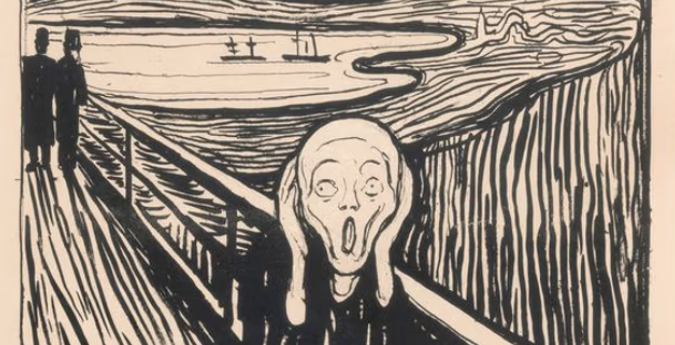
*As my Featured Image for this post, I used the painting The Scream by Edvard Munch (1895). He said about the piece that it felt like a “scream through nature,” and the painting features a distorted figure covering its ears, reacting to, rather than making, a sound.

3. Verdun from Dragon Dawn Productions

Verdun is a card game that is focused on the famous siege of Verdun during World War I. As player’s hands dwindle down as they play 2 cards per round but only draw 1, players will also have to play cards that help the other side, timing it strategically to minimize their own casualties. The teams alternate being the Attacker, and each card played leads to more and more deaths. You are fighting over positive victory points from trying to win several positions through over the top attacks that are worth a set amount of VP but that are hidden from view until they are taken so you never know if you are going for the high VP area or the low ones until you blow the whistle to initiate the attack.

A game of Verdun lasts about 16 rounds as players start with 12 cards, which they then play in a series of 12 tricks. When you win the trick, you gain the VP for the position but the winner will lose their lowest valued cards while the loser will lose their highest value cards to the dead pile representing mounting casualties. Low cards have fewer skulls on them representing deaths while higher cards have more. So even in victory you will be accumulating negative VP’s and this is one of the key aspects of the game…managing those deaths! Just like the high command.

In the end, the player with the highest score will win and this number will be very low or can even be negative. In our play of the game, my French defeated Alexander’s Germans by a final score of 3 VP to -14 VP. What a great little trick taking game! The really interesting part about the late game is that your hand has dwindled to being full of your worst cards as you have most likely used the good cards earlier to win tricks or cause losses to your opponent. The last few card plays just seem brutal and you are just hoping to not have to take a lot of skulls. This felt very fruitless and mimics the despair of commanders as they had to issue orders that they knew were not going to result in any positive gains but only the loss of life.

The game is also gorgeous with fantastic original period art used on the cards and amazing graphical layout and design. The images are very gritty and involve the feelings of the battle and create a very thematic portal for the players to experience the difficulties in the battle. Just a very slick little thematic game.

Here is a link to our video review of the game:

2. Paths of Glory: The First World War, 1914-1918 from GMT Games

Paths of Glory is widely thought to be a masterpiece on WWI and after just a few plays of the game, both in person and online on the fabulous Rally the Troops!, I can definitely see why people feel that way. Even though we are novices, the game is just that good and really tells the story of the fruitless efforts of both the Entente and Central Powers as they bashed their heads against each other over control of Europe. The game is long and you generally are going to have to play this one over a long weekend to get it all in and enjoy it properly but it is just such as great tool to understand the complexities of the struggles of trench warfare, supply and the balance of attacking versus taking a breath and regrouping. I really enjoyed the mix of historical events and the choices that I had to wage the war in a way that I felt was appropriate. But, my message to everyone who plays this game is beware of supply. Even in our few plays, supply has been an issue and we have had to make sure we didn’t make a few fatal mistakes that would get us in trouble. I want it to be clear here. I am not good at this game…at all and the nuances of supply and how to play have just eluded me as I continue to make the same errors game after game. But it is really good and I look forward to each new play with enthusiasm and am excited about the chance to get to learn more about this fascinating war that was so very fruitless.

With that being said, generally in every single game the Central Powers will start out by playing their Guns of August card. Guns of August is a crucial, high-stakes opening event for the Central Powers on Turn 1, enabling an immediate, powerful and historical offensive against France and Belgium. It kicks off the continual back and forth of trench warfare and frankly seems to never really generate a good outcome. Each attack is bloody, with both sides being brutalized by having to reduce units and the trenches make attacking more and more difficult as they evolve and grow to Level 2. Paths of Glory in a large part is about resource management and the constant pressure to continue offensive momentum and rebuild troops through the use of Replacement Points and events to bring on additional troops is a major problem for both sides. You can only attack for so long before you will burn yourself out and will have to spend time to recover and get ready for the next turn’s offensives. This process of back and forth will ultimately rarely see fruits on the Western Front and will devolve into stalemate as each side strengthens their defense and the Entente begin to bring in reinforcements from England to shore up the lines and nullify the early German advantage. But the real despair in this game are the decisions about how to play your cards. You can use them for their Ops Points to fuel attacks and movement on the board, use them for the printed event or play them for the Reinforcement Points located at the bottom of the card. This is the real key to the game and managing this process of maneuver, attack, shoring up defenses, buying replacement points and protecting supply lines is where the players lose their minds. You simply cannot continue a full out frontal assault round after round. If you do, you will grind your men to dust and dig their own graves as you will be unable to prepare for the next turn. This is a long game and this process wears on turn after turn and the first person that makes a mistake typically is the one that loses.

Here is a link to our initial impressions video of the game:

1. The Grizzled from CMON Games

The Grizzled is a special game. Not a big game. Not a complex game. And not a game for every one as it is different, focused on the friendship and bonds of a group of French soldiers caught in the trenches of World War I. The game is a cooperative card game set during The Great War, also known as “the war that no one in the U.S. really understands because we only ever learn about World War II”. Ironically, playing The Grizzled is somewhat of a rather peaceful affair, but our plays have found it to be quite challenging, sometimes unwinnable in fact, and that is where the despair comes in. No matter how well you play the cards you are dealt and no matter how hard you work together to overcome challenges, failure is a part of the game and winning is truly at a premium.

The cards represent threats to all of the men’s safety or a hard knock which impacts the player or their compatriots in some way. The goal of the game is to play through all of the Trials cards to find peace (literally a Peace card). A standard game starts with 25 Trial cards on the peace deck and the remaining 34 Trial cards are placed in a separate morale deck (a draw pile). Cards move from the Morale deck to the Trial deck at the end of a mission. The Morale deck sits on a card picturing a monument commemorating the sacrifices made in war. But if you ever see this Monument card, you’ve lost the game.

The goal of each mission is the same to play as many cards as you can before withdrawing from battle. Cards are played in one of two ways; placing a threat in No Man’s Land or placing a hard knock card next to your soldier. Every time you play a card, the group is one step closer to victory, but if there are ever 3 of the same threats showing on the table at any one time, the mission is lost but the game will continue.

Beyond playing a card, there are 2 other actions but they are rarely available. On each player’s character there is a Lucky Charm showing one of the 6 threats in the game. Playing the Lucky Charm as an action allows that player to remove a matching threat from No Man’s Land, making the mission a bit easier to continue. After you use your Lucky charm you flip your character card over and no longer have access to that action. The other action is to make a speech. There are a very limited number of Speech Tokens in the game – the mission leader will receive one after each mission until all the tokens have been distributed. When giving a speech as an action, you have to have the token and you have to choose one of the 6 threats. The OTHER players still active in the mission then remove ONE card from their hand that matches the declared threat. These can be useful but are not guaranteed to have an impact. Once played, a speech token is removed from the game. But, one of my favorite mechanic is when you withdraw and add a support token to your character. The token is, very thematically a cup of coffee. When the round ends, you will pass this coffee to a teammate as support. The teammate that gets the most support at the end of the round can remove two hard-knocks or recover their lucky charm.

While we love the game, and I find it to be supremely interesting, we have never won in over 20 plays. We simply seem to run the same course over and over again and never seem to gain much ground. And I really think that this is the point of the game. And where the despair comes into play. One of the other things that I love about the game is the tag line that appears on the front cover. It reads: Can friendship be stronger than war? This statement gives some pause and causes a lot of discussion in our group particularly with the concepts of the exhaustion of characters (using their Lucky Charm and turning them over), the speeches (removing a threat from the battlefield that you cannot get rid of because no one has the matching cards) and the cups of coffee (support). As if a cup of coffee can overcome anything…but you can always give it a go.

Now there are many games that could be included on this list but the games I have chosen perfectly evoke the level of despair that I was going for in this piece. I have played many other games that convey despair but feel that these 3 best demonstrate the level of hopelessness that I was thinking of. What are your favorite games that evoke despair?

-Grant
La Der des Ders – The War to End War from Hexasim – Action Point 3

Von: Grant
26. Februar 2026 um 14:00

La Der des Ders – The War to End War from Hexasim is a 1-2 player slightly abstracted strategic level look at World War I. The game allows the players to relive the First World War at a strategic level, with each player controlling one of the 2 sides either the Entente, consisting of France, England, Russia, Serbia and other minor nations or the Central Powers including Germany, Austria-Hungary, the Ottoman Empire and a few minors. La Der des Ders can also be played solo, with a dedicated solitaire bot called “Athena” who utilizes special Cornflower Cards to make decisions about what technologies to invest in, where to undertake offensives and how to utilize limited resources and reinforcements. Each turn, players gain an amount of Resource Points dependent on what nations are in the war, which they can allocate to different areas to guide their overall strategy. Victory is achieved by launching offensives that drain the morale of enemy nations, forcing them out of the conflict through collapse.

In Action Point 1, we looked at the Game Board, discussing the Collapse Tracks, Trade Tracks, Russian Revolution Track and Naval Control Table and other various on-board tables and offensive spaces. In Action Point 2, we covered the Technology Phase and the Technology Tree and Technological Improvement Boards. In this Action Point, we will take a look at the Event Cards and how they inject the historical narrative into the gameplay and also alter the conditions of the game.

Event Cards

La Der des Ders has used the vehicle of Event Cards to inject the historical events and happenings of World War I into the game. This choice makes a lot of sense and plays into some of the game’s mechanics such as the Air Raid Technology that we discussed in the last post. At the outset of each turn, the players will be instructed to draw 3 Event Cards from the Event Deck. These are the 3 cards that will be in effect for this portion of the year as each of the years are divided into 3 separate turns representing roughly 4 months, with the exception of 1914 which represents the period of August through end of December that year. At setup, the player will divide the Event Cards by year to make 5 piles (1914, 1915, 1916, 1917 and 1918). Then they will take the 1914 Deck, shuffle it and
place it on the game board, in its dedicated box. Place the other decks on the right of the game board, near their
respective boxes on the Turn Track.

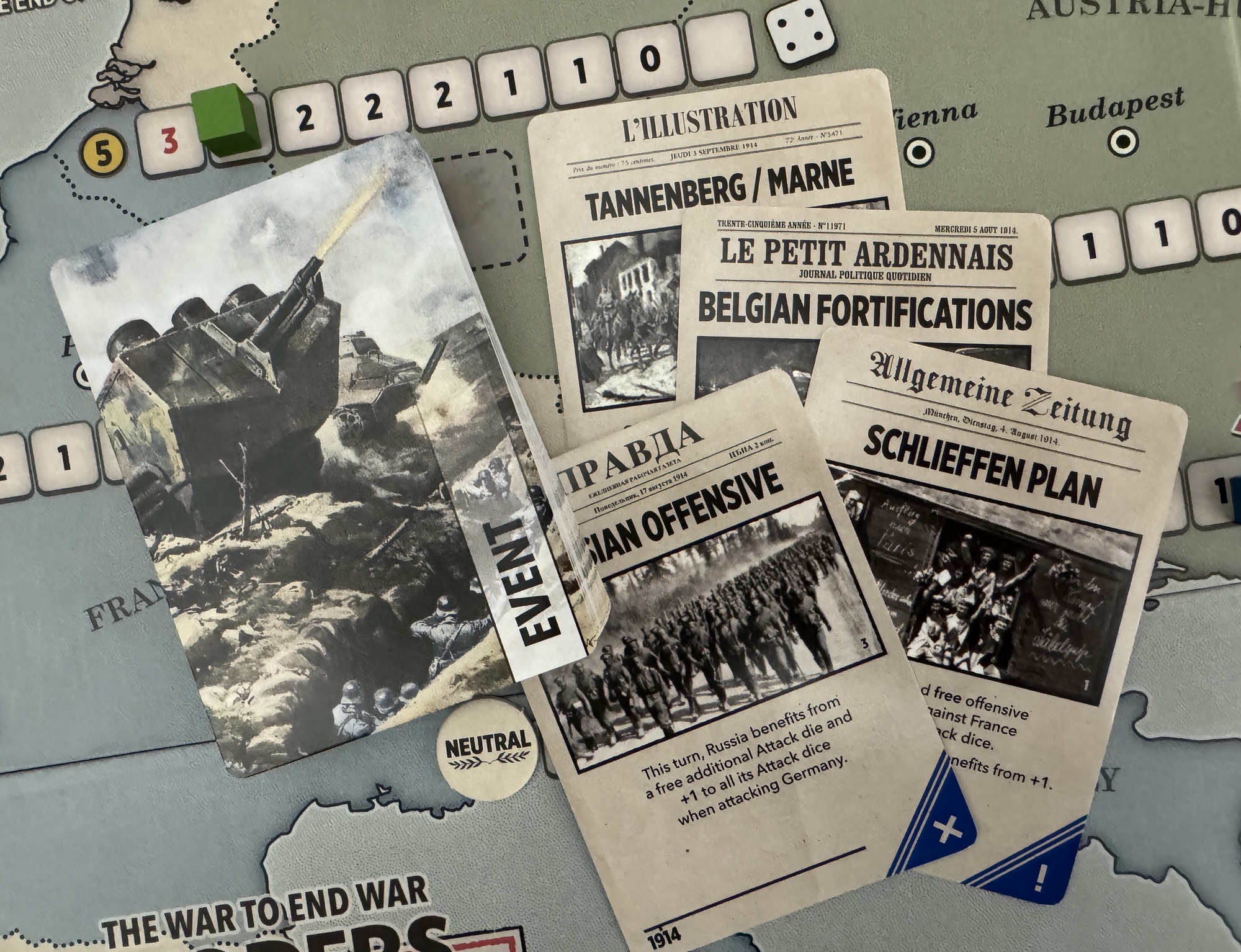
The 4 Event Cards for 1914.

Some of the Events are applied immediately when drawn, while others take effect later in the turn. This is all typically based upon the color of the symbols found on the cards in the bottom right hand corner and the symbol that coincides with a specific phase, such as the Resource Phase or Offensives Phase. In the picture below, you can see different examples of these cards and their color and symbols. These are Event Cards from 1914 on the left all the way through 1918. Also, some of the Events are only applicable in 1914. These Events will be marked with a blue corner. In the picture above you can see the 4 different 1914 Event Cards and their blue corners. Some Events have effects that apply until the end of the game, while others until they are cancelled. The text found on the cards is generally self-explanatory and I only found maybe 1 instance where I had to really think over what the card was trying to tell me to do. If you need additional information about the meaning of the cards and to find a bit of clarity, you can refer to the Events List in the rule book for more information.

Blue corners mean that the effect is no longer applicable after the year 1914. Red corners mean that this card can never be cancelled by using the Air Raid Technology. I found that this was the thing that I missed the most in my plays. Green corners mean this card may be cancelled with the Air Raid Technology but only under certain
conditions. Most of the Event Cards do things like allow for additional Offensives that turn at no cost, add a +1 DRM to Offensive rolls, or make Offensives cause more losses (but at a cost as that Offensive will cause you to lose troops as well) and the like. They are not game breaking but do inject some very interesting bonuses into the mix that will cause you to think about your plan for the use of of your Resource Points for that turn.

One final thing that I want to point out about some of the Event Cards. Some of the Events will instruct the player to place out a marker onto the board. On the board, there are several dashed boxes with small white numbers printed in them in specific locations. These are the Event Boxes and act as a reminder of the effects of various Event Cards when they are pulled. When Event Cards happen, some will provide the players with a counter that should be placed in these boxes to remind them of the effects of the historical events. These act as an mnemonic device and are very helpful.

These include the introduction of specific characters from history, special Events that occurred that changed the course of the war or had an effect on countries and their allegiance or that simply allow one of the many minor nations on the board, such as Italy, Romania, Bulgaria and Greece, to join either the Entente or the Central Powers. Here is a list of those special Events:

•  #6 – Von Lettow in Africa
• #10 – The Lusitania Torpedoed
• #15 – Major German Defeat (Battle of Jutland)
• #16 – Wilson Intervenes!
• #23 – Unrestricted Submarine Warfare
• #24 – Zimmermann Telegram
• #35 – Unified Command
• #36 – Louis Franchet d’Espèrey
• #41 – Pariser Kanonen

I mentioned the characters that are introduced by Event Cards and one of my favorite is the Von Lettow in Africa Event Card. This card refers to Paul von Lettow-Vorbeck who was a German General who commanded the Schutztruppe (colonial forces) in East Africa. Leading a small force of 3,000 Germans and 11,000 African Askari, he fought a brilliant guerrilla campaign against superior Allied forces (up to 300,000 men), never losing a battle and surrendering only after the 1918 armistice. The effects of this Event are that any Offensives by the Central Powers undertaken in Africa will not cost any Resource Points. This card will not appear until 1915 but can be a real boon to the CP player as they can continue hammering on the African Entente trying to get them to Collapse and no longer contribute their Production Value to the Entente war effort.

One of the major events that are covered by the Event Cards include the likes of the sinking of the Lusitania by the German U-Boats. On May 7, 1915, a German U-Boat torpedoed and sank the British ocean liner RMS Lusitania off the Irish coast. The ship sank in just 18–20 minutes, killing 1,198 of the 1,959 people on board, including 128 Americans. The attack spurred international outrage and shifted U.S. public opinion against Germany, contributing to the eventual American entry into the war. The effects of the is card include the placement of the Lafayette Marker above the Merchant Navy Track and indicates the number of additional Resource Points awarded to the Entente for the current turn. This support was basically from the United States of America as their citizens were killed in the tragedy and can be a very tough pill to swallow for the Central Powers as it is a death knell due to additional resources to bring more troops and focus more attention on Technology and the launching of Offensives.

The Event Cards are a key part of the game and really make it different from play to play as events might come out in a different order giving the player new opportunities to exploit or new dilemmas to plan for and deal with.

In Action Point 4, we will go through an example of an Offensive and take a closer look at the combat procedure.

-Grant

My Favorite Wargame Cards – A Look at Individual Cards from My Favorite Games – Card #64: Guns of August from Paths of Glory: The First World War, 1914-1918 from GMT Games

Von: Grant
03. Februar 2026 um 14:00

With this My Favorite Wargame Cards Series, I hope to take a look at a specific card from the various wargames that I have played and share how it is used in the game. I am not a strategist and frankly I am not that good at games but I do understand how things should work and be used in games. With that being said, here is the next entry in this series.

#64: Guns of August from Paths of Glory: The First World War, 1914-1918 from GMT Games

Paths of Glory is widely thought to be a masterpiece on WWI and after just a few plays of the game, both in person and online on the fabulous Rally the Troops!, I can definitely see why people feel that way. Even though we are novices, the game is just that good and really tells the story of the fruitless efforts of both the Entente and Central Powers as they bashed their heads against each other over control of Europe. The game is long and you generally are going to have to play this one over a long weekend to get it all in and enjoy it properly but it is just such as great tool to understand the complexities of the struggles of trench warfare, supply and the balance of attacking versus taking a breath and regrouping. I really enjoyed the mix of historical events and the choices that I had to wage the war in a way that I felt was appropriate. But, my message to everyone who plays this game is beware of supply. Even in our few plays, supply has been an issue and we have had to make sure we didn’t make a few fatal mistakes that would get us in trouble. I want it to be clear here. I am not good at this game…at all and the nuances of supply and how to play have just eluded me as I continue to make the same errors game after game. But it is really good and I look forward to each new play with enthusiasm and am excited about the chance to get to learn more about this fascinating war that was so very fruitless.

I am going to use snips of the board from Rally the Troops! in this post so it might look a bit different from my normal posts.

With that being said, generally in every single game the Central Powers will start out by playing their Guns of August card. Guns of August is a crucial, high-stakes opening event for the Central Powers on Turn 1, enabling an immediate, powerful, and historical offensive against France and Belgium.

The Guns of August is a 3/4 OPs card that is placed into the CP player’s hand at the outset and gives them the initiative immediately. First off, the card destroys the fortress at Liège and then gives a massive mobilization effort booster by moving 2 German Army counters from their starting spaces including the German 1st and 2nd Armies and then activating them both to attack along with the German 3rd Army who is located at the start of the game setup in Koblenz.

This gives the CP player 2 choices about how to start the war with this attack. They can focus on the British Expeditionary Force located in Brussels or the French 5th Army located in Sedan. The allows the CP to destroy the Liège fortress, advance armies, and immediately attack or pressure the British Expeditionary Force (BEF) and French forces. In my humble opinion, the BEF is the real target here as this unit cannot be replaced or rebuilt and its removal opens up the path for the Germans to take on the fortress at Antwerp.

While the Guns of August card play is an aggressive move, it does somewhat ensure Austria-Hungary can survive potential Russian pressure as the Allied player will have to quickly use their precious resources to fill the gaps created by this opening attack rather than using them to bolster the Russians in the east or to build up the Serbians a bit in the south to prolong the fall of Belgrade. Paths of Glory is a large part about resource management and the constant pressure to continue offensive momentum and rebuild troops through the use of Replacement Points and events to bring on additional troops is a major problem for both sides. You can only attack for so long before you will burn yourself out and will have to spend time to recover and get ready for the next turn’s offensives. Using the Guns of August cards efficiency will free up resources to use elsewhere.

There are alternative openings with the card that can be considered. If not using Guns of August for the event, the CP player can use 1 OP to destroy the Liège fort, allowing them to conserve the card for later or pivot to a more defensive strategy, such as defending the Rhine.

In the end, I would recommend the hammer approach versus any other use of the card as it will really put the pressure squarely on the Allies to do something about what you have just accomplished. In the picture to the right is the normal outcome of these attacks as you can see the BEF is reduced and the French 5th Army has broken and is now replaced by a smaller Corps counter that cannot really do anything offensively and is just there to protect the back side of the Maginot Line from being caught out of supply.

The Guns of August (published in the UK as August 1914) is a 1962 book centered on the first month of World War I written by Barbara W. Tuchman. After introductory chapters, Tuchman describes in great detail the opening events of the conflict. The book’s focus then becomes a military history of the contestants, chiefly the great powers.

The Guns of August provides a narrative of the earliest stages of World War I, from the decisions to go to war up until the start of the Franco-British offensive that stopped the German advance into France. This led to four years of trench warfare. The book discusses military plans, strategies, world events, and international sentiments before and during the war.

The book was awarded the Pulitzer Prize for General Nonfiction for publication year 1963, and proved very popular. Tuchman later returned to the subject of the social attitudes and issues that existed before World War I in a collection of eight essays published in 1966 as The Proud Tower: A Portrait of the World Before the War, 1890–1914.

In the next entry in this series, we will take a look at Georgi Zhukov from Churchill: Big 3 Struggle for Peace from GMT Games.

-Grant

Best 3 Games with…Designer R. Ben Madison!

Von: Grant
14. Januar 2026 um 14:00

I have really enjoyed my plays of several games designed by R. Ben Madison. He has a knack for including elements of the history into the gameplay while placing the historical events into the framework of his chosen system, which is usually the States of Siege Series…but not always. He has designed 24 games to date, with most of those being solitaire games, dealing with all types of history including the American Revolutionary War, World War I, World War II, the American Civil War, Ancient Egypt, the pre-Columbian Indian “mound builder” cultures that dominated eastern North America, the Falklands, Napoleonic Wars and many, many more and I frankly have never played one of his that I didn’t like.

A few years ago, I did a video showcasing many of Ben’s games on our YouTube Channel and you can check that out at the following link:

In this entry in the Best 3 Games with…Series, we will take a look at some of favorites games by Ben.

3. Jeff Davis: The Confederacy at War from White Dog Games

I love a really hard and involved solitaire wargame and I found a really good one in Jeff Davis: The Confederacy at War. The player takes on the role of President of the Confederacy Jefferson Davis, and you have to manage the Confederate government and the Southern war effort during the American Civil War. The choices help determine the fate of armies and the struggle between Robert E. Lee and Ulysses S. Grant. The game uses the States of Siege Series model with a central point being defended from advancing forces on 5 different tracks.

One of the more interesting design choices in this one was the inclusion of slaves held by the South. Their focus in the game is as a resource to advance and assist the war effort through their labor. These human resources are used to take extra actions for the Confederate States of America, as the noose of the Union closes around them, they will be starved for Action Points as their factories and railroads are taken over by the advancing Federal Troops. I truly appreciate this focus in the game to give a glimpse into the political and social issues that contributed to the start of the American Civil War. I think that all too often our wargames sanitize and whitewash history of all of the darker and less desirable aspects but I think that including this element into the game was a wise choice by the designer.

The game also uses a very interesting method of determining your per turn funds as you have to run blockades against the Union to get funds to supply armies, move your troops and invest in actions to build defenses. You can also use the Slave tokens as a sort of currency to take actions but then those tokens are used up and cannot be reused. I have really enjoyed this one although it is a full 3 hour game as you have to get through 40+ chits to survive to the end. Lots of tough choices, lots of interesting side issues, such as dealing with slaves in the southern economy and keeping politicians happy. This is a great solo game!

You can check out our unboxing video to get a good look at the components:

2. Mound Builders from Victory Point Games

Mound Builders from Victory Point Games is a solitaire States of Siege game that to me has a very intriguing theme that hasn’t been gamed very often and really caught my eye. In Mound Builders, you represent the two largest pre-Columbian Indian “mound builder” cultures that dominated eastern North America from before the time of Christ until the coming of the European colonists in the 17th century. Your empire represents the earlier Hopewell culture and the later Mississippian culture that derived from it.

The game plays in two distinct sections or modules. The first module deals with the Hopewell culture, which is the earlier of the two cultures in the game. During this phase of the game, your goal is to simply expand the influence of your empire across the land, trading with various chiefdoms and trying to incorporate their dominions into your own in order to increase your economic power through the accumulation of various types of resources. As time passes, your empire will grow and regress due to various factors including warfare, disease and drought, but more often than not, the real threat to your culture is simply that of the existence of other ways of life and beliefs that will ultimately mix with your own culture.

During the second phase of the game, you will be beset on all sides by competing tribes as well as the nasty Spaniards and will watch as the empire that you worked so hard to build during the Hopewell Era simply disappears from history. Each turn, a card will be drawn that tells you which of the 5 opposing cultures will move into your lands along a siege track. Sometimes only 1 will move but up to 3 can all move at once, and some can be moved more than once each turn. If you do not attack those cultures when they occupy one of your chiefdoms by the end of your turn and chase them off, your resource will be taken from you and you will no longer be able to produce or trade for that type of good, thereby weakening your economy. This States of Siege system is so very cool and has been replicated in may other additions to the series (such as Ottoman SunsetDawn of the Zeds and Hapsburg Eclipse but also has spawned, or at least inspired several other designers to create equally cool and interesting simulations (Pavlov’s House and Castle Itter). I have definitely reaped the benefits of this States of Siege Series and love me a good solo game with this cool mechanic.

This is a link to a video unboxing of the game showing off the great components but unfortunately we have never done any other videos on this game:

1. Kaiserkrieg! The Great War 1914-1918 from White Dog Games

Kaiserkrieg! is simply fantastic! A solitaire treatment of The Great War using the States of Siege Series model but with a change to a horizontal rather than vertical layout of spaces where enemy forces can build up and perform an “Over the Top” move if you don’t destroy their troops before then. The player takes the side of the Central Powers and must deal with events that replicate the history of the period and the tumult of various revolutions, threats and opportunities. Well done game by Ben Madison that uses chit pull to activate the enemies and cause events. Lots of chaos. Lots of tough choices. Lots of history. And it always seems to come down to the very end. The only draw back to the game though is that it is long, taking 2-3 hours to play through an entire game. Each chit drawn has lots of information and there are always lots of things to do each turn with your very limited actions.

One of my favorite parts is the use of Blockade Runners to gain your funds for the turn. During the Naval/Air Warfare Phase, the player will place out their available Blockade Runners on various seas zones numbered 1a, 1b, 2a, 2b, 2c, 3 and 4 in order to attempt to break Allied blockades and deliver goods and funds to Germany to fuel the war effort. Each of these numbered sea zones will provide a haul of Reichsmarks based on the number of the sea zone if they are able to evade the British Cruisers. This is determined by rolling 2d6 and consulting the British Cruisers Table to find out in what sea zones the available British Cruisers will be placed. If there is a Blockade Runner in the determined sea zone, it will be destroyed and placed in the Neutral Ports box where it will wait to be built later at a cost of 2 RM. If the rolled sea zone contains a Blockade Runner and the High Seas Fleet marker, the British Cruiser will be unable to destroy the Blockade Runner and a naval combat will ensue.

In the above picture, the Central Powers defeat the British Cruiser with the High Seas Fleet and the 3 Blockade Runners placed in seas zones 2b, 3 and 4 bring home a cash haul of 9 Reichsmarks that will be used to take actions and push back the amassing Entente forces in the various staging areas to avoid an Over the Top chit from being placed and prevent the built up forces there attacking into Germany. This process of gaining income is very interesting and unique and it really feels correct as you are trying to do your best to avoid and destroy the British Cruisers so that you have your choice of the best producing sea zones without the fear of Entente intervention.

You can check out our unboxing video to get a good look at the components:

Here is a link to my video review:

Well there you have my 3 favorite games from R. Ben Madison. There are so many good titles to choose from making this exercise very difficult but the 3 that I chose were very enjoyable to play. What are your favorite Ben Madison designs?

-Grant

❌