With this My Favorite Wargame Cards Series, I hope to take a look at a specific card from the various wargames that I have played and share how it is used in the game. I am not a strategist and frankly I am not that good at games but I do understand how things should work and be used in games. With that being said, here is the next entry in this series.
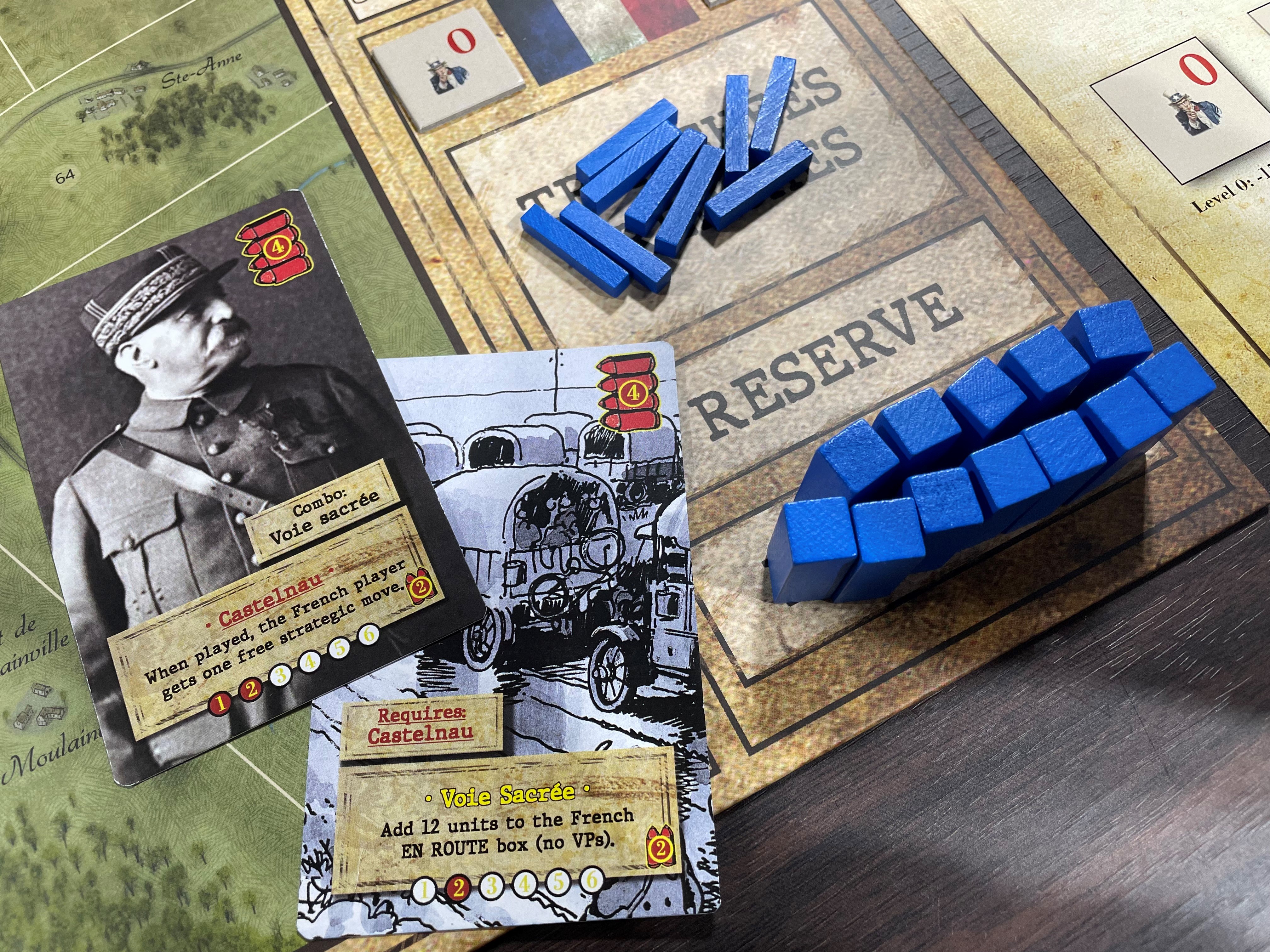
#92: Castelnau and Voie Sacrée from Verdun 1916: Steel Inferno from Fellowship of Simulations
Over the past several years, we have played quite a few World War I games with our focus on the Guns of August events every summer. We have really played some fantastic games including some of the true classics on the genre such as Paths of Glory from GMT Games and The Lamps are Going Out from Compass Games but also some real hidden gems like At All Costs from Hollandspiele, Devil Dogs from Worthington Publishing and Decisive Victory 1918: Soissons from Legion Wargames. A game that we very much liked was Verdun 1916: Steel Infernofrom Fellowship of Simulations. The game is a Card Driven Game that uses cards with events and operation points to tell the grim story of the year long fighting around the French city of Verdun. The game uses a bucket of dice approach to the initial bombardments in a battle and then players choose whether to follow that with an infantry assault that doesn’t use any dice to determine hits. The game is very much a wargame but I think the cover highlights a key fact about the game by calling it a “Strategy Game” namely that it is a game as there are wildly powerful events based in history, with lots of dependence on dice not just for bombardments but also for playing certain offensives Event Cards where Victory Points are earned based on the higher numbers rolled. The game is very well done, is truly interesting and surprisingly deep with its tactical choices and decisions.
Some cards cannot be played as an Event until a specific named card has been played by the player. This is indicated on the card with a small “requires” box above the title of the card which shows the card that must already be in play as a Permanent Event to allow the new event to be triggered. Also, these Required Cards also have a small “combo” box above the title of the card to remind players which card they will allow to be played as a Permanent Event. Sometimes this concept of Combos must be planned for and may take a few rounds to get lined up to be able to play.
A perfect example of this is the Castelnau/Voie Sacrée Combo. Castelnau is an Event Card that must be played down on the table as a Permanent Event and is available during Turns 1 and 2. Once it is played, then that unlocks the play of Voie Sacrée and allows a very powerful Combo to go into effect by allowing the French player to place 12 units into the En Route Box on the board meaning they will be available for placement during the next Turn. This is so very powerful as in order to get that many units to use, the French player has to sacrifice a total of 12 VP (1 VP per unit added as Reinforcements). With this Combo, you sacrifice no VP’s and get 12 units to place on the board to plug the inevitable holes that will be created by the powerful German Barrages and assaults. There are other Combos as well including several specified Offensives (Russian Offensives and the Somme Offensive) that take several Turns to accomplish with multiple cards to get an opportunity to roll dice to gain VP’s. This was a very novel idea for the CDG mechanic and really worked well to create some portion of the game that required planning and an investment.
The Voie Sacrée, which is French for Sacred Way or Sacred Road, is a road that connects Bar-le-Duc to Verdun, France. It was given its name because of the vital role it played during the Battle of Verdun in World War I. After March 1916, along the 45 miles of the Voie Sacrée, transport vehicles were on the move day and night, ferrying troops, armaments, and supplies to the Verdun battlefield. During the initial crisis of February 21st through March 22nd, 600 trucks per day had already delivered 48,000 tons of ammunition, 6,400 tons of other materiel and 263,000 men to the battlefield. Beginning on February 21st, all horse-drawn traffic and troop movements on foot had been ordered off the road, leaving it open for truck and motorcar traffic only. After March 1916, one truck passed every 14 seconds, submitting the road to considerable wear and tear. Quarries had to be opened nearby to supply the road with crushed stone. Over the course of ten months, 16 labour battalions worked to keep the road in good shape and order. The road had been recognised since 1915 as the only reliable vehicular road that remained in existence to supply Verdun safely. All the standard-gauge railway lines that could reach Verdun had already been interrupted by German forces in late 1914. To compensate for this precarious situation, the road had been widened to 23 ft during 1915, so it could accommodate the continuous up and down flow of two lines of truck traffic. This preemptive roadway improvement in 1915, plus success in organizing the transport system on the road (a mission supervised by Colonel Maurice de Barescut, the Chief of Staff of the French Second Army), is what ultimately saved Verdun in 1916.
The Voie Sacrée still exists, but it has been paved over and is now an active secondary road. In 2006, the route was renumbered RD1916, a reference to the road’s most critical year. From 1923, the Voie Sacrée was marked by a borne every kilometer along the route. Each borne is topped with a sculpture of an Adrian helmet, the helmet worn by French soldiers during the Battle of Verdun.
The town hall in the village of Souilly, on the Voie Sacrée, served as headquarters to Generals Philippe Pétain and Robert Nivelle during the Battle of Verdun. A large, well-preserved, two-story stone building fronting on the Voie Sacrée, the Souilly town hall is still in official use today. Several plaques on its facade remind the visitor of the historic role it played in 1916 during the Battle of Verdun and, later in 1918, during the Meuse–Argonne offensive.
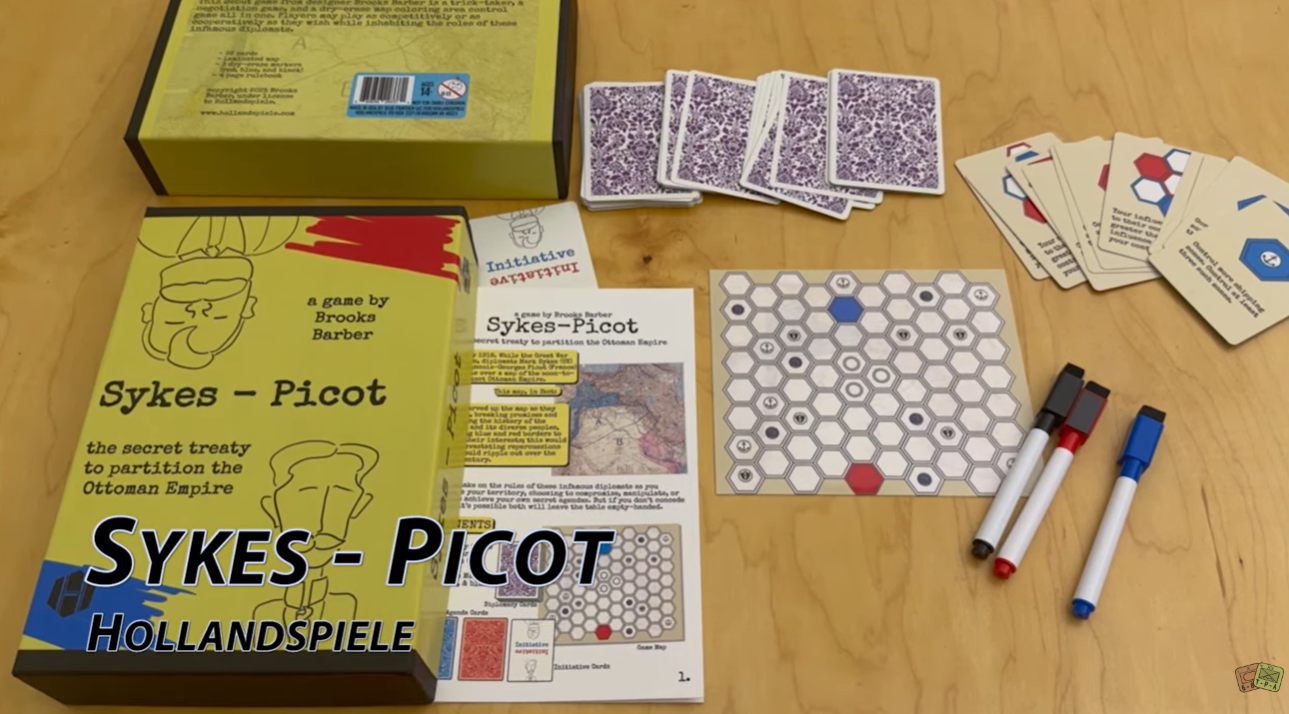
During the First World War, the British and French made a secret agreement to carve up the Ottoman Empire – literally drawing on a map in red and blue ink – without respect to the peoples, culture, or history of the region. This would have devastating effects over the next century.
In Sykes-Picot, two players take on the roles of infamous diplomats Mark Sykes and Francois Georges-Picot, using red and blue markers to carve out territories to control and to influence on a dry-erase map. Trick-taking card play and table-talk negotiations drive the proceedings, with the winner of each trick choosing one of the two cards to implement, and the loser consoling themselves with the remaining card. Each player has a set of hidden objectives they’re trying to achieve. Players may be as co-operative or as competitive as they wish in pursuit of these goals.
Tonally, the game is light, reflecting the distance and cavalier attitude of these imperialist powers. We feel there’s something horrifying in that, and this approach captures some of that horror.
I think that every single wargamer knows the name Volko Ruhnke. He has designed several great series in the COIN Series, that has now stretched to a full 15 volumes, and then more recently Levy & Campaign Series, which has an astounding 5 released volumes with several others that are announced and about a dozen more in design. He can make a good game for sure! One of our first experiences in wargaming and the first Volko design we played was Wilderness War. He is now at it again with a new design in a continuing newer series called the Recon Series that uses hide and seek elements and hidden blocks to tell the story of the Allied intelligence efforts during World War I during the campaigns around Verdun in 1916. The game is called Drachen: Reconnaissance at Verdun, 1916 and looks to be very interesting and we reached out to Volko to get a look into the design.
Grant: Volko welcome back to the blog. What is your new upcoming game Drachen about?
Volko: Hi Grant & Alex! Thank you for this opportunity. I love what you guys do.
Drachen continues my new Recon Series, following on to the series’ recently released first volume, Coast Watchers. Volume II – Drachen – is about the struggle for reconnaissance information in a World War I trench battles, specifically, Verdun in 1916.
Grant: What does the title mean and why did you want to use it for this game?
Volko: “Drachen” means “kite” in German and is simply short for “Drachenballon” – kite balloon. The tethered observation balloons famous as targets for balloon-busting fighter aeroplane missions were really the queens of the battlefield in their ability to see what the enemy was up to and guide artillery fire onto enemy targets. They were in effect hydrogen filled kites in that they faced into the wind for stability. On a clear day, even a windy one, a spotter with binoculars in a kite balloon could provide information on enemy movements and positions up to 15 miles away. Tethered to the ground, unlike observer aeroplanes with either no radio or early transmitters only, balloons had instant and secure communications with friendly headquarters or batteries to coordinate fire.
Grant: This is Volume II in the Recon Series. Why does this subject fit your vision for the series?
Volko: I’m looking for the Series to visit settings in which secrets and their discovery really mattered to the outcome of a conflict. The advent of trench warfare on the Western Front was a remarkable moment in land battle because the age-old means of reconnaissance – the horseman – could no longer roam. For the first time, you would know nothing of the enemy beyond the next ridge unless you got up in the air. We gamers have tended to focus on ace-versus-ace duels in the sky. I wanted to explore what all the dogfighting was really about: winning the right to peer down upon your enemy.
Grant: How has your experience with series games assisted you in the development of this Recon Series?
Volko: OK, that’s a big question! I do try to learn, and I have developed some principles for series design:
1) Openness – Make room for other designers to take the series where you never imagined.
2) Complexity – Bigger is not always better. I wrote about this in depth in C3i Nr29.
3) Variety – Make it familiar, not samey. I wrote about that in C3i Nr30.
Regarding variety within a series, it helps to articulate a focus to guide selection of topics, what you keep the same, and what you vary for each setting.
For the COIN Series, that was the premise that counterinsurgency and other popular conflicts were multifactional, that factional relations were key.
For Levy & Campaign, it was that medieval warfare was equally complex as modern but in distinct ways, especially regarding command and logistics.
For the Recon Series, then, it is that secret information – which side protects it or discovers it better – can decide the outcome, at least for certain conflicts.
That said, for me, principle 1) above trumps the other two. Other designers certainly have taken COIN and Levy & Campaign to places beyond my original intent. I hope the same for the Recon Series.
Regarding “bigger is not better” for Drachen in particular, that meant being sure that Volume II did not just add subsystems like more ornaments on a Christmas tree. Rather, I try to drop something unneeded out for every new thing added in. For example, Drachen gets much deeper into resolution of combat than does Coast Watchers, but then Drachen has a much simpler resolution of who won the struggle: just most of 3 Objective cards fulfilled, rather than Volume I’s “victory point salad”.
To keep Drachen “familiar but not samey”, we keep not only the location blocks and open versus secret spotting but also two chit cups for resolution, for example. Where Coast Watchers has Delivery and Patrol cups, Drachen features Air and Group cups to resolve clashes in…well, you can guess where for each.
Grant: What did you need to make sure to model from aerial reconnaissance in WWI?
Volko: The key historical dynamics that I was able to find and felt were important to incorporate in the game include:
The main purpose of fighter aeroplane engagements as clearing the way for friendly observers and countering enemy observers.
The difference between just spotting something and being able to loiter long enough to cooperate with guns or take photos.
Which observation activity would be known to the enemy and which would be secret.
The importance of attrition in aircraft to observation dominance.
Grant: What sources did you consult to get the historical details correct? What one must-read source would you recommend?
Volko: I scarfed up all I could about Great War trench warfare in general, including the nature and use of observation balloons, how aeroplanes cooperated with artillery, the purposes of trench raids, and so on. Naturally, I particularly dug into how things worked in the Battle of Verdun, which was a great learning laboratory for both sides.
My two key secondary sources were The First Air Campaign by Eric and Jane Lawson, which discusses the evolution of air power in World War I and the special juncture that Verdun was in its development, and Alistaire Horne’s The Price of Glory, still for me the best of the several English-language works on the iconic battle.
Grant: What is your overall design goal and thesis with Drachen?
Volko: The design goal is to take apart how reconnaissance worked in trench battles, with the premise that winning the reconnaissance struggle set up the possibility of winning the kinetic part, the fire and assault.
Grant: Why do you feel that blocks and chit pull are the best ways to tell this story?
Volko: Blocks are an age-old but powerful way to manage secret information on the tabletop, without writing or referees. The Recon Series uses blocks in a new way: not as units that the opponent can see massing and moving across the map but as location information about which you start out seeing nothing and have to act to gain any knowledge of.
Chit pull gives me as designer an ability unparalleled by dice to subtly manipulate probabilities – and to give the players abilities to influence those probabilities – in a relatively simple and inexpensively produced way.
Grant: What other mediums did you consider or explore?
Volko: One question was whether to use “record” markers for players to log what they find. The Japanese player in Coast Watchers has such markers on the board as reminders of what is known of Allied blocks that have stood up hidden again.
In Drachen, there is even more to keep track of: various sizes and types of units and fortifications. And some of what players spot they do so secretly. So Drachen provides a record sheet reproducing the battlefield in miniature, but with room to take notes, plus screens to hide that record, if players want to use them. I considered providing record markers to place on the sheet, but the variety of items to spot mean that it would have been a mess, a big pile of counters to sort through – not worth it when a pencil works fine!
Grant: What different units are available to the players?
Volko: Here is a look at the blocks and counters, including the units represented. By the way, no real art exists yet – these are just my homemade prototypes.…
The standup blocks represent the guns, soldiers, fortifications, and depots that fight out the duels between gun batteries and the offensive’s barrage and assault. They build up hidden and are the targets for enemy observation missions. Positioning your hidden blocks will be critical both to make them harder to spot and to get the best use out of them in your plan for combat.
The counters represent those forces carrying out or supporting reconnaissance. They build up openly on the battlefield, except for anti-aircraft emplacements that may be AA sections or just harmless trucks. (Other counters here are markers that support various missions and actions.)
Grant: What is the role of Depots?
Volko: Depot blocks – if they survive unsuppressed – during the offensive resupply guns to fire again or fire at double strength. If the attacker exploits an advance, the depots refill and can again supply guns.
Grant: What are the All Quiet blocks and what do they represent from history?
Volko: “All Quiet” blocks (also nicknamed “trees”) represent just the usual presence of defenses at a side’s positions. So they do not mean empty, rather nothing special to see and shoot at. There are some troops garrisoning the line in what are probably battered trench works, perhaps some wire or field guns. If attacked, at least a few machineguns hidden there will answer.
Grant: What different air assets are available to players?
Volko: The workhouse in the air is the “Air Patrol” – either single or group, the latter more effective but uses up more airframes. Each player has a supply of Air Patrols at their aerodromes (on their mat) and sends them on specific fighter and observer missions or puts them into the Air Cup to add generally to the density of friendly aircraft prowling and protecting the skies over Verdun. Air Patrols suffer loss in action, so you can run out if you don’t manage the air battle carefully, potentially requiring you to recall counters from the cup or the map.
Of course we have balloons too, aloft over friendly positions behind the front line. Enemy balloon-busting fighter missions can destroy them or, more commonly, force them to lower. As noted above, these Drachen are highly effective observers, in the game reaching out to a distance of 4 positions, spotting secretly – you won’t know where your opponent’s balloons are looking unless they range guns in on your blocks – and unlike aeroplane observers automatically succeed in spotting their targets.
On the ground but protecting your balloons and blocks against enemy Air Patrols, you get antiaircraft emplacements – “AA Sections” or dummy “Trucks”. These will make any enemy air missions at or adjacent to them more dangerous. They also occasionally can cause a loss among your own nearby defensive air patrols, representing friendly fire.
The counters for Balloons and AA Emplacements are round to signify that these units can built up, adjusted, and used for free – whereas use of Air Patrols and trench raiders cost actions.
Grant: How are the serial assets used to perform recon? How does this work?
Volko: As reconnaissance and the efforts of fighters to stop it are the focus of the sim, most Air Missions as well as Trench Raids use an articulated chit-pull procedure accounting for a wide range of circumstances.
On the Air Missions table, you can see that we account for the presence of the enemy’s defensive Patrols and AA, how deep behind enemy lines you are flying, whether you are using an Air Group, and how many enemy chits you are likely to draw.
Various Asset cards, like “Boelke & Immelmann”, can further affect these results.
Grant: Why do you feel this is so important to the game?
Volko: Most trench warfare games either focus on the assault by infantry and perhaps tanks or cover the air duels going on overhead. But before those assaults and the barrages supporting them kick off, there would have been a critical period in which the sides were struggling to figure out what the enemy was up to and where they were massed. And that is when most of those aerial dogfights would be going on. Drachen pulls all that together to try to illuminate just HOW reconnaissance got done and would then set the course of a “big push”.
Grant: What is the layout of the game board and the purpose of the different shaped fortifications?
Volko: The game board shows the battlefield of Verdun. Area spaces, called “positions”, each hold a single block hiding the forces or fortifications there.
Terrain is either Lowland, Hill, or Fort – the latter effectively on hills too but tougher to crack. Hills and Forts enable guns on them to shoot a little farther, are harder to take by infantry assault, and often are the very targets that the attacker is assigned to seize.
A road and rail network spans the battlefield. Its effect is to limit where depots can be built up.
Land and Meuse River segments separate the positions. Little wooden stick pieces will mark the front along these segments. Positions group into sectors, such as “Left French”, to guide setup and solo play.
A final feature of the map positions is that some are observation posts. They function much like balloons but with far more limited reach, and they can be suppressed by artillery fire.
Grant: What is the general Sequence of Play?
Volko: In each of between 2 and 4 turns total, each side first builds up forces (blocks and counters). Buildup limits are most lenient on Turn I, so players generally need to set a plan of attack or defense then and just adjust positioning on later turns. On Turn II and thereafter, revealed (face up) blocks hide again (stand back up) unless suppressed by enemy fire or under loitering air surveillance. On Turn III and IV – if the attacker has not yet launched an offensive – the defender receives reinforcement in the form of an added block.
The main part of the turn follows buildup, “Reconnaissance” activity by Fighters then Observers. That includes mounting defensive “Barrier Patrols” and offensive “Jagd” against enemy Air Patrols plus Balloon Busting, then Aerial Observation, Trench Raids, and spotting by Balloons and OPs.
After that, the sides will exchange “Directed Fire” by their guns onto previously “Ranged” targets. Or, on Turn II or later, the attacker can instead launch the offensive that will resolve the game.
Grant: How is victory achieved?
Volko: After the offensive, or after Turn IV in the rare case that the attacker never launches one, Victory depends on who has fulfilled more of their 3 drawn Objective Cards.
Grant: What are the purpose of the Attacker & Defender Objective Cards?
Volko: The simulation premise of the Objective Cards is that reconnaissance is trying not only to discover where the enemy is but what they are up to – what matters to them? Will the attack go for a breakthrough, or are they just trying to pin our forces in place and divert our attention from some other part of the front? Or even less, are they for now just trying to grind down our forces and soften up our fortifications? Is the defender set to hold everything at all cost? Or do they just want to bloody us as we advance?
A second set of questions concerns how big an enemy buildup we are dealing with. The Objective Cards give players more robust forces to carry out the more ambitious task. So that too is an essential element of information that reconnaissance is trying to gauge – what are we up against?
The Objective Cards provide a neat and easy way to set out that secret information. Through recon successes, such as finding out how your enemy’s fortifications or troops are deployed, you can discern what your opponent’s cards may be. And if you invest in trench raiding, your raiders might reveal one or more enemy Objectives for certain.
Grant: What are the various hidden objectives?
Volko: Attacker and Defender each draw 3 cards from up to 9 Objective Cards, most of which are unique tasks hidden from the opponent. Each card not only sets out a task to be achieved but also provides added blocks to that side’s “Reserves” and specifies a number of blocks that the player can build up on the map on Turn I.
One twist is that you don’t have to use a card’s specified forces for that task: the blocks just add to your total available.
A second twist is that particularly successful trench raids can obtain “Plans” that reveal your opponent’s Objective Cards to you: potentially highly useful, as you win not only by achieving your own Objectives but by impeding your enemy’s.
Grant: What different types of these cards are there?
Volko: There is a separate set each for Attacker and Defender. In sets of 3, they go from least to most ambitious/robust, for the Attacker, “Preparation”, “Push”, “All-Out Attack”; for the Defender, “Retrenchment”, “Attrition”, “They Shall Not Pass”. Different scenarios then might limit some of these sets for one or the other side to reflect that stage in the longer Battle of Verdun.
As you can see by the examples, the cards are specific as to their tasks and forces. Generally, the Attacker is either destroy certain defenses, mount strong attacks, or take key positions. The Defender generally is to hold key positions or destroy substantial attacking forces.
Grant: How do players go about accomplishing these?
Volko: A key premise of the game is that reconnaissance success unlocked success of an offensive push. So in the game, you won’t earn VP or whatever for how you run your reconnaissance effort. Rather, knowing what your enemy has where – and “Ranging” those targets for accurate fire by your gun – will set up the combat success that you will need to fulfill more of your own Objectives.
But you will need to add to that skillful positioning of your forces and fortifications to make use of the information that you gather, and then the right decisions when and where to uncover your guns to fire or send your infantry waves into assaults and counter-assaults.
So the game is about reconnaissance but also how that feeds into running trench war combat.
Grant: What challenges does each side face in their objectives?
Volko: Since fulfilling your Objectives flows from how you handle the entire Sequence of Play, they really distill all the game’s challenges. But specific challenges to do with the cards include that the easier tasks come with skinnier forces to fight with, and that you start out unaware of what your opponents Objectives are. That latter can be critical, as even decent performance against the goals in front of you may not be enough to win if your opponent does even better at their secret tasks.
Grant: How do offensives work?
Volko: When the Attacker decides to launch the Offensive, both sides first get to recover some of their suppressed positions. Then each side’s guns, Attacker first, can “Barrage” to suppress enemy positions without needing Ranging by observers, just using more shells. Then each side can “Bombard” Ranged targets to Suppress them more efficiently or destroy them outright (as in the earlier “Directed Fire” phase).
Then players place “Wave” markers to commit where infantry Assaults and counterattacks will occur. For the Attacker, these will attempt to take the defender’s frontline positions. Those get resolved rather simply, including a draw from the Ground cup to give at least some chance for a weaker attack or defense to succeed.
If any such Assault does succeed in taking ground, the attacker may “Exploit” – meaning one more round of Artillery and Infantry combat, usually to try to seize a 2nd-Line position.
Grant: How many players is the game designed for? Is there a solitaire mode?
Volko: Drachen is a 2-player game. A larger number of players, divided into 2 teams, has worked well at the many demos that I have done.
There is a solitaire mode that enables a solo player to take the Attacking side in all the scenarios, whether German or French. It uses instructions and scenario setups found in the Playbook, a “Defenses” display to guide hidden block buildup, and a deck of 18 “Army HQ” Cards to help run Defender actions.
Grant: What opportunities for deception and signaling are there?
Volko: Great question! A point of the Recon Series is to feature not only secret information but both open and secret collection of that information – in part to enhance such opportunities for deceptive signals.
In Drachen, you will have plenty of secret information about which to mislead your opponent. And, critically, you will have potentially or automatically open information that you can transit selectively in order to mislead. Some ideas…in the game, you can:
Put a few Soldiers to get spotted where you do not intend to assault, or fortifications that suggest Objectives that you did not draw.
Range targets that you cannot actually or do not intend to Bombard.
Deploy air defenses in areas that are unimportant to you.
And so on. Circumstances and your imaginings are the only limits!
Grant: What do you feel the game models well?
Volko: I am quite pleased with how the flow of the game models trench warfare’s set-piece buildups, the contest for control of the skies, the danger and importance of busting balloons and launching trench raids, the tit-for-tat artillery duels, including the danger of firing and exposing your batteries too soon, and more. In short, Drachen plays out on the table my mental model of WWI trench battles.
Grant: What are you most pleased about with the design?
Volko: The biggest thrill for me is that the design has held the interest of a talented corps of testers for many moons and many plays – and that it seems to get universally positive reactions at con demos. Ted Raicer has done wonders to bring out the fascinating aspects of the Great War, but even now trench battles don’t get the spotlight among us wargamers that I feel they warrant. And Verdun does not even have British or Americans (outside some volunteer fliers). So I’m proud that Drachen is adding to our hobby’s examination of WWI’s Western Front in between the famous mobile phases of 1914 and 1918.
Grant: What other designs are you contemplating or already working on in this series?
Volko: I already have a playable prototype for Volume III, and it even has seen some playtests. I call it Masher and it is set in Vietnam. Perhaps a topic for another visit here!
Thanks again for this opportunity to talk about the Recon Series!
I think that this new series, and this game particularly, look really interesting and I am all in on the subject matter and the approach. Also, the game offers 8 main scenarios and a solo learning situation spanning German and French offensives within the titanic 10-month Battle of Verdun. I did just receive my copy of Volume I in the Recon Series called Coast Watchers but have not had a change to get it to the table as of yet. I will rectify that sooner rather than later.
If you are interested in Drachen: Reconnaissance at Verdun, 1916, you can pre-order a copy for $79.00 from the GMT Games website at the following link: https://www.gmtgames.com/p-1162-drachen.aspx
I am nearing the end of my time here at WBC and I’m starting to get a bit sad. I have tomorrow but I will be leaving 1 day early on Saturday and just am not ready for it to be over. I have had a great time, played a lot of games, 13 by my count, and also seen old friends and made new ones. I have also done 6 videos but have had some technical difficulties with the camera as the batteries keep prematurely dying even though they have been fully charged. Bit I have made great memories and I am happy with that.
Today, we got in a full 6-player game of the excellent Imperial Elegy from VUCA Simulations. Imperial Elegy: The Road to the Great War 1850-1920 is a card driven game that blends diplomacy, warfare, and statecraft and feels a bit akin to games like Here I Stand and Virgin Queen from GMT Games. Grand scale sweeping epics that play multiplayers and take a day to play. Players play as 1 of 6 unique major powers in the game including Germany/Prussia, the United Kingdom, France, Austria-Hungary, Russia and the Ottoman Empire.
The game is somewhat of a sandbox style game as you have so many options and choices about what to do during the course of the game. Obviously, your faction has some direction about what you should be doing but really it is up the player to spend their resources how they will to accomplish their ultimate goals and score Victory Points. I truly love that aspect about this game and as we played we saw that sandbox and the asymmetry between the various factions. Particularly at the start, each country has some specific goals that they have drawn from the National Goals Deck that are a source of Victory Points, in fact a major source of Victory Points, and players will need to prioritize these cards and decide which ones to attempt to go after from the start. With only 7 turns, they will have to make progress on these National Goals if they have any hope of actually achieving them.
I have now played 3 times and very much like the grand scale of the game. It is a tad long, todays game took us about 11 hours to play, and I am starting to have concerns with the ability of France and Germany to team up and dominate the game and the Great War. I played as France today and did fairly well scoring 9 VP’s from my National Goals and doing really well in Africa and Asia with colonies as well as breaking into Mexico. I was getting 8 cards near the end of the game because I had done well in my colonial keys and my stability. This gave me lots of options with my cards and I also built up a sizeable army with 5 full Armies on the board and 5 reserve armies with 5 squadrons on the high seas and several naval bases in the east, Africa and the Mediterranean.
I think the game is a tad bit long. This is because players have at least 5-7 cards each and the Battles are very long and are their own little sideshow with a war budget and multiple movements and attacks allowed. I like the game. Love it in fact but am beginning to think it is just going to be hard to get to the table often. Here I Stand is similar in scope and scale and uses the same system but can be played in 6-9 hours versus 10-14 hours for IE.
In the end, France, Germany and the Ottomans were teamed in the Triple Entente while UK and Russia formed the Triple Alliance even though Austria and Italy were left out in the cold. The TE won the game as they just had too much muscle. I look forward to the next time I can play but it might be a while.
I was then able to watch a few minutes of play of the new upcoming Here I Stand Series game called TheNight Watch: European Global Conflicts 1618-1648 from GMT Games, which focuses on the Thirty Years War. Just a prototype of the game but it looks epic and those playing seemed to enjoy it!
I was able to then go down to the vendor hall and bought quite a few games including The Alamo from Art of Wargames (solitaire), Sails at War from B2M Games, Year of the Rat Vietnam 1972 Deluxe Edition from Decision Games, Fortress of Oblivion from White Dog Games (solitaire), Le Conqueste from White Dog Games (solitaire), Model’s Counterattack from Dissimula Edizioni, On To Berlin from Multi-Man Publishing and Strike Counter Strike from Multi-Man Publishing. I was gifted a new copy of Assault Red Horizon ‘41 Revised Edition from Assault Games. Lots of great stuff to explore over the next several months.
I then met up with Bob Tkach designer of the upcoming Above the Trenches: The Fokker Scourge 1915-1917 from Flying Pig Games coming to Kickstarter this fall. This is a 2-player aerial dogfighting wargame that combines tactical, operational, and strategic elements of World War I air combat on the Western Front into a fast playing and fun game. The game focuses on the early years of WWI aerial warfare and the German-versus-British air battles.
The players will have to deal with the strategic board that has sector based objectives that will provide Victory Points and then place out their air units on the operational board where they will focus on height and positioning of observation balloons and fighters to protect them and finally will duel using cards on the innovative and very interesting combat wheel system for tactical positioning.
The players will draw a hand of technology cards, maneuver cards, speed cards and ace cards that all have numbers and some written events and will then play them to move the plane counter around the wheel and its various areas to take shots with front or rear based guns, avoid contact by maneuvering out of harms way and then starting over until one side or the other wins.
This game is not just about the dogfighting but players will be faced with the management of their squadrons, taking out of service planes to upgrade and repair them, give training to pilots to learn new skills and also to build new and upgraded planes.
A very fun and exciting game. As I was playing, I could really fell the excitement and tension building and very much loved what this one was trying to do. After playing, I was able to shoot a 30 minute video with the designer Bob and his developer Rich and I could feel their passion for the subject and the game.
After finishing up, I then met up with Uwe Wallentin from Sound of Drums to get a look at their upcoming lineup of games which includes many great looking titles such as Neither King Nor God Expanded Edition,No Retreat! The Russian Front Designer’s Edition, Battles of Napoleon Volume II: QUATRE BRAS 1815 / WARTENBURG 1813, Iron Cross Army Group North and Iron Cross Kharkov.
Uwe is a great guy and Sound of Drums is doing a great job of designing playable games with fantastic graphic design and artwork. I very much enjoyed our chat and we did a 30 minute video that’ll be up later on the channel.
That was it and I landed in bed around 10:30pm and need to get some rest for our final day tomorrow where we are playing Here I Stand from GMT Games.
I know it is now June….I am usually done with this post by mid-March but this year we had a bunch of great games that came out in November and December and we just had to get several of them to the table before we shut 2025 down. Our opportunity to do so with full tables as there were several multi-player games in that bunch, was during Buckeye Game Fest in mid-March where we played lots of great games including Werwolf: Insurgency in Occupied Germany, 1945-1948 from Legion Wargames, Cross Bronx Expressway from GMT Games and Imperial Elegy: The Road to the Great War 1850-1920 from VUCA Simulations to name just a few. And now, with those final games getting played, comes the impossible task of distilling an entire year’s worth of gaming down to a list of the 10 games that we most enjoyed. I hate doing this. I love writing about, thinking about and sharing my experiences about the games we have played but hate having to make somewhat objective choices about which is better and which games should even be considered for the list. The first comment I would have is that not all games are the same. Not the same scale, the same play time, the same mechanically or even historically. Each game is unique and in my opinion, all games have something objectively good about them. Secondly, we didn’t get around to playing some of the new releases in 2025. I say some but we actually didn’t play a lot of the new releases and did the best that we could to play as many as possible. So we might leave off a game that you thought was very good and deserving and it probably is but we either didn’t get around to playing it or it just didn’t hit with us. But, in the end, I have to make this list and this is my best effort at doing just that!
In 2025, we played 33 unique titles from 22 different publishers. Some were operational, strategic or tactical scale and in the list this year I didn’t include any solitaire games. Some used counters. Some used cards. Some used wooden bits and some used miniatures. Some were only card games with no other components and some were cooperative. At the end of the day, in 2025 we played a lot of games! And here I present to you my list of the Top 10 Wargames of 2025!
10. China’s War: 1937-1941 from GMT Games
This is a game that I have been awaiting for a long, long time. Really since it was announced nearly 7 years ago in 2019. Yes you read that right…2019! And I am happy to report that the wait was definitely worth it as the game feels fresh and is a very worthy addition to the COIN Series. China’s War: 1937-1941 from GMT Games, which is volume 13 in the well respected and venerable COIN Series, examines the first five years of the 2nd Sino-Japanese conflict, when China stood alone against the whole of the Japanese Empire. Each player takes on the role of 1 of 4 Factions seeking to attack or defend the Republic of China including the aggressive and powerful Japanese, the harried Government represented by the Guomindang party, the rebellious Chinese Communist Party, or the unruly and fractious Warlords who are obedient when convenient but have their eye on gaining state power. Using military, political, and economic actions and exploiting various events, players will build and maneuver forces to influence or control the population, extract resources, or otherwise achieve their Faction’s goals and victory conditions. As with all COIN Series games that are Card Assisted rather than Card Driven Games, the deck of cards will regulate turn order, inject historical events into the game with major benefits or consequences, cause victory checks and other in game processes.
China’s War feels like a classic COIN Series game but in my opinion has 3 insurgent style factions against the powerful Japanese who don’t really act like the large Government factions in previous entries in the series. The focus really centers on the control of the Lines of Communication or LoC’s on the game board, which was a very refreshing approach that created some really interesting interplay and caused me to think differently about how I would go about achieving my Victory Conditions.
We find that Brian Train’s designs are just fantastic. I think that sometimes they can be a bit opaque, meaning that their true genius cannot be seen with just a few plays but will be unlocked over 4 or 5 plays as we have found with A Distant Plain, which has continually moved up on my list of favorite COIN Series games with each play that now numbers around 5. But China’s War was just special. It is totally unique as to its take on insurgency within the COIN Series, is really frenetic and active and gives the feeling of classic COIN while really turning things a bit upside down with the way the powerful faction works in the Japanese as they really only care about maintaining and cleaning off their Lines of Communication. In fact, they are so unique that they are the faction that will place Terror on the board, which is typically reserved for the insurgent factions to sway Support and Opposition.
We very much enjoyed the game and had a good time with it. We had a newer COIN Series player and they seemed to take to the game quickly and understood what it was that they were supposed to be doing. With that being said, with only the 1 play, I am sure that there are lots of things that we didn’t experience and will be able to discover those in future gaming opportunities. Suffice it to say that we can’t wait to play the game again and I am planning to bring this one along with me to the World Boardgaming Championships at the end of July.
We recently shot a First Impression/review video and you can watch that at the following link:
9. Imperial Elegy: The Road to the Great War 1850-1920 from VUCA Simulations
This spring, while attending Buckeye Game Fest in Columbus, Ohio, we were able to coordinate a 6-player game of Imperial Elegy: The Road to the Great War 1850-1920 from VUCA Simulations. Imperial Elegy is a card driven game that blends diplomacy, warfare, and statecraft and feels a bit akin to games like Here I Stand and Virgin Queen from GMT Games. Grand scale sweeping epics that play multiplayers and take a day to play. Players play as 1 of 6 unique major powers in the game including Germany/Prussia, the United Kingdom, France, Austria-Hungary, Russia and the Ottoman Empire.
Imperial Elegy is a fantastically themed game that takes place over 7 turns, with each of the turns representing approximately a decade. If the Great War breaks out due to the World Tension Track reaching a certain level, the game can be extended by an additional 6 shorter turns. A turn in the game consists of player impulses that is driven by the play of action cards for their Command Points or for the printed events. Players will use CP and events to take actions like colonize, conduct diplomacy with minor nations, fight wars, as well as hinder their opponents by playing events that take away their actions or resources. A turn will end once all players have consecutively passed or when all players run out of cards.
The game is somewhat of a sandbox style game as you have so many options and choices about what to do during the course of the game. Obviously, your faction has some direction about what you should be doing but really it is up the player to spend their resources how they will to accomplish their ultimate goals and score Victory Points. I truly love that aspect about this game and as we played we saw that sandbox and the asymmetry between the various factions. Particularly at the start, each country has some specific goals that they have drawn from the National Goals Deck that are a source of Victory Points, in fact a major source of Victory Points, and players will need to prioritize these cards and decide which ones to attempt to go after from the start. With only 7 turns, they will have to make progress on these National Goals if they have any hope of actually achieving them.
Each of the represented nations in the game have their own special player board that contains various tracks that keep various information readily available to the players. Here is a look at the German player board. I very much enjoyed that they have gone to a great deal of effort to make these player boards and also that they gave each of the nation’s Stability, which decides whether various actions like war can be taken or if there are various positive or negative modifiers, the available Manpower that will determine how many armies can be built, Industry that tells how many action pointed you will have to spend during war to maneuver units, attack and replace losses. The focus of the game is about the control of territories both in Europe as well as colonies abroad and there is an automatic victory if a certain target number is met, in the case of Germany 15.
As we played, I started to realize that the key focus of the overall world stability and things like the Domestic Stability Tracks, which are focused of both the internal and external pressures faced by the powers. I really very much liked this thematic inclusion as no one wants to start a major global conflagration and there are steps that players have to take to skirt the inevitable troubles that result in their own actions and how they are seen by the other players in the game. But in our limited play, I never really felt threatened by this concept. Either our group was super skilled at avoiding the inevitable increase in tension or due to our short play we didn’t really experience some of the events that would have tipped this over the edge. I think that we say small increases in our full turn play but nothing that seemed unmanageable and we actually had an event that lowered it so it never became an issue. The game is about spending your resources wisely, in the form of your cards and your aspects like Stability, and to use your cards to do the events that could increase tension didn’t seem to be in our best interest, at least not in the 1st decade of the game. But maybe that will come later.
8. An Impossible War: The First Carlist War in the North, 1834-1838 from Bellica Third Generation
Earlier this year, I was able to host Francisco Ronco at my home to play a few games together. One of the games we played was published by his company Bellica Third Generation and was called An Impossible War. An Impossible War: The First Carlist War in the North, 1834-1838 is a block wargame that recreates the First Carlist War in the North of Spain which was a civil war between the Carlists who supported the succession of the late king’s brother Carlos de Borbón and the progressive and centralist supporters of the regent Maria Christina acting for Isabella II of Spain who were referred to as the Liberals. The game uses blocks representing units but also includes counters and uses cards.
An Impossible War is a fantastic design that attempts to capture the historical aspects of this titanic struggle for the throne of Spain in the mid 19th century. Historically, the Carlist forces who were defenders of traditional monarchy, regional privileges, and the Catholic Church, were a minority faction fighting an overwhelmingly larger, richer liberal government. The uprising phase reflects how the Carlists compensated for this disparity by forcing the Liberal government to fight on multiple fronts and suffer from logistical nightmares across hostile terrain. The Carlist Uprising Phase, and the use of its auxiliary Rest of Spain regional map, forces some really tough dilemmas on the Liberal player. They must attempt to divide their forces between the main Game Map and the Rest of Spain Map to prevent the opposition Carlist forces from overwhelming the home territory in the north. It serves as a vital strategic balancing act for the Liberal player that cannot be ignored and must be dealt with systematically and somewhat evenly. Too much focus on the Rest of Spain Map and the situation on the Game Map will quickly snowball and they will lose control. Focus on the situation on the Game Map and the protection of Cities and Towns and the Carlist Expeditions will gain momentum and turn the countryside red. While the primary war centers on the rugged terrain of northern Spain (Navarre and the Basque Provinces), the uprising mechanic abstractly models scattered insurgencies across the rest of the country. And as you know, insurgencies can be very unpredictable and difficult to contain. You stamp out one area only to see a fire start in another. The Liberal player must divert troops and supply resources to the secondary map to quell these localized rebellions and hunt down Carlist expeditions originating from the north. And, the important thing for the Carlist player and the expansion of the uprisings and the success of their expeditions is the possible generation of generation of Prestige and Victory Points, which is really crucial to their path to victory.
I very much enjoyed the asymmetry between the Carlist and Liberal forces in the game. It made for a very interesting tactical challenge for both sides as they have to play to their strengths and not get too overly concerned with the numbers. The Carlists will be much more mobile in their defense and look to exploit every gap in a supply line to move around and stay away from the numerically superior Liberal forces, whereas the Liberal player will have to move more methodically to take outlying towns and settlements to be able to shore up their lines and create less opportunities for end arounds by the Carlists. The disparity in the forces was a very interesting choice by the designer David Gómez Relloso and I am sure is reflective of the historical reality of the First Carlist War.
I very much enjoyed An Impossible War, even though I played just a few turns of a smaller scenario with Francisco Ronco. He was a master at the game, as obviously as the publisher and a playtester he is intimately familiar with the rules and strategies, and I learned a lot from him about how the game should be played. I am looking forward to future plays as the game is just very good and has some interesting aspects that create a very tense and interesting game of maneuver and strategy. The Game Map is very well done, from an aesthetic perspective as well as functionally, and the board makes playing the game easier.
I also was able to shoot a fairly short video summary of my game play with Francisco Ronco who is the owner of Bellica Third Generation and you can watch that at the following link:
Also I have embarked on a series of written Action Point post highlighting the various aspects of the game. Those published to date are as follows:
If you are interested in An Impossible War: The First Carlist War in the North, 1834-1838, you can purchase a copy for 120,00 € ($139.08 in US Dollars) from the Bellica Third Generation website at the following link: https://bellica3g.com/en/product/una-guerra-imposible/
7. Blue & Gray Deluxe Edition from Decision Games
If you like classic wargames, and by that I mean simple I Go You Go Hex and Counter games from the 70’s and 80’s, then you are going to love Blue & Gray Deluxe Edition, which is a new updated version of 2 classic quadrigames from SPI covering several key battles from the American Civil War. Blue & Gray Deluxe Edition consists of the original eight games from the SPI Blue & Gray I & II Quadrigames but with massively upgraded components and counters and some better written rules. The key battles depicted are among the most important of the American Civil War and include Shiloh, Antietam, Fredericksburg, Chancellorsville, Gettysburg, Chickamauga, Chattanooga and The Battle of the Wilderness.
The Deluxe Edition part of the title is really just a few changes including a mounted board that is really gorgeous and pretty sturdy. The counters have been slightly enlarged and there are a few additional optional rules including things like night turns, fatigue, leader casualties. There also were some optional unit counters that could be used but overall this was an artist and layout reissue of the game with some other nice additions such as period fonts and a very solid choice of colors for the maps and the counters as they really compliment each other well. But the game is really extremely playable meaning that is doesn’t take long to pick up the rules and the system is very standard fair. The game mechanics used are based on the Borodino/Napoleon at Waterloo system and frankly are very easy to grock and to get into. I did very much like the back and forth of the scenarios as the players will tend to clash over control of certain key areas that have defensible terrain and that are only approachable from a few areas. But the game does have a few concerns for me such as generally no fog of war and no difficulty in activating any and all of your stacks. But that is what the system is and it will truly appeal to those that are looking for that nostalgic feeling from their childhoods.
But it plays well, fast and is solid and any good solid wargame is good with me.
6. Fighting Formations: US 29th Infantry Division from GMT Games
One of my favorite tactical systems of all time is Combat Commander designed by the late Chad Jensen. I had yet to play his other tactical combined-arms series called Fighting Formations until the newest release came out in 2025 called Fighting Formations: US 29th Infantry Division. Fighting Formations is intended to be an ongoing series of wargames covering WWII tactical combined-arms combat at the platoon and squad levels. Each game in the series will feature a distinct combat unit, highlighting battles in which that unit participated as well as its particular order of battle and fighting characteristics. In this second volume of Fighting Formations, GMT features the US 29th Infantry Division—“Blue and Gray”—as it fought from just after D-Day in June of 1944 to the end of the year.
The core mechanics from the original Fighting Formations remain unchanged in this volume. The difference from the original game is in the way the units will fight. The different costs on the matrix place an emphasis on certain actions and assets for the 29th ID that were different than the others games way of approaching a battle. This game is far from Combat Commander though as it uses cards but they are not the engine of the game. The game also has a very interesting and unique activation system where each of the orders cost a different amount of Initiative and tuns into and impulse-type back and forth where the various Orders carry with them a certain cost in Initiative. The game has a pool of 40 Initiative that is spent to give these orders and then to activate units for those orders. At the end of every order, the player with the most Initiative is able to give the next order. In response, the opponent can also spend Initiative to conduct both Opportunity Fire or Reactive Fire which keeps the game very dynamic and fluid. Just a really great way to approach this and if you have played Downfall from GMT Games you will notice similarities with the system.
The game also tells a great narrative of the differences between the US and German troops as the 29th had access to more battlefield support than their German counterparts and the card deck is tailored to that experience as well. The US player in the new game has access to more cards and at lower initiative costs, bringing artillery and air support to the forefront in a way that we have not seen before.
We did a RAW video after our 1st play and you can watch that at the following link:
The Rock of Chickamauga is the 2nd entry in the Black Swan Series from Flying Pig Games designed by Hermann Luttmann and follows closely on the heels of A Most Fearful Sacrifice. Using the same game system, which is based on the well received Blind Sword Series, The Rock of Chickamauga covers the entire Battle of Chickamauga, fought from September 18th through the 20th, 1863 in northern Georgia. The Union Army of the Cumberland, under William Rosecrans, is driving south from Chattanooga, hoping to envelop and trap Braxton Bragg’s Confederate Army of Tennessee. But Bragg anticipates the maneuver, pulls back and then counterattacks the overextended Union forces. They meet along Chickamauga Creek, nicknamed the “River of Death”, in an epic struggle.
The Black Swan Series uses a card-draw activation system that functions similarly to a traditional chit-pull system. This system is a core mechanic for introducing uncertainty, friction, and the fog of war into the gameplay. The cards themselves contain specific game information and orders, which streamlines play and reduces the need to look up rules or charts, saving time compared to traditional chit-pull systems.
I also very much liked how the confusion and true fog of war that existed at the battlefield was included in the game play. Not only do to the commanders’ lack precise information about their opponent but also the physical nature of the battlefield. Both sides basically went into battle stumbling and bumbling through the woods, searching out what they thought was the enemy’s flank and actually being way off in their assumptions. The woods themselves were so uniquely characteristic in that they were mostly thickly grouped with little undergrowth (being cleared by the local farmers and millers), but still displaying significant canopies. This canopy functioned like a tropical jungle “roof” and trapped smoke and dust within it. To add to that, there had been little rain in the area and the trails, lanes, and roads were exceedingly dry and produced clouds of dust. My main concern therefore was replicating all that confusion and ignorance of the location of opposing forces and thankfully, that’s what the entire Blind Swords/Black Swan System is modeled to reflect. Therefore, I just doubled-down on the inherent “chaos” elements of the core system and made those factors even more prevalent.
I also love how the system models the units and their fighting prowess referred to as Cohesion. The Cohesion Rating of a unit is essentially a catch-all for its morale, training and experience and includes what the unit’s intangible fighting qualities are, other than just sheer number of men. It is probably the most important aspect of the game engine as it is the key element that will determine how well a unit will fight – and survive – during the battle. It is used throughout the game to measure a unit’s ability to fight and endure on the battlefield. The CR will fluctuate during the entire game, and it will do so often. Units that are Shaken or Battleworn will have their CR suffer. Units can also raise their CR temporarily through the use of various events or by providing them with Unit Support. A low CR makes units more vulnerable and increases their risk during a Break Test, which will cause them to leave the game if they fail. You have to focus on this aspect or you will be unable to consistently move your attacks forward.
Just such a great system and I love Hermann’s attention to the historical details and the way he tells these ACW stories. I love this Black Swan Series and look forward to future volumes.
4. BCS Inflection Point: The Battle for Kalach and the Battle of Chir from Multi-Man Publishing
Over the past couple years, we have played a few venerated and respected series games from Multi-Man Publishing for the first time that frankly I had initially turned my nose up at for various reasons. These reasons were not really anything important or truly about the design or mechanics but included things like price, graphic design, style and somewhat because of the complexity and reputation of complexity of those systems. These series included first the Standard Combat Series (SCS) with our first game being Rostov ’41 and now the Battalion Combat Series (BCS) with our first game being Arracourt and since we have played several other volumes including Brazen Chariots and Baptism by Fire. I must admit here that I am actually embarrassed that I hadn’t played those series and readily admit that I just discounted and dismissed them out of hand. I am so very glad that we repented of our stubbornness and found this system because it really is very, very good at what it is trying to teach and demonstrate about warfare at this scale.
One of the best parts about this new volume in the series is that it is actually 2 games in the same box. One game which is smaller, with fewer counters and formations and that uses a smaller version of the board included in the game and one that is the full campaign with more counters and formations, a larger board and is much more involved. Overall, I would say that the BCS is a fairly straightforward series even for someone who is a beginner and has less experience with the BCS system like me. I think that I thought they were designing Arracourt as the entry to the series, and I still think that is the case, but this volume has some of the same flexibility and approachability that some of the larger titles don’t necessarily have. I feel that players can cut their teeth on this one using the smaller scenario while getting comfortable with the rules and system before you attempt the larger scenarior or even other larger games in the series. I also feel that the game requires somewhat of a paradigm shift before playing. What I mean by that is really two fold.
First, I really feel that usually these big hex and counter wargames are set in their combat methods, namely focused on odds based Combat Results Tables and counting up combat factors to get the perfect odds, and require a bit of calculation. But BCS doesn’t use a traditional CRT but breaks the combat down into more of a collection of DRM’s based on many factors.
Second, the game also has very low counter density, with the scenario we played having about 40 counters per side on the map at any given time, and stacking limits are just 2 combat units with other counters also allowed such as support units or HQ’s. There are not enough counters here to create the long contiguous line or wall of units that are typical in some of the larger systems, which lends this one to a bit more maneuvering of units to get into good position while using terrain to attempt to isolate and cut off units from supply or to prevent the enemy from doing the same to your units. This created somewhat of a back and forth dance for us that kept my focus and attention and was really quite entertaining. Supply is important to the system but not as focused on it as say the Operational Combat Series (OCS). The players must manage their HQ’s and their combat trains to keep their units in full supply and this becomes somewhat of a different type of dance that sees players cautiously keeping their units in a loose perimeter to prevent a freak breakthrough or run around to get to the back of the formations to take out supply sources and cut off units. I really liked the scale and feeling of this BCS system and had a very good time in trying to learn and understand it and also trying to figure out the best strategies to engage.
The counters included in BCS Inflection Point are dual sided but the back side is not to show a reduced unit as is normal with these wargames. The front side is the unit’s move side while the back side is its deployed side. Each of these stances is very important and must be used by each player to get the most out of their units and to take it to their opponent.
We also did a review video and you can watch that at the following link:
If you are interested in BCS Inflection Point: The Battle for Kalach and the Battle of Chir, you can order a copy for $112.00 from the Multi-Man Publishing website at the following link: https://mmpgamers.com/inflection-point-p-418
3. Close Quarter Battles: Waterloo from Lock ‘n Load Publishing
Close Quarter Battles: Waterloo was such a surprise of the year for us. It is a tactical level wargame that is truly intense and chaotic that attempts to, and does a fantastic job of accomplishing, the brutal, up-close engagements of Napoleonic warfare. The game puts players in command of elite British, French, or Prussian forces as they fight for control of key battlefield positions. The designer has chosen to center on the two strongpoints of the battle of Waterloo including the La Haye Sainte farm and the Hougoumont Farm. First off, the game is just gorgeous and the maps are stunning. In fact, they are so good that I am going to highlight them in an upcoming entry on the blog in the Beautiful Boards of Wargaming Series. But, the Waterloo battles here are skirmishes around and for the taking of these two farms. The game uses a grand tactical system that works to attempt to to simulate the interactions between infantry skirmishers of small groups, artillery sections and cavalry in a fortified area. This leads to the game being uber violent and bloody as assaults are common but difficult particularly for the attackers who will have to scale formidable walls and then take on the awaiting crack troops inside. Officers and generals are very important to the battle as they will influence the battlefield with their command range and other attributes to add DRM’s to the troops by issuing orders, rallying troops, and trying their best to maintain discipline.
I really like this one as it is really a game. Meaning that the rules are simple yet impactful and the game provides each of the players with a deck of cards that act as events to provide bonuses, allow for greater movement distance or to perform heroic acts. They also provide the chance to attack and eliminate leaders with sniper fire to cause even further chaos and blood.
We did a review video and you can watch that at the following link:
2. All Are Brothers: Solferino, 1859 from Legion Wargames
We very much enjoy the Blind Swords Series originally designed by Hermann Luttmann. We love it for its chaos, unpredictability and for is crunchy combat system. This past year, a new designer Bryan Armor took up the call and took this Blind Swords System and put it into action in the Second Italian War of Independence. All Are Brothers: Solferino, 1859 simulates the decisive battle of the Second Italian War of Independence at the Brigade-level, with some additional Regimental-size and smaller detachments included.
And the other part that is so good about this system and the game itself is the activation chit pull system. The chit pull mechanic also very much aids in solitaire play, as does variable activation rules and reinforcement tables but it really makes for a lot of uncertainty about how and what units will activate. No battle is in your full control and this system really reinforces that truth about the battlefield.
One of the best parts is the morale system. Each corps has an associated Corps Morale marker on the Morale Track. Each Corps Morale marker will be reduced by one when they activate including movement and fire attacks but also when Leaders take casualties or break tests are failed. This can all lead to the corps becoming demoralized which means they will be unable to offensively move and attack and will be relegated to a defensive posture. So you really have to make good choices about what units and when they will activate. You cannot just wholesale activate each formation every turn but must look at their status to decide how best to manage this aspect that was a very interesting and nice addition to an all ready proven and very good system. This means that units are also prone to attrition and need to be covered or supported by artillery fire. They can be used most effectively if massed at certain points. The chits also effected the corps’ stance switching between aggressive or defensive and this is a choice that must be made with a full understanding of a plan of attack.
Just a very solid and playable game that felt like a big wargame that played fairly quickly and easily and didn’t get bogged down too much.
We did a review video and you can watch that at the following link:
If you are interested in All Are Brothers: Solferino, 1859, you can order a copy for $58.00 from the Legion Wargames website at the following link: https://www.legionwargames.com/legion_AAB.html
1. Congress of Vienna from GMT Games
I am a big fan of the Great Statesman Series from GMT Games and several of its volumes including Churchill and Pericles are among my favorite wargames. But Congress of Vienna is a really great game, probably the best of the bunch, and has matured the system laid out by its found Mark Herman. Congress of Vienna has two different but related phases including the conference table where players first debate over the control of issues germane to the factions and the period of the war and second these issues are then used on the battlefield to recruit units, attack and take overall command of battles. The players will be playing cards from their hands to “debate” over the various issues that were placed on the table, which include all types of things such as Military Operations, Recruitment, who will lead the combined Coalition forces (Generalissimo), Future of French Government, British Financial Aid, Liberalism vs. Absolutism, Austrian Neutrality and several other issues, and then later the players will use their accumulated Resources gained from the issues to enact action on the Military Map and do things like mobilize troops, place Military Support Markers and the ultimately to conduct warfare.
The interesting thing about this mechanic is that sometimes the other players will win your issues by having them rest on their side of the conference table at the conclusion of the phase. In this case, the winning player will gain control of that issue and then will get the opportunity to choose where the issues will be placed on the Military Map, but the owner of the issue will still pay for it and must do where the placement is telling them to do, such as attack on a certain front. There also is a small area on the board where the Russian player must turn their effort to fight in Asia. This action has no real in game effect or benefit other than causing Russia to lose the choice of what they wanted to do in favor of doing something else. This can be a great tactic for the French player, or even for other Coalition players to spoil the plans of the Russian player and possibly box them out of gaining VP for military victories on various tracks.
The game relies on cards and cards can be used to negotiate, i.e. move an issue to your National Track. Cards can provide a particular issue with positive and negative DRM’s depending on which nation plays them and can also be traded with another player during the Diplomacy Phase. Certain cards are better than others for debating an issue moved by another player; and finally, if they are saved for the War Phase, staff cards can be used to modify dice rolling in battles. These are very versatile cards and the players will have to learn them and their benefits in order to be effective at the game.
But even though the game relies on cards and has an important Diplomacy Phase, without a doubt CoV is a wargame with DRM’s for units and military leaders, terrain, military support, a Casualties Table, retreat and advancing after battle, etc. However, both Phases are inversely related and if players use their Character Cards in the form of generals and military leaders for the Diplomacy Phase you will not have them available for the Military Phase. If you do not win enough issues during the Diplomacy Phase, you will not have recruiting or military operations where they are most important to your power.
I would say that the game is very involved and will take a few plays to really get comfortable with. I don’t want anyone to take this to mean that the game is overly complex and difficult to play. That is not the case. It is a very approachable system and game once you get the basics down through the play of a few turns. I would also say that there is a ton of differences and asymmetry with the nations and learning all of them well and understanding their tactics will take some time. But that is a good thing in my opinion and means that there is depth to the game and replayabilty is huge. And in my opinion, this was the best game that I played from 2025. Just fantastic!
Each year I feel compelled to tack on some games to this list just because they were so very interesting or dealt with unique settings that I feel they are worthy of mentioning. While they didn’t make the Top 10 list, they are each good games in their own right.
Alliance: Multi-Player Napoleonic Wargame from Columbia Games
All in all, we had a great time with Alliance. I think that we felt that the game was solid, with some great mechanics such as the card play and the block combat system, but was just missing some things. I would like to see what the community comes up with as far as variants and other changes over the next year. But the game delivers on its promise of a sandbox strategic level Napoleonic wargame with a focus on alliance building and maintenance. There is a lot to like and we plan to play this one again.
We also did a full video review and you can watch that at the following link:
If you are interested in Alliance: Multi-Player Napoleonic Wargame, you can order a copy for $99.98 from the Columbia Games website at the following link: https://secure.columbiagames.com/products/3221
Werwolf: Insurgency in Occupied Germany, 1945-1948 from Legion Wargames
Werwolf: Insurgency in Occupied Germany, 1945-1948 is a COIN Series adjacent game designed by Clint Warren-Davey and Benjamin Feine and is an alternate history game, but the story that is presented is entirely plausible. Werwolf was a real underground guerrilla group, comprised of SS and Hitler Youth members. It was intended to lead an insurgency against the invading Allies and Soviets when it became clear that Germany was losing the war in a conventional sense in the mid-1940’s. They did in fact have a few successes and American intelligence officer Frank Manuel said that the Werwolves were prepared “to strike down the isolated soldier in his jeep, the MP on patrol, the fool who goes a-courting after dark, the Yankee braggart who takes a back road.” The game allows players to take on the role of the occupying Soviets and Western Allies along with this Werwolf insurgency and the Edelweiss insurgency.
This game was very good and frankly was a breath of fresh air in the COIN Series or COIN Series adjacent arena. This game was very kinetic and each faction had a ton of combat and had to engage each other to accomplish their goals. The cards were fantastic and the additions to the system such as Research Tokens, Heavy Weapons in the form of leftover tanks, Wunder-waffen and the Cold War Tension Track, were really fresh and well integrated into the game play. I loved the game and would play it again in a heart beat!
If you are interested in Werwolf: Insurgency in Occupied Germany, 1945-1948, you can order a copy for $106.00 from the Legion Wargames website at the following link: https://www.legionwargames.com/legion_WER.html
Verdun from Dragon Dawn Productions
Verdun is a card game that is focused on the famous siege of Verdun during World War I. As player’s hands dwindle down as they play 2 cards per round but only draw 1, players will also have to play cards that help the other side, timing it strategically to minimize their own casualties. The teams alternate being the Attacker, and each card played leads to more and more deaths. You are fighting over positive victory points from trying to win several positions through over the top attacks that are worth a set amount of VP but that are hidden from view until they are taken so you never know if you are going for the high VP area or the low ones until you blow the whistle to initiate the attack.
A game of Verdun lasts about 16 rounds as players start with 12 cards, which they then play in a series of 12 tricks. When you win the trick, you gain the VP for the position but the winner will lose their lowest valued cards while the loser will lose their highest value cards to the dead pile representing mounting casualties. Low cards have fewer skulls on them representing deaths while higher cards have more. So even in victory you will be accumulating negative VP’s and this is one of the key aspects of the game…managing those deaths! Just like the high command.
In the end, the player with the highest score will win and this number will be very low or can even be negative. In our play of the game, my French defeated Alexander’s Germans by a final score of 3 VP to -14 VP. What a great little trick taking game! The really interesting part about the late game is that your hand has dwindled to being full of your worst cards as you have most likely used the good cards earlier to win tricks or cause losses to your opponent. The last few card plays just seem brutal and you are just hoping to not have to take a lot of skulls. This felt very fruitless and mimics the despair of commanders as they had to issue orders that they knew were not going to result in any positive gains but only the loss of life.
We did a full video review and you can watch that at the following link:
Drop Zone: Southern France from Worthington Publishing
Drop Zone: Southern France is a company-level wargame covering the Allied airborne assault that spearheaded Operation Dragoon, which was the invasion of Southern France or the Second D-Day on August 15, 1944. The history behind this operation is really very interesting as early on the morning of D-Day, the allied First Airborne Task Force (1st ABTF) parachuted a dozen miles behind the Riviera landing beaches to seize key towns and road junctions, to prevent the German occupation forces from counter-attacking the amphibious landing, and to facilitate the advance of Allied forces. The 4:00 AM parachute drop was badly scattered due to an unexpected dense fog bank that blanketed the battlefield. Drop Zone: Southern France covers the first two days of this airborne operation in six game turns, when the American and British paratroopers and glider-men fought surrounded and alone, supported only by French resistance bands. This game is very good and is just a solid wargame.
This game is surprisingly good and we had a great time playing it! There are just so many interesting elements to consider including the various operations, objectives and paths to take for the Allies to attempt to capture their objectives as planned. We found the game to be imminently playable and were very pleased with the strategy and planning required to do well. This one is a winner and I would recommend it highly as an introductory wargame that plays in 90-120 minutes but gives some real meat to chew on.
We did a full video review and you can watch that at the following link:
Chicago ’68 pits revolutionary spectacle against civil order at the Democratic National Convention riots of 1968. Players take the role of either the Establishment, consisting of the Chicago PD and Mayor Daley, or the Demonstrators, including the Yippies and MOBE, and is a fast-paced game of street battles and political maneuvers.
Each side plays from two asymmetric decks of action cards. The Establishment positions tactical forces and police platoons to co-ordinate mass arrests while working the convention floor. The Demonstrators, on the other hand, can pivot from direct clashes to radical street theater; their tactics can be reactive and unpredictable, allowing for wild cat-and-mouse chases and mischief-making across the tear-gassed avenues of downtown Chicago.
This game is an area control/area influence game that uses cards to take a predetermined set of actions that can be upgraded and replayed with better actions as the game progresses. Each player will fight for control of the delegates to the convention as well as exposure to the nation through the media. Just a very well designed game that was a ton of fun to play.
There I am finally done. My list of the Top 10 Wargames published in 2025. I had fun playing them and putting this list together as I got to revisit each of the games and think about why they were included on this list.
Please let me know what your top games of the year were and what you think of my choices and what games you would have placed on such a list.

 Anmelden