Anmelden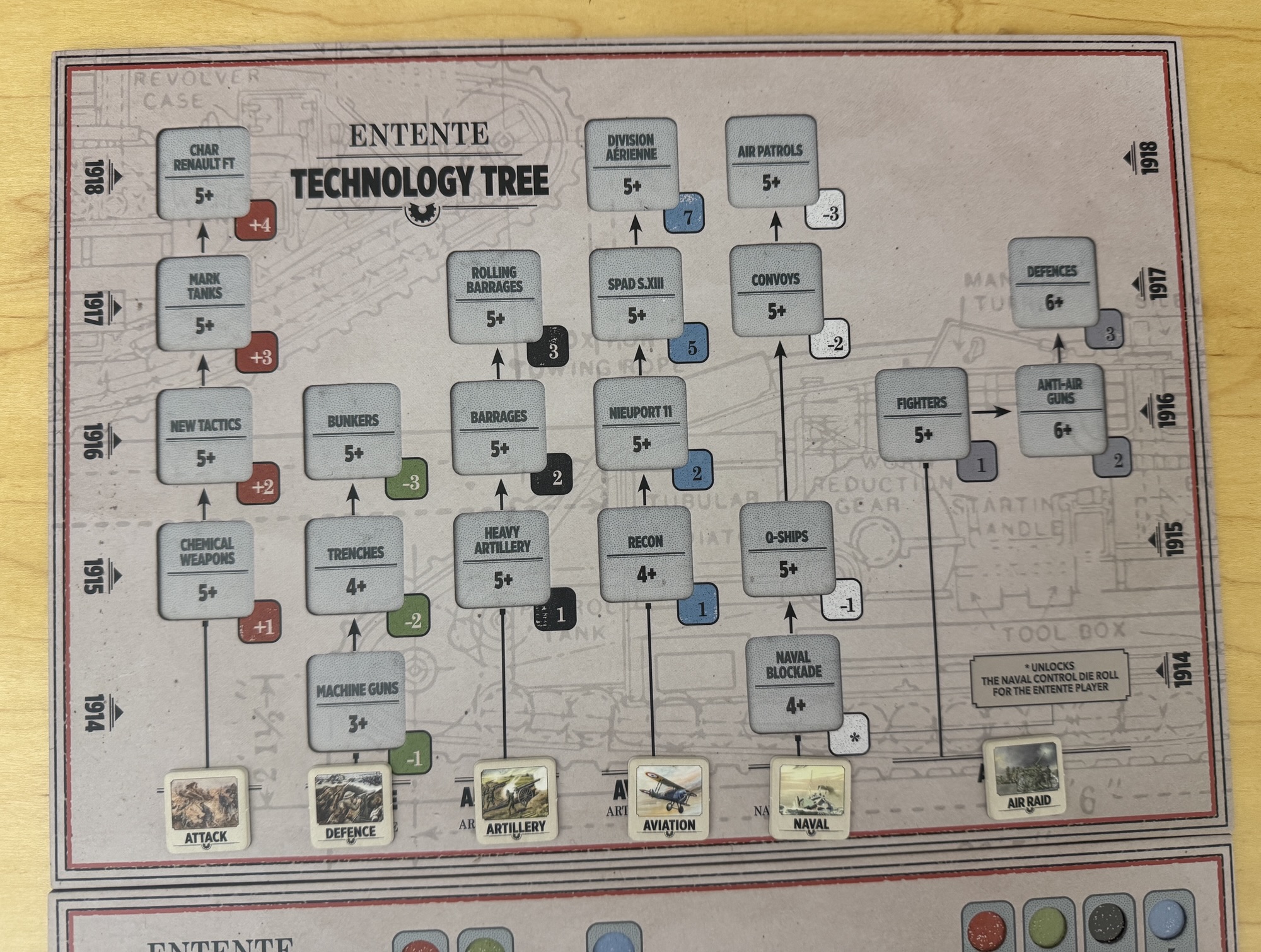


La Der des Ders – The War to End War from Hexasim – Action Point 2
La Der des Ders – The War to End War from Hexasim is a 1-2 player slightly abstracted strategic level look at World War I. The game allows the players to relive the First World War at a strategic level, with each player controlling one of the 2 sides either the Entente, consisting of France, England, Russia, Serbia and other minor nations or the Central Powers including Germany, Austria-Hungary, the Ottoman Empire and a few minors. La Der des Ders can also be played solo, with a dedicated solitaire bot called “Athena” who utilizes special Cornflower Cards to make decisions about what technologies to invest in, where to undertake offensives and how to utilize limited resources and reinforcements. Each turn, players gain an amount of Resource Points dependent on what nations are in the war, which they can allocate to different areas to guide their overall strategy. Victory is achieved by launching offensives that drain the morale of enemy nations, forcing them out of the conflict through collapse.
In Action Point 1, we looked at the Game Board, discussing the Collapse Tracks, Trade Tracks, Russian Revolution Track and Naval Control Table and other various on-board tables and offensive spaces. In this Action Point, we will cover the Technology Phase and the Technology Tree and Technological Improvement Boards.
Technology Phase
One of the best parts of La Der de Ders, and typically the best part of any strategic level wargame, is the Technology Phase and the player’s ability to spend their limited resources on various types of technologies to improve their performance on the battlefield and in the economic war. But, keep in mind that there is a risk here as resources are limited and you have to pay to develop these technologies and there is no guarantee of success as it is up to dice roll, albeit a modified one at that. Each of the players has their own Technology Tree board that is used to track their technological progress over the course of the game. There are a total of 6 different Technologies that can be researched including Attack, Defence, Artillery, Aviation, Naval, and Air Raid.

Each of the different technologies are important and the failure to develop them can lead to a quick and ignominious defeat. I also really like the concept of keeping up with your enemy as sometimes you are simply investing not to gain ground but just not to lose it! This is particularly the case with the Attack and Defence Technologies as if one side gets too far ahead that +1 or -1 difference can make a huge impact on attacks and can lead to significant losses which creates a whole new problem and a sink for those scarce resources.
As you look at the Technology Trees you will see that each box on the Tree represents a level of technology. Each level contains important information about its name, the available date when the technology can be researched, the target number needed to unlock it denoted as a number with a + that means equal to or greater than the number and the bonus that is granted when it is discovered. Each time a level of technology is unlocked, the player will move their Technology marker to the box corresponding to that level. Each level of technology provides a specific bonus which only applies to sectors that have implemented that level. Implemented means having paid for the implementation as you actually pay first to discover the technology and then must spend resources to grant its ability to your different nations.
In addition to the Technology Tree Boards, each player has a board with Improvement Tracks that indicate which sectors or nations belong to their side. For each sector, the tracks correspond to Attack, Defence, Artillery, and Aviation technologies. When a level of Technology is unlocked on the Technology Tree, the relevant side can implement it in the sectors of its choice so that these sectors can benefit from the bonuses this level provides. This will require the expenditure of Resource Points and then the Technological Improvement cylinder on the Improvement Track is then moved accordingly.
Keep in mind that it is possible to attempt to unlock a level of technology only if the year shown on that technology’s row has been reached. The dates that each of the Technologies is available is shown on the outer edges of the level of Technology in large black letters. It can be overlooked from time to time so check during each of the Technology Phases to makes sure you can spend resources on the tech you desire. Also, an attempt to unlock the Technology may only be attempted if the previous level of Technology has been unlocked during a previous turn’s Technology Phase. And finally, keep in mind that for each of the various Technology types, only one level can be unlocked per turn.
Now let’s take a look at ways to improve your chances when rolling the dice to unlock the Technologies. The cost for each attempt at unlocking a Technology is 1 Resource Point. But there is a key decision point at this time as before rolling the die to unlock a level of Technology, the player may decide to spend additional Resource Points. Each additional 1 Resource Point spent provides a +1 bonus for this attempt. This can be very important during the game as it can be the difference between getting the Technology needed to push you over the top for the turn or not and this decision is very important. The more Resource Points you spend on Technology, the fewer you will have to move forward with Offensives to weaken your opponent and break them or even the less Reinforcements you will be able to afford to shore up your defenses.
If the attempt is failed, the player receives a Technological Research Cube which they will place in the box of the level they just tried to unlock. On future attempts this white cube will grant a +1 DRM to die roll per cube accumulated through failed rolls. Ultimately, you will unlock these Technology levels, either through blind luck, your persistence or due to the over expenditure and over commitment of Resource Points. But that is what makes this part of the game so good as it is all about choices and the management of risk along with your resources. You cannot do everything that you wish to each turn and you will have to manage these things as best as you can to taste victory.
In my opinion, the 3 most important Technologies are the first 3 listed on the Technology Tree being Attack, Defence and Artillery. This game is mostly about the planning and execution of Offensives to weaken and ultimately break the will of your opponent by causing their nations to reach collapse on their Collapse Track. Attack gives a positive modifier to each of the attack dice rolled. Typically a nation must roll a 4 (Germany), 5 (France, Russia, the Ottoman Empire, Middle East, Romania, Bulgaria, Africa both sides and Serbia) or a 6 (Greece) and this +1-+3 for attacks will make a huge. A lot of the times though having a good Attack modifier will be lessened our counteracted due to a good Defence value but this is where keeping up the pace with the enemy is a key decision. The Artillery dice are a special animal. For each level of the Artillery Technology, typically each nation will gain an additional Artillery Die (black) to roll along with their Attack Dice (white). These Artillery Dice are not modified by the Attack Technology but are an additional free chance to score a hit. These dice can also be rerolled through the Aviation Technology which will allow for an Artillery Die reroll per level shown on the Technology Tree.
The Naval Technology and Air Raid Technology represent these 2 important miliary advancements in the struggle for the economic aspect of the war. The Naval Technology will for the Central Powers moves the Naval Control Cube one space to the right on its track. With the exception of Level 1, each level of Technology unlocked by the Entente moves the Naval Control Cube one space to the left. As mentioned in Action Point 1, the Naval Control Table is used to represent the efforts of the German U-Boat attacks on commerce and mimic the associated receipt of foreign support by the Entente from the United States of America. At the outset of each turn, a die is rolled and the table referred to in order to determine a possible number of lost Resource Points. There are 2 rows on the table, 1 being the U-Boat for the Central Powers and the other the effects of the Blockade for the Entente.
The Table located under the Naval Control Table indicates the modifier that will be applied to the Central Powers’ Naval Control die rolls. It takes into account the Naval Technology levels of the Central Powers and that of the Entente. At the start of the game, only the Central Powers can carry out a Naval Control die roll. You may notice the small gray box with a lock linked to the Naval Control Table that indicates that the Entente cannot carry out a Naval Control die roll yet. Only once it has unlocked Naval Technology Level 1, can the Entente perform Naval Control die rolls.
And finally, the Air Raid Technology allows the Central Powers player (and them alone) to influence the course of Events, depending on the difference with the Entente’s level of Air Raid Technology. This advantage will allow the CP to cancel an event or more that is beneficial to their enemy or that will harm their efforts.
I feel that the inclusion of the Technology Advancement in La Der de Ders was a stroke of genius and I very much like how the designer Arnauld Della Siega made it have a Press Your Luck aspect to it. This forces some very critical decision points on the players but also keeps the game a game and gives it a really nice feel of hope.
We recently published an interview on the blog with the designer Arnauld Della Siega and you can read that at the following link: https://theplayersaid.com/2026/02/09/interview-with-arnauld-della-siega-designer-of-la-der-des-ders-the-war-to-end-war-from-hexasim/
In Action Point 3, we will take a look at the Event Cards and how they inject the historical narrative into the gameplay and also alter the conditions of the game.
-Grant