I love a different style and focus of wargame. A game that takes a look at an important but somewhat obscure or rarely addressed historical topic, such as espionage or intelligence, and creates a gaming experience tailored around the events to highlight and evoke the difficulties and tension that would have been present. In January 2026, GMT Games announced such a game in Checkpoint Charlie, which is a solo or cooperative game focused on SIS espionage missions in Berlin in the 1960’s designed by Russell Brown. We have posted an interview with Russel and it was very well received and he has now agreed to create a series of History Behind the Cards to highlight the events of the 1960’s Cold War struggle in West Germany but also to share aspects about the game play and how it models the history.
*Note: The cards highlighted in this series and their event text, as well as any pictures used showing any of the various components, are still in the design and development process and as such event effects and text might still change prior to final development and publication.Also the art and layout of the cards are only for playtest purposes at this point and the game will enter the art department as it nears publication.
History Behind the Cards – Checkpoint Charlie from GMT Games – Card #7: Ich Bin Ein Berliner
In the summer of 1963, the Berlin Wall had been in place for almost two years, the reality of a city split between east and west, between Soviet and Western influence, was impossible to deny. Politicians, military leaders, and the people living day-to-day in Berlin continued to argue about the lack of forceful response from the west, particularly the Americans, when the wall went up. Other than a modest buildup of US forces within and around the city, there had been precious little action to re-assure the people of Berlin that the west hadn’t abandoned them.
In June of that year, President Kennedy hoped to change that perception by personally visiting this western city in the center of Soviet-controlled East Germany. He received the reception and the reaction he was hoping for, driving through the city to crowds of cheering West Berliners, and giving his famous speech on the steps of the Rathhaus Shöneberg to a gathered crowd of over one hundred thousand. In a calculated risk, he referred to the city as West Berlin, officially acknowledging the split created by the wall. He introduced his “Fellow Americans” and at the mention of General Clay (Card #6), the crowd interrupted the speech for some heartfelt cheering for the man that saved their city during the Berlin Airlift. Kennedy’s famous line of solidarity, “Ich bin ein Berliner,” — I am a Berliner — came at the end of the speech and may have been a bit off-script.
So how would Kennedy’s speech affect a mission in Checkpoint Charlie? I’m going to answer that with a story.
I spend a lot of time at a wonderful coffee shop near my home, so much time that my iPhone has labeled the location as my “work.” The baristas there know me, and one day one of them asked me what I was working on. “Right now,” I said, I’m working on a board game about spies in Berlin in the 60’s.”
He laughed. “Have you met John?” He pointed to an older customer at one of the tables. “He was a spy in Berlin in the 60’s.” It was true.
Since then, I’ve had many conversations with John about his time in Berlin. He was Army Intelligence, keeping track of what was going on in the city. He was there when the wall went up. He interviewed the refugees that, for a time, still managed to find a way into West Berlin. And he was there during Kennedy’s speech.
I asked him about the speech and said that in the game it resulted in crowds (a Demonstrations marker) near Tempelhof. He shook his head. “Everywhere. Crowds everywhere. All over the city.”
I’m sorry to report that I’ve restrained the effects of this card and the speech for gameplay reasons, but I haven’t ignored John in every case. The Daily Military Train event (Card #9) exists solely because of his stories, and after removing the Refugees event (Card #13) from the game because I assumed the flow of refugees disappeared after the wall went up, I put it back in because John assured me that they were still coming – he had met and interviewed hundreds of them.
In the next article in this series, we will take a look at the ongoing propaganda efforts from both sides of the Berlin Wall with Loudspeaker Wars.
In my opinion, this game looks extremely interesting and I am very much excited to learn more about it. I am appreciative to Russell and his efforts to bring us these cards and to write these entries to share with our readers. I am also very glad that this topic is being covered in a game and look forward to playing this one day soon.
With this My Favorite Wargame Cards Series, I hope to take a look at a specific card from the various wargames that I have played and share how it is used in the game. I am not a strategist and frankly I am not that good at games but I do understand how things should work and be used in games. With that being said, here is the next entry in this series.
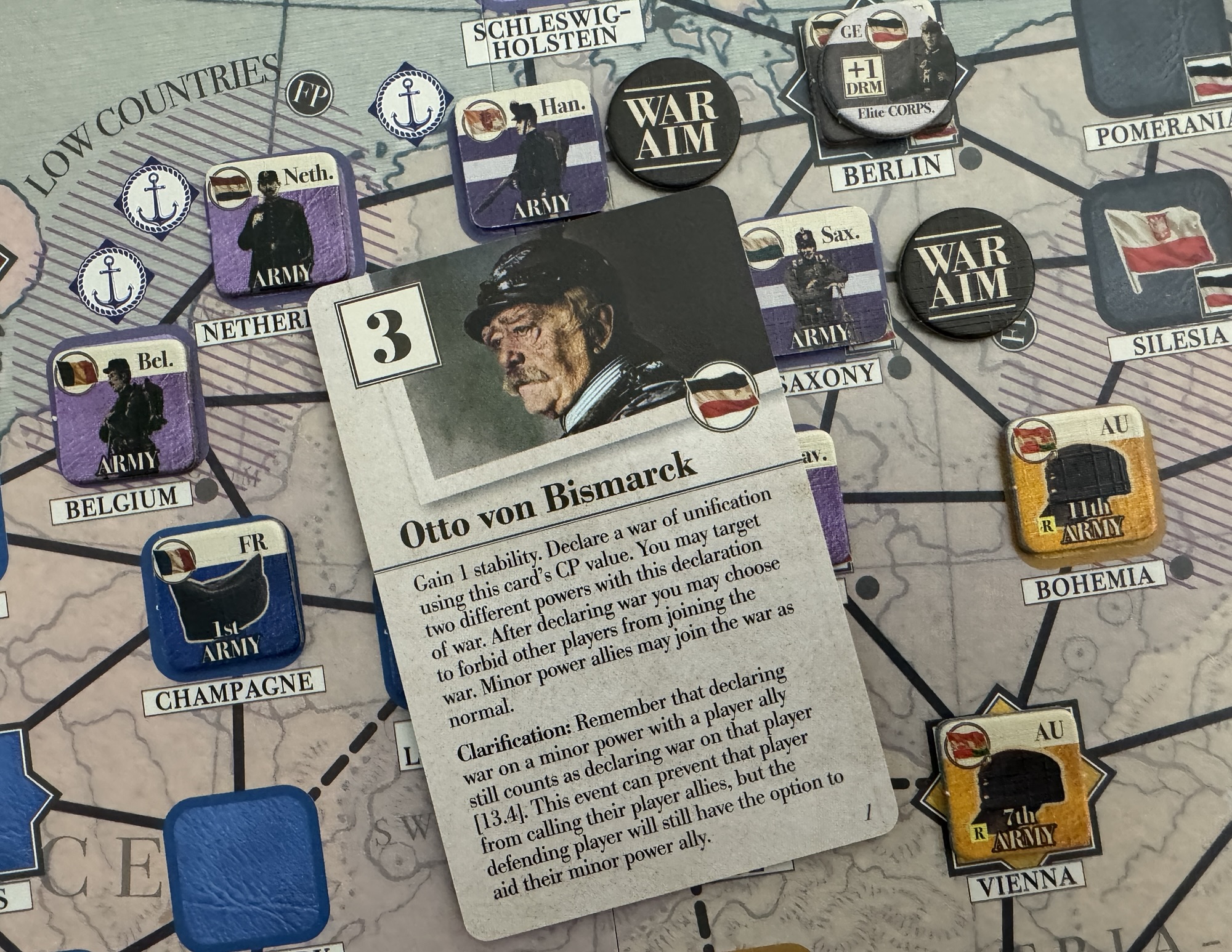
#93: German Home Card Otto von Bismarck from Imperial Elegy: The Road to the Great War 1850-1920 from VUCA Simulations
Imperial Elegy: The Road to the Great War 1850-1920 is a massive card driven game that blends diplomacy, warfare, and statecraft and feels a bit akin to games like Here I Stand and Virgin Queen from GMT Games, which are both grand scale sweeping epics that play multiplayers and take a day to play. Players play as 1 of 6 major powers in the game including Germany/Prussia, the United Kingdom, France, Austria-Hungary, Russia and the Ottoman Empire. The game is quite grand and ambitious as it covers 70 years near the end of the Victorian Era and the Progressive Ear and sees quite a lot of global change and competition between the great powers of the time. The game is a Card Driven Game and uses Action Cards as a type of currency to spend for their Command Points or the printed event to take actions such as recruiting armies and navies, industrialize, moving fleets and armies around the globe, influencing minor powers and establish colonies in Africa, India and the Pacific Ocean. The cards are all tied to the history of the period but the game can be played very much as a sandbox allowing players to explore strategies by trailblazing new horizons or following history.
In Imperial Elegy: The Road to the Great War 1850-1920, the Otto von Bismarck Card is a powerful and extremely important German Home Card. Rather than being shuffled into the common Action Card Deck, it belongs exclusively to the Prussian/German player’s unique toolkit to represent the historical trajectory of German state-building. The card is mechanically tied to the first few turns of the grand 7-decade timeline and acts as a get started quickly card for the German player as they begin the long and somewhat difficult task of attempting to unify the Germanic peoples under one banner. The German player can choose to execute it on Turn 1 to abstractly simulate Bismarck’s rapid real-world rise to power and kickstart early diplomatic maneuvers or wars. Playing as Germany, the player should be focused on attempting the Unification of Germany and will most likely choose the Unification National Goal card as a standard at the beginning of games. The Bismarck Home Card is the primary historical vehicle used to achieve this unification and simulates driving the annexations or alliances needed to claim crucial minor regions including Saxony, Schleswig-Holstein, Denmark and Alsace Lorraine. And like standard Action Cards in Imperial Elegy, the card presents a choice. The German player can either choose between using its high Command Point (CP) Value of 3 for a massive push focusing on industrial development or military actions, or using the card for its printed Event text. One of the really nice parts of the card is the way that it effects Stability in the game. Stability is a core national resource and rating that measures a major power’s internal political health, structural integrity and capacity to wage war or absorb setbacks such as economic downtown and social upheaval. Typically, when you declare war, your Stability will degrade but not in the case of a War of Unification. And with Bismarck, Germany will gain 1 Stability when they declare a War of Unification. This is such a powerful effect for the early game as it will allow the German state to build up their capacity and increase Stability to be able to perform later in the game.
1871 portrait of Otto von Bismarck, the first Chancellor of the German Empire. He is depicted wearing his signature Prussian military uniform, including the distinct Pickelhaube (spiked helmet).
Otto Eduard Leopold, Prince of Bismarck, Duke of Lauenburg, known as Otto von Bismarck, was a conservative German statesman who masterminded the unification of Germany in 1871 and served as its first chancellor until 1890, in which capacity he dominated European affairs for two decades. He had previously been Minister President of Prussia from 1862–1890 and Chancellor of the North German Confederation from 1867–1871. He provoked three short, decisive wars, against Denmark, Austria, and France.
Following the victory against Austria, he abolished the supranational German Confederation and instead formed the North German Confederation as the first German national state, aligning the smaller North German states behind Prussia, and excluding Austria. Receiving the support of the independent South German states in the Confederation’s defeat of France, he formed the German Empire – which also excluded Austria – and united Germany.
With Prussian dominance accomplished by 1871, Bismarck skillfully used balance of power diplomacy to maintain Germany’s position in a peaceful Europe. To historian Eric Hobsbawm, Bismarck “remained undisputed world champion at the game of multilateral diplomatic chess for almost twenty years after 1871, and devoted himself exclusively, and successfully, to maintaining peace between the powers”. However, his annexation of Alsace-Lorraine (Elsaß-Lothringen) gave new fuel to French nationalism and Germanophobia. Bismarck’s diplomacy of Realpolitik and powerful rule at home gained him the nickname the “Iron Chancellor”. German unification and its rapid economic growth was the foundation to his foreign policy. He disliked colonialism but reluctantly built an overseas empire when it was demanded by both elite and mass opinion. Juggling a very complex interlocking series of conferences, negotiations and alliances, he used his diplomatic skills to maintain Germany’s position.
A master of complex politics at home, Bismarck created the first welfare state in the modern world, with the goal of gaining working-class support that might otherwise go to his Socialist opponents. In the 1870s, he allied himself with the low-tariff, anti-Catholic Liberals and fought the Catholic Church in what was called the Kulturkampf (“culture struggle”). He lost that battle as the Catholics responded by forming the powerful German Centre Party and using universal male suffrage to gain a bloc of seats. Bismarck then reversed himself, ended the Kulturkampf, broke with the Liberals, imposed protective tariffs, and formed a political alliance with the Centre Party to fight the Socialists. A devout Lutheran, he was loyal to his king, Wilhelm I, who argued with Bismarck but in the end supported him against the advice of his wife Queen Augusta and his heir Crown Prince Frederick William. While Germany’s parliament was elected by universal male suffrage, it did not have much control of government policy. Bismarck distrusted democracy and ruled through a strong, well-trained bureaucracy with power in the hands of a traditional Junker elite that consisted of the landed nobility in eastern Prussia. He largely controlled domestic and foreign affairs, until he was removed by the young new headstrong Kaiser Wilhelm II. He retired to write his memoirs.
This historic image shows Chancellor Prince Otto von Bismarck (center) with diplomatic envoys and plenipotentiaries of the Federal Council (Bundesrat) inside the Berliner Reichstag in 1889.
We have put out several pieces of content covering Imperial Elegy and find it to be a fantastic game. These include written posts and videos. You can visit those by following the links below:
Unboxing Video:
Video Review:
Summary of Solitaire Bots presented by our friend James:
I love a different style and focus of wargame. A game that takes a look at an important but somewhat obscure or rarely addressed historical topic, such as espionage or intelligence, and creates a gaming experience tailored around the events to highlight and evoke the difficulties and tension that would have been present. In January 2026, GMT Games announced such a game in Checkpoint Charlie, which is a solo or cooperative game focused on SIS espionage missions in Berlin in the 1960’s designed by Russell Brown. We have posted an interview with Russel and it was very well received and he has now agreed to create a series of History Behind the Cards to highlight the events of the 1960’s Cold War struggle in West Germany but also to share aspects about the game play and how it models the history.
*Note: The cards highlighted in this series and their event text, as well as any pictures used showing any of the various components, are still in the design and development process and as such event effects and text might still change prior to final development and publication.Also the art and layout of the cards are only for playtest purposes at this point and the game will enter the art department as it nears publication.
History Behind the Cards – Checkpoint Charlie from GMT Games – Card #6: General Clay Steps In
US General Lucious D. Clay was appointed as military governor of the United States zone of Berlin from 1945 until 1949. He was best known, especially to the people of Berlin, as the person responsible for the Berlin Airlift, which fed and supplied the people of Berlin from the air when the Soviets cut off all access to the city for eleven months, from June 1948 to May 1949. Without the airlift, the west would have been left with two terrible options – allow West Berlin to be starved into submission and annexation, or invade East Germany to open a supply corridor, almost certainly starting an all-out war with the Soviets.
In the early 1960’s, US President Kennedy turned to the now retired General Clay and called on him to deal with serious issues that arose in Berlin, like the faceoff between tanks at Checkpoint Charlie (card #4). Clay understood Berlin and had the respect of its people, so Kennedy brought him along on his famous visit to the city, during which the president gave his “Ich bin ein Berliner” speech (card #7).
The General Clay Steps In card in Checkpoint Charlie represents the retired general being sent by Kennedy to resolve issues in West Berlin. Playing the card removes an event marker from the city and is the only way many of the event markers can be removed during a mission. It is especially useful for removing the Faceoff marker or a troublesome Stasi Stakeout.
In the next article in this series, we will take a look at Ich bin ein Berliner Speech by President John F. Kennedy.
In my opinion, this game looks extremely interesting and I am very much excited to learn more about it. I am appreciative to Russell and his efforts to bring us these cards and to write these entries to share with our readers. I am also very glad that this topic is being covered in a game and look forward to playing this one day soon.
Galactic Cruise could extend its run of major award wins after being named a top-three finalist in this year’s Deutscher Spiele Preis, the biggest community-voted board game award in Germany.
The space tourism-themed worker placement title faces competition in the final from Ark Nova creator Mathias Wigge, who could win the award again with just his second major design – the similarly zoo-themed Sanctuary.
A win for Sanctuary would double down on Matthias Wigge’s success following the colossal performance of his debut design Ark Nova, which as well as becoming the second-highest ranked game on BoardGameGeek has been a sensation on digital gaming platform BoardGameArena, with more than 13 million games played since its online launch in May 2023..
That latter title, which made designer Reiner Knizia the first person to complete a clean sweep of the Spiel des Jahres, Kennerspiel des Jahres and Kinderspiel des Jahres awards, finished sixth in this year’s DSP vote.
The Lord of the Rings: Fate of the Fellowship, another game which has already enjoyed significant awards success this year, finished just outside the top three finalists in this year’s DSP.
Take Time, which won the Austrian game of the year and Swiss Gamers Award this year, took fifth place in the DSP, ahead of Rebirth, Cozy Stickerville, River of Gold, Star Trek: Captain’s Chair and Forest Shuffle – Dartmoor.
Asmodee-owned studios secured four places in the Top 10: Z-Man with Fate of the Fellowship, Libellud with Take Time, Unexpected Games with Cozy Stickerville and Lookout with Forest Shuffle – Dartmoore – although none managed to break into the top three.
Other recent DSP winners have included Planet Unknown in 2023, Ark Nova in 2022 and Lost Ruins of Arnak in 2021, following The Crew, Wingspan, Azul and Terraforming Mars among winners from the previous decade.
The 2026 DSP is open to standalone games released in German between May 1, 2025 and April 30 this year, with voting open to people living in Germany, Austria and Switzerland.
Merz Verlag, which has presented the award since 1990, said “many thousands” of people voted during the three-month voting period.
The children’s DSP has also named its top three finalists: Mooki Island from designer Florian Sirieix, Paleolino from Marco Teubner, and Toriki: The Castaway Island by Wojciech Grajkowski.
German children’s book, gifts and stationery publisher arsEdition has confirmed it has tasked Asmodee with distributing its fledgling board game range to specialist toy retailers and some wholesalers, after making its first significant move into tabletop games just under a year ago.
Asmodee has been distributing the Bonnier-owned publisher’s games under the agreement since the beginning of 2026, creating a split-channel model that sees arsEdition continue to handle distribution within the book trade and major book retail chains.
The pair said the move gives retailers improved availability, clear product range structures and coordinated support across both distribution channels – with an aim of sustainably increasing the visibility of arsEdition games in the market and generate further momentum in the family games segment.
arsEdition launched a dedicated games programme last September focused on family-weight games for ages 6, 8, and 10 and up, with an opening slate of seven titles including Reiner Knizia designs Oshiya Tokio and Guardian of the Treasure, and Sophia Wagner’s Twilight Watch.
The board game unit lead, Volker Hirsch, previously spent six years as creative director at Amigo Spiele until 2001, and has also since worked as head of product development at Ravensburger Digital, and as a partner at former Games Workshop collectible card games subsidiary Sabretooth Games.
Some of arsEdition’s debut line of board game releases
arsEdition publisher Dagmar Becker-Göthel said when the range was unveiled last year that games represented a growing category in the toy trade, while also becoming increasingly important for booksellers – providing the rationale for developing a range capable of operating across both channels.
The publisher said at the time it planned to release new games twice a year.
Rebecca Roscher, commercial director at arsEdition, said, “We are currently putting a great deal of energy into the development and production of exceptional family games for ages eight and above, which are characterised by innovative mechanics, strong brands and unique design.
“With Asmodee as our partner, we can now position our games even more strategically and comprehensively across the relevant distribution channels.”
Upcoming releases from arsEdition include include Toshi, a 1-4 player tile-laying game from Friedemann Friese scheduled for September, and Cat and the Tower, a cooperative dexterity game from Masakazu Takizawa.
Box cover for Toshi, designed by Friedemann Friese
The company also continues to work with prominent designer Reiner Knizia, with its website currently listing seven products from the storied creator.
For Asmodee Germany, arsEdition adds another outside publishing partner to a distribution operation that has continued to broaden its third-party portfolio.
Asmodee Germany managing director Udo Fischer said the arsEdition deal brought together the companies’ different areas of expertise.
“The trusting collaboration between Asmodee and arsEdition brings together two distinct perspectives – expertise from the book trade combined with many years’ experience in board and card games – which complement each other perfectly,” he said.
“By entering the world of board games, arsEdition is providing a strong additional impetus in the family segment.”
arsEdition is part of Bonnier Media Deutschland, which also owns publishers including Carlsen, Piper, Ullstein and Thienemann-Esslinger. The wider group reported net sales of €336m in 2025, sold 75.5 million books across all formats and employed an average of 795 full-time staff.
Bonnier Media Deutschland describes itself as the largest German book publishing group, with particularly strong positions in children’s publishing, comics and illustrated formats.
We’ve been assessing the merits of political leaders in (more or less) democratic countries on this blog for a few years now. Today, we’re looking at the longest-serving chancellor of the Weimar Republic, Germany’s first attempt at parliamentary government – Wilhelm Marx. And which game could be more appropriate for him than Weimar (Matthias Cramer, Capstone Games/Skellig Games/Spielworxx)?
If you want to read more ratings of historical leaders like this, I strongly recommend you subscribe to the blog – all new posts in your inbox right when they go live!
Some caveats ahead: The chancellors will be rated by the knowledge of their time. If they or their contemporaries could not have known about the effects of something, I will not use my hindsight to mark it as a mistake of theirs. The assessment is focused on their conduct as chancellor.
Now, to the system itself: There are three policy field categories (foreign, domestic, and economic policy) and three more general ones (vision, pragmatism, integrity). A chancellor can earn from one to five stars in each category (for a total sum of up to 30). In detail, the chancellor is assessed as follows:
Foreign policy: Did the chancellor increase German influence in the world and the security of Germans at home? Did the chancellor wield German power responsibly and with positive results for the regions affected?
Domestic policy: Did the chancellor increase the liberty of Germans to express themselves and to participate in the political process? Did the chancellor promote domestic security and shape the framework for fair justice dealing with offenses?
Economic policy: Did the chancellor facilitate the prosperity and economic security of Germans (including in the mid- and long-term)? Was the chancellor’s economic policy based on mutual benefit of those involved or did it unduly burden one side?
Vision: Did the chancellor have an idea of what Germany and Europe (the latter counting for more in times of German influence being great) should look like beyond the immediate future? Did the chancellor’s policies steer Germany (and, if applicable, Europe) in this direction?
Pragmatism: Did the chancellor succeed in seeing their policy through from inception to completion? How well did the chancellor manage the support from parliament, society, the administration, the media?
Integrity: Did the chancellor understand the office as a means to benefit themselves, special interest groups, the entire country, or another community? Did the chancellor respect the boundaries of the office?
Note: If you have read my UK prime minister or US president ratings, you will remember that I rated them on the global impacts of their vision as well. As the rating system is only really applicable to democratic leaders and no democratic German leader ever had the chance to conduct a truly global policy, I only assess their vision on national and European grounds.
Early Life: The Catholic Man of Duty
Wilhelm Marx was born in 1863 in Cologne, then a part of the Rhine Province of the Kingdom of Prussia, soon to be part of the united Germany. No one could have foreseen in his boyhood that he would rise to the chancellorship – he was the son of a mere schoolteacher, and a part of the Catholic minority which was always suspected of possibly disloyalty by the Protestant Prussian state. The young Wilhelm Marx was one of many who set out to prove that he could be just as patriotic as any Protestant: He studied law and entered public service. His Catholic faith, however, would always be the guiding star in his life.
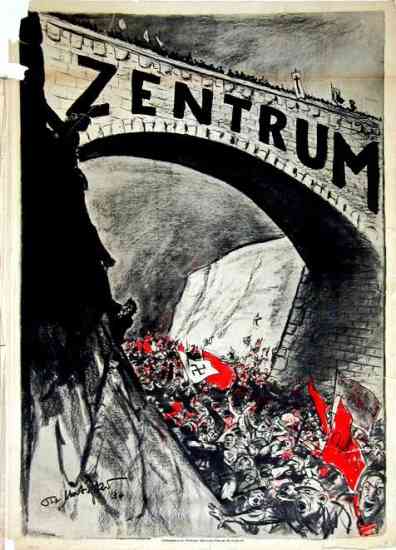
He was first elected to the Prussian parliament in 1899 on the ticket of the Catholic Zentrum (Center) party – one of the four player factions in Weimar. By the time Marx was elected, he had been active for nine years in the Volksverein für das katholische Deutschland (People’s Association for Catholic Germany), an organization dedicated to improving the social conditions especially of the poorer Catholics. Social and cultural issues, especially the expansion of Catholic schooling, would remain close to his heart: In 1910, he founded the Katholische Schulorganisation (Catholic School Organization), a grassroots lobbying organization dedicated to the matter.
The same year, he was elected to the German parliament – his first electoral success on the national level after two campaigns in hopeless districts with very few organized Catholics which he had only undertaken out of duty to the party. In parliament as well as in his electoral campaigns, he aimed to form an alliance with the Protestant bourgeois parties against the burgeoning SPD (Sozialdemokratische Partei Deutschlands, Social Democratic Party of Germany), the second player faction of Weimar. However, this strategy failed when cross-confessional bourgeois solidarity eroded in the more confrontational cultural climate from 1911 on.
World War and Revolution
These divisions faded into the background with the beginning of World War I. Despite the pre-eminence of military and diplomatic action then, Marx’s political activity remained limited to domestic issues. From his papers, we cannot discern if he even formed an opinion on many of the pressing issues in those other realms (say, unrestricted u-boat warfare). He did, however, change his mind about cooperation with the SPD, with whom the Zentrum (and the liberal parties) partnered from 1917 on in their quest to place the imperial government on a more parliamentary basis.
The revolution of 1918/1919 took Marx by surprise. Once more, he placed his powers at the disposal of his party, and was elected to both the Prussian and the German constitutional assemblies. The National Assembly in Weimar developed a constitution which included many long-held dreams of his, as the Catholic church, Catholic associations, and individual Catholics finally had their rights guaranteed. The short period of cooperation with the Social Democrats (and, to a lesser degree, the progressive liberals of the DDP (Deutsche Demokratische Partei, German Democratic Party) had achieved what years of negotiation with the Protestant conservatives of the Empire had not. This early alliance between Zentrum and SPD is the starting point of any Weimar game.
Yet the new German republic was unpopular with the numerous conservative, monarchist Zentrum members, and cooperation with the Social Democrats doubly so. Marx thus spent much of his political energy advocating for the constitution among his fellow Catholics.
At the time, Marx considered leaving politics altogether in favor of focusing on social work: From 1919 to 1921, he acted as director for the Volksverein (but proved unsuited to implement the sweeping changes necessary to improve the Volksverein’s faltering popularity in the Catholic milieu).
Yet once more duty called: As many of the old Zentrum parliamentary leaders died, Marx was one of the most experienced politicians his party could field. And his conciliatory, even-handed manner was just what the Zentrum needed when the party was so deeply divided against itself on the question of supporting the republic or restoring the monarchy as well as if to cooperate with the Social Democrats or the Protestant nationalists of the DNVP (Deutschnationale Volkspartei, German Nationalist People’s Party), the third Weimar player faction.
Marx was thus called on to hold the diverging wings together: He was elected head of the parliamentary group of the Zentrum and then also party chairman in late 1921. As the Zentrum’s governing partner SPD merged with the more left-leaning USPD (Unabhängige Sozialdemokratische Partei Deutschlands, Independent Social Democratic Party of Germany), Marx advanced a closer cooperation with the two liberal parties DDP (in government) and DVP (Deutsche Volkspartei, German People’s Party, in opposition) – the two minor parties which the Zentrum can control in Weimar. Yet Chancellor Joseph Wirth’s attempt to entice the DVP into a government of all democratic parties (a Grand Coalition) failed in late 1922. As a consequence, the SPD left the government as well. The parliamentary basis for the government shrunk.
The following year, Germany was shaken by the French occupation of the Ruhr which exacerbated the already galloping inflation. Under these circumstances, the Grand Coalition of all democratic parties became reality, led by DVP chancellor Gustav Stresemann. While it tackled these huge tasks rather successfully, the government could not maintain its internal cohesion: The right wing of the DVP (under its parliamentary leader Ernst Scholz) wanted to use the crisis to abolish the eight-hour workday and expand the government to the right by including the DNVP. The SPD refused and left the government. Marx’s conciliating manner helped with bringing both of them back to the negotiating table and a new Grand Coalition was formed.
This one was even shorter-lived: When federal forces broke up the socialist state governments of Saxony and Bavaria, but (doubting the loyalty of the army) refused to act against the right-wing coup in Bavaria, the SPD once more went into opposition. Without a parliamentary majority, Stresemann was soon unseated as chancellor. As the SPD’s appetite for government responsibility was sated, a bourgeois minority cabinet would be formed. That would be straight-up impossible in Weimar – unlike left-wing or right-wing coalitions, the Weimar Coalition (with SPD and Zentrum as the player factions and the DDP as a minor party which is always attached to one of the two) cannot refuse to govern, and so SPD and Zentrum are often stuck with each other if they want it or not. Historically, the SPD was not quite as keen on governing as the party is in Weimar.
To get anything done without a parliamentary majority would require special skills at winning friends and not making enemies. Marx, the skilled mediator, was just the right man for the time. He was elected chancellor on November 30, 1923. The weighty issues facing him were Bavaria’s continued insurrection, the implementation of the measures against hyperinflation, and an agreement with the Allies on the reparations issue which had set off the entire crisis of 1923.
A full hand of cards, leading the government (chancellor token in the top left), both liberal minor parties aligned (bottom right) – a comfortable situation for the Zentrum in Weimar, but not so much in history.
The First and Second Chancellorships
Marx’s cabinet nominations sent a signal to Bavaria that he was willing to improve the relationship between the fractious state and the Reich: He made the Bavarian Eduard Hamm (DDP) Minister for the Economy, and, for the first time in the history of the republic, included a member of the BVP (Bayerische Volkspartei, Bavarian People’s Party) whose more radical members had been behind the coup in Bavaria (Erich Emminger as Minister of Justice). His discreet negotiations with the Bavarian coupists would come to fruition in spring 1924: They resigned and opened the way for parliamentary government again. Bavaria, however, would retain some special privileges and be exempt from federal oversight.
The BVP had played an ambiguous role in the anti-republican insurrection in Bavaria. While the party cooperated with the Zentrum in national politics, its leader Gustav von Kahr had also been behind the coup of September 1923. This playtest version of the “Bayerische Volkspartei” card strengthens the Zentrum in parliament, but also allows the DNVP to recruit a dissolved unit – the latter effect was removed in the final version of the game.
Both the reparations negotiations with the Allies and the massive financial and economic reform package which would solidify the end of inflation required Marx to gather parliamentary support far beyond his minority coalition’s meager base. As there were constitutional changes involved (for example, in merging the various state railway companies into a federal railway), he even needed a two-thirds majority. Marx’s parliamentary skills and his reputation as an honest broker who would not abuse his power came together in securing an Enabling Act which would allow his government to gain the respective legislative powers despite their parliamentary minority. Equipped with such power, Marx set out to do the necessary, but unpopular steps forward. The cuts to public expenses which were to flank the currency reform massively reduced the number and salary of public employees and all but expropriated most pensioners.
The bitter taste of Marx’s domestic reforms was lessened by the negotiations with the Allies. Not even France had the stomach to force another confrontation after the chaos of 1923. They were thus inclined to negotiate a payment schedule which suited both sides. American bankers were to provide the loans with which Germany would cover a large part of the payments.
The electorate, however, was unimpressed. In the May 1924 parliamentary elections, Marx’s Zentrum held firm, but his DDP and DVP partners collapsed, as did the SPD. The right-wing parties were triumphant. Yet with no viable alternative to the bourgeois minority coalition, Marx was soon confirmed for his second chancellorship.
In the second tenure, he concluded the negotiations with the Allies. The final agreement would become known as the Dawes Plan after the chief Allied negotiator, American banker Charles G. Dawes. Once more, Marx needed a broad parliamentary majority. In addition to his government coalition, the SPD was sure to support the plan. The DNVP publicly railed against the Dawes Plan (which confirmed the infamous war guilt clause of the Treaty of Versailles), but DNVP chairman Oskar Hergt offered his support in return for policy concessions and the DNVP’s inclusion in government. Otherwise, he threatened that the Dawes Plan would fail in parliament. Marx, however, knew that the DNVP was internally divided on the matter and that a large number of DNVP members of parliament either saw the necessity of the plan for German economic revival or at least did not want to take the blame for the failure. Thus, he called the parliamentary vote without giving in to Hergt’s demands. The motion passed, as most DNVP members abstained.
Marx’s policy successes had not broadened his parliamentary base. As he kept refusing the DNVP’s inclusion in government in favor of a more centrist approach, new elections were called for December 1924. These did not change the parliamentary balance of power much. Marx resigned and was succeeded by Hans Luther, who formed a technocratic government based on the centrist and right-wing parties including the DNVP.
Parliament includes a lot of Zentrum members… but not enough for a majority.
Prussian Intermezzo, Presidential Election
Marx could not enjoy being relieved of his duties for long. When the Prussian DVP, as much a loose cannon as its federal counterpart, forced the end of the Grand Coalition in Prussia, Germany’s largest state, and demanded a right-wing government including the DNVP like in the Reich, Marx was called on to solve the government crisis. He was elected Prussian Prime Minister with the votes of the Weimar Coalition (SPD, Zentrum, DDP) on February 18, 1925, yet just two days after was toppled when renegades in his own party refused to support him in a parliamentary vote of confidence. Marx resigned, his appetite for politics lessened and his trust in the party damaged.
Still, Marx was one of the few Zentrum politicians who were well-known and had a good enough reputation to field in national elections. When President Friedrich Ebert (SPD) died, he was thus the natural candidate for the next presidential elections. The death of Ebert is a turning point in many Weimar games: The office allows its holder to play one card per round for two uses instead of just one. So, it is in essence a one-card bonus. As you normally only hold five cards, this is a huge boon. The presidential elections will thus be hotly contested and usually also serve as a check on who seems to be in the lead and must be reined in… sometimes in surprising coalitions.
In the first round, Marx gained 14% of the vote, the third-best showing after Duisburg mayor Karl Jarres (DVP, 39%) and the new Prussian prime minister Otto Braun (SPD, 29%). Now the coalition-building began. The SPD withdrew Braun, knowing that bourgeois voters almost never supported a working-class candidate in runoff elections. Instead, Marx was nominated as the joint candidate of the Weimar Coalition parties (People’s Bloc). Together, their candidates had received 49% of the vote in the first round. The right-leaning parties knew that Jarres, a man with no national standing, stood no chance in the second round. However, it was legal to field a candidate in the second round who had not stood in the first. They produced the old imperial field marshal Paul von Hindenburg – the “Victor of Tannenberg”.
Now the bickering for support in the second round begins! Unlike in history, parties in Weimar may support candidates which are ideologically opposed to them (usually to prevent a runaway leader or as part of a bigger political deal).
Marx might have been a more attractive candidate for centrist and bourgeois voters than Braun, but he still failed to attract votes beyond the Weimar Coalition. Conservative Protestants did not vote for him, and even his more conservative Catholic brothers and sisters in faith deserted him in favor of Hindenburg. Despite their Catholic fundament and Bavarian particularism, the BVP supported the Protestant Prussian marshal. Hindenburg was elected on April 26, 1925, with 48% of the vote (Marx carried 45%).
The Third and Fourth Chancellorships
The centrifugal forces within the Zentrum intensified. The party’s right wing blamed the defeat at the presidential election on Marx’s refusal as chancellor to form a coalition with the DNVP. The existing coalition under Luther fell apart when the DNVP refused to consider an agreement with the Allies which would confirm the post-Versailles borders in Western Europe. In December 1925, Luther formed a bourgeois minority coalition supported by Zentrum, DVP, DDP, and BVP in which Marx headed both the Ministry of Justice and the Ministry for the Occupied Territories.
The next inevitable call of duty came when Chancellor Luther resigned in May 1926. When the Zentrum once more turned to Marx to fill the post, he wrote to his wife, “Now they’ve found their idiot again”. Like the first two times, Marx’s cabinet based on Zentrum, DVP, DDP, and BVP had no parliamentary majority, so he had to look for outside support. While the SPD bumbled in the Princes’ Expropriation campaign, it could be relied upon to continue the foreign policy of rapprochement with the Allies, and thus Marx was able to negotiate the admittance of Germany into the League of Nations in 1926 – in Weimar, one of the most difficult, but also most valuable foreign policy successes of a government.
Marx’s government was toppled by a vote of no confidence over the military’s secret cooperation with the Soviet Union in February 1927. By now, the right wing of the Zentrum was clearly ascendant, and the party pushed for a coalition with the DNVP. Marx opposed the notion, but felt compelled to give in to his party’s wishes. Thus, his fourth cabinet included DNVP ministers for the first time – no fewer than four of them. Despite this new right-wing bent, the new government implemented a major piece of social security with the introduction of unemployment insurance.
Marx’s special ability in Weimar allows him to swap two issues on the debate track: He might, for example, bring the attractive Unemployment Insurance issue to the Zentrum area of the track – and instead give the SPD the Stab in the Back issue which would have them face the dilemma between either weakening their own position or strengthening the DNVP.
However, infighting increased both in the Zentrum (between its republican and its conservative wings) and the government coalition at large. Marx attempted to pacify the former by pushing for legislation which would please both by appealing to their shared Catholicism – and which was dear to his own heart: A federal school law should codify the equality of confessional schools (with religious instruction only in the corresponding faith) with “simultaneous schools” (with both Protestant and Catholic religious instruction on offer). While that improved cohesion in the Zentrum, it put a strain on the coalition: The liberal parties DVP and DDP opposed the measure. Marx was unable to find a compromise. As the coalition disintegrated and the Zentrum’s right-wing gained ever more traction, the subsequent electoral defeat of May 1928 was almost a relief for Marx. A new Grand Coalition, led by chancellor Hermann Müller (SPD), was formed.
After Politics
After the election, Marx withdrew from politics. His centrist course was abandoned by his ever more right-leaning party which ended the Grand Coalition in 1930, operated a minority cabinet without parliamentary support strictly via presidential emergency decrees, and finally even voted in favor of the Enabling Act of 1933 which transferred the legislative power on the freshly elected Nazi government.
Marx himself limited his public activities to umbrella organization of Catholic student associations which he chaired. When the organization was to be Nazified in 1933, he let himself be pushed aside without a fight.
Marx’s old acquaintances shunned him after the Nazi takeover, as nobody wanted to be perceived to be close to an exponent of the democratic system. He lived a private life on very limited means and was fortunate to be left alone by the Nazis. When the post-war political system was formed in Germany, Marx joined the CDU (Christlich-Demokratische Union, Christian Democratic Union), the new cross-confessional Christian party. Soon after, Wilhelm Marx died on August 5, 1946.
Weimar Germany’s longest-serving chancellor is today all but forgotten.
The Rating
Foreign Policy
Marx’s foreign policy was neither original – Hermann Müller had outlined it as foreign minister and chancellor in the early 1920s – nor entirely his own – Gustav Stresemann, who served as foreign minister in all of Marx’s cabinets, carried out a good deal of it. It was, however, successful, as both the Dawes Plan and the admittance to the League of Nations show. Sometimes, the soft-spoken, conciliatory Marx also enjoyed advantages over the brash Stresemann – tough talk would not have finalized the Dawes Plan.
Rating: 4 out of 5.
Domestic Policy
Marx had been reared to champion the cause of Catholic cultural equality from his early years on. His tragedy is that most of the disadvantages Catholics faced in the Protestant German Empire were removed by the Weimar Constitution, and those which remained – for example, that Catholic civil servants were less likely to be promoted – had no simple legislative solutions. Yet such solutions Marx kept pursuing, as with his ill-fated school law (despite the fact that 85% of Catholic schoolchildren already attended Catholic confessional schools). This practical non-issue has not even made it into the Weimar game – neither as an event card nor as a debate issue. Marx squandered political capital in the pursuit of an object which was neither useful nor attainable.
Rating: 1 out of 5.
Economic Policy
The ambitious anti-inflation reforms of 1923 and 1924 had been initiated by Stresemann, a friend of decisive action. Yet their actual implementation fell to the more measured Marx – probably a lucky stroke. Neither of them attempted to curtail the social effects of the reforms, and thus many pensioners and former as well as current civil servants fell into poverty, often alienating them from the republic.
Similarly, the introduction of unemployment insurance was a great step forward for social security – but it was underfunded in the relatively prosperous years of the beginning, and when unemployment and thus costs exploded after the crash of 1929, the system proved to be both a burden on the national budget and insufficient to alleviate the hardship of the many.
Rating: 4 out of 5.
Vision
Marx was content to be placed wherever his party or the country needed him and do what he thought was required of him. He did not shape politics as much as answer to calls of duty.
Rating: 1 out of 5.
Pragmatism
Considerable parliamentary skill and his negotiation as an honest broker allowed Marx to gain him the majorities for his Enabling Act (1923) as well as the ratification of the Dawes Plan (1924). His mastery in that mere year contrasts unfavorably with his constant inability (despite his best attentions and efforts) to control the direction of his party (or at least keep the renegades under control), most markedly in the Prussian fiasco of 1925. His willingness to go along with any situation and answer any call of duty weakened his negotiating power, and forced him to repeatedly carry out political operations with whose premises he did not agree.
Marx was personally incorruptible. He managed to be both a committed party man, but govern with all of his country in mind. However, the Enabling Act set a dangerous precedent for the erosion of the constitution.
Rating: 4 out of 5.
Overall
In his first and second chancellorship, Wilhelm Marx rose to the challenge of implementing the solutions to the great crisis of the republic. In his later tenures, he performed markedly worse despite the much-improved situation. His biggest successes are holding the course in foreign and economic policy in 1924, his biggest failure his inability to develop and implement a long-term plan for his party and the republic.
How would you rate Marx? Let me know in the comments!
Further Reading
For short overview essays on all German chancellors from Bismarck on, see Sternburg, Wilhelm von: Die deutschen Kanzler.Von Bismarck bis Merkel[The German Chancellors. From Bismarck to Merkel], Aufbau-Verlag, Berlin 2006 (in German).
The only full-length biography of Marx is Hehl, Ulrich von Wilhelm Marx: 1863—1946.Eine politische Biographie [Wilhelm Marx: 1863—1946. A Political Biography], Matthias-Grünewald-Verlag, Mainz 1987. Its somewhat dry style is made up for by its detailed, source-rich research.
For the broader context, see: Herbert, Ulrich: A History of Twentieth-Century Germany, Oxford University Press, Oxford 2019.
I love a different style and focus of wargame. A game that takes a look at an important but somewhat obscure or rarely addressed historical topic, such as espionage or intelligence, and creates a gaming experience tailored around the events to highlight and evoke the difficulties and tension that would have been present. In January 2026, GMT Games announced such a game in Checkpoint Charlie, which is a solo or cooperative game focused on SIS espionage missions in Berlin in the 1960’s designed by Russell Brown. We have posted an interview with Russel and it was very well received and he has now agreed to create a series of History Behind the Cards to highlight the events of the 1960’s Cold War struggle in West Germany but also to share aspects about the game play and how it models the history.
*Note: The cards highlighted in this series and their event text, as well as any pictures used showing any of the various components, are still in the design and development process and as such event effects and text might still change prior to final development and publication.Also the art and layout of the cards are only for playtest purposes at this point and the game will enter the art department as it nears publication.
History Behind the Cards – Checkpoint Charlie from GMT Games – Card #3: Demonstrations
West Berlin, and West Germany as a whole, spawned a number of large, very active student demonstration organizations in the late 1960’s. These were generally in response to a perceived return to very traditional German authoritarian government, and specifically as a reaction to former members of the Nazi party, like Chancellor Kiesinger, serving in the Bonn government.
However, during the slightly earlier time period of Checkpoint Charlie (early 1962 to late 1963), demonstrations were not as organized. They were spontaneous and in response to specific events, like the Speigel Affair (Card #16) and President Kennedy’s Visit (Card #7). As with those later, more organized movements, they consisted primarily of young Germans, and the universities acted as catalysts and staging areas. Even during the period of this game, marches and demonstrations were common enough to warrant an event card.
As a side note, Chancellor Keisinger, who’s Nazi affiliation spawned some of those later protests, was replaced as Chancellor of West Germany in 1969 by Willie Brandt, who was mayor of West Berlin during the period of Checkpoint Charlie. Mayor Brandt has his own token in the game and plays a role in a few of the missions.
The Demonstrations Event Card places a special Demonstrations marker in one of the West Berlin locations on the map. Demonstrations could last for hours, or even days, so this marker generally remains on the City Map for the rest of the mission. East Berlin locations are not eligible because the Stasi secret police, along with the confinement imposed by the Berlin Wall, had effectively suppressed any open opposition in the East. In game terms, the Demonstrations marker provides some cover for assets, increasing their chances of passing both detection and compromise saves.
In the next article in this series, we will take a look at Faceoff with the Soviets when East German police placed barbed wire barriers to stop East Germans from defecting.
In my opinion, this game looks extremely interesting and I am very much excited to learn more about it. I am appreciative to Russell and his efforts to bring us these cards and to write these entries to share with our readers. I am also very glad that this topic is being covered in a game and look forward to playing this one day soon.
Word association party game JinxO has been crowned the winner of this year’s hugely influential Spiel des Jahres award, on a night which also saw legendary game designer Reiner Knizia make history with his Kennerspiel award win.
Indonesia-based Ang’s victory underscored the growing internationality of the venerable German award, which until last year’s triumph by Hisashi Hayashi’s Bomb Busters had never been won by an Asian designer.
The 2026 ceremony also delivered a historic first for veteran designer Reiner Knizia, whose tile-laying title Rebirth claimed the higher complexity Kennerspiel des Jahres prize.
JinxO designer Martin Ang with his Spiel des Jahres award || Photo Credit: Spiel des Jahres
That win made Knizia the first designer in history to complete the full set of Spiel des Jahres, Kinderspiel des Jahres and Kennerspiel des Jahres wins, having previously picked up awards for Keltis and the children-focused Whoowasit? in 2008.
Morty Sorty Magic Shop designer Markus Slawitscheck narrowly missed matching that feat this year after finishing runner up to JinxO, following his 2023 Kennerspiel victory with Challengers! and 2024 Kinderspiel win for Magic Keys.
The children-focused Kinderspiel award this year was won by Florian Sirieix’s Mooki Island, ahead of his co-design with Benoit Turpin, Boo Party, and Verflixt Verzaubert, a localisation of Thomas Dagenais-Lespérance’s Mimose & Sam et le Voleur de Fruits.
Winning the Spiel des Jahres can transform the fortunes of games, designers and publishers alike, with Pegasus Spiele co-founder Karsten Esser previously telling BoardGameWire the award can increase sales by 10 to 20 times in the months following the ceremony, thanks to huge exposure in Germany’s mainstream retail market ahead of Christmas.
Receiving his trophy at the ceremony in Berlin, Ang thanked Swiss publisher Game Factory “for really believing in Dito! [the German-language localisation of JinxO] and in us”.
JinxO || Photo Credit: Tabletoys Games
He dedicated the victory to supporters across Asia, adding: “Thank you also to all the friends and publishers from Asia, especially from southeast Asia… finally we made it, and this is all for you also.”
Speaking separately during the ceremony, Ang said the game’s origins lay in Indonesia’s enthusiasm for social games.
“We made a party game because in Indonesia people really love to play party games,” he said. “It’s really famous in Indonesia right now and a lot of people like it, even the gamers also like it.”
Spiel des Jahres Association chairman Harald Schrapers said Ang’s success reflected the awards’ increasingly international reach.
He said, “We have had nominees from Japan and New Zealand in past years, but we always had a blind spot on the world map. We have never had a nominated author from the global south here on stage, and we are very proud of our Indonesian game author.
“Maybe there will also be a game from Africa or South America in the future. That is the great thing about playing – we play the same games here in Germany as they play in Indonesia.”
That geographic expansion has not been similarly reflected in the gender of nominated designers, however, with non-male designers once again heavily underrepresented.
The Spiel des Jahres jury looked at a record 571 games for this year’s awards – but just 2.3% of those games were from women designers, with male creators making up 94% of the cohort, and the rest being designed by mixed teams.
That figure has barely moved in recent years, having stood at 2% in 2025 and 2.6% in 2024 – an ongoing lack of diversity highlighted in great detail in this excellent feature by Wargamer’s Mollie Russell earlier this year.
The 440 titles reviewed across the Spiel and Kennerspiel categories was up 14% on last year, while the 92 games considered for the Kinderspiel marked a roughly 50% rise compared to the 61 from 2025. Another 39 titles were considered by judges across both the Spiel and Kinderspiel awards.
Number of games reviewed in recent Spiel des Jahres years – red is Spiel and Kennerspiel, blue is Kinderspiel, and purple is games which span both segments
JinxO’s victory marked a milestone for Zurich-based publisher Game Factory, which claimed its first Spiel des Jahres 18 years after being founded.
Game Factory previously won the Kinderspiel category with Magic Keys in 2024, and was also shortlisted for this year’s Kinderspiel through Verflixt Verzaubert.
The publisher had picked up a nominated for the Kennerspiel last year with viking-themed resource gathering game Looot.
Accepting the award, Knizia – dressed in a kilt and tartans to reflect the Scottish map in Rebirth – paid tribute to his wife Margaret, whom he described as “the love of my life” and thanked for “giving me the space to fill my life with games”, before highlighting the importance of playtesters in modern game development.
Rebirth designer Reiner Knizia || Photo Credit: Spiel des Jahres
“Developing games, you cannot do alone,” he said. “You can’t develop games without playing them. No matter how much experience you have, you have to play, play, play.”
He added that his Munich testing group had made “a very significant contribution” to the game, saying playtesters should not be underestimated because “without them nothing is possible”.
Knizia also praised Rebirth’s graphic designers, who he said made a major contribution to designing the game – “it is about haptics, it is about the visuals” – and the game’s original, Malta-based publisher Mighty Boards.
He said, “We are not publishers, we create one handmade prototype, and then we need somebody who puts this into practice very professionally and who makes the game even better.
“And now you will ask me, ‘why do you then pick a publisher on Malta? What can they sell on Malta?’ Well, today things are different, today we have many localisation partners across the world – that said, it doesn’t really matter where the original publishing house is located.”
Knizia closed his long speech by urging players not to overlook the other nominees.
“In the end, it doesn’t matter who wins, because we carry the message about good games out to the people,” he said.
“There has to be one on top, but the top is amongst equals… Buy the other games, play them and honour the authors and all the contributors as much as the winners.”
The 2025 Spiel des Jahres Awards longlists:
Spiel des Jahres
WINNER: JinxO – designed by Martin Ang (Published by Game Factory / Tabletoys Games)
Recommended Hot Streak by Jon Perry (Strohmann Games / CMYK) Meister Makatsu by Reiner Knizia (Amigo) Take Time by Alexi Piovesan and Julien Prothière (Libellud) Toriki by Wojciech Grajkowski (Mirakulus / Lucky Duck Games) Toy Battle by Paolo Mori and Alessandro Zucchini (Repos Production) Wilmot’s Warehouse by David King, Ricky Haggett and Richard Hogg (CMYK)
Kennerspiel des Jahres
WINNER: Rebirth – Reiner Knizia (Frosted Games / Mighty Boards)
Nominated: Boss Fighters QR – Michael Palm and Lukas Zach (Pegasus Spiele) Nominated: Moon Colony Bloodbath – Donald X Vaccarino (Alea / Rio Grande Games)
Recommended Artengarten (Sanctuary) by Mathias Wigge (Feuerland / Capstone Games) Frosted Blooms by Bruno Cathala and Ludovic Maublanc (Elznir Games / Synapses Games) Grundstein von Metropolis (Foundations of Metropolis) by Emerson Matsuuchi (Kobold Spieleverlag / Arcane Wonders) Tag Team by Gricha German and Corentin Lebrat (Kosmos / Scorpion Masqué)
Kinderspiel des Jahres
WINNER: Mooki Island – Florian Sirieix (Kosmos / Scorpion Masqué)
Nominated: BOO PARTY -Florian Sirieix and Benoit Turpin (Loki) Nominated: Verflixt verzaubert – Thomas Dagenais-Lespérance (Game Factory / Locomuse)
Recommended Kleiner Stinker (Little Stinker) by Elan Lee, Ken Gruhl and Quentin Weir (Kitten Games) Magische Spiegel (Half-and-Seek) by Kseniya Kuznetsova (Ravensburger / Red Cat Games) Paleolino by Marco Teubner and Peter Rustemeyer (Hans im Glück)
I love a different style and focus of wargame. A game that takes a look at an important but somewhat obscure or rarely addressed historical topic, such as espionage or intelligence, and creates a gaming experience tailored around the events to highlight and evoke the difficulties and tension that would have been present. In January 2026, GMT Games announced such a game in Checkpoint Charlie, which is a solo or cooperative game focused on SIS espionage missions in Berlin in the 1960’s designed by Russell Brown. We have posted an interview with Russel and it was very well received and he has now agreed to create a series of History Behind the Cards to highlight the events of the 1960’s Cold War struggle in West Germany but also to share aspects about the game play and how it models the history.
*Note: The cards highlighted in this series and their event text, as well as any pictures used showing any of the various components, are still in the design and development process and as such event effects and text might still change prior to final development and publication.Also the art and layout of the cards are only for playtest purposes at this point and the game will enter the art department as it nears publication.
History Behind the Cards – Checkpoint Charlie from GMT Games – Card #2: Cuban Missile Crisis
In response to the US placing nuclear missiles in the UK and Turkey, within range of Moscow, and in an effort to protect Cuba and keep it within the Soviet sphere of influence, Khrushchev made a deal with Castro in July of 1961 to base Soviet nuclear missiles in Cuba, within range of most of the southeastern United States.
The US knew the Soviet Union was training and supplying Castro’s army and inserting specialists, and CIA assets in Cuba had seen Soviet surface-to-air missiles. This led to suspicion that the Soviets were intending to place ballistic missiles in Cuba.
The best US assets for confirming the presence of these missiles were high-altitude U-2 Spy plane flyovers. However, the loss of Francis Gary Powers’s U-2 over the Soviet Union to a SAM missile (Event Card #12 The Powers Abel Exchange) created reluctance, since the US now knew the Soviets had deployed similar SAM’s to Cuba. U-2 flights were finally authorized in October of 1962, and it was these photos that confirmed the presence of Soviet nuclear-capable missiles.
The status of Berlin, halfway around the world, played an important role in the Cuban Missile Crisis. From 1958 until the discovery of the missiles, the relationship between the US and the Soviets was dominated by the “Berlin Crisis,” which consisted of a series of military and diplomatic moves by Khrushchev to outmaneuver the Americans and annex West Berlin into East Germany. The Cuban Missile Crisis not only brought the conflict over Cuba to a head, but also brought new attention on the status of Berlin. The two became linked. A ground invasion of Cuba might result in a military annexation of West Berlin by the Soviets, and it was not out of the question for the Americans to concede to the Soviets in Berlin to get the missiles out of Cuba.
President Kennedy avoided direct military conflict and responded with backchannel diplomacy and a naval blockade of ships coming into Cuba. The crisis continued for two weeks, with US ground forces readied for an invasion, Soviet ships attempting to run the blockade, and the US strategic nuclear forces going to Defcon 2. The tensions eased when Khrushchev agreed to remove the missiles in exchange for an agreement that the US would never invade Cuba. In addition, Kennedy secretly agreed to remove US nuclear missiles from Turkey.
In Checkpoint Charlie, the Cuban Missile Crisis is assumed to have diverted Soviet attention from espionage activities in Berlin. This card not only removes surveillance from any location of the player’s choice; it also reduces the number of available surveillance pawns for the rest of the mission.
In the next article in this series, we will take a look at Demonstrations and what effect these student run organizations had on operations in West Berlin and West Germany.
In my opinion, this game looks extremely interesting and I am very much excited to learn more about it. I am appreciative to Russell and his efforts to bring us these cards and to write these entries to share with our readers. I am also very glad that this topic is being covered in a game and look forward to playing this one day soon.
With this My Favorite Wargame Cards Series, I hope to take a look at a specific card from the various wargames that I have played and share how it is used in the game. I am not a strategist and frankly I am not that good at games but I do understand how things should work and be used in games. With that being said, here is the next entry in this series.
#84: Marconi Transmitter from The Hunt from Salt & Pepper Games
I have played several hidden movement games over the years and enjoyed them all. Some of these titles have included wargames such as They Come Unseen from Osprey Games, Sniper Elite: The Board Game from Rebellion Unplugged and Bomber Command from GMT Games as well as a few board games including Hunt for the Ring from Ares Games. The concept of moving cautiously, attempting to evade pursuers, all while trying to locate and acquire or destroy objectives makes for a very interesting gaming experience. These situations can make for some really tense games that cause your head to ache and your wits to be tested. But they rely on some bluffing as well. Trying to force your opponent to anticipate where they think you should be and then trying not to be there. A really great mechanic in board games but not always easy to pull off and make for a very playable and interesting game. In 2022, we played a new design from Matthias Cramer and Engin Kunter that took this hidden movement concept and put it into a historically based game about the struggle over control of the South Atlantic between the British Royal Navy and the German Kriegsmarine during the early years of World War II called The Hunt from Salt & Pepper Games.
The Hunt is a Card Driven Game where the German player has to attempt to stay hidden while trying to sink merchant shipping as the Royal Navy hunts for them throughout the South Atlantic. The players each have asymmetric actions to use to accomplish their missions and each has a tough time doing what they have to do. But, if they manage their cards wisely, using them as effectively as possible, they can successfully either evade their pursuer or catch their prey.
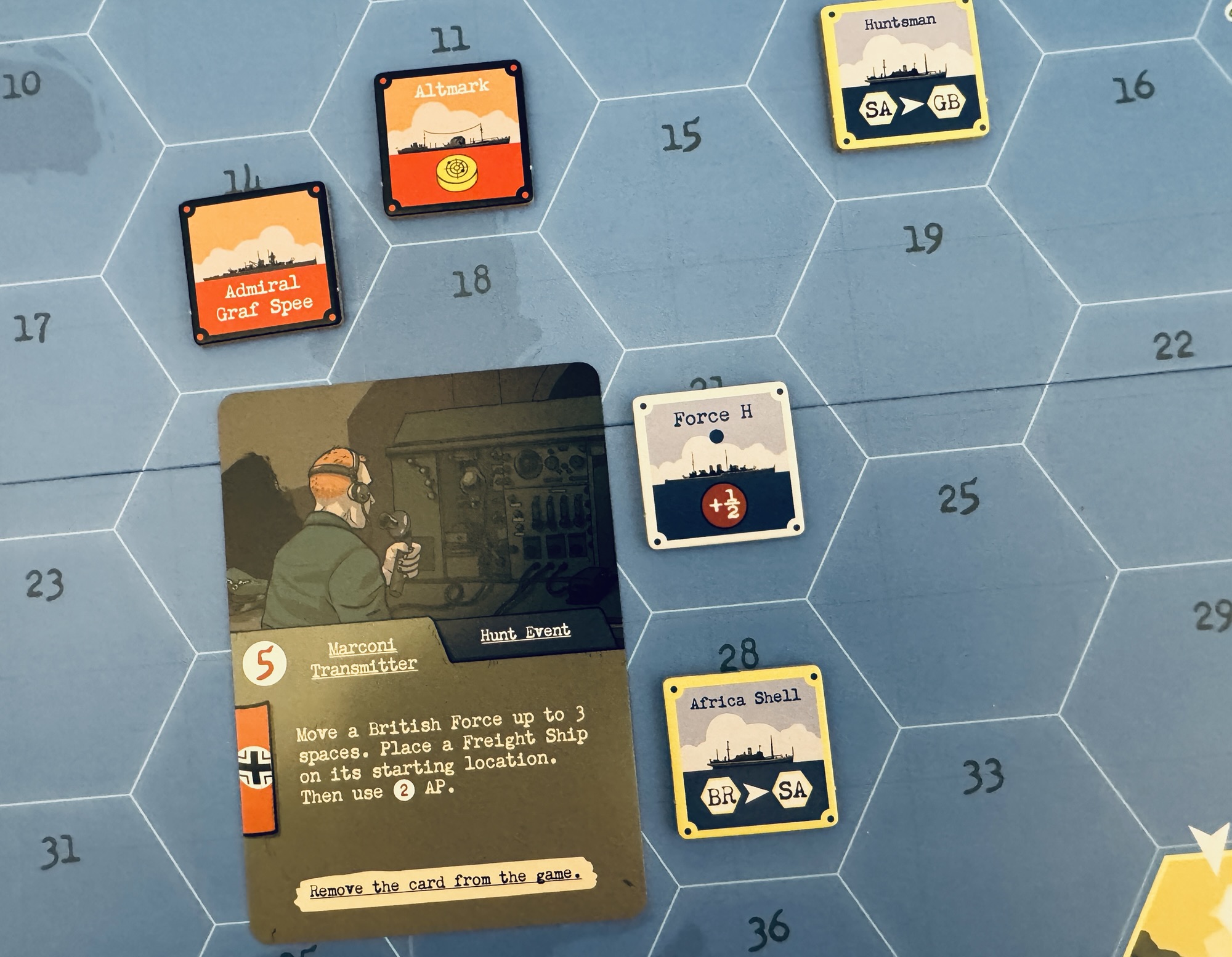
In today’s post, we will take a look at the very useful German card Marconi Transmitter. Marconi Transmitter is a 5 Ops card, which makes it a very important card in the German deck as it allows for the taking of 2-3 actions in a single turn, but for which there is an even more important use as a means of setting yourself up for that easy score to sink a merchant vessel. In the game, the British have multiple Task Forces that will search the South Atlantic for the Graf Spee attempting to find her, engage her and sink her to the bottom. As a Hidden Movement game, the German player has surprise on their side and must use tactics that manipulate and change things for the British player making their searches much more difficult and time consuming. The Marconi Transmitter allows the German player to move a British Task Force up to 3 hexes away and then to choose a Freight Ship and then place that ship back onto its starting location on the board. This card has the ability to clear the way of enemy ships searching for the Graf Spee but then follows that up with the relocation of an unsuspecting Freight Ship to place it within striking distance of the pocket battleship for an easy kill. I just love these kind of cards that manipulate things and provide means to change up the current situation.
Marconi transmitters were pioneering early radio devices developed by Guglielmo Marconi in the late 1890’s. Primarily consisting of spark-gap transmitters, they generated radio waves that allowed ships and continents to communicate via Morse code without wires, paving the way for modern broadcasting and other telecommunications. This advancement was used by the Allies to hunt for the Graf Spee in the South Atlantic and caused the German pocket battleship to change some of its operating procedures. The Admiral Graf Spee did not elude the Marconi radio transmitters through electronic jamming. Instead, her commanding captain, Hans Langsdorff, successfully evaded Allied interception by using strict radio silence and executing aggressive threats to ensure merchant vessels never broadcasted their distress calls.
When the Graf Spee intercepted a merchant ship, she used her speed and imposing silhouette to intercept before a signal could be sent. The standard British raider defense was to use their Marconi-equipped transmitters to call for help. However, as soon as a merchant ship began transmitting a warning, the Graf Spee would flash a signal demanding they cease transmission immediately, threatening to open fire with her devastating main armament. Outgunned and at the mercy of the German ship, the merchant crews complied, shutting off their wireless.
Because the Graf Spee traveled thousands of miles across the remote South Atlantic and Indian oceans, she remained unseen by simply avoiding the heavy shipping lanes. Captain Langsdorff further deceived Allied forces by utilizing visual camouflage. By attaching fake turrets and a dummy funnel, and flying false colors, he bypassed merchant shipping unmolested while maintaining strict radio silence to keep his location hidden.
Here is a link to our full video review of the game:
I love a different style and focus of wargame. A game that takes a look at an important but somewhat obscure or rarely addressed historical topic, such as espionage or intelligence, and creates a gaming experience tailored around the events to highlight and evoke the difficulties and tension that would have been present. In January 2026, GMT Games announced such a game in Checkpoint Charlie, which is a solo or cooperative game focused on SIS espionage missions in Berlin in the 1960’s designed by Russell Brown. We have posted an interview with Russel and it was very well received and he has now agreed to create a series of History Behind the Cards to highlight the events of the 1960’s Cold War struggle in West Germany but also to share aspects about the game play and how it models the history.
*Note: The cards highlighted in this series and their event text, as well as any pictures used showing any of the various components, are still in the design and development process and as such event effects and text might still change prior to final development and publication.Also the art and layout of the cards are only for playtest purposes at this point and the game will enter the art department as it nears publication.
History Behind the Cards – Checkpoint Charlie from GMT Games – Card #1: Cousins Operation
The British SIS wasn’t the only intelligence agency operating in Berlin in the 1960’s, not by a longshot. The Potsdam Agreement of 1945 had divided Germany into allied occupation zones, with West Berlin itself divided into British, French and American sectors for administration and military presence, but those boundaries in no way restricted the activities of intelligence organizations in the city. The US Central Intelligence Agency had the largest presence.
The remarkably close relationship between US and British intelligence was formalized in 1946 under the British-US Communications Intelligence Agreement (BRUSA). It became the UKUSA agreement in 1955, including Canada, New Zealand and Australia (the “Five Eyes”), and still stands today. The term “cousins” was used within the British and American intelligence communities to refer to their counterparts from the other agencies, in reference to their longstanding Special Relationship. There were notable examples of not just coordination, but cooperation among the agencies, like Operation Gold – a joint operation in the 1950’s to tunnel beneath the city and tap into the landline communication of the Soviet Army headquarters in Berlin.
This relationship was formalized in the rules of a much earlier version of Checkpoint Charlie, with a specific step in the turn sequence when SIS assets could call upon the CIA for assistance, though with increased risk of detection. However, even with liaison officers and daily intelligence briefings between the two agencies, it was impossible to inform the other service of every aspect of day-to-day activities, let alone coordinate at a task level, so I removed that interaction.
This card represents a CIA operation in one of the locations in the city that has come to the attention of the KGB and was unknown to SIS case officers. This card places a marker that makes it more difficult for SIS assets to operate in the location, as indicated by the negative detection save modifier, and also draws a KGB Agent closer to that location.
In the next article in this series, we will take a look at the Cuban Missile Crisis and how the status of Berlin, even though it is located halfway around the world, effected things on the world stage.
In my opinion, this game looks extremely interesting and I am very much excited to learn more about it. I am appreciative to Russell and his efforts to bring us these cards and to write these entries to share with our readers. I am also very glad that this topic is being covered in a game and look forward to playing this one day soon.
I know it is now June….I am usually done with this post by mid-March but this year we had a bunch of great games that came out in November and December and we just had to get several of them to the table before we shut 2025 down. Our opportunity to do so with full tables as there were several multi-player games in that bunch, was during Buckeye Game Fest in mid-March where we played lots of great games including Werwolf: Insurgency in Occupied Germany, 1945-1948 from Legion Wargames, Cross Bronx Expressway from GMT Games and Imperial Elegy: The Road to the Great War 1850-1920 from VUCA Simulations to name just a few. And now, with those final games getting played, comes the impossible task of distilling an entire year’s worth of gaming down to a list of the 10 games that we most enjoyed. I hate doing this. I love writing about, thinking about and sharing my experiences about the games we have played but hate having to make somewhat objective choices about which is better and which games should even be considered for the list. The first comment I would have is that not all games are the same. Not the same scale, the same play time, the same mechanically or even historically. Each game is unique and in my opinion, all games have something objectively good about them. Secondly, we didn’t get around to playing some of the new releases in 2025. I say some but we actually didn’t play a lot of the new releases and did the best that we could to play as many as possible. So we might leave off a game that you thought was very good and deserving and it probably is but we either didn’t get around to playing it or it just didn’t hit with us. But, in the end, I have to make this list and this is my best effort at doing just that!
In 2025, we played 33 unique titles from 22 different publishers. Some were operational, strategic or tactical scale and in the list this year I didn’t include any solitaire games. Some used counters. Some used cards. Some used wooden bits and some used miniatures. Some were only card games with no other components and some were cooperative. At the end of the day, in 2025 we played a lot of games! And here I present to you my list of the Top 10 Wargames of 2025!
10. China’s War: 1937-1941 from GMT Games
This is a game that I have been awaiting for a long, long time. Really since it was announced nearly 7 years ago in 2019. Yes you read that right…2019! And I am happy to report that the wait was definitely worth it as the game feels fresh and is a very worthy addition to the COIN Series. China’s War: 1937-1941 from GMT Games, which is volume 13 in the well respected and venerable COIN Series, examines the first five years of the 2nd Sino-Japanese conflict, when China stood alone against the whole of the Japanese Empire. Each player takes on the role of 1 of 4 Factions seeking to attack or defend the Republic of China including the aggressive and powerful Japanese, the harried Government represented by the Guomindang party, the rebellious Chinese Communist Party, or the unruly and fractious Warlords who are obedient when convenient but have their eye on gaining state power. Using military, political, and economic actions and exploiting various events, players will build and maneuver forces to influence or control the population, extract resources, or otherwise achieve their Faction’s goals and victory conditions. As with all COIN Series games that are Card Assisted rather than Card Driven Games, the deck of cards will regulate turn order, inject historical events into the game with major benefits or consequences, cause victory checks and other in game processes.
China’s War feels like a classic COIN Series game but in my opinion has 3 insurgent style factions against the powerful Japanese who don’t really act like the large Government factions in previous entries in the series. The focus really centers on the control of the Lines of Communication or LoC’s on the game board, which was a very refreshing approach that created some really interesting interplay and caused me to think differently about how I would go about achieving my Victory Conditions.
We find that Brian Train’s designs are just fantastic. I think that sometimes they can be a bit opaque, meaning that their true genius cannot be seen with just a few plays but will be unlocked over 4 or 5 plays as we have found with A Distant Plain, which has continually moved up on my list of favorite COIN Series games with each play that now numbers around 5. But China’s War was just special. It is totally unique as to its take on insurgency within the COIN Series, is really frenetic and active and gives the feeling of classic COIN while really turning things a bit upside down with the way the powerful faction works in the Japanese as they really only care about maintaining and cleaning off their Lines of Communication. In fact, they are so unique that they are the faction that will place Terror on the board, which is typically reserved for the insurgent factions to sway Support and Opposition.
We very much enjoyed the game and had a good time with it. We had a newer COIN Series player and they seemed to take to the game quickly and understood what it was that they were supposed to be doing. With that being said, with only the 1 play, I am sure that there are lots of things that we didn’t experience and will be able to discover those in future gaming opportunities. Suffice it to say that we can’t wait to play the game again and I am planning to bring this one along with me to the World Boardgaming Championships at the end of July.
We recently shot a First Impression/review video and you can watch that at the following link:
9. Imperial Elegy: The Road to the Great War 1850-1920 from VUCA Simulations
This spring, while attending Buckeye Game Fest in Columbus, Ohio, we were able to coordinate a 6-player game of Imperial Elegy: The Road to the Great War 1850-1920 from VUCA Simulations. Imperial Elegy is a card driven game that blends diplomacy, warfare, and statecraft and feels a bit akin to games like Here I Stand and Virgin Queen from GMT Games. Grand scale sweeping epics that play multiplayers and take a day to play. Players play as 1 of 6 unique major powers in the game including Germany/Prussia, the United Kingdom, France, Austria-Hungary, Russia and the Ottoman Empire.
Imperial Elegy is a fantastically themed game that takes place over 7 turns, with each of the turns representing approximately a decade. If the Great War breaks out due to the World Tension Track reaching a certain level, the game can be extended by an additional 6 shorter turns. A turn in the game consists of player impulses that is driven by the play of action cards for their Command Points or for the printed events. Players will use CP and events to take actions like colonize, conduct diplomacy with minor nations, fight wars, as well as hinder their opponents by playing events that take away their actions or resources. A turn will end once all players have consecutively passed or when all players run out of cards.
The game is somewhat of a sandbox style game as you have so many options and choices about what to do during the course of the game. Obviously, your faction has some direction about what you should be doing but really it is up the player to spend their resources how they will to accomplish their ultimate goals and score Victory Points. I truly love that aspect about this game and as we played we saw that sandbox and the asymmetry between the various factions. Particularly at the start, each country has some specific goals that they have drawn from the National Goals Deck that are a source of Victory Points, in fact a major source of Victory Points, and players will need to prioritize these cards and decide which ones to attempt to go after from the start. With only 7 turns, they will have to make progress on these National Goals if they have any hope of actually achieving them.
Each of the represented nations in the game have their own special player board that contains various tracks that keep various information readily available to the players. Here is a look at the German player board. I very much enjoyed that they have gone to a great deal of effort to make these player boards and also that they gave each of the nation’s Stability, which decides whether various actions like war can be taken or if there are various positive or negative modifiers, the available Manpower that will determine how many armies can be built, Industry that tells how many action pointed you will have to spend during war to maneuver units, attack and replace losses. The focus of the game is about the control of territories both in Europe as well as colonies abroad and there is an automatic victory if a certain target number is met, in the case of Germany 15.
As we played, I started to realize that the key focus of the overall world stability and things like the Domestic Stability Tracks, which are focused of both the internal and external pressures faced by the powers. I really very much liked this thematic inclusion as no one wants to start a major global conflagration and there are steps that players have to take to skirt the inevitable troubles that result in their own actions and how they are seen by the other players in the game. But in our limited play, I never really felt threatened by this concept. Either our group was super skilled at avoiding the inevitable increase in tension or due to our short play we didn’t really experience some of the events that would have tipped this over the edge. I think that we say small increases in our full turn play but nothing that seemed unmanageable and we actually had an event that lowered it so it never became an issue. The game is about spending your resources wisely, in the form of your cards and your aspects like Stability, and to use your cards to do the events that could increase tension didn’t seem to be in our best interest, at least not in the 1st decade of the game. But maybe that will come later.
8. An Impossible War: The First Carlist War in the North, 1834-1838 from Bellica Third Generation
Earlier this year, I was able to host Francisco Ronco at my home to play a few games together. One of the games we played was published by his company Bellica Third Generation and was called An Impossible War. An Impossible War: The First Carlist War in the North, 1834-1838 is a block wargame that recreates the First Carlist War in the North of Spain which was a civil war between the Carlists who supported the succession of the late king’s brother Carlos de Borbón and the progressive and centralist supporters of the regent Maria Christina acting for Isabella II of Spain who were referred to as the Liberals. The game uses blocks representing units but also includes counters and uses cards.
An Impossible War is a fantastic design that attempts to capture the historical aspects of this titanic struggle for the throne of Spain in the mid 19th century. Historically, the Carlist forces who were defenders of traditional monarchy, regional privileges, and the Catholic Church, were a minority faction fighting an overwhelmingly larger, richer liberal government. The uprising phase reflects how the Carlists compensated for this disparity by forcing the Liberal government to fight on multiple fronts and suffer from logistical nightmares across hostile terrain. The Carlist Uprising Phase, and the use of its auxiliary Rest of Spain regional map, forces some really tough dilemmas on the Liberal player. They must attempt to divide their forces between the main Game Map and the Rest of Spain Map to prevent the opposition Carlist forces from overwhelming the home territory in the north. It serves as a vital strategic balancing act for the Liberal player that cannot be ignored and must be dealt with systematically and somewhat evenly. Too much focus on the Rest of Spain Map and the situation on the Game Map will quickly snowball and they will lose control. Focus on the situation on the Game Map and the protection of Cities and Towns and the Carlist Expeditions will gain momentum and turn the countryside red. While the primary war centers on the rugged terrain of northern Spain (Navarre and the Basque Provinces), the uprising mechanic abstractly models scattered insurgencies across the rest of the country. And as you know, insurgencies can be very unpredictable and difficult to contain. You stamp out one area only to see a fire start in another. The Liberal player must divert troops and supply resources to the secondary map to quell these localized rebellions and hunt down Carlist expeditions originating from the north. And, the important thing for the Carlist player and the expansion of the uprisings and the success of their expeditions is the possible generation of generation of Prestige and Victory Points, which is really crucial to their path to victory.
I very much enjoyed the asymmetry between the Carlist and Liberal forces in the game. It made for a very interesting tactical challenge for both sides as they have to play to their strengths and not get too overly concerned with the numbers. The Carlists will be much more mobile in their defense and look to exploit every gap in a supply line to move around and stay away from the numerically superior Liberal forces, whereas the Liberal player will have to move more methodically to take outlying towns and settlements to be able to shore up their lines and create less opportunities for end arounds by the Carlists. The disparity in the forces was a very interesting choice by the designer David Gómez Relloso and I am sure is reflective of the historical reality of the First Carlist War.
I very much enjoyed An Impossible War, even though I played just a few turns of a smaller scenario with Francisco Ronco. He was a master at the game, as obviously as the publisher and a playtester he is intimately familiar with the rules and strategies, and I learned a lot from him about how the game should be played. I am looking forward to future plays as the game is just very good and has some interesting aspects that create a very tense and interesting game of maneuver and strategy. The Game Map is very well done, from an aesthetic perspective as well as functionally, and the board makes playing the game easier.
I also was able to shoot a fairly short video summary of my game play with Francisco Ronco who is the owner of Bellica Third Generation and you can watch that at the following link:
Also I have embarked on a series of written Action Point post highlighting the various aspects of the game. Those published to date are as follows:
If you are interested in An Impossible War: The First Carlist War in the North, 1834-1838, you can purchase a copy for 120,00 € ($139.08 in US Dollars) from the Bellica Third Generation website at the following link: https://bellica3g.com/en/product/una-guerra-imposible/
7. Blue & Gray Deluxe Edition from Decision Games
If you like classic wargames, and by that I mean simple I Go You Go Hex and Counter games from the 70’s and 80’s, then you are going to love Blue & Gray Deluxe Edition, which is a new updated version of 2 classic quadrigames from SPI covering several key battles from the American Civil War. Blue & Gray Deluxe Edition consists of the original eight games from the SPI Blue & Gray I & II Quadrigames but with massively upgraded components and counters and some better written rules. The key battles depicted are among the most important of the American Civil War and include Shiloh, Antietam, Fredericksburg, Chancellorsville, Gettysburg, Chickamauga, Chattanooga and The Battle of the Wilderness.
The Deluxe Edition part of the title is really just a few changes including a mounted board that is really gorgeous and pretty sturdy. The counters have been slightly enlarged and there are a few additional optional rules including things like night turns, fatigue, leader casualties. There also were some optional unit counters that could be used but overall this was an artist and layout reissue of the game with some other nice additions such as period fonts and a very solid choice of colors for the maps and the counters as they really compliment each other well. But the game is really extremely playable meaning that is doesn’t take long to pick up the rules and the system is very standard fair. The game mechanics used are based on the Borodino/Napoleon at Waterloo system and frankly are very easy to grock and to get into. I did very much like the back and forth of the scenarios as the players will tend to clash over control of certain key areas that have defensible terrain and that are only approachable from a few areas. But the game does have a few concerns for me such as generally no fog of war and no difficulty in activating any and all of your stacks. But that is what the system is and it will truly appeal to those that are looking for that nostalgic feeling from their childhoods.
But it plays well, fast and is solid and any good solid wargame is good with me.
6. Fighting Formations: US 29th Infantry Division from GMT Games
One of my favorite tactical systems of all time is Combat Commander designed by the late Chad Jensen. I had yet to play his other tactical combined-arms series called Fighting Formations until the newest release came out in 2025 called Fighting Formations: US 29th Infantry Division. Fighting Formations is intended to be an ongoing series of wargames covering WWII tactical combined-arms combat at the platoon and squad levels. Each game in the series will feature a distinct combat unit, highlighting battles in which that unit participated as well as its particular order of battle and fighting characteristics. In this second volume of Fighting Formations, GMT features the US 29th Infantry Division—“Blue and Gray”—as it fought from just after D-Day in June of 1944 to the end of the year.
The core mechanics from the original Fighting Formations remain unchanged in this volume. The difference from the original game is in the way the units will fight. The different costs on the matrix place an emphasis on certain actions and assets for the 29th ID that were different than the others games way of approaching a battle. This game is far from Combat Commander though as it uses cards but they are not the engine of the game. The game also has a very interesting and unique activation system where each of the orders cost a different amount of Initiative and tuns into and impulse-type back and forth where the various Orders carry with them a certain cost in Initiative. The game has a pool of 40 Initiative that is spent to give these orders and then to activate units for those orders. At the end of every order, the player with the most Initiative is able to give the next order. In response, the opponent can also spend Initiative to conduct both Opportunity Fire or Reactive Fire which keeps the game very dynamic and fluid. Just a really great way to approach this and if you have played Downfall from GMT Games you will notice similarities with the system.
The game also tells a great narrative of the differences between the US and German troops as the 29th had access to more battlefield support than their German counterparts and the card deck is tailored to that experience as well. The US player in the new game has access to more cards and at lower initiative costs, bringing artillery and air support to the forefront in a way that we have not seen before.
We did a RAW video after our 1st play and you can watch that at the following link:
The Rock of Chickamauga is the 2nd entry in the Black Swan Series from Flying Pig Games designed by Hermann Luttmann and follows closely on the heels of A Most Fearful Sacrifice. Using the same game system, which is based on the well received Blind Sword Series, The Rock of Chickamauga covers the entire Battle of Chickamauga, fought from September 18th through the 20th, 1863 in northern Georgia. The Union Army of the Cumberland, under William Rosecrans, is driving south from Chattanooga, hoping to envelop and trap Braxton Bragg’s Confederate Army of Tennessee. But Bragg anticipates the maneuver, pulls back and then counterattacks the overextended Union forces. They meet along Chickamauga Creek, nicknamed the “River of Death”, in an epic struggle.
The Black Swan Series uses a card-draw activation system that functions similarly to a traditional chit-pull system. This system is a core mechanic for introducing uncertainty, friction, and the fog of war into the gameplay. The cards themselves contain specific game information and orders, which streamlines play and reduces the need to look up rules or charts, saving time compared to traditional chit-pull systems.
I also very much liked how the confusion and true fog of war that existed at the battlefield was included in the game play. Not only do to the commanders’ lack precise information about their opponent but also the physical nature of the battlefield. Both sides basically went into battle stumbling and bumbling through the woods, searching out what they thought was the enemy’s flank and actually being way off in their assumptions. The woods themselves were so uniquely characteristic in that they were mostly thickly grouped with little undergrowth (being cleared by the local farmers and millers), but still displaying significant canopies. This canopy functioned like a tropical jungle “roof” and trapped smoke and dust within it. To add to that, there had been little rain in the area and the trails, lanes, and roads were exceedingly dry and produced clouds of dust. My main concern therefore was replicating all that confusion and ignorance of the location of opposing forces and thankfully, that’s what the entire Blind Swords/Black Swan System is modeled to reflect. Therefore, I just doubled-down on the inherent “chaos” elements of the core system and made those factors even more prevalent.
I also love how the system models the units and their fighting prowess referred to as Cohesion. The Cohesion Rating of a unit is essentially a catch-all for its morale, training and experience and includes what the unit’s intangible fighting qualities are, other than just sheer number of men. It is probably the most important aspect of the game engine as it is the key element that will determine how well a unit will fight – and survive – during the battle. It is used throughout the game to measure a unit’s ability to fight and endure on the battlefield. The CR will fluctuate during the entire game, and it will do so often. Units that are Shaken or Battleworn will have their CR suffer. Units can also raise their CR temporarily through the use of various events or by providing them with Unit Support. A low CR makes units more vulnerable and increases their risk during a Break Test, which will cause them to leave the game if they fail. You have to focus on this aspect or you will be unable to consistently move your attacks forward.
Just such a great system and I love Hermann’s attention to the historical details and the way he tells these ACW stories. I love this Black Swan Series and look forward to future volumes.
4. BCS Inflection Point: The Battle for Kalach and the Battle of Chir from Multi-Man Publishing
Over the past couple years, we have played a few venerated and respected series games from Multi-Man Publishing for the first time that frankly I had initially turned my nose up at for various reasons. These reasons were not really anything important or truly about the design or mechanics but included things like price, graphic design, style and somewhat because of the complexity and reputation of complexity of those systems. These series included first the Standard Combat Series (SCS) with our first game being Rostov ’41 and now the Battalion Combat Series (BCS) with our first game being Arracourt and since we have played several other volumes including Brazen Chariots and Baptism by Fire. I must admit here that I am actually embarrassed that I hadn’t played those series and readily admit that I just discounted and dismissed them out of hand. I am so very glad that we repented of our stubbornness and found this system because it really is very, very good at what it is trying to teach and demonstrate about warfare at this scale.
One of the best parts about this new volume in the series is that it is actually 2 games in the same box. One game which is smaller, with fewer counters and formations and that uses a smaller version of the board included in the game and one that is the full campaign with more counters and formations, a larger board and is much more involved. Overall, I would say that the BCS is a fairly straightforward series even for someone who is a beginner and has less experience with the BCS system like me. I think that I thought they were designing Arracourt as the entry to the series, and I still think that is the case, but this volume has some of the same flexibility and approachability that some of the larger titles don’t necessarily have. I feel that players can cut their teeth on this one using the smaller scenario while getting comfortable with the rules and system before you attempt the larger scenarior or even other larger games in the series. I also feel that the game requires somewhat of a paradigm shift before playing. What I mean by that is really two fold.
First, I really feel that usually these big hex and counter wargames are set in their combat methods, namely focused on odds based Combat Results Tables and counting up combat factors to get the perfect odds, and require a bit of calculation. But BCS doesn’t use a traditional CRT but breaks the combat down into more of a collection of DRM’s based on many factors.
Second, the game also has very low counter density, with the scenario we played having about 40 counters per side on the map at any given time, and stacking limits are just 2 combat units with other counters also allowed such as support units or HQ’s. There are not enough counters here to create the long contiguous line or wall of units that are typical in some of the larger systems, which lends this one to a bit more maneuvering of units to get into good position while using terrain to attempt to isolate and cut off units from supply or to prevent the enemy from doing the same to your units. This created somewhat of a back and forth dance for us that kept my focus and attention and was really quite entertaining. Supply is important to the system but not as focused on it as say the Operational Combat Series (OCS). The players must manage their HQ’s and their combat trains to keep their units in full supply and this becomes somewhat of a different type of dance that sees players cautiously keeping their units in a loose perimeter to prevent a freak breakthrough or run around to get to the back of the formations to take out supply sources and cut off units. I really liked the scale and feeling of this BCS system and had a very good time in trying to learn and understand it and also trying to figure out the best strategies to engage.
The counters included in BCS Inflection Point are dual sided but the back side is not to show a reduced unit as is normal with these wargames. The front side is the unit’s move side while the back side is its deployed side. Each of these stances is very important and must be used by each player to get the most out of their units and to take it to their opponent.
We also did a review video and you can watch that at the following link:
If you are interested in BCS Inflection Point: The Battle for Kalach and the Battle of Chir, you can order a copy for $112.00 from the Multi-Man Publishing website at the following link: https://mmpgamers.com/inflection-point-p-418
3. Close Quarter Battles: Waterloo from Lock ‘n Load Publishing
Close Quarter Battles: Waterloo was such a surprise of the year for us. It is a tactical level wargame that is truly intense and chaotic that attempts to, and does a fantastic job of accomplishing, the brutal, up-close engagements of Napoleonic warfare. The game puts players in command of elite British, French, or Prussian forces as they fight for control of key battlefield positions. The designer has chosen to center on the two strongpoints of the battle of Waterloo including the La Haye Sainte farm and the Hougoumont Farm. First off, the game is just gorgeous and the maps are stunning. In fact, they are so good that I am going to highlight them in an upcoming entry on the blog in the Beautiful Boards of Wargaming Series. But, the Waterloo battles here are skirmishes around and for the taking of these two farms. The game uses a grand tactical system that works to attempt to to simulate the interactions between infantry skirmishers of small groups, artillery sections and cavalry in a fortified area. This leads to the game being uber violent and bloody as assaults are common but difficult particularly for the attackers who will have to scale formidable walls and then take on the awaiting crack troops inside. Officers and generals are very important to the battle as they will influence the battlefield with their command range and other attributes to add DRM’s to the troops by issuing orders, rallying troops, and trying their best to maintain discipline.
I really like this one as it is really a game. Meaning that the rules are simple yet impactful and the game provides each of the players with a deck of cards that act as events to provide bonuses, allow for greater movement distance or to perform heroic acts. They also provide the chance to attack and eliminate leaders with sniper fire to cause even further chaos and blood.
We did a review video and you can watch that at the following link:
2. All Are Brothers: Solferino, 1859 from Legion Wargames
We very much enjoy the Blind Swords Series originally designed by Hermann Luttmann. We love it for its chaos, unpredictability and for is crunchy combat system. This past year, a new designer Bryan Armor took up the call and took this Blind Swords System and put it into action in the Second Italian War of Independence. All Are Brothers: Solferino, 1859 simulates the decisive battle of the Second Italian War of Independence at the Brigade-level, with some additional Regimental-size and smaller detachments included.
And the other part that is so good about this system and the game itself is the activation chit pull system. The chit pull mechanic also very much aids in solitaire play, as does variable activation rules and reinforcement tables but it really makes for a lot of uncertainty about how and what units will activate. No battle is in your full control and this system really reinforces that truth about the battlefield.
One of the best parts is the morale system. Each corps has an associated Corps Morale marker on the Morale Track. Each Corps Morale marker will be reduced by one when they activate including movement and fire attacks but also when Leaders take casualties or break tests are failed. This can all lead to the corps becoming demoralized which means they will be unable to offensively move and attack and will be relegated to a defensive posture. So you really have to make good choices about what units and when they will activate. You cannot just wholesale activate each formation every turn but must look at their status to decide how best to manage this aspect that was a very interesting and nice addition to an all ready proven and very good system. This means that units are also prone to attrition and need to be covered or supported by artillery fire. They can be used most effectively if massed at certain points. The chits also effected the corps’ stance switching between aggressive or defensive and this is a choice that must be made with a full understanding of a plan of attack.
Just a very solid and playable game that felt like a big wargame that played fairly quickly and easily and didn’t get bogged down too much.
We did a review video and you can watch that at the following link:
If you are interested in All Are Brothers: Solferino, 1859, you can order a copy for $58.00 from the Legion Wargames website at the following link: https://www.legionwargames.com/legion_AAB.html
1. Congress of Vienna from GMT Games
I am a big fan of the Great Statesman Series from GMT Games and several of its volumes including Churchill and Pericles are among my favorite wargames. But Congress of Vienna is a really great game, probably the best of the bunch, and has matured the system laid out by its found Mark Herman. Congress of Vienna has two different but related phases including the conference table where players first debate over the control of issues germane to the factions and the period of the war and second these issues are then used on the battlefield to recruit units, attack and take overall command of battles. The players will be playing cards from their hands to “debate” over the various issues that were placed on the table, which include all types of things such as Military Operations, Recruitment, who will lead the combined Coalition forces (Generalissimo), Future of French Government, British Financial Aid, Liberalism vs. Absolutism, Austrian Neutrality and several other issues, and then later the players will use their accumulated Resources gained from the issues to enact action on the Military Map and do things like mobilize troops, place Military Support Markers and the ultimately to conduct warfare.
The interesting thing about this mechanic is that sometimes the other players will win your issues by having them rest on their side of the conference table at the conclusion of the phase. In this case, the winning player will gain control of that issue and then will get the opportunity to choose where the issues will be placed on the Military Map, but the owner of the issue will still pay for it and must do where the placement is telling them to do, such as attack on a certain front. There also is a small area on the board where the Russian player must turn their effort to fight in Asia. This action has no real in game effect or benefit other than causing Russia to lose the choice of what they wanted to do in favor of doing something else. This can be a great tactic for the French player, or even for other Coalition players to spoil the plans of the Russian player and possibly box them out of gaining VP for military victories on various tracks.
The game relies on cards and cards can be used to negotiate, i.e. move an issue to your National Track. Cards can provide a particular issue with positive and negative DRM’s depending on which nation plays them and can also be traded with another player during the Diplomacy Phase. Certain cards are better than others for debating an issue moved by another player; and finally, if they are saved for the War Phase, staff cards can be used to modify dice rolling in battles. These are very versatile cards and the players will have to learn them and their benefits in order to be effective at the game.
But even though the game relies on cards and has an important Diplomacy Phase, without a doubt CoV is a wargame with DRM’s for units and military leaders, terrain, military support, a Casualties Table, retreat and advancing after battle, etc. However, both Phases are inversely related and if players use their Character Cards in the form of generals and military leaders for the Diplomacy Phase you will not have them available for the Military Phase. If you do not win enough issues during the Diplomacy Phase, you will not have recruiting or military operations where they are most important to your power.
I would say that the game is very involved and will take a few plays to really get comfortable with. I don’t want anyone to take this to mean that the game is overly complex and difficult to play. That is not the case. It is a very approachable system and game once you get the basics down through the play of a few turns. I would also say that there is a ton of differences and asymmetry with the nations and learning all of them well and understanding their tactics will take some time. But that is a good thing in my opinion and means that there is depth to the game and replayabilty is huge. And in my opinion, this was the best game that I played from 2025. Just fantastic!
Each year I feel compelled to tack on some games to this list just because they were so very interesting or dealt with unique settings that I feel they are worthy of mentioning. While they didn’t make the Top 10 list, they are each good games in their own right.
Alliance: Multi-Player Napoleonic Wargame from Columbia Games
All in all, we had a great time with Alliance. I think that we felt that the game was solid, with some great mechanics such as the card play and the block combat system, but was just missing some things. I would like to see what the community comes up with as far as variants and other changes over the next year. But the game delivers on its promise of a sandbox strategic level Napoleonic wargame with a focus on alliance building and maintenance. There is a lot to like and we plan to play this one again.
We also did a full video review and you can watch that at the following link:
If you are interested in Alliance: Multi-Player Napoleonic Wargame, you can order a copy for $99.98 from the Columbia Games website at the following link: https://secure.columbiagames.com/products/3221
Werwolf: Insurgency in Occupied Germany, 1945-1948 from Legion Wargames
Werwolf: Insurgency in Occupied Germany, 1945-1948 is a COIN Series adjacent game designed by Clint Warren-Davey and Benjamin Feine and is an alternate history game, but the story that is presented is entirely plausible. Werwolf was a real underground guerrilla group, comprised of SS and Hitler Youth members. It was intended to lead an insurgency against the invading Allies and Soviets when it became clear that Germany was losing the war in a conventional sense in the mid-1940’s. They did in fact have a few successes and American intelligence officer Frank Manuel said that the Werwolves were prepared “to strike down the isolated soldier in his jeep, the MP on patrol, the fool who goes a-courting after dark, the Yankee braggart who takes a back road.” The game allows players to take on the role of the occupying Soviets and Western Allies along with this Werwolf insurgency and the Edelweiss insurgency.
This game was very good and frankly was a breath of fresh air in the COIN Series or COIN Series adjacent arena. This game was very kinetic and each faction had a ton of combat and had to engage each other to accomplish their goals. The cards were fantastic and the additions to the system such as Research Tokens, Heavy Weapons in the form of leftover tanks, Wunder-waffen and the Cold War Tension Track, were really fresh and well integrated into the game play. I loved the game and would play it again in a heart beat!
If you are interested in Werwolf: Insurgency in Occupied Germany, 1945-1948, you can order a copy for $106.00 from the Legion Wargames website at the following link: https://www.legionwargames.com/legion_WER.html
Verdun from Dragon Dawn Productions
Verdun is a card game that is focused on the famous siege of Verdun during World War I. As player’s hands dwindle down as they play 2 cards per round but only draw 1, players will also have to play cards that help the other side, timing it strategically to minimize their own casualties. The teams alternate being the Attacker, and each card played leads to more and more deaths. You are fighting over positive victory points from trying to win several positions through over the top attacks that are worth a set amount of VP but that are hidden from view until they are taken so you never know if you are going for the high VP area or the low ones until you blow the whistle to initiate the attack.
A game of Verdun lasts about 16 rounds as players start with 12 cards, which they then play in a series of 12 tricks. When you win the trick, you gain the VP for the position but the winner will lose their lowest valued cards while the loser will lose their highest value cards to the dead pile representing mounting casualties. Low cards have fewer skulls on them representing deaths while higher cards have more. So even in victory you will be accumulating negative VP’s and this is one of the key aspects of the game…managing those deaths! Just like the high command.
In the end, the player with the highest score will win and this number will be very low or can even be negative. In our play of the game, my French defeated Alexander’s Germans by a final score of 3 VP to -14 VP. What a great little trick taking game! The really interesting part about the late game is that your hand has dwindled to being full of your worst cards as you have most likely used the good cards earlier to win tricks or cause losses to your opponent. The last few card plays just seem brutal and you are just hoping to not have to take a lot of skulls. This felt very fruitless and mimics the despair of commanders as they had to issue orders that they knew were not going to result in any positive gains but only the loss of life.
We did a full video review and you can watch that at the following link:
Drop Zone: Southern France from Worthington Publishing
Drop Zone: Southern France is a company-level wargame covering the Allied airborne assault that spearheaded Operation Dragoon, which was the invasion of Southern France or the Second D-Day on August 15, 1944. The history behind this operation is really very interesting as early on the morning of D-Day, the allied First Airborne Task Force (1st ABTF) parachuted a dozen miles behind the Riviera landing beaches to seize key towns and road junctions, to prevent the German occupation forces from counter-attacking the amphibious landing, and to facilitate the advance of Allied forces. The 4:00 AM parachute drop was badly scattered due to an unexpected dense fog bank that blanketed the battlefield. Drop Zone: Southern France covers the first two days of this airborne operation in six game turns, when the American and British paratroopers and glider-men fought surrounded and alone, supported only by French resistance bands. This game is very good and is just a solid wargame.
This game is surprisingly good and we had a great time playing it! There are just so many interesting elements to consider including the various operations, objectives and paths to take for the Allies to attempt to capture their objectives as planned. We found the game to be imminently playable and were very pleased with the strategy and planning required to do well. This one is a winner and I would recommend it highly as an introductory wargame that plays in 90-120 minutes but gives some real meat to chew on.
We did a full video review and you can watch that at the following link:
Chicago ’68 pits revolutionary spectacle against civil order at the Democratic National Convention riots of 1968. Players take the role of either the Establishment, consisting of the Chicago PD and Mayor Daley, or the Demonstrators, including the Yippies and MOBE, and is a fast-paced game of street battles and political maneuvers.
Each side plays from two asymmetric decks of action cards. The Establishment positions tactical forces and police platoons to co-ordinate mass arrests while working the convention floor. The Demonstrators, on the other hand, can pivot from direct clashes to radical street theater; their tactics can be reactive and unpredictable, allowing for wild cat-and-mouse chases and mischief-making across the tear-gassed avenues of downtown Chicago.
This game is an area control/area influence game that uses cards to take a predetermined set of actions that can be upgraded and replayed with better actions as the game progresses. Each player will fight for control of the delegates to the convention as well as exposure to the nation through the media. Just a very well designed game that was a ton of fun to play.
There I am finally done. My list of the Top 10 Wargames published in 2025. I had fun playing them and putting this list together as I got to revisit each of the games and think about why they were included on this list.
Please let me know what your top games of the year were and what you think of my choices and what games you would have placed on such a list.
Dan Dan Dan von Autor Thade Precht, erschienen bei Heldbergs Games, entführt uns in die Welt der japanischen Straßenverkäufer, den so genannten Tekiya. Angeblich eine große Familie, missgönnt jeder dem…
Frosted Games, the German-language publisher of titles including Too Many Bones and Endeavor: Deep Sea, has brought in board game industry veteran Michael Kränzle to lead its marketing operations – and hired a board game podcaster as its sales head.
Kränzle has a storied history within the German tabletop market, having previously spent more than a decade working in editorial and marketing for Pegasus Spiele, followed by another five leading marketing efforts at HeidelBÄR Games.
He replaces Jörg Hopfengarten, who has left Frosted to become project director for fair management at Spiel Essen.
Frosted Games CEO Benjamin Schönheiter, who worked with Kränzle at Pegasus Spiele in the early 2010s, told BoardGameWire, “I know Michael from way back in the day at Pegasus Spiele – and I was always impressed with his ability to create a strong brand awareness both offline and online.
“I want him to bring that same drive and success to Frosted Games to help us build on our twice in a row nomination (and our previous win) at the Kennerspiel des Jahres this year.
“We are still only a small publisher, and not known to many players. And there is none better to change that.”
Frosted launched in 2015 with the announcement it would publish a board games advent calendar, with each door revealing a different small expansion for a popular hobby board or card game.
Rebirth, designed by Reiner Knizia || Photo credit: Frosted Games
Alongside Kränzle’s arrival Frosted has also appointed Dennis Oettershagen as sales manager – a figure best known in German board game circles as a host of the Board Game Theory podcast.
He joins Frosted from barefoot shoe manufacturer Wildling, and previously spent more than a decade working for furniture giant IKEA.
Schönheiter said, “While Frosted Games wants to have a much stronger and better retail presence and experience – we are very much focused on a tight relationship with our players.
“…Dennis has exactly that experience from his previous job at Wildling shoes, a barefoot shoes pioneer. His main focus in 2026 will be to solidify our retail presence while overhauling our e-commerce platform and direct to consumer channels.”
Schönheiter added, “In general, I want to keep doing in 2026 what we have always been doing – creating and delivering phenomenal games with partners around the world.
“Our tag line is ‘We love games’. What seems like a foregone conclusion in an industry mainly driven by the hearts and souls of players that create games, it was nevertheless important to me to make that statement.
“And I want Frosted Games to publish games we love, not games that ‘just sell well’. And I want to keep investing in every single game, to give it the attention it needs and deserves always as a first thought – as a dedication, not a business model first.
“And I think that I have a great team that lets me achieve this goal, and I can see that the industry appreciates this as well.”
Titles set for release by Frosted this year include the German language version of Entropy, designed by Tommaso Battista, Simone Luciani and Nestore Mangone.
Last summer BoardGameWire reported that Frosted had signed a deal with industry heavyweight Asmodee to expand its distribution across Germany, Austria and Switzerland.
That deal came just over a year after Frosted ended its years-long distribution deal with Germany’s Pegasus Spiele, saying at the time that as a niche publisher of small print runs, “the wholesale route was no longer financially viable without either drastically increasing the prices of our games or making massive cuts somewhere in the production chain”.
We’ve been assessing the merits of political leaders in (more or less) democratic countries on this blog for a few years now. Today, we’re returning to German chancellors… but not the way you know it. After a few chancellors from the Federal Republic of Germany (founded in 1949), we’re assessing for the first time a chancellor from the Weimar Republic, Germany’s first attempt at parliamentary government – Hermann Müller. And which game could be more appropriate for him than Weimar (Matthias Cramer, Capstone Games/Skellig Games/Spielworxx)?
The Rating System
Some caveats ahead: The chancellors will be rated by the knowledge of their time. If they or their contemporaries could not have known about the effects of something, I will not use my hindsight to mark it as a mistake of theirs. The assessment is focused on their conduct as chancellor.
Now, to the system itself: There are three policy field categories (foreign, domestic, and economic policy) and three more general ones (vision, pragmatism, integrity). A chancellor can earn from one to five stars in each category (for a total sum of up to 30). In detail, the chancellor is assessed as follows:
Foreign policy: Did the chancellor increase German influence in the world and the security of Germans at home? Did the chancellor wield German power responsibly and with positive results for the regions affected?
Domestic policy: Did the chancellor increase the liberty of Germans to express themselves and to participate in the political process? Did the chancellor promote domestic security and shape the framework for fair justice dealing with offenses?
Economic policy: Did the chancellor facilitate the prosperity and economic security of Germans (including in the mid- and long-term)? Was the chancellor’s economic policy based on mutual benefit of those involved or did it unduly burden one side?
Vision: Did the chancellor have an idea of what Germany and Europe (the latter counting for more in times of German influence being great) should look like beyond the immediate future? Did the chancellor’s policies steer Germany (and, if applicable, Europe) in this direction?
Pragmatism: Did the chancellor succeed in seeing their policy through from inception to completion? How well did the chancellor manage the support from parliament, society, the administration, the media?
Integrity: Did the chancellor understand the office as a means to benefit themselves, special interest groups, the entire country, or another community? Did the chancellor respect the boundaries of the office?
Note: If you have read my UK prime minister or US president ratings, you will remember that I rated them on the global impacts of their vision as well. As the rating system is only really applicable to democratic leaders and no democratic German leader ever had the chance to conduct a truly global policy, I only assess their vision on national and European grounds.
Müller’s Early Life
Hermann Müller was born in Mannheim (in the southwest of Germany) on May 18, 1876. His father ran a small sparkling wine company, but died when Hermann was still a teenager. Thus, instead of taking over the company or going to university, the young Hermann Müller trained to become a clerk. He soon became involved with the socialist movement and joined the Social Democratic Party of Germany (SPD) in 1893. After some years working for social democratic newspapers, he was elected to the leadership board of the SPD in 1906. Müller was often charged with liaisons to other socialist parties in Europe – including a doomed trip to Paris in July 1914, trying to negotiate a joint refusal of French and German socialists to support their respective countries’ impending war with each other.
Müller was elected to Imperial Germany’s parliament in a by-election in 1916. Soon after, the German Social Democrats split between the Majority Social Democrats (MSPD, including Müller) who supported the war effort, and the Independent Social Democrats (USPD), who did not. When the war was lost in November 1918 and the monarchy swept away by revolutionary soldiers and workers, the MSPD soon took control of the revolution and steered a moderate course towards parliamentary democracy.
The revolution of 1918/1919 transformed the (M)SPD from the pariah party of Imperial Germany to the most important pillar of the new republic. As the Social Democrats were no longer barred from the positions of power, they needed scores of cadres to fill them. The general upswing also brought a promotion for Müller, who was elected co-chairman of the MSPD in 1919. Government came with its own challenges: The lost war, the ongoing Allied naval blockade, and the weak position of the new government made it imperative to conclude a peace treaty with the Allied powers. The provisions of the Treaty of Versailles, with which the Allies presented Germany, seemed unacceptable to most Germans – including many Social Democrats. Chancellor Philipp Scheidemann resigned rather than take responsibility for the treaty. He was succeeded by Gustav Bauer (also SPD) whose new administration Müller joined as foreign minister in June 1919. In this role, it fell to him to sign the treaty. From there, Müller sketched the outlines of a new foreign policy – one in which Germany would cooperate with the Allies, use its economic and cultural rather than its military strength to influence world events, and thus overturn the harsh provisions of the Treaty of Versailles.
The Bauer administration resigned after the Kapp-Lüttwitz coup of March 1920. Müller took over the chancellorship as a caretaker – elections were scheduled for June 1920. He was unable to tackle most of the many challenges which beset Germany (chiefly the agreement with the Allies on the details of the German reparations, the tensions over the German-Polish border, and the threat of right-wing terrorism and insurgency (as in the Kahr coup in Bavaria)). The only crisis which was dispelled during his time in office was the dissolution of the Red Ruhr Army, a left-wing militia which had formed in opposition to the Kapp-Lüttwitz coup and, after its failure, had continued their struggle for a council republic on the Ruhr. Their uprising was put down by army and Freikorps units and over a thousand workers (with more or less connection to the uprising) summarily executed.
The Red Ruhr Army can give the Communists a powerful push in the game… and make the Republican parties more forgiving of the Nationalists taking over army units (black units in Essen).
The first one and a half years of democratic government in Germany had proven a disappointment for many voters, including those who generally were in favor of the new republic. The three government parties (the SPD, the Catholic Center (Zentrum), and the liberal German Democratic Party (DDP)) all suffered heavy losses in the 1920 election. The SPD was particularly hard hit, as its handling of the Kapp-Lüttwitz coup and the Ruhr Uprising disenchanted many left-leaning workers. Both the USPD and the pro-business, conservative-liberal German People’s Party (DVP) gained a lot of votes.
With the majority for the government coalition lost, Müller attempted to broaden the government by including the USPD. Due to his handling of the aftermath of the Kapp-Lüttwitz coup, he was brusquely rebuffed. As he did not see potential to cooperate with the DVP, he led the SPD into opposition.
The Opposition agenda card in Weimar strengthens the SPD in parliament and allows the party to (re-)gain a minor ally (the USPD or DDP).
Opposition and Return to Government
Müller’s own inclination was to return to government responsibility, but he prioritized first the reunification of the SPD with the USPD (concluded in 1922) and then the prevention of another rupture. However, the SPD supported the bourgeois minority government (Zentrum, DDP, and DVP) in matters of foreign policy, which was conducted by the guidelines which Müller had laid out as foreign minister and chancellor in 1919 and 1920.
The reparations issue, however, remained unresolved. As tensions over it with the Allies heated up, France occupied the Ruhr again, to which the government responded with encouraging the population of the Ruhr to cease cooperation with the occupiers. This “passive resistance” relied on the national government funding the livelihood of millions of people and thus fueled inflation. As these interconnected crises escalated, it became clear that the government did not have the parliamentary and public support to deal with them. Government needed to rest on a broad basis. The first “Grand Coalition”, led by DVP chancellor Gustav Stresemann and including SPD, Zentrum, DDP, and DVP was inaugurated in August 1923. Four Social Democrats became ministers. Hermann Müller, however, was none of them as he was deemed indispensable to maintain control of the fractious SPD parliamentary group (whose vote to join the government had been on the narrowest of margins).
Stresemann’s re-roll ability makes him an excellent ally in any kind of crisis – coups, foreign policy, presidential elections.
While the Stresemann government successfully ended both the passive resistance (and French occupation) and the inflation crisis, the way there was rocky. It included challenges from both the left wing in Saxony and Thuringia (which were put down by the armed forces once the Communist Party entered a parliamentary government) and the right wing (a nationalist power grab in Bavaria was left unanswered as the loyalty of the army to the republic seemed suspect; an attempt to radicalize Bavaria even further led by a young demagogue named Adolf Hitler collapsed when it met resistance by the nationalist authorities). This uneven treatment convinced the SPD to leave government after only three months. Stresemann, thus without a majority, soon was toppled as chancellor, but remained foreign minister.
The SPD, despite being the largest party in parliament (and being confirmed in this status in 1924), would spend the next five years in opposition. Attempts to form another Grand Coalition failed in 1924 and 1925 (because the DVP preferred to cooperate with the nationalist DNVP and the new, monarchist, president Paul von Hindenburg), and in 1926, because Müller’s SPD engaged in the fool’s quest of pursuing a plebiscite to expropriate the former princes – the plebiscite failed to meet the quorum as expected, but it set the SPD on a path of confrontation with the bourgeois parties which ruled out any cooperation with them.
That did not mean that cooperation was impossible: The SPD continued to back the cooperative-revisionist foreign policy of the government, and also supported budget compromises. Thus, the party agreed to a budget for the year 1928 which included a first payment for new armored cruisers to modernize the navy. It then campaigned for the March 1928 elections on the slogan “Meals for Children instead of the Armored Cruiser”. The electorate returned the SPD with its best showing since 1919. Müller was able to form a government (once more including Zentrum, DDP, and DVP) and was elected chancellor for the second time.
Müller at work in his preferred arena – that of parliamentary debate, not of street action. His event often allows the SPD player to shift the issues decisively in their favor.
The Second Chancellorship
The contradiction between parliamentary action and campaign promises immediately backfired for Müller. The budget for the new fiscal year was due, and as agreed, included funds for the naval modernization. Müller belatedly realized that the decision had been made already, that the SPD had agreed to it, and that his government partners would expect the SPD to stick to its previous course. While Müller and the SPD ministers voted in favor of the budget in cabinet, the SPD parliamentary group revolted against the budget and forced them to vote against it in parliament. It did the rebels no good, as they could not find another majority for an alternative budget, but the revolt was a catastrophe for Müller’s authority.
The economic situation was similarly unpromising: When the trade unions of the Ruhr heavy industry proposed a pay raise by 15 pennies per hour, the employers responded by pre-emptively handing hundreds of thousands of workers their notice. Unions and employers then agreed on mediation, but when the employers did not like the result, they backtracked and disputed the legality of the process. Thus, 240,000 iron workers were laid off. Müller had a second mediator make a new proposal, which was suitably employer-friendly (with pay raises ranging from one to six pennies per hour). The employers contentedly saw that playing hardball paid off. Their confrontational stance would increase with the growing unemployment after the 1929 stock market crash.
For the time being, Müller enjoyed the greatest success of his tenure: He negotiated a new reparations agreement (without Stresemann, who died in October 1929), the Young Plan (named after Owen D. Young, who represented the American side). The negotiations were a great step forward for Germany (as the reparations were much reduced and payment put on a realistic basis), but a mixed blessing for Müller: On the one hand, the agreement was very unpopular (as it stipulated German payments for the next 58 years) and thus maligned by the right wing (which campaigned against it on the slogan “Enslaved for three generations). On the other, the combination of the undoubted necessity of the negotiations and their unpopularity meant that the moderate right-wing parties held off their assault on Müller for the moment, as they wanted him to take the blame.
The combo of the Young Plan and the petition against it may place up to three new crisis markers on the board. Müller really threaded the needle by successfully negotiating the reparations agreement and then fending off the referendum against it.
It was only a short reprieve. By January 1930, the Young Plan negotiations were concluded. The same month, the DVP, not being held back by the pro-government Stresemann anymore, had secretly decided to break the coalition if the SPD did not agree to radical pro-business reforms. The party had received encouragement from president Hindenburg, who also intimated to Zentrum leader Heinrich Brüning that he would support a Brüning-led bourgeois minority cabinet with presidential executive orders.
The showdown came in March 1930 over the reform of unemployment insurance. Müller had negotiated a compromise with Paul Moldenhauer (DVP), the minister of finance. However, the DVP parliamentary group refused to accept the compromise. Müller then tasked Brüning to work out another proposal which would be acceptable to all parties in government. Brüning’s suggestion – which would have postponed the issue by another year without solving it – found agreement in the DVP, Zentrum, and DDP parliamentary groups, but, despite Müller’s urging, not that of the SPD. The second Müller administration thus ended on March 27, 1930.
Müller had hoped that president Hindenburg would support an SPD-led minority government with executive orders. Instead, Hindenburg turned to Brüning whose chancellorship began the slide into government not backed by parliamentary majorities. The SPD, however, supported Brüning on key issues of economic and foreign policy lest the president find excuses to turn even more authoritarian. It was to no avail: Hindenburg and his camarilla got tired of Brüning in 1932 and replaced him in turn with Franz von Papen and Kurt von Schleicher who enjoyed even less parliamentary support, before it seemed like a smart move to them to ally their nationalist elites to the popular movement of the Nazis in January 1933, ending German democracy altogether. Müller did not live to see his democratic republic destroyed: He had never been of strong health, had campaigned and governed against the advice of his doctors who counselled rest, and died on March 20, 1931.
The Rating
Foreign policy
Müller developed Weimar’s foreign policy in his first term in government (as foreign minister and chancellor), which aimed at proving to the Allies by faithful cooperation that Germany was willing to do its part in reconciliation (but had economic limits in what it could do) and would thus be re-admitted on an equal footing to the international community, which would allow the country to revise key portions of the Treaty of Versailles. While the theory was sound, its application ran into practical problems – for Müller as well as the other chancellors and foreign ministers of the Weimar Republic: French revisionism of the Treaty (France felt short-changed in the matters of annexations and would have liked to incorporate the entire left bank of the Rhine as under Napoleon), and the constant charges from the German right that international cooperation under the Treaty of Versailles was akin to betrayal of the nation.
Müller never gave much attention to the existing inequities during his two terms as chancellor. That he was aware of them is proven by his record as foreign minister, in which he massively overworked the diplomatic service (which had been almost exclusively staffed by nobles heretofore), opening it for applicants from all backgrounds. Similar reforms of the judiciary or the military, two other institutions still personally and mentally clinging to Imperial Germany, did not make it to Müller’s chancellor agenda, even though the atrocities committed on the Ruhr in 1920 while the army could not be used to deal with the Bavarian regime at all showed the necessity of these institutional changes.
Müller’s handling of economic policy was incremental and cooperative – a bad fit to deal with his counterparts in business and the government (DVP) who wanted radical changes through confrontation. Müller’s stance may have been the more reasonable. But Müller lost.
Rating: 2 out of 5.
Vision
Müller’s vision of a Germany based on constructive parliamentary debate and government compromise, cooperating with other countries on an equal footing, is compelling. However, Müller was not always successful in advancing these goals, as he prioritized party unity over compromise with others at times.
Müller failed to see most of his policy initiatives through. He kept neither his coalition nor his own parliamentary group in check. However, Müller prevented another rupture of his party, and as a skilled electoral campaigner, achieved the first place for the SPD in every national election with him at the helm of the party.
Müller was fair and even-handed in his conduct as a chancellor. As a Social Democrat, he considered the workers his natural constituency, but was always willing to include the interests of other groups in the compromises he forged. His only fault was to hope for the a-parliamentary executive order minority government which, in the end, was given not to him, but Brüning.
Rating: 4 out of 5.
Overall
Hermann Müller’s chancellorship is traditionally considered a failure based on the collapse of the Weimar Republic soon after. Yet the Republic did not end with his tenure, and it was destroyed not by his actions, but by those of others. Müller’s most enduring contribution was the invention of the Weimar formula of foreign policy, his biggest weakness his inability to impose authority on his friends, partners, rivals, and foes. He failed because he was a middling chancellor in a hostile world.
How would you rate Müller? Let me know in the comments!
Further Reading
For short overview essays on all German chancellors from Bismarck on, see Sternburg, Wilhelm von: Die deutschen Kanzler. Von Bismarck bis Merkel[The German Chancellors. From Bismarck to Merkel], Aufbau-Verlag, Berlin 2006 (in German).
The only full-length biography of Müller is Reichel, Peter: Der tragische Kanzler [The Tragic Chancellor], dtv, Munich 2018 (in German). Unfortunately, the book suffers from the author’s misguided attempt to assign blame for the end of the republic on the SPD for an alleged lack of willingness to compromise, which runs through the entire book.
A revisionist, but insightful short treatment of Müller is Behring, Rainer: Hermann Müller (1876—1931) und die Chancen der Weimarer Republik [Hermann Müller (1876—1931] and the Chances of the Weimar Republic], in: Brandt, Peter/Lehnert, Detlef: Sozialdemokratische Regierungschefs in Deutschland und Österreich. 1918—1983, Dietz, Bonn 2017 (in German).
For the broader context, see: Herbert, Ulrich: A History of Twentieth-Century Germany, Oxford University Press, Oxford 2019.
Before we dive into the content of the playlist, some general observations:
All of the songs in the playlist were popular during the Weimar Republic (1918—1933). Yet as music recording was still in its infancy at that time, many of the songs in the playlist are later recordings (and some rare ones were recorded even before 1918!).
As the playlist is only 2:21 hours long, your Weimar game will probably last longer (if you don’t crash the republic on the first or second round), but there’s no reason not to listen to these songs two or three times – they’re fascinating historical documents.
The playlist is thematically sorted. That helps you find similar songs, but makes for somewhat monotonous listening (until you come to the next group of songs). I therefore recommend you turn shuffle on.
Now, what awaits you in the playlist?
#1: The National Anthem
It seems like a no-brainer to include the German national anthem of the time, yet it’s not so simple: The Lied der Deutschen (Song of the Germans) had been written in 1841, but had since then only been a patriotic song among many – until the first president of the republic, Friedrich Ebert, declared it the national anthem in 1922. The song’s three stanzas were variedly popular: Ebert favored the third stanza with its liberal ideals of unity, justice, and freedom, his right-wing opponents preferred the “Deutschland über alles” (Germany Above Everything) first stanza. I have included an instrumental version. If you feel patriotic, you can sing along.
The Weimar Republic did not come into existence in a vacuum. It inherited German cultural traditions like folk songs (“Wem Gott will rechte Gunst erweisen” (Whom God Wants to Favor), song #2).
And, of course, the Weimar Republic succeeded the German Empire with its national feeling (“Die Wacht am Rhein” (The Guard on the Rhine), song #2), dominant Protestantism (Martin Luther’s classic “Ein feste Burg ist unser Gott” (A Mighty Fortress Is Our God), song #5), and monarchy (“Heil dir im Siegerkranz” (Hail to Thee In the Victor’s Crown), song #7 – the quasi-anthem of the German Empire).
The republic’s midwife was the First World War – whose experience shaped its veterans and provided the cultural context even for those who had not been adults during the war yet (“Wildgänse rauschen durch die Nacht” (Wild Geese Rush Through the Night), song #8, written in 1916, was immensely popular among the Weimar Republic youth movement). The war also cast its shadow over Weimar Germany as many had lost their husbands, sons, fathers, brothers, and friends in the war (“Ich hatt’ einen Kameraden” (I Had a Comrade), song #9, the traditional German soldiers’ lament).
The liberal republic proved fertile ground for satirical treatments of the new developments: Otto Reutter made fun of the big and small war profiteers with “Seh’n Sie, darum ist es schade, dass der Krieg zu Ende ist” (See, that’s why it’s a pity that the war is over, song #10), and Claire Waldoff called for replacing the men in power with women in “Raus mit den Männern aus dem Reichstag” (Kick the Men Out of Parliament, song #11), playing on masculine anxieties after the introduction of women’s suffrage.
Even in a time and place as politically charged as the Weimar Republic, not everything was politics. The average Hans and Gretel may have cared less about their preferred ideology and more about how to have good time on a Saturday night… and the new cultural scene, especially in the big cities like Berlin, provided ample opportunities.
The more sophisticated artists like the Comedian Harmonists succeeded with witty wordplay and erudite vocal harmonies. Others played on the classics – alcohol (“Wir versaufen unser Oma ihr klein’ Häuschen“ (We Blow Grandma’s Little House on Booze, song #19) and sexual innuendo („Fräulein, Woll’n Sie nicht ein Kind von mir“ (Miss, Don’t You Want a Child By Me, song #22). There was even the equivalent of a (generalized) diss track: “Du bist als Kind zu heiß gebadet worden” (You Have Been Bathed Too Hot As a Child, song #23) indicates that this neglect of bath safety led to lasting brain damage in the interlocutor.
#26-33: Film, Theater, and Opera Music
The Weimar Republic’s vibrant cultural scene led to cross-pollination between diverse forms of artistic expression. The new medium of film was pioneered in Germany, and once it had left its silent infancy behind, movie songs became hits. Marlene Dietrich, starring in The Blue Angel, enticed with “Ich bin von Kopf bis Fuß auf Liebe eingestellt (I’m Set to Love From Head to Heel, song #26), but warned “Nimm dich in Acht vor blonden Frau’n“ (Beware of Blonde Women, song #27).
More traditional art forms like the theater also adapted. Die Dreigroschenoper (The Threepenny Opera)’s acerbic critique of capitalism would not have been as successful without its catchy songs, the most famous of which is the “Moritat of Mackie Messer” (Ballad of Mack the Knife, song #31).
Even the most classic and highbrow form of entertainment modernized: “Jonny spielt auf” (Jonny Plays It Big, song #33) introduced jazz into the world of the opera… which brings us to our next category.
#34-41: Jazz and Blues
Traditionally, the United States had received and emulated European fashions, not the other way around. Yet by the early 20th century, America had become the largest economy in the world, its war entry in 1917 tipped the scales of the war further in favor of the Allies, and the increased presence of Americans in Europe meant that the United States turned from an importer to an exporter of culture. Jazz took Europe by storm – both in the form of American (and nascent European) bands and by the new medium of the music record. The Weimar Republic was no exception. Jazz fueled the parties in any larger city of 1920s Germany.
Of course, not everyone loved jazz, and the controversy over its unorthodox dissonances, the more expressive, individualistic, and eroticized dancing style accompanying the music, and, of course, the race of its performers entered the contemporary culture wars – exemplified by Weimar’s double use of Louis Armstrong, illustrating both the SPD’s “The New Rhythm” and the DNVP’s “Nicht Deutsch” (“Not German”) event cards.
The “Tiger Rag” (song #41) is also used in The Tin Drum, German writer Günter Grass’s epic about the rise, fall, and persistence of Nazism: The youthful protagonist Oskar Matzerath who always carries his eponymous tin drum plays the Tiger Rag at a NSDAP rally in his hometown Danzig. The mesmerizing rhythm has the audience sway and dance, exposing the Nazis to ridicule.
#42-47: Workers’ Songs
The aggressive ethno-nationalism of Nazism was one of the two most dynamic political movements of the Weimar Republic (at least once the 1929 crash had plunged vast parts of the German population into a crisis of material and identity). The other was the workers’ movement, both in its reformist Social Democratic and its revolutionary Communist form. As the workers had been traditionally excluded from the public in imperial Germany, dominated by aristocracy and bourgeoisie, they created their own political parties (SPD, later USPD and KPD), economic associations (the trade unions), and social and cultural associations – from workers’ sport clubs to workers’ singing societies. Their milieu was bound together not only by their shared economic experience, but also by this cultural connection, of which the workers’ songs formed an important part.
Classics from imperial times like “Die Internationale” (The Internationale, song #42) remained important, but the movement also adopted new songs written by the numerous socialist poets and composers like Bertolt Brecht, Hanns Eisler, or Ernst Busch. Whereas some of these became new classics (like the “Solidaritätslied” (Solidarity Song, song #46), others aged badly: “Der Marsch ins Dritte Reich” (The March to the Third Reich, song #47) poked fun at the alleged inability of the Nazis to take power after their electoral setback at the Reichstag election of November 1932. First recorded in December 1932, the song was horribly overtaken by events just a month later when Hitler was elected chancellor in January 1933.
Thus, we conclude our playlist. It contains the traditional and the modern, entertainment and politics, left and right – except for the very right, but I don’t want to listen to Nazi songs while playing board games, and I’m sure that neither do you.
Do you like to play music in the background while playing board games? What’s your favorite song from this playlist? Let me know in the comments!
Before we dive into the content of the playlist, some general observations:
All of the songs in the playlist were popular during the Weimar Republic (1918—1933). Yet as music recording was still in its infancy at that time, many of the songs in the playlist are later recordings (and some rare ones were recorded even before 1918!).
As the playlist is only 2:21 hours long, your Weimar game will probably last longer (if you don’t crash the republic on the first or second round), but there’s no reason not to listen to these songs two or three times – they’re fascinating historical documents.
The playlist is thematically sorted. That helps you find similar songs, but makes for somewhat monotonous listening (until you come to the next group of songs). I therefore recommend you turn shuffle on.
Now, what awaits you in the playlist?
#1: The National Anthem
It seems like a no-brainer to include the German national anthem of the time, yet it’s not so simple: The Lied der Deutschen (Song of the Germans) had been written in 1841, but had since then only been a patriotic song among many – until the first president of the republic, Friedrich Ebert, declared it the national anthem in 1922. The song’s three stanzas were variedly popular: Ebert favored the third stanza with its liberal ideals of unity, justice, and freedom, his right-wing opponents preferred the “Deutschland über alles” (Germany Above Everything) first stanza. I have included an instrumental version. If you feel patriotic, you can sing along.
The Weimar Republic did not come into existence in a vacuum. It inherited German cultural traditions like folk songs (“Wem Gott will rechte Gunst erweisen” (Whom God Wants to Favor), song #2).
And, of course, the Weimar Republic succeeded the German Empire with its national feeling (“Die Wacht am Rhein” (The Guard on the Rhine), song #2), dominant Protestantism (Martin Luther’s classic “Ein feste Burg ist unser Gott” (A Mighty Fortress Is Our God), song #5), and monarchy (“Heil dir im Siegerkranz” (Hail to Thee In the Victor’s Crown), song #7 – the quasi-anthem of the German Empire).
The republic’s midwife was the First World War – whose experience shaped its veterans and provided the cultural context even for those who had not been adults during the war yet (“Wildgänse rauschen durch die Nacht” (Wild Geese Rush Through the Night), song #8, written in 1916, was immensely popular among the Weimar Republic youth movement). The war also cast its shadow over Weimar Germany as many had lost their husbands, sons, fathers, brothers, and friends in the war (“Ich hatt’ einen Kameraden” (I Had a Comrade), song #9, the traditional German soldiers’ lament).
The liberal republic proved fertile ground for satirical treatments of the new developments: Otto Reutter made fun of the big and small war profiteers with “Seh’n Sie, darum ist es schade, dass der Krieg zu Ende ist” (See, that’s why it’s a pity that the war is over, song #10), and Claire Waldoff called for replacing the men in power with women in “Raus mit den Männern aus dem Reichstag” (Kick the Men Out of Parliament, song #11), playing on masculine anxieties after the introduction of women’s suffrage.
Even in a time and place as politically charged as the Weimar Republic, not everything was politics. The average Hans and Gretel may have cared less about their preferred ideology and more about how to have good time on a Saturday night… and the new cultural scene, especially in the big cities like Berlin, provided ample opportunities.
The more sophisticated artists like the Comedian Harmonists succeeded with witty wordplay and erudite vocal harmonies. Others played on the classics – alcohol (“Wir versaufen unser Oma ihr klein’ Häuschen“ (We Blow Grandma’s Little House on Booze, song #19) and sexual innuendo („Fräulein, Woll’n Sie nicht ein Kind von mir“ (Miss, Don’t You Want a Child By Me, song #22). There was even the equivalent of a (generalized) diss track: “Du bist als Kind zu heiß gebadet worden” (You Have Been Bathed Too Hot As a Child, song #23) indicates that this neglect of bath safety led to lasting brain damage in the interlocutor.
#26-33: Film, Theater, and Opera Music
The Weimar Republic’s vibrant cultural scene led to cross-pollination between diverse forms of artistic expression. The new medium of film was pioneered in Germany, and once it had left its silent infancy behind, movie songs became hits. Marlene Dietrich, starring in The Blue Angel, enticed with “Ich bin von Kopf bis Fuß auf Liebe eingestellt (I’m Set to Love From Head to Heel, song #26), but warned “Nimm dich in Acht vor blonden Frau’n“ (Beware of Blonde Women, song #27).
More traditional art forms like the theater also adapted. Die Dreigroschenoper (The Threepenny Opera)’s acerbic critique of capitalism would not have been as successful without its catchy songs, the most famous of which is the “Moritat of Mackie Messer” (Ballad of Mack the Knife, song #31).
Even the most classic and highbrow form of entertainment modernized: “Jonny spielt auf” (Jonny Plays It Big, song #33) introduced jazz into the world of the opera… which brings us to our next category.
#34-41: Jazz and Blues
Traditionally, the United States had received and emulated European fashions, not the other way around. Yet by the early 20th century, America had become the largest economy in the world, its war entry in 1917 tipped the scales of the war further in favor of the Allies, and the increased presence of Americans in Europe meant that the United States turned from an importer to an exporter of culture. Jazz took Europe by storm – both in the form of American (and nascent European) bands and by the new medium of the music record. The Weimar Republic was no exception. Jazz fueled the parties in any larger city of 1920s Germany.
Of course, not everyone loved jazz, and the controversy over its unorthodox dissonances, the more expressive, individualistic, and eroticized dancing style accompanying the music, and, of course, the race of its performers entered the contemporary culture wars – exemplified by Weimar’s double use of Louis Armstrong, illustrating both the SPD’s “The New Rhythm” and the DNVP’s “Nicht Deutsch” (“Not German”) event cards.
The “Tiger Rag” (song #41) is also used in The Tin Drum, German writer Günter Grass’s epic about the rise, fall, and persistence of Nazism: The youthful protagonist Oskar Matzerath who always carries his eponymous tin drum plays the Tiger Rag at a NSDAP rally in his hometown Danzig. The mesmerizing rhythm has the audience sway and dance, exposing the Nazis to ridicule.
#42-47: Workers’ Songs
The aggressive ethno-nationalism of Nazism was one of the two most dynamic political movements of the Weimar Republic (at least once the 1929 crash had plunged vast parts of the German population into a crisis of material and identity). The other was the workers’ movement, both in its reformist Social Democratic and its revolutionary Communist form. As the workers had been traditionally excluded from the public in imperial Germany, dominated by aristocracy and bourgeoisie, they created their own political parties (SPD, later USPD and KPD), economic associations (the trade unions), and social and cultural associations – from workers’ sport clubs to workers’ singing societies. Their milieu was bound together not only by their shared economic experience, but also by this cultural connection, of which the workers’ songs formed an important part.
Classics from imperial times like “Die Internationale” (The Internationale, song #42) remained important, but the movement also adopted new songs written by the numerous socialist poets and composers like Bertolt Brecht, Hanns Eisler, or Ernst Busch. Whereas some of these became new classics (like the “Solidaritätslied” (Solidarity Song, song #46), others aged badly: “Der Marsch ins Dritte Reich” (The March to the Third Reich, song #47) poked fun at the alleged inability of the Nazis to take power after their electoral setback at the Reichstag election of November 1932. First recorded in December 1932, the song was horribly overtaken by events just a month later when Hitler was elected chancellor in January 1933.
Thus, we conclude our playlist. It contains the traditional and the modern, entertainment and politics, left and right – except for the very right, but I don’t want to listen to Nazi songs while playing board games, and I’m sure that neither do you.
Do you like to play music in the background while playing board games? What’s your favorite song from this playlist? Let me know in the comments!
Wer heute in geselliger Runde zu Skat oder Rommé greift, hält mehr in der Hand als nur ein Kartenspiel. Diese beiden Klassiker tragen Geschichte in sich – und ihre Wurzeln reichen weiter zurück, als viele vermuten. Besonders eng verbunden ist diese Geschichte mit einem Ort: Altenburg, die traditionsreiche Skatstadt in Thüringen. Hier begann einst eine Entwicklung, die sich […]
We’ve been assessing the merits of political leaders in (more or less) democratic countries on this blog for a few years now – UK prime ministers, US presidents, German chancellors. Today, we’re returning to German presidents, looking at Friedrich Ebert. And which game could be more appropriate for him than Weimar (Matthias Cramer, Capstone Games/Skellig Games/Spielworxx)?
The Rating System
Some caveats ahead: The presidents will be rated by the knowledge of their time. If they or their contemporaries could not have known about the effects of something, I will not use my hindsight to mark it as a mistake of theirs. The assessment is focused on their conduct as president.
Now, to the system itself: There are three policy field categories (foreign, domestic, and economic policy) and three more general ones (vision, pragmatism, integrity). A president can earn from one to five stars in each category (for a total sum of up to 30). In detail, the president is assessed as follows:
Foreign policy: Did the president increase German influence in the world and the security of Germans at home? Did the president wield German power responsibly and with positive results for the regions affected?
Domestic policy: Did the president increase the liberty of Germans to express themselves and to participate in the political process? Did the president promote domestic security and shape the framework for fair justice dealing with offenses?
Economic policy: Did the president facilitate the prosperity and economic security of Germans (including in the mid- and long-term)? Was the president’s economic policy based on mutual benefit of those involved or did it unduly burden one side?
Vision: Did the president have an idea of what Germany and Europe (the latter counting for more in times of German influence being great) should look like beyond the immediate future? Did the president’s policies steer Germany (and, if applicable, Europe) in this direction?
Pragmatism: Did the president succeed in seeing their policy through from inception to completion? How well did the president manage the support from parliament, society, the administration, the media?
Integrity: Did the president understand the office as a means to benefit themselves, special interest groups, the entire country, or another community? Did the president respect the boundaries of the office?
Note: If you have read my UK prime minister or US president ratings, you will remember that I rated them on the global impacts of their vision as well. As the rating system is only really applicable to democratic leaders and no democratic German leader ever had the chance to conduct a truly global policy, I only assess their vision on national and European grounds.
In all other ratings (UK prime ministers, US presidents, German chancellors) the subject’s life after holding the office is also assessed (for they are still seen as ex-office holders, but as a secondary consideration). This does not apply here, as – spoiler! – both Weimar Republic presidents died in office.
In Ebert’s special case, I will not only assess his conduct as president, but also as chancellor before, as he held the post at a time when Germany did not have a head of state.
Ebert’s Life
From Saddler to Chancellor
Friedrich Ebert was born on February 4, 1871, as the son of a tailor. He learned the trade of a saddler and became involved with the workers’ movement during his journeyman years. In 1891, he settled down in Bremen, where he ran a pub while working for the trade union. Ebert’s political work in the trade union and the Social Democratic Party (Sozialdemokratische Partei Deutschlands, SPD) assumed ever more importance. He was elected to the Bremen city council (1899) and became a full-time trade union secretary. In the following years, Ebert rose to national prominence: He was elected to the SPD national party committee (1905) and to the Reichstag, the national parliament of Germany (1912). One year later, he became one of the leading Social Democrats in Germany when he was elected co-chairman of the SPD.
The Social Democrats faced their crucible at the outbreak of World War I. Ebert successfully advocated supporting the government’s war efforts (instead of attempting to forge an international workers’ coalition against the war). In the later years of the war, more and more Social Democrats took up a strict anti-war stance, forming up as Independent Social Democrats (Unabhängige Sozialdemokratische Partei Deutschlands, USPD). Ebert maintained his previous stance and kept most of his allies within the party (now known as Majority Social Democrats (Mehrheitssozialdemokratische Partei Deutschlands, MSPD), yet tried to mediate between workers protesting and striking against the war and the government (notably during the January Strike of 1918).
When the military situation looked grim for Germany in fall 1918, de facto military dictator Erich von Ludendorff resigned and pushed for a new government to assume responsibility for the impending defeat. Ebert joined a parliamentary government and became its interim chancellor on the day that emperor William II was forced to abdicate. Two days later, Germany and the Allies agreed on the Armistice which ended the fighting on the Western Front.
Many socialists, especially from the USPD, now pressed for a full-scale political and social revolution based on the workers’ and soldiers’ councils sprouting up everywhere. Ebert, who abhorred the Russian Revolution, wanted to bring about gradual change which would transform Germany into a democracy by parliamentary means. The sweep of revolution brought MSPD and USPD together in an uneasy government alliance. The opposition between moderate and radical socialists provides the basis for the SPD and KPD (Kommunistische Partei Deutschlands – Communist Party of Germany) players’ relationship in Weimar (all forms of radical socialism are subsumed under the umbrella of the KPD (which was historically only founded in January 1919) in the game). The USPD is a minor party in the game which can be aligned with either SPD or KPD (starting in the latter’s camp) and which provides more gumption for actions in the street and sizable parliamentary bonuses in the early game.
The USPD gives additional seats in parliament in the first four rounds of the game as well as a bonus point in the reserve each round (on the board to the left of the card). If the SPD can wrest the party away from KPD control early, that usually results in a large democratic majority under SPD leadership.
In the heady first days of the revolution, MSPD co-chairman Philipp Scheidemann proclaimed the German Republic (Ebert had opposed it and wanted Germany to become a parliamentary monarchy). The new government also proclaimed wide-ranging individual liberties and promised sweeping economic and social reforms (ranging from the eight-hour work day over housing programs to social security) as well as democratic elections in which both men and women would have the right to vote – here Ebert and the USPD agreed in substance, yet not in process: The USPD regarded the consent of the workers’ and soldiers’ councils as enough legitimation; Ebert insisted to carry out the reforms through a parliamentary process. Ebert outfoxed the USPD by having the Reich Councils’ Congress agree to hold parliamentary elections at the earliest possible date.
While Ebert outmaneuvered his rivals on the left, he also secured his right flank. Millions of German soldiers streamed back from the frontlines after the armistice. They needed to be demobilized in an orderly fashion, and, most of all, the threat of a military coup against the nascent republic needed to be warded off. Ebert thus struck a bargain with the army’s conservative leadership: The army would not act against the republic. In return, the new government would forgo the democratization of army structures. The deal already paid off for Ebert by December 1918: When the conflict of the government with the left-leaning People’s Naval Division over outstanding pay and the choosing of its commander escalated, Ebert had the Division dissolved by armed force. The same fate awaited the singularly ill-prepared Spartacus Uprising of January 1919.
A revolution makes for strange bedfellows: Social Democrat Ebert is inspecting German troops in the illustration of the “Pact with the Old Powers” event card. The event is extremely powerful under the right circumstances. Note that the SPD player could also use it to suppress a right-wing insurgency!
When the National Assembly had been elected in January 1919, Ebert’s MSPD was by far the strongest party. Its allies, the Catholic Zentrum (Center), and the progressive-liberal DDP (Deutsche Demokratische Partei, German Democratic Party) also fared well at the ballot box. Due to the armed unrest in Berlin, the National Assembly was convened in the quiet provincial town of Weimar, thus providing the common name for the first German republic (and, consequently, also for the alliance of SPD, Zentrum, and DDP – the “Weimar Coalition”). The Assembly elected Ebert the first president on February 11, 1919.
The Parliamentary President
The National Assembly established wide-ranging rights for the president in the constitution. Yet Ebert interpreted these as powers to be used in emergencies. In his view, the president was a steward whose role was to guard the constitution and integrate the nation. Thus, Ebert only rarely got involved in the day-to-day business of the cabinet, now headed by Philipp Scheidemann – for example, when the Allies presented Germany with the Treaty of Versailles, Ebert remained publicly non-committal.
Even when the republic as such was threatened, the president was not always the first to respond: The right-wing power grab by Wolfgang Kapp and Walther von Lüttwitz was stopped by a general strike. While Ebert’s name appeared on the pamphlet calling for the strike, it is likely that he was in fact not involved in the move. Ebert’s main contribution to the failure of the coup was of a different kind: When the coup leaders occupied Berlin, the federal civil service refused to do their bidding. Even though most of the civil servants had been hired under the emperor and felt attached to the monarchy, they had come to respect Ebert and would not enable the coup against his lawful government.
The 1920 parliamentary elections dealt the (M)SPD and its allies a heavy blow. They lost their parliamentary majority. Ebert advocated for a “grand coalition” which would include not only the parties of the Weimar Coalition, but also the pro-business, national liberal DVP (Deutsche Volkspartei, German People’s Party). His counsel was not heeded. Instead, Zentrum and DDP formed a bourgeois minority government.
Ebert was the most imposing political figure of the early Weimar Republic. While his integrative approach did much to wed the more moderate workers to the Republic (they would remain its most steadfast defenders till the very end), his suppression of revolutionary activities also alienated the more radical workers… thus the “Red Emperor” event card (showing Ebert at his presidential desk) can cut both ways, placing either an SPD- or a KPD-aligned worker marker on the society track.
As the government had no parliamentary majority, the president might have assumed a greater role. Ebert, however, maintained his interpretation of the presidency as a stewardship, detached from party politics and the day-to-day decisions of the cabinet. In economic and social matters, Ebert retained his representative role, mediating at times in collective bargaining struggles. In foreign policy, the president’s constitutional role was larger, and while Ebert generally supported the general foreign policy of the bourgeois minority governments, he was left out of the actual decision-making. In the meantime, Ebert tirelessly lobbied for cooperation among all democratic parties. It took a plunge into catastrophe for the young republic to heed his counsel.
When Germany reduced the reparation payments to the Allies in January 1923, France occupied the industrial heartland on the Ruhr. The German government called on the workers of the Ruhr not to collaborate with the occupation force in extracting the reparations in kind (“passive resistance”). That required the government to pay out ersatz wages to millions of people, accelerating inflation to a ludicrous degree. By August 1923, prices compared to January had multiplied by 100 (!), and France was still occupying the Ruhr. With Ebert’s support, all democratic parties from the SPD to the DVP formed a grand coalition under chancellor Gustav Stresemann.
Stresemann ended the ruinous passive resistance. While economically sound, this blow to German national sentiment caused backlash: The Bavarian state government declared a state of emergency, aiming to build a new authoritarian system in Bavaria (equivalent to the establishment of a right-wing regime in Weimar) and then exporting it to the Reich as a whole. In response, SPD-KPD state governments formed in Saxony and Thuringia (both in the path for a “March on Berlin” from Munich).
Once more, Ebert suppressing a leftist challenge to the republic. The Reichsexekution placed Saxony and Thuringia under federal control.
Ebert used the constitutional emergency powers granted to the president to depose the Saxon and Thuringian state governments. Federal troops quelled the unrest there before any uprising had even materialized. Yet while the army would march against leftist challenges to the republic, it was notoriously unwilling to confront right-wing movements (as Ebert knew from the Kapp-Lüttwitz coup). Thus, while Ebert formally put the army’s commander Hans von Seeckt in charge of Bavaria, he did not order any concrete action. In the end, the authoritarian government of Bavaria was overthrown from the fringe of the right-wing movement – Germany’s erstwhile military dictator Ludendorff and an ambitious demagogue named Adolf Hitler took the key government players captive and called for a march on Berlin. It was stopped within its first kilometer by 130 policemen. After that, the authoritarian government collapsed. The republic had been saved.
Lots to deal with: The Weimar Republic was close to collapse in 1923 – in game terms, approaching its seventh threat marker in the Deutsches Reich box.
While the Weimar Republic stabilized, Ebert fought for the dignity of his office. He had been smeared by enemies of the republic from the beginning of his term. When Ebert had visited a beach town in 1919, a local photographer had snapped a picture of him in swimming trunks. The monarchists bought that picture and kept circulating it, often contrasting the half-naked president with one of the emperors of the old Germany in full regalia.
The nationalist DNVP begins the game as the weakest of the four parties. One strategy for them is to erode the democratic majority – for example, by attacking the SPD’s parliamentary standing with the President in Swimming Trunks event.
Ebert’s detractors also attacked his conduct. Most famously, they attacked him for his role in the January Strike in 1918. A court found those calling Ebert a “traitor to his country” for his participation in the strike guilty of defamation, but added that they were factually correct – symptomatic for the monarchist leanings of the Weimar courts, still staffed with jurists from the ancien régime. The court’s ruling was only overturned in 1931. Ebert would not live to see it. He had put off surgery for appendicitis due to the trial and died of the resulting peritonitis on February 28, 1925. He was only 53 years old.
Ebert’s death is a watershed moment in a Weimar game. As long as the Ebert token occupies the Reichspräsident spot, the presidency is neutral, and nobody gains any benefits from it. When Ebert dies, an election is held in which the parties’ popularity with the voters is measured. Each party fields a candidate. The two candidates with the most votes advance to the second round, in which the two parties whose candidates have been eliminated can pledge their votes to any of the remaining candidates. That is a crucial moment to make deals, to forge alliances, to exact promises in return for the votes, and, more often than not, to pivot away from an ally who has become too strong. (I have seen my Social Democratic candidate defeated by a very grand coalition of the other three parties – Nationalists, Conservatives, and Communists.) From then on, the party holding the presidency can play a card both for the event/actions and for a debate once per round, effectively giving the party one more party card (which, as you typically only draw three of them per round, is huge). This less restrained approach to the presidency reflects the presidential activism of Ebert’s successor Paul von Hindenburg.
Even though foreign policy was the area in which the president’s role was constitutionally confirmed, Ebert followed rather than led. While he – much like his head of government Philipp Scheidemann – personally found the terms of the Versailles Treaty unacceptable, he stayed on when Scheidemann resigned, displaying a keen sense of duty and order. Ebert supported the various governments in their unpopular, but necessary fulfilment of the stipulations of the Versailles Treaty and their orientation toward the western powers. At times, he was entirely sidelined, as when chancellor Joseph Wirth and foreign minister Walther Rathenau forged the Treaty of Rapallo with the Soviet Union.
Ebert’s achievements in this realm lie during his tenure as chancellor. His Proclamation (Nov 12, 1918) ushered in an unprecedented era of personal liberty and social equity, exemplified in the commitment to freedom of the press and women’s suffrage. Ebert’s integration of the army into the new republic avoided a civil war. Later, his uneven use of force dealing with the uprisings of 1923 was pragmatically understandable, but failed to conciliate the political right with the republic or make the army more accountable to the political leadership.
The Proclamation of November 12, 1918 laid the foundation for the eight-hour work day, a milestone for the working population of Germany. An overlooked contribution of Ebert’s to economic development is his advocacy for the “grand coalition” – only this broad alliance could bring about the far-reaching currency reform which ended hyperinflation in 1923. That Ebert’s calls to alleviate the social hardships which came as a side effect to the currency reform went unheeded by the bourgeois minority government which followed the grand coalition is symptomatic for the limited power of the presidency in the realm of economic and social policy.
Ebert has often been criticized from the left as too cautious, not able or not willing to dream big. And indeed, in hindsight his thought and practice seems much less imaginative than his critics’ utopias of socialist republics based on grassroots councils. Yet in 1918, the thought of a liberal, parliamentary Germany – the realization of the dream of 1848 – was revolutionary, and, most importantly, it was achievable. Ebert helped to bring about the German democracy and guided it into calmer waters during his tenure.
Rating: 5 out of 5.
If Ebert (pictured in the background of the election poster) played Weimar, he’d select this agenda card every round.
Pragmatism
Ebert made it possible for the bourgeois politicians, the army, and the civil service to get along with a Social Democratic government. While this was an impressive feat in itself, his pleas for cooperation were often not heeded – neither from his own party nor from those he sought as allies. His natural inclination to compromise veils his deft handling of his political opponents: The USPD joined the provisional government on equal footing in November, yet ended up entirely outmaneuvered by January – its moderates falling in with Ebert’s call for elections as soon as possible, its radicals reduced to a singularly ill-advised attempt at armed uprising.
Ebert is the rare politician who, presented with the opportunity to make wide-reaching decisions with a free hand, refused it. His belief that a freely elected parliament must make the important choices guided him during the revolution. Later, Ebert understood himself as a steward of the republic, a president of all Germans, and was unwilling to use his office for the gain of particular individuals or groups. He used the wide-ranging emergency powers assigned to the president in the constitution only when presented with a grave crisis. His thoughtful wielding of power becomes ever more apparent in comparison with his successor’s liberal use of the emergency powers which contributed to the fall of the republic.
Friedrich Ebert took on the highest duty in tumultuous times. He wielded power responsibly, with the best of intentions, and remarkable success. His restraint and willingness to compromise were admirable in themselves, but sometimes emboldened the enemies of the republic he had helped to create.
How would you rate Ebert? Let me know in the comments!
Further Reading
For a short introduction to Ebert (and all other German chancellors in history), see: Sternburg, Wilhelm von (ed.): Die deutschen Kanzler. Von Bismarck bis Merkel [The German Chancellors. From Bismarck to Merkel], Aufbau, Berlin 2007, pp. 187—210 [in German].
The standard scholarly biography remains Mühlhausen, Walter: Friedrich Ebert. 1871—1925. Reichspräsident der Weimarer Republik [Friedrich Ebert. 1871—1925. Reichspräsident of the Weimar Republic], Dietz, Bonn 2007 [in German].
For the broader context, see: Herbert, Ulrich: A History of Twentieth-Century Germany, Oxford University Press, Oxford 2019.
Three years ago, I have inaugurated a new irregular series on my blog assessing the merits of UK prime ministers (illustrated through the lens of a single board game each). The rating system seemed robust enough to apply it to other countries/leaders (at least if they are more or less democratic). Thus, we branched out to American presidents and German chancellors. Today’s subject is the rare German president with political power – Paul von Hindenburg, the second and last president of the Weimar Republic. And which game could be more appropriate for him than Weimar (Matthias Cramer, Capstone Games/Skellig Games/Spielworxx)?
The Rating System
Some caveats ahead: The presidents will be rated by the knowledge of their time. If they or their contemporaries could not have known about the effects of something, I will not use my hindsight to mark it as a mistake of theirs. The assessment is focused on their conduct as president.
Now, to the system itself: There are three policy field categories (foreign, domestic, and economic policy) and three more general ones (vision, pragmatism, integrity). A president can earn from one to five stars in each category (for a total sum of up to 30). In detail, the president is assessed as follows:
Foreign policy: Did the president increase German influence in the world and the security of Germans at home? Did the president wield German power responsibly and with positive results for the regions affected?
Domestic policy: Did the president increase the liberty of Germans to express themselves and to participate in the political process? Did the president promote domestic security and shape the framework for fair justice dealing with offenses?
Economic policy: Did the president facilitate the prosperity and economic security of Germans (including in the mid- and long-term)? Was the president’s economic policy based on mutual benefit of those involved or did it unduly burden one side?
Vision: Did the president have an idea of what Germany and Europe (the latter counting for more in times of German influence being great) should look like beyond the immediate future? Did the president’s policies steer Germany (and, if applicable, Europe) in this direction?
Pragmatism: Did the president succeed in seeing their policy through from inception to completion? How well did the president manage the support from parliament, society, the administration, the media?
Integrity: Did the president understand the office as a means to benefit themselves, special interest groups, the entire country, or another community? Did the president respect the boundaries of the office?
Note: If you have read my UK prime minister or US president ratings, you will remember that I rated them on the global impacts of their vision as well. As the rating system is only really applicable to democratic leaders and no democratic German leader ever had the chance to conduct a truly global policy, I only assess their vision on national and European grounds.
In all other ratings (UK prime ministers, US presidents, German chancellors) the subject’s life after holding the office is also assessed (for they are still seen as ex-office holders, but as a secondary consideration). This does not apply here, as – spoiler! – both Weimar Republic presidents died in office.
Hindenburg’s Life
Paul von Beneckendorff und Hindenburg was born in 1847, when Prussia was still an absolute monarchy. Like most men in his family, he opted for a military career and had his baptism of fire in Prussia’s wars of unification: He fought at Königgrätz (Sadowa) against the Austrians at age 18, at Sedan against the French three years later. The socialist Paris Commune which had been formed against both the Prussian siege of Paris and the liberal French government filled him with a horror of civil war and revolution which would influence him all his life. Back from the wars, Hindenburg enjoyed a successful career as an officer, culminating in his promotion to (full) general in 1905. In the forty years between the victory over France in 1871 and his retirement (aged 63) in 1911 he would not fight another war.
Hindenburg was recalled into active service shortly after the outbreak of World War I and placed at the head of the 8th Army, the only German force dealing with Russia’s invasion of East Prussia. At the advice of his energetic chief of staff Erich Ludendorff, Hindenburg opted for a daring counter-attack which annihilated one of the two Russian invasion armies. The actual execution of the plan was left to Ludendorff. Hindenburg’s main contribution was to remain steadfast when Ludendorff wanted to abandon the plan in the middle of the operation during one of his nervous fits – a pattern which would become characteristic for the rest of the war. Hindenburg and Ludendorff had won the most significant German victory of the early weeks of the war, and they had done so on German soil. The fundament for the myth of Hindenburg was in place.
While Hindenburg, now the commander-in-chief of the German forces on the Eastern Front, had suddenly become the most admired and revered German, the ambitious Ludendorff also urged him to demand greater influence over the course of the entire war. That embroiled the duo Hindenburg-Ludendorff in a continued rivalry with the OHL (Oberste Heeresleitung, Supreme Army Command) under Erich von Falkenhayn. Hindenburg, brought up with the values of a Prussian officer, was now routinely insubordinate to his military superior Falkenhayn, until Emperor Wilhelm II sacked Falkenhayn in August 1916 and replaced him with Hindenburg. Of course, it was once more Ludendorff, who (now as First Quartermaster General) pulled the strings.
Hindenburg and Ludendorff widely sidelined the emperor and ran Germany as a quasi-military dictatorship. However, their double role of political and military decision-makers did not come with increased effectiveness: What the politicians Hindenburg and Ludendorff demanded (a victorious peace, vast annexations, a German hegemony over Europe), the generals Hindenburg and Ludendorff could not deliver. And while the military leadership of the German armies remained strong, the political decisions lacked judgment – unlimited submarine warfare drew the United States into the conflict on the Allied side in 1917; the mishandling of relations with post-revolutionary Russia tied down German forces in the east. Hindenburg and Ludendorff gambled on a last offensive in the west in 1918 – and lost. The reserves were spent now. As the Allied armies pressed forward in a counter-offensive, making peace seemed like the best option to Germany’s military dictators.
They applied to US President Woodrow Wilson for peace – in the hope that a lenient peace based on the Fourteen Points could be obtained. Wilson, however, remained firm: On the one hand, he insisted on parliamentary government for Germany (and thus the end of the OHL dictatorship); on the other, the territorial losses and military restrictions to be applied to Germany seemed dishonorable to Hindenburg and Ludendorff. One way or the other, their desire to remain responsible for the country waned – they complained in bitter terms how they had been “stabbed in the back” by a non-supportive home front. In the end, Ludendorff resigned, but Hindenburg stayed on as the head of the OHL – but complemented with a chancellor whose power base was the German parliament. Their attempt to save the German monarchy with an orderly transition out of the war was quickly swept away by the revolting masses in the revolution of November 1918.
Now Hindenburg showed remarkable pragmatism. While the revolution was made by the Social Democrats, pariahs under the monarchy to which Hindenburg was so attached, his dislike for them was outweighed by his horror of civil war. Together with Ludendorff’s successor, general Wilhelm Groener, he placed the German army at the disposal of the new government led by Social Democrat Friedrich Ebert… with the understanding that it would be used to quell any Bolshevik unrest. The (Majority) Social Democrats thus were able to complement their political dominance over the more left-leaning Independent Social Democrats with the hard power of the army and usher in a parliamentary republic.
The pact between Ebert and Groener allowed them to put down socialist revolutionaries. Note that the game event (which is a SPD card) could also be used against a right wing uprising!
As with Ludendorff, Hindenburg let Groener fill the active role in their partnership while providing the myth surrounding his person. Groener and he made sure that the army, still spread out from France to Ukraine, returned in an orderly fashion. When the Treaty of Versailles was offered to the German government, Hindenburg personally understood that there was no alternative to it – Germany could not have renewed the war with the Allies. As he felt the Treaty was humiliating, though, he left it to Groener to advise the government to accept.
The “stab-in-the-back myth” contributed to the re-legitimation of the German right wing after World War I.
Once the Treaty was signed, Hindenburg retired to private life, but remained immensely popular, a beacon of the anti-republican Germany. When he stated at the parliamentary committee of inquiry dealing with the end of the war that the German army, “undefeated in the field” had been “stabbed in the back,” (by whom exactly, he did not specify – listeners felt free to fill in the blank with their preferred choice of enemy, usually “the Jews” or “the Socialists”) it gave the myth a quasi-official sanctioning.
His relationship with the German right, however, was rather complicated. Hindenburg was close with some members of the DNVP (Deutschnationale Volkspartei – German National People’s Party), but never became a party member. He did join the ideologically similarly inclined Stahlhelm (Steel Helmet) association of former soldiers, though. He condemned both major right-wing coup attempts of the early Weimar Republic – reluctantly in the case of Kapp and Lüttwitz, forcefully in the case of his former partner Ludendorff with the upstart demagogue Adolf Hitler.
When president Friedrich Ebert died in 1925, lesser men had to fill his shoes. None of the various candidates running in the first round of the presidential election came close to a majority by themselves. Coalition building was the order of the day now. The pillars of the republican order (Social Democrats, (Catholic) Center, and left-leaning Liberals) would put the Center candidate Wilhelm Marx forward as a joint candidate. While the right-leaning Liberal candidate Karl Jarres had received the most votes in the first round, the parties of the right feared that he would not be able to stand against a united republican camp. The constitution, however, allowed for candidates to be entered in the second round who had not been running in the first. And which candidate would, on merit of his personality, have a better chance than the old war hero, the victor of Tannenberg?
Hindenburg electrified a certain part of the electorate. Others criticized his closeness to the old monarchy (Hindenburg had sought approval from the exiled Wilhelm II before running, but denied this), his lack of experience with parliamentary politics, and his age (he was 77 already, and would be 84 by the end of his term). Hindenburg was elected in the second round with a plurality of the votes.
Hindenburg has the best chances to be elected president in Weimar – and will give the slow-starting DNVP a great boost when in office.
The election of a Reichspräsident is one of the turning points in a game of Weimar: The winner receives the very powerful Reichspräsident card which allows the player to use one of their cards twice every turn. As you only hold five cards each turn, being president thus guarantees you to be 20% more effective! In the game, Hindenburg acts as the candidate for the DNVP (which is an amalgam of various nationalist groups extending beyond the DNVP proper). His chances to win are typically pretty good, as the DNVP has many opportunities to place more party bases early in the game… and, as the DNVP typically does not score a lot of points in the early game, other players might also be more likely to cast their votes for Hindenburg in the second round of the election.
Early in his term, Hindenburg surprised many of his critics: Despite his background, he kept within the confines of the republican constitution (and declared publicly that he did not seek a return to monarchy), despite his inexperience, he immediately found a role in the political process (for example, it was his stern intervention that brought the quarrelling parties to form a government in 1926), and despite his age, he did not seem to lack vigor.
Hindenburg even showed his trademark pragmatism: When Hans von Seeckt, the chief of the German army, invited a Prussian prince to an army exercise, Hindenburg promptly sacked him to avoid tensions with the Allies. And when the Social Democrats won the 1928 parliamentary elections and formed a “grand coalition” government with the Center and the Liberals, Hindenburg worked well with them.
Yet his old networks persisted, and in the eyes of the monarchists, the military men, the aristocratic magnates of the old Prussia, it was clear that the Social Democrats, no, the whole parliamentary system needed to go. As Hindenburg grew older and relied more on his advisers (chief of them his son Oskar and Kurt von Schleicher from the Army Ministry), his attachment to the parliamentary, constitutional system lessened. When the Social Democratic Chancellor Hermann Müller opposed an agricultural aid package from which the aristocratic magnates would benefit most, Hindenburg decided it was time for a change in government. Together with Oskar and Schleicher, he sounded out the parties on the political right to form a minority government which would not act through parliament, but through presidential emergency decrees. They were intrigued.
The last Weimar Republic government which had a parliamentary majority broke apart in 1930 – ostensibly over a rather minor disagreement regarding the budget for unemployment insurance (by then, Germany was in the throes of the Great Depression). The schemers behind the scenes quickly put up a new minority government led by Heinrich Brüning from the right wing of the Center. Brüning would spend the next two ears trying to combat the crisis with a deflationary policy exacerbating the economic woes of the country. The Social Democrats opposed Brüning and, when he couldn’t get a majority for his budget, forced new elections in September 1930. Neither they nor the government succeeded at the polls, though – instead, the Nazi Party leaped from a fringe group to the second-strongest force in parliament (behind the Social Democrats). Brüning continued his minority government based on presidential executive orders.
Hindenburg and Schleicher regarded the Brüning experiment with ever less enthusiasm, and sought to push the government to the right – but they could not find the partners for such an enterprise yet: The DNVP refused to join the government coalition, and Hindenburg dismissed the Nazi Party because of his assessment of Hitler as too vulgar (understandable) and socialist (confusing his positions with those of the “national revolutionaries” in the Nazi Party). Hindenburg even gave in to Brüning’s and Groener’s (now Army Minister) pressure to outlaw the SS and SA Nazi paramilitary forces to stop the ever-increasing political violence in the streets.
After the seven years of his first term ended, Hindenburg, now aged 84, stood for re-election 1932. His main opponent would be Hitler. The parties who had supported Marx in his failed bid of 1925 had no candidate who could match the charisma of the other two – and so the left-leaning and centrist democratic parties rallied around Hindenburg. One would suppose that this would ensure a blowout victory – yet most of Hindenburg’s old supporters on the political right, concentrated in the rural, Protestant areas of Germany, defected to Hitler. Hindenburg won 53% of the vote in the second round and remained president.
Schleicher then pushed for a new, entirely non-parliamentary government, and when Brüning proposed a plan to settle derelict agricultural land in the east with the unemployed (to the detriment of the aristocratic owners), Hindenburg agreed that it was time for change. He dismissed Brüning, and, advised by Schleicher, appointed Franz von Papen (no party affiliation) chancellor. Papen was to govern with a cabinet of aristocrats which had no parliamentary basis whatsoever – the Cabinet of Barons.
Papen and Schleicher both courted the Nazis, but disagreed on the methods: Schleicher wanted to split the Nazis by allying with its “national revolutionary” wing; Papen (supported by Hindenburg) lifted the ban on SS and SA, ostensibly to decrease political tensions. The opposite happened: Nazi paramilitaries started a riot with Communist supporters in the working-class Hamburg suburb of Altona in which several people were killed. The fear of political violence provided a pretext for forceful government action: When there was no government majority after the state elections in Prussia, Hindenburg authorized Papen by executive order to depose the acting state government of the democratic parties (an open breach of the constitution).
Papen, however, had maneuvered himself into a dead end. His attempt of governing detached from parliament ignored the political will of the German people: Some of them might prefer the Nazis, others the Social Democrats, the Communists, or the Center – but barely anyone supported Papen, as the parliamentary election of November 1932 showed. Hindenburg sounded out all parties from the Nazis to the Liberals (but not the Social Democrats or the Communists), but failed to find a workable government.
Another solution had to be found. Schleicher convinced Hindenburg to sack Papen and took over as chancellor himself. His attempt to form a cross-ideological front of the army, the trade unions, and the “national revolutionary” Nazis made the established elites uneasy. Papen took his revenge by agreeing with Hitler on a coalition government – headed by Hitler, but with only a few Nazi ministers. Papen convinced Hindenburg that this was the way to tame the Nazis: Use their popular support while demystifying them as they got bogged down in the minutiae of government. On January 30, 1933, Hindenburg swore Hitler in as chancellor.
In Weimar, Nazi parliamentary rule would end the game – with all players losing. Hindenburg, playing with people of flesh and blood, rather than with wooden meeples, also seemed defeated after the Nazi takeover. He ceased resistance to Hitler and stood by him at the old church of the Potsdam Garrison in a symbolic merger of the old and the new national movement. In the meantime, the Nazis dismantled the democratic order. Paul von Hindenburg died on August 2, 1934. No new president was elected. Instead, Hitler acted as joint head of state and government – Führer und Reichskanzler.
The Rating
Foreign Policy
Hindenburg generally supported the government position on foreign policy, which aimed at shedding the restrictions of the Versailles Treaty and re-admittance of Germany as a fully equal great power. He did misjudge at times how to achieve these goals – for example, he thought that the League of Nations would put additional shackles on Germany (unlike foreign minister Stresemann, who realized the League’s potential to adjudicate conflicts which were before handled directly between Germany and the Allies).
Hindenburg was not particularly interested in domestic policy and left it largely to the chancellors and their ministers. Whenever he did get involved, however, it was to detriment of the freedom of the German people: His initial refusal to outlaw SS and SA contributed to the rise of political violence, as did his speedy cancellation of the ban after only three months. The subsequent Strike on Prussia was the most obscene breach of the constitution before the Nazis dismantled it altogether – without encountering resistance from Hindenburg, whose credibility with the military, administrative, and business elites might have prevented their walkover.
Once more, Hindenburg largely went along with the policies of his chancellors. In the case of Brüning’s attempt to combat the recession with the tightening of spending, that was catastrophic. Whenever Hindenburg attempted to leave his own mark, it was in favor propping up the failing system of East Elbian agriculture in a lucrative way for the old aristocratic elites.
What did Hindenburg eventually want? – He favored monarchy over republic, but did not seek a return to it in office. He swore an oath to the constitution, but treated it ever more casually the longer he ruled. His preferences for governing with, against, or beside parliament shifted according to his chancellors and advisors. He attempted to include or exclude the Nazis at times, and eventually was swallowed by them.
Hindenburg started strong in this regard: He was instrumental in the formation of governments and got along well with parties as different as the Social Democrats and the German National People’s Party. He also got his way in the change of governments from 1930 on (even though a good deal of this was conceived rather by his son and Schleicher). Yet these tactical strokes did not lead to strategic gains, and in the end, Hindenburg outmaneuvered himself with the Nazi-led coalition government.
Hindenburg attached great importance to be regarded as above the parties, as a representative of all Germans. Yet in practice, he played favorites, most notably in his economic policy which was shaped by his close connection with the East Elbian agricultural magnates. Hindenburg could also be petty, as when he refused to visit the Rhineland and Westphalia in 1930 because the Stahlhelm had been outlawed there for their breaches of the Versailles Treaty. On a grander scale, Hindenburg tested the limits of the constitution from 1930 on with his various non-parliamentary governments… and in the end, attacked the constitution frontally in the Strike on Prussia.
Overall: Hindenburg played a complex role in the Weimar Republic. While his age and his tendency to let others plot the course of action excuse him from some of the blame, he crucially contributed to the extension of the economic woes and political violence which engulfed the republic, and directly aided the steady erosion of parliamentary rule from 1930 on. Hindenburg enters the list at the very bottom.
How would you rate Hindenburg? Let me know in the comments!
Further Reading
Hindenburg has found surprisingly little attention in recent English-language scholarship. The standard scholarly biography in German is Pyta, Wolfram: Hindenburg. Herrschaft zwischen Hohenzollern und Hitler [Hindenburg. Rule between the Hohenzollern and Hitler], Siedler, Munich 2007.
A shorter, more accessible treatment is Rauscher, Walter: Hindenburg. Feldmarschall und Reichspräsident [Hindenburg. Field Marshal and Reich President], Ueberreuter, Vienna 1997.
For the broader context, see: Herbert, Ulrich: Herbert, Ulrich: A History of Twentieth-Century Germany, Oxford University Press, Oxford 2019.

 Anmelden