With this My Favorite Wargame Cards Series, I hope to take a look at a specific card from the various wargames that I have played and share how it is used in the game. I am not a strategist and frankly I am not that good at games but I do understand how things should work and be used in games. With that being said, here is the next entry in this series.
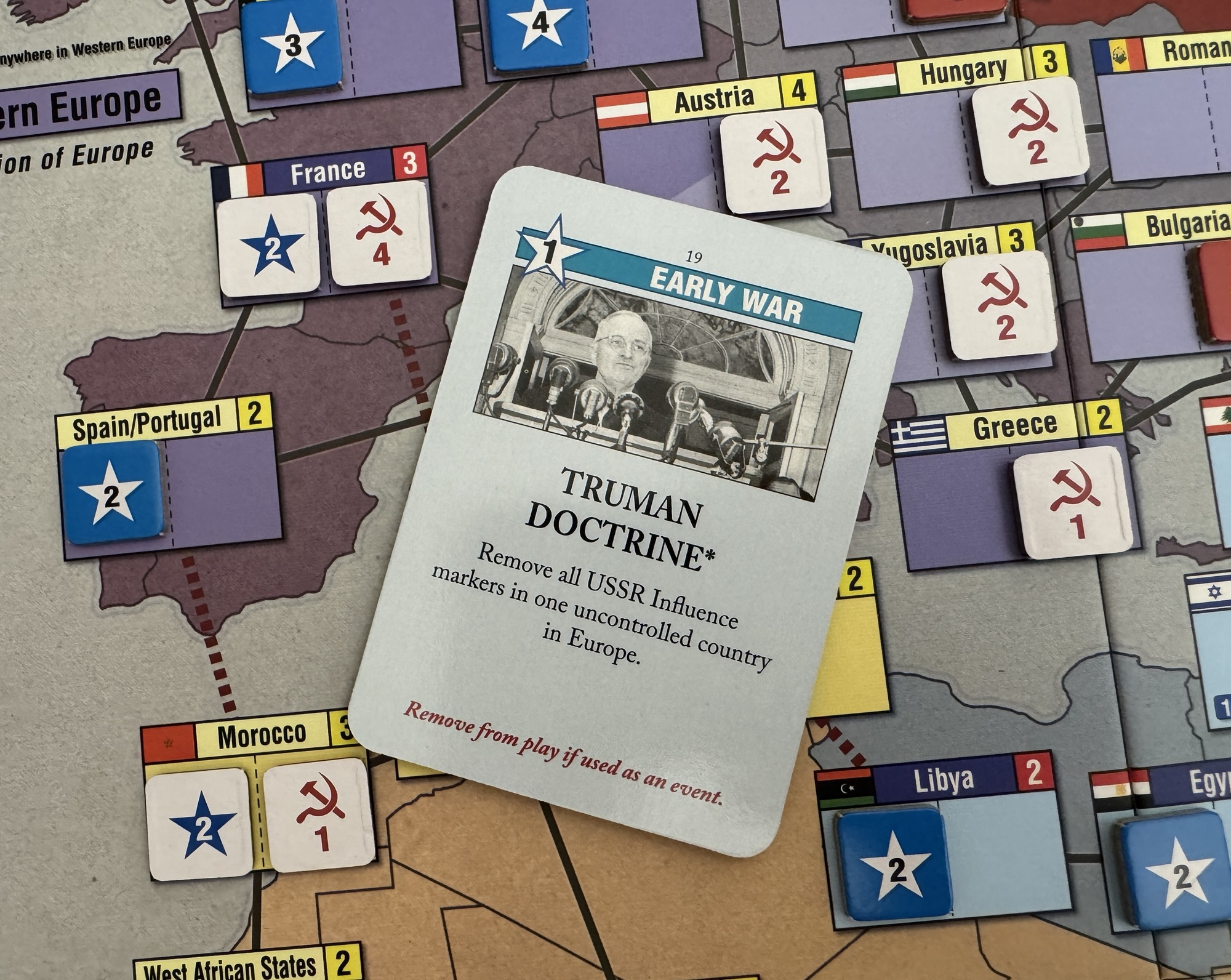
#99: Truman Doctrine from Twilight Struggle: The Cold War, 1945-1989 from GMT Games
Twilight Struggle is a 2-player game simulating the forty-five year ideological struggle known as the Cold War between the Soviet Union and the United States which can be played in 2-3 hours. The entire world is the stage on which these two countries “fight” to make the world safe for their own ideologies and way of life. The game starts right after the end of World War II in the midst of the ruins of Europe as the two new “superpowers” of the world squabble over what is left and ends in 1989, when only the United States remained standing.
The map is a world map of the period, where players abstractly move units and exert influence through the placing of Influence Markers in an attempt to build local support and gain allies and control for their superpower. The beauty of the CDG system used here is that each decision of whether to use a card for the event or the operations value is a struggle as if it is the other side’s event, it might go off hurting you very badly. There are mechanics to allow for the ignoring or cancelling of some of the best cards for your opponent in a side game within the game called The Space Race as well as nuclear tensions, with the possibility of game-ending global thermonuclear war (Shall we play a game, anyone?). I have played TS about 30 times and love it more and more with each sitting. The game makes me sweat, cringe, jump with joy and bite my fingernails. To me, a game that can do all of that in one sitting is worth the price.
The Truman Doctrine is an Early War U.S. 1 Op Event Card that removes all Soviet Influence from a single country in Europe where the U.S. has presence. This means that the U.S. at least has 1 Influence in a space and the space must be uncontrolled. I think that players should be judicious and patient with this card and do not rush to play early in the game on Turn 1 or Turn 2 if Europe is stable and the USSR has minimal presence there. The best way to use the card is to wait for a window where you can do the most damage in a key Battleground space where each side has been fighting for control by placing Influence there such as in France or West Germany on the last action round of a turn or playing the card during the Headline Phase to wipe out stacked Soviet Influence as a precursor to bumping up your own Influence there for control. The Truman Doctrine card is such a nice booby trap in many ways and the proper use of it can be very efficient and give you a leg up in Europe.
The Truman Doctrine was a United States foreign policy established by President Harry S. Truman on March 12, 1947, which pledged that the U.S. would provide political, military, and economic assistance to democratic nations threatened by external or internal authoritarian forces. President Harry S. Truman asked for $400 million in military and economic assistance for Greece and Turkey. “It must be the policy of the United States to support free peoples who are resisting attempted subjugation by armed minorities or by outside pressures,” Truman declared. “If we falter in our leadership, we may endanger the peace of the world — and we shall surely endanger the welfare of our own nation.”
In asserting that the U.S. would intervene in faraway conflicts, President Truman dramatically reoriented U.S. foreign policy. The writing of this ground-breaking message went through multiple stages. In his memoir, Truman noted that the State Department’s first draft of the speech “was not at all to my liking.” Rather than asserting a new foreign policy doctrine, the State Department writers had “made the whole thing sound like an investment prospectus.” Truman returned the draft to Secretary of State Dean Acheson “with a note asking for more emphasis on a declaration of general policy.”
The State Department complied, and included a general policy statement in the next draft. But Truman was not satisfied. “It seemed to me half-hearted,” he recalled. President Truman “scratched out” what he deemed equivocations. For example, Truman replaced “should” with “must” in a key sentence that read “I believe that it should be the policy of the United States…” According to Truman, “I wanted no hedging in this speech.” Because this speech “was America’s answer to the surge of expansion of Communist tyranny,” it “had to be clear and free of hesitation or double talk.” A total of eight drafts of Truman’s speech to Congress are featured on the Truman Library’s website. Many include handwritten comments and corrections. Combined, they give readers a sense of the tremendous effort that went into drafting the Truman Doctrine as well as the importance a single word can make when crafting foreign policy.
Truman delivered his address on March 12, 1947. Over the next several weeks, Congress debated the merits of Truman’s proposed foreign policy. On April 22nd, the Senate approved the legislation to provide assistance to Greece and Turkey. The House followed suit, approving the bill on May 9th. On May 22, 1947, Truman signed the bill into law. According to President Truman, the enactment of his bill “served notice that the march of Communists would not be allowed to succeed by default.”
The Soviet Union was one of the great dictatorships of the 20th century. It applied an immense amount of coercion on its own citizens as well as many of its neighboring countries. Yet the almost seventy years between the Soviet Union’s founding from the ashes of the Russian Civil War in 1922 and its fragmentation into 15 nation-states in 1991 are no monolith of unfreedom. There were two distinct periods of liberalization around a generation apart from each other – one that began under General Secretary Nikita Khrushchev in the 1950s, and one that began under General Secretary Mikhail Gorbachev in the 1980s. Let’s look at them, beginning with Khrushchev’s thaw, in terms of domestic, foreign, and economic policy. The post on Gorbachev’s reforms will follow in two weeks. As always, there will be board games along the way.
Freedom of Thought, Speech, and Political Expression
Joseph Stalin’s Soviet Union curtailed its citizens’ expression dramatically. Historiography has recounted Stalin’s reign of terror in detail, yet the best-known expression of the totalitarian control to which the Soviet Union aspired from the 1930s on is George Orwell’s dystopian novel 1984: Its one-party state does not only control citizens’ access to information (they are being exposed to constant propaganda and expected to keep up with its frequently changing, often contradictory contents), but demands active participation in the daily reconstruction of the system, ranging from institutionalized “two-minute hate” against political enemies to unlimited devotion to the “Big Brother” at the top of the pyramid.
The Soviet equivalent to the “Big Brother,” of course, was Stalin who was exalted in an official cult of personality as a wise and infallible leader, working tirelessly for the security and well-being of the Soviet Union. Whatever went wrong on the Soviet Union’s inexorable march of progress was the fault of an inept underling or a shadowy enemy.
When Stalin died, his lieutenants fought briefly, but viciously over his succession. Nikita Khrushchev emerged victorious. Khrushchev had been as loyal to Stalin as his chief rivals and immediatly used Stalinist methods to depose Lavrentiy Beria, the powerful Minister of Internal Affairs (and thus chief of the domestic security services). Beria was charged with treason, put through a mock trial, and executed.
Khrushchev’s skillful power politics could also swing the other way, though. He prepared a report on Stalin’s crimes which he delivered to a stunned audience at the 20th Congress of the Communist Party of the Soviet Union on February 25, 1956. For four hours, Khrushchev detailed Stalin’s party purges, his deportation of whole peoples deemed unloyal, and, most of all, how Stalin had established a cult of personality in which he was almost worshipped like a god.
Khrushchev’s de-Stalinization drive did not stop at mere proclamations. The late 1950s and early 1960s saw a lessening of censorship: Alexander Solzhenitsyn was allowed to publish his Gulag novel One Day in the Life of Ivan Denisovitch.
There were limits, however: Criticism of Stalin’s Gulags was one thing, criticism of the October Revolution another. Boris Pasternak’s Doctor Zhivago was not published in the USSR. When Pasternak won the Nobel Prize in literature for it, he and his family were threatened by agents of the state. Cowed, Pasternak did not travel to Stockholm to accept the prize.
Still, Khrushchev’s pivot represented an important turn in the state’s relationship with violence. While Soviet citizens were still routinely surveilled and subjected to coercion, it was neither with the overwhelming force of Stalinism nor with its unpredictability. The age of escalating purges, in which the accusers of today would be the accused of tomorrow was over.
Peaceful Coexistence and Khrushchev’s Many Other Schemes
Khrushchev’s 1956 speech was meant to remain secret, known only to its direct recipients and the allied Communist governments in Eastern Europe, but a member of the Polish Communist party smuggled a copy abroad via the Israeli embassy in Warsaw. From there, it soon gained wide circulation, and while Khrushchev had intended it to be a domestic power play only (it delegitimized his rivals Georgy Malenkov and Vyacheslav Molotov), he now also reaped benefits abroad: The post-Stalinist Soviet Union was naturally a more attractive ally and role model for both the socialist movements in Europe and the decolonizing and freshly independent nations in Africa and Asia.
This unintended benefit is the focus of the foreign-policy heavy Twilight Struggle‘s De-Stalinization card: The Soviet player may move up to four points of influence around on the globe. That may seem like a zero-sum game – after all, the influence is not added, but only moved. But the Soviet Union typically has a lot of spare influence in Eastern Europe after the first one or two turns, and De-Stalinization is the earliest and best way to gain access to faraway continents, chiefly South America (and, to a lesser degree, Africa).
Even before Khrushchev’s speech was leaked, his approach to foreign policy markedly differed from Stalin’s last years. When the relationship with the Soviet Union’s erstwhile allies had deteriorated after the end of World War II, Stalin had adopted a confrontational stance based on the assumption that the world was split in two hostile camps. Khrushchev, on the other hand, approached the western powers under the new motto of peaceful coexistence. Socialism and capitalism could both inhabit the same world. Of course, Khrushchev as a convinced Communist believed that his system would eventually triumph. Until then, peaceful coexistence would not only foster peace, but also make socialism more attractive, and free up resources for economic development and consumer goods (more on that below).
The economic (factory icon) and especially ideological (socialist – man with flat cap icon) bonuses are nice, but what sets the Peaceful Coexistence event in Wir sind das Volk! – 2+2 (Richard Sivél/Peer Sylvester, Histogame) apart is the ability to advance peace (dove icon) – indispensable when the world is sliding toward nuclear war!
Khrushchev was always better at initiating things than at seeing them through. Peaceful coexistence gave way to other projects – be that the support of nationalist movements in the global south or a re-newed competition with the West over Central Europe. And while Khrushchev thought that the Soviet Union and the western powers could live next to one another, that tolerance did not extend to heterodox socialist ideas within his own sphere of influence: When the Hungarian Socialist Workers’ Party announced to withdraw the country from the Warsaw Pact and hold free elections, Khrushchev had the reform movement quashed by Soviet tanks.
The Soviet economy under Stalin had been tuned to increase heavy industrial output to achieve a fast industrialization on the one hand and provide the basis for the country’s military security. This approach was validated by the country’s survival of the Nazi invasion and its eventual military victory in 1945. The proponents of this economic policy which usually went together with ideological mobilization and a confrontational foreign policy were called to adhere to politika. Yet after Stalin’s death, the rival faction of tekhnika gained ground: Its advocates favored a less aggressive foreign policy, less ideological mobilization, and, most of all, more market elements in the economy which would then produce more consumer goods.
Khrushchev positioned himself in the middle: Heavy industry would have priority (the Soviet Union was in a nuclear arms race with the United States whose economy was around three times as large as the Soviet, after all), but more attention would be given to consumer goods than before. Soviet citizens enjoyed a limited amount of prosperity with radios, washing machines, and sometimes even cars. Khrushchev saw this also as an instrument in the systemic competition of the Cold War: Material comfort and personal lifestyles would influence people’s allegiances as much as military strength or ideological treatises.
Khrushchev’s confidence in that regard led him to agree with the United States on mutual national exhibitions which would showcase their respective country to the citizens of the other. The confidence, however, was not quite justified: The Soviet exhibition in New York aroused curiosity, but the American one in Moscow was positively overrun. It also produced one of the iconic pictures of the Cold War with Nikita Khrushchev and US Vice President Richard Nixon debating the merits of their respective systems surrounded by American household appliances – the “Kitchen Debate.”
Some Soviet citizens might have dreamed of living in America, but their personal lifestyles already became more akin to those of Americans under Khrushchev. Even more important than the new consumer goods were their living conditions: Housing in big Soviet cities had been dominated by kommunalkas – large apartments from pre-revolutionary times which had been split to accommodate several families, each living in a single room and sharing the kitchen and bathroom with the others. These crammed living spaces afforded their inhabitants no privacy whatsoever. Only the elites of Stalin’s Soviet Union had apartments to themselves. Khrushchev started an ambitious housing program based on prefabricated, concrete-paneled apartment buildings which allowed millions of Soviet citizens to move into an apartment just for their own family for the first time.
As with foreign policy, Khrushchev started more economic reform projects than he saw through. The ambitious “Virgin Lands” campaign which aimed at alleviating Soviet food shortages by cultivating vast swathes of Siberia and northern Kazakhstan petered out after a few years. His scheme to introduce an Iowa-style corn belt fared even worse, discrediting both corn and Khrushchev in the Soviet Union.
Khrushchev’s Ouster
The economic starts and shifts of Khrushchev’s tenure undermined his position, as did his foreign policy unpredictability ranging from arms control to confronting the United States over Cuba. Most damaging to him, however, were his constant shuffles in the Communist Party. Disaffected cadres who feared they might lose their offices overthrew Khrushchev in October 1964. They installed the less fickle Leonid Brezhnev as new General Secretary of the Communist Party of the Soviet Union. The conservative Brezhnev would tone down some of Khrushchev’s domestic reforms, resulting in a more restricted cultural and literary climate, but stuck with Khrushchev’s economic reforms and conducted foreign policy along the lines of détente with the West.
Not everything about Khrushchev was as cuddly as this bear which he received when visiting an East German electronics factory, but his rule made the Soviet Union a better place to live and furthered its international power and prestige. Image from Wir sind das Volk! – 2+2.
In the end, Khrushchev himself was one of the beneficiaries of the liberalization he had pushed: Unlike the victims of the purges of the 1930s (or even Beria), he was not subjected to a mock trial and executed. Instead, he officially resigned for health reasons and was allowed to live out his days at a comfortable dacha in the countryside.
The authoritative biography remains Taubman, William: Khrushchev. The Man and His Era, Norton, New York City, NY 2004.
A magisterial mosaic of Soviet social, economic, and cultural life is Schlögel, Karl: The Soviet Century. Archaeology of a Lost World, Princeton University Press, Princeton, NJ 2023.
On the suppression of the Hungarian revolution and its impact on Soviet and western foreign policy, see Békés, Csaba: The 1956 Hungarian Revolution and World Politics, (Cold War International History Project Working Paper No. 16), Washington, D.C. 1996.
On the politika/tekhnika split, see Priestland, David: Cold War Mobilization and Domestic Politics: the Soviet Union, in: Leffler, Melvyn P./Westad, Odd Arne (eds.): The Cambridge History of the Cold War. Volume I. Origins, 5th edition, Cambridge University Press, Cambridge 2013, pp. 442-463.
The Soviet Union was one of the great dictatorships of the 20th century. It applied an immense amount of coercion on its own citizens as well as many of its neighboring countries. Yet the almost seventy years between the Soviet Union’s founding from the ashes of the Russian Civil War in 1922 and its fragmentation into 15 nation-states in 1991 are no monolith of unfreedom. There were two distinct periods of liberalization around a generation apart from each other – one that began under First Secretary Nikita Khrushchev in the 1950s, and one that began under General Secretary Mikhail Gorbachev in the 1980s. Let’s look at them, beginning with Khrushchev’s thaw, in terms of domestic, foreign, and economic policy. The post on Gorbachev’s reforms will follow in two weeks. As always, there will be board games along the way.
Freedom of Thought, Speech, and Political Expression
Joseph Stalin’s Soviet Union curtailed its citizens’ expression dramatically. Historiography has recounted Stalin’s reign of terror in detail, yet the best-known expression of the totalitarian control to which the Soviet Union aspired from the 1930s on is George Orwell’s dystopian novel 1984: Its one-party state does not only control citizens’ access to information (they are being exposed to constant propaganda and expected to keep up with its frequently changing, often contradictory contents), but demands active participation in the daily reconstruction of the system, ranging from institutionalized “two-minute hate” against political enemies to unlimited devotion to the “Big Brother” at the top of the pyramid.
The Soviet equivalent to the “Big Brother,” of course, was Stalin who was exalted in an official cult of personality as a wise and infallible leader, working tirelessly for the security and well-being of the Soviet Union. Whatever went wrong on the Soviet Union’s inexorable march of progress was the fault of an inept underling or a shadowy enemy.
When Stalin died, his lieutenants fought briefly, but viciously over his succession. Nikita Khrushchev emerged victorious. Khrushchev had been as loyal to Stalin as his chief rivals and immediatly used Stalinist methods to depose Lavrentiy Beria, the powerful Minister of Internal Affairs (and thus chief of the domestic security services). Beria was charged with treason, put through a mock trial, and executed.
Khrushchev’s skillful power politics could also swing the other way, though. He prepared a report on Stalin’s crimes which he delivered to a stunned audience at the 20th Congress of the Communist Party of the Soviet Union on February 25, 1956. For four hours, Khrushchev detailed Stalin’s party purges, his deportation of whole peoples deemed unloyal, and, most of all, how Stalin had established a cult of personality in which he was almost worshipped like a god.
Khrushchev’s de-Stalinization drive did not stop at mere proclamations. The late 1950s and early 1960s saw a lessening of censorship: Alexander Solzhenitsyn was allowed to publish his Gulag novel One Day in the Life of Ivan Denisovitch.
There were limits, however: Criticism of Stalin’s Gulags was one thing, criticism of the October Revolution another. Boris Pasternak’s Doctor Zhivago was not published in the USSR. When Pasternak won the Nobel Prize in literature for it, he and his family were threatened by agents of the state. Cowed, Pasternak did not travel to Stockholm to accept the prize.
Still, Khrushchev’s pivot represented an important turn in the state’s relationship with violence. While Soviet citizens were still routinely surveilled and subjected to coercion, it was neither with the overwhelming force of Stalinism nor with its unpredictability. The age of escalating purges, in which the accusers of today would be the accused of tomorrow was over.
Peaceful Coexistence and Khrushchev’s Many Other Schemes
Khrushchev’s 1956 speech was meant to remain secret, known only to its direct recipients and the allied Communist governments in Eastern Europe, but a member of the Polish Communist party smuggled a copy abroad via the Israeli embassy in Warsaw. From there, it soon gained wide circulation, and while Khrushchev had intended it to be a domestic power play only (it delegitimized his rivals Georgy Malenkov and Vyacheslav Molotov), he now also reaped benefits abroad: The post-Stalinist Soviet Union was naturally a more attractive ally and role model for both the socialist movements in Europe and the decolonizing and freshly independent nations in Africa and Asia.
This unintended benefit is the focus of the foreign-policy heavy Twilight Struggle‘s De-Stalinization card: The Soviet player may move up to four points of influence around on the globe. That may seem like a zero-sum game – after all, the influence is not added, but only moved. But the Soviet Union typically has a lot of spare influence in Eastern Europe after the first one or two turns, and De-Stalinization is the earliest and best way to gain access to faraway continents, chiefly South America (and, to a lesser degree, Africa).
Even before Khrushchev’s speech was leaked, his approach to foreign policy markedly differed from Stalin’s last years. When the relationship with the Soviet Union’s erstwhile allies had deteriorated after the end of World War II, Stalin had adopted a confrontational stance based on the assumption that the world was split in two hostile camps. Khrushchev, on the other hand, approached the western powers under the new motto of peaceful coexistence. Socialism and capitalism could both inhabit the same world. Of course, Khrushchev as a convinced Communist believed that his system would eventually triumph. Until then, peaceful coexistence would not only foster peace, but also make socialism more attractive, and free up resources for economic development and consumer goods (more on that below).
The economic (factory icon) and especially ideological (socialist – man with flat cap icon) bonuses are nice, but what sets the Peaceful Coexistence event in Wir sind das Volk! – 2+2 (Richard Sivél/Peer Sylvester, Histogame) apart is the ability to advance peace (dove icon) – indispensable when the world is sliding toward nuclear war!
Khrushchev was always better at initiating things than at seeing them through. Peaceful coexistence gave way to other projects – be that the support of nationalist movements in the global south or a re-newed competition with the West over Central Europe. And while Khrushchev thought that the Soviet Union and the western powers could live next to one another, that tolerance did not extend to heterodox socialist ideas within his own sphere of influence: When the Hungarian Socialist Workers’ Party announced to withdraw the country from the Warsaw Pact and hold free elections, Khrushchev had the reform movement quashed by Soviet tanks.
The Soviet economy under Stalin had been tuned to increase heavy industrial output to achieve a fast industrialization on the one hand and provide the basis for the country’s military security. This approach was validated by the country’s survival of the Nazi invasion and its eventual military victory in 1945. The proponents of this economic policy which usually went together with ideological mobilization and a confrontational foreign policy were called to adhere to politika. Yet after Stalin’s death, the rival faction of tekhnika gained ground: Its advocates favored a less aggressive foreign policy, less ideological mobilization, and, most of all, more market elements in the economy which would then produce more consumer goods.
Khrushchev positioned himself in the middle: Heavy industry would have priority (the Soviet Union was in a nuclear arms race with the United States whose economy was around three times as large as the Soviet, after all), but more attention would be given to consumer goods than before. Soviet citizens enjoyed a limited amount of prosperity with radios, washing machines, and sometimes even cars. Khrushchev saw this also as an instrument in the systemic competition of the Cold War: Material comfort and personal lifestyles would influence people’s allegiances as much as military strength or ideological treatises.
Khrushchev’s confidence in that regard led him to agree with the United States on mutual national exhibitions which would showcase their respective country to the citizens of the other. The confidence, however, was not quite justified: The Soviet exhibition in New York aroused curiosity, but the American one in Moscow was positively overrun. It also produced one of the iconic pictures of the Cold War with Nikita Khrushchev and US Vice President Richard Nixon debating the merits of their respective systems surrounded by American household appliances – the “Kitchen Debate.”
Some Soviet citizens might have dreamed of living in America, but their personal lifestyles already became more akin to those of Americans under Khrushchev. Even more important than the new consumer goods were their living conditions: Housing in big Soviet cities had been dominated by kommunalkas – large apartments from pre-revolutionary times which had been split to accommodate several families, each living in a single room and sharing the kitchen and bathroom with the others. These crammed living spaces afforded their inhabitants no privacy whatsoever. Only the elites of Stalin’s Soviet Union had apartments to themselves. Khrushchev started an ambitious housing program based on prefabricated, concrete-paneled apartment buildings which allowed millions of Soviet citizens to move into an apartment just for their own family for the first time.
As with foreign policy, Khrushchev started more economic reform projects than he saw through. The ambitious “Virgin Lands” campaign which aimed at alleviating Soviet food shortages by cultivating vast swathes of Siberia and northern Kazakhstan petered out after a few years. His scheme to introduce an Iowa-style corn belt fared even worse, discrediting both corn and Khrushchev in the Soviet Union.
Khrushchev’s Ouster
The economic starts and shifts of Khrushchev’s tenure undermined his position, as did his foreign policy unpredictability ranging from arms control to confronting the United States over Cuba. Most damaging to him, however, were his constant shuffles in the Communist Party. Disaffected cadres who feared they might lose their offices overthrew Khrushchev in October 1964. They installed the less fickle Leonid Brezhnev as new First Secretary of the Communist Party of the Soviet Union (an office soon to be re-named to General Secretary, like under Stalin). The conservative Brezhnev would tone down some of Khrushchev’s domestic reforms, resulting in a more restricted cultural and literary climate, but stuck with Khrushchev’s economic reforms and conducted foreign policy along the lines of détente with the West.
Not everything about Khrushchev was as cuddly as this bear which he received when visiting an East German electronics factory, but his rule made the Soviet Union a better place to live and furthered its international power and prestige. Image from Wir sind das Volk! – 2+2.
In the end, Khrushchev himself was one of the beneficiaries of the liberalization he had pushed: Unlike the victims of the purges of the 1930s (or even Beria), he was not subjected to a mock trial and executed. Instead, he officially resigned for health reasons and was allowed to live out his days at a comfortable dacha in the countryside.
The authoritative biography remains Taubman, William: Khrushchev. The Man and His Era, Norton, New York City, NY 2004.
A magisterial mosaic of Soviet social, economic, and cultural life is Schlögel, Karl: The Soviet Century. Archaeology of a Lost World, Princeton University Press, Princeton, NJ 2023.
On the suppression of the Hungarian revolution and its impact on Soviet and western foreign policy, see Békés, Csaba: The 1956 Hungarian Revolution and World Politics, (Cold War International History Project Working Paper No. 16), Washington, D.C. 1996.
On the politika/tekhnika split, see Priestland, David: Cold War Mobilization and Domestic Politics: the Soviet Union, in: Leffler, Melvyn P./Westad, Odd Arne (eds.): The Cambridge History of the Cold War. Volume I. Origins, 5th edition, Cambridge University Press, Cambridge 2013, pp. 442-463.

 Anmelden