After 20 years growing the UK Games Expo into one of the largest tabletop gaming conventions in the world, founders Richard Denning and Tony Hyams are preparing for their eventual exit by bringing in AireCon co-founder Mark Cooke as operations director.
Cooke joins following another record year for UKGE, which has seen its annual unique attendance surge almost 65% since 2023 to reach more than 51,000.
The show has already well surpassed Gen Con in terms of trade hall size, with the British event now spanning about 44,000 sq m – about 40% larger than Gen Con’s trade hall area – and hosting around 900 exhibitors in 2026.
That soaring growth has put increasing pressure on the small organising team at UKGE, with Denning telling BoardGameWire last year that the show had strained a full-time workforce which stood at just six people – although UKGE also relies on more than 200 volunteers, GMs, umpires and other helpers to deliver the convention each year.
Cooke is no stranger to growing a UK board game convention, having co-founded and built AireCon with Ben Clarkson from a 28-person gaming weekend in his flat a decade ago into England’s second-largest board game con, with about 5,000 attendees this year.
More than 5,500 people are expected at the final AireCon – which has been nicknamed Airemageddon – with Cooke set to continue working on that final show before moving to UKGE full time.
A statement from UKGE emphasised the hire was part of a phased transition for UKGE’s organisers, and was “not a sudden change of leadership or direction”.
UK Games Expo 2026
It said Cooke would work alongside Denning and Hyams “over the next few UK Games Expo events”, ensuring that knowledge, experience and responsibilities the pair have built up over the last 20 years are handed over “gradually and thoughtfully”.
Denning said, “As UKGE has expanded to now one of the world’s largest shows we have gradually grown our team, adding event managers, administrators and logistics support.
“Bringing in Mark as operations director is the next logical step as we put in place plans to ensure UKGE can run far into the future.
UK Games Expo co-founder and director Richard Denning
“We have known Mark through AireCon and other industry roles for many years now and he is an ideal choice bringing both event management experience, energy and fresh ideas to the team as well as a safe pair of hands as and when Tony and I eventually step away from the show we have built together with others.”
Cooke added, “I’m incredibly excited to be joining the UK Games Expo team and to have the opportunity to play a part in the next chapter of such an important event for the tabletop gaming community.
“I have huge respect for what Richard and Tony have built over the years, and I’m looking forward to working alongside them over the coming events.
“This will be a gradual transition, giving us plenty of time to share knowledge, ideas and experience. My aim is to build on the fantastic foundations already in place while helping UKGE continue to grow and thrive for many years to come.”
Denning and Hyams launched UK Games Expo at Birmingham’s Clarendon Suites in 2007, when the convention attracted about 1,000 visitors.
It moved to Birmingham’s National Exhibition Centre in 2013, and had grown to more than 25,000 unique attendees by 2019 before the Covid-19 pandemic interrupted its run of physical events.
UK Games Expo attendance figures since launch. Note: no physical show took place in 2020 due to the Covid-19 pandemic
Denning told BoardGameWire last year that building a world-class trade hall in the UK had been a personal ambition stretching back almost two decades, adding at the time that UKGE was “now fully on the world stage of ‘mega-cons'”.
Despite this year’s record attendance, Denning told BoardGameWire after the show that there was still room for further expansion, particularly around the roughly 500 events taking place during the convention.
The next UK Games Expo is scheduled to take place at Birmingham NEC from June 4 to June 6, 2027.
Exploding Kittens has named chief commercial officer Joeri Hoste as its new head of studio, with the long-time game industry exec eyeing further expansion of the company’s namesake hit into a “long-lasting evergreen brand” beyond its big-selling card game.
Hoste joined Exploding Kittens to lead its international business in 2020, following multi-year stints at companies including Hong Kong based board game publisher and manufacturer Ooba Games, toy company BOTI and trading card and collectibles specialist Upper Deck.
Hoste said in a LinkedIn post that the past six years at Exploding Kittens had been the most rewarding of his career, adding that he was “ecstatic and humbled” to take responsibility for leading the company into the next stage of its development.
He said, “We’ll continue our mission of making great games and creating experiences that bring people together. Exploding Kittens is the game that built its namesake company, and our next challenge will be to develop the IP into a long-lasting evergreen brand that outgrows its original format.
“Exploding Kittens is unique within Asmodee as we combine deep commercial mass market expertise with publishing quirky and irreverent games that disrupt the games category.
“We did not get here by blending in. We succeed because of the talented team that’s willing to be different.”
Last year Exploding Kittens revealed it had sold more than 60 million games as it marked a decade in business – with the company’s growth having already extended well beyond the tabletop.
That has included a partnership with Netflix which expanded the property into mobile gaming and an animated series.
Asmodee bought a 55% majority stake in Exploding Kittens at the end of 2021, and exercised its option to purchase the remaining 45% minority stake last year.
Exploding Kittens has continued to stand out within Asmodee’s portfolio during a difficult period for parts of the US board game market.
The promotion comes as Asmodee is making a wider push into social and party games – a category where Exploding Kittens has been one of its strongest brands.
In March the company agreed to pay up to €250m for French social and party game publisher ATM Gaming, with Koegler saying the acquisition would combine ATM’s strength in Europe with Exploding Kittens’ strong position in the US. Asmodee has said it expects the social games category to grow at between 4% and 8% annually between 2025 and 2030, compared with about 4% for the broader board games market.
It also launched US party game studio Moodbox Games last year, a move de Barros described at the time as strengthening Asmodee’s presence in a category where Exploding Kittens and Zygomatic were already seeing strong success.
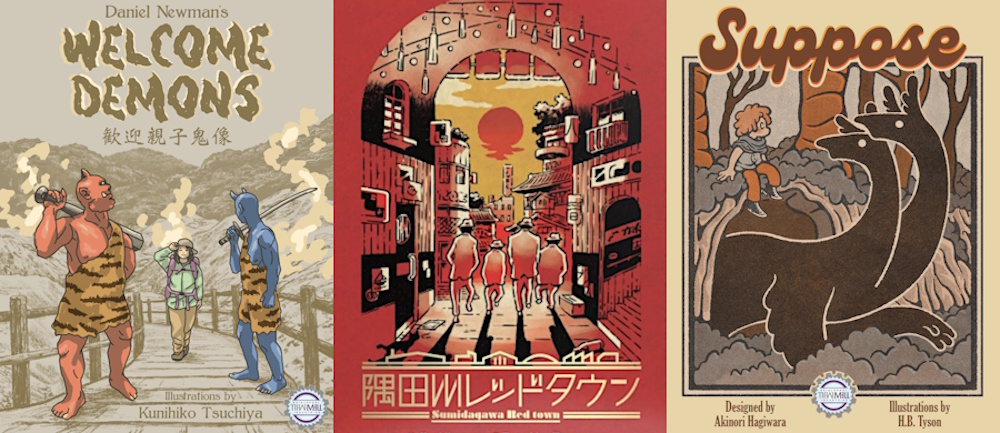
All I play anymore is trick-takers. And climber/shedders. Are those the same thing? Some say so. Others disagree. I don’t take a strong stance on it. Which is why I’m lumping these three titles together. For this quarter’s roundup, we’ve got friendly oni, unfriendly gangsters, and some super cute monsters that might be friendly or unfriendly depending on whether you correctly guess their identity.
Boo! We’re here to help!
Welcome Demons
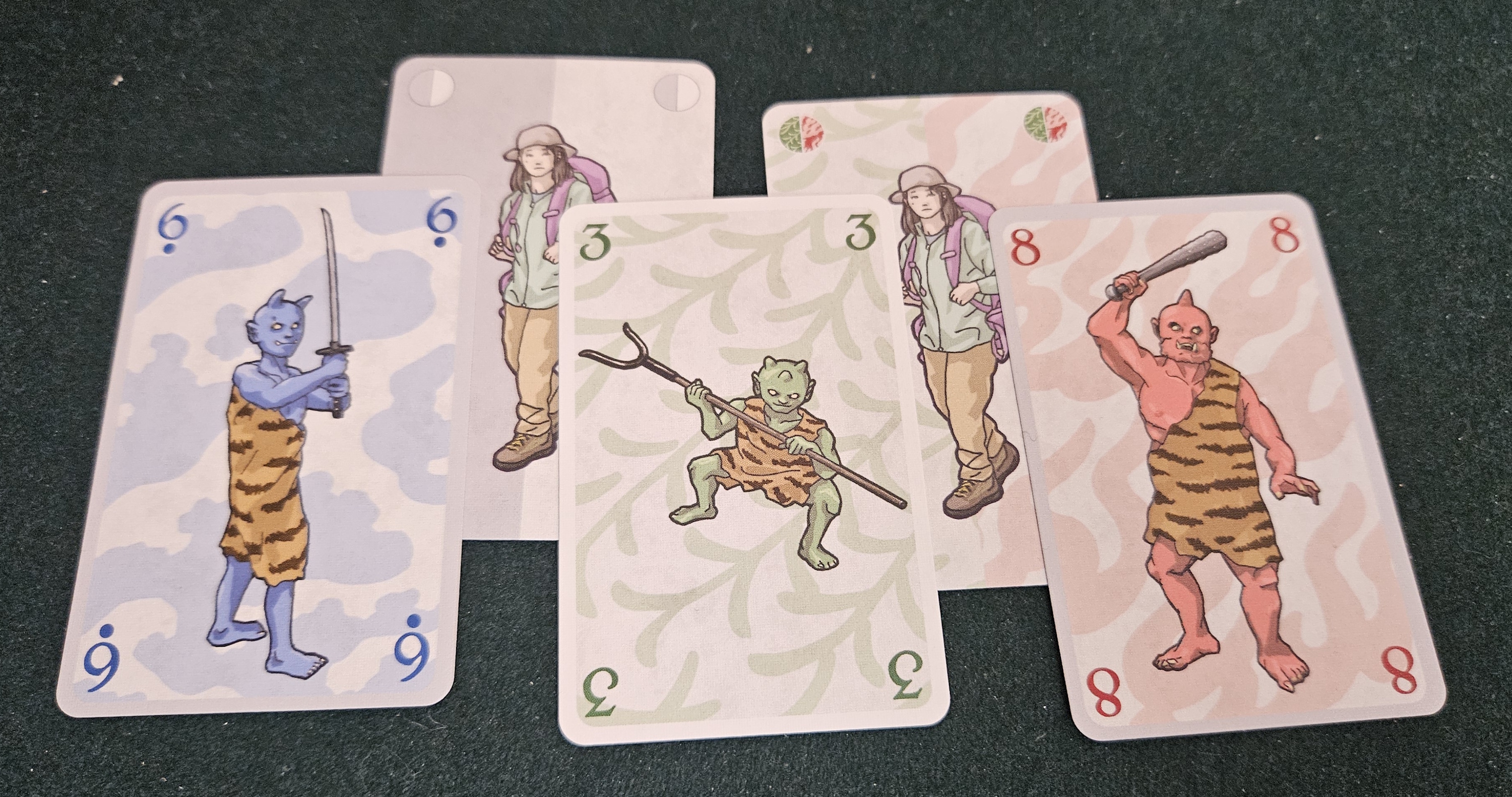
If I were a Japanese demon, I’d be like the oni from Welcome Demons — a menacing li’l guy with a sword, but really just here to make sure you get home safe. Designed by Daniel Newman, this is a shedder about using the cards from your hand to guide lost hikers out of the mountains.
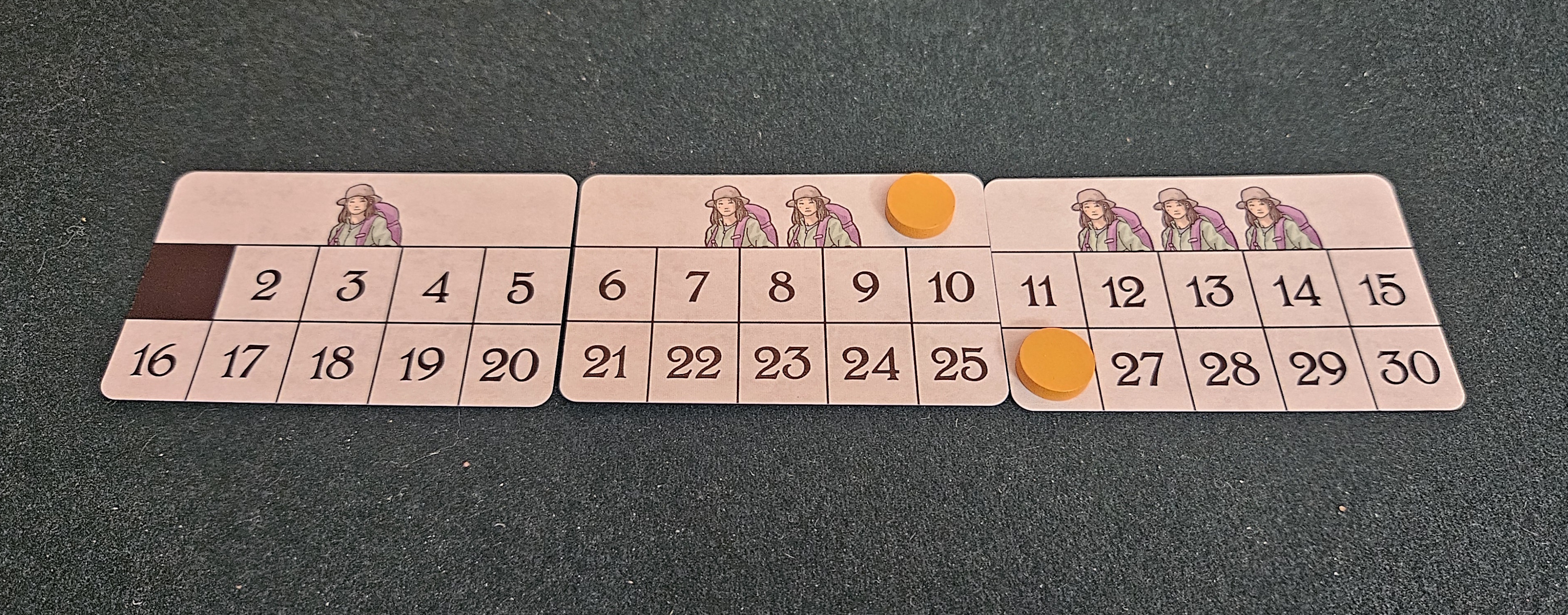
It’s also as atypical as it gets, seating exactly three players and, rather than building melds in the usual fashion, having you match your cards to your hikers. Each hiker has their own needs, whether odd/even ranks or various suits of oni. What’s more, players are required to format these melds using at least one card from the previous player’s set. This forces everyone to pay some attention to what their rivals are putting on the table. More than some attention, really. Because your meld must contain the same number of hikers (one, two, or three) but a higher sum of ranks, or more hikers but a lower overall rank. Which makes things tricky indeed, especially if you’re holding a bunch of mid-rank cards.
And then, if it becomes impossible to follow, everyone passes and the last demon to shepherd their lost hikers begins the process all over again with one lonely hiker. This continues until somebody most definitely can’t save any more hikers, at which point they lose and the other two players are crowned… I don’t know, the most helpful oni of the month.
How many hikers can you aid?
It’s a clever little thing, emphasis on both “clever” and “little.” Newman pulls a trick we’ve seen before, where you aren’t playing to win so much as playing to avoid losing. Oni are spiteful that way. Especially near the end of the hand — and the hand is the game, this isn’t some multi-round affair — it isn’t uncommon for players to struggle to build the right melds, sometimes resulting in an early quit for the session. Like many shedders, this makes the game’s back half less interesting than its opening salvo.
Fortunately for Welcome Demons, its approach to meld-building is novel enough that it’s worth witnessing, even if only as a filler. I would put this one in the midnight nugget box: a tasty snack with a crunchy exterior, but not the most filling meal out there.
Take ’em out back and gun ’em down.
Sumidagawa Red Town
Like our previous entry, Sumidagawa Red Town is a shedding game about sinking slowest. Players, of which there are between two and five, step into the rain-slicked trenchcoats of small-town gangsters who need to subtract a column from the organization’s payroll. By which I mean they need to murder one of their companions. With the oni doing emergency response, it raises the question of who the real monsters are. Sobering, etc.
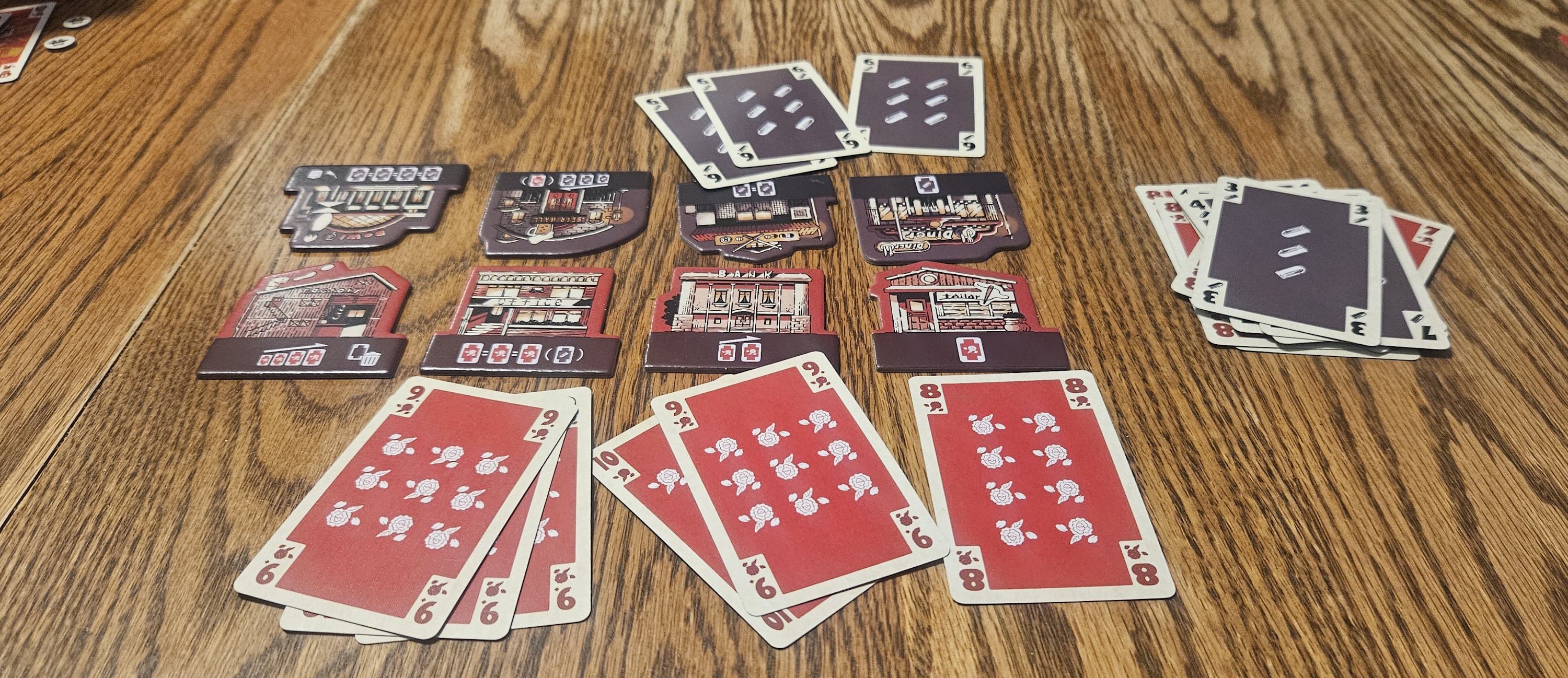
The main twist is that players aren’t one-upping each other’s melds, at least not in the traditional sense. Instead, the titular red town is presented as eight sections, each of which holds its own unique meld. There’s a space for a sequence of three brown cards, another for a triplet of red cards, two for singles of either suit, and so forth. Into these spaces you play a meld. This must start at a higher rank than whatever the previous player deployed, but otherwise you’re free to choose whether to play one card or four.
Assuming the proper space remains open, that is. And that’s the rub. After even one round, it becomes very tricky indeed to find a good fit. This marks Sumidagawa Red Town as one of those titles absolutely riddled with tactical passes. While dropping four cards on the town’s biggest space is certainly a power move, it might be better to pass and let the town clear out for the next round. Especially if you’re likely to go second.
First to lose. Might as well get some help.
It’s thrilling to follow a four-card bomb with a single, and for that reason alone Sumidagawa Red Town establishes itself as one of my favorite shedders.
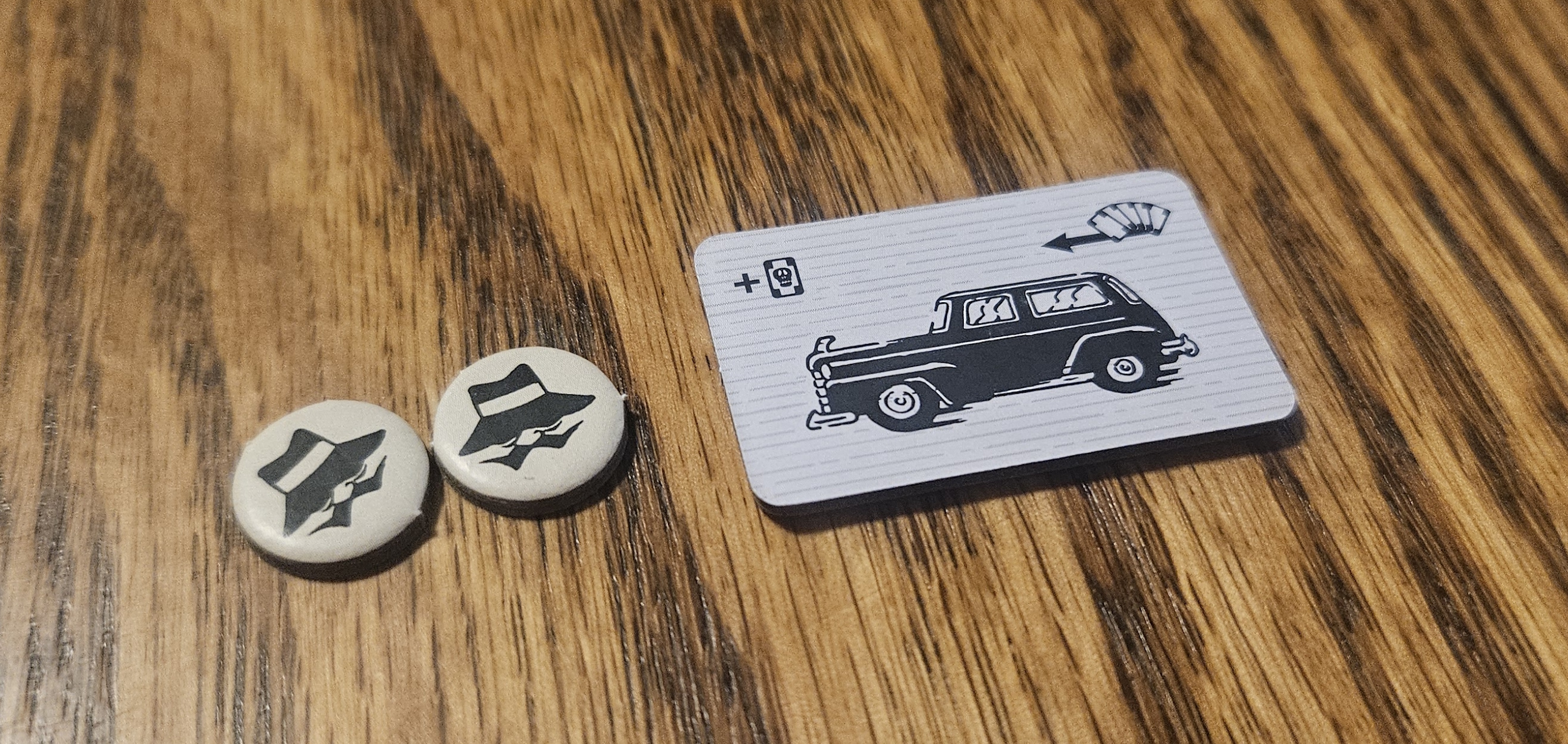
But Mashikamaru doesn’t stop there. In between rounds, players get to decide if they want to summon hitmen — in game terms, suit-coded wild cards — to beef up their hand. If only one player elects to do so, they receive broad latitude to add as many hitmen from their private pool as they like. But if multiple players choose this option, they only add one hitman, then swap hands with everyone else who made the same decision. It’s a brilliant piece of brinkmanship, potentially making or breaking your entire hand, plus offering the chance to drop a real stinker of a hand onto somebody else.
And really, that’s what this one is all about. Choosing your battles, knowing when to go all-in, and then slipping your rival a mickey rather than facing them directly. The main downside is that it’s hard to find outside of Japan and requires a translated rules sheet. Personally, I’ve found it well worth the effort. Forget it, Jake. It’s Sumidagawa Red Town.
Check out that handsome devil.
Suppose
On the more traditional end of things — although only marginally — is another New Mill import in the form of Hagizou’s Suppose. This is a trick-taker, and for once there’s an actual winner, but the game’s may-follow nature marks it as rather distinct from most of its peers.
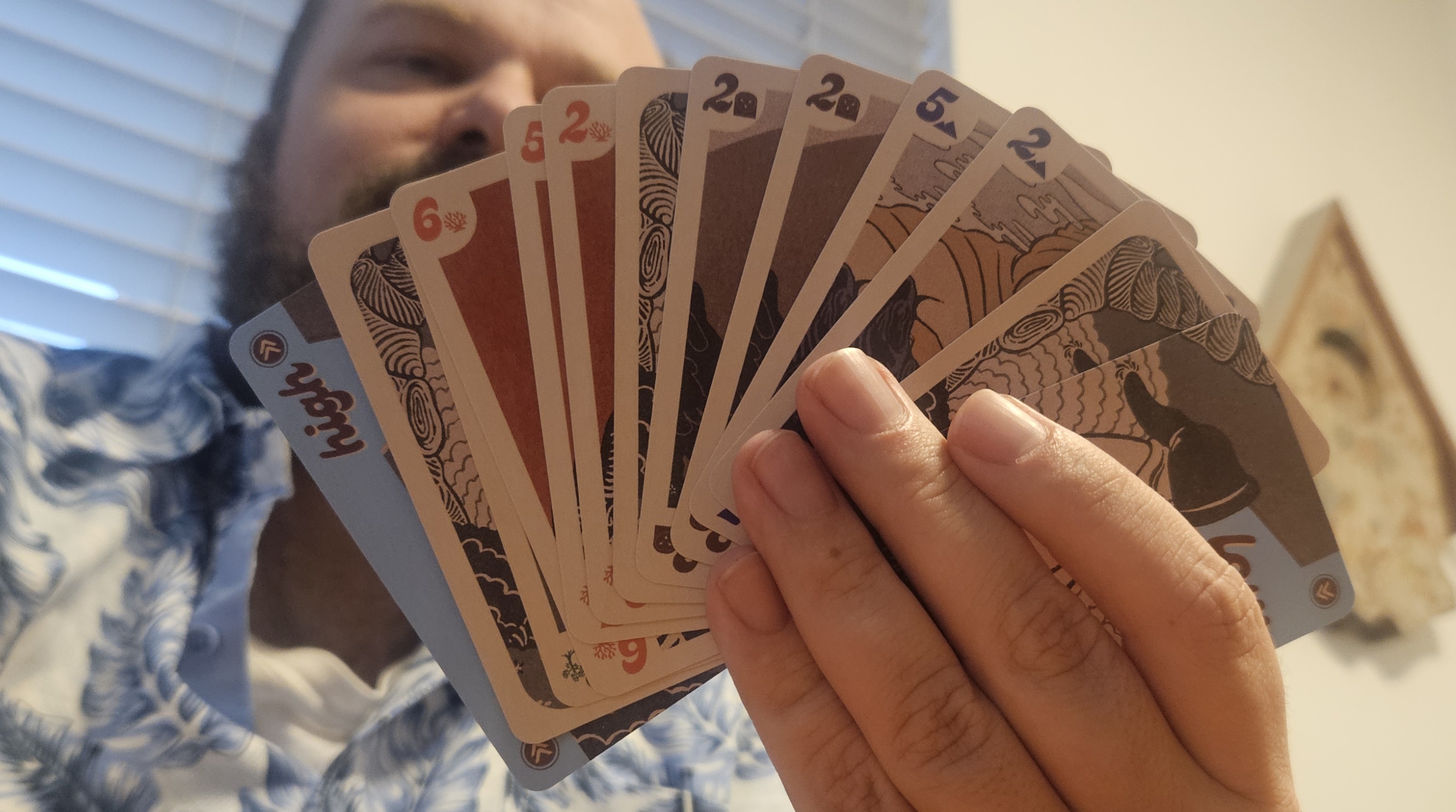
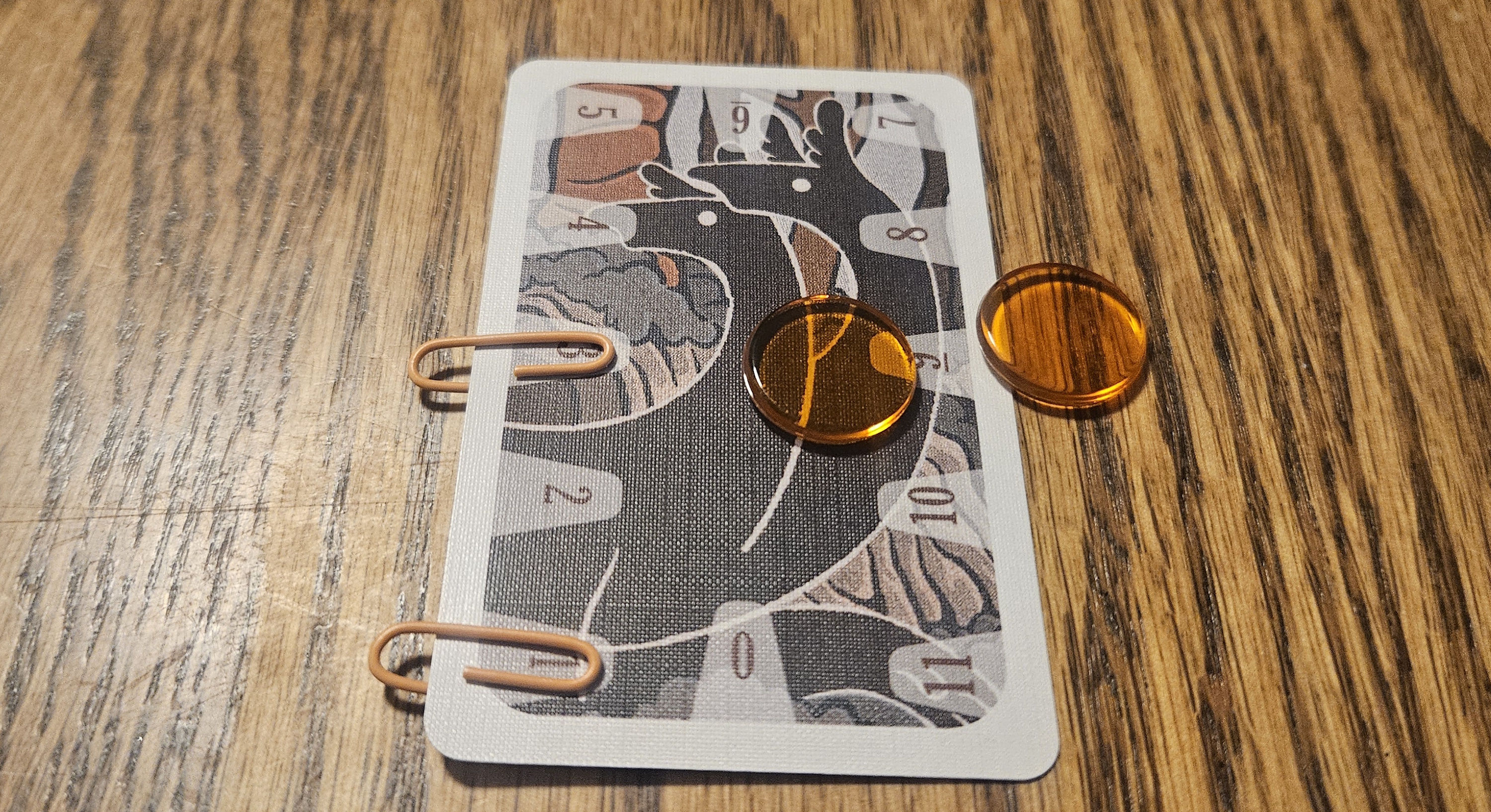
Scratch that, everything is distinct. There’s the way your hand is arranged: sorted by your neighbor and splayed so that ranks increase within suits, but with only a few cards facing you while the others peek outward to show everyone else at the table what you’re holding. In fact, much of the game revolves around your hand’s concealment. Whenever you play a card you can’t see, you’re permitted to guess its identity. There’s no penalty for guessing wrong, while a correct guess awards a “suppose” token. These translate into points at the end of the hand. Which is a good thing, given the relative scarcity of points elsewhere.
How, then, does one score? Tricks, first of all, although at one point per, these aren’t much to write home about. Your larger tally comes from another guess. When the round begins and you sort your neighbor’s hand, you wager how many tricks you think they’ll take. Contract bids are always testy, but here they’re especially tough. Since you’re never forced to follow suit, sabotaging a neighbor’s bid is especially easy. It’s possible to split your bid for fewer points, but, well, that only makes it marginally easier to hypothesize what your opponent is going to do during the round.
Making good guesses, I guess.
The outcome, then, is an extended guessing game, but one that strikes out along multiple avenues of conjecture. What you’re holding, what everybody else is holding, how your target neighbor is faring, whether this is a good time to nab another trick or yield it to someone else… it’s a lot to take in.
That said, Suppose is something special. It might even be my favorite New Mill release all year. The deck is tight enough that correct guesses are possible, but the inclusion of two copies of each card makes card-counting, while not impossible, at least not such an advantage that it changes the nature of the game entirely. The result is a game that’s as much about sabotage and the careful sniping of unexpected tricks as it is about reading everyone’s hand. Truly, this one is a gem.
You know. I suppose.
A complimentary of Suppose and Welcome Demons was provided by the publisher.
(If what I’m doing at Space-Biff! is valuable to you in some way, please consider dropping by my Patreon campaign or Ko-fi. Right now, supporters can read the next installment in my series Talking About Games, this time tackling the topic of what makes a good list! Naturally, the piece includes a list.)
UFO 50 was one of the coolest gaming artifacts of the past few years, a collection of fifty unique video games by Derek Yu, Jon Perry, and a handful of other developers that pitched itself as a digital excavation of a long-lost 8-bit console. The collection was special for many reasons, but my favorite trick was the way its creators employed modern design principles that contrasted the system’s hardware and input limitations.
For example, Party House. Designed by Jon Perry, this was a full-fledged solitaire deck-building game that fictively predated Dominion by over two decades. Now, in a design ouroboros, Perry is shifting Party House to tabletop.
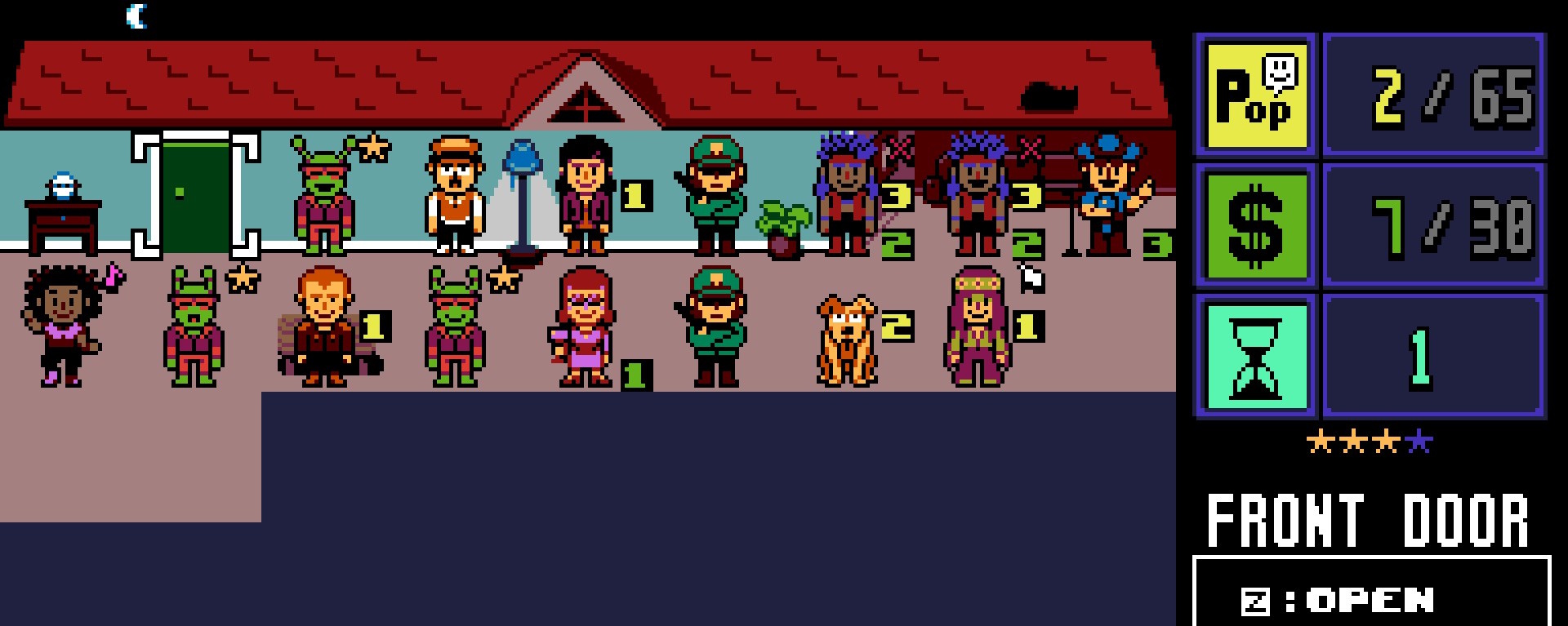
Check out my sick group of friends. (UFO 50 version)
If nothing else, Party House is more relatable than most gamified topics. You want to throw a party. A big party. But you also don’t want the cops and/or the fire marshal to bust up the festivities. In the UFO 50 original, that meant building out your Rolodex, expanding your apartment to accommodate more bodies, and then randomly drawing guests until you decided you’d had enough. Or until the door got kicked in.
Basically, the whole thing was a merger of Dominion-style deck-building and press-your-luck gameplay. Good guests awarded popularity and cash, while rowdy guests egged your neighbors into taking matters into their own hands. Others served as utilities: bouncers for tossing out troublemakers, private investigators who could drag the right people to the party, college mascots for nostalgic gatherings of old friends. Special guests like aliens and mermaids, meanwhile, served as objectives, awarding the stars that proved you had mastered a particular set.
That’s the gist of the physical version as well, although Perry has made a number of changes, some delicate and others structural.
The biggest alteration is Party House’s format. Because the UFO 50 version was a solitaire game, it presented a series of challenges, each offering a pre-built selection of guests and objectives. Tackling these levels required some luck, but the game’s core concern was more with finding the right build order for your Rolodex than responding to dynamic problems. The result wasn’t quite a puzzle with a set solution, but it was closer to that side of things than one might expect.
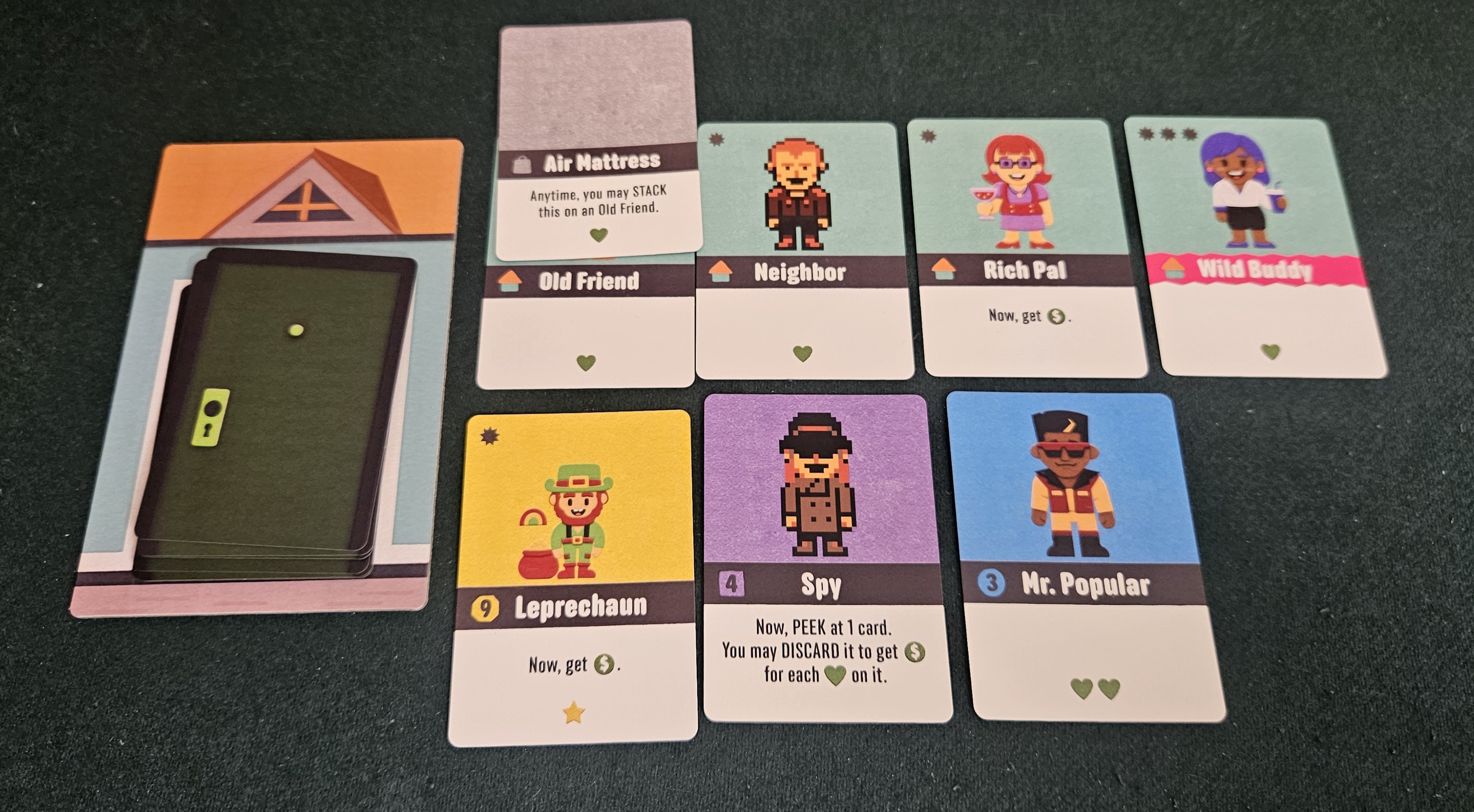
For the physical edition, Perry has tossed all the digital game’s goodies into a single box. Gone is the set marketplace. Instead, players are presented with three rows of guests that are constantly refreshing as they’re befriended with popularity and cash. Gone are the puzzle-style levels. In their stead is a race to earn a certain number of stars before anybody else at the table. Gone is the apartment limit. Now your place can hold as many guests as possible. Provided the party doesn’t end prematurely, that is.
Parties are better in person.
On the topic of premature ejection, troublemakers have received a significant facelift. Previously, the police would crash the party as soon as three troublemakers were clomping around the living room. Now every guest — or nearly all of them — produces some amount of noise. As soon as you hit eight points of ruckus, the party’s over. Worse, you skip the Rolodex phase entirely. And unlike in the original game, popularity fades each round. Only money can be hoarded. Fortunately, these twin currencies are interchangeable. What one lacks in charisma they can make up for with Benjamins.
As a side note, there’s a nice balancing mechanism where a crashed party puts an accessory card in your deck. Accessories are always positive, just not as positive as a good guest. Still, a charcuterie board or karaoke machine is handy in a pinch. It’s a nice concession for the occasional stroke of rotten luck. Failing players stay in the game, but with less control over how they assemble their guest list.
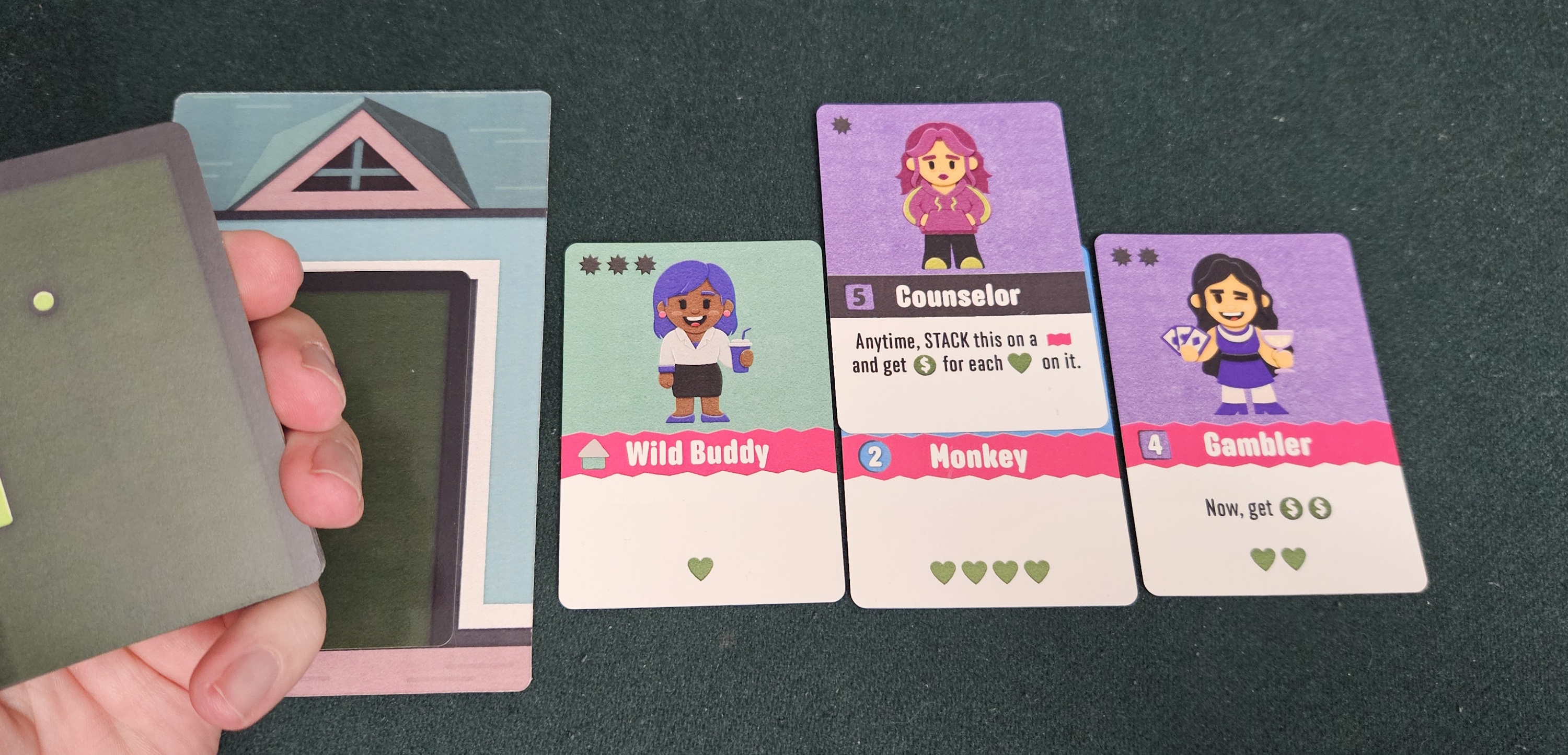
Perhaps most importantly, the whole thing is fast. You hold your deck in your hand the entire round. A turn takes maybe twenty seconds at most. And cards flip at a rate comparable to the typewriter clatter of FlipToons, but with the occasional mid-turn decision to prevent it from feeling quite so rote. Actually, the comparisons don’t end there. Party House feels like FlipToons with considerably more direct control. Whether it’s the ability to peek at cards mid-party via spies and superheroes, cover your loudest offenders with cute dogs and counselors, or deploy occasional cards that directly confront your opponents, your Rolodex is a bespoke assemblage that can be bent to your will.
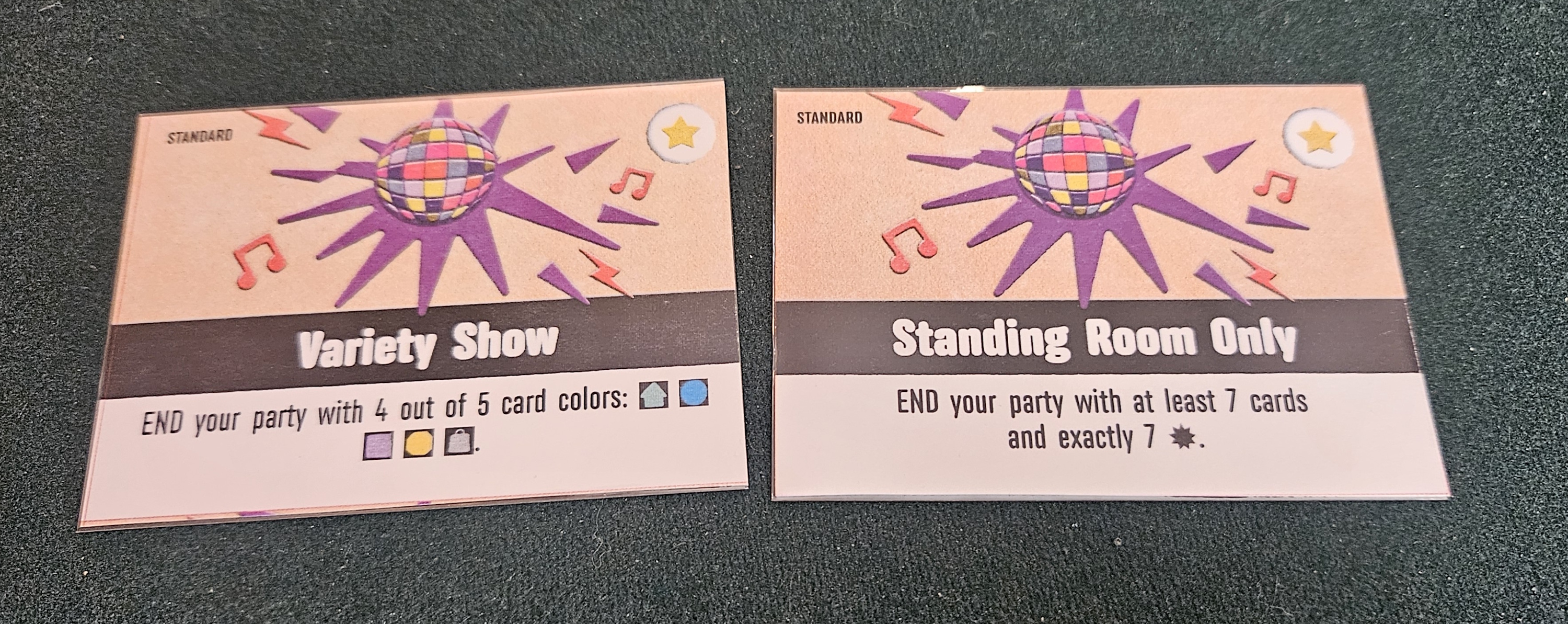
The other big point of inter-player friction arrives in the form of party cards. Each game puts two of these on display, then asks players to jostle for control by fulfilling their stated objectives. This allows for some distinction between sessions. Hosting a Class Reunion feels different from a Legendary Rager, with the former favoring gatherings of old friends while the latter requires you to ride the line with plenty of troublemakers. Importantly, these cards can be stolen, encouraging players to one-up each other over the course of the game.
Different party types can also award stars.
On the whole, Party House does an admirable job of translating the version that existed in UFO 50. It captures the spirit of the original, incorporates more players, and expands the decision space, while also keeping the play punchy and pacey. There are even little touches that speak to Perry’s deep mastery of how a hand of cards can and should be handled, such as the single guest that must be peeled from your deck to become the “door” (read: discard pile) of your apartment, a trick he pulled in Hot Streak to prevent players from developing too robust of a predictive mental model of their deck.
I’d also be remiss to forget Daniel Profiri’s illustrations, which resemble felt board cutouts and are a perfect way to depict the guests’ retro appearance without defaulting to pixels.
At the same time — and keeping in mind that I’ve only played the prototype — Party House comes across as a minor title in Perry’s ludography. It isn’t as subversive as some of his other hits, lacking the emotional range of Scape Goat, the genre-redefining nature of Air, Land, & Sea, or the family breadth of Spots. To be sure, this isn’t to say that Party House has to be revolutionary, and there’s a tyranny to expectations that can prevent us from appreciating what’s right in front of us. But by and large, my experience with Party House has been a gentle one, a pleasurable process of revealing and shifting cards that still feels largely automatic. Where the version found in UFO 50 fit that collection’s 8-bit limitations, here it lands somewhat more thinly.
Then again, there’s a lot to be said for pleasurable physical processes, and that’s where Party House succeeds best. With the right group, it’s the sort of game that gets people chanting “Hit, hit, hit!” And the game upsets genre formulas in subtler ways. For instance, this is one of the few deck-builders to shrug off the absolutism of the five-card hand. Here a party might consist of three guests or ten, all depending on chance and how well you’ve assembled your Rolodex. It’s a smart little thing. Just be aware that it’s littler than you might expect.
The bigger the party, the more likely the cop roll-by.
Where does that leave Party House? On the threshold, I suppose. Playing prototypes is always a risk. Sometimes you get Baba Is You, which feels poised to become an instant cult classic. Other times you get a game that’s still finding its identity. That’s where I would put Party House. Class Reunion or Legendary Rager — we’ll see next year which party this shindig shapes up to be.
A prototype copy of Party House was temporarily provided by the publisher.
(If what I’m doing at Space-Biff! is valuable to you in some way, please consider dropping by my Patreon campaign or Ko-fi. Right now, supporters can read the next installment in my series Talking About Games, this time tackling the topic of what makes a good list! Naturally, the piece includes a list.)
Tabletop game design pioneer Steve Jackson has ended a 17-month return running his namesake games company, with new CEO Sabrina Gonzalez taking charge of a business with years of falling revenue as well as a run of promising crowdfunding successes.
Jackson will remain president of the company he founded in 1980, but will refocus his attention on game design and development, with managing editor Allison Page promoted to COO.
He had previously stepped back from the day-to-day running of Steve Jackson Games in 2014, when long-time COO Phil Reed became CEO, allowing Jackson to devote more of his attention to game development.
Jackson’s return as CEO in 2024 was not presented as a permanent appointment, with him saying in the wake of her departure that her direct reports would report to him while he “figured out a plan”.
Gonzalez has been with SJ Games since 2013 as a production artist and production manager, apart from a brief period away from the company working for toy and game manufacturer Grand Prix International – and has been a member of the board of directors since 2021.
She said of her vision for the business, “As a general goal, I’d like us to continue to grow. We weathered the pandemic and pivoted project plans to address continually changing tariffs.
“The goal is always to make great games that people love. I want to continue developing new titles for future generations of gamers and also support (and sometimes update) the classics that our fans continue to request.”
New Steve Jackson Games COO Allison Page
New COO Page joined SJ Games as managing editor in 2023, having previously worked as executive artistic director of San Francisco comedy organisation Killing My Lobster. She also spent a year working as a narrative designer in the video game industry.
Page said, “I’m most excited to support Sabrina in her new role as CEO! We’ve always worked really well together and want the same things for SJ Games.
“I’m a problem solver, and I’m passionate about setting clear expectations. I’m excited to untangle whatever comes my way and ensure the team knows how to move forward and has what they need.”
He said on the company’s blog in May, “We made it through! But it’s not a story that fits well into the standard Stakeholder format. It took me a while to get up the nerve to start, and it has taken me longer to get it right. But I shall.”
Revenues have decline substantially since, however, falling about 2.5x from that peak to settle at around $3.5m across both 2023 and 2024 – the last years for which Steve Jackson has published the total – and bringing the annual total down to levels last seen back in 2010.
Annual revenue at Steve Jackson Games between 2003 and 2024. The asterisk(*) at 2022 indicates that the company overstated its revenue at $4.7m that year “due to confusion about BackerKit proceeds”, but it has not publicly provided an updated figure.
Jackson said in the executive summary in the 2023 report, “Cash flow was acceptable. It was not a profitable year, though. We have identified and dealt with some of the money-losing issues; others will be harder. We are working on it. (No fear; we have plenty of runway left. I just hate to use it.)”
He continued in the 2024 overview, “Cash flow was acceptable, but I don’t feel ‘prosperous’. This is not just us; individual game sales, industry-wide, were down at both the distribution and retail end, largely due to the glut of titles.”
Jackson added that year, “We are still working the problem, but we have less runway than we did last year! Cause for optimism: it was a rebuilding year and not expected to be good for cash, but thanks to your support for Munchkin Big Box it was better than we anticipated.”
Those challenges were exacerbated in 2025 by the impact of volatile US tariff policy, which included an unexpected “high five-figure” bill on its Munchkin Big Box after new tariffs were levied while the already-produced game was at sea.
The Munchkin Big Box || Photo Credit: Steve Jackson Games
The BackerKit campaign for the Munchkin Big Box had been one of the company’s bright spots over the past couple of years, bringing in more than $1.3m from over 9,000 backers – a situation Jackson credited with making 2024 financially better than expected.
SJ Games followed that with a $370,000 BackerKit campaign for Munchkin Second Edition this year to coincide with the game’s 25th anniversary, and in recent years has extended out the game with Munchkin Shadowrun, Munchkin Vox Machina and multiple Warhammer-based releases, as well as several other expansions.
It said at the time that the deal would allow Possum Creek, the publisher of Wanderhome and Yazeba’s Bed & Breakfast, to retain full creative and editorial control over its titles, while “lending their talents to the SJ Games design and visual branding”.
Possum Creek editorial director Jay Dragon joined the SJ Games board of directors as part of the tie-up, and became its lead game designer, while Ruby Lavin became the company’s art director.
Seven-Part Pact, designed by Jay Dragon
Since then Dragon’s TTRPG design Seven-Part Pact has raised more than $1m through a Kickstarter campaign, while SJ Games has also raised almost $600,000 across a pairof Kickstarters for the venerable Fighting Fantasy line of adventure gamebooks, having agreed a deal in 2024 to bring the UK-created titles back to the US for the first time in more than two decades.
Steve Jackson’s game design career dates back to the late 1970s, with his 1977 debut Ogre helping popularise the emerging microgame format of small, inexpensive wargames.
Within five years he had designed Car Wars and Illuminati, founded his own games company and been inducted into the Academy of Adventure Gaming Arts & Design Hall of Fame in 1982 – all while still in his 20s.
He followed that with the Generic Universal RolePlaying System (GURPS) in 1986, which was his attempt to create a single roleplaying system capable of working across different settings and genres.
While not the first RPG to experiment with universal rules, GURPS helped popularise the concept and grew into a huge publishing line for Steve Jackson Games. By 2004 the company had released about 200 GURPS titles, with more than one million copies in print in English alone.
Jackson’s most visible modern design is Munchkin, which became the company’s biggest commercial success following its release in 2001. The game was inducted into the Academy of Adventure Gaming Arts & Design Hall of Fame in 2013.
If you haven’t heard of Baba Is You, grab hold of the nearest guardrail, because you’re about to be hit by a wrecking ball of descriptors. Here goes: released in 2019, Baba Is You was a mind-bending box-pushing syntax-making meta-puzzle video game by Arvi Teikari. It was hard. Famously so. Especially if you’re anything like me and not really into Sokoban-style box-pushers.
Baba Is You is now also a board game, albeit one whose pedigree doesn’t only belong to Teikari. The analog adaptation was done by Peter C. Hayward, and in many ways it feels like a riff on his abstract comedy game That Time You Killed Me. Although somehow, improbably, it’s even better — provided you have the right mind for it.
Baba Is Sometimes Confounding. In a good way.
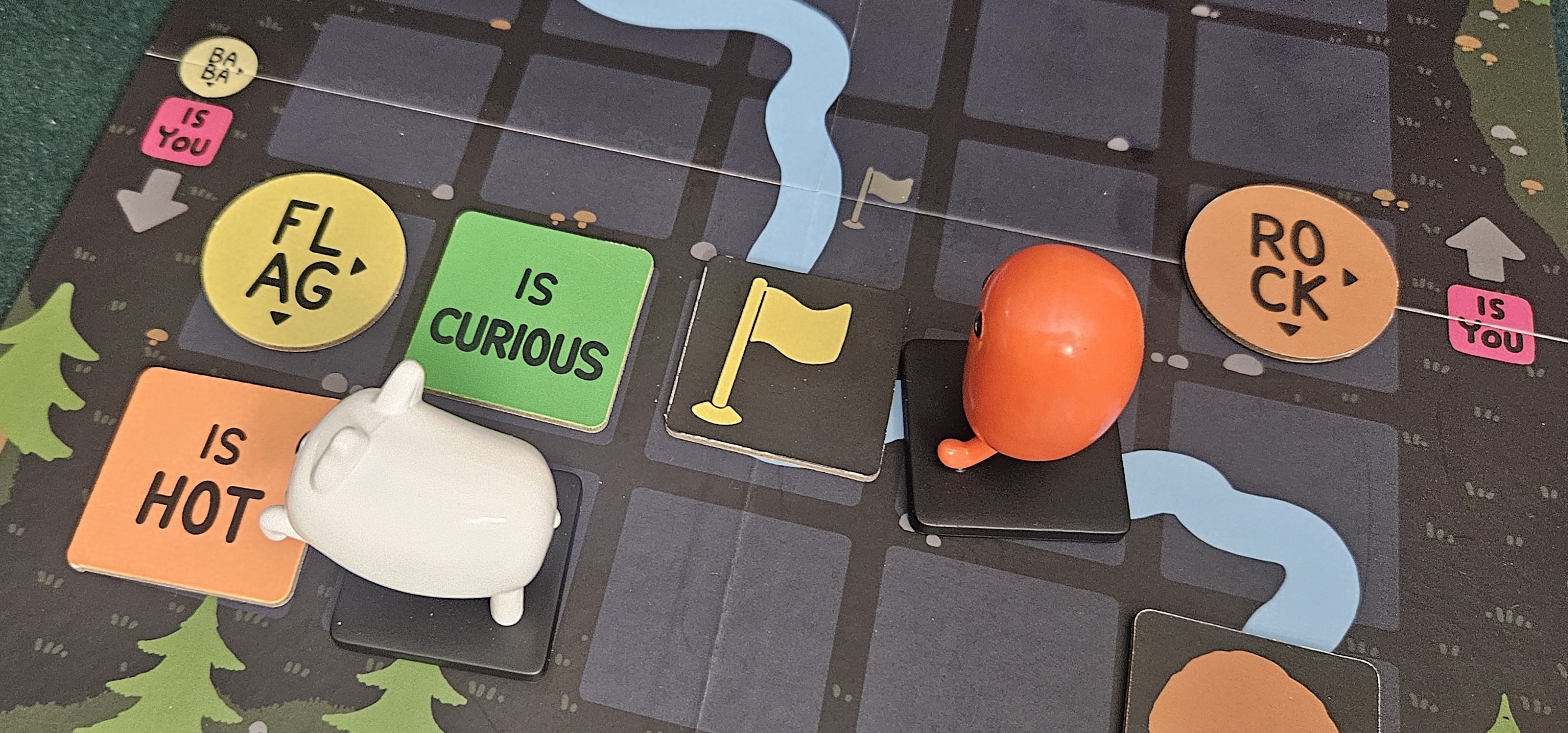
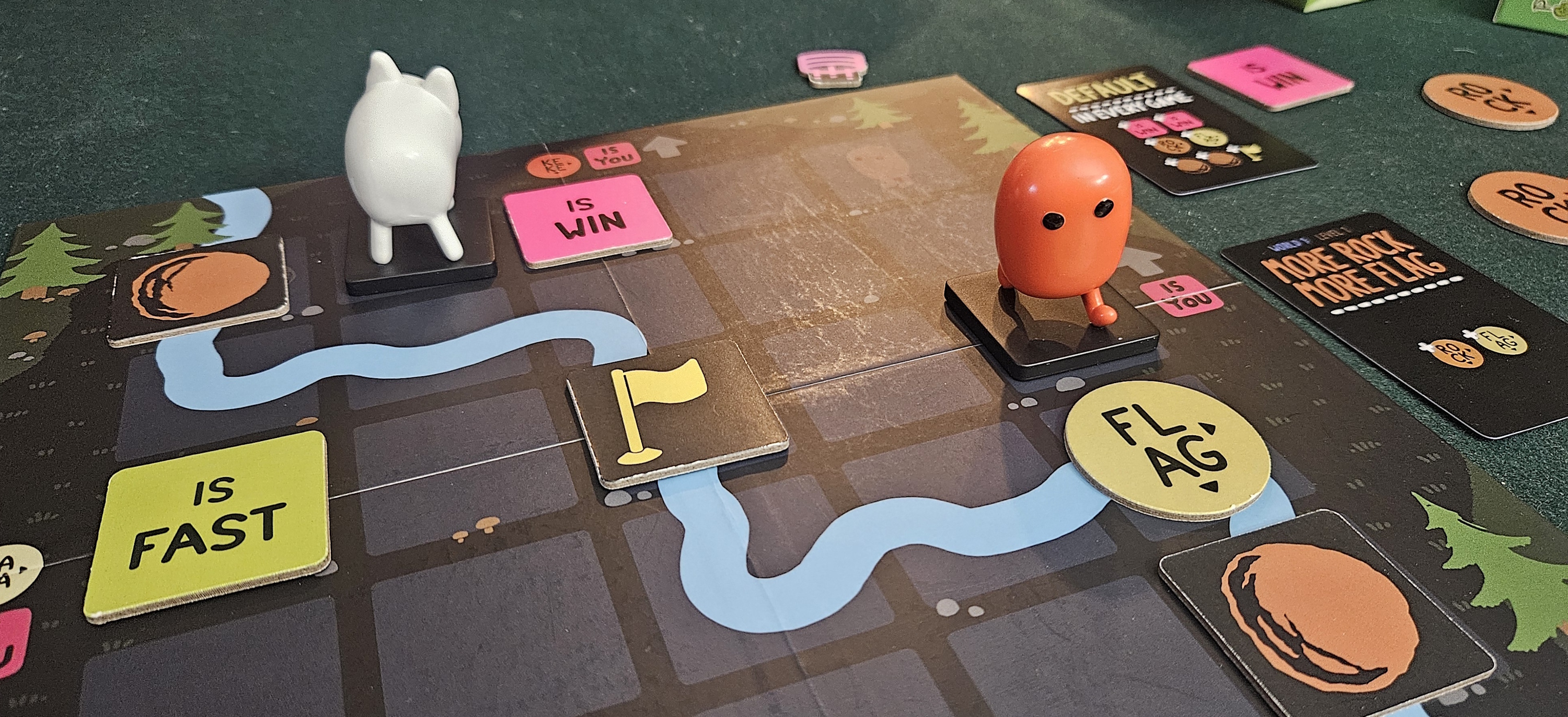
You are Baba. Baba is a dog… sheep… cat thing. Baba likes to push boxes around a ten-by-ten grid. Baba can also pull boxes, one of the board game’s main concessions to its non-digital format. Mostly, this is to prevent everything from piling up on the edges and corners until the board has screwed inward like an ingrown toenail. Boxes can also be placed next to Baba, brought from off-map to alter the game’s progress.
You are also Keke. Or, well, your opponent is Keke. Because unlike the video game, Baba Is You: The Board Game is not a solitaire affair. This is a duel, alternating players and pairs of actions. I take two actions, split as I choose between moving Baba and placing boxes. Then you take two actions, moving Keke this time and maybe also placing boxes.
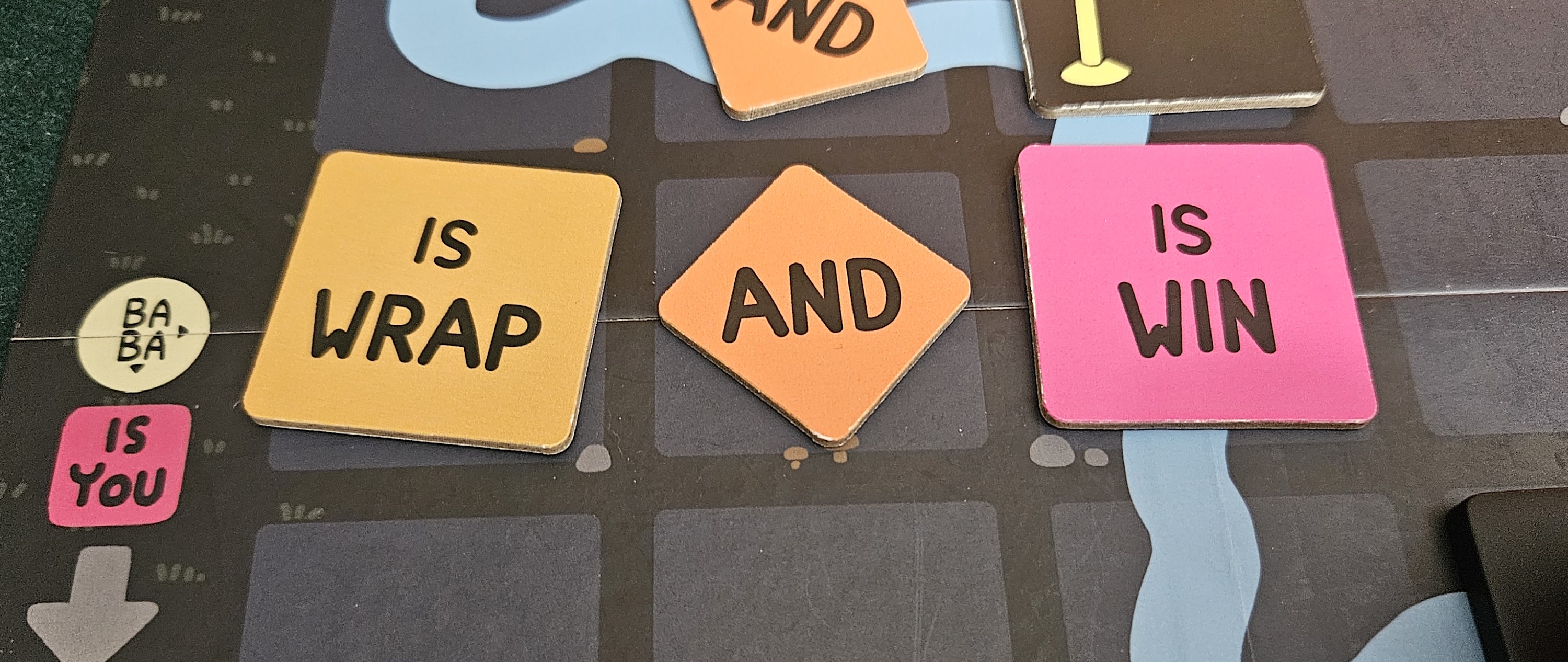
What sets this apart from any number of other games is that there is no win condition. Not right away. Your goal is “to win.” I mean, obviously. That’s why we’re playing games, isn’t it? To win? But in order to win, you must construct a way for that win to occur. For example, by placing and pushing boxes. “Rock.” That’s one such box you can place on the map. “Is Win.” That’s another. Put them next to one another and you spell out the phrase “Rock Is Win.” Now if somebody steps onto a rock, they win.
Baba Has Lots of Options. But not too many at any given time.
It doesn’t take long for this rubric to turn pretzels and loop-de-loops and barrel rolls on itself.
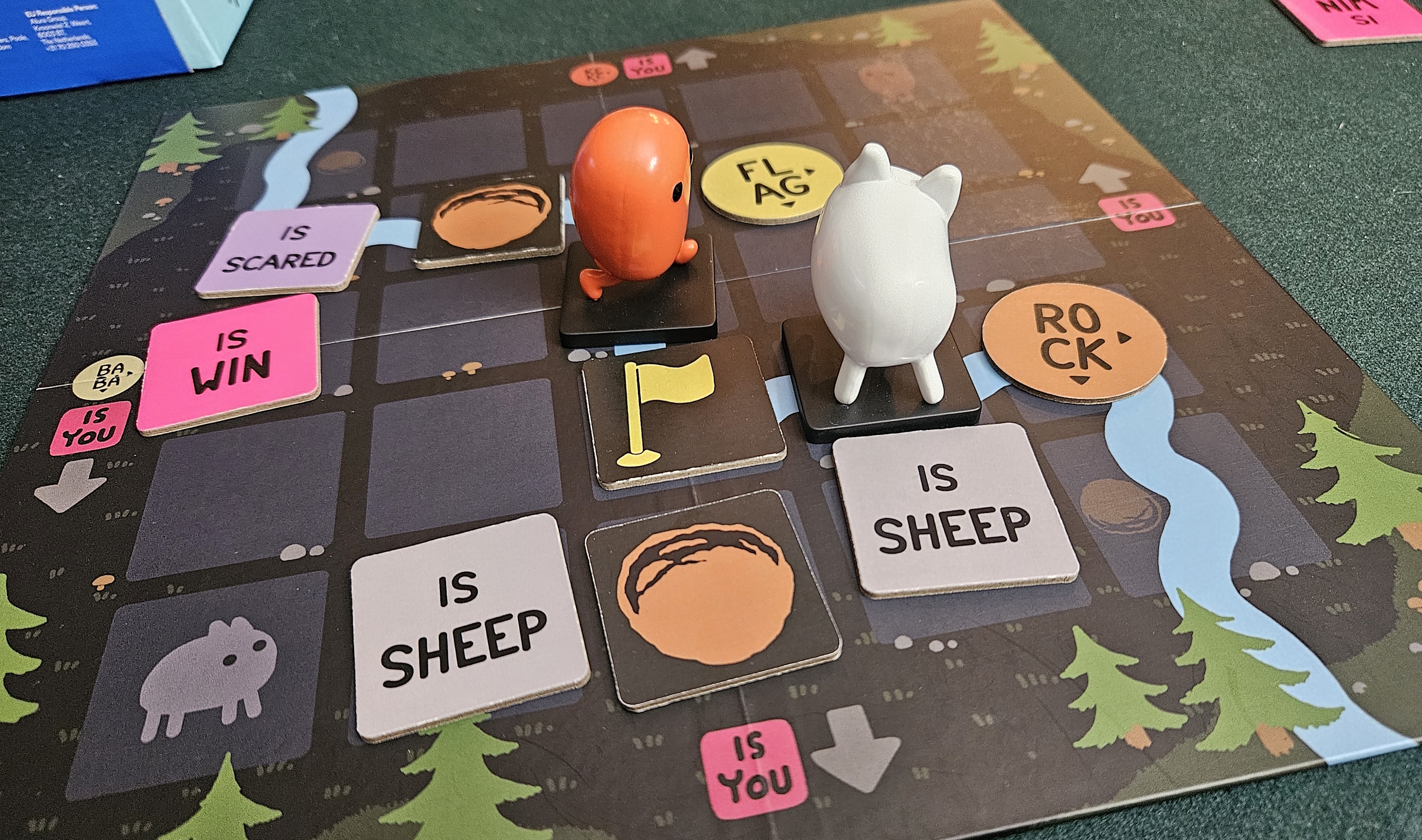
For one thing, there’s a lot you can do with a few basic phrases. Put “Rock” next to “Is You” and suddenly “Rock Is You.” Now instead of only moving Keke, you can also move any rock as though you were the rock. Spell out “Rock Is You” and “Rock Is Win” at the same time and you might be able to win by stepping one rock onto another rock — because you’re a rock and also rock is win. Or you could do things more simply by just spelling “Rock Is Win” and having Keke, who is you, step onto the rock. Fewer steps that way.
At the same time, fewer steps isn’t always better, because both you and your opponent are messing with the integrity of these phrases. Usually by pushing and pulling, but other tricks eventually reveal themselves as well. As a rock, maybe you push apart the phrase “Flag Is Win.” Now the flag isn’t win, so your opponent, Baba, who was one turn away from stepping on the flag, cannot win. At least not without somehow putting that phrase back together or creating another. Or by layering the game’s syntax and box-pushing puzzles over the top of each other so that your rival is checkmated into permitting your win.
Also, there are heaps of these phrases, all capable of jumbling together to create dynamic new rulesets. For example, maybe something on the board becomes “Curious.” This means that anything that moves into its row or column will cause that thing to come wandering over to see what’s snuffling about. Or perhaps Baba becomes “Thirsty,” inclined to scoot over to the river spaces at the end of each turn. Or the river decides to begin to flow downhill, potentially whisking items off the board altogether.
Sometimes these rules can have unintended consequences. Such as when a “Hot” item comes in contact with a “Melt” item, which destroys the latter. It’s possible that you will even be destroyed. You as in Baba, or you as in Keke, depending on which side you’re playing as right now. If you are something else on the board — a rock, a flag, an errant piece of syntax uplifted to temporary sentience — then you can continue to function, maybe even calling your destroyed body back onto the board, until such time as the rule is broken into pieces.
Baba Took A Wide Angle Shot.
There are three main things I would impress upon you about Baba Is You: The Board Game.
The first is that it’s incredibly funny. I mentioned that Baba recalls Hayward’s earlier effort, That Time You Killed Me, another notably funny game. Their commonalities are many. Both are short abstract games with ever-shifting rules. Both are tight two-player duels on claustrophobic boards. Both allow precisely two actions per turn, which is just enough to get something done but not enough to accomplish everything you need. Also, if played in an obnoxious manner, both can result in little I-step, you-step conundrums that aren’t especially interesting to resolve.
But where Baba Is You differs from That Time You Killed Me is crucial. These are dramatically different games in scope and process. Moves are harder to undo than those in That Time You Killed Me, with boxes usually sticking around for the duration of the match. Also, the comedy doesn’t arise from the prose. There’s none to speak of anyway. Here, Baba and Keke’s misadventures are pure slapstick. It’s the joy of assembling a mousetrap only to trigger it in your own face.
Which is also to say, the game is hard. At least it’s hard for me and the people I’ve played it with. I came into the game forearmed, having played Teikari’s original video game. But when introduced to newcomers, I found it often perplexed them. Four different opponents bounced off its systems. The combination of box-arranging and word-making is no easy thing to get a handle on.
Baba Wishes To Understand Grammar.
Then my seven-year-old requested a try. She’d watched me try it with her older sister and Summer. I figured there was no harm. She plays all sorts of games that are beyond her level, so she’s a good sport whenever something doesn’t match her expectations.
Except she took to it immediately. To her, the syntax puzzles were a joy, a constant wellspring of experimentation. The box-pushing was tougher, especially when she developed some creative interpretations of which boxes could be pulled. But making innovative new phrases became her favorite thing. She began to request it every day before school, insisting on new chapters with their punch-boards of nouns and adjectives. When we would walk to class afterward, she would bounce along, singing about the different combinations of words she had made. “Daddy, I’m floating, like Baba! Daddy, watch out, I’m gonna melt you! Daddy, the hole in the grass over there is win!” Sharing the various ways she had discovered to upset reality.
Which is another way of saying that Baba Is You doesn’t fit every brain. But when it fits, it fits with a satisfying click.
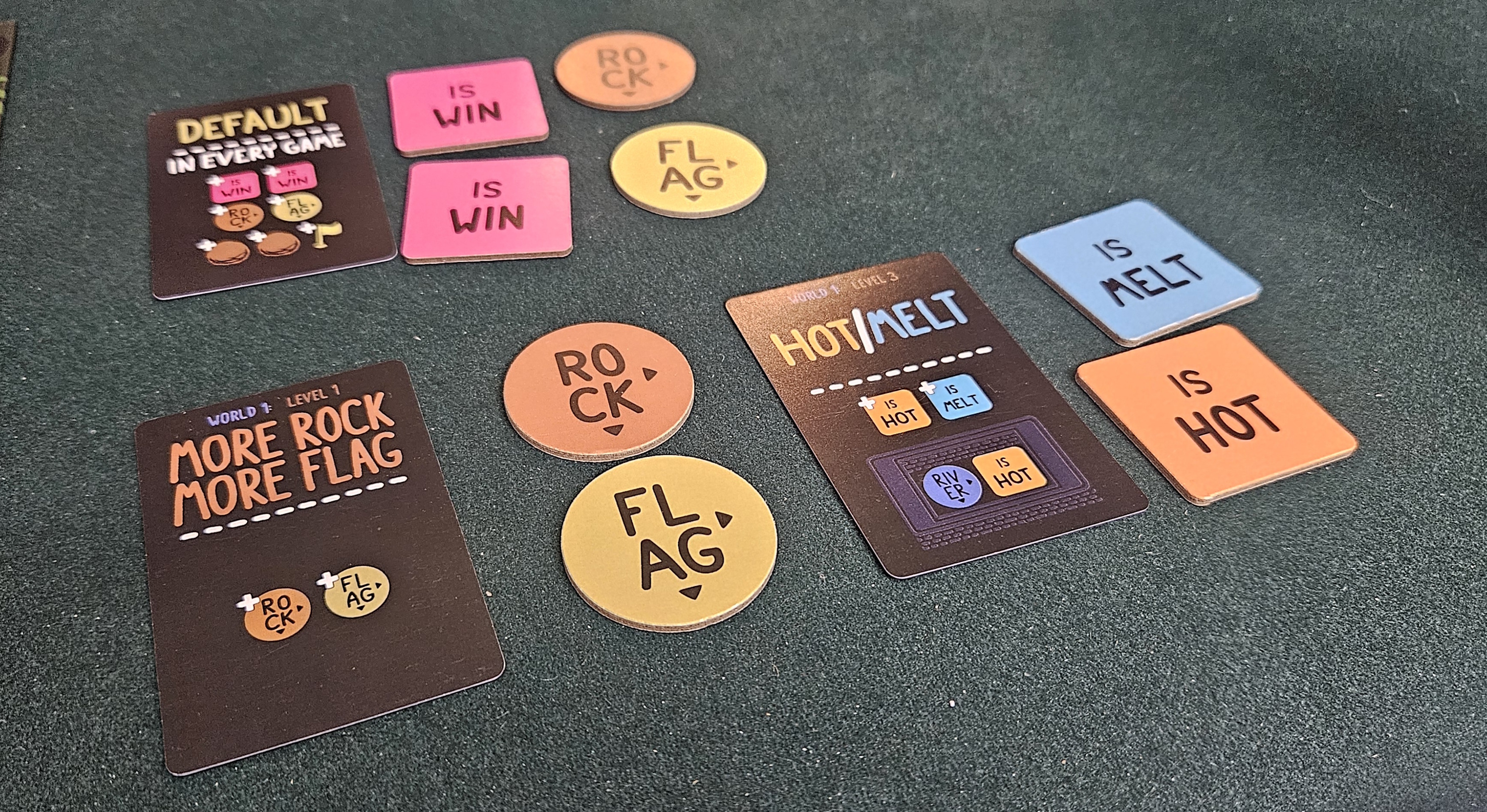
To the designer’s credit, there’s some secret sauce in the recipe… and it’s basically mayonnaise. As in, not the most exciting to talk about, but an essential splash of flavor nevertheless. The way it works is that you play a match with only a couple of keywords. Then, when that’s over, you add a new keyword and the loser gets to decide which older word is removed. This keeps the game lively and defangs the threat of losing. Rather than wagering everything on a single session, Baba Is You is played as a flight of five, seven, or possibly more matches, each building on what came before. Little metagames develop, instances where both parties want to see a keyword used to greater effect, or perhaps someone gets fed up with a Fast Baba zipping around the board and deletes the “Fast” keyword from existence altogether. It’s a dang smart way to approach the game as a whole, encouraging experimentation and risk-taking instead of putting all that weight on a single bundle of moves.
Baba Is a Perfect Outro.
Put together, Baba Is You: The Board Game becomes more than the sum of its parts. It’s a comedy game that’s genuinely thinky, a thinky game that bounces off some brains but burrows into others, and a technical achievement that always feels one step ahead of both players. When it works — and for some, that won’t happen — it’s one of the funniest, most generous titles of the year, a constant reinvention of what it means to be Baba.
A prototype copy of Baba Is You was temporarily provided by the publisher.
(If what I’m doing at Space-Biff! is valuable to you in some way, please consider dropping by my Patreon campaign or Ko-fi. Right now, supporters can read the next installment in my series Talking About Games, this time tackling the topic of what makes a good list! Naturally, the piece includes a list.)
Ants, the debut release from designers Renato Ciervo and Andrea Robbiani, has scored its first board game award by picking up this year’s Jogo do Ano, the Portuguese game of the year prize.
Vital Lacerda design Speakeasy, Dave Beck and Abe Burson’s Luthier and Toni López creation Ada’s Dream were also nominated for the annual prize, which is organised by the non-profit board game association Spiel Portugal.
The Jogo do Ano, which has been presented since 2006, tends to skew towards the heavier end of board gaming, with recent winners including SETI, Nucleum, Barrage and Imperial Struggle.
Spiel Portugal says the type of game it looks for is “strong, spirited, dense, and stimulating”. Each member of the organisation initially selects ten games, with the resulting five finalists played again and scored according to a weighted set of criteria.
Half of the final score is based on what Spiel Portugal calls “time/fun”, with production accounting for 15%, theme, mechanics and replayability each worth 10%, and player interaction making up the remaining 5%.
Ants, designed by Renato Ciervo and Andrea Robbiani
The title was originally published by Italy-based Cranio Creations, and has since been picked up for localisation by publishers including US-based Capstone Games and Germany’s PD-Verlag.
Ants is the sole design to date from chemist Renato Ciervo, who also works with Italian publishers as a game developer, according to his BoardGameGeek page.
His Ants co-designer, engineer Andrea Robbiani, has subsequently created Maestro – themed around the fierce rivalry between Leonardo da Vinci and Michelangelo – and co-designed Timeless Journeys: The Italian Grand Tour with Nestore Mangone.
Maestro Media is opening up the publishing, licensing, manufacturing and retail infrastructure behind its own games to outside designers and publishers, including companies looking for a North American publishing partner.
Maestro founder and CEO Javon Frazier said, “The hardest part of this industry has never been the ideas. It is everything after them. Getting your design in front of a publisher, funding the development, entering distribution, landing it on a shelf.
“We built a machine to do that for our own titles alongside some of the largest licensors in the world. Overture by Maestro Media opens that machine to everybody else.”
Maestro says Overture will allow other companies to use its existing operations for areas including development and licensing, production, manufacturing, crowdfunding, direct-to-consumer sales and retail distribution.
The company has already struck several deals along those lines, including announcing in the summer that it would publish a new North American edition of Zoch Verlag’s Ghost Blitz from January 2027.
Frazier said of the Ghost Blitz deal ahead of unveiling the game at this year’s Gen Con, “Ghost Blitz has sold more than one million copies in 20-plus languages over 15 years. Most North American families have never seen it on a shelf. That’s not a demand problem. It’s a distribution problem.
“That’s the gap we built Maestro Media to close. Crowdfunding, direct-to-consumer, and retail working as one engine, with distribution partners already in place across North America.”
Peterson Rodrigues, CEO of D20 Culture, said, “We’re excited to work with Maestro because we see the same opportunity they do: great games shouldn’t be limited by borders.
“Bringing these titles to players around the world, in their own languages and through partners who understand their markets, is exactly the kind of collaboration we want to be part of.”
Game designers will get their first opportunity to pitch original tabletop games via the new operation through a month-long submission window running from January 1 to 30 next year.
The company says it has worked with more than 40 licensed properties to date, and shipped more than 400,000 products, while Frazier has raised more than $16m across 16 crowdfunding campaigns – although almost 60% of that total comprises the two Binding of Isaac projects.
The company added that Ryan Lumax has been promoted to vice president and head of games at the company, having joined last year after almost eight years at Canadian distributor Lion Rampant Imports.
Lion Rampant was acquired by Asmodee in 2019, when Lumax was working as head purchaser. He became a purchasing manager at the business in 2023.
Lumax said, “I spent eight years on the buying side, and the games that didn’t make it were almost never the bad ones.
“They were good games whose creators ran out of road somewhere between the prototype and the pallet. That is the gap Overture by Maestro Media closes.”
I owe Abroad an apology. When it first landed on my doorstep, I set it aside for a solid month. My assumption was that it was another ultra-light globe-trotter, absent serious tension and disconnected from the locales it was asking me to explore. A game about travel, but not really about travel, if you take my meaning. Not to throw any specific shade here, but I figured it for a Trekking the World clone.
Designed by Rodrigo Rego and Danilo Valente, Abroad is anything but a clone, and it certainly doesn’t feel disconnected from its geography. If anything, it hews closer to the Let’s Go! series by Josh Wood, which invited us on vacations to Japan and France. Those titles drew us in with both tourist traps and local color, the unique contours of their cities, even the way these places’ infrastructure might require transit, downtime, or some extra effort to uncover something off the beaten path. The main distinction, of course, is that Abroad covers a continent rather than a single country. The remarkable thing is that it still manages to feel like a real place — and a highly competitive one at that.
Trekking Europe (not that one)
Unlike the abstractions found in some titles, Abroad opens with quite the hook: you’re in the running for a position as a travel journalist. It’s a dream job for people who don’t mind trains, planes, and automobiles — that’s me precluded — and as such you have one month to visit as many regions of Europe as possible, cultivate local connections, write articles, and sometimes pass out from exhaustion.
Also, engage in a cutthroat area control minigame. But that comes later.
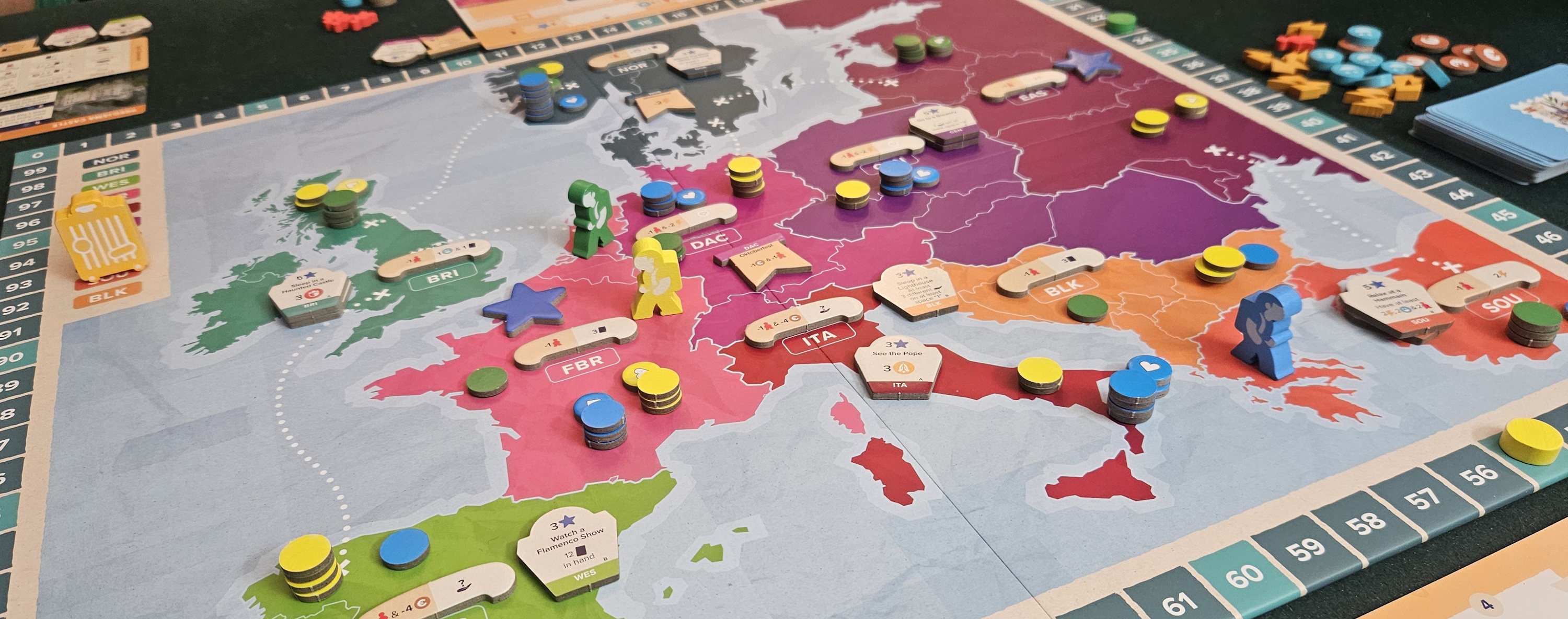
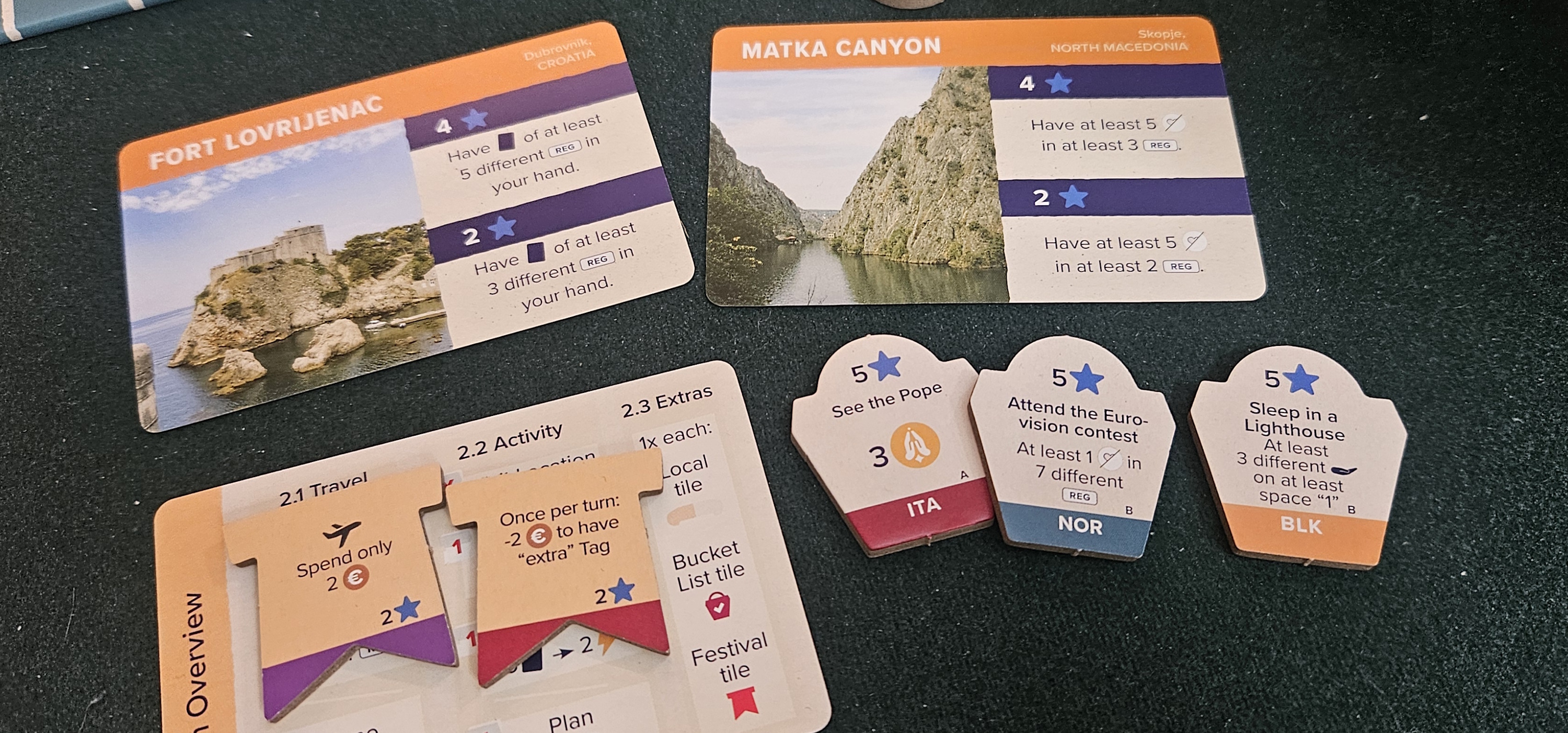
In a near mirror image of something like Trekking the World, it begins with a selection of cards that represent a whole range of possible destinations. Here those cards begin in your hand, subdivided by region rather than individual country. You might, for instance, consider swinging by the Alhambra Palace in Spain, the Isola Bella on Lake Maggiore in Northern Italy, and the Tsarevets Fortress in Bulgaria. Broadly speaking, your objective is to visit these destinations, necessitating some logistics as you balance flights against available funds and train rides against a steadily declining supply of physical energy.
So it’s a movement game! True. Getting around is one of Abroad’s central questions, especially when you get stranded in Greece because you hopped one too many trains. But it very quickly reveals other dimensions as well.
As any seasoned traveler can tell you, schedule is king.
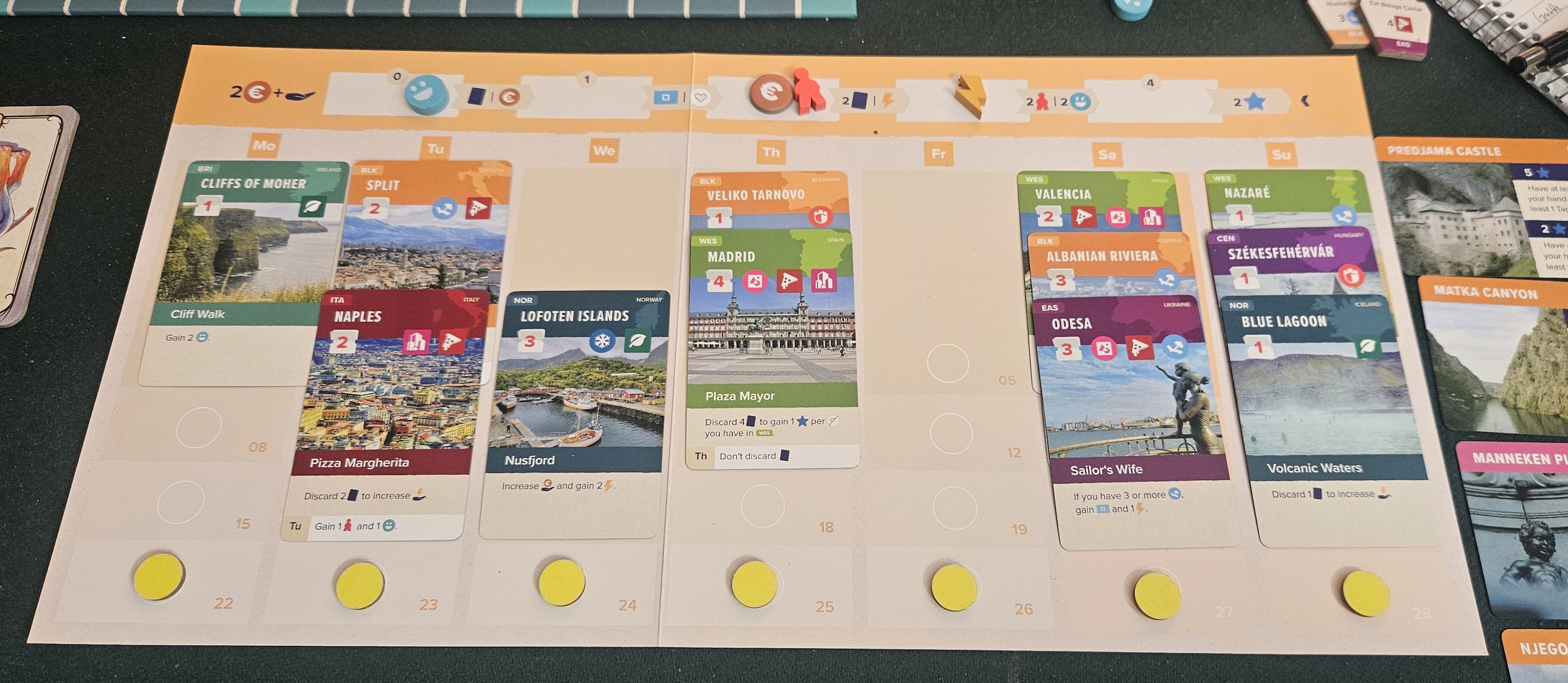
The calendar, for instance. When you visit a location, you don’t just play the card and earn a bonus. Sure, you do both of those things. Playing cards and earning bonuses are both major components of the game. But the card is also added to an ongoing schedule that shows your four-week tour of Europe.
What’s more, the duration of that card matters. A small attraction, like an ancient amphitheater in Greece, might only require one day to visit, while something grander, such as the Fjords of Norway, takes four. To place such a card into your schedule, then, you must count that many spaces forward on your calendar. One, two, three, four. That’s most of a week. Maybe it would be better to see a bunch of smaller locales?
Except it isn’t that simple. First, there’s an entire resource system under the hood. You can spend motivation — which for those who are counting is a fourth resource to manage, in addition to cards, money, and energy — to subtract from a destination’s time requirement. Want to see the Fjords in two days? You can do that. It will cost you, but it’s possible.
Second, the slots on your calendar don’t only serve to mark time. They also demonstrate how much you’ve mastered the region you’re currently exploring. Visiting that day-trip amphitheater means you’ll only move one token from your calendar to the map. You now know something about Greece. Well done! But spending four days in Norway means placing four tokens. Sure, you could use motivation to shorten the trip. But that also decreases the number of tokens you’re placing on the map.
And tokens matter. Oh, how they matter. At the end of each week, there’s some quick upkeep. You earn income, which is nice. You discard and draw cards, which is even better. But the real headliner is that each region awards points to the journo who’s mastered it best.
Even then, this isn’t as simple as “most tokens wins.” Sometimes tokens can be flipped to their more powerful heart side. Then they function as trump cards, winning against any number of ordinary tokens. The result is a series of little bids across the map. My knowledge of the German-speaking countries gets one-upped by your heart token, so I counter by writing a great piece about hot spring destinations in Britain, eroding your base by way of revenge. It’s smart, emphasizing both time and mastery over our subject matter.
Postcards, festivals, bucket list items.
It’s also super, super mean. Just downright jerky. Snitty all the way through. Supernal area control, with all the little bid-sweeps and point-swipes one has come to expect from the mechanism.
Which is also, naturally, the best thing about Abroad. Generally, these travel games serve as comfort fantasies. If you could go anywhere, could take the time off work and afford any destination, what would you do? We play it out, and then we tally our scores to see who had the best trip. Which can be a great deal of fun, but isn’t exactly doing any heavy lifting with inter-player dynamics.
Abroad, on the other hand, never lets you sleep on its audition. Took a nap in France to recoup your energy? That’s a defeat. Paused to write a few articles for pocket money? That’s a chance for your peers to step ahead of you. Spent two whole weeks in Central Europe because you were holding a dozen purple cards? Sorry, you’ve overspecialized. You think Rick Steves only knows Poland? Baby, there isn’t a roadhouse or castle or war memorial between Portugal and Moscow that he hasn’t photographed or humped.
Along the way, you get to know these spaces. Not as intimately as the spaces in some games, it’s true. These are big attractions, not the gachapon shops and hidden gardens of the Let’s Go! titles. But one still develops a sense for Europe, its many sights, the festivals, the benefit of local knowledge. It’s only an impression, and barely an impression at that. But it’s more of an impression than most games of this stripe bother to make. It feels like it loves these places, wants them to be more widely appreciated, understands why people keep returning to them. They’re destinations, not points on a checklist. You’re only visiting, but you’re visiting something.
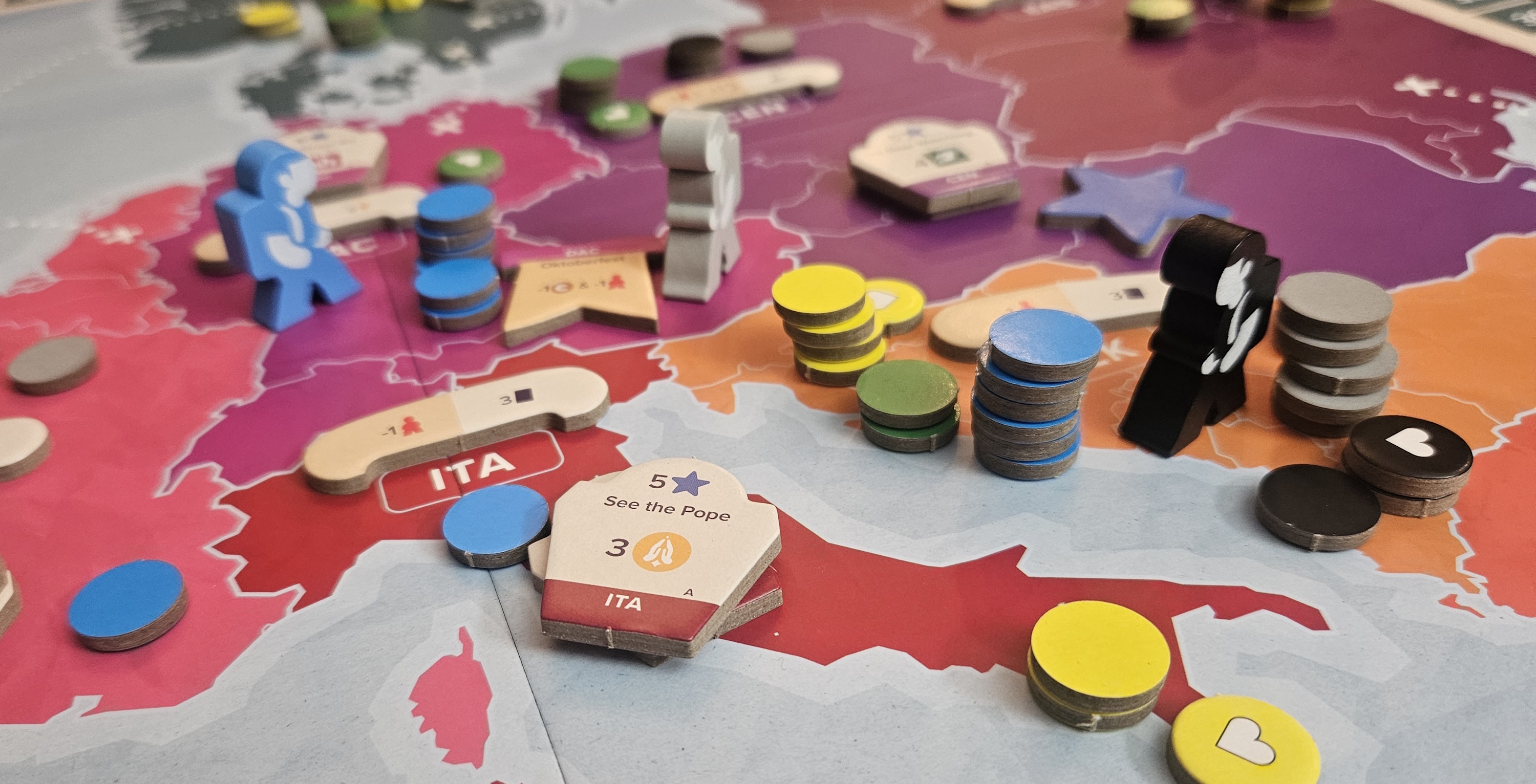
I will see the Pope today, dammit.
This marks Abroad as a success in myriad ways. Its sense of place, of course, but also its willingness to let players knock heads, to steal scoops from one another, to become the Prime Understander of Spain when nobody expects it. The result is wonderful to handle, from its calendar to its board, raising questions of timing and control and resource management and comprehension and more besides. I went in expecting a staycation; what I found is one of the finer travel games out there.
A complimentary copy of Abroad was provided by the publisher.
(If what I’m doing at Space-Biff! is valuable to you in some way, please consider dropping by my Patreon campaign or Ko-fi. Right now, supporters can read the next installment in my series Talking About Games, this time tackling the topic of what makes a good list! Naturally, the piece includes a list.)
CMON has warned that its core business is suffering a “prolonged structural downturn” and is still consuming more cash than it generates, despite a drastic restructuring which has seen the board game crowdfunding major halve its workforce, sell off some of its biggest game IPs and halt new crowdfunding campaigns.
Those efforts have now dramatically reduced its losses, CMON’s newly-released H1 financial report shows – with the company reporting a loss of just over $2m for the first half of this year, compared to almost $7m for the same period in 2025.
CMON’s revenue also rose more than 7% year-on-year in H1, up to $3.68m from $3.43m in the first six months of 2025, while its selling and distribution expenses more than halved from $1.83m to $859,000, and its general and administrative expenses fell from $4.37m to $2.37m.
But that improvement has failed to make the underlying business self-sustaining. CMON’s cash reserves, which stood at $3.9m at the end of 2022, had fallen to $2.1m by the end of 2024, and slipped again to just over $900,000 by June 2025.
CMON revealed last month that it had about $368,000 in bank and cash balances as of August 4, which it described as enough to cover less than a month of its daily operating expenses.
Crowdfunding Commitments
Despite the sharp reduction in its losses, CMON’s balance sheet remained under pressure at the end of June – with $7.34m more in short-term liabilities than short-term assets, up from $6.89m at the end of 2025.
A significant part of CMON’s liabilities relates to eight crowdfunded games whose campaigns raised $14m from backers, but which the company has yet to deliver.
CMON has not completed fulfillment of a crowdfunding project since Zombicide: White Death in mid-2025, but has managed to deliver pre-orders for Cthulhu: Dark Providence, Marvel United: Witching Hour and Dune: Desert War in the first half of this year.
CMON said in its H1 report that the liabilities position had caused the company’s directors to give “careful consideration to the future liquidity and performance of the group and its available sources of financing in assessing whether the group will have sufficient financial resources to continue as a going concern”.
Those directors believe CMON will be able to continue operating – but central to that assessment is a major share sale designed to raise up to HK$150.5m – about $19m.
CMON first announced the rights issue fundraise in June, proposing to offer existing shareholders the opportunity to buy three new shares for every share they already owned in an attempt to raise the capital.
That leaves CMON looking to raise more than $17.5m from other investors through the rights issue – a figure approaching 2.5-times the valuation of the entire company implied by its last share sale in February this year.
CMON said it plans to use 40% of the money raised to fund its day-to-day operations for roughly the next year, including staff costs, royalties, shipping and distribution, professional fees and other administrative and operating expenses.
Another 20% is earmarked for repaying debts and other outstanding liabilities, including $2.46m owed to a CMON director and $385,000 of unsecured advances from employees, as well as outstanding production, shipping, royalty and other operating costs.
CMON has earmarked 25% for expansion in existing and new markets, including strengthening the company’s presence in Europe through marketing and potential attendance at events including Spiel Essen and Cannes, as well as targeting growth in Japan and the Philippines.
Digital Ambitions
The company added that it plans to put 15% of the new capital towards potential acquisitions as part of a push into digital gaming, although said it had not yet identified any targets.
CMON said it intends to look for between one and three businesses, primarily in Asia-Pacific, valued at between about $1.3m and $2.5m each, which could help it develop digital adaptations of its existing games, companion apps and other digitally-enabled features.
The publisher stressed that it intends to retain physical tabletop games as its core business, with the digital push designed to complement rather than replace them.
That plan had included transitioning the company’s titles such as Massive Darkness and Super Fantasy Brawl Reborn into “high-quality digital assets” – with CMON saying the group would “continue to supplement this digital transformation as physical games would still offer a ‘screen break’ for individuals as well as foster direct face to face interaction”.
The proposed investment would have valued Blissful Link at more than $95m. Blissful Link made a loss of about $197,000 in 2024, on revenues of just over $408,000, and had net liabilities of about $889,000, according to unaudited figures provided by CMON in April. It did not include finances for 2025.
CMON said in the rights issue offer, “Under prevailing high-interest lending conditions, traditional bank borrowings and debt financing carry heavy interest and securing such financing would severely strain the group’s remaining liquidity.
“Accordingly, equity financing via the rights Issue is the most viable strategic path to recapitalize the group’s capital base without increasing debt distress.”
The directors’ assessment that CMON can remain a going concern also takes into account continued financial support from some of its directors, progress fulfilling its outstanding contract liabilities and further restructuring aimed at reducing cash outflows.
Revenue Collapse
CMON’s latest figures also reveal the scale of the collapse in its North American and European revenues over the past five years, transforming the geographical make-up of what remains of its business.
North America alone generated more than $8.6m for CMON in the first half of 2021, making up 57% of its roughly $15.1m H1 revenue. By the first half of this year, however, revenue from North and South America combined had fallen to just $642,000.
Europe has undergone a similarly dramatic contraction, with revenue from the region falling from about $4.5m in the first half of 2021 to just $982,000 in the latest six-month period.
Asia has consequently become CMON’s largest market by a considerable margin, generating more than $2m in the first half of this year and accounting for about 55% of its total revenue, compared with less than 10% in the same period of 2021.
That reversal has not been driven by Asian growth, however. CMON generated $3.22m from Asia in the first half of 2022, marking a roughly 37% decline since – but a far more resilient performance than the steep falls recorded in North America and Europe over the same period.
The publisher said in its H1 2026 report, “The group intends to continue developing its distribution and market presence in Asia while supporting its established markets in Europe.
“The group will also continue to monitor trade and tariff conditions affecting the US market, and maintain a prudent approach to allocate resources to markets and projects.”
CMON said in March this year that it intended to resume crowdfunding in the second half of 2026, but its latest interim results stop short of repeating that commitment, saying instead that new titles will be developed and launched selectively depending on market conditions, available financial resources and project readiness.
The final result of the rights issue is due to be announced on September 15.
“Nobody, and I mean NOBODY, trusts two random dentists to make a fantastic board game.”
That was the problem facing Nick Murray and Kyle Spackman, two friends who fell down the board game rabbit hole while at dental school together, when they decided to launch publisher Bitewing Games in 2020.
Bitewing’s efforts to reach out to designers ultimately provided what might have seemed an ambitious solution to that credibility problem: work with one of the biggest names in board games, prolific German designer Reiner Knizia.
Knizia and his team presented the fledgling publisher with seven prototypes to choose from, three of which became its first publishing project: the Criminal Capers Collection.
It proved the start of a defining relationship. Bitewing has since published 16 Knizia games across more than five years, building a particular reputation for digging through the legendary German designer’s enormous back catalogue for overlooked titles it believes can be successfully reworked for today’s market.
Those successes have included Zoo Vadis, Cascadero, Cascadito, Iliad, Ichor, Silos, Ego and Orbit – with Bitewing’s campaigns featuring Knizia titles among games from other designers having raised more than $2.2m between them.
But after a run of six Knizia releases last year, Murray believes Bitewing has now found “most, if not all” of the hidden gems that suit the company’s catalogue – and is increasingly looking towards video games as another route to finding potentially long-lasting hits.
Bitewing Games co-founder Nick Murray
He told BoardGameWire, “There was a period of time where Bitewing was finding some phenomenal hidden gems in Knizia’s catalogue and inspiration struck for how to evolve them, and we were fortunate that Reiner was up for revisiting them with our development goals in mind. That all culminated in a truly wild run of 2024 and 2025 Knizia releases… an explosion that I don’t expect we’ll ever see again.
“Of course we are still finding a few here and there like Gold Country, Eureka, and Escar-GO, but after playing over 200 different Knizia games (and researching hundreds more) I’ve increasingly felt that we’ve found most (if not all) of the hidden gems that are a great fit for Bitewing.
“The other thing worth noting about re-implementing older games is that you are immediately fighting an uphill battle. You see it from gamers, critics, localization partners, and retailers, especially those who have been in the industry for enough years – if a game is perceived as “old”, even it is entirely new to them and dramatically updated, they lose interest.
“Even when we go to great lengths to show how the original designer has improved the gameplay and the art team has enhanced the presentation, helping a game evolve into something even more special and exciting (at least in my opinion), it’s sometimes not enough for certain folks.
“Entirely new games have a huge psychological advantage over reprints, rethemes, and reimplementations – unless that old game is considered a major classic like Ra or Cyclades.”
The publisher is now pushing further into video games with adaptations of two established indie releases – most notably acclaimed 2019 puzzle game Baba Is You, which picked up a string of major industry awards on its release and has sold hundreds of thousands of copies through digital PC distribution platform Steam alone.
Launching alongside it is Party House, one of the breakout games from highly regarded 2024 retro videogame collection UFO 50. Its creator Jon Perry is also designing Bitewing’s tabletop adaptation, adding to a board game CV that already includes Air, Land & Sea, Spots and multipleaward–winning 2025 release Hot Streak – Murray’s favourite board game of last year.
The shift forms part of a significant new phase for Bitewing, which also saw Murray step away from dentistry this year to work on the publisher full-time – making the commercial success and longevity of the games it chooses increasingly important.
Murray told BoardGameWire, “The most deliberate change we are making is shifting our focus from many small passion projects to more carefully selected heavy hitters. Especially now that I’ve stepped away from dentistry this year to go full-time on Bitewing, I want to make games that have the best potential to last more than one or two print runs.
“My family’s livelihood depends on me making smart decisions with the projects we take on. So we’re not only trying to reach new audiences (like the solo gaming community with our Table For One Series, Rolling Deep and Eureka), but we’re also trying to find and create the very best experiences in each genre.”
Murray told BoardGameWire that despite his long interest in video games – he says he has owned every major Nintendo console and handheld since the NES was released in the mid-1980s – making board game adaptations of digital titles “wasn’t really something we were actively seeking”.
He said, “Obtaining licensing rights for established IPs is a rather intimidating challenge. Plus that’s only half the battle – having a great IP to slap onto a game box doesn’t automatically make it a great board game. But we were lucky enough to have a huge opportunity land in our laps, and we’ve fully embraced it.
“The two projects that have really blown the doors open for us have been Rolling Deep and Baba Is You: The Board Game, which are both designed by Peter C Hayward. So if anyone deserves the credit for being a catalyst to Bitewing’s strategic evolution, it’s Peter.
“As a huge fan of Balatro and Baba Is You, and a very capable board game designer, Peter set out to pay homage to Balatro with a dice-crafting roguelike adventure and adapt Baba Is You to a 2-player strategy game, in collaboration with the developer of Baba Is You. When Peter pitched these designs to us, I was hooked. I’m already a huge fan of Balatro and Baba Is You, so those were an easy sell for me.
“With Rolling Deep, I realized that this was also a perfect opportunity to use a watercolor rubber hose animation style for the game – reinvigorated by Cuphead, which I’m also a huge fan of. So the first artist I reached out to was Caitlin Russell [the background artist of Cuphead], and we were extremely fortunate to have her join the project.
“From my perspective, we’re simply doing what we’ve always done… which is pouring all of our passion and excitement as fans of these types of games into the biggest opportunities we can find.
“Of course, despite Reiner Knizia being perhaps the world’s biggest board game designer, even he is eclipsed by so much of the video game industry. So I’m not blind to the fact that titles like Rolling Deep, Baba Is You, and Party House have a much bigger reach straight from day one.
“The longer I’m in the board games industry, the more I realize just how important it is to stand out. With over 5,000 new games releasing each year, it’s no wonder that so many great games are easily overlooked or quickly forgotten.
“While many publishers like Bitewing are fortunate to be sustained by an amazing fanbase, we’re all hunting for that next huge hit. Having one or more ‘evergreen’ titles in your catalogue allows for so much more security and growth.”
Finding Hits
Murray added that Rolling Deep’s success especially had affected how he thinks about selecting future releases.
He told BoardGameWire, “Rolling Deep has proven to me that for designers and publishers, you are much better off starting with something that is popular or widely loved and building a game or product on that.
“That doesn’t necessarily mean that it has to be an established IP or a direct homage to a specific game (like Balatro). Many huge hits have taken one or more popular ingredients and presented them in a thrilling new way: Dune Imperium combines deck building with worker placement (two very popular mechanisms). Magical Athlete takes wacky player asymmetry (another popular board game mechanism) and maximizes it in a highly approachable racing game. Wingspan takes bird watching (an immensely popular hobby) and turns it into the ultimate game for bird fans.
“In the case of Rolling Deep, the concept was ridiculously easy to get folks excited about with just one sentence: A Balatro-style roguelike solo adventure featuring dice crafting and artwork inspired by Cuphead.
“To me, Rolling Deep and other hits like the ones mentioned above have become the gold standard for how marketable we want all of our games to be.”
He told BoardGameWire at the end of August that pre-launch follower numbers were tracking alongside Rolling Deep, while trailers for the two games had generated unusually high viewing figures.
The Baba Is You board game trailer alone has generated more than 240,000 combined views across Bitewing Games’ and Baba Is You video game creator Hempuli’s YouTube channels – far more than any of the publisher’s previous game trailers or videos.
That contrasts with Murray’s experience of the games’ reveal at Gen Con, where he said few of the board game media attending had played either original video game.
He told BoardGameWire, “My expectation is that we’ll see a huge percentage of our backers for this project be from the video game community rather than the board game community. And I’ll be thrilled if our adaptations help any of those people fall in love with board games.
“I firmly believe that board games are for everyone! Anyone who says otherwise just hasn’t found the right game for them (yet).”
But Murray added that attracting an audience from outside the traditional board game market also puts greater importance on getting the adaptations themselves right – preserving what people like about the original games without attempting to reproduce them wholesale on the tabletop.
He said, “I think a lot of adaptations make the mistake of trying to perfectly simulate or mimic the experience of the IP they are based on.
“Instead of embracing the strengths and mitigating the weaknesses of our tabletop medium, they try to cram a square peg into a round hole. Or they take the opposite approach and merely slap a popular brand on a board or card game without much meaningful connection between the two.
“With anything IP related, my goal is to wow both the fans and the creators of that IP. The adaptation should preserve the spirit of that IP, but it should also fully embrace and respect its form as a tabletop game.
“And it should stand on its own as an incredible board game experience, even for people who have zero familiarity with the IP.”
Murray added that he hopes Baba Is You, Party House, and Rolling Deep are enough to “get the ball rolling” for other video game adaptations.
The push into videogames does not mean Bitewing is moving away from Knizia, however, with Murray saying its long partnership with the designer “will continue” – adding that the company’s wider slate is also expanding through work with designers including David Thompson, Trevor Benjamin, Brett J. Gilbert, Kasper Lapp and Perry.
Murray said, “Folks will always regard Bitewing and Knizia as close partners, and we’re proud of it! But I’m always seeking opportunities to work with my favorite creators.”
I don’t know what to make of Pond. Not as a board game — it isn’t that hard to get a handle on — but rather as an artifact of hyperreality, a signifier that has sprung into Pinocchio-like boyhood, a cardboard link to another game entirely.
Which, yeah, is to say that it calls to mind Root. It isn’t even that close, gameplay-wise. But when you put something on the table and three people blurt out “Is this that new Root expansion?” / “Wait, those aren’t the Root frogs” / “Huh, it even has four letters in the title,” just one part shy of a Barbershop quartet, reality begins to feel negotiable.
Frogs in their natural habitat.
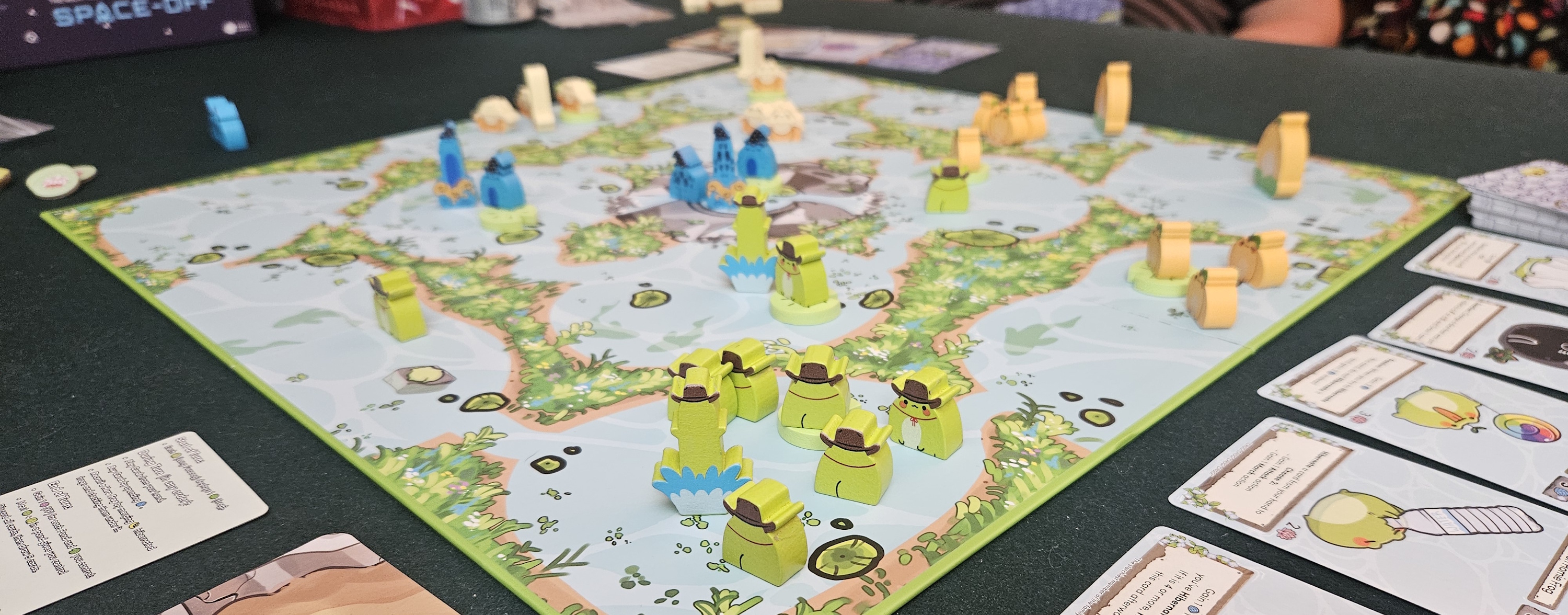
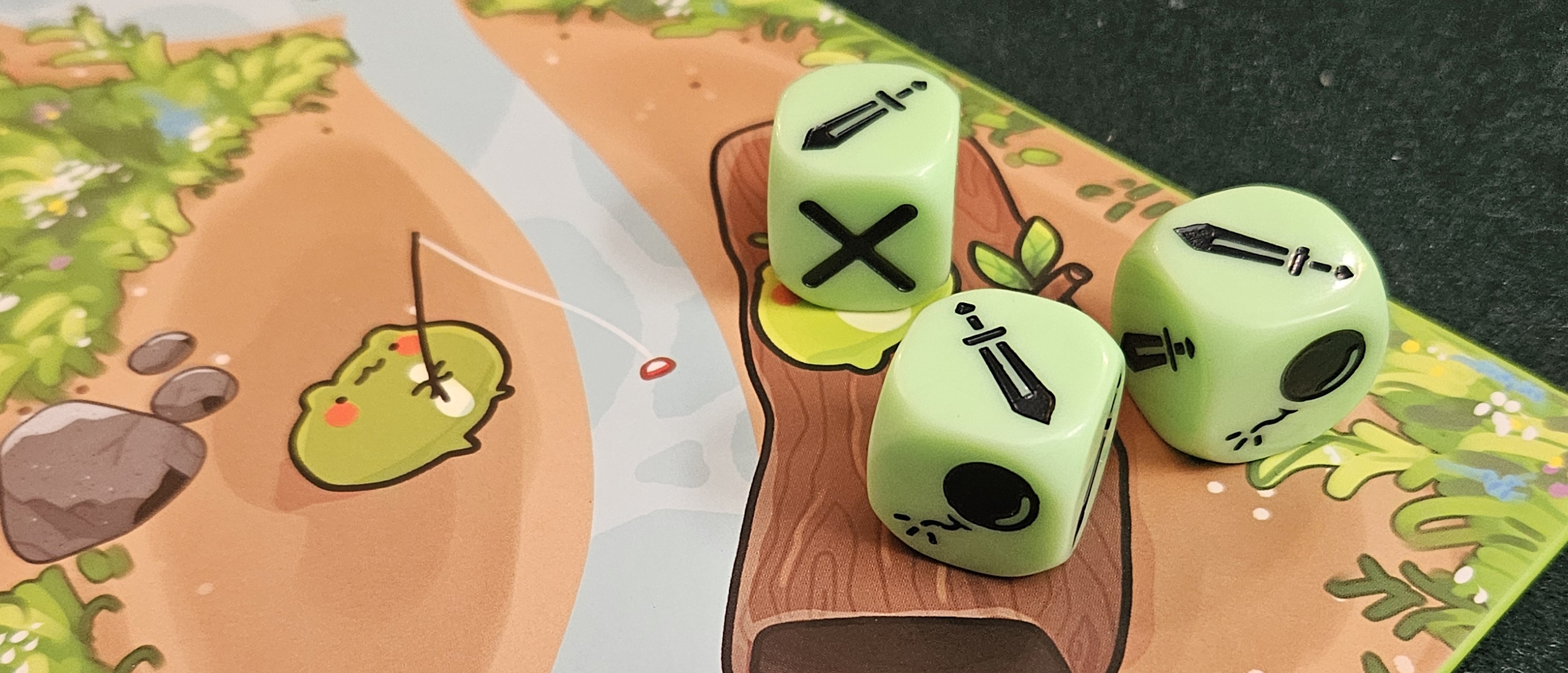
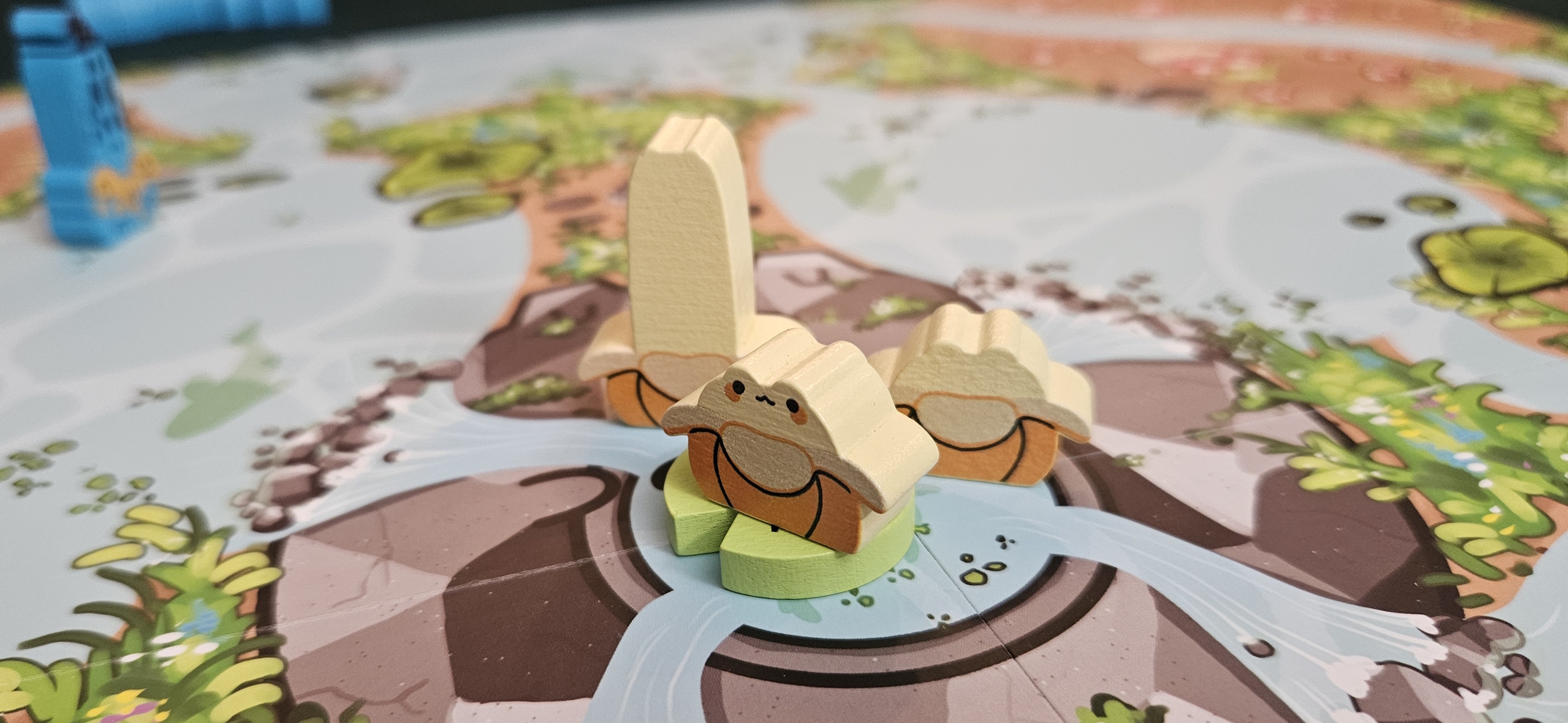
Picture this. Up to four factions of adorable wetland creatures have decided to duke it out for control of their local pond network. Each faction is asymmetric, with its own adorable superpower to attend to its adorable visual motif. For the most part, they are staffed with frogs. Just frogs: the infantry for this final war, the grist for this cuisses de grenouille.
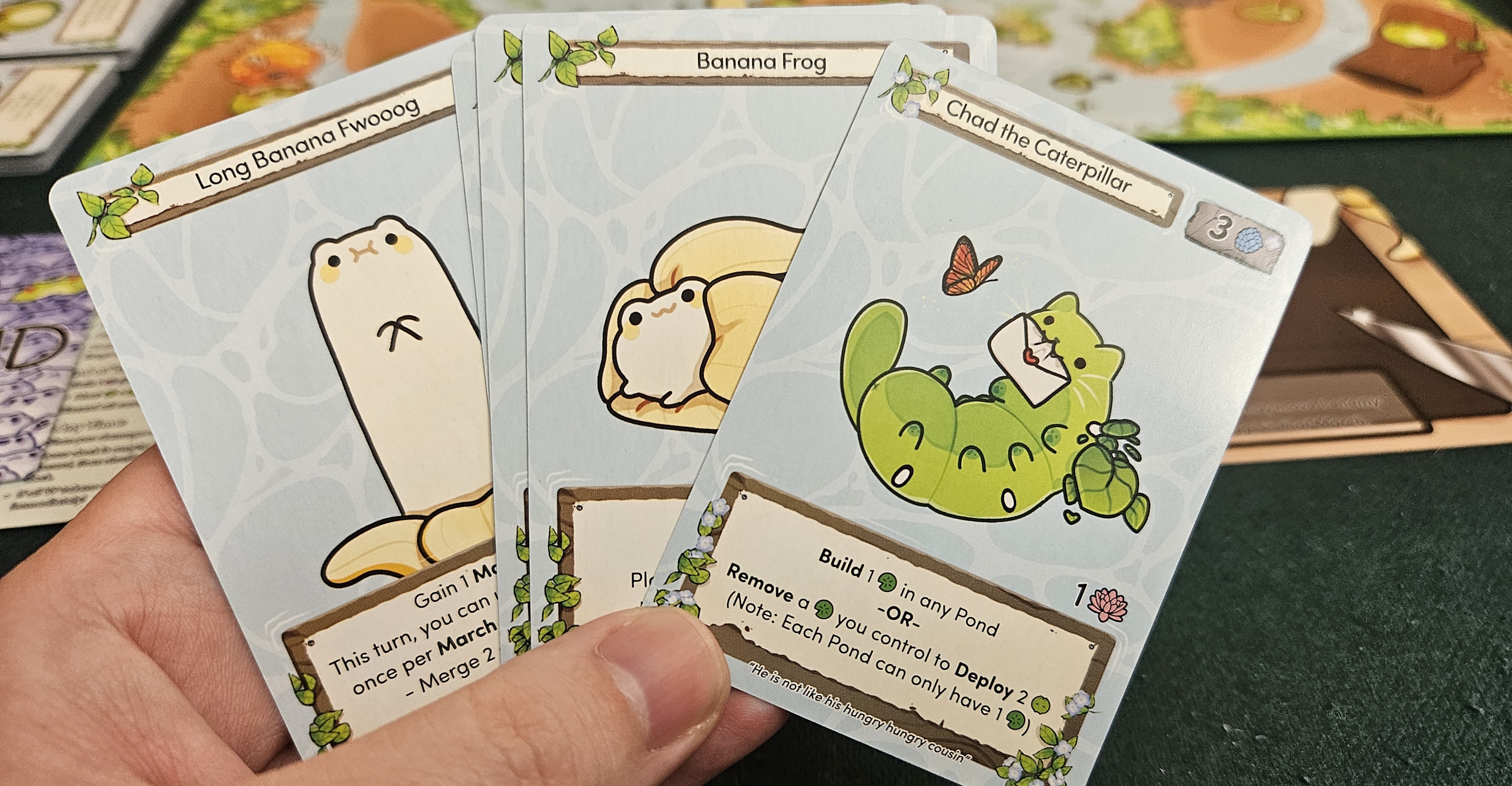
There are also long frogs. Pardon me. Long fwooogs. That should tell you something about Pond’s sense of humor. If “long fwooog” strikes you as substantially cuter than “long frog,” this might be the game for you. At any rate, long fwooogs are the battlefield commanders who send their fellow frog-kind hopping into battle. They can be injured, in the sense that sustaining damage will result in points for your rivals, but never killed the way a lesser frog might be removed from the board. One imagines them the gentlemen officers of this particular campaign. Stiff upper lips when asked to call upon others to make the final sacrifice, quavering backs and sickbed sweats when it’s time to charge over the top. Which is perhaps why long fwooogs do not take part in battle directly.
As for the map, it’s arranged as concentric ponds that radiate from the center. Each pond is identical, but lily pads may be built to increase one’s scoring value. Movement tends to be rapid. In part because the map is rather compact, but also because factions can accomplish quite a bit on a turn. The art, as you might expect, is downright adorable. I don’t mean that in a belittling sense; some of the cards made me laugh out loud, in particular the “Biblically Accurate Frog,” with its seraph’s spokes of eyes and wings.
A pocketful of frogs.
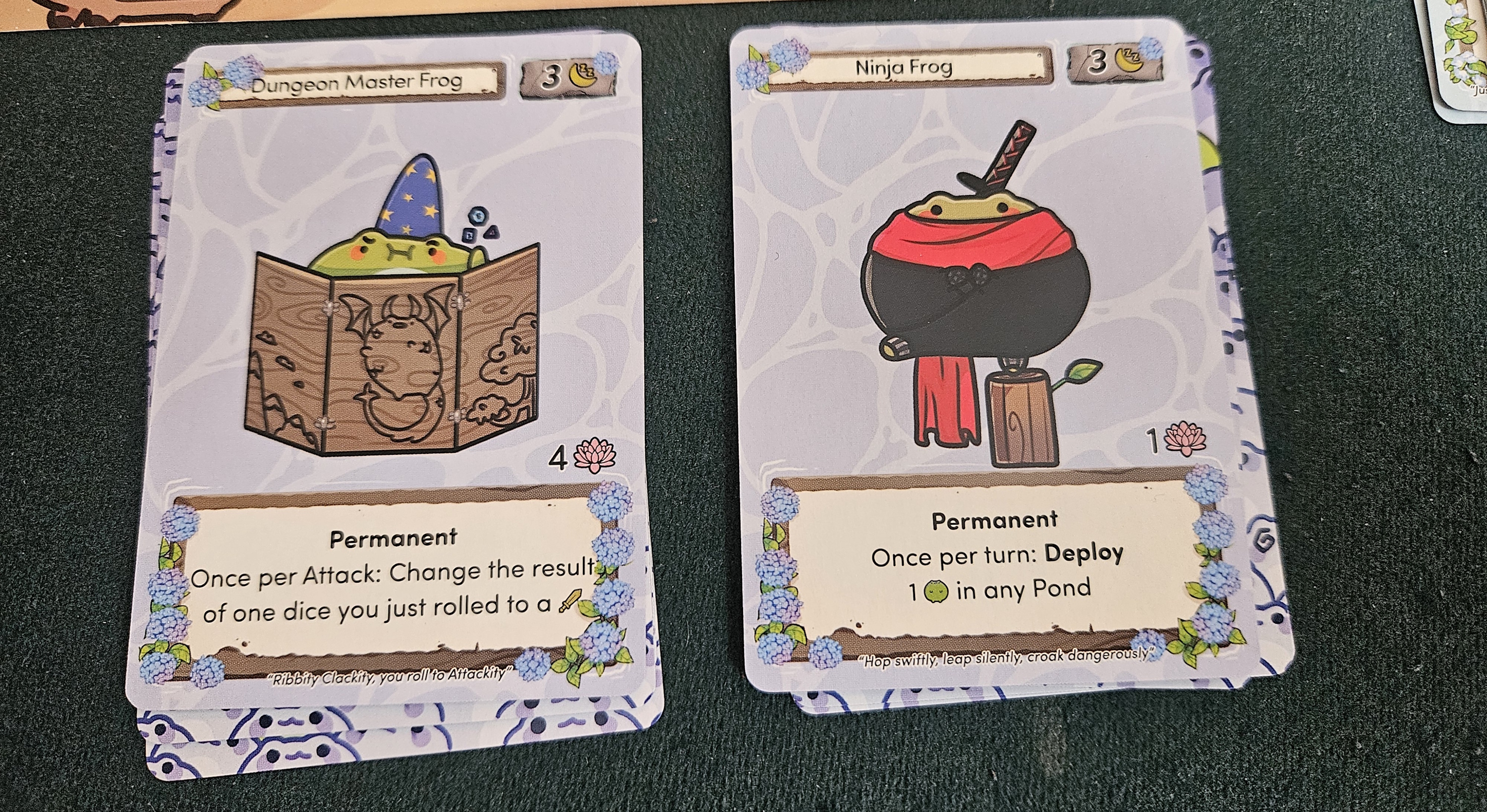
As for cards, there are heaps of the things. In a thankful departure from Root, Pond presents itself as a deck-building game. Everyone begins with a deck of ten cards, built from a combination of generic offerings (“Frog with a Knife” and “Frog with a Net”) and faction-specific troops that give each player their own dose of asymmetry without front-loading too many rules. Banana Frogs are slippery — they generate movement but also return to the top of your deck — while Wizard Frogs teleport around, Pumpkin Frogs produce lots of food, and Cowboy Frogs like to wrassle.
This is probably where Pond shines the brightest, not least because its card effects are all over the place. You might draft Jimmy the Bee into your deck to draw a card for every single lily pad under your control — potentially doubling the total action economy of your turn but also planting a target on all those lily pads. Or the Anarchy Frog, perfect for dumping all your stagnant frogs into a single pond and then lighting them on fire for a bunch of points. Swole Frog turns self-damaging battle results into offense-only attacks; Sneaky Frog deploys into any pond, even those you can’t normally reach; Cactus Frog pops a couple of attackers at the instant of their aggression. The whole thing feels wild and untamed. One might even say it doesn’t feel properly developed. All the better.
Of course, there aren’t infinite effects to tinker with. Indeed, one of the main limitations of the underlying system is that everything seems to revolve around four or five verbs — deploy, move, attack, build, hibernate — but within that rubric, there’s an impressive range of expression here. Some cards feel like outright showstoppers. As far as I’m concerned, that’s a great way to get the table to actually pay attention to the card market.
Hibernation leads to metamorphosis.
It helps, too, that card-winnowing is built right into the foundation. Whenever you shuffle your deck, you’re required to “hibernate” a frog, removing it from circulation while still preserving its point value. There are other ways to hibernate cards, too. They’re almost always desirable thanks to hero frogs.
What are hero frogs? Glad you asked. These are permanent upgrades that sit atop one, two, or three hibernated cards. That’s where the Biblically Accurate Frog comes in. Also the Unicorn Frog, the Leprechaun Frog, the Investor Frog, and so many more. To a one, these guys are valuable. First of all, you don’t need to shuffle them into your deck. Their ability is always there, ready to teleport a dead frog into your opponent’s swamp cooler.
At a more fundamental level, hibernation and heroes are a wonderful method for further defining all that factional asymmetry. Once again, almost no overhead required. This is probably where Pond deposits itself furthest from Root’s woodland. Where that game put all its chips on front-end asymmetry, requiring a tremendous initial investment before anybody could play — or at least play well — here the asymmetry is gentle at first, then slightly less gentle. It never becomes not gentle. Just more differentiated, with little perks that spring from the cards you’ve chosen to hibernate, draft, and deputize to hero status.
Frog battles are dangerous affairs.
Which brings us, inadvertently, back to Root.
I’ve seen some people call Pond a starter Root. My Little Root. Root for Babies. (Okay, not that one.) That isn’t too far off in the sense that its adorable artwork belies a confrontational race to score a certain number of points. But the games are surprisingly distinct in their underlying approach. They’re both volume-measuring tools with froggy eyes sharpied onto the side. But one is a funnel that runs from wide to narrow while the other is a bit more of a graduated cylinder. Despite some superficial resemblance, they move their liquids toward different purposes. A gulp versus a sip.
Those purposes, meanwhile, reach different conclusions. Root has been around for eight years. That’s a long time in this hyper-speed hobby of ours. Long enough to spawn imitators, some more flattering than others. Pond, in some senses, feels like a game that can only exist because Root existed first. But it carves out an identity that feels… still similar to Root, but not overly so. Not so close that it starts to feel like a ripoff. Just another perspective on similar themes. Root but easier to learn. Root with a first teach that doesn’t feel like reading a syllabus. Root that ends with a bang rather than a last little trickle of crafting points. Root without the near-infinite imaginary space.
(Root without Foucault? Yes. But Root as Baudrillard, as the signifier and signified getting mixed together until we can’t tell the difference. Root as the meme that has escaped containment. If it could ever be contained to begin with.)
Sometimes a frog is only a frog.
This leaves Pond in an interesting place. There’s a spot for a lighter adorable woodland creature kingmaking asymmetrical game. Maybe not the biggest spot or the most lasting one. But it would be false to pretend that Pond hasn’t exerted some charm. I’ve enjoyed spending a few sessions with its Biblically Accurate Frogs and Frogs with Two Knives and, sure, even the Long Fwooogs, cloying as they seem. I don’t imagine I’ll keep coming back, but my romps through these wetlands have been enjoyable all the same.
A complimentary copy of Pond was provided by the designer/publisher.
(If what I’m doing at Space-Biff! is valuable to you in some way, please consider dropping by my Patreon campaign or Ko-fi. Right now, supporters can read the next installment in my series Talking About Games, this time tackling the topic of what makes a good list! Naturally, the piece includes a list.)
Games tackling subjects ranging from the 1968 Democratic National Convention protests to the 30-year holdout of Japanese WW2 soldier Hiroo Onoda have been named as finalists in this year’s Summit Award, which aims to recognise historical game designs which have attracted new players or introduced new subjects or perspectives to the hobby.
The game puts players in the roles of the gender-defying mollies of early 18th century London, attempting to build community and joy while facing persecution by the Society for the Reformation of Manners.
Chicago ‘68, designed by Yoni Goldstein and published by the Dietz Foundation, was the most-selected title during the Summit Award’s public nomination process this summer.
Chicago ’68, designed by Yoni Goldstein || Photo Credit: Yoni Goldstein
The game explores the protests and police response surrounding the 1968 Democratic National Convention, dividing players between Establishment and Demonstrator factions including the mayor’s office, Chicago Police Department, Yippies and National Mobilization Committee To End The War In Vietnam.
Battlefields of the Napoleonic Wars, designed by Paolo Mori and Alessandro Zucchini and published by Ingenioso Hidalgo, uses four different battlefield maps to recreate engagements from the Napoleonic Wars in sessions lasting between 60 and 120 minutes.
The fourth finalist is Francisco “Pako” Gradaille’s Onoda, a 25-minute solo game published by Salt & Pepper Games which explores the experiences of Japanese soldier Hiroo Onoda, who continued guerrilla warfare on the Philippine island of Lubang until 1974. Judges praised the unusual subject and the way the game asks players to engage with Onoda’s story and decisions.
Onoda, designed by Francisco Gradaille || Photo Credit: Salt & Pepper Games
Winter Rabbit, which draws on traditional Cherokee animal stories and was created as a counterpoint to common colonial themes in games, was runner-up in the 2021 Zenobia Award and won the Light Strategy category at this year’s Origins Awards.
The Summit Award considers games across five criteria – ease of teaching, ease of play, uniqueness of topic, novelty of approach and effectiveness as a historical game.
SDHist, which was launched mainly as a local wargaming group in 2015, is led by wargaming experts including Liberty or Death: The American Insurrection designer Harold Buchanan.
The organisation’s board and board of advisors selected three of this year’s finalists following the public nomination process, which put Chicago ‘68 on the shortlist.
The same groups will select the winner, which is set to be announced at the SDHist Summit convention in San Diego in November.
Circle of Conflict is a really bad title. Just terrible. You know what would have been better? Anything. Ring of Conflict, maybe, seeing as how this is a Lord of the Rings shindig. Crud, just call it Circlet. That has an elegant chime, doesn’t it? Circlet.
I imagine the thinking behind the title, which was designed by Geoff Engelstein and Stephen Buonocore, was that it’s descriptive. Because the game actually plops you right into the middle of a circle, you see, and that circle happens to be not a circle of harmony, but a circle of conflict. You’re reenacting the War of the Third Age from both perspectives, commanding the Free Peoples against the player to your left and Sauron & Friends against the player to your right. Thus the Circle. The Circle of Conflict.
The other rancid thing about the title is that… oh, what’s that? You want to hear about the game? Very well. It’s quite good. Not perfect, but good.
More board games should be in folders. For the lazy.
As gimmicks go, one could do a lot worse than Circle of Conflict. It’s like the inverse of its title: just a great idea from top to bottom. As the Free Peoples, you’re trying to safeguard the One Ring on its trip to Mount Doom, muster armies to defend Rohan and Gondor, and generally vouchsafe the hearts of men so they don’t falter. As the Shadow, you’re doing all that but exactly the opposite. Find the Ring, burn Rohan, burn Gondor, indulge every impulse.
And it works. Works well, in fact. Works too well, perhaps, in the sense that the system very quickly scurries out of the way and opens up the holistic design to any number of nitpicks.
The baseline mechanism is roll-and-write, landing this in the long and not-often-successful lineage of titles that have tried to fashion a roll-and-write-but-bigger game. Every round — which is a mess of phases, just be warned — opens with a big handful of chunky dice getting rolled onto the table. When the game begins, only two of these dice are actually usable, and you’re required to divide them between the halves of your demesne. One for the Free Peoples, one for the Shadow.
I do love some nice dice. And a nice Sméagol, too.
It’s a simple enough decision, although of course there’s more to it than first meets the eye. It isn’t long before players begin to hear rumors from their neighbors. Perhaps the player to your left announces that they’ve rallied Isengard. This means they also gain the icons from the gray die, and may soon begin deploying troops to assault your version of Rohan. Meanwhile your Nazgul are hunting for the Ring somewhere around Weathertop; this initiates a call-and-response phase where you check your investigation against the player to your right, who reveals whether you’ve managed to corrupt their Ringbearer.
Point is, while you aren’t given total control over whether to go all-in on one side or the other, you’re afforded just enough authority to lather up some nice apprehension. At times, it can feel like both sides are pressing in on you while ignoring their neighbors on the opposite side. It’s a smart way of divvying up the action on Engelstein and Buonocore’s part. Some activities are concealed, others reveal essential breadcrumbs of military intelligence. Along the way, you hope you aren’t playing with cheaters. Or people who don’t really understand the rules and might interpret them in their favor.
At all times, this puts you in twin headspaces: hunter and hunted, army on the march and defenders under siege, Gollum and Sméagol. Actually, you’re only ever Gollum or Sméagol. There’s a special phase for that. Everyone chooses whether they’re the li’l guy’s good side or bad side, then reveals their decision and handles the fallout. If anything, Gollum’s madness seems like the one thing to collapse the game’s cosmological superposition. But that’s neither here nor there.
The battle board is, ahem, functional.
If anything, there are a few points where Circle of Conflict (ugh) seems to throw up its hands, as though Engelstein and Buonocore knew they were onto something great and realized they had to bring it back down lest they invent something too mind-expanding. There are a lot of the customary roll-and-write combos, for example, where you’ll be filling in one bubble that then awards another icon that lets you mark another bubble, and then that bubble lets you mark something else, and on and on until an ordinary turn has transformed into two or three turns’ worth of dry-erase daubs. In a game this distinct, these moments always feel like a throwback to the format’s puzzle-going past, more of a conundrum to solve than a dynamic contest between players.
And, yes, at times Circle of Conflict (hurk) feels like too much of a puzzle. After one or two sessions, you get a good sense for which combos will really let you whip along its tracks. Some early Boromir and Galadriel to secure the loyalty of Rohan toot suite, Wormtongue to tank the loyalty of whichever nation your right-ward neighbor embraces first, just enough Legolas Gimli to max out your battle value but no more. I don’t want to say it can be “solved”… but one of my opponents in our most recent session sure believed so.
Which isn’t to say this ruins the game. Not by a long shot. It’s just that Circle of Conflict (uruk-hai) is at its best when it leans into the suspense between neighboring players, but not every portion of the design is pitched toward maximizing that. The slow buildup of armies, with both sides growing stronger, closer, and more likely to win a bunch of points from the coming battle: incredible. The gradual chase and evasion of the Ring on both sides: wonderful. The occasional game-disturbing abilities from the heroes: appropriately enraging. Waiting around while somebody completes their tenth mark on a turn when you earned two or three: a bit of a downer.
Conducting the grand tour.
On the whole, I dig it. It calls to mind other experimental titles like Captain Sonar and The Anarchy in its willingness to tinker with the usual formula, even as it doesn’t quite reach their heights. Even so, there are little touches that make it especially considerable, like how the hobbits are tiny until suddenly they matter quite a lot, the occasional ability to move or hunt with greater efficacy, or, my favorite detail, the fact that the whole thing is presented as a single folder so you can lean back in your chair while you jot down your moves. One could do a lot worse.
A complimentary copy of The Lord of the Rings: Circle of Conflict was provided by the publisher.
(If what I’m doing at Space-Biff! is valuable to you in some way, please consider dropping by my Patreon campaign or Ko-fi. Right now, supporters can read the next installment in my series Talking About Games, this time tackling the topic of what makes a good list! Naturally, the piece includes a list.)
Catan is continuing to push into professional sport in a bid to reach new players, adding a season-long partnership with NHL team the Ottawa Senators and recruiting German handball star Juri Knorr as a brand ambassador.
Asmodee and Catan Studio have teamed with the Senators for a season-long partnership which they said will put the board game in front of hockey fans through arena advertising, “concourse activations” and social media competitions.
The deal will culminate in a dedicated Catan Night at the Senators’ Canadian Tire Centre on November 23, when the team faces the Calgary Flames – including themed decorations and activities, promotional giveaways and special ticket packages.
Senators VP of marketing Peter Shier said the team will be the only Canadian professional sports franchise, and the only NHL team, to host a Catan-themed game this year.
Catan Studio director of brand development Kevin Hovdestad said at the time the partnership highlighted how the game had become “woven into sports culture”, following years of reports of the game being played by professional athletes including members of the Green Bay Packers, Buffalo Bills, Kansas City Chiefs and Minnesota Twins.
Separately, German Catan publisher Kosmos has named international handball player Juri Knorr as a Catan brand ambassador ahead of the 2027 Handball World Championship, which will be held in Germany next January.
The campaign, running under the slogan Mein Spiel nach dem Spiel – ‘My Game After The Game’ – will feature Knorr prominently on branded retail displays and products, alongside a QR-code competition offering meet-and-play sessions with the handball star and Catan-branded adidas handball shirts.
The publisher is potentially tapping into a sizeable audience: 13 million people watched Germany play Denmark in the 2026 European Handball Championship final, according to Kosmos.
Knorr said, “Catan has been with me since my childhood and still captivates me today. For me, the game is a very good balance and complement to… highly focused competitive sport.
“The game offers a great opportunity to spend quality and intense time with friends and teammates. It involves spending time while also thinking strategically. That’s why I’m very pleased to represent Catan as a brand ambassador in this special campaign.”
The deals add to a growing collection of partnerships putting Catan in front of potential players outside of traditional board game retail and media – with the aim of expanding the audience for a game which has already sold more than 50 million copies and been translated into over 45 languages.
Kosmos is currently involved in one of the most striking examples through a McDonald’s Happy Meal promotion across Germany, Austria and Luxembourg, for which almost seven million specially adapted games have been produced.
Kosmos licensing content and entertainment head Julia Courmont said, “This collaboration is a huge milestone for us. The fact that Kosmos is represented here with eight exclusive titles confirms the great confidence in our brands and their relevance to a broad target group.
“It’s a fantastic opportunity to make these classic games accessible to millions of people and to create valuable shared gaming moments.”
Catan has since held a game night with Linkin Park and Warner Music in Hamburg, while a licensed crossover with children’s entertainment phenomenon Bluey is due to launch across several international markets in 2027.
As you know, I do love me a good Card Driven Game….or a game that uses cards….multi-use cards. I love cards because it allows for the designer to keep a game going while using a vehicle that incorporates special rules that fit a historical situation but also to be able to use bits of the history itself to teach the players about the topic. A few months ago, I caught wind that The Dietz Foundation was working again with Yoni Goldstein on his second game called The Nights of King Ludd: The Luddite War on Industry, 1811-? that recently launched on Kickstarter (the game has already funded). The Nights of King Ludd is a 2-4 player game that deals with direct oath-sworn secret societies of English Luddites at the dawn of the Industrial Revolution in the English Midlands. Working together, players will build a secret network of saboteurs, ferry provisions and weapons on the black market, assemble raiding parties, and if all goes as planned, smash those “dark satanic mills” to cinders. I reached out to Yoni to get a bit more information about the design and he was more than willing to share.
Grant: Yoni welcome back to our blog. What have been your feelings about the reception of your great game Chicago ‘68?
Yoni: I’ve joked that I’ve taught this game now more than I’ve played it (of course this is only true if one just counts the last couple years!). Since 2024, I’ve taught it to a diverse and intergenerational cohort of non gamers, grognards, peace activists, veterans, and even a few spooks. Inevitably players relate the experience they are having on the board to what they see in their neighborhoods: protests and tear gas, troops deployed into cities, election interference, and so on. Those conversations are still ongoing and I’m heartened that Chicago ‘68 is facilitating a space for that.
Grant: What lessons did you learn from that experience that have helped you with your new game?
Yoni: I’m grateful that Joe Dewhurst, who developed both Chicago ‘68 and the upcoming The Nights of King of Ludd, guided me through the design, testing, and development processes. Ludd is my second game and it went through a number of iterations, but this time we had a proper methodology in place. Likewise, The Dietz Foundation was very transparent with the manufacturing and publishing side of things, which gave me a deeper understanding of the timeline and proofing / editing process that accompanies those final stages of production.
Grant: What is your new upcoming game The Nights of King Ludd about?
Yoni:The Nights of King Ludd is a collaborative game for 2-4 players about the Luddite revolts in the English Midlands. Set roughly around 1811, the game tells the story of local workers in the textile industry (“weavers”) forming secret societies and leading armed raids against mills and factories in their communities. Players command an oath-sworn organization of conspirators working with the Luddites to achieve the collective goal of machine wrecking while also attempting to meet their individual motivations (which may include assassinating the local manufacturer, spurring a republican revolution, or just avoiding an Australian exile).
In terms of game mechanics, you are building a dice pool while also maneuvering pieces and collecting multi-use cards to modify your roles. Collectively you are building a tableau and operating it together to mount a series of raids against the three Mills on the map.
Grant: What is the meaning of the title of the game? What should it convey to players about the game and the history it represents?
Yoni: The title of the game is borrowed from a chapter in Gavin Mueller’s book from 2021, Breaking Things at Work. Mueller is among a cohort of authors, including Kirkpatrick Sales (Rebels Against the Future), Brian Merchant (Blood in the Machine) and Cory Doctorow, who are working to reconsider the Luddites’ reputation in the age of AI and the gig economy. Rather than seeing them as misguided revolts against the inevitability of technological progress, these writers appraise the Luddites in their historical context as severely desperate labor movements against tech oligarchies. The Luddites’ aims were, ultimately, to raise the minimum wage, cease child labor, and to maintain a higher standard of craftsmanship and quality in the production of textile goods. At every point their appeals to authority were spurned. So they turned to mob justice. “You may call the people a mob,” remarked Lord Byron before Parliament, “but do not forget that a mob too often speaks the sentiments of the people.”
The subtitle of the game, “The Luddite War on Industry, 1811-?” is also a cheeky nod to Volko’s Labyrinth: The War on Terror, 2001 – ?. While these games don’t share a mechanical similarity, they both explore the ongoing and unpredictable nature of insurgencies.
Grant: Why was this a subject you wanted to focus on?
Yoni: My area of interest in game design, broadly speaking, is movement politics on an operational scale. As with Chicago ‘68, the Luddite war on industry feels an under-explored subject matter in historical gaming. While there are certainly titles about the Industrial Revolution from the perspective of barons and magnates (especially in the Euro game niche), little is mentioned about the social, political, and ecological costs of these endeavors for progress.
Moreover, the story of the Luddites and their “secret societies” is about the tensions of modernity. New technologies combined with extensive wars abroad drove a rise in food costs and detonated an affordability crisis in the imperial homeland. Communication media (handbills, newspaper editorials, and pseudonymous letters) was an instrument of persuasion, vitriol, and threats. Suspected Luddites and their sympathizers were surveilled by the state, which increasingly saw its interests entwined with industrial capital. We’ve seen this all before!
Grant: What are the unique features with the system used for the game?
Yoni: The Nights of King Ludd has a unique framework for collaborative engine building. Initially, players draw from “The Commons” (a shifting card pool) where each card has the same “trade cost.” On your turn, you may activate a Conspirator (spending an action point) to draw a card into one of the columns in your tableau. Each column upgrades your actions with a permanent ability. If you specialize your actions, you can harmonize a collective strategy between players and hone in on the steps you need to take to sabotage the mills.
In the Commons we are evoking the notion of a shared economy. But this may shift dramatically when decreasing wages and increasing productivity converge. Then, the Commons transforms into the “Common Market.” Now, players are building their tableaux with an increasing cost, similar to the Pax Series (for example, Pax Pamir or Pax Renaissance). Each player is now facing a decision: overwork their cabal of conspirators or draw on the labor power of the workers in the textile industry (which drains their militant power on the map).
Grant: What does the collaborative portion of the subtitle mean for the game? How do the players cooperate?
Yoni: I choose “collaborative” not “cooperative” as a descriptor to emphasize the multi-victor nature of the game. In The Nights of King Ludd, each player chooses not only their persona and their role in the Luddite struggle (with asymmetric abilities and effects), they also put forward a “Motivation.” Motivations are personal victory conditions that unlock if the collective win condition (destroying all three mills on the map) is met. This gives shape to the degree of player friction in the game. For example, Lord Byron’s motivation is to turn down the heat from the ruling Regency. His motivation is in conflict with George Mellor’s, the famed assassin, whose attempts at the Manufacturer’s life will ratchet up the crown’s crackdown. But pair John Baines, a republican agitator, with the Molyneux sisters, two young women destined to labor in the mills, and the gameplay will tilt more toward cooperation. In this case, Baines is working to regulate the industriousness of the mill (keeping productivity low and wages high) while the Sisters are interested in keeping workers employed. So the degree of cooperation is up to the players, and as often happens, someone may have to make a noble sacrifice for the collective good.
Grant: What did you need to model regarding the English Luddites at the dawn of the Industrial Revolution?
Yoni: As EP Thompson (The Making of the English Working Class) notes, the history of the Luddites is, at best, “opaque.” We are grappling with a story about secret societies in an era where workers associations were illegal and damaging weaving frames was a capital offence. As such, we have dubious claims from government spies, confessions before “hanging judges,” and pseudonymous letters and handbills. Consequently, the model had to be expansive enough to capture the granular nature of these conspiratorial operations, but also open enough to allow for the plausibility of a broad range of player actions.
For example, one of the core actions is to “rally local weavers,” which is a form of recruitment. In game terms, this means moving one of the Employed Weaver cubes into an Enclosure where they can contribute to your force strength. This action may represent members of your secret society swearing in sympathetic workers in local pubs, or calling a clandestine meeting in the nearby woods. We don’t know precisely how the Luddites organized themselves, so the language has to be inclusive of these possibilities. Players then “assemble a raiding party”, which is to move the cubes from the enclosure into a nearby Mill. Each cube in the Mill space adds a die to the Sabotage roll (which is the primary means of wrecking machines). So here is a group of raiders hiding in the hedge and awaiting the signal from King Ludd. They are spurred on by the Mobs who have surrounded the site, represented by these Mob tiles. Matching a die roll to the symbol on the Mob Tile is how you roll a “hit.” The intention is to shape a series of amorphous and difficult to historicize chain of events into a familiar wargaming mechanism: rolling a handful of dice representing an “attack” and applying modifiers to the results.
Grant: What is your design goal with the game?
Yoni: My overall aim was to develop a system that could express a relationship between an abstract economic system, worker uprisings, and the coming together of industry and aristocracy to form a ruling class. But on a purely design level, I wanted to work within the framework of a Pax Series style market that you encounter in games like Pax Pamir and Pax Renaissance. That is, a shifting market of cards that players can purchase and place into their tableau. It’s an evocative description of history as a bazaar of possibilities and counterfactuals. The Nights of King Ludd tweaks this vision of history as somewhere between a commons (a gift economy) and a market (which costs worker power as in-game resources).
But really, I want this to be a “raiding party game.” Beneath the heady layers of history and theory is a brisk experience featuring dice odds, clever combos, and cooperation with your friends (while slyly pushing your own agenda!).
Grant: What other games did you use as inspiration?
Yoni: John Company from Wehrlegig Games is certainly one of the biggest inspirations, taking place in a similar era of British imperial economic imperialism (Ludd is at the tail end of JoCo’s later scenarios) and drawing on the satirical printworks of the time. Like John Company, players are asked to intervene in an existing ecosystem. In both games, player actions accelerate a system that will simultaneously reward and punish everyone at the table. How this is doled out is uneven, so players have to weave and dodge to make best of a collapsing infrastructure.
Grant: What sources did you consult about the history?
Yoni: An invaluable resource for all things Luddite is the Luddite Bicentenary curated by Richard Holland. This is a comprehensive digital archive of historical ephemera devoted to Luddism, including handbills, court transcripts, and other images and texts. I also quote extensively from Rebels Against the Future by Kilpatrick Sale and The Risings of the Luddites: Chartists and Plug-Drawers by Frank Peel, E.P. Thompson, as well as The Making of the English Working Class also by E.P. Thompson.
Other reference texts include:
Writings of the Luddites edited by Kevin Binfield
Ben o’ Bill’s, The Luddite: A Yorkshire Tale by Daniel Frederick Edward Sykes, George Henry Walker
Breaking Things at Work: The Luddites Are Right About Why You Hate Your Job by Gavin Mueller
The Luddite Rebellion by Brian Bailey
Blood in the Machine by Brian Merchant
Women in Protests 1800-1850 by Malcolm Thomis
Convict Lives at the Launceston Female Factory (A swing rioter: Elizabeth Studhamby Keryn Rivett), edited by Lucy Frost & Meredith Hodgson,
Grant: What is the dice pool building mechanic and how does it work in the design?
Yoni: At the core of the game is a fairly straightforward dice mechanic for resolving raids against the three mills on the map. Throughout the course of the round, players add “saboteur dice” to the dice pool, representing the Luddite’s militant capacity. These are D6’s with the following icons: gun, hammer, and torch (matching the “mobs tiles” – armed rabble surrounding the mill). The remaining three sides are blank and always result in a miss.
When a sabotage operation is initiated, the number of dice rolled is determined by the number of raiders you’ve positioned at the mill and what constitutes a possible hit is determined by the matching icons on the nearby mob tiles (again; gun, hammer, or torch). All misses are returned to supply but if at least one hit is rolled, you may push on and carry out multiple raids, striking at other mills as well.
As your readers can deduce, the purpose of the tableau building and the card engine is to modify the odds of the roll in your favor, i.e. the more raiders you assemble the more dice you will roll, and the more mobs you’ve fomented the more likely you are to roll a hit.
Grant: What is the general Sequence of Play?
Yoni: As neighboring societies of Luddites, you have three rounds before the Crown musters its army and crushes the revolts. Each round is structured the same:
Dawn: Industry Operates – at the beginning of the second and third round your adversaries in London will take actions against you, sending the militia on patrols and accelerating industrial production.
Day: The Manufacturer Speculates – during this phase, the local manufacturer will take an action, depleting the Commons of its resources.
Night: The Luddites Conspire – this is the main phase of the game, where each player takes turns resolving a Conspiracy action by spending a Ready Conspirator cube on their boards. Each player takes a primary Conspiracy Action and resolves any secondary effects on Cards tucked into the Column of that Conspiracy on their Player Boards. In this phase, players can attempt a sabotage roll to destroy the Mills.
Round’s End – when there are no Ready Conspirators (or all players pass) players reset the components for the next round.
Thank you for your time in answering our questions Yoni! I am very much interested in this game and its efforts to tell this very interesting story of resistance. While this is not a traditional wargame, in my opinion it certainly merits a serious look from wargamers who are interested in CDG’s and games that use cards and that are interested in seeing these type of non-traditional historical subjects represented. I have backed the project and look forward to getting my copy next year!
Three-year-old Dutch board game publisher DSV Games has continued its rapid rise by securing three nominations in this year’s Dutch game of the year awards, a year after picking up its first win in the contest.
DSV has landed a nomination in each of the three Nederlandse Spellenprijs categories with Reiner Knizia design Rebirth, Tomáš Holek’s Pondscape and Ants from Renato Ciervo and Andrea Robbiani – equalling veteran Dutch publisher White Goblin Games and industry giant Asmodee as the most-nominated company this year.
The entirety of this year’s nominations are split between those three publishers, with White Goblin selected for Grégory Grard and Mathieu Roussel’s design Castle Combo in the Family category, and Keith Piggott-created River of Gold and Hisashi Hayashi’s Yokohama among the Expert games.
The remaining nominations are from Asmodee studios: Alexi Piovesan and Julien Prothière’s Take Time from Libellud in Family, and Space Cowboys’ Dewan (Johannes Goupy, Yoann Levet) and Office Dog’s two The Lord of the Rings: Trick-Taking Game releases (Bryan Bornmueller), which were judged as a single title, completing the Connoisseurs’ game shortlist.
The result sees DSV and Asmodee join White Goblin and fellow Dutch board game publishing veteran 999 Games as the only publishers to score at least three nominations in a single year since the Nederlandse Spellenprijs moved to its current three-category format in 2020.
999 Games was the only company to secure two nominations last year, and ultimately won both categories it contested, with Hisashi Hayashi design Bomb Busters taking the Family award and Botanicus (Samuele Tabellini Ferrari, Vieri Masseini) triumphing among the Connoisseurs games. DSV won the remaining Expert award with Tomáš Holek’s SETI.
This year 999 Games has no nominees at all – a not unprecedented situation, with the publisher also having missed the shortlist in 2021, but one that marks a sharp turnaround from its five nominations across 2024 and 2025. They included Sky Team winning the Family award two years ago.
DSV Games was launched in 2023 by online shop De Spelletjes Vrienden, with a focus on visually appealing titles which offer exceptional gameplay – making use of “stunning artwork, high-quality components, and well-crafted mechanics”, according to its website.
Its debut release slate in 2024 comprised four games including Rats of Wistar, designed by Simone Luciani and Danilo Sabia, which secured the publisher its first Nederlandse Spellenprijs nomination. The publisher increased its output to nine releases in 2025, and put out another 11 releases between January and the end of June this year – the cut-off point for games eligible for the 2026 award.
DSV co-owner Marieke Kuit-van Woesik said after the Nederlandse Spellenprijs victory last year, “We are really proud that as a publisher, which has only been around for two years, we receive this wonderful confirmation that we are on the right track with our small team.”
DSV Games co-owner Marieke Kuit – van Woesik collects the Nederlandse Spellenprijs Expert Game award for SETI in 2025
This year’s nominations take DSV into territory previously reached under the current award system only by two of the most established names in Dutch-language board game publishing.
The Nederlandse Spellenprijs added its intermediate ‘Connoisseurs’ category in 2020, creating the current annual line-up of three nominees apiece across Family, Connoisseurs and Expert games.
999 Games took five of those nine nominations in 2020, with White Goblin taking three. White Goblin followed with four nominations in 2021, while 999 again reached three in 2024. No other publishers bar those had scored three nominations in one year under the current format prior to 2026.
More than 100 board and card games released for the Dutch market during this year’s eligibility period were played by the Nederlandse Spellenprijs jury, which selects its nominees with a focus on quality, playability and originality.
The winners of the Family, Connoisseurs and Expert categories are due to be announced on October 10 at BumbleBeez Spellenwinkel in Bergen op Zoom.
Nederlandse Spellenprijs nominees2026
Family Castle Combo – designed by Grégory Grard and Mathieu Roussel (Published by White Goblin Games) Rebirth – Reiner Knizia (DSV Games) Take Time – Alexi Piovesan and Julien Prothière (Libellud / Asmodee)
Connoisseurs Dewan – Johannes Goupy and Yoann Levet (Space Cowboys / Asmodee) Pondscape – designed by Tomáš Holek (Published by DSV Games) The Lord of the Rings: Trick-Taking Game (Fellowship of the Ring and The Two Towers) – designed by Bryan Bornmueller (Office Dog / Asmodee)
Experts Ants – Renato Ciervo and Andrea Robbiani (DSV Games) River of Gold – Keith Piggott (White Goblin Games) Yokohama – (White Goblin Games)
Gaming convention major PAX is doubling down on the success of its tabletop-focused Unplugged show by launching a second event in Houston, after growing the original into the second-largest tabletop gaming convention in the US after Gen Con.
PAX Unplugged Houston is set to take place at the George R Brown Convention Center from June 25 to 27 next year – marking the first expansion of the Unplugged brand since the dedicated tabletop convention debuted in Philadelphia in 2017.
Company event manager Sean Gonzalez told GamesBeat that PAX had considered several major cities while investigating the feasibility of a second Unplugged show, adding that Houston stood out based on infrastructure, demographics, data from other ReedPop events and demand from the industry.
“Most importantly though, Houston is where exhibitors wanted us to place the event,” he said.
PAX said in a separate announcement that Unplugged Houston will feature an expo floor for tabletop exhibitors alongside panels, tournaments and community events, although it is yet to reveal exhibitors, floor space, expected attendance or badge prices.
The show marks a return to Texas for the business, which previously ran PAX South in San Antonio from 2015 to 2020.
Gonzalez told GamesBeat Houston offered an opportunity to bring PAX back to the community which had attended PAX South, while giving the new event a more specific tabletop focus.
He added, “While we know that the current state of the economy impacts everyone, we are extremely confident based on the tremendous success we continue to see with the PAX events, particularly our Philadelphia PAX Unplugged, that the market will support PAX Unplugged Houston.”
PAX was launched by Penny Arcade web comic creators Jerry Holkins and Mike Krahulik in 2004 as the Penny Arcade Expo, after the pair decided they wanted a show exclusively to celebrate video gaming and game culture.
Attendees at PAX Unplugged in 2024 || Photo Credit: PAX/ReedPop
About 3,300 people attended the inaugural show, but that attendance had already soared to 58,500 by the 2008 event, leading to organiser to team up with New York Comic Con organiser ReedPop in 2009, and to launch a second con, PAX East, in 2010.
The company expanded again with PAX Australia in 2013 and the short-lived PAX South two years later, before launching the inaugural PAX Unplugged in 2017 after seeing the tabletop sections of its existing PAX conventions continue to expand.
PAX does not disclose precise attendance figures for PAX Unplugged, but says the Philadelphia event draws “tens of thousands” of visitors each year – believed to be north of the 30,000 mark. Its record 2024 show sold out all three days for the first time, filling all 528,000 sq ft of exhibition hall space with more than 350 exhibitors.
But Pax Unplugged’s success has seen it displace long-running peer Origins as the second-largest tabletop gaming convention in the US – and its decision to launch a second event just 12 days after Origins 2027 is due to take place puts further pressure on the latter event.
Origins has been rebuilding its attendance since the pandemic, but unlike other major tabletop conventions such as Gen Con, Spiel Essen and the UK Games Expo has yet to regain its pre-Covid record of about 20,600.
The show’s attendance fell 2.5% this year to 18,700 – its first annual decline since the pandemic, although the fall came as other measures of activity at Origins remained stable or continued to grow. Exhibitor numbers increased marginally from 410 in 2025 to 413 this year, while the number of scheduled events climbed about 10% from 7,810 to more than 8,600.
PAX has not overtly positioned Houston as a competitor to Origins, but publishers weighing whether to exhibit at both now face the prospect of getting their teams and products to two major US tabletop shows within less than two weeks, alongside the associated staffing, travel, freight and booth costs.
Badges for PAX Unplugged Houston are due to go on sale later this year, with applications for media and content creators also opening before the end of 2026.
The original PAX Unplugged returns to Philadelphia for its tenth show between December 4 and 6 this year.
What recourse is there for the public when their leaders will not listen, their employers have broken the compacts that bind society, and their bellies gnaw with hunger?
If two examples are sufficient to draw a motif, that seems to be the recurring question at the center of Yoni Goldstein’s work. Last year’s Chicago ’68 was a refreshing look at civil disobedience in the streets; now Goldstein and the Dietz Foundation are publishing The Nights of King Ludd, which raises similar questions about resistance and state repression despite being translocated across an ocean and 150 years.
Gettim, lads!
I’ve been twice called a Luddite. The second time was not that long ago, after publishing an article explaining why I wouldn’t be reviewing any board game that used non-human artwork. A few years before that, it was because I mentioned to a friend that I thought it was wrong for corporations to use programmed obsolescence to spur consumers to purchase replacement cell phones.
In both cases, the response felt similar. “Get with the times. You can’t fight progress. This technology is inevitable. Go with the tide or get washed away by it.”
At the turn of the 18th to 19th century, English stockingers and woolworkers were hearing similar sentiments. Their trade, which had been conducted by domestic labor for over a century, was facing upheaval. The stocking frame was not a new technology — it had been invented in Nottingham way back in 1589 — but gradual improvements, such as rotary-, water-, and steam-powered frames and Jebediah Strutt’s derby rib, made it possible to turn out greater quantities than ever before.
Now, I know what you’re thinking. Isn’t easier work better than harder work? In theory, absolutely. I’m as lazy as they come, so you won’t hear a peep out of me on that count.
But the people who made their living knitting stockings weren’t the ones who benefited from these improvements. Over the course of a few short decades, mill owners used one dirty trick after another to dispossess an entire class of laborer. They violated price-collaboration laws. They used enclosure acts to drive commoners from the lands they had occupied for centuries, producing hordes of desperate workers who would work for almost nothing. They used their superior access to parliament to lobby for frame-breaking protections and outlaw collective bargaining. They churned out cheaper but less durable products. They employed children with no care for the blood their amputated limbs left in the machines. They used war as a pretext to declare their industries essential and therefore in need of military protection.
With every peaceful recourse blocked off, some textile workers took matters in a different direction. They took up their hammers not to work the machine, but to break it. And they did so under the fictional name of Ned Ludd.
Roles are dynamic, with self-interested goals and unique abilities.
This is where The Nights of King Ludd deposits us. The mills are roaring. Thousands have already been displaced. It’s going to get a lot worse before it gets better.
Goldstein presents the Luddite movement from two vantages. There’s the sky-high perspective, showing the three epicenters of Luddite activity in Nottinghamshire, Yorkshire, and Lancashire. This portion has the look of a traditional historical simulation game: there are enclosures for unemployed laborers, mills where workers or mobs can congregate, and a chess knight making the rounds to crack down on anyone threatening the supply of cheap stockings and lace.
But there’s another, more intimate perspective, and it’s here that Goldstein’s approach to the Luddite movement becomes clearer. Rather than embodying the Luddites as a faceless mass, as they’ve customarily been represented by the intervening two centuries of Oxford tut-tutting, here they’re given names and faces — and, above even those signifiers, personal aspirations and fears.
It works like this. When the game opens, everybody adopts an identity. You might become George Mellor, King Ludd’s “right-hand man” who infamously assassinated the wealthiest mill owner of Yorkshire and hanged for it. Everybody at the table loses the game together if they don’t burn the map’s three mills, but Mellor must also assassinate the manufacturer, a nasty piece of work who sits at the side of the board and hoovers up cards from the deck with each passing round. This is a dangerous proposition, liable to bring the military down on the movement’s head sooner than later, ensuring that Mellor’s appearance lends the session a riotous edge.
That’s the extreme end of things. The remaining identities provide other objectives, like sisters Mary and Lydia Molyneux’s desire to hold onto their family’s position in society and John Baines’ fear that the price of goods will collapse. These characters necessitate a more cautious approach, one that strives to keep as many weavers employed as possible rather than whipping everyone into a frenzy. These figures have been brought together by a manufactured crisis, but they have stark differences of opinion on the movement’s operation.
Crucially, these identities are more than clusters of special abilities and personal objectives. Each character seeds a woe into the deck, representing a personal problem that might rear its head at any moment. They also have personal lines they refuse to cross. Elizabeth Studham has joined the Luddites to save her home and community. Will she eventually become so impassioned — some would say radicalized — by the cause that she risks exile to the colonies? The celebrity parliamentarian Lord Byron is another option, his distance from the movement reflected by a weaker pool of conspirators. Will he throw away his standing in polite society to champion laborers who hold so little in common with him? These are the questions The Nights of King Ludd asks early and often, presenting the movement as a tangle of competing interests and concerns.
The Regency gets up to no good in response to the Luddites’ no good.
The Luddite movement has always eluded easy classification. Given the revolutionary fervor on the Continent, some historians portray it as a similar moment of English class consciousness. Others interpret it as the earliest stirrings of what would become later labor reform and even Marxism.
Perhaps it’s appropriate, then, that Goldstein presents the movement in such contradictory terms. Just as the game tells its story via two vastly different scopes, and just as its characters squabble over the appropriate course of action, the game itself is suspended between identities.
On the one hand, there are familiar elements of both card-driven wargames and paxgames. There’s the river-style market, which recalls Pax Porfiriana and its many successors, while the cards themselves are multitools that hew closer to the system found in Mark Herman’s We the People and popularized by Twilight Struggle. Much of the game revolves around figuring out which cards to purchase and when to deploy them, familiar fare for anyone who’s been involved in the historical gaming scene at any point over the past three decades.
But the cards play second fiddle to the game’s real core: its dice. At heart, The Nights of King Ludd is about building a pool of dice and then rolling them to determine whether your frame-breakers have successfully broken enough frames to put a mill out of commission. This is a multi-step process. First your conspirators must organize unemployed weavers, bringing them into the movement and assembling them at the sites where their agitation will do the most good. Then they must be persuaded to take up arms and occupy the mills — both of which are testy affairs, drawing ire from the Regency and the patrolling militia. All the while, you must assemble a pool of dice that can be spent for those workers, now suitably organized and positioned, to assault the mill.
If everything goes right, a mob of weavers will enter a mill, burn it down, and disappear back into the moonlight. No need for anybody to get hurt. No trials, no hangings, no masses of deportations to Australia. Some property will be ruined, but like the historical Luddite movement these attacks will shock authorities with their targeted precision.
The hitch, as you can probably discern for yourself, it that it is exceedingly rare for everything to go right.
Hm. I knew those Aussies were up to something.
In practice, The Nights of King Ludd plays out like a jigsaw puzzle whose pieces keep getting hidden beneath the tablecloth, squirreled away by cranky uncles, and sometimes fed to the family dog.
Consider this. To wreck a mill, you must organize those unemployed weavers. But the passing militia will lock down entire counties at a time, sometimes for extended durations. This makes it near-impossible to organize with any precision, especially if your character is currently in hiding in the affected portion of the board. It may become necessary to wait out the occupation. Or even to bait the militia into removing itself to another region. Just be careful you don’t draw them toward a mill where your workers are on the verge of an uprising; that will exile the entire lot to Australia, severely limiting the movement’s access to manpower.
Okay, so you’re keeping an eye on the local garrison. But what about the Regency in London? Certain actions force you to draw a card from the Regency deck, and these cards are, to use the terminology of the day, a right burr in the arse. Their effects are far-ranging. Government spies tip off the authorities before a mob can act. Preemptive hangings permanently lower the ceiling on your dice pool. The cavalry show up to move the militia token two spaces instead of the usual one. Child labor and sixteen-hour workdays and workplace accidents ensure that laborers are too exhausted to resist their plight.
There are other, more transformative consequences as well. Somewhere in the game’s midsection, the card row shifts from a common pool to a laissez-faire market that’s open to those with capital — hint hint: Lord Byron still does okay — but not so much to those who actually produce its goods. This alters how players access cards. No longer is every card the same price. Now their values are tiered, requiring greater expenditures to purchase until they slide leftward in the market. It’s a remarkable flourish, illustrating the radical changes this industrializing generation underwent as food prices soared, their livelihoods were stripped, and their legal representatives were bought out by moneyed interests.
Swear me an oath!
Put together, these elements give the game the sensation of trying to keep a sinking ship afloat even as you commit mutiny. There are occasional refreshing breezes: an ambush that delays the militia’s approach, such a mass of unemployed workers that their grievances become impossible to ignore, even early attempts at establishing labor cooperatives. But make no mistake, what initially seems like a straightforward task will soon be stymied from all directions. Even when the movement’s success is secured, it often comes at the expense of a conspirator’s personal goal.
At times, it’s also an uneven task, and not only because the Regency is scrambling to protect the people with the most from having slightly less. Thanks to Goldstein’s hybrid system, The Nights of King Ludd can be tricky to operate. At any given moment, you’re operating along multiple vectors. There’s the strategic layer, with its emphasis on timing and positioning. The personal level, with its diverse objectives and abilities. The card market, always in flux, plus the gradual attentions of the Regency. Keeping in mind that I’ve only played a prototype, it’s a lot to unpick.
And then, of course, there are the dice. Goldstein provides opportunities to mitigate a flubbed roll, not to mention a few alternate tricks for damaging mills, but these options are few and far between. Most of the time, the only path forward is a healthy dice pool, a well-armed mob, and a prayer in one’s heart. There’s nothing as uniquely irksome as showing up to a mill-burning with torches and hammers, only to somehow roll all misses. Those who balked at John Company’s retirement rolls will likely find themselves similarly disappointed here.
It takes a village to burn a mill.
For my part, The Nights of King Ludd is a strange, evocative thing, as much a machine as those it seeks to break. It’s a more radical experiment than Chicago ’68, but Goldstein leverages it to similar ends, asking hard questions about who societies prioritize. Put somebody in a sack and don’t be surprised when they choose to fight their way out.
Were the Luddites doomed? Maybe. The textiles industry was transforming with or without powered mills and innovative knitting frames. Trousers were soon to supplant hosiery in popularity. Cotton and silk were growing more affordable. The United States was starting to throw their economic weight around. And, pardon my French, Napoleon was being a real butthole.
But some men chose to oil their machinery with blood. The response was fire and fury. And, yes, sometimes blood for blood. A few droplets pattered into an ocean. Once again, Goldstein has crafted a challenging, thought-provoking rumination on an oft-misplaced history, collective anger, and the depths power and capital will plumb to protect their interests. Stark, sobering, and sometimes hopeful, The Nights of King Ludd is an essential work for students of labor history and new-wave historical simulation.
A prototype of The Nights of King Ludd was temporarily provided by the designer. It is on Kickstarter right now.
(If what I’m doing at Space-Biff! is valuable to you in some way, please consider dropping by my Patreon campaign or Ko-fi. Right now, supporters can read the next installment in my series Talking About Games, this time tackling the topic of what makes a good list! Naturally, the piece includes a list.)
Spiel Essen has launched a dedicated B2B matchmaking system aimed at helping publishers, designers, retailers and other industry professionals find potential business partners and arrange meetings before arriving at the world’s biggest board game fair.
The new service, which is restricted to exhibitors and people with business visitor tickets, lets users create profiles detailing what they are looking for and what they can offer, send specific business inquiries, connect via chat and schedule appointments at the show using the built-in calendar.
Spiel said today that the system will be integrated directly into its dedicated app, adding that the move is intended to make networking between trade visitors, professionals and publishers “more targeted, simple, and effective”.
Business has long been an important part of Spiel despite its status as a public-facing convention, with major publishers operating their own dedicated B2B areas for meetings with retailers and other industry professionals.
B2B-specific companies such as manufacturers, crowdfunding services and trade organisations were still scattered across various halls in 2019, but that situation began to change after Spiel was taken over in 2022 by Merz Verlag – whose core event, Spielwarenmesse, is one of the world’s biggest B2B toy trade fairs.
Those companies began to be more concentrated in Hall 4 during the 2022 event – a move which intensified the following year amid a major reorganisation of the halls which attempted to more obviously split the fair into themed segments such as children’s games, family and light-to-medium games, expert games, tabletop and miniature games, roleplaying games and TCGs.
Florian Hess, managing director of Merz Verlag, said after last year’s record-breaking Spiel, “For exhibitors at the fair the focus is also on the joy of the games. At the same time, an incredible number of effective business developments emerge here – and this happens naturally alongside everything else.
“I don’t know of any other event that is as strong a springboard for a business’s launch as Spiel. I have met exhibitors who started here a few years ago with a small booth and are now occupying several hundred square meters and selling games internationally.
“Experiencing this kind of B2B rocket launch never ceases to fascinate me.”
Hall 3 at Spiel Essen 2025
The new system arrives as Spiel prepares for its biggest-ever event from October 22 to 25 this year – with an expansion into all eight main halls at the Messe Essen exhibition centre for the first time expected to see the event challenge its record 220,000 attendance set last year.
But despite the show bumping against its space limits at its long-time home, a Merz Verlag spokesperson told BoardGameWire in March, “We love Essen – as a venue and the city – and have no intention of leaving. For the foreseeable future SPIEL will remain in Essen as it has for more than 40 years now.”
The fair’s expansion into a seventh hall last year helped the four-day show to its record 220,000 attendance, outstripping the 209,000 visitor record it set just before the Covid-19 pandemic.
Spiel might have broken its attendance record in 2024 were it not for a self-imposed visitor cap, which limited the number of attendees each day to about 50,000 – a measure introduced alongside wider aisles post-pandemic to help visitors move around the often crowded halls more easily.
More than 920 exhibitors from 53 countries are expected at this year’s event, with Merz Verlag saying in March that demand had come both from long-term exhibitors keen to “significantly increase” their booth space, as well as an “impressive number” of first-time exhibitors hoping to attend this year.
About half of the available tickets for Thursday, Friday and Saturday have already been sold, seven weeks before the show opens, with Sunday sales currently “lagging slightly behind”, the show announced today.
Access to the matchmaking platform comes as part of Spiel’s €46 business visitor ticket, which compares with €25 for a standard adult day ticket.
Spiel Essen 2026 takes place at Messe Essen from October 22 to 25.

 Anmelden