French board game designer association SAJ has renamed itself to make its title more inclusive to women and non-binary people, as well as to better underscore its status as a union.
The Société des Auteurs de Jeux – which translates as society of game designers – was formed in 2017 through the merger of three separate groups, and currently represents more than 800 individual designers.
The organisation has now been rebranded as the Syndicat des Auteurices de Jeux – the Union of Game Designers – following a vote at its annual general meeting at the Festival International des Jeux in Cannes.
SAJ president Audrey Bondurand told BoardGameWire, “We wanted to change this name for two reasons: first, we have officially been a union for several years now, and we wanted our name to reflect that.
“Second, in French, ‘auteur’ is not a gender-neutral word, but a masculine one. ‘Auteurice’ is a contraction of ‘auteur’ and ‘autrice’ (the feminine form). We chose this neologism to include women and non-binary people.”
Bondurand, who worked in a board game cafe and in distribution before publishing her first game, Draky, said part of SAJ’s remit was advocating for the recognition of board games as cultural works, something which is “unfortunately still not the case today in France or in Europe”.
The organisation also offers contract reviews, mediation, accounting advice sessions and general support for designers in the industry, much like its US-based peer the Tabletop Game Designers Association and Germany’s SAZ.
Bondurand added, “Regarding the use of AI, we openly support the position of the CIL (our illustrator colleagues) in opposing generative AI in our published games.”
SAJ said a new website featuring its rebranded title is currently under construction, with the organisation’s existing email addresses currently operating as normal.
With this My Favorite Wargame Cards Series, I hope to take a look at a specific card from the various wargames that I have played and share how it is used in the game. I am not a strategist and frankly I am not that good at games but I do understand how things should work and be used in games. With that being said, here is the next entry in this series.
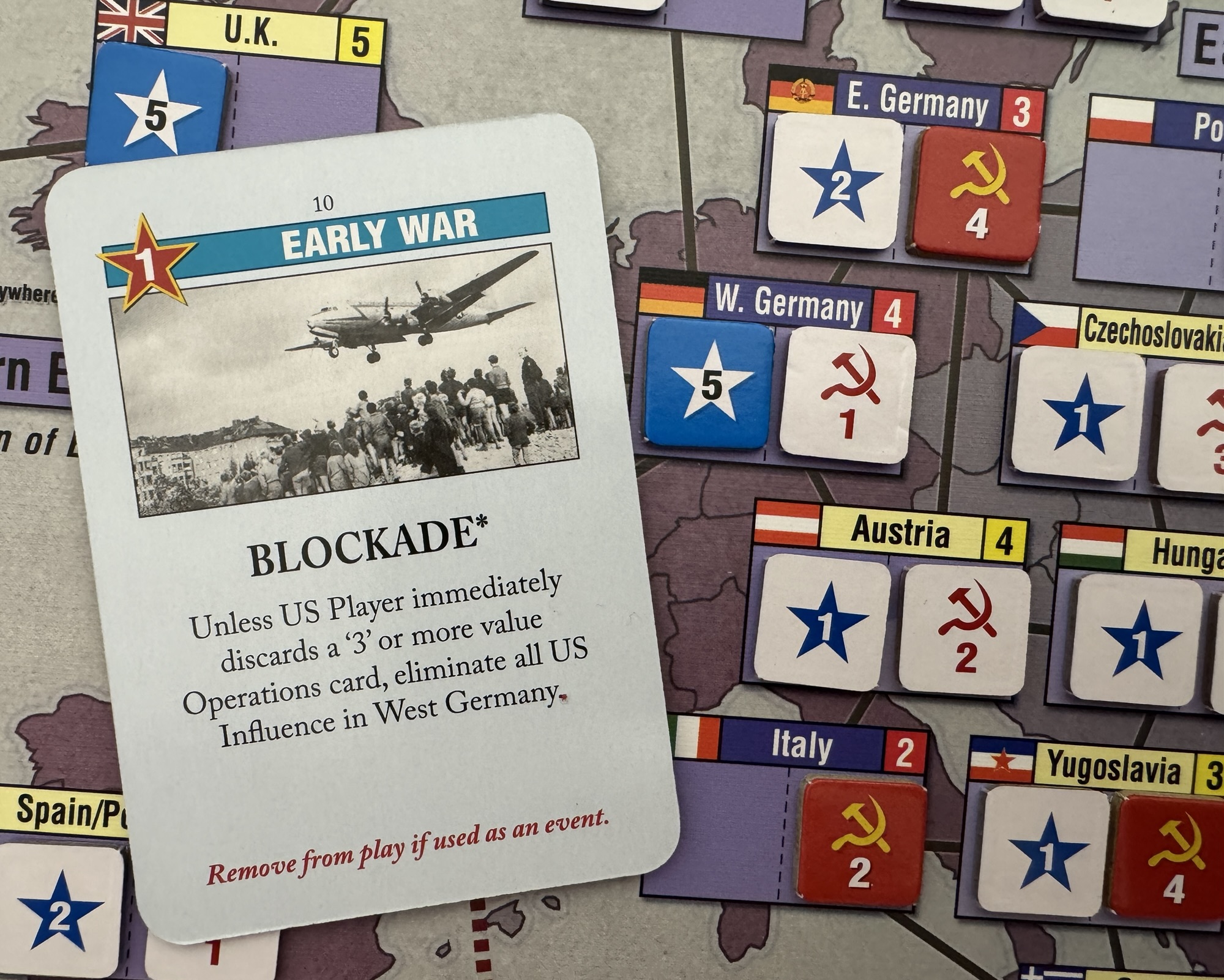
#69: Blockade from Twilight Struggle: The Cold War, 1945-1989 from GMT Games
Twilight Struggle is a 2-player game simulating the forty-five year ideological struggle known as the Cold War between the Soviet Union and the United States which can be played in 2-3 hours. The entire world is the stage on which these two countries “fight” to make the world safe for their own ideologies and way of life. The game starts right after the end of World War II in the midst of the ruins of Europe as the two new “superpowers” of the world squabble over what is left and ends in 1989, when only the United States remained standing.
The map is a world map of the period, where players move units and exert influence in attempts to gain allies and control for their superpower. The beauty of the CDG system used here is that each decision of whether to use a card for the event or the operations value is a struggle as if it is the other side’s event, it might go off hurting you very badly. There are mechanics to allow for the ignoring or cancelling of some of the best cards for your opponent in a side game within the game called The Space Race as well as nuclear tensions, with the possibility of game-ending global thermonuclear war (Shall we play a game, anyone?). I have played TS about 30 times and love it more and more with each sitting. The game makes me sweat, cringe, jump with joy and bite my fingernails. To me, a game that can do all of that in one sitting is worth the price.
One of my favorite type of cards from the game are those that force an action upon your opponent, such as discarding a card, reducing the Ops from card plays or causing them to have to make other plans than what they were working toward. These type of cards are more reactionary but definitely cause issues and mimic the various non-military focused strategies and tactics used during the Cold War. One of the most famous events from the early history of the Cold War is that of the Berlin Blockade. And there is a specific card that pays homage to the event in the game called Blockade. Blockade is an Early War Soviet Card that has an Ops Value of 1, which makes the card more valuable to be used for the printed event versus for the Ops.
When played, the card requires the US Player to immediately discard a 3 Ops or more value card from their hand or the consequence of not doing so will see all US Influence being removed from West Germany. This is a tough choice. Being early in the game, it is possible for the US to rebuild in West Germany and replace the lost influence over time if they do not wish to discard such as high value card. But, herein lies the real key to the Blockade cards use. The Soviet Player, who should be paying attention to not only their hand but also the card plays of the US Player, should try to use this card later in a turn once the US Player has played a majority of their cards in order to ensure that the event text can be realistically be achieved. If played quickly during a turn, the chances of the US Player being able to discard the required 3 Ops or great value card is higher and the card play will not generate any meaningful difference on the board state. I also would recommend a 2 card strategy here as the Soviet Player should be holding in their hand a high Ops card to be able to follow up this action with the placement of Influence into West Germany on their very next play. But, the real value to a card such as Blockade is that it forces the US Player to consider what cards are out there and to play around their negative effects as much as possible. Due to the nature of the game, and the randomness of card draws, having an expendable high Ops card ready and able to be discarded just in case of the play of Blockade is not really feasible. Also, remember that in Twilight Struggle that opponent events on cards that you play will go off and Blockade being drawn by the US Player can be bad as it will require them to play the event as you cannot discard a 1 Ops card to get rid of its negative effect in the Space Race Track due to the minimum requirement being a 2 Ops card. So the moral of the story here is that both players need to consider and plan for the play of or the mitigation of damage from Blockade.
The Berlin Blockade, which lasted from June 1948–May 1949, was a major Cold War crisis where the Soviet Union blocked all land and water access to West Berlin to attempt to force Western Allies out. The Soviet Union was taking this action as a means of retaliation against the introduction of the new Deutschmark currency. The US and Britain responded with the massive Berlin Airlift, flying over 2.3 million tons of food, fuel and supplies to the city. At the peak of the Airlift, a plane landed in West Berlin every 30 seconds. The blockade failed and the Soviets lifted it on May 12, 1949, after realizing the Allied Airlift could sustain the city for an extended period of time, marking a significant victory for the West in the ideological struggle. This event led to the acceleration of the division of Germany into East and West and the deepening of Cold War tensions.
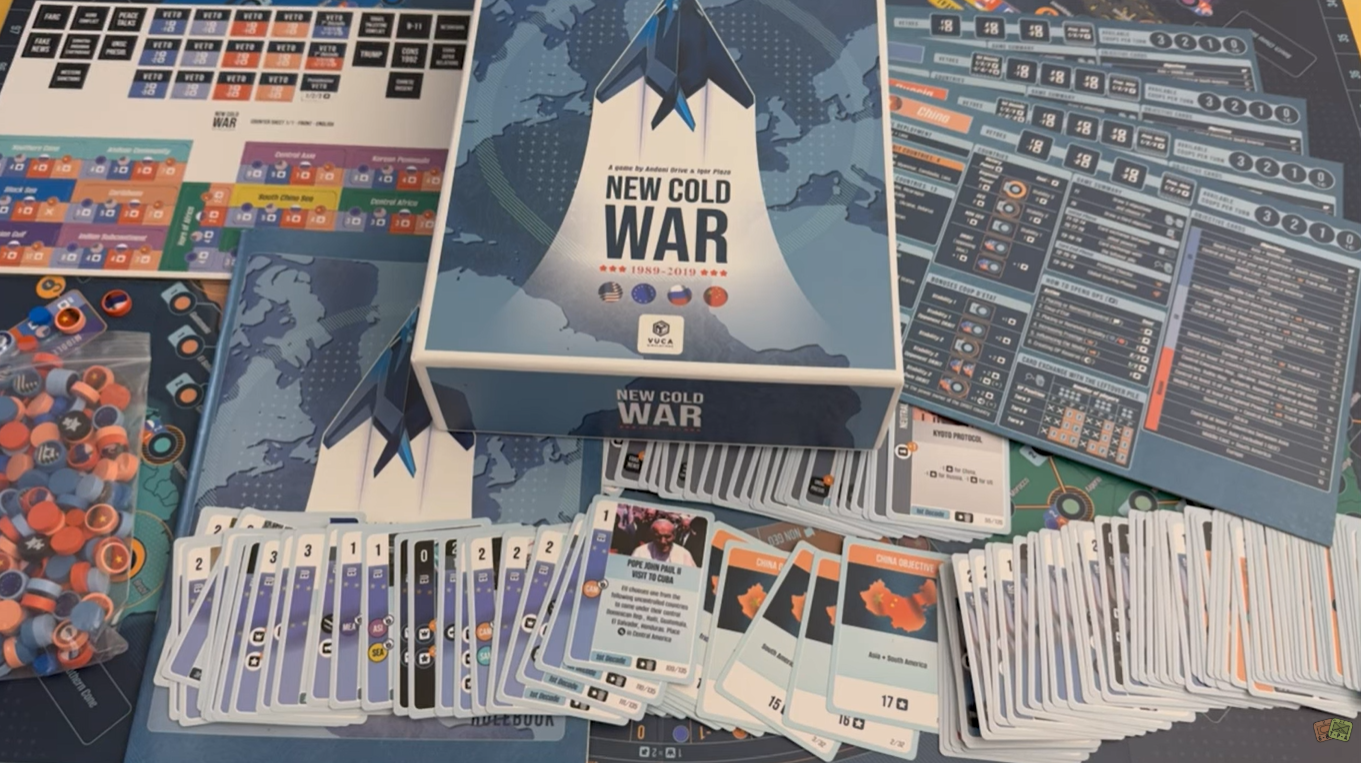
New Cold War: 1989-2019 is a Card-Driven Game based in the most important geopolitical events from 1989 to 2019. Players lead one of the four great powers (Russia, China, US, EU) in their fight for the new world order. Initially, the confrontation is between the red bloc, consisting of Russia and China and the blue bloc, comprising the United States and the European Union. However, each player must also prioritize their own strategy, as only one power can emerge victorious at the end of the game. Therefore, this game starts with cooperation between allied powers in the early stages but becomes entirely competitive as the moment of final victory approaches.
New Cold War utilizes a Card-Driven game mechanic. Players strive to attain victory by gaining international prestige, dominating the media and increasing their control of countries and different regions of the world. Other key factors to manage include military force and United Nations Security Council vetoes. Players’ strategies are determined by a series of hidden objectives they must pursue to achieve victory.
The game accommodates three or two-player versions and includes a solitaire mode through a system of bots.
Two weeks ago, we’ve looked at the first period of Soviet liberalization under Nikita Khrushchev from the 1950s on. While these reforms ended the era of Stalinist totalitarianism, they petered out when Khrushchev lost interest in them and was eventually overthrown and replaced by the more conservative Leonid Brezhnev. It would take another generation until a new Soviet leader, Mikhail Gorbachev, would undertake another broad reform program. These reforms – like last time, in the realms of domestic, foreign, and economic policy – are the subject of this article. Of course, you’ll also find a few board games in it!
Freer Press, Freer Elections
The Soviet Union’s political landscape had ossified under Brezhnev. This stagnation (or, if you want to phrase it more positively, hyperstability) also ruled out any experiments after Brezhnev’s death in 1982, and so the Politburo selected his loyal lieutenant Yuri Andropov. Unfortunately, Andropov was already 68 and severely ill then. He died in 1984, to be succeeded by another Brezhnevite stalwart, Konstantin Chernenko, who was similarly afflicted and even older (72 at his accession). Chernenko died in 1985. The rapid succession of aging Soviet leaders is poignantly captured in the contemporary joke: Margaret Thatcher calls Ronald Reagan: “It’s a pity you didn’t come to the funeral of the Soviet general secretary. Marvelous. A great spectacle. I’m totally going again next year.”
Cover of the English-language edition of Kremlin. Unfortunately, fake Cyrillic was once more irresistible, and so the R in Kremlin has been replaced with a Я (which would make the word Kyaemlin).
Another quasi-contemporary (1986) satirical take on the Soviet gerontocracy is Kremlin (Urs Hostettler, Fata Morgana): Players support the various Politburo members in the hopes of advancing those they have influence with to the top jobs, but many a hopeful candidate will die of stress and old age before realizing their ambitions.
After Chernenko’s death, even the most conservative Politburo members saw the need for a different tack: They elected Mikhail Gorbachev as their new leader in 1985, a real baby at age 54. Gorbachev’s reformist leanings were well-known, but he proceeded cautiously in his first year. As with Khrushchev, the big programmatic changes were first announced at a Party Conference of the Communist Party of the Soviet Union.
Gorbachev’s first slogan for his reforms was glasnost (openness). That included sweeping changes to Soviet citizens’ freedom of expression: Gorbachev encouraged the Soviet press to scrutinize politics instead of simply parroting the party line. Dissidents were released from prison. Even non-state-sponsored demonstrations were allowed – a powerful tool to express malcontent with the government. Of course, these reforms undermined the power base of the Communist Party – but Gorbachev hoped that he could steer the ship of state in the new environment and might even benefit from a freer populace.
Even more radical were Gorbachev’s institutional reforms, usually referred to as perestroika (restructuring): The Communist Party’s monopoly on power was cut off by establishing the Congress of People’s Deputies as an independent parliament, and while the first elections in 1989 were not fully free, it was the first time that Soviet citizens could select from several candidates in a contested election. Gorbachev himself chose to base his power no longer on his role as General Secretary of the Communist Party, and instead was elected President of the Soviet Union by the Congress of People’s Deputies in 1990.
This nascent democratization drive – eventually rather envisioned than enacted – makes for the most powerful card in the last phase (1985—1991) of the Cold-War-in-a-nutshell which is Twilight Squabble (David J. Mortimer, AEG): It’s a bit of speculation on the internal and external legitimacy and attractiveness a more democratic Soviet Union could have enjoyed.
Speaking of external legitimacy and attractiveness: Gorbachev’s policies (and he himself) would prove immensely popular in the West… after he had weathered the initial suspicion. Gorbachev began to advocate for a return to détente soon after he assumed office, but US president Ronald Reagan assumed this to be a Soviet ploy. Only after Gorbachev had met Reagan at the 1986 Reykjavík summit did the president believe Gorbachev’s intentions to be genuine.
In the following years, the two of them agreed on far-reaching mutual disarmament, most notably the Intermediate-Range Nuclear Forces (INF) Treaty. Gorbachev’s immutable advocacy for arms reduction is reflected in Wir sind das Volk! – 2+2 (Richard Sivel/Peer Sylvester, Histogame) as his event card cannot be used for the arms race.
Besides the lofty realms of nuclear arms reduction, Gorbachev also had more grounded problems to deal with: The Soviet Union had invaded Afghanistan in 1979 to prop up the failing pro-Soviet government there and had been embroiled since then in a costly and futile counter-insurgency. As the Soviet military could not present Gorbachev with a convincing roadmap on how to win the war, he decided to pull the Soviet forces out in 1988. By that time, the unsuccessful war had undermined the Soviet government’s legitimacy which had rested on its status as a military superpower, exacerbated by the new avenues of political expression open to disaffected citizens – the mothers of Soviet soldiers who fought (or had died) in Afghanistan were among the first to form associations, to pressure the government, and to protest.
In that sense, it is surprising that the withdrawal from Afghanistan can still net the Communist player points in 1989 (Jason Matthews/Ted Torgerson, GMT Games) – but the general principle holds true: The later the Soviets withdraw, the more their failure in Afghanistan becomes an asset to the opponents of Communist power.
Finally, Soviet power was the rock on which the Communist governments in Eastern Europe rested. Whenever they had been challenged – most importantly in Hungary in 1956 and Czechoslovakia in 1968 – Soviet tanks had quashed the dissent. This limited sovereignty within the Eastern bloc had been the central tenet of Soviet foreign policy, after 1968 named the Brezhnev Doctrine. Gorbachev adopted a new approach: He would not militarily intervene in Eastern Europe anymore. Instead, the countries of the Warsaw Pact were free to “do it their way” – thus humorously called the Sinatra Doctrine.
Finally, Gorbachev’s reform agenda of perestroika also aimed to transform the Soviet economy. All Soviet leaders had engaged in some kind of economic reforms, so Gorbachev’s activity did not seem very surprising… until observers inside and outside of the Soviet Union realized how radically it would change the tenets of the Soviet economy, traditionally based on central planning, large state-owned companies, and very limited contacts with the outside world.
First, Gorbachev gave the state-owned companies much more leeway over what to produce and how to set prices. These market incentives were supposed to improve efficiency, but clashed with the existing structures.
Undeterred, Gorbachev went a step further and loosened the restriction on private enterprises. More Soviet citizens could start their own store or workshop and offer goods and services at their own responsibility.
Then, Gorbachev allowed for joint ventures with Western companies (provided the Soviet part owned a majority share), and even let them set up dependencies in the Soviet Union – the famous first McDonald’s restaurant in the Soviet Union opened in January 1990.
The End of the Cold War and the Collapse of the Soviet Union
Gorbachev’s daring move to end hostilities with the West was an unqualified success. In late 1989, he and US president George H.W. Bush could merrily declare together that the Cold War was over.
The consequences of Gorbachev’s foreign policy reverberated through the Eastern Bloc: The allied Communist regimes of Central and Eastern Europe were swept away in 1989.
Early in a game of 1989: The Democrat (blue) has already taken power in Poland and Hungary. It will be difficult for the Communist (red) to stop the ever-growing blue tide. From the Rally the Troops! implementation.
The Perestroika and Glasnost event in Wir sind das Volk! – 2+2 neatly shows the way in which Gorbachev’s reforms put stress on the system: On the one hand, it increases Soviet dominance and makes socialism more attractive (lower two icons). However, it also increases unrest in East Germany (fist icons).
Within the Soviet Union, the political freedoms granted allowed citizens to demand more freedoms. These centrifugal effects became particularly visible as most of the non-Russian republics soon had nationalist independence movements which began to eat away the Soviet Union from its ethnic fringes. Gorbachev responded by proposing a looser federation between the Soviet Republics.
The political reforms also had negative interaction with the economic reforms: On the one hand, the flurry of changes created new inefficiencies; on the other, the increased freedom of the press highlighted economic problems no matter if they were new or had existed for centuries. As Soviet economic performance thus both objectively worsened and also became more obvious to the average citizen, Gorbachev’s legitimacy eroded.
Hardliners within the Communist Party couped against Gorbachev in August 1991 to prevent the loose federation between the Soviet Republics. A coup might also spell the end for the player in the solo game Gorbachev: The Fall of Communism (R. Ben Madison, White Dog Games). It’s a States of Siege game with a twist: Whenever the marker on any of the five paths (four of which refer to various ethno-national groups in the Soviet Union, the fifth represents the Communist Party) reaches the center, the game is not lost immediately, but a coup is staged: If Gorbachev has enough elite support to weather it, he goes on to fight another day.
In history, that was not the case: While the coup failed, it made Gorbachev a lame duck. The supporters of reforms turned away from him and toward his erstwhile ally Boris Yeltsin (who had cut a much more dashing figure during the coup), and away from the Soviet Union and toward their respective ethno-national identities. Gorbachev resigned as president and the Soviet Union was dissolved in December 1991.
The most influential work on Gorbachev’s time in office and his policies remains Brown, Archie: The Gorbachev Factor, Oxford University Press, Oxford 1996.
A magisterial mosaic of Soviet social, economic, and cultural life is Schlögel, Karl: The Soviet Century. Archaeology of a Lost World, Princeton University Press, Princeton, NJ 2023.
For the age of hyperstability before Gorbachev (and the discussion if it was an age of stability or stagnation), see the essays (in German, but with English abstracts) in: Belge, Boris/Deuerlein, Martin (eds.): Goldenes Zeitalter der Stagnation? Perspektiven auf die sowjetische Ordnung der Brežnev-Ära, Mohr Siebeck, Tübingen 2014.
On the transformative last third of the 20th century in Russian history, see Kotkin, Stephen: Armageddon Averted. The Soviet Collapse, 1970-2000, Oxford University Press, Oxford 2001.
On the end of the Cold War, see Dockrill, Saki Ruth: The End of the Cold War Era. The Transformation of the Global Security Order, Hodder, London 2005.
For the Soviet intervention in Afghanistan, see Braithwaite, Rodric: Afgantsy. The Russians in Afghanistan, 1979—1989, Oxford University Press, Oxford 2011.
With this My Favorite Wargame Cards Series, I hope to take a look at a specific card from the various wargames that I have played and share how it is used in the game. I am not a strategist and frankly I am not that good at games but I do understand how things should work and be used in games. With that being said, here is the next entry in this series.
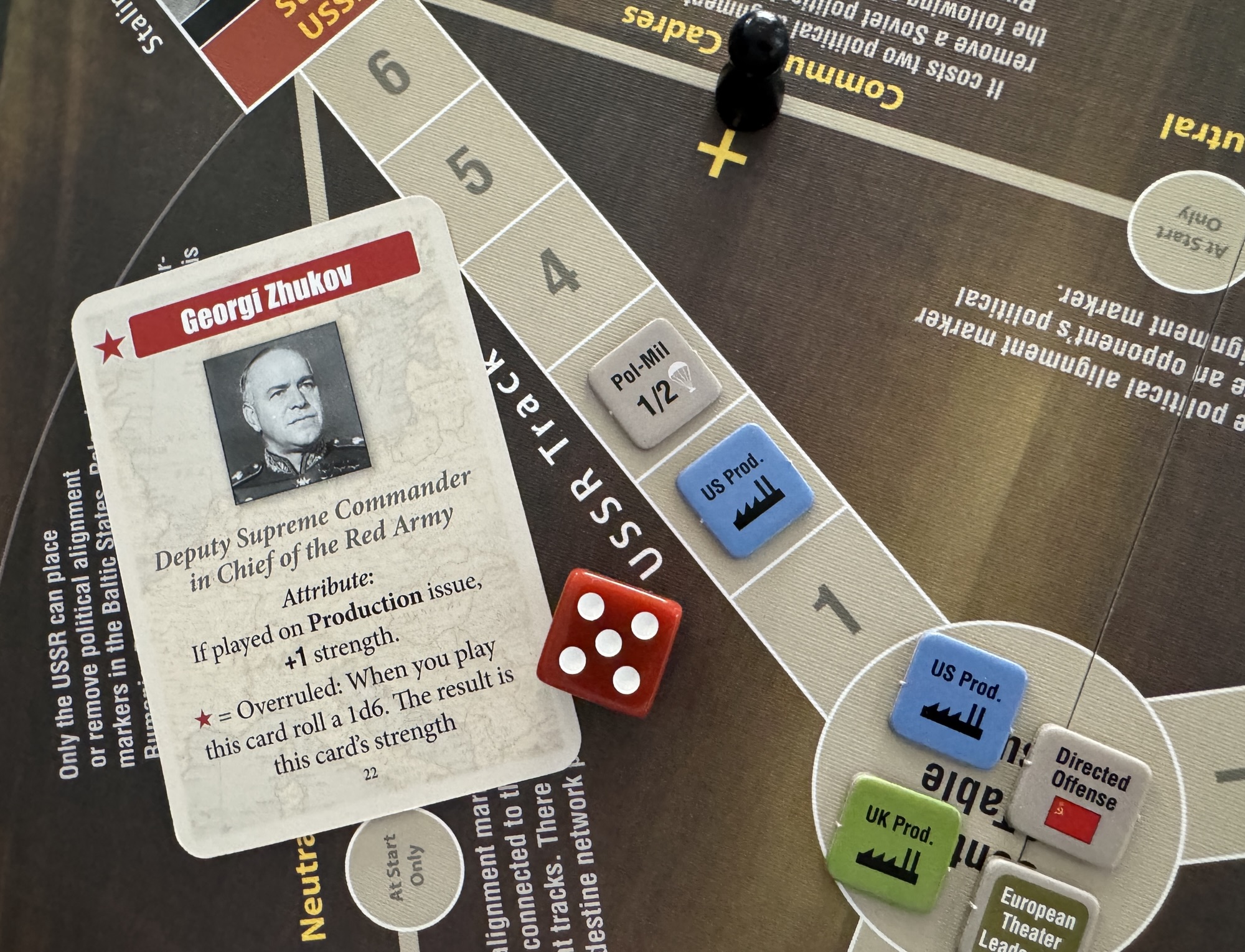
#65: Georgi Zhukov from Churchill: Big 3 Struggle for Peace from GMT Games
The players in Churchill: Big Three Struggle for Peace take on the roles of Churchill, Roosevelt, or Stalin during World War II as they maneuver against each other over the course of 10 Conferences that determine who will lead the Allied forces, where those military forces will be deployed, and how the Axis will be defeated. The player whose forces collectively have greater control over the surrendered Axis powers will win the peace and the game.
Churchill is not necessarily a wargame, but more of a political conflict of cooperation and competition. Over the course of the 10 historical conferences from 1943 till the end of the war this mechanic and much of the design should not be taken literally. Before and after each conference small groups of advisors and senior officials moved between the Allied capitals making the deals that drove the post war peace. These advisors and senior officials are represented by cards with an assigned numeric value that represents an amount of influence. Each conference sees one of a group of issues nominated for inclusion in the conference for debating and discussion. The issues categories include: Theater leadership changes, directed offensives, production priorities, clandestine operations, political activity, and strategic warfare (A-bomb). Each of the historical conference cards independently puts some number of issues, such as directed offensives or production priorities, metaphorically on the table, while the players nominate an additional 7 issues. The best part of the design is the conference table and stress and tension that comes from fighting over each and every issue. No one issue is a game breaker and no one issue will outright win the peace for you. But, each issue is key to the game as they unfold and change the landscape across which you are battling. Not landscape of terrain and defenses, but pit falls, traps and dead ends.
As I have mentioned, the Staff Cards are the engine for the game and the players must utilize their asymmetric abilities to the best of their ability in order to come out on top of the heap at the end of the game. These Staff Cards represent real period personalities of advisors, political officers and generals, who had the ear of the leaders and could go about working behind the scenes to move an issue into the limelight. Each player will utilize these cards to win those issues and each card provides either a bonus for a specific attribute or, in rare occasions, a negative modifier.
Today, we will take a look at one of my favorite type of cards from the game in the Chief of Staff Cards and specifically look at the Soviet Chief of Staff Georgi Zhukov who was the Deputy Supreme Commander in Chief of the Red Army. Each of the Chief of Staff Cards have a random numeric value in addition to a bonus for a certain attribute. The random numeric value is determined from rolling a 6 sided die and then using that number as the card’s base value. In Zhukov’s case, he is good with Production Issues and will grant a +1 strength toward moving these issues on the conference table. I like to think that this random determination of the Chief of Staff Card’s strength represents the internal power struggle with each of the nations leaders and those closest to them. In the case of Soviet Premier Stalin and his relationship with Zhukov they maintained a tense, professional, and ultimately strained relationship defined by mutual need during World War II, followed by postwar jealousy and suspicion. While Stalin relied on Zhukov as his top military commander to secure victory on the battlefield, he grew paranoid of the Marshal’s immense popularity and influence, leading to his ultimate demotion. And this random nature of the card’s strength reflects this well as sometimes they would agree and they could make great progress while other times they did not and there was tension and difficulty in their cooperation.
Georgy Konstantinovich Zhukov was born on December 1, 1896 and was a Soviet military leader who served as a top commander during World War II and achieved the rank of Marshal of the Soviet Union. During World War II, Zhukov served as deputy commander-in-chief of the armed forces under leader Joseph Stalin, and oversaw some of the Red Army’s most decisive victories. He also served at various points as Chief of the General Staff, Minister of Defence and a member of the Presidium of the Communist Party (Politburo).
Born to a poor peasant family near Moscow, Zhukov was conscripted into the Imperial Russian Army and fought in World War I. He served in the Red Army during the Russian Civil War, after which he quickly rose through the ranks. In summer 1939, Zhukov commanded a Soviet army group to a decisive victory over Japanese forces at the Battles of Khalkhin Gol, for which he won the first of his four Hero of the Soviet Union awards, and in 1940 he commanded the Soviet invasion of Bessarabia and Northern Bukovina in Romania. In February 1941, Stalin appointed Zhukov as chief of the General Staff of the Red Army.
Following the German invasion of the Soviet Union in June 1941, Zhukov lost his post as chief of staff after disagreeing with Stalin over the defense of Kiev. Zhukov, often in collaboration with Aleksandr Vasilevsky, was subsequently involved in the Soviet actions at Leningrad, Moscow, Stalingrad, and Kursk. He held the title of deputy commander-in-chief of the armed forces from August 1942, and was promoted to Marshal of the Soviet Union in January 1943. He participated in the planning of Operation Bagration in 1944, and in 1945 commanded the 1st Belorussian Front as it led the Vistula–Oder Offensive into Germany, where he oversaw the Soviet victory at the Battle of Berlin. In recognition of Zhukov’s key role in the war, he was chosen to accept the German Instrument of Surrender and to inspect the 1945 Moscow Victory Parade. He also served as the first military governor of the Soviet occupation zone in Germany from 1945 to 1946.
After the war, Zhukov’s popularity caused Stalin to see him as a potential threat. Stalin stripped him of his positions and relegated him to military commands of little strategic significance. After Stalin’s death in 1953, Zhukov supported Nikita Khrushchev’s bid for leadership, and in 1955, he was appointed Defense Minister and made a member of the Presidium. In 1957, Zhukov lost favor again and was forced to retire. He never returned to a top post, and died in 1974. Zhukov is remembered as one of the greatest Russian and Soviet military leaders of all time.
The Soviet Union was one of the great dictatorships of the 20th century. It applied an immense amount of coercion on its own citizens as well as many of its neighboring countries. Yet the almost seventy years between the Soviet Union’s founding from the ashes of the Russian Civil War in 1922 and its fragmentation into 15 nation-states in 1991 are no monolith of unfreedom. There were two distinct periods of liberalization around a generation apart from each other – one that began under General Secretary Nikita Khrushchev in the 1950s, and one that began under General Secretary Mikhail Gorbachev in the 1980s. Let’s look at them, beginning with Khrushchev’s thaw, in terms of domestic, foreign, and economic policy. The post on Gorbachev’s reforms will follow in two weeks. As always, there will be board games along the way.
Freedom of Thought, Speech, and Political Expression
Joseph Stalin’s Soviet Union curtailed its citizens’ expression dramatically. Historiography has recounted Stalin’s reign of terror in detail, yet the best-known expression of the totalitarian control to which the Soviet Union aspired from the 1930s on is George Orwell’s dystopian novel 1984: Its one-party state does not only control citizens’ access to information (they are being exposed to constant propaganda and expected to keep up with its frequently changing, often contradictory contents), but demands active participation in the daily reconstruction of the system, ranging from institutionalized “two-minute hate” against political enemies to unlimited devotion to the “Big Brother” at the top of the pyramid.
The Soviet equivalent to the “Big Brother,” of course, was Stalin who was exalted in an official cult of personality as a wise and infallible leader, working tirelessly for the security and well-being of the Soviet Union. Whatever went wrong on the Soviet Union’s inexorable march of progress was the fault of an inept underling or a shadowy enemy.
When Stalin died, his lieutenants fought briefly, but viciously over his succession. Nikita Khrushchev emerged victorious. Khrushchev had been as loyal to Stalin as his chief rivals and immediatly used Stalinist methods to depose Lavrentiy Beria, the powerful Minister of Internal Affairs (and thus chief of the domestic security services). Beria was charged with treason, put through a mock trial, and executed.
Khrushchev’s skillful power politics could also swing the other way, though. He prepared a report on Stalin’s crimes which he delivered to a stunned audience at the 20th Congress of the Communist Party of the Soviet Union on February 25, 1956. For four hours, Khrushchev detailed Stalin’s party purges, his deportation of whole peoples deemed unloyal, and, most of all, how Stalin had established a cult of personality in which he was almost worshipped like a god.
Khrushchev’s de-Stalinization drive did not stop at mere proclamations. The late 1950s and early 1960s saw a lessening of censorship: Alexander Solzhenitsyn was allowed to publish his Gulag novel One Day in the Life of Ivan Denisovitch.
There were limits, however: Criticism of Stalin’s Gulags was one thing, criticism of the October Revolution another. Boris Pasternak’s Doctor Zhivago was not published in the USSR. When Pasternak won the Nobel Prize in literature for it, he and his family were threatened by agents of the state. Cowed, Pasternak did not travel to Stockholm to accept the prize.
Still, Khrushchev’s pivot represented an important turn in the state’s relationship with violence. While Soviet citizens were still routinely surveilled and subjected to coercion, it was neither with the overwhelming force of Stalinism nor with its unpredictability. The age of escalating purges, in which the accusers of today would be the accused of tomorrow was over.
Peaceful Coexistence and Khrushchev’s Many Other Schemes
Khrushchev’s 1956 speech was meant to remain secret, known only to its direct recipients and the allied Communist governments in Eastern Europe, but a member of the Polish Communist party smuggled a copy abroad via the Israeli embassy in Warsaw. From there, it soon gained wide circulation, and while Khrushchev had intended it to be a domestic power play only (it delegitimized his rivals Georgy Malenkov and Vyacheslav Molotov), he now also reaped benefits abroad: The post-Stalinist Soviet Union was naturally a more attractive ally and role model for both the socialist movements in Europe and the decolonizing and freshly independent nations in Africa and Asia.
This unintended benefit is the focus of the foreign-policy heavy Twilight Struggle‘s De-Stalinization card: The Soviet player may move up to four points of influence around on the globe. That may seem like a zero-sum game – after all, the influence is not added, but only moved. But the Soviet Union typically has a lot of spare influence in Eastern Europe after the first one or two turns, and De-Stalinization is the earliest and best way to gain access to faraway continents, chiefly South America (and, to a lesser degree, Africa).
Even before Khrushchev’s speech was leaked, his approach to foreign policy markedly differed from Stalin’s last years. When the relationship with the Soviet Union’s erstwhile allies had deteriorated after the end of World War II, Stalin had adopted a confrontational stance based on the assumption that the world was split in two hostile camps. Khrushchev, on the other hand, approached the western powers under the new motto of peaceful coexistence. Socialism and capitalism could both inhabit the same world. Of course, Khrushchev as a convinced Communist believed that his system would eventually triumph. Until then, peaceful coexistence would not only foster peace, but also make socialism more attractive, and free up resources for economic development and consumer goods (more on that below).
The economic (factory icon) and especially ideological (socialist – man with flat cap icon) bonuses are nice, but what sets the Peaceful Coexistence event in Wir sind das Volk! – 2+2 (Richard Sivél/Peer Sylvester, Histogame) apart is the ability to advance peace (dove icon) – indispensable when the world is sliding toward nuclear war!
Khrushchev was always better at initiating things than at seeing them through. Peaceful coexistence gave way to other projects – be that the support of nationalist movements in the global south or a re-newed competition with the West over Central Europe. And while Khrushchev thought that the Soviet Union and the western powers could live next to one another, that tolerance did not extend to heterodox socialist ideas within his own sphere of influence: When the Hungarian Socialist Workers’ Party announced to withdraw the country from the Warsaw Pact and hold free elections, Khrushchev had the reform movement quashed by Soviet tanks.
The Soviet economy under Stalin had been tuned to increase heavy industrial output to achieve a fast industrialization on the one hand and provide the basis for the country’s military security. This approach was validated by the country’s survival of the Nazi invasion and its eventual military victory in 1945. The proponents of this economic policy which usually went together with ideological mobilization and a confrontational foreign policy were called to adhere to politika. Yet after Stalin’s death, the rival faction of tekhnika gained ground: Its advocates favored a less aggressive foreign policy, less ideological mobilization, and, most of all, more market elements in the economy which would then produce more consumer goods.
Khrushchev positioned himself in the middle: Heavy industry would have priority (the Soviet Union was in a nuclear arms race with the United States whose economy was around three times as large as the Soviet, after all), but more attention would be given to consumer goods than before. Soviet citizens enjoyed a limited amount of prosperity with radios, washing machines, and sometimes even cars. Khrushchev saw this also as an instrument in the systemic competition of the Cold War: Material comfort and personal lifestyles would influence people’s allegiances as much as military strength or ideological treatises.
Khrushchev’s confidence in that regard led him to agree with the United States on mutual national exhibitions which would showcase their respective country to the citizens of the other. The confidence, however, was not quite justified: The Soviet exhibition in New York aroused curiosity, but the American one in Moscow was positively overrun. It also produced one of the iconic pictures of the Cold War with Nikita Khrushchev and US Vice President Richard Nixon debating the merits of their respective systems surrounded by American household appliances – the “Kitchen Debate.”
Some Soviet citizens might have dreamed of living in America, but their personal lifestyles already became more akin to those of Americans under Khrushchev. Even more important than the new consumer goods were their living conditions: Housing in big Soviet cities had been dominated by kommunalkas – large apartments from pre-revolutionary times which had been split to accommodate several families, each living in a single room and sharing the kitchen and bathroom with the others. These crammed living spaces afforded their inhabitants no privacy whatsoever. Only the elites of Stalin’s Soviet Union had apartments to themselves. Khrushchev started an ambitious housing program based on prefabricated, concrete-paneled apartment buildings which allowed millions of Soviet citizens to move into an apartment just for their own family for the first time.
As with foreign policy, Khrushchev started more economic reform projects than he saw through. The ambitious “Virgin Lands” campaign which aimed at alleviating Soviet food shortages by cultivating vast swathes of Siberia and northern Kazakhstan petered out after a few years. His scheme to introduce an Iowa-style corn belt fared even worse, discrediting both corn and Khrushchev in the Soviet Union.
Khrushchev’s Ouster
The economic starts and shifts of Khrushchev’s tenure undermined his position, as did his foreign policy unpredictability ranging from arms control to confronting the United States over Cuba. Most damaging to him, however, were his constant shuffles in the Communist Party. Disaffected cadres who feared they might lose their offices overthrew Khrushchev in October 1964. They installed the less fickle Leonid Brezhnev as new General Secretary of the Communist Party of the Soviet Union. The conservative Brezhnev would tone down some of Khrushchev’s domestic reforms, resulting in a more restricted cultural and literary climate, but stuck with Khrushchev’s economic reforms and conducted foreign policy along the lines of détente with the West.
Not everything about Khrushchev was as cuddly as this bear which he received when visiting an East German electronics factory, but his rule made the Soviet Union a better place to live and furthered its international power and prestige. Image from Wir sind das Volk! – 2+2.
In the end, Khrushchev himself was one of the beneficiaries of the liberalization he had pushed: Unlike the victims of the purges of the 1930s (or even Beria), he was not subjected to a mock trial and executed. Instead, he officially resigned for health reasons and was allowed to live out his days at a comfortable dacha in the countryside.
The authoritative biography remains Taubman, William: Khrushchev. The Man and His Era, Norton, New York City, NY 2004.
A magisterial mosaic of Soviet social, economic, and cultural life is Schlögel, Karl: The Soviet Century. Archaeology of a Lost World, Princeton University Press, Princeton, NJ 2023.
On the suppression of the Hungarian revolution and its impact on Soviet and western foreign policy, see Békés, Csaba: The 1956 Hungarian Revolution and World Politics, (Cold War International History Project Working Paper No. 16), Washington, D.C. 1996.
On the politika/tekhnika split, see Priestland, David: Cold War Mobilization and Domestic Politics: the Soviet Union, in: Leffler, Melvyn P./Westad, Odd Arne (eds.): The Cambridge History of the Cold War. Volume I. Origins, 5th edition, Cambridge University Press, Cambridge 2013, pp. 442-463.
The Soviet Union was one of the great dictatorships of the 20th century. It applied an immense amount of coercion on its own citizens as well as many of its neighboring countries. Yet the almost seventy years between the Soviet Union’s founding from the ashes of the Russian Civil War in 1922 and its fragmentation into 15 nation-states in 1991 are no monolith of unfreedom. There were two distinct periods of liberalization around a generation apart from each other – one that began under First Secretary Nikita Khrushchev in the 1950s, and one that began under General Secretary Mikhail Gorbachev in the 1980s. Let’s look at them, beginning with Khrushchev’s thaw, in terms of domestic, foreign, and economic policy. The post on Gorbachev’s reforms will follow in two weeks. As always, there will be board games along the way.
Freedom of Thought, Speech, and Political Expression
Joseph Stalin’s Soviet Union curtailed its citizens’ expression dramatically. Historiography has recounted Stalin’s reign of terror in detail, yet the best-known expression of the totalitarian control to which the Soviet Union aspired from the 1930s on is George Orwell’s dystopian novel 1984: Its one-party state does not only control citizens’ access to information (they are being exposed to constant propaganda and expected to keep up with its frequently changing, often contradictory contents), but demands active participation in the daily reconstruction of the system, ranging from institutionalized “two-minute hate” against political enemies to unlimited devotion to the “Big Brother” at the top of the pyramid.
The Soviet equivalent to the “Big Brother,” of course, was Stalin who was exalted in an official cult of personality as a wise and infallible leader, working tirelessly for the security and well-being of the Soviet Union. Whatever went wrong on the Soviet Union’s inexorable march of progress was the fault of an inept underling or a shadowy enemy.
When Stalin died, his lieutenants fought briefly, but viciously over his succession. Nikita Khrushchev emerged victorious. Khrushchev had been as loyal to Stalin as his chief rivals and immediatly used Stalinist methods to depose Lavrentiy Beria, the powerful Minister of Internal Affairs (and thus chief of the domestic security services). Beria was charged with treason, put through a mock trial, and executed.
Khrushchev’s skillful power politics could also swing the other way, though. He prepared a report on Stalin’s crimes which he delivered to a stunned audience at the 20th Congress of the Communist Party of the Soviet Union on February 25, 1956. For four hours, Khrushchev detailed Stalin’s party purges, his deportation of whole peoples deemed unloyal, and, most of all, how Stalin had established a cult of personality in which he was almost worshipped like a god.
Khrushchev’s de-Stalinization drive did not stop at mere proclamations. The late 1950s and early 1960s saw a lessening of censorship: Alexander Solzhenitsyn was allowed to publish his Gulag novel One Day in the Life of Ivan Denisovitch.
There were limits, however: Criticism of Stalin’s Gulags was one thing, criticism of the October Revolution another. Boris Pasternak’s Doctor Zhivago was not published in the USSR. When Pasternak won the Nobel Prize in literature for it, he and his family were threatened by agents of the state. Cowed, Pasternak did not travel to Stockholm to accept the prize.
Still, Khrushchev’s pivot represented an important turn in the state’s relationship with violence. While Soviet citizens were still routinely surveilled and subjected to coercion, it was neither with the overwhelming force of Stalinism nor with its unpredictability. The age of escalating purges, in which the accusers of today would be the accused of tomorrow was over.
Peaceful Coexistence and Khrushchev’s Many Other Schemes
Khrushchev’s 1956 speech was meant to remain secret, known only to its direct recipients and the allied Communist governments in Eastern Europe, but a member of the Polish Communist party smuggled a copy abroad via the Israeli embassy in Warsaw. From there, it soon gained wide circulation, and while Khrushchev had intended it to be a domestic power play only (it delegitimized his rivals Georgy Malenkov and Vyacheslav Molotov), he now also reaped benefits abroad: The post-Stalinist Soviet Union was naturally a more attractive ally and role model for both the socialist movements in Europe and the decolonizing and freshly independent nations in Africa and Asia.
This unintended benefit is the focus of the foreign-policy heavy Twilight Struggle‘s De-Stalinization card: The Soviet player may move up to four points of influence around on the globe. That may seem like a zero-sum game – after all, the influence is not added, but only moved. But the Soviet Union typically has a lot of spare influence in Eastern Europe after the first one or two turns, and De-Stalinization is the earliest and best way to gain access to faraway continents, chiefly South America (and, to a lesser degree, Africa).
Even before Khrushchev’s speech was leaked, his approach to foreign policy markedly differed from Stalin’s last years. When the relationship with the Soviet Union’s erstwhile allies had deteriorated after the end of World War II, Stalin had adopted a confrontational stance based on the assumption that the world was split in two hostile camps. Khrushchev, on the other hand, approached the western powers under the new motto of peaceful coexistence. Socialism and capitalism could both inhabit the same world. Of course, Khrushchev as a convinced Communist believed that his system would eventually triumph. Until then, peaceful coexistence would not only foster peace, but also make socialism more attractive, and free up resources for economic development and consumer goods (more on that below).
The economic (factory icon) and especially ideological (socialist – man with flat cap icon) bonuses are nice, but what sets the Peaceful Coexistence event in Wir sind das Volk! – 2+2 (Richard Sivél/Peer Sylvester, Histogame) apart is the ability to advance peace (dove icon) – indispensable when the world is sliding toward nuclear war!
Khrushchev was always better at initiating things than at seeing them through. Peaceful coexistence gave way to other projects – be that the support of nationalist movements in the global south or a re-newed competition with the West over Central Europe. And while Khrushchev thought that the Soviet Union and the western powers could live next to one another, that tolerance did not extend to heterodox socialist ideas within his own sphere of influence: When the Hungarian Socialist Workers’ Party announced to withdraw the country from the Warsaw Pact and hold free elections, Khrushchev had the reform movement quashed by Soviet tanks.
The Soviet economy under Stalin had been tuned to increase heavy industrial output to achieve a fast industrialization on the one hand and provide the basis for the country’s military security. This approach was validated by the country’s survival of the Nazi invasion and its eventual military victory in 1945. The proponents of this economic policy which usually went together with ideological mobilization and a confrontational foreign policy were called to adhere to politika. Yet after Stalin’s death, the rival faction of tekhnika gained ground: Its advocates favored a less aggressive foreign policy, less ideological mobilization, and, most of all, more market elements in the economy which would then produce more consumer goods.
Khrushchev positioned himself in the middle: Heavy industry would have priority (the Soviet Union was in a nuclear arms race with the United States whose economy was around three times as large as the Soviet, after all), but more attention would be given to consumer goods than before. Soviet citizens enjoyed a limited amount of prosperity with radios, washing machines, and sometimes even cars. Khrushchev saw this also as an instrument in the systemic competition of the Cold War: Material comfort and personal lifestyles would influence people’s allegiances as much as military strength or ideological treatises.
Khrushchev’s confidence in that regard led him to agree with the United States on mutual national exhibitions which would showcase their respective country to the citizens of the other. The confidence, however, was not quite justified: The Soviet exhibition in New York aroused curiosity, but the American one in Moscow was positively overrun. It also produced one of the iconic pictures of the Cold War with Nikita Khrushchev and US Vice President Richard Nixon debating the merits of their respective systems surrounded by American household appliances – the “Kitchen Debate.”
Some Soviet citizens might have dreamed of living in America, but their personal lifestyles already became more akin to those of Americans under Khrushchev. Even more important than the new consumer goods were their living conditions: Housing in big Soviet cities had been dominated by kommunalkas – large apartments from pre-revolutionary times which had been split to accommodate several families, each living in a single room and sharing the kitchen and bathroom with the others. These crammed living spaces afforded their inhabitants no privacy whatsoever. Only the elites of Stalin’s Soviet Union had apartments to themselves. Khrushchev started an ambitious housing program based on prefabricated, concrete-paneled apartment buildings which allowed millions of Soviet citizens to move into an apartment just for their own family for the first time.
As with foreign policy, Khrushchev started more economic reform projects than he saw through. The ambitious “Virgin Lands” campaign which aimed at alleviating Soviet food shortages by cultivating vast swathes of Siberia and northern Kazakhstan petered out after a few years. His scheme to introduce an Iowa-style corn belt fared even worse, discrediting both corn and Khrushchev in the Soviet Union.
Khrushchev’s Ouster
The economic starts and shifts of Khrushchev’s tenure undermined his position, as did his foreign policy unpredictability ranging from arms control to confronting the United States over Cuba. Most damaging to him, however, were his constant shuffles in the Communist Party. Disaffected cadres who feared they might lose their offices overthrew Khrushchev in October 1964. They installed the less fickle Leonid Brezhnev as new First Secretary of the Communist Party of the Soviet Union (an office soon to be re-named to General Secretary, like under Stalin). The conservative Brezhnev would tone down some of Khrushchev’s domestic reforms, resulting in a more restricted cultural and literary climate, but stuck with Khrushchev’s economic reforms and conducted foreign policy along the lines of détente with the West.
Not everything about Khrushchev was as cuddly as this bear which he received when visiting an East German electronics factory, but his rule made the Soviet Union a better place to live and furthered its international power and prestige. Image from Wir sind das Volk! – 2+2.
In the end, Khrushchev himself was one of the beneficiaries of the liberalization he had pushed: Unlike the victims of the purges of the 1930s (or even Beria), he was not subjected to a mock trial and executed. Instead, he officially resigned for health reasons and was allowed to live out his days at a comfortable dacha in the countryside.
The authoritative biography remains Taubman, William: Khrushchev. The Man and His Era, Norton, New York City, NY 2004.
A magisterial mosaic of Soviet social, economic, and cultural life is Schlögel, Karl: The Soviet Century. Archaeology of a Lost World, Princeton University Press, Princeton, NJ 2023.
On the suppression of the Hungarian revolution and its impact on Soviet and western foreign policy, see Békés, Csaba: The 1956 Hungarian Revolution and World Politics, (Cold War International History Project Working Paper No. 16), Washington, D.C. 1996.
On the politika/tekhnika split, see Priestland, David: Cold War Mobilization and Domestic Politics: the Soviet Union, in: Leffler, Melvyn P./Westad, Odd Arne (eds.): The Cambridge History of the Cold War. Volume I. Origins, 5th edition, Cambridge University Press, Cambridge 2013, pp. 442-463.
With this My Favorite Wargame Cards Series, I hope to take a look at a specific card from the various wargames that I have played and share how it is used in the game. I am not a strategist and frankly I am not that good at games but I do understand how things should work and be used in games. With that being said, here is the next entry in this series.
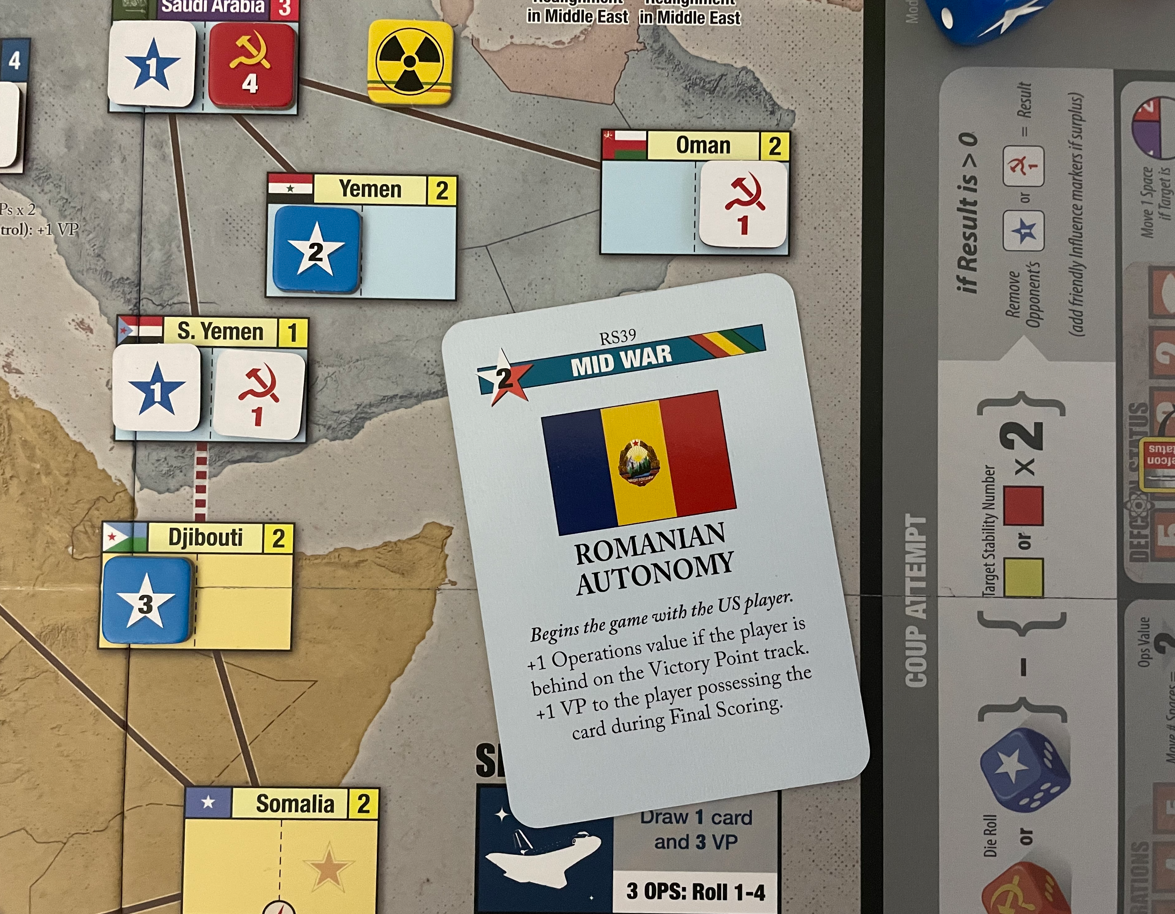
#62: Romanian Autonomy from Twilight Struggle: Red Sea – Conflict in the Horn of Africa from GMT Games from GMT Games
We all love Twilight Struggle….and if you say you don’t, you really do but just want to be different or are a contrarian! The game is phenomenal and has done very well for GMT Games with 8 Printings as well as the Turn Zero Expansion and now a series of smaller geographically focused spin off games starting with Twilight Struggle: Red Sea – Conflict in the Horn of Africa. Twilight Struggle: Red Sea deals with just two regions located in the Horn of Africa including Africa and the Middle East. The game uses the familiar Twilight Struggle formula of Cards with both Events and Operations Points that can be used by players to perform Coups, do Realignment Rolls or place Influence in an effort to gain control of the most Countries in the Regions to score Victory Points and win the game. The game is fast, furious and only lasts 2 hands of cards (unless you choose to play the special 3 Turn variant) so there isn’t a lot of time to mess around and players must be focused on what they are trying to accomplish. The best thing about the game is that it plays in 45 minutes as compared to 3-4 hours for Twilight Struggle.
The next card we will take a look at in this series is the special Romanian Autonomy, which is a unique card that doesn’t play from the deck but starts with the US player and resembles one of the classic cards from the original Twilight Struggle called The China Card. And if you have played Twilight Struggle, you know about the China Card. The China Card is a 4 Ops Value Card that can be held by the player in addition to their hand limit thereby giving them an extra card to use. But the card also has a special ability where if the player uses the card for 4 Ops to place Influence only in Asia, it will grant the player +1 Ops Value to use in placing one additional Influence. The China Card also grant’s the player who holds the card at the end of Turn 10 a +1 VP bonus.
In Twilight Struggle: Red Sea, the China Card has been replaced by the Romanian Autonomy Card. This card is not as powerful as the China Card but definitely creates some new opportunities and challenges for the player playing the card. The Romanian Autonomy Card can effect their Ops Value from cards by +1 during the Turn that they play it if they are behind on the Victory Point Track and also grants +1 VP to the player holding the card during Final Scoring. I think this is a really interesting concept and I think was included as a sort of catchup mechanic due to the short nature of the game. I look forward through more plays to seeing how its addition changes things and whether it is overpowered or just right. Once again, a small and subtle change to the game to create a new and interesting experience for the avid fan of Twilight Struggle or players who are new to the system.
Nicolae Ceaușescu visiting Africa during the Cold War.
During the Cold War, particularly under Nicolae Ceaușescu (1965–1989), Romania maintained a distinct, active presence in Africa, including the Horn of Africa, as part of a strategy to distance itself from Soviet influence, gain international prestige, and foster economic exchanges. While major powers like the Soviet Union and Cuba directly intervened in regional conflicts (such as the Ogaden War), Romania focused on building “fraternal” socialist relations through diplomatic, economic, and technical assistance, often operating with a degree of autonomy from the Warsaw Pact. Romania’s actual African strategy in the Horn of Africa, outlined in its 2023 Africa Strategy, emphasizes partnership, peace, development, education, and security cooperation, not territorial autonomy. Romania aimed to be a bridge between Europe and Africa, strengthening ties through cultural exchange, economic projects, and increased diplomatic presence in strategic capitals like Addis Ababa and Nairobi. Under its former communist regime, Socialist Republic Romania pursued economic independence and influenced African nations, but this was distinct from seeking autonomy within Africa. The phrase “Romanian autonomy in the Horn of Africa” is a game term with strategic implications within the game, while Romania’s real-world engagement with Africa is about broader diplomatic and economic partnerships

 Anmelden