Last day. We have had a great time and got 14 different games played! I’m exhausted but it’s a good exhaustion, if there is such a thing. Our final day was filled with 3 more great games as well as a lot of quality time with friends and fellow wargamers.
The day started with our first play of a brand new game called Imperial Elegy: The Road to the Great War 1850-1920 from VUCA Simulations. Imperial Elegy is a card driven game that blends diplomacy, warfare, and statecraft and feels a bit akin to games like Here I Stand and Virgin Queen from GMT Games. Grand scale sweeping epics that play multiplayers and take a day to play. Players play as 1 of 6 unique major powers in the game including Germany/Prussia, the United Kingdom, France, Austria-Hungary, Russia and the Ottoman Empire.
The game takes place over 7 turns, with each turn representing approximately a decade. If the Great War breaks out, the game can be extended by an additional 6 shorter turns.A turn in the game consists of numerous player impulses that is driven by the play of action cards for their Command Points or the printed events. Players will use CP and events to take actions like colonize, conduct diplomacy with minor nations, fight wars, as well as hinder their opponents by playing events that take away their actions or resources. A turn will end once all players have consecutively passed or when all players run out of cards.
Here is a look at the German player board which tracks a lot of information including current Stability, which decides whether various actions like war can be taken or if there are various positive or negative modifiers, the available Manpower that will determine how many armies can be built, Industry that tells how many action pointed you will have to spend during war to maneuver units, attack and replace losses. The focus of the game is about the control of territories both on the Minsk and of Europe as well colonies abroad and there is an automatic victory if a certain target number is met, in the case of Germany 15.
Here is a quick look at the Russia player board for comparison’s sake as each faction is unique and has various starting levels and abilities.
We only played the first full turn and it took us about 90 minutes including an hour of setup and rules overview and discussion as only one of us at the table had player previously (John Lapham). But we very much enjoyed the experience and found lots to like. We are going to try to put together another full game in the next several months and will have more to report on after that. But suffice it to stay everyone at the table was impressed with the design and everyone had a good time with it.
The 2nd game of the day was Bretwalda from PHALANX. This is such a beautiful game but is also a very good design in the area control/dudes on a map realm.
Bretwalda attempts to do what Civ Builders do but do it in a novel and different way…and also finds a way to incentivize combat, which was really a breath of fresh air for me. Bretwalda from PHALANX is a game for 1-4 players that plays in around 2 1/2 hours. Each player takes charge of one of the kingdoms of medieval England, including Northumbria, Mercia, Wessex and East Anglea, and each of these kingdoms has unique leaders and abilities. The goal is to be crowned the Bretwalda of England and victory will be achieved through a combination of controlling key areas with victory points, completing Chronicle cards in the form of hidden objectives and also focusing on building various buildings such as Abbeys.
The game has very little assymetry and I initially thought that this would be a bad thing for the design but really enjoyed how they did make each kingdom feel different, also how they provided unique choices in the area of Kingdom Tiles and the development of your kingdom. The Kingdoms differ in three main aspects. First, they are located in different areas on the map. Now this might not seem very important but there are advantages to each of these locations. East Anglea has access to several Areas that produce Food. This is very good as you have to feed your soldiers at the start of each Winter Phase and you will always be on the lookout for how to get more Food. This is a very good advantage but the tradeoff is that they are very open and spread-out on the map in the east and have more areas susceptible to attack which requires more troops for defense. Northumbria is located in the north of England up against Hadrian’s Wall which provides some form of protection as it provides extra defense if attacked. They can also conquer the area to the north of their kingdom and have very little worry about any threat from that side so they can focus on defending other areas.
Second, each kingdom has its own permanent, unique special rule that provides them with an advantage. East Anglea starts with 3 Food in their capital while other kingdoms start with just 1 and they also obtain 2 Food at the start of each Spring Season. Wessex will draw one extra Lordship Card after winning a battle. This is very important as these cards are very versatile special benefit cards that can be used in battle to do several things like reroll dice, add reinforcements, bring back a destroyed unit, etc. They also though have other uses through other phases of the game including scouting your opponents stash of cards before attacking, cancelling played card effects, gaining additional Gold, amongst other benefits. Mercia is able to Recruit 1 additional land unit when they take the Fyrd (Recruit) action. This gives them access to larger armies more quickly than other kingdoms so you have to watch out for them to be aggressive early. Finally, Northumbria may build Abbeys for 1 less Gold. This is probably the most simple benefit but Gold is at a premium and this really helps them to get more Gold as Abbeys give victory points (called Dalcs) as well as provide 1 additional Gold during the Collect Action. These benefits are not massive or game breaking but really add some flavor to each kingdom. Third and finally, as already discussed in the point above, each of the kingdoms has a set of its own unique historical Rulers, each with a different ability. I wont say anymore about this here but I really liked this part of the assymetry and thought it worked really well without breaking the game or making it more difficult than it had to be.
The area that I really wanted to cover in this part though was the Kingdom Tiles. During the Development Action, each player can pay 3 Gold and place 1 Kingdom Tile on their board. These Kingdom Tiles are divided into 4 different categories (you can see the four categories on the Kingdom Board shown above) tied to the four available Actions for players, including Development, Collection, Fyrd (Recruit) and Movement. The surprising thing about these tiles was that they are all the same for each kingdom. At first I thought maybe this was a missed opportunity but then after playing I saw that each having the same access to the same tiles was smarter as it gave the game balance. Also, each of the categories offers 3 possible Kingdom Tiles to develop and each player only has 2 spots on their board so you cannot develop all 3 in each category and each player will have to choose what makes the most sense for them at the time. I have seen this done in several of the Lite Civ Dudes on a Map Area Control games but they tend to overcomplicate it and make it clunky whereas in Bretwalda it is streamlined and simple yet there are options and paths to develop.
Bretwalda is a unique game amongst the many Lite Civ Building Dudes on a Map Area Control games out there. I had a great time playing the game and enjoyed the very interesting and fun combat system with custom dice for each unit type and Lordship Cards that add special abilities. This game is special and beautiful and thematic and earns a spot on my shelf as a game that I want to play again and again.
The wrap up event was annual roleplaying game and this year Cullen prepared a session of a new RPG called War Stories, which is set during the World War II. With it, players take the roles of heroic soldiers parachuting into Normandy during Operation Overlord in June of 1944.
As an RPG players will have characters with various special focuses across 4 abilities including Strength, Agility, Intelligence and Empathy. Each time a skill is to the checked you find the matching ability and roll that number of six sided dice looking fur 6’s which mean success. If multiple successes are rolled you can earn special tokens called Lucky Strikes that can be saved and used as successes on future rolls. The players will have to decide if they roll their dice again and will remove any 1’s from the pool and roll the remaining dice again. If they fail this time though the GM will gain a FUBAR token that can be used to cause a failure on a rolled success in the future. This really created some cinematic moments and was a very interesting way to handle a check.
Our friend Cullen was the GM and did a fantastic job guiding us through our first experience with the system. His good explanation and clear understanding and familiarity with the system really made our first experience an enjoyable one.
We were tasked with taking a hardpoint on D-Day behind enemy lines to assault and take out several gun emplacements shelling the upcoming landing beaches. We went through a series of rolls and checks on the flight in on the Dakota C-47 and then had to bail out over flak filled skies taking hits and losing gear or our musette bags.
When we landed we had to gather up, create a plan and then execute that plan to maneuver through German held positions under fire and take out the emplacements. There were lots of heroic actions, good sniper shots, daring orders and of course explosions and we had a great time with the game.
In the end we were successful and only lost a few of the men under our command. I look forward to playing more in the future. Thanks to Cullen for his preparation and time devoted to teaching us the system
We finished up at about 9:00pm and we then gathered up all of our games, equipment and items and said goodbye to friends who we hope to see next year. This week was a major success as we played 14 different games and had a very good time. Thank you so much for following along in my daily posts and look ahead to the videos we did appearing on the YouTube Channel over the next month.
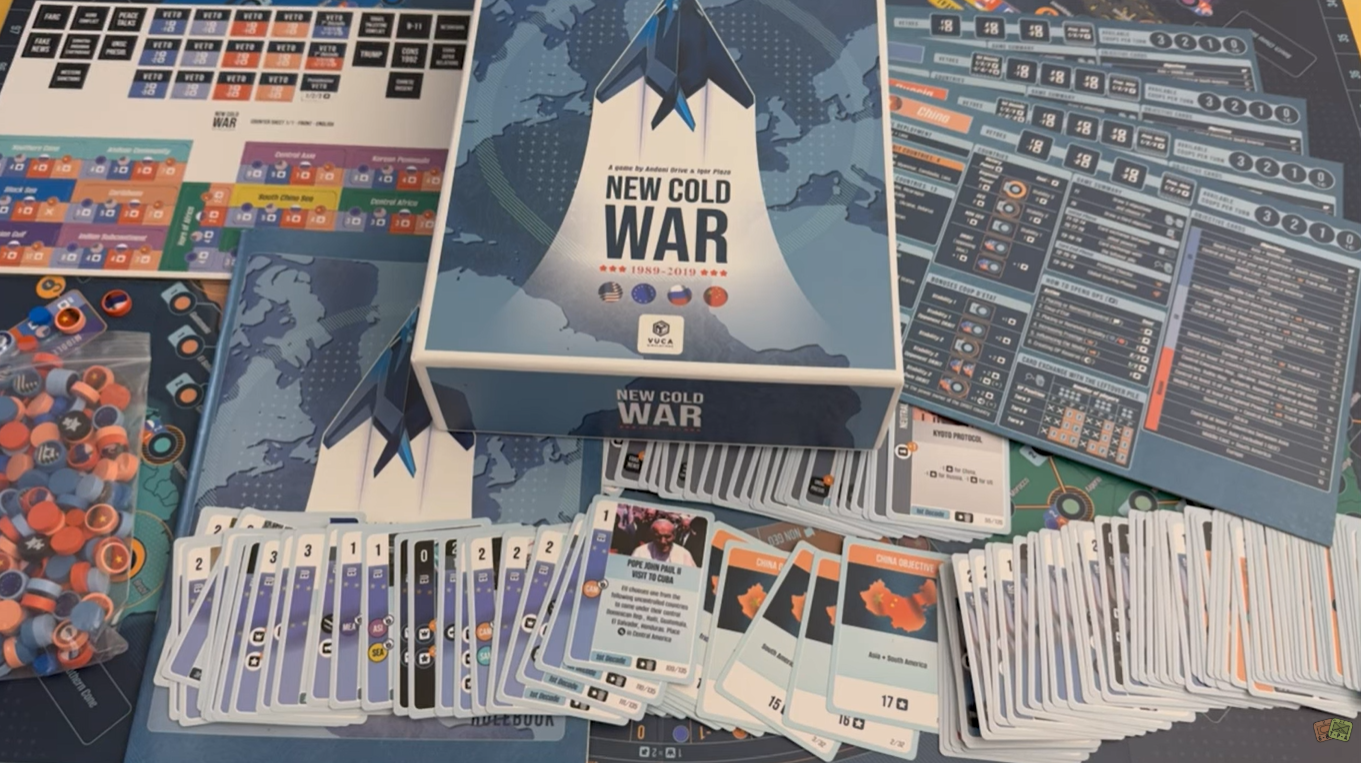
New Cold War: 1989-2019 is a Card-Driven Game based in the most important geopolitical events from 1989 to 2019. Players lead one of the four great powers (Russia, China, US, EU) in their fight for the new world order. Initially, the confrontation is between the red bloc, consisting of Russia and China and the blue bloc, comprising the United States and the European Union. However, each player must also prioritize their own strategy, as only one power can emerge victorious at the end of the game. Therefore, this game starts with cooperation between allied powers in the early stages but becomes entirely competitive as the moment of final victory approaches.
New Cold War utilizes a Card-Driven game mechanic. Players strive to attain victory by gaining international prestige, dominating the media and increasing their control of countries and different regions of the world. Other key factors to manage include military force and United Nations Security Council vetoes. Players’ strategies are determined by a series of hidden objectives they must pursue to achieve victory.
The game accommodates three or two-player versions and includes a solitaire mode through a system of bots.
This year has been a bit of a blur for me with work, personal commitments and family matters and I just feel like I have not been giving much attention to the blog. But, I am back now and ready to get right back to it with the next entry in our Wargame Watch feature. This month, I was able to find 18 games to highlight! Of that total, 3 games were offered on Crowdfunding.
Founded by industry veterans Ryan Heilman and Wes Crawford, Wharf Rat Games is a Baltimore-based publisher dedicated to high-quality, light-to-medium-weight games. Our mission is to deliver engaging historical, sci-fi, and fantasy themes that can be played in under 90 minutes, making them accessible to both casual and experienced players.
Featured Title:A Forlorn Hope by Hermann Luttmann
Wharf Rat Games is thrilled to announce their debut title, a revitalized vision from legendary designer Hermann Luttmann.
The History: Originally pitched over a decade ago as the mechanical precursor to the hit In Magnificent Style, this game returns to Hermann’s original vision of WWI trench warfare. Here is a link to the Rat Chat show where Hermann discusses the history of In Magnificent Style:
The Gameplay: A solo or 1–3 player cooperative experience using a tense push-your-luck mechanic. Players command a regiment charging across No Man’s Land, balancing bold advances against the threat of becoming pinned under relentless enemy fire.
The Content: Features six scenarios covering iconic battles such as The Somme, Verdun, and The Lost Battalion.
Wharf Rat Games is gearing up to launch their Backerkit campaign on February 10th. Early Bird Special: Back the game on the first day to get it for just $69, a savings of $20 off the MSRP!
You can connect with Wharf Rat Games on the following social media outlets:
1. A Forlorn Hope from Wharf Rat Games Coming to Backerkit on February 10th
Wharf Rat Games is a new publisher recently started by the dynamic duo of Ryan Heilman and Wes Crawford. I have interviewed both of these guys a few times for their own designed games and also hung out with them quite a bit at conventions including Buckeye Game Fest in April 2024 and the World Boardgaming Championships in August 2024. I am really happy for them that they have taken this plunge and created their own publishing company. I know they know games. Have been in the industry for a while now and also have great connections with many designers and would be designers and I am sure that they will bring many quality offerings to our tables over the next decade plus.
But there is more than just their introduction here as they have signed their first game and it is from a designer we all know and love – Hermann Luttmann. A Forlorn Hope places solo players or up to three cooperative players in command of a battalion charging across No Man’s Land to capture enemy trenches during World War I. Success requires careful balancing of bold advances and timely retreats to avoid casualties, maintain cohesion, and keep troops from becoming pinned under relentless enemy fire. Over a decade ago, Hermann pitched a groundbreaking design to Alan Emrich at Victory Point Games—a push-your-luck mechanic within a wargame framework, originally set in the WWI trenches. While the concept was well-received, Alan suggested a Civil War theme instead, leading to the creation of In Magnificent Style, based on Pickett’s Charge at Gettysburg. This game went on to be published by Victory Point Games and later by Worthington Publishing.
From the game page, we read the following:
A Forlorn Hope is an abstract simulation wargame of a typical trench assault, modeling those attacks that were conducted during the First World War (1914-1918). The player represents an attacking regiment of troops consisting of three battalions, with each battalion made up of two or three assault companies (depending on the number of players).
The game uses a “press-your-luck” design philosophy that will challenge you with tough decision-making and risk-taking throughout the game. The goal is for the player(s) to drive their forces across No Man’s Land in the quickest and most efficient manner possible to achieve the best level of victory.
A Forlorn Hope is designed both for solitaire and multiplayer co-operative play. Numerous scenarios are included, starting with a basic assault scenario (which is ideal for learning the intricacies of the game system), then adding multiple historically-based scenarios simulating actual battles from World War I that offer a slightly more complex and layered gaming experience. Each scenario features singular aspects of the historical battle it is simulating, and each will therefore be a unique gaming experience.
The project is set to launch on Tuesday, February 10th.
2. Napoleon at War Deluxe Edition from Decision Games
Over the past couple of years, Decision Games has been going back through their catalog and doing these Deluxe Editions of several of their games including Red Dragon Green Crescent Deluxe Edition in 2024 and Blue & Gray Deluxe Edition in 2025. They now have tabbed several more games for this game treatment and the first that I will share is Napoleon at War Deluxe Edition.
From the game page, we read the following:
Napoleon at War Deluxe Edition reprints the original SPI QuadriGame consisting of four separate battles, each among the most important of the Napoleonic Wars: Marengo, Jena-Auerstadt, Wagram, and the Battle of Nations at Leipzig. This new deluxe edition has a full-color instruction booklet, new counter and map artwork, with 9/16” counters, two back printed 22” x 25.5” mounted game boards, and new player aid cards. The basic rules to all four games in the Napoleon at War Series are standardized. Each game has its own exclusive rules, which include historical set up and reinforcements, special rules, player’s notes, and commentary by the game’s designer. The game mechanics used in this series are based on the popular Borodino-Napoleon at Waterloo game system. The scale of each game ranges from 400 to 800 meters per hex, while each game turn represents between one and two hours of real time. Units range in size from demi-brigades through divisions, with each strength point representing between 250 and 350 men or an equivalent amount of artillery.
Movement is sequential and single-phased. Zones of control are rigid, and combat is mandatory between adjacent opposing units. Stacking is limited to one unit per hex. The Combat Results Table is relatively uncertain, with odds of 4 to 1, or better, necessary to ensure at least a “Defender Retreat” result. Terrain ranges from the Austrian parade grounds south of Wagram to the rough and forested battlegrounds of Jena-Auerstadt. Game length varies from the five-turn First Day Scenario of the Battle of Nations to the 20 game turn Grand Battle Scenario of that same game which simulates the entire three- and one-half-day Battle of Leipzig, the largest battle of the Napoleonic Wars.The games, though graphically enhanced from the originals, remain the same. Now enhance your enjoyment with this new deluxe edition of another SPI classic!
3. Year of the Rat Vietnam 1972 Deluxe Edition from Decision Games
The 2nd game that is being offered up for pre-sale with a new Deluxe Edition is Year of the Rat Vietnam 1972, which was originally designed by John Prados and now redesigned by Joseph Miranda.
From the game page, we read the following:
On 30 March 1972 the North Vietnamese Army (NVA) launched its “Easter Offensive” into South Vietnam, attempting to either win the war decisively or improve the North’s negotiating position at the Paris Peace Talks. Surprised by the large-scale attack, the Army of the Republic of Vietnam (ARVN) rallied, and supported by US airpower, launched counterattacks into the fall, finally repulsing the Communist offensive.
Year of the Rat Deluxe Edition recreates that decisive campaign. Powerful NVA divisions operate alongside Viet Cong regiments and decoys, evading the ARVN while striking quickly at vital towns and bases. ARVN elite airborne, ranger, and marine units respond, creating a tense asymmetrical contest of big unit battles and hard-fought sieges, with increasing American airstrikes and worsening NVA supply capabilities.
This Deluxe Edition enhances the original, acclaimed SPI game design (published during the campaign) with a half-century of research and analysis, providing updated orders of battle and terrain analysis. Three scenarios and fifteen order of battle variants cover a wide range of game options, including operations into Laos and Cambodia.
Additional features include:
• New graphics on enlarged maps and counters
• Expanded Allied airmobile operations and units
• NVA divisional reorganization and tank regiments
• Full 1971–72 US order of battle
• Australian, Royal Thai, Cambodian, and Khmer Rouge forces
• Vietnamese and US Navy riverine units
• ARVN base camps and regional forces
• Extensive optional rules
Year of the Rat Deluxe Edition offers you the opportunity to explore and make decisions in a campaign that changed the course of war and peace.
4. 1812: The Campaign of Napoleon in Russia Deluxe Edition from Decision Games
The third and final game getting a facelift from Decision Games is 1812: The Campaign of Napoleon in Russia Deluxe Edition.
From the game page, we read the following:
Napoleon invaded Russia with 600,000 troops of which only about 110,000 escaped in organized formations. The largest factor in this enormously deadly campaign was supply. The ability of a Napoleonic army to supply itself depended heavily on the surrounding countryside. Areas were stripped of resources to supply the army, which had to move or starve within a very short period. 1812 Deluxe Edition treats this difficulty of command as a central point, through the game’s area depletion system.
1812 Deluxe Editionupgrades the original SPI 1812 Strategic Area Map Game with a full-color rulebook and player aid cards, new artwork, larger counters and an enlarged map on a mounted game board.
Players must battle attrition, supply, and enemy forces to win. 1812 offers three scenarios, starting in June, late August, and early October, each with free and historical set-up options. Optional rules add leaders and fortresses, while new variant rules provide additional leaders, battle plans, and elite guard forces. Other than adding the variant rules, and incorporating clarifications and known errata, no major changes have been made to the original SPI rules.
1812 Deluxe Edition provides you the opportunity to see if Russia falls to Napoleon’s conquest, or survives, spelling the eventual doom of the Napoleonic Empire. Open this new deluxe edition and see if you can change history.
I love a different style and focus of wargame. A game that takes a look at an important but somewhat obscure or rarely addressed topic such as espionage or intelligence. And this month, GMT Games announced such a game in Checkpoint Charlie, which is a solo or cooperative game focused on SIS espionage missions in Berlin in the 1960’s.
From the game page, we read the following:
Checkpoint Charlie is a solitaire or cooperative game of British Secret Intelligence Service (SIS) espionage missions in Berlin in the early 1960s.
West Berlin is an isolated outpost of the Western Powers in the center of the German Democratic Republic (East Germany). East Berlin, on the other side of the Berlin Wall, is a base of operations for Soviet KGB agents and the Stasi secret police. This is a city of spies, a focal point of worldwide espionage in the growing Cold War. In this game, you send your assets (agents) on missions and use your influence and foresight to help them complete objectives before they are detected and compromised by KGB agents. As you play through these missions, you will:
Ensure that an important defector gets safely out of the city.
Make contact with a dissident Russian scientist on the other side of the Berlin Wall.
Gather intelligence in East Berlin and return safely to the West
Entrap a troublesome KGB agent with tempting intelligence.
Sow distrust between KGB and Stasi agents.
Identify a Soviet mole among your SIS agents and wait for them to reveal themselves.
Can you accomplish all of this in secret, as the very public events of the Cold War change the political landscape of Berlin itself?
This is a game about your assets staying one step ahead of the KGB and completing missions without being detected. Each mission starts with a different cast of assets and KGB agents, a set of items that may help complete the mission, and multiple historical events that can change the situation. Victory conditions are specific – getting an asset out of the city, making contact with a new source, or even crossing the Berlin Wall to gather important intelligence and returning without getting caught. There are no victory points or turn limits in Checkpoint Charlie, just objectives your assets must complete before they are compromised or overwhelmed by the growing web of KGB surveillance. The game map includes iconic locations like Checkpoint Charlie, Glienicke Bridge (the “Bridge of Spies”), and the notorious Berlin Hilton, each with unique game effects. You will manage a hand of cards that represent assets, items, and locations on the map. On your turn, you’ll play a card to influence the situation, and when you take a card from the Draw Area to refill your hand, every SIS asset and KGB agent in the city will move and take actions based on which card you chose. New Intel may appear on the map, locations may be placed under KGB surveillance, and Event cards may affect specific locations.
In Checkpoint Charlie, you are not a field agent. You are a planner, a director monitoring the situation but limited in how much you can directly intervene. That sense of influencing the situation but often just having to watch as events unfold is created by the core mechanic of Checkpoint Charlie: the Draw Area below the map. This area contains five face-up location, asset, or item cards. Chits representing each of the tokens on the city map (your SIS assets and the KGB agents) are placed above each of the cards in the Draw Area. After playing a card from your hand, you will draw a card from either end of the Draw Area, and then the remaining four cards will shift left or right to fill the empty position before a new card is drawn to fill the row. In this way, every card in the Draw Area shifts one space whenever you draw a card. This is important because every token in Berlin then moves closer to the location, asset, or item on the card directly below their chit. In the example below, the cards have shifted and the empty spot has been filled. Now the Dentist will move to Mehringplatz. Jester will move one location closer to Checkpoint Charlie, and KGB Agent Svetlova will move toward the 1958 Rambler at RAF Gatow.
This game looks extremely interesting and I am very much excited to learn more about it. I am going to reach out to the designer Russ Brown to get some more information to share.
6. Here I Stand 500th Anniversary Reprint Edition 3rd Printing from GMT Games
Here I Stand is one of the greatest Card Driven Games I have ever played, and we have played a lot in our time. I have played this game more than 10 times and found each experience to be simply sublime, even though it takes 10-12 hours to play. The game now has a 3rd Printing of the Deluxe 500th Anniversary Edition and you need to get you a copy and find someone to play with.
From the game page, we read the following:
Here I Stand: Wars of the Reformation 1517-1555 is the first game in over 25 years to cover the political and religious conflicts of early 16th Century Europe. Few realize that the greatest feats of Martin Luther, Jean Calvin, Ignatius Loyola, Henry VIII, Charles V, Francis I, Suleiman the Magnificent, Ferdinand Magellan, Hernando Cortes, and Nicolaus Copernicus all fall within this narrow 40-year period of history. This game covers all the action of the period using a unique card-driven game system that models both the political and religious conflicts of the period on a single point-to-point map. There are six main powers in the game, each with a unique path to victory.
If you own the original (non-500th Anniversary edition) Here I Stand, here are the upgrades you will find in the deluxe 500th anniversary edition. Enhancements include: 6 brand new cards added to the deck, including Thomas More, Thomas Cromwell, Rough Wooing, and Imperial Coronation. Revisions to over 15 existing cards including Copernicus, Master of Italy, and Machiavelli to allow for more exciting in-game play and additional possibilities for diplomatic deals. A new Chateau construction table is now used to resolve France’s Patron of the Arts home card plays. Several Virgin Queen rule updates are incorporated back into Here I Stand, affecting minor power activation, piracy, space trading, and foreign wars.
There also is included the special 2-player variant which pits the Protestants versus the Catholics in a modified form of the game. But it is still good and this is how we first played the game.
7. Special Component Pack for The Last Hundred Yards Vol. 5: For King & Country from GMT Games
If you didn’t know we really enjoyed The Last Hundred Yards very much as well as Volume 2: Airborne Over Europe. The system is extremely interesting for a tactical game and uses some novel elements in regards to how victory points are scored including a focus on time and casualties. Really an excellent system! Now, even though there are 5 total volumes that have been released, including most recently Volume 5 For King & Country, Mike Denson has forged ahead with an interesting expansion called a Special Component Pack.
From the game page, we read the following:
We are offering this Special Pack for players who purchased The Last Hundred Yards Volume 5: For King & Country because the necessary modules to play all the missions are not currently available. This pack includes all components (German counters and maps) necessary to make Volume 5 a Stand-Alone Game. With this Pack, players will be able to play every mission included in the module.
Components included in the for King and Country Special Zip Lock Pack:
7 double-sided geomorphic maps (14 maps total)
1 full color Rules booklet (latest edition) (44 pgs.)
8. Dice in the Dirt: A Tactical Print and Play Skirmish Game from Michael Shane Mecham Currently on Kickstarter
Recently, I have really been enjoying several Print and Play solitaire wargames. They are inexpensive, easy to create and setup and then most of them have some really engaging and interesting gameplay. This month, I came across a new offering called Dice in the Dirt: A Tactical Print and Play Skirmish Game designed by Michael Shane Mecham and I jumped on it pretty quickly.
From the game page, we read the following:
Dice in the Dirt is a fast, tactical print-and-play skirmish game for two players.
Each player commands a six-soldier squad fighting over a dense, modular battlefield where pressure, positioning, and timing matter more than raw firepower. The game uses blind-bag activation, suppression mechanics, and standard dice to create tense, unpredictable engagements.
Dice in the Dirt is not about killing fast—it’s about pressure. Suppression locks soldiers in place. Actions are scarce. Timing matters more than firepower. Victory comes from forcing your opponent to waste precious moments under fire.
This is a complete, digital-only release designed for quick setup and focused play.
It really seems pretty interesting and the best part about these Print and Play games is that the cost of entry is so low that it is worth taking a chance on. I am a backer and look forward to playing this one.
As of February 1st, the Kickstarter campaign has funded and raised $521.00 toward its $100.00 funding goal with 32 backers. The campaign will conclude on Friday, February 6, 2026 at 9:57am EST.
9. Battle Decisions: Kriegsspiel from Catastrophe Games Currently on Kickstarter
Catastrophe Games is a small publisher who just really puts out interesting games. I have played several of their games and enjoyed them all. Recently, they announced a new game called Battle Decisions: Kriegsspiel designed by Paul LaFontaine.
From the game page, we read the following:
Battle Decisions: Kriegsspiel is a basic Kriegsspiel kit in a box. You will have everything you need to play a game of Kriegsspiel: a map and counter sheet for the umpire and two players, along with a very basic resolution system.
This game benefits from hundreds of hours of face to face and online playtesting, with the system refined to allow an experienced umpire to launch and complete a simple scenario in just over an hour.
The scenario book runs scenarios across time: while most of the scenarios focus on the 19th century, it also shows how to run modern skirmishes (WW2) while allowing ancient battles as well (Alexandria versus the Persian Empire)
But wait, you might ask, how can you run so many and various scenarios off one central Europe map? What Paul did was take the central element of the battle and found a location on the map that most represents the fight. This is an elegant way to allow a single map to be used for multiple battles.
Kriegsspiel began as a past time for Prussian nobles. Eventually a version was presented to their king who then required its use for training Prussian officers. Many attribute some of the Prussian success in the 1870 Franco-Prussian war to the widespread use of the Kriegsspiel amongst the Prussian officer corps.
After the war Kriegsspiel games were used by many nations to train their leaders. Now the descendants of the original Kriegsspiele live on in the form of software driven exercises for staffs at various levels. However the focus on command and control is still the key factor in these modern games.
Battle Decisions: Kriegsspiel offers players a chance to return to form of the original games, with simple counters and maps, allowing players to forge their own tactics and plans.
As of February 1st, the Kickstarter campaign has funded and raised $3,313.00 toward its $500.00 funding goal with 55 backers. The campaign will conclude on Monday, February 2, 2026 at 7:00pm EST.
10. Operation Overlord from VUCA Simulations
VUCA Simulations is a new company on the scene the last few years and they are coming out with some really great looking games. We have played several of their games and always have a great experience with them. One of their newest pre-order offerings is called Operation Overlord designed by Clem. It covers the D-Day invasion and as usual looks to be of the highest quality and production.
From the game page, we read the following:
Operation Overlord is a deep, historically grounded strategic wargame that simulates the Normandy invasion and the critical battles that followed from June to August 1944. One player commands the Allied SHAEF forces, planning and executing the largest amphibious operation in history, while the opposing player takes the role of Oberbefehlshaber West, defending the Atlantic Wall and attempting to delay the Allied advance long enough to alter the course of the war.
Rather than focusing on tactical skirmishes, Operation Overlord operates at the operational–strategic level, where timing, logistics, intelligence, and command structure are decisive. Players maneuver divisions and army corps across a detailed map of Normandy, manage supply networks and reinforcements, execute historical and fictional operations, and influence battles through doctrine, supports, and event cards.
Each month begins with high-level planning: the Allied player secretly schedules strategic and special operations, while the German player designates key cities as Festungen, to be held at all costs. Weekly turns then unfold through intelligence gathering, supply allocation, reinforcement arrivals, and alternating unit activations that combine maneuver and combat into a tense, fluid system. Fog of war is maintained through hidden unit values and simultaneous combat card reveals, ensuring constant uncertainty and meaningful decision-making.
Victory is not measured simply by territory, but by time and consequences. The German player is unlikely to drive the Allies back into the sea—but every week gained has far-reaching implications for morale, resources, and other fronts of the war. Likewise, an Allied breakthrough ahead of schedule can dramatically reshape history. Each scenario and campaign outcome includes historically reasoned consequences that frame the result within the broader context of World War II.
With multiple scenarios (June, July, August, and a full campaign), robust asymmetry, and a strong emphasis on planning and operational art, Operation Overlord offers a demanding and rewarding experience for players seeking a serious, historically informed wargame.
If you are interested in Operation Overlord, you can pre-order a copy for €107,99 ($118.79 in US Dollars) from the VUCA Simulations website at the following link: https://vucasims.com/products/operation-overlord
11. Kawanakajima 1561: Battles of the Sengoku Jidai from Serious Historical Games
A few years ago, a new company called Serious Historical Games released the first in a new series of games focused on the Sengoku Jidai period and the battles of the time. This game was called Nagashino 1575 & Shizugatake 1583: Battles of the Sengoku Jidai and it is part of the Age of the Warring States Series. Since that time they have released Volume 2 and now are getting Volume 3 ready for pre-sale, which focuses on the battle of Kawanakajima in 1561. These games are excellent and overall, the quality of the production is amazing, especially the counters and the colors used for the various clan banners.
From the game page, we read the following:
Kawanakajima 1561, the most epic battle of Sengoku Jidai, is the third volume in the Sengoku Jidai series. The game features a one-sided area map measuring 23.1 × 33.1 inches (59.4 × 84 cm), 216 beautifully illustrated counters, and a 24-page bilingual rulebook (English & French). It also includes two player aids and two scenarios: one historical and one alternative.
The scale represents 300–400 meters per area, 30 minutes per turn, and 500–1,000 men per counter. A full game lasts 2 to 4 hours and is ideally suited for two players. Kawanakajima 1561 is an area-movement wargame designed to deliver intense, fast-paced engagements.
Prepare for swift and brutal battles, where maneuver, timing, and tactical decisions are the keys to victory.
The Battle of Kawanakajima (1561) was fought between the armies of Uesugi Kenshin and Takeda Shingen, the Fourth Battle of Kawanakajima is one of the most famous clashes of Japan’s Sengoku period. Renowned for its daring maneuvers, sudden attacks, and legendary duels, it epitomizes the art of war practiced by rival daimyo at the height of samurai warfare.
If you are interested in Kawanakajima 1561, you can pre-order a copy for 60,00 € ($71.46 in US Dollars) from the Serious Historical Games website at the following link: Kawanakajima 1561 – Serious Historical Games
New Release
1. They Came In Threes! The Final Word in Solo Sci-Fi Madness from Tiny Battle Publishing
I love a good Sci-Fi solo game and have played quite a few over the years. But one that still sticks out in my mind is Attack of the 50 Foot Colossi! from Tiny Battle Publishing, which is designed by Hermann Luttmann. Recently, I saw where Tiny Battle Publishing was offering a multi-pack of these Sci-Fi games and I wanted to share it with you. The multi-pack is called They Came In Threes! The Final Word in Solo Sci-Fi Madness that contains 3 full solo games including Space Vermin from Beyond!, Invaders from Dimension X! and the aforementioned Attack of the 50 Foot Colossi!.
From the game page, we read the following:
They came from beyond time, beyond reason… and they brought friends.
Strap in, Commander—this is the ultimate solo sci-fi slugfest! They Came In Threes! cranks the chaos to maximum warp. For the first time ever, three of designer Hermann Luttmann’s bizarre, brain-busting solo science fiction games are gathered in one battle-scarred box. Lead brave Galactic Marines against interdimensional horrors, titanic biomech monstrosities, and insectoid swarms that shouldn’t exist—but definitely do.
This deluxe package includes:
• Invaders from Dimension X! – A reality-warping solo game where your foes don’t follow logic… or sanity.
• Attack of the 50 Foot Colossi! – Massive, rock-like entities stomp across a doomed world. Can you outwit their merciless programming?
• Space Vermin from Beyond! – Bugs. Big ones. Hungry ones. And they’re coming for your outpost in waves.
• A Slick New FAQ & Scenario Book – Includes 3 scenarios, 8 counters for Invaders from Dimension X and an FAQ for each title.
Each game offers fast, intuitive solo play with unpredictable enemies, evolving scenarios, and that signature “what the heck just happened?” flavor. Whether you’re repelling alien warlords, dodging titanic footfalls, or holding the last line against a tide of teeth and slime, They Came In Threes! delivers old-school thrills in glorious technicolor terror. Three games. One box. Unlimited weirdness.
Attack of the 50 Foot Colossi!
I have played the Attack of the 50 Foot Colossi! game and have done the following Action Point posts on the blog:
2. Field Commander: Robert E. Lee from Dan Verssen Games
I have had various communications on social media with a fledgling designer named Vince Cooper over the past few years as he has embarked on a design odyssey for a few different wargames. Both he and I share an affinity for the designs of David Thompson and especially for the Valiant Defense Series. Through these online communications, I became aware of Vince’s first design called Field Commander: Robert E. Lee. I have played several of the games in the series including Field Commander: Alexander and Field Commander: Rommel and enjoyed them both. So my interest has been immediately sparked for this game. The game had a successful Kickstarter campaign last year and is now shipping and available for purchase.
From the game page, we read the following:
Field Commander – Robert E. Lee builds on the design and gameplay of Field Commander – Napoleon (currently ranked #97 in the Wargames category on BGG!!) to put the player firmly in control of the Army of Northern Virginia during the American Civil War, with the Union forces controlled by an AI.
The game includes 5 campaign and to keep the campaigns decision-heavy and focused on the critical aspects, some of the dates for the games noted may be different to the historical dates of a longer campaign. The campaigns include:
3. Battle Hymn Vol. 2 – Shiloh and Bentonville from Compass Games
We really enjoyed our play experience with Battle Hymn Volume 1: Gettysburg and Pea Ridge from Compass Games in 2019. The rules were very approachable with lots of good details that were based in history, a good combat system that keeps the battle interesting and engaging but is simply withering and the game evokes a lot of emotions. I played as the CSA and it was heart breaking knowing the outcome and seeing what those men would have encountered going against those formidable Union defenses as they had the high ground and were not going to give it up easily. The newest volume in this series is now out and is called Battle Hymn Volume 2 – Shiloh and Bentonville.
From the game page, we read the following:
Battle Hymn Volume 2 is the long-anticipated sequel game release to Volume 1 and includes two complete games: Shiloh and Bentonville. Battle Hymn is the new brigade-level system based upon the latest research into Civil War combat. This new entry introduces an extension map for Gettysburg (Volume 1) for a complete alternative history of the entire battle. Designed by Charles S. Roberts Award-winning designer Eric Lee Smith.
Shiloh: The First Great Battle depicts the two-day battle of Shiloh. (4 Scenarios & 1 Full Campaign)
On April 7th and 8th of 1862, the Battle of Shiloh was fought in Tennessee along a sluggish river and centered on a church called Shiloh. America would never be the same. The first day of battle harvested more casualties than all of America’s previous wars combined. It got worse. While the Confederates caught Grant’s army off guard, he stood his ground; reinforcements arrived, and he counter-attacked and won the battle. As a reward, he was demoted. But Lincoln spared Grant his career, and the result is history.
Bentonville: The Last Great Battle simulates the final major battle of the war. (4 Scenarios)
Outside Goldsboro, North Carolina, on March 19th, 1865, Confederate forces under General Joseph Johnston made one last desperate attempt to destroy one wing of Sherman’s army. The Confederates caught them by surprise, and it was a close-run thing for an afternoon, but it ended in tragedy and defeat for Joe Johnston. It was the last major battle of the war and a needless pity.
Gettysburg 1862 is pure conjecture and simulates a completely hypothetical battle. (1 standalone Scenario, 2 new Scenarios combining Vol 2 with Vol 1)
The lost order was never lost, Antietam never happened, and the Confederates entered Gettysburg a year early, facing George McClellan rather than George Meade. Stonewall Jackson is alive; the cavalry for both sides are there, and the meeting engagement happens along different lines.
Also includes rules to modify existing scenarios to add the new map to Vol 1 Scenarios & Full Campaign.
4. Sensuikan: Japanese Fleet Submarines, 1941-45 from Compass Games
Another solitaire game…..from Gregory M. Smith? Wow, he is a machine! Sensuikan: Japanese Fleet Submarines in WW2, 1941-1945 is a solitaire, tactical level game that places you in command of a Japanese Fleet submarine from Pearl Harbor until the end of the war in 1945. After choosing a class, your mission is to conduct special missions as assigned by the Combined Fleet. The player will take their submarine on assigned missions with the objective to complete said missions, as opposed to necessarily sinking merchant vessels (although that is sometimes an objective). You will be advancing your crew quality and increasing your commander’s rank and awards—all while remembering you have to make it home amidst diminishing odds of survival as the war progresses.
From the game page, we read the following:
A fascinating historical addition to Sensuikan is three new modules: the Aircraft Module, the Midget Sub Module, and the Kaiten (suicide torpedo) Module. These modules facilitate play if a player is assigned to a submarine that is equipped with one of these special capabilities. The system is packed with rich technical detail based on the various submarine classes used by Japan. There are no less than 17 classes of submarine to choose from. These include:
Types A, B, C
Junsen (3 classes)
Kirai-Sen Class
Kaidai (5 classes)
Type B. 3 and Type C. 3
Sen-Toku and Sen-Taka Classes
Type A (Modified)
The different classes have historical equipment, sometimes including aircraft in watertight hangars, midget submarines, and later in the war, suicide torpedoes. You may be assigned to special missions based on your class’s capabilities – perhaps a midget submarine attack on Pearl Harbor or Australia, the bombing of the U.S. west coast, or possibly even an attack on the Panama Canal.
But, as with Greg’s best solitaire games, this game doesn’t just focus on the hardware you use to complete missions but the crew also plays a pivotal role as they have skills and can advance with experience throughout the campaign.
…the human aspect of the war is captured as the submarine Commander (the player) and his crew can improve over time via skills acquisition. In addition to having combat modules to facilitate ease of play, the game includes a major change by including the “Major Event” markers that track the war’s progress and possibly involve the player in supporting the Major Events as they occur.
5. A Distant Plain: Insurgency in Afghanistan 4th Printing from GMT Games
As you may know from my previews and reviews, I love the COIN Series of games by GMT Games. They are a fantastic vehicle to allow me personally to engage in the struggles throughout history between great powers and those that are considered rebels or traitors. Each of the volumes that I have personally played is a highly enjoyable delve into the time period depicted. The game mechanics are so well designed, that I am allowed to totally immerse myself not only in the theme, but actually in the philosophy, mindset, motivations and direction of each of the factions. A Distant Plain is no different for me and I am truly pleased with this game and love it. And am not surprised at all that it has now had a 4th Printing as it really is just that good.
From the game page, we read the following:
Afghanistan—scene of tribal, ethnic, colonial, and Cold War conflict across the ages. Into this cockpit dropped a multinational post-9/11 coalition to root out al-Qaeda and replace the hardline-Islamist Taliban regime that harbored it. A quick invasion and regime change portended quiet reconstruction and good governance, but it was not to be so. In their sanctuary across Pakistan’s border, the Taliban rebuilt for an insurgency that would ensnare the Coalition in the tangle of Afghan rivalries, shifting allegiances, and warlordism that the West could at first only distantly grasp. A Distant Plain teams Volko Ruhnke, the award-winning designer of LABYRINTH—The War on Terror, with Brian Train, a designer with 20 years’ experience creating influential simulations such as Algeria, Somalia Interventions, Shining Path, and many others.
A Distant Plain features the same accessible game system as GMT’s recent Andean Abyss but with new factions, capabilities, events, and objectives. For the first time in the Series, two counterinsurgent (COIN) factions must reconcile competing visions for Afghanistan in order to coordinate a campaign against a dangerous twin insurgency:
As the Coalition, how will you secure popular support for an Afghan Government that cares more about corrupt patronage and control than legitimacy? Your high-tech forces are capable, but your publics are pressuring you to keep your footprint small: how will you stabilize this complex country and get out?
As the Government, how can you run the country when your foreign partners continually redirect your war effort? You can reshape Afghanistan’s human terrain by encouraging the resettlement of millions of refugees, and your Coalition-trained forces are potentially the most numerous of any faction. But they are unsteady, and your war chest is not your own: how will you keep your allies’ firepower in-country long enough to ensure that you are the top dog once they leave?
As the Taliban, how will you come back against the potent forces arrayed against you? Islamism, Pashtun ethnic solidarity, and your Pakistani friends behind you will help you recruit and move with ease amidst the enemy. But not all Afghanistan is Pashtun, its warlords are treacherous allies at best, your fighters are seasonal, and Pakistan’s word is ever uncertain: can you sting the occupier and his puppets to reawaken Islamic revolution without drawing an unrelenting fire upon yourself?
As the Warlords, how will you secure your traditional ways against the intrusive centralizers of Kabul and the Taliban? You profit from the country’s lucrative opium crop, and your money can talk loudly to the Government’s venal officials. But your fighters have neither the equipment of the Coalition, the numbers of the national army and police, nor the fanaticism of the Taliban: how will you block this latest cast of combatants from unifying the country and imposing their rule on you?
Afghanistan is not Colombia!
A Distant Plain adapts familiar Andean Abyss mechanics to the conditions of Afghanistan without adding rules complexity. A snap for COIN Series players to learn, A Distant Plain will transport them to a different place and time. New features include:
Coalition-Government joint operations.
Volatile Pakistani posture toward the conflict.
Evolution of both COIN and insurgent tactics and technology.
Government graft and desertion.
Coalition casualties.
Afghan returnees.
Pashtun ethnic terrain.
Multiple scenarios.
A deck of 72 fresh events.
As with each COIN Series volume, players of A Distant Plain will face difficult strategic decisions with each card. The innovative game system smoothly integrates political, cultural, and economic affairs with military and other violent and non-violent operations and capabilities. Terror, drug trafficking and eradication, highway extortion and sabotage, drone strikes, and many more options are on the menu.
6. Men of Iron Volume VI: Purgatorio: Battles between the Guelphs and Ghibellines from GMT Games
There are some systems that are just very playable. They are well designed, cover an interesting historical period or happening and have very interesting mechanics to boot. Such a series is the Men or Iron Series designed by Richard Berg. We played the new Tri-Pack in 2020 and really enjoyed the system. It was just really playable and ultimately created some great narratives. Since that time, we got a copy of Volume V Norman Conquests but have yet to play it (I am actually clipping the counters right now). This new volume is set in Italy and looks to be really good!
From the game page, we read the following:
The struggle between monarchs in Europe, particularly between the Holy Roman Emperor and the Pope, would spawn well over a hundred years of conflict in Italy. The Investiture Controversy caused a split between the Italian city states and even the people within the city states. Guelph was the name given to those who supported the Papacy—while the Ghibellines were the supporters of the Holy Roman Empire. Guelph cities tended to be farther away from the Papal States and closer to the Holy Roman Empire, and Ghibelline cities tended to be farther away from the Holy Roman Empire and closer to the Pope’s temporal power.
Battles raged across Italy from the mid-1100’s to the mid-1300’s with both sides ending up on top at one time or another. This sixth Men of Iron game (Men of Iron Volume VI: Purgatorio: Battles between the Guelphs and Ghibellines) covers some of those battles: beginning with Frederick Barbarossa trying to recapture rebelling provinces in Italy in the late 12th century, taking a spin through the 13th century with a few battles that spelled the end of direct Hohenstaufen rule of Italy, and ending with a war that myth says was fought over the theft of a bucket from one city by another!
The battles include: Legnano 29 May 1176 – Frederick Barbarossa fights the Lombard League for control of northern Italy.
Cortenuova 27 November 1237 – Frederick II, grandson of Barbarossa, tangles with the second Lombard League for control of northern Italy.
Montaperti 4 September 1260 – Florence and Sienna fight one of the bloodiest battles in medieval Italy—as seen on TV, or in GMT’s Inferno!
Benvento 26 February 1266 – Manfred, King of Sicily, dies in battle in southern Italy against Charles I, King of France, earning Charles I the title King of Sicily.
Tagliacozzo 23 August 1268 – Conradin III, King of Jerusalem, is captured and executed after a battle in southern Italy against Charles I, King of France and Sicily.
Campaldino 11 June 1289 – Florence and Arezzo fight in northern Italy. Famous Italian poet Dante Alighieri fought in the battle. Later, his brand of Guelph would lose power in Florence, and he would be forced into exile.
Zappolino 15 November 1325 – Modena and Bologna fight, not over an oaken bucket stolen from a well, but over a long standing feud replete with raids and reprisal that had occurred almost a century.
7. Infernal Machine: Dawn of Submarine Warfare from GMT Games
Jerry White is one of our favorite designers. He focuses on mostly solitaire wargames but he is very good at what he does and has a real talent for making a playable game out of any historical situation. Over the past couple of years, titles likes Atlantic Chase, Storm Above the Reich and Skies Over Britain have been released by GMT and are simply fantastic games that tell a great narrative. A few years ago, his newest title was announced that covers the development of submarine warfare during the American Civil War and is in partnership with Ed Ostermeyer called Infernal Machine: Dawn of Submarine Warfare. This game looks great and I am very much looking forward to playing it.
From the game page, we read the following:
Infernal Machine: Dawn of Submarine Warfare is a solitaire board game that casts the player in the role of inventor/entrepreneur in mid -19th century America. The game is set during a historical moment when the business environment has gotten rather dynamic – it is the tumultuous landscape of the American Civil War. The player’s task is to design, build, and put to use a submarine during that war.
Infernal Machine can be played either in scenario form or campaign. In a campaign, you can choose the city or port where the project’s machine shop will be located. Since construction materials and labor costs money, your role as entrepreneur comes into play as you seek out Investors to join your team; their cash will provide the funds that help your Fishboat take shape. As Inventor, your design gives form and substance to the size and shape of your submarine, and to its capabilities. Will it carry a snorkel? Will its prow have a spar-mounted torpedo as the primary weapon?? Will it tow a captive mine instead? Will it have dive planes? Will it be powered by the muscle strength of a crew cranking the propeller or will you install a boiler engine?
To bring blueprints to life, you will need to hire Mechanics, whose engineering expertise keeps your infernal machine’s construction on schedule. Once assembly is complete, your Mechanics can join the crew, using their repair capability to keep the machinery and the vessel running smoothly. Journeymen can also lend a hand on the shop floor and inside the Fishboat, while Sailors bring nautical know-how as well as sheer brawn.
While your machine shop is busy getting started with the submarine’s construction, the game reminds you that the war drags on, and it is an unstable business environment. Prices for materials and labor fluctuate. Current events can affect your construction schedule and your machine shop’s performance. Public, and even personal circumstances may force your hand. You may decide to push your Fishboat into the water before you feel it is optimal, or push your crew into battle with little training. So many decisions. Where do you turn and how do you find out what you need to know?
As usual, thanks so much for reading along and sticking with me this month as I navigated through the many websites and game pages looking for new and interesting games to share.
Finally, thanks once again to this month’s sponsor Wharf Rat Games!
In an effort to keep our content varied and most importantly interesting, we have in the past reached out to Graphic Design Artists to provide them an opportunity to talk about their craft and their works. I for one love a good looking game as much as a well designed game and feel that the visual element to wargames can make them successful or hold them back. Prior interviews with Graphic Design Artists that have appeared on our blog have included Antonio Pinar Peña, Nicolás Eskubi, Ilya Kudriashov, Ania Ziolkowska, Matt White and Iván Cáceres. In this interview, we talk to an up and coming artist who has actually done a lot of really great looking graphics for several wargames over the recent years in Wouter Schoutteten.
Grant: First off Wouter, please tell us a little about yourself. Where do you live? What are your hobbies and interests? What types of games do you enjoy playing?
Wouter: I’m Wouter Schoutteten, I live in Belgium, I’m married with 2 kids. I have many interests and hobbies! Gardening, reading, grilling, walking, baking sourdough bread, drawing and being creative all around, collecting music… But my main interest is playing board games. I play all kinds: I play a lot of wargames obviously, but I also play Euro games and last year I really got into TTRPG’s as well. I play a lot solo too – almost every evening, something I enjoy a lot.
I really appreciate games that are very tight, that have limited mechanics. Games where every decision just is really important. The White Castle is one I like a lot.
As for wargames, ironically I have more affinity with history before WWII. Though I play WWII games too, and mostly on a tactical scale.
I’m now diving a bit into the ACW and one game that really stood out for me is Mark Herman’s Rebel Fury. What a clever game, one that I’m blessed to play with my 8-year old.
Grant: What is your full time profession? How did you get into wargame graphic design?
Wouter: I work as a graphic designer and illustrator. I do a lot of illustration in the field of branding and marketing. I’ve been working independent close to 10 years now.
One day during holiday, I was reflecting on my career as an artist and about the kind of jobs I did so far.
I always feel like an artist should set his own goals and should create something he wants to create. You know, something you as an artist would like to put into the world. And it dawned on me I could probably involve my hobby in my profession. I mean, I loved spending time tinkering with boardgames, making my own stuff, laying out little playaids I shared on BGG… But is there such a thing as an artist working in the wargame niche? I felt it would enable me to create something myself and at the same time give something back to the hobby.
So I first created the art for Corvette Command, got in touch with Allen Eagle (the designer) next and presented the art to a couple of publishers and that got the ball rolling!
Grant:What is your favorite part about the graphic design/art process? Conversely, what do you struggle with or find to be the greatest challenge?
Wouter: My favorite part about it is really pretty early on in the process. Reading up, doing the research and spending a couple of days diving into the topic, looking for documentaries, listening to podcasts and get some understanding of what the topic is about. Something I did with Volko Ruhnke when we were starting on Coast Watchers – We sat together and played a single turn of the game, just so I got an understanding of the basic ideas and hearing from the designer what he is trying to convey, what he thinks the ideal experience for the player should be like.
So what is my greatest challenge? In 2025 I started taking on more and more commissions, which was very exciting. I did a lot more work in the war game space than I ever did before. Then I learned that mapping the workload and working out my schedule really is a nightmare! These games can take a long time to develop. There’s a lot of going back and forth and to get everybody on the same line, that could mean a lot of iterations. So working on my planning skills this year!
Grant: If you are given strict design parameters for a specific game, does this stifle your creativity?
Wouter: Not really! As long as the parameters aren’t really about the look and feel of the game, I’m okay with that. Usually being creative is easier within constraints. Starting from a blank canvas, that’s often a bit paralyzing. It’s nice to have some parameters like “we are looking to bring this kind of a feeling” or “this one should really feel like 1600”. These kinds of parameters work really well to spark creativity.
Grant: How long does it usually take to fully design the graphics for a wargame? What is the starting point for the whole process?
Wouter: The starting point really is doing research, reading up on the topic, talking with the designer about his vision, what he’s trying to convey, what the players should experience while playing the game. Once I have that, I start with mood boarding, looking for inspirational or similar graphics that I like. Also digging into the whole BGG catalog, looking for other games on the same topic, taking inspiration out of that. Then usually I design a couple of components to get a general look and feel. Then I hope to get the green light from both publisher and designer. Once we have that, I work out everything and usually there’s a couple of iterations that are going back and forth between me, the publisher and the designer.
Grant: Where do you obtain information from to ensure the accuracy of your subjects, whether it be uniforms, insignia, equipment, maps, terrain, etc.?
Wouter: So when I say mood boarding it’s more than just finding an esthetic. It’s also about collecting reference images from the appropriate period, so that I will be working on the right uniform, the right insignia and things like that. I like to have at least a couple of different sources. Online groups with miniature painters for exemple are excellent for this, these guys are experts. Also museums, books, documentaries,…
Wargamers can be really picky about details. And rightly so. I remember a talk from Adrian Goldsworthy, the historian, on historical accuracy in movies. But the same applies to games as well: We create these visuals as a representation of history and they are passed from generation to generation and we expect them to be accurate. Now there’s a big risk in that if we make something inaccurate, not many people will be able to tell. So it’s important for us to try and tell the history as accurately as possible. I like to think of wargames as another form of education, a way of studying history. But also as a way of preserving stories and keeping them alive.
1920: Nest of Eagles from PHALANX.
Grant: What role does a good map play in a proper wargame? How does it help tell the narrative of the battle depicted?
Wouter: One of the things a map does is conveying the feeling of the era. It can also tell a part of the story in itself. Like the board I did for 1812: Napoleon’s Fateful March from VUCA Simulations, if you look to the right top corner, where Moscow is, you will see the colors there are paler and they’re almost white, as opposed to the lower left, where the colors are more green-ish. This is because the French invasion started from these countries with a more mild climate. And as the French marched on toward Moscow, winter was setting in. Once they retreated from Moscow, they had to do so in terrible conditions, freezing severely. For this game, we couldn’t create two maps just for the sake of the narrative. So I worked with this color gradient so the French player would feel, the more he’s moving towards Moscow, the harsher the terrain is, the harsher the conditions are becoming.
Another one is the map for the upcoming Merville Battery from Dan Verssen Games that I am working on. For the raid on that French coast battery during D-Day, British paratroopers were dropped very early in the morning. By the time they attacked the battery, the sun was almost coming up, so the sun would have created these very long shadows. I visited the site of the battery in person to see how the site looked, but also what kind of colors we have there. I also checked with photo’s from tourists there that were taken early dawn, to really simulate those colors. In my first designs I tried dark blue tones to give it that night ambiance, but we settled for a version with a lot of dark greens with some pastel-like hues, some pink and soft purple. A peculiar color scheme, but one that gives that sense of early dawn on the map.
Grant: How does the design process for counters compare to the process for maps? What is your goal with the look of counters?
Wouter: Oh I enjoy drawing counters! I make illustrations based on reference images like photos from miniatures. Counters are drawn by hand. Usually I do a couple of tests to see if they work well when printed small. They have to be clear when used so very tiny. One thing I like about counters when placed on the map is when they really pop out. That’s something I keep in mind, to keep the colors of the map rather subdued and work with brighter colors for the counters.
Personally, I like if the counters are a bit of a narrative as well. I’m not a fan of NATO symbols because I feel they are too abstract and I lose that emotional connection with the people that were involved in the action.
Nightfighter Command from War Diary Publications.
Grant: What wargame companies have you worked with in the past? What games have you been involved with?
Wouter: I’ve been blessed to work with a very wide roster of publishers in such a short time. Lately I’ve been working with GMT, with VUCA Simulations and with Sound of Drums. But I also work with DVG, Nuts! Publishing and have worked for PHALANX, Fort Circle and War Diary Publications.
Grant: What games have you been involved with?
Wouter: 1812: Napoleon’s Fateful March, 1920: Nest of Eagles, Assault Red Horizon 41: Revised Edition and Primosole Bridge Expansion, Corvette Command, Nightfighter Command, Merville Battery, Coast Watchers: Allied Field Intelligence in the South Pacific, 1942-1943 (to be released), The Far Seas (to be released), 1813: Napoleon’s Struggle for Germany (to be released), A House Divided: Designer Edition (to be released) and my own Dreaded Flags: Naval Conflict in the Age of Piracy 1568-1720.
Grant: How would you classify or describe your distinct graphics style?
Wouter: I try to inject little bits of innovation in my art, something a bit different at least for the wargame scene. I like clear iconography, clear typography. I’m not a big fan of a lot of drop shadows and special effects. So I think you would classify it more as a bold, flat, very graphic style with some elements of the Franco-Belge comic, DIY and print techniques such as screenprinting, copier effects and lithography. I think these are some common elements you’ll find with other European artists as well. Is there something as a European wargame look?
Grant: What game’s graphics are you most proud of? Is there one game that you would like another crack at to improve or simply do differently?
Wouter: I really like the whole package of 1812 and how everything in that box works together. I’m also pretty proud at the humble Corvette Command. It’s published by War Diary Publications and it’s a game by Alan Eagle and more of a narrative-style game in the line of B-17: Queen of the Skies. Usually in these games, you haven’t many visual components in front of you. So for this type of game, I really wanted to create something different, something new, a strong visual game. I like the box art of Corvette Command. I tried a couple of new techniques in there.
Grant: What graphic designers/artists out there have influenced your style? Do you spend a lot of time studying other’s work?
Wouter: No, I try not to look too much to other artists. I’m a bit of a perfectionist, prone to tinkering with my own art. And, like many artists, I struggle with the infamous ‘imposter syndrome’. Nothing is ever good enough, especially if you compare it to work made by people who are way more experienced than me. “Comparison is the thief of joy” is a mantra I need daily. Of course, there are artists I admire a lot and if I buy a game, usually it’s because I like the look of it! Work by Nils Johansson, Marc Von Martial, Iván Cáceres, Roland MacDonald, Donal Hegarty, Rick Barber, Albert Monteys, Javi de Castro… Sure, I’m now forgetting many… So many talented artists.
Grant: What games are you currently working on?
Wouter: We have the Kickstarter running for Merville Battery by Vince Cooper for DVG. I’m also finishing up Coast Watchers with GMT Games before I start working on A House Divided. I’m also working on 1813 which is the follow-up on 1812, and the next volume in that series. There is this big rework of The Far Seas I’m finishing for Vuca. With Sound of Drums I’m working on their ‘Assault’ line and with Nuts! on a game on the Battle of Borodino. And some other as well, but that’s too early to say anything about!
Grant: Where do you see your wargaming graphic design career in 5 years?
Wouter: Difficult question because honestly I didn’t think there was such a thing as an artist career in wargames, because it’s so niche. Something I started to realize is that working in a niche industry is incredibly valuable. It’s very powerful for an artist to find a niche, one where you feel welcome and validated. It gives you focus in your artistic choices and it gives your work longevity. But that being said, I’m incredibly grateful for being able to work in this space and I didn’t expect it to go that fast. Something I really like to do in the future is to be able to work on a medieval or ancients game, because it would be so different to work on. And perhaps break in the TTRPG scene because there are a lot of illustrations used there.
Grant: What type of software and hardware do you use for design?
Wouter: Part of my work is deliberately done analog, pen and paper style. Most of the work however is done on computer in Photoshop, Illustrator and some InDesign. Drawings I do analog and a lot on iPad as well. At the moment I’m trying a couple of new things. I’m trying to introduce my scanner and my analog work back into the digital space, combining it with photobashing, which is a very exciting technique to create fast but unique visuals that sit somewhere between photograhpy and illustration.
Thank you Grant, for taking the time to listen to me. And thanks a lot to you and Alexander for doing The Players’ Aid these past 10 years or so. I think it’s one of the pillars of the hobby and of this wonderful community. I’ve been following the blog for as long as I can remember. It’s how I have been staying in touch with new games, how I discovered a lot of games and the joy of solo gaming too. The blog and YouTube channel has given me so much joy in this hobby. Thank you!
Thanks for your time Wouter. I know that you are busy working on several new projects but appreciate that you were willing to share your story and give us a little bit of insight into the life of a graphic designer. You have a very impressive list of games that you have done graphics for and I look forward to enjoying your work for years to come.

 Anmelden