This year has been a bit of a blur for me with work, personal commitments and family matters and I just feel like I have not been giving much attention to the blog. But, I am back now and ready to get right back to it with the next entry in our Wargame Watch feature. This month, I was able to find 18 games to highlight! Of that total, 3 games were offered on Crowdfunding.
Founded by industry veterans Ryan Heilman and Wes Crawford, Wharf Rat Games is a Baltimore-based publisher dedicated to high-quality, light-to-medium-weight games. Our mission is to deliver engaging historical, sci-fi, and fantasy themes that can be played in under 90 minutes, making them accessible to both casual and experienced players.
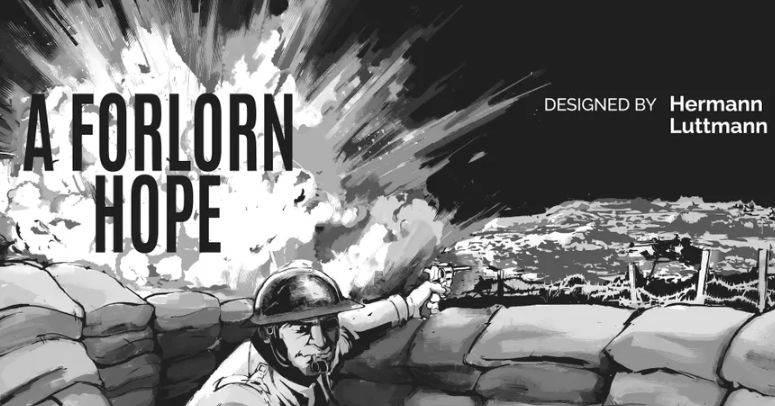
Featured Title:A Forlorn Hope by Hermann Luttmann
Wharf Rat Games is thrilled to announce their debut title, a revitalized vision from legendary designer Hermann Luttmann.
The History: Originally pitched over a decade ago as the mechanical precursor to the hit In Magnificent Style, this game returns to Hermann’s original vision of WWI trench warfare. Here is a link to the Rat Chat show where Hermann discusses the history of In Magnificent Style:
The Gameplay: A solo or 1–3 player cooperative experience using a tense push-your-luck mechanic. Players command a regiment charging across No Man’s Land, balancing bold advances against the threat of becoming pinned under relentless enemy fire.
The Content: Features six scenarios covering iconic battles such as The Somme, Verdun, and The Lost Battalion.
Wharf Rat Games is gearing up to launch their Backerkit campaign on February 10th. Early Bird Special: Back the game on the first day to get it for just $69, a savings of $20 off the MSRP!
You can connect with Wharf Rat Games on the following social media outlets:
1. A Forlorn Hope from Wharf Rat Games Coming to Backerkit on February 10th
Wharf Rat Games is a new publisher recently started by the dynamic duo of Ryan Heilman and Wes Crawford. I have interviewed both of these guys a few times for their own designed games and also hung out with them quite a bit at conventions including Buckeye Game Fest in April 2024 and the World Boardgaming Championships in August 2024. I am really happy for them that they have taken this plunge and created their own publishing company. I know they know games. Have been in the industry for a while now and also have great connections with many designers and would be designers and I am sure that they will bring many quality offerings to our tables over the next decade plus.
But there is more than just their introduction here as they have signed their first game and it is from a designer we all know and love – Hermann Luttmann. A Forlorn Hope places solo players or up to three cooperative players in command of a battalion charging across No Man’s Land to capture enemy trenches during World War I. Success requires careful balancing of bold advances and timely retreats to avoid casualties, maintain cohesion, and keep troops from becoming pinned under relentless enemy fire. Over a decade ago, Hermann pitched a groundbreaking design to Alan Emrich at Victory Point Games—a push-your-luck mechanic within a wargame framework, originally set in the WWI trenches. While the concept was well-received, Alan suggested a Civil War theme instead, leading to the creation of In Magnificent Style, based on Pickett’s Charge at Gettysburg. This game went on to be published by Victory Point Games and later by Worthington Publishing.
From the game page, we read the following:
A Forlorn Hope is an abstract simulation wargame of a typical trench assault, modeling those attacks that were conducted during the First World War (1914-1918). The player represents an attacking regiment of troops consisting of three battalions, with each battalion made up of two or three assault companies (depending on the number of players).
The game uses a “press-your-luck” design philosophy that will challenge you with tough decision-making and risk-taking throughout the game. The goal is for the player(s) to drive their forces across No Man’s Land in the quickest and most efficient manner possible to achieve the best level of victory.
A Forlorn Hope is designed both for solitaire and multiplayer co-operative play. Numerous scenarios are included, starting with a basic assault scenario (which is ideal for learning the intricacies of the game system), then adding multiple historically-based scenarios simulating actual battles from World War I that offer a slightly more complex and layered gaming experience. Each scenario features singular aspects of the historical battle it is simulating, and each will therefore be a unique gaming experience.
The project is set to launch on Tuesday, February 10th.
2. Napoleon at War Deluxe Edition from Decision Games
Over the past couple of years, Decision Games has been going back through their catalog and doing these Deluxe Editions of several of their games including Red Dragon Green Crescent Deluxe Edition in 2024 and Blue & Gray Deluxe Edition in 2025. They now have tabbed several more games for this game treatment and the first that I will share is Napoleon at War Deluxe Edition.
From the game page, we read the following:
Napoleon at War Deluxe Edition reprints the original SPI QuadriGame consisting of four separate battles, each among the most important of the Napoleonic Wars: Marengo, Jena-Auerstadt, Wagram, and the Battle of Nations at Leipzig. This new deluxe edition has a full-color instruction booklet, new counter and map artwork, with 9/16” counters, two back printed 22” x 25.5” mounted game boards, and new player aid cards. The basic rules to all four games in the Napoleon at War Series are standardized. Each game has its own exclusive rules, which include historical set up and reinforcements, special rules, player’s notes, and commentary by the game’s designer. The game mechanics used in this series are based on the popular Borodino-Napoleon at Waterloo game system. The scale of each game ranges from 400 to 800 meters per hex, while each game turn represents between one and two hours of real time. Units range in size from demi-brigades through divisions, with each strength point representing between 250 and 350 men or an equivalent amount of artillery.
Movement is sequential and single-phased. Zones of control are rigid, and combat is mandatory between adjacent opposing units. Stacking is limited to one unit per hex. The Combat Results Table is relatively uncertain, with odds of 4 to 1, or better, necessary to ensure at least a “Defender Retreat” result. Terrain ranges from the Austrian parade grounds south of Wagram to the rough and forested battlegrounds of Jena-Auerstadt. Game length varies from the five-turn First Day Scenario of the Battle of Nations to the 20 game turn Grand Battle Scenario of that same game which simulates the entire three- and one-half-day Battle of Leipzig, the largest battle of the Napoleonic Wars.The games, though graphically enhanced from the originals, remain the same. Now enhance your enjoyment with this new deluxe edition of another SPI classic!
3. Year of the Rat Vietnam 1972 Deluxe Edition from Decision Games
The 2nd game that is being offered up for pre-sale with a new Deluxe Edition is Year of the Rat Vietnam 1972, which was originally designed by John Prados and now redesigned by Joseph Miranda.
From the game page, we read the following:
On 30 March 1972 the North Vietnamese Army (NVA) launched its “Easter Offensive” into South Vietnam, attempting to either win the war decisively or improve the North’s negotiating position at the Paris Peace Talks. Surprised by the large-scale attack, the Army of the Republic of Vietnam (ARVN) rallied, and supported by US airpower, launched counterattacks into the fall, finally repulsing the Communist offensive.
Year of the Rat Deluxe Edition recreates that decisive campaign. Powerful NVA divisions operate alongside Viet Cong regiments and decoys, evading the ARVN while striking quickly at vital towns and bases. ARVN elite airborne, ranger, and marine units respond, creating a tense asymmetrical contest of big unit battles and hard-fought sieges, with increasing American airstrikes and worsening NVA supply capabilities.
This Deluxe Edition enhances the original, acclaimed SPI game design (published during the campaign) with a half-century of research and analysis, providing updated orders of battle and terrain analysis. Three scenarios and fifteen order of battle variants cover a wide range of game options, including operations into Laos and Cambodia.
Additional features include:
• New graphics on enlarged maps and counters
• Expanded Allied airmobile operations and units
• NVA divisional reorganization and tank regiments
• Full 1971–72 US order of battle
• Australian, Royal Thai, Cambodian, and Khmer Rouge forces
• Vietnamese and US Navy riverine units
• ARVN base camps and regional forces
• Extensive optional rules
Year of the Rat Deluxe Edition offers you the opportunity to explore and make decisions in a campaign that changed the course of war and peace.
4. 1812: The Campaign of Napoleon in Russia Deluxe Edition from Decision Games
The third and final game getting a facelift from Decision Games is 1812: The Campaign of Napoleon in Russia Deluxe Edition.
From the game page, we read the following:
Napoleon invaded Russia with 600,000 troops of which only about 110,000 escaped in organized formations. The largest factor in this enormously deadly campaign was supply. The ability of a Napoleonic army to supply itself depended heavily on the surrounding countryside. Areas were stripped of resources to supply the army, which had to move or starve within a very short period. 1812 Deluxe Edition treats this difficulty of command as a central point, through the game’s area depletion system.
1812 Deluxe Editionupgrades the original SPI 1812 Strategic Area Map Game with a full-color rulebook and player aid cards, new artwork, larger counters and an enlarged map on a mounted game board.
Players must battle attrition, supply, and enemy forces to win. 1812 offers three scenarios, starting in June, late August, and early October, each with free and historical set-up options. Optional rules add leaders and fortresses, while new variant rules provide additional leaders, battle plans, and elite guard forces. Other than adding the variant rules, and incorporating clarifications and known errata, no major changes have been made to the original SPI rules.
1812 Deluxe Edition provides you the opportunity to see if Russia falls to Napoleon’s conquest, or survives, spelling the eventual doom of the Napoleonic Empire. Open this new deluxe edition and see if you can change history.
I love a different style and focus of wargame. A game that takes a look at an important but somewhat obscure or rarely addressed topic such as espionage or intelligence. And this month, GMT Games announced such a game in Checkpoint Charlie, which is a solo or cooperative game focused on SIS espionage missions in Berlin in the 1960’s.
From the game page, we read the following:
Checkpoint Charlie is a solitaire or cooperative game of British Secret Intelligence Service (SIS) espionage missions in Berlin in the early 1960s.
West Berlin is an isolated outpost of the Western Powers in the center of the German Democratic Republic (East Germany). East Berlin, on the other side of the Berlin Wall, is a base of operations for Soviet KGB agents and the Stasi secret police. This is a city of spies, a focal point of worldwide espionage in the growing Cold War. In this game, you send your assets (agents) on missions and use your influence and foresight to help them complete objectives before they are detected and compromised by KGB agents. As you play through these missions, you will:
Ensure that an important defector gets safely out of the city.
Make contact with a dissident Russian scientist on the other side of the Berlin Wall.
Gather intelligence in East Berlin and return safely to the West
Entrap a troublesome KGB agent with tempting intelligence.
Sow distrust between KGB and Stasi agents.
Identify a Soviet mole among your SIS agents and wait for them to reveal themselves.
Can you accomplish all of this in secret, as the very public events of the Cold War change the political landscape of Berlin itself?
This is a game about your assets staying one step ahead of the KGB and completing missions without being detected. Each mission starts with a different cast of assets and KGB agents, a set of items that may help complete the mission, and multiple historical events that can change the situation. Victory conditions are specific – getting an asset out of the city, making contact with a new source, or even crossing the Berlin Wall to gather important intelligence and returning without getting caught. There are no victory points or turn limits in Checkpoint Charlie, just objectives your assets must complete before they are compromised or overwhelmed by the growing web of KGB surveillance. The game map includes iconic locations like Checkpoint Charlie, Glienicke Bridge (the “Bridge of Spies”), and the notorious Berlin Hilton, each with unique game effects. You will manage a hand of cards that represent assets, items, and locations on the map. On your turn, you’ll play a card to influence the situation, and when you take a card from the Draw Area to refill your hand, every SIS asset and KGB agent in the city will move and take actions based on which card you chose. New Intel may appear on the map, locations may be placed under KGB surveillance, and Event cards may affect specific locations.
In Checkpoint Charlie, you are not a field agent. You are a planner, a director monitoring the situation but limited in how much you can directly intervene. That sense of influencing the situation but often just having to watch as events unfold is created by the core mechanic of Checkpoint Charlie: the Draw Area below the map. This area contains five face-up location, asset, or item cards. Chits representing each of the tokens on the city map (your SIS assets and the KGB agents) are placed above each of the cards in the Draw Area. After playing a card from your hand, you will draw a card from either end of the Draw Area, and then the remaining four cards will shift left or right to fill the empty position before a new card is drawn to fill the row. In this way, every card in the Draw Area shifts one space whenever you draw a card. This is important because every token in Berlin then moves closer to the location, asset, or item on the card directly below their chit. In the example below, the cards have shifted and the empty spot has been filled. Now the Dentist will move to Mehringplatz. Jester will move one location closer to Checkpoint Charlie, and KGB Agent Svetlova will move toward the 1958 Rambler at RAF Gatow.
This game looks extremely interesting and I am very much excited to learn more about it. I am going to reach out to the designer Russ Brown to get some more information to share.
6. Here I Stand 500th Anniversary Reprint Edition 3rd Printing from GMT Games
Here I Stand is one of the greatest Card Driven Games I have ever played, and we have played a lot in our time. I have played this game more than 10 times and found each experience to be simply sublime, even though it takes 10-12 hours to play. The game now has a 3rd Printing of the Deluxe 500th Anniversary Edition and you need to get you a copy and find someone to play with.
From the game page, we read the following:
Here I Stand: Wars of the Reformation 1517-1555 is the first game in over 25 years to cover the political and religious conflicts of early 16th Century Europe. Few realize that the greatest feats of Martin Luther, Jean Calvin, Ignatius Loyola, Henry VIII, Charles V, Francis I, Suleiman the Magnificent, Ferdinand Magellan, Hernando Cortes, and Nicolaus Copernicus all fall within this narrow 40-year period of history. This game covers all the action of the period using a unique card-driven game system that models both the political and religious conflicts of the period on a single point-to-point map. There are six main powers in the game, each with a unique path to victory.
If you own the original (non-500th Anniversary edition) Here I Stand, here are the upgrades you will find in the deluxe 500th anniversary edition. Enhancements include: 6 brand new cards added to the deck, including Thomas More, Thomas Cromwell, Rough Wooing, and Imperial Coronation. Revisions to over 15 existing cards including Copernicus, Master of Italy, and Machiavelli to allow for more exciting in-game play and additional possibilities for diplomatic deals. A new Chateau construction table is now used to resolve France’s Patron of the Arts home card plays. Several Virgin Queen rule updates are incorporated back into Here I Stand, affecting minor power activation, piracy, space trading, and foreign wars.
There also is included the special 2-player variant which pits the Protestants versus the Catholics in a modified form of the game. But it is still good and this is how we first played the game.
7. Special Component Pack for The Last Hundred Yards Vol. 5: For King & Country from GMT Games
If you didn’t know we really enjoyed The Last Hundred Yards very much as well as Volume 2: Airborne Over Europe. The system is extremely interesting for a tactical game and uses some novel elements in regards to how victory points are scored including a focus on time and casualties. Really an excellent system! Now, even though there are 5 total volumes that have been released, including most recently Volume 5 For King & Country, Mike Denson has forged ahead with an interesting expansion called a Special Component Pack.
From the game page, we read the following:
We are offering this Special Pack for players who purchased The Last Hundred Yards Volume 5: For King & Country because the necessary modules to play all the missions are not currently available. This pack includes all components (German counters and maps) necessary to make Volume 5 a Stand-Alone Game. With this Pack, players will be able to play every mission included in the module.
Components included in the for King and Country Special Zip Lock Pack:
7 double-sided geomorphic maps (14 maps total)
1 full color Rules booklet (latest edition) (44 pgs.)
8. Dice in the Dirt: A Tactical Print and Play Skirmish Game from Michael Shane Mecham Currently on Kickstarter
Recently, I have really been enjoying several Print and Play solitaire wargames. They are inexpensive, easy to create and setup and then most of them have some really engaging and interesting gameplay. This month, I came across a new offering called Dice in the Dirt: A Tactical Print and Play Skirmish Game designed by Michael Shane Mecham and I jumped on it pretty quickly.
From the game page, we read the following:
Dice in the Dirt is a fast, tactical print-and-play skirmish game for two players.
Each player commands a six-soldier squad fighting over a dense, modular battlefield where pressure, positioning, and timing matter more than raw firepower. The game uses blind-bag activation, suppression mechanics, and standard dice to create tense, unpredictable engagements.
Dice in the Dirt is not about killing fast—it’s about pressure. Suppression locks soldiers in place. Actions are scarce. Timing matters more than firepower. Victory comes from forcing your opponent to waste precious moments under fire.
This is a complete, digital-only release designed for quick setup and focused play.
It really seems pretty interesting and the best part about these Print and Play games is that the cost of entry is so low that it is worth taking a chance on. I am a backer and look forward to playing this one.
As of February 1st, the Kickstarter campaign has funded and raised $521.00 toward its $100.00 funding goal with 32 backers. The campaign will conclude on Friday, February 6, 2026 at 9:57am EST.
9. Battle Decisions: Kriegsspiel from Catastrophe Games Currently on Kickstarter
Catastrophe Games is a small publisher who just really puts out interesting games. I have played several of their games and enjoyed them all. Recently, they announced a new game called Battle Decisions: Kriegsspiel designed by Paul LaFontaine.
From the game page, we read the following:
Battle Decisions: Kriegsspiel is a basic Kriegsspiel kit in a box. You will have everything you need to play a game of Kriegsspiel: a map and counter sheet for the umpire and two players, along with a very basic resolution system.
This game benefits from hundreds of hours of face to face and online playtesting, with the system refined to allow an experienced umpire to launch and complete a simple scenario in just over an hour.
The scenario book runs scenarios across time: while most of the scenarios focus on the 19th century, it also shows how to run modern skirmishes (WW2) while allowing ancient battles as well (Alexandria versus the Persian Empire)
But wait, you might ask, how can you run so many and various scenarios off one central Europe map? What Paul did was take the central element of the battle and found a location on the map that most represents the fight. This is an elegant way to allow a single map to be used for multiple battles.
Kriegsspiel began as a past time for Prussian nobles. Eventually a version was presented to their king who then required its use for training Prussian officers. Many attribute some of the Prussian success in the 1870 Franco-Prussian war to the widespread use of the Kriegsspiel amongst the Prussian officer corps.
After the war Kriegsspiel games were used by many nations to train their leaders. Now the descendants of the original Kriegsspiele live on in the form of software driven exercises for staffs at various levels. However the focus on command and control is still the key factor in these modern games.
Battle Decisions: Kriegsspiel offers players a chance to return to form of the original games, with simple counters and maps, allowing players to forge their own tactics and plans.
As of February 1st, the Kickstarter campaign has funded and raised $3,313.00 toward its $500.00 funding goal with 55 backers. The campaign will conclude on Monday, February 2, 2026 at 7:00pm EST.
10. Operation Overlord from VUCA Simulations
VUCA Simulations is a new company on the scene the last few years and they are coming out with some really great looking games. We have played several of their games and always have a great experience with them. One of their newest pre-order offerings is called Operation Overlord designed by Clem. It covers the D-Day invasion and as usual looks to be of the highest quality and production.
From the game page, we read the following:
Operation Overlord is a deep, historically grounded strategic wargame that simulates the Normandy invasion and the critical battles that followed from June to August 1944. One player commands the Allied SHAEF forces, planning and executing the largest amphibious operation in history, while the opposing player takes the role of Oberbefehlshaber West, defending the Atlantic Wall and attempting to delay the Allied advance long enough to alter the course of the war.
Rather than focusing on tactical skirmishes, Operation Overlord operates at the operational–strategic level, where timing, logistics, intelligence, and command structure are decisive. Players maneuver divisions and army corps across a detailed map of Normandy, manage supply networks and reinforcements, execute historical and fictional operations, and influence battles through doctrine, supports, and event cards.
Each month begins with high-level planning: the Allied player secretly schedules strategic and special operations, while the German player designates key cities as Festungen, to be held at all costs. Weekly turns then unfold through intelligence gathering, supply allocation, reinforcement arrivals, and alternating unit activations that combine maneuver and combat into a tense, fluid system. Fog of war is maintained through hidden unit values and simultaneous combat card reveals, ensuring constant uncertainty and meaningful decision-making.
Victory is not measured simply by territory, but by time and consequences. The German player is unlikely to drive the Allies back into the sea—but every week gained has far-reaching implications for morale, resources, and other fronts of the war. Likewise, an Allied breakthrough ahead of schedule can dramatically reshape history. Each scenario and campaign outcome includes historically reasoned consequences that frame the result within the broader context of World War II.
With multiple scenarios (June, July, August, and a full campaign), robust asymmetry, and a strong emphasis on planning and operational art, Operation Overlord offers a demanding and rewarding experience for players seeking a serious, historically informed wargame.
If you are interested in Operation Overlord, you can pre-order a copy for €107,99 ($118.79 in US Dollars) from the VUCA Simulations website at the following link: https://vucasims.com/products/operation-overlord
11. Kawanakajima 1561: Battles of the Sengoku Jidai from Serious Historical Games
A few years ago, a new company called Serious Historical Games released the first in a new series of games focused on the Sengoku Jidai period and the battles of the time. This game was called Nagashino 1575 & Shizugatake 1583: Battles of the Sengoku Jidai and it is part of the Age of the Warring States Series. Since that time they have released Volume 2 and now are getting Volume 3 ready for pre-sale, which focuses on the battle of Kawanakajima in 1561. These games are excellent and overall, the quality of the production is amazing, especially the counters and the colors used for the various clan banners.
From the game page, we read the following:
Kawanakajima 1561, the most epic battle of Sengoku Jidai, is the third volume in the Sengoku Jidai series. The game features a one-sided area map measuring 23.1 × 33.1 inches (59.4 × 84 cm), 216 beautifully illustrated counters, and a 24-page bilingual rulebook (English & French). It also includes two player aids and two scenarios: one historical and one alternative.
The scale represents 300–400 meters per area, 30 minutes per turn, and 500–1,000 men per counter. A full game lasts 2 to 4 hours and is ideally suited for two players. Kawanakajima 1561 is an area-movement wargame designed to deliver intense, fast-paced engagements.
Prepare for swift and brutal battles, where maneuver, timing, and tactical decisions are the keys to victory.
The Battle of Kawanakajima (1561) was fought between the armies of Uesugi Kenshin and Takeda Shingen, the Fourth Battle of Kawanakajima is one of the most famous clashes of Japan’s Sengoku period. Renowned for its daring maneuvers, sudden attacks, and legendary duels, it epitomizes the art of war practiced by rival daimyo at the height of samurai warfare.
If you are interested in Kawanakajima 1561, you can pre-order a copy for 60,00 € ($71.46 in US Dollars) from the Serious Historical Games website at the following link: Kawanakajima 1561 – Serious Historical Games
New Release
1. They Came In Threes! The Final Word in Solo Sci-Fi Madness from Tiny Battle Publishing
I love a good Sci-Fi solo game and have played quite a few over the years. But one that still sticks out in my mind is Attack of the 50 Foot Colossi! from Tiny Battle Publishing, which is designed by Hermann Luttmann. Recently, I saw where Tiny Battle Publishing was offering a multi-pack of these Sci-Fi games and I wanted to share it with you. The multi-pack is called They Came In Threes! The Final Word in Solo Sci-Fi Madness that contains 3 full solo games including Space Vermin from Beyond!, Invaders from Dimension X! and the aforementioned Attack of the 50 Foot Colossi!.
From the game page, we read the following:
They came from beyond time, beyond reason… and they brought friends.
Strap in, Commander—this is the ultimate solo sci-fi slugfest! They Came In Threes! cranks the chaos to maximum warp. For the first time ever, three of designer Hermann Luttmann’s bizarre, brain-busting solo science fiction games are gathered in one battle-scarred box. Lead brave Galactic Marines against interdimensional horrors, titanic biomech monstrosities, and insectoid swarms that shouldn’t exist—but definitely do.
This deluxe package includes:
• Invaders from Dimension X! – A reality-warping solo game where your foes don’t follow logic… or sanity.
• Attack of the 50 Foot Colossi! – Massive, rock-like entities stomp across a doomed world. Can you outwit their merciless programming?
• Space Vermin from Beyond! – Bugs. Big ones. Hungry ones. And they’re coming for your outpost in waves.
• A Slick New FAQ & Scenario Book – Includes 3 scenarios, 8 counters for Invaders from Dimension X and an FAQ for each title.
Each game offers fast, intuitive solo play with unpredictable enemies, evolving scenarios, and that signature “what the heck just happened?” flavor. Whether you’re repelling alien warlords, dodging titanic footfalls, or holding the last line against a tide of teeth and slime, They Came In Threes! delivers old-school thrills in glorious technicolor terror. Three games. One box. Unlimited weirdness.
Attack of the 50 Foot Colossi!
I have played the Attack of the 50 Foot Colossi! game and have done the following Action Point posts on the blog:
2. Field Commander: Robert E. Lee from Dan Verssen Games
I have had various communications on social media with a fledgling designer named Vince Cooper over the past few years as he has embarked on a design odyssey for a few different wargames. Both he and I share an affinity for the designs of David Thompson and especially for the Valiant Defense Series. Through these online communications, I became aware of Vince’s first design called Field Commander: Robert E. Lee. I have played several of the games in the series including Field Commander: Alexander and Field Commander: Rommel and enjoyed them both. So my interest has been immediately sparked for this game. The game had a successful Kickstarter campaign last year and is now shipping and available for purchase.
From the game page, we read the following:
Field Commander – Robert E. Lee builds on the design and gameplay of Field Commander – Napoleon (currently ranked #97 in the Wargames category on BGG!!) to put the player firmly in control of the Army of Northern Virginia during the American Civil War, with the Union forces controlled by an AI.
The game includes 5 campaign and to keep the campaigns decision-heavy and focused on the critical aspects, some of the dates for the games noted may be different to the historical dates of a longer campaign. The campaigns include:
3. Battle Hymn Vol. 2 – Shiloh and Bentonville from Compass Games
We really enjoyed our play experience with Battle Hymn Volume 1: Gettysburg and Pea Ridge from Compass Games in 2019. The rules were very approachable with lots of good details that were based in history, a good combat system that keeps the battle interesting and engaging but is simply withering and the game evokes a lot of emotions. I played as the CSA and it was heart breaking knowing the outcome and seeing what those men would have encountered going against those formidable Union defenses as they had the high ground and were not going to give it up easily. The newest volume in this series is now out and is called Battle Hymn Volume 2 – Shiloh and Bentonville.
From the game page, we read the following:
Battle Hymn Volume 2 is the long-anticipated sequel game release to Volume 1 and includes two complete games: Shiloh and Bentonville. Battle Hymn is the new brigade-level system based upon the latest research into Civil War combat. This new entry introduces an extension map for Gettysburg (Volume 1) for a complete alternative history of the entire battle. Designed by Charles S. Roberts Award-winning designer Eric Lee Smith.
Shiloh: The First Great Battle depicts the two-day battle of Shiloh. (4 Scenarios & 1 Full Campaign)
On April 7th and 8th of 1862, the Battle of Shiloh was fought in Tennessee along a sluggish river and centered on a church called Shiloh. America would never be the same. The first day of battle harvested more casualties than all of America’s previous wars combined. It got worse. While the Confederates caught Grant’s army off guard, he stood his ground; reinforcements arrived, and he counter-attacked and won the battle. As a reward, he was demoted. But Lincoln spared Grant his career, and the result is history.
Bentonville: The Last Great Battle simulates the final major battle of the war. (4 Scenarios)
Outside Goldsboro, North Carolina, on March 19th, 1865, Confederate forces under General Joseph Johnston made one last desperate attempt to destroy one wing of Sherman’s army. The Confederates caught them by surprise, and it was a close-run thing for an afternoon, but it ended in tragedy and defeat for Joe Johnston. It was the last major battle of the war and a needless pity.
Gettysburg 1862 is pure conjecture and simulates a completely hypothetical battle. (1 standalone Scenario, 2 new Scenarios combining Vol 2 with Vol 1)
The lost order was never lost, Antietam never happened, and the Confederates entered Gettysburg a year early, facing George McClellan rather than George Meade. Stonewall Jackson is alive; the cavalry for both sides are there, and the meeting engagement happens along different lines.
Also includes rules to modify existing scenarios to add the new map to Vol 1 Scenarios & Full Campaign.
4. Sensuikan: Japanese Fleet Submarines, 1941-45 from Compass Games
Another solitaire game…..from Gregory M. Smith? Wow, he is a machine! Sensuikan: Japanese Fleet Submarines in WW2, 1941-1945 is a solitaire, tactical level game that places you in command of a Japanese Fleet submarine from Pearl Harbor until the end of the war in 1945. After choosing a class, your mission is to conduct special missions as assigned by the Combined Fleet. The player will take their submarine on assigned missions with the objective to complete said missions, as opposed to necessarily sinking merchant vessels (although that is sometimes an objective). You will be advancing your crew quality and increasing your commander’s rank and awards—all while remembering you have to make it home amidst diminishing odds of survival as the war progresses.
From the game page, we read the following:
A fascinating historical addition to Sensuikan is three new modules: the Aircraft Module, the Midget Sub Module, and the Kaiten (suicide torpedo) Module. These modules facilitate play if a player is assigned to a submarine that is equipped with one of these special capabilities. The system is packed with rich technical detail based on the various submarine classes used by Japan. There are no less than 17 classes of submarine to choose from. These include:
Types A, B, C
Junsen (3 classes)
Kirai-Sen Class
Kaidai (5 classes)
Type B. 3 and Type C. 3
Sen-Toku and Sen-Taka Classes
Type A (Modified)
The different classes have historical equipment, sometimes including aircraft in watertight hangars, midget submarines, and later in the war, suicide torpedoes. You may be assigned to special missions based on your class’s capabilities – perhaps a midget submarine attack on Pearl Harbor or Australia, the bombing of the U.S. west coast, or possibly even an attack on the Panama Canal.
But, as with Greg’s best solitaire games, this game doesn’t just focus on the hardware you use to complete missions but the crew also plays a pivotal role as they have skills and can advance with experience throughout the campaign.
…the human aspect of the war is captured as the submarine Commander (the player) and his crew can improve over time via skills acquisition. In addition to having combat modules to facilitate ease of play, the game includes a major change by including the “Major Event” markers that track the war’s progress and possibly involve the player in supporting the Major Events as they occur.
5. A Distant Plain: Insurgency in Afghanistan 4th Printing from GMT Games
As you may know from my previews and reviews, I love the COIN Series of games by GMT Games. They are a fantastic vehicle to allow me personally to engage in the struggles throughout history between great powers and those that are considered rebels or traitors. Each of the volumes that I have personally played is a highly enjoyable delve into the time period depicted. The game mechanics are so well designed, that I am allowed to totally immerse myself not only in the theme, but actually in the philosophy, mindset, motivations and direction of each of the factions. A Distant Plain is no different for me and I am truly pleased with this game and love it. And am not surprised at all that it has now had a 4th Printing as it really is just that good.
From the game page, we read the following:
Afghanistan—scene of tribal, ethnic, colonial, and Cold War conflict across the ages. Into this cockpit dropped a multinational post-9/11 coalition to root out al-Qaeda and replace the hardline-Islamist Taliban regime that harbored it. A quick invasion and regime change portended quiet reconstruction and good governance, but it was not to be so. In their sanctuary across Pakistan’s border, the Taliban rebuilt for an insurgency that would ensnare the Coalition in the tangle of Afghan rivalries, shifting allegiances, and warlordism that the West could at first only distantly grasp. A Distant Plain teams Volko Ruhnke, the award-winning designer of LABYRINTH—The War on Terror, with Brian Train, a designer with 20 years’ experience creating influential simulations such as Algeria, Somalia Interventions, Shining Path, and many others.
A Distant Plain features the same accessible game system as GMT’s recent Andean Abyss but with new factions, capabilities, events, and objectives. For the first time in the Series, two counterinsurgent (COIN) factions must reconcile competing visions for Afghanistan in order to coordinate a campaign against a dangerous twin insurgency:
As the Coalition, how will you secure popular support for an Afghan Government that cares more about corrupt patronage and control than legitimacy? Your high-tech forces are capable, but your publics are pressuring you to keep your footprint small: how will you stabilize this complex country and get out?
As the Government, how can you run the country when your foreign partners continually redirect your war effort? You can reshape Afghanistan’s human terrain by encouraging the resettlement of millions of refugees, and your Coalition-trained forces are potentially the most numerous of any faction. But they are unsteady, and your war chest is not your own: how will you keep your allies’ firepower in-country long enough to ensure that you are the top dog once they leave?
As the Taliban, how will you come back against the potent forces arrayed against you? Islamism, Pashtun ethnic solidarity, and your Pakistani friends behind you will help you recruit and move with ease amidst the enemy. But not all Afghanistan is Pashtun, its warlords are treacherous allies at best, your fighters are seasonal, and Pakistan’s word is ever uncertain: can you sting the occupier and his puppets to reawaken Islamic revolution without drawing an unrelenting fire upon yourself?
As the Warlords, how will you secure your traditional ways against the intrusive centralizers of Kabul and the Taliban? You profit from the country’s lucrative opium crop, and your money can talk loudly to the Government’s venal officials. But your fighters have neither the equipment of the Coalition, the numbers of the national army and police, nor the fanaticism of the Taliban: how will you block this latest cast of combatants from unifying the country and imposing their rule on you?
Afghanistan is not Colombia!
A Distant Plain adapts familiar Andean Abyss mechanics to the conditions of Afghanistan without adding rules complexity. A snap for COIN Series players to learn, A Distant Plain will transport them to a different place and time. New features include:
Coalition-Government joint operations.
Volatile Pakistani posture toward the conflict.
Evolution of both COIN and insurgent tactics and technology.
Government graft and desertion.
Coalition casualties.
Afghan returnees.
Pashtun ethnic terrain.
Multiple scenarios.
A deck of 72 fresh events.
As with each COIN Series volume, players of A Distant Plain will face difficult strategic decisions with each card. The innovative game system smoothly integrates political, cultural, and economic affairs with military and other violent and non-violent operations and capabilities. Terror, drug trafficking and eradication, highway extortion and sabotage, drone strikes, and many more options are on the menu.
6. Men of Iron Volume VI: Purgatorio: Battles between the Guelphs and Ghibellines from GMT Games
There are some systems that are just very playable. They are well designed, cover an interesting historical period or happening and have very interesting mechanics to boot. Such a series is the Men or Iron Series designed by Richard Berg. We played the new Tri-Pack in 2020 and really enjoyed the system. It was just really playable and ultimately created some great narratives. Since that time, we got a copy of Volume V Norman Conquests but have yet to play it (I am actually clipping the counters right now). This new volume is set in Italy and looks to be really good!
From the game page, we read the following:
The struggle between monarchs in Europe, particularly between the Holy Roman Emperor and the Pope, would spawn well over a hundred years of conflict in Italy. The Investiture Controversy caused a split between the Italian city states and even the people within the city states. Guelph was the name given to those who supported the Papacy—while the Ghibellines were the supporters of the Holy Roman Empire. Guelph cities tended to be farther away from the Papal States and closer to the Holy Roman Empire, and Ghibelline cities tended to be farther away from the Holy Roman Empire and closer to the Pope’s temporal power.
Battles raged across Italy from the mid-1100’s to the mid-1300’s with both sides ending up on top at one time or another. This sixth Men of Iron game (Men of Iron Volume VI: Purgatorio: Battles between the Guelphs and Ghibellines) covers some of those battles: beginning with Frederick Barbarossa trying to recapture rebelling provinces in Italy in the late 12th century, taking a spin through the 13th century with a few battles that spelled the end of direct Hohenstaufen rule of Italy, and ending with a war that myth says was fought over the theft of a bucket from one city by another!
The battles include: Legnano 29 May 1176 – Frederick Barbarossa fights the Lombard League for control of northern Italy.
Cortenuova 27 November 1237 – Frederick II, grandson of Barbarossa, tangles with the second Lombard League for control of northern Italy.
Montaperti 4 September 1260 – Florence and Sienna fight one of the bloodiest battles in medieval Italy—as seen on TV, or in GMT’s Inferno!
Benvento 26 February 1266 – Manfred, King of Sicily, dies in battle in southern Italy against Charles I, King of France, earning Charles I the title King of Sicily.
Tagliacozzo 23 August 1268 – Conradin III, King of Jerusalem, is captured and executed after a battle in southern Italy against Charles I, King of France and Sicily.
Campaldino 11 June 1289 – Florence and Arezzo fight in northern Italy. Famous Italian poet Dante Alighieri fought in the battle. Later, his brand of Guelph would lose power in Florence, and he would be forced into exile.
Zappolino 15 November 1325 – Modena and Bologna fight, not over an oaken bucket stolen from a well, but over a long standing feud replete with raids and reprisal that had occurred almost a century.
7. Infernal Machine: Dawn of Submarine Warfare from GMT Games
Jerry White is one of our favorite designers. He focuses on mostly solitaire wargames but he is very good at what he does and has a real talent for making a playable game out of any historical situation. Over the past couple of years, titles likes Atlantic Chase, Storm Above the Reich and Skies Over Britain have been released by GMT and are simply fantastic games that tell a great narrative. A few years ago, his newest title was announced that covers the development of submarine warfare during the American Civil War and is in partnership with Ed Ostermeyer called Infernal Machine: Dawn of Submarine Warfare. This game looks great and I am very much looking forward to playing it.
From the game page, we read the following:
Infernal Machine: Dawn of Submarine Warfare is a solitaire board game that casts the player in the role of inventor/entrepreneur in mid -19th century America. The game is set during a historical moment when the business environment has gotten rather dynamic – it is the tumultuous landscape of the American Civil War. The player’s task is to design, build, and put to use a submarine during that war.
Infernal Machine can be played either in scenario form or campaign. In a campaign, you can choose the city or port where the project’s machine shop will be located. Since construction materials and labor costs money, your role as entrepreneur comes into play as you seek out Investors to join your team; their cash will provide the funds that help your Fishboat take shape. As Inventor, your design gives form and substance to the size and shape of your submarine, and to its capabilities. Will it carry a snorkel? Will its prow have a spar-mounted torpedo as the primary weapon?? Will it tow a captive mine instead? Will it have dive planes? Will it be powered by the muscle strength of a crew cranking the propeller or will you install a boiler engine?
To bring blueprints to life, you will need to hire Mechanics, whose engineering expertise keeps your infernal machine’s construction on schedule. Once assembly is complete, your Mechanics can join the crew, using their repair capability to keep the machinery and the vessel running smoothly. Journeymen can also lend a hand on the shop floor and inside the Fishboat, while Sailors bring nautical know-how as well as sheer brawn.
While your machine shop is busy getting started with the submarine’s construction, the game reminds you that the war drags on, and it is an unstable business environment. Prices for materials and labor fluctuate. Current events can affect your construction schedule and your machine shop’s performance. Public, and even personal circumstances may force your hand. You may decide to push your Fishboat into the water before you feel it is optimal, or push your crew into battle with little training. So many decisions. Where do you turn and how do you find out what you need to know?
As usual, thanks so much for reading along and sticking with me this month as I navigated through the many websites and game pages looking for new and interesting games to share.
Finally, thanks once again to this month’s sponsor Wharf Rat Games!
Wharf Rat Games is a new publisher recently started by the dynamic duo of Ryan Heilman and Wes Crawford. I have interviewed both of these guys a few times for their own designed games and also hung out with them quite a bit at conventions including Buckeye Game Fest in April 2024 and the World Boardgaming Championships in August 2024. I am really happy for them that they have taken this plunge and created their own publishing company. I know they know games. Have been in the industry for a while now and also have great connections with many designers and would be designers and I am sure that they will bring many quality offerings to our tables over the next decade plus.
Wharf Rat Games is a Baltimore-based board game publishing company whose mission is to produce high-quality, light-to-medium-weight board games with engaging themes in historical, science fiction, and fantasy genres. With gameplay designed to last under 90 minutes, their games aim to captivate both casual and experienced players. But there is more than just their introduction here as they have signed their first game and it is from a designer we all know and love – Hermann Luttmann. A Forlorn Hope places solo players or up to three cooperative players in command of a battalion charging across No Man’s Land to capture enemy trenches during World War I. Success requires careful balancing of bold advances and timely retreats to avoid casualties, maintain cohesion, and keep troops from becoming pinned under relentless enemy fire. Over a decade ago, Hermann pitched a groundbreaking design to Alan Emrich at Victory Point Games—a push-your-luck mechanic within a wargame framework, originally set in the WWI trenches. While the concept was well-received, Alan suggested a Civil War theme instead, leading to the creation of In Magnificent Style, based on Pickett’s Charge at Gettysburg. This game went on to be published by Victory Point Games and later by Worthington Publishing.
They are now gearing up to launch this interesting game on Backerkit and I reached out to Hermann to get some more information and understanding of the game.
Grant: What is your upcoming game A Forlorn Hope about?
Hermann: A Forlorn Hope is an abstract simulation of six different World War I trench warfare battlefields, using a push-your-luck system that allows the player to experience the tension, frustration, and futility of these trench assaults across No Man’s Land. Players will try to push their battalions to victory in six different scenarios – Neuve Chapelle, 1st & 2nd Ypres, Verdun, The Somme, Passchendaele, and the Meuse-Argonne (The Lost Battalion). Each scenario is quite different, with unique elements, mechanics, terrain features, events, and victory conditions.
Grant: What is the meaning of the title? What did you hope to convey about the game to the players?
Hermann: The dictionary definition of forlorn hope is “A persistent or desperate hope that is unlikely to be fulfilled”. There is hardly a better way to describe the madness of the four years of trench warfare during the First World War. Interestingly, a “Forlorn Hope” is also a military term for a group of soldiers who are assigned the riskiest (and potentially most suicidal) mission, often involving infiltration, ambushes, or scouting missions. For the players, we felt the title was perfectly descriptive of what to expect in the game play. These are tough, grueling scenarios that will require the player to grind out their assaults to their best ability. And yes, the friction of war in this game is a cruel, un-welcomed participant.
Grant: Who is this new publisher and how did you come to do their first game?
Hermann: The publisher is a brand new company called Wharf Rat Games. It was founded by Ryan Heilman and Wes Crawford, both fellow game designers who also became good friends of mine as we worked on other projects together and just hung out at conventions. That I was honored with the opportunity to design their first published game and it was honestly totally by accident! They were interviewing me for their Rat Chat video series and somehow my In Magnificent Style design came up in conversation. I happened to mention that the original idea for the unique push-your-luck mechanism I came up with for that game was actually a World War I trench warfare game. Victory Point Games, who published the original IMS, thought that subject matter was not an easily marketed subject for a wargame, so we changed it to Pickett’s Charge. Well Ryan and Wes asked me if I would like to fulfill my original dream for the mechanism because they really liked the idea of covering trench battles. And here you have it!
Grant: Why was this a subject that drew your interest?
Hermann: I’ve always found a particular interest in World War I, maybe because it was a subject about which I knew few details, but every time I explored it deeper, it became more fascinating. There are just so many interesting aspects to the various nations involved in the conflict and the widespread fronts where such vicious fighting occurred. It just captivated me and then even more so when I discovered there were relatively few wargames covering the war, at least in the early days of wargaming. When I got into actually designing wargames, I wanted to challenge myself to do unusual games and when looking for relatively under-gamed and obscure topics, trench warfare loomed large. So, I set out to figure a way to make trench warfare entertaining for a game player. A tough task, to be sure, but I stumbled upon the idea of doing it as a solo design with an “against the wind” type of push-your-luck approach.
Grant: What is your design goal with the game?
Hermann: Well, as with any of my game designs, my #1 goal is to make an entertaining game experience that players will want to come back to constantly. I want players primarily to have fun, but also to have some challenging decision-making to ponder, topped off with some genuine surprises. In this game design, I want players to explore the various types of historical trench assault situations, which can be quite varied. Each scenario is unique and highlights a different aspect of attacking across No Man’s Land. At the same time, I hope players learn a little something about each of these battles and then perhaps will be interested enough to want to explore a bit deeper into these fascinating engagements.
Grant: What from trench warfare during WWI was important to model?
Hermann: Actually, the near helplessness of your troops crossing No Man’s Land and the fact that you are left to fate! You can direct your men to a certain degree…pointing them in the right direction and gauging when they should “hunker down” and take shelter…but otherwise it’s “dancing through raindrops”. What I did with this design is that you do have control of the order in which you move your units and how far (unless the enemy interferes with your plans, of course). I also added the “Wave” mechanic where you want your men to remain in as long a connected line across the battlefield as possible. Not only is this realistic, but a successful wave will earn you additional Tactics Chits, which will increase your units’ abilities and help mitigate against bad luck. So, you as the player are trying to advance against the enemy’s “wall of fire” as quickly as you can, but also trying to maintain order- two opposite forces pulling you apart, and something that a commander on the Western Front had to deal with. Yes, that can be frustrating but it’s also quite fun. You cannot know or control where the enemy artillery will fall – and that’s about as realistic as you can get. You pray and hope and push…and that’s the WWI tension I want to model.
Grant: What sources did you consult about the details of the history? What one must read source would you recommend?
Hermann: Oh, boy – honestly, there is no one book I used as these scenarios cover multiple battles. I researched each battle from the various books I own, on the internet, and I watched one or more documentaries on You Tube for each of the battles. My main source to get a framework for most of the early- to mid-war battles was The Western Front 1914-1916 by Michael Neiberg. Otherwise, there are numerous books covering each of the Western Front trench battles in greater detail.
Grant: What other games did you draw inspiration from?
Hermann: None actually…other than my own. This game is closely related to In Magnificent Style, Crowbar! The Rangers at Point du Hoc, and the upcoming Kill All Fermitians! (formerly Volters Lead the Way! and is being re-published by Flying Pig Games). Some of the games that I did play in the past, and which gave me hope that I could make a decently entertaining trench game, were Landships (Clash of Arms) and Trenchfoot (GDW).
Grant: How does the game use press your luck?
Hermann: Essentially there are two aspects to the push-your-luck mechanic in this game. One is that you want to get your units to voluntarily Hunker Down before the last Cohesion Cube is lost – this is called a Catastrophic Cohesion Loss. Units that are not Hunkered Down when this happens will be made Pinned, and that makes it harder for them to activate in the next turn (as they start that turn as Shaken units). Hunkering Down in time means the unit has huddled, taken cover, and is regrouping safely. It will begin the next turn without penalty. So, the player pushes their luck by gauging how far to move a unit before Hunkering Down and ending its current turn but thereby being in good shape to start the next turn. The other aspect is that the player will be compelled to keep units in a Wave – a chain of adjacency to each other – to gain the greatest number of new Tactics Chits. Therefore, the player needs to determine how long to keep units active in order to maneuver them into a Wave, but then risking being caught in the open and thereby Pinned when cohesion is lost.
Grant: What type of experience does this create? What are the toughest decisions forced on the players?
Hermann: Well hopefully, as with all my push-your-luck game designs, a sense of constant tension and discomfort! Because of the nature of the Activation and Event Cards, you never know when things will get really rough, really fast. Artillery barrages can land directly on your units – or just miss them. These can cause units to be forced to become Pinned, ending their turn immediately and making it tough to get them going next turn. Therefore, with each decision by the player whether to push another turn or not, there is never a comfort zone where you think “all is well”. The game system will keep you on your toes and always second guessing yourself – and that’s the experience I want to see players having as they attempt to navigate No Man’s Land in WWI.
Grant: What different player counts does the game handle?
Hermann: I suspect most players will be interested in this as a solitaire game, but in fact it does accommodate two or three players as well. In these counts, players will each control one Battalion and work cooperatively with the other player(s). In the case of the 2-player game, players will alternate control of the second (middle) Battalion. Scoring remains the same, with players sharing in the victory or defeat.
Grant: How does the solitaire game function? How does the AI prioritize its decisions?
Hermann: The player draws a hand of Activation Cards each step. Every card has a theme…either Suppressed, Slog, Advance, or Rush…and a set of matching results for cohesion loss, movement, and casualties inflicted on the unit. The player assigns each card to a unit and that unit must then abide by the directions and effects on that card. Usually, the player has some agency in how that assignment can occur. But if one or more “Draw Event Card” cards is drawn, the player must immediately draw an Event Card and apply its effects before continuing on with the activation. This also has the reciprocal detrimental effect of reducing the player’s hand size for this step’s assignment. If you have fewer cards than units, then you must draw the top Activation Card and blindly assign it a unit. There are a number of ways to help mitigate bad draws and results…the player has Tactics Chits to apply if needed and Officer Cards that can be used for certain special abilities. The AI is the deck of Activation and Event Cards, and the player needs to become familiar with what the Activation deck has to offer to make better calculated decisions. In the case of the Event deck, it is mostly random effects (such as for artillery bombardments and machinegun fire) but does prioritize counterattacks and other events against the most advanced player units. There are also Scenario Event Cards in most scenarios that create events specifically tailored to the battle you are currently simulating.
Grant: What has been your most challenging design obstacle to overcome with the game? How did you solve the problem?
Hermann: Honestly, the hardest thing we struggled with was not mechanical or procedural or thematical…it was making sure that the game was balanced for the player. In other words, that the player in every scenario was sufficiently challenged with a competitive, but not impossible, game. That means gauging how severe the Event and Activation Cards are, how many Tactics Chits to allow, how many Officer cards to be made available and how strong their powers are, and how variable and deadly the combat system is. Oh yeah – and how many Victory Points to award and penalize for each victory condition. And after you’ve taken your best starting estimate of where and how these factors should fall, the only way of getting them right is through trial and error, and tons of testing and demoing. And there’s really no magic formula to solving that issue, other than to hammer through the game and constantly bend, spindle, tweak, fudge, and edit.
Grant: What is the layout of the game board?
Hermann: Gamers familiar with In Magnificent Style and Crowbar will recognize the game board immediately. On the player side is the first row, representing the home trench. Then there are a series of nine more rows extending to the far side of the map, ending in a final row representing the enemy trench. There are also nine columns, each of which is occupied by one of the nine player units. In addition, the board is segmented into three No Man’s Land Zones of rows…green (the closest to the player), blue (in the middle), and red (closest to the enemy side of the board). These zones have a number of important effects on game play. Finally, there are three Battalion Zones of columns – 1st Battalion (left side), 2nd Battalion (middle), and 3rd Battalion (right side)…into which is deployed the three units of each of the three Battalions.
Grant: What is the anatomy of the counters?
Hermann: Well, there are no unit counters used in this game! Each of the player’s nine units is represented by a unique wooden piece, showing hand-drawn artwork highlighting the typical soldiers deployed by each nation in the game (there are four armies included – German, British, American, and French). There is no other information on the standees as it is not required for gameplay. There are other numerous cardboard markers used to track information or to be used by the player to perform certain game functions.
Grant: What different type of units are available?
Hermann: There is only one type of unit, technically speaking. The unit pieces represent the generic units fielded by the army you are controlling. Some scenarios will designate if the units represent a unique type of unit. If so, the scenario instructions tell you what your units can do differently during this scenario than the typical unit.
Grant: How does combat work in the design?
Hermann: Combat is pretty straightforward and fun, using custom combat dice. There are two types of combat…Event Combat (generated by an Event Card) and Assault Combat (generated when you move a unit into the same space with an Enemy Unit or vice versa). The dice handle both types of combat resolution. Each face of the die has a letter code that is utilized when resolving Event Combat. This letter tells the player if any Hits are scored on the affected Battalion, if the unit must retreat, and if it must Hunker Down. In the case of Assault Combat, each face of the die has a number value. Both sides in an Assault Combat will roll a number of dice, depending on the value of the enemy unit (shown on its counter) or, for the player’s unit, the use of Tactics Chits, Officer abilities, and the presence of supporting friendly units. All dice are rolled at once and the number values for each side added together into an Assault Combat total. This will yield a victory for either side or a stalemate result.
Grant: How does the game use cards? Can you share a few examples of cards and explain their use?
Hermann: Activation Cards are used to move and fight with your units while Event Cards are random events that will affect your units in various ways (or not, if you get lucky). Each step, you draw a number of Activation Cards equal to the number of available activated units, plus one.
For example, you draw three cards when you have two eligible units to activate (there are only two available units in this example because the third unit is finished for the phase, due to it being Hunkered Down or Pinned). You look at the three cards and if one or more is a “Draw Event Card” card, you draw an Event Card immediately and resolve it.
If it’s the Event Card shown above, the enemy machineguns are issuing sweeping fire across your advancing forces. You check areas “A” and “B” to see which of your units are located in those areas (there could be up to six units in both areas!). You then roll one die against each such eligible unit and apply the letter result rolled on that unit.
Then you discard the “Draw Event Card” Activation Card and you now only have two Activation Cards to choose from. One card is assigned to each of the two units you have left to activate, and its instructions are applied to each unit.
For example, the above “Advance” Activation Card is read from top to bottom as follows:
The top (yellow) entry is the possible loss of cohesion. Because there is a “1” shown in the icon, this means that one Cohesion Cube (the scenario will tell you how many you start with) is discarded. If this is the last cube in your supply, there is an immediate Catastrophic Cohesion Loss and any of your units that are not Hunkered Down or already Pinned are made Pinned. This ends the turn – you count victory points earned, reset all the markers and Officer Cards, and begin a new turn, but starting with a fewer number of cohesion cubes to use.
The middle (red) entry is the number of Hits this unit’s Battalion takes. Hits are recorded by Battalion, not by unit, using a Battalion Hit Infliction Track. In this case, because there is a “2” in this icon, there are 2 Hits inflicted on the Battalion and this is immediately recorded by the player.
The bottom entry is the Movement allowance for the unit. The color of this icon and the graphic of the soldier’s posture indicate the maximum number of spaces the unit can move forward (towards the enemy only) and the manner of the move (Normal, Cautious, or Crawl). Normal is a standard move forward with no impediments; Cautious is a Normal move but only if the unit is not moving from one Zone to another (like from the Blue zone to the Red zone); Crawl is used to move a unit that is Shaken (removing the Shaken marker) and/or moving from a Shellhole. On the example card, there is a “3” in the Movement Allowance icon so the unit move up to 3 spaces using Normal movement procedures.
Grant: How is victory achieved?
Hermann: The player scores, and loses, Victory Points (VP) throughout gameplay, and at the conclusion of the scenario. Each scenario lays out exactly what conditions are needed for the player to score, and lose, VP. This is normally a combination of how much progress each of your units makes toward the enemy trenches, capturing enemy trench spaces, and the occurrence of Catastrophic Casualties (that’s when a Battalion accumulates more than 10 Hits). Each scenario may also have entirely unique ways to gain and lose VP, depending on the historical battle situation being depicted. The player totals their VP and compares that total to the narrative table that provides the level of victory or defeat and what would have happened in the battle at your level of achievement.
Grant: What type of experience does the game create for the players?
Hermann: Well, this kind of design attempts to give the players an appreciation for the frustration, sacrifice, and difficulty of conducting trench assaults during the First World War. Obviously, I can’t honestly replicate the true horror of these events, but I think playing through a tough game like this at least gives a glimpse into the absolutely brutal experience these men faced on the trench lines. Rather than focus on that death and destruction, the game abstractly attempts to give the player the feeling of commanding these troops and leading them on an almost insurmountable mission, under dire circumstances, and against nearly impossible odds. The scenarios included in this game were chosen for the drama, strategy, and historical significance offered by the battles they represent. And by boiling all these factors down to a simple push-your-luck mechanic, with the requisite amount of thematic bells-and-whistles to create the narrative, I think players will at least be challenged, intrigued, and curious about not only exploring all the scenarios and situations, but perhaps even researching the actual details of the horrific experiences of these soldiers. To that end, we’ve also included on every Activation Card an actual quote from a soldier, officer, or author who lived through these battles and hopefully conveys the horrors of trench warfare.
Grant: What are you most pleased about with the design?
Hermann: One thing I’m very pleased with is the amount of narrative detail and variety we managed to get into this design. There are six scenarios contained in this first effort, but two of the scenarios actually contain multiple games to be played, kind of mini-campaigns. And each scenario feels so different than the others. Secondly, I am so pleased by the development and production support from Wharf Rat Games … specifically, Ryan and Wes. They are not only terrific designers and developers in their own right, but they’re beginning a company here that cares about providing high-grade production quality and customer service. This entire game package will be an attractive, well-produced, comprehensive, accessible, and highly replayable product and I am very appreciative and proud of that.
Go sign up for the game’s prelaunch at Backerkit and check out the art, news, and upcoming interviews at https://www.backerkit.com/call_to_action/12a5e9bc-4ce6-4667-8f62-b2df3ccbf9fd/landing and get a free downloadable print-and-play game called A Summer in Sarajevo designed by Ryan Heilman. Can you save Franz Ferdinand from his assassins?
Grant: What other situations could this system be used in?
Hermann: This style of game play is designed for any era…even fictional ones…where one side is primarily static, on defense, and tough. The basic idea is that the player is pushing their luck against a tough defending opponent and their “wall of fire”. However, that defensive enemy is still capable of launching localized attacks of their own, so that even though a static line is being faced, the enemy can still jump out and sting the player. Any situation that fits that set of criteria can work in this system. I have ideas for more World War I battles that will fit in this series, but we’ll first see how well it is received. But I am open to suggestions as to how to convert this framework to almost any other historical era or fictional setting that will work.
Grant: What other designs are you currently working on?
Hermann: Oh boy…every time you ask me this, the list gets longer! OK…here’s what’s cooking:
GMT Games – A Hell So Terrible: Verdun 1916 (on the GMT P500 right now). Also, the More of a Bad Thing expansion for The Plum Island Horror is now out and available. I will also be working on a post-apocalyptic design called Heavy Metal Thunder that is sort of an “express” version of the Plum Island Horror engine. It is designed to give players the same kind of narrative and cooperative experience as Plum Island Horror, but in about half the time and even more accessible as far as rules weight.
Blue Panther – Dawn of the Zeds: Designer Edition. Yes – a brand new edition of the Zeds franchise with some new and better mechanics. Also, I need to work on the next Tattered Flags game (Antietam’s Cornfield) and the next Napoleonic solo game (probably on Borodino).
Revolution Games – They March Against Us: Leipzig 1813 (the first of the Bonaparte’s Swords Series…which will be Napoleonic Blind Swords).
Flying Pig Games – Kill All Fermitians! (formerly Volters Lead the Way!, a science fiction push-your-luck game). And we are beginning work on A Wild Primitive Madness, the next Black Swan Series game covering The Battle of Antietam.
Jackl Games – More Brains! (a zombie push-your-luck game).
Unknown Publisher – White Mud (a tactical wargame on the Battle of Tuyuti, fought during the War of the Triple Alliance and bloodiest battle ever fought in South America. This was called the “Waterloo of South America” and is such an interesting engagement).
Unknown Publisher – Miracle Along the Marne (a Black Swan style of wargame covering the Battle of the Marne in 1914).
You asked!
Thanks again for letting me do this! I really appreciate your support and kindness.
As always it was a pleasure speaking with you Hermann. I am very excited about this one as it sounds very interesting and is also a unique gaming subject. I have played your Press Your Luck designs (In Magnificent Style and Crowbar!) and loved them both. Great games with very tough decisions.

 Anmelden