Normale Ansicht

My Favorite Wargame Cards – A Look at Individual Cards from My Favorite Games – Card #78: Hamburger Hill from Fire in the Lake: Insurgency in Vietnam from GMT Games

Von: Grant
19. Mai 2026 um 14:00

With this My Favorite Wargame Cards Series, I hope to take a look at a specific card from the various wargames that I have played and share how it is used in the game. I am not a strategist and frankly I am not that good at games but I do understand how things should work and be used in games. With that being said, here is the next entry in this series.

#78: Hamburger Hill from Fire in the Lake: Insurgency in Vietnam from GMT Games

The COIN Series uses cards in a very different way from other CDG’s. These cards are not necessarily the driver of the action but more assistive to the actions of the players by setting eligibility and also providing powerful events. The Event Cards are more often than not, very powerful. They either give you a continuing bonus on future Operations and Special Activities (as in the case of the volumes that include the various Capabilities) or allow you to take Operations and Special Activities more times that round than you would normally have been able to had you not chosen the Event and more often than not, at no cost! Also, because of the power of the cards and their ties to one or more factions, you can take the Event which allows you a huge advantage, only to see that very powerful Event reversed with the next Event or with a regular Operation. This is very frustrating but is one of the major reasons that I love the card-assisted element of the COIN Series. Today we are going to take a look at the Hamburger Hill Event Card.

But first an aside. Along with the movie Platoon, my introduction to the fierce fighting in the Ashau Valley of Vietnam was mainly from the movie Hamburger Hill starring Dylan McDermott as Lt. Frantz and Courtney Vance as Doc. The images from this movie will be forever burned in my mind and with the recent passing of the anniversary of the battle’s start on May 13th I thought it would be a perfect time to cover this card.

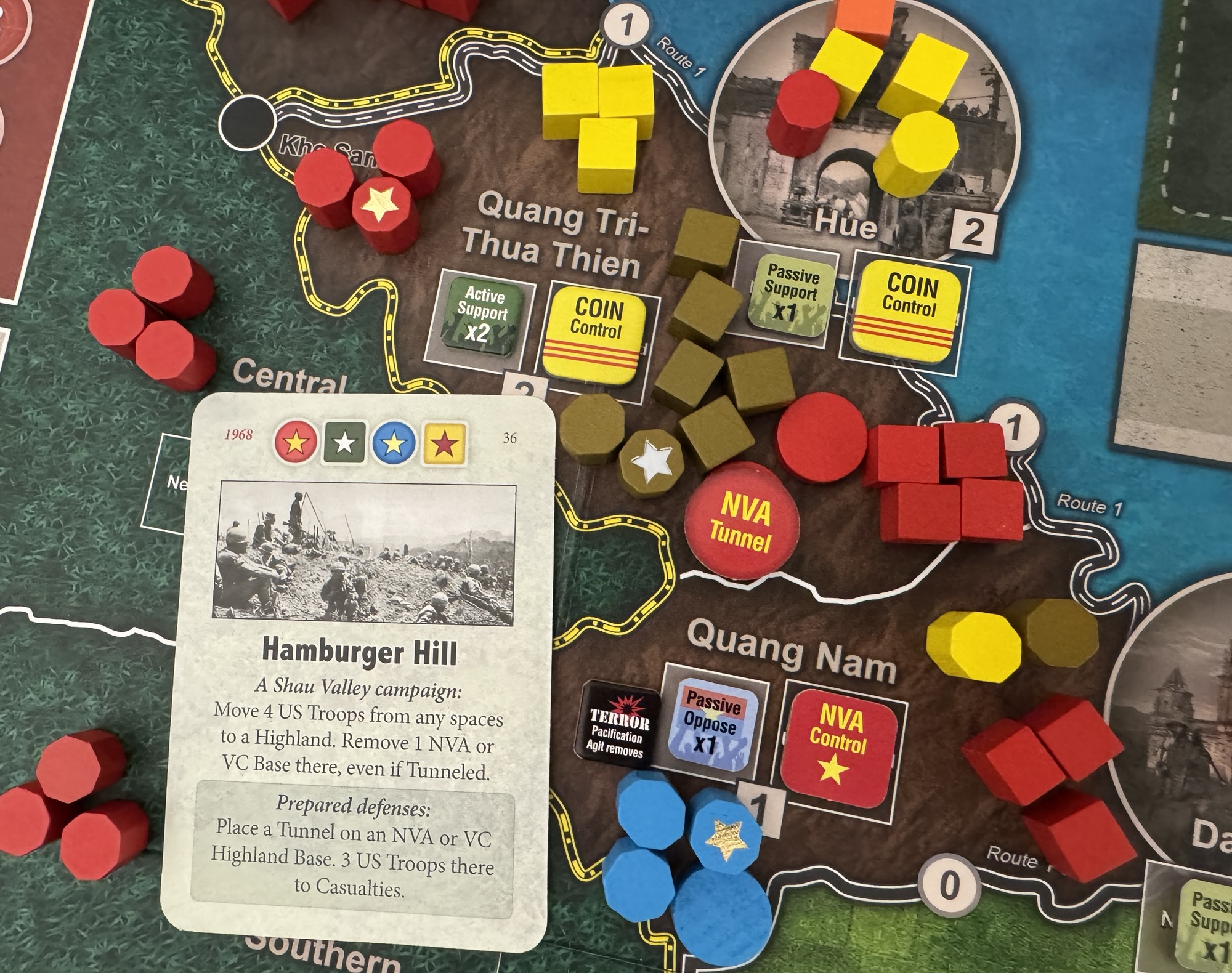
The Hamburger Hill Event Card has a top event and a bottom event, which is the case with all cards found in the decks of COIN Series games. The top event benefits the US/ARVN players while the bottom benefits the NVA/VC players. The top event allows the US player to move 4 US Troop Cubes from any spaces on the board to any Highland space, which are the brown colored regions representing less forgiving elevated terrain and mountainous areas. It then goes onto allow the removal of any NVA or VC base there, even if the base is currently Tunneled. This is a very powerful event as normally moving units requires an Air Lift Special Activity or a Train Operation to place new units into a space. Also, removing a Base, and especially a Tunneled Base, requires multiple turns and a focused approach of Patrol, Sweep and Assault to uncover hiding Insurgent pieces and then to destroy them allowing for a Base to be removed.

The Insurgent half of the event allows them to place a new Tunneled Based into a Highland space as well as remove 3 US Troop Cubes to Casualties. The Casualties Box is where these “dead” cubes are stored until the Coup Round where they will have negative effects on the United States player and then be available again for use in the next turn. This event is very powerful and is a major boon for the Insurgent player in taking control of and maintaining their presence in the Highland Provinces.

I also very much like the historical connection to the Battle of Hamburger Hill and think that the designers did a great job of creating this event with real game effects related to the battle and consequences that are felt from the play of the card. This Hamburger Hill Event is one that will be played by both sides often rather than taking their Operations and Special Activities. The effects are just too efficient and powerful to pass on unless the timing of the game dictates differently.

The Battle of Hamburger Hill was a major battle that lasted from May 13–20, 1969 was fought by United States Army and Army of the Republic of Vietnam (ARVN) forces against People’s Army of Vietnam (PAVN) forces during Operation Apache Snow of the Vietnam War. Though the heavily fortified Hill 937, a ridge of the mountain Dong Ap Bia in central Vietnam near its western border with Laos, had little strategic value, US command ordered its capture by a frontal assault, only to abandon it soon thereafter. The action caused a controversy among both the US armed services and the public back home, and marked a turning point in US involvement in Vietnam.

The battle was primarily an infantry engagement, with the US troops moving up the steeply sloped hill against well-entrenched troops. Attacks were repeatedly repelled by the PAVN defenses. Bad weather also hindered operations. Nevertheless, the Airborne troops took the hill through direct assault with heavy use of artillery and airstrikes, causing extensive casualties to the PAVN forces.

Local Degar tribesmen call the mountain Ap Bia, which means “the mountain of the crouching beast.” Official histories of the engagement refer to it as Hill 937 after the elevation displayed on US Army maps, but the US soldiers who fought there dubbed it “Hamburger Hill,” suggesting that those who fought on the hill were “ground up like hamburger meat.”

The quote was attributed to Sgt. James Spears who said, “Have you ever been inside a hamburger machine? We just got cut to pieces by extremely accurate machine gun fire…”.

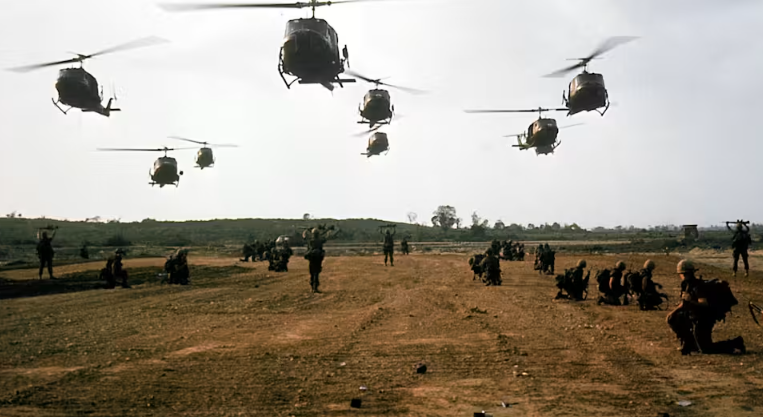
US Army photographers climb Hill 937 at Dong Ap Bia after the battle, May 1969.

In the next entry in this series, we will take a look at Culper Ring from Liberty or Death: The American Insurrection from GMT Games.

-Grant
Best 3 Games with…Vietnam!

Von: Grant
13. Mai 2026 um 14:00

One of my favorite wars to game is that of the Vietnam War. Part of that is because I was born in the early 1970’s and heard a lot about this war for the rest of that decade and throughout my teenage years. I remember watching the short lived television series Tour of Duty. I also read the graphic novel series The ‘Nam from Marvel Comics. But, my interest really grew after watching movies such as Apocalypse Now and Platoon. I always asked myself, how are you expected to fight a war where you don’t know who the enemy is? But also part of the attraction for me is that the war in anything but conventional. The combatants were diametrically different, the powerful and well funded United States of America and their technology and special forces versus the Viet Cong, a rag tag group of insurgents, and the mighty North Vietnamese Army funded and supported by the Chinese. This war also was set amongst the backdrop of social upheaval and cultural change at home with anti-war protests, freedom for all being sung as a marching song and desegregation and civil rights taking center stage. We have played plenty of games set in this conflict and I want to share my Best 3 Games with…Vietnam!

3. Hearts & Minds: Vietnam 1965-1975 from Worthington Publishing

We really enjoy Card Driven Games and try to play as many of them as we possibly can get our hands on. Also, as I said in the intro, we also enjoy Vietnam wargames. So, when we had a chance to play a CDG on the Vietnam War, it was a no brainer! I got this game for Christmas about 6 years ago and it was a used copy of the 1st Edition published by Worthington Publishing. There is a 2nd Edition out there but I really don’t know what the differences are. Since that time, there also is a new 3rd Edition from Compass Games and it looks really good. But that is neither here nor there.

In Hearts and Minds: Vietnam 1965-1975, players will play as either the US/ARVN forces (with some units from NATO as well as ROK) against the Communist forces which include NVA regulars and VC hidden units. The game has multiple scenarios and covers the entirety of the Vietnam War from 1965 all the way through 1975 as the U.S. forces left and only the ARVN remained to attempt to stem the red tide coming down into South Vietnam.

Hearts and Minds Pacification
The ROK unit in Quang Ngai successfully Pacifies the province, placing a blue star marker that will factor in end round calculations for the dreaded Political Will Track.

Players have a hand of 5 cards each round from which they will play 4 that provide Resource Points to perform various actions including activating units to move up to their movement allowance, attacking enemy units, doing bombing missions, pacifying areas or forcing a political change. Each faction has their own deck, the Communist deck is red, the Allies is blue and then there are black cards that are neutral. Players will make their decks from their color and mix in half of the black cards. These cards represent the meat of the game and are the vehicle to make the game progress. The Resource Points are spent to perform the actions mentioned above and also can be used to buy the printed event on the card just played. Sometimes this event will have lasting effects for the entire game, such as the Commando Hunt card that allows Bomber missions to target Laotian border provinces and also allows more than 1 bomber to bomb any given province, or will have a one time effect such as Junction City, that allow you to spend more than one saved Resource Point in a given turn as long as all Battle and Political Control Change actions take place in Zone III. These cards are well done and the game boils down to the efficient use of the hand that you are dealt. Sometimes, you will be given cards with high RP’s of 4 or 5, which will allow you to make a lot of progress with various actions including moving forces, battling the opposition and making political changes. But, there will be times when your draws are not great and you have a hand full of low value RP cards but they might have interesting and very useful events that you must take advantage of. In essence, you have to play the cards you are dealt and make the best go of things. This can be both fun and frustrating but always keeps things interesting and requires that you plan and execute on that plan.

Hearts and Minds Cards

Battle is pretty simple as well as all the counters are pretty much the same for both sides. Each counter has an untried side and a veteran side (with either a 1-6 or 2-6 for ARVN and US troops or a 1-4 or 2-4 for NVA and typically a 1-1 for VC units) and then there are support units such as mortars, artillery, tanks and helicopter gunships. When a players units are located in a province with enemy units, a contested area is created where the players can fight by buying a battle round for the cost of 1 RP. If the battle doesn’t conclude, another battle round can be purchased with an additional RP until the player no longer has RP’s. Units in a province simply total up their battle factors (located in the bottom left corner of the counters), roll a die and consult their specific faction’s Battle Table. The results are the damage that must be applied and fire is considered simultaneous. The results include a specific number of units that must be eliminated but also sometimes has a capital R that means the player must either lose one unit or pay a saved RP. The blue table is slightly better than the red table, but not by much.

Hearts and Minds Fighting in Zone III

The really neat part about the battles is that units can evade before the battle starts with a roll, which becomes more difficult in certain terrain types and also has negative results for even attempting, such as the loss of a unit. This part can be very frustrating for the Allied player as he has finally corned the wily NVA and VC and they then slip right through his fingers with a favorable roll.

How does the game end? Well, players will be fighting each other for control of provinces and for casualties that will affect the will of the fighting powers and adjust the Political Will Track. This track factors in how each side feels about the war and their attitude to continued hostilities. Each scenario has a set level for an immediate victory, which frankly will never happen, and an end scenario number, which is more reachable. The Political Will Track really sums up the game for me and the feelings that many had about the Vietnam War. It seemed that escalation of bombing, more U.S. Troops on the ground and bloodshed didn’t equate to a victory. But simply meant the fighting would linger until one side or the other eventually would give in.

I recommend this game wholeheartedly for anyone that likes CDG’s and for anyone that is interested in a holistic approach and treatment of the Vietnam War. My only negative about this game is that it appears to be very hard for the Communists to win. That is probably an assessment after only one play as we both really didn’t know what we were doing but it is a concern of mine that I would like to see in future plays. It just felt very difficult to do anything that was meaningful with the resources they have and they are also outclassed in combat so that is a concern as battle is a big part of the game. Still a very solid representation of the Vietnam War and frankly a very interesting design by John Poniske.

2. Fire in the Lake: Insurgency in Vietnam from GMT Games

The COIN Series uses cards in a very different way from other CDG’s. These cards are not necessarily the driver of the action but more assistive to the actions of the players by setting eligibility and also providing powerful events. The Event Cards are more often than not, very powerful. They either give you a continuing bonus on future Operations and Special Activities (as in the case of the volumes that include the various Capabilities) or allow you to take Operations and Special Activities more times that round than you would normally have been able to had you not chosen the Event and more often than not, at no cost! Also, because of the power of the cards and their ties to one or more factions, you can take the Event which allows you a huge advantage, only to see that very powerful Event reversed with the next Event or with a regular Operation. This is very frustrating but is one of the major reasons that I love the card-assisted element of the COIN Series.

Fire in the Lake from GMT Games just really sums up the the Vietnam War experience to me and Volko’s magnum opus is Fire in the Lake, without a doubt, as it attempts to answer the question of who the enemy is and does a fantastic job. Fire in the Lake: Insurgency in Vietnam is Volume IV of the COIN Series and teams up two amazing designers in Volko and Mark Herman. The game is an asymmetric treatment of the Vietnam War and pits four players against each other, as even allies want to win the war, but win it in their way. The US Player has control of lots of powerful forces that can utilize Air Lift, Assaults and Sweeps to drive the insurgent guerilla forces of the Viet Cong and NVA back into the jungles but the VC and NVA have tools at their disposal to evade these heavy handed tactics such as tunneled bases, the terrain itself including jungles, rivers and mountains, and the Ho Chi Minh Trail. The US Player must also watch his own back as his ally, the ARVN, is more interested in patronage and lining their pockets with US dollars than necessarily winning the war through brute force. This game design takes into account all of the difficulties with this quagmire of a war and time, and through the cards used to assist the game moving forward, inserts key events such as drug use, protests at home, booby traps and the Tet Offensive.

Fire in the Lake
The US forces are on the move to try to eradicate the VC stronghold in Tay Ninh province, which will not be an easy task as that tunneled VC base is really hard to kill.

If you haven’t played Fire in the Lake, please do yourself a favor, and do so. It is an exquisite experience that will test you on so many levels and leave you exhausted at the end of the effort while yearning for more. But, don’t go into it thinking it will be easy as it will not be and is sure to have you pulling your hair out as you attempt to win this war. Great theme. Great game play. High quality components and a well thought out design. To get a little more insight into why this game is so great, please read my article on Why I find the COIN Series to be Fantastic! I use several examples of the game play from Fire in the Lake to prove my point.

1. Silver Bayonet: The First Team in Vietnam, 1965 from GMT Games

I own and have read the book We Were Soldiers Once..and Young by Lt. Gen. Hal Moore and was fascinated by the story he told of his brave soldiers who fought the first major battle of the Vietnam War. How they went into the Ia Drang Valley and ran into nearly 2,500 NVA regulars who were spoiling for a fight and who outnumbered them 2.5/1 and how that fight lasted 5 days from November 14th through November 18th. I was also amazed at the new tactics used by the 7th Cavalry in using helicopters to jump from landing zone to landing zone to remain maneuverable enough to fight a conventional war that we were comfortable with against a non-conventional enemy in the Viet Cong and the North Vietnamese Army who didn’t want to fight our way. When the new 25th Anniversary Edition of Silver Bayonet was announced I was excited to experience this war and was glad when my friend Alexander P500’ed the game and we got a chance to play it.

So, this isn’t some monster game that covers the whole of the Vietnam conflict, but covers the entirety of the Silver Bayonet campaign. The initial landings of the 1st Cavalry Division are just 1 of 11 or 12 scenarios/campaign games included in the box. It covers 4 days and uses a handful of units in brutal close assaults.

img_6312
NVA troops try to surround Free World Alliance forces and use numbers to overwhelm them.

Something that I was pleasantly surprised about was that a good number of the scenarios can be played solitaire because most of them don’t involve using the hidden aspects of the game (NVA hidden movement, US secret helicopter basing and staging, etc.). The complexity of the rules, and sub rules, as well as all of the different phases means that the game is very cerebral. There’s a lot to consider, and units/combats might not function in ways that you’re used to in other games. With one stack attacking another you are very unlikely to wipe the other player out. The CRT just isn’t built for that. If you use maneuver combat then the NVA will flee to the hills and then just come back at you. However, NVA assaulting American troops is also deadly, because in assaults the defender inflicts hits first. We found ourselves often in bloody stalemates, with the Americans just barely hanging on for dear life. The US had access to big artillery pieces as well as many points of airstrikes, which learned through hard experience need to be stacked all together in precision strikes in order to do any kind of damage. All of these things lead to just a fascinating, and in my opinion, extremely accurate representation of the type of combat, fought on the jungled hills of South Vietnam. This game felt real and as we played we could really begin to get into the narrative of the situation and even in some small manner, feel the same frustration and disappointment that the US must have felt in fighting an un-fightable enemy! For that alone, I am extremely impressed and cannot wait to play more and just explore the depth that the rest of the scenarios have to offer.

If you can’t tell, I love this game. It’s deep, rich, and flavorful, just like a good curry. There’s volume in the box, so much stuff to play with. The components are unbelievably good value. Something that didn’t feel too great was the importance of the coordination rolls. The NVA would have handed the US their ass early on day 3 if they hadn’t utterly failed this coordination roll. In failing, they were unable to attack with their best stacks that had been meticulously moved into position for the final assault to take LZ X-Ray. And while I understand what it represents, which is is great, but it seemed very ‘swingy’, because it happened on several of my activations during our plays. Coordinating the amount of NVA troops commanded in the jungles whilst being bombarded day and night isn’t an easy thing to do, but that it boiled down to a single d10 roll felt like a little bit of a let down. I might be house ruling a 2d6 method to make that roll less randomly distributed. I also get that over the course of a full campaign those kind of things would have evened themselves out, but in a short scenario like that it kind of felt like bad luck. That being said: It’s still a good model for the command situation, so there is that. Just maybe find a way to be less random?

wp-1479789350319.jpg

Well, those are my 3 favorite games focused on the Vietnam War. I have played several others but feel that these 3 best demonstrate what it is like to be in an unwinnable and unmanageable situation that quickly spirals out of your control. What are your favorite Vietnam War games?

As an added bonus, here are links to a few Vietnam related posts that I did during the pandemic on the Music of the Vietnam War:

The Music of the Vietnam War – Playlist Suggestion for Wargames Part 1 – 1964-1969

The Music of the Vietnam War – Playlist Suggestion for Wargames Part 2 – 1970-1975

Post Publishing Edit: I was asked why Purple Haze from PHALANX didn’t make the list and here was my response:

Oh no. It was amazing. We absolutely love the theme and the feel of that game. Fantastic representation of the Vietnam War. Warfighter Vietnam from DVG is also very good.

A few other smaller games I have played and liked on the subject was Fortunate Sons from High Flying Dice Games, Long Cruel Woman from High Flying Dice Games and Dien Ben Phu from Legion Wargames (although not the US war in Vietnam but a great game). Just only wanted to spotlight 3.

-Grant

Not Your Daddy’s Blackbeard

07. Mai 2026 um 04:37

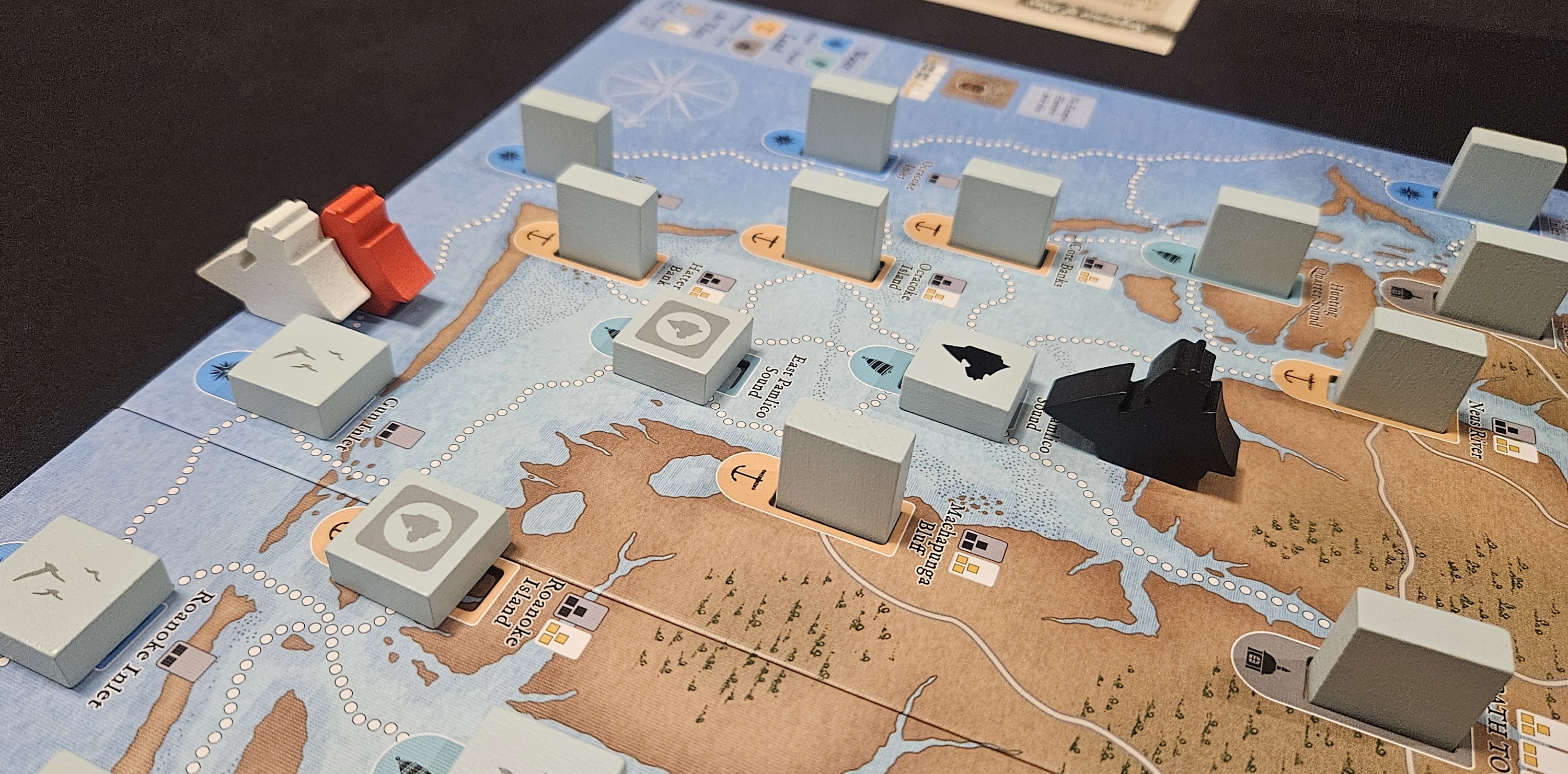
*not a representative image of the actual Blackbeard or Lieutenant Robert Maynard*

I no longer think of Volko Ruhnke as a man, but as a machine purpose-built for stamping out novel conflict simulations. COIN, Levy & Campaign, that older one where the terrorists have the efficacy of ’90s movie baddies, and now Hunt for Blackbeard, an unexpected romp that’s as much about setting the record straight as it is about blasting pirates with grapeshot. I now know more about Blackbeard than at any point in my life. Which is to say, I know a lot less, given the man’s outsized legend.

Ye'll keel the swab-haul lest ye port-rum the banyan, yarr

Afore ye vast, starboard lubbers!

Almost everything we know about Blackbeard is wrong, or at least embellished from later sources seeking to cash in on the pirate’s notoriety. That he learned his trade under the legendary Captain Hornigold — unconfirmed. That he braided his hair with smoking fuses — not exactly the sort of fire hazard a man who worked with gunpowder would accept. That he murdered a swath across three seas — well, there was some murder, that’s true. But not as much as previously reported. Not when a pirate’s work required most crews to throw down their arms.

If anything, the Edward Thatch we come to know in Hunt for Blackbeard is something of a sad sack, at least when placed alongside his outsized legend. His great vessel has been stripped. His plunder has been sold down to its last few barrels and crates. His crew has been reduced to a couple dozen hands. Even his most infamous companions are on the outs; Stede Bonnet’s surviving crewmen are likely informers rather than allies, and Israel Hands, Blackbeard’s long-time second in command, may soon be sent on a doomed mission to allow the captain to claim his portion of their remaining goods.

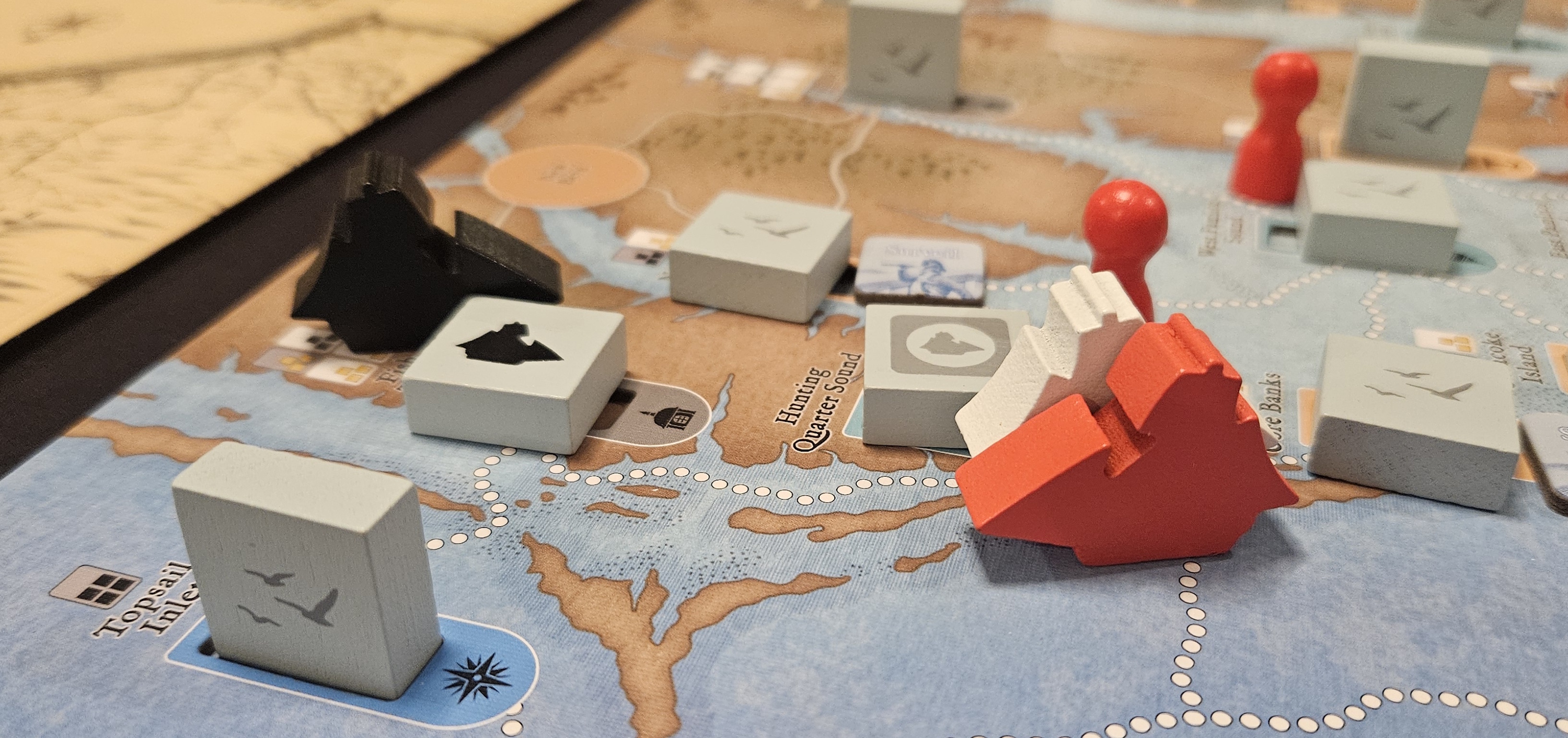
Some of these details are relegated to the historical notes, and this, being a production from Fort Circle Games, provides excellent timelines and essays. But the diminished status of the infamous captain is on display right there on the board as well. For one thing, there’s the scope of the hunt. Confined to the sounds, towns, and islands of North Carolina, this pursuit is leagues away from the Caribbean waters that usually dominate pirate yarns. And then there’s the scale. Blackbeard’s fleet has become one ship, the Adventure, ill-fitted and undercrewed. His pursuers have only two ships, both of them relatively small, plus a band of hunters who travel by land to check the colony’s towns and inlets. These are, in a sense, an invading force, commissioned and outfitted by the governor of Virginia. But as invading forces go, sending bounty hunters from one colony into another isn’t an excursion into foreign territory.

For his part, Thatch behaves more like a cornered rat than a pirate king. Hunt for Blackbeard opens with the pirate standing at an intersection. Rather than expend the resources to hunt down every last offender, the Crown has offered a pardon to all who will renounce the pirate’s life. Most in the colonies have already accepted. Thatch, too, has taken the offer, only to return to the sea to seize some easy plunder. Now the hunters are coming for him, and while he has relative shelter in North Carolina thanks to his largesse with colony officials, the ensuing game of cat and mouse has the mood of a deepening sunset rather than a crescendo.

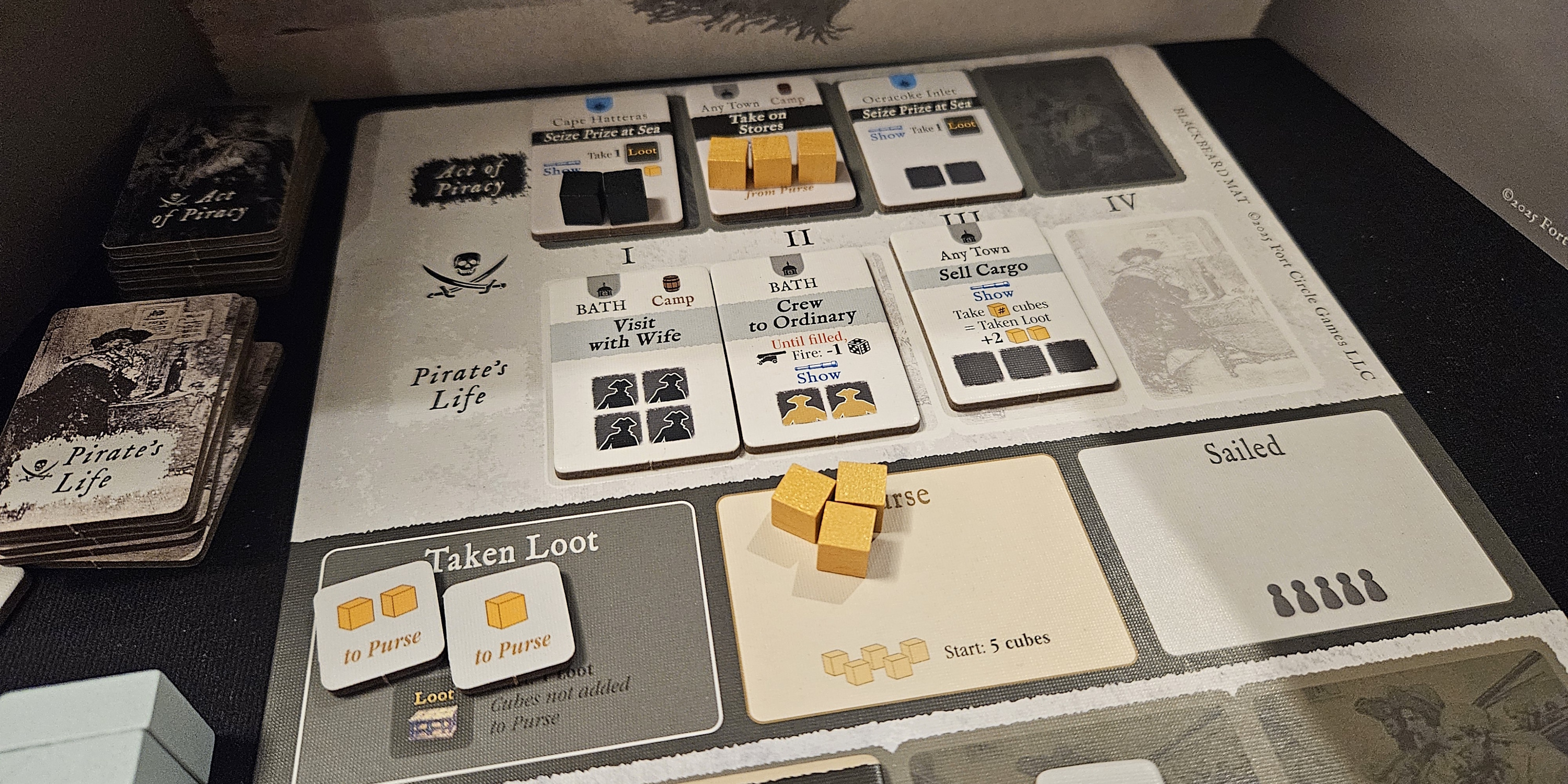
"Bums around town or camp with his wife" is the most relatable event.

Blackbeard tends to his retirement… or continues his piratical career.

There are two sides in Hunt for Blackbeard, hunter and hunted, but Ruhnke’s virtuosity at game design clutters and blurs those roles.

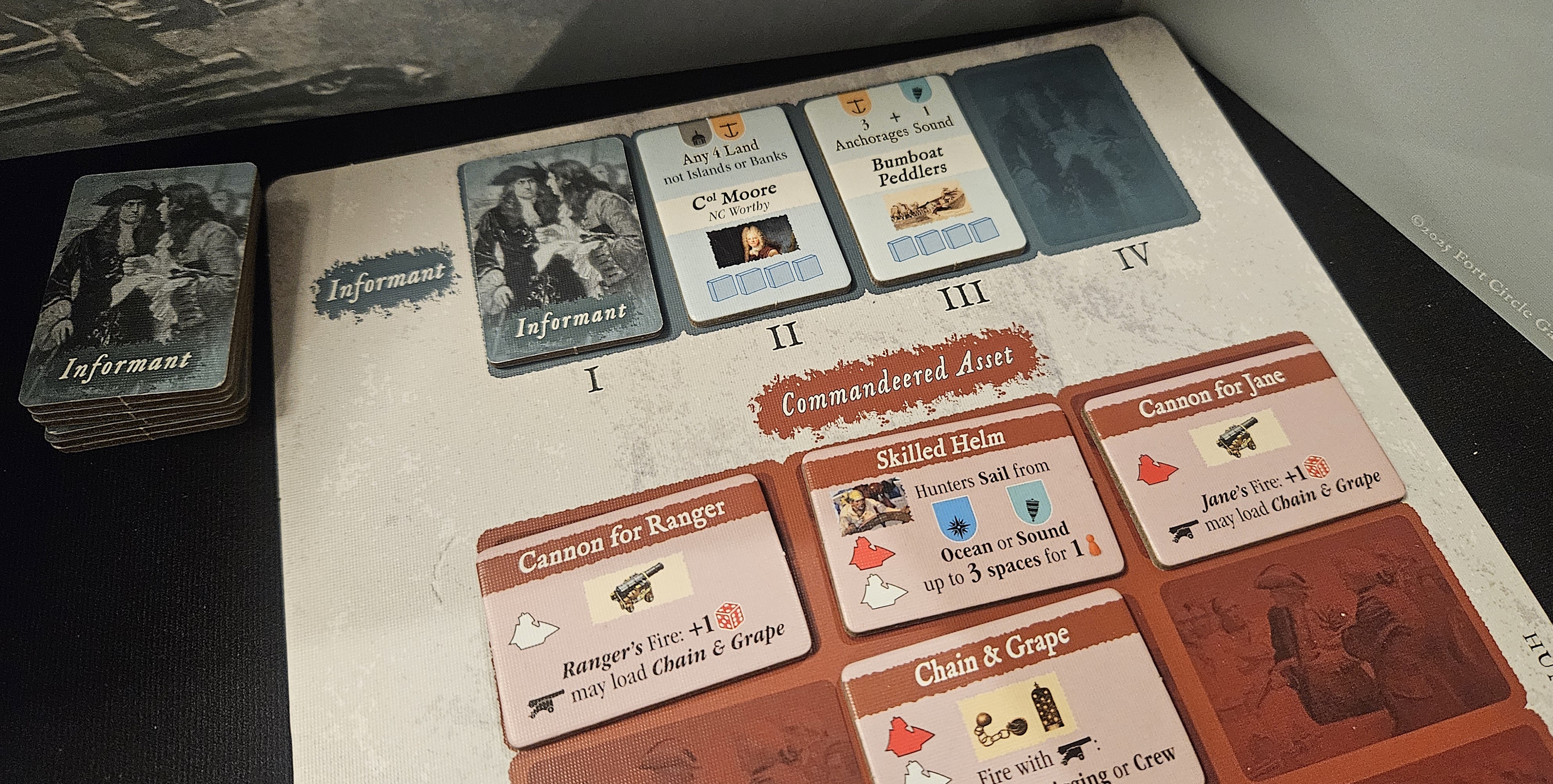
Both sides, for instance, are gluttonous for information. In the case of the Hunters, that means Blackbeard’s location — whether that of the famed captain, his lieutenant, or the camp he might periodically visit to resupply or lick his wounds. But for Blackbeard, word of his pursuers’ deeds is every bit as precious. The Hunters are always visible on the map, but how far their reach has extended, where their informants have told them to search, or whether they have a particular stretch of the sea under surveillance, those details may be concealed or laid bare depending on context and choice.

The same goes for the question of which side is hunting whom. Nominally, the Hunters are, well, the hunters. As soon as they’ve outfitted their vessels, they depart from Virginia and begin the chase. But all the while, Blackbeard is laying preparations of his own. Looting vessels, preparing the Adventure, buying off witnesses. When the time comes for the spark to touch powder, it’s entirely possible that Blackbeard will sink the competition.

What Ruhnke produces, then, is a double-blind game of entrapment. First there’s the race. Blackbeard hurries to gain or spend his treasure, whether to reestablish himself as a great pirate captain or to secure another pardon. The Hunters hustle to outfit their vessels before the trail goes cold. But then, over the course of the ensuing rounds, the fierce dance between predators.

Perhaps the most surprising thing about Hunt for Blackbeard is its speed. The game only lasts four rounds. And these aren’t the drawn-out bullet-point-ridden rounds of something like Here I Stand. While there are still bullet points to tick off, the phases pass at a brisk pace, bouncing between sides so rapidly that there’s hardly a moment of downtime. First, the Hunters interview informants, giving them a glimpse at Blackbeard’s potential location — a step that requires Blackbeard to avert his gaze, lest he learn what the Hunters have gleaned. Second, Blackbeard spends his time preparing his ship, sailing, and planning any piratical activities. Again someone must close their eyes, although it’s the Hunter player this time. After that, the Hunters take their turn proper, moving their ships and perhaps picking up their quarry’s trail. Only then does Blackbeard actually accomplish any pirating, a step that may well have been interrupted by the arrival of the Hunters.

They also need to balance how much time they spend "interviewing" (interrogating) "witnesses" (pirates) about "Blackbeard" (some innocent man).

The hunters balance preparation against the need to depart early.

Playing through these steps, a few thoughts spring to mind.

First, there’s an essential tactility to Hunt for Blackbeard. The actions themselves are brief, but the need to physically turn the blocks gives every movement a sense of growing unease. When I played digitally, the entire session took perhaps a third of the duration, but in its haste lost its sense of place. It’s one thing to click an icon; another entirely to hover one’s fingertips over the block, stomach knotted into a fist as you try to deduce whether an earlier clatter had come from here or there, or was perhaps your opponent shifting a few components as a ruse. This process elongates the game, but is necessary: touching the pieces, straining your senses for clues, seeing the shadows cast by those monolithic blocks and wondering whether they conceal a trace of your foe’s passage or a flock of passing gulls, these are as much components in the game’s telling as the rules or the wooden ships.

As much as Ruhnke excels at designing macro-level systems, he still has yet to create a compelling method for resolving combat. Perhaps the game’s biggest disappointment is the moment of battle, when, after all those preparations, both sides roll a couple dice to see who hits the higher number. It’s fitting, I suppose, given the chanciness of naval combat. The historical Blackbeard managed to rake one of his pursuers with grapeshot, effectively removing their ship from the fight, before the trap was sprung and he was overwhelmed during a boarding action. But after all those steps and countersteps — after that dance! — it wouldn’t have gone amiss to put some showmanship into the last struggle. What could have been a wall of thunder instead comes across as a puff of smoke.

Lastly, however, the game leaves me in awe of the way board game excel at representing history. I’ve read about Blackbeard. Not a lot. Just enough to know we don’t know much. But it wasn’t until seeing it rendered this way that I understood some of the words on the page. The intimacy of the space. The smallness of a man whose legend has outgrown him and now nips at his heels. The small invasion of a neighboring colony, one governor determined to rid himself of a pest that his peer next door has decided to indulge. Piracy was always caught up in the history of empires, and nowhere is that clearer than here, with official pardons and corrupt commissioners in the balance, populated by enemies and victims, but also imperial troops crowding into spaces that were once open, with safe havens where an infamous pirate acted as a patron rather than a danger to be cut out with the point of a saber. To play this game is to grasp the history a little more tightly.

You know what's a really good hidden movement game? Burned. In terms of hidden movement mechanisms, that one almost ruined Hunt for Blackbeard for me. Although to be fair, it might have ruined all hidden movement.

The hide-and-seek nature of the game is well done.

Is it disappointing that Hunt for Blackbeard operates better as history than as a plaything? Oh, maybe. A little bit. Especially when the game concludes with a wet fuse rather than a discharged cannon, I can’t help but feel some letdown.

But I’m impressed with the trappings that surround that climactic battle. Once again, Ruhnke has created a system that will hopefully earn emulation; once again, Fort Circle has crafted an enviable representation of American history, one that complicates and deepens its subject matter rather than frocking him in smoking fuses.


A complimentary copy of Hunt for Blackbeard was provided by the publisher.

(If what I’m doing at Space-Biff! is valuable to you in some way, please consider dropping by my Patreon campaign or Ko-fi. Right now, supporters can read my first-quarter update of 2026: the best board games, movies, books, and more!)

My Favorite Wargame Cards – A Look at Individual Cards from My Favorite Games – Card #70: Mohawks from Wilderness War: The French & Indian War, 1755-1760 from GMT Games

Von: Grant
24. März 2026 um 13:00

With this My Favorite Wargame Cards Series, I hope to take a look at a specific card from the various wargames that I have played and share how it is used in the game. I am not a strategist and frankly I am not that good at games but I do understand how things should work and be used in games. With that being said, here is the next entry in this series.

#70: Mohawks from Wilderness War: The French & Indian War, 1755-1760 from GMT Games

One of my fondest memories of our wargaming journey was our initial experience with the full campaign game of Wilderness War from GMT Games. We were 2 very inexperienced wargamers and we slogged through a 9-hour marathon play over a few days that ended in a 0-0 tie of all things. That’s right, the game ended in a tie, even though we both had a card in hand, but I was unable to use mine to activate Levis, which was my only potential Victory Point scoring force, and Alexander’s forces were in too tenuous a position or too wounded to risk an open battle for VP’s. You would think that this would have turned us off to the game but on the contrary it made me fall in love with asymmetric wargames and the Card Driven Game mechanic with its use of Action Points and events to wage war on the North American continent. The end score of our game really followed the tension of the game, and the blunders on the side of the British that counter balanced their various successes.

All in all, this game was excellent to play and we both highly recommend it. The two factions play extremely differently which leads to many intricate and reactive strategic decisions. The British have many powerful forces with their Highlanders and cannon while the French have access to better leaders and mobile troops and Indian allies who can run around the frontier raiding and burning settlements for VP’s. Laying siege and assaulting really feels like it should, and avoiding battle until you are ready is something that is integral to maintaining a strong presence on the board. You cannot always get into every possible fight as you will not survive the attrition of these battles. The deck plays really well, and as you don’t have to worry about the opponents events in your hand going off, the management aspect is much simpler yet very engaging as there are always reaction cards you can play or cards that you want to hold onto for that perfect moment.

In previous posts in this series, we have discussed the importance of the players of both sides gaining the trust and services of the indigenous Indian denizens of North America in the fight. The French and British can both use the Indian recruitment cards, including cards such as Iroquois Alliance, Northern Indian Alliance and Western Indian Alliance, to recruit, restore, and move native allies to gain victory points through raids and controlling of territory. The French hold a significant advantage with more access to a greater number of Indian auxiliaries, and will be using these cards to launch early raids, while the British can recruit specialized units like their Mohawk or Cherokee allies. 

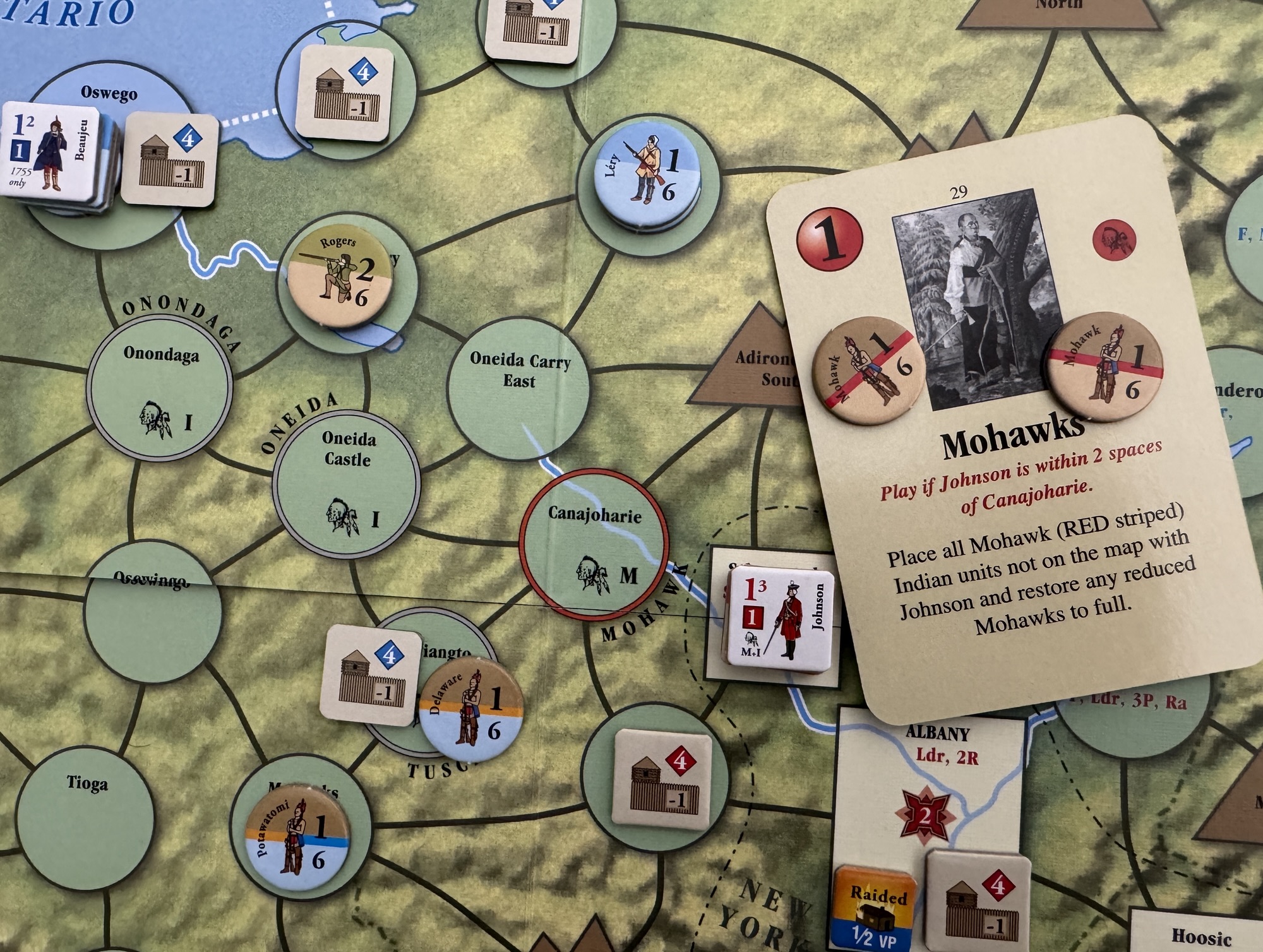
In this entry, we will take a look at the British card Mohawks. Mohawks is one of those cards that has a pre-requisite qualifying condition to play the card. In this case, the qualifier is that the leader Johnson must be located on the board within 2 spaces of Canajoharie, which was a Mohawk village located in upstate New York. As long as he is within the required 2 spaces, the card can be played to bring out onto the board the Red striped Mohawk Indian units. These must be placed with Johnson and the other added benefit is that any reduced Mohawks on the board can be flipped to their full side. These pro-British units can only be recruited by the British player and their arrival in New York can be a huge boon to the British as the French and their Indian allies will be raiding the villages and settlements up and down the frontier regularly during the game as one of their most dependable sources of Victory Points. These Mohawk allies can spread out around the area and intercept incoming raids before they can occur. Remember that Indian allies in Wilderness War are not powerful combat units and are best used to raid and prevent other tribes from raiding.

I very much love the thematic connection here as in order to attract the Mohawk Indians as your allies you must have someone that they trust in the area and this is Johnson. Sir William Johnson was a pivotal British superintendent of Indian Affairs whose deep integration into Mohawk society secured the crucial Mohawk Nation alliance for the British during the French and Indian War. By living among them, learning their language, and marrying Mohawk women, he maintained the Iroquois Covenant Chain and led Mohawk warriors in key victories. This is one of the great things about these Card Driven Games and their use of the cards to deliver the bits and bobs of history to enlighten our understanding and to expand our knowledge of the period.

As a young man, Johnson moved to the Province of New York to manage an estate purchased by his uncle, Royal Navy officer Peter Warren, which was located in territory of the Mohawk, one of the Six Nations of the Iroquois League. Johnson learned the Mohawk language and Iroquois customs, and was appointed the British agent to the Iroquois. Johnson commanded Iroquois and colonial militia forces against the French and their allies during the war and was later commissioned a major-general for his role in the British victory at the Battle of Lake George in 1755. His capture of Fort Niagara from the French in 1759 brought him additional renown. Throughout his career as a British official among the Iroquois, Johnson combined personal business with official diplomacy, acquiring tens of thousands of acres of Native land and becoming very wealthy.

In the next entry in this series, we will take a look at The Wartburg from Here I Stand: Wars of the Reformation, 1517-1555 from GMT Games.

-Grant

❌