Back to the history and board games of New York City! Last time, we’ve looked at the city’s humble beginnings all the way to the destruction wrought on the city by the Revolutionary War. Today, we’ll cover the first century of New York City as a city in the United States – how it established its primacy in the country, how it was at the same time very attractive and a horrible place to live in, and how it took shape as a modern metropolis. As always, board games will guide us.
American Capital
When Britain had recognized American independence in 1783, the young country gave itself a constitution – the Articles of Confederation. The United States were organized on strictly confederative principles. New York City became the capital. The advocates of broad independence for the states and minimal federal government, however, lost ground over the next few years as the United States struggled to deal with the post-war challenges, chiefly the states’ tremendous debt. Thus, over ferocious public debate, a new constitution was adopted in 1787, and according to it, a strong chief magistrate elected – George Washington, the first president, who was inaugurated in 1789 at City Hall, New York.
One of the fiercest proponents of a strong federal government was New Yorker Alexander Hamilton who became the nation’s first secretary of the treasury. In this role, Hamilton advocated for further government centralization, especially in regards to financial and economic affairs, based on his experience in the commercial hub New York. Hamilton succeeded in having the federal government take over the remaining states’ debts, but his opponents – chiefly rural southerners – demanded a price: The federal capital would move away from New York. Philadelphia would fill the role temporarily, before a new capital to be constructed in a southern swamp would be ready – the future Washington, D.C.
Even though New York City ceased to be America’s capital, it was still the prime center of American capital. In 1792, the New York Stock Exchange was founded. Its location – Wall Street – is synonymous with finance until today. The city’s booming harbor also attracted more and more commerce. By 1804, New York City had overtaken Philadelphia as the largest city in the United States at around 70,000 inhabitants. As growth did not slow down, the city’s leadership embarked on a scheme which must have seemed megalomaniac at the time: In 1811, they adopted a development plan which laid a regular grid of avenues and perpendicular streets over Manhattan Island, encompassing areas large enough to house a million people at the contemporary population density. That was the blueprint for modern New York City.
New York’s growth, however, was not pre-ordained. It relied chiefly on the city’s status the nation’s premier port. Yet as the United States grew westward, New York lay farther and farther away from many of the new towns and states. Goods could only flow to or from the Great Lakes or the Great Plains by arduous land journeys – or down the Mississippi. New Orleans, located at the mouth of the great stream, seemed poised to take over New York’s role as America’s port. That’s when the governor of New York state, DeWitt Clinton, proposed an ambitious engineering scheme: Nature might not have connected New York City with the great inland waterways of America. But men could. The 350-mile Erie Canal, completed in 1825, connected the Hudson River with Lake Erie and thus allowed uninterrupted ship transport from New York all the way to the western frontier states.
Packet Row (Åse Berg/Henrik Berg, White Goblin Games) is set in the bustling port of New York in the 1840s. Players need to find the right combination of trade goods (so, supply), contracts (demand), and ships to grow rich as merchants. Money alone will not be enough for victory: The game embodies the ethos of the magnates of the 19th century, which held that wealth came with responsibility for the community. Thus, the money earned in Packet Row needs to be spent on projects which benefit the city (say, the university) for victory points.
When the Erie Canal was completed in 1825, 89% of New Yorkers had been born in the United States. By 1860 that number had fallen to less than half. Let’s take a look at this great social and political transformation.
Immigration, Death, and Politics
New York’s status as America’s port made it incredibly attractive for immigrants: Its booming trade hungered for willing workers, and even if immigrants had different dreams – say, farming on the wide prairie – they would probably arrive by ship in New York. In the mid-19th century, an astounding 70% of all European immigrants to the United States entered the country through New York. The absolute numbers are even more breath-taking: In the decade after the Great Famine, a million Irish alone arrived in New York, along with German, English, and Scottish immigrants.
Despite this massive population influx, New York City had only around 800,000 inhabitants by 1860. That was partly because many immigrants moved on further inland, but also because of the astonishing mortality: For example, during the year 1856, 4% of all adults and 20% of all children in New York City died. The cramped living quarters in which most immigrants found themselves and the inadequate medical infrastructure made New York a fertile breeding ground for all kinds of epidemics, while the high cost of living forced the immigrants into long working hours at often dangerous jobs.
Under these circumstances, it is no surprise that the immigrants turned to anyone who promised them a helping a hand. And as they were so many (and usually gained citizenship after two years of residence), courting them became a viable electoral strategy. Fernando Wood became the first New York mayor whose election had been largely achieved by his success with Irish-American and German-American voters. His recipe for success – mobilizing various immigrant communities – would be copied for decades by his successors in Tammany Hall, the local Democratic Party’s political machine which traded patronage for votes.
Tammany Hall (Doug Eckhart, Pandasaurus) is centered on this political strategy: The basic move which players take is to select one immigrant token (Irish, German, English, or – inspired by the later 19th century – Italian) and place it in one of the wards of New York. That gives the player both some influence with the respective immigrant community and some potential strength on the ground in that ward, come the next election. Whichever player wins most wards in an election round becomes mayor of New York and thus gets to dole out City Hall jobs to their allies.
Tammany’s success in the 1850s was based on organizing various disparate communities. The Civil War brought ruptures to this alliance: Mayor Wood called for New York City to secede from the Union and become a “free city” in order to maintain trade relations with the treasonous southern states. The majority of Tammany Democrats, however, were staunchly in favor of the Union, but less enthusiastic about the cause of abolitionism. Thus, many of the German immigrants (often veterans of the 1848/49 revolution) abandoned the party in favor of the Republicans, and the German-Irish voting bloc split (although it would remain firmly united in its opposition to the temperance movement).
The split caused a Republican-led fusion ticket to win the mayoral election of 1862. It would be a short break from Tammany rule, as the new mayor faced growing racial tensions: On July 13 1863, protests against the continued draft erupted in violence. For the next three days, a mob (mostly consisting of Irish-Americans from the Lower Manhattan slums) rampaged through the city, targeting Black neighborhoods. The Draft Riots would only be put down once regiments returning from Gettysburg reached the city. Many Black New Yorkers left the city afterward, so that they amounted to barely over one percent of New York City’s population in 1865.
Tammany rule was restored in the 1864 mayoral election… not that it mattered much who exactly the mayor was, as long as he was a loyal follower of the Tammany machine. The unbridled access to power allowed the Tammany leader William “Boss” Tweed to become one of the richest men in New York – and public money also lined the pockets of many public servants and private contractors (especially in the construction business). The most outrageous example of this corruption was the construction of the County Courthouse. Tweed himself bought a quarry to supply the marble for the project at egregious prices, and the subcontractors had a field day, too, billing amounts like $360,000 for one carpenter’s month of labor or $7,500 per individual thermometer. The Courthouse’s final cost ran up to $13 million – almost twice the price of the contemporary Alaska Purchase!
Tweed, however had cranked the levers one too many times. Even New York Democrats (at least those set aside by him) distanced themselves from him. A court found Tweed guilty of embezzlement and sentenced him to a year in prison. He escaped and made his way to Spain, but was discovered and extradited to the United States, where he would die in prison. Tammany would rule New York politics for almost another century due to the machine’s continued ability to organize new immigrants (Italians and Eastern European Jews in the late 19th and early 20th centuries), but the worst excesses of its corruption ended with Boss Tweed. Indeed, for a 20th century New Yorker, it would be almost impossible to imagine how political office could be mostly sought to enrich a few powerful individuals and their willing helpers.
The Dawn of the Modern Age
New York City in the mid-19th century was squalor and corruption, but it was also the place where the innovations of the modern metropolis first took shape. The explosive population growth and the crowded living conditions were countered with a massive park development – Central Park, until today New York’s finest place to breathe fresh air and surround yourself with the peace of grass and trees. Construction lasted from 1857 to 1876.
New technology also sprung from New York – literally and figuratively. When Thomas Edison looked for the first city in which to broadly distribute electricity, New York was the obvious choice. And the transformational impact of the railroad on America would not have been possible without the finance hub New York raising and directing the capital for the investments. So, all of you 18XX gamers, you can thank New York!
Finally, in 1886, New York City received its most iconic landmark: The people of France gifted the United States a large statue, symbolizing liberty, the chief value of the American Revolution. Once the Americans had succeeded at funding the pedestal for the statue – encouraged by campaigns of the New York newspapers – the Statue of Liberty was proudly displayed in New York harbor, welcoming newcomers and promising them a free life. In the words of Emma Lazarus, whose poem adorns the a plaque inside the pedestal of the statue:
Not like the brazen giant of Greek fame,
With conquering limbs astride from land to land;
Here at our sea-washed, sunset gates shall stand
A mighty woman with a torch, whose flame
Is the imprisoned lightning, and her name
Mother of Exiles. From her beacon-hand
Glows world-wide welcome; her mild eyes command
The air-bridged harbor that twin cities frame.
“Keep, ancient lands, your storied pomp!” cries she
In the years after the Statue of Liberty was erected, New York shape-shifted… upwards. The age of the skyscraper began, and nowhere more so than in Manhattan. But that’s a story for next time!
For a concise introduction, especially focused on local politics, see Lankevich, George J.: New York City. A Short History, New York University Press, New York City, NY/London 1998.
If you want a treatment which is both more in-depth and more journalistic (and lavishly illustrated) and don’t mind its history practically ending around 1970, see the book version of the 17-hour PBS documentary from 1999: Burns, Ric/Sanders, James/Ades, Lisa: New York. An Illustrated History, Knopf, New York City, NY 2001.
With this My Favorite Wargame Cards Series, I hope to take a look at a specific card from the various wargames that I have played and share how it is used in the game. I am not a strategist and frankly I am not that good at games but I do understand how things should work and be used in games. With that being said, here is the next entry in this series.
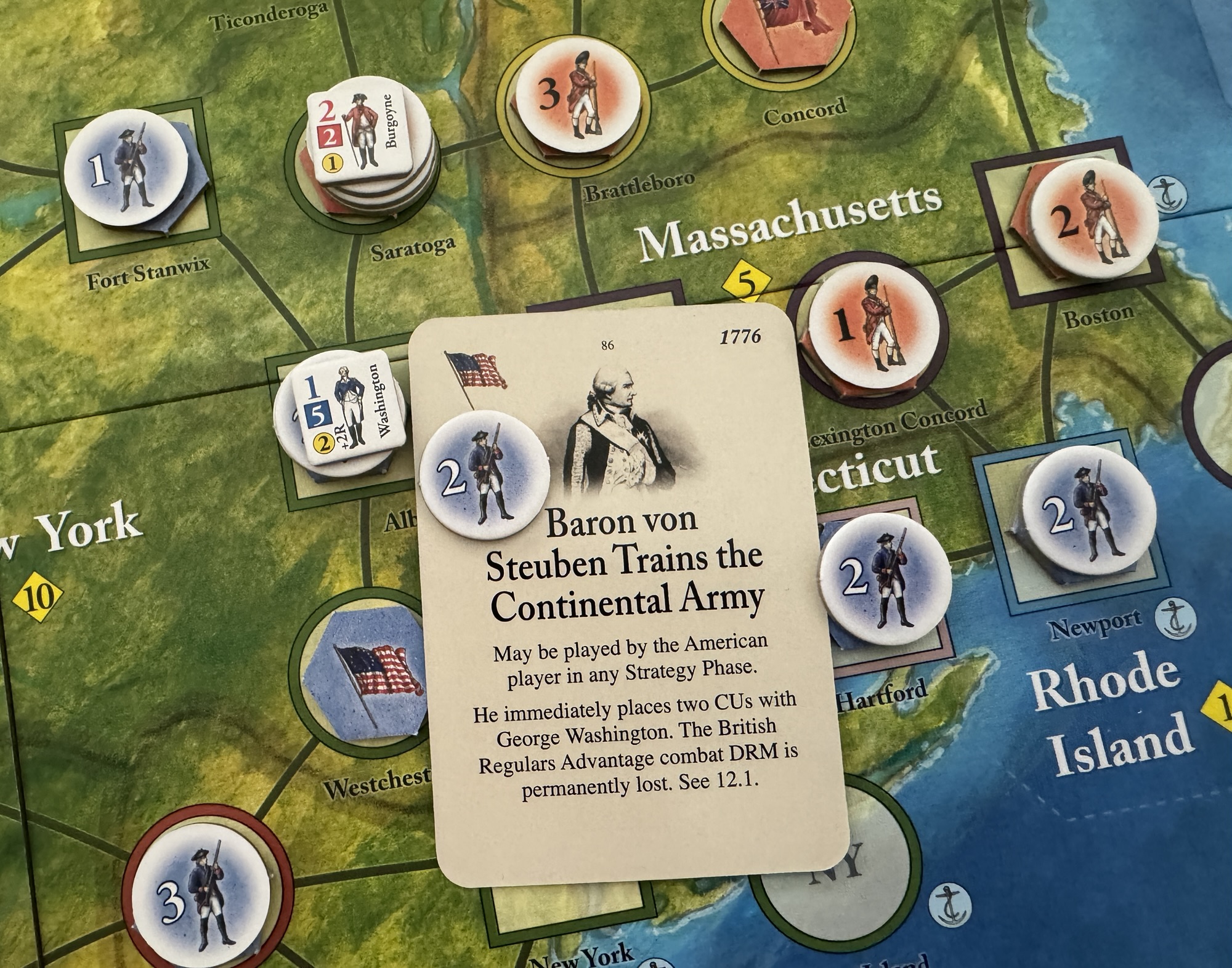
#81: Baron von Steuben Trains the Continental Army from Washington’s War from GMT Games
Washington’s War is a war game, make no mistake about that. But, it is virtually impossible to win the game by focusing only on the field of battle. For that to happen, the Patriots need to completely drive the British forces out of the 13 colonies or the British need to wipe the American forces off the map. Both are extremely difficult and I would be surprised if any more than 1 out of 30 games ended in such a way. Rather, the ultimate goal of the game is to have political control of the colonies. If at the end of the game the Patriots control 7 colonies, while holding the British to control of less than 5, they win. If not, the British win. Simple as that. So, you can see that battle is not the main goal but control is. And more importantly political control.
I really like this about the design and feel that the real core of the American Revolution was the groundswell of patriotism and the desire to live free from the shackles of an overseas monarch who cared little for the American way of life. This desire led great men of the time to sacrifice themselves, their livelihood and their families to further the true cause of liberty and build a truly free and democratic nation where individual liberty and freedom was prioritized over anything else. And yes, I realize that this nation was not perfect, not without contradiction but the concept of liberty helped to form a country that would lead to the ultimate freedom of all people.
Washington’s War is a Card Driven Game, and as such, relies on cards to provide to players the actions needed to play the game. The cards contain OPS Points which can be used to drive various actions, including such things as activating leaders, who in turn will then move with forces to attack, and also contain written text in the form of events. These events can be played only by the side they are intended for and if drawn and played by the opposing side, they can only be thrown away while granting a few possible actions, such as placing or removing Political Control markers.
In today’s entry, I have chosen this card to showcase one of my favorite events from the history of the American Revolution. The card for today is called Baron von Steuben Trains the Continental Army and has a dual focus. It will add Combat Units or CU’s to go along with General Washington but most importantly changes the balance of the game for battles. The card text reads “May be played by the American player in any Strategy Phase. He immediately places two CU’s with George Washington. The British Regulars’ Advantage combat DRM is permanently lost”. Now don’t get me wrong, gaining a free injection of 2 CU’s worth of fighting forces is a nice bonus for the Patriots but the real benefit of the card is that it changes the game. At the start of the game, the British receive a +1 Dice Roll Modifier (DRM) in all battles until what is called the British Regulars’ Advantage is lost. The British Regulars’ Advantage will be lost immediately if the British lose 3 or more CU’s in a single battle and of course, the British may also lose the British Regulars’ Advantage as a result of the play of this card. I very much like this card and it is very important for the hopes of the rebellion. I have found that the +1 DRM is really difficult to overcome for the Patriots and I found that my hopes in combat at the beginning of the game are almost always a 50/50 proposition. But once this card is played, that changes and I feel like the Patriots can better go on the offensive and openly hunt down and attack the British with confidence.
I have always been impressed with the Patriot effort to bring in professional soldiers from Europe to assist them in training and leading the Continental forces. Names like Marquis de Lafayette (France), Baron von Steuben (Prussia), Casimir Pulaski (Poland), Tadeusz Kościuszko (Poland) and Baron de Kalb (Bavaria) to name just a few. These European Generals had experience and knowledge, which were commodities that the Patriots didn’t have a lot of.
Friedrich Wilhelm August Heinrich Ferdinand Fresher von Steuben was a Prussian-born army officer who played a leading role in the American Revolutionary War by reforming the Continental Army into a disciplined and professional fighting force. His contributions marked a significant improvement in the performance of Patriot troops and he is consequently regarded as one of the fathers of the United States Army.
Born into a military family, Steuben was exposed to war from an early age; at 14 years old, he observed his father directing Prussian engineers in the 1742 siege of Prague. At age 16 or 17, he enlisted in the Prussian Army, which was considered the most professional and disciplined in Europe. During his 17 years of military service, Steuben took part in several battles in the Seven Years’ War, rose to the rank of captain, and became aide-de-camp to King Frederick II of Prussia, who was renowned for his military prowess and strategy. Steuben’s career culminated in his attendance at Frederick’s elite school for young military officers, after which he was abruptly discharged from the army in 1763, allegedly by the machinations of a rival.
In 1775, as the American Revolution had begun, Steuben saw a reduction in his salary and sought some form of military work; unable to find employment in peacetime Europe, he joined the Patriot war effort through mutual French contacts with American diplomats, most notably ambassadors to France being Silas Deane and Benjamin Franklin. Due to his military exploits in Europe, and his willingness to serve the Americans without compensation, Steuben made a positive impression on both Congress and General George Washington, who appointed him as temporary Inspector General of the Continental Army.
Appalled by the state of Continental forces, Steuben took the lead in teaching soldiers the essentials of military drills, tactics, and discipline based on Prussian techniques. He wrote Regulations for the Order and Discipline of the Troops of the United States, which remained the army’s drill manual for decades, and continues to influence modern U.S. army manuals. Steuben also addressed widespread administrative waste and graft, helping save desperately needed supplies and funds. As these reforms began bearing fruit on the battlefield, in 1778, on Washington’s recommendation, Congress commissioned Steuben to the position of Inspector General with the rank of major general. He served the remainder of the war as Washington’s chief of staff and one of his most trusted advisors.
Baron von Steuben drilling American recruits at Valley Forge in 1778 by Edwin Austin Abbey.
According to Peter Stephen Du Ponceau, Steuben’s personal secretary and interpreter, “The Baron loved to speak of…his sansculottes (radical partisans, urban laborers, and common people of the lower classes during the French Revolution), as he called us. Thus the denomination was first invented in America…when, it could not be foreseen, that the name which honoured the followers of Washington would afterwards be assumed by the satellites of a Marat and a Robespierre”.
After the war, Steuben was made a U.S. citizen and granted a large estate in New York in reward for his service. In 1780, he was elected a member of the American Philosophical Society, a learned society that included many of the nation’s most prominent Founding Fathers.
Here is a link to our full video review of the game:
With this My Favorite Wargame Cards Series, I hope to take a look at a specific card from the various wargames that I have played and share how it is used in the game. I am not a strategist and frankly I am not that good at games but I do understand how things should work and be used in games. With that being said, here is the next entry in this series.
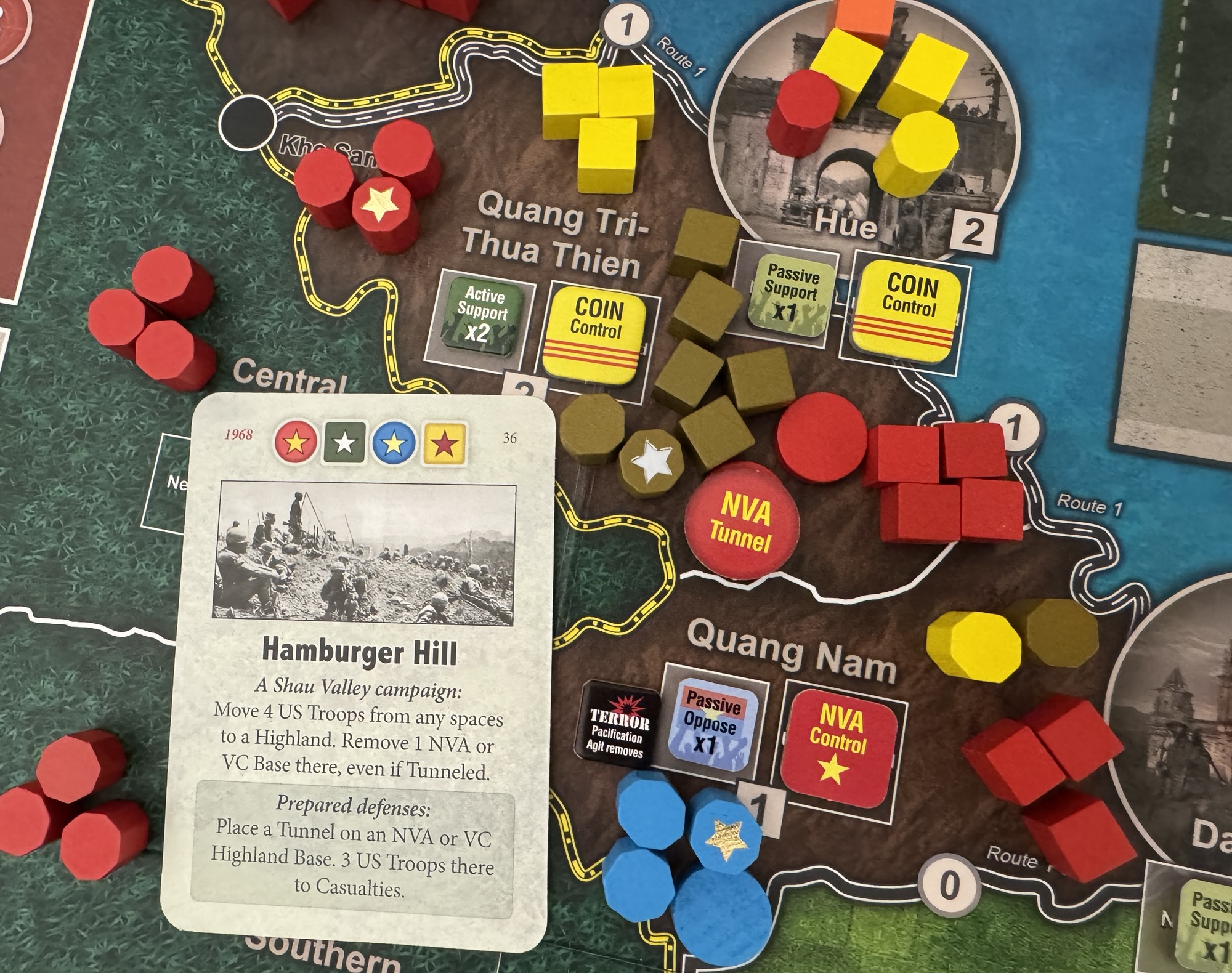
#78: Hamburger Hill from Fire in the Lake: Insurgency in Vietnam from GMT Games
The COIN Series uses cards in a very different way from other CDG’s. These cards are not necessarily the driver of the action but more assistive to the actions of the players by setting eligibility and also providing powerful events. The Event Cards are more often than not, very powerful. They either give you a continuing bonus on future Operations and Special Activities (as in the case of the volumes that include the various Capabilities) or allow you to take Operations and Special Activities more times that round than you would normally have been able to had you not chosen the Event and more often than not, at no cost! Also, because of the power of the cards and their ties to one or more factions, you can take the Event which allows you a huge advantage, only to see that very powerful Event reversed with the next Event or with a regular Operation. This is very frustrating but is one of the major reasons that I love the card-assisted element of the COIN Series. Today we are going to take a look at the Hamburger Hill Event Card.
But first an aside. Along with the movie Platoon, my introduction to the fierce fighting in the Ashau Valley of Vietnam was mainly from the movie Hamburger Hill starring Dylan McDermott as Lt. Frantz and Courtney Vance as Doc. The images from this movie will be forever burned in my mind and with the recent passing of the anniversary of the battle’s start on May 13th I thought it would be a perfect time to cover this card.
The Hamburger Hill Event Card has a top event and a bottom event, which is the case with all cards found in the decks of COIN Series games. The top event benefits the US/ARVN players while the bottom benefits the NVA/VC players. The top event allows the US player to move 4 US Troop Cubes from any spaces on the board to any Highland space, which are the brown colored regions representing less forgiving elevated terrain and mountainous areas. It then goes onto allow the removal of any NVA or VC base there, even if the base is currently Tunneled. This is a very powerful event as normally moving units requires an Air Lift Special Activity or a Train Operation to place new units into a space. Also, removing a Base, and especially a Tunneled Base, requires multiple turns and a focused approach of Patrol, Sweep and Assault to uncover hiding Insurgent pieces and then to destroy them allowing for a Base to be removed.
The Insurgent half of the event allows them to place a new Tunneled Based into a Highland space as well as remove 3 US Troop Cubes to Casualties. The Casualties Box is where these “dead” cubes are stored until the Coup Round where they will have negative effects on the United States player and then be available again for use in the next turn. This event is very powerful and is a major boon for the Insurgent player in taking control of and maintaining their presence in the Highland Provinces.
I also very much like the historical connection to the Battle of Hamburger Hill and think that the designers did a great job of creating this event with real game effects related to the battle and consequences that are felt from the play of the card. This Hamburger Hill Event is one that will be played by both sides often rather than taking their Operations and Special Activities. The effects are just too efficient and powerful to pass on unless the timing of the game dictates differently.
The Battle of Hamburger Hill was a major battle that lasted from May 13–20, 1969 was fought by United States Army and Army of the Republic of Vietnam (ARVN) forces against People’s Army of Vietnam (PAVN) forces during Operation Apache Snow of the Vietnam War. Though the heavily fortified Hill 937, a ridge of the mountain Dong Ap Bia in central Vietnam near its western border with Laos, had little strategic value, US command ordered its capture by a frontal assault, only to abandon it soon thereafter. The action caused a controversy among both the US armed services and the public back home, and marked a turning point in US involvement in Vietnam.
The battle was primarily an infantry engagement, with the US troops moving up the steeply sloped hill against well-entrenched troops. Attacks were repeatedly repelled by the PAVN defenses. Bad weather also hindered operations. Nevertheless, the Airborne troops took the hill through direct assault with heavy use of artillery and airstrikes, causing extensive casualties to the PAVN forces.
Local Degar tribesmen call the mountain Ap Bia, which means “the mountain of the crouching beast.” Official histories of the engagement refer to it as Hill 937 after the elevation displayed on US Army maps, but the US soldiers who fought there dubbed it “Hamburger Hill,” suggesting that those who fought on the hill were “ground up like hamburger meat.”
The quote was attributed to Sgt. James Spears who said, “Have you ever been inside a hamburger machine? We just got cut to pieces by extremely accurate machine gun fire…”.
US Army photographers climb Hill 937 at Dong Ap Bia after the battle, May 1969.
New Cold War: 1989-2019 is a Card-Driven Game based in the most important geopolitical events from 1989 to 2019. Players lead one of the four great powers (Russia, China, US, EU) in their fight for the new world order. Initially, the confrontation is between the red bloc, consisting of Russia and China and the blue bloc, comprising the United States and the European Union. However, each player must also prioritize their own strategy, as only one power can emerge victorious at the end of the game. Therefore, this game starts with cooperation between allied powers in the early stages but becomes entirely competitive as the moment of final victory approaches.
New Cold War utilizes a Card-Driven game mechanic. Players strive to attain victory by gaining international prestige, dominating the media and increasing their control of countries and different regions of the world. Other key factors to manage include military force and United Nations Security Council vetoes. Players’ strategies are determined by a series of hidden objectives they must pursue to achieve victory.
The game accommodates three or two-player versions and includes a solitaire mode through a system of bots.
Everything seems to get ever bigger. Cars. Phones. Board game boxes. And the cities whose history and board games we explore are no exception: We started with Venice, moved on to Amsterdam, and today, we’re starting with New York. I say starting, because unlike the previous two cities, there is no way to do the vast number of board games set in New York’s history justice in a single post. Thus, this will be a mini-series with (tentatively) three instalments.
Names are given by people. “New York” was what the English called the settlement they took over in 1664, but the place had been inhabited by thousands of years before. While that is thus technically not the history of New York, we’ll take a short look at it.
We don’t know very much about the first humans to live in what would become New York: The indigenous people did not keep written records. Archaeology is hard to do in a place which is almost entirely covered in buildings and streets today. And the oral tradition of the Indians was largely destroyed when the westward expansion of the European colonists pushed them out of their native homes, broke up their communities, and finally confined them to reservations.
Five hundred years ago, several thousand Lenape Indians inhabited an island they called Mannahatta (“island of many hills”). They lived off slash-and-burn agriculture, hunting, and fishing. I am not aware of any board game which depicts their lives before the arrival of the first Europeans, but I think it would be a nice change of perspective while still retaining the familiar geography which draws many board gamers (of course, especially those from New York and its surroundings) to games about the city.
In 1524, Giovanni da Verrazzano, an Italian explorer employed by the king of France, sailed into what would be called New York Bay. There, he met a group of Lenape in their canoes. He called the area New Angoulême to honor the French royal house of Valois-Angoulême. For the next century, European fur traders would occasionally visit the Lenape, but not attempt to build a permanent presence.
Nieuw Amsterdam
Only in the 1620s did the Dutch, by then the premier commercial and maritime country of Europe, decide to colonize parts of North America. They resolved that this colony should include Mannahatta to take advantage of the rich beaver population whose pelts were much sought after in Europe, and put the merchant Peter Minuit in charge of the operation.
Minuit arrived on May 4, 1626. He met with some of the Lenape, and, according to his written report to Europe, purchased the southern tip of Mannahatta from them for trade goods worth 60 guilders. Even though nobody knows any details beyond Minuit’s own account, the deal is the founding story of New York. One thing that stands out about it is that it was a business transaction. Unlike other cities in North America, New York was not founded by a royal agent or religious refugees, but in the spirit and through the means of commerce (which has since remained the supreme political order and religious faith of New York). In that sense, Minuit’s purchase is either a very smart business move – after all, a large tract of land in such a prime position was surely worth more than the trade goods he handed over – or the hostile act of an unscrupulous merchant taking advantage of the less business-savvy (both actions hallmarks of New York’s commercial culture until today). Beyond the foundational myth, the transaction mostly shows different ways of thinking about land – the Lenape only accepted the right to temporarily co-use it, whereas the Europeans subscribed to the tenet of permanent, exclusive ownership.
While the Dutch colonized the whole mid-Atlantic coast of what is today the US, their settlement on Mannahatta was meant to be its center – as evidenced by its name of Nieuw Amsterdam (New Amsterdam), after the Dutch capital. Nieuw Amsterdam grew into a trading hub based on its deep natural harbor, the best on the Atlantic coast. The fur trade was soon complemented by Dutch farms which extended ever further north on Mannahatta, which triggered conflicts with the Lenape. This period is represented in New Amsterdam (Jeffrey D. Allers, White Goblin Games), which casts its players in the shoes of Dutch traders who will gather resources and expand New Amsterdam (at the expense of the Lenape).
Nieuw Amsterdam already contained the seeds of some characteristic New York traits: Its demographics diversified (Africans lived in Nieuw Amsterdam in 1626 already, an Italian followed a few years after); and the municipal council established in 1653, the first of its kind in America, was the start of the great democratic tradition of the city.
The English Colony
The Dutch colony did not last long. When the commercial and maritime rivalry with England flared up again, an English fleet seized Manhattan in 1664. To honor the heir presumptive, James, Duke of York, they renamed the city New York. The Dutch briefly recaptured the city in the next Anglo-Dutch war, but had to cede it permanently in 1674.
New York’s fine deep-water harbor was as valuable to English as it had been to Dutch traders, and the city continued to grow larger and more prosperous. When the British parliament imposed taxes on the American colonies from the 1760s on, the merchants of New York found themselves in a bind: On the one hand, like all entrepreneurs, they resented being parted from money. On the other, a rupture between Britain and its American colonies would cut off trade entirely – much worse than having to pay a moderate due. New York became thus both a hotbed of anti-British activism and one of the places in the American colonies which least wanted a war with the British motherland.
Fierier heads than those of the New Yorkers prevailed. War between Britain and the colonies erupted in 1775. Once George Washington had expelled the British from Boston in the first major action of the war, he moved his headquarters to New York. The city was thus the biggest possible prize for the British smarting from their first defeat. If they could beat the colonials there soundly, force Washington to surrender with his army, they could still quash the rebellion quickly… or so they thought. The amphibious campaign against New York would become the biggest operation of the entire War of Independence. While the British defeated Washington’s army and took the city, the wily colonial commander extricated most of his forces and lived to fight another day. The city of New York, however, would remain under British occupation for the rest of the war.
The British occupation cut New York off from its sister colonies. Many New Yorkers fled to towns which were under control of the American rebels. The loyalists left the town when Britain recognized American independence. In 1783, New York’s population had fallen by 60% compared to the pre-war number of 30,000. From then on, however, the city would know nothing but spectacular growth for over a century… but that’s a story for next time.
For a concise introduction, especially focused on local politics, see Lankevich, George J.: New York City. A Short History, New York University Press, New York City, NY/London 1998.
If you want a treatment which is both more in-depth and more journalistic (and lavishly illustrated) and don’t mind its history practically ending around 1970, see the book version of the 17-hour PBS documentary from 1999: Burns, Ric/Sanders, James/Ades, Lisa: New York. An Illustrated History, Knopf, New York City, NY 2001.
It’s Women’s Day! A great opportunity to look pair a book and a game on the American women’s suffrage struggle: The Woman’s Hour (Elaine Weiss) and Votes for Women (Tory Brown, Fort Circle).
The Woman’s Hour was published in 2018 by Viking Press. It focuses on the campaigns for and against Tennessee to ratify the 19th Amendment which enshrined women’s suffrage in the US constitution – as the 36th, and decisive, state to do so.
Votes for Women was published in 2022. It is Tory Brown’s first published board game. The card-driven game can be played in a solo or cooperative mode with the player(s) representing the American suffrage movement from 1848 to 1920 against an automated opposition, or with two to four players facing off against each other (half of them for, the other against women’s suffrage). In either case, the suffrage players must win 36 states (either by shoring them up decisively during the game, or in the final vote on ratification of the federal amendment) to win.
Connections & Conclusions
At first look, book and game seem to have very different scopes. After all, Votes for Women sets in with the Seneca Falls Convention (at which women’s suffrage was first voiced as a political demand in the United States) in 1848 and covers the following 72 years, whereas The Woman’s Hour begins with the arrival of activists Carrie Chapman Catt, Sue White, and Josephine Pearson at the Nashville station in the sweltering summer of 1920. Yet as the narrative progresses, background stories are woven into the tapestry – on the context of the 1920 presidential election, suffragists’ previous efforts to gain voting rights for women in the states and to lobby for a federal amendment, the women’s suffrage movement’s relationship with abolitionism, and all the way back to Seneca Falls (and a little bit of Abigail Adams’s “Remember the Ladies”). If you have played Votes for Women, you will recognize many of the people and events on the cards from the early and middle periods of the game when reading The Woman’s Hour.
The Seneca Falls Convention is the Start card for the suffragist player with which any game of Votes for Women kicks off, following the tradition laid out by protagonist Elizabeth Cady Stanton that this was the starting point of the American women’s suffrage movement.
What unites book and game is their focus on procedural politics. Historical change does not simply happen, nor is momentarily decided upon. Instead, it is brought into effect by the “strong, slow drilling into hardwood boards with passion as well as sound judgment” (Max Weber). The drills used come in both cases from the toolbox of political activism:
The Woman’s Hour details how suffragists (suffs) and anti-suffragists (antis) lobbied the Tennessee lawmakers, how they organized in associations and clubs to channel their activists’ time, funds, and energy, and, of course, how they campaigned for public opinion to win the hearts and minds of the American people with newspaper articles, public speeches, great processions, and all kinds of civil disobedience.
Votes for Women makes these the three actions from which the players choose on a given turn: Lobbying (for and against the 19th Amendment in Congress), organizing (to gain the crucial buttons which are the currency for some powerful in-game effects and die re-rolls), and campaigning (which spreads influence cubes and thus eventually decides if enough states come out in favor of ratification of the 19th Amendment or not).
Early in the game: There are still a lot of orange Opposition cubes, but the women’s suffrage movement has made some inroads (yellow and purple cubes). The large round buttons represent the movement’s organizational strength, the white columns (one already placed on the track under the picture of the Capitol) the willingness of Congress to pass the women’s suffrage amendment.
As we’ve mentioned civil disobedience already: The women’s suffrage movement was no monolithic bloc. One of the great dividing lines was that of styles: The more conventional part of the movement, organized in the late 19th and early 20th century in the National American Women’s Suffrage Association (NAWSA) led by Carrie Chapman Catt, paid close attention to appear as respectable as possible (knowing full well that their demand for equal suffrage was enough of a provocation to the male public opinion of the time). Others adopted a more radical style, inspired by the British suffragettes: The Women’s Party, led by Alice Paul (and represented in Tennessee by Sue White) referred to the president as “Kaiser Wilson” in reference to the German war enemy, burned him in effigy, and (successfully) provoked the police into arresting activists over minor infractions. The dainty young women and respectable matrons who served some prison time then embodied the injustice of depriving women of their vote.
The Woman’s Hour details these fractions within the movement, as NAWSA and the Women’s Party led entirely separate campaigns for Tennessee’s ratification of the 19th Amendment. While infighting was avoided, the reader is left to wonder if the movement could have been more effective if not for these parallel structures – or if the split between a more moderate and a more radical wing was able to compel a broader spectrum of audiences by working in parallel.
Votes for Women depicts the multifaceted character of the women’s suffrage movement by splitting the suffragist player into campaigner figures and influence of cubes of two colors (yellow/gold, the traditional color of the American women’s suffrage movement, and purple, a color which Alice Paul had coopted from the British suffrage movement). As several Opposition event cards target the highest concentration of one or the other color, the Suffragist player is well-advised to aim for an even spread of colors in the individual states.
The pluralism of the women’s suffrage movement is exemplified by the two colors… and a plethora of Opposition events which target only one or the other.
Votes for Women also tackles another split in the women’s suffrage movement which is outside the scope of The Woman’s Hour – that on strategy. After the initial push for women’s suffrage as a part of a great campaign for equal suffrage regardless of sex and race had failed in the aftermath of the Civil War, the suffragists disagreed on how to proceed: Some pushed for a federal amendment to the Constitution (like the 15th Amendment had codified the voting rights of black men), others wanted to win voting rights in the individual states first. While the struggle for women’s voting rights was eventually won with the ratification of the 19th Amendment in Tennessee, the voting rights advances in the individual states had laid the groundwork: Wyoming had established women’s suffrage as early as 1869, Montana sent Jeannette Rankin as the first woman to Capitol Hill, and by 1917, women in 19 states – mostly in the West and Midwest – had won the right to vote (sometimes only in a limited fashion, like voting in local elections).
Votes for Women’s stance is that it needs both – after all, the game is lost for the suffragist player if their lobbying fails to get the federal amendment through Congress, but to win, they need the strength amassed in dozens of local campaigns to have the amendment ratified in enough states. The game, however, makes a statement about timing: While it is possible for the suffragist to have Congress pass the 19th Amendment in the mid-game already, that is a decidedly risky strategy which gives the Opposition a lot of opportunity to snatch individual states and rack up the necessary 13 rejections which mean the failure of the amendment. The ideal move for the suffragist is to build up the strength in the states as much as possible before pushing Congress into action as late as possible. While that is not without its risks (Opposition can still try to throw wrenches in the wheels of congressional action), it spreads them more evenly between federal and local action.
As mentioned above, equal suffrage spread from the American West and Midwest. It had a much harder time in the Northeast and in southern states – like Tennessee. The southern states were not only more conservative in general, suffragists also faced specific obstacles there: Many southern whites remained committed to the cause of white supremacy after the defeat of the Confederacy in the Civil War. Enfranchising women would give the right to vote to black as well as white women, and in the mind of the white supremacists, white women would be much less likely to actually exercise it (be it because they, as “proper” women, would rely on their men to represent them, or because they would not go to a polling station where they might meet with Black Americans). Others, while generally in favor of women’s suffrage, resented the method: After the Civil War, the 13th, 14th, and 15th Amendments had enshrined certain rights (including male voting) for Black Americans in the Constitution. Federal amendments were thus unpopular with many southern whites.
As The Woman’s Hour details, this provided for a lot of traction for the anti movement in Tennessee. Activists like Nina Pinckard and Josephine Pearson railed against carpet-bagging outsiders swooping down from the North to meddle with Tennessee’s affairs, warned of impending “negro domination”, and appealed to the chivalry of southern men to rescue their women from being thrown into the dirty cesspit of politics. That they themselves were knee-deep in that cesspit – after all, they were political activists! – bothered them as much as modern-day “tradwives” are bothered by the fact that their plea for women to be submissive to and dependent on their men is at odds with their often successful social media enterprises.
Somewhat counter-intuitively, many women opposed women’s suffrage on moral or political grounds. Votes for Women does a great job in showing the multi-facetedness of the anti movement beyond the male political and business establishment.
Inherent contradictions aside, the antis’ arguments needed to be countered by the suffs. Many of the white suffragists were willing to make rhetorical or substantial compromises: One of NAWSA’s most-cited statistics in the Tennessee campaign was that the number of white women in the south exceeded that of black men and women combined. Enfranchising women, so the more-or-less subtle subtext, would thus not threaten white supremacy – it might even strengthen it. In the end, the tacit agreement was like that found after the Reconstruction amendments designed to protect Black Americans’ rights in the South: The women’s suffrage amendment made its way into the constitution. Yet voting rights were overseen by the individual states, and federal institutions looked the other way about the blatant disenfranchisement of black voters in the South until the Voting Rights Act almost half a century later.
Neither The Woman’s Hour nor Votes for Women shies away from this uncomfortable part of the women’s suffrage movement: The protagonists of the movement are not portrayed as infallible saints in the book. While they held wildly progressive views for their time on women’s suffrage, their stances on issues of race and class were often more in keeping with those of their contemporaries. They also made tactical mistakes, like Carrie Chapman Catt railing against outsiders trying to influence Tennessee – a charge that was immediately turned against her, a Northerner herself, and restricted her visibility for the remainder of the campaign. And most of them were willing to make compromises for the cause of women’s suffrage – sometimes with themselves (Carrie Chapman Catt supported the US effort in World War I against her pacifist convictions lest the women’s suffrage movement be branded unpatriotic), and sometimes at the expense of others. In short, they were human.
Would the 19th Amendment have passed in Tennessee if the suffragists had been less willing to assuage the fears of southern whites about “black domination”? – Probably not – maybe another state could have become the decisive 36th then, but all likely options had been exhausted before. Did the Black Americans in the South, men and women, suffer from the continued disenfranchisement after 1920? – Undoubtedly.
The South is notoriously tough for the suffragists. Placing a ton of cubes there (plus some additional perks) is a tempting proposition.
Suffragist players in Votes for Women face the same strategic and ethical question (of course, with infinitely lower stakes): One of the most powerful cards in the game is The Southern Strategy which places an immense amount of suffragist influence in the South (representing the union between suffragists and white supremacists). It does open the suffragist for some counter-plays from the opposition, though. Savvy suffragist players might hold the card from turn to turn to play it as late as possible, as an uncounterable stratagem in the final struggle for women’s suffrage. Victories won that way have an odd aftertaste, I assure you.
Since Votes for Women has been released, it’s been in the top 5 of games I have played most often. And while I rarely re-read books, especially non-fiction (because there are always intriguing new books to read), I have come back to The Woman’s Hour and have now both read the physical book and listened to the (excellent) audiobook production. Besides all their worthy exploration and analysis of history, that speaks to both the game and the book being excellently crafted, incredibly engaging pinnacles of their respective medium.
Before the Treaty of Alliance and the French declaration of war on Britain, France had supported the American Patriots materially. Now that France was a full belligerent, fighting forces would follow – first, the French fleet.
Admiral d’Estaing’s event card in Liberty or Death (Harold Buchanan, GMT Games) emphasizes the difficulties and opportunities of coordinating far-reaching naval operations. From the Vassal module.
A naval force under Admiral Charles Henri Hector d’Estaing, carrying a few thousand French land forces, was dispatched to North America in summer 1778. They embarked on an ambitious combined-force scheme together with the Continental Army to take Newport from the British. American-French cooperation (as well as army-navy cooperation) proved difficult, and the operation had to be aborted. In one of the more dubious decisions of the war, the British abandoned Newport, one of the finest natural harbors in New England, voluntarily soon after.
As joint operations had not yielded success, the American and British forces would usually operate separately for the next two years. That meant that the Americans continued to bear the brunt of the struggle for North America. The French navy and army, however, were crucial in tying down British forces in the by now global struggle: British and French forces fought over the economically crucial “sugar islands” of the Caribbean. A French armada, strengthened by Spain which had recently entered the war, threatened to invade Britain itself in 1779. Even in far away India, British forces were challenged by the French and their local allies. Players of Imperial Struggle (Ananda Gupta/Jason Matthews, GMT Games) will recognize these as the four regions in which Britain and France fight for supremacy – with victory going to the player who can balance their interests in the four regions best, taking losses where they must while making bigger gains elsewhere.
The board of Imperial Struggle depicts a world full of opportunities for conquest, alliance, and trade in North America, Europe, the Caribbean, and India. In this particular game, the British have been expelled from North America, but done well in India.
The American Patriots had none of this strategic depth. If they were defeated North America, their cause would be lost. And even with French support, it did not seem like they could do more than brace themselves against the military and financial superiority of Britain… if so much. The harsh winter of 1779-80 decimated the Continental Army. Difficulties in paying the troops resulted in the mutiny of the Pennsylvania and New Jersey Line regiments. The situation seemed so dire that Benedict Arnold, one of the most distinguished American commanders, betrayed the American cause (but failed to deliver the fort of West Point to Britain), serving in the British army for the remainder of the war.
The Benedict Arnold event in Washington’s War (Mark Herman, GMT Games) does not only give a die roll modifier in a battle to Britain, but also removes the (American) leader Arnold from the board. Experienced American players know this, of course, and will not entrust Arnold with important missions… thus, his invasion of Canada is unlikely to happen in the game. An interesting meditation on how much historical hindsight influences gameplay.
The Southern Strategy
Part of the American woes was the new British focus. As New England was lost to Britain, and too full of rebels to be retaken, the British turned their attention to the southern colonies which the believed to be populated by many British loyalists.
First, they advanced from Florida (supported by sea) into Georgia and took Savannah on December 29, 1778. A combined American-French land-sea operation failed to retake the city in June 1779. After this second joint operations failure, the French fleet relocated to the Caribbean. British forces under Charles Cornwallis laid siege to Charleston, South Carolina, the following March.
Lincoln never stood a chance. From the Rally the Troops! implementation of Washington’s War.
Benjamin Lincoln, who had commanded the American troops in the unsuccessful counter-offensive at Savannah, was put under enormous political pressure not to let Charleston, one of the most important cities in the south, fall into British hands. Retreat was thus impossible. Yet the defense of the city against superior British forces was doomed. Lincoln surrendered in May 1780.
Cornwallis’s next victim. From the Rally the Troops! implementation of Washington’s War.
Cornwallis also beat the new American commander in the south, Horatio Gates, at Camden (and thus cut Gates, the hero of Saratoga, back to size again). As the British general was poised to invade North Carolina, Washington dispatched Nathanael Greene to take command in the south.
Greene’s approach aimed to elude a decisive engagement. Contrary to British assumptions, the south was not rife with British loyalists. The crown was only supported where Britain could enforce loyalty – on the coasts, and wherever Cornwallis’s army was at the moment. And Cornwallis could not be everywhere. Small American forces under guerilla leaders (like “The Gamecock” Thomas Sumter and Francis Marion, on whom the movie The Patriot is based) chipped away at British forces and support. While Cornwallis beat Greene at Guilford Court House and Eutaw Springs in early 1781, he could not reverse the south’s affiliation to the Patriot cause.
Yorktown
Cornwallis lost patience with the indecisive campaign against Greene’s Fabian strategy. In 1781, he boldly struck into Virginia. His supply was to come from sea via the port of Yorktown on Chesapeake Bay. If Virginia, the largest and most populous southern colony was taken and thus the south cut off from the north, Greene would have to surrender – or so Cornwallis thought. Cornwallis’s good strategy rating in Washington’s War makes it likely that the British player will let him pursue similarly active campaigns… and hopes not to get caught by superior force.
Cornwallis’s plan was risky. Virginia was much closer to the American and French main forces than the Carolinas. The French commander Jean-Baptiste Donatien de Vimeur, comte de Rochambeau, urged George Washington to confront Cornwallis. And thus a third joint operation began: Gilbert du Motier, Marquis de Lafayette, a French volunteer in the Continental army, marched American and French forces to Virginia.
Cornwallis responded in the typical British manner: He fortified Yorktown and confidently relied on British naval superiority to keep his options open. That confidence was shaken when the French instead of the British navy showed up in Chesapeake Bay. The British sent a fleet of their own, but the resulting naval battle of Chesapeake Bay failed to expel the French fleet (September 5, 1781).
Between a rock and a hard place: Cornwallis was trapped by the American-French army and the French navy. From the Rally the Troops! implementation of Washington’s War.
Washington and Rochambeau took command of the combined army and invested Yorktown. As Cornwallis had failed to tenaciously defend the outer defenses, assuming he would be evacuated by the Royal Navy, the sieging forces advanced quickly. Cut off from supplies and under bombardment from the allied artillery, Cornwallis surrendered on October 17, 1781. His entire force of almost 8,000 was captured (with another 156 dead). French and American total casualties (dead and wounded) were barely over 200.
Peace
The war in the colonies had been unpopular in Britain for some years. Parliament was unwilling to expend more money on it, and thus the British forces deployed had never again reached their peak strength from 1776. With one of the two main British forces in the colonies lost, so was the parliamentary base for the government. When the Whig opposition’s motion to end the war in North America carried a majority, Prime Minister Frederick North resigned in March 1782. “North’s Government Falls” is the end of a game of Washington’s War, and can happen anytime between 1779 and 1783 (provided the event is face-up in the respective year).
North’s successors had to make peace with four separate enemies – the United States, France, Spain, and the Netherlands. The American negotiators Benjamin Franklin and John Jay proved most skillful in this complicated multi-sided diplomacy. They secured diplomatic recognition for the United States as well as the western domain all the way to the Mississippi and important fishing rights in the Atlantic. The Peace of Paris was signed on September 3, 1783.
The king of France had little time to enjoy his triumph. The war expenses incurred in the American Revolutionary War contributed to the financial crisis which resulted in the French Revolution (whose protagonists were in turn inspired by the American ideas of liberalism and republicanism) just six years after the Peace of Paris.
Britain, on the other hand, bounced back from the setback in North America. The country’s naval, commercial, and financial strength was still intact. Britain would orchestrate the coalitions against revolutionary and Napoleonic France until the final victory at Waterloo in 1815, ushering in a century of British global dominance.
And the United States? They remained within their own hemisphere for the time being. Only occasionally drawn into conflict with their erstwhile French allies or old British enemies, the United States dealt with their westward expansion and economic development. Despite its unresolved conflict internal conflict about slavery, the American republic remained an inspiration to European liberals and democrats who strove to follow the example begun 250 years ago.
Allison, Robert J.: The American Revolution. A Very Short Introduction, Oxford University Press, New York City, NY 2015 is exactly what it says on the tin.
Higginbotham, Don: The War of American Independence. Military Policies, Attitudes, and Practice, 1763-1789, Indiana University Press, Bloomington, IN 1977 covers not only the campaigns, but also the political, social, and economic dimensions behind them.
Nine score and seven weeks ago, I have inaugurated a new irregular series on my blog assessing the merits of UK prime ministers (illustrated through the lens of a single board game each). The rating system seemed robust enough to apply it to other countries/leaders (at least if they are more or less democratic). Thus, we branched out to American presidents, German chancellors, and even a German president. Today’s subject is another US president – Abraham Lincoln, our first rated subject from the 19th century. And which game could be more appropriate for him than the first real political-military game of the American Civil War – For the People (Mark Herman, GMT Games)?
The Rating System
Some caveats ahead: The presidents will be rated by the knowledge of their time. If they or their contemporaries could not have known about the effects of something, I will not use my hindsight to mark it as a mistake of theirs. The assessment is focused on their conduct as president, but includes their life after holding the office (in which they will still be regarded in the public eye as (ex-)presidents).
Now, to the system itself: There are three policy field categories (foreign, domestic, and economic policy) and three more general ones (vision, pragmatism, integrity). A president can earn from one to five stars in each category (for a total sum of up to 30). In detail, the president is assessed as follows:
Foreign policy: Did the president increase US influence in the world and the security of Americans at home? Did the president wield US power responsibly and with positive results for the regions affected (the latter counting for a greater deal in times of US power being great)?
Domestic policy: Did the president increase the liberty of Americans to express themselves and to participate in the political process? Did the president promote domestic security and shape the framework for fair justice dealing with offenses?
Economic policy: Did the president facilitate the prosperity and economic security of Americans (including in the mid- and long-term)? Was the president’s economic policy based on mutual benefit of those involved or did it unduly burden one side?
Vision: Did the president have an idea of what the United States and the world (the latter counting for more in times of US influence being great) should look like beyond the immediate future? Did the president’s policies steer the United States (and, if applicable, the world) in this direction?
Pragmatism: Did the president succeed in seeing his policy through from inception to completion? How well did the president manage the support from Congress, society, the administration, the media (the latter counting for more in more recent years)?
Integrity: Did the president understand the office as a means to benefit himself, special interest groups, the entire country, or another community? Did the president respect the boundaries of the office?
Lincoln’s Life
Beginnings on the Frontier
Abraham Lincoln was born on February 12, 1809, as the son of Kentucky frontier farmers. The family moved around often during his childhood – first to Indiana, then Illinois. Lincoln received little formal education. He worked on his father’s farm and as a hired laborer from his youth on. However, he loved reading and yearned to escape physical labor by self-improvement – thus, he jumped at the chance to work as a store clerk (and later, store owner), postmaster, and, finally, taught himself law from books and passed the bar to practice as a lawyer.
Lincoln ran for the Illinois state legislature in 1832 and was narrowly defeated – as he proudly noted later, it was his only defeat in a popular election. Two years later, he was successful. During his eight years in the state house, Lincoln focused on supporting the infrastructural development of the state – railroads, canals, and the state bank to finance these projects.
The dominance of the Democratic Party in Illinois left little room for Whigs like Lincoln to be elected to national office. Lincoln thus waited until it was his turn in the Whig party candidate rotation to try for the US House of Representatives in 1846. Lincoln went to Washington where he attacked Democratic president James K. Polk’s war against Mexico. The Whig rotation meant that he could not run for re-election. Lincoln resumed his law practice and gloomily assumed his political career was over.
Lincoln vs. the Expansion of Slavery
The Mexican-American War ended in a resounding success for the United States – and in an expansion of slave-holding territory in the south which upended the Missouri Compromise of 1820. Instead of being bottled up in the south, slavery now seemed on the advance. The proponents of the “peculiar institution” saw their chance to export it to the territories, new states, and enforce their customs in the free states of the north as well. The possible expansion of slavery electrified its opponents as well, and the territories in the west – especially Kansas – soon became embroiled in a violent struggle over their status as slave-holding or free.
Lincoln was elected to the Illinois state legislature again in 1854, but declined to take his seat to stand for election to the US Senate (then elected by state legislatures). As he failed to obtain a majority, he struck a pact with anti-slavery Democrat Lyman Trumbull and had him elected on a cross-party coalition of Whigs and Trumbull’s small faction of anti-slavery Democrats. A political re-alignment was near.
When the new Republican Party formed, united in its opposition to slavery, Lincoln abandoned the sinking ship of the Whig Party. He stood again for election to the US Senate in 1858, this time against Democratic heavyweight Stephen A. Douglas who had made his fame as the evangelist of “popular sovereignty” – the position that the federal government should neither allow the expansion of slavery to the new states and territories nor ban it, and instead leave the decision to be decided in local referenda. Lincoln followed the immensely popular Douglas on his campaign trail and got him to stand in a series of debates against Lincoln. While Lincoln lost the Senate election once more, the debates elevated him to national standing as a moderate opponent of slavery with great intellectual and rhetorical capabilities.
Elected by the People
Lincoln’s moderate stance – he opposed the expansion of slavery, but did not call for its abolition in the slave states of the American South – was a liability in the new Republican Party if they just wanted to make a statement for their supporters. Yet when the dominant Democratic Party which had won six of the last eight presidential elections fractured over the question of slavery (Douglas’s platform of Popular Sovereignty gained a majority, but not the required two thirds of the delegates; the southern proponents of federal enforcement of slavery outside of the South bolted from the Democratic convention and nominated John C. Breckinridge as their own candidate), it became an asset – for the Republicans now played for victory. Lincoln was nominated as the Republican candidate, beating the party’s more radical heavyweights such as Governor Salmon P. Chase (Ohio) or Senator William H. Seward (New York). As the pro-slavery field fractured even further (John Bell ran as the candidate as the Constitutional Union Party which had the same views on slavery as the southern Democrats, but opposed their flirt with secession), the Republicans were suddenly the frontrunners. While Lincoln only won 40% of the popular vote in the election of November 6, 1860, he was ahead in all the populous free states of the north which gave him an easy victory in the electoral college (180 of 303 votes). John Bell had carried three states for 39 electoral votes with only 13% of the popular vote; Stephen Douglas only 12 electoral votes even though his 29% of the popular vote placed him second behind Lincoln. Yet he had been crushed in the north by Lincoln, and in the south by John Breckinridge who had only received 18% of the popular vote, but carried eleven slave-holding states in the south for 72 electoral votes.
Lincoln was only a moderate opponent of slavery, but that was still likely to mean that he would end the federal practice to enforce slavery in the new states and territories as well as the free states (as when fugitive slaves were returned from the free states to their erstwhile masters). That thought put southern slaveholders in a frenzy. South Carolina declared its secession from the United States on December 20, 1860. Six other states followed suit in the next weeks. The seven proclaimed a new country, the Confederate States of America, on February 4, 1861 – one month before Lincoln had even taken office.
Any attempts to save the Union before Lincoln’s accession failed. Lincoln himself made a conscious effort not to provoke the southerners, he was also fiercely aware that their position was that of a political minority, having just been soundly defeated by the electorate, and that he could not act “as if I repented for the crime of having been elected, and was anxious to apologize and beg forgiveness.” Constitutional Unionist Senator John C. Crittenden proposed to enshrine slavery in the US constitution to allay the fears of the slavers. These constitutional amendments could not gain a majority in Congress, as the Republicans were unwilling to use their electoral victory to enact their defeated opponent’s platform, and the southern Democrats were bent on secession.
Entering the White House, Lincoln found a mess. His predecessor James Buchanan, a pro-slavery Democrat, had done nothing to prevent secession or reign in the secessionists. Parts of his administration had even helped the secessionists before their terms in office ended. Lincoln himself dared not act to boldly to quash the secession as he (falsely) believed that the majority of southern whites supported the Union and would rise up against the secession. As that did not happen, the only committed Unionists in the South were representatives of federal institutions – most notably, the army. The secessionists seized army installations, where they could, and sieged them, where they couldn’t: The shots fired at Fort Sumter, a fort in the harbor of Charleston (South Carolina) which its commander refused to hand over to the secessionists, marked the beginning of armed insurrection to the United States – the American Civil War. Encouraged by the brazen action further south, four more states (including the all-important Virginia) joined the Confederacy.
Limited War to Save the Union
Lincoln now walked a dangerous tightrope. The secession could only be put down by military force, but he needed to apply it in a way which would not make the Union look the aggressor lest the slave states which were still in the Union (Missouri, Kentucky, and Maryland) seceded as well. Lincoln managed these border states with a deft hand. In Missouri, the local unionists and the US forces overcame the secessionists. Lincoln left Kentucky deliberately alone until a Confederate invasion swayed the state in favor of the Union (and US forces defended it against the Confederacy). Maryland, the most crucial of the three for its position (it provided the only connection of Washington, D.C., to the rest of the Union), was put under tight control by the US military. Lincoln dispensed with the writ of Habeas Corpus to allow for a more effective control of secessionists there.
With the border states secured, the Union needed to put down the Confederacy. That proved to be a daunting task: While the Confederacy was far inferior in terms of manpower and industrial production, it only needed to hold out long enough for the war to become so unpopular in the North that the Union would seek a negotiated end to it. The Union, on the other hand, had to force the Confederacy into surrender by destroying its armies and taking its territory. This asymmetry is reflected in the victory conditions of For the People: The Union player can only win (the campaign game) by dragging Confederate Strategic Will all the way down from 100 to 0. The Confederate player, on the other hand, has other avenues of victory: Having more than twice the Strategic Will of the Union player will do, as will lowering Union Strategic Will under 50 in fall of 1864 – when Lincoln would be up for re-election.
Lincoln was thus on a timer. The Union needed to win decisively, and soon. Yet the first offensive toward the Confederate capital Richmond (Virginia) was repelled. Lincoln consequently approved a massive expansion of the army, the naval blockade of the south, and a multi-pronged approach into the Confederacy (not only in the east, but also through Kentucky and along the Mississippi River) – preparations for a long war.
Lincoln studiously avoided any infractions against slavery in the early phase of the war (and when his generals, such as 1856 Republican presidential candidate John C. Frémont, overstepped their authority in that regard, sacked them). Yet as no southern Unionist movement arose to challenge the Confederacy, Lincoln’s belief in the unionist leanings of the white Southerners dwindled. By 1862, he had grown convinced that the still undecided war had broken out to serve a larger purpose – the end of slavery. Thus, he slowly racked up anti-slavery measures. Slaves taken from Confederate owners were treated as contraband of war, not to be returned. Slavery was abolished in D.C. (with the former slaveowners compensated), and banned in the territories. And by late 1862, Lincoln had changed his views on the relationship between slavery and the Union altogether: He no longer thought that respecting slavery would convince the South to re-join the Union, but that attacking slavery would weaken the Confederacy internally and sap its external sources of support and would thus help to end the war and restore the Union.
Total War: Emancipation and Union
A more sweeping statement on slavery was thus necessary. With one military disappointment after another (excepting Ulysses S. Grant’s victories in the west), it would look like an act of desperation, though. Lincoln needed a success. The marginal Union victory in the battle of Antietam (which repelled a Confederate offensive on Union territory) on September 17, 1862, was as good as it would get – and so Lincoln proclaimed that the insurgent states had until January 1, 1863, to re-join the Union. Otherwise, all slaves living in states in rebellion would be freed. Of course, that had no immediate effects – after all, the thus emancipated slaves were in territories under Confederate control – but it forced the Confederacy to increase the effort to keep their slaves from running, and it effectively precluded the European powers Britain and France (pro-Confederate from the point of view of their economies and power politics, but strictly anti-slavery) to recognize the Confederacy.
The Emancipation Proclamation is a crucial event in For the People as well (which sets the game apart from earlier Civil War games, which focused almost exclusively on the movement of armies and made at best cursory references to slavery). It is one of the very few mandatory events – if the conditions are met (a Union battle victory), it must be played for the event. While it lowers the Strategic Will of the Union (reflecting the unwillingness of many northerners to fight a war for the Black people of the South), it hurts the Confederacy much more – not only in terms of Strategic Will (a further penalty will be applied henceforth every round), but also by removing some military forces (which, presumably, either are kept back to guard plantations, or cannot be supplied anymore as the fleeing slaves shrink the southern economy).
Lincoln was also done with his earlier attempt at limited war in another respect: US forces in the crucial eastern theater had been commanded by General George B. McClellan since July 1861. McClellan had mishandled them at almost every opportunity, and even when he succeeded (such as Antietam), he squandered his advantage by failing to pursue. Even his political value to Lincoln – McClellan was a high-profile Democrat – could not save him now. Lincoln sacked him, continuing his search for a general who would act aggressively, deliver battle to the Confederacy, and victory to the Union – going in succession through Ambrose Burnside, Joe Hooker, and George G. Meade.
Sacking McClellan is something that a Union player at For the People might also want to do – while McClellan’s battle rating of 0-2 (offense/defense) is not too bad, his strategy rating of 3 means his forces can only be moved when spending a powerful 3-value card – bad for any US president who means to go on the offensive! Yet McClellan’s high political value (10) makes it painful for the player to relieve him of his command, as it will incur a steep Strategic Will penalty.
McClellan where loved to be most – in command of the Army of the Potomac, the Union’s main force on the eastern theater.
1863 would mark the turning point of the war. The Confederacy meant to undermine Union morale by another large-scale incursion into Union territory. On July 1, 1863, the Confederate and Union main armies clashed at Gettysburg. After three days of bloody battle, the Confederacy retreated. One day later, Grant took Vicksburg (Mississippi) and thus put the entire Mississippi River under Union control, cutting the Confederacy in half.
Yet the war remained unpopular in the North. Only two weeks after the victories of Gettysburg and Vicksburg, riots against the draft broke out in New York. Lincoln had the draft momentarily suspended and quietly resumed a month later.
With only one more year until the presidential election, time was running out for Lincoln. The Democratic Party of the North, always split between the supporters of the war to re-establish the Union and its opponents, adopted a pro-peace platform… and selected George McClellan, whose incompetence had done so much to prolong the war, as their candidate. Lincoln had no problem securing his nomination (his control of the Republican Party was by now complete) and left it to the convention to select his running mate. They opted for Andrew Johnson, a Democrat who supported the war.
If the Union did not win great victories in 1864, Lincoln’s chances for re-election were slim. Yet there were reasons to be optimistic: Lincoln had placed Grant in command of the eastern theater, whereas Grant’s former subordinate William T. Sherman now headed the forces in Tennessee, ready to invade Georgia. Grant slowly wore down the Confederate forces in Virginia which could not bear the attrition. In the meantime, Sherman had taken Atlanta – a psychologically invaluable success which shifted the electorate’s mood in Lincoln’s favor – and marched on Savannah. Lincoln was re-elected with 55% of the popular vote and 212 of 233 electoral votes.
Now the great tasks of restoring the Union and abolishing slavery had to be brought to conclusion. While Grant and Sherman kept advancing, Lincoln worked to turn emancipation from a wartime measure to a constitutional right: The 13th Amendment would end slavery in the United States. The amendment showed not only Lincoln’s acumen in dealing with Congress, but also how much the country had changed – Lincoln had lost the 1858 Senate election on a much more moderate position than what was now to become part of the US Constitution. In his second inaugural address, Lincoln interpreted the war as a punishment for the nation’s original sin of slavery, but expressed hope for the nation to move forward together.
The Confederacy collapsed under Grant’s and Sherman’s campaigns. Confederate General in Chief of the Armies, Robert E. Lee, surrendered on April 9, 1865, with other commanders following suit. The Reconstruction of the South with the eventual goal of its re-admission to the Union and the integration of the former slaves into American society were now Lincoln’s chief tasks. Yet before he could begin to deal with the requirements of peace, he was murdered by the Confederate sympathizer John Wilkes Booth on April 14, 1865.
The Rating
Foreign policy
Lincoln left foreign policy largely to Secretary of State William H. Seward, yet intervened where necessary (for example, when the seizure of British mail ship Trent which carried Confederate envoys threatened to spark a crisis or even British intervention, Lincoln calmed the storm by releasing the envoys). He successfully forestalled foreign recognitions of the Confederacy (except by fellow slave-state Brazil), let alone military intervention on behalf of the Confederacy.
Lincoln recognized slavery as the chief obstacle to liberty in the United States. First tentatively, then boldly did he abolish the practice, resulting in the freedom of four million people. While he has been attacked for his alleged infractions on individual freedoms (most notably the suspension of Habeas Corpus), Lincoln used these measures in moderation. That Lincoln never even considered postponing the 1864 election (which he full well knew could end both his presidency and his policies) because of the war is the strongest testament to Lincoln’s deep respect for the rule of law.
Lincoln regarded economic policy as the prerogative of Congress and did not interfere with it. His own economic policy was concerned with the organization and financing of the war effort, in which he was largely successful (even though it must be said that the economic basis of the Union was much stronger than that of the Confederacy).
Rating: 4 out of 5.
Vision
Lincoln’s vision of the United States was that of a country which was no longer “a house divided against itself.” While his own preference would have been to contain slavery and let it extinguish by itself in the South, the secession both enabled and required him to take firmer measures. Besides ending slavery, Lincoln laid the foundations during the Civil War for the United States to be a unified country, largely centrally administered, rather than a collection of individual states, and thus prepared the country’s 20th century predominance. Not least of all, Lincoln’s unmatched rhetorical prowess allowed him to interpret political events in memorable language which shapes American thinking until today.
Lincoln was a Washington outsider. Before his presidency, he had only spent two years in federal politics. Still, he quickly developed a productive working relationship with Congress and his cabinet – all the more remarkable as Lincoln’s Secretaries were not selected for their loyalty and subservience, but came from the heavyweights which had competed for the 1860 presidential nomination (including Secretary of the Treasure Chase and Secretary of State Seward). Lincoln’s legacy is remarkable as well: He established the nascent Republican Party as the dominant political force which would win twelve of the next 16 presidential elections.
Lincoln respected the boundaries of his office and did not attempt to extend his influence into areas which were thought to be Congress’s province. The goodwill he extended to people of the most diverse backgrounds and convictions is legendary. Lincoln placed himself at the service of the Union – a nation he came to understand as larger than before, including four million heretofore disenfranchised slaves.
Rating: 5 out of 5.
Overall
Abraham Lincoln faced challenges like no other American president. The secession and Civil War were both a struggle for survival of the United States against those who would not accept the democratic process and a moral crucible which would resolve the awkward question of slavery after 80 years of failed attempts to skirt it. Lincoln met these challenges head on and with resounding success. He jumps to the top of the ranking – and it’s not even close.
How would you rate Lincoln? Let me know in the comments!
Further Reading
For an accessible biography of Lincoln, see Gienapp, William E.: Abraham Lincoln and Civil War America. A Biography, Oxford University Press, Oxford 2002.
For a “biography of the mind” of Lincoln, situating him in the intellectual currents of his time, see Guelzo, Allen C.: Lincoln. A Very Short Introduction, Oxford University Press, Oxford 2009.
For an overview of how Civil War games treat the causes of the war, slavery, and emancipation, see Wallace, Alfred: The War in Cardboard and Ink. Fifty Years of Civil War Board Games, in: Kreiser Jr., Lawrence A./Allred, Randal: The Civil War in Popular Culture. Memory and Meaning, University Press of Kentucky, Lexington, KY 2014, pp. 175—89.
Two years ago, I have inaugurated a new irregular series on my blog assessing the merits of UK prime ministers (illustrated through the lens of a single board game each). The rating system seemed robust enough to apply it to other countries/leaders (at least if they are more or less democratic). Thus, we branched out to Americanpresidents and a German chancellor. Today’s subject is another US president – John F. Kennedy, an almost mythological figure despite – or because? – his short tenure. And which game could be more appropriate for him than 13 Days: The Cuban Missile Crisis (Asger Harding Granerud/Daniel Skjold Pedersen, Jolly Roger Games)?
The Rating System
Some caveats ahead: The presidents will be rated by the knowledge of their time. If they or their contemporaries could not have known about the effects of something, I will not use my hindsight to mark it as a mistake of theirs. The assessment is focused on their conduct as president, but includes their life after holding the office (in which they will still be regarded in the public eye as (ex-)presidents).
Now, to the system itself: There are three policy field categories (foreign, domestic, and economic policy) and three more general ones (vision, pragmatism, integrity). A president can earn from one to five stars in each category (for a total sum of up to 30). In detail, the president is assessed as follows:
Foreign policy: Did the president increase US influence in the world and the security of Americans at home? Did the president wield US power responsibly and with positive results for the regions affected (the latter counting for a greater deal in times of US power being great)?
Domestic policy: Did the president increase the liberty of Americans to express themselves and to participate in the political process? Did the president promote domestic security and shape the framework for fair justice dealing with offenses?
Economic policy: Did the president facilitate the prosperity and economic security of Americans (including in the mid- and long-term)? Was the president’s economic policy based on mutual benefit of those involved or did it unduly burden one side?
Vision: Did the president have an idea of what the United States and the world (the latter counting for more in times of US influence being great) should look like beyond the immediate future? Did the president’s policies steer the United States (and, if applicable, the world) in this direction?
Pragmatism: Did the president succeed in seeing his policy through from inception to completion? How well did the president manage the support from Congress, society, the administration, the media (the latter counting for more in more recent years)?
Integrity: Did the president understand the office as a means to benefit himself, special interest groups, the entire country, or another community? Did the president respect the boundaries of the office?
Kennedy’s Early Life
John Fitzgerald Kennedy was born on May 29, 1917. Both his paternal and maternal ancestors had played important roles in business and politics within the community of Boston’s Catholic Irish Americans – and his grandfather John Fitzgerald and father Joseph Kennedy (Sr.) envisioned that the next generation could break out of this religious/ethnic niche onto the national stage. Their hopes, however, did not rest on “Jack,” as the family called him, but on his older brother Joseph (Jr.). While Joseph (Jr.) seemed to succeed at everything he touched, Jack developed a rebellious streak at school and suffered from frail health (particularly back and intestinal problems) from a young age on.
Jack enjoyed the opportunities his privileged background offered to him: He enrolled at Harvard University and travelled through Europe. His contacts there – his father was Franklin D. Roosevelt’s ambassador to the United Kingdom – provided him with a wealth of information on the brewing crisis in Europe, which coalesced into his senior thesis attacking British appeasement policy (finished in 1940, when World War II had already begun). One year later, Japan attacked the United States at Pearl Harbor.
Britain and France had tried to attempt Nazi Germany with the Munich Agreement. One year later, they were at war with Germany anyway. This failure of appeasement informed John F. Kennedy’s foreign policy stance through his life.
Jack, still unsure about his own path in life, had entered the United States Naval Reserve just weeks before the attack. He now zealously took up his service in the hopes that his military prowess would support Joseph (Jr.)’s later political career. While his physical state would have still prevented him from a frontline role, his father pulled some strings to have him assigned to the command of a patrol torpedo (PT) boat, one of the few parts of the Navy enjoying success against the Japanese early in the war.
From April 1943 on, Jack commanded PT-109 in the South Pacific. In August of that year, his boat collided with a Japanese destroyer and was cut in half. Jack and his crew swam to an island several miles away from the wreckage, with Jack towing one of the injured sailors by the strip of a life vest he held between his teeth. They swam out to find help in the following days, until they encountered a native with a canoe whom they entrusted with a message to bring to the American forces nearby. The stranded were rescued after seven days on the island, and the story immediately garnered lots of press attention. Jack became a war hero.
As Jack had injured his back again during the collision, he spent most of the rest of the war receiving medical treatment and was decommissioned in March 1945 already – half a year after Joseph Jr. had died flying an experimental plane in the European theater of operations. Jack was now the heir to the Kennedy ambitions.
The Congressman
After a brief stint in journalism, Jack Kennedy ran for Congress in 1946 and was elected to the House of Representatives in a working-class, Catholic Boston district. Despite these local advantages, his election made some waves – after all, Kennedy’s Democrats had received a shellacking elsewhere, owing to the unpopularity of sitting president Harry S. Truman. While Kennedy was aware that his influence in the House was limited, he used his position to travel the world and get more foreign policy experience, and – helped by his large staff, paid for with his father’s financial assistance – ingratiate himself with the local voters. The House was only to be the first step for him.
In 1952, Kennedy ran against the incumbent Henry Cabot Lodge to represent Massachusetts in the Senate. While Lodge could rely on his experience and the momentum (the Republicans would win the presidential election of 1952 both nationally and in Massachusetts), Kennedy ran the more dynamic campaign. It was a family affair: His mother and sisters organized events focusing on women voters, his younger brother Robert managed the campaign, and his father bankrolled everything. Kennedy won a close race, and, at age 34, he was a United States Senator.
Many politicians have waved and smiled, but rarely has anyone done it as charmingly as John F. Kennedy.
Once more, the Senate was only supposed to be a stepping-stone. Not least importantly for a man who wanted to become president, Kennedy got married during his time in the Senate – to the glamourous Jacqueline Bouvier (Kennedy). Jack Kennedy did not introduce any remarkable legislation during his time in the Senate (and spent a good deal of time in treatment for his worsening back, taking ever more medication, and even receiving last rites at one point). He did, however, gain some national stature and made sure the voters looked upon him favorably. When the Democrats selected their presidential ticket in 1956, Kennedy ran for Vice President, but was narrowly defeated on the third ballot by Estes Kefauver. This setback might have been to Kennedy’s advantage: Democratic presidential nominee Adlai Stevenson and Kefauver went down in the worst electoral showing for a Democratic ticket in decades. The unscathed Kennedy won his own Senate reelection with the biggest landslide in Massachusetts history two years later.
The stage was set for his presidential campaign. Once more, Robert managed the campaign and Joseph Sr. funded it. Senate Majority Leader Lyndon B. Johnson was Kennedy’s toughest opponent for the Democratic nomination, yet the Texan’s appeal outside of the South was limited. Kennedy clinched the nomination and made Johnson his running mate. They faced off against sitting Vice President Richard Nixon and Kennedy’s old rival Henry Cabot Lodge on the Republican ticket. In one of the closest races of American history (the two tickets were separated by a mere 113,000 votes nationwide), Kennedy’s charm (and funds) prevailed. At age 43, John F. Kennedy was the youngest person ever to be elected President of the United States.
Early Presidential Setbacks
Kennedy dedicated himself chiefly foreign policy – by inclination, but also because the bipartisan coalition of conservative Democrats and Republicans in Congress blocked his legislative initiatives for housing, health, and tax reforms. He had inherited several crises from his presidential predecessor Dwight D. Eisenhower. Closest to home was the Cuban revolution, during which Fidel Castro had not only deposed the US-aligned dictator Fulgencio Batista, but also nationalized the assets of US enterprises. The Eisenhower administration had started planning the overthrow of Castro by an invasion of Cuban exiles, which were to be supported by CIA and US forces if necessary. Kennedy distanced himself from the planning process, but approved the operation anyway. The results of the landing in Cuba’s Bay of Pigs were disastrous. Not only did the invasion fail, it also damaged the goodwill which the nations of Latin America held toward the new president, and made Castro actively seek Soviet support to maintain his rule.
The Bay of Pigs invasion damaged American leadership in the world and narrowed foreign policy options as the United States was now locked into hostility with Cuba.
A few months after the Bay of Pigs fiasco, Kennedy first met with Soviet leader Nikita Khrushchev in Vienna. Kennedy took a rhetorical beating (and Khrushchev threatened action over the divided city of Berlin). Yet while Khrushchev was concerned over the ongoing exodus from East German via Berlin, he did not want to risk war, and so he authorized the building of the Berlin Wall instead (to the relief of Kennedy). Kennedy signaled the willingness of the United States to secure the rights of the West Berliners, and thus strengthened American ties with its European allies. All the while, Kennedy worked on a military build-up to reduce US dependence on its nuclear arsenal – in his words, to give him a “wider choice than humiliation or all-out war,” the beginning of what would be called the “Flexible Response” doctrine.
Soviet plays for Berlin had been common since the immediate post-war era. In Khrushchev’s earthy language: “West Berlin is the testicle of the West. When I want the West to scream, I squeeze West Berlin.”
The military buildup was helped along by economic recovery. Unemployment receded and growth picked up while inflation was low. Then some of the large steel firms hiked their prices right after the unions had agreed to a very modest, non-inflationary pay raise. Kennedy met the challenge head on, having the FTC investigate the price fixing, the IRS launch a tax probe, and the Department of Defense announce that it would only buy from companies which had not raised prices. The firms quickly rescinded the price hike.
Civil Rights and Cuban Missiles
Civil rights were the dominant domestic issue of the day. While Kennedy insisted that Black Americans were given more opportunities and visibility in public service, he was not willing to spend political capital to advance their cause outside of the federal government. On a day-to-day basis, he was mostly concerned with the problems racial discrimination presented to his foreign policy (for example, in reaching out in the new post-colonial nations of Africa) – both the discrimination itself and the protests against it, which in Kennedy’s eyes created disharmony.
Kennedy’s attention was soon to be grabbed by foreign policy anyway: Khrushchev, emboldened by Kennedy’s weak showing in Vienna, had found a willing partner in Castro to establish a strategic balance by stationing nuclear weapons on Cuba (in Khrushchev’s own colorful imagery, “planting a hedgehog in Uncle Sam’s underpants”). That would have left the United States vulnerable to Soviet medium-range missiles. When a U-2 spy plane took pictures of the missile site, the most dangerous two weeks of the Cold War began. Kennedy almost continually met with closest advisers to explore possible responses. Initially, most of them favored an unannounced airstrike on the missile sites (possibly followed by a full-scale invasion) before the missiles were ready. Kennedy thought such a course of action would not only taint the reputation of the United States (as Pearl Harbor had done for Japan), but also entail a high risk of escalating into full-scale nuclear war with the Soviet Union. Instead, he opted for a “quarantine” – ships entering or leaving Cuban waters would be stopped and searched by the US Navy. In the meantime, he and Khrushchev exchanged letters and public announcements. Tensions ran high when US ships forced Soviet nuclear-armed submarines to surface with depth charges and when an American plane was shot down over Cuba on October 27, 1962 (“Black Saturday”). Sobered by these near-brushes with nuclear war, Kennedy and Khrushchev agreed that the missiles would be removed from Cuba (in exchange for the secret removal of the older American missiles in Turkey, which Kennedy had wanted to remove anyway).
The Cuban Missile Crisis was resolved with both superpowers’ reputation intact, yet in practice Kennedy got what he wanted without giving anything away that he would have liked to keep.
After the Cuban Missile Crisis, Kennedy pursued a policy of détente with the Soviet Union. He established a direct communications connection between the White House and the Kremlin, and in summer 1963, concluded the first nuclear test ban treaty with the Soviets.
In the meantime, the Civil Rights situation became ever more urgent. Universities now turned into flashpoints of the struggle for equal rights – federal marshals and troops had to protect James Meredith’s right to enroll at the University of Mississippi as the first black student there ever; Alabama governor George Wallace personally barred the door of the enrolment office to black would-be students at the University of Alabama. The clashed between federal and state forces, Civil Rights protesters, and segregationists escalated – state police used dogs and fire hoses on peaceful Civil Rights protesters, and segregationists bombed black churches and killed protesters. Kennedy could not evade the issue any longer. Strengthened by his successful resolution of the Cuban Missile Crisis, he threw the weight of the presidency behind the Civil Rights movement (while still urging them not to act too radically): He announced a legislative program which would provide equal access to public schools as well as the ballot box.
As his Civil Rights package went into Congress, Kennedy had to deal with another foreign policy issue: The United States had taken an ever greater role in Southeast Asia as the former colonial power France withdrew from the region. By the early 1960s, the United States propped up the deeply unpopular Southern Vietnamese regime of Ngo Dinh Diem against the challenges of Communist North Vietnam to reunify the country on their terms. An ever-growing force of American “military advisers” flowed into the country – during Kennedy’s tenure alone, their number expanded from 1,000 to 17,000. As Diem grew both more authoritarian and less effective, Kennedy authorized American tacit support for a military coup against him.
While Kennedy still explored options for Vietnam (ranging from sending more troops to pulling them out entirely) and his Civil Rights legislation was far from complete, his presidential tenure ended abruptly: On November 22, 1963, John F. Kennedy was assassinated while on a trip to shore up political support in Dallas. The circumstances of the assassination remain contested. He was only 46 years old.
The Rating
Foreign policy:
Kennedy’s tenure began with the Bay of Pigs disaster and ended with the crisis in Vietnam out of which America’s greatest military defeat would develop. There were, however, no US combat forces in Vietnam when Kennedy was in office, and we can only speculate if he might have failed as abjectly in resolving the issue as his successors. In between these bookends, Kennedy’s foreign policy was successful – he made the American toolbox to deal with security crises more flexible, strengthened the relationship with the European allies and reached out to the newly decolonized nations of Africa, resolved the single greatest challenge of the Cold War (the Cuban Missile Crisis) both peacefully and advantageously for the United States, and initiated the détente with the Soviet Union which would permanently lessen the risk of nuclear war.
Rating: 4 out of 5.
Kennedy’s only summit with Khrushchev was a failure, but the young president learned from it and pursued a pretty successful foreign policy afterward.
Domestic policy:
Kennedy was a latecomer to the dominant domestic policy issue of the day. While he supported Civil Rights verbally and in the federal government, he saw it otherwise as a distraction which would drain political capital from more important tasks like foreign policy. Only when the situation in the South had made a massive federal intervention inevitable did Kennedy rise to the occasion. He was unable to pass Civil Rights legislation before his death.
Rating: 2 out of 5.
Only late in his tenure did Kennedy realize that responding to protests was not necessarily a nuisance, but could provide momentum for policymaking.
Economic policy:
As with Civil Rights, Kennedy was no successful legislator in matters of economic policy. The cross-party conservative coalition in Congress defeated his early initiatives. Yet the American economy was fundamentally sound and did not need major legislation. When presented with the biggest economic challenge – the steel price hike – Kennedy met it firmly, and the specter of inflation fueled by corporate greed was defeated.
Rating: 4 out of 5.
Vision:
Kennedy came to the presidency by personal ambition rather than ideological conviction, and his approach to the office was decidedly tentative. He held varying positions on the same topic over time – from Vietnam to Cuba – and shifted his priorities ad hoc (for example with Civil Rights). In his short tenure, he did not develop any policy hallmark – yet it is conceivable that détente with the Soviet Union might have become just that.
Rating: 2 out of 5.
Pragmatism:
Here Kennedy’s performance is ambiguous. On the one hand, Kennedy’s skill as a legislator were minimal. He never got a good grasp on Congress (despite his own fourteen years of experience there) and was unable to secure any major legislation. On the other hand, Kennedy’s winning personality ensured popular support for himself (even when his policies failed, for example the Bay of Pigs invasion). He thrived in the modern politics-media environment to whose establishment he contributed – as the winner of the first televised presidential debate as well as the inaugurator of the free-flowing, question-and-answer presidential press conference.
Rating: 3 out of 5.
Kennedy was a gifted communicator, and beloved by the electorate. He has both the highest average job approval of any US President since polling began in 1945 (70%), and the highest floor (never polling below 56% approval, which is better than most presidents’ average).
Integrity:
During the 1960 presidential election campaign, many of Kennedy’s political opponents alleged that he would be beholden to his Catholic and Irish-American brethren, or even a puppet of the Pope. None of this turned out to be true. Nonetheless, Kennedy regarded politics a little too much as a family business – naming his brother-in-law Sargent Shriver head of the Peace Corps and his brother Robert Attorney General (a practice which has since been made unlawful).
Rating: 2 out of 5.
Overall:
In the words of Kennedy’s biographer Robert Dallek, his life was “unfinished.” So was his presidency. Public opinion, of course, is not bound by the confines of historical scholarship, and in this sphere, Kennedy lives large as the promise of a youthful, vigorous, optimistic America, not yet tainted by the disaster of the Vietnam War, or the Watergate Scandal. Historical scholarship, however, is left to assess Kennedy’s short, and sometimes contradictory time in office. Here Kennedy shows himself to be a president whose flashes of brilliant leadership (most notably during the Cuban Missile Crisis) are not the norm, but the exception in an overall solid presidency.
How would you rate Kennedy? Let me know in the comments!
Further Reading
Dallek, Robert: An Unfinished Life. John F. Kennedy 1917—1963, Little, Brown and Co., Boston, MA 2003.
As always when it comes to American presidents of the 20th century, see the respective chapter in Leuchtenburg, William E.: The American President. From Teddy Roosevelt to Bill Clinton, Oxford University Press, Oxford 2015, pp. 386-424.
For a quick introduction to the Cuban Missile Crisis, see Hershberg, James G.: The Cuban Missile Crisis, in Westad, Odd Arne/Leffler, Melvyn (eds.): The Cambridge History of the Cold War. Volume 2. Crises and Détente, Cambridge 2010, pp. 65—87.
A detailed treatment of the crisis can be found in Fursenko, Aleksandr/Naftali, Timothy: „One Hell of a Gamble“: Khrushchev, Castro, and Kennedy, 1958—1964, John Murray, London 1997.
Last year, I have inaugurated a new irregular series on my blog assessing the merits of UK prime ministers (illustrated through the lens of a single board game each). The rating system seemed robust enough to apply it to other countries/leaders (at least if they are more or less democratic). Thus, we branched out to an American president and a German chancellor. Today’s subject is another US president – Harry S. Truman, the first Cold Warrior in the White House. And which game could be more appropriate for him than Twilight Struggle (Ananda Gupta/Jason Matthews, GMT Games)?
The Rating System
Some caveats ahead: The presidents will be rated by the knowledge of their time. If they or their contemporaries could not have known about the effects of something, I will not use my hindsight to mark it as a mistake of theirs. The assessment is focused on their conduct as president, but includes their life after holding the office (in which they will still be regarded in the public eye as (ex-)presidents).
Now, to the system itself: There are three policy field categories (foreign, domestic, and economic policy) and three more general ones (vision, pragmatism, integrity). A president can earn from one to five stars in each category (for a total sum of up to 30). In detail, the president is assessed as follows:
Foreign policy: Did the president increase US influence in the world and the security of Americans at home? Did the president wield US power responsibly and with positive results for the regions affected (the latter counting for a greater deal in times of US power being great)?
Domestic policy: Did the president increase the liberty of Americans to express themselves and to participate in the political process? Did the president promote domestic security and shape the framework for fair justice dealing with offenses?
Economic policy: Did the president facilitate the prosperity and economic security of Americans (including in the mid- and long-term)? Was the president’s economic policy based on mutual benefit of those involved or did it unduly burden one side?
Vision: Did the president have an idea of what the United States and the world (the latter counting for more in times of US influence being great) should look like beyond the immediate future? Did the president’s policies steer the United States (and, if applicable, the world) in this direction?
Pragmatism: Did the president succeed in seeing his policy through from inception to completion? How well did the president manage the support from Congress, society, the administration, the media (the latter counting for more in more recent years)?
Integrity: Did the president understand the office as a means to benefit himself, special interest groups, the entire country, or another community? Did the president respect the boundaries of the office?
Truman’s Life
Harry S. Truman was born on May 8, 1884 as the son of Missouri farmers. He took a few classes at a local business school, but remains the only US president of the 20th and 21st century to not have attended college. After a few years of odd jobs, he returned to help on his parents’ farm. As he had political ambitions, he joined the National Guard in 1905 and volunteered for service during World War I.
Back from the war, Truman opened a haberdashery (which went bankrupt in 1921) and was elected county judge (in 1922). His political career was tied to Tom Pendergast’s political machine. Over the course of the following years, he struggled both economically and politically. His fortunes only improved when he was named Missouri’s director for the Federal Re-Employment program (which got him in touch with important people from Franklin D. Roosevelt’s New Deal programs) in 1933 and was elected senator in 1934.
Truman’s first term in the Senate was unremarkable and he only barely won re-election in 1940. The following year, his career took off when he headed a special committee to investigate inefficiencies in US war production – a crucial task with war ravaging both Europe and the Pacific, which the United States would enter later that year. Truman’s reputation for honesty and efficiency recommended him to president Roosevelt who was looking for a running mate in the 1944 presidential elections. As the favorites of the two wings of the Democratic party – Henry Wallace for the liberals, James F. Byrnes for the conservatives – were anathema to the respective other wing, Roosevelt chose Truman as a non-offending alternative – the “second Missouri compromise”. Roosevelt barely met with Truman either on the campaign trail or after their successful election and kept him in the dark about his political initiatives, particularly regarding foreign policy. When Roosevelt died barely three months after the start of his term, Truman entered the presidency woefully unprepared.
His first task was the victorious conclusion of World War II. Germany surrendered only weeks after Truman’s inauguration. When soon after the first nuclear bombs were successfully tested, the United States dropped them on Japan in order to “shock” the country into surrender – a policy which Truman endorsed, but did not specifically authorize (the bomb was treated like any other weapon at the disposal of the commanders in the theater).
In the meantime, Truman grew more distant to America’s erstwhile Soviet allies. He had wanted the Soviets to join the United Nations and the war against Japan, but once they had done both, Truman took a hard line against what he perceived as Soviet expansionism. The first test of strength was Soviet refusal to leave Iran – in violation of the agreement among the Allies after their invasion of Iran in 1941, which specified that they would leave the country six months after the cessation of hostilities. Truman’s tough stance won the day by spring 1946 – but in a pattern typical for his presidency, he did not receive the credit for it among the American public.
A common sight in the first turn of Twilight Struggle: Iran is a focal point for both players if they want to contest the Middle East and have access to western Asia. …in this case, the US player used their +2 influence boost (according to competitive play standards) in Iran – a luxury which the historical Truman did not have! From the Playdek digital adaptation of Twilight Struggle.
At home, Truman was faced with the transformation of the economy back to peace time. Increased unemployment and inflation dashed the hopes for a beautiful, carefree post-war life for many Americans. Truman’s heavy-handed handling of a railroad strike – he proposed a law that would draft strikers into the army – intimidated the strikers into submission. Yet while it antagonized labor (and questioned Truman’s commitment to constitutional practices), it did not win him support among business or the middle class. Truman’s Democrats were shellacked the 1946 midterm elections.
The electoral defeat freed Truman from his obsession to walk a middle course and please everybody. Instead, he proposed the policies that he thought were right. Domestically, that encompassed a series of ambitious bills to preserve and expand civil and economic rights which he called the “Fair Deal.” Most of them were squarely defeated by a cross-aisle conservative majority in Congress, but Truman’s activity put Congress on the defensive and no further New Deal legislation was rolled back.
Truman’s greatest achievements belong to the realm of foreign policy. Faced with the challenge of possible Soviet inroads into the Eastern Mediterranean (from where the United Kingdom was about to withdraw), Truman countered with the promise of aid to any free nation which resisted subjugation – the Truman Doctrine. He backed this unprecedented American commitment to internationalism up with the European Recovery Program – or, as it was more popularly called, the Marshall Plan. (Truman was wise enough not to attach his own name to it, as his unpopularity in Congress would likely have resulted in a defeat of the proposal.) The ERP did not only help Europe in its recovery from the destruction of World War II, but also provided a welcome stimulus for the American economy on whose goods the money was spent, and it was a major PR success for the United States in the nascent Cold War with the Soviet Union. When the Soviets played hardball in 1948 and blockaded West Berlin, a western-controlled island within the Soviet occupation zone of Germany, Truman found a measured response in supplying West Berlin from the air – steering clear of both abandoning West Berlin and risking war.
Truman’s relationship with both wings of the Democratic Party had been uneasy through his tenure – the liberals disliked him for his handling of labor disputes and his tough stance on real and perceived Communists. As the Cold War developed, a second “Red Scare” swept the country. Truman, who personally did not believe that a large number of Communist spies had infiltrated federal institutions, nonetheless lent this conspiracy theory credence with the vain attempt to ward off more radical legislation on the matter by examining the loyalty of all federal employees – with “reasonable doubts” sufficient to be fired. Even though the past of five million federal employees was scrutinized, not a single Communist spy was found.
On the other hand, the conservatives, particularly those from the Democrats’ southern bastions, warily regarded his Civil Rights stance. Truman created a committee to make proposals for Civil Rights whose recommendations he endorsed. Yet only when the Southern Democrats abandoned him in the election year 1948 (and supported the segregationist Strom Thurmond instead) did he stick out his head and decreed the desegregation of the armed forces and the federal civil service.
Truman took to the campaign trail and vigorously attacked the Republicans for not supporting his domestic reform agenda. Against the predictions of the pollsters, Truman defeated his Republican opponent Thomas E. Dewey soundly, with Thurmond coming in a distant third (and defeated in most southern states as well). Truman’s inauguration in 1949 was the first to which Black Americans were invited as guests.
Truman’s second term was less eventful than his first – and less successful.
When North Korean forces crossed the 38th parallel to unite Korea by force (with Stalin’s approval), Truman faced another Cold War crisis. Truman attached an importance to it that went far beyond Korea – if such a blatant breach of the peace was not checked, it would spell doom for the rules-based peace order embodied in the United Nations. Thus, he sent in US forces to stop the Northern invasion and attained UN approval for the operation. US troops under General Douglas MacArthur blunted the offensive of the North Koreans and landed in their rear – thus throwing the entire invasion force back in disarray. As the coalition forces approached the 38th parallel, Truman disregarded Chinese warnings and authorized a crossing into North Korea. The ensuing Chinese entry into the war now caught the coalition forces off guard and forced them into an ignominious retreat. MacArthur then pressured Truman to extend the war to China – and the use of nuclear bombs. Truman refused, and as MacArthur kept defying presidential authority, relieved him of his command. For the remainder of Truman’s tenure, the Korean War would be a bloody stalemate.
Domestically, Truman did not fare better. His attempt to prevent a full-on Red Scare by the loyalty check program turned out to have failed entirely – instead Representative Joseph McCarthy levelled (unfounded) charges of Communist sympathies and activities at government officials, academics, left-leaning politicians, labor activists, and entertainers (especially in the film industry). The climate of fear which infringed on free speech also damaged the United States’ standing abroad.
Finally, another strike – this time in the steel industry – aroused the president’s anger. He seized the steel mills from their private owners to deal with the strike. This was deemed unconstitutional by the Supreme Court in April 1952. By the time of the Court’s decision, the deeply unpopular Truman had already announced that he would not seek re-election. The Democratic Party instead chose the governor of Illinois, Adlai Stevenson, as their nominee. Stevenson lost in a landslide against the Republican candidate Dwight D. Eisenhower, the general credited with winning World War II in Europe.
Harry S. Truman lived a relatively modest post-presidential life, devoting much of his time to writing his memoirs. He died on December 26, 1972.
The Rating
Foreign policy: Truman shifted from cooperation to confrontation with the Soviet Union with remarkable skill. He found adequate responses to most foreign policy crises – from the first test of strength in Iran over the Greek/Turkish crisis which prompted the Truman Doctrine to the Berlin Blockade and the North Korean invasion of the South. His rare misstep was the foolhardy decision to push further in Korea which drew the Chinese into the war.
Structurally, Truman’s influence is even more profound: Almost the entire modern US security architecture was founded by him – the US Air Force, the Department of Defense, the National Security Council, the Central Intelligence Agency and NATO.
Rating: 5 out of 5.
Domestic policy: Truman’s domestic record is mixed. While he was the first 20th century president to stick his head out for the equal treatment of Black Americans, he only turned to action after the Southern Democrats had abandoned him already. His anti-Communist loyalty checks infringed on the individual liberties of federal employees and did not achieve their goal of pre-empting more radical measures by the anti-Communist conspiracy theorists like Joseph McCarthy (and rather emboldened them). Finally, Truman’s invasive meddling in the economy – both his law to draft strikers and his seizing of the steel mills – show an instinctive preference for a security-based war presidency over individual economic freedoms.
Rating: 2 out of 5.
Economic policy: Truman faced the challenge to transform the US economy back to peace time – for which conservatives/business and liberals/labor had starkly different ideas. Truman initially attempted a middle course, but turned more liberal after his electoral victory in 1948. His Fair Deal legislation (most notably the near-doubling of the minimum wage, the expansion of Social Security to another 10 million Americans, the rural electrification programs, and the building of homes for low-income Americans) contributed to the broad prosperity of the post-war decades.
In the end, it was Truman’s foreign policy that was most influential for the economic development of the US: The Marshall Plan had shown how a further internationalization of American businesses could be profitable for them. Truman’s turn toward the security state after the outset of the Korean War led to a quadrupling of defense spending which would never again fall to the level of the inter-war years. This perpetual state of war-readiness and the resulting military-industrial complex of the United States play a crucial role for the structure of the US economy until today.
Rating: 4 out of 5.
Vision: Nobody regarded Truman as a visionary when he entered the presidency. Yet his policies captured not only the present but also the future: The Truman Doctrine, a sharp break with the American isolationist tradition, was employed for the remainder of the Cold War. Every other Cold War presidential doctrine rested on it (and usually interpreted it for a particular region). Its basic tenet – to aid free nations against attempts to subjugate them – informs US policy until today (say, in Ukraine). In practice, the Truman Doctrine resulted in the “containment” of the Soviet Union and global Communism – another basic principle of US foreign policy for the next 40 years.
Truman’s predecessor Franklin D. Roosevelt, much more a visionary in the public perception, had relied on his own personality to see through all the great breaks with political tradition. Truman, on the other hand, built the institutionalized security state which is until today the foundation of the US presidency. Despite the pivot to “security” as the new main goal of American government activity, Truman maintained the primacy of politics over the military and defeated the specter of Bonapartism when he fired MacArthur over his insubordination.
Rating: 5 out of 5.
Pragmatism: Truman’s early attempts to chart a middle path often antagonized both sides – and sometimes led to contradictions (as when he publicly endorsed both Henry Wallace’s and James F. Byrnes’s foreign policy statements which differed markedly on the matter if the Soviet Union was an ally or an opponent of the United States).
Truman was at best middling at winning public support for his initiatives. While he won the 1948 election, his Congressional allies fared badly both in 1946 and 1950, and Truman had low approval ratings through most of his tenure (excepting the honeymoon period in 1945 and his time of foreign policy glory in 1947), sometimes as low as 23%.
Despite these troubles with both Congress and the wider public, Truman could see some of his key policy initiatives through Congress despite their impulses towards isolationism and a limited role of government.
Rating: 2 out of 5.
Integrity: Truman honestly strove for the interests of the whole nation. Yet he tested the limits of the Constitution with his reaction to strikes and when he did not seek Congressional approval for the war in Korea. His appointments were often based on loyalty rather than merit (and turned out lackluster in these cases more often than not). While Truman never used the presidency to enrich himself personally, his reputation for being extraordinarily honest is rather an artifact of being compared favorably to his morally flexible successors Lyndon B. Johnson and Richard Nixon in the 1960s and 1970s.
Rating: 3 out of 5.
Overall: Despite Truman’s unassuming personality and his low popularity during his tenure, he laid the foundations for American foreign policy for decades. His many moments of foreign policy brilliance are interspersed with a mixed record at home and many individual mistakes in running the office. He was an above-average, but not great president.
How would you rate Truman? Let me know in the comments!
Further Reading
For a short and accessible biography, see Dallek, Robert: Harry S. Truman, St. Martin’s Press, New York City, NY 2008.
As always when it comes to American presidents of the 20th century, see the respective chapter in Leuchtenburg, William E.: The American President. From Teddy Roosevelt to Bill Clinton, Oxford University Press, Oxford 2015, pp. 243—326.
Last year, I have begun a new irregular series on my blog assessing the merits of UK prime ministers (illustrated through the lens of a single board game per prime minister). The rating system seemed robust enough to apply it to other countries/leaders (at least if they are more or less democratic). Thus, I’m branching out! Today, we’re doing our first US president. And we’re starting with none other than 20th century heavyweight Franklin D. Roosevelt. The accompanying game will be Cataclysm (Scott Muldoon/William Terdoslavich, GMT Games).
The Rating System
Some caveats ahead: The presidents will be rated by the knowledge of their time. If they or their contemporaries could not have known about the effects of something, I will not use my hindsight to mark it as a mistake of theirs. The assessment is focused on their conduct as president, but includes their life after holding the office (in which they will still be regarded in the public eye as (ex-)presidents).
Now, to the system itself: There are three policy field categories (foreign, domestic, and economic policy) and three more general ones (vision, pragmatism, integrity). A president can earn from one to five stars in each category (for a total sum of up to 30). In detail, the president is assessed as follows:
Foreign policy: Did the president increase US influence in the world and the security of Americans at home? Did the president wield US power responsibly and with positive results for the regions affected (the latter counting for a greater deal in times of US power being great)?
Domestic policy: Did the president increase the liberty of Americans to express themselves and to participate in the political process? Did the president promote domestic security and shape the framework for equality before the law and fair justice dealing with offenses?
Economic policy: Did the president facilitate the prosperity and economic security of Americans (including in the mid- and long-term)? Was the president’s economic policy based on mutual benefit of those involved or did it unduly burden one side?
Vision: Did the president have an idea of what the United States and the world (the latter counting for more in times of US influence being great) should look like beyond the immediate future? Did the president’s policies steer the United States (and, if applicable, the world) in this direction?
Pragmatism: Did the president succeed in seeing his policy through from inception to completion? How well did the president manage the support from Congress, society, the administration, the media (the latter counting for more in more recent years)?
Integrity: Did the president understand the office as a means to benefit himself, special interest groups, the entire country, or another community? Did the president respect the boundaries of the office?
Roosevelt’s Life
Franklin D. Roosevelt – or FDR for short – (1882—1945) came from a wealthy New York family. He studied law and ventured into politics soon after graduating: At age 28, he was elected into the New York state senate. Like his famous (distant) cousin Theodore Roosevelt who’d been president until a few years before, Franklin was a progressive in favor of ambitious reforms. Unlike Theodore, he was a Democrat. When fellow Democrat Woodrow Wilson became president in 1913, he appointed FDR Assistant Secretary of the Navy. Many of Roosevelt’s convictions – like the importance of a strong navy to control sea lanes and his commitment to an interventionist foreign policy – were shaped in that time. In 1920, FDR was nominated as the Democratic presidential candidates James M. Cox’s running mate. They lost in a blowout, but Roosevelt established himself as a national figure. Roosevelt fell ill soon after and became paralyzed from the waist down (traditionally, his illness has been identified as polio, but newer research suggests it might have been Guillain-Barré syndrome). Consequently, he retired from electoral politics for a few years.
Roosevelt returned to politics and was elected governor of New York in 1928. His energetic tenure recommended him as a presidential candidate four years later, when the country was suffering from the Great Depression. Roosevelt won the election against Republican incumbent Herbert Hoover in a landslide. He would be re-elected an unprecedented and never repeated three times, winning over 80% of electoral votes in every election.
Roosevelt immediately began a flurry of reforms – starkly different from Hoover’s aloof and seemingly indifferent reaction to the Depression. This “New Deal” included unemployed relief and federal work programs, the foundation of federal social security, and the regulation of the financial sector. Thus, Roosevelt restored trust in the American economy and government.
In his second term, Roosevelt’s reforms were opposed by the conservative majority on the Supreme Court. Roosevelt threatened to introduce legislation which would have increased the size of the Supreme Court. As Judge Owen Roberts left the conservative camp in the Court, the New Deal now had a reliable judicial majority and the “court-packing” bill failed in Congress.
Outside of the United States, storms were brewing. Germany, Italy, and Japan challenged the existing world order. Roosevelt recognized early that American isolationism was ill-equipped to deal with these challenges. He pushed for American rearmament and, once war had broken out in Europe, supported the United Kingdom, France, China, and later also the Soviet Union in their struggle against the Axis aggressors – especially by giving them war matériel which they were to return or pay for after the war (“Lend-Lease”).
The Pacific is large. Even for a country as wealthy and powerful as the United States, it is not easy to project power on the other side of it. Setup for scenario C.4 The Eagle and the Sun from Cataclysm, taken from the Vassal module.
The United States only joined the war after the Japanese attack on Pearl Harbor in December 1941 (and the subsequent declarations of war by Germany and Italy). Roosevelt mobilized the country on an unprecedented scale: Federal spending from 1941 to 1945 exceeded that from the founding of the United States to 1940. The demand for war materiel stimulated the economy. Thus, America overcame the Great Depression building the planes, ships, and trucks with which the Axis was defeated.
Roosevelt’s main allies, the communist Soviet Union and Britain with its large colonial empire were not always supportive of the president’s ideas for a post-war order based on national self-determination and a rules-based international community. Yet they went along, defeated the Axis powers together, and founded international institutions like the United Nations. Roosevelt, however, would not live to see it: He died on April 12, 1945, less than a month before Germany’s defeat.
The Rating
Foreign policy: Roosevelt’s impact on US foreign policy can barely be overstated. He overcame the traditional American isolationism and replaced it with the United Stated adopting a global role appropriate to its economic strength and ideological appeal as the beacon of democracy and capitalism.
Even before the United States entered the war, Roosevelt had succeeding in putting the country on a quasi-war footing, instituting selective service and supporting the beleaguered Allies first with the “cash & carry” option to purchase war matériel, then with the destroyers-for-bases deal, and finally with Lend-Lease).
During the war, he managed a coalition of unlikely allies and got them to agree with his outline for the rules-based post-war order in which we live until today.
Rating: 5 out of 5.
Domestic policy: Roosevelt expanded American liberties with the early, symbolically valuable decision to end prohibition. More substantially, his appointments for judgeships as well as cabinet and administration posts reflected American diversity much better than before – Frances Perkins, his secretary of labor, the first woman to hold a cabinet post, may have been the most famous, but besides her, countless FDR appointees were women, from racial minorities, as well as Catholic and Jewish. Thus, Roosevelt ended the practical monopoly of WASP men on the levers of political power.
While the practical implementation of some New Deal policies excluded disadvantaged Americans (particularly Black southerners), the programs overall were the first large-scale social scheme in America not designed to exclude them and contributed to their equality.
However, Roosevelt’s controversial decision to incarcerate ethnic Japanese (most of which were American citizens) from the Pacific Coast states was an act of state violence based on racial prejudice and taints Roosevelt’s record for liberty and equality.
Rating: 3 out of 5.
Economic policy: The strategy tips for the United States in the Cataclysm playbook state: “The United States can do everything. But in 1933, America is not doing anything.” That’s precisely the state in which Roosevelt found the United States. His deft management of competing interests quickly restored trust in the US government and economy, as when his early cuts in federal expenses increased support for the following spending on unemployment relief.
It is impossible to list all New Deal policies and their economic effects. Three examples might illustrate their breadth and depth:
Roosevelt’s labor rights legislation allowed for the establishment of minimum wages, maximum working hours, and codified the right to collective bargaining. Combined with the expanded access to higher education from the G.I. Bill, these rights ushered in an unprecedented age of prosperity for the American working and middle classes from the 1940s on.
The Glass-Steagall Act separated commercial and investment banking and thus limited the effect of stock market crashes on the “real economy”. Its repeal in the 1990s paved the way for the Great Recession beginning with the crash of 2007.
The Civilian Conservation Corps (CCC) did not only provide unemployment relief and conduct infrastructure projects, it also had a massive positive environmental impact (for example, with the three billion trees that were planted by CCC workers).
Rating: 5 out of 5.
The United States has great potential in Cataclysm, yet begins with a small force and low commitment. It is your task as the player – as it was FDR’s – to change that. United States power sheet from Cataclysm with counters from the beginning of the full game on them, taken from Vassal.
Vision: Roosevelt built the modern presidency and shaped US and world politics for decades to come. He elevated and enlarged the office of the president, which, as a strong executive center, allowed the United States to become a global superpower. His vision of achieving liberty, equality, and opportunity with the help of an active government dominated in US politics until the 1970s, and his vision of the rules-based world order even longer (even though it has been under attack in recent years both domestically and internationally).
Rating: 5 out of 5.
Pragmatism: As outlined above, Roosevelt undertook a massive transformation of American policy as well as of the role of US government. He succeeded in getting this transformation through Congress and the judiciary mostly by virtue of his immense electoral appeal: The public’s trust in Roosevelt was never more eloquently put forward than in his four landslide electoral victories. The “Roosevelt coalition” of urban working class, southerners, and racial/ethnic minorities proved almost unbeatable even after his death – from 1933 to 1969, Democrats held the presidential office for 28 of 36 years. Thanks to the Roosevelt coalition, they could always rely on Democratic strength in Congress. These endured even longer – the first time Republicans held both houses of Congress was after the “Republican Revolution” of 1994.
This combination of radical reform and enduring popular support in a democracy is remarkable. Cataclysm players need to keep their stability always at a high level if they want to emulate FDR!
Rating: 5 out of 5.
Integrity: Roosevelt did not use his vast power for personal benefit, but for that of his country and the world. Still, his reach for power knew no bounds. He frequently tested the limits of his office, as in the “court-packing” attempt or in his battles with Congress. He never relinquished power voluntarily. Only death parted him from the presidency.
Rating: 2 out of 5.
Overall: Roosevelt is not easy to rate. He is such a massively impactful president – by virtue of his long time in office, his re-shaping of the presidential role, his complete re-orientation of US foreign and economic policies – that in all the categories in which I have awarded him five stars he is likely still to stand out among future highly-rated contenders. The low points of his presidency – Japanese internment and his constant reach for more power – remind us that he was a flawed man, and that the flaws of a man with his power would shake a nation.
Summed up, he scores 25 out of 30 stars – a top contender.
Maybe I should tackle a less stellar subject for the next leader rating…
How would you rate FDR? Let me know in the comments!
Further Reading
For a recent, politically-focused Roosevelt biography, see Daniels, Roger: Franklin D. Roosevelt (2 volumes), University of Illinois Press, Champaign, IL 2016/2020.
William E. Leuchtenburg’s chapter on FDR in his treatment of the American presidents in the 20th century is almost a monography unto itself. See Leuchtenburg, William E.: The American President. From Teddy Roosevelt to Bill Clinton, Oxford University Press, Oxford 2015, pp. 143-242.

 Anmelden