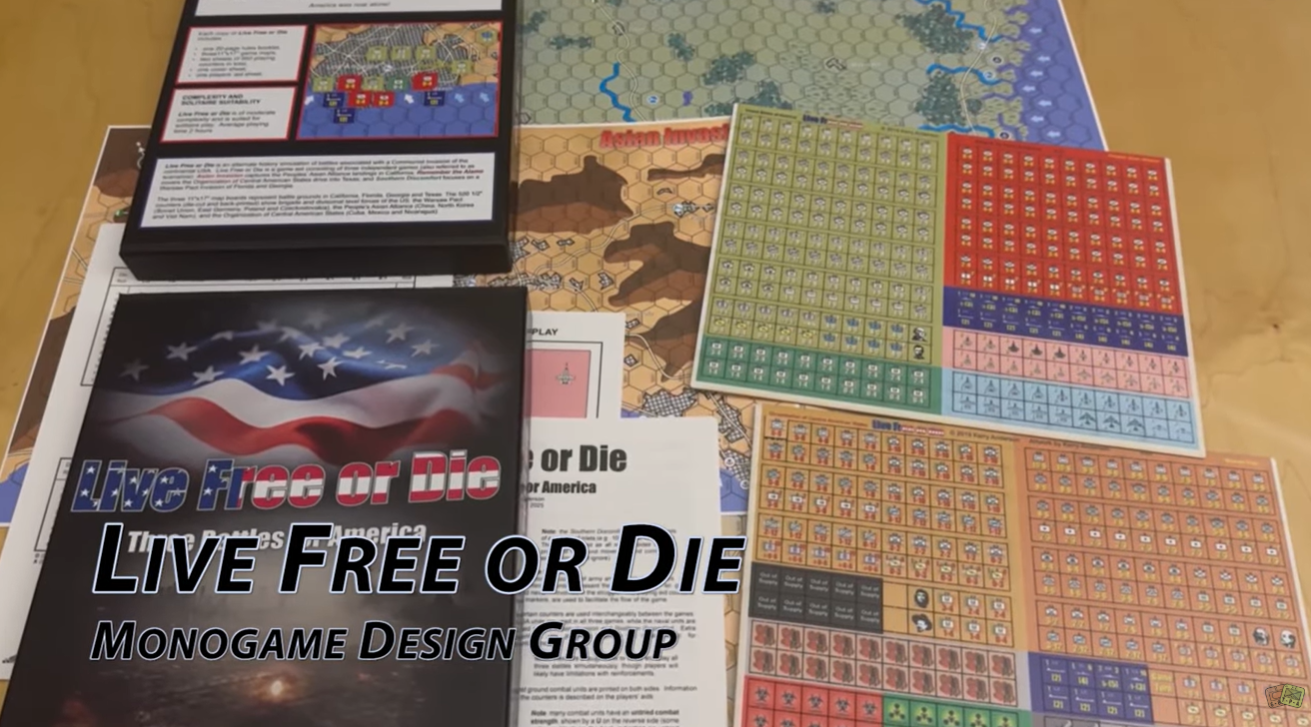
Following the successful deployment of missiles on Cuba in 1962, the Communists gained much ground in Latin America. Western Europe became less convinced of American commitment to defend the continent. This led to the NATO alliance being dissolved and replaced by a neutral bloc.
America was now alone!
Live Free or Die is an alternate history simulation of battles associated with a Communist invasion of continental USA. Live Free or Die is a game set consisting of three independent games:
Asian Invasion captures the Peoples’ Asian Alliance landings in California;
Remember the Alamo covers the Organization of Central American States drive into Texas; and
Southern Discomfort focuses on a Warsaw Pact invasion of Florida, Georgia.
The Basic Game focuses on ground combat, providing a quick, entertaining game. The Advanced Game introduces air and naval units as well as additional specialized units like cruise missiles, laser defenses and political troops. And beware, there are rules for nuclear, biological and chemical warfare!
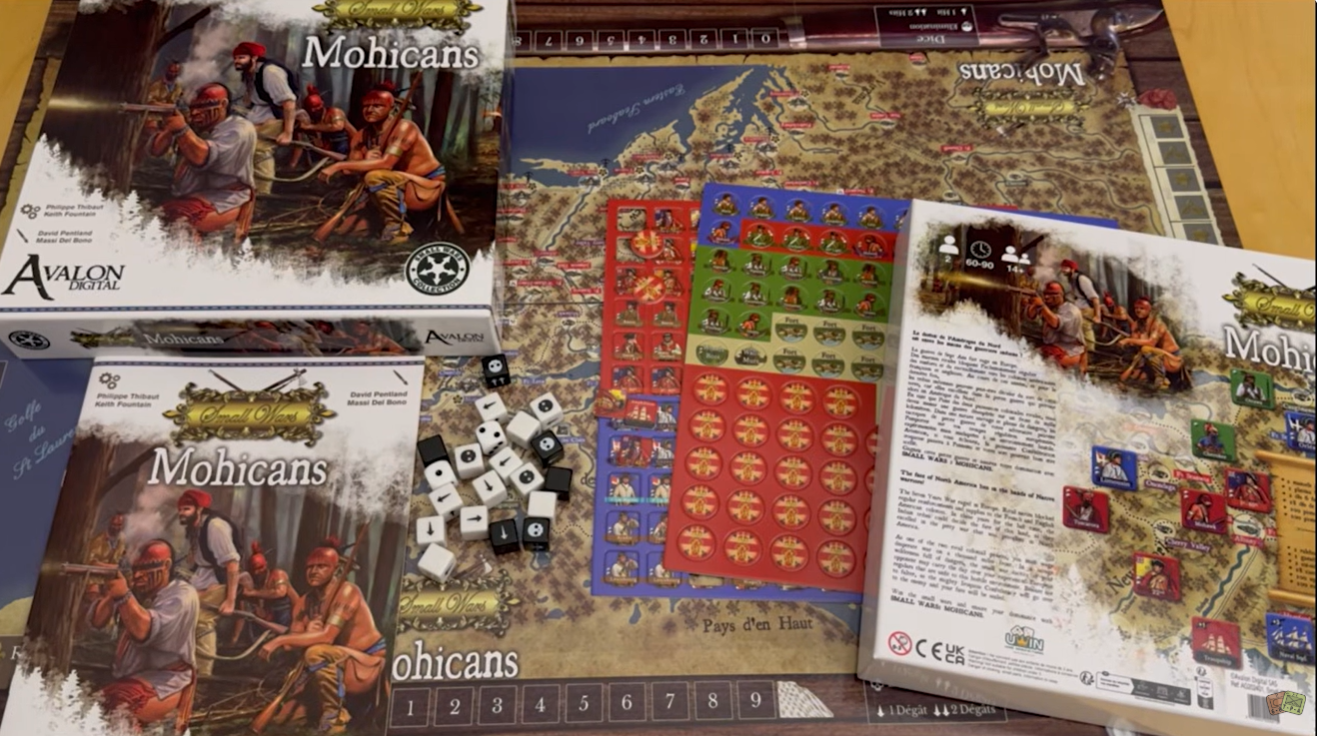
Small Wars: Mohicans is the first game of the Small Wars Series and covers the French & Indian War of the mid-18th century, and is based on a popular 1983 Canadian boardgame called Mohawk. Mohicans starts in 1754 and continues to 1760, which historically was the year after the conquest of Quebec by British forces (a founding event in the creation of modern Canada).
In Mohicans, the powerful regular forces of Britain fight for control of north-eastern North America against the mixed regular and irregular forces of the French and their local allies. The forces of both sides are bolstered by local militia units and other irregular forces, such as the famous French Couriers des Bois or British Rangers, and the arrival each year of more regular reinforcements from Europe.
While the British have the edge in firepower and numbers, the French have better mobility and their Indigenous allies can make effective use of terrain, particularly the massive forests that covered eastern North America at the time. The British are also more vulnerable to having their supply lines cut off.
Both sides seek to curry favour with the powerful but neutral Iroquois Confederacy, as an alliance with them is an enormous strategic advantage. With each major victory on the battlefield, one of the six tribes of the Iroquois will offer its support to the winning side. Get the support of all six tribes, and the Iroquois will join the fight.
To win the game, the British must hold three of the French cities and towns of Louisbourg, Frontenac, Duquesne, Montreal and Quebec (and at least one must be Montreal or Quebec). If they don’t do this by 1760, the French win by default.
The French can also win by holding the British cities of Albany and either New York, Boston or Philadelphia. This will be a tall order for the French but they can take comfort in the fact that the British, like NATO 250 years later have the watches, but the French have the time…
Combat occurs at the different locations, after the seasonal movement has been processed. It covers different battles, such as ambushes in woods, landings, raids on enemy villages and towns, field battles or forts assaults.
During the Winter between each of the 7 years of the war, reinforcements are received, militias and Indians are mustered and forts can be built.
Panini startet eine ganze Reihe neuer Comic-Serien mit beliebten Marvel-Helden im neuen Format zum günstigen Preis: Der Neustart von Captain America spielt direkt nach seinem Auftauen aus dem Eis, Thor ist nun ein Sterblicher und niemand kann sich an ihn erinnern und die Fantastic Four werden in die Vergangenheit geschleudert.
French board game publisher Don’t Panic Games has continued its expansion into the North American market, telling BoardGameWire the success of several recent titles had reinforced its confidence in the strategy.
The company has made a name for itself providing French localisations of games including Final Girl, Champions of Midgard and Fantasy Realms since it was co-founded by current director Cédric Littardi in 2013.
But Don’t Panic has also found success publishing its own titles such as Chess-like abstract game Above – and said the performance of that, and several other recent games, had persuaded it to bring more of its titles to North America.
Emma Recher, who will head up a three-person team at Don’t Panic’s new US office in California, told BoardGameWire, “Several recent titles have reinforced our confidence in expanding more directly into the US market.
“That is one of the reasons we are beginning this US expansion with titles such as Spyworld, Luminis, Above, and Maiko, which are also the titles highlighted in our North American launch announcement.
“We also have additional releases planned each quarter this year, including Don’t Drop the Soap! toward the end of the year.”
Above, designed by Yves Charamel-Lenain, from Don’t Panic Games
Don’t Panic said those licensed titles would continue to be distributed by Japanime, while the French company’s historical and war line, including Fighters of the Pacific and Fighters of Europe, will continue to be distributed by Ares Games in the US.
Recher said, “What the new US office changes is that Don’t Panic can now directly support additional English-language titles that were not previously represented in the market in the same way.
“For retailers, that means broader access to the catalog, closer communication, more direct follow-up, and stronger on-the-ground marketing support.”
Don’t Panic added that it would be supported in the US by Double Exposure, which will represent the company at both major and smaller conventions – adding that it had a “robust demo schedule” planned over the next few months.
When asked about Don’t Panic’s decision to expand further in the US despite ongoing uncertainty over the country’s tariffs policy – and its effect on board game publishers working in the country – Recher said, “Like many publishers in tabletop gaming, we are watching the tariff situation very carefully. It creates uncertainty across the supply chain, from manufacturing and freight planning to wholesale pricing and retailer margins.
“Our approach is to stay flexible: planning conservatively, reviewing sourcing and logistics options on an ongoing basis, and working closely with our partners to protect continuity of supply as much as possible.
“The current environment is challenging for everyone in the industry, but we believe the best response is to remain pragmatic, adaptable, and transparent with our partners.”
With this My Favorite Wargame Cards Series, I hope to take a look at a specific card from the various wargames that I have played and share how it is used in the game. I am not a strategist and frankly I am not that good at games but I do understand how things should work and be used in games. With that being said, here is the next entry in this series.
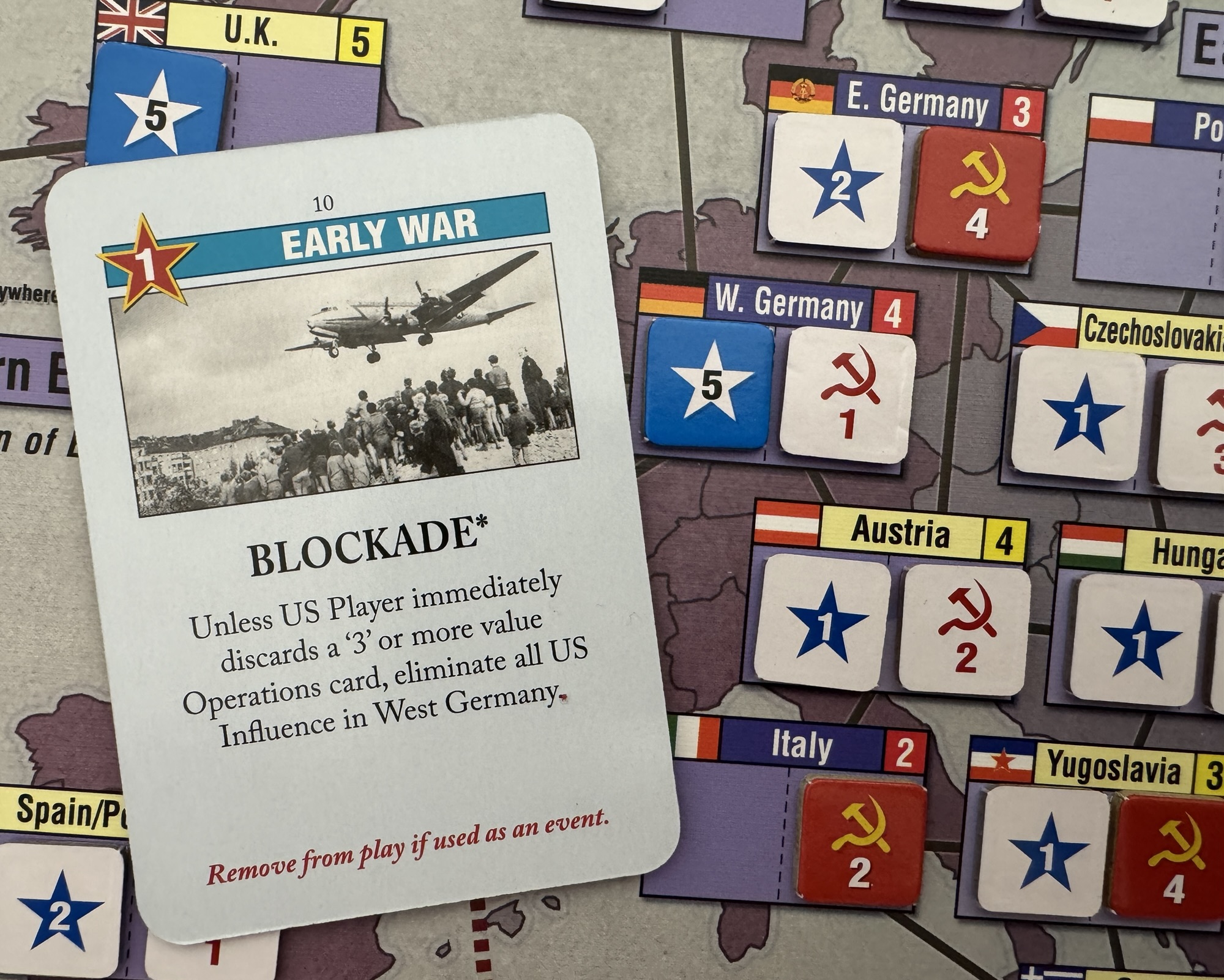
#69: Blockade from Twilight Struggle: The Cold War, 1945-1989 from GMT Games
Twilight Struggle is a 2-player game simulating the forty-five year ideological struggle known as the Cold War between the Soviet Union and the United States which can be played in 2-3 hours. The entire world is the stage on which these two countries “fight” to make the world safe for their own ideologies and way of life. The game starts right after the end of World War II in the midst of the ruins of Europe as the two new “superpowers” of the world squabble over what is left and ends in 1989, when only the United States remained standing.
The map is a world map of the period, where players move units and exert influence in attempts to gain allies and control for their superpower. The beauty of the CDG system used here is that each decision of whether to use a card for the event or the operations value is a struggle as if it is the other side’s event, it might go off hurting you very badly. There are mechanics to allow for the ignoring or cancelling of some of the best cards for your opponent in a side game within the game called The Space Race as well as nuclear tensions, with the possibility of game-ending global thermonuclear war (Shall we play a game, anyone?). I have played TS about 30 times and love it more and more with each sitting. The game makes me sweat, cringe, jump with joy and bite my fingernails. To me, a game that can do all of that in one sitting is worth the price.
One of my favorite type of cards from the game are those that force an action upon your opponent, such as discarding a card, reducing the Ops from card plays or causing them to have to make other plans than what they were working toward. These type of cards are more reactionary but definitely cause issues and mimic the various non-military focused strategies and tactics used during the Cold War. One of the most famous events from the early history of the Cold War is that of the Berlin Blockade. And there is a specific card that pays homage to the event in the game called Blockade. Blockade is an Early War Soviet Card that has an Ops Value of 1, which makes the card more valuable to be used for the printed event versus for the Ops.
When played, the card requires the US Player to immediately discard a 3 Ops or more value card from their hand or the consequence of not doing so will see all US Influence being removed from West Germany. This is a tough choice. Being early in the game, it is possible for the US to rebuild in West Germany and replace the lost influence over time if they do not wish to discard such as high value card. But, herein lies the real key to the Blockade cards use. The Soviet Player, who should be paying attention to not only their hand but also the card plays of the US Player, should try to use this card later in a turn once the US Player has played a majority of their cards in order to ensure that the event text can be realistically be achieved. If played quickly during a turn, the chances of the US Player being able to discard the required 3 Ops or great value card is higher and the card play will not generate any meaningful difference on the board state. I also would recommend a 2 card strategy here as the Soviet Player should be holding in their hand a high Ops card to be able to follow up this action with the placement of Influence into West Germany on their very next play. But, the real value to a card such as Blockade is that it forces the US Player to consider what cards are out there and to play around their negative effects as much as possible. Due to the nature of the game, and the randomness of card draws, having an expendable high Ops card ready and able to be discarded just in case of the play of Blockade is not really feasible. Also, remember that in Twilight Struggle that opponent events on cards that you play will go off and Blockade being drawn by the US Player can be bad as it will require them to play the event as you cannot discard a 1 Ops card to get rid of its negative effect in the Space Race Track due to the minimum requirement being a 2 Ops card. So the moral of the story here is that both players need to consider and plan for the play of or the mitigation of damage from Blockade.
The Berlin Blockade, which lasted from June 1948–May 1949, was a major Cold War crisis where the Soviet Union blocked all land and water access to West Berlin to attempt to force Western Allies out. The Soviet Union was taking this action as a means of retaliation against the introduction of the new Deutschmark currency. The US and Britain responded with the massive Berlin Airlift, flying over 2.3 million tons of food, fuel and supplies to the city. At the peak of the Airlift, a plane landed in West Berlin every 30 seconds. The blockade failed and the Soviets lifted it on May 12, 1949, after realizing the Allied Airlift could sustain the city for an extended period of time, marking a significant victory for the West in the ideological struggle. This event led to the acceleration of the division of Germany into East and West and the deepening of Cold War tensions.
I think it’s fair to say that we crushed this last year (although some of us better than others), so it’s only correct and right that we should return to do it again. What are the best games of 2026 going to be? Well, only we know, but we’re willing to part with that information. Get your fat stacks ready. Before we set ourselves up for failure, we talk about Alibis, Mosaic: A Story of Civilization, and Cyclades: Legendary Edition.
If you don’t want to miss an episode, please subscribe on Apple Podcasts/Google Podcasts/Stitcher/Spotify, or add our RSS feed to your favourite app. Reviews and subscriptions really help us and would be greatly appreciated! To download the episode directly, click here.
If you’d like to discuss anything in the episode, please do so in the comments below, visit our BoardGameGeek guild, join our Discord, or Facebook Group! Any feedback is also always helpful. If you’d like to show your support for the show, we also have a Patreon with some fun rewards, and a merch store!
Timecodes:
03:02 – Alibis 09:18 – Mosaic: A Story of Civilization 23:25 – Cyclades: Legendary Edition 36:27 – Anticipation Auction 2026 41:18 – The Game Makers 44:25 – Cozy Stickerville 46:39 – Brass: Pittsburgh 50:35 – The Lord of the Rings: The Two Towers – Trick-taking Game 54:04 – Revenant 56:21 – World Order 59:31 – Dark Pact 1:02:28 – The Great Library 1:03:56 – Spirited 1:05:25 – Realm of Reckoning 1:08:55 – Avalon: The Riven Veil 1:12:57 – La Pâtisserie Rococo 1:14:24 – Nippon: Zaibatsu 1:17:24 – Rewild: South America 1:18:44 – Movers & Shakers
Thank you to Heart Society for generously letting us use What’s On Your Mind, Kid? from their album Wake the Queens.
Before the Treaty of Alliance and the French declaration of war on Britain, France had supported the American Patriots materially. Now that France was a full belligerent, fighting forces would follow – first, the French fleet.
Admiral d’Estaing’s event card in Liberty or Death (Harold Buchanan, GMT Games) emphasizes the difficulties and opportunities of coordinating far-reaching naval operations. From the Vassal module.
A naval force under Admiral Charles Henri Hector d’Estaing, carrying a few thousand French land forces, was dispatched to North America in summer 1778. They embarked on an ambitious combined-force scheme together with the Continental Army to take Newport from the British. American-French cooperation (as well as army-navy cooperation) proved difficult, and the operation had to be aborted. In one of the more dubious decisions of the war, the British abandoned Newport, one of the finest natural harbors in New England, voluntarily soon after.
As joint operations had not yielded success, the American and British forces would usually operate separately for the next two years. That meant that the Americans continued to bear the brunt of the struggle for North America. The French navy and army, however, were crucial in tying down British forces in the by now global struggle: British and French forces fought over the economically crucial “sugar islands” of the Caribbean. A French armada, strengthened by Spain which had recently entered the war, threatened to invade Britain itself in 1779. Even in far away India, British forces were challenged by the French and their local allies. Players of Imperial Struggle (Ananda Gupta/Jason Matthews, GMT Games) will recognize these as the four regions in which Britain and France fight for supremacy – with victory going to the player who can balance their interests in the four regions best, taking losses where they must while making bigger gains elsewhere.
The board of Imperial Struggle depicts a world full of opportunities for conquest, alliance, and trade in North America, Europe, the Caribbean, and India. In this particular game, the British have been expelled from North America, but done well in India.
The American Patriots had none of this strategic depth. If they were defeated North America, their cause would be lost. And even with French support, it did not seem like they could do more than brace themselves against the military and financial superiority of Britain… if so much. The harsh winter of 1779-80 decimated the Continental Army. Difficulties in paying the troops resulted in the mutiny of the Pennsylvania and New Jersey Line regiments. The situation seemed so dire that Benedict Arnold, one of the most distinguished American commanders, betrayed the American cause (but failed to deliver the fort of West Point to Britain), serving in the British army for the remainder of the war.
The Benedict Arnold event in Washington’s War (Mark Herman, GMT Games) does not only give a die roll modifier in a battle to Britain, but also removes the (American) leader Arnold from the board. Experienced American players know this, of course, and will not entrust Arnold with important missions… thus, his invasion of Canada is unlikely to happen in the game. An interesting meditation on how much historical hindsight influences gameplay.
The Southern Strategy
Part of the American woes was the new British focus. As New England was lost to Britain, and too full of rebels to be retaken, the British turned their attention to the southern colonies which the believed to be populated by many British loyalists.
First, they advanced from Florida (supported by sea) into Georgia and took Savannah on December 29, 1778. A combined American-French land-sea operation failed to retake the city in June 1779. After this second joint operations failure, the French fleet relocated to the Caribbean. British forces under Charles Cornwallis laid siege to Charleston, South Carolina, the following March.
Lincoln never stood a chance. From the Rally the Troops! implementation of Washington’s War.
Benjamin Lincoln, who had commanded the American troops in the unsuccessful counter-offensive at Savannah, was put under enormous political pressure not to let Charleston, one of the most important cities in the south, fall into British hands. Retreat was thus impossible. Yet the defense of the city against superior British forces was doomed. Lincoln surrendered in May 1780.
Cornwallis’s next victim. From the Rally the Troops! implementation of Washington’s War.
Cornwallis also beat the new American commander in the south, Horatio Gates, at Camden (and thus cut Gates, the hero of Saratoga, back to size again). As the British general was poised to invade North Carolina, Washington dispatched Nathanael Greene to take command in the south.
Greene’s approach aimed to elude a decisive engagement. Contrary to British assumptions, the south was not rife with British loyalists. The crown was only supported where Britain could enforce loyalty – on the coasts, and wherever Cornwallis’s army was at the moment. And Cornwallis could not be everywhere. Small American forces under guerilla leaders (like “The Gamecock” Thomas Sumter and Francis Marion, on whom the movie The Patriot is based) chipped away at British forces and support. While Cornwallis beat Greene at Guilford Court House and Eutaw Springs in early 1781, he could not reverse the south’s affiliation to the Patriot cause.
Yorktown
Cornwallis lost patience with the indecisive campaign against Greene’s Fabian strategy. In 1781, he boldly struck into Virginia. His supply was to come from sea via the port of Yorktown on Chesapeake Bay. If Virginia, the largest and most populous southern colony was taken and thus the south cut off from the north, Greene would have to surrender – or so Cornwallis thought. Cornwallis’s good strategy rating in Washington’s War makes it likely that the British player will let him pursue similarly active campaigns… and hopes not to get caught by superior force.
Cornwallis’s plan was risky. Virginia was much closer to the American and French main forces than the Carolinas. The French commander Jean-Baptiste Donatien de Vimeur, comte de Rochambeau, urged George Washington to confront Cornwallis. And thus a third joint operation began: Gilbert du Motier, Marquis de Lafayette, a French volunteer in the Continental army, marched American and French forces to Virginia.
Cornwallis responded in the typical British manner: He fortified Yorktown and confidently relied on British naval superiority to keep his options open. That confidence was shaken when the French instead of the British navy showed up in Chesapeake Bay. The British sent a fleet of their own, but the resulting naval battle of Chesapeake Bay failed to expel the French fleet (September 5, 1781).
Between a rock and a hard place: Cornwallis was trapped by the American-French army and the French navy. From the Rally the Troops! implementation of Washington’s War.
Washington and Rochambeau took command of the combined army and invested Yorktown. As Cornwallis had failed to tenaciously defend the outer defenses, assuming he would be evacuated by the Royal Navy, the sieging forces advanced quickly. Cut off from supplies and under bombardment from the allied artillery, Cornwallis surrendered on October 17, 1781. His entire force of almost 8,000 was captured (with another 156 dead). French and American total casualties (dead and wounded) were barely over 200.
Peace
The war in the colonies had been unpopular in Britain for some years. Parliament was unwilling to expend more money on it, and thus the British forces deployed had never again reached their peak strength from 1776. With one of the two main British forces in the colonies lost, so was the parliamentary base for the government. When the Whig opposition’s motion to end the war in North America carried a majority, Prime Minister Frederick North resigned in March 1782. “North’s Government Falls” is the end of a game of Washington’s War, and can happen anytime between 1779 and 1783 (provided the event is face-up in the respective year).
North’s successors had to make peace with four separate enemies – the United States, France, Spain, and the Netherlands. The American negotiators Benjamin Franklin and John Jay proved most skillful in this complicated multi-sided diplomacy. They secured diplomatic recognition for the United States as well as the western domain all the way to the Mississippi and important fishing rights in the Atlantic. The Peace of Paris was signed on September 3, 1783.
The king of France had little time to enjoy his triumph. The war expenses incurred in the American Revolutionary War contributed to the financial crisis which resulted in the French Revolution (whose protagonists were in turn inspired by the American ideas of liberalism and republicanism) just six years after the Peace of Paris.
Britain, on the other hand, bounced back from the setback in North America. The country’s naval, commercial, and financial strength was still intact. Britain would orchestrate the coalitions against revolutionary and Napoleonic France until the final victory at Waterloo in 1815, ushering in a century of British global dominance.
And the United States? They remained within their own hemisphere for the time being. Only occasionally drawn into conflict with their erstwhile French allies or old British enemies, the United States dealt with their westward expansion and economic development. Despite its unresolved conflict internal conflict about slavery, the American republic remained an inspiration to European liberals and democrats who strove to follow the example begun 250 years ago.
Allison, Robert J.: The American Revolution. A Very Short Introduction, Oxford University Press, New York City, NY 2015 is exactly what it says on the tin.
Higginbotham, Don: The War of American Independence. Military Policies, Attitudes, and Practice, 1763-1789, Indiana University Press, Bloomington, IN 1977 covers not only the campaigns, but also the political, social, and economic dimensions behind them.
Nine score and seven weeks ago, I have inaugurated a new irregular series on my blog assessing the merits of UK prime ministers (illustrated through the lens of a single board game each). The rating system seemed robust enough to apply it to other countries/leaders (at least if they are more or less democratic). Thus, we branched out to American presidents, German chancellors, and even a German president. Today’s subject is another US president – Abraham Lincoln, our first rated subject from the 19th century. And which game could be more appropriate for him than the first real political-military game of the American Civil War – For the People (Mark Herman, GMT Games)?
The Rating System
Some caveats ahead: The presidents will be rated by the knowledge of their time. If they or their contemporaries could not have known about the effects of something, I will not use my hindsight to mark it as a mistake of theirs. The assessment is focused on their conduct as president, but includes their life after holding the office (in which they will still be regarded in the public eye as (ex-)presidents).
Now, to the system itself: There are three policy field categories (foreign, domestic, and economic policy) and three more general ones (vision, pragmatism, integrity). A president can earn from one to five stars in each category (for a total sum of up to 30). In detail, the president is assessed as follows:
Foreign policy: Did the president increase US influence in the world and the security of Americans at home? Did the president wield US power responsibly and with positive results for the regions affected (the latter counting for a greater deal in times of US power being great)?
Domestic policy: Did the president increase the liberty of Americans to express themselves and to participate in the political process? Did the president promote domestic security and shape the framework for fair justice dealing with offenses?
Economic policy: Did the president facilitate the prosperity and economic security of Americans (including in the mid- and long-term)? Was the president’s economic policy based on mutual benefit of those involved or did it unduly burden one side?
Vision: Did the president have an idea of what the United States and the world (the latter counting for more in times of US influence being great) should look like beyond the immediate future? Did the president’s policies steer the United States (and, if applicable, the world) in this direction?
Pragmatism: Did the president succeed in seeing his policy through from inception to completion? How well did the president manage the support from Congress, society, the administration, the media (the latter counting for more in more recent years)?
Integrity: Did the president understand the office as a means to benefit himself, special interest groups, the entire country, or another community? Did the president respect the boundaries of the office?
Lincoln’s Life
Beginnings on the Frontier
Abraham Lincoln was born on February 12, 1809, as the son of Kentucky frontier farmers. The family moved around often during his childhood – first to Indiana, then Illinois. Lincoln received little formal education. He worked on his father’s farm and as a hired laborer from his youth on. However, he loved reading and yearned to escape physical labor by self-improvement – thus, he jumped at the chance to work as a store clerk (and later, store owner), postmaster, and, finally, taught himself law from books and passed the bar to practice as a lawyer.
Lincoln ran for the Illinois state legislature in 1832 and was narrowly defeated – as he proudly noted later, it was his only defeat in a popular election. Two years later, he was successful. During his eight years in the state house, Lincoln focused on supporting the infrastructural development of the state – railroads, canals, and the state bank to finance these projects.
The dominance of the Democratic Party in Illinois left little room for Whigs like Lincoln to be elected to national office. Lincoln thus waited until it was his turn in the Whig party candidate rotation to try for the US House of Representatives in 1846. Lincoln went to Washington where he attacked Democratic president James K. Polk’s war against Mexico. The Whig rotation meant that he could not run for re-election. Lincoln resumed his law practice and gloomily assumed his political career was over.
Lincoln vs. the Expansion of Slavery
The Mexican-American War ended in a resounding success for the United States – and in an expansion of slave-holding territory in the south which upended the Missouri Compromise of 1820. Instead of being bottled up in the south, slavery now seemed on the advance. The proponents of the “peculiar institution” saw their chance to export it to the territories, new states, and enforce their customs in the free states of the north as well. The possible expansion of slavery electrified its opponents as well, and the territories in the west – especially Kansas – soon became embroiled in a violent struggle over their status as slave-holding or free.
Lincoln was elected to the Illinois state legislature again in 1854, but declined to take his seat to stand for election to the US Senate (then elected by state legislatures). As he failed to obtain a majority, he struck a pact with anti-slavery Democrat Lyman Trumbull and had him elected on a cross-party coalition of Whigs and Trumbull’s small faction of anti-slavery Democrats. A political re-alignment was near.
When the new Republican Party formed, united in its opposition to slavery, Lincoln abandoned the sinking ship of the Whig Party. He stood again for election to the US Senate in 1858, this time against Democratic heavyweight Stephen A. Douglas who had made his fame as the evangelist of “popular sovereignty” – the position that the federal government should neither allow the expansion of slavery to the new states and territories nor ban it, and instead leave the decision to be decided in local referenda. Lincoln followed the immensely popular Douglas on his campaign trail and got him to stand in a series of debates against Lincoln. While Lincoln lost the Senate election once more, the debates elevated him to national standing as a moderate opponent of slavery with great intellectual and rhetorical capabilities.
Elected by the People
Lincoln’s moderate stance – he opposed the expansion of slavery, but did not call for its abolition in the slave states of the American South – was a liability in the new Republican Party if they just wanted to make a statement for their supporters. Yet when the dominant Democratic Party which had won six of the last eight presidential elections fractured over the question of slavery (Douglas’s platform of Popular Sovereignty gained a majority, but not the required two thirds of the delegates; the southern proponents of federal enforcement of slavery outside of the South bolted from the Democratic convention and nominated John C. Breckinridge as their own candidate), it became an asset – for the Republicans now played for victory. Lincoln was nominated as the Republican candidate, beating the party’s more radical heavyweights such as Governor Salmon P. Chase (Ohio) or Senator William H. Seward (New York). As the pro-slavery field fractured even further (John Bell ran as the candidate as the Constitutional Union Party which had the same views on slavery as the southern Democrats, but opposed their flirt with secession), the Republicans were suddenly the frontrunners. While Lincoln only won 40% of the popular vote in the election of November 6, 1860, he was ahead in all the populous free states of the north which gave him an easy victory in the electoral college (180 of 303 votes). John Bell had carried three states for 39 electoral votes with only 13% of the popular vote; Stephen Douglas only 12 electoral votes even though his 29% of the popular vote placed him second behind Lincoln. Yet he had been crushed in the north by Lincoln, and in the south by John Breckinridge who had only received 18% of the popular vote, but carried eleven slave-holding states in the south for 72 electoral votes.
Lincoln was only a moderate opponent of slavery, but that was still likely to mean that he would end the federal practice to enforce slavery in the new states and territories as well as the free states (as when fugitive slaves were returned from the free states to their erstwhile masters). That thought put southern slaveholders in a frenzy. South Carolina declared its secession from the United States on December 20, 1860. Six other states followed suit in the next weeks. The seven proclaimed a new country, the Confederate States of America, on February 4, 1861 – one month before Lincoln had even taken office.
Any attempts to save the Union before Lincoln’s accession failed. Lincoln himself made a conscious effort not to provoke the southerners, he was also fiercely aware that their position was that of a political minority, having just been soundly defeated by the electorate, and that he could not act “as if I repented for the crime of having been elected, and was anxious to apologize and beg forgiveness.” Constitutional Unionist Senator John C. Crittenden proposed to enshrine slavery in the US constitution to allay the fears of the slavers. These constitutional amendments could not gain a majority in Congress, as the Republicans were unwilling to use their electoral victory to enact their defeated opponent’s platform, and the southern Democrats were bent on secession.
Entering the White House, Lincoln found a mess. His predecessor James Buchanan, a pro-slavery Democrat, had done nothing to prevent secession or reign in the secessionists. Parts of his administration had even helped the secessionists before their terms in office ended. Lincoln himself dared not act to boldly to quash the secession as he (falsely) believed that the majority of southern whites supported the Union and would rise up against the secession. As that did not happen, the only committed Unionists in the South were representatives of federal institutions – most notably, the army. The secessionists seized army installations, where they could, and sieged them, where they couldn’t: The shots fired at Fort Sumter, a fort in the harbor of Charleston (South Carolina) which its commander refused to hand over to the secessionists, marked the beginning of armed insurrection to the United States – the American Civil War. Encouraged by the brazen action further south, four more states (including the all-important Virginia) joined the Confederacy.
Limited War to Save the Union
Lincoln now walked a dangerous tightrope. The secession could only be put down by military force, but he needed to apply it in a way which would not make the Union look the aggressor lest the slave states which were still in the Union (Missouri, Kentucky, and Maryland) seceded as well. Lincoln managed these border states with a deft hand. In Missouri, the local unionists and the US forces overcame the secessionists. Lincoln left Kentucky deliberately alone until a Confederate invasion swayed the state in favor of the Union (and US forces defended it against the Confederacy). Maryland, the most crucial of the three for its position (it provided the only connection of Washington, D.C., to the rest of the Union), was put under tight control by the US military. Lincoln dispensed with the writ of Habeas Corpus to allow for a more effective control of secessionists there.
With the border states secured, the Union needed to put down the Confederacy. That proved to be a daunting task: While the Confederacy was far inferior in terms of manpower and industrial production, it only needed to hold out long enough for the war to become so unpopular in the North that the Union would seek a negotiated end to it. The Union, on the other hand, had to force the Confederacy into surrender by destroying its armies and taking its territory. This asymmetry is reflected in the victory conditions of For the People: The Union player can only win (the campaign game) by dragging Confederate Strategic Will all the way down from 100 to 0. The Confederate player, on the other hand, has other avenues of victory: Having more than twice the Strategic Will of the Union player will do, as will lowering Union Strategic Will under 50 in fall of 1864 – when Lincoln would be up for re-election.
Lincoln was thus on a timer. The Union needed to win decisively, and soon. Yet the first offensive toward the Confederate capital Richmond (Virginia) was repelled. Lincoln consequently approved a massive expansion of the army, the naval blockade of the south, and a multi-pronged approach into the Confederacy (not only in the east, but also through Kentucky and along the Mississippi River) – preparations for a long war.
Lincoln studiously avoided any infractions against slavery in the early phase of the war (and when his generals, such as 1856 Republican presidential candidate John C. Frémont, overstepped their authority in that regard, sacked them). Yet as no southern Unionist movement arose to challenge the Confederacy, Lincoln’s belief in the unionist leanings of the white Southerners dwindled. By 1862, he had grown convinced that the still undecided war had broken out to serve a larger purpose – the end of slavery. Thus, he slowly racked up anti-slavery measures. Slaves taken from Confederate owners were treated as contraband of war, not to be returned. Slavery was abolished in D.C. (with the former slaveowners compensated), and banned in the territories. And by late 1862, Lincoln had changed his views on the relationship between slavery and the Union altogether: He no longer thought that respecting slavery would convince the South to re-join the Union, but that attacking slavery would weaken the Confederacy internally and sap its external sources of support and would thus help to end the war and restore the Union.
Total War: Emancipation and Union
A more sweeping statement on slavery was thus necessary. With one military disappointment after another (excepting Ulysses S. Grant’s victories in the west), it would look like an act of desperation, though. Lincoln needed a success. The marginal Union victory in the battle of Antietam (which repelled a Confederate offensive on Union territory) on September 17, 1862, was as good as it would get – and so Lincoln proclaimed that the insurgent states had until January 1, 1863, to re-join the Union. Otherwise, all slaves living in states in rebellion would be freed. Of course, that had no immediate effects – after all, the thus emancipated slaves were in territories under Confederate control – but it forced the Confederacy to increase the effort to keep their slaves from running, and it effectively precluded the European powers Britain and France (pro-Confederate from the point of view of their economies and power politics, but strictly anti-slavery) to recognize the Confederacy.
The Emancipation Proclamation is a crucial event in For the People as well (which sets the game apart from earlier Civil War games, which focused almost exclusively on the movement of armies and made at best cursory references to slavery). It is one of the very few mandatory events – if the conditions are met (a Union battle victory), it must be played for the event. While it lowers the Strategic Will of the Union (reflecting the unwillingness of many northerners to fight a war for the Black people of the South), it hurts the Confederacy much more – not only in terms of Strategic Will (a further penalty will be applied henceforth every round), but also by removing some military forces (which, presumably, either are kept back to guard plantations, or cannot be supplied anymore as the fleeing slaves shrink the southern economy).
Lincoln was also done with his earlier attempt at limited war in another respect: US forces in the crucial eastern theater had been commanded by General George B. McClellan since July 1861. McClellan had mishandled them at almost every opportunity, and even when he succeeded (such as Antietam), he squandered his advantage by failing to pursue. Even his political value to Lincoln – McClellan was a high-profile Democrat – could not save him now. Lincoln sacked him, continuing his search for a general who would act aggressively, deliver battle to the Confederacy, and victory to the Union – going in succession through Ambrose Burnside, Joe Hooker, and George G. Meade.
Sacking McClellan is something that a Union player at For the People might also want to do – while McClellan’s battle rating of 0-2 (offense/defense) is not too bad, his strategy rating of 3 means his forces can only be moved when spending a powerful 3-value card – bad for any US president who means to go on the offensive! Yet McClellan’s high political value (10) makes it painful for the player to relieve him of his command, as it will incur a steep Strategic Will penalty.
McClellan where loved to be most – in command of the Army of the Potomac, the Union’s main force on the eastern theater.
1863 would mark the turning point of the war. The Confederacy meant to undermine Union morale by another large-scale incursion into Union territory. On July 1, 1863, the Confederate and Union main armies clashed at Gettysburg. After three days of bloody battle, the Confederacy retreated. One day later, Grant took Vicksburg (Mississippi) and thus put the entire Mississippi River under Union control, cutting the Confederacy in half.
Yet the war remained unpopular in the North. Only two weeks after the victories of Gettysburg and Vicksburg, riots against the draft broke out in New York. Lincoln had the draft momentarily suspended and quietly resumed a month later.
With only one more year until the presidential election, time was running out for Lincoln. The Democratic Party of the North, always split between the supporters of the war to re-establish the Union and its opponents, adopted a pro-peace platform… and selected George McClellan, whose incompetence had done so much to prolong the war, as their candidate. Lincoln had no problem securing his nomination (his control of the Republican Party was by now complete) and left it to the convention to select his running mate. They opted for Andrew Johnson, a Democrat who supported the war.
If the Union did not win great victories in 1864, Lincoln’s chances for re-election were slim. Yet there were reasons to be optimistic: Lincoln had placed Grant in command of the eastern theater, whereas Grant’s former subordinate William T. Sherman now headed the forces in Tennessee, ready to invade Georgia. Grant slowly wore down the Confederate forces in Virginia which could not bear the attrition. In the meantime, Sherman had taken Atlanta – a psychologically invaluable success which shifted the electorate’s mood in Lincoln’s favor – and marched on Savannah. Lincoln was re-elected with 55% of the popular vote and 212 of 233 electoral votes.
Now the great tasks of restoring the Union and abolishing slavery had to be brought to conclusion. While Grant and Sherman kept advancing, Lincoln worked to turn emancipation from a wartime measure to a constitutional right: The 13th Amendment would end slavery in the United States. The amendment showed not only Lincoln’s acumen in dealing with Congress, but also how much the country had changed – Lincoln had lost the 1858 Senate election on a much more moderate position than what was now to become part of the US Constitution. In his second inaugural address, Lincoln interpreted the war as a punishment for the nation’s original sin of slavery, but expressed hope for the nation to move forward together.
The Confederacy collapsed under Grant’s and Sherman’s campaigns. Confederate General in Chief of the Armies, Robert E. Lee, surrendered on April 9, 1865, with other commanders following suit. The Reconstruction of the South with the eventual goal of its re-admission to the Union and the integration of the former slaves into American society were now Lincoln’s chief tasks. Yet before he could begin to deal with the requirements of peace, he was murdered by the Confederate sympathizer John Wilkes Booth on April 14, 1865.
The Rating
Foreign policy
Lincoln left foreign policy largely to Secretary of State William H. Seward, yet intervened where necessary (for example, when the seizure of British mail ship Trent which carried Confederate envoys threatened to spark a crisis or even British intervention, Lincoln calmed the storm by releasing the envoys). He successfully forestalled foreign recognitions of the Confederacy (except by fellow slave-state Brazil), let alone military intervention on behalf of the Confederacy.
Lincoln recognized slavery as the chief obstacle to liberty in the United States. First tentatively, then boldly did he abolish the practice, resulting in the freedom of four million people. While he has been attacked for his alleged infractions on individual freedoms (most notably the suspension of Habeas Corpus), Lincoln used these measures in moderation. That Lincoln never even considered postponing the 1864 election (which he full well knew could end both his presidency and his policies) because of the war is the strongest testament to Lincoln’s deep respect for the rule of law.
Lincoln regarded economic policy as the prerogative of Congress and did not interfere with it. His own economic policy was concerned with the organization and financing of the war effort, in which he was largely successful (even though it must be said that the economic basis of the Union was much stronger than that of the Confederacy).
Rating: 4 out of 5.
Vision
Lincoln’s vision of the United States was that of a country which was no longer “a house divided against itself.” While his own preference would have been to contain slavery and let it extinguish by itself in the South, the secession both enabled and required him to take firmer measures. Besides ending slavery, Lincoln laid the foundations during the Civil War for the United States to be a unified country, largely centrally administered, rather than a collection of individual states, and thus prepared the country’s 20th century predominance. Not least of all, Lincoln’s unmatched rhetorical prowess allowed him to interpret political events in memorable language which shapes American thinking until today.
Lincoln was a Washington outsider. Before his presidency, he had only spent two years in federal politics. Still, he quickly developed a productive working relationship with Congress and his cabinet – all the more remarkable as Lincoln’s Secretaries were not selected for their loyalty and subservience, but came from the heavyweights which had competed for the 1860 presidential nomination (including Secretary of the Treasure Chase and Secretary of State Seward). Lincoln’s legacy is remarkable as well: He established the nascent Republican Party as the dominant political force which would win twelve of the next 16 presidential elections.
Lincoln respected the boundaries of his office and did not attempt to extend his influence into areas which were thought to be Congress’s province. The goodwill he extended to people of the most diverse backgrounds and convictions is legendary. Lincoln placed himself at the service of the Union – a nation he came to understand as larger than before, including four million heretofore disenfranchised slaves.
Rating: 5 out of 5.
Overall
Abraham Lincoln faced challenges like no other American president. The secession and Civil War were both a struggle for survival of the United States against those who would not accept the democratic process and a moral crucible which would resolve the awkward question of slavery after 80 years of failed attempts to skirt it. Lincoln met these challenges head on and with resounding success. He jumps to the top of the ranking – and it’s not even close.
How would you rate Lincoln? Let me know in the comments!
Further Reading
For an accessible biography of Lincoln, see Gienapp, William E.: Abraham Lincoln and Civil War America. A Biography, Oxford University Press, Oxford 2002.
For a “biography of the mind” of Lincoln, situating him in the intellectual currents of his time, see Guelzo, Allen C.: Lincoln. A Very Short Introduction, Oxford University Press, Oxford 2009.
For an overview of how Civil War games treat the causes of the war, slavery, and emancipation, see Wallace, Alfred: The War in Cardboard and Ink. Fifty Years of Civil War Board Games, in: Kreiser Jr., Lawrence A./Allred, Randal: The Civil War in Popular Culture. Memory and Meaning, University Press of Kentucky, Lexington, KY 2014, pp. 175—89.

 Anmelden