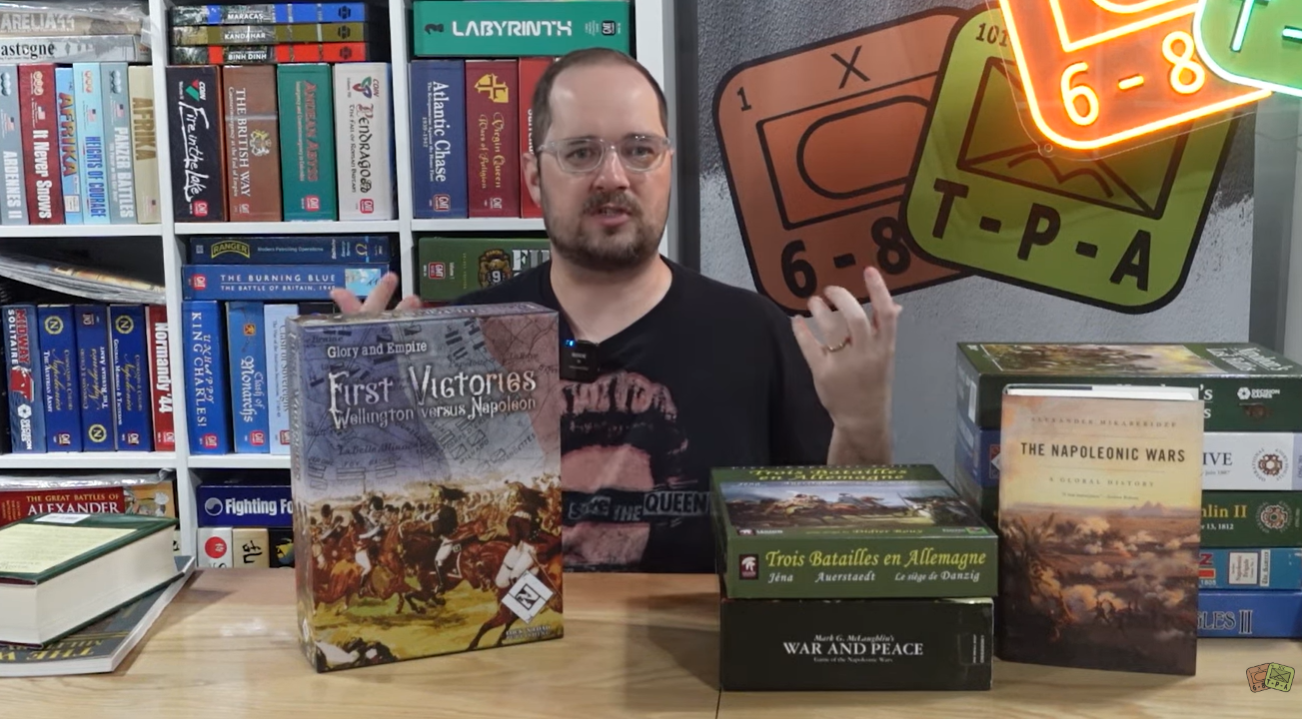
We have an ongoing video series on our YouTube Channel called From Cover to Cover where we read a book on a subject and then pair that with a discussion of the book while covering a few games also on the subject. In this 14th entry in the series, Alexander takes a look at The Napoleonic Wars: A Global History by Alexander Mikaberidze. He then discusses a few games on the subject including Congress of Vienna from GMT Games, Imperial Struggle from GMT Games, Alliance from Columbia Games, Commands & Colors: Napoleonics from GMT Games and The Napoleonic Wars from GMT Games. amongst many others
2026, what a year. Here’s what my board gaming looked like in the first half of it.
Let’s start with a statistical overview (as of June 30):
I’ve played 20 different games (slightly down compared to last year at this point).
Only 3 of them were new to me (massively down compared to last year’s 9).
These 23 games resulted in a total of 57 plays (slightly up compared to last year)
The month in which I played most games was June (with 16 plays), the months with the fewest plays April and May (5 each).
Of the 23 different games, 8 are historical. These account for 29 of the plays (half the games, around three quarters of the plays compared to last year).
7 of the plays were solo (up from last year’s single play).
31 of the 57 plays were digital, continuing the strong digital bent of 2025.
The changes are partially due to a changed event schedule – I did not attend any conventions this year, so I played fewer new and fewer historical games.
Here are some of the games I enjoyed most this year so far:
As said, I didn’t play a lot of new games this year. But among them, Pax Pamir is the absolute standout. Cole Wehrle’s first design is a thoughtful exploration of the roles of small power brokers having to deal with big ones, skillfully seizing opportunities and avoiding pitfalls, using loyalty and betrayal as necessary tools in their struggle for security and power. It is also an incredibly clever game blending planning, chaos, and negotiation into a tight, low-scoring affair which usually sees several players reaching for victory until the very end.
End of the game: British Dominance has been warded off (which would have given the victory to either Orange or Gray), Russian Dominance as well (which would have put Red in play). Instead, my Blues have found a way to thread the imperial needle and emerge victorious! From the implementation on Rally the Troops!
At eight plays, Pax Pamir is my most-played game so far this year. I predict a few more plays will follow – facilitated by the excellent digital implementation at Rally the Troops!
New discoveries are great. So are re-discoveries. I was enamored with Imperial Struggle in 2022, getting it to the table (and to Vassal) a few times. Since then, however, I hadn’t played it a single time… until it came to Rally the Troops! this year.
With that, I got in no fewer than seven plays. I delight in the diplomatic, economic, and military opportunities all over the globe and despair when my opponent snatches a key advantage. I carefully plan out the investment tile selection, but sometimes I go with my intuition about what’s the area of contest in which my play will have the biggest impact. And I love both the sheer might of the French juggernaut and the plucky resilience of the British underdog.
British dominance in India has not been enough to outweigh French advantages in the western hemisphere… nor has the almost-complete wipeout of British alliances in Europe helped. From the implementation on Rally the Troops!
If you have also started (or re-started) playing Imperial Struggle and need some strategic pointers, have a look at my strategy post! And if you need the right music to play in the background, here’s my immersive playlist of period tunes.
A game which I had only played online (also on Rally the Troops!) before… but finally, I had the chance to break out my physical copy! I must say, it is a very different experience – the perfect documentation of the digital implementation allows for a lot more analytic play. On the board, you need to rely on your memory – and on your intuition, which suits the bluffing-heavy style of the game anyway.
Caesar’s concentrated forces are ready to strike.
In our game, I led the Caesarian forces against the Pompeians of a newcomer. Antony and Pompey clashed aggressively in Italia; Scipio and Caesar in Asia. All four leaders barely survived their initial battles. After Antony had chased Pompey out of Italia, he rested on his laurels… but old Pompey still had some fight in him and returned with a fresh legion and some elephants to retake Rome! When the Caesarian advance in Hispania was turned into a rout by Jupiter’s divine intervention, Pompey won after only three years of civil war – also proving how accessible the game is to new players who are not burdened with too much rules overhead and can just focus on their schemes and ruses!
Games are fundamentally about people. Legends of Andor is a great series of cooperative games, but I am under no illusions that its main staying power for me comes from with whom I’ve been playing it: My good friends F. and M. started the Andor base game with me in 2014, and since then, it has become one of the mainstays for the three of us – and, since F. died in 2020, for M. and me. We have been steadily playing through the main series and have just finished the fourth big box instalment The Eternal Frost – the first one which M. and I played entirely without F. Legends of Andor is a game, but it is also a celebration and commemoration of our friendship. I can’t wait to start the next instalment: Legenden von Andor: Das ferne Land (The Distant Land – as far as I know, there won’t be an English edition).
Gaming against the heatwave: While we dispelled the eternal frost from Andor, the outside temperatures reached 38°C.
What was remarkable about your 2026 gaming so far? Let me know in the comments!
You love board games. You probably also like music. Let’s combine the two into an immersive playlist for Imperial Struggle (Ananda Gupta/Jason Matthews, GMT Games). Have it gently play in the background during your next session of Imperial Struggle for the full period immersion!
First things first: Here’s the playlist!
Before we dive into the content of the playlist, some general observations:
Of course, there was no music recording in age of Imperial Struggle, so all the songs in the playlist have been recorded in the 20th or 21st century.
The playlist is only 1:45 hours long, so you might need to listen to it several times during your game… unless France stomps over Britain in the first turns.
The playlist is thematically sorted. That helps you find similar songs, but makes for somewhat monotonous listening (until you come to the next group of songs). I therefore recommend you turn shuffle on.
Now, what awaits you in the playlist?
#1-3: Religious (classical) music
Imperial Struggle begins after the age of the great confessional wars in Europe, but religion still played an important role in people’s lives, from the lowliest peasants all the way up to kings. Their week culminated in a Sunday service and their year was interspersed with religious events. Composers wrote pieces specifically for a religious holiday (like Bach’s “Christmas Oratorio” from which #2 is taken), or were dedicated to comprehensive religious teaching (like Händel’s “Messiah”, premiering on Easter 1742 in Dublin, from which #3 is taken).
#4-12: Secular (classical) music
The Baroque saw music as universal. Religious and secular followed the same conventions, and thus the same composers wrote pieces for the church and for worldly courts, like Baroque grandmaster Johann Sebastian Bach (Toccata and Fugue in D minor, #4 and Cello Suite No. 1 in G Major, #6) or Georg Friedrich Händel (Sarabande from Suite No. 11, #5). The classical (in the narrower sense) music from the mid-18th century on left this universal view behind. Composers now focused on either one or the other, with most of them following the more fashionable and more lucrative secular path.
Some composed for a court whose lavish entertainments always required music (like the 1773 wedding of the French prince Charles Philippe, the later king Charles X, for which François Francœur arranged the music from which #9 is taken – thus the title Symphonie du Festin Royal (Symphony of the Royal Feast)). Others became freelance musicians (like Mozart, who could (for some years) live of the proceeds of his concerts and operas, #10-12).
#13-16: Folk songs
Not everyone went to a church where the latest compositions were played on Sundays, and of course most people were far removed from attending any court festivities, let alone royal weddings. But people made and listened to music. The easiest, most affordable way to do so was to sing. The 18th century is rich with folk songs, some originally written at the time (like Frère Jacques (“Brother James”), #15 or “Ye Jacobites by Name”, #16), others older, but first put down to paper at the time (Au Claire De La Lune (“By the Light of the Moon”, #13, and Over the Hills, and Far Away (#14)).
#17-23: Patriotic songs
We’ve heard in #16 already how political events seeped into popular songs. Others were written specifically to rouse patriotic feeling, an emotion which came into its own in the 18th century: “Rule, Britannia” (#17) expressed confidence and pride in the Royal Navy to protect British freedoms, “The British Grenadiers” (#18) praised the courage of their counterpart by land.
That these songs could be re-interpreted and turned against their original intent shows “Free America” (#19), written in 1770, which uses the same tune as “The British Grenadiers”, but its lyrics extol America’s freedom (which turned out to be freedom from Britain).
Finally, national anthems also came first into existence in the 18th century: Brits sang “God Save the King/Queen” (#22 – I took the liberty of choosing a not-quite-traditional version). France only got its first anthem (La Marseillaise, #23) with the French Revolution which bookends Imperial Struggle… at least until Ananda Gupta and Jason Matthews get around to do a Revolutionary and Napoleonic Wars expansion!
You love board games. You probably also like music. Let’s combine the two into an immersive playlist for Imperial Struggle (Ananda Gupta/Jason Matthews, GMT Games). Have it gently play in the background during your next session of Imperial Struggle for the full period immersion!
First things first: Here’s the playlist!
Before we dive into the content of the playlist, some general observations:
Of course, there was no music recording in age of Imperial Struggle, so all the songs in the playlist have been recorded in the 20th or 21st century.
The playlist is only 1:45 hours long, so you might need to listen to it several times during your game… unless France stomps over Britain in the first turns.
The playlist is thematically sorted. That helps you find similar songs, but makes for somewhat monotonous listening (until you come to the next group of songs). I therefore recommend you turn shuffle on.
Now, what awaits you in the playlist?
#1-3: Religious (classical) music
Imperial Struggle begins after the age of the great confessional wars in Europe, but religion still played an important role in people’s lives, from the lowliest peasants all the way up to kings. Their week culminated in a Sunday service and their year was interspersed with religious events. Composers wrote pieces specifically for a religious holiday (like Bach’s “Christmas Oratorio” from which #2 is taken), or were dedicated to comprehensive religious teaching (like Händel’s “Messiah”, premiering on Easter 1742 in Dublin, from which #3 is taken).
#4-12: Secular (classical) music
The Baroque saw music as universal. Religious and secular followed the same conventions, and thus the same composers wrote pieces for the church and for worldly courts, like Baroque grandmaster Johann Sebastian Bach (Toccata and Fugue in D minor, #4 and Cello Suite No. 1 in G Major, #6) or Georg Friedrich Händel (Sarabande from Suite No. 11, #5). The classical (in the narrower sense) music from the mid-18th century on left this universal view behind. Composers now focused on either one or the other, with most of them following the more fashionable and more lucrative secular path.
Some composed for a court whose lavish entertainments always required music (like the 1773 wedding of the French prince Charles Philippe, the later king Charles X, for which François Francœur arranged the music from which #9 is taken – thus the title Symphonie du Festin Royal (Symphony of the Royal Feast)). Others became freelance musicians (like Mozart, who could (for some years) live of the proceeds of his concerts and operas, #10-12).
#13-16: Folk songs
Not everyone went to a church where the latest compositions were played on Sundays, and of course most people were far removed from attending any court festivities, let alone royal weddings. But people made and listened to music. The easiest, most affordable way to do so was to sing. The 18th century is rich with folk songs, some originally written at the time (like Frère Jacques (“Brother James”), #15 or “Ye Jacobites by Name”, #16), others older, but first put down to paper at the time (Au Claire De La Lune (“By the Light of the Moon”, #13, and Over the Hills, and Far Away (#14)).
#17-23: Patriotic songs
We’ve heard in #16 already how political events seeped into popular songs. Others were written specifically to rouse patriotic feeling, an emotion which came into its own in the 18th century: “Rule, Britannia” (#17) expressed confidence and pride in the Royal Navy to protect British freedoms, “The British Grenadiers” (#18) praised the courage of their counterpart by land.
That these songs could be re-interpreted and turned against their original intent shows “Free America” (#19), written in 1770, which uses the same tune as “The British Grenadiers”, but its lyrics extol America’s freedom (which turned out to be freedom from Britain).
Finally, national anthems also came first into existence in the 18th century: Brits sang “God Save the King/Queen” (#22 – I took the liberty of choosing a not-quite-traditional version). France only got its first anthem (La Marseillaise, #23) with the French Revolution which bookends Imperial Struggle… at least until Ananda Gupta and Jason Matthews get around to do a Revolutionary and Napoleonic Wars expansion!
Now this may sound a bit basic. Of course you want advantages! Yet when you’re planning what to do with your investment tile, you might often be tempted by other things – shiny prestige spaces, or simply spaces with a lower cost which help you gain the majority in the region. Advantages, however, are often the better choice: A well-chosen advantage can gain you another space (or deny it to your opponent) not only once, but several times over the course of a game. If your opponent is smart, they will often try to counteract your gaining of an advantage by unflagging the space which gave you the advantage, or at least gaining a similar advantage, which means you are acting and they are reacting.
France and Britain are fighting hard for the two spaces adjacent to the Baltic Trade advantage. You can see on the French player mat in the background that France has gained the Algonquin Raids and Mediterranean Intrigue advantages.
Some of my favorite advantages: The Indian alliances with Mysore, Nizam, or the Marathas which allow you to drown your opponent in a sea of conflict markers, the Asiento advantage whose discount on fleets gains you a cheap military edge – and spaces – which can be flexibly moved around, and, best of all, Baltic Trade whose debt reduction amounts to two free wild points every turn. Get it or at least deny it to your opponent!
Board Position First, VPs Second
Advantages are long-term benefits. In the same spirit, I advise you to prioritize the long-term benefits of a sound board position over the short-term gains of winning this regional or that global demand scoring. If your board position is good – if you have the right alliances, military outposts, and advantages – you will put pressure on your opponent, win wars, gain spoils, and the VPs will come rolling in anyway.
Both players have done their homework and placed a flag on a fort (hexagonal spaces) in North America – Britain in Halifax, France in Louisbourg.
A key investment in that sense is a turn 1 fort in North America. That’s the only theater which is active in all four wars, so the fort will give you a military benefit four times (a strength point and the conquest line) in addition to controlling its surroundings (which makes unflagging harder and removing enemy conflict markers easier), and, of course, it’s a space which counts for regional scoring.
Use Initiative Wisely
If your opponent scores a few more VPs than you early on, that is not only bearable, but might even be to your advantage, as the player behind in VPs has the initiative and decides who goes first in a turn. That’s a weighty decision, as going first gives you a better choice of the investment tiles, but going last allows you to mess with your opponent’s plans and they have no chance to repair the damage before scoring.
If this were the first turn – would you choose to go first or second as the player with initiative?
My rule of thumb is: I go last, unless there’s an odd number of investment tiles with a major action in the dimension that will be crucial (early on, that’s often diplomatic), or an odd-and-low number of investment tiles that allow you to play an event.
Which strategies and tricks do you use to win at Imperial Struggle? Let me know in the comments!

 Anmelden