The August 2026 Monthly Debrief Video, which is the 8th episode in Season 6 of this series, saw us discussing American Revolution Wargames. As you may know, I really enjoy the history of the American Revolutionary War. I have read dozens of histories on the subject, with my favorite being Robert Leckie’s George Washington’s War: The Saga of the American Revolution, and it never ceases to amaze me how a group of ragtag rebels were able to best an entire global Empire in open rebellion. The reason for that was the patriots resolve and their ability to run away when outmatched to fight another day when they had a better advantage and not necessarily because they were better armed, or drilled or disciplined. I think that their desire to truly be free was the main difference but that is up for speculation. I love the games on this subject and have played nearly 20 and I was surprised at the number when we had this discussion.
Also, as usual, we covered the games we played in August as well as the games we plan to play in September and had a short discussion of our plans to attend the Gaming the American Revolution Camden 250 Event in Camden, South Carolina sponsored by GMT Games.
We will remind you here that we are fortunate to be continuing our relationship with Noble Knight Games as the sponsor for our Monthly Debrief Video series. In case you don’t know, Noble Knight Games specializes in hard to find games but also carry all the new releases. But what makes them truly unique is that you can find some of the rarest games, long out of print games, hand made games, imported games from overseas, etc. Thanks to them for their sponsorship and we hope that you will consider them first when looking for the games we cover.
Rom, die Ewige Stadt: Eine uralte und vergessene Gefahr droht, sie und das Römische Reich zu zerstören. Nur die mutigen Custodes und der Kaiser können dies noch verhindern in einer komplexen Kampagne, die die Welt von Lex Arcana grundlegend verändert.
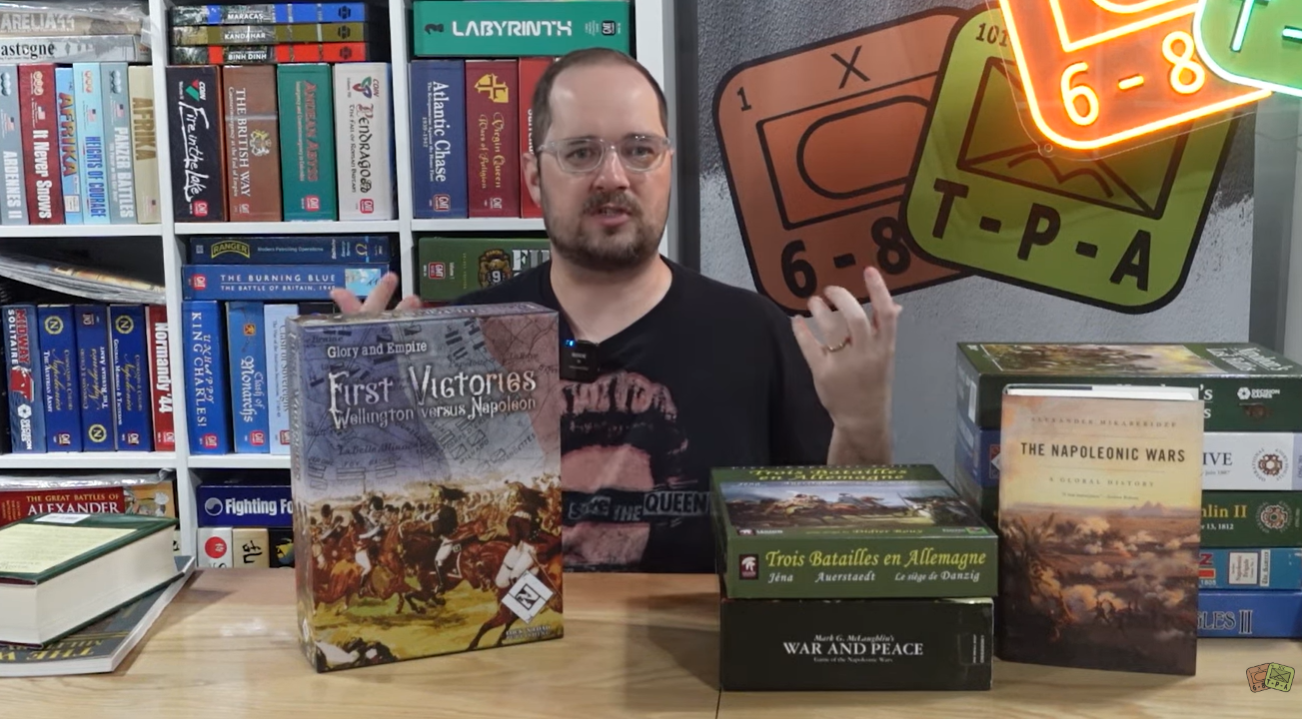
We have an ongoing video series on our YouTube Channel called From Cover to Cover where we read a book on a subject and then pair that with a discussion of the book while covering a few games also on the subject. In this 14th entry in the series, Alexander takes a look at The Napoleonic Wars: A Global History by Alexander Mikaberidze. He then discusses a few games on the subject including Congress of Vienna from GMT Games, Imperial Struggle from GMT Games, Alliance from Columbia Games, Commands & Colors: Napoleonics from GMT Games and The Napoleonic Wars from GMT Games. amongst many others
I’ve said it before, I’ll say it again: Small local board game fairs and conventions are great. You get board gaming fun in a manageable dose of one day, without long trips and expensive accommodation. In many cases, they’re also not quite as full – which means no waiting times and instead just 100% of the good stuff. In that spirit, I attended Spiel doch! in Friedrichshafen (Germany). Here’s how it went.
If you want to read more convention reports like this, I strongly recommend you subscribe to the blog – all new posts in your inbox right when they go live!
Spiel doch! [Just play!/Why don’t you play?] is a new-ish affair: Its western German original was first held in 2015 in Duisburg (and has since moved to Dortmund). It has branched out to the south in 2023 (Friedrichshafen). The name of the fair also indicates who the target audience is – casual gamers who might not have sold their soul to board gaming entirely (yet). That means the focus is on playing – a good part of the fair grounds is dedicated to tables at which you can play ganes (either your purchases r copies from their ample library of games (which you get to check out for free).
Ever saw the Night Witches fight Louis XIV’s musketeers? – Now you can!
Of course, there are also opportunities for publishers and local board game stores to present their goods (and even some new designs). There’s a lot of variety between the sellers – some focus on the bestsellers, others have a more eclectic collection where you might find a rarer gem. For example, I got a copy of A Battle Through History (Erik Burigo/Pär Sundström/Marco Valtriani, Pegasus) as a gift for a friend who is a big Sabaton fan.
Dice, dice in all colors of the rainbow.
In addition to the games, you’ll also find a lot of board game accessories and other items of interest to the nerdy crowd drawn by a board game fair.
Some great pins to wear for game night!
As said, though, the heart of the fair is the big free play area. We had the chance to give Dungeon Legends (Przemek Wojtkowiak, Rebel Studio) a try: Our team of knight, scout, and smith cleared the underground of monsters, kept the castle safe, and eventually extinguished the fire which was the main challenge of our legend.
The bluish hue of the game mat makes the orange fires which we had to fight in our legend pop even more. Great visual design!
We enjoyed the straightforward deck building and the visual style of the game – but I must say that learning the rules was a bit of a challenge. Whose idea was it to list the actions you can take in the middle of the rule book and then describe how you perform them in an icon overview on the second-to-last-page of the scenario book?
The best thing about Spiel doch!, however, may be that it goes beyond buying and playing games, as two particular highlights for me attest: The booth of the European Society of Game Collectors presents rare games through the ages – this year, all of them aerospace-themed.
Some older aerospace-themed games. The one in the left foreground was co-funded by the German Research and Testing Agency for Flight and Space Flight.
We have interviewed the venerable designer Ty Bomba on numerous occasions over the 10-year life of the blog. In fact, I counted up the interviews and to date we have done 18 total! Wow but the last one we did was in January 2023 and we have just not had him on since. No reason for that other than I have been busy with other games. But recently I saw from War Diary Publications that they were printing one of his What If? style alternative history games called Rommel in Italy, 1943-1944: A Counter-Factual Simulation, which supposes Field Marshal Erwin Rommel had taken command of German forces in Northern Italy rather than being sent to help with the defense of France against the expected Allied invasion. I reached out to Ty and he was more than glad to give me some more information.
Grant: What is your upcoming game Rommel in Italy about?
Ty:Rommel in Italy, 1943-1944: A Counter-Factual Simulation allows 2 players (or one playing 2-hand solitaire) to investigate the strategic and operational potentials that would have been in place across northern Italy from September 1943 through May 1944 if Hitler had left Field Marshal Erwin Rommel in charge there rather than Kesselring. Rommel advocated for immediately pulling back to a shorter, easier to defend, position at the south edge of the Po Valley rather than trying to fight it out farther south, with both the German’s flanks exposed to possible encirclement via Allied amphibious end runs. In effect, it put the Allies into a strategic position that historically they did not achieve until a year later. The question then becomes can they keep up that kind of advance into and across the Alps.
Grant: Why was this a subject that you wanted to design a game around? What assumptions about history did you take into account?
Ty: Historically, we had 2 of Germany’s best field commanders, Rommel and Kesselring at complete odds with each other over theater-level strategy. Kesselring felt confident the Allies would not achieve a level of operational efficiency that would allow them to effectively exploit the supremacy in the seas along both of Italy’s coasts. History showed that he was correct in that assessment, but Rommel’s transfer to France was not a sure thing. Hitler actually tried to send him back to Italy, to take full charge there, shortly after Rommel had gotten on a plane to fly to France. Radio communications temporarily failed, and by the time Hitler’s communications people got that all sorted out, the dictator had again changed his mind and kept Kesselring in place.
Further, the fact Kesselring was shown to have been correct does not mean Rommel was necessarily wrong – and there’s a fun-to-play wargame inherent in that iron.
Grant: What is important from the overall period and setting to model in the game?
Ty: The opening of the campaign, in September 1943, is filled with opportunity – but also fraught with peril – for both sides. At the start of play, there are only a few German garrison units in the far north of Italy, while the 10 (mostly elite) divisions of their Tenth Army start off-map to the south, where they just received Rommel’s order to run north. There are no Allied units setup on the map at all. They enter on the south edge during the first turn, and both players operate using the sequence below.
5.3 Allied Reinforcement & Replacement Phases
During these phases, the Allied player may bring onto the map newly arriving units and reclaim into play units that had been previously eliminated in combat. This phase is skipped on Turn 1.
5.4 German Reinforcement Phases
During these phases, the German player may bring onto the map newly arriving units and reclaim into play units that had been previously eliminated in combat. This phase is skipped on Turn 1.
5.5 Movement & Combat Sequence Determination Phases
In each of these phases, excluding that of Turn 1, the Allied player openly declares whether that turn’s movement phase or combat phase will be taken first. On Turn 1 the sequence is always the movement phase followed by the combat phase.
5.6 Alternating Actions Movement or Combat Phases
Always starting with the Allied player, the two players alternate either launching one attack or moving one unit, depending on whether the present phase is movement or combat. Individual attacks may have more than one attacking unit in them, but moves are always made one unit at a time. The unit(s) committed to those “actions” are, upon their completion, flipped over to show their disrupted sides. If a player does not actually want to make an attack or a move when it is his time to do so, he must flip one unit to its disrupted side, just as if it had moved or launched an attack: no “passing” is allowed.
5.7 Movement or Combat Recovery Phases
A movement or combat phase continues as described above until both players are out of undisrupted units or both agree they want to end the phase. If one player runs out of undisrupted units before the other, the player with remaining undisrupted units may go ahead and complete whatever actions he wants to perform with them within normal strictures, but now uninterrupted by having to pause to allow the opposing player to take an action. When a combat or movement phase is ended, both players should cooperatively turn over all disrupted units on the map so their undisrupted sides are and showing.
5.8 German Supply Check Phases
In each of these phases, both players should cooperatively look over the map to find if there are any German units out of supply. Each such unit is immediately removed to the dead pile.
5.9 Allied Supply Check Phases
In each of these phases, both players should cooperatively look over the map to find if there are any Allied units out of supply. Each such unit is immediately removed to the dead pile.
5.10 Ending & Starting Turns
Each time a Allied Supply Check Phase has been completed, advance the Turn marker one box on the Turn Track printed on the mapsheet and start a new turn with Phase I.
On the first turn, the Allied player has a relatively open front before him. If he can exploit that to get into the Po Valley quickly, he will move the strategic timetable significantly forward of the historic one. However, as he’s moving onto the map, so too it German Tenth Army. Depending on how bold both players are, it is not unusual to see pockets form inside other pockets.
Grant: How has this design changed since its original publication in 2021 in Banzai Magazine under the title Rommel’s Last Stand: Italy 1943-44, What If?
Ty: The new publisher has fixed the (scant) errata from the first (bilingual) Japanese edition from Banzai Magazine. They have also taken all the Japanese off the map and out of the rules, presenting everything fully in English. Other than the removal of those irritants, it is the same game.
Grant: What is the scale and force structure of units used for this design?
Ty: Each hex on the map equals 5 miles (8 km) from side to opposite side. Each full turn represents 2 weeks to 2 months, depending on the time of year. Every ground unit represents a regiment, brigade or division of about 2,500 to 12,000 men and/or 50 to 350 armored fighting vehicles.
Grant: How many maps are used in the game?
Ty: There is 1 large-hex based 34×22” map showing Italy north of the line of the Arno River to Ancona.
Grant: What is the anatomy of the counters?
Ty: The units are standard-classical in their data presentations, except their movement factors are not printed on them. All Allied units have (supplied) MF’s of 16 throughout the game, while the German MF’s are as follows.
German Mechanized Units Turns 1-6 – 16 MF’s
German Non-Mechanized Units Turns 1-6 – 8 MF’s
German Mechanized Units On Turns 7-10 – 12 MF’s
German Non-Mechanized Units On Turns 7-10 – 6 MF’s
Grant: What sources did you consult for the Order of Battle?
Ty: The Armies of Rommel by George Forty was an excellent source for the subtleties in the initial German Order of Battle. Beyond that, I pulled the roughly half-dozen historical Italian campaign games off my shelves and pulled information out of them. This is one of the most thoroughly simulated campaigns in the hobby, going all the way back to Avalon Hill’s Anzio, so I was not looking to find any heretofore undiscovered anomalies in either sides’ OB. The uniqueness in this game’s treatment of it comes from the changed strategic context combined with the tension inherent in the turn sequence, which requires both players to remain alert for sudden danger or fortuitous opportunities all throughout its play
Grant: How does combat work?
Ty: Combat is always voluntary and, when viewed on a battle-by-battle basis, is standard/classical odds ratio using a six-sided die.
Grant: What are the victory conditions?
Ty: Operating in conjunction with the alternating-actions turn sequence, the victory conditions are a further element I used to keep both players on the edges of their seats at all times. See below.
4.1 In General. The Allied player is on the offensive, trying to win by advancing fast enough to cause a major disruption to the historic timeline.
4.2 Allied Victory During 1943 Turns. If Phase 9 of Turn 1 or 2 or 3 or 4 ends with Venice or Milan or Trieste, or any one or more of the four German supply source hexes, occupied by an Allied unit or stack, that game ends at that time in an Allied victory.
4.3 Allied Victory During 1944 Turns. If Phase 9 of Turn 5 or 6 or 7 or 8 or 9 or 10 ends with any one or more of the four German supply source hexes occupied by an Allied unit or stack, that game ends at that time in an Allied victory.
4.4 German 1943 Sudden Death Victory. If any movement or combat phase of a 1943 turn ends with the German player having gained control of the containing the Allied Amphibious Invasion Beachhead marker, the games ends in a German victory at that time.
4.5 German 1944 Sudden Death Victory. If any movement or combat phase of a 1944 turn ends with one or more German units in any hex(es) on the south map edge, that game ends in a German victory at that time.
4.6 German End-Game Victory. If Phase 9 of Turn 10 ends without the Allied player having achieved a victory, the game ends at that time in a German victory.
The “White Dragon Game Designer” dressed as a samurai.
Grant: What are you most pleased with about the design?
Ty: As I mentioned above, the Italian campaign has been one of our hobby’s most thoroughly plowed fields for decades. Despite that, I believe I have offered a new experience with it here. Players will get a new slant on it, one that operates within the broad parameters of the war’s historic decision-making, but that is also tense and entertaining for both commanders.
I also hope its appearance in an easily available all-English edition may lead this and other publishers to look into acquiring the rights to other of my designs that have so far appeared only in East Asia (where I am affectionately known as the “White Dragon Game Designer”). I have done several games that have been well-received there, but are barely known here in the West.
Grant: I know you are a busy man with game design projects as well as editing for various wargame magazines but what other games are you currently working on?
Ty: I am presently working on this alternative history design, which is scheduled to appear in World at War No. 130, called Stalin’s Missed Opportunity: What If He Invaded Romania in May 1940?.
Following the successful deployment of missiles on Cuba in 1962, the Communists gained much ground in Latin America. Western Europe became less convinced of American commitment to defend the continent. This led to the NATO alliance being dissolved and replaced by a neutral bloc.
America was now alone!
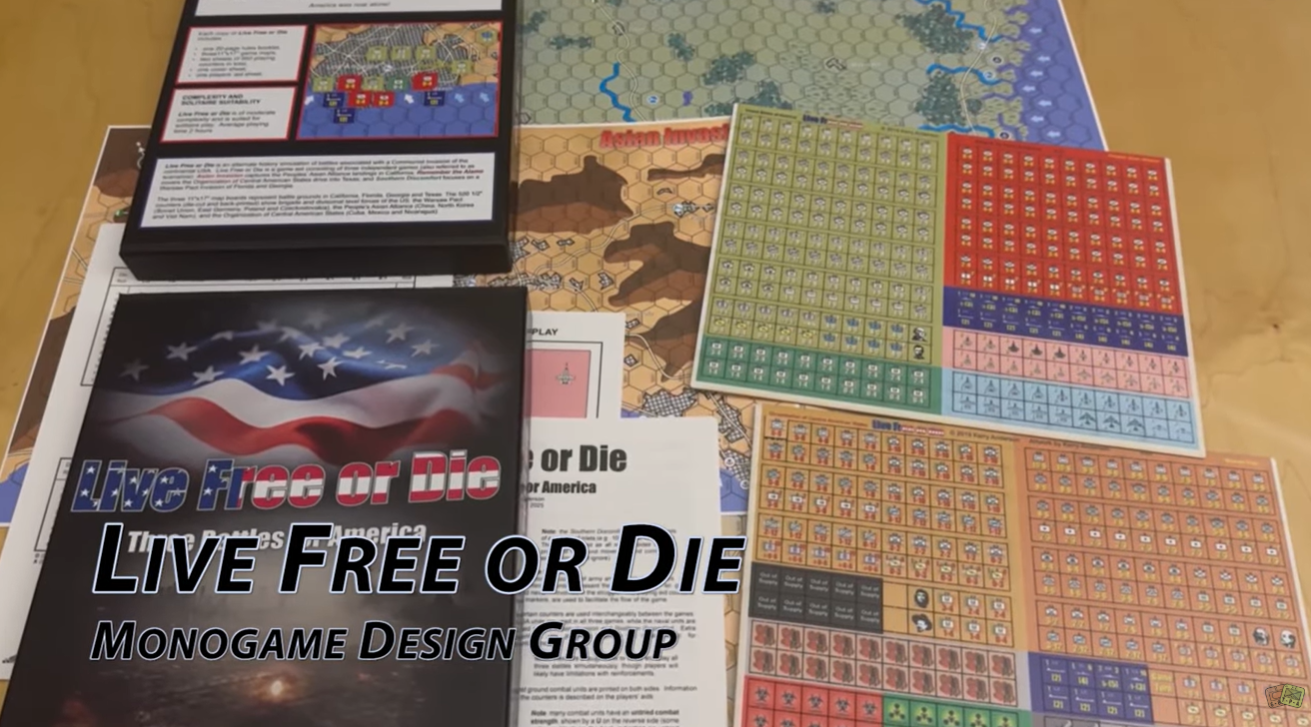
Live Free or Die is an alternate history simulation of battles associated with a Communist invasion of continental USA. Live Free or Die is a game set consisting of three independent games:
Asian Invasion captures the Peoples’ Asian Alliance landings in California;
Remember the Alamo covers the Organization of Central American States drive into Texas; and
Southern Discomfort focuses on a Warsaw Pact invasion of Florida, Georgia.
The Basic Game focuses on ground combat, providing a quick, entertaining game. The Advanced Game introduces air and naval units as well as additional specialized units like cruise missiles, laser defenses and political troops. And beware, there are rules for nuclear, biological and chemical warfare!
Back to our board game assisted biography of Fabius Cunctator! In the first part, we’ve seen where Fabius came from, how his career was already illustrious before Hannibal’s invasion, and how he was then called to Rome’s highest emergency office – the dictatorship. Today, we’re covering the turning point of the war against Hannibal, Fabius’s later campaigns, and his final years – as always, with board games.
If you want to read more posts of this kind, I strongly recommend you subscribe to the blog – all new posts in your inbox right when they go live!
“The Man, Who by His Delaying Restored the State to Us”
After Fabius had laid down the dictatorship, the consuls returned to the traditional method of Roman warfare: Lucius Aemilius Paullus and Gaius Terentius Varro were ready to offer battle to Hannibal once more. Hannibal’s third major battle in Italy ended for the Romans even worse than the clashes at the Trebia and Lake Trasimene: At Cannae, the Roman center advanced, their wings gave way, and the entire army was caught in the double envelopment. Rome lost 50,000 soldiers in a single day, including consul Paullus.
The catastrophe at Cannae made Fabius the obvious choice to lead Rome. While he did not take any formal office immediately, his authority, encouragement, and – once more – attention to religious rites calmed the Romans and rekindled their belief in victory.
Fabius was now at the height of his political, military, and religious authority – and he used them. The Romans elected Marcus Claudius Marcellus and Lucius Postumius Albinus as consuls for 215. When the latter was killed in action before he could assume the office, the college of augurs (of which Fabius was a member) vetoed the by-election of Tiberius Sempronius Gracchus, citing religious reasons against having two plebeians as consuls. Instead, the patrician Fabius was chosen to be consul alongside Marcellus. Fabius would be co-opted into the second important priesthood, the college of pontifices, expanding his religious authority even further.
The two consuls of 215 were both seasoned commanders – just what Rome needed in such dire times. At least Fabius would have thought so. When the elections for the consuls of the year 214 were almost completed, Fabius as the presiding magistrate annulled the elections, claiming that the chosen candidates were no match for Hannibal. The elections were held again, and this time, Fabius and Marcellus were returned for another year (contrary to the Roman prohibition of consecutive terms in office).
In any case, Fabius and Marcellus worked well together. They contained Hannibal in 215 in southern Italy, allowing him no more successes in peeling off Roman allies. In 214, Marcellus went on the offensive in Sicily, while Fabius continued to shadow Hannibal’s army and punish Rome’s unfaithful allies. Their division of labor had them soon known as “the sword [Marcellus] and shield [Fabius] of Rome”. When their terms ended in 213, both of them were confirmed as pro-consular commanders.
As Hannibal’s forces dwindled away, his attempt to destroy the Roman alliance system was failing. Even those cities which had joined him were slowly retaken by the Romans. Marcellus conquered Syracuse, the biggest city on Sicily, in 212. Fabius went for a prize of similar importance, besieging Capua, the biggest Italian city after Rome. Hannibal knew he could not defeat Fabius with his shrunken army. Instead, he tried to save his last major ally by marching on Rome, hoping to lure Fabius away from Capua.
Fabius, however, was as phlegmatic as ever and called Hannibal’s bluff by continuing to siege Capua. Rome held, Capua fell. Hannibal’s war was all but lost. The edge of the Carthaginian invasion had been blunted by Fabius’s patience and tenacity, until Rome’s almost-inexhaustible supplies of soldiers allowed it to take the initiative. Fabius’s contemporary, the poet Ennius described him as the “man, who by his delaying restored the state to us”.
The Last Campaigns
Hannibal had lost, but Rome had not yet won. The cities who had broken faith with Rome in Italy had to be re-taken. Rome still had need of Fabius. He was elected consul once more for 209, and also named princeps senatus (“first of the Senate”), an honorary title which by tradition would have been bestowed on the most senior senator who had served as censor.
Bedecked with these honors, Fabius set out against Tarentum, the last major city in Italy which still supported Hannibal, while other Roman generals kept Hannibal busy. Fabius secretly negotiated with the leaders of the city. They broke with Hannibal and opened the city gates to the Roman army – but Fabius had them slaughtered to veil that he had gained the city by treason.
Not a good time to be Tarentine. From Hannibal & Hamilcar.
Tarentum was plundered. Fabius had a colossal statue of Hercules brought to Rome and placed it next to a statue of himself on the capitol, emphasizing his connection to the divine ancestor which he claimed.
Eclipsed
Hannibal was still in Italy, but Rome was firmly on the offensive. The young Publius Cornelius Scipio invaded Spain and expelled the Carthaginians and proposed to invade the Carthaginians’ African seat of power. While Fabius still argued for a defensive strategy which would contain Hannibal, his word did not count for as much as it used to: He may have been the nominally most influential senator, but his strategy had outlived itself. It had been necessary lest Rome suffer defeat, but it could not deliver the ultimate victory.
Scipio found support in the senate and sailed to Africa. Hannibal was promptly recalled by the Carthaginians and made his way back to Africa as well. Scipio met Hannibal at Zama and defeated him in a bloody battle of attrition. Carthage sued for peace soon after. Fabius did not live to see it. He had died a few weeks before the battle of Zama.
Plutarch’s biography of Fabius (which prizes unity of character over historical accuracy) can be found in an English translation here.
Polybius’s Histories which deal with the rise of Rome in the Mediterranean including the Second Punic War are online in an English translation here.
Fabius has found remarkably little attention by modern biographers. If you read German, I recommend this short, but insightful piece on him: Beck, Hans: Quintus Fabius Maximus. Musterkarriere ohne Zögern [Quintus Fabius Maximus. Model Career without Delaying], in: Hölkeskamp, Karl-Joachim/Stein-Hölkeskamp, Elke: Von Romulus zu Augustus. Große Gestalten der römischen Republik [From Romulus to Augustus. Great Characters of the Roman Republic], Beck, Munich 2000.
It’s Women’s Day! A great opportunity to look pair a book and a game on the American women’s suffrage struggle: The Woman’s Hour (Elaine Weiss) and Votes for Women (Tory Brown, Fort Circle).
The Woman’s Hour was published in 2018 by Viking Press. It focuses on the campaigns for and against Tennessee to ratify the 19th Amendment which enshrined women’s suffrage in the US constitution – as the 36th, and decisive, state to do so.
Votes for Women was published in 2022. It is Tory Brown’s first published board game. The card-driven game can be played in a solo or cooperative mode with the player(s) representing the American suffrage movement from 1848 to 1920 against an automated opposition, or with two to four players facing off against each other (half of them for, the other against women’s suffrage). In either case, the suffrage players must win 36 states (either by shoring them up decisively during the game, or in the final vote on ratification of the federal amendment) to win.
Connections & Conclusions
At first look, book and game seem to have very different scopes. After all, Votes for Women sets in with the Seneca Falls Convention (at which women’s suffrage was first voiced as a political demand in the United States) in 1848 and covers the following 72 years, whereas The Woman’s Hour begins with the arrival of activists Carrie Chapman Catt, Sue White, and Josephine Pearson at the Nashville station in the sweltering summer of 1920. Yet as the narrative progresses, background stories are woven into the tapestry – on the context of the 1920 presidential election, suffragists’ previous efforts to gain voting rights for women in the states and to lobby for a federal amendment, the women’s suffrage movement’s relationship with abolitionism, and all the way back to Seneca Falls (and a little bit of Abigail Adams’s “Remember the Ladies”). If you have played Votes for Women, you will recognize many of the people and events on the cards from the early and middle periods of the game when reading The Woman’s Hour.
The Seneca Falls Convention is the Start card for the suffragist player with which any game of Votes for Women kicks off, following the tradition laid out by protagonist Elizabeth Cady Stanton that this was the starting point of the American women’s suffrage movement.
What unites book and game is their focus on procedural politics. Historical change does not simply happen, nor is momentarily decided upon. Instead, it is brought into effect by the “strong, slow drilling into hardwood boards with passion as well as sound judgment” (Max Weber). The drills used come in both cases from the toolbox of political activism:
The Woman’s Hour details how suffragists (suffs) and anti-suffragists (antis) lobbied the Tennessee lawmakers, how they organized in associations and clubs to channel their activists’ time, funds, and energy, and, of course, how they campaigned for public opinion to win the hearts and minds of the American people with newspaper articles, public speeches, great processions, and all kinds of civil disobedience.
Votes for Women makes these the three actions from which the players choose on a given turn: Lobbying (for and against the 19th Amendment in Congress), organizing (to gain the crucial buttons which are the currency for some powerful in-game effects and die re-rolls), and campaigning (which spreads influence cubes and thus eventually decides if enough states come out in favor of ratification of the 19th Amendment or not).
Early in the game: There are still a lot of orange Opposition cubes, but the women’s suffrage movement has made some inroads (yellow and purple cubes). The large round buttons represent the movement’s organizational strength, the white columns (one already placed on the track under the picture of the Capitol) the willingness of Congress to pass the women’s suffrage amendment.
As we’ve mentioned civil disobedience already: The women’s suffrage movement was no monolithic bloc. One of the great dividing lines was that of styles: The more conventional part of the movement, organized in the late 19th and early 20th century in the National American Women’s Suffrage Association (NAWSA) led by Carrie Chapman Catt, paid close attention to appear as respectable as possible (knowing full well that their demand for equal suffrage was enough of a provocation to the male public opinion of the time). Others adopted a more radical style, inspired by the British suffragettes: The Women’s Party, led by Alice Paul (and represented in Tennessee by Sue White) referred to the president as “Kaiser Wilson” in reference to the German war enemy, burned him in effigy, and (successfully) provoked the police into arresting activists over minor infractions. The dainty young women and respectable matrons who served some prison time then embodied the injustice of depriving women of their vote.
The Woman’s Hour details these fractions within the movement, as NAWSA and the Women’s Party led entirely separate campaigns for Tennessee’s ratification of the 19th Amendment. While infighting was avoided, the reader is left to wonder if the movement could have been more effective if not for these parallel structures – or if the split between a more moderate and a more radical wing was able to compel a broader spectrum of audiences by working in parallel.
Votes for Women depicts the multifaceted character of the women’s suffrage movement by splitting the suffragist player into campaigner figures and influence of cubes of two colors (yellow/gold, the traditional color of the American women’s suffrage movement, and purple, a color which Alice Paul had coopted from the British suffrage movement). As several Opposition event cards target the highest concentration of one or the other color, the Suffragist player is well-advised to aim for an even spread of colors in the individual states.
The pluralism of the women’s suffrage movement is exemplified by the two colors… and a plethora of Opposition events which target only one or the other.
Votes for Women also tackles another split in the women’s suffrage movement which is outside the scope of The Woman’s Hour – that on strategy. After the initial push for women’s suffrage as a part of a great campaign for equal suffrage regardless of sex and race had failed in the aftermath of the Civil War, the suffragists disagreed on how to proceed: Some pushed for a federal amendment to the Constitution (like the 15th Amendment had codified the voting rights of black men), others wanted to win voting rights in the individual states first. While the struggle for women’s voting rights was eventually won with the ratification of the 19th Amendment in Tennessee, the voting rights advances in the individual states had laid the groundwork: Wyoming had established women’s suffrage as early as 1869, Montana sent Jeannette Rankin as the first woman to Capitol Hill, and by 1917, women in 19 states – mostly in the West and Midwest – had won the right to vote (sometimes only in a limited fashion, like voting in local elections).
Votes for Women’s stance is that it needs both – after all, the game is lost for the suffragist player if their lobbying fails to get the federal amendment through Congress, but to win, they need the strength amassed in dozens of local campaigns to have the amendment ratified in enough states. The game, however, makes a statement about timing: While it is possible for the suffragist to have Congress pass the 19th Amendment in the mid-game already, that is a decidedly risky strategy which gives the Opposition a lot of opportunity to snatch individual states and rack up the necessary 13 rejections which mean the failure of the amendment. The ideal move for the suffragist is to build up the strength in the states as much as possible before pushing Congress into action as late as possible. While that is not without its risks (Opposition can still try to throw wrenches in the wheels of congressional action), it spreads them more evenly between federal and local action.
As mentioned above, equal suffrage spread from the American West and Midwest. It had a much harder time in the Northeast and in southern states – like Tennessee. The southern states were not only more conservative in general, suffragists also faced specific obstacles there: Many southern whites remained committed to the cause of white supremacy after the defeat of the Confederacy in the Civil War. Enfranchising women would give the right to vote to black as well as white women, and in the mind of the white supremacists, white women would be much less likely to actually exercise it (be it because they, as “proper” women, would rely on their men to represent them, or because they would not go to a polling station where they might meet with Black Americans). Others, while generally in favor of women’s suffrage, resented the method: After the Civil War, the 13th, 14th, and 15th Amendments had enshrined certain rights (including male voting) for Black Americans in the Constitution. Federal amendments were thus unpopular with many southern whites.
As The Woman’s Hour details, this provided for a lot of traction for the anti movement in Tennessee. Activists like Nina Pinckard and Josephine Pearson railed against carpet-bagging outsiders swooping down from the North to meddle with Tennessee’s affairs, warned of impending “negro domination”, and appealed to the chivalry of southern men to rescue their women from being thrown into the dirty cesspit of politics. That they themselves were knee-deep in that cesspit – after all, they were political activists! – bothered them as much as modern-day “tradwives” are bothered by the fact that their plea for women to be submissive to and dependent on their men is at odds with their often successful social media enterprises.
Somewhat counter-intuitively, many women opposed women’s suffrage on moral or political grounds. Votes for Women does a great job in showing the multi-facetedness of the anti movement beyond the male political and business establishment.
Inherent contradictions aside, the antis’ arguments needed to be countered by the suffs. Many of the white suffragists were willing to make rhetorical or substantial compromises: One of NAWSA’s most-cited statistics in the Tennessee campaign was that the number of white women in the south exceeded that of black men and women combined. Enfranchising women, so the more-or-less subtle subtext, would thus not threaten white supremacy – it might even strengthen it. In the end, the tacit agreement was like that found after the Reconstruction amendments designed to protect Black Americans’ rights in the South: The women’s suffrage amendment made its way into the constitution. Yet voting rights were overseen by the individual states, and federal institutions looked the other way about the blatant disenfranchisement of black voters in the South until the Voting Rights Act almost half a century later.
Neither The Woman’s Hour nor Votes for Women shies away from this uncomfortable part of the women’s suffrage movement: The protagonists of the movement are not portrayed as infallible saints in the book. While they held wildly progressive views for their time on women’s suffrage, their stances on issues of race and class were often more in keeping with those of their contemporaries. They also made tactical mistakes, like Carrie Chapman Catt railing against outsiders trying to influence Tennessee – a charge that was immediately turned against her, a Northerner herself, and restricted her visibility for the remainder of the campaign. And most of them were willing to make compromises for the cause of women’s suffrage – sometimes with themselves (Carrie Chapman Catt supported the US effort in World War I against her pacifist convictions lest the women’s suffrage movement be branded unpatriotic), and sometimes at the expense of others. In short, they were human.
Would the 19th Amendment have passed in Tennessee if the suffragists had been less willing to assuage the fears of southern whites about “black domination”? – Probably not – maybe another state could have become the decisive 36th then, but all likely options had been exhausted before. Did the Black Americans in the South, men and women, suffer from the continued disenfranchisement after 1920? – Undoubtedly.
The South is notoriously tough for the suffragists. Placing a ton of cubes there (plus some additional perks) is a tempting proposition.
Suffragist players in Votes for Women face the same strategic and ethical question (of course, with infinitely lower stakes): One of the most powerful cards in the game is The Southern Strategy which places an immense amount of suffragist influence in the South (representing the union between suffragists and white supremacists). It does open the suffragist for some counter-plays from the opposition, though. Savvy suffragist players might hold the card from turn to turn to play it as late as possible, as an uncounterable stratagem in the final struggle for women’s suffrage. Victories won that way have an odd aftertaste, I assure you.
Since Votes for Women has been released, it’s been in the top 5 of games I have played most often. And while I rarely re-read books, especially non-fiction (because there are always intriguing new books to read), I have come back to The Woman’s Hour and have now both read the physical book and listened to the (excellent) audiobook production. Besides all their worthy exploration and analysis of history, that speaks to both the game and the book being excellently crafted, incredibly engaging pinnacles of their respective medium.
Was passiert, wenn ein Staat versagt – und die Zivilgesellschaft beginnt, sich zu wehren? Rise Against Repression ist ein kooperatives Kartenspiel für 3–5 Spieler:innen ab 12 Jahren, das diese Frage auf spannende, herausfordernde Weise erfahrbar macht. In sechs Runden (Monaten) versuchen die Spielenden, durch gemeinsames Handeln Hoffnung in der Bevölkerung zu stärken – bevor die Repression überwiegt.
Ein autoritäres Regime klammert sich an die Macht: durch Angst, Lügen und Gewalt. Die Bevölkerung ist erschöpft, überwacht und misstrauisch. Doch eine Bewegung beginnt – heimlich, mutig, entschlossen.
Die Spieler:innen übernehmen die Rollen von Bürger:innen, die sich im Untergrund organisieren: mit Flugblättern, Protesten, (geheimen) Netzwerken. Dabei treffen sie auf Dilemmata, Risiken – und müssen sich ohne offene Kommunikation koordinieren. Jede Entscheidung zählt. Hoffnung und Repression werden kontinuierlich abgewogen.
Entwickelt habe ich das Spiel im Rahmen der Centropa Summer Academy, die dieses Jahr in Budapest und Belgrad stattfand. Das Spiel basiert auf historischen Entwicklungen – etwa am Ende des Kommunismus in Osteuropa – und greift auch aktuelle Themen wie staatliche Desinformation, Korruption oder internationale Medienwirkung auf. Ereigniskarten stellen reale Entwicklungen abstrahiert dar, ohne konkrete Länder zu nennen.
Im Spiel wird deutlich: Demokratische Veränderungen entstehen nicht einfach – sie müssen erkämpft werden. Und: Zivilgesellschaft ist kein Selbstläufer. Sie lebt von Mut, Zusammenhalt und Entscheidungskraft.
Rise Against Repression eignet sich für den Einsatz in der politischen Bildung, in Geschichts- oder Sozialkunde sowie in Projekttagen zur Demokratiebildung. Das Spiel kann in pädagogischen Kontexten Diskussionen anstoßen, historische Parallelen aufzeigen und demokratische Werte erlebbar machen und sollte entsprechend eingebettet werden..
Es macht komplexe politische Prozesse emotional erfahrbar, fördert Urteilsvermögen und moralische Reflexion und erlaubt Anpassungen an verschiedene historische oder politische Szenarien (z. B. Simulation stärkerer Repression durch andere Startbedingungen). Durch die Erweiterungen mit Informantenkarten lassen sich zusätzliche Dynamiken wie Misstrauen und Verrat simulieren.
Anleitung und Karten sind aufgrund des Entstehungkontextes auf der Sommer Akademie von Centropa auf Englisch und können hier heruntergeladen werden:
Hinweis: Die Bilder auf den Karten stammen von pixabay und und game-icons.net (CC BY 3.0).
What happens when a state fails – and civil society begins to fight back?
Rise Against Repression is a cooperative card game for 3–5 players aged 12 and up that brings this question to life in a thrilling and challenging way. Over six rounds (representing six months), players work together to strengthen hope among the population – before repression takes over.
An authoritarian regime clings to power: through fear, lies, and violence. The population is exhausted, surveilled, and distrustful. But a movement is beginning – secretly, courageously, determinedly.
Players take on the roles of citizens organising underground: with leaflets, protests, and secret networks. Along the way, they encounter dilemmas and risks – and must coordinate without open communication. Every decision matters. Hope and repression are constantly weighed against each other.
I developed the game as part of the Centropa Summer Academy, which took place this year in Budapest and Belgrade. The game draws on historical developments – such as the fall of communism in Eastern Europe – and also addresses current issues such as state disinformation, corruption, and the influence of international media. Event cards present abstracted real-world developments without naming specific countries.
The message is clear: democratic change doesn’t just happen – it must be fought for. And civil society is not a given. It depends on courage, solidarity, and the ability to act decisively.
Rise Against Repression is well suited for use in political education, history or social studies classes, and project days focused on democracy. In educational settings, it can spark discussion, highlight historical parallels, and make democratic values tangible. For best results, it should be used as part of a broader learning context.
The game makes complex political processes emotionally accessible, promotes critical thinking and moral reflection, and can be adapted to various historical or political scenarios (e.g., simulating harsher repression through different starting conditions). Optional informant cards introduce additional dynamics such as mistrust and betrayal.
The rules and cards are in English, as the game was developed during the Centropa Summer Academy, and can be downloaded here:

 Anmelden