Normale Ansicht

Buckeye Game Fest 2026 Daily Debrief Series – Day 5

Von: Grant
15. März 2026 um 03:02

Last day. We have had a great time and got 14 different games played! I’m exhausted but it’s a good exhaustion, if there is such a thing. Our final day was filled with 3 more great games as well as a lot of quality time with friends and fellow wargamers.

The day started with our first play of a brand new game called Imperial Elegy: The Road to the Great War 1850-1920 from VUCA Simulations. Imperial Elegy is a card driven game that blends diplomacy, warfare, and statecraft and feels a bit akin to games like Here I Stand and Virgin Queen from GMT Games. Grand scale sweeping epics that play multiplayers and take a day to play. Players play as 1 of 6 unique major powers in the game including Germany/Prussia, the United Kingdom, France, Austria-Hungary, Russia and the Ottoman Empire.

The game takes place over 7 turns, with each turn representing approximately a decade. If the Great War breaks out, the game can be extended by an additional 6 shorter turns.A turn in the game consists of numerous player impulses that is driven by the play of action cards for their Command Points or the printed events. Players will use CP and events to take actions like colonize, conduct diplomacy with minor nations, fight wars, as well as hinder their opponents by playing events that take away their actions or resources. A turn will end once all players have consecutively passed or when all players run out of cards.

Here is a look at the German player board which tracks a lot of information including current Stability, which decides whether various actions like war can be taken or if there are various positive or negative modifiers, the available Manpower that will determine how many armies can be built, Industry that tells how many action pointed you will have to spend during war to maneuver units, attack and replace losses. The focus of the game is about the control of territories both on the Minsk and of Europe as well colonies abroad and there is an automatic victory if a certain target number is met, in the case of Germany 15.

Here is a quick look at the Russia player board for comparison’s sake as each faction is unique and has various starting levels and abilities.

We only played the first full turn and it took us about 90 minutes including an hour of setup and rules overview and discussion as only one of us at the table had player previously (John Lapham). But we very much enjoyed the experience and found lots to like. We are going to try to put together another full game in the next several months and will have more to report on after that. But suffice it to stay everyone at the table was impressed with the design and everyone had a good time with it.

The 2nd game of the day was Bretwalda from PHALANX. This is such a beautiful game but is also a very good design in the area control/dudes on a map realm.

Bretwalda attempts to do what Civ Builders do but do it in a novel and different way…and also finds a way to incentivize combat, which was really a breath of fresh air for me. Bretwalda from PHALANX is a game for 1-4 players that plays in around 2 1/2 hours. Each player takes charge of one of the kingdoms of medieval England, including Northumbria, Mercia, Wessex and East Anglea, and each of these kingdoms has unique leaders and abilities. The goal is to be crowned the Bretwalda of England and victory will be achieved through a combination of controlling key areas with victory points, completing Chronicle cards in the form of hidden objectives and also focusing on building various buildings such as Abbeys.

The game has very little assymetry and I initially thought that this would be a bad thing for the design but really enjoyed how they did make each kingdom feel different, also how they provided unique choices in the area of Kingdom Tiles and the development of your kingdom. The Kingdoms differ in three main aspects. First, they are located in different areas on the map. Now this might not seem very important but there are advantages to each of these locations. East Anglea has access to several Areas that produce Food. This is very good as you have to feed your soldiers at the start of each Winter Phase and you will always be on the lookout for how to get more Food. This is a very good advantage but the tradeoff is that they are very open and spread-out on the map in the east and have more areas susceptible to attack which requires more troops for defense. Northumbria is located in the north of England up against Hadrian’s Wall which provides some form of protection as it provides extra defense if attacked. They can also conquer the area to the north of their kingdom and have very little worry about any threat from that side so they can focus on defending other areas. 

Second, each kingdom has its own permanent, unique special rule that provides them with an advantage. East Anglea starts with 3 Food in their capital while other kingdoms start with just 1 and they also obtain 2 Food at the start of each Spring Season. Wessex will draw one extra Lordship Card after winning a battle. This is very important as these cards are very versatile special benefit cards that can be used in battle to do several things like reroll dice, add reinforcements, bring back a destroyed unit, etc. They also though have other uses through other phases of the game including scouting your opponents stash of cards before attacking, cancelling played card effects, gaining additional Gold, amongst other benefits. Mercia is able to Recruit 1 additional land unit when they take the Fyrd (Recruit) action. This gives them access to larger armies more quickly than other kingdoms so you have to watch out for them to be aggressive early. Finally, Northumbria may build Abbeys for 1 less Gold. This is probably the most simple benefit but Gold is at a premium and this really helps them to get more Gold as Abbeys give victory points (called Dalcs) as well as provide 1 additional Gold during the Collect Action. These benefits are not massive or game breaking but really add some flavor to each kingdom. Third and finally, as already discussed in the point above, each of the kingdoms has a set of its own unique historical Rulers, each with a different ability. I wont say anymore about this here but I really liked this part of the assymetry and thought it worked really well without breaking the game or making it more difficult than it had to be.

The area that I really wanted to cover in this part though was the Kingdom Tiles. During the Development Action, each player can pay 3 Gold and place 1 Kingdom Tile on their board. These Kingdom Tiles are divided into 4 different categories (you can see the four categories on the Kingdom Board shown above) tied to the four available Actions for players, including Development, Collection, Fyrd (Recruit) and Movement. The surprising thing about these tiles was that they are all the same for each kingdom. At first I thought maybe this was a missed opportunity but then after playing I saw that each having the same access to the same tiles was smarter as it gave the game balance. Also, each of the categories offers 3 possible Kingdom Tiles to develop and each player only has 2 spots on their board so you cannot develop all 3 in each category and each player will have to choose what makes the most sense for them at the time. I have seen this done in several of the Lite Civ Dudes on a Map Area Control games but they tend to overcomplicate it and make it clunky whereas in Bretwalda it is streamlined and simple yet there are options and paths to develop.

Bretwalda is a unique game amongst the many Lite Civ Building Dudes on a Map Area Control games out there. I had a great time playing the game and enjoyed the very interesting and fun combat system with custom dice for each unit type and Lordship Cards that add special abilities. This game is special and beautiful and thematic and earns a spot on my shelf as a game that I want to play again and again.

The wrap up event was annual roleplaying game and this year Cullen prepared a session of a new RPG called War Stories, which is set during the World War II. With it, players take the roles of heroic soldiers parachuting into Normandy during Operation Overlord in June of 1944.

As an RPG players will have characters with various special focuses across 4 abilities including Strength, Agility, Intelligence and Empathy. Each time a skill is to the checked you find the matching ability and roll that number of six sided dice looking fur 6’s which mean success. If multiple successes are rolled you can earn special tokens called Lucky Strikes that can be saved and used as successes on future rolls. The players will have to decide if they roll their dice again and will remove any 1’s from the pool and roll the remaining dice again. If they fail this time though the GM will gain a FUBAR token that can be used to cause a failure on a rolled success in the future. This really created some cinematic moments and was a very interesting way to handle a check.

Our friend Cullen was the GM and did a fantastic job guiding us through our first experience with the system. His good explanation and clear understanding and familiarity with the system really made our first experience an enjoyable one.

We were tasked with taking a hardpoint on D-Day behind enemy lines to assault and take out several gun emplacements shelling the upcoming landing beaches. We went through a series of rolls and checks on the flight in on the Dakota C-47 and then had to bail out over flak filled skies taking hits and losing gear or our musette bags.

When we landed we had to gather up, create a plan and then execute that plan to maneuver through German held positions under fire and take out the emplacements. There were lots of heroic actions, good sniper shots, daring orders and of course explosions and we had a great time with the game.

In the end we were successful and only lost a few of the men under our command. I look forward to playing more in the future. Thanks to Cullen for his preparation and time devoted to teaching us the system

We finished up at about 9:00pm and we then gathered up all of our games, equipment and items and said goodbye to friends who we hope to see next year. This week was a major success as we played 14 different games and had a very good time. Thank you so much for following along in my daily posts and look ahead to the videos we did appearing on the YouTube Channel over the next month.

-Grant

The Woman’s Hour / Votes for Women (Book & Game, #5)

08. März 2026 um 18:15

It’s Women’s Day! A great opportunity to look pair a book and a game on the American women’s suffrage struggle: The Woman’s Hour (Elaine Weiss) and Votes for Women (Tory Brown, Fort Circle).

Check out my previous Book & Game posts here:

Eastern Front: Russia’s War and No Retreat! The Russian Front

Reformation Era: Four Princes and Here I Stand

The Second Hundred Years’ War: The Rise of the Great Powers 1648—1815 and Imperial Struggle

Prussia in the Seven Years’ War: Frederick the Great. A Military Life and Friedrich

The Book & Game

The Woman’s Hour was published in 2018 by Viking Press. It focuses on the campaigns for and against Tennessee to ratify the 19th Amendment which enshrined women’s suffrage in the US constitution – as the 36th, and decisive, state to do so.

Votes for Women was published in 2022. It is Tory Brown’s first published board game. The card-driven game can be played in a solo or cooperative mode with the player(s) representing the American suffrage movement from 1848 to 1920 against an automated opposition, or with two to four players facing off against each other (half of them for, the other against women’s suffrage). In either case, the suffrage players must win 36 states (either by shoring them up decisively during the game, or in the final vote on ratification of the federal amendment) to win.

Connections & Conclusions

At first look, book and game seem to have very different scopes. After all, Votes for Women sets in with the Seneca Falls Convention (at which women’s suffrage was first voiced as a political demand in the United States) in 1848 and covers the following 72 years, whereas The Woman’s Hour begins with the arrival of activists Carrie Chapman Catt, Sue White, and Josephine Pearson at the Nashville station in the sweltering summer of 1920. Yet as the narrative progresses, background stories are woven into the tapestry – on the context of the 1920 presidential election, suffragists’ previous efforts to gain voting rights for women in the states and to lobby for a federal amendment, the women’s suffrage movement’s relationship with abolitionism, and all the way back to Seneca Falls (and a little bit of Abigail Adams’s “Remember the Ladies”). If you have played Votes for Women, you will recognize many of the people and events on the cards from the early and middle periods of the game when reading The Woman’s Hour.

The Seneca Falls Convention is the Start card for the suffragist player with which any game of Votes for Women kicks off, following the tradition laid out by protagonist Elizabeth Cady Stanton that this was the starting point of the American women’s suffrage movement.

What unites book and game is their focus on procedural politics. Historical change does not simply happen, nor is momentarily decided upon. Instead, it is brought into effect by the “strong, slow drilling into hardwood boards with passion as well as sound judgment” (Max Weber). The drills used come in both cases from the toolbox of political activism:

The Woman’s Hour details how suffragists (suffs) and anti-suffragists (antis) lobbied the Tennessee lawmakers, how they organized in associations and clubs to channel their activists’ time, funds, and energy, and, of course, how they campaigned for public opinion to win the hearts and minds of the American people with newspaper articles, public speeches, great processions, and all kinds of civil disobedience.

Votes for Women makes these the three actions from which the players choose on a given turn: Lobbying (for and against the 19th Amendment in Congress), organizing (to gain the crucial buttons which are the currency for some powerful in-game effects and die re-rolls), and campaigning (which spreads influence cubes and thus eventually decides if enough states come out in favor of ratification of the 19th Amendment or not).

Early in the game: There are still a lot of orange Opposition cubes, but the women’s suffrage movement has made some inroads (yellow and purple cubes). The large round buttons represent the movement’s organizational strength, the white columns (one already placed on the track under the picture of the Capitol) the willingness of Congress to pass the women’s suffrage amendment.

As we’ve mentioned civil disobedience already: The women’s suffrage movement was no monolithic bloc. One of the great dividing lines was that of styles: The more conventional part of the movement, organized in the late 19th and early 20th century in the National American Women’s Suffrage Association (NAWSA) led by Carrie Chapman Catt, paid close attention to appear as respectable as possible (knowing full well that their demand for equal suffrage was enough of a provocation to the male public opinion of the time). Others adopted a more radical style, inspired by the British suffragettes: The Women’s Party, led by Alice Paul (and represented in Tennessee by Sue White) referred to the president as “Kaiser Wilson” in reference to the German war enemy, burned him in effigy, and (successfully) provoked the police into arresting activists over minor infractions. The dainty young women and respectable matrons who served some prison time then embodied the injustice of depriving women of their vote.

The Woman’s Hour details these fractions within the movement, as NAWSA and the Women’s Party led entirely separate campaigns for Tennessee’s ratification of the 19th Amendment. While infighting was avoided, the reader is left to wonder if the movement could have been more effective if not for these parallel structures – or if the split between a more moderate and a more radical wing was able to compel a broader spectrum of audiences by working in parallel.

Votes for Women depicts the multifaceted character of the women’s suffrage movement by splitting the suffragist player into campaigner figures and influence of cubes of two colors (yellow/gold, the traditional color of the American women’s suffrage movement, and purple, a color which Alice Paul had coopted from the British suffrage movement). As several Opposition event cards target the highest concentration of one or the other color, the Suffragist player is well-advised to aim for an even spread of colors in the individual states.

The pluralism of the women’s suffrage movement is exemplified by the two colors… and a plethora of Opposition events which target only one or the other.

Votes for Women also tackles another split in the women’s suffrage movement which is outside the scope of The Woman’s Hour – that on strategy. After the initial push for women’s suffrage as a part of a great campaign for equal suffrage regardless of sex and race had failed in the aftermath of the Civil War, the suffragists disagreed on how to proceed: Some pushed for a federal amendment to the Constitution (like the 15th Amendment had codified the voting rights of black men), others wanted to win voting rights in the individual states first. While the struggle for women’s voting rights was eventually won with the ratification of the 19th Amendment in Tennessee, the voting rights advances in the individual states had laid the groundwork: Wyoming had established women’s suffrage as early as 1869, Montana sent Jeannette Rankin as the first woman to Capitol Hill, and by 1917, women in 19 states – mostly in the West and Midwest – had won the right to vote (sometimes only in a limited fashion, like voting in local elections).

Votes for Women’s stance is that it needs both – after all, the game is lost for the suffragist player if their lobbying fails to get the federal amendment through Congress, but to win, they need the strength amassed in dozens of local campaigns to have the amendment ratified in enough states. The game, however, makes a statement about timing: While it is possible for the suffragist to have Congress pass the 19th Amendment in the mid-game already, that is a decidedly risky strategy which gives the Opposition a lot of opportunity to snatch individual states and rack up the necessary 13 rejections which mean the failure of the amendment. The ideal move for the suffragist is to build up the strength in the states as much as possible before pushing Congress into action as late as possible. While that is not without its risks (Opposition can still try to throw wrenches in the wheels of congressional action), it spreads them more evenly between federal and local action.

As mentioned above, equal suffrage spread from the American West and Midwest. It had a much harder time in the Northeast and in southern states – like Tennessee. The southern states were not only more conservative in general, suffragists also faced specific obstacles there: Many southern whites remained committed to the cause of white supremacy after the defeat of the Confederacy in the Civil War. Enfranchising women would give the right to vote to black as well as white women, and in the mind of the white supremacists, white women would be much less likely to actually exercise it (be it because they, as “proper” women, would rely on their men to represent them, or because they would not go to a polling station where they might meet with Black Americans). Others, while generally in favor of women’s suffrage, resented the method: After the Civil War, the 13th, 14th, and 15th Amendments had enshrined certain rights (including male voting) for Black Americans in the Constitution. Federal amendments were thus unpopular with many southern whites.

As The Woman’s Hour details, this provided for a lot of traction for the anti movement in Tennessee. Activists like Nina Pinckard and Josephine Pearson railed against carpet-bagging outsiders swooping down from the North to meddle with Tennessee’s affairs, warned of impending “negro domination”, and appealed to the chivalry of southern men to rescue their women from being thrown into the dirty cesspit of politics. That they themselves were knee-deep in that cesspit – after all, they were political activists! – bothered them as much as modern-day “tradwives” are bothered by the fact that their plea for women to be submissive to and dependent on their men is at odds with their often successful social media enterprises.

Somewhat counter-intuitively, many women opposed women’s suffrage on moral or political grounds. Votes for Women does a great job in showing the multi-facetedness of the anti movement beyond the male political and business establishment.

Inherent contradictions aside, the antis’ arguments needed to be countered by the suffs. Many of the white suffragists were willing to make rhetorical or substantial compromises: One of NAWSA’s most-cited statistics in the Tennessee campaign was that the number of white women in the south exceeded that of black men and women combined. Enfranchising women, so the more-or-less subtle subtext, would thus not threaten white supremacy – it might even strengthen it. In the end, the tacit agreement was like that found after the Reconstruction amendments designed to protect Black Americans’ rights in the South: The women’s suffrage amendment made its way into the constitution. Yet voting rights were overseen by the individual states, and federal institutions looked the other way about the blatant disenfranchisement of black voters in the South until the Voting Rights Act almost half a century later.

Neither The Woman’s Hour nor Votes for Women shies away from this uncomfortable part of the women’s suffrage movement: The protagonists of the movement are not portrayed as infallible saints in the book. While they held wildly progressive views for their time on women’s suffrage, their stances on issues of race and class were often more in keeping with those of their contemporaries. They also made tactical mistakes, like Carrie Chapman Catt railing against outsiders trying to influence Tennessee – a charge that was immediately turned against her, a Northerner herself, and restricted her visibility for the remainder of the campaign. And most of them were willing to make compromises for the cause of women’s suffrage – sometimes with themselves (Carrie Chapman Catt supported the US effort in World War I against her pacifist convictions lest the women’s suffrage movement be branded unpatriotic), and sometimes at the expense of others. In short, they were human.

Would the 19th Amendment have passed in Tennessee if the suffragists had been less willing to assuage the fears of southern whites about “black domination”? – Probably not – maybe another state could have become the decisive 36th then, but all likely options had been exhausted before.  Did the Black Americans in the South, men and women, suffer from the continued disenfranchisement after 1920? – Undoubtedly.

The South is notoriously tough for the suffragists. Placing a ton of cubes there (plus some additional perks) is a tempting proposition.

Suffragist players in Votes for Women face the same strategic and ethical question (of course, with infinitely lower stakes): One of the most powerful cards in the game is The Southern Strategy which places an immense amount of suffragist influence in the South (representing the union between suffragists and white supremacists). It does open the suffragist for some counter-plays from the opposition, though. Savvy suffragist players might hold the card from turn to turn to play it as late as possible, as an uncounterable stratagem in the final struggle for women’s suffrage. Victories won that way have an odd aftertaste, I assure you.

Since Votes for Women has been released, it’s been in the top 5 of games I have played most often. And while I rarely re-read books, especially non-fiction (because there are always intriguing new books to read), I have come back to The Woman’s Hour and have now both read the physical book and listened to the (excellent) audiobook production. Besides all their worthy exploration and analysis of history, that speaks to both the game and the book being excellently crafted, incredibly engaging pinnacles of their respective medium.

My Favorite Wargame Cards – A Look at Individual Cards from My Favorite Games – Card #67: Frederick Douglas from Votes for Women from Fort Circle Games

Von: Grant
24. Februar 2026 um 14:00

With this new My Favorite Wargame Cards Series, I hope to take a look at a specific card from the various wargames that I have played and share how it is used in the game. I am not a strategist and frankly I am not that good at games but I do understand how things should work and be used in games. With that being said, here is the next entry in this series.

#67: Frederick Douglas from Votes for Women from Fort Circle Games

Votes for Women is a very interesting card-driven game that covers the American Women’s Suffrage Movement from 1848-1920, culminating in the ratification of the Nineteenth Amendment which granted women the right to vote. The game is a 2-player game, that has a fully developed solitaire mode with an “Oppobot” and offers a cooperative mode for those who don’t wish to play as they Opposition. The Suffragist player will have to push Congress to propose the Nineteenth Amendment, and then focus on campaigning to have a minimum of 36 states to ratify the Amendment. The Opposition side will try to prevent Congress from proposing the amendment and failing that to have 13 states reject the amendment.

The game uses cards in a fairly traditional CDG way as there are events that can be be taken or the cards can be played to do things like Campaign, Organize or Lobby Congress. Each card has a specific Card Era that is used to create of the each players’ Draw Decks. Late cards will be on the bottom of the deck, Middle cards will be in the middle of the deck and Early cards will be on the top of the deck. The Suffragist and Opposition decks each have one Start card that will be placed in the player’s hand at the start of the game. Some Event Cards have a prerequisite and some of the cards require a player to roll a 6-sided die and only take the the action on a roll of 3-6. Otherwise, the Event Card is discarded with no effect. The cards in this game are also steeped in historical details, from the name of the events that tie back to specific individuals or happenings, to major moments in the struggle. This game is about the history of the struggle for the right to vote and it is very good!

I like to see Votes for Women as a game primarily as it uses some really fun and lite methods to determine the majority control in various states. One of the goals of the game is for either side to place out their influence cubes in the states in order to collect State cards that provide unique and sometimes very powerful free ways to add more influence or otherwise change the level of influence in states. This goal also leads all the way to the end game as if when the 19th Amendment is ratified in Congress because the Suffragist player used their cards to place out support cylinders in Congress each of the states can have their support for the amendment decided at that time if there are 4 or more influence cubes of either side in that state. If there are 4 cubes in a state at that time either a green check mark will be placed, representing support for the 19th Amendment or an orange X will be placed meaning the state voted against.

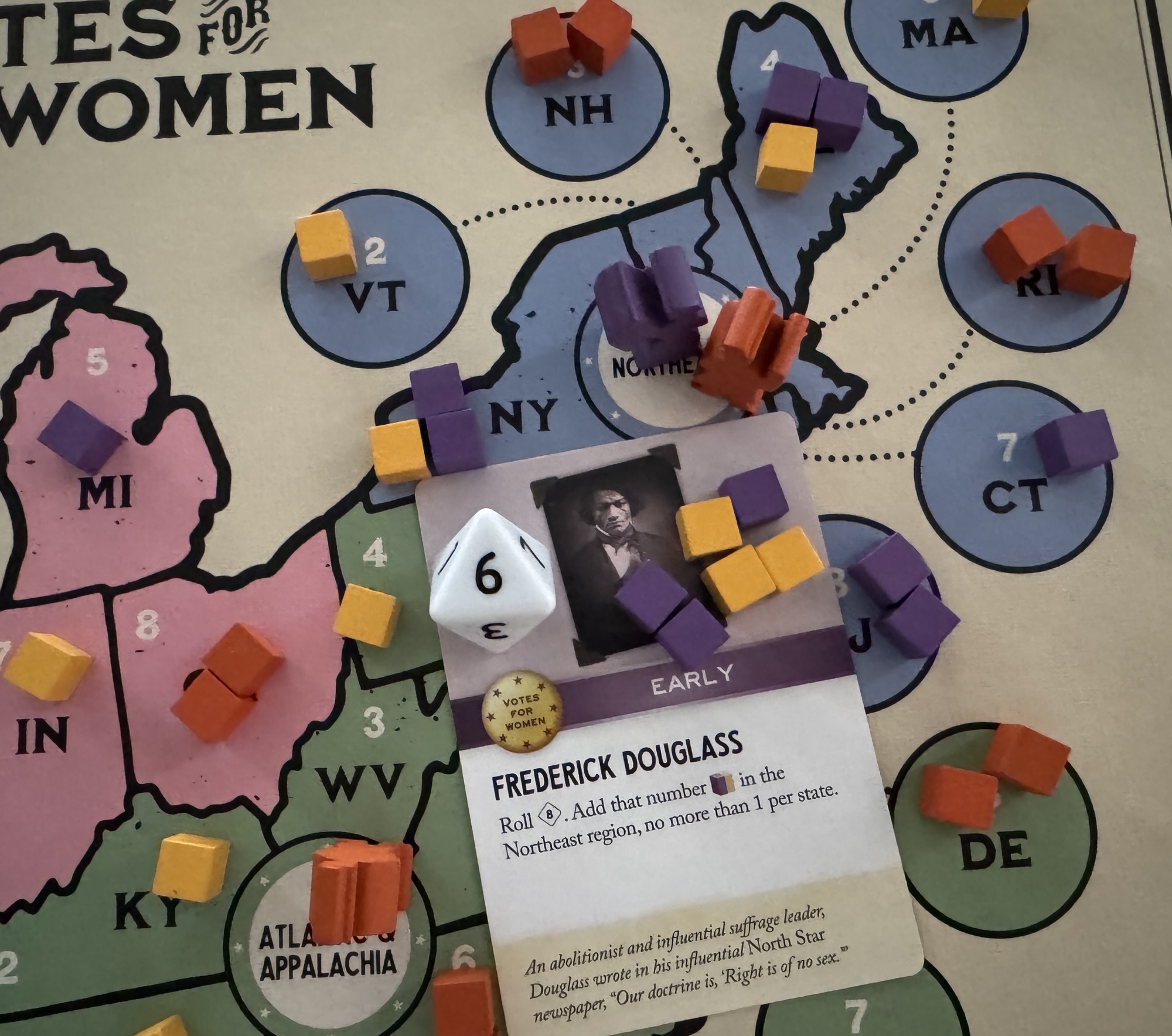
The Frederick Douglas card is one of these methods used to shake things up a bit and give the Suffragist player a chance to push their luck and roll the die to see how many influence cubes they can place. The card text instructs the player to roll a D8 (the game uses D6’s, D8’s and D12’s) and then add that number of influence cubes in the Northeast region, which includes states such as New York, New Jersey, Vermont, New Hampshire, Maine, Massachusetts, Rhode Island and Connecticut. The key limiter here though is that no more than 1 cube per state can be placed. The other thing about placing these influence cubes is that you can use 1 cube to remove a cube of the opposing player. This action does not allow you to then place one of your cubes in the state if that action would remove the only Opposition cube in the state…but nice try!

Frederick Douglass was a staunch, lifelong advocate for women’s suffrage, viewing it as an essential component of human equality, famously declaring “Right is of no sex”. As a key ally to suffragists like Susan B. Anthony and Elizabeth Cady Stanton, he supported the cause for over four decades, including crucial support at the 1848 Seneca Falls Convention.

In an issue of the North Star published shortly after the convention, Douglass wrote:

In respect to political rights, we hold woman to be justly entitled to all we claim for man. We go farther, and express our conviction that all political rights which it is expedient for man to exercise, it is equally so for women. All that distinguishes man as an intelligent and accountable being, is equally true of woman; and if that government is only just which governs by the free consent of the governed, there can be no reason in the world for denying to woman the exercise of the elective franchise, or a hand in making and administering the laws of the land. Our doctrine is, that “Right is of no sex.”

Douglass continued to support the cause of women after the 1848 convention. In 1866 Douglass, along with Stanton and Anthony, founded the American Equal Rights Association, an organization that demanded universal suffrage. Though the group disbanded just three years later due to growing tension between women’s rights activists and Africa-American rights activists, Douglass remained influential in both movements, championing the cause of equal rights until his death in 1895.

Here is a link to our full video review of the game:

We also published an interview on the blog with the designer Tory Brown and you can read that at the following link: https://theplayersaid.com/2020/09/07/interview-with-tory-brown-designer-of-votes-for-women-from-fort-circle-games-currently-on-kickstarter/

In the next entry in this series, we will take a look at Usurper Emperor from Barbarians at the Gates, The Decline and Fall of the Western Roman Empire 337 – 476 from Compass Games.

-Grant

Scarface 1920 – Bloody Business

10. Januar 2026 um 08:00

„Ich weiß, dass du es warst, Fredo, und es bricht mir das Herz! Hörst du? Es bricht mir das Herz.“ – Der Pate.

Wenn Scarface 1920 ja bereits ein geliebtes Konzert von mir war, so hat Bloody Business es geschafft die Harmonie der Komposition zu veredeln! Die Erweiterung bietet viele sich in die eigentlich bereits gute Spielmechanik sauber einbettende Module an. Manche verändern dabei Nachhaltig das Spiel in eine kleine aber spürbar wirkende Richtung, andere bieten hier und da neue, bislang ungeahnte Klänge.

Der gesamte Tonfall wird dabei allerdings etwas härter und aggressiver in den Nebenklängen. Allerdings bietet es auch insgesamt höhere Endpunkte. Hoffentlich haben sich nach der Partie noch alle lieb am Tisch. In unserem Anspiel der Erweiterung vor ein paar Tagen glückte dieses Unterfangen, auch wenn einige Momente im Spiel nicht nur mir, sondern sicher auch anderen in seiner Take-That-Manier das Lächeln teilweise geradezu aus dem Gesicht gefegt haben!


Eindruck von der Bühne

„Bonasera, Bonasera, was habe ich dir getan, dass du mich so respektlos behandelst? Du kommst in mein Haus, am Hochzeitstag meiner Tochter und bittest mich einen Mord zu begehen?“ – der Pate

Wenn man Scarface 1920 bereits so wie ich kannte, ist die Einstiegshürde der neuen Regeln recht überschaubar. Wenn man das komplette Spiel allerdings neu erlernen muss, sind das natürlich weitere Hürden einer komplexeren Mechanik. Erschwerend kommt hinzu, dass manche Regeln durch neue Wegfallen oder angepasst werden – Also meine Empfehlung: erstmal das Original 1-2 mal Spielen, bevor man sich an die Erweiterung heranwagt!

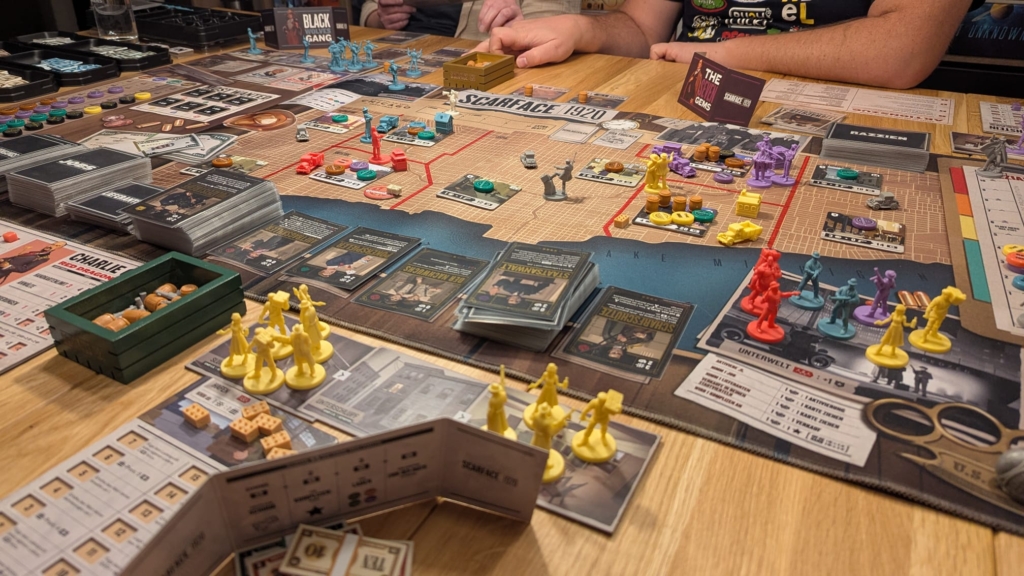
Noch ist in der Unterwelt mehr los als auf der Stadtkarte.

Bloody Business bietet dabei einige neue Module. Um sie kurz aufzuzählen: Krankenhaus, Ladenwertleiste, Heimatbezirke, wütende Bosse oder auch wütender Eliot Ness, Wahlkandidaten, Straßengangs, Erpressungen, Komplizenboni und den G-Man (ein FBI-Agent). Die Modi können einzeln eingefügt werden, oder alle zusammen. Aber nach meinem Empfinden haben sie sich alle so gut eingebunden und das Spiel in meinen Augen gemeinsam verbessert (die einen Modi mehr und die anderen weniger), dass ich keines davon weglassen würde.

Man kann nun gar nicht alle einzelnen Modi genauer beleuchten um nicht den Rahmen hier zu sprengen. Besonderes Augenmerk möchte ich daher nur auf die folgenden beiden Modi richten:

Heimatbezirke: Das ist eigentlich ein Minimodus der das Spiel in meinen Augen aber deutlich interessanter werden lässt. Je weiter entfernt das Viertel sich von meinem bei Spielstart festgelegten Heimatbezirk befindet, desto mehr zusätzliche Dollar bringt der Verkauf dort ein. Dieser kleine Kniff motiviert die Spielenden auf sehr einfache Art und Weise für eine höhere Verteilung der eigenen Gang auf der Karte.

Gesamtübersicht des Spiels. Ganz links sind viele Modi aus Bloody Business zu erkennen.

Ladenwertleiste: Läden bringen nach wie vor bei den Reorganisationszügen Geld ein, dieses ist nun aber nicht mehr statisch sondern von der Anzahl gebauter Läden eines Typs abhängig. Wenn z.B. die Flüsterkneipe bereits sehr oft im Spiel ist, bringt jede einzelne davon nicht mehr so viel Geld, als würde es nur wenige davon geben. Das bringt einige taktische Finessen. Zumal man mit dem Modus der Erpressung unter anderem Läden im Spiel schließen kann um diese Mechanik auch in die andere Richtung beeinflussen zu können.

Zu unserem Testspiel der Erweiterung haben wir auch die beiden neuen Gangs hinzugezogen. Diese sind nicht Teil der Erweiterung sondern müssen einzeln dazu gekauft werden. Das sind zum einen die chinesischen Opiumhändler mit dem Namen Red Dragon Tong, die Ihre Opiumhöhlen in der gesamten Stadt verteilen möchten. Dazu kommen die Kanadier – the golden Oaks Gang – die kanadischen Whiskey einführen und zwei Bosse gleichzeitig haben. Beide Gangs haben zum Teil stark von den anderen abweichende Sonderregeln.

Die Red Dragon Tong gerieten durch den wütenden Eliot Ness und Polizei im eigenen Bezirk unter Druck. Ihr Opium verteilt sich langsam in der ganzen Stadt

Eine ganz gravierende Spieländerung hat das Night Deck gebracht. Dieses war ein zusätzliches Ad-On der Gamefound-Kampagne und damit nicht Teil von Bloody Business. Die Karten sind schwarz eingerahmt und besonders hübsch gestaltet. Sie ersetzen die Komplizen des normalen Spiels. Dabei kann man gemäß der beiliegenden Minierweiterung entscheiden ob man diese komplett anstelle der normalen Karten nimmt, Teile austauscht oder beide Decks zusammenmischt. Wir hatten uns zum Test für die erste Option entschieden und – Holla die Waldfee – ist das Spiel mit diesen Karten grob geworden! Die damit neuen Fertigkeiten der Handkarten werden echt fies und das Take-That Element ist nicht mehr nur spürbar sondern glotzt einen mit süffisantem Lächeln direkt in die Augen!

Unten sind die Karten aus dem Night Deck zu erkennen.

Es liegt den neuen Gangs übrigens eine 5-6 Spieler Anleitung bei. Da stelle ich mir in diesem Spiel die Frage nach dem Sinn, denn das Spiel dauert zu viert bereits mehr als 4 Stunden! Wo soll das hinführen? Ich schaue mir das Anleitungsblättchen nochmal genau an. Erwarten oder herbeisehnen tue ich aber keine so großen Runden!


Groupie auf Tour

„Du darfst nie einen Menschen, der nicht zur Familie gehört, merken lassen, was du denkst.“ – der Pate

War Scarface 1920 bereits ein Area-Control-Spiel mit Engine- und Deckbuilder inkl. einem überraschend harten Ärgermechanismus im Petto, wird die Kneifzange in Bloody Business noch ein ganzen Stück härter angesetzt. Das muss und sollte man abkönnen, und zwar alle am Tisch! Wenn das dann kein Problem ist und man mit einem gut verzahnten Mechanismus-Misch und Take-That-Allüren Spaß haben kann und das Thema von Mafiagangs zur Zeit der amerikanischen Prohibition bereits ein diabolischen Grinsen auf die Lippen zaubert, ist man in diesem Spiel sicherlich zuhause.

Kurzfazit: Es macht einen riesigen Spaß die eigenen Pläne zu schmieden, anderen gegenüber auszuteilen und sich möglichst stabil auf das damit verursachte Echo einzustellen. Waffen durchgeladen und den Whiskey in der Hand! Weiter geht’s! Das kommt immer wieder gerne auf den Tisch!


Björn’s Konzerterlebnisse

Schon meine erste Partie Scarface 1920 hat mir richtig Spaß gemacht, aber mit der Erweiterung Bloody Business und den neuen Fraktionen kommt für mich erst so richtig Freude auf. Wie Bill schon geschrieben hat, müssen die Mitspieler diesen aggressiven Spielstil abkönnen. Hier fährt man nicht höflich vor, bittet freundlich um Schutzgeld und zieht wieder ab – nein, hier gibt’s erst eins auf die Nase, dann wird das Schutzgeld einkassiert und zum Abschied noch mal nachgetreten. Business as usual eben.

Ein echtes „Take that“-Spiel, aber ehrlich gesagt auch genau das, was man bei Bandenkriegen erwarten würde. Die setzen sich ja eher selten diplomatisch an einen Tisch, um bei einem Teller Rigatoni al forno über Einflusszonen zu verhandeln. Und selbst wenn, liegt am nächsten Morgen wahrscheinlich jemand im Fluss.

Ich kannte vorher noch Der Pate, was bereits ein guter Titel war, aber Scarface 1920 setzt dem Ganzen noch mal richtig die Haube auf. Mit breiterer Schulterpartie und härterem Händedruck. Die Züge lassen sich grundsätzlich gut vorplanen, aber da sich auf dem Spielplan ständig irgendwer einmischt, kann es jederzeit passieren, dass du deinen schönen Plan direkt wieder über den Haufen wirfst. Das trägt sicher zur längeren Spieldauer bei, fühlt sich aber thematisch absolut richtig an.

Und im Gegensatz zu Bill hätte ich richtig Lust auf eine Sechserpartie. Ich glaube, das würde dem Spiel noch einmal eine ganz neue Dynamik verleihen, gerade bei den Gebietskämpfen, die selbst zu viert (zumindest in den ersten Runden) noch vergleichsweise zahm ablaufen. Mit sechs Spielern dürfte da deutlich mehr Bewegung, Chaos und „Missverständnisse“ aufkommen. Auch bei den Komplizen würde dann sicher mehr Durchlauf herrschen, statt dass sie gemütlich in der Auslage hängen bleiben.

Unterm Strich: ein tolles Spiel. Und ich fand es so gut, dass ich es mir sogar selbst noch einmal gekauft habe, obwohl Bill es bereits besitzt. Man weiß ja nie, wann man plötzlich sein eigenes Imperium braucht.


Konzertmitschnitte

(Galerie mit Fotos)

Titelbild von Sammy-Sander auf Pixabay

❌