One of the more interesting topics to play a wargame on is that of a sustained siege. I am not talking about a game that has a siege mechanic that is used over the course of the game but a game that is based wholly around a specific historical siege. A siege requires a lot of different takes to be included in a wargame to make it work including things such as supplies, manpower, defenses such as walls, trenches and other fortifications, siege engines, morale and the ability and will to continue the fight. I really have very much enjoyed the siege based wargames that I have played over the years and I wanted to share 3 of my favorites in this post. So, without further adieu, here are my Best 3 Games with…Sieges!
I want to make one thing clear. I love the States of Siege Series of games and have played dozens of them. But I don’t consider those games in the same vein as these siege focused games that I am sharing.
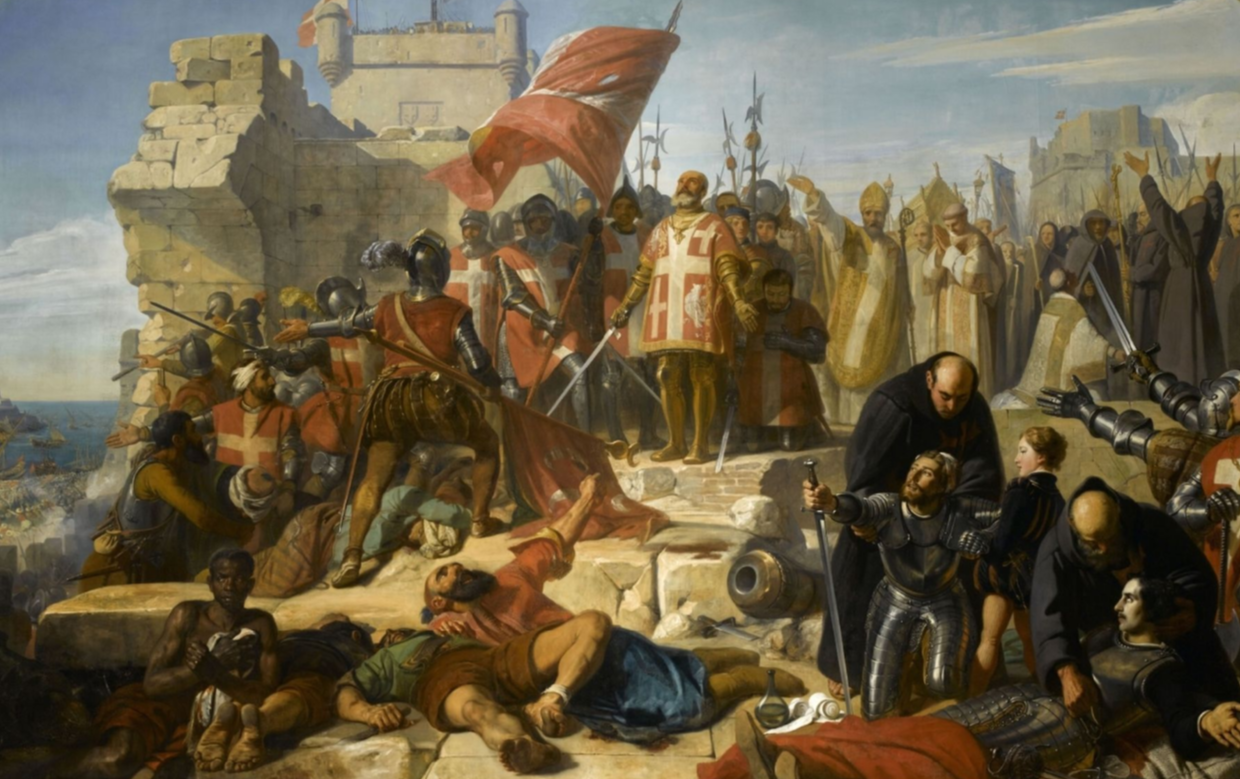
*The image used as the featured image for this post is called Lifting of the Siege of Malta painted by Charles-Philippe Lariviere.
3. Freedom! from PHALANX
Freedom! is a card driven siege game that pits the Greek freedom fighters and the besieging imperial forces of the Ottomans against each other. The siege is of the Greek Holy City of Messolonghi during the Greek War of Independence in 1825-1826. Freedom! features asymmetrical play with the goal of the invading forces being to manage to get inside the city before the end of the game or to force the citizens to abandon the cause by dropping their morale to zero while the defenders, on the other hand, try to withstand the siege and protect the city long enough for the invaders to abandon their attempt either by deciding to leave on their own or by having their morale dropped to zero. The actions of the players are driven by the cards in their hands, which highlight actual events and personalities of that time, while the combat is dice-driven to allow for quick and exciting game-play.
The rebel player is largely focused on grinding out a victory by surviving over the course of 6 rounds and are simply trying to hang on, unless of course they can somehow reduce the morale of the besieging units enough to where they give up and go home. However, nothing about this is a grind for the defending player and that is a problem that can be endemic with siege games. You as the defender, are as much a part of the action and must try to follow your own plan whenever possible to get a win. In other asymmetric siege games, the defender is often just reacting to the aggressor’s moves. As the insurgents, it never feels like you are simply reactionary and just along for the ride.
The really interesting thing about this one is that that there are actually two maps that are used to play the game. One of the maps shows the actual city and the forces involved in the siege while the other shows the surrounding areas, highlighting the support that each of them provides to both players. The art is gorgeous and this one is a game that we had a really good experience with. There also is a solitaire module that you have to buy separately but it works very well and provides an opportunity to play this game when you can’t find an opponent.
Players will find that they are competing for a number of nearby Greek regions on the board and there will be a tug-of-war played out by using various support actions that are focused on cutting off your opponent’s supplies. This is what I liked most about Freedom! It’s not just a continual back and forth trying to knock out your enemy’s units but there are multiple paths to victory, and all of them seem to be viable. By lowering your opponent’s morale and cutting them off from the supplies they need, you completely change their plans. Of course, there is nothing to stop you from pushing aggressively against the enemy’s walls.
Each side of the conflict really gives a different feel to the game and creates a new experience once you switch sides. As the Ottomans, you are generally going to undertake aggressive maneuver and attacks in an attempt to push forward and put pressure on the defenders and their walls of security. But when you play the Greeks there is a real feeling unpleasant feeling of desperation, which only gets worse with the arrival of Turkish reinforcements.
Here is a look at our unboxing video so you can get a good look at the components:
Here is our video review used for the Kickstarter campaign so you can understand our thoughts on the game:
If you are interested in Freedom!, you can purchase a copy for €69,00 ($80.00 in US Dollars) from the PHALANX website at the following link: https://phalanx.co.uk/games/freedom-board-game/
2. Storm Over Jerusalem: The Roman Siege from Multi-Man Publishing
The Storm Over Area Impulse Series has been around for a while and includes games such as Storm Over Arnhem (1981) from The Avalon Hill Game Company, Storm Over Stalingrad (2006) from Multi-Man Publishing and Storm Over Dien Bien Phu (2014) from Multi-Man Publishing amongst several others. The hallmark of the series is relatively low complexity for a wargame and a very simple combat system that calculates total attack versus total defense and adds a roll of 2d6. The losses from combat can be absorbed by either retreating from the attacked areas or destroying units. The game system has mostly been used to model more modern wars including the Franco-Prussian War, World War II and the French conflict at Dien Bien Phu in Vietnam.
Storm Over Jerusalem: The Roman Siege is a 2-player wargame that simulates the Roman siege of Jerusalem during 70 AD. One player controls the mighty Roman forces, who are truly master of siege warfare with their siege towers, ballista, battering rams and onagers, and the other player controls the Judean forces, which are divided into 2 separate factions with different leaders. The game is 8 turns long, but can be shortened by the play of a few event cards, at the end of which time the winner is determined by calculating victory points that come from overall losses, holding of certain VP areas and keeping the Romans out of the city.
We were very impressed by the game and its overall clarity of rules, quality components and interesting tactical choices and really had a good time learning and playing it. The Judeans are obviously outclassed by the powerful and skilled Roman Legions but they have several of their own tricks to use to hold out long enough to win the day. There is a lot to like here and I am really glad that we decided to give the system a try. There were some changes specially made to introduce the style of Ancient sieges to the Storm Over Series and this is where the game really shines. The Siege Towers were an evolution of the trenches found in Storm Over Dien Bien Phu game and are very important to the Roman efforts. The walls historically were such a physical presence in the city, and were a major impediment to the Roman efforts, that they had to come up with rules to cover them. The walls provide a defensive modifier against Roman Attacks and Assaults. This Defense Value starts at +4 and can be reduced over time by successful Roman Assaults. Since Judean units have a defense of 7 or 8 the bonus provided by the walls of +4 really helps hold onto areas. Once a wall is damaged from a successful attack though, the defensive modifier can be rebuilt by the Judean player but can never be increased to its full value of +4.
The Roman player also has specific cards (Catapult, Onager, and Battering Rams) that can be used to damage or breach the walls. Once breached, the walls don’t provide any defensive bonus and allow Roman troops to flood into the city. We found that the Romans tried to focus on a specific area of the walls and made their attacks there first in order to bring the maximum attacks possible each round to force the Judean player to have to spend their time and actions on fixing the walls and bringing up reinforcement to replace those lost in retreats. To repair a wall section, the Judean player can discard a card and use the Repair Value of that card to repair walls in an area. This action though requires a fresh unit in that area to be flipped to spent to complete the repair. Walls can only be repaired back up to +3, not the original +4. You can’t rebuild them completely.
I really enjoyed our play of Storm Over Jerusalem. The game was beautifully put together, with fantastic components, but also had some really amazing details and depth to the gameplay. This one is a winner and really has me interested in the other games in the series. I know that this game had a siege focus, which is not necessarily in each of the other games, but I really liked the simple combat system, great card play and very interesting tactical choices that were there for players to have to make.
Here is a link to our full unboxing showing off the beautiful components:
1. Dien Bien Phu: The Final Gamble from Legion Wargames
Dien Bien Phu: The Final Gamble from Legion Wargames is a 2-player wargame about the decisive battle of Dien Bien Phu in 1954 that not only ended the French Indochina War but also had political repercussions far outside the region itself. One player represents France and her colonial troops. The other player represents the armed force of Viet Minh, the communist/nationalist independence movement of Vietnam. This game is not a traditional wargame and has different victory conditions than normal and also some unique and interesting supply rules. The Viet Minh win by forcing the French troops to surrender and France wins by not surrendering.
The board covers the former village of Dien Bien Phu and surrounding areas. There is a small submap of the French strongpoint Isabelle further south in the valley. There are several groups of French strongpoints scattered around the map, each one with a female name, which are all named after the commander de Castries’ mistresses, according to lore. The map is divided into three divisional sectors. Each sector has several zones that represent Viet Minh trenches winding from the map edge towards the center of the map. Each hex represents 150 meters and each game turn covers three days. There are 21 turns in the game, but historically, it ended after 19 game turns with a Viet Minh victory. The scale allows stacking of three French units in a hex, but there are no stacking limits for Viet Minh battalions, which creates a chess like feel.
French supply is a bit of a mini-game within the game. As this battle took place far out in the wilderness of Vietnam and both sides had to adjust to the limited flow of supplies that could be brought forward, through the air to the French, and through vast forests to the Viet Minh. Supplies tend to be a lot less than wished for. There are several supply tracks on the map showing how much ammo, food & bullets, fuel & spares, medicine as well as the amount of truck transport available for the French. The process for doing this supply phase is really pretty interesting and fun. Each game turn air transports will bring in a mix of supplies together with replacements and reinforcements. This is done on a chart with a grid where a mix of supply markers are placed together with eventual reinforcements and replacements. Weather will then decide what will arrive and what will abort back to Hanoi. The French player will never know for sure what type of supplies and how much will arrive and has to take that into account as they plan out their turns. And this is one of the best parts of the game and kept me thinking about the struggle with keeping my efforts going with the French. This one is not an easy game for either side and I think that it keeps the game very balanced and interesting to play.
Here is a link to our full video review:
If you are interested in Dien Bien Phu: The Final Gamble, you can order a copy for $54.00 from the Legion Wargames website at the following link: https://www.legionwargames.com/legion_DBP.html
A few other games that I have played on the subject of sieges, and that I very much liked, were games such as Halls of Hegra from Tompet Games, 1565 Siege of Malta from Worthington Publishing, 414 BC Siege of Syracuse from Worthington Publishing, Keep Up the Fire! Deluxe Edition from Worthington Publishing, Castle Itter: The Strangest Battle of WWII from Dan Verssen Games, Siege Works: A Napoleonic Siege Roll & Write from Solo Wargame, Crusaders: The Siege of Acre 1291 from Blue Panther/Art of Wargames, Castelnuovo 1539 from Draco Ideas and The Alamo Remembered from Victory Point Games.
Another early morning and we met John Sy to have some breakfast before heading to our scheduled game of World Order from Hegemonic Project Games. We met friends Tom and Tim and they had played the game and prepared to teach Mike and I.
World Order is a strategic level 2-4 player Euro-style board game that focuses on geopolitical influence in 7 different regions. Players are the United States, China, Russia, or the European Union in the year 2010 and compete for global hegemony by earning victory points through economic power, diplomacy, and regional control.
Game at setup. You can see the card market where players build up their deck through improved actions.
This game is played over 6 turns and players have a hand of 6 cards with various actions such as trading goods, influencing countries to become your ally, building military bases and placing influence. Each of the regions will score at the end of turn 3 and 6 and players will have to scramble to gain influence to get the most Victory Points in each region with lesser VP awarded for 2nd through 5th place. But each turn you only play 4 cards fur the actions and then use your remaining 2 cards to earn money and gain research points to purchase new upgraded and more efficient actions.
The game features asymmetric factions representing each superpower’s unique strengths and starting resources. Players will have to choose 1 of 3 Focus each round included my domestic, diplomatic or military, which grants specialized bonuses for that turn.
I loved this one. What a game! My Chinese won with 114 points as I was able to control 3 regions but also weasel my way into 3 others to gain lesser points. This one has a lot of moving parts but plays fairly quickly once people know what they are doing. I very much want to play again.
I next got into a 4-player game of Coalitions: Realpolitik from PHALANX designed by Valdemar Gumienny and Andrew Rourke.
Realpolitik is an area-control board game that features action selection cards where players have to play a card for 1 action that turn including taxing controlled areas, mobilizing new forces and battle cards, moving into battles, scoring victory points or then picking up your already played cards. It’s a very smart and slick little game that sees players competing for control of mid-19th-century German and Italian unification wars.
Combat is lite and fun and uses battle cards that add values of 1-5 to your combat totals but each played unit also has unique abilities that can change the battlefield such as destroying a played unit, adding +1 if the Barrie occurs in an area you control. The goal is to get to 25 victory points first and the game is very quick playing 60+ minutes with lots of strategy, creating alliances and working toward your goal of dominating key areas. Just a very fun and interesting game. I was able to guide my Prussians to victory scoring 25 VP first and it came down to the very end as Italy was also close on my heals. I liked it so much that I’m going to get a copy and hope to play the game with our local gaming group. Thanks to Ric Mann fur teaching and for the members of the Hoosier Herd gaming group for playing.
I then met up with Mark Miklos to chat about his newest upcoming volume in the Battles of the American Revolution Series called The Battle of Green Spring. We did a fairly lengthy video interview covering the game and its history as well as discussing his upcoming book called Liberty.
The Battle of Green Spring was the largest field battle fought in Virginia during the American Revolution with over 10,000 combatants. In addition to being noteworthy for its scope, this battle was Lord Cornwallis’s final victory in North America and served as the immediate precursor to the Siege of Yorktown.
I ended Day 3 playing The Adventures of Conan from Gale Force Nine, which is an asymmetric, semi-coop dice game of exploration, sorcery and combat set in the Hyborian age of Conan. We bounced off this one hard. Poor rules, lack of structure and little clarity, which is a shame. The art is fantastic, great components with custom dice but I felt like we had no idea what we were doing or how we were supposed to reliably get things done. We will try to watch a video out there to get an idea about what we are supposed to do and then maybe give it another try.
Die Kalenderwoche 29 (7. bis 13. Juli) ist eine Woche der Endspurts. Auf Gamefound laufen gleich drei bereits durchfinanzierte Kampagnen in den nächsten Tagen aus, während eine vierte als Schwergewicht noch weiterklettert. Auf Kickstarter und der Spieleschmiede sind in diesem Zeitraum keine neuen, für den DACH-Raum relevanten Brettspiel-Kampagnen gestartet, die einen eigenen Beitrag rechtfertigen. Wir konzentrieren uns deshalb auf die vier stärksten laufenden Projekte, die alle auf Gamefound zu finden sind.
Believe in me! (please)
„Believe in me! (please)" vom deutschen Verlag Wyrmgold läuft nur noch bis Dienstag, den 14. Juli, und steht damit im letzten Tag. Aktuell haben 833 Unterstützende rund 61.000 Euro zusammengetragen, gut das Dreifache des Ziels von 20.000 Euro.
In dem Karten- und Worker-Placement-Spiel für 2 bis 4 Personen übernehmen die Spielenden die Rolle selbsternannter Götter. Mit Naturereignissen wie Stürmen und Fluten überzeugen sie die Bevölkerung von ihrer Macht und sammeln möglichst viele Gläubige, während sie die konkurrierenden Möchtegern-Götter am Tisch ausstechen. Eine Partie dauert etwa 60 Minuten, empfohlen ab 14 Jahren. Wyrmgold hat zuvor unter anderem „Pagan: Fate of Roanoke" und „Hydra" veröffentlicht.
Bild: Wyrmgold (Gamefound-Kampagne)
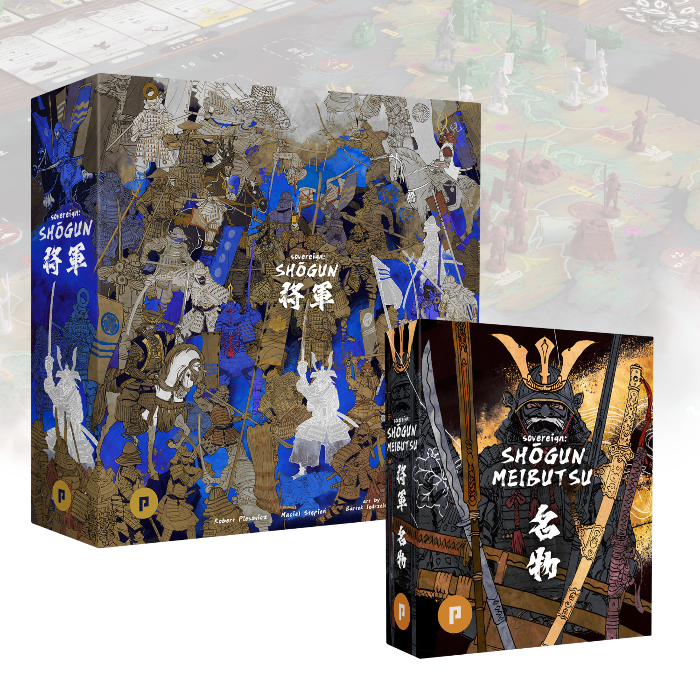
Sovereign: Shōgun
„Sovereign: Shōgun" des Londoner Studios PHALANX läuft noch bis Donnerstag, den 16. Juli. Die Kampagne ist mit rund 280.000 Euro von 1.271 Unterstützenden das mit Abstand größte hier vorgestellte Projekt und steht bei über dem Neunfachen des 30.000-Euro-Ziels.
Das Strategiespiel für 2 bis 5 Personen führt in die Sengoku-Zeit Japans, in der fünf Fürsten um den Thron ringen. Gespielt wird asymmetrisch um Gebietskontrolle: Die Spielenden bauen ihren Klan aus, schließen Allianzen, treiben Handel und versuchen, den minderjährigen Regenten auf ihre Seite zu ziehen, statt allein auf Waffengewalt zu setzen. Eine Partie ist mit rund 90 Minuten angesetzt, ab 14 Jahren.
Bild: PHALANX (Gamefound-Kampagne)
Siege Perilous
„Siege Perilous" von Play to Z läuft noch bis Freitag, den 17. Juli, und hat mit 652 Unterstützenden rund 94.800 US-Dollar erreicht, gut das Sechsfache des Ziels von 15.000 US-Dollar.
Das Spiel für 1 bis 4 Personen siedelt im Britannien der Artus-Sage: Als Ritter gehen die Spielenden auf Abenteuer aus, um Ruhm und Ansehen zu gewinnen. Mechanisch mischt es Worker Placement mit Euro-Aufbau und Würfelaktionen, und es lässt sich sowohl solo als auch kompetitiv spielen. Für eine Partie sind rund 120 Minuten einzuplanen, ab 14 Jahren.
Bild: Play to Z (Gamefound-Kampagne)
Kemet: The Gates of Thonis
Etwas mehr Zeit bleibt bei „Kemet: The Gates of Thonis" von Kolossal Games, das noch bis Dienstag, den 21. Juli, läuft. Mit rund 276.000 US-Dollar von 3.169 Unterstützenden steht die Kampagne bei über dem Achtzehnfachen des niedrig angesetzten 15.000-US-Dollar-Ziels.
Wichtig zur Einordnung: „The Gates of Thonis" ist keine eigenständige Neuheit, sondern eine große Erweiterung für das Area-Control-Spiel „Kemet: Blood and Sand". Unsere Crowdfunding-Wochenschau KW 28 ordnet das Projekt und seinen Kampagnenstart zusätzlich ein. Sie bringt neue Karten, neue Spielplan-Seiten und eine zusätzliche zentrale Mechanik ins Spiel und richtet sich damit an alle, die das Grundspiel bereits besitzen oder es sich parallel zulegen. Gespielt wird zu 2 bis 6 Personen, rund 90 Minuten, ab 14 Jahren.
Bild: Kolossal Games (Gamefound-Kampagne)
Alle Zahlen entsprechen dem Stand vom 13. Juli 2026.
It has been very hot lately….and the humidity is getting out of control here in our Area of Operations (Indianapolis, IN). It makes everything tougher but I still like it better than the negative temp spikes we experience in January and February and look forward to the rest of summer. In the wargaming world, there is also a lot of “heat” coming upon us in waves as this month for the Wargame Watch, I was able to find 30 games (including the single new game from our sponsor Bring it on Games). I was also able to find 9 games being offered on Crowdfunding through Gamefound and Kickstarter.
This month we have a sponsor for the Wargame Watch feature in a new publisher named Bring it on Games. Bring it on Games is owned by Adam Starkweather of Grand Tactical Series (GTS) and Company Scale System (CSS) fame. He has started this new company with several friends and compatriots as a “company run by gamers – not a company that publishes games”. I think that Adam is a great designer and he is now out on his own and is going to make the games that he wants to make.
On their website, they have said the following about their production schedule and plans for the near future:
We will only make two or three games every two years. Next up is ACSS: Utah: 10 Days in Normandy. But work has also started on Omaha, Market Garden, and Battleaxe for ACSS. But other games on different stuff using new systems has started too. Gettysburg, The War of the Atlantic, and other fun stuff. I just have to live to ninety to make everything I want to make.
While they are new and don’t have a published game to their credit as of yet, they appear to be working hard to build a brand that is solid and will hopefully be one that is a continual force in the wargaming hobby. Their current project that is up for pre-order is called Anzio: A Lost Opportunity and is a big, monster wargame. This game has a ton of maps (10 total) and a ton of counters (20 5/8th” Countersheets) as well as a ton of charts, tables and player aids. This is a MONSTER wargame…big, bad and beautiful…no doubt about it but it looks really good.
We have played several games designed by Adam Starkweather in his Company Scale System (CSS) published by Compass Games including Saipan: The Bloody Rock and The Enemy is at the Gates: The Batlte for Berlin. These games are really good solid chit draw systems that really puts some unknown in what groups of units can activate and even when they will activate. There are also events and if the chit cup runs dry before all of the units can activate due to the end round chit then you are just sore out of luck. You have to prepare for this inevitability and I love the concept of prioritizing your activations and making sure you activate what you absolutely have to before doing those units that would be beneficial to activate. The system is a highly accessible, streamlined approach to simulating tactical military operations while retaining strong decision-making depth. The CSS offers a “design-for-effect” combat system that effectively eliminates micro-management and makes the game a joy to play.
Anzio is the first game in a new series called the Advanced Company Scale System or ACSS. At this point, I am unsure what makes it advanced but will be working with the designer to get a better understanding of that in a designer interview for the blog.
In the mean time, you can download the rules and the scenario booklet from an online OneDrive and you can also get access to a Vassal module to try the game out. Here is the link to the OneDrive: OneDrive Link to Rules and Scenario Booklet
If you are interested in Advanced Company Scale System Game One:Anzio: A Lost Opportunity, you can pre-order a copy for $300.00 from the Bring It On Games website at the following link: https://bringitongames.com/shop/p/anzio-a-lost-opportunity
Pre-Order
1. OCSThe Hero City: The Battle of the Baltics, September 1943-April 1944 from Multi-Man Publishing
In late 2021, we posted an interview with Tony Birkett as designer and Chip Saltsman as developer covering his The Third Winter from Multi-Man Publishing, which covers the third winter on the Eastern Front during World War II and deals with German Army Group South as they retreat to the Dnieper River and then the Carpathian Mountains. This game is an entry in the Operational Combat Series and was followed up by his Crimea: Conquest & Liberation game that was promoted as a low-counter density, small OCS game. Since then, he has been hard at work on the next volume in the series called The Hero City: The Battle of the Baltics, September 1943-April 1944 that dives into the mid war battles in the Baltics between the Germans and the Russians.
From the game page, we read the following:
The Hero City depicts the desperate battles between late September 1943 and April 1944 in the Army Group North sector of the Russian front. Soviet priorities were to establish a rail connection into Leningrad, evict the Axis forces from the Leningrad Oblast, and force their way into the Baltic States. Well aware this hammer was about to fall, Army Group North prepared the Panther Line defensive belt along the borders of Estonia and Latvia. The Hero City covers the major engagements: the autumn attrition battles while the Soviets mass their forces, the fighting retreat as the Wehrmacht desperately tries to escape intact, and the crashing impact as Russian waves pound against the German Panther Line breakwater. In the north are the Finnish lines, which offer a completely different strategic opportunity, including a scenario for the Soviet Summer 1944 offensive into Karelia. The Axis forces managed—barely—to hold at the Panther line, but the situation could have spiraled into disaster. The campaign here laid the foundations for the drama during the summer of 1944, and many of the German units in The Hero City will end the war trapped in Courland.
The game area covers the Soviet Oblasts of Leningrad, Novgorod and Pskov, as well as Estonia, Latvia, and the northern part of Lithuania. The map extends north of Helsinki and Viipuri in Finland, south to Daugavpils and Tilsit, east to Valday and Volkhov and west to the Baltic Sea. The Hero City is fully playable with The Forgotten Battles, to create a combined massive gaming experience using campaign setups that start in September 1943 and January 1944.
The Soviet command and supply structure is modeled through Front HQ markers. Fronts are either in “Offensive” or “Regrouping” status, allowing for shifting axes of attack and the on/off nature of Soviet operational warfare during this time. Each Front has an assigned Air Force. The parallel fighting in Army Group Center is represented by a boundary marker that shifts as the war advances off map, and the Axis player must be careful to watch his off-map flanks.
The Hero City is a large-sized OCS game, with 1,400 combat units (five counter sheets) and a 44×66-inch map layout at a scale of 5-mile hex/3.5 days per turn. The full Campaign game is 63 turns long, and there are three campaign scenarios so players can start at different points in the action. Also included are several partial-map scenarios.
Special rules in this OCS game are carefully researched to model key aspects of this critical campaign:
Forces include German Wehrmacht, Luftwaffe and SS formations, as well as Soviet Guards, regular and Partisan units, plus Finnish, Estonian, Latvian, and Lithuanian units. The Prinz Eugen and German destroyers might put in an appearance.
Soviet Front HQ Markers which reflect their role in command and marshaling supply.
Soviet RVGK for coordinating strategic redeployment and rebuilding shattered mobile Corps.
Axis Army, Army Group and Kessel HQs, along with Kampfgruppe markers which portray Axis operational flexibility.
Random events similar to what are found in The Third Winter and The Forgotten Battles. The 26 possible events add historical flavor with minimal rules overhead, covering things like Guards Promotions, Fuel Shortages, Hitler’s intransigence, Soviet submarines Partisan Offensives, One-Turn Offensives, Battlefield Heroes, options for emergency reinforcements and unexpected Finnish offensives.
If you are interested in OCS The Hero City: The Battle of the Baltics, September 1943-April 1944, you can pre-order a copy for $90.00 from the Multi-Man Publishing website at the following link: https://mmpgamers.com/the-hero-city-p-468
2. Inferno in the Blue Grass: The Battle of Perryville, 8 October 1862 from Multi-Man Publishing
While attending Buckeye Game Fest this past March, we met with a fan of the channel named Leslie Jerome and had him introduce us to the Line of Battle Series with Volume 3 To Take Washington: Jubal Early’s Summer 1864 Campaign from Multi-Man Publishing. Line of Battle is a regimental-level American Civil War wargame system designed for fast-paced, non-stop action by eliminating excessive paperwork and combining fire phases with movement. I feel like this system is a highly playable classic ACW system with lots of very interesting mechanics including activation, order reception and relay, closing rolls, morale checks and close assault. In fact, I love how it creates a great narrative with some of the terminology and naming conventions such as the Blood Lust result for close assaults and the Cowardly Legs from broken units.
Recently, MMP put the next volume in the series up for pre-order called Inferno in the Blue Grass: The Battle of Perryville, 8 October 1862. I am very much anticipating this one and can’t wait to dive back into the series.
From the game page, we read the following:
Inferno in the Bluegrass brings The Gamer’s Line of Battle (LoB) Series into the Western Theater. The Battle of Perryville, the largest battle fought in Kentucky during the American Civil War, was the culminating engagement of the Heartland Campaign of 1862. This was the South’s attempt to invade the border state and garner support for its cause while simultaneously forcing Union armies in the west on the defensive. By October, the Army of the Ohio was on the move, poised to throw back the invaders. Bragg, confident that an initial Federal advance would focus elsewhere, was completely unaware that Don Carlos Buell was converging on his army in the small town of Perryville. As the sun rose on October 8th, 1862, neither army could have known that the coming engagement would ultimately determine the fate of Kentucky in the war.
The sheer scale of violence at Perryville factored heavily into the design, over 7,600 casualties were tallied – resulting in one of the larger casualties per hour rates of the war. Independent Command rule replicates Confederate commanders blurring the lines of command by fragmenting divisions into small, independent commands, creating confusion and limiting effectiveness. The Attack Commencement Chart limits the ability of the Confederate player to organize one massive assault. The Union, conversely, is hamstrung from the outset. The Union Alertness Table represents the phenomenon of an “acoustic shadow”, which caused Buell to be blissfully unaware of the overall tactical situation hours after the initial fighting had started. The map shows the parched land in meticulous detail, corroborated by the designer walking the battlefield to get a great feel of the ground.
This is Nick Roser’s first published design. His commitment and expertise on the battle shines through the design. Nick’s ancestor, Johann Christian Kurtz, fought in the battle, so his personal connection to Inferno in the Bluegrass is in his blood.
If you are interested in Inferno in the Blue Grass: The Battle of Perryville, 8 October 1862, you can pre-order a copy for $48.00 from the Multi-Man Publishing website at the following link: https://mmpgamers.com/inferno-in-the-bluegrass-p-467
3. Great Battles of the American Civil War: Battles for the Ozarks from GMT Games
This is one of those venerable series that we have not had the opportunity to play or experience. Great Battles of the American Civil War or GBACW (not to be confused with Great Campaigns of the American Civil War from Multi-Man Publishing) is a highly detailed, regimental-level wargame series originally created by Richard H. Berg. It is known for its interactive chit-pull mechanics that simulate the chaos, command difficulties and fatigue of 19th-century warfare. The newest volume in the series, which is Volume XI, was announced in late June and is called Battles of the Ozarks.
From the game page, we read the following:
The game presents five key battles that shifted the balance of power west of the Mississippi during the first two years of the war. Battles for the Ozarks concentrates on events on the Ozark Plateau of northern Arkansas and southwest Missouri and included are these battles from the first three campaigns of the war in the West. Each battle is portrayed in great detail allowing players to try alternate strategies.
Dead & Buried, The Battle of Wilson’s Creek, August 10, 1861 The first large battle west of the Mississippi. Federal General Nathaniel Lyon leads the Union forces in an attempt to bloody the nose of General Sterling Price’s Missouri State Guard and Ben McColluch’s Western Army that has arrived from Texas and Arkansas. Command the unusual forces that were arrayed in each army for this battle. As the Union, you’ll have Home Guard units, Regulars (including the famous 2nd Dragoons), and German American Missouri Volunteers from St. Louis. As Price and McCulloch, you’ll have everything from Missouri State Guard units armed with flintlocks and shotguns, to the South Kansas Texas Cavalry regiment and Arkansas State Militia.
Into The Night, The Battle of Dunagin’s Farm, February 17th, 1862 A lesser-known battle that occurred about a month before the much more famous battle of Pea Ridge. In north Arkansas along the Little Sugar Creek, the rear guard of McCulloch’s Army of the West, led by the capable Louis Hebert, tries to cover Sterling Price’s retreat from Springfield, Missouri. Hot on Price’s trail is Samuel Curtis’ Army of the Southwest. The advance cavalry of Curtis’ army collides with Hebert’s forces on farmer Dunagin’s field. What starts as a simple skirmish escalates into a full-blown fight that spills over into the evening, with both sides gradually feeding more troops into the battle.
Rush To Glory, The Battle of Pea Ridge, March 7th & 8th, 1862 Can you, as Earl Van Dorn, fall upon the rear and flank of the Federal army deployed north of the Little Sugar Creek before the more rested and organized enemy responds? Or can you, as General Samuel Curtis, repeat one of the few times in military history when an army reversed course, moved its supply train out of danger, and then engaged and defeated the enemy? A challenging battle for both sides; the Confederate army has been “Rushed to Glory” by Van Dorn in a snowstorm and is worn out, while the Union army is flanked by the CSA foe. The battle has a two-map and a three-map version (the largest presentation of the battle ever done).
Iron Men, The Battle of First Newtonia, September 30th, 1862 Probably the most unusual and desperate of all the battles included in Battles for the Ozarks. First Newtonia was fought before the Battle of Prairie Grove in Blunt’s campaign. The advance units of the two armies meet at the small hamlet of Newtonia in southwest Missouri. A CSA force comprised of the Indian Command, a brigade of Texas cavalry, and part of Jo Shelby’s Iron Brigade attempt to stop the forward movement of BG Fredrick Salomon’s 1st Kansas Division. With warriors of the First Nations on both sides, First Newtonia steps into new territory for GBACW. Also command part of the Western “Iron Brigade” in its first battle. One of the most desperate fought battles in the Trans-Mississippi.
Blunted Again, The Battle of Prairie Grove, December 7th, 1862 Take the role of the headstrong Union General James Blunt and see if you can move the CSA forces led by Thomas Hindman off the Fayetteville Road. As the Union commander, you will have superior artillery that can win the day. Or as the Confederate commander, you’ll hold the strong defensive position between the two Union wings along “The Bench”. You have the Napoleonic central position, and it is held by Joe Shelby’s Iron Brigade! Will it be enough?
Ready for a new experience in your War Between the States gaming? Battles for the Ozarks is the 11th installment in the award-winning Great Battles of the American Civil War Series. The game has rules that satisfy both experienced and new players, with a Simple Version that offers an easier, faster gaming experience. New optional rules are also introduced! New skirmish rules catch the ebb and flow of open order combat between the battle lines, and the Peoples of the First Nations make their first appearance in the GBACW Series. See how well these warriors fought at Prairie Grove or First Newtonia. New terrain types, such as Heavy and Light woods, are introduced, along with Rifle Pits and Entrenchments. With over twelve scenarios, including two on their own half maps, there is something for everyone.
4. Bataan! The Battle for the Philippines 1942 2nd Edition from Consim Games/GMT Games
Classic wargames always do well, either because of nostalgia and a longing for the past or because the game was really good. I don’t know which one this fits into but GMT Games announced a new 2nd Edition of a classic wargame called Bataan!. I say GMT Games but the game is actually published by Consim Games, as they have entered a new partnership with GMT as they have in the past to publish their own line of games.
From the game page, we read the following:
Bataan! 2nd Edition is the much-anticipated, updated grand-tactical-level treatment of WWII battles on the Bataan Peninsula in the Philippines, which took place from January through April 1942. Game designer and Charles S. Roberts Award recipient Vance von Borries has drawn on his game design experience to create a game engine capable of portraying the tense jungle fighting that took place on Bataan. While the system is based on his popular Roads to Leningrad game, the changes needed to simulate the fighting on Bataan make for a unique gaming experience. For history enthusiasts and wargamers, this is a nuanced, in-depth exploration of a specific, underrepresented aspect of WWII history. This all-new 2nd Edition does not simply address all official errata from the original edition, but also delivers new game components and a major game system update, with the rules rewritten to further advance this popular game system.
Gameplay is both tense and interactive, based on an alternating activation sequence in which both sides conduct operations. This second edition features streamlined game mechanics to improve and help speed gameplay, all based on player feedback. The game also captures air and naval operations, though the focus is on ground warfare and specialized unit capabilities.
Special rules model key historical facets of the campaign include: movement classes of units, artillery, air power, air missions, strategic movement, infiltration movement, disruption, contested hexes, unit formations, attack coordination, lead unit losses, efficiency and lead units, HQ units and capabilities, initiative and activation, hasty and deliberate activations, momentum, supply, fortifications, withdrawals, Japanese emergency supply, Campaign supply, general attrition, forage, naval operations, amphibious invasion, special situations and events, special units, Philippine Scouts, and more! Five scenarios are included. The three quick-playing opening scenarios require fewer rules to play. You can complete them in a single sitting, focusing on the core game system, and they include At the Pearly Gates: Layac (intro scenario), Abucay Line, and Mauban Line. These scenarios provide a clear and accessible entry point for players new to the system, allowing them to learn the core mechanics before tackling the full complexity of the campaign game. The two full campaign game scenarios add detail by introducing campaign supply, naval operations, amphibious invasions, special situations, and events. While intended for two players, the game is also suitable for solitaire play.
5. When Titans Clashed: The Eastern Front in WW2 from Consim Games/GMT Games
And the 2nd game offered on pre-order this past month in this new Consim Games/GMT Games partnership is called When Titans Clashed: The Eastern Front in WW2 designed by Michael Resch. This is a new game design but pays homage to the original Jedko Games edition of the classic The Russian Campaign designed by John Edwards. I know that we all very much enjoy a good romp on the Eastern Front of World War II and the tank clashes and and I am sure that this game will be a fantastic representation of the genre and give us hours and hours of hex and counter goodness.
From the game page, we read the following:
When Titans Clashed is a game covering the epic campaign fought in Eastern Europe during World War II. Game designer Michael Resch offers this tribute to the original 1974 Jedko Games edition of The Russian Campaign by John Edwards. This new design seeks to balance the classic game’s attractive aspects while introducing modern design concepts unheard of at that time. The map and counters use a vintage style to honor the 1974 Jedko edition, but beyond this, the designer presents a new, modernized design approach to the classic game.
Gameplay is fast-paced and intense for both sides, as the initiative can shift through significant maneuvers and battle outcomes. For both sides, each turn features a double-impulse sequence that rewards the player who, in a disciplined fashion, plans for the possibilities the double-impulse sequence can create. Such planning may enable battlefield gains to be solidified or, conversely, allow recovery from disaster along an expansive front. Players must also plan for reinforcements, replacements, and upgrades, as well as various strategic considerations and political events that will influence the campaign.
While the game system itself is relatively low in complexity, special rules help capture the campaign’s historical narrative. Political events include the Warsaw Uprising and the Romanian coup d’état. Special rules include Axis Ally Limitations, German Heavy Panzers, Air Power, Stalin, Fortified Areas, Coastal Army, Sea Invasion, Soviet artillery, partisans, workers, oilfields, and more! The game, while designed for two players, plays very well solitaire, and one can finish the full campaign in a single sitting.
6. Combat Commander Battle Pack Nr. 1: Paratroopers 4th Printing from GMT Games
I have played a ton of Combat Commander over the years, including from Combat Commander: Europe, Combat Commander: Mediterranean and Combat Commander: Pacific as well as several of the Battle Packs and absolutely love the narrative that the game creates. I love the cards and how they are used for combat, there are no dice in CC, activations and events. The system is just full of chaos and fun. This month they have announced the 4th Printings of a few of the classic Battle Packs including Battle Pack Nr. 1: Paratroopers, which allows players access to elite American/Russian/German troops with some nifty abilities that can really turn the tide of battle and boost the capabilities of your soldiers.
From the game page, we read the following:
Combat Commander: Battle Pack Nr. 1 – Paratroopers is the first of many themed scenario packs for use with the Combat CommanderSeries of games. The theme of this first Pack is focused on the exploits of American, German and even Russian Airborne forces. CC-Paratroopers features eleven new scenarios printed on cardstock, as well as four new maps.
The scenarios included in CC-Paratroopers are:
“Fields of Fire” and “Fields of Blood” set at Lanzerath, Germany, 16 December 1944 – both morning and afternoon attacks (using a new map #25)
“Turnbull Turns ’em” at Neuville-au-Plain, France, 6 June 1944 (using a new map #26)
“Carentan Causeway” at Carentan, France, 10 June 1944 (using a new map #27)
“No Ingouf Around” at Carentan, France, 11 June 1944 (using a new map #28)
“Operation Repulse” at Bastogne, Belgium, 27 December 1944
“Red Skies at Night” at Veliki Bukrin Bridgehead, Russia, 25 September 1943
“Blizzard Baptism” at Flamierge, Belgium, 4 January 1945
“Look Mom, No Tanks!” near Trois Ponts, Belgium, 24 December 1944
“We Go!” at St. Mere Eglise, France, 6 June 1944″Encircled at Hill 30″ at Caponnet, France, 8 June 1944
CC Battle Packs are NOT stand-alone games and will require ownership of one or more Combat Commander boxed games in order to be played. CC-Paratroopers requires ownership of Combat Commander: Europe or the Combat Commander: Europe/Med 20th Anniversary Edition.
Overall, this is a great expansion for the base game and all true Combat Commander fans should include this in their collection. The only concern or complaint that I had about the Battle Pack was that the American Forces colors on the scenario cards are almost all different. Some appear as Lime Green, others are Olive Drab and more yet are Forest Green! I don’t know if this is simply my copy’s problem or the entire run during the printing. Not a major issue and it definitely doesn’t change my opinion about this expansion. The scenarios are printed on thick card stock and are very durable and as usual the Situation Reports are some of my favorite parts as they set the tone for the scenario by giving historical analysis of the happenings. Great stuff that you simply must own!
7. Combat Commander Battle Pack Nr. 2: Stalingrad 4th Printing from GMT Games
They also have announced the 4th Printing of Battle Pack Nr. 2: Stalingrad and I know that this one has been out of print for a while now. I own a copy but have yet to get any of the scenarios played at this point.
From the game page, w read the following:
Combat Commander: Battle Pack Nr. 2 Stalingrad is the second themed collection of scenarios for use with the Combat CommanderSeries of games. The theme of this second Battle Pack shifts to the East Front in late 1942 as German and Soviet forces clash in and around the vaunted city of Stalingrad. CC–Stalingrad features eleven new scenarios printed on cardstock — one of which is a new style of multi-scenario Campaign Game — as well as eight new maps and dozens of new counters.
Numerous additional rules relevant to the dense urban fighting characteristic of the struggle for Stalingrad are also included:
Factories
Urban Snipers
Ongoing Melee
Rubble, Debris & Craters
Underground Sewer Movement
and the “Ampulomet” Molotov Launcher
The scenarios included in CC–Stalingrad are:
“Spartakovka Salient” set at Spartakovka, 23 August 1942
“Sea Devils” set at the Grain Elevator, 18 September 1942
“Dom 31”, behind the Barrikady, 27 October 1942
“Not One Step Back!” set at Dolgyi Gully, 1 October 1942
“Fortresses of Blood and Iron” set near the Volga River, 1 October 1942
“Into the Breach” set at the Barrikady’s Great Assembly Hall, 17 October 1942
“The Commissar’s House” as fought on 13 November 1942
“Shootout at Obliskaya” seeing the Rumanians fighting for Obliskaya Airfield, 1 December 1942
“Lyudnikov’s Island” near the Fuel Tank Area, 22 December 1942
“Stalingrad of the North” set at Veliki Luki, 14 January 1943
The “Stand and Die” multi-scenario Campaign Game recreating the battle for Mamayev Kurgan, late September 1942
NOTE: CC–Stalingrad is not a complete game and requires ownership of both Combat Commander: Europe and Combat Commander: Mediterranean OR the Combat Commander Europe/Med 20th Anniversary Edition to play.
Designed by John Foley and Chad Jensen with additional scenario designs in this second Pack courtesy of Mark Kalina, Bryan Collars, Kai Jensen, and Will Green.
8. Battle Line: Medieval-Themed Edition 2nd Printing from GMT Games
Following on in this reprint trend this month, Battle Line: Medieval is getting a 2nd Printing. This is one of those famous classic wargames designed by Reiner Knizia that is very well thought of but that is a smaller, card based game that is portable and very approachable.
From the game page, we read the following:
Now in its 12th GMT printing, designer Reiner Knizia’s Battle Line is our #2 all-time best-selling game! This new re-themed version of Battle Line is a two-player strategy card game built around the theme of Medieval warfare. This Medieval-themed version of Battle Line features 60 beautiful new cards by illustrator Roland MacDonald, as well as 10 full-color tactics “wildcards” that give players extra flexibility and choices and help make each new battle wildly different from the last.
Battle Line: Medieval takes about 30 minutes to play. To win, you must create powerful formations along your side of the line of battle that are superior to those of your enemy. Victory goes to the player who wins 5 of the 9 battle flags (an envelopment) or three adjacent flags (a breakthrough). Based on Reiner Knizia’s original design published in Germany as Shotten-Totten,Battle Line: Medieval enhances and expands that game system to give players even more tactical options and gut-wrenching decisions.
Battle Line: Medieval is a beautiful game that will delight competitive strategy game players and also serve as an great introductory game for new or young gamers.
9. Spearhead: Hell on Wheels – Tank Battles in Normandy from Matt White Currently on Kickstarter
Over the past several years, we have done interviews with Matt White, publicized his games and played a few of them as well and he always has something cooking. Recently, I came across his newest offering on Kickstarter called Spearhead: Hell on Wheels – Tank Battles in Normandy. This game is a solitaire or 2-player print and play tactical game that allows players to take command of US tanks in German occupied France.
From the game page, we read the following:
Welcome to Spearhead: Hell on Wheels – Tank Battles in Normandy” a brand new solitaire and co-op World War II print and play tactical wargame. In this game you are in command of a group of 3 US tanks in brutal and intense tank combat in enemy-occupied territory.
You must lead your tanks, through unforgiving terrain, finding and then engaging the enemy in fierce fire fights. You must defeat any encountered enemy tanks and forces, whilst meeting the objectives as you cross the map.
Keeping your tank crews alive and positioning your tanks whilst dealing with unexpected enemy positions is key to survival and success. This game is point-to-point based where you must place your tank orientation and can aim the turret separately. Being able to keep the front of the hull forward towards the enemy tanks whilst hopefully being able to fire on their flank is critical.
This is a standalone game in my series of WW2 print and play games. All of the digital PDF files are included (you simply print it out, provide yourself with a couple of regular six sided dice and a pencil).
The game is quick to setup and play, with a scenario taking around a hour to play and requires very little space.
As of July 1st, the Kickstarter campaign has funded and raised $2,485 toward its modest $171 funding goal with 88 backers. The campaign will conclude on Thursday, July 9th at 3:22pm EDT.
10. ’65: Squad Level Combat in the Jungles of Vietnam Strategy Guide from Flying Pig Games Currently on Kickstarter
Several years ago, Alexander and I played ’65 when it was originally released on Kickstarter. For a look at all the various bits and pieces in the box we made an unboxing video that shows all of the KS stretch goals as well that can be picked up, of which there were many! I’m always impressed by Mark Walker’s games because he packs so much in the box, and your hard earned cash can take you really far. The rules themselves are pretty light for a squad level tactical game, especially a Vietnam game with all of the potential complexities from that war. That made ’65 quite accessible and I’d recommend it for those looking to enter the tactical side of the hobby, as well as those who are looking for a game that is high on the fun side, and low on the dreary sense of impending doom when you lose side.
Recently, Flying Pig Games announced a new Strategy Guide Kickstarter campaign for the game and it looks like this is a very comprehensive booklet on the game and how to play it well.
From the game page, we read the following:
The ’65 Strategy Guide, launching on Kickstarter by Flying Pig Games, is a tactical handbook for the ’65: Squad Battles in the Jungles of Vietnam wargame. It features in-depth analyses of game mechanics, unit profiles, and faction-specific strategies, along with a detailed table of contents.
As of July 1st, the Kickstarter campaign has funded and raised $10,287 toward its $1,500 funding goal with 172 backers. The campaign will conclude on Thursday, July 9th at 12:00pm EDT.
11. Assault Red Horizon ’41 – Revised Edition from Assault Games / Sound of Drums Currently on Gamefound
A few years ago, I came across a new designer named Wolfgang Klein (no relation to Alexander Klein) and his new company Assault Games. They create fantastic tactical level wargames and we have played several of them and also got a chance to meet both Wolfgang and his friend and partner Erich Rankl last fall while attending Spiel Essen in Germany.
They have been working on a new edition of their first game called Assault – Red Horizon ’41: Revised Edition and they are ready now to take it to Gamefound.
From the game page, we read the following:
Assault – Red Horizon 41: Revised Edition marks the relaunch of the acclaimed tactical war game that immerses players in the dramatic early stages of Operation Barbarossa (June–October 1941). A clash of titans – the German Wehrmacht and the Soviet Red Army locked in a desperate struggle with infantry, artillery, and armored forces.
This new edition refines the system and significantly expands the experience, combining historical depth with playability, streamlined rules, and enhanced components.
The Revised Edition has optimised rules v2.5: Comprehensive revisions ensure smoother play, faster resolution, and greater clarity. The core mechanics remain familiar but have been refined for balance and accessibility. Find a draft version and changelog on our website here.
As well as expanded Game Material: New elements such as fortifications, obstacles, and minefields provide fresh tactical challenges. Tactical air support and off-board artillery support are now fully integrated into the ruleset, adding depth and variety to battlefield engagements.
Completely Redesigned Artwork: All visual elements have been thoroughly overhauled, delivering a sharper, more immersive presentation on both counters and maps. Additional we developed and upgraded the map boards with important symbols to aid the players during their actions.
As of July 1st, the Gamefound campaign has funded and raised €46,856 ($53,357 in US Dollars) toward its €15,000 ($17,119 in US Dollars) with 390 backers. The campaign will conclude on Monday, July 6th at 6:00pm EDT.
12. Imperial Elegy: The Imperial World at War 1850-1920Revised First Edition from VUCA Simulations
VUCA Simulations is a new company on the scene the last few years and they are coming out with some really great looking games. We have played several of their games and always have a great time with them. One of their newest offerings is called Imperial Elegy: The Imperial World at War 1850-1920 designed by Mike Lorino and they are doing a reprint of sorts and are calling it a Revised First Edition. This is a fantastic game that we have played twice now and looks at the time period covering 1850-1920 and the start of the Great War.
From the game page, we read the following:
Steam and steel redraw the map as telegrams outpace cavalry and dreadnoughts cast long shadows on distant straits. Imperial Elegy lets you steer a great power through seven decades of brinkmanship—industrial booms, colonial crises, and alliances that never sit still. Each turn spans a decade; the Great War may erupt…or be averted—depending on how you play your hand.
Your engine of statecraft is a hand of Action Cards. Spend them as command points to recruit, industrialize, move fleets and armies, influence minors, set war aims and build reach—or unleash their events to bend history at exactly the right moment. Control the pace by dominating flashpoints—the Low Countries, the Balkans, and global Power Projection—to draw more cards and roll your industry forward. At sea, ports and bases across linked naval boxes determine how far your influence can travel; chokepoints like the Suez Canal and the Dardanelles can open or close entire theaters.
Alliances breathe. Political shifts and crisis checks can flip blocs, sometimes twice in a single step. If the guns do speak, the game changes cadence: fixed wartime budgets, trenches, reserves and naval interceptions make every decision tighter—and every loss sting—until winter closes the campaign.
Victory wears many faces. If peace holds to the end, reveal National Goals and tally your triumphs. If the Great War crowns a side, alliance victory (with room for a canny neutral to slip through) decides the outcome. On rare occasions, sheer territorial conquest ends it early.
13. The Far Seas: German Cruiser Operations at the Onset of WWI from VUCA Simulations
Another new pre-order game from VUCA Simulations this month is The Far Seas: German Cruiser Operations at the Onset of WWI and I am always in for a naval focused wargame. I have not played that many and frankly not that many of the ones that I have played are that good but this one does look intriguing. I have also always been interested in the German efforts to solidify their place around the globe navally and with the founding of colonies in Africa and the South Pacific. So this one looks to fill that niche and looks to be really very interesting.
From the game page, we read the following:
At the outbreak of World War I, eight German cruisers were scattered across the globe—isolated, outnumbered, and cut off from home. What followed was a daring campaign of commerce raiding, evasion, and naval warfare that forced the British Empire to divert vast resources in pursuit.
The Far Seas puts you in command of this asymmetric naval struggle.
Take control of the German raiders or the Allied fleets in a tense operational-level game of hidden movement, search, and decisive engagements.
German player: Plan secretly, strike where the enemy is weak, raid merchant shipping, disrupt supply lines, and attempt the long journey home.
Allied player: Coordinate a superior fleet, protect trade routes, and hunt down elusive cruisers across the world’s oceans.
Every decision matters—overextend, and you risk destruction; hesitate, and the enemy slips away.
The system is built for fast turns, high tension, and meaningful choices:
Hidden movement and intelligence gaps create constant uncertainty
Elegant search and encounter mechanics lead to dynamic engagements
Combat resolves quickly but carries lasting consequences
Modular rules allow you to scale complexity to your preference
The core experience is accessible, yet layered with strategic depth for experienced players.
Beyond the core system, the game integrates historical realities that shaped naval warfare in 1914:
Coaling constraints force long-term planning
Convoy systems create high-risk, high-reward targets
Colonial operations add strategic pressure points
Special events introduce uncertainty and narrative moments
These elements enhance realism while preserving smooth gameplay.
If you are interested in The Far Seas: German Cruiser Operations at the Onset of WWI, you can pre-order a copy for $89.99 from the VUCA Simulations website at the following link: https://vucasimulations.com/products/the-far-seas
14. In Fours to Heaven: The Invasion of Poland 1939 from VUCA Simulations
Last year, while trolling the intervebs, I came upon the In Development section of the VUCA Simulations website and saw a very interesting looking operational level wargame on the German invasion of Poland in 1939 to kickoff World War II called In Fours to Heaven. The subject caught my eye, the title caught my eye and the cover caught my eye and I am very much interested in this one. I know that this campaign is seen as very one sided and that the outcome was predetermined as there was really no way for the Polish army to stand against the might of the German war machine but this one takes a look at the situation and makes it a gameable effort.
From the game page, we read the following:
In Fours to Heaven places you at the operational command level of the German invasion of Poland in 1939—a campaign often considered decided, yet far more complex, chaotic, and uncertain than history suggests.
Will you execute a lightning campaign—or struggle against friction, supply, and coordination breakdowns? Will you delay the inevitable—or collapse under pressure?
This is not a scripted retelling. It is a dynamic operational simulation of the Polish Campaign—driven by uncertainty, command limitations, and morale.
The German player must achieve rapid operational success before time, logistics, and resistance slow the advance.
The Polish player fights a desperate but intelligent campaign of delay, coordination, and survival—where morale becomes a decisive factor.
If you are interested in In Fours to Heaven: The Invasion of Poland 1939, you can pre-order a copy for $214.99 from the VUCA Simulations website at the following link: https://vucasimulations.com/products/in-fours-to-heaven
15. Sovereign: Shōgun from PHALANX Currently on Gamefound
Big, beautifully produced wargames is what PHALANX specializes in and they have a new offering on Gamefound called Sovereign: Shōgun that fits that bill.
From the game page, we read the following:
Sovereign: Shōgun is a competitive strategy game set in feudal Japan, where rival daimyos struggle for political dominance, military strength, and imperial legitimacy. Each player leads an asymmetric clan with unique advantages, competing to shape the future of the realm while a young heir sits at the center of shifting power.
On their turn, players select a single action using a River-style action track. Actions grow stronger the longer they remain unchosen, creating constant tension between acting early at lower strength or waiting for greater impact while risking that another player claims the opportunity first.
Core actions include Harvest to generate income from developed lands, Move to reposition armies, Develop to expand infrastructure and territories, Mastery to recruit and strengthen military forces, and Diplomacy to gain favor with temples and increase influence. Timing, positioning, and reading opponents are just as important as raw military strength.
The game ends when a player reaches the required threshold on either the Points or Glory track, or when a Harvest-related condition triggers the endgame. Victory belongs to the clan that best balances economic growth, military power, and political influence.
As of July 1st, the Gamefound campaign has funded and raised €222,770 ($253,662 in US Dollars) towards its €30,000 ($32,241 in US Dollars) funding goal with 930 backers. The campaign will conclude on Thursday, July 16th at 3:30pm EDT.
16. Russia ’41/Germany ’45 + Battle of the Bulge 1944Reprint from Worthington Publishing Currently on Kickstarter
From the game page, we read the following:
3 Hex and Counter wargames of 3 Classic Campaigns of World War II brought to life by designer Dan Fournie.
The 3 Games:
All 3 games in this series uses the same game play with modifications made on the campaigns. Each game has it’s own dynamic scenarios, and special rules modifications based on the historical situation.
All games may be played by 2 players but are very solitaire friendly by the player playing both sides to the best of their ability (there are varying resource points per turn making knowing what your opponent will receive difficult).
Further, Germany ’45 has 2, 3, and 4 player scenarios including the Western Allies attacking Russia to prevent communist domination of Europe!!!
Each side gets a set number of resource points to move and have combat, each move or combat costing a resource point. But you can do these in any order, so attack with an adjacent unit, create a hole, and then race through with another unit, which can then attack! Then move the initial unit that attacked to create the hole…the decisions are yours!
Breakthroughs will occur, having the right units in position to expoit your opportunities is critical.
Russia ’41
The game of the East Front from 1941 to 1945. As the German player you must push rapidly east trying to capture the key cities of Leningrad, Moscow and Stalingrad, not only fighting the Russian army but the winter as well. And as the Russian player you must withstand the German sledgehammer attacks as you trade ground for time, marshalling your forces for the counterattack that will drive the enemy backwards. 4 Scenarios starting and ending at different times of the conflict, plus a campaign from 1941 to 1945 all playable in 1 to 3 hours. Russia ended up winning but history did not have to end like this, can you do better?
Germany ’45
The game of the drive through Germany by the Western Allies and Russia in 1945. The game has scenarios for single front action (Germans vs Russians / Germans vs Western Allies) East and West Front Action, could the Western Allies have beaten Russia to Berlin? With 4 scenarios including a hypothetical scenario confrontation between the Western Allies against Russia as Churchill persuades Truman to prevent communist domination of Europe!
Designed by Dan Fournie this fast playing Bulge game will give you hours of game play. With fewer than 50 counters per side, and 8 pages of rules, you’ll be up and playing in 15 minutes, and finishing games in 2 hours or less.
As of July 1st, the Gamefound campaign has funded and raised $16,913 towards its $1,945 funding goal with 118 backers. The campaign will conclude on Saturday, July 11th at 4:00pm EDT.
17. Warriors of America from Compass Games Currently on Kickstarter
You had me at American Revolution and Adam Starkweather! I absolutely and supremely am interested in this offering, although I am not a fan of the title. Just doesn’t’ seem to fit with the history but that is a horse of a different color! It is actually named that as it uses a similar system to Warriors of God. Warriors of America is a new low complexity American Revolution hex and counter wargame. Not much information was shared but I do enjoy Adam Starkweather’s designs (favorite is Saipan – The Bloody Rock) and look forward to this one for sure!
From the game page, we read the following:
Warriors of America is a fast-playing game on the American War of Independence, inspired by the well-received game Warriors of God. It features the leaders, soldiers, fleets, and events that were pivotal in this war. The map is focused on the colonized coastal regions while reaching west to Indiana and north into Canada. Major events will shape each season and both sides will call on their allies; the French, Spanish, and Dutch rallying to the Americans, and Hessian mercenaries coming to the aid of the British. The American player must raise money and an army that, while less trained, is highly motivated to prevent the British player – commanding perhaps the greatest army in the world – from putting out a revolutionary fire that is about to change history.
As of July 1st, the Kickstarter campaign has funded and raised $4,457 towards its $2,500 funding goal with 46 backers. The campaign will conclude on Sunday, July 12th at 9:48am EDT.
18. Politik from Black Yeti Games Currently on Gamefound
I love a good geo-political game that focuses on nation building, conquest and economic growth and development. If that game is also a card based game more the better. And this month, I found a new game being offered on Gamefound called Politik from Black Yeti Games. Black Yeti is a new company and this is their first game so just be aware of that but what they are showing on the Gamefound page and on Boardgame Geek looks both interesting and encouraging. I am definitely interested in this one and am going to take the leap and back the game.
From the game page, we read the following:
Politik is a dynamic strategy game of military, political, and corporate control for 2–6 players. Representing any of 12 nations, players develop distinct identities during their struggle for global supremacy. They seize territories, orchestrate propaganda campaigns, and pilot companies to conquer markets. 500+ unique cards provide the landscapes, propaganda, companies, assets, and events for each nation to forge its path to power.
Following the Great Collapse, the world is fragmented but finding its way after decades of Imperial disinformation. Ascending from those ashes, pirate signals entangle the airwaves. Deserted broadcast stations spark back to life, trumpeting new anthems. With right and wrong blurred, a disoriented world yearns for truth. And one nation will decide it.
From the Gamefound page, we can see that the game is a tableau builder that uses multi-use cards that is focused on area control and action selection. If a game has all 4 of these things it definitely has my interest and I believe will appeal to wargamers.
As of July 1st, the Kickstarter campaign has raised $113,402 towards its $100,000 funding goal with 891 backers. The campaign will conclude on Wednesday, July 29th at 9:00pm EDT.
New Release
1. Rommel in Italy, 1943-1944: A Counter Factual Simulation from War Diary Publications
Recently I saw from War Diary Publications that they were printing one of Ty Bomba’s What If? style alternative history games called Rommel in Italy, 1943-1944: A Counter-Factual Simulation, which supposes Field Marshal Erwin Rommel had taken command of German forces in Northern Italy rather than being sent to help with the defense of France against the expected Allied invasion. The game is a bagged game and is very affordable.
From the game page, we read the following:
This new game from Ty Bomba supposes Field Marshal Rommel had taken command of German forces in Northern Italy rather than being sent to help with the defense of France against the expected Allied invasion.
Rommel in Italy is a fast-playing game of low-complexity, capable of being played to completion in an evening. The game includes a 23.5″ x 33″ mapsheet, 104 laser-cut counters, one Player Aid Card, and a 16-page rulebook. The game is presented in ziplock format.
2. Volume VI of the Warrior Kings Campaign Series: Alfred the Great: War of the Five Kings, 892 AD from High Flying Dice Games
Small format wargames on lesser gamed subjects are always welcome at my table. High Flying Dice Games seems to specialize in these type of games and this month have a very interesting looking game on Alfred the Great.
The game is called Volume VI of the Warrior Kings Campaign Series: Alfred the Great: War of the Five Kings, 892 AD.
From the game page, we read the following:
By 892 AD, Vikings had been in the Daneland areas of East Anglia, Mercia, and Northumbria for 27 years. These local warriors comprised a formidable army, and formed alliance with another Viking Army that pillaged Frankia and arrived on the shores of Britain in two divisions led by the legendary Hasten.
Alfred, who showed a mind that thought both strategically and tactically, not only reformed his Fyrd (local militia) but had also created the Burh system of defense in depth. The southern Welsh kingdoms, who for so long were a natural foe of the Saxons and who had battled vigorously with the Saxons of Mercia, had through strategic necessity and Alfred’s diplomatic entrees, become fi rm allies with Alfred in what could only be described as a diplomatic master class for this greatest of Saxon kings.
The Viking strength was in their professional and aggressive soldiery skills. Their weaknesses were often in the re-supply of their fighting men from overseas. However, with the local Viking Army drawn from the Daneland region of Britain this was changing the re-supply dynamic and creating new challenges for the Saxons and Welsh.
If you are interested in Volume VI of the Warrior Kings Campaign Series: Alfred the Great: War of the Five Kings, 892 AD, you can order a copy for $24.95 from the High Flying Dice Games website at the following link: https://www.hfdgames.com/5Kings.html
3. The Alamo: The Battle of the Alamo 1836 from Art of Wargames
Solitaires games are plentiful recently and another one that I found was The Alamo: The Battle of the Alamo 1836 from Art of Wargames. This one looks pretty interesting and has some really interesting mechanics to it. Plus, it is a solitaire game on one of the greatest stories of the growth of America.
From the game page, we read the following:
“Remember the Alamo!”
Dive into history and heroism with The Alamo 1836, a solitaire war game that lets you experience the last stand of the Texian Militia at the Alamo Mission. Relive the courages stand of 250 Texians led by Davy Crocket, James Bowie, and William Travis as they defend The Alamo against a professional Mexican Army numbering around three thousand soldiers.
On the morning of March 6th, 1836, the Mexican Army under General Santa Anna’s command began their final assault. Texian sharpshooters, including the legendary Davy Crockett, took their toll on the attacking force, picking off officers and disrupting formations. Hand-to-hand combat erupted as Mexican soldiers swarmed over the southern wall. The Texians, fighting for their lives and their fledgling republic, used muskets, knives, and even cannons loaded with scrap metal to repel the invaders.
The fighting was fierce and unrelenting. Though outnumbered and outgunned, the Texians fought with courage and doomed desperation. However, as the battle progressed, the tide turned. Mexican soldiers, in wave after wave, breached the Alamo’s defenses, pushing the Texians back into the interior of the compound.
The fighting devolved into a brutal close-quarters struggle, with every doorway and building a desperate battleground. By mid-morning, overwhelmed and surrounded, the last Texian defenders perished. Santa Anna, in a brutal display of power, ordered the execution of any survivors, including those who had surrendered. Can you hold onto The Alamo?
If you are interested in The Alamo: The Battle of the Alamo 1836, you can order a copy for $35.00 from the Blue Panther website at the following link: https://www.bluepantherllc.com/products/the-alamo
4. Rebel Tide: Rebel Tide: The U.S. Civil War, 1861-1865 from Compass Games
There is no secret that we really enjoy Gregory M. Smith designs and we also count him as a close friend so take that for what it is worth. He is a great designer and has put together some of our favorite narrative-driven solitaire wargames, such as Silent Victory, The Hunters and The Hunted, but also has done some great 2-player strategic level wargames on various historical periods such as Imperial Tide, covering WWI, and Pacific Tide, taking on the Pacific Theater of WWII. His new game in the Tide Series deals with the American Civil War and is called Rebel Tide.
From the game page, we read the following:
Rebel Tide: The U.S. Civil War, 1861-1865 is a two-player strategic level game that places you in command of either the USA (Union) or CSA (Confederacy) during the Civil War. Each turn consists of a year, during which multiple card plays occur. These give the players movement, combats, entrenchments, and other actions. At the end of each year, players must make critical decisions on which cards to re-buy in an attempt to win the war outright or to win by placing the other side in a disadvantageous position by 1865. Rebel Tide is based on the popular, action-packed Imperial Tide/Pacific Tidegame system by Gregory M. Smith, with many combat and strategic decisions to challenge players in just a single evening’s game.
The core of the game is the unique card re-buy system, in which players take their annual production (adjusted for blockades and blockade runners) and decide which cards they need for the upcoming year. Cards not only provide for reinforcements, but allow for movement, combat, and entrenchment. Which cards to rebuy is without question one of the key decisions the player must make to prepare for next year’s operations.
The game has infantry units for all of the major participants, cavalry, and artillery units. Naval operations are mainly abstracted, although the Confederate player must worry about Farragut invading a port from the sea. Besides the focus on card play, the game features a small footprint (one standard map) and also is designed to be played in just a single evening – estimated at 3 hours for experienced players to fight the entire war.
But don’t worry because the game is not just a reskin of the same system used in those other two games, although the system is really interesting, but instead attempts to create new mechanics and elements to tell the proper story of the struggle for the soul of the country in the 1860’s.
One new mechanic in Rebel Tide is the Political Track, which is an abstract measure of the support of England and/or France to the Confederacy. If this track reaches the maximum early in the war, it can trigger an early CSA victory.
Another new key mechanic in the game system is the addition of historical Leaders, who range in ability from excellent (5) to poor (2). Bad leaders may be “sacked” and removed from the game and randomly replaced by the expenditure of a movement action. Leaders are vital in advancing after combat and also can add strength to an attack’s total combat power.
While attending WBC a few summers ago, we had a chance to sit down with Gregory M. Smith to cover a few of his upcoming designs and Rebel Tide was included in that discussion. Here is a look at our video interview with Greg:
5. Warfighter War: The WWII Europe Strategic Combat Card Game from Dan Verssen Games
The Warfighter system from Dan Verssen Games is a card based game designed for 1 to 6 players. You can play solo or cooperatively against the AI to complete World War II squad-level combat missions set in the North Africa and Mediterranean Theatre of Operations. One of my favorite parts of the game is at the start of each mission, you will select one or more Player Soldiers, equip them with skills, weapons, and combat gear within the mission’s Resource limit. You then fight your way through hostile territory and engage enemy soldiers, as you attempt to reach and complete your mission objective. Every mission is a stand-alone game. You build your Soldiers, select your Gear, and then run your mission. Within 30 to 60 minutes you will have succeeded or failed. We simply love the system and prefer the WWII focused modules (we really hated Fantasy!) and are very excited to see this offering as I think that it will offer a new and expanded view of the history. Their newest expansion into the system takes it into the Strategic Warfare realm where you are looking at entire campaigns and the war as a whole in Warfighter War.
From the game page, we read the following:
Warfighter War takes the solitaire (also plays great in cooperative mode with one or more other players) Warfighter tactical design to the strategic level. In Warfighter tactical, a unit card is an individual soldier. In Warfighter War, a unit card is a brigade, regiment, battalion, or company. In tactical, each location is roughly 50 to 400 yards. In War, each location is roughly 10 to 50 miles.
In the tactical game, you fought way through streets, buildings, and other tactical locations. In War, you’ll command your forces as they capture cities, forests, and other strategic objectives.
The general rule framework of War is based on the Warfighter Tactical System that has been in print, and refined, over the past decade. If you know how to play Warfighter, you’ll be able to jump right in to War.
So, what makes War different? What does War do that is beyond the scope of tactical?
War adds Supplies to both your friendly units, as well as to the Hostile units. Supplies play a key role in the success of your mission. You must expend supplies from units to gain the special abilities noted on their cards. In some cases you must expend supplies for a unit to perform specified actions. For example, armor units must expend supplies to move, and artillery units must expend supplies to attack.
War also streamlines the rules used for both friendly and hostile forces. Both sides now use the same move and attack combat actions. This means that if a hostile force starts within range of a friendly unit, it will be able to attack twice.
War has two types of friendly units: Player Armies and Support Armies. Player Armies are similar to Player Soldiers in that they hold a hand of Action cards. Support Armies are similar to Squad Soldiers, and they do not hold Action cards.
In War, both friendly and hostile forces have their attack charts built into their cards, there is no need to equip weapons.
Instead of equipping weapons and other gear, your forces will instead attach support forces, such as infantry, artillery, armor, or engineering units to aid them in their mission.
War uses a much more interactive Sequence of Play. In tactical, all friendly soldiers act, and then all hostile soldiers act. In War, one friendly unit acts, then one hostile unit acts, and so on. This gives a better feel of two large forces maneuvering and engaging in combat.
War Missions also offer more flexibility. You can now run Missions with a large force attempting to overcome an Objective that is only a few Location cards deep, as well as a small force going against an Objective deep in enemy territory.
In addition, we streamlined the rules be removing Hand-to-Hand combat, since War takes place on a strategic level.
War also adds the important role of engineers to the game. Some locations and hostile units present engineering challenges. If your engineering units are able to overcome these obstacles, you will gain advantages, or not suffer penalties.
Hostile forces are made up of a wide variety of unit types, including infantry, armor, mechanized, artillery, scout, engineering, and more
While the core aspects of War are same as traditional tactical Warfighter, War adds many new elements that make for an entirely different experience!
The core provides all the materials you need to play the game. The core game includes US friendly forces, German hostile forces, and the Missions, Locations, and Objectives for resolving battles following the D-Day landings in June of 1944.
The campaign also offers 7 total expansion packs that can be purchased that typically include 56 cards including Player Armies, Hostile Armies and an assortment of Location, Attachment, Skill, and other cards.
I think that every single wargamer knows the name Volko Ruhnke. He has designed several great series including the COIN Series, that has now stretched to a full 15 volumes (not all designed by Volko), and then more recently the Levy & Campaign Series. He can make a good game for sure! One of our first experiences in wargaming and the first Volko design we played was Wilderness War. He is now at it again with a new design that uses hide and seek elements to tell the story of the Allied intelligence teams versus the Japanese in the Pacific during WWII. The game is called Coast Watchers: Allied Field Intelligence in the South Pacific, 1942-1943 and looks to be very interesting.
From the game page, we read the following:
Coast Watchers takes you into this struggle between Allied intelligence teams and Japanese hunters. Standup blocks hide coastwatching stations, guerrillas, refugees, and stranded Allied crew. The gameboard recesses hold the blocks snug. Facedown counters hide the buildup of Japanese forces, which the coastwatchers seek to observe and report to headquarters. Other counters show where Japanese patrols are searching for coastwatchers or go into and get drawn from a cup to run Japanese searches and Allied delivery missions.
Hidden information using blocks. I like this. Facedown counters that hide the number of Japanese units amassing. This is even better. Hidden information is a very good mechanic but it is difficult to make it good and I have every confidence that Volko will do just that.
Each side has Mission cards. Allied Missions assign side tasks to the coastwatchers. Japanese Missions lay out secret military objectives for victory points, including air and sea operations against which the coastwatchers are to warn Allied forces. By hunting coastwatchers while building up military readiness and guiding operations, the Japanese player seeks to slip through the enemy intelligence net. Players also draw Asset cards: special abilities to augment actions and perhaps add victory points.
The game will contain 15 standalone “Situations” or scenarios plus 4 campaigns to link all of these situations together. The Situations cover the early-1942 Japanese incursion into the South Pacific to the ultimate neutralization of their base at Rabaul by the end of 1943. This one just sounds very interesting and I look forward to doing some more research.
If you are interested in Coast Watchers, you an order a copy for $102.00 ($65.00 if you get your order in quickly before they start shipping at the beginning of July) from the GMT Games website at the following link: https://www.gmtgames.com/p-1102-coast-watchers.aspx
7. North Africa ’40: The 1940 Expansion to North Africa ’41 from GMT Games
I love a good North Africa wargame! To me, the reasons that I love it are several but the focus on supply and how difficult it was in this theater as well as the various elements of infrastructure used to perform that supply, such as shipping, ports, trucks, etc. are always good fun. I also love the scope and scale of the North African Theater. The front covered an area over 2,000 or so miles stretching from Morocco on the western coast of the Atlantic, through Algeria, Libya and onto Egypt. Names such as Tunis, Kasserine Pass, Tripoli, Benghazi, Tobruk, El Alamein, Malta (I realize not a part of Africa but an important cog in this theater) and Alexandria. There is something about this theater and the games we have played that we have absolutely loved.
Also, when you pair this interesting theater with a great system in the ’40X Series and a great designer in Mark Simonitch, you have a recipe for a really tasty treat!
Now comes an expansion to North Africa ’41 called North Africa ’40.
From the game page, we read the following:
The legend continues with North Africa ’40, the prequel expansion to North Africa ’41. This expansion covers September 1940 to December 1941. Scenarios cover both Operazione E (the Italian invasion of Egypt; 12 turns) and the Allied counter-offensive, Operation Compass (6 turns). Both scenarios can be extended through December 1941 for an Operazione E full campaign (32 turns) or an Operation Compass full campaign (26 turns).
Can you as the Allied commander bag the Italian 10th Army? Will you be ready for theater whiplash, the Middle East Command operational shift to Greece in February 1941? Will you be prepared for the entry of Rommel and the German panzers?
And the game is not just taking advantage of a very good system that has been well received. There is plenty that is new to the system to make the situation come to life. New rules cover all the significant aspects of the 1940 campaign in North Africa including General O’Connor, Italian Camps, Civilian Evacuees/Stragglers, Tank Reliability, Italian Saharan Forces, Libyan Tank Command, Sollum Port and Post-Operation Compass Refit.
We recently played and loved North Africa ’41 and you can check out our video review at the following link:
If you are interested in North Africa ’40: The 1940 Expansion to North Africa ’41, you can order a copy for $49.00 ($29.00 if you get your order in quickly before they start shipping in early July) from the GMT Games website at the following link: https://www.gmtgames.com/p-1106-north-africa-40.aspx
Be aware that North Africa ’40 is not a complete game and ownership of North Africa ’41 is required to play.
8. No Turning Back: The Battle of the Wilderness, 5-6 May, 1864 from Multi-Man Publishing
American Civil War is an up and coming gaming experience with us as Alexander has really been bitten by the bug because he has been reading various books on the subject (Shelby Foote’s The Civil War: A NarrativeSeries). I have always had interest in the conflict but just have not played all that many games in the setting. With this new offering called No Turning Back: The Battle of the Wilderness, 5-6 May, 1864 we are definitely more interested now than ever and very much looking forward to this!
From the game page, we read the following:
No Turning Back is the next game in The Gamers’ Line of Battle (LoB) Series covering the first epic confrontation between Grant and Lee, the Battle of the Wilderness in May 1864. The battle is a very misunderstood battle with the general narrative that both armies were stumbling to find each other in the thick woods. Units get lost and confusion reigns. While the precepts of this confused melee are generally true, there is much more to this battle that No Turning Back will showcase based on extensive design and research. There was maneuver at the operational level as both commanders prodded their forces forward to hit an open flank. Grant was seeking a general offensive to bring to bear the entire weight of his large army. Lee was not looking for a general engagement in the Wilderness, but had no choice when the shooting started and deftly engaged his outnumbered army. What is not often known is that both sides had multiple chances of obtaining victory only to be undone by the tide of fortune at the last minute. Do you have the dogged determination as Grant or Lee to snatch victory in the bloody thickets?
Game specific rules to handle the terrain that dictated how the forces fought include: WIlderness terrain type, command & communication difficulties, different trail types, and guides. Unique command situations are likewise represented in the game with Grant’s chain of command with Meade’s Army of the Potomac and Burnside’s independent corps, Hancock’s pseudo-wing command, Lt. Col. Sorrel’s ad hoc division, Ewell’s stoutness then passiveness on successive days, and A.P. Hill’s inability to get his men dug in which nearly spelt disaster for him. While cavalry action was minimal, the actions of two cavalry regiments, the 1st NC and 5th NY, proved pivotal and their exploits are captured in the rules.
The map is accurately rendered from a survey conducted immediately following the war that laid out the myriad of trails that led the armies astray. The Order of Battle is presented with accurate regimental strengths with contributions from a leading Civil War scholar. No Turning Back will show the Wilderness in incredible detail at the regimental scale.
If you are in interested in No Turning Back: The Battle of the Wilderness, 5-6 May, 1864, you can order a copy for $120.00 from the Multi-Man Publishing website at the following link: https://mmpgamers.com/no-turning-back-p-420
9. Fallschirmjaeger: The Airborne Assault on Fortress Holland May 10 to 14, 1940 from Multi-Man Publishing
I am a fan of any game that deals with airborne operations as these games are always unique and interesting. One of the volumes in the Standard Combat Series that has eluded us until recently is Fallschirmjaeger: The Airborne Assault on Fortress Holland May 10 to 14, 1940 as I got a second hand copy from our friends at Noble Knight Games. But, it appears that MMP knew this and has now released the game in a new edition.
From the game page, we read the following:
Fallschirmjaeger: The Airborne Assault on Fortress Holland May 10 to 14, 1940, simulates the German May, 1940 capture of Rotterdam and The Hague (Den Haag).
In the spring of 1940, the German military machine turned west to convert the Phoney War into a real one. Fresh from his victory in Poland, Hitler planned a blow that would knock France out of the war. Key to this plan was a knife-like attack through the Ardennes to the English Channel which would split the Allied forces moving north to block the expected replay of 1914 and the Maginot Line forces immobile in the south. To add to the trap, the Germans planned the first massive airborne operation of the war. This attack would capture the hinterland of Holland, pave the way for subordinate German Armored thrusts crossing the Maas, and to continue to lure the Allies northward.
Fallschirmjaeger covers this bait. The German player plops down an airborne invasion force with the goal of fighting off all-comers until relieved by advancing ground forces. The Dutch, all but abandoned by their French and British Allies, put up a fight for the record books. The German air bridge held on by its fingernail. While the main German drive was never in doubt, these scattered paratroopers had the fight of their lives against a small nation unwilling to succumb without giving the fight everything.
In the end, the Dutch government had to be evacuated along with the Dutch Gold Reserve, to form a government in exile. They would return after liberation.
The player must do all these things, or smash the German paratroopers before they are rescued by the Panzers, to win. Any German player thinking he’ll have an easy time, must be reminded his is not Nazi Germany’s main effort and that he must make-do on a shoestring.
If you are interested in Fallschirmjaeger: The Airborne Assault on Fortress Holland May 10 to 14, 1940, you can order a copy for $52.00 from the Multi-Man Publishing website at the following link: https://mmpgamers.com/fallschirmjaeger-p-419
As usual, thanks so much for reading along and sticking with me this month as I navigated through the many websites and game pages looking for new and interesting games to share.
Finally, thanks once again to this month’s sponsor Bring it on Games!
In der Kalenderwoche 27 verlagert sich das Brettspiel-Crowdfunding klar auf Gamefound. Dort läuft der Endspurt der bislang größten Kampagne des Jahres, daneben legt ein neuer Strategietitel ein hohes Tempo vor. Aus dem DACH-Raum kommen zwei Kampagnen dazu, eine auf Gamefound und eine in der Spieleschmiede. Kickstarter liefert in dieser Woche keinen frischen, für den DACH-Markt einschlägigen Brettspiel-Neuzugang, die großen Kampagnen dort sind bereits ausgelaufen. Alle Zahlen geben den Stand vom 29. Juni 2026 wieder.
Concordia Special Edition (Gamefound)
Concordia Special Edition endet am 30. Juni und ist mit rund 4,36 Millionen Euro bei einem Ziel von 50.000 Euro die mit Abstand größte laufende Kampagne (mehr als das 87-fache des Ziels, über 17.400 Unterstützende). Wer die Premium-Neuauflage will, hat also nur noch wenige Stunden Zeit.
Concordia ist ein Eurospiel von Mac Gerdts (PD-Verlag) für 2 bis 5 Personen und dauert rund 100 Minuten. Es kommt ohne Würfel aus: Aktionen wählt man über einen anfangs identischen Kartensatz, der am Spielende zugleich die Punkte bringt. Mechanisch tragen das Spiel der Aufbau des eigenen Kartendecks, der Netzwerk- und Routenbau über die Mittelmeerkarte sowie das Sammeln von Karten passender Gottheiten.
Die Special Edition von Awaken Realms bündelt das Grundspiel mit allen bisher erschienenen Karten und Erweiterungen, ergänzt eine neue Karte namens Barbarica und ersetzt Pappmarker durch Holzmaterial. Solomodus (Solitaria) und Erweiterungen heben die Spanne auf 1 bis 6 Personen. Die Sprachversion ist wählbar, eine deutsche Ausgabe ist verfügbar.
Sovereign: Shōgun ist seit dem 23. Juni live und steht bei rund 209.000 Euro, knapp 700 Prozent des Ziels von 30.000 Euro (880 Unterstützende). Die Kampagne läuft noch bis zum 16. Juli.
Der Titel von PHALANX setzt die Sovereign-Reihe nach Bretwalda fort und ist ein kompetitives Strategiespiel für 2 bis 5 Personen, das 90 bis 160 Minuten dauert und ab 14 Jahren empfohlen wird. Gespielt wird im Sengoku-Japan, jeder Clan startet asymmetrisch mit eigenen Vorteilen.
Im Kern steht eine Aktionsleiste im River-Stil: Eine Aktion wird stärker, je länger sie niemand wählt, was die Wahl zwischen frühem Zugriff und stärkerer Wirkung spannt. Dazu kommen Gebietsmehrheiten, Truppenbewegung, Diplomatie um Tempel-Einfluss und Würfelkämpfe. Verantwortlich für das Design sind Robert Plesowicz und Maciej Stępień.
Believe in me! (please) (Gamefound)
Kampagnen-Key-Art: Believe in me! (please) (Wyrmgold / Gamefound)
Believe in me! (please) vom deutschen Verlag Wyrmgold läuft bis zum 14. Juli und hat das Ziel von 20.000 Euro mit rund 36.600 Euro bereits übertroffen (183 Prozent, 500 Unterstützende). Die Kampagne ist seit dem 16. Juni online.
Das Spiel ist für 2 bis 4 Personen ausgelegt, dauert etwa 60 Minuten und richtet sich an Spielende ab 14 Jahren. Die Teilnehmenden mimen Gottheiten, die mit vermeintlich selbst ausgelösten Naturereignissen Gläubige gewinnen und ihre Gefolgschaft ausbauen.
Mechanisch mischt der Titel Auslagenbau, Handkartenmanagement, Worker Placement und einen versteckten Stichmechanismus, dazu kommt ein humorvoller Ton. Die Idee stammt von den TV-Autoren Erik Haffner, Cornel Krizsan und Henneke Holst. Geplant sind eine deutsche und eine englische Ausgabe mit Auslieferung ab dem 22. Oktober 2026.
Children of the Colossi (Spieleschmiede)
Kampagnen-Titelmotiv: Children of the Colossi (Giant Roc / Spieleschmiede)
Children of the Colossi läuft in der Spieleschmiede mit deutscher Ausgabe von Giant Roc und hat noch rund acht Tage Laufzeit (75 Unterstützende). Den aktuellen Finanzierungsstand zeigt die Kampagnenseite.
Hinter dem Spiel steht der Designer Jacopo Sarli (Cosmodrome Games). Es ist ein Euro-Spiel mit Figuren auf der Karte für 2 bis 4 Personen, dauert 60 bis 120 Minuten und wird ab 14 Jahren empfohlen. Das Setting ist postapokalyptisch: Was von der Welt übrig ist, ruht auf dem Rücken riesiger Kolosse.
Die Spielenden führen Stämme, gleiten zwischen der Karte und den modularen Koloss-Tableaus, sammeln Eier und ziehen Jungtiere groß. Entschieden wird über Positionierung und Kartenausspiel um Mehrheiten, ohne direkte Angriffe. Jede Partie nutzt nur drei der fünf Kolosse, was den Wiederspielwert erhöht.
Wer eine der Kampagnen unterstützen möchte, prüft Preis, Versandkosten und Liefertermin vor dem Pledge direkt auf der jeweiligen Plattform.
PHALANX does some really great games and they have 2 new games that have recently been placed on pre-order in a 2-pack called Pacific War Games (you can order them separately). This package includes 1943: Race to Rabaul designed by Volko Ruhnke and Tora Tora Tora! designed by Wataru Horiba. I have reached out to Volko Ruhnke to discuss his 1943: Race to Rabaul, which is part of the Keep ‘Em Rolling Series of logistics focused wargames that includes titles such as 1944: Race to the Rhine and 1941: Race to Moscow, and he was more than willing to share.
If you are interested in 1943: Race to Rabaul, or its sister game in the Pacific Wargames package called Tora Tora Tora!, you can pre-order copies on the Gamefound pre-order page at the following link: https://gamefound.com/en/projects/phalanx/pacificwar-games
Grant: Volko welcome back to the blog. What is your new upcoming game 1943: Race to Rabaul?
Volko:1943: Race to Rabaul will be the next volume in Phalanx Games’ “Keep ‘Em Rolling” Series, following up on 1944: Race to the Rhine and 1941: Race to Moscow. Also set in World War II, this time you are supplying forces moving and fighting across the South Pacific–with the twists that players are fighting each other and have to manage sea, air, and land operations.
Grant: You have designed logistics focused games in the past such as the Levy & Campaign Series. How has that experience lead you to the Keep ‘EM Rolling Series?
Volko: I’ve always enjoyed wargames that include placing, moving, consuming, destroying actual supply bits on the map–going back at least to The Gamers’ Standard Combat Series AFRIKA. In Levy & Campaign, I wanted to show that for medieval campaigns, in a simple enough way to be fun rather than tedious. When I later played 1944: Race to the Rhine, I saw that that design accomplished that very well indeed, even made it the focus of play. So I was hooked.
Grant: How did this opportunity come to you?
Volko: Two Septembers ago, I was in Prague for Czech Con hosted by Levy & Campaign Žižka designer Petr Mojžíš, where I got to meet Phalanx co-owner Jaro Andruszkiewicz. He invited me to do a design with his company. I at once knew that it had to be something in their “Race” series. Via my research for Coast Watchers from GMT Games, I already had become fascinated by Japanese logistical challenges and Allied counter-logistics strategy in the South Pacific. So the fit seemed a natural.
Grant: What sources did you consult to get the historical details correct? What one must-read source would you recommend?
Volko: I had already done a lot of reading for Coast Watchers. The source that really laid out the Japanese perspective on their difficulties in reinforcing the front line was Kengoro Tanaka’s Operations of the Imperial Japanese Armed Forces in the Papua New Guinea Theater. I also picked up Breaking the Bismarcks Barrier, an official US Navy history of the campaign. My favorite general Pacific War history source is Ronald Spector’s Eagle Against the Sun (as I briefly had the opportunity to study history under Professor Spector at George Washington University.)
Grant: What is your overall design goal and thesis for Race to Rabaul?
Volko: In the South Pacific of 1943, the Allies were far more savvy than just piling their firepower and men directly against the well-fortified Japanese positions. Instead, they wore them down with air strikes over time, while blockading them by air and sea. The key challenge to the Japanese defense was the inability to get enough supplies and men through the growing Allied air and then sea superiority to reinforce–and even just feed the Japanese forces holding the line. In1943: Race to Rabaul, you manage that logistical and counter-logistical struggle on each side.
Grant: How tough was working within the constraints of an existing system?
Volko: I find it easier overall to start with an existing system that I know works and build from there (as I did with classic-CDG Wilderness War and the scenarios and C3iMagazine campaign that I’ve done within Combat Commander). The key challenges for me in bringing the Phalanx “Race” system to the South Pacific were expanding it to opposed play necessary to capture the critical counter-logistical aspect – and to a maritime environment – sea, air, amphibious and land warfare – all with the eye to adding just a dose of added complexity.
Grant: How does the vastness and remoteness of the pacific affect logistics? How did you model this?
Volko: The environmental problem that the Japanese faced and the Allies exploited in the South Pacific was that nearly all logistics came by sea, so air interdiction ruled. There were land campaigns in New Guinea’s interior. But the jungle and ridge terrain there required air lift or coastal transport to build up. And by 1943, the Allies increasingly dominated the air war. Race to Rabaul requires you to move your troops, ammunition, and food across sea–you can’t just march your corps forward. For the more constrained Japanese, that means launching Convoys that the Allies might detect and strike.
Grant: What was most important to model in the game? What about inter-service rivalry?
Volko: That Japanese challenge moving anything and the Allied effort to stop it is most characteristic of the design. But perhaps its most impactful addition to the “Race” system is opposed combat. Rabaul taps the same principle of counting supply bits to determine combat outcomes. But with 2 opposed players, playing cards to hope to out wit each other, as well as land and amphibious attacks, the combat subsystem in this volume is necessarily more involved. For non-wargamers, that is probably a hindrance. But for wargamers, it may make Rabaul even more up their alley than the earlier games. Inter-service rivalry comes to the fore in Rabaul when you have 3 or 4 players. Each side has two Commander roles, “racing” along either the east or west half of the map. Each represents the Japanese or Allied army or naval dominance of the New Guinea and Solomons campaigns, respectively. Whichever player (not side) reaches its goal first wins the game–so you can choose to cooperate with the other Commander on your side or not!
Grant: How does the logistics support differ between the Allies and the Japanese?
Volko: I’ve mentioned the Japanese use of Convoys and Allied Convoy Strikes above. The Allies have that easier–their abundance of transports is assumed wherever they have Air Cover. The problem is that they must take ground and build Air Bases to extend that Air Cover and Convoy Strike range forward. The Allies also get more abundant Men &Material–generally more bits per action at their Supply Bases than the Japanese get at theirs. But, as in the earlier “Race” games, here the Allies must work their Logistics Level up to add to that capacity. The Japanese also have an advantage stalwart austerity in feeding their troops: the Japanese, unlike the Allies, never lose their last Troops piece in a space due to lack of Food, they garden!
Grant: What was the process of taking a series designed for land based campaigns into one involving amphibious supply and operations?
Volko: I had to add some complication to show the maritime environment. Instead of one type of connection between spaces, Race to Rabaul has Land, Sea, and Straight. Instead of just Trucks (and in Moscow Trains), Rabaul has Japanese Freighters, Destroyers and Barges and Allied Landing Craft. Because you have to transport soldiers not just supplies across water, Rabaul has Troops bits instead of Fuel, and Troops become key to feeding requirements, building Air Bases, fortifying, and, naturally, combat. Allied amphibious landings can be disastrous if defeated with the sea at their backs. And air power looms far larger int he naval environment, with Commanders controlling up to 6 Air tokens instead of Rhine’s 1 each.
Grant: What other challenges does each side face in obtaining their goal?
Volko: The Japanese defenders are essentially playing for time, as each Logistics step that the Allies need to trigger will award Japanese medals for holding the Bismarcks Barrier. But just those Japanese medals probably won’t be enough: the Japanese Commanders need to find openings to strike and cause Allied Troop losses as well. That takes timing and will cost Japanese Men & Material or Air tokens–possibly accelerating the Allied drive that will break the Bismarcks Barrier and stop those medal awards for good. The Allied attackers need to manage the troops, supplies, and cards to take Japanese positions efficiently to reduce the number of enemy medals for those Logistics steps. But rushing too much will result in risky attacks–even a potentially disastrous failed invasion–not to mention exposure to Japanese Banzai counterattacks. Pushing Allied Men & Material forward needs to occur even while the Allies keep up the pressure on Japanese convoys and bomb Japanese positions to counter their defensive buildup and digging in.
Grant: What is the layout of the game board and the purpose of the different boxes?
Volko: The board shows 2 tracks, in effect: MacArthur (green player) is racing up the New Guinea coast on the west half, while Halsey (blue) is racing up the Solomon Island chain on the east. These work like the colored areas in the earlier “Race” games, except that each track has a human opponent trying to stop you: Imamura (gold) against MacArthur, and Kusaka (white) against Halsey. The various boxes serve as pools for each side’s Men & Materiel bits and Fleets of Convoys or Landing Craft. Boxes also track what is just temporarily removed or spent rather than out of play (off the board). An Allied Logistics track works very much like those in the earlier games, showing how much each Allied Commander has developed the logistical infrastructure, affecting how many M&M they get per action, how many Air tokens they have, and how many cards they hold.
1943: Race to Rabaul game board art by Donal Hegarty.
Grant: What is the general Sequence of Play?
Volko: The Sequence of Play is quite basic–first the Japanese take actions, then the Allies do. As in the other games, Commanders each get 2 core actions from a menu, plus Bonus actions from cards, in this case at most 1 of the latter.
But before each Japanese turn, there is a free Delivery step in which Convoys drop off cargo. That wrinkle in the sequence means that (mostly) there will be an Allied turn in between Japanese Convoy Launch (an action) and Delivery, so a chance for the Allied players to strike the Japanese ships. The exception is certain Japanese Bonus action cards representing particularly successful “Tokyo Express” runs and the like. Logistics steps, when (mostly) the Allies trigger them, always occur after Allied actions. There are a couple Japanese cards that can force a Logistics step, representing intervention by Japanese fleet commander Yamamoto. Victory is instantaneous, whenever any Commander takes their 12th medal or–far less likely–a Japanese Supply Base such as Rabaul falls.
Grant: How many players is the game designed for?
Volko: The game handles 2, 3, or 4 players. We always have Japanese and Allied players opposing each other, as both logistics and counter-logistics feature. With 4 players, each takes a Commander: the 2 Commanders on a side can help each other with longer-range strikes and intelligence, or they can withhold help or even sabotage each other if their ally is pulling ahead and getting too close to winning. With3 players, one takes both Commanders on a side and must win with both, facing 2 players each as a single Commander. The single player can be either on the Japanese or Allied side, either works. With 2 players, you can either each command a side–the 2 Japanese Commanders versus the 2 Allied–or you can pick either half of the map–New Guinea alone or the Solomons–and play a shorter game with just 1 Commander each side.
Grant: What different commanders do players have a choice to play as? How do they differ?
Volko: The paired Commanders personify not only the conditions in New Guinea and the Solomons, respectively, but also the bureaucratic friction between Army and Navy on each side.
-MacArthur in New Guinea is also the theater commander so gets say in any internal Allied dispute such as order of actions. As an Army General, he has more land assets such as Artillery cards and a related Special Ability to redraw them, more suitable anyway to the New Guinea “track” that involves some interior fighting. Also, MacArthur alone can use Airdrops to seize jungle airstrips.
-Halsey in the Solomons has more Naval Shelling, Cruisers against Japanese Convoys–also his Special Ability–plus Guerrillas but correspondingly less Artillery and attack Divisions. Halsey late in the campaign needs to be the most careful not to get the last of his Divisions beaten up and withdrawn.
-Facing MacArthur, General Imamura represents the overall Japanese Army’s focus on New Guinea and the overall Japanese priority on that axis over the Solomons chain–so that player is the senior partner on the Japanese side. Imamura has more Troop and Ammo unit cards at his disposal and a Special Ability that can redraw them. He has his own Bonus action cards like Supply Road and Barge Assault.
-Admiral Kusaka facing Halsey has an edge in Carrier Pilots–his Special Ability–naval advantages like Long Lance torpedoes, but also the defensively crafty Army General Sasaki, who held up the Allies bloodily on New Georgia.
Grant: How is victory achieved?
Volko: As in the other “Race” games, capture of a Supply Base–here an Allied Commander advancing to either Rabaul, Madang in New Guinea, or Kavieng in the islands–ends the game immediately in an Allied Commander win. But, as in those games, that rarely will occur: the main way to win is to be the first of the 4 Commanders to gather 12 medals along the way.
Grant: What different scenarios are included?
Volko: The game includes 4 scenarios, each of different length. They all end with capture of a Japanese Supply Base or with a 12th medal. They run different play lengths by starting at later and later points in the South Pacific campaign:
-TheFull Campaignbegins with the Japanese still to make their final push on the Kokoda track and Guadalcanal in late 1942. The Allies must battle their way to Buna in Papau before heading up the New Guinea coast, while throwing the Japanese off Guadalcanal before driving up the Solomons chain.
-CARTWHEEL begins with the Allies preparing their historical 1943 drive to conquer or encircle Rabaul. Buna and Guadalcanal are cleared and serving as Allied bases, but the great Allied offensive has not yet launched.
-POSTERN begins with MacArthur primed for the historical September invasion to capture the Japanese New Guinea base of Lae and Halsey’s forces having just fought across New Georgia in the central Solomons.
-Finally, CHERRY BLOSSOM is a small learning scenario for just 2 players on the Solomons half of the board, representing the moment that Halsey is about to invade the Japanese bastion island of Bougainville.
Grant: What do you feel the game models well?
Volko: Phalanx’s “Race” system does so well highlighting the need to gather and push supplies forward in a mobile mechanized campaign–especially one in which the defender is largely on the run. Race to Rabaul I hope similarly succeeds in showing that the overwhelming Allied logistical edge over the Japanese in the South Pacific by 1943 was alone not enough against tenacious, dug-in defenders. The Allies succeeded as they did by smartly targeting Japanese logistics first, and only then throwing ground forces at the enemy bastions. To me, this design makes that counter-logistics approach vivid. I hope players will agree!
Grant: What are you most pleased about with the design?
Volko: I’m pleased with how the one-sided “Race” concept ported here to a full wargame, force on force, and that some added map features, pieces types, and combat rules brought the Phalanx system to “tri-phibious” warfare. The game is more complicated than either 1944: Race to the Rhine or 1941: Race to Moscow, to be sure, but remains more accessible than my usual design space such as Levy & Campaign or Recon Series. (I think so, anyway.)
Grant: What other designs are you contemplating or already working on?
Volko: Jaro of Phalanx, who commissioned this design from me, and I have chatted back and forth about a wide range of settings for a possible next “Race” volume from me. I have a good idea what that would be, if players end up digging Rabaul. But it would be premature to raise particular expectations as yet.
Thank you for the intriguing questions!
If you are interested in 1943: Race to Rabaul, or its sister game in the Pacific Wargames package called Tora Tora Tora!, you can pre-order copies on the Gamefound pre-order page at the following link: https://gamefound.com/en/projects/phalanx/pacificwar-games

 Anmelden