Normale Ansicht

Class Reunion: Euphoria

26. Mai 2026 um 22:54

Yes, the title of this review is a reference to Euphoria, a television show I haven't watched a single minute of, but which the internet has led me to understand stars Sydney Sweeney's bosoms.

It’s been thirteen years since the original release of Jamey Stegmaier’s Euphoria: Build a Better Dystopia. I would say it doesn’t feel like thirteen years, but I’d be lying. Between the pandemic and five or six successive generations of board game iteration, it’s been an eternity. Long enough for a retrospective, certainly.

Speak of the devil. Euphoria: Essential Edition is a remake of the original game, plus some of the stuff from the expansions, minus a few love handles and splotchy moles. Let’s see how the old dystopia has held up after all these years.
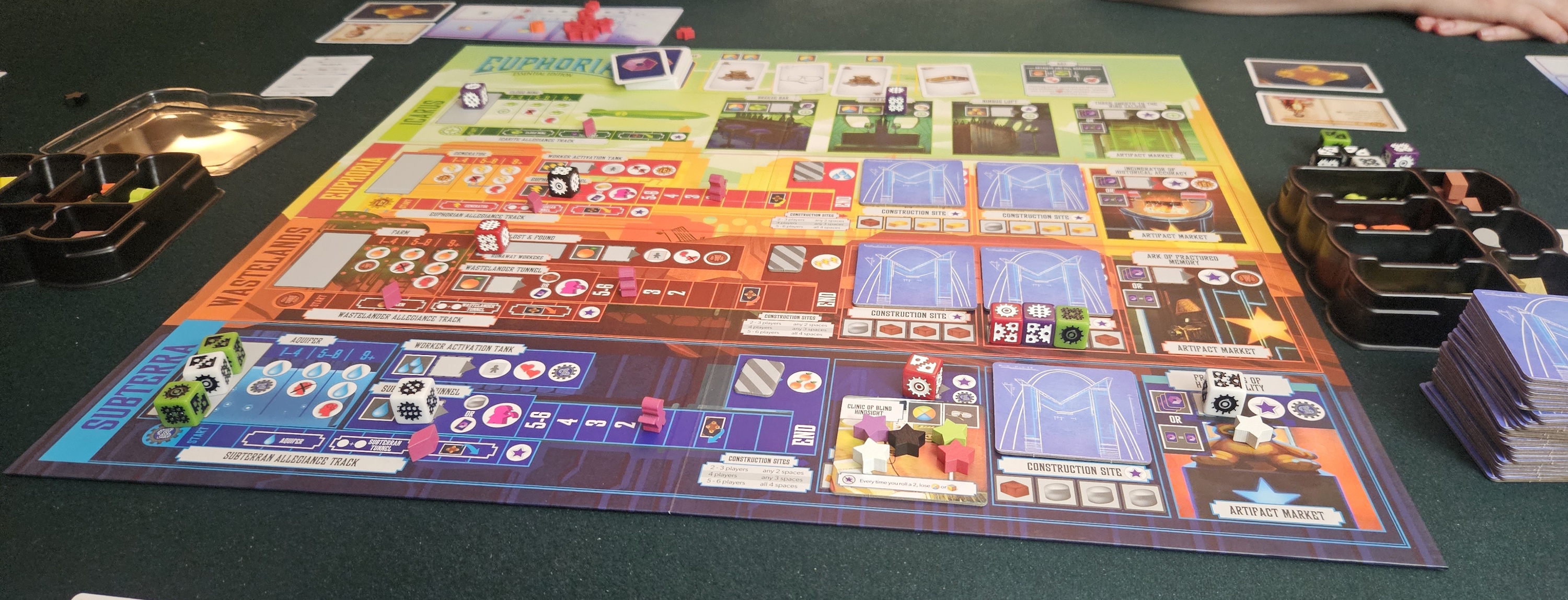
There's even a drab side. For the drabbers.

The new board, not quite the same as the old board.

Short version, there’s rebar showing through the concrete.

As before, Euphoria is about your efforts to thrive in a dystopian society. Relatable. Maybe that’s why the intervening decade hasn’t flown by. But I digress. In Euphoria’s case, that dystopian society is divided into four strata, each offering different spaces for your workers to run errands. There are the Euphorians, folks who generate electricity by marching on hamster wheels, Wastlanders who labor in orange groves, Subterrans who pump water through the cracked bedrock, and Icarans… Icarids? Icaruses? Whatever. These guys cook future-meth for keeping everyone’s workers drowsy and compliant.

The status of those workers is never far from mind. At the time of the original game’s release, rolling dice to determine the relative knowledge of one’s workers was a clever touch. If nothing else, it functioned as one of the hobby’s earliest meta-commentaries on the blank slate that was the worker-placement worker. Roll too high, and one of your workers gets wise to the situation and flees from your grasp. Roll too low, and…

… and there’s no penalty for rolling too low. What you really want is to roll doubles. That way, you can spend some morale to place an extra worker, earning two turns in a single go.
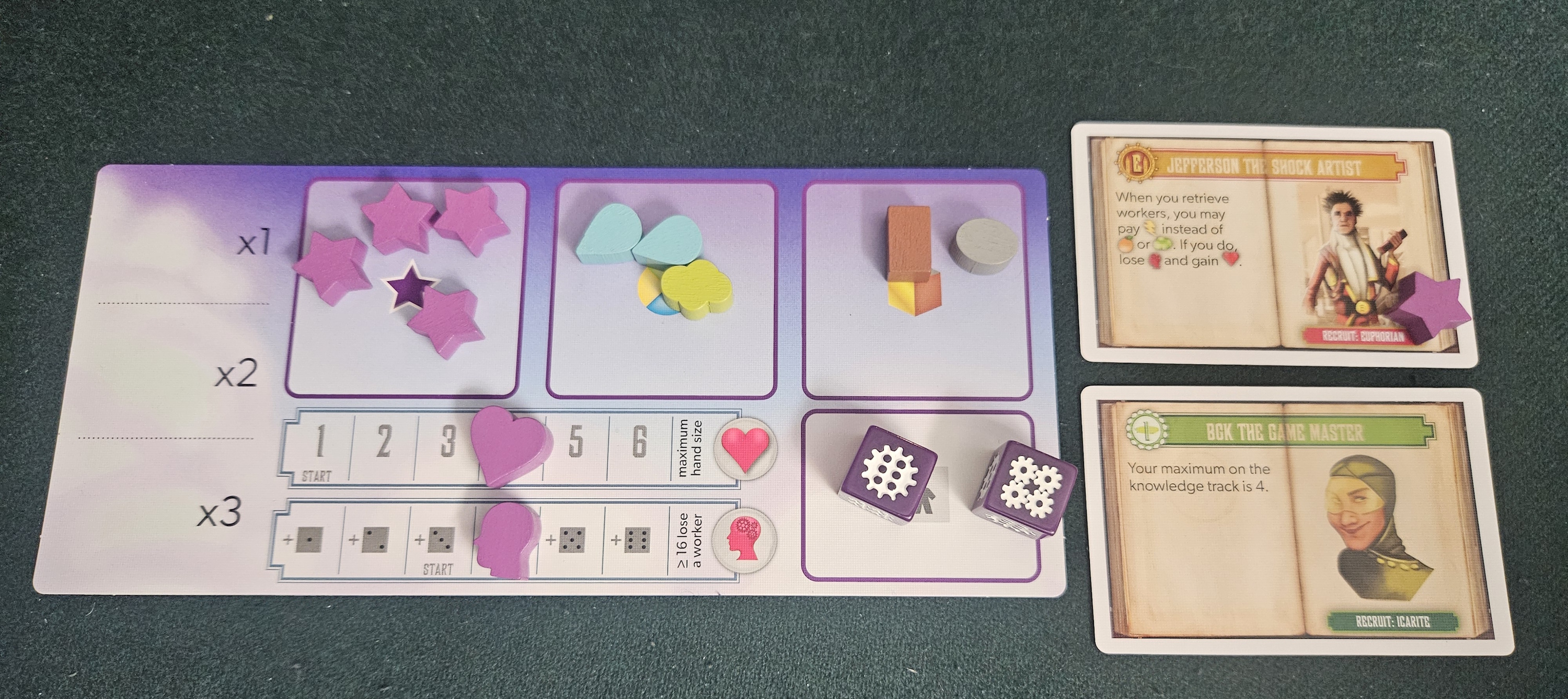
"Actually, there are no streets in the future world of Euphoria." —that one superfan of Stonemaier Games who writes nasty notes whenever I don't love one of their games

Euphoria: meek in the streets, freak in the spreadsheets.

At the time of the original game’s release — there’s a phrase I’ll probably say more than twice — it was easier to overlook the chanciness of the whole thing. Sure, rolling high means losing a worker, and rolling doubles means earning a twofer. But rolling low, I suppose, means you can send a worker to one of the game’s resource production zones without worrying about them learning the shape of their culture. Except, wait, that’s another benefit for rolling low. Darn it.

Okay, so Euphoria is full of luck. Always was, still is. The problem isn’t so much that luck is the sole determiner of whether you succeed, but rather that it’s just enough to prove frustrating. As a genre, Eurogames included more chance in 2013 than they do today. Personally, I miss a bit of chance. But in general, those earlier forms of chance were about mitigation. Even placing towns in Settlers of Catan was about spreading around the odds so that you’d always earn something. In Euphoria, the system feels out of place, and not only among the determinists of 2020s nu-euros.

But let’s set that aside. How has the rest of the game borne the timelapse?

Again, the short version is that it works perfectly well, but never quite eases its grandfatherly creaks and groans. Most actions are tit-for-tat resource conversions. First you send a worker to a resource generator to earn one or two commodities. Then you send them to a tunnel to spend a commodity for a building block. Maybe you spend a wad of commodities for an extra worker. Then you build special markets, which let you exchange commodities, blocks, and artifacts for stars, the game’s victory condition. Repeat. Repeat. Repeat.
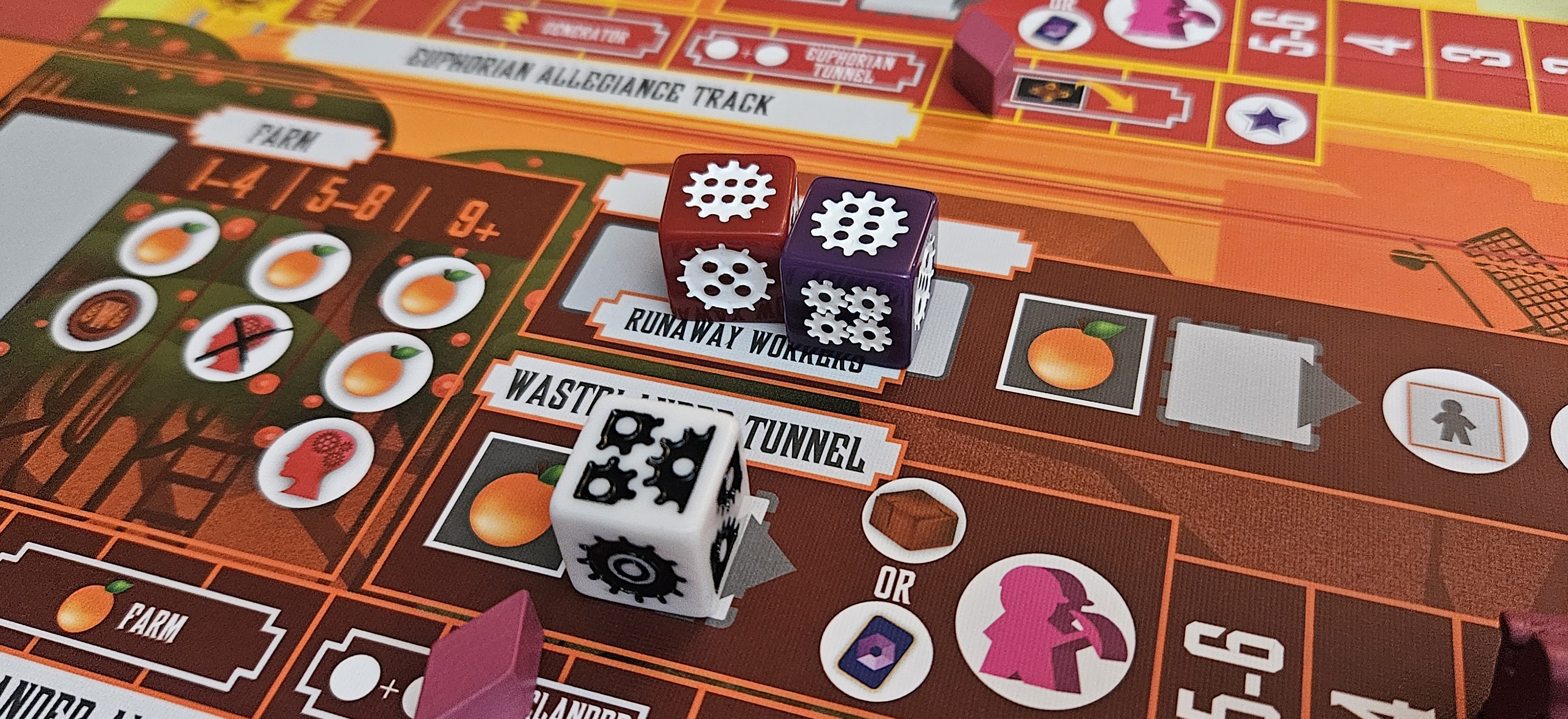
But an appropriate one, I guess. At least you're managing your workers' needs, even if all they happen to need is some vitamin-C or some space-meth.

“Runaway workers” sure is a loaded term.

It doesn’t help that the Essential Edition sometimes comes across as more of a Pruned Edition. The board is more legible, but has shed the original map’s sense of place. Just look at that perfect goofball illustration. The new map feels like a spreadsheet setup for a spreadsheet game. Which is fine, as those things go. This is a resource-conversion worker-placement game, after all. You could even make the argument that this new edition has shed the original game’s pretense, including the ethical dilemma cards that, let’s face it, didn’t always add much to the game systems-wise. But, again, they mattered to Euphoria’s sense of place, the notion that players were being forced to compromise their values in order to get ahead. Thanks to the intervening years, a few subtractions, and this updated visual design, it’s easier than ever to see the wires and mirrors behind the illusion.

The remaining good parts are still as good as ever. For example, those markets. As before, building a market means spending a bunch of building blocks, not to mention putting your laborers in a holding pattern until other players join in. This created a certain degree of cooperation, one that could be turned against you at a moment’s notice. Having even a single worker hanging around at a job site is a real sacrifice, fostering opportunities for players to bicker and cajole. That’s great.

Furthermore, the markets themselves are nasty little things. When built, every player who didn’t contribute to its construction is forced to suffer a penalty until they pay a penalty at the new market. Sometimes these are negligible; other times they pose biting impositions that must be rectified as soon as possible. Or even both at once. The Theatre of Endless Monotony reduces how many commodities you earn, but only to a minimum of one. The Institute of Orwellian Optimism treats all your 1s and 2s as 3s when it comes to checking your dice for thoughtcrime. The Courthouse of Hasty Judgment makes it harder to spend artifacts for stars. That sort of thing.
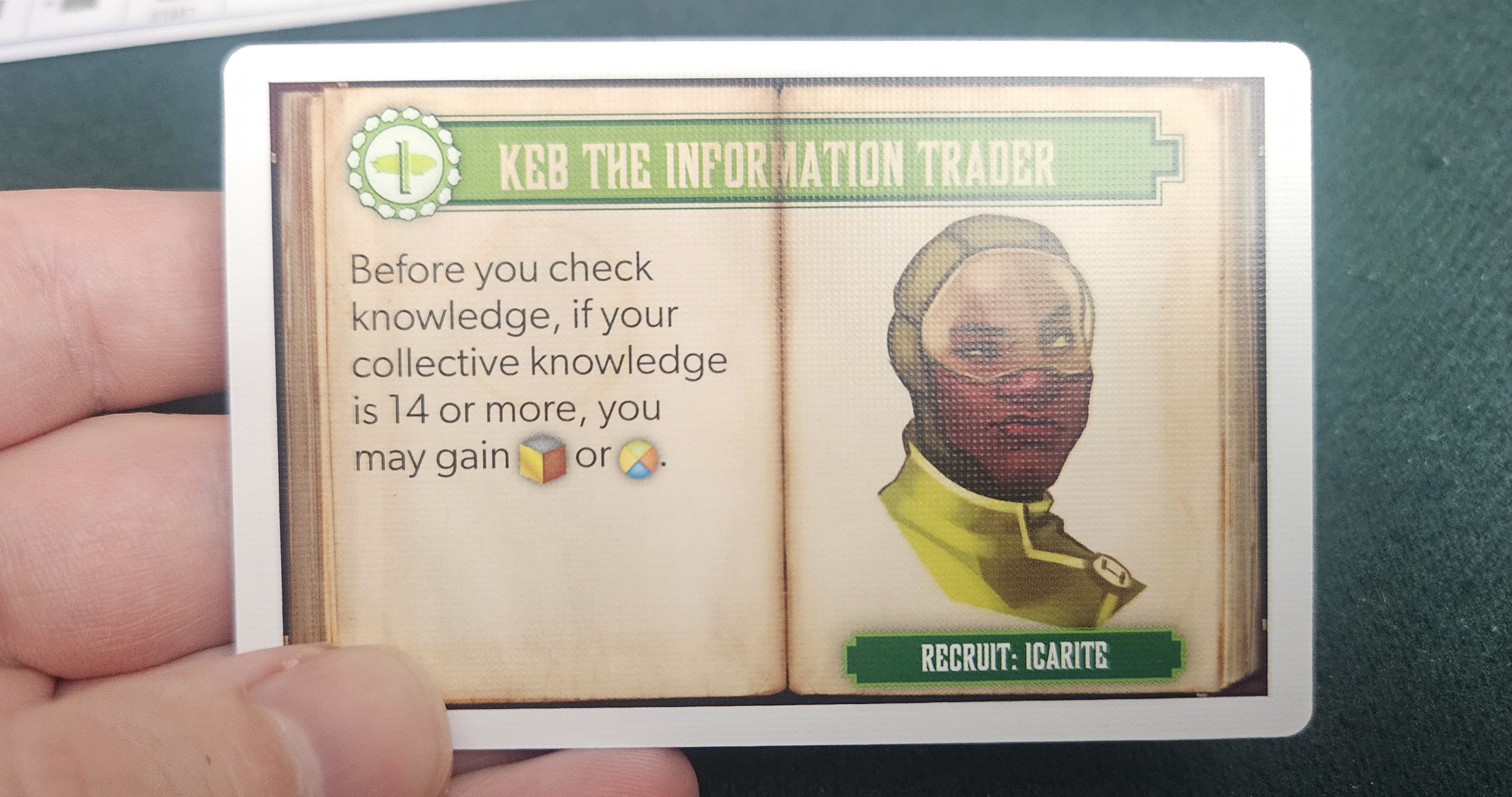
He likes to live on the edge. The edge of KNOWLEDGE.

This guy is a cool dude.

There are some real whoppers in there, too. In one case, we revealed the Apothecary of Productive Dreams. This market prevents some players from sending workers to Icarus. At all. Which effectively locks them out of a full quarter of the board’s spaces. Worse, buying into an already-built Apothecary requires bliss, the very same drug peddled by the Icaroopsies. Not only were some players locked out of Icarus territory, this locking-out was effectively permanent. Was this a fair turn of events? Hardly. But it was interesting. Textured, we might call it. Abrasively textured, sure, but it was refreshing to play a game that would offer such overt penalties rather than ensuring everything ran smoothly all the time.

Between these and the heaps of recruit cards, there’s always something happening on the board. Some market being constructed (or ruining your day), some recruit tweaking the rules to your benefit, some haggling over at the construction site. That’s all great.

The downside is that it never quite breaks free of its shackles. Board games have largely moved on from worker placement, at least in such a straightforward cube-pushing sense. And Euphoria always feels like cube-pushing. Every segment of its dystopia is more or less identical to its peers. The same resources exchange rates. The same methods for hampering one another. The same costs at the artifact markets. And now those four segments are placed side by side so you can see just how closely they align.

In a sense, the Essential Edition is a worthwhile experiment because it highlights just how far game design has come over the past decade. But it’s only a worthwhile experiment for me, a total sicko for how board games change and develop over time. For somebody looking to spend their hard-earned cash, there are better options out there. If I’m going to place dice-shaped workers and suffer random consequences, I’d much rather play Connie Vogelmann’s Apiary, and that’s limiting our selection to titles from the same publisher.
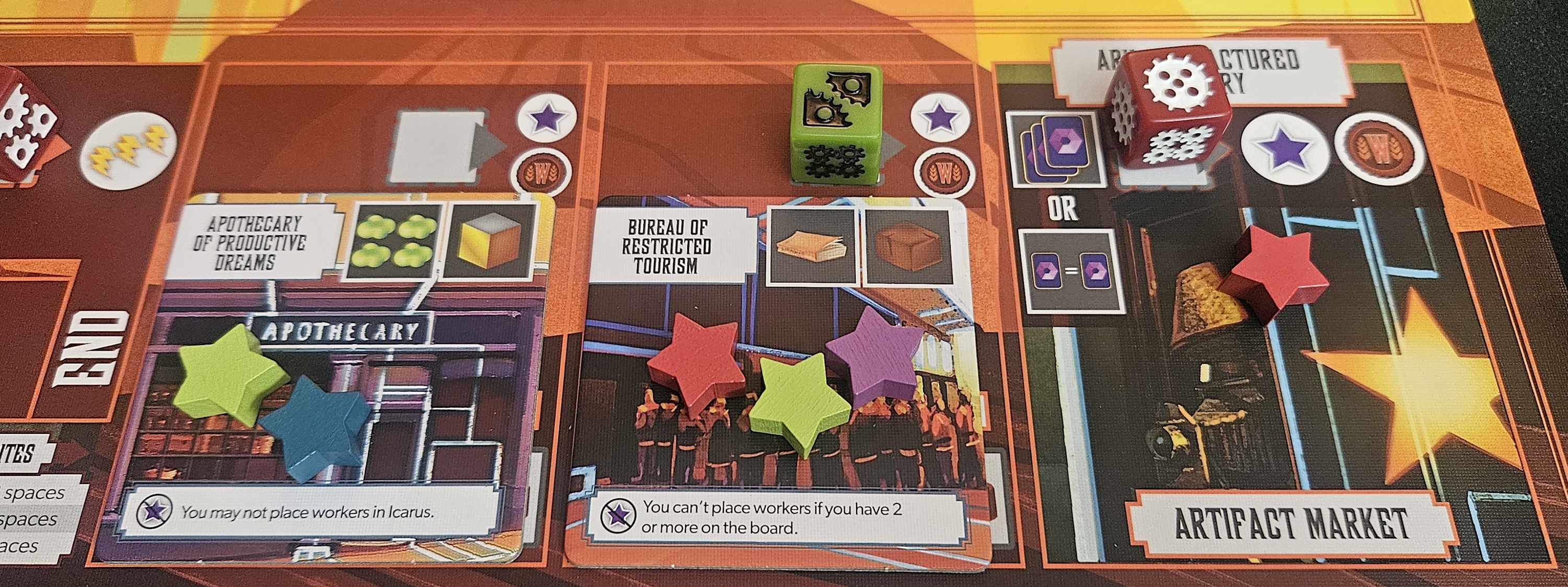
Now make the crossover worker-placement game that's Space Bees vs. Dystopian Labor, Jamey.

E:EE is full of little textures. Some of them are abrasive.

Because Euphoria has been left behind. By board games as an iterative artform. By our hobby’s collective taste in the role of chance. By an Essential Edition that leaves some of its most interesting ideas in the dustbin. By a culture that’s grown weary of dystopias.

Speaking only for myself, I think it’s time to tunnel through to the other side.


A complimentary copy of Euphoria: Essential Edition was provided by the publisher/designer.

(If what I’m doing at Space-Biff! is valuable to you in some way, please consider dropping by my Patreon campaign or Ko-fi. Right now, supporters can read my first-quarter update of 2026: the best board games, movies, books, and more!)

Co-op titles Fate of the Fellowship, Vantage dominate 20th Golden Geek Awards, Hot Streak scores pair of wins

Co-op designs The Lord of the Rings: Fate of the Fellowship and Vantage put in a powerful showing in this year’s Golden Geek Awards, winning five categories between them and scoring another five runner-up successes.

Pandemic creator Matt Leacock’s spin-off creation The Lord of the Rings: Fate of the Fellowship took home the awards for medium game of the year, best thematic game and best co-op at the 20th annual Golden Geeks, which are selected and voted on by BoardGameGeek users from games released in the prior year.

Co-op open-world exploration game Vantage, designed by Scythe and Viticulture creator Jamey Stegmaier, won the innovative game prize and best solo game awards, while Jon Perry’s chaotic mascot racer Hot Streak triumphed in the best party game and light game of the year categories.

Jamey Stegmaier’s design Vantage, from Stonemaier Games

The much sought after heavy game of the year title went to Galactic Cruise, while The Old King’s Crown secured the artwork and presentation award, Toy Battle took best 2-player game and Star Wars: Battle of Hoth best wargame.

Fate of the Fellowship’s flurry of wins and runner-up nods continues a powerful run in the Golden Geeks for games based on JRR Tolkien’s seminal novels, with Bryan Bornmueller’s The Fellowship of the Ring – Trick-Taking Game and Antoine Bauza and Bruno Cathala’s Duel for Middle-earth both having secured wins in last year’s contest.

All of those Lord of the Rings titles were published by studios at board game giant Asmodee – which last October announced it had been named manager of the hugely lucrative Middle-earth licence for tabletop games and accessories.

Questions naturally abounded within the industry about what that would mean for other publishers hoping to create The Hobbit or Lord of the Rings-based titles – but Luke Peterschmidt, the tabletop veteran tasked with running the Middle-earth operation at Asmodee, sat down with BoardGameWire at Spiel Essen last year to outline his vision for the IP, what they want from publishers in terms of pitches, and how they hope to prove naysayers of the deal wrong.

Components from Lord of the Rings: Fate of the Fellowship, designed by Matt Leacock

No game based on The Hobbit or The Lord of the Rings had won a Golden Geek prior to last year’s awards, despite multiple nominations for Journeys in Middle-Earth in 2019, Battle of the Five Armies in 2014 and The Lord of the Rings: The Card Game in 2012.

Fate of the Fellowship winning the co-op award marked the second year running that a Lord of the Rings game has triumphed in the category, after Bryan Bornmueller’s The Fellowship of the Ring – Trick-Taking Game took home the prize in 2025.

Despite the high-profile successes of two co-operative titles in this year’s Golden Geeks, the results were less positive for co-op fantasy adventuring game Arydia: The Paths We Dare Tread – which failed to convert any of its six nominations into wins or runner-up placings.

Sci-fi and space-themed games were notably everywhere again across this year’s awards, continuing a trend from 2025 which ended in multiple wins for Arcs and SETI.

In addition to win for Star Wars: Battle of Hoth and Galactic Cruise, SETI’s expansion Space Agencies won expansion of the year award in this year’s Golden Geeks, while there were two runner-up places for Star Trek: Captain’s Chair, and runner-up nods for Moon Colony Bloodbath and Dune: Imperium – Bloodlines.

Elsewhere in this year’s awards, Dungeons of the Oak Dell won best print and play game, Board Game Hot Takes secured best podcast and Ark Nova took home the best digital app prize.

Speaking about Vantage’s multiple wins and nominations, designer Jamey Stegmaier – who spent about eight years designing and playtesting the title – told BoardGameWire, “I’m just happy for the opportunity to bring a little joy to people through our games, and I’m honored that my labor of love, Vantage, was able to do that for the people who selected it for the Golden Geek Awards.”

Fate of the Fellowship creator Matt Leacock said, “Designing The Lord of the Rings: Fate of the Fellowship was such a rewarding experience for me. I’m so pleased that players are continuing to enjoy it and using it to write their own stories with each other.

“So many things came together with this product: the creative direction, development, illustration, paper engineering, graphic design, sculpting, and marketing. I want to extend my congratulations to the entire team that brought it to life.”

The 20th Annual Golden Geek Awards results in full:

2-Player Game
Winner: Toy Battle
Runner-up: Tag Team
Runner-up: Star Trek: Captain’s Chair

Artwork & Presentation
Winner: The Old King’s Crown
Runner-up: Galactic Cruise
Runner-up: The Lord of the Rings: Fate of the Fellowship

Cooperative Game
Winner: The Lord of the Rings: Fate of the Fellowship
Runner-up: Vantage
Runner-up: Eternal Decks

Expansion
Winner: SETI: Space Agencies
Runner-up: Lost Ruins of Arnak: Twisted Paths
Runner-up: Dune: Imperium – Bloodlines

Innovative
Winner: Vantage
Runner-up: Moon Colony Bloodbath
Runner-up: Hot Streak

Light GOTY
Winner: Hot Streak
Runner-up: Magical Athlete
Runner-up: Toy Battle

Medium GOTY
Winner: The Lord of the Rings: Fate of the Fellowship
Runner-up: Moon Colony Bloodbath
Runner-up: Vantage

Heavy GOTY
Winner: Galactic Cruise
Runner-up: Speakeasy
Runner-up: Luthier

Party Game
Winner: Hot Streak
Runner-up: Magical Athlete
Runner-up: Take Time

Print & Play
Winner: Dungeons of the Oak Dell
Runner-up: Rise of the Oak Dell
Runner-up: 52 Duels

Solo Game
Winner: Vantage
Runner-up: The Lord of the Rings: Fate of the Fellowship
Runner-up: Star Trek: Captain’s Chair

Thematic Game
Winner: The Lord of the Rings: Fate of the Fellowship
Runner-up: Galactic Cruise
Runner-up: Vantage

Wargame
Winner: Star Wars: Battle of Hoth
Runner-up: Toy Battle
Runner-up: Cross Bronx Expressway

Best Podcast
Winner: Board Game Hot Takes
Runner-up: Space-Biff! Space-Cast!
Runner-up: Five Games for Doomsday

Best Board Game App
Winner: Ark Nova
Runner-up: Cascadia Digital
Runner-up: MicroMacro: Downtown Detective

The post Co-op titles Fate of the Fellowship, Vantage dominate 20th Golden Geek Awards, Hot Streak scores pair of wins first appeared on .

Board Game Arena: Neue Spiele in KW 14 (2026)

08. April 2026 um 10:13
Board Game Arena: Neue Spiele in KW 14 (2026)

Board Game Arena hat in der vergangenen Woche zwei neue Titel ins Programm aufgenommen. Mit Scythe kommt ein moderner Klassiker des Strategiegenres auf die Plattform. Charuma bringt dagegen ein kompaktes Stichspiel mit ungewöhnlichem Bietmechanismus an den digitalen Tisch.

Scythe – Strategie im alternativen Europa der 1920er

Scythe von Designer Jamey Stegmaier erscheint bei Stonemaier Games und gehört seit seiner Erstveröffentlichung 2016 zu den bekanntesten Strategiespielen weltweit. Auf BoardGameGeek belegt der Titel Platz 26 im Gesamtranking und erreicht eine Bewertung von 8,10 aus 10 Punkten bei über 92.000 abgegebenen Stimmen. Das Komplexitätsgewicht liegt bei 3,45 von 5.

Das Spiel versetzt 1–5 Personen in ein alternatives Europa der 1920er-Jahre, in dem gefallene Reiche um Ressourcen und Territorien konkurrieren. Im Kern verbindet Scythe Engine-Building, Ressourcenmanagement und Gebietskontrolle. Jede Fraktion startet mit eigenen Fähigkeiten und einer individuellen Position auf der Karte. Trotz der militärischen Optik liegt der Schwerpunkt auf wirtschaftlicher Effizienz und dem geschickten Ausbau des eigenen Tableaus.

Eine Partie dauert laut BoardGameGeek rund 115 Minuten, auf Board Game Arena liegt der Durchschnitt bei etwa 58 Minuten. Für die Illustrationen zeichnet Jakub Różalski verantwortlich, dessen Dieselpunk-Ästhetik maßgeblich zur Bekanntheit des Spiels beigetragen hat. Im deutschsprachigen Raum ist das physische Spiel über Feuerland Spiele erhältlich. Für diesen Titel wird ein Premium-Abo benötigt.

Charuma – Stichspiel mit Bietphase

Charuma stammt von Designer Takashi Saito und erscheint beim Verlag Darucat. Das Kartenspiel für 2–5 Personen kombiniert klassisches Stichspiel mit einer vorgeschalteten Auktionsphase. Vor jeder Runde bieten die Spielenden mit ihren eigenen Siegpunkten auf offen ausliegende Karten und bestimmen so selbst, mit welcher Hand sie in die Stichphase gehen.

Das Deck besteht aus nur zwei Farben mit Werten von 1 bis 10, jeweils doppelt vorhanden. Besondere Regeln sorgen für taktische Tiefe: Wird eine identische Karte gespielt, schlägt die zuletzt gespielte die erste. Treffen Ass und 10 derselben Farbe aufeinander, gewinnt das Ass. Paare können erzwungen werden, was weitere Entscheidungen verlangt.

Eine Partie dauert laut BoardGameGeek zwischen 20 und 45 Minuten. Auf der Plattform wurde Charuma bislang 47 Mal bewertet und kommt auf einen Durchschnitt von 6,00 Punkten. Die Illustrationen stammen von Simon Caruso. Das Spiel lässt sich ohne Premium-Abo spielen.

Origin Story (Hero Story)

Von: Krys
30. März 2026 um 17:56

Origin Story stellt die Entstehungsgeschichte eines Superhelden in den Mittelpunkt. Über mehrere Kapitel hinweg entwickelt sich die eigene Figur vom unbekannten Charakter hin zu einem Helden mit individuellen Fähigkeiten, Stärken und Schwächen. Dabei entstehen nicht nur spielerische Kombinationen, sondern auch

The post Origin Story (Hero Story) first appeared on Spiele-Akademie.de.

Soaring ‘span’ trilogy sales see Stonemaier Games’ annual revenue reach record $25.1m

03. März 2026 um 16:08

Stonemaier Games’ diversification of its flagship bestseller Wingspan into a trilogy of standalone titles powered the company to record revenues of more than $25m last year – eclipsing its previous annual high from the post-Covid board game boom in 2021.

More than 610,000 copies of Elizabeth Hargrave design Wingspan, its Asia expansion, dragon-themed title Wyrmspan and last year’s fish-focused release Finspan were printed by Stonemaier in 2025 according to its latest annual stakeholder report, bringing the total lifetime copies across the trilogy to more than 3.3 million.

While the bulk of that lifetime figure is from 2019 release Wingspan and ‘standalone expansion’ Wingspan Asia, at about 2.6 million copies, the addition of Connie Vogelmann’s Wyrmspan in 2024 and the David Gordon and Michael O’Connell design Finspan last year have created a hefty boost for Stonemaier’s overall sales.

The latter pair now have more than 685,000 copies in circulation – a figure which already outstrips the roughly 600,000 copies of Scythe, Stonemaier’s biggest seller outside of the ‘span’ trilogy, despite that game being in print for a decade.

Speaking to BoardGameWire about the latest annual results, company co-founder Jamey Stegmaier reiterated his regular refrain that “number go up” was “simply not on our list of goals at all”, adding, “I understand that the annual revenue is an interesting number to poke at, but honestly that number could go up or down by many millions of dollars and I wouldn’t care as long as we’re bring joy to people.”

Stonemaier Games co-founder Jamey Stegmaier

Stegmaier had a similar line on the company’s sales performance when he spoke to BoardGameWire two years ago, after the company’s revenue fell for the second year running to $16.7m, marking its lowest annual total since 2019.

He said at the time that he had no concerns about the fall in revenue, saying, “Based on our reach and evergreen sales, I think a ‘normal’ annual revenue for us is somewhere between $15m to $20m, with the exact amount depending on when certain products ship.

“In that way, I think 2021 was an outlier (probably pandemic related) – not only was it a very strong year for Wingspan, but we also saw excellent evergreen sales for Viticulture and Scythe, and we had one of our biggest releases that year in Red Rising.”

But strong sales this year of the ‘span’ trio among a busy slate of other Stonemaier releases has pushed company revenue beyond those 2021 heights, with Stegmaier telling BoardGameWire yesterday, “After hearing from customers for a long time that they wanted the Wingspan model applied to other creatures, I’m really glad we’ve been able to serve them via Wyrmspan and Finspan.

“It also takes pressure off of Wingspan designer Elizabeth Hargrave. Also… it gives us some wiggle room to take on riskier projects, though any game is a risk – we never really know how a game will do.”

One game which could arguably be put in that category is Stonemaier’s 2025 release Vantage – a non-campaign, open-world-style exploration game designed by Stegmaier which was in development for seven years.

Stonemaier printed 64,000 copies of Vantage last year, with Stegmaier telling BoardGameWire: “There’s no other tabletop game that does what Vantage does, so I see it hitting tabletops for years to come.”

He said, “We’re currently initiating Vantage’s fourth reprint, which is remarkable for an expensive game just eight months into its lifecycle.

“I’m so glad this labor of love from the last eight years of my life is resonating with people who want to go on an open-world, first-person adventure without the need to commit to a campaign game.

“Also, unlike all other new releases, Vantage had so much text that it didn’t have any localization partners in 2025 – they needed a lot more time, so 10,000 units of non-English versions are coming in 2026.”

Vantage, published by Stonemaier Games

He also highlighted the success of superhero-themed, tableau-building trick-taker Origin Story, which printed 33,500 copies, and added that more quick-playing, smaller-box titles are on the way from the publisher – including a more lightweight Wingspan title which the company says is playable in about 30 minutes.

Stegmaier said, “I love Origin Story, and I’m excited that we’ve packed so much game into a smaller box that you can teach and play in 45 minutes.

“I would say that’s the realm of the smaller Wingspan game we’re releasing in mid-2026, and I’m wrapping up something kind of in the same realm (in terms of size and length) for 2027.”

Going smaller still, Stonemaier’s 18-card co-operative micro-game Smitten and its sequel also performed well last year, Stegmaier said, with the number of copies printed up 23,000 compared to 2024.

He said, “These are both very small, very humble games that serve well as add-ons, stocking stuffers, and suitcase inclusions for travel. I’m honestly kind of surprised they’ve sold so well, given how different they are from our core offerings.

“That said, they offer more of a trickle of sales through any sales partner – a dozen here each month to distributors, a dozen there to retailers, a few dozen on our webstores.”

Stegmaier added, “The one product for which we probably over-forecasted was Wyrmspan: Dragon Academy. It has sold very well (over 60,000 units for an expansion is remarkable), but I think we probably could have made 75,000 units and later reprinted 25,000 instead of printing 100,000 up front.

“Stamp Swap has done fine [BGW note: 34,000 copies printed in its 2024 release year, but none in 2025], but I think it’s indicative that it’s more difficult than ever for a good game to break through.”

Cards from 2025 Stonemaier release Wyrmspan: Dragon Academy

Other 2025 releases from the company included Tokaido and Tokaido: Duo, which it bought from financially-troubled French board game publisher Funforge towards the end of 2024.

Stegmaier has been at the vocal forefront of the board game industry’s fight against volatile US tariff policy since President Trump’s inauguration last January, which has seen several board game businesses shutter their operationslay off staff and hike the prices of their games to cover the unexpected costs.

Stonemaier was among a string of companies that took part in lawsuits challenging Trump’s power to raise tariffs at will – and Stegmaier expressed his “relief” when those tariffs were judged as unconstitutional by the US Supreme Court late last month.

He said in a blog post at the time, “Every day for the last ten months, I’ve lived in fear that the executive branch of my own country would raise our import taxes to an extreme level that would significantly damage Stonemaier Games and the thousands of small businesses seeking to serve their US customers, retailers, and employees.

“So when the Supreme Court ruled on Friday that the tariff taxes and the way they were implemented were unconstitutional, I had a huge sense of relief. Relief that small businesses can no longer be used as pawns in a global game. Relief that the whim of one person can no longer effectively change the landed cost of our product from $10 to $25.

“Yes, there are still legal ways for the executive branch to impose tariff taxes. They seem really passionate about making small businesses in the US pay more taxes. But these methods have limits: For example, the new tariff tax is 15% (that’s the max it can be), and it needs congressional approval to extend beyond 150 days.

“In the immediate future, I don’t think we’ll see much of an impact on prices, as anything in stock in the US already had its tariff tax paid when it entered the country (if it was manufactured elsewhere). My perception is that many businesses avoided raising prices and instead just ate the extra costs (that’s what we did; we did not increase any prices).

“There is also the possibility of tariff tax refunds. To date, Stonemaier Games has paid just under $300,000 in tariff taxes to the US government. I’m not counting on getting any of that back – it will be nice if we do, and I hope that other businesses do, but the level of uncertainty isn’t something for which we can plan.

“My hope, as always, is that what happens next will help me best serve my coworkers, our independent contractors and partners, and our customers in the US and around the world (consumers, retailers, and distributors). I wish the same for all other small businesses.”

Stegmaier told BoardGameWire that he was “really excited” about the company’s 2026 line-up, which kicked off with the Wingspan Americas and Viticulture: Bordeaux expansions, and also includes a two-player Scythe vs Expeditions duelling game which expands both those titles as well as working as a standalone design.

He said, “I’m excited for the opportunity to serve fans through expansions for Wingspan, Viticulture, Finspan, Scythe, and Expeditions, along with the new Euphoria board.

“The main challenge is communicating what makes these products unique and special. For the first time in a while (since Apiary, as I recall), we’ll have a new game in our original sweet spot of mid-weight euro games – that’s the Smoking Bones game in Q4.”

Stonemaier Lifetime and 2025 Sales

  • Wingspan & Wingspan Asia: 2,639,429 lifetime units, up 229,686 compared to 2024
  • Wyrmspan: 451,994 units +148,598
  • Finspan: 233,584 units (new release)
  • Vantage: 64,000 units (new release)
  • Scythe: 601,102 units +41,500
  • Origin Story: 33,500 units (new release)
  • Tokaido: 29,500 units (new release)
  • Tokaido Duo: 27,834 units (new release)
  • Smitten & Smitten 2: 38,000 units +23,000
  • Apiary: 55,004 units +8,500
  • Viticulture: 273,584 units +6,750
  • Rolling Realms & Rolling Realms Redux: 62,000 units +6,000
  • Tapestry: 91,650 units +4,000

  • Between Two Castles: (58,000 units) received an Essential Edition in 2025 – 8,000 copies made, about 5,000 sold

Games which did not receive new printings in 2025:

  • Euphoria: 44,000 units
  • Between Two Cities: 56,900 units
  • Charterstone: 97,500 units
  • My Little Scythe: 68,500 units
  • Pendulum: 49,200 units
  • Red Rising: 154,800 units
  • Libertalia: 62,584 units
  • Expeditions: 77,500 units
  • Stamp Swap: 34,000 units

The post Soaring ‘span’ trilogy sales see Stonemaier Games’ annual revenue reach record $25.1m first appeared on .

Sag Servus: Mein Abschied von Vantage ist längst überfällig

Von: ravn
19. Februar 2026 um 20:27

Keine Panik, dieser Abschied ist kein Abgesang, sondern nur auf Zeit und bis zur lokalisierten Special Edition von Feuerland, die wie bisher geplant im Sommer 2026 stattfinden soll. Bleiben bis dahin drei offene Fragen, die ich hier in ungefilterter Selbstreflexion mit Euch klären möchte. Lasst uns nochmal über Vantage palavern.

Der Abenteuersandkasten im Kartenspielformat aus dem Hause Stonemaier Games hat sich für mich persönlich auf mehreren Ebenen gelohnt. Erstens konnte ich mit der englischsprachigen Version die Grenzen meines Wortschatzes kennenlernen und neue Begriffswelten erkunden. Wer bitteschön kennt schon das Verb „hone„? In meinen längst vergangenen Business-Meetingsessions im Kreise von internationalen Nicht-Muttersprachlern kam das nicht vor und auch in diversen YouTube-Videos der wissenschaftlichen Welt wurde das ebenso wenig benutzt. Dabei bedeutet „hone“ einfach nur etwas verbessern oder verfeinern, feinschleifen, vervollkommnen.

Aha, verstanden und direkt wieder vergessen, weil ich gerne nur Worte nutze, die meine Gegenüber auch verstehen können. Sprache ist für mich vor allem ein Kommunikationsmittel. Mit der lokalisierten Vantage-Version von Feuerland brauche ich mir darüber aber zum Glück keine Gedanken zu machen. Denn Bettspielen ist für mich vor allem ein entspanntes Hobby, das gerne ohne unnötige Hürden auskommt.

Die zweite lohnende Ebene war die Entdeckung einer neuen Spielwelt. Eine Welt, in der es schlicht kein Scheitern gibt, dafür aber alles vorbestimmt ist. Eine Welt, die ich auf Schienen durchlaufe und mich damit begnüge, die Weichen zu stellen, wohin ich jeweils abbiegen möchte. Und das alles in einem Takt, der keinen Stillstand duldet und damit Entscheidungen forciert – entweder das oder jenes, aber fast immer nie beides. Also genau das, was mir in der jeweiligen Situation am wichtigsten erscheint. Gut, wenn ich in Zukunft auch die ganzen Nuancen verstehe und auch die, welche ich nie hinterfragt hätte – in eigener Selbstüberschätzung. Wie soll ich auch was hinterfragen, wenn ich nicht weiß, dass es etwas zu hinterfragen gibt? Mit der Feuerland-Ausgabe kann ich mich bald aufs Wesentliche fokussieren. Gut so.

Die dritte Ebene der Belohnung, das wart Ihr liebe Leserinnen und Leser. Mit meinen Erzählungen von und über Vantage sind ganz viele von Euch neu zu diesem kleinen Tagebuch der entspannten Brettspiele dazugekommen. So zumindest sagt es meine Serverstatistik, die mal eben einen Sprung um den Faktor 10 gemacht hat, der schwankend bis zum heutigen Tage anhält. Da ich hier nichts monetarisiert habe und nur ganz selten mal erwähne, dass Ihr (ja, Du bist gemeint, sofern Du Dich angesprochen fühlst!) mich freiwillig unterstützen könnt, ist das alles aber nur reine Bauchpinselei fürs eigene Ego, gelesen zu werden. Wenn ich Euch damit eine oder gerne auch mehrere Freuden machen konnte, dann umso besser. Brettspieltag als Webseite und Sprachrohr ist mein privilegiertes Hobby und Ausgleich zugleich. Das reicht mir, denn manches muss einfach verschriftlicht werden.

Aber eigentlich sollte es doch um drei offene Fragen rund um die deutschsprachige Vantage Special Edition von Feuerland gehen. Genau und deshalb greife ich die hier ohne weitere Umschweife auf:

Wird es die Vantage-App auch für die lokalisierte Version von Feuerland Spiele geben?

Seit Ende August 2025 gibt es Vantage ausschließlich auf Englisch von Stonemaier Games. Weitere Sprachversionen sind erst für 2026 angekündigt. Da folgen dann auch Versionen in Spanisch, Ungarisch und Niederländisch. Das ist aber alles noch Zukunftsmusik bei den einzelnen länderspezifischen Verlagen, die diese Lokalisationen übernehmen. Eine offizielle Aussage, ob es dazu überhaupt und wann auch lokalisierte App-Versionen geben wird, die gibt es nicht.

Die Vantage App ist auch kein eigenes Produkt von Stonemaier Games, sondern gehört der Firma Rulepop, die dafür eine Produkt-Partnerschaft eingegangen ist. Feuerland Spiele müsste wohl ebenfalls eine solche Partnerschaft eingehen, denn eine eigene App-Entwicklung wird laut meiner Nachfrage am Messestand der SPIEL 2025 in Essen nicht angestrebt,

Wer also ganz sicher und weiterhin, wie 31 % der Vantage-Nutzer laut aktueller Stonemaier Games Umfrage, die Vantage-App nutzen möchte, der muss wohl oder übel bei der englischsprachigen Originalausgabe bleiben. Wir sprechen bei der App zudem auch nicht von einer einmaligen Übersetzung, denn die App wird weiterhin gepflegt und überarbeitet. So wurde am 26. Dezember 2025 die offizielle Errata eingepflegt und am 22. Januar 2026 gab es minimale Anpassungen der Storybuch-Einträge. Dieser Aufwand käme dann auch auf eine Übersetzung zu, wobei die aktuelle Version einen Stand erreicht hat, mit der ich bisher zufrieden war.

Was bleibt, das sind Spekulationen. Wir können uns da nur überraschen lassen. Ich freunde mich allerdings schon mal damit an, zurück zum Papier zu kehren, damit ich mich nicht selbst aus einer unbegründeten Erwartungshaltung enttäuschen werde. Denn versprochen hat uns bisher niemand etwas. Das solltet Ihr bedenken, wenn Ihr an die Vantage-App denkt.

Wann genau ist das Auslieferungsdatum der lokalisierte Vantage.Version von Feuerland Spiele geplant?

Mitte Januar 2026 berichtete das Feuerland-Team an alle Vorbesteller der Special-Edition, dass nach langer Übersetzungsarbeit die Produktion nach erneuter Prüfung der Druckdateien starten wird. Im Mai 2026 sollen die Spiele fertig produziert sein. Im Sommer werden die dann im Lager von Feuerland erwartet und dann verschickt. Seitdem gibt es keine weiteren offiziellen Aussagen, die dem widersprechen.

Ich für mich rechne damit, auf der SPIEL DOCH! in Dortmund, die vom 24. bis 26. April 2026 in der Westfalenhalle 4 stattfinden wird, ein deutschsprachiges Vorabexemplar am Messestand von Feuerland anschauen zu können. Merkt Euch die Standnummer B-26 vor. Wer nicht so lange warten will, macht sich selbst einen Eindruck von der Qualität der Übersetzung. Die lokalisierte Spielregel gibt es längst zum Download.

Rechnen wir von Mai aus ein wenig weiter, so dauert die Standard-Seefracht per Container aus China rund 30 bis 50 Tage. Dazu kommen noch die Zollabfertigung und der Einzelversand zu den Vorbestellern. Damit wird August realistisch und wir sind mitten im Sommer 2026 angekommen. Also genau dann, was uns Feuerland mit „im Sommer“ versprochen hat. Verzögerungen sind aber immer möglich. Und auch da setze ich mich nicht selbst unter übersteigerten Erwartungsdruck.

Bleibt die allerletzte Frage: Wer möchte mir meine noch größtenteils ungespielte englischsprachige „All in Deluxe“ Vantage Version abkaufen?

In meinen Spielberichten hier könnt Ihr einfachst nachzählen, wie oft das Spiel bei mir auf den Tisch gekommen ist. Zu wenig, muss die Antwort leider lauten, denn Vantage ist eben speziell und in seiner Fremdsprache noch spezieller für einige potenzielle Mitspieler. Das letzte Mal hatte ich Vantage im Herbst letzten Jahres gespielt. Jede weitere Partie hätte mit zudem der Möglichkeit beraubt, die lokalisierte Version zu entdecken. So zumindest rede ich es mir ein und blicke zu den ganz vielen anderen Brettspielen, die nach ihrer ersten Euphoriephase schlicht von anderen Neuheiten verdrängt worden sind.

Aber Vantage darf ja seinen zweiten Frühling (wenn auch im Sommer 2026) erleben, diesmal dann auf Deutsch. Nur spätestens bis dahin benötige ich keine zwei Vantage Spiele. Macht mir ein faires Angebot für das Grundspiel mit allem Deluxe-Zubehör – einfach per E-Mail an verkauf@brettspieltag.de

Und damit schließe ich den Vorhang vor Vantage und sage Servus zur Stonemaier Games Ausgabe. Wir sehen uns in einer anderen Sprache wieder, wenn es dann Sommer ist. Bis dahin, hoffentlich bald!

Vantage

Von: Krys
16. Januar 2026 um 21:18

Vantage ist ein kooperatives Abenteuerspiel in einer offenen Welt für ein bis sechs Personen. Nach dem Absturz auf einem unbekannten Planeten startet jeder Spieler mit einem eigenen Charakter an einem anderen Ort und nimmt die Spielwelt ausschließlich aus seiner individuellen

The post Vantage first appeared on Spiele-Akademie.de.

Scythe im Test

23. September 2024 um 22:27

Scythe ist ein strategisches Brettspiel, das in einer alternativen Vergangenheit in den 1920er Jahren spielt. In einer vom Ersten Weltkrieg geprägten Welt kämpfen verschiedene Fraktionen um Macht, Ressourcen und Kontrolle über Osteuropa. Mit seinem Mix aus Strategie, Ressourcenmanagement und asymmetrischen Fraktionen hat sich Scythe schnell als moderner Klassiker etabliert. Dank der drei Erweiterungen – „Invasoren aus der Ferne“, „Kolosse der Lüfte“ und „Aufstieg der Fenris“ – bleibt das Spiel auch langfristig spannend und bietet vielfältige neue Herausforderungen.

Um was geht es in Scythe?

In Scythe übernehmen die Spieler die Führung über verschiedene Fraktionen in einer alternativen Vergangenheit, die stark von den Ereignissen des Ersten Weltkriegs und den technischen Innovationen dieser Zeit geprägt ist. Das Spiel ist im fiktiven Osteuropa angesiedelt, wo gigantische Mechs das Schlachtfeld dominieren und wertvolle Ressourcen in der Region „Die Fabrik“ gewonnen werden können. Die Spieler wetteifern um die Kontrolle über das Land, indem sie Gebiete erobern, Ressourcen abbauen, militärische Stärke aufbauen und wirtschaftliche Vorteile ausnutzen.

Das zentrale Ziel in Scythe ist es, als erste Fraktion eine bestimmte Anzahl von Erfolgen zu erzielen. Diese können durch den Aufbau von Gebäuden, das Erobern von Gebieten, das Entwickeln von Technologien, den Aufbau von Militärmacht oder das Absolvieren von Kämpfen erreicht werden. Doch das Spiel belohnt nicht nur kriegerische Erfolge, sondern auch ökonomisches Geschick und strategische Planung. Jeder Zug erfordert gut durchdachte Entscheidungen – welche Aktion wird gewählt, welche Ressourcen werden genutzt und wie reagiert man auf die Züge der Gegner?

Was Scythe besonders fesselnd macht, ist der nahtlose Übergang zwischen friedlichem Aufbau und militärischer Eroberung. Spieler müssen geschickt zwischen Wirtschaft und Krieg abwägen, um erfolgreich zu sein. Trotz der thematischen Schwere bleibt das Spiel durch seine klare Struktur und das intuitive Design zugänglich und spannend.

Die 1. Erweiterung: Invasoren aus der Ferne

Die erste Erweiterung, Invasoren aus der Ferne, fügt zwei neue Fraktionen hinzu: die Togawa-Shogunate und das Albion-Königreich. Jede dieser Fraktionen bringt ihre eigenen asymmetrischen Fähigkeiten und Mechaniken ins Spiel, was die strategischen Möglichkeiten erweitert. Diese Fraktionen sind nicht nur optisch und thematisch einzigartig, sondern verändern auch das Spielgeschehen, da sie mit neuen Taktiken und Spielstilen eingeführt werden. „Invasoren aus der Ferne“ verleiht Scythe somit nicht nur mehr Vielfalt, sondern auch eine noch größere strategische Tiefe und Flexibilität. Fans des Grundspiels werden die neuen Herausforderungen und Möglichkeiten zu schätzen wissen.

Die 2. Erweiterung: Kolosse der Lüfte

Mit der zweiten Erweiterung, Kolosse der Lüfte, werden gewaltige Luftschiffe in die Welt von Scythe eingeführt. Diese mächtigen Einheiten bieten den Spielern neue Bewegungs- und Kampfoptionen. Die Luftschiffe sind flexibel einsetzbar und können Truppen schnell über das Spielfeld transportieren, was die taktischen Möglichkeiten noch erweitert. Zudem bringt die Erweiterung neue Auftragskarten ins Spiel, die für zusätzliche strategische Entscheidungen sorgen. „Kolosse der Lüfte“ fügt somit eine neue Dimension der Mobilität und des strategischen Kampfes hinzu, die das Spielgeschehen dynamischer und noch spannender macht.

Die 3. Erweiterung: Aufstieg der Fenris

Aufstieg der Fenris, die dritte Erweiterung, bringt eine völlig neue Spielweise in Scythe: eine Kampagne. Diese Erweiterung besteht aus acht Episoden, die miteinander verbunden sind und eine epische (zurücksetzbare) Geschichte erzählen, die den Spielern die Möglichkeit gibt, ihre Fraktion weiterzuentwickeln und anzupassen. Was diese Erweiterung besonders spannend macht, ist die Möglichkeit, geheime Module und neue Regeln nach und nach freizuschalten, was den Wiederspielwert enorm erhöht. Darüber hinaus können die neuen Module auch außerhalb der Kampagne verwendet werden, um das reguläre Spiel zu erweitern. „Aufstieg der Fenris“ bietet somit nicht nur eine narrative Tiefe, sondern auch vielfältige Anpassungsoptionen für zukünftige Partien.

Fazit zu Scythe

Scythe ist ein Meisterwerk der strategischen Brettspiele, das durch seine asymmetrischen Fraktionen, tiefgründigen Mechaniken und seine spannenden Erweiterungen überzeugt. Egal, ob man sich auf wirtschaftlichen Aufbau oder militärische Eroberung konzentriert, das Spiel bietet unzählige Möglichkeiten und Herausforderungen. Dank der Erweiterungen bleibt es langfristig spannend und abwechslungsreich.

Kein Spiel ist für Jedermann. Ob Scythe etwas für euch ist, entscheidet allein ihr.


Top-Test

Erfahre mehr über das Wertungssystem im Toptest.

1. Thema

Scythe strotzt vor Thema – nicht nur optisch! Alles an diesem Spiel entspricht dem Geist der Zeichnungen von Jakub Rozalski. Scythe fühlt sich in allem sehr thematisch an, bis… ja bis man seine Mechs ins Wasser bewegt um einen Fluss zu überqueren. Denn dann haut einem das Spiel eine Balancing-Regel um die Ohren wie einen sprichwörtlichen Zaunpfahl: Die Mechs können je nach Fraktion, zu der sie gehören, das Wasser nur an bestimmten Terraintypen verlassen. Beispielsweise ist es einem bestimmten Mech nicht gestattet von Wasser aus ein Grasland zu betreten, aber mit Bäumen oder Gebirgen gibt es keine Probleme. Eine Regel, die unthematischer nicht sein könnte. Zum Glück fällt dieses „Problem“ im Gamedesign mit den Kolossen der Lüfte vollends vom Tisch und die ansonsten perfekt inszenierte Welt rettet hier die Wertung.

2. Material

Scythe ist eines der Spiele, die man mit Unmengen an Material aufwerten und verbessern kann. Beschränkt man sich nur auf das originale Material von Stonemaier Games / Feuerland Spiele und die lizensierten Produkte von Meeple Source, kann man dennoch ganz schnell bei über 800 € landen. Sagte mir zumindest… ein Freund! Und das ist eigentlich gar nicht nötig, da das Spiel im Originalzustand schon tolle Holz- und Kunststoffteile dabei hat, hervorragende Kartenqualität und einen Karton so stabil, dass man damit umziehen könnte.

3. Optik

Laut einem Interview kam der Designer Jamey Stegmaier erst durch die fantastischen Artworks von Jakub Rozalski auf die Idee zu Scythe. Und das sieht man dem Spiel an. Alles hier wirkt wie aus einem Guss und versprüht diesen merkwürdig interessanten Vibe von Historie und dennoch fortschrittlicher und uns fremder Technologie. Hervorragend!

4. Setup

Zwar ist Scythe ein großes Spiel, doch das Spielbrett gibt einem lauter Hinweise, wo was zu platzieren ist. Dazu wählt jeder Spieler eine Fraktion sowie eine Ausrichtung und bekommt das Holzmaterial der Farbe, die er (wie angegeben) auf seinem Board platziert. Abgesehen von Ressourcen, Zielkarten und ein paar Kleinigkeiten war es das auch schon. Für ein Spiel dieser Größe und taktischen Tiefe geht das beeindruckend leicht von der Hand!

5. Spieleranzahl

Das Grundspiel ist spielbar mit bis zu 5 Spielern. Durch die Invasion Invasoren aus der Ferne kommen die Möglichkeiten für einen 6. & 7. Spieler dazu. Aus meiner Sicht wird das aber etwas übertrieben sein, denn mehr als 5 Spieler wären mir persönlich zu viel für einen runden Spielablauf – daher gibt es einen Punkt Abzug. Die hohe Punktzahl ist hier – da ich das Gesamtpaket Scythe bewerte – tatsächlich dem modularen Spielplan geschuldet: Erst dieser bringt die nötigen Veränderungen mit sich, um auch bei weniger als 4 Spielern schnell Grenzen zu schaffen und diese knisternde Spannnung zwischen Frieden und militärischer Abschreckung zu provozieren. Der modulare Spielplan ist für mich bei unter 4 Spielern ein MUSS!

6. Zugänglichkeit

Auch hier gibt es eine hohe Punktzahl, denn das Spiel ist sehr einfach gesteuert: Jedes Tableau besteht aus 8 Aktionen, von denen jeweils 2 (von Fraktion zu Fraktion unterschiedlich) gruppiert sind. Ich muss mich jede Runde für eine andere Paarung entscheiden, wobei schon nur noch 3 zur Auswahl stehen. Die obere Aktion bringt mir meist Einkommen, die untere eine Möglichkeit diese Ressourcen auszugeben. Scythe ist im Grundsatz ein leicht zugängliches Spiel, dessen so rundes Bild allerdings durch seine Sonderregeln für Bewegung, Transport und Kampf etwas kränkelt. Nichts, was man sich nicht merken könnte, jedoch definitiv der trägste Regelabschnitt bei Scythe.

7. Spieltiefe

Das Spiel ist an sich recht euro-mäßig gesteuert, obwohl es so nach Kriegsspiel aussieht. Und das gibt dem Spiel seine enorme Tiefe. Scythe glänzt erst dann, wenn Spieler Grenzen zu einander aufbauen. Denn Krieg zu führen ist in Scythe immer schlecht. Er kostet Ansehen und das ist im Endeffekt der Multiplikator für unsere Siegpunkte. Man sollte sich also ganz genau überlegen, wo man eine offene Konfrontation hochkochen lässt und wo man es bei der Abschreckung belässt. Dieses Gefühl ist schon ziemlich gut eingefangen.

8. Spieldauer

Lässt man mögliche Konflikte außer Acht, kann jede Kombination aus Nations- und Spielertableau das Spielende nach derselben Anzahl optimaler Züge erreichen – gut, zwei Kombinationsmöglichkeiten benötigen rechnerisch weniger Runden und sind daher auch offiziell „gebannt“. Jedoch muss man auf dieses Niveau auch erstmal kommen. Scythe ist ein Wettrennen zum Erreichen der Ziele und wenn die Piloten schlafen bzw. nicht wissen, wie sie schnell zum Ziel kommen, dann kann sich auch eine Partie Scythe ziehen. Gerade mit höheren Spielerzahlen kann das ermüdend werden.

9. Downtime

Abgesehen von Kämpfen – die aber sowieso für jeden Spieler interessant sind und schnell ausgeführt werden – gibt es recht schnelle Züge: Eine Kombination auswählen, oben generieren, unten zahlen, der nächste Bitte. So gut, so vereinfacht. Dennoch ist und bleibt Scythe eine sehr thematische Karosse auf einem Euro-Motor. Und der erlaubt und benötigt manchmal etwas Gehirnschmalz. Gerade in den gehobeneren Spielerzahlen und im letzten Drittel des Spiels kann die Downtime dann schon ansteigen.

10. Preis

Mit rund 65 € ist das Grundspiel von Scythe ein echter Kracher! Und selbst mit jeglichem Erweiterungs-Content landet man ohne zusätzliches Blingbling bei nicht einmal 175 € Neupreis. Das ist eine Kampfansage an so viele moderne Kickstarter, die vermutlich in Puncto Qualität mit Scythe nicht mithalten können. Volle Punktzahl!

Ergebnis

Mit 44/50 Punkten ergattert Scythe einen hervorragenden Punktestand und damit das Prädikat „Ausgezeichnet“!

Dieses Spiel ist von der Webseite Boardgamefan.de ausgezeichnet worden.
❌