❌

Normale Ansicht

Woodrow Wilson (Presidential Ratings, #5)

01. November 2026 um 16:27

We’ve been assessing the merits of political leaders in (more or less) democratic countries, illustrated by a single board game each, on this blog for a few years now. Today’s subject is another US president – domestic reformer turned foreign policy prophet Woodrow Wilson. And which game could be more appropriate for him than Versailles 1919 (Geoff Engelstein/Mark Herman, GMT Games)?

If you want to read more ratings of historical leaders like this, I strongly recommend you subscribe to the blog – all new posts in your inbox right when they go live!

The Rating System

Some caveats ahead: The presidents will be rated by the knowledge of their time. If they or their contemporaries could not have known about the effects of something, I will not use my hindsight to mark it as a mistake of theirs. The assessment is focused on their conduct as president, but includes their life after holding the office (in which they will still be regarded in the public eye as (ex-)presidents).

Now, to the system itself: There are three policy field categories (foreign, domestic, and economic policy) and three more general ones (vision, pragmatism, integrity). A president can earn from one to five stars in each category (for a total sum of up to 30). In detail, the president is assessed as follows:

Foreign policy: Did the president increase US influence in the world and the security of Americans at home? Did the president wield US power responsibly and with positive results for the regions affected (the latter counting for a greater deal in times of US power being great)?

Domestic policy: Did the president increase the liberty of Americans to express themselves and to participate in the political process? Did the president promote domestic security and shape the framework for fair justice dealing with offenses?

Economic policy: Did the president facilitate the prosperity and economic security of Americans (including in the mid- and long-term)? Was the president’s economic policy based on mutual benefit of those involved or did it unduly burden one side?

Vision: Did the president have an idea of what the United States and the world (the latter counting for more in times of US influence being great) should look like beyond the immediate future? Did the president’s policies steer the United States (and, if applicable, the world) in this direction?

Pragmatism: Did the president succeed in seeing his policy through from inception to completion? How well did the president manage the support from Congress, society, the administration, the media (the latter counting for more in more recent years)?

Integrity: Did the president understand the office as a means to benefit himself, special interest groups, the entire country, or another community? Did the president respect the boundaries of the office?

Wilson’s Life

Receiving and Providing Education

Thomas Woodrow Wilson was born on December 28, 1856 as the son of a Presbyterian pastor in Staunton, Virginia. Wilson grew up in several states of the American South before, during, and after the Civil War. He would be the only American president who had been a citizen of the Confederacy.

Wilson became a lawyer, but found it not to his liking. Instead, he pursued graduate studies in political science with a dissertation on Congressional government at Johns Hopkins University. His PhD, awarded in 1886, makes him to this day the only US president with such an academic distinction. Even though Wilson had never bothered to take a trip from Baltimore to Washington, D.C., to see the object of his study in action, his dissertation was well received. Atypically for a southerner, he advocated for a strong federal government. At the end of his graduate studies, Wilson married Ellen Louise Axson, who came from a southern clergy family like himself.

Wilson’s academic career led him to teach at several universities. Eventually, he became president of Princeton University in 1902. He took the university out of the grip of Presbyterian traditionalists, appointed the first Catholic and Jewish professors, but worked vigorously against the enrolment of Black students. Wilson turned Princeton into one of America’s leading teaching and research institutions, fueled by the large contributions of outside donors which he attracted. At the same time, Wilson advocated – in often fiery rhetoric – for the independence of the university; a contradiction he could never resolve. Both his administrative reforms and his powerful oratory aroused interest in him political circles; and Wilson put out feelers to the Democratic Party.

To the Presidency

The Democrats, perennially shut out of national office since the Civil War, were in dire need of fresh candidates. Wilson seemed like an ideal fit to party bosses due to his reputation as a natural conservative with progressive credentials. He ran for governor of New Jersey in 1910 and was the first Democrat to be elected to the office in 18 years.

Woodrow Wilson was consistent in his support for labor reforms.

Anyone who believed Wilson to be a conservative at heart was swiftly disabused of the notion once he took office. He directed his energy to labor, electoral, and education reform. Within his first two years in office, Wilson had gained nationwide fame as a progressive leader.

That made him a contender for the 1912 presidential election. His campaign was ably run by the Texas businessman Edward M. House, and Wilson entered the 1912 Democratic National Convention second only to Speaker of the House James “Champ” Clark. When Clark gained the support of New York’s Tammany Hall political machine, that threw the liberal wing of the party, led by three-time presidential nominee William Jennings Bryan, into Wilson’s arms. Wilson gained his party’s nomination and went on to run against a split Republican Party in the general election: Incumbent president William H. Taft represented the party’s conservative wing, former president Theodore Roosevelt mounted a progressive challenge. As the Republican vote split, Wilson’s 42% of the popular vote were enough to give him a landslide victory in the electoral college.

Edward M. House ran Wilson’s election campaign, would conduct European diplomacy on Wilson’s behalf during and after World War I. He took great liberties in his diplomatic assignments and would be summarily sacked.

Reforms and Interventions

Wilson started the presidency where he had left off the governorship – with an ambitious domestic reform program. To clinch the reforms, he broke with the tradition that separated the executive and legislative branches of the American government: Wilson was the first president to appear before Congress since John Adams, a precedent which has since become standard practice. In another momentous move, Wilson focused his efforts to build legislative majorities on mobilizing his own party (which held both the Senate and the House), ignoring the Republican opposition. With these measures, Wilson enacted far-reaching economic reforms:

  • He replaced tariffs with a federal income tax as the chief source of federal revenue.
  • He established the Federal Reserve system to stabilize the heretofore decentralized, fragile American finance world.
  • His Antitrust Act clarified that unions and collective bargaining did not constitute a breach of freedom of contract.

Other Wilsonian reforms were less progressive: Wilson introduced segregation in several federal institutions including the Navy Department and the Post Office.

The worst imaginable day for Woodrow Wilson: Having to speak not one, but two people of color with opinions!

Wilson’s belief in a racial hierarchy also carried over into his foreign policy. During his presidency, the United States intervened in Mexico (twice), Nicaragua, the Dominican Republic, and Haiti (where a new constitution imposed on the country reintroduced the forced labor of corvée). The most momentous of these interventions took place in Mexico, where a US-backed coup had brought the authoritarian Victoriano Huerta to the presidency shortly before Wilson’s own accession to power. Wilson opposed Huerta and first imposed an arms embargo on Mexico, then landed forces in the Mexican port of Veracruz. The intervention did not shift the political situation in Mexico, and US forces left Veracruz after seven months of occupation in November 1914.

Wilson’s rhetoric accompanying the intervention was based on lofty principles, but he applied them rather flexibly: He argued both for imposing and for lifting the arms embargo with the “standards of neutrality”; and he justified both beginning and ending the intervention on moral grounds – the former with his commitment to constitutional government, the latter with Mexico’s right to national self-determination.

Self-determination – easy to define in the Americas (no intervention in other countries’ domestic affairs), but a thorny issue in the often ethnically diverse European countries at the Versailles peace negotiations.

Neutrality, Honor, and Prosperity

While the United States had been busy in Mexico, a much bigger conflict had erupted in Europe – the Great War. Over the next years, Wilson pursued a course which would allow the United States to maintain three competing objectives – neutrality, honor, and prosperity.

Wilson was driven by an honest desire to keep the United States out of the war. That did not mean that he was indifferent to its outcome. His sympathies lay clearly with the Allies. Every few months, his administration launched a peace initiative which would invariably come to nothing as they demanded very different things from the belligerents: The Allies were given the idea that Wilson wanted them to win victories before a peace should be negotiated, the Central Powers presented with unacceptable demands (like the cession of Alsace-Lorraine from Germany to France as a precondition for a peace conference).

Honor was an even trickier business than neutrality. Wilson demanded that the belligerent parties adhered to the London Declaration concerning the Laws of Naval War (which none of them had ratified), but in practice complied with the British violations of the Declaration – the harassment of neutral (including American) trade and the blockade of the German coast – while he denounced the German violations – submarine warfare. When a German submarine sunk the British ocean liner Lusitania shortly before it arrived in Liverpool with its cargo of ammunition for the Western front as well as over a thousand passengers – 128 of them American citizens – Wilson was outraged. He declared in a note to the German government that he would hold Germany responsible for any damages to American citizens and property. Secretary of State William Jennings Bryan resigned after the incident, believing Wilson endangered American neutrality with his hardline insistence on German (but not British) respect for trade rights.

“Global Trade” is a mildly isolationist strategy card in Versailles 1919: You focus on industrial growth (icon to the left), your own national happiness (third icon from the left), and try to not have the world blow up (bonus for regions with low unrest, icon to the right).

That brings us the third leg on which Wilson’s stool rested: While he never mentioned prosperity (much unlike neutrality and honor), it was a major motive for his wartime policies. In August 1914, Wilson had publicly opposed bonds for the Allies to be raised by American banks, but when the banks started issuing them, he did not contest it. Consequently, the American economy was effectively mobilized for the Allied cause: US goods were bought with money from US bonds. Allied victory thus became a national interest for the United States to see the bonds repaid.

In the short term, Wilsons’s hard line was successful. He forced Germany to comply with his notions of naval law while the American economy boomed from the war trade to the Allies. America reaped all the benefits of the war at none of the costs.

That made Wilson a strong contender for re-election in 1916. The Democratic Party touted his foreign policy success with “He Kept Us Out of the War” (a slogan which had been adopted without consulting Wilson). Still, Wilson’s main advantage of 1912 – the split Republican field – had evaporated. To beat his Republican opponent Charles Evans Hughes, he had to make inroads in states where Democrats had not fared well over the last decades. As Wilson feared that the new women voters in many of the western and midwestern states might take objection to his marriage to Edith Bolling Galt – just a year after his first wife Ellen had died – he tried to balance it out with publicly supporting women’s suffrage. While we do not have electoral statistics by gender for 1916, Wilson’s strong showing (for a Democrat) in the West and Midwest indicates that his strategy worked. In the end, Wilson’s victory in California by the hair’s breadth of 3,773 voters decided the presidential contest in his favor.

Women’s suffrage remained in the waiting room for a long time thanks to Wilson.

Into the War

In Wilson’s second term, his three-way balancing act between neutrality, honor, and prosperity became ever more precarious. One of them had to give – and the most likely candidate seemed neutrality, whose meaning Wilson had stretched beyond recognition anyway. Ironically, that happened just as Wilson made his first attempt to put pressure on the Allies (by withholding bonds if they did not agree to a peace conference).

Germany, unaware of any rifts between the US and the Allies, played the elephant in the diplomatic China shop again in January 1917: The German Foreign Secretary Arthur Zimmermann secretly instructed the German embassy in Mexico to sound out the Mexicans for an alliance in case the United States entered the war. Two weeks later, Germany resumed unrestricted submarine warfare in the British home waters again. Wilson felt he could not honorably back down from his hardline position of American trade and travel rights which he had taken in 1915, and broke off all diplomatic relations to Germany. A few days later, British naval intelligence relayed the contents of the “Zimmermann Telegram” to Wilson. Its release helped inflame American public opinion against Germany, but the essential decision had been made already: America would enter the war as an “associated power” on the Allied side. Congress voted in favor of a declaration of war at Wilson’s request on April 6, 1917.

Militarily, the United States was a dwarf in 1917. Safe itself due to large oceans and weak neighbors, its armed forces had been minuscule since the end of the Civil War. Expanding and training them would take time. And economically, the awesome might of America had been mobilized for the Allied cause anyway. Thus, the American war entry mattered little for the course of the war in the short term.

It did, however, have immediate domestic repercussions: On the one hand, government spending exploded. The expenses which the federal government accrued in the 19 months of war from April 1917 to November 1918 would exceed those of almost 130 years since the founding of the country. And Wilson cracked down on perceived opponents of the war: The Espionage Act made interference with military operations or recruitment illegal, which in practice meant that any kind of anti-war activism could – and often did – send the protester to prison.  “Illoyal” publications were banned from postal transport which made them practically unavailable at any distance from their printing.

Preparing for the Post-War World

In the meantime, the war raged on. Wilson’s initial lofty rhetoric of a “war without victory” by which the world would be “made safe for democracy” had been largely superseded by the gritty requirements of military buildup and diplomatic compromises with the Allies. The day-to-day realpolitik of the Allies suffered a heavy blow when the October Revolution took Russia out of the Allied coalition in late 1917; and Wilson was subsequently also replaced as the leading visionary by a certain Vladimir Lenin whose radical rejection of imperialist war (along with capitalism as a whole) proved popular with the European masses after three years of carnage – and they set Russia to seal a deal with Germany and leave the war for good.

The second-worst imaginable day for Woodrow Wilson: Having to speak to a person of color with opinions and being usurped as the leading thinker on peace!

Wilson countered by laying out his vision for the post-war world before Congress on January 8, 1918: The Fourteen Points contained a mix of specific territorial changes and universal principles – the freedom of navigation and trade, disarmament, the rejection of secret diplomacy, and the founding of a “general association of nations”.

Wilson’s views condensed into one strategy card: Bonuses for containing Germany, self-determination to various nations, having Japan and Italy sign the Treaty of Versailles (and presumably joining the League of Nations), and for controlling issues pertaining to the League of Nations.

By summer 1918, American forces had arrived in Europe in substantial numbers. They contributed to turning the tide on the Western Front, and their ever-growing numbers (which matched the British and neared the French) and excellent supply situation convinced the German High Command that the war could not be won anymore. The German generals abandoned the sinking ship. Their civilian successors applied for a peace on the basis of the Fourteen Points.

Wilson, meanwhile, urged the American voters to consider the 1918 midterm elections as a plebiscite on his policies, especially the post-war order he had formulated. The voters soundly rejected him by giving majorities in both houses to the Republicans for the first time in eight years.

Germany and the Allies agreed to an armistice on the Western Front on November 11, 1918. While Germany’s new parliamentarian leaders dealt with the turmoil in their new republic, the Allies met on the outskirts of Paris to negotiate the peace treaty, chief of them the “Big Four” France, Britain, Italy, and the United States. Wilson attended the Versailles negotiations in person, which made him the first US president to leave the country on official business. After he had alienated the Republicans by his adversarial rhetoric before the 1918 midterms, he snubbed them even further by not including a single Republican senator in his delegation.

The Big Four on the cover of Versailles 1919. Image ©Rodger B. MacGowan.

Versailles 1919

All of Wilson’s political goals merged at the Versailles peace negotiations. He wanted a new world order which would provide for long-term peace: “I am playing for a hundred years hence”, he told those who asked him why he would forgo short-term American gains. And the US was indeed different as the country did not angle for territorial enlargement – unlike the other major countries, which sought colonial expansion (especially Britain and France in the Middle East and Africa) or direct annexations of regions bordering their mainland (especially France along the Rhine and Italy in the Alps and on the Dalmatian coast). Wilson held mixed views on the territorial changes in Europe, but supported colonial expansion, especially where it benefitted European imperial powers rather than imperial Japan (another expression of his racial views).

Japan, the only non-white major nation at the Versailles peace conference, pushed hard to include a racial equality clause in the League of Nations. Wilson would have none of it.

Make no mistake: The US had direct material interests at stake as well. On the one hand, Wilson’s interest in free trade aligned with American business wanting to sell goods in the European markets, on the other, American finance expected the war bonds to be repaid. In the view of the European debtors, that required large reparations from Germany, so that the vanquished would pay for the costs of the war.

The Iron Bank… er, J.P. Morgan will have its due.

Wilson’s most cherished goal, however, was the establishment of that “association of nations” outlined in the Fourteen Points. In an ironic repudiation of the other principles of the Fourteen Points, Wilson engaged in the secret diplomacy horse-trading of Versailles, making large concessions to the wishes of the other Big Four nations for territorial enlargement, to get them to agree to what would become the League of Nations.

Here the card does not quite grab the nuances of the issue: The “One State, One Vote” camp at least partially had a special notion of it – Britain pushed hard (and eventually was confirmed) in securing a vote not only for its European part, but also for the four settler dominions Canada, Australia, New Zealand, and South Africa, as well as for its colonial possession India. Wilson, a supporter of the British Empire, was sympathetic to this arrangement.

In June 1919, the negotiations were concluded and the Treaty of Versailles presented to Germany. The Germans engaged in some naïve protests and then signed anyway, as the only alternative of resuming hostilities was utterly impossible for the country. Wilson’s task now was to convince his own countrymen that America must join the League of Nations.

The Struggle for Ratification

Initially, popular support for the League was high in America. However, the Senate which needed to ratify the Treaty for America to join the League was not on board with Wilson:

  • A small part of the senators, the “Irreconcilables”, was adamantly against the Treaty. Some of the Irreconcilables were adherents to America’s traditional isolationist foreign policy, others came from (or were supported by) groups which had been against the United States’s entry into the war (chiefly German-Americans and Irish-Americans), a third subset were Republicans eager to get back at Wilson for the hostility he had shown them at least since 1918.
  • A larger, but not sufficiently large group were Wilson’s loyal supporters, who wanted ratification of the Treaty without any changes.
  • Lastly, the largest group were not opposed to the Treaty as such, but wanted changes which would confirm Congress’s sovereignty on foreign policy decisions, ensure that no territorial mandates could be forced on the United States, and that the Monroe Doctrine would be confirmed and its interpretation left to the United States alone.
The fear that America could be forced into militarily intervening on behalf of the League enraged the skeptics of the Treaty of Versailles, but Wilson was adamant on the issue.

Wilson once more relied on public pressure. He embarked on a speaking tour to advocate for the Treaty. When a bipartisan majority of senators, led by Republican Henry Cabot Lodge, put forward a proposal for a Treaty with amendments in November 1919, Wilson rejected it, and the proposal could not find a two-thirds majority in the senate against Wilson’s allies and the Irreconcilables. By then, Wilson had suffered a stroke and was physically unable to partake in competition for hearts and minds in either the Senate or the public arena. The Treaty of Versailles would never be ratified, and America never joined the League of Nations.

The Final Years

Wilson prepared for another presidential run in 1920 (the Twenty-second Amendment limiting presidents to two terms would only be passed under Harry S. Truman). His party, however, had enough of him and chose Ohio governor James M. Cox as their candidate – a mixture of a turn from Wilson’s policies and the simple truth that his poor health made him barely able to discharge the duties of his office in the present, let alone for another four years. Wilson, undeterred by his defeats in 1918 and 1919, framed the 1920 election once more as a plebiscite on his policies, specifically the League of Nations. The American voters had enough of them and gave the Republican party in the person of Warren G. Harding the presidency and enlarged its majorities in both the House and the Senate. The end of Wilson’s presidency also marked the end of the Progressive Era of sweeping in the United States.

Isolationism, or, as Wilson’s successor Warren G. Harding phrased it, “normalcy”, consisted in a retreat to domestic happiness (right), a booming economy (left), and not getting too involved with other countries (bonus VP for self-determination icons and Japan and Italy not signing the Treaty). Notice that Self-Determination appears both on this strategy card and the 14 Points one, which represent diametrically opposed views within American politics.

Four years later, Woodrow Wilson considered another presidential run. Yet just a few days after he had laid out his program, he died on February 3, 1924.

The Rating

Foreign policy:

Woodrow Wilson really pushed America on the global stage with the entry into World War I. From then on, no matter of great importance in the world has been decided without the United States, very much in line with Wilson’s programmatic thinking. His practical policies, however, were disjointed. His interventionism in Latin America infringed on the locals’ freedoms (up to the point of practically reintroducing slave labor in Haiti), but did not come at a high cost for the United States. The entry into World War I, on the other hand, prioritized export opportunities and especially the travel rights of the affluent few over the lives of the American soldiers who then had to defend those rights and opportunities. Despite all these costs, it is hard to find a positive foreign policy outcome for the United States besides its increased global stature.

Rating: 2 out of 5.
John Maynard Keynes is well-known for his scathing criticism of the economic provisions in the Treaty of Versailles, but he also had a few choice words for Wilson’s negotiating skills at Versailles: “[T]he President had thought out nothing; when it came to practice his ideas were nebulous and incomplete. He had no plan, no scheme, no constructive ideas whatever for clothing with the flesh of life the commandments which he had thundered from the White House. He could have preached a sermon on any of them or have addressed a stately prayer to the Almighty for their fulfillment; but he could not frame their concrete application to the actual state of Europe. […] [H]is mind was slow and unadaptable. […] There can seldom have been a statesman of the first rank more incompetent than the President in the agilities of the council chamber.”

Domestic policy:

By 1920, most Americans were less free than they had been eight years before. Wilson’s expansion of segregation shut down opportunities for African Americans, his wartime policies of censorship and oppression limited the traditional American freedom of expression. Women’s suffrage, the great enfranchisement, was brought about during Wilson’s time, but his support for the cause was minimal.

Rating: 1 out of 5.

Economic policy:

Wilson’s early economic reforms (federal income tax replacing tariffs, the Federal Reserve System, and the Antitrust Act) benefitted consumers, workers, and the economy as a whole. Later, Wilson’s interpretation of neutrality meant that the United States enjoyed a long war boom as a supplier of goods to the Allies. This prosperity came with risks, as it relied on the Allies winning the war and eventually being able to repay their loans, which would become a major matter of contentment after the war and endanger both the American and the global economy.

Rating: 4 out of 5.

Vision:

Wilson redefined the presidency. He strengthened the executive and established the president as lawmaker-in-chief, a change which has held up until today.

He looked far beyond the day-to-day issues of politics. While his idea of a liberal internationalist global order was discredited when he left office, and remained so for the next twenty years, it was rehabilitated by Franklin D. Roosevelt and Harry S. Truman. As these later presidents had more political common sense than Wilson, they were able to form them into a bipartisan consensus which only eroded in recent years.

Rating: 4 out of 5.

Pragmatism:

Wilson parlayed his electoral triumph in 1912 into a sweeping reform agenda, which he got through Congress by mobilizing his own party and cowing the opposition with the force of his public oratory. He later found out that there were limits to speaking from the bully pulpit. His electoral success ran out in 1918, and his stubborn intransigence made it impossible for him to reach compromise in Congress. Wilson would rather be right and achieve none of his goals than concede a little and receive a lot – a distinctly unpolitical trait for a politician.

Rating: 2 out of 5.

Integrity:

Wilson was driven by an honest commitment to better his country, and through the means of it, the world. His practical politics were not always this clean. His appointments were often based on loyalty rather than merit, he treated his political opponents as enemies and traitors, and he clung to power even when his health limited his ability to discharge the duties of his office to the point that even his cabinet pondered if to declare him unfit.

Rating: 2 out of 5.

Overall:

Woodrow Wilson was one of the greatest visionaries in the White House. The completion of his visions was left to others due to his own lack of political skills. The great principles for which he strove – prosperity for all, free trade, eternal peace – were mixed with his authoritarian tendencies and his hostility to his political opponents as well as non-whites. His presidency contains the sublime and the ignoble, and calling it middling is charitable.

  1. Abraham Lincoln 28/30
  2. Franklin D. Roosevelt 25/30
  3. Friedrich Ebert 25/30
  4. Winston Churchill 25/30
  5. Robert Walpole 24/30
  6. Willy Brandt 23/30
  7. Konrad Adenauer 22/30
  8. Harry S. Truman 21/30
  9. John F. Kennedy 17/30
  10. Hermann Müller 17/30
  11. Wilhelm Marx 17/30
  12. Woodrow Wilson 15/30
  13. Ludwig Erhard 12/30
  14. Paul von Hindenburg 10/30

How would you rate Wilson? Let me know in the comments!

Further Reading

The most recent full-length biography of Wilson is O’Toole, Patricia: The Moralist. Woodrow Wilson and the World He Made, Simon & Schuster, New York City, NY 2018.

For a snappy, but nuanced biography, see Berg, Manfred: Woodrow Wilson. Amerika und die Neuordnung der Welt. Eine Biographie [Woodrow Wilson. America and the Reshaping of the World. A Biography], C.H. Beck, Munich 2017 (in German).

As always when it comes to American presidents of the 20th century, see the respective chapter in Leuchtenburg, William E.: The American President. From Teddy Roosevelt to Bill Clinton, Oxford University Press, Oxford 2015, pp. 70-116.
My Favorite Wargame Cards – A Look at Individual Cards from My Favorite Games – Card #100: KSM from Labyrinth: The War on Terror, 2001-? from GMT Games

Von: Grant
28. Oktober 2026 um 13:00

With this My Favorite Wargame Cards Series, I hope to take a look at a specific card from the various wargames that I have played and share how it is used in the game. I am not a strategist and frankly I am not that good at games but I do understand how things should work and be used in games. With that being said, here is the next entry in this series.

#100: KSM from Labyrinth: The War on Terror, 2001-? from GMT Games

Labyrinth: The War on Terror, 2001-? from GMT Games is a 2-player asymmetrical Card Driven Game that pits the mighty and powerful United States military and all of its various antiterrorist agencies against the Jihadists in the Middle East whose sole goal is to spread terror, sow the seeds of deceit and ultimately destroy Western civilization. The game is a Card Driven Game where the cards contain Operation Points or Events and each turn the player must strategize and use their cards to their best ability in order to effect the state of the board and further their individual and asymmetric victory conditions. But the game is raw and is tied to the actual events of the early 2000’s as the United States was reeling to recover from the terrorist attacks in New York.

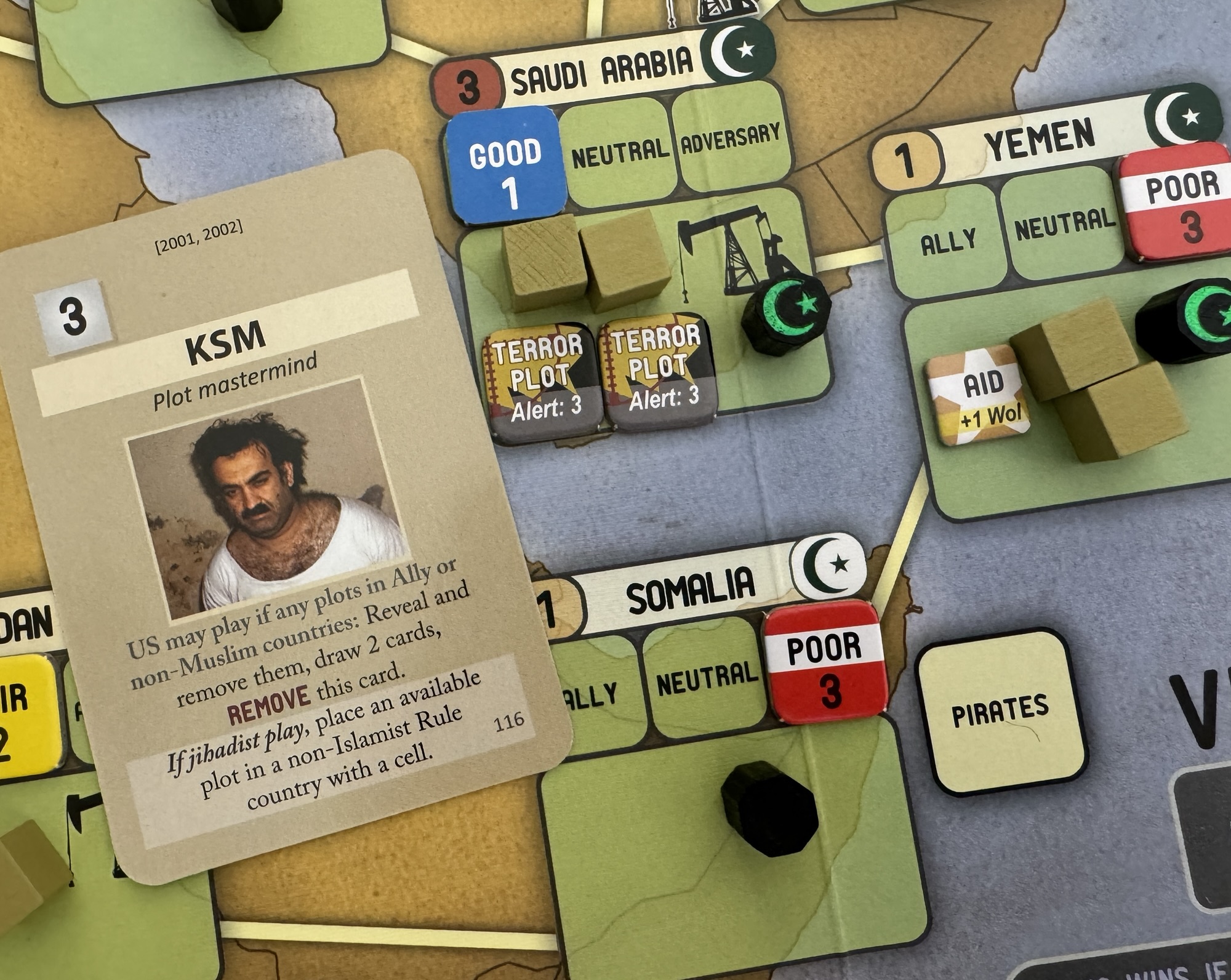
In the game, the Jihadist player is working to destabilize the Middle East through a series of clandestine activities such as destroying stability, toppling governments and forcing the US to react to their actions. One of their biggest strategies is to work to place what are called Plots out on the board in order to destabilize but also to generate local support and funding for their activities from the populace. If left alone, these Plots will go off at the end of a round and cause trouble that will then have to be cleaned up by the US player over the next turn. In order to uncover these Plots, the US player will have to play a 3 Ops card to take the Alert Action and different from most other actions there is no die roll required and the the Plot removal is automatic. But, the cost is steep as a 3 Ops card is pretty rare and spending it on this action is very painful. Jihadists use these Plots to force the US player to have to stamp out fire after fire rather than working to reform and stabilize governments to create allies. And when these Plots appear, the player’s long-term strategy will have to be put aside and a focus will have to change from managing regime change and the Global War on Terror (GWOT) posture to dealing with urgent plots. The KSM card is a very powerful tool in this game as it allows for the US player to remove Plots from an Ally or non-Muslim country but also to replace this investment with drawing 2 cards to replace it. This is specifically tied to the intel that was obtained from the capture of Khalid Sheik Mohammad and how it was then used to defuse several ongoing plots. The Jihadist player also gains a pretty large benefit as they will be allowed to place a Plot Marker into a non-Islamist Rule country with a cell. The process of successfully placing a Plot can be very challenging for the Jihadist player as it takes the play of a card for Operations points, uncovering a cell in a country and then rolling a die equal to or less than that country’s Governance Level to then place a face-down Plot Marker. This takes the need for a roll away and makes the placement of a Plot an automatic success.

I think that one of the other important distinctions and differences with the KSM card is that it is a 3 Ops Neutral Card that can be played by either side but when played by the US player for the event, it will be removed from the game while when being played for the Jihadist portion of the event it will remain and be able to be used in a later turn when it is drawn again. This reflects the important role that KSM played in al-Qaeda’s plans and if allowed to stay at large he will continue to plan and execute plots across the globe.

Khalid Sheik Mohammed was a member of Osama bin Laden’s militant organization al-Qaeda, and was specifically in charge of leading al-Qaeda’s propaganda operations from around 1999 until late 2001. Mohammed was captured on March 1, 2003 in the Pakistani city of Rawalpindi by a combined operation of the U.S. Central Intelligence Agency (CIA) and Pakistan’s Inter-Services Intelligence (ISI). Immediately after his capture, Mohammed was taken to secret CIA prison sites in Afghanistan, then Poland, where he was interrogated by U.S. operatives. By December 2006, he had been transferred to military custody at Guantanamo Bay detention camp. Sensationally nabbed in Pakistan, alleged 9/11 mastermind Khalid Sheikh Mohammed was photographed for the
world in a disheveled state immediately after his capture—symbolizing an apparent laying low of the once mighty al-Qaeda network. According to his US captors, he later provided information that thwarted other attacks.

Mohammed is widely regarded as the chief planner of the September 11 attacks. The United States government has alleged that he further participated in planning Richard Reid’s shoe bombing attempt to attack an airliner, the 2002 Bali bombings in Indonesia, the 1993 World Trade Center bombing, the murder of Daniel Pearl and various foiled attacks as well as numerous other crimes. These claims have been criticised by others, such as military prosecutor Moe Davis and journalist Andrew Brown, as inadmissible due to being obtained through torture. He was charged in February 2008 with war crimes and murder by a U.S. military commission at the Guantanamo Bay detention camp, which could carry the death penalty if convicted. A 2008 decision by the United States Supreme Court had also drawn into question the legality of the methods used to gain such admissions and the admissibility of such admissions as evidence in a criminal proceeding.

This image shows Khalid Sheikh Mohammed, the self-proclaimed mastermind of the September 11 terrorist attacks, photographed shortly after his capture during a joint raid in Rawalpindi, Pakistan, on March 1, 2003.

In the next entry in this series, we will take a look at Constantinople Sends Aid Core Event from The Shores of Tripoli from Fort Circle Games.

-Grant

United States für Konflikt 47 – Gott will es (Fraktionsvorstellung)

15. Oktober 2026 um 09:00

K47US - TitelDer Zweite Weltkrieg hat sich festgefahren und die Atombombe soll die Wende für die United States bringen. Risse in der Realität waren dabei nicht eingeplant. Welche Macht aus diesen Rissen entweicht, ist zunächst nicht klar. Doch was sich dann ereignet, kann nur göttliche Fügung sein.

Dieser Beitrag wurde von Dennis Rexin geschrieben

My Favorite Wargame Cards – A Look at Individual Cards from My Favorite Games – Card #98: The Balkan Wars from Imperial Elegy: The Road to the Great War 1850-1920 from VUCA Simulations

Von: Grant
13. Oktober 2026 um 14:00

With this My Favorite Wargame Cards Series, I hope to take a look at a specific card from the various wargames that I have played and share how it is used in the game. I am not a strategist and frankly I am not that good at games but I do understand how things should work and be used in games. With that being said, here is the next entry in this series.

#98: The Balkan Wars from Imperial Elegy: The Road to the Great War 1850-1920 from VUCA Simulations

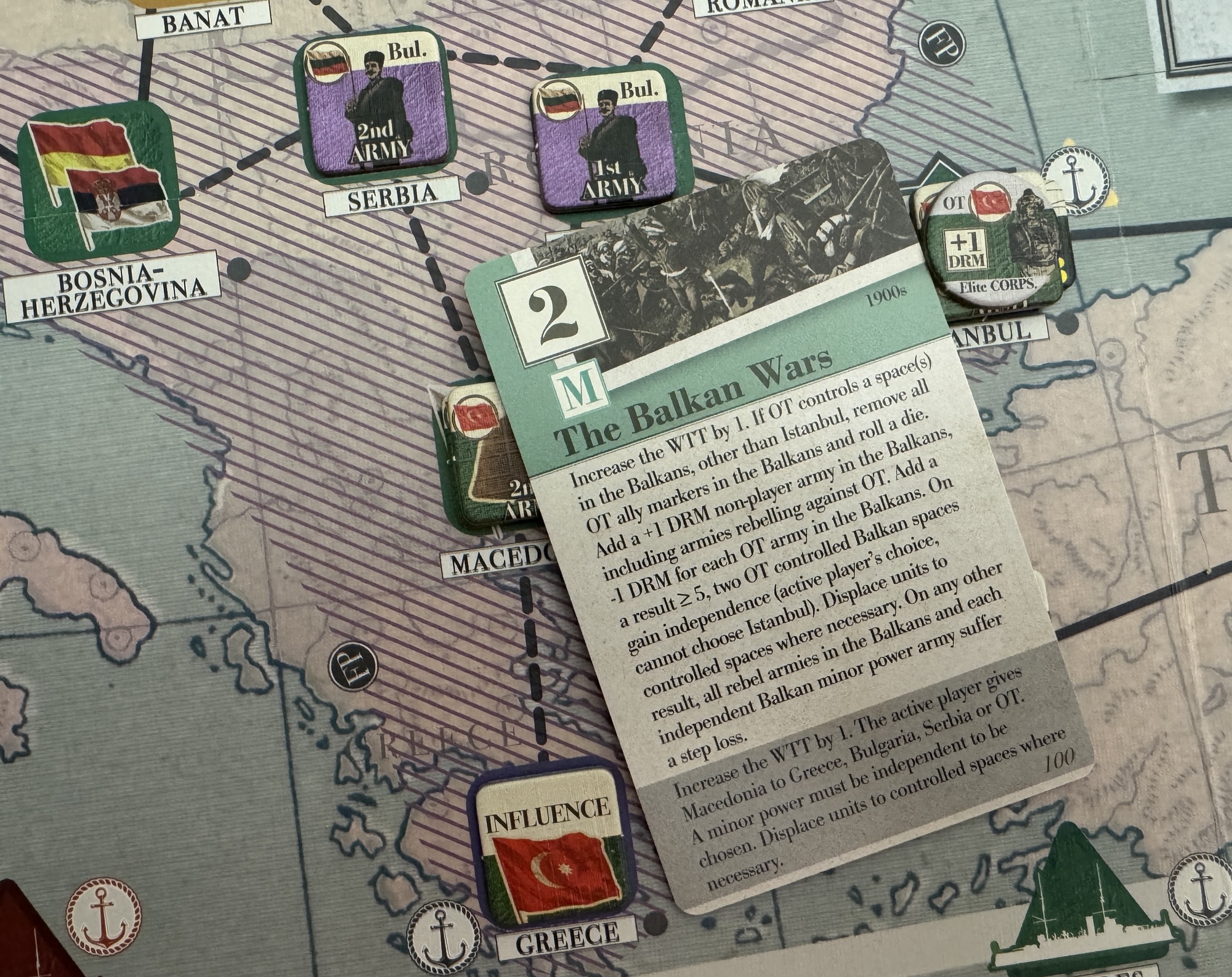
Imperial Elegy: The Road to the Great War 1850-1920 is a massive card driven game that blends diplomacy, warfare, and statecraft and feels a bit akin to games like Here I Stand and Virgin Queen from GMT Games, which are both grand scale sweeping epics that play multiplayers and take a day to play. Players play as 1 of 6 major powers in the game including Germany/Prussia, the United Kingdom, France, Austria-Hungary, Russia and the Ottoman Empire. The game is quite grand and ambitious as it covers 70 years near the end of the Victorian Era and the Progressive Ear and sees quite a lot of global change and competition between the great powers of the time. The game is a Card Driven Game and uses Action Cards as a type of currency to spend for their Command Points or the printed event to take actions such as recruiting armies and navies, industrialize, moving fleets and armies around the globe, influencing minor powers and establish colonies in Africa, India and the Pacific Ocean. The cards are all tied to the history of the period but the game can be played very much as a sandbox allowing players to explore strategies by trailblazing new horizons or following history.

Before we dive into today’s chosen card The Balkan Wars, I want to first make sure you know about Mandatory Event Cards in the game and how they work as they work slightly differently from normal Action Cards. Mandatory Event Cards are all lime green colored and bear a large block “M” just under the CP Value listed in the upper left hand corner. Mandatory Events, as the name suggests, must be played for their events. However, when playing a Mandatory Event Card, players trigger the event and also receive the CP to spend on various actions. The events on Mandatory Event Cards are always resolved first before the CP are utilized. If a Mandatory Event Card is discarded, the event will immediately trigger. There is no way around these cards and they are included in the game to drive the action historically and interject the various special circumstances that drove the rise and decline of these Victorian Age empires. The player that discarded the card resolves the event as if they were the active player. If two such Mandatory Event Cards are discarded in the same impulse the events are resolved in turn order.

Some of the events that occurred historically prior to 1914 were ultimately precursors to The Great War in many ways. The Balkan Wars were two conflicts fought in 1912 and 1913 that stripped the Ottoman Empire of almost all its remaining European territory and directly set the stage for World War I. The Balkan Wars saw similar levels of carnage as machine guns and artillery equipped with hydraulic recoil mechanisms were used in large numbers. Politically, they highlight the volatile nature of international politics in the Balkan Peninsula and are included as a Mandatory Event to ultimately drive up the World Tension Track on a path toward the outbreak of World War I. When played, the World Tension Track will increase by +1 and if the Ottoman player controls any territory in the Balkans other than Istanbul, or has Diplomatic Influence with countries, they will have a chance to lose their control there as a result of the chaos of the First and Second Balkan Wars. If these checks fail, and they will incur a -1 DRM for each Ottoman Army that is located anywhere in the Balkans, non-player armies will be placed in those locations and will increase the difficulty for the Ottomans to gain a foothold in this area. According to the designer Michael Lorino, mechanically this event causes all kinds of trouble in the Balkans, as intended. Similar to the Mandatory Event Card Empire of the Sun, the original event was a bit more involved and had players fight an actual war. In an effort to keep the game in the playable zone, he decided to abstract these wars through a die roll.

I very much enjoy the concept of a Mandatory Event, although they are never convenient for someone at the table as they typically have negative effects for at least 1 faction. But I very much like the approach taken here with The Balkan Wars with the -1 DRM for control of a territory and its thematic connection with the Ottoman Empire’s presence in the region generating tension and setting off these Balkan Wars.

A Bulgarian postcard depicting the Battle of Lule Burgas.

The Balkan Wars were two conflicts that took place in the Balkan states in 1912 and 1913. In the First Balkan War, the four Balkan states of Greece, Serbia, Montenegro and Bulgaria declared war upon the Ottoman Empire and defeated it, in the process stripping the Ottomans of their European provinces, leaving only Eastern Thrace under Ottoman control. In the Second Balkan War, Bulgaria fought against the other four combatants of the first war. It also faced an attack from Romania from the north. As a result of these wars, the Ottoman Empire lost the bulk of its territory in Europe. Although not involved as a combatant, Austria-Hungary became relatively weaker as a much enlarged Serbia pushed for union of the South Slavic peoples. The Balkan Wars set the stage for the July Crisis of 1914 and was a prelude to the First World War.

We have put out several pieces of content covering Imperial Elegy and find it to be a fantastic game. These include written posts and videos. You can visit those by following the links below:

Unboxing Video:

Video Review:

Summary of Solitaire Bots presented by our friend James:

Written First Impressions Post on the blog: https://theplayersaid.com/2026/05/06/first-impressions-imperial-elegy-the-road-to-the-great-war-1850-1920-from-vuca-simulations/

In the next entry in this series, we will take a look at Truman Doctrine from Twilight Struggle: The Cold War, 1945-1989 from GMT Games.

-Grant

Interview with Darren McGuire Designer of Iron Triangle: Search and Destroy Operations in the Vietnam War from GMT Games

Von: Grant
05. Oktober 2026 um 14:00

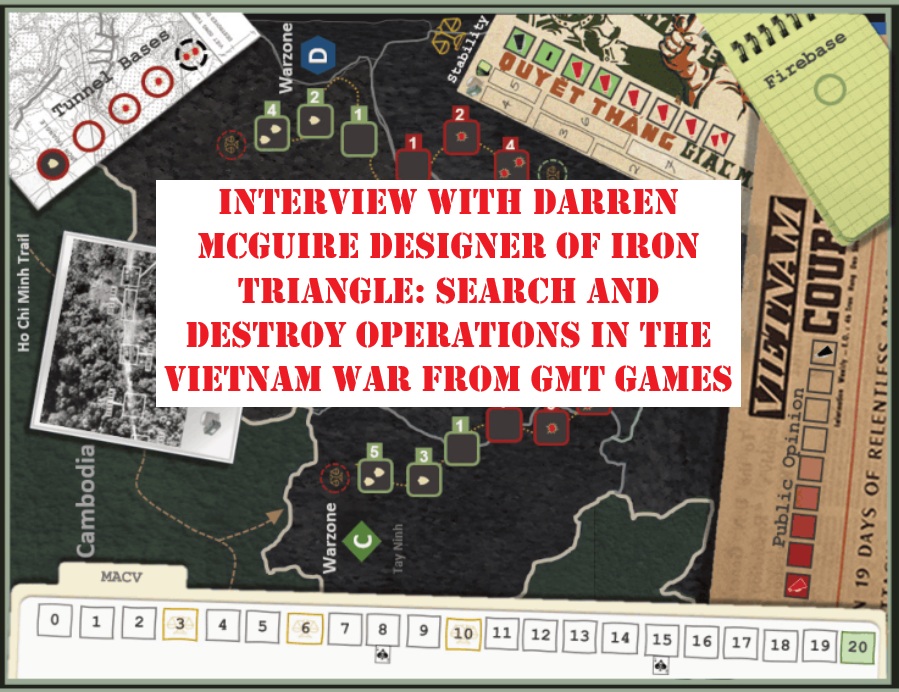
A new series, and we have seen how well series have done at GMT Games, a new designer and a new concept to wargaming (lane battler), I think that this game has great potential and it happens to be focused on one of my most favorite wars to game – the Vietnam War. Iron Triangle: Search and Destroy Operations in the Vietnam War is designed by Darren McGuire and takes a look at the struggle between the United States military and the Viet Cong insurgents as they fight over control of three key “lanes” or regions. I am very much excited about this one and reached out to designer Darren McGuire for some additional information.

*Note: The pictures used in this interview showing the various components and cards, are still in the design and development process and as such rules, event effects and text might still change prior to final development and publication. Also the art and layout of the cards are only for playtest purposes at this point and the game will enter the art department as it nears publication.

Grant: Darren welcome to our blog. First off please tell us a little about yourself. What are your hobbies? What’s your day job?

Darren: Hi Grant, I live not too far from Glasgow in Scotland, which is a board gamer’s delight, by which I mean, plenty of rainy days and dark evenings. By day, I work as a Quantity Surveyor (Cost Engineer) on major water infrastructure projects, dealing with cost control, commercial management and contractual disputes, so it’s excitement all round! Away from work, my wife and four children keep me more than busy.

As you may have guessed, my main hobby is board gaming, which has now expanded into board game design. Unfortunately, my best ideas seem to arrive in the middle of the night rather than at my desk. When I’m not thinking about games, you’ll usually find me following Glasgow Celtic, the best football (soccer) team in the world…well, Scotland at least. Other interests include noodling away on my guitar and getting out for the occasional hike.

Grant: What motivated you to break into game design? What have you enjoyed the most about the experience thus far?

Darren: I am relatively new to board gaming, having played regularly for only four or five years. My growing interest in historical games was sparked by Rodney Smith’s discussion of Cuba Libre in the Discovering the COIN series. After learning and playing the game, and later watching a documentary on the Cuban Revolution, I became fascinated by how game mechanics can represent the political, military and social dimensions of historical events.

This experience led me to appreciate game design not just as entertainment but as a way of communicating history. My interest in creating games developed further through roleplaying games, particularly the Basic Roleplaying system, which inspired me to write and run a Second World War-themed scenario. Seeing others enjoy something I had created was highly rewarding and encouraged me to pursue game design more seriously.

What I enjoy most about design is the iterative process, watching an idea evolve through testing, refining it based on feedback, and carrying lessons learned from one project into the next.

Grant: What is your upcoming Game Iron Triangle about?

Darren: Iron Triangle is a 2-player card battler game about the struggle between US and Viet Cong forces in the III Corps region of South Vietnam during the Vietnam War. Players compete across a series of Operations while also managing the wider military, political and social factors that shaped the conflict.

The US player must balance military success with the need to maintain stability and support for the South Vietnamese government. The VC player, meanwhile, seeks to undermine government authority through guerrilla warfare, hidden infrastructure, and the careful preparation of the Tet Offensive. While battles are fought over individual Operations, success ultimately depends on how effectively players manage resources, control territory, influence Public Opinion and pursue their broader strategic objectives.

Rather than focusing solely on military confrontation, Iron Triangle aims to capture the asymmetrical nature of the war, where political legitimacy could be just as important as success on the battlefield. The result is a fast-paced experience in which decisions can have consequences beyond the immediate fight.

Grant: Why was this a subject that drew your interest?

Darren: I have always been fascinated by David versus Goliath conflicts, where a seemingly weaker side challenges a much stronger opponent. The Vietnam War particularly captured my interest because it was a conflict I initially knew very little about. Like many people, my early perceptions were shaped largely by Hollywood films, but after becoming interested in historical conflict through board gaming, I began to realize there was far more nuance and complexity to the war than popular culture suggests. The more I explored the subject, the more intrigued I became by the political, military and human factors that shaped the conflict.

Grant: What is your design goal of the game?

Darren: My goal is to create a fun and engaging game that feels thematic within what is traditionally quite an abstract genre. I want the mechanics and player decisions to reflect the realities of the conflict, so that the theme is expressed through gameplay rather than simply through artwork or historical flavor text.

Beyond providing an enjoyable experience, I hope players come away with a greater appreciation of the unique challenges faced by both sides in this part of the Vietnam War. The conflict was not decided solely by battlefield success. Political support, public opinion, hidden infrastructure and competing strategic priorities all played important roles. Capturing these tensions within an accessible and entertaining game has been one of the central objectives of the design.

Grant: What from Search and destroy missions in Vietnam was most important to model?

Darren: Two aspects were at the forefront of my mind. The first was capturing the cat-and-mouse nature of search and destroy operations through the card play. These missions were rarely straightforward engagements; instead, they involved a constant struggle to locate, pursue and evade the enemy.

Equally important was ensuring that the tactical outcomes of these operations were connected to their wider political and societal consequences. In Vietnam, success on the battlefield did not always translate into strategic success. Capturing that tension between military achievement and its broader impact on public opinion, political will, and the course of the war was therefore a key design objective.

Grant: What sources did you consult about the details of the history? What one must read source would you recommend?

Darren: The principal sources I consulted were:

  • The Vietnam War: An Intimate History by Geoffrey C. Ward and Ken Burns
  • Vietnam: An Epic Tragedy, 1945-1975 by Max Hastings
  • The Tunnels of Cu Chi by Tom Mangold and John Penycate

Of these, I would recommend The Tunnels of Cu Chi as essential reading. The book argues that the Cu Chi tunnel network became one of the most powerful symbols of Viet Cong resilience and ingenuity, demonstrating why overwhelming American military superiority alone could not guarantee victory. That theme had a significant influence on the design of the game. Mechanics such as tunneled cards, Tunnel Bases, and the creation and use of caches are intended to reflect the hidden infrastructure that enabled the Viet Cong to survive, recover and at times overwhelm a conventionally stronger opponent. Capturing this asymmetry between military power and insurgent resilience was one of the central goals of the design.

Grant: What is the goal of the game?

Darren: The VC player seeks to undermine the local population’s trust in the South Vietnamese government. To achieve this, they must win Operations, carefully manage their resources, and, most importantly, plan and execute a successful Tet Offensive.

The US player, meanwhile, has two paths to victory. The first is through attrition, exposing and neutralizing enemy forces. The second is through pacification, placing pacification chits on regional tracks to strengthen government influence. Whichever strategy they pursue, they must contend with the fallout of scorched-earth tactics, maintain control of pacified areas and disrupt the enemy’s Tet Offensive preparations whenever possible.

Grant: What is the layout of the board?

Darren: The operations are divided across three regions, with players contesting one operation in each region during every round. Running alongside these battles is a strategic layer represented on the board, which tracks the overall situation across the theatre. This includes the level of control within each region, regional stability, public opinion, and refugee generation. As a result, success in individual operations can have far-reaching consequences, forcing players to balance short-term military objectives against their broader strategic and political impact.

Grant: What are the “lanes” and how do they work?

Darren: The three lanes represent the key operational regions north of Saigon: War Zone C, War Zone D and the Iron Triangle. Each lane contains a dedicated deck of Operation Cards representing historical Search and Destroy missions conducted in that region during the period.

During each round, players will contest one Operation from each region, fighting simultaneous battles across all three lanes. The outcome of these Operations will influence the wider conflict, affecting the various tracks and areas of the main board. Success on the battlefield can shift regional control, impact public support, alter available resources and shape each side’s broader strategic objectives.

Grant: How does the game use cards? How are the player decks asymmetrical?

Darren: Each player commands a unique deck of cards representing the units, tactics and capabilities available to their side. These cards are committed to Operations, where players compete for control and the rewards those Operations provide. Every card has a strength value and a special action that can be utilized when played.

The game’s real asymmetry lies in how the VC player can deploy their cards. VC cards may be played in one of three states: Exposed (face-up), Concealed (face-down) or Tunnelled (face-down and rotated). This system forces the VC player to balance protection against flexibility. A Tunnelled card, for example, is much harder for the US player to expose and inflict attrition upon, but it requires additional effort from the VC player to reveal and activate its ability.

These mechanics give the VC player multiple strategic options. They can bluff with hidden forces, launch surprise attacks, prepare units for future engagements or hide powerful cards for the decisive end-of-round reveal. The US player, meanwhile, is rarely certain of the strength or composition of the forces they are facing, creating a constant risk that an attack may not go as planned.

To counter this uncertainty, the US player can resort to scorched-earth tactics, exposing and neutralising enemy forces through attrition. However, this approach has consequences. Such actions generate refugees, a resource that can ultimately be exploited by the VC player to advance their own objectives.

The card system is therefore central to how the game’s theme is reflected in its mechanics. Through hidden information, bluffing and the constant tension between searching for the enemy and avoiding detection, it captures the cat-and-mouse nature of the conflict and the uncertainty faced by US forces throughout the war.

Grant: What different type of cards are included?

Darren: There are several types of cards in the game. The Operation Decks form the core of the conflict, with each card detailing the rewards available for successfully completing that mission. These rewards can include gaining regional control, destroying enemy caches or bases, reducing public opinion or generating refugees, all of which contribute to the wider strategic situation on the main board.

Each faction also has its own unique deck containing units and tactics, with cards featuring different strength values and special abilities. These decks reflect the contrasting approaches employed by the US and VC forces and provide players with meaningful tactical decisions throughout the game.

Currently in development are Commander Cards, which can be employed throughout the course of the game. Each commander provides powerful advantages but also introduces specific drawbacks, requiring players to carefully consider who is best suited to lead their forces at any given stage of the conflict.

Also in development is a dedicated solo mode, being designed by Joe Dewhurst. This system includes a bespoke bot deck for each faction, aiming to deliver a challenging and thematic opponent that captures the strategic priorities and character of both sides.

Grant: Can you show us a few examples of cards and describe how they work?

Darren: Here are a few examples that highlight the key decisions and interactions players will encounter during a round.

Operation Cards

Players battle over three Operation cards during each round. The rewards gained depend on the final Strength differential between the opposing sides.

For example, on the Operation shown above, if the VC player ends the round with a Strength differential of 3 or more, they move the control marker on the Warzone C Region Track one space toward Saigon and remove one US Firebase.

Action Cards

Infrastructure symbols indicate that the Operation takes place in a populated area. When the US player uses Scorched Earth actions, such as Zippo Raids, Refugees are generated as a result of the destruction.

In this example, the Zippo Raids Card generates two Refugees for each Infrastructure symbol shown on the Operation Card and allows the US player to destroy two Caches from the VC supply.

The card also gives the US player the option of playing it rotated to its lower-strength Pacification side. When played this way, the US player may place one Pacification chit on a Region Track if the Tet Offensive has not yet occurred, or two Pacification chits if it has.

This creates an important strategic decision for the US player. They can use the card’s high Strength value to help win the Operation, potentially generating Refugees that the VC can later exploit, or they can focus on Pacification to reduce the effectiveness of VC Tax actions and move closer to their alternative victory condition.

The Ambush Card from the VC Deck illustrates the different states in which a card can be played. It may be played face-down (Concealed or Tunnelled) or face-up (Exposed).

The Attrition symbol represents a key objective for the US player, who seeks to expose and exploit these cards as part of their Attrition victory condition. The US Activation symbol indicates that the card’s action may also be triggered when it is exposed by a US card effect.

This gives the VC player meaningful agency. They can play the card face-up to gain the action immediately, play it face-down and activate it later in the round, or use it as a bluff to lure the US player into exposing it.

These are just a few examples of how the decks interact. The game includes numerous ways for players to influence and counter each other’s cards. K9 Units can negate the US Activation effect, Hueys can move cards and place Firebases, Tunnel Rats can flush out Tunnelled cards and locate Caches, Booby Traps can eliminate Tunnel Rats and Supply cards can place Caches on Operations to increase Strength.

Together, these layered interactions ensure that every card choice can have lasting consequences, creating a tense and highly interactive contest between the US and VC players.

Grant: How are the cards concealed by the VC player? What does this represent?

Darren: VC cards feature symbols indicating whether they can be played face up, face down, or either. Face-down cards represent concealed forces, while rotated cards represent units operating through tunnel networks.

The VC player must use Action Cards, such as Manoeuvre, to flip or rotate cards already committed to a lane. This creates a constant balancing act between revealing powerful effects, such as Ambushes and Night Raids, and protecting the valuable Attrition symbols contained on those cards.

These mechanics also enable bluffing. For example, a low-value Booby Trap Card can be tunnelled, encouraging the US player to believe it is a high-strength Support Card with significant Attrition potential. The uncertainty forces the US player to carefully consider where to commit resources and when to challenge concealed threats.

The VC player must also decide whether to play a card face up and immediately benefit from its effect but exposing it to US attack, or instead commit it face down from the outset and save its reveal for a decisive moment later in the round. This flexibility reflects the hidden nature of VC operations and rewards careful planning and deception.

Grant: What challenges for the US are created by this concealment?

Darren: Attrition is a key US victory path, but many VC Attrition symbols remain hidden on concealed or tunnelled cards. To succeed, the US player must reveal and engage these forces while making difficult decisions with incomplete information, risking costly overcommitment if hidden threats prove stronger than expected.

Military operations can expose VC units, destroy bases and uncover caches, but they often generate Refugees, which the VC can exploit to gain cards, add Tet tokens or reduce Regional Stability. As a result, the US player must constantly balance immediate military success against longer-term political consequences. These mechanics create a tense contest of information and deception, with the VC concealing their strength while the US works to uncover and eliminate hidden assets before they can affect the wider war.

Grant: What is the Tet Offensive draw bag? How is it built?

Darren: The Tet Offensive was the watershed moment of the Vietnam War. Although it did not bring the conflict to an immediate end, it fundamentally altered US strategy and set the conditions for the gradual withdrawal of American forces. Capturing the importance of this moment was a key design goal.

The Tet Bag is one of the most important systems in the game. Following recent design changes, it no longer acts as a simple end-game decider but instead serves as a mechanism that can greatly influence the course of the war. At the start of each round, the VC player secretly decides whether to launch the Tet Offensive by selecting one of two cards: one commits to the Offensive and the other acts as a bluff. This creates uncertainty from the outset of the round, as the US player must react without knowing whether a major offensive is truly imminent. The VC player may retract their decision during the round, but doing so becomes increasingly expensive as the cost in Caches rises with each turn that passes.

The bag begins with three US tokens and two VC tokens, but its contents constantly evolve throughout the game. The VC can add tokens through Infiltrate actions and by exploiting Refugees created by US operations. The US player, meanwhile, can remove tokens through Round-Up actions and through Attrition in an attempt to limit the impact of any future Offensive.

The primary way for the VC to influence the draw is through the accumulation of Caches. These can be generated through Tax Actions or received as end-of-round supply from the North. When the offensive is launched, the number of available Caches determines how many Tet tokens can be added to the bag, while Tunnel Bases deployed to region tracks act as multipliers, increasing the number of tokens generated from those Caches. Control of key regional spaces provides additional opportunities, with certain track positions allowing a player to add Tet tokens at the end of a round if the Offensive is launched.

If the VC player commits to the Tet Offensive, the appropriate tokens are added to the bag at the end of the round and five tokens are drawn at random. Each VC token drawn reduces Public Opinion by one step, while each US token drawn increases Attrition by one step. This can create a dramatic swing in the strategic situation. Even if neither victory condition is immediately met, the outcome of the draw can significantly alter the state of the war and shape the decisions available to both players in subsequent rounds.

The timing of the Offensive is therefore a critical consideration. The VC player must decide whether to launch early with limited preparation or delay in order to strengthen the bag’s odds while risking discovery or disruption. The US player, meanwhile, must balance efforts to contain the insurgency on the ground against the need to manage the growing threat represented by the Tet Bag. This creates a constant strategic tension that mirrors the historical conflict.

Grant: What is Public Opinion? How is it changed?

Darren: Public Opinion represents the local population’s perception of the South Vietnamese Government and, by extension, the effectiveness of the US-backed war effort. Managing Public Opinion is crucial, as it forms one of the key strategic battlegrounds in the game.

The primary driver of Public Opinion is Regional Stability, which is determined by the position of Control markers on the regional tracks. As the VC expands its influence and gains control across a region, Stability declines, reflecting a population that increasingly doubts the government’s ability to maintain order and security. Conversely, government control and stability reinforce confidence in the existing regime.

Beyond regional control, both players have additional means of influencing Public Opinion. The VC can erode support for the government by achieving decisive victories in key Operations, demonstrating its strength and undermining confidence in official authority. A successful Tet Offensive can also significantly damage Public Opinion, representing the political shock caused by the scale and visibility of the attacks.

The US player is not without tools of their own. Through Pacification actions, they can improve conditions within contested areas, securing spaces on the regional tracks and creating opportunities to increase Public Opinion. By achieving key objectives and restoring Stability, the US player can demonstrate progress and strengthen support for the South Vietnamese Government.

Grant: What is urban infiltration?

During the build-up to the Tet Offensive, the Viet Cong infiltrated towns and cities across South Vietnam, embedding cadres among the local population. These operatives remained hidden until called upon to conduct terror attacks, sabotage missions, or support the wider offensive once it began. Their ability to operate covertly within urban areas was a key factor in the scale and surprise of the 1968 Tet Offensive.

This aspect of the conflict is represented in the game through a dedicated VC Action card. When played, the card allows the VC player to add a Tet token to the Tet Bag, reflecting the gradual preparation and expansion of the underground network in advance of the Offensive. While the immediate effect may seem modest, repeated use of these actions can significantly alter the balance of the eventual draw.

Grant: How are bases used and what benefits do they bring?

Darren: Bases are another important asymmetrical element of the game. While both factions use bases to influence control of the battlefield, there are significant differences between VC Tunnel Bases and US Fire Bases that reflect their distinct approaches to the war.

In general, bases are deployed to a Regional Track adjacent to a Control marker through the use of Action Cards. Once in play, they allow a player to either reinforce their position or exploit success in an Operation.

A base can be placed defensively on a Region Track between the player and the Control marker. In this position, it acts as a buffer against enemy advances. If the opposing player wins an Operation and would move the Control marker towards their side of the track, the base absorbs one of those control shifts before being removed and returned to its home space. This allows players to protect hard-won gains and makes regional control more difficult to reverse.

Alternatively, a base can be deployed aggressively between the Control marker and an opponent’s side of the track. This represents a player anticipating success and positioning assets to exploit a breakthrough. If the Operation is won, the Control marker effectively leapfrogs the base, allowing it to advance further than it otherwise would. In this role, the base accelerates territorial gains, helping a player press their advantage.

When a VC Tunnel Base is used offensively, it is flipped to its exposed side, representing increased activity and a greater risk of detection. Exposed bases are significantly easier for the US player to locate and destroy.

This creates an important strategic dilemma for the VC player. Tunnel Bases are not only valuable for influencing regional control but also contribute to the Tet Offensive system by acting as multipliers for Tet tokens generated through Caches. Committing them aggressively can produce short-term gains on the board, but doing so risks losing assets that could have a major impact on a future Tet Offensive. The VC player must therefore balance the need to consolidate territorial gains against the benefits of preserving their network for a decisive political strike later in the war.

Grant: What role do refugees play in the game?

Darren: Refugees represent one of the key consequences of the counterinsurgency strategies employed during the war. Population displacement was frequently used to separate the VC from the rural population and disrupt their support networks, creating both military opportunities and political challenges.

The US player has access to powerful Scorched Earth Action Cards. These are high-strength cards that can be used to destroy VC Caches and generate Attrition, helping the US pursue one of its victory conditions. However, such operations can also displace civilians, creating Refugees as local communities are caught up in the fighting.

When a Scorched Earth Card is played, Refugees are generated based on the concentration of the local population in the targeted area, represented by infrastructure symbols on the Operation cards. For each Refugee generated, a Refugee token is placed in Saigon.

While these operations can successfully disrupt VC activity, the resulting Refugees create opportunities for the VC player. On their turn, Refugee tokens can be spent in several ways:

  • Recruit – Draw additional cards,
  • Infiltrate – Add a Tet token to the Tet Bag, helping prepare future offensives.
  • Destabilise – Reduce Regional Stability, further undermining confidence in the South Vietnamese Government.

This creates a difficult strategic dilemma for the US player. Aggressive operations may achieve important military objectives by destroying enemy resources and inflicting Attrition, but they can also generate conditions that the VC can exploit for political and organisational gain.

To counter this, the US player has access to Resettlement Action Cards, which reduces the number of Refugees in Saigon. These actions represent efforts to restore stability, provide support for displaced civilians, and mitigate the wider consequences of military operations.

The Refugee mechanic reinforces one of the game’s central themes: success on the battlefield does not always translate into strategic success. Players must consider not only the immediate impact of their actions, but also the longer-term political and social consequences that can shape the course of the war.

Grant: How is victory achieved?

Darren: For the VC, victory is achieved by reducing Public Opinion to the bottom space of its track. This is accomplished through the rewards gained from winning Operations and by successfully planning and executing the Tet Offensive.

The US player has two possible routes to victory. The first is Attrition, achieved by exposing VC forces, revealing Attrition symbols on their cards, and capitalising on those symbols. Successfully pacifying individual regions and repelling the Tet Offensive also support this strategy.

The second route is Pacification. If the US player can fill all the spaces on the lower half of each regional track with Pacification chits, they have successfully stabilised the countryside and strengthened support for the South Vietnamese government. Achieving this level of security and political control results in a US victory.

Grant: What type of experience does the game create?

Darren: The aim is to create a fast-paced and tense experience in which both players must balance the military, political and social aspects of the conflict. While Operations provide the focus for direct confrontation, victory depends on managing a range of competing priorities rather than simply overpowering an opponent.

The game is not intended to be a straightforward tug-of-war over territory. Players must constantly weigh short-term gains against long-term objectives, deciding when to commit resources, when to accept setbacks, and when to focus on the wider strategic situation. Success comes from understanding how the different systems interact and adapting to an ever-changing battlefield, creating a game that rewards careful planning while still maintaining a constant sense of pressure and uncertainty.

Grant: What are you most pleased with about the design?

Darren: I am most pleased with how I have taken a relatively abstract style of game and made it as thematic as possible, capturing not only the military aspects of the conflict but also the political and social factors that shaped it. I am also very happy with the recent design changes, which have expanded the game’s scope and increased the decision space for both players. In particular, turning the Tet Offensive into a flexible strategic option rather than a fixed endgame event has created more meaningful choices for the VC player, while adding greater uncertainty and tension throughout the game. Overall, these changes have made for a richer and more engaging experience without losing sight of the historical themes I wanted to explore.

Grant: What other designs are you working on?

Darren: I have several other card battler designs at various stages of development, covering topics such as the Eastern Front, the Arctic Convoys of the Second World War, the Napoleonic Wars, and the Russo-Chechen War, the latter of which served as a precursor to Iron Triangle. Each design approaches its subject in a very different way, and I am hopeful that the lessons I have learned during the development of Iron Triangle will help me refine and strengthen these projects.

I’d just like to finish by saying thanks for taking the time to reach out and for the opportunity to talk about Iron Triangle.

If you are interested in Iron Triangle: Search and Destroy Operations in the Vietnam War, you can pre-order a copy for $41.00 from the GMT Games website at the following link: https://www.gmtgames.com/p-1215-iron-triangle-search-and-destroy-operations-in-the-vietnam-war.aspx

-Grant

History Behind the Cards – A Look at Checkpoint Charlie from GMT Games – Card #7: Ich Bin Ein Berliner

Von: Grant
17. September 2026 um 14:00

I love a different style and focus of wargame. A game that takes a look at an important but somewhat obscure or rarely addressed historical topic, such as espionage or intelligence, and creates a gaming experience tailored around the events to highlight and evoke the difficulties and tension that would have been present. In January 2026, GMT Games announced such a game in Checkpoint Charlie, which is a solo or cooperative game focused on SIS espionage missions in Berlin in the 1960’s designed by Russell Brown. We have posted an interview with Russel and it was very well received and he has now agreed to create a series of History Behind the Cards to highlight the events of the 1960’s Cold War struggle in West Germany but also to share aspects about the game play and how it models the history.

*Note: The cards highlighted in this series and their event text, as well as any pictures used showing any of the various components, are still in the design and development process and as such event effects and text might still change prior to final development and publication. Also the art and layout of the cards are only for playtest purposes at this point and the game will enter the art department as it nears publication.

History Behind the Cards – Checkpoint Charlie from GMT Games – Card #7: Ich Bin Ein Berliner

In the summer of 1963, the Berlin Wall had been in place for almost two years, the reality of a city split between east and west, between Soviet and Western influence, was impossible to deny. Politicians, military leaders, and the people living day-to-day in Berlin continued to argue about the lack of forceful response from the west, particularly the Americans, when the wall went up. Other than a modest buildup of US forces within and around the city, there had been precious little action to re-assure the people of Berlin that the west hadn’t abandoned them.

In June of that year, President Kennedy hoped to change that perception by personally visiting this western city in the center of Soviet-controlled East Germany. He received the reception and the reaction he was hoping for, driving through the city to crowds of cheering West Berliners, and giving his famous speech on the steps of the Rathhaus Shöneberg to a gathered crowd of over one hundred thousand. In a calculated risk, he referred to the city as West Berlin, officially acknowledging the split created by the wall. He introduced his “Fellow Americans” and at the mention of General Clay (Card #6), the crowd interrupted the speech for some heartfelt cheering for the man that saved their city during the Berlin Airlift. Kennedy’s famous line of solidarity, “Ich bin ein Berliner,” — I am a Berliner — came at the end of the speech and may have been a bit off-script.

So how would Kennedy’s speech affect a mission in Checkpoint Charlie? I’m going to answer that with a story.

I spend a lot of time at a wonderful coffee shop near my home, so much time that my iPhone has labeled the location as my “work.” The baristas there know me, and one day one of them asked me what I was working on. “Right now,” I said, I’m working on a board game about spies in Berlin in the 60’s.”

He laughed. “Have you met John?” He pointed to an older customer at one of the tables. “He was a spy in Berlin in the 60’s.”  It was true.

Since then, I’ve had many conversations with John about his time in Berlin. He was Army Intelligence, keeping track of what was going on in the city. He was there when the wall went up. He interviewed the refugees that, for a time, still managed to find a way into West Berlin. And he was there during Kennedy’s speech.

I asked him about the speech and said that in the game it resulted in crowds (a Demonstrations marker) near Tempelhof. He shook his head. “Everywhere. Crowds everywhere. All over the city.”

I’m sorry to report that I’ve restrained the effects of this card and the speech for gameplay reasons, but I haven’t ignored John in every case. The Daily Military Train event (Card #9) exists solely because of his stories, and after removing the Refugees event (Card #13) from the game because I assumed the flow of refugees disappeared after the wall went up, I put it back in because John assured me that they were still coming – he had met and interviewed hundreds of them.

In the next article in this series, we will take a look at the ongoing propaganda efforts from both sides of the Berlin Wall with Loudspeaker Wars.

In my opinion, this game looks extremely interesting and I am very much excited to learn more about it. I am appreciative to Russell and his efforts to bring us these cards and to write these entries to share with our readers. I am also very glad that this topic is being covered in a game and look forward to playing this one day soon.

We published an interview with the designer Russell Brown on the blog and you can read that at the following link: https://theplayersaid.com/2026/02/23/interview-with-russell-brown-designer-of-checkpoint-charlie-from-gmt-games/

You can catch up on the posts in this series to date by following the below links:

Card #1: Cousins Operation

Card #2: Cuban Missile Crisis

Card #3: Demonstrations

Card #4: Faceoff with the Soviets

Card #5: Berlin Film Festival

Card #6: General Clay Steps In

If you are interested in Checkpoint Charlie, you can pre-order a copy for $48.00 from the GMT Games website at the following link: https://www.gmtgames.com/p-1211-checkpoint-charlie.aspx

-Grant

History Behind the Cards – A Look at Checkpoint Charlie from GMT Games – Card #6: General Clay Steps In

Von: Grant
03. September 2026 um 14:00

I love a different style and focus of wargame. A game that takes a look at an important but somewhat obscure or rarely addressed historical topic, such as espionage or intelligence, and creates a gaming experience tailored around the events to highlight and evoke the difficulties and tension that would have been present. In January 2026, GMT Games announced such a game in Checkpoint Charlie, which is a solo or cooperative game focused on SIS espionage missions in Berlin in the 1960’s designed by Russell Brown. We have posted an interview with Russel and it was very well received and he has now agreed to create a series of History Behind the Cards to highlight the events of the 1960’s Cold War struggle in West Germany but also to share aspects about the game play and how it models the history.

*Note: The cards highlighted in this series and their event text, as well as any pictures used showing any of the various components, are still in the design and development process and as such event effects and text might still change prior to final development and publication. Also the art and layout of the cards are only for playtest purposes at this point and the game will enter the art department as it nears publication.

History Behind the Cards – Checkpoint Charlie from GMT Games – Card #6: General Clay Steps In

US General Lucious D. Clay was appointed as military governor of the United States zone of Berlin from 1945 until 1949. He was best known, especially to the people of Berlin, as the person responsible for the Berlin Airlift, which fed and supplied the people of Berlin from the air when the Soviets cut off all access to the city for eleven months, from June 1948 to May 1949. Without the airlift, the west would have been left with two terrible options – allow West Berlin to be starved into submission and annexation, or invade East Germany to open a supply corridor, almost certainly starting an all-out war with the Soviets.

In the early 1960’s, US President Kennedy turned to the now retired General Clay and called on him to deal with serious issues that arose in Berlin, like the faceoff between tanks at Checkpoint Charlie (card #4). Clay understood Berlin and had the respect of its people, so Kennedy brought him along on his famous visit to the city, during which the president gave his “Ich bin ein Berliner” speech (card #7).

The General Clay Steps In card in Checkpoint Charlie represents the retired general being sent by Kennedy to resolve issues in West Berlin. Playing the card removes an event marker from the city and is the only way many of the event markers can be removed during a mission. It is especially useful for removing the Faceoff marker or a troublesome Stasi Stakeout.

In the next article in this series, we will take a look at Ich bin ein Berliner Speech by President John F. Kennedy.

In my opinion, this game looks extremely interesting and I am very much excited to learn more about it. I am appreciative to Russell and his efforts to bring us these cards and to write these entries to share with our readers. I am also very glad that this topic is being covered in a game and look forward to playing this one day soon.

We published an interview with the designer Russell Brown on the blog and you can read that at the following link: https://theplayersaid.com/2026/02/23/interview-with-russell-brown-designer-of-checkpoint-charlie-from-gmt-games/

You can catch up on the posts in this series to date by following the below links:

Card #1: Cousins Operation

Card #2: Cuban Missile Crisis

Card #3: Demonstrations

Card #4: Faceoff with the Soviets

Card #5: Berlin Film Festival

If you are interested in Checkpoint Charlie, you can pre-order a copy for $48.00 from the GMT Games website at the following link: https://www.gmtgames.com/p-1211-checkpoint-charlie.aspx

-Grant

Konflikt ’47: Invasion Amerika – der Krieg erreicht die USA (Rezension)

29. August 2026 um 11:57

Mit Festung Europa verlagerte Konflikt ’47 den Krieg ins Herz des Kontinents. Doch während die Alliierten dort um Dresden kämpfen, bereitet Japan den nächsten Schlag vor. Invasion Amerika führt den Rift War über den Pazifik und bringt den Krieg dorthin, wo ihn die USA kaum erwartet haben: ins eigene Land.

Dieser Beitrag wurde von Geoffrey Förste geschrieben

New York in History and Board Games, #4

23. August 2026 um 17:42

Welcome back New York in history and board games! We’ve seen the city’s humble beginnings, its rise to America’s first city, and its glory days as the epitome of the modern metropolis. Today, we wrap up by covering the city’s crisis and nadir in the second half of the 20th century as well as the New York of our time – as always, with board games. Let’s go!

If you want to read more posts like this history & board games long read, I strongly recommend you subscribe to the blog: All new posts in your inbox right when they go live!

The Crisis of Modernity

New York had replaced London as the financial center of the world after the Great War. In the following years, the city complemented its financial with cultural heft, helped by an influx of refugees from Nazi tyranny in Europe. With Paris under German occupation, New York became the art capital of the world, a primacy the city would not relinquish after the war.

Where money and art met, power would follow: When the newly founded United Nations needed a headquarters, New York was the obvious choice. The UN building, a sleek colossus of glass and steel, embodied the new age. Symbolically, New York was the capital of the world now.

New York’s glory moment as the epitome of modernity was not to last – by a good deal because modernity undermined itself. New York’s transformation from manufacturing to services had made the city richer and provided well-paying white-collar jobs for the old and new middle classes, but it also meant that demand for unskilled laborers dried up. At the same time, both domestic and foreign migration to New York increased: Black Americans from the South arrived as well as Puerto Ricans in large numbers. When the federal limits on immigration from non-European countries were lifted in the 1960s, many Latin Americans and Asians followed. The migration of ethnic minorities to New York City was complemented by the white flight to the suburbs. Since 1990s, New York is a majority-minority city – that is, a majority of New Yorkers belong to an ethnic minority.

Chinatown at the end of a game with many developed businesses. Photo taken by BoardGameGeek user EndersGame, used with permission.

As in many American cities, the individual ethnicities typically cluster in separate neighborhoods. Manhattan’s Chinatown, first a center of Chinese immigration in the mid-1800s, grew after 1965 and became a vibrant part of Lower Manhattan. Today, it is also popular with tourists and New Yorkers from other neighborhoods, especially for its varied food. A small part of Manhattan’s Chinatown between Canal Street and Worth Street forms the map for Chinatown (Karsten Hartwig, Alea), a game about negotiation and business development.

New York’s demographic changes posed economic challenges. The new immigrants often didn’t have the skills required for the service and knowledge economy, and the skilled middle classes emigrating to the counties around New York also paid their taxes there. Sometimes, their employers left the city as well, now that they could find the workforce further from the center (and would pay lower taxes than in New York), and even if they didn’t, the threat alone was usually enough to receive a tax rebate from municipal administration.

The tragedy of this decentralization which sapped the economic strength of New York is that the city helped to bring it on itself. The subways of the early 20th century had decentralized the city, but they had also brought quality of life. The transport policy which the city in the person of Robert Moses (remember him from last time?) enacted had all of the decentralization and none of the quality of life. To summarize it in two words: Road Rage.

Moses led a crusade against public transport. The subways remained, but all the elevated trains and trolleys which had serviced every corner of New York in the first half of the 20th century were phased out by 1957. This development was not limited to Moses: The Pennsylvania Railroad demolished Penn Station, the heart of New York’s long-distance rail system and an architectural landmark of the old New York. Instead of rails, expressways cut through New York, attracting an ever larger avalanche of cars for which they never had enough lanes.

The expressways exemplified Moses’s astounding powers: He had the authority to appropriate land for their construction, evict the inhabitants and destroy their buildings. The expressways cut through neighborhoods or dispersed them completely. The construction of the Cross Bronx Expressway required relocating 60,000 people and pierced the heart of the South Bronx, even though a less destructive path for it could have been built just one block further south – but Moses preferred the optimal trajectory of the road, regardless of the human cost.

Box cover of Cross Bronx Expressway. What looks more vibrant, the building standing in the demolition or the graffito on it? Image ©GMT Games.

The tension between city development and human cost is the central theme of Cross Bronx Expressway (Non-Breaking Space, GMT Game). Three players – the city, the local communities, and private enterprise – want to shape the South Bronx according to their vision, but if they play too selfishly, neglecting the overall state of the neighborhood (or the needs of the other players), incarceration and bankruptcy ruin the South Bronx and everyone loses. There are many city-building games, but barely any with a vision as bold as Cross-Bronx Expressway.

The people of the South Bronx were poor in economic and cultural capital. Any resistance to the construction of the Cross Bronx Expressway was bound to be shrugged off as the complaints of people who didn’t know any better about the requirements of modern city planning. The same could not be said about the Manhattanites. When Moses planned for the Lower Manhattan Expressway to cut through the island, demolishing dozens of residential blocks and disposing of Washington Square Park altogether, resistance formed. Jane Jacobs, an assistant editor at the magazine Architectural Forum, both organized the community on the ground and published the bible of anti-Moses urban planning: The Death and Life of Great American Cities, an argument for putting the needs of residents first.

As Moses’s vision of the modern city as a sprawling, motorized metropolis lost its shine, his hold over the city weakened. The planned expressways through Lower and Midtown Manhattan were never built. By 1968, Robert Moses had been removed from the last of his many municipal and state posts. Yet as infrastructure spending has dried up since the late 1960s, contemporary New York is still very much Moses’s creation.

Debt and Crime

Above, I noted the two losing conditions for Cross Bronx Expressway: Debt (both municipal and on the community level) and crime (or, rather incarceration levels among the population). That’s the historical outcome – the New York’s crisis in the last third of the 20th century.

The debt crisis had two origins: On the one hand, New York’s tax base was eroded by the suburbanization described above. On the other, the city’s budget massively expanded in the mid-20th century. By the late 1960s, it was the second-largest public budget of the United States, right after the federal budget. New York City attempted to provide what state and federal governments would not – chiefly free higher education and the best, most comprehensive health care in the nation. That promise rested precariously on federal support. When federal spending on municipal programs was sharply cut in the early 1970s, New York’s financial structure came crashing down. By 1975, the city was practically bankrupt. The state legislature created oversight bodies which rendered the mayor unable to do anything but implement radical spending cuts. In the end, a federal loan saved the city from defaulting.

There’s a lot of potential for speculation why Ravensburger remade Scotland Yard, a game set in London, into N.Y. Chase, set in New York, in 1999. Still riding that wave of New York as a high-crime city? New York being sufficiently safe again to be appropriate for a family game? I guess it was just that New York oozed “cool metropolis”. Image ©Ravensburger.

The cuts to municipal expenditure ended the New York’s experiment as an all-providing city. They also made New Yorkers poorer, sicker, and less safe. In the 1980s, drugs, AIDS, and crime rocked the city. The crime epidemic ebbed off in the 1980s, in parallel to the nation-wide development. The exact reasons are still debated.

The city’s debt remained high through the 1990s – Democratic mayor David Dinkins expanded spending again, while Republican mayor Rudy Giuliani cut taxes. The newly dynamic economy, however, made more than up for that. New York seemed to have a bright future ahead.

The 21st Century

Instead, New York suffered calamity at the dawn of the new century: On September 11, 2001, Islamist terrorists hijacked four planes in the Eastern United States. One crashed, one hit the Pentagon. The other two were piloted into the twin towers of the World Trade Center in Lower Manhattan. The impact, fire, and collapse of the towers killed almost 2,800 people in New York – the largest terrorist attack in history.

Mayor Giuliani’s energetic, but measured response rallied the city (and briefly made him America’s  most popular politician) as an immense wave of national and international solidarity flowed to New York. While the immediate damage was soon taken care of and plans for new buildings to replace the old World Trade Center were made, the shadow of the 9/11 attacks continues to hang over New York: The dust from the collapsing buildings contained asbestos, heavy metals, and toxic chemicals. Until now, around 7,000 additional lives have been claimed by the attacks, especially among the firefighters and the volunteers who helped search for survivors (and often found corpses) and clear the rubble.

A heavily armed man walks into uncertainty… symptomatic for the war on terror. Image ©Rodger B. MacGowan.

The attacks did not only change New York, but also the world. The US government, aided by many of its allies around the world, embarked on a global “war on terror” in response, beginning with the invasion of Afghanistan in October 2001.

Today, New York remains a city of many facets. It is still the center of global capitalism as well as a hotbed for anti-capitalist activism (like the Occupy Wall Street protests) – and its new mayor Zohran Mamdani is a socialist.

Forget that Mamdani dude, mutated T-Rex is the new ruler of New York! From King of New York.

New York remains not only an economic, but also a cultural center, the place where aspiring young artists of all fields go to make it big – photographers, musicians, monsters… Yes, monsters. King of New York (Richard Garfield, IELLO) is a remake of King of Tokyo with a twist: A good deal of the victory points come from your monster becoming a superstar and enjoying its fifteen minutes of fame.

After decades as a homebrew game, wargame publisher TSR acquired the rights to publish a commercial version of The Broadway Game to enter the family gaming market. Image ©TSR.

Sometimes, culture and economy go together: The Broadway Game (Ernie Parmentier, Tactical Studies Rules), eagerly played by generations of actors, directors, and playwrights, started out as a Monopoly variant.

Most of all, however, New York always changes. The city reinvents itself permanently. To many Americans, it seems foreign because of that – and to many foreigners, quintessentially American.

Games Referenced

Chinatown (Karsten Hartwig, Alea)

Cross Bronx Expressway (Non-Breaking Space, GMT Games)

N.Y. Chase (Projekt Team III, Ravensburger)

Labyrinth: The War on Terror, 2001-? (Volko Ruhnke, GMT Games)

King of New York (Richard Garfield, IELLO)

The Broadway Game (Ernie Parmentier, Tactical Studies Rules)

Further Reading

For a concise introduction, especially focused on local politics, see Lankevich, George J.: New York City. A Short History, New York University Press, New York City, NY/London 1998.

If you want a treatment which is both more in-depth and more journalistic (and lavishly illustrated) and don’t mind its history practically ending around 1970, see the book version of the 17-hour PBS documentary from 1999: Burns, Ric/Sanders, James/Ades, Lisa: New York. An Illustrated History, Knopf, New York City, NY 2001.

The magisterial biography of Robert Moses is Caro, Robert A.: The Power Broker. Robert Moses and the Fall of New York, Knopf, New York City, NY 1974.

History Behind the Cards – A Look at Checkpoint Charlie from GMT Games – Card #5: Berlin Film Festival

Von: Grant
20. August 2026 um 14:00

I love a different style and focus of wargame. A game that takes a look at an important but somewhat obscure or rarely addressed historical topic, such as espionage or intelligence, and creates a gaming experience tailored around the events to highlight and evoke the difficulties and tension that would have been present. In January 2026, GMT Games announced such a game in Checkpoint Charlie, which is a solo or cooperative game focused on SIS espionage missions in Berlin in the 1960’s designed by Russell Brown. We have posted an interview with Russel and it was very well received and he has now agreed to create a series of History Behind the Cards to highlight the events of the 1960’s Cold War struggle in West Germany but also to share aspects about the game play and how it models the history.

*Note: The cards highlighted in this series and their event text, as well as any pictures used showing any of the various components, are still in the design and development process and as such event effects and text might still change prior to final development and publication. Also the art and layout of the cards are only for playtest purposes at this point and the game will enter the art department as it nears publication.

History Behind the Cards – Checkpoint Charlie from GMT Games – Card #5: Berlin Film Festival

Every summer since 1951, Berlin had hosted the international Berlin Film Festival (the Berlinale) and awarded the Golden Bear to the best film in each of five categories. Venues in both East and West Berlin were used for screening of films. As summer approached in 1962, Berlin found itself cut in two by the Berlin Wall amid growing tensions between East and West. It seemed there were any number of events that could trigger a war over the city. And yet, the Film Festival was held, entirely in West Berlin this time. The festival drew thousands of visitors to the city, including Hollywood stars like Jimmy Stewart and Tony Curtis. Screenings took place in venues throughout the city and, we can assume, brought a much-needed sense of normalcy and continuity to the residents of West Berlin and perhaps a sense of what was lost to those in the east.

The festival took place every year throughout the Cold War, and after reunification it once again began film screenings in the former East Berlin. The festival continues and this year the Golden Bear award for best film went to “Yellow Letters.”

The Berlin Film Festival card in Checkpoint Charlie assumes the Berlin Hilton is full up with visitors and cannot function as a Honey Trap. The card also assumes that the extra traffic in the city, including thousands of additional pedestrians trying to get a glimpse of celebrities, negates any Ongoing Card Effects that allow additional movement during the Movement step.

In the next article in this series, we will take a look General Clay Steps In as he is appointed by President Kennedy to resolve issues in West Berlin.

In my opinion, this game looks extremely interesting and I am very much excited to learn more about it. I am appreciative to Russell and his efforts to bring us these cards and to write these entries to share with our readers. I am also very glad that this topic is being covered in a game and look forward to playing this one day soon.

We published an interview with the designer Russell Brown on the blog and you can read that at the following link: https://theplayersaid.com/2026/02/23/interview-with-russell-brown-designer-of-checkpoint-charlie-from-gmt-games/

You can catch up on the posts in this series to date by following the below links:

Card #1: Cousins Operation

Card #2: Cuban Missile Crisis

Card #3: Demonstrations

Card #4: Faceoff with the Soviets

If you are interested in Checkpoint Charlie, you can pre-order a copy for $48.00 from the GMT Games website at the following link: https://www.gmtgames.com/p-1211-checkpoint-charlie.aspx

-Grant

New York in History and Board Games, #3

09. August 2026 um 21:04

Back to the history of New York City! We have begun with the city’s origin before the founding of the United States and left off in the 1880s in the last post – when New York was undeniably the economic and cultural center of the United States. Today, we are covering New York in its most iconic form as a moloch of steel, concrete, and millions of people. A chronological narrative will not help us here. Instead, we adopt a thematic approach and look the economy, construction, infrastructure, and culture which made New York from the late 19th to the mid-20th century the model city of high modernity.

If you want to read more posts like this – for example, the next instalment in the New York series – I strongly recommend you subscribe to the blog: All new posts in your inbox right when they go live!

Economy: Transformation

New York had been America’s most dynamic hub for trade and manufacturing for decades. Yet the city’s riches had been shared unequally, just like the risks in producing them. In the late 19th and early 20th century, New York’s working class grew more assertive and found more political support to improve their lives: For example, the three Tenement House Acts of 1867, 1879, and 1901 mandated such luxuries as windows in every apartment and toilets in every building.

The 1909/1910 textile worker strikes led to improved pay and shorter hours. Just one year later, the Triangle Shirtwaist Factory in Lower Manhattan burned down and 146 garment workers died – many of them unable to escape through the staircase because management kept the doors locked during shifts. The fire catastrophe led to a public outcry against such practices and New York state introduced better workplace and fire safety regulations.

The garment workers were in some ways emblematic for the New York working class – most of them were young immigrants (especially Jewish and Italian). In another, they represented a shift – almost all of them were women, and their struggle for better working conditions mirrored the force of the American women’s movement in the political arena.

In one way, however, they represented New York’s present, but not its future: The industrialization of the 19th century had turned New York into the largest manufacturing hub of the world. Yet manufacturing, the physical production of goods, ran out of steam when the improved productivity provided most people in the United States with most of their basic needs. Eager customers were thus not to be taken for granted anymore. Instead, they had to be wooed and their desires – for items of whose existence they had recently been still ignorant – awakened. New York became a hotbed for the growing advertisement industry (with which Madison Avenue is synonymous until today) as well as for shopping (here, Fifth Avenue is the symbolic street). Our age of trends, shopping as a leisure activity, and overconsumption cannot be imagined without New York.

Fifth Avenue (Wilko Manz, Ravensburger) draws on both business development and skyscraper construction… more on the latter below. Image ©Ravensburger.

In the 19th century, foreign capital had funded the expansion into the American West, but now the capital flows reversed: American capital was instrumental in financing the Allies’ Great War effort. At the end of the Great War, America was for the first time a net creditor nation. Its role in the international financial system expanded after the war as American loans enabled defeated Germany to pay its reparations to the Allies (who, in turn, paid off their American war loans). At the same time as New York took London’s place as the premier finance hub in the world, America at large withdrew from the world under a renewed isolationism and the xenophobia which came with the Red Scare after the Bolshevik Revolution.

Political upheaval did not stop the investment craze of the 1920s: When a bomb exploded in Wall Street in 1920 and killed 30 people, stock trading resumed normally the next day – much in contrast to 1920 Wall Street (Perepau Llistosella, Looping Games), where the bombing marks the end of the game (and players hope to have made all their profits by then).

One of these hands is not like the others. Cover of 1920 Wall Street, ©Looping Games.

The New York-based financial system was robust enough to withstand such external shocks, but it collapsed under its own contradictions: The stock market boom of the 1920 led to ever more capital pouring into the New York Stock Exchange (at the expense of all other forms of investments, for example the American overseas loans on which the global financial system was now based). The spectacular gains fueled a debt-based speculation bubble which burst in October 1929. The inadequate response by central banks which did nothing to combat the contraction of the monetary supply led to an extended, global economic crisis – the Great Depression.

Unemployment and poverty plagued New York much like the rest of the world in the 1930s. The city bounced back through ambitious public works initiated by the energetic new mayor Fiorello LaGuardia (many of them funded by New Deal funds in a cross-party cooperation between the Republican LaGuardia and the Democratic president Franklin D. Roosevelt). Still, New York’s economy only recovered when demand for manufactured goods skyrocketed because of World War II: The industrial giant rose one last time. One example of New York’s awesome productive capacity may suffice: From 1941 to 1945, the New York Navy Yard built more warships than all of Japan combined. The United States won World War II because of their industrial productivity, and New York was the beating heart of it.

Construction: Upwards

New York had always grown. From the 1880s on, the city grew in a heretofore barely used dimension – upwards. The twin innovations of the elevator and steel frame construction allowed for building heights which had been considered impractical, if not impossible, before. While New York was not the pioneer of these technologies – that merit belongs to Chicago – they were accepted in Manhattan on a scale not known before. Ever more “skyscrapers”, as the tall buildings were soon to be known, sprang up between the Hudson and the East River, giving the city a characteristic look from far away. New York’s skyline has been continually changing, but since then, it has always been dominated by skyscrapers – as has been the image of the city in the public imagination.

I always love when board game art draws inspiration from the period styles – as this art deco cover of Flatiron. ©Ludonova.

Board games are no exception. No theme is as prevalent in games about New York as the construction of skyscrapers. Some are specific, like Flatiron (Isra C./Shei S., Ludonova) which has players build the eponymous Flatiron Building together, but many could be set in any city with tall buildings – but as they are about tall buildings, their designers and publishers think they fit best for a New York setting: Manhattan (Karl-Heinz Koch, Fagus) is a variant of Acquire (Sid Sackson, Avalon Hill) to which the third dimension is added. New York City (Stefan Feld, Queen Games) is a remake of Rialto (Stefan Feld, TMG) – just that the struggle for majorities in Venetian districts of the original, fought with councilmembers, has been replaced by a struggle for majorities in New York boroughs, fought with – you guessed it – skyscrapers.

The covers agree: Manhattan or…
…New York City are places full of skyscrapers. Images ©Fagus, Queen Games.

The skyscrapers got ever taller: The first steel frame buildings in the 1880s and 1890s were well below 100 meters. In 1909, the Singer Building (187m) was the first structure in New York to exceed the height of Europe’s church spires – the first time that the world’s tallest building stood in New York. The city would retain that honor until the 1970s with a succession of ever taller skyscrapers.

The most iconic one was the Empire State Building whose construction was begun in October 1929 – just weeks before the stock market crash. It became the most visible sign of the economic crisis: Even five years after its completion in 1931, half of the Empire State Building’s office space remained empty. Like the rest of New York, it recovered by the 1940s. It would remain the world’s tallest building until it was overtaken by another New York icon in 1973 – the twin towers of the World Trade Center.

Infrastructure: Transport and Leisure

New York did not only grow vertically. Originally, the city had been confined to Manhattan Island and gradually expanded into what became the Bronx. In 1898, New York merged with its neighbor Brooklyn (itself America’s third-largest city at the time) as well Queens county and Staten Island to become a massive metropolis of more than three million inhabitants.

This sprawling moloch, however, was initially still centered on Manhattan, as most people worked there and thus couldn’t live too far away: In 1900, more than half of New Yorkers lived in Manhattan. That changed with the construction of the New York subway from 1900 on. New York was late to embark on such a project (London had started in the 1860s), but it was undertaken with the characteristic boldness of the city and soon became the largest in the world.

Thus, the geography of the city changed: New Yorkers could work in Manhattan, but commute every day from one of the other boroughs. As land there was a lot cheaper, a residential construction boom set in, and by the 1920s, Brooklyn had become the most populous borough of New York.

Sticking to the greatest hits: “New York” means “Midtown and Lower Manhattan plus one stop in Brooklyn” here. Promotional material for Ticket to Ride: New York (Alan R. Moon, Days of Wonder).

The growth of the city required its transport and leisure infrastructure to keep up. One man would become synonymous with it from the 1920s on: Robert Moses, starting out on the Long Island State Park Commission in 1924, became responsible for all kinds of parks, beaches, roads, bridges, and tunnels for both the state and the city of New York over the next decades.

These projects shaped the face of New York: The parks, both in the center and on the outskirts, provided very real benefits in one of the largest, most densely settled cities in the world. And the transport projects took inspiration from the new trend of motorized individual transport – and reinforced it.

Large-scale engineering projects like these go beyond the mere technical aspects. Moses’s creations were shaped by his ideas about how society should look like. For example, already his very first project – Jones Beach State Park on Long Island – outlined his ideal: It provided New Yorkers with a beautifully designed leisure park on the seashore. They arrived there after a pleasurable drive on the new parkways through lush greenery – by car, as no train or subway station was built in Jones Beach, and the bridges crossing the parkway were too low for buses to pass through. This lack of public transport meant that Jones Beach was exclusively accessible for the middle classes.

An even more striking example is Riverside Park in Manhattan along the Hudson River. Around a third of the park is in the predominantly Black neighborhood of Harlem, two thirds in the predominantly White Morningside Heights and the Upper West Side. These southern two thirds were liberally sprinkled with dozens and dozens of playgrounds, the third in Harlem only received one – and here, the iron lattice at the toilets was “decorated” with little ape sculptures.

As you can see, Robert Moses was not quite a nice guy. We’ll see more of him in the next post in this series!

Culture: Roaring Twenties

America’s new, more assertive role in the world after World War I also increased global interest in the country’s cultural output. American literature developed a new confidence, and American jazz became the hottest new music around the world. New York as America’s cultural center both attracted established artists (like the jazz musicians Duke Ellington and Louis Armstrong who both made the city their home in 1923) and produced its own original creations (like the Harlem Renaissance, which marked the first time that a movement of Black American writers and visual artists left their imprint on the wider American cultural consciousness).

Some of the artists in 1923 Cotton Club, taken from the rulebook of the game. ©Looping Games.

One of the institutions of the 1920s New York cultural scene has gotten its own board game: 1923 Cotton Club (Pau Carles, Looping Games). The historical Cotton Club was founded in Harlem in 1923 and soon became the venue to see many of the finest jazz musicians – an attraction not only for regular New Yorkers, but also for the celebrities of the time. That, in turn, made the club even more attractive… well, not for everyone. While the performers on stage were Black, the club would not admit Black patrons (except for the rare Black celebrity). That is not explicitly addressed by the board game, but attentive players will notice that the almost all of the artists which can perform at the players’ clubs are Black, almost all of the celebrities which may attend the club (and are the chief source of points) are White – as are the gangsters.

…and some of the celebrities, also from the rulebook of 1923 Cotton Club, ©Looping Games.

“Gangsters?” you may ask. “In a game about running a nightclub?” Yes, as we are in the age of the prohibition of alcohol in the United States. This fleeting episode (1920 to 1933), and the massive expansion of organized crime which came with it, is almost as irresistible to board game designers as the construction of skyscrapers. Sometimes, it is only the corollary to another activity (like in 1923 Cotton Club).

Another beautiful art deco cover! In the center, we see a fashionable lady at a party… but this party only gets running by work, creativity, and violence (figures on the sides). Cover of Speakeasy, ©Eagle-Gryphon Games.

At other occasions, it takes center stage: Speakeasy (Vital Lacerda, Eagle-Gryphon Games) is all about building a crime empire in Manhattan based on the distribution of illegal alcohol. Frankly, there is a mafia game set in New York for all kinds of gaming tastes: Speakeasy caters to heavy euro gamer, The Godfather: Corleone’s Empire (Eric M. Lang, CMON) to those who love miniatures.

A man who loves cats cannot be a bad person. ©CMON.
A New York map with all five boroughs! We even get a slice of New Jersey as a bonus. Board of Blood Feud in New York, ©Eagle-Gryphon Games.

Blood Feud in New York (Kyle Weinandy, Eagle-Gryphon Games) is for combat-oriented gamers, and Nutty Business (Alain Rivollet, Studio H) for those who don’t want to take their game so seriously: Gangs of squirrels try to dominate the nut-smuggling business in Central Park, 1925.


“You say, ‘Don Squirleone, give me justice.’ But you don’t ask with respect. You don’t offer friendship. You don’t even think to call me Nutfather.” ©Studio H.

Of course, all these mafia games could be set elsewhere. After all, alcohol was prohibited everywhere in the United States. New York, however, is irresistible as the biggest city, where presumably also the biggest crimes are committed. It is no coincidence that both Superman and Batman, those heroes of the Golden Age of Comics, fight their mastermind criminal enemies in fictionalized versions of New York (Metropolis and Gotham, respectively). Apropos: Age of Comics: The Golden Years (Giacomo Cimini/Sónia Gonçalves, Lirius Games) allows players to run a comic book publisher, develop ideas, print, and sell comic books… and of course, they do so in New York.  

If you do a game about comic books, your art better be in a comic book style as well! Note the view to the Chrysler Building. ©Lirius Games.

New York’s status as leading America in culture and crime will feature in our next (and last) instalment of this series. Watch this space!

Games Referenced

Fifth Avenue (Wilko Manz, Ravensburger)

1920 Wall Street (Perepau Llistosella, Looping Games)

Flatiron (Isra C./Shei S., Ludonova)

Manhattan (Karl-Heinz Koch, Fagus)

Acquire (Sid Sackson, Avalon Hill)

New York City (Stefan Feld, Queen Games)

Rialto (Stefan Feld, TMG)

Ticket to Ride: New York (Alan R. Moon, Days of Wonder)

1923 Cotton Club (Pau Carles, Looping Games)

Speakeasy (Vital Lacerda, Eagle-Gryphon Games)

The Godfather: Corleone’s Empire (Eric M. Lang, CMON)

Blood Feud in New York (Kyle Weinandy, Eagle-Gryphon Games)

Nutty Business (Alain Rivollet, Studio H)

Age of Comics: The Golden Years (Giacomo Cimini/Sónia Gonçalves, Lirius Games)

Further Reading

For a concise introduction, especially focused on local politics, see Lankevich, George J.: New York City. A Short History, New York University Press, New York City, NY/London 1998.

If you want a treatment which is both more in-depth and more journalistic (and lavishly illustrated) and don’t mind its history practically ending around 1970, see the book version of the 17-hour PBS documentary from 1999: Burns, Ric/Sanders, James/Ades, Lisa: New York. An Illustrated History, Knopf, New York City, NY 2001.

History Behind the Cards – A Look at Checkpoint Charlie from GMT Games – Card #4: Faceoff with the Soviets

Von: Grant
06. August 2026 um 14:00

I love a different style and focus of wargame. A game that takes a look at an important but somewhat obscure or rarely addressed historical topic, such as espionage or intelligence, and creates a gaming experience tailored around the events to highlight and evoke the difficulties and tension that would have been present. In January 2026, GMT Games announced such a game in Checkpoint Charlie, which is a solo or cooperative game focused on SIS espionage missions in Berlin in the 1960’s designed by Russell Brown. We have posted an interview with Russel and it was very well received and he has now agreed to create a series of History Behind the Cards to highlight the events of the 1960’s Cold War struggle in West Germany but also to share aspects about the game play and how it models the history.

*Note: The cards highlighted in this series and their event text, as well as any pictures used showing any of the various components, are still in the design and development process and as such event effects and text might still change prior to final development and publication. Also the art and layout of the cards are only for playtest purposes at this point and the game will enter the art department as it nears publication.

History Behind the Cards – Checkpoint Charlie from GMT Games – Card #4: Faceoff with the Soviets

On August 13th, 1961, in a dramatic move to stop the flow of millions of East Germans defecting to the West, East German police placed miles of barbed wire overnight, cutting off access between East and West Berlin and catching the western powers by surprise. It wasn’t clear what the response of the west would be, and whether it would ultimately lead to the war with the Soviets that many people felt was inevitable.

For days there seemed to be no reaction. West Berlin and Mayor Willie Brandt looked to U.S. President Kennedy to respond quickly and forcefully to the wall, but U.S. troops in Berlin made no move to intervene. Instead, on August 16th, Kennedy sent Vice President, Lyndon Johnson, and General Lucious Clay (more about him on card #6) to deal with the situation. At the same time, he ordered the U.S. 18th Infantry regiment in West Germany to cross East Germany on the autobahn to Berlin, along the access corridor established by the Potsdam Conference. The troops came equipped for battle and paraded through the streets of West Berlin with Johnson and General Clay. This showed U.S. support for Berlin, but did nothing to remove the wall, which quickly turned from barbed wire to concrete.

Over the next two months, disputes arose over the rights of French, British and U.S. troops to travel in the Soviet sector of Berlin, which were also established by the Potsdam Agreement. Tensions came to a head when a U.S. diplomat was stopped at Checkpoint Charlie while crossing into East Berlin. On October 27th, after heated exchanges, mostly between the Soviet Commandant and General Clay, Clay attempted to send another diplomatic mission through Checkpoint Charlie, this time accompanied by ten jeeps full of American soldiers, with ten U.S. tanks in reserve back in West Berlin. The crossing succeeded, but the Soviets responded by sending ten of their own tanks right up to the Checkpoint Charlie crossing. The U.S. tanks moved up to face them.

The standoff lasted nearly a full day, with the tanks and soldiers facing each other, ready for battle. Kennedy and Khrushchev managed to negotiate a resolution and the Soviet tanks pulled back slightly first (presumably because they had moved up to the border first), then the U.S. tanks pulled back. This gradual retreat alternated until the faceoff was at an end and traffic through the checkpoint resumed.

The Faceoff with the Soviets card in Checkpoint Charlie places a Faceoff marker in the Checkpoint Charlie location, which prevents any assets and KGB agents from entering this location during the Movement step of the turn (though some played card effects still allow this). This marker can only be removed by the General Clay Steps In event (card #6).

In the next article in this series, we will take a look at Berlin Film Festival and how its effect caused some issues with various locations operating as Honey Traps about the city.

In my opinion, this game looks extremely interesting and I am very much excited to learn more about it. I am appreciative to Russell and his efforts to bring us these cards and to write these entries to share with our readers. I am also very glad that this topic is being covered in a game and look forward to playing this one day soon.

We published an interview with the designer Russell Brown on the blog and you can read that at the following link: https://theplayersaid.com/2026/02/23/interview-with-russell-brown-designer-of-checkpoint-charlie-from-gmt-games/

You can catch up on the posts in this series to date by following the below links:

Card #1: Cousins Operation

Card #2: Cuban Missile Crisis

Card #3: Demonstrations

If you are interested in Checkpoint Charlie, you can pre-order a copy for $48.00 from the GMT Games website at the following link: https://www.gmtgames.com/p-1211-checkpoint-charlie.aspx

-Grant

New York in History and Board Games, #2

14. Juni 2026 um 18:00

Back to the history and board games of New York City! Last time, we’ve looked at the city’s humble beginnings all the way to the destruction wrought on the city by the Revolutionary War. Today, we’ll cover the first century of New York City as a city in the United States – how it established its primacy in the country, how it was at the same time very attractive and a horrible place to live in, and how it took shape as a modern metropolis. As always, board games will guide us.

American Capital

When Britain had recognized American independence in 1783, the young country gave itself a constitution – the Articles of Confederation. The United States were organized on strictly confederative principles. New York City became the capital. The advocates of broad independence for the states and minimal federal government, however, lost ground over the next few years as the United States struggled to deal with the post-war challenges, chiefly the states’ tremendous debt. Thus, over ferocious public debate, a new constitution was adopted in 1787, and according to it, a strong chief magistrate elected – George Washington, the first president, who was inaugurated in 1789 at City Hall, New York.

One of the fiercest proponents of a strong federal government was New Yorker Alexander Hamilton who became the nation’s first secretary of the treasury. In this role, Hamilton advocated for further government centralization, especially in regards to financial and economic affairs, based on his experience in the commercial hub New York. Hamilton succeeded in having the federal government take over the remaining states’ debts, but his opponents – chiefly rural southerners – demanded a price: The federal capital would move away from New York. Philadelphia would fill the role temporarily, before a new capital to be constructed in a southern swamp would be ready – the future Washington, D.C.

Even though New York City ceased to be America’s capital, it was still the prime center of American capital. In 1792, the New York Stock Exchange was founded. Its location – Wall Street – is synonymous with finance until today. The city’s booming harbor also attracted more and more commerce. By 1804, New York City had overtaken Philadelphia as the largest city in the United States at around 70,000 inhabitants. As growth did not slow down, the city’s leadership embarked on a scheme which must have seemed megalomaniac at the time: In 1811, they adopted a development plan which laid a regular grid of avenues and perpendicular streets over Manhattan Island, encompassing areas large enough to house a million people at the contemporary population density. That was the blueprint for modern New York City.

New York’s growth, however, was not pre-ordained. It relied chiefly on the city’s status the nation’s premier port. Yet as the United States grew westward, New York lay farther and farther away from many of the new towns and states. Goods could only flow to or from the Great Lakes or the Great Plains by arduous land journeys – or down the Mississippi. New Orleans, located at the mouth of the great stream, seemed poised to take over New York’s role as America’s port. That’s when the governor of New York state, DeWitt Clinton, proposed an ambitious engineering scheme: Nature might not have connected New York City with the great inland waterways of America. But men could. The 350-mile Erie Canal, completed in 1825, connected the Hudson River with Lake Erie and thus allowed uninterrupted ship transport from New York all the way to the western frontier states.

1842 – a good year to do business in New York. Cover of Packet Row, ©White Goblin Games.

Packet Row (Åse Berg/Henrik Berg, White Goblin Games) is set in the bustling port of New York in the 1840s. Players need to find the right combination of trade goods (so, supply), contracts (demand), and ships to grow rich as merchants. Money alone will not be enough for victory: The game embodies the ethos of the magnates of the 19th century, which held that wealth came with responsibility for the community. Thus, the money earned in Packet Row needs to be spent on projects which benefit the city (say, the university) for victory points.

When the Erie Canal was completed in 1825, 89% of New Yorkers had been born in the United States. By 1860 that number had fallen to less than half. Let’s take a look at this great social and political transformation.

Immigration, Death, and Politics

New York’s status as America’s port made it incredibly attractive for immigrants: Its booming trade hungered for willing workers, and even if immigrants had different dreams – say, farming on the wide prairie – they would probably arrive by ship in New York. In the mid-19th century, an astounding 70% of all European immigrants to the United States entered the country through New York. The absolute numbers are even more breath-taking: In the decade after the Great Famine, a million Irish alone arrived in New York, along with German, English, and Scottish immigrants.

Despite this massive population influx, New York City had only around 800,000 inhabitants by 1860. That was partly because many immigrants moved on further inland, but also because of the astonishing mortality: For example, during the year 1856, 4% of all adults and 20% of all children in New York City died. The cramped living quarters in which most immigrants found themselves and the inadequate medical infrastructure made New York a fertile breeding ground for all kinds of epidemics, while the high cost of living forced the immigrants into long working hours at often dangerous jobs.

Under these circumstances, it is no surprise that the immigrants turned to anyone who promised them a helping a hand. And as they were so many (and usually gained citizenship after two years of residence), courting them became a viable electoral strategy. Fernando Wood became the first New York mayor whose election had been largely achieved by his success with Irish-American and German-American voters. His recipe for success – mobilizing various immigrant communities – would be copied for decades by his successors in Tammany Hall, the local Democratic Party’s political machine which traded patronage for votes.

The mapboard of Tammany Hall breathes the spirit of 19th and 20th century maps and public education campaigns. ©Pandasaurus.

Tammany Hall (Doug Eckhart, Pandasaurus) is centered on this political strategy: The basic move which players take is to select one immigrant token (Irish, German, English, or – inspired by the later 19th century – Italian) and place it in one of the wards of New York. That gives the player both some influence with the respective immigrant community and some potential strength on the ground in that ward, come the next election. Whichever player wins most wards in an election round becomes mayor of New York and thus gets to dole out City Hall jobs to their allies.

Tammany’s success in the 1850s was based on organizing various disparate communities. The Civil War brought ruptures to this alliance: Mayor Wood called for New York City to secede from the Union and become a “free city” in order to maintain trade relations with the treasonous southern states. The majority of Tammany Democrats, however, were staunchly in favor of the Union, but less enthusiastic about the cause of abolitionism. Thus, many of the German immigrants (often veterans of the 1848/49 revolution) abandoned the party in favor of the Republicans, and the German-Irish voting bloc split (although it would remain firmly united in its opposition to the temperance movement).

The split caused a Republican-led fusion ticket to win the mayoral election of 1862. It would be a short break from Tammany rule, as the new mayor faced growing racial tensions: On July 13 1863, protests against the continued draft erupted in violence. For the next three days, a mob (mostly consisting of Irish-Americans from the Lower Manhattan slums) rampaged through the city, targeting Black neighborhoods. The Draft Riots would only be put down once regiments returning from Gettysburg reached the city. Many Black New Yorkers left the city afterward, so that they amounted to barely over one percent of New York City’s population in 1865.

Event card “Draft Riots in New York” from For the People (Mark Herman, GMT Games): Even though For the People is a political game at heart, the effect is strictly military here (the Union player removes some strength points (units), presumably to deal with the riots in NYC) – speaking to the unlikeliness of the riots effecting some kind of political sea change in New York (let alone the Union). Image ©GMT Games.

Tammany rule was restored in the 1864 mayoral election… not that it mattered much who exactly the mayor was, as long as he was a loyal follower of the Tammany machine. The unbridled access to power allowed the Tammany leader William “Boss” Tweed to become one of the richest men in New York – and public money also lined the pockets of many public servants and private contractors (especially in the construction business). The most outrageous example of this corruption was the construction of the County Courthouse. Tweed himself bought a quarry to supply the marble for the project at egregious prices, and the subcontractors had a field day, too, billing amounts like $360,000 for one carpenter’s month of labor or $7,500 per individual thermometer. The Courthouse’s final cost ran up to $13 million – almost twice the price of the contemporary Alaska Purchase!

Tweed, however had cranked the levers one too many times. Even New York Democrats (at least those set aside by him) distanced themselves from him. A court found Tweed guilty of embezzlement and sentenced him to a year in prison. He escaped and made his way to Spain, but was discovered and extradited to the United States, where he would die in prison. Tammany would rule New York politics for almost another century due to the machine’s continued ability to organize new immigrants (Italians and Eastern European Jews in the late 19th and early 20th centuries), but the worst excesses of its corruption ended with Boss Tweed. Indeed, for a 20th century New Yorker, it would be almost impossible to imagine how political office could be mostly sought to enrich a few powerful individuals and their willing helpers.

The Dawn of the Modern Age

New York City in the mid-19th century was squalor and corruption, but it was also the place where the innovations of the modern metropolis first took shape. The explosive population growth and the crowded living conditions were countered with a massive park development – Central Park, until today New York’s finest place to breathe fresh air and surround yourself with the peace of grass and trees. Construction lasted from 1857 to 1876.

Tesla vs. Edison: War of Currents (Dirk Knemeyer, Artana) is not only about engineering projects, but also about stock market investments… a very New York-coded game! Image ©Artana.

New technology also sprung from New York – literally and figuratively. When Thomas Edison looked for the first city in which to broadly distribute electricity, New York was the obvious choice. And the transformational impact of the railroad on America would not have been possible without the finance hub New York raising and directing the capital for the investments. So, all of you 18XX gamers, you can thank New York!

Mapboard of 1846: The Race for the Midwest (Tom Lehmann, GMT Games): On the left part, you see a box called “Stock Market”. It might as well be called New York.

Finally, in 1886, New York City received its most iconic landmark: The people of France gifted the United States a large statue, symbolizing liberty, the chief value of the American Revolution. Once the Americans had succeeded at funding the pedestal for the statue – encouraged by campaigns of the New York newspapers – the Statue of Liberty was proudly displayed in New York harbor, welcoming newcomers and promising them a free life. In the words of Emma Lazarus, whose poem adorns the a plaque inside the pedestal of the statue:

Not like the brazen giant of Greek fame,

With conquering limbs astride from land to land;

Here at our sea-washed, sunset gates shall stand

A mighty woman with a torch, whose flame

Is the imprisoned lightning, and her name

Mother of Exiles. From her beacon-hand

Glows world-wide welcome; her mild eyes command

The air-bridged harbor that twin cities frame.

“Keep, ancient lands, your storied pomp!” cries she

With silent lips. “Give me your tired, your poor,

Your huddled masses yearning to breathe free,

The wretched refuse of your teeming shore.

Send these, the homeless, tempest-tost to me,

I lift my lamp beside the golden door!

The Statue of Liberty is such an icon that it got its own promo card in 7 Wonders: Duel (Antoine Bauza/Bruno Cathala, Repos Production) – even though your definition of antiquity must be very wide to include the Statue of Liberty. But nothing is impossible in board games!

Great statues of the ancient world: Zeus, Colossus, Liberty. Image ©Repos Production.

In the years after the Statue of Liberty was erected, New York shape-shifted… upwards. The age of the skyscraper began, and nowhere more so than in Manhattan. But that’s a story for next time!

Games Referenced

Packet Row (Åse Berg/Henrik Berg, White Goblin Games)

Tammany Hall (Doug Eckhart, Pandasaurus)

For the People (Mark Herman, GMT Games)

Tesla vs. Edison: War of Currents (Dirk Knemeyer, Artana)

1846: The Race for the Midwest (Thomas Lehmann, GMT Games)

7 Wonders Duel: Statue of Liberty Promo Card (Antoine Bauza/Bruno Cathala, Repos Production)

7 Wonders: Duel (Antoine Bauza/Bruno Cathala, Repos Production)

Further Reading

For a concise introduction, especially focused on local politics, see Lankevich, George J.: New York City. A Short History, New York University Press, New York City, NY/London 1998.

If you want a treatment which is both more in-depth and more journalistic (and lavishly illustrated) and don’t mind its history practically ending around 1970, see the book version of the 17-hour PBS documentary from 1999: Burns, Ric/Sanders, James/Ades, Lisa: New York. An Illustrated History, Knopf, New York City, NY 2001.

New York City in History & Board Games – Part 1

03. Mai 2026 um 19:03

Everything seems to get ever bigger. Cars. Phones. Board game boxes. And the cities whose history and board games we explore are no exception: We started with Venice, moved on to Amsterdam, and today, we’re starting with New York. I say starting, because unlike the previous two cities, there is no way to do the vast number of board games set in New York’s history justice in a single post. Thus, this will be a mini-series with (tentatively) three instalments.

If somebody asked you what New York is, you’d probably start by saying it’s a city in the United States. Today, we’re looking at it before it was that – first, when the area which is today New York was settled by Native Americans, then, when the first Europeans founded an outpost there, and finally, when this little settlement received the name it bears until today.

The First Settlers

Names are given by people. “New York” was what the English called the settlement they took over in 1664, but the place had been inhabited by thousands of years before. While that is thus technically not the history of New York, we’ll take a short look at it.

We don’t know very much about the first humans to live in what would become New York: The indigenous people did not keep written records. Archaeology is hard to do in a place which is almost entirely covered in buildings and streets today. And the oral tradition of the Indians was largely destroyed when the westward expansion of the European colonists pushed them out of their native homes, broke up their communities, and finally confined them to reservations.

Five hundred years ago, several thousand Lenape Indians inhabited an island they called Mannahatta (“island of many hills”). They lived off slash-and-burn agriculture, hunting, and fishing. I am not aware of any board game which depicts their lives before the arrival of the first Europeans, but I think it would be a nice change of perspective while still retaining the familiar geography which draws many board gamers (of course, especially those from New York and its surroundings) to games about the city.

In 1524, Giovanni da Verrazzano, an Italian explorer employed by the king of France, sailed into what would be called New York Bay. There, he met a group of Lenape in their canoes. He called the area New Angoulême to honor the French royal house of Valois-Angoulême. For the next century, European fur traders would occasionally visit the Lenape, but not attempt to build a permanent presence.

Nieuw Amsterdam

Only in the 1620s did the Dutch, by then the premier commercial and maritime country of Europe, decide to colonize parts of North America. They resolved that this colony should include Mannahatta to take advantage of the rich beaver population whose pelts were much sought after in Europe, and put the merchant Peter Minuit in charge of the operation.

Minuit arrived on May 4, 1626. He met with some of the Lenape, and, according to his written report to Europe, purchased the southern tip of Mannahatta from them for trade goods worth 60 guilders. Even though nobody knows any details beyond Minuit’s own account, the deal is the founding story of New York. One thing that stands out about it is that it was a business transaction. Unlike other cities in North America, New York was not founded by a royal agent or religious refugees, but in the spirit and through the means of commerce (which has since remained the supreme political order and religious faith of New York). In that sense, Minuit’s purchase is either a very smart business move – after all, a large tract of land in such a prime position was surely worth more than the trade goods he handed over – or the hostile act of an unscrupulous merchant taking advantage of the less business-savvy (both actions hallmarks of New York’s commercial culture until today). Beyond the foundational myth, the transaction mostly shows different ways of thinking about land – the Lenape only accepted the right to temporarily co-use it, whereas the Europeans subscribed to the tenet of permanent, exclusive ownership.

While the Dutch colonized the whole mid-Atlantic coast of what is today the US, their settlement on Mannahatta was meant to be its center – as evidenced by its name of Nieuw Amsterdam (New Amsterdam), after the Dutch capital. Nieuw Amsterdam grew into a trading hub based on its deep natural harbor, the best on the Atlantic coast. The fur trade was soon complemented by Dutch farms which extended ever further north on Mannahatta, which triggered conflicts with the Lenape. This period is represented in New Amsterdam (Jeffrey D. Allers, White Goblin Games), which casts its players in the shoes of Dutch traders who will gather resources and expand New Amsterdam (at the expense of the Lenape).

Skeptical looks at the newcomers: Cover of New Amsterdam, ©White Goblin Games.

Nieuw Amsterdam already contained the seeds of some characteristic New York traits: Its demographics diversified (Africans lived in Nieuw Amsterdam in 1626 already, an Italian followed a few years after); and the municipal council established in 1653, the first of its kind in America, was the start of the great democratic tradition of the city.

The English Colony

The Dutch colony did not last long. When the commercial and maritime rivalry with England flared up again, an English fleet seized Manhattan in 1664. To honor the heir presumptive, James, Duke of York, they renamed the city New York. The Dutch briefly recaptured the city in the next Anglo-Dutch war, but had to cede it permanently in 1674.

New York’s fine deep-water harbor was as valuable to English as it had been to Dutch traders, and the city continued to grow larger and more prosperous. When the British parliament imposed taxes on the American colonies from the 1760s on, the merchants of New York found themselves in a bind: On the one hand, like all entrepreneurs, they resented being parted from money. On the other, a rupture between Britain and its American colonies would cut off trade entirely – much worse than having to pay a moderate due. New York became thus both a hotbed of anti-British activism and one of the places in the American colonies which least wanted a war with the British motherland.

Fierier heads than those of the New Yorkers prevailed. War between Britain and the colonies erupted in 1775. Once George Washington had expelled the British from Boston in the first major action of the war, he moved his headquarters to New York. The city was thus the biggest possible prize for the British smarting from their first defeat. If they could beat the colonials there soundly, force Washington to surrender with his army, they could still quash the rebellion quickly… or so they thought. The amphibious campaign against New York would become the biggest operation of the entire War of Independence. While the British defeated Washington’s army and took the city, the wily colonial commander extricated most of his forces and lived to fight another day. The city of New York, however, would remain under British occupation for the rest of the war.

George Washington kept the American rebellion alive with his escape from New York in 1776. From the Vassal implementation of Liberty or Death (Harold Buchanan, GMT Games).

The British occupation cut New York off from its sister colonies. Many New Yorkers fled to towns which were under control of the American rebels. The loyalists left the town when Britain recognized American independence. In 1783, New York’s population had fallen by 60% compared to the pre-war number of 30,000. From then on, however, the city would know nothing but spectacular growth for over a century… but that’s a story for next time.

Games Referenced

New Amsterdam (Jeffrey D. Allers, White Goblin Games)

Liberty or Death (Harold Buchanan, GMT Games)

Further Reading

For a concise introduction, especially focused on local politics, see Lankevich, George J.: New York City. A Short History, New York University Press, New York City, NY/London 1998.

If you want a treatment which is both more in-depth and more journalistic (and lavishly illustrated) and don’t mind its history practically ending around 1970, see the book version of the 17-hour PBS documentary from 1999: Burns, Ric/Sanders, James/Ades, Lisa: New York. An Illustrated History, Knopf, New York City, NY 2001.

The Woman’s Hour / Votes for Women (Book & Game, #5)

08. März 2026 um 18:15

It’s Women’s Day! A great opportunity to look pair a book and a game on the American women’s suffrage struggle: The Woman’s Hour (Elaine Weiss) and Votes for Women (Tory Brown, Fort Circle).

Check out my previous Book & Game posts here:

Eastern Front: Russia’s War and No Retreat! The Russian Front

Reformation Era: Four Princes and Here I Stand

The Second Hundred Years’ War: The Rise of the Great Powers 1648—1815 and Imperial Struggle

Prussia in the Seven Years’ War: Frederick the Great. A Military Life and Friedrich

The Book & Game

The Woman’s Hour was published in 2018 by Viking Press. It focuses on the campaigns for and against Tennessee to ratify the 19th Amendment which enshrined women’s suffrage in the US constitution – as the 36th, and decisive, state to do so.

Votes for Women was published in 2022. It is Tory Brown’s first published board game. The card-driven game can be played in a solo or cooperative mode with the player(s) representing the American suffrage movement from 1848 to 1920 against an automated opposition, or with two to four players facing off against each other (half of them for, the other against women’s suffrage). In either case, the suffrage players must win 36 states (either by shoring them up decisively during the game, or in the final vote on ratification of the federal amendment) to win.

Connections & Conclusions

At first look, book and game seem to have very different scopes. After all, Votes for Women sets in with the Seneca Falls Convention (at which women’s suffrage was first voiced as a political demand in the United States) in 1848 and covers the following 72 years, whereas The Woman’s Hour begins with the arrival of activists Carrie Chapman Catt, Sue White, and Josephine Pearson at the Nashville station in the sweltering summer of 1920. Yet as the narrative progresses, background stories are woven into the tapestry – on the context of the 1920 presidential election, suffragists’ previous efforts to gain voting rights for women in the states and to lobby for a federal amendment, the women’s suffrage movement’s relationship with abolitionism, and all the way back to Seneca Falls (and a little bit of Abigail Adams’s “Remember the Ladies”). If you have played Votes for Women, you will recognize many of the people and events on the cards from the early and middle periods of the game when reading The Woman’s Hour.

The Seneca Falls Convention is the Start card for the suffragist player with which any game of Votes for Women kicks off, following the tradition laid out by protagonist Elizabeth Cady Stanton that this was the starting point of the American women’s suffrage movement.

What unites book and game is their focus on procedural politics. Historical change does not simply happen, nor is momentarily decided upon. Instead, it is brought into effect by the “strong, slow drilling into hardwood boards with passion as well as sound judgment” (Max Weber). The drills used come in both cases from the toolbox of political activism:

The Woman’s Hour details how suffragists (suffs) and anti-suffragists (antis) lobbied the Tennessee lawmakers, how they organized in associations and clubs to channel their activists’ time, funds, and energy, and, of course, how they campaigned for public opinion to win the hearts and minds of the American people with newspaper articles, public speeches, great processions, and all kinds of civil disobedience.

Votes for Women makes these the three actions from which the players choose on a given turn: Lobbying (for and against the 19th Amendment in Congress), organizing (to gain the crucial buttons which are the currency for some powerful in-game effects and die re-rolls), and campaigning (which spreads influence cubes and thus eventually decides if enough states come out in favor of ratification of the 19th Amendment or not).

Early in the game: There are still a lot of orange Opposition cubes, but the women’s suffrage movement has made some inroads (yellow and purple cubes). The large round buttons represent the movement’s organizational strength, the white columns (one already placed on the track under the picture of the Capitol) the willingness of Congress to pass the women’s suffrage amendment.

As we’ve mentioned civil disobedience already: The women’s suffrage movement was no monolithic bloc. One of the great dividing lines was that of styles: The more conventional part of the movement, organized in the late 19th and early 20th century in the National American Women’s Suffrage Association (NAWSA) led by Carrie Chapman Catt, paid close attention to appear as respectable as possible (knowing full well that their demand for equal suffrage was enough of a provocation to the male public opinion of the time). Others adopted a more radical style, inspired by the British suffragettes: The Women’s Party, led by Alice Paul (and represented in Tennessee by Sue White) referred to the president as “Kaiser Wilson” in reference to the German war enemy, burned him in effigy, and (successfully) provoked the police into arresting activists over minor infractions. The dainty young women and respectable matrons who served some prison time then embodied the injustice of depriving women of their vote.

The Woman’s Hour details these fractions within the movement, as NAWSA and the Women’s Party led entirely separate campaigns for Tennessee’s ratification of the 19th Amendment. While infighting was avoided, the reader is left to wonder if the movement could have been more effective if not for these parallel structures – or if the split between a more moderate and a more radical wing was able to compel a broader spectrum of audiences by working in parallel.

Votes for Women depicts the multifaceted character of the women’s suffrage movement by splitting the suffragist player into campaigner figures and influence of cubes of two colors (yellow/gold, the traditional color of the American women’s suffrage movement, and purple, a color which Alice Paul had coopted from the British suffrage movement). As several Opposition event cards target the highest concentration of one or the other color, the Suffragist player is well-advised to aim for an even spread of colors in the individual states.

The pluralism of the women’s suffrage movement is exemplified by the two colors… and a plethora of Opposition events which target only one or the other.

Votes for Women also tackles another split in the women’s suffrage movement which is outside the scope of The Woman’s Hour – that on strategy. After the initial push for women’s suffrage as a part of a great campaign for equal suffrage regardless of sex and race had failed in the aftermath of the Civil War, the suffragists disagreed on how to proceed: Some pushed for a federal amendment to the Constitution (like the 15th Amendment had codified the voting rights of black men), others wanted to win voting rights in the individual states first. While the struggle for women’s voting rights was eventually won with the ratification of the 19th Amendment in Tennessee, the voting rights advances in the individual states had laid the groundwork: Wyoming had established women’s suffrage as early as 1869, Montana sent Jeannette Rankin as the first woman to Capitol Hill, and by 1917, women in 19 states – mostly in the West and Midwest – had won the right to vote (sometimes only in a limited fashion, like voting in local elections).

Votes for Women’s stance is that it needs both – after all, the game is lost for the suffragist player if their lobbying fails to get the federal amendment through Congress, but to win, they need the strength amassed in dozens of local campaigns to have the amendment ratified in enough states. The game, however, makes a statement about timing: While it is possible for the suffragist to have Congress pass the 19th Amendment in the mid-game already, that is a decidedly risky strategy which gives the Opposition a lot of opportunity to snatch individual states and rack up the necessary 13 rejections which mean the failure of the amendment. The ideal move for the suffragist is to build up the strength in the states as much as possible before pushing Congress into action as late as possible. While that is not without its risks (Opposition can still try to throw wrenches in the wheels of congressional action), it spreads them more evenly between federal and local action.

As mentioned above, equal suffrage spread from the American West and Midwest. It had a much harder time in the Northeast and in southern states – like Tennessee. The southern states were not only more conservative in general, suffragists also faced specific obstacles there: Many southern whites remained committed to the cause of white supremacy after the defeat of the Confederacy in the Civil War. Enfranchising women would give the right to vote to black as well as white women, and in the mind of the white supremacists, white women would be much less likely to actually exercise it (be it because they, as “proper” women, would rely on their men to represent them, or because they would not go to a polling station where they might meet with Black Americans). Others, while generally in favor of women’s suffrage, resented the method: After the Civil War, the 13th, 14th, and 15th Amendments had enshrined certain rights (including male voting) for Black Americans in the Constitution. Federal amendments were thus unpopular with many southern whites.

As The Woman’s Hour details, this provided for a lot of traction for the anti movement in Tennessee. Activists like Nina Pinckard and Josephine Pearson railed against carpet-bagging outsiders swooping down from the North to meddle with Tennessee’s affairs, warned of impending “negro domination”, and appealed to the chivalry of southern men to rescue their women from being thrown into the dirty cesspit of politics. That they themselves were knee-deep in that cesspit – after all, they were political activists! – bothered them as much as modern-day “tradwives” are bothered by the fact that their plea for women to be submissive to and dependent on their men is at odds with their often successful social media enterprises.

Somewhat counter-intuitively, many women opposed women’s suffrage on moral or political grounds. Votes for Women does a great job in showing the multi-facetedness of the anti movement beyond the male political and business establishment.

Inherent contradictions aside, the antis’ arguments needed to be countered by the suffs. Many of the white suffragists were willing to make rhetorical or substantial compromises: One of NAWSA’s most-cited statistics in the Tennessee campaign was that the number of white women in the south exceeded that of black men and women combined. Enfranchising women, so the more-or-less subtle subtext, would thus not threaten white supremacy – it might even strengthen it. In the end, the tacit agreement was like that found after the Reconstruction amendments designed to protect Black Americans’ rights in the South: The women’s suffrage amendment made its way into the constitution. Yet voting rights were overseen by the individual states, and federal institutions looked the other way about the blatant disenfranchisement of black voters in the South until the Voting Rights Act almost half a century later.

Neither The Woman’s Hour nor Votes for Women shies away from this uncomfortable part of the women’s suffrage movement: The protagonists of the movement are not portrayed as infallible saints in the book. While they held wildly progressive views for their time on women’s suffrage, their stances on issues of race and class were often more in keeping with those of their contemporaries. They also made tactical mistakes, like Carrie Chapman Catt railing against outsiders trying to influence Tennessee – a charge that was immediately turned against her, a Northerner herself, and restricted her visibility for the remainder of the campaign. And most of them were willing to make compromises for the cause of women’s suffrage – sometimes with themselves (Carrie Chapman Catt supported the US effort in World War I against her pacifist convictions lest the women’s suffrage movement be branded unpatriotic), and sometimes at the expense of others. In short, they were human.

Would the 19th Amendment have passed in Tennessee if the suffragists had been less willing to assuage the fears of southern whites about “black domination”? – Probably not – maybe another state could have become the decisive 36th then, but all likely options had been exhausted before.  Did the Black Americans in the South, men and women, suffer from the continued disenfranchisement after 1920? – Undoubtedly.

The South is notoriously tough for the suffragists. Placing a ton of cubes there (plus some additional perks) is a tempting proposition.

Suffragist players in Votes for Women face the same strategic and ethical question (of course, with infinitely lower stakes): One of the most powerful cards in the game is The Southern Strategy which places an immense amount of suffragist influence in the South (representing the union between suffragists and white supremacists). It does open the suffragist for some counter-plays from the opposition, though. Savvy suffragist players might hold the card from turn to turn to play it as late as possible, as an uncounterable stratagem in the final struggle for women’s suffrage. Victories won that way have an odd aftertaste, I assure you.

Since Votes for Women has been released, it’s been in the top 5 of games I have played most often. And while I rarely re-read books, especially non-fiction (because there are always intriguing new books to read), I have come back to The Woman’s Hour and have now both read the physical book and listened to the (excellent) audiobook production. Besides all their worthy exploration and analysis of history, that speaks to both the game and the book being excellently crafted, incredibly engaging pinnacles of their respective medium.

Abraham Lincoln (Presidential Ratings, #4)

27. Oktober 2024 um 17:01

Nine score and seven weeks ago, I have inaugurated a new irregular series on my blog assessing the merits of UK prime ministers (illustrated through the lens of a single board game each). The rating system seemed robust enough to apply it to other countries/leaders (at least if they are more or less democratic). Thus, we branched out to American presidents, German chancellors, and even a German president. Today’s subject is another US president – Abraham Lincoln, our first rated subject from the 19th century. And which game could be more appropriate for him than the first real political-military game of the American Civil War – For the People (Mark Herman, GMT Games)?

The Rating System

Some caveats ahead: The presidents will be rated by the knowledge of their time. If they or their contemporaries could not have known about the effects of something, I will not use my hindsight to mark it as a mistake of theirs. The assessment is focused on their conduct as president, but includes their life after holding the office (in which they will still be regarded in the public eye as (ex-)presidents).

Now, to the system itself: There are three policy field categories (foreign, domestic, and economic policy) and three more general ones (vision, pragmatism, integrity). A president can earn from one to five stars in each category (for a total sum of up to 30). In detail, the president is assessed as follows:

Foreign policy: Did the president increase US influence in the world and the security of Americans at home? Did the president wield US power responsibly and with positive results for the regions affected (the latter counting for a greater deal in times of US power being great)?

Domestic policy: Did the president increase the liberty of Americans to express themselves and to participate in the political process? Did the president promote domestic security and shape the framework for fair justice dealing with offenses?

Economic policy: Did the president facilitate the prosperity and economic security of Americans (including in the mid- and long-term)? Was the president’s economic policy based on mutual benefit of those involved or did it unduly burden one side?

Vision: Did the president have an idea of what the United States and the world (the latter counting for more in times of US influence being great) should look like beyond the immediate future? Did the president’s policies steer the United States (and, if applicable, the world) in this direction?

Pragmatism: Did the president succeed in seeing his policy through from inception to completion? How well did the president manage the support from Congress, society, the administration, the media (the latter counting for more in more recent years)?

Integrity: Did the president understand the office as a means to benefit himself, special interest groups, the entire country, or another community? Did the president respect the boundaries of the office?

Lincoln’s Life

Beginnings on the Frontier

Abraham Lincoln was born on February 12, 1809, as the son of Kentucky frontier farmers. The family moved around often during his childhood – first to Indiana, then Illinois. Lincoln received little formal education. He worked on his father’s farm and as a hired laborer from his youth on. However, he loved reading and yearned to escape physical labor by self-improvement – thus, he jumped at the chance to work as a store clerk (and later, store owner), postmaster, and, finally, taught himself law from books and passed the bar to practice as a lawyer.

Lincoln ran for the Illinois state legislature in 1832 and was narrowly defeated – as he proudly noted later, it was his only defeat in a popular election. Two years later, he was successful. During his eight years in the state house, Lincoln focused on supporting the infrastructural development of the state – railroads, canals, and the state bank to finance these projects.

The dominance of the Democratic Party in Illinois left little room for Whigs like Lincoln to be elected to national office. Lincoln thus waited until it was his turn in the Whig party candidate rotation to try for the US House of Representatives in 1846. Lincoln went to Washington where he attacked Democratic president James K. Polk’s war against Mexico. The Whig rotation meant that he could not run for re-election. Lincoln resumed his law practice and gloomily assumed his political career was over.

Lincoln vs. the Expansion of Slavery

The Mexican-American War ended in a resounding success for the United States – and in an expansion of slave-holding territory in the south which upended the Missouri Compromise of 1820. Instead of being bottled up in the south, slavery now seemed on the advance. The proponents of the “peculiar institution” saw their chance to export it to the territories, new states, and enforce their customs in the free states of the north as well. The possible expansion of slavery electrified its opponents as well, and the territories in the west – especially Kansas – soon became embroiled in a violent struggle over their status as slave-holding or free.

Lincoln was elected to the Illinois state legislature again in 1854, but declined to take his seat to stand for election to the US Senate (then elected by state legislatures). As he failed to obtain a majority, he struck a pact with anti-slavery Democrat Lyman Trumbull and had him elected on a cross-party coalition of Whigs and Trumbull’s small faction of anti-slavery Democrats. A political re-alignment was near.

When the new Republican Party formed, united in its opposition to slavery, Lincoln abandoned the sinking ship of the Whig Party. He stood again for election to the US Senate in 1858, this time against Democratic heavyweight Stephen A. Douglas who had made his fame as the evangelist of “popular sovereignty” – the position that the federal government should neither allow the expansion of slavery to the new states and territories nor ban it, and instead leave the decision to be decided in local referenda. Lincoln followed the immensely popular Douglas on his campaign trail and got him to stand in a series of debates against Lincoln. While Lincoln lost the Senate election once more, the debates elevated him to national standing as a moderate opponent of slavery with great intellectual and rhetorical capabilities.

Elected by the People

Lincoln’s moderate stance – he opposed the expansion of slavery, but did not call for its abolition in the slave states of the American South – was a liability in the new Republican Party if they just wanted to make a statement for their supporters. Yet when the dominant Democratic Party which had won six of the last eight presidential elections fractured over the question of slavery (Douglas’s platform of Popular Sovereignty gained a majority, but not the required two thirds of the delegates; the southern proponents of federal enforcement of slavery outside of the South bolted from the Democratic convention and nominated John C. Breckinridge as their own candidate), it became an asset – for the Republicans now played for victory. Lincoln was nominated as the Republican candidate, beating the party’s more radical heavyweights such as Governor Salmon P. Chase (Ohio) or Senator William H. Seward (New York). As the pro-slavery field fractured even further (John Bell ran as the candidate as the Constitutional Union Party which had the same views on slavery as the southern Democrats, but opposed their flirt with secession), the Republicans were suddenly the frontrunners. While Lincoln only won 40% of the popular vote in the election of November 6, 1860, he was ahead in all the populous free states of the north which gave him an easy victory in the electoral college (180 of 303 votes). John Bell had carried three states for 39 electoral votes with only 13% of the popular vote; Stephen Douglas only 12 electoral votes even though his 29% of the popular vote placed him second behind Lincoln. Yet he had been crushed in the north by Lincoln, and in the south by John Breckinridge who had only received 18% of the popular vote, but carried eleven slave-holding states in the south for 72 electoral votes.

Lincoln was only a moderate opponent of slavery, but that was still likely to mean that he would end the federal practice to enforce slavery in the new states and territories as well as the free states (as when fugitive slaves were returned from the free states to their erstwhile masters). That thought put southern slaveholders in a frenzy. South Carolina declared its secession from the United States on December 20, 1860. Six other states followed suit in the next weeks. The seven proclaimed a new country, the Confederate States of America, on February 4, 1861 – one month before Lincoln had even taken office.

The states in the Deep South seceding rather than pursuing a deal extremely favorable to them hurt the cause of secession in the slave-holding border states. Image ©GMT Games.

Any attempts to save the Union before Lincoln’s accession failed. Lincoln himself made a conscious effort not to provoke the southerners, he was also fiercely aware that their position was that of a political minority, having just been soundly defeated by the electorate, and that he could not act “as if I repented for the crime of having been elected, and was anxious to apologize and beg forgiveness.” Constitutional Unionist Senator John C. Crittenden proposed to enshrine slavery in the US constitution to allay the fears of the slavers. These constitutional amendments could not gain a majority in Congress, as the Republicans were unwilling to use their electoral victory to enact their defeated opponent’s platform, and the southern Democrats were bent on secession.

An extremely powerful card if played early by the Confederacy – a fort in the right place (say, Nashville or Paducah) can stop the Union advance right away. Image ©GMT Games.

Entering the White House, Lincoln found a mess. His predecessor James Buchanan, a pro-slavery Democrat, had done nothing to prevent secession or reign in the secessionists. Parts of his administration had even helped the secessionists before their terms in office ended. Lincoln himself dared not act to boldly to quash the secession as he (falsely) believed that the majority of southern whites supported the Union and would rise up against the secession. As that did not happen, the only committed Unionists in the South were representatives of federal institutions – most notably, the army. The secessionists seized army installations, where they could, and sieged them, where they couldn’t: The shots fired at Fort Sumter, a fort in the harbor of Charleston (South Carolina) which its commander refused to hand over to the secessionists, marked the beginning of armed insurrection to the United States – the American Civil War. Encouraged by the brazen action further south, four more states (including the all-important Virginia) joined the Confederacy.

Limited War to Save the Union

Lincoln now walked a dangerous tightrope. The secession could only be put down by military force, but he needed to apply it in a way which would not make the Union look the aggressor lest the slave states which were still in the Union (Missouri, Kentucky, and Maryland) seceded as well. Lincoln managed these border states with a deft hand. In Missouri, the local unionists and the US forces overcame the secessionists. Lincoln left Kentucky deliberately alone until a Confederate invasion swayed the state in favor of the Union (and US forces defended it against the Confederacy). Maryland, the most crucial of the three for its position (it provided the only connection of Washington, D.C., to the rest of the Union), was put under tight control by the US military. Lincoln dispensed with the writ of Habeas Corpus to allow for a more effective control of secessionists there.

Kentucky was the most contested border state in the early stage of the Civil War. Lincoln feared that the West would be lost if Kentucky would not remain in the Union. Image ©GMT Games.

With the border states secured, the Union needed to put down the Confederacy. That proved to be a daunting task: While the Confederacy was far inferior in terms of manpower and industrial production, it only needed to hold out long enough for the war to become so unpopular in the North that the Union would seek a negotiated end to it. The Union, on the other hand, had to force the Confederacy into surrender by destroying its armies and taking its territory. This asymmetry is reflected in the victory conditions of For the People: The Union player can only win (the campaign game) by dragging Confederate Strategic Will all the way down from 100 to 0. The Confederate player, on the other hand, has other avenues of victory: Having more than twice the Strategic Will of the Union player will do, as will lowering Union Strategic Will under 50 in fall of 1864 – when Lincoln would be up for re-election.

The political need to “Do Something” pressured the Union into many ill-advised frontal attacks on Richmond early in the war. The Confederate Player in For the People can use this event to their advantage by drawing the Union Army into a similarly fruitless campaign which may lose them troops, Strategic Will, and, if played right, even their capital if Washington is undefended because of the drive to Richmond. Image ©GMT Games.

Lincoln was thus on a timer. The Union needed to win decisively, and soon. Yet the first offensive toward the Confederate capital Richmond (Virginia) was repelled. Lincoln consequently approved a massive expansion of the army, the naval blockade of the south, and a multi-pronged approach into the Confederacy (not only in the east, but also through Kentucky and along the Mississippi River) – preparations for a long war.

One of many event cards which affect the Union Blockade Level. The Blockade is absolutely crucial to sap the Confederacy of Strategic Will and reinforcements in the long run. Image ©GMT Games.

Lincoln studiously avoided any infractions against slavery in the early phase of the war (and when his generals, such as 1856 Republican presidential candidate John C. Frémont, overstepped their authority in that regard, sacked them). Yet as no southern Unionist movement arose to challenge the Confederacy, Lincoln’s belief in the unionist leanings of the white Southerners dwindled. By 1862, he had grown convinced that the still undecided war had broken out to serve a larger purpose – the end of slavery. Thus, he slowly racked up anti-slavery measures. Slaves taken from Confederate owners were treated as contraband of war, not to be returned. Slavery was abolished in D.C. (with the former slaveowners compensated), and banned in the territories. And by late 1862, Lincoln had changed his views on the relationship between slavery and the Union altogether: He no longer thought that respecting slavery would convince the South to re-join the Union, but that attacking slavery would weaken the Confederacy internally and sap its external sources of support and would thus help to end the war and restore the Union.

Total War: Emancipation and Union

A more sweeping statement on slavery was thus necessary. With one military disappointment after another (excepting Ulysses S. Grant’s victories in the west), it would look like an act of desperation, though. Lincoln needed a success. The marginal Union victory in the battle of Antietam (which repelled a Confederate offensive on Union territory) on September 17, 1862, was as good as it would get – and so Lincoln proclaimed that the insurgent states had until January 1, 1863, to re-join the Union. Otherwise, all slaves living in states in rebellion would be freed. Of course, that had no immediate effects – after all, the thus emancipated slaves were in territories under Confederate control – but it forced the Confederacy to increase the effort to keep their slaves from running, and it effectively precluded the European powers Britain and France (pro-Confederate from the point of view of their economies and power politics, but strictly anti-slavery) to recognize the Confederacy.

It’s hard to meet the conditions for the event to trigger, but if it does, it’s a veritable catastrophe for the Union. Image ©GMT Games.

The Emancipation Proclamation is a crucial event in For the People as well (which sets the game apart from earlier Civil War games, which focused almost exclusively on the movement of armies and made at best cursory references to slavery). It is one of the very few mandatory events – if the conditions are met (a Union battle victory), it must be played for the event. While it lowers the Strategic Will of the Union (reflecting the unwillingness of many northerners to fight a war for the Black people of the South), it hurts the Confederacy much more – not only in terms of Strategic Will (a further penalty will be applied henceforth every round), but also by removing some military forces (which, presumably, either are kept back to guard plantations, or cannot be supplied anymore as the fleeing slaves shrink the southern economy).

After forty years of Civil War board games, For the People was the first one to use the Emancipation Proclamation as a meaningful event. Image ©GMT Games.

Lincoln was also done with his earlier attempt at limited war in another respect: US forces in the crucial eastern theater had been commanded by General George B. McClellan since July 1861. McClellan had mishandled them at almost every opportunity, and even when he succeeded (such as Antietam), he squandered his advantage by failing to pursue. Even his political value to Lincoln – McClellan was a high-profile Democrat – could not save him now. Lincoln sacked him, continuing his search for a general who would act aggressively, deliver battle to the Confederacy, and victory to the Union – going in succession through Ambrose Burnside, Joe Hooker, and George G. Meade.

Letting your political opponents label you is usually a bad thing – they might name you after a venomous snake. The threat presented by the peace-at-any-price Democrats in the North forced Lincoln to be extremely accommodating to the Democrats supporting the war effort, including the incompetent ingrate McClellan. Image ©GMT Games.

Sacking McClellan is something that a Union player at For the People might also want to do – while McClellan’s battle rating of 0-2 (offense/defense) is not too bad, his strategy rating of 3 means his forces can only be moved when spending a powerful 3-value card – bad for any US president who means to go on the offensive! Yet McClellan’s high political value (10) makes it painful for the player to relieve him of his command, as it will incur a steep Strategic Will penalty.

McClellan where loved to be most – in command of the Army of the Potomac, the Union’s main force on the eastern theater.

1863 would mark the turning point of the war. The Confederacy meant to undermine Union morale by another large-scale incursion into Union territory. On July 1, 1863, the Confederate and Union main armies clashed at Gettysburg. After three days of bloody battle, the Confederacy retreated. One day later, Grant took Vicksburg (Mississippi) and thus put the entire Mississippi River under Union control, cutting the Confederacy in half.

Yet the war remained unpopular in the North. Only two weeks after the victories of Gettysburg and Vicksburg, riots against the draft broke out in New York. Lincoln had the draft momentarily suspended and quietly resumed a month later.

The draft was always a contentious issue – especially for its social inequities, as well-connected or wealthy draftees could name substitutes or pay a fee instead of serving. Image ©GMT Games.

With only one more year until the presidential election, time was running out for Lincoln. The Democratic Party of the North, always split between the supporters of the war to re-establish the Union and its opponents, adopted a pro-peace platform… and selected George McClellan, whose incompetence had done so much to prolong the war, as their candidate. Lincoln had no problem securing his nomination (his control of the Republican Party was by now complete) and left it to the convention to select his running mate. They opted for Andrew Johnson, a Democrat who supported the war.

The minority Democratic faction supporting peace at any price won out in 1864 – here with the patently absurd image of the adult McClellan breaking up the fight between the squabbling children Lincoln and (Confederate president) Jefferson Davis. Image ©GMT Games.

Political and Military Victory

If the Union did not win great victories in 1864, Lincoln’s chances for re-election were slim. Yet there were reasons to be optimistic: Lincoln had placed Grant in command of the eastern theater, whereas Grant’s former subordinate William T. Sherman now headed the forces in Tennessee, ready to invade Georgia. Grant slowly wore down the Confederate forces in Virginia which could not bear the attrition. In the meantime, Sherman had taken Atlanta – a psychologically invaluable success which shifted the electorate’s mood in Lincoln’s favor – and marched on Savannah. Lincoln was re-elected with 55% of the popular vote and 212 of 233 electoral votes.

Now the great tasks of restoring the Union and abolishing slavery had to be brought to conclusion. While Grant and Sherman kept advancing, Lincoln worked to turn emancipation from a wartime measure to a constitutional right: The 13th Amendment would end slavery in the United States. The amendment showed not only Lincoln’s acumen in dealing with Congress, but also how much the country had changed – Lincoln had lost the 1858 Senate election on a much more moderate position than what was now to become part of the US Constitution. In his second inaugural address, Lincoln interpreted the war as a punishment for the nation’s original sin of slavery, but expressed hope for the nation to move forward together.

The Confederacy collapsed under Grant’s and Sherman’s campaigns. Confederate General in Chief of the Armies, Robert E. Lee, surrendered on April 9, 1865, with other commanders following suit. The Reconstruction of the South with the eventual goal of its re-admission to the Union and the integration of the former slaves into American society were now Lincoln’s chief tasks. Yet before he could begin to deal with the requirements of peace, he was murdered by the Confederate sympathizer John Wilkes Booth on April 14, 1865.

The Rating

Foreign policy

Lincoln left foreign policy largely to Secretary of State William H. Seward, yet intervened where necessary (for example, when the seizure of British mail ship Trent which carried Confederate envoys threatened to spark a crisis or even British intervention, Lincoln calmed the storm by releasing the envoys). He successfully forestalled foreign recognitions of the Confederacy (except by fellow slave-state Brazil), let alone military intervention on behalf of the Confederacy.

The Union’s seizing of the neutral Trent was an immense chance for the diplomatic momentum of the Confederacy – reflected in the large Strategic Will bonus if the card is played for the event. Lincoln’s intervention prevented Britain from taking hostile steps (such as recognizing the Confederacy or even entering the war on its side) through a mix of compliance with international law and the strongly indicated readiness to respond to military challenges. Image ©GMT Games.

Rating: 4 out of 5.

Domestic policy:

Lincoln recognized slavery as the chief obstacle to liberty in the United States. First tentatively, then boldly did he abolish the practice, resulting in the freedom of four million people. While he has been attacked for his alleged infractions on individual freedoms (most notably the suspension of Habeas Corpus), Lincoln used these measures in moderation. That Lincoln never even considered postponing the 1864 election (which he full well knew could end both his presidency and his policies) because of the war is the strongest testament to Lincoln’s deep respect for the rule of law.

Much has been made of Lincoln’s suspension of the writ of Habeas Corpus, yet in the end it was a moderate interference with civil liberties in a time of extreme danger to the Union – and thus, the event is only a Strategic Will penalty of 2 to the Union (compare to the bonus of 5 above). Image ©GMT Games.

Rating: 5 out of 5.

Economic policy

Lincoln regarded economic policy as the prerogative of Congress and did not interfere with it. His own economic policy was concerned with the organization and financing of the war effort, in which he was largely successful (even though it must be said that the economic basis of the Union was much stronger than that of the Confederacy).

Rating: 4 out of 5.

Vision

Lincoln’s vision of the United States was that of a country which was no longer “a house divided against itself.” While his own preference would have been to contain slavery and let it extinguish by itself in the South, the secession both enabled and required him to take firmer measures. Besides ending slavery, Lincoln laid the foundations during the Civil War for the United States to be a unified country, largely centrally administered, rather than a collection of individual states, and thus prepared the country’s 20th century predominance. Not least of all, Lincoln’s unmatched rhetorical prowess allowed him to interpret political events in memorable language which shapes American thinking until today.

In a game called “For the People”, it is only fitting to have an event card representing the speech from which the quote is taken: “that government of the people, by the people, for the people, shall not perish from the earth.” Image ©GMT Games.

Rating: 5 out of 5.

Pragmatism

Lincoln was a Washington outsider. Before his presidency, he had only spent two years in federal politics. Still, he quickly developed a productive working relationship with Congress and his cabinet – all the more remarkable as Lincoln’s Secretaries were not selected for their loyalty and subservience, but came from the heavyweights which had competed for the 1860 presidential nomination (including Secretary of the Treasure Chase and Secretary of State Seward). Lincoln’s legacy is remarkable as well: He established the nascent Republican Party as the dominant political force which would win twelve of the next 16 presidential elections.

Confederate wishful thinking: While Lincoln’s cabinet members frequently engaged in political power play, the Cabinet was overall very focused on winning the war – kept together by Lincoln’s leadership. Image ©GMT Games.

Rating: 5 out of 5.

Integrity

Lincoln respected the boundaries of his office and did not attempt to extend his influence into areas which were thought to be Congress’s province. The goodwill he extended to people of the most diverse backgrounds and convictions is legendary. Lincoln placed himself at the service of the Union – a nation he came to understand as larger than before, including four million heretofore disenfranchised slaves.

Rating: 5 out of 5.

Overall

Abraham Lincoln faced challenges like no other American president. The secession and Civil War were both a struggle for survival of the United States against those who would not accept the democratic process and a moral crucible which would resolve the awkward question of slavery after 80 years of failed attempts to skirt it. Lincoln met these challenges head on and with resounding success. He jumps to the top of the ranking – and it’s not even close.

  1. Abraham Lincoln 28/30
  2. Franklin D. Roosevelt 25/30
  3. Friedrich Ebert 25/30
  4. Winston Churchill 25/30
  5. Robert Walpole 24/30
  6. Willy Brandt 23/30
  7. Konrad Adenauer 22/30
  8. Harry S. Truman 21/30
  9. John F. Kennedy 17/30
  10. Hermann Müller 17/30
  11. Wilhelm Marx 17/30
  12. Woodrow Wilson 15/30
  13. Ludwig Erhard 12/30
  14. Paul von Hindenburg 10/30

How would you rate Lincoln? Let me know in the comments!

Further Reading

For an accessible biography of Lincoln, see Gienapp, William E.: Abraham Lincoln and Civil War America. A Biography, Oxford University Press, Oxford 2002.

For a “biography of the mind” of Lincoln, situating him in the intellectual currents of his time, see Guelzo, Allen C.: Lincoln. A Very Short Introduction, Oxford University Press, Oxford 2009.

For an overview of how Civil War games treat the causes of the war, slavery, and emancipation, see Wallace, Alfred: The War in Cardboard and Ink. Fifty Years of Civil War Board Games, in: Kreiser Jr., Lawrence A./Allred, Randal: The Civil War in Popular Culture. Memory and Meaning, University Press of Kentucky, Lexington, KY 2014, pp. 175—89.

John F. Kennedy (Presidential Ratings, #3)

12. November 2023 um 17:46

Two years ago, I have inaugurated a new irregular series on my blog assessing the merits of UK prime ministers (illustrated through the lens of a single board game each). The rating system seemed robust enough to apply it to other countries/leaders (at least if they are more or less democratic). Thus, we branched out to American presidents and a German chancellor. Today’s subject is another US president – John F. Kennedy, an almost mythological figure despite – or because? – his short tenure. And which game could be more appropriate for him than 13 Days: The Cuban Missile Crisis (Asger Harding Granerud/Daniel Skjold Pedersen, Jolly Roger Games)?

The Rating System

Some caveats ahead: The presidents will be rated by the knowledge of their time. If they or their contemporaries could not have known about the effects of something, I will not use my hindsight to mark it as a mistake of theirs. The assessment is focused on their conduct as president, but includes their life after holding the office (in which they will still be regarded in the public eye as (ex-)presidents).

Now, to the system itself: There are three policy field categories (foreign, domestic, and economic policy) and three more general ones (vision, pragmatism, integrity). A president can earn from one to five stars in each category (for a total sum of up to 30). In detail, the president is assessed as follows:

Foreign policy: Did the president increase US influence in the world and the security of Americans at home? Did the president wield US power responsibly and with positive results for the regions affected (the latter counting for a greater deal in times of US power being great)?

Domestic policy: Did the president increase the liberty of Americans to express themselves and to participate in the political process? Did the president promote domestic security and shape the framework for fair justice dealing with offenses?

Economic policy: Did the president facilitate the prosperity and economic security of Americans (including in the mid- and long-term)? Was the president’s economic policy based on mutual benefit of those involved or did it unduly burden one side?

Vision: Did the president have an idea of what the United States and the world (the latter counting for more in times of US influence being great) should look like beyond the immediate future? Did the president’s policies steer the United States (and, if applicable, the world) in this direction?

Pragmatism: Did the president succeed in seeing his policy through from inception to completion? How well did the president manage the support from Congress, society, the administration, the media (the latter counting for more in more recent years)?

Integrity: Did the president understand the office as a means to benefit himself, special interest groups, the entire country, or another community? Did the president respect the boundaries of the office?

Kennedy’s Early Life

John Fitzgerald Kennedy was born on May 29, 1917. Both his paternal and maternal ancestors had played important roles in business and politics within the community of Boston’s Catholic Irish Americans – and his grandfather John Fitzgerald and father Joseph Kennedy (Sr.) envisioned that the next generation could break out of this religious/ethnic niche onto the national stage. Their hopes, however, did not rest on “Jack,” as the family called him, but on his older brother Joseph (Jr.). While Joseph (Jr.) seemed to succeed at everything he touched, Jack developed a rebellious streak at school and suffered from frail health (particularly back and intestinal problems) from a young age on.

Jack enjoyed the opportunities his privileged background offered to him: He enrolled at Harvard University and travelled through Europe. His contacts there – his father was Franklin D. Roosevelt’s ambassador to the United Kingdom – provided him with a wealth of information on the brewing crisis in Europe, which coalesced into his senior thesis attacking British appeasement policy (finished in 1940, when World War II had already begun). One year later, Japan attacked the United States at Pearl Harbor.

Britain and France had tried to attempt Nazi Germany with the Munich Agreement. One year later, they were at war with Germany anyway. This failure of appeasement informed John F. Kennedy’s foreign policy stance through his life.

Jack, still unsure about his own path in life, had entered the United States Naval Reserve just weeks before the attack. He now zealously took up his service in the hopes that his military prowess would support Joseph (Jr.)’s later political career. While his physical state would have still prevented him from a frontline role, his father pulled some strings to have him assigned to the command of a patrol torpedo (PT) boat, one of the few parts of the Navy enjoying success against the Japanese early in the war.

From April 1943 on, Jack commanded PT-109 in the South Pacific. In August of that year, his boat collided with a Japanese destroyer and was cut in half. Jack and his crew swam to an island several miles away from the wreckage, with Jack towing one of the injured sailors by the strip of a life vest he held between his teeth. They swam out to find help in the following days, until they encountered a native with a canoe whom they entrusted with a message to bring to the American forces nearby. The stranded were rescued after seven days on the island, and the story immediately garnered lots of press attention. Jack became a war hero.

As Jack had injured his back again during the collision, he spent most of the rest of the war receiving medical treatment and was decommissioned in March 1945 already – half a year after Joseph Jr. had died flying an experimental plane in the European theater of operations. Jack was now the heir to the Kennedy ambitions.

The Congressman

After a brief stint in journalism, Jack Kennedy ran for Congress in 1946 and was elected to the House of Representatives in a working-class, Catholic Boston district. Despite these local advantages, his election made some waves – after all, Kennedy’s Democrats had received a shellacking elsewhere, owing to the unpopularity of sitting president Harry S. Truman. While Kennedy was aware that his influence in the House was limited, he used his position to travel the world and get more foreign policy experience, and – helped by his large staff, paid for with his father’s financial assistance – ingratiate himself with the local voters. The House was only to be the first step for him.

In 1952, Kennedy ran against the incumbent Henry Cabot Lodge to represent Massachusetts in the Senate. While Lodge could rely on his experience and the momentum (the Republicans would win the presidential election of 1952 both nationally and in Massachusetts), Kennedy ran the more dynamic campaign. It was a family affair: His mother and sisters organized events focusing on women voters, his younger brother Robert managed the campaign, and his father bankrolled everything. Kennedy won a close race, and, at age 34, he was a United States Senator.

Many politicians have waved and smiled, but rarely has anyone done it as charmingly as John F. Kennedy.

Once more, the Senate was only supposed to be a stepping-stone. Not least importantly for a man who wanted to become president, Kennedy got married during his time in the Senate – to the glamourous Jacqueline Bouvier (Kennedy). Jack Kennedy did not introduce any remarkable legislation during his time in the Senate (and spent a good deal of time in treatment for his worsening back, taking ever more medication, and even receiving last rites at one point). He did, however, gain some national stature and made sure the voters looked upon him favorably. When the Democrats selected their presidential ticket in 1956, Kennedy ran for Vice President, but was narrowly defeated on the third ballot by Estes Kefauver. This setback might have been to Kennedy’s advantage: Democratic presidential nominee Adlai Stevenson and Kefauver went down in the worst electoral showing for a Democratic ticket in decades. The unscathed Kennedy won his own Senate reelection with the biggest landslide in Massachusetts history two years later.

The stage was set for his presidential campaign. Once more, Robert managed the campaign and Joseph Sr. funded it. Senate Majority Leader Lyndon B. Johnson was Kennedy’s toughest opponent for the Democratic nomination, yet the Texan’s appeal outside of the South was limited. Kennedy clinched the nomination and made Johnson his running mate. They faced off against sitting Vice President Richard Nixon and Kennedy’s old rival Henry Cabot Lodge on the Republican ticket. In one of the closest races of American history (the two tickets were separated by a mere 113,000 votes nationwide), Kennedy’s charm (and funds) prevailed. At age 43, John F. Kennedy was the youngest person ever to be elected President of the United States.

Early Presidential Setbacks

Kennedy dedicated himself chiefly foreign policy – by inclination, but also because the bipartisan coalition of conservative Democrats and Republicans in Congress blocked his legislative initiatives for housing, health, and tax reforms. He had inherited several crises from his presidential predecessor Dwight D. Eisenhower. Closest to home was the Cuban revolution, during which Fidel Castro had not only deposed the US-aligned dictator Fulgencio Batista, but also nationalized the assets of US enterprises. The Eisenhower administration had started planning the overthrow of Castro by an invasion of Cuban exiles, which were to be supported by CIA and US forces if necessary. Kennedy distanced himself from the planning process, but approved the operation anyway. The results of the landing in Cuba’s Bay of Pigs were disastrous. Not only did the invasion fail, it also damaged the goodwill which the nations of Latin America held toward the new president, and made Castro actively seek Soviet support to maintain his rule.

The Bay of Pigs invasion damaged American leadership in the world and narrowed foreign policy options as the United States was now locked into hostility with Cuba.

A few months after the Bay of Pigs fiasco, Kennedy first met with Soviet leader Nikita Khrushchev in Vienna. Kennedy took a rhetorical beating (and Khrushchev threatened action over the divided city of Berlin). Yet while Khrushchev was concerned over the ongoing exodus from East German via Berlin, he did not want to risk war, and so he authorized the building of the Berlin Wall instead (to the relief of Kennedy). Kennedy signaled the willingness of the United States to secure the rights of the West Berliners, and thus strengthened American ties with its European allies. All the while, Kennedy worked on a military build-up to reduce US dependence on its nuclear arsenal – in his words, to give him a “wider choice than humiliation or all-out war,” the beginning of what would be called the “Flexible Response” doctrine.

Soviet plays for Berlin had been common since the immediate post-war era. In Khrushchev’s earthy language: “West Berlin is the testicle of the West. When I want the West to scream, I squeeze West Berlin.”

The military buildup was helped along by economic recovery. Unemployment receded and growth picked up while inflation was low. Then some of the large steel firms hiked their prices right after the unions had agreed to a very modest, non-inflationary pay raise. Kennedy met the challenge head on, having the FTC investigate the price fixing, the IRS launch a tax probe, and the Department of Defense announce that it would only buy from companies which had not raised prices. The firms quickly rescinded the price hike.

Civil Rights and Cuban Missiles

Civil rights were the dominant domestic issue of the day. While Kennedy insisted that Black Americans were given more opportunities and visibility in public service, he was not willing to spend political capital to advance their cause outside of the federal government. On a day-to-day basis, he was mostly concerned with the problems racial discrimination presented to his foreign policy (for example, in reaching out in the new post-colonial nations of Africa) – both the discrimination itself and the protests against it, which in Kennedy’s eyes created disharmony.

Kennedy’s attention was soon to be grabbed by foreign policy anyway: Khrushchev, emboldened by Kennedy’s weak showing in Vienna, had found a willing partner in Castro to establish a strategic balance by stationing nuclear weapons on Cuba (in Khrushchev’s own colorful imagery, “planting a hedgehog in Uncle Sam’s underpants”). That would have left the United States vulnerable to Soviet medium-range missiles. When a U-2 spy plane took pictures of the missile site, the most dangerous two weeks of the Cold War began. Kennedy almost continually met with closest advisers to explore possible responses. Initially, most of them favored an unannounced airstrike on the missile sites (possibly followed by a full-scale invasion) before the missiles were ready. Kennedy thought such a course of action would not only taint the reputation of the United States (as Pearl Harbor had done for Japan), but also entail a high risk of escalating into full-scale nuclear war with the Soviet Union. Instead, he opted for a “quarantine” – ships entering or leaving Cuban waters would be stopped and searched by the US Navy. In the meantime, he and Khrushchev exchanged letters and public announcements. Tensions ran high when US ships forced Soviet nuclear-armed submarines to surface with depth charges and when an American plane was shot down over Cuba on October 27, 1962 (“Black Saturday”). Sobered by these near-brushes with nuclear war, Kennedy and Khrushchev agreed that the missiles would be removed from Cuba (in exchange for the secret removal of the older American missiles in Turkey, which Kennedy had wanted to remove anyway).

The Cuban Missile Crisis was resolved with both superpowers’ reputation intact, yet in practice Kennedy got what he wanted without giving anything away that he would have liked to keep.

After the Cuban Missile Crisis, Kennedy pursued a policy of détente with the Soviet Union. He established a direct communications connection between the White House and the Kremlin, and in summer 1963, concluded the first nuclear test ban treaty with the Soviets.

In the meantime, the Civil Rights situation became ever more urgent. Universities now turned into flashpoints of the struggle for equal rights – federal marshals and troops had to protect James Meredith’s right to enroll at the University of Mississippi as the first black student there ever; Alabama governor George Wallace personally barred the door of the enrolment office to black would-be students at the University of Alabama. The clashed between federal and state forces, Civil Rights protesters, and segregationists escalated – state police used dogs and fire hoses on peaceful Civil Rights protesters, and segregationists bombed black churches and killed protesters. Kennedy could not evade the issue any longer. Strengthened by his successful resolution of the Cuban Missile Crisis, he threw the weight of the presidency behind the Civil Rights movement (while still urging them not to act too radically): He announced a legislative program which would provide equal access to public schools as well as the ballot box.

As his Civil Rights package went into Congress, Kennedy had to deal with another foreign policy issue: The United States had taken an ever greater role in Southeast Asia as the former colonial power France withdrew from the region. By the early 1960s, the United States propped up the deeply unpopular Southern Vietnamese regime of Ngo Dinh Diem against the challenges of Communist North Vietnam to reunify the country on their terms. An ever-growing force of American “military advisers” flowed into the country – during Kennedy’s tenure alone, their number expanded from 1,000 to 17,000. As Diem grew both more authoritarian and less effective, Kennedy authorized American tacit support for a military coup against him.

While Kennedy still explored options for Vietnam (ranging from sending more troops to pulling them out entirely) and his Civil Rights legislation was far from complete, his presidential tenure ended abruptly: On November 22, 1963, John F. Kennedy was assassinated while on a trip to shore up political support in Dallas. The circumstances of the assassination remain contested. He was only 46 years old.

The Rating

Foreign policy:

Kennedy’s tenure began with the Bay of Pigs disaster and ended with the crisis in Vietnam out of which America’s greatest military defeat would develop. There were, however, no US combat forces in Vietnam when Kennedy was in office, and we can only speculate if he might have failed as abjectly in resolving the issue as his successors. In between these bookends, Kennedy’s foreign policy was successful – he made the American toolbox to deal with security crises more flexible, strengthened the relationship with the European allies and reached out to the newly decolonized nations of Africa, resolved the single greatest challenge of the Cold War (the Cuban Missile Crisis) both peacefully and advantageously for the United States, and initiated the détente with the Soviet Union which would permanently lessen the risk of nuclear war.

Rating: 4 out of 5.
Kennedy’s only summit with Khrushchev was a failure, but the young president learned from it and pursued a pretty successful foreign policy afterward.

Domestic policy:

Kennedy was a latecomer to the dominant domestic policy issue of the day. While he supported Civil Rights verbally and in the federal government, he saw it otherwise as a distraction which would drain political capital from more important tasks like foreign policy. Only when the situation in the South had made a massive federal intervention inevitable did Kennedy rise to the occasion. He was unable to pass Civil Rights legislation before his death.

Rating: 2 out of 5.
Only late in his tenure did Kennedy realize that responding to protests was not necessarily a nuisance, but could provide momentum for policymaking.

Economic policy:

As with Civil Rights, Kennedy was no successful legislator in matters of economic policy. The cross-party conservative coalition in Congress defeated his early initiatives. Yet the American economy was fundamentally sound and did not need major legislation. When presented with the biggest economic challenge – the steel price hike – Kennedy met it firmly, and the specter of inflation fueled by corporate greed was defeated.

Rating: 4 out of 5.

Vision:

Kennedy came to the presidency by personal ambition rather than ideological conviction, and his approach to the office was decidedly tentative. He held varying positions on the same topic over time – from Vietnam to Cuba – and shifted his priorities ad hoc (for example with Civil Rights). In his short tenure, he did not develop any policy hallmark – yet it is conceivable that détente with the Soviet Union might have become just that.

Rating: 2 out of 5.

Pragmatism:

Here Kennedy’s performance is ambiguous. On the one hand, Kennedy’s skill as a legislator were minimal. He never got a good grasp on Congress (despite his own fourteen years of experience there) and was unable to secure any major legislation. On the other hand, Kennedy’s winning personality ensured popular support for himself (even when his policies failed, for example the Bay of Pigs invasion). He thrived in the modern politics-media environment to whose establishment he contributed – as the winner of the first televised presidential debate as well as the inaugurator of the free-flowing, question-and-answer presidential press conference.

Rating: 3 out of 5.
Kennedy was a gifted communicator, and beloved by the electorate. He has both the highest average job approval of any US President since polling began in 1945 (70%), and the highest floor (never polling below 56% approval, which is better than most presidents’ average).

Integrity:

During the 1960 presidential election campaign, many of Kennedy’s political opponents alleged that he would be beholden to his Catholic and Irish-American brethren, or even a puppet of the Pope. None of this turned out to be true. Nonetheless, Kennedy regarded politics a little too much as a family business – naming his brother-in-law Sargent Shriver head of the Peace Corps and his brother Robert Attorney General (a practice which has since been made unlawful). 

Rating: 2 out of 5.

Overall:

In the words of Kennedy’s biographer Robert Dallek, his life was “unfinished.” So was his presidency. Public opinion, of course, is not bound by the confines of historical scholarship, and in this sphere, Kennedy lives large as the promise of a youthful, vigorous, optimistic America, not yet tainted by the disaster of the Vietnam War, or the Watergate Scandal. Historical scholarship, however, is left to assess Kennedy’s short, and sometimes contradictory time in office. Here Kennedy shows himself to be a president whose flashes of brilliant leadership (most notably during the Cuban Missile Crisis) are not the norm, but the exception in an overall solid presidency.

All leader ratings so far:

  1. Abraham Lincoln 28/30
  2. Franklin D. Roosevelt 25/30
  3. Friedrich Ebert 25/30
  4. Winston Churchill 25/30
  5. Robert Walpole 24/30
  6. Willy Brandt 23/30
  7. Konrad Adenauer 22/30
  8. Harry S. Truman 21/30
  9. John F. Kennedy 17/30
  10. Hermann Müller 17/30
  11. Wilhelm Marx 17/30
  12. Woodrow Wilson 15/30
  13. Ludwig Erhard 12/30
  14. Paul von Hindenburg 10/30

How would you rate Kennedy? Let me know in the comments!

Further Reading

Dallek, Robert: An Unfinished Life. John F. Kennedy 1917—1963, Little, Brown and Co., Boston, MA 2003.

As always when it comes to American presidents of the 20th century, see the respective chapter in Leuchtenburg, William E.: The American President. From Teddy Roosevelt to Bill Clinton, Oxford University Press, Oxford 2015, pp. 386-424.

For a quick introduction to the Cuban Missile Crisis, see Hershberg, James G.: The Cuban Missile Crisis, in Westad, Odd Arne/Leffler, Melvyn (eds.): The Cambridge History of the Cold War. Volume 2. Crises and Détente, Cambridge 2010, pp. 65—87.

A detailed treatment of the crisis can be found in Fursenko, Aleksandr/Naftali, Timothy: „One Hell of a Gamble“: Khrushchev, Castro, and Kennedy, 1958—1964, John Murray, London 1997.

Harry S. Truman (Presidential Ratings, #2)

11. Dezember 2022 um 22:00

Last year, I have inaugurated a new irregular series on my blog assessing the merits of UK prime ministers (illustrated through the lens of a single board game each). The rating system seemed robust enough to apply it to other countries/leaders (at least if they are more or less democratic). Thus, we branched out to an American president and a German chancellor. Today’s subject is another US president – Harry S. Truman, the first Cold Warrior in the White House. And which game could be more appropriate for him than Twilight Struggle (Ananda Gupta/Jason Matthews, GMT Games)?

The Rating System

Some caveats ahead: The presidents will be rated by the knowledge of their time. If they or their contemporaries could not have known about the effects of something, I will not use my hindsight to mark it as a mistake of theirs. The assessment is focused on their conduct as president, but includes their life after holding the office (in which they will still be regarded in the public eye as (ex-)presidents).

Now, to the system itself: There are three policy field categories (foreign, domestic, and economic policy) and three more general ones (vision, pragmatism, integrity). A president can earn from one to five stars in each category (for a total sum of up to 30). In detail, the president is assessed as follows:

Foreign policy: Did the president increase US influence in the world and the security of Americans at home? Did the president wield US power responsibly and with positive results for the regions affected (the latter counting for a greater deal in times of US power being great)?

Domestic policy: Did the president increase the liberty of Americans to express themselves and to participate in the political process? Did the president promote domestic security and shape the framework for fair justice dealing with offenses?

Economic policy: Did the president facilitate the prosperity and economic security of Americans (including in the mid- and long-term)? Was the president’s economic policy based on mutual benefit of those involved or did it unduly burden one side?

Vision: Did the president have an idea of what the United States and the world (the latter counting for more in times of US influence being great) should look like beyond the immediate future? Did the president’s policies steer the United States (and, if applicable, the world) in this direction?

Pragmatism: Did the president succeed in seeing his policy through from inception to completion? How well did the president manage the support from Congress, society, the administration, the media (the latter counting for more in more recent years)?

Integrity: Did the president understand the office as a means to benefit himself, special interest groups, the entire country, or another community? Did the president respect the boundaries of the office?

Truman’s Life

Harry S. Truman was born on May 8, 1884 as the son of Missouri farmers. He took a few classes at a local business school, but remains the only US president of the 20th and 21st century to not have attended college. After a few years of odd jobs, he returned to help on his parents’ farm. As he had political ambitions, he joined the National Guard in 1905 and volunteered for service during World War I.

Back from the war, Truman opened a haberdashery (which went bankrupt in 1921) and was elected county judge (in 1922). His political career was tied to Tom Pendergast’s political machine. Over the course of the following years, he struggled both economically and politically. His fortunes only improved when he was named Missouri’s director for the Federal Re-Employment program (which got him in touch with important people from Franklin D. Roosevelt’s New Deal programs) in 1933 and was elected senator in 1934.

Truman’s first term in the Senate was unremarkable and he only barely won re-election in 1940. The following year, his career took off when he headed a special committee to investigate inefficiencies in US war production – a crucial task with war ravaging both Europe and the Pacific, which the United States would enter later that year. Truman’s reputation for honesty and efficiency recommended him to president Roosevelt who was looking for a running mate in the 1944 presidential elections. As the favorites of the two wings of the Democratic party – Henry Wallace for the liberals, James F. Byrnes for the conservatives – were anathema to the respective other wing, Roosevelt chose Truman as a non-offending alternative – the “second Missouri compromise”. Roosevelt barely met with Truman either on the campaign trail or after their successful election and kept him in the dark about his political initiatives, particularly regarding foreign policy. When Roosevelt died barely three months after the start of his term, Truman entered the presidency woefully unprepared.

His first task was the victorious conclusion of World War II. Germany surrendered only weeks after Truman’s inauguration. When soon after the first nuclear bombs were successfully tested, the United States dropped them on Japan in order to “shock” the country into surrender – a policy which Truman endorsed, but did not specifically authorize (the bomb was treated like any other weapon at the disposal of the commanders in the theater).

In the meantime, Truman grew more distant to America’s erstwhile Soviet allies. He had wanted the Soviets to join the United Nations and the war against Japan, but once they had done both, Truman took a hard line against what he perceived as Soviet expansionism. The first test of strength was Soviet refusal to leave Iran – in violation of the agreement among the Allies after their invasion of Iran in 1941, which specified that they would leave the country six months after the cessation of hostilities. Truman’s   tough stance won the day by spring 1946 – but in a pattern typical for his presidency, he did not receive the credit for it among the American public.

A common sight in the first turn of Twilight Struggle: Iran is a focal point for both players if they want to contest the Middle East and have access to western Asia. …in this case, the US player used their +2 influence boost (according to competitive play standards) in Iran – a luxury which the historical Truman did not have! From the Playdek digital adaptation of Twilight Struggle.

At home, Truman was faced with the transformation of the economy back to peace time. Increased unemployment and inflation dashed the hopes for a beautiful, carefree post-war life for many Americans. Truman’s heavy-handed handling of a railroad strike – he proposed a law that would draft strikers into the army – intimidated the strikers into submission. Yet while it antagonized labor (and questioned Truman’s commitment to constitutional practices), it did not win him support among business or the middle class. Truman’s Democrats were shellacked the 1946 midterm elections.

The electoral defeat freed Truman from his obsession to walk a middle course and please everybody. Instead, he proposed the policies that he thought were right. Domestically, that encompassed a series of ambitious bills to preserve and expand civil and economic rights which he called the “Fair Deal.” Most of them were squarely defeated by a cross-aisle conservative majority in Congress, but Truman’s activity put Congress on the defensive and no further New Deal legislation was rolled back.

After the declaration of the doctrine, no Soviet attempts at taking over western-leaning countries in Europe occurred. But was that the direct effect of the Doctrine – or were the Soviets abiding by the dividing line drawn at the end of World War II anyway? Twilight Struggle‘s Truman Doctrine event follows the former interpretation – the threat of the Truman Doctrine wiping out Soviet influence in a country typically deters the Soviets from high-profile influence contests over European countries. Card “Truman Doctrine”, ©GMT Games.

Truman’s greatest achievements belong to the realm of foreign policy. Faced with the challenge of possible Soviet inroads into the Eastern Mediterranean (from where the United Kingdom was about to withdraw), Truman countered with the promise of aid to any free nation which resisted subjugation – the Truman Doctrine. He backed this unprecedented American commitment to internationalism up with the European Recovery Program – or, as it was more popularly called, the Marshall Plan. (Truman was wise enough not to attach his own name to it, as his unpopularity in Congress would likely have resulted in a defeat of the proposal.) The ERP did not only help Europe in its recovery from the destruction of World War II, but also provided a welcome stimulus for the American economy on whose goods the money was spent, and it was a major PR success for the United States in the nascent Cold War with the Soviet Union. When the Soviets played hardball in 1948 and blockaded West Berlin, a western-controlled island within the Soviet occupation zone of Germany, Truman found a measured response in supplying West Berlin from the air – steering clear of both abandoning West Berlin and risking war.

Historically, the Soviets’ play for West Berlin backfired, resulting in increased Western cohesion. And in Twilight Struggle, this Soviet event can also be beneficial for the US – by allowing you to discard a pesky Soviet event (Socialist Governments, anyone?). Card “Blockade”, ©GMT Games.

Truman’s relationship with both wings of the Democratic Party had been uneasy through his tenure – the liberals disliked him for his handling of labor disputes and his tough stance on real and perceived Communists. As the Cold War developed, a second “Red Scare” swept the country. Truman, who personally did not believe that a large number of Communist spies had infiltrated federal institutions, nonetheless lent this conspiracy theory credence with the vain attempt to ward off more radical legislation on the matter by examining the loyalty of all federal employees – with “reasonable doubts” sufficient to be fired. Even though the past of five million federal employees was scrutinized, not a single Communist spy was found.

On the other hand, the conservatives, particularly those from the Democrats’ southern bastions, warily regarded his Civil Rights stance. Truman created a committee to make proposals for Civil Rights whose recommendations he endorsed. Yet only when the Southern Democrats abandoned him in the election year 1948 (and supported the segregationist Strom Thurmond instead) did he stick out his head and decreed the desegregation of the armed forces and the federal civil service.

Truman took to the campaign trail and vigorously attacked the Republicans for not supporting his domestic reform agenda. Against the predictions of the pollsters, Truman defeated his Republican opponent Thomas E. Dewey soundly, with Thurmond coming in a distant third (and defeated in most southern states as well). Truman’s inauguration in 1949 was the first to which Black Americans were invited as guests.

Truman’s second term was less eventful than his first – and less successful.

Foresight which Truman did not have: In Twilight Struggle, the best outcome of the Korean War for the US is nothing changing on the board – no point in crossing the 38th parallel! Card “Korean War”, ©GMT Games.

When North Korean forces crossed the 38th parallel to unite Korea by force (with Stalin’s approval), Truman faced another Cold War crisis. Truman attached an importance to it that went far beyond Korea – if such a blatant breach of the peace was not checked, it would spell doom for the rules-based peace order embodied in the United Nations. Thus, he sent in US forces to stop the Northern invasion and attained UN approval for the operation. US troops under General Douglas MacArthur blunted the offensive of the North Koreans and landed in their rear – thus throwing the entire invasion force back in disarray. As the coalition forces approached the 38th parallel, Truman disregarded Chinese warnings and authorized a crossing into North Korea. The ensuing Chinese entry into the war now caught the coalition forces off guard and forced them into an ignominious retreat. MacArthur then pressured Truman to extend the war to China – and the use of nuclear bombs. Truman refused, and as MacArthur kept defying presidential authority, relieved him of his command. For the remainder of Truman’s tenure, the Korean War would be a bloody stalemate.

Domestically, Truman did not fare better. His attempt to prevent a full-on Red Scare by the loyalty check program turned out to have failed entirely – instead Representative Joseph McCarthy levelled (unfounded) charges of Communist sympathies and activities at government officials, academics, left-leaning politicians, labor activists, and entertainers (especially in the film industry). The climate of fear which infringed on free speech also damaged the United States’ standing abroad.

One of the most devastating headlines in the entire game: The domestic paralysis and diminished foreign attractiveness of a Red Scare can wreck the American position. Card “Red Scare/Purge”, ©GMT Games.

Finally, another strike – this time in the steel industry – aroused the president’s anger. He seized the steel mills from their private owners to deal with the strike. This was deemed unconstitutional by the Supreme Court in April 1952. By the time of the Court’s decision, the deeply unpopular Truman had already announced that he would not seek re-election. The Democratic Party instead chose the governor of Illinois, Adlai Stevenson, as their nominee. Stevenson lost in a landslide against the Republican candidate Dwight D. Eisenhower, the general credited with winning World War II in Europe.

Harry S. Truman lived a relatively modest post-presidential life, devoting much of his time to writing his memoirs. He died on December 26, 1972.

The Rating

Foreign policy: Truman shifted from cooperation to confrontation with the Soviet Union with remarkable skill. He found adequate responses to most foreign policy crises – from the first test of strength in Iran over the Greek/Turkish crisis which prompted the Truman Doctrine to the Berlin Blockade and the North Korean invasion of the South. His rare misstep was the foolhardy decision to push further in Korea which drew the Chinese into the war.

Structurally, Truman’s influence is even more profound: Almost the entire modern US security architecture was founded by him – the US Air Force, the Department of Defense, the National Security Council, the Central Intelligence Agency and NATO.

Rating: 5 out of 5.

Domestic policy: Truman’s domestic record is mixed. While he was the first 20th century president to stick his head out for the equal treatment of Black Americans, he only turned to action after the Southern Democrats had abandoned him already. His anti-Communist loyalty checks infringed on the individual liberties of federal employees and did not achieve their goal of pre-empting more radical measures by the anti-Communist conspiracy theorists like Joseph McCarthy (and rather emboldened them). Finally, Truman’s invasive meddling in the economy – both his law to draft strikers and his seizing of the steel mills – show an instinctive preference for a security-based war presidency over individual economic freedoms.

Rating: 2 out of 5.

Economic policy: Truman faced the challenge to transform the US economy back to peace time – for which conservatives/business and liberals/labor had starkly different ideas. Truman initially attempted a middle course, but turned more liberal after his electoral victory in 1948. His Fair Deal legislation (most notably the near-doubling of the minimum wage, the expansion of Social Security to another 10 million Americans, the rural electrification programs, and the building of homes for low-income Americans) contributed to the broad prosperity of the post-war decades.

No other event in Twilight Struggle places as much influence at once as this one. It is stronger the earlier it comes out (best played as a turn 1 headline for the US) to lock up Europe before the Soviets had a chance to make any inroads. Card “Marshall Plan”, ©GMT Games.

In the end, it was Truman’s foreign policy that was most influential for the economic development of the US: The Marshall Plan had shown how a further internationalization of American businesses could be profitable for them. Truman’s turn toward the security state after the outset of the Korean War led to a quadrupling of defense spending which would never again fall to the level of the inter-war years. This perpetual state of war-readiness and the resulting military-industrial complex of the United States play a crucial role for the structure of the US economy until today.

Rating: 4 out of 5.

Vision: Nobody regarded Truman as a visionary when he entered the presidency. Yet his policies captured not only the present but also the future: The Truman Doctrine, a sharp break with the American isolationist tradition, was employed for the remainder of the Cold War. Every other Cold War presidential doctrine rested on it (and usually interpreted it for a particular region). Its basic tenet – to aid free nations against attempts to subjugate them – informs US policy until today (say, in Ukraine). In practice, the Truman Doctrine resulted in the “containment” of the Soviet Union and global Communism – another basic principle of US foreign policy for the next 40 years.

It is a bit ironic that the president pictured here is not Truman, the inventor of containment, but Eisenhower, who criticized it as too passive and sought to replace it with the more aggressive “rollback” – but ended up practising containment all the same. Card “Containment”, ©GMT Games.

Truman’s predecessor Franklin D. Roosevelt, much more a visionary in the public perception, had relied on his own personality to see through all the great breaks with political tradition. Truman, on the other hand, built the institutionalized security state which is until today the foundation of the US presidency. Despite the pivot to “security” as the new main goal of American government activity, Truman maintained the primacy of politics over the military and defeated the specter of Bonapartism when he fired MacArthur over his insubordination.

Rating: 5 out of 5.

Pragmatism: Truman’s early attempts to chart a middle path often antagonized both sides – and sometimes led to contradictions (as when he publicly endorsed both Henry Wallace’s and James F. Byrnes’s foreign policy statements which differed markedly on the matter if the Soviet Union was an ally or an opponent of the United States).

Truman was at best middling at winning public support for his initiatives. While he won the 1948 election, his Congressional allies fared badly both in 1946 and 1950, and Truman had low approval ratings through most of his tenure (excepting the honeymoon period in 1945 and his time of foreign policy glory in 1947), sometimes as low as 23%.

Despite these troubles with both Congress and the wider public, Truman could see some of his key policy initiatives through Congress despite their impulses towards isolationism and a limited role of government.

Rating: 2 out of 5.

Integrity: Truman honestly strove for the interests of the whole nation. Yet he tested the limits of the Constitution with his reaction to strikes and when he did not seek Congressional approval for the war in Korea. His appointments were often based on loyalty rather than merit (and turned out lackluster in these cases more often than not). While Truman never used the presidency to enrich himself personally, his reputation for being extraordinarily honest is rather an artifact of being compared favorably to his morally flexible successors Lyndon B. Johnson and Richard Nixon in the 1960s and 1970s.

Rating: 3 out of 5.

Overall: Despite Truman’s unassuming personality and his low popularity during his tenure, he laid the foundations for American foreign policy for decades. His many moments of foreign policy brilliance are interspersed with a mixed record at home and many individual mistakes in running the office. He was an above-average, but not great president.

  1. Abraham Lincoln 28/30
  2. Franklin D. Roosevelt 25/30
  3. Friedrich Ebert 25/30
  4. Winston Churchill 25/30
  5. Robert Walpole 24/30
  6. Willy Brandt 23/30
  7. Konrad Adenauer 22/30
  8. Harry S. Truman 21/30
  9. John F. Kennedy 17/30
  10. Hermann Müller 17/30
  11. Wilhelm Marx 17/30
  12. Woodrow Wilson 15/30
  13. Ludwig Erhard 12/30
  14. Paul von Hindenburg 10/30

How would you rate Truman? Let me know in the comments!

Further Reading

For a short and accessible biography, see Dallek, Robert: Harry S. Truman, St. Martin’s Press, New York City, NY 2008.

As always when it comes to American presidents of the 20th century, see the respective chapter in Leuchtenburg, William E.: The American President. From Teddy Roosevelt to Bill Clinton, Oxford University Press, Oxford 2015, pp. 243—326.

Franklin D. Roosevelt (Presidential Ratings, #1)

23. Januar 2022 um 21:01

Last year, I have begun a new irregular series on my blog assessing the merits of UK prime ministers (illustrated through the lens of a single board game per prime minister). The rating system seemed robust enough to apply it to other countries/leaders (at least if they are more or less democratic). Thus, I’m branching out! Today, we’re doing our first US president. And we’re starting with none other than 20th century heavyweight Franklin D. Roosevelt. The accompanying game will be Cataclysm (Scott Muldoon/William Terdoslavich, GMT Games).

The Rating System

Some caveats ahead: The presidents will be rated by the knowledge of their time. If they or their contemporaries could not have known about the effects of something, I will not use my hindsight to mark it as a mistake of theirs. The assessment is focused on their conduct as president, but includes their life after holding the office (in which they will still be regarded in the public eye as (ex-)presidents).

Now, to the system itself: There are three policy field categories (foreign, domestic, and economic policy) and three more general ones (vision, pragmatism, integrity). A president can earn from one to five stars in each category (for a total sum of up to 30). In detail, the president is assessed as follows:

Foreign policy: Did the president increase US influence in the world and the security of Americans at home? Did the president wield US power responsibly and with positive results for the regions affected (the latter counting for a greater deal in times of US power being great)?

Domestic policy: Did the president increase the liberty of Americans to express themselves and to participate in the political process? Did the president promote domestic security and shape the framework for equality before the law and fair justice dealing with offenses?

Economic policy: Did the president facilitate the prosperity and economic security of Americans (including in the mid- and long-term)? Was the president’s economic policy based on mutual benefit of those involved or did it unduly burden one side?

Vision: Did the president have an idea of what the United States and the world (the latter counting for more in times of US influence being great) should look like beyond the immediate future? Did the president’s policies steer the United States (and, if applicable, the world) in this direction?

Pragmatism: Did the president succeed in seeing his policy through from inception to completion? How well did the president manage the support from Congress, society, the administration, the media (the latter counting for more in more recent years)?

Integrity: Did the president understand the office as a means to benefit himself, special interest groups, the entire country, or another community? Did the president respect the boundaries of the office?

Roosevelt’s Life

Franklin D. Roosevelt – or FDR for short – (1882—1945) came from a wealthy New York family. He studied law and ventured into politics soon after graduating: At age 28, he was elected into the New York state senate. Like his famous (distant) cousin Theodore Roosevelt who’d been president until a few years before, Franklin was a progressive in favor of ambitious reforms. Unlike Theodore, he was a Democrat. When fellow Democrat Woodrow Wilson became president in 1913, he appointed FDR Assistant Secretary of the Navy. Many of Roosevelt’s convictions – like the importance of a strong navy to control sea lanes and his commitment to an interventionist foreign policy – were shaped in that time. In 1920, FDR was nominated as the Democratic presidential candidates James M. Cox’s running mate. They lost in a blowout, but Roosevelt established himself as a national figure. Roosevelt fell ill soon after and became paralyzed from the waist down (traditionally, his illness has been identified as polio, but newer research suggests it might have been Guillain-Barré syndrome). Consequently, he retired from electoral politics for a few years.

Roosevelt returned to politics and was elected governor of New York in 1928. His energetic tenure recommended him as a presidential candidate four years later, when the country was suffering from the Great Depression. Roosevelt won the election against Republican incumbent Herbert Hoover in a landslide. He would be re-elected an unprecedented and never repeated three times, winning over 80% of electoral votes in every election.

Roosevelt immediately began a flurry of reforms – starkly different from Hoover’s aloof and seemingly indifferent reaction to the Depression. This “New Deal” included unemployed relief and federal work programs, the foundation of federal social security, and the regulation of the financial sector. Thus, Roosevelt restored trust in the American economy and government.

In his second term, Roosevelt’s reforms were opposed by the conservative majority on the Supreme Court. Roosevelt threatened to introduce legislation which would have increased the size of the Supreme Court. As Judge Owen Roberts left the conservative camp in the Court, the New Deal now had a reliable judicial majority and the “court-packing” bill failed in Congress.

Outside of the United States, storms were brewing. Germany, Italy, and Japan challenged the existing world order. Roosevelt recognized early that American isolationism was ill-equipped to deal with these challenges. He pushed for American rearmament and, once war had broken out in Europe, supported the United Kingdom, France, China, and later also the Soviet Union in their struggle against the Axis aggressors – especially by giving them war matériel which they were to return or pay for after the war (“Lend-Lease”).

The Pacific is large. Even for a country as wealthy and powerful as the United States, it is not easy to project power on the other side of it. Setup for scenario C.4 The Eagle and the Sun from Cataclysm, taken from the Vassal module.

The United States only joined the war after the Japanese attack on Pearl Harbor in December 1941 (and the subsequent declarations of war by Germany and Italy). Roosevelt mobilized the country on an unprecedented scale: Federal spending from 1941 to 1945 exceeded that from the founding of the United States to 1940. The demand for war materiel stimulated the economy. Thus, America overcame the Great Depression building the planes, ships, and trucks with which the Axis was defeated.

Roosevelt’s main allies, the communist Soviet Union and Britain with its large colonial empire were not always supportive of the president’s ideas for a post-war order based on national self-determination and a rules-based international community. Yet they went along, defeated the Axis powers together, and founded international institutions like the United Nations. Roosevelt, however, would not live to see it: He died on April 12, 1945, less than a month before Germany’s defeat.

The Rating

Foreign policy: Roosevelt’s impact on US foreign policy can barely be overstated. He overcame the traditional American isolationism and replaced it with the United Stated adopting a global role appropriate to its economic strength and ideological appeal as the beacon of democracy and capitalism.

Even before the United States entered the war, Roosevelt had succeeding in putting the country on a quasi-war footing, instituting selective service and supporting the beleaguered Allies first with the “cash & carry” option to purchase war matériel, then with the destroyers-for-bases deal, and finally with Lend-Lease).

During the war, he managed a coalition of unlikely allies and got them to agree with his outline for the rules-based post-war order in which we live until today.

Rating: 5 out of 5.

Domestic policy: Roosevelt expanded American liberties with the early, symbolically valuable decision to end prohibition. More substantially, his appointments for judgeships as well as cabinet and administration posts reflected American diversity much better than before – Frances Perkins, his secretary of labor, the first woman to hold a cabinet post, may have been the most famous, but besides her, countless FDR appointees were women, from racial minorities, as well as Catholic and Jewish. Thus, Roosevelt ended the practical monopoly of WASP men on the levers of political power.

While the practical implementation of some New Deal policies excluded disadvantaged Americans (particularly Black southerners), the programs overall were the first large-scale social scheme in America not designed to exclude them and contributed to their equality.

However, Roosevelt’s controversial decision to incarcerate ethnic Japanese (most of which were American citizens) from the Pacific Coast states was an act of state violence based on racial prejudice and taints Roosevelt’s record for liberty and equality.

Rating: 3 out of 5.

Economic policy: The strategy tips for the United States in the Cataclysm playbook state: “The United States can do everything. But in 1933, America is not doing anything.” That’s precisely the state in which Roosevelt found the United States. His deft management of competing interests quickly restored trust in the US government and economy, as when his early cuts in federal expenses increased support for the following spending on unemployment relief.

It is impossible to list all New Deal policies and their economic effects. Three examples might illustrate their breadth and depth:

  • Roosevelt’s labor rights legislation allowed for the establishment of minimum wages, maximum working hours, and codified the right to collective bargaining. Combined with the expanded access to higher education from the G.I. Bill, these rights ushered in an unprecedented age of prosperity for the American working and middle classes from the 1940s on.
  • The Glass-Steagall Act separated commercial and investment banking and thus limited the effect of stock market crashes on the “real economy”. Its repeal in the 1990s paved the way for the Great Recession beginning with the crash of 2007.
  • The Civilian Conservation Corps (CCC) did not only provide unemployment relief and conduct infrastructure projects, it also had a massive positive environmental impact (for example, with the three billion trees that were planted by CCC workers).

Rating: 5 out of 5.
The United States has great potential in Cataclysm, yet begins with a small force and low commitment. It is your task as the player – as it was FDR’s – to change that. United States power sheet from Cataclysm with counters from the beginning of the full game on them, taken from Vassal.

Vision: Roosevelt built the modern presidency and shaped US and world politics for decades to come. He elevated and enlarged the office of the president, which, as a strong executive center, allowed the United States to become a global superpower. His vision of achieving liberty, equality, and opportunity with the help of an active government dominated in US politics until the 1970s, and his vision of the rules-based world order even longer (even though it has been under attack in recent years both domestically and internationally).

Rating: 5 out of 5.

Pragmatism: As outlined above, Roosevelt undertook a massive transformation of American policy as well as of the role of US government. He succeeded in getting this transformation through Congress and the judiciary mostly by virtue of his immense electoral appeal: The public’s trust in Roosevelt was never more eloquently put forward than in his four landslide electoral victories. The “Roosevelt coalition” of urban working class, southerners, and racial/ethnic minorities proved almost unbeatable even after his death – from 1933 to 1969, Democrats held the presidential office for 28 of 36 years. Thanks to the Roosevelt coalition, they could always rely on Democratic strength in Congress. These endured even longer – the first time Republicans held both houses of Congress was after the “Republican Revolution” of 1994.

This combination of radical reform and enduring popular support in a democracy is remarkable. Cataclysm players need to keep their stability always at a high level if they want to emulate FDR!

Rating: 5 out of 5.

Integrity: Roosevelt did not use his vast power for personal benefit, but for that of his country and the world. Still, his reach for power knew no bounds. He frequently tested the limits of his office, as in the “court-packing” attempt or in his battles with Congress. He never relinquished power voluntarily. Only death parted him from the presidency.

Rating: 2 out of 5.

Overall: Roosevelt is not easy to rate. He is such a massively impactful president – by virtue of his long time in office, his re-shaping of the presidential role, his complete re-orientation of US foreign and economic policies – that in all the categories in which I have awarded him five stars he is likely still to stand out among future highly-rated contenders. The low points of his presidency – Japanese internment and his constant reach for more power – remind us that he was a flawed man, and that the flaws of a man with his power would shake a nation.

Summed up, he scores 25 out of 30 stars – a top contender.

Full ratings so far:

  1. Abraham Lincoln 28/30
  2. Franklin D. Roosevelt 25/30
  3. Friedrich Ebert 25/30
  4. Winston Churchill 25/30
  5. Robert Walpole 24/30
  6. Willy Brandt 23/30
  7. Konrad Adenauer 22/30
  8. Harry S. Truman 21/30
  9. John F. Kennedy 17/30
  10. Hermann Müller 17/30
  11. Wilhelm Marx 17/30
  12. Woodrow Wilson 15/30
  13. Ludwig Erhard 12/30
  14. Paul von Hindenburg 10/30

Maybe I should tackle a less stellar subject for the next leader rating…

How would you rate FDR? Let me know in the comments!

Further Reading

For a recent, politically-focused Roosevelt biography, see Daniels, Roger: Franklin D. Roosevelt (2 volumes), University of Illinois Press, Champaign, IL 2016/2020.

William E. Leuchtenburg’s chapter on FDR in his treatment of the American presidents in the 20th century is almost a monography unto itself. See Leuchtenburg, William E.: The American President. From Teddy Roosevelt to Bill Clinton, Oxford University Press, Oxford 2015, pp. 143-242.

❌