❌

Normale Ansicht

My Favorite Wargame Cards – A Look at Individual Cards from My Favorite Games – Card #98: The Balkan Wars from Imperial Elegy: The Road to the Great War 1850-1920 from VUCA Simulations

Von: Grant
13. Oktober 2026 um 14:00

With this My Favorite Wargame Cards Series, I hope to take a look at a specific card from the various wargames that I have played and share how it is used in the game. I am not a strategist and frankly I am not that good at games but I do understand how things should work and be used in games. With that being said, here is the next entry in this series.

#98: The Balkan Wars from Imperial Elegy: The Road to the Great War 1850-1920 from VUCA Simulations

Imperial Elegy: The Road to the Great War 1850-1920 is a massive card driven game that blends diplomacy, warfare, and statecraft and feels a bit akin to games like Here I Stand and Virgin Queen from GMT Games, which are both grand scale sweeping epics that play multiplayers and take a day to play. Players play as 1 of 6 major powers in the game including Germany/Prussia, the United Kingdom, France, Austria-Hungary, Russia and the Ottoman Empire. The game is quite grand and ambitious as it covers 70 years near the end of the Victorian Era and the Progressive Ear and sees quite a lot of global change and competition between the great powers of the time. The game is a Card Driven Game and uses Action Cards as a type of currency to spend for their Command Points or the printed event to take actions such as recruiting armies and navies, industrialize, moving fleets and armies around the globe, influencing minor powers and establish colonies in Africa, India and the Pacific Ocean. The cards are all tied to the history of the period but the game can be played very much as a sandbox allowing players to explore strategies by trailblazing new horizons or following history.

Before we dive into today’s chosen card The Balkan Wars, I want to first make sure you know about Mandatory Event Cards in the game and how they work as they work slightly differently from normal Action Cards. Mandatory Event Cards are all lime green colored and bear a large block “M” just under the CP Value listed in the upper left hand corner. Mandatory Events, as the name suggests, must be played for their events. However, when playing a Mandatory Event Card, players trigger the event and also receive the CP to spend on various actions. The events on Mandatory Event Cards are always resolved first before the CP are utilized. If a Mandatory Event Card is discarded, the event will immediately trigger. There is no way around these cards and they are included in the game to drive the action historically and interject the various special circumstances that drove the rise and decline of these Victorian Age empires. The player that discarded the card resolves the event as if they were the active player. If two such Mandatory Event Cards are discarded in the same impulse the events are resolved in turn order.

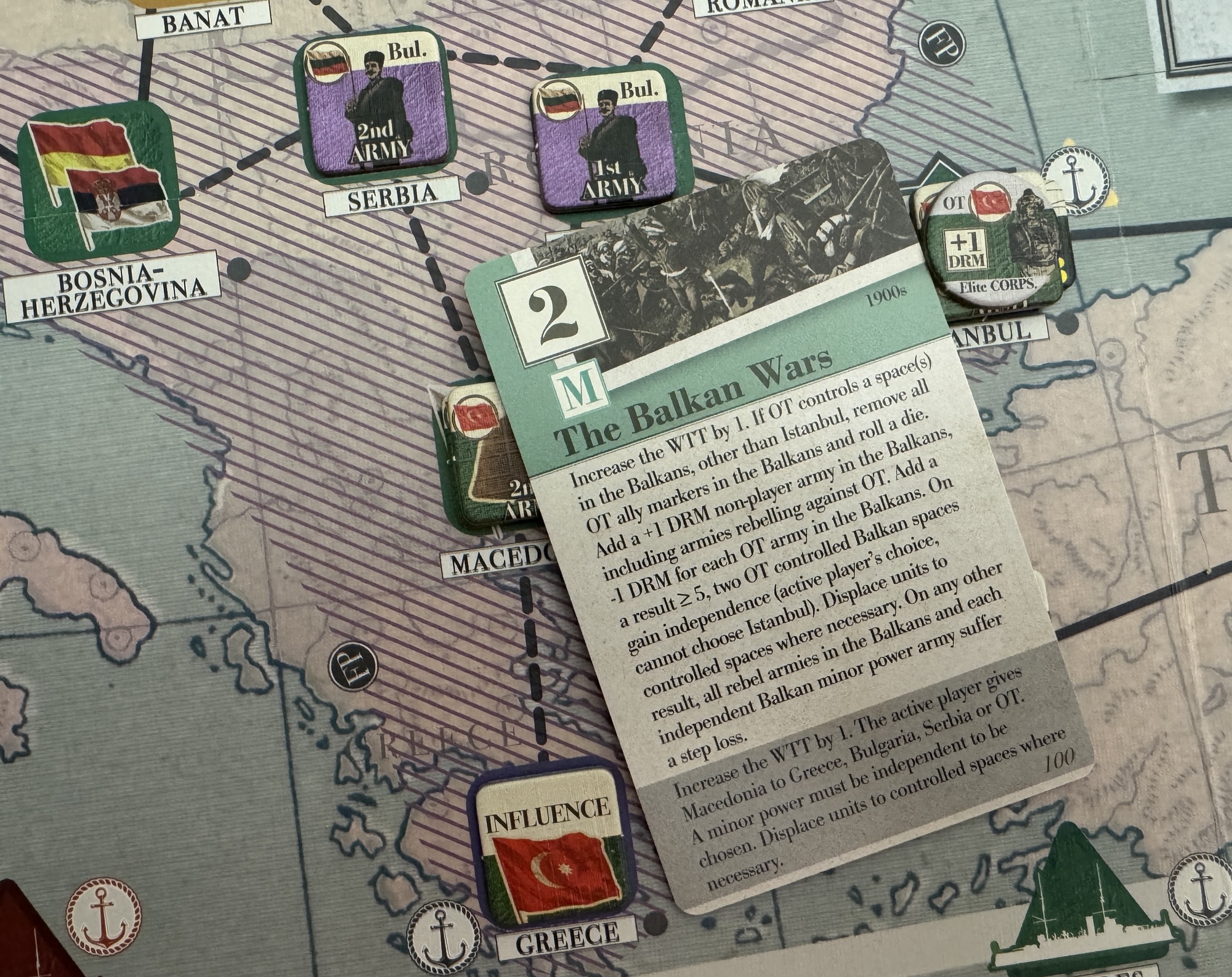
Some of the events that occurred historically prior to 1914 were ultimately precursors to The Great War in many ways. The Balkan Wars were two conflicts fought in 1912 and 1913 that stripped the Ottoman Empire of almost all its remaining European territory and directly set the stage for World War I. The Balkan Wars saw similar levels of carnage as machine guns and artillery equipped with hydraulic recoil mechanisms were used in large numbers. Politically, they highlight the volatile nature of international politics in the Balkan Peninsula and are included as a Mandatory Event to ultimately drive up the World Tension Track on a path toward the outbreak of World War I. When played, the World Tension Track will increase by +1 and if the Ottoman player controls any territory in the Balkans other than Istanbul, or has Diplomatic Influence with countries, they will have a chance to lose their control there as a result of the chaos of the First and Second Balkan Wars. If these checks fail, and they will incur a -1 DRM for each Ottoman Army that is located anywhere in the Balkans, non-player armies will be placed in those locations and will increase the difficulty for the Ottomans to gain a foothold in this area. According to the designer Michael Lorino, mechanically this event causes all kinds of trouble in the Balkans, as intended. Similar to the Mandatory Event Card Empire of the Sun, the original event was a bit more involved and had players fight an actual war. In an effort to keep the game in the playable zone, he decided to abstract these wars through a die roll.

I very much enjoy the concept of a Mandatory Event, although they are never convenient for someone at the table as they typically have negative effects for at least 1 faction. But I very much like the approach taken here with The Balkan Wars with the -1 DRM for control of a territory and its thematic connection with the Ottoman Empire’s presence in the region generating tension and setting off these Balkan Wars.

A Bulgarian postcard depicting the Battle of Lule Burgas.

The Balkan Wars were two conflicts that took place in the Balkan states in 1912 and 1913. In the First Balkan War, the four Balkan states of Greece, Serbia, Montenegro and Bulgaria declared war upon the Ottoman Empire and defeated it, in the process stripping the Ottomans of their European provinces, leaving only Eastern Thrace under Ottoman control. In the Second Balkan War, Bulgaria fought against the other four combatants of the first war. It also faced an attack from Romania from the north. As a result of these wars, the Ottoman Empire lost the bulk of its territory in Europe. Although not involved as a combatant, Austria-Hungary became relatively weaker as a much enlarged Serbia pushed for union of the South Slavic peoples. The Balkan Wars set the stage for the July Crisis of 1914 and was a prelude to the First World War.

We have put out several pieces of content covering Imperial Elegy and find it to be a fantastic game. These include written posts and videos. You can visit those by following the links below:

Unboxing Video:

Video Review:

Summary of Solitaire Bots presented by our friend James:

Written First Impressions Post on the blog: https://theplayersaid.com/2026/05/06/first-impressions-imperial-elegy-the-road-to-the-great-war-1850-1920-from-vuca-simulations/

In the next entry in this series, we will take a look at Truman Doctrine from Twilight Struggle: The Cold War, 1945-1989 from GMT Games.

-Grant
Castelnuovo 1539 from Draco Ideas – Action Point 2

Von: Grant
13. August 2026 um 14:00

In 1539, a small Spanish garrison of troops numbering 3,500 men held the Albanian village of Castelnuovo for 22 days against the massive Ottoman army consisting of over 54,000 Turk soldiers. This siege took place as a part of the Ottoman-Habsburg struggle for control of the Mediterranean Sea in July 1539 at the walled town of Castelnuovo, which is the location of present-day Herceg Novi, Montenegro. After days of open trench warfare and more than a month of smaller combats, skirmishes, assaults and bombardments from the Turkish navy, the last Spanish defenders fell ending the siege. Castelnuovo 1539 is a wargame that focuses on this siege designed by Francisco Ronco. The defenders are safe behind sturdy walls and battlements but time and continual shelling from the Ottomans will lead to assaults over the walls. The battle is hopeless for the defenders but they can win the game by doing enough damage to the Ottomans to end their campaign and stop them from invading further into the Albania and then onto Spain and the rest of Europe. The game is very well produced using wooden blocks for soldiers, stylized walls, siege trenches and cannon along with ships and the board is also beautifully illustrated. The game is a block wargame where the strength of units are hidden from the opponent and plays pretty quickly in less than 90 minutes and really is a great representation of the battle and its history.

In Action Point 1, we took a look at the beautiful Game Board and its area movement scheme. In this Action Point, we will examine the units available to both sides and compare their relative strengths and weaknesses.

Units

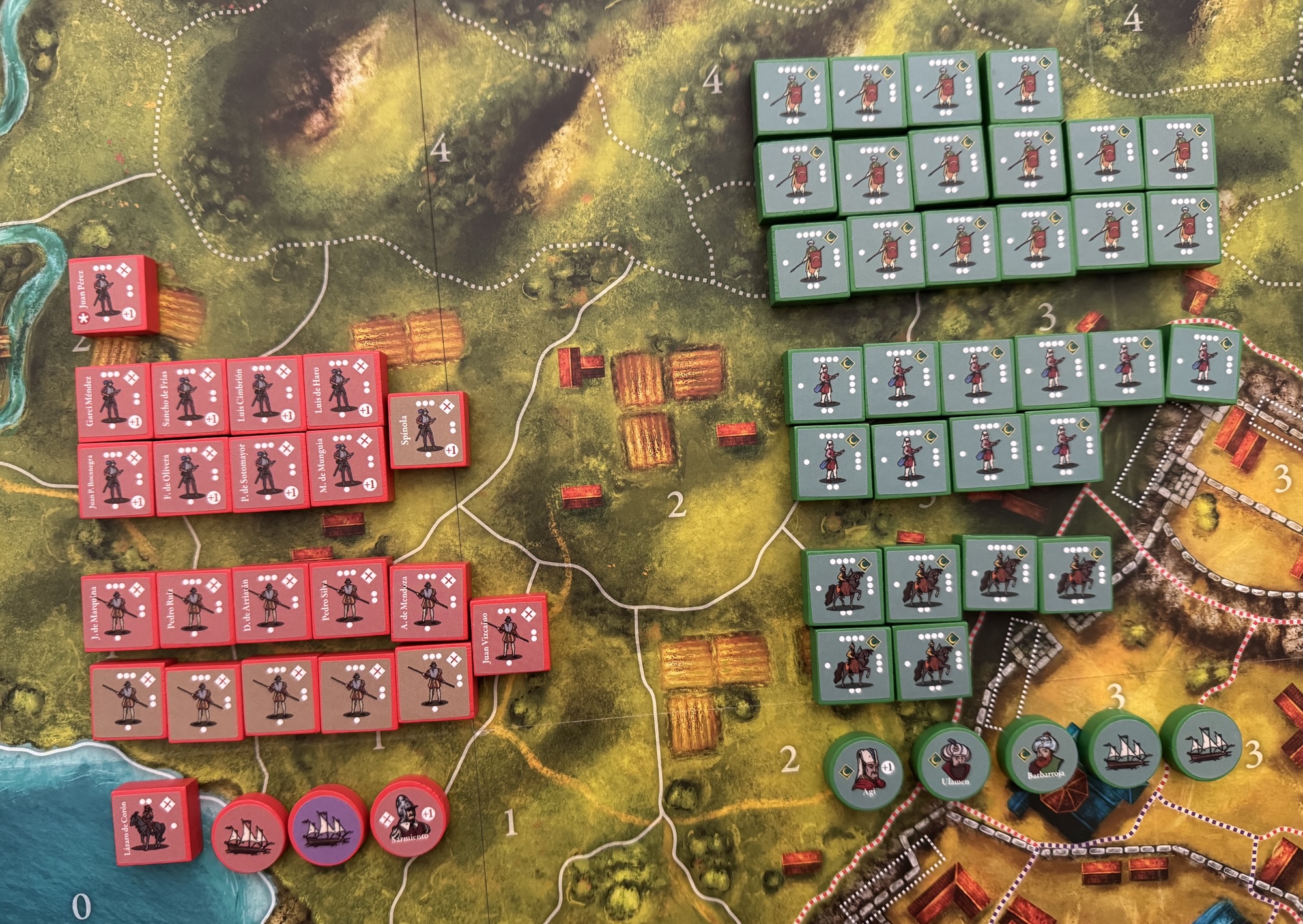
As a block wargame, all of the units in the game are represented by wooden blocks that have stickers affixed to them representing the fighting forces of the Spanish and the Ottomans. There are generally 3 types of units including Infantry, Cavalry and Naval. Infantry is a large category that includes Arquebusiers and Pikemen for the Spanish and Turkish Janissaries and Azab for the Ottomans. Cavalry units are fewer and include Albanian Cavalry for the Spanish and Sipahi for the Ottomans. Each Infantry and Cavalry sticker has a central icon with groups of dots printed on its sides which represent their Combat Strength and the number of dice that each unit will roll in combat. The blocks range in Combat Strength from 2 to 4 dots as not all units have the same Combat Strength. The number of dots oriented at the top of the individual block units represents the current Combat Strength of the unit and can be reduced when entering combat and taking losses. Naval units do not have dots, as they are used in a different way to Infantry and Cavalry units.

All blocks start the game at full Strength and each time a block receives 1 or more hits, it will be rotated counterclockwise so that the top of the block shows the Strength it has remaining. When a Spanish block loses its last Strength Point, it will be removed from the game permanently. The same will happen for Turkish Janissary blocks but for eliminated Ottoman Azab and Sipahi Cavalry units they will be able return to the game at the end of each round during the Reinforcement Phase.

Fleets represent the use of galleys as artillery platforms to support the land forces in their siege and to provide the opportunity to perform some amphibious landing operations with ground troops. The Fleet discs are placed on the board horizontally, unlike the other blocks, and in this way their presence is not hidden from the opponent. Fleet blocks cannot leave the sea areas and count as Artillery Batteries when playing Bombardment and Friendly Fire cards. Once placed, Fleets do not move during the game.

Let’s take a quick look at the statistical makeup of the opposing forces.

In the following table, you will see the number of different types available to each of the combatants. The Ottoman forces have a numerical superiority as they have the most Infantry units with 26, comprising 10 elite Janissaries and 16 Azab. The Spanish have just 21 Infantry, with 10 of those being Arquebusiers and 11 Pikemen. The Ottomans also have the edge in the number of Cavalry units available with 6 Sipahi as compared to just 1 Cavalry unit from the Spanish in the form of a single Albanian Cavalry. The Infantry typically are the backbone of the army and will do most of the fighting and do most of the damage while the Cavalry units will be used to move ahead quickly to seize key areas and set up defenses to allow for the Infantry who have slower movement to catch up. Each side has 2 Fleets and these are vitally important for the Ottomans as this is the means that they can bring onto shore additional units to siege Castelnuovo.

And a look at total Combat Strength for each side. But, first it is important to explain the Combat Strength of each of the units for both sides. The Spanish Arquebusiers have a Combat Strength of 3 as do their Pikemen. This means that these units will roll 3 dice in combat and will be able to take 3 hits before being killed. The Ottoman Janissaries have 4 Combat Strength as do the Azab. When you simply multiply the Combat Strength by the number of blocks of each type you will get their Total Infantry Combat Strength. The Ottoman has a total of 104 Combat Strength spread out amongst their 26 Infantry units and the Spanish have a total of 63 Combat Strength among their 21 Infantry units. This can be used to get a quick idea about which side is better and has more power but this can be deceiving as the Spanish have the walls which can slow down the sieging Ottomans and absorb hits as well. The Ottomans have 49.1% more Infantry Combat Strength than the Spanish with a numerical difference of 41. A fairly significant difference and when coupled with the fact that the Ottomans can bring back killed Azab units where the Spanish Infantry are removed from the game, it is easy to see that the Spanish have the tougher time of it. Also, the Cavalry advantage is on the side of the Ottomans with Sipahi having a Combat Strength of 4 as compared to the Spanish Albanian Cavalry’s Combat Strength of 2. This gives the Ottoman the advantage in Total Cavalry Combat Strength of 24 as compared to just 2 for the Spanish.

I do want to point out that the Spanish have better Leaders and some of their units are considered elite and gain advantage on their combat rolls. The Arquebusiers Blocks have a +1 printed on them as a reminder that they have a +1 bonus to their combat roll and this is a major advantage in combat.

The other difference in combat is a unit’s priority and when they get to roll their attack dice and if hits are scored steps will be removed before lower priority units get to roll. The priority is as follows:

Pikemen go first if enemy Cavalry is present and they are fighting in clear or rough terrain.

Cavalry, if no opposing Pikemen are present and the battle is fought in clear or rough terrain.

Arquebusiers.

All other Infantry will then attack simultaneously.

Cavalry, only if there are opposing Pikemen in clear or rough terrain.

Hits are scored when players roll a modified 5 or 6 result on their 6-sided dice. Remember that Arquebusiers get a +1 to hit, which means they hit on a roll of 4-6, which is a huge advantage. Also remember that there are Leaders and certain Leaders will give a +1 bonus to specific troops that are located in their areas.

Leaders must always have blocks of their side present in their areas on the board but do not count toward the 3-block limit per area. Leaders Agi (Ottoman Janissary Leader) and Sarmiento (Spanish Leader that affects all units with him) grant benefits to the dice rolls of the units they escort. Leaders do not have to accompany specific units and as such can move with any unit in the area they are in, or they can stay there with units other than the ones they originally moved in with. But Leaders must perform the full movement with the units they started moving with as you cannot drop or pick up a Leader during movement. You can move units from where the Leader is without taking the Leader with them, but some units will need to stay behind so the Leader is not alone in the area. If during combat, all blocks accompanying the Leader are eliminated, the Leader is eliminated as well.

Artillery Batteries

Both players have Artillery Batteries at their disposal, which represent vitally important siege pieces used to both defend and attack the city walls. These Artillery Batteries are in the form of red and green cannon meeples (they are very cute) and make a huge impact on the presence of the board as when they are placed they command respect. The Batteries allow players to play cards that fire from a distance and there can never be more than 1 of these Batteries in a single area of the map. The Spanish player’s Artillery Batteries are placed at the beginning of the game and cannot be moved while the Ottoman player can install an Artillery Battery when building Trenches with any cards that allow it. They can also move the Batteries through areas connected by Trenches using those same cards.

In Castelnuovo 1539, the Spanish and Ottoman fighting forces are deeply asymmetrical. The Spanish field a small, fixed and irreplaceable garrison of elite veteran Tercios focused on defense and repairing fortifications, whereas the Ottomans possess an overwhelming, recyclable horde of Azabs, Sipahi Cavalry, and Janissaries arriving by land and sea. You will feel the asymmetry in the game and I think that it is really very well done by the designer to represent this very difficult siege from history.

We published an interview on the blog with the game’s designer Francisco Ronco and you can read that at the following link: https://theplayersaid.com/2025/06/06/interview-with-francisco-ronco-designer-of-castelnuovo-1539-from-draco-ideas-coming-to-kickstarter-june-17th/

In Action Point 3, we will take a look at the different types of Command Cards and discuss how they are used.

-Grant

❌