Normale Ansicht

Castelnuovo 1539 from Draco Ideas – Action Point 2

Von: Grant
13. August 2026 um 14:00

In 1539, a small Spanish garrison of troops numbering 3,500 men held the Albanian village of Castelnuovo for 22 days against the massive Ottoman army consisting of over 54,000 Turk soldiers. This siege took place as a part of the Ottoman-Habsburg struggle for control of the Mediterranean Sea in July 1539 at the walled town of Castelnuovo, which is the location of present-day Herceg Novi, Montenegro. After days of open trench warfare and more than a month of smaller combats, skirmishes, assaults and bombardments from the Turkish navy, the last Spanish defenders fell ending the siege. Castelnuovo 1539 is a wargame that focuses on this siege designed by Francisco Ronco. The defenders are safe behind sturdy walls and battlements but time and continual shelling from the Ottomans will lead to assaults over the walls. The battle is hopeless for the defenders but they can win the game by doing enough damage to the Ottomans to end their campaign and stop them from invading further into the Albania and then onto Spain and the rest of Europe. The game is very well produced using wooden blocks for soldiers, stylized walls, siege trenches and cannon along with ships and the board is also beautifully illustrated. The game is a block wargame where the strength of units are hidden from the opponent and plays pretty quickly in less than 90 minutes and really is a great representation of the battle and its history.

In Action Point 1, we took a look at the beautiful Game Board and its area movement scheme. In this Action Point, we will examine the units available to both sides and compare their relative strengths and weaknesses.

Units

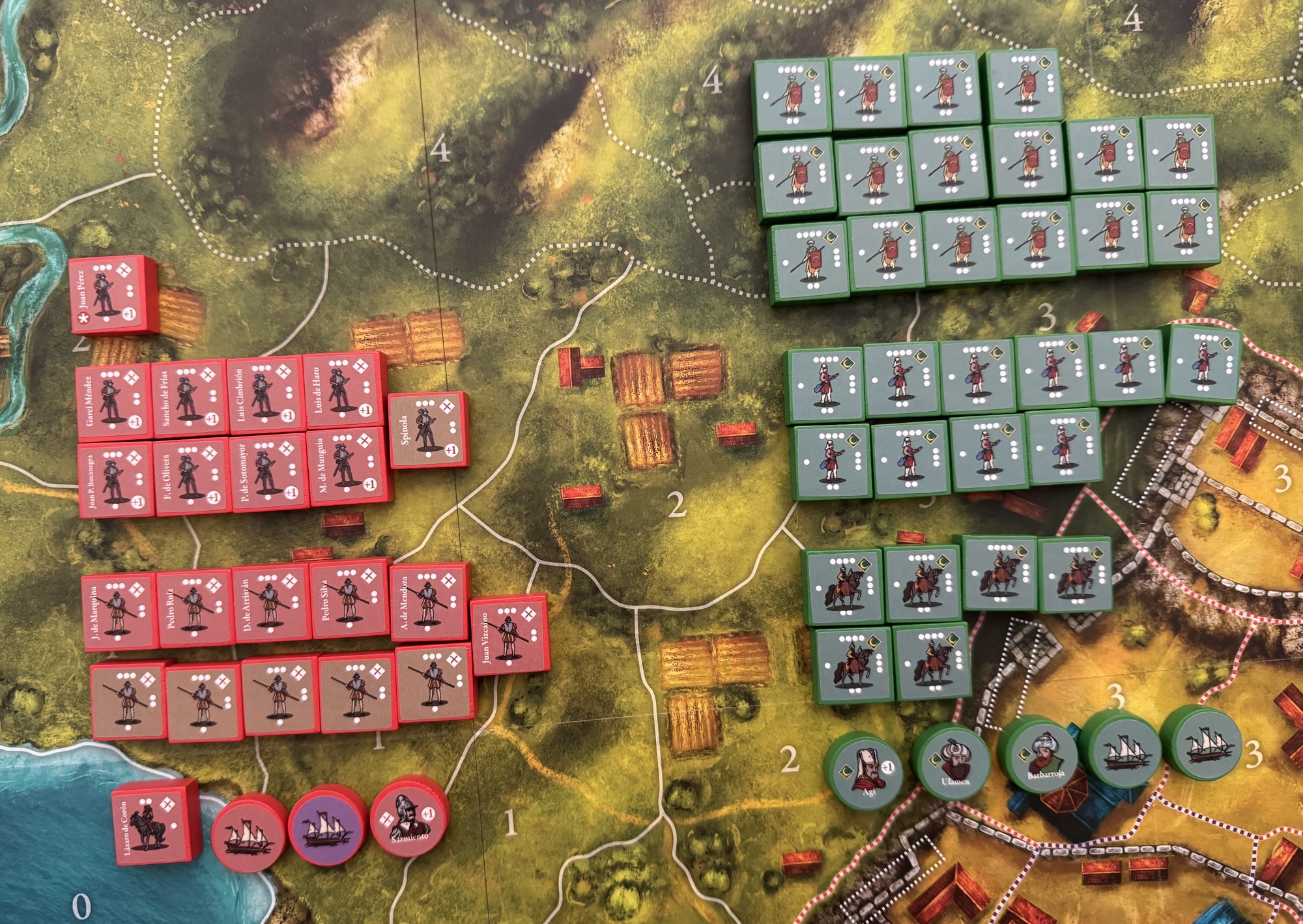
As a block wargame, all of the units in the game are represented by wooden blocks that have stickers affixed to them representing the fighting forces of the Spanish and the Ottomans. There are generally 3 types of units including Infantry, Cavalry and Naval. Infantry is a large category that includes Arquebusiers and Pikemen for the Spanish and Turkish Janissaries and Azab for the Ottomans. Cavalry units are fewer and include Albanian Cavalry for the Spanish and Sipahi for the Ottomans. Each Infantry and Cavalry sticker has a central icon with groups of dots printed on its sides which represent their Combat Strength and the number of dice that each unit will roll in combat. The blocks range in Combat Strength from 2 to 4 dots as not all units have the same Combat Strength. The number of dots oriented at the top of the individual block units represents the current Combat Strength of the unit and can be reduced when entering combat and taking losses. Naval units do not have dots, as they are used in a different way to Infantry and Cavalry units.

All blocks start the game at full Strength and each time a block receives 1 or more hits, it will be rotated counterclockwise so that the top of the block shows the Strength it has remaining. When a Spanish block loses its last Strength Point, it will be removed from the game permanently. The same will happen for Turkish Janissary blocks but for eliminated Ottoman Azab and Sipahi Cavalry units they will be able return to the game at the end of each round during the Reinforcement Phase.

Fleets represent the use of galleys as artillery platforms to support the land forces in their siege and to provide the opportunity to perform some amphibious landing operations with ground troops. The Fleet discs are placed on the board horizontally, unlike the other blocks, and in this way their presence is not hidden from the opponent. Fleet blocks cannot leave the sea areas and count as Artillery Batteries when playing Bombardment and Friendly Fire cards. Once placed, Fleets do not move during the game.

Let’s take a quick look at the statistical makeup of the opposing forces.

In the following table, you will see the number of different types available to each of the combatants. The Ottoman forces have a numerical superiority as they have the most Infantry units with 26, comprising 10 elite Janissaries and 16 Azab. The Spanish have just 21 Infantry, with 10 of those being Arquebusiers and 11 Pikemen. The Ottomans also have the edge in the number of Cavalry units available with 6 Sipahi as compared to just 1 Cavalry unit from the Spanish in the form of a single Albanian Cavalry. The Infantry typically are the backbone of the army and will do most of the fighting and do most of the damage while the Cavalry units will be used to move ahead quickly to seize key areas and set up defenses to allow for the Infantry who have slower movement to catch up. Each side has 2 Fleets and these are vitally important for the Ottomans as this is the means that they can bring onto shore additional units to siege Castelnuovo.

And a look at total Combat Strength for each side. But, first it is important to explain the Combat Strength of each of the units for both sides. The Spanish Arquebusiers have a Combat Strength of 3 as do their Pikemen. This means that these units will roll 3 dice in combat and will be able to take 3 hits before being killed. The Ottoman Janissaries have 4 Combat Strength as do the Azab. When you simply multiply the Combat Strength by the number of blocks of each type you will get their Total Infantry Combat Strength. The Ottoman has a total of 104 Combat Strength spread out amongst their 26 Infantry units and the Spanish have a total of 63 Combat Strength among their 21 Infantry units. This can be used to get a quick idea about which side is better and has more power but this can be deceiving as the Spanish have the walls which can slow down the sieging Ottomans and absorb hits as well. The Ottomans have 49.1% more Infantry Combat Strength than the Spanish with a numerical difference of 41. A fairly significant difference and when coupled with the fact that the Ottomans can bring back killed Azab units where the Spanish Infantry are removed from the game, it is easy to see that the Spanish have the tougher time of it. Also, the Cavalry advantage is on the side of the Ottomans with Sipahi having a Combat Strength of 4 as compared to the Spanish Albanian Cavalry’s Combat Strength of 2. This gives the Ottoman the advantage in Total Cavalry Combat Strength of 24 as compared to just 2 for the Spanish.

I do want to point out that the Spanish have better Leaders and some of their units are considered elite and gain advantage on their combat rolls. The Arquebusiers Blocks have a +1 printed on them as a reminder that they have a +1 bonus to their combat roll and this is a major advantage in combat.

The other difference in combat is a unit’s priority and when they get to roll their attack dice and if hits are scored steps will be removed before lower priority units get to roll. The priority is as follows:

Pikemen go first if enemy Cavalry is present and they are fighting in clear or rough terrain.

Cavalry, if no opposing Pikemen are present and the battle is fought in clear or rough terrain.

Arquebusiers.

All other Infantry will then attack simultaneously.

Cavalry, only if there are opposing Pikemen in clear or rough terrain.

Hits are scored when players roll a modified 5 or 6 result on their 6-sided dice. Remember that Arquebusiers get a +1 to hit, which means they hit on a roll of 4-6, which is a huge advantage. Also remember that there are Leaders and certain Leaders will give a +1 bonus to specific troops that are located in their areas.

Leaders must always have blocks of their side present in their areas on the board but do not count toward the 3-block limit per area. Leaders Agi (Ottoman Janissary Leader) and Sarmiento (Spanish Leader that affects all units with him) grant benefits to the dice rolls of the units they escort. Leaders do not have to accompany specific units and as such can move with any unit in the area they are in, or they can stay there with units other than the ones they originally moved in with. But Leaders must perform the full movement with the units they started moving with as you cannot drop or pick up a Leader during movement. You can move units from where the Leader is without taking the Leader with them, but some units will need to stay behind so the Leader is not alone in the area. If during combat, all blocks accompanying the Leader are eliminated, the Leader is eliminated as well.

Artillery Batteries

Both players have Artillery Batteries at their disposal, which represent vitally important siege pieces used to both defend and attack the city walls. These Artillery Batteries are in the form of red and green cannon meeples (they are very cute) and make a huge impact on the presence of the board as when they are placed they command respect. The Batteries allow players to play cards that fire from a distance and there can never be more than 1 of these Batteries in a single area of the map. The Spanish player’s Artillery Batteries are placed at the beginning of the game and cannot be moved while the Ottoman player can install an Artillery Battery when building Trenches with any cards that allow it. They can also move the Batteries through areas connected by Trenches using those same cards.

In Castelnuovo 1539, the Spanish and Ottoman fighting forces are deeply asymmetrical. The Spanish field a small, fixed and irreplaceable garrison of elite veteran Tercios focused on defense and repairing fortifications, whereas the Ottomans possess an overwhelming, recyclable horde of Azabs, Sipahi Cavalry, and Janissaries arriving by land and sea. You will feel the asymmetry in the game and I think that it is really very well done by the designer to represent this very difficult siege from history.

We published an interview on the blog with the game’s designer Francisco Ronco and you can read that at the following link: https://theplayersaid.com/2025/06/06/interview-with-francisco-ronco-designer-of-castelnuovo-1539-from-draco-ideas-coming-to-kickstarter-june-17th/

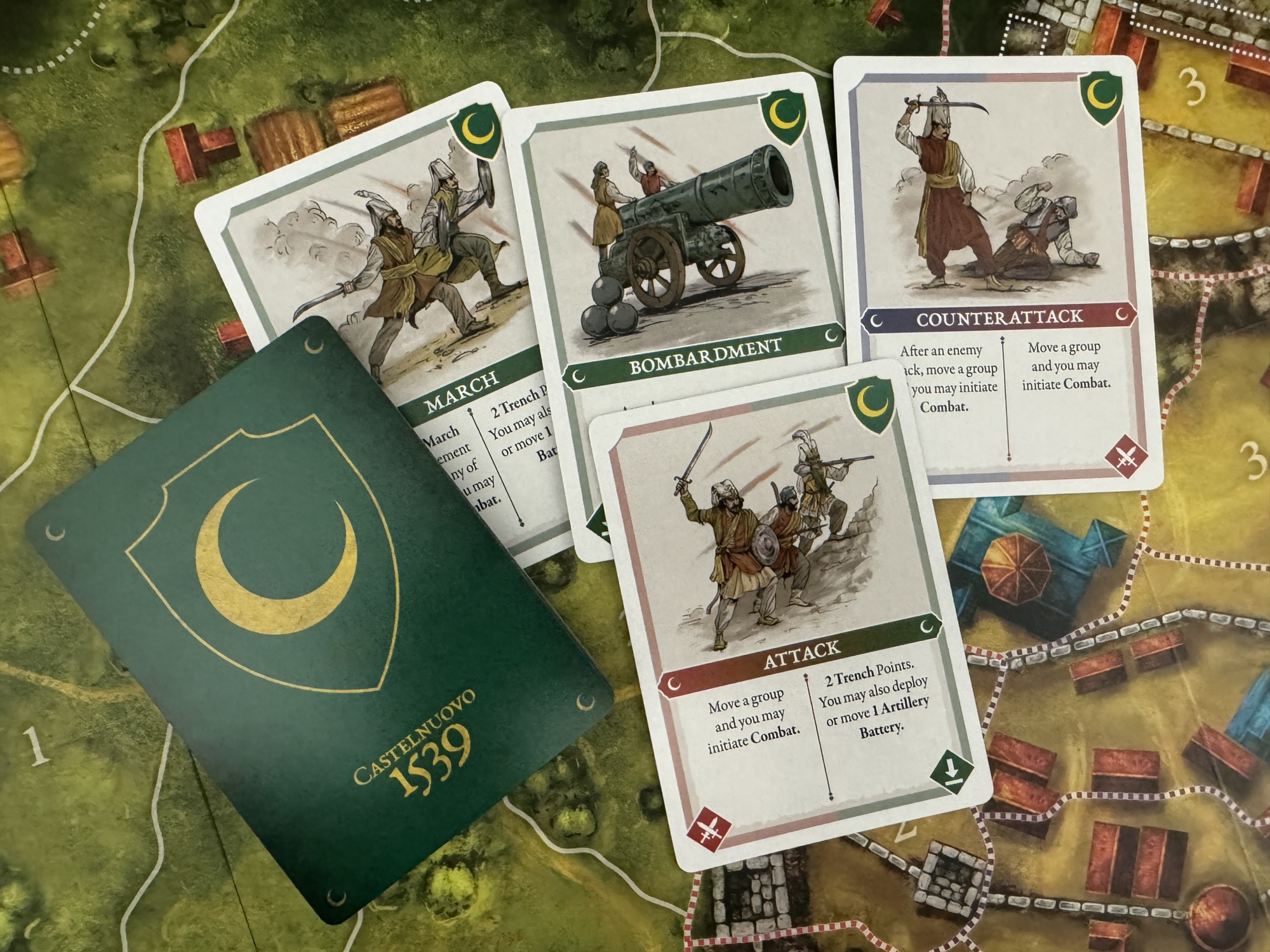
In Action Point 3, we will take a look at the different types of Command Cards and discuss how they are used.

-Grant

Castelnuovo 1539 from Draco Ideas – Action Point 1

Von: Grant
18. Juni 2026 um 14:00

In 1539, a small Spanish garrison of troops numbering 3,500 men held the Albanian village of Castelnuovo for 22 days against the massive Ottoman army consisting of over 54,000 Turk soldiers. This siege took place as a part of the Ottoman-Habsburg struggle for control of the Mediterranean Sea in July 1539 at the walled town of Castelnuovo, which is the location of present-day Herceg Novi, Montenegro. After days of open trench warfare and more than a month of smaller combats, skirmishes, assaults and bombardments from the Turkish navy, the last Spanish defenders fell ending the siege. Castelnuovo 1539 is a wargame that focuses on this siege designed by Francisco Ronco. The defenders are safe behind sturdy walls and battlements but time and continual shelling from the Ottomans will lead to assaults over the walls. The battle is hopeless for the defenders but they can win the game by doing enough damage to the Ottomans to end their campaign and stop them from invading further into the Albania and then onto Spain and the rest of Europe. The game is very well produced using wooden blocks for soldiers, stylized walls, siege trenches and cannon along with ships and the board is also beautifully illustrated. The game is a block wargame where the strength of units are hidden from the opponent and plays pretty quickly in less than 90 minutes and really is a great representation of the battle and its history.

In this series of Action Points, we will first take a look at the beautiful Game Board and its area movement scheme, examine the units available to both sides and compare their relative strengths and weaknesses, take a look at the 5 different types of Command Cards and discuss how they are used, look at the 2 different types of rounds including a Siege Round and an Assault Round and how they differ, take a look at an example of combat and bombardment and finally examine the victory conditions for both sides and how casualties effect this outcome.

Game Board

The Game Board represents the fortified city of Castelnuovo and its surrounding areas, including the Mediterranean Sea to the south and the rolling countryside to the north. The Game Board is divided up into areas which are used to regulate the movement and positioning of the block units. The Game Board is pretty large really measuring in at 29″ x 21″ and is a fully mounted map board and is very nicely illustrated by Paco Arenas and absolutely was a joy to play on.

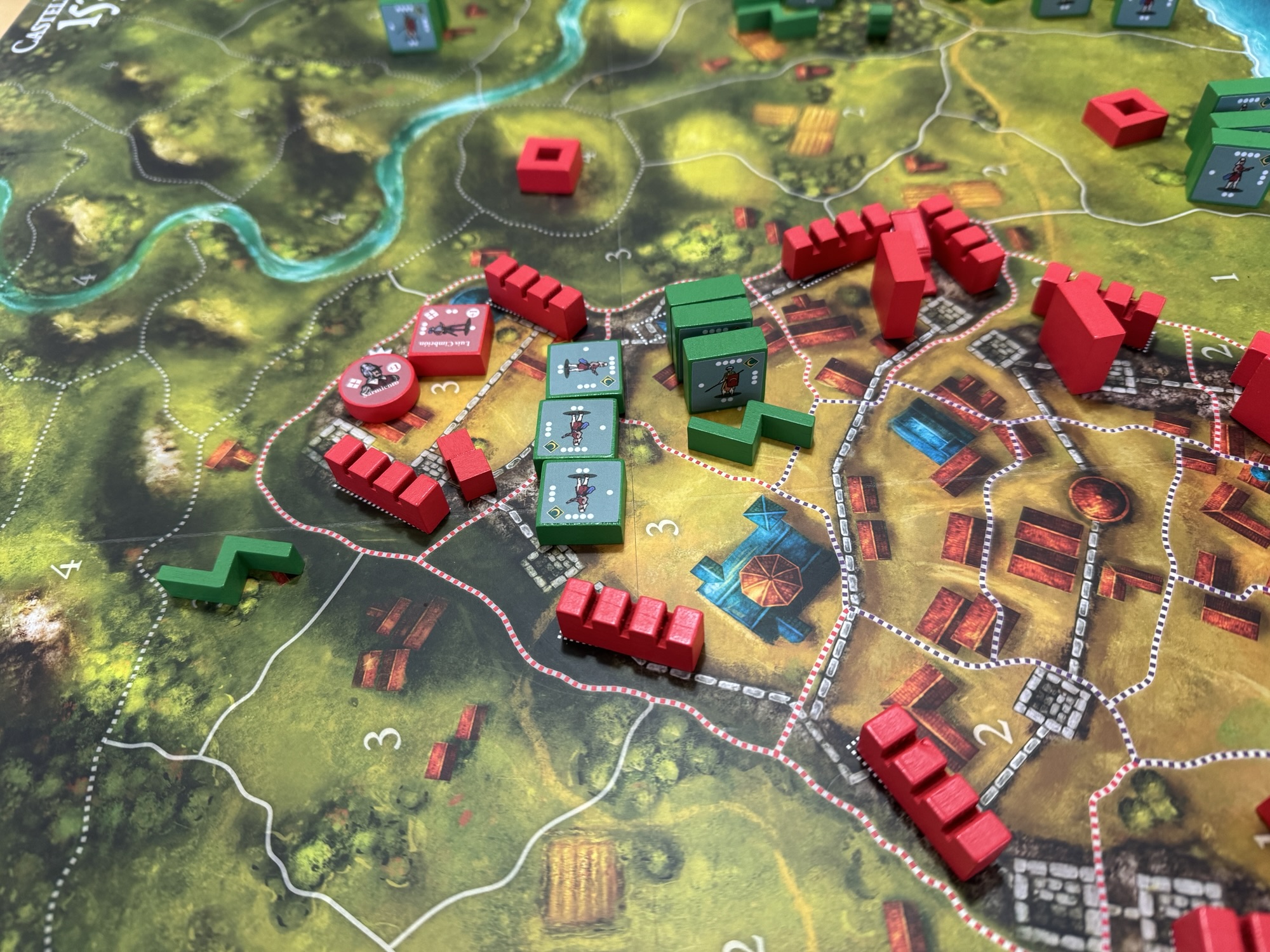
As you look at the Game Board in the picture above you will notice a few things. The areas of the city of Castelnuovo are outlined in red with a dotted line representing the city walls around its perimeter. There are also 4 inner areas of the city itself outlined in purple. Sometimes the game rules make reference to the “Fortress”, which means the 4 areas of the city and the walls surrounding them.

Here is a closeup of the Fortress where you can see the colored lines a bit better. You will also notice that there are rectangular boxes on top of the walls in the Fortress outlined with white dotted lines. These are spaces where the wooden wall segments are placed to represent the Resistance Level of the walls. You will see that in each area of the city that has walls, there is a number found in a white star that represents this Resistance Level. There are areas with both Resistance 1, 2 and 3 inside the Fortress. As the walls are attacked with bombardments from artillery, their Resistance Level will be degraded represented by placing wooden cubes in each area marking the current Resistance Level with 1, 2 or 3 cubes. If an area has 3 Resistance Level and takes a hit, the player will remove one wooden piece indicating that the Resistance points have dropped. Once the Resistance Level reaches 0, the walls are destroyed and the wooden wall pieces are removed from the board. The Ottoman player may then storm the walls and attack the defending units in the city.

There are 2 types of terrain found in the countryside of the Game Board with clear terrain being shown by a solid white outline and rough terrain outlined by a white dotted line. Each area of the map has a Height Level value printed in its location, which indicates the height of the area. The heights are 0 being the lowest, or basically the sea level with a 4 being the highest which represents a mountain level. The height effects the shooting of firearms. In addition, other terrain features are printed on the Game Board including the coastline, which separates the sea areas from the land areas, and also is a landing point for a majority of the Ottoman player’s reinforcement troops. Also, the 3 areas with Resistance Levels of 2 and 3, marked with the white star, are the areas that the Ottoman army must occupy at the end of any round to win the game.

Movement is specifically tied to the type of lines found in the areas of terrain. Units and Leaders can move by playing Action Cards, which allow a group of 1 to 3 units that are in the same area to one or more areas. Activated Infantry units will have 2 movement points and Cavalry have 4 movement points. Moving into a clear terrain area costs 1 movement point while moving into a rough terrain area, which is marked with white dotted
lines will cost 2.

The countryside areas have various depictions of buildings including shacks, storage sheds, houses as well as farm fields. These buildings do not affect combat or movement and are simply illustrative of the surroundings of the city. They are also many trees and bushes drawn on the Game Board with connecting roads also shown.

There are a few pieces that the players will place on the Game Board at the outset of playing including the wall blocks already mentioned as well as the Bastions. These Bastions are used by the Spanish player and are placed at the beginning of the game in any terrain areas outside of the city proper. These Bastions function similarly to the walls of Castelnuovo’s fortifications. Once these are placed, they cannot be moved and will remain on
the board even if their Resistance drops to 0 and they are destroyed. The Ottoman player can destroy them with artillery Bombardments or by spending Trench Points from Command Cards when entering them. These Bastions do not provide defense to the Ottoman player.

The Casualty Track is printed in the bottom left hand corner of the Game Board and is used to keep track of the number of blocks lost by the Ottoman player. In addition, also tracked will be Leaders and the number of Assault Rounds used by the Ottoman player.

The game really is a nicely made production with the Game Board being one of the best parts of the package. It is clear, well laid out and takes little to no time to understand its locations and areas. I think that one of the strengths of this game is that it is not only nicely produced but the rules are very clear and the strategy of what each side should be doing, by taking advantage of their defenses and the terrain.

In Action Point 2, we will examine the units available to both sides and compare their relative strengths and weaknesses.

-Grant

❌