With this My Favorite Wargame Cards Series, I hope to take a look at a specific card from the various wargames that I have played and share how it is used in the game. I am not a strategist and frankly I am not that good at games but I do understand how things should work and be used in games. With that being said, here is the next entry in this series.
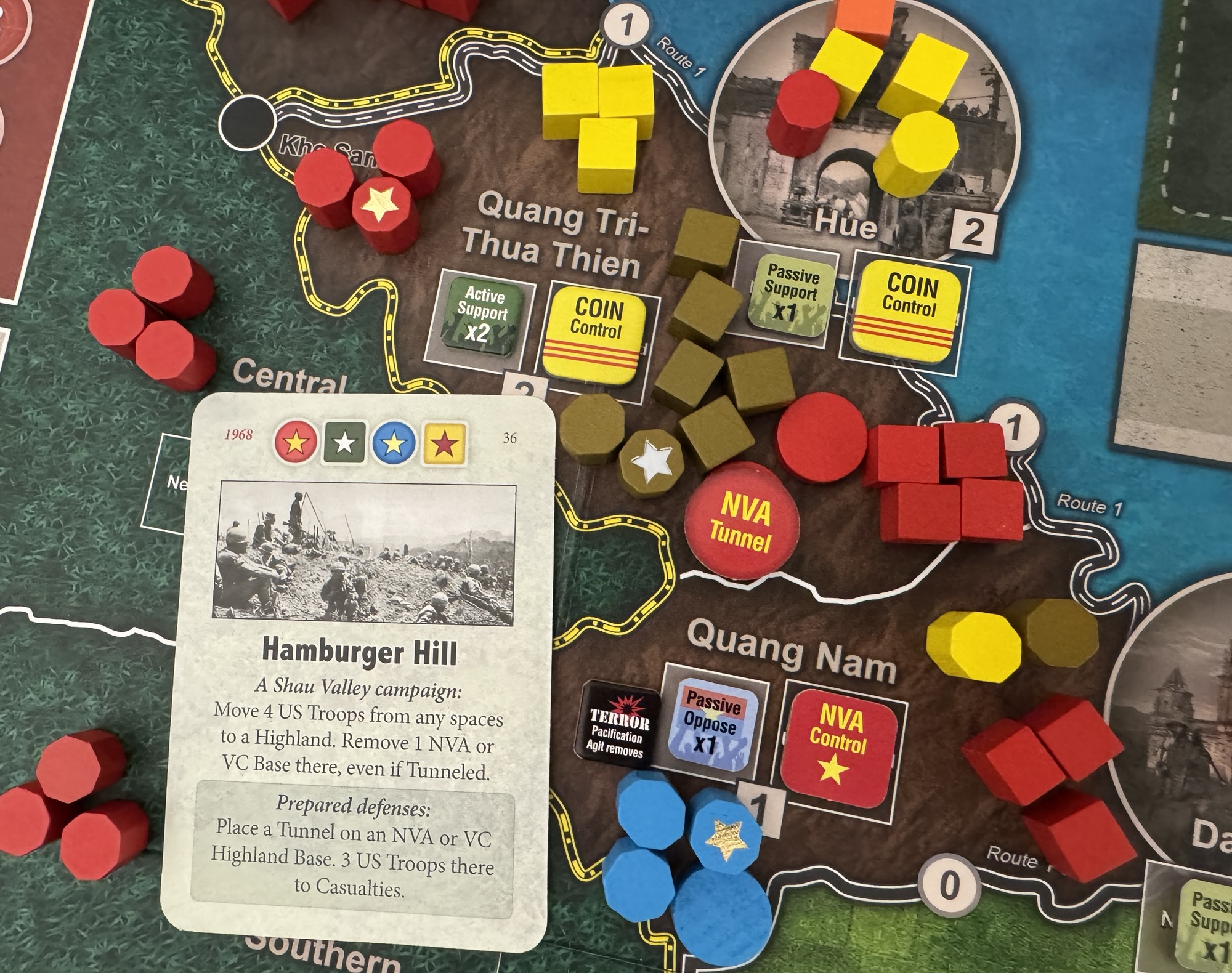
#78: Hamburger Hill from Fire in the Lake: Insurgency in Vietnam from GMT Games
The COIN Series uses cards in a very different way from other CDG’s. These cards are not necessarily the driver of the action but more assistive to the actions of the players by setting eligibility and also providing powerful events. The Event Cards are more often than not, very powerful. They either give you a continuing bonus on future Operations and Special Activities (as in the case of the volumes that include the various Capabilities) or allow you to take Operations and Special Activities more times that round than you would normally have been able to had you not chosen the Event and more often than not, at no cost! Also, because of the power of the cards and their ties to one or more factions, you can take the Event which allows you a huge advantage, only to see that very powerful Event reversed with the next Event or with a regular Operation. This is very frustrating but is one of the major reasons that I love the card-assisted element of the COIN Series. Today we are going to take a look at the Hamburger Hill Event Card.
But first an aside. Along with the movie Platoon, my introduction to the fierce fighting in the Ashau Valley of Vietnam was mainly from the movie Hamburger Hill starring Dylan McDermott as Lt. Frantz and Courtney Vance as Doc. The images from this movie will be forever burned in my mind and with the recent passing of the anniversary of the battle’s start on May 13th I thought it would be a perfect time to cover this card.
The Hamburger Hill Event Card has a top event and a bottom event, which is the case with all cards found in the decks of COIN Series games. The top event benefits the US/ARVN players while the bottom benefits the NVA/VC players. The top event allows the US player to move 4 US Troop Cubes from any spaces on the board to any Highland space, which are the brown colored regions representing less forgiving elevated terrain and mountainous areas. It then goes onto allow the removal of any NVA or VC base there, even if the base is currently Tunneled. This is a very powerful event as normally moving units requires an Air Lift Special Activity or a Train Operation to place new units into a space. Also, removing a Base, and especially a Tunneled Base, requires multiple turns and a focused approach of Patrol, Sweep and Assault to uncover hiding Insurgent pieces and then to destroy them allowing for a Base to be removed.
The Insurgent half of the event allows them to place a new Tunneled Based into a Highland space as well as remove 3 US Troop Cubes to Casualties. The Casualties Box is where these “dead” cubes are stored until the Coup Round where they will have negative effects on the United States player and then be available again for use in the next turn. This event is very powerful and is a major boon for the Insurgent player in taking control of and maintaining their presence in the Highland Provinces.
I also very much like the historical connection to the Battle of Hamburger Hill and think that the designers did a great job of creating this event with real game effects related to the battle and consequences that are felt from the play of the card. This Hamburger Hill Event is one that will be played by both sides often rather than taking their Operations and Special Activities. The effects are just too efficient and powerful to pass on unless the timing of the game dictates differently.
The Battle of Hamburger Hill was a major battle that lasted from May 13–20, 1969 was fought by United States Army and Army of the Republic of Vietnam (ARVN) forces against People’s Army of Vietnam (PAVN) forces during Operation Apache Snow of the Vietnam War. Though the heavily fortified Hill 937, a ridge of the mountain Dong Ap Bia in central Vietnam near its western border with Laos, had little strategic value, US command ordered its capture by a frontal assault, only to abandon it soon thereafter. The action caused a controversy among both the US armed services and the public back home, and marked a turning point in US involvement in Vietnam.
The battle was primarily an infantry engagement, with the US troops moving up the steeply sloped hill against well-entrenched troops. Attacks were repeatedly repelled by the PAVN defenses. Bad weather also hindered operations. Nevertheless, the Airborne troops took the hill through direct assault with heavy use of artillery and airstrikes, causing extensive casualties to the PAVN forces.
Local Degar tribesmen call the mountain Ap Bia, which means “the mountain of the crouching beast.” Official histories of the engagement refer to it as Hill 937 after the elevation displayed on US Army maps, but the US soldiers who fought there dubbed it “Hamburger Hill,” suggesting that those who fought on the hill were “ground up like hamburger meat.”
The quote was attributed to Sgt. James Spears who said, “Have you ever been inside a hamburger machine? We just got cut to pieces by extremely accurate machine gun fire…”.
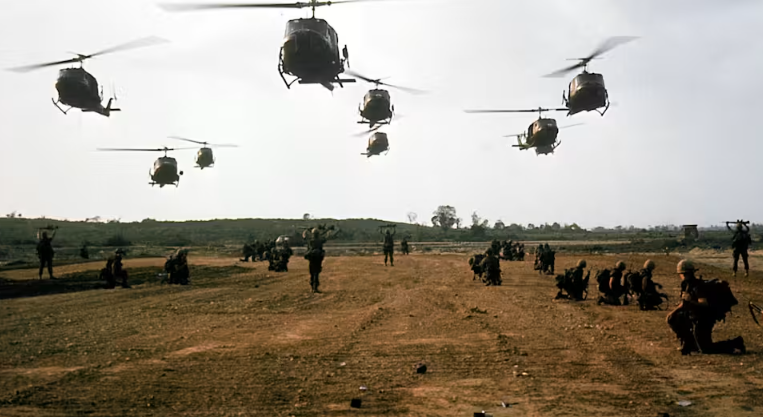
US Army photographers climb Hill 937 at Dong Ap Bia after the battle, May 1969.
One of my favorite wars to game is that of the Vietnam War. Part of that is because I was born in the early 1970’s and heard a lot about this war for the rest of that decade and throughout my teenage years. I remember watching the short lived television series Tour of Duty. I also read the graphic novel series The ‘Nam from Marvel Comics. But, my interest really grew after watching movies such as Apocalypse Now and Platoon. I always asked myself, how are you expected to fight a war where you don’t know who the enemy is? But also part of the attraction for me is that the war in anything but conventional. The combatants were diametrically different, the powerful and well funded United States of America and their technology and special forces versus the Viet Cong, a rag tag group of insurgents, and the mighty North Vietnamese Army funded and supported by the Chinese. This war also was set amongst the backdrop of social upheaval and cultural change at home with anti-war protests, freedom for all being sung as a marching song and desegregation and civil rights taking center stage. We have played plenty of games set in this conflict and I want to share my Best 3 Games with…Vietnam!
3. Hearts & Minds: Vietnam 1965-1975 from Worthington Publishing
We really enjoy Card Driven Games and try to play as many of them as we possibly can get our hands on. Also, as I said in the intro, we also enjoy Vietnam wargames. So, when we had a chance to play a CDG on the Vietnam War, it was a no brainer! I got this game for Christmas about 6 years ago and it was a used copy of the 1st Edition published by Worthington Publishing. There is a 2nd Edition out there but I really don’t know what the differences are. Since that time, there also is a new 3rd Edition from Compass Games and it looks really good. But that is neither here nor there.
In Hearts and Minds: Vietnam 1965-1975, players will play as either the US/ARVN forces (with some units from NATO as well as ROK) against the Communist forces which include NVA regulars and VC hidden units. The game has multiple scenarios and covers the entirety of the Vietnam War from 1965 all the way through 1975 as the U.S. forces left and only the ARVN remained to attempt to stem the red tide coming down into South Vietnam.
The ROK unit in Quang Ngai successfully Pacifies the province, placing a blue star marker that will factor in end round calculations for the dreaded Political Will Track.
Players have a hand of 5 cards each round from which they will play 4 that provide Resource Points to perform various actions including activating units to move up to their movement allowance, attacking enemy units, doing bombing missions, pacifying areas or forcing a political change. Each faction has their own deck, the Communist deck is red, the Allies is blue and then there are black cards that are neutral. Players will make their decks from their color and mix in half of the black cards. These cards represent the meat of the game and are the vehicle to make the game progress. The Resource Points are spent to perform the actions mentioned above and also can be used to buy the printed event on the card just played. Sometimes this event will have lasting effects for the entire game, such as the Commando Hunt card that allows Bomber missions to target Laotian border provinces and also allows more than 1 bomber to bomb any given province, or will have a one time effect such as Junction City, that allow you to spend more than one saved Resource Point in a given turn as long as all Battle and Political Control Change actions take place in Zone III. These cards are well done and the game boils down to the efficient use of the hand that you are dealt. Sometimes, you will be given cards with high RP’s of 4 or 5, which will allow you to make a lot of progress with various actions including moving forces, battling the opposition and making political changes. But, there will be times when your draws are not great and you have a hand full of low value RP cards but they might have interesting and very useful events that you must take advantage of. In essence, you have to play the cards you are dealt and make the best go of things. This can be both fun and frustrating but always keeps things interesting and requires that you plan and execute on that plan.
Battle is pretty simple as well as all the counters are pretty much the same for both sides. Each counter has an untried side and a veteran side (with either a 1-6 or 2-6 for ARVN and US troops or a 1-4 or 2-4 for NVA and typically a 1-1 for VC units) and then there are support units such as mortars, artillery, tanks and helicopter gunships. When a players units are located in a province with enemy units, a contested area is created where the players can fight by buying a battle round for the cost of 1 RP. If the battle doesn’t conclude, another battle round can be purchased with an additional RP until the player no longer has RP’s. Units in a province simply total up their battle factors (located in the bottom left corner of the counters), roll a die and consult their specific faction’s Battle Table. The results are the damage that must be applied and fire is considered simultaneous. The results include a specific number of units that must be eliminated but also sometimes has a capital R that means the player must either lose one unit or pay a saved RP. The blue table is slightly better than the red table, but not by much.
The really neat part about the battles is that units can evade before the battle starts with a roll, which becomes more difficult in certain terrain types and also has negative results for even attempting, such as the loss of a unit. This part can be very frustrating for the Allied player as he has finally corned the wily NVA and VC and they then slip right through his fingers with a favorable roll.
How does the game end? Well, players will be fighting each other for control of provinces and for casualties that will affect the will of the fighting powers and adjust the Political Will Track. This track factors in how each side feels about the war and their attitude to continued hostilities. Each scenario has a set level for an immediate victory, which frankly will never happen, and an end scenario number, which is more reachable. The Political Will Track really sums up the game for me and the feelings that many had about the Vietnam War. It seemed that escalation of bombing, more U.S. Troops on the ground and bloodshed didn’t equate to a victory. But simply meant the fighting would linger until one side or the other eventually would give in.
I recommend this game wholeheartedly for anyone that likes CDG’s and for anyone that is interested in a holistic approach and treatment of the Vietnam War. My only negative about this game is that it appears to be very hard for the Communists to win. That is probably an assessment after only one play as we both really didn’t know what we were doing but it is a concern of mine that I would like to see in future plays. It just felt very difficult to do anything that was meaningful with the resources they have and they are also outclassed in combat so that is a concern as battle is a big part of the game. Still a very solid representation of the Vietnam War and frankly a very interesting design by John Poniske.
2. Fire in the Lake: Insurgency in Vietnam from GMT Games
The COIN Series uses cards in a very different way from other CDG’s. These cards are not necessarily the driver of the action but more assistive to the actions of the players by setting eligibility and also providing powerful events. The Event Cards are more often than not, very powerful. They either give you a continuing bonus on future Operations and Special Activities (as in the case of the volumes that include the various Capabilities) or allow you to take Operations and Special Activities more times that round than you would normally have been able to had you not chosen the Event and more often than not, at no cost! Also, because of the power of the cards and their ties to one or more factions, you can take the Event which allows you a huge advantage, only to see that very powerful Event reversed with the next Event or with a regular Operation. This is very frustrating but is one of the major reasons that I love the card-assisted element of the COIN Series.
Fire in the Lake from GMT Games just really sums up the the Vietnam War experience to me and Volko’s magnum opus is Fire in the Lake, without a doubt, as it attempts to answer the question of who the enemy is and does a fantastic job. Fire in the Lake: Insurgency in Vietnam is Volume IV of the COIN Series and teams up two amazing designers in Volko and Mark Herman. The game is an asymmetric treatment of the Vietnam War and pits four players against each other, as even allies want to win the war, but win it in their way. The US Player has control of lots of powerful forces that can utilize Air Lift, Assaults and Sweeps to drive the insurgent guerilla forces of the Viet Cong and NVA back into the jungles but the VC and NVA have tools at their disposal to evade these heavy handed tactics such as tunneled bases, the terrain itself including jungles, rivers and mountains, and the Ho Chi Minh Trail. The US Player must also watch his own back as his ally, the ARVN, is more interested in patronage and lining their pockets with US dollars than necessarily winning the war through brute force. This game design takes into account all of the difficulties with this quagmire of a war and time, and through the cards used to assist the game moving forward, inserts key events such as drug use, protests at home, booby traps and the Tet Offensive.
The US forces are on the move to try to eradicate the VC stronghold in Tay Ninh province, which will not be an easy task as that tunneled VC base is really hard to kill.
If you haven’t played Fire in the Lake, please do yourself a favor, and do so. It is an exquisite experience that will test you on so many levels and leave you exhausted at the end of the effort while yearning for more. But, don’t go into it thinking it will be easy as it will not be and is sure to have you pulling your hair out as you attempt to win this war. Great theme. Great game play. High quality components and a well thought out design. To get a little more insight into why this game is so great, please read my article on Why I find the COIN Series to be Fantastic! I use several examples of the game play from Fire in the Lake to prove my point.
1. Silver Bayonet: The First Team in Vietnam, 1965 from GMT Games
I own and have read the book We Were Soldiers Once..and Young by Lt. Gen. Hal Moore and was fascinated by the story he told of his brave soldiers who fought the first major battle of the Vietnam War. How they went into the Ia Drang Valley and ran into nearly 2,500 NVA regulars who were spoiling for a fight and who outnumbered them 2.5/1 and how that fight lasted 5 days from November 14th through November 18th. I was also amazed at the new tactics used by the 7th Cavalry in using helicopters to jump from landing zone to landing zone to remain maneuverable enough to fight a conventional war that we were comfortable with against a non-conventional enemy in the Viet Cong and the North Vietnamese Army who didn’t want to fight our way. When the new 25th Anniversary Edition of Silver Bayonet was announced I was excited to experience this war and was glad when my friend Alexander P500’ed the game and we got a chance to play it.
So, this isn’t some monster game that covers the whole of the Vietnam conflict, but covers the entirety of the Silver Bayonet campaign. The initial landings of the 1st Cavalry Division are just 1 of 11 or 12 scenarios/campaign games included in the box. It covers 4 days and uses a handful of units in brutal close assaults.
NVA troops try to surround Free World Alliance forces and use numbers to overwhelm them.
Something that I was pleasantly surprised about was that a good number of the scenarios can be played solitaire because most of them don’t involve using the hidden aspects of the game (NVA hidden movement, US secret helicopter basing and staging, etc.). The complexity of the rules, and sub rules, as well as all of the different phases means that the game is very cerebral. There’s a lot to consider, and units/combats might not function in ways that you’re used to in other games. With one stack attacking another you are very unlikely to wipe the other player out. The CRT just isn’t built for that. If you use maneuver combat then the NVA will flee to the hills and then just come back at you. However, NVA assaulting American troops is also deadly, because in assaults the defender inflicts hits first. We found ourselves often in bloody stalemates, with the Americans just barely hanging on for dear life. The US had access to big artillery pieces as well as many points of airstrikes, which learned through hard experience need to be stacked all together in precision strikes in order to do any kind of damage. All of these things lead to just a fascinating, and in my opinion, extremely accurate representation of the type of combat, fought on the jungled hills of South Vietnam. This game felt real and as we played we could really begin to get into the narrative of the situation and even in some small manner, feel the same frustration and disappointment that the US must have felt in fighting an un-fightable enemy! For that alone, I am extremely impressed and cannot wait to play more and just explore the depth that the rest of the scenarios have to offer.
If you can’t tell, I love this game. It’s deep, rich, and flavorful, just like a good curry. There’s volume in the box, so much stuff to play with. The components are unbelievably good value. Something that didn’t feel too great was the importance of the coordination rolls. The NVA would have handed the US their ass early on day 3 if they hadn’t utterly failed this coordination roll. In failing, they were unable to attack with their best stacks that had been meticulously moved into position for the final assault to take LZ X-Ray. And while I understand what it represents, which is is great, but it seemed very ‘swingy’, because it happened on several of my activations during our plays. Coordinating the amount of NVA troops commanded in the jungles whilst being bombarded day and night isn’t an easy thing to do, but that it boiled down to a single d10 roll felt like a little bit of a let down. I might be house ruling a 2d6 method to make that roll less randomly distributed. I also get that over the course of a full campaign those kind of things would have evened themselves out, but in a short scenario like that it kind of felt like bad luck. That being said: It’s still a good model for the command situation, so there is that. Just maybe find a way to be less random?
Well, those are my 3 favorite games focused on the Vietnam War. I have played several others but feel that these 3 best demonstrate what it is like to be in an unwinnable and unmanageable situation that quickly spirals out of your control. What are your favorite Vietnam War games?
As an added bonus, here are links to a few Vietnam related posts that I did during the pandemic on the Music of the Vietnam War:
Post Publishing Edit: I was asked why Purple Haze from PHALANX didn’t make the list and here was my response:
Oh no. It was amazing. We absolutely love the theme and the feel of that game. Fantastic representation of the Vietnam War. Warfighter Vietnam from DVG is also very good.
A few other smaller games I have played and liked on the subject was Fortunate Sons from High Flying Dice Games, Long Cruel Woman from High Flying Dice Games and Dien Ben Phu from Legion Wargames (although not the US war in Vietnam but a great game). Just only wanted to spotlight 3. -Grant
The Tactical level wargame is a staple in my collection and in our hobby. I have played a lot of the various offerings out there over the past 10 years including Advanced Squad Leader from The Avalon Hill Game Company, Lock ‘n Load Tactical from Lock ‘n Load Publishing, Combat Commander from GMT Games, Fields of Fire from GMT Games, Conflict of Heroes from Academy Games, Old School Tactical from Flying Pig Games, Assault from Assault Games, Fighting Formations from GMT Games, Combat Infantry from Columbia Games, Valiant Defense Series from Dan Verssen Games, 2GM Tactics from Draco Ideas and Squad Battles from Flying Pig Games to name just a few. Tactical level wargames are just so gritty, action packed, bloody and in your face and I love that about them. But, there are some things that I don’t love, as with all games. In this edition of The Love/Hate Relationship, I want to share what I love and hate about Tactical level wargames.
Love
I love tactical squad level combat. I will say that I am partial to World War II tactical games but am always open and willing to play other time periods. There is just something about the strategy, the tension and fear inherent in the game that really draws me in. What is going to happen when I run my squad out from their comfortable and relatively safe building to cross an open field, offering little to no cover, in order to get into position to eliminate the enemy? I don’t know but whatever it is it will be fun!
I love that tactical level games focus on individual units, which can range from vehicles and squads all the way up to platoons or companies. These units are assigned rating factors based on what types of individual weaponry the units carry, reflected in firepower, range and usually movement. Tactical games are usually designed so that a rudimentary knowledge of military tactics will facilitate good gameplay. But this personal vantage point, as you control an individual soldier or small squad of soldiers, really feels personal to me. As opposed to larger Operational or Strategic level games where I am making decisions about 1,000’s of men and machines and it feels more generic and removed from the action, in the Tactical level game I get to put myself in the shoes of a soldier named “Joe”.
One of my first experiences with Tactical level games was Combat Commander. I remember sitting down and doing the Example of Play scenario laid out in the playbook where I was paying as the Russians going up against the Germans. The Russians had the initiative and immediately began taking shots at the Germans using an infantry gun controlled by a Weapons team. The first shot was a miss and I was disappointed. I wanted to see their aim be true and do some damage to the Germans but it wasn’t meant to be. I will say that it was amazing to see the range of the gun, which showed me the power of this type of ordinance. The Russians then finished their first turn by moving forces north from the orchard through the forest on a path to be within striking distance of the Germans holed up in the buildings. I saw the power in leaders as well as by activating a single leader, you can control the actions of the units within their command radius.
A Russian squad in Combat Commander: Europe from GMT Games designed by the late Chad Jensen.
I remember feeling the angst and weight of the role of Sergeant Kaminsky who was desperately trying to inspire his men to move up on the buildings to engage the enemy and knock them out of that fortification. I also experienced the disappointment of the German leader Sergeant Ganz as his troops were forced to retreat to the north to try to repel the Russians who were threatening the German troops in the buildings. I felt the disgust in my unit’s performance when the very powerful infantry gun continued to miss its targets! I was relieved when the random event put a blaze marker in between my troops and the German forces in the woods obscuring their line of sight and not allowing them to effectively fire. I love this aspect of Tactical level games because it is personal.
Another favorite part for me is the narrative that is told as the battles unfold! As I have played Tactical level games such as Combat Commander, I imagine that I can feel what the squads felt in combat. The narrative is always the best part and allows my mind to participate in the battle, even though I am not there. It is a similar feeling to a well written book that forces you to take the role of characters and experience their feelings as you read the story as it unfolds on the written pages. If a game can do all that, it is definitely good!
I do love the strategy and tactics at play when playing a Tactical level wargame! Scoot and shoot, fire from cover, suppressing fire, using smoke to obscure movement, group fire, flanking, use of off-board artillery and fire support and all of the various elements of this level of fighting. I am in control of the game and have the tools and abilities of my troops at my disposal to try and best solve the tactical puzzle laid out before me and to plan how best to go about reaching my goal. Sometimes in these tactical games there are unit abilities that can be called upon. An example of this is found in the Squad Battles Series from Flying Pig Games. Special abilities or “Powers” that different types of units and Leaders have can be activated by playing the right type of card (see below pictured card with the word POWER shown) and really pay off when you can get them played. This element really adds some variety to the game play and always has me really thinking about how I need to effectively build my squads.
A Power found on a card in ’65: Squad Level Combat in the Jungles of Vietnam from Flying Pig Games.
Finally, I really like the granularity and realism of some of the Tactical systems out there. One of the best games in regards to this aspect is Advanced Squad Leader. Admittedly, I have only played the Advanced Squad Leader Starter Kit #4, but got a real taste for the gritty minutiae that the system demonstrates. I have asked many people what the appeal is for them with Advanced Squad Leader. They typically all refer to many aspects of the game, including things like its depth, rules complexity (not I am just joking with this one!), granularity and realism as well as the thought that anything worth playing should be hard to learn. But, I would agree that the granularity of the game and its focus on realism are two of its greatest advantages.
A Banzai Charge in the Advanced Squad Leader Starter Kit #4 The Pacific Theater from Multi-Man Publishing.
But I think that the systems used in ASL and the rules that prop them up are really quite realistic and provide you the player with a good understanding of the factors involved in these small tactical engagements and their pitfalls. I do really think that the system mimics the process and actions of soldiers in many ways. Does it do this perfectly? Probably not but I am unsure that I can’t definitively say at this time in my journey but I want to learn more and understand the answers to those questions. And hopefully I can play it again to get a better feel and understanding. I also think that people really enjoy the bits and pieces of chrome that are injected into the system. I bring this up as I experienced the chrome of banzai charges as we played ASLSK#4 The Pacific Theater of Operations.
Hate
Hate is such a strong word for me but there are things that are very displeasing about the medium of Tactical level wargames. First off, sometimes a Tactical level game can feel pretty generic, meaning that we have just thrown a scenario together that isn’t necessarily realistic or tied to a specific historical event. As a player of historical games, and an admitted lover of history, I really like playing games that are rooted in the events of the time portrayed. If I am just covering a generic run across an open field or an assault on a fortified line of trenches, I am not necessarily as interested or vested in this situation. But if you throw a name to it, such as the Marine defense at Alligator Creek, the British defense at Rorke’s Drift or the chaotic Battle of Castle Itter, then I sit up, take it a bit more seriously and can dive into the details of the fight. I just wish that more of the systems out there did a better job of integrating the actual small scale battles into their scenarios.
Castle Itter: The Strangest Battle of WWII from Dan Verssen Games designed by David Thompson.
Sometimes Tactical level games are not necessarily realistic as they are games and they always have some gamey elements such as the activation system, dice or the use of cards to determine results. Now before you blow me out of the water, my use of realism here isn’t to say that these Tactical games are simulations. Sometimes systems, such as ASL, gives the players a sort of God’s eye view of the whole battlefield and the omnipotent understanding of the situation and of what can and will happen. This allows for the players to somewhat plan around any difficulties or traps and make the best of a situation. And I think that any battlefield commander will tell you that this is not the case as you never know exactly who you are fighting, their makeup, their numbers and capabilities nor their support. But, keep in mind that one of the keys to any battles is the use of reconnaissance and scouting of the terrain and battlefield before committing so maybe there is more to this than I think.
Well, in summary, I love Tactical level wargames. They are the best and I love them for many reasons including those I have listed above but also because they are fun and exciting to play. Part of the reason that I play games is to be stimulated and to have to exercise my brain to come up with a workable plan and then to execute that plan in the face of adversity and poor dice rolling. Tactical level games give me this and I will always want to play them.
What do you love and hate about Tactical level wargames? What are your thoughts on my observations? Please share.
Fields of Fire is a solitaire game of commanding a rifle company between World War II and the Present Day. The game is different from many tactical games in that it is diceless and card based. There are two decks used to play. The Terrain Deck is based on a specific region and is used to build a map for the various missions your company must perform. The Action deck serves many purposes in controlling combat, command and control, and various activity attempts. The units of the company are counters representing headquarters elements, squads, weapons teams, forward observers, individual vehicles or helicopters. A single game is a mission and several missions from a historical campaign are strung together for the player to manage experience and replacements. A mission can be played in about 1 – 4 hours.
The Deluxe Edition includes a rewritten series rulebook, with a rewritten third edition ruleset, packed with examples, diagrams and clarifying notes while maintaining continuity with the second edition rules, a Starter Guide, a Full Starter Mission, which is a stand-alone mission tailored towards easing new company commanders into the full game, 4 fully Redesigned Mission Books, Normandy, Heartbreak Ridge, Naktong River and Vietnam campaigns are presented in a clarified and expanded manner, over 200 updated counters plus various additional reference markers and new units, new elevation cards to enhance the Heartbreak Ridge campaign and a completely new set of redesigned player aids including new charts and air assault planning cards.

 Anmelden