Day 2 dawned early with a morning gathering at the Camden Revolutionary War Visitor Center to receive instruction on the days events and schedule. As you can see in the picture below, there were about 50 gamers who showed up early to get a good start on the gaming.
We entered the gaming hall and I was very surprised as it was very nice and cozy and felt roomy with lots of tables setup to choose from. We chose a corner in the back and began setting up to play Battles of the American Revolution Oriskany from the American Revolution Tri-Pack #2 from GMT Games.
There were a lot of different games being played including BoAR, Washington’s War, Liberty or Death and Common Sense as well as a BoAR Eutaw Springs tournament going on.
Bill Simoni and designer Trevor Bender playing in the Eutaw Springs tournament.
A demo of the upcoming Common Sense by designer Sam London.
Washington’s War.
Liberty or Death.
We decided to play the historical scenario for Oriskany which is a 6-turn game focusing on the August 6, 1777 ambush as General Nicholas Herkimer’s relief column is trying to make their way up the Military Road to Fort Stanwix.
The game starts with the British player having to set up their units in an ambush that has to be connecting contiguous units adjacent to the Patriots and they get an Ambush marker placed on them which will grant a 1 column shift to their attack if they can successfully make the ambush roll.
Alexander didn’t roll well so several of his units were detected and lost their element of surprise. You can see that 3 of his units lost their Ambush markers and this would prove to be a boon to the Patriots.
We spent the next 3-4 turns beating ourselves as our planned attacks were not working well and we basically rolled poorly and did damage to ourselves. Very odd but it was fun. But the best part of the system is the Tactics cards that create a bluff type of mind game.
The Tactics cards options are split into tiers with the 4 basic tactics always eligible to be chosen whereas advanced maneuvers require a commanding leader present and sometimes specific adjacent vacant hexes to execute. Common tactical choices include attacking in echelon, turning flanks, frontal assaults or attempting to withdraw. I very much enjoy this aspect because it adds a psychological tension that castes players to anticipate and bluff. Just a really neat addition to the game.
In the end, Alexander’s British and Indian allies ended up killing 2 of my leaders and also reduced 3 of my units and I was unable to advance the relief column to the point needed. He won the scenario with 4 VP to my zero. We had fun and I am glad we had a chance to play this one.
A leaderless rabble was defeated.
We then got in a game of Liberty or Death which is my 2nd favorite volume in the COIN Series.
I played as the Indians and Alexander took the French. I worked on building Villages and then started Plundering the Patriots of their resources. Meanwhile the French did a great job of getting into the war early by the end of 1777 and then worked well with the Patriots to attack the British in New York and New York City driving them out of both. This put a great deal of pressure on the Indians as I had to continually Raid into these areas trying to keep their level of Opposition low.
In the end, Alexander’s French earned victory at the end of 1779 (5th deck) with the finals scores being French -5, Indians (Grant) -10, Patriots (Shane) -10 and British (Mark) -15.
I saw something I have not seen before as my Indians got skipped multiple times on my turns due to Brilliant Stroke cards, Winter Quarters and some inopportune passing. Just weird that I lost 3-4 turns and also got into a cycle of only getting Limited Commands due to the eligibility on cards.
We next took a few minutes to walk around the grounds at the Camden site. My favorite part was the redoubt.
The British redoubt.
I was very interested in the ditch in front of the redoubt wall and its formidable defense as sharpened wooden stakes called fraises are placed horizontally projecting straight out from the earthen parapet. Their primary purpose was to prevent attacking infantry from climbing up the exterior wall.
We had a long discussion about how effective these would have been as infantry would have to run this gauntlet to get at the defenders all the while taking rifle fire and cannon fire. Just diabolical really.
Once inside there are several protected covered areas for storage of arms and supplies as well as to offer some additional protection to defenders.
Just a really cool experience being able to get inside this fortification and experience the history.
We ended the night with a group dinner at a local brewery. We sat with our friend Bill Simoni and Mike from My Own Worst Enemy.
Tomorrow we are taking part in a 3+ hour guided tour of the Camden battlefield as well as nearby Hobkirk’s Hill. We are then going to play a few games including BoAR Newtown and possibly the new Small BoAR Cowpens.
With this My Favorite Wargame Cards Series, I hope to take a look at a specific card from the various wargames that I have played and share how it is used in the game. I am not a strategist and frankly I am not that good at games but I do understand how things should work and be used in games. With that being said, here is the next entry in this series.
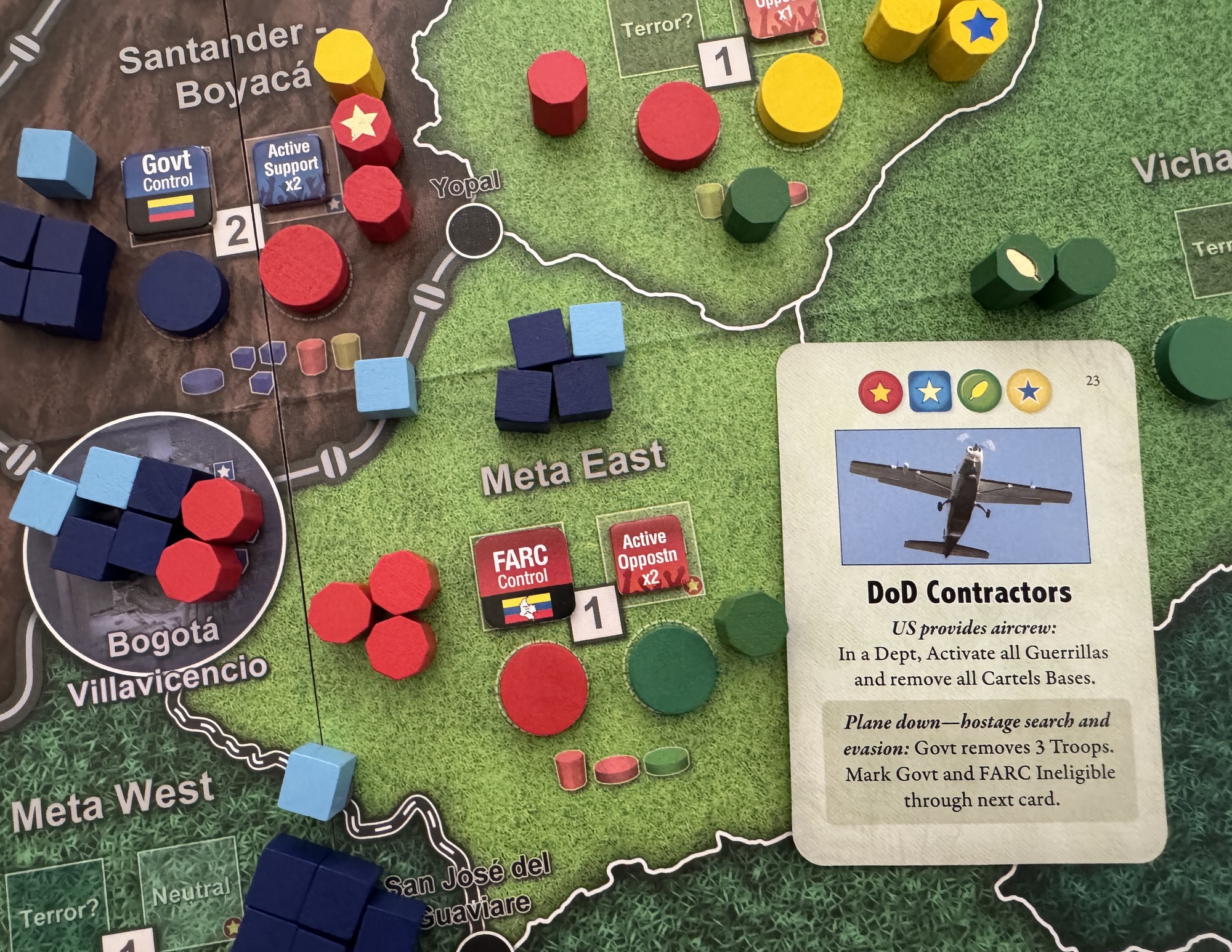
#91: DoD Contractors from Andean Abyss: Insurgency and Counterinsurgency in Colombia from GMT Games
The first game in the COIN Series called Andean Abyss is a 1-4 player multifaction treatment of the campaign for control of Colombia with different factions such as the the Government, FARC (Fuerzas Armadas Revolucionarias de Colombia), AUC (Autodefensas Unidas de Colombia) and the Cartels. The game focuses on all of the facets of the conflict including guerrillas and police, kidnapping and the drug war, military sweeps and terror. The factions deploy distinct capabilities and tactics to influence Colombian affairs and achieve differing goals. Andean Abyss creates an opportunity to get a feel for this model of insurgency and counterinsurgency in Colombia.
In this entry, we will take a look at the interesting and fairly powerful DoD Contractors. The card pays homage to the efforts by the Department of Defense to pay independent contractors to provide pilots for crop spraying over FARC-held territory and for reconnaissance flights to pinpoint the locations of guerrillas and their bases of operation. Patrolling FARC guerrillas in 2003 shot down one such flight along the western slopes of Caquetá and took three US personnel hostage, setting off a Colombian Army manhunt. The event gives the Government player the opportunity in a single Department to Activate all underground Guerillas and also to remove all Cartels Bases. Typically, to perform this type of action is a multi-turn investment with the Government having to mobilize and move Troops and Police into a Department and then perform a Sweep operation to uncover them. Then on a following turn, they can Assault and do things likes Air Strikes to attempt to eliminate these units. But this is very hard to do as the FARC and Cartel player can just use their next action to send their units back Underground or to Rally additional units in the space to safeguard their assets and Bases. On the other side, the Insurgents can use the event to remove up to 3 Government Troop Cubes and also mark both the Government and FARC ineligible through the next turn which means they will lose a turn. This effect is tied to the manhunt by the Government looking for the downed hostages as their resources and efforts are tied up preventing them from taking their normal actions. This can be really powerful and allow the insurgents to recover and get their units on the move or bring in more. Depending upon the time of the game that this is played, and around whatever circumstances are going on, this can really be a powerful card either way and I love how it reflects the US efforts to smoke out these drug lords in their war on drugs.
In 1978, Baton Rouge pilot Barry Seal, who flew commercial jets for TWA, is recruited by CIA case officer Monty Schafer. He asks Seal, who has been smuggling Cuban cigars into the country to make a little money, to fly reconnaissance missions over Central America using an Aerostar 600, outfitted with aerial surveillance cameras. Seal accepts the job, but hides it from his wife, Lucy.
In the 1980’s, Schafer asks Seal to act as a courier between the CIA and General Noriega in Panama. During a mission, the Medellín Cartel picks Seal up and asks him to fly cocaine on his return flights to the US. Seal accepts and flies the cartel’s cocaine to Louisiana, airdropping the drug in the countryside.
The CIA turns a blind eye to the drug smuggling, but the DEA tracks Seal down. To avoid the authorities, Seal and his family relocate to Mena, Arkansas and his wife comes to accept the wealth generated by his side job. The small town becomes wealthy as the hub of US cocaine trafficking.
Later, Schafer asks Seal to run guns to the Nicaraguan Contras in Honduras. Realizing the Contras are not serious about the war and just want to get rich, Seal starts trading the guns to the cartel. The CIA sets up a Contra training base in Mena and Seal flies the Contras in, but many of them escape as soon as they arrive.
Seal makes so much money he buries it in suitcases in the backyard. The FBI catches wind of the sudden exuberance on the streets of Mena. Eventually, the CIA shuts down the program and abandons Seal, who is arrested by the FBI, DEA, ATF and Arkansas State Police simultaneously.
Seal escapes prosecution by making a deal with the White House, which wants evidence of the Sandinistas being drug traffickers. They ask him to get photos that tie the Medellín Cartel to the Nicaraguan Sandinistas. Seal manages to get them, but the White House releases them as propaganda against the Sandinistas. Seal is prominently shown in the pictures, which leads to his indictment by the crusading state attorney general and the cartel plotting revenge.
Seal is convicted but sentenced to only 1,000 hours of community service. Moving from motel to motel making video recordings detailing his experiences, Seal expects an explosion any time he starts his car. As his community service is performed at the same Salvation Army building every night, Seal cannot hide from the cartel and is shot dead by an assassin. The CIA destroys all evidence connecting them to Seal and continues smuggling, instead using Iran to get guns to the Contras, as proposed by Schafer.
While this example is a bit more than crop dusting, the operation is part of the same deal and shows the US Government’s reliance on private commercial aircraft pilots during the war on drugs.
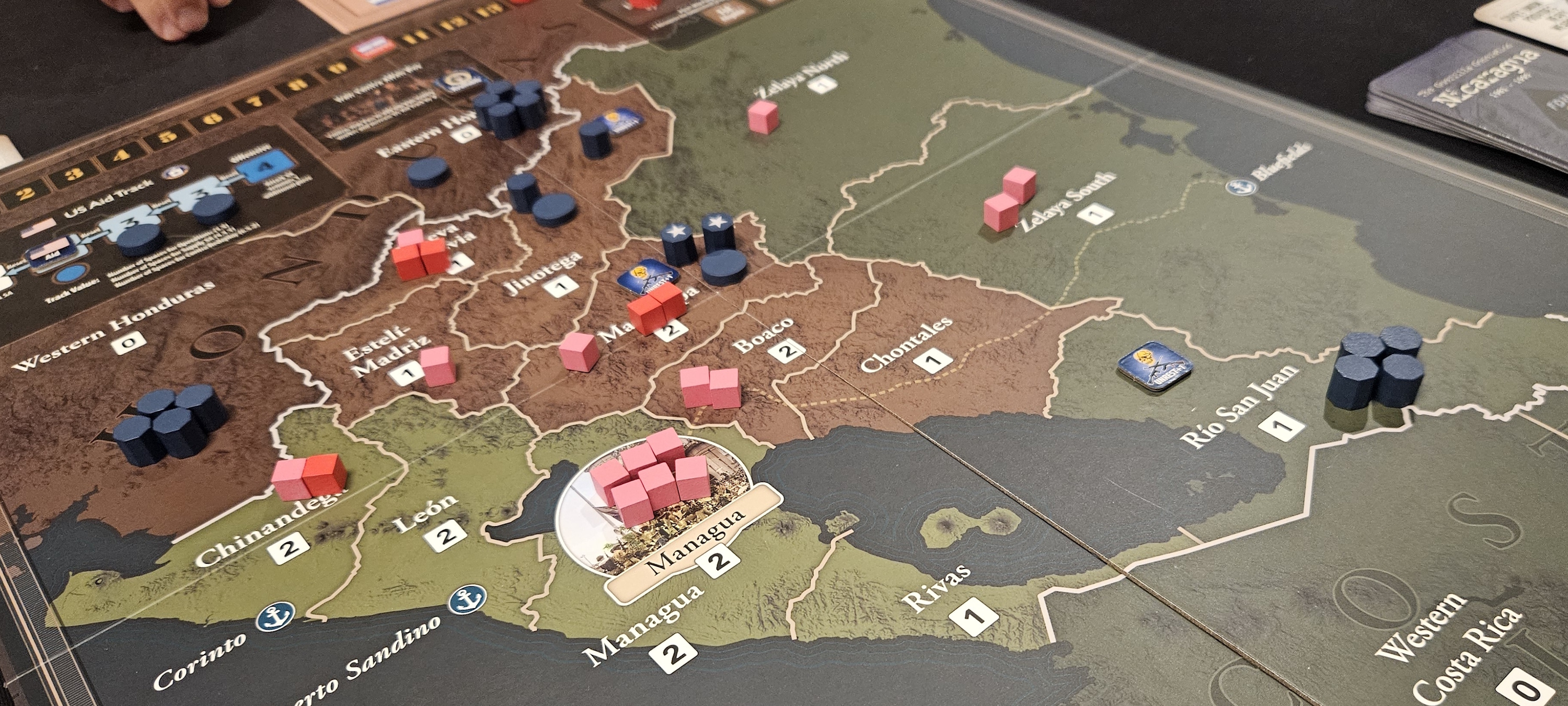
The first thing one notices about the third scenario in Stephen Rangazas’s The Guerrilla Generation is that the script has been flipped. Unlike both the Uruguay and Peru scenarios, which presented the COIN Series’s customary red insurgents facing off against government blues, here the entire color scheme has been inverted. Now the insurgent cylinders are the blue ones, while the government’s troops and police are red and pink. The effect is jarring. More than once, I found myself staring at the wrong side of the faction aid, trying in vain to make sense of the information before me. What do you mean the red side needs to deploy sweep-and-clear operations? Wait, the pinkos have air superiority? When has that ever been the case?
This is Nicaragua, baby. One short year after the socialist Sandinistas ended the Somoza family’s four-decade reign, inheriting an indebted and war-wracked country, the U.S.-backed Contras are pouring over the border from Honduras and Costa Rica. What follows is the most harrowing of the multipack’s scenarios thus far.
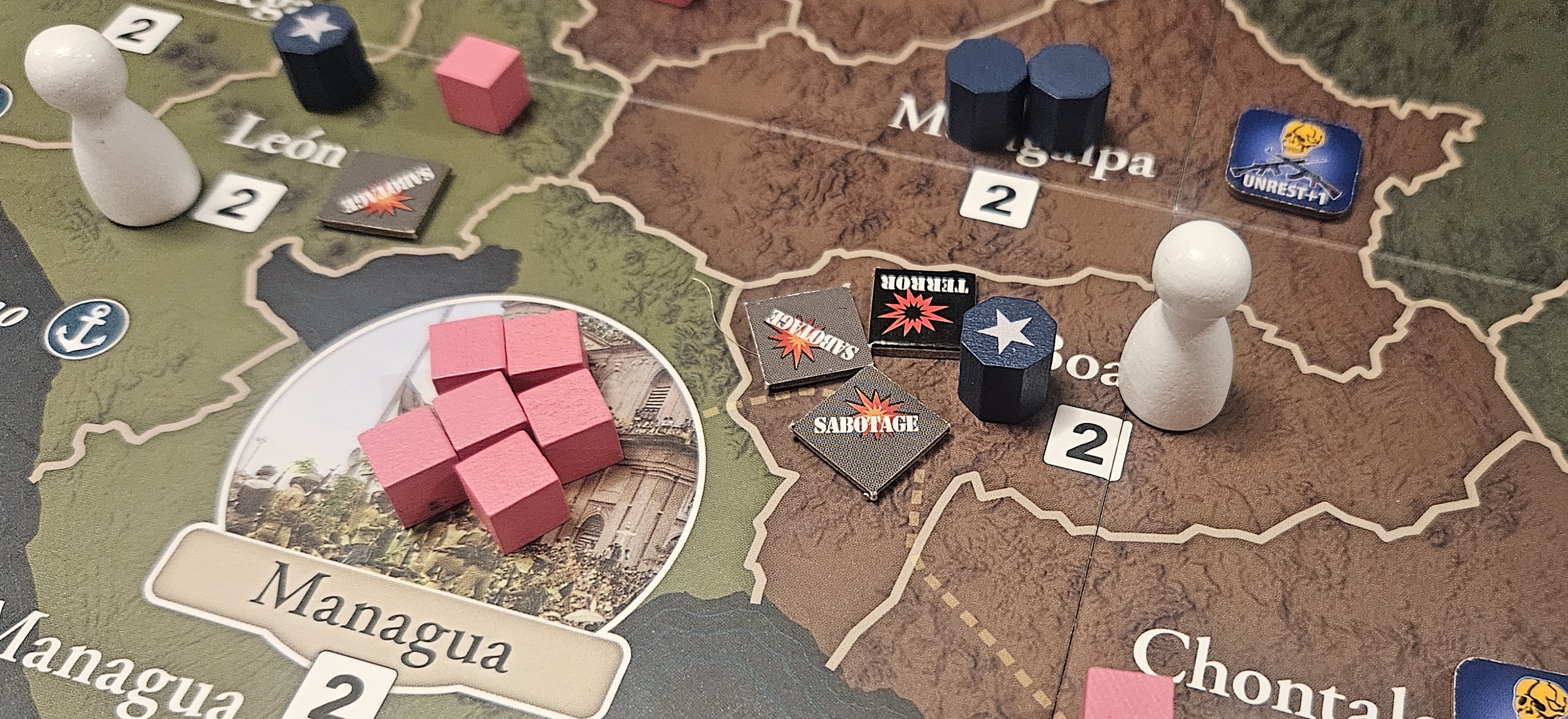
Nicaragua under siege.
As always, the first few turns in a new COIN scenario are testy. Both sides take longer turns than usual, acquainting themselves with the operations that will be their guiding star over the next few hours. (Or, in the case of Rangazas’s scenarios, the next hour to ninety minutes.) Everything is new. The contours of the geography, with its many tropical hiding places and mountainous hard points. The location of any urban centers and their lifelines through the countryside. Any neighboring countries to act as hiding places for roving insurgent forces.
And, in this case, the sudden realization that the Sandinistas are going to have to find a way to afford all this stuff, while the Contras are perpetually flush.
This isn’t the first time in the COIN Series a faction has wielded unlimited spending potential. That distinction traces all the way back to the bottomless pockets of the Coalition in Brian Train’s A Distant Plain. Even this multipack has already showcased a scenario that dispensed with funding altogether.
But what makes Nicaragua so dizzying is that here it’s the insurgents who can act with impunity, not the government. In the background, the Sandinistas are hurrying to repair the damage from the last bad decade of Somozan rule, including the earthquake that leveled much of Managua only for relief funds to quietly route into el presidente’s personal bank account. Now they’re making good on their promises: literacy campaigns, schools, hospitals. Also no small measure of native repression, in case you’re thinking everything is rosy. So when it comes to the CIA shenanigans in Honduras, the Contras with their limitless materiel, the commandos laying nautical mines in the harbors, the U.S. embargo squeezing the entire economy, there simply isn’t enough cash to go around.
It wouldn’t matter so much if everything weren’t so damned expensive. When the scenario opens, the Sandinistas are desperately undermanned. This makes sense in context. All those bright-red troops and hot-pink police have been hastily retrained from the previous conflict’s insurgent cylinders. This leaves much of the country unprotected, especially around the fringes. The only solution, especially early on, is to spend, spend, spend. Spend to train more police. Spend to garrison them in the countryside. Spend to sweep into insurgent hotbeds. Spend to send in the soldiers with the big guns. Even with the multipack’s briefer campaigns, hovering around only eight cards per propaganda round, it isn’t uncommon for a government player to find themselves skint with a good few turns before the next infusion of income.
That’s a little too close to home for comfort.
The only reprieve comes from the Contras themselves. Once again, Rangazas uses the limited tools of Volko Ruhnke’s COIN System to carve out some impressive evocations of insurgent warfare. Unlike the other insurgents we’ve seen thus far, the Contras are not locals. Or, well, they’re locals, former members of Somoza’s national guard or disillusioned revolutionaries, but they aren’t locals the way the Tupamaros were locals to Montevideo or the Shining Path were locals to Ayacucho. The Contras are roving death squads. Their targets aren’t only military, but also the schools and hospitals and agricultural collectives currently being set up by the Sandinistas. Their targets are economic. And therefore civilian.
Which means the Contras don’t have roots in local communities. They can establish bases in Nicaragua, but these are closer to waystations than actual recruitment centers. All their actual recruitment occurs in neighboring countries, in the safe harbors of Honduras and Costa Rica. They aren’t wholly untouchable across these borders; the Sandinistas can lob artillery strikes into foreign territory, risking erosions to their legitimacy, and depending on the whims of the event deck might mount small incursions. But their foreign-backed status informs everything about how the Contras behave. They deploy in foreign territory, then infiltrate into Nicaragua via mountain passages and jungle paths. Once there, they mount attacks and sabotage infrastructure — the customary insurgent tactics — only to melt back across the border at regular intervals.
This produces a starkly different type of gameplay from the usual COIN fare. The Contras work according to their own circadian rhythm, there and back again, in offensives and dispersions, rather than claiming territory long-term. When a campaign ends, they can maintain a certain number of toeholds in-country, but not so many that they won’t have to yield something hard-fought.
More importantly, this gives the Sandinistas some breathing room. Border security is a priority, and not an impossible one. Urban centers have always been tough nuts to crack, but Managua’s central position makes it uniquely secure among COIN capitals. It isn’t unthinkable, for example, that the Sandinista player might opt to empty it of protection altogether. A risky proposition, but one that might put its manpower to better use in more vulnerable sectors.
Meanwhile, the geography takes on real significance. Given its operational focus, the COIN Series has always taken a satellite perspective of territory, more about regional tendencies than individual strongpoints. Here, one immediately grasps the various inroads the Contras might take toward destabilizing the socialist regime. Harbors on the coast are vulnerable, but are more readily policed. The mountains are good hiding spots for entrenched death squads, but access can be blocked with some well-placed army divisions. Perhaps the tenderest pressure point is the harbor on the country’s Atlantic coast, far from Managua and surrounded by jungle. But the Contras also struggle to project that far. It’s a pickle all around.
Come get your yankee dollars!
Of all its pickles, however, none are more vinegary than the looming gaze of the continental hegemon. The United States is never absent from either side’s thoughts. While the Contras don’t have to worry about actual resources, they are subject to American pocketbooks. Depending on the current status of U.S. aid, their operations can target between two to four regions at a time. This encourages the Contras to spend at least a portion of their attention attending to their paymasters, whether through the event deck or by occasionally passing to beg for more attention.
The Sandinistas, for their part, must also keep an eye on the Yankees. There’s no avenue for directly tanking funding to the Contras; the inner workings of a corrupt American presidency are far above the Sandinistas’ ability to influence. But there are ample cards in the deck for applying international pressure. This makes the Sandinista player somewhat reliant on the sequencing of the event deck, but it also prevents their operations from becoming rote. More than most of Rangazas’s scenarios across both The Guerrilla Generation and The British Way, and indeed more than most of the main COIN volumes, Government players must consider every possible avenue for undermining their opponent. Where these titles usually present their government factions as clear frontrunners in terms of wealth and manpower, here they feel fragile and outmanned. They’re the region’s big dog, but their hookworms are funded by the most powerful empire in human history.
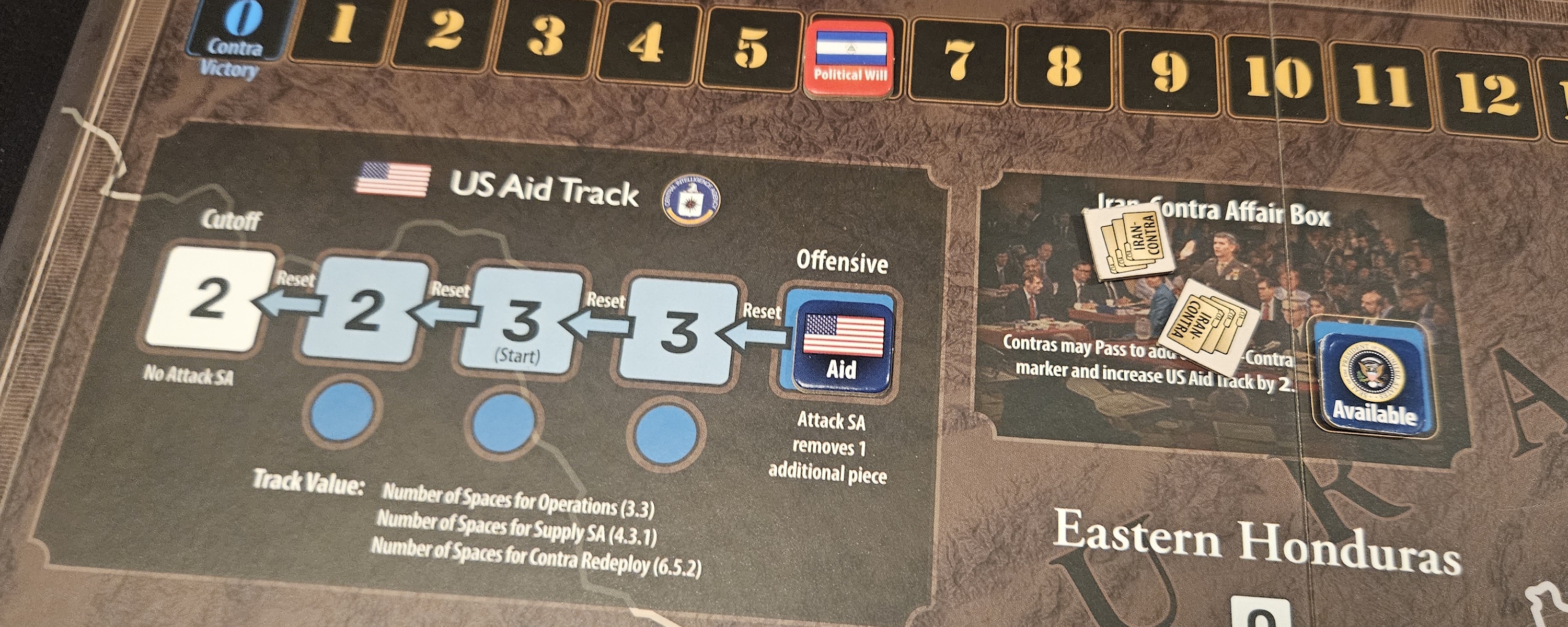
Which makes the Iran–Contra Affair such a big deal. Whenever the Contras require extra help, they can pass to bump up the aid track. The price is an extra evidence token in the Iran–Contra box. This isn’t guaranteed to trigger; in fact, it’s even less likely than the People’s Prison being uncovered in Uruguay or Abimael Guzmán being captured in Peru. But if Reagan does happen to get caught funding a violent insurgency that wantonly targets civilians, the ramifications are considerable. With no further ability to increase their funding, there’s a very real chance the Contras will wither on the vine.
Where the previous two scenarios existed in isolation, this draws greater attention to the specter of American involvement in Latin American politics. There’s the wider situation to consider. For The British Way, Rangazas connected all four scenarios via a meta-campaign that traced the larger anti-colonial movement against the British Empire. The Guerrilla Generation includes a similar option, one that’s both more focused and more ambitious. This campaign, called Resisting Reagan, allows players to tackle both this scenario and the next one side by side. It’s a massive undertaking, requiring familiarity with both scenarios and an additional set of campaign rules.
Which is why it will have to wait for its own chapter in this series. Hey, I can only do so much at a time. Look at the bright side: bonus fifth part! Yay!
(Right? Yay?)
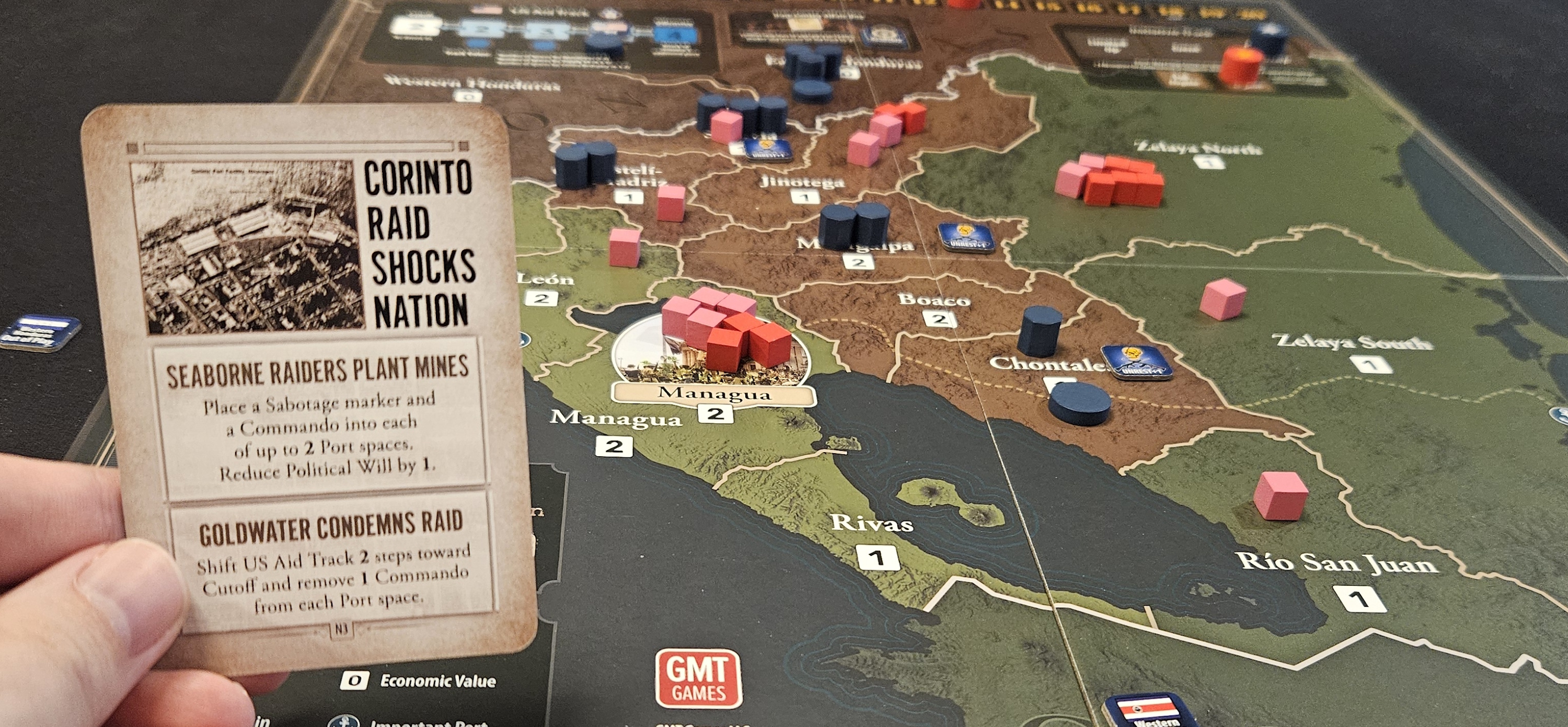
You’ve gotta be doing something wrong if Barry Goldwater denounces it.
All told, Nicaragua is not only the strongest of the three scenarios we’ve played in this multipack, and not only one of Rangazas’s best uses of this long-running system about counterinsurgencies, but one of the best expressions of the wider COIN Series, period. It draws clear delineations between its besieged (and increasingly problematic) revolutionary government and the foreign-backed commandos raising hell in the countryside, presents a novel gameplay scheme in the constant ebb and flow of its insurgents, and, perhaps most importantly, draws the player’s attention outward to the wider problems of American imperialism besetting the titular guerrilla generation on all sides. As my play partner put it, this might be the first COIN scenario that he would request we play again.
But another session in Nicaragua will have to wait for Resisting Reagan. First, we need to examine the multipack’s fourth and final scenario, and the one most personal to me: El Salvador.
A complimentary copy of The Guerrilla Generation was provided by the publisher.
(If what I’m doing at Space-Biff! is valuable to you in some way, please consider dropping by my Patreon campaign or Ko-fi. Right now, supporters can read the next installment in my series Talking About Games, this time tackling the topic of what makes a good list! Naturally, the piece includes a list.)

 Anmelden