Normale Ansicht

My Favorite Wargame Cards – A Look at Individual Cards from My Favorite Games – Card #79: Culper Ring from Liberty or Death: The American Insurrection from GMT Games

Von: Grant
26. Mai 2026 um 17:13

With this My Favorite Wargame Cards Series, I hope to take a look at a specific card from the various wargames that I have played and share how it is used in the game. I am not a strategist and frankly I am not that good at games but I do understand how things should work and be used in games. With that being said, here is the next entry in this series.

#79: Culper Ring from Liberty or Death: The American Insurrection from GMT Games

In case you didn’t know, I love Liberty or Death: The American Insurrection! This is my 2nd favorite volume in the COIN Series and is such a fantastic game filled with the history of my favorite historical period the American Revolutionary War. Liberty or Death was the COIN Series’ first foray into non-modern warfare and takes us to the 18th Century and the days of the Brown Bess musket, the 18 pound siege cannon and nice and tidy formations better suited for a gentleman’s war. The focus of the game is the struggle of the American Patriots against their mother British government as they have made their intentions clear to become independent with the Declaration of Independence. The game is a multi-faction treatment of the American Revolution, which includes the Patriots and their allies the French against the British and their reluctant allies the Indians.

Liberty or Death is a 1 to 4 player game focused on all aspects of the struggle including financing operations with Rabble Rousing, infiltrating British held cities to Skirmish, blockading major cities with the mighty French fleet, Raiding the frontiers with the Indian nations, the spread of propaganda to build support for the revolution, fort building and small scale battles. So, with this short description you can see that this game is not a “traditional” wargame but does contain some armed conflict. So a game about the American Revolution that isn’t focused on battle you say? How can that be? Well, I will tell you that this game is probably a perfect representation of the multifaceted struggle that wasn’t necessarily decided on the field of combat, but by the little actions of many behind the scenes characters. Yes battle will decide the control of major areas of the board and decide the fate of troops as they must be concerned about being in supply through a network of forts but the game is so much more than just rolling some dice and consulting a CRT!

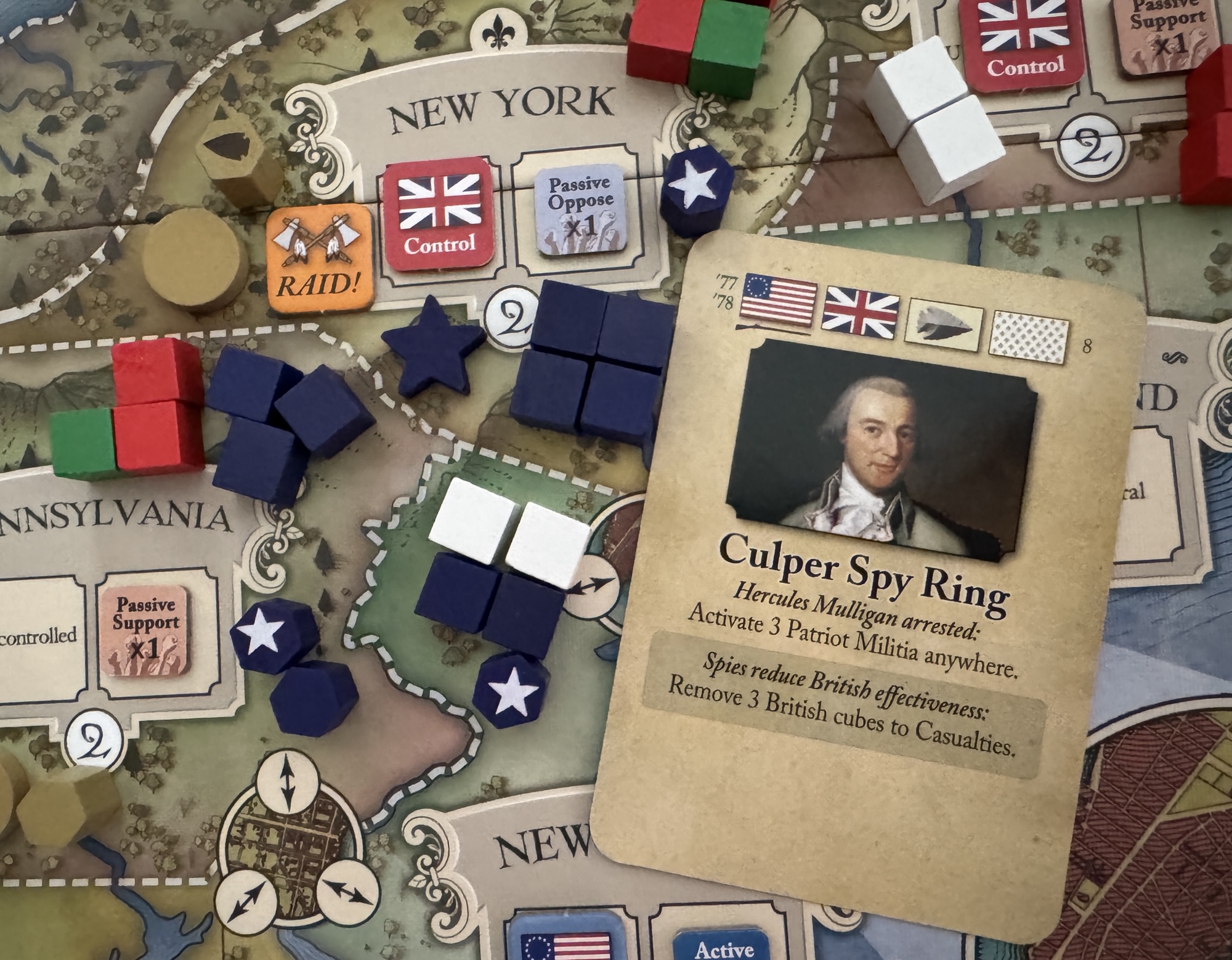
In today’s entry, we are going to take a look at a very interesting card called Culper Spy Ring. I very much enjoy the connection of this card to the history of the American Revolution as it deals with one of the more important aspects of the war being that of reconnaissance and spying to gain intel on the enemy’s plans and the makeup and disposition of their forces. The Culper Spy Ring card allows the British/Indian players to Activate 3 Patriot Militia pieces anywhere on the board. These pieces do not have to be located together in the same space but can be in 3 different spaces if the players chooses. This is a very powerful event as the Patriot Militia are generally only able to perform their actions if they are Underground meaning hidden from the British. Typically their Commands and Special Activities for things such as Rabble Rousing (create Opposition to Crown rule), Persuasion (get Resources) and Partisans (attack Royalist pieces), require at least 1 Underground Militia piece be in the space and typically requires that they be Activated or turned face up with their embossed star icon showing. The process of turning up these Militia pieces normally involves a British March Command into a space with Underground Militia but the process of removing them requires an additional step by taking either a Skirmish Special Activity or a Battle Command. This card allows for these turncoats to be discovered and then removed in a later action. If you also read the card above the action description you will notice that it says “Hercules Mulligan arrested”. Hercules Mulligan was an Irish-American tailor, spy, and founding member of the Sons of Liberty. Operating in British-occupied New York City, he used his high-end tailor shop to befriend British officers, gather critical intelligence, and covertly pass military secrets to General George Washington. Mulligan is credited with twice saving General Washington from capture or ambush. He sent secret messages, often via his trusted assistant Cato, warning Washington of planned British traps. I love the history here and am very glad that the design and development team gave a shout out to this little known American hero who risked his life to perform these spy activities in New York City.

The bottom half of the event is for the Patriot/French player and has an immediate powerful effect that can change the odds of an upcoming Battle or wrest control of a key province from the British at an inopportune time. The event simply allows the removal of 3 British Cubes from the board, consisting of British Regulars or Tories, and then placing them into the Casualties Box. This is a key action because it can cause the shifting of the delicate balance for the British between Combined Rebellion Casualties (CRC) versus Combined British Casualties (CBC). This difference is 1 of the 2 parts of the British Victory Condition and the CRC must be higher than the CBC. I also love the text above this benefit as it states “Spies reduce British effectiveness”. This is an homage to the critical work of these spy rings as they often lead to more beneficial and favorable Patriot outcomes to Battles as they were better prepared or knew the British plans before the battle event took place.

Major Benjamin Tallmadge.

The Culper Spy Ring was an American intelligence network established in 1778 by Major Benjamin Tallmadge and General George Washington. Operating primarily in British-occupied New York City and Setauket, Long Island, the ring provided vital reconnaissance on British troop movements, notably exposing Benedict Arnold’s treasonous plot to surrender West Point. The network utilized a chain of trusted individuals rather than trained military spies from all walks of life. Some of the more famous spies in this vital ring included:

Agent 355: An anonymous female member within the ring whose true identity remains unknown, though she is credited with providing crucial insights

Benjamin Tallmadge (alias “John Bolton”): The spymaster and director of intelligence who managed the flow of information.

Abraham Woodhull (alias “Samuel Culper Sr.”): The primary gatherer of intelligence in Setauket, who oversaw the ring’s daily operations.

Robert Townsend (alias “Samuel Culper Jr.”): A Manhattan merchant and journalist who operated within British circles, collecting firsthand intelligence on the enemy.

Caleb Brewster: A daring whaleboat captain who transported the messages across the treacherous Long Island Sound.

Austin Roe: A Setauket tavern keeper who acted as the primary courier, frequently riding the 55 miles between Setauket and New York City.

The Culper Spy Ring is widely considered one of the most successful intelligence networks of the American Revolution. Its greatest achievements included preventing a surprise British ambush on incoming French forces in Rhode Island and securing the intelligence that led to the capture of British spy master John André. The secrecy maintained by Tallmadge was so effective that the true identities of the spies were not discovered by historians until the 20th century.

This Culper spy network was the feature of a television series on AMC called TURИ: Washington’s Spies that aired from April 2016 through August 2017 and spanned a total of 40 episodes.

The story of the drama covers events from 1776 to 1781 and features a farmer from Setauket, New York and his childhood friends who form an unlikely group of spies called the Culper Ring, which eventually helps to turn the tide during the American Revolutionary War. The series begins in October 1776, shortly after British victories, including the recapturing of Long Island and the Port of New York for the Crown, leaving General George Washington’s army in dire straits. The first episode opens with the following introductory text:

Autumn 1776. Insurgents have declared war against the Crown. Following a successful naval landing, His Majesty’s Army has forced Washington’s rebels into the wilderness. New York City serves as a military base of operations for the British. The Loyalists of nearby Long Island keep vigilant watch out for sympathizers and spies.

I very much enjoyed the tv show and loved watching each episode to see the hidden historical details of the Culper Spy Ring be revealed that have been discovered over the past few hundred years since the events of the American Revolution. Just an amazing example of a grass roots and loosely organized group of Patriots who risked their lives and families to ensure that the cause of Liberty prevailed.

In the next entry in this series, we will take a look at Rome Offers Settlement from Barbarians at the Gates, The Decline and Fall of the Western Roman Empire 337 – 476 from Compass Games.

-Grant
My Favorite Wargame Cards – A Look at Individual Cards from My Favorite Games – Card #78: Hamburger Hill from Fire in the Lake: Insurgency in Vietnam from GMT Games

Von: Grant
19. Mai 2026 um 14:00

With this My Favorite Wargame Cards Series, I hope to take a look at a specific card from the various wargames that I have played and share how it is used in the game. I am not a strategist and frankly I am not that good at games but I do understand how things should work and be used in games. With that being said, here is the next entry in this series.

#78: Hamburger Hill from Fire in the Lake: Insurgency in Vietnam from GMT Games

The COIN Series uses cards in a very different way from other CDG’s. These cards are not necessarily the driver of the action but more assistive to the actions of the players by setting eligibility and also providing powerful events. The Event Cards are more often than not, very powerful. They either give you a continuing bonus on future Operations and Special Activities (as in the case of the volumes that include the various Capabilities) or allow you to take Operations and Special Activities more times that round than you would normally have been able to had you not chosen the Event and more often than not, at no cost! Also, because of the power of the cards and their ties to one or more factions, you can take the Event which allows you a huge advantage, only to see that very powerful Event reversed with the next Event or with a regular Operation. This is very frustrating but is one of the major reasons that I love the card-assisted element of the COIN Series. Today we are going to take a look at the Hamburger Hill Event Card.

But first an aside. Along with the movie Platoon, my introduction to the fierce fighting in the Ashau Valley of Vietnam was mainly from the movie Hamburger Hill starring Dylan McDermott as Lt. Frantz and Courtney Vance as Doc. The images from this movie will be forever burned in my mind and with the recent passing of the anniversary of the battle’s start on May 13th I thought it would be a perfect time to cover this card.

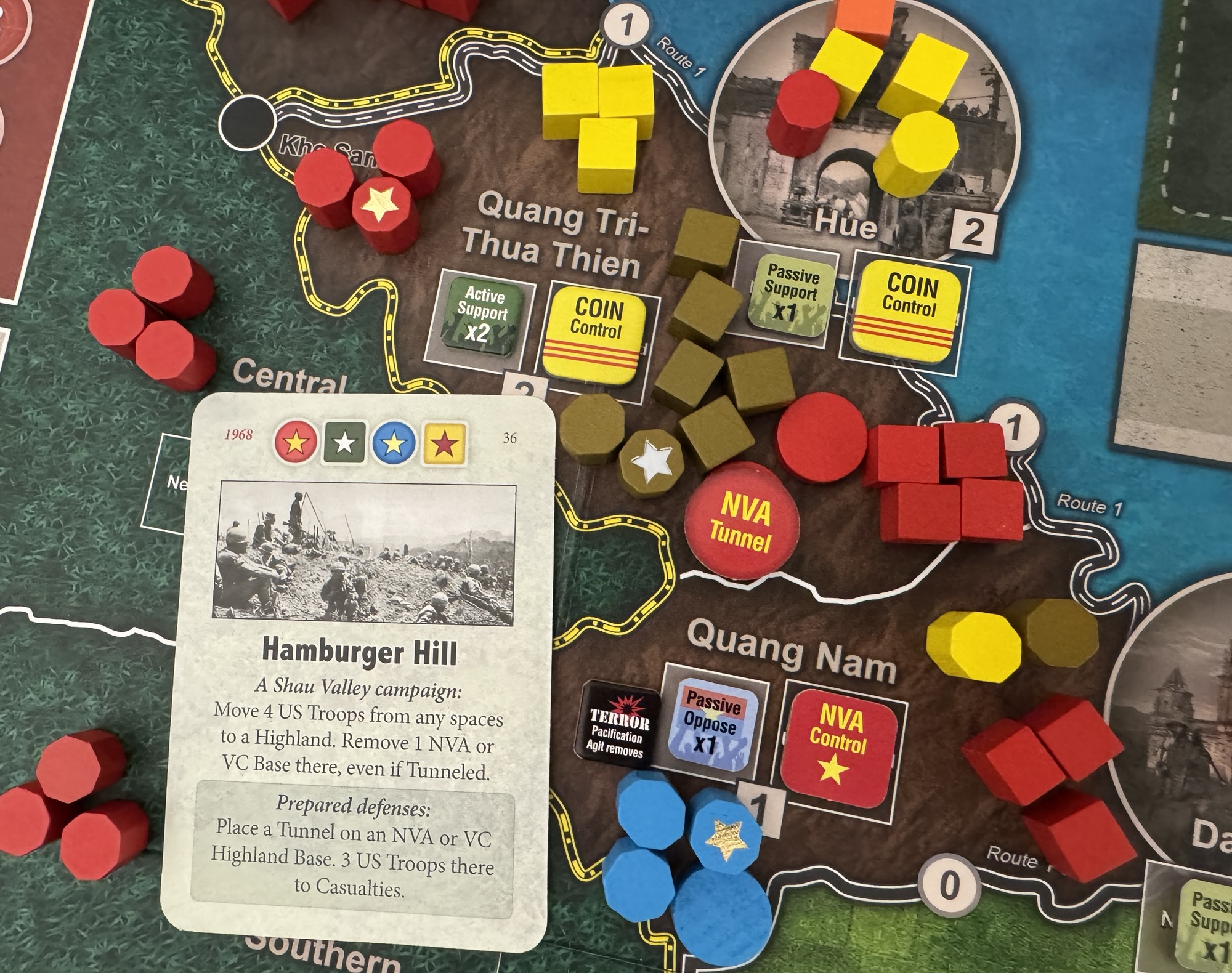
The Hamburger Hill Event Card has a top event and a bottom event, which is the case with all cards found in the decks of COIN Series games. The top event benefits the US/ARVN players while the bottom benefits the NVA/VC players. The top event allows the US player to move 4 US Troop Cubes from any spaces on the board to any Highland space, which are the brown colored regions representing less forgiving elevated terrain and mountainous areas. It then goes onto allow the removal of any NVA or VC base there, even if the base is currently Tunneled. This is a very powerful event as normally moving units requires an Air Lift Special Activity or a Train Operation to place new units into a space. Also, removing a Base, and especially a Tunneled Base, requires multiple turns and a focused approach of Patrol, Sweep and Assault to uncover hiding Insurgent pieces and then to destroy them allowing for a Base to be removed.

The Insurgent half of the event allows them to place a new Tunneled Based into a Highland space as well as remove 3 US Troop Cubes to Casualties. The Casualties Box is where these “dead” cubes are stored until the Coup Round where they will have negative effects on the United States player and then be available again for use in the next turn. This event is very powerful and is a major boon for the Insurgent player in taking control of and maintaining their presence in the Highland Provinces.

I also very much like the historical connection to the Battle of Hamburger Hill and think that the designers did a great job of creating this event with real game effects related to the battle and consequences that are felt from the play of the card. This Hamburger Hill Event is one that will be played by both sides often rather than taking their Operations and Special Activities. The effects are just too efficient and powerful to pass on unless the timing of the game dictates differently.

The Battle of Hamburger Hill was a major battle that lasted from May 13–20, 1969 was fought by United States Army and Army of the Republic of Vietnam (ARVN) forces against People’s Army of Vietnam (PAVN) forces during Operation Apache Snow of the Vietnam War. Though the heavily fortified Hill 937, a ridge of the mountain Dong Ap Bia in central Vietnam near its western border with Laos, had little strategic value, US command ordered its capture by a frontal assault, only to abandon it soon thereafter. The action caused a controversy among both the US armed services and the public back home, and marked a turning point in US involvement in Vietnam.

The battle was primarily an infantry engagement, with the US troops moving up the steeply sloped hill against well-entrenched troops. Attacks were repeatedly repelled by the PAVN defenses. Bad weather also hindered operations. Nevertheless, the Airborne troops took the hill through direct assault with heavy use of artillery and airstrikes, causing extensive casualties to the PAVN forces.

Local Degar tribesmen call the mountain Ap Bia, which means “the mountain of the crouching beast.” Official histories of the engagement refer to it as Hill 937 after the elevation displayed on US Army maps, but the US soldiers who fought there dubbed it “Hamburger Hill,” suggesting that those who fought on the hill were “ground up like hamburger meat.”

The quote was attributed to Sgt. James Spears who said, “Have you ever been inside a hamburger machine? We just got cut to pieces by extremely accurate machine gun fire…”.

US Army photographers climb Hill 937 at Dong Ap Bia after the battle, May 1969.

In the next entry in this series, we will take a look at Culper Ring from Liberty or Death: The American Insurrection from GMT Games.

-Grant

My Favorite Wargame Cards – A Look at Individual Cards from My Favorite Games – Card #74: Open Borders from 2040: An American Insurgency from Compass Games

Von: Grant
22. April 2026 um 14:00

With this My Favorite Wargame Cards Series, I hope to take a look at a specific card from the various wargames that I have played and share how it is used in the game. I am not a strategist and frankly I am not that good at games but I do understand how things should work and be used in games. With that being said, here is the next entry in this series.

#74: Open Borders from 2040: An American Insurgency from Compass Games

2040: An American Insurgency is a card driven game that attempts to simulate a near future US civil war in the 21st century. In this 2-player game that plays in less than 3 hours, the blue team is the Federals representing agents of the government in Washington. The red team are the Rebels including militia groups trying to seize control of states, highways, and cities. The conflict spreads across the entire continental US, from Miami to Seattle and from Los Angeles to New York.

This game is not perfect and it has some issues and the graphics are not that great frankly. As I played the game, I actually felt like it was a pretty decent game, with some very interesting mechanics covering an interesting topic. I know it isn’t perfect and in some ways the designer was so careful not to offend anyone in the game that he really didn’t get to say anything about the situation and its causes, and the game somewhat suffers from that. But it was interesting and I believe that we are about the only ones who played the game.

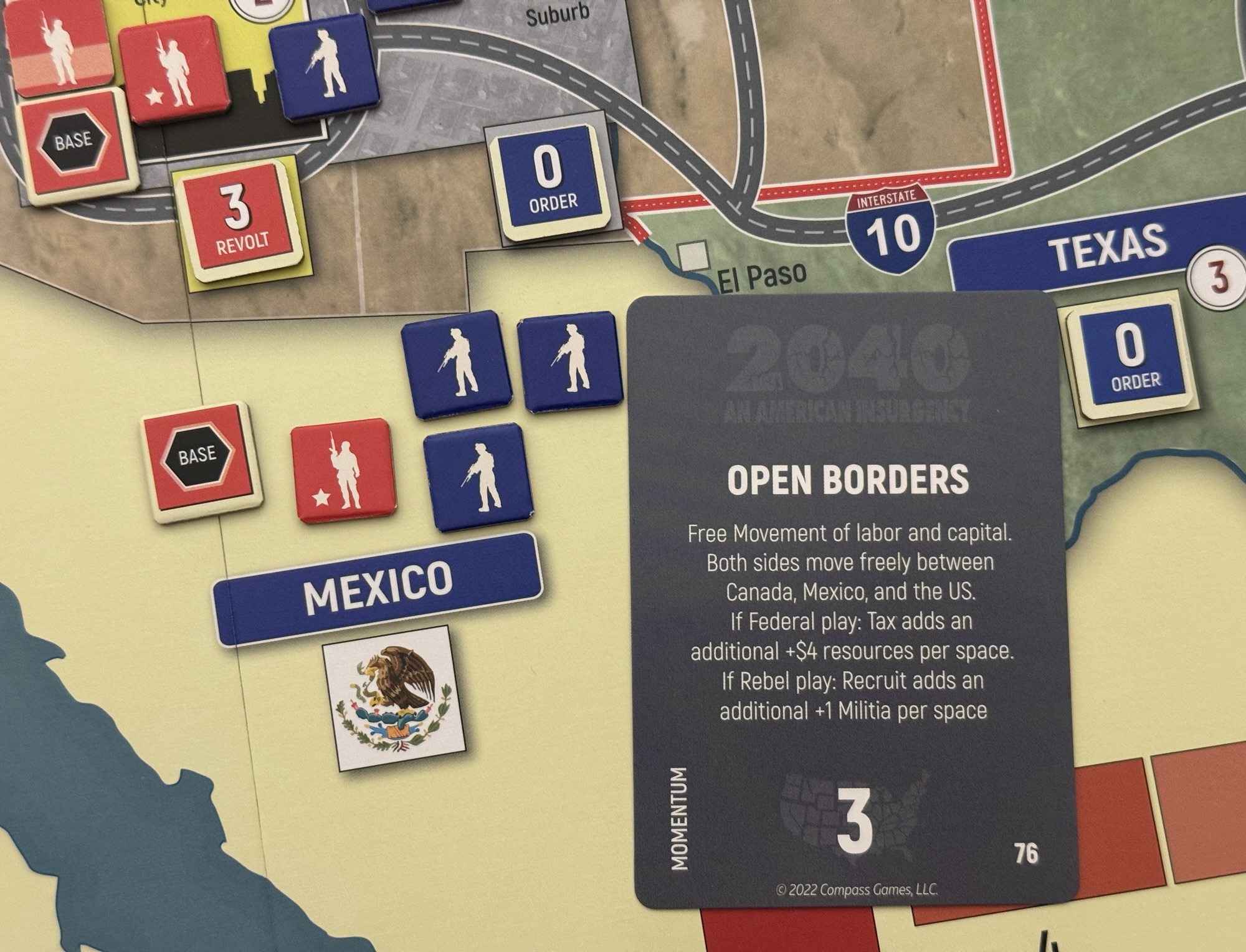
In this post, I will be taking a look at a Neutral Card called Open Borders. Remember, that each event is either friendly, enemy, or neutral. Friendly events help you; enemy events help your enemy while Neutral events can help either player. Gray cards such as Open Borders have no identifying side’s markings in the bottom right corner and when you play a Neutral Card, you may choose to do the Ops or the Event. Open Borders is a very good Neutral Card because it is a 3 Ops card and can be used to take various standard operations, such as raising
troops, fundraising and attacking. The card also is identified as a Momentum Card, which means that if played as the event, the effect will persist until a time specified in the text of the Event or, if none, until the end of the game. With Open Borders, the spaces of Mexico and Canada become playable areas on the board. These areas typically become a way for the Rebels to build and develop bases from which they recruit fresh insurgent units and then cross over the Open Borders to attack those States that border these areas eroding their Order and creating chaos and Revolt. The Open Borders Card allows this but also allows the Federal player to respond by crossing over the border and attempting to squash these recruiting centers.

The other effects of the Event provides both sides with a bonus when they take certain actions such as Tax for the Federals and Recruit for the Rebels. When the card has been played and is in effect, the Federal Tax Action will provide an additional $4 worth of income from the action. This is an effect of open borders and the unrestricted use of free trade and cross border commerce creating new jobs, providing additional sources of income and employing workers who ultimately pay income taxes on those improved wages. The Rebel Recruit Action will gain an additional Militia unit per space where taken. This reflects the stoking of anger at home as illegals and other bad actors are able to pour across the borders unfettered. I very much like this card for its game effect but also for the questions and concerns that it raises in this debate. Such an interesting economic spin on this issue through the game and I think is a very well done part of the design.

The concept of open borders highlights a fundamental tension between national security, economic openness, and civil liberties. Post-9/11, critics argue that porous or “open” borders allow terrorists to exploit security gaps, while proponents of open borders emphasize that excessive restrictions hurt economic freedom and that security should be managed through intelligence rather than isolation. The biggest concern regarding open borders is that unvetted, irregular migration through porous borders can be exploited by extremists to enter countries and perform acts of terrorism, sedition or general mayhem. To manage the tension between security and economic openness, many nations have turned to the concept of biometric borders. This involves using risk profiling and digital identity such as fingerprints and facial recognition to separate “civilized” business travelers from “illegitimate” and bad actors. This use of these high tech instruments in surveillance, data tracking and technology to distinguish between legitimate travel and potential threats has raised more concerns with civil liberty and privacy. This debate often pits “secure borders” against “open doors,” with officials grappling with protecting citizens without sacrificing the democratic principles of open societies. In one of the most famous quotes from history about privacy, Benjamin Franklin stated “Those who would give up essential liberty, to purchase a little temporary safety, deserve neither liberty nor safety“. Where do you land on this issue of Open Borders?

Here is a link to our unboxing video showing the components:

Here also is a link to our full video review:

I also posted an interview with the designer Edward Castronova on the blog and you can read that at the following link: https://theplayersaid.com/2023/04/04/interview-with-edward-castronova-designer-of-2040-an-american-insurgency-from-compass-games-currently-on-kickstarter/

In the next entry in this series, we will take a look at The Second Funnel from The Hunt from Salt & Pepper Games.

-Grant

❌