If you want to read more ratings of historical leaders like this, I strongly recommend you subscribe to the blog – all new posts in your inbox right when they go live!
Some caveats ahead: The presidents will be rated by the knowledge of their time. If they or their contemporaries could not have known about the effects of something, I will not use my hindsight to mark it as a mistake of theirs. The assessment is focused on their conduct as president, but includes their life after holding the office (in which they will still be regarded in the public eye as (ex-)presidents).
Now, to the system itself: There are three policy field categories (foreign, domestic, and economic policy) and three more general ones (vision, pragmatism, integrity). A president can earn from one to five stars in each category (for a total sum of up to 30). In detail, the president is assessed as follows:
Foreign policy: Did the president increase US influence in the world and the security of Americans at home? Did the president wield US power responsibly and with positive results for the regions affected (the latter counting for a greater deal in times of US power being great)?
Domestic policy: Did the president increase the liberty of Americans to express themselves and to participate in the political process? Did the president promote domestic security and shape the framework for fair justice dealing with offenses?
Economic policy: Did the president facilitate the prosperity and economic security of Americans (including in the mid- and long-term)? Was the president’s economic policy based on mutual benefit of those involved or did it unduly burden one side?
Vision: Did the president have an idea of what the United States and the world (the latter counting for more in times of US influence being great) should look like beyond the immediate future? Did the president’s policies steer the United States (and, if applicable, the world) in this direction?
Pragmatism: Did the president succeed in seeing his policy through from inception to completion? How well did the president manage the support from Congress, society, the administration, the media (the latter counting for more in more recent years)?
Integrity: Did the president understand the office as a means to benefit himself, special interest groups, the entire country, or another community? Did the president respect the boundaries of the office?
Wilson’s Life
Receiving and Providing Education
Thomas Woodrow Wilson was born on December 28, 1856 as the son of a Presbyterian pastor in Staunton, Virginia. Wilson grew up in several states of the American South before, during, and after the Civil War. He would be the only American president who had been a citizen of the Confederacy.
Wilson became a lawyer, but found it not to his liking. Instead, he pursued graduate studies in political science with a dissertation on Congressional government at Johns Hopkins University. His PhD, awarded in 1886, makes him to this day the only US president with such an academic distinction. Even though Wilson had never bothered to take a trip from Baltimore to Washington, D.C., to see the object of his study in action, his dissertation was well received. Atypically for a southerner, he advocated for a strong federal government. At the end of his graduate studies, Wilson married Ellen Louise Axson, who came from a southern clergy family like himself.
Wilson’s academic career led him to teach at several universities. Eventually, he became president of Princeton University in 1902. He took the university out of the grip of Presbyterian traditionalists, appointed the first Catholic and Jewish professors, but worked vigorously against the enrolment of Black students. Wilson turned Princeton into one of America’s leading teaching and research institutions, fueled by the large contributions of outside donors which he attracted. At the same time, Wilson advocated – in often fiery rhetoric – for the independence of the university; a contradiction he could never resolve. Both his administrative reforms and his powerful oratory aroused interest in him political circles; and Wilson put out feelers to the Democratic Party.
To the Presidency
The Democrats, perennially shut out of national office since the Civil War, were in dire need of fresh candidates. Wilson seemed like an ideal fit to party bosses due to his reputation as a natural conservative with progressive credentials. He ran for governor of New Jersey in 1910 and was the first Democrat to be elected to the office in 18 years.
Woodrow Wilson was consistent in his support for labor reforms.
Anyone who believed Wilson to be a conservative at heart was swiftly disabused of the notion once he took office. He directed his energy to labor, electoral, and education reform. Within his first two years in office, Wilson had gained nationwide fame as a progressive leader.
That made him a contender for the 1912 presidential election. His campaign was ably run by the Texas businessman Edward M. House, and Wilson entered the 1912 Democratic National Convention second only to Speaker of the House James “Champ” Clark. When Clark gained the support of New York’s Tammany Hall political machine, that threw the liberal wing of the party, led by three-time presidential nominee William Jennings Bryan, into Wilson’s arms. Wilson gained his party’s nomination and went on to run against a split Republican Party in the general election: Incumbent president William H. Taft represented the party’s conservative wing, former president Theodore Roosevelt mounted a progressive challenge. As the Republican vote split, Wilson’s 42% of the popular vote were enough to give him a landslide victory in the electoral college.
Edward M. House ran Wilson’s election campaign, would conduct European diplomacy on Wilson’s behalf during and after World War I. He took great liberties in his diplomatic assignments and would be summarily sacked.
Reforms and Interventions
Wilson started the presidency where he had left off the governorship – with an ambitious domestic reform program. To clinch the reforms, he broke with the tradition that separated the executive and legislative branches of the American government: Wilson was the first president to appear before Congress since John Adams, a precedent which has since become standard practice. In another momentous move, Wilson focused his efforts to build legislative majorities on mobilizing his own party (which held both the Senate and the House), ignoring the Republican opposition. With these measures, Wilson enacted far-reaching economic reforms:
He replaced tariffs with a federal income tax as the chief source of federal revenue.
He established the Federal Reserve system to stabilize the heretofore decentralized, fragile American finance world.
His Antitrust Act clarified that unions and collective bargaining did not constitute a breach of freedom of contract.
Other Wilsonian reforms were less progressive: Wilson introduced segregation in several federal institutions including the Navy Department and the Post Office.
The worst imaginable day for Woodrow Wilson: Having to speak not one, but two people of color with opinions!
Wilson’s belief in a racial hierarchy also carried over into his foreign policy. During his presidency, the United States intervened in Mexico (twice), Nicaragua, the Dominican Republic, and Haiti (where a new constitution imposed on the country reintroduced the forced labor of corvée). The most momentous of these interventions took place in Mexico, where a US-backed coup had brought the authoritarian Victoriano Huerta to the presidency shortly before Wilson’s own accession to power. Wilson opposed Huerta and first imposed an arms embargo on Mexico, then landed forces in the Mexican port of Veracruz. The intervention did not shift the political situation in Mexico, and US forces left Veracruz after seven months of occupation in November 1914.
Wilson’s rhetoric accompanying the intervention was based on lofty principles, but he applied them rather flexibly: He argued both for imposing and for lifting the arms embargo with the “standards of neutrality”; and he justified both beginning and ending the intervention on moral grounds – the former with his commitment to constitutional government, the latter with Mexico’s right to national self-determination.
Self-determination – easy to define in the Americas (no intervention in other countries’ domestic affairs), but a thorny issue in the often ethnically diverse European countries at the Versailles peace negotiations.
Neutrality, Honor, and Prosperity
While the United States had been busy in Mexico, a much bigger conflict had erupted in Europe – the Great War. Over the next years, Wilson pursued a course which would allow the United States to maintain three competing objectives – neutrality, honor, and prosperity.
Wilson was driven by an honest desire to keep the United States out of the war. That did not mean that he was indifferent to its outcome. His sympathies lay clearly with the Allies. Every few months, his administration launched a peace initiative which would invariably come to nothing as they demanded very different things from the belligerents: The Allies were given the idea that Wilson wanted them to win victories before a peace should be negotiated, the Central Powers presented with unacceptable demands (like the cession of Alsace-Lorraine from Germany to France as a precondition for a peace conference).
Honor was an even trickier business than neutrality. Wilson demanded that the belligerent parties adhered to the London Declaration concerning the Laws of Naval War (which none of them had ratified), but in practice complied with the British violations of the Declaration – the harassment of neutral (including American) trade and the blockade of the German coast – while he denounced the German violations – submarine warfare. When a German submarine sunk the British ocean liner Lusitania shortly before it arrived in Liverpool with its cargo of ammunition for the Western front as well as over a thousand passengers – 128 of them American citizens – Wilson was outraged. He declared in a note to the German government that he would hold Germany responsible for any damages to American citizens and property. Secretary of State William Jennings Bryan resigned after the incident, believing Wilson endangered American neutrality with his hardline insistence on German (but not British) respect for trade rights.
“Global Trade” is a mildly isolationist strategy card in Versailles 1919: You focus on industrial growth (icon to the left), your own national happiness (third icon from the left), and try to not have the world blow up (bonus for regions with low unrest, icon to the right).
That brings us the third leg on which Wilson’s stool rested: While he never mentioned prosperity (much unlike neutrality and honor), it was a major motive for his wartime policies. In August 1914, Wilson had publicly opposed bonds for the Allies to be raised by American banks, but when the banks started issuing them, he did not contest it. Consequently, the American economy was effectively mobilized for the Allied cause: US goods were bought with money from US bonds. Allied victory thus became a national interest for the United States to see the bonds repaid.
In the short term, Wilsons’s hard line was successful. He forced Germany to comply with his notions of naval law while the American economy boomed from the war trade to the Allies. America reaped all the benefits of the war at none of the costs.
That made Wilson a strong contender for re-election in 1916. The Democratic Party touted his foreign policy success with “He Kept Us Out of the War” (a slogan which had been adopted without consulting Wilson). Still, Wilson’s main advantage of 1912 – the split Republican field – had evaporated. To beat his Republican opponent Charles Evans Hughes, he had to make inroads in states where Democrats had not fared well over the last decades. As Wilson feared that the new women voters in many of the western and midwestern states might take objection to his marriage to Edith Bolling Galt – just a year after his first wife Ellen had died – he tried to balance it out with publicly supporting women’s suffrage. While we do not have electoral statistics by gender for 1916, Wilson’s strong showing (for a Democrat) in the West and Midwest indicates that his strategy worked. In the end, Wilson’s victory in California by the hair’s breadth of 3,773 voters decided the presidential contest in his favor.
Women’s suffrage remained in the waiting room for a long time thanks to Wilson.
Into the War
In Wilson’s second term, his three-way balancing act between neutrality, honor, and prosperity became ever more precarious. One of them had to give – and the most likely candidate seemed neutrality, whose meaning Wilson had stretched beyond recognition anyway. Ironically, that happened just as Wilson made his first attempt to put pressure on the Allies (by withholding bonds if they did not agree to a peace conference).
Germany, unaware of any rifts between the US and the Allies, played the elephant in the diplomatic China shop again in January 1917: The German Foreign Secretary Arthur Zimmermann secretly instructed the German embassy in Mexico to sound out the Mexicans for an alliance in case the United States entered the war. Two weeks later, Germany resumed unrestricted submarine warfare in the British home waters again. Wilson felt he could not honorably back down from his hardline position of American trade and travel rights which he had taken in 1915, and broke off all diplomatic relations to Germany. A few days later, British naval intelligence relayed the contents of the “Zimmermann Telegram” to Wilson. Its release helped inflame American public opinion against Germany, but the essential decision had been made already: America would enter the war as an “associated power” on the Allied side. Congress voted in favor of a declaration of war at Wilson’s request on April 6, 1917.
Militarily, the United States was a dwarf in 1917. Safe itself due to large oceans and weak neighbors, its armed forces had been minuscule since the end of the Civil War. Expanding and training them would take time. And economically, the awesome might of America had been mobilized for the Allied cause anyway. Thus, the American war entry mattered little for the course of the war in the short term.
It did, however, have immediate domestic repercussions: On the one hand, government spending exploded. The expenses which the federal government accrued in the 19 months of war from April 1917 to November 1918 would exceed those of almost 130 years since the founding of the country. And Wilson cracked down on perceived opponents of the war: The Espionage Act made interference with military operations or recruitment illegal, which in practice meant that any kind of anti-war activism could – and often did – send the protester to prison. “Illoyal” publications were banned from postal transport which made them practically unavailable at any distance from their printing.
Preparing for the Post-War World
In the meantime, the war raged on. Wilson’s initial lofty rhetoric of a “war without victory” by which the world would be “made safe for democracy” had been largely superseded by the gritty requirements of military buildup and diplomatic compromises with the Allies. The day-to-day realpolitik of the Allies suffered a heavy blow when the October Revolution took Russia out of the Allied coalition in late 1917; and Wilson was subsequently also replaced as the leading visionary by a certain Vladimir Lenin whose radical rejection of imperialist war (along with capitalism as a whole) proved popular with the European masses after three years of carnage – and they set Russia to seal a deal with Germany and leave the war for good.
The second-worst imaginable day for Woodrow Wilson: Having to speak to a person of color with opinions and being usurped as the leading thinker on peace!
Wilson countered by laying out his vision for the post-war world before Congress on January 8, 1918: The Fourteen Points contained a mix of specific territorial changes and universal principles – the freedom of navigation and trade, disarmament, the rejection of secret diplomacy, and the founding of a “general association of nations”.
Wilson’s views condensed into one strategy card: Bonuses for containing Germany, self-determination to various nations, having Japan and Italy sign the Treaty of Versailles (and presumably joining the League of Nations), and for controlling issues pertaining to the League of Nations.
By summer 1918, American forces had arrived in Europe in substantial numbers. They contributed to turning the tide on the Western Front, and their ever-growing numbers (which matched the British and neared the French) and excellent supply situation convinced the German High Command that the war could not be won anymore. The German generals abandoned the sinking ship. Their civilian successors applied for a peace on the basis of the Fourteen Points.
Wilson, meanwhile, urged the American voters to consider the 1918 midterm elections as a plebiscite on his policies, especially the post-war order he had formulated. The voters soundly rejected him by giving majorities in both houses to the Republicans for the first time in eight years.
Germany and the Allies agreed to an armistice on the Western Front on November 11, 1918. While Germany’s new parliamentarian leaders dealt with the turmoil in their new republic, the Allies met on the outskirts of Paris to negotiate the peace treaty, chief of them the “Big Four” France, Britain, Italy, and the United States. Wilson attended the Versailles negotiations in person, which made him the first US president to leave the country on official business. After he had alienated the Republicans by his adversarial rhetoric before the 1918 midterms, he snubbed them even further by not including a single Republican senator in his delegation.
All of Wilson’s political goals merged at the Versailles peace negotiations. He wanted a new world order which would provide for long-term peace: “I am playing for a hundred years hence”, he told those who asked him why he would forgo short-term American gains. And the US was indeed different as the country did not angle for territorial enlargement – unlike the other major countries, which sought colonial expansion (especially Britain and France in the Middle East and Africa) or direct annexations of regions bordering their mainland (especially France along the Rhine and Italy in the Alps and on the Dalmatian coast). Wilson held mixed views on the territorial changes in Europe, but supported colonial expansion, especially where it benefitted European imperial powers rather than imperial Japan (another expression of his racial views).
Japan, the only non-white major nation at the Versailles peace conference, pushed hard to include a racial equality clause in the League of Nations. Wilson would have none of it.
Make no mistake: The US had direct material interests at stake as well. On the one hand, Wilson’s interest in free trade aligned with American business wanting to sell goods in the European markets, on the other, American finance expected the war bonds to be repaid. In the view of the European debtors, that required large reparations from Germany, so that the vanquished would pay for the costs of the war.
The Iron Bank… er, J.P. Morgan will have its due.
Wilson’s most cherished goal, however, was the establishment of that “association of nations” outlined in the Fourteen Points. In an ironic repudiation of the other principles of the Fourteen Points, Wilson engaged in the secret diplomacy horse-trading of Versailles, making large concessions to the wishes of the other Big Four nations for territorial enlargement, to get them to agree to what would become the League of Nations.
Here the card does not quite grab the nuances of the issue: The “One State, One Vote” camp at least partially had a special notion of it – Britain pushed hard (and eventually was confirmed) in securing a vote not only for its European part, but also for the four settler dominions Canada, Australia, New Zealand, and South Africa, as well as for its colonial possession India. Wilson, a supporter of the British Empire, was sympathetic to this arrangement.
In June 1919, the negotiations were concluded and the Treaty of Versailles presented to Germany. The Germans engaged in some naïve protests and then signed anyway, as the only alternative of resuming hostilities was utterly impossible for the country. Wilson’s task now was to convince his own countrymen that America must join the League of Nations.
The Struggle for Ratification
Initially, popular support for the League was high in America. However, the Senate which needed to ratify the Treaty for America to join the League was not on board with Wilson:
A small part of the senators, the “Irreconcilables”, was adamantly against the Treaty. Some of the Irreconcilables were adherents to America’s traditional isolationist foreign policy, others came from (or were supported by) groups which had been against the United States’s entry into the war (chiefly German-Americans and Irish-Americans), a third subset were Republicans eager to get back at Wilson for the hostility he had shown them at least since 1918.
A larger, but not sufficiently large group were Wilson’s loyal supporters, who wanted ratification of the Treaty without any changes.
Lastly, the largest group were not opposed to the Treaty as such, but wanted changes which would confirm Congress’s sovereignty on foreign policy decisions, ensure that no territorial mandates could be forced on the United States, and that the Monroe Doctrine would be confirmed and its interpretation left to the United States alone.
The fear that America could be forced into militarily intervening on behalf of the League enraged the skeptics of the Treaty of Versailles, but Wilson was adamant on the issue.
Wilson once more relied on public pressure. He embarked on a speaking tour to advocate for the Treaty. When a bipartisan majority of senators, led by Republican Henry Cabot Lodge, put forward a proposal for a Treaty with amendments in November 1919, Wilson rejected it, and the proposal could not find a two-thirds majority in the senate against Wilson’s allies and the Irreconcilables. By then, Wilson had suffered a stroke and was physically unable to partake in competition for hearts and minds in either the Senate or the public arena. The Treaty of Versailles would never be ratified, and America never joined the League of Nations.
The Final Years
Wilson prepared for another presidential run in 1920 (the Twenty-second Amendment limiting presidents to two terms would only be passed under Harry S. Truman). His party, however, had enough of him and chose Ohio governor James M. Cox as their candidate – a mixture of a turn from Wilson’s policies and the simple truth that his poor health made him barely able to discharge the duties of his office in the present, let alone for another four years. Wilson, undeterred by his defeats in 1918 and 1919, framed the 1920 election once more as a plebiscite on his policies, specifically the League of Nations. The American voters had enough of them and gave the Republican party in the person of Warren G. Harding the presidency and enlarged its majorities in both the House and the Senate. The end of Wilson’s presidency also marked the end of the Progressive Era of sweeping in the United States.
Isolationism, or, as Wilson’s successor Warren G. Harding phrased it, “normalcy”, consisted in a retreat to domestic happiness (right), a booming economy (left), and not getting too involved with other countries (bonus VP for self-determination icons and Japan and Italy not signing the Treaty). Notice that Self-Determination appears both on this strategy card and the 14 Points one, which represent diametrically opposed views within American politics.
Four years later, Woodrow Wilson considered another presidential run. Yet just a few days after he had laid out his program, he died on February 3, 1924.
The Rating
Foreign policy:
Woodrow Wilson really pushed America on the global stage with the entry into World War I. From then on, no matter of great importance in the world has been decided without the United States, very much in line with Wilson’s programmatic thinking. His practical policies, however, were disjointed. His interventionism in Latin America infringed on the locals’ freedoms (up to the point of practically reintroducing slave labor in Haiti), but did not come at a high cost for the United States. The entry into World War I, on the other hand, prioritized export opportunities and especially the travel rights of the affluent few over the lives of the American soldiers who then had to defend those rights and opportunities. Despite all these costs, it is hard to find a positive foreign policy outcome for the United States besides its increased global stature.
Rating: 2 out of 5.
John Maynard Keynes is well-known for his scathing criticism of the economic provisions in the Treaty of Versailles, but he also had a few choice words for Wilson’s negotiating skills at Versailles: “[T]he President had thought out nothing; when it came to practice his ideas were nebulous and incomplete. He had no plan, no scheme, no constructive ideas whatever for clothing with the flesh of life the commandments which he had thundered from the White House. He could have preached a sermon on any of them or have addressed a stately prayer to the Almighty for their fulfillment; but he could not frame their concrete application to the actual state of Europe. […] [H]is mind was slow and unadaptable. […] There can seldom have been a statesman of the first rank more incompetent than the President in the agilities of the council chamber.”
Domestic policy:
By 1920, most Americans were less free than they had been eight years before. Wilson’s expansion of segregation shut down opportunities for African Americans, his wartime policies of censorship and oppression limited the traditional American freedom of expression. Women’s suffrage, the great enfranchisement, was brought about during Wilson’s time, but his support for the cause was minimal.
Rating: 1 out of 5.
Economic policy:
Wilson’s early economic reforms (federal income tax replacing tariffs, the Federal Reserve System, and the Antitrust Act) benefitted consumers, workers, and the economy as a whole. Later, Wilson’s interpretation of neutrality meant that the United States enjoyed a long war boom as a supplier of goods to the Allies. This prosperity came with risks, as it relied on the Allies winning the war and eventually being able to repay their loans, which would become a major matter of contentment after the war and endanger both the American and the global economy.
Rating: 4 out of 5.
Vision:
Wilson redefined the presidency. He strengthened the executive and established the president as lawmaker-in-chief, a change which has held up until today.
He looked far beyond the day-to-day issues of politics. While his idea of a liberal internationalist global order was discredited when he left office, and remained so for the next twenty years, it was rehabilitated by Franklin D. Roosevelt and Harry S. Truman. As these later presidents had more political common sense than Wilson, they were able to form them into a bipartisan consensus which only eroded in recent years.
Rating: 4 out of 5.
Pragmatism:
Wilson parlayed his electoral triumph in 1912 into a sweeping reform agenda, which he got through Congress by mobilizing his own party and cowing the opposition with the force of his public oratory. He later found out that there were limits to speaking from the bully pulpit. His electoral success ran out in 1918, and his stubborn intransigence made it impossible for him to reach compromise in Congress. Wilson would rather be right and achieve none of his goals than concede a little and receive a lot – a distinctly unpolitical trait for a politician.
Rating: 2 out of 5.
Integrity:
Wilson was driven by an honest commitment to better his country, and through the means of it, the world. His practical politics were not always this clean. His appointments were often based on loyalty rather than merit, he treated his political opponents as enemies and traitors, and he clung to power even when his health limited his ability to discharge the duties of his office to the point that even his cabinet pondered if to declare him unfit.
Rating: 2 out of 5.
Overall:
Woodrow Wilson was one of the greatest visionaries in the White House. The completion of his visions was left to others due to his own lack of political skills. The great principles for which he strove – prosperity for all, free trade, eternal peace – were mixed with his authoritarian tendencies and his hostility to his political opponents as well as non-whites. His presidency contains the sublime and the ignoble, and calling it middling is charitable.
How would you rate Wilson? Let me know in the comments!
Further Reading
The most recent full-length biography of Wilson is O’Toole, Patricia: The Moralist. Woodrow Wilson and the World He Made, Simon & Schuster, New York City, NY 2018.
For a snappy, but nuanced biography, see Berg, Manfred: Woodrow Wilson. Amerika und die Neuordnung der Welt. Eine Biographie [Woodrow Wilson. America and the Reshaping of the World. A Biography], C.H. Beck, Munich 2017 (in German).
As always when it comes to American presidents of the 20th century, see the respective chapter in Leuchtenburg, William E.: The American President. From Teddy Roosevelt to Bill Clinton, Oxford University Press, Oxford 2015, pp. 70-116.
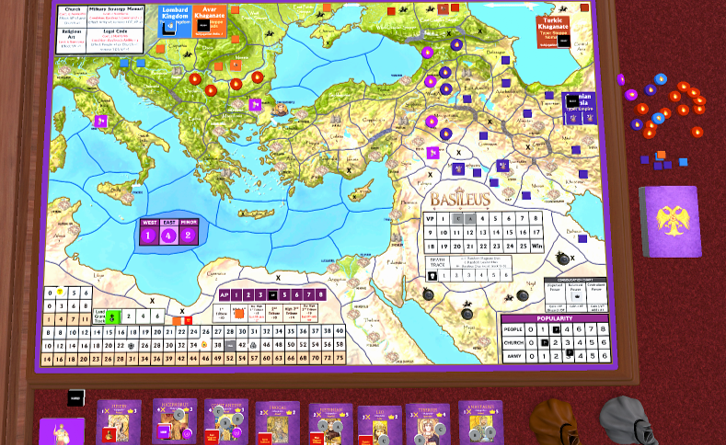
From time to time, we assist designers with getting the word out for them as they are looking for playtesters for upcoming designs. Recently, I was contacted by Douglas Walker who is working on 2 designs, one named Rubicon and the other Basileus, and was in need of assistance. He has created a Discord server for potential playtesters called “Doug Walker Playtest Server.” Here is the invite, which won’t expire: https://discord.gg/gSsQRWjPWp.
Doug has provided the following descriptions of the games:
Rubicon is a strategy game about political competition in the late Roman Republic. It is 133 B.C. The Republic of Rome overshadows the Mediterranean world, but internal discord threatens to derail its growing empire. Two political factions vie for dominance—the aristocratic and conservative “Optimates” and the populist and revolutionary “Populares.” The fragile consensus holding together Rome’s elites erodes as conflict grows ever more violent.
In Rubicon, players control a faction of Roman senators belonging to either the Optimate or Popularis faction. More than one player belongs to each faction—but only one player may win the game. Players use their political influence to win elections, gain glory in war, and shape the laws of the Republic to suit their ideology and interests. Rubicon involves simultaneous blind bidding, negotiation and hand management. A thematic push-your-luck mechanic involves violating the unwritten customs of the Republic to unlock powerful actions, at the risk of provoking a deadly pushback. Winning requires carefully balancing cooperating with one’s faction partners to advance shared objectives, such as passing laws, while simultaneously competing with them to advance the glory and reputation of one’s own characters.
It is A.D. 568, and you live in the East Roman Empire (also known as the Byzantine Empire.) Three years ago, the great emperor Justinian died and was succeeded by his nephew. As the heirs of Caesar Augustus and Constantine the Great, the emperor—or “Basileus”—enjoys total control of the Byzantine state. Yet it is clear that Justinian’s repeated attempt to reconquer lost territory in the west has overextended the empire. He succeeded in re-taking North Africa, Sicily, and Italy—but at an enormous expense in both money and soldiers. Wealthy landowners and small farmers alike are burdened by taxes. The “powerful ones” or “magnates”—men who are educated, own land, and serve the government as high-ranking officials or generals—are unhappy. Justinian’s prestige made him untouchable while alive, but his successor enjoys no such immunity.
Basileus is a card-driven strategy game for three players that simulates politics, war and diplomacy in the East Roman Empire in the 500’s AD. Players take one of two roles: one player—the “Ruler”—controls the emperor (Basileus), while the other two players—the “Magnates”—control both the wealthy and powerful Roman courtiers and non-Roman nations. Players take two actions per turn. There are a certain number of actions available every turn, while strategy cards give extra event and action possibilities to the Magnates. Action cards are chosen simultaneously and resolved in a semi-random order, making gameplay quick and unpredictable. Victory points are awarded for winning battles, conquering territory, and completing literary or artistic achievements. But there’s a catch: the Basileus-Player automatically gains a certain number of victory points each turn. The Magnates must try to make life difficult for the Ruler by lowering the Basileus’s popularity, devastating the Roman economy, leading foreign nations to victory over Roman armies, and building up disloyal characters. If they get lucky, they can initiate a rebellion against the Basileus, depose him, switch roles with the Ruler to become the new Ruler. The Ruler player must try to ensure that the Basileus remains popular with the Romans and successfully defends against foreign threats. But in a world where any failure can be interpreted as divine punishment, the margin for error is razor-thin. Basileus is a tense game where success can be fleeting and danger lurks just around the corner.
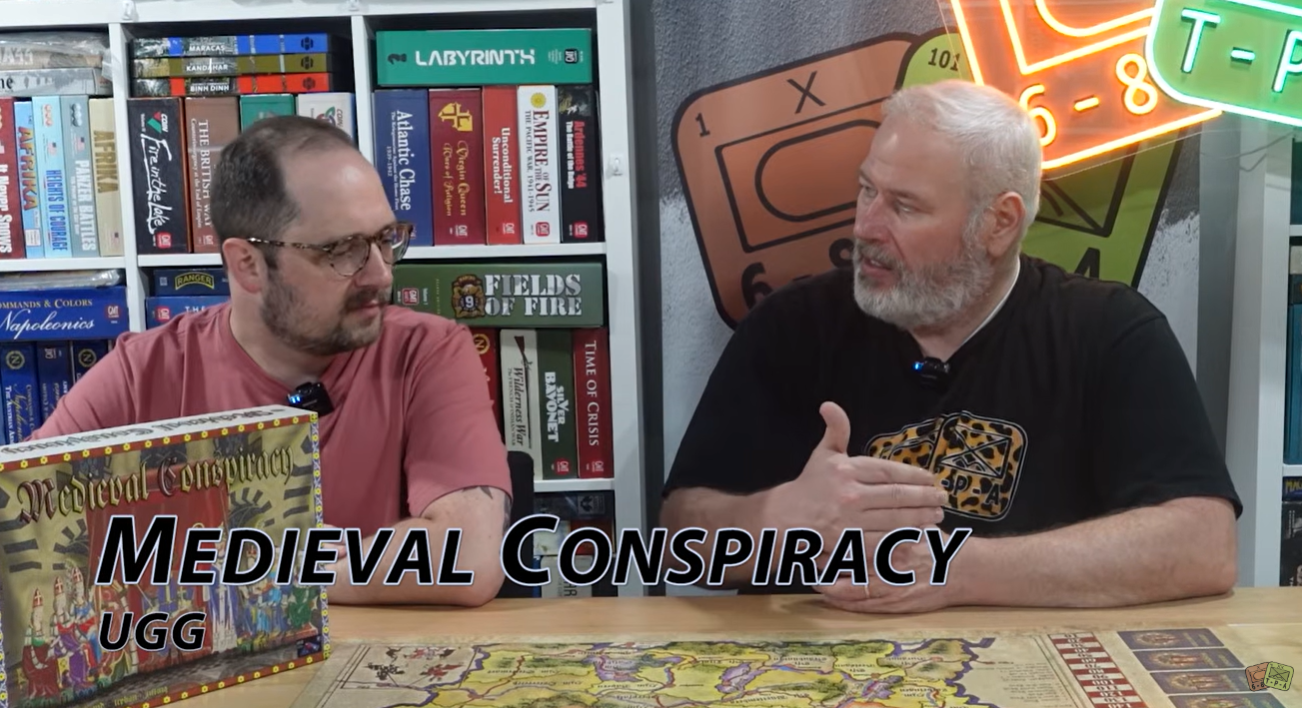
Medieval Conspiracy introduces players to the Holy Roman Empire of Germany, which is divided into numberless small earldoms, principalities and bishoprics. The Ruler of the Empire is the Holy Roman Emperor who is elected by the 7 electoral princes. In Medieval Conspiracy players take the role of a mighty noble family attempting to increase their power, gain new countries, all to gain votes of the electoral princes to finally be elected the new Holy Roman Emperor.
Medieval Conspiracy is run by Action Cards and Event Cards. After collecting income, players bid for Event Cards. 3 Event Cards are displayed on their open side. Thereafter players bid for them in turn order. The player who got an Event Card can use it later during his turn. During a player turn players roll the dice of destiny and play Event and Action Cards. That card play results in numerous effects giving each game a new special course. The goal of the game is to gain new countries or conquer them by force from others in an attempt to influence the vote for the Holy Roman Emperor.
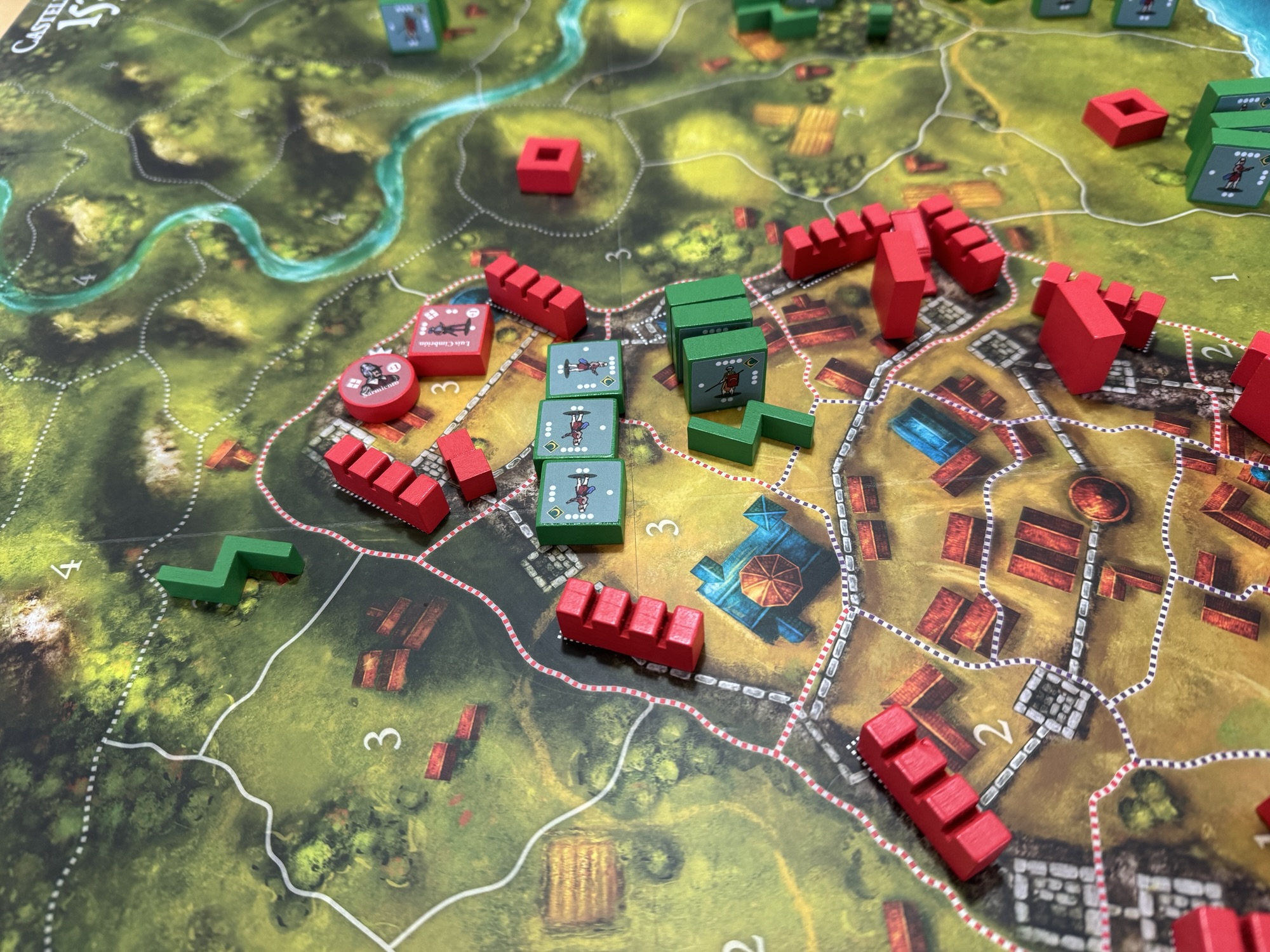
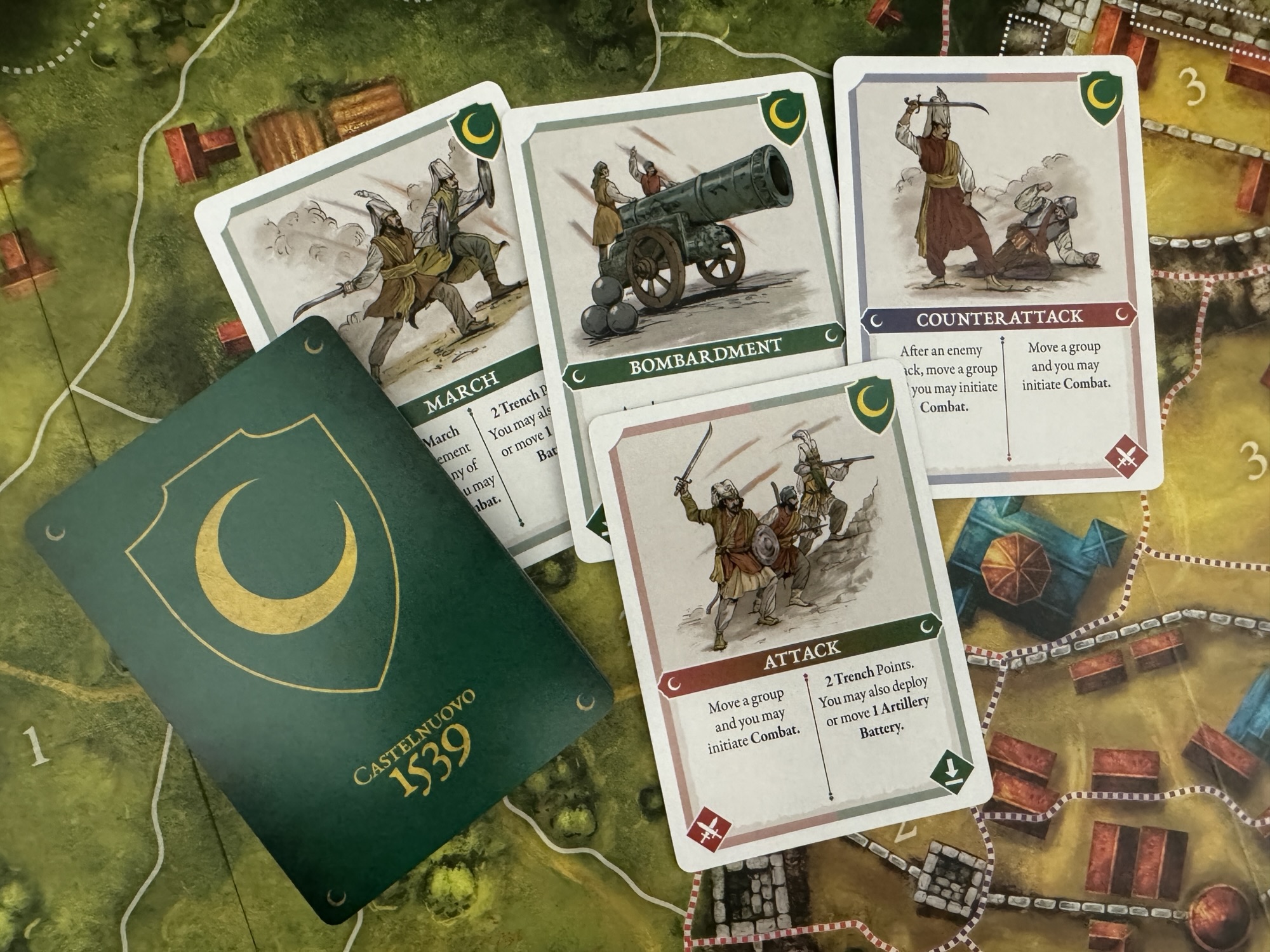
In 1539, a small Spanish garrison of troops numbering 3,500 men held the Albanian village of Castelnuovo for 22 days against the massive Ottoman army consisting of over 54,000 Turk soldiers. This siege took place as a part of the Ottoman-Habsburg struggle for control of the Mediterranean Sea in July 1539 at the walled town of Castelnuovo, which is the location of present-day Herceg Novi, Montenegro. After days of open trench warfare and more than a month of smaller combats, skirmishes, assaults and bombardments from the Turkish navy, the last Spanish defenders fell ending the siege. Castelnuovo 1539 is a wargame that focuses on this siege designed by Francisco Ronco. The defenders are safe behind sturdy walls and battlements but time and continual shelling from the Ottomans will lead to assaults over the walls. The battle is hopeless for the defenders but they can win the game by doing enough damage to the Ottomans to end their campaign and stop them from invading further into the Albania and then onto Spain and the rest of Europe. The game is very well produced using wooden blocks for soldiers, stylized walls, siege trenches and cannon along with ships and the board is also beautifully illustrated. The game is a block wargame where the strength of units are hidden from the opponent and plays pretty quickly in less than 90 minutes and really is a great representation of the battle and its history.
In Action Point 1, we took a look at the beautiful Game Board and its area movement scheme. In Action Point 2, we examined the units available to both sides and compared their relative strengths and weaknesses. In Action Point 3, we took a look at the different types of Command Cards and discussed how they are used. In this Action Point, we will take a look at the 2 different types of rounds including a Siege Round and an Assault Round and how they differ.
In Castelnuovo 1539 there are 2 different types of rounds within the structure of the game including Siege Rounds and Assault Rounds. This 2 type approach is designed to reflect the different preparations and phases of a sustained siege on a fortified location. The Ottoman player is allowed to choose the type of round for the upcoming turn during the Reinforcement Phase, which is the last phase in any round. In this structure, the Ottoman player has the chance to review the previous round, consider their losses and gains on the battlefield, identify their goals and set themselves up for success in the coming round.
Siege Rounds reflect the necessary preparations, concentration of resources of both men and materiel, the progress of mine works and siege trenches and represent 3 or 4 days of the siege. During this time there are small combats and skirmishes, probing of the enemy lines and reconnoitering but no major frontal assaults. In this type of round, each player draws only 4 cards reflecting the slower and more deliberate planning phases of a siege. The first round of the game is always a Siege Round in the main scenario. There also is another mechanic that is added to the Siege Rounds as the Ottoman player can choose to rest during only a Siege Round and no cards are played and the player also places all of their Azab and Sipahi Blocks on the board at full Strength. This reflects the buildup and preparation for the upcoming assault and is a key decision for the Ottoman player who is pushing against time and must complete the siege in their favor before time expires.
Assault Rounds represent moments of decisive assault, with a great amount of movement and activity on both sides. The action is fast and furious and each turn represents only 1 days worth of combat. In this type of round, the hand of both players increases to 7 cards in order to provide the fuel needed to sustain a planned attack. There is a price to pay for the prosecution of an Assault Round though as each time the Ottoman player declares their intention to assault, the Ottoman Casualty Track will be advanced 1 space.
The decision opportunity for an Assault Round versus a Siege Round comes at the end of the Spanish Action Phase. Before drawing any cards, the Ottoman player chooses which type of round to play next. If an Assault Round is chosen and the player has more than 4 cards in their hand, no new cards will be drawn and the player will discard down to 4 cards. One of the key decision points at this time is the makeup of the Ottoman player’s hand. If they have good cards, such as the necessary Order Cards to initiate attacks as well as a Combat Card or 2 to supplement those attacks and make them more effective, the choice is pretty simple. If their hand of cards is not necessarily setup and beneficial for a siege, they may want to move to an Assault Round where they will draw the maximum 7 cards and can continue their preparations for the next round while still engaging in smaller attacks and bombardments to weaken the defenses and demoralize and reduce the defending Spanish Tercios.
I was very impressed by this distinction in the 2 types of rounds in the design but at first had difficulty making the connection to the history and the design choice. But a siege is a very different and particular case in warfare and has some very interesting nuances that must be taken into consideration. As the game is basically decided by the mounting casualties of both sides, the presence of artillery batteries, the obsolete medieval fortifications of the city and the modern earthen fortifications built by the Spanish to reinforce them, casualties are a reality and the Ottoman player needs to be cognizant of this and take it seriously. There has to be a deliberate and planned attack on the city with the proper and measured construction of siege trenches by the Ottomans to realize the benefit of their usefulness in reducing the casualties of the besiegers.
A good Ottoman commander will play a well balanced game with a consistent pattern of incremental movement upon the city, all the while building their siege lines to form a tightening encirclement of the walls like the coils of an anaconda, inching closer and closer to the walls, using their artillery to weaken and break the defenses and create breaches where close-range assaults can be launched that will ultimately decide the outcome. Digging trenches should be one of the Ottomans first tasks, as they must protect their blocks as they are in the open field, an easy target for attack. Once the blocks are protected with trenches, there is a need to plan the advance and bring these trenches and batteries closer to the Spanish fortifications so that they can breached. Once there are open breaches, it is necessary to throw caution to the wind and take the city by assault as the Spanish attempts to repair the walls and build internal fortifications will continue to hinder the Ottoman’s progress. But, the Spanish player must keep in mind their advantages, including the well known Spanish ‘camisado’ attacks (encamisadas in Spanish) to sally forth and inflict damage upon the besieging forces to weaken their strength. The Spanish leaders are better and will provide great benefits to these attacks that should inflict maximum damage and break the will of the Ottoman as they continue the slow and arduous advance on the city. But the understanding of how to use this Siege/Assault process will take a few plays to understand but once you master the rules, you will see that these fortresses were not defended passively, but rather are in the pattern of an active defense that makes calculated sorties to hinder the work of the attackers by destroying artillery batteries and not giving the Ottomans any rest or respite from the action a vital part of the process.
In Action Point 5, we will delve into an example of combat and bombardment.
If you are interested, I was able to shoot the following review/overview/summary video with the designer Francisco Ronco after playing the game earlier this year:
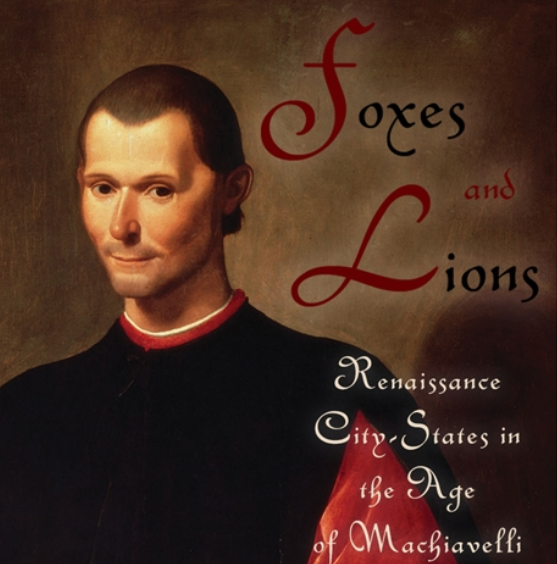
We have played all of the games in the Reivers and Reformers Series designed by Ed Beach, including Here I Stand (multiple times), Virgin Queen (multiple times but not as many as HIS), Tanto Monta (once) and Border Reivers (twice) with our most recent play being a full 5-player game in March while attending Buckeye Game Fest. This series is just special and I very much enjoy our experience with these games each time we play them. The card driven mechanic simply makes the series and it really is a bit of a sandbox as you can win in various and sundry ways. Several months ago, GMT announced the fifth entry in the series called Foxes and Lions:Renaissance City-States in the Age of Machiavelli designed by the duo of Paul Wright and Liz Davidson. This one looks to be epic and is set during warring city-states and dominions of Renaissance Italy during the era known as the Italian Wars (specifically, the period from 1494 to 1527). I am very keen on a new addition to the series and look forward to diving in and learning more about the game over the next year or so. My first step was to reach out to the design team to do a designer interview and Paul Wright was more than willing to answer our questions.
*Note: The pictures used in this interview showing the various components and cards, are still in the design and development process and as such rules,event effects and text might still change prior to final development and publication.Also the art and layout of the components are only for playtest purposes at this point and the game will enter the art department as it nears publication.
Grant: Paul welcome to our blog. First off, please tell us a little about yourself. What are your hobbies? What’s your day job?
Paul: From Chicago originally, I’m a cultural historian by training, having taken my doctorate in Comparative Literature at Princeton and worked with the masterful historian Anthony Grafton. I’m happy if even a tiny percentage of his vast knowledge has lodged itself in me. My focus in my doctoral research was Renaissance humanism in Italy and England, including work on Leonardo Bruni, Pico della Mirandola, Machiavelli, Gabriel Harvey, and John Milton. I have been dialoguing with Machiavelli ever since my undergraduate days at Northwestern, when one of my mentors (the wonderful Albert Ascoli) tasked me with translating long sections of The Prince into English. I’m certain those early efforts were awful and too literal-minded, but what an instructive exercise that has only made me more admiring of great translators. Alongside Machiavelli remaining a key part of my research, I have also been working on the political and social impact of Savonarola.
I taught for three decades in higher education, including my graduate T.A. days at Princeton, as well as teaching posts at Osaka University, Villanova University, and Cabrini University. That last school, sadly, closed in the wake of all the pressures on higher ed in the last fifteen years or so. I then turned to teaching in the independent school world, which brought me to Main Line Classical Academy in Bryn Mawr, PA, where I teach English and History, as well as a games-based learning history elective funded by a grant I recently received from the Renaissance Society of America.
In my games-based learning exercises in my classrooms over the years, I have used analog board games as well as the occasional computer game (Europa Universalis in particular), but I also use role-immersion pedagogies like Reacting to the Past; I serve on the national consortium board for RTTP (for more info, see https://reactingconsortium.org/). I’m currently developing a RTTP game on Florence in the period 1494-1512, the era of the republic with the Medici in exile. In that game students may take on one of over thirty historical roles, including Piero Soderini, Da Vinci, Da Vinci’s portrait subject Ginevra de Benci, followers of Savonarola, condottiere Fabrizio Colonna, or even Machiavelli himself. Think of this as a role-playing game that zooms in even further than does Foxes and Lions. The game has been tested by professors at over a dozen institutions so far; it will be used in a high school setting for the first time this year.
My hobbies include film and media studies. I have taught film and media courses (on everything from the Coen Brothers to Kurosawa to The Sopranos) at the Bryn Mawr Film Institute for some twenty years now. I also have a screenplay (in painfully drafted form) on Machiavelli’s time spent with Cesare Borgia, which certainly informed Machiaveli’s thinking and later writing.
I also treasure any chance to travel abroad, and it was a big part of my higher ed career in international affairs. I hate how expenses have curtailed that experience for so many of us, as well as how the U.S. has become less welcoming to international students. Not surprisingly perhaps, Italy is my favorite destination, with Albania (home country of my wife) and China (home country of my daughter) tied for a close second. I also lived and taught in Japan for four years from 1996-2000, and it was one of the most formative times of my life; I treat any chance to return as a treat.
Grant: What motivated you to break into game design? What have you enjoyed most about the experience thus far?
Paul: I waded into game design after decades of intensive play of wargames, euros, RPGs, and so many other types of games that I’m clearly an omni-gamer—certainly on the heavier side of the complexity scale with a focus on historical games. I’ve always been happy to solo (even multi-handed) because playing more games teaches you so much about how games are put together and how they try to model complex realities, including the past. I’m an admirer of David Lowenthal’s classic book, The Past Is a Foreign Country, which certainly evokes how games draw me into historical eras and crises.
I’ve also been blessed in Philadelphia, my home of 26 years now, with the best gaming group anyone could ask for—a group of people who are kind, seriously competitive yet never obnoxious, while also being sharp and funny as hell. Between my own solo forays and playing with them, it has been an education that led to this first ever design for me. My Philadelphia group are truly shadow co-designers in their way.
What I’ve most enjoyed about design is the sense of something evolving before your eyes that captures the history as I understand it, but I also love designs that challenge or revise my understanding. Collaborating with an amazing co-designer in Liz Davidson and developer extraordinaire Joe Dewhurst has been an absolute treat. I’m spoiled by having these two on my team.
Grant: What have you learned about design over the years?
Paul: Like many designers, I have many designs that never saw the light of day; some of these will come to fruition, I think, once Foxes and Lions is released. What I do know is that I’m a designer by theme and subject who looks far and wide for mechanics that will capture the historical complexities that fascinate me. I know many work in the opposite direction starting with mechanics, but that’s not how I’m wired. I start with a theme or problem that haunts me, then see if a game (mine or someone else’s) can help to illuminate it—or at minimum, reframe my questions more powerfully.
I also see historical game design as a way of testing and modifying (not merely reinforcing) my own interpretive and historiographical assumptions. One of the reasons I began the journey with Foxes and Lions over a decade ago now is that I had deep questions about Machiavelli, his theories, his playful will to narrative, and the era through which he lived, an era that we all too facilely collapse under the rubric of the “Italian Wars” or “The Renaissance.” Game design can be a heuristic tool that can bear fruit eventually in a new interpretation or synthesis that we hadn’t anticipated. At minimum, it clarifies my own tortured thinking and reading of the sources.
Grant: What is your upcoming game Foxes and Lions: Renaissance City-States in the Age of Machiavelli about?
Paul: Foxes and Lions: Renaissance City-States in the Age of Machiavelli is the next game in the GMT series that includes Here I Stand, Virgin Queen, and Tanto Monta. Focused on the warring city-states and dominions of Renaissance Italy during the era known as the “Italian Wars” (specifically, the period from 1494 to 1527), this game zooms in on the Italian peninsula. Unlike many other games on the Italian Wars, Foxes and Lions puts the focus on Italian experiences of this era of enormous upheaval, which also saw some of the greatest cultural splendors that we now associate with the period known, not without controversy, as the Renaissance. The game depicts the political, military, economic, religious, and cultural affairs of five key Italian powers brought to life by players (Florence, Milan, Naples, Venice, and the Papacy).
Players struggle to create political legitimacy for themselves while contending with both Italian rivals and non-player great powers intent on conquest of their own objectives in Italy; namely, France, Spain, the Holy Roman Empire, and the Ottoman Empire. For those who have played other series games, much will be familiar mechanically, but there are many new concepts and mechanics to enjoy, including experimenting with different government types, managing local sentiment, and gathering precious florins to pay for mercenaries and their fickle condottieri captains.
Furthermore, players will be faced with the possibility of collective defeat to the non-player great powers. Players will individually pursue Virtù Points, drawing on Machiavelli’s famously pliable conception of political ability and military strength, while at the same time striving to avoid collective defeat by loss of Italian Virtù Points. Dwindling Italian Virtù embodies Machiavelli’s abiding fear of great power domination of Italy. Players will each attempt to win without Italy falling into the subjection that was historically its fate, and should they fail to prevent that, the game ascribes blame to the specific players viewed as the scourge of Italy and the new lapdog of the great powers. Can you thread the needle between your Italian rivals’ ambitions and the threat posed by the great powers of Europe?
Grant: Why was this a subject that drew your interest in making a game?
Paul: This subject got under my skin as an undergrad as I mentioned above. I first fell in love with Dante in multiple courses with terrific and yet very different teachers. They graciously invited me to join their graduate courses as an undergrad. Milton, Spenser, and a host of political poets in the epic tradition caught my eye there too, but I fell hardest for Dante and his era. As I went on to graduate school, that love of Dante abided, but Machiavelli re-entered the chat, as it were.
After my graduate experience with Machiavelli (thanks especially to one of my teachers, Victoria Kahn), I was never quite the same. Machiavelli embodied someone both deeply troubled and somehow deeply amused by a world that was falling down around him. His political career began in the wake of the 1494 Medici exile, the rise of Savonarola, and the restoration of a republic that had long been under the Medici yoke. His career ended the first time in 1512 with the Medici restoration. It ended again with another Medici exile in 1527, with yet another republic that didn’t really trust Machiavelli anymore given his courting of Medici patronage in the intervening years. Above all, the traumatic Sack of Rome in 1527 really shook Machiavelli. He died just over a month after the Sack, witnessing exactly the kind of Italian nightmare that he had warned about for years. Someone who had lived that much life and turmoil became endlessly fascinating to me. I know Machiavelli will be a part of my scholarship and design life for the duration.
Grant: How did you come to team up with Liz Davidson on this project?
Paul: Liz has become a dear friend as well as collaborator and sounding board on everything from our shared gaming interests to our broader professional and personal lives. We met because I invited her to be a keynote speaker at a Reacting to the Past game design conference at my former institution. She was not only awesome in that role, but we immediately hit it off as people. It wasn’t long till we were talking regularly cross-country and at conventions, then talking about collaborations.
Grant: What strengths did each of you bring to the design process?
Paul: In the case of Foxes and Lions, I obviously brought the historical background and scholarly passion to the project, which I had first formulated about six or seven years before Liz and I met. But in all candor, I was spinning my wheels. I was swamped with the faculty and administration politics of a dying institution, and I was smack dab in the middle of all that drama in a leadership role for our faculty. It took Liz to help me see the real comfort of game design and of throwing myself back into my true passions, especially for Foxes and Lions.
It also helps enormously that Liz is a doctorate-holding historian of religion herself with a focus on the ancient world. And as anyone passionate about the period knows, the Renaissance was defined in many ways by its relationship to the classical world, so while Liz wasn’t an early modernist or medievalist, she understood intuitively and on a deep level why a classicist would enjoy and contribute to a game about the Renaissance. Simply put, without Liz, there is no Foxes and Lions for the world, just the game in my head. Liz also has a sharp sense of end-user needs in game design. How something will play to a more general audience and not just specialists or heavy gamers. To be clear, our game is a heavy game situated within a heavy (yet beloved) series, but Liz is working hard on materials to onboard people as only she can, including training guides, videos, and more. She is doing an amazing service with this in relation not only to our game, but also the series at large. Stay tuned for more of these things in the months to come.
I’d also be remiss not to mention the support and encouragement of Volko Ruhnke. After he visited my former university as keynote panelist for a games-as-scholarship workshop, we talked about Foxes and Lions possibly joining the COIN series in the vein of other pre-modern titles like Falling Sky and Pendragon. Liz and I even prototyped a first COIN version of our game. It was fun and quirky; it could have possibly thrived in COIN world, but at the end of the day GMT’s Jason Carr wisely suggested a retooling to the Here I Stand line. That was preaching to the choir for me given my admiration for Ed Beach and for the series. Ed became yet another guiding light as we got to know him. One of my proudest moments was having Ed participate in a play of the game at WBC this past summer. They say don’t meet your heroes; both Volko and Ed prove that dictum wrong.
Grant: What has been the division of labor between you?
Paul: Liz and I both have day jobs that are very consuming. She as creative director at Leder Games, myself as an educator (a role Liz had also previously played in independent schools). Yet we both get up incredibly early, whether we are meeting or not. We are always busy with our games at every spare moment. Liz has so many games on her plate, including with other collaborators like David Thompson, another designer for whom I’m an unabashed fanboy. I’ve got Foxes and Lions of course as my primary focus, but also a book project on Machiavelli and the Reacting to the Past role-immersion game on Machiavelli’s Florence that I mentioned earlier.
I would call our division of labor something like triage; think ER or The Pitt. We are each picking up the slack when needed, prioritizing one thing or another. If there is a functional division right now, I’m heavy into the rules and component revisions, as well as early TTS testing, about to go wider as of November 2026. Liz is contributing to the InsideGMT articles we are posting on the game; her favorite subject, not surprisingly if you know her, being espionage for an upcoming piece. Liz is also there anytime we need to vet some unusual change or some stubborn holdover of mine from earlier iterations of the game. Liz will give you her most honest take on how something plays and how it will feel in the game experience. Liz has an reliable, sure sense of that. As I mentioned, she is also developing onboarding materials for newbies that I think will be awesome.
The few times we have not seen eye to eye (and I can count them on one hand), we have always had principled discussions of where each of us is coming from, and that has always lit the way to a solution. Like myself, Liz is an omni-gamer with an historian and educator’s perspective on things. That fundamental commonality has always carried us through. Having Joe Dewhurst as our developer has been equally essential as he too is an educator and scholar, and his sharp eye for what will make a game its best is invaluable. As with Liz, no Foxes and Lions in its current exciting form without Joe.
Grant: What is your design goal with the game?
Paul: If I have an historian’s axe to grind with many games on the Italian Wars and Renaissance, they have never quite to my satisfaction captured the cultural dynamism, complexity, and sheer messiness of the period. There are success stories among Renaissance games to be sure. Many games attempt to capture the military picture and do so well; on the tactical front, Rich Berg’s Arquebus comes to mind here as well as the lesser known and under-appreciated Brien Miller game, Fornovo 1495.
Other games attempt to integrate military concerns with politics and economics on a grand scale, and of course Eivind Vetlesen’s Europa Universalis: The Price of Power comes to mind here as a masterful and inspiring example, although the cultural and political front in that game is more driven by events than player agency compared to Foxes and Lions. Pascal Ribrault’s Virtù is also an interesting euro that tackles some of these concerns in an accessible way.
And of course, we have the crowded field of games tapping into Renaissance commercialism. Brasini, Gigli, and Luciani’s Lorenzo il Magnifco and Fabiano Lopiano’s Calimala come to mind here. An underappreciated and roughhewn gem is Mario Papini’s Siena; his better-known De Vulgari Eloquentia is terrific. On the art front, Stefano Groppi’s Florenza looms large in my mind for its attention to both Florentine art and the material and political considerations behind that art; it’s also just a beautiful game to look at.
Yet for all those examples above, Ed Beach’s Here I Stand and Virgin Queen were the guiding lights to Foxes and Lions—alongside the interest in political asymmetry that transcends the traditional wargame fixation on “control,” a paradigm shift displayed so beautifully in Volko’s COIN series. What Morgane Gouyon-Rety attempted so ambitiously in Pendragon also figures in my original thinking about the game. Morgane and I have chatted of late about how the character-driven conceptualization of ever-shifting rulers has serendipitously shaped both her Hubris game and Foxes and Lions.
Yet for my design purposes, what Ed’s work on Here I Stand proved was that a wargame could tackle vitally important and culturally adjacent aspects of the period that impact things happening on the strategic battlefield—in Ed’s case the religious strife of the Reformation and Counter-Reformation. COIN demonstrates to us that the sentiment and shifting support of an administered population is just as important as the intentions of those controlling a space—or trying to convince themselves that they do. This was very much on Machiavelli’s mind too.
In addition to wanting to make a game that captures the overdetermined messiness and intricacy of the Italian Renaissance, especially during the Italian Wars per se, we also wanted a game that “consciously uncoupled” (to riff on Gwyneth Paltrow’s marital breakup language) from reliance on “great power” narratives. Those narratives and the assumptions implicit in them are a recurring feature of most games on the Italian Wars and even of the Here I Stand series to date. We wanted ultimately to put the focus on Italian experiences of those conflicts—in the process creating a HIS series game about underdogs.
This was more than about zooming in on the map of Italy as depicted in earlier series games, something Carlos’s Tanto Monta did to a degree that left me hungry to do far more given my own scholarly interests in Italy. Yet it was above all about letting players personify powers that were otherwise total underdogs (or minor powers at best) in the context of the rest of the series and most other games on the period.
In this way, Avalon Hill’s out-of-print classic Machiavelli comes to mind for its attention to Italian powers alongside the greater powers of Europe and the Ottoman world. Our elevator pitch for Foxes and Lions remains a good formula—the old Machiavelli game brought to life in the mechanical exoskeleton of the Here I Stand system. Finally, as I get into in more detail below, we wanted a game that honored the messy contradictions and true interests of Machiavelli and didn’t simply replicate the many misleading stereotypes about him.
Grant: How have you modified the Here I Stand System to recount the story of the rise and fall of Renaissance City-States in the Age of Machiavelli between 1494-1527?
Paul: In addition to the non-player great powers mentioned earlier, the game features other significant additions or changes to series conventions.
Political traditions—These are the governments (current and past) that define the political character of any given space in the game (featuring merchant republics, feudal aristocracies, princedoms, theocracies, tribute states, and vassals). In keeping with Machiavelli’s respect for founders of institutions, lawgiving will be an available action that permits you to attempt to alter governments in your dominion. Each space under your control may have a very different political arrangement, which affects its prosperity, unit construction capability, and many other things. Your central government (that of your capital) may also change over time.
Sentiment—This captures the current attitude of the local population to the government overseeing it. The scale of sentiment reflects Machiavelli’s own terminology, ranging from “Hated” to “Feared,” to “Feared and Loved” (the latter an ideal Machiavelli thought hard to achieve, opting instead for being “Feared” whenever a choice between fear and love was unavoidable).
New unit types—Regulars are split into citizen militia and feudal levies, alongside a more detailed look at mercenaries (with elite variants including the Swiss reisläufer and the Imperial landsknechte).
Condottieri captains—Twenty of the colorful, talented, and sometimes treacherous mercenary captains of the era will be available to players in competitive blind bidding for their services, with each captain reflecting unique battlefield abilities, vulnerabilities, and other surprising game impacts. Captains are essential to success in the game, and if not properly paid and retained, will go up for auction again; they may even be suborned and taken from you by nefarious rival actions. Among the captains are the infamous Cesare Borgia, Fabrizio Colonna, Giovanni delle Bande Nere, and “El Gran Capitán” himself, Gonzalo Fernández de Córdoba. Yet the captains also include those who are captains for our game, but not condottieri narrowly defined; these include militaristic cardinals like Francesco Alidosi as well as the famously defiant Caterina Sforza.
Money economy—Alongside the high-level political capital of command points (CP) already familiar to CDG players, Foxes and Lions features the cold, hard cash that mercenaries and dominions crave. Florins are collected by a trade action connected to the prosperity of the various governments in one’s dominion. The florin economy will be necessary not only to pay or bribe mercenaries and captains, but also for espionage, government maintenance, and more. Player treasuries are hidden behind a screen, so no one is ever quite sure of a rival’s wealth. Should you run out of florins for a required or desired expenditure, the banks will be available to lend to you at exorbitant interest rates, and failure to repay may cost you dearly.
Espionage available from turn one—Nefarious measures are available to players from the outset of the game, including familiar operations from Virgin Queen like Gain Intel and Assassination, now supplemented with Appeasement, Foment Rebellion, Sabotage Fortifications, and Suborning others’ employed condottieri to your cause.
New patronage systems and figures—For those familiar with Virgin Queen, patronage now features three tracks (artists, scientists, and humanists) with 10 figures of each type. Each patronage target affords unique game effects. Among the 30 patronage subjects are figures such as Michelangelo, Da Vinci, Botticelli, Copernicus, Pacioli, Paracelsus, Machiavelli, Manutius, and even a prying poet-courtesan, Tullia d’Aragona.
New ruler dynamics—Each player will have an often-volatile lineup of rulers who will transition based on circumstances in the game (26 rulers in total across five player powers). In the case of the Papal States, a conclave procedure involving all five players will determine the next pope whenever the current pope dies, however mysteriously.
Variable impulse order—Players may bid their florins to change the impulse order for a given turn, creating dynamic opportunities for surprising your enemies—or lying in deadly wait for them.
More opportunities to declare war mid-action phase—No game about Machiavelli’s era would be complete without the temptations and risks of back-stabbing rivals, even erstwhile allies, including in the middle of a turn. Great coalitions (like the historical “Holy League”) may form, but no alliance is ever truly safe.
Grant: What elements do you feel are most important to model from the period?
Paul: If there was one thing that consumed me more than anything else in formulating this game years ago, it was the desire to make the best possible game on the richness, diversity, and contradictions in Machiavelli’s whole body of work—a game that would capture Machiavelli the writer and, above all, the human being as I’ve come to know him.
I didn’t want a game that just brought The Prince to life, or that just reveled in the skullduggery so often associated with Machiavelli, even in games that somehow invoke him. I wanted a game that also featured the other Machiavelli(s). The celebrator of republics in the Discourses on Livy who also knew just how fragile republics really are, a lesson for today if ever there was one. Machiavelli the historian in his state-sponsored Florentine Histories, an example of urban history compromised by political pressures to dance around certain uncomfortable truths. Machiavelli the military theorist of The Art of War, who appreciated the potentially dangerous impact of militarism on civic life in addition to the positive virtues of citizen soldiers (there is something of both James Madison and Stephen Ambrose in Machiavelli here). And finally, even the Machiavelli of La Mandragola (“The Mandrake Root”), a viciously funny sex comedy about cuckolding with a sly political subtext commenting on the differences between classical virtues and Renaissance realities. Further down in this interview, you can see three event cards that were inspired by Machiavelli’s diverse array of writings.
In all that effort, we also want to be sure that Foxes and Lions never simply takes Machiavelli at his word or at face value. Given his own internal contradictions, that would be unwise. We instead see the game as interrogating Machiavelli’s assumptions and claims. His critique of mercenaries versus citizen militia is explored both in design and in actual play, never simply rehearsed uncritically. His appreciation for the libertà of republics is tempered by his continued recognition of their fragility and their vulnerability to other powers with more direct mechanisms of control and decision-making; think here of today’s debates about democracy and autocracy.
Machiavelli’s sense was that Italy might be doomed by great power intrigue—exacerbated by Italian powers courting the greats to their own ends rather than looking to Italy’s good. This was always balanced with a deep yet tortured belief in the possibility of resuscitating Italian virtù. In addition, we wade in this game into Machiavelli’s discussion of virtù itself, a term almost untranslatable given its variety of uses in his works. The tension between individual and communal greatness was always on Machiavelli’s mind in using that term—with a preference at last for the latter as it was most pursuant to true glory and historical legacy, as well as most compatible with republics. Lawgivers (as opposed to generals and strongmen) were always most admired by Machiavelli, I would say. The serendipity of our victory points in the game easily transmuting into “Virtù Points” was an early discovery, as was realizing that we should also track Italian Virtù Points to gauge the threat of collective defeat.
To say that this is a game of ideas in the crucible of conflict is an understatement, but even more vital to us is that the game’s ideas should be tested in a sandbox of historical conditions that confronted the historical actors, both individual and collective. We want a game that is not on historical rails, but that instead allows for historically plausible surprises and strange developments. So far testing has provided just that. Thankfully, the game allows shockers—the imperial troops of Charles V against Cesare Borgia; Savonarola arranging a cuckolding of the “Warrior Pope” Julius II; Piero de’ Medici lingering on for multiple turns as the hapless ruler of Florence. Testing has seen a lot of these unanticipated “what ifs,” and we imagine even more strange developments over the life of the game. Above all, testers have stressed just how fun and crazy the game can be. Mission accomplished, to my mind.
Grant: What major design challenges did you encounter and how did you overcome them?
Paul: I go into more detail on this below, but one of the challenges I personally faced is the same that confronts any designer—the old “kill your darlings” mantra. This is why I’m especially grateful to Liz and to our amazing Joe Dewhurst on the development end. While there are many things in Foxes and Lions that I deem “thesis-level” in importance and non-negotiable, there are plenty of things I fell in love with early on that it took me time to see were hampering the design and gameplay.
Sometimes you don’t have to kill the “darling” as much as reshape it. One example is sentiment, discussed above. At one point, we really needed to find a way to make sentiment matter more to the game mechanically. We had it as conceptually important, and it truly is, but it wasn’t doing what we needed to make players care about it. Once Liz and Joe encouraged connecting sentiment to espionage, battlefield impacts, and other power-specific concerns, I saw the light. We didn’t jettison sentiment, but we made it matter to players and to the thesis of the game. A similar thing happened with political traditions. Originally, we were tracking up to four governments (current and previous) in each space’s political traditions box. We wisely revised so that now you only trace the current government and any previous dominant political tradition in that space; that simplification kept the interest in government forms without creating a truly unwieldy board state.
In other cases, you do just need to kill the “darling” altogether, as we did with dynamic prosperity management for each space. While each space still has a political traditions box and its current government affords a trade value to that space impacting your power’s florin economy, originally I was foolishly insistent that each space have dynamic prosperity that you could spend CP to raise or lower (subject to caps by government type). That might have worked for a computer version of the game, but it was decidedly awful for a game that already has lots of moving parts and elements new to the series. Dynamic prosperity was not only killing the delicate Command Point economy of the game, but it was also just boring to players. They definitely wanted florins and economics, but they didn’t need that much granularity. Again, so grateful I had Liz and Joe to help me see the light. The game is way better for all these refinements.
Grant: How does designing a game in an established system work? Any constraints on your thoughts for the period?
Paul: One might think designing within an existing series framework is an easier task. There is a template, a style, and a set of mechanics and design assumptions. And to an extent, this is true. It’s nice to “stand on the shoulders of giants” like our predecessors in the series, Ed Beach and Carlos Diaz Narvaez.
The difficulties I encountered, however, were met and overcome thanks to a 2025 game designer retreat hosted on Beaver Island, Michigan by Central Michigan University’s Center for Learning through Games and Simulations, run by my friend and an intrepid scholar of colonial Mexico, Jon Truitt. In that weeklong retreat in a remote, beautiful setting, I spent uninterrupted days studying the entire Here I Stand series and its rulebooks. I wrote the new rules for Foxes and Lions from the ground up there, with an eye toward retaining what was essential to the series while weaving in what was of thesis-level importance to our game and its historical setting.
The real challenge of adapting to an existing series framework is not so much what you will keep, but what you will add or change altogether. If you are standing on that giant’s shoulders, you never want to annoy (let alone topple) the giant carrying you by flailing around thoughtlessly in a shared design space. In this case, the giant isn’t just someone like Ed; it’s a community of dedicated series players who have made HIS games a lifestyle choice. Many of them are making series games of their own, such as the gracious and supportive Luis Rubio, whose game Primus Inter Pares is of great interest to me.
We know this community will put Foxes and Lions through its paces. We know too that GMT is seeking a game about the complexity of Virgin Queen, a design goal we share and think we have met. Things that we don’t fret over in our game (e.g., the religious mechanics of Here I Stand) are replaced by things that we feel we must have (e.g., political traditions).
The way Liz and I have tackled any additions or changes to the sturdy, muscular frame that is this series is always to ask a fundamental question of anything new. Does it support a “thesis-level” contention or historical organizing principle of the game? Does it add something to the series that offers a new, welcome dimension to gameplay that shakes things up for the better? If something didn’t speak to one of those needs, we generally ended up revising it until it did or dumping it.
Ultimately, we never felt the series hamstrung our vision of the period, but it enriched it. What we kept our attention on was how you can redeploy series conventions to treat a more focused region that would be a mere few spaces in the larger scale games like Virgin Queen. This change of scale and perspective was a challenge, but the system opened itself to that. To borrow from my side work as a teacher of film, we think of Foxes and Lions as zooming the camera in from the eagle-eye view of the great powers in the other series games. Like Norma Desmond in Sunset Boulevard, the Italian Wars (and as I keep stressing, the Italian experience of those conflicts) were ready for their closeup.
Grant: What sources did you consult for the historical details? What one must-read source would you recommend?
Paul: I could be here all day talking about the game’s primary and secondary sources, but I’ll keep it brief. Liz and I recently did a video about precisely this topic of sources or ancillary readings for the game and you can watch that at the following link:
The books we mentioned there are terrific places to begin. Some commentary follows the list here.
The Essential Writings of Machiavelli (translated by Peter Constantine)
Foxes and Lions: Machiavelli’s Confidence Men by Wayne A. Rebhorn
The Civilization of the Renaissance in Italy by Jacob Burckhardt
The Beauty and the Terror by Catherine Fletcher
The Machiavellian Moment by J. G. A. Pocock
Niccolo’s Smile by Maurizio Viroli
Inventing the Renaissance by Ada Palmer
Florentine Histories by Machiavelli (translated by Laura Banfield and Harvey Mansfield)
A History of Florence 1200-1575 by John Najemy
Fortune is a Woman by Hanna Pitkin
The Tigress of Forlì by Elizabeth Lev
Fortune is a River by Roger Masters
Mercenaries and their Masters by Michael Mallett
The Italian Wars 1494-1559: War, State and Society in Early Modern Europe by Christine Shaw and Michael Mallett
This is very much a partial list. Of these, the most welcomely irreverent in terms of pieties about the Renaissance is Palmer’s Inventing the Renaissance. Great stuff that explodes many preconceptions and has some great sections on Machiavelli. That side, the pieties deserve their day in court too though, and no one was more influential there than Burckhardt. It has become fashionable to pile on Burckhardt for his missteps, which is a shame because there is much he got right to which it is worth returning.
Mallet and Shaw are terrific on the Italian Wars proper, as well as the role of condottieri, whom they treat evenhandedly and with nuance missing elsewhere. Roger Masters in Fortune Is a River illuminates a lesser-known military plan to deploy terraforming of all things; the book explores a collaboration between Da Vinci and Machiavelli to divert the Arno River to strike at Florence’s favorite obsession, Pisa. The book puts into dialogue two of the most unique figures in the Renaissance; it remains a proud moment for me that I introduced my dissertation Tony Grafton to this book, as it is quite rare to find anything on this period that Tony hasn’t already read.
I’d of course recommend reading Machiavelli himself, but please, read widely, not just The Prince. There is as much to learn in his Discourses on Livy, Florentine Histories, Art of War, and his sex comedy Mandragola as there is anywhere else. Machiavelli even wrote some historical and political poetry (Decennali) on the dramas of his day.
John Najemy offers what I view as the single best modern history of Florence in English. Pocock’s classic, The Machiavellian Moment, is a most ambitious attempt to trace Machiavelli’s ideas about republics backwards to the ancient writer Polybius, but most compellingly forward to the English Civil War and the American Founding. A truly monumental book that loomed large in the conceptualization of the game.
Grant: What are the playable factions?
Paul: The player factions are the Republic of Venice, the Duchy of Milan, the Republic of Florence, the Kingdom of Naples, and the Papacy. These are the “big five” mentioned by Machiavelli in The Prince. They are confronted not only by each other, but also by four non-player “great powers”—France, Spain, the Holy Roman Empire, and the Ottoman Empire. Some have asked why Genoa is not among the playable powers; Machiavelli’s “big five” aside, this is because Genoa finds itself under the thumb of Milan at game start. It is a minor power held hostage by a player power, but it may break free and find new allies. I do have in mind a prequel expansion in which Genoa is playable though (see below for more on that).
Grant: How did you try to differentiate them in their style of gameplay?
Paul: The asymmetry of the playable powers is deeply baked into the game, both in the event deck featuring events drawing on their histories, but also in the mechanics, victory conditions, and play styles.
Venice begins the game leading the pack by a good margin. An economic powerhouse of merchant republican bent, Venice has wealth coming from its colonies abroad, especially the Balkans in our game. Yet, what was often called Venice’s “Long Decline,” which would not be completed until Napoleon’s era, was already in motion at the start of our game. The Ottomans threatening the colonies, combined with Venice’s own dangerous ambitions on the Italian mainland, would lead to disaster at Agnadello in 1509, with what must have felt like the world arrayed against Venice.
Milan begins as a powerful duchy, wherein the Visconti had been replaced by the condottieri family of the Sforzas long before game start. Milan has its thumb on Lombardy, but also Genoa. Genoa is a source of wealth and prestige, but also a constant headache and a state that might break loose. Milan is a viable threat for autowin and may expand south (as they did in the early 15th century), but it is also surrounded by great powers (notably, France and HRE), as well as neighboring Venice, their closest rival at game start.
Naples has the stability of a feudal kingdom to support its military and political cause, but it is also torn between the dynastic claims of the French and Spanish, which go back centuries. Naples is in a great position to keep what it has, but expanding toward victory is a major challenge unless it chooses to cross swords with the Papacy and others. Naples cannot rely on the status quo, even though the French armies of the time were already threatening that.
The Papacy is vexed by a roster of alternately skilled and disappointing rulers, as well as internal divisions in Roma between the Orsini and Colonna families, whose vendetta threatens both the city and papal stability. The Papacy has considerable spiritual powers with material benefits for its allies and punishments for its enemies. Occasionally it boasts military leadership to boot; think Cesare Borgia and Pope Julius II, the “Warrior Pope.” The Papacy’s advantages are often situational and fleeting though, and it is surrounded by rivals, not to mention great power intrigue (above all, from the Holy Roman Emperors, such as Charles V).
Finally, my beloved Florence. It begins with the single greatest mess of any of the powers. Piero de’ Medici, hapless and unprepared son of the late Lorenzo il Magnifico, is alienating citizens left and right. He is in the pocket of French interests and will controversially cede Pisa to King Charles VIII. In his wake comes someone no less controversial, Friar Savonarola, whose apocalyptic vision of Firenze as the “New Jerusalem” will bring it into direct conflict with the Papacy of the Borgia Pope Alexander VI. Their confrontation is an early set-piece in most games. The other rulers who follow the Friar (Piero Soderini and two Medici) offer radically different political visions for Florence. Of all five player powers, Florence must wrestle with the most political instability, particularly in a difficult starting position.
With Venice, Milan, and Naples functioning as the “big dogs” (at least among Italian player powers), both Florence and the Papacy have their work cut out for them, but many avenues to victory. Florence can play the patronage game like few others, and the Papacy will have opportunities for expansion as long as they also maintain their influence over the Christian great powers and keep the Orsini and Colonna in stalemate. Florence and the Papacy also have the game’s only option for a joint victory. Provided a Medici rules both powers (a thing not always easy to coordinate), they can win the game together by one of them achieving an autowin (i.e., military victory) on the map. This assumes of course both players are interested in and capable of this coordination.
Grant: As a CDG, how does the game utilize cards?
Paul: Our game uses the classic CDG framework of multi-use cards pioneered by Mark Herman and used to such great effect in the Here I Stand series. We have added some wrinkles, however. First, there are 26 rulers in the game (4 for Venice, 5 for Florence, 5 for Milan, 6 for Naples, and 6 for the Papacy). There are two home cards for each power, available from game start. Each home card can be used for varying purposes unique to that power, but one of the two home cards benefits more from that player having allies, who will also appreciate that card’s advantages to them. The other home card tends to be best when going it alone with few or no allies, but players are free to use either home card each turn. There are some events that impact this; one (“Well Governed Dominion”) allows a player to use both home cards that turn, while another (“Confused Administration”) allows a rival to force you to pick a home card of the rival’s choosing, while also saddling you with -1 card next turn.
Finally, we introduce an important new type of mandatory event card: Captain auction cards. These 20 figures represent the condottieri and other influential figures (even ostensibly non-military figures who nonetheless have a powerful effect on the battlefield and other arenas). Captains are the subject of aggressive florin bidding wars in secret auctions (or sometimes, assigned to a player with highest influence on a specific great power). As these captains are the most decisive on-map leaders in the game, accumulating them is vitally important, especially given the vagaries of a captain’s fate on the battlefield (a captain is a potential casualty in any battle, even a victory) and off (being subject to assassination attempts or certain events). Being a power without any captain at all is the surest way to be easy prey in a land of many predators.
Grant: Can you share a few examples of individual cards with us and explain how they work?
Paul: Here are some examples of the types of cards in Foxes and Lions, especially those that break with series conventions in one or more ways. Please note that all card images here are prototypes and will undergo further graphics work, refinement, etc. Some commentary follows the images.
First, let’s consider one of our rulers: Venice’s Andrea Gritti, not to be confused with the mind-warping mascot of the Philadelphia Flyers. In addition to typical Admin and Card Bonus ratings familiar to series veterans, each ruler card also includes important additional information. Every ruler in the game has conditions for accession and removal (if a game start ruler, removal only). These conditions are almost always situational in nature, and in Gritti’s case, depends on his predecessor Doge Grimani having been removed. Doges and Popes are most typically removed by failing a survival roll at end of each turn; some, but not all rulers have these rolls. Elderly doges and popes always do. We also see here Gritti’s effects on the game—a helpful boost when paying CP for diplomatic influence. Other leaders may have disadvantages and outright weaknesses (e.g., Piero de’ Medici’s awful Admin rating of 0).
In a sense, you must endure and exploit the ruler you have rather than necessarily embodying that ruler, as is more the role-playing conceit in other HIS series games. For example, in HIS, you feel you are Suleiman the Magnificent, and that’s great for that game with all its high-level great power shenanigans. But in Foxes and Lions, it might be most helpful to think of yourself as a Machiavelli-type advisor behind the scenes, and you certainly won’t relish embodying the weaker and more problematic rulers when navigating their serious tradeoffs. I sometimes think of the role-playing conceit of this game as you portraying no mere ruler or advisor, but perhaps an entire polity, a people weathering the rulers they’ve been dealt. The conceit at last is up to you and your play group.
Alfonso II of Naples is a different ruler example. He is the starting ruler for Naples. Alfonso is awful at Appeasement (formerly “Pacify” as seen here), which is the effort to improve sentiment in your dominion; he is so poor at this that no dominion space may even reach the coveted Feared and Loved status. Note too that while he does have a survival roll, he may also be removed if Napoli (the capital space proper) is enemy-controlled. This is a situational timer on this ruler, and other situational timers apply to many rulers (in Milan, Florence, and Naples especially).
The captain examples here include one conventional condottiere, Paolo Vitelli. You bid on captains when they are played as mandatory events. Some turns there will be few or no captains on which to bid; on other turns, they will appear in great waves. Each game play is very different on this front. Our Paolo, adept at siege assaults, nonetheless has an Achilles’ Heel—if he doesn’t assault at least once a turn, he is executed by his employer! This reflects the curious history of the real Paolo, whom the Florentines accused of treacherously soft-pedaling the siege of Pisa on their behalf. His execution enraged his brother Vitellozzo (another captain in the game), who will become an inveterate enemy of Paolo’s former employer if this happens (and it might be another power that employs Paolo, not necessarily Florence).
Then we have the illustrious Caterina Sforza, scion of a family of condottieri, but not herself one as classically defined. We felt it important that our game have a preponderance of captains who do fit that classic description, but we also wanted a few, unusual “captains” who don’t, but nonetheless had battlefield and even other impacts. Caterina is celebrated in Machiavelli’s Prince as a commanding leader defending the siege of Forlì, with Machiavelli (perhaps apocryphally) crediting her with this infamously defiant statement to her besieging enemies, who had kidnapped her sons and threatened their lives: “To show them that she did not care about her sons, she revealed her genitals, saying that she still had the means to produce more” (trans. Peter Constantine). Accordingly, in the true Man Who Shot Liberty Valance spirit of “printing the legend,” our Caterina excels in siege defense alongside other advantages upon “hiring.” If she has a vulnerability, it is that she will stand down and not fight against her beloved Milan. Every captain has a downside of sorts to go with the silver lining.
Finally, we have two card types familiar to series players, but with wrinkles. “Diplomatic Maneuvers in the Dark” is in one way your typical mandatory event; the event player gets 2 CP to spend after the mandatory event fires. What is important here is the event itself reminds us that a good number of event cards will drive the activities of the non-player great powers. Some of those events are optional, but many are mandatory to ensure regular activity on the part of the greats threatening Italy. This card also nicely pairs activation of one great power with evaluation of one minor power, the latter something quite familiar to series veterans.
The Home card example pairing here is also instructive. Both are from Florence. The first, “Civic Humanism,” exploits Florence’s advantages in patronage, lawgiving, and maintenance of dominion sentiment. The second, “Lucrative Textile Trade,” focuses on Florence’s distinctive economy in wool and cloth, but it also rewards Florence and its allies with additional florin generation beyond what is typical in the trade action. As remarkably different as the home cards of the others player powers are, this template of one ally-focused and one other home card is consistent throughout. Either card can be used with or without allies, but the ally-focused cards are especially attractive to courting, rewarding, and retaining allies. Until of course, they see you as being in the way of their own ambitions.
Grant: What role does Patronage play in the design? How have you modified the system used in Virgin Queen to fit this era and your focus?
Paul: The biggest change to patronage compared to Virgin Queen is the addition of humanists (broadly defined to include literary creators of all kinds) to the original categories of artists and scientists (also more broadly defined for our game’s purposes). We now have thirty patronage subjects (ten in each category), with two figures having different potential contributions in different categories (Michelangelo in both the arts and humanism for his poetry, and Da Vinci in both the arts and sciences for his engineering gifts).
Speaking to the broad definitions by category, a few examples suffice. Among the more predictable artists of the era, off the beaten path we have Jan Cornelisz Vermeyen, a chronicler commissioned by Emperor Charles V. Vermeyen eventually designed the “Conquest of Tunis” tapestry series, and in some ways can be viewed as a proto-journalist. Among scientists in our game, we have Luca Pacioli, often credited as the “father of accounting.” And among our humanists (extended to include classicizing poets), we have Tullia D’Aragona, a brilliant courtesan-poet who can function as an espionage informant inflicted upon a rival; the rival must both pay Tullia and can never shake her off.
Another significant change from VQ is that for the most part, patronage figures are available for any power to patronize. A few have some restrictions; for example, Machiavelli is for Florence only, while Pico della Mirandola is available to any power except the Papacy given his storied troubles with the Church’s reaction to his more provocative ideas about syncretism. These less common examples aside, most patronage subjects are open to all comers.
We also modify the rollout of our many patronage subjects with only three in each category randomly selected from the available pool on turn 1, then three more added each turn thereafter (with all having appeared by turn 4, albeit in a different order each game). This creates a bit of uncertainty about when your preferred patronage target will become available; it also afford players less cognitive overload than were all ten figures of each type available from game start. Each patronage figure has unique game effects, some immediate and some long-term, and the effects run the gamut of applications to war, politics, economics, other patronage endeavors, or entirely different effects.
Unlike VQ where artists offered VP and scientists VP and/or abilities, every subject of each type in Foxes and Lions has a completely unique patronage ability and the capacity to reward VP. No two figures are the same, and each effect is tailored to the historical achievements or longer term influence of that person.
Grant: How important is Espionage? Why is it available early from Turn 1?
Paul: We wanted the cutthroat environment and skullduggery of Renaissance Italy to be captured from game start. We understand why Virgin Queen delays those things, but we felt Foxes and Lions needed it right off to be a believable recreation of that brutal environment in Italy. No one held back historically, so why should our players?
Espionage is one of the most effective tools at any power’s disposal in the game, but only if you really commit to it. We have seen some players go hard on it, while others stay focused on patronage, conquest, their own victory conditions, etc. If you are to make espionage work for you, having informants and (when possible by event) the cypher key (another holdover from VQ) goes a long way toward exploitation of these tools.
In addition to classic VQ-style espionage actions such as Plant Informant, Gain Intelligence, and Assassination, we also have Foment Rebellion to cause sentiment problems and unrest in enemy territory, as well as Appeasement to address or put down such problems.
We also offer a Sabotage Fortifications action that can remove fortified status from a target space—a nice complement we think to the ability in other series games to build fortifications. Successful sabotage doesn’t change a space’s key status (if any), and it can thematically be understood as anything appropriate to the space; in other words, it could be a literal sabotaging of town walls, but it could easily represent traitors in the leadership ranks of that town, undermining of garrison readiness, or anything else imaginatively appropriate. Fortifications themselves should also be understood in our game to be thematically diverse. In Forlì, there may be literal walls at Ravaldino, but in Volterra, this may additionally represent the natural defenses of high ground. In Venice, imagine the natural defensibility of Venice’s storied lagoon.
Lastly, the espionage action Suborn Captain allows a power to attempt corruption of a rival’s captain (i.e., a battlefield leader), causing that captain to join your cause and possibly causing defection of some of his mercenaries too. Our research has shown that, Machiavelli’s opinion notwithstanding, captains did not defect quite as often as is held by some, but we certainly allow for it to happen in the game as it did occasionally take place. It just won’t be a slam dunk without significant effort and investment (including florins).
In sum, we think espionage is especially robust in our game. Many creative uses are already being discovered in testing.
Grant: How is the next Pope decided when a change is called for? What dynamic does this create between players?
Paul: Pope Leo above is a good example of how the Papacy’s rollout of rulers is different from any other player power. You will note Leo becomes Pope by accession in Papal Conclave.
The Papal Conclave process is used anytime a pope has “shuffled off this mortal coil,” for whatever natural or nefarious reason you imagine. Other player powers have a fairly linear progression of rulers, who change based on shifting game conditions and/or survival rolls as specified on each ruler and discussed above. Yet early on, Liz and I decided it would be delicious fun to allow the popes of this era to roll out in a potentially different order based on conclave intrigue.
The short version is that a conclave does favor the Papacy player with some extra voting power, and any ties will be decided by that player. Ties are rare though as each player power in the game will have some voting power, which can be modified by territories lost to or taken from the Papacy. Having high influence on the Christian great powers (France, Spain and the HRE) can help one’s voting power, but having too much Ottoman influence will hurt it since you are viewed as consorting with an enemy of Christendom.
Finally, we allow players to spend their precious florins to bribe their way to an outcome in secret bidding, wherein even the preferred candidate of a player is not known till everyone reveals their pick and any florins spent.
So while the game begins with the Borgia Pope Alexander VI, it may wind its way to out-of-order candidates of the era succeeding him. Sticking the Papacy with a weaker pope (hello, scrupulous Adrian VI, who foregoes espionage altogether) may hinder the Papacy’s efforts, while the Papacy’s desire for the “Warrior Pope” Julius II will often be transparent. That said, sometimes a wise Papacy player will support a weaker candidate in hopes of drawing out financial support for that weaker candidate, with the knowledge that a better pope will come down the road at perhaps a more opportune time. The Conclave, like bidding on Captain auctions, is one of the major “head games” of Foxes and Lions.
You will also note in the Leo example above a great example of a ruler with downsides. Limitations on dominion sentiment are paired with higher costs to trade. The latter reflects Leo’s tendency to spend papal resources on his own extravagances; the saying ascribed to him comes to mind, “Since God has been pleased to give us the Papacy, let us enjoy it.” It doesn’t help either that Leo causes sentiment problems in Roma, in part due to his refusal to take seriously emerging threats to church authority, including Luther as the game reaches its end stage. At least Leo opens the possibility of a joint Florence / Papacy victory as described earlier. As with so many rulers in our game, there are always tradeoffs and always ways to exploit even a troubling ruler.
Grant: How do players bid for Impulse Order? Why was this important to include?
Paul: Impulse order might be the most debated subject among designers, developer, and testers so far. We decided to include secret florin bidding for variable turn order to create yet another arena in which to angle toward your goals and thwart those of others. We also see it as appropriately reflecting the chaos of Italy compared to the great power canvas of other series games.
Variable impulse order also allows us to use the current order (established after bidding each spring) as a tiebreaker for just about any situation in the game. We have found our current group of ten veteran testers to be unanimously in favor of the variable order bidding. Winning a bid only allows you to move one power’s marker (it need not be your own), thereby altering the impulse order in the Action Phase and impacting the tiebreaker mechanic I mentioned above.
That said, some players will surely not like it, and we had some recently who were new to the game at conventions argue that having a set table order is just easier to keep track of with seating, and we acknowledge this is valid concern for some groups. Online it might not matter, but in person with limited table space, it really might. My group of ten is vocal about keeping variable order bidding as a unique feature of the game, but who knows what wider testing will show.
The upshot is that we are most likely to have a set impulse order as the default rule, but with two variants. In one variant, you can embrace the full “wild west” of variable order bidding described above. For groups that like such volatility, they’ll still have the option. Another variant we have in mind is that you can bid, but all you are changing is which player goes first, while the order proper doesn’t change. We are happy for play groups to use whatever approach they prefer. If fully variable order bidding is not used, the tiebreaker that mechanic affords disappears and is replaced by a dice off. The argument for fully variable order could be that its tiebreaker usage will entail less dice rolling in a game series that is already chock full of that.
Grant: I see there are more ways to declare war during mid-turn. How does this work?
Paul: We knew early on that we needed shifting alliances, betrayals, and overall volatile situations of war and peace in the game. While we love the other series games, we tend to find them a bit too stately for Italy in this period. Yes, some of the other games have a card that lets you start a war mid-Action Phase (famously, Machiavelli’s Prince card in HIS), but we wanted more of this to be possible and more of it to happen!
Originally, we had a mechanism that allowed mid-turn betrayal of allies and declarations of war on the fly at any time provided a cost in CP and florins was paid. This still proved to be too easy and common. It was more in keeping with the wildness of the original Machiavelli game from Avalon Hill, itself a nasty and rich Diplomacy variant.
When we discovered that process was making mid-turn betrayal and declaration of war too common and easy for the good of the game, we compromised. Most declarations of war and making of alliances will happen as normal in the Diplomacy Phase in Foxes and Lions. We still want uncertainty about the reliability of an ally (or the intentions of a possible attacker), so we created four event cards that involve the option of a) attempting to suborn a rival captain on the eve of a battle or b) declaring war mid-Action Phase, even against a current ally. The latter is relevant to this discussion.
There are a few other cards that might situationally create such an opportunity, but these are the big four that clearly do. And so long as you haven’t accounted for those four cards in the discard pile (or preferably, your own hand), you just don’t know who might be able to stab you in the back at any moment. This approach has preserved the paranoia that is necessary for the game, while at the same time preventing a betrayal from happening just anytime on a pure whim. Marshaling your hand effectively is always important in any CDG, but arguably even more so in Foxes and Lions. “Suborn” cards (that include the betrayal and DoW option) are worth their weight in gold, and smart players try to hold onto them for future use.
Grant: How is ultimate victory obtained?
Paul: We have a few types of victory, most recognizable to players of other series games. We have the classic, end-of-last turn race to highest VP (Virtù Point) total; our game is 7 turns long maximum. We have the possibility of the series-typical domination victory from turn 4 on, whereby if you are leading all other players by 5 or more VP at turn end, you can claim victory that way. Finally, we have the traditional autowin condition (getting all your key markers out on map), in essence a military victory, although diplomacy and the minor power influence game may play a large role in that outcome too. What we tinkered with was adding to autowin another requirement for each power. For example, for Florence to autowin, it must retain control of Pisa-Livorno, an historical objective that obsessed many a Florentine government. For Venice to autowin, it must have a certain number of Balkans colonies still in it is possession. And so forth with other playable powers. Autowin isn’t automatic unless you meet that power’s sine qua non condition too.
Frankly, the biggest change in our game is not to victory conditions so much as the introduction of collective defeat. Having all players lose to the “great powers” (France, Spain, HRE, and Ottomans) because Italian Virtù has tanked is our favorite innovation and very appropriate to the situation historically. The game also specifies in the rules which one or two players at your table the others get to blame (perhaps unfairly, but who said life or games are always fair). The lapdog in a collective defeat will be the player with the most VP at the time of that outcome. Many in Italy see the lapdog’s ambitious rush to personal glory as the cause of the great power triumph. The scourge in a collective defeat will be the player with the most influence on all four great powers at the time of that outcome. That influence will not reflect all the influence invested over the course of the game, but those looking for an easy scapegoat will find one in the player currently dallying most with the great powers at that moment. It is even possible for one player to be both the scourge and lapdog; no greater infamy in our game is possible.
One inspiration here is another Avalon Hill classic, Republic of Rome (soon to be back in print, it seems). In that game, players are Roman patricians battling each other, but they are also battling the game, which throws challenges at them like the Carthaginians, Gauls, manpower shortages, etc. We felt Foxes and Lions absolutely needed that possible outcome of collective loss. We are also working on variants to calibrate how likely that is to happen in any given play. The default will be collective defeat as a serious threat, but we will have variant options to make that outcome more or less likely depending on a group’s wishes. If a group wants the focus to be on a likely player triumph, they can reduce the impact of the greats; if a group wants players constantly on their heels, they can increase it.
One can reliably argue that the Italian Wars ended in great power triumph by 1559. As our current game ends with the year of the Sack of Rome in 1527, we allow the game to put that writing on the wall sometimes, but it doesn’t have to be that way if players stand tall against the great powers as Machiavelli wished—often far easier said than done. We are estimating collective defeat to be less common an outcome in the game, but a constant worry. Testing will tell on that front, but we will certainly allow play groups to calibrate this possibility to their tastes as mentioned above.
Grant: What are some general strategies for each of the sides?
Paul: We will have eventually have detailed strategy guides for each power in upcoming InsideGMT pieces and of course, in the eventual Playbook. For now, referring to my answer above about player power asymmetry, the short version for strategies would look like this.
Florence
Put your messy house in order early. Try to move past Piero de’ Medici, even if you must play cards and create conditions for that yourself (Piero’s awful 0 Admin rating is a killer). We did once in testing see Piero persist three turns and threaten a joint victory with a Clement-led Papacy, but Piero is overall a drain on your prospects. You will also have to adapt to each of your next rulers in turn; Florence has perhaps the most dizzying political dance to do in the game. They also begin with serious sentiment problems in their dominion (Pisa, for example, is not particularly thrilled about losing its republican liberties to Florence).
Milan
Keep Genoa under thumb at all costs and find ways to expand into the Romagna, Tuscany, or the Veneto Region at the expense of the Venetians. Alternatively, play nice or even ally with Venice until it’s just the two of you with a viable shot at victory, bearing in mind other players will have a lot to say about such an alliance.
Naples
Continue your investment in Feudal Aristocracy in your capital and beyond. While your kingdom is safe on most sides, you need to expand to win. Papal territories seem the best and nearest opportunities for that, but you can get creative. Even Roma itself is calling you, but you must remove some pesky exclaves of Milan and the Papacy from your dominion before you truly commit to broader expansion. You will also need to play the patronage game like anyone else.
Papacy
Manage the flow of your popes through the conclave process to your advantage whenever possible. Don’t rush to get Julius II till you feel you are ready militarily. It would be premature to install him as pope, then have him die due to a survival roll before you can fully exploit him. Learn to manage the weaker popes (Adrian VI and Pius III), sometimes opting for them when your enemies least expect it and may have spent precious resources trying to inflict them on you. And above, make hay while the sun shines with Cesare Borgia. He is called “Darth Vader” by our testers for a reason. He will burn out at some point once Daddy (Alexander VI) dies, but like Roy Batty in Blade Runner, he should burn “so very, very brightly.”
Venice Maintain your top dog status as the game begins. Your bigger problem is growing into actual victory, which will take playing every aspect of the game wisely lest you be overtaken by lesser lights. You must preserve your colonies in the Balkans against often constant Ottoman threats. You need to expand on the mainland where you can without courting the wrath of all others upon you; historically, this was the disaster of Agnadello, which Machiavelli said cost Venice the efforts of eight centuries. You should patronize strategically to boost your VP total and ability profile. And you should always ensure lots of florins in your treasury; each turn end that you have 20+ florins brings VP to you. Weather your weaker doges and exploit your best; above all, the incomparable Leonardo Loredan
Grant: What has been the feedback of your playtesters?
Paul: One recent tester, Stephen Franco, made a comment that was truly gratifying: “Similar to what actually happened historically, the game is a free for all in a confined space, making for entertaining and unexpected outcomes. Great game.” That “knife fight in a phone booth” vibe, which I’ve always loved in games like Cuba Libre, has been shining forth in Foxes and Lions.
There has been a similar reaction from testers both internal and external at select conventions. That said, we are about to extend TTS testing more widely, followed by Vassal testing down the road. There may be very different reactions, concerns, and suggestions there. We look forward to all of it. Like myself, my core testing group of ten people has been very appreciative of the “thesis-level” interests of the game, and they have been amazing with suggesting how to capture the game’s theses in a way that is compelling for players while faithful to the history, as much as any game can be.
The area in which testers have been the most helpful is with implementation of the non-player great powers. That took a lot of play and effort on their part, and their ideas got us to a place where we are now very happy. Joe Dewhurst has also been terrific in helping us calibrate the greats too.
Grant: What do you feel the design excels at?
Paul: Recreating the feeling of the political and cultural climate in which Machiavelli labored, and in which he continually agonized over his beloved Florence’s fate, not to mention Italy’s. The game also has plenty of the paranoia, second-guessing, and treachery that characterized the era, but as I mentioned earlier, above all it’s a game about Machiavelli’s ideas and ideals, however pragmatically or provocatively he expressed them.
That testers have talked mid-game and afterward about Machiavelli’s deepest political concerns—that they have gotten beyond the image of the treacherous Machiavel of the Shakespearean stage in Richard III or the like—is what most gratifies me. Foxes and Lions is meant to stimulate conversation, including about our own political moment when democratic republics are in grave danger indeed. The “Machiavellian moment” is that invoked by John Pocock’s great book—the moment when any state, especially a republic, realizes its utter, temporal fragility in the wake of Fortuna. And when such a state realizes its own contradictions and failings are as dangerous to its survival as any external threat.
An example of how Machiavelli remains front and center in our game is found in three event cards dedicated to his incredible body of work, not just The Prince. Here are these cards, with a brief comment following.
We wanted our game to have some events that reflect the diversity of Machiavelli’s thought and literary output. We also wanted the event effects to tie into those key works and to be usable by any player. With the first card above, the focus is squarely on The Prince and the Discourses on Livy as political explorations of de facto princedoms and republics respectively (bearing in mind that each text explores the ostensible subject of the other too). The second card puts us in the realm of military theory and historiography; the Florentine Histories are in fact the subject of a scholarly book on which I have been working for years now, so I really wanted it to appear. Lastly, the third card always generates the most belly laughs at the table, focused as it is on Machiavelli’s scandalous sex comedy, a tale of cuckoldry and trickery worthy of the ancient comedian, Plautus. The card effect puts quite a hit on a rival, but the mockery the player endures is perhaps even more stinging. This card has had some wonderfully odd uses (e.g., as mentioned above, Savonarola instigating a cuckolding of Julius II has gone down in my tester group as legendary).
Grant: What other designs are you currently working on?
Paul: My next game, a design on my own and not in any existing series framework, is called Catasto. I have a prototype now that I plan to share at Circle DC next spring. This is another Renaissance game, but about something that hasn’t been treated before in games to my knowledge—Renaissance tax evasion. The Florentine catasto of 1427 is an extraordinarily important document in late medieval and Renaissance social history. In essence a combination of census and property assessment, the catasto permitted political appointees the right to dig into their fellow citizens’ wealth and other holdings to be sure everyone was paying their fair share. This was especially important in the context of ongoing military conflicts between Tuscany and the ambitious Visconti of Milan, all of which had to be funded.
The game explores how far Florentine families would go to hide their assets, and how far their enemies would go to expose those assets while protecting their own from scrutiny. An especially influential (yet very different) design is Tyler Brown’s 23 Knives on the conspiracy to eliminate Julius Caesar. That game uses some very clever mechanics to show how Romans hid, revealed, or unwillingly had exposed their positions on Caesar. The game also allows that the assassination may or may not ultimately succeed. This has been helpful in thinking through how my Florentine players in Catasto might go about concealing their wealth (or excusing it somehow once uncovered). There will also be a tension between seeking to be the catasto investigator and effectively hiding your family’s gains, however ill-gotten.
I’m also working on outlines for a prequel and sequel expansion to Foxes and Lions—no promises and don’t take this as anything from GMT! Just exploring so far, but very much on my mind. The prequel would be set in the 1464-1493 timeframe and feature the Italy of Lorenzo il Magnifico. While military matters remain important there (and Genoa would be a playable power too), there is overall less chance of collective defeat to the great powers. There is much more focus on behind the scenes skullduggery and espionage in that one, including conspiracies like the infamous Pazzi Conspiracy to eliminate the Medici hatched by factions across Italy, including Pope Sixtus IV.
As the main Foxes and Lions game covers the 1494-1527 period, any sequel would cover 1528-1559 (the year of the Treaty of Cateau-Cambrésis that in essence ended the Italian Wars). That era would see a very high chance of collective defeat throughout and great transformations in the situation (e.g., Florence and Tuscany morphing into an eventual Grand Duchy, Venice’s overseas position worsening, Naples finally accepting its dependent status, etc.). If this envisioned triptych for Foxes and Lions comes to pass, I imagine it along the lines of the amazing Fire In the Lake with its prequel and sequel, and the last bit of Foxes and Lions would definitely have a “Fall of Saigon” feel of desperation. Again, no promises, but lots of passion and research on my part in these early days. We have to finish the main stage drama of Foxes and Lions first!
And after (or perhaps a bit alongside) all that, I am working on a CDG game on Skanderbeg, hero of my wife’s home country of Albania, as well as a game on Savonarola and the power of Renaissance rhetoric. I have no lack of projects, but of course the contingencies of time and space remain challenges. Still, good challenges to have!
In 1539, a small Spanish garrison of troops numbering 3,500 men held the Albanian village of Castelnuovo for 22 days against the massive Ottoman army consisting of over 54,000 Turk soldiers. This siege took place as a part of the Ottoman-Habsburg struggle for control of the Mediterranean Sea in July 1539 at the walled town of Castelnuovo, which is the location of present-day Herceg Novi, Montenegro. After days of open trench warfare and more than a month of smaller combats, skirmishes, assaults and bombardments from the Turkish navy, the last Spanish defenders fell ending the siege. Castelnuovo 1539 is a wargame that focuses on this siege designed by Francisco Ronco. The defenders are safe behind sturdy walls and battlements but time and continual shelling from the Ottomans will lead to assaults over the walls. The battle is hopeless for the defenders but they can win the game by doing enough damage to the Ottomans to end their campaign and stop them from invading further into the Albania and then onto Spain and the rest of Europe. The game is very well produced using wooden blocks for soldiers, stylized walls, siege trenches and cannon along with ships and the board is also beautifully illustrated. The game is a block wargame where the strength of units are hidden from the opponent and plays pretty quickly in less than 90 minutes and really is a great representation of the battle and its history.
In Action Point 1, we took a look at the beautiful Game Board and its area movement scheme. In Action Point 2, we examined the units available to both sides and compared their relative strengths and weaknesses. In this Action Point, we will take a look at the different types of Command Cards and discuss how they are used.
Command Cards
In Castelnuovo 1539, there are 72 Command Cards with 36 unique cards per player side that are used to drive the tactical asymmetry of the siege. Players will draw hands of 4 cards during Siege Rounds or 7 cards during high-intensity Assault Rounds to be used for maneuvers around the board, bombardments and various special events. The Spanish and Ottoman factions utilize distinct and asymmetrical decks meaning that their available action options differ to reflect historical realities of the forces and their roles. I have already said this in previous posts on this game but the asymmetry is so very well done in this game and each side truly feels different from one another which creates a really interesting tactical challenge as players have to understand not only their own deck and its capabilities but those of their enemy to be able to effectively prosecute or defend against the siege.
There are 5 distinct types of Command Cards in the game, which include Action Cards, Order Cards, Combat Cards, Reaction Cards and Immediate Effect/Event Cards. Each has their own purpose and place in the game and I very much like the way the cards create opportunities for each player. Let’s take a bit of a deeper look into the types of cards, give a bit of a background on their general use and provide some examples.
First off are Action Cards, which are used by the players to execute specific actions such as engineering, trench-digging or board-manipulation tasks, such as generating Trench Points to advance through or destroy Spanish bastions. The cards basic purpose is to activate units to take actions on the board.
Order Cards typically dictate the movement, repositioning and coordination of military units, marches, and artillery batteries across the board. These are the most common of the card types and are frankly the most important as you cannot use the other cards to attack until you are in position to do so.
Combat Cards are the force multiplication cards and are played during combat resolution to enhance striking power, modify dice roll or trigger pre-combat attacks like the specialized Ottoman volley actions. These Combat Cards are best used as a hold in your hand to use them when they most benefit the player. This can be challenging as holding too many will mean you are not drawing the Order Cards that you need to advance on the enemy.
Reaction Cards are played out of turn during your opponent’s Action Phase to counter maneuvers or provide mid-combat support for engaged troops. These cards can be lifesavers and are important to any good strategy.
Finally, there are Immediate Effect/Event Cards that are used to inject the historical narrative into the game and to replicate the historical action. These cards can also be focused on environmental factors such as the faith of the defenders/attackers, fire devices or the like that will change the flow and pace of the battle instantly.
Each of the 5 different type of Command Cards have a unique color coded icon to assist the players in understanding the capabilities of the card and the appropriate phase to use the card in. These 5 icons are as follows:
Keep in mind though that several of the Command Cards will have 2 icons listed which means that they belong to either of the types and can be played as either during a play. You cannot play the same card again and use its other icon though. This duality provides the players with a bit more flexibility and creates a more engaging and free flowing game. In my opinion, sometimes games which rely on cards to activate units for moves or attacks can suffer from poor draws. While that can still be an issue in Castelnuovo 1539, the dual icon cards make this a bit less of a problem.
Here is a look at the makeup of the Command Cards by type per faction. Keep in mind that dual icon cards will count double in the categories they represent.
As you can see, the Spanish have more icons represented on their 36 cards than the Ottomans demonstrated by the Total Type of Card icons for the Spanish being 50 (1.39 icons per card) as compared to only 44 (1.22 icons per card) for the Ottomans. This is not a huge difference but does give the Spanish player a bit more flexibility in their cards draws and they will be able to be a bit more nimble than the attacking Ottomans. The Spanish have the advantage in the number of Action icons of 18 to 16. Remember that Action Cards are typically used for specific actions such as engineering, trench-digging or board-manipulation tasks. The Ottomans have the advantage in Order icons which means they have more move and march cards than the Spanish. Keep in mind that the onus to attack lies with the Ottoman player as they will have to move their units on the board to be able to attack the Spanish defenders. Also keep in mind the Bombard is an Order and the Ottoman has more of these type of card icons than the Spanish player 5 vs. 3. One of the most glaring differences is the high number of Reaction icons that the Spanish player has. These type of cards are used in response to your opponent’s card play and include things like Counterattacks, Arquebusiers, which gives a free attack when Ottoman units come adjacent to any Arquebusier unit on the board or Friendly Fire, which allows free rolls against Ottoman units located in between their firing artillery and the Spanish.
Another key card for the Spanish include Cheveaux de Frise, which allows the Spanish player to place a chevaux-de-frise cube in a Wall area or a Bastion. Each cube allows the Spanish player to ignore 1 hit in combat. These cubes are not destroyed by absorbing the hit. In addition, if a combat is tied in an area with these cubes, the Spanish player wins the battle. This card is a huge advantage for the Spanish and these should be played as soon as possible in order to minimize the damage taken from the Ottoman onslaught. If the Ottomans occupy an area with chevaux-de-frise and no enemies, the cubes are automatically destroyed. Another very important card for the Spanish player is Comisado. This Action Card can be used as a normal attack or, during a Siege Round, to make a special attack called the Camisado. The Camisados were night raids carried out by the Tercios troops in reduced numbers, specifically intended to sabotage and attack the Ottoman camps, trying to eliminate the enemies while they slept and to inflict material damage to the camp. The Spanish player selects a group of Spanish units, which may include the Leader Sarmiento, and these units can attack an area that is a maximum of 2 areas away from the selected group. This is a hit and run type of attack that gives the Spanish the powerful opportunity to sally forth from the walls to enact damage and then retreat back to safety.
The Ottomans have their own tricks with special cards including For the Faith. This card can only be played in combat if there is at least 1 Azab unit involved. When used, all dice rolled by Azab units (not Janissaries or Sipahi) in combat have a +1 bonus to hit, but at the end of the battle, the Ottoman player must eliminate 3 points of strength from the Azab units. This card is a tradeoff but the price paid can be very much worth it if the dice are kind.
Both sides have access to cards that perform special attacks or provide bonuses like Fire Devices which is a Combat Card that allows the player to roll 3d6 against enemy units at the start of Combat, when the card is revealed. Any result of 5 or 6 counts as 1 hit, to be assigned by the opponent. It can only be played in areas that contain, or are adjacent to, Walls or Bastions built by the Spanish player. These type of cards are very important to the game and its combat system as the weaker units are the fewer dice they will roll and the chances of hits are lessened.
The Command Cards are very well done and truly create the setting for the asymmetry of the game. These cards serve as a highly effective, dual-purpose engine of the game’s dynamic card driven design and I think that the designer did a fantastic job in creating a very balanced and playable game that provides an opportunity for “victory” for both players. The Command Cards are highly effective because they completely abstract command and logistics into a tight tactical choice with units only moving or initiating combat when activated by a card.
In Action Point 4, we will take a look at the 2 different types of rounds including a Siege Round and an Assault Round and how they differ.
If you are interested, I was able to shoot the following review/overview/summary video with the designer Francisco Ronco after playing the game earlier this year:
With this My Favorite Wargame Cards Series, I hope to take a look at a specific card from the various wargames that I have played and share how it is used in the game. I am not a strategist and frankly I am not that good at games but I do understand how things should work and be used in games. With that being said, here is the next entry in this series.
#98: The Balkan Wars from Imperial Elegy: The Road to the Great War 1850-1920 from VUCA Simulations
Imperial Elegy: The Road to the Great War 1850-1920 is a massive card driven game that blends diplomacy, warfare, and statecraft and feels a bit akin to games like Here I Stand and Virgin Queen from GMT Games, which are both grand scale sweeping epics that play multiplayers and take a day to play. Players play as 1 of 6 major powers in the game including Germany/Prussia, the United Kingdom, France, Austria-Hungary, Russia and the Ottoman Empire. The game is quite grand and ambitious as it covers 70 years near the end of the Victorian Era and the Progressive Ear and sees quite a lot of global change and competition between the great powers of the time. The game is a Card Driven Game and uses Action Cards as a type of currency to spend for their Command Points or the printed event to take actions such as recruiting armies and navies, industrialize, moving fleets and armies around the globe, influencing minor powers and establish colonies in Africa, India and the Pacific Ocean. The cards are all tied to the history of the period but the game can be played very much as a sandbox allowing players to explore strategies by trailblazing new horizons or following history.
Before we dive into today’s chosen card The Balkan Wars, I want to first make sure you know about Mandatory Event Cards in the game and how they work as they work slightly differently from normal Action Cards. Mandatory Event Cards are all lime green colored and bear a large block “M” just under the CP Value listed in the upper left hand corner. Mandatory Events, as the name suggests, must be played for their events. However, when playing a Mandatory Event Card, players trigger the event and also receive the CP to spend on various actions. The events on Mandatory Event Cards are always resolved first before the CP are utilized. If a Mandatory Event Card is discarded, the event will immediately trigger. There is no way around these cards and they are included in the game to drive the action historically and interject the various special circumstances that drove the rise and decline of these Victorian Age empires. The player that discarded the card resolves the event as if they were the active player. If two such Mandatory Event Cards are discarded in the same impulse the events are resolved in turn order.
Some of the events that occurred historically prior to 1914 were ultimately precursors to The Great War in many ways. The Balkan Wars were two conflicts fought in 1912 and 1913 that stripped the Ottoman Empire of almost all its remaining European territory and directly set the stage for World War I. The Balkan Wars saw similar levels of carnage as machine guns and artillery equipped with hydraulic recoil mechanisms were used in large numbers. Politically, they highlight the volatile nature of international politics in the Balkan Peninsula and are included as a Mandatory Event to ultimately drive up the World Tension Track on a path toward the outbreak of World War I. When played, the World Tension Track will increase by +1 and if the Ottoman player controls any territory in the Balkans other than Istanbul, or has Diplomatic Influence with countries, they will have a chance to lose their control there as a result of the chaos of the First and Second Balkan Wars. If these checks fail, and they will incur a -1 DRM for each Ottoman Army that is located anywhere in the Balkans, non-player armies will be placed in those locations and will increase the difficulty for the Ottomans to gain a foothold in this area. According to the designer Michael Lorino, mechanically this event causes all kinds of trouble in the Balkans, as intended. Similar to the Mandatory Event Card Empire of the Sun, the original event was a bit more involved and had players fight an actual war. In an effort to keep the game in the playable zone, he decided to abstract these wars through a die roll.
I very much enjoy the concept of a Mandatory Event, although they are never convenient for someone at the table as they typically have negative effects for at least 1 faction. But I very much like the approach taken here with The Balkan Wars with the -1 DRM for control of a territory and its thematic connection with the Ottoman Empire’s presence in the region generating tension and setting off these Balkan Wars.
A Bulgarian postcard depicting the Battle of Lule Burgas.
The Balkan Wars were two conflicts that took place in the Balkan states in 1912 and 1913. In the First Balkan War, the four Balkan states of Greece, Serbia, Montenegro and Bulgaria declared war upon the Ottoman Empire and defeated it, in the process stripping the Ottomans of their European provinces, leaving only Eastern Thrace under Ottoman control. In the Second Balkan War, Bulgaria fought against the other four combatants of the first war. It also faced an attack from Romania from the north. As a result of these wars, the Ottoman Empire lost the bulk of its territory in Europe. Although not involved as a combatant, Austria-Hungary became relatively weaker as a much enlarged Serbia pushed for union of the South Slavic peoples. The Balkan Wars set the stage for the July Crisis of 1914 and was a prelude to the First World War.
We have put out several pieces of content covering Imperial Elegy and find it to be a fantastic game. These include written posts and videos. You can visit those by following the links below:
Unboxing Video:
Video Review:
Summary of Solitaire Bots presented by our friend James:
I do love a good Napoleonics wargame and The Conquerors Series from Shakos is really very good as we have played a few games over the years. They have a new volume in that series on Kickstarter that is designed by a tandem of great designers in Brian Asklev (Baltic Empires from GMT Games and 1812: Napoleon’s Fateful March from VUCA Simulations) and Fred Serval (A Gest of Robin Hood and Red Flag Over Paris from GMT Games as well as A Very Civil Whist from PHALANX) called Napoléon 1870: The Collapse of the Second French Empire from Shakos. This game is set in a different period but uses the same system to tell the story of the collapse of the Second French Empire during the Franco-Prussian War of the 1870’s. We reached out to Brian to get some answers to our questions and he was more than interested in working with us.
Grant: Brian welcome back to the blog. What is your new upcoming game Napoléon 1870 about?
Brian: Thanks – Its nice to be back As the title hints at its about the Franco-Prussian War of 1870-71, and covers the opening weeks of that war.
Grant: Why was this a game that you wanted to design?
Brian: As a Frenchman and a Dane, Fred Serval (my co-designer) and I talked about how the wars of German unification (vs. Denmark in 1864, Austria in 1866 and France in 1870) are massively overlooked in our hobby, and we decided to go about to fix this.
I am a sucker for conflicts which had a decisive impact on history as well as wars where the belligerents have very asymmetric strengths and weaknesses at both the tactical and operational levels so 1870 fits this bill perfectly. The 2nd Schleswig War in 1864 would also fit this bill but is a far less interesting topic for a game due to its static nature. This leaves out 1866 and I might just return and do that campaign in this series
Grant: What does the subtitle “The Collapse of the Second French Empire” mean?
Brian: The opening battles in August 1870, which led to most of the French army being trapped and besieged at Metz, was a crippling blow to the French Second Empire under Napoleon III (nephew to the way more famous Emperor of the First Empire, Napoléon Bonaparte). His attempts to salvage the situation led to the remaining part of the army and the emperor himself being trapped at Sedan and France becoming a republic again on September 4th.
Grant:Why does TheConquerors Series work for this battle in the Franco-Prussian War of the 1870’s?
Brian: It’s a very flexible system so it can easily be adapted to different periods. Its fatigue system and uncertain movement system is perfectly suited to show some of the difference between the French and Prussian armies in this campaign
Grant:What unique challenges to this well-tried and highly acclaimed campaign system are explored here?
Brian: We have added Objective Cards which allow each player to secretly draw one of their sides 5 Objective Cards before play begins. This card then lists some additional ways of earning VP’s for your side and thus you will play differently in each game depending on what you are trying to achieve besides the usual VP’s for losses and controlling specific locations.
In addition, Event Cards allowed us to add some aspects, such as logistics, which we felt was underrepresented in previous games in the series. As the Event Card use in the system is so flexible we could add this without any additional rules to the series as such.
Grant:Who is your co-designer on this effort? What has their experience brought to the table?
Brian: Fred Serval of Red Flag over Paris and A Gest of Robin Hood fame. We work very well together and find it easy to build upon the ideas of the other as well as stop those ideas that only worked well in our heads In addition, he has a lot of knowledge about the period as well as being able to read and understand French sources.
Grant: What was the division of labor between the 2 of you?
Brian: The design started when we lived in the same town and saw each other regularly, so it was easy for us to have brainstorming sessions and test ideas so we only divided the labor between us for the design of the various scenarios once we were sure the main scenario and the decks worked as we wanted them to. Besides this we decided it would be best if Fred did the translation into French
Grant:How does designing a game in an established system work? Any constraints on your thoughts for the battle?
Brian: I love designing in established series as I have a solid framework from the start and can do all my reading and thinking from the perspective of the series ruleset. This was also how I started as a designer (with GMT´s Musket & Pike Series). In many ways I am probably more of a tinkerer than a designer as I always start with one or more established systems as my basic framework and then expand, merge and tweak those gradually until I end up with something that is very different from my starting point.
If a suitable system is chosen for the conflict the designer seeks to model there should be few constraints apart from the basic parameters of the series in terms of what it does, and what it does not, focus on. One of my only critiques of The Conquerors Series is the lack of logistics and supply rules as I really like such rules both as a player and as a designer (as anyone who has played 1812: Napoleon´s Fateful March will know). Luckily, The Conquerors Series is very flexible and as noted above, we could easily represent the logistic challenges of the war by the inclusion of Event Cards.
Grant:What did you need to make sure to model from the Franco-Prussian War?
Brian: We needed to include and highlight the asymmetry of both of the armies involved: The French had a massively superior rifle called the Chassepot that in and of itself could have won them the war, while the Prussians had far superior artillery. In addition, the French command was very chaotic and disorganized while the Prussians were remarkably well organized and planned considering they were technically the defending side in the war.
Grant: What sources did you consult to get the historical details correct? What one must-read source would you recommend?
Brian: Fred and I consulted several sources, with Fred having the major advantage here of being French speaking. We actually made our own draft versions of the decks and then compared to see where we agreed and where we differed in our choice of focus. To me this was my favorite part of the design process as its very enlightening to see how another person interprets the same source info into card effects and special rules. I would recommend Geoffrey Wawro´s The Franco-Prussian War as a good one-volume book on the conflict.
Grant: What is your overall design goal and thesis with the game?
Brian: My main design goal is always to produce a game that is a solid model of the historical conflict, show players their historical counterpart´s objectives as well as the restrictions they operated under, while being capable of producing plausible alternative outcomes.
When designing in an existing series I naturally adopt that series’ focus and design philosophy, so here we have a system that excels at showing a lot of the friction of war that commanders have little control over and must continually adapt their plans to. Movement rates and combat performance are never certain and both sides have plenty of events that interfere in the operations and capabilities of the other side as well as Must-Play events that can upset the plans of both sides. Historically everything went badly for the French as they were horribly unprepared for the war they started. Within a few days it was obvious that they had to change their overall plan from one of advancing into Germany to one of saving their army from destruction.
I wanted the game to represent this and give the French a chance of winning a sudden death victory by advancing into Germany and repelling their advance forces (and thus shaking up the internal cohesion of the Prussian alliance with the other German states), so the Prussian player is forced to act with some caution in the early phase.
Poor French planning & coordination (represented by initial fatigue levels, pesky Prussian Event Cards and low movement values on their cards) will then often create a situation where the French are in danger of being outmaneuvered and encircled and this next phase in the game will often see the French army trying to fall back in good order and utilize its defensive advantages.
Grant: How does combat work in the design?
Brian: Combat in this series is simple, smooth and elegant. Each side draws a number of cards from their deck and checks the symbols in the bottom corner to see how many losses and fatigue points they cause to the opponent. The number of cards you draw depend on the number of units you have present, their strength and their Fatigue levels. Good defensive terrain as well as unit specific bonuses (clearly shown with icons on the units) may increase the number of cards you draw as well. The two decks are intentionally different. The French deck causes more losses to represent the effect of their Chassepot rifle while the Prussian deck causes more fatigue to represent their superior breechloading artillery.
Grant: What is the area covered by the board? What strategic challenges does it present?
Brian: The game covers only the first phase of the war and thus covers the area of France from (and a bit beyond) the border to Prussia in the east to the area just west of Metz. The fortress of Metz is a key terrain feature on the map and a lot of the late game revolves around it. In game terms it is impassable for the Prussians who have to go around it and control the areas behind it to besiege it. But Metz is not the only VP area on the map and the Prussians have to advance along several axis as well as prevent the French from advancing into their rear and capturing the VP areas inside Prussia. Depending on the Objective Cards drawn for each side some areas may have their VP value further increased, which will make them more important.
Grant:What role does Fatigue play in the design? How do you track this aspect?
Brian: Fatigue is a critical aspect of the system and each unit´s Fatigue Level is tracked on an off-map display which also serves to track its current strength. The Fatigue Track goes from 1 to 8. If a unit´s Fatigue Level goes beyond 4 you draw one less card for the unit in battle, and at the end of the turn if will lose a strength point. If Fatigue reaches 8, the Cohesion of the unit collapses completely and it is eliminated. Players can discard cards at the end of the turn to recover 1 or 2 Fatigue Levels on a unit and units that do nothing for a full turn get to remove all their Fatigue at the end of the turn.
Grant: How does the game use cards? Can you share a few examples with us and explain how they work?
Brian: The series uses cards for movement, combat, Fatigue recovery and for events during your own and the opponents turn, so it is very much a card driven system
Whenever you wish to move a stack you declare who is moving and then draw a card – the number in the upper-right corner is the stacks movement points (with some modifiers from leader presence and the size of the stack)
The icon in the upper left corner show when a card´s event (the text in the middle) is playable:
Cards with a sabre icon are battle events that are (as the name implies) playable during battles.
Cards with your side´s flag are playable when its your turn to move units while cards with the opposing side´s flag are playable in their turn.
Cards with their title in a blue box are played at the start of the turn and generally add reinforcements or effects that last throughout the turn.
Cards with their title in a red box are played immediately and usually represent bad stuff, outside the control of the historical commanders, happening. This could be bad weather but also logistical problems.
The icons in the lower right section show how many fatigue points you get to remove from a unit if you discard this card at the end of the turn while the icons in the lower left section shows how many losses and fatigue points you cause if this card is drawn to resolving a battle.
Disclaimer: The cards below are low-resolution images from the pre-proofreading so they contain small errors that have already been corrected. Blue background cards are from the French Deck while grey background cards are from the Prussian Deck.
Grant: How is victory obtained?
Brian: Victory is obtained by capturing VP cities and causing losses as in the other games in the series. In addition to that we, as mentioned above, added Objective Cards that give players options for scoring additional VP’s by fulfilling the conditions on them.
Grant: What are some general strategies for each of the sides?
Brian: The French are definitely the weaker side in this campaign and will be fighting to prevent their army from being destroyed and the Prussians from placing Metz under siege. But on a unit-on-unit basis the French are usually superior, especially when defending, and in the early game have a chance to inflict enough losses on the Prussians to win a sudden death victory. So the Prussians are on a tight schedule and have a lot to do – but also have to be careful in how they to it.
Grant:What different scenarios are included?
Brian: The main scenario covers the period from the start of the war up to encirclement of Metz and then we have a short scenario covering the battles on the border in the opening days of the war and a short scenario covering the battle of Mars-la-Tour and Gravelotte.
Assuming we reach all the stretchgoals, there will also be a hypothetical scenario covering the same period as the main scenario but assuming the French command and logistics were better planned and organized. All the scenarios come in a fixed setup version and a free setup version.
Grant: What do you feel the design excels at?
Brian: I think we achieved our goal of showing the different strengths and weaknesses of the two armies. The French, with their accurate and long-ranged Chassepot rifles, will usually cause more losses than they suffer but be forced to fall back to prevent their units’ cohesion from collapsing under the weight of the effective artillery and superior numbers of the Prussians.
Grant:What other designs are you currently working on?
Brian: WAY too many!
I am working on a new Operational level game series with Fred Serval which will include little gamed topics on a vide variety of conflicts in the 1900-1990 time frame. Once we launch this series, we will likely be able to put out titles quickly as we already have several games that are ready to go now.
I am both designer and developer on 3 new games in VUCA Simulation’s Marshals & Quartermasters Series, which currently only consists of 1812: Napoleon´s Fateful March but will soon include games on the 1813 German campaign (by me), 1814 invasion of France (by Pete Manning), 1796 in Italy (by Antonello Salvatucci) and 1812 in Iberia (by me).
For Academy Games I am (hopefully) finalizing games in the Birth of Series on the Vietnam War and the 2nd Punic Wars. The latter is a co-design with Jose Rivero.
I am also working on new games in VUCA Simulation’s War Chronicles Series I started with Thirty Years of Misery that is just coming out now. One of these will also be a co-design with Jose Rivero on Al-Andalus (medieval Spain).
Lastly, I am also doing final testing on The 38th Parallel in Bellica 3rd Generation’s criminally overlooked Campaign Commander Series
If you want to learn more about the game, you can watch this preview video put together by co-designer Fred Serval for the Kickstarter page:
September has been really, really busy for me. We attended the Gaming the American Revolution Camden 250 Event in Camden, South Carolina and work was pretty busy as well. As such, I just feel like I have been unable to really give this post the time needed to make it as good as it can be. Don’t get me wrong…I am still writing it but I am not spending as much time searching this month. I also was unable to find a sponsor for the post so we are foregoing that this month as well.
This month, I was able to find 15 games to share. I was also able to find 5 games being offered on Crowdfunding through Kickstarter.
1. Battlegroup Clash: Baltics 2nd Printing from Sapper Studio
James Buckley is a name we all know in the wargaming space. He has worked with publishers like PHALANX and Nuts! Publishing and also is now a burgeoning designer as he published his first game in 2025 called Battlegroup Clash: Baltics from his new publishing company called Sapper Studio. The game has already sold out and they are currently offering up a 2nd Printing on pre-order
From the game page, we read the following:
Battlegroup Clash: Baltics is a two-to six-player tactical land warfare game that plays in two to three hours. It is a commercially-adapted version of a game recently developed for the British Army to help train its junior officers.
The game is set in Estonia and covers a hypothetical near-future Russian invasion of the country, and attempts by NATO land forces to repulse it. Each side has a maximum force size equivalent to a reinforced battalion, with individual unit sizes being platoons or sections.
It comes with six scenarios and has three play modes and optional rules, allowing for players to vary the level of realism and complexity of play. The Basic mode of play is equivalent to a light complexity commercial wargame. The Standard and Advanced modes are equivalent to a medium-light complexity game.
While the game mechanics and components will be familiar to anyone that has played a hex and counter wargame, there are several unique features about Battlegroup Clash: Baltics:
Preparation & Planning – In the Standard and Advanced modes of the game players will need to draft Orders for their forces. This happens at the start of the game. These Orders drive the actions individual units take in the game. This is a simplified version of the type of planning that would occur in real life. It presents both a challenge and opportunity to players, and greatly enhances the immersion of the game.
Drones and Electronic Warfare – Events in Ukraine have shown how much the use of drones has changed the modern battlefield. Reflecting this, in the game players use UAS drones for reconnaissance and FPV (‘kamikazi’) drones to attack enemy units. Each side can intercept their opponent’s electronic transmissions to improve targeting, and apply tactical Electronic Warfare effects such as jamming the enemy’s drone assets or crippling their GPS navigation.
Real World Mapping – The four maps in the game are based on satellite imagery from key locations in Estonia. Using computer aided design, that imagery has been turned into a highly realistic map. There are no hexes, just grid lines, the same as a real world map. Players must read the map terrain to determine key locations and terrain features, and assess how they fit into their battleplan and objectives.
If you are interested in Battlegroup Clash: Baltics2nd Printing, you can pre-order a copy for £69.00 ($92.38 in US Dollars) from the Sapper Studio website at the following link: Battlegroup Clash: Baltics (2nd printing) | Sapper Studio
2. VEKTYR: The Geopolitical Struggle for Central Asia, 1991-2020 from GMT Games
I love a good geopolitical wargame as well as a good multi-player wargame. And when these 2 are mixed, it can really make for a very interesting gaming experience with diplomacy, alliances, asymmetry and the like. This past month, GMT offered a game that have both in VEKTYR: The Geopolitical Struggle for Central Asia, 1991-2020 that takes a look at the ongoing struggle between the United States, Russia, and China. for influence and control in Central Asia. The game is designed by a new designer named Kyle Farrell so I am very interested in connecting with him to discuss the design and get more information about how it plays and what his vision and basis are for the game.
From the game page, we read the following:
VEKTYR is a 2-3 player geopolitical wargame that simulates the ongoing struggle for influence in Central Asia between the United States, Russia and China.
The game takes players from 1991 after the newly independent Central Asian nations – Kazakhstan, Kyrgyzstan, Tajikistan, Turkmenistan, and Uzbekistan – emerged from the collapse of the Soviet Union through 2020 when multiple international crises accelerated the global shift towards a multipolar world.
The extensive action deck covers over 120 distinct historical occurrences that have shaped Central Asia’s relationship with three global powers – the United States, Russia and China – as well as the rest of the world.
Over the five turns of the game, each player will have to bend history to their will in order to establish influence throughout Central Asia as well as periphery territories in the Caucasus, Türkiye, and Afghanistan. Your mission is to win hearts and minds, catch the ears of the region’s presidents, invest in critical industries and showcase your power’s prowess through military assistance.
In VEKTYR, players will accrue victory points by playing “Scoring” cards, playing event cards that award VP’s, or building pipelines for VP payouts. The game consists of 5 turns: 3 turns within the Post Independence epoch from 1991-2016 and 2 turns within the Central Asian “Renaissance” epoch from 2016-2020. Each turn consists of 6 rounds.
At the start of each turn, each player draws up to a hand size of 7 cards and plays one round in succession until every player has played 6 rounds. All of VEKTYR‘s cards have a dial in their upper left corner noting which global power the card’s event pertains to. Some cards are fully-neutral cards meaning any power can play them, others can be played by 2 of the 3 powers, and others still can only be played by a single power. Whenever a rival plays a card with an event pertaining to you, you’ll have the opportunity to resolve the event during your rival’s round. A delightful mechanic that keeps the game dynamic even when it’s not your go!
Every round, players either use their card’s event or action points to lay influence on the board, seize the ear of the region’s presidents, invest in industries, provide military assistance or build pipeline infrastructure. Much of the game centers around your ability to build influence in the Central Asian provinces as well as periphery countries. Players will use events and action points to gain a strategic foothold in these wide stretches of Eurasia. But how effective will your soft power be in fending off your rivals’ similarly enticing offers?
Also, what have you done for me lately? One of the mechanics that keeps the board fresh in VEKTYR is called “atrophy” and mimics the ephemerality of political popularity. Under this mechanic, at the end of every Turn, each player removes some of their influence from the board, opening up new possibilities for their opponents as they are forced to abandon specific countries or provinces.
I am very much interested in this title and would like to learn more about how it works and how it tries to simulate the complex situation and politics involved.
3. Empire of the Sun: China Expansion from GMT Games
Empire of the Sun is Mark Herman’s card driven design that takes a strategic level look at the entirety of World War II in the Pacific from the attack on Pearl Harbor until the surrender of Japan and is the first card driven game (CDG) to move the system closer to a classic hex and counter wargame, while retaining all of the tension and uncertainty people have come to expect from a CDG. Recently, GMT announced an expansion to the game that deals with the China Theater and the action that took place there between the combatants. The game comes with a new replacement map that will replace the China Front Track as well as some new cards. The game was dreamed up by a few Chinese designers, and fans of Empire of the Sun, named Ji So and Liu Zhijun.
From the game page, we read the following:
Empire of the Sun examines the China theater as a frontline ‘piston’ model that reprises its historical role as an Allied resource need based on the level of Japanese offensive efforts to force its surrender. We are now releasing a new expansion for the core game, which you will need to play this expansion that adds all of the ground and air forces to open up a path not really taken to include the eventual Soviet invasion of Manchuria.
About two years ago, two Chinese gamers contacted me that they had developed a China expansion for Empire of the Sun. I was certainly interested and what you hold in your hands is the product of my collaboration with Ji So, Liu Zhijun, and my developer Francisco Colmenares. What has changed is my original piston model China Front track has been replaced with a map and counters. There are a host of rules to handle this unique theater of operations, but what I have found at their core is how well we have gotten the new module to perform to history and the original track.
What you will find is if the Japanese play cards into China offensives, they will likely capture and control the rail lines plus the coastal ports. Achieving more is possible, and everyone is likely to try, but it is hard to get forward momentum as long as the Allies put some equivalent effort into defending Chungking. This is exactly how the original track worked, but what is very interesting is you more clearly see the connection between the China-Burma-India (hereafter CBI) theater and mainland China. In my various opposed playtests, I have found that in half the games there is some action in China and in others not much happens. I have also found that if the Japanese army strategy is followed, the US makes quicker progress across the Pacific. What this will give you is more control over how you decide to prosecute the war from the Japanese perspective. That said, every so often I have had spectacular success with a surprise Chinese offensive. More options, more strategy, and for me, more interesting game play.
Empire of the Sun: China Expansion comes with 33 new cards (18 Allied and 15 Japanese), a 22”x34” paper map (original map art with the China theater shown in detail), one counter sheet featuring new US, Nationalist Chinese, Communist Chinese, Japanese, and Soviet air, ground, and naval units, replacement player aids with the new rules added for China, PLUS an integrated rulebook with all rules integrated into the original core system. Empire of the Sun: China Expansion is now available for the low, low, low, low price of $35.
4. Pax Romana & Genesis Dual Pack Reprint Edition from GMT Games
I very much love these Deluxe Edition Multi-Packs from GMT Games. They are an insane value with multiple games included in the same box, typically with new components, updated rules and sometimes additional scenarios. A newly announced pack is the Pax Romana & Genesis Dual Pack, which contains 2 classic Ancients games in Pax Romana and Genesis designed by Richard Berg.
From the game page, we read the following:
GMT is proud to bring back into print Richard Berg’s Pax system games, Pax Romana and Genesis in a dual pack format. This printing of Pax Romana will be identical to the 2nd edition published in 2015 with all known errata incorporated along with additional editing where necessary to improve clarity. Similarly, this printing of Genesis will be identical to the 1st edition with the exception that Kingdom Displays will be enlarged to 8 ½ “ x 11”. All known errata will be addressed with additional editing where necessary to improve clarity. The games will share a back-printed mounted map and come in a 3” box.
Components
Pax Romana
One 22″ x 34″ back printed full-color mounted map board shared with Genesis
Three full-color die-cut counter sheets (1/2” counters, 280 counters per sheet)
One smaller full-color die-cut counter sheet (5/8” counters)
One smaller full-color die-cut counter sheet (round counters)
55 Event Cards
Four 8 ½ ” x11″ Player Mats
Two 11” x 17” Player Aid Cards (four sets of the two PACs)
Rule Book
Play Book
Two six-sided dice
Genesis
One 22″ x 34″ back printed full-color mounted map board shared with Pax Romana
Three full-color die-cut counter sheets (840 1/2” counters)
55 Event Cards
Two 11” x 17” Player Aid Cards (five sets of the two PACs)
Five 8 ½” x 11” Kingdom Display Cards
Rule Book
Play Book
Two six-sided dice
Pax Romana
How did Rome get to be Rome? Why did the Glory That Was Greece fade? What stopped Carthage from making an empire of the Mediterranean? Could the Seleucids really have conquered the western world?
These are a few of the questions you can explore in Pax Romana, designed for play by all levels of gamers, from the competition-oriented, one sitting players to the Let’s Recreate History on a grand scale afficionados.
Pax Romana covers the Europe from 300 BC through the end of the 1st century BC, when control of the Mediterranean was in a state of flux with four possible empires. And it does so with a scale and system that is filled with decision-making tension but also highly accessible and easy to play. The emphasis is on strategic operations, from raising armies to colonizing outlying areas, to fighting barbarian incursions, to maintaining political stability at home.
Pax uses a unique marker-oriented play sequence that provides surprise and opportunity, plus a deck of unusual cards that provide the historical background of events and calamities within which the players must operate. Each turn represents 25 years, with the movement of forces and the shifting of power occurring at a proportionately very large scale. Combat takes place throughout the game, but they, too, represent ongoing conflict as much as individual battles. But even here, subtleties are built-in: force composition matters – armies overbalanced by cheap light infantry suffer penalties, while cavalry can single-handedly make the difference between winning and losing – and knowing when and where to make a stand and when to withdraw to safer places can literally decide the fate of a power for an entire generation. And at this scale, of course, the best-laid plans frequently go awry.
Most important for gamers, though, is the wide variety of scenarios Pax provides, from fast-playing, one-sitting two-player games to vivid recreations of the entire era with four players. The game works well with 2, 3 or 4 players, and is designed to be playable solitaire for those interested in the historical view it provides. Scenarios range from The Punic Wars, through the Eastern Med conflicts between the Greeks and the Seleucids, all the way up to the entire 10 turn game, covering 300 years of history. In addition, there are two versions of Pax: the Standard Game, designed for fast play, and the Advanced version, which adds in much tangential history and allows for a more introspective examination of the era.
Genesis
Genesis is a campaign-level game covering the turbulent Late Bronze Age in the Middle East, where kingdoms rose and fell while establishing many of the systems and ways of life that underwrite Western Civilization. Much like its ancestor game, Pax Romana, Genesis is a game that provides the players with the historical dramatis personae and allows them to forge their own empires. It also has a great emphasis on the control of the important trade routes and commercial centers and the building of the spectacular monuments these civilizations left for posterity and wonder.
All the “high”-points of this era are included: lots of gods that have major effect on play (Astarte, Baal, Dagon, Marduk, et al), the rise of chariot warfare … peasants, slaves, and a host of historical kings: Thutmose, Akhenaten, Suppiluliuma, Mullatawi, Tushratta, Hammurabi, Agum III, Shalmaneser, Shamsi-Adad , and many more. . . even Sargon the Great (the world’s first great conqueror (2270-2215 BCE) … along with Sea Peoples, independent kingdoms (Canaanites, Arzawans) and pirates, and guys with great beards (see below):
There are several two-player scenarios for short-time play, an introductory scenario to get you into the system (featuring Sargon), and the big, 5-player multi, included all the major players – Egypt, The Hittites, the Mitanni, Assyria and Babylon – more color than a Crayola Factory and more fun chrome than a ‘57 Chevy. The main scenario can also be played with 3 or 4 players.
Of course, there are the cards (the game is not card-driven but card-augmented), such as:
The Begat Effect: Independent Expansion (2): The card player may move a Peasant unit from a friendly City space to any unoccupied independent City space within 4 spaces of where that Peasant starts. This card may be held in Hand until played.
Baal (2): It’s Time to Pay Baal … and all those priests running those temples. For every Monument he has in a Home Kingdom City, the card player must pay 2$. If he cannot pay, the player must remove the Monuments that he cannot pay for.
The Akhenaten Effect: If you are Egypt and your Pharaoh/King is Akhenaten, you do not pay anything; you simply remove all Monuments in your Home Kingdom cities. This card must be played when drawn.
5. Enemy Coast Ahead: The Dambuster Raid Mounted Map from GMT Games
One of my complaints about wargames is that that boards that you play the games on are paper. These are generally flimsy, have severe folds on them that disfigure the beauty of the boards and also are a bitch to get to lay flat without having humps in them that act as steep terrain and make it hard for me to line up my units. Now, once again, I want to say that I generally am ok with paper maps for multi-map hex and counter wargames where having a nice thick mounted map, or in the case of many maps, is infeasible for storage purposes. But, when the game is a different kind of game, such as Waro (Euro focused wargame), I very much like having a solid mounted mapboard. One of the offerings this month is a step in the right direction to fix a great game with a new Mounted Map for Enemy Coast Ahead.
From the game page, we read the following:
Based on positive feedback to our mounted mapboard releases, we are continuing to offer mounted maps for several of our most popular games as P500 items.
We are now offering a 22 x 34″ mounted map for Jerry White’s Enemy Coast Ahead: The Dambusters Raid. This is intended to ship separately along with the game’s 2nd printing. But note that it will work with either 1st or 2nd printing, so this will work just fine for those of you who want to get a mounted map for your original game. Enjoy!
6. In the Desert 1940–1943: WW2 in North Africa from Dissimula Edizioni Currently on Kickstarter
Several years ago, Sergio Schiavi broke onto the scene with his new company called Dissimula Edizioni with their first Kickstarter called Radetsky’s March: The Hundred Hours Campaign and that game was then followed a few years later by From Salerno to Rome: World War II – The Italian Campaign, 1943-1944 and their third game called Give Us Victories: The Chancellorsville Campaign. They also have a line of smaller, simpler games that started with 1943-1945 from a few years ago that dealt with the war for Italy during WWII. That game was fantastic and they have now worked on the 2nd entry in that series called In the Desert 1940–1943: WW2 in North Africa that is currently on Kickstarter.
From the game page, we read the following:
Between 1940 and 1943, North Africa was the theater of a war fought between the Axis forces and the British Commonwealth; numerically limited armies faced each other in a long sequence of offensives, retreats, and counterattacks. The clashes often took place in the desert, where mobility and the ability to maintain supply lines were as decisive as the strength of the weapons.
Behind the front loomed Malta, a strategic British base and a constant threat to the vital supplies heading toward Tripoli…
The game system used in In the Desert 1940–1943: WW2 in North Africa is derived from 1943–1945, but features significant differences. The game lasts eight turns, during which players alternate their operations by spending Supply Points (SP). Each activation requires careful decisions: commit your forces immediately or preserve them for later operations? Supply is essential: without a clear line to their own bases, units risk remaining engaged and vulnerable. Meanwhile, control of Malta constantly threatens Axis supplies. Special events allow players to alter the situation on the battlefield, recover forces, strengthen attacks, or create new strategic opportunities.
As of October 1st, the Kickstarter campaign has funded and raised $5,461 toward its $3,643 funding goal with 156 backers. The campaign will conclude on Wednesday, October 7th at 4:25am EDT.
7. Napoléon 1870: The Collapse of the Second French Empire from Shakos Currently on Kickstarter
I do love a good Napoleonics wargame and The Conquerors Series from Shakos is really very good as we have played a few games over the years. They have a new volume in that series on Kickstarter that is designed by a tandem of great designers in Brian Asklev (Baltic Empires from GMT Games and 1812: Napoleon’s Fateful March from VUCA Simulations) and Fred Serval (A Gest of Robin Hood and Red Flag Over Paris from GMT Games as well as A Very Civil Whist from PHALANX) called Napoléon 1870: The Collapse of the Second French Empire from Shakos. This game is set in a different period but uses the same system to tell the story of the collapse of the Second French Empire during the Franco-Prussian War of the 1870’s.
From the game page, we read the following:
In 1870, Napoleon III’s Second Empire was on the brink of collapse. After hastily declaring war on Bismarck’s Prussia, the French armies were overwhelmed and surrounded at Metz.
This is your opportunity to write something different.
Napoléon 1870 is the fourth instalment in the Napoleon Series, a series devoted to the great strategists of history. Following on from Napoléon 1806, Napoléon 1807 and Napoléon 1815, Napoléon 1870 brings its own unique challenges to this well-tried and highly acclaimed campaign system.
In Napoléon 1870, two players, assume the role of Napoleon III or Bismarck, making the key decisions that will shape the fate of Europe. In the role of Napoleon, will you manage to escape the trap set by your opponent and avoid being trapped in Metz, or, like Bismarck, will you succeed in taking the French armies by surprise and outflanking them? A variety of scenarios, lasting from 40 minutes to 2 hours and a half, will allow you to rewrite the battles along the borders right up to the final assault on Metz.
Napoléon 1870 is aimed at both seasoned grognards as well as enthusiastic young conscripts keen to understand how history is made. Thanks to a set of simple rules that remain faithful to historical reality, all the key aspects of the campaigns of the Napoleonic era are recreated so that players can engage with them. As events unfold, there will be scope for both subtle bluffing and the brutal use of overwhelming force.
Napoléon 1870 follows the rules of the Napoleon Series (also referred to as the Conquest Series) created by Denis Sauvage, but two designers wellknown to the general public have teamed up to produce this new installment:
• Fred Serval, a specialist in the Second Empire and author of Red Flag over Paris and A Gest of Robin Hood from GMT Games.
• Brian Asklev, an expert in Napoleonic strategy and operations, author of 1812: Napoleon’s Fateful March from VUCA Simulations.
As of October 1st, the Kickstarter campaign has funded and raised $32,894 toward its $17,079 funding goal with 294 backers. The campaign will conclude on Tuesday, October 13th at 2:00pm EDT.
8. Band of Brothers BLACK BULL: British 11th Armoured Division Bull from Worthington Publishing Currently on Kickstarter
There are some series out there that people really love and enjoy playing. This love leads to the series selling well and then expanding as the market is able to continue supporting the games. Band of Brothers from Worthington Publishing is such a series. A tactical level squad based game set in World War II, the series has expanded into several different theaters and has multiple stand-alone expansions. Recently, I saw news that there would be a new volume coming to Kickstarter called Black Bull, which focuses on the exploits of the British 11th Armoured Division during World War II.
From the game page, we read the following:
The Band of Brothers Series returns to Europe with BLACK BULL: British 11th Armoured Division, a new standalone game focusing on one of the British Army’s best-known armoured formations of World War II.
The British 11th Armoured Division was formed in 1941 and adopted the distinctive Charging Bull as its divisional emblem.
The game includes 14 scenarios following the 11th Armoured Division through its campaign in Northwest Europe.
The scenarios put the British player in command of the infantry, tanks and supporting weapons of the Black Bull against German forces in a variety of tactical situations.
As of October 1st, the Kickstarter campaign has funded and raised $19,020 toward its $500 funding goal with 267 backers. The campaign will conclude on Saturday, October 10th at 4:00pm EDT.
9. Aces of Aces: Handy Rotary & Flying Machines Deluxe Editions from Mr. B Games Currently on Kickstarter
A classic reborn is how I would classify the newest edition of Ace of Aces. With very unique mechanics trying to provide the experience of dueling it out with an enemy biplane over the fields of World War I, Ace of Aces is now making a comeback with the Powerhouse Series rebirth all the way from 1981. The newest edition include a look at 2 games in Aces of Aces: Handy Rotary & Flying Machines Deluxe Editions.
From the game page, we read the following:
We’re back with two more Ace of Aces books! We are giving our deluxe treatment to two more books, Ace of Aces: Flying Machines and Ace of Aces: Handy Rotary. We promised these during our Powerhouse Series Kickstarter campaign, and we’re excited to bring them to you now. Just as with our Ace of Aces: Powerhouse Deluxe Edition, these will both be redone in full color with the same slipcase design as the Powerhouse edition.
The Ace of Aces family of games uses two books to simulate a duel in the skies between two fighters in World War I. Using Alfred Leonardi’s innovative matrix system, players choose maneuvers in their book. Each maneuver leads to a page in the book that matches the first-person perspective of the pilot. Players maneuver to line up their planes so they can unload their guns on their opponent. Take too many shots, and you go down in flames!
Each of the Ace of Aces sets includes two books; these are the dogfighting books, as well as a rulebook and chart book, all in a beautiful slipcase! The slipcase also has an extra drawer to store dice and chips.
We’ve updated all the interior graphics with all new artwork. All in full color! These aren’t the final pages, but they are pretty close
As of October 1st, the Kickstarter campaign has funded and raised $162,075 toward its $50,000 funding goal with 1,335 backers. The campaign will conclude on Thursday, October 8th at 6:00pm EDT.
10. Afrika Korps 41 from Trafalgar Editions Currently on Kickstarter
Who doesn’t love a good North Africa wargame? No one says me and I am excited to share with you this new upcoming game called Afrika Korps 41 from Trafalgar Editions. The game is currently on Kickstarter and really looks to be pretty good.
From the game page, we read the following:
The North African desert, 1941. The armored columns of Rommel’s Afrika Korps and the British 8th Army clash in a brutal war of movement for strategic control of the Mediterranean theater.
Afrika Korps 41 puts you in supreme command of this legendary campaign. Featuring an intuitive, deeply challenging, and highly immersive gameplay system, it delivers the true grit and tactical depth of historical conflict—without the dense complexity of traditional wargames.
There are several games that recreate the North Africa campaign in World War II, but Afrika Korps 41 offers a unique experience thanks to its balance between accessibility and strategic depth.
Simple Rules, complex decisions – Unlike other denser wargames, here the rules are easy to learn, but mastering the game requires planing and efficient resource management
Area-based system – Forget about hexes. Movement and territorial control are resolved intuitively with clearly defined strategic areas.
Innovative combat chart – We’ve designed a combat resolution system that moves away from the traditional, offering dynamic and realistic results without relying on complex tables.
Clean map with integrated aids – Key information is incorporated directly onto the game board, facilitating quick reference and speeding up gameplay.
Three difficulty levels – From an introductory mode ideal for new players to advanced levels that will challenge even the most experienced.
Flexible experience – You can play the full campaign or choose between three historical scenarios of 30-40 minutes, in addition to the option of starting the campaign from different key moments of the conflict.
Solo mode – Perfect for those who want to enjoy the game without needing an opponent.
Larger counters (17 mm) – Greater comfort and visibility on the battlefield.
Afrika Korps 41 is designed to offer an immersive, strategic, and dynamic experience, with innovative mechanics that differentiate it from other games about the same campaign.
And the game comes designed with a fully functioning solitaire game mode for those that either prefer to play solitaire or have difficulty finding opponents.
Afrika Korps 41 features an advanced Artificial Intelligence (AI) system designed to deliver the full gameplay experience in solo play, allowing you to command either side (the Axis or the Allies). Both the full campaign and individual scenarios are completely playable without a human opponent, ensuring a tactical challenge that is as tense as it is dynamic.
Forget predictable automation. Our AI makes strategic decisions based on the actual, real-time context of the board. By evaluating the map situation and vital objectives, the system dynamically shifts between two core mentalities:
Offensive Posture (Attacker Mode): The AI aggressively seeks to breach your lines, pushes relentlessly toward strategic objectives, and exploits every single tactical blunder you make.
Defensive Posture (Defender Mode): The enemy digs in smartly, focusing on consolidating key positions, containing your advances, and efficiently deploying their reinforcements.
Infinite Replayability: Thanks to this adaptive behavior, no two solo games will ever play the same. The system immerses you in a war of attrition where your ability to counter the AI’s unpredictable maneuvers is your only path to victory.
As of October 1st, the Kickstarter campaign has funded and raised $12,704 toward its $7,932 funding goal with 151 backers. The campaign will conclude on Friday, October 16th at 6:00am EDT.
New Release
1. Colossus Stumbled: The Second Battle at Kharkov, May 12-23rd, 1942 from Three Crown Games
Three Crown Games is a great little company and their games really cover some great historical topics and also look the part as they are well produced, even though they are poly bag and not boxed games and are just plain desirable. This month, I noticed that they were shipping one of their new games called Colossus Stumbled: The Second Battle at Kharkov, May 12-23rd, 1942 and I very much wanted to share it with you.
From the game page, we read the following:
Colossus Stumbled is the title of the game that handles the first 12 intensive days of the second Battle of Kharkov (nowadays Kharkiv), 12 to 23, May 1942. On 12 May 1942, Soviet forces launched an offensive against the German 6th Army from a salient established during the winter counter-offensive. After a promising start, the offensive was stopped on 15 May by massive airstrikes and the Axis started their counter-offensive ‘Operation Fredericus’, in the region around Kharkov. Its objective was to eliminate the Izium bridgehead over Seversky Donets or the “Barvenkovo bulge” which was one of the Soviet offensive’s staging areas.
If you are interested in Colossus Stumbled: The Second Battle at Kharkov, May 12-23rd, 1942, you can order a copy for 49,50 € ($57.30 in US Dollars) from the Three Crown Games website at the following link: https://www.threecrownsgames.com/product-page/colossus-sumbled
2. Medieval Command: Battle of Varna, 1444 Print & Play from Solo Wargame
Martin Melbardis began his design career with Campaign: Fall Blau from Catastrophe Games. This was a very interesting little dice chucking solitaire game on Operation Barbarossa during WWII. Since that time, he has started his own independent wargame company called Solo Wargame and has designed 10 different and very interesting roll and write wargames on a plethora of subjects including World War I (Trench Tactics), World War II (Operation Barbarossa, Lone Wolf: U-Boat Command and War in the Pacific), Napoleonic Wars (Siege Works) and Ancient Rome (Rome Must Fall). His newest game called Medieval Command: Battle of Varna, 1444 starts a new series and is focused on the Crusade Battle of Varna and looks really interesting.
From the game page, we read the following:
On the fog-shrouded morning of 10 November 1444, the fate of southeastern Christendom hangs by a fraying thread as your heavily outnumbered Crusader army stands before the terrifying mass of Sultan Murad II’s Ottoman host near the Black Sea port of Varna. You are outnumbered nearly two to one; however, your heavy cavalry advantage can make the difference. Medieval Command: Battle of Varna 1444 is a solo Print & Play wargame that simulates the epic last ditch crusade attempt to free the Balkans from Ottoman rule. As the solo player, you play the role of Crusader, while the BOT handles your opponent, the Ottomans. You must master a tight dice-drafting system where GREEN dice power Ottoman attacks and Crusader defenses, while WHITE dice fuel your own offensives. Because you cannot win a war of attrition against these odds, your only hope is to tactically bank your dice to unleash devastating Boosted Actions like a thunderous, multi-die cavalry charge to smash the elite Janissary Wall before your lines crumble and the young King Władysław III is slain in the mud.
Here is a link to a playthrough video from the designer:
3. Thirty Years of Misery: The Thirty Years War 1618-1648 from VUCA Simulations
A couple of years ago, I came across a new designer named Brian Asklev and have done interviews with him covering Baltic Empires from GMT Games and 1812 – Napoleon’s Fateful March from VUCA Simulations. Brian is a pretty sharp designer and I very much like his approach to design as well as the choices in designs that he is doing. His new game is called Thirty Years of Misery: The Thirty Years War 1618-1648. The cover art is amazing, the topic looks great and the approach that he is taking seems to be very novel.
From the game page, we read the following:
Between 1618 and 1648, Europe was consumed by one of the longest and most destructive conflicts in its history. What began as a rebellion in Bohemia soon engulfed the Holy Roman Empire and drew nearly every major European power into a struggle over religion, dynastic ambition, and political supremacy. Millions perished as armies marched across Central Europe, cities were besieged, alliances shifted, and entire regions were devastated.
Thirty Years of Misery places you in command of the major powers that shaped this conflict. Lead the Imperial Habsburgs, the Catholic League, Sweden, or France as you fight to reshape Germany through military campaigns, religious influence, political maneuvering, and strategic diplomacy.
Victory requires more than battlefield success. You must secure electorates, protect your heartlands, influence the religious landscape of the Empire, and achieve your faction’s unique historical ambitions before peace is finally negotiated at Westphalia. Rather than recreating individual battles, Thirty Years of Misery captures the entire strategic conflict across three decades of war.
Every campaign combines:
Military operations
Religious conflict
Political objectives
Coalition warfare
Historical events
Dynamic diplomacy
Each round features a randomized turn order, ensuring that no two campaigns unfold the same way. Players must continually adapt to changing circumstances, unexpected interventions, and opportunities created by both allies and enemies.
4. The Far Seas: German Cruiser Operations at the Onset of WWI from VUCA Simulations
Another new order game from VUCA Simulations this month is The Far Seas: German Cruiser Operations at the Onset of WWI and I am always in for a naval focused wargame. I have not played that many and frankly not that many of the ones that I have played are that good but this one does look intriguing. I have also always been interested in the German efforts to solidify their place around the globe navally and with the founding of colonies in Africa and the South Pacific. So this one looks to fill that niche and looks to be really very interesting.
From the game page, we read the following:
At the outbreak of World War I, eight German cruisers were scattered across the globe—isolated, outnumbered, and cut off from home. What followed was a daring campaign of commerce raiding, evasion, and naval warfare that forced the British Empire to divert vast resources in pursuit.
The Far Seas puts you in command of this asymmetric naval struggle.
Take control of the German raiders or the Allied fleets in a tense operational-level game of hidden movement, search, and decisive engagements.
German player: Plan secretly, strike where the enemy is weak, raid merchant shipping, disrupt supply lines, and attempt the long journey home.
Allied player: Coordinate a superior fleet, protect trade routes, and hunt down elusive cruisers across the world’s oceans.
Every decision matters—overextend, and you risk destruction; hesitate, and the enemy slips away.
The system is built for fast turns, high tension, and meaningful choices:
Hidden movement and intelligence gaps create constant uncertainty
Elegant search and encounter mechanics lead to dynamic engagements
Combat resolves quickly but carries lasting consequences
Modular rules allow you to scale complexity to your preference
The core experience is accessible, yet layered with strategic depth for experienced players.
Beyond the core system, the game integrates historical realities that shaped naval warfare in 1914:
Coaling constraints force long-term planning
Convoy systems create high-risk, high-reward targets
Colonial operations add strategic pressure points
Special events introduce uncertainty and narrative moments
These elements enhance realism while preserving smooth gameplay.
If you are interested in The Far Seas: German Cruiser Operations at the Onset of WWI, you can order a copy for $99.99 from the VUCA Simulations website at the following link: https://vucasimulations.com/products/the-far-seas
5. In Fours to Heaven: The Invasion of Poland 1939 from VUCA Simulations
Last year, while trolling the interwebs, I came upon the In Development section of the VUCA Simulations website and saw a very interesting looking operational level wargame on the German invasion of Poland in 1939 to kickoff World War II called In Fours to Heaven. The subject caught my eye, the title caught my eye and the cover caught my eye and I am very much interested in this one. I know that this campaign is seen as very one sided and that the outcome was predetermined as there was really no way for the Polish army to stand against the might of the German war machine but this one takes a look at the situation and makes it a gameable effort.
From the game page, we read the following:
In Fours to Heaven places you at the operational command level of the German invasion of Poland in 1939—a campaign often considered decided, yet far more complex, chaotic, and uncertain than history suggests.
Will you execute a lightning campaign—or struggle against friction, supply, and coordination breakdowns? Will you delay the inevitable—or collapse under pressure?
This is not a scripted retelling. It is a dynamic operational simulation of the Polish Campaign—driven by uncertainty, command limitations, and morale.
The German player must achieve rapid operational success before time, logistics, and resistance slow the advance.
The Polish player fights a desperate but intelligent campaign of delay, coordination, and survival—where morale becomes a decisive factor.
As usual, thanks so much for reading along and sticking with me this month as I navigated through the many websites and game pages looking for new and interesting games to share.
They recently announced their next Kickstarter project that would take their system to the Anglo-Boer War called The Great Anglo-Boer War: The Battle for South Africa 1899-1902. The game is currently on Kickstarter and I reached out to my contact there Kevin Talley who acts as one of the Developers on the team for his input into the design to give us a better picture of how this new game plays.
Grant: What is the focus of your new upcoming game called The Great Anglo-Boer War?
Kevin:The Great Anglo-Boer War is a grand-strategic level game of the war between the British Empire and the Boer Republics in South Africa from 1899 to 1902.
Grant: Who is the designer and what is their goal with the game?
Kevin: As with all of our designs, R.J. Mills is the designer. He has always been fascinated with the Boer War and the goal was to make a really good hex-and-counter wargame to cover the whole conflict.
Grant: What is important to model from the history of the Anglo-Boer War?
Kevin: Well, the Boer War was very unique. It began as an asymmetric conventional contest in 1899 between the relatively small citizen militia forces of the two Boer Republics (they had no standing professional armies) and nearly the entire army of the British Empire! Then, once the Empire had captured both Boer capitals in 1900, the Boers refused to surrender and instead decided to fight a guerrilla war (and that went on for 2 more years). So, given the dynamics of this truly unique conflict, making a realistic game presented some serious design challenges. The design had to accurately simulate the conventional period, where the fractional Boer forces soundly defeated the British in several key battles during the early months, and it also had to credibly represent the guerrilla phase of the war, where very small numbers of Boers roamed (often unseen) and raided (always with surprise) throughout a vast area nearly twice the size of Texas. For this phase, the Empire forces had 250,000 troops deployed unsuccessfully trying to defeat 20,000 guerrillas! It all ended (finally) 31 May, 1902, with the Treaty of Vereeniging.
Grant: What other games inspired this design?
Kevin: We had not intended to make a Boer War game here at Cadet until after we started seeking a good grand-strategic/operational game about the Boer War to play. We got the “Boer War bug” playing Geoff Noble’s Redver’s Reverse: The Battle of Colenso, 1899 from Legion Games and decided we wanted to play a game of the whole war. We had pledged the KS Campaign for Joseph Miranda’s The Boer War from Canvas Temple Publishing and were hopeful, but it wasn’t what we’d hoped for in the end. Then we tried all the other Boer War games out there, or at least those we knew about, but there just wasn’t a good, realistic, strategic level/operational game of the whole war – especially not with the kind of depth we were looking for. We wanted something more like Nick Karp’s Vietnam: 1965-1975 from Victory Games – but for the Boer War – something with that kind of simulative value, historical chrome and especially guerrilla war operational mechanics. The closest thing we found was the old 3W game from 1991 (Eric Faust and Lew Fisher) called The Boer War. It had a lot of what we were looking for, but it was under-developed, errata-riddled and had too many issues to list. Still, that game had some brilliant design ideas, so we decided to start with that framework and make our own game. We were surprised that this topic didn’t have more published games already.
Grant: How did warfare change during the Victorian Age? How did you capture these changes?
Kevin: The British Army was fighting in drill book formations all the way through the 19th century. Consider that, just a year before in 1898 at Omdurman, the infantry stood in close order (just like in the movie Zulu), easily repelling the 50,000-strong army of the Khalifa with Lee-Metford volleys, Maxims and quick-firing breech loading artillery. This all worked very well when the enemy had swords, spears or primitive firearms. But the Boers had Mausers. And Krupps. And Maxims! Tactics had to evolve to meet this new level of lethality and the British Army was not initially prepared to face an enemy that was equipped with the same weapons as they. And an enemy that chose trenches and concealment – inflicting severe losses on British troops in drill formations. The combat system in the game realistically models the advantages of entrenchments, terrain, unit formation posture, night marches and even artillery effects. The Boers on defense can be very tough. A typical attack will be costly. Best to use open order and artillery to great effect – even better to use maneuver and avoid the prepared defense altogether. It took the British some time to learn their lessons.
Grant: What sources were consulted for the historical details?
Kevin: The bibliography for the game is included in section 26 of the rulebook. We used 20+ books on the topic to get the information for the design, and of course those include all the most important works published about the war: Rayne Kruger, Pakenham, Farwell, Arthur Conan Doyle (who was there), Barthorp, Reitz (a famous Boer Journal of the war), Maurice’s official history, Amery (Times history) and more. Someone who has researched the war and knows the historiography will truly appreciate this game.
Grant: What is the scale of the game? Force structure of units?
Kevin: The map scale is 9 miles to a hex. The map is huge. 34″ x 44″ on the table. The unit scale can be as little as a half battalion on the Empire side (500 men) and a single commando element of as few as 333 for the Boers. But the system is so flexible that a single leader’s counter in a hex on the map could represent as many as 30,000 Empire soldiers (with supporting artillery) and up to 13,320 Boers with several batteries of their guns as well. The game scale works for both large conventional battles (early war) and small guerrilla actions (later war).
Grant: What is the layout and anatomy of the counters?
Kevin: The counters are the typical ½” variety, printed on both sides. There are Entrenchment markers that, when flipped, double as “Scorched Earth” markers; Rail markers (early war) that also double as Blockhouse Line markers (guerrilla phase); Boer Control markers that can also be used as Strength Point counters; Number markers that flip to various increments; dozens of Empire Detachment markers which flip to show either Infantry or Cavalry or Artillery Strength Points (and the rotated position of these markers indicates the detachment strength in the hex); Armoured Train unit counters; Supply Wagon unit counters; Unit Status markers for multiple conditions like Retreated, Disordered, Demoralized, Invasion VP’s and more; and of course the Empire and Boer Leader counters, which are the basic units of maneuver in the game.
Grant: What different types of units are available to both sides?
Kevin: A Leader counter on the map typically indicates a ‘Force’ (which is a leader and the Strength Points of soldiers and artillery in their command) for both sides. These Forces are the maneuver units that move around on the map. There are also Detachments, which are Strength Points of soldiers and artillery without a leader (these secure and patrol an area, with a ZOC but without the counter moving). The Empire Strength Points can be Infantry, Cavalry or Artillery, with each point equating to 500 soldiers or a battery of field guns. The Boers are basically all mounted infantry militia, with each Strength Point representing 333 Boers or one battery of their artillery. The Empire also has Armoured Train units (we kept the English spelling), which function as ‘line of communication’ forces that police Empire-controlled rail lines. The Boers also have their Republic Presidents (Steyn and Kruger) and their small government staffs, which serve to score Victory Points by avoiding capture and maintaining their presence as head of state, either in their capitals or out on the veldt.
Grant: What is the off-map Arrow/Wheel used for?
Kevin: There are “Unit Displays” for both sides. These typically show a small picture of the Leader next to a pair of Strength Point numbered ‘wheels’. The players use counters with little arrows on them to indicate on the ‘wheels’ how many SP’s of soldiers are in a Leader’s Force, with any artillery batteries indicated by using a number marker. This keeps the counter-density on the map low, since the battalions, regiments, batteries or commandos are indicated using these off-map strength displays, and only the Leader’s counter moves on the map.
Grant: What was the inspiration for this mechanism?
Kevin: This came from the 3W game. Some players dislike this method for managing unit strength, and it took some getting used to, but we eventually decided it was the best mechanic we had seen in any design for this aspect of the game. Now we love it. Especially because of the flexibility it allows once the war changes from conventional to guerrilla. Historically the forces changed from divisions and brigades fighting large Boer commandos to much smaller columns of Empire troops chasing small Boer units of a few hundred all over the map.
Grant: How does it show the importance of Leaders in the game?
Kevin: I think this whole method of organizing the armies of both sides by each “Leader’s Force” really works perfectly to simulate the Boer War. It matches the real history. Everything a Force does boils down to the influence and command capabilities of the Leader. And forces of widely varying strength and unit composition were assigned to different leaders on both sides at different times throughout the conflict.
Grant: What is the Leader specific initiative rating system? How does it aid in your telling of the Anglo-Boer War?
Kevin: A Leader has to ‘roll for initiative’ to do most actions. Each Leader has an initiative rating which either helps or hurts their odds of a successful die roll, and the ratings are based on the historical performance of that Leader. This represents more than simply a Leader’s tendency to act decisively or not, but also his relative command influence for scarcity of resources, typical Victorian-era officer rivalries, orders and communications variables, bad intelligence and other typical “frictions” of war. The history of the war is full of instances where orders didn’t get communicated, sometimes weren’t given at all, or were ignored. Battles were lost many times because this leader or that failed to act on their own initiative or had some other priority override their commander’s intent. There are some Leaders whose rating is so good, they can nearly always do anything the player wants (and those are almost exclusively Boers). Other Leaders are reliably ineffective, and special care must be taken by the players to choose the right missions for these people. The realism of the design is greatly enhanced by this aspect – a player might have a great plan, but there is no guarantee that their Leaders will enact it. As Lord Roberts said after the battle at Poplar Grove, “In war you can’t expect everything to come out right.”
Grant: What is the layout of the game board?
Kevin: The Game Map contains almost all of the area of the war, from the eastern Transvaal and much of Swaziland and Zululand all the way to the Kalahari desert in the west; from 150 miles west of Port Elizabeth on the coast all the way up past Durban in Natal – and all of the mountains, ridges, rough and veldt of South Africa contained therein. It is a very large area and the map scale is 9 miles per hex. Using .625 hexes (for standard ½” counters), the map is 34″ x 44″ on the table.
Grant: What key terrain features are included and how do they affect maneuver and tactics?
Kevin: The terrain types for hexes include mountain, rough and veldt. Special hexside types can be ridge or river, bridge or rail. The mountain ranges are all there, as are the ridgelines and heights, rivers and rail, towns, ports and capitals. Even the passes and “neks” are indicated. The actual escarpment of the Drakensberg are all mountain hexes, but the Biggarsberg north of Ladysmith, as an example, is treated as ridge-type hexsides with rough terrain hexes. There is a real distinction between mountains and typical rough country/hills. The geography of South Africa was a serious factor in the conduct of the war and the terrain effects for both movement and combat are significant in the game.
A Force attacking across a river hexside is reduced by 50%; a Force attacking across a ridge or into mountains is reduced by 25%; a Force defending in mountain terrain is doubled; a Cavalry Force crossing a river pays 2 extra movement points to do so, while an Infantry Force pays 3; a veldt hex costs 1 point to enter, a rough hex 2, a mountain hex 4, and crossing a ridge hexside adds 2 points. Geography is key. Often, the only way to effectively dislodge an enemy Force from a position is to maneuver them out of it, because the odds for a successful attack are slim based on the terrain. The Tugela River line in Natal is a famous example of a natural fortress, and so it is with the game. To get past a competent Boer defense there, it will take an Empire player who understands the map and the combat system (plus some good dice and a card or two).
Grant: What type of cards are included? Can you share a few examples.
Kevin: The cards are great. Mostly they modify the combat odds or DR’s by providing for an odds-column shift or a DR mod for one of the many on the Battle Board (the Empire Attack Scouting Effect, the Artillery Effect or the actual combat DR). But there are also many cards that influence very specific game actions – like evasions or recruiting, siege surrender extensions or supply situations, armoured trains or movement or initiative effects. Some cards influence the unit formation or entrenchment posture during a battle, while some may determine the outcome of night marches. Some are related to intelligence and reveal hidden enemy units or prevent unknown strength in a combat event. Others influence scouting and observation, signals and orders, escapes and ambushes…I could go on.
All the cards were created based on actual events that happened during the war. Here is an excerpt from the Campaign language and the “design notes” section of the rulebook: “The game cards are designed to build historic realism into the game, especially for the combat system. As in all wars, small instances of chance – moments of decisive leadership (or not) – a thunderstorm – an oil-less signals lamp – a wire fence – a flooded drift – a poorly drawn map – a mistaken guide – an enemy surprise…all these historic events and elements of chance are represented in our design by game cards for both sides. We think this adds to the design immensely, since these can account for odds column shifts and DR mods that the players cannot anticipate. Like their historical counterparts, the players cannot know exactly what their odds are until the battle is joined and the card(s) are revealed!”
Grant: How does combat work?
Kevin: The combat system uses an odds-based CRT and a combat die roll to determine battle results, so it is fairly typical of a hex-and-counter wargame. What gives the system the right depth is that combat can happen during the movement as well as the combat phases. Combat can also be initiated by the non-phasing player using a reaction mechanism – so it isn’t nearly as simple or predictable as “I go / You go”. Based on the history, we felt the combat system (even at this scale) needed to incorporate strength ratios, unit tactical formations, weather, visibility, unknown Boer strength, artillery strength and effects for both sides, leadership, scouting and intelligence, terrain, night march outcomes, unit morale, “dummy” defensive positions, entrenchments and more.
Grant: How does the Battle Board work?
Kevin: There are so many effects and modifiers that contribute to the combat system that we decided the only way to keep everything straight was to have a Battle Board. For example, an Empire attack vs. a defending Boer Force would look like this: First, the Force attacking commits their desired number of Strength Points to the battle using the Attacker’s SP display, then the defending Boer unit’s SPs are indicated on their display. Any unit status particulars (Disordered, Demoralized, Retreated) are also indicated. The next step is to see how many unknown Boer SPs there are, so a die is rolled and that number goes on the Board (usually the Empire player cannot know their exact combat odds until after they commit their SPs to the attack because of this “unknown SP” die roll). Then any terrain or supply state modifiers are applied (there are markers for these) for both sides to establish the initial combat odds, and a counter for that ratio is placed in the appropriate box on the odds track (always rounded in favor of the defender). Next, any factors that modify the combat odds are noted and applied (entrenchments, the Empire Attack Scouting Effect DR, any other enemy units in the attacker’s ZOC, a Demoralized defender, any cards – attacker first). Now a marker is placed for the final combat odds on the final odds track. The last bit is to calculate what modifier (if any) is going to apply to the combat DR. The Artillery Effect is determined with a DR, if the Empire is using a night march there is another DR, the Empire Force’s Leader combat rating is applied, if the attack is made from a rail-move ZOC it matters, and finally any cards that modify the DR – attacker first. Once the Battle Board has been completely and correctly configured, the combat die is rolled and the CRT consulted to determine the result. The Battle Board is really essential to keep track of all of it.
Grant: What role does scouting and intelligence play in the game?
Kevin: The British generals were famously ignorant of the Boer dispositions in the early battles, for they had almost no intelligence organization in their army corps and they were especially short on mounted troops for effective scouting. The Empire Attack Scouting Effect is built into the combat system to reflect this. If the “E.A.S.E.” DR is greater than the number of Cavalry SP’s in the attacking Force, there is an odds-column shift to the left for the combat on the CRT. Later in the guerrilla phase, there is a “mystery movement” dynamic which keeps the Empire player guessing about which Boer commando markers are real units and which are only decoys. Some of the game cards confer valuable intelligence by allowing the Empire player to reveal a “mystery” commando of their choice (and native spies can help both sides).
Grant: How is artillery used?
Kevin: There is an Artillery Effect Track on the Battle Board which compares the arty strength of the two sides in a battle – whomever wins this comparison gets a modifier that applies to the combat DR. The Boers get a DR to add to their battery count, so even an Empire Force with 8 batteries of guns might not win the Arty Effect Bonus if there are 3 Boer batteries (if they roll a 6, they have 9). This “Boer Arty Effect” DR does not necessarily represent additional unknown batteries/guns, but more simulates the Boer tendency to use superior artillery tactics, multiple prepared positions, gun re-positioning during a battle, indirect fires and hidden gun positions with range and target fire preparation. In addition, the British firepower was often wasted against cunningly prepared “dummy” trenches and positions such that seemingly impressive preparatory fires were completely ineffective. The Boer Arty DR serves to simulate both aspects. The Empire has far greater potential weight of fire, but qualitatively the Boer Arty is superior (as with the historical truth). There are cards for both sides that impact the Artillery Effect for a battle.
Grant; What is the role of Scorched Earth?
Kevin: As the Boers turned more towards guerrilla tactics, the Empire forces began burning farms and killing or confiscating livestock (and especially horses) as reprisals for Boer attacks and to destroy potential shelter and supply sources for the guerrillas. This often resulted in the re-settlement of the Boer women and children in concentration camps, where thousands perished from disease and hunger. There are several game mechanics during the guerrilla phase that simulate this aspect of the war, and one is the “Scorched Earth” program. If the Empire player chooses, they may assign Forces during a game turn to “Scorch” one or more district areas in the Boer Republics. A marker is placed, and Boer movement point costs in that district are doubled, while guerrilla recruiting is halved. Once “Scorched”, a district can no longer provide Boer VP’s during the District Control segment of the VP interphase. But there is a potential cost to this kind of “scorched earth” policy: every turn this is done the Boer rolls a die – if the result is equal to or less than the number of newly “scorched” districts for the turn, the Boers get 5 VP for each. These VP’s reflect negative public opinion, parliamentary outrage and press coverage back in England, as well as increased Boer resentment and dedication to fight to the bitter end to avenge the destruction of their homes and families. The Empire player must balance the military benefits against the possible consequences of the policy (and be careful).
Grant: How does the Attrition Phase work?
Kevin: There is a lot going on during the Attrition and VP interphase. Hundreds of the Boers in just about every Force will simply leave to go home (they are all volunteer militia, not regulars); The Empire may have thousands of losses to typhoid (it was a big deal during the war); Boer family deaths in the concentration camps may cause desertions in the commandos (and uproar back in Britain); Besieged Empire garrisons may suffer losses or surrender; Railheads may advance or be pushed back: Forces might entrench; Unit statuses (like Demoralized units) get updated; VP’s for the game turn are tallied and losses counted, and the totals for the war (or scenario) are arrived at. It gets even busier if a Boer capital has been captured during the turn, as this can drastically increase the number of Boers who choose to “take leave” and go home (low morale). At the end of the phase, the players advance the game turn marker and start the next month of the war.
Grant: How is victory determined?
Kevin: Victory Points are awarded to both sides for all kinds of events. Mostly major or minor battle victories, but also for siege outcomes (relief or surrender), Boer invasions of Empire territory, capture of Leaders and capitals, control of districts, consequences from the scorched earth policy and concentration camps, and even penalties for over-stacking. There is a VP table on the back of the rulebook so the players can double-check during the VP interphase, and there are handy player-turn and interphase record sheets to use as well. Whoever has the most VP’s at the end of the scenario wins, unless an automatic victory for either side ends the contest early.
Grant: What different scenarios are included in the design?
Kevin: There are three scenarios – the Conventional War, the Guerrilla War, and the Grand Campaign Game. Here’s an excerpt from the Campaign language: “The full campaign is the ultimate Boer War experience – from the first desperate siege defenses of 1899 to the treaty of Vereeniging (or maybe not?) – and everything tactical and otherwise in between: Battles, blockhouses, farm-burnings, evasions, escapes, raids, concentration camps, sieges, drives, armoured trains, 1-pdr automatic “pom-poms”, surrenders, entrenchments, typhoid, barbed-wire, native spies, night marches, supply wagons and more. If it was part of the real Boer war – it is in the game.”
Grant: What does the game do well in modeling the Anglo-Boer War?
Kevin: We feel the game succeeds in modeling just about every aspect of the war, but there are a few particulars. Again, from the Campaign language: “For our design, we wanted a more granular scale of both movement and combat than any other strategic-level Boer War game yet published. Rayne Kruger, in chapter 23 of his “Good-Bye Dolly Gray” pointed out that, perhaps more than any other Boer advantage, the Empire was fighting “a war against space.” We ended up having two 22″ x 34″ map sections at 9 miles/hex to pull this off. A very large game on the table – but very typically “Cadet.” As it goes here, bigger is better. More hexes = more realism.”
Also, the Empire forces during the war were especially dependent on the rail lines for supply, while the Boer forces were far less dependent on any supply system to keep their forces in the field. The supply rules in the game really do justice to history, as everything the Empire player wants to do will be substantially constrained by their proximity to a rail line. In fact, some remote districts simply cannot be effectively garrisoned by Empire forces or detachments, because those units will be out of supply. Moreover, the scarcity of draft animals (oxen and mules) during the war meant only a handful of supply wagon units were available to extend an Empire LOS away from any rail line, and so it is with the game. These few substantial wagon convoys are also prime targets for the marauding Boers (as with countless examples from the war).
Grant: What has been the experience of playtesters?
Kevin: The game plays very well, indeed, but there were a few unexpected outcomes from the initial design, especially the combat system. In our first run of the conventional war scenario, we discovered that the “Boer unknown SP DR” mechanic needed a change. The Boers simply fought too well. Every time the Empire committed SP’s to an attack, the Boers would essentially be ‘reinforced’, owing to their unknown SP die roll. It always added SP’s to the Boer Force, since it wasn’t designed to subtract them. True, this kept the Empire player uncertain as to the combat odds until the forces were joined, but it had the effect of representing the Boers as ahistorically disciplined regular troops – prepared to fight to the death and hold their ground even when attacked by 15, 20, or even 30,000 British with 50+ field guns. The Boers just didn’t do that. There are far more examples of the Boer volunteers fleeing in droves from large Empire forces (in spite of exhortations and even threats by their leaders and even presidents) than examples where they stood their ground. In many ways this tendency served to preserve their forces and denied the Empire the showdown battles they hoped for during the second phase of the conventional war. A small rearguard of hardcore Burghers (farmers) would usually hold off the exponentially larger Empire forces, allowing their thousands of fleeing comrades to make their escape. They traded ground for time and blood, almost always avoiding any decisive loss.
So, we amended the rule so the DR can go either way, depending on the size of the attacking Empire force and on another DR modified by the Boer Leader rating of the defending force. This solution made a huge difference and resulted in the historical outcomes we wanted. If you attack Botha with a large Empire Force, he will likely motivate several hundred more Burghers to join the defense. Attack Prinsloo, though, and he’s likely to have several hundred of them (or more) run away before the battle is joined. There is a card in the Empire deck that prevents the unknown SP DR altogether, and now freshly retreated or Demoralized defenders don’t roll either.
Grant: When can we expect the game to be fulfilled?
Kevin: We are optimistic that the community will support our Campaign for this one (gotta get successfully funded first), and we will start the production sample and the rest of the process immediately afterward. Our anticipated timeline is to have the games shipping to the backers by August of next year.
Grant: What projects are in the near future for Cadet Games?
Kevin: We would really like to get our Hamburger Hill game produced. The design is 100% done and it is a really detailed sim of that famous battle. We ran it on Gamefound back in 2025 but it didn’t hit the goal. So, we will likely run that one again to see if we can’t get that produced here sometime soon. We have a ton of other projects in the works, one of which is a solo design covering the Mayaguez incident and the battle for Koh Tang Island from May, 1975. We have been really immersed in the Boer War since the middle of last year, so this one has had almost all of our attention (and still does for now, since we are playing through multiple rounds of the guerrilla phase and all of its intricacies)! We also have Barbarossa ’41 on deck for our Armies & Alliances Series of WWII ‘miniatures and monster map’ designs. Thanks again for helping us get the word out about our passion for military history and wargames!
Thank you for your time in answering our questions Kevin and for the great care you guys are taking with these games to tell a fun and interesting part of history.
During the First World War, the British and French made a secret agreement to carve up the Ottoman Empire – literally drawing on a map in red and blue ink – without respect to the peoples, culture, or history of the region. This would have devastating effects over the next century.
In Sykes-Picot, two players take on the roles of infamous diplomats Mark Sykes and Francois Georges-Picot, using red and blue markers to carve out territories to control and to influence on a dry-erase map. Trick-taking card play and table-talk negotiations drive the proceedings, with the winner of each trick choosing one of the two cards to implement, and the loser consoling themselves with the remaining card. Each player has a set of hidden objectives they’re trying to achieve. Players may be as co-operative or as competitive as they wish in pursuit of these goals.
Tonally, the game is light, reflecting the distance and cavalier attitude of these imperialist powers. We feel there’s something horrifying in that, and this approach captures some of that horror.
Back to the history of New York City! We have begun with the city’s origin before the founding of the United States and left off in the 1880s in the last post – when New York was undeniably the economic and cultural center of the United States. Today, we are covering New York in its most iconic form as a moloch of steel, concrete, and millions of people. A chronological narrative will not help us here. Instead, we adopt a thematic approach and look the economy, construction, infrastructure, and culture which made New York from the late 19th to the mid-20th century the model city of high modernity.
If you want to read more posts like this – for example, the next instalment in the New York series – I strongly recommend you subscribe to the blog: All new posts in your inbox right when they go live!
New York had been America’s most dynamic hub for trade and manufacturing for decades. Yet the city’s riches had been shared unequally, just like the risks in producing them. In the late 19th and early 20th century, New York’s working class grew more assertive and found more political support to improve their lives: For example, the three Tenement House Acts of 1867, 1879, and 1901 mandated such luxuries as windows in every apartment and toilets in every building.
The 1909/1910 textile worker strikes led to improved pay and shorter hours. Just one year later, the Triangle Shirtwaist Factory in Lower Manhattan burned down and 146 garment workers died – many of them unable to escape through the staircase because management kept the doors locked during shifts. The fire catastrophe led to a public outcry against such practices and New York state introduced better workplace and fire safety regulations.
The garment workers were in some ways emblematic for the New York working class – most of them were young immigrants (especially Jewish and Italian). In another, they represented a shift – almost all of them were women, and their struggle for better working conditions mirrored the force of the American women’s movement in the political arena.
In one way, however, they represented New York’s present, but not its future: The industrialization of the 19th century had turned New York into the largest manufacturing hub of the world. Yet manufacturing, the physical production of goods, ran out of steam when the improved productivity provided most people in the United States with most of their basic needs. Eager customers were thus not to be taken for granted anymore. Instead, they had to be wooed and their desires – for items of whose existence they had recently been still ignorant – awakened. New York became a hotbed for the growing advertisement industry (with which Madison Avenue is synonymous until today) as well as for shopping (here, Fifth Avenue is the symbolic street). Our age of trends, shopping as a leisure activity, and overconsumption cannot be imagined without New York.
In the 19th century, foreign capital had funded the expansion into the American West, but now the capital flows reversed: American capital was instrumental in financing the Allies’ Great War effort. At the end of the Great War, America was for the first time a net creditor nation. Its role in the international financial system expanded after the war as American loans enabled defeated Germany to pay its reparations to the Allies (who, in turn, paid off their American war loans). At the same time as New York took London’s place as the premier finance hub in the world, America at large withdrew from the world under a renewed isolationism and the xenophobia which came with the Red Scare after the Bolshevik Revolution.
Political upheaval did not stop the investment craze of the 1920s: When a bomb exploded in Wall Street in 1920 and killed 30 people, stock trading resumed normally the next day – much in contrast to 1920 Wall Street (Perepau Llistosella, Looping Games), where the bombing marks the end of the game (and players hope to have made all their profits by then).
The New York-based financial system was robust enough to withstand such external shocks, but it collapsed under its own contradictions: The stock market boom of the 1920 led to ever more capital pouring into the New York Stock Exchange (at the expense of all other forms of investments, for example the American overseas loans on which the global financial system was now based). The spectacular gains fueled a debt-based speculation bubble which burst in October 1929. The inadequate response by central banks which did nothing to combat the contraction of the monetary supply led to an extended, global economic crisis – the Great Depression.
Unemployment and poverty plagued New York much like the rest of the world in the 1930s. The city bounced back through ambitious public works initiated by the energetic new mayor Fiorello LaGuardia (many of them funded by New Deal funds in a cross-party cooperation between the Republican LaGuardia and the Democratic president Franklin D. Roosevelt). Still, New York’s economy only recovered when demand for manufactured goods skyrocketed because of World War II: The industrial giant rose one last time. One example of New York’s awesome productive capacity may suffice: From 1941 to 1945, the New York Navy Yard built more warships than all of Japan combined. The United States won World War II because of their industrial productivity, and New York was the beating heart of it.
Construction: Upwards
New York had always grown. From the 1880s on, the city grew in a heretofore barely used dimension – upwards. The twin innovations of the elevator and steel frame construction allowed for building heights which had been considered impractical, if not impossible, before. While New York was not the pioneer of these technologies – that merit belongs to Chicago – they were accepted in Manhattan on a scale not known before. Ever more “skyscrapers”, as the tall buildings were soon to be known, sprang up between the Hudson and the East River, giving the city a characteristic look from far away. New York’s skyline has been continually changing, but since then, it has always been dominated by skyscrapers – as has been the image of the city in the public imagination.
Board games are no exception. No theme is as prevalent in games about New York as the construction of skyscrapers. Some are specific, like Flatiron (Isra C./Shei S., Ludonova) which has players build the eponymous Flatiron Building together, but many could be set in any city with tall buildings – but as they are about tall buildings, their designers and publishers think they fit best for a New York setting: Manhattan (Karl-Heinz Koch, Fagus) is a variant of Acquire (Sid Sackson, Avalon Hill) to which the third dimension is added. New York City (Stefan Feld, Queen Games) is a remake of Rialto (Stefan Feld, TMG) – just that the struggle for majorities in Venetian districts of the original, fought with councilmembers, has been replaced by a struggle for majorities in New York boroughs, fought with – you guessed it – skyscrapers.
The skyscrapers got ever taller: The first steel frame buildings in the 1880s and 1890s were well below 100 meters. In 1909, the Singer Building (187m) was the first structure in New York to exceed the height of Europe’s church spires – the first time that the world’s tallest building stood in New York. The city would retain that honor until the 1970s with a succession of ever taller skyscrapers.
The most iconic one was the Empire State Building whose construction was begun in October 1929 – just weeks before the stock market crash. It became the most visible sign of the economic crisis: Even five years after its completion in 1931, half of the Empire State Building’s office space remained empty. Like the rest of New York, it recovered by the 1940s. It would remain the world’s tallest building until it was overtaken by another New York icon in 1973 – the twin towers of the World Trade Center.
Infrastructure: Transport and Leisure
New York did not only grow vertically. Originally, the city had been confined to Manhattan Island and gradually expanded into what became the Bronx. In 1898, New York merged with its neighbor Brooklyn (itself America’s third-largest city at the time) as well Queens county and Staten Island to become a massive metropolis of more than three million inhabitants.
This sprawling moloch, however, was initially still centered on Manhattan, as most people worked there and thus couldn’t live too far away: In 1900, more than half of New Yorkers lived in Manhattan. That changed with the construction of the New York subway from 1900 on. New York was late to embark on such a project (London had started in the 1860s), but it was undertaken with the characteristic boldness of the city and soon became the largest in the world.
Thus, the geography of the city changed: New Yorkers could work in Manhattan, but commute every day from one of the other boroughs. As land there was a lot cheaper, a residential construction boom set in, and by the 1920s, Brooklyn had become the most populous borough of New York.
The growth of the city required its transport and leisure infrastructure to keep up. One man would become synonymous with it from the 1920s on: Robert Moses, starting out on the Long Island State Park Commission in 1924, became responsible for all kinds of parks, beaches, roads, bridges, and tunnels for both the state and the city of New York over the next decades.
These projects shaped the face of New York: The parks, both in the center and on the outskirts, provided very real benefits in one of the largest, most densely settled cities in the world. And the transport projects took inspiration from the new trend of motorized individual transport – and reinforced it.
Large-scale engineering projects like these go beyond the mere technical aspects. Moses’s creations were shaped by his ideas about how society should look like. For example, already his very first project – Jones Beach State Park on Long Island – outlined his ideal: It provided New Yorkers with a beautifully designed leisure park on the seashore. They arrived there after a pleasurable drive on the new parkways through lush greenery – by car, as no train or subway station was built in Jones Beach, and the bridges crossing the parkway were too low for buses to pass through. This lack of public transport meant that Jones Beach was exclusively accessible for the middle classes.
An even more striking example is Riverside Park in Manhattan along the Hudson River. Around a third of the park is in the predominantly Black neighborhood of Harlem, two thirds in the predominantly White Morningside Heights and the Upper West Side. These southern two thirds were liberally sprinkled with dozens and dozens of playgrounds, the third in Harlem only received one – and here, the iron lattice at the toilets was “decorated” with little ape sculptures.
As you can see, Robert Moses was not quite a nice guy. We’ll see more of him in the next post in this series!
Culture: Roaring Twenties
America’s new, more assertive role in the world after World War I also increased global interest in the country’s cultural output. American literature developed a new confidence, and American jazz became the hottest new music around the world. New York as America’s cultural center both attracted established artists (like the jazz musicians Duke Ellington and Louis Armstrong who both made the city their home in 1923) and produced its own original creations (like the Harlem Renaissance, which marked the first time that a movement of Black American writers and visual artists left their imprint on the wider American cultural consciousness).
One of the institutions of the 1920s New York cultural scene has gotten its own board game: 1923 Cotton Club (Pau Carles, Looping Games). The historical Cotton Club was founded in Harlem in 1923 and soon became the venue to see many of the finest jazz musicians – an attraction not only for regular New Yorkers, but also for the celebrities of the time. That, in turn, made the club even more attractive… well, not for everyone. While the performers on stage were Black, the club would not admit Black patrons (except for the rare Black celebrity). That is not explicitly addressed by the board game, but attentive players will notice that the almost all of the artists which can perform at the players’ clubs are Black, almost all of the celebrities which may attend the club (and are the chief source of points) are White – as are the gangsters.
“Gangsters?” you may ask. “In a game about running a nightclub?” Yes, as we are in the age of the prohibition of alcohol in the United States. This fleeting episode (1920 to 1933), and the massive expansion of organized crime which came with it, is almost as irresistible to board game designers as the construction of skyscrapers. Sometimes, it is only the corollary to another activity (like in 1923 Cotton Club).
Of course, all these mafia games could be set elsewhere. After all, alcohol was prohibited everywhere in the United States. New York, however, is irresistible as the biggest city, where presumably also the biggest crimes are committed. It is no coincidence that both Superman and Batman, those heroes of the Golden Age of Comics, fight their mastermind criminal enemies in fictionalized versions of New York (Metropolis and Gotham, respectively). Apropos: Age of Comics: The Golden Years (Giacomo Cimini/Sónia Gonçalves, Lirius Games) allows players to run a comic book publisher, develop ideas, print, and sell comic books… and of course, they do so in New York.
For a concise introduction, especially focused on local politics, see Lankevich, George J.: New York City. A Short History, New York University Press, New York City, NY/London 1998.
If you want a treatment which is both more in-depth and more journalistic (and lavishly illustrated) and don’t mind its history practically ending around 1970, see the book version of the 17-hour PBS documentary from 1999: Burns, Ric/Sanders, James/Ades, Lisa: New York. An Illustrated History, Knopf, New York City, NY 2001.
As this month’s Wargame Watch posts on the blog, I will have just come back from attending the World Boardgaming Championships in Seven Springs, Pennsylvania where I was able to spend 5 1/2 days of fabulous gaming. I bring that up because this month I just didn’t have the time to do the deep dive that I normally do and only was able to find 27 games (including a new game from our sponsor Nuts! Publishing). I was also able to find 3 games to share being offered on Crowdfunding through Gamefound and Kickstarter.
This month we have a sponsor for the Wargame Watch feature in Nuts! Publishing. Founded in 2011, Nuts! Publishing is a French tabletop and board game publisher established by four wargaming and history enthusiasts. While initially famous strictly for historical and tactical wargames, the company has expanded its catalog to include cooperative, sci-fi, and family-friendly board games, while maintaining a strict selection process for those games they do publish. They are well known for developing popular original titles like Mini Rogue, Diluvium, and 300: Earth & Water, which is a part of their unique small format wargame series called Combat Rations that recently released the 3rd volume in the series called Guerre Eclair. The “Combat Ration” Series is a line of highly accessible, compact wargames designed to be played in about an hour including the 2 previous titles of 300: Earth & Water that delves into the Persian invasion of Greece in 492BC, and Port Arthur that retells the story of the 1905 Russo-Japanese War.
But, they also have a full line of more beefy traditional wargames including such titles as Urban Operations, Saigon 75, Stalingrad Roads, This War Without an Enemy, We Are Coming, Nineveh and Phantom Fury.
In addition to their own unique games, they also hold licenses to translate and distribute highly acclaimed international games for the French market, such as One Deck Dungeon, War of the Ring and the UndauntedSeries.
Their newest wargame release is called Guerre Eclair designed by Yasushi Nakaguro and is a part of the Combat Rations Series. Guerre Eclair is a remake of the 2019 game called The Rise of Blitzkrieg from Bonsai Games and is a card-driven game for 2 players lasting around 45 minutes. The setting is World War II in 1940 as the Germans unleashed their new Blitzkrieg tactic to invade France. The attacking Germans hide their intentions by choosing a conquest goal of either taking the Maginot Line, conquering Paris or controlling the ports at Dunkirk. Dice are rolled for combat and the highest 2 dice totals determine the outcome and if doubles are rolled losses to units will be inflicted. The French and British really cannot afford to lose many units as they don’t have a lot but neither can the Germans. The game is simple but fairly meaty with lots of decision points and we had a great time with it, as we have had with the other games appearing in the series.
Here is what Florent had to share on their upcoming slate of games:
In May, we released Guerre Eclair the third game in the CombatRations series and work on the next titles in the line is well underway (specifically Norway 40, followed by Bulge 20 – Yes, by Joe Miranda previously published by Victory Point Games). Urban Operations 2nd Edition is now available in stores worldwide. Please note that an upgrade kit is available on our website for owners of the 1st Edition.
Upcoming releases in early 2027 include The Coldest Winter, a card-driven game about the 1939–40 war between Finland and the Soviet Union (designed by Timo Pohja; art by Nils Johanssen), followed by Supremacy 2050, in which the world’s four major powers clash between 2020 and 2050 (designed by Pierre Razoux; art by Domhnall Hegarty).
Finally, we will launch two crowdfunding campaigns in 2027. The first will be for the second edition of Sword of Rome, covering the rise of Roman power in the 3rd and 4th centuries BC (designed by Wray Ferrell; art by Nicolas Roblin and Gabriel Pardon). The second will feature Nemto a cooperative sci-fi wargame (designed by Hermann Luttman; art by Nicolas Roblin and Christian Benavides).
Quite a variety of eras and gameplay styles!
Here is a link to an interview we did with one of the owners, designer and main bottle washer Florent Coupeau while attending Essen Spiel 2025:
Here also is an older video we did with Florent while attending SDHistCon 2024 where we discussed the excellent Combat Rations Series and Guerre Eclair (recently released) and the upcoming Norway 40:
1. Pacific Fleet: Rise & Fall of the Japanese Empire from VUCA Simulations
VUCA Simulations is a newer company on the scene the last several years (really since 2021) and they are coming out with some really great looking games. We have played several of their games and always have a great time with them. One of their newest pre-order offerings is called Pacific Fleet: Rise & Fall of the Japanese Empire designed by Hiroyuki Inose. I love a good Pacific Theater WWII game and this one looks pretty great.
From the game page, we read the following:
The Pacific War was unlike any other conflict of the Second World War. Vast oceans, isolated island chains, carrier task forces, long-range bombers, amphibious invasions, and industrial warfare all combined into one of history’s most complex military campaigns.
Pacific Fleet: Rise & Fall of the Japanese Empire places you in command of this global struggle. Lead the Imperial Japanese forces in their quest to establish dominance across Asia and the Pacific, or direct the Allied war effort as overwhelming industrial power gradually turns the tide. Every carrier strike, convoy, amphibious landing, and production decision shapes the course of the war.
This is not merely a naval game—it is a complete grand-strategic simulation where sea, air, and land warfare are seamlessly integrated into one operational system.
Fight from the opening attacks of December 1941 through the climactic campaigns that determined the fate of the Japanese Empire. Unlike many Pacific games that focus on individual battles, Pacific Fleet presents the entire theatre as one interconnected campaign where logistics, production, intelligence, and operational planning are equally important.
2. Modern Tactics: Afghanistan – British Forces Expansion from VUCA Simulations
We have played a lot of Old School Tactical from Flying Pig Games, which is designed by Shayne Logan. Shayne now has a design with VUCA Simulations that deals with modern warfare in Afghanistan called Modern Tactics: Afghanistan. That was announced on pre-order a while ago and has since been delivered but there is now an expansion of sorts to the game called Modern Tactics: Afghanistan – British Forces Expansion but it is being designed by another designer named Kenneth Tee of People Power from GMT Games fame.
From the game page, we read the following:
The war in Afghanistan was fought village by village, compound by compound, and patrol by patrol. Every operation demanded careful planning, disciplined infantry, close cooperation with allied forces, and constant vigilance against an elusive insurgency.
Modern Tactics: Afghanistan – British Forces Expansion places you in command of the British Army, Royal Marines, Special Air Service, and supporting Afghan forces during Operation Herrick. Experience thirteen new scenarios inspired by real operations fought throughout Helmand Province between 2001 and 2012, introducing new units, mechanics, and tactical challenges to the Modern Tactics system.
Whether conducting a night raid with the SAS, leading Gurkhas into hostile villages, defending isolated platoon houses, or escorting Afghan National Army units through dangerous territory, every mission presents unique tactical and operational decisions.
3. Thirty Years of Misery: The Thirty Years War 1618-1648 from VUCA Simulations
A couple of years ago, I came across a new designer named Brian Asklev and have done interviews with him covering Baltic Empires from GMT Games and 1812 – Napoleon’s Fateful March from VUCA Simulations. Brian is a pretty sharp designer and I very much like his approach to design as well as the choices in designs that he is doing. His new game is called Thirty Years of Misery: The Thirty Years War 1618-1648. The cover art is amazing, the topic looks great and the approach that he is taking seems to be very novel.
From the game page, we read the following:
Between 1618 and 1648, Europe was consumed by one of the longest and most destructive conflicts in its history. What began as a rebellion in Bohemia soon engulfed the Holy Roman Empire and drew nearly every major European power into a struggle over religion, dynastic ambition, and political supremacy. Millions perished as armies marched across Central Europe, cities were besieged, alliances shifted, and entire regions were devastated.
Thirty Years of Misery places you in command of the major powers that shaped this conflict. Lead the Imperial Habsburgs, the Catholic League, Sweden, or France as you fight to reshape Germany through military campaigns, religious influence, political maneuvering, and strategic diplomacy.
Victory requires more than battlefield success. You must secure electorates, protect your heartlands, influence the religious landscape of the Empire, and achieve your faction’s unique historical ambitions before peace is finally negotiated at Westphalia. Rather than recreating individual battles, Thirty Years of Misery captures the entire strategic conflict across three decades of war.
Every campaign combines:
Military operations
Religious conflict
Political objectives
Coalition warfare
Historical events
Dynamic diplomacy
Each round features a randomized turn order, ensuring that no two campaigns unfold the same way. Players must continually adapt to changing circumstances, unexpected interventions, and opportunities created by both allies and enemies.
4. Iwo Jima: Hell on Earth Revised Edition from Neva Game Press
Neva Game Press (formerly Neva Wargames) is a new publisher who appeared on the scene 2+ years ago. When I started seeing their posts on Twitter and Facebook, I was immediately impressed with their interesting topic choices for their upcoming games as well as the fact that they are trying to make small footprint wargames that pack a punch. And the art is also very appealing and brings an aesthetically pleasing and attractive look to their games! Their first release called Iwo Jima: Hell on Earth, which is a solitaire look at the amphibious invasion of the island of Iwo Jima in 1945 at the end of WWII, was both commercially and critically successful and has sold out and now they are bringing back a revised edition for pre-order.
From the game page, we read the following:
Iwo Jima: Hell on Earth is a hex & counter wargame based on this iconic battle. This challenging solitaire wargame puts you in command of US Marine Regiments as they battle entrenched Japanese Battalions during the iconic 36-day Operation Detachment. Each game turn represents approximately four days, condensing the intense conflict into nine turns of strategic decision-making.
In Iwo Jima: Hell on Earth, your mission as the commander of US forces is to conquer the island of Iwo Jima to secure its three airfields and the iconic Mount Suribachi. The game simulates the 36-day battle in nine turns, with each turn representing approximately four days.
Victory is determined at the end of Turn 9 by calculating your Victory Points. You earn VP’s by: Eliminating Japanese units, Capturing key objectives on time and Japanese surrender. You can lose VP’s if: You play too many Special Orders and/or you suffer too many US casualties. Your final VP score will give you an assessment of your performance, ranging from a “pen-pushing job” (1 or less to 5 VP) to an “incredible victory” (19-20 VP).
I think that a new company selling out their first release is probably pretty rare in our hobby but Neva did it and it is partly because a good solitaire game is always in demand and their focus on quality, in both game play and components, speaks to wargamers and word will spread fast once it is out. So what is different in this new Revised Edition?
Because we are heading back to the printers, we saw the perfect opportunity to integrate our community feedback directly into the game. The Revised Edition will feature:
Upgraded Map: A minor visual tweak where hill hex frames are slightly thicker, making them much easier to identify during intense gameplay.
Box Art Variant: A fresh, slight variation of the original box art (while keeping the classic spirit of the original design).
Fully Integrated Updates: All components from our Update Kit (detailed below) will come standard inside the box!
5. Rebels Against Rebellion from Flying Pig Games Currently on Kickstarter
About 18 months ago, while attending Buckeye Game Fest in Columbus, Ohio, we met up with David Thompson to get a quick look at a few of his newest upcoming games at the time including Line of Fire: Burnt Moon from Osprey Games and the very interesting American Civil War game with a twist called Rebels Against Rebellion from Flying Pig Games. I got to play Rebels Against Rebellion and very much enjoyed the game and what it was trying to convey about the lack of support for the secession of Tennessee from the Union as most of the residents of Scott County voted against breaking away during the American Civil War. The game pits the local groups against each other as the Free and Independent State of Scott fights against the local secessionist residents as violent confrontations between Loyalist and secessionist-aligned partisans and outlaws engaged in raids on farms, stealing livestock, and destroying property. Since that time, the game has progressed and has already launched on Kickstarter.
From the game page, we read the following:
Rebels Against Rebellion is a card-driven war game designed by award-winning designers, David Thompson and Trevor Benjamin. The cards in your deck represent the units and locations under your control. Each turn you will play cards to perform actions on the board and to add, remove, and improve the cards in your deck. The player who most successfully spreads their control across Scott County is the winner.
Tennessee’s role in the American Civil War and the Secession Crisis was marked by significant internal divisions between its eastern, middle, and western regions. In early 1861, when South Carolina became the first state to secede from the Union, Tennessee’s legislature resisted the idea. However, following the attack on Fort Sumter in April 1861, Tennessee was forced to readdress its position. On June 8, 1861, a state referendum resulted in a decisive vote to secede.
Despite this formal decision, Tennessee remained divided. In the eastern part of the state, loyalist sentiment was strong. East Tennessee had overwhelmingly voted against secession in the 1861 referendum, while West and Middle Tennessee overwhelmingly supported secession.
As tensions escalated, residents of East Tennessee found themselves forced to take sides, often leading to violent confrontations. Loyalist- and secessionist-aligned partisans and outlaws engaged in raids on farms, stealing livestock, and destroying property. The establishment of local militia groups known as the home guard sought to defend loyalists. These small militias acted in secret, launching surprise attacks on Confederate soldiers and secessionist raiders, but they also faced constant threats from the Confederate army and local secessionist groups.
Of the thirty-one counties in East Tennessee, none voted against succession by a higher margin than Scott County. With a vote of 521 to 19 in favor of rejecting secession, the county’s stance was clear. Local residents so opposed the Confederacy that later in 1861, the county court approved a protest resolution declaring the county’s secession from the State of Tennessee and the creation of a “Free and Independent State of Scott.”
This is the story of the Free and Independent State of Scott during the Civil War.
If you are interested, we did an interview video with David while attending Buckeye Game Fest in the spring of 2025 and you can watch that at the following link for more information on the game:
Because I know that many of you will be paying this one solitaire, Denver did an overview video of the solitaire mode and you can watch that at the following link:
As of August 1st, the Kickstarter campaign has funded and raised $24,531 toward $10,000 funding goal with 450 backers. The campaign will conclude on Tuesday, August 18th at 12:00pm EDT.
6. Lee’s War: The War in Virginia 1861-65 from Worthington Publishing Currently on Kickstarter
One of the subjects that Worthington Publishing does really well is the American Civil War. They have their Civil War Brigade Battle Series that we have enjoyed and they really have a way of making these ACW games playable yet integrating some of the most important historical aspects to keep them grounded in history. Their newest series is focused on the Strategic Level and is supposed to be a 3 volume series. The first entry in the series is called Lee’s War: The War in Virginia 1861-65 and is currently on Kickstarter.
From the game page, we read the following:
Lee’s War is Volume I in what I hope to be a 3 Volume set on the American Civil War. It is meant to show the difficulties each side faced during the war. There is no plan currently for a full war campaign scenario. Players are given scenarios based on the campaigns and complete years of the war. I hope you enjoy playing the short crisp 2 – 3-hour scenarios giving an intense game experience as well as a study in Civil War command.
If this game is successful then Volume II, tentatively titled Grant’s War will be the Western Theater along the Mississippi from 1861 to 1864. Volume III, titled Sherman’s War, will be the Western Theater and the battle for Eastern Tennessee and Georgia from 1861 to 1865.
The game is for 2 or more players but is highly solitaire friendly (one player playing both sides) due to the random nature of certain rules such as Dice Differential and combat die rolls.
Lee’s War is a strategic level hex and counter war game for 2 or more players of the entire American Civil War in Virginia from 1862 – 1865. Leadership is highlighted using counters representing the combat leaders of the war. The destruction of the opposing players forces are the main objectives of the game, followed by the occupation of key cities or rail lines. The political aspects of the war are not reflected in the game per say, however they are reflected in the Victory Conditions. The longer the south drug out the war, and the more Union casualties inflicted, the better the chance that Lincoln would lose the 1864 election, and a peace Candidate (probably McClellan) would end the war with southern independence.
Here is the current 14 scenario list:
First Manassas / Historic 4 turns or optional long game 8 turns (July 1 – August 31, 1861)
The Peninsula Campaign / 10 turns (April 1 – June 15, 1862)
The Peninsula Campaign Plus Seven Days 16 turns (April 1 – July 31, 1862)
Second Manassas / 7 turns (July 14 – August 31, 1862)
As of August 1st, the Kickstarter campaign has funded and raised $27,212 toward its $1,861 funding goal with 304 backers. The campaign will conclude on Saturday, August 15th at 4:00pm EDT.
7. Warfighter: The WWII Eastern FrontSpecial Forces Card Game from Dan Verssen Games Currently on Kickstarter
The Warfighter system from Dan Verssen Games is a card based game designed for 1 to 6 players. You can play solo or cooperatively against the AI to complete World War II squad-level combat missions. One of my favorite parts of the game is at the start of each mission, you will select one or more Player Soldiers, equip them with skills, weapons, and combat gear within the mission’s Resource limit. You then fight your way through hostile territory and engage enemy soldiers, as you attempt to reach and complete your mission objective. Every mission is a stand-alone game. You build your Soldiers, select your Gear, and then run your mission. Within 30 to 60 minutes you will have succeeded or failed. We simply love the system and prefer the WWII focused modules (we really hated Fantasy!) and are very excited to see that they are doing this WWII Eastern Front offering as I think that it will offer a new and interesting view of the history.
From the game page, we read the following:
Warfighter WWII Eastern Front recreates the brutal skirmishes fought across the vast Soviet battlefields of World War II, where Soviet Red Army and German forces clashed for shattered cities, strategic strongholds, and hard-won ground in some of the harshest climactic conditions of the war. You will face fierce resistance from enemy troops, but the battlefield itself, from deep snow and choking mud to bitter cold and broken terrain, can prove equally deadly.
Do you have what it takes to defend the Rodina and drive the invader from our soil?
Warfighter WWII Eastern Front is the latest title in the Warfighter WWII Series, which includes other core sets for the Europe, Pacific, Mediterranean and North Africa Theatres of Operation. The Eastern Front has been an area of interest which we have been discussing for a time, and we began research and design work in January 2025. Now, the game design is complete, and we are ready to present it for crowdfunding support.
A key part of the game is squad building and mission planning. You decide which soldiers go on the mission, and which skills, weapons and gear to equip them with, best suited for the objective you are attacking. You control their actions and resolve all combat against hostiles and events encountered, but do not take too long, as the timer is counting down!
As a solitaire wargame, the game’s hostile response system handles all the enemy decisions and actions which will oppose your squad and thwart your mission plans. You will have to respond to the unexpected events and hostile attacks, as well as challenging weather and terrain, to make it to the objective and complete the victory conditions. Glory for the Motherland! Slava Rodina!
Along with the Eastern Front Core Box, there are seven Expansions which will allow you to extend your gameplay to include more armed forces and battles. The expansions offered with the Eastern Front core box feature Penal Battalions, Airborne, Partisans, as well as the Soviet Winter, Soviet Winter Vehicles and the Raid on Peenemünde.
We have also created the Critical Hit Deck pack, a new type of expansion which introduces critical hits to Soldiers and Hostiles alike, to add some cinematic flair and drama to your stories. All expansions are designed to be playable with the core set, and they add new Soldiers, Missions and Objectives, Gear, Skills, Locations, Hostiles and Events to your gameplay.
As of August 1st, the Kickstarter campaign has raised $24,469 toward its $20,000 funding goal with 151 backers. The campaign will conclude on Monday, August 3rd at 3:00pm EDT.
8. Lee Moves North: Campaigns of Antietam and Gettysburg from GMT Games
Several years ago, Mark Herman designed a unique and simple American Civil War game called Gettysburg that appeared in C3i Magazine #32. That game became the basis for his new Civil War Heritage Series with the first volume being Rebel Fury that focused on five battles from the Chancellorsville and Chickamauga Campaigns and Volume II being Army of the Potomac. Mark has now advanced the series with the upcoming Volume III called Lee Moves North: Campaigns of Antietam and Gettysburg that was announced this past month by GMT Games.
From the game page, we read the following:
Lee Moves North is a standalone game that covers the Confederate invasions that led to the battles of Antietam and Gettysburg. Lee Moves North is the third volume in Mark Herman’s Civil War Heritage Series that began with the Charles S. Roberts Award winning Rebel Fury (Best American Civil Wargame of 2024).
Lee Moves North is a low-complexity, grand tactical simulation that won the James F. Dunnigan Award for Playability and Design. Its unique combat system generates a detailed narrative that perhaps for the first time allows you to fully experience the risk calculus of a Civil War Army General.
If you know how to play Rebel Fury or Army of the Potomac, you can play the one map battles of Antietam and Gettysburg right out of the box. The game comes with 13 scenarios, 7 of which are played on one map to include 4 DOG (the four days of Gettysburg) with the remainder using all or some number of its EIGHT grand tactical maps, plus a standalone Theater scenario. The thirteenth bonus scenario covers Jubal Early’s 1864 invasion that led to the battle of the Monocacy River.
Through Lee Moves North you will experience these famous battles in a way that you have not seen them before. The grand tactical level is about maneuver combinations prior to and during a battle but make no mistake you will also see the brutal nature of Civil War combat. As the general leading an army, you will have player agency over when, where, and how often to attack using the unique Rebel Fury combat system. Following the combat narratives that are in every book that you have ever read on the Civil War you will experience the frustration of seeing your assaults fail more often than they succeed yet the better general is the one whose plans turn this historical reality into victory.
While we have not yet played Army of the Potomac, we have very much enjoyed the system and its first volume Rebel Fury. Here is a look at our video review for Rebel Fury:
If you are interested in Lee Moves North: Campaigns of Antietam and Gettysburg, you can pre-order a copy for $82.00 from the GMT Games website at the following link: https://www.gmtgames.com/p-1253-lee-moves-north.aspx
9. Rowing to Hades: Fast Playing Naval Battles of the Ancient World from GMT Games
Ancients games are always a good time and if that game has naval units, including triremes, Greek fire ships and the like sign me up. This past month, GMT announced this new game from designer Jason Walonoski called Rowing to Hades:Fast Playing Naval Battles of the Ancient World. Jason is a newer designer with his first game called Epipolae: The Athenian Expedition in Sicily, 415-413 BCE, which is a part of the Levy & Campaign Ancients Series. I share that because he knows something about Ancients and I also think that he is a good designer with a good approach.
From the game page, we read the following:
Rowing to Hades is a squadron-level naval wargame set in the ancient era. The era of oars, not sails. Rams, not broadsides.
Inspired by classics such as War Galley (GMT), Trireme (Avalon Hill) and the Commands & Colors system, it will appeal to gamers who want to enjoy quick naval battles at a different scale and complexity level.
A single battle can be completed in 30-60 minutes. There are scenarios for the Greco-Persian and the Peloponnesian Wars as well as a campaign system to link multiple battles together in an afternoon.
A key design goal was to create a fun quick-playing game, not a simulation. Many details are abstracted, while maintaining historical flavor.
Combat is simple and quickly resolved. After all units have moved, they may Ram. If units have not moved, they may conduct Melee.
Attackers roll a base number of dice determined by the unit type (different types of units roll different numbers of dice for ramming and melee), with the number of dice increasing or decreasing for factors like attacking from the rear, using a special maneuver card, or the enemy formation (for example, line abreast, line ahead, or kyklos).
I am very much interested in this one. Tactical level naval combat is something that is very appealing and this one looks to be on the lighter side of the spectrum but offers enough depth that it should be a very interesting experience.
If you are interested in Rowing to Hades: Fast Playing Naval Battles of the Ancient World, you can pre-order a copy for $55.00 from the GMT Games website at the following link: https://www.gmtgames.com/p-1252-rowing-to-hades.aspx
10. Commands & Colors: Ancients 8th Printing from GMT Games
Commands & Colors: Ancients depicts warfare from approximately 3,000 BC to the opening of the Middle Ages in 400 AD, which is quite a spread across time encompassing different strategies, tactics and even technology. CC: Ancients uses the standard card activation system which identifies a number of units that can take actions in one of three areas on the board, including the Left, Center and Right. This card system is standard to the series and really keeps the game light and fun as you sometimes simply cannot control take the actions you need to in order to win the game.
One of the reasons that I like Ancients and how it implements the system is that the scale changes during each of the battles represented. This means that some of the scenarios will have an Infantry unit representing an entire legion of fighters, while in other scenarios a unit may just represent a few warriors. This flexibility makes the game really interesting and you have to learn how best to use each of your units in each of the settings. This really adds to the replayability factor as well because you are learning from each scenario.
The unit variety in this one is interesting as compared to other games in the series such as Battle Cry and Memoir ’44 as each of those volumes had just three types of different units. In Ancients though there are multiple different types or classes of Infantry. Units are rated according to their makeup and in some ways their tactics and are placed in three neat and tidy categories including Light, Medium and Heavy. In the ranks of the Light Infantry, there are the standard Light Infantry, Auxilia, Light Bow and Light Sling for example. In looking at the other types of units there are Cavalry, Chariots, War Machines, Leaders, and the best part Elephants. The game comes with very clear and well done player aids that outline the different abilities of each type of unit and help you with an understanding of their movement, combat dice and any special abilities.
The final best thing about the game is the number of different engagements portrayed and how each of them uses different units and will require you to think on your toes about how best to utilize your assets. The battles covered include Akragas, Crimissos River, Ticinus River, Lake Trasimenus, Cannae, Dertosa, Castulo, Baecula, Ilipa, and Zama. All in all, I find Ancients to be a simple yet fulfilling gateway to the series and would recommend it heartily to anyone interested in getting on board.
From the game page, we read the following:
Commands & Colors: Ancients allows you to re-fight epic battles of the ancient world. Here the focus is on the two rivals for power in the Western Mediterranean – Carthage and Rome. Will you, as Hannibal, triumph over larger Roman armies; or as Scipio Africanus, will you beat Hannibal with newer tactics of your own?
Units in both armies can only move and fight when ordered. The command playing cards supply those orders, providing an element of luck that creates a fog of war and presents players with both challenges and opportunities. You must maximize your opportunities by playing your command cards judiciously. How well you handle the diverse units, their weapons, and the terrain, will determine victory.
Commands & Colors: Ancients contains the battles of Akragas, Crimissos River, Ticinus River, Lake Trasimenus, Cannae, Dertosa, Castulo, Baecula, Ilipa, and Zama.
11. Commands & Colors: Napoleonics 6th Printing from GMT Games
I will be honest with you, when we first played Commands and Colors, I was really leaning toward Ancients as my favorite one. But that all changed once we got the grand daddy of them all on the table in Napoleonics. To me, I really enjoy the added layers of depth to this one. It has six expansions for a reason as they have tried to capture the intricacies of each nation and their unique abilities and fighting styles to make for very highly stylized game.
Of all the C&C games this one is on the richer end of the scale, especially as you add in the expansions. The little bits of chrome make the combats more tactical. You can put your infantry into square formation to counter cavalry charges, but that comes with it’s own sub set of limitations. Each nation has their own special ability, and then each of their units have their own characteristics. An example of which are the Spaniards’ Infantry being straight up not as good as others. They roll dice equal to their number of blocks -1 for example. Each faction has strengths and weaknesses which gives you a little more to think about. Again, nothing overwhelming, and nothing you can’t handle but Napoleonics just has that extra richness and detail that brings the game to life and makes each play feel different from the last.
There are a few new differences in this one. Leaders play a very important role on the battlefield. They don’t add to attack but keep units in formation and from breaking. You must try to keep the Leaders away from the front line because they can become casualties but you need them to keep order on the battlefield as they will allow units to ignore some symbols.
Another major difference is in how units do when they are reduced. In all previous versions of the C&C system, the number of remaining blocks in a unit was not factored into the strength of that unit’s attack. If they had three units left, they would still roll their maximum 2 dice. But now that has changed and I really like this one. The basic attack strength of a unit is equal to the number of its blocks.
The color and the pageantry of a Napoleonics battle is hard to ignore and this one has a lot of substance to the game that the other volumes don’t approach. I will play Napoleonics at any time and relish the chance to learn new strategies and try out new tactics with the multitude of different units found in each expansion.
In the end, Commands and Colors is a fantastic system that has a little bit of everything that will appeal to any wargamer’s taste. I recently played Tricorne and man was that a fascinating experience. We also played the new one from GMT from 2019 Medieval and enjoyed it, and actually really liked some of the new additions, but just were let down by the theme. If you haven’t tried C&C yet, what are you waiting for? Pick a historical period you like and give it a try. You won’t be disappointed!
From the game page, we read the following:
The Napoleonic historical period has always been one of our favorites and was actually the second historical game that we developed using the Commands & Colors system. The Wars of Napoleon rules at first glance may seem more complex than other Commands & Colors games, but if you are familiar with the game system, you are only a few short steps away from taking Command. Even if you have never played before, learning the fundamentals of the game system is straightforward and will be an enjoyable endeavor.
For the game group in Orlando, Wars of Napoleon is one of our favorites. There is a wealth of subtle and bold features that set it apart from other historical periods and it truly embraces the tactical doctrines of France and the various nations that fought against Napoleon.
The Napoleonic period showcases a unique balance between the roles of Infantry, Cavalry and Artillery on the battlefield.
In combat, a unit’s battle strength is directly tied to the number of blocks present in the unit. Therefore, as a unit suffers block loses its combat effectiveness is reduced.
An Infantry unit, by forming square, can reduce the effectiveness of the most gallant Cavalry charge.
Artillery in combined arms combat along with an Infantry or Cavalry melee attack can produce the most devastating results.
As with other Commands & Colors games, the battle dice resolve combat quickly and the Command cards provide a fog of war and will present players with new challenges and opportunities for victory.
When in Command, the battlefield tactics you will need to execute conform remarkably well to the historical advantages and limitations inherent to each Napoleonic Army. For example, as the French Commander you will want to maneuver your infantry units into a position to take advantage of their melee attack dice bonus. While a British Commander will want his line infantry to take up a defensive position and stand and volley fire with a dice bonus. The other major powers also have similar seemingly simple advantages that can impact a battle and will influence your Command style for that army.
The core Wars of Napoleon game will feature French, British and Portuguese troops, while the expansions will showcase one Coalition army that opposed Napoleon.
12. Pacific War: The Struggle Against Japan, 1941-1945 Deluxe Edition 2nd Printing from GMT Games
Both Alexander and I love Empire of the Sun and really enjoy Mark Herman designs. Now I know that Pacific War is not EotS but it definitely was a precursor and led to its design and development. Unfortunately, I did not play the original Pacific War as I was 12 years old and focused on other things (baseball, football) and other games (mainly Dungeons & Dragons and other role playing in my teens). So, this one interests me because it will be a new experience for me.
From the game page we read the following:
Pacific War is a Strategic wargame that takes you from the attack on Pearl Harbor to the climatic summer of 1945… from Australia to China… from Burma to Hawaii… from the defense of Wake Island through the invasion of Guadalcanal culminating in the desperate battles to defend the Japanese Home Islands.
Strategic wargame that covers the entirety of the Pacific Theater of World War II…pretty big game, both in scale and distance. For a game to cover the entire theater, it has to be deep and have various systems to cover all of the different types of actions. Here is an answer on this aspect frog the game page:
For the first time in a Pacific Theater game, size, subtlety, and ease of play has come together in a game of sharp action and historical accuracy. Players can become familiar with the layered Pacific War systems in the solitaire Engagement scenarios, then fight their way through increasingly panoramic Battle, Campaign, and Strategic two player and multi-player Scenarios. As they learn the game’s basic maneuver and combat systems, they will then layer on more advanced systems for Strategic bombing, submarine attacks on merchant shipping, search and detection, amphibious assaults, and extensive Operations driven by their command decisions.
As this game is a reprint and updating of a classic, the first thing I thought about was what has changed in the design? Mark answered this question very well in the game write up on the game page:
So, what will change in the new version? The structure and feel of the design will be unchanged, so if you played it in your youth, you already know how to play. That said, a devoted number of players have been playing this game for 35 years and I have incorporated the best of their feedback into this new and final edition for this title. I am going over each scenario and updating them with information that I did not have available back in 1985. For example, I now have several Japanese translations of their official records that were only published in the last few years. Toward this end, I am adding at least six new campaign and strategic scenarios, so you can experience the entire panorama of the war in a long afternoon .
The key question that I consider when buying a new game is will it hit the table? The owners and reviewers who created the game’s reputation were excited that Pacific War had a layered set of scenarios that incorporated fifteen-minute solitaire learning engagements, two hour battles (such as Coral Sea and Santa Cruz that were used in a decade of tournaments), two to eight hour Campaigns (such as Malaya, Guadalcanal and Breaking the Bismarck barrier), and of course the Strategic scenarios that cover the entire war from a single year to the entire war. Will you ever play the entire war? It’s unlikely (to date I have only done it three times). However, Pacific Waris an operational level game and the Campaign scenarios are the heart and soul of this game system. Most play in an afternoon to completion. So, will it hit the table? Only you can answer that question, but from a time and learning perspective this game will support any time commitment you wish to make, to include the 100+ hour Strategic Scenario.
No cards, as this one is not a Card Driven Game, and lots of counters with 9 counter sheets listed. This is going to be blast and I hope that we get around to playing this game so that I can get a view of the original work from one of my favorite designers.
1. Bohemian Rhapsody – Battles of Wimpen: May 6, 1622 and Hochst: June 20, 1622 from High Flying Dice Games
Paul Rohrbaugh and his company High Flying Dice Games is a designer I love to follow. He is always doing games on smaller or lesser known conflicts and I just find his work to be superb and really draws me in. Recently I saw where he was releasing a new series of games covering the Thirty Years War called Bohemian Rhapsody – Battles of Wimpen: May 6, 1622 and Hochst: June 20, 1622.
From the game page, we read the following:
Bohemian Rhapsody – Battles of Wimpen: May 6, 1622 and Hochst: June 20th, 1622 is a game with 2 battles and both battles were part of the so called “Bohemian Phase” of the Thirty Years War and were one the result of the other. The first took place when the Catholic forces of Tilly and Cordoba surprised the smaller force of George Fredrick of Baden who was trying to cross the river Neckar near Wimpfen. Even if the Protestant forces made their best in the battle, thanks to a favorable uphill position, theywere defeated.
A month and an half later, another part of the Protestant troops moving around the Rhineland, the part commanded by Christian of Brunswick, was stopped by the same catholic army under Tilly and Cordoba near Hochst, while trying to cross the river Main. The ensuing battle was a sort of a draw, as at least a part of the catholic army was able to join the other catholic force under Mansfeld, but at so high a cost in losses, that the Palatinate theatre of the war was de facto closed.
If you are interested in Bohemian Rhapsody – Battles of Wimpen: May 6, 1622 and Hochst: June 20, 1622, you can order a copy for $20.95 from the High Flying Dice Games website at the following link: https://www.hfdgames.com/bohemia.html
2. La Conqueste: The French and Indian War 1754-1763 from White Dog Games
I have really enjoyed my plays of several games designed by R. Ben Madison. He has a knack for including elements of the history into the gameplay while placing the events into the framework of his chosen system, which is usually the States of Siege Series…but not always. His newest offering called La Conqueste: The French and Indian War 1754-1763 from White Dog Games uses the States of Siege Series System and dives into the French & Indian War.
From the game page, we read the following:
Over 270 years ago, France controlled most of North America east of the Mississippi River. The British had colonized only along the Atlantic Coast and wanted to expand further west. Conflict between these two great powers in the New World was inevitable. The immediate issue in the new World was whether the upper Ohio River valley was to be a part of the British Empire, and therefore open for trade and settlement by English colonists, or part of New France. When, in 1754, war broke out between France and England in Europe, it quickly spread to the New World, where it was called the French and Indian War, and where two of the most famous generals in history fought one another: Wolfe and Montcalm.
In this exciting game of that titanic struggle in America designed by R. Ben Madison, you control the forces of New France against England and the British colonies as the epic nine-year long French and Indian War breaks out.
If you are interested in La Conqueste: The French and Indian War 1754-1763, you can order a copy for $60.00 from the White Dog Games website at the following link: https://www.whitedoggames.com/french-and-indian-war
3. Fortress of Oblivion: Iran in the Sasanian Era 224-651 AD from White Dog Games
Another new solitaire States of Siege Series offering this month from White Dog Games takes us to ancient Persia and Iran in the Sasanian Era covering the years of 224-651 AD. This one is also designed by R. Ben Madison and looks to be very interesting.
From the game page, we read the following:
Fortress of Oblivion is an exciting solitaire game by designer Ben Madison that puts the player in the role of the ancient Shahs of Iran during the Sasanian Era, 224-651 AD – or even later, if you survive! You will use the economic, military, and social resources of the Iranian Empire, called “Persia” in the west, to defend your realm against invading foreign armies from the west (Armenians and Romans, later called Byzantines), the east (China, Central Asian nomads, and the mighty empires and petty states of India), and marauding Himyarites and Ethiopians from the south, soon to be routed by your greatest foe: the giant Arab Caliphate!
If you are interested in Fortress of Oblivion: Iran in the Sasanian Era 224-651 AD, you can order a copy for $60.00 from the White Dog Games website at the following link: https://www.whitedoggames.com/fortressofoblivion
4. Santa Cruz 1797 Reprint from Bellica 3rd Generation
One well recieved wargame from 2017 was called Santa Cruz 1797 from Bellica 3rd Generation which was designed by Iván Cáceres. The game covers the British amphibious assault on the fortress at Santa Cruz de Tenerife in Spain and is a card driven siege game. Bellica 3rd Generation is now reprinting this game which has been out of stock pretty much everywhere with a new edition.
From the game page, we read the following:
Early morning on July 25, 1797…A squadron of His Britannic Majesty under the command of Lord Admiral Horatio Nelson set out to assault the fortifications of Santa Cruz de Tenerife. The fight would be desperate and the first light of day would find the
On this occasion, in addition, Nelson lost his right arm due to an impact from a cannon (“El Tigre”) that is still preserved in the Museum of the Castle of San Cristobal, in Tenerife.
Santa Cruz 1797 is a game for two players in which each player has a well-defined role: the British must storm the city and occupy its key points while defeating the Spanish military forces, the Spanish must wait to see where his opponent lands and then launch into a tenacious and aggressive defense to defeat him.
The game is a block wargame and works with a card engine that allows players to act on the opponent’s turn and creates a situation of unparalleled tension and uncertainty until the end of the game.
If you are interested in Santa Cruz 1797Reprint, you can purchase a copy for 50,00 € ($57.00 in US Dollars) from the Bellica 3rd Generation website at the following link: https://bellica3g.com/en/product/santa-cruz-1797/
5. Lone Panther from Mike Lambo
Over the past several years, print and play solitaire wargames have gained a lot of traction in our hobby. A solitaire wargame that is very affordable at $10-$15 and can be purchased and downloaded online. What is not to like? And the name of Mike Lambo has been tied to a lot these games as he has designed 20+ of these titles and has built quite the rabid and loyal fanbase. His newest game is called Lone Panther and can be downloaded from Wargame Vault. I do know that typically these games are sold on Amazon but I have not seen this offering make it there as of yet.
From the game page, we read the following:
The German front in the Italian Po Valley is collapsing. Months of retreat, shattered divisions, and dwindling fuel have left the once‑proud Panzerwaffe reduced to scattered pockets of armour fighting desperately to hold back the Allied advance. In this flat, misty landscape of farms and villages, marshland, narrow roads and orchards, tanks are no longer committed in massed formations. Instead, single vehicles are thrown forward to plug gaps, delay Allied spearheads, or hold a vital crossroads.
You command one such machine, a Panther Ausf. G, operating alone, cut off from its parent battalion and reliant on its crew. Allied forces push north with growing momentum. British armour probes ahead, infantry screens advance through the fields, and fighter‑bombers circle overhead searching for targets of opportunity.
In this final phase of the Italian campaign, a Lone Panther can still shape the battlefield – if its Commander keeps his nerve.
Whilst this game is not a ‘narrative driven’ game as such, with a little imagination it will provide memorable stories. Some events are randomly generated, but the Player always has at least some degree of control over the level of risk they wish to take and how vulnerable they leave their Tank to these Events.
This game is designed to be easy to learn and good fun to play.
This is a solitaire wargame. You play the game, and the enemy is controlled by the game (or the Artificial Intelligence or ‘AI’). You will need at least 7, but preferably 9, standard six-sided dice (not included). There are 10 very replayable missions included with full colour maps and clear instructions.
It is highly recommended that the counters provided on the final page of the game are used to play this game. Simply stick them to card and cut them out. A video demonstrating how generally to do this can be found on the Mike Lambo Games YouTube channel. The easiest way to make these counters is to print or copy them onto an A4 printer label, leave the ink to dry completely, then peel the back and stick to 1-2mm card. Alternatively, any standard paper glue will do such as PVA. You can also find ‘Instructional Playthrough’ videos on the Mike Lambo Games YouTube Channel to see how the game plays.
6. Great War Battles Volume 2: Tankschlacht: Cambrai, 1917 from Revolution Games
World War I is always an interesting war to game. We have played our fair share of WWI games and pretty much enjoyed them all. The Great War Battles Series from Revolution Games is a wargame system designed by Kerry Anderson that simulates World War I engagements at the brigade and regimental level and the newest offering in the series is called Tankschlacht: Cambrai 1917, which is now available for purchase.
The Battle of Cambrai was a massive British offensive on the Western Front in France during World War I and was fought between November 20 and December 7, 1917. The battle is legendary for marking the first large-scale, effective use of massed tanks in warfare.
From the game page, we read the following:
Tankschlacht is the second game in the Great War Battles Series; the first being Death of an Army: Ypres, 1914. Tankschlacht is a brigade/regimental simulation of the Battle of Cambrai, November 20 – December 3, 1917. A two player game where players assume the role of the German and Allied troops as they desperately fight for the valuable position in the line.
7. Blind Swords Series Volume 13Early Threatens Washington: The Battle of Monacacy Junction, July 9, 1864 from Revolution Games
Blind Swords is a series that most all wargamers have heard of and played at least a few games that use the system. We have played several of these games including Shiloh: The First Day and Gettysburg: The First Day in the series from Revolution Games. Recently, they announced a new title in the series called Early Threatens Washington: The Battle of Monacacy Junction, July 9, 1864 designed by Mike Wimple.
From the game page, we read the following:
The Confederate’s 1864 Maryland Campaign, led by Lieutenant General Jubal Early, was designed to draw Union forces away from the siege of Petersburg, Virginia and pose a possible threat to Washington. On the morning of July 9, 1864 Early was in Frederick Maryland, ready to cross the Monocacy River and drive toward a lightly defended Washington. Opposing him was Union General Lew Wallace. Wallace put together a hurried defense using any available troops who delayed the Confederate offensive towards Washington long enough that battle hardened forces from Grant’s Army were able to reach the city and bolster its defenses. These additional forces proved sufficient to repel the threat to the city. Thus, the ensuing Battle of Monocacy Junction has been referred to by many historians as “The battle that saved Washington”.
Early Threatens Washington includes one introductory and two full battle scenarios. The all-day full battle scenario allows players to try various strategies for clearing the Georgetown Pike. Do you try Early’s plan of forcing his way across the Wooden and Railroad bridges while feigning interest in the other crossings or some other, more clever method? The half-day full battle scenario allows players to play out Early’s plan as it actually unfolded, ignoring the morning actions, and focusing on the afternoon climax of the battle. Even though the Union is outnumbered by the Confederates, the situation is balanced and offers tough choices for both players. The thirteenth game in Revolution Games’ popular Blind Swords system, Early Threatens Washington provides an immersive experience of tactical American Civil War combat without a heavy rules load. The game can be enjoyed solitaire, two-player or multi-player.
If you are interested in Blind Swords Series Volume 13Early Threatens Washington: The Battle of Monacacy Junction, July 9, 1864, you can order a copy for $70.00 ($55.00 for a Ziploc edition) from the Revolution Games website at the following link: https://stores.revolutiongames.us/early-threatens-washington-boxed-edition/
8. Stalingrad: Advance to the Volga, 1942 from Revolution Games
I love a good solitaire wargame. And if that game covers the famous Battle of Stalingrad mores the better! A few years ago, they released the first volume in a new Solitaire Area Movement Series called Stalingrad: Advance to the Volga, 1942 designed by Mike Rinella. Mike has done a slew of area movements games, such as Patton’s Vanguard and Last Battle, Ie Shima, and his designs are always interesting and playable.
I have played this one quite a few times, and have also played the follow up version called Manila: The Savage Streets, and the AI and the overall design itself really worked well to create a very interesting and challenging game. In fact, after 4 or 5 plays, I have yet to taste victory. I really have enjoyed my experience with Stalingrad: Advance to the Volga, 1942 as the game is well put together, well thought out and frankly just works. They now have reprinted the game and you can get a copy now after the game was out of print for a year or so.
From the game page, we read the following:
There can be little question Stalingrad was one of the bloodiest and most decisive battles of the entire Second World War. The campaign by the German 6th Army to crush the Soviet 62nd Army and capture the city has been the subject of numerous two-player designs. It is a situation known to most gamers but is presented here in a new and exciting SOLITAIRE format, the first in a series of single-player area movement games by publisher Take Aim Designs. Stalingrad: Advance to the Volga, 1942 puts the player in charge of the attacking and far more mobile German side while the game system handles the defending and largely static Soviet side. No two games will ever be the same. Each turn presents new and unique challenges for the player in the form of random events, uncertain supply deliveries, and unknown Soviet area strengths and defensive strategies.
The primary game is a nine-turn campaign covering the first great German assault on the city during September 1942. The deeper German forces advance, from the city’s less developed periphery to its urban and industrial core, the greater Soviet resistance becomes. The number of German units bled white, effectively out of action, mounts. German determination to secure a rapid victory, represented as “morale” in the game, gradually decreases. The player wins by equaling or exceeding historical German gains and loses if they fail to do so, or if morale falls too low.
Also included is a five-turn “Factory District Scenario” representing the second great German effort in October 1942. The challenge is now even greater: the player must capture all of Stalingrad in order to release divisions in time to cover the German flanks outside the city against the coming Soviet winter offense, which was not far off. With a setup time of less than 15 minutes, low counter density, endless variability, and quick playing time, Stalingrad: Advance to the Volga, 1942 will appeal to every level of player, from the novice to the grognard.
9. Drive on Voronezh, June 28-July 27, 1942 from Legion Wargames
I love Legion Wargames. They are just a solid publisher and Randy Lein is such a great guy. Recently, they started shipping a new game designed by John Theissen called Drive on Voronezh, June 28-July 27, 1942 that deals with combat on the East Front of World War II.
From the game page, we read the following:
The Battle of Voronezh was fought on the Eastern Front of World War II, in and around the strategically important city of Voronezh on the Don river, 450 km (280 mi) south of Moscow, from 28 June-27 July 1942, as the opening move of the German summer offensive that year. The German attack in this sector bit into parts of the Soviet Briansk and Southwestern Fronts with German panzer corps leading the drive.The German assault was conducted by the element of the 4th Panzer Army′s forces of Army Group South under commanded by General Hermann Hoth, who was under strict instructions not to get bogged down in street-to-street fighting.
The armored units of the 4th Panzer Army partly captured Voronezh on 6 July by occupying the western river-bank suburbs, however German troops were subjected to a Red Army counter-attack. The 4th Panzer Army was to be followed by the Sixth Army, and when Voronezh was occupied the former was to wheel south-eastward and move down the right bank of the Don towards Stalingrad as part of Operation Blau. It took two days for infantry divisions from the Army Group South to reach Voronezh to hold the line and free the Panzer troops; Adolf Hitler later came to believe that these two days, when combined with other avoidable delays on the drive south, allowed Marshal Semyon Timoshenko to reinforce the forces in Stalingrad before the 4th Panzer Army could arrive to allow taking of Stalingrad.
Drive on Voronezh covers this opening move in the Fall Blau offensive. The scale of the game is nine miles per hex and two days per turn. The basic units in the game are divisions with special brigades for the Germans and brigades/corps for the Russians. The game uses a basic I Go – You Go system but also includes special event chits that allow players to augment certain combat and movement situations.
If you are interested in Drive on Voronezh, June 28-July 27, 1942, you can order a copy for $46.00 from the Legion Wargames website at the following link: https://www.legionwargames.com/legion_DOV.html
10. Bear Trap: The Soviet-Afghan War, 1979-1989 from GMT Games
A few years ago, GMT announced a very cool looking game designed by Paul Daniels covering the Soviet-Afghan War from 1979-1989 called Bear Trap. The game was described as a block wargame that used a similar system to what was used in the design for Sekigahara: The Unification of Japan.
From the game page, we read the following:
Bear Trap is a quick-playing, low-complexity 2-player block wargame covering the Soviet-Afghan War (1979-1989).
In the Soviet–Afghan war, Insurgent groups—including the mujahideen—fought a guerrilla war against the Soviet 40th Army and the Democratic Republic of Afghanistan (DRA) government. The game begins shortly after “Operation Storm-333” was executed at the end of 1979—in this coup, Hafizullah Amin (General Secretary of the People’s Democratic Party of Afghanistan) was killed, and Babrak Karmal, a Soviet loyalist, replaced him. By putting the Brezhnev Doctrine into practice, the Soviets sought to prop up the sympathetic local government and “solve the Russian Ice-lock Problem” while the Insurgents sought to expel the secularist government and foreign invaders.
Although the two sides in this conflict were fundamentally different in a variety of ways, they also faced some parallel challenges. For instance, they struggled to maintain loyalty. For the Soviets and the DRA, the DRA armed forces merely offered an opportunity for a paycheck, and there were cases where conscripts in the Soviet Army defected to the Mujahideen (e.g. Kazbek Hudalov). For the Insurgents, propaganda, threats, and promises to family drew would-be combatants away, as did injuries suffered from landmines and attacks on villages. Both sides also struggled to puncture the fog of war, not being able to secure reliable intel about force deployment and strength. And both faced various challenges around supply, communication, and coordination. Both sides needed to react to shifting strategies and developments over this decade long Cold War proxy war, where the landscape upon which it was fought presented many unique challenges.
Bear Trap is a spiritual successor to Sekigahara—building on the same core system. In both games, each player has their own deck of cards; players spend cards from their hand to activate areas or in combat to commit units to battle. This means fans of Sekigahara will find learning Bear Trap easy, but the feel and experience of the games are highly divergent. In addition to the difference in topics covered, other differences include:
In Bear Trap, forces are represented by blocks, stickered side hidden from the opponent, and the orientation of a block determines its disposition (i.e. the orientation of a block dictates whether it’s mobilized, fortified, disordered, poised to offer fire support to a battle initiated by friendly units, or ready to ambush enemy units). The orientation of a block also determines which battles it can join, whether card play is required to commit it to battle, and whether it can be moved or activated.
Bear Trap features an area-based map, rather than the point-to-point style found in Sekigahara.
The sequential combat system popularized in Sekigahara is utilized in Bear Trap, adapted to suit the setting. This includes the use of ‘loyalty challenges,’ making Bear Trap simulate the proneness of (for instance) Afghan forces to defect.
Bear Trap is, like Sekigahara, first and foremost a 2-player game—but Bear Trap includes a unique solo mode, built around a card assisted flowchart bot.
Bear Trap has fewer blocks than Sekigahara, and each player has fewer card types (‘suits’) in their decks.
Bear Trapintroduces ‘strategy’ cards—powerful event cards. Although it would be misleading to label Bear Trap a deck-building game, players will add 2 cards from a pool specific to their side each time they reshuffle their deck.
Bear Trap is not a “clone” of Sekigahara—they are very different games with differences in topic, feel, and mechanism, despite having an underlying shared game system. Bear Trap is also a more asymmetric game than Sekigahara. AlthoughBear Trap is a slight step up in complexity (relative to Sekigahara), the mechanics remain simple, and Bear Trap can be completed in 2-3 hours.
11. Fields of Despair: France 1914-1918 2nd Printing from GMT Games
Fields of Despair: France 1914-1918 is a medium weight 2 player hex-based strategic level block war game set on the Western Front of World War I. Players take control of either the Allies, including France, England, Belgium, the United States and an abstracted Russia or the mighty Central Powers fighting the war not only on land, but also at sea, and most importantly and probably one of the better and more interesting parts of the game, in the air all while having to focus on and make tough decisions about your economic and technological progression.
Fields of Despair uses a very unique and revolutionary block system designed to maintain the confusion and uncertainty of the Fog of War throughout the entire game. The reason that I consider this system revolutionary is that in most block games, the combat values of individual blocks usually range from one to four, so as you scan the battlefield and after a quick calculation in your head you can come up with a pretty good guesstimate of what force power is arrayed against you, while in FoD the combat value of blocks ranges from zero (dummy blocks) all the way to a maximum of twenty. This difference in value ranges alone has completely changed the block wargame and has created a very strategic game that can be quite deceptive and difficult to play well. The reason for this deception is that you can build up one block in a hex to 20 when in other block games this would require 4 or 5 blocks that have tipped your hand and help your opponent to gauge your strategy and react more effectively to counter that. But, this deception does have its limits as air reconnaissance, one of the best parts of the design, allows players to scout out the strength of units and remove that deception. But, you cannot simply scout with no opposition as your opponent can place their air units in that hex you are scouting to initiate aerial dogfights that will ruin your recon attempt.
Movement in the game is also very straightforward and simple and can be used as a deceptive tool as well in addition to the use of dummy blocks. Players are allowed to “make change” during the movement phase, which means a larger block can be broken apart into 2 separate blocks or can even be done in reverse by consolidating a few smaller blocks into a larger force. So after the movement phase, you will not be 100% confident in your enemy’s strength and will have to sometimes just throw your hesitancy out the window and attack. The Fog of War also isn’t lost after first contact with the enemy. Blocks remain hidden even when enemies occupy the same hex and stay hidden until one player decides to allocate an air squadron for reconnaissance or sends his men across no man’s land to attack.
I love that this game is so unique with the Strategic Reorganization element as well as the continuous battle for reconnaissance with the airplanes. I have played several block wargames and the way this is handled is very revolutionary and I am sure will be replicated in future block wargame designs. I also am very impressed with the tightness of the rules and how easy they were to understand and apply. For an ambitious wargame covering the entirety of the Western Front of World War I, a 24 page rule book was a shocker. But it is done very well and has very few rules problems.
If you are interested in Fields of Despair: France 1914-1918 2nd Printing, you can order a copy for $108.00 ($69.00 if you hurry and place your order before they ship in mid-August) from the GMT Games website at the following link: https://www.gmtgames.com/p-686-fields-of-despair-2nd-printing.aspx
12. Small Battles of the American Revolution Volume I: The Battle of Cowpens from GMT Games
While attending the World Boardgaming Championships 2 years ago, I was able to meet up with Dave Stiffler (acting as Developer on the project) and Bruno Sinigaglio who is the designer to get an early look at the upcoming debut release in the Small BoAR Series called The Battle of Cowpens.
I didn’t get any pictures because they didn’t have the components along to show but learned a lot about the design and how it changes the Battles of the American Revolution Series from GMT Games. First off, the scale is the major difference as it is 1/8th of the scale used in the normal series. This means 25 yard hexes and 2-3 men per counter. They also have included both rifle fire and musket fire which is a change as musket fire is simply an abstracted part of the close combat mechanic in BoAR. They also have added some new mechanics to account better for things like morale and being shaken or even shattered.
I have known about this game for a few months, actually nearly a year or so, but am very excited to see this one added to the P500 and hope that the reception is great and that the game does well because I would like to see more small battles covered in future volumes.
From the game page, we read the following:
Two critical battles were considered turning points in the American Revolutionary War: the Battle of Saratoga in New York and the Battle of Cowpens in South Carolina. The Battle of Cowpens was a catalyst to a series of events that led eventually to the surrender of the British at Yorktown. Small BoAR Volume I, The Battle of Cowpens, puts players directly into the milieu of this decisive contest.
The goal of the Small BoAR design concept is to include small yet critical battles that otherwise do not fit the scale of the historically simulating and highly successful Battles of the American Revolution (BoAR) system designed by Mark Miklos. This new system, aptly termed Small Battles of the American Revolution (Small BoAR), was designed by Bruno Sinigaglio working closely with Mark Miklos to preserve the continuity and popularity of the original Battles of the American Revolution game system.
Although extremely important to the history of the Revolutionary War, the Battle of Cowpens involved slightly over 1000 participants per side. In the Battles of the American Revolution system, which represents 100 men per strength point, this would equate to only ten or so combat factors per side. The scale for the battle of Cowpens, on the other hand, is 12 men per strength point, or one-eighth that of the BoAR system. The map scale is also correspondingly reduced to 25 yards per hex from the BoAR scale of 200 yards per hex. The time scale is approximately four minutes per turn as compared with one hour per turn in BoAR.
I think that one of the best parts of this new series, aside from the size and scope of the battles covered being smaller, is that they have not just rested on their laurels and reproduced the BoAR System but have added new mechanics and elements to better deal with these battles and to model the smaller scale battles.
Although Army Morale, the game-within-the-game in BoAR, is faithfully preserved in Small BoAR, and the Small BoAR sequence of play resembles that of BoAR and will look familiar to anyone who has played games in the original series, certain novel elements appropriate to the new scaling have been added. These include:
The ability to designate cavalry units in reserve
Artillery Fire conducted both offensively and defensively
Simultaneous ranged musket Fire as a complement to ranged rifle fire
A Cavalry Reserve Phase where units designated in Reserve may charge after the normal Close Combat Phase
And Opportunity Card Management
As mentioned earlier, I had the honor of sitting down with Bruno Sinigaglio and Dave Stiffler to discuss this new series and The Battle of Cowpens. Here is a link to that video interview:
If you are interested in Small Battles of the American Revolution Volume I: The Battle of Cowpens, you can order a copy for $75.00 ($48.00 if you hurry and place your order before they ship in mid-August) from the GMT Games website at the following link: https://www.gmtgames.com/p-1140-the-battle-of-cowpens.aspx
13. Twilight Struggle 20th Anniversary Hall of Fame Edition from GMT Games
As if you don’t know but Twilight Struggle is a 2-player game simulating the forty-five year ideological struggle known as the Cold War between the Soviet Union and the United States which can be played in 2-3 hours. The entire world is the stage on which these two countries “fight” to make the world safe for their own ideologies and way of life. The game starts right after the end of World War II in the midst of the ruins of Europe as the two new “superpowers” of the world squabble over what is left and ends in 1989, when only the United States remained standing.
I remember my first impressions of Twilight Struggle was that it needed some graphic design improvements and the game just didn’t grab me visually but that was all erased the first time we played as the topic and the mechanics just really spoke to me. This game was our gateway to the CDG mechanic and I still have a real soft spot in my heart for it. Well, this month I got my wish and this new edition of TS with upgraded art is now on the P500.
From the game page, we read the following comments and a bit about the history of Twilight Struggle on the new offering:
“Twilight Struggle is my all-time favorite game. It is a brilliant first design by the team of Jason Matthews and Ananda Gupta. It takes the card-driven genre of games like We The People, Hannibal: Rome vs. Carthage, and Wilderness War to its highest peak. Every game is different and the game gets better and better as you become more familiar with the individual cards. You are surprised as hidden combos are revealed game after game. Every turn is filled with tension as you try to figure out the best way to play the hand of cards you’ve been dealt. Gaming simply doesn’t get any better than this”. – Alan R. Moon
That quote from legendary designer Alan Moon, spoken not long after Twilight Struggle was released in 2005, helped sell out the game’s first print run and introduced thousands of gamers to Twilight Struggle. Fortunately, they mostly shared Alan’s opinion of the game and they told their friends. Soon, a groundswell of play and support for the game ran rampant across the gaming community as tens of thousands of players immersed themselves in the tense competition and compelling storytelling of Twilight Struggle. As a result, Twilight Struggle was the #1 ranked game on BGG for over five years, something no other game has achieved.
Soon there was a digital version of the game for Steam and tablets, introducing hundreds of thousands of additional gamers to GMT’s most commercially and critically successful all-time game and supporting a total of twelve sold-out versions of the boardgame. And over those years, the awards rolled in, reflecting the joy and challenge that Twilight Struggle brought to so many gamers: BGG Golden Geek Game of the Year, IGA Game of the Year, Charles Roberts Awards, and more.
Then, in the summer of 2024 at its Origins convention, GAMA (Game Manufacturers of America) bestowed on Twilight Struggle its most prestigious award, inducting Twilight Struggle into the GAMA Hall of Fame. Designers Ananda Gupta and Jason Matthews attended the awards ceremony and jointly accepted the honor on their behalf and for all of the Twilight Struggle team at GMT.
As we now approach the 20th anniversary of the game’s release, and in light of the recent Hall of Fame honor, we are thrilled to announce a new edition of our most successful game. We invite you to check out Twilight Struggle 20th Anniversary Hall of Fame Edition.
So what exactly is new and different about this edition:
Twilight Struggle 20th Anniversary Hall of Fame Edition adds even more beauty and play options to the original game. Here are some of the additions you’ll see in this new Edition:
A brand new game box by the incomparable Terry Leeds
A double sided map with a new Terry Leeds map on the front and the familiar Deluxe Edition Mark Simonitch map on the back
The Turn Zero and Alternative Space Race variants included.
A new alt-history scenario, “Red Sun Rising” with new cards.
A collection of promotional cards including the Kickstarter Promo Packs #1 and #2 and a selection of promo cards from foreign editions of Twilight Struggle
A background booklet including retrospective essays from the designers
We cannot think of a better way to commemorate the Cold War, this vital piece of world history, than with our freshest and richest version of Twilight Struggle to date.
Here is a comment from Gene Billingsley about this game offering:
We’re really proud of Jason and Ananda and what they and their brilliant game have meant to GMT over these past 20 years—and for all of the TS team that helped to make their design vision a reality. And we’re so honored and really happy that Twilight Struggle was inducted into the GAMA Hall of Fame at Origins this past summer. That is a rare honor. So, to celebrate both the 20th Anniversary of Twilight Struggle and it’s HoF induction, we are adding a new Twilight Struggle 20th Anniversary Hall of Fame Edition to our P500 list this month. As you can see from the artwork, this is a beautiful new edition, featuring a new box and mounted map from Terry Leeds (with the Mark Simonitch map on the back side) as well as all new card fronts (we’re keeping the backs standard so there’s no problem mixing in cards from other versions). It’s also chock-full of a lot of new or hard-to-find play value, with a new scenario and a variety of cards and other game add-ons all in one new package.
With the recent advances in art and production, I have often longed for GMT to retouch some of their best games and give them the art and components that they deserve. It looks like this might be the first step in that direction and I would argue there are other great games that deserve a similar treatment including Here I Stand, Labyrinth, Wilderness War and others.
14. Falling Crescent: The British Offensive: September-October 1918 from Compass Games
More WWI is never a bad thing. Particularly when that game focuses on a front that doesn’t get a lot of love in the wargaming world. But Falling Crescent is such a game that focuses on the British offensive against the Turks in Palestine in the fall of 2018.
From the game page, we read the following:
Falling Crescent is an operational-level game of the British offensive of September-October 1918 against the Turks in Palestine. One player controls the Turkish, German, and Bedouin forces, and the other, British, French, and Arab guerilla forces. A three-player version, commanding the Arabs separately is also included.
After lasting for centuries, the Ottoman Turks’ hold on Palestine is at risk. British forces and Arabs in revolt threaten to bring down the Ottomans and their Crescent flag. The game is one of skill, in which it is entirely possible to change the course of history. This game proves to be an interesting challenge as modifications to the design, such as strategic and operational cards, bring a new feel to the classic model also built-in!
In designing Falling Crescent, designer Roger Nord brought out the flavor of encirclement and surrender, of charging cavalry and elusive Arab guerillas. The Palestine campaign is one of history’s last great cavalry actions. In this fluid scene, local plans can often go astray unforeseen developments may hinder or even alter command plans. The players’ cards, new to this edition, add their part to the fortunes of war with reactive tactics and shifting events.
The game’s pace is swift, and we believe players will enjoy it as a World War I game devoid of attrition and stalemate. Especially in the use of cavalry and air, they will see a hint of things to come in 1939-1940, when a later war will no longer be fought with horses and canvas biplanes, but with treaded armor and screaming dive bombers.
I am very much looking forward to this one. Games on this subject and with this scale are pretty rare and the comment in the description about “one of history’s last great cavalry actions” definitely has my attention!
As usual, thanks so much for reading along and sticking with me this month as I navigated through the many websites and game pages looking for new and interesting games to share.
Finally, thanks once again to this month’s sponsor Nuts! Publishing!

 Anmelden