Normale Ansicht

My Favorite Wargame Cards – A Look at Individual Cards from My Favorite Games – Card #92: Castelnau and Voie Sacrée from Verdun 1916: Steel Inferno from Fellowship of Simulations

Von: Grant
02. September 2026 um 14:00

With this My Favorite Wargame Cards Series, I hope to take a look at a specific card from the various wargames that I have played and share how it is used in the game. I am not a strategist and frankly I am not that good at games but I do understand how things should work and be used in games. With that being said, here is the next entry in this series.

#92: Castelnau and Voie Sacrée from Verdun 1916: Steel Inferno from Fellowship of Simulations

Over the past several years, we have played quite a few World War I games with our focus on the Guns of August events every summer. We have really played some fantastic games including some of the true classics on the genre such as Paths of Glory from GMT Games and The Lamps are Going Out from Compass Games but also some real hidden gems like At All Costs from Hollandspiele, Devil Dogs from Worthington Publishing and Decisive Victory 1918: Soissons from Legion Wargames. A game that we very much liked was Verdun 1916: Steel Inferno from Fellowship of Simulations. The game is a Card Driven Game that uses cards with events and operation points to tell the grim story of the year long fighting around the French city of Verdun. The game uses a bucket of dice approach to the initial bombardments in a battle and then players choose whether to follow that with an infantry assault that doesn’t use any dice to determine hits. The game is very much a wargame but I think the cover highlights a key fact about the game by calling it a “Strategy Game” namely that it is a game as there are wildly powerful events based in history, with lots of dependence on dice not just for bombardments but also for playing certain offensives Event Cards where Victory Points are earned based on the higher numbers rolled. The game is very well done, is truly interesting and surprisingly deep with its tactical choices and decisions. 

Some cards cannot be played as an Event until a specific named card has been played by the player. This is indicated on the card with a small “requires” box above the title of the card which shows the card that must already be in play as a Permanent Event to allow the new event to be triggered. Also, these Required Cards also have a small “combo” box above the title of the card to remind players which card they will allow to be played as a Permanent Event. Sometimes this concept of Combos must be planned for and may take a few rounds to get lined up to be able to play.

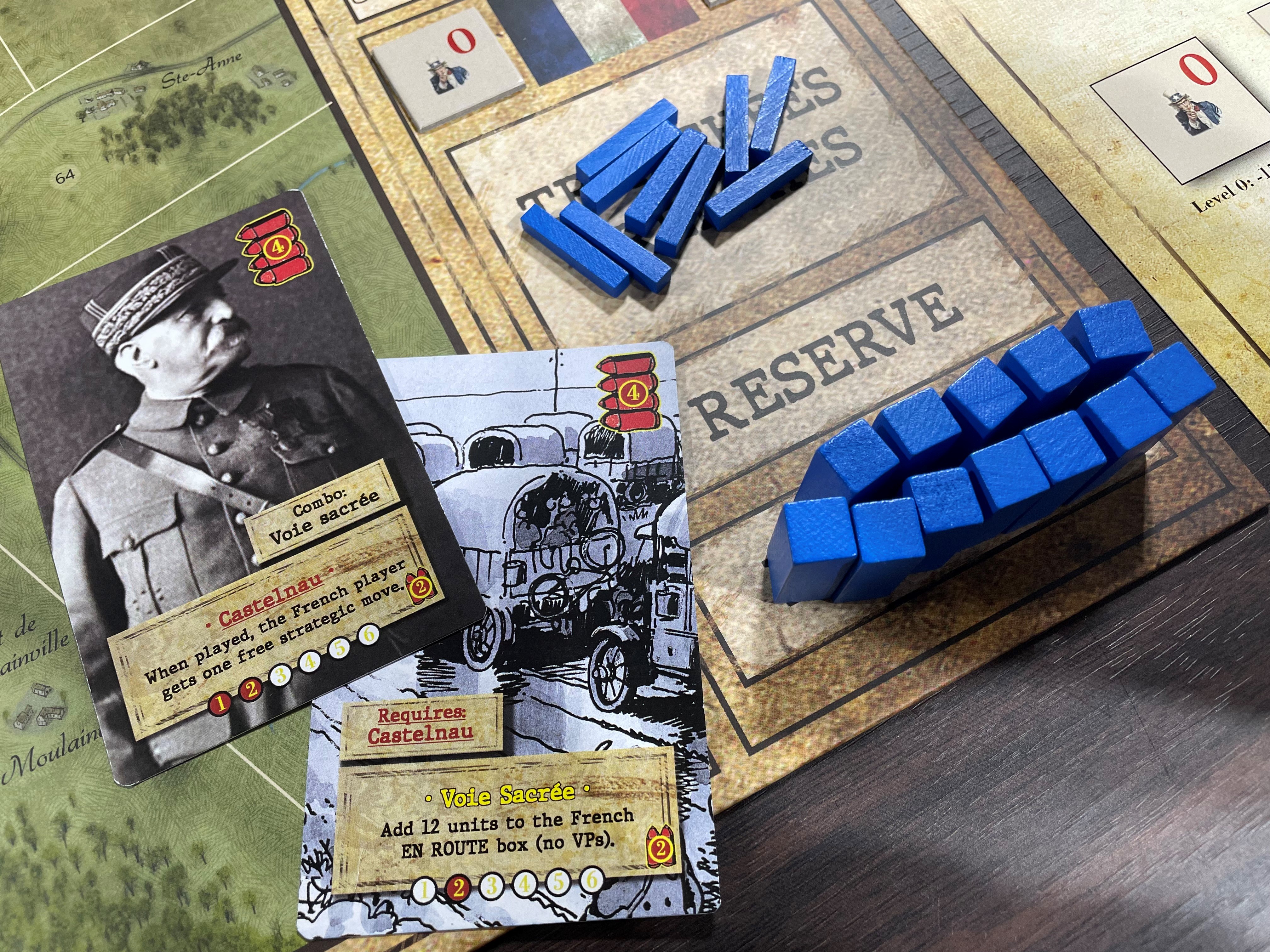
A perfect example of this is the Castelnau/Voie Sacrée Combo. Castelnau is an Event Card that must be played down on the table as a Permanent Event and is available during Turns 1 and 2. Once it is played, then that unlocks the play of Voie Sacrée and allows a very powerful Combo to go into effect by allowing the French player to place 12 units into the En Route Box on the board meaning they will be available for placement during the next Turn. This is so very powerful as in order to get that many units to use, the French player has to sacrifice a total of 12 VP (1 VP per unit added as Reinforcements). With this Combo, you sacrifice no VP’s and get 12 units to place on the board to plug the inevitable holes that will be created by the powerful German Barrages and assaults. There are other Combos as well including several specified Offensives (Russian Offensives and the Somme Offensive) that take several Turns to accomplish with multiple cards to get an opportunity to roll dice to gain VP’s. This was a very novel idea for the CDG mechanic and really worked well to create some portion of the game that required planning and an investment.

The Voie Sacrée, which is French for Sacred Way or Sacred Road, is a road that connects Bar-le-Duc to Verdun, France. It was given its name because of the vital role it played during the Battle of Verdun in World War I. After March 1916, along the 45 miles of the Voie Sacrée, transport vehicles were on the move day and night, ferrying troops, armaments, and supplies to the Verdun battlefield. During the initial crisis of February 21st through March 22nd, 600 trucks per day had already delivered 48,000 tons of ammunition, 6,400 tons of other materiel and 263,000 men to the battlefield. Beginning on February 21st, all horse-drawn traffic and troop movements on foot had been ordered off the road, leaving it open for truck and motorcar traffic only. After March 1916, one truck passed every 14 seconds, submitting the road to considerable wear and tear. Quarries had to be opened nearby to supply the road with crushed stone. Over the course of ten months, 16 labour battalions worked to keep the road in good shape and order. The road had been recognised since 1915 as the only reliable vehicular road that remained in existence to supply Verdun safely. All the standard-gauge railway lines that could reach Verdun had already been interrupted by German forces in late 1914. To compensate for this precarious situation, the road had been widened to 23 ft during 1915, so it could accommodate the continuous up and down flow of two lines of truck traffic. This preemptive roadway improvement in 1915, plus success in organizing the transport system on the road (a mission supervised by Colonel Maurice de Barescut, the Chief of Staff of the French Second Army), is what ultimately saved Verdun in 1916.

The Voie Sacrée still exists, but it has been paved over and is now an active secondary road. In 2006, the route was renumbered RD1916, a reference to the road’s most critical year. From 1923, the Voie Sacrée was marked by a borne every kilometer along the route. Each borne is topped with a sculpture of an Adrian helmet, the helmet worn by French soldiers during the Battle of Verdun.

The town hall in the village of Souilly, on the Voie Sacrée, served as headquarters to Generals Philippe Pétain and Robert Nivelle during the Battle of Verdun. A large, well-preserved, two-story stone building fronting on the Voie Sacrée, the Souilly town hall is still in official use today. Several plaques on its facade remind the visitor of the historic role it played in 1916 during the Battle of Verdun and, later in 1918, during the Meuse–Argonne offensive.

In the next entry in this series, we will take a look at the German Home Card Otto von Bismarck from Imperial Elegy: The Road to the Great War 1850-1920 from VUCA Simulations.

-Grant

Asmodee buys flip and write pioneer Welcome To… from Blue Cocker to continue acquisition spree

01. September 2026 um 13:47

Asmodee has continued its revived acquisitions spree by picking up the Welcome To… IP and game range from French publisher Blue Cocker.

The deal hands the board game publishing and distribution giant control of a flip-and-write series which has sold hundreds of thousands of copies since Benoit Turpin’s breakout design Welcome To Your Perfect Home was released in 2018.

Subsequent releases have included standalone sequels Welcome to the Moon and Welcome to New Las Vegas, while its implementation on online platform Board Game Arena has racked up more than 3 million played games, and averages over 3,000 unique players daily.

More new versions seem likely to be on the way following the acquisition, with Asmodee head of collections Mathieu Aubert saying, “This acquisition goes beyond bringing a strong IP into our portfolio. We see huge potential to expand the Welcome To… universe, and the team already has plenty of ideas to bring it to life. I look forward to sharing more about our projects in the coming month.”

Asmodee announced in November 2024 that it was preparing to “reignite” its strategy of buying up smaller board game publishers and distributors, saying at the time that it had a pipeline of more than 20 acquisition opportunities.

That expansion kicked off with the opportunistic purchases of Zombicide and Cthulhu: Death May Die from financially troubled CMON in 2025, and has accelerated this year with deals including the striking buyout of French social and party game publisher ATM Gaming in a deal which could reach €250m.

Other acquisitions from Asmodee this year include returning to CMON to buy Sheriff of Nottingham and publisher Japon Brand, buying Time’s Up from R&R Games and picking up the remaining 45% of Exploding Kittens it did not already own.

Asmodee CEO Thomas Koegler said during the announcement of the revived M&A strategy that many of its targets were businesses it already knew “in and out” through existing commercial relationships.

Asmodee CEO Thomas Koegler

He specifically highlighted publishers behind successful games it already distributed as potential targets, alongside social and party game businesses and IPs, hobby game studios and local distributors.

Welcome To… fits withing that strategy, with Asmodee already handling Blue Cocker titles in markets including the UK and US. In Asmodee’s home market of France, however, Welcome To… and other Blue Cocker Games are currently distributed by Hachette subsidiary BlackRock.

The original game helped popularise the flip-and-write format, replacing dice rolls common to roll-and-write games with shared cards which allow players to make their choices simultaneously.

Asmodee SVP of tabletop games Benoit Clerc said, “Welcome To… established itself as landmark titles in modern board gaming, combining elegant game design with exceptional accessibility.

“We have tremendous respect for the work accomplished by the Blue Cocker team, Benoit Turpin, and everyone who contributed to the success of the game and their different iterations.

“We are excited to welcome this intellectual property into Asmodee’s portfolio and join our line-up of great family games and look forward to building its future.”

Blue Cocker founder Alain Balay added, “From the very beginning, our ambition was to create a game that would stand the test of time and bring people together around the table.

“We are incredibly proud of everything Welcome To… has achieved over the past years, and we are confident Asmodee will now carry the brand forward and introduce it to even more players around the world.”

Blue Cocker was launched by former aeronautical engineer Balay in 2013, and operated as a one-person business until the success of Welcome To… and the company’s international sales allowed it to expand to a five-person operation in 2019, he recently told French newspaper La Gazette du Midi.

He said exports accounted for 60% of Blue Cocker’s revenue at that point, but have since fallen to just 10% amid ongoing global financial and political uncertainty.

Balay added that despite that, the French market has held up well despite concerns about a resurgence in inflation in the country.

Blue Cocker’s remaining titles include 2014’s Medieval Academy, 2016 release Meeple War and 2025’s The Last Droids, while its main 2026 release so far has been corporate deckbuilder SAN.

The company’s 15th release, the two-player cooperative title Les Yeux Fermés designed by Antonin Boccara and Julien Prothière, is slated for a 2027 release according to its BoardGameGeek page.

Forthcoming Blue Cocker release Les Yeux Fermés, designed by Antonin Boccara and Julien Prothière

Asmodee has kept its potential acquisitions tightly under wraps, but has plenty of financial firepower for further deals.

Its net sales rose 23% to €1.68bn in the financial year ending March 2026, while its adjusted EBITDA – its earnings before taxes, depreciation, amortisation and irregular one-off costs – was up about 25% to €285.4m.

The company’s net debt, meanwhile, stood at 1.6x adjusted EBITDA at the end of June, rising to 1.7 times once M&A commitments were included – down from 2.1 times a year earlier and comfortably below the company’s 2.5-times leverage target, given it significant headroom for M&A.

Despite Asmodee’s long-time image as a board game publishing heavyweight, more than 72% of its revenue now comes via its distribution of other companies’ games – up from an already hefty 63% in the previous financial year to March 31, 2025.

TCGs make up the lion’s share of Asmodee’s annual net sales – about 60% in the 2025/26 financial year, up from just over 50% across the preceding 12 month period.

The company’s own board game publishing operation, meanwhile, saw its net sales fall 5.8% in the last financial year – while net sales for the first quarter of this year were down 9.8% compared to the same period in 2025.

Asmodee CEO Thomas Koegler was asked directly during a Q&A session on Asmodee’s latest financial results in May if the company was still primarily a board game publisher, or whether it was “increasingly becoming an infrastructure company for TCGs”.

He said in response, “We have insisted a lot on the fact that one of the strengths of Asmodee is to be a publisher, but the first strength that we do have is our global reach across all categories, from TCGs and board games.

“That’s the superpower of Asmodee – and then being a very strong publisher is a way of accelerating performance.

“So I would say that there is no change, we continue to capture opportunities across the board wherever they come from… our aim is to be a dominant player, bringing all games to the market, anywhere they can.”

Last week Asmodee named Exploding Kittens CEO Carly McGinnis as head of its global publishing operation, putting an executive who helped transform a record-breaking Kickstarter game into an international brand in charge of a portfolio including Catan, Ticket to Ride, 7 Wonders and Dobble/Spot It.

The move puts McGinnis into a hugely influential position within the tabletop industry. Asmodee’s chief product officer has responsibility for its studios, franchise development, licensing and studio marketing, according to the organisational structure the company published ahead of its stock market listing last year.

The post Asmodee buys flip and write pioneer Welcome To… from Blue Cocker to continue acquisition spree first appeared on .

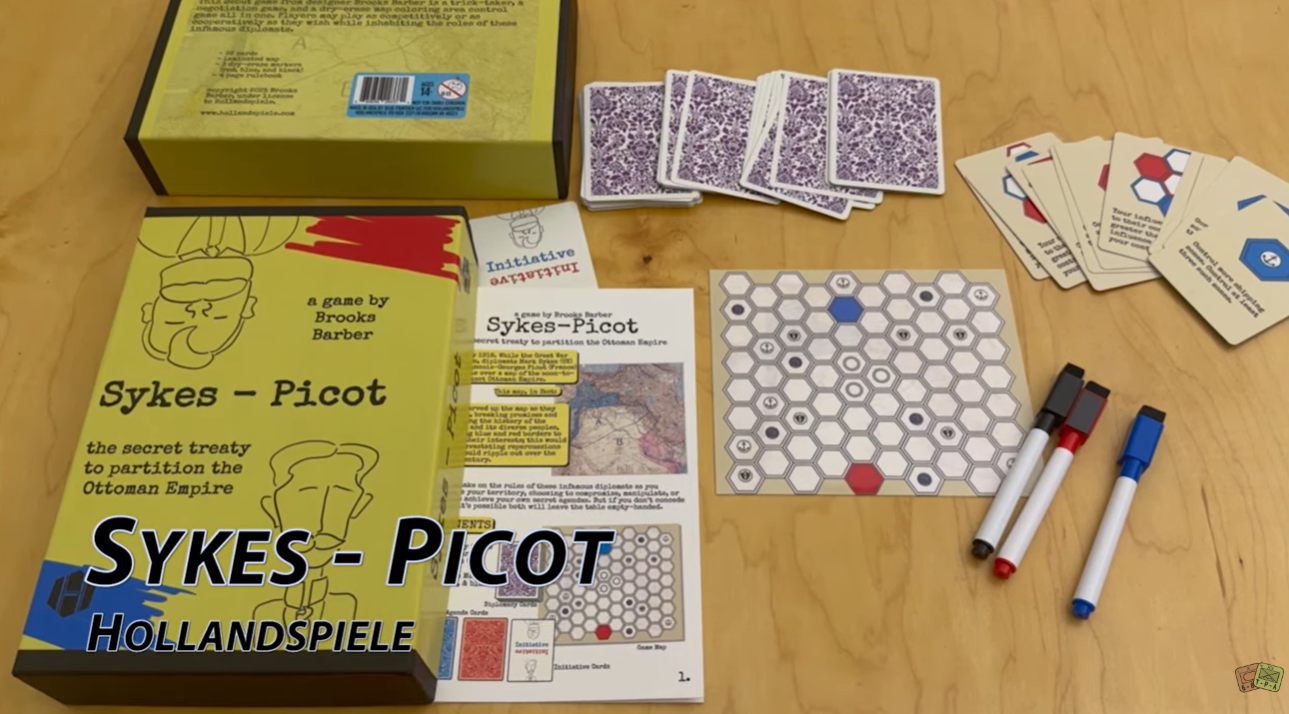
Unboxing Video: Sykes-Picot from Hollandspiele

Von: Grant
22. August 2026 um 14:00

During the First World War, the British and French made a secret agreement to carve up the Ottoman Empire – literally drawing on a map in red and blue ink – without respect to the peoples, culture, or history of the region. This would have devastating effects over the next century.

In Sykes-Picot, two players take on the roles of infamous diplomats Mark Sykes and Francois Georges-Picot, using red and blue markers to carve out territories to control and to influence on a dry-erase map. Trick-taking card play and table-talk negotiations drive the proceedings, with the winner of each trick choosing one of the two cards to implement, and the loser consoling themselves with the remaining card. Each player has a set of hidden objectives they’re trying to achieve. Players may be as co-operative or as competitive as they wish in pursuit of these goals.

Tonally, the game is light, reflecting the distance and cavalier attitude of these imperialist powers. We feel there’s something horrifying in that, and this approach captures some of that horror.

-Grant

Spylune

12. August 2026 um 01:37

but wait, hear me out: what if the dragon had a top hat... with gears

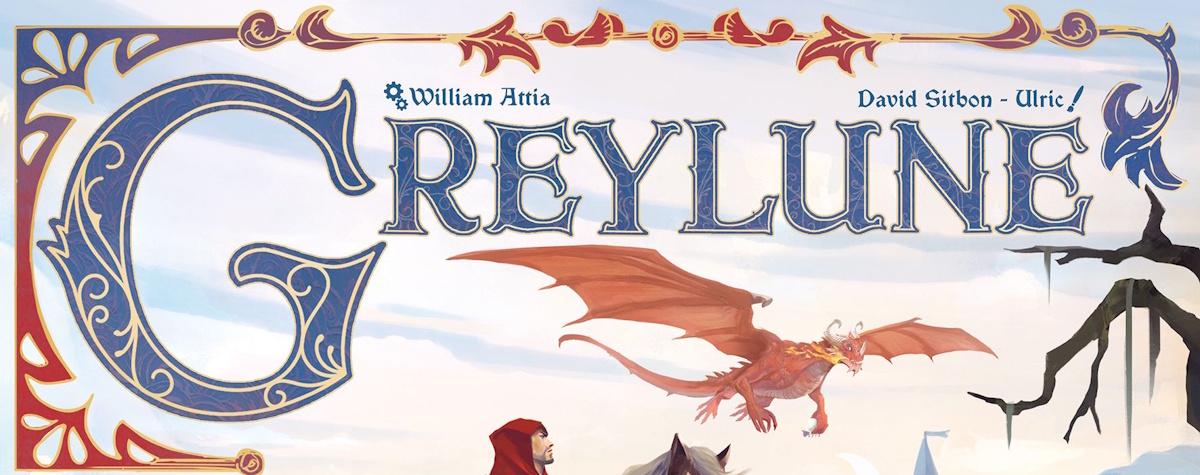
I never played Spyrium, William Attia’s 2013 game of steampunk factories, but I heard good things about its worker placement/removal system. Greylune, as near as I can tell, recaptures that title’s core appeal, while swapping the geared top hats for a more generic — but maybe more blandly appealing? — fantasy universe.

just steal that horse instead thanks

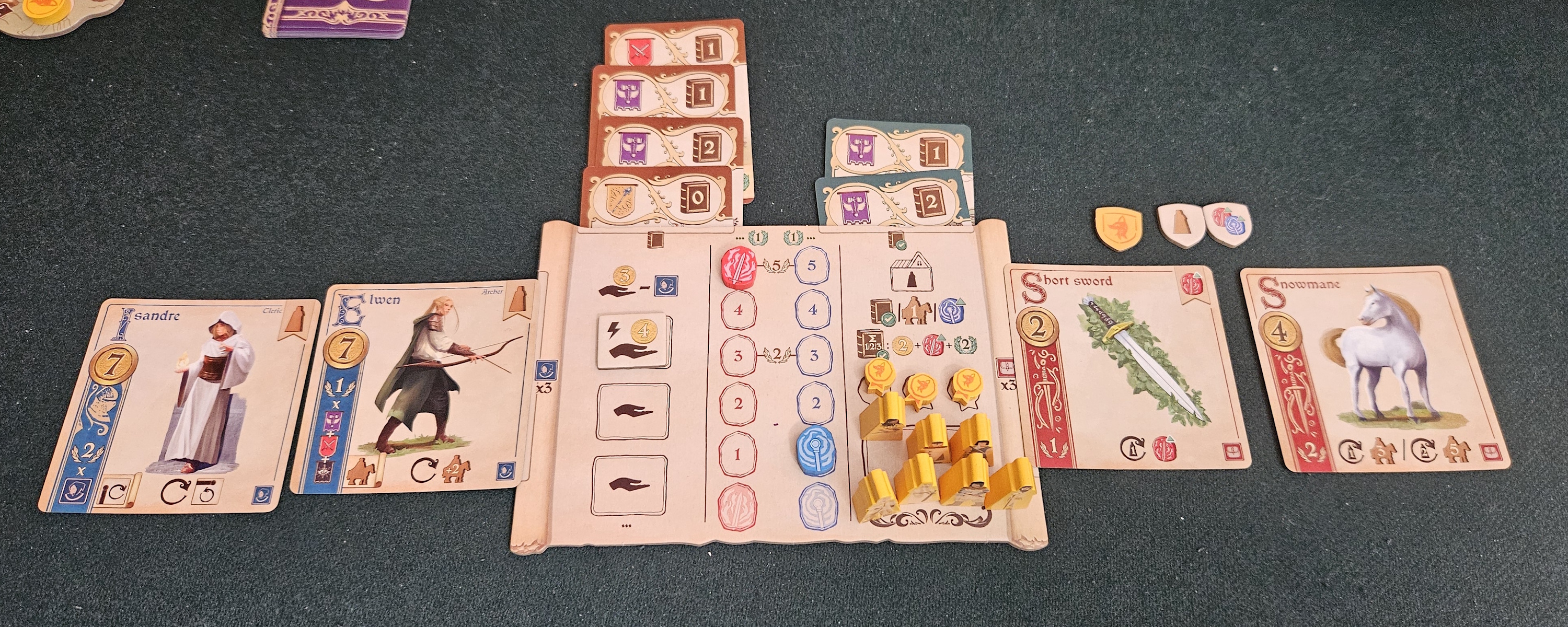
Your followers go into the market to buy goods… and steal gold? I think?

As expected, the best part has everything to do with the workers. The core system here is genuinely brilliant, a series of placements and eventual withdrawals that feel like direct assaults on one’s fellows at the table without ever laying a cross finger upon anyone’s shoulder.

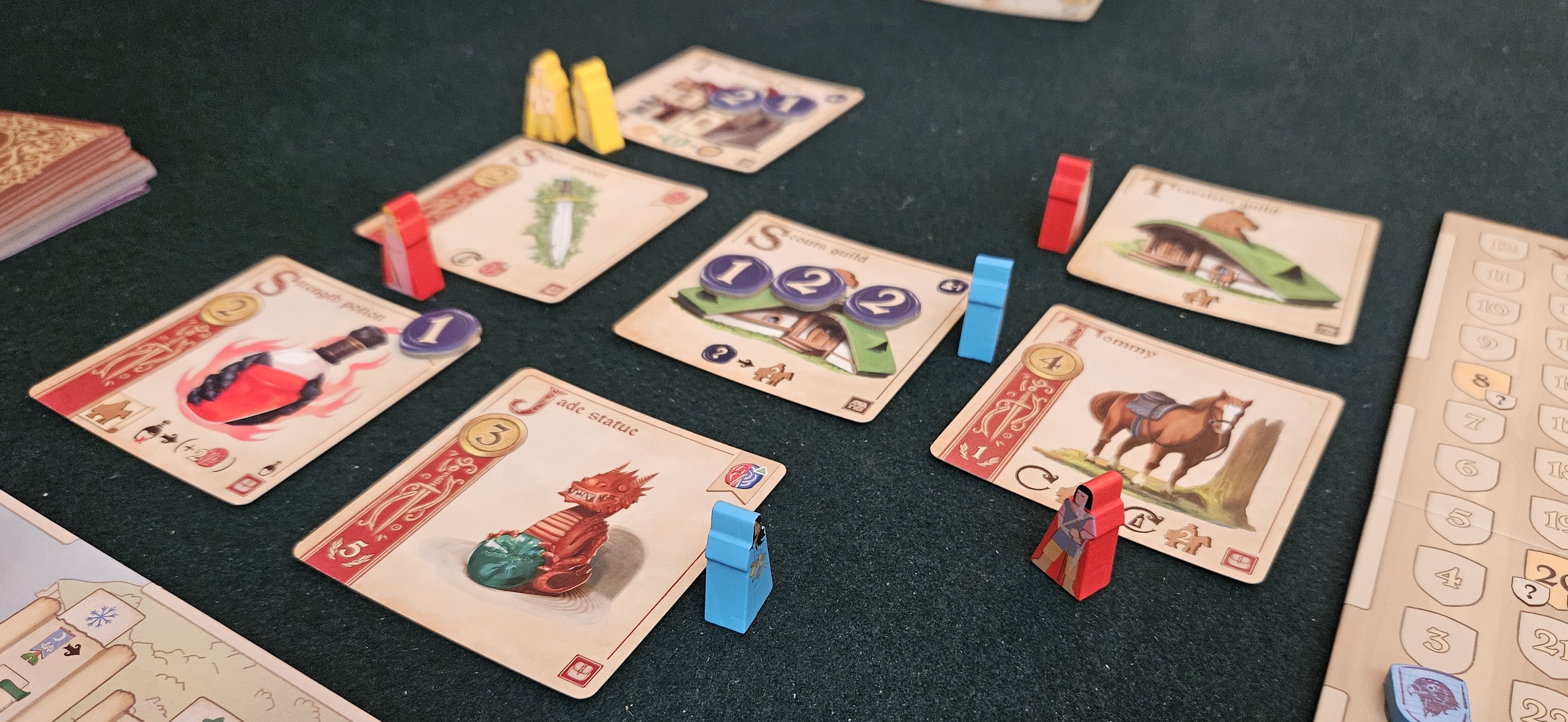
The idea is that workers are placed into a marketplace to secure various goods. There are a few types of said goods: items and companions, both of which require purchasing, and amenities, which can be visited more than once. Their main commonality is that buying something from the market has two big restrictions. First, you can only purchase something by removing a worker — thus shifting yourself into the game’s second phase, which prevents you from placing any more workers until the next year — and second, the more workers there are surrounding something, the higher its cost.

The inverse is also true. Rather than pulling off a worker (teehee) to buy a card, their withdrawal can earn a pocketful of gold instead. This works by the same formula: you remove a worker, count how many other workers are next to the card in question, and then earn that many coins. They’re probably engaging in commerce or something. I preferred to pretend they were pickpockets.

As systems go, there’s no doubting its cleverness. Everything is wholly player-driven. It’s pretty rare that I’ll pay attention to how many coins a rival is holding, but here it’s common to tally someone’s holdings. Often, the placement of a single worker can drive up a price just beyond their reach, prompting them to first place another worker to earn the necessary cash, and thus providing a window to swoop in and nab whatever sword, horse, or buddy they were eyeing.

It’s a rather snitty game like that. Also a razor-taut one, every coin and card counted to its precise change.

There's some frustration to assessing whether a resource needs to be spent or merely held. So that's annoying.

Ah, an adventure!

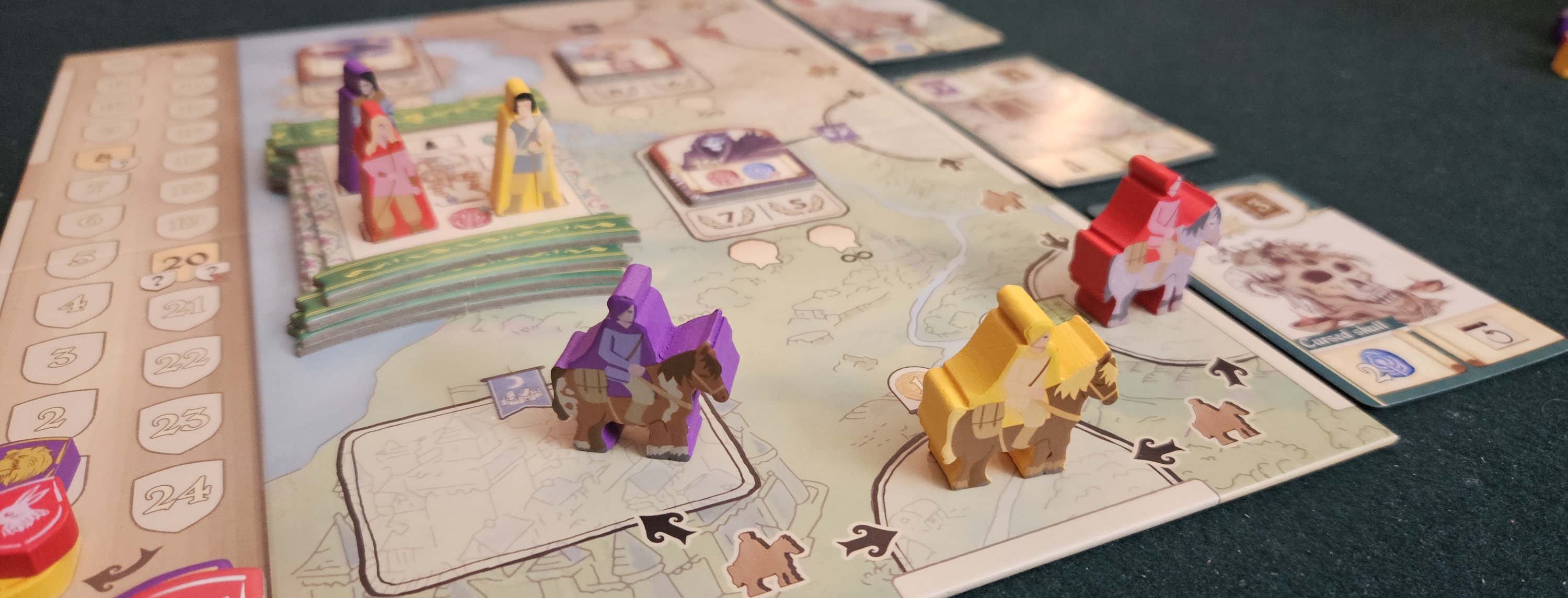
The reason for all those fairly-gotten gains is to outfit your knight for adventure. Everything has its place: companions provide reactive abilities that make it easier to travel and survive encounters, while items generally serve to improve your skills or move your knight deeper into the wild. There are also two flavors of strength, cherry and blueberry, to represent swords and sorcery.

So you head out into the unknown to beat up a troll, help a hermit, or take part in a joust. You know. Hero stuff. But in my favorite twist, it isn’t enough to accomplish an objective. These encounters are tucked under your player board, where they then sit, doing nothing, until you get around to sending one of your followers to boast of your achievements in one of the local taverns. This requires more worker placement and removal, whether the following spring or because you’ve planned ahead.

It’s rather impressive to see in motion. Despite the removal of anything resembling steampunk, the game moves according to clockwork logic, everything feeding back into itself: workers outfit knights who bring back deeds for workers to boast about or resources for them to spend at the market, around and around, until you’ve exhausted everyone and it’s time to tuck in for the winter.

At the same time, it’s a game laden with regrets. It isn’t uncommon to move onto the next phase only to immediately see the gap in your plans. Or, more often, for another player to come along and do something that forces you to think more reactively. Encounters exist to be stolen; quests to be one-upped; jeweled idols to be purchased out from under another prospective client.

It feels good, though. Really good. Which makes me wish the game didn’t feel like it was left at eighty percent completion. There’s a big difference between replayability and variety, with lots of modern games leaning toward the latter. I would guess that Attia was designing for tightness of experience.

But also… Greylune needs some variety. Every session reveals nearly every card, both in the marketplace and the wild. There’s such a lovely sense of discovery to those first sessions that I found myself wishing I could go back and experience it again. Here, knowing what’s coming is much of the battle. On my second play, I knew I would buy the horse if it showed up. Then I knew I would try for a potion strategy. In the last round, which features no variance from play to play, it’s inevitable that a powerful tavern will appear, one that awards rather large quantities of points. So I planned from the very beginning to save most of my quests for the last moment and forego adventuring altogether. There were little hiccups, but the strategy worked well enough to lap most of my opponents. It felt good, to be sure. But it also felt sterile and mechanical.

I love buying DVDs. Physical media! The best! I've tried applying that same enthusiasm to replacing ancient air conditioning units or busted clothes washers, but so far it isn't working.

Everyone likes buying stuff, right?

Ultimately, Greylune both impressed me and left me chilly. Its core system is downright smart, and the set dressing around it feels good to handle. But it’s like handling a machine; a fidget toy, perhaps, or an orrery, spinning along its foreordained orbit. Pleasant but cold; beautiful but delicate. These days, I like my games to apply some force when they’re ramming their shield into my teeth, and Greylune’s touch is simply too dainty to cause so much as a wiggle.


A complimentary copy of Greylune was provided by the publisher.

(If what I’m doing at Space-Biff! is valuable to you in some way, please consider dropping by my Patreon campaign or Ko-fi. Right now, supporters can read the next installment in my series Talking About Games, this time tackling the topic of what makes a good list! Naturally, the piece includes a list.)

Auf den Wegen von Marie Curie

23. Dezember 2025 um 07:46

„Auf den Wegen von Marie Curie” ist der zweite Titel, mit dem der Verlag Sorry We Are French berühmte Wissenschaftler in den Fokus setzt. „Auf den Wegen von Charles Darwin” war im Jahr 2024 direkt zum “Spiel des Jahres” nominiert worden. Es zeichnet auf eine konsequent reduzierte Weise die Reise des britischen Evolutionsforschers nach. Im neuen Spiel dreht sich nun alles um die aus Polen stammende Marie Curie (1867-1934).

Auf den Wegen von Marie Curie

Wie schon das Darwin-Spiel, punktet auch „Auf den Wegen von Marie Curie” mit einem Zusatzheft, in dem die wichtigsten Stationen der Wissenschaftlerin nachgezeichnet werden. Marie Curie forschte zur Radioaktivität, entdeckte neue Elemente und erhielt die Nobelpreise für Physik (1903) und Chemie (1911).

Im Spiel folgen wir ihr in das Labor und stellen selbst Experimente mit Pechblende, Uran und Radium an. Die Ungewissheit über den Ausgang von Versuchen wird hier simuliert, indem wir Holzsteinchen, die Elemente, in einen Würfelturm werfen. Manche Steine bleiben hängen und kommen möglicherweise erst bei einem Zug eines anderen Spielers wieder zum Vorschein. Ein passender, wenn auch mitunter ungerechter Mechanismus.

Ein ständiges Umwandeln bei „Auf den Wegen von Marie Curie“

Der Zufall greift also ein bei der Auswahl an Elementen, die uns für verschiedene Aktion zur Verfügung stehen. Aufgabe ist es nun, mit den Ergebnissen möglichst effektiv umzugehen, um letztlich Siegpunkte zu ergattern. Wir absolvieren Experimente, erwerben sogenannte Aktivitätskarten, stellen Thesen auf. Das geht einher mit einem ständigen und eintönigem Umwandeln der Elemente: drei Pechblende gleich ein Uran, zwei Uran gleich zwei Radium, zwei Radium gleich ein Siegpunkt und ein Schritt auf der Zeitleiste.

Auf den Wegen von Marie Curie

Zeitleiste? Ja, wir haken die wichtigsten Stationen Marie Curies ab – mit einmaligen Aktionsmöglichkeiten zu bestimmten Zeitpunkten. Darauf sollte man vorbereitet sein. Zudem bestimmt die Zahl geglückter Versuche die Aktionsmöglichkeiten. Doch der Spannungsbogen nimmt dadurch nicht zu. Im Gegensatz zu Marie Curies wirklichem Leben fehlen in diesem Spiel leider die Höhepunkte.

Auf den Wegen von Marie Curie | Sorry We Are French | Florian Fay | 2 bis 4 Spieler | ab 10 Jahren | 20 bis 40 Minuten | Spielanleitung | Meine Bewertung: ★☆☆☆☆ (mäßig)

❌