Co-operative puzzle challenge game Take Time has triumphed in this year’s Swiss Gamers Award, which is voted on by members of board game clubs, game and toy libraries and gaming associations from across the country.
Alexi Piovesan and Julien Prothière’s design sealed top spot above Eric Olsen’s Flip 7 – which won the separate family game prize – and also finished in third place in the family-weight category.
The win is the second year in a row a game from Asmodee studio Libellud has won the Swiss Gamers Award, following last year’s success for nature-themed tile-laying game Harmonies.
Take Time, designed by Alexi Piovesan and Julien Prothière
The game fought off tough competition in the family game category this year from titles including Paolo Mori and Alessandro Zucchini’s Toy Battle, the winner of the 2026 As d’Or.
This year’s Swiss Gamers Award featured an expert game category for the first time, which was won by Yeom Cheolwoong’s design Wondrous Creatures – a strategy title based around players building fantasy animal reserves.
Wondrous Creatures, designed by Yeom Cheolwoong || Photo Credit: Bad Comet
The Swiss Gamers Award has been held every year since 2010, following the demise of the Schweizer Spielepreis in 2006.
Although the award is given by gamers living in Switzerland, all games published in the prior year can be nominated, regardless of the nationality of their authors and publishers.
This year’s award marked the third in a row presented to a relatively light game, following Harmonies last year and Faraway in the 2023 awards (presented in 2024).
The far more heavyweight Ark Nova triumphed in 2022, and mid-weight euro The Lost Ruins of Arnak won in 2021.
The award is organised by Ludesco, Switzerland’s biggest board game festival, in partnership with the Swiss Federation of Toy Libraries and the Swiss Game Museum.
Swiss Gamers Awards full results 2025
Main Award Winner: Take Time, designed by Alexi Piovesan, Julien Prothière (Published by Libellud) 2nd Place: Flip 7, Eric Olsen (Catch Up Games, Kosmos) 3rd Place: Zenith, Grégory Grard, Mathieu Roussel (PlayPunk)
Family Award Winner: Flip 7, Eric Olsen (Catch Up Games, Kosmos) 2nd Place: Toy Battle, Paolo Mori and Alessandro Zucchini (Repos Productions) 3rd Place: Take Time, Alexi Piovesan and Julien Prothière (Libellud)
Expert Award Winner: Wondrous Creatures, Yeom Cheolwoong (Super Meeple, Strohmann Games) 2nd Place: Endeavor: Deep Sea, Carl de Visser and Jarratt Gray (Super Meeple, Board Game Circus) 3rd Place: Eternal Decks, Hiroken (Pixie Games, Strohmann Games)
Ryan Dancey, a more than 30-year veteran of the tabletop gaming industry, has lost his COO job at publisher Alderac Entertainment Group (AEG) a day after saying AI could generate game ideas as good as his company’s titles Tiny Towns and Cubitos.
Much of the ire was directed at Dancey’s response to a post comment which argued that “AI wouldn’t come up with Tiny Towns or Flip Seven or Cubitos because it doesn’t understand the human element of fun”.
Dancey posted in reply, “I have zero reason to believe that an AI couldn’t ‘come up with Tiny Towns or Flip Seven or Cubitos’. I can prompt any of several AIs RIGHT NOW [Dancey’s emphasis] and get ideas for games as good as those.
“The gaming industry doesn’t exist because humans create otherwise unobtainable ideas. It exists because many many previous games exist, feed into the minds of designers, who produce new variants on those themes. People then apply risk capital against those ideas to see if there’s a product market fit. Sometimes there is, and sometimes there is not. (In fact, much more often than not).”
“Extremely occasionally (twice in my lifetime: D&D and Magic: the Gathering) a human has produced an all new form of gaming entertainment. Those moments are so rare and incandescent that they echo across decades.
“Game publishing isn’t an industry of unique special ideas. It’s an industry about execution, marketing, and attention to detail. All things AIs are great at.”
Alderac CEO John Zinser, who has led the Space Base and Love Letter publisher for three decades, moved quickly to distance the company from Dancey’s comments, posting on BlueSky yesterday, “I want to be clear where I stand. For 30+ years, AEG has worked with human designers to bring games to life.
“That creative partnership, the collaboration, the shared spark, is what makes tabletop special. That is not changing.”
Several hours later, Zinser confirmed in a Facebook post that Dancey and AEG had “parted ways” after more than a decade.
Zinser said, “This is not an easy post to write. Ryan is my best friend and has been a significant part of AEG’s story, and I am personally grateful for the years of work, passion, and intensity he brought to the company. We have built a lot together.
“As AEG moves into its next chapter, leadership alignment and clarity matter more than ever. This transition reflects that reality.
“Our commitment to our designers, partners, retailers, and players remains unchanged. We will continue building great games through collaboration, creativity, and trust.
“I expect Ryan will have much success in whatever he builds next.”
BoardGameWire contacted Zinser to ask for further comment on the situation, its affect on AEG, the company’s plans to recruit a replacement, and for Zinser’s take on Dancey’s achievements during his decade at the business, but is yet to receive a reply.
“This tide is, in my opinion, only running one way, and AEG is going to have to fight hard to hold it’s [sic] position.”
Former Alderac COO Ryan Dancey
Dancey, however, provided an extensive response to BoardGameWire’s questions, including denying that he believed AI could “come up with Tiny Towns or Flip 7 or Cubitos” – instead emphasising that he was speaking about the technology being able to produce “ideas” rather than completed designs.
He told BoardGameWire, “I am not saying that an AI could turn over a finished game design ready for publication. I’m not even saying that an AI could produce work ripe enough to be pitched to a publisher. But the idea that it could not be used to generate ideas on the level as those embodied by those three games is already demonstrably false (in my opinion).
“This language ‘come up with’ is pretty nonspecific and I understand people who chose to take it at its most extreme level even though that was not my intent. I could have done a better job of being more explicit about the level of work I think an AI can do.”
Dancey added that he had contacted Tiny Towns designer Peter McPherson and Cubitos creator John D Clair in the wake of his comments discussing their games, saying, “Among other things I told them: ‘I don’t think AI is capable of doing your jobs, I would much rather work you with than a robot, I think you’re both top-tier designers that I feel privileged to work with, and I apologize if you found anything in my remarks to be hurtful’.
“I don’t have a working relationship with [Flip 7 designer Eric Olsen], but I would say the same to him if I did.”
Tiny Towns: Villagers || Photo Credit: AEG
Commenting on his suggestion in the LinkedIn post that all current board game design is based on designers taking existing games and producing variants on those themes, Dancey said, “Everything we do as humans is derived from experience. All art is derived. We all stand on the shoulders of every generation who went before us.
“Specifically I wrote: ‘The gaming industry doesn’t exist because humans create otherwise unobtainable ideas. It exists because many many previous games exist, feed into the minds of designers, who produce new variants on those themes’.
“I stand by that statement. It seems axiomatic to me.
“The game industry is overflowing with great ideas for games. We don’t lack for ideas. The hard part is deciding which great ideas can be commercialized, and how to do that. The incredible skill that someone like Pete or John brings is knowing how to evolve ‘a good idea’ into a ‘great game’.”
No AI at AEG
Dancey also told BoardGameWire that AEG’s leadership team made a policy decision “several years ago” not to use generative AI in its products or its “creative pipeline”.
He said, “I supported that decision – it was a consensus. I believed then and I believe now that it’s not appropriate to use AI in those ways in tabletop games.
“Since then I have been responsible for developing and adding language to our boilerplate contracts with people who freelance for AEG, who develop for AEG and who create artwork for AEG which specifically prohibits them from using generative AI in their work without permission, which AEG does not provide, and that specifies pretty harsh penalties for failure to comply with those policies.
“I fully support the inclusion of that language in our contracts. I took the initiative to write that language and I took the initiative to enforce its inclusion.
“We have already had pushback from creative workers who don’t like the harsh penalties. We’ve had pushback from people who want to water down their affirmative responsibility to ensure that they and anyone they’re working with or subcontracting work to adheres to this policy.
“This tide is, in my opinion, only running one way, and AEG is going to have to fight hard to hold it’s [sic] position.”
He continued, “I am not championing the use of generative AI in the gaming industry to design, develop or illustrate games. I believe we must talk about the real abilities of this technology, honestly, so that we can think about the impacts it will have on our lives.
“Making decisions to use it, how to use it, how to restrict it, and how to enforce those decisions is something that every publisher in the industry should already have done and should be revisiting on a regular basis.
“The time for these conversations is now. Not next year. Now.”
“I’m writing this for the people in my life who don’t [work with AI]… my family, my friends, the people I care about who keep asking me “so what’s the deal with AI?” and getting an answer that doesn’t do justice to what’s actually happening. I keep giving them the polite version. The cocktail-party version. Because the honest version sounds like I’ve lost my mind. And for a while, I told myself that was a good enough reason to keep what’s truly happening to myself. But the gap between what I’ve been saying and what is actually happening has gotten far too big. The people I care about deserve to hear what is coming, even if it sounds crazy.”
Dancey told BoardGameWire, “I believe I am in touch with enough of this tech and have done enough research to feel the same as author Matt Schumer. I feel like I have an obligation to discuss this technology as widely and as honestly as possible. If I do not, I am doing harm to those I care about.
“I’m sorry if having this conversation makes people uncomfortable. I know there are people who want it to go away, or believe it’s unfixably tainted by the unethical circumstances of its birth. I know that there are people who want to have a fight about this and want to use proxies if they have to (which is what I feel has happened in this particular case). But I still feel compelled to speak. If I do not, I will go insane.
“I’m incredibly sad that this episode has resulted in my separation from AEG, a company I have worked with for more than 10 years. And I’m really frustrated and hurt that it’s happening because of something people think I said, not something I actually said.”
Wider Issue
Wingspan designer Elizabeth Hargrave, the co-founder of non-profit support organisation the Tabletop Game Designers Association, dismissed Dancey’s suggestion that AI could generate ideas for games such as Tiny Towns and Cubitos.
TTGDA co-founder Elizabeth Hargrave
She told BoardGameWire, “I absolutely do not think AI could be prompted to come up with even the basic idea for those games, let alone a fully fleshed out ruleset for them. For fun, I’ve prompted several different options for ideas for Wingspan cards and not one of them has given me an actionable idea.
“I had a friend who ran a rulebook through AI for proofreading and it hallucinated that people needed to shout ‘bingo’. Apparently that’s AI’s conception of board games right now.”
She added, “Designers do pull from existing games but when it’s done well it’s because those existing mechanisms serve some original idea, and then they’re remixed so thoroughly with other mechanisms and with the subject matter that it feels new.
“Sanibel has pieces of Tokaido and Tetris and many tile-laying games. But it wasn’t a prompt of ‘I’m going to remix these games’. It was ‘what would work well in service of this idea that I have?’.
“That requires understanding how games actually feel when you play them, and anticipating how different pieces can fit together.”
Hargrave said that the TTGDA board had been discussing the use of AI in board game design, adding that it was “a conversation we need to have with our membership”.
She said, “We’re working on a model contract to offer to our members right now, and that will offer a clause that designers can request that will require publishers not to use AI in their final product. A lot of contracts ask us to certify that a board game design is our own, and not plagiarized.
“It’s my opinion that using AI in a final product goes against that, because it’s using a machine that’s built entirely on plagiarism.”
Hargrave added, “I do see people using AI for things like generating a bunch of placeholder names in a prototype. They’re often clunky options but they do the job when you know everything will change 50 times before you’re done anyway. I’m not aware of anyone who has successfully actually gotten good, original ideas for mechanisms from AI.
“What I wish we were talking about is how AI could be built to help designers run models of their games repeatedly to catch weird edge cases or broken strategies. I wish someone would build that tool instead of the language models that just focus on advanced auto-complete.
“This would never replace actual playtesting with humans for psychology and actual fun, but it might save me some repetitions.”
Previous apology
Dancey’s exit from Alderac comes three years after he publicly apologised for saying that male board game designers vastly outnumber women because “females are socialized in the West to avoid situations where they’re subjected to fairly harsh criticism of their abilities and creative ideas”.
He had made those comments on Twitter in response to a thread from Elizabeth Hargrave, who had presented data criticising the structural issues in board gaming which had seen so few women nominated for the Spiel des Jahres prize – widely considered the biggest award in board gaming.
Dancey’s comment in the thread included him saying, “Males are socialized to take the punches and keep moving forward. Getting across the gap is how you turn someone into a ‘real game designer’ who gets paid for their work and who makes designs that are attractive to publishers.”
In addition to saying the post “doesn’t reflect my views and it certainly doesn’t reflect the views of the company I work for”, Dancey outlined “concrete steps” he said AEG would be taking “to do better in this regard”, and called on readers to “check back with me in a year and hold me accountable”.
When BoardGameWire contacted Dancey on the anniversary of the apology for an update, he said, “When I’m ready to speak more on this topic I’ll do it on X as a followup to that original post.”
No follow-up to that original post from Dancey appears to exist.
Update 19/2/26: Dancey contacted BoardGameWire to say that he wrote a follow-up to the original post on Twitter in May of 2024, but deleted some of his Twitter posts when he stopped using the site in November of that year.That response no longer exists online following Dancey’s deletion of it, but a full version of the text has now been included at the end of this article.
Dancey’s career in the tabletop space dates back more than 30 years, when he was part of the team developing the Legend of the Five Rings TCG.
In 1997 he helped negotiate Wizards of the Coast’s takeover of the bankruptcy-threatened Dungeons & Dragons publisher TSR, becoming head of D&D following the deal.
Dancey also previously worked as chief marketing officer for CCP Games, the Icelandic video game producer of space sandbox MMO Eve Online, following its acquisition of roleplaying game and book publisher White Wolf Publishing in 2006.
He was also the CEO of Goblinworks, the company behind development of a massively multiplayer online game based on Paizo’s Pathfinder RPG, between 2011 and 2015.
That title raised about $1.4m across a pair of Kickstarter campaigns, but after Dancey left for “personal reasons” all but three of the company’s staff were almost immediately laid off, with then-Paizo CEO Lisa Stevens saying “delays in getting the game to market coupled with some anticipated funding falling through have left us about 75% short of the money we need to finish the game”.
Dancey told BoardGameWire yesterday that he did not have any specific plans for the future following his departure from AEG.
—
Update 19/2/26:Ryan Dancey’s now deleted Twitter post from May 2024, a year after his apology for saying that male board game designers vastly outnumber women because “females are socialized in the West to avoid situations where they’re subjected to fairly harsh criticism of their abilities and creative ideas”:
Last year I hastily wrote out some thoughts about the challenges that women face in succeeding as game designers and the hurdles they face moving past the pitch process and getting their games published. I managed to pretty thoroughly mangle my thoughts, anger a lot of people, and disrupt that dialog. I was clumsy in my writing, and poorly communicated what I wanted to express. In the aftermath I apologized, and I said I would return to the topic after a year spent in reflection and in working on these issues.
This is that update.
Since I joined AEG as a full time staff member in 2016 one of the things I have been working on is improving the diversity of our staff. From 2016 into the pandemic, we had fairly low staff turnover. During that time the most significant staff change was the addition of a VP of Sales & Marketing, who is a woman, but we parted ways with her in 2019. During the pandemic we had no significant staff changes.
Currently of 13 full time staff at AEG, five are women. Of the most recent hires since 2021, four of five hires have been women. Of the departures since 2021, none have been women. Since 2023 we have hired one person into a full time staff role, and that person is a woman. As we turned the calendar page to 2024, we promoted Adelheid Zimmerman to our Leadership team. This five person team sets overall direction for the company, and reviews and approves things like the schedule of new product releases, budgets, staff compensation and hiring and separations, etc.
We continue to struggle with racial and ethnic diversity and are also concerned about our internal and external connections with all people who might feel marginalized or face obstacles in the profession of game publishing. This is a significant problem that our Leadership team has discussed at length and it is an area where we need to show improvement.
AEG affirmatively seeks to diversify its workplace by providing opportunities to candidates who identify with underrepresented groups and we provide a pathway through our application process for candidates who may have experience and backgrounds that bypass some of the requirements in our job postings.
I am confident that we will continue to become a more diverse employer over time.
Our pipeline for new products has mostly been closed over this period. We have a backlog of amazing games in development and have not been actively pursuing new pitches in the way that we did earlier in the decade and before the pandemic. Much of the new work we have been pursuing has involved designers already working with us on previous products. This has significantly curtailed our footprint in the spaces where designers interface with publishers as a part of the pitch process. We did take a few outside pitches this year including several from designers who don’t identify as male, but none of those pitches progressed to an option or offer.
In 2023 and 2024 AEG released four all new games: Rolling Heights, Number Drop, Shake that City and Waffle Time. We have two more games that are just now going into wide release: Let’s Go! To Japan and Undergrove. Of those games Undergrove which was co-designed by Elizabeth Hargrave and Mark Wootton is the only game in that list designed by a woman.
We have been trying to find proactive ways to connect with people who have been working on diversity initiatives in the industry. It’s been a good year for forward momentum in this area. Organizations like the Tabletop Game Designers Association will hopefully gain traction and AEG intends to provide support when they are ready to connect with the publisher tier. We have also connected with and provided support to the Rose Gauntlet Foundation.
We have plans to directly contact some of the communities which have self-organized for groups that are underrepresented in the design pipeline and establish a system by which we can both provide opportunities for constructive feedback (both directions) and hear pitches from designers in those communities who feel they are ready to make them. We’re hopeful that this will result in some games in development coming from those communities for publication in the latter half of this decade.
We have done some work behind the scenes providing counsel and advice to a number of women and BIPOC individuals who have approached us seeking insights about the industry and when possible we’ve been happy to provide as much assistance as we can. These kinds of interactions are usually confidential and we respect the secure nature of these relationships; if you or someone you know would like to engage with us confidentially and ask for our thoughts about how the industry works, have us make introductions to our network of contacts, share some of our quantitative information or get our perspective on the current state of the industry please feel free to reach out to anyone on the AEG team.
I believe that the design pipeline is unbalanced and the predominant cohort of designers who succeed in finding a partner to get their games into print are stereotypically middle aged white men. Over the more than thirty years I have been a gaming industry professional this has improved and not remained static but a lot of work remains to be done. My personal opinion is that the biggest obstacle to a more representative market of designers begins upstream of the pitch meeting. I think that like AEG, most of our peers are very receptive to the idea of working with designers who are not middle aged white men. The challenge all publishers face is increasing the quantity and quality of pitches that we are receiving from designers from a wider demographic base.
We need to see more designers get past their first design efforts even if those efforts don’t result in a published game. It’s possible that a person’s first design is a winner but It is much more common that it often takes several swings before a designer makes a winning design idea. One thing I think a lot about is how to help people get over that first hurdle of rejection, recycle, and come back with a better second (third, fourth, etc.) effort. Game design is an inherently and intensely personal creative effort and nobody likes the feeling of being told their ideas aren’t good enough or marketable enough. I wish I had better answers for how to support people going through the transition from someone with good ideas about games to someone who is a professional game designer. This is a subject I think about often and am very interested in having more dialog about to craft viable ideas.
As a publisher that mostly publishes games from outside designers, we have a responsibility to try to find designers who are not a part of that traditional cohort of white male designers. We believe making connections with as diverse a community of designers as possible is likely to result in enabling us to publish games that don’t feel like iterations on older game tropes and inject new ideas and new voices that hopefully will connect with an ever wider audience.
At our leadership summit at the end of January this year our team recommitted ourselves to the goal of widening our reach when prospecting for new game pitches. When we’re ready to re-open our pitch pipeline we plan to be more actively visible in the spaces where we believe we can find and connect with an ever more diverse designer community. Coincidentally and beneficially it appears the industry is self-generating many new venues where these connections may occur and we’re going to seek to take advantage of those opportunities.
Another part of that is finding ways to support people at the beginning of their design careers, when they are making their first forays into the business of game design. We continue to research and evaluate opportunities AEG may be able to assist with in this area, but progress so far has been slow other than relationship building with individuals.
We’d like to find ways to engage at a systems level, so we can multiply our investment of time and resources to reach many people at the same time. This is a tough nut to crack, but we’ll continue to work on it.
Diversity is both an objective and a set of values. I’m proud to work for a company that has embraced the challenge of being a part of the change that the industry needs and is experiencing and I’m happy that we are on a path of continuous improvement in this area that is generating results.
I would like to thank all the people who helped me craft this message. Those people included AEG staff members and people in our larger stakeholder community. Your feedback was invaluable.
For various reasons mostly related to current ownership of this platform, I don’t interact much on X any longer but since this was the place where the initial interactions which triggered this response occurred I felt it appropriate to post this message here. I would be happy to respond to anyone who wishes to have a dialog about any of the issues raised in this message; the best way to reach me is via email at rsdancey at gmail dot com.
Es müssen für mich nicht immer Expertenspiele sein, deren Regelerklärungen so lange dauern wie so manch andere Spielrunde. Einmal im Monat gönne ich mir die Abwechslung und tauche ein in das Leben von ebensolchen Spielbegeisterten wie ich selbst – nur eben am anderen Ende der Komplexitätsskala.
Über einen alten Bekannten bin ich mehr als zufällig auf den Spieletreff im Foyer des Gemeindesaals der baptistischen ruhrkirche Wetter aufmerksam geworden. Erst skeptisch und dann überrascht, auf wen ich dort alles treffen werde. Zum Glück wollte mich auch dort niemand missionieren und hätte es sicher auch nicht geschafft. Wobei Kirche und Brettspiele viel stärker miteinander verknüpft sind in meinem spielerischen Umfeld, als ich zunächst dachte. Etliche meiner Spieletreffs fanden und finden in Räumen statt, die direkt oder indirekt in Kirchenbesitz sind. Neben öffentlichen Räume der Städte meist die einzige Gelegenheit, sich in einer größeren Runde zu treffen. Der eigene private und zudem spielgerechte Raum ist ja meist eher eingeschränkt.
So ein halböffentlicher Spieletreff bietet zudem die Chance, immer wieder neue MitspielerInnen kennenzulernen. Wer lädt schon völlig Unbekannte zu sich nach Hause ein? Wobei wirklich Unbekannte sind das eigentlich nur für mich, denn irgendjemand kennt irgendwen und bringt den mit. Das funktioniert im öffentlichen Raum wesentlich einfacher, so meine Erfahrung. Inzwischen und ich bin erst seit einem halben Jahr mit dabei, sozusagen auch einer dieser Neulinge, hat sich der Spieletreff am letzten Dienstag im Monat in Wetter an der Ruhr herumgesprochen. Eine sehr inhomogene und ebenso wechselnde Gruppe, die allerdings mehrheitlich eines vereint – Gelegenheitsspieler oder auch Freunde von eher einfacheren Spielen. Mit einem Mondbasis Shackleton brauche ich da erst gar nicht anzukommen. Hatte ich aber trotzdem letzten Dienstag mit eingepackt, weil je nach Konkurrenzveranstaltungen saß ich auch mal zu zweit vor Ort und der Organisator des Spieletreffs ist ebenso ein Vielspieler wie ich.
Die Mondbasis Shackleton musste allerdings in meiner Tasche blieben, denn diesmal war die Runde eher fortgeschrittenen Alters, zwar durchaus neugierig, aber eher an schon bekannten Spielen oder leichter Kost interessiert. Der allgemeine Tenor war: „Bitte nichts Kompliziertes“. Kein Problem, es gibt ausreichend gute und spaßbringende Brettspiele an diesem unteren Ende der Komplexitätsskala. Also alles, was Boardgamegeek mit „Light“ bis maximal „Medium Light“ einstuft. So kam dann in unserer Achterrunde Flip 7 auf den Tisch. Hier hätten meine Kings & Queens Pokerchips matt glänzen können, um den Punktestand übersichtlicher zu gestalten. Aber die hatte ich mal wieder nicht dabei. Schade eigentlich.
Wir spielten direkt eine Revanche nach der Kennenlernpartie, weil für fünf MitspielerInnen war es die erste Runde Flip 7. Gelegenheitsspieler mögen keine zu schnellen Spielwechsel. Das kenne ich schon und kann es auch akzeptieren. Wenn so gut wie jedes Spiel eine Neuheit und Herausforderung für sich ist, dann wird gerne zu etwas Bekannten gegriffen und sei es nur das eben erst bekannt gewordene. Klar gab es dabei ein paar Stolpersteine, wie ein viel zu schnelles Ausspielen des Kartengebers, ohne dass auf das Aufdecken der vorherigen Karte gewartet wurde. Oder eben, dass man den Kartenstapel nicht offen in der Hand halten sollte und die Trennung zwischen Nachzieh- und Ablagestapel durchaus spielerischen Sinn hat. Das alles hielt uns aber nicht davon ab, gemeinsam Spaß zu haben. Ich erinnere mich an durchweg vergnügliche Gesichter und darauf kommt es an. Für ein paar Minuten den Alltag vergessen, ins Spiel eintauchen, die Spannung miterleben und sich daran erfreuen oder auch ein wenig Schadenfreude empfinden, die sich mit Glücksmomenten abwechselte. Das macht Flip 7 aus und genau deshalb mag ich es. Da mag es für manch anderen noch so banal vom Anspruch sein.
Danach teilte sich die Spielrunde auf. Gemeinsame Wortspiele wie mein vorgeschlagenes One Round oder Stille Post Extreme als Mal- und Ratespiel wurde verworfen. Kein Problem, sind alles nur Angebote. Ich drücke da auch niemanden ein Spiel auf, nur weil ich es spielen mag. So wurden schließlich am Nachbartisch Qwixx und Rummikub gespielt. Zwei alte Bekannte. Ein neues Spiel pro Abend reicht eben völlig aus. Ich gesellte mich zu einer Zweierrunde. Dort wurde Carcassonne favorisiert und das bisher unbekannte Slide auf danach verschoben. Wir spielten den Hans im Glück Klassiker in der Erstauflage und mussten uns erstmal in die Regeln einlesen. Meine letzte Partie lag mindestens 15 Jahre zurück. Mit etwas Glück beim Plättchenziehen konnte ich über eine übergroße und arg spät abgeschlossene Stadt mit vielen Wappen das Spiel gewinnen. Auch, weil wir alle die Verteilung der unterschiedlichen Städte- und Wegeformen nicht mehr im Kopf hatten und ich die sowieso nie auswendig kannte. So spielte bei uns der Überraschungsmoment mit und das war gut. Klassiker wie Carcassonne haben sich ihren Ruf eben verdient und der trägt auch 25 Jahre nach Veröffentlichung noch.
Zum Ende des Spieleabends kam Slide auf den Tisch. Derweil waren wir zur Viererrunde angewachsen. Drei Erstspieler dabei, sodass ich die Regeln erklärte. Dank mitgebrachter Spielmatte aus Neopren konnten die Karten auch gut in ihre Positionen rutschen, denn Kartenhüllen nutze ich bei so preiswerten Kartenspielen in der Regel nicht, wenn es nicht zwingend notwendig scheint. Wie erwartet war das Aha-Erlebnis groß, wenn sich in den letzten Spielzügen zeigt, wie das eigene Kartenmuster durch den trickreichen Schiebemechanismus auseinanderreißt. Deshalb musste auch zwingend eine zweite Partie Slide folgen. Immer wieder gerne, weil eben flott gespielt ist und eine angenehme Denktiefe bietet. So gerade an der Grenze, an der ich meine, es im Griff und durchschaut zu haben, nur um dann zu merken, dass meine Pläne doch nicht so vollständig klappen. Slide kam durchweg gut an und war dann auch der Endpunkt eines schön entschleunigten Spieleabends. Mondbasis Shackleton habe ich nicht vermisst, denn das wird sowieso in wenigen Tagen wieder aufgetischt.
France’s highest-profile board game prize, the As d’Or, has updated its rules for 2026 to ensure that artist names must appear on a game box in order for designs to be eligible for the award.
The award, which traces its history back to 1988, has required entries to show designer names on their game boxes for several years, in addition to requirements for the game to be published in French and available in the French market during the preceding year.
Board game designers and artists are frequently namechecked on box covers in the current hobby – a far cry from the time of the “coaster proclamation” in 1988, when 13 designers – including El Grande and Tikal creator Wolfgang Kramer – signed a beer mat at the Nuremberg toy fair vowing that none of them would give their games to a company without their names being written on the box.
Exceptions to that have long existed at the mass-market end of the hobby – but further cases have begun to appear in recent years, some due to the use of AI generated images in titles, and others due to stylistic choices by publishers.
Viking-themed card shedding game Odin won last year’s As d’Or, while city-building eurogame Kutná Hora triumphed in the Expert Game category at the 2025 awards, Operation Noisettes won the children’s game prize, and Behind scooped the “Initié” award – which targets regular board game players ready for more challenging mechanisms.
The 2024 winner was also a small-box card game, Trio, potentially giving Flip 7 a boost in this year’s contest.
It added, “It also reflects the current trend: playing games as a couple, and smaller-format games are appealing to the public, and publishers are offering more and more of them.”
The As d’Or traces its history back to 1988, when it was launched to highlight the best games available at France’s Festival International des Jeux in Cannes. The award was merged with the Jeu de l’Année in 2005.
This year’s winners are due to be announced on February 26 during the annual Festival International des Jeux in Cannes.
Last year’s FIJ had a record 110,000 admissions across the five-day event, with 60,000 sq m of exhibition space – up a third compared to 2024.
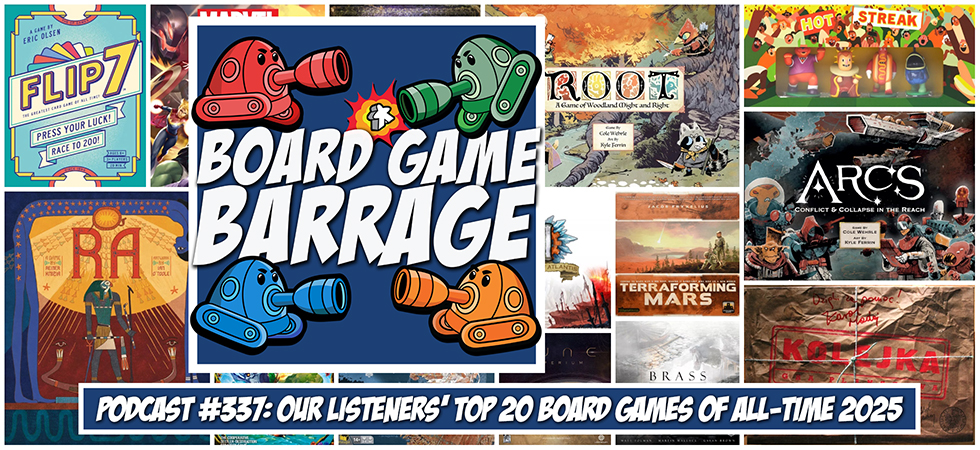
It’s time again to turn the tables and get your take, to feel out the collective tastes of you, the listeners of the show. It’s the annual Listener Top 20! You’ve been sending in all of your lists (thank you!), I’ve been compiling all of the data (you’re welcome!) – and here it is, in a convenient list format. Before we ask the audience, we talk about Flip 7, Hot Streak, and Kolejka.
If you don’t want to miss an episode, please subscribe on Apple Podcasts/Google Podcasts/Stitcher/Spotify, or add our RSS feed to your favourite app. Reviews and subscriptions really help us and would be greatly appreciated! To download the episode directly, click here.
If you’d like to discuss anything in the episode, please do so in the comments below, visit our BoardGameGeek guild, join our Discord, or Facebook Group! Any feedback is also always helpful. If you’d like to show your support for the show, we also have a Patreon with some fun rewards, and a merch store!
Timecodes:
02:37 – Flip 7 10:40 – Hot Streak 19:47 – Kolejka 27:42 – Listener Top 20 29:05 – Agricola 29:55 – Gloomhaven 31:26 – Guards of Atlantis II 32:20 – Blood on the Clocktower 33:20 – Arcs 34:40 – Tigris & Euphrates 35:21 – Terraforming Mars 35:54 – Marvel Champions: The Card Game 36:42 – Inis 37:24 – Innovation 38:13 – Race for the Galaxy 39:02 – Root 40:04 – Concordia 41:00 – The Castles of Burgundy 41:41 – Ark Nova 42:03 – Dune: Imperium 43:19 – Ra 43:35 – Brass: Birmingham 45:11 – Spirit Island 46:27 – Hansa Teutonica
Thank you to Heart Society for generously letting us use What’s On Your Mind, Kid? from their album Wake the Queens.
In dieser Kategorie gibt es Aktuelles der drei Kategorien Mäh! (News), Herde (Neuzugänge) und Grasen (Ersteindrücke). Diesen Monat mit Codenames, Burger Master, Auf den Wegen von Marie Curie, Stupor Mundi, Flip 7 und Medium.

 Anmelden