With this My Favorite Wargame Cards Series, I hope to take a look at a specific card from the various wargames that I have played and share how it is used in the game. I am not a strategist and frankly I am not that good at games but I do understand how things should work and be used in games. With that being said, here is the next entry in this series.
#87: Proletarian Revolution from The Republic’s Struggle: Battle for the Republic, Spain 1931-1939 from NAC Wargames
The Republic’s Struggle is a thematic Card Driven Game that tells the story of the historical events that took place in Spain after the resignation to the throne of King Alfonso XIII, and the proclamation of the II Spanish Republic in 1931. With the creation of the new regime, the struggle for power between the different social, political and ideological sectors increased, which gave rise to continuous changes of political power, alterations of public order, armed uprisings and violent acts, carried out by the numerous ideological factions of the moment; which culminated in 1936, in a failed military uprising. The failure of this coup d’état was the origin for the Spanish Civil War.
The Republic’s Struggle is based on Twilight Struggle from GMT Games and uses the same concepts of area control while adding in some actual combat with units represented on the board. During the game, the Republican player and the National player, will be able to recreate events of the period to increase their popularity in the localities by carrying out political propaganda, recruiting troops or militias, generating revolts or assaults, establishing diplomatic relations or carrying out bombardments. All this will be done by playing their hand of cards in an alternative way, either by using the events or by playing the action points or icons to perform any of the other actions available to the players.
One of the interesting parts of the design is that each player has what is referred to as a Special Card that is included in their hand from the start of the game and can be played during their turn. These cards don’t count towards the maximum number of cards that each player can have in their hand at the beginning of each turn. The 2 cards are Military Uprising, which is given to the Nationalist player and Proletarian Revolution, which is given to the Republican player. These cards are single-use event cards and can only be used during the first 4 turns of the game, or in other words during the period referred to as Phase 1 – The Republic. If, after this phase, these cards have not been played, they must be discarded and removed from the game. Both players can choose to use their Special Card in an Action round, instead of using one of the cards from their hand. These cards are played like the rest of the Operation Cards either using their Operations Value or applying the effects of the printed Event. Once played, the card will be removed from the game so it is use it or lose it.
Both cards are very powerful but have some fairly difficult criteria that must be met to fully realize the value of the printed Event. In the case of our featured card Proletarian Revolution, the top part of the card first gives the player the chance to downgrade the European Status Quo Track by 2 levels. The European Status Quo Track allows players to appeal to and in some ways manipulate the stance of the other European Nations regarding their view on the Spanish Civil War. It also is the determining factor in how Victory Points are awarded for the crucial Armed Actions aspect of the game. At the end of each turn, if the number of Armed Actions carried out by a player equals or exceeds the current level of the European Status Quo, that player will score 3 Victory Points. Also, as long as the European Status Quo Track is set on level 2, players cannot carryout any action using the Operations Points of cards played to advance in the Diplomatic Relations Track. So this is another tied result to the card as if the level is 1, no cards can be played to advance the Diplomatic Relations Track.
But, remember I said that to fully realize the effects of the card, the Republican player would need to control Barcelona, Madrid, Valencia and every Naval Base Location or every Air Base Location. If this is the case when the card is played, then the Republican player will earn an automatic victory. Frankly, this is next to impossible, but has a sliver of possibility depending on how diligent and attentive the Nationalist player is as well as the hand of cards that are drawn by the Republican player. If they draw certain other events, as well as have a hand full of higher Operations Point value cards, they can make a run at this but it is not necessarily recommended. The card also has a very useful secondary use as if the condition isn’t met, they will get to place out on the board 1 combatant cube, representing one of their combat units, and also remove all of the influence of the Nationalist player in the Catalonia and Valencia Regions. This literally means all of the Nationalist influence in these regions which each has several locations. In order for the card to be used in this manner though the Republican player will have had to previously play the Defense Committees card.
The proletarian revolution in the Spanish Civil War refers to the widespread social revolution that erupted in the summer of 1936. Triggered by the failed military coup of July 17, workers spontaneously armed themselves, taking control of factories, collectivizing agriculture, and establishing anti-fascist militias primarily in Catalonia, Aragon, and Andalusia. When General Francisco Franco and conservative military officers attempted to overthrow the democratically elected Second Spanish Republic, the working class retaliated by launching a massive wave of grassroots social reorganization. This proletarian movement aimed to permanently dismantle capitalist structures and the influence of the conservative elite and the Catholic Church.
In major industrial hubs like Barcelona, workers’ committees seized factories, transport networks, and public utilities, shifting control directly to the trade unions. In the countryside, particularly in the region of Aragon, peasants seized large agricultural estates. They abolished private property and reorganized land into self-sustaining collectives operating under libertarian socialist or communist principles. Instead of relying on a traditional military hierarchy, fighting forces were formed as democratic workers’ militias led by trade unions and political parties like the CNT (anarcho-syndicalist) and the POUM (Marxist).
The suppression of the revolutionary movement divided the Republican forces. Deprived of its radical grassroots momentum and lacking support from Western democracies, the Republican cause lost ground to Franco’s well-equipped Nationalist army (which was heavily backed by Nazi Germany and Fascist Italy). The Spanish Revolution was ultimately defeated in 1939, leading to the collapse of the Second Republic and the beginning of Franco’s 36-year dictatorship.
Here is a link to our full video review of the game:
In the next entry in this series, we will take a look at National American Woman Suffrage Association from Votes for Women from Fort Circle Games.
An Impossible War: The First Carlist War in the North, 1834-1838 from Bellica Third Generation is a block wargame that recreates the First Carlist War in the North of Spain which was a civil war between the Carlists who supported the succession of the late king’s brother Carlos de Borbón and the progressive and centralist supporters of the regent Maria Christina acting for Isabella II of Spain who were referred to as the Liberals. The game uses blocks representing units but also includes counters and uses cards. I was able to play the game about a month or so ago with Francisco Ronco who owns the publishing company Bellica Third Generation and very much enjoyed the game and how it represented this interesting struggle.
In Action Point 1, we took a look at the Game Map, discussing the point-to-point movement configuration, the various spaces and the delineation of the Carlist versus the Liberal Zones, as well as explained the use of the Rest of Spain smaller map. In Action Point 2, we examined the units available to both sides and covered the importance of Supply. In Action Point 3, we took a closer look at the Carlist Uprising Phase and what it means for the game. In Action Point 4, we examined the activation system and the use of Action Point Markers. In this Action Point, which is the conclusion to the series, we will take a look into how Battles work, focusing on the tactical aspect of combat with the use of the Battle Board.
Battle
One of my favorite parts of the game is the Battle mechanic. With Battle, I very much enjoy the use of the Battle Board but also like that there are several different types of combat. Battles focus on asymmetric combat rather than massive open field engagements and are typical of the First Carlist War. These Battles boil down to 3 primary types including Skirmishes, Battles and Assaults and each type have their benefits and uses and one of the important things about the game is the need to learn their best uses and then how to perform them. If both sides have at least 3 Infantry or Cavalry units in a contested space, then there is a Battle. Also if 1 or both sides has less than 3 Infantry and Cavalry units in the space, or only has Cavalry units, then there will be a Skirmish. And finally, in order to launch an Assault on a Fortress, the besieging player must have a Field Artillery unit of any value in the enemy Fortress space.
But before we take a look at these different types of Battle, I want to cover the Combat Cards. Combat Cards provide background events and assist tactical maneuvers without running the game on their own. Each player holds a distinct 36-card deck (Liberal or Carlist) representing historical, operational, and tactical modifiers. These cards simulate unpredictable elements, like sudden skirmishes, political shifts, or logistical hurdles. The Liberal Player generally leads larger, but lower-quality forces plagued by supply issues. Their Combat Cards tend to focus on maintaining order, quelling uprisings on the Rest of Spain Map and chasing Carlist expeditions. The Carlist Player will command smaller, high-quality troops. Their Combat Cards focus on exploiting superior mobility, terrain knowledge, and sudden strikes. Since this is an “impossible” war featuring guerrilla tactics, siege warfare, and frequent skirmishes rather than massive battles, the cards adapt to these asymmetric scenarios.
There are 3 types of cards found in the decks, including Event Cards, Operational Cards and Tactical Cards. Event Cards are played immediately when drawn and provide both positive and negative benefits to the players. Operational Cards can be played when the conditions stated on the card are met, during the player’s own Player Phase or sometimes during the opponent’s Player Phase. Tactical Cards can be played in combat as stated on the card. Each player can use a maximum of one tactical card in each Skirmish, Battle Round or Assault Round.
At the beginning of a player’s Player Phase each Turn, that player will take the top card from their draw deck. If it is an Event Card then it is applied immediately. If it is not an Event Card, the card is kept in the hand so that the other player cannot see it. A player can have up to 8 cards in their hand and these can be played as indicated on the card itself.
These cards are very well done and keep the game very interesting and tense as you just don’t know what type of cards your opponent has that they can spring on you in combat. These cards alter the conditions of the battle and cannot be planned for but must be kept in mind as players enter conflicts. From adding defenses that absorb hits (such as the Stone Walls Tactical Card) or provide additional Effectiveness Rating to units in battles when they are firing (such as the False Retreat Card), these cards make a difference and keep the game feeling like a game.
Now that we have looked at the cards, let’s now take a quick look at the various forms of Battle. A Skirmish consists of just 1 single round of fire. First the defender will fire and applies all hits to the attacking units, then the attacker will fire and applies hits to the defending units. There are no morale rolls in the game. In a Skirmish a player fires with a maximum of 3 Infantry and Cavalry units. The player must choose which units will fire with several limitations. maximum of 1 Cavalry unit in rough terrain and a maximum of 2 Cavalry units in open terrain. A player always fires with all Artillery units.
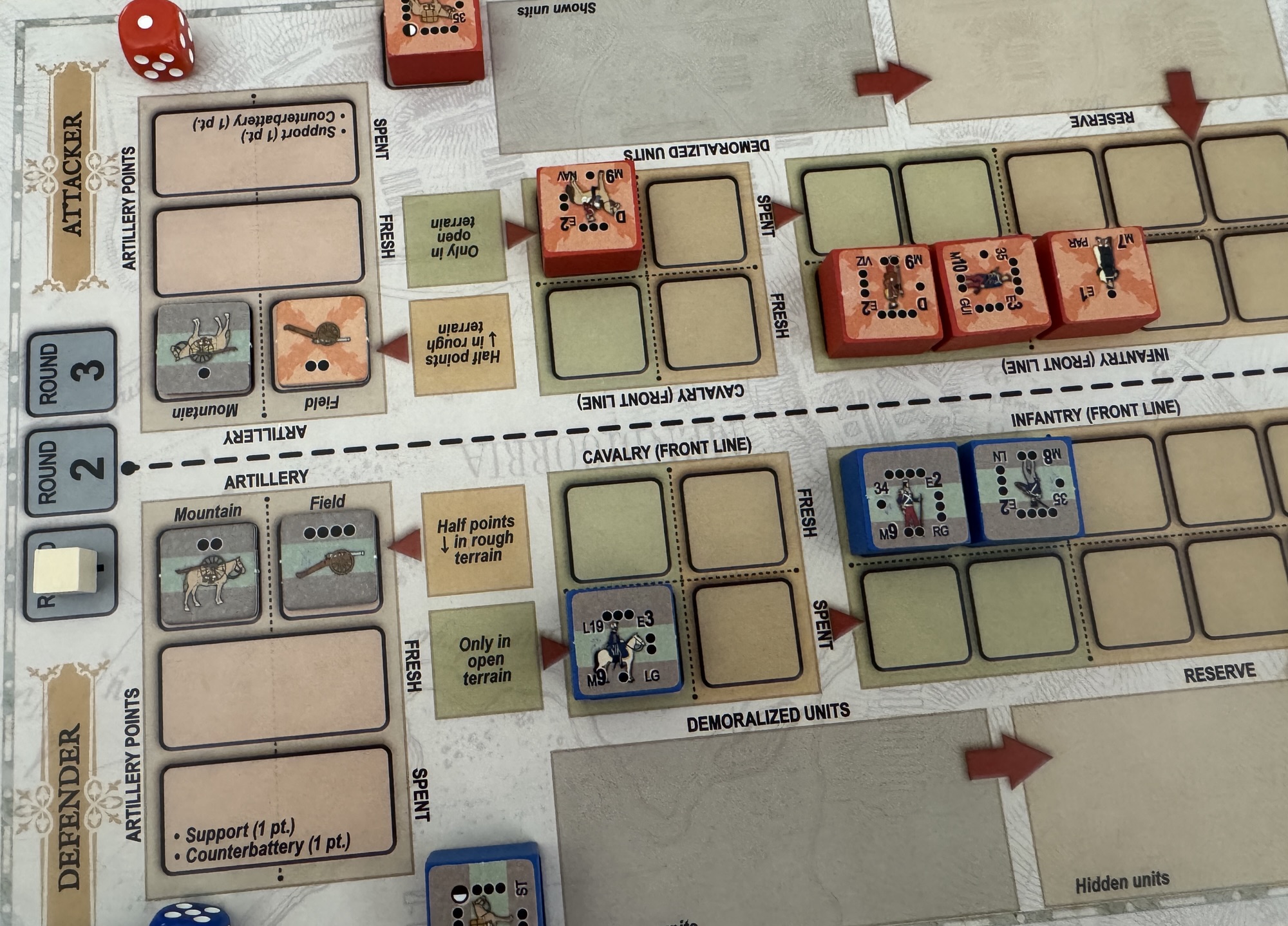
The Battle Board operates as a dedicated, zoomed-in tactical area where the details of combat are resolved. When opposing blocks meet on the main strategic map, units are moved to this board to fight out the encounter safely separated from global troop movements. When a Battle begins, players move their hidden army blocks from the main map onto the Battle Board. Depending on the terrain where the battle takes place (such as rough terrain for a city or plains for the countryside), players deploy their units into specific zones on the board. The Flanks are outside positions that trap or outmaneuver the enemy. The Front Line are the units taking the direct hits and dealing the damage to the enemy and the Reserve is where extra units are kept on standby to join the battle as losses are suffered.
Combat on the Battle Board happens in rounds. As a block wargame, the number of dice rolled by any unit is based on the number of pips shown on the block and the to hit number is equal to or less than their Effectiveness Rating printed on the block. Modifiers may be added from terrain or from the play of Combat Cards. Dice are then rolled and hits are determined with the defending units taking losses by reducing their pips by rotating the block counterclockwise. It is as simple as that.
The big difference in the types of Battle are the duration. A Skirmish last only 1 round while a Battle can last up to 3 rounds. The Battle ends immediately when 1 of the following situations arises. If the Battle lasts the full 3 round, when the 3rd Battle Round ends the defending player remains in the space and the attacking player retreats. There is no Rout or Pursuit A player has no Infantry units in the front line. The other player wins, gains 1 VP, and causes a Rout by the losing side, which will then retreat. Or, a player decides to retreat voluntarily in the End of Battle Round phase. The other player wins and can carry out Pursuit.
The Battle mechanic in An Impossible War captures perfectly the frustration of asymmetry in both competing sides and their troops. The name of the game is specifically reference to the the Liberals’ massive, clunky numbers versus the Carlists’ nimble, guerrilla style of warfare. 2 different armies with 2 different philosophies has created a situation where neither side can feel comfortable with the war and their chances at winning it. I frankly think that the designer David Gómez Relloso did an exceptional job at creating this asymmetry and creating a highly playable and engaging game. If you didn’t know, I chose to add An Impossible War to my Top 10 Wargames of 2025!. It landed at #8 on the list, and probably would have scored higher had I had a chance to play the game further and experience all of the parts of the design.
I also was able to shoot a fairly short video summary of my game play with Francisco Ronco who is the owner of Bellica Third Generation and you can watch that at the following link:
Grant: Javier welcome back to the blog. What is your new game Battle of Pensacola 1781?
Javier: Thanks for having me again. Pensacola 1781 is a simulation of the American Revolution in the southeast region, stretching from the Mississippi River basin to the Floridas, from the Spanish entry in the war in 1779 to 1782. I must say that the title is a bit deceptive in its scope and included battles.
Grant: What was your inspiration for this game? Why did you feel drawn to the subject?
Javier: The Spanish participation in the American Revolution has recently attracted much interest in Spain. It was, so to speak, the swansong of the empire in the Americas. There aren’t any games that cover the entire campaign. There is only a wargame on the siege of Pensacola from GMT Games which is a part of their Battles of the American Revolution Series, which is a detailed and interesting situation. But I wanted an operational level game showing the big picture, from New Orleans to Mobile, Pensacola and St. Augustine. The game highlights the operations of Bernardo de Gálvez, who led one of the most brilliant campaigns in that theatre, clearing the Mississippi basin of English outposts as well as taking Mobile and Pensacola fighting against all odds. Against the advice of his subordinates, who deemed impossible defending Louisiana without reinforcements from Cuba, Gálvez declared that he preferred “having to answer charges of recklessness, than other type of charges” and took the offensive against the British in the lower Mississippi.
Grant: What was your design goal with the game?
Javier: My goal was to show a “multi domain” 18th century campaign, including amphibious operations, sieges, Indian warfare and diplomacy. The design puts the focus on leadership quality, Indian warfare and chaos. The campaign in Louisiana, modern day Alabama and the Floridas was a bit of a sideshow in a worldwide conflict fought from Canada to the Mediterranean, the 13 colonies, the British channel, Gibraltar or India. The design reflects this in several ways. In this game, reinforcements arrive at the beginning of each year and their arrival depend upon a number of factors, such as victories in earlier turns (thus gaining the favor of their respective courts in London and Madrid) as well as events elsewhere. Fleet squadrons come and go because this is an oceanic war being fought out across the seven seas, and the Caribbean was just only one more front.
Grant: What type of research did you do to get the details correct? What one must-read source wouldyou recommend?
Javier: There are plenty of Spanish sources on the campaigns of Bernardo de Gálvez in the Americas, many of them published in recent times. There are recent English language sources that recognize the major role of Spain in arming and supporting the American Revolution. For instance, the book by Larrie D. Ferreiro Brothers at Arms: American Independence and the Men of France and Spain Who Saved It. Another interesting source in English is the work by Joshua Provan Every Hazard and Fatigue: the Siege of Pensacola, 1781 published by Helion Books. This book provides solid evidence of “the true military consequences of the siege [of Pensacola] on the War of American Independence.”
Grant: What from the American Revolution in the Southeast was most important to model?
Javier: It was important to model that the Mississippi-Floridas campaign was one more theatre in a global war spanning from the Americas to Europe and India. Keeping open the Mississippi River basin to the arms and supplies shipments coming from Spain, France and other nations was a decisive factor in keeping alive the American Revolution. Being just one more theatre, the arrival of reinforcements depends on a number of a factors and events elsewhere. After the first successes of Gálvez, the Spanish decided to reinforce success and provide him with more ships, troops and resources.
Grant: What is the scale of the game? Force structure of units?
Javier: Units are basically regiments and Indian warbands, rated for Indian and Linear warfare. Using one or the other depends on a number of factors, namely leadership quality.
Grant: What area of the Southeast does the map cover?
Javier: The map covers a large area, from the lower Mississippi to Eastern Florida, with off map boxes for outposts in the upper Mississippi and Georgia.
Grant: What off map areas are represented and why are they important?
Javier: There are three: St. Joseph and St. Louis, which are important to keep the Mississippi supply route open, and Georgia, from where the Spanish/Patriot player can launch attacks against East Florida. The 1778 Patriot invasion of East Florida was defeated, but there was the possibility of new offensives in the following years. After the conquest of Pensacola the Allied forces (Spanish, French and Patriots) planned a joint operation against British forces in the Carolinas, but the end of the war cancelled it.
Grant: What key strategic points are contested in the area and what is the geographic goal of the combatants?
Javier: For the Spanish, the first objective is to defend the Mississippi Basin, although Havana is also included in the map so that the Spanish has to keep a sizeable defense there. Historically, the Spanish commander in chief in Havana was extremely reluctant to spare ships and troops for the Floridas. In the words of the chief of the Spanish navy in the island, “This [Cuba] is worth 50 Mobiles or Pensacolas…if the King was here, he would do the same”. The British capture of Havana in 1762 still loomed large.
For the British, the objective is to reach the Mississippi Basin, and, if not possible, to defend West and East Florida. With the arrival of Rodney’s fleet, he can also chance a surprise attack on New Orleans, or even Havana if the Spanish player doesn’t keep there a sizeable force.
Grant: What different unit types does each side have access to?
Javier: There are line infantry, militias, artillery, siege trains, supply trains, Indian warbands, fleets, transport ships, and leaders.
Grant: What is the anatomy of the counters?
Javier: Land units are rated for linear warfare (representing “proper” 18th century warfare) and Indian warfare (irregular tactics, hit and run, pillage, ambushes). Linear infantry and field artillery are better for the first, while militias and Indian warbands are better for the latter. Militias and Indian warbands are also very useful for finding out the makeup and location of the enemy or avoiding interception/ambushes by the enemy force. Leaders are rated for their tactical and diplomatic skills that add modifiers to initiative, combat, diplomacy and other actions. Supply trains are spent to avoid attrition, which can be heavy in the hostile wilderness.
Grant: What is the general Sequence of Play?
Javier: The sequence of play begins with the stratagem markers phase (both players pick at random stratagem markers), followed by reinforcements die rolls at the beginning of the campaign season. Then comes the Indian diplomacy phase, where both players use diplomacy stratagem markers to break or establish alliances with the various Indian tribes. After that both sides can try to recruit Indian warbands among neutral or allied Indian nations. Then comes the recruiting phase, where both sides use accumulated Treasury Points to rebuild destroyed units. Finally, the Spanish operates his naval and land forces in any order he sees fit, followed by the British operations phase. At the end of the turn, both sides roll for attrition, and for the possible withdrawal of Indian bands.
Grant: What type of experience did you want the Sequence of Play to invoke?
Javier: Players can activate their forces in any order they want, so that they can use any combination of land, amphibious and naval operations. The experience I wanted to invoke is that of uncertainty- this is the 18th century warfare in a remote colony. As in many other wars, both sides make plans, but there are many factors that can disrupt them, from hurricanes to unexpected arrival of enemy forces to events elsewhere. There are no communications other than messengers and courier ships, so the possibility of an enemy expedition arriving out of nowhere should make players to be cautious.
Grant: How do the different nations troops coordinate their maneuvers and attacks? What difficulty of command will players experience trying to coordinate French, Spanish and Patriot forces as well as British, Hessian and Loyalist forces?
Javier: In general the troops of different nations can operate together without problem. The Indian forces are a double edged weapon-very useful for reconnaissance and ambush (or to avoid enemy ambushes) but they can leave a force if they decided that they have to return or that they have captured enough loot and captives. Forces can operate any number of units of different nations.
Grant: What role do the Indians of the region play in the game?
Javier: In this game I wanted to emphasize the role of the various Indian nations. Indian warbands are useful for raiding and reconnaissance although they tended to return to their villages after a successful campaign. Historically, the British had a well developed network of Indian agents which gave them advantage in their Indian diplomacy. This is reflected in the “Indian agent” markers, that provide die roll modifiers to the British diplomacy attempts. Historian Josh Provan pointed out in his book on the Pensacola campaign that the Spanish victory was achieved with the assistance of Native American nations, “whom have routinely been dismissed outright for over two hundred years”.
Grant: What are Stratagem markers?
Javier: The Stratagem Marker is a mechanism that I use in many of my designs. These are very useful to simulate things that are beyond the control of players. Represent anything from tropical diseases, campaigns elsewhere in the Americas and in the World, to tactical events such as lucky hit, ambushes or military advantage. The marker “Surprise move” is particularly useful to simulate the uncertainties of 18th century in a remote wilderness such as the old Southeast. Given the right conditions, a surprise move may make a fleet appear out of nowhere and destroy an enemy force. This is the 18th century…there are no communications other than messengers and courier ships. Historically, upon learning about the presence in the Caribbean basin of the squadron of Admiral Rodney, the Spaniards feared that they could catch by surprise the forces besieging Pensacola. Stratagem Markers also simulate the spy networks of both sides. Before the war, Gálvez setup an extensive spy network that was very useful. For instance, his spies got hold of a copy of the secret orders sent to General Campbell at Pensacola, ordering him to organize, if possible, an attack on New Orleans with armed vessels from Jamaica and “as many faithful Indians and the Superintendent could supply”. Gálvez took the initiative and took the British outposts along the lower Mississippi before Campbell could arrange his own offensive.
Grant: What are Treasury Points? How are they gained and lost?
Javier: TP’s represent resources received from their respective metropolis, as well as local contributions used to recruit units. Treasury Points are received from their respective countries during reinforcement turns. Unlike other games, there are no treasury generating regions or cities-everything comes from Havana, Madrid or Britain. Treasury Points are used to rebuild destroyed units.
Grant: What role do Leaders play? What historic personalities are represented?
Javier: Leaders play a key role in diplomacy and combat. The better the leadership, the better chances of gaining initiative in combat, recruiting Indian allies, and so on. Among the historic personalities, the most notable is perhaps Bernardo de Gálvez, the most noted commander in that theatre. After fighting in Europe, North Africa and the Americas (against the Apaches), he was named governor of Louisiana in 1777. In May 1779, a month before Spain declared war on Britain, and three years after the Declaration of Independence, Gálvez assembled a small army with which he attacked the defensive posts the British held along the Mississippi. With a contingent that included free African Americans, Choctaw Indians, Canadians, and American volunteers, Gálvez captured forts such as Manchac, Baton Rouge, and Mobile, and expelled the British from the region. His greatest victory was the conquest of the port city of Pensacola, in northwest Florida in 1781. Galvez’ adversary at Pensacola, Major General John Campbell, a veteran of Culloden in 1746 and the siege of Havana in 1762, is an interesting figure as well.
Grant: How does combat work?
Javier: There are two odds-based Combat Tables-Indian and Linear. Indian represents Indian Warfare-emphasizing mobility, with night attacks, ambushes. Local militias and, of course, Indian warbands are better at them. The other CRT is linear warfare, representing “proper” 18th century linear warfare. In this, Line infantry are artillery are most useful. The choice of CRT is determined by an initiative die roll, modified by the leadership rating of any leaders in the forces, plus the play of Stratagem Markers such as military advantage or ambush.
Grant: What are Military Advantage and Ambush Markers used for?
Javier: They represent tactical opportunities and junior leadership and can be used to modify initiative, interception or operations points die rolls.
Grant: What is the makeup of the CRT?
Javier: As mentioned above, it is odds based. Units add their linear or Indian warfare factors-Linear units add 2 combat factors on the linear CRT, 1 on the Indian CRT. Artillery adds 2 combat factors on the linear CRT, 0 on the Indian CRT. So, a force containing mostly militias and Indian warriors against a force containing line infantry and artillery will chose the Indian CRT. Of course, the system rewards combined arms-it is advisable to combine all types of units in a single force. The Linear CRT is bloodier (more chances of completely destroying an enemy force) the Indian Warfare CRT is more indecisive.
Grant: How do Sieges work?
Javier: In the game there are Fortresses and forts. The first represent stone fortresses such as the ones in Mobile, St. Augustine and Pensacola, while forts represent minor positions made mostly of wood. Players can build siege works to approach the enemy defenses (representing parallel trenches, mining and so on). The force under siege may choose to launch a sortie to destroy the siege works. If the sortie fails, the siege works add a positive modifier to the assault operation against the fortress hex. The player then rolls on the siege table and apply results, which may include Bloody Repulse (Eliminate besieging units equivalent to the number of defending units), Honors of War (with Age of Enlightment chivalry), the defender is given the option to withdraw from the fort or fortress. The defenders are withdrawn and can enter as reinforcements during the next game turn) or Surrender: the fortress is conquered and all defenders are eliminated, including any naval units if it is a coastal fort or fortress.
Grant: How is victory achieved?
Javier: Victory is achieved by taking geographical objectives (Mobile, Pensacola, St. Augustine, New Orleans…) or by preventing the enemy from taking them. The British may win a sudden death victory if they manage to take Havana as in 1762.
Grant: What role do Naval Operations play? Why were they important to include?
Javier: Naval operations were very important because it was the only means to move sizeable forces in this theatre. Overland movement and supply was extremely slow, so the best way to move reinforcements, supplies and to take the fight to the enemy strongholds was by sea.
Grant: What optional rules are included?
Javier: There are four optional rules. In general, these add to the game narrative although it might make game turns somewhat longer. Optional rules are naval infantry. In this one, players can “land” marine infantry from naval ships, which can fight overland in a siege, for instance-if the naval ship is involved in naval combat, it has a negative modifier in combat, representing the missing crew and marines. The other optional rules are Indian supplies (players can purchase supplies to local Indian tribes, like Gálvez did, for instance, during the siege of Pensacola), destroyed forts (players have the option to burn forts, but not fortresses) and valley movement, where players follow river valleys to move faster across the wilderness territory.
Grant: What type of an experience does the game create?
Javier: It creates an experience of uncertainty, in particular with the unexpected arrival of enemy forces from out of nowhere. If this could happen at the tactical level, more so in a strategic game covering all of North America from the Mississippi river basin to Florida. Also, gamers must keep in mind the importance of the human geography-the Indian nations played key roles in the operations of the war, by supplying, providing information and combat troops to the empires at war. Elements such as the “Surprise move” markers, and the arrival of Rodney’s Fleet, provide the game with wild changes of initiative. The British, in particular in the early turns, can try to grab the initiative and attack towards the lower Mississippi or St. Louis.
Grant: What are you most pleased about with the design?
Javier: I think it makes a good work at simulating “multi domain” 18th warfare, covering many aspects, from conventional operations to irregular warfare to diplomacy with a relatively simple set of rules.
Grant: What other designs are you working on?
Javier: I am currently working on several games for SNAFU Design Team, Decision Games, VUCA, Bonsai Games and Compass Games/Paper Wars. S&T will publish in May-June 2026 another of my operational WW2 designs, Forgotten Front: Italy 1944-45. I just turned in to Decision Games the prototype for Ukraine Battles 2. This one covers the early, mobile campaign in Kharkiv in Eastern Ukraine in the spring and summer of 2022. It is an evolution of the system first used in Ukraine Battles 2014-15. Artillery plays a very important role in the system. It is precise and deadly, and can do a number of missions, from interdiction to destroying command posts to supply depots. Plus drones and long range fires, of course.
1942: Battle for the Mediterranean for VUCA Simulations, is, I hope, approaching completion. It is an old project that I first agreed to publish with the company of the late Jack Greene, Quarterdeck International, but later he suggested me to contact VUCA for publication since they did a great job with the new edition of his Bismarck design. 1942: Battle for the Mediterranean is what I would call an operational naval game, with turns representing one month of naval operations. Apart from supplying the war fronts and fighting the enemy at sea, players have to manage their assets and think in the long term. The campaign game covers 10 game turns, from January to October 1942. There are also shorter one turn scenarios simulating the major convoy battles of the 1942 campaign: Second Sirte, Harpoon/Vigorous (Battaglia di Mezzo Giugno, “Battle of Mid June” for the Italians), or Pedestal (Battaglia di Mezzo Agosto, “Battle of Mid August”).
Aragón 38 for SNAFU Team is also in development. Nils Johansson is working on the graphics aspect (map, counters, play aids and cover). It uses an evolution of the Santander ’37 System. While in the Santander campaign we have Brigade-sized units attacking across a mountain range, using speed, firepower and infiltration to overcome the Republican defenses, in Aragon we have a “push” of several Army Corps operating together, with front collapse followed by exploitation, consolidation and conquest of several bridgeheads as bases for future offensive operations. So we had to adapt the system to better simulate that campaign. Bonsai Games from Japan will publish my game Assault on Europe 1943, covering land operations in the Mediterranean Theatre in 1943, from Tunisia to Sicily and Southern Italy. The Allied player can decide whether to land in Corsica and Sardinia before Southern Italy. Rules simulate the painful US Army learning curve (from being called in Tunisia “our Italians” by the British, to a much better performance in Sicily and Southern Italy) and the surrender/collapse of the Italian army (operation Achse). After publishing Red Partisans for Paper Wars, I am working on a small unit game of the fight around Kyiv in February 2022. It is still in a very early design stage.
Thanks for your time Javier in answering our questions as I know you are a busy man and obviously have lots of interesting gaming subjects on your design table. I am very interested in this one, as the American Revolution is one of my favorite gaming topics.
With this My Favorite Wargame Cards Series, I hope to take a look at a specific card from the various wargames that I have played and share how it is used in the game. I am not a strategist and frankly I am not that good at games but I do understand how things should work and be used in games. With that being said, here is the next entry in this series.
#83: British Leader Wellington from Congress of Vienna from GMT Games
Congress of Vienna from GMT Games is a diplomatic card driven wargame based on Churchill and is the 4th game in the Great Statesmen Series. The game is set during the years of 1813-1814 and sees players take on the role of the main characters of the struggle between the Napoleonic Empire and the coalition of Russia, Austria, and Great Britain with their Prussian, Spanish, Portuguese, and Swedish allies. Congress of Vienna has two different but related phases including the conference table where players first debate over the control of issues germane to the factions and the period of the war and second these issues are then used on the battlefield to recruit units, attack and take overall command of battles. The players will be playing cards from their hands to “debate” over the various issues that were placed on the table, which include all types of things such as Military Operations, Recruitment, who will lead the combined Coalition forces (Generalissimo), Future of French Government, British Financial Aid, Liberalism vs. Absolutism, Austrian Neutrality and several other issues, and then later the players will use their accumulated Resources gained from the issues to enact action on the Military Map and do things like mobilize troops, place Military Support Markers and the ultimately to conduct warfare.
The game relies on cards and cards can be used to negotiate, i.e. move an issue to your National Track. Cards can provide a particular issue with positive and negative DRM’s depending on which nation plays them and can also be traded with another player during the Diplomacy Phase. Certain cards are better than others for debating an issue moved by another player; and finally, if they are saved for the War Phase, staff cards can be used to modify dice rolling in battles. These are very versatile cards and the players will have to learn them and their benefits in order to be effective at the game.
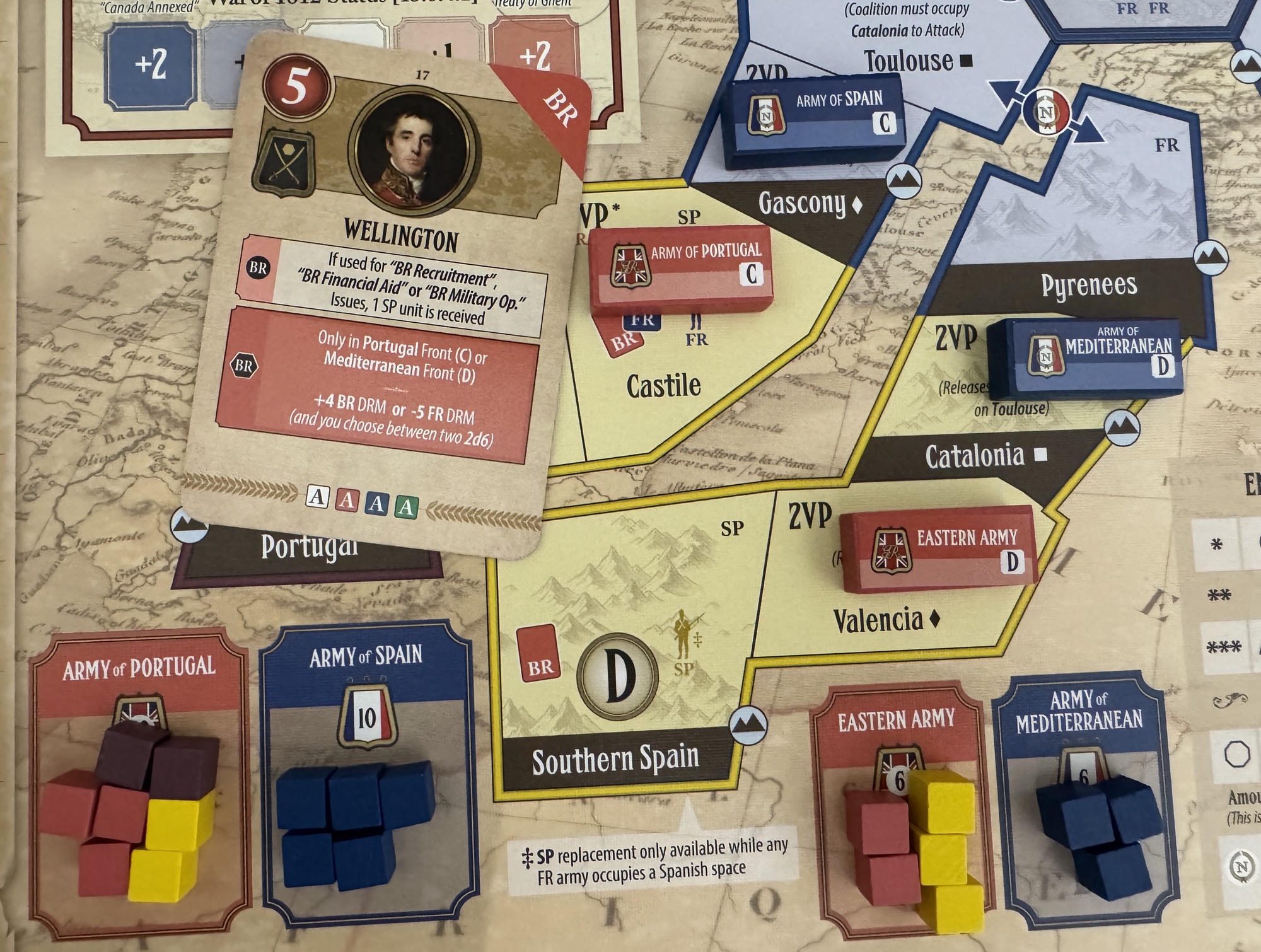
In this entry, we are going to take a look at the British Leader Wellington card. The Wellington card is the most powerful British military asset available and the British player should work hard to make sure that they get the card either by luck of the draw or by attempting to trade cards with other players. The major benefit of the card is during the War Phase, as it provides multiple benefits that can make combat much easier for the British. The bottom part of the card gives a boost during combat by granting an impressive +4 DRM in battles or to make the French have a -5 DRM. This is a very important decision and will mainly come into play to ensure losses are greater for the French or to make sure that a battle can we won. The combat benefit can only be used in the Portugal or Mediterranean Fronts but that is fine as this is where a majority of the British military actions will occur. But even more important than the DRM’s is the re-roll of the combat dice for the British. The other part of the combat benefit shown on the card is that the British player will get to roll 2d6 twice and then select the highest result during battles, greatly mitigating their risks of rolling poorly. Just a very powerful card for battles and I would definitely recommend its use in this fashion.
But, the top part of the card is also very important, particularly in the early part of the game, as when the card is used to move a British Recruitment, Financial Aid or Military Op Issue at the negotiating table they will gain a 1 SP unit that can be placed in the future into Fronts. This extra unit recruitment allows the British to slowly build up their forces without having to solely focus on choosing Recruitment Issues. This gives them the opportunity to focus on other Issues which can be very beneficial and give them a more well rounded approach.
Field Marshal Arthur Wellesley, 1st Duke of Wellington was a British Army officer and statesman who was one of the leading military and political figures in Britain during the early 19th century, twice serving as Prime Minister. He was one of the British commanders who ended the Anglo-Mysore wars by defeating Tipu Sultan in 1799, and was among those generals who ended the Napoleonic Wars in a major Coalition victory when the Seventh Coalition defeated Napoleon at the Battle of Waterloo in 1815.
Wellesley was born into a Protestant Ascendancy family in Dublin, in the Kingdom of Ireland. He was commissioned as an ensign in the British Army in 1787, serving in Ireland as aide-de-camp to 2 successive lords lieutenant of Ireland. He was also elected as a member of Parliament in the Irish House of Commons. Rising to the rank of colonel by 1796, Wellesley served in the Flanders campaign before being sent to India, where he fought in the Fourth Anglo-Mysore War, ending the conflict with a victory at Seringapatam in 1799. He was appointed governor of Seringapatam and Mysore and, as a newly appointed major general, won a decisive victory over the Maratha Confederacy at the Battle of Assaye in 1803.
Rising to prominence as a general officer during the Peninsular War, Wellesley was promoted to field marshal after leading British-led forces to victory against a French army at the Battle of Vitoria in 1813. Following Napoleon’s first exile in 1814, he served as the British ambassador to France and was made Duke of Wellington. During the Hundred Days campaign in 1815, Wellington commanded another British-led army which, together with a Prussian army under Field Marshal Gebhard von Blücher defeated Napoleon at Waterloo.
After the end of his active military career, Wellington returned to politics, becoming a prominent member of the British Tory party. He served as prime minister from 1828 to 1830, as well as on an interim basis for a little less than a month in 1834. Wellington oversaw the passage of the Roman Catholic Relief Act 1829 and opposed the Reform Act 1832. He continued to be one of the leading figures in the House of Lords until his retirement in 1846 and remained Commander-in-Chief of the Forces until his death in 1852.
Portrait of the Duke of Wellington by Sir Thomas Lawrence, c. 1815–1816.
We have done 2 videos on this game including the following RAW Video after out 1st play at Buckeye Game Fest in May 2025:
We then did the following full Review Video after our 2nd play at WBC last July:
This is a board game blog. Board games are a medium which can help us understand – for example, they can provide a uniquely active perspective on history. Yet which other medium can provide a fresh perspective on board games? – This is where novels come in handy. Today, we’re going to look at The Third Reich (Roberto Bolaño), a study in obsession as well as gaming and history.
Spain in the 1980s. Udo Berger, a young German, has just arrived in a small seaside town for a vacation with his girlfriend Ingeborg. Yet Udo’s mind is not on the beach. He has just won the national championship at the wargame The Third Reich (clearly based on Rise and Decline of the Third Reich (Don Greenwood/John Prados, Avalon Hill)) and plans to use his vacation to write an article on his new strategy for the Axis. Ingeborg, however, has more traditional vacation activities in mind, and so they spend some of their swimming, tanning, and partying, through which they befriend another German couple, some locals, and the enigmatic paddleboat renter who is only known as El Quemado (The Burned One) for the burn marks which cover his body. When the vacation comes to an end, Udo remains in Spain, supposedly to help in the case of an acquaintance lost at sea windsurfing… yet the real reason is the game of Third Reich which he plays against El Quemado.
Chilean novelist Roberto Bolaño wrote the novel in 1989. Since he turned his hand-written first draft into a typoscript (and later typed the first 20% into his first computer), it is assumed that he wanted to eventually publish it, but he didn’t do so before his death in 2003. When the novel was found among his papers, it was posthumously published in 2010. In addition to the original Spanish (El Tercer Reich), the book has been widely translated. I read the German translation.
Warning: Spoilers for the plot of The Third Reich ahead – but frankly, this is not a book you read for plot, you read it for the vibes.
Obsession: Conquest, Validation, Control
Udo Berger is wargame-obsessed, but the book is not a study of how an outsider has outsider fixations. On the one hand, Berger’s obsession with conquest and domination sets him by no means apart from his peers – just that they usually direct their respective urges to amorous exploits. On the other, our protagonist does not only want to conquer in the game either. In addition to his girlfriend, he also pursues the hotel manager Frau Else (who has been his crush when he was vacationing in Spain as a teen), and the underage chambermaid Clarita. And maybe most of all, Berger is fixated on being respected by his wargame peers, which he can only imagine obtaining by finding strategies (and publishing articles about them) which will obliterate all conventional wisdoms about the game.
As Berger is acutely aware of his lack of linguistic sophistication, he decides to practice by writing a diary during his vacation (which is what we read in the novel). The development of this diary reflects the changes in the writer: Originally, his daily entries are very structured (one per day, headlined by the date), and mostly concerned with banal reports on what he did, what he ate, and what he has in mind for the game/article). As Berger is drawn more and more into his duel with El Quemado, the diary gets more confused: He jumps from one level of narration to another within the same paragraph, extensive passages are solely dedicated to what’s happening in the game (down to which counters are placed on which individual hex numbers on the board), and the chapters are not only named after the dates, but also entitled “With El Lobo and El Cordero [his Spanish acquaintances]”, “Spring 1942” or “My Favorite Generals”.
Berger’s inability to focus also dooms his conquests (ludic and erotic): He sets out to prove that opening a second front early is not a liability, but an asset, and enthusiastically reports early in the game to a friend at home that it’s “Blitzkrieg on all fronts”. Yet as he conducts an amphibious assault of Britain at the same time as he invades the Soviet Union, his forces are overstretched and his Axis collapses before the historical date. And broadcasting his erotic attention over Ingeborg, Frau Else, and Clarita, does not further his relationship with either of them.
As things slide out of his grip, his attitude to control changes: Initially, Berger is fixated on the superior strategy. He notes down the exact moves – which corps need to occupy which hex in which turn to win. This chess-like approach collapses after the turning point of the game: Once El Quemado begins his counter-attack, Berger mentions for the first times that there are die rolls in the game (and how they favor his opponent) – not unlike many board gamers I have seen.
Gaming and History
Besides the main theme of obsession, the novel also offers many glimpses on gaming, history, and the relation between the two.
Berger arrives in Spain with his life compartmentalized between the gaming and the “normal” part – his girlfriend and the office job. This compartmentalization is already eroding with his plan to write the strategy article (which immediately chafes against the confines of a conventional vacation – the hotel employees are bewildered by his request for a large table to be set up in his room, and Ingeborg demands he come to the beach) and fully collapses over the course of the book, when he even unilaterally extends his vacation to play the game (and gets fired for it).
The shadow of history hangs over Berger. Our protagonist does not only play games about World War II, he also reads “patriotic” literature of the era, knows about the lives and deeds of the German generals (especially those of the SS), and the only of his wargamer friends for whom he has a certain reverence is a veteran of World War II. Despite this clear fascination for the history of Nazi Germany, Berger twice disavows being a Nazi himself (having been asked by El Quemado and Clarita). Once he even calls himself an “opponent of the Nazis”, but does not expound on it. His personal politics do not factor into the novel – Berger, having been born around 1960 in democratic, liberal, prosperous post-war Germany enjoys the luxury of only engaging with history at his leisure. He thus remains at the surface of it…
…unlike his gaming opponent. El Quemado comes from South America, and it is rumored among his Spanish acquaintances that the scars he bears are the result of torture (by one of the many right-wing regimes which took power in the 1970s). History has thus seeped into his body and gives him the strength to withstand the ludic assault of the experienced player Berger.
Bolaño himself was arrested after the 1973 coup in Chile and, to his own wonder, was released after eight days without having been tortured (he ascribed it to two of the detectives having attended school with him). He then emigrated to Spain where he worked odd jobs in the tourism industry like El Quemado.
Another allusion to Chile is made in a much-misunderstood scene: On September 11, everyone is out at the beach to celebrate the Catalan national holiday. Yet when a plane flies overhead, an eerie sense of dread overcomes the spectators. Many reviewers see this as a revision which Bolaño must have made after the September 11, 2001 terrorist attacks (or, as an odd coincidence) – but I think the likeliest reason for the scene is that the coup in Chile began on September 11, 1973 with the rebelling air force bombarding the presidential palace in Santiago.
Verdict
Roberto Bolaño’s The Third Reich starts with the innocent concept of a beach vacation. As it grows darker, the novel develops a hypnotic pull. The author’s own deep knowledge of wargames allows him to paint a vivid picture of the game itself – and of the hold it can have over its players.

 Anmelden