About a month ago, I started a new feature on the blog called Discussion Thread where I pose a question or a situation and seek your input and comments on the issue to gain greater understanding and to encourage thoughtful feedback. The response to the first post about In-Game Retribution was positive and there were a lot comments and opinions shared. I now wanted to do another post in the series but focus on the subject of Zones of Control and their importance in wargames.
A Zone of Control, typically referred to as ZOC, is the area immediately surrounding a military unit that exerts tactical influence over adjacent spaces, which in turn restricts enemy movement, closes up gaps in a line preventing enemy units from moving through, forces combat or triggers some sort of reactive action such as opportunity fire or engagement without the passive player needing to occupy those hexes or take any actions. They are designed to create some sort of resistance to enemy units as they approach. Mimicking real world combat and adding in this concept of awareness of enemy movement.
I think that everyone has an opinion on the subject of ZOC’s and these opinions are mixed regarding complexity, the type, being rigid or sticky, and their in-game effects, but there is a consensus that they simulate well the concept of military friction and holding frontline positions. Let’s take a quick look at the different types of ZOC’s and I will share my thoughts on each.
First up, is the rigid/locking ZOC where units must halt their movement the moment they enter a space where an enemy unit is exerting a Zone of Control. The ZOC in this case forces the moving unit to terminate its movement for that turn. I very much prefer these type of ZOC’s as I think that they really simulate the concept of prepared and even sometimes dug-in troops have the advantage and can force advancing units to stop trough interlocking fields of fire or heavy gun projection on the area such as off-board artillery.
Next, we have the soft ZOC where advancing enemy units can move through enemy ZOC influenced spaces, but suffer some sort of movement point penalties, attrition, or extra costs. I also really like this concept as it typically functions similarly to more rigid ZOC’s by costing a +2 or +3 movement cost which typically ends a units movement but not always. I have seen moving units have to take a step loss to take an extra move or more simply extra movement costs such as the placing of a disrupted marker or the like. This type really focuses on the pressures and cost of moving into and through these Zones of Control but are simpler than the more rigid variety.
Finally, I have seen more fluid ZOC’s such as when units can pass adjacent to enemies, but doing so might trigger attacks of opportunity or reactive fire at a disadvantage such as providing the units projecting the ZOC a positive DRM in their attacks or attacking with a column shift on the Combat Results Table. This concept is that moving or advancing units have less cover, less caution and open themselves up to attack more so than those that are forced to stop.
I think that all 3 of these types have their merits and downsides but their use typically depends on the situation represented in the design, the mindset or experience of the designer and the varying historical troop quality and fire power of the units. A line of tanks dug in is much more fearsome and demands a different level of respect in their ZOC projection than say a small arms squad of soldiers who do not have heavy weapons such as LMG’s. And I think that all are viable in design.
Then there is the lack of Zones of Control. I am not a fan of this concept at all but have found that it is typically used in more introductory wargames that are less complex and focuses on being less of a simulation than a traditional hex and counter affair. Many years ago, and at a time when we were still early in our wargame learning journey, I played a game called Paul Koenig’s Market-Garden: Arnhem Bridge from Victory Point Games. I think that I was attracted to it because of the subject of Market-Garden and the inclusion of Allied airborne units. In looking at the game, the main focus and goal is to move toward the bridge and capture it. The path to move to the bridge is through fairly dense urban hexes with a road leading right to the on-ramps.
Strategically, a German commander would have lined the streets with their best units to prevent the enemy from simply riding right down the middle of the street to the bridge. This commander would have given orders to fire on anything approaching and would have had reserve units located in the buildings to the left and right of the streets to prevent small unit interdiction through the back alleys. These units would have taken up positions to bring heavy fire upon any approach hex and this is typically simulated in other games through the use of a Zone of Control. This ZOC would typically cause advancing units to stop while taking fire from an adjacent unit but in this design, the units just kind of ride on by, waving to the nasty MG-42 nests on the 2nd floor of the buildings and blowing kisses to the Panzers hidden in or behind the piles of rubble!
In reviewing the history of the campaign, one of the major problems the British had in advancing on the bridge was that relatively small German forces had taken up positions in the woods and on the outskirts of the city and effectively pinned down most of the advance of British forces toward Arnhem. This, in my opinion, is a major design flaw and should be house-ruled or cause a redesign of an otherwise fun and good playing game. I have illustrated this point with the pictures below where the British 4-6 Infantry unit simply moves right down the street between 4 better groups of units (an 8-9 Tank, three 6-8 Mobile Infantry and a crack 6-6 SS unit) without taking fire or being stopped! Seems silly doesn’t it?!?
I really tend to prefer the sticky/rigid/locking Zones of Control that seem to be found in most of the hex and counter wargames we play. I am more ok with the less restrictive soft or fluid ZOC’s in a tactical wargame where I can hold actions to then inflict opportunity fire on advancing units. But, as I said before, once you introduce the big guns in the form or tanks or heavy artillery, I really like the sticky/rigid/locking Zones of Control. Is this a taste thing or am I in the minority?
So what are your thoughts on the importance of Zones of Control? Can you enjoy and play a game that doesn’t have them? What is your preference in their stickiness/level of exerted influence in a game? What games do them best? Thanks for reading and for sharing your thoughts. I will come up with a few more of these posts over the next few months to share and I hope to see lots of comments and reaction.
Releasing an album that consists entirely of cover songs is a risky proposition. For every Renegades of Funk there’s also a Thank You. IV Studio’s Realm of Reckoning is such a perilous venture, excising slices of ingenuity from some of the area control genre’s most prolific entities. The originality and expression exist in how these…
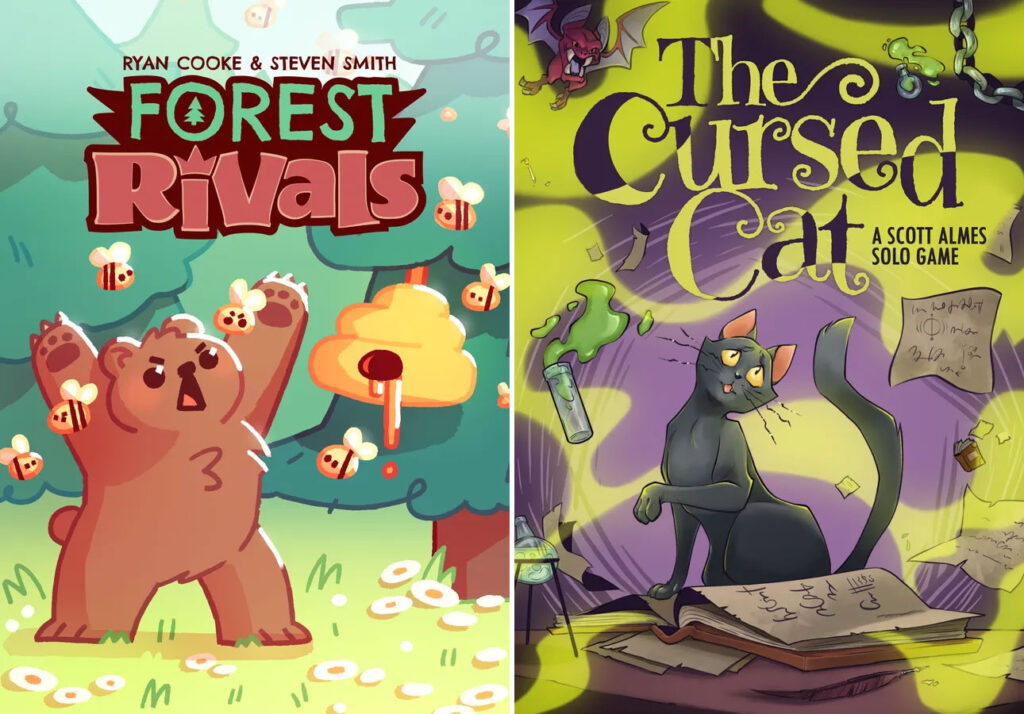
What’s a better way to spice up your summer travel plans than packing new micro-games from Button Shy’s Summer 2026 collection. I’ll be giving a preview of two of the new titles, Forest Rivals (for 2-players), and The Cursed Cast (for solo play), both consisting of 18 cards and playing in around 10 minutes. Forest […]
With this My Favorite Wargame Cards Series, I hope to take a look at a specific card from the various wargames that I have played and share how it is used in the game. I am not a strategist and frankly I am not that good at games but I do understand how things should work and be used in games. With that being said, here is the next entry in this series.
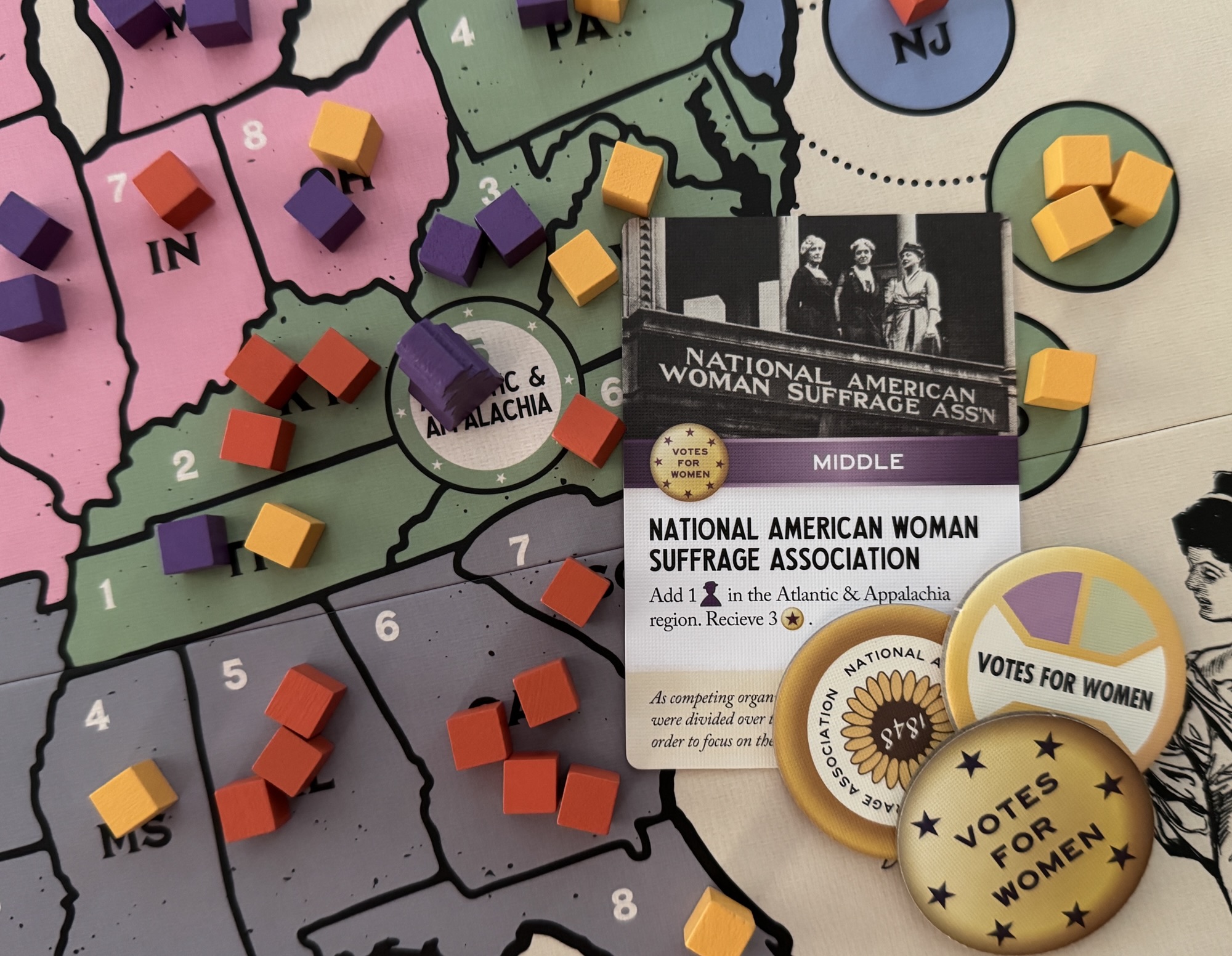
Card #88: National American Woman Suffrage Association from Votes for Women from Fort Circle Games
Votes for Women is a very interesting card-driven game that covers the American Women’s Suffrage Movement from 1848-1920, culminating in the ratification of the Nineteenth Amendment which granted women the right to vote. The game is a 2-player game, that has a fully developed solitaire mode with an “Oppobot” and offers a cooperative mode for those who don’t wish to play as they Opposition. The Suffragist player will have to push Congress to propose the Nineteenth Amendment, and then focus on campaigning to have a minimum of 36 states to ratify the Amendment. The Opposition side will try to prevent Congress from proposing the amendment and failing that to have 13 states reject the amendment.
The game uses cards in a fairly traditional CDG way as there are events that can be be taken or the cards can be played to do things like Campaign, Organize or Lobby Congress. Each card has a specific Card Era that is used to create of the each players’ Draw Decks. Late cards will be on the bottom of the deck, Middle cards will be in the middle of the deck and Early cards will be on the top of the deck. The Suffragist and Opposition decks each have one Start card that will be placed in the player’s hand at the start of the game. Some Event Cards have a prerequisite and some of the cards require a player to roll a 6-sided die and only take the the action on a roll of 3-6. Otherwise, the Event Card is discarded with no effect. The cards in this game are also steeped in historical details, from the name of the events that tie back to specific individuals or happenings, to major moments in the struggle. This game is about the history of the struggle for the right to vote and it is very good!
One of the more interesting aspects about the mechanics of the game is the use of Campaigners to go about trying to influence the attitude of the people and legislators regarding the Nineteenth Amendment through the Campaign Action. When a card is played for a Campaign Action, the player rolls a die, either a 6-sided or 8-sided die depending on what cards have been activated, for each Campaigner they have in play. The player then gets to take the dice and their results, which range from 1-8, and assign a specific die to each of their Campaigners. Each Campaigner may then place the corresponding number of cubes, matching the Campaigner’s color, in the States within the region that the Campaigner is located in. The player may spend a Button to move the Campaigner to a different region, but all of the corresponding cubes must be put into the same region. This is a great way to get a lot of influence out on the board to begin taking control of various States for the final vote in the game. This also is a very efficient way of doing this as you will be rolling 2-3 dice for your Campaigners and then spamming the States. With that in mind, today’s card is the National American Woman Suffrage Association and it provides the Suffragist player with a new Campaigner (purple) to place out specifically into the Atlantic & Appalachia Region that includes the States of Kentucky, Tennessee, West Virginia, Pennsylvania, Virginia, North Carolina, Maryland and Delaware. The card also grants the Suffragist player with 3 Buttons that can be used as described above to relocate a Campaigner from one state to another. This card is very helpful and should be played for the Event 9 times out of 10 and will make a huge difference in the outcome of the game. Once a 2nd or 3rd Campaigner is deployed, I tend to take Campaign Actions rather than some of the less intensive placement options or Events.
The National American Woman Suffrage Association (NAWSA) was an organization formed on February 18, 1890, to advocate in favor of women’s suffrage in the United States. It was created by the merger of two existing organizations, the National Woman Suffrage Association (NWSA) and the American Woman Suffrage Association (AWSA). Its membership, which was about 7,000 at the time it was formed, eventually increased to 2 million, making it the largest voluntary organization in the nation. It played a pivotal role in the passing of the Nineteenth Amendment to the United States Constitution, which in 1920 guaranteed women’s right to vote.
Helen Hamilton Gardener, Maud Wood Park and Carrie Chapman Catt at Suffrage House in Washington, D.C.
Susan B. Anthony, a long-time leader in the suffrage movement, was the dominant figure in the newly formed NAWSA. Carrie Chapman Catt, who became president after Anthony retired in 1900, implemented a strategy of recruiting wealthy members of the rapidly growing women’s club movement, whose time, money and experience could help build the suffrage movement. Anna Howard Shaw’s term in office, which began in 1904, saw strong growth in the organization’s membership and public approval.
After the Senate decisively rejected the proposed women’s suffrage amendment to the U.S. Constitution in 1887, the suffrage movement had concentrated most of its efforts on state suffrage campaigns. In 1910 Alice Paul joined the NAWSA and played a major role in reviving interest in the national amendment. After continuing conflicts with the NAWSA leadership over tactics, Paul created a rival organization, the National Woman’s Party.
Here is a link to our full video review of the game:
Here are two facts you should know about me: I love area control games, and I often only get to play board games with two players. Sounds like a conundrum, right? Well! Moytura pitches itself as a two-player area control game with the feel of a five-player game, thanks to three bot players. But does […]
About 18 months ago, while attending Buckeye Game Fest in Columbus, Ohio, we met up with David Thompson to get a quick look at a few of his newest upcoming games at the time including Line of Fire: Burnt Moon from Osprey Games and the very interesting American Civil War game with a twist called Rebels Against Rebellion from Flying Pig Games. I got to play Rebels Against Rebellion and very much enjoyed the game and what it was trying to convey about the lack of support for the secession of Tennessee from the Union as most of the residents of Scott County voted against breaking away during the American Civil War. The game pits the local groups against each other as the Free and Independent State of Scott fights against the local secessionist residents as violent confrontations between Loyalist and secessionist-aligned partisans and outlaws engaged in raids on farms, stealing livestock, and destroying property. Since that time, the game has progressed and has launched on Kickstarter. I reached out to one of the game’s designer David Thompson to see if he would be willing to share about the design and as always he was more than happy to oblige us.
Grant: David, welcome back to our blog. What is your new upcoming game Rebels Against Rebellion about?
Davind: Thanks for having me back! Rebels Against Rebellion is a card-driven war game for one or two players, set in Scott County, Tennessee, during the American Civil War. Tennessee’s own path to secession was messy. The state voted against a secession convention in February 1861, then reversed course and voted to join the Confederacy in June, following Fort Sumter. But East Tennessee never went along with it. And of all the counties in East Tennessee, none rejected secession more decisively than Scott County: 521 to 19. Later that year, the county court went so far as to pass a resolution declaring Scott County’s own independence from the state of Tennessee, calling itself the “Free and Independent State of Scott.” That’s the story we’re telling: Southern Loyalists trying to hold their ground against the Confederate army and their allied secessionist guerrillas, for the whole length of the war.
Grant: What should the title convey to the players?
David: I wanted the title to carry that irony right up front. Rebels Against Rebellion. The people of Scott County were, technically, rebelling against a rebellion by resisting the Confederacy in order to maintain their ties with the Union. History likes to flatten “Rebel” down to one side of the Civil War, but in Scott County that word cuts the other way too. I liked that the title does some of the historical educating on its own, before a player has even opened the box.
Grant: Why was this a subject you wanted to focus on?
David: It’s a story that doesn’t get told nearly enough. We hear a lot about the big battles and the big generals, but the internal fractures within the South (communities that stayed loyal to the Union under occupation, that organized home guards, that got raided by their own state’s army) that’s a different and much more personal kind of Civil War story. I’ve made a habit of chasing these under-told corners of history rather than the well-trodden ones, and Scott County is about as under-told as it gets. Once you learn about Julia Marcum defending her father’s house with an axe, or the Home Guard’s oath at the Huntsville courthouse, it’s hard not to want to build a game around it.
Grant: What are the unique features with the system used for the game?
David: The core of it is a deck that represents both your units and your locations. Playing a card from your hand isn’t just “move a piece,” it’s your people and your settlements acting together. Every location you control is physically a card sitting in your deck, hand, or discard pile, so controlling territory and building your deck are the same action. You don’t have a separate “buy phase” and “map phase.” When you improve control of a location or bolster in a new unit, you’re deck-building in exactly the same motion as you’re expanding on the board. I think that tight coupling between deckbuilding and area control is the thing that sets Rebels Against Rebellion apart.
Grant: What did you need to model regarding the American Civil War and the situation in Scott County, Tennessee?
David: Quite a lot, honestly. We needed the asymmetry between the two sides to feel true to what actually happened. The Loyalists start the game already holding six locations and 11 points, reflecting how entrenched they already were in the county by the time real fighting started, while the Confederates start with nothing on the board and have to earn their presence. We needed the food economy to reflect how much this was a war of resources and raiding: burned farms, stolen livestock, the constant question of how you feed yourself when supply lines are contested. We needed supply lines themselves to matter for Confederate regulars in a way they didn’t for local guerrillas, since regular units like the 43rd Alabama or Morgan’s Raiders came in from outside the county and depended on a route back to it, while home-grown units like the Home Guard didn’t need that at all. And we needed the map’s road, water, and path connections to reflect the real terrain. Scott County’s isolation and rugged geography is a huge part of why guerrilla warfare took hold there in the first place.
Grant: What is your design goal with the game?
David: We wanted a game that plays cleanly as a tight, two-player card-driven war game, and we wanted a player who knows absolutely nothing about Scott County going in to come away from a session with real curiosity about what actually happened there. Every named card, every location, every unit in the game is drawn from the historical record. If the mechanics are doing their job, “Capt. William Robbins” isn’t just a card with shield and gun icons on it. It’s a doorway into a real person’s story.
Grant: What other games did you use as inspiration?
David: The DNA is definitely there from our work on Undaunted, that idea of your deck representing your force on the board rather than being an abstract resource. But Rebels Against Rebellion pushes further into area control than Undaunted ever did, so we were also looking hard at how area-control and card-driven wargames handle territory scarcity and endgame tension. The most obvious influence comes from Martin Wallace’s A Few Acres of Snow, which serves as a the origin for the core concept of playing a location card as the source of movement. A lot of our actual influences, though, came out of the playtesting process itself.
Grant: What sources did you consult about the history?
David: We leaned heavily on the Scott County Historical Society throughout, especially David Jeffers, Alan Keeton, and James Cecil, who were enormously generous with their research and their archives. On the written side, Paul Roy’s Scott County in the Civil War was probably our single most important source. His overview chapter and his 148-page account of individual Scott County soldiers did a lot of heavy lifting for us. We also relied on Esther Sharp Sanderson’s County Scott and Its Mountain Folk and Scott County Gem of the Cumberlands, H. Clay Smith’s Dusty Bits of the Forgotten Past, Noel C. Fisher’s War at Every Door for the statistical picture of East Tennessee loyalism, Ben Garrett’s Enclave, decades of back issues of the Scott County Chronicle and the First National Bank Chronicle, and the Official Records of the Union and Confederate Armies for the military correspondence. Dr. Stuart Ellis-Gorman did our proofing and copyediting to help make sure we got the details right.
Grant: What did you learn from your trip to this area as part of your research?
David: Back in the fall of 2025 I went to Scott County to meet with folks from the Historical Society and access primary sources that were otherwise unavailable. This trip was absolutely critical to the design process. The men I met at the Historical Society had deep knowledge on the subject, so I conducted interviews with them. They also provided me some of the primary sources I had read about, but could not access without their help (mostly in the form of photocopied versions of printed documents from local authors). My trip to Scott County also gave me the opportunity to visit the area and experience the topography for myself.
Grant: What are the differences between the playable factions of the Confederates and the rebels?
David: Thematically, the Loyalists are defenders who start the game already dug in. They begin with six locations and a head start on the scoreboard, and their whole arc is about holding what’s theirs and expanding cautiously outward. The Confederates start with nothing on the board and have to fight for every location, but they’ve got the raw power to do it: bigger regular units, the ability to bring in outside firepower, provided they can maintain a supply line back to where those units are actually based.
Grant: How did you differentiate them in their mechanics?
David: A few ways. The Loyalists have much more extensive access to the Improve Control action, which allows them to place a second control marker into a location for an additional victory point and card benefit, while a couple of key Loyalist locations, Brimstone and Trammell’s, double as both a location and a unit card depending how you want to play them that turn. The Confederates, on the other hand, get access to harder-hitting regular army units, but those units can carry a supply line requirement, so playing them isn’t as simple as just having them in hand. You need an unbroken road connection back to their origin. It creates a real asymmetry: the Loyalists play a tighter, more efficient game, while the Confederates have more raw strength but have to work to unlock it.
Grant: How does the game use cards?
David: Cards do double duty as your units and your locations, and every card you play resolves a specific action before it goes to your discard pile. Food is the one shared resource, but everything else, from combat strength to your area-control footprint, lives directly on the cards moving through your deck.
Grant: Can you show us a few examples and explain their use?
David: Sure, take the Home Guard. It’s a Loyalist unit card linked to Huntsville, and if you upgrade it, you get an improved version with better combat value. Or take Chitwood’s, a basic location card: play it for its Take Food action to add to your supply, or play it to Move into an adjacent location, which is how you expand your territory or launch an attack. And then there’s Brimstone, which starts as a plain location card but can be improved into Capt. William Robbins. At that point it’s simultaneously the location and a combat unit, with its own attack value and shield icons, giving you flexibility about how you use it depending on what your turn needs.
Grant: How do the cards upgrade or power up?
David: There are two upgrade paths. Improve Control takes a basic location card, has you pay food, and swaps it for its improved version, which usually comes with better attributes and, for a couple of key locations, unlocks a linked unit. Improve Unit works the same way for unit cards directly. You pay the listed food cost, and the improved version replaces the original in your discard pile while the old card goes out of the game for good. Either way, you’re not adding new cards on top of old ones. You’re replacing weaker cards with stronger ones, so your deck gets more powerful without getting bigger and bloated.
Grant: How important is this to the design?
David: It’s central. Deck quality, not just deck size, is what wins you the game, and the choice of when to spend food on upgrading versus expanding onto the board versus bolstering in new units is the core tension every turn.
Grant: What is the layout of the board?
David: The board depicts Scott County and its surrounding area, with locations connected by roads, water, and paths. Each connection type governs how many cards you can commit to an attack moving along it, from one card on a path up to three on a road. Locations within Scott County proper are marked in brown; locations outside the county, like Somerset, Jacksborough or Jamestown, are marked in grey and generally serve as Confederate staging points and supply origins. Each location shows its star value, which doubles as its point value and its food cost to take control, along with any food production and, for locations that can be improved, their upgraded attributes.
Grant: What is the anatomy of the counters?
David: We use control markers rather than traditional counters. One per location per player, showing who currently holds it, with some locations (mostly limited to the Loyalists) able to carry a second marker once improved. The real “unit anatomy” lives on the cards themselves: name, faction affiliation, attack and defense attributes, a linked location, an improvement cost, and icons indicating whether the unit returns to its supply or is removed from the game entirely after a successful attack.
Grant: How are units activated?
David: You activate units by playing their card from your hand as part of a Move action or in response to an attack. There’s no separate “activation phase.” A unit card played in combat commits its attack or defense value to that fight; the same card, played on its own, might instead trigger a Bolster or Improve Unit action. Context and the icon panel on the card tell you what’s legal in the moment.
Grant: What is the general Sequence of Play?
David: Turns alternate, Confederates first. On your turn you play cards from your hand one at a time to take actions, resolving each fully, including paying food and playing any additional required cards, before moving to the next, and you can stop whenever you like. Once you’re done taking actions, you discard down as much as you want from what’s left in hand, then draw back up to a five-card hand, reshuffling your discard pile into a new deck if you run out.
Grant: What actions are available to players?
David: Take Food, Improve Control, Bolster, Improve Unit, and Move, which is also the action that triggers combat if you’re moving into a location your opponent controls.
Grant: How does combat work?
David: Once you move into a contested location, the attacker plays one required combat-eligible card face down, and the defender either matches with a card of their own (up to a maximum of two, since they can also commit the target location’s own card) or passes. This goes back and forth, both sides adding cards until they hit their limits or choose to stop, with the attacker’s ceiling set by the connection type they’re attacking along. Everyone reveals at once: the attacker totals their attack icons, the defender totals their defense (and any dual-purpose attack icons used defensively), and the defender wins all ties. Win as the attacker, and you strip your opponent’s control marker, shift points in your favor, and get the option to immediately take control as a follow-up action.
Grant: How is victory achieved?
David: You’re racing toward one of a few thresholds: reach 20 points while your opponent sits at 10 or fewer, or simply hold more points than your opponent once the game’s light-colored food tokens run dry and it tips into sudden death. The Confederates have a separate, blunter win condition too: if the Loyalists ever lose every control marker on the board, the Confederates win outright. And if the very last food token, one of the ten darker ones, gets taken, the game ends in a draw, so there’s a real, ticking clock underneath everything you do.
Grant: Who is the artist and how does their style assists in thematic immersion?
David: Kwanchai Moriya handled illustration and Jina Rueter handled graphic design, and I couldn’t be happier with how it came together. Kwanchai has this warm, painterly quality that makes Scott County’s mountains and creeks feel lived-in rather than just decorative. It goes a long way toward making cards like Capt. William Robbins or Julia Marcum feel like real people from a real place rather than generic Civil War stand-ins. Jina’s layout work keeps the cards (action icons, attributes, linked locations, improvement costs) legible at a glance, which matters enormously in a system where you’re constantly reading your hand.
Grant: What type of experience does the game create?
David: Tense and personal. Because the map is so tightly connected, and because food is always ticking down toward sudden death, every attack matters and every food token spent is a decision you feel. It plays fast for a war game, but it doesn’t feel light. The historical grounding and the asymmetry between a scrappy, entrenched Loyalist defense and a Confederate side that has to earn its foothold give it real dramatic shape.
Grant; What are you most pleased about with the design?
David: I’m just happy that we had such an amazing team come together to work on this game. Trevor and me from a design perspective, Kwanchai and Jina bringing the game together through their illustration and graphic design, with Denver at Flying Pig Games leading the way. It was a dream team for this project that I am so passionate about. Of all the games I’ve worked on recently, this is the game closest to my heart. I just want to spread the word about these amazing people who fought for what they believed in.
Grant: What other games are you currently working on?
David: It’s a busy stretch. Alongside Rebels Against Rebellion, I’ve got Night Witches coming, co-designed with Liz Davidson (Fort Circle Games); two expansions for Sniper Elite with Roger Tankersley (Rebellion Unplugged); Flintlock!, a Seven Years’ War and French & Indian War game built on Paolo Mori’s Blitzkrieg! System, also with Roger (Floodgate Games); For the Gods!, co-designed with Trevor and Brett J. Gilbert (Mighty Boards); Zheng He, co-designed with Geoff Engelstein (GMT); and Undaunted 2200: Revolution, co-designed with Trevor (Osprey Games). There are some others on the way, but those are further off…
Thanks as always for having me!
As always, thank you so much David for your time in answering our questions and for showing me the game about a year and a half ago. I very much look forward to playing the final product and wish you well with the Kickstarter campaign.
If you are interested, we did an interview video with David while attending Buckeye Game Fest in the spring of 2025 and you can watch that at the following link for more information on the game:
Ameisen haben es nicht leicht. Sie sind klein und ihre Umwelt ist meist gegen sie. Und nicht nur die, sondern auch andere Ameisen sind keine netten Nachbarn. Also heißt es nun, eine Überlebenstaktik zu entwickeln und kräftig zurückzuschlagen. 4X-Spiele sind ja in den meisten Fällen immer ein echtes Brett und benötigen oftmals gerne einen ganzen Tag an Spielzeit. Oder sie sind so simplifiziert, dass einfach die Tiefe fehlt und dem 4X-Genre gar nicht mehr gerecht wird. March of the Ants will hier so ein wenig die Brücke schlagen, ob das gelingt, schaue ich mir hier doch direkt mal an.
March of the Ants: Evolved Edition ist die Neuauflage des 2015 erschienenen March of the Ants, das noch recht zweckmäßig daherkam, aber doch viele Fans hatte. Daher wohl nun auch die aufgemotzte Neuauflage, die nicht nur mit einer deutlich schickeren Optik daherkommt, sondern auch mechanisch optimiert wurde. Da ich das Original nie gespielt habe, kann ich dir leider keine Unterschiede vorführen, doch dafür aber eine unbeeinflusste Sicht auf die Neuauflage bieten.
Twilight Imperium im heimischen Vorgarten
Worum geht es hier eigentlich genau? Wir starten alle mit einem kleinen, noch etwas ärmlichen Ameisenbau, einer Handvoll fleißiger Arbeiter und großen Träumen von der absoluten Wiesenherrschaft. Wie es sich für ein sauberes 4X-Spiel gehört, wird das Spielfeld aus hexagonalen Plättchen Runde für Runde von uns erkundet (das erste X: eXplore).
Sobald du deine kleinen Sechsbeiner losschickst und ein neues Feld aufdeckst, fühlst du dich ein bisschen wie Christopher Kolumbus, nur dass du statt auf Gold und Gewürze auf fette Würmer, saftige Pilze oder auch mal auf einen extrem übellaunigen Hundertfüßer triffst. Und natürlich willst du dich ausbreiten (eXpand) und die Ressourcen der Wiese gnadenlos ausbeuten (eXploit), denn deine wachsende Kolonie hat großen Hunger.
Das Aktionssystem und der Kampf gegen die Downtime
Wer schon mal eine Runde Eclipse oder andere Welteroberungs-Monster mit Grüblern am Tisch gespielt hat, kennt das Problem: Du machst deinen Zug und kannst danach gefühlt erst mal in Ruhe die Wand verspachteln, bis du wieder an der Reihe bist. March of the Ants löst dieses Problem mit einem schönen Reaktions-System.
Jede Runde steht dir eine Auswahl an Hauptaktionen zur Verfügung: Du kannst erkunden, deine Truppen marschieren lassen, Karten ziehen oder ausspielen. Sobald du eine dieser Aktionen ausführst und dafür deine Ameisen bezahlst, schauen die anderen Spieler aber nicht nur däumchendrehend zu! Jeder Nachbarspieler hat sofort die Möglichkeit, eine dazu passende Nebenaktion (das sogenannte „Reagieren“) auszuführen. Wenn du also kräftig marschierst, können dein linker und rechter Tischnachbar ebenfalls einen Schritt mit einer Ameise gehen oder eine Larve schlüpfen lassen. Wenn du Karten ziehst, dürfen die Mitspieler eine neue Larve auf dem Spielertableau platzieren.
Das führt dazu, dass alle mehr ins Spielgeschehen eingebunden sind und hoffen und bangen können, ob die Mitspieler eine für dich gerade praktische Aktion machen. Der gefühlte Leerlauf sinkt dadurch auf ein angenehmes Maß. Das ist ein sehr cleveres Feature, das ich mir auch für andere Spiele wünsche.
Pimp my Ameise
Das wildeste Herzstück des Spiels sind aber ohne Frage die Evolutionskarten. Vergiss langweiliges Holzsammeln oder staubige Technologiebäume aus dem Mittelalter! Hier wird mutiert, evolutionär getrickst und die Biologie komplett auf den Kopf gestellt.
Das ist das nackte Board ohne Aufwertungen. Auf der linken Seite sind praktischerweise alle Aktionen und deren Effekt aufgeführt.
Du kannst deine Ameisen in genau drei anatomischen Kategorien aufmotzen: Kopf, Thorax und Abdomen (auf gut Deutsch: der Arsch). Du fängst deine Partie als brave, völlig unauffällige kleine Waldameise an und nach zwei oder drei Runden hast du plötzlich fliegende, säurespuckende Killer-Insekten mit gigantischen Mandibeln und angsteinflößenden Augen auf dem Tisch stehen. Das sieht durch die extrem charmanten Illustrationen nicht nur super aus, sondern gibt dir auch starke asymmetrische Fähigkeiten, die deine ganze Strategie beeinflussen.
Hast du keine Lust mehr, dass dir feindliche Truppen den Weg streitig machen? Kein Problem, schnall deinen Arbeitern einfach ein paar parasitäre Flügel an den Thorax und flieg locker über die Feinde hinweg! Deine Armee verliert ständig im Kampf? Bastel dir einen Kampfameisenkopf dran und verteile im Kampf richtig fiesen Schaden! Oder willst du lieber die ultimative Geburten-Engine aufbauen? Dann verpasse deinem Abdomen eine fette Eierkammer und pumpe neue Larven schneller auf das Spielfeld als die Konkurrenz gucken kann. Auf der Rückseite der Tableaus ist auch bereits ein asymmetrischer Start, bei dem jeder eine andere Startarmeise bekommt.
Die Karten sind dabei herrlich vielseitig: Du kannst sie nicht nur für Evolutionen nutzen, sondern sie auch als sofortige Ereignisse ausspielen oder im Kampf als taktische Boni abwerfen.
So sieht das Board mit einer Evolution aus. Trotzdem können weitere Evolutionskarten auf bereits bestehende gespielt werden.
Krieg, Frieden und hungrige Hundertfüßer
Ein richtiges 4X braucht natürlich auch zwingend das vierte X: eXterminate (also ordentlich auf die Mütze geben). Und ja, hier wird gekämpft! Wenn zwei fremde Kolonien auf demselben Wiesen-Feld landen, wird der Platz schnell eng, und wenn alle Ressourcenfelder belegt sind und weitere Ameisen etwas vom süßen Ertrag haben wollen, kommt es zur Keilerei.
Das Kampfsystem ist flott gelöst. Statt stundenlange Würfelorgien abzufeiern, während der Rest des Tisches auf Instagram, Facebook oder wo man aktuell so ist scrollt, wird hier einfach die Grundstärke der beteiligten Ameisen gezählt und verdeckt mit Taktikkarten aus der Hand aufgewertet. Wer verliert, verliert Truppen, aber selbst der Sieger geht selten ohne Verluste nach Hause.
Noch waren alle auf ihren eigenen Erkundungstrip, doch bald starten die ersten Rangeleien.
Du musst aber gar nicht unbedingt kämpfen. Das Spiel bietet eine Symbiose-Mechanik. Wenn du es schaffst, friedlich mit deinen Nachbarn auf einem Feld zu koexistieren und die Ressourcen der Natur zu teilen, generiert das für beide Seiten in jeder Runde wertvolle Ressourcen. Das klingt nach harmonischem Hippie-Leben in der Kräuterwiese, funktioniert in der Praxis aber natürlich genau so lange, bis jemand den Hals nicht voll bekommt, dringend das Wiesen-Feld für seine geheime Mission braucht und dir von hinten kräftig in den dicken Abdomen beißt. Also solange sich nicht mehr Ameisen auf dem Hexfeld befinden, als es Sammelplätze gibt, ist alles im Lot.
Und als wäre das Gezanke unter Nachbarn nicht schon stressig genug, musst du am Ende jeder Runde auch noch die Schlummerphase abhandeln. Hier bekommst du nicht nur die Ressourcen von deinen Sammelfeldern, sondern du musst deine ganzen hart arbeitenden Ameisen auch noch ernähren. Falls du das nicht kannst, heißt es, sie sind futsch. Wer hier schlecht geplant hat und seine Truppen nicht durchfüttern kann, muss zusehen, wie die eigenen Arbeiter jämmerlich verhungern. Zu allem Überfluss werden jetzt auch noch die neutralen Hundertfüßer aktiv! Diese fiesen KI-Monster streifen über das Spielfeld, nisten sich auf wertvollen Wiesenfeldern ein und fressen alles, was nicht schnell genug auf den Bäumen ist. Ein neutraler Ärgerfaktor, der die Wiese lebendig und gefährlich hält.
„Hey Björn, das klingt ja richtig toll, doch gibt es auch negative Sachen oder schreibst du hier nur Lobeshymnen?“, höre ich dich raunen.
Und oh ja, leider fällt auch einiges an Schatten auf die Wiese. Ich finde die Kartenanzahl etwas zu gering. Ich würde es bevorzugen, wenn das Deck während eines Spiels nicht gemischt werden müsste. Und vor allem nicht zweimal. Natürlich wäre das eine hohe Zahl weiterer Karten, aber ich glaube, das täte dem Spiel wirklich gut. Allein, um auf Dauer mehr Abwechslung reinzubringen.
Ok, das war eher ein verschmerzbarer Punkt, der nächste ist aber ein echter Downer. Es gibt zwar nicht direkt eine Player Elimination, also dass ein Spieler komplett vom Tisch gefegt wird, doch wer einmal fast ausgerottet wurde, schafft es in der kurzen Spielzeit nicht mehr, sich zu rehabilitieren. Also kein Handshake, gutes Spiel und ich geh schon mal, oder lese die neuesten Forums-Thread-Einträge auf Unknowns, oder doomscrolle durch TikTok. Ne, du schaust deinem toten Ameisenhaufen bei den Versuchen, sich erneut auszubreiten, dabei zu, wie er ganz einfach von den Übermächten auf dem Feld erneut zerschlagen wird. Die Mechanik, dass auch der Gewinner mit Verlusten nach Hause geht, kompensiert das einfach nicht genug. Die schwächste Kolonie ist einfach immer ein interessantes Angriffsziel. Eine komplette Eliminierung eines Spielers wäre hier einfach ehrlicher gewesen.
Spielerin Blau war hier schon so zurückgeschlagen und dezimiert, dass es nicht mehr möglich war sich erneut auszubreiten. Zumindest nicht wenn die anderen das nicht wollten.
Der Spagat zwischen einer umfangreichen 4X-Erfahrung und einer schnellen Spielzeit gelingt auch nicht so recht. Durch die verschiedenen Ameisenkörper, Siegpunkt- und Aktionskarten lassen sich zwar unterschiedliche Strategien verfolgen, aber im Kern machst du hier nicht viel. Ein wenig mehr Tiefgang in den Aktionen hätte sicher nicht geschadet, auch wenn die Spielzeit auf 3 Stunden ansteigen würde. Ich gehe davon aus, dass einfach eine ganz andere Zielgruppe im Visier war, und da funktioniert das Spiel sicherlich auch wunderbar.
Unboxing
Der ganze Inhalt kommt in einem tollen Pappinsert, gefüllt mit hochwertigem Spielmaterial: Holztoken, dicke, schön designte Hex-Plättchen und griffige Karten mit tollen Artworks. Ein wirklich gelungenes Insert mit vielen Pappboxen für das ganze Material. Da lässt sich alles super verstauen, ohne ein eigenes Insert dafür drucken zu müssen.
Die Regeln lesen sich gut und das Ganze ist neuen Mitspielern in entspannten rund 15 Minuten erklärt. Die Spielzeit ist angenehm und ich würde sagen, pro Spieler sind es hier rund 30 Minuten Spielzeit. Mit neuen Spielern sicher noch mal 30 Minuten mehr.
Bewertung
Schafft March of the Ants also den schwierigen Spagat im 4X-Genre? Wer nicht zu komplex werden will und ein echtes Aufbauspiel mit Erkunden, Expandieren, Ausbeuten und Kämpfen auf dem Tisch haben will, ohne dafür direkt ein ganzes Wochenende frei zu nehmen, wird hier sicher glücklich. Auch beim Begeistern von Wenigspielern ist March of the Ants ein toller Einstieg.
Doch am Ende steht sich das Spiel selbst etwas im Weg und endet als ein Spiel, das voll ok ist, aber eigentlich hätte richtig gut sein können. Das Mutationsthema holt mich thematisch und mechanisch total ab. Zusammen mit der modularen Wiese spielen sich die Partien unberechenbar und immer etwas anders. Die Evolved Edition macht auch auf dem Tisch wirklich was her. Für den großen Wurf fehlt aber einfach etwas.
Die Erweiterung „Räuber und Beute“ konnte ich noch nicht testen, sie bietet aber eine Zusammenfassung zweier Erweiterungen des Originalspiels.
Wie wir bewerten haben wir euch hier aufgeschrieben.
(c) Copyright Giant Roc
Grafik(en) und Bild(er) von analog rockt
Bausteine: Das Spiel ist ein Rezensionsexemplar. Diese Rezension ist unentgeltlich durchgeführt worden und spiegelt meine persönliche Meinung wider.
Hegemony made a huge splash in the board gaming world with its 2023 debut, representing one of the most thematic politico-economic Eurogames ever released. Containing seven unique policies about which four asymmetric factions could push and pull levers to their class’s unique benefit, this creation was equal parts board game and government simulation. The main […]
Ever play a game that you want to love, that you think you should love, but when you play it, you don’t, and you keep playing anyway, hoping you’ll fall in love with it? For me, that game is Smash Up by Alderac Entertainment Group (AEG). On paper, the concept is fantastic. The “shufflebuilding” premise […]
Risk was probably the first area control game most of us ever played. When I started playing Risk, I felt like I “graduated” from Monopoly and was ready for more “grown up” games. At least that’s what went through my head. I played Risk regularly throughout high school, but when my group of friends all […]
Kauri versetzt die Spieler nach Neuseeland und greift dabei die Veränderungen des Ökosystems seit der Ankunft der Menschen auf. Im Mittelpunkt stehen vier asymmetrische Fraktionen mit völlig unterschiedlichen Zielen und Spielweisen. Der Kiwi verteidigt seinen Lebensraum, das Possum breitet sich
You were left the family farm, and it’s your life’s dream to take it over and live out your small town dream. It’s the bucolic scenario that kicks off every cozy game of the last ten years. Unfortunately, in this scenario, your headstrong siblings have also been left the farm, and none of you can […]
A review copy of Joraku Deluxe was kindly provided by Moaideas. Thoughts & opinions are my own. Joraku takes the threads of a traditional trick-taking system and combines them with area control and action selection to weave a tight, intricate fabric. Joraku didn’t make waves when it first arrived and was desperately difficult to get hold of. It’s well worth tracking down a copy though…
Contrary to many in the boardgaming hobby, I do not bling out my games, in part because I am better able to rationalize my next, totally unnecessary, board game purchase if I know I passed on the metal coins for my last Gamefound pledge. Thus, I have monitored the recent trend of classic Eurogame deluxification—including […]
Crowdfunded board games are a saturated market space. In other breaking news, the sky is blue. That saturation means there are much-hyped games that don’t even merit being printed. It also means that there are criminally underrated games that sneak through unnoticed. To call Mysthea unnoticed is a bit of an overstatement, as it was […]
Im Sommer sind alle gerne in ihren Hütten auf dem Land. Doch auch dort gibt es bessere und schlechtere Orte. Bei Stuglandet platziert man seine Hütten bestmöglich und sorgt für Mehrheiten, nachdem man mit ihnen gewürfelt hat. Die Spielschachtel ist
The instinct to build massive edifices, monuments, and works of art is primal. For animals like the Bowerbird, their elaborate mating parlors are practical. For humans like Jason Blake, their mind-boggling creations eschew practicality for ambition. The most honest assessment I can give of Cysmic is that it’s a boldly crafted reliquary to youthful mirth…
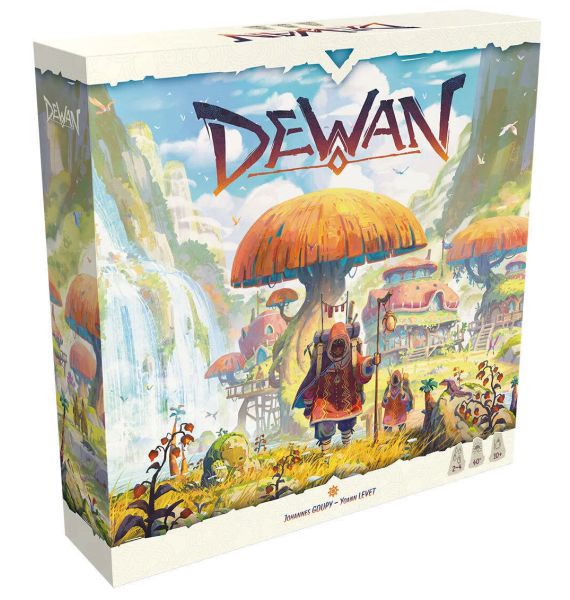
Dewan von Johannes Goupy und Yoann Levet – erschienen bei den Space Cowboys Wenn ich die Wikipedia-Artikel zum und zum des malaysischen Parlament richtig deute, dann kann "Dewan" in der malaysischen mit "Halle" übersetzt werden. Das passt besser als erwartet. Denn auch wenn uns die blumige thematische Einkleidung zu anderen Assoziationen führen will: im Endeffekt geht […]
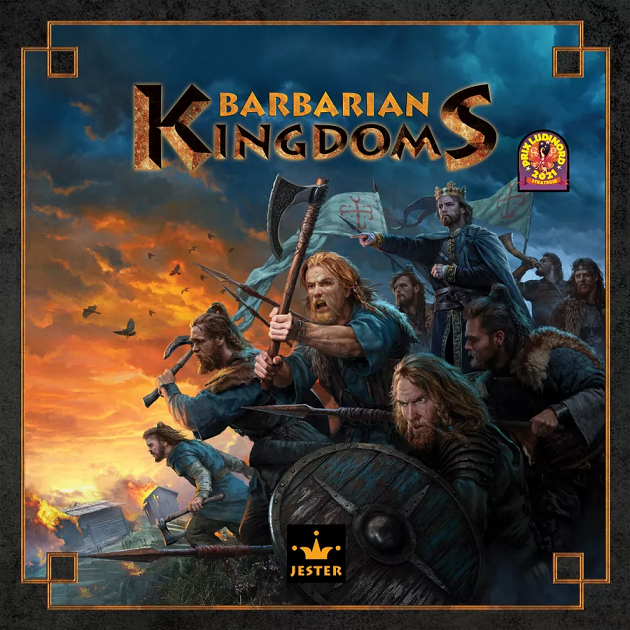
Barbarian Kingdoms is the kind of modest board game that comes in a standard sized box with a small selection of cards, a reasonable number of tokens, and a surprising absence of miniatures. While it is nearly two years old at this point, it actually appears more long in the tooth and weathered. I wouldn’t…
Weltpolitik um 2010 als Spiel – ein erstes Anfühlen
Nachdem das Spiel uns vor wenigen Tagen erreichte, hat Bill gleich am ersten Abend Weltpolitik geschnuppert und sich die ersten Eindrücke der Spielmechanik in einem trockenen Solokonzert, also in einem simulierten Zweipersonenspiel in halber Länge, vorab erstmal beigebracht.
Wie sich das Spiel mit echten Gegner anfühlen würde, konnte er also erstmal nur erahnen. Doch schon in diesem ersten Durchlauf konnte er interessante Ansätze und interaktive Möglichkeiten erhaschen und somit stieg die Spannung um das erste Debut mit Horst zwei Tage später.
Ob diese Partie unser beider Erwartungen erfüllen konnte oder uns als ratlose Großmächte stehen lies werden wir Euch aus zwei Perspektiven näher bringen. Der vorliegende Artikel spiegelt unser „Vorspiel“ – sprich den Ersteindruck – wieder.
An dieser Stelle möchten wir Giant Roc herzlich für die Bereitstellung der erhaltenen Vorabversion des Grundspiels danken. World Order und seine Erweiterung World Order – Welt in Aufruhr werden ab dem 15.05.2026 erhältlich sein, sind aber bereits zum jetzigen Zeitpunkt vorbestellbar.
Steckbrief
Spiel
World Order
Verlag
Giant Roc (Hegemonic Project Games)
Veröffentlichung
2026
Idee
Vangelis Satriohadi, Varnavas Timotheou
Illustration
Angga Satriohadi, Milosz Wojtasik
Rating (BGG)
7,9 (bei derzeit 250 Stimmern)
Komplexität (BGG)
Kennerspiel (gehoben)
Spielweise
Kompetitiv
Mechaniken
Area-Control, Deck-Building
Bill’s Eindruck von der Bühne
Während sich Horst als meine konkurierende Großmacht die Volksrepublik China ausgewählt hat, gibt die Spielanleitung vor, dass man zu zweit gegen China oder Russland die USA oder die Europäische Union als Gegenpart auswählen soll. Das ist aber die einzige Einschränkung solcher Art. Wer nun von dem Vorgänger Hegemony anderes gewohnt ist: ab einer Partie zu dritt werden hier bereits keine Vorgaben mehr gemacht. Ich wählte Europa, deren Farbe gelb ist – das allein ist bereits ein Grund dafür in meinen Augen!
Im Herzen ist das Spiel ein Area-Control mit einem Deckbuilding-Element. Die Gebietskontrolle läuft dabei in zwei Ebenen ab. Einmal durch das Setzen von Einflusssteinchen über diplomatische Kooperationen, Investitionen oder das Erbauen von Militärbasen. Krieg selbst spielt zumindest im Grundspiel keine große Rolle. Die militärische Macht und damit die zweite Ebene in der Gebietskontrolle, stellt eher ein Kettenrasseln der Großmächte dar und kann die Unterlegenen in Ihren Interessengebieten maximal um ein paar Siegpunkte pro Runde bringen. Insgesamt ist es damit ein Area-Control, welches mit meiner allgemeinen Skepsis zu diesen Spielen doch kompatibel ist, da man nicht komplett verdrängt wird und auch dann noch Siegpunkte generieren kann, wenn man nicht stärkste Kraft vor Ort ist.
Das Deckbuilding stellt auch einen wichtigen Bestandteil in jeder Partie da, wirkte im ersten Spiel aber lediglich partiell beeinflussbar. Im Hauptteil des Spiels, der Aktionsphase, muss man während der 4 Aktionen pro Runde schon überlegen, welche der 6 Handkarten man ausspielt und welche man zum Generieren der Forschungspunkte auf der Hand behält. Mit diesen kauft man an jedem Rundenende Karten vom ausliegenden Markt. Manche selten vorkommenen Karten erlauben es auch, andere aus der restlichen Partie zu entfernen aber man ist ähnlich wie bei Dune oder Klong! eher von den ausliegenden Karten abhängig.
Auch andere Elemente wie ein kleiner Tech-Tree oder Ressourcenmanagement sowie die Möglichkeit Geld und Siegpunkte mit Wohlstand im Volk zu generieren sind vorhanden. Diese sollen im Vorbericht aber nur erwähnt bleiben. Weitere Partien werden zeigen welchen Einfluss sie auf das Spielgeschehen insgesamt nehmen.
Sollte man mit weniger als 4 Spielern unterwegs sein, werden die Einflüsse und Militärmacht der ungenutzten Großmächte mit Karten simuliert, was gut funktionier und mir recht klug erscheint, weil diese dann auch vornehmlich in die eigenen Interessengebieten der Welt einsteigen und dort für Ärger sorgen. Ebenso kann man mit diesen Handeln. Somit ist man nicht nur auf die vorhandenen, bespielten Großmächte angewiesen.
Groupie auf Tour
Die Lernpartie und folgende Erstpartie haben mir Spaß gemacht, spiegeln aber noch nicht die volle Breite an spieltechnischen Möglichkeiten wider. Ich glaube aber zu diesem Zeitpunkt, dass mir das Spiel gefallen wird, weil es an mein „Hass“-Thema Area-Control doch anders und für mich passend herangeht und ich die anderen Spielkomponenten generell sehr mag. Die Asymmetrie der unterschiedlichen Großmächte sind thematsich gut erfasst und ausreichend vorhanden aber längst nicht so sehr im Vordergrund wie in Hegemony selbst. Die ausgeübten Aktionen unterscheiden sich zwischen den Spielenden kaum voneinander, aber das Startdeck oder bestimmte Kriterien auf den Spielertableaus sind unter anderem doch klar Unterscheidbar und zu den jeweiligen Großmächten passend.
Bleibt für mich abzuwarten ob der Titel auf Dauer wirklich meinen Erwartungen entspricht und ob es meinen Mitspielenden gefallen kann. Näheres dazu folgt wie oben erwähnt in Kürze. Ob einem das Thema an sich in Betracht der realen Weltlage gefällt muss natürlich jeder für sich selbst entscheiden.
Kurzfazit: Komplett anderes Spiel als Hegemony. Wirkt gut durchdacht und macht durchaus Spaß. Ich bin auf weitere Partien gespannt.
Horst’s Eindruck von der Bühne
Das Thema mag in der momentanen politischen Weltsituation etwas makaber wirken. Ich müsste noch mal schauen, aber ich bin der Meinung, dass ich ein Interview oder eine Stellungnahme von den Autoren gelesen haben, dass sie ebenso geschockt sind, wie wir, was gerade auf der Weltpolitischen Drehscheibe passiert. World Order spielt im Grundspiel im Jahr 2010, vor Corona, vor Ukraine, vor Trump Teil 2, um nur einige der Dinge zu nennen. Daher rollen wir nicht in Risiko-Manier mit der Geheimkarte Welteroberung durch die Weltkugel, sondern müssen unserer staatlichen Geschicke mit Drohgebärden, Handel und diplomatischen Geschick lenken. Bill hat schon geschrieben, dass es Area Control Anteile hat, aber diese sind eher in Racing-Mechanismen versteckt. Es gibt oft darum als erste Person Einfluß zu platzieren, Punktekarten einsammeln oder ähnliches. Man kann der konkurrierenden Regierung zwar auch einen Panzer in den Garten stellen und diese so ärgern, aber in unserer Erstpartie war dafür kaum Zeit. Apropos Erstpartie: Ohne Regelerklärung haben wir die Weltgeschicke 2,5 Stunden gewidmet, wobei die Zeit wie im Fluge verging.
Wer bei World Order aber nun hoft ein Hegemony auf großer Weltbühne zu bekommen, wird enttäuscht werden. World Order ist ein sehr gutes Spiel, aber eben deutlich anders und ich würde sogar sagen, deutlich weniger komplex und interaktiv wie das Erstwerk. Es ist eben ein sehr eigenständiges Werk.
Die grandiose Asymmetrie des Vorgängers ist in etwa nicht so stark ausgeprägt. Jede Regierung hat zwar etwas einmaliges und auch die ein oder andere Karte. In Summe wirken die abweichenden Fähigkeiten aber das ist nicht so Spielentscheidend, auch wenn jede Regierung in eine gewisse Richtung geschoben wird. Chinas Strategie beispielsweise ist die eigenen Luxusgüter in die Welt zu exportieren und zu vermarkten. Kommt euch bekannt vor? Deswegen haben Europa und Amerika (im Jahre 2010) noch ein militärisches Bündnis und der Panzer des einen im Gebiet des anderen hat keine negativen Folgen. Russland rasselt schon in 2010 gerne mit den Säbeln und lebt vom Ölexport.
Aus meiner Sicht kommt das Thema wieder grandios zum Vorschein und zieht ähnlich in den Bann wie es bereits der Staatshaushalt gemacht hat. Das Deckbuilding Element hat mich etwas ratlos zurück gelassen. Manchmal war die Auslage nicht passend und die Kartenhand wurde eher zugemüllt. Das führte bei mir dazu, dass ich in einer Runde Pech bei der gezogenen Kartenhand hatte und direkt mehrere Notaktionen machen musste. Das war bereits am Ende der zweiten (von sechs) Runden und ich konnte ab dem Zeitpunkt nur noch sehen, wie Bill mit Punkten davon geritten ist. Am Ende waren wir dann doch nur elf Punkte voneinander getrennt, es fühlte sich vier Runden aber nicht mehr gut an.
Ich freue mich sehr auf die nächsten Partien, weil es noch so viel auszuprobieren gibt.
Mein Kurzfazit: Gutes eigenständiges Spiel mit gut verzahntem und umgesetzten Thema. Vergleicht es nicht mit Hegemony.
Konzertmitschnitte
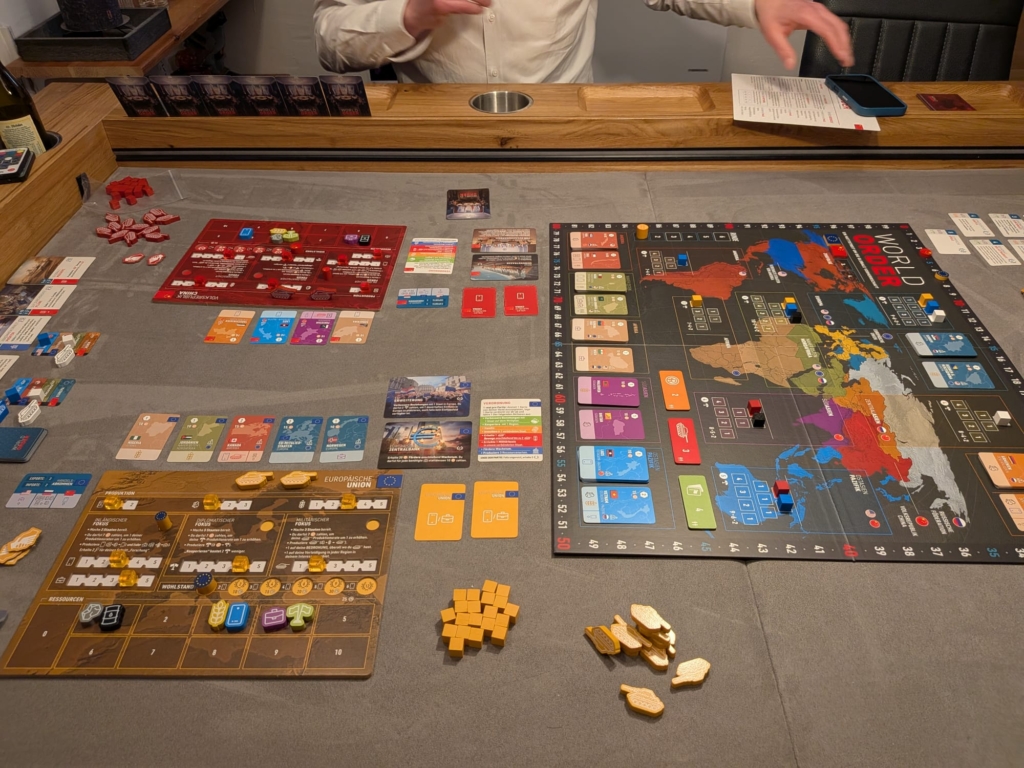
Spielaufbau zum StartDie Europäische Union in Runde 5/6Chinesische Republik in Runde 5/6Einflussmarker und Militäraufgebot ind Runde 5/6

 Anmelden