Auch in der zweiten Septemberwoche bleibt es bei Kickstarter, Gamefound und Spieleschmiede eher ruhig, die großen Neustarts der letzten sieben Tage (31. August bis 7. September 2026) waren bereits eigene Meldungen dieser Redaktion. Zwei weitere Kampagnen erreichen zusätzlich die Auswahlkriterien: eine Jubiläumsausgabe eines Verhandlungs-Klassikers und ein Kunstschul-Spiel, das sein Finanzierungsziel um mehr als das Vierzigfache übertrifft.
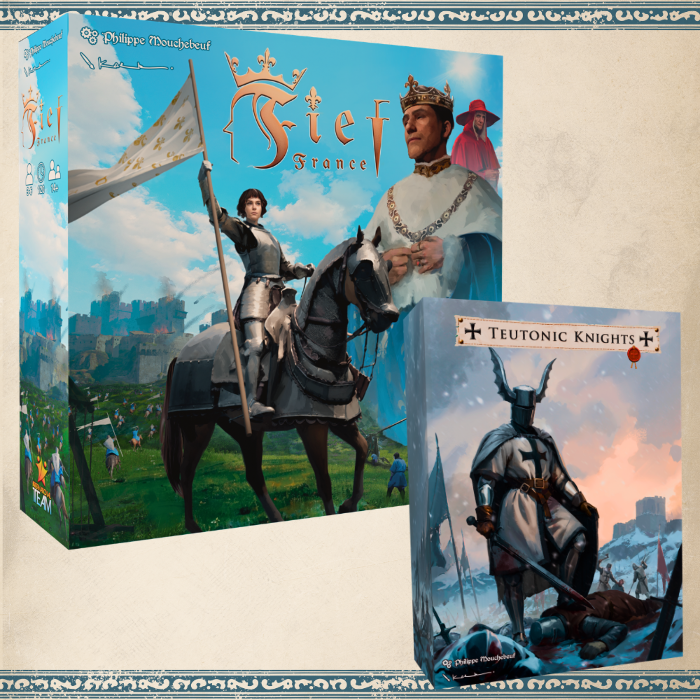
Fief: France 45th Anniversary Edition
Der französische Verlag International Team hat Fief: France 45th Anniversary Edition am 1. September 2026 auf Gamefound gestartet, Stand 7. September 2026 bei rund 273 Prozent des Ziels von 30.000 Euro (82.043 Euro). Design stammt von Philippe Mouchebeuf, der die Fief-Reihe ursprünglich entworfen hat.
Drei bis sechs Spielende führen eine Adelsfamilie im mittelalterlichen Frankreich und kämpfen über Bündnisse, Heiraten, Wahlen, Kirchenämter und offene Kriege um die Vorherrschaft im Königreich. Mechanisch verbindet das Spiel Verhandlung, Gebietskontrolle, Würfelwürfe und ein Bestechungssystem, dazu kommen geheime Truppenbewegungen und Abstimmungen im Kronrat. Zum 45-jährigen Jubiläum der Reihe überarbeitet diese Ausgabe einzelne Abläufe und bündelt Inhalte aus früheren Erweiterungen der Vorgängerausgabe. Eine Partie dauert laut Kampagnenseite rund 120 Minuten, ausgelegt für drei bis sechs Spielende ab 14 Jahren, einen Solo-Modus gibt es bei dieser Spielerzahl nicht.
Die Kampagne läuft noch bis zum 17. September 2026. Eine deutsche Ausgabe ist bestätigt.
Reverie: Symphony of Colors
Das US-Studio Dux Somnium Games hat Reverie: Symphony of Colors am 1. September 2026 auf Kickstarter gestartet, Stand 7. September 2026 bei rund 4609 Prozent des Ziels von 5.000 US-Dollar (230.460 US-Dollar, 1.434 Unterstützende). Design stammt von Amy Droz und Dusty Droz.
Ein bis vier Spielende schlüpfen in die Rolle angehender Künstlerinnen und Künstler an einer viktorianischen Kunstschule, sammeln Pigmente, erlernen neue Techniken und knüpfen Freundschaften, um daraus eigene Meisterwerke zu schaffen. Punkte gibt es über die sogenannte Euphorie, ein Maß für die persönliche Entwicklung und die geschaffenen Werke im Spielverlauf. Eine Partie dauert laut BGG rund 70 Minuten, ausgelegt für ein bis vier Spielende ab 8 Jahren, ein Solo-Modus ist enthalten. Details zu einem eigenen Automa-System nennt die Kampagne nicht.
Die Kampagne läuft noch bis zum 1. Oktober 2026. Eine deutsche Lokalisierung ist bislang nicht angekündigt.
Den Abschluss unserer kleinen Blog-Reihe zu unserem Team bildet unser Neuzugang Joanna. Erfahrt mehr darüber, wie sie zu uns gestoßen ist und was sie an der bunten Welt der Brettspiele besonders reizt.
In der neuen Folge unseres Podcast sind wir ganz begeistert. Von der Rückkehr an Mikro, unseren drei August-Neuheiten und unserem neuen Team-Mitglied. Hört rein!
DISCLAIMER: DAS BEITRAGSBILD WURDE MIT KI ERSTELLT UND ZEIGT NICHT DEN WIRKLICHEN AWARD 2024 aus einer Schnapsidee gestartet, geht der Communitypreis SWAMS des JAHRES vom Brettspiel-Kulturpodcast SWAMS – Schlecht würfeln, aber mit Stil! 2026 in die dritte Runde! Der SWAMS des JAHRES zeichnet jährlich das beste Würfelspiel aus und hat sich bereits jetzt als ein wichtiger Communitypreis in der Brettspielbubble […]
Tag Team was a noteworthy competitor in 2025. Its combination of smooth card play with the unpredictable drama of auto-battling forms a compelling build. So compelling in fact, that it seized my affection previously allocated to games like Unmatched and Dice Throne. Anyone with eyes could see this new Scorpion Masqué title was not a one-off.…
Crowdfunded eurogames from smaller board game publishers had a banner year at the latest Dice Tower Awards, accounting for half of the wins at the high-profile prize ceremony.
The biggest success of the night was Kinson Key Games’ Galactic Cruise, which was crowned game of the year in addition to picking up gongs for best strategy game and best game from a new designer.
Galactic Cruise, designed by TK King, Dennis Northcott and Koltin Thompson
Fellow indie publisher Paverson Games was also a standout winner in this year’s Dice Tower Awards, with its classical music-inspired title Luthier picking up awards for best theme, best production and best game from a small publisher.
Other crowdfunded titles honoured by the awards were mid-weight euro Critter Kitchen for best artwork thanks to the work of Sandara Tang, and 20 Strong: Tanglewoods Red for best solo game – the latter the only one which raised money through Gamefound rather than Kickstarter.
The string of crowdfunded successes is significant given the notable shifts which have taken place on Kickstarter and Gamefound in recent years, with a rise in larger publishers using the sites, and more campaigns focused around big-budget releases, miniatures heavy projects, deluxified components and major licensed IP.
CMYK scored a second success in this year’s awards with Hot Streak, which won best party game, while Stonemaier Games took the most innovative game prize with Vantage and Tag Team won best 2-player game.
Presented annually during Gen Con, the Dice Tower Awards are among the board game hobby’s highest-profile jury-voted honours, given the winning titles gain exposure with the veteran reviews giant’s more than 360,000 YouTube subscribers.
Winners are selected from the previous year’s games by a panel of more than 60 Dice Tower contributors, reviewers and content creators. The awards celebrates its 20th anniversary next year.
In unserer kleinen Blog-Reihe darüber, wie sich unser Team zusammensetzt, sind wir bei Sven angekommen. Als wahres Urgestein der Szene ist er ein echter Gewinn und erzählt hier mehr darüber, was er selbst am liebsten spielt und welchen Dingen er in seiner Freizeit so nachgeht.
Tagsüber ein Mensch, nachtsüber ein Vampir: Der Protagonist von The Blood of Dawnwalker bringt je nach Sonnenstand unterschiedliche Fähigkeiten mit. Wie sich diese einsetzen lassen, können Spieler*innen ab dem 03.09.2026 herausfinden. Dann nämlich erscheint das düstere Fantasy-Abenteuer auf PC, PlayStation 5 und Xbox Series X und S.
Viele Spielende trauen sich nicht an Solospiele. Wir wollen euch heute 5 gute Gründe vorstellen, warum ihr Solospielen doch eine Chance geben solltet...
Not that long ago, my twelve-year-old daughter listed Tag Team as her favorite title of 2025. When I asked her whether that was still the case, she replied, “I like other games more, but I still like Tag Team.” There we have it, I guess.
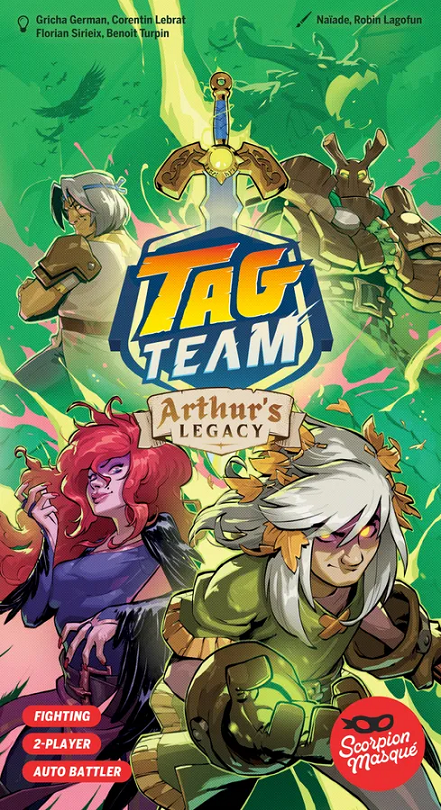
Except now there’s a second set, Arthur’s Legacy, that can be played standalone with its own six fighters or merge with the original ten to create infinite possibilities. Or 120, which might as well be infinite. How does it stack up? Honestly, I think it might be the stronger of the pair.
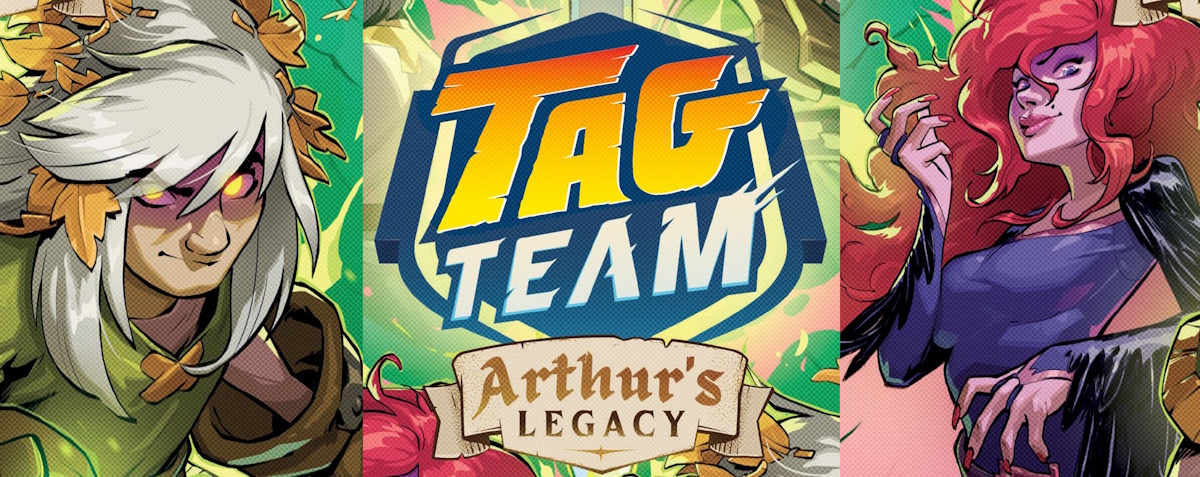
Two of the set’s six characters.
For those coming in late, Arthur’s Legacy keeps the Tag Team formula fully intact. Both players pick two fighters and shuffle their decks together. Then you take those fighters’ two starting cards, one apiece, and order them as you like. When battle kicks off, these cards resolve simultaneously: my first card and yours, then our second cards together.
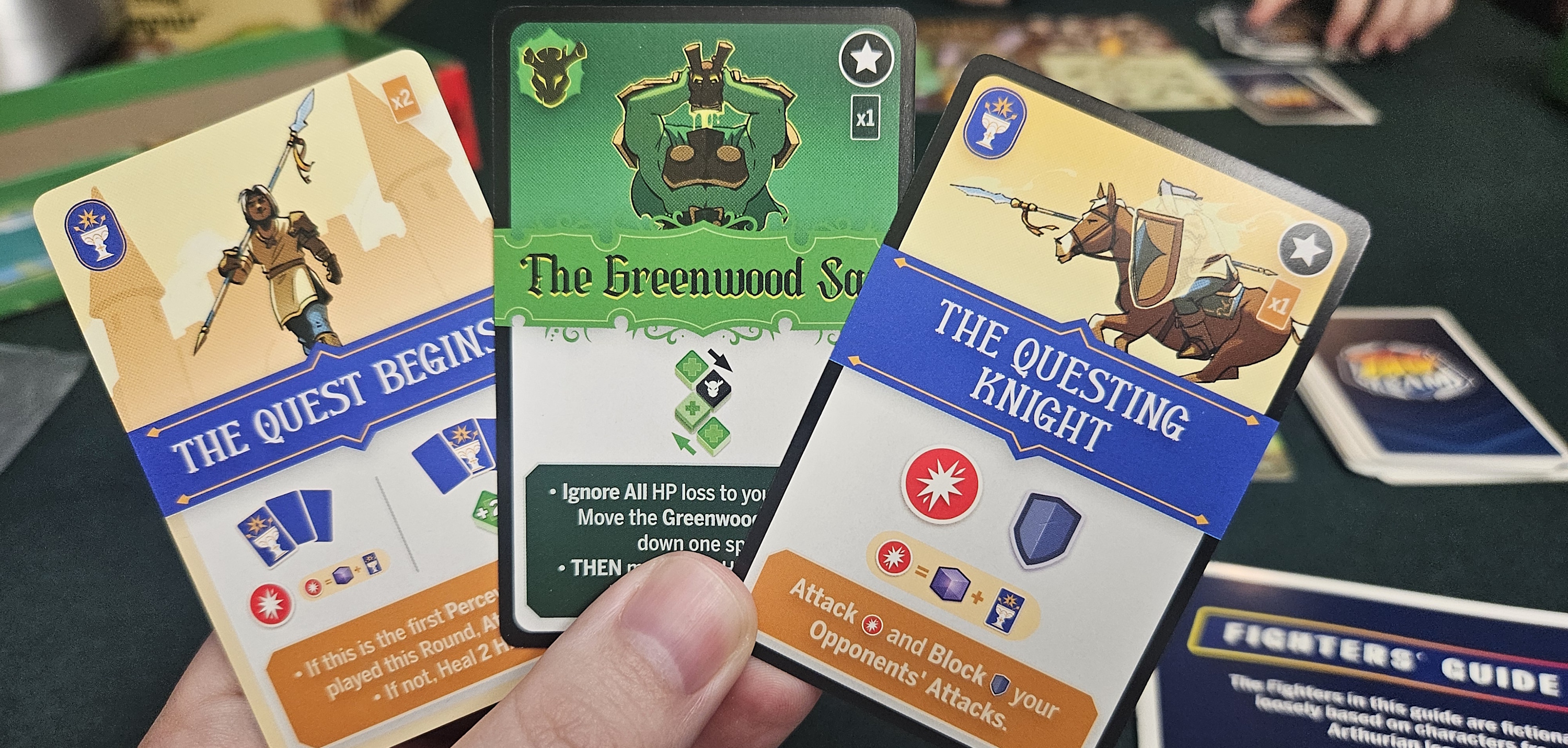
What happens next is where the game shines. We both take a trio of cards from our larger decks, pick one, and slide it into our battle decks. The order of our previous cards must be preserved, but our new attack (or block or heal or defense or whatever else) can be added before, after, or in the middle of our previous cards. Now we have a battle deck that’s three cards deep. We resolve another clash. Then we add a fourth card. Another battle. Now a fifth card.
We continue adding cards to our battle deck and duking it out until a fighter is KO’d, at which point the game is over. Along the way, our decks grow outward, but only in manageable increments. It’s so simple that one designer friend, in the midst of theory-crafting his own auto-battler, was shocked at its lack of adornment. Which isn’t to say the game is shallow. It’s just that it’s subtle, capable of being played sloppily or carefully, and reliant more on memory and yomi than on flashy stratagems.
My worry, when it came to expansions, was that the design team would clutter what was otherwise such an elegant piece of work. Even in the original set, a few of the fighters were decidedly more complicated than the others. In some cases, this could distract from the actual battle, adding an unnecessary cognitive load over the top of the cards and their all-important ordering.
Here’s the good news: while Arthur’s Legacy is somewhat slimmer than the initial Tag Team, with only six fighters rather than the original ten, this is probably the stronger ingress for newcomers. Instead of bumping up the complexity, Corentin Lebrat, Gricha German, and their added co-designers have kept the powers meaningful and punchy. If anything, the new characters are easier to handle than many of the previous set’s fighters.
Drafting from a selection of three cards.
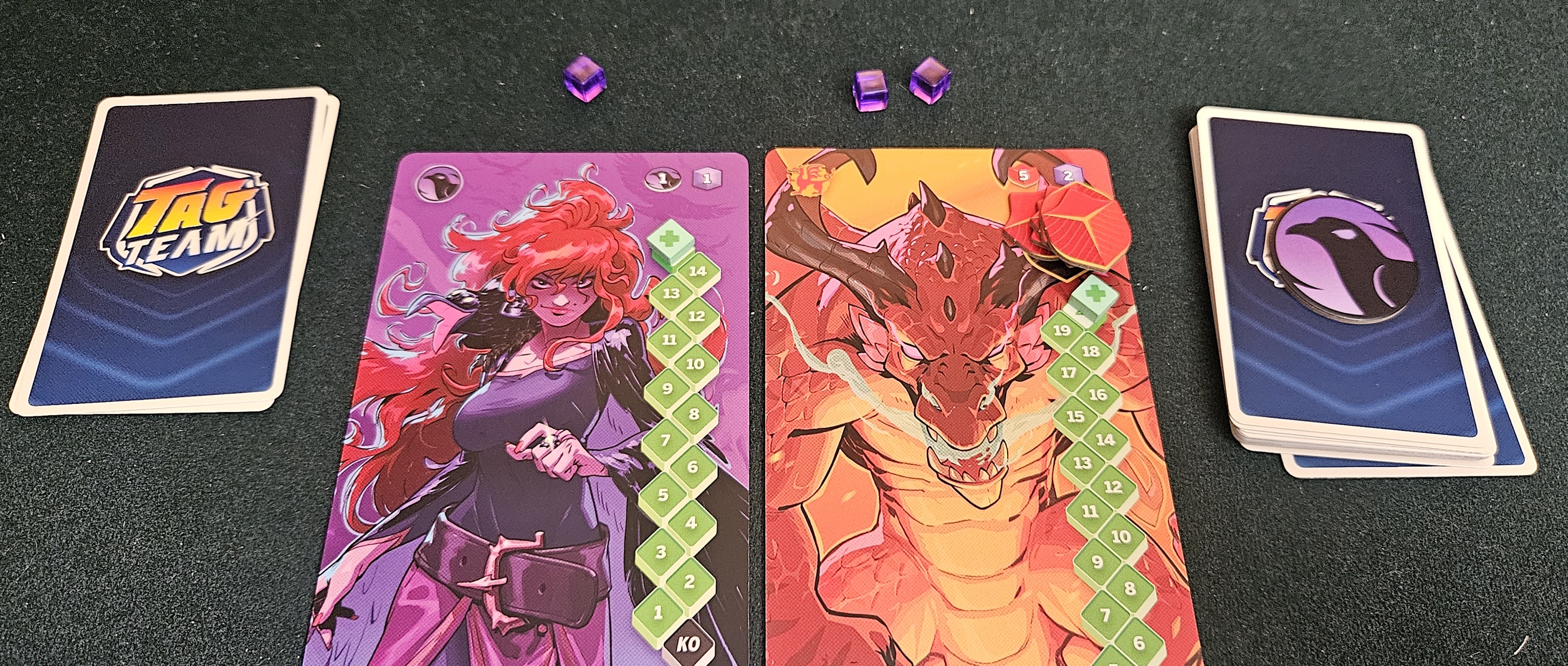
Naturally, each fighter has its own gimmick. The Dragon sprouts scales that act as makeshift armor, reducing opposing attacks but shedding them in the process. Percival grows more powerful with added cards, performing lots of little n-value attacks that encourage you to focus on his combos, but at the risk of neglecting his partner. Basically he’s self-obsessed, but for good reason. Morgan’s whole thing is dead simple: her gift of foresight lets her see which card her opponent is drafting before she makes her own selection. And the Green Knight offers a miniature game of press-your-luck. He heals fully every round, but many of his abilities lower the ceiling on his actual life pool. This makes him difficult to whittle down, but also prone to killing blows. Prolonged bouts are not his friend.
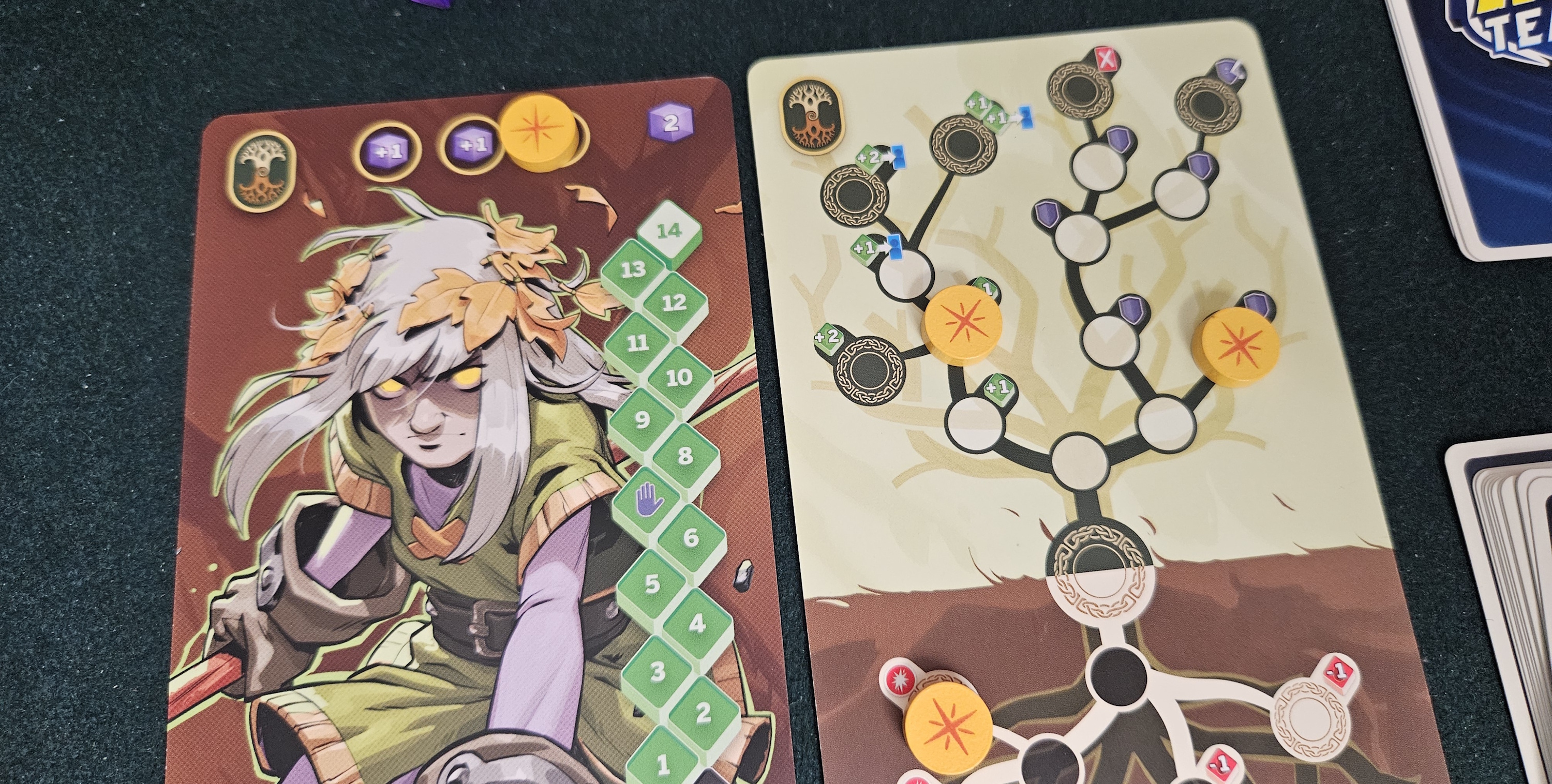
The last two fighters are a little more complicated, but, again, not by much. My personal favorite is Merlin. He comes with a little sideboard that’s kin to a skill tree. Certain cards let him upgrade his skills, gaining blocks or attacks or heals. These then trigger thanks to other cards, resulting in attack/heal/block combos that are incredibly powerful. Then again, because they only trigger on rare cards, they become fragile and easy to preempt. Arthur’s Legacy continues Tag Team’s tradition of including occasional cards that cancel their foe’s ability outright, meaning a well-timed counter can leave Merlin with his smock down. Or blown up. Whichever way an awkward smock goes.
Lastly, there’s Excalibur. This one is tricky. The gist is that it’s a low-health, high-finesse fighter, almost guaranteed to shatter midway into the match. But rather than ending with a KO, the duel continues with an invulnerable Excalibur. The downside is that Excalibur’s cards now add a “broken” trigger. In nearly every case, these injure Excalibur’s partner. But there are a couple that are even more potent when shattered, like one that damages everyone at the table, or another that lets Excalibur’s partner make an unblockable attack. Perhaps more importantly, this upsets the previous status quo. The order of cards is thrown into disarray, with attacks that previously targeted Excalibur suddenly rendered ineffective. It’s tough to play, but incredibly rewarding at the same time.
Where is Merlin, for I much desire to speak with him?
In nearly every regard, Arthur’s Legacy is an excellent follow-up to one of last year’s strongest two-player titles. It’s a little slimmer than I would have preferred, but it hits the right spot in terms of rules load and complexity. Most importantly, it preserves the system’s elegance. Indeed, it doubles down in that regard. These characters have a clear identity, feel distinct without risking obvious power gaps, and make strong additions to any duo, whether paired with the original or on their own.
A complimentary copy of Tag Team: Arthur’s Legacy was provided by the publisher.
(If what I’m doing at Space-Biff! is valuable to you in some way, please consider dropping by my Patreon campaign or Ko-fi. Right now, supporters can read the next installment in my series Talking About Games, this time tackling the topic of what makes a good list! Naturally, the piece includes a list.)
Die planetaren Verwandten der Weltenschiff-Aeldari standen nicht nur lange auf dem Wunschzettel vieler Aeldari-Fans. Mit Kill Team: Exoditen bringt Games Workshop sie in Form von Drachen reitenden Drachenmeistern nun tatsächlich auf den Spieltisch. Dazu widmet sich ein Hintergrundband dieser bisher wenig beleuchteten Subfraktion des Warhammer 40k-Universums.
Eine von Katastrophen gezeichnete und fast vergessene Welt voller Gefahren wartet darauf, erkundet zu werden. In Fatekeeper wechseln sich die Schönheit detailverliebter Regionen mit der Tödlichkeit des Kampfes ab. Seit dem 02.06.2026 können Spieler*innen sich im Early Access des Spiels einen ersten Eindruck verschaffen.
Weiter geht's mit unserer großen Team-Porträt-Runde, bei dem wir euch einen kleinen Einblick hinter die Kulissen des Board Game Circus verschaffen möchten. Diesmal ist Frank an der Reihe, der etwas mehr darüber verrät, was er so alles auf seinem Zettel hat.
Das Ende Mai im Early Access erschienene Singleplayerspiel Paralives ist eine neue, lang erwartete Lebenssimulation. Wie dieses Leben aussieht, entscheiden ganz alleine die Spieler*innen. Das Spiel hat schon jetzt eine solide und gut spielbare Grundlage, aber das kleine Entwickler*innenteam Paralives Studio hat sich noch viel für die Zukunft vorgenommen.
Wir machen bei unserer kleinen Blog-Reihe zum BGC-Team chronologisch weiter und sind bei unserem Redaktions- und Lokalisierungswunder Lisa gelandet. Wie es zu ihrer Vorliebe für Partyspiele ohne Double-Bass gekommen ist, erfahrt ihr in ihrem Beitrag ...

 Anmelden