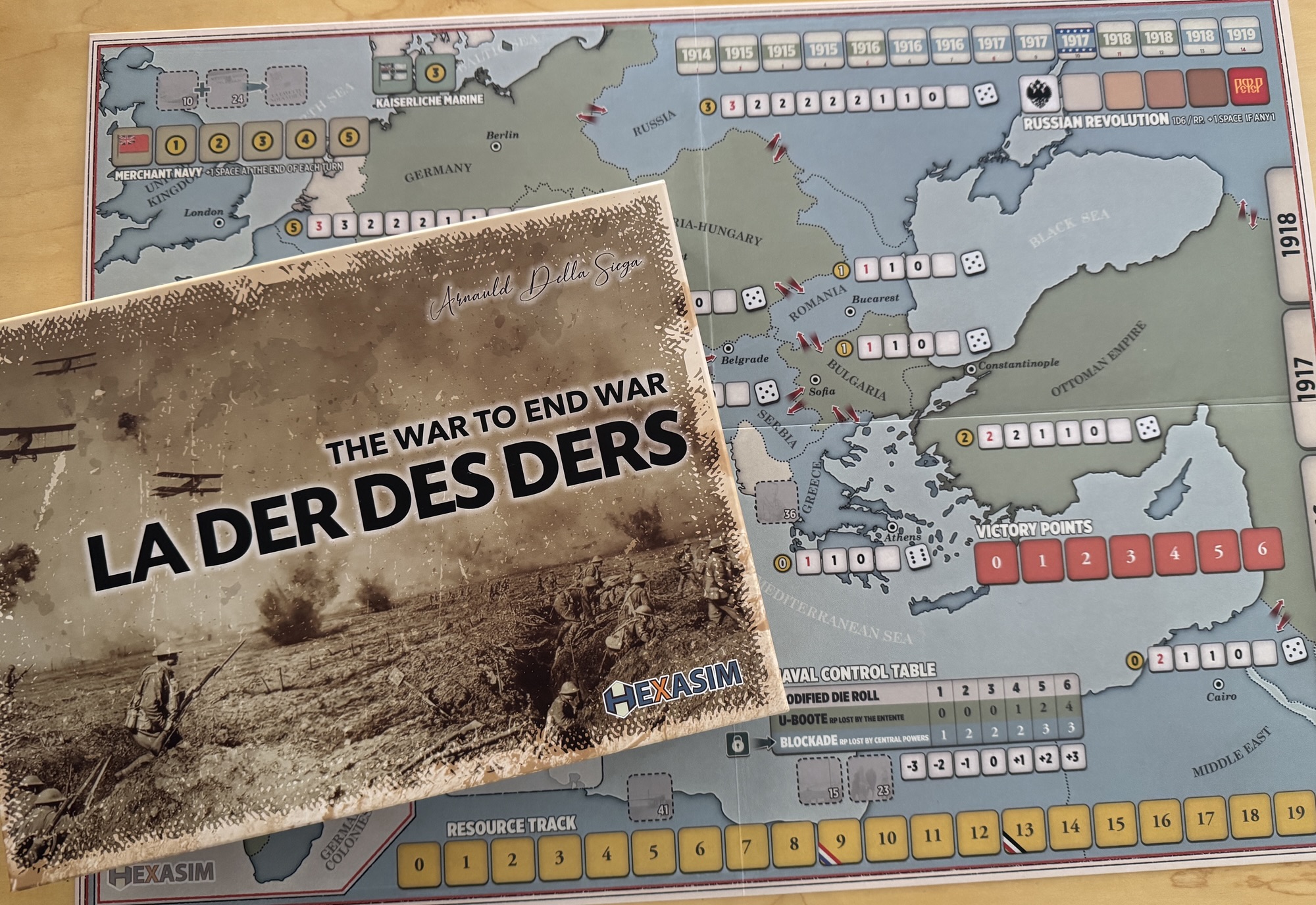
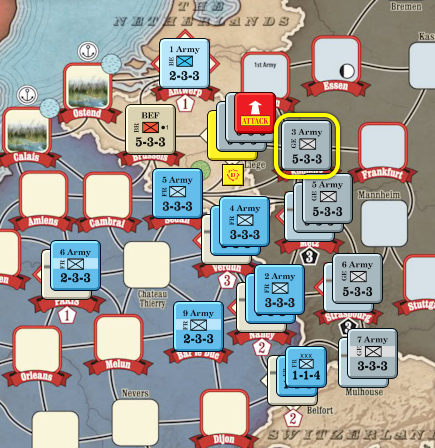
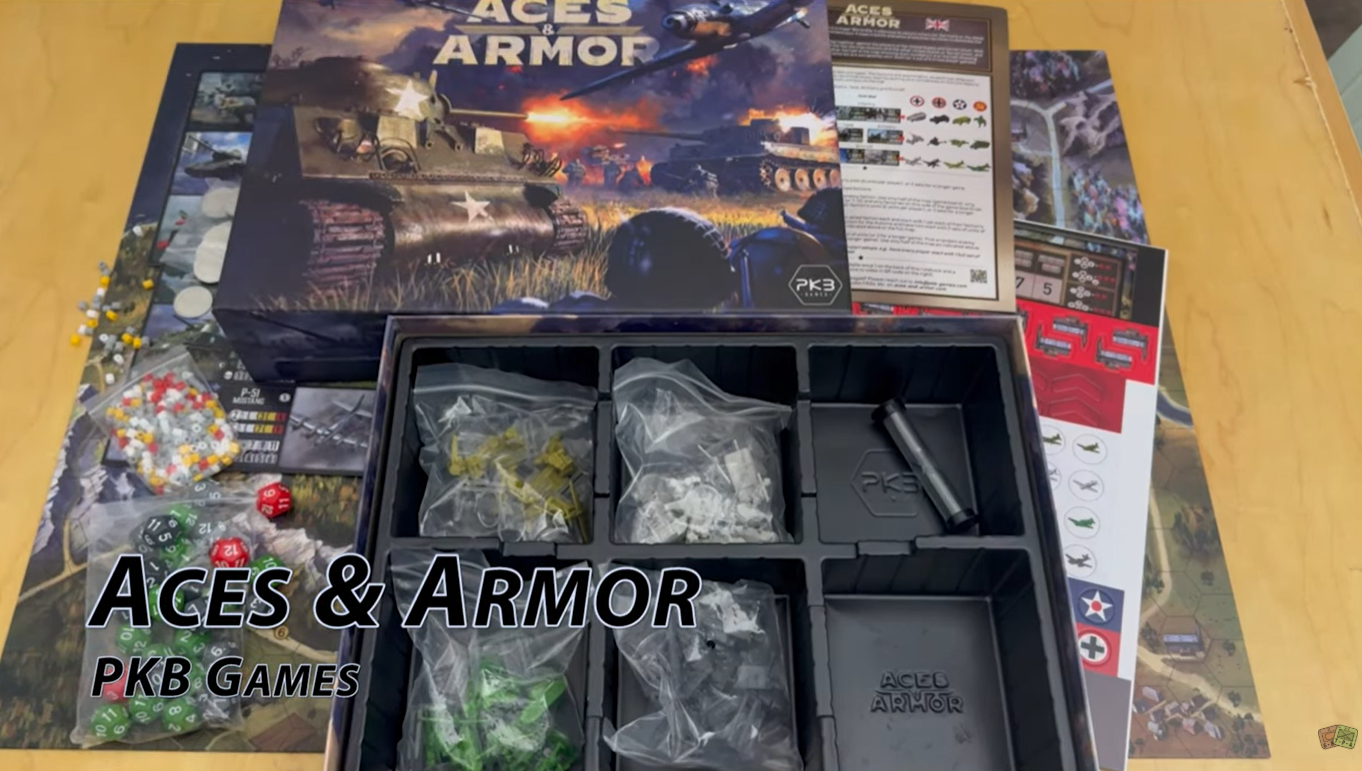
La Der des Ders – The War to End War from Hexasim is a 1-2 player slightly abstracted strategic level look at World War I. The game allows the players to relive the First World War at a strategic level, with each player controlling one of the 2 sides either the Entente, consisting of France, England, Russia, Serbia and other minor nations or the Central Powers including Germany, Austria-Hungary, the Ottoman Empire and a few minors. La Der des Ders can also be played solo, with a dedicated solitaire bot called “Athena” who utilizes special Cornflower Cards to make decisions about what technologies to invest in, where to undertake offensives and how to utilize limited resources and reinforcements. Each turn, players gain an amount of Resource Points dependent on what nations are in the war, which they can allocate to different areas to guide their overall strategy. Victory is achieved by launching offensives that drain the morale of enemy nations, forcing them out of the conflict through collapse.
In this series of Action Points, we will first take a look at the Game Board, discussing the Collapse Tracks, Trade Tracks, Russian Revolution Track and Naval Control Table and other various on-board tables and offensive spaces, cover the Technology Phase and the Technology Tree and Technological Improvement Boards, take a look at the Event Cards and how they alter the game, go through an example of an Offensive and the combat procedure, review the Victory Conditions and give an overview of the “Athena” solitaire bot and how it works.
Game Board
The Game Board used in La Der des Ders covers the entirety of the European and Eastern portions of World War I and is a simplified geographical representation of the major players involved in the war. You will not find anything more than simple borders of countries and then not all of each country is represented in its entirety such as the Ottoman Empire of the vastness of the Russian steppes. There is also an inset map in the bottom left hand corner that covers the war in Africa. The Game Board is divided up into what are called Sectors representing both the major and minor powers involved in World War I. These Sector representations are illustrative of the main countries that took part in the war and one Sector can actually represent multiple countries. For example, in the case of France, you will notice that England really has no specific direct playable area or a Collapse Track of its own on the Game Board other than the graphical representation of their island nation. The British troops, along with those of Belgium, are abstracted into those of France for simplicities sake and to meet the design goals of the game. To further differentiate these Sectors from each other and to make playing visually simpler, the Sectors are shaded blue if they belong to the Entente and then green if they are part of the Central Powers.
The Collapse Tracks
Let’s take a closer look at the various information that is contained in these Sectors. Above is a picture focused on Germany with France (lower left), Austria-Hungary (on the right) and Russia (upper right) also included. You will first notice a line of small boxes with numbers listed in each box numbered from 3 on the far left descending to 0 and a blank box on the far right. These numbers are referred to as the Operational Value. This Track is referred to as the Collapse Track and represents the morale, fighting spirit, economic stability, martial resources and preparation of each of the countries for war in the game. On the left end of the Collapse Track is the country’s Production Value printed in a yellow circle. The Production Value corresponds to the number of Resource Points (RP) that will be generated by this sector at the start of each turn, if it is at war. If this Production Value number is printed in black, this means that this Sector is at war at the start of the game. If the Production Value is printed in white, the Sector is not at war at the start of the game but will enter the war through the appropriate Event Card being drawn. If a Sector is not at war but is Neutral, for purposes of the game this means that it does not generate any Resource Points.
At the start of the game, a wooden cube is placed in the space to the right of the box containing the red value. As losses are inflicted in this Sector due to Offensives or Event Cards, the cube will be moved to the right on the Collapse Track. When the Sector receives reinforcements, the cube will be moved moved to the left. The cube will never be placed on the space with the red value and the player must read the number in the box to the left of the cube to ascertain the current Operational Value. The numbers indicate the maximum amount of Resource Points that can be allocated to this Sector during an Offensive, which will also determine the size and number of dice that are used for the Offensive. This Operational Value will change throughout the game due to losses in Offensives or due to specific Event Cards. If the cube ever reaches the end of the Collapse Track, and another reduction must be made, the country will surrender and fall to their enemies.
The other important piece of information found on the far right side of the Collapse Track is the Attack Value. The Attack Value is used for Offensives and is how players determine whether they score hits or not with their troops and artillery. This Attack Value is represented by a die face that shows the number needed to hit. If the rolled Attack Dice are equal to or greater than the printed Attack Value a hit will be scored and losses will be taken by the defender by moving the cube down on the Collapse Track. This Attack Value can be modified through the advancement of technologies including on Attack and on Defense. The player will simply add up all applicable modifiers from these Technologies or from Event Cards and then reduce or increase that target Attack Value accordingly.
Offensive Arrows
Shown on the board are the Offensive Arrows that will remind the players about what Offensives they can undertake, meaning what Sectors may be attacked, and what Sectors have already taken their one Offensive against that adjacent Sector per turn. These are identified by red arrows connecting adjacent Sectors and will be covered up by the appropriate Offensive Marker when undertaken. In the below picture, we will take a look at Serbia as an example. You can see that Serbia is surrounded by Central Power countries including Austria-Hungary and Bulgaria (Neutral at the start of the war). They also have a few of their Allied nations adjacent including Romania (Neutral at the start of the war) and Greece (Neutral at the start of the war). From each of the adjacent Sectors there are 2 Offensive Arrows represented meaning that this Sector can both be attacked and can attack the adjacent Sector.
It is important to remember that an individual Sector can only launch one Offensive per turn, and that is always against an enemy sector adjacent to it. During the same turn, a sector may be attacked by several adjacent enemy sectors, but each Offensive is resolved separately.
Trade Tracks
There are two Trade Tracks shown on the Game Board, both of which are located in the top left hand corner of the board, 1 for the Entente (Merchant Navy) and the other for the Central Powers (Kaiserliche Marine). These 2 tracks provide additional Resource Points to both sides at the beginning of a turn when they are collecting income. Naval Control die rolls can modify the number of RP’s received at the beginning of a turn. It is important to remember that the Merchant Navy Marker is moved forward 1 space at the end of each turn, which will result in advancing the Production Marker of the Entente. If the Lafayette Marker is on this track, it is also moved forward 1 space. These markers are never moved to the left. Once the end of the track has been reached, the markers will no longer need to be moved.
Russian Revolution Track
The Russian Revolution Track indicates the advance of the Russian people towards their ultimate Revolution, which historically broke out in March 1917. The Russian Revolution Marker will begin the game in the white space. This marker may be moved to the right each time Russia obtains reinforcements. It is never moved to the left. When this marker reaches the last space, Revolution breaks out and Russia will no longer produce resources and can no longer receive reinforcements.
Naval Control Table and Track
The Naval Control Table is used to represent the efforts of the German U-Boat attacks on commerce and mimic the associated receipt of foreign support by the Entente from the United States of America. At the outset of each turn, a die is rolled and the table referred to in order to determine a possible number of lost Resource Points. There are 2 rows on the table, 1 being the U-Boat for the Central Powers and the other the effects of the Blockade for the Entente.
The track located under the Naval Control Table indicates the modifier that will be applied to the Central Powers’ Naval Control die rolls. It takes into account the Naval Technology levels of the Central Powers and that of the Entente. At the start of the game, only the Central Powers can carry out a Naval Control die roll. You may notice the small gray box with a lock linked to the Naval Control Table that indicates that the Entente cannot carry out a Naval Control die roll yet. Only once it has unlocked Naval Technology Level 1, can the Entente perform Naval Control die rolls.
There are also several administrative tracks on the Game Board including the Resource Track, used to track the current Resource Points of both the Entente and the Central Powers, the Turn Track and the Victory Point Track. You will also notice lots of dashed boxes with small white numbers printed in them all over the board. These are the Event Boxes and act as a reminder of the effects of various Event Cards when they are pulled. When Event Cards happen, some will provide the players with a counter that should be placed in these boxes to remind them of the effects of the historical events.
One final comment on the Game Board. Marc von Martial is the artist and he has done an excellent job with this game board as it is truly functional and aids play but also is very attractive and has a very clean and pleasing aesthetic. I enjoy the choice of colors, even though these old eyes are starting to have trouble differentiating gray and green when they are both light, that work well together and the tracks and information found on the board are all crisp and clean and easily read. I just like the overall appearance of the game board and wanted to congratulate him on his exemplary graphic design work.
In Action Point 2, we will cover what I would consider one of the better parts of the game in the Technology Phase and the Technology Tree and Technological Improvement Boards.
Anticipation! Something that we feel for things that we are interested in, whether it be family trips, sporting events, time off, holidays or hobbies. Anticipation keeps our minds focused on something that we feel and hope will be a good thing that brings us great joy. I feel anticipation each year for the new wargames that we are going to get to play many of which we will have been waiting upon….sometimes for years. Each year since year 3 of the blog (having been started in 2016), I have posted this list highlighting my most anticipated wargames for the upcoming year. The list has grown each year with the first entry consisting of 11 games in 2018, then growing to 12 games in 2019 and 2020, ballooning to 18 games in 2021 and then settling on just 10 games in 2022, 2023 and 2024 and then 11 games in 2025. This year, I will focus on 15 games because I cannot help myself! In case you missed my post from last year, you can read that here: Most Anticipated Wargames of 2025!
Once again the same as I did last year, I wanted to put this caveat out there. The games chosen for this list might not fit your definition of a wargame. I feel that historical and wargames are somewhat interchangeable terms because of the quote from Clausewitz “war is a mere continuation of politics by other means”. Wargames to me are a broad category not simply relegated to hexes, counters and a CRT. Don’t get me wrong. I really like hexes, counters and a CRT. But wargames can include none of these three things and be considered wargames to me. But that is probably a debate for another time. Once this post is shared, I expect many comments and questioning statements from you our audience and I have come to actually “anticipate” reading these. So sit back, relax and get ready to have your paradigm about what a wargame is shifted!
Battle Commander: Volume I – Napoleon’s Italian Campaigns from Sound of Drums
I have been following this project for the past couple of years after it had a very successful Gamefound campaign in November 2024. I just really like the way the game looks to be laid out and executed and frankly anything designed by Carl Paradis has been good such as the No Retreat Series. Another tactical Napoleonics game sounds like something that I am very much in need of and am hotly anticipating this title. Battle Commander: Napoleon’s Italian Campaigns is at the Brigade/Division scale, is supposedly very playable, with no downtime or complex computations or mechanics. Because it is being published by Sound of Drums, the package will be super-deluxe, using a very large box, allowing the 2-sided mounted maps to be folded only once, game pieces will be painted-on wood blocks of different shapes, so no annoying stickers to apply, you’ll have a couple dozen blocks per side in a game, often less. Also, no dice, almost no markers, and the emphasis is on the gameplay!
The crux of the game engine will be the deck of event cards, that will also take care of all the combat results and other dice functions and the cube-pull mechanism, that will manage player unit activations, but also turn end, when combat and rally happens, and other similar game happenstances. It’s all a very granular affair. The whole package has a definite “Kriegspiel” look, with all the graphics done in a contemporary Napoleonic style, with a very different way of maneuvering units on the field of battle compared to other Napoleonic games.
From the game page, we read the following:
Battle Commander intends to recreate historical 18th-19th century battles. It features a fresh framework focused on providing two key aspects: command decision and maximum playability.
In Volume I, you act as Army Commander in a series of six dramatic Battles fought during Napoleon’s two Italian campaigns. Volume II will cover engagements of the Second and Third Coalitions, including Austerlitz and the Battle of the Pyramids.
In Battle Commander, you struggle against the chaos of battle, making meaningful high-level decisions, not micro-managing your troops: that’s your colonels’ job! Good card play is paramount for Battle success, but make no mistake: this is not a card-driven, but a card enhanced game.
Cube-pull activation is used to manage game phases (movement, combat, rally, card draws etc.), and cards for the interactive combat system and events, allowing for a myriad of possibilities and solitaire-friendly gaming. No dice, no complex odds counting, no markers, no play downtimes, no sure thing!
A persona card represents each Commander, his specific abilities and your Army’s resources; the all-important Subordinate Leaders are integrated in an innovative multi-role card system.
Morale and troop skill are a core mechanic: demoralizing the enemy goes a long way towards winning the fight, with Armies slowly degrading in performance, until the breaking point! Casualties are managed effortlessly, and a correct “Battlefield Look” maintained at all times. With a game piece count similar to Chess, you’ll be able to assess your going in one quick “coup d’oeuil”.
This one looks to be interesting! And Carl Paradis is a very good designer as we have played lots of his No Retreat! Series games and enjoyed them.
I am 100% confident that Battle Commander Volume I: Napoleon’s Italian Campaigns will be out this year and I am very much looking forward to playing it.
Valiant Defense Series Volume V: Guadalcanal: The Battle for Henderson Field, Oct 23-26, 1942 from Dan Verssen Games
The Valiant Defense Series originally designed by David Thompson has been one of my favorite solitaire wargame series of the past 8 years. Each of the volumes in the game addresses very specific situations and always have a very interesting take with fun mechanics, great art and fantastic production. The torch for the series though appears to be passing to a new designer in Vincent Cooper. He has been working on Guadalcanal: The Battle for Henderson Field, Oct 23-26 1942 for the past few years and it had a successful Kickstarter campaign in July 2024.
From the game page, we read the following:
Valiant Defense Series Volume V: Guadalcanal: The Battle for Henderson Field (Oct 23-26, 1942) from Dan Verssen Games is a solitaire wargame where players command US forces defending a fixed perimeter against waves of Imperial Japanese Army troops. It focuses on the pivotal four-day battle, utilizing card-driven AI to simulate intense, often nocturnal, combat, similar to Pavlov’s House.
Players will command the 1st Marine Division and the 164th Infantry Regiment, defending the Lunga perimeter against the Japanese 17th Army’s major October offensive. Similar to Pavlov’s House, you manage multiple layers of defense, including the Cactus Air Force (Wildcats and SBD’s), supply lines from Task Force 62, and the 11th Marine Artillery Regiment. The game emphasizes the “Night” setting of Guadalcanal’s jungle warfare, utilizing unique card illustrations to show Japanese columns advancing through the dense foliage toward your perimeter.
This all started about 3 1/2 years ago when I first played Pavlov’s House. I say played. I ‘played’ the game for about 10 minutes…and then I sat there in stunned disbelief at how a game could be sooooo good!!!! By the time I finished there were two very clear ideas for games fully formed. I contacted DVG to see if there was any interest and they put me in touch with David Thompson. I didn’t hold much hope. There was no reason for him to trust his IP to me, a person he didn’t know.
But I gave it a try and David, it turns out, is one of the nicest people you can ever come into contact with. After some back and forth, the idea for Guadalcanal – The Battle for Henderson Field was born (not, in fact, one of the original ideas, but we’ll see what the future holds for them…).
Art by the supremely talented Nils Johansson
Thank you to all the play testers, and in particular Glenn Saunders, Shane Freshwater and Martin Fenwick Charlesworth Much more to come from out design team in the near future!!!
The most recent update on this one’s progress says that the game was sent to the printer in December 2025 and that this process could take “months”. With that being said, my guess is that this will shipping in the spring, probably around April.
Volume II Civil War Heritage Series – Army of the Potomac: Campaigns of 1862 & 1864 from GMT Games
Several years ago, Mark Herman designed a very unique and simple American Civil War game called Gettysburg that appeared in C3i Magazine #32. That game became the basis for his new Civil War Heritage Series with the first volume being Rebel Fury that focused on five battles from the Chancellorsville and Chickamauga Campaigns. He has been working on the follow-up to that game and we finally will get it with Army of the Potomac.
From the game page, we read the following:
Army of the Potomac: Campaigns of 1862 & 1864 is the second volume in the Civil War HeritageSeries and the follow-up game to the innovative and acclaimed Rebel Fury. Army of the Potomac uses the same core rules as Rebel Fury, so players familiar with Rebel Fury will be able to jump right into the action. Each battle in Army of the Potomac is quick-set-up, quick-playing, and deeply interactive. The density of counters in each scenario is low, allowing you to see and experience the big picture of the battle.
Army of the Potomac covers the battles of Spotsylvania II, North Anna River, Cold Harbor, and the entire Seven Days battle (McClellan vs. Lee), including the prelude Seven Pines (McClellan vs. Johnson) when Johnson’s wounding brought Lee into the command of the Army of Northern Virginia. Each battle places you, the player, in the role of the Army Commander (Grant, McClellan, Lee, Johnson). You maneuver your army to find the enemy’s flanks, concentrate your forces for an attack, and determine where to commit your artillery assets.
I think that one of the most interesting parts is that this new game can be played with Rebel Fury as also included are two bonus scenarios to allow owners of Rebel Fury to fight Spotsylvania II and begin the Campaign scenario from Wilderness to Cold Harbor using their original Rebel Fury map.
While attending the WBC last summer, me sat down with Mark Herman and he gave us an overview and insight into the game and its focus. You can watch that interview at the following link:
If you are interested in Volume II Civil War Heritage Series Army of the Potomac: Campaigns of 1862 & 1864, you can pre-order a copy for $49.00 from the following link: https://www.gmtgames.com/p-1108-army-of-the-potomac.aspx
The most recent update from GMT Games from late January was that Army of the Potomac is currently at the printer but doesn’t have an expected shipping date as of yet. My guess is this one will be on our tables sometime in early summer.
First Man in Rome – Strategikon Book II: The Civil War and the Fall of the Republic from Thin Red Line Games
If you are a monster wargame fan then you are probably familiar with Thin Red Line Games and the genius behind the madness Fabrizio Vianello. They are a small but passionate publisher and my favorite thing about them is that Fabrizio speaks in his military jargon so fluently that it is such a thematic boost to the games they produce. Over the past couple of years, we have posted interviews with Fabrizio covering their Cold War Gone Hot games called Die Festung Hamburg and In a Dark Wood as well as the first game in a new Ancients series called The Fate of All: Alexander’s Campaign Against the Persian Empire. Following along in that Strategikon Series is the new volume called First Man in Rome that was announced during the fall of last year.
From the game page, we read the following:
Citizens, the creation of the great mosaic depicting the beleagured civil war between Caius Iulius Caesar and Cneo Pompeius Magnus continues!
As already discussed in the Senate, we intend to represent the entire civil war, from the crossing of the Rubicon in 49BC to the defeat of the last Pompeian forces in Spain in 45BC. So it’s not just a glimpse of this epic confrontation, but the whole struggle for the greater good of the Res Publica.
I can now share some details on the map, almost at its conclusion. The map will be probably divided in six parts, each one with the size of a “standard” map. Due to the enormous extension of the conflict, the scale has been increased from 30km to 60km per hex, and the rules will be adjusted accordingly.
If you are interested in First Man in Rome– Strategikon Book II: The Civil War and the Fall of the Republic, you are encouraged by the designer to reserve a copy immediately by writing a votive tablet (email) to info@TRLGames.com! Don’t miss your chance to join the Legions and defend the Res Publica!
Rising Dragon: Platoon Level Combat in 2034 from Flying Pig Games
Several years ago, we played a very fresh and innovative wargame called Armageddon War, which is a platoon level scenario based game set in the near future. The game focuses on the Mid-East, pitting Israelis, Russians, and Americans against age-old adversaries. The game felt very fresh and new as it adds a few new tricks to a tried and true hex and counter tactical wargame system. And Flying Pig Games pulled out all of the stops on production with huge hexes, beautifully large counters and custom dice. Now, finally, Flying Pig Games and Greg Porter are unveiling the next volume in this series called Rising Dragon: Platoon Level Combat in 2034 and it looks awesome!
From the game page, we read the following:
October 1, 2034 marks the beginning of the conflict that unfolds in Rising Dragon, a standalone game and campaign setting for the Armageddon WarSystem. With the United States turning inward in the wake of the catastrophic ‘Armageddon War’, China seizes the moment to assert its territorial claims, letting the world know that it is now the unchallenged power in the region. This sets the stage for a military showdown that spans East Asia, with Taiwan at the epicenter.
Platoon Level
Scale of 150 meters per hex
15 minutes per turn
Continuous Chit-pull Activation
18 stamped dice for combat resolution
Naval, amphibious, and urban conflicts
Age: 14+
Players: 2
Playing Time: 1-3 Hours
Scenario based
The game introduces cutting-edge technologies, including hypersonic missiles, advanced amphibious operations, and features detailed maps that bring the battlegrounds of Taiwan and the wider region to life. Scenarios include the Chinese invasion of Taiwan, where hypersonic missile systems like the PRC Heaven Sword devastate Taiwanese defenses.
OPLAN 5027 Supplement
OPLAN 5027 expands the conflict further, introducing North and South Korean hostilities, where players can engage in both the defense and offense of Korea’s border zones. With Rising Dragon, players can immerse themselves in a fast-paced, near-future conflict, where technological advancements and strategic decision-making determine the fate of East Asia.
Gameplay is continuous and fluid. There are no turns, just continuous activations. The intensity of a unit’s close combat modifier is determined not only by its weapons but also by the tactics you choose to use for the assault or defense, and when you fire on a unit, it has the option of taking cover or returning fire. The number of dice and the color of dice rolled, determine the number of hits.
Formations are activated by chit draw (nothing new there), but returned to the draw cup not at the end of a turn, but rather in a continuous manner. When chosen, a formation marker is placed on the activation track, to the right of the last-drawn formation. When only one chit remains in the cup, the two leftmost chits are returned to the draw cup. Simple, continuous.
I am unsure if this title will be ready this year but am hoping that it it. The Kickstarter campaign was funded in November and I see no reason why this cannot be fulfilled by the end of the year.
Rebel Tide: The American Civil War, 1861-1865 from Compass Games
There is no secrete that we really enjoy Gregory M. Smith designs and we also count him as a close friend so take that for what it is worth. He is a great designer and has put together some of our favorite narrative-driven solitaire wargames, such as Silent Victory, The Hunters and The Hunted, but also has done some great 2-player strategic level games on various historical periods including Imperial Tide, covering WWI, and Pacific Tide, taking on the Pacific Theater of WWII. His new game in the system deals with the American Civil War and is called Rebel Tide.
From the game page, we read the following:
Rebel Tide: The U.S. Civil War, 1861-1865 is a two-player strategic level game that places you in command of either the USA (Union) or CSA (Confederacy) during the Civil War. Each turn consists of a year, during which multiple card plays occur. These give the players movement, combats, entrenchments, and other actions. At the end of each year, players must make critical decisions on which cards to re-buy in an attempt to win the war outright or to win by placing the other side in a disadvantageous position by 1865. Rebel Tide is based on the popular, action-packed Imperial Tide/Pacific Tidegame system by Gregory M. Smith, with many combat and strategic decisions to challenge players in just a single evening’s game.
The core of the game is the unique card re-buy system, in which players take their annual production (adjusted for blockades and blockade runners) and decide which cards they need for the upcoming year. Cards not only provide for reinforcements, but allow for movement, combat, and entrenchment. Which cards to rebuy is without question one of the key decisions the player must make to prepare for next year’s operations.
The game has infantry units for all of the major participants, cavalry, and artillery units. Naval operations are mainly abstracted, although the Confederate player must worry about Farragut invading a port from the sea. Besides the focus on card play, the game features a small footprint (one standard map) and also is designed to be played in just a single evening – estimated at 3 hours for experienced players to fight the entire war.
But don’t worry because the game is not just a reskin of the same system used in those other two games, although the system is really interesting, but instead attempts to create new mechanics and elements to tell the proper story of the struggle for the soul of the country in the 1860’s.
One new mechanic in Rebel Tide is the Political Track, which is an abstract measure of the support of England and/or France to the Confederacy. If this track reaches the maximum early in the war, it can trigger an early CSA victory.
Another new key mechanic in the game system is the addition of historical Leaders, who range in ability from excellent (5) to poor (2). Bad leaders may be “sacked” and removed from the game and randomly replaced by the expenditure of a movement action. Leaders are vital in advancing after combat and also can add strength to an attack’s total combat power.
While attending WBC a few summers ago, we had a chance to sit down with Gregory M. Smith to cover a few of his upcoming designs and Rebel Tide was included in that discussion. Here is a look at our video interview with Greg:
As of February, Rebel Tide was the 4th next game to be published according to Compass Games website so I would think that this will be in our hands early summer.
Brandywine 1777 – A Time for Heroes from Les 3 Zouaves
As you know, I love a good game about the American Revolution and last fall (September) month I noticed a new game going to Gamefound on the Battle of Brandywine Creek on September 11, 1777. The game is from a new company that I don’t know much about called Les 3 Zouaves but looks really great.
From the game page, we read the following:
The smoke of musket fire hangs in the air. The Brandywine River glistens behind your lines. Across the field, redcoats are on the move — and one bold decision could tip the balance of the entire Revolution.
You hold command.
Will you outwit your enemy? Will you strike with daring precision, or hold the line against impossible odds?
Play as General Howe or General Washington in a tense, card-driven clash of minds.
Every decision matters. Every move could rewrite history.
And only one can emerge victorious.
Brandywine 1777 is more than a battle: It’s your chance to prove you are a true tactician… a hero of the Revolutionary Wars.
In Brandywine 1777, you assume the role of George Washington, facing a bold and elusive enemy. Activation Cards are your principal tool —used to commit your forces at just the right moment… if you can anticipate the British plan.
But it’s never that simple. Each card lists several potential formations—some real, some misleading—and you’ll never have enough activations to do everything you need to do. Choose wisely, bluff cleverly, and stay one step ahead.
You’ll be balancing:
Major activations – few in number, but vital,
Minor activations – flexible but limited,
And Bonus activations, which cost precious cohesion but can turn the tide when used effectively.
This one is a stretch to add to this post but once again I am being optimistic.
Limits of Glory Campaign V: Donning the Sacred Heart from Form Square Games
A few years ago, we became acquainted with Andrew Rourke through his Coalitions design from PHALANX that went on to a successful crowdfunding campaign and is a game that I am very much looking forward to and have been since that time. He has since been a busy guy with starting his own publishing company called Form Square Games and also publishing the first 3 designs in a new series called Limits of Glory that will take a look at the campaigns of Napoleon and other contemporary conflicts. In Campaign I, which is called Bonaparte’s Eastern Empire, the game is focused on the campaign of the French in Egypt between 1798 and 1801. Campaigns II, III and IV are Maida 1806 and Santa Maura & Capri. Last year, they ran a successful crowdfunding campaign for the fifth campaign and volume in the Limits of Glory Series and it is set during the French Revolution and the Civil War in the Vendée in 1793 and is called Donning the Sacred Heart. I very much have enjoyed our plays of this series with its use of Glory and chance in managing your leaders and their inherent elan and leadership.
From the game page, we read the following:
The French Revolution was not welcomed by all in France. The staunchly Catholic and Royalist leaning Vendée Militaire was a region unwilling to sacrifice its youth to the voracious appetite of the Republic’s military conscription machine, and the people of the Vendée were prepared to fight to defend their beliefs. Donning the Sacred Heart covers the vicious Civil War in the Vendée from March until December, 1793. All combatants and significant commanders are included and the game causes Multiple strategic decisions every turn. Your decisions will decide victory or defeat, the easy to play mechanics produce a subtle game with full player agency. Complete player engagement throughout.
Tension builds as the Event Clock drives the game, neither player being able to depend on events going their way, or knowing when the game will end.
I would expect this one to be fulfilled in late summer as the most recent update in late January was that the games would be shipping soon.
An Impossible War: The First Carlist War in the North, 1834-1838 from Bellica 3rd Generation
A few years ago, we did an interview with David Gómez Relloso covering his well thought of Crusade and Revolution: The Spanish Civil War, 1936-1939 from Compass Games that was getting a deluxe edition and on Kickstarter at the time. Since that time, we have played the game and really enjoyed it. Recently, I spoke with Francisco Ronco and he informed me that his company Bellica 3rd Generation was doing a new game by David called An Impossible War. That game covers The First Carlist War in the North of Spain and is currently in the process of being fulfilled so it won’t be long now.
From the game page, we read the following:
An Impossible War is a game about the decisive years of the First Carlist War in the North. Infantry and cavalry are represented by blocks, which introduce fog of war into operations. There are also artillery counters (field and mountain artillery) and logistics units (supply trains and backpacks).
The main map is a point-to-point board covering the northern theater of operations: Navarre, the Basque Country, and surrounding areas of La Rioja, Burgos, and Cantabria. In addition to provincial capitals, major towns and other localities are shown, along with primary and secondary routes of communication. There is also a smaller map of the rest of peninsular Spain, showing the regions affected by the Carlist uprising and allowing expeditions being launched from the North.
Each turn, players compete for initiative and carry out a variable number of actions. There is also a card deck for each side, including historical, operational, and tactical events. The cards add background and unpredictability to the game, helping make each session different. This is NOT a card-driven game, but one assisted by cards.
An Impossible War simulates the historical conflict, which featured numerous skirmishes, few major battles, and significant siege warfare. It is an asymmetric game in which each side has strengths and weaknesses. Players must exploit their advantages and mitigate their disadvantages to achieve victory.
The Carlist player must make use of superior mobility and unit quality to consolidate territory, wear down the enemy, and threaten cities. The Liberal player must contain and suppress the insurrection; they have more troops, but of lower quality and plagued by logistical nightmares. Additionally, they must quell uprisings and chase down Carlist expeditions across the rest of Spain.
If you are interested in An Impossible War: The First Carlist War in the North, 1834-1838, you can order a copy for 120,00 € from the Bellica 3rd Generation website at the following link: https://bellica3g.com/en/product/una-guerra-imposible/
This game just recently became available and I actually own a copy and am in the process of doing an unboxing video0 and learning the rules to play it with Francisco Ronco (owner of Bellica 3 G) at the end of the month.
Song for War: Mediterranean Theater from Invicta Rex Games
While attending Buckeye Game Fest in the spring of 2022, we met two new designers who had a very cool looking prototype copy of their new game setup in the War Room called Song for War: Mediterranean Theater. Chris Helm and Seth Stigliano were really nice guys who obviously had put a ton of time into their game and it was immediately evident that this was going to be a different experience. Unfortunately, because of our crazy schedule of events and already committed to games at the convention, we were unable to sit down and play the game but did get a quick overview and crash course into the design as well as a good look at the awesome components.
The game was funded on Kickstarter in 2025 and we have been told that the game will be available by the end of 2026.
From the game page, we read the following:
Song for War is a tabletop strategy game based in the contested regions of southern Europe, north Africa, and the Mediterranean Sea during World War II. Representing one of four nations, players must work together as the Allies (US or Great Britain) or Axis (Germany or Italy). Players have the option to set strategy, move units, attack and defend as individual nations or simultaneously as the Allied or Axis team. Innovative mechanics allow players to deploy their land, sea, and air units strategically as combined forces, with faster units moving first and more often, followed by heavy units with stronger firepower. Take strategic objectives, control shipping lanes and resupply, deploy new technologies and units, and recreate historical events to defeat the enemy and win the day.
One of the best parts is the asymmetry built into the design for each of the nations. This gives the game some feeling of reality versus everyone just having the exact same units with the exact same abilities. I also am really interested in each nations’ special units and want to see how these things work and feel as the game is played.
Fellow content creator Zilla Blitz did a preview for the game in 2023 and you can check that out at the following link:
If you are interested in Song for War: Mediterranean Theater, you can pre-order the game at the Invicta Rex Games website at the following link: https://www.invictarex.com/songforwar
The Lions of El Alamein from VentoNuovo Games
Last year, while perusing the internet, I found mention of an upcoming block wargame on the battles in and around El Alamein in World War II from VentoNuovo Games. The game covers the Axis and Commonwealth Forces clash in the North African Theater in Egypt during 1942 and really looks to be pretty interesting. The game is called The Lions of El Alamein and was successfully funded on Kickstarter.
From the game page, we read the following:
What is The Lions of El Alamein? North Africa, 1942.The Battles of El Alamein were a series of battles fought in Egypt between Axis and Commonwealth forces between July and November 1942.
The terrain of El Alamein, close to the Qattara Depression, was chosen by the British after the Tobruk rout because it was the only geographical segment that could offer a defense in depth capable of protecting the Nile Delta and the Suez Canal. The game offers five scenarios to play all the battles fought at El Alamein from July to November 1942.
A turn is made of Impulses and each turn represents a month of real time. Each hex represents a distance of about six kilometers from side to side. Units vary from brigades to battalions, most of them HQ’s, armored, artillery, motorized, or infantry. The game employs the newly developed SLIT engine.
Complexity depends on the scenario played and the optional modules applied, thus varying from 2 to 4 out out of 5. Average game duration is less than a hour for the short battles, and about 1-4 hours for the three major battles.
There was supposed to be a series of these small interviews in a run up to the Kickstarter but there was a language misunderstanding (that I still cannot figure out) and I believe that I offended the parties involved and the series was cut short after just one entry. Shame really as I was liking what I was seeing and hoping to bring more of it to you!
I recently received a shipping notice on that one and would expect it to arrive by the end of February.
Model’s Counterattack: The Battle of Radzymin and Bagration’s End from Dissimula Edizioni
A few years ago, Sergio Schiavi broke onto the scene with his new company called Dissimula Edizioni with their first Kickstarter called Radetsky’s March: The Hundred Hours Campaign and that game was then followed a few years later by From Salerno to Rome: World War II – The Italian Campaign, 1943-1944 and then their third game called Give Us Victories: The Chancellorsville Campaign. Now, they have launched a very interesting looking East Front wargame during the summer of 1944, after Soviet forces launched a series of offensives that annihilated much of the German army but Field Marshal Model rallied some intact forces and counterattacked managing to halt temporarily the Soviet forces. This game is called Model’s Counterattack: The Battle of Radzymin and Bagration’s End and is currently available.
From the game page, we read the following:
In the summer of 1944, Soviet forces launched a series of offensives that annihilated much of the German army. During their advance they went as far as the Vistula, arriving near Warsaw. Field Marshal Model, by rallying some relatively intact forces and counterattacking, managed to halt, at least temporarily, the Soviet forces. While all this was happening east of the Vistula, the city of Warsaw rose up behind it…
The game lasts a total of ten turns; during each turn both players, altering each other, move and fight with their forces on the map, trying to conquer or defend key positions. During the course of the game some particular historical events may occur such as the arrival of reinforcements or the Warsaw uprising. At the end of the game, the victory conditions are checked and victory is awarded to the player who scores the most points.
Each hex on the map represents a distance of approximately two kilometers, side to side. Each turn represents one day of real time; units vary from brigades to battalions. The map represents the area where the main bales took place, east of Warsaw. Above it is printed a hexagonal grid which serves to regulate some aspects of the game. Warsaw is considered as a single area, an area where only German forces can transit or mass. Tables and tracks are printed on the map and are used to record and regulate some game functions:
Game Turn Track
Track for the Warsaw Uprising
Track for the allocation of German forces in Magnuszew
If you are interested in Model’s Counterattack: The Battle of Radzymin and Bagration’s End, you can purchase a copy for 59 € on the Dissimula Edizioni website at the following link: https://www.dsimula.com/model
COIN Series Multi-Pack IIThe Guerrilla Generation: Cold War Insurgencies in Latin America from GMT Games
Stephen Rangazas has been active behind the scenes over the past few years with his development work on Fall of Saigon: A Fire in the Lake Expansion. He used his background and research capabilities to great effect as he did the background work on the Event cards for that game. From that experience, he has now come forward with a few of his own designs in The British Way: Counterinsurgency at the End of Empire, which was announced in 2021 as well as Sovereign of Discord announced in 2022. Now, he is working on a new COIN Series Multi-Pack that deals with insurgencies in Latin America during the height of the Cold War called The Guerrilla Generation.
From the game page, we read the following:
The Guerrilla Generation: Cold War Insurgencies in Latin America is the second COINMulti-Pack, containing four separate games exploring a series of thematically related insurgencies. Building on the The British Way, this new multipack allows players to explore variations in insurgent groups’ organizational structures, strategies, and relationship with civilians, across four insurgencies in Central and South America between 1968 and 1992. During this part of the Cold War era, Latin America experienced an incredible number of different insurgent groups, many inspired by the Cuban Revolution featured in Cuba Libre, ranging from popular backed rural insurgencies, flexible urban guerrillas, externally sponsored raiders, and brutal ideologically rigid groups. This multipack features a game exemplifying each of these types of insurgencies, to offer players the chance to compare different approaches to rebellion highlighted in the quote by scholar Jeremy Weinstein above. The Guerrilla Generation also offers four longer and more complex individual games than those found in The British Way, as well as an entirely different approach to the linked campaign scenario, which combines two games into a simultaneous side-by-side experience.
This Multi-Pack includes four full games in one box, which is a fantastic value that will allow players to explore four different conflicts set during the height of Cold War Latin America between 1968 and 1992. Each game uses a unique ruleset building on the same general mechanical structure, ensuring that they are easy to pick up while still offering a distinctive experience.
I also love these Multi-Packs because they have a small board footprint with each of the 4 games playing in under 2 hours and taking place on a single 17” x 22” board. But, the game doesn’t just treat these games as individual as they are designed to experience at least a portion of the full span of the period and be used to learn more about these insurgencies.
There is also a “Resisting Reagan” Campaign designed into the game. A linked campaign scenario allowing up to 4 players to play El Salvador and Nicaragua side-by-side, with new mechanisms to represent the Central American peace and solidarity movement’s efforts to resist the Reagan Administration’s aid to both the Salvadoran government and the Contra insurgency, by influencing Congress and American public opinion.
In the most recent GMT Games update from January, the game was listed as being at sea, meaning that it has been printed and is in transit to the warehouse. Hoping that this one sees our table in April/May.
Small Battles of the American Revolution, Volume I: The Battle of Cowpens
While attending the World Boardgaming Championships in July 2024, I was able to meet up with Dave Stiffler (acting as Developer on the project) and Bruno Sinigaglio who is the designer to get an early look at the upcoming debut release in the Small BoAR Series called The Battle of Cowpens.
I didn’t get any pictures because they didn’t have the components along to show but learned a lot about the design and how it changes the Battles of the American Revolution Series from GMT Games. First off, the scale is the major difference as it is 1/8th of the scale used in the normal series. This means 25 yard hexes and 2-3 men per counter. They also have included both rifle fire and musket fire which is a change as musket fire is simply an abstracted part of the close combat mechanic in BoAR. They also have added some new mechanics to account better for things like morale and being shaken or even shattered.
I have known about this game for a while now, actually nearly a few years or so, but am very excited to see this one see the light of day and hope that the reception is great and that the game does well because I would like to see more small battles covered in future volumes.
From the game page, we read the following:
Two critical battles were considered turning points in the American Revolutionary War: the Battle of Saratoga in New York and the Battle of Cowpens in South Carolina. The Battle of Cowpens was a catalyst to a series of events that led eventually to the surrender of the British at Yorktown. Small BoAR Volume I, The Battle of Cowpens, puts players directly into the milieu of this decisive contest.
The goal of the Small BoAR design concept is to include small yet critical battles that otherwise do not fit the scale of the historically simulating and highly successful Battles of the American Revolution (BoAR) system designed by Mark Miklos. This new system, aptly termed Small Battles of the American Revolution (Small BoAR), was designed by Bruno Sinigaglio working closely with Mark Miklos to preserve the continuity and popularity of the original Battles of the American Revolution game system.
Although extremely important to the history of the Revolutionary War, the Battle of Cowpens involved slightly over 1000 participants per side. In the Battles of the American Revolution system, which represents 100 men per strength point, this would equate to only ten or so combat factors per side. The scale for the battle of Cowpens, on the other hand, is 12 men per strength point, or one-eighth that of the BoAR system. The map scale is also correspondingly reduced to 25 yards per hex from the BoAR scale of 200 yards per hex. The time scale is approximately four minutes per turn as compared with one hour per turn in BoAR.
I think that one of the best parts of this new series, aside from the size and scope of the battles covered being smaller, is that they have not just rested on their laurels and reproduced the BoAR System but have added new mechanics and elements to better deal with these battles and to model the smaller scale battles.
Although Army Morale, the game-within-the-game in BoAR, is faithfully preserved in Small BoAR, and the Small BoAR sequence of play resembles that of BoAR and will look familiar to anyone who has played games in the original series, certain novel elements appropriate to the new scaling have been added. These include:
The ability to designate cavalry units in reserve
Artillery Fire conducted both offensively and defensively
Simultaneous ranged musket Fire as a complement to ranged rifle fire
A Cavalry Reserve Phase where units designated in Reserve may charge after the normal Close Combat Phase
And Opportunity Card Management
As mentioned earlier, I had the honor of sitting down with Bruno Sinigaglio and Dave Stiffler to discuss this new series and The Battle of Cowpens. Here is a link to that video interview:
If you are interested in Small Battles of the American Revolution, Volume I: The Battle of Cowpens, you can pre-order a copy for $48.00 from the P500 game page at the following link: https://www.gmtgames.com/p-1140-the-battle-of-cowpens.aspx
In the most recent GMT Games update from January, the game was listed as going through final art and proofreading so production should be in the next few months and possibly this one will be ready in the fall.
Imperial Borders – The Congress of Vienna from Nightingale Games
Put this game in the expensive, overproduced, huge, Ameritrashy wargame section if you are looking for a categorization of what it is but Imperials Borders: The Congress of Vienna from Nightingale Games is designed by Larry Harris (he of Axis & Allies fame) and is somewhat of an alternative history game that includes a system of written orders that is really very cool as we played this system with War Room a few years ago. The game is nearing finalization and shipping after successful Kickstarter campaign last year.
From the game page, we read the following:
Imperial Borders – The Congress of Vienna is an alternative historical board game designed by Larry Harris (designer of Axis & Allies) that lasts about 4 to 6 hours.
PREMISE – What if the Congress of Vienna failed to establish peace? 2 to 6 players control the major nations of Europe during the aftermath of war with Napoleon. Establish a dominating presence of power and wealth through clever diplomacy and strategic warfare…
THE HEART OF THE GAME – Establish a dominating presence of power and wealth through clever diplomacy and strategic warfare…Plotting, scheming, deal-making, and backstabbing are fundamental to winning the game. The timing of exactly when to make your play for domination of Europe is a most challenging dilemma.
HOW TO WIN – Each Nation’s final score is their sum of Prestige points gained gradually over the entire game and the value of all their controlled Territories and Elite Forces in the last Game Round. The highest total score wins the game.
END GAME – Starting in the 5th Game Round, the Congress of Vienna convenes. A blind vote is held as to whether to settle for peace or to continue the conflict. Each subsequent Game Round the results are weighted more heavily towards peace.
This game is very highly produced, with hundreds of plastic miniature units (including infantry, cavalry, artillery and ships of the line) and an absolutely huge and stunning looking board. This one is for sure going to become a game we play at conventions and with large groups of friends. We backed the game and are very much looking forward to playing it!
If you are interested in Imperial Borders: The Congress of Vienna, you can pre-order the game from the Nightingale Games website at the following link: https://www.nightingale-games.com/imperial-borders
With a quick look at their website, it appears that they are readying the game for delivery and then retail sale this summer. You will want to keep your eye out on that page to get information and learn more about the game.
Whew! I am wiped out now. I hope that you have enjoyed reading this list (I know I had a good time writing it!) and I hope that you have a good financing plan to purchase all the gaming goodness coming soon. Let me know what games you are looking forward to in 2026 as I always like to hear your thoughts. With so many good games upcoming it is really hard to cover them all!
With this My Favorite Wargame Cards Series, I hope to take a look at a specific card from the various wargames that I have played and share how it is used in the game. I am not a strategist and frankly I am not that good at games but I do understand how things should work and be used in games. With that being said, here is the next entry in this series.
#65: Georgi Zhukov from Churchill: Big 3 Struggle for Peace from GMT Games
The players in Churchill: Big Three Struggle for Peace take on the roles of Churchill, Roosevelt, or Stalin during World War II as they maneuver against each other over the course of 10 Conferences that determine who will lead the Allied forces, where those military forces will be deployed, and how the Axis will be defeated. The player whose forces collectively have greater control over the surrendered Axis powers will win the peace and the game.
Churchill is not necessarily a wargame, but more of a political conflict of cooperation and competition. Over the course of the 10 historical conferences from 1943 till the end of the war this mechanic and much of the design should not be taken literally. Before and after each conference small groups of advisors and senior officials moved between the Allied capitals making the deals that drove the post war peace. These advisors and senior officials are represented by cards with an assigned numeric value that represents an amount of influence. Each conference sees one of a group of issues nominated for inclusion in the conference for debating and discussion. The issues categories include: Theater leadership changes, directed offensives, production priorities, clandestine operations, political activity, and strategic warfare (A-bomb). Each of the historical conference cards independently puts some number of issues, such as directed offensives or production priorities, metaphorically on the table, while the players nominate an additional 7 issues. The best part of the design is the conference table and stress and tension that comes from fighting over each and every issue. No one issue is a game breaker and no one issue will outright win the peace for you. But, each issue is key to the game as they unfold and change the landscape across which you are battling. Not landscape of terrain and defenses, but pit falls, traps and dead ends.
As I have mentioned, the Staff Cards are the engine for the game and the players must utilize their asymmetric abilities to the best of their ability in order to come out on top of the heap at the end of the game. These Staff Cards represent real period personalities of advisors, political officers and generals, who had the ear of the leaders and could go about working behind the scenes to move an issue into the limelight. Each player will utilize these cards to win those issues and each card provides either a bonus for a specific attribute or, in rare occasions, a negative modifier.
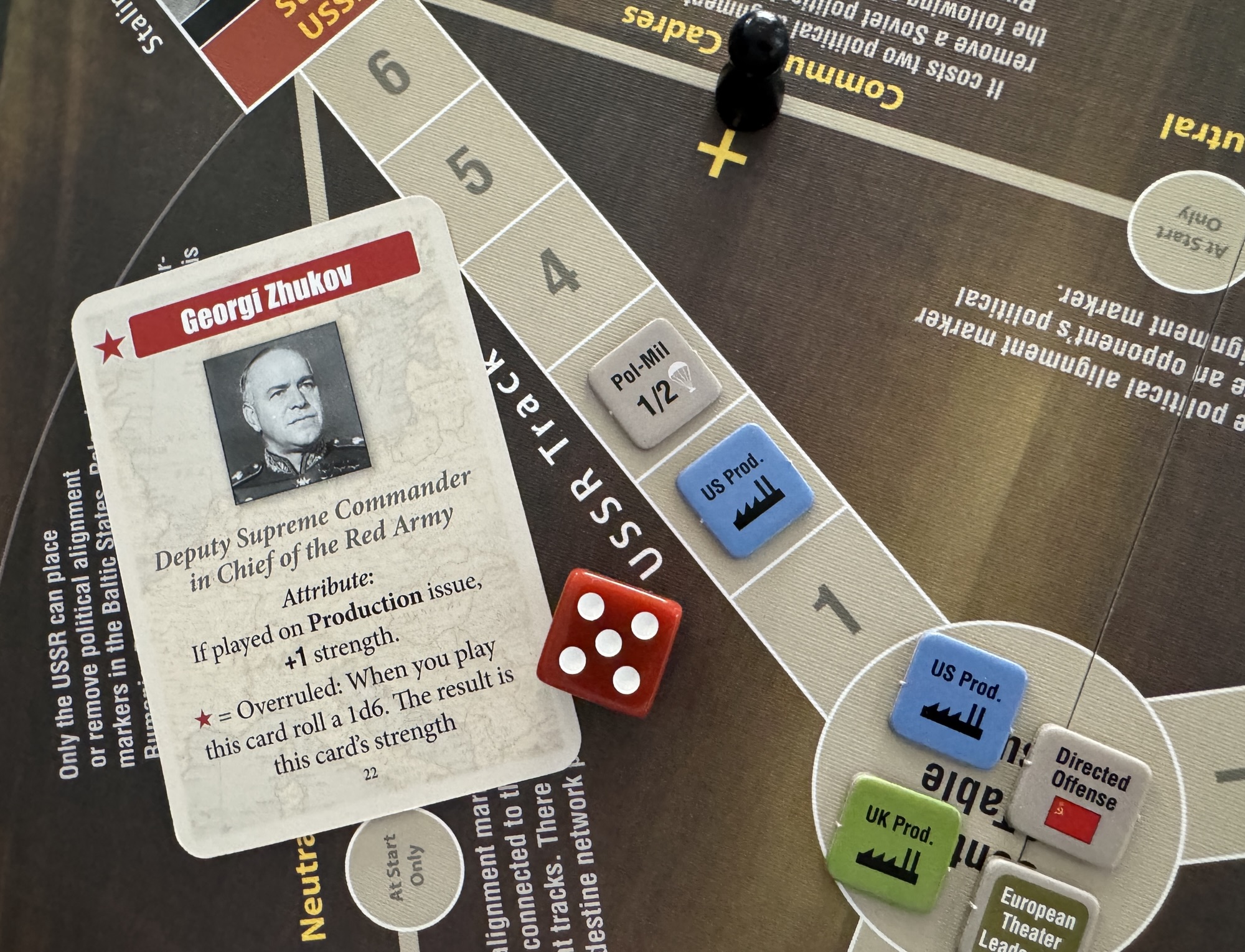
Today, we will take a look at one of my favorite type of cards from the game in the Chief of Staff Cards and specifically look at the Soviet Chief of Staff Georgi Zhukov who was the Deputy Supreme Commander in Chief of the Red Army. Each of the Chief of Staff Cards have a random numeric value in addition to a bonus for a certain attribute. The random numeric value is determined from rolling a 6 sided die and then using that number as the card’s base value. In Zhukov’s case, he is good with Production Issues and will grant a +1 strength toward moving these issues on the conference table. I like to think that this random determination of the Chief of Staff Card’s strength represents the internal power struggle with each of the nations leaders and those closest to them. In the case of Soviet Premier Stalin and his relationship with Zhukov they maintained a tense, professional, and ultimately strained relationship defined by mutual need during World War II, followed by postwar jealousy and suspicion. While Stalin relied on Zhukov as his top military commander to secure victory on the battlefield, he grew paranoid of the Marshal’s immense popularity and influence, leading to his ultimate demotion. And this random nature of the card’s strength reflects this well as sometimes they would agree and they could make great progress while other times they did not and there was tension and difficulty in their cooperation.
Georgy Konstantinovich Zhukov was born on December 1, 1896 and was a Soviet military leader who served as a top commander during World War II and achieved the rank of Marshal of the Soviet Union. During World War II, Zhukov served as deputy commander-in-chief of the armed forces under leader Joseph Stalin, and oversaw some of the Red Army’s most decisive victories. He also served at various points as Chief of the General Staff, Minister of Defence and a member of the Presidium of the Communist Party (Politburo).
Born to a poor peasant family near Moscow, Zhukov was conscripted into the Imperial Russian Army and fought in World War I. He served in the Red Army during the Russian Civil War, after which he quickly rose through the ranks. In summer 1939, Zhukov commanded a Soviet army group to a decisive victory over Japanese forces at the Battles of Khalkhin Gol, for which he won the first of his four Hero of the Soviet Union awards, and in 1940 he commanded the Soviet invasion of Bessarabia and Northern Bukovina in Romania. In February 1941, Stalin appointed Zhukov as chief of the General Staff of the Red Army.
Following the German invasion of the Soviet Union in June 1941, Zhukov lost his post as chief of staff after disagreeing with Stalin over the defense of Kiev. Zhukov, often in collaboration with Aleksandr Vasilevsky, was subsequently involved in the Soviet actions at Leningrad, Moscow, Stalingrad, and Kursk. He held the title of deputy commander-in-chief of the armed forces from August 1942, and was promoted to Marshal of the Soviet Union in January 1943. He participated in the planning of Operation Bagration in 1944, and in 1945 commanded the 1st Belorussian Front as it led the Vistula–Oder Offensive into Germany, where he oversaw the Soviet victory at the Battle of Berlin. In recognition of Zhukov’s key role in the war, he was chosen to accept the German Instrument of Surrender and to inspect the 1945 Moscow Victory Parade. He also served as the first military governor of the Soviet occupation zone in Germany from 1945 to 1946.
After the war, Zhukov’s popularity caused Stalin to see him as a potential threat. Stalin stripped him of his positions and relegated him to military commands of little strategic significance. After Stalin’s death in 1953, Zhukov supported Nikita Khrushchev’s bid for leadership, and in 1955, he was appointed Defense Minister and made a member of the Presidium. In 1957, Zhukov lost favor again and was forced to retire. He never returned to a top post, and died in 1974. Zhukov is remembered as one of the greatest Russian and Soviet military leaders of all time.
Hexasim has really been stepping up their game recently with some great looking wargames. Late last year, they announced their newest game called La Der des Ders – The War to End War, which focuses on World War I and is designed by Arnauld Della Siega. We reached out to Arnauld and he was more than willing to provide us some insight into the design.
Grant: Arnauld welcome to our blog. First off please tell us a little about yourself. What are your hobbies? What’s your day job?
Arnauld: Hello, everyone. Despite my Italian-sounding name, I am French. My hobbies? Gaming, of course. Formula 1. American football and flag football – I am assistant coach for my youngest son’s team. Oh, and I play badminton. And when I had a little more time, astronomy. Add Motörhead and Lovecraft to that, and I think you’ll have a pretty good idea of who I am. My real job? I’ve been working for Hexasim for three years. I mainly handle communication and game development (clarity of the rules, layout of the rulebook, some of the graphics).
Grant: What motivated you to break into game design? What have you enjoyed most about the experience thus far?
Arnauld: I think this is true of many designers, but my brain is constantly buzzing, whether I’m writing stories or inventing game systems. I wanted to create something to give shape to the ideas swirling around in my head. Then, and perhaps most importantly, to leave something behind for my descendants. Creating is more frustrating than rewarding, but seeing your game released is a bit like the birth of a child. A culmination.
Grant: What is your upcoming game La Der des Ders about?
Arnauld: La Der des Ders is the story of the First World War in its entirety, from the early stages to 11 November (and even a little beyond). It follows the timeline of the war and focuses on technological developments. La Der des Ders is a grand-strategy game in which you control sectors. You decide how to allocate your resources between recruiting new soldiers to rebuild your forces, technological research and preparing offensives. La Der des Ders is a revised and corrected version, with greatly improved artworks, ergonomics and rules, published in VaeVictis Magazine #145.
A look at the game found originally in VaeVictis Magazine #145.
Grant: What is the translation of this French phrase La Der de Ders?
Arnauld: La Der des Ders means « the last of the last ». You may translate it by « The War to End War ». I asked my testers and Boardgame Geek whether to use a French or English title. The players unanimously opted for a French one.
Grant: Why was this a subject you wanted to create a game on?
Arnauld: After creating No Man’s Land – Trench Warfare1914-1918 from Ludifolie Editions, I had acquired a good amount of knowledge about the First World War at a tactical level. I thought it would be a good idea to take a step back and look at the First World War from a different angle. That’s how La Der des Ders came about.
Grant: What are the unique features with the system used for the game?
Arnauald: It depends on what we mean by ‘unique’. Are there any truly unique games? When it was released in 2019, La Der des Ders was, to my knowledge, the only solo game covering the entire First World War. What makes it unique is its focus on technology (the game includes 41 levels of technology). It is also this abstraction, which facilitates the narrative without distorting it. This is particularly evident in the Collapse Tracks (which will be discussed later), which manage the erosion of the belligerents.
Grant: What is your design goal with the game?
Arnauld: What I look for above all else in a game is elegance. I like it when a lot of thought has gone into it, both in terms of the ergonomics and the gameplay. For La Der des Ders, I wanted to create a game that was easy to learn, designed for solo play, and with engaging mechanics. A game made to be played and able to learn more about the historical WW1.
Grant: What unique elements from WWI did you feel important to model in the game?
Arnauld: I think that sometimes a game is less about ‘what is important to model’ than ‘what the designer wants to model’. I like the ‘technical’ side of conflict. For this reason, 1914 interests me much less than 1918. I love all the technologies that abound. It was the shape of those funny steampunk-style tanks that made me love WW1 (basically, I’m more into Francis I, the Assyrians and the like).
Grant: As a Strategic Level wargame, what economic or political elements are included?
Arnauld: The entry of neutral countries into the war is managed by events. I did not want countries to be able to adopt a stance different from their historical one. That would have had too much of an impact on historicity. Neutral countries will therefore certainly enter the war in the same year as historically, but players do not really know on which turn (1 turn = 4 months).
The economy is managed by Resource Points awarded each turn. These Resource Points are the heart of the system, as they act somewhat like Action Points. Each sector contributes to the overall amount of Resource Points. The British and American navies also contribute an ever-increasing number of resources. The Naval Control Table simulates the war between merchant ships and U-boats.
Grant: How does the Collapse Track work?
Arnauld: The Collapse Track represents both a sector’s willingness to fight and its military potential. With each loss, a cube moves to the right, towards surrender. These losses also reduce the number of Attack dice a sector can roll during an offensive. Spending resources allows you to counteract this slow erosion and regain power.
Grant: What technologies can be developed?
Arnauld: There are six categories of Technology (Attack, Defense, Artillery, Air, Naval and Raid). Each category is divided into several levels, specific to each side.
Once unlocked, Technology levels grant bonuses in attack or defense, Artillery dice, rerolls, bonuses during the Naval Control Phase (which reduces the number of Resource Points available to the opponent), or the ability to cancel some events.
Grant: How does the game use cards?
Arnauld: There are two types of cards. Cornflower Cards are used to manage the solitaire bot.
The other cards are Events. Three are drawn at the beginning of each turn, and the effects are applied. Events are classified by year, and one card remains at the end of each year when the new year’s deck is brought into play. This adds variety to the game without sacrificing historical timeline.
What I am most proud of with these cards are the top banners. I made sure to copy the headlines from newspapers of the time, even going so far as to put a credible date and, above all, a number that, unless I am mistaken, should be correct. Yes, I had a lot of fun.
Grant: What different types of cards are included? Can you provide a few examples?
Arnauld: There are several types of Event Cards. Blue cards, such as the Schlieffen Plan, are only available in 1914. Red cards are Pivotal Cards that cannot be cancelled. These include cards that bring countries into the war, such as Lusitania and Zimmermann Telegram. Finally, green cards, which are the most numerous, allow players to obtain Resource Points, additional bonuses by attacking a particular country, but sometimes penalties. I looked for the most important events of the conflict, thought about their impact on the course of the war, and then translated that into game terms. A little tip: each color has a specific design, which means that color-blind players are not at a disadvantage.
Grant: How does combat work?
Arnauld: Combat is referred to as ‘offensives’. A single sector can only launch one offensive per turn, and a single sector can be attacked by multiple sectors. The player chooses the attacking sector and designates its target. They spend a number of Resource Points equal to the number of dice they wish to roll. This number cannot exceed the current Operational Value of the attacking sector (indicated by the position of the cube on the Collapse Track). To inflict a loss on the enemy, the player must obtain a certain value (often 5+). However, the dice roll is modified according to the technologies unlocked by the attacker or defender.
Artillery technology is important, as it allows black dice to be rolled that will not be modified. This highlights the power of artillery during conflict.
Grant: How are historical events handled?
Arnauld: By drawing three cards at the beginning of each turn. The cards do not go into the players’ hands. They are applied during the current turn. Some are applied immediately, others during offensives, and a few during the Resource Collection Phase. Some cards remain in play for several turns, such as Von Lettow, which allows the Germans to launch free offensives in Africa until the end of the war.
Grant: What variants are included?
Arnauld: The Fast Play variant speeds up games by bringing this version closer to the original version published in VaeVictis, removing the two new Technology categories and not charging sectors for implementing unlocked technology levels. I don’t really like it when a designer offers variants. It makes me think that they haven’t taken responsibility and are leaving it up to the player to figure it out.
You know what? I’m going to offer your fellow readers a great variant. This variant is for use in 1 vs 1 games, if you find it too difficult to win with the Entente.
Here it is:
Countries that are still neutral do not pay to implement an unlocked technology. Once the sector is at war, they must pay as normal.
You can consider this variant official. It has been tested.
Grant: How does the solitaire mode work? How are the Cornflower Cards used?
Arnauld: For each phase (Reinforcements, Technological Research, Offensives), the player draws a card and refers to what is indicated on the card.
It’s very simple to set up and effective. No need for endless dice rolls, referring to multiple tables, or having to make decisions for your opponent. Everything is indicated on the card. It’s elegant. Players seem to love this simplicity and the relevance of the decisions made by the bot.
Grant: How is victory achieved?
Arnauld: Victory can be achieved in several ways. Either by forcing France or Germany to surrender, or by earning 6 Victory points (obtained by forcing the enemy sectors to surrender), or at the end of the game (triggered when the Peace Negotiations Card is drawn) when the side with the most Prestige Points (calculated according to the position of the cubes on each of the Collapse Tracks).
Grant: What do you feel the game models well?
Arnauld: You can really feel the Entente gaining strength, with more and more resources at their disposal thanks to British and American support, and Germany’s obligation to finish the war as quickly as possible before the task becomes insurmountable.
But I also particularly like the story that the game tells, which is very close to the actual historical timeline.
Grant: What are you most pleased about with the design?
Arnauld: I like the fact that it is both simple and interesting. I like the fact that Dad can play with Junior. I like that players learn things while playing. I like the way it looks. And I like the price: we decided to make this game as affordable as possible so that more people could enjoy it. Games should not be a luxury item.
Grant: What other designs are you contemplating or already working on?
Arnauld: I have several projects in mind, mostly solo games. Some are well advanced, but I feel like I’m at a crossroads. I mean… there are too many games coming out. Designers need to learn to restrain themselves and, rather than flooding the market with games that are sometimes barely finished, take the time to polish them as much as possible and perfect the rulebook (which is often really awful). Given the price of games, I believe we should respect players and offer them flawless products. Fewer games, but higher quality. And that’s good, because that’s exactly Hexasim’s credo. If sales of La Der des Ders are fantastic, we can plan a sequel, perhaps World War II, to please as many people as possible, and/or fantasy. The ratings received on Boardgame Geek will decide.
We picked up Churchill back in 2014 when it first was printed. From what I could tell at the time was that it wasn’t getting a lot of buzz amongst board gamers on BGG and there were only 2 YouTube videos about the game where we could learn a little more (one from Mark Herman and his wife, the other from Stuka Joe). I realize now that I was wrong to a large extent about the presumptive popularity of the game. First, we had bought it while it was brand new so the buzz was just getting started in a major way. Secondly, Churchill is viewed by many as a wargame and as such many euro gamers are hesitant to give it the try it so rightly deserves. But the game system and what it is trying to do is just fantastic with its debating over issues, seeing those issues translate to action on the board in the further prosecution of the war and then the way that people work to coordinate their actions. Just a really solid system.
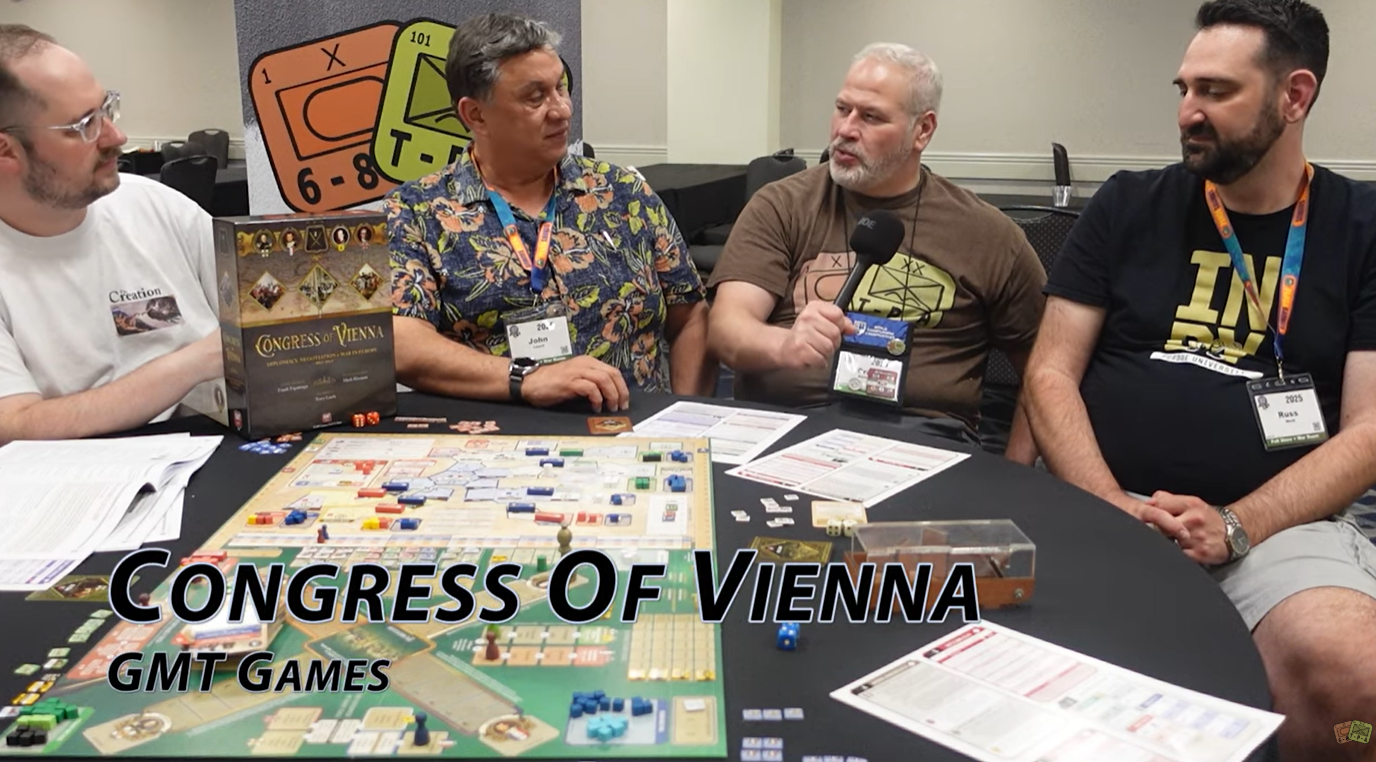
A few years ago, after playing all of the games in the Great Statesmen Series, we heard of a new game in the series from a designer not named Mark Herman and I was immediately interested and intrigued as we have had so much fun with Churchill, Pericles and Versailles 1919. Congress of Vienna from GMT Games is a diplomatic card driven wargame based on Churchill and is the 4th game in the Great Statesmen Series. The game is set during the years of 1813-1814 and sees players take on the role of the main characters of the struggle between the Napoleonic Empire and the coalition of Russia, Austria, and Great Britain with their Prussian, Spanish, Portuguese, and Swedish allies. We played the game recently while attending Buckeye Game Fest and then played a full campaign again while attending the World Boardgaming Championships and absolutely were amazed at the changes and innovations to the system introduced by the designer Frank Esparrago.
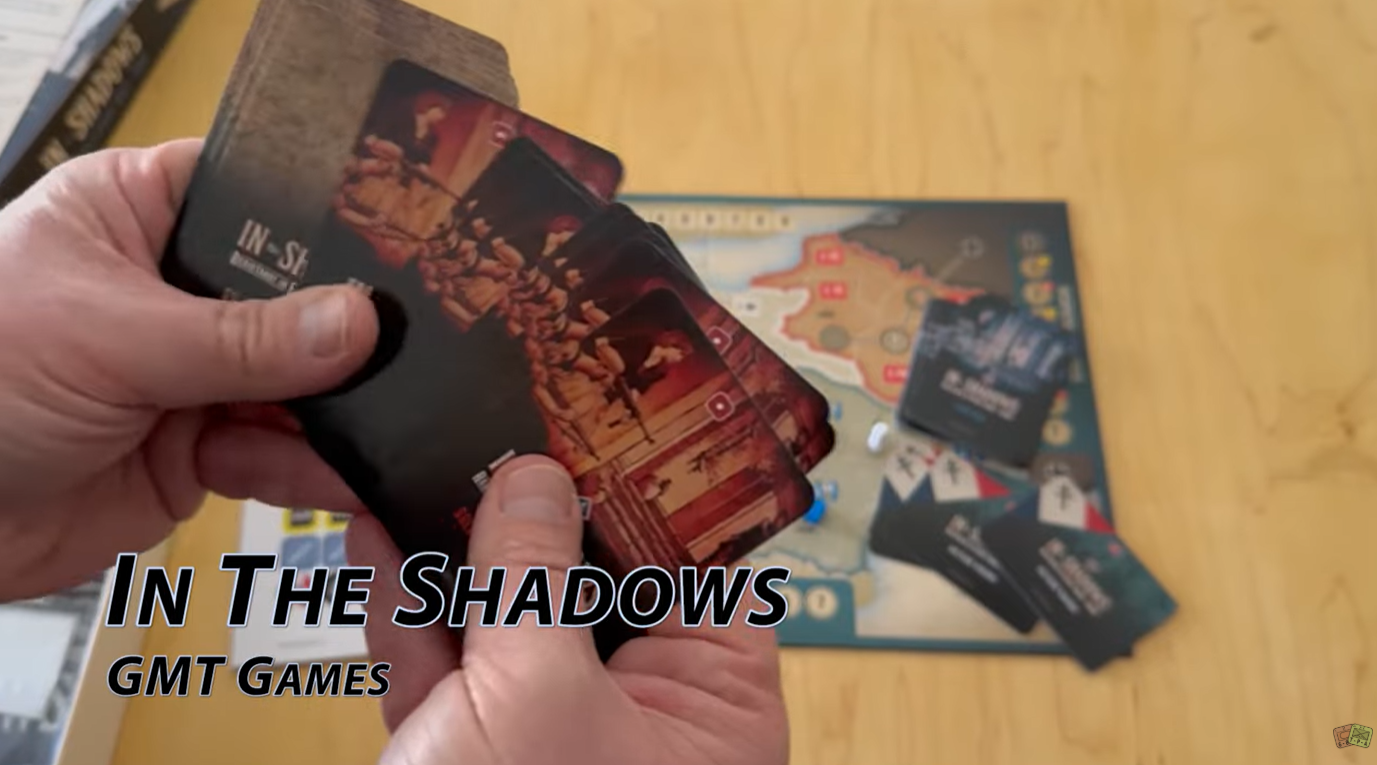
In the Shadows: Resistance in France, 1943-1944 from GMT Games is a 2-player card-driven game about the desperate struggle of the French Resistance against the occupying Nazi and collaborating French forces between January 1943 and June 1944. In the game you will play as either the Resistance or the Occupation in a fight over the hearts and minds of the French People. The game strives to have players better understand the nuances of the resistance and the clandestine nature of the fight that led to the founding of the fourth French Republic.
The gameplay of In the Shadows is driven by Event cards and Actions based on suits. The game relies on three different suits (the Resistance Cross, the Victory Cross, and the Iron Cross) to determine the cost and effectiveness of your Actions. Narratively, this is meant to represent the vital importance of local networks and resources. You may be working with resources in Paris but need to perform Sabotage Actions in Vichy. In this way, the game can better replicate the choices that the leaders of the Occupation and Resistance needed to make.
In this video, I run down my list of the Top 10 Solitaire Wargames that I played in 2024. These games included many that are designed for solitaire play only as well as a few of the games that I played solo but were designed for 2-player. They also included some Print and Play offerings as well.
If you have been following our blog for a while now, you know of my affinity for the history of the American Revolutionary War. I am a proud American, believe deeply in the principles of our land and the Constitution that governs it and am grateful to God every single day that our country was successful in our fight for its freedom in order to create a better society and to assist all peoples with protecting their “unalienable rights” endowed by a Creator, which include “Life, Liberty and the pursuit of Happiness”. I play wargames on the American Revolutionary War and very much enjoy learning about the history and its key battles. There are many out there that feel the same as I do and they have designed lots of these type of games and with 2026 being our 250th Anniversary of the Declaration of Independence, there are events that are planned to celebrate it.
One of which is an event put on by GMT Games and Mark Miklos called Gaming the American Revolution 250 Camden, South Carolina. We are planning to attend and have already marked off the date on our calendar and we would love to see many of you there for 3 days of gaming centered on American Revolutionary Wargames produced and published by GMT Games.
The details of the event are as follows:
The Occasion: Three days of AmRev gaming on the campus of the Camden Revolutionary War Visitor Center located in Camden, South Carolina. Camden was pivotal to the story of the Southern Campaign with two battles fought within 6 miles of each other, bracketed by a British occupation of the town. The Battle of Camden in 1780 was a decisive British victory that crushed the American Southern Army and brought disgrace to American General Horatio Gates. The Battle of Hobkirk’s Hill in 1781 was a British tactical victory that proved to be a strategic defeat.
Holding a dedicated AmRev War game event in Camden is GMT’s way of recognizing not only the 250th anniversary in our nation’s history but also those in our hobby for whom gaming the American Revolution holds a special place in their heart. Perhaps most importantly, the energy that we will bring to the occasion ensures that the people and the events showcased in these excellent games will not be forgotten. As the proverb says, “As long as you speak my name I shall live forever.”
Dates: September 24-27, 2026. (Thursday through Sunday)
Location: Camden, South Carolina.
Venues: Liberty Hall, Camden Revolutionary War Visitor Center and Historic Camden.
Registration: $76.00
Travel:
If flying, Columbia, S.C. is 35 miles away, Charlotte, N.C. is 88 miles away, Charleston, S.C. is 127 miles away, and Greenville/Spartanburg, S.C. is 134 miles away.
If driving, connect to East-West Interstate 20 and take exit 98 for US 521 toward Camden. Several hotels are at the exit. Our venue is 1-mile away, toward town, and downtown Camden is perhaps one mile further on.
Lodging: There is no official event hotel. Lodging is on your own. Select from a list of nearby hotels to be published on the launch website.
Meals: Meals are on your own, with some hotels serving an included breakfast. See below for a possible group dinner on Saturday. Local restaurants will be listed on the event website.
Games: This event will feature an exclusively-GMT line up of American Revolutionary War games: Battles of the American Revolution Series, Liberty or Death and Washington’s War. In addition, we anticipate having current prototypes of games in development including The Battle of Cowpens, The Battle of Green Spring, and Common Sense available to play. Players are asked to bring their own copies of the GMT Rev War games they hope to play to ensure availability. A limited number of house games will also be available. Respectfully, please leave games by other publishers at home.
Game Schedule: Friday, 9:00 a.m. until 11:00 p.m. Saturday, 9:00 a.m. until 11:00 p.m. Sunday, 9:00 a.m. until 3:00 p.m.
Format: Open gaming; play with a friend or make a new one.
BoAR Eutaw Springs Tournament: For any BoAR players who may want to mark the occasion with competitive play, there will be a single-elimination Eutaw Springs tournament. The winner will receive a theme-appropriate prize.
Attendees: Maximum attendance will be 125. Attending will be Gene and Rachel Billingsley and several GMT designers and developers. Content creators and podcasters will also be in attendance.
Event registration includes the following non-gaming activities:
Thursday – On arrival day we are planning an evening Meet & Greet at the historic McCaa Tavern, a restored 18th century tavern on the campus of Historic Camden. We will gather at approximately 6:00 p.m. for light refreshments and period entertainment. At sunset, we will light the cressets and adjourn to the back lawn for brief remarks, culminating with two rounds of artillery fire in full darkness.
Friday – Gather at 8:30 a.m. on the lawn in front of Liberty Hall for some brief period entertainment preceding the start of gaming. On this day there will be photo opportunities for those wishing a picture in period dress. All attendees will have access to the grounds of Historic Camden featuring several restored period buildings including the Kershaw-Cornwallis House (HQ for Lords Cornwallis and Rawdon during the British occupation) and a reconstructed British redoubt. The Rev War museum at the Visitor Center will also be available.
Saturday – Today we will offer two departures by chartered school buses to the Camden battlefield (approx. 8-miles away) where we will enjoy private battlefield tours conducted by Rick Wise, Executive Director of the South Carolina Battleground Preservation Trust. Tours will be conducted at 10:00 a.m. and 2:00 p.m. with departures scheduled accordingly. Each departure will be limited to bus capacities and sign up will be on-site at registration on a first come, first served basis. The grounds of Historic Camden and the museum will be available today as well.
We are currently trying to arrange a private dinner for Saturday night. Reservations will be required and there will be an upcharge to the $76 event price for those wishing to attend. Arrangements may not be completed by the time event tickets go on sale on February 19th. In that case, we will notify all registered players later with information about the dinner, (location, cuisine, cost, time, etc.) and the opportunity to reserve space.
Sunday – Gaming ends at 3:00 p.m. Last chance to visit the sites of Historic Camden, The Old Presbyterian Graveyard, and the Quaker Cemetery, final resting places for several Revolutionary War soldiers. Depart for onward travel.
Agenda for non-registered players: We are working to compile a list of points of interest and other activities for those coming to Camden but who will not be registering to play. This list will include at least one antebellum home open to the public, the National Steeplechase Museum, the Camden Horse & Hound Weekend, antique stores and boutique shops, etc. Entry fees, if any, will be the responsibility of each individual.
More information will be forthcoming soon and the event website where you can register will be available on February 19th.
I am very excited about this opportunity and Alexander and I are already making plans to attend. We look forward to playing several games of the Battles of the American Revolution Series, as we have really only played a few including Brandywine, Savannah and Germantown, as well as talking with fellow devotees to the historical period and seeing the sights. I have been to Camden in the past, but didn’t get a chance to see all of the sites in the area and look forward to learning more about the period and setting.
Because this is a wargaming blog, I am going to share below some of our content we have made regarding AmRev War games for your review:
With this My Favorite Wargame Cards Series, I hope to take a look at a specific card from the various wargames that I have played and share how it is used in the game. I am not a strategist and frankly I am not that good at games but I do understand how things should work and be used in games. With that being said, here is the next entry in this series.
#64: Guns of August from Paths of Glory: The First World War, 1914-1918 from GMT Games
Paths of Glory is widely thought to be a masterpiece on WWI and after just a few plays of the game, both in person and online on the fabulous Rally the Troops!, I can definitely see why people feel that way. Even though we are novices, the game is just that good and really tells the story of the fruitless efforts of both the Entente and Central Powers as they bashed their heads against each other over control of Europe. The game is long and you generally are going to have to play this one over a long weekend to get it all in and enjoy it properly but it is just such as great tool to understand the complexities of the struggles of trench warfare, supply and the balance of attacking versus taking a breath and regrouping. I really enjoyed the mix of historical events and the choices that I had to wage the war in a way that I felt was appropriate. But, my message to everyone who plays this game is beware of supply. Even in our few plays, supply has been an issue and we have had to make sure we didn’t make a few fatal mistakes that would get us in trouble. I want it to be clear here. I am not good at this game…at all and the nuances of supply and how to play have just eluded me as I continue to make the same errors game after game. But it is really good and I look forward to each new play with enthusiasm and am excited about the chance to get to learn more about this fascinating war that was so very fruitless.
I am going to use snips of the board from Rally the Troops! in this post so it might look a bit different from my normal posts.
With that being said, generally in every single game the Central Powers will start out by playing their Guns of August card. Guns of August is a crucial, high-stakes opening event for the Central Powers on Turn 1, enabling an immediate, powerful, and historical offensive against France and Belgium.
The Guns of August is a 3/4 OPs card that is placed into the CP player’s hand at the outset and gives them the initiative immediately. First off, the card destroys the fortress at Liège and then gives a massive mobilization effort booster by moving 2 German Army counters from their starting spaces including the German 1st and 2nd Armies and then activating them both to attack along with the German 3rd Army who is located at the start of the game setup in Koblenz.
This gives the CP player 2 choices about how to start the war with this attack. They can focus on the British Expeditionary Force located in Brussels or the French 5th Army located in Sedan. The allows the CP to destroy the Liège fortress, advance armies, and immediately attack or pressure the British Expeditionary Force (BEF) and French forces. In my humble opinion, the BEF is the real target here as this unit cannot be replaced or rebuilt and its removal opens up the path for the Germans to take on the fortress at Antwerp.
While the Guns of August card play is an aggressive move, it does somewhat ensure Austria-Hungary can survive potential Russian pressure as the Allied player will have to quickly use their precious resources to fill the gaps created by this opening attack rather than using them to bolster the Russians in the east or to build up the Serbians a bit in the south to prolong the fall of Belgrade. Paths of Glory is a large part about resource management and the constant pressure to continue offensive momentum and rebuild troops through the use of Replacement Points and events to bring on additional troops is a major problem for both sides. You can only attack for so long before you will burn yourself out and will have to spend time to recover and get ready for the next turn’s offensives. Using the Guns of August cards efficiency will free up resources to use elsewhere.
There are alternative openings with the card that can be considered. If not using Guns of August for the event, the CP player can use 1 OP to destroy the Liège fort, allowing them to conserve the card for later or pivot to a more defensive strategy, such as defending the Rhine.
In the end, I would recommend the hammer approach versus any other use of the card as it will really put the pressure squarely on the Allies to do something about what you have just accomplished. In the picture to the right is the normal outcome of these attacks as you can see the BEF is reduced and the French 5th Army has broken and is now replaced by a smaller Corps counter that cannot really do anything offensively and is just there to protect the back side of the Maginot Line from being caught out of supply.
The Guns of August (published in the UK as August 1914) is a 1962 book centered on the first month of World War I written by Barbara W. Tuchman. After introductory chapters, Tuchman describes in great detail the opening events of the conflict. The book’s focus then becomes a military history of the contestants, chiefly the great powers.
The Guns of August provides a narrative of the earliest stages of World War I, from the decisions to go to war up until the start of the Franco-British offensive that stopped the German advance into France. This led to four years of trench warfare. The book discusses military plans, strategies, world events, and international sentiments before and during the war.
The book was awarded the Pulitzer Prize for General Nonfiction for publication year 1963, and proved very popular. Tuchman later returned to the subject of the social attitudes and issues that existed before World War I in a collection of eight essays published in 1966 as The Proud Tower: A Portrait of the World Before the War, 1890–1914.
This year has been a bit of a blur for me with work, personal commitments and family matters and I just feel like I have not been giving much attention to the blog. But, I am back now and ready to get right back to it with the next entry in our Wargame Watch feature. This month, I was able to find 18 games to highlight! Of that total, 3 games were offered on Crowdfunding.
Founded by industry veterans Ryan Heilman and Wes Crawford, Wharf Rat Games is a Baltimore-based publisher dedicated to high-quality, light-to-medium-weight games. Our mission is to deliver engaging historical, sci-fi, and fantasy themes that can be played in under 90 minutes, making them accessible to both casual and experienced players.
Featured Title:A Forlorn Hope by Hermann Luttmann
Wharf Rat Games is thrilled to announce their debut title, a revitalized vision from legendary designer Hermann Luttmann.
The History: Originally pitched over a decade ago as the mechanical precursor to the hit In Magnificent Style, this game returns to Hermann’s original vision of WWI trench warfare. Here is a link to the Rat Chat show where Hermann discusses the history of In Magnificent Style:
The Gameplay: A solo or 1–3 player cooperative experience using a tense push-your-luck mechanic. Players command a regiment charging across No Man’s Land, balancing bold advances against the threat of becoming pinned under relentless enemy fire.
The Content: Features six scenarios covering iconic battles such as The Somme, Verdun, and The Lost Battalion.
Wharf Rat Games is gearing up to launch their Backerkit campaign on February 10th. Early Bird Special: Back the game on the first day to get it for just $69, a savings of $20 off the MSRP!
You can connect with Wharf Rat Games on the following social media outlets:
1. A Forlorn Hope from Wharf Rat Games Coming to Backerkit on February 10th
Wharf Rat Games is a new publisher recently started by the dynamic duo of Ryan Heilman and Wes Crawford. I have interviewed both of these guys a few times for their own designed games and also hung out with them quite a bit at conventions including Buckeye Game Fest in April 2024 and the World Boardgaming Championships in August 2024. I am really happy for them that they have taken this plunge and created their own publishing company. I know they know games. Have been in the industry for a while now and also have great connections with many designers and would be designers and I am sure that they will bring many quality offerings to our tables over the next decade plus.
But there is more than just their introduction here as they have signed their first game and it is from a designer we all know and love – Hermann Luttmann. A Forlorn Hope places solo players or up to three cooperative players in command of a battalion charging across No Man’s Land to capture enemy trenches during World War I. Success requires careful balancing of bold advances and timely retreats to avoid casualties, maintain cohesion, and keep troops from becoming pinned under relentless enemy fire. Over a decade ago, Hermann pitched a groundbreaking design to Alan Emrich at Victory Point Games—a push-your-luck mechanic within a wargame framework, originally set in the WWI trenches. While the concept was well-received, Alan suggested a Civil War theme instead, leading to the creation of In Magnificent Style, based on Pickett’s Charge at Gettysburg. This game went on to be published by Victory Point Games and later by Worthington Publishing.
From the game page, we read the following:
A Forlorn Hope is an abstract simulation wargame of a typical trench assault, modeling those attacks that were conducted during the First World War (1914-1918). The player represents an attacking regiment of troops consisting of three battalions, with each battalion made up of two or three assault companies (depending on the number of players).
The game uses a “press-your-luck” design philosophy that will challenge you with tough decision-making and risk-taking throughout the game. The goal is for the player(s) to drive their forces across No Man’s Land in the quickest and most efficient manner possible to achieve the best level of victory.
A Forlorn Hope is designed both for solitaire and multiplayer co-operative play. Numerous scenarios are included, starting with a basic assault scenario (which is ideal for learning the intricacies of the game system), then adding multiple historically-based scenarios simulating actual battles from World War I that offer a slightly more complex and layered gaming experience. Each scenario features singular aspects of the historical battle it is simulating, and each will therefore be a unique gaming experience.
The project is set to launch on Tuesday, February 10th.
2. Napoleon at War Deluxe Edition from Decision Games
Over the past couple of years, Decision Games has been going back through their catalog and doing these Deluxe Editions of several of their games including Red Dragon Green Crescent Deluxe Edition in 2024 and Blue & Gray Deluxe Edition in 2025. They now have tabbed several more games for this game treatment and the first that I will share is Napoleon at War Deluxe Edition.
From the game page, we read the following:
Napoleon at War Deluxe Edition reprints the original SPI QuadriGame consisting of four separate battles, each among the most important of the Napoleonic Wars: Marengo, Jena-Auerstadt, Wagram, and the Battle of Nations at Leipzig. This new deluxe edition has a full-color instruction booklet, new counter and map artwork, with 9/16” counters, two back printed 22” x 25.5” mounted game boards, and new player aid cards. The basic rules to all four games in the Napoleon at War Series are standardized. Each game has its own exclusive rules, which include historical set up and reinforcements, special rules, player’s notes, and commentary by the game’s designer. The game mechanics used in this series are based on the popular Borodino-Napoleon at Waterloo game system. The scale of each game ranges from 400 to 800 meters per hex, while each game turn represents between one and two hours of real time. Units range in size from demi-brigades through divisions, with each strength point representing between 250 and 350 men or an equivalent amount of artillery.
Movement is sequential and single-phased. Zones of control are rigid, and combat is mandatory between adjacent opposing units. Stacking is limited to one unit per hex. The Combat Results Table is relatively uncertain, with odds of 4 to 1, or better, necessary to ensure at least a “Defender Retreat” result. Terrain ranges from the Austrian parade grounds south of Wagram to the rough and forested battlegrounds of Jena-Auerstadt. Game length varies from the five-turn First Day Scenario of the Battle of Nations to the 20 game turn Grand Battle Scenario of that same game which simulates the entire three- and one-half-day Battle of Leipzig, the largest battle of the Napoleonic Wars.The games, though graphically enhanced from the originals, remain the same. Now enhance your enjoyment with this new deluxe edition of another SPI classic!
3. Year of the Rat Vietnam 1972 Deluxe Edition from Decision Games
The 2nd game that is being offered up for pre-sale with a new Deluxe Edition is Year of the Rat Vietnam 1972, which was originally designed by John Prados and now redesigned by Joseph Miranda.
From the game page, we read the following:
On 30 March 1972 the North Vietnamese Army (NVA) launched its “Easter Offensive” into South Vietnam, attempting to either win the war decisively or improve the North’s negotiating position at the Paris Peace Talks. Surprised by the large-scale attack, the Army of the Republic of Vietnam (ARVN) rallied, and supported by US airpower, launched counterattacks into the fall, finally repulsing the Communist offensive.
Year of the Rat Deluxe Edition recreates that decisive campaign. Powerful NVA divisions operate alongside Viet Cong regiments and decoys, evading the ARVN while striking quickly at vital towns and bases. ARVN elite airborne, ranger, and marine units respond, creating a tense asymmetrical contest of big unit battles and hard-fought sieges, with increasing American airstrikes and worsening NVA supply capabilities.
This Deluxe Edition enhances the original, acclaimed SPI game design (published during the campaign) with a half-century of research and analysis, providing updated orders of battle and terrain analysis. Three scenarios and fifteen order of battle variants cover a wide range of game options, including operations into Laos and Cambodia.
Additional features include:
• New graphics on enlarged maps and counters
• Expanded Allied airmobile operations and units
• NVA divisional reorganization and tank regiments
• Full 1971–72 US order of battle
• Australian, Royal Thai, Cambodian, and Khmer Rouge forces
• Vietnamese and US Navy riverine units
• ARVN base camps and regional forces
• Extensive optional rules
Year of the Rat Deluxe Edition offers you the opportunity to explore and make decisions in a campaign that changed the course of war and peace.
4. 1812: The Campaign of Napoleon in Russia Deluxe Edition from Decision Games
The third and final game getting a facelift from Decision Games is 1812: The Campaign of Napoleon in Russia Deluxe Edition.
From the game page, we read the following:
Napoleon invaded Russia with 600,000 troops of which only about 110,000 escaped in organized formations. The largest factor in this enormously deadly campaign was supply. The ability of a Napoleonic army to supply itself depended heavily on the surrounding countryside. Areas were stripped of resources to supply the army, which had to move or starve within a very short period. 1812 Deluxe Edition treats this difficulty of command as a central point, through the game’s area depletion system.
1812 Deluxe Editionupgrades the original SPI 1812 Strategic Area Map Game with a full-color rulebook and player aid cards, new artwork, larger counters and an enlarged map on a mounted game board.
Players must battle attrition, supply, and enemy forces to win. 1812 offers three scenarios, starting in June, late August, and early October, each with free and historical set-up options. Optional rules add leaders and fortresses, while new variant rules provide additional leaders, battle plans, and elite guard forces. Other than adding the variant rules, and incorporating clarifications and known errata, no major changes have been made to the original SPI rules.
1812 Deluxe Edition provides you the opportunity to see if Russia falls to Napoleon’s conquest, or survives, spelling the eventual doom of the Napoleonic Empire. Open this new deluxe edition and see if you can change history.
I love a different style and focus of wargame. A game that takes a look at an important but somewhat obscure or rarely addressed topic such as espionage or intelligence. And this month, GMT Games announced such a game in Checkpoint Charlie, which is a solo or cooperative game focused on SIS espionage missions in Berlin in the 1960’s.
From the game page, we read the following:
Checkpoint Charlie is a solitaire or cooperative game of British Secret Intelligence Service (SIS) espionage missions in Berlin in the early 1960s.
West Berlin is an isolated outpost of the Western Powers in the center of the German Democratic Republic (East Germany). East Berlin, on the other side of the Berlin Wall, is a base of operations for Soviet KGB agents and the Stasi secret police. This is a city of spies, a focal point of worldwide espionage in the growing Cold War. In this game, you send your assets (agents) on missions and use your influence and foresight to help them complete objectives before they are detected and compromised by KGB agents. As you play through these missions, you will:
Ensure that an important defector gets safely out of the city.
Make contact with a dissident Russian scientist on the other side of the Berlin Wall.
Gather intelligence in East Berlin and return safely to the West
Entrap a troublesome KGB agent with tempting intelligence.
Sow distrust between KGB and Stasi agents.
Identify a Soviet mole among your SIS agents and wait for them to reveal themselves.
Can you accomplish all of this in secret, as the very public events of the Cold War change the political landscape of Berlin itself?
This is a game about your assets staying one step ahead of the KGB and completing missions without being detected. Each mission starts with a different cast of assets and KGB agents, a set of items that may help complete the mission, and multiple historical events that can change the situation. Victory conditions are specific – getting an asset out of the city, making contact with a new source, or even crossing the Berlin Wall to gather important intelligence and returning without getting caught. There are no victory points or turn limits in Checkpoint Charlie, just objectives your assets must complete before they are compromised or overwhelmed by the growing web of KGB surveillance. The game map includes iconic locations like Checkpoint Charlie, Glienicke Bridge (the “Bridge of Spies”), and the notorious Berlin Hilton, each with unique game effects. You will manage a hand of cards that represent assets, items, and locations on the map. On your turn, you’ll play a card to influence the situation, and when you take a card from the Draw Area to refill your hand, every SIS asset and KGB agent in the city will move and take actions based on which card you chose. New Intel may appear on the map, locations may be placed under KGB surveillance, and Event cards may affect specific locations.
In Checkpoint Charlie, you are not a field agent. You are a planner, a director monitoring the situation but limited in how much you can directly intervene. That sense of influencing the situation but often just having to watch as events unfold is created by the core mechanic of Checkpoint Charlie: the Draw Area below the map. This area contains five face-up location, asset, or item cards. Chits representing each of the tokens on the city map (your SIS assets and the KGB agents) are placed above each of the cards in the Draw Area. After playing a card from your hand, you will draw a card from either end of the Draw Area, and then the remaining four cards will shift left or right to fill the empty position before a new card is drawn to fill the row. In this way, every card in the Draw Area shifts one space whenever you draw a card. This is important because every token in Berlin then moves closer to the location, asset, or item on the card directly below their chit. In the example below, the cards have shifted and the empty spot has been filled. Now the Dentist will move to Mehringplatz. Jester will move one location closer to Checkpoint Charlie, and KGB Agent Svetlova will move toward the 1958 Rambler at RAF Gatow.
This game looks extremely interesting and I am very much excited to learn more about it. I am going to reach out to the designer Russ Brown to get some more information to share.
6. Here I Stand 500th Anniversary Reprint Edition 3rd Printing from GMT Games
Here I Stand is one of the greatest Card Driven Games I have ever played, and we have played a lot in our time. I have played this game more than 10 times and found each experience to be simply sublime, even though it takes 10-12 hours to play. The game now has a 3rd Printing of the Deluxe 500th Anniversary Edition and you need to get you a copy and find someone to play with.
From the game page, we read the following:
Here I Stand: Wars of the Reformation 1517-1555 is the first game in over 25 years to cover the political and religious conflicts of early 16th Century Europe. Few realize that the greatest feats of Martin Luther, Jean Calvin, Ignatius Loyola, Henry VIII, Charles V, Francis I, Suleiman the Magnificent, Ferdinand Magellan, Hernando Cortes, and Nicolaus Copernicus all fall within this narrow 40-year period of history. This game covers all the action of the period using a unique card-driven game system that models both the political and religious conflicts of the period on a single point-to-point map. There are six main powers in the game, each with a unique path to victory.
If you own the original (non-500th Anniversary edition) Here I Stand, here are the upgrades you will find in the deluxe 500th anniversary edition. Enhancements include: 6 brand new cards added to the deck, including Thomas More, Thomas Cromwell, Rough Wooing, and Imperial Coronation. Revisions to over 15 existing cards including Copernicus, Master of Italy, and Machiavelli to allow for more exciting in-game play and additional possibilities for diplomatic deals. A new Chateau construction table is now used to resolve France’s Patron of the Arts home card plays. Several Virgin Queen rule updates are incorporated back into Here I Stand, affecting minor power activation, piracy, space trading, and foreign wars.
There also is included the special 2-player variant which pits the Protestants versus the Catholics in a modified form of the game. But it is still good and this is how we first played the game.
7. Special Component Pack for The Last Hundred Yards Vol. 5: For King & Country from GMT Games
If you didn’t know we really enjoyed The Last Hundred Yards very much as well as Volume 2: Airborne Over Europe. The system is extremely interesting for a tactical game and uses some novel elements in regards to how victory points are scored including a focus on time and casualties. Really an excellent system! Now, even though there are 5 total volumes that have been released, including most recently Volume 5 For King & Country, Mike Denson has forged ahead with an interesting expansion called a Special Component Pack.
From the game page, we read the following:
We are offering this Special Pack for players who purchased The Last Hundred Yards Volume 5: For King & Country because the necessary modules to play all the missions are not currently available. This pack includes all components (German counters and maps) necessary to make Volume 5 a Stand-Alone Game. With this Pack, players will be able to play every mission included in the module.
Components included in the for King and Country Special Zip Lock Pack:
7 double-sided geomorphic maps (14 maps total)
1 full color Rules booklet (latest edition) (44 pgs.)
8. Dice in the Dirt: A Tactical Print and Play Skirmish Game from Michael Shane Mecham Currently on Kickstarter
Recently, I have really been enjoying several Print and Play solitaire wargames. They are inexpensive, easy to create and setup and then most of them have some really engaging and interesting gameplay. This month, I came across a new offering called Dice in the Dirt: A Tactical Print and Play Skirmish Game designed by Michael Shane Mecham and I jumped on it pretty quickly.
From the game page, we read the following:
Dice in the Dirt is a fast, tactical print-and-play skirmish game for two players.
Each player commands a six-soldier squad fighting over a dense, modular battlefield where pressure, positioning, and timing matter more than raw firepower. The game uses blind-bag activation, suppression mechanics, and standard dice to create tense, unpredictable engagements.
Dice in the Dirt is not about killing fast—it’s about pressure. Suppression locks soldiers in place. Actions are scarce. Timing matters more than firepower. Victory comes from forcing your opponent to waste precious moments under fire.
This is a complete, digital-only release designed for quick setup and focused play.
It really seems pretty interesting and the best part about these Print and Play games is that the cost of entry is so low that it is worth taking a chance on. I am a backer and look forward to playing this one.
As of February 1st, the Kickstarter campaign has funded and raised $521.00 toward its $100.00 funding goal with 32 backers. The campaign will conclude on Friday, February 6, 2026 at 9:57am EST.
9. Battle Decisions: Kriegsspiel from Catastrophe Games Currently on Kickstarter
Catastrophe Games is a small publisher who just really puts out interesting games. I have played several of their games and enjoyed them all. Recently, they announced a new game called Battle Decisions: Kriegsspiel designed by Paul LaFontaine.
From the game page, we read the following:
Battle Decisions: Kriegsspiel is a basic Kriegsspiel kit in a box. You will have everything you need to play a game of Kriegsspiel: a map and counter sheet for the umpire and two players, along with a very basic resolution system.
This game benefits from hundreds of hours of face to face and online playtesting, with the system refined to allow an experienced umpire to launch and complete a simple scenario in just over an hour.
The scenario book runs scenarios across time: while most of the scenarios focus on the 19th century, it also shows how to run modern skirmishes (WW2) while allowing ancient battles as well (Alexandria versus the Persian Empire)
But wait, you might ask, how can you run so many and various scenarios off one central Europe map? What Paul did was take the central element of the battle and found a location on the map that most represents the fight. This is an elegant way to allow a single map to be used for multiple battles.
Kriegsspiel began as a past time for Prussian nobles. Eventually a version was presented to their king who then required its use for training Prussian officers. Many attribute some of the Prussian success in the 1870 Franco-Prussian war to the widespread use of the Kriegsspiel amongst the Prussian officer corps.
After the war Kriegsspiel games were used by many nations to train their leaders. Now the descendants of the original Kriegsspiele live on in the form of software driven exercises for staffs at various levels. However the focus on command and control is still the key factor in these modern games.
Battle Decisions: Kriegsspiel offers players a chance to return to form of the original games, with simple counters and maps, allowing players to forge their own tactics and plans.
As of February 1st, the Kickstarter campaign has funded and raised $3,313.00 toward its $500.00 funding goal with 55 backers. The campaign will conclude on Monday, February 2, 2026 at 7:00pm EST.
10. Operation Overlord from VUCA Simulations
VUCA Simulations is a new company on the scene the last few years and they are coming out with some really great looking games. We have played several of their games and always have a great experience with them. One of their newest pre-order offerings is called Operation Overlord designed by Clem. It covers the D-Day invasion and as usual looks to be of the highest quality and production.
From the game page, we read the following:
Operation Overlord is a deep, historically grounded strategic wargame that simulates the Normandy invasion and the critical battles that followed from June to August 1944. One player commands the Allied SHAEF forces, planning and executing the largest amphibious operation in history, while the opposing player takes the role of Oberbefehlshaber West, defending the Atlantic Wall and attempting to delay the Allied advance long enough to alter the course of the war.
Rather than focusing on tactical skirmishes, Operation Overlord operates at the operational–strategic level, where timing, logistics, intelligence, and command structure are decisive. Players maneuver divisions and army corps across a detailed map of Normandy, manage supply networks and reinforcements, execute historical and fictional operations, and influence battles through doctrine, supports, and event cards.
Each month begins with high-level planning: the Allied player secretly schedules strategic and special operations, while the German player designates key cities as Festungen, to be held at all costs. Weekly turns then unfold through intelligence gathering, supply allocation, reinforcement arrivals, and alternating unit activations that combine maneuver and combat into a tense, fluid system. Fog of war is maintained through hidden unit values and simultaneous combat card reveals, ensuring constant uncertainty and meaningful decision-making.
Victory is not measured simply by territory, but by time and consequences. The German player is unlikely to drive the Allies back into the sea—but every week gained has far-reaching implications for morale, resources, and other fronts of the war. Likewise, an Allied breakthrough ahead of schedule can dramatically reshape history. Each scenario and campaign outcome includes historically reasoned consequences that frame the result within the broader context of World War II.
With multiple scenarios (June, July, August, and a full campaign), robust asymmetry, and a strong emphasis on planning and operational art, Operation Overlord offers a demanding and rewarding experience for players seeking a serious, historically informed wargame.
If you are interested in Operation Overlord, you can pre-order a copy for €107,99 ($118.79 in US Dollars) from the VUCA Simulations website at the following link: https://vucasims.com/products/operation-overlord
11. Kawanakajima 1561: Battles of the Sengoku Jidai from Serious Historical Games
A few years ago, a new company called Serious Historical Games released the first in a new series of games focused on the Sengoku Jidai period and the battles of the time. This game was called Nagashino 1575 & Shizugatake 1583: Battles of the Sengoku Jidai and it is part of the Age of the Warring States Series. Since that time they have released Volume 2 and now are getting Volume 3 ready for pre-sale, which focuses on the battle of Kawanakajima in 1561. These games are excellent and overall, the quality of the production is amazing, especially the counters and the colors used for the various clan banners.
From the game page, we read the following:
Kawanakajima 1561, the most epic battle of Sengoku Jidai, is the third volume in the Sengoku Jidai series. The game features a one-sided area map measuring 23.1 × 33.1 inches (59.4 × 84 cm), 216 beautifully illustrated counters, and a 24-page bilingual rulebook (English & French). It also includes two player aids and two scenarios: one historical and one alternative.
The scale represents 300–400 meters per area, 30 minutes per turn, and 500–1,000 men per counter. A full game lasts 2 to 4 hours and is ideally suited for two players. Kawanakajima 1561 is an area-movement wargame designed to deliver intense, fast-paced engagements.
Prepare for swift and brutal battles, where maneuver, timing, and tactical decisions are the keys to victory.
The Battle of Kawanakajima (1561) was fought between the armies of Uesugi Kenshin and Takeda Shingen, the Fourth Battle of Kawanakajima is one of the most famous clashes of Japan’s Sengoku period. Renowned for its daring maneuvers, sudden attacks, and legendary duels, it epitomizes the art of war practiced by rival daimyo at the height of samurai warfare.
If you are interested in Kawanakajima 1561, you can pre-order a copy for 60,00 € ($71.46 in US Dollars) from the Serious Historical Games website at the following link: Kawanakajima 1561 – Serious Historical Games
New Release
1. They Came In Threes! The Final Word in Solo Sci-Fi Madness from Tiny Battle Publishing
I love a good Sci-Fi solo game and have played quite a few over the years. But one that still sticks out in my mind is Attack of the 50 Foot Colossi! from Tiny Battle Publishing, which is designed by Hermann Luttmann. Recently, I saw where Tiny Battle Publishing was offering a multi-pack of these Sci-Fi games and I wanted to share it with you. The multi-pack is called They Came In Threes! The Final Word in Solo Sci-Fi Madness that contains 3 full solo games including Space Vermin from Beyond!, Invaders from Dimension X! and the aforementioned Attack of the 50 Foot Colossi!.
From the game page, we read the following:
They came from beyond time, beyond reason… and they brought friends.
Strap in, Commander—this is the ultimate solo sci-fi slugfest! They Came In Threes! cranks the chaos to maximum warp. For the first time ever, three of designer Hermann Luttmann’s bizarre, brain-busting solo science fiction games are gathered in one battle-scarred box. Lead brave Galactic Marines against interdimensional horrors, titanic biomech monstrosities, and insectoid swarms that shouldn’t exist—but definitely do.
This deluxe package includes:
• Invaders from Dimension X! – A reality-warping solo game where your foes don’t follow logic… or sanity.
• Attack of the 50 Foot Colossi! – Massive, rock-like entities stomp across a doomed world. Can you outwit their merciless programming?
• Space Vermin from Beyond! – Bugs. Big ones. Hungry ones. And they’re coming for your outpost in waves.
• A Slick New FAQ & Scenario Book – Includes 3 scenarios, 8 counters for Invaders from Dimension X and an FAQ for each title.
Each game offers fast, intuitive solo play with unpredictable enemies, evolving scenarios, and that signature “what the heck just happened?” flavor. Whether you’re repelling alien warlords, dodging titanic footfalls, or holding the last line against a tide of teeth and slime, They Came In Threes! delivers old-school thrills in glorious technicolor terror. Three games. One box. Unlimited weirdness.
Attack of the 50 Foot Colossi!
I have played the Attack of the 50 Foot Colossi! game and have done the following Action Point posts on the blog:
2. Field Commander: Robert E. Lee from Dan Verssen Games
I have had various communications on social media with a fledgling designer named Vince Cooper over the past few years as he has embarked on a design odyssey for a few different wargames. Both he and I share an affinity for the designs of David Thompson and especially for the Valiant Defense Series. Through these online communications, I became aware of Vince’s first design called Field Commander: Robert E. Lee. I have played several of the games in the series including Field Commander: Alexander and Field Commander: Rommel and enjoyed them both. So my interest has been immediately sparked for this game. The game had a successful Kickstarter campaign last year and is now shipping and available for purchase.
From the game page, we read the following:
Field Commander – Robert E. Lee builds on the design and gameplay of Field Commander – Napoleon (currently ranked #97 in the Wargames category on BGG!!) to put the player firmly in control of the Army of Northern Virginia during the American Civil War, with the Union forces controlled by an AI.
The game includes 5 campaign and to keep the campaigns decision-heavy and focused on the critical aspects, some of the dates for the games noted may be different to the historical dates of a longer campaign. The campaigns include:
3. Battle Hymn Vol. 2 – Shiloh and Bentonville from Compass Games
We really enjoyed our play experience with Battle Hymn Volume 1: Gettysburg and Pea Ridge from Compass Games in 2019. The rules were very approachable with lots of good details that were based in history, a good combat system that keeps the battle interesting and engaging but is simply withering and the game evokes a lot of emotions. I played as the CSA and it was heart breaking knowing the outcome and seeing what those men would have encountered going against those formidable Union defenses as they had the high ground and were not going to give it up easily. The newest volume in this series is now out and is called Battle Hymn Volume 2 – Shiloh and Bentonville.
From the game page, we read the following:
Battle Hymn Volume 2 is the long-anticipated sequel game release to Volume 1 and includes two complete games: Shiloh and Bentonville. Battle Hymn is the new brigade-level system based upon the latest research into Civil War combat. This new entry introduces an extension map for Gettysburg (Volume 1) for a complete alternative history of the entire battle. Designed by Charles S. Roberts Award-winning designer Eric Lee Smith.
Shiloh: The First Great Battle depicts the two-day battle of Shiloh. (4 Scenarios & 1 Full Campaign)
On April 7th and 8th of 1862, the Battle of Shiloh was fought in Tennessee along a sluggish river and centered on a church called Shiloh. America would never be the same. The first day of battle harvested more casualties than all of America’s previous wars combined. It got worse. While the Confederates caught Grant’s army off guard, he stood his ground; reinforcements arrived, and he counter-attacked and won the battle. As a reward, he was demoted. But Lincoln spared Grant his career, and the result is history.
Bentonville: The Last Great Battle simulates the final major battle of the war. (4 Scenarios)
Outside Goldsboro, North Carolina, on March 19th, 1865, Confederate forces under General Joseph Johnston made one last desperate attempt to destroy one wing of Sherman’s army. The Confederates caught them by surprise, and it was a close-run thing for an afternoon, but it ended in tragedy and defeat for Joe Johnston. It was the last major battle of the war and a needless pity.
Gettysburg 1862 is pure conjecture and simulates a completely hypothetical battle. (1 standalone Scenario, 2 new Scenarios combining Vol 2 with Vol 1)
The lost order was never lost, Antietam never happened, and the Confederates entered Gettysburg a year early, facing George McClellan rather than George Meade. Stonewall Jackson is alive; the cavalry for both sides are there, and the meeting engagement happens along different lines.
Also includes rules to modify existing scenarios to add the new map to Vol 1 Scenarios & Full Campaign.
4. Sensuikan: Japanese Fleet Submarines, 1941-45 from Compass Games
Another solitaire game…..from Gregory M. Smith? Wow, he is a machine! Sensuikan: Japanese Fleet Submarines in WW2, 1941-1945 is a solitaire, tactical level game that places you in command of a Japanese Fleet submarine from Pearl Harbor until the end of the war in 1945. After choosing a class, your mission is to conduct special missions as assigned by the Combined Fleet. The player will take their submarine on assigned missions with the objective to complete said missions, as opposed to necessarily sinking merchant vessels (although that is sometimes an objective). You will be advancing your crew quality and increasing your commander’s rank and awards—all while remembering you have to make it home amidst diminishing odds of survival as the war progresses.
From the game page, we read the following:
A fascinating historical addition to Sensuikan is three new modules: the Aircraft Module, the Midget Sub Module, and the Kaiten (suicide torpedo) Module. These modules facilitate play if a player is assigned to a submarine that is equipped with one of these special capabilities. The system is packed with rich technical detail based on the various submarine classes used by Japan. There are no less than 17 classes of submarine to choose from. These include:
Types A, B, C
Junsen (3 classes)
Kirai-Sen Class
Kaidai (5 classes)
Type B. 3 and Type C. 3
Sen-Toku and Sen-Taka Classes
Type A (Modified)
The different classes have historical equipment, sometimes including aircraft in watertight hangars, midget submarines, and later in the war, suicide torpedoes. You may be assigned to special missions based on your class’s capabilities – perhaps a midget submarine attack on Pearl Harbor or Australia, the bombing of the U.S. west coast, or possibly even an attack on the Panama Canal.
But, as with Greg’s best solitaire games, this game doesn’t just focus on the hardware you use to complete missions but the crew also plays a pivotal role as they have skills and can advance with experience throughout the campaign.
…the human aspect of the war is captured as the submarine Commander (the player) and his crew can improve over time via skills acquisition. In addition to having combat modules to facilitate ease of play, the game includes a major change by including the “Major Event” markers that track the war’s progress and possibly involve the player in supporting the Major Events as they occur.
5. A Distant Plain: Insurgency in Afghanistan 4th Printing from GMT Games
As you may know from my previews and reviews, I love the COIN Series of games by GMT Games. They are a fantastic vehicle to allow me personally to engage in the struggles throughout history between great powers and those that are considered rebels or traitors. Each of the volumes that I have personally played is a highly enjoyable delve into the time period depicted. The game mechanics are so well designed, that I am allowed to totally immerse myself not only in the theme, but actually in the philosophy, mindset, motivations and direction of each of the factions. A Distant Plain is no different for me and I am truly pleased with this game and love it. And am not surprised at all that it has now had a 4th Printing as it really is just that good.
From the game page, we read the following:
Afghanistan—scene of tribal, ethnic, colonial, and Cold War conflict across the ages. Into this cockpit dropped a multinational post-9/11 coalition to root out al-Qaeda and replace the hardline-Islamist Taliban regime that harbored it. A quick invasion and regime change portended quiet reconstruction and good governance, but it was not to be so. In their sanctuary across Pakistan’s border, the Taliban rebuilt for an insurgency that would ensnare the Coalition in the tangle of Afghan rivalries, shifting allegiances, and warlordism that the West could at first only distantly grasp. A Distant Plain teams Volko Ruhnke, the award-winning designer of LABYRINTH—The War on Terror, with Brian Train, a designer with 20 years’ experience creating influential simulations such as Algeria, Somalia Interventions, Shining Path, and many others.
A Distant Plain features the same accessible game system as GMT’s recent Andean Abyss but with new factions, capabilities, events, and objectives. For the first time in the Series, two counterinsurgent (COIN) factions must reconcile competing visions for Afghanistan in order to coordinate a campaign against a dangerous twin insurgency:
As the Coalition, how will you secure popular support for an Afghan Government that cares more about corrupt patronage and control than legitimacy? Your high-tech forces are capable, but your publics are pressuring you to keep your footprint small: how will you stabilize this complex country and get out?
As the Government, how can you run the country when your foreign partners continually redirect your war effort? You can reshape Afghanistan’s human terrain by encouraging the resettlement of millions of refugees, and your Coalition-trained forces are potentially the most numerous of any faction. But they are unsteady, and your war chest is not your own: how will you keep your allies’ firepower in-country long enough to ensure that you are the top dog once they leave?
As the Taliban, how will you come back against the potent forces arrayed against you? Islamism, Pashtun ethnic solidarity, and your Pakistani friends behind you will help you recruit and move with ease amidst the enemy. But not all Afghanistan is Pashtun, its warlords are treacherous allies at best, your fighters are seasonal, and Pakistan’s word is ever uncertain: can you sting the occupier and his puppets to reawaken Islamic revolution without drawing an unrelenting fire upon yourself?
As the Warlords, how will you secure your traditional ways against the intrusive centralizers of Kabul and the Taliban? You profit from the country’s lucrative opium crop, and your money can talk loudly to the Government’s venal officials. But your fighters have neither the equipment of the Coalition, the numbers of the national army and police, nor the fanaticism of the Taliban: how will you block this latest cast of combatants from unifying the country and imposing their rule on you?
Afghanistan is not Colombia!
A Distant Plain adapts familiar Andean Abyss mechanics to the conditions of Afghanistan without adding rules complexity. A snap for COIN Series players to learn, A Distant Plain will transport them to a different place and time. New features include:
Coalition-Government joint operations.
Volatile Pakistani posture toward the conflict.
Evolution of both COIN and insurgent tactics and technology.
Government graft and desertion.
Coalition casualties.
Afghan returnees.
Pashtun ethnic terrain.
Multiple scenarios.
A deck of 72 fresh events.
As with each COIN Series volume, players of A Distant Plain will face difficult strategic decisions with each card. The innovative game system smoothly integrates political, cultural, and economic affairs with military and other violent and non-violent operations and capabilities. Terror, drug trafficking and eradication, highway extortion and sabotage, drone strikes, and many more options are on the menu.
6. Men of Iron Volume VI: Purgatorio: Battles between the Guelphs and Ghibellines from GMT Games
There are some systems that are just very playable. They are well designed, cover an interesting historical period or happening and have very interesting mechanics to boot. Such a series is the Men or Iron Series designed by Richard Berg. We played the new Tri-Pack in 2020 and really enjoyed the system. It was just really playable and ultimately created some great narratives. Since that time, we got a copy of Volume V Norman Conquests but have yet to play it (I am actually clipping the counters right now). This new volume is set in Italy and looks to be really good!
From the game page, we read the following:
The struggle between monarchs in Europe, particularly between the Holy Roman Emperor and the Pope, would spawn well over a hundred years of conflict in Italy. The Investiture Controversy caused a split between the Italian city states and even the people within the city states. Guelph was the name given to those who supported the Papacy—while the Ghibellines were the supporters of the Holy Roman Empire. Guelph cities tended to be farther away from the Papal States and closer to the Holy Roman Empire, and Ghibelline cities tended to be farther away from the Holy Roman Empire and closer to the Pope’s temporal power.
Battles raged across Italy from the mid-1100’s to the mid-1300’s with both sides ending up on top at one time or another. This sixth Men of Iron game (Men of Iron Volume VI: Purgatorio: Battles between the Guelphs and Ghibellines) covers some of those battles: beginning with Frederick Barbarossa trying to recapture rebelling provinces in Italy in the late 12th century, taking a spin through the 13th century with a few battles that spelled the end of direct Hohenstaufen rule of Italy, and ending with a war that myth says was fought over the theft of a bucket from one city by another!
The battles include: Legnano 29 May 1176 – Frederick Barbarossa fights the Lombard League for control of northern Italy.
Cortenuova 27 November 1237 – Frederick II, grandson of Barbarossa, tangles with the second Lombard League for control of northern Italy.
Montaperti 4 September 1260 – Florence and Sienna fight one of the bloodiest battles in medieval Italy—as seen on TV, or in GMT’s Inferno!
Benvento 26 February 1266 – Manfred, King of Sicily, dies in battle in southern Italy against Charles I, King of France, earning Charles I the title King of Sicily.
Tagliacozzo 23 August 1268 – Conradin III, King of Jerusalem, is captured and executed after a battle in southern Italy against Charles I, King of France and Sicily.
Campaldino 11 June 1289 – Florence and Arezzo fight in northern Italy. Famous Italian poet Dante Alighieri fought in the battle. Later, his brand of Guelph would lose power in Florence, and he would be forced into exile.
Zappolino 15 November 1325 – Modena and Bologna fight, not over an oaken bucket stolen from a well, but over a long standing feud replete with raids and reprisal that had occurred almost a century.
7. Infernal Machine: Dawn of Submarine Warfare from GMT Games
Jerry White is one of our favorite designers. He focuses on mostly solitaire wargames but he is very good at what he does and has a real talent for making a playable game out of any historical situation. Over the past couple of years, titles likes Atlantic Chase, Storm Above the Reich and Skies Over Britain have been released by GMT and are simply fantastic games that tell a great narrative. A few years ago, his newest title was announced that covers the development of submarine warfare during the American Civil War and is in partnership with Ed Ostermeyer called Infernal Machine: Dawn of Submarine Warfare. This game looks great and I am very much looking forward to playing it.
From the game page, we read the following:
Infernal Machine: Dawn of Submarine Warfare is a solitaire board game that casts the player in the role of inventor/entrepreneur in mid -19th century America. The game is set during a historical moment when the business environment has gotten rather dynamic – it is the tumultuous landscape of the American Civil War. The player’s task is to design, build, and put to use a submarine during that war.
Infernal Machine can be played either in scenario form or campaign. In a campaign, you can choose the city or port where the project’s machine shop will be located. Since construction materials and labor costs money, your role as entrepreneur comes into play as you seek out Investors to join your team; their cash will provide the funds that help your Fishboat take shape. As Inventor, your design gives form and substance to the size and shape of your submarine, and to its capabilities. Will it carry a snorkel? Will its prow have a spar-mounted torpedo as the primary weapon?? Will it tow a captive mine instead? Will it have dive planes? Will it be powered by the muscle strength of a crew cranking the propeller or will you install a boiler engine?
To bring blueprints to life, you will need to hire Mechanics, whose engineering expertise keeps your infernal machine’s construction on schedule. Once assembly is complete, your Mechanics can join the crew, using their repair capability to keep the machinery and the vessel running smoothly. Journeymen can also lend a hand on the shop floor and inside the Fishboat, while Sailors bring nautical know-how as well as sheer brawn.
While your machine shop is busy getting started with the submarine’s construction, the game reminds you that the war drags on, and it is an unstable business environment. Prices for materials and labor fluctuate. Current events can affect your construction schedule and your machine shop’s performance. Public, and even personal circumstances may force your hand. You may decide to push your Fishboat into the water before you feel it is optimal, or push your crew into battle with little training. So many decisions. Where do you turn and how do you find out what you need to know?
As usual, thanks so much for reading along and sticking with me this month as I navigated through the many websites and game pages looking for new and interesting games to share.
Finally, thanks once again to this month’s sponsor Wharf Rat Games!
Take the role of a general (United States, Russia or Germany) in Aces & Armor, which is a complex (but easy to learn) strategy game. In addition to attack strength and armor of your troops, their tactical setup, combat experience, damage and terrain have a decisive influence on the outcome of the battle. Since each unit brings its own strengths, you must cleverly assemble your army to win the victory over your opponents.
Cooperative or competitive
Solo mode
Detailed miniatures with many different unit types
High re-playability due to the variable start setup
Complex combat system that depends on type of unit, combat damage, experience, strategic formation, terrain and armor (known from highly rated game Trench Club)
Invasion Normandy by Historical Board Gaming, designed by Kirt Purdy, is a historically accurate D-Day board game developed over three years of design and playtesting. This WWII strategy game immerses players in the Allied invasion of Normandy, featuring a detailed map in three sizes, battleboards for combat resolution, wire-bound rulebooks, reference sheets, and cardstock roundels and markers for strategic gameplay. Plastic pieces are not included, allowing players to use their own game components.
Experience the challenge of commanding forces during one of the most pivotal battles of World War II!
As you know, we very much enjoy multi-player wargames and anytime there is a new multi-player game coming out we very much sit up and take notice. In early 2024, Columbia Games launched a Kickstarter for a game on the Napoleonic Wars called Alliance: Multiplayer Napoleonic Wargame. Alliance is billed as a 1-7 player strategic level game of diplomacy and warfare in the Napoleonic Era with a Columbia Block System twist. The game is huge and plays best with more players. The players take on the roles of different nations during the time and you can play as Austria, England, France, Prussia, Russia, Spain, or the Ottomans. We recently played a full 7-player game and had a grand old time. While the game is not perfect, and there are some quirks that you must get past, the game is really pretty fun and interesting and could be one of those main staples at gaming conventions where you need a lot of players.
With this My Favorite Wargame Cards Series, I hope to take a look at a specific card from the various wargames that I have played and share how it is used in the game. I am not a strategist and frankly I am not that good at games but I do understand how things should work and be used in games. With that being said, here is the next entry in this series.
#63: Militia from Stilicho: Last of the Romans from Hollandspiele
Stilicho: Last of the Romans is a very well designed and interesting solo experience that plays in 60-90 minutes. But, due to the unforgiving nature of the random card draws and its reliance on dice luck, that admittedly can be mitigated through cagey card play and proper decisions, the game can be over very quickly. In fact, my very first play a few years ago lasted only 2 rounds and was over in about 15 minutes. Remember that the historical Stilicho only made it to Round 3! The cards are at the heart of the game here and make it a very tense and decision filled experience. Having to analyze each card, measuring its utility against the board state and what pressing matters the player must address while also fretting over having to discard a good Event Card that just isn’t useful at this point in time to take an action can be really agonizing. I think that this design works even better than its predecessor Wars of Marcus Aurelius.
The cards are a form of multi-use cards, as most Card Driven Games are, as they can either be used for the printed events on the cards or simply to be discarded to take one of a number of actions available to the player. It is important to read every aspect of the card thoroughly as some cards have multiple effects, differing effects depending on what the state of the game is or whether one Barbarian has surrendered or may have several prerequisites to that card being allowed to be played.
There are some events that are too important to your efforts to ever discard to take an action as they provide you with such great benefit and are more efficient than taking individual actions. Don’t get me wrong though the playability of a card is always dependent on when in the course of the game the card is drawn. An example of what I am talking about is the Militia Roman Card.
During the game, some cards will cause Unrest Markers to be placed on the various tracks that wind their way through the provinces. These Unrest Markers represent the erosion and weakening of Roman control, the spread of fear throughout the populace due to the threat of usurpers and ultimate civil war as well as the logistical difficulties of defending against barbarian incursions. They act as a critical, accumulating threat that, if left unchecked, can lead to widespread revolts, which are one of the primary ways a player loses the game. Unrest Markers are placed in Dioceses when specific enemy cards (particularly the Vandals) are activated or reach the end of their movement tracks. If a Diocese already contains an Unrest Marker when a new one is triggered, it indicates increasing instability, requiring the player to flip an existing, lower-level Unrest Marker to its “Revolt” side. Unrest/Revolt Markers increase the difficulty of battles in that province. When attacking or defending in a affected Diocese, the marker adds to the enemy’s strength. Also, a major loss condition in the game is having too many Revolt Markers on the board simultaneously. Managing and removing these markers is essential for survival. Unrest Markers are placed in a specific order across the board—starting from Hispania and moving through Gallia to Italia—which dictates the geographic spread of the crisis. Players must spend valuable actions (usually by discarding cards) or use specific Event Cards such as the Militia card to remove these counters from the board.
Before the late 2nd century BC, Rome used a citizen militia or levy of property-owning men aged 16–46, serving unpaid during summer campaigns. Organized by wealth, they formed three lines—hastati, principes, triarii—and provided their own equipment. They were crucial for seasonal defense and expansion, as well as for patrolling and safeguarding supply lines, trade routes and newly conquered territories, ultimately transitioning to a professional army after 107 BC. The citizen troops were grouped into maniples based on age and wealth, with the poorest acting as light-armed skirmishers (velites). Service was typically restricted to the annual campaign season, often ending with the Festival of the October Horse on 19 October. The militia employed a three-line, checkerboard formation to allow for tactical flexibility. Due to many reasons, the militia system was phased out after 107 BC in favor of a full-time, professional army, although conscription remained as a, mostly unpopular, option for raising forces.
I wrote a series of Action Points on the various aspects of the game and you can read those at the following links:
Action Point 1 – the Mapsheet focusing on the three Fronts down which your enemies advance, but also covering the different spaces and boxes that effect play such as the Olympius Track, Game Turn Track, Army Box, Leader Box and Recovery Box
Action Point 2 – look at the cards that drive the game and examine the makeup of both the Enemy Deck and the Roman Deck.
Action Point 3 – look into the Roman Phase and examine how cards are discarded to take one of nine different actions.
Action Point 4 – look at a few examples of Battles and how they are resolved.
Action Point 5 – look at a few points of strategy that will help you do better in the game.
I shot a playthrough video for the game and you can watch that at the following link:
I also followed that up with a full video review sharing my thoughts:
Wharf Rat Games is a new publisher recently started by the dynamic duo of Ryan Heilman and Wes Crawford. I have interviewed both of these guys a few times for their own designed games and also hung out with them quite a bit at conventions including Buckeye Game Fest in April 2024 and the World Boardgaming Championships in August 2024. I am really happy for them that they have taken this plunge and created their own publishing company. I know they know games. Have been in the industry for a while now and also have great connections with many designers and would be designers and I am sure that they will bring many quality offerings to our tables over the next decade plus.
Wharf Rat Games is a Baltimore-based board game publishing company whose mission is to produce high-quality, light-to-medium-weight board games with engaging themes in historical, science fiction, and fantasy genres. With gameplay designed to last under 90 minutes, their games aim to captivate both casual and experienced players. But there is more than just their introduction here as they have signed their first game and it is from a designer we all know and love – Hermann Luttmann. A Forlorn Hope places solo players or up to three cooperative players in command of a battalion charging across No Man’s Land to capture enemy trenches during World War I. Success requires careful balancing of bold advances and timely retreats to avoid casualties, maintain cohesion, and keep troops from becoming pinned under relentless enemy fire. Over a decade ago, Hermann pitched a groundbreaking design to Alan Emrich at Victory Point Games—a push-your-luck mechanic within a wargame framework, originally set in the WWI trenches. While the concept was well-received, Alan suggested a Civil War theme instead, leading to the creation of In Magnificent Style, based on Pickett’s Charge at Gettysburg. This game went on to be published by Victory Point Games and later by Worthington Publishing.
They are now gearing up to launch this interesting game on Backerkit and I reached out to Hermann to get some more information and understanding of the game.
Grant: What is your upcoming game A Forlorn Hope about?
Hermann: A Forlorn Hope is an abstract simulation of six different World War I trench warfare battlefields, using a push-your-luck system that allows the player to experience the tension, frustration, and futility of these trench assaults across No Man’s Land. Players will try to push their battalions to victory in six different scenarios – Neuve Chapelle, 1st & 2nd Ypres, Verdun, The Somme, Passchendaele, and the Meuse-Argonne (The Lost Battalion). Each scenario is quite different, with unique elements, mechanics, terrain features, events, and victory conditions.
Grant: What is the meaning of the title? What did you hope to convey about the game to the players?
Hermann: The dictionary definition of forlorn hope is “A persistent or desperate hope that is unlikely to be fulfilled”. There is hardly a better way to describe the madness of the four years of trench warfare during the First World War. Interestingly, a “Forlorn Hope” is also a military term for a group of soldiers who are assigned the riskiest (and potentially most suicidal) mission, often involving infiltration, ambushes, or scouting missions. For the players, we felt the title was perfectly descriptive of what to expect in the game play. These are tough, grueling scenarios that will require the player to grind out their assaults to their best ability. And yes, the friction of war in this game is a cruel, un-welcomed participant.
Grant: Who is this new publisher and how did you come to do their first game?
Hermann: The publisher is a brand new company called Wharf Rat Games. It was founded by Ryan Heilman and Wes Crawford, both fellow game designers who also became good friends of mine as we worked on other projects together and just hung out at conventions. That I was honored with the opportunity to design their first published game and it was honestly totally by accident! They were interviewing me for their Rat Chat video series and somehow my In Magnificent Style design came up in conversation. I happened to mention that the original idea for the unique push-your-luck mechanism I came up with for that game was actually a World War I trench warfare game. Victory Point Games, who published the original IMS, thought that subject matter was not an easily marketed subject for a wargame, so we changed it to Pickett’s Charge. Well Ryan and Wes asked me if I would like to fulfill my original dream for the mechanism because they really liked the idea of covering trench battles. And here you have it!
Grant: Why was this a subject that drew your interest?
Hermann: I’ve always found a particular interest in World War I, maybe because it was a subject about which I knew few details, but every time I explored it deeper, it became more fascinating. There are just so many interesting aspects to the various nations involved in the conflict and the widespread fronts where such vicious fighting occurred. It just captivated me and then even more so when I discovered there were relatively few wargames covering the war, at least in the early days of wargaming. When I got into actually designing wargames, I wanted to challenge myself to do unusual games and when looking for relatively under-gamed and obscure topics, trench warfare loomed large. So, I set out to figure a way to make trench warfare entertaining for a game player. A tough task, to be sure, but I stumbled upon the idea of doing it as a solo design with an “against the wind” type of push-your-luck approach.
Grant: What is your design goal with the game?
Hermann: Well, as with any of my game designs, my #1 goal is to make an entertaining game experience that players will want to come back to constantly. I want players primarily to have fun, but also to have some challenging decision-making to ponder, topped off with some genuine surprises. In this game design, I want players to explore the various types of historical trench assault situations, which can be quite varied. Each scenario is unique and highlights a different aspect of attacking across No Man’s Land. At the same time, I hope players learn a little something about each of these battles and then perhaps will be interested enough to want to explore a bit deeper into these fascinating engagements.
Grant: What from trench warfare during WWI was important to model?
Hermann: Actually, the near helplessness of your troops crossing No Man’s Land and the fact that you are left to fate! You can direct your men to a certain degree…pointing them in the right direction and gauging when they should “hunker down” and take shelter…but otherwise it’s “dancing through raindrops”. What I did with this design is that you do have control of the order in which you move your units and how far (unless the enemy interferes with your plans, of course). I also added the “Wave” mechanic where you want your men to remain in as long a connected line across the battlefield as possible. Not only is this realistic, but a successful wave will earn you additional Tactics Chits, which will increase your units’ abilities and help mitigate against bad luck. So, you as the player are trying to advance against the enemy’s “wall of fire” as quickly as you can, but also trying to maintain order- two opposite forces pulling you apart, and something that a commander on the Western Front had to deal with. Yes, that can be frustrating but it’s also quite fun. You cannot know or control where the enemy artillery will fall – and that’s about as realistic as you can get. You pray and hope and push…and that’s the WWI tension I want to model.
Grant: What sources did you consult about the details of the history? What one must read source would you recommend?
Hermann: Oh, boy – honestly, there is no one book I used as these scenarios cover multiple battles. I researched each battle from the various books I own, on the internet, and I watched one or more documentaries on You Tube for each of the battles. My main source to get a framework for most of the early- to mid-war battles was The Western Front 1914-1916 by Michael Neiberg. Otherwise, there are numerous books covering each of the Western Front trench battles in greater detail.
Grant: What other games did you draw inspiration from?
Hermann: None actually…other than my own. This game is closely related to In Magnificent Style, Crowbar! The Rangers at Point du Hoc, and the upcoming Kill All Fermitians! (formerly Volters Lead the Way! and is being re-published by Flying Pig Games). Some of the games that I did play in the past, and which gave me hope that I could make a decently entertaining trench game, were Landships (Clash of Arms) and Trenchfoot (GDW).
Grant: How does the game use press your luck?
Hermann: Essentially there are two aspects to the push-your-luck mechanic in this game. One is that you want to get your units to voluntarily Hunker Down before the last Cohesion Cube is lost – this is called a Catastrophic Cohesion Loss. Units that are not Hunkered Down when this happens will be made Pinned, and that makes it harder for them to activate in the next turn (as they start that turn as Shaken units). Hunkering Down in time means the unit has huddled, taken cover, and is regrouping safely. It will begin the next turn without penalty. So, the player pushes their luck by gauging how far to move a unit before Hunkering Down and ending its current turn but thereby being in good shape to start the next turn. The other aspect is that the player will be compelled to keep units in a Wave – a chain of adjacency to each other – to gain the greatest number of new Tactics Chits. Therefore, the player needs to determine how long to keep units active in order to maneuver them into a Wave, but then risking being caught in the open and thereby Pinned when cohesion is lost.
Grant: What type of experience does this create? What are the toughest decisions forced on the players?
Hermann: Well hopefully, as with all my push-your-luck game designs, a sense of constant tension and discomfort! Because of the nature of the Activation and Event Cards, you never know when things will get really rough, really fast. Artillery barrages can land directly on your units – or just miss them. These can cause units to be forced to become Pinned, ending their turn immediately and making it tough to get them going next turn. Therefore, with each decision by the player whether to push another turn or not, there is never a comfort zone where you think “all is well”. The game system will keep you on your toes and always second guessing yourself – and that’s the experience I want to see players having as they attempt to navigate No Man’s Land in WWI.
Grant: What different player counts does the game handle?
Hermann: I suspect most players will be interested in this as a solitaire game, but in fact it does accommodate two or three players as well. In these counts, players will each control one Battalion and work cooperatively with the other player(s). In the case of the 2-player game, players will alternate control of the second (middle) Battalion. Scoring remains the same, with players sharing in the victory or defeat.
Grant: How does the solitaire game function? How does the AI prioritize its decisions?
Hermann: The player draws a hand of Activation Cards each step. Every card has a theme…either Suppressed, Slog, Advance, or Rush…and a set of matching results for cohesion loss, movement, and casualties inflicted on the unit. The player assigns each card to a unit and that unit must then abide by the directions and effects on that card. Usually, the player has some agency in how that assignment can occur. But if one or more “Draw Event Card” cards is drawn, the player must immediately draw an Event Card and apply its effects before continuing on with the activation. This also has the reciprocal detrimental effect of reducing the player’s hand size for this step’s assignment. If you have fewer cards than units, then you must draw the top Activation Card and blindly assign it a unit. There are a number of ways to help mitigate bad draws and results…the player has Tactics Chits to apply if needed and Officer Cards that can be used for certain special abilities. The AI is the deck of Activation and Event Cards, and the player needs to become familiar with what the Activation deck has to offer to make better calculated decisions. In the case of the Event deck, it is mostly random effects (such as for artillery bombardments and machinegun fire) but does prioritize counterattacks and other events against the most advanced player units. There are also Scenario Event Cards in most scenarios that create events specifically tailored to the battle you are currently simulating.
Grant: What has been your most challenging design obstacle to overcome with the game? How did you solve the problem?
Hermann: Honestly, the hardest thing we struggled with was not mechanical or procedural or thematical…it was making sure that the game was balanced for the player. In other words, that the player in every scenario was sufficiently challenged with a competitive, but not impossible, game. That means gauging how severe the Event and Activation Cards are, how many Tactics Chits to allow, how many Officer cards to be made available and how strong their powers are, and how variable and deadly the combat system is. Oh yeah – and how many Victory Points to award and penalize for each victory condition. And after you’ve taken your best starting estimate of where and how these factors should fall, the only way of getting them right is through trial and error, and tons of testing and demoing. And there’s really no magic formula to solving that issue, other than to hammer through the game and constantly bend, spindle, tweak, fudge, and edit.
Grant: What is the layout of the game board?
Hermann: Gamers familiar with In Magnificent Style and Crowbar will recognize the game board immediately. On the player side is the first row, representing the home trench. Then there are a series of nine more rows extending to the far side of the map, ending in a final row representing the enemy trench. There are also nine columns, each of which is occupied by one of the nine player units. In addition, the board is segmented into three No Man’s Land Zones of rows…green (the closest to the player), blue (in the middle), and red (closest to the enemy side of the board). These zones have a number of important effects on game play. Finally, there are three Battalion Zones of columns – 1st Battalion (left side), 2nd Battalion (middle), and 3rd Battalion (right side)…into which is deployed the three units of each of the three Battalions.
Grant: What is the anatomy of the counters?
Hermann: Well, there are no unit counters used in this game! Each of the player’s nine units is represented by a unique wooden piece, showing hand-drawn artwork highlighting the typical soldiers deployed by each nation in the game (there are four armies included – German, British, American, and French). There is no other information on the standees as it is not required for gameplay. There are other numerous cardboard markers used to track information or to be used by the player to perform certain game functions.
Grant: What different type of units are available?
Hermann: There is only one type of unit, technically speaking. The unit pieces represent the generic units fielded by the army you are controlling. Some scenarios will designate if the units represent a unique type of unit. If so, the scenario instructions tell you what your units can do differently during this scenario than the typical unit.
Grant: How does combat work in the design?
Hermann: Combat is pretty straightforward and fun, using custom combat dice. There are two types of combat…Event Combat (generated by an Event Card) and Assault Combat (generated when you move a unit into the same space with an Enemy Unit or vice versa). The dice handle both types of combat resolution. Each face of the die has a letter code that is utilized when resolving Event Combat. This letter tells the player if any Hits are scored on the affected Battalion, if the unit must retreat, and if it must Hunker Down. In the case of Assault Combat, each face of the die has a number value. Both sides in an Assault Combat will roll a number of dice, depending on the value of the enemy unit (shown on its counter) or, for the player’s unit, the use of Tactics Chits, Officer abilities, and the presence of supporting friendly units. All dice are rolled at once and the number values for each side added together into an Assault Combat total. This will yield a victory for either side or a stalemate result.
Grant: How does the game use cards? Can you share a few examples of cards and explain their use?
Hermann: Activation Cards are used to move and fight with your units while Event Cards are random events that will affect your units in various ways (or not, if you get lucky). Each step, you draw a number of Activation Cards equal to the number of available activated units, plus one.
For example, you draw three cards when you have two eligible units to activate (there are only two available units in this example because the third unit is finished for the phase, due to it being Hunkered Down or Pinned). You look at the three cards and if one or more is a “Draw Event Card” card, you draw an Event Card immediately and resolve it.
If it’s the Event Card shown above, the enemy machineguns are issuing sweeping fire across your advancing forces. You check areas “A” and “B” to see which of your units are located in those areas (there could be up to six units in both areas!). You then roll one die against each such eligible unit and apply the letter result rolled on that unit.
Then you discard the “Draw Event Card” Activation Card and you now only have two Activation Cards to choose from. One card is assigned to each of the two units you have left to activate, and its instructions are applied to each unit.
For example, the above “Advance” Activation Card is read from top to bottom as follows:
The top (yellow) entry is the possible loss of cohesion. Because there is a “1” shown in the icon, this means that one Cohesion Cube (the scenario will tell you how many you start with) is discarded. If this is the last cube in your supply, there is an immediate Catastrophic Cohesion Loss and any of your units that are not Hunkered Down or already Pinned are made Pinned. This ends the turn – you count victory points earned, reset all the markers and Officer Cards, and begin a new turn, but starting with a fewer number of cohesion cubes to use.
The middle (red) entry is the number of Hits this unit’s Battalion takes. Hits are recorded by Battalion, not by unit, using a Battalion Hit Infliction Track. In this case, because there is a “2” in this icon, there are 2 Hits inflicted on the Battalion and this is immediately recorded by the player.
The bottom entry is the Movement allowance for the unit. The color of this icon and the graphic of the soldier’s posture indicate the maximum number of spaces the unit can move forward (towards the enemy only) and the manner of the move (Normal, Cautious, or Crawl). Normal is a standard move forward with no impediments; Cautious is a Normal move but only if the unit is not moving from one Zone to another (like from the Blue zone to the Red zone); Crawl is used to move a unit that is Shaken (removing the Shaken marker) and/or moving from a Shellhole. On the example card, there is a “3” in the Movement Allowance icon so the unit move up to 3 spaces using Normal movement procedures.
Grant: How is victory achieved?
Hermann: The player scores, and loses, Victory Points (VP) throughout gameplay, and at the conclusion of the scenario. Each scenario lays out exactly what conditions are needed for the player to score, and lose, VP. This is normally a combination of how much progress each of your units makes toward the enemy trenches, capturing enemy trench spaces, and the occurrence of Catastrophic Casualties (that’s when a Battalion accumulates more than 10 Hits). Each scenario may also have entirely unique ways to gain and lose VP, depending on the historical battle situation being depicted. The player totals their VP and compares that total to the narrative table that provides the level of victory or defeat and what would have happened in the battle at your level of achievement.
Grant: What type of experience does the game create for the players?
Hermann: Well, this kind of design attempts to give the players an appreciation for the frustration, sacrifice, and difficulty of conducting trench assaults during the First World War. Obviously, I can’t honestly replicate the true horror of these events, but I think playing through a tough game like this at least gives a glimpse into the absolutely brutal experience these men faced on the trench lines. Rather than focus on that death and destruction, the game abstractly attempts to give the player the feeling of commanding these troops and leading them on an almost insurmountable mission, under dire circumstances, and against nearly impossible odds. The scenarios included in this game were chosen for the drama, strategy, and historical significance offered by the battles they represent. And by boiling all these factors down to a simple push-your-luck mechanic, with the requisite amount of thematic bells-and-whistles to create the narrative, I think players will at least be challenged, intrigued, and curious about not only exploring all the scenarios and situations, but perhaps even researching the actual details of the horrific experiences of these soldiers. To that end, we’ve also included on every Activation Card an actual quote from a soldier, officer, or author who lived through these battles and hopefully conveys the horrors of trench warfare.
Grant: What are you most pleased about with the design?
Hermann: One thing I’m very pleased with is the amount of narrative detail and variety we managed to get into this design. There are six scenarios contained in this first effort, but two of the scenarios actually contain multiple games to be played, kind of mini-campaigns. And each scenario feels so different than the others. Secondly, I am so pleased by the development and production support from Wharf Rat Games … specifically, Ryan and Wes. They are not only terrific designers and developers in their own right, but they’re beginning a company here that cares about providing high-grade production quality and customer service. This entire game package will be an attractive, well-produced, comprehensive, accessible, and highly replayable product and I am very appreciative and proud of that.
Go sign up for the game’s prelaunch at Backerkit and check out the art, news, and upcoming interviews at https://www.backerkit.com/call_to_action/12a5e9bc-4ce6-4667-8f62-b2df3ccbf9fd/landing and get a free downloadable print-and-play game called A Summer in Sarajevo designed by Ryan Heilman. Can you save Franz Ferdinand from his assassins?
Grant: What other situations could this system be used in?
Hermann: This style of game play is designed for any era…even fictional ones…where one side is primarily static, on defense, and tough. The basic idea is that the player is pushing their luck against a tough defending opponent and their “wall of fire”. However, that defensive enemy is still capable of launching localized attacks of their own, so that even though a static line is being faced, the enemy can still jump out and sting the player. Any situation that fits that set of criteria can work in this system. I have ideas for more World War I battles that will fit in this series, but we’ll first see how well it is received. But I am open to suggestions as to how to convert this framework to almost any other historical era or fictional setting that will work.
Grant: What other designs are you currently working on?
Hermann: Oh boy…every time you ask me this, the list gets longer! OK…here’s what’s cooking:
GMT Games – A Hell So Terrible: Verdun 1916 (on the GMT P500 right now). Also, the More of a Bad Thing expansion for The Plum Island Horror is now out and available. I will also be working on a post-apocalyptic design called Heavy Metal Thunder that is sort of an “express” version of the Plum Island Horror engine. It is designed to give players the same kind of narrative and cooperative experience as Plum Island Horror, but in about half the time and even more accessible as far as rules weight.
Blue Panther – Dawn of the Zeds: Designer Edition. Yes – a brand new edition of the Zeds franchise with some new and better mechanics. Also, I need to work on the next Tattered Flags game (Antietam’s Cornfield) and the next Napoleonic solo game (probably on Borodino).
Revolution Games – They March Against Us: Leipzig 1813 (the first of the Bonaparte’s Swords Series…which will be Napoleonic Blind Swords).
Flying Pig Games – Kill All Fermitians! (formerly Volters Lead the Way!, a science fiction push-your-luck game). And we are beginning work on A Wild Primitive Madness, the next Black Swan Series game covering The Battle of Antietam.
Jackl Games – More Brains! (a zombie push-your-luck game).
Unknown Publisher – White Mud (a tactical wargame on the Battle of Tuyuti, fought during the War of the Triple Alliance and bloodiest battle ever fought in South America. This was called the “Waterloo of South America” and is such an interesting engagement).
Unknown Publisher – Miracle Along the Marne (a Black Swan style of wargame covering the Battle of the Marne in 1914).
You asked!
Thanks again for letting me do this! I really appreciate your support and kindness.
As always it was a pleasure speaking with you Hermann. I am very excited about this one as it sounds very interesting and is also a unique gaming subject. I have played your Press Your Luck designs (In Magnificent Style and Crowbar!) and loved them both. Great games with very tough decisions.
Another year in the books and I am in awe of what we were able to get accomplished in 2025! In this post, I want to take a look back at some of what we did, played and experienced in 2025! But, I also want to share my thoughts and create some discussion here about some very interesting trends and changes that I am seeing. So welcome to my musings as I take a retrospective look back at the year that was 2025.
The Numbers
To start this post off, let’s take a quick look at the numbers associated with our gaming and the content that we created in 2025. This is not a full deep dive into the statistics (like we normally do in our annual State of the Union posts in April) but a quick look at the number of games and then some simple info about the content.
In 2025, I am pleased to announce that we played a total of 26 new wargame titles but we will still get in a few more over the next several months as we don’t put together our “Best of” lists until around March in order to give some time to play at least some of the games released in December. That number is quite a bit less than it was last year. We had a weird 2025 in the gaming time availability department as we were busy with work, family vacations and commitments and some minor health issues. We just didn’t meet each and every week to play, which was a bit disappointing.
I also was able to play a total of 12 solitaire games but am still fiddling around with 4 or 5 titles (Black Skin Black Shirt from White Dog Games, Trench Raid from Compass Games, The Twelfth Battle from Hexasim, SPQR: The Battle of Alesia from Art of Wargames and Iwo Jima: Hell on Earth from Neva Wargames) that I hope to finish out before March.
I had quite the streak going over the past 2 years plus as I had a post on the blog for 876 consecutive days! By my calculations, that represented 2.4 years straight that something had appeared here! I gave up the streak over the holidays as I was just more interested in spending time with family and friends and enjoying myself. That was a bit mind blowing and I was just in a groove and had the ability to write quickly, sometimes repurposing previous posts, and still had the drive to do it. I am saddened that my streak came to an end but as they say all good things must come to an end! I am now actively trying to get myself back into a good streak but have had a bit of trouble with motivation at this time of year. In 2025, I posted a total of 395 blog posts! That is a bit behind the records for posts we had in 2024 (410) but still a really good number and represents 1.08 blog posts per day. Thanks for reading and consuming what I put up and for the great feedback.
A bit more of the numbers, for 10 out of 12 months we exceeded 50,000 views with 5 of those months far exceeding that number (May 65,344, August 72,868, October 68,081, November 130,612 and December 202,847). I am not sure what happened in those months but the views were really, really good. Maybe I was hacked or spam bots were sharing my content but it was nice to see. So, in 2025, the blog did just fine and keeps chugging along, mainly due to your consumption and I thank you.
Our YouTube Channel has also grown to 21.2K subscribers (we were at 19.5K subscribers in January 2025) and we have posted 184 new videos in 2025! We have a pattern of 1 new video (including unboxings, reviews, interviews, debriefs and other videos) every other day and some times we had 2 or 3 in a row due to timelines for Kickstarter/Gamefound projects, new games we simply wanted to share quickly or mistakes in scheduling. We hope that you find our videso genuine, insightful, helpful and fun because we really enjoy doing them and have plans to continue our torrid pace. Enough with the numbers! Now onto some of the trends we saw or things we did in 2025.
How do you prefer to consume our content? What do you like best about our stuff? What would you like to see?
Proliferation of Solo Wargames
A trend that I have seen expanding is the number of high quality solitaire wargame offerings on the market. I know that there have always been solo wargames, and those 2-player games that are more easily solo able such as Chit-Pull Activation, but the number of dedicated solitaire wargame options has just exploded. In 2025, I acquired 29 new dedicated solitaire wargames. I was only able to play a handful but there are just so many options out there that it is really amazing.
Here is a list of those games that I acquired (with those played bolded):
Okinawa: The Last Battle of WWII
The Fall of Röhm 3rd Edition
Iwo Jima 1945
The Pursuit of John Wilkes Booth
Battles of the American Civil War
Operation Dragoon Travel Game
Solitaire D-Day
Crusaders: The Siege of Acre 1291
Nightfighter Command
SPQR: The Battle of Alesia
Siege Works: A Napoleonic Siege Roll & Write
War In The Pacific: A WW2 Roll & Write
Lonely Cairn
World War II Solitaire: Echoes of War: (Right Handed Allied Edition)
The Twelfth Battle
Pocket Air War
Combat Volume 3 Arnhem
Fields of Fire Deluxe 2nd Edition
Bloody Lane
French & Indian War Solitaire
Lone Wolf: U-Boat Command
Europe at War 1940 Solitaire
Shogun Solitaire
Black Skin Black Shirt
Trench Raid
Empire of Grass
British Tank Ace
Onoda
I have always been a believer in the market and I think that this proliferation is due to more games being purchased and played than ever before. I hope this trend continues and that I am able to get to more of these games in the future.
What are your thoughts on dedicated solitaire wargames? How many did you acquire in 2025?
Shelf of Shame Dustoff! Event Part II – 12 Games from Our Shelves of Shame
One of the new things that we tried in 2024 and now have continued into 2026 was our Shelf of Shame Dustoff! where we identified 12 older games that have been sitting on our shelves for far too long and need to see the light of day and our gaming tables. We initially chose one game per month to play but due to time and other constraints ended up simply choosing a few games to play this year. We didn’t get around to 12, but still were able to play quite a few that we had owned for a while. The Shelf of Shame! games we were able to play in 2025 were as follows:
Medieval Conspiracy from UGG – not a wargame per se but a hybrid euro style area control game with bidding and combat along with event and action cards that are used to build up your economy and influence and control fiefdoms to gain prestige and power. The game is set during the Holy Roman Empire of Germany. The HRE is divided into many small earldoms, principalities, and bishoprics. The Ruler of the Empire is the Holy Roman Emperor who is elected by the 7 electoral princes and the players vie for control of these areas to build up trade, wealth and armies to fight wars of conquest.
Here is a link to our video review of Medieval Conspiracy:
Border Reivers: Anglo-Scottish Border Raids, 1513-1603 from GMT Games – In Border Reivers, each player rules over one of the Marches on the border of England and Scotland and has the goal to increase the wealth and fame of their clan by gaining VP’s from successful combats, amassing large herds of livestock consisting of sheep and cattle, and by elevating their notoriety above the other players on the regions of the map. The game is unique and in essence is a limited action selection game where players use cards to target the various marches and perform various atrocities such as raiding and stealing livestock, feuding with rivals and participating in ongoing battles. But the most unique part is the it is made for 2-6 players and is best with 4 or 6 players, though 2 and 3-player versions are also supported where each player leads both an English and a Scottish family.
Here is a link to our video review of Border Reivers:
The Napoleonic Wars 2nd Edition from GMT Games – The Napoleonic Wars is a Card Driven Game where the cards have Command Points that can be used to build units, move armies, lay siege, negotiate with neutral countries and other such actions. The game is a strategic level look at the entire Napoleonic Wars from 1805-1815. We had a very good time with the game and are very glad that we had a chance to play it with seasoned and experienced players.
Here is a link to our video review of The Napoleonic Wars:
Time of Wars: Eastern Europe 1590 – 1660 from Strategemata – Time of Wars is a multi-player card driven game similar to games like Here I Stand and Virgin Queen designed by Krzysztof Dytczak that focuses on the 16th and 17th centuries in Eastern Europe. The game focuses on the five superpowers of the time in Eastern Europe including the Polish – Lithuanian Commonwealth, the Tsardom of Russia, the Ottoman Empire, the Kingdom of Sweden and the Holy Roman Empire.
Here is a link to our first impressions video of Time of Wars:
Black Orchestra from Starling Games – Black Orchestra is a lighter cooperative but seriously thematic game focused on the various coup and assassination attempts on Hitler near the end of World War II. We did a full 5-player game and had a blast with it.
Here is a link to our video review of Black Orchestra:
1714: The Case of the Catalans from Devir Games – This is a game that I purchased off Amazon for $18 a few years back and have been wanting to play called 1714: The Case of the Catalans from Devir Games. The game tells the story of the death of king Charles II of Habsburg, which left the throne vacant and started a war all over Europe to settle the matter of the Spanish Succession.
The players in the game represent the powers of the Grand Alliance and will fight the Bourbon forces composed of French, Castilian and Bavarian troops. The overall goal of the game is to obtain the best commercial and territorial concessions, and conquer the Bourbon territories gaining VP from control. But this is not a true cooperative game as only 1 player will win.
Here is a link to our video review for 1714: The Case of the Catalans:
Crusade and Revolution: The Spanish Civil War, 1936-1939 from Compass Games – Crusade and Revolution is a fairly traditional card-driven game system that mimics Paths of Glory but adapts it to the specific circumstances of the Spanish Civil War. Each player, the Republicans and Nationalists, has their own unique deck of strategic cards, which are the heart of the game, and must make difficult choices on their use through-out the game. Each card has four possible uses, but only one of them can be chosen each time the card is played! The possibilities included using it for Ops points to move and attack, the printed Event, Replacement Points to be able to rebuild damaged and eliminated units and Strategic Redeployment to place these units out onto the board.
Here is a link to our video review of Crusade and Revolution:
So we only ended up getting 7 games played but that is better than zero!
Another Busy Convention Year
Again 2025 was very busy on the convention front as we attended Basement CON, Buckeye Game Fest, the World Boardgaming Championships and the big one in ESSEN Spiele in Germany. We always have such a great time at conventions and love to see our friends and play lots of great games.
Here are some summaries of those events as well as video debriefs to get you caught up on our experiences.
Basement CON – At the end of March, Alexander and I traveled to St. Louis, Missouri to meet up with friends to play wargames all weekend during what we affectionately call “Basement CON”. We do this annually, usually in the spring, and play large multiplayer wargames with max players. In the past, we have played games like War Room, Virgin Queen, Here I Stand and Tank Duel just to name a few. This year at Basement CON, which was our fourth such gathering, we played multiple games over 3 days including Red Dragon / Green Crescent Deluxe Edition from Decision Games, War Room (again) from Nightingale Games, Dune from Gale Force Nine, Virgin Queen from GMT Games and a few others.
Here is a link to our debrief video for Basement CON:
Buckeye Game Fest 2025 was a fantastic time and we got to play a lot of games including Crusade and Revolution: The Spanish Civil War, 1936-1939 from Compass Games, Black Orchestra from Starling Games, 1714: The Case of the Catalans from Devir Games, Congress of Vienna from GMT Games, Tattered Flags No. 1: Into the Whirlpool from Blue Panther, Rebels Against Rebellion from Flying Pig Games coming soon to Crowdfunding, Divine Right from Pungo Games, True Command from Catastrophe Games, Crisis: 1914 from Worthington Publishing, Successors 4th Edition from PHALANX, Nations & Cannons RPG from Flagbearer Games, Time of Crisis from GMT Games, New Cold War from VUCA Simulations and finally The Fellowship of the Ring – Trick Taking Game from Office Dog. That’s a total of 13 games. Amazing!
Also, I wrote a Daily Debrief Series of posts on the blog while attending and you can read those at the following links:
Here is a link to our debrief video for Buckeye Game Fest 2025:
The World Boardgaming Championships 2025 held at the beautiful Seven Springs Mountain Resort in Seven Springs, Pennsylvania was a great time and we played a lot of games including B-52D Linebacker II from Compass Games, Medieval Conspiracy from UGG, Congress of Vienna from GMT Games, The Napoleonic Wars from GMT Games, Time of Wars from Strategemata, Triumvir from GMT Games, Here I Stand from GMT Games, Operation Valkyrie: A Black Orchestra Game from Starling Games, Battlestar Galactica from Fantasy Flight Games, Border Reivers: Anglo-Scottish Border Raids, 1513-1603 from GMT Games, Eschaton from Archon Games and Great Battles of the American Revolution Germantown from the new American Revolution Tri-Pack from GMT Games.
Here is a link to our WBC 2025 debrief video:
Also, I wrote a Daily Debrief Series of posts on the blog while attending and you can read those at the following links:
And finally, we attended ESSEN Spiel in Essen, Germany in October. SPIEL Essen, often referred to as Essen Spiel, is the world’s largest public fair for board games. The convention is held annually in Essen, Germany, typically in late October, and attracts a massive crowd of visitors and exhibitors. The fair is intended for board gamers to be able to discover new games, play demos, meet with game designers, and purchase new products. The convention is more about board games than wargames but we went over due to the generosity of Sound of Drums and Uwe Wallentin. While there, we also spent time driving through Germany, France, Belgium and Holland to take in various historical sites.
Here is a link to our ESSEN Spiel 2025 debrief video:
While there, I posted a daily summary of our activities on the blog and you can read those at the following links:
What a year it was for us on the convention circuit. We had a lot of fun, played a ton of games and saw many friends and made even more. I look forward to they future of our conventions.
What was your best convention experience in 2025?
2025 Gaming Convention Attendance Plans
We next will take a look at our big plans for 2026 and attendance at several gaming conventions. We are planning to attend our traditional gaming conventions this year with nothing really new.
BasementCON – March 27-29th – St. Louis, Missouri – Attending our friends BasementCON again in St. Louis in March and hope to play several big games including Here I Stand for the umpteenth time and possibly the new Napoleonic wargame Imperial Borders from Nightingale Games as well as some other large games.
Buckeye Game Fest – May 10-15th – Columbus, Ohio – This is a staple in our convention schedule and we look forward to playing some games, running some events, including sessions of Nations & Cannons RPG from Flagbearer Games, the COIN Series and some other larger multi-player wargames.
World Boardgaming Championships (WBC) – July 25–August 2nd – Seven Springs, Pennsylvania – I will be planning to attend again this year but Alexander will once again be out of the country with family and I will be solo. Have no concrete plans as of yet but it will probably involve 8-10 videos, several games (probably including a rematch with Mark Miklos of one of the BoAR Series titles) and meet ups with publishers to discuss upcoming games.
SDHistCon – November 6-9th – San Diego, California – Back to sunny California for another small and intimate convention where we will play lots of prototype games, shoot designer interview videos and have a great time.
There might end up being others that we add but our slate is pretty full with these conventions and we hope to see many of you there! I have considered trying to attend Circle DC in late March but am afraid it will conflict with my family’s spring break trip to Florida. I also keep threatening to make the 2 1/2 hour drive over to Columbus, Ohio in June to got to a few days of Origins but June is always so busy for me at work.
What conventions are you planning on attending in 2026?
Thank you for following along and please let me know what you loved about 2025 and what you are looking forward to for 2026.
The November/December 2025 Monthly Debrief Video, which is the 11th and 12th episodes in Season 5 of this series, saw us discussing Winter Wargames. These are games that feature battles and campaigns that happened in snowy and cold wintry conditions. These involve several different theaters and wars but as you would expect does involve the East Front of WWII quite a bit.
Also, as usual, we covered the games we played in November and December, as well as the games we plan to play in January.
We will remind you here that we are fortunate to be continuing our relationship with Noble Knight Games as the sponsor for our Monthly Debrief Video series. In case you don’t know, Noble Knight Games specializes in hard to find games but also carry all the new releases. But what makes them truly unique is that you can find some of the rarest games, long out of print games, hand made games, imported games from overseas, etc. Thanks to them for their sponsorship and we hope that you will consider them first when looking for the games we cover.
With this My Favorite Wargame Cards Series, I hope to take a look at a specific card from the various wargames that I have played and share how it is used in the game. I am not a strategist and frankly I am not that good at games but I do understand how things should work and be used in games. With that being said, here is the next entry in this series.
#62: Romanian Autonomy from Twilight Struggle: Red Sea – Conflict in the Horn of Africa from GMT Games from GMT Games
We all love Twilight Struggle….and if you say you don’t, you really do but just want to be different or are a contrarian! The game is phenomenal and has done very well for GMT Games with 8 Printings as well as the Turn Zero Expansion and now a series of smaller geographically focused spin off games starting with Twilight Struggle: Red Sea – Conflict in the Horn of Africa. Twilight Struggle: Red Sea deals with just two regions located in the Horn of Africa including Africa and the Middle East. The game uses the familiar Twilight Struggle formula of Cards with both Events and Operations Points that can be used by players to perform Coups, do Realignment Rolls or place Influence in an effort to gain control of the most Countries in the Regions to score Victory Points and win the game. The game is fast, furious and only lasts 2 hands of cards (unless you choose to play the special 3 Turn variant) so there isn’t a lot of time to mess around and players must be focused on what they are trying to accomplish. The best thing about the game is that it plays in 45 minutes as compared to 3-4 hours for Twilight Struggle.
The next card we will take a look at in this series is the special Romanian Autonomy, which is a unique card that doesn’t play from the deck but starts with the US player and resembles one of the classic cards from the original Twilight Struggle called The China Card. And if you have played Twilight Struggle, you know about the China Card. The China Card is a 4 Ops Value Card that can be held by the player in addition to their hand limit thereby giving them an extra card to use. But the card also has a special ability where if the player uses the card for 4 Ops to place Influence only in Asia, it will grant the player +1 Ops Value to use in placing one additional Influence. The China Card also grant’s the player who holds the card at the end of Turn 10 a +1 VP bonus.
In Twilight Struggle: Red Sea, the China Card has been replaced by the Romanian Autonomy Card. This card is not as powerful as the China Card but definitely creates some new opportunities and challenges for the player playing the card. The Romanian Autonomy Card can effect their Ops Value from cards by +1 during the Turn that they play it if they are behind on the Victory Point Track and also grants +1 VP to the player holding the card during Final Scoring. I think this is a really interesting concept and I think was included as a sort of catchup mechanic due to the short nature of the game. I look forward through more plays to seeing how its addition changes things and whether it is overpowered or just right. Once again, a small and subtle change to the game to create a new and interesting experience for the avid fan of Twilight Struggle or players who are new to the system.
Nicolae Ceaușescu visiting Africa during the Cold War.
During the Cold War, particularly under Nicolae Ceaușescu (1965–1989), Romania maintained a distinct, active presence in Africa, including the Horn of Africa, as part of a strategy to distance itself from Soviet influence, gain international prestige, and foster economic exchanges. While major powers like the Soviet Union and Cuba directly intervened in regional conflicts (such as the Ogaden War), Romania focused on building “fraternal” socialist relations through diplomatic, economic, and technical assistance, often operating with a degree of autonomy from the Warsaw Pact. Romania’s actual African strategy in the Horn of Africa, outlined in its 2023 Africa Strategy, emphasizes partnership, peace, development, education, and security cooperation, not territorial autonomy. Romania aimed to be a bridge between Europe and Africa, strengthening ties through cultural exchange, economic projects, and increased diplomatic presence in strategic capitals like Addis Ababa and Nairobi. Under its former communist regime, Socialist Republic Romania pursued economic independence and influenced African nations, but this was distinct from seeking autonomy within Africa. The phrase “Romanian autonomy in the Horn of Africa” is a game term with strategic implications within the game, while Romania’s real-world engagement with Africa is about broader diplomatic and economic partnerships
In an effort to keep our content varied and most importantly interesting, we have in the past reached out to Graphic Design Artists to provide them an opportunity to talk about their craft and their works. I for one love a good looking game as much as a well designed game and feel that the visual element to wargames can make them successful or hold them back. Prior interviews with Graphic Design Artists that have appeared on our blog have included Antonio Pinar Peña, Nicolás Eskubi, Ilya Kudriashov, Ania Ziolkowska, Matt White and Iván Cáceres. In this interview, we talk to an up and coming artist who has actually done a lot of really great looking graphics for several wargames over the recent years in Wouter Schoutteten.
Grant: First off Wouter, please tell us a little about yourself. Where do you live? What are your hobbies and interests? What types of games do you enjoy playing?
Wouter: I’m Wouter Schoutteten, I live in Belgium, I’m married with 2 kids. I have many interests and hobbies! Gardening, reading, grilling, walking, baking sourdough bread, drawing and being creative all around, collecting music… But my main interest is playing board games. I play all kinds: I play a lot of wargames obviously, but I also play Euro games and last year I really got into TTRPG’s as well. I play a lot solo too – almost every evening, something I enjoy a lot.
I really appreciate games that are very tight, that have limited mechanics. Games where every decision just is really important. The White Castle is one I like a lot.
As for wargames, ironically I have more affinity with history before WWII. Though I play WWII games too, and mostly on a tactical scale.
I’m now diving a bit into the ACW and one game that really stood out for me is Mark Herman’s Rebel Fury. What a clever game, one that I’m blessed to play with my 8-year old.
Grant: What is your full time profession? How did you get into wargame graphic design?
Wouter: I work as a graphic designer and illustrator. I do a lot of illustration in the field of branding and marketing. I’ve been working independent close to 10 years now.
One day during holiday, I was reflecting on my career as an artist and about the kind of jobs I did so far.
I always feel like an artist should set his own goals and should create something he wants to create. You know, something you as an artist would like to put into the world. And it dawned on me I could probably involve my hobby in my profession. I mean, I loved spending time tinkering with boardgames, making my own stuff, laying out little playaids I shared on BGG… But is there such a thing as an artist working in the wargame niche? I felt it would enable me to create something myself and at the same time give something back to the hobby.
So I first created the art for Corvette Command, got in touch with Allen Eagle (the designer) next and presented the art to a couple of publishers and that got the ball rolling!
Grant:What is your favorite part about the graphic design/art process? Conversely, what do you struggle with or find to be the greatest challenge?
Wouter: My favorite part about it is really pretty early on in the process. Reading up, doing the research and spending a couple of days diving into the topic, looking for documentaries, listening to podcasts and get some understanding of what the topic is about. Something I did with Volko Ruhnke when we were starting on Coast Watchers – We sat together and played a single turn of the game, just so I got an understanding of the basic ideas and hearing from the designer what he is trying to convey, what he thinks the ideal experience for the player should be like.
So what is my greatest challenge? In 2025 I started taking on more and more commissions, which was very exciting. I did a lot more work in the war game space than I ever did before. Then I learned that mapping the workload and working out my schedule really is a nightmare! These games can take a long time to develop. There’s a lot of going back and forth and to get everybody on the same line, that could mean a lot of iterations. So working on my planning skills this year!
Grant: If you are given strict design parameters for a specific game, does this stifle your creativity?
Wouter: Not really! As long as the parameters aren’t really about the look and feel of the game, I’m okay with that. Usually being creative is easier within constraints. Starting from a blank canvas, that’s often a bit paralyzing. It’s nice to have some parameters like “we are looking to bring this kind of a feeling” or “this one should really feel like 1600”. These kinds of parameters work really well to spark creativity.
Grant: How long does it usually take to fully design the graphics for a wargame? What is the starting point for the whole process?
Wouter: The starting point really is doing research, reading up on the topic, talking with the designer about his vision, what he’s trying to convey, what the players should experience while playing the game. Once I have that, I start with mood boarding, looking for inspirational or similar graphics that I like. Also digging into the whole BGG catalog, looking for other games on the same topic, taking inspiration out of that. Then usually I design a couple of components to get a general look and feel. Then I hope to get the green light from both publisher and designer. Once we have that, I work out everything and usually there’s a couple of iterations that are going back and forth between me, the publisher and the designer.
Grant: Where do you obtain information from to ensure the accuracy of your subjects, whether it be uniforms, insignia, equipment, maps, terrain, etc.?
Wouter: So when I say mood boarding it’s more than just finding an esthetic. It’s also about collecting reference images from the appropriate period, so that I will be working on the right uniform, the right insignia and things like that. I like to have at least a couple of different sources. Online groups with miniature painters for exemple are excellent for this, these guys are experts. Also museums, books, documentaries,…
Wargamers can be really picky about details. And rightly so. I remember a talk from Adrian Goldsworthy, the historian, on historical accuracy in movies. But the same applies to games as well: We create these visuals as a representation of history and they are passed from generation to generation and we expect them to be accurate. Now there’s a big risk in that if we make something inaccurate, not many people will be able to tell. So it’s important for us to try and tell the history as accurately as possible. I like to think of wargames as another form of education, a way of studying history. But also as a way of preserving stories and keeping them alive.
1920: Nest of Eagles from PHALANX.
Grant: What role does a good map play in a proper wargame? How does it help tell the narrative of the battle depicted?
Wouter: One of the things a map does is conveying the feeling of the era. It can also tell a part of the story in itself. Like the board I did for 1812: Napoleon’s Fateful March from VUCA Simulations, if you look to the right top corner, where Moscow is, you will see the colors there are paler and they’re almost white, as opposed to the lower left, where the colors are more green-ish. This is because the French invasion started from these countries with a more mild climate. And as the French marched on toward Moscow, winter was setting in. Once they retreated from Moscow, they had to do so in terrible conditions, freezing severely. For this game, we couldn’t create two maps just for the sake of the narrative. So I worked with this color gradient so the French player would feel, the more he’s moving towards Moscow, the harsher the terrain is, the harsher the conditions are becoming.
Another one is the map for the upcoming Merville Battery from Dan Verssen Games that I am working on. For the raid on that French coast battery during D-Day, British paratroopers were dropped very early in the morning. By the time they attacked the battery, the sun was almost coming up, so the sun would have created these very long shadows. I visited the site of the battery in person to see how the site looked, but also what kind of colors we have there. I also checked with photo’s from tourists there that were taken early dawn, to really simulate those colors. In my first designs I tried dark blue tones to give it that night ambiance, but we settled for a version with a lot of dark greens with some pastel-like hues, some pink and soft purple. A peculiar color scheme, but one that gives that sense of early dawn on the map.
Grant: How does the design process for counters compare to the process for maps? What is your goal with the look of counters?
Wouter: Oh I enjoy drawing counters! I make illustrations based on reference images like photos from miniatures. Counters are drawn by hand. Usually I do a couple of tests to see if they work well when printed small. They have to be clear when used so very tiny. One thing I like about counters when placed on the map is when they really pop out. That’s something I keep in mind, to keep the colors of the map rather subdued and work with brighter colors for the counters.
Personally, I like if the counters are a bit of a narrative as well. I’m not a fan of NATO symbols because I feel they are too abstract and I lose that emotional connection with the people that were involved in the action.
Nightfighter Command from War Diary Publications.
Grant: What wargame companies have you worked with in the past? What games have you been involved with?
Wouter: I’ve been blessed to work with a very wide roster of publishers in such a short time. Lately I’ve been working with GMT, with VUCA Simulations and with Sound of Drums. But I also work with DVG, Nuts! Publishing and have worked for PHALANX, Fort Circle and War Diary Publications.
Grant: What games have you been involved with?
Wouter: 1812: Napoleon’s Fateful March, 1920: Nest of Eagles, Assault Red Horizon 41: Revised Edition and Primosole Bridge Expansion, Corvette Command, Nightfighter Command, Merville Battery, Coast Watchers: Allied Field Intelligence in the South Pacific, 1942-1943 (to be released), The Far Seas (to be released), 1813: Napoleon’s Struggle for Germany (to be released), A House Divided: Designer Edition (to be released) and my own Dreaded Flags: Naval Conflict in the Age of Piracy 1568-1720.
Grant: How would you classify or describe your distinct graphics style?
Wouter: I try to inject little bits of innovation in my art, something a bit different at least for the wargame scene. I like clear iconography, clear typography. I’m not a big fan of a lot of drop shadows and special effects. So I think you would classify it more as a bold, flat, very graphic style with some elements of the Franco-Belge comic, DIY and print techniques such as screenprinting, copier effects and lithography. I think these are some common elements you’ll find with other European artists as well. Is there something as a European wargame look?
Grant: What game’s graphics are you most proud of? Is there one game that you would like another crack at to improve or simply do differently?
Wouter: I really like the whole package of 1812 and how everything in that box works together. I’m also pretty proud at the humble Corvette Command. It’s published by War Diary Publications and it’s a game by Alan Eagle and more of a narrative-style game in the line of B-17: Queen of the Skies. Usually in these games, you haven’t many visual components in front of you. So for this type of game, I really wanted to create something different, something new, a strong visual game. I like the box art of Corvette Command. I tried a couple of new techniques in there.
Grant: What graphic designers/artists out there have influenced your style? Do you spend a lot of time studying other’s work?
Wouter: No, I try not to look too much to other artists. I’m a bit of a perfectionist, prone to tinkering with my own art. And, like many artists, I struggle with the infamous ‘imposter syndrome’. Nothing is ever good enough, especially if you compare it to work made by people who are way more experienced than me. “Comparison is the thief of joy” is a mantra I need daily. Of course, there are artists I admire a lot and if I buy a game, usually it’s because I like the look of it! Work by Nils Johansson, Marc Von Martial, Iván Cáceres, Roland MacDonald, Donal Hegarty, Rick Barber, Albert Monteys, Javi de Castro… Sure, I’m now forgetting many… So many talented artists.
Grant: What games are you currently working on?
Wouter: We have the Kickstarter running for Merville Battery by Vince Cooper for DVG. I’m also finishing up Coast Watchers with GMT Games before I start working on A House Divided. I’m also working on 1813 which is the follow-up on 1812, and the next volume in that series. There is this big rework of The Far Seas I’m finishing for Vuca. With Sound of Drums I’m working on their ‘Assault’ line and with Nuts! on a game on the Battle of Borodino. And some other as well, but that’s too early to say anything about!
Grant: Where do you see your wargaming graphic design career in 5 years?
Wouter: Difficult question because honestly I didn’t think there was such a thing as an artist career in wargames, because it’s so niche. Something I started to realize is that working in a niche industry is incredibly valuable. It’s very powerful for an artist to find a niche, one where you feel welcome and validated. It gives you focus in your artistic choices and it gives your work longevity. But that being said, I’m incredibly grateful for being able to work in this space and I didn’t expect it to go that fast. Something I really like to do in the future is to be able to work on a medieval or ancients game, because it would be so different to work on. And perhaps break in the TTRPG scene because there are a lot of illustrations used there.
Grant: What type of software and hardware do you use for design?
Wouter: Part of my work is deliberately done analog, pen and paper style. Most of the work however is done on computer in Photoshop, Illustrator and some InDesign. Drawings I do analog and a lot on iPad as well. At the moment I’m trying a couple of new things. I’m trying to introduce my scanner and my analog work back into the digital space, combining it with photobashing, which is a very exciting technique to create fast but unique visuals that sit somewhere between photograhpy and illustration.
Thank you Grant, for taking the time to listen to me. And thanks a lot to you and Alexander for doing The Players’ Aid these past 10 years or so. I think it’s one of the pillars of the hobby and of this wonderful community. I’ve been following the blog for as long as I can remember. It’s how I have been staying in touch with new games, how I discovered a lot of games and the joy of solo gaming too. The blog and YouTube channel has given me so much joy in this hobby. Thank you!
Thanks for your time Wouter. I know that you are busy working on several new projects but appreciate that you were willing to share your story and give us a little bit of insight into the life of a graphic designer. You have a very impressive list of games that you have done graphics for and I look forward to enjoying your work for years to come.
Manila: The Savage Streets, 1945 puts the player in charge of the attacking and far more mobile American side while the game system handles the defending and largely static Japanese side. No two games will ever be the same. Each turn presents new and unique challenges for the player in the form of random events, uncertain supply deliveries, and unknown Japanese area strengths and defensive strategies.
The primary game is a nine-turn campaign covering the American assault on the city during February and March 1945. The deeper American forces advance, from the city’s less developed periphery to its urban business district and fortress-like government buildings, the greater Japanese resistance becomes. The number of American units fought to exhaustion, effectively out of action, mounts. American determination to secure a rapid victory for Supreme Allied Commander General Douglas MacArthur, represented as “morale” in the game, gradually decreases. The player wins by equaling or exceeding historical American gains and loses if they fail to do so, or if morale falls too low.

 Anmelden