After 20 years growing the UK Games Expo into one of the largest tabletop gaming conventions in the world, founders Richard Denning and Tony Hyams are preparing for their eventual exit by bringing in AireCon co-founder Mark Cooke as operations director.
Cooke joins following another record year for UKGE, which has seen its annual unique attendance surge almost 65% since 2023 to reach more than 51,000.
The show has already well surpassed Gen Con in terms of trade hall size, with the British event now spanning about 44,000 sq m – about 40% larger than Gen Con’s trade hall area – and hosting around 900 exhibitors in 2026.
That soaring growth has put increasing pressure on the small organising team at UKGE, with Denning telling BoardGameWire last year that the show had strained a full-time workforce which stood at just six people – although UKGE also relies on more than 200 volunteers, GMs, umpires and other helpers to deliver the convention each year.
Cooke is no stranger to growing a UK board game convention, having co-founded and built AireCon with Ben Clarkson from a 28-person gaming weekend in his flat a decade ago into England’s second-largest board game con, with about 5,000 attendees this year.
More than 5,500 people are expected at the final AireCon – which has been nicknamed Airemageddon – with Cooke set to continue working on that final show before moving to UKGE full time.
A statement from UKGE emphasised the hire was part of a phased transition for UKGE’s organisers, and was “not a sudden change of leadership or direction”.
UK Games Expo 2026
It said Cooke would work alongside Denning and Hyams “over the next few UK Games Expo events”, ensuring that knowledge, experience and responsibilities the pair have built up over the last 20 years are handed over “gradually and thoughtfully”.
Denning said, “As UKGE has expanded to now one of the world’s largest shows we have gradually grown our team, adding event managers, administrators and logistics support.
“Bringing in Mark as operations director is the next logical step as we put in place plans to ensure UKGE can run far into the future.
UK Games Expo co-founder and director Richard Denning
“We have known Mark through AireCon and other industry roles for many years now and he is an ideal choice bringing both event management experience, energy and fresh ideas to the team as well as a safe pair of hands as and when Tony and I eventually step away from the show we have built together with others.”
Cooke added, “I’m incredibly excited to be joining the UK Games Expo team and to have the opportunity to play a part in the next chapter of such an important event for the tabletop gaming community.
“I have huge respect for what Richard and Tony have built over the years, and I’m looking forward to working alongside them over the coming events.
“This will be a gradual transition, giving us plenty of time to share knowledge, ideas and experience. My aim is to build on the fantastic foundations already in place while helping UKGE continue to grow and thrive for many years to come.”
Denning and Hyams launched UK Games Expo at Birmingham’s Clarendon Suites in 2007, when the convention attracted about 1,000 visitors.
It moved to Birmingham’s National Exhibition Centre in 2013, and had grown to more than 25,000 unique attendees by 2019 before the Covid-19 pandemic interrupted its run of physical events.
UK Games Expo attendance figures since launch. Note: no physical show took place in 2020 due to the Covid-19 pandemic
Denning told BoardGameWire last year that building a world-class trade hall in the UK had been a personal ambition stretching back almost two decades, adding at the time that UKGE was “now fully on the world stage of ‘mega-cons'”.
Despite this year’s record attendance, Denning told BoardGameWire after the show that there was still room for further expansion, particularly around the roughly 500 events taking place during the convention.
The next UK Games Expo is scheduled to take place at Birmingham NEC from June 4 to June 6, 2027.
Exploding Kittens has named chief commercial officer Joeri Hoste as its new head of studio, with the long-time game industry exec eyeing further expansion of the company’s namesake hit into a “long-lasting evergreen brand” beyond its big-selling card game.
Hoste joined Exploding Kittens to lead its international business in 2020, following multi-year stints at companies including Hong Kong based board game publisher and manufacturer Ooba Games, toy company BOTI and trading card and collectibles specialist Upper Deck.
Hoste said in a LinkedIn post that the past six years at Exploding Kittens had been the most rewarding of his career, adding that he was “ecstatic and humbled” to take responsibility for leading the company into the next stage of its development.
He said, “We’ll continue our mission of making great games and creating experiences that bring people together. Exploding Kittens is the game that built its namesake company, and our next challenge will be to develop the IP into a long-lasting evergreen brand that outgrows its original format.
“Exploding Kittens is unique within Asmodee as we combine deep commercial mass market expertise with publishing quirky and irreverent games that disrupt the games category.
“We did not get here by blending in. We succeed because of the talented team that’s willing to be different.”
Last year Exploding Kittens revealed it had sold more than 60 million games as it marked a decade in business – with the company’s growth having already extended well beyond the tabletop.
That has included a partnership with Netflix which expanded the property into mobile gaming and an animated series.
Asmodee bought a 55% majority stake in Exploding Kittens at the end of 2021, and exercised its option to purchase the remaining 45% minority stake last year.
Exploding Kittens has continued to stand out within Asmodee’s portfolio during a difficult period for parts of the US board game market.
The promotion comes as Asmodee is making a wider push into social and party games – a category where Exploding Kittens has been one of its strongest brands.
In March the company agreed to pay up to €250m for French social and party game publisher ATM Gaming, with Koegler saying the acquisition would combine ATM’s strength in Europe with Exploding Kittens’ strong position in the US. Asmodee has said it expects the social games category to grow at between 4% and 8% annually between 2025 and 2030, compared with about 4% for the broader board games market.
It also launched US party game studio Moodbox Games last year, a move de Barros described at the time as strengthening Asmodee’s presence in a category where Exploding Kittens and Zygomatic were already seeing strong success.
There are a few words in our English language that have the ability to assist us with time travel. Traveling back not in physical form but back in our memory vault to a time and place that has long passed and that we have forgotten all of the gory details about. This word is nostalgia and in my opinion the word can bring both a positive and negative response. Nostalgia is simply a bittersweet emotional longing for a past period, person, thing or place in someone’s life. We all have it from time to time and it is a good thing. In fact, I often think back to the “good old guys” of growing up on the farm, high school and my college days. These seemed to be the best times of my life and I have carried those memories and the feelings they engender with me over the years to take me away from my current cares and strife. Nostalgia offers benefits such as a mood boost, fostering deeper social and emotional connection with family and friends and improving our outlook and optimism about our current situation and the world. But, there are also negative side effects as well such as triggering sadness or a longing, causing unhealthy rumination and more often than not idealizing the past and glazing over the hard parts and holding onto only the good. In the end, nostalgia is good but it can distract us from the reality of things and even cause angst or sorrow over the fact that the past won’t return to us. In this edition of The Love/Hate Relationship, I want to share what I love and hate about nostalgia and particularly wargame nostalgia.
Love
There is a lot to love about wargame nostalgia. While my childhood experience with wargames is very different from many of you, I still have very fond memories of my hours upon hours playing Axis & Allies with my brothers. We would always go to the ends of the Earth to finish a game and no one ever wanted to surrender. There was always a chance…that you would roll nothing but 6’s and hit with every attack and they would miss with every one of theirs. I still have those discussions with my brothers from time to time and I think that this is one of my favorite parts about this shared nostalgia. We all can be teleported back to a moment in time and remember where we were, how we were feeling and what the world was like at the time…based on a shared memory of something that we liked. This boosts our mood, as we typically remember only the good parts of the experience, and also deepens and strengthens bonds with family and friends. This is a real mood stabilizer and improver and I very much love that about nostalgia.
I also realize that sometimes when we think back, and have good feelings about a game we played, that it was really the memories created from the play experience and the people that we played with and not necessarily the game. The game could have been good, maybe even great but when revisited it just feels different somehow. And that difference is the people you played it with and the memories you created….with them. Nostalgia. That doesn’t mean the feelings are not valid and that the thing associated with them wasn’t good just that there is more there than just the thing we experienced.
I also very much love how wargame nostalgia can help you build your own taste pallet for games and help you to identify what it is that you liked. Is this a subjective remembrance of the game? Probably, as the play experience is always subjective and is influenced by the people and personalities you are playing it with. But it still can form you and your views on wargaming. What works, what doesn’t and what you liked and disliked.
Finally, I love that nostalgia can be a positive tool to use as you search for and attempt to indoctrinate your friends and prospective players. If you speak favorably about the game or system, and liked it or at least remember that you liked it, the other participants will pick up on your energy and vibe about the game and start the experience out with a positive first impression. After all, you seemed to like it in the past and have convinced them to give it a try. How bad can it be? I think that this is one of the more positive aspects of wargame nostalgia. The transference of feelings and emotions. I think that even Alexander and I can be influenced by each other after a play experience. As we think about and discuss the game, whether we liked it or not and what that was, we can begin to see things from another perspective that we either missed or just didn’t initially pick up, and then it can cause us to see things similarly. After all, what are wargamers if not pushers of a doctrine or system and continually on the hunt from some unsuspecting idiot to throw it at….
Hate
Now that you see what I love about wargame nostalgia, let’s take a look at what I hate. Hate is such a strong word for me but there are many things that are very displeasing about wargame nostalgia. First off, nostalgia leads to a continual comparison of our memories in the past and the reality of today. Nostalgia causes us to ruminate and to get stuck in our own personal echo chamber about certain games or systems. We then dwell too much on the “good old days” and that fondly thought or time and experience and this can lead to unrealistic expectations of a new game. In fact, it can be so strong that we may never give another game in that same line a chance. This can lead to what I call wargame bitterness or a way of thinking that lumps all devotees or followers of other systems into a negative light. This can lead to us not wanting to engage with them because they “think [insert game name] is a bad game” and can lead to us personally self isolate and not being able to make new friends and acquaintances to share games with. In extreme cases, it can lead to feelings of despair and depression about the current state of the hobby and even with your current gaming choices.
I have not experienced these feelings but as a relative newcomer to wargaming have definitely felt judged. Case in point, our experience with Advanced Squad Leader. Not a system that I had ever played until a few years ago and that first experience was with a seasoned ASL gamer who had played it since he was in 7th grade. He loves the system, even though he has some problems with certain rules, and he compares every tactical level wargame against his experience. That is fair but it doesn’t represent the feelings of others. I for one, love Combat Commander! And there are a few main reasons that this game holds such high regard, and in my humble opinion, is the best tactical level game ever created. One is that it is a card-driven strategy game. The cards are what you rely on to take actions, and if you do not wisely manage those cards, you may not have the card you need, such as a fire or advance in your hand when you need it! Some would complain that this is randomness and doesn’t belong in a strategy game but I disagree. I have never been in the service nor had to participate in a battle, but I can only imagine that there is chaos. This chaos changes all of the best laid battle plans and there are certain factors that contribute to that chaos, such as running out of ammo, your guns jamming, being pinned down by a sniper or having your units morale drop leaving them hugging the ground and keeping their heads down, that make battle difficult. The cards represent this part of the chaos and is a genius addition to the game. I also enjoy the way the designer chose to address rolling using the dice printed at the bottom of each order card. This is a very solid way of handling this necessary random determination of combat.
The other favorite part for me with Combat Commander is the narrative that is told as the battles unfold! As I have played Combat Commander, I imagine that I can feel what the squads felt in combat. I have felt as if I was Sergeant Kaminsky trying to inspire his men to move up on a well defended building to engage the enemy and knock them out of that fortification. I have experienced the disappointment of Sergeant Ganz as his troops were forced to retreat to try to repel the Russians who were threatening the German troops in the buildings. I have felt the disgust in my unit’s performance when a very powerful infantry gun or heavy artillery continues to miss its targets. The narrative is the best part and allows my mind to participate in the battle, even though I am not there. It is a similar feeling to a well written book that forces you to take the role of characters and experience their feelings as you read the pages. If a game can do all that, it is definitely good!
And with ASL, I get some of that but just feel too all knowing and too much in control. My friend just thinks it is more realistic and true to the rigors of combat. He also personally hates the cards in CC and cannot stand that he cannot do what he wants because he doesn’t have the right card in his hand. And I get it. But, to me, this is an example of the real problem with wargame nostalgia. The comparisons. Every system out there has its strengths and flaws. There is no perfect system and we just need to accept that our old games, and those positive memories that have formed our opinion of that game, are not the be-all-end-all of wargaming and others can have a different opinion as well as their own struggles with nostalgia.
Finally, I do hate that wargame nostalgia tends to view the past through rose-tinted glasses, filtering out the bad or things we didn’t like or agree with to highlight only the good. This is also human nature and something that we all do and I am not sure we have the capacity to not partake in this reminiscing. But, it is not a good side effect of nostalgia and I wish that we could get away from that. In fact, we have seen a resurgence of what I would call “nostalgia grabs” over the past couple of years from publishers who take an old game, and one that people hold onto the nostalgic memories of playing when they were kids, and then slap “designer signature edition”, “deluxe edition” or “new and improved mechanics” labels on them and then place them on Kickstarter for unsuspecting crazed nostalgia-filled wargamers who know better but bite anyways. A few of these examples recently were the Divine Right Kickstarter in 2023 from Pungo Games (Worthington Publishing) and the more recent Ace of Aces Powerhouse SeriesDeluxe Edition Kickstarter in 2024 from Mr. B Games. Don’t get me wrong, there is something to both of these games and people really have great memories of them. But, I have played both, and with Divine Right, I am not sure there is a real game there. It is a hollow exercise in fantasy wargaming that just doesn’t work very well and has no real soul. There are symbols on the board that are not used and almost are trying to lure us into buying any future expansion like a Great Northern Pike chases after a shiny lure even though he is not really hungry!
Ace of Aces is fine for what it is, a flip book game with some great concepts and very much upgraded components, but in this present day of modern wargame design it just doesn’t hold a candle to other games that I would rather play. Now both of these games did very well on Kickstarter. Divine Right made $114,609 with 936 backers and Ace of Aces Powerhouse Series Deluxe Edition made $189,374 with 3,247 backers. That is a lot of nostalgia buying! But, Divine Right did a 2nd crowdfunding campaign for the Divine Right X: The Omega Expansion and it did even better with $144,896 in funding from 1,099 backers. Mr. B Games is readying their next Kickstarter Ace of Aces: Handy Rotary & Flying Machines Deluxe Editions that launches this month.
In summary, wargame nostalgia is a real, tangible thing that has a mind of it’s own and causes us to do things that we probably normally wouldn’t do. From buying overpriced reissues of our favorite games to putting other games and systems down with great passion and omniscient thinking about what is right and wrong, good and bad, worthy and not worthy! But, it is not all bad and I think that nostalgia is good in moderation and with some real introspection to get past the initial overreaction and mis-remembrance we have when thinking about and discussing our favorite pet games from yesteryear. Don’t leap before you look….you might end up with a nice shiny turd in a box! What are your thoughts on wargame nostalgia? What do you love and hate about the concept? Is there a real place for this feeling in our hobby?
Catan is continuing to push into professional sport in a bid to reach new players, adding a season-long partnership with NHL team the Ottawa Senators and recruiting German handball star Juri Knorr as a brand ambassador.
Asmodee and Catan Studio have teamed with the Senators for a season-long partnership which they said will put the board game in front of hockey fans through arena advertising, “concourse activations” and social media competitions.
The deal will culminate in a dedicated Catan Night at the Senators’ Canadian Tire Centre on November 23, when the team faces the Calgary Flames – including themed decorations and activities, promotional giveaways and special ticket packages.
Senators VP of marketing Peter Shier said the team will be the only Canadian professional sports franchise, and the only NHL team, to host a Catan-themed game this year.
Catan Studio director of brand development Kevin Hovdestad said at the time the partnership highlighted how the game had become “woven into sports culture”, following years of reports of the game being played by professional athletes including members of the Green Bay Packers, Buffalo Bills, Kansas City Chiefs and Minnesota Twins.
Separately, German Catan publisher Kosmos has named international handball player Juri Knorr as a Catan brand ambassador ahead of the 2027 Handball World Championship, which will be held in Germany next January.
The campaign, running under the slogan Mein Spiel nach dem Spiel – ‘My Game After The Game’ – will feature Knorr prominently on branded retail displays and products, alongside a QR-code competition offering meet-and-play sessions with the handball star and Catan-branded adidas handball shirts.
The publisher is potentially tapping into a sizeable audience: 13 million people watched Germany play Denmark in the 2026 European Handball Championship final, according to Kosmos.
Knorr said, “Catan has been with me since my childhood and still captivates me today. For me, the game is a very good balance and complement to… highly focused competitive sport.
“The game offers a great opportunity to spend quality and intense time with friends and teammates. It involves spending time while also thinking strategically. That’s why I’m very pleased to represent Catan as a brand ambassador in this special campaign.”
The deals add to a growing collection of partnerships putting Catan in front of potential players outside of traditional board game retail and media – with the aim of expanding the audience for a game which has already sold more than 50 million copies and been translated into over 45 languages.
Kosmos is currently involved in one of the most striking examples through a McDonald’s Happy Meal promotion across Germany, Austria and Luxembourg, for which almost seven million specially adapted games have been produced.
Kosmos licensing content and entertainment head Julia Courmont said, “This collaboration is a huge milestone for us. The fact that Kosmos is represented here with eight exclusive titles confirms the great confidence in our brands and their relevance to a broad target group.
“It’s a fantastic opportunity to make these classic games accessible to millions of people and to create valuable shared gaming moments.”
Catan has since held a game night with Linkin Park and Warner Music in Hamburg, while a licensed crossover with children’s entertainment phenomenon Bluey is due to launch across several international markets in 2027.
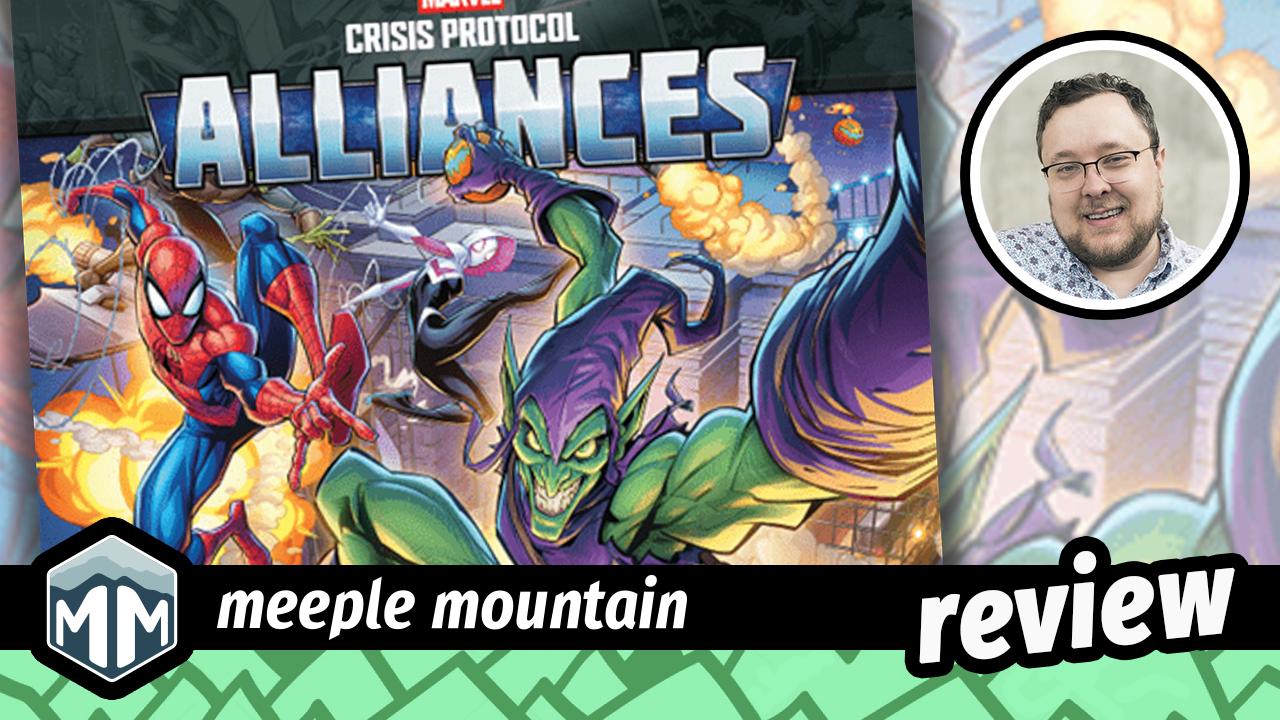
When AMG first announced their foray into the world of board games with the Alliances line as a spinoff from Marvel: Crisis Protocol, I was… skeptical. After all, could they really take a game I love like MCP and spin it off into a team-based co-op experience? Could they capture what makes MCP work? I was dubious. While it’s not a perfect experience, I was completely pleasantly surprised by just how fun the game turned out to be. It’s just an absolute blast.
The quick idea is that each Alliances game brings together a team of four heroes, all with varying superpowers, to take down an iconic villain and their army of goons. Here, we get both Spider-Men (Peter Parker and Miles Morales) along with Black Cat and Ghost-Spider, teaming up to take down the Green Goblin. Together, they’ll fight him across three different chapters (two objective-based chapters and a final boss fight), each lasting roughly 90 minutes each.
Getting started is simple - each player picks the character they want to be and picks a level 1 upgrade, and then you’re off. It’s worth noting that if you’re a solo player, this game is very easily playable in solo mode with you controlling all four characters, though I can’t speak to that experience…
A trio of veteran board game industry professionals have launched a new tabletop gaming agency, with the aim of helping businesses within the hobby get their games developed and into the market.
Hues and Cues designer Scott Brady, Sagrada co-creator Daryl Andrews and Friendly Skeleton CEO Jacob Way said Best in Play will offer everything from interim executive leadership and designer representation to publisher submission management and crowdfunding strategy.
Brady said, “Best in Play was created to bring together people and opportunities that should already be working with one another.
“Great intellectual properties need the right designers and publishing partners, designers need better access to decision-makers, and companies sometimes need experienced leadership without the time or resources required to build an entire department.”
Best in Play says its five core service areas comprise IP matchmaking, crowdfunding consultation, interim replacement of key personnel, publisher-inventor relations and identifying publishers and licensing opportunities for individual games, multiple projects or designer catalogues.
The company announced at launch that it has already been hired as a consultant for an unspecified US-based “creator-brand merchandising and e-commerce company”, providing senior-level leadership and games-industry expertise while the client continues its search for a permanent head of games.
Best in Play said that project will run the gamut of product development, licensing, publishing, production, crowdfunding and portfolio strategy.
Andrews said of the assignment, “An important initiative should not lose six months of momentum because a key role is temporarily vacant.
“Our model gives clients access to an experienced team that can step in quickly, evaluate the situation and keep products, partnerships and internal teams moving forward.”
The company is also working on a tabletop project based on an unnamed “major video game intellectual property”, with a crowdfunding launch planned for early 2027.
Way said, “A recognizable property may attract attention, but a successful crowdfunding campaign still needs the right product, positioning, audience strategy and operational plan.
“Our goal is to build campaigns that respect the fans, communicate value clearly and create a foundation for success beyond the initial launch.”
As well as the founding trio of managing directors, the Best in Play team also includes strategic contributors David Gordon, the co-creator of Finspan, Eastar Game Manufacturing founder and CEO David Du, Legend of the Five Rings: The Card Game co-designer Erik Dahlman and Daniel Pesante.
Brady previously launched his development studio A Game Studio at the start of 2024, following the 2020 release of the big-selling Hues and Cues and the success of his cat-themed abstract strategy Boop in 2022.
He previously spent two years as head of talent acquisition at Maestro Media, following several months working in investor relations, before leaving the company in early 2025.
Jacob Way, meanwhile, began his board game career as COO and co-founder of Deep Water Games, which for several years operated as a subsidiary of Ox Eye Media.
Deep Water, which is best known for sketching game MonsDRAWsity, spun out from Ox Eye as an independent business in 2022 under Way before rebranding as Friendly Skeleton.
French board game distributor and publisher Atalia has entered compulsory liquidation, saying an increasingly saturated market, the limited capacity of retailers and the loss of distribution rights to bestselling titles left the business unable to remain viable.
A statement posted to Atalia’s Facebook page said the rapid expansion of the tabletop market since the company was founded in 2015 had created a tougher commercial environment for smaller distributors, despite the industry’s continued growth.
Atalia said that despite soaring numbers of players in that time, “so many new games are being released today that the market has become saturated. Shops no longer have the space, the time or the cash flow to stock all the games arriving each week”.
It added, “They therefore naturally turn to distributors with the biggest marketing budgets, some of whom invest sums each year that exceed Atalia’s annual turnover.
“This year, Atalia has lost the distribution rights for its latest bestsellers, as their publisher has chosen to entrust them to a distributor offering greater financial and marketing resources.
“We naturally respect these decisions, but we cannot hide our regret. Without these bestsellers, it has become increasingly difficult to finance new releases and ensure the company’s long-term viability.
French board game distribution is dominated by industry heavyweights Asmodee and Hachette, the latter via its Gigamic and Blackrock subsidiaries.
Atalia was founded in 2015 as a French board game distributor, before expanding into localisation and then publishing in 2021. It distributed games to hundreds of specialist retailers across France and neighbouring francophone territories.
The company says on its website that it deliberately maintained a relatively small catalogue, so individual games entrusted to it would not be “lost amongst an overwhelming number of titles”.
Atalia’s decision to double its headcount to six amid that success backfired when the publisher of Limite Limite, a French adaptation of Cards Against Humanity which accounted for about half Atalia’s revenue, switched to a new distributor in 2019 with no prior warning.
The company placed itself into receivership the same year, but emerged intact from that process in early 2020, citing strong sales of its bestsellers including Punto and Dreamscape, and receiving court-ordered compensation from the publisher of Limite Limite for the abrupt termination of its distribution deal.
Atalia officially entered compulsory liquidation on July 8 via Nanterre Commercial Court.
The company’s assets, including stock, brand and customer database, will now be offered for sale by the liquidator. Mainardi said interested parties should contact him via private message on Facebook.
He said in the Facebook post, “Today, we turn the page with our heads held high, feeling immense pride in everything we have built together.
“The people we’ve met, the games we’ve played and the memories created during this adventure will remain with us forever.”
Aufnahme: 01.07.2026 Sendedatum: 15.07.2026 Themen 00:00:00 Intro & Begrüßung 00:01:15 Zur Person 00:04:15 Faszination Spiel, Sprache und Systemtheorie 00:13:23 Spiel als Metapher und mögliche Missverständnisse 00:18:22 Beispiel aus Schule: Konferenzen […]
Wir waren im Juni (vor der Hitzewelle) mal wieder ein paar Tage in Hamburg und es hat uns wie immer sehr gut gefallen. Angereist sind wir von Frankfurt/Main mit dem ICE und der war sogar 15 Minuten zu früh in Hamburg-Harburg, wo wir dann allerdings auf die Weiterfahrt warten mussten, da der Zug ja nicht vor der fahrplanmäßigen Abfahrtszeit weiterfahren konnte.
Am Hamburger Hauptbahnhof angekommen sind wir dann noch 2 Haltstellen mit dem Bus zu unserem Hotel an der Außenalster gefahren. Im Hotel Bellevue von der Relexa-Gruppe sind wir auch bei unseren letzten Hamburg-Besuchen immer abgestiegen. Es ist sehr gut gelegen, die Zimmer sind okay und es gibt ein gutes und reichhaltiges Frühstücksbüffet. Leider hat während Corona das gute Restaurant im Hotel geschlossen und nicht wieder aufgemacht, aber in der näheren Umgebung findet man genug Möglichkeiten, um Essen zu gehen.
Blick vom Dach des Hotels auf die AußenalsterUnser Zimmer (mit Fenster zur Außenalster)
Hier ist unser Favorit die Gasstätte Frau Möller, in der Langen Reihe, die man vom Hotel aus in 5 Minuten erreicht. Das Essen dort ist gut, reichlich und wirklich günstig. Es gibt täglich wechselnde Tagesgerichte und auch Vegetarier haben hier genügend Auswahl. Sollte man jedoch erst gegen Abend dorthin gehen, dann kann es vorkommen, dass ein Tagesgericht nicht mehr verfügbar ist.
Hier findet ihr u. a. die Speisekarte (unbedingt einen Blick auf die Wochenkarte werfen) https://www.fraumoeller.com
Da die Gaststätte immer sehr gut besucht ist, kann es von Vorteil sein zu reservieren. Wenn man etwas Geduld hat, bekommt man aber auch mit etwas Wartezeit einen Platz. Um so eher, wenn man kein Problem damit hat, den Tisch mit anderen Gästen zu teilen, was ich persönlich sehr gerne mache, da ich da schon oft ins Gespräch gekommen bin.
Ein weiterer Tipp für einen Hamburg-Besuch ist die Nutzung der Hafen-Fähren der HADAG, da diese auch mit dem 63 Euro Ticket genutzt werden können und man so kostengünstig durch den Hamburger Hafen schippern kann. Pläne findet ihr auf deren Webseite: https://hadag.de/de/
Wir sind mit der Fähre von den Landungsbrücken nach Finkenwerder und zurück gefahren. Leider nicht am Wochenende. Dann hätten wir nämlich noch von Finkenwerder mit der Linie 65 weiter bis nach Blankenese fahren können.
Eine weitere Empfehlung ist der Besuch von Planten & Blomen. Das ist eine große Parkanlage, die sich durch das Zentrum von Hamburg zieht. Von Anfang Mai bis Ende September kann man hier am Parksee mittags zwischen 16 und 18 Uhr die Wasserspiele bewundern und abends ab 22 Uhr (im September ab 21 Uhr) die Wasserlichtkonzerte. Die kostenlose 30-minütigen Vorführungen werden live von zwei Künstlern begleitet – einer steuert die Wasserfontänen, der andere spielt das sogenannte „Lichtklavier“ passend zu klassischen, jazzigen oder modernen Klängen. Leider hatten wir das Pech, dass bei uns die Lichtanlage ihren Dienst verweigert hat.
Wir hatten uns frühzeitig (gegen 21 Uhr) einen Platz im Café Seepavillon gesichert und hatten von dort einen tollen Blick auf die Wasserspiele.
An einem Abend war ich auch im Würfel und Zucker. Wenn ich schon mal in Hamburg bin, dann muss ich auch das WuZ besuchen. Ich hatte mich dort mit Bekannten verabredet und wir haben Bounce it und Chimera Station gespielt.
Chimera Station mit Magnus (rechts) und Jope (links)
Bei Chimera Station bauen wir gemeinsam mit unseren Aliens an einer Raumstation. Wir können dabei unsere Aliens mit verschiedenen Körpermodifaktionen verstärken (Klauen, Tentakel, Gehirne und Blätter).
Bounce it
Bounce it ist ein Geschicklichkeitsspiel, bei dem es darum geht möglichst oft seine 3-4 Bällen in die Mitte der Spielschachtel zu werfen. Dabei müssen sie vorher 1 mal auf dem Tisch auftippen.
Was ich auch empfehlen kann ist ein Besuch der Elbphilharmonie. Der Besuch der Plaza (Balkon rund um das Gebäude) ist hier kostenlos. Man muss sich vorher nur ein Ticket am Ticketschalter vor dem Eingang besorgen. Vom Balkon aus hat man einen sehr schönen Rundumblick auf den Hamburger Hafen, die Innen- und die Speicherstadt .
Ausblick auf die St. Pauli Landungsbrücken (von der Elbphilharmonie aus)
Wir haben während unseres Hamburg-Aufenthalts auch noch 2 Bootstouren gemacht, eine 1-stündige Hafenrundfahrt und eine 1-stündige Alsterrundfahrt, außerdem sind wir einen Tag mit dem Roten Doppeldecker durch die Stadt gefahren. Das Kombiticket „Entdecker Tour“ hat 62 Euro gekostet.
Blick von der Außenalster in Richtung Innenstadt/Hafen
Erst später haben wir den Hamburg All-in-Pass entdeckt, der hier vielleicht noch die bessere Wahl gewesen wäre, da er mehr beinhaltet: Hamburg All-In-Pass Bei dem Pass sind all die genannten Touren auch drin, aber auch noch einiges mehr. Man muss sich hier nur entscheiden wie lange der Pass gelten soll, wovon dann der Preiss abhängt. Ich denke hier wäre der 3-Tage-Pass eine gute Wahl.
Dinge, die wir dieses Mal nicht mehr unterbringen konnten, da wir uns auch nicht stressen wollten, die ich aber jedem empfehlen kann sind:
Ein Besuch des Miniatur-Wunderland (am besten die Tickets vorher online buchen). Ich war schon 3 mal hier und könnte es immer wieder besuchen. Ein Tag reicht hier auch nicht aus, um sich alles genau anzuschauen und das Miniatur-Wunderland wird auch ständig erweitert.
Ein Besuch des Spicys Gewürzmuseum in der Speicherstadt. Hier kann man Gewürze entdecken und einiges über die Geschichte der Gewürze (Anbau, Handel …) erfahren. Man kann viel der Gewürze auch probieren und am Ende natürlich auch kaufen.
Ein Besuch des Planetariums. Hier gibt es viele interessante Shows (Tickets für 12,30 Euro) und man hat von der Aussichtsplattform (Eintritt 2 Euro) einen tollen Blick über den Stadtpark bis zum Fernsehturm, dem Michel und der Elbphilharmonie.
Besuch eines Konzertes in der Elbphilharmonie. Das hätten wir uns früher überlegen müssen, da es sehr schwierig ist hier kurzfristig noch Karten zu bekommen. Während wir in Hamburg waren hätten wir aber die Chance gehabt ein kostenloses Konzert in der Laeiszhalle. Hier haben nämlich an einem Tag Absolventen der Musikhochschule gespielt. Weitere kostenlose Konzerte findet man auf der Webseite der Stadt Hamburg: https://www.hamburg.de/freizeit/kostenlos-musik-333640
Ein Besuch des alten Hamburger Elbtunnels. Auch dieser Besuch ist kostenlos. Man kann hier von den St. Pauli Landungsbrücken 426 Meter unter der Elbe hindurch zur Elbinsel Steinwerder laufen.
Zu guter Letzt will ich auch unbedingt mal in die Mittelalter und Rollenspiel Taverne Zum tanzenden Einhorn. Eine Nerd-Bar für Rollenspieler und Mittelalterfans in der man auch Brettspiele spielen kann. Leider hat die Bar am Montag und Dienstag geschlossen, was dazu geführt hat, dass es nicht mehr in unseren Zeitplan gepasst hat. So wird ein Besuch bis zu meinem nächsten Hamburg-Aufenthalt warten müssen. Der aber sicherlich kommen wird.
Alter Elbtunnel (Foto von meinem Besuch in 2019)
Hamburg und seine Plakate
Zum Abschluss noch etwas was ich an Hamburg auch immer wieder mag sind die Plakate die man dort immer wieder entdeckt. 2 davon musste ich auch einfach fotografieren. Okay, das zweite ist natürlich eine Werbung, aber da steckt viel Wahres drin
Nahverkehr in Hamburg
Wir haben in Hamburg sehr viele Strecken mit dem Bus zurückgelegt, was ich auch durchaus als sehr gut empfand. Dank 63 Euro-Ticket muss ich mir da auch keine Gedanken um einen Fahrschein machen.
Ich musste leider mehrfach feststellen, dass die HVV-App nicht immer die besten Verbindung heraussucht. Vor allem gibt es leider keine Option, eine Fahrt so zu planen, dass man möglichst viel von der Strecke mit dem Bus, der U- oder S-Bahn zurücklegt und nicht immer wieder größere Strecken zu Fuß, obwohl dies durchaus möglich wäre. Vielleicht habe ich die Option aber auch nicht gefunden.
Ich habe mich dann oft damit beholfen, dass ich erst eine Teilstrecke zum Hauptbahnhof (ZOB oder Steintordamm) gesucht habe und dann von dort eine weitere Teilstrecke zu meinem Ziel. Das hat oft besser funktioniert als direkt die gesamte Strecke zu suchen. Auch fand ich, dass die DB-App oft bessere Ergebnisse geliefert hat. Sehr hilfreich finde ich auch den Plan des Hamburger Busliniennetzes parat zu haben: https://www.nimmbus.de/frame.php?doc=busliniennetz.htm
Man kann dann auch immer sehr gut erst einmal in Google Maps nachschauen, welche Haltstelle dem Ziel am nächsten ist und dann im Netzplan schauen, wie man am besten dorthin gelangt.
Nachtrag: Katzencafés
Da hab ich doch glatt noch was vergessen. Wir haben in Hamburg auch noch 2 Katzencafes der Kette Katzentempel besucht. Eines in der Hafencity und das, zu diesem Zeitpunkt, gerade frisch eröffnete am Holstenwall, welches uns besser gefallen hat. Das ´Konzept der Katzentempel ist es vegane Speisen anzubieten und Katzen eine Heimat zu bieten. Die Katzen entscheiden selbst ob sie zu einem kommen oder nicht. Sie haben in dem Katzencafe einige Rückzugsmöglichkeiten, die man auch unbedingt respektieren sollte.
Die oberen beiden Bilder sind aus/vom dem Katzentempel in der Hafencity, die unteren beiden aus dem am Holstenwall.
Die Preise im Katzentempel sind jetzt nicht gerade günstig, aber die Katzen müssen ja auch noch versorgt werden. Es gibt in Hamburg auch noch ein weiteres Katzencafe, das Cat Café in der Wandsbeker Chaussee. Das steht für unseren nächsten Hamburgbesuch auf der Liste.
Editor’s note: GAMA is one of the sponsors of the BoardGameWire newsletter
The Origins Awards, one of tabletop gaming’s longest-running prizes voted on by industry professionals, has crowned its latest group of winners after whittling them down from 120 nominees.
Jon Perry’s Hot Streak continues to live up to its name as far as award wins go, adding party game of the year to a pair of Golden Geek Award wins, casual game of the year in the American Tabletop Awards, and a ‘recommended’ accolade in the Spiel des Jahres.
Railroad Tiles, designed by Hjalmar Hach and Lorenzo Silva, took Gateway Game of the Year, while Will Thompson’s Winter Rabbit was named Light Strategy Game of the Year at the award ceremony, which took place at Origins Game Fair last month.
Railroad Tiles, designed by Hjalmar Hach and Lorenzo Silva
The awards also recognised Matt Brown and Zara Reid’s conservation-themed board game Kavango with a Sustainability Award, which aim to celebrate games with thoughtful production and publishers which “have taken strides towards sustainable manufacturing to reduce the impact on the natural environment”.
Outside the board game categories, James Parks and Ben Costa’s Land of Eem won Roleplaying Game of the Year, while in the trading card and collectible game categories Riftbound: Proving Grounds won Fixed Constructible Game of the Year, while the Gudnak: Expansion Bundle took the Randomized Constructible Game award.
Goblin Hobbies’ Stampin’ Plates claimed the Paint/Hobby Accessory award, while Luis Silva’s TCG design Shard Bugs claimed Fan Favorite Game of the Year, voted on by Origins attendees.
GAMA made an effort to rectify that error with its announcement of the award winners, including not only the names of the designers but also the artists who worked on each title.
The Origins awards, which were first presented in 1975, have been in heavy flux over the past few years, going from 10 categories in 2019 to 24 in 2024 – with the make-up of those categories significantly shaken up from year to year.
GAMA briefly introduced categories in 2024 which represented its membership having expanded beyond just retailers, publishers and wholesalers – including recognition for artists, writers and media.
But those segments were quickly dropped again in 2025, with categories cut including Best Media Production, Best Game Related Writing and Best 2D Artwork – although the miniatures segment was expanded from two categories to three, covering games, the miniatures themselves, and paint and accessories.
Separate from the main slate of awards, the trade organisation also revealed its hall of fame entrants this year, awarded – like the Origins Awards – by its division the Academy of Adventure Gaming Arts and Design.
AAGAD describes itself as “a peer based network of gaming industry professionals whose mission is to promote innovation and excellence in design and production of games and game related materials”.
Individuals inducted into the hall of fame this year include Richard Borg, famous for his design of the Command and Colors system used by games including Memoir ’44, and Antoine Bauza, the creator of designs including 7 Wonders, Hanabi and Tokaido.
Magic: The Gathering, Pathfinder RPG and Dungeons & Dragons artist Wayne Reynolds was also inducted into the hall of fame.
Origins Awards 2026 – Full Results
Gateway Game of the Year Railroad Tiles Publisher: Horrible Guild Designers: Hjalmar Hach and Lorenzo Silva Artists: Francesco De Benedittis and Barla Tranquilli
Party Game of the Year Hot Streak Publisher: CMYK Designer: Jon Perry Artist: Cécile Gariépy
Light Strategy Game of the Year Winter Rabbit Publisher: Absurdist Productions Designer: Will Thompson Artists: Kindra Swafford and Jonni Ketcher
Heavy Strategy Game of the Year Speakeasy Publisher: Eagle-Gryphon Games Designer: Vital Lacerda Artist: Ian O’Toole
Cooperative/Solo Game of the Year The Lord of the Rings: Fate of the Fellowship Publisher: Z-Man Games Designer: Matt Leacock Artists: Jared Blando and Cory Godbey
Roleplaying Game of the Year Land of Eem Publisher: Exalted Funeral Designed & Written by: James Parks and Ben Costa Artists: Justin Gerard, Sean Kiernan, Anneliese Mak, Sam Mamei, Rosario Mendez and Rob Gatto
Roleplaying Game Supplement of the Year Call of Cthulhu: The Sutra of Pale Leaves – Twin Suns Rising Publisher: Chaosium Designers/Authors: Yukihiro Terada, Jason Sheets, Damon Lang, and Andrew Logan Montgomery
Miniatures Game of the Year Blood Bowl Third Season Edition Publisher: Games Workshop
Miniature of the Year Warhammer: Age of Sigmar – Festus, The Leech Lord Publisher: Games Workshop
Paint/Hobby Accessory of the Year Goblin Hobbies Stampin’ Plates Producer: Goblin Hobbies Designed by: Brent Amberger and Casey Alden
Fixed Constructible Game of the Year Riftbound: Proving Grounds Publisher: UVS Games & Riot Games Designers: David Smith and Jon Moormann
Randomized Constructible Game of the Year Gudnak: Expansion Bundle Publisher: Chaotic Great Games Designer: Tim O’Brien and Ian Oliver Artist: Vittoria Pompolani
Fan Favorite Game of the Year Shard Bugs Publisher: Shard Bugs LLC Designer: Luis Silva Artists: Ray of Sand, Nelygibi, Julio E. Jácome Paz, María Ayuso, Alma Faustica, Pietro Desirò, Ninamarie, Steve Ozminkowski, Erick Mezart
With this My Favorite Wargame Cards Series, I hope to take a look at a specific card from the various wargames that I have played and share how it is used in the game. I am not a strategist and frankly I am not that good at games but I do understand how things should work and be used in games. With that being said, here is the next entry in this series.
#84: Marconi Transmitter from The Hunt from Salt & Pepper Games
I have played several hidden movement games over the years and enjoyed them all. Some of these titles have included wargames such as They Come Unseen from Osprey Games, Sniper Elite: The Board Game from Rebellion Unplugged and Bomber Command from GMT Games as well as a few board games including Hunt for the Ring from Ares Games. The concept of moving cautiously, attempting to evade pursuers, all while trying to locate and acquire or destroy objectives makes for a very interesting gaming experience. These situations can make for some really tense games that cause your head to ache and your wits to be tested. But they rely on some bluffing as well. Trying to force your opponent to anticipate where they think you should be and then trying not to be there. A really great mechanic in board games but not always easy to pull off and make for a very playable and interesting game. In 2022, we played a new design from Matthias Cramer and Engin Kunter that took this hidden movement concept and put it into a historically based game about the struggle over control of the South Atlantic between the British Royal Navy and the German Kriegsmarine during the early years of World War II called The Hunt from Salt & Pepper Games.
The Hunt is a Card Driven Game where the German player has to attempt to stay hidden while trying to sink merchant shipping as the Royal Navy hunts for them throughout the South Atlantic. The players each have asymmetric actions to use to accomplish their missions and each has a tough time doing what they have to do. But, if they manage their cards wisely, using them as effectively as possible, they can successfully either evade their pursuer or catch their prey.
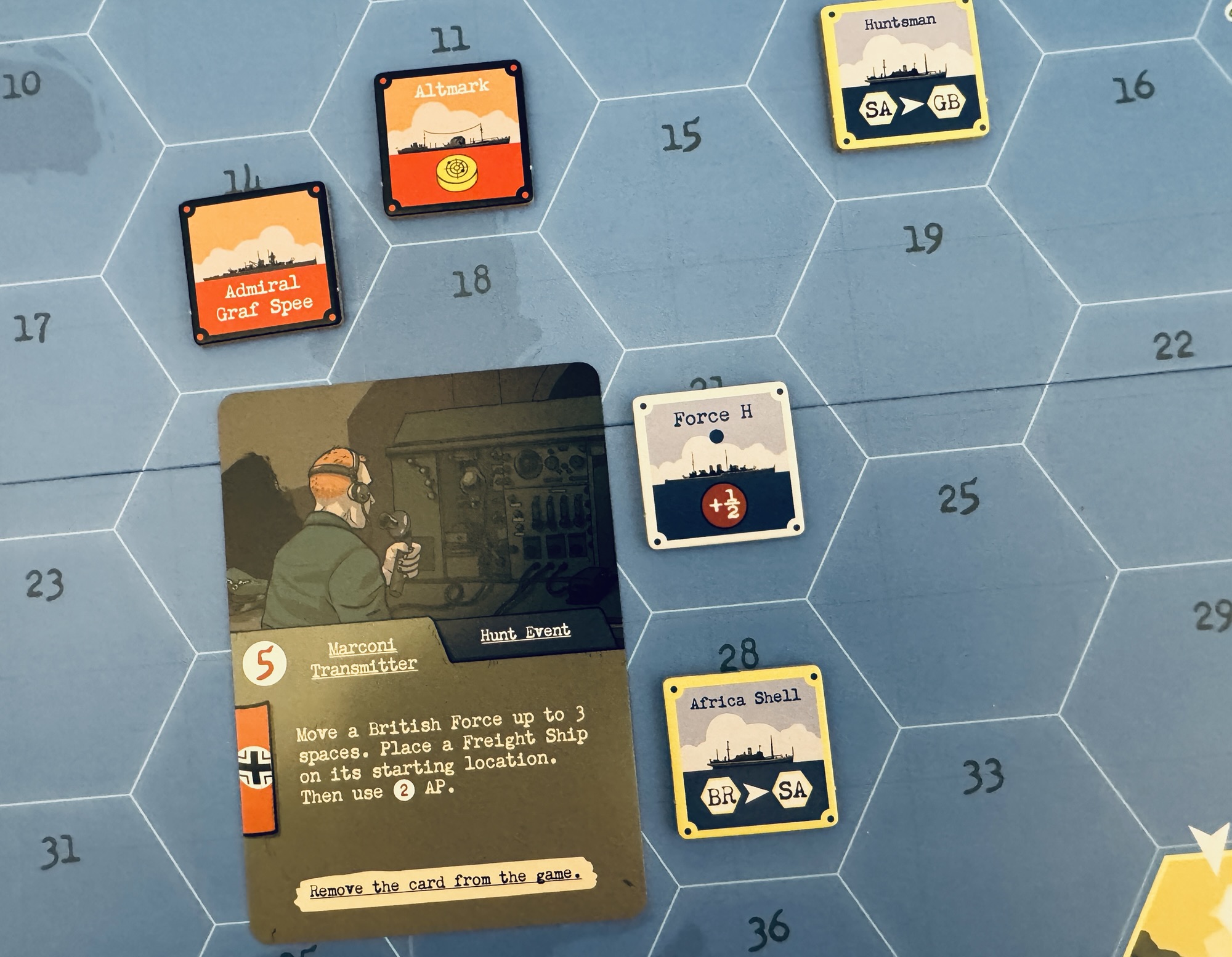
In today’s post, we will take a look at the very useful German card Marconi Transmitter. Marconi Transmitter is a 5 Ops card, which makes it a very important card in the German deck as it allows for the taking of 2-3 actions in a single turn, but for which there is an even more important use as a means of setting yourself up for that easy score to sink a merchant vessel. In the game, the British have multiple Task Forces that will search the South Atlantic for the Graf Spee attempting to find her, engage her and sink her to the bottom. As a Hidden Movement game, the German player has surprise on their side and must use tactics that manipulate and change things for the British player making their searches much more difficult and time consuming. The Marconi Transmitter allows the German player to move a British Task Force up to 3 hexes away and then to choose a Freight Ship and then place that ship back onto its starting location on the board. This card has the ability to clear the way of enemy ships searching for the Graf Spee but then follows that up with the relocation of an unsuspecting Freight Ship to place it within striking distance of the pocket battleship for an easy kill. I just love these kind of cards that manipulate things and provide means to change up the current situation.
Marconi transmitters were pioneering early radio devices developed by Guglielmo Marconi in the late 1890’s. Primarily consisting of spark-gap transmitters, they generated radio waves that allowed ships and continents to communicate via Morse code without wires, paving the way for modern broadcasting and other telecommunications. This advancement was used by the Allies to hunt for the Graf Spee in the South Atlantic and caused the German pocket battleship to change some of its operating procedures. The Admiral Graf Spee did not elude the Marconi radio transmitters through electronic jamming. Instead, her commanding captain, Hans Langsdorff, successfully evaded Allied interception by using strict radio silence and executing aggressive threats to ensure merchant vessels never broadcasted their distress calls.
When the Graf Spee intercepted a merchant ship, she used her speed and imposing silhouette to intercept before a signal could be sent. The standard British raider defense was to use their Marconi-equipped transmitters to call for help. However, as soon as a merchant ship began transmitting a warning, the Graf Spee would flash a signal demanding they cease transmission immediately, threatening to open fire with her devastating main armament. Outgunned and at the mercy of the German ship, the merchant crews complied, shutting off their wireless.
Because the Graf Spee traveled thousands of miles across the remote South Atlantic and Indian oceans, she remained unseen by simply avoiding the heavy shipping lanes. Captain Langsdorff further deceived Allied forces by utilizing visual camouflage. By attaching fake turrets and a dummy funnel, and flying false colors, he bypassed merchant shipping unmolested while maintaining strict radio silence to keep his location hidden.
Here is a link to our full video review of the game:
Canadian board game publisher Off the Page Games is expanding beyond its comic book roots with the launch of a new imprint focused on original IP.
The company, which has built its reputation adapting indie comics into tabletop games such as Mind MGMT, has unveiled Off the Page Games Unbound, which will publish games not tied to existing comic book licences.
In a reversal of Off the Page’s previous strategy, the company said it had hired award-nominated comic book creator Chris Schweizer and illustrator Rocio Ogñenovich for Unbound to create a series of comics based on The Seekers.
The Seekers, published by Off the Page Games Unbound
Schweizer previously collaborated with the publisher to turn his graphic novel series The Creeps into a family-weight board game, which is due for release this autumn.
The Seekers webcomic will be released weekly leading up to the crowdfunding campaign for the board game, with physical copies included with the final product.
Cormier said, “I’m excited to continue converting my favourite comics into cool board games, but I’m also pumped to bring some other surprises that aren’t tied (…or bound!) to any specific comic.”
Cormier launched Off the Page in 2019 by publishing Mind MGMT, based on the Dark Horse comic book series created by Matt Kindt.
The publishers subsequent titles have included Harrow County and Corps of Discovery, while Cormier’s designs with other publishers include Junk Art, co-created by Sen-Foong Lim, and In the Hall of the Mountain King, which was designed alongside Graeme Jahns.
It’s long been said that we’re the foremost experts in knowing which way the awards winds blow, so we’re putting our talents to use guessing, nay, predicting, nay, deciding who the winners in the Golden Geeks are going to be. Before we geek out, we talk about Chronicles of Crime: 2400, Quarto, and Shackleton Base: A Journey to the Moon.
If you don’t want to miss an episode, please subscribe on Apple Podcasts/Google Podcasts/Stitcher/Spotify, or add our RSS feed to your favourite app. Reviews and subscriptions really help us and would be greatly appreciated! To download the episode directly, click here.
If you’d like to discuss anything in the episode, please do so in the comments below, visit our BoardGameGeek guild, join our Discord, or Facebook Group! Any feedback is also always helpful. If you’d like to show your support for the show, we also have a Patreon with some fun rewards, and a merch store!
Timecodes:
04:07 – Chronicles of Crime: 2400 12:00 – Quarto 16:13 – Shackleton Base: A Journey to the Moon 30:16 – Golden Geeks 2025
Thank you to Heart Society for generously letting us use What’s On Your Mind, Kid? from their album Wake the Queens.
If you don’t want to miss an episode, please subscribe on Apple Podcasts/Google Podcasts/Stitcher/Spotify, or add our RSS feed to your favourite app. Reviews and subscriptions really help us and would be greatly appreciated! To download the episode directly, click here.
If you’d like to discuss anything in the episode, please do so in the comments below, visit our BoardGameGeek guild, join our Discord, or Facebook Group! Any feedback is also always helpful. If you’d like to show your support for the show, we also have a Patreon with some fun rewards, and a merch store!
Timecodes:
04:07 – Chronicles of Crime: 2400 12:00 – Quarto 16:13 – Shackleton Base: A Journey to the Moon 30:16 – Golden Geeks 2025
Thank you to Heart Society for generously letting us use What’s On Your Mind, Kid? from their album Wake the Queens.
Aufnahme: 19.01.2026 Sendedatum: 15.02.2026 Themen 00:00:00 Intro & Begrüßung 00:00:30 Zur Person & Dissertation 00:05:40 Forschungsmethodik & Ergebnisse 00:24:25 Einsatz von Brettspielen zum Lernen 00:29:06:00 besondere Rolle von Brettspielen in […]
The Soviet Union was one of the great dictatorships of the 20th century. It applied an immense amount of coercion on its own citizens as well as many of its neighboring countries. Yet the almost seventy years between the Soviet Union’s founding from the ashes of the Russian Civil War in 1922 and its fragmentation into 15 nation-states in 1991 are no monolith of unfreedom. There were two distinct periods of liberalization around a generation apart from each other – one that began under General Secretary Nikita Khrushchev in the 1950s, and one that began under General Secretary Mikhail Gorbachev in the 1980s. Let’s look at them, beginning with Khrushchev’s thaw, in terms of domestic, foreign, and economic policy. The post on Gorbachev’s reforms will follow in two weeks. As always, there will be board games along the way.
Freedom of Thought, Speech, and Political Expression
Joseph Stalin’s Soviet Union curtailed its citizens’ expression dramatically. Historiography has recounted Stalin’s reign of terror in detail, yet the best-known expression of the totalitarian control to which the Soviet Union aspired from the 1930s on is George Orwell’s dystopian novel 1984: Its one-party state does not only control citizens’ access to information (they are being exposed to constant propaganda and expected to keep up with its frequently changing, often contradictory contents), but demands active participation in the daily reconstruction of the system, ranging from institutionalized “two-minute hate” against political enemies to unlimited devotion to the “Big Brother” at the top of the pyramid.
The Soviet equivalent to the “Big Brother,” of course, was Stalin who was exalted in an official cult of personality as a wise and infallible leader, working tirelessly for the security and well-being of the Soviet Union. Whatever went wrong on the Soviet Union’s inexorable march of progress was the fault of an inept underling or a shadowy enemy.
When Stalin died, his lieutenants fought briefly, but viciously over his succession. Nikita Khrushchev emerged victorious. Khrushchev had been as loyal to Stalin as his chief rivals and immediatly used Stalinist methods to depose Lavrentiy Beria, the powerful Minister of Internal Affairs (and thus chief of the domestic security services). Beria was charged with treason, put through a mock trial, and executed.
Khrushchev’s skillful power politics could also swing the other way, though. He prepared a report on Stalin’s crimes which he delivered to a stunned audience at the 20th Congress of the Communist Party of the Soviet Union on February 25, 1956. For four hours, Khrushchev detailed Stalin’s party purges, his deportation of whole peoples deemed unloyal, and, most of all, how Stalin had established a cult of personality in which he was almost worshipped like a god.
Khrushchev’s de-Stalinization drive did not stop at mere proclamations. The late 1950s and early 1960s saw a lessening of censorship: Alexander Solzhenitsyn was allowed to publish his Gulag novel One Day in the Life of Ivan Denisovitch.
There were limits, however: Criticism of Stalin’s Gulags was one thing, criticism of the October Revolution another. Boris Pasternak’s Doctor Zhivago was not published in the USSR. When Pasternak won the Nobel Prize in literature for it, he and his family were threatened by agents of the state. Cowed, Pasternak did not travel to Stockholm to accept the prize.
Still, Khrushchev’s pivot represented an important turn in the state’s relationship with violence. While Soviet citizens were still routinely surveilled and subjected to coercion, it was neither with the overwhelming force of Stalinism nor with its unpredictability. The age of escalating purges, in which the accusers of today would be the accused of tomorrow was over.
Peaceful Coexistence and Khrushchev’s Many Other Schemes
Khrushchev’s 1956 speech was meant to remain secret, known only to its direct recipients and the allied Communist governments in Eastern Europe, but a member of the Polish Communist party smuggled a copy abroad via the Israeli embassy in Warsaw. From there, it soon gained wide circulation, and while Khrushchev had intended it to be a domestic power play only (it delegitimized his rivals Georgy Malenkov and Vyacheslav Molotov), he now also reaped benefits abroad: The post-Stalinist Soviet Union was naturally a more attractive ally and role model for both the socialist movements in Europe and the decolonizing and freshly independent nations in Africa and Asia.
This unintended benefit is the focus of the foreign-policy heavy Twilight Struggle‘s De-Stalinization card: The Soviet player may move up to four points of influence around on the globe. That may seem like a zero-sum game – after all, the influence is not added, but only moved. But the Soviet Union typically has a lot of spare influence in Eastern Europe after the first one or two turns, and De-Stalinization is the earliest and best way to gain access to faraway continents, chiefly South America (and, to a lesser degree, Africa).
Even before Khrushchev’s speech was leaked, his approach to foreign policy markedly differed from Stalin’s last years. When the relationship with the Soviet Union’s erstwhile allies had deteriorated after the end of World War II, Stalin had adopted a confrontational stance based on the assumption that the world was split in two hostile camps. Khrushchev, on the other hand, approached the western powers under the new motto of peaceful coexistence. Socialism and capitalism could both inhabit the same world. Of course, Khrushchev as a convinced Communist believed that his system would eventually triumph. Until then, peaceful coexistence would not only foster peace, but also make socialism more attractive, and free up resources for economic development and consumer goods (more on that below).
The economic (factory icon) and especially ideological (socialist – man with flat cap icon) bonuses are nice, but what sets the Peaceful Coexistence event in Wir sind das Volk! – 2+2 (Richard Sivél/Peer Sylvester, Histogame) apart is the ability to advance peace (dove icon) – indispensable when the world is sliding toward nuclear war!
Khrushchev was always better at initiating things than at seeing them through. Peaceful coexistence gave way to other projects – be that the support of nationalist movements in the global south or a re-newed competition with the West over Central Europe. And while Khrushchev thought that the Soviet Union and the western powers could live next to one another, that tolerance did not extend to heterodox socialist ideas within his own sphere of influence: When the Hungarian Socialist Workers’ Party announced to withdraw the country from the Warsaw Pact and hold free elections, Khrushchev had the reform movement quashed by Soviet tanks.
The Soviet economy under Stalin had been tuned to increase heavy industrial output to achieve a fast industrialization on the one hand and provide the basis for the country’s military security. This approach was validated by the country’s survival of the Nazi invasion and its eventual military victory in 1945. The proponents of this economic policy which usually went together with ideological mobilization and a confrontational foreign policy were called to adhere to politika. Yet after Stalin’s death, the rival faction of tekhnika gained ground: Its advocates favored a less aggressive foreign policy, less ideological mobilization, and, most of all, more market elements in the economy which would then produce more consumer goods.
Khrushchev positioned himself in the middle: Heavy industry would have priority (the Soviet Union was in a nuclear arms race with the United States whose economy was around three times as large as the Soviet, after all), but more attention would be given to consumer goods than before. Soviet citizens enjoyed a limited amount of prosperity with radios, washing machines, and sometimes even cars. Khrushchev saw this also as an instrument in the systemic competition of the Cold War: Material comfort and personal lifestyles would influence people’s allegiances as much as military strength or ideological treatises.
Khrushchev’s confidence in that regard led him to agree with the United States on mutual national exhibitions which would showcase their respective country to the citizens of the other. The confidence, however, was not quite justified: The Soviet exhibition in New York aroused curiosity, but the American one in Moscow was positively overrun. It also produced one of the iconic pictures of the Cold War with Nikita Khrushchev and US Vice President Richard Nixon debating the merits of their respective systems surrounded by American household appliances – the “Kitchen Debate.”
Some Soviet citizens might have dreamed of living in America, but their personal lifestyles already became more akin to those of Americans under Khrushchev. Even more important than the new consumer goods were their living conditions: Housing in big Soviet cities had been dominated by kommunalkas – large apartments from pre-revolutionary times which had been split to accommodate several families, each living in a single room and sharing the kitchen and bathroom with the others. These crammed living spaces afforded their inhabitants no privacy whatsoever. Only the elites of Stalin’s Soviet Union had apartments to themselves. Khrushchev started an ambitious housing program based on prefabricated, concrete-paneled apartment buildings which allowed millions of Soviet citizens to move into an apartment just for their own family for the first time.
As with foreign policy, Khrushchev started more economic reform projects than he saw through. The ambitious “Virgin Lands” campaign which aimed at alleviating Soviet food shortages by cultivating vast swathes of Siberia and northern Kazakhstan petered out after a few years. His scheme to introduce an Iowa-style corn belt fared even worse, discrediting both corn and Khrushchev in the Soviet Union.
Khrushchev’s Ouster
The economic starts and shifts of Khrushchev’s tenure undermined his position, as did his foreign policy unpredictability ranging from arms control to confronting the United States over Cuba. Most damaging to him, however, were his constant shuffles in the Communist Party. Disaffected cadres who feared they might lose their offices overthrew Khrushchev in October 1964. They installed the less fickle Leonid Brezhnev as new General Secretary of the Communist Party of the Soviet Union. The conservative Brezhnev would tone down some of Khrushchev’s domestic reforms, resulting in a more restricted cultural and literary climate, but stuck with Khrushchev’s economic reforms and conducted foreign policy along the lines of détente with the West.
Not everything about Khrushchev was as cuddly as this bear which he received when visiting an East German electronics factory, but his rule made the Soviet Union a better place to live and furthered its international power and prestige. Image from Wir sind das Volk! – 2+2.
In the end, Khrushchev himself was one of the beneficiaries of the liberalization he had pushed: Unlike the victims of the purges of the 1930s (or even Beria), he was not subjected to a mock trial and executed. Instead, he officially resigned for health reasons and was allowed to live out his days at a comfortable dacha in the countryside.
The authoritative biography remains Taubman, William: Khrushchev. The Man and His Era, Norton, New York City, NY 2004.
A magisterial mosaic of Soviet social, economic, and cultural life is Schlögel, Karl: The Soviet Century. Archaeology of a Lost World, Princeton University Press, Princeton, NJ 2023.
On the suppression of the Hungarian revolution and its impact on Soviet and western foreign policy, see Békés, Csaba: The 1956 Hungarian Revolution and World Politics, (Cold War International History Project Working Paper No. 16), Washington, D.C. 1996.
On the politika/tekhnika split, see Priestland, David: Cold War Mobilization and Domestic Politics: the Soviet Union, in: Leffler, Melvyn P./Westad, Odd Arne (eds.): The Cambridge History of the Cold War. Volume I. Origins, 5th edition, Cambridge University Press, Cambridge 2013, pp. 442-463.
The Soviet Union was one of the great dictatorships of the 20th century. It applied an immense amount of coercion on its own citizens as well as many of its neighboring countries. Yet the almost seventy years between the Soviet Union’s founding from the ashes of the Russian Civil War in 1922 and its fragmentation into 15 nation-states in 1991 are no monolith of unfreedom. There were two distinct periods of liberalization around a generation apart from each other – one that began under First Secretary Nikita Khrushchev in the 1950s, and one that began under General Secretary Mikhail Gorbachev in the 1980s. Let’s look at them, beginning with Khrushchev’s thaw, in terms of domestic, foreign, and economic policy. The post on Gorbachev’s reforms will follow in two weeks. As always, there will be board games along the way.
Freedom of Thought, Speech, and Political Expression
Joseph Stalin’s Soviet Union curtailed its citizens’ expression dramatically. Historiography has recounted Stalin’s reign of terror in detail, yet the best-known expression of the totalitarian control to which the Soviet Union aspired from the 1930s on is George Orwell’s dystopian novel 1984: Its one-party state does not only control citizens’ access to information (they are being exposed to constant propaganda and expected to keep up with its frequently changing, often contradictory contents), but demands active participation in the daily reconstruction of the system, ranging from institutionalized “two-minute hate” against political enemies to unlimited devotion to the “Big Brother” at the top of the pyramid.
The Soviet equivalent to the “Big Brother,” of course, was Stalin who was exalted in an official cult of personality as a wise and infallible leader, working tirelessly for the security and well-being of the Soviet Union. Whatever went wrong on the Soviet Union’s inexorable march of progress was the fault of an inept underling or a shadowy enemy.
When Stalin died, his lieutenants fought briefly, but viciously over his succession. Nikita Khrushchev emerged victorious. Khrushchev had been as loyal to Stalin as his chief rivals and immediatly used Stalinist methods to depose Lavrentiy Beria, the powerful Minister of Internal Affairs (and thus chief of the domestic security services). Beria was charged with treason, put through a mock trial, and executed.
Khrushchev’s skillful power politics could also swing the other way, though. He prepared a report on Stalin’s crimes which he delivered to a stunned audience at the 20th Congress of the Communist Party of the Soviet Union on February 25, 1956. For four hours, Khrushchev detailed Stalin’s party purges, his deportation of whole peoples deemed unloyal, and, most of all, how Stalin had established a cult of personality in which he was almost worshipped like a god.
Khrushchev’s de-Stalinization drive did not stop at mere proclamations. The late 1950s and early 1960s saw a lessening of censorship: Alexander Solzhenitsyn was allowed to publish his Gulag novel One Day in the Life of Ivan Denisovitch.
There were limits, however: Criticism of Stalin’s Gulags was one thing, criticism of the October Revolution another. Boris Pasternak’s Doctor Zhivago was not published in the USSR. When Pasternak won the Nobel Prize in literature for it, he and his family were threatened by agents of the state. Cowed, Pasternak did not travel to Stockholm to accept the prize.
Still, Khrushchev’s pivot represented an important turn in the state’s relationship with violence. While Soviet citizens were still routinely surveilled and subjected to coercion, it was neither with the overwhelming force of Stalinism nor with its unpredictability. The age of escalating purges, in which the accusers of today would be the accused of tomorrow was over.
Peaceful Coexistence and Khrushchev’s Many Other Schemes
Khrushchev’s 1956 speech was meant to remain secret, known only to its direct recipients and the allied Communist governments in Eastern Europe, but a member of the Polish Communist party smuggled a copy abroad via the Israeli embassy in Warsaw. From there, it soon gained wide circulation, and while Khrushchev had intended it to be a domestic power play only (it delegitimized his rivals Georgy Malenkov and Vyacheslav Molotov), he now also reaped benefits abroad: The post-Stalinist Soviet Union was naturally a more attractive ally and role model for both the socialist movements in Europe and the decolonizing and freshly independent nations in Africa and Asia.
This unintended benefit is the focus of the foreign-policy heavy Twilight Struggle‘s De-Stalinization card: The Soviet player may move up to four points of influence around on the globe. That may seem like a zero-sum game – after all, the influence is not added, but only moved. But the Soviet Union typically has a lot of spare influence in Eastern Europe after the first one or two turns, and De-Stalinization is the earliest and best way to gain access to faraway continents, chiefly South America (and, to a lesser degree, Africa).
Even before Khrushchev’s speech was leaked, his approach to foreign policy markedly differed from Stalin’s last years. When the relationship with the Soviet Union’s erstwhile allies had deteriorated after the end of World War II, Stalin had adopted a confrontational stance based on the assumption that the world was split in two hostile camps. Khrushchev, on the other hand, approached the western powers under the new motto of peaceful coexistence. Socialism and capitalism could both inhabit the same world. Of course, Khrushchev as a convinced Communist believed that his system would eventually triumph. Until then, peaceful coexistence would not only foster peace, but also make socialism more attractive, and free up resources for economic development and consumer goods (more on that below).
The economic (factory icon) and especially ideological (socialist – man with flat cap icon) bonuses are nice, but what sets the Peaceful Coexistence event in Wir sind das Volk! – 2+2 (Richard Sivél/Peer Sylvester, Histogame) apart is the ability to advance peace (dove icon) – indispensable when the world is sliding toward nuclear war!
Khrushchev was always better at initiating things than at seeing them through. Peaceful coexistence gave way to other projects – be that the support of nationalist movements in the global south or a re-newed competition with the West over Central Europe. And while Khrushchev thought that the Soviet Union and the western powers could live next to one another, that tolerance did not extend to heterodox socialist ideas within his own sphere of influence: When the Hungarian Socialist Workers’ Party announced to withdraw the country from the Warsaw Pact and hold free elections, Khrushchev had the reform movement quashed by Soviet tanks.
The Soviet economy under Stalin had been tuned to increase heavy industrial output to achieve a fast industrialization on the one hand and provide the basis for the country’s military security. This approach was validated by the country’s survival of the Nazi invasion and its eventual military victory in 1945. The proponents of this economic policy which usually went together with ideological mobilization and a confrontational foreign policy were called to adhere to politika. Yet after Stalin’s death, the rival faction of tekhnika gained ground: Its advocates favored a less aggressive foreign policy, less ideological mobilization, and, most of all, more market elements in the economy which would then produce more consumer goods.
Khrushchev positioned himself in the middle: Heavy industry would have priority (the Soviet Union was in a nuclear arms race with the United States whose economy was around three times as large as the Soviet, after all), but more attention would be given to consumer goods than before. Soviet citizens enjoyed a limited amount of prosperity with radios, washing machines, and sometimes even cars. Khrushchev saw this also as an instrument in the systemic competition of the Cold War: Material comfort and personal lifestyles would influence people’s allegiances as much as military strength or ideological treatises.
Khrushchev’s confidence in that regard led him to agree with the United States on mutual national exhibitions which would showcase their respective country to the citizens of the other. The confidence, however, was not quite justified: The Soviet exhibition in New York aroused curiosity, but the American one in Moscow was positively overrun. It also produced one of the iconic pictures of the Cold War with Nikita Khrushchev and US Vice President Richard Nixon debating the merits of their respective systems surrounded by American household appliances – the “Kitchen Debate.”
Some Soviet citizens might have dreamed of living in America, but their personal lifestyles already became more akin to those of Americans under Khrushchev. Even more important than the new consumer goods were their living conditions: Housing in big Soviet cities had been dominated by kommunalkas – large apartments from pre-revolutionary times which had been split to accommodate several families, each living in a single room and sharing the kitchen and bathroom with the others. These crammed living spaces afforded their inhabitants no privacy whatsoever. Only the elites of Stalin’s Soviet Union had apartments to themselves. Khrushchev started an ambitious housing program based on prefabricated, concrete-paneled apartment buildings which allowed millions of Soviet citizens to move into an apartment just for their own family for the first time.
As with foreign policy, Khrushchev started more economic reform projects than he saw through. The ambitious “Virgin Lands” campaign which aimed at alleviating Soviet food shortages by cultivating vast swathes of Siberia and northern Kazakhstan petered out after a few years. His scheme to introduce an Iowa-style corn belt fared even worse, discrediting both corn and Khrushchev in the Soviet Union.
Khrushchev’s Ouster
The economic starts and shifts of Khrushchev’s tenure undermined his position, as did his foreign policy unpredictability ranging from arms control to confronting the United States over Cuba. Most damaging to him, however, were his constant shuffles in the Communist Party. Disaffected cadres who feared they might lose their offices overthrew Khrushchev in October 1964. They installed the less fickle Leonid Brezhnev as new First Secretary of the Communist Party of the Soviet Union (an office soon to be re-named to General Secretary, like under Stalin). The conservative Brezhnev would tone down some of Khrushchev’s domestic reforms, resulting in a more restricted cultural and literary climate, but stuck with Khrushchev’s economic reforms and conducted foreign policy along the lines of détente with the West.
Not everything about Khrushchev was as cuddly as this bear which he received when visiting an East German electronics factory, but his rule made the Soviet Union a better place to live and furthered its international power and prestige. Image from Wir sind das Volk! – 2+2.
In the end, Khrushchev himself was one of the beneficiaries of the liberalization he had pushed: Unlike the victims of the purges of the 1930s (or even Beria), he was not subjected to a mock trial and executed. Instead, he officially resigned for health reasons and was allowed to live out his days at a comfortable dacha in the countryside.
The authoritative biography remains Taubman, William: Khrushchev. The Man and His Era, Norton, New York City, NY 2004.
A magisterial mosaic of Soviet social, economic, and cultural life is Schlögel, Karl: The Soviet Century. Archaeology of a Lost World, Princeton University Press, Princeton, NJ 2023.
On the suppression of the Hungarian revolution and its impact on Soviet and western foreign policy, see Békés, Csaba: The 1956 Hungarian Revolution and World Politics, (Cold War International History Project Working Paper No. 16), Washington, D.C. 1996.
On the politika/tekhnika split, see Priestland, David: Cold War Mobilization and Domestic Politics: the Soviet Union, in: Leffler, Melvyn P./Westad, Odd Arne (eds.): The Cambridge History of the Cold War. Volume I. Origins, 5th edition, Cambridge University Press, Cambridge 2013, pp. 442-463.
The Pandemic system has spawned quite a few games now, and while I’m not a big fan of co-operative games, I hoped that The Lord of the Rings: Fate of the Fellowship would be different enough to offer a new and, for me, better, experience. And all the elements are here to make a more compelling game – it just seems that co-ops still aren’t for me.
The Lord of the Rings: Fate of the Fellowship boils the books down to a series of objectives you must complete before the final push to drop the Ring into the Crack of Doom. These can be mixed and matched to create scenarios that concentrate on various parts of the tale – for example, the taking of Isengard and the battles in Rohan – or you can just choose a random set of them. Each player controls two characters and must complete 4 actions with one, and 1 action with the other, on each of their turns. Your hand of region cards has icons on them that allow you to pay for some of those actions or get dice re-rolls. At the end of each player’s turn, a number of shadow cards are drawn according to the threat level, and these cards dictate the movement of troops along battle lines on the board as they head inexorably towards the strongholds of the good guys, or move the Eye of Sauron and the Nazgûl around the map. Occasionally, Skies Darken cards will pop up that, among other things, instruct you to shuffle the shadow card discards and put them back on top of the deck, in true Pandemic fashion.
I appreciate that this game is an interesting and very thematic evolution of the Pandemic system, but unfortunately I find the constant maintenance required by that system – moving the troops around the map in little conga lines, shuffling the cards back on top of the deck – pulls me out of the game’s theme. I sometimes found myself in situations where I had nothing I could do with my characters (probably my poor playing, but still…) Crucially, I simply can’t seem to get excited about winning or losing against a game system rather than real-life opponents. And finally, while the included dice tower is a solid, attractive bit of gimmickry, I found the game’s graphic design lacking a unified direction and a little bit amateurish. So in the end, while I can definitely see why this game has been reviewed so well and why so many people will love it, after a couple of plays, I realised it just wasn’t for me and I decided to sell it on to someone who would enjoy it more.
For more detail, check out my video review! And of course, you can find this summary in my amazing rules app, Tabletop Codex.
There’s any number of subtle innuendoes we could’ve gone with, but this is what we’re doing I guess. If you haven’t got there yet, we’re talking about games that aren’t just slow rides, but instead leave you gasping for more right as they climax. Before we finish, we talk about No Loose Ends, Eselsbrücke, and The Lord of the Rings: Fate of the Fellowship.
If you don’t want to miss an episode, please subscribe on Apple Podcasts/Google Podcasts/Stitcher/Spotify, or add our RSS feed to your favourite app. Reviews and subscriptions really help us and would be greatly appreciated! To download the episode directly, click here.
If you’d like to discuss anything in the episode, please do so in the comments below, visit our BoardGameGeek guild, join our Discord, or Facebook Group! Any feedback is also always helpful. If you’d like to show your support for the show, we also have a Patreon with some fun rewards, and a merch store!
Timecodes:
01:24 – No Loose Ends 09:08 – Eselsbrücke 19:33 – The Lord of the Rings: Fate of the Fellowship 33:52 – Comings and Goings 37:44 – Games that finish strong 40:17 – Agricola 40:44 – Splendor 41:14 – The Voyages of Marco Polo 44:03 – Terraforming Mars 45:28 – Blood on the Clocktower 46:57 – Innovation 47:49 – Rumble Nation 49:50 – Moon Colony Bloodbath 52:12 – Dominion
Thank you to Heart Society for generously letting us use What’s On Your Mind, Kid? from their album Wake the Queens.

 Anmelden