Flip 7took the world by storm in 2023, touting itself as the “World’s Greatest Card Game.” It backed up that claim in 2024, taking home a slew of awards, including Origins Best Party Game, Golden Geek Best Party Game, and even a nomination for the 2025 Spiel des Jahres award.
It’s also gaining recognition outside the gaming bubble. I recently had an interaction with coworkers in my office who wanted to play Uno, and I asked if they’d heard of Flip 7. To my surprise, more than one of them said yes with immediate excitement. Whether you love it or hate it, Flip 7 is almost a household name now.
It’s only natural that a game in this format would spawn variations to keep the cash coming. Last year, we saw the Dr. Seuss’s Grinch variant, and I have an inside scoop that more reskins are on the way.
Following on the heels of the Uno: No Mercy madness from a few years back, Flip 7 now has its own “mean” version, packed with ruthless cards and more stabbing. But how does it hold up against the original? Let’s flip the next card and find out.
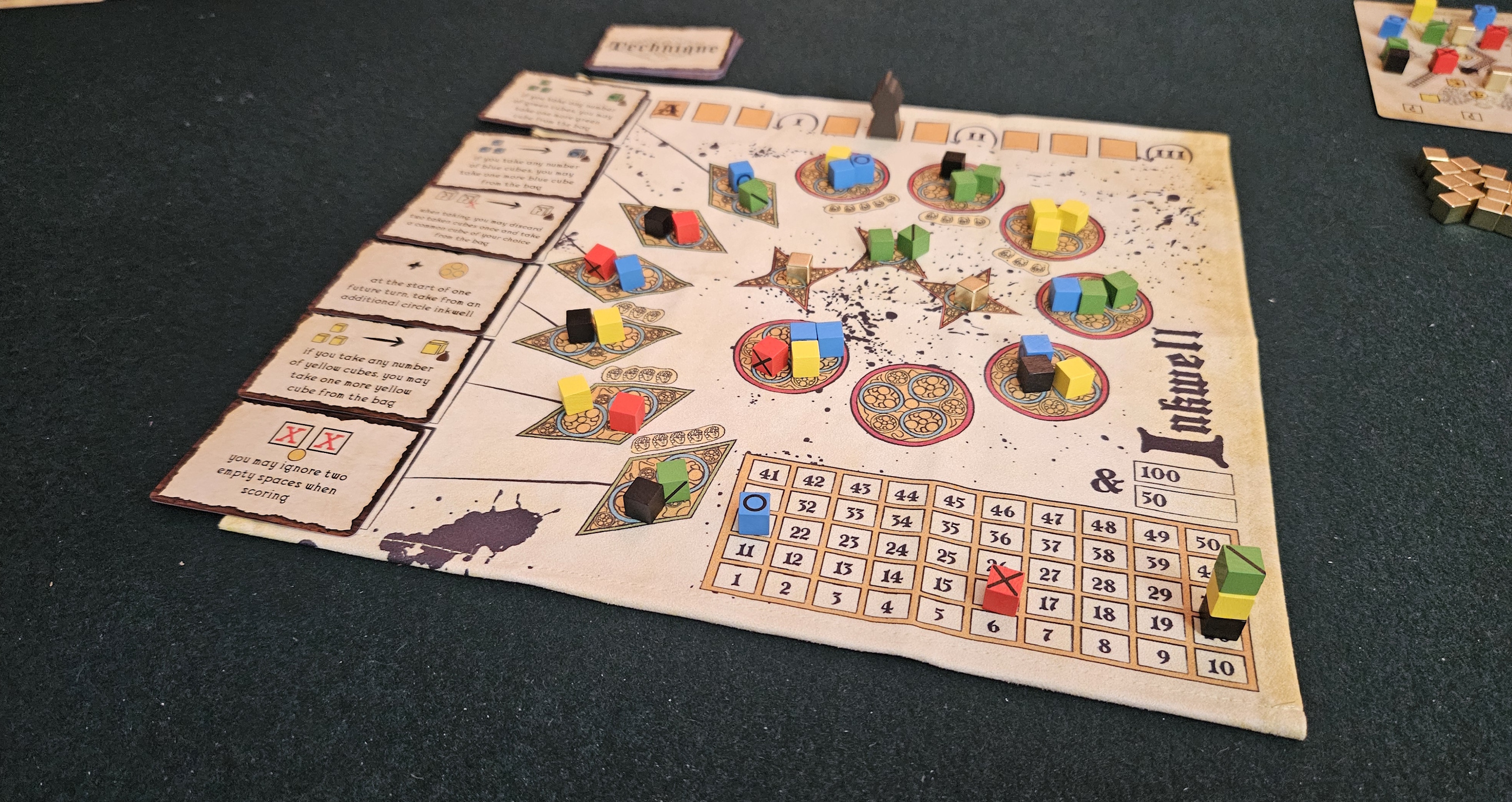
When I play Inkwell, I think about other games. That isn’t a slight on Inkwell’s quality, necessarily, nor a reflection on my fidelity to whichever title happens to be on the table at the moment. It’s just the sort of game that sets the mind to wandering. I have yet to play it without somebody mentioning Azul, for instance, and Sagrada isn’t a distant touchstone either.
The big one, though, is Alf Seegert’s Illumination, an overlooked quip from five years back that also dressed up its players as monks illuminating manuscripts under the stern eye of a passing abbot. And while it might seem like the parallel is entirely in the setting, it’s really the gentleness that does it, the warmth, the do-no-harm-ness of the whole thing. As a game, Inkwell isn’t only about monks; it’s downright monkish.
Ah, many pots of pigment. A monk’s dream.
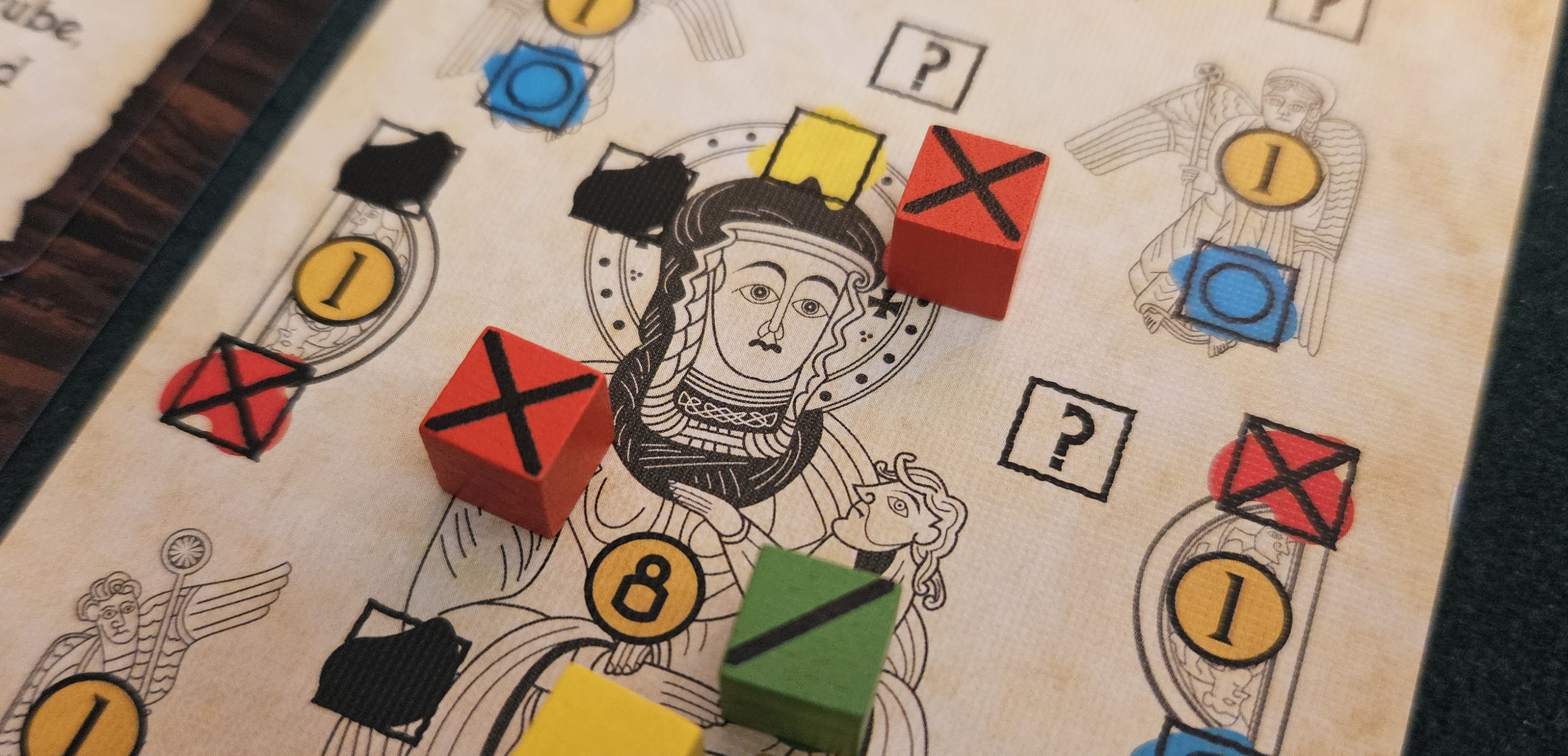
It begins with a page. Not quite a blank page, although one imagines the parchment fresh. For the sake of gameplay, the page is scrawled with the outlines of what will soon become vibrant illustrations: saints and angels, wreaths and knots, lions penned by someone who has clearly never seen a lion, scenes of Eden, holy babes that appear twice of age of the Lord at his crucifixion. Touching these illustrations are squares, each the size of a small wooden cube. Sometimes these squares appear in other spots, too, free of any illustration, but still ready to accept daubs and brush-strokes.
Your goal is to fill that page with color. Reds, blues, yellows, greens, deep charcoal blacks. Maybe some gold leaf. Gold is wild, capable of making up a shortfall elsewhere — because it’s gold, obviously — but it’s also sometimes required in special circumstances. Some spaces are blank, beckoning for leftovers. That or scoring multipliers.
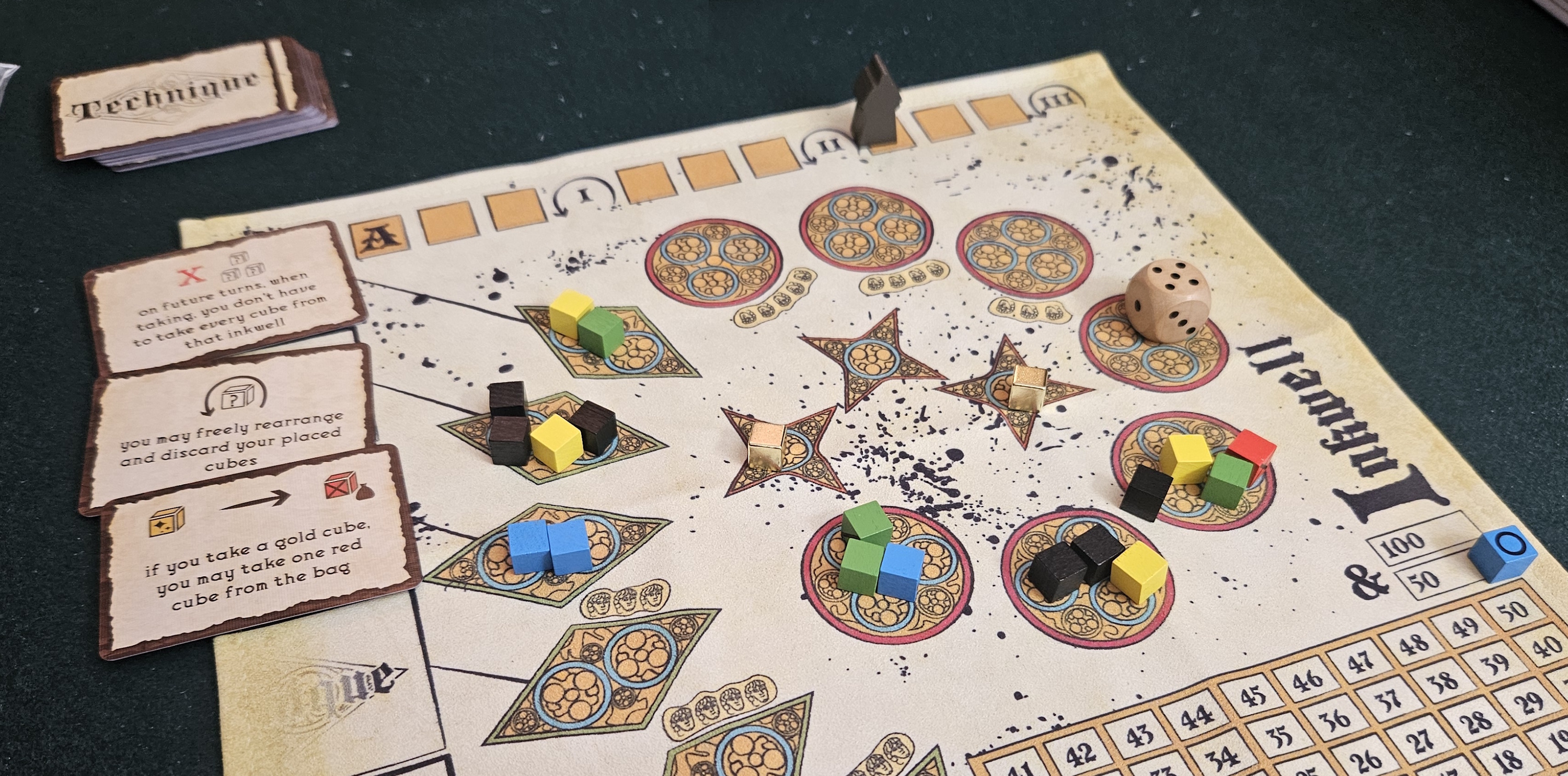
These cubes must be drafted from the central mat, itself represented as a swirl of ink-pots. There are three types to draw from. Circular pots hold the most ink, three cubes at the beginning. Star spaces hold gold, but usually only a single cube’s worth, marking them as a tradeoff between quality and quantity. Diamonds are the most interesting, offering a meager two cubes, but also technique cards, special abilities that gradually hone your monk’s abilities.
Creepy adult baby Jesus and all.
One turn at a time, players go around and select which inkwells to draw from. There’s some potential for blocking, but it’s a relatively remote concept here, especially in the page’s early moments when any color will serve. The effect is trancelike, meditative, as close to multiplayer solitaire as design collective Jasper Beatrix has gotten thus far. The most burdensome restriction is that you aren’t permitted to draw from an inkwell unless you can actually use every last drop and employ every technique card. This makes blocking even less likely, instead reinforcing the game’s gentle proceedings. It’s possible to grab as many cubes as possible, but that might make the page difficult to fill. Better to proceed steadily, like the proverbial tortoise.
There is some pressure, however light. Whenever one of those varieties of inkwell is depleted — circle, star, or diamond — the abbot marches one step across the mat. He’s here to oversee your work, and at various points he may force the table to turn the page. This scores all those illustrations and color cubes, potentially leaving some work undone. It’s better to turn the page of your own volition, at the time of your choosing, but it’s hard to say exactly when the abbot will peek into the scriptorium to ensure the commissions are being fulfilled.
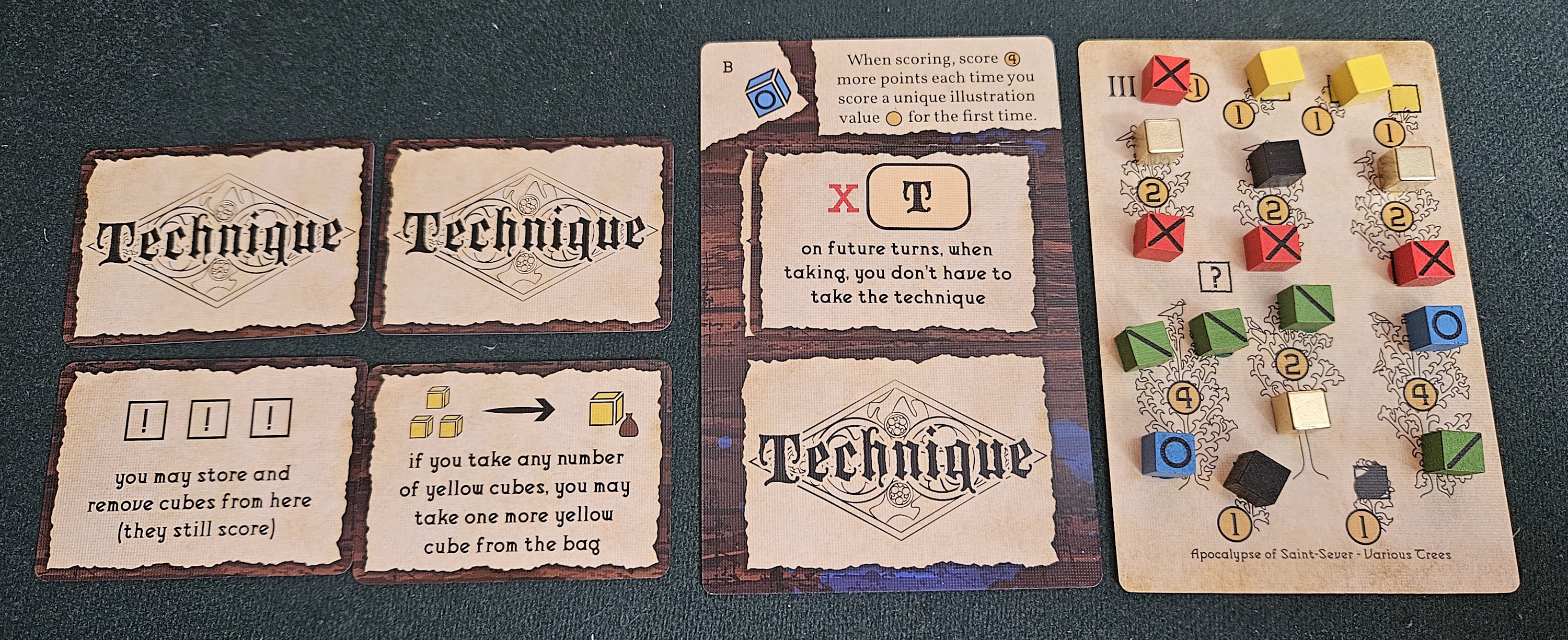
Over time, your accumulated techniques produce little engines, to use a game-word that would have meant something very different to our monks. But there’s some spark of the Latin gignere to these flashes of talent, reflected in the way they speak to an artistry now long displaced. Some techniques bestow extra cubes, perhaps when a specific color is drawn or the abbot marches down the hall, evoking the scribe, bent over his masterwork and taskmaster at once, carefully measuring every drop to its uttermost potential. Others let you claim cubes as a one- or two-time bonus, the medieval equivalent of double-dipping. Others still let you store a few cubes to the side, or rearrange them on the page, saving your palimpsest scrapings for reuse elsewhere.
With the right techniques, the third page can be a breeze.
In some ways, Inkwell is also itself a palimpsest. There are traces of other games here, possibly better or more interesting games. The most pronounced is Azul; it’s impossible to look at the circular inkwells and not see that game’s rounded factories and Starburst-sized ceramics. There are other traces, too, impressions on the parchment that can still be made out despite the game’s clean presentation. Playing Inkwell, it’s hard to escape the feeling that we’ve gone through these motions before.
Of course we have, if only because nothing under the sun is new. None these actions are wholly novel. But Inkwell feels a little closer to its peers than some games. Especially Jasper Beatrix games, with their penchant for novelty and mechanical introspection. Inkwell is no Pacts, with its dissection of I-split-you-choose gameplay, no Here Lies with its decoupling of detective games from rigid logic, no Signal and communication, no Scream Park and tableau-building.
But for all its similarity to other games, there are still reasons to recommend it. For example, I appreciate the open-ended nature of its conundrum, one where each selection feels like another window into a broad decision-space, rather than a binary best or worst pick. It’s rare that a single inkwell feels like the answer to a puzzle so much as one more question. Another brushstroke, perhaps, another inlay of gold. Those other games use artistry as their backdrop; Inkwell, by contrast, feels like artistry. More specifically, it feels like that slender space between commercial reality — deadlines and managers, limited resources, coworkers who sometimes take the pigments you need without meaning any harm — and the aspiration to fashion something that will endure the centuries.
The foolish monk Dicelius, also known as SOLOBOT, offers a nice diversion.
Where does that put Inkwell, in the end? It’s hard to say. As a game, it occupies a peculiar middle ground. It lacks the brain-tickling nature of its heavier inspirations, the emphasis on puzzling and position, but ventures a little closer to its source material than those games have ever managed.
More than that, Inkwell is reassuring. It feels like a weighted blanket, the game equivalent of a movie like The Taste of Things, all soft sensation and creamy sunlight and lulled senses. The outcome is neither the strongest nor the weakest of Jasper Beatrix’s collective output, but offers a lovely and gentle visit to a faraway time and place nonetheless.
A complimentary copy of Inkwell was provided by the publisher.
(If what I’m doing at Space-Biff! is valuable to you in some way, please consider dropping by my Patreon campaign or Ko-fi. Right now, supporters can read about which films I watched in 2025, including some brief thoughts on each. That’s 44 movies! That’s a lot, unless you see, like, 45 or more movies in a year!)
So uh, what’s it like, having such a short life cycle?
Peter and Will play Epic Warpath over some really incredible Gale Force Nine terrain!
My mini-season of battle reports from Will’s recent visit continues, and this time it’s an incredible game on probably the most spectacular tabletop of terrain I’ve ever had the good fortune to play on. That’s mostly thanks to Gale Force Nine, who sent me several boxes of their amazing pre-painted Gothic Sector epic scale terrain. You can see my unboxing of it all in this video.
The game is Epic Warpath by Mantic Games, and I’ve got to say I’m really impressed with this pretty streamlined, easy-to-use, and fun system for epic-scale scifi wargaming. I’m looking forward to getting my hands on some different factions and painting them up too! While panting epic armies can be a bit of a chore, the results, as you can see, are undeniably stunning, and the scale makes for big, beautiful games. So enjoy this session, where we show off Epic Warpath at its absolute best, and have a lot of laughs at the same time!
Making high quality tabletop gaming content at the EOG takes time and money. Please consider becoming a Patreon supporter or making a donation so I can continue this work! Thankyou!
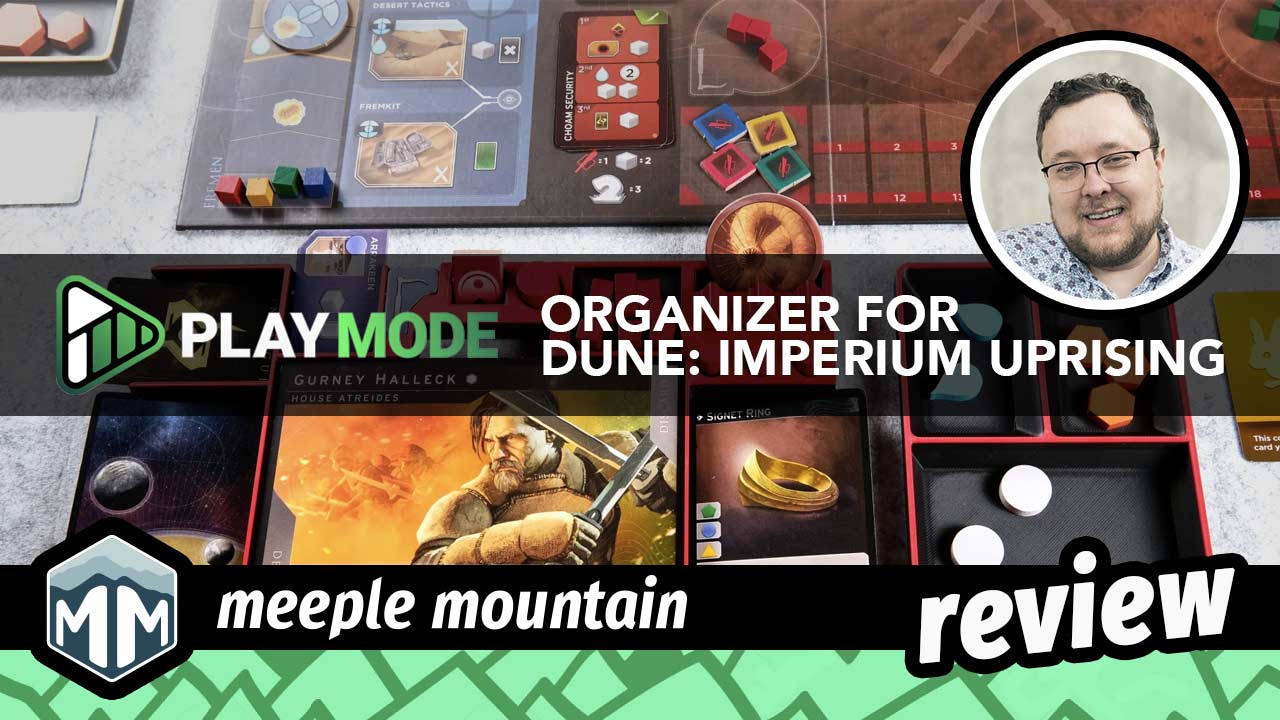
It’s rare to get an opportunity to review an organizer, and I’m a sucker for a good organization system. Half the appeal of games like Eclipse: Second Dawn for the Galaxy for me comes from the insanely sleek storage trays. When PlayMode asked if we’d be interested in covering their new inserts for the Dune: Imperium games, I immediately jumped at the opportunity. Readers may recall that I was very high on Dune: Imperium - Uprising in my review.
The box arrived from PlayMode and took up space on my shelf for a month or two while my busy travel schedule kept me from digging into it. It is, after all, quite the behemoth of a box at first glance, and even starting to figure out how everything fits together is a tall task. Finally, I found myself free on a recent Sunday, and my husband and I sat down. We dumped the contents of both Dune: Imperium - Uprising and its Bloodlines expansion out on our game table and tossed the included cardboard inserts.
Fresh out of the box, the PlaySystem can definitely take your breath away. We pulled out roughly two dozen individual components, which made the process feel…
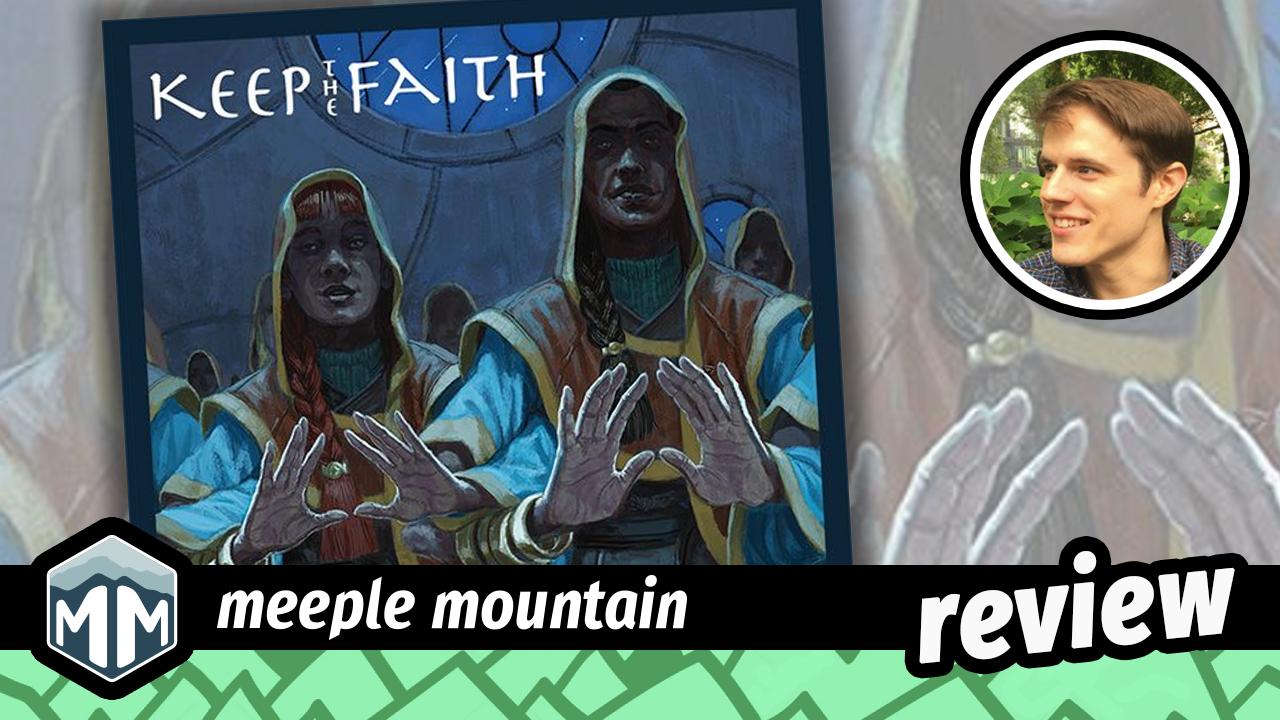
In the midst of Suzannah Herbert’s tremendous documentary Natchez, religious fundamentalists stage a Westboro Baptist–style protest outside an LGBTQI+ event. They stand there with their signs, decrying sin and the fate of the wayward souls inside. One man reads scripture into a megaphone, citing chapter and verse to support his belief that the drag queens emceeing will go to hell.
For some reason, it struck me in that moment as particularly absurd that this man was citing documents written over 2,000 years ago to explain his beliefs now. Well, “to explain” is wrong, and I even think “to justify” wouldn’t quite get across what I felt. I believe in and understand the power of citing the Bible as a collection of parables to relay lessons, questions, universal experiences. This man was not doing that. He was quoting the best-selling book of all time as edict. Those dusty old words were why he is presently required to believe that gay people will go to hell.
To that man, and those around him, the text of the faith is the faith. It is the destination, rather than the compass. To him, the scripture can neither change nor can it be changed. It is unyielding, unsparing, unimpeachable. Some words written down over two millennia ago are to be followed to the letter…
April is one of my favorite months due to Easter and the warming of the weather. And this month we got a good amount of newly baked wargames, still warm some of them because they are so new, for you to choose from. This month for the Wargame Watch I was able to find 28 games (including the 7 games from our sponsor VUCA Simulations). Interestingly though this was a cooler month for crowdfunding as I only found 4 different campaigns, which did contain a total of 6 games as one was a triple feature, featured on Kickstarter or Gamefound.
This month again we have a sponsor for the Wargame Watch in VUCA Simulations. VUCA Simulations is a newer German publisher that is really crushing it with their graphics and production. Their games are also very good and we have really enjoyed several of their titles including Donnerschlag: Escape from Stalingrad, Traces of War and most recently New Cold War.
But I also want to point your attention to their In Development Section of their website to show you all of the great projects that they are currently working on. Here there are 7 different games listed with pictures of the beautiful covers and a description of the game itself. These titles include Thirty Years of Misery designed by Brian Asklev, Pacific Fleet designed Hiroyuki Inose, The Far Seas designed by Martin Anderson, In Fours to Heaven designed by Grzegorz Kuryłowicz, Gateway to Falaise designed by Andrew Glenn, 1916 – Prelude to Blitzkrieg designed by Paul Hederer and Saint-Lô – The Capital of Ruins designed by Clemm.
VUCA is really doing a great job with their games and we recently played one of their newest games in Imperial Elegy: The Road to the Great War 1850-1920 and it was a sublime experience. We only played 1 full hand with a full table of 6 players, but very much enjoyed what it was that we were trying to do and the production is just fantastic. Can’t wait to get this one back to the table soon!
But now onto the games for April!
Pre-Order
1. Company of Heroes – Desert Warfare Expansion + Reprint from Bad Crow Games Currently on Gamefound
Glitz. Bits. Content. Miniatures. If these things appeal to you and you like a tactical wargame experience then this is your chance. The well regarded Company of Heroes System has a Gamefound campaign for a new expansion called Company of Heroes – Desert Warfare Expansion and they are also offering the base game 2nd Edition as an add-on as you need it to play.
From the game page, we read the following:
The Company of Heroes – Desert Warfare Expansion + Reprint on Gamefound brings the Deutsches Afrika Corps (DAK) to the 2nd Edition board game, featuring high-mobility, mechanized, and elite units. This expansion enhances solo/co-op play with improved AI, offering a fast-paced, tactical tabletop experience with armored, hit-and-run tactics. The Deutsches Africa Corps adds specialized, agile desert combat forces with a focus on armored vehicles, Italian alliance units, and fast, bold maneuvers. The expansion includes a sophisticated AI for solo or cooperative play, featuring an AI commander, HQ board, action deck, and target selection priority cards. The AI is described as aggressive, frequently seizing objectives. The expansion includes new maps, units, and components to expand the core game experience. The campaign also offers a reprint of the 2nd Edition core box, required to play, featuring streamlined rules and high-quality components.
I am going to be honest here. I played the 2nd Edition. We enjoyed it but it wasn’t necessarily as amazing as I thought it would be. I mean the systems are interesting but it feels more Euro game like than wargame like and it is also extremely expensive. Now it is gorgeous and the miniatures, terrain and maps are very well done but I am not sure that this game lives up to the hype. Just my humble opinion.
As of April 1st, the Gamefound campaign has funded and raised $948,465 toward its $100,000 funding goal with 1,928 backers. The campaign will conclude on Thursday, April 16, 2026 at 12:00am EST.
2. T-34 Leader: The World War II Ground Combat Solitaire Strategy Board Game from Dan Verssen Games Currently on Kickstarter
A good solitaire game is always very much welcome on my table. I usually start these entries about solitaire gaming by saying I am not a solitaire gamer. Well, after playing the Leader Series from DVG for the first time about 8 years ago, that statement no longer applies. I used to really only play solitaire games when I had no other choice or available opponents. But, when I put these games on the table, my whole opinion has changed. The Leader Series is a solitaire gaming system that recreates modern combat, including ground combat, air warfare and even submarine warfare and sees the player creating, managing and outfitting a group of soldiers/boats/planes over the course of a variable length campaign. Some of the games offer individual combat systems that are included in the overall game and each handles their theater with specific rules and equipment used historically. Originally, all of the games were designed by Dan Verssen but more recently other designers have been taking up the reigns of the series. Such is the case with their newest offering in the series T-34 Leader designed by Vincent Cooper.
From the game page, we read the following:
You are the commander of a Soviet army combat group in World War II. You will take command in the hardest fought campaigns from Operation Barbarossa (1941) to the Battle of Berlin (1945).
Each of your Campaigns involve both operational and tactical decisions. At the start of a Campaign, you select the Units and Commanders to make up your force. During each Week of the Campaign, you decide which Enemy Battalions to attack, which of your forces to allocate, and then resolve each Battle using the Tactical Battlefield. Your Commanders gain Experience with every Battle, but they also suffer Stress. Each Week you must decide how hard to push your men to achieve Victory. T-34 Leader is a great game for both experienced strategy gamers, as well as new players. Each Campaign takes around 30 minutes to set-up, and each Battle can be resolved in 15 to 30 minutes.
T-34 Leader has been designed from the ground up as a Solitaire wargame. It is not an adaptation of a 2-player wargame and the rules have been specifically designed for the solo player. As a Solitaire wargame, you can play whenever you have time, at your own pace. T-34 Leader is the latest Tank Leader game from DVG, following Tiger Leader and Sherman Leader.
With that look, I will let you know that I very much love Sherman Leader and the ground combat for me is where it is at and I would think that T-34 Leader will be more of the same but on the East Front. I have played Sherman Leader the most in the series, using both short and long campaigns, and really enjoy its systems, the structure of the AI and the management of your units and Commanders. Really engaging and enjoyable experience of ground combat in World War II.
Here is a link to my video review for Sherman Leader that you can view at the following link:
As of April 1st, the Kickstarter campaign has funded and raised $38,484 toward its $30,000 funding goal with 148 backers. The campaign will conclude on Tuesday, April 7, 2026 at 3:02pm EDT.
3. Chalice of Poison: The Iran-Iraq War, 1980-1988 from GMT Games
We met Akar Bharadvaj while attending SDHistCon in 2023 and played his award winning design Tyranny of Blood: India’s Caste System Under British Colonialism, 1750-1947 and very much enjoyed the experience and talking with him about game design. Since that time, he has been working on another designer called Chalice of Poison: The Iran-Iraq War, 1980-1988 from GMT Games, which was recently announced on their P500. Chalice of Poison is the first volume in a new series that models complex conflicts not only as clashes between adversaries in the air, land, and sea, but also as political struggles within the regimes and military forces fighting it.
From the game page, we read the following:
In 1980, Saddam Hussein’s Iraq invaded Iran, hubristically expecting to achieve a quick victory in a few weeks. Instead, the war became a brutal slog that lasted eight years. During the war, both countries had to choose between political and military objectives, balancing between the power of their military forces and the stability of their regimes. In Chalice of Poison you will play as the heads of two very different authoritarian regimes that have structured their militaries to be excellent at forestalling internal threats…but less effective at fighting foreign adversaries. Can you reform your military so that it’s effective enough to win the war, without accidentally creating a force that threatens your power?
A unique game on the Iran-Iraq War, the longest conventional war of the 20th century, and a historically important conflict underexplored in tabletop gaming.
Designed by Zenobia Award-winning designer Akar Bharadvaj, and inspired by Dr. Caitlin Talmadge’s academic research on the fundamental weakness of so-called “strong-man” authoritarian regimes.
Simple mechanics create a tense, dynamic, and meaningful decision space with an exciting narrative, capturing the dilemmas faced by regimes faced with both internal and external threats.
A two-player game that also plays well with four players on competing teams.
Includes two solitaire modes: A simple-to-operate “Al-Jazari” bot that offers a challenging non-player opponent. A more complex “Kissinger mode”—inspired by Mark Herman’s Peloponnesian War—in which the solitaire player represents both sides in the conflict. This mode abstractly models the international community, which cynically supported both sides in the conflict, ensuring a lengthy war in which neither country could win a decisive victory.
“At its most interesting, Chalice of Poison simulates warfare as a social battle as much as one involving tanks and bullets…This might sound complicated, but Bharadvaj presents these fluctuating power levels with refreshing clarity…Even at this early stage it’s an impressive and ambitious plaything. And its critique is unexpectedly timely, highlighting how strongman governments weaken their nations in the name of strengthening their regimes.” ~ Dan “Space-Biff” Thurot
4. Pericles: The Peloponnesian Wars 460-400 BC 2nd Printing from GMT Games
We are admitted Mark Herman fanboys! I am not ashamed of that statement as he is a very good designer and such an interesting person. He has designed a series of games called The Great Statesman Series and there are such fantastic mechanics at play that create a very interesting non-traditional wargame feeling such as Churchill. The 2nd game in the series is called Pericles, unlike Churchill, pits 2 sides, the Athenians and the Spartans against one another. The real game-changer is that each side is made up of two factions. As such it plays best with 4 players, each working to not only have their side win, but to have their faction within that side end with the most honor, and thus be victorious overall. The good news for most of us, is that there’s bots for solitaire, or 3 player games and there’s a fascinating 2 player variant, where each player plays a faction on each side. GMT just put a 2nd Printing up on their P500 and I am so very glad that this game will get some more attention as it is a really great game.
From the game page, we read the following:
Pericles is a ‘sandbox’ (unscripted) wargame that covers the ENTIRE period of conflict described in Thucydides classic history on the Peloponnesian wars. Pericles is a 4-player game, where two teams of Athenian and Spartan factions fight for Hegemony in 5th Century Greece. Each team of two represents a faction vying for control of their City States, strategy, and honor. Athens sees the Aristocrats debate issues with their opposing Demagogues, while in Sparta House Agiad and House Eurypontid contend for royal dominance.
Pericles uses elements from the Golden Geek best Wargame of 2015, Churchill, to simulate war as the extension of politics by other means. In the War portion of the game, it is US versus THEM (Athens versus Sparta), where each team implements their collective strategy to dominate Theaters of War, build economic strength, and fight battles to win Honor. In the respective Political assemblies, it is ME versus YOU (faction versus faction), where the battle for government control has to be balanced by your common interests in a series of wars that must be won, or all is lost.
Pericles uses an Issue Queue preplanning mechanic that the play testers have described as ‘insanely fun’. After your Political assembly has debated and won issues, these issues (military, league, diplomatic, oracle) are secretly placed on the military map in one of the twenty Theaters of war. If you or your opponents place a second issue into a Theater, it creates a queue of issues. Once all issues are placed, they are revealed and resolved one at a time. The order of issues in the queues and the order in which they are resolved across all Theaters tells YOUR story of the Peloponnesian wars.
Strategy in Pericles unfolds in how you create combinations of issues to achieve the historical narrative. Do you want to conduct a Periclean raiding strategy? Then you would play two military issues into a Theater to first move forces into position, then raid. Do you want to build a base in the enemy homeland (historically Pylos or Decelea)? Then you would conduct a military expedition, followed by a league issue. Do you want to raise an opponent’s ally in rebellion? Then you would deploy a diplomatic mission, and sow treachery for immediate or future advantage. It is in the placement, order, and resolution of the issues that the game allows you to explore and experience the broad range of historical situations without a script.
What would a game of Hoplites and Triremes be without a battle mechanic? Battle in Pericles is based on armies and fleets being led by the classic generals of yore, represented as Strategos tokens. During the Political assembly, each faction uses historical personalities to acquire Strategos tokens. Use the Spartan general Brasidas and gain four Strategos tokens, while Epitadas only generates one. Strategos tokens can be thought of as military capital that is spent in the war to lead and move forces. If you send forces to a Theater with enemy forces, a land or naval battle will occur. All players then secretly commit Strategos to the battle. Then, the commanding general of the military expedition and their teammate reveal their Strategos commitment and move wooden land and naval units to the battle. Now the defensive commitment of Strategos is revealed, each side then reveals a random battle card value, and the winner is decided. The winner of the battle now has the option to fight a subsequent naval or land battle. The outcome of these tactical decisions determines if any fortified bases are destroyed by assault or siege. Then the next issue is resolved. Winning battles awards and reduces honor.
Here is a link to our video review that was created when we were younger, had more hair and were not very polished in any part of what we were doing:
5. Silver Bayonet: The First Team in Vietnam, 1965 – 25th Anniversary Edition 2nd Printing from GMT Games
We have had a great experience playing Silver Bayonet a few times over the years and I am glad that it is now getting a 2nd Printing of the 25th Anniversary Edition. Silver Bayonet: The First Team in Vietnam, 1965 – 25th Anniversary Edition is a revamping of their first ever game released all the way back in 1990.
From the game page, we read the following:
Silver Bayonet recreates the pivotal November 1965 battle between a full North Vietnamese Army Division and the US 1st Air Cavalry Division in the Ia Drang Valley. NVA expertise in lure and ambush tactics resulted in significant US casualties. US mobility and the ability to bring massive amounts of firepower to bear quickly virtually destroyed the attacking NVA division and forced a change in NVA tactics.
This re-issue of GMT Games’ 1990 CSR Award winning title that started it all keeps the original operational system, but streamlines to it to include innovative combat resolution integrating maneuver combat, close assault, artillery bombardment, and support from gunships and air sorties.
Increased accessibility to primary and secondary source material has made it possible to make changes to more accurately represent both sides’ unique capabilities without significantly altering or breaking the base game system. The major changes involve patrols, ambushes, landing zones, and the 1st Cav Brigade HQ, while minor changes tweak movement, combat, and coordination game mechanics to showcase radically different strengths and weaknesses the FWA and NVA force brought to the battles in the Ia Drang Valley.
6. I, Napoleon 2nd Edition Update Kit from GMT Games
As you probably know, normally Ted Raicer designs hard core hex and counter wargames such as The Dark Valley: East Front Campaign, 1941-45, The Dark Sands: War in North Africa, 1940-42 and The Dark Summer: Normandy, 1944. These games are fantastic experiences that are true wargames. But, he also has an eclectic side to him and has designed one of the classic card driven games on the subject of World War I in Paths of Glory. So when I heard that he had designed an interesting looking card based historical role-playing game the first thought that came to my mind was “How is he going to accomplish this feat?” Last year, I played I, Napoleon and did enjoy what it was doing even though it felt like it fell a bit short of its ultimate claim. But there is more of the game now and they are doing this Update Kit in case those who want to the updated cards don’t wish to order the Limits of Glory Expansion.
From the game page, we read the following:
For our customers who own the 1st Printing of I, Napoleon and want to upgrade to the 2nd Printing without purchasing the Limits of Glory Expansion, we’re providing an Update Kit.
This Kit includes:
60 Updated Cards
2 Divider Cards (1 New, 1 Adjusted)
Rulebook
Playbook
8.5″x11″ Player Aid
Sticker Sheet (4 stickers to update the Game Board)
NOTE: The Limits of Glory Expansion includes the updated Cards, Divider Cards and Sticker Sheet, as well as a Rulebook, Playbook and Player Aid that can be used with both the expansion and base game.
7. Paper Wars Magazine Issue #116: Roma Invicta: The Roman Republic 400-50BC from Compass Games
Wargame magazines can be a bit hit and miss with their games. But, Paper Wars seems to really pick some great topics and systems to highlight in their pack-in games and this month there is a new pre-order for a game called Roma Invicta: The Roman Republic, 400-50 BC designed by Paul Kallia who did Roma Victrix: Campaigns of the Roman World from Compass Games.
From the game page, we read the following:
Roma Invicta: The Roman Republic & the Western Mediterranean by Paul Kallio is a 2-player, scenario-based design depicting several historic conflicts that occurred in and around the Roman Republic between 400 and 50 BC. This is a systemic brother design to Paul Kallio’s Roma Victrix boxed game. Each game turn represents one year. Infantry unit types include legions, heavy infantry, auxiliaries, and barbarians, and represent about 5,000 men each.
BONUS GAME MATERIAL: This issue will include two new scenarios for play with WWII Campaigns: 1940, 1941, and 1942. For 1941, we have Festung Stalingrad. It covers the German counteroffensive to try to save the Sixth Army trapped in Stalingrad in December 1942. For 1940, we have the Operation Matador variant scenario by David Meyler.
Article highlights include previews of Rise to Glory and Iberian Tide, a work-in-progress report on Island Infernos, a Bitter Woods AAR, an alternate start scenario for Desert Tide, and a new optional fuel dump rule for The Last Gamble.
8. Limits of Glory: Campaigns VI & VII – Jersey New Jersey and A Strong War: The Conflict for North America 1755-60 from Form Square Games Coming to Gamefound April 7th
A few years ago, we became acquainted with Andrew Rourke through his Coalitions design from PHALANX that went on to a successful crowdfunding campaign and has recently been delivered. He has since been a busy guy with starting his own publishing company called Form Square Games and also publishing the first 5 designs in a new series called Limits of Glory that will take a look at the campaigns of Napoleon and other contemporary conflicts. In Campaign I, which is called Bonaparte’s Eastern Empire, the game is focused on the campaign of the French in Egypt between 1798 and 1801. Campaigns II, III and IV was Maida 1806 and Santa Maura & Capri. Campaign V was Donning the Sacred Heart which covers the Vendee Civil War and just recently fulfilled as I have my copy sitting on my gaming table awaiting and unboxing video.
And now, recently, he has announced came out about the next entry in the series which is a two-fer with Campaigns VI and VII called Jersey New Jersey and is set during the American Revolutionary War but also a 2nd game called A Strong War set during the French & Indian War. I think that these games are well timed with this year being the 250th Anniversary of the signing of the Declaration of Independence and I look forward to playing and exploring both of these games. I have also reached out to Andrew to see about him as well as the design duo of Mark Kwasny and John Kwasny for A Strong War doing another interview to give us a look inside the design and get more information for you to digest before the campaign kicks off on April 7th. But at this point the games look great and I love the art and the covers are very eye catching for sure!
From the game page, we read the following:
For the 2 games in the Limits of Glory Series:
Two exciting games in one box, Jersey covers the little known 1781 invasion by the French of the Island of Jersey as part of the American Revolutionary War. The game examines the impact of luck on events and challenges the skill of players to use their commanders to influence these events.
New Jersey covers the famous crossing of the Delaware and the battles of Trenton and Princeton using the same Limits of Glory System to test players ability to mitigate what luck throws at them by the skillful use of commanders and troop positioning.
Limits of Glory represents military campaigns at the highest command level, players take the role of theater commander and must manage their resources of men, material and skill to emerge victorious.
And for the other game in the offering called A Strong War: The Conflict for North America 1755-60:
The title, A Strong War, refers to the type of war the Abenaki Nation threatened to unleash on the land-grabbing British in 1753. The sparks of war, ignited in 1754 near Fort Duquesne by an obscure colonel of Virginia militia, George Washington, spread quickly; soon, flames engulfed the entire globe as England and France vied for control of empire. Over the next 5 years, Regular regiments from the French and British armies, American and French-Canadian provincial units, and Native warriors all fought in a chaotic and violent series of campaigns and frontier raids that culminated in the British conquest of French Canada and the defeat of the Native Nations (most of which had sided with the French).
A Strong War brings this war to life in a simple, fast-playing game. The map (covering the region stretching from Louisbourg to Alexandria, and from New York to Lake Erie) uses point-to-point connections to highlight the key locations that were targeted during the war. Using wooden cubes to represent the different types of forces used (French and British Regulars, British Colonials, French-Canadian Marines, French Bush Rangers, and Native American warriors), each player has only a few pieces (maximum 13 for the British and 10 for the French) to use each turn (one turn = one year, so there are 6 turns/years total).
The heart of the game is the unique combat system where players can deploy forces to a chosen battle and then commit them one by one; or they can call off the battle if it goes badly and save some of those forces for use later in the year. The types of forces committed also play a critical role in combat – the British want to mass their Regulars but the French want to bring in a mixed force to take advantage of the different skill sets each provides. Thus, tension is created in trying to decide if/when (or where) it is best to commit one’s forces: do you avoid combat completely; do you call off a combat that is going badly; or, do you go all in and commit your entire force? But if you lose a battle, initiative then swings to your opponent who may then launch an offensive. Each player has several paths to victory, leading to a “different” game each time, and forcing players to choose between different strategies each turn. Finally, it is a quick game, taking just a couple of minutes to set up, and usually taking less than an hour to play to completion. The game also plays well solitaire, though there is no dedicated solitaire system.
9. Campaign: Operation Bagration from Catastrophe Games Currently on Kickstarter
A few years ago, I played and very much enjoyed a cool little solitaire WWII card-driven game called Campaign: Fall Blau from Catastrophe Games and designer Martin Melbardis where the player attempted to breach the Soviet defenses on the East Front in the pivotal German summer campaign of 1942. The game system is very playable and simple, but has some strategic depth to it as the player has to make a lot of choices about what to go after, how to manage their scarce resources (fuel) and what generals to use to take advantage of their special abilities to amass enough VP to claim victory over the Soviet Union. They now have the counter punch of that game in a new entry in the series called Campaign: Operation Bagration and it is currently being offered on Kickstarter.
From the game page, we read the following:
Campaign: Operation Bagration is the follow-up to Campaign: Fall Blau, the acclaimed solo experience of trying to seize Stalingrad and the prized oil fields beyond. In this game the shoe is on the other foot, as you will be pushing the Red Army to retake the center of the occupied Soviet Union, setting up the capture of Berlin. Stalin is expecting fast results though, so once again you will be racing against the clock trying to achieve enough objectives before your supplies (and Stalin’s patience) runs out.
Campaign: Operation Bagration is a solitaire wargame that takes place during WWII and puts the player in charge of the Soviet summer offensive of 1944 against Army Group Center, code named operation Bagration. Pick your three generals and use your resources wisely in order to obtain your campaign’s objectives.
One month turns. Decide which card (objective) to go after, each with a unique set of Soviet defenses. Manage supplies required for each offensive, or choose to take an operational pause. Receive random event cards that are mostly beneficial but a few are Soviet counterattacks that can throw a serious monkey-wrench into your plans. Play continues until fall begins, and you must report to Stalin with your success or failure.
In order to meet Stalin’s expectations you need to be relentless, while carefully marshalling your troops and material. Drive too hard, and the Germans will crush one of your wings, and your push will stall out. But if you move too slow you know you will be summoned to a special meeting with Stalin, and that is a grim fate.
As of April 1st, the Kickstarter campaign has funded and raised $1,138 toward its $500 funding goal with 14 backers. The campaign will conclude on Monday, April 20, 2026 at 8:51pm EDT.
New Release
1. VaeVictis Magazine Issue #185 Game Edition: Storm on the Ménez Hom 1944 from VaeVictis
VaeVictis is a very fine wargame magazine and they always have very interesting looking pack-in games on various subjects. This month, they have featured a scenario involving the 1944 attack on the Ménez-Hom peak on the Crozon peninsula in a game called Storm on the Ménez Hom 1944. But there is more as the magazine features articles on various wargames including Hubris from GMT Games, La Der des Ders from Hexasim, Thunder on the Mississippi from Multi-Man Publishing, Italia 1917-1918 from Nuts! Publishing, New Cold War from VUCA Simulations, Werwolf from Legion Wargames and many more.
From the game page, we read the following:
During the siege of Brest, the coastal batteries on the Crozon peninsula, on the southern shore of the harbor, were hindering the advance of the US Army. It was therefore crucial to silence them. To achieve this, the barrier closing off the peninsula had to be breached: the Ménez-Hom peak, rising to 330 meters. This mission was entrusted to the FFI-FTP battalions of central Finistère. It took three weeks, from August 12th to September 1st, 1944, and the reinforcement of a US cavalry brigade to finally defeat the German, Russian, and Caucasian defenders.
2. The Coming Storm II: Quadrigames of the Fourth Coalition: October 1806-June 1807 from Operational Studies Group
Large Napoleonic wargames are always interesting. Operational Studies Group does some big games on the subject and their newest offering is called The Coming Storm II: Quadrigames of the Fourth Coalition: October 1806-June 1807 and deals with four different battles including Jena-Auerstadt, Pultusk/Golymin, Eylau and Friedland.
From the game page, we read the following:
These four games explore the major battles of 1806–07, where the French Army encountered two different opponents with different capabilities, from the leadership-challenged Prussians in Saxony to the chaotic battle conditions in winter against the Russians. Based on OSG’s Special Studies, which provide a turn-by-turn narrative of the four battles. Each game shows the approach to the battlefield on the day before battle. The Jena-Auerstadt game has both battlefields on one map and allows both sides to redeploy before battle.
We are offering a new edition, with new maps—not too much different in detail—but rendered in Charles Kibler’s naturalistic style. TCS2 will be updated to use the Universal Deck and latest series rules (deck not included). With few exceptions, the counters will be identical to the first edition.
This is a very popular series of games amongst Grognards and I have heard many people recommend these titles to both of us. We have yet to take the plunge and get one but one day we will…one day!
If you are interested in The Coming Storm II: Quadrigames of the Fourth Coalition: October 1806-June 1807, you can order a copy for $140.00 from the Operational Studies Group website at the following link: https://napoleongames.com/products/the-coming-storm-ii
3. The Maid Ascendant: The Siege of Orleans, October 1428-May 1429 from High Flying Dice Games
Paul Rohrbaugh and his company High Flying Dice Games is a designer I love to follow. He is always doing games on smaller or lesser known conflicts and I just find his work to be superb and really draws me in. Recently I saw where he was releasing a game on the Siege of Orleans and I do like siege games! The game is called The Maid Ascendant and really looks pretty interesting and is definitely a unique subject for a game.
From the game page, we read the following:
The Maid Ascendant is an introductory level wargame on the siege of Orleans. The siege marked the debut of Joan of Arc as a military commander, and a campaign that would see the English eventually evicted from France and the end of the Hundred Years War.
“Begone, or I will make you go!” – Jeanne d’Arc’s command to English and Burgundian troops besieging Orleans.
If you are interested in The Maid Ascendant: The Siege of Orleans, October 1428-May 1429, you can order a copy for $16.95 from the High Flying Dice Games website at the following link: https://www.hfdgames.com/maid.html
4. Mr. Lincoln’s War from Compass Games
You can’t have enough good American Civil War games and Compass Games has been working to bring out a new edition of a classic called Mr. Lincoln’s War designed by Mark McLaughlin.
From the game page, we read the following:
Mr. Lincoln’s War is a historical game which captures the epic struggle of the American Civil War. From their first major battle at Bull Run in 1861, through the campaigns of Vicksburg, Gettysburg and Atlanta and until the final days at Appomattox in 1865, the armies of the Union and the Confederacy raged across America wreaking havoc and bloodshed on a scale never before or since witnessed in the New World.
This box set is organized into two sub-games, “Army of the Tennessee,” which deals with the war in the western theater, and “Army of the Potomac,” which deals with the war in Virginia. Each has four short scenarios that recreate the maneuvers and battles of Shiloh, Gettysburg, Atlanta, and other monumental Civil War contests. Campaign games enabling the players to fight the war in the West or East are provided with each sub-game. They may be combined to play the Mr. Lincoln’s War grand campaign that simulates the entire Civil War, on both fronts.
5. Volume II Civil War Heritage Series Army of the Potomac: Campaigns of 1862 and 1864 from GMT Games
Several years ago, Mark Herman designed a very unique and simple American Civil War game called Gettysburg that appeared in C3i Magazine #32. That game became the basis for his Civil War Heritage Series with the first volume being Rebel Fury that focused on five battles from the Chancellorsville and Chickamauga Campaigns. He has long mentioned working on the follow-up to that game and we finally are getting it with Army of the Potomac.
From the game page, we read the following:
Army of the Potomac: Campaigns of 1862 and 1864 is the second volume in the Civil War HeritageSeries and the follow-up game to the innovative and acclaimed Rebel Fury. Army of the Potomac uses the same core rules as Rebel Fury, so players familiar with Rebel Fury will be able to jump right into the action. Each battle in Army of the Potomac is quick-set-up, quick-playing, and deeply interactive. The density of counters in each scenario is low, allowing you to see and experience the big picture of the battle.
Army of the Potomac covers the battles of Spotsylvania II, North Anna River, Cold Harbor, and the entire Seven Days battle (McClellan vs. Lee), including the prelude Seven Pines (McClellan vs. Johnson) when Johnson’s wounding brought Lee into the command of the Army of Northern Virginia. Each battle places you, the player, in the role of the Army Commander (Grant, McClellan, Lee, Johnson). You maneuver your army to find the enemy’s flanks, concentrate your forces for an attack, and determine where to commit your artillery assets.
I think that one of the most interesting parts is that this new game can be played with Rebel Fury as also included are two bonus scenarios to allow owners of Rebel Fury to fight Spotsylvania II and begin the Campaign scenario from Wilderness to Cold Harbor using their original Rebel Fury map.
Last summer, while attending WBC in late July, we sat down with Mark Herman and did an interview/overview of Army of the Potomac and you can watch that video at the following link:
6. Baltic Empires: The Northern Wars of 1558-1721 from GMT Games
This one is very much anticipated by me and I feel like I have been waiting in it forever since its announcement in 2022. Baltic Empires is a grand looking game that focuses on the conflicts between the states of the Baltic region during the early modern era. The wait is now over as they game is set to ship on April 17th.
From the game page, we read the following:
Baltic Empires is an approachable 2-5 player strategy game about conflicts between the states of the Baltic region during the early modern era, a transformative period of religious conflict, large scale warfare, and constant struggles for power. Players will have to develop their economy, strengthen their administration, secure trade hubs, and finally build armies to become the dominant power of the Baltics. Denmark-Norway, Sweden, Russia, Poland-Lithuania, and Prussia will fight for hegemony, using variable victory conditions that reflect their respective historical objectives.
During the 16th & 17th centuries, religious conflicts between Protestants and Catholics swept Europe, vast colonies were established by the maritime powers, and a series of wars were fought against Louis XIV’s Kingdom of France to maintain the balance of power, eventually culminating in the War of Spanish Succession. While this history might be familiar to many, the related conflicts around the Baltic Sea that took place during these centuries are less well-known.
Where did the French, English, and Dutch acquire the materials they needed to build and maintain their vast navies that won them their colonial empires? Where did they acquire the food they needed to feed their sailors and growing populations? Where did the Swedish juggernaut that suddenly emerged and changed the course of the Thirty Years War come from, and why didn’t its great power status last? How did the Russian and Prussian Empires that became so powerful in later periods first emerge on the European stage? The Baltic region was crucial to the history of Europe, and the conflict for influence over the Baltic Sea was closely intertwined with the balance of power in Western Europe. The outcome of the wars and societal transformation in the Baltic region, from the collapse of the Teutonic Order in Livonia in 1558 to the end of the Great Northern War in 1721, shaped European and world history up until the present day.
Baltic Empires presents these less well-known conflicts in a fun and accessible format, while also doing justice to the fascinating history of the Baltic Sea region during this period. The game features 5 asymmetric factions with different strengths, forces, and historical objectives, along with the capacity to develop their states by investing in economic infrastructure and recruiting key historical characters that offer unique game effects. The game also includes several scenarios for variable player counts and durations, offering additional flexibility and replayability.
7. Three Days of Gettysburg Deluxe Edition from GMT Games
A very popular series featuring one of the most gamed battles of the American Civil War! Quite the combination. And to add to that, a Deluxe Edition treatment with new counters, some new rules, new and updated maps and lots of scenarios. This is a great value for any gamer who wants to game one of the most iconic battles of the American Civil War.
From the game page, we read the following:
GMT Games and the GBACW design team are proud to announce Three Days of Gettysburg Deluxe Edition, the ultimate edition of the definitive game on the Battle of Gettysburg. First published in 1995, 3DoG has stood the test of time as one of the most popular games of the Great Battles of the American Civil WarSeries.
This series is one of the hobby’s longest-lived design concepts, springing from the legendary regimental level Gettysburg game—Terrible Swift Sword (SPI)—designed by Richard Berg in 1976. Under GMT, the rules system has remained stable but has shown remarkable flexibility to allow each game to smoothly incorporate additional rules to reflect the historical battles. The series relies on interactive chit-pull mechanics to simulate the often-chaotic nature of the 19th Century battlefield at the regimental level.
Three Days of Gettysburg Deluxe Edition will include ten plus scenarios. They range from small Skirmisher contests on half sized maps to the ultimate Gettysburg experience on four full full-sized maps depicting the entire battle, including the East Cavalry Battlefield! Other scenarios will depict both the first and second day of the struggle. Experienced players will be able to play many of the scenarios in one sitting. The 3DoG Deluxe Edition will include many exclusive rules to represent the special situations at Gettysburg, including new Skirmisher rules. However, many of the rules are optional, allowing players to decide for themselves what level of complexity they want.
New components and exclusive rules include new cavalry counters, CSA dismounted cavalry counters, corrected artillery types, two types of skirmisher units, artillery sections for some scenarios (Calef’s battery on the first day!), and artillery overshoot. The new maps continue to use Mark Simonitch’s beautiful artwork but include stonewalls, the Devil’s Den, and sloping hexes to better represent the unique terrain at Gettysburg. The large rock formations are represented differently from earlier editions, and artillery will find moving up the slopes of Little Round Top as difficult in the game as it was in the battle.
And just take a look at this big beautiful map of the game….by the talented Mark Simonitch!
8. Dreams of Empire Expansion Kit – Seeds of Empire: The Wars of South & Central India, 1730’s-1750’s from Red Sash Games
Red Sash Games have a reputation for very large, very long playing games that are focused on interesting historical events. This month, they announced their newest offering with their printing partner Blue Panther and it is an expansion to their Seeds of Empire game focused on the wars in South & Central India during the 1730’s through the 1750’s. The game is called Dreams of Empire Expansion Kit – Seeds of Empire: The Wars of South & Central India, 1730’s-1750’s and really looks to be pretty interesting.
From the game page, we read the following:
Seeds of Empire is the second in a series of operational war games covering conflict in India during the 18th Century, using Red Sash Games’ LaceWars rules. SOE extends the environment of Dreams of Empire to include the whole of Central India (the Deccan) and extends the timeline into the 1750s to cover the Second Carnatic War.
The expansion includes several new Powers, divides the Marathas into Clans, and adds Factions for the two — not one, but two — major succession crises simultaneously taking place in the Deccan and Carnatic. This is the period when John Company, the British East India Company, finally got involved in the geopolitics of the Subcontinent. It was the highwater mark of the French presence, and a watershed for the Maratha Confederacy, while for the Mughal Empire it was a period of steep decline.
Seeds of Empire offers eight unique scenarios:
The Second Carnatic War: this scenario uses only the original map set (most of the action took place in a very confined area). Featuring the return of Chanda Sahib and Governor Dupleix, with Bussy-Castelneau, Clive of India, Stringer Lawrence (Father of the Indian Army), and above all, Mohammad Ali Khan.
“Early Start”: An ‘early start’ variant of the same scenario in which Chanda Sahib has the opportunity to slay Anwar ud-Din (or vice versa). Historically the death of Anwar kicked off the Second Carnatic War.
“Capture of Devikotta”: An even earlier start that allows the players to simulate the EIC‘s capture of Devikotta from Tanjore under the guise of restoring the Raja.
“French in the Deccan”: A ‘French in the Deccan’ scenario using only the new maps, focusing on the war for control of the Viceroyalty of the Deccan and the activities of the various Maratha clans.
“Deccan + Dreams of Empire”: A 1740s Deccan sandbox scenario matching the timeline of the original DOE Campaign Game, showing what the Marathas were getting up to.
“Full Territory”: A Campaign Game for the Second Carnatic War that combines the maps.
“Both Carnatic Wars”: A Campaign Game for the 1740s combining the original DOE Campaign with the 1740s Deccan scenario. This scenario can be extended to create a Grand Campaign covering the period of both Carnatic Wars.
“Malabar War”: A small scenario set in Malabar, showcasing the continued expansion of Travancore against Cochin and its allies.
Like Dreams of Empire, Seeds of Empire assigns the various Powers to the players as and when they Activate. However, the Second Carnatic War also creates semi- permanent Alliances, with the French on one side and the British on the other, though only acting as ‘auxiliaries’ to the great Indian lords.
To help the players cope with the material, the original rules, scenarios, charts, and (some) displays have been duplicated, with the new material from Seeds of Empire inserted into the relevant places. The expansion also includes errata and small fixes to the game system.
This is not a complete game and will requires ownership of Dreams of Empire to play.
If you are interested in Dreams of Empire Expansion Kit – Seeds of Empire: The Wars of South & Central India, 1730’s-1750’s, you can order a copy for $240.00 from the Blue Panther website at the following link: https://www.bluepantherllc.com/products/seeds-of-empire
9. Ace of Aces: Powerhouse SeriesDeluxe Edition from Mr. B Games
A classic reborn is how I would classify the next offering on this list. With very unique mechanics trying to provide the experience of dueling it out with an enemy biplane over the fields of World War I, Ace of Aces is now making a comeback with the Powerhouse Series rebirth all the way from 1981.
From the game page, we read the following:
Ace of Aces: Powerhouse is an exciting game of World War 1 aerial dogfighting. Each player is the pilot of a fighter plane in the skies over France trying to shoot down their opponent. The players each have a book that shows the position of their opponent, and what maneuvers they can perform to line up their machine guns on their target. Through an innovative matrix system, the players can fly through the sky and attempt to drive away their enemy. Each game takes 15-20 minutes to complete!
The mechanic used in this series is a very cool little flip book called a Dogfighting Book that has various pictures representing the maneuvers of your plan and the enemies. These flip books are nicely crafted and there is one for both the German Fokker DVII and the British SPAD XIII.
10. Commander: Romans v Dacians – A Solitaire Wargame from Mike Lambo
Over the past several years, print and play solitaire wargames have gained a lot of traction in our hobby. A solitaire wargame that is very affordable at $10-$15 and can be purchased and downloaded online. What is not to like? And the name of Mike Lambo has been tied to a lot these games as he has designed 20+ of these titles and has built quite the rabid and loyal fanbase. His newest game is called Commander: Romans v Dacians – A Solitaire Wargame and can be downloaded from Wargame Vault.
From the game page, we read the following:
In the rugged hills and forests of ancient Dacia (today located in the European country of Romania) Rome fights a war unlike any it has faced before. The legions advance into a land of ridges, valleys and fierce tribal resistance, where every skirmish can turn the tide of battle. You command a small Roman force consisting of legionaries, praetorian guard, cavalry, archers, and spearmen, tasked with holding the line, breaking the enemy, or seizing vital ground before the Dacian horde overwhelms you. Opposing you are the warriors of King Decebalus – swift, unpredictable, ferocious and deadly. Cavalry smash into formations with startling power, warriors surge forward in wild charges, swordsmen hold the line with grim resolve, and archers and falxmen harass and surprise from the rear. Each battle unfolds differently as both armies are drawn at random, events disrupt your plans, and reinforcements arrive to mix things up.
This is a tense solo wargame of tactical decision making and battlefield chaos. Every turn demands adaptation and every clash counts. No two battles will ever play the same, and victory is never guaranteed until it is achieved.
In the game, the Player will be commanding the units of the Roman Empire as they battle a seemingly endless stream of fierce Dacian fighters.
This game is a solitaire wargame. You play the game, and the enemy is controlled by the game (or ‘AI’). You will need three standard six-sided dice to play. It is recommended that the counters provided on the final page of the game are used to play this game (especially for the units). Simply stick them to card and cut them out. A video demonstrating how generally to do this can be found on the Mike Lambo Games YouTube channel.
As usual, thanks so much for reading along and sticking with me this month as I navigated through the many websites and game pages looking for new and interesting games to share.
Finally, thanks once again to this month’s sponsor VUCA Simulations!
In Cold City kämpfen Agent*innen einer internationalen Behörde im Berlin der Nachkriegszeit gegen Monster. Doch nicht alle Gefahren sind übernatürlicher Natur. In einer Stadt, in der alle ihre eigenen Ziele verfolgen und jede*r ein*e Spion*in sein könnte, weiß man nie, wem man trauen kann, schon gar nicht den eigenen Kolleg*innen.
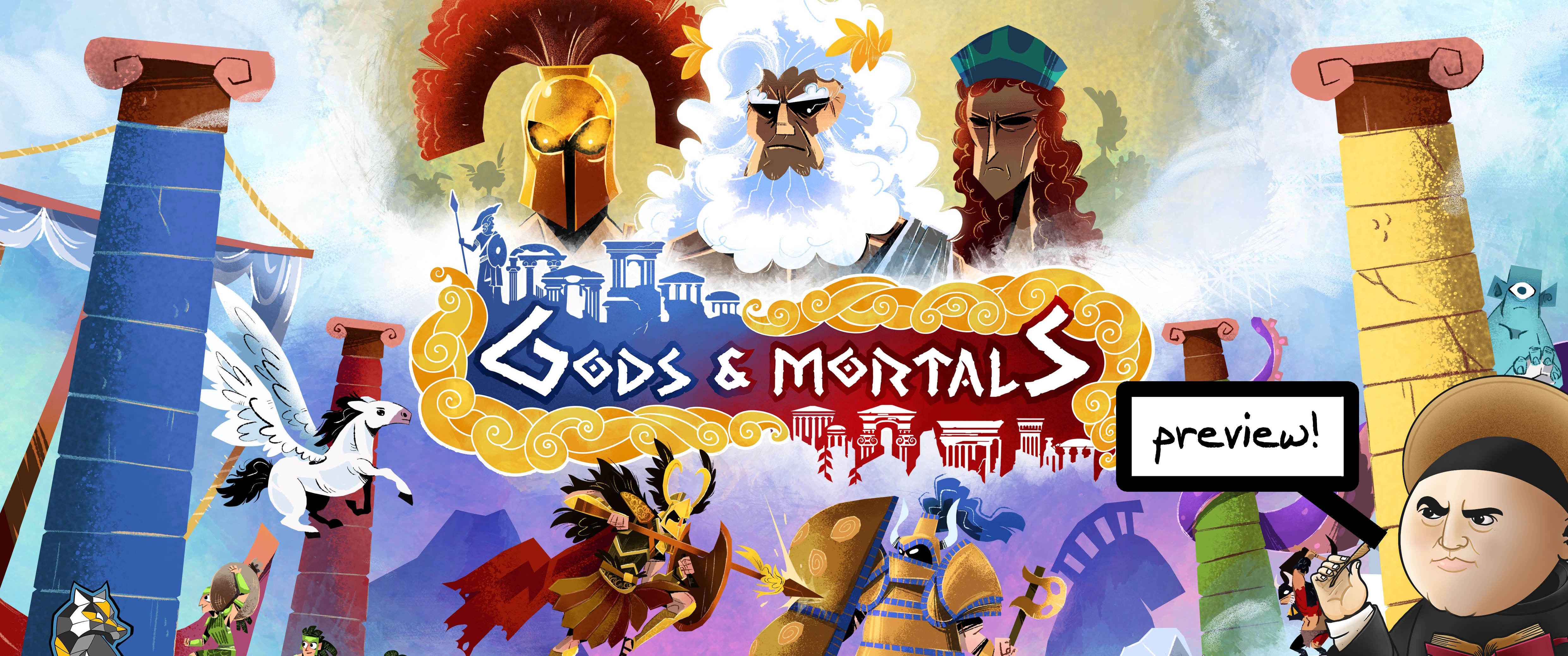
Gods & Mortals, designed by William Borg Barthet and Artyom Nichipurov — the latter of whom brought us the excellent Trick Shot and even excellenter Guards of Atlantis II — happens to be one of my favorite things: a total theological dumpster fire. There’s a purity to Graeco-Roman Polytheism, with its wild gods that are best placated or avoided. It isn’t until Hebrew and Christian religion start bellyaching about God’s goodness that the pantheon’s previous badness became — clap your hands between each letter — P R O B L E M A T I C. What does it mean when the Creator places a wager with his court prosecutor for a man’s soul? It means a problem for how we understand the universe. A big spoiled amphora of a problem.
In other words, Gods & Mortals is Greek myth by way of the Book of Job. As you might expect, it’s incredible.
This trampoline game has gotten out of hand.
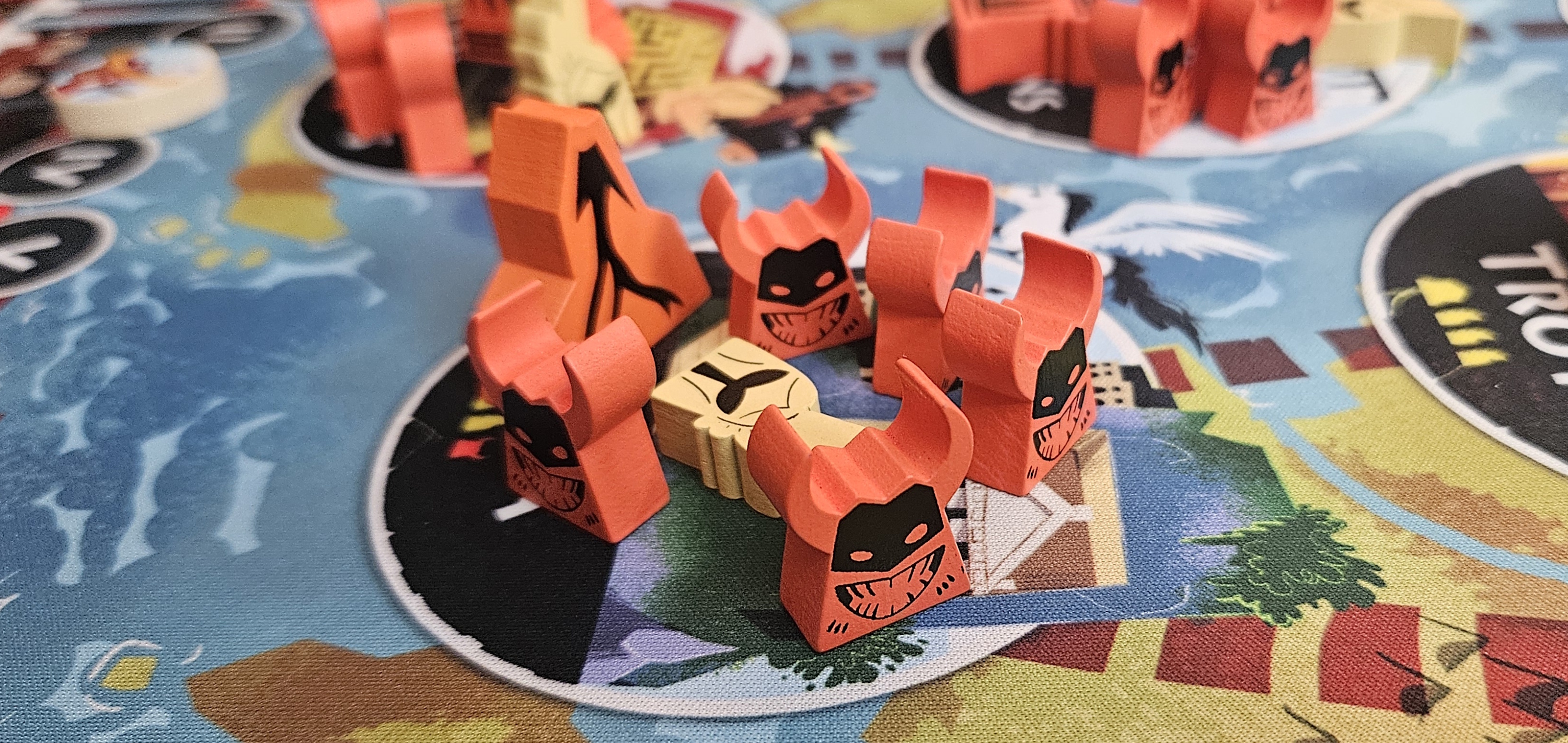
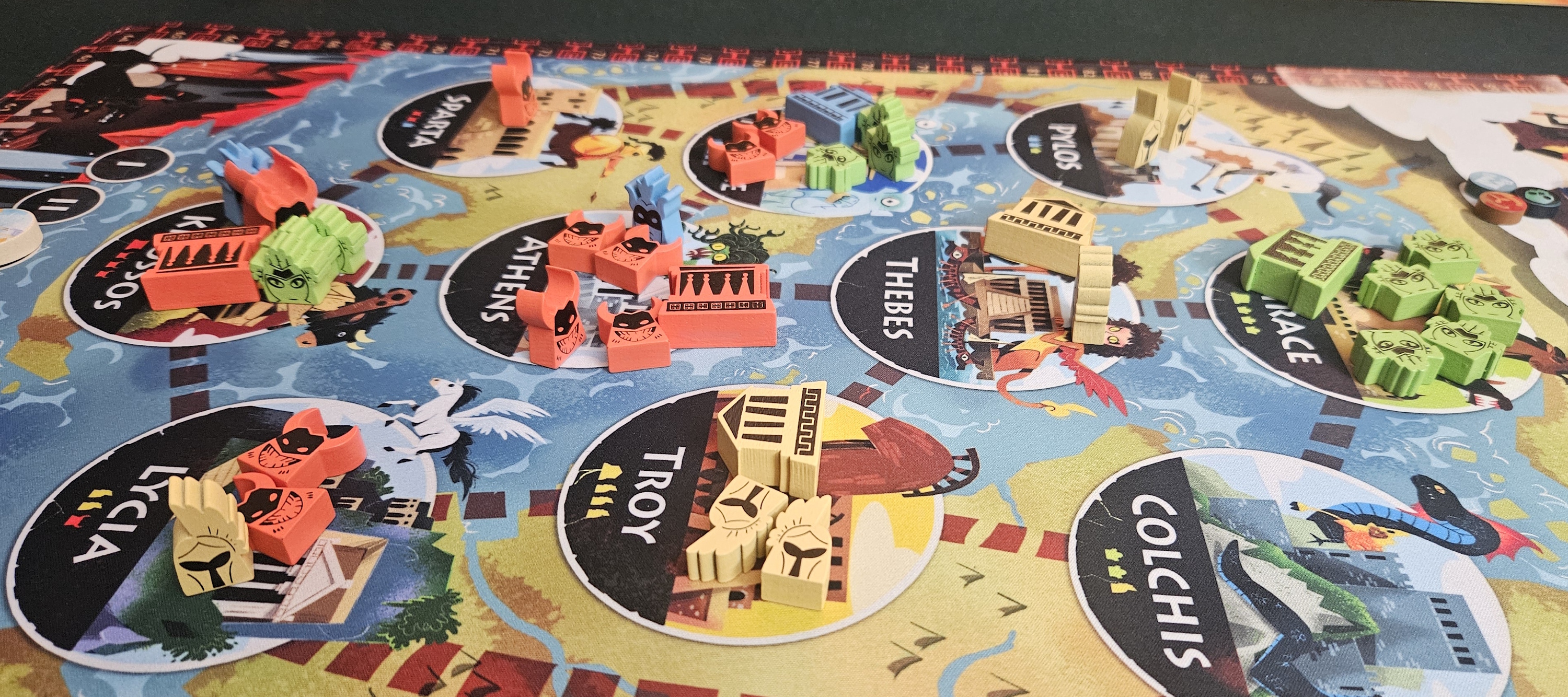
When Gods & Mortals opens, we receive a vision of the Aegean that’s half history and half myth. Humankind has split into four factions, each dominating roughly a quadrant of the known world. Proud Troy rules over one side of the sea, the Achaeans hold the opposite shore, the Minoans are doing the seafaring thing down south, and the northern land are ruled by the Amazons.
Don’t worry about keeping them straight. To you, an immortal, they’re yellow, blue, red, and green. You might as well distinguish between one species of beetle and another. The only reason you care that much is because the entire pantheon has gotten together and decided to wager some of their divine essence on the outcome of mortal affairs. Basically, you’re playing Age of Empires for money.
What follows is a freewheeling contest that plays out in two separate realms. On the table, mortal empires vie for control of territory, erect temples, and sometimes murder each other. Above it, the gods hoot and holler about their preferred sports team, trading wagers and nakedly calling for a rival’s star player to get benched. Betrayal is common. So is cooperation. Often those two go hand-in-hand, swapping places within seconds of the previous state of affairs.
I like to believe the gods invest in my soul as well.
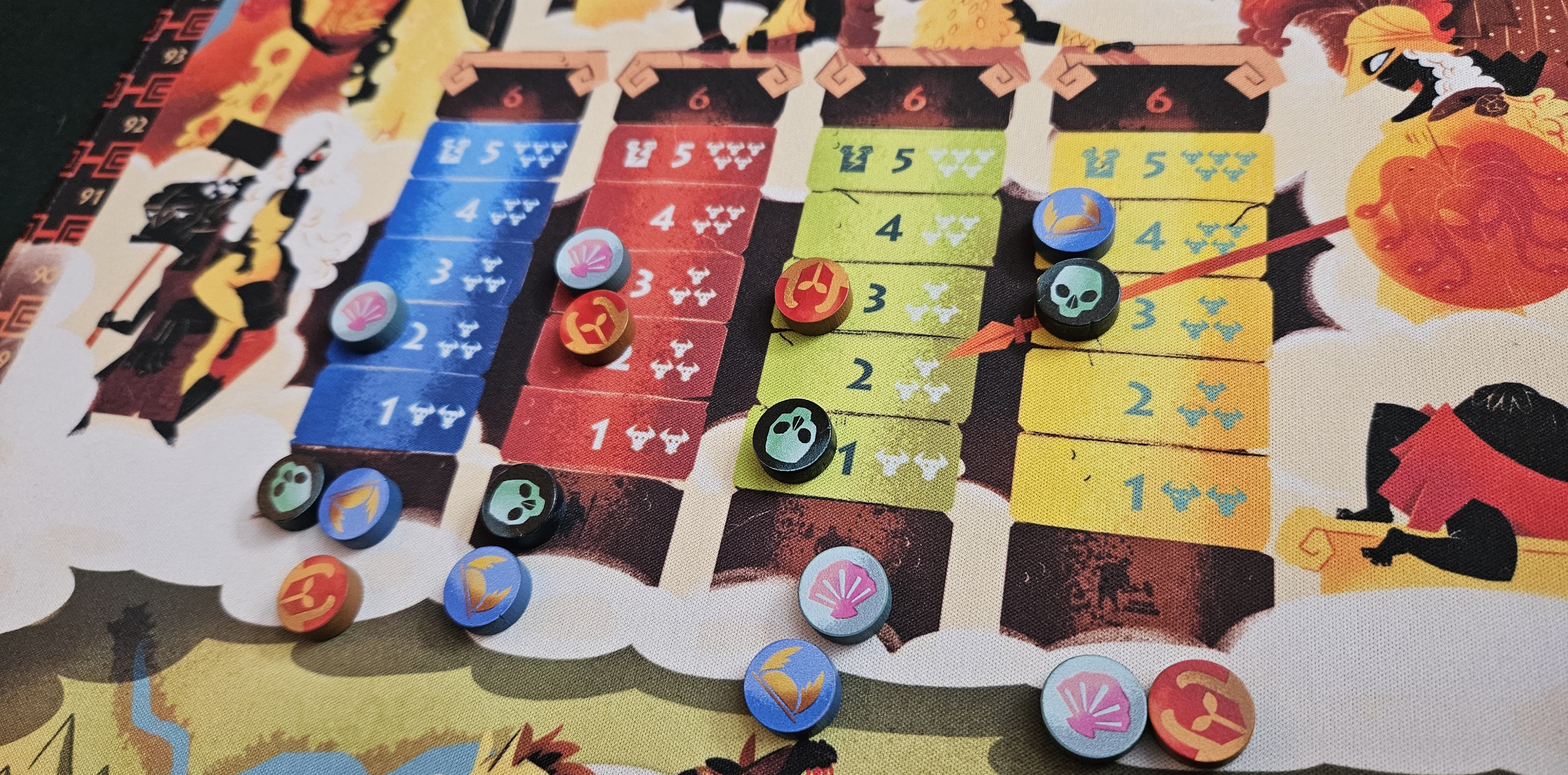
It works like this. When the round begins, every god is allowed to invest a portion of their divinity into the insect human dramas playing out below. The rules are strict. Only two kingdoms can hold your favor at a time. These increments are slow, only permitted one or two ticks at a time. Only one god can hold each level of favor within a kingdom, making it possible to block the interests of their fellows.
Perhaps most crucially, increasing your favor with a kingdom requires a proportionate investment of your divinity. If the Achaeans have been driven back to their city-state while the Amazons control a map-spanning empire, well, you’re presented with a conundrum: either buy Achaean favor at fire-sale prices, or cough up a premium for the Amazons.
Or betray them entirely. The strategy of Gods & Mortals is one of tactical investment and withdrawal. In essence, human factions are the joint-stock companies of your average cube rails title. Buying into a faction requires more divinity as they grow more prosperous. But so does your god’s potential buy-out. It’s tempting to bestow your godly light on a faction in ascent, but that could prove costly; on the flipside, spending too much time on a failed empire might prove catastrophic. We could render this as folksy wisdom. Buy low, sell high. The bigger they are, the harder they fall. Don’t date crazy.
And then, bets placed, the gods shift their attention to the mortal realm. You didn’t expect the gods, of all beings, to place a wager without leaning their thumbs and/or lightning bolts on the scales, did you? Even in the Book of Job, the foremost text on deities with compulsive gambling disorders, the spurned Creator sends a whole whirlwind to browbeat the poor guy into recanting his frustration.
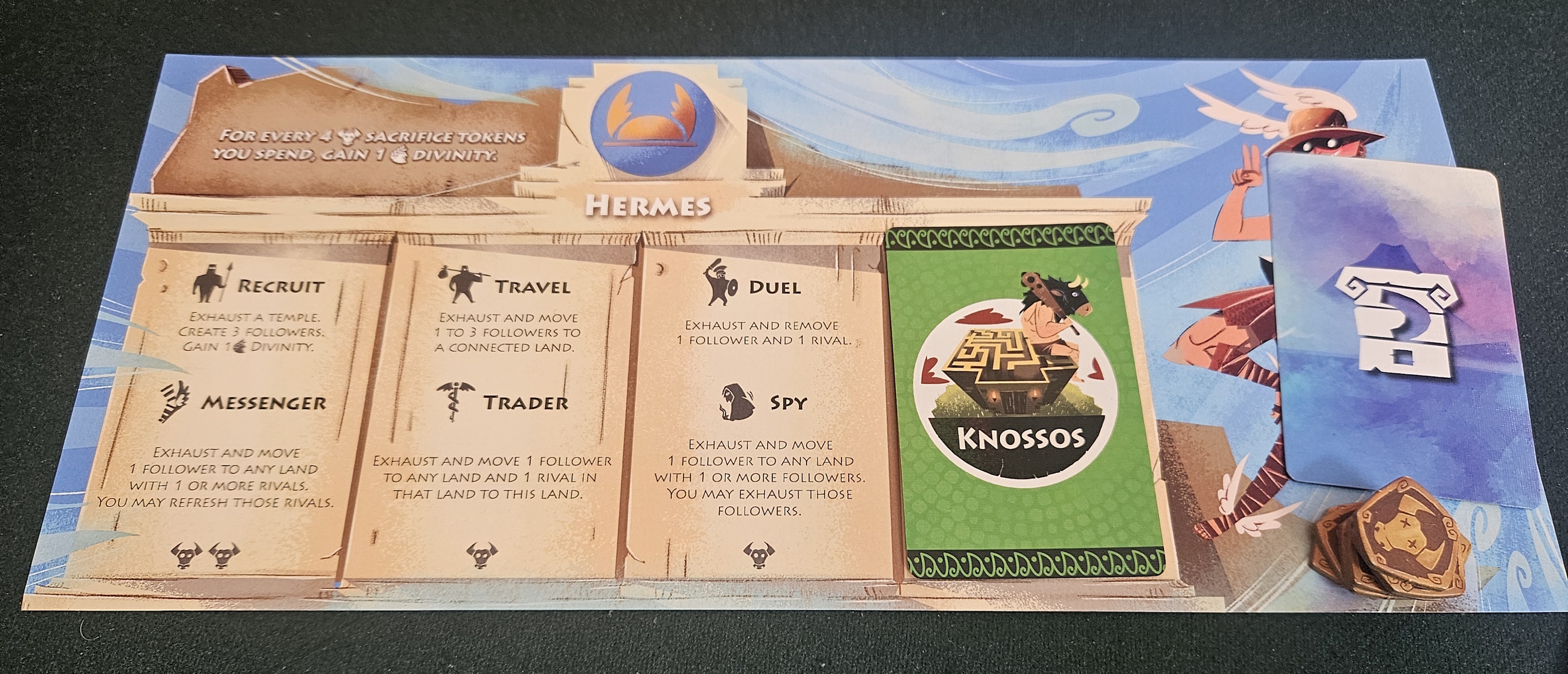
Each god brings their own strengths to bear.
This phase occupies the bulk of a round. Going around the table four times, each god takes turns manipulating the mortal wars, expansions, and offerings of the Aegean. As with the previous wagers, there are stark limitations. The short version is that you can manipulate mortal events quite broadly, but only provided you’re holding the right cards, the desired action is still available, and, if you’re going for one of the more powerful options, have enough sacrifices on-hand.
In practice, this strikes a tight balance. On the one hand, it’s exhilarating how transformative your powers can be. Some of this depends on your divine identity. Artemis can guide the bowstring of an anointed hunter to slay rivals in multiple foreign lands. Ares likes to sack rival temples, turning unprotected holy places into recruiting grounds for entire armies. Hades chews up souls and disgorges them as half-rotten Odysseuses. Most actions are smaller — troops marching from one space to another, a temple providing sacrifices to its patrons, a duel that kills both participants — but with the right timing and preparations, human affairs can prove surprisingly malleable.
But the other portion is social. Given the game’s stock-broker core, it shouldn’t come as a surprise that success often requires a deft touch with your immortal relatives. Control over the human factions is entirely shared, making it possible to meddle in surprising ways. I remember the white-hot fury that resulted when a carefully stocked military campaign entered a distant land only to, at the very beginning of the next round, turn around and march home before they could erect their intended temple.
More than that, it’s important to think about the long-term implications of each move. Will building that temple in Thebes lead to a long-term rivalry with Zeus? Is a volcano in Sparta a good way to ensure compliance with your plans, lest the little bondage-geared goofballs scream “This… is… ARGHHHH THE FIRE!!”? Or are there opportunities to trade favors? One session I won on the strength of collaboration, working with another player to reform the Achaeans from a measly two-territory kingdom into a sizeable empire. Theirs wasn’t the biggest faction on the board, in the end. But it had undergone the best growth, which meant the best total increase in our divinity. In my divinity.
Historical Greece. No embellishment.
All told, Gods & Mortals is a hoot. It’s a stock game, there’s no disguising that, but it’s direct and combative in a way that, say, cube rails is not. It would be tempting to say that this blunts that genre’s subtleties, but the more accurate summary is that it moves the concept in a new direction. The result is flashy but still measured, every god bending the rules in their own manner, but only after careful preparation and in clear sight of everybody else at the table. While it’s distinct from Nichipurov’s previous designs, it carries a few strands of familiar code: the emphasis on human drama, the tightness of a few outlandish actions, the sheer exuberance that comes from discovering each god’s inner workings.
As a bonus, yeah, it’s got that train wreck theology going on. How do we respond when the gods throw our lives into turmoil? Not much, apparently. Maybe, at best, we can place some bets on the outcome.
A prototype copy of Gods & Mortals was temporarily provided by the publisher.
(If what I’m doing at Space-Biff! is valuable to you in some way, please consider dropping by my Patreon campaign or Ko-fi. Right now, supporters can read about which films I watched in 2025, including some brief thoughts on each. That’s 44 movies! That’s a lot, unless you see, like, 45 or more movies in a year!)
Financially-troubled board game publisher CMON says it plans to relaunch its halted crowdfunding operations later this year, after seeing its annual losses soar to almost $20m in 2025.
But a month later it emerged that CMON’s financial problems had been growing long before the tariffs, with the company announcing it had slumped to a loss of more than $3m in 2024 due to falling sales for its crowdfunding campaigns.
CMON’s $23m losses across 2024 and 2025 are now almost 5.5-times larger than its profits from the preceding nine years combined – and have led an independent auditor hired by the company to question whether it has the resources to stay in business for the foreseeable future.
An extract of a report from auditor Zhonghui Anda shared by CMON, which is set to appear in the company’s 2025 annual report next month, considered the publisher’s $19.9m annual loss, its net liabilities of more than $3.5m and contract liabilities of over $7.5m, saying, “These conditions indicate a material uncertainty which may cast significant doubt about the Group’s ability to continue as a going concern.”
CMON’s directors have a different view, however, saying in the 2025 financial report that the company “should be able to continue as a going concern” thanks to a trio of factors.
They include financial support from some of the directors “sufficient to finance CMON’s working capital requirements”, the roughly $2.4m proceeds from selling its Singapore office that it received in January, and the roughly $1.25m gross proceeds from a successful share sale last month.
CMON’s hefty liabilities are largely due to its eight undelivered crowdfunding campaigns, which are not recognised as revenue on the company’s books until they are fulfilled to backers.
The company said that delivering crowdfunding projects in 2024 contributed about $20m in revenue – a figure which had sunk to just $200,000 last year according to its latest financial report.
CMON said the 2025 losses were driven by a “significant decline in revenue”, which fell more than 73% to $9.9m last year, compared to the $37.3m total from 2024.
DCeased from CMON || Kickstarter image
It also cited impairment losses on property, plant and equipment, right of-use assets and intangible assets, and a loss it made disposing intellectual properties and related assets as part of its “strategic portfolio restructuring”.
Those IP sales included parting with its most famous and profitable title Zombicide – which has raised more than $40m on Kickstarter since its 2012 launch – to Asmodee, as well as Blood Rage, Rising Sun and Ankh to Tycoon Games.
CMON said all those sales combined amounted to about $5.1m, but added that it actually made an overall $2.4m loss on disposal of intellectual properties and related assets across 2025.
It also made a $5.7m loss due to undertaking an impairment assessment on some of its property, plant and equipment, right-of-use assets and intangible assets “with finite useful lives”.
CMON said in the financial report, “These actions, while negatively impacting short-term results, were undertaken to strengthen the Group’s operational focus and reduce future cost burden.”
The company’s remaining significant IP includes the Massive Darkness series, with the most recent installment, Massive Darkness: Dungeons of Shadowreach, completing a $2.85m crowdfund on Gamefound early last year – a figure which rose to more than $3.7m including late pledges.
That campaign was CMON’s last before it scrapped its future crowdfunding plans two months later. The company has pivoted in the interim to releasing several small-box games direct to retail, including Collect!, Peanuts Talent Show, Fairy Perfume, Rocket Punch and Yokai Carnival.
Collect! from CMON, designed by Jérémy Ducret and Johannes Goupy
Discussing its current strategy in the report, the company said, “In light of the continued uncertainty in the global market, particularly the instability arising from US import tariffs on certain products since the first half of 2025, the Group has taken decisive steps to restructure its operations and strengthen its financial position.
“Our current strategy is to:
1) reduce exposure to large-scale crowd-funding launches in the near term, focusing on fulfilment of games already committed to backers, with plans to resume crowdfunding activities in the second half of 2026 with new titles from current game lines;
2) grow distribution in Asia as a primary strategic market;
3) maintain a streamlined operational structure with reduced headcount and a smaller office footprint in line with the Group’s current scale of operations; and
4) maintain a debt-free position following the full repayment of bank borrowings, significantly reducing the Group’s financial liabilities and improving its financial resilience.
“We remain committed to becoming a quality developer and publisher of tabletop games and believe the strategic refocus toward Asia and selective game development will position the Group more sustainably for the future.”
CMON said it had reduced its revenue exposure to the US to about 21.4% of its total across 2025, compared to around 42% for the previous year, through what it described as a “deliberate strategic pivot toward Asia”.
The report showed CMON’s combined North and South America revenue fell more than 86% last year to about $2.1m, from around $15.7m in 2024.
European revenue also fell more than 81% year-on-year, from about $12.7m to around $2.4m. Asia revenue fell too, but much less sharply, down about 33% in 2025 from $8m to around $5.3m.
CMON said in the report, “Notwithstanding this reduced exposure, tariff-related uncertainties may continue to affect future export sales, revenue and gross margin performance in the US market.
“The Group intends to maintain its current reduced focus on the US market until the trade environment stabilises and market conditions improve.”
CMON also revealed the scale of its staffing cuts in the latest report, with headcount falling from 81 at the start of 2025 to just 41 at the beginning of this year.
The report said total staff costs had fallen in that time from about $4m to around $2.8m, including pay for its directors and their pension fund contributions, but it did not provide a breakdown of those numbers.
Mehr Spielzeug und Eyecatcher als ernstzunehmendes Spiel? Wer das so sieht, hat eventuell völlig falsche Erwartungshaltungen an das turbulente Maskottchenrennen in der lokalisierten Version von Strohmann Games. Ganz sicher nicht für jede Runde geeignet, die ein Partyspiel erwartet, aber dann doch mehr Klamauk bekommt als erhofft. Ich selbst bin zwiegespalten trotz eindeutiger Meinung.
Hot Streak will auffallen. Das fängt bei der Spieleverpackung mit Blick auf die überdimensionalen Maskottchen in ihrer Plastikvitrine an, geht über das aus der Schachtel herausziehbare überlange Spielfeld als Laufstrecke und endet schließlich beim Siegerpodest hoch oben auf der Spieleschachtel. Dabei hätte der Ursprungsverlag CMYK das kurzweilige Wett- und Rennspiel auch ganz anders gestalten können. Mit Fokus auf den spielerischen Kern und weniger auf opulente Optik mit Gimmick-Faktor. Denn wäre der Verkaufspreis von knapp 50 Euro sicher auch niedriger ausgefallen. Für ein Partyspiel eh schon an der oberen Grenze. Dafür bekommt Ihr allerdings auch ein besonderes Spiel von einem Verlag, der sich einfach zu lernende, aber schwierig zu vergessende Spiele auf seine Fahnen geschrieben hat.
Strohmann Games hat Hot Streak lokalisiert, den Titel allerdings beim Original belassen. Dass es auch anders geht, hat Asmodee mit Turbo Flitzpiepen 2000 vorgemacht. Auch ein CMYK-Spiel, das Ihr wohl eher als Eigenimport unter dem Namen Magical Athlete kennt und eventuell auch lieben gelernt habt. Als Partyspiel, in dessen Kerbe ebenso Hot Streak schlägt. Aber noch ein Wort zu Lokalisation, mit der ich nicht ganz so glücklich bin. Da wird in der Anleitung von „glücklosen Spielsüchtigen“ geschrieben und auch die abschließenden Kurzlebensläufe nach dem Geldgewinn bei Spielende habe ich als ein Humor empfunden, der mir eher im Hals stecken bleibt. Beispiel gefällig? „59$: Du kaufst dir ein Seil. Man kann einfach nie genug Seile besitzen.“
Im Original klingt das anders, aber lustig ist dann doch irgendwie anders, nicht so erzwungen. Dort sind wir ein „degenerate gambler“ und wünschen uns von unserem Gewinn „You get yourself some rope. You can never have too much rope!“. Das Zitat könnte ich mit etwas Wohlwollen Samweis Gamdschie aus Herr der Ringe zuordnen oder eben auch der mordiben Redewendung „Give someone enough rope (to hang themselves)“. Entscheidet selbst, was für Euch passender zum Spielgefühl von Hot Streak passt. Wirklich gelacht hat in unserer Runde keiner darüber.
Aber eventuell bin ich auch voreingenommen. Denn mein Erstkontakt mit meiner selbst gekauften Ausgabe von Hot Streak in der lokalisierten Version war kein wirklich gutes Erlebnis. Eine Enttäuschung aufgrund der mit deutlichen Mängeln behafteten Materialqualität trifft es wohl eher. Für 45 Euro im freien Handel hatte ich schlicht mehr erwartet. Bekommen habe ich hingegen ein Exemplar, dessen gelbe Plastikleiste, die als Zughilfe für die Rennstrecke dient, nicht entgratet und eher schief improvisiert als gerade abgeschnitten war. Zudem war die planenartige Rennstrecke ebenso schief umgetackert, sodass diese sich an den Rändern unschön verzog und sichtbar aus der Zughilfe-Schiene herauszog. Da hat anscheinend jemand daran gewerkelt. dem das Endergebnis egal war. Made in USA steht auf der Verpackung.
Weiter geht die Negativfahrt leider mit einer ausgebeulten Spieleverpackung, weil die Pappfaltung keinen Halt dagegen bieten kann und die Materialschublade mit den restlichen Spielkomponenten wuchtig dagegendrückt. Zum Transport war eben dieses Spielmaterial mit arg strammen Einmachgummis um schnürt, die sich in meine Papp-Wettscheine gedrückt und Spuren für die Ewigkeit dort hinterlassen haben. Das Spielgeld als leicht gummiertes Papier war angeknickt, weil die Ecken keinen Schutz vor dem Schwergewicht des Spielkartenpäckchens hatten. Dass die deutschsprachige Spielanleitung dann noch zu groß ist, wie schon in der inzwischen verbesserten Erstauflage der Originalversion, rundet das Gesamtbild nur noch ab. Für ein 25-Euro-Gimmick hätte ich da beide Augen zugedrückt und nichts gesagt, so ist es für mich ein Reklamationsfall. CMYK soll ich laut Rückmeldungen auf Boardgamegeek da wirklich kulant zeigen, mal sehen, ob Strohmann Games dort mithalten kann.
Vor dem Wochenende nach Online-Kauf konnte ich es sowieso nicht beheben lassen, umso gespannter war ich, ob Hot Streak denn zumindest auf dem Spieltisch überzeugen würde können. Wir haben eine Partie zu fünft gespielt. Phasenweise kam dabei durchaus Laune auf. Allerdings lag das eher an der enthusiastischen Kommentierung der gezogenen Bewegungskarten und weniger am Spiel selbst. Wir begleiteten das mit entsprechendem Gejohle und Anfeuerung unserer aufgrund der Wetten bevorzugten Maskottchen. Eine Gaudi wurde es erst dadurch, dass wir es gemeinsam zu einer Gaudi gemacht haben.
Die folgenden zwei Rennen unserer Partie waren da schon deutlich gebremster in der Mitmach-Laune. Wohl auch, weil sich das Spielgeschehen wiederholte und der eigene Einfluss durch das Reinmischen einer eigenen Handkarte in den Zugstapel doch eher gering war. Zu schnell wurde uns klar, dass wir uns hier etwas selbst vormachen und auch wohl müssen, um den Spaßfaktor hochzuhalten.
Genau deshalb kann ich Hot Streak fernab aller optischen Eye-Catcher-Momente und in Ignorierung aller Qualitätsmängel meines Exemplars nur für Spielrunden empfehlen, die als Gruppe die drei Rennen einer Partie zur Party machen wollen und dabei auch entsprechenden Einsatz zeigen. Wer da nicht jubelnd und johlend aus sich herausgehen mag, weil es einem nicht liegt, ist hier leider fehl am Platz oder andersherum gesagt, Hot Streak ist für solche Spielrunden kein geeignetes Spiel.
Ich selbst werde Hot Streak noch in anderen Gruppenzusammensetzungen spielen, aber meine Zweifel bleiben, dass wir hier leider kein Spiel haben, das von sich aus den Spielspaß erzeugen und tragen kann. Dazu ist es dann doch zu banal. Nur wenn die Mitspieler die Hauptlast der Gaudi selbst bringen müssen, wozu dann überhaupt Hot Streak spielen?
Im direkten Vergleich gefällt mir Magical Athlete, ebenfalls von CMYK und später im Jahr denn lokalisiert von Asmodee wesentlich besser. Eben weil dort die arg unterschiedlichen Charaktere mit ihren schrägen Sondereigenschaften in immer neuen Kombinationen für ein Spielerlebnis sorgen, das jedes Mal erfrischend neu wirkt. Hier bei Hot Streak rennen immer die vier selben Maskottchen, die keinerlei eigene Eigenschaften fernab der zufällig im Spiel vorhandenen Bewegungskarten haben, die immergleiche Rennstrecke entlang. Zwar ist das Renngeschehen auch hier mehr als chaotisch, aber durch den eigenen Würfel bei Magical Athlete fühlte sich das für mich weitaus weniger fremdgesteuert an, obwohl es vergleichbar zufällig ist, wie sich das alles im Zusammenspiel und Zusammenstoß auswirkt.
Magical Athlete bietet für mich mehr Spiel und Spielsubstanz, während die Gaudi durch die Situationskomik der Charaktere selbst entsteht und wir darauf reagieren. Das trägt für mich mehr und deshalb würde ich in Gruppen, von denen ich weiß, dass die nicht die absoluten Wir-machen-aus-jeden-Spiel-unsere-eigene-Party-Fraktion sind, eher Magical Athlete vorziehen. Schade um den kreativen Ansatz von Hot Streak. Aber wenn es um Wett- und Rennspiele geht, wäre das gute und alte Camel Up eine Alternative, die noch in so manchem Spieleschrank schlummert. Sogar mit Spiel des Jahres Auszeichnung.
With this My Favorite Wargame Cards Series, I hope to take a look at a specific card from the various wargames that I have played and share how it is used in the game. I am not a strategist and frankly I am not that good at games but I do understand how things should work and be used in games. With that being said, here is the next entry in this series.
#71: The Wartburg from Here I Stand: Wars of the Reformation, 1517-1555 from GMT Games
Here I Stand: Wars of the Reformation 1517-1555 is an experience packaged in a game that attempts to boldly cover the political and religious conflicts of early 16th Century Europe. The game focuses on the struggle of religious reformers such as Martin Luther, John Calvin and Ulrich Zwingli as they battle the Papacy for changes in their views of God and religion. But it is more than just the Holy War as it deals with the other European countries involved in the affairs of the time including France, England, the mighty Hapsburg Empire and the Ottoman Empire in the east. They all played a role in the process of the Reformation and the design brilliantly weaves this all together into an interesting and engaging experience. The game also covers other plot lines and events of the period, including wars, marriages and ascendancies to thrones, using a unique Card Driven Game (CDG) system that models both the political and religious conflicts of the period.
Today, I want to take a look at a very interesting Response card in The Wartburg. Response cards in Here I Stand are event cards that can be played out of turn to interrupt the actions of an opponent or provide immediate reactions to specific game events. Response cards are often used to negate, mitigate, or enhance events and combats, and they may be played during an opponent’s impulse, provided the text allows for this asynchronous timing. These cards also tend to have specific pre-requisites that must be met in order to play the card and The Wartburg states that the card is “only playable by Protestants, and Luther must be alive”. The card itself allows the Protestant player to cancel the play of a card as an event but cannot cancel a Mandatory Event. The card however can cancel the play of the Papal Bull or Leipzig Debate Papal Home Cards, which is probably the way that the card will mostly be used. The card will not only cancel the play of the event but will also end the impulse of the player playing the card. This can be very powerful and when played at the right time can be a game saver for the Protestant player.
For example, in our most recent play at Buckeye Game Fest, I was playing as the Protestants and Bill Simoni as the Papacy. After the forming of the Schmalkaldic League and the Protestants changing into a military power, the focus of the other players turned toward me as I was doing well and near victory. They all then decided to declare war on the Protestants and began to advance upon and attack my fortified Electorates to take away VP I had earned by having both religious and political control in 5 of the 6 as the League was formed. As we came into turn 5, I was at 24 VP and ultimately came up shy of a victory by 1 point at the time. I had been able to take over the entirety of England and change every space and also get about 5-6 spaces in France, but now the Papal Bull came to play and Bill fought me back and forth with him taking over 3-4 spaces followed by me reclaiming 3-4 spaces. It was a beautiful game of back and forth and I used every tool at my disposal to fight him including The Wartburg card to stop the untimely excommunication of Zwingli before he could attempt to embarrass him in a debate. That card play at that very time saved me or most likely he would have used Eck who is his best debater against Zwingli who is just average and I would have lost leading to him being burnt at the stake giving him VP or by allowing him to turn over a few of my hard fought converted spaces back to Catholicism.
The only problem with this card is that it commits Luther so he will be unavailable to be chosen directly to debate during the rest of the turn. But this was a small price to pay at that time and ultimately led to me being able to hold on through the end of Turn 6 where I won a Protestant victory on the tie breaker with England.
Martin Luther stayed at Wartburg Castle from May 1521 to March 1522 under the alias “Junker Jörg” (Knight George) to hide from papal and imperial authorities. During these 300 days of protective custody, he translated the New Testament into German in just 11 weeks, wrote numerous theological works, and grappled with spiritual turmoil. His greatest accomplishment at Wartburg Castle was his translating of the New Testament from Koine Greek into German, which laid the foundation for a unified German language and made the Bible accessible to ordinary people. He also wrote numerous works, including Against Latomus and several tracts. He began his attack on monastic vows during this time, arguing they were contrary to faith. Luther used his time in exile for intense study and writing, referring to his stay as his “Patmos”, referring to the Apostle John’s exile to the Island of Patmos in 95AD. While here though he also experienced significant psychological distress and temptation. According to legend, he threw his inkwell at the devil during a confrontation, leaving a stain on the wall. His exile was organized by Frederick the Wise after the Diet of Worms and the stay was designed to keep Luther safe from those looking for him, ensuring the survival of his reform movement.
Wizards of the Grimoire is a two-player head-to-head battle game. You are wizards and you deal damage to each other by casting spells. To win the game, you need to reduce your opponent's health points to zero. This structure is pretty common. However the way you pick spells to use and manage mana needed to cast them is interesting. The game certainly offers something new.
There is
Origin Story stellt die Entstehungsgeschichte eines Superhelden in den Mittelpunkt. Über mehrere Kapitel hinweg entwickelt sich die eigene Figur vom unbekannten Charakter hin zu einem Helden mit individuellen Fähigkeiten, Stärken und Schwächen. Dabei entstehen nicht nur spielerische Kombinationen, sondern auch
Petiquette, Thomas Sellner’s card game of picking out patterns among hat-wearing animals, has been named game of the year at this year’s Golden Box Awards.
The Oink Games-published design fought off competition from 2025 winner Isao Mukai, who was nominated for Banana Governance – a card-based drafting and bidding game which sees players attempt to satisfy the needs of hungry monkeys better than their opponents.
A comment from the selection committee about Petiquette called the title “a brilliant and sharp work typical of Oink”.
Cards from Banana Governance, designed and published by Isao Mukai
It said, “I’ll never forget the shock I felt the first time I played it. The rules are simple: just give the answer that fits in the single ‘?’ on the cards laid out.
“But… the eyes of those who give the same answer feel friendly. The mouths of those who give a different answer seem to twist. The loneliness of desperately trying to explain when you’re the only one who gives a different answer.
“A mix of various emotions. The unique experience of this game really stands out.”
The annual Golden Box contest was launched four years ago, modelled on the American film industry’s Academy Awards. More than 40 industry professionals from within the Japanese board game sphere voted on this year’s award.
In addition to ‘Best Picture’ for the overall game of the year, the awards also celebrate the best in game design, art, graphic design, production and rulebook work through individual awards.
Cover art for Sweet Lands
Eve Inc-designed Nusutto Cat – also known as Meow Heist – triumphed in this year’s Game Design Award, while best art went to Totsuca Chuo’s Sweet Lands, which was illustrated by Tatsuki Asano and Broni120.
Moyuki Adisawa’s animal jet ski racing game Tornado Splash picked up the Graphic Design Award thanks to the work of iD Creative Co, while the Production Award went to National Economy and Toshinori Iwai.
The selection committee said of the Production Award win: “It’s great when a great game is revived. It’s even better when a great game is revived in the best possible form.
“This new edition not only makes the seemingly impossible revival of this masterpiece a reality, but also reinterprets it in a more refined way.
“The ‘box within a box’ structure, combining the three parts, is exciting even before you start playing, and the ‘household budget’ mechanism that characterizes this game is implemented clearly and beautifully as a ‘safe’.
“This masterpiece hasn’t lost its appeal even after ten years, and this new edition will be loved for even longer.”
Yoshihiko Koriyama worked on the rulebook for that title, with proofreading from Shota Okano and DTP work from Makoto Takami. The selection committee said, “The fact that you can essentially understand the game rules by reading just one page is excellent.”
Bomb Busters designer Hishashi Hayashi collecting his Spiel des Jahres award
The win marked the first Spiel des Jahres triumph for an Asian designer in the prize’s 46-year history, and underscored the huge rise in tabletop designs making their way across from Asia to Europe and North America in the past decade.
Each winner will receive a golden board game box as a trophy.
Winner: Sweet Lands, Totsuca Chuo (Uchibacoya) – art by Tatsuki Asano and Broni120 A Boar, Crab, Dung Beatle, Takuya Iwamura (Kyuhachi Dog) – art by Takuya Iwamura Ghost Lift, Onegear (Engames) – art by Sai Beppu
Graphic Design Award
Winner: Tornado Splash, Moyuki Adisawa (ArcLight Games) – graphic design by iD Creative Vidro, Keita Kasagi (Bamboo Games) – graphic design by Kakuzato Shady Lady, Kaya Miyano (Mob+) – graphic design by Sai Beppu
Winner: Down Down Dungeon, Reiner Knizia (ForGames) Electra Select (The Society for Appreciating Swaying Buds) Snowp, Eisuke Fujinawa, Kazunori Hori (SzpiLAB)
Das Videospiel Balatro hat in den vergangenen Monaten eine riesige Fangemeinde aufgebaut. Mit Trash Poker bringen die Designer Rico Besteher und Frank Noack das Prinzip der Pokerdeck-Destruction jetzt als kompetitives Brettspiel auf den Tisch. Corax Games begleitet das Projekt über die Spieleschmiede, wo die Kampagne ihr Fundingziel bereits deutlich übertroffen hat.
Pokerhände, Trash und Joker
In Trash Poker starten alle Spielenden mit einem klassischen Pokerdeck und treten über acht Runden gegeneinander an. Ziel ist es, in jeder Runde die beste Pokerhand auszuspielen. Das klingt zunächst vertraut, doch der Clou liegt im Deckbau und der gezielten Zerstörung von Karten.
Während der Partie kannst du unerwünschte Karten aus deinem Deck entfernen und stattdessen Spezialkarten hinzufügen. So formst du Runde für Runde ein immer stärkeres Deck. Gleichzeitig lassen sich die eigenen Werte upgraden, um den Punkteertrag pro Pokerhand zu steigern.
Punkte in Form von Chips gibt es auf zwei Wegen: Zum einen durch gewonnene Pokerhände während des Spiels, zum anderen durch bestimmte Kartensymbole, die sich am Spielende entweder noch im Deck oder im Trash befinden. Wer nach acht Runden die meisten Chips gesammelt hat, gewinnt.
Ein besonderes Feature sind die 53 Glitzer-Joker-Karten im Spiel. Diese lassen sich im Laufe mehrerer Partien freischalten und verändern das Spielerlebnis spürbar. Pokererfahrung ist übrigens keine Voraussetzung. Trash Poker funktioniert auch ohne Kenntnis der klassischen Pokerregeln.
Die Kampagne auf der Spieleschmiede
Die Kampagne auf der Spieleschmiede läuft noch 24 Tage und hat das Fundingziel von rund 3.333 € mit aktuell über 9.000 € bereits deutlich übertroffen. 257 Unterstützende sind bisher dabei.
Der Pledge „Straße" für 30 € enthält ein Exemplar von Trash Poker und ist mit 180 Unterstützenden die beliebteste Stufe. Für 40 € gibt es im Pledge „Fünfling" zusätzlich passende Kartenhüllen. Darüber hinaus stehen als Add-ons weitere Titel von Corax Games zur Verfügung, darunter „Gestern wirst du mich töten" und „Pax Viking".
Als Stretch Goal winkt bei Erreichen von 5.555 € eine Achievement-Promo mit zusätzlichen Herausforderungen für jedes Exemplar. Ab 9.999 € kommt ein Set aus drei Trash-Poker-Bierdeckeln dazu.
Trash Poker ist für 1–4 Personen ab 12 Jahren ausgelegt. Eine Partie dauert etwa 45–90 Minuten. Mechanisch verbindet das Spiel Deck Construction, Hand Management, Open Drafting und Set Collection. Wer den Charme von Balatro am Spieltisch erleben möchte, findet die Kampagne unter spiele-offensive.de.
Operation Barclay is one of the most inspired marriages of setting and mechanic that I’ve ever had the pleasure of experiencing. How did designer Maurice Suckling get the idea to pair the story of Operation Barclay, the Allied plan to feed the Axis false information about an upcoming Mediterranean invasion, with poker and a shell game? It’s such a remarkable idea, such a perfect idea. Most game designers would sacrifice body parts in exchange for an idea this good.
While the real Operation Barclay was about convincing the Axis that the Allies would invade Greece when they were in fact planning to invade Sicily, Operation Barclay the game gives us a bit more ambiguity than that. There are five possible areas of attack, stretching from Morocco-to-France and Egypt-to-Turkey. The Allied player places wooden Intelligence tokens into each of them. One lane, whichever the Allied player decides to make the Primary Offensive Sector, gets four positive Intelligence tokens and one negative. The Secondary Offensive Sector gets three of the first and two of the second, and the other three Sectors, red herrings all, get two and three.
[caption id="attachment_329516" align="alignnone" width="1024"]Operation Barclay Game Review appeared first on Meeple Mountain.
About five years ago, I had the chance to play a friend’s copy of the game Arkwright (originally published in 2015 by Spielworxx.) My buddy Jason was a huge fan and wanted to show off his copy to our strategy gaming group, so we got a three-player game rolling at my place. About four hours later, we came up for air to talk through our thoughts: mostly positive, a bit too long, a lifestyle game that really needed to be played often to be truly fulfilling.
My favorite game of all time—then, and now—is City of the Big Shoulders, now known as Chicago 1875: City of the Big Shoulders. “City BS”, as it is known in my circles, is a special game for a lot of reasons. Its focus is on the city of Chicago, in a period where a somewhat shocking number of famous companies were born there: Oscar Mayer, Quaker Oats, Kraft, Florsheim Shoes, Schwinn, Swift & Co., and many more. It’s the only game I’ve ever played that successfully combined the stock manipulation mechanics of popular gaming systems (such as incremental capitalization of 18xx games) with a straightforward worker placement mechanic that drives the middle phases of each round. It’s also a knife fight, a game that has epic swings and great competition, in…
French board game publisher Don’t Panic Games has continued its expansion into the North American market, telling BoardGameWire the success of several recent titles had reinforced its confidence in the strategy.
The company has made a name for itself providing French localisations of games including Final Girl, Champions of Midgard and Fantasy Realms since it was co-founded by current director Cédric Littardi in 2013.
But Don’t Panic has also found success publishing its own titles such as Chess-like abstract game Above – and said the performance of that, and several other recent games, had persuaded it to bring more of its titles to North America.
Emma Recher, who will head up a three-person team at Don’t Panic’s new US office in California, told BoardGameWire, “Several recent titles have reinforced our confidence in expanding more directly into the US market.
“That is one of the reasons we are beginning this US expansion with titles such as Spyworld, Luminis, Above, and Maiko, which are also the titles highlighted in our North American launch announcement.
“We also have additional releases planned each quarter this year, including Don’t Drop the Soap! toward the end of the year.”
Above, designed by Yves Charamel-Lenain, from Don’t Panic Games
Don’t Panic said those licensed titles would continue to be distributed by Japanime, while the French company’s historical and war line, including Fighters of the Pacific and Fighters of Europe, will continue to be distributed by Ares Games in the US.
Recher said, “What the new US office changes is that Don’t Panic can now directly support additional English-language titles that were not previously represented in the market in the same way.
“For retailers, that means broader access to the catalog, closer communication, more direct follow-up, and stronger on-the-ground marketing support.”
Don’t Panic added that it would be supported in the US by Double Exposure, which will represent the company at both major and smaller conventions – adding that it had a “robust demo schedule” planned over the next few months.
When asked about Don’t Panic’s decision to expand further in the US despite ongoing uncertainty over the country’s tariffs policy – and its effect on board game publishers working in the country – Recher said, “Like many publishers in tabletop gaming, we are watching the tariff situation very carefully. It creates uncertainty across the supply chain, from manufacturing and freight planning to wholesale pricing and retailer margins.
“Our approach is to stay flexible: planning conservatively, reviewing sourcing and logistics options on an ongoing basis, and working closely with our partners to protect continuity of supply as much as possible.
“The current environment is challenging for everyone in the industry, but we believe the best response is to remain pragmatic, adaptable, and transparent with our partners.”
Board Game Arena hat in der vergangenen Woche zwei neue Titel in die digitale Bibliothek aufgenommen. Mit Tipperary und Postcards kommen ein Polyomino-Legespiel aus Irland und ein Familienspiel rund um eine Radtour durch Frankreich auf die Plattform.
Tipperary – Irland als Legepuzzle
Tipperary von Designer Günter Burkhardt versetzt 2 bis 5 Personen in die irische Grafschaft Tipperary. Dort legst du Polyomino-Plättchen in dein Tableau und versuchst, möglichst große zusammenhängende Gebiete aus Weiden, Burgen und Whiskey-Destillerien zu bilden.
Im Zentrum steht ein „magischer Steinkreis", eine Art Drehscheibe, die in jeder Runde bestimmt, welche Landschaftsplättchen zur Auswahl stehen. Der besondere Dreh: Alle spielen gleichzeitig. Nach zwölf Runden steht fest, wer die Grafschaft am besten genutzt hat.
Das Spiel erschien 2023 bei Lookout Games. Auf BoardGameGeek erreicht es eine Bewertung von 7,19 bei einer Komplexität von 1,89 (von 5). Eine Partie dauert rund 45 Minuten. Die Community empfiehlt Tipperary besonders zu zweit oder zu dritt, es funktioniert aber auch in größeren Runden gut. Das Spiel lässt sich auf Board Game Arena ohne Abo spielen.
Postcards – Per Rad durch Frankreich
Postcards von Eric Dubus und Simon Kayne schickt 1 bis 4 Personen auf eine Fahrradreise durch die 13 Regionen Frankreichs. Ziel ist es, möglichst viele ikonische Postkarten zu sammeln, mit Briefmarken zu versehen und nach Hause zu schicken.
Pro Zug spielst du Reisekarten, um eine von vier Aktionen auszuführen: neue Postkarten nehmen, ein Lager aufschlagen, Briefmarken kleben oder in eine andere Region ziehen. Postkarten mit höherem Punktwert erfordern mehr Briefmarken. Da jede Briefmarke gleichzeitig eine Reisekarte kostet, schränkt das Frankieren die übrigen Handlungsmöglichkeiten ein. In diesem Spannungsfeld zwischen Sammeln und Ressourcenmanagement liegt der taktische Reiz.
Das Spiel erschien 2025 bei Fenrir Games und Synapses Games, illustriert von Crocotame. Auf BoardGameGeek steht es bei einer Bewertung von 6,85 mit einer Komplexität von 1,79. Eine Partie dauert 30–45 Minuten und endet, sobald jemand die vierte Postkarte abgeschickt hat. Auch dieses Spiel ist auf Board Game Arena ohne Premium-Abo zugänglich.
Zwei rivalisierende Autogangs rasen auf Leben und Tod durch die Einöde – einen riesigen Staubsturm im Nacken. Dustbiters von King Raccoon Games ist ein rasantes Zwei-Personen-Kartenspiel, das in weniger als einer Viertelstunde komplett gespielt ist und mindestens genauso schnell wieder aufgebaut werden will.

 Anmelden