I love a different style and focus of wargame. A game that takes a look at an important but somewhat obscure or rarely addressed historical topic, such as espionage or intelligence, and creates a gaming experience tailored around the events to highlight and evoke the difficulties and tension that would have been present. In January 2026, GMT Games announced such a game in Checkpoint Charlie, which is a solo or cooperative game focused on SIS espionage missions in Berlin in the 1960’s designed by Russell Brown. We have posted an interview with Russel and it was very well received and he has now agreed to create a series of History Behind the Cards to highlight the events of the 1960’s Cold War struggle in West Germany but also to share aspects about the game play and how it models the history.
*Note: The cards highlighted in this series and their event text, as well as any pictures used showing any of the various components, are still in the design and development process and as such event effects and text might still change prior to final development and publication.Also the art and layout of the cards are only for playtest purposes at this point and the game will enter the art department as it nears publication.
History Behind the Cards – Checkpoint Charlie from GMT Games – Card #7: Ich Bin Ein Berliner
In the summer of 1963, the Berlin Wall had been in place for almost two years, the reality of a city split between east and west, between Soviet and Western influence, was impossible to deny. Politicians, military leaders, and the people living day-to-day in Berlin continued to argue about the lack of forceful response from the west, particularly the Americans, when the wall went up. Other than a modest buildup of US forces within and around the city, there had been precious little action to re-assure the people of Berlin that the west hadn’t abandoned them.
In June of that year, President Kennedy hoped to change that perception by personally visiting this western city in the center of Soviet-controlled East Germany. He received the reception and the reaction he was hoping for, driving through the city to crowds of cheering West Berliners, and giving his famous speech on the steps of the Rathhaus Shöneberg to a gathered crowd of over one hundred thousand. In a calculated risk, he referred to the city as West Berlin, officially acknowledging the split created by the wall. He introduced his “Fellow Americans” and at the mention of General Clay (Card #6), the crowd interrupted the speech for some heartfelt cheering for the man that saved their city during the Berlin Airlift. Kennedy’s famous line of solidarity, “Ich bin ein Berliner,” — I am a Berliner — came at the end of the speech and may have been a bit off-script.
So how would Kennedy’s speech affect a mission in Checkpoint Charlie? I’m going to answer that with a story.
I spend a lot of time at a wonderful coffee shop near my home, so much time that my iPhone has labeled the location as my “work.” The baristas there know me, and one day one of them asked me what I was working on. “Right now,” I said, I’m working on a board game about spies in Berlin in the 60’s.”
He laughed. “Have you met John?” He pointed to an older customer at one of the tables. “He was a spy in Berlin in the 60’s.” It was true.
Since then, I’ve had many conversations with John about his time in Berlin. He was Army Intelligence, keeping track of what was going on in the city. He was there when the wall went up. He interviewed the refugees that, for a time, still managed to find a way into West Berlin. And he was there during Kennedy’s speech.
I asked him about the speech and said that in the game it resulted in crowds (a Demonstrations marker) near Tempelhof. He shook his head. “Everywhere. Crowds everywhere. All over the city.”
I’m sorry to report that I’ve restrained the effects of this card and the speech for gameplay reasons, but I haven’t ignored John in every case. The Daily Military Train event (Card #9) exists solely because of his stories, and after removing the Refugees event (Card #13) from the game because I assumed the flow of refugees disappeared after the wall went up, I put it back in because John assured me that they were still coming – he had met and interviewed hundreds of them.
In the next article in this series, we will take a look at the ongoing propaganda efforts from both sides of the Berlin Wall with Loudspeaker Wars.
In my opinion, this game looks extremely interesting and I am very much excited to learn more about it. I am appreciative to Russell and his efforts to bring us these cards and to write these entries to share with our readers. I am also very glad that this topic is being covered in a game and look forward to playing this one day soon.
With this My Favorite Wargame Cards Series, I hope to take a look at a specific card from the various wargames that I have played and share how it is used in the game. I am not a strategist and frankly I am not that good at games but I do understand how things should work and be used in games. With that being said, here is the next entry in this series.
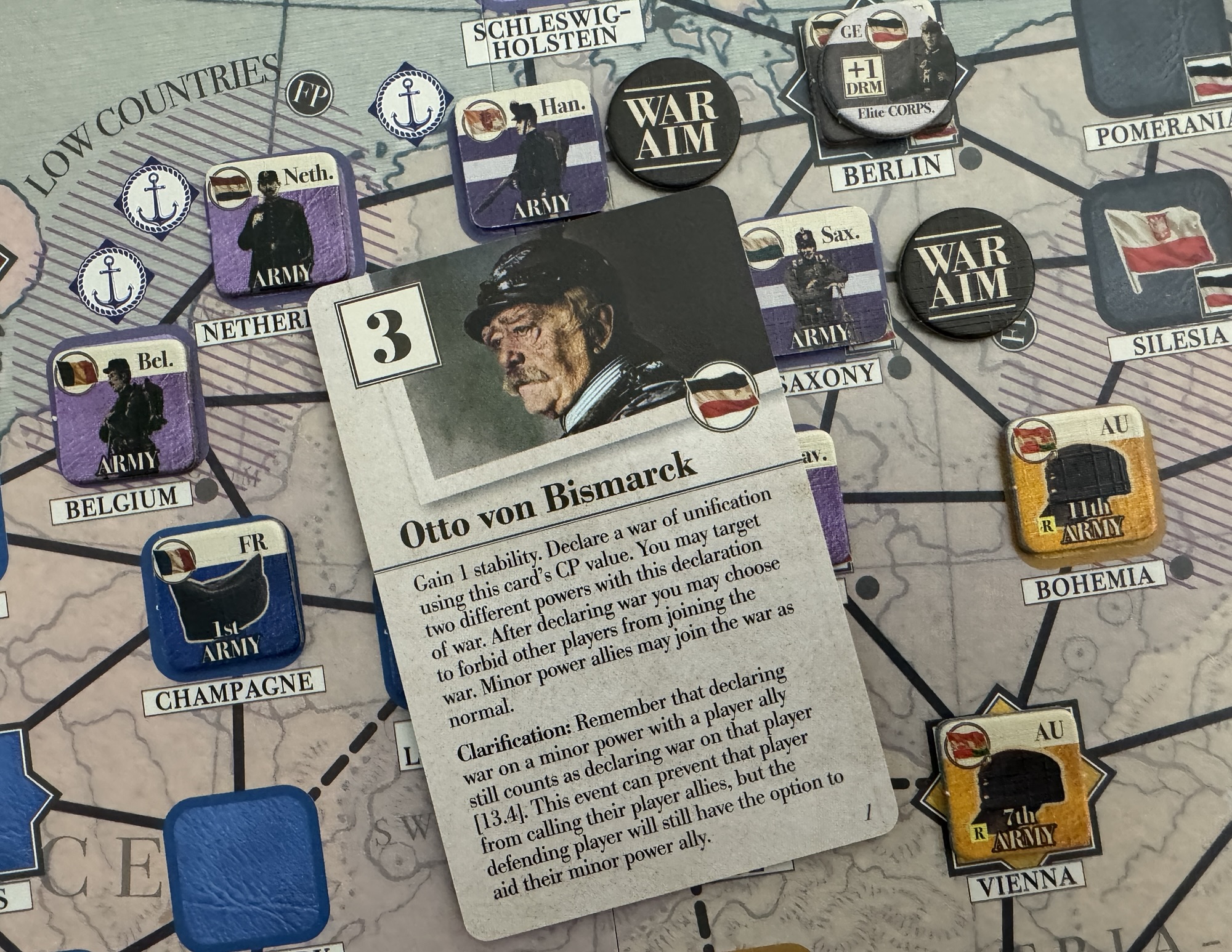
#93: German Home Card Otto von Bismarck from Imperial Elegy: The Road to the Great War 1850-1920 from VUCA Simulations
Imperial Elegy: The Road to the Great War 1850-1920 is a massive card driven game that blends diplomacy, warfare, and statecraft and feels a bit akin to games like Here I Stand and Virgin Queen from GMT Games, which are both grand scale sweeping epics that play multiplayers and take a day to play. Players play as 1 of 6 major powers in the game including Germany/Prussia, the United Kingdom, France, Austria-Hungary, Russia and the Ottoman Empire. The game is quite grand and ambitious as it covers 70 years near the end of the Victorian Era and the Progressive Ear and sees quite a lot of global change and competition between the great powers of the time. The game is a Card Driven Game and uses Action Cards as a type of currency to spend for their Command Points or the printed event to take actions such as recruiting armies and navies, industrialize, moving fleets and armies around the globe, influencing minor powers and establish colonies in Africa, India and the Pacific Ocean. The cards are all tied to the history of the period but the game can be played very much as a sandbox allowing players to explore strategies by trailblazing new horizons or following history.
In Imperial Elegy: The Road to the Great War 1850-1920, the Otto von Bismarck Card is a powerful and extremely important German Home Card. Rather than being shuffled into the common Action Card Deck, it belongs exclusively to the Prussian/German player’s unique toolkit to represent the historical trajectory of German state-building. The card is mechanically tied to the first few turns of the grand 7-decade timeline and acts as a get started quickly card for the German player as they begin the long and somewhat difficult task of attempting to unify the Germanic peoples under one banner. The German player can choose to execute it on Turn 1 to abstractly simulate Bismarck’s rapid real-world rise to power and kickstart early diplomatic maneuvers or wars. Playing as Germany, the player should be focused on attempting the Unification of Germany and will most likely choose the Unification National Goal card as a standard at the beginning of games. The Bismarck Home Card is the primary historical vehicle used to achieve this unification and simulates driving the annexations or alliances needed to claim crucial minor regions including Saxony, Schleswig-Holstein, Denmark and Alsace Lorraine. And like standard Action Cards in Imperial Elegy, the card presents a choice. The German player can either choose between using its high Command Point (CP) Value of 3 for a massive push focusing on industrial development or military actions, or using the card for its printed Event text. One of the really nice parts of the card is the way that it effects Stability in the game. Stability is a core national resource and rating that measures a major power’s internal political health, structural integrity and capacity to wage war or absorb setbacks such as economic downtown and social upheaval. Typically, when you declare war, your Stability will degrade but not in the case of a War of Unification. And with Bismarck, Germany will gain 1 Stability when they declare a War of Unification. This is such a powerful effect for the early game as it will allow the German state to build up their capacity and increase Stability to be able to perform later in the game.
1871 portrait of Otto von Bismarck, the first Chancellor of the German Empire. He is depicted wearing his signature Prussian military uniform, including the distinct Pickelhaube (spiked helmet).
Otto Eduard Leopold, Prince of Bismarck, Duke of Lauenburg, known as Otto von Bismarck, was a conservative German statesman who masterminded the unification of Germany in 1871 and served as its first chancellor until 1890, in which capacity he dominated European affairs for two decades. He had previously been Minister President of Prussia from 1862–1890 and Chancellor of the North German Confederation from 1867–1871. He provoked three short, decisive wars, against Denmark, Austria, and France.
Following the victory against Austria, he abolished the supranational German Confederation and instead formed the North German Confederation as the first German national state, aligning the smaller North German states behind Prussia, and excluding Austria. Receiving the support of the independent South German states in the Confederation’s defeat of France, he formed the German Empire – which also excluded Austria – and united Germany.
With Prussian dominance accomplished by 1871, Bismarck skillfully used balance of power diplomacy to maintain Germany’s position in a peaceful Europe. To historian Eric Hobsbawm, Bismarck “remained undisputed world champion at the game of multilateral diplomatic chess for almost twenty years after 1871, and devoted himself exclusively, and successfully, to maintaining peace between the powers”. However, his annexation of Alsace-Lorraine (Elsaß-Lothringen) gave new fuel to French nationalism and Germanophobia. Bismarck’s diplomacy of Realpolitik and powerful rule at home gained him the nickname the “Iron Chancellor”. German unification and its rapid economic growth was the foundation to his foreign policy. He disliked colonialism but reluctantly built an overseas empire when it was demanded by both elite and mass opinion. Juggling a very complex interlocking series of conferences, negotiations and alliances, he used his diplomatic skills to maintain Germany’s position.
A master of complex politics at home, Bismarck created the first welfare state in the modern world, with the goal of gaining working-class support that might otherwise go to his Socialist opponents. In the 1870s, he allied himself with the low-tariff, anti-Catholic Liberals and fought the Catholic Church in what was called the Kulturkampf (“culture struggle”). He lost that battle as the Catholics responded by forming the powerful German Centre Party and using universal male suffrage to gain a bloc of seats. Bismarck then reversed himself, ended the Kulturkampf, broke with the Liberals, imposed protective tariffs, and formed a political alliance with the Centre Party to fight the Socialists. A devout Lutheran, he was loyal to his king, Wilhelm I, who argued with Bismarck but in the end supported him against the advice of his wife Queen Augusta and his heir Crown Prince Frederick William. While Germany’s parliament was elected by universal male suffrage, it did not have much control of government policy. Bismarck distrusted democracy and ruled through a strong, well-trained bureaucracy with power in the hands of a traditional Junker elite that consisted of the landed nobility in eastern Prussia. He largely controlled domestic and foreign affairs, until he was removed by the young new headstrong Kaiser Wilhelm II. He retired to write his memoirs.
This historic image shows Chancellor Prince Otto von Bismarck (center) with diplomatic envoys and plenipotentiaries of the Federal Council (Bundesrat) inside the Berliner Reichstag in 1889.
We have put out several pieces of content covering Imperial Elegy and find it to be a fantastic game. These include written posts and videos. You can visit those by following the links below:
Unboxing Video:
Video Review:
Summary of Solitaire Bots presented by our friend James:
The year is quickly fading as we are nearing the start of the 4th quarter of 2026. Man the year has just gone by so quickly and I still have so many great games awaiting us to give them the attention they deserve. But there are always new games and they are also equally deserving. This month, I was able to find 19 games to share (including 6 games from our sponsor). I was also able to find 3 games being offered on Crowdfunding through Kickstarter and Gamefound.
Again this month, we have a sponsor for the Wargame Watch post in Neva Game Press. This is Neva’s 3rd time sponsoring this post and they are very busy as they have a ton of new games upcoming. Neva Game Press is a new publisher who appeared on the scene 2 years ago. When I started seeing their posts on Twitter and Facebook, I was immediately impressed with their interesting topic choices for their upcoming games as well as the fact that they are trying to make small footprint wargames that pack a punch. And the art is also very appealing and brings an aesthetically pleasing and attractive look to their games!
Big Experiences, Small Footprint: New from Neva Game Press
At Neva Game Press, we believe great games don’t require massive boxes. Our ‘Hardcover Book’ box policy delivers premium components and deep, innovative mechanics in a shelf-friendly format—without compromising playability. We recently rebranded from Neva Wargames to Neva Game Press to reflect our expansion into thematic titles, though our commitment to wargaming remains stronger than ever.
End-of-Year Releases
We are closing 2026 on a high note with two major releases. After the rapid sell-out of Iwo Jima: Hell on Earth—the first volume of our Blind Valor Series—we are thrilled to bring it back as a Revised Edition, and we are grateful for the community’s support. We are also releasing an Iwo Jima: Hell on Earth Update Kit for owners of the original 1st Edition. Finally, we are launching our new tactical wargame, Peking: 55 Days of Fury—the first volume in our Breach Point Series.
Peking immerses 1–2 players in the 1900 Boxer Rebellion for a tense, 90-minute experience. Whether defending the International Legations or leading the attack, you’ll need to master our unique fog-of-war mechanic and hybrid system (featuring event cards and operation points split into two phases) to secure victory.
Our commitment to the community continues with an ambitious slate for 2027, featuring: Valls: Battle of the Goi Bridge, Spartacus: Rome under Threat, 1806: The Elbe Campaign and Reformation: Fire and Faith.
They recently announced their next Kickstarter project that would take their system to the Anglo-Boer War called The Great Anglo-Boer War: The Battle for South Africa 1899-1902. The game is currently on Kickstarter and appears to be a very important addition to the many games on the period.
From the game page, we read the following:
The Great Anglo-Boer War is a grand-strategic level game of the war between the British Empire and the Boer Republics in South Africa from 1899 to 1902. The Boers were armed like no other adversary the Empire had ever faced. By October 1899, war had become inevitable—and both sides were equipped for the first ‘modern’ conflict. Both sides had rifled breech-loading artillery, machine guns, bolt-action magazine rifles, trenches, barbed wire, and more.
The war started as a conventional contest but morphed into the first modern guerrilla war of the 20th century. In the end, the Empire overwhelmed the Boers, but by 1910 all of South Africa (including the contested republics of 1899) was granted self-government as a Crown Dominion, with Louis Botha as the Prime Minister. The Boers can be said to have lost the war but won the peace. A fascinating bit of history but an even more interesting study in military history.
The game places you in the position of the military commanders of both armies. Political events are largely beyond your control, but may influence what you are allowed to do. There are three scenarios – the Conventional War, the Guerrilla War, and the Grand Campaign Game. The full campaign is THE ULTIMATE BOER WAR EXPERIENCE – from the first desperate siege defenses of 1899 to the treaty of Vereeniging (or maybe not?) – and everything tactical and otherwise in between. Battles, blockhouses, farm-burnings, evasions, escapes, raids, concentration camps, sieges, drives, armoured trains, 1-pdr automatic “pom-poms”, surrenders, entrenchments, typhoid, barbed-wire, native spies, night marches, supply wagons and more. If it was part of the real Boer war – it is in the game. If you know about the war – this is the one you’ve been hoping someone would make, and if you are learning about it – this IS THE GAME for that. With a 44×34 map at 9 miles/hex scale, monthly game turns and an accurate order of battle, this is a game that truly does justice to the topic.
As of September 1st, the Kickstarter campaign has raised $7,389 toward its $12,900 funding goal with 86 backers. The campaign will conclude on Tuesday, October 20th at 1:38pm EDT.
2. Combat! Vietnam from Compass Games
This month we had another pretty big downloading of new pre-order games from Compass Games that I have affectionately referred to in the past as “Pre-Order Palooza”. This one was not their normal 6-10 new titles but there were 4 new games offered and they all looked very good. The first game that I am highlighting here is the next volume in the highly thought of Combat! Series of solitaire wargames. These games represent man to man combat where typically each of the counters on the board represent a single soldier. They have focused exclusively on World War II previously but now they have announced this new game set during the Vietnam War called Combat! Vietnam. I have yet to play any of the previous volumes in the series, even though I own 4 of them, but they are high on my want to play list and I am very much interested in this system because I love Tactical level games, very much enjoy man to man combat in games and also enjoy games that are set in during the Vietnam War.
From the game page, we read the following:
Combat! Vietnam is a stand-alone solitaire game of man-to-man combat in the Vietnam War, covering the years from 1965 to 1972. This game depicts the countless small actions that were fought during those years, with the player commanding a squad of American, Communist, or South Vietnamese soldiers. In the 11 scenarios, the fighting rages across the widely varied terrain of Vietnam, from dense jungles to city streets.
The comprehensive Random Scenario Generator (and Campaign Game) further expands your gaming possibilities. With this tool, players can generate a limitless supply of unique scenarios for Combat! Vietnam.
Combat! Vietnam also includes Armor rules, allowing the player to relive iconic scenes such as T-54 tanks charging south during the Easter Offensive or Marine Patton tanks battling through Hué.
3. Viking Dawn: A Game of Viking Exploration & Expansion 800-1040 A.D. from Compass Games
The 2nd game from Compass Games today is a good one. And I know that because I have played it. But, our friend Gregory M. Smith is a solitaire game designing genius and has done many of these solo, narrative driven style wargames that we have all enjoyed for hours on end while we have been unable to find an opponent or just because we want to play a game on our timeline. We have interviewed him many times for his games such as Zeppelin Raider, Interceptor Ace, The Hunted, Western Front Ace, Amerika Bomber, Defending America, American Tank Ace, British Tank Ace, Rebel Tide, Sinking Yamato and most recently for a magazine wargame called B-52D Linebacker II. But Greg is a versatile designer and also has done many great 2-player games as well. He always has something cooking in his game design kitchen and recently we spoke with him about his new design with Kevin McPartland called Viking Dawn: A Game of Viking Exploration & Expansion 800-1040 A.D. from Compass Games. I was able to play this 1-4 player game while at the World Boardgaming Championships last month and you can read about my experience at the following link: https://theplayersaid.com/2026/07/27/world-boardgaming-championships-2026-daily-debrief-series-day-3/
From the game page, we read the following:
Viking Dawn is a low-complexity strategic game, with rules for two, three, or four players, each controlling a faction of Vikings (Norse, Swede, Dane, and optionally Geat). Inspired by SPI’s game Conquistador! from the 1970’s, Viking Dawn has exploration, trade (both internal and external), and minor leaders. The game also contains rules for solitaire play with the Danes or Norse.
Faction descriptions:
Norse – closest to the New World, they have the additional advantage of two Explorers, Erik the Red and Leif Eriksson.
Danes – closest to the lucrative raiding and settlement targets of England, they also have the advantage of having several early leaders.
Swedes – although further from England, they are closest to several Russian settlement areas, and river portage routes to the east and Constantinople.
Geats – ostensibly the weakest faction, as they must pay tribute to the Swedes for protection, they have the best trading advantage in the game.
Players compete to raid lucrative settlements and explore the world with longships and warbands. Each faction has named historical leaders, who have an impact on combat and exploration. Players may trade with each other or nonplayer-controlled areas and establish settlements. Includes rules for settlements gaining independence, leader burials, and establishment of the Varangian Guard.
If you are interested in Viking Dawn: A Game of Viking Exploration & Expansion 800-1040 A.D., you can pre-order a copy for $54.00 from the Compass Games website at the following link: https://www.compassgames.com/product/viking-dawn-pay-later/
4. Tunnel Rats: The Vietnam War Underground from Compass Games
Game 3 in this month’s mini-Pre-Order Palooza from Compass Games is another very interesting looking game set during the Vietnam War called Tunnel Rats: The Vietnam War Underground. This game is a solitaire game, which I think makes a lot of sense historically and thematically and actually gets me very excited for the possibilities, and I very much look forward to seeing how this one works. I have great hope for this one. The designer is Lisa Smedman who has done several recent popular solo games including Trench Raid.
From the game page, we read the following:
Tunnel Rats is a single-player game set during the Vietnam War. You will control two American “tunnel rats” who have been tasked with exploring an underground tunnel complex created by the Viet Cong. This complex is made up of tiles representing tunnels and underground rooms in which the enemy may be lurking. In this claustrophobic environment, the tunnel rats need to be as quiet as possible to avoid alerting the enemy. Tense firefights and hand-to-hand combat feature a unique initiative system, and encounters are fast and furious.
With a procedurally generated map, nine tunnel rat characters to choose from, and a variety of weapon and equipment load-outs, each “run” will provide a new and dynamic challenge. Your team’s objective will vary, shifting the focus of play depending upon which lieutenant is in command of the team. Tunnel Rats also includes rules for campaign play, allowing surviving tunnel rats to gradually hone their skills over time – if they survive.
Be on your guard, as the tunnel rats never know what they will encounter down in “the black”. It might be a hidden punji stake pit, a Viet Cong command center filled with valuable documents, a venomous snake slithering along a tunnel, or a water trap they must swim through without drowning!
5. Against the Reich Deluxe Edition from Compass Games
Game 4 from the Compass Games mini Pre-Order Palooza is a classic hex and counter operational level wargame set in World War II called Against the Reich Deluxe Edition designed originally by Joseph Balkoski.
From the game page, we read the following:
In June of 1944, the world held its breath as land and naval forces of six Allied nations launched the largest amphibious assault ever attempted. The long-awaited second front, the Western Front, was finally open. The Allies had to force the unconditional surrender of Nazi Germany by crossing the great Rhine River into the Reich itself. Adolf Hitler was confident that the battered but undefeated Wehrmacht could hold two enormous fortified zones (the Atlantic and Westwalls) and repulse any attempt to cross into the German homeland. Against the Reich is the first game in years to cover the entire Western Front campaign. The players are in the positions of Eisenhower and Hitler, making the grand decisions that control the course of the campaign.
A Quick-Playing Simulation: Designer Joseph M. Balkoski, whose specialty is the Western Front, has provided an accurate, realistic simulation that plays like a game. With short and long campaign games, you can choose the length of the simulation.
Headquarters and Supplies are Realistically Linked: Players must decide where to concentrate their resources. Limited supplies make the placement of headquarters and depots a critical factor in the campaign.
Choice of Invasion Sites: The Allied player must decide where to invade – do you strike a lightly defended area and accept a long, grinding ground campaign, or strike close to the Rhine and risk quick destruction?
Historical Overview: Russel F. Weigley, author of Eisenhower’s Lieutenants, the definitive history of the Western Front, has analyzed the strategic options facing Eisenhower and Hitler – and the players.
Loaded with other Features: A short “Battle of the Bulge” scenario, Second Invasion, Flooding Holland, Port Repair, The Roer Dams, Rail Movement, Mediterranean Front Reinforcements, Amphibious and Airborne Assaults, and much more.
6. Enlightenment Empires: Power and Politics in Eastern Europe, 1725-1795 from GMT Games
One of my favorite parts about historical wargaming is that I get exposed to and am able to learn about some of the more obscure parts of our world’s history. Now you might be saying to me that the subject of power politics in Eastern Europe form 1725-1795 is not obscure and I think that you would be correct if I was from Eastern Europe. But as I am from the United States, this is not a period or locale that we learned much about in grade school. That being said, I am very much interested in this concept and history and am glad to see Brian Asklev taking another crack at a topic that focuses on some of the history from his neck of the woods. When Enlightenment Empires: Power and Politics in Eastern Europe, 1725-1795 was first announced a few weeks ago, I was immediately interested because I do love games where several nations have to compete economically, politically, diplomatically and through force of arms. I also recently played Brian’s Baltic Empires at WBC and very much enjoyed that game and this one appears to be in a similar style and uses the very interesting Dramatis Personae cards to inject historical characters with their abilities into the game play.
From the game page, we read the following:
Enlightenment Empires is an approachable 2-5 player strategy game about conflicts between the states of Central and Eastern Europe region during the Enlightenment era, a transformative period of political upheaval, large-scale warfare, and constant struggles for power. Players will have to develop their economy, decide their internal policies on the ideas of individual liberty and effective governance, secure trade deals and financial assistance within the context of the global rivalry between Britain and France, and finally build armies to become the dominant power of Central and Eastern Europe. Russia, Poland-Lithuania, Prussia, Austria, and the Ottoman Empire will fight for hegemony, using variable victory conditions that reflect their respective historical objectives.
Building on the solid foundation provided by Baltic Empires, highlights of Enlightenment Empires include:
Five new asymmetric factions with unique abilities and objectives, including a new “Constitution” objective reflecting the pinnacle of Enlightenment political ideals.
Another highly thematic deck of historical Dramatis Personae to constitute your royal court, now also including random events that can disrupt players’ plans…or present them with new opportunities.
A simplified, yet still deep and political, economic system that forces players to make tough decisions regarding their state’s internal policies (serfdom, noble privileges, and military spending) and its diplomatic relations to the superpowers of the period, England and France.
The same streamlined battle system based on custom dice per unit type, now modified by military reforms.
More detailed minor powers that players may form alliances with.
Variable player counts (from 2 to 5 players), with scenarios ranging from a tight duel to a tense multiplayer conflict replete with alliances and betrayals.
If there is a word that could define the whole of 18th century, it would be the Enlightenment. The philosophical thought that applied reason to all spheres of life guided the social and political developments of the 1700s, and intellectuals, scientists, politicians, and rulers alike acted either in support of it or against it. And while in Western Europe the republican ideals of enlightenment brought about the French Revolution, in Central and Eastern Europe enlightenment became a tool for state-building for the absolutist monarchs, including the Holy Roman Emperor and Archduke of Austria Joseph II, King Frederick II of Prussia, or Empress Catherine the Great of Russia. The mid-18th century period was formative for these powers, with Prussia and Russia continuing to struggle to establish their dominance in the region, while Austria and the Ottoman Empire fought to preserve their status, and the weakened state of Poland-Lithuania struggled to reform its constitution before meeting an unlucky demise. Three of the traditional “pentarchy“ of Great European Powers (namely, Russia, Prussia, and Austria) were Eastern powers that achieved this status during the 18th century. Their dominance in the region was forged by the work of bureaucrats and reformers, as much as by the soldiers and generals on the fields of the Seven Years‘ War.
Keep in mind that these type of games can sometimes be very complex and have lots of moving parts. And I am not saying that this doesn’t have them but Brian has said that the game is very approachable.
Enlightenment Empires presents these political and military conflicts in a fun and accessible format, while also doing justice to the fascinating history of the region during this period. The game features five asymmetric factions with different strengths, internal political conditions, military forces, and historical objectives, along with the capacity to develop their states by conducting reforms along (or against) Enlightenment ideals, investing in economic infrastructure, and recruiting key historical characters that offer unique game effects. The game also includes several scenarios for variable player counts and durations, offering additional flexibility and replayability.
7. The Last Hundred Yards Volume 6: The Forgotten Hell from GMT Games
If you didn’t know we really enjoyed The Last Hundred Yards as well as Volume 2: Airborne Over Europe. The system is extremely interesting for a tactical game and uses some novel elements in regards to how victory points are scored including a focus on time to complete missions as well as the casualties incurred. Really an excellent system with lots of crunch and potential! Now, even though there are a total of 5 other volumes that have been released, Mike Denson has forged ahead with the next entry in the series which gives us a look at the operations in New Guinea and the Northern Solomon Islands during WWII with The Last Hundred Yards Volume 6: The Forgotten Hell.
From the game page, we read the following:
The Last Hundred Yards: The Forgotten Hell is Volume 6 in The Last Hundred Yards Series. This game examines the Allied campaigns against Japan in 1942, focusing on U.S. operations on Guadalcanal and Australian fighting in Papua New Guinea.
In New Guinea, Australian militia and the Australian Imperial Force troops fought a brutal and desperate delaying campaign along the Kokoda Track from Port Moresby to Buna, Battling through jungle, mountains, rain, mud, hunger, disease, and exhaustion, they resisted repeated Japanese advances and flanking attacks. Their stubborn defense slowed the enemy, shielded Port Moresby, and eventually helped reverse the campaign. At Milne Bay, Australian forces pushed the Japanese back and shattered the belief that the Imperial Japanese Army was invincible.
On Guadalcanal, U.S. Marines and Army troops fought equally savage battles, destroying Ichiki’s force at Alligator Creek and later assaulting entrenched Japanese positions around Mount Austen. There, the enemy used caves, rocky ridges, and concealed strongpoints to prolong the struggle.
Together, these engagements reveal the intensity of jungle warfare in the Southwest Pacific, where endurance, small-unit leadership, and relentless attacks under terrible conditions shaped the early Allied offensive against Japan. These actions also showed how terrain, logistics, and morale could decide campaigns as surely as firepower across the battlefields of the Solomons and New Guinea alike.
8. Shenandoah: Jackson and Sheridan in the Valley, 1862 – 1864 (Stonewall in the Valley and Sheridan in the Shenandoah) from Multi-Man Publishing
A BIG and well respected American Civil War operational system is what Great Campaigns of the American Civil War (GCACW) is and the newest volume in the series is called Shenandoah: Jackson and Sheridan in the Valley, 1862 – 1864. One of the things that I very much appreciate about this system is the fact that they use some of the best art out there for their covers.
From the game page, we read the following:
Shenandoah: Jackson and Sheridan in the Valley, 1862 – 1864 is the latest design in the award-winning Great Campaigns of the American Civil War(GCACW) Series. It contains both a complete redesign of the Stonewall in the Valley (SIV) game covering Stonewall Jackson’s 1862 valley campaign and a completely new game module Sheridan in the Shenandoah that depicts Sheridan’s 1864 valley campaign. The game is designed by Joe Balkoski (the original GCACW Series creator) and Chris Withers. The original SIV game maps have been upgraded to contain the latest GCACW map features, with map design executed by artist Charlie Kibler—whose work on the series dates to its creation in 1992.
Shenandoah: Jackson and Sheridan in the Valley, 1862 – 1864 uses the latest version of the GCACW Standard Basic Game Rules, which also apply to all other games in the series, and these rules are now printed at an increased 11-point font size instead of 9-point. After more than a quarter-century of refinement, these rules are extremely well organized and relatively easy to learn, even for series newcomers. The Advanced Game rules cover situations specifically applicable to these unique campaigns such as “The Burning” that depicts the desolation of the valley by Union cavalry in 1864.
Stonewall in the Valley includes one new Basic Game scenario, the four original Basic Scenarios rebalanced, and the original Advanced Game campaign scenario extensively revised:
The Battle of Kernstown (March 23, 1862; 1 turn): Introductory scenario on the battle of Kernstown – ideal for beginners.
My Last Council of War (March 10 to March 23, 1862; 14 turns): Heavily outnumbered, Jackson moves south from Winchester thru Strasburg to Mt. Jackson. A Union force of three divisions follows to Strasburg while sending two divisions out of the Valley to reinforce McClellan. Jackson races back north and attacks the remaining Union division at Kernstown but loses the battle.
God Blessed Our Arms at McDowell (April 30 to May 11, 1862; 12 turns): Historically, Jackson moves west from Staunton and causes the Union force at McDowell to retreat north to Franklin. He briefly pursues them but then returns to the Valley. This scenario postulates what might have happened had Ewell’s division and Banks’ two divisions become involved in the McDowell campaign instead of holding fast in their camps in the south of the Valley.
Rebel Blitzkrieg (May 21 to June 2, 1862; 13 turns): Jackson and Ewell advance north on the Luray Pike and surprise the small Union force at Front Royal. A Union division entrenched at Strasburg to the west belatedly discovers it is in danger of being cut off and just beats Jackson north to Winchester. Jackson defeats the Union at the first battle of Winchester and pursues to Harpers Ferry. Meanwhile strong Union forces are moving in behind Jackson from both the east and the west. Jackson turns south, marching to Strasburg and then Mt. Jackson and barely avoids the trap.
Our Beautiful Valley Will be Cleansed (June 6 to June 11, 1862; 6 turns); Two Union columns, separated by the Shenandoah River, pursue Jackson south from Strasburg. Fremont’s force engages the Confederates at Harrisonburg and then two days later battles them at Cross Keys. Meanwhile Shields’ division advances into Jackson’s rear and almost captures his wagon train. Jackson turns his army from Fremont to Shields and defeats Shields in the battle of Port Republic causing both Union forces to pull back north.
Jackson’s Shenandoah Valley Campaign (March 7 to June 19, 1862; 105 turns): The entire Valley campaign is covered in this scenario. Both sides typically have forces moving all over all three maps in exciting maneuvers and with forces coming and going due to external events. The scenario plays quite fast due to lulls where sets of 5 turns are skipped. The original advanced rules have been simplified, and the scenario has been extensively playtested and re-balanced.
Sheridan in the Shenandoah includes twelve Basic Game scenarios and two Advanced Game campaign scenarios, all extensively playtested:
Second Winchester (June 13 to June 15, 1863; 3 turns): Ewell’s corps leads the Confederate army thru the Valley to invade Pennsylvania and routed the Union division at Winchester. The Rebels cut off the Union retreat and captured most of the Union division. The route was now clear for Lee’s invasion of the north.
The Battle of New Market (May 15, 1864; 1 turn): Introductory scenario on the battle of New Market – ideal for beginners.
Piedmont (June 4 to June 6, 1864; 3 turns): Picking up the after Sigel’s debacle at New Market, Union General David Hunter marches south from Winchester. With Breckinridge, Confederate hero of New Market, aiding Lee at Cold Harbor, defense of the Valley falls to a ragtag collection of troops that are rushed to the area under General W. E. “Grumble” Jones. The forces battle at Piedmont, Jones is killed, the Rebels are routed, and the Union captures Staunton.
In the Valley Again (July 23 to August 5, 1864; 14 turns): Early’s army moved back into the Valley in mid-July after retreating from the outskirts of Washington, D.C. On July 23, Confederate scouting revealed that Early was only opposed by Crook’s forces and not the VI and XIX corps, which had returned to D.C. Early attacked Crook at Kernstown and routed the Union forces which retreated across the Potomac. Confederate infantry destroyed the B&O RR at Martinsburg and threatened to invade north. Two Confederate cavalry brigades advanced north towards Chambersburg, burned it, and were chased by 2 Union cavalry divisions. Meanwhile, the VI and XIX corps had been recalled to the Valley, but then along with Crook’s force, moved east to protect against an assumed invasion again by the Confederates. The Union force soon countermarched back to Harpers Ferry and the Confederates retreated south.
Second Kernstown (July 24, 1864; 1 turn): A simple scenario covering the second battle of Kernstown – ideal for beginners.
Sheridan Takes Command (August 10 to August 14, 1864; 5 turns): Sheridan took command of all forces in the region on August 7th. His orders were “wherever the enemy goes let our troops go also”. The plan was to trap the Confederate infantry in the northern valley, but Early knew the danger and moved south just ahead of the Union. Both sides marched rapidly south until the Confederates setup a strong line at the Fisher’s Hill. Sheridan prepared to attack but halted his plans when a strong force under Anderson entered the Valley at Front Royal.
You Must Be Cautious (August 17 to August 21, 1864; 5 turns): With the Union infantry camped along Cedar Creek and the Confederates entrenched in a strong line at Fisher’s Hill just to the south, Sheridan learned of the approach of Kershaw’s division. This elicited a new directive from Grant warning Sheridan he “must be cautious and act on the defensive until movements … force them to detach” troops. Therefore, Sheridan conducted a night march to Winchester. From there the Union briefly defended at Berryville and then at Charlestown. The Confederates pursued and eventually tried to bring on a battle at Charlestown. However, Sheridan was cautious and followed the new defensive strategy and disengaged to retreat into a strong, compact line at Halltown, just in front of Harpers Ferry.
Third Winchester (September 19, 1864; 1 turn): This scenario depicting the third battle of Winchester is only one turn but still features lots of maneuver and combat.
From Winchester to Fisher’s Hill (September 19 to September 22, 1864; 4 turns): This scenario encompasses two significant battles in the valley campaign. The Union army attacked the Confederate defensive line just east of Winchester and eventually drove the Rebels back to Winchester. This final Confederate line collapsed, and they retreated south all the way to a formidable defensive position at Fisher’s Hill, just south of Strasburg. The Union pursued and then rolled the west flank of this line and routed the Confederates.
Early’s About Played Out (September 23 to September 26, 1864; 4 turns): After the battle of Fisher’s Hill the Confederates retreated south. The Union pursued with their entire army, but the action for the next few days was limited to cavalry and rear-guard skirmishes. The Confederates safely made it to Brown’s Gap, while the Union infantry stopped at Harrisonburg and Union cavalry started burning the countryside.
Tom’s Brook (October 9, 1864; 1 turn): This solitaire scenario is filled with cavalry action and is an excellent learning scenario for beginners.
The Battle of Cedar Creek (October 19, 1864; 1 turn): While this is only a 1-turn scenario it is filled with the action that took place in the battle of Cedar Creek. The Confederate player starts with a Night March and a Surprise Attack. The Union responds with a special “Sheridan’s Ride” action to enable counterattacks.
Sheridan Moves South (September 19 to October 20, 1864; 32 turns): This scenario spans the battles in the campaign from when Sheridan attacked the Confederates at Winchester, to when the Confederates were defeated at the battle of Cedar Creek. This campaign can be easily played in a weekend.
The Last Valley Campaign (July 21 to October 20, 1864; 92 turns): This scenario encompasses the entire campaign from when Early’s army returned to the Valley after his raid on Washington, to when he was defeated at the battle of Cedar Creek. There is maneuver and combat all over all three maps in this scenario. The action often starts with a Confederate offensive and advance to the Potomac. The Union then gets significant reinforcements to launch counteroffensives.
9. Okinawa: The Last Battle of WWII Reprint from Best with 1
I love a new and interesting way to tell the story of a key battle and I found a very interesting one called Okinawa: The Last Battle of WWII from Best with 1 earlier this year. This is a solitaire only game and for each game the player will draw four objectives from a possible 12 that you must survive and capture before time runs out. On your turn, the player will roll special dice and then spend those to take actions such as movement, attack and take special actions from different unit action cards that will be set up in a square from from 1 to 10. The numbers coincide with the dice of the attacking Japanese and as the player moves through the rondel they will be able to activate and use their different soldiers to attack the Japanese defenders or use their special abilities to gain tokens that can be used for rerolls or healing of wounds
I think that the best part of the game is the concept of resource management as you have to use the dice appropriately to move and fight and also to manage your troops as you can upgrade certain cards as you pass the midway point of the round as well as when special actions are granted via the special resource chits. Upgrading units is very important as this will unlock things like heavy weapons in the form of bazookas, a Sherman tank and planes to be able to take out the Japanese armor units defending the island. The game is about efficiency of movement and doing the most with what you have. The dice determine what you can and can’t do and movement is optional as you don’t have to move unless you feel it is advantageous. But remember, that you have to defeat the defenders and the various objectives to be able to advance to your final objective and sitting in one space too long is not advisable.
The different units have various functions including attack, such as the Rifleman, Machine Gun Team and Sniper but also have secondary functions to remove the fog of war, heal your damaged units or gain additional resources. The Japanese defenders are well hidden and also have various defenses such as pill boxes and caves that will require the player to defeat these before moving to attack the units located inside.
In the end the game is about defeating the Japanese defenders while doing so in a set amount of revolutions around the rondel setup. This can be as few as 2 times around or as many as 4 and knowing when to use your resources to reroll your dice, as you either didn’t get the run of consecutive numbers you were looking for or just need a specific number, you will run out of resources quickly and you must plan them out as best you can to win the game. This one is really fun and I have played it about a dozen times winning about 70% of the time. The game plays in about an hour and the action is fast and furious and you are immediately beset by the staunch Japanese defenders and must act quickly.
You do not have to buy the Hero Bound game but can order the game as an Add On.
10. Tank Clash: Eastern Front from Ameba Games
I love to highlight these little campaigns that I find on Kickstarter and this month there is a new company, or at least that I am not familiar with, called Ameba Games that is offering a small game called Tank Clash: Eastern Front. This games appears to be the 2nd game in the series with the 1st being called Tank Clash: Western Front.
From the game page, we read the following:
Tank Clash is back with new iconic World War 2 tanks!
The Red Army is spearheaded by the powerful Soviet armoured units like the T34, SU100 and IS2. Germany pins its hopes on the last of the panzer divisions to halt the Soviet advance. The Wehrmacht fields its fearsome tanks like the Stug III, Nashorn and Tiger II for the coming battle.
The stage is set for the largest clash of late-war heavy armour.
Tank Clash: Eastern Front is a standalone tactical tank warfare game for 2 players, designed for both newcomers and seasoned strategists. Easy to learn yet rich in tactical choices, it combines its signature checkers-style armour tracking system with dice rolling and hand management for intense skirmish battles.
Already own Tank Clash: Western Front?
Built with modularity in mind, Eastern Front is fully compatible with its predecessor. Combine both games to command 12 unique tank types across expansive battlefields with up to 4 players. Eastern Front’s new features – including new missions, battlefield tokens, event cards and enhanced gameplay elements can also be incorporated into Western Front for an even richer combat experience.
I know what you might be thinking, as the art is a bit cartoony, but I am going to give this one a chance. I think that any wargamer likes to use tanks and this one appears to be focused on these metal monsters and I am going to give it a go. Plus the components are really nice, including some very well made poker chips that are used on the board, and frankly the price of $40 is probably worth what you re getting.
As of September 1st, the Kickstarter campaign has funded and raised $9,054 toward its $3,928 funding goal with 108 backers. The campaign will conclude on Wednesday, September 16th at 9:00pm EDT.
New Release
1. A Hellish Fight: The Battle of Fort Sumter – 1863 from High Flying Dice Games
I love lesser gamed subjects. Or even sometimes games that have never seen the light of day and never touched certain subjects. It is always nice to play something unique and interesting while learning new parts of history. High Flying Dice Games does this exceptionally well as they have made their living on doing lesser (or even totally) unknow battles in their small format games. This month they have released a game that focuses on the 2nd siege of Fort Sumter in Charleston, South Carolina in 1863 called A Hellish Fight: The Battle of Fort Sumter – 1863. This one looks pretty interesting and appears to focus on the iron clad battles and bombardment of the ruins of the fort that were still held by the Confederates.
From the game page, we read the following:
Following the capture of Fort Wagner on September 7th, and the protracted bombardment of Fort Sumter by the Union navy’s ironclads as well as army land batteries, an assault to take the fort’s ruins was planned. Admiral Dahlgren and General Gilmore both felt that securing Fort Sumter’s capture would not only lead to Charleston’s surrender, but send a clear signal that the Confederacy’s days were numbered.
If you are interested in A Hellish Fight: The Battle of Fort Sumter – 1863, you can order a copy for $18.95 from the High Flying Dice Games website at the following link: https://www.hfdgames.com/sumter.html
2. Guadalcanal: The Battle for Henderson Field, Oct 23-26, 1942 from Dan Verssen Games
The Valiant Defense Series designed by David Thompson has been one of my favorite solitaire wargame series of the past nearly 10 years. Each of the volumes in the game address very specific situations and always have a very interesting take with fun mechanics, great art and fantastic production. The torch for the series though has been passed to a new designer in Vincent Cooper. He has designed Volume 5 Guadalcanal: The Battle for Henderson Field, Oct 23-26, 1942 and it has finally fulfilled off of Kickstarter.
From the game page, we read the following:
Take command of the valiant Marines of the 1st Marine Division, supported by Soldiers of the 164th Infantry Regiment, desperately defending Henderson Field against waves of Japanese troops. Guadalcanal: The Battle for Henderson Field is a solitaire and cooperative tactical wargame published by Dan Verssen Games (DVG) as Volume V in the Valiant Defense Series.
Here is a bit of a designer diary/commentary from the designer Vincent Cooper:
This all started about 3 1/2 years ago when I first played Pavlov’s House. I say played. I ‘played’ the game for about 10 minutes…and then I sat there in stunned disbelief at how a game could be sooooo good!!!!
By the time I finished there were two very clear ideas for games fully formed. I contacted DVG to see if there was any interest and they put me in touch with David Thompson. I didn’t hold much hope. There was no reason for him to trust his IP to me, a person he didn’t know.
But I gave it a try and David, it turns out, is one of the nicest people you can ever come into contact with. After some back and forth, the idea for Guadalcanal – The Battle for Henderson Field was born (not, in fact, one of the original ideas, but we’ll see what the future holds for them…).
The game has been through various stages of development and now stands ready to KS!! I will be giving more details in the future about the various variant play options, but have no fear: This will keep you scratching your head looking for the right decision for MONTHS!!
Art by the supremely talented Nils Johansson
Thank you to all the play testers, and in particular Glenn Saunders, Shane Freshwater and Martin Fenwick Charlesworth Much more to come from out design team in the near future!!!
A few years ago, Road to the Rhine designed by Frank Chadwick was announced and it is now ready to ship.
From the game page, we read the following:
In the cataclysmic battle of the Falaise Pocket, the Allied forces defeated the German army and drove them back across France in disorder. In the south of France, American and French troops of the 6th Army Group have stormed ashore and driven the remnants of the German 19th Army north toward the border.
Road to the Rhine covers the Allied pursuit of the German Army following the Normandy breakout through fierce fighting at the West Wall and bridging the Rhine River. The campaign game covers the period from September 1944 through April 1945, while separate shorter scenarios include Operation Market-Garden and the Battle of the Bulge. The game includes two battle games (one-turn scenarios), two longer scenarios, and one full campaign game. The game also includes extensive designer notes from original game designer Frank Chadwick and a historical play-through of the Bulge battle game.
Road to the Rhine is another classic by Game Designers’ Workshop, re-mastered by Compass Games. Originally designed by Frank Chadwick, this edition pays tribute to the classic by honoring the original game system while introducing many enhancements for gameplay purposes. In terms of presentation, we upgraded all components, including completely new full-color maps, new reinforcement and new unit displays, expanded turn and supply tracks, enhanced charts, a rulebook with incorporated errata, and larger counters.
This one does have two 22″x34″ maps but with only 2 countershafts so it is large in scope but not necessarily in scale as it appears to be fairly low counter density. One to keep an eye on though as it is designed by Frank Chadwick and is a remastering of the classis GDW release in 1979.
As usual, thanks so much for reading along and sticking with me this month as I navigated through the many websites and game pages looking for new and interesting games to share.
Finally, thanks once again to this month’s sponsor Neva Game Press!
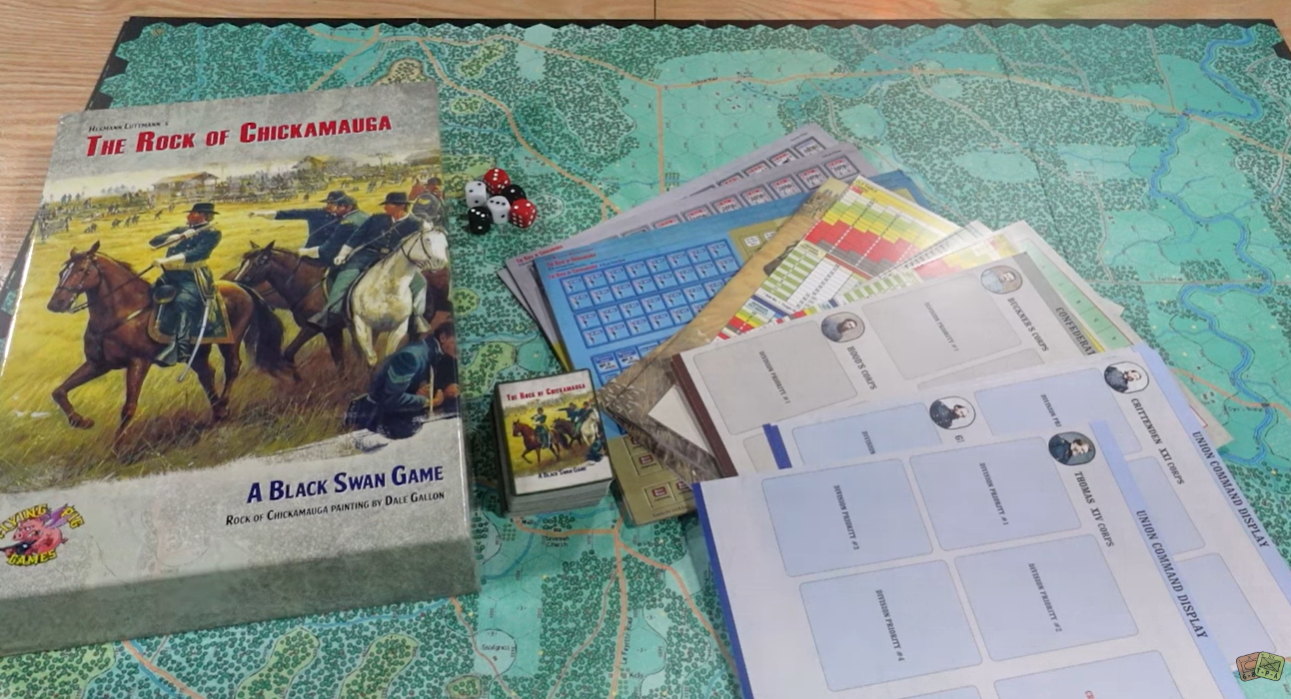
The Rock of Chickamauga is the next game in the Black Swan Series and follows closely on the heels of A Most Fearful Sacrifice. Using the same proven game system, The Rock of Chickamauga covers the entire Battle of Chickamauga, fought from September 18th through the 20th, 1863 in northern Georgia. The Union Army of the Cumberland, under William Rosecrans, is driving south from Chattanooga, hoping to envelop and trap Braxton Bragg’s Confederate Army of Tennessee in its vise. But Bragg anticipates the maneuver, pulls back and then counterattacks the overextended Union forces. They meet along Chickamauga Creek, the “River of Death”, in an epic struggle.
This scenario-driven, two-player war-game utilizes the ACW operating system called the Black Swan System, which is closely related to the Blind Swords game system first introduced in the game The Devil’s To Pay!. This version of the system is specifically designed to handle larger-scale battles yet keep rules overhead low. players will trigger activations by Corps instead of by lower-level formations but they still have tactical decision-making choices by needing to determine which Divisions get activation priority. Players will use card draws rather than chit pulls.
Ulisses und die RatCon können nur Das Schwarze Auge? Weit gefehlt. Von Replikanten über Brandon Sanderson über Hexen und Mythen sucht eine Ameise den Pfad zwischen verschiedenen Realitäten, um schlussendlich mit dem „Who is Who?“ des Warhammer-Universums gepflegt einen Pumpkin Spice Latte im Barista-Shop einer Hexe trinken zu gehen.
In November 2024, while attending the SDHistCon, we sat down with designer Sam London to play his upcoming game called Common Sense (it was originally called Absolved from All Allegiance), which was announced on GMT Games P500 last year. The game is an American Revolutionary War Strategic Level game that uses trick taking and is a struggle over the Will to Fight Track that measures the level of commitment by both sides to the fight. We recently reached out to Sam to get some more details to share about the design and he was very glad to oblige our request.
*Keep in mind that the design is still undergoing playtesting and development and that any details or component pictures shared in this interview are for prototype purposes and will definitely change prior to final publication as they enter the art department.
Grant: Sam welcome back to the blog. How are your other announced game projects coming along?
Sam: Thanks for having me back! Things are going well. I am hands off on Firefight Tactical at this point. All of the content art is complete and we are just working on things like rulebook layouts. I am very much looking forward to getting it out the door and into people’s hands. Microverse has most of the art complete. I am doing a few tweaks to the bot still to get it to a point I am happy with it, but in truth it is not tracking far behind Firefight Tactical. They both have been wonderful experiences from a development and production stand point and I cannot speak highly enough of the various teams I have worked with at GMT on these games.
Grant: How have you changed as a designer over the past few years?
Sam: This is an awesome question and I am grateful to be asked it as it forced me to do some introspection. To explain I will have to make some references to film making. As I have stated previously I have been designing games for a couple of decades at this point and only started trying to get my designs out there after Covid. The truth is that while this gave me lots of opportunities to refine my design chops, it was ultimately just me learning in a bubble. Coming into the hobby as a designer rather than a gamer, I fancied myself as a sort of auteur designer. For those not familiar with the term in the context of film making, this is an approach to creative endeavor where everything is made to conform precisely to one person’s specific vision. After getting to work with so many fantastic people, decidedly outside of my bubble, I have taken a bit of a 180. While I still own the ultimate vision, I now recognize that the odds that I understand the optimal route to get to that destination are unlikely, and that pretending I do will often result in an inferior game. This isn’t to say that I am going to incorporate every bit of feedback I receive into my designs. It does mean that I am more able to recognize weaknesses in my designs as conceived and solicit feedback from others to get around my blind spots.
Grant: What specific lessons have you learned about design?
Sam: The big one would be about systems pruning. Most people, myself included, understand academically that design complexity for complexity’s sake is not good. Putting that principle into practice, especially retroactively, is far more challenging. Every mechanism in the game has to serve the player’s enjoyment without making the cost of entry too daunting. This can often mean cutting mechanisms that I am particularly passionate about, but for which I am the sole audience (or close to it). This is especially difficult for me because I consider myself a systems designer, and I virtually always approach the mechanics of a design first.
Grant: What is your newest project Common Sense about?
Sam: Common Sense: An American Revolution, 1775-1783 is a card driven strategic level wargame covering the American Revolution. It attempts to offer a comprehensive view of the conflict, all the way from the battlefield to the halls of the Continental Congress and British Parliament.
Grant: Why was this a subject that drew your interest?
Sam: I always knew I would want to do an American Revolution game. The problem was that I needed a system that would fit my thesis of the conflict. A few years back I was working on a Barbarossa game and every step of the way I was thinking I would rather do that system in the American Revolution. The more passionate I became about that, the more I started to flesh out the system in ways that didn’t make sense for Barbarossa. Eventually that game ended up in the trash bin and Common Sense got my attention instead. I think the American Revolution is such a fascinating subject because it’s a real David and Goliath story. I of course am keenly aware that in reality it was more of David vs Goliath while Goliath is arm wrestling another giant while also trying to solve a Rubik’s cube, but there is still a lot of inherent heroic optimism to that history. Also, everyone loves a good underdog story.
Grant: What is your design goal with the game?
Sam: My design goal for the system was to see how much personality I could give to the belligerents without making their asymmetries require too much rules overhead. We have all played asymmetrical games where you feel like after you read your rulebook you need to read the other player’s rulebook to have a comprehensive understanding of the game. Here, while there are some mechanisms that are specific to each side, the asymmetry is more in terms of each player’s strategic concerns rather than their tools to execute upon them. All of these relate back to this unifying concept of “resolve” which is an abstraction that allows us to relate the varying strategic concerns into a single mechanism.
Grant: How did you focus on creating asymmetry on each side? What are some basic examples of these differences?
Sam: As noted above, I viewed each side in terms of what was unique about their concerns and what was unique about their tools to address them. For the British as an example, they are tremendously constrained by supply. It isn’t just a supply line (though it is that too), it’s a currency they spend to move and battle with units. Obviously historically supply was a concern for the Colonials as well, but it did not hamstring them to the same degree, so the Colonials don’t have to worry about it at all. What’s more, this opens up strategic opportunities for the Colonial player to attack the British in other areas to force the British player to split their limited resources. An example for the Colonial player is Attrition Combat. Each time the Colonials battle in a space they control on their turn, they have the option to resolve Attrition Combat, in which they cede control of that space to the British but as a result can resolve the battle without risking return fire. At the beginning of the game this must be used strategically and sparingly, but as certain key personalities in the Colonial Deck, from George Washington to Francis Marion enter play it becomes far more powerful.
Grant: How does the game use trick taking? Why was this a good choice for your vision of the game?
Sam: I am actually trying to get away from that term, as I think it causes people to think that Common Sense is a lighter game than it is. It invokes pithy card games rather than sweeping strategic affairs played out on a map. The final rulebook will likely make no reference to standard trick taking terms. I chose it as a core mechanism though for a variety of reasons. One I will cover in a future question, but the other reason is because I became very interested in the question of card balance. If I have a card driven game with a variety of card effects, and I want them to vary in their power, they have to be balanced in some way. The most common way this is handled in game design is to make them have a proportionate cost to play using some in-game currency. I was more interested in making the powerful cards more difficult to play. In fact, I wanted to take a step beyond that and say that not only are they more difficult to play, but they are never guaranteed. This gave me a simple way to inject far more personality into the cards and make some have a tangible weight to them when they manage to enter play. “Ha ha, I play King George. You’re in trouble now.” Trick taking was a natural fit for this as the rules overhead for it is comparatively light and the cards come with their own intrinsic value based on the ease with which they can be used to win tricks.
Grant: What is the makeup of the cards? Can you share a few examples with us and explain their use?
Sam: Each year players will begin their turn with a ten card hand. They can perform a strategic mulligan of up to 5 cards each year. This is not in case a player got a “bad hand” but rather so they can try to postpone getting cards that do not fit their strategic objectives at the start of the year. The year is then played out over a series of ten “clashes” in which the initiative player plays a card face up and then the other player does the same. The initiative player’s card sets the suit for the clash and the non-initiative player must follow the suit of that played card if able. Then the player who played the card with the higher initiative value (ties going to the non-initiative player) resolves their card.
In this example (all placeholder art at this point in the game’s development by the way), the Colonial player has initiative and plays the Artemis Ward card into the clash who is a 6 value of the Battle suit. The British player then plays Battle of Quebec into the clash which is a 7 value of the Battle suit. Battle of Quebec then resolves.
The British player immediately gains a supply (the orange wagon in the upper right corner). This is a special bonus effect present on some cards. The equivalent effect for the Colonials is to go up on the Continental Congress Track. They now have the option to cancel the resolution of the card to perform any one of their available actions. If they choose to continue to resolve the card they resolve its event first. Battle of Quebec’s event is of the type “special action,” which offers additional effects to the action on the card. In this case, if the Battle action is used to resolve a battle north of the Winter Line, the Colonial player must reroll all their successful hit dice once. The last piece is the yellow star under the Battle suit icon which indicates Battle has “advantage” over the Special suit. This means that if the non-initiative player does not have a card of the clash’s suit to play into the clash, any Battle card will always beat a Special card.
Grant: What different suits are included? What use does each have for players?
Sam: There are three common suits which are universals and one special suit which is player specific. The three common suits are March, Battle, and Recruit. March is used to move armies about the board, Battle is used to fight, and Recruit is used to get more units to fight with. There are asymmetries in how these resolve but the goals of their use are the same, which is why they are considered the common suits.
Grant: What is different about the Special Suit? How does it benefit players?
Sam: The Special suit is different for a couple of reasons. First all of the actions contained in the Special suit cards are unique to that player. The Colonial player can train their militia units into the Continental Army and negotiate with the French, eventually bringing in and performing actions with French pieces once they enter the conflict. The British player can recruit, move, fight, and raid with Native units and move and battle with the British navy. A lot of the flavor of the two sides are contained in the Special suit. The other thing that is different about the suit is that the Special suit allows you to resolve any combination of these actions. For example a Battle x 3 card allows you to resolve up to three Battle actions. A Colonial Special x 3 on the other hand will allow them to perform a mix of any 3 train and French actions which offers flexibility.
Grant: What is the purpose of the Resolve Track?
Sam: I mentioned the Resolve Track earlier when I was describing how most of the asymmetrical concerns of the players coalesce into a singular concept. The Resolve Track serves three purposes. Firstly, it is the game clock. While the game can end in the event that you completely resolve the year 1783, it will more commonly end when the British and Colonial Resolve markers cross. Each player’s Resolve marker starts on opposite ends of the track and moves towards the other end as they lose resolve. Once they cross, the year is completed and final scoring occurs.
Grant: How do players manipulate this track? What benefits or detriments does it provide to players?
Sam: This is where the other functions of the Resolve Track come in. The second purpose is that many of the points for determining final score and victory come from the Resolve Track. Finally, resolve has a tremendous impact on both sides’ ability to recruit new units, the Colonials in particular. This is another demonstration of the game’s asymmetries actually, as the Colonials are far more impacted by resolve loss both from a scoring perspective and a recruitment perspective than the British. In regards to how the track is manipulated, common track manipulations only cause a loss of resolve. There are several ways resolve is regained, but they are all due to specific card effects. The British primarily lose resolve by losing British Regulars in battle and by being overcommitted to the American conflict at the expense of their other global conflicts. They can also lose resolve by overusing Hessian mercenaries, who are good and reliable but cost money that parliament is loath to spend. The Colonials on the other hand will lose resolve mostly due to the British seizing control of colonies, Winter Attrition, and failure of the Continental Congress to offer a believable alternative as a governing power to the crown.
Grant: What is dynamic about the initiative system?
Sam: I said I would come back to this when I was describing why I went with trick taking as a core mechanism. Essentially, you are the active (initiative) player for as long as you continue to win subsequent clashes. For the duration the other player is what I would consider a “reactive” player. They still have choices to make of course, for example which card to play into clashes, whether to resolve combat as a siege or not in fortified spaces, how much supply to commit to a protracted battle, etc. The point however is that while by sheer odds you are guaranteed to eventually get your turns in, the duration of the runs of turns is strongly connected to the skill of the player and their familiarity with the game. This is very much a game where a player will become far better after repeated plays. The other cool thing about this is that the events on cards require skill and forethought to combo them together. You may have the thought that if cards A, B, and C resolve in order you will have all but won the game, only to lose the clash for card C and have to pivot. This dynamism does a lot to keep the game fresh and challenging rather than thinking “I have cards A, B, and C so I already know how I will play this out.”
Grant: What different unit types does each player have access to? How does each type benefit them?
Sam: Again pursuing asymmetry I wanted to give each unit type its own character. Each unit has a potency and a resilience but this is just the tip of the iceberg. Militia are able to pop up virtually anywhere and are able fire first in battles where they are the aggressor, but they are poorly trained and can’t leave where they are recruited unless they are picked up by an army. British navies can contribute to naval sieges and amphibious assaults while they are also required end points for British supply lines. French regulars are able to operate as a distinct force while also being able to launch coordinated actions with the Continental Army, offering them incredible command flexibility. British Field Artillery is powerful, but is unable to retreat quickly when the battle is lost, meaning it will be commandeered by the Colonials (and may exchange hands several times over the course of the war). There are also Continental Army, Native Warband, Hessian Mercenary, French Navy, Tory Loyalist, Colonial Artillery, and British Ranger units. Each has its own complement of traits to figure out how to employ them optimally.
Grant: How does combat work in the design?
Sam: As I have alluded to, there are a variety of special combat resolutions possible like Attrition Combat, Sieges, Naval Bombardment, Raids, and Surprise Attacks. I will just be describing the standard battle procedure here though. Each unit has a number of dice they grant during battles. The British player will have to pay a supply for each unit they want to activate to gain dice this way. Players then roll all their dice simultaneously. Dice come in three flavors, red, white, and blue (see what I did there?). Red dice hit on 3 or better, blue on 4 or better, and white on 5 or better. No matter the die color, a 6 counts as 2 hits. The other player then takes as many dice as they have incoming hits (at this point color doesn’t matter) and rolls them. For each 6 they roll, they discard the lowest die among their rolled dice. They then go from their lowest rolled die to their highest, assigning dice to their units if possible. Each unit has a limited range of dice values they can be assigned which represents their morale. For example, the British and French Regulars are a professional army and so they can only be assigned 1s and 2’s. The Colonial Militia and Tory Loyalists on the other hand can be assigned anything from a 1 to a 4. After all dice have been assigned or there are no more rolled dice that can be assigned to any units legally, all units with a die assigned to them are eliminated. Then, if the resolving card grants additional Battle actions, the initiative player can choose to either resolve another round of battle in this space, or not, potentially beginning to resolve another battle in a different space. If no further battle rounds will occur in the current space, the total number of casualties is compared. If one side took fewer casualties and did not control the space, they gain control of the space. Then, if the side that took more casualties lost at least as many units as half the size of their army (stack), they are forced to retreat from the space.
Grant: What is the British Commitment Check? How does it work?
Sam: The British player uniquely tracks the number of clashes they win each year on their own “British Perception” Track. At the end of the year, they add their current level on this track to the number of British Regular and Navy units outside of the American Colonies available to fight the French and the Spanish. If this total is less than 10, they lose 1 level of resolve for each point of shortfall. This means that if they have run the table the entire year, they are free to overcommit to the colonies, thematically because the optics are good back home. If however they have a rough year, they may have to hold some forces back to avoid the war being cut short by Parliament because opinions have turned against it.
Grant: What is the Continental Congress Level? How does it work?
Sam: On average, every card in the Colonial deck is one initiative value lower than every card in the British deck. However, every card in the Recruit suit grants the Colonial players levels on the Continental Congress Track. Levels can be spent from the track as cards are played to increase the initiative value of the played card. The problem is that at the end of the year, the Colonial player is expected to have an ever increasing level on the Continental Congress track or they will lose resolve equal to the shortfall. This obligation is an even bigger potential headache for the Colonial player as the Continental Congress isn’t just a track on the board, it’s also a piece on the map. If the Continental Congress is forced to relocate (retreat) because their current space falls into British control, the Continental Congress levels reset to 0. Done later in the war this can be devastating to the Colonial player. Even worse, if the Continental Congress would have to retreat, but it has no valid place to do so since it is surrounded by British Controlled spaces, the Congress surrenders and the Colonial player loses the game outright with no points counted.
Grant: I have seen where you describe the game as a sandbox. What does this mean and how does it benefit the design?
Sam: I think this can best be demonstrated by the card I showed earlier, Battle of Quebec. Now of course, the Battle of Quebec occurred when Richard Montgomery and Benedict Arnold attempted to siege Quebec City on December 31, 1775. The Colonials suffered heavy losses and were soundly defeated by the elements as well as the British. Nowhere in that card does it specify that the battle needs to occur on a specific date, or at a specific location, just that it must be north of the Winter Line for the event to have an effect. There have been plenty of times in playtests where the card has been resolved in 1775 in Canada, but also many times where it hasn’t. This approach enables me to inject historicity into the game without shackling the player to recreate historical decisions. I think many historical gamers want experiences where they can recreate history, but they are not obligated to do so. Roughly paraphrasing what Gene Billingsley said about the game, “all the events are there, all the major players, and the outcomes, even though potentially very different from history, are entirely conceivable.” Put differently, it’s like the game hands you a toy box filled with American Revolution action figures to play with as you will. There will of course be some players who will miss some rigidity holding them to a more strictly historical course. However, I think this sandbox approach offers an opportunity to sink your teeth into the history and better appreciate the moving parts by seeing the different ways they could have fit together.
Grant: What are some general strategies for both sides?
Sam: From a general strategy perspective things are very historical. The British want a quick war. The fastest way to do this is to take the more valuable northern colonies which will tank the Colonial resolve and secure most of the significant strategic locations. By doing this they can force the Continental Army to suffer brutal winters away from the cities and put enough pressure on the Continental Congress that their resolve rapidly drains and they are forced to surrender. The Colonials want the opposite. They just want to hold out long enough using delaying tactics to organize a proper army, get the French into the war, and retake whatever key fortified locations they ceded to the British in the early war so they can force the British to the bargaining table.
Grant: What is the layout of the board?
Sam: Again, this map is placeholder art. The game uses point to point movement, with some spaces representing precise fortified locations and some representing large tracts of land (even entire colonies in some cases). Spaces are grouped into colonies that each have an associated hit to Colonial resolve if they are lost. There is also a British “in Europe” area and a number of tracks tied to the various game mechanics.
Grant: Why did you feel point to point movement was best?
Sam: The only two contenders here were point to point vs area based movement. Given the level of abstraction the system uses, any sort of hexed based representation was never an option. I decided to go with point to point because the game’s focus is really on the narrative more than anything else. An area based map would have forced me to have the visual importance of areas be at least somewhat to scale by the size of the colony. Instead by doing point to point I can give a colony as many spaces and fortifications as are thematically appropriate for the importance of that colony in the actual conflict.
Grant: What type of an experience does the game create?
Sam: The game is punchy. It is very competitive and intentionally so. You are only able to achieve so much on a given turn, and at the end of each turn you have another clash and a chance for your opponent to seize the initiative. The elation when the other player plays a card out and you realize you can beat it and put out Benjamin Franklin when you thought you weren’t going to get a turn for at least 2 more clashes is fantastic. It also plays very quickly for a game of its weight. Most games between players who know how to play will be under 2 hours.
Grant; What are you most pleased about with the design?
Sam: I would say three things. First, because it’s top of mind as I just finished it, the solo play. I knew how I wanted the solo to feel, but I wasn’t quite sure how I was going to make it happen mechanically. I will be putting out some videos soon showing how it works, but suffice it to say for the moment that I am very pleased with it. Second, every game I design, I design to create stories at the table. If it always tells the same story it isn’t memorable. If there are never any surprises it isn’t memorable. Common Sense succeeds in both of these areas to a tremendous degree. Each time I catch up with a player I have played Common Sense with before they are able to remind me of our whole game by invoking strange or exciting moments from our game a year ago like it happened yesterday. Finally, when I design a new game I generally try to think about what aspects of it are specific to the topic and which could be modified slightly to make it work for other topics. I have my own plans for a Vietnam War version of this system that I am very excited about. What surprised me though was how many great designers have been inspired by the system and want to do their own designs with it. At the moment I am only at liberty to say that Ananda Gupta wants to do a French Revolution game with the system, which is such an incredible honor since Twilight Struggle is the primary inspiration for it.
Grant: What other designs are you working on?
Sam: I am always working on something. I have a non-historical game I am working on that has been picked up but I cannot talk about it yet. I have a train game that I may be able to talk about more publicly soon and an American Civil War game that I will be debuting at HistCon North. Oh, and I have a Sengoku Jidai wargamer’s party game that I am tooling around with. There are more, but that’s enough of a teaser. Thanks for the interview!
Thank you Sam for your thoughts on your game and for the effort you have obviously put into it. Having played the game while attending SDHistCon ta few years ago, I can say that we had a great time with the game, felt all of the aspects you discussed and very much enjoyed the way cards were played, how the initiative kept with the winner and the various frustrations of the asymmetry of each of the sides. I think that this one will be a winner and I look forward to playing it further in the future!
For a bit more information, we posted a quick video interview with Sam while at SDHistCon and you can view that at the following link:
As this month’s Wargame Watch posts on the blog, I will have just come back from attending the World Boardgaming Championships in Seven Springs, Pennsylvania where I was able to spend 5 1/2 days of fabulous gaming. I bring that up because this month I just didn’t have the time to do the deep dive that I normally do and only was able to find 27 games (including a new game from our sponsor Nuts! Publishing). I was also able to find 3 games to share being offered on Crowdfunding through Gamefound and Kickstarter.
This month we have a sponsor for the Wargame Watch feature in Nuts! Publishing. Founded in 2011, Nuts! Publishing is a French tabletop and board game publisher established by four wargaming and history enthusiasts. While initially famous strictly for historical and tactical wargames, the company has expanded its catalog to include cooperative, sci-fi, and family-friendly board games, while maintaining a strict selection process for those games they do publish. They are well known for developing popular original titles like Mini Rogue, Diluvium, and 300: Earth & Water, which is a part of their unique small format wargame series called Combat Rations that recently released the 3rd volume in the series called Guerre Eclair. The “Combat Ration” Series is a line of highly accessible, compact wargames designed to be played in about an hour including the 2 previous titles of 300: Earth & Water that delves into the Persian invasion of Greece in 492BC, and Port Arthur that retells the story of the 1905 Russo-Japanese War.
But, they also have a full line of more beefy traditional wargames including such titles as Urban Operations, Saigon 75, Stalingrad Roads, This War Without an Enemy, We Are Coming, Nineveh and Phantom Fury.
In addition to their own unique games, they also hold licenses to translate and distribute highly acclaimed international games for the French market, such as One Deck Dungeon, War of the Ring and the UndauntedSeries.
Their newest wargame release is called Guerre Eclair designed by Yasushi Nakaguro and is a part of the Combat Rations Series. Guerre Eclair is a remake of the 2019 game called The Rise of Blitzkrieg from Bonsai Games and is a card-driven game for 2 players lasting around 45 minutes. The setting is World War II in 1940 as the Germans unleashed their new Blitzkrieg tactic to invade France. The attacking Germans hide their intentions by choosing a conquest goal of either taking the Maginot Line, conquering Paris or controlling the ports at Dunkirk. Dice are rolled for combat and the highest 2 dice totals determine the outcome and if doubles are rolled losses to units will be inflicted. The French and British really cannot afford to lose many units as they don’t have a lot but neither can the Germans. The game is simple but fairly meaty with lots of decision points and we had a great time with it, as we have had with the other games appearing in the series.
Here is what Florent had to share on their upcoming slate of games:
In May, we released Guerre Eclair the third game in the CombatRations series and work on the next titles in the line is well underway (specifically Norway 40, followed by Bulge 20 – Yes, by Joe Miranda previously published by Victory Point Games). Urban Operations 2nd Edition is now available in stores worldwide. Please note that an upgrade kit is available on our website for owners of the 1st Edition.
Upcoming releases in early 2027 include The Coldest Winter, a card-driven game about the 1939–40 war between Finland and the Soviet Union (designed by Timo Pohja; art by Nils Johanssen), followed by Supremacy 2050, in which the world’s four major powers clash between 2020 and 2050 (designed by Pierre Razoux; art by Domhnall Hegarty).
Finally, we will launch two crowdfunding campaigns in 2027. The first will be for the second edition of Sword of Rome, covering the rise of Roman power in the 3rd and 4th centuries BC (designed by Wray Ferrell; art by Nicolas Roblin and Gabriel Pardon). The second will feature Nemto a cooperative sci-fi wargame (designed by Hermann Luttman; art by Nicolas Roblin and Christian Benavides).
Quite a variety of eras and gameplay styles!
Here is a link to an interview we did with one of the owners, designer and main bottle washer Florent Coupeau while attending Essen Spiel 2025:
Here also is an older video we did with Florent while attending SDHistCon 2024 where we discussed the excellent Combat Rations Series and Guerre Eclair (recently released) and the upcoming Norway 40:
1. Pacific Fleet: Rise & Fall of the Japanese Empire from VUCA Simulations
VUCA Simulations is a newer company on the scene the last several years (really since 2021) and they are coming out with some really great looking games. We have played several of their games and always have a great time with them. One of their newest pre-order offerings is called Pacific Fleet: Rise & Fall of the Japanese Empire designed by Hiroyuki Inose. I love a good Pacific Theater WWII game and this one looks pretty great.
From the game page, we read the following:
The Pacific War was unlike any other conflict of the Second World War. Vast oceans, isolated island chains, carrier task forces, long-range bombers, amphibious invasions, and industrial warfare all combined into one of history’s most complex military campaigns.
Pacific Fleet: Rise & Fall of the Japanese Empire places you in command of this global struggle. Lead the Imperial Japanese forces in their quest to establish dominance across Asia and the Pacific, or direct the Allied war effort as overwhelming industrial power gradually turns the tide. Every carrier strike, convoy, amphibious landing, and production decision shapes the course of the war.
This is not merely a naval game—it is a complete grand-strategic simulation where sea, air, and land warfare are seamlessly integrated into one operational system.
Fight from the opening attacks of December 1941 through the climactic campaigns that determined the fate of the Japanese Empire. Unlike many Pacific games that focus on individual battles, Pacific Fleet presents the entire theatre as one interconnected campaign where logistics, production, intelligence, and operational planning are equally important.
2. Modern Tactics: Afghanistan – British Forces Expansion from VUCA Simulations
We have played a lot of Old School Tactical from Flying Pig Games, which is designed by Shayne Logan. Shayne now has a design with VUCA Simulations that deals with modern warfare in Afghanistan called Modern Tactics: Afghanistan. That was announced on pre-order a while ago and has since been delivered but there is now an expansion of sorts to the game called Modern Tactics: Afghanistan – British Forces Expansion but it is being designed by another designer named Kenneth Tee of People Power from GMT Games fame.
From the game page, we read the following:
The war in Afghanistan was fought village by village, compound by compound, and patrol by patrol. Every operation demanded careful planning, disciplined infantry, close cooperation with allied forces, and constant vigilance against an elusive insurgency.
Modern Tactics: Afghanistan – British Forces Expansion places you in command of the British Army, Royal Marines, Special Air Service, and supporting Afghan forces during Operation Herrick. Experience thirteen new scenarios inspired by real operations fought throughout Helmand Province between 2001 and 2012, introducing new units, mechanics, and tactical challenges to the Modern Tactics system.
Whether conducting a night raid with the SAS, leading Gurkhas into hostile villages, defending isolated platoon houses, or escorting Afghan National Army units through dangerous territory, every mission presents unique tactical and operational decisions.
3. Thirty Years of Misery: The Thirty Years War 1618-1648 from VUCA Simulations
A couple of years ago, I came across a new designer named Brian Asklev and have done interviews with him covering Baltic Empires from GMT Games and 1812 – Napoleon’s Fateful March from VUCA Simulations. Brian is a pretty sharp designer and I very much like his approach to design as well as the choices in designs that he is doing. His new game is called Thirty Years of Misery: The Thirty Years War 1618-1648. The cover art is amazing, the topic looks great and the approach that he is taking seems to be very novel.
From the game page, we read the following:
Between 1618 and 1648, Europe was consumed by one of the longest and most destructive conflicts in its history. What began as a rebellion in Bohemia soon engulfed the Holy Roman Empire and drew nearly every major European power into a struggle over religion, dynastic ambition, and political supremacy. Millions perished as armies marched across Central Europe, cities were besieged, alliances shifted, and entire regions were devastated.
Thirty Years of Misery places you in command of the major powers that shaped this conflict. Lead the Imperial Habsburgs, the Catholic League, Sweden, or France as you fight to reshape Germany through military campaigns, religious influence, political maneuvering, and strategic diplomacy.
Victory requires more than battlefield success. You must secure electorates, protect your heartlands, influence the religious landscape of the Empire, and achieve your faction’s unique historical ambitions before peace is finally negotiated at Westphalia. Rather than recreating individual battles, Thirty Years of Misery captures the entire strategic conflict across three decades of war.
Every campaign combines:
Military operations
Religious conflict
Political objectives
Coalition warfare
Historical events
Dynamic diplomacy
Each round features a randomized turn order, ensuring that no two campaigns unfold the same way. Players must continually adapt to changing circumstances, unexpected interventions, and opportunities created by both allies and enemies.
4. Iwo Jima: Hell on Earth Revised Edition from Neva Game Press
Neva Game Press (formerly Neva Wargames) is a new publisher who appeared on the scene 2+ years ago. When I started seeing their posts on Twitter and Facebook, I was immediately impressed with their interesting topic choices for their upcoming games as well as the fact that they are trying to make small footprint wargames that pack a punch. And the art is also very appealing and brings an aesthetically pleasing and attractive look to their games! Their first release called Iwo Jima: Hell on Earth, which is a solitaire look at the amphibious invasion of the island of Iwo Jima in 1945 at the end of WWII, was both commercially and critically successful and has sold out and now they are bringing back a revised edition for pre-order.
From the game page, we read the following:
Iwo Jima: Hell on Earth is a hex & counter wargame based on this iconic battle. This challenging solitaire wargame puts you in command of US Marine Regiments as they battle entrenched Japanese Battalions during the iconic 36-day Operation Detachment. Each game turn represents approximately four days, condensing the intense conflict into nine turns of strategic decision-making.
In Iwo Jima: Hell on Earth, your mission as the commander of US forces is to conquer the island of Iwo Jima to secure its three airfields and the iconic Mount Suribachi. The game simulates the 36-day battle in nine turns, with each turn representing approximately four days.
Victory is determined at the end of Turn 9 by calculating your Victory Points. You earn VP’s by: Eliminating Japanese units, Capturing key objectives on time and Japanese surrender. You can lose VP’s if: You play too many Special Orders and/or you suffer too many US casualties. Your final VP score will give you an assessment of your performance, ranging from a “pen-pushing job” (1 or less to 5 VP) to an “incredible victory” (19-20 VP).
I think that a new company selling out their first release is probably pretty rare in our hobby but Neva did it and it is partly because a good solitaire game is always in demand and their focus on quality, in both game play and components, speaks to wargamers and word will spread fast once it is out. So what is different in this new Revised Edition?
Because we are heading back to the printers, we saw the perfect opportunity to integrate our community feedback directly into the game. The Revised Edition will feature:
Upgraded Map: A minor visual tweak where hill hex frames are slightly thicker, making them much easier to identify during intense gameplay.
Box Art Variant: A fresh, slight variation of the original box art (while keeping the classic spirit of the original design).
Fully Integrated Updates: All components from our Update Kit (detailed below) will come standard inside the box!
5. Rebels Against Rebellion from Flying Pig Games Currently on Kickstarter
About 18 months ago, while attending Buckeye Game Fest in Columbus, Ohio, we met up with David Thompson to get a quick look at a few of his newest upcoming games at the time including Line of Fire: Burnt Moon from Osprey Games and the very interesting American Civil War game with a twist called Rebels Against Rebellion from Flying Pig Games. I got to play Rebels Against Rebellion and very much enjoyed the game and what it was trying to convey about the lack of support for the secession of Tennessee from the Union as most of the residents of Scott County voted against breaking away during the American Civil War. The game pits the local groups against each other as the Free and Independent State of Scott fights against the local secessionist residents as violent confrontations between Loyalist and secessionist-aligned partisans and outlaws engaged in raids on farms, stealing livestock, and destroying property. Since that time, the game has progressed and has already launched on Kickstarter.
From the game page, we read the following:
Rebels Against Rebellion is a card-driven war game designed by award-winning designers, David Thompson and Trevor Benjamin. The cards in your deck represent the units and locations under your control. Each turn you will play cards to perform actions on the board and to add, remove, and improve the cards in your deck. The player who most successfully spreads their control across Scott County is the winner.
Tennessee’s role in the American Civil War and the Secession Crisis was marked by significant internal divisions between its eastern, middle, and western regions. In early 1861, when South Carolina became the first state to secede from the Union, Tennessee’s legislature resisted the idea. However, following the attack on Fort Sumter in April 1861, Tennessee was forced to readdress its position. On June 8, 1861, a state referendum resulted in a decisive vote to secede.
Despite this formal decision, Tennessee remained divided. In the eastern part of the state, loyalist sentiment was strong. East Tennessee had overwhelmingly voted against secession in the 1861 referendum, while West and Middle Tennessee overwhelmingly supported secession.
As tensions escalated, residents of East Tennessee found themselves forced to take sides, often leading to violent confrontations. Loyalist- and secessionist-aligned partisans and outlaws engaged in raids on farms, stealing livestock, and destroying property. The establishment of local militia groups known as the home guard sought to defend loyalists. These small militias acted in secret, launching surprise attacks on Confederate soldiers and secessionist raiders, but they also faced constant threats from the Confederate army and local secessionist groups.
Of the thirty-one counties in East Tennessee, none voted against succession by a higher margin than Scott County. With a vote of 521 to 19 in favor of rejecting secession, the county’s stance was clear. Local residents so opposed the Confederacy that later in 1861, the county court approved a protest resolution declaring the county’s secession from the State of Tennessee and the creation of a “Free and Independent State of Scott.”
This is the story of the Free and Independent State of Scott during the Civil War.
If you are interested, we did an interview video with David while attending Buckeye Game Fest in the spring of 2025 and you can watch that at the following link for more information on the game:
Because I know that many of you will be paying this one solitaire, Denver did an overview video of the solitaire mode and you can watch that at the following link:
As of August 1st, the Kickstarter campaign has funded and raised $24,531 toward $10,000 funding goal with 450 backers. The campaign will conclude on Tuesday, August 18th at 12:00pm EDT.
6. Lee’s War: The War in Virginia 1861-65 from Worthington Publishing Currently on Kickstarter
One of the subjects that Worthington Publishing does really well is the American Civil War. They have their Civil War Brigade Battle Series that we have enjoyed and they really have a way of making these ACW games playable yet integrating some of the most important historical aspects to keep them grounded in history. Their newest series is focused on the Strategic Level and is supposed to be a 3 volume series. The first entry in the series is called Lee’s War: The War in Virginia 1861-65 and is currently on Kickstarter.
From the game page, we read the following:
Lee’s War is Volume I in what I hope to be a 3 Volume set on the American Civil War. It is meant to show the difficulties each side faced during the war. There is no plan currently for a full war campaign scenario. Players are given scenarios based on the campaigns and complete years of the war. I hope you enjoy playing the short crisp 2 – 3-hour scenarios giving an intense game experience as well as a study in Civil War command.
If this game is successful then Volume II, tentatively titled Grant’s War will be the Western Theater along the Mississippi from 1861 to 1864. Volume III, titled Sherman’s War, will be the Western Theater and the battle for Eastern Tennessee and Georgia from 1861 to 1865.
The game is for 2 or more players but is highly solitaire friendly (one player playing both sides) due to the random nature of certain rules such as Dice Differential and combat die rolls.
Lee’s War is a strategic level hex and counter war game for 2 or more players of the entire American Civil War in Virginia from 1862 – 1865. Leadership is highlighted using counters representing the combat leaders of the war. The destruction of the opposing players forces are the main objectives of the game, followed by the occupation of key cities or rail lines. The political aspects of the war are not reflected in the game per say, however they are reflected in the Victory Conditions. The longer the south drug out the war, and the more Union casualties inflicted, the better the chance that Lincoln would lose the 1864 election, and a peace Candidate (probably McClellan) would end the war with southern independence.
Here is the current 14 scenario list:
First Manassas / Historic 4 turns or optional long game 8 turns (July 1 – August 31, 1861)
The Peninsula Campaign / 10 turns (April 1 – June 15, 1862)
The Peninsula Campaign Plus Seven Days 16 turns (April 1 – July 31, 1862)
Second Manassas / 7 turns (July 14 – August 31, 1862)
As of August 1st, the Kickstarter campaign has funded and raised $27,212 toward its $1,861 funding goal with 304 backers. The campaign will conclude on Saturday, August 15th at 4:00pm EDT.
7. Warfighter: The WWII Eastern FrontSpecial Forces Card Game from Dan Verssen Games Currently on Kickstarter
The Warfighter system from Dan Verssen Games is a card based game designed for 1 to 6 players. You can play solo or cooperatively against the AI to complete World War II squad-level combat missions. One of my favorite parts of the game is at the start of each mission, you will select one or more Player Soldiers, equip them with skills, weapons, and combat gear within the mission’s Resource limit. You then fight your way through hostile territory and engage enemy soldiers, as you attempt to reach and complete your mission objective. Every mission is a stand-alone game. You build your Soldiers, select your Gear, and then run your mission. Within 30 to 60 minutes you will have succeeded or failed. We simply love the system and prefer the WWII focused modules (we really hated Fantasy!) and are very excited to see that they are doing this WWII Eastern Front offering as I think that it will offer a new and interesting view of the history.
From the game page, we read the following:
Warfighter WWII Eastern Front recreates the brutal skirmishes fought across the vast Soviet battlefields of World War II, where Soviet Red Army and German forces clashed for shattered cities, strategic strongholds, and hard-won ground in some of the harshest climactic conditions of the war. You will face fierce resistance from enemy troops, but the battlefield itself, from deep snow and choking mud to bitter cold and broken terrain, can prove equally deadly.
Do you have what it takes to defend the Rodina and drive the invader from our soil?
Warfighter WWII Eastern Front is the latest title in the Warfighter WWII Series, which includes other core sets for the Europe, Pacific, Mediterranean and North Africa Theatres of Operation. The Eastern Front has been an area of interest which we have been discussing for a time, and we began research and design work in January 2025. Now, the game design is complete, and we are ready to present it for crowdfunding support.
A key part of the game is squad building and mission planning. You decide which soldiers go on the mission, and which skills, weapons and gear to equip them with, best suited for the objective you are attacking. You control their actions and resolve all combat against hostiles and events encountered, but do not take too long, as the timer is counting down!
As a solitaire wargame, the game’s hostile response system handles all the enemy decisions and actions which will oppose your squad and thwart your mission plans. You will have to respond to the unexpected events and hostile attacks, as well as challenging weather and terrain, to make it to the objective and complete the victory conditions. Glory for the Motherland! Slava Rodina!
Along with the Eastern Front Core Box, there are seven Expansions which will allow you to extend your gameplay to include more armed forces and battles. The expansions offered with the Eastern Front core box feature Penal Battalions, Airborne, Partisans, as well as the Soviet Winter, Soviet Winter Vehicles and the Raid on Peenemünde.
We have also created the Critical Hit Deck pack, a new type of expansion which introduces critical hits to Soldiers and Hostiles alike, to add some cinematic flair and drama to your stories. All expansions are designed to be playable with the core set, and they add new Soldiers, Missions and Objectives, Gear, Skills, Locations, Hostiles and Events to your gameplay.
As of August 1st, the Kickstarter campaign has raised $24,469 toward its $20,000 funding goal with 151 backers. The campaign will conclude on Monday, August 3rd at 3:00pm EDT.
8. Lee Moves North: Campaigns of Antietam and Gettysburg from GMT Games
Several years ago, Mark Herman designed a unique and simple American Civil War game called Gettysburg that appeared in C3i Magazine #32. That game became the basis for his new Civil War Heritage Series with the first volume being Rebel Fury that focused on five battles from the Chancellorsville and Chickamauga Campaigns and Volume II being Army of the Potomac. Mark has now advanced the series with the upcoming Volume III called Lee Moves North: Campaigns of Antietam and Gettysburg that was announced this past month by GMT Games.
From the game page, we read the following:
Lee Moves North is a standalone game that covers the Confederate invasions that led to the battles of Antietam and Gettysburg. Lee Moves North is the third volume in Mark Herman’s Civil War Heritage Series that began with the Charles S. Roberts Award winning Rebel Fury (Best American Civil Wargame of 2024).
Lee Moves North is a low-complexity, grand tactical simulation that won the James F. Dunnigan Award for Playability and Design. Its unique combat system generates a detailed narrative that perhaps for the first time allows you to fully experience the risk calculus of a Civil War Army General.
If you know how to play Rebel Fury or Army of the Potomac, you can play the one map battles of Antietam and Gettysburg right out of the box. The game comes with 13 scenarios, 7 of which are played on one map to include 4 DOG (the four days of Gettysburg) with the remainder using all or some number of its EIGHT grand tactical maps, plus a standalone Theater scenario. The thirteenth bonus scenario covers Jubal Early’s 1864 invasion that led to the battle of the Monocacy River.
Through Lee Moves North you will experience these famous battles in a way that you have not seen them before. The grand tactical level is about maneuver combinations prior to and during a battle but make no mistake you will also see the brutal nature of Civil War combat. As the general leading an army, you will have player agency over when, where, and how often to attack using the unique Rebel Fury combat system. Following the combat narratives that are in every book that you have ever read on the Civil War you will experience the frustration of seeing your assaults fail more often than they succeed yet the better general is the one whose plans turn this historical reality into victory.
While we have not yet played Army of the Potomac, we have very much enjoyed the system and its first volume Rebel Fury. Here is a look at our video review for Rebel Fury:
If you are interested in Lee Moves North: Campaigns of Antietam and Gettysburg, you can pre-order a copy for $82.00 from the GMT Games website at the following link: https://www.gmtgames.com/p-1253-lee-moves-north.aspx
9. Rowing to Hades: Fast Playing Naval Battles of the Ancient World from GMT Games
Ancients games are always a good time and if that game has naval units, including triremes, Greek fire ships and the like sign me up. This past month, GMT announced this new game from designer Jason Walonoski called Rowing to Hades:Fast Playing Naval Battles of the Ancient World. Jason is a newer designer with his first game called Epipolae: The Athenian Expedition in Sicily, 415-413 BCE, which is a part of the Levy & Campaign Ancients Series. I share that because he knows something about Ancients and I also think that he is a good designer with a good approach.
From the game page, we read the following:
Rowing to Hades is a squadron-level naval wargame set in the ancient era. The era of oars, not sails. Rams, not broadsides.
Inspired by classics such as War Galley (GMT), Trireme (Avalon Hill) and the Commands & Colors system, it will appeal to gamers who want to enjoy quick naval battles at a different scale and complexity level.
A single battle can be completed in 30-60 minutes. There are scenarios for the Greco-Persian and the Peloponnesian Wars as well as a campaign system to link multiple battles together in an afternoon.
A key design goal was to create a fun quick-playing game, not a simulation. Many details are abstracted, while maintaining historical flavor.
Combat is simple and quickly resolved. After all units have moved, they may Ram. If units have not moved, they may conduct Melee.
Attackers roll a base number of dice determined by the unit type (different types of units roll different numbers of dice for ramming and melee), with the number of dice increasing or decreasing for factors like attacking from the rear, using a special maneuver card, or the enemy formation (for example, line abreast, line ahead, or kyklos).
I am very much interested in this one. Tactical level naval combat is something that is very appealing and this one looks to be on the lighter side of the spectrum but offers enough depth that it should be a very interesting experience.
If you are interested in Rowing to Hades: Fast Playing Naval Battles of the Ancient World, you can pre-order a copy for $55.00 from the GMT Games website at the following link: https://www.gmtgames.com/p-1252-rowing-to-hades.aspx
10. Commands & Colors: Ancients 8th Printing from GMT Games
Commands & Colors: Ancients depicts warfare from approximately 3,000 BC to the opening of the Middle Ages in 400 AD, which is quite a spread across time encompassing different strategies, tactics and even technology. CC: Ancients uses the standard card activation system which identifies a number of units that can take actions in one of three areas on the board, including the Left, Center and Right. This card system is standard to the series and really keeps the game light and fun as you sometimes simply cannot control take the actions you need to in order to win the game.
One of the reasons that I like Ancients and how it implements the system is that the scale changes during each of the battles represented. This means that some of the scenarios will have an Infantry unit representing an entire legion of fighters, while in other scenarios a unit may just represent a few warriors. This flexibility makes the game really interesting and you have to learn how best to use each of your units in each of the settings. This really adds to the replayability factor as well because you are learning from each scenario.
The unit variety in this one is interesting as compared to other games in the series such as Battle Cry and Memoir ’44 as each of those volumes had just three types of different units. In Ancients though there are multiple different types or classes of Infantry. Units are rated according to their makeup and in some ways their tactics and are placed in three neat and tidy categories including Light, Medium and Heavy. In the ranks of the Light Infantry, there are the standard Light Infantry, Auxilia, Light Bow and Light Sling for example. In looking at the other types of units there are Cavalry, Chariots, War Machines, Leaders, and the best part Elephants. The game comes with very clear and well done player aids that outline the different abilities of each type of unit and help you with an understanding of their movement, combat dice and any special abilities.
The final best thing about the game is the number of different engagements portrayed and how each of them uses different units and will require you to think on your toes about how best to utilize your assets. The battles covered include Akragas, Crimissos River, Ticinus River, Lake Trasimenus, Cannae, Dertosa, Castulo, Baecula, Ilipa, and Zama. All in all, I find Ancients to be a simple yet fulfilling gateway to the series and would recommend it heartily to anyone interested in getting on board.
From the game page, we read the following:
Commands & Colors: Ancients allows you to re-fight epic battles of the ancient world. Here the focus is on the two rivals for power in the Western Mediterranean – Carthage and Rome. Will you, as Hannibal, triumph over larger Roman armies; or as Scipio Africanus, will you beat Hannibal with newer tactics of your own?
Units in both armies can only move and fight when ordered. The command playing cards supply those orders, providing an element of luck that creates a fog of war and presents players with both challenges and opportunities. You must maximize your opportunities by playing your command cards judiciously. How well you handle the diverse units, their weapons, and the terrain, will determine victory.
Commands & Colors: Ancients contains the battles of Akragas, Crimissos River, Ticinus River, Lake Trasimenus, Cannae, Dertosa, Castulo, Baecula, Ilipa, and Zama.
11. Commands & Colors: Napoleonics 6th Printing from GMT Games
I will be honest with you, when we first played Commands and Colors, I was really leaning toward Ancients as my favorite one. But that all changed once we got the grand daddy of them all on the table in Napoleonics. To me, I really enjoy the added layers of depth to this one. It has six expansions for a reason as they have tried to capture the intricacies of each nation and their unique abilities and fighting styles to make for very highly stylized game.
Of all the C&C games this one is on the richer end of the scale, especially as you add in the expansions. The little bits of chrome make the combats more tactical. You can put your infantry into square formation to counter cavalry charges, but that comes with it’s own sub set of limitations. Each nation has their own special ability, and then each of their units have their own characteristics. An example of which are the Spaniards’ Infantry being straight up not as good as others. They roll dice equal to their number of blocks -1 for example. Each faction has strengths and weaknesses which gives you a little more to think about. Again, nothing overwhelming, and nothing you can’t handle but Napoleonics just has that extra richness and detail that brings the game to life and makes each play feel different from the last.
There are a few new differences in this one. Leaders play a very important role on the battlefield. They don’t add to attack but keep units in formation and from breaking. You must try to keep the Leaders away from the front line because they can become casualties but you need them to keep order on the battlefield as they will allow units to ignore some symbols.
Another major difference is in how units do when they are reduced. In all previous versions of the C&C system, the number of remaining blocks in a unit was not factored into the strength of that unit’s attack. If they had three units left, they would still roll their maximum 2 dice. But now that has changed and I really like this one. The basic attack strength of a unit is equal to the number of its blocks.
The color and the pageantry of a Napoleonics battle is hard to ignore and this one has a lot of substance to the game that the other volumes don’t approach. I will play Napoleonics at any time and relish the chance to learn new strategies and try out new tactics with the multitude of different units found in each expansion.
In the end, Commands and Colors is a fantastic system that has a little bit of everything that will appeal to any wargamer’s taste. I recently played Tricorne and man was that a fascinating experience. We also played the new one from GMT from 2019 Medieval and enjoyed it, and actually really liked some of the new additions, but just were let down by the theme. If you haven’t tried C&C yet, what are you waiting for? Pick a historical period you like and give it a try. You won’t be disappointed!
From the game page, we read the following:
The Napoleonic historical period has always been one of our favorites and was actually the second historical game that we developed using the Commands & Colors system. The Wars of Napoleon rules at first glance may seem more complex than other Commands & Colors games, but if you are familiar with the game system, you are only a few short steps away from taking Command. Even if you have never played before, learning the fundamentals of the game system is straightforward and will be an enjoyable endeavor.
For the game group in Orlando, Wars of Napoleon is one of our favorites. There is a wealth of subtle and bold features that set it apart from other historical periods and it truly embraces the tactical doctrines of France and the various nations that fought against Napoleon.
The Napoleonic period showcases a unique balance between the roles of Infantry, Cavalry and Artillery on the battlefield.
In combat, a unit’s battle strength is directly tied to the number of blocks present in the unit. Therefore, as a unit suffers block loses its combat effectiveness is reduced.
An Infantry unit, by forming square, can reduce the effectiveness of the most gallant Cavalry charge.
Artillery in combined arms combat along with an Infantry or Cavalry melee attack can produce the most devastating results.
As with other Commands & Colors games, the battle dice resolve combat quickly and the Command cards provide a fog of war and will present players with new challenges and opportunities for victory.
When in Command, the battlefield tactics you will need to execute conform remarkably well to the historical advantages and limitations inherent to each Napoleonic Army. For example, as the French Commander you will want to maneuver your infantry units into a position to take advantage of their melee attack dice bonus. While a British Commander will want his line infantry to take up a defensive position and stand and volley fire with a dice bonus. The other major powers also have similar seemingly simple advantages that can impact a battle and will influence your Command style for that army.
The core Wars of Napoleon game will feature French, British and Portuguese troops, while the expansions will showcase one Coalition army that opposed Napoleon.
12. Pacific War: The Struggle Against Japan, 1941-1945 Deluxe Edition 2nd Printing from GMT Games
Both Alexander and I love Empire of the Sun and really enjoy Mark Herman designs. Now I know that Pacific War is not EotS but it definitely was a precursor and led to its design and development. Unfortunately, I did not play the original Pacific War as I was 12 years old and focused on other things (baseball, football) and other games (mainly Dungeons & Dragons and other role playing in my teens). So, this one interests me because it will be a new experience for me.
From the game page we read the following:
Pacific War is a Strategic wargame that takes you from the attack on Pearl Harbor to the climatic summer of 1945… from Australia to China… from Burma to Hawaii… from the defense of Wake Island through the invasion of Guadalcanal culminating in the desperate battles to defend the Japanese Home Islands.
Strategic wargame that covers the entirety of the Pacific Theater of World War II…pretty big game, both in scale and distance. For a game to cover the entire theater, it has to be deep and have various systems to cover all of the different types of actions. Here is an answer on this aspect frog the game page:
For the first time in a Pacific Theater game, size, subtlety, and ease of play has come together in a game of sharp action and historical accuracy. Players can become familiar with the layered Pacific War systems in the solitaire Engagement scenarios, then fight their way through increasingly panoramic Battle, Campaign, and Strategic two player and multi-player Scenarios. As they learn the game’s basic maneuver and combat systems, they will then layer on more advanced systems for Strategic bombing, submarine attacks on merchant shipping, search and detection, amphibious assaults, and extensive Operations driven by their command decisions.
As this game is a reprint and updating of a classic, the first thing I thought about was what has changed in the design? Mark answered this question very well in the game write up on the game page:
So, what will change in the new version? The structure and feel of the design will be unchanged, so if you played it in your youth, you already know how to play. That said, a devoted number of players have been playing this game for 35 years and I have incorporated the best of their feedback into this new and final edition for this title. I am going over each scenario and updating them with information that I did not have available back in 1985. For example, I now have several Japanese translations of their official records that were only published in the last few years. Toward this end, I am adding at least six new campaign and strategic scenarios, so you can experience the entire panorama of the war in a long afternoon .
The key question that I consider when buying a new game is will it hit the table? The owners and reviewers who created the game’s reputation were excited that Pacific War had a layered set of scenarios that incorporated fifteen-minute solitaire learning engagements, two hour battles (such as Coral Sea and Santa Cruz that were used in a decade of tournaments), two to eight hour Campaigns (such as Malaya, Guadalcanal and Breaking the Bismarck barrier), and of course the Strategic scenarios that cover the entire war from a single year to the entire war. Will you ever play the entire war? It’s unlikely (to date I have only done it three times). However, Pacific Waris an operational level game and the Campaign scenarios are the heart and soul of this game system. Most play in an afternoon to completion. So, will it hit the table? Only you can answer that question, but from a time and learning perspective this game will support any time commitment you wish to make, to include the 100+ hour Strategic Scenario.
No cards, as this one is not a Card Driven Game, and lots of counters with 9 counter sheets listed. This is going to be blast and I hope that we get around to playing this game so that I can get a view of the original work from one of my favorite designers.
1. Bohemian Rhapsody – Battles of Wimpen: May 6, 1622 and Hochst: June 20, 1622 from High Flying Dice Games
Paul Rohrbaugh and his company High Flying Dice Games is a designer I love to follow. He is always doing games on smaller or lesser known conflicts and I just find his work to be superb and really draws me in. Recently I saw where he was releasing a new series of games covering the Thirty Years War called Bohemian Rhapsody – Battles of Wimpen: May 6, 1622 and Hochst: June 20, 1622.
From the game page, we read the following:
Bohemian Rhapsody – Battles of Wimpen: May 6, 1622 and Hochst: June 20th, 1622 is a game with 2 battles and both battles were part of the so called “Bohemian Phase” of the Thirty Years War and were one the result of the other. The first took place when the Catholic forces of Tilly and Cordoba surprised the smaller force of George Fredrick of Baden who was trying to cross the river Neckar near Wimpfen. Even if the Protestant forces made their best in the battle, thanks to a favorable uphill position, theywere defeated.
A month and an half later, another part of the Protestant troops moving around the Rhineland, the part commanded by Christian of Brunswick, was stopped by the same catholic army under Tilly and Cordoba near Hochst, while trying to cross the river Main. The ensuing battle was a sort of a draw, as at least a part of the catholic army was able to join the other catholic force under Mansfeld, but at so high a cost in losses, that the Palatinate theatre of the war was de facto closed.
If you are interested in Bohemian Rhapsody – Battles of Wimpen: May 6, 1622 and Hochst: June 20, 1622, you can order a copy for $20.95 from the High Flying Dice Games website at the following link: https://www.hfdgames.com/bohemia.html
2. La Conqueste: The French and Indian War 1754-1763 from White Dog Games
I have really enjoyed my plays of several games designed by R. Ben Madison. He has a knack for including elements of the history into the gameplay while placing the events into the framework of his chosen system, which is usually the States of Siege Series…but not always. His newest offering called La Conqueste: The French and Indian War 1754-1763 from White Dog Games uses the States of Siege Series System and dives into the French & Indian War.
From the game page, we read the following:
Over 270 years ago, France controlled most of North America east of the Mississippi River. The British had colonized only along the Atlantic Coast and wanted to expand further west. Conflict between these two great powers in the New World was inevitable. The immediate issue in the new World was whether the upper Ohio River valley was to be a part of the British Empire, and therefore open for trade and settlement by English colonists, or part of New France. When, in 1754, war broke out between France and England in Europe, it quickly spread to the New World, where it was called the French and Indian War, and where two of the most famous generals in history fought one another: Wolfe and Montcalm.
In this exciting game of that titanic struggle in America designed by R. Ben Madison, you control the forces of New France against England and the British colonies as the epic nine-year long French and Indian War breaks out.
If you are interested in La Conqueste: The French and Indian War 1754-1763, you can order a copy for $60.00 from the White Dog Games website at the following link: https://www.whitedoggames.com/french-and-indian-war
3. Fortress of Oblivion: Iran in the Sasanian Era 224-651 AD from White Dog Games
Another new solitaire States of Siege Series offering this month from White Dog Games takes us to ancient Persia and Iran in the Sasanian Era covering the years of 224-651 AD. This one is also designed by R. Ben Madison and looks to be very interesting.
From the game page, we read the following:
Fortress of Oblivion is an exciting solitaire game by designer Ben Madison that puts the player in the role of the ancient Shahs of Iran during the Sasanian Era, 224-651 AD – or even later, if you survive! You will use the economic, military, and social resources of the Iranian Empire, called “Persia” in the west, to defend your realm against invading foreign armies from the west (Armenians and Romans, later called Byzantines), the east (China, Central Asian nomads, and the mighty empires and petty states of India), and marauding Himyarites and Ethiopians from the south, soon to be routed by your greatest foe: the giant Arab Caliphate!
If you are interested in Fortress of Oblivion: Iran in the Sasanian Era 224-651 AD, you can order a copy for $60.00 from the White Dog Games website at the following link: https://www.whitedoggames.com/fortressofoblivion
4. Santa Cruz 1797 Reprint from Bellica 3rd Generation
One well recieved wargame from 2017 was called Santa Cruz 1797 from Bellica 3rd Generation which was designed by Iván Cáceres. The game covers the British amphibious assault on the fortress at Santa Cruz de Tenerife in Spain and is a card driven siege game. Bellica 3rd Generation is now reprinting this game which has been out of stock pretty much everywhere with a new edition.
From the game page, we read the following:
Early morning on July 25, 1797…A squadron of His Britannic Majesty under the command of Lord Admiral Horatio Nelson set out to assault the fortifications of Santa Cruz de Tenerife. The fight would be desperate and the first light of day would find the
On this occasion, in addition, Nelson lost his right arm due to an impact from a cannon (“El Tigre”) that is still preserved in the Museum of the Castle of San Cristobal, in Tenerife.
Santa Cruz 1797 is a game for two players in which each player has a well-defined role: the British must storm the city and occupy its key points while defeating the Spanish military forces, the Spanish must wait to see where his opponent lands and then launch into a tenacious and aggressive defense to defeat him.
The game is a block wargame and works with a card engine that allows players to act on the opponent’s turn and creates a situation of unparalleled tension and uncertainty until the end of the game.
If you are interested in Santa Cruz 1797Reprint, you can purchase a copy for 50,00 € ($57.00 in US Dollars) from the Bellica 3rd Generation website at the following link: https://bellica3g.com/en/product/santa-cruz-1797/
5. Lone Panther from Mike Lambo
Over the past several years, print and play solitaire wargames have gained a lot of traction in our hobby. A solitaire wargame that is very affordable at $10-$15 and can be purchased and downloaded online. What is not to like? And the name of Mike Lambo has been tied to a lot these games as he has designed 20+ of these titles and has built quite the rabid and loyal fanbase. His newest game is called Lone Panther and can be downloaded from Wargame Vault. I do know that typically these games are sold on Amazon but I have not seen this offering make it there as of yet.
From the game page, we read the following:
The German front in the Italian Po Valley is collapsing. Months of retreat, shattered divisions, and dwindling fuel have left the once‑proud Panzerwaffe reduced to scattered pockets of armour fighting desperately to hold back the Allied advance. In this flat, misty landscape of farms and villages, marshland, narrow roads and orchards, tanks are no longer committed in massed formations. Instead, single vehicles are thrown forward to plug gaps, delay Allied spearheads, or hold a vital crossroads.
You command one such machine, a Panther Ausf. G, operating alone, cut off from its parent battalion and reliant on its crew. Allied forces push north with growing momentum. British armour probes ahead, infantry screens advance through the fields, and fighter‑bombers circle overhead searching for targets of opportunity.
In this final phase of the Italian campaign, a Lone Panther can still shape the battlefield – if its Commander keeps his nerve.
Whilst this game is not a ‘narrative driven’ game as such, with a little imagination it will provide memorable stories. Some events are randomly generated, but the Player always has at least some degree of control over the level of risk they wish to take and how vulnerable they leave their Tank to these Events.
This game is designed to be easy to learn and good fun to play.
This is a solitaire wargame. You play the game, and the enemy is controlled by the game (or the Artificial Intelligence or ‘AI’). You will need at least 7, but preferably 9, standard six-sided dice (not included). There are 10 very replayable missions included with full colour maps and clear instructions.
It is highly recommended that the counters provided on the final page of the game are used to play this game. Simply stick them to card and cut them out. A video demonstrating how generally to do this can be found on the Mike Lambo Games YouTube channel. The easiest way to make these counters is to print or copy them onto an A4 printer label, leave the ink to dry completely, then peel the back and stick to 1-2mm card. Alternatively, any standard paper glue will do such as PVA. You can also find ‘Instructional Playthrough’ videos on the Mike Lambo Games YouTube Channel to see how the game plays.
6. Great War Battles Volume 2: Tankschlacht: Cambrai, 1917 from Revolution Games
World War I is always an interesting war to game. We have played our fair share of WWI games and pretty much enjoyed them all. The Great War Battles Series from Revolution Games is a wargame system designed by Kerry Anderson that simulates World War I engagements at the brigade and regimental level and the newest offering in the series is called Tankschlacht: Cambrai 1917, which is now available for purchase.
The Battle of Cambrai was a massive British offensive on the Western Front in France during World War I and was fought between November 20 and December 7, 1917. The battle is legendary for marking the first large-scale, effective use of massed tanks in warfare.
From the game page, we read the following:
Tankschlacht is the second game in the Great War Battles Series; the first being Death of an Army: Ypres, 1914. Tankschlacht is a brigade/regimental simulation of the Battle of Cambrai, November 20 – December 3, 1917. A two player game where players assume the role of the German and Allied troops as they desperately fight for the valuable position in the line.
7. Blind Swords Series Volume 13Early Threatens Washington: The Battle of Monacacy Junction, July 9, 1864 from Revolution Games
Blind Swords is a series that most all wargamers have heard of and played at least a few games that use the system. We have played several of these games including Shiloh: The First Day and Gettysburg: The First Day in the series from Revolution Games. Recently, they announced a new title in the series called Early Threatens Washington: The Battle of Monacacy Junction, July 9, 1864 designed by Mike Wimple.
From the game page, we read the following:
The Confederate’s 1864 Maryland Campaign, led by Lieutenant General Jubal Early, was designed to draw Union forces away from the siege of Petersburg, Virginia and pose a possible threat to Washington. On the morning of July 9, 1864 Early was in Frederick Maryland, ready to cross the Monocacy River and drive toward a lightly defended Washington. Opposing him was Union General Lew Wallace. Wallace put together a hurried defense using any available troops who delayed the Confederate offensive towards Washington long enough that battle hardened forces from Grant’s Army were able to reach the city and bolster its defenses. These additional forces proved sufficient to repel the threat to the city. Thus, the ensuing Battle of Monocacy Junction has been referred to by many historians as “The battle that saved Washington”.
Early Threatens Washington includes one introductory and two full battle scenarios. The all-day full battle scenario allows players to try various strategies for clearing the Georgetown Pike. Do you try Early’s plan of forcing his way across the Wooden and Railroad bridges while feigning interest in the other crossings or some other, more clever method? The half-day full battle scenario allows players to play out Early’s plan as it actually unfolded, ignoring the morning actions, and focusing on the afternoon climax of the battle. Even though the Union is outnumbered by the Confederates, the situation is balanced and offers tough choices for both players. The thirteenth game in Revolution Games’ popular Blind Swords system, Early Threatens Washington provides an immersive experience of tactical American Civil War combat without a heavy rules load. The game can be enjoyed solitaire, two-player or multi-player.
If you are interested in Blind Swords Series Volume 13Early Threatens Washington: The Battle of Monacacy Junction, July 9, 1864, you can order a copy for $70.00 ($55.00 for a Ziploc edition) from the Revolution Games website at the following link: https://stores.revolutiongames.us/early-threatens-washington-boxed-edition/
8. Stalingrad: Advance to the Volga, 1942 from Revolution Games
I love a good solitaire wargame. And if that game covers the famous Battle of Stalingrad mores the better! A few years ago, they released the first volume in a new Solitaire Area Movement Series called Stalingrad: Advance to the Volga, 1942 designed by Mike Rinella. Mike has done a slew of area movements games, such as Patton’s Vanguard and Last Battle, Ie Shima, and his designs are always interesting and playable.
I have played this one quite a few times, and have also played the follow up version called Manila: The Savage Streets, and the AI and the overall design itself really worked well to create a very interesting and challenging game. In fact, after 4 or 5 plays, I have yet to taste victory. I really have enjoyed my experience with Stalingrad: Advance to the Volga, 1942 as the game is well put together, well thought out and frankly just works. They now have reprinted the game and you can get a copy now after the game was out of print for a year or so.
From the game page, we read the following:
There can be little question Stalingrad was one of the bloodiest and most decisive battles of the entire Second World War. The campaign by the German 6th Army to crush the Soviet 62nd Army and capture the city has been the subject of numerous two-player designs. It is a situation known to most gamers but is presented here in a new and exciting SOLITAIRE format, the first in a series of single-player area movement games by publisher Take Aim Designs. Stalingrad: Advance to the Volga, 1942 puts the player in charge of the attacking and far more mobile German side while the game system handles the defending and largely static Soviet side. No two games will ever be the same. Each turn presents new and unique challenges for the player in the form of random events, uncertain supply deliveries, and unknown Soviet area strengths and defensive strategies.
The primary game is a nine-turn campaign covering the first great German assault on the city during September 1942. The deeper German forces advance, from the city’s less developed periphery to its urban and industrial core, the greater Soviet resistance becomes. The number of German units bled white, effectively out of action, mounts. German determination to secure a rapid victory, represented as “morale” in the game, gradually decreases. The player wins by equaling or exceeding historical German gains and loses if they fail to do so, or if morale falls too low.
Also included is a five-turn “Factory District Scenario” representing the second great German effort in October 1942. The challenge is now even greater: the player must capture all of Stalingrad in order to release divisions in time to cover the German flanks outside the city against the coming Soviet winter offense, which was not far off. With a setup time of less than 15 minutes, low counter density, endless variability, and quick playing time, Stalingrad: Advance to the Volga, 1942 will appeal to every level of player, from the novice to the grognard.
9. Drive on Voronezh, June 28-July 27, 1942 from Legion Wargames
I love Legion Wargames. They are just a solid publisher and Randy Lein is such a great guy. Recently, they started shipping a new game designed by John Theissen called Drive on Voronezh, June 28-July 27, 1942 that deals with combat on the East Front of World War II.
From the game page, we read the following:
The Battle of Voronezh was fought on the Eastern Front of World War II, in and around the strategically important city of Voronezh on the Don river, 450 km (280 mi) south of Moscow, from 28 June-27 July 1942, as the opening move of the German summer offensive that year. The German attack in this sector bit into parts of the Soviet Briansk and Southwestern Fronts with German panzer corps leading the drive.The German assault was conducted by the element of the 4th Panzer Army′s forces of Army Group South under commanded by General Hermann Hoth, who was under strict instructions not to get bogged down in street-to-street fighting.
The armored units of the 4th Panzer Army partly captured Voronezh on 6 July by occupying the western river-bank suburbs, however German troops were subjected to a Red Army counter-attack. The 4th Panzer Army was to be followed by the Sixth Army, and when Voronezh was occupied the former was to wheel south-eastward and move down the right bank of the Don towards Stalingrad as part of Operation Blau. It took two days for infantry divisions from the Army Group South to reach Voronezh to hold the line and free the Panzer troops; Adolf Hitler later came to believe that these two days, when combined with other avoidable delays on the drive south, allowed Marshal Semyon Timoshenko to reinforce the forces in Stalingrad before the 4th Panzer Army could arrive to allow taking of Stalingrad.
Drive on Voronezh covers this opening move in the Fall Blau offensive. The scale of the game is nine miles per hex and two days per turn. The basic units in the game are divisions with special brigades for the Germans and brigades/corps for the Russians. The game uses a basic I Go – You Go system but also includes special event chits that allow players to augment certain combat and movement situations.
If you are interested in Drive on Voronezh, June 28-July 27, 1942, you can order a copy for $46.00 from the Legion Wargames website at the following link: https://www.legionwargames.com/legion_DOV.html
10. Bear Trap: The Soviet-Afghan War, 1979-1989 from GMT Games
A few years ago, GMT announced a very cool looking game designed by Paul Daniels covering the Soviet-Afghan War from 1979-1989 called Bear Trap. The game was described as a block wargame that used a similar system to what was used in the design for Sekigahara: The Unification of Japan.
From the game page, we read the following:
Bear Trap is a quick-playing, low-complexity 2-player block wargame covering the Soviet-Afghan War (1979-1989).
In the Soviet–Afghan war, Insurgent groups—including the mujahideen—fought a guerrilla war against the Soviet 40th Army and the Democratic Republic of Afghanistan (DRA) government. The game begins shortly after “Operation Storm-333” was executed at the end of 1979—in this coup, Hafizullah Amin (General Secretary of the People’s Democratic Party of Afghanistan) was killed, and Babrak Karmal, a Soviet loyalist, replaced him. By putting the Brezhnev Doctrine into practice, the Soviets sought to prop up the sympathetic local government and “solve the Russian Ice-lock Problem” while the Insurgents sought to expel the secularist government and foreign invaders.
Although the two sides in this conflict were fundamentally different in a variety of ways, they also faced some parallel challenges. For instance, they struggled to maintain loyalty. For the Soviets and the DRA, the DRA armed forces merely offered an opportunity for a paycheck, and there were cases where conscripts in the Soviet Army defected to the Mujahideen (e.g. Kazbek Hudalov). For the Insurgents, propaganda, threats, and promises to family drew would-be combatants away, as did injuries suffered from landmines and attacks on villages. Both sides also struggled to puncture the fog of war, not being able to secure reliable intel about force deployment and strength. And both faced various challenges around supply, communication, and coordination. Both sides needed to react to shifting strategies and developments over this decade long Cold War proxy war, where the landscape upon which it was fought presented many unique challenges.
Bear Trap is a spiritual successor to Sekigahara—building on the same core system. In both games, each player has their own deck of cards; players spend cards from their hand to activate areas or in combat to commit units to battle. This means fans of Sekigahara will find learning Bear Trap easy, but the feel and experience of the games are highly divergent. In addition to the difference in topics covered, other differences include:
In Bear Trap, forces are represented by blocks, stickered side hidden from the opponent, and the orientation of a block determines its disposition (i.e. the orientation of a block dictates whether it’s mobilized, fortified, disordered, poised to offer fire support to a battle initiated by friendly units, or ready to ambush enemy units). The orientation of a block also determines which battles it can join, whether card play is required to commit it to battle, and whether it can be moved or activated.
Bear Trap features an area-based map, rather than the point-to-point style found in Sekigahara.
The sequential combat system popularized in Sekigahara is utilized in Bear Trap, adapted to suit the setting. This includes the use of ‘loyalty challenges,’ making Bear Trap simulate the proneness of (for instance) Afghan forces to defect.
Bear Trap is, like Sekigahara, first and foremost a 2-player game—but Bear Trap includes a unique solo mode, built around a card assisted flowchart bot.
Bear Trap has fewer blocks than Sekigahara, and each player has fewer card types (‘suits’) in their decks.
Bear Trapintroduces ‘strategy’ cards—powerful event cards. Although it would be misleading to label Bear Trap a deck-building game, players will add 2 cards from a pool specific to their side each time they reshuffle their deck.
Bear Trap is not a “clone” of Sekigahara—they are very different games with differences in topic, feel, and mechanism, despite having an underlying shared game system. Bear Trap is also a more asymmetric game than Sekigahara. AlthoughBear Trap is a slight step up in complexity (relative to Sekigahara), the mechanics remain simple, and Bear Trap can be completed in 2-3 hours.
11. Fields of Despair: France 1914-1918 2nd Printing from GMT Games
Fields of Despair: France 1914-1918 is a medium weight 2 player hex-based strategic level block war game set on the Western Front of World War I. Players take control of either the Allies, including France, England, Belgium, the United States and an abstracted Russia or the mighty Central Powers fighting the war not only on land, but also at sea, and most importantly and probably one of the better and more interesting parts of the game, in the air all while having to focus on and make tough decisions about your economic and technological progression.
Fields of Despair uses a very unique and revolutionary block system designed to maintain the confusion and uncertainty of the Fog of War throughout the entire game. The reason that I consider this system revolutionary is that in most block games, the combat values of individual blocks usually range from one to four, so as you scan the battlefield and after a quick calculation in your head you can come up with a pretty good guesstimate of what force power is arrayed against you, while in FoD the combat value of blocks ranges from zero (dummy blocks) all the way to a maximum of twenty. This difference in value ranges alone has completely changed the block wargame and has created a very strategic game that can be quite deceptive and difficult to play well. The reason for this deception is that you can build up one block in a hex to 20 when in other block games this would require 4 or 5 blocks that have tipped your hand and help your opponent to gauge your strategy and react more effectively to counter that. But, this deception does have its limits as air reconnaissance, one of the best parts of the design, allows players to scout out the strength of units and remove that deception. But, you cannot simply scout with no opposition as your opponent can place their air units in that hex you are scouting to initiate aerial dogfights that will ruin your recon attempt.
Movement in the game is also very straightforward and simple and can be used as a deceptive tool as well in addition to the use of dummy blocks. Players are allowed to “make change” during the movement phase, which means a larger block can be broken apart into 2 separate blocks or can even be done in reverse by consolidating a few smaller blocks into a larger force. So after the movement phase, you will not be 100% confident in your enemy’s strength and will have to sometimes just throw your hesitancy out the window and attack. The Fog of War also isn’t lost after first contact with the enemy. Blocks remain hidden even when enemies occupy the same hex and stay hidden until one player decides to allocate an air squadron for reconnaissance or sends his men across no man’s land to attack.
I love that this game is so unique with the Strategic Reorganization element as well as the continuous battle for reconnaissance with the airplanes. I have played several block wargames and the way this is handled is very revolutionary and I am sure will be replicated in future block wargame designs. I also am very impressed with the tightness of the rules and how easy they were to understand and apply. For an ambitious wargame covering the entirety of the Western Front of World War I, a 24 page rule book was a shocker. But it is done very well and has very few rules problems.
If you are interested in Fields of Despair: France 1914-1918 2nd Printing, you can order a copy for $108.00 ($69.00 if you hurry and place your order before they ship in mid-August) from the GMT Games website at the following link: https://www.gmtgames.com/p-686-fields-of-despair-2nd-printing.aspx
12. Small Battles of the American Revolution Volume I: The Battle of Cowpens from GMT Games
While attending the World Boardgaming Championships 2 years ago, I was able to meet up with Dave Stiffler (acting as Developer on the project) and Bruno Sinigaglio who is the designer to get an early look at the upcoming debut release in the Small BoAR Series called The Battle of Cowpens.
I didn’t get any pictures because they didn’t have the components along to show but learned a lot about the design and how it changes the Battles of the American Revolution Series from GMT Games. First off, the scale is the major difference as it is 1/8th of the scale used in the normal series. This means 25 yard hexes and 2-3 men per counter. They also have included both rifle fire and musket fire which is a change as musket fire is simply an abstracted part of the close combat mechanic in BoAR. They also have added some new mechanics to account better for things like morale and being shaken or even shattered.
I have known about this game for a few months, actually nearly a year or so, but am very excited to see this one added to the P500 and hope that the reception is great and that the game does well because I would like to see more small battles covered in future volumes.
From the game page, we read the following:
Two critical battles were considered turning points in the American Revolutionary War: the Battle of Saratoga in New York and the Battle of Cowpens in South Carolina. The Battle of Cowpens was a catalyst to a series of events that led eventually to the surrender of the British at Yorktown. Small BoAR Volume I, The Battle of Cowpens, puts players directly into the milieu of this decisive contest.
The goal of the Small BoAR design concept is to include small yet critical battles that otherwise do not fit the scale of the historically simulating and highly successful Battles of the American Revolution (BoAR) system designed by Mark Miklos. This new system, aptly termed Small Battles of the American Revolution (Small BoAR), was designed by Bruno Sinigaglio working closely with Mark Miklos to preserve the continuity and popularity of the original Battles of the American Revolution game system.
Although extremely important to the history of the Revolutionary War, the Battle of Cowpens involved slightly over 1000 participants per side. In the Battles of the American Revolution system, which represents 100 men per strength point, this would equate to only ten or so combat factors per side. The scale for the battle of Cowpens, on the other hand, is 12 men per strength point, or one-eighth that of the BoAR system. The map scale is also correspondingly reduced to 25 yards per hex from the BoAR scale of 200 yards per hex. The time scale is approximately four minutes per turn as compared with one hour per turn in BoAR.
I think that one of the best parts of this new series, aside from the size and scope of the battles covered being smaller, is that they have not just rested on their laurels and reproduced the BoAR System but have added new mechanics and elements to better deal with these battles and to model the smaller scale battles.
Although Army Morale, the game-within-the-game in BoAR, is faithfully preserved in Small BoAR, and the Small BoAR sequence of play resembles that of BoAR and will look familiar to anyone who has played games in the original series, certain novel elements appropriate to the new scaling have been added. These include:
The ability to designate cavalry units in reserve
Artillery Fire conducted both offensively and defensively
Simultaneous ranged musket Fire as a complement to ranged rifle fire
A Cavalry Reserve Phase where units designated in Reserve may charge after the normal Close Combat Phase
And Opportunity Card Management
As mentioned earlier, I had the honor of sitting down with Bruno Sinigaglio and Dave Stiffler to discuss this new series and The Battle of Cowpens. Here is a link to that video interview:
If you are interested in Small Battles of the American Revolution Volume I: The Battle of Cowpens, you can order a copy for $75.00 ($48.00 if you hurry and place your order before they ship in mid-August) from the GMT Games website at the following link: https://www.gmtgames.com/p-1140-the-battle-of-cowpens.aspx
13. Twilight Struggle 20th Anniversary Hall of Fame Edition from GMT Games
As if you don’t know but Twilight Struggle is a 2-player game simulating the forty-five year ideological struggle known as the Cold War between the Soviet Union and the United States which can be played in 2-3 hours. The entire world is the stage on which these two countries “fight” to make the world safe for their own ideologies and way of life. The game starts right after the end of World War II in the midst of the ruins of Europe as the two new “superpowers” of the world squabble over what is left and ends in 1989, when only the United States remained standing.
I remember my first impressions of Twilight Struggle was that it needed some graphic design improvements and the game just didn’t grab me visually but that was all erased the first time we played as the topic and the mechanics just really spoke to me. This game was our gateway to the CDG mechanic and I still have a real soft spot in my heart for it. Well, this month I got my wish and this new edition of TS with upgraded art is now on the P500.
From the game page, we read the following comments and a bit about the history of Twilight Struggle on the new offering:
“Twilight Struggle is my all-time favorite game. It is a brilliant first design by the team of Jason Matthews and Ananda Gupta. It takes the card-driven genre of games like We The People, Hannibal: Rome vs. Carthage, and Wilderness War to its highest peak. Every game is different and the game gets better and better as you become more familiar with the individual cards. You are surprised as hidden combos are revealed game after game. Every turn is filled with tension as you try to figure out the best way to play the hand of cards you’ve been dealt. Gaming simply doesn’t get any better than this”. – Alan R. Moon
That quote from legendary designer Alan Moon, spoken not long after Twilight Struggle was released in 2005, helped sell out the game’s first print run and introduced thousands of gamers to Twilight Struggle. Fortunately, they mostly shared Alan’s opinion of the game and they told their friends. Soon, a groundswell of play and support for the game ran rampant across the gaming community as tens of thousands of players immersed themselves in the tense competition and compelling storytelling of Twilight Struggle. As a result, Twilight Struggle was the #1 ranked game on BGG for over five years, something no other game has achieved.
Soon there was a digital version of the game for Steam and tablets, introducing hundreds of thousands of additional gamers to GMT’s most commercially and critically successful all-time game and supporting a total of twelve sold-out versions of the boardgame. And over those years, the awards rolled in, reflecting the joy and challenge that Twilight Struggle brought to so many gamers: BGG Golden Geek Game of the Year, IGA Game of the Year, Charles Roberts Awards, and more.
Then, in the summer of 2024 at its Origins convention, GAMA (Game Manufacturers of America) bestowed on Twilight Struggle its most prestigious award, inducting Twilight Struggle into the GAMA Hall of Fame. Designers Ananda Gupta and Jason Matthews attended the awards ceremony and jointly accepted the honor on their behalf and for all of the Twilight Struggle team at GMT.
As we now approach the 20th anniversary of the game’s release, and in light of the recent Hall of Fame honor, we are thrilled to announce a new edition of our most successful game. We invite you to check out Twilight Struggle 20th Anniversary Hall of Fame Edition.
So what exactly is new and different about this edition:
Twilight Struggle 20th Anniversary Hall of Fame Edition adds even more beauty and play options to the original game. Here are some of the additions you’ll see in this new Edition:
A brand new game box by the incomparable Terry Leeds
A double sided map with a new Terry Leeds map on the front and the familiar Deluxe Edition Mark Simonitch map on the back
The Turn Zero and Alternative Space Race variants included.
A new alt-history scenario, “Red Sun Rising” with new cards.
A collection of promotional cards including the Kickstarter Promo Packs #1 and #2 and a selection of promo cards from foreign editions of Twilight Struggle
A background booklet including retrospective essays from the designers
We cannot think of a better way to commemorate the Cold War, this vital piece of world history, than with our freshest and richest version of Twilight Struggle to date.
Here is a comment from Gene Billingsley about this game offering:
We’re really proud of Jason and Ananda and what they and their brilliant game have meant to GMT over these past 20 years—and for all of the TS team that helped to make their design vision a reality. And we’re so honored and really happy that Twilight Struggle was inducted into the GAMA Hall of Fame at Origins this past summer. That is a rare honor. So, to celebrate both the 20th Anniversary of Twilight Struggle and it’s HoF induction, we are adding a new Twilight Struggle 20th Anniversary Hall of Fame Edition to our P500 list this month. As you can see from the artwork, this is a beautiful new edition, featuring a new box and mounted map from Terry Leeds (with the Mark Simonitch map on the back side) as well as all new card fronts (we’re keeping the backs standard so there’s no problem mixing in cards from other versions). It’s also chock-full of a lot of new or hard-to-find play value, with a new scenario and a variety of cards and other game add-ons all in one new package.
With the recent advances in art and production, I have often longed for GMT to retouch some of their best games and give them the art and components that they deserve. It looks like this might be the first step in that direction and I would argue there are other great games that deserve a similar treatment including Here I Stand, Labyrinth, Wilderness War and others.
14. Falling Crescent: The British Offensive: September-October 1918 from Compass Games
More WWI is never a bad thing. Particularly when that game focuses on a front that doesn’t get a lot of love in the wargaming world. But Falling Crescent is such a game that focuses on the British offensive against the Turks in Palestine in the fall of 2018.
From the game page, we read the following:
Falling Crescent is an operational-level game of the British offensive of September-October 1918 against the Turks in Palestine. One player controls the Turkish, German, and Bedouin forces, and the other, British, French, and Arab guerilla forces. A three-player version, commanding the Arabs separately is also included.
After lasting for centuries, the Ottoman Turks’ hold on Palestine is at risk. British forces and Arabs in revolt threaten to bring down the Ottomans and their Crescent flag. The game is one of skill, in which it is entirely possible to change the course of history. This game proves to be an interesting challenge as modifications to the design, such as strategic and operational cards, bring a new feel to the classic model also built-in!
In designing Falling Crescent, designer Roger Nord brought out the flavor of encirclement and surrender, of charging cavalry and elusive Arab guerillas. The Palestine campaign is one of history’s last great cavalry actions. In this fluid scene, local plans can often go astray unforeseen developments may hinder or even alter command plans. The players’ cards, new to this edition, add their part to the fortunes of war with reactive tactics and shifting events.
The game’s pace is swift, and we believe players will enjoy it as a World War I game devoid of attrition and stalemate. Especially in the use of cavalry and air, they will see a hint of things to come in 1939-1940, when a later war will no longer be fought with horses and canvas biplanes, but with treaded armor and screaming dive bombers.
I am very much looking forward to this one. Games on this subject and with this scale are pretty rare and the comment in the description about “one of history’s last great cavalry actions” definitely has my attention!
As usual, thanks so much for reading along and sticking with me this month as I navigated through the many websites and game pages looking for new and interesting games to share.
Finally, thanks once again to this month’s sponsor Nuts! Publishing!
El Grande zeigt eindrucksvoll, wie viel Spannung aus wenigen Regeln entstehen kann. Kaum ein anderes Spiel lässt Mehrheiten auf einem gemeinsamen Spielplan so lebendig und umkämpft wirken.
Mit El Grande veröffentlichten Wolfgang Kramer und Richard Ulrich 1995 einen Titel, der bis heute als einer der einflussreichsten Vertreter seines Genres gilt. Die Neuauflage (2023) bringt den Klassiker mit überarbeitetem Material zurück auf den Tisch, ohne an den Regeln etwas Grundlegendes zu verändern.
Wir übernehmen die Rolle spanischer Adelsfamilien und entsenden unsere Caballeros in die verschiedenen Regionen des Landes. Dort versuchen wir, bei den Wertungen möglichst weit vorne zu liegen. Wer nach neun Runden die meisten Punkte gesammelt hat, gewinnt den Titel El Grande. Das klingt zunächst schlicht, entwickelt aber erstaunlich schnell eine Spannung, die viele moderne Spiele trotz deutlich umfangreicherer Regeln nicht erreichen.
Aufbau und Spielablauf
Ein Spielzug in El Grande beginnt bereits mit der Wahl einer Machtkarte. Wer eine hohe Zahl spielt, darf früher handeln, erhält aber weniger neue Caballeros. Danach wählen die Spielerinnen und Spieler reihum eine der ausliegenden Aktionskarten. Mit ihr bringen sie neue Caballeros aus ihrem Hof in die Regionen rund um den König, werfen sie verdeckt ins Castillo oder verändern die Lage auf dem Spielplan durch eine Sonderaktion. Ständig stellt sich dabei die Frage, ob man eine bestehende Mehrheit absichert, einen Gegner verdrängt oder bereits die nächste Wertung vorbereitet. Jede Entscheidung wirkt sich unmittelbar auf die Verteilung der Macht in Spanien aus und wichtig: Jede Karte darf nur einmal pro Partie genutzt werden.
Anschließend wandern neue Caballeros auf den Spielplan. Dabei richtet sich fast jeder Blick auf die aktuelle Position des Königs. Er bestimmt, welche Regionen überhaupt verstärkt werden dürfen und welche Gebiete vor Veränderungen geschützt sind. Kaum wurde eine vermeintlich sichere Mehrheit aufgebaut, verändert eine Aktionskarte die Lage wieder komplett.
Genau daraus zieht El Grande seine Stärke. Niemand spielt für sich allein. Jede Figur auf dem Spielplan ist sichtbar, jede Verschiebung verändert die Mehrheitsverhältnisse. Während einige Regionen hart umkämpft sind, entstehen anderswo plötzlich Chancen, die zuvor niemand auf dem Schirm hatte. Ständig wird gezählt, verglichen und neu bewertet.
Überraschungen aus dem Castillo
Besonders gelungen ist das Castillo, der große Turm in der Tischmitte. Dort verschwinden Caballeros verdeckt und bleiben bis zur nächsten Wertung geheim. Immer wieder richten sich die Blicke auf den Turm, weil niemand genau weiß, welche Überraschung dort wartet. Wenn die Figuren schließlich ausgeschüttet werden, können ganze Wertungen kippen.
Trotz dieser ständigen Konkurrenz bleibt der Ablauf erstaunlich zugänglich. Die Grundregeln sind schnell erklärt, doch die Entscheidungen bleiben bis zur letzten Wertung interessant. El Grande verlangt Aufmerksamkeit für das Geschehen am Tisch, belohnt gute Einschätzungen und sorgt regelmäßig für Momente, in denen sorgfältig geplante Mehrheiten plötzlich ins Wanken geraten.
Fragen und Antworten
Wie lange dauert eine Partie El Grande?
Eine Partie dauert bei uns (zu fünft) meist bis zu 120 Minuten. Das ist aber abhängig von Spielerzahl und Erfahrung der Gruppe.
Für wen eignet sich El Grande?
Vor allem für Spielerinnen und Spieler, die direkte Konkurrenz auf einem gemeinsamen Spielplan mögen und Freude daran haben, Mehrheiten auszukämpfen.
Was macht El Grande besonders?
Die Kombination aus offenen Mehrheiten, begrenzten Machtkarten und dem geheimen Castillo sorgt für ständige Spannung bis zur Schlusswertung.
Mein Fazit nach vielen Testrunden
Die Regeln sind klar, der Ablauf bleibt auch nach mehreren Partien nachvollziehbar und dennoch entstehen immer wieder neue Situationen auf dem Spielplan.
Besonders überzeugt das direkte Ringen um die Regionen. Punkte werden nicht über persönliche Auslagen oder kleine Einzelaufgaben gesammelt, sondern dort, wo alle hinschauen. Dadurch bleibt die Partie von Anfang bis Ende lebendig. Tolle Interaktion!
Weniger geeignet ist El Grande daher für Gruppen, die lieber ungestört vor sich hin planen. Wer direkte Eingriffe und wechselnde Mehrheiten nicht mag, wird mit dem ständigen Gerangel um die Regionen möglicherweise nicht warm. Mit drei bis fünf Personen entfaltet der Klassiker jedoch auch heute noch eine bemerkenswerte Präsenz am Spieltisch.
Pro & Contra
Was mir gut gefällt:
Spannung durch ständig wechselnde Mehrheiten
Einfacher Regelkern mit vielen interessanten Entscheidungen
Hinweis: Wertungen vergeben wir im Bereich 0 bis 4 Sternen. Spiele mit 0-1,5 Sternen sind sind schlecht, mit 2 bis 2,5 Sternen durchschnittlich. Ab 3 Sternen beginnen die empfehlenswerten Spiele. Nur außergewöhnliche Titel erhalten 4 Sterne („Four-Star Game“).
Der Brettspielverlag CMON, bekannt für Miniaturenspiele wie Zombicide und Blood Rage, zieht sich aus einem Ausflug in die Blockchain zurück. Wie das Branchenmagazin BoardGameWire am 23. Juli 2026 unter Berufung auf eine Pflichtmeldung an die Börse Hongkong berichtet, kündigt CMON das im April 2026 angekündigte Investment von 2,1 Millionen US-Dollar in den NFT-Spieleentwickler Blissful Link wieder auf.
Capverse: Was Blissful Link mit NFT-Charakteren plante
Blissful Link entwickelt Capverse, laut Unternehmensangaben ein Play-to-earn-Videospiel auf Blockchain-Basis. Spielerinnen und Spieler kaufen darin NFT-Charaktere namens Sumer und lassen diese online gegeneinander antreten. Der Reiz für den Käufer liegt weniger im Spiel als im Handel: Die Figuren sind digitale Besitztitel, die weiterverkauft werden können. Die Namen des Entwicklerteams hinter Blissful Link nennt die Meldung nicht.
Warum CMON den Blissful-Link-Deal abbläst
Als Grund für den Rückzug gibt CMON an, die Bedingungen für den Vollzug seien nicht erfüllt worden. Konkret nennt der Verlag laut Bericht offene Punkte bei der Prüfung von Finanzen und Rechtsstruktur von Blissful Link sowie bei vertraglichen Gewährleistungen. Welche Prüfung im Detail scheiterte, legt CMON nicht offen.
Der ursprüngliche Deal bewertete Blissful Link mit über 95 Millionen Dollar. Dem stehen magere Zahlen gegenüber: Für 2024 weist das Unternehmen einen Verlust von rund 197.000 Dollar bei einem Umsatz von gut 408.000 Dollar aus, dazu Nettoverbindlichkeiten von etwa 889.000 Dollar. Die Angaben sind ungeprüft, Zahlen für 2025 fehlen. Ziel des Investments war es laut CMONs Verwaltungsrat, „relevant in der Spielebranche zu bleiben" und den Umsatz zu verbreitern: Marken wie Massive Darkness und Super Fantasy Brawl Reborn sollten als digitale Assets in die Blockchain wandern.
CMON in der Krise: Verluste, Markenverkäufe, wartende Backer
Parallel warten Unterstützer auf Ware. Kampagnen wie DC Super Heroes United (4,4 Millionen Dollar) und DCeased (2,5 Millionen Dollar) sind noch nicht ausgeliefert, CMON erwartet die Lieferung nun für das vierte Quartal 2026. Neue Crowdfunding-Projekte hatte der Verlag im April 2025 wegen der US-Zölle auf in China gefertigte Spiele pausiert, ein Wiederanlauf ist für Ende 2026 geplant.
Schlechtes Timing: der NFT-Markt seit 2021
Der Zeitpunkt für den NFT-Einstieg wäre ohnehin heikel gewesen. Der NFT-Hype erreichte 2021 seinen Höhepunkt, die Spekulationsblase platzte bereits ein Jahr später: Viele Token verloren über 90 Prozent ihres Höchstwerts. Kickstarter verbietet NFT-Inhalte weiterhin: Die Kampagne Wonders of the First musste 2024 genau daran scheitern.
The morning dawned early and I was up and ready to go by 8:30am. I had a muffin in my room and a trusty diet Mountain Dew for breakfast and we were on our way to the Winterberry Room to get going on our continued game of GTS.
We jumped right back into GTS Where Eagles Dare and The Devil’s Cauldron from MMP. I was assigned to command the area around Eindhoven/Best/Son and to eliminate the few pockets of German resistance remaining there and then move our armor north to cut off possible German reinforcements from the east. We jumped back in at the 1100 turn and played into the 1700 turn although I had to leave shortly after lunch to meet up with Gregory M. Smith. This system is just so solid and is really great fun.
And I also very much enjoy the deep historical immersion into the event and its incorporation of things like heroes and artillery parks as well as the gorgeous production values with amazing counters, a very detailed and beautiful board and the way it portrays company-level combat. I will say that there is a fairly steep learning curve and rules overhead and while I feel the combat system works it is very involved and bits can be forgotten. But it really is a solid operational level portrayal of WWII combat. I very much can’t wait to play it again in the future and we actually have the reprint of The Devil’s Cauldron on pre-order and I have heard it might be out by the end of the year. I need to find me a copy of Where Eagles Dare as well although I most likely will never get the full combined games together on the table at the same time.
After 14 hours of pushing counters, I am now a follower of this system and want to thank Joe and Matt, as well as my friend Mike Heckman, for teaching me.
After lunch I found my friend John Sy from the Philippines and said hello but he had a gift he had brought for me. It was Japanese occupation currency in the form of Philippine pesos from WWII. What a very cool and thoughtful gift and upon my return home I will be placing it in a frame and hanging it in my game room. Thanks John!
I then was able to meet up with my friend and fantastic designer Gregory M. Smith as well as Kevin McPartland to get a look at a few games that they are designing together, including Viking Dawn from Compass Games and Star Spangled Tide: The War of 1812 from Compass Games.
Me, Greg Smith and Kevin McPartland.
We first got a play in of Viking Dawn and had a great time with the game. It is a light, beer and pretzels style game based on the SPI Conquistadors designed by Richard Berg where players control 1 of 4 Viking clans and are trying to build longboats, train war bands, develop explorers and lead them to explore, settle, raid and conquer Europe from Russia in the east, to Iceland and Newfoundland in the west, the Mediterranean and parts of North Africa. When leaders die you must bury them with silver gaining VP’s or if you can’t afford it bury them with nothing and lose VP’s. The main mechanic is a press your luck exploration mechanic where you must roll for the destruction of your fleets based upon how far they have traveled that year. You might lose all of your ships or may get lucky and lose none, you can mitigate this be investing in the journeys with additional supplies and tech to ensure better offs but the dice are cruel and you might just lose not only your fleets but also the booty they have collected from raiding.
It’s a very fun and lite take on this chaotic time in history and I very much enjoyed it. The game is nearly complete and should be printing and ready for shipping in early 2027. I think that this one is a perfect convention game and is sure to see more plays on my table.
We then shot a video with both designers together and then broke off with just Greg to talk about 6 of his other in-design projects. These included the following Korean Tide (next entry in the Tide Series covering the Korean War 1940-1953),Rifle Platoon (tactical level squad based solitaire game using the American Tank Ace Series), Project Z (what if bombing game where Japan won at Midway and began to run bombing operations against the United States mainland and Australia similar to Amerika Bomber), Western Desert Ace (solitaire Ace Series game focused in North Africa), B-52D Linebacker II (solitaire Vietnam War bombing game in 1972) and then finally a scoop on a joint design from Kevin McPartland and Greg Smith called Star Spangled Tide. It was a great discussion and I’m very much looking forward to all of these games.
To end the video, Greg spoiled his upcoming Lone Banner game which is a 1-4 player dungeon crawler set in the fantasy world of Kalar from Burning Banners from Compass Games. This one is going to be fun and I got a look at the characters, spells and weapons and also saw the dungeon tiles that will be laid out as players move through the dungeon encountering traps, monsters and bosses to fight. This looks great but it is a ways off as Greg said he has only been designing it for a month or so.
I then got to play the new The Great Hunger from Compass Games with designer Kevin McPartland. InThe Great Hunger players represent families of tenant farmers and field hands. At first, when the potatoes are plentiful your clan will grow, using the events on the top half of cards to help your family expand across the map moving into counties, working on estates and in factories. When the potatoes blight arrives, you’ll use the events on the bottom half to save as many as you can, finding them aid or employment in Ireland, or scrambling to ports to secure passage to America.
The game is a very light Euro style game of survival and is well done as it’s rooted in history and teaches about the struggles of the Irish. I am glad to have played the final production copy as I got to play a prototype copy a few years ago at WBC. This one will catch some heat from people for it’s dark topic and will just not be for everyone but it has something to teach about history and I have Irish ancestry and am interested as to what happened to cause my ancestors to leave their home to come to America.
One final thing I want to show you is the lineup of games that GMT has staged in the main gaming area. These are all of their newest arrivals and they are just gorgeous. I’m most interested in Coast Watchers designed by Volko Ruhnke and The Weimar Republic designed by Gunnar Holmbäck.
Financially-troubled board game publisher CMON has terminated its planned $2.1m investment in NFT video game maker Blissful Link, three months after pinning its future on a push into digital game development and blockchain-based projects.
CMON’s board had planned to transition the company’s titles such as Massive Darkness and Super Fantasy Brawl Reborn into “high-quality digital assets” through the investment, saying the move was necessary for it to “continue to be relevant in the games industry and to expand the group’s revenue stream”.
CMON did not disclose which conditions had not been satisfied, nor whether it intends to pursue alternative investments as part of the announced digital strategy.
Super Fantasy Brawl Reborn || CMON crowdfunding image
The conditions of the deal included CMON being satisfied with the results of due diligence of Blissful Link’s finances, assets and legal structure – particularly around its Capverse game – approval of both parties, and warranties related to the agreement “remaining true and accurate and not misleading at completion”.
Capverse is a play-to-earn video game built on blockchain technology, in which players buy NFT ‘Sumer’ characters to battle with online.
The proposed investment would have valued Blissful Link at more than $95m. Blissful Link made a loss of about $197,000 in 2024, on revenues of just over $408,000, and had net liabilities of about $889,000, according to unaudited figures provided by CMON in April. It did not include finances for 2025.
CMON was mocked in multiple places online after it announced the NFT deal in April, with commentors largely expressing that they believed the deal was not financially sound, and questioning CMON’s decision to bank on NFT and web3 technology to fix its financial problems.
Those IP sales included parting with its most famous and profitable title Zombicide – which has raised more than $40m on Kickstarter since its 2012 launch – to Asmodee, as well as Blood Rage, Rising Sun and Ankh to Tycoon Games.
Earlier this year an independent auditor hired by the company questioned whether it CMON had the resources to stay in business for the foreseeable future, saying the publisher’s $19.9m annual loss, its net liabilities of more than $3.5m and contract liabilities of over $7.5m “indicate a material uncertainty which may cast significant doubt about the group’s ability to continue as a going concern.”
CMON’s directors had a different view, however, saying in the company’s 2025 financial report that it “should be able to continue as a going concern” thanks to a trio of factors.
They include financial support from some of the directors “sufficient to finance CMON’s working capital requirements”, the roughly $2.4m proceeds from selling its Singapore office that it received in January, and about $1.25m of gross proceeds from a successful share sale in February.
CMON’s hefty liabilities are largely due to its eight undelivered crowdfunding campaigns, which are not recognised as revenue on the company’s books until they are fulfilled to backers.
CMON also has several undelivered pre-order campaigns on its books, including Super Fantasy Brawl Reborn and the Assassin’s Creed Role Playing Game. The company is currently in the process of fulfilling a trio of other pre-orders including Dune Desert War, Cthulhu: Dark Providence and Marvel United: Witching Hour.
Two years ago CCG project Wonders of the First had to pull a $1.4m campaign from Kickstarter after falling foul of the crowdfunding platform’s ban on NFTs. The game went on to raise about $1.2m after relaunching without NFT content.
I love a different style and focus of wargame. A game that takes a look at an important but somewhat obscure or rarely addressed historical topic, such as espionage or intelligence, and creates a gaming experience tailored around the events to highlight and evoke the difficulties and tension that would have been present. In January 2026, GMT Games announced such a game in Checkpoint Charlie, which is a solo or cooperative game focused on SIS espionage missions in Berlin in the 1960’s designed by Russell Brown. We have posted an interview with Russel and it was very well received and he has now agreed to create a series of History Behind the Cards to highlight the events of the 1960’s Cold War struggle in West Germany but also to share aspects about the game play and how it models the history.
*Note: The cards highlighted in this series and their event text, as well as any pictures used showing any of the various components, are still in the design and development process and as such event effects and text might still change prior to final development and publication.Also the art and layout of the cards are only for playtest purposes at this point and the game will enter the art department as it nears publication.
History Behind the Cards – Checkpoint Charlie from GMT Games – Card #3: Demonstrations
West Berlin, and West Germany as a whole, spawned a number of large, very active student demonstration organizations in the late 1960’s. These were generally in response to a perceived return to very traditional German authoritarian government, and specifically as a reaction to former members of the Nazi party, like Chancellor Kiesinger, serving in the Bonn government.
However, during the slightly earlier time period of Checkpoint Charlie (early 1962 to late 1963), demonstrations were not as organized. They were spontaneous and in response to specific events, like the Speigel Affair (Card #16) and President Kennedy’s Visit (Card #7). As with those later, more organized movements, they consisted primarily of young Germans, and the universities acted as catalysts and staging areas. Even during the period of this game, marches and demonstrations were common enough to warrant an event card.
As a side note, Chancellor Keisinger, who’s Nazi affiliation spawned some of those later protests, was replaced as Chancellor of West Germany in 1969 by Willie Brandt, who was mayor of West Berlin during the period of Checkpoint Charlie. Mayor Brandt has his own token in the game and plays a role in a few of the missions.
The Demonstrations Event Card places a special Demonstrations marker in one of the West Berlin locations on the map. Demonstrations could last for hours, or even days, so this marker generally remains on the City Map for the rest of the mission. East Berlin locations are not eligible because the Stasi secret police, along with the confinement imposed by the Berlin Wall, had effectively suppressed any open opposition in the East. In game terms, the Demonstrations marker provides some cover for assets, increasing their chances of passing both detection and compromise saves.
In the next article in this series, we will take a look at Faceoff with the Soviets when East German police placed barbed wire barriers to stop East Germans from defecting.
In my opinion, this game looks extremely interesting and I am very much excited to learn more about it. I am appreciative to Russell and his efforts to bring us these cards and to write these entries to share with our readers. I am also very glad that this topic is being covered in a game and look forward to playing this one day soon.
At the beginning of 1793, after the execution of King Louis XVI, France was drawn into a war against a coalition of most European monarchies. On 24 February, the National Convention decreed the mass draft of 300,000 men to defend the eastern borders. Throughout the country, revolts broke out against this conscription, everywhere they were brutally repressed with success. However, an insurgent territory, called the “Vendée Militaire” resisted. Determined to engage in a trial of strength with the new revolutionary regime, the Vendéens gradually organized themselves until they formed a “Catholic and Royal Army”.
Vendée 93, a card driven two player wargame, takes you back to this particularly epic period in the French history, which pitted the young French Republic against the Royalist insurgents from March to October 1793.
“White” or “Blue”, choose your cause and take command of your troops! “White”: you will have to take the advantage quickly at the risk of seeing the Republican forces inexorably strengthen, forcing you into a sinister “Virée de Galerne”. “Blues”: time is on your side, resist the first assaults of the “brigands” to then be able to face the hell of the bocage in order to definitively extinguish the insurrection.
With this My Favorite Wargame Cards Series, I hope to take a look at a specific card from the various wargames that I have played and share how it is used in the game. I am not a strategist and frankly I am not that good at games but I do understand how things should work and be used in games. With that being said, here is the next entry in this series.
#86: LRRP from Fire in the Lake: Insurgency in Vietnam from GMT Games
The COIN Series uses cards in a very different way from other CDG’s. These cards are not necessarily the driver of the action but more assistive to the actions of the players by setting eligibility and also providing powerful events. The Event Cards are more often than not, very powerful. They either give you a continuing bonus on future Operations and Special Activities (as in the case of the volumes that include the various Capabilities) or allow you to take Operations and Special Activities more times that round than you would normally have been able to had you not chosen the Event and more often than not, at no cost! Also, because of the power of the cards and their ties to one or more factions, you can take the Event which allows you a huge advantage, only to see that very powerful Event reversed with the next Event or with a regular Operation. This is very frustrating but is one of the major reasons that I love the card-assisted element of the COIN Series. Today we are going to take a look at the LRRP Event Card.
The LRRP Event Card, with LRRP standing for Long-Range Reconnaissance Patrol, allows the US player to place 3 Irregulars outside the South then conduct a free Air Strike, that also allows for the removal of Bases first. Keep in mind that Irregulars are US Special Forces pieces, which are the hexagonal shaped cylinders not ARVN Rangers. “Outside the South” means any Laos or Cambodia Provinces. Seems pretty pedestrian but it is important to note that this card changes the rules when played as normally all other units in a space must be removed before Bases can be removed. A very powerful card that typically will be played by the US player when it comes up. But keep in mind that Air Strikes are a dual edged sword as you get rid of pesky enemy pieces but it will result in shifts of Support/Opposition but can also Degrade the Trail. On the bottom of the card, the text allows the VC or NVA to ambush these LRRP”s and remove 3 Irregulars from the map to Casualties. Then it gives an added benefit of shifting each space these removed Irregulars were in 1 level toward Active Opposition.
Image courtesy of Boxxer’s Blog.
A Long-Range Reconnaissance Patrol, or LRRP, is a small, well-armed and nimble recon team that is tasked with patrolling deep into enemy territory to identify or destroy key targets and gain recon on the enemy. The concept of scouting forces such as LRRP’s dates back to ancient warfare but also has been used in more modern and contemporary wars such as the French & Indian War where specialized Rangers, such as Rogers’ Rangers, were tasked with raiding Indian settlements, disrupting supply lines and reporting back to command on troop disposition and movement.
In Vietnam, veteran or specially trained forces often augmented with Vietnamese irregulars usually carried out Long Range Reconnaissance Patrols into enemy territory. The Studies and Observation Group (SOG) was the ground element of the US air war against the Ho Chi Minh Trail as illustrated by Project Tiger that spotted for and marked enemy trail activity for elimination by US air assets.
Here is a link to a very interesting summary of an LRRP and its mission on a Vietnam veteran run blog called Boxxer’s Blog: From the seat of a motorcycle: LRRPs: “—doing the impossible for the ungrateful.”
It has been very hot lately….and the humidity is getting out of control here in our Area of Operations (Indianapolis, IN). It makes everything tougher but I still like it better than the negative temp spikes we experience in January and February and look forward to the rest of summer. In the wargaming world, there is also a lot of “heat” coming upon us in waves as this month for the Wargame Watch, I was able to find 30 games (including the single new game from our sponsor Bring it on Games). I was also able to find 9 games being offered on Crowdfunding through Gamefound and Kickstarter.
This month we have a sponsor for the Wargame Watch feature in a new publisher named Bring it on Games. Bring it on Games is owned by Adam Starkweather of Grand Tactical Series (GTS) and Company Scale System (CSS) fame. He has started this new company with several friends and compatriots as a “company run by gamers – not a company that publishes games”. I think that Adam is a great designer and he is now out on his own and is going to make the games that he wants to make.
On their website, they have said the following about their production schedule and plans for the near future:
We will only make two or three games every two years. Next up is ACSS: Utah: 10 Days in Normandy. But work has also started on Omaha, Market Garden, and Battleaxe for ACSS. But other games on different stuff using new systems has started too. Gettysburg, The War of the Atlantic, and other fun stuff. I just have to live to ninety to make everything I want to make.
While they are new and don’t have a published game to their credit as of yet, they appear to be working hard to build a brand that is solid and will hopefully be one that is a continual force in the wargaming hobby. Their current project that is up for pre-order is called Anzio: A Lost Opportunity and is a big, monster wargame. This game has a ton of maps (10 total) and a ton of counters (20 5/8th” Countersheets) as well as a ton of charts, tables and player aids. This is a MONSTER wargame…big, bad and beautiful…no doubt about it but it looks really good.
We have played several games designed by Adam Starkweather in his Company Scale System (CSS) published by Compass Games including Saipan: The Bloody Rock and The Enemy is at the Gates: The Batlte for Berlin. These games are really good solid chit draw systems that really puts some unknown in what groups of units can activate and even when they will activate. There are also events and if the chit cup runs dry before all of the units can activate due to the end round chit then you are just sore out of luck. You have to prepare for this inevitability and I love the concept of prioritizing your activations and making sure you activate what you absolutely have to before doing those units that would be beneficial to activate. The system is a highly accessible, streamlined approach to simulating tactical military operations while retaining strong decision-making depth. The CSS offers a “design-for-effect” combat system that effectively eliminates micro-management and makes the game a joy to play.
Anzio is the first game in a new series called the Advanced Company Scale System or ACSS. At this point, I am unsure what makes it advanced but will be working with the designer to get a better understanding of that in a designer interview for the blog.
In the mean time, you can download the rules and the scenario booklet from an online OneDrive and you can also get access to a Vassal module to try the game out. Here is the link to the OneDrive: OneDrive Link to Rules and Scenario Booklet
If you are interested in Advanced Company Scale System Game One:Anzio: A Lost Opportunity, you can pre-order a copy for $300.00 from the Bring It On Games website at the following link: https://bringitongames.com/shop/p/anzio-a-lost-opportunity
Pre-Order
1. OCSThe Hero City: The Battle of the Baltics, September 1943-April 1944 from Multi-Man Publishing
In late 2021, we posted an interview with Tony Birkett as designer and Chip Saltsman as developer covering his The Third Winter from Multi-Man Publishing, which covers the third winter on the Eastern Front during World War II and deals with German Army Group South as they retreat to the Dnieper River and then the Carpathian Mountains. This game is an entry in the Operational Combat Series and was followed up by his Crimea: Conquest & Liberation game that was promoted as a low-counter density, small OCS game. Since then, he has been hard at work on the next volume in the series called The Hero City: The Battle of the Baltics, September 1943-April 1944 that dives into the mid war battles in the Baltics between the Germans and the Russians.
From the game page, we read the following:
The Hero City depicts the desperate battles between late September 1943 and April 1944 in the Army Group North sector of the Russian front. Soviet priorities were to establish a rail connection into Leningrad, evict the Axis forces from the Leningrad Oblast, and force their way into the Baltic States. Well aware this hammer was about to fall, Army Group North prepared the Panther Line defensive belt along the borders of Estonia and Latvia. The Hero City covers the major engagements: the autumn attrition battles while the Soviets mass their forces, the fighting retreat as the Wehrmacht desperately tries to escape intact, and the crashing impact as Russian waves pound against the German Panther Line breakwater. In the north are the Finnish lines, which offer a completely different strategic opportunity, including a scenario for the Soviet Summer 1944 offensive into Karelia. The Axis forces managed—barely—to hold at the Panther line, but the situation could have spiraled into disaster. The campaign here laid the foundations for the drama during the summer of 1944, and many of the German units in The Hero City will end the war trapped in Courland.
The game area covers the Soviet Oblasts of Leningrad, Novgorod and Pskov, as well as Estonia, Latvia, and the northern part of Lithuania. The map extends north of Helsinki and Viipuri in Finland, south to Daugavpils and Tilsit, east to Valday and Volkhov and west to the Baltic Sea. The Hero City is fully playable with The Forgotten Battles, to create a combined massive gaming experience using campaign setups that start in September 1943 and January 1944.
The Soviet command and supply structure is modeled through Front HQ markers. Fronts are either in “Offensive” or “Regrouping” status, allowing for shifting axes of attack and the on/off nature of Soviet operational warfare during this time. Each Front has an assigned Air Force. The parallel fighting in Army Group Center is represented by a boundary marker that shifts as the war advances off map, and the Axis player must be careful to watch his off-map flanks.
The Hero City is a large-sized OCS game, with 1,400 combat units (five counter sheets) and a 44×66-inch map layout at a scale of 5-mile hex/3.5 days per turn. The full Campaign game is 63 turns long, and there are three campaign scenarios so players can start at different points in the action. Also included are several partial-map scenarios.
Special rules in this OCS game are carefully researched to model key aspects of this critical campaign:
Forces include German Wehrmacht, Luftwaffe and SS formations, as well as Soviet Guards, regular and Partisan units, plus Finnish, Estonian, Latvian, and Lithuanian units. The Prinz Eugen and German destroyers might put in an appearance.
Soviet Front HQ Markers which reflect their role in command and marshaling supply.
Soviet RVGK for coordinating strategic redeployment and rebuilding shattered mobile Corps.
Axis Army, Army Group and Kessel HQs, along with Kampfgruppe markers which portray Axis operational flexibility.
Random events similar to what are found in The Third Winter and The Forgotten Battles. The 26 possible events add historical flavor with minimal rules overhead, covering things like Guards Promotions, Fuel Shortages, Hitler’s intransigence, Soviet submarines Partisan Offensives, One-Turn Offensives, Battlefield Heroes, options for emergency reinforcements and unexpected Finnish offensives.
If you are interested in OCS The Hero City: The Battle of the Baltics, September 1943-April 1944, you can pre-order a copy for $90.00 from the Multi-Man Publishing website at the following link: https://mmpgamers.com/the-hero-city-p-468
2. Inferno in the Blue Grass: The Battle of Perryville, 8 October 1862 from Multi-Man Publishing
While attending Buckeye Game Fest this past March, we met with a fan of the channel named Leslie Jerome and had him introduce us to the Line of Battle Series with Volume 3 To Take Washington: Jubal Early’s Summer 1864 Campaign from Multi-Man Publishing. Line of Battle is a regimental-level American Civil War wargame system designed for fast-paced, non-stop action by eliminating excessive paperwork and combining fire phases with movement. I feel like this system is a highly playable classic ACW system with lots of very interesting mechanics including activation, order reception and relay, closing rolls, morale checks and close assault. In fact, I love how it creates a great narrative with some of the terminology and naming conventions such as the Blood Lust result for close assaults and the Cowardly Legs from broken units.
Recently, MMP put the next volume in the series up for pre-order called Inferno in the Blue Grass: The Battle of Perryville, 8 October 1862. I am very much anticipating this one and can’t wait to dive back into the series.
From the game page, we read the following:
Inferno in the Bluegrass brings The Gamer’s Line of Battle (LoB) Series into the Western Theater. The Battle of Perryville, the largest battle fought in Kentucky during the American Civil War, was the culminating engagement of the Heartland Campaign of 1862. This was the South’s attempt to invade the border state and garner support for its cause while simultaneously forcing Union armies in the west on the defensive. By October, the Army of the Ohio was on the move, poised to throw back the invaders. Bragg, confident that an initial Federal advance would focus elsewhere, was completely unaware that Don Carlos Buell was converging on his army in the small town of Perryville. As the sun rose on October 8th, 1862, neither army could have known that the coming engagement would ultimately determine the fate of Kentucky in the war.
The sheer scale of violence at Perryville factored heavily into the design, over 7,600 casualties were tallied – resulting in one of the larger casualties per hour rates of the war. Independent Command rule replicates Confederate commanders blurring the lines of command by fragmenting divisions into small, independent commands, creating confusion and limiting effectiveness. The Attack Commencement Chart limits the ability of the Confederate player to organize one massive assault. The Union, conversely, is hamstrung from the outset. The Union Alertness Table represents the phenomenon of an “acoustic shadow”, which caused Buell to be blissfully unaware of the overall tactical situation hours after the initial fighting had started. The map shows the parched land in meticulous detail, corroborated by the designer walking the battlefield to get a great feel of the ground.
This is Nick Roser’s first published design. His commitment and expertise on the battle shines through the design. Nick’s ancestor, Johann Christian Kurtz, fought in the battle, so his personal connection to Inferno in the Bluegrass is in his blood.
If you are interested in Inferno in the Blue Grass: The Battle of Perryville, 8 October 1862, you can pre-order a copy for $48.00 from the Multi-Man Publishing website at the following link: https://mmpgamers.com/inferno-in-the-bluegrass-p-467
3. Great Battles of the American Civil War: Battles for the Ozarks from GMT Games
This is one of those venerable series that we have not had the opportunity to play or experience. Great Battles of the American Civil War or GBACW (not to be confused with Great Campaigns of the American Civil War from Multi-Man Publishing) is a highly detailed, regimental-level wargame series originally created by Richard H. Berg. It is known for its interactive chit-pull mechanics that simulate the chaos, command difficulties and fatigue of 19th-century warfare. The newest volume in the series, which is Volume XI, was announced in late June and is called Battles of the Ozarks.
From the game page, we read the following:
The game presents five key battles that shifted the balance of power west of the Mississippi during the first two years of the war. Battles for the Ozarks concentrates on events on the Ozark Plateau of northern Arkansas and southwest Missouri and included are these battles from the first three campaigns of the war in the West. Each battle is portrayed in great detail allowing players to try alternate strategies.
Dead & Buried, The Battle of Wilson’s Creek, August 10, 1861 The first large battle west of the Mississippi. Federal General Nathaniel Lyon leads the Union forces in an attempt to bloody the nose of General Sterling Price’s Missouri State Guard and Ben McColluch’s Western Army that has arrived from Texas and Arkansas. Command the unusual forces that were arrayed in each army for this battle. As the Union, you’ll have Home Guard units, Regulars (including the famous 2nd Dragoons), and German American Missouri Volunteers from St. Louis. As Price and McCulloch, you’ll have everything from Missouri State Guard units armed with flintlocks and shotguns, to the South Kansas Texas Cavalry regiment and Arkansas State Militia.
Into The Night, The Battle of Dunagin’s Farm, February 17th, 1862 A lesser-known battle that occurred about a month before the much more famous battle of Pea Ridge. In north Arkansas along the Little Sugar Creek, the rear guard of McCulloch’s Army of the West, led by the capable Louis Hebert, tries to cover Sterling Price’s retreat from Springfield, Missouri. Hot on Price’s trail is Samuel Curtis’ Army of the Southwest. The advance cavalry of Curtis’ army collides with Hebert’s forces on farmer Dunagin’s field. What starts as a simple skirmish escalates into a full-blown fight that spills over into the evening, with both sides gradually feeding more troops into the battle.
Rush To Glory, The Battle of Pea Ridge, March 7th & 8th, 1862 Can you, as Earl Van Dorn, fall upon the rear and flank of the Federal army deployed north of the Little Sugar Creek before the more rested and organized enemy responds? Or can you, as General Samuel Curtis, repeat one of the few times in military history when an army reversed course, moved its supply train out of danger, and then engaged and defeated the enemy? A challenging battle for both sides; the Confederate army has been “Rushed to Glory” by Van Dorn in a snowstorm and is worn out, while the Union army is flanked by the CSA foe. The battle has a two-map and a three-map version (the largest presentation of the battle ever done).
Iron Men, The Battle of First Newtonia, September 30th, 1862 Probably the most unusual and desperate of all the battles included in Battles for the Ozarks. First Newtonia was fought before the Battle of Prairie Grove in Blunt’s campaign. The advance units of the two armies meet at the small hamlet of Newtonia in southwest Missouri. A CSA force comprised of the Indian Command, a brigade of Texas cavalry, and part of Jo Shelby’s Iron Brigade attempt to stop the forward movement of BG Fredrick Salomon’s 1st Kansas Division. With warriors of the First Nations on both sides, First Newtonia steps into new territory for GBACW. Also command part of the Western “Iron Brigade” in its first battle. One of the most desperate fought battles in the Trans-Mississippi.
Blunted Again, The Battle of Prairie Grove, December 7th, 1862 Take the role of the headstrong Union General James Blunt and see if you can move the CSA forces led by Thomas Hindman off the Fayetteville Road. As the Union commander, you will have superior artillery that can win the day. Or as the Confederate commander, you’ll hold the strong defensive position between the two Union wings along “The Bench”. You have the Napoleonic central position, and it is held by Joe Shelby’s Iron Brigade! Will it be enough?
Ready for a new experience in your War Between the States gaming? Battles for the Ozarks is the 11th installment in the award-winning Great Battles of the American Civil War Series. The game has rules that satisfy both experienced and new players, with a Simple Version that offers an easier, faster gaming experience. New optional rules are also introduced! New skirmish rules catch the ebb and flow of open order combat between the battle lines, and the Peoples of the First Nations make their first appearance in the GBACW Series. See how well these warriors fought at Prairie Grove or First Newtonia. New terrain types, such as Heavy and Light woods, are introduced, along with Rifle Pits and Entrenchments. With over twelve scenarios, including two on their own half maps, there is something for everyone.
4. Bataan! The Battle for the Philippines 1942 2nd Edition from Consim Games/GMT Games
Classic wargames always do well, either because of nostalgia and a longing for the past or because the game was really good. I don’t know which one this fits into but GMT Games announced a new 2nd Edition of a classic wargame called Bataan!. I say GMT Games but the game is actually published by Consim Games, as they have entered a new partnership with GMT as they have in the past to publish their own line of games.
From the game page, we read the following:
Bataan! 2nd Edition is the much-anticipated, updated grand-tactical-level treatment of WWII battles on the Bataan Peninsula in the Philippines, which took place from January through April 1942. Game designer and Charles S. Roberts Award recipient Vance von Borries has drawn on his game design experience to create a game engine capable of portraying the tense jungle fighting that took place on Bataan. While the system is based on his popular Roads to Leningrad game, the changes needed to simulate the fighting on Bataan make for a unique gaming experience. For history enthusiasts and wargamers, this is a nuanced, in-depth exploration of a specific, underrepresented aspect of WWII history. This all-new 2nd Edition does not simply address all official errata from the original edition, but also delivers new game components and a major game system update, with the rules rewritten to further advance this popular game system.
Gameplay is both tense and interactive, based on an alternating activation sequence in which both sides conduct operations. This second edition features streamlined game mechanics to improve and help speed gameplay, all based on player feedback. The game also captures air and naval operations, though the focus is on ground warfare and specialized unit capabilities.
Special rules model key historical facets of the campaign include: movement classes of units, artillery, air power, air missions, strategic movement, infiltration movement, disruption, contested hexes, unit formations, attack coordination, lead unit losses, efficiency and lead units, HQ units and capabilities, initiative and activation, hasty and deliberate activations, momentum, supply, fortifications, withdrawals, Japanese emergency supply, Campaign supply, general attrition, forage, naval operations, amphibious invasion, special situations and events, special units, Philippine Scouts, and more! Five scenarios are included. The three quick-playing opening scenarios require fewer rules to play. You can complete them in a single sitting, focusing on the core game system, and they include At the Pearly Gates: Layac (intro scenario), Abucay Line, and Mauban Line. These scenarios provide a clear and accessible entry point for players new to the system, allowing them to learn the core mechanics before tackling the full complexity of the campaign game. The two full campaign game scenarios add detail by introducing campaign supply, naval operations, amphibious invasions, special situations, and events. While intended for two players, the game is also suitable for solitaire play.
5. When Titans Clashed: The Eastern Front in WW2 from Consim Games/GMT Games
And the 2nd game offered on pre-order this past month in this new Consim Games/GMT Games partnership is called When Titans Clashed: The Eastern Front in WW2 designed by Michael Resch. This is a new game design but pays homage to the original Jedko Games edition of the classic The Russian Campaign designed by John Edwards. I know that we all very much enjoy a good romp on the Eastern Front of World War II and the tank clashes and and I am sure that this game will be a fantastic representation of the genre and give us hours and hours of hex and counter goodness.
From the game page, we read the following:
When Titans Clashed is a game covering the epic campaign fought in Eastern Europe during World War II. Game designer Michael Resch offers this tribute to the original 1974 Jedko Games edition of The Russian Campaign by John Edwards. This new design seeks to balance the classic game’s attractive aspects while introducing modern design concepts unheard of at that time. The map and counters use a vintage style to honor the 1974 Jedko edition, but beyond this, the designer presents a new, modernized design approach to the classic game.
Gameplay is fast-paced and intense for both sides, as the initiative can shift through significant maneuvers and battle outcomes. For both sides, each turn features a double-impulse sequence that rewards the player who, in a disciplined fashion, plans for the possibilities the double-impulse sequence can create. Such planning may enable battlefield gains to be solidified or, conversely, allow recovery from disaster along an expansive front. Players must also plan for reinforcements, replacements, and upgrades, as well as various strategic considerations and political events that will influence the campaign.
While the game system itself is relatively low in complexity, special rules help capture the campaign’s historical narrative. Political events include the Warsaw Uprising and the Romanian coup d’état. Special rules include Axis Ally Limitations, German Heavy Panzers, Air Power, Stalin, Fortified Areas, Coastal Army, Sea Invasion, Soviet artillery, partisans, workers, oilfields, and more! The game, while designed for two players, plays very well solitaire, and one can finish the full campaign in a single sitting.
6. Combat Commander Battle Pack Nr. 1: Paratroopers 4th Printing from GMT Games
I have played a ton of Combat Commander over the years, including from Combat Commander: Europe, Combat Commander: Mediterranean and Combat Commander: Pacific as well as several of the Battle Packs and absolutely love the narrative that the game creates. I love the cards and how they are used for combat, there are no dice in CC, activations and events. The system is just full of chaos and fun. This month they have announced the 4th Printings of a few of the classic Battle Packs including Battle Pack Nr. 1: Paratroopers, which allows players access to elite American/Russian/German troops with some nifty abilities that can really turn the tide of battle and boost the capabilities of your soldiers.
From the game page, we read the following:
Combat Commander: Battle Pack Nr. 1 – Paratroopers is the first of many themed scenario packs for use with the Combat CommanderSeries of games. The theme of this first Pack is focused on the exploits of American, German and even Russian Airborne forces. CC-Paratroopers features eleven new scenarios printed on cardstock, as well as four new maps.
The scenarios included in CC-Paratroopers are:
“Fields of Fire” and “Fields of Blood” set at Lanzerath, Germany, 16 December 1944 – both morning and afternoon attacks (using a new map #25)
“Turnbull Turns ’em” at Neuville-au-Plain, France, 6 June 1944 (using a new map #26)
“Carentan Causeway” at Carentan, France, 10 June 1944 (using a new map #27)
“No Ingouf Around” at Carentan, France, 11 June 1944 (using a new map #28)
“Operation Repulse” at Bastogne, Belgium, 27 December 1944
“Red Skies at Night” at Veliki Bukrin Bridgehead, Russia, 25 September 1943
“Blizzard Baptism” at Flamierge, Belgium, 4 January 1945
“Look Mom, No Tanks!” near Trois Ponts, Belgium, 24 December 1944
“We Go!” at St. Mere Eglise, France, 6 June 1944″Encircled at Hill 30″ at Caponnet, France, 8 June 1944
CC Battle Packs are NOT stand-alone games and will require ownership of one or more Combat Commander boxed games in order to be played. CC-Paratroopers requires ownership of Combat Commander: Europe or the Combat Commander: Europe/Med 20th Anniversary Edition.
Overall, this is a great expansion for the base game and all true Combat Commander fans should include this in their collection. The only concern or complaint that I had about the Battle Pack was that the American Forces colors on the scenario cards are almost all different. Some appear as Lime Green, others are Olive Drab and more yet are Forest Green! I don’t know if this is simply my copy’s problem or the entire run during the printing. Not a major issue and it definitely doesn’t change my opinion about this expansion. The scenarios are printed on thick card stock and are very durable and as usual the Situation Reports are some of my favorite parts as they set the tone for the scenario by giving historical analysis of the happenings. Great stuff that you simply must own!
7. Combat Commander Battle Pack Nr. 2: Stalingrad 4th Printing from GMT Games
They also have announced the 4th Printing of Battle Pack Nr. 2: Stalingrad and I know that this one has been out of print for a while now. I own a copy but have yet to get any of the scenarios played at this point.
From the game page, w read the following:
Combat Commander: Battle Pack Nr. 2 Stalingrad is the second themed collection of scenarios for use with the Combat CommanderSeries of games. The theme of this second Battle Pack shifts to the East Front in late 1942 as German and Soviet forces clash in and around the vaunted city of Stalingrad. CC–Stalingrad features eleven new scenarios printed on cardstock — one of which is a new style of multi-scenario Campaign Game — as well as eight new maps and dozens of new counters.
Numerous additional rules relevant to the dense urban fighting characteristic of the struggle for Stalingrad are also included:
Factories
Urban Snipers
Ongoing Melee
Rubble, Debris & Craters
Underground Sewer Movement
and the “Ampulomet” Molotov Launcher
The scenarios included in CC–Stalingrad are:
“Spartakovka Salient” set at Spartakovka, 23 August 1942
“Sea Devils” set at the Grain Elevator, 18 September 1942
“Dom 31”, behind the Barrikady, 27 October 1942
“Not One Step Back!” set at Dolgyi Gully, 1 October 1942
“Fortresses of Blood and Iron” set near the Volga River, 1 October 1942
“Into the Breach” set at the Barrikady’s Great Assembly Hall, 17 October 1942
“The Commissar’s House” as fought on 13 November 1942
“Shootout at Obliskaya” seeing the Rumanians fighting for Obliskaya Airfield, 1 December 1942
“Lyudnikov’s Island” near the Fuel Tank Area, 22 December 1942
“Stalingrad of the North” set at Veliki Luki, 14 January 1943
The “Stand and Die” multi-scenario Campaign Game recreating the battle for Mamayev Kurgan, late September 1942
NOTE: CC–Stalingrad is not a complete game and requires ownership of both Combat Commander: Europe and Combat Commander: Mediterranean OR the Combat Commander Europe/Med 20th Anniversary Edition to play.
Designed by John Foley and Chad Jensen with additional scenario designs in this second Pack courtesy of Mark Kalina, Bryan Collars, Kai Jensen, and Will Green.
8. Battle Line: Medieval-Themed Edition 2nd Printing from GMT Games
Following on in this reprint trend this month, Battle Line: Medieval is getting a 2nd Printing. This is one of those famous classic wargames designed by Reiner Knizia that is very well thought of but that is a smaller, card based game that is portable and very approachable.
From the game page, we read the following:
Now in its 12th GMT printing, designer Reiner Knizia’s Battle Line is our #2 all-time best-selling game! This new re-themed version of Battle Line is a two-player strategy card game built around the theme of Medieval warfare. This Medieval-themed version of Battle Line features 60 beautiful new cards by illustrator Roland MacDonald, as well as 10 full-color tactics “wildcards” that give players extra flexibility and choices and help make each new battle wildly different from the last.
Battle Line: Medieval takes about 30 minutes to play. To win, you must create powerful formations along your side of the line of battle that are superior to those of your enemy. Victory goes to the player who wins 5 of the 9 battle flags (an envelopment) or three adjacent flags (a breakthrough). Based on Reiner Knizia’s original design published in Germany as Shotten-Totten,Battle Line: Medieval enhances and expands that game system to give players even more tactical options and gut-wrenching decisions.
Battle Line: Medieval is a beautiful game that will delight competitive strategy game players and also serve as an great introductory game for new or young gamers.
9. Spearhead: Hell on Wheels – Tank Battles in Normandy from Matt White Currently on Kickstarter
Over the past several years, we have done interviews with Matt White, publicized his games and played a few of them as well and he always has something cooking. Recently, I came across his newest offering on Kickstarter called Spearhead: Hell on Wheels – Tank Battles in Normandy. This game is a solitaire or 2-player print and play tactical game that allows players to take command of US tanks in German occupied France.
From the game page, we read the following:
Welcome to Spearhead: Hell on Wheels – Tank Battles in Normandy” a brand new solitaire and co-op World War II print and play tactical wargame. In this game you are in command of a group of 3 US tanks in brutal and intense tank combat in enemy-occupied territory.
You must lead your tanks, through unforgiving terrain, finding and then engaging the enemy in fierce fire fights. You must defeat any encountered enemy tanks and forces, whilst meeting the objectives as you cross the map.
Keeping your tank crews alive and positioning your tanks whilst dealing with unexpected enemy positions is key to survival and success. This game is point-to-point based where you must place your tank orientation and can aim the turret separately. Being able to keep the front of the hull forward towards the enemy tanks whilst hopefully being able to fire on their flank is critical.
This is a standalone game in my series of WW2 print and play games. All of the digital PDF files are included (you simply print it out, provide yourself with a couple of regular six sided dice and a pencil).
The game is quick to setup and play, with a scenario taking around a hour to play and requires very little space.
As of July 1st, the Kickstarter campaign has funded and raised $2,485 toward its modest $171 funding goal with 88 backers. The campaign will conclude on Thursday, July 9th at 3:22pm EDT.
10. ’65: Squad Level Combat in the Jungles of Vietnam Strategy Guide from Flying Pig Games Currently on Kickstarter
Several years ago, Alexander and I played ’65 when it was originally released on Kickstarter. For a look at all the various bits and pieces in the box we made an unboxing video that shows all of the KS stretch goals as well that can be picked up, of which there were many! I’m always impressed by Mark Walker’s games because he packs so much in the box, and your hard earned cash can take you really far. The rules themselves are pretty light for a squad level tactical game, especially a Vietnam game with all of the potential complexities from that war. That made ’65 quite accessible and I’d recommend it for those looking to enter the tactical side of the hobby, as well as those who are looking for a game that is high on the fun side, and low on the dreary sense of impending doom when you lose side.
Recently, Flying Pig Games announced a new Strategy Guide Kickstarter campaign for the game and it looks like this is a very comprehensive booklet on the game and how to play it well.
From the game page, we read the following:
The ’65 Strategy Guide, launching on Kickstarter by Flying Pig Games, is a tactical handbook for the ’65: Squad Battles in the Jungles of Vietnam wargame. It features in-depth analyses of game mechanics, unit profiles, and faction-specific strategies, along with a detailed table of contents.
As of July 1st, the Kickstarter campaign has funded and raised $10,287 toward its $1,500 funding goal with 172 backers. The campaign will conclude on Thursday, July 9th at 12:00pm EDT.
11. Assault Red Horizon ’41 – Revised Edition from Assault Games / Sound of Drums Currently on Gamefound
A few years ago, I came across a new designer named Wolfgang Klein (no relation to Alexander Klein) and his new company Assault Games. They create fantastic tactical level wargames and we have played several of them and also got a chance to meet both Wolfgang and his friend and partner Erich Rankl last fall while attending Spiel Essen in Germany.
They have been working on a new edition of their first game called Assault – Red Horizon ’41: Revised Edition and they are ready now to take it to Gamefound.
From the game page, we read the following:
Assault – Red Horizon 41: Revised Edition marks the relaunch of the acclaimed tactical war game that immerses players in the dramatic early stages of Operation Barbarossa (June–October 1941). A clash of titans – the German Wehrmacht and the Soviet Red Army locked in a desperate struggle with infantry, artillery, and armored forces.
This new edition refines the system and significantly expands the experience, combining historical depth with playability, streamlined rules, and enhanced components.
The Revised Edition has optimised rules v2.5: Comprehensive revisions ensure smoother play, faster resolution, and greater clarity. The core mechanics remain familiar but have been refined for balance and accessibility. Find a draft version and changelog on our website here.
As well as expanded Game Material: New elements such as fortifications, obstacles, and minefields provide fresh tactical challenges. Tactical air support and off-board artillery support are now fully integrated into the ruleset, adding depth and variety to battlefield engagements.
Completely Redesigned Artwork: All visual elements have been thoroughly overhauled, delivering a sharper, more immersive presentation on both counters and maps. Additional we developed and upgraded the map boards with important symbols to aid the players during their actions.
As of July 1st, the Gamefound campaign has funded and raised €46,856 ($53,357 in US Dollars) toward its €15,000 ($17,119 in US Dollars) with 390 backers. The campaign will conclude on Monday, July 6th at 6:00pm EDT.
12. Imperial Elegy: The Imperial World at War 1850-1920Revised First Edition from VUCA Simulations
VUCA Simulations is a new company on the scene the last few years and they are coming out with some really great looking games. We have played several of their games and always have a great time with them. One of their newest offerings is called Imperial Elegy: The Imperial World at War 1850-1920 designed by Mike Lorino and they are doing a reprint of sorts and are calling it a Revised First Edition. This is a fantastic game that we have played twice now and looks at the time period covering 1850-1920 and the start of the Great War.
From the game page, we read the following:
Steam and steel redraw the map as telegrams outpace cavalry and dreadnoughts cast long shadows on distant straits. Imperial Elegy lets you steer a great power through seven decades of brinkmanship—industrial booms, colonial crises, and alliances that never sit still. Each turn spans a decade; the Great War may erupt…or be averted—depending on how you play your hand.
Your engine of statecraft is a hand of Action Cards. Spend them as command points to recruit, industrialize, move fleets and armies, influence minors, set war aims and build reach—or unleash their events to bend history at exactly the right moment. Control the pace by dominating flashpoints—the Low Countries, the Balkans, and global Power Projection—to draw more cards and roll your industry forward. At sea, ports and bases across linked naval boxes determine how far your influence can travel; chokepoints like the Suez Canal and the Dardanelles can open or close entire theaters.
Alliances breathe. Political shifts and crisis checks can flip blocs, sometimes twice in a single step. If the guns do speak, the game changes cadence: fixed wartime budgets, trenches, reserves and naval interceptions make every decision tighter—and every loss sting—until winter closes the campaign.
Victory wears many faces. If peace holds to the end, reveal National Goals and tally your triumphs. If the Great War crowns a side, alliance victory (with room for a canny neutral to slip through) decides the outcome. On rare occasions, sheer territorial conquest ends it early.
13. The Far Seas: German Cruiser Operations at the Onset of WWI from VUCA Simulations
Another new pre-order game from VUCA Simulations this month is The Far Seas: German Cruiser Operations at the Onset of WWI and I am always in for a naval focused wargame. I have not played that many and frankly not that many of the ones that I have played are that good but this one does look intriguing. I have also always been interested in the German efforts to solidify their place around the globe navally and with the founding of colonies in Africa and the South Pacific. So this one looks to fill that niche and looks to be really very interesting.
From the game page, we read the following:
At the outbreak of World War I, eight German cruisers were scattered across the globe—isolated, outnumbered, and cut off from home. What followed was a daring campaign of commerce raiding, evasion, and naval warfare that forced the British Empire to divert vast resources in pursuit.
The Far Seas puts you in command of this asymmetric naval struggle.
Take control of the German raiders or the Allied fleets in a tense operational-level game of hidden movement, search, and decisive engagements.
German player: Plan secretly, strike where the enemy is weak, raid merchant shipping, disrupt supply lines, and attempt the long journey home.
Allied player: Coordinate a superior fleet, protect trade routes, and hunt down elusive cruisers across the world’s oceans.
Every decision matters—overextend, and you risk destruction; hesitate, and the enemy slips away.
The system is built for fast turns, high tension, and meaningful choices:
Hidden movement and intelligence gaps create constant uncertainty
Elegant search and encounter mechanics lead to dynamic engagements
Combat resolves quickly but carries lasting consequences
Modular rules allow you to scale complexity to your preference
The core experience is accessible, yet layered with strategic depth for experienced players.
Beyond the core system, the game integrates historical realities that shaped naval warfare in 1914:
Coaling constraints force long-term planning
Convoy systems create high-risk, high-reward targets
Colonial operations add strategic pressure points
Special events introduce uncertainty and narrative moments
These elements enhance realism while preserving smooth gameplay.
If you are interested in The Far Seas: German Cruiser Operations at the Onset of WWI, you can pre-order a copy for $89.99 from the VUCA Simulations website at the following link: https://vucasimulations.com/products/the-far-seas
14. In Fours to Heaven: The Invasion of Poland 1939 from VUCA Simulations
Last year, while trolling the intervebs, I came upon the In Development section of the VUCA Simulations website and saw a very interesting looking operational level wargame on the German invasion of Poland in 1939 to kickoff World War II called In Fours to Heaven. The subject caught my eye, the title caught my eye and the cover caught my eye and I am very much interested in this one. I know that this campaign is seen as very one sided and that the outcome was predetermined as there was really no way for the Polish army to stand against the might of the German war machine but this one takes a look at the situation and makes it a gameable effort.
From the game page, we read the following:
In Fours to Heaven places you at the operational command level of the German invasion of Poland in 1939—a campaign often considered decided, yet far more complex, chaotic, and uncertain than history suggests.
Will you execute a lightning campaign—or struggle against friction, supply, and coordination breakdowns? Will you delay the inevitable—or collapse under pressure?
This is not a scripted retelling. It is a dynamic operational simulation of the Polish Campaign—driven by uncertainty, command limitations, and morale.
The German player must achieve rapid operational success before time, logistics, and resistance slow the advance.
The Polish player fights a desperate but intelligent campaign of delay, coordination, and survival—where morale becomes a decisive factor.
If you are interested in In Fours to Heaven: The Invasion of Poland 1939, you can pre-order a copy for $214.99 from the VUCA Simulations website at the following link: https://vucasimulations.com/products/in-fours-to-heaven
15. Sovereign: Shōgun from PHALANX Currently on Gamefound
Big, beautifully produced wargames is what PHALANX specializes in and they have a new offering on Gamefound called Sovereign: Shōgun that fits that bill.
From the game page, we read the following:
Sovereign: Shōgun is a competitive strategy game set in feudal Japan, where rival daimyos struggle for political dominance, military strength, and imperial legitimacy. Each player leads an asymmetric clan with unique advantages, competing to shape the future of the realm while a young heir sits at the center of shifting power.
On their turn, players select a single action using a River-style action track. Actions grow stronger the longer they remain unchosen, creating constant tension between acting early at lower strength or waiting for greater impact while risking that another player claims the opportunity first.
Core actions include Harvest to generate income from developed lands, Move to reposition armies, Develop to expand infrastructure and territories, Mastery to recruit and strengthen military forces, and Diplomacy to gain favor with temples and increase influence. Timing, positioning, and reading opponents are just as important as raw military strength.
The game ends when a player reaches the required threshold on either the Points or Glory track, or when a Harvest-related condition triggers the endgame. Victory belongs to the clan that best balances economic growth, military power, and political influence.
As of July 1st, the Gamefound campaign has funded and raised €222,770 ($253,662 in US Dollars) towards its €30,000 ($32,241 in US Dollars) funding goal with 930 backers. The campaign will conclude on Thursday, July 16th at 3:30pm EDT.
16. Russia ’41/Germany ’45 + Battle of the Bulge 1944Reprint from Worthington Publishing Currently on Kickstarter
From the game page, we read the following:
3 Hex and Counter wargames of 3 Classic Campaigns of World War II brought to life by designer Dan Fournie.
The 3 Games:
All 3 games in this series uses the same game play with modifications made on the campaigns. Each game has it’s own dynamic scenarios, and special rules modifications based on the historical situation.
All games may be played by 2 players but are very solitaire friendly by the player playing both sides to the best of their ability (there are varying resource points per turn making knowing what your opponent will receive difficult).
Further, Germany ’45 has 2, 3, and 4 player scenarios including the Western Allies attacking Russia to prevent communist domination of Europe!!!
Each side gets a set number of resource points to move and have combat, each move or combat costing a resource point. But you can do these in any order, so attack with an adjacent unit, create a hole, and then race through with another unit, which can then attack! Then move the initial unit that attacked to create the hole…the decisions are yours!
Breakthroughs will occur, having the right units in position to expoit your opportunities is critical.
Russia ’41
The game of the East Front from 1941 to 1945. As the German player you must push rapidly east trying to capture the key cities of Leningrad, Moscow and Stalingrad, not only fighting the Russian army but the winter as well. And as the Russian player you must withstand the German sledgehammer attacks as you trade ground for time, marshalling your forces for the counterattack that will drive the enemy backwards. 4 Scenarios starting and ending at different times of the conflict, plus a campaign from 1941 to 1945 all playable in 1 to 3 hours. Russia ended up winning but history did not have to end like this, can you do better?
Germany ’45
The game of the drive through Germany by the Western Allies and Russia in 1945. The game has scenarios for single front action (Germans vs Russians / Germans vs Western Allies) East and West Front Action, could the Western Allies have beaten Russia to Berlin? With 4 scenarios including a hypothetical scenario confrontation between the Western Allies against Russia as Churchill persuades Truman to prevent communist domination of Europe!
Designed by Dan Fournie this fast playing Bulge game will give you hours of game play. With fewer than 50 counters per side, and 8 pages of rules, you’ll be up and playing in 15 minutes, and finishing games in 2 hours or less.
As of July 1st, the Gamefound campaign has funded and raised $16,913 towards its $1,945 funding goal with 118 backers. The campaign will conclude on Saturday, July 11th at 4:00pm EDT.
17. Warriors of America from Compass Games Currently on Kickstarter
You had me at American Revolution and Adam Starkweather! I absolutely and supremely am interested in this offering, although I am not a fan of the title. Just doesn’t’ seem to fit with the history but that is a horse of a different color! It is actually named that as it uses a similar system to Warriors of God. Warriors of America is a new low complexity American Revolution hex and counter wargame. Not much information was shared but I do enjoy Adam Starkweather’s designs (favorite is Saipan – The Bloody Rock) and look forward to this one for sure!
From the game page, we read the following:
Warriors of America is a fast-playing game on the American War of Independence, inspired by the well-received game Warriors of God. It features the leaders, soldiers, fleets, and events that were pivotal in this war. The map is focused on the colonized coastal regions while reaching west to Indiana and north into Canada. Major events will shape each season and both sides will call on their allies; the French, Spanish, and Dutch rallying to the Americans, and Hessian mercenaries coming to the aid of the British. The American player must raise money and an army that, while less trained, is highly motivated to prevent the British player – commanding perhaps the greatest army in the world – from putting out a revolutionary fire that is about to change history.
As of July 1st, the Kickstarter campaign has funded and raised $4,457 towards its $2,500 funding goal with 46 backers. The campaign will conclude on Sunday, July 12th at 9:48am EDT.
18. Politik from Black Yeti Games Currently on Gamefound
I love a good geo-political game that focuses on nation building, conquest and economic growth and development. If that game is also a card based game more the better. And this month, I found a new game being offered on Gamefound called Politik from Black Yeti Games. Black Yeti is a new company and this is their first game so just be aware of that but what they are showing on the Gamefound page and on Boardgame Geek looks both interesting and encouraging. I am definitely interested in this one and am going to take the leap and back the game.
From the game page, we read the following:
Politik is a dynamic strategy game of military, political, and corporate control for 2–6 players. Representing any of 12 nations, players develop distinct identities during their struggle for global supremacy. They seize territories, orchestrate propaganda campaigns, and pilot companies to conquer markets. 500+ unique cards provide the landscapes, propaganda, companies, assets, and events for each nation to forge its path to power.
Following the Great Collapse, the world is fragmented but finding its way after decades of Imperial disinformation. Ascending from those ashes, pirate signals entangle the airwaves. Deserted broadcast stations spark back to life, trumpeting new anthems. With right and wrong blurred, a disoriented world yearns for truth. And one nation will decide it.
From the Gamefound page, we can see that the game is a tableau builder that uses multi-use cards that is focused on area control and action selection. If a game has all 4 of these things it definitely has my interest and I believe will appeal to wargamers.
As of July 1st, the Kickstarter campaign has raised $113,402 towards its $100,000 funding goal with 891 backers. The campaign will conclude on Wednesday, July 29th at 9:00pm EDT.
New Release
1. Rommel in Italy, 1943-1944: A Counter Factual Simulation from War Diary Publications
Recently I saw from War Diary Publications that they were printing one of Ty Bomba’s What If? style alternative history games called Rommel in Italy, 1943-1944: A Counter-Factual Simulation, which supposes Field Marshal Erwin Rommel had taken command of German forces in Northern Italy rather than being sent to help with the defense of France against the expected Allied invasion. The game is a bagged game and is very affordable.
From the game page, we read the following:
This new game from Ty Bomba supposes Field Marshal Rommel had taken command of German forces in Northern Italy rather than being sent to help with the defense of France against the expected Allied invasion.
Rommel in Italy is a fast-playing game of low-complexity, capable of being played to completion in an evening. The game includes a 23.5″ x 33″ mapsheet, 104 laser-cut counters, one Player Aid Card, and a 16-page rulebook. The game is presented in ziplock format.
2. Volume VI of the Warrior Kings Campaign Series: Alfred the Great: War of the Five Kings, 892 AD from High Flying Dice Games
Small format wargames on lesser gamed subjects are always welcome at my table. High Flying Dice Games seems to specialize in these type of games and this month have a very interesting looking game on Alfred the Great.
The game is called Volume VI of the Warrior Kings Campaign Series: Alfred the Great: War of the Five Kings, 892 AD.
From the game page, we read the following:
By 892 AD, Vikings had been in the Daneland areas of East Anglia, Mercia, and Northumbria for 27 years. These local warriors comprised a formidable army, and formed alliance with another Viking Army that pillaged Frankia and arrived on the shores of Britain in two divisions led by the legendary Hasten.
Alfred, who showed a mind that thought both strategically and tactically, not only reformed his Fyrd (local militia) but had also created the Burh system of defense in depth. The southern Welsh kingdoms, who for so long were a natural foe of the Saxons and who had battled vigorously with the Saxons of Mercia, had through strategic necessity and Alfred’s diplomatic entrees, become fi rm allies with Alfred in what could only be described as a diplomatic master class for this greatest of Saxon kings.
The Viking strength was in their professional and aggressive soldiery skills. Their weaknesses were often in the re-supply of their fighting men from overseas. However, with the local Viking Army drawn from the Daneland region of Britain this was changing the re-supply dynamic and creating new challenges for the Saxons and Welsh.
If you are interested in Volume VI of the Warrior Kings Campaign Series: Alfred the Great: War of the Five Kings, 892 AD, you can order a copy for $24.95 from the High Flying Dice Games website at the following link: https://www.hfdgames.com/5Kings.html
3. The Alamo: The Battle of the Alamo 1836 from Art of Wargames
Solitaires games are plentiful recently and another one that I found was The Alamo: The Battle of the Alamo 1836 from Art of Wargames. This one looks pretty interesting and has some really interesting mechanics to it. Plus, it is a solitaire game on one of the greatest stories of the growth of America.
From the game page, we read the following:
“Remember the Alamo!”
Dive into history and heroism with The Alamo 1836, a solitaire war game that lets you experience the last stand of the Texian Militia at the Alamo Mission. Relive the courages stand of 250 Texians led by Davy Crocket, James Bowie, and William Travis as they defend The Alamo against a professional Mexican Army numbering around three thousand soldiers.
On the morning of March 6th, 1836, the Mexican Army under General Santa Anna’s command began their final assault. Texian sharpshooters, including the legendary Davy Crockett, took their toll on the attacking force, picking off officers and disrupting formations. Hand-to-hand combat erupted as Mexican soldiers swarmed over the southern wall. The Texians, fighting for their lives and their fledgling republic, used muskets, knives, and even cannons loaded with scrap metal to repel the invaders.
The fighting was fierce and unrelenting. Though outnumbered and outgunned, the Texians fought with courage and doomed desperation. However, as the battle progressed, the tide turned. Mexican soldiers, in wave after wave, breached the Alamo’s defenses, pushing the Texians back into the interior of the compound.
The fighting devolved into a brutal close-quarters struggle, with every doorway and building a desperate battleground. By mid-morning, overwhelmed and surrounded, the last Texian defenders perished. Santa Anna, in a brutal display of power, ordered the execution of any survivors, including those who had surrendered. Can you hold onto The Alamo?
If you are interested in The Alamo: The Battle of the Alamo 1836, you can order a copy for $35.00 from the Blue Panther website at the following link: https://www.bluepantherllc.com/products/the-alamo
4. Rebel Tide: Rebel Tide: The U.S. Civil War, 1861-1865 from Compass Games
There is no secret that we really enjoy Gregory M. Smith designs and we also count him as a close friend so take that for what it is worth. He is a great designer and has put together some of our favorite narrative-driven solitaire wargames, such as Silent Victory, The Hunters and The Hunted, but also has done some great 2-player strategic level wargames on various historical periods such as Imperial Tide, covering WWI, and Pacific Tide, taking on the Pacific Theater of WWII. His new game in the Tide Series deals with the American Civil War and is called Rebel Tide.
From the game page, we read the following:
Rebel Tide: The U.S. Civil War, 1861-1865 is a two-player strategic level game that places you in command of either the USA (Union) or CSA (Confederacy) during the Civil War. Each turn consists of a year, during which multiple card plays occur. These give the players movement, combats, entrenchments, and other actions. At the end of each year, players must make critical decisions on which cards to re-buy in an attempt to win the war outright or to win by placing the other side in a disadvantageous position by 1865. Rebel Tide is based on the popular, action-packed Imperial Tide/Pacific Tidegame system by Gregory M. Smith, with many combat and strategic decisions to challenge players in just a single evening’s game.
The core of the game is the unique card re-buy system, in which players take their annual production (adjusted for blockades and blockade runners) and decide which cards they need for the upcoming year. Cards not only provide for reinforcements, but allow for movement, combat, and entrenchment. Which cards to rebuy is without question one of the key decisions the player must make to prepare for next year’s operations.
The game has infantry units for all of the major participants, cavalry, and artillery units. Naval operations are mainly abstracted, although the Confederate player must worry about Farragut invading a port from the sea. Besides the focus on card play, the game features a small footprint (one standard map) and also is designed to be played in just a single evening – estimated at 3 hours for experienced players to fight the entire war.
But don’t worry because the game is not just a reskin of the same system used in those other two games, although the system is really interesting, but instead attempts to create new mechanics and elements to tell the proper story of the struggle for the soul of the country in the 1860’s.
One new mechanic in Rebel Tide is the Political Track, which is an abstract measure of the support of England and/or France to the Confederacy. If this track reaches the maximum early in the war, it can trigger an early CSA victory.
Another new key mechanic in the game system is the addition of historical Leaders, who range in ability from excellent (5) to poor (2). Bad leaders may be “sacked” and removed from the game and randomly replaced by the expenditure of a movement action. Leaders are vital in advancing after combat and also can add strength to an attack’s total combat power.
While attending WBC a few summers ago, we had a chance to sit down with Gregory M. Smith to cover a few of his upcoming designs and Rebel Tide was included in that discussion. Here is a look at our video interview with Greg:
5. Warfighter War: The WWII Europe Strategic Combat Card Game from Dan Verssen Games
The Warfighter system from Dan Verssen Games is a card based game designed for 1 to 6 players. You can play solo or cooperatively against the AI to complete World War II squad-level combat missions set in the North Africa and Mediterranean Theatre of Operations. One of my favorite parts of the game is at the start of each mission, you will select one or more Player Soldiers, equip them with skills, weapons, and combat gear within the mission’s Resource limit. You then fight your way through hostile territory and engage enemy soldiers, as you attempt to reach and complete your mission objective. Every mission is a stand-alone game. You build your Soldiers, select your Gear, and then run your mission. Within 30 to 60 minutes you will have succeeded or failed. We simply love the system and prefer the WWII focused modules (we really hated Fantasy!) and are very excited to see this offering as I think that it will offer a new and expanded view of the history. Their newest expansion into the system takes it into the Strategic Warfare realm where you are looking at entire campaigns and the war as a whole in Warfighter War.
From the game page, we read the following:
Warfighter War takes the solitaire (also plays great in cooperative mode with one or more other players) Warfighter tactical design to the strategic level. In Warfighter tactical, a unit card is an individual soldier. In Warfighter War, a unit card is a brigade, regiment, battalion, or company. In tactical, each location is roughly 50 to 400 yards. In War, each location is roughly 10 to 50 miles.
In the tactical game, you fought way through streets, buildings, and other tactical locations. In War, you’ll command your forces as they capture cities, forests, and other strategic objectives.
The general rule framework of War is based on the Warfighter Tactical System that has been in print, and refined, over the past decade. If you know how to play Warfighter, you’ll be able to jump right in to War.
So, what makes War different? What does War do that is beyond the scope of tactical?
War adds Supplies to both your friendly units, as well as to the Hostile units. Supplies play a key role in the success of your mission. You must expend supplies from units to gain the special abilities noted on their cards. In some cases you must expend supplies for a unit to perform specified actions. For example, armor units must expend supplies to move, and artillery units must expend supplies to attack.
War also streamlines the rules used for both friendly and hostile forces. Both sides now use the same move and attack combat actions. This means that if a hostile force starts within range of a friendly unit, it will be able to attack twice.
War has two types of friendly units: Player Armies and Support Armies. Player Armies are similar to Player Soldiers in that they hold a hand of Action cards. Support Armies are similar to Squad Soldiers, and they do not hold Action cards.
In War, both friendly and hostile forces have their attack charts built into their cards, there is no need to equip weapons.
Instead of equipping weapons and other gear, your forces will instead attach support forces, such as infantry, artillery, armor, or engineering units to aid them in their mission.
War uses a much more interactive Sequence of Play. In tactical, all friendly soldiers act, and then all hostile soldiers act. In War, one friendly unit acts, then one hostile unit acts, and so on. This gives a better feel of two large forces maneuvering and engaging in combat.
War Missions also offer more flexibility. You can now run Missions with a large force attempting to overcome an Objective that is only a few Location cards deep, as well as a small force going against an Objective deep in enemy territory.
In addition, we streamlined the rules be removing Hand-to-Hand combat, since War takes place on a strategic level.
War also adds the important role of engineers to the game. Some locations and hostile units present engineering challenges. If your engineering units are able to overcome these obstacles, you will gain advantages, or not suffer penalties.
Hostile forces are made up of a wide variety of unit types, including infantry, armor, mechanized, artillery, scout, engineering, and more
While the core aspects of War are same as traditional tactical Warfighter, War adds many new elements that make for an entirely different experience!
The core provides all the materials you need to play the game. The core game includes US friendly forces, German hostile forces, and the Missions, Locations, and Objectives for resolving battles following the D-Day landings in June of 1944.
The campaign also offers 7 total expansion packs that can be purchased that typically include 56 cards including Player Armies, Hostile Armies and an assortment of Location, Attachment, Skill, and other cards.
I think that every single wargamer knows the name Volko Ruhnke. He has designed several great series including the COIN Series, that has now stretched to a full 15 volumes (not all designed by Volko), and then more recently the Levy & Campaign Series. He can make a good game for sure! One of our first experiences in wargaming and the first Volko design we played was Wilderness War. He is now at it again with a new design that uses hide and seek elements to tell the story of the Allied intelligence teams versus the Japanese in the Pacific during WWII. The game is called Coast Watchers: Allied Field Intelligence in the South Pacific, 1942-1943 and looks to be very interesting.
From the game page, we read the following:
Coast Watchers takes you into this struggle between Allied intelligence teams and Japanese hunters. Standup blocks hide coastwatching stations, guerrillas, refugees, and stranded Allied crew. The gameboard recesses hold the blocks snug. Facedown counters hide the buildup of Japanese forces, which the coastwatchers seek to observe and report to headquarters. Other counters show where Japanese patrols are searching for coastwatchers or go into and get drawn from a cup to run Japanese searches and Allied delivery missions.
Hidden information using blocks. I like this. Facedown counters that hide the number of Japanese units amassing. This is even better. Hidden information is a very good mechanic but it is difficult to make it good and I have every confidence that Volko will do just that.
Each side has Mission cards. Allied Missions assign side tasks to the coastwatchers. Japanese Missions lay out secret military objectives for victory points, including air and sea operations against which the coastwatchers are to warn Allied forces. By hunting coastwatchers while building up military readiness and guiding operations, the Japanese player seeks to slip through the enemy intelligence net. Players also draw Asset cards: special abilities to augment actions and perhaps add victory points.
The game will contain 15 standalone “Situations” or scenarios plus 4 campaigns to link all of these situations together. The Situations cover the early-1942 Japanese incursion into the South Pacific to the ultimate neutralization of their base at Rabaul by the end of 1943. This one just sounds very interesting and I look forward to doing some more research.
If you are interested in Coast Watchers, you an order a copy for $102.00 ($65.00 if you get your order in quickly before they start shipping at the beginning of July) from the GMT Games website at the following link: https://www.gmtgames.com/p-1102-coast-watchers.aspx
7. North Africa ’40: The 1940 Expansion to North Africa ’41 from GMT Games
I love a good North Africa wargame! To me, the reasons that I love it are several but the focus on supply and how difficult it was in this theater as well as the various elements of infrastructure used to perform that supply, such as shipping, ports, trucks, etc. are always good fun. I also love the scope and scale of the North African Theater. The front covered an area over 2,000 or so miles stretching from Morocco on the western coast of the Atlantic, through Algeria, Libya and onto Egypt. Names such as Tunis, Kasserine Pass, Tripoli, Benghazi, Tobruk, El Alamein, Malta (I realize not a part of Africa but an important cog in this theater) and Alexandria. There is something about this theater and the games we have played that we have absolutely loved.
Also, when you pair this interesting theater with a great system in the ’40X Series and a great designer in Mark Simonitch, you have a recipe for a really tasty treat!
Now comes an expansion to North Africa ’41 called North Africa ’40.
From the game page, we read the following:
The legend continues with North Africa ’40, the prequel expansion to North Africa ’41. This expansion covers September 1940 to December 1941. Scenarios cover both Operazione E (the Italian invasion of Egypt; 12 turns) and the Allied counter-offensive, Operation Compass (6 turns). Both scenarios can be extended through December 1941 for an Operazione E full campaign (32 turns) or an Operation Compass full campaign (26 turns).
Can you as the Allied commander bag the Italian 10th Army? Will you be ready for theater whiplash, the Middle East Command operational shift to Greece in February 1941? Will you be prepared for the entry of Rommel and the German panzers?
And the game is not just taking advantage of a very good system that has been well received. There is plenty that is new to the system to make the situation come to life. New rules cover all the significant aspects of the 1940 campaign in North Africa including General O’Connor, Italian Camps, Civilian Evacuees/Stragglers, Tank Reliability, Italian Saharan Forces, Libyan Tank Command, Sollum Port and Post-Operation Compass Refit.
We recently played and loved North Africa ’41 and you can check out our video review at the following link:
If you are interested in North Africa ’40: The 1940 Expansion to North Africa ’41, you can order a copy for $49.00 ($29.00 if you get your order in quickly before they start shipping in early July) from the GMT Games website at the following link: https://www.gmtgames.com/p-1106-north-africa-40.aspx
Be aware that North Africa ’40 is not a complete game and ownership of North Africa ’41 is required to play.
8. No Turning Back: The Battle of the Wilderness, 5-6 May, 1864 from Multi-Man Publishing
American Civil War is an up and coming gaming experience with us as Alexander has really been bitten by the bug because he has been reading various books on the subject (Shelby Foote’s The Civil War: A NarrativeSeries). I have always had interest in the conflict but just have not played all that many games in the setting. With this new offering called No Turning Back: The Battle of the Wilderness, 5-6 May, 1864 we are definitely more interested now than ever and very much looking forward to this!
From the game page, we read the following:
No Turning Back is the next game in The Gamers’ Line of Battle (LoB) Series covering the first epic confrontation between Grant and Lee, the Battle of the Wilderness in May 1864. The battle is a very misunderstood battle with the general narrative that both armies were stumbling to find each other in the thick woods. Units get lost and confusion reigns. While the precepts of this confused melee are generally true, there is much more to this battle that No Turning Back will showcase based on extensive design and research. There was maneuver at the operational level as both commanders prodded their forces forward to hit an open flank. Grant was seeking a general offensive to bring to bear the entire weight of his large army. Lee was not looking for a general engagement in the Wilderness, but had no choice when the shooting started and deftly engaged his outnumbered army. What is not often known is that both sides had multiple chances of obtaining victory only to be undone by the tide of fortune at the last minute. Do you have the dogged determination as Grant or Lee to snatch victory in the bloody thickets?
Game specific rules to handle the terrain that dictated how the forces fought include: WIlderness terrain type, command & communication difficulties, different trail types, and guides. Unique command situations are likewise represented in the game with Grant’s chain of command with Meade’s Army of the Potomac and Burnside’s independent corps, Hancock’s pseudo-wing command, Lt. Col. Sorrel’s ad hoc division, Ewell’s stoutness then passiveness on successive days, and A.P. Hill’s inability to get his men dug in which nearly spelt disaster for him. While cavalry action was minimal, the actions of two cavalry regiments, the 1st NC and 5th NY, proved pivotal and their exploits are captured in the rules.
The map is accurately rendered from a survey conducted immediately following the war that laid out the myriad of trails that led the armies astray. The Order of Battle is presented with accurate regimental strengths with contributions from a leading Civil War scholar. No Turning Back will show the Wilderness in incredible detail at the regimental scale.
If you are in interested in No Turning Back: The Battle of the Wilderness, 5-6 May, 1864, you can order a copy for $120.00 from the Multi-Man Publishing website at the following link: https://mmpgamers.com/no-turning-back-p-420
9. Fallschirmjaeger: The Airborne Assault on Fortress Holland May 10 to 14, 1940 from Multi-Man Publishing
I am a fan of any game that deals with airborne operations as these games are always unique and interesting. One of the volumes in the Standard Combat Series that has eluded us until recently is Fallschirmjaeger: The Airborne Assault on Fortress Holland May 10 to 14, 1940 as I got a second hand copy from our friends at Noble Knight Games. But, it appears that MMP knew this and has now released the game in a new edition.
From the game page, we read the following:
Fallschirmjaeger: The Airborne Assault on Fortress Holland May 10 to 14, 1940, simulates the German May, 1940 capture of Rotterdam and The Hague (Den Haag).
In the spring of 1940, the German military machine turned west to convert the Phoney War into a real one. Fresh from his victory in Poland, Hitler planned a blow that would knock France out of the war. Key to this plan was a knife-like attack through the Ardennes to the English Channel which would split the Allied forces moving north to block the expected replay of 1914 and the Maginot Line forces immobile in the south. To add to the trap, the Germans planned the first massive airborne operation of the war. This attack would capture the hinterland of Holland, pave the way for subordinate German Armored thrusts crossing the Maas, and to continue to lure the Allies northward.
Fallschirmjaeger covers this bait. The German player plops down an airborne invasion force with the goal of fighting off all-comers until relieved by advancing ground forces. The Dutch, all but abandoned by their French and British Allies, put up a fight for the record books. The German air bridge held on by its fingernail. While the main German drive was never in doubt, these scattered paratroopers had the fight of their lives against a small nation unwilling to succumb without giving the fight everything.
In the end, the Dutch government had to be evacuated along with the Dutch Gold Reserve, to form a government in exile. They would return after liberation.
The player must do all these things, or smash the German paratroopers before they are rescued by the Panzers, to win. Any German player thinking he’ll have an easy time, must be reminded his is not Nazi Germany’s main effort and that he must make-do on a shoestring.
If you are interested in Fallschirmjaeger: The Airborne Assault on Fortress Holland May 10 to 14, 1940, you can order a copy for $52.00 from the Multi-Man Publishing website at the following link: https://mmpgamers.com/fallschirmjaeger-p-419
As usual, thanks so much for reading along and sticking with me this month as I navigated through the many websites and game pages looking for new and interesting games to share.
Finally, thanks once again to this month’s sponsor Bring it on Games!
With this My Favorite Wargame Cards Series, I hope to take a look at a specific card from the various wargames that I have played and share how it is used in the game. I am not a strategist and frankly I am not that good at games but I do understand how things should work and be used in games. With that being said, here is the next entry in this series.
#83: British Leader Wellington from Congress of Vienna from GMT Games
Congress of Vienna from GMT Games is a diplomatic card driven wargame based on Churchill and is the 4th game in the Great Statesmen Series. The game is set during the years of 1813-1814 and sees players take on the role of the main characters of the struggle between the Napoleonic Empire and the coalition of Russia, Austria, and Great Britain with their Prussian, Spanish, Portuguese, and Swedish allies. Congress of Vienna has two different but related phases including the conference table where players first debate over the control of issues germane to the factions and the period of the war and second these issues are then used on the battlefield to recruit units, attack and take overall command of battles. The players will be playing cards from their hands to “debate” over the various issues that were placed on the table, which include all types of things such as Military Operations, Recruitment, who will lead the combined Coalition forces (Generalissimo), Future of French Government, British Financial Aid, Liberalism vs. Absolutism, Austrian Neutrality and several other issues, and then later the players will use their accumulated Resources gained from the issues to enact action on the Military Map and do things like mobilize troops, place Military Support Markers and the ultimately to conduct warfare.
The game relies on cards and cards can be used to negotiate, i.e. move an issue to your National Track. Cards can provide a particular issue with positive and negative DRM’s depending on which nation plays them and can also be traded with another player during the Diplomacy Phase. Certain cards are better than others for debating an issue moved by another player; and finally, if they are saved for the War Phase, staff cards can be used to modify dice rolling in battles. These are very versatile cards and the players will have to learn them and their benefits in order to be effective at the game.
In this entry, we are going to take a look at the British Leader Wellington card. The Wellington card is the most powerful British military asset available and the British player should work hard to make sure that they get the card either by luck of the draw or by attempting to trade cards with other players. The major benefit of the card is during the War Phase, as it provides multiple benefits that can make combat much easier for the British. The bottom part of the card gives a boost during combat by granting an impressive +4 DRM in battles or to make the French have a -5 DRM. This is a very important decision and will mainly come into play to ensure losses are greater for the French or to make sure that a battle can we won. The combat benefit can only be used in the Portugal or Mediterranean Fronts but that is fine as this is where a majority of the British military actions will occur. But even more important than the DRM’s is the re-roll of the combat dice for the British. The other part of the combat benefit shown on the card is that the British player will get to roll 2d6 twice and then select the highest result during battles, greatly mitigating their risks of rolling poorly. Just a very powerful card for battles and I would definitely recommend its use in this fashion.
But, the top part of the card is also very important, particularly in the early part of the game, as when the card is used to move a British Recruitment, Financial Aid or Military Op Issue at the negotiating table they will gain a 1 SP unit that can be placed in the future into Fronts. This extra unit recruitment allows the British to slowly build up their forces without having to solely focus on choosing Recruitment Issues. This gives them the opportunity to focus on other Issues which can be very beneficial and give them a more well rounded approach.
Field Marshal Arthur Wellesley, 1st Duke of Wellington was a British Army officer and statesman who was one of the leading military and political figures in Britain during the early 19th century, twice serving as Prime Minister. He was one of the British commanders who ended the Anglo-Mysore wars by defeating Tipu Sultan in 1799, and was among those generals who ended the Napoleonic Wars in a major Coalition victory when the Seventh Coalition defeated Napoleon at the Battle of Waterloo in 1815.
Wellesley was born into a Protestant Ascendancy family in Dublin, in the Kingdom of Ireland. He was commissioned as an ensign in the British Army in 1787, serving in Ireland as aide-de-camp to 2 successive lords lieutenant of Ireland. He was also elected as a member of Parliament in the Irish House of Commons. Rising to the rank of colonel by 1796, Wellesley served in the Flanders campaign before being sent to India, where he fought in the Fourth Anglo-Mysore War, ending the conflict with a victory at Seringapatam in 1799. He was appointed governor of Seringapatam and Mysore and, as a newly appointed major general, won a decisive victory over the Maratha Confederacy at the Battle of Assaye in 1803.
Rising to prominence as a general officer during the Peninsular War, Wellesley was promoted to field marshal after leading British-led forces to victory against a French army at the Battle of Vitoria in 1813. Following Napoleon’s first exile in 1814, he served as the British ambassador to France and was made Duke of Wellington. During the Hundred Days campaign in 1815, Wellington commanded another British-led army which, together with a Prussian army under Field Marshal Gebhard von Blücher defeated Napoleon at Waterloo.
After the end of his active military career, Wellington returned to politics, becoming a prominent member of the British Tory party. He served as prime minister from 1828 to 1830, as well as on an interim basis for a little less than a month in 1834. Wellington oversaw the passage of the Roman Catholic Relief Act 1829 and opposed the Reform Act 1832. He continued to be one of the leading figures in the House of Lords until his retirement in 1846 and remained Commander-in-Chief of the Forces until his death in 1852.
Portrait of the Duke of Wellington by Sir Thomas Lawrence, c. 1815–1816.
We have done 2 videos on this game including the following RAW Video after out 1st play at Buckeye Game Fest in May 2025:
We then did the following full Review Video after our 2nd play at WBC last July:
PHALANX does some really great games and they have 2 new games that have recently been placed on pre-order in a 2-pack called Pacific War Games (you can order them separately). This package includes 1943: Race to Rabaul designed by Volko Ruhnke and Tora Tora Tora! designed by Wataru Horiba. I have reached out to Volko Ruhnke to discuss his 1943: Race to Rabaul, which is part of the Keep ‘Em Rolling Series of logistics focused wargames that includes titles such as 1944: Race to the Rhine and 1941: Race to Moscow, and he was more than willing to share.
If you are interested in 1943: Race to Rabaul, or its sister game in the Pacific Wargames package called Tora Tora Tora!, you can pre-order copies on the Gamefound pre-order page at the following link: https://gamefound.com/en/projects/phalanx/pacificwar-games
Grant: Volko welcome back to the blog. What is your new upcoming game 1943: Race to Rabaul?
Volko:1943: Race to Rabaul will be the next volume in Phalanx Games’ “Keep ‘Em Rolling” Series, following up on 1944: Race to the Rhine and 1941: Race to Moscow. Also set in World War II, this time you are supplying forces moving and fighting across the South Pacific–with the twists that players are fighting each other and have to manage sea, air, and land operations.
Grant: You have designed logistics focused games in the past such as the Levy & Campaign Series. How has that experience lead you to the Keep ‘EM Rolling Series?
Volko: I’ve always enjoyed wargames that include placing, moving, consuming, destroying actual supply bits on the map–going back at least to The Gamers’ Standard Combat Series AFRIKA. In Levy & Campaign, I wanted to show that for medieval campaigns, in a simple enough way to be fun rather than tedious. When I later played 1944: Race to the Rhine, I saw that that design accomplished that very well indeed, even made it the focus of play. So I was hooked.
Grant: How did this opportunity come to you?
Volko: Two Septembers ago, I was in Prague for Czech Con hosted by Levy & Campaign Žižka designer Petr Mojžíš, where I got to meet Phalanx co-owner Jaro Andruszkiewicz. He invited me to do a design with his company. I at once knew that it had to be something in their “Race” series. Via my research for Coast Watchers from GMT Games, I already had become fascinated by Japanese logistical challenges and Allied counter-logistics strategy in the South Pacific. So the fit seemed a natural.
Grant: What sources did you consult to get the historical details correct? What one must-read source would you recommend?
Volko: I had already done a lot of reading for Coast Watchers. The source that really laid out the Japanese perspective on their difficulties in reinforcing the front line was Kengoro Tanaka’s Operations of the Imperial Japanese Armed Forces in the Papua New Guinea Theater. I also picked up Breaking the Bismarcks Barrier, an official US Navy history of the campaign. My favorite general Pacific War history source is Ronald Spector’s Eagle Against the Sun (as I briefly had the opportunity to study history under Professor Spector at George Washington University.)
Grant: What is your overall design goal and thesis for Race to Rabaul?
Volko: In the South Pacific of 1943, the Allies were far more savvy than just piling their firepower and men directly against the well-fortified Japanese positions. Instead, they wore them down with air strikes over time, while blockading them by air and sea. The key challenge to the Japanese defense was the inability to get enough supplies and men through the growing Allied air and then sea superiority to reinforce–and even just feed the Japanese forces holding the line. In1943: Race to Rabaul, you manage that logistical and counter-logistical struggle on each side.
Grant: How tough was working within the constraints of an existing system?
Volko: I find it easier overall to start with an existing system that I know works and build from there (as I did with classic-CDG Wilderness War and the scenarios and C3iMagazine campaign that I’ve done within Combat Commander). The key challenges for me in bringing the Phalanx “Race” system to the South Pacific were expanding it to opposed play necessary to capture the critical counter-logistical aspect – and to a maritime environment – sea, air, amphibious and land warfare – all with the eye to adding just a dose of added complexity.
Grant: How does the vastness and remoteness of the pacific affect logistics? How did you model this?
Volko: The environmental problem that the Japanese faced and the Allies exploited in the South Pacific was that nearly all logistics came by sea, so air interdiction ruled. There were land campaigns in New Guinea’s interior. But the jungle and ridge terrain there required air lift or coastal transport to build up. And by 1943, the Allies increasingly dominated the air war. Race to Rabaul requires you to move your troops, ammunition, and food across sea–you can’t just march your corps forward. For the more constrained Japanese, that means launching Convoys that the Allies might detect and strike.
Grant: What was most important to model in the game? What about inter-service rivalry?
Volko: That Japanese challenge moving anything and the Allied effort to stop it is most characteristic of the design. But perhaps its most impactful addition to the “Race” system is opposed combat. Rabaul taps the same principle of counting supply bits to determine combat outcomes. But with 2 opposed players, playing cards to hope to out wit each other, as well as land and amphibious attacks, the combat subsystem in this volume is necessarily more involved. For non-wargamers, that is probably a hindrance. But for wargamers, it may make Rabaul even more up their alley than the earlier games. Inter-service rivalry comes to the fore in Rabaul when you have 3 or 4 players. Each side has two Commander roles, “racing” along either the east or west half of the map. Each represents the Japanese or Allied army or naval dominance of the New Guinea and Solomons campaigns, respectively. Whichever player (not side) reaches its goal first wins the game–so you can choose to cooperate with the other Commander on your side or not!
Grant: How does the logistics support differ between the Allies and the Japanese?
Volko: I’ve mentioned the Japanese use of Convoys and Allied Convoy Strikes above. The Allies have that easier–their abundance of transports is assumed wherever they have Air Cover. The problem is that they must take ground and build Air Bases to extend that Air Cover and Convoy Strike range forward. The Allies also get more abundant Men &Material–generally more bits per action at their Supply Bases than the Japanese get at theirs. But, as in the earlier “Race” games, here the Allies must work their Logistics Level up to add to that capacity. The Japanese also have an advantage stalwart austerity in feeding their troops: the Japanese, unlike the Allies, never lose their last Troops piece in a space due to lack of Food, they garden!
Grant: What was the process of taking a series designed for land based campaigns into one involving amphibious supply and operations?
Volko: I had to add some complication to show the maritime environment. Instead of one type of connection between spaces, Race to Rabaul has Land, Sea, and Straight. Instead of just Trucks (and in Moscow Trains), Rabaul has Japanese Freighters, Destroyers and Barges and Allied Landing Craft. Because you have to transport soldiers not just supplies across water, Rabaul has Troops bits instead of Fuel, and Troops become key to feeding requirements, building Air Bases, fortifying, and, naturally, combat. Allied amphibious landings can be disastrous if defeated with the sea at their backs. And air power looms far larger int he naval environment, with Commanders controlling up to 6 Air tokens instead of Rhine’s 1 each.
Grant: What other challenges does each side face in obtaining their goal?
Volko: The Japanese defenders are essentially playing for time, as each Logistics step that the Allies need to trigger will award Japanese medals for holding the Bismarcks Barrier. But just those Japanese medals probably won’t be enough: the Japanese Commanders need to find openings to strike and cause Allied Troop losses as well. That takes timing and will cost Japanese Men & Material or Air tokens–possibly accelerating the Allied drive that will break the Bismarcks Barrier and stop those medal awards for good. The Allied attackers need to manage the troops, supplies, and cards to take Japanese positions efficiently to reduce the number of enemy medals for those Logistics steps. But rushing too much will result in risky attacks–even a potentially disastrous failed invasion–not to mention exposure to Japanese Banzai counterattacks. Pushing Allied Men & Material forward needs to occur even while the Allies keep up the pressure on Japanese convoys and bomb Japanese positions to counter their defensive buildup and digging in.
Grant: What is the layout of the game board and the purpose of the different boxes?
Volko: The board shows 2 tracks, in effect: MacArthur (green player) is racing up the New Guinea coast on the west half, while Halsey (blue) is racing up the Solomon Island chain on the east. These work like the colored areas in the earlier “Race” games, except that each track has a human opponent trying to stop you: Imamura (gold) against MacArthur, and Kusaka (white) against Halsey. The various boxes serve as pools for each side’s Men & Materiel bits and Fleets of Convoys or Landing Craft. Boxes also track what is just temporarily removed or spent rather than out of play (off the board). An Allied Logistics track works very much like those in the earlier games, showing how much each Allied Commander has developed the logistical infrastructure, affecting how many M&M they get per action, how many Air tokens they have, and how many cards they hold.
1943: Race to Rabaul game board art by Donal Hegarty.
Grant: What is the general Sequence of Play?
Volko: The Sequence of Play is quite basic–first the Japanese take actions, then the Allies do. As in the other games, Commanders each get 2 core actions from a menu, plus Bonus actions from cards, in this case at most 1 of the latter.
But before each Japanese turn, there is a free Delivery step in which Convoys drop off cargo. That wrinkle in the sequence means that (mostly) there will be an Allied turn in between Japanese Convoy Launch (an action) and Delivery, so a chance for the Allied players to strike the Japanese ships. The exception is certain Japanese Bonus action cards representing particularly successful “Tokyo Express” runs and the like. Logistics steps, when (mostly) the Allies trigger them, always occur after Allied actions. There are a couple Japanese cards that can force a Logistics step, representing intervention by Japanese fleet commander Yamamoto. Victory is instantaneous, whenever any Commander takes their 12th medal or–far less likely–a Japanese Supply Base such as Rabaul falls.
Grant: How many players is the game designed for?
Volko: The game handles 2, 3, or 4 players. We always have Japanese and Allied players opposing each other, as both logistics and counter-logistics feature. With 4 players, each takes a Commander: the 2 Commanders on a side can help each other with longer-range strikes and intelligence, or they can withhold help or even sabotage each other if their ally is pulling ahead and getting too close to winning. With3 players, one takes both Commanders on a side and must win with both, facing 2 players each as a single Commander. The single player can be either on the Japanese or Allied side, either works. With 2 players, you can either each command a side–the 2 Japanese Commanders versus the 2 Allied–or you can pick either half of the map–New Guinea alone or the Solomons–and play a shorter game with just 1 Commander each side.
Grant: What different commanders do players have a choice to play as? How do they differ?
Volko: The paired Commanders personify not only the conditions in New Guinea and the Solomons, respectively, but also the bureaucratic friction between Army and Navy on each side.
-MacArthur in New Guinea is also the theater commander so gets say in any internal Allied dispute such as order of actions. As an Army General, he has more land assets such as Artillery cards and a related Special Ability to redraw them, more suitable anyway to the New Guinea “track” that involves some interior fighting. Also, MacArthur alone can use Airdrops to seize jungle airstrips.
-Halsey in the Solomons has more Naval Shelling, Cruisers against Japanese Convoys–also his Special Ability–plus Guerrillas but correspondingly less Artillery and attack Divisions. Halsey late in the campaign needs to be the most careful not to get the last of his Divisions beaten up and withdrawn.
-Facing MacArthur, General Imamura represents the overall Japanese Army’s focus on New Guinea and the overall Japanese priority on that axis over the Solomons chain–so that player is the senior partner on the Japanese side. Imamura has more Troop and Ammo unit cards at his disposal and a Special Ability that can redraw them. He has his own Bonus action cards like Supply Road and Barge Assault.
-Admiral Kusaka facing Halsey has an edge in Carrier Pilots–his Special Ability–naval advantages like Long Lance torpedoes, but also the defensively crafty Army General Sasaki, who held up the Allies bloodily on New Georgia.
Grant: How is victory achieved?
Volko: As in the other “Race” games, capture of a Supply Base–here an Allied Commander advancing to either Rabaul, Madang in New Guinea, or Kavieng in the islands–ends the game immediately in an Allied Commander win. But, as in those games, that rarely will occur: the main way to win is to be the first of the 4 Commanders to gather 12 medals along the way.
Grant: What different scenarios are included?
Volko: The game includes 4 scenarios, each of different length. They all end with capture of a Japanese Supply Base or with a 12th medal. They run different play lengths by starting at later and later points in the South Pacific campaign:
-TheFull Campaignbegins with the Japanese still to make their final push on the Kokoda track and Guadalcanal in late 1942. The Allies must battle their way to Buna in Papau before heading up the New Guinea coast, while throwing the Japanese off Guadalcanal before driving up the Solomons chain.
-CARTWHEEL begins with the Allies preparing their historical 1943 drive to conquer or encircle Rabaul. Buna and Guadalcanal are cleared and serving as Allied bases, but the great Allied offensive has not yet launched.
-POSTERN begins with MacArthur primed for the historical September invasion to capture the Japanese New Guinea base of Lae and Halsey’s forces having just fought across New Georgia in the central Solomons.
-Finally, CHERRY BLOSSOM is a small learning scenario for just 2 players on the Solomons half of the board, representing the moment that Halsey is about to invade the Japanese bastion island of Bougainville.
Grant: What do you feel the game models well?
Volko: Phalanx’s “Race” system does so well highlighting the need to gather and push supplies forward in a mobile mechanized campaign–especially one in which the defender is largely on the run. Race to Rabaul I hope similarly succeeds in showing that the overwhelming Allied logistical edge over the Japanese in the South Pacific by 1943 was alone not enough against tenacious, dug-in defenders. The Allies succeeded as they did by smartly targeting Japanese logistics first, and only then throwing ground forces at the enemy bastions. To me, this design makes that counter-logistics approach vivid. I hope players will agree!
Grant: What are you most pleased about with the design?
Volko: I’m pleased with how the one-sided “Race” concept ported here to a full wargame, force on force, and that some added map features, pieces types, and combat rules brought the Phalanx system to “tri-phibious” warfare. The game is more complicated than either 1944: Race to the Rhine or 1941: Race to Moscow, to be sure, but remains more accessible than my usual design space such as Levy & Campaign or Recon Series. (I think so, anyway.)
Grant: What other designs are you contemplating or already working on?
Volko: Jaro of Phalanx, who commissioned this design from me, and I have chatted back and forth about a wide range of settings for a possible next “Race” volume from me. I have a good idea what that would be, if players end up digging Rabaul. But it would be premature to raise particular expectations as yet.
Thank you for the intriguing questions!
If you are interested in 1943: Race to Rabaul, or its sister game in the Pacific Wargames package called Tora Tora Tora!, you can pre-order copies on the Gamefound pre-order page at the following link: https://gamefound.com/en/projects/phalanx/pacificwar-games
With this My Favorite Wargame Cards Series, I hope to take a look at a specific card from the various wargames that I have played and share how it is used in the game. I am not a strategist and frankly I am not that good at games but I do understand how things should work and be used in games. With that being said, here is the next entry in this series.
#81: Baron von Steuben Trains the Continental Army from Washington’s War from GMT Games
Washington’s War is a war game, make no mistake about that. But, it is virtually impossible to win the game by focusing only on the field of battle. For that to happen, the Patriots need to completely drive the British forces out of the 13 colonies or the British need to wipe the American forces off the map. Both are extremely difficult and I would be surprised if any more than 1 out of 30 games ended in such a way. Rather, the ultimate goal of the game is to have political control of the colonies. If at the end of the game the Patriots control 7 colonies, while holding the British to control of less than 5, they win. If not, the British win. Simple as that. So, you can see that battle is not the main goal but control is. And more importantly political control.
I really like this about the design and feel that the real core of the American Revolution was the groundswell of patriotism and the desire to live free from the shackles of an overseas monarch who cared little for the American way of life. This desire led great men of the time to sacrifice themselves, their livelihood and their families to further the true cause of liberty and build a truly free and democratic nation where individual liberty and freedom was prioritized over anything else. And yes, I realize that this nation was not perfect, not without contradiction but the concept of liberty helped to form a country that would lead to the ultimate freedom of all people.
Washington’s War is a Card Driven Game, and as such, relies on cards to provide to players the actions needed to play the game. The cards contain OPS Points which can be used to drive various actions, including such things as activating leaders, who in turn will then move with forces to attack, and also contain written text in the form of events. These events can be played only by the side they are intended for and if drawn and played by the opposing side, they can only be thrown away while granting a few possible actions, such as placing or removing Political Control markers.
In today’s entry, I have chosen this card to showcase one of my favorite events from the history of the American Revolution. The card for today is called Baron von Steuben Trains the Continental Army and has a dual focus. It will add Combat Units or CU’s to go along with General Washington but most importantly changes the balance of the game for battles. The card text reads “May be played by the American player in any Strategy Phase. He immediately places two CU’s with George Washington. The British Regulars’ Advantage combat DRM is permanently lost”. Now don’t get me wrong, gaining a free injection of 2 CU’s worth of fighting forces is a nice bonus for the Patriots but the real benefit of the card is that it changes the game. At the start of the game, the British receive a +1 Dice Roll Modifier (DRM) in all battles until what is called the British Regulars’ Advantage is lost. The British Regulars’ Advantage will be lost immediately if the British lose 3 or more CU’s in a single battle and of course, the British may also lose the British Regulars’ Advantage as a result of the play of this card. I very much like this card and it is very important for the hopes of the rebellion. I have found that the +1 DRM is really difficult to overcome for the Patriots and I found that my hopes in combat at the beginning of the game are almost always a 50/50 proposition. But once this card is played, that changes and I feel like the Patriots can better go on the offensive and openly hunt down and attack the British with confidence.
I have always been impressed with the Patriot effort to bring in professional soldiers from Europe to assist them in training and leading the Continental forces. Names like Marquis de Lafayette (France), Baron von Steuben (Prussia), Casimir Pulaski (Poland), Tadeusz Kościuszko (Poland) and Baron de Kalb (Bavaria) to name just a few. These European Generals had experience and knowledge, which were commodities that the Patriots didn’t have a lot of.
Friedrich Wilhelm August Heinrich Ferdinand Fresher von Steuben was a Prussian-born army officer who played a leading role in the American Revolutionary War by reforming the Continental Army into a disciplined and professional fighting force. His contributions marked a significant improvement in the performance of Patriot troops and he is consequently regarded as one of the fathers of the United States Army.
Born into a military family, Steuben was exposed to war from an early age; at 14 years old, he observed his father directing Prussian engineers in the 1742 siege of Prague. At age 16 or 17, he enlisted in the Prussian Army, which was considered the most professional and disciplined in Europe. During his 17 years of military service, Steuben took part in several battles in the Seven Years’ War, rose to the rank of captain, and became aide-de-camp to King Frederick II of Prussia, who was renowned for his military prowess and strategy. Steuben’s career culminated in his attendance at Frederick’s elite school for young military officers, after which he was abruptly discharged from the army in 1763, allegedly by the machinations of a rival.
In 1775, as the American Revolution had begun, Steuben saw a reduction in his salary and sought some form of military work; unable to find employment in peacetime Europe, he joined the Patriot war effort through mutual French contacts with American diplomats, most notably ambassadors to France being Silas Deane and Benjamin Franklin. Due to his military exploits in Europe, and his willingness to serve the Americans without compensation, Steuben made a positive impression on both Congress and General George Washington, who appointed him as temporary Inspector General of the Continental Army.
Appalled by the state of Continental forces, Steuben took the lead in teaching soldiers the essentials of military drills, tactics, and discipline based on Prussian techniques. He wrote Regulations for the Order and Discipline of the Troops of the United States, which remained the army’s drill manual for decades, and continues to influence modern U.S. army manuals. Steuben also addressed widespread administrative waste and graft, helping save desperately needed supplies and funds. As these reforms began bearing fruit on the battlefield, in 1778, on Washington’s recommendation, Congress commissioned Steuben to the position of Inspector General with the rank of major general. He served the remainder of the war as Washington’s chief of staff and one of his most trusted advisors.
Baron von Steuben drilling American recruits at Valley Forge in 1778 by Edwin Austin Abbey.
According to Peter Stephen Du Ponceau, Steuben’s personal secretary and interpreter, “The Baron loved to speak of…his sansculottes (radical partisans, urban laborers, and common people of the lower classes during the French Revolution), as he called us. Thus the denomination was first invented in America…when, it could not be foreseen, that the name which honoured the followers of Washington would afterwards be assumed by the satellites of a Marat and a Robespierre”.
After the war, Steuben was made a U.S. citizen and granted a large estate in New York in reward for his service. In 1780, he was elected a member of the American Philosophical Society, a learned society that included many of the nation’s most prominent Founding Fathers.
Here is a link to our full video review of the game:
An Impossible War: The First Carlist War in the North, 1834-1838 from Bellica Third Generation is a block wargame that recreates the First Carlist War in the North of Spain which was a civil war between the Carlists who supported the succession of the late king’s brother Carlos de Borbón and the progressive and centralist supporters of the regent Maria Christina acting for Isabella II of Spain who were referred to as the Liberals. The game uses blocks representing units but also includes counters and uses cards. I was able to play the game about a month or so ago with Francisco Ronco who owns the publishing company Bellica Third Generation and very much enjoyed the game and how it represented this interesting struggle.
In Action Point 1, we took a look at the Game Map, discussing the point-to-point movement configuration, the various spaces and the delineation of the Carlist versus the Liberal Zones, as well as explained the use of the Rest of Spain smaller map. In Action Point 2, we examined the units available to both sides and covered the importance of Supply. In this Action Point, we will take a look at the Carlist Uprising Phase and what it means for the game.
Carlist Uprising Phase
The map of the Regions of Spain, or Rest of Spain Map as it is referred to in the rules, is smaller and simpler than the Game Map itself and is a separate board that plays along side the main board. It consists of 9 large regions that cover large territories of Spain. This map’s purpose is to record the spread of the Carlist Uprisings, to enable Carlist expeditions to operate and for the Liberal player to chase and hunt these expeditions down. The Rest of Spain Map is divided into regions and each region has a Carlist Uprising Level of between 0-3. Also, there are 2 regions, including Valencia-Murcia and Catalonia, where the Carlist Uprising Level cannot fall below 1, reflecting the intensity of Carlism in these regions. The Carlist Uprising Level cannot ever be less than 0 (or less than 1 in Valencia-Murcia and Catalonia which is the printed value on the Rest of Spain Map) or more than 3. Any effects that change the Carlist Uprising Level below or above these numbers is simply ignored.
The Carlist Uprising Phase begins with a roll on the Carlist Uprising Table to determine any effects that will be carried out this turn. Then, if there is an existing active Carlist Expedition on the Rest of Spain Map, the Carlist player may attempt to increase the Carlist Uprising level in its region. This increasing of the Uprising Level is like a wave. A wave that starts out small with presence of unrest being only in a few spaces on the Rest of Spain Map, but it will soon get out of control and turn into a tidal wave that can crush the Liberal player if they have not being paying attention to the situation on the board.
The Carlist player will roll 2D6, sum the result of both of the dice, and then will consult the Carlist Uprising Table found on the Rest of Spain Map to find and then apply the result. If you know anything about the probability of the outcome of this 2D6 roll, the most likely outcome is 7. There are 36 total possible combinations when rolling 2D6 and there are 6 different ways to get to a result of 7 including 1+6, 2+5, 3+4, 4+3, 5+2, and 6+1. So generally your spread will be around that 5-8 range, which according to the Carlist Uprising Table means that you will see the Uprising Level increase in places like Castile-León (result of 5), no increase (result of 6), Valencia-Murcia (result of 7) and Catalonia (result of 8). But it is also important to remember that the highest a region can attain is 3 and if it is rolled then the Carlist player will choose to increase the Carlist Uprising Level in 1 adjacent region.
The next step of this phase is the Expedition portion. If there is any active Expedition on the Rest of Spain Map then the Carlist player can attempt to increase the Uprising Level in each region where there is an Expedition, as long as there are more Carlist units than Liberal units there. The number of Liberal Infantry and Cavalry units in the region is subtracted from the number of Carlist Infantry and Cavalry units forming the Expedition. The Carlist player then rolls a die, and if the result is equal to or less than this number, the Uprising Level increases by +1. An Expedition cannot increase the Uprising Level in a region where the level is already 3 and there is no adjacent spill over of this furor.
The units of the Liberal player can move on this map at all times. The units of the Carlist player cannot enter the Rest of Spain Map before 1835. It is important to keep in mind the Carlist player can only have a single active Carlist Expedition on the Rest of Spain Map in 1835, and a maximum of 2 Expeditions from 1836 onwards.
So why is this part of the game important? Uprisings can provide Victory Points to the Carlist player. In addition to VP’s, Uprisings provide replacements for Carlist Expeditions and feeds the spread of rebellion on the Rest of Spain Map. There is a track on the map where the Carlist player keeps an accounting of the the Carlist Prestige marker to gain VP’s. If the amount of regions with an Uprising Level of 3 is at 3 or 4 regions, the Carlist player will gain 1 VP. If there are 5 or more, the Carlist player will receive +2 VP’s.
But there are other benefits to the players that come as a result of the Uprising Level on the Rest of Spain Map. For the Liberal player, at the end of each year for each region that is empty of Carlist Expeditions and has an Uprising Level of 0 or 1 (no 2’s or 3’s), they gain 1 Replacement Point in 1834-1835 and 2 Replacement Points in 1836-1837. Think of it this way. If there are no Carlist troops threatening the local Liberal supporting public, they are more willing to provide their sons to the military to fight the rebellion. But, if the Carlist fire of uprising has spread and there are active Carlist troops in the streets there will be less support for the Liberal cause.
Also for the Carlist player, if at the start of their turn there is an Expedition on the Rest of Spain Map and there are 5 or more regions with an Uprising Level of 2 or 3, they will gain +1 Action Point that can only be used to move or recruit Expeditions. Once again, if the groundswell of support is leaning toward the Carlist, the local populace are more in favor or supporting these Expeditions and expelling the Liberal from the region.
As you can see, there are a great deal of benefits for both players from the Uprising Level but there seem to be more impactful benefits for the Carlist player. If they can control the Rest of Spain Map, and dot the landscape with support and uprisings, they can win the game handily. But don’t worry, the Liberal player has an action available to them for combating and reducing the Carlist Uprising level in a region. This action is called Suppress Uprising.
Suppress Uprising is where the Liberal player can attempt to reduce the Carlist Uprising Level in a region by spending 1 Action Point and rolling 1D6. If there are no Liberal Infantry or Cavalry unit in the region, or if no unit takes part in the action, if the result is equal to or less than the Carlist Uprising level, then the attempt has no effect. If the result if higher than the Carlist Uprising Level, then the level is reduced by -1. If there is at least 1 Liberal Infantry or Cavalry unit in the region that takes part in the action, for each Liberal Infantry or Cavalry unit after the first that participates in the action, the Liberal player adds +1 to the roll. But there are possible losses that come with using your troops in this manner.
If the result is less than the Carlist Uprising Level, then the attempt has no effect. If the result is equal to the Carlist Uprising Level, then the level is reduced by -1, and one Liberal Infantry or Cavalry unit loses 1 strength point. If the result is 6 or more, then the Uprising Level is reduced by -2. So there is incentive to make sure you use your troops in this action. A bit risky but useful and definitely worth the risk.
An Impossible War is a fantastic design that attempts to capture the historical aspects of this titanic struggle for the throne of Spain in the mid 19th century. Historically, the Carlist forces who were defenders of traditional monarchy, regional privileges, and the Catholic Church, were a minority faction fighting an overwhelmingly larger, richer liberal government. The uprising phase reflects how the Carlists compensated for this disparity by forcing the Liberal government to fight on multiple fronts and suffer from logistical nightmares across hostile terrain. The Carlist Uprising Phase, and the use of its auxiliary Rest of Spain regional map, forces some really tough dilemmas on the Liberal player. They must attempt to divide their forces between the main Game Map and the Rest of Spain Map to prevent the opposition Carlist forces from overwhelming the home territory in the north. It serves as a vital strategic balancing act for the Liberal player that cannot be ignored and must be dealt with systematically and somewhat evenly. Too much focus on the Rest of Spain Map and the situation on the Game Map will quickly snowball and they will lose control. Focus on the situation on the Game Map and the protection of Cities and Towns and the Carlist Expeditions will gain momentum and turn the countryside red. While the primary war centers on the rugged terrain of northern Spain (Navarre and the Basque Provinces), the uprising mechanic abstractly models scattered insurgencies across the rest of the country. And as you know, insurgencies can be very unpredictable and difficult to contain. You stamp out one area only to see a fire start in another. The Liberal player must divert troops and supply resources to the secondary map to quell these localized rebellions and hunt down Carlist expeditions originating from the north. And, the important thing for the Carlist player and the expansion of the uprisings and the success of their expeditions is the possible generation of generation of Prestige and Victory Points, which is really crucial to their path to victory.
In Action Point 4, we will take a look at the activation system and the use of Action Point Markers.
Geschichten, die das Spielen so schreibt Vor ungefähr 15 Jahren war ich mit meinem neuen Jubiläumsspiel aus Holz, Siedler von Catan, unterwegs, zum Zocken bei Freunden. Es war ein schöner…

 Anmelden