GESUCHT – GEFUNDEN. Die Spielebranche produziert auf Teufel komm raus. Mit der Aufnahme von einigen weiteren Herbstneuheiten von Pegasus haben wir diese Woche die Marke von 22.000 Brett- und Kartenspielen in der besten deutschsprachigen Online-Datenbank überschritten.
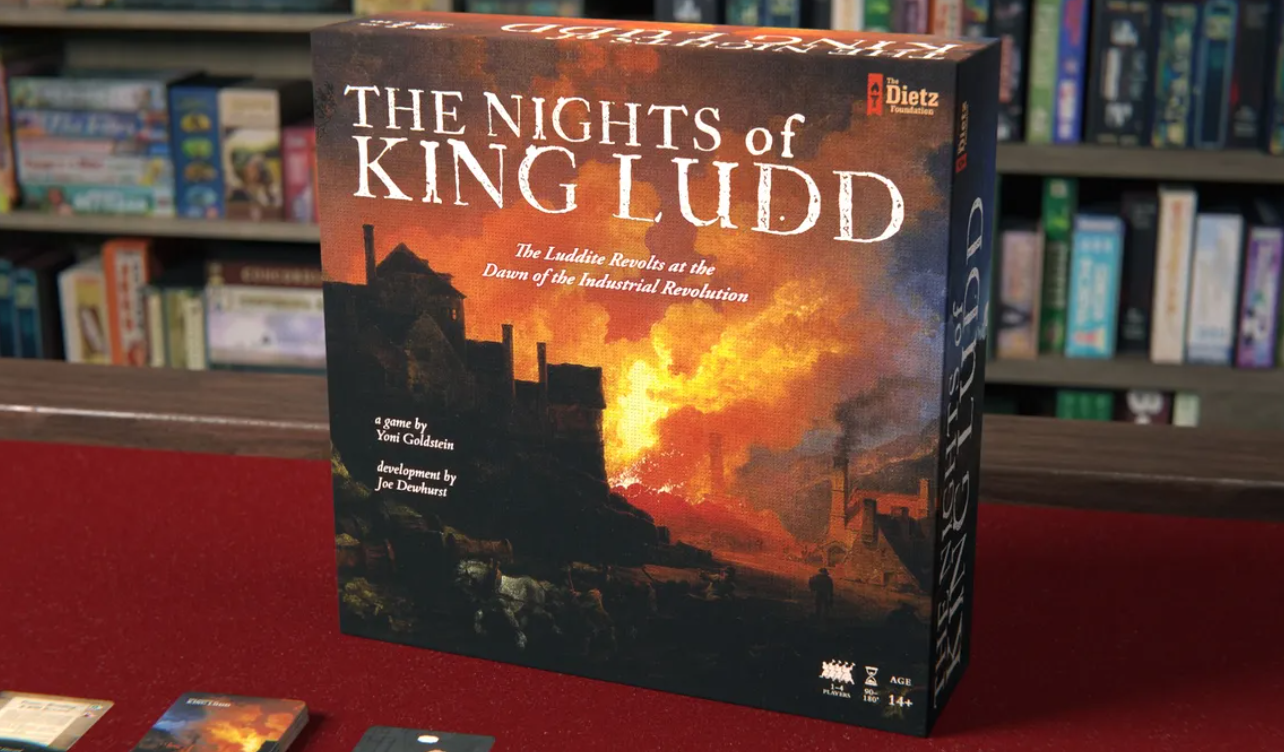
The Dietz Foundation has a new game from Yoni Goldstein on Kickstarter called The Nights of King Ludd: The Luddite War on Industry, 1811-? (the game has already funded). The Nights of King Ludd is a 2-4 player game that deals with direct oath-sworn secret societies of English Luddites at the dawn of the Industrial Revolution in the English Midlands. Working together, players will build a secret network of saboteurs, ferry provisions and weapons on the black market, assemble raiding parties, and if all goes as planned, smash those “dark satanic mills” to cinders. Here is Part II of our interview with Yoni.
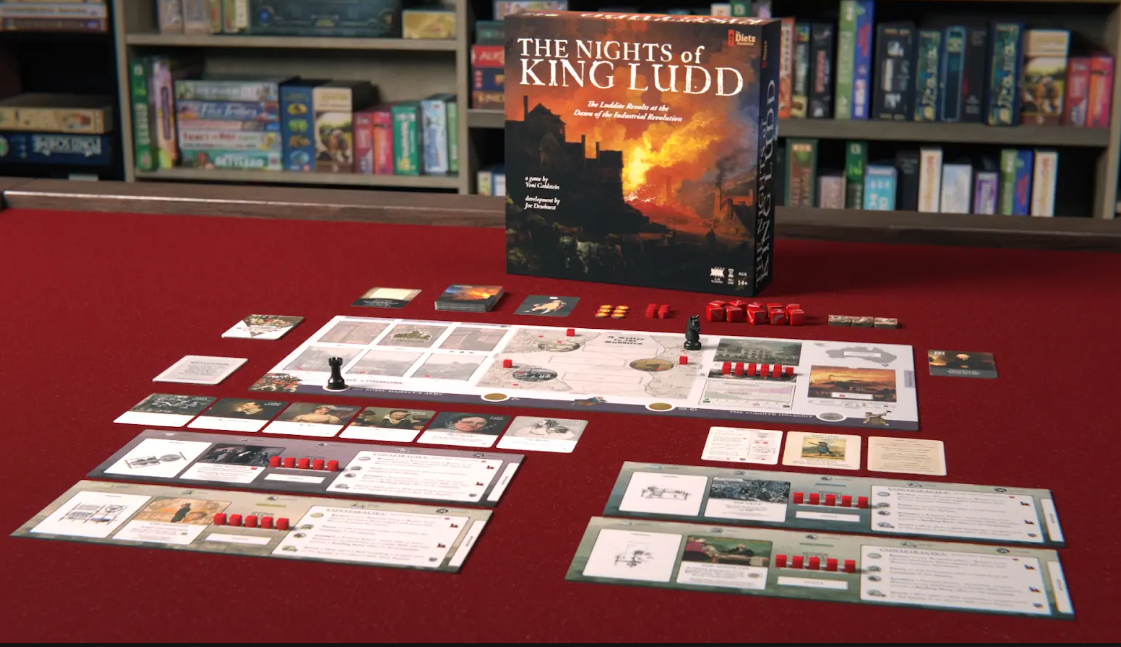
Grant: What is the layout of the board and the different locations?
Yoni: The board is divided into three panels. On the left, you will see the two card pools. The top row is where you place the “Regency” Cards, reactionary forces from London sent to quash the Luddite revolts. Below London are three cards representing the “Commons,” a shifting market of dual-use cards helpful to the players.
The central panel features the mills and enclosures. This is where players place their pieces (Weavers sympathizing with the Luddite cause), and the local Militia (the knight piece). The map depicts the “Luddite Triangle:” the West Riding of Yorkshire, Nottinghamshire, and Lancashire.
The right panel holds the Manufacturer’s House (and the current Manufacturer), the pool of Employed Weavers, and the Stocking Market to track wages and productivity in the mills. On the far right panel, is the Australia space for weavers punished by transportation, and the “Saboteur Dice Pool.”
A ribbon at the bottom of the board displays His Royal Majesty’s Army progress toward the Luddite Holdout. This is effectively the round track, if the Luddites are unable to sabotage the three mills by the end of the third round, the game ends in collective defeat.
Grant: How does the game use cards? What different type of cards are included?
Yoni: In The Nights of King Ludd players build a collective card engine by acquiring dual use cards from the “Commons” to upgrade their actions (aka “Conspiracies” – more on those below). The main pool of cards is called “The Commons” which, as the name suggests, represents a mutual aid network of provisions, tactics, and personalities that the Luddites may draw from in the course of their clandestine operations.
“Commons” cards are dual use and drawn from the Draw Deck. They are beneficial in two ways: the top of the card displays a persistent upgrade to any Conspiracy action and is locked into the player board to form a tableau. The bottom of the card displays a “Raiding Party” effect, a one time effect that can be triggered when a Raiding Party is formed and dispatched to a local mill.
The antithesis of the Commons is the “Regency,” a deck of cards reflecting the alignment of the aristocracy in London with an ascendent industrial class against the Luddite cause. They are drawn whenever the Luddites make themselves known in public: fomenting a mob, carrying out an assassination, or setting a factory on fire. When drawn, they set the machines of industry into motion; driving up productivity, plummeting wages, and calling the local constabulary to police the countryside.
Once more than three cards are in the “London” track above the Commons, a nasty event is resolved. These effects will intensify the game’s challenges. Sympathetic weavers will be exiled to Australia, the militia will sweep into the local mill to root out hidden raiders, and the Commons will be parceled off and sold to the highest bidder.
Grant: What is the role of the Persona Cards? Who are these figures?
Yoni: As mentioned in Part I of this interview, each player represents a secret society of Luddites organized around a particular “persona.” These personae introduce a special ability, as well as their their own victory condition, aka a “Motivation”, and a unique “Woe” – a card shuffled into the Draw Deck at setup that will, inevitably, undermine their efforts. There are six persona to choose from.
In clockwise order, they are:
Mary Molyneux, 19, and Lydia Molyneux, 15, were two sisters who, in 1812, stormed a steam-driven cotton mill outside Bolton shouting, “Now Lads!” – encouraging the mob to set the building afire (and they steadfastly did so).
Lady Ludd: “The “Lady Ludd Riots” took place in 1812 when a group of women and young lads – “distressed” by the precipitous rise in corn prices – marched through Leeds, assaulting merchants and “beating up for a mob.” They were led by a disguised person “who was dignified by the title of LADY LUDD.”
George Gordon Byron, 6th Baron Byron, “a young poet with the chiselled good looks, the oddly deformed club foot, and an obscure and very prestigious peerage,” was an eloquent Romantic dandy who rose to defend the Luddites before the House of Lords in 1812. Byron sympathized with the weavers near his home north of Nottingham; “the real cause of their misery [was] the destructive warfare of the last eighteen years, which has destroyed their comfort, your comfort, all men’s comfort.”
Elizabeth Studham was one of seven women tried for arson during the Swing Riots of 1829-30, an echo of the Luddite rebellion. At the age of 19 she set fire to an East Kent workhouse, demanding a wage increase for farmers threatened by threshing machines. Studham was deported and served 14 years and two months in Van Diemen’s Land (Tasmania) during which time she gave birth to two children of whom records are sparse. She would later be sentenced for 10 offences, primarily for bad language.
Lt. George Mellor was a Cropper and Yorkshire Luddite known to the movement as General Ludd’s Right-Hand Man. A strong willed and roguish machine-wrecker, he eventually faced a hanging sentence for the murder of a wealthy mill owner whom he shot in the groin. Eventually, Mellor was arrested in October of 1812. It is said he raised his hands in shackles and shouted “Three cheers for General Ludd!”
John Baines the elder was an “intelligent Hatter” and president of the local Republican Club of St. Crispin. Baines dreamt that Luddism would one day blossom into a democratic revolution; “Let the people now rise and rid themselves of this vile brood who flung upon them the sole taxation of the country and reduced them to the condition of galley slaves!” He was found guilty at the York Special Commission of administering illegal oaths and died on board a prison hulk in a Portsmouth harbour, on December 21st, 1814.
Grant: What is the purpose of the Manufacturer Card?
Yoni: At the beginning of each game, one of the three Manufacturer Cards is selected at random and placed face up in the “Manufacturer’s House” space on the board. The initial effect (tuck 6 cards from the draw deck beneath the manufacturer) represents the nascent industrial class’ emphasis on extracting from the commons, resolving at the start of each round. In practical terms, this prunes away the players’ available card pool over the course of play as well as ambiguates the composition of the draw deck. When a manufacturer is assassinated, all the cards tucked beneath are discarded (and will shuffle back into the Draw Deck) and the Manufacturer Card is flipped to reveal a more reactionary and dangerous side.
Grant: What are Conspiracy Actions?
Yoni: At the beginning of the game, each player has five conspirators (four for Lord Byron) at their command. Spending a conspirator allows the player to activate one of the four following Conspiracy actions (per turn):
Rally Local Weavers: either place a weaver from the supply pool at your presence pawn, or move your pawn and any weavers to another enclosure on the map.
Trade in the Commons: pick up a card from the Commons and tuck into one of the columns on your player board. That card allows for secondary actions whenever that matching Conspiracy is activated.
Assemble a Raiding Party: a two step action, move one or more weavers from an Enclosure (spaces on the map adjacent to Mills) into a Mill. This sets up a future sabotage action. Then, activate one of the Raiding Party effects in the Commons. This is the primary means of building your Saboteur Dice Pool. The more raiders you have at the Mill, the more dice you are permitted to roll during a Sabotage operation.
Lastly, you may Incite a Mob, placing a Mob Tile next to an adjacent Mill. For a sabotage roll to be successful, the die rolls must match an icon depicted on the Mob tile – hammer, gun, or torch.
Grant: What type of secondary effects come from cards tucked into the Column on Player Boards?
Yoni: Once you use a Trade conspiracy to move a card from the Commons to your tableau (your “Secret Society”), you can activate it, along with any other card in that same column on your player board, every time you resolve that conspiracy action. This allows for chaining and sequencing a series of effects that may have significant impact on your objective to destroy the mills.
Grant: Can you show us a few examples and explain their use?
Yoni: For example, let’s say you are George Mellor and you are seeking to assassinate the manufacturer. You resolve the Trade conspiracy to take “Dispatch Delegates to Neighbouring Counties” and place it in your Trade column, meaning it will be available to you immediately after this primary action. In previous turns you’ve already acquired an ongoing ability, “Mellor Takes a Shot at Mr. Horsfall!”, giving you an extra die for Assassination roles (helpful, since these operations are so risky!). You activate “Dispatch Delegates…” to activate a Raiding Party effect (the bottom of the card) in the Commons, which happens to be your partner in crime, “Martha Mellor Defends the Accused.” She allows you to roll for Assassination, but will be removed from play once that effect is resolved.
Grant: How does Sabotage and Assassinations work in the game?
Yoni: At various points in the game, players may elect to roll for Sabotage or Assassination. Of course, certain maneuvers must take place for these brazen attacks to succeed. Sabotages are larger scale events and are aimed at the Mills. You must have assembled a raiding party at the Mill and incited a Mob to spurn them on. As mentioned above, you roll one die per weaver cube at the Mill and attempt results matching the icons on the Mobs you’ve placed. The dice are D6s with the following faces: 3 blanks (a miss), 1 Torch, 1 Gun, and 1 Hammer. So with one Mob tile matching one of those icons, each die you roll has a 1 in 6 chance of hitting. If all three Mobs are in place, the odds climb to 1 in 2 per die.
An assassination is a similar roll, but only one die may be cast and hits are only the gun or hammer. Beware, the Regency will respond with a draw from its deck for both sabotage and assassination rolls!
Grant: What are you most pleased about with the design?
Yoni: As Dan Thurot noted, “The Nights of King Ludd points toward a more experimental direction than Chicago ‘68 and I feel it reflects a degree of growth and maturation as a designer. It’s a game that seeks to capture both the panoramic view of a people’s struggle as well as sketching out the personal incentives that motivate individual participation in (and sometimes sacrifice for) a collective cause”.
Grant: What other games are you currently working on?
Yoni: I am currently working on a commission for an international art exhibition on “sociopolitical freefall.” This will be a smaller box game and will also be developed by Joe Dewhurst. I’m also co-designing a project about Mai ‘68 with Fred Serval. This game is about the French experience of student and labor riots in 1968. While it shares the themes of Chicago ‘68 it’s driven by a completely new system.
In den vergangenen sieben Tagen (7. bis 14. September 2026) sind gleich mehrere neue Kampagnen gestartet, vier davon erreichen die Auswahlkriterien dieser Redaktion. Den Auftakt macht ein Ableger eines in Deutschland etablierten Eurogames, dazu kommen ein Katzenabenteuer, eine Endzeit-Erweiterung und ein Arena-Kartenspiel.
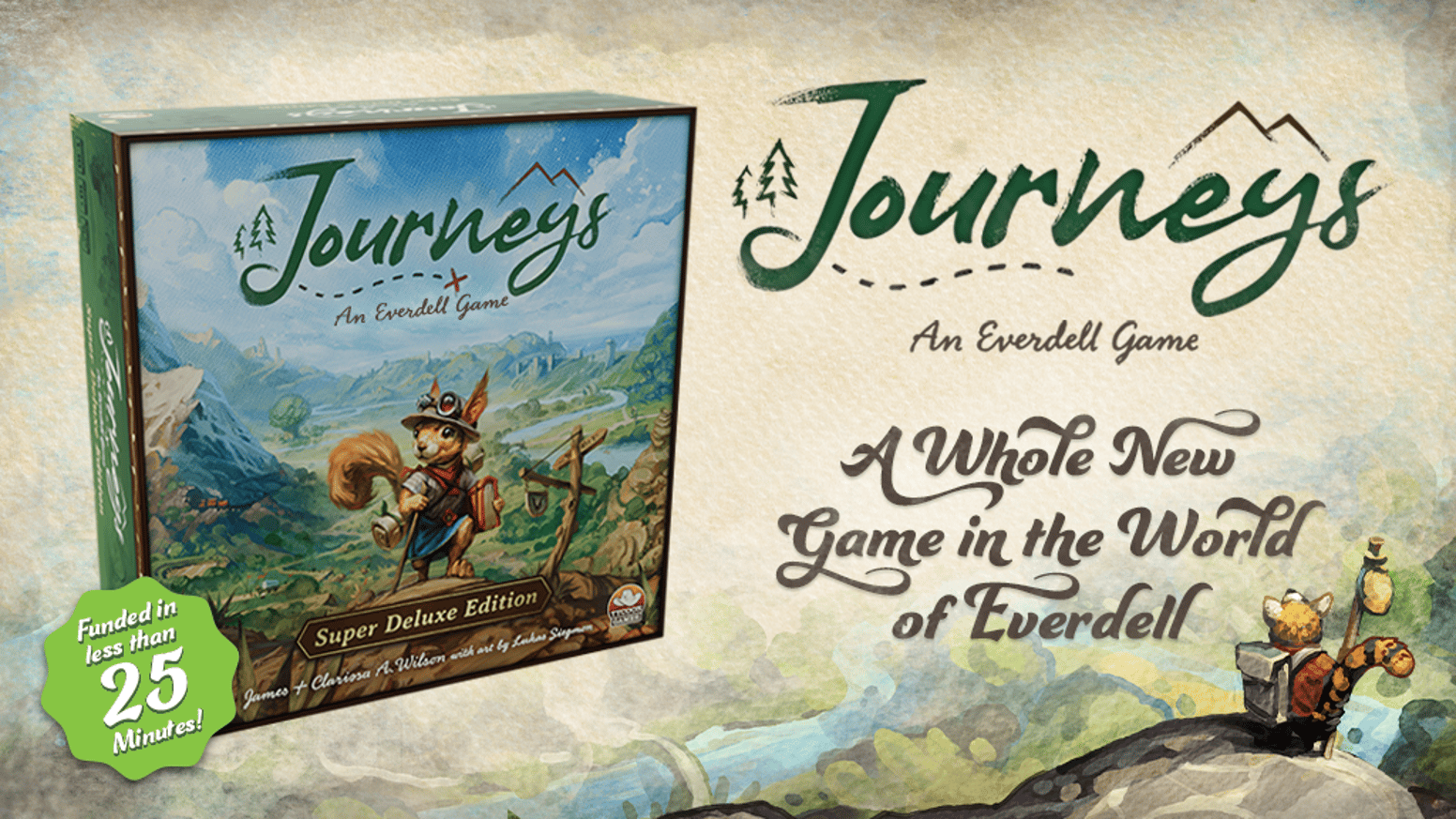
Everdell Journeys
Das US-Studio Tycoon Games hat Everdell Journeys am 8. September 2026 auf Kickstarter gestartet, Stand 14. September 2026 bei rund 1509 Prozent des Ziels von 35.000 US-Dollar (528.284 US-Dollar, 4.230 Unterstützende). Design stammt von James A. Wilson und Clarissa A. Wilson, den Schöpferinnen und Schöpfern von Everdell, die Illustrationen wieder von Lukas Siegmon.
Zwei bis fünf Spielende legen in diesem Ableger keine Städte mehr an, sondern ziehen als reisende Tiere durch die Welt von Everdell und legen dabei einen Pfad aus Karten. Wer eine Karte auf dem eigenen Pfad aktiviert, sammelt Ressourcen und Punkte für spätere Kombinationen, ein persönliches Reisetagebuch hält besondere Erinnerungen fest. Statt Worker Placement steht damit Card Drafting im Zentrum des Spiels. Eine Partie dauert laut BGG rund 60 Minuten, ausgelegt für zwei bis fünf Spielende ab 10 Jahren, ein Solo-Modus ist erst in der Deluxe-Ausgabe mit erweiterten Regeln enthalten.
Die Kampagne läuft noch bis zum 25. September 2026, der Versand ist laut Kampagnenseite für August 2027 vorgesehen. Das Hauptspiel Everdell erscheint in Deutschland regulär bei Pegasus Spiele, eine deutsche Ausgabe von Everdell Journeys selbst nennt die Kampagne bislang nicht.
Catvale
Das polnische Studio FUdice hat Catvale am 8. September 2026 auf Kickstarter gestartet, Stand 14. September 2026 bei rund 1298 Prozent des Ziels von 20.000 Euro (259.596 Euro, 1.961 Unterstützende). Design stammt von Lukasz Berdowski.
Zwei bis sechs Spielende steuern ehrgeizige Katzen durch ein von Runde zu Runde neu zusammengesetztes Kachel-Tableau, sammeln Ressourcen und lösen Quests, um Prestige und Luxusgüter für ihren eigenen Rückzugsort zu erobern. Würfel legen zu Rundenbeginn die Stärke der verfügbaren Aktionen fest, wählbare Spielstile reichen vom Kämpfer über die Bauherrin bis zur Abenteurerin. Eine Partie dauert laut BGG bis zu 180 Minuten, ausgelegt für zwei bis sechs Spielende.
Die Kampagne läuft noch bis zum 8. Oktober 2026, der Versand ist laut Kampagnenseite für Dezember 2027 vorgesehen. Aktuell gibt es das Spiel nur auf Englisch und Polnisch, weitere Sprachen schaltet der Verlag laut eigener Ankündigung erst frei, sobald für sie jeweils 200 Unterstützende zusammenkommen. Eine deutsche Fassung ist damit nicht ausgeschlossen, aber auch nicht zugesagt.
Barbaric: Crown of the Frost
Der Verlag Hexa House hat Barbaric: Crown of the Frost am 8. September 2026 auf Gamefound gestartet, Stand 14. September 2026 bei rund 711 Prozent des Ziels von 20.000 US-Dollar (142.141 US-Dollar). Die Erweiterung ergänzt das postapokalyptische Duell- und Erkundungsspiel Barbaric: After the Apocalypse, das von Thitinan N. entworfen wurde.
Neu ist unter anderem die Riderin Yrsa mit zwei wählbaren Entwicklungspfaden, dazu kommen weitere Kämpferinnen und Kämpfer samt ihrer Gear-Fahrzeuge für das titelgebende Winter-Setting. Im Kern bleibt das Spiel dabei, was es im Grundspiel war: Ein bis vier Spielende steuern mutierte Tierkrieger, kämpfen um Ressourcen und versuchen, den namensgebenden Energiekern im Zentrum des Spielfelds zu erobern, bevor die Bedrohung durch das Grundspiel selbst zu stark wird. Eine Partie dauert laut Kampagnenseite rund 60 Minuten, ausgelegt für ein bis vier Spielende ab 14 Jahren, ein Solo-Modus ist durch das Grundspiel gegeben.
Die Kampagne läuft noch bis zum 30. September 2026. Eine deutsche Lokalisierung nennt die Kampagnenseite nicht.
Trials of Maya
Das Studio Department of Lore aus Goa, Indien, hat Trials of Maya am 8. September 2026 auf Gamefound gestartet, Stand 14. September 2026 bei rund 400 Prozent des Ziels von 50.000 US-Dollar (199.874 US-Dollar). Entwickelt wurde das Spiel unter der Leitung von Zain Memon im Fantasy-Universum MAYA.
Ein bis vier Spielende steuern Champions mit individuellem Kartendeck durch Arena-Duelle, verwalten dabei ihre Energie und verketten Kartenkombinationen, um im richtigen Moment zuzuschlagen. Vor jeder Partie lässt sich das eigene Deck aus den Karten des gewählten Champions neu zusammenstellen, fünf verschiedene Spielmodi mit eigenen Arenen und Regeln stehen zur Auswahl. Eine Partie dauert laut BGG bis zu 120 Minuten, ausgelegt für ein bis vier Spielende ab 14 Jahren. Das Basisspiel selbst bietet zwei kompetitive Modi, ein Solo- und Koop-Modus namens „Depths of Kaav“ ist als separates Zusatzmodul für 30 US-Dollar erhältlich, nicht Teil des Basisspiels.
Die Kampagne läuft noch bis zum 13. Oktober 2026. Eine deutsche Lokalisierung nennt die Kampagne nicht.
Korrektur vom 17.09.2026: Im Abschnitt zu Everdell Journeys hieß es zunächst, das Hauptspiel Everdell erscheine in Deutschland bei Frosted Games. Richtig ist: Der deutsche Verlag ist Pegasus Spiele.
As you know, I do love me a good Card Driven Game….or a game that uses cards….multi-use cards. I love cards because it allows for the designer to keep a game going while using a vehicle that incorporates special rules that fit a historical situation but also to be able to use bits of the history itself to teach the players about the topic. A few months ago, I caught wind that The Dietz Foundation was working again with Yoni Goldstein on his second game called The Nights of King Ludd: The Luddite War on Industry, 1811-? that recently launched on Kickstarter (the game has already funded). The Nights of King Ludd is a 2-4 player game that deals with direct oath-sworn secret societies of English Luddites at the dawn of the Industrial Revolution in the English Midlands. Working together, players will build a secret network of saboteurs, ferry provisions and weapons on the black market, assemble raiding parties, and if all goes as planned, smash those “dark satanic mills” to cinders. I reached out to Yoni to get a bit more information about the design and he was more than willing to share.
Grant: Yoni welcome back to our blog. What have been your feelings about the reception of your great game Chicago ‘68?
Yoni: I’ve joked that I’ve taught this game now more than I’ve played it (of course this is only true if one just counts the last couple years!). Since 2024, I’ve taught it to a diverse and intergenerational cohort of non gamers, grognards, peace activists, veterans, and even a few spooks. Inevitably players relate the experience they are having on the board to what they see in their neighborhoods: protests and tear gas, troops deployed into cities, election interference, and so on. Those conversations are still ongoing and I’m heartened that Chicago ‘68 is facilitating a space for that.
Grant: What lessons did you learn from that experience that have helped you with your new game?
Yoni: I’m grateful that Joe Dewhurst, who developed both Chicago ‘68 and the upcoming The Nights of King of Ludd, guided me through the design, testing, and development processes. Ludd is my second game and it went through a number of iterations, but this time we had a proper methodology in place. Likewise, The Dietz Foundation was very transparent with the manufacturing and publishing side of things, which gave me a deeper understanding of the timeline and proofing / editing process that accompanies those final stages of production.
Grant: What is your new upcoming game The Nights of King Ludd about?
Yoni:The Nights of King Ludd is a collaborative game for 2-4 players about the Luddite revolts in the English Midlands. Set roughly around 1811, the game tells the story of local workers in the textile industry (“weavers”) forming secret societies and leading armed raids against mills and factories in their communities. Players command an oath-sworn organization of conspirators working with the Luddites to achieve the collective goal of machine wrecking while also attempting to meet their individual motivations (which may include assassinating the local manufacturer, spurring a republican revolution, or just avoiding an Australian exile).
In terms of game mechanics, you are building a dice pool while also maneuvering pieces and collecting multi-use cards to modify your roles. Collectively you are building a tableau and operating it together to mount a series of raids against the three Mills on the map.
Grant: What is the meaning of the title of the game? What should it convey to players about the game and the history it represents?
Yoni: The title of the game is borrowed from a chapter in Gavin Mueller’s book from 2021, Breaking Things at Work. Mueller is among a cohort of authors, including Kirkpatrick Sales (Rebels Against the Future), Brian Merchant (Blood in the Machine) and Cory Doctorow, who are working to reconsider the Luddites’ reputation in the age of AI and the gig economy. Rather than seeing them as misguided revolts against the inevitability of technological progress, these writers appraise the Luddites in their historical context as severely desperate labor movements against tech oligarchies. The Luddites’ aims were, ultimately, to raise the minimum wage, cease child labor, and to maintain a higher standard of craftsmanship and quality in the production of textile goods. At every point their appeals to authority were spurned. So they turned to mob justice. “You may call the people a mob,” remarked Lord Byron before Parliament, “but do not forget that a mob too often speaks the sentiments of the people.”
The subtitle of the game, “The Luddite War on Industry, 1811-?” is also a cheeky nod to Volko’s Labyrinth: The War on Terror, 2001 – ?. While these games don’t share a mechanical similarity, they both explore the ongoing and unpredictable nature of insurgencies.
Grant: Why was this a subject you wanted to focus on?
Yoni: My area of interest in game design, broadly speaking, is movement politics on an operational scale. As with Chicago ‘68, the Luddite war on industry feels an under-explored subject matter in historical gaming. While there are certainly titles about the Industrial Revolution from the perspective of barons and magnates (especially in the Euro game niche), little is mentioned about the social, political, and ecological costs of these endeavors for progress.
Moreover, the story of the Luddites and their “secret societies” is about the tensions of modernity. New technologies combined with extensive wars abroad drove a rise in food costs and detonated an affordability crisis in the imperial homeland. Communication media (handbills, newspaper editorials, and pseudonymous letters) was an instrument of persuasion, vitriol, and threats. Suspected Luddites and their sympathizers were surveilled by the state, which increasingly saw its interests entwined with industrial capital. We’ve seen this all before!
Grant: What are the unique features with the system used for the game?
Yoni: The Nights of King Ludd has a unique framework for collaborative engine building. Initially, players draw from “The Commons” (a shifting card pool) where each card has the same “trade cost.” On your turn, you may activate a Conspirator (spending an action point) to draw a card into one of the columns in your tableau. Each column upgrades your actions with a permanent ability. If you specialize your actions, you can harmonize a collective strategy between players and hone in on the steps you need to take to sabotage the mills.
In the Commons we are evoking the notion of a shared economy. But this may shift dramatically when decreasing wages and increasing productivity converge. Then, the Commons transforms into the “Common Market.” Now, players are building their tableaux with an increasing cost, similar to the Pax Series (for example, Pax Pamir or Pax Renaissance). Each player is now facing a decision: overwork their cabal of conspirators or draw on the labor power of the workers in the textile industry (which drains their militant power on the map).
Grant: What does the collaborative portion of the subtitle mean for the game? How do the players cooperate?
Yoni: I choose “collaborative” not “cooperative” as a descriptor to emphasize the multi-victor nature of the game. In The Nights of King Ludd, each player chooses not only their persona and their role in the Luddite struggle (with asymmetric abilities and effects), they also put forward a “Motivation.” Motivations are personal victory conditions that unlock if the collective win condition (destroying all three mills on the map) is met. This gives shape to the degree of player friction in the game. For example, Lord Byron’s motivation is to turn down the heat from the ruling Regency. His motivation is in conflict with George Mellor’s, the famed assassin, whose attempts at the Manufacturer’s life will ratchet up the crown’s crackdown. But pair John Baines, a republican agitator, with the Molyneux sisters, two young women destined to labor in the mills, and the gameplay will tilt more toward cooperation. In this case, Baines is working to regulate the industriousness of the mill (keeping productivity low and wages high) while the Sisters are interested in keeping workers employed. So the degree of cooperation is up to the players, and as often happens, someone may have to make a noble sacrifice for the collective good.
Grant: What did you need to model regarding the English Luddites at the dawn of the Industrial Revolution?
Yoni: As EP Thompson (The Making of the English Working Class) notes, the history of the Luddites is, at best, “opaque.” We are grappling with a story about secret societies in an era where workers associations were illegal and damaging weaving frames was a capital offence. As such, we have dubious claims from government spies, confessions before “hanging judges,” and pseudonymous letters and handbills. Consequently, the model had to be expansive enough to capture the granular nature of these conspiratorial operations, but also open enough to allow for the plausibility of a broad range of player actions.
For example, one of the core actions is to “rally local weavers,” which is a form of recruitment. In game terms, this means moving one of the Employed Weaver cubes into an Enclosure where they can contribute to your force strength. This action may represent members of your secret society swearing in sympathetic workers in local pubs, or calling a clandestine meeting in the nearby woods. We don’t know precisely how the Luddites organized themselves, so the language has to be inclusive of these possibilities. Players then “assemble a raiding party”, which is to move the cubes from the enclosure into a nearby Mill. Each cube in the Mill space adds a die to the Sabotage roll (which is the primary means of wrecking machines). So here is a group of raiders hiding in the hedge and awaiting the signal from King Ludd. They are spurred on by the Mobs who have surrounded the site, represented by these Mob tiles. Matching a die roll to the symbol on the Mob Tile is how you roll a “hit.” The intention is to shape a series of amorphous and difficult to historicize chain of events into a familiar wargaming mechanism: rolling a handful of dice representing an “attack” and applying modifiers to the results.
Grant: What is your design goal with the game?
Yoni: My overall aim was to develop a system that could express a relationship between an abstract economic system, worker uprisings, and the coming together of industry and aristocracy to form a ruling class. But on a purely design level, I wanted to work within the framework of a Pax Series style market that you encounter in games like Pax Pamir and Pax Renaissance. That is, a shifting market of cards that players can purchase and place into their tableau. It’s an evocative description of history as a bazaar of possibilities and counterfactuals. The Nights of King Ludd tweaks this vision of history as somewhere between a commons (a gift economy) and a market (which costs worker power as in-game resources).
But really, I want this to be a “raiding party game.” Beneath the heady layers of history and theory is a brisk experience featuring dice odds, clever combos, and cooperation with your friends (while slyly pushing your own agenda!).
Grant: What other games did you use as inspiration?
Yoni: John Company from Wehrlegig Games is certainly one of the biggest inspirations, taking place in a similar era of British imperial economic imperialism (Ludd is at the tail end of JoCo’s later scenarios) and drawing on the satirical printworks of the time. Like John Company, players are asked to intervene in an existing ecosystem. In both games, player actions accelerate a system that will simultaneously reward and punish everyone at the table. How this is doled out is uneven, so players have to weave and dodge to make best of a collapsing infrastructure.
Grant: What sources did you consult about the history?
Yoni: An invaluable resource for all things Luddite is the Luddite Bicentenary curated by Richard Holland. This is a comprehensive digital archive of historical ephemera devoted to Luddism, including handbills, court transcripts, and other images and texts. I also quote extensively from Rebels Against the Future by Kilpatrick Sale and The Risings of the Luddites: Chartists and Plug-Drawers by Frank Peel, E.P. Thompson, as well as The Making of the English Working Class also by E.P. Thompson.
Other reference texts include:
Writings of the Luddites edited by Kevin Binfield
Ben o’ Bill’s, The Luddite: A Yorkshire Tale by Daniel Frederick Edward Sykes, George Henry Walker
Breaking Things at Work: The Luddites Are Right About Why You Hate Your Job by Gavin Mueller
The Luddite Rebellion by Brian Bailey
Blood in the Machine by Brian Merchant
Women in Protests 1800-1850 by Malcolm Thomis
Convict Lives at the Launceston Female Factory (A swing rioter: Elizabeth Studhamby Keryn Rivett), edited by Lucy Frost & Meredith Hodgson,
Grant: What is the dice pool building mechanic and how does it work in the design?
Yoni: At the core of the game is a fairly straightforward dice mechanic for resolving raids against the three mills on the map. Throughout the course of the round, players add “saboteur dice” to the dice pool, representing the Luddite’s militant capacity. These are D6’s with the following icons: gun, hammer, and torch (matching the “mobs tiles” – armed rabble surrounding the mill). The remaining three sides are blank and always result in a miss.
When a sabotage operation is initiated, the number of dice rolled is determined by the number of raiders you’ve positioned at the mill and what constitutes a possible hit is determined by the matching icons on the nearby mob tiles (again; gun, hammer, or torch). All misses are returned to supply but if at least one hit is rolled, you may push on and carry out multiple raids, striking at other mills as well.
As your readers can deduce, the purpose of the tableau building and the card engine is to modify the odds of the roll in your favor, i.e. the more raiders you assemble the more dice you will roll, and the more mobs you’ve fomented the more likely you are to roll a hit.
Grant: What is the general Sequence of Play?
Yoni: As neighboring societies of Luddites, you have three rounds before the Crown musters its army and crushes the revolts. Each round is structured the same:
Dawn: Industry Operates – at the beginning of the second and third round your adversaries in London will take actions against you, sending the militia on patrols and accelerating industrial production.
Day: The Manufacturer Speculates – during this phase, the local manufacturer will take an action, depleting the Commons of its resources.
Night: The Luddites Conspire – this is the main phase of the game, where each player takes turns resolving a Conspiracy action by spending a Ready Conspirator cube on their boards. Each player takes a primary Conspiracy Action and resolves any secondary effects on Cards tucked into the Column of that Conspiracy on their Player Boards. In this phase, players can attempt a sabotage roll to destroy the Mills.
Round’s End – when there are no Ready Conspirators (or all players pass) players reset the components for the next round.
Thank you for your time in answering our questions Yoni! I am very much interested in this game and its efforts to tell this very interesting story of resistance. While this is not a traditional wargame, in my opinion it certainly merits a serious look from wargamers who are interested in CDG’s and games that use cards and that are interested in seeing these type of non-traditional historical subjects represented. I have backed the project and look forward to getting my copy next year!
I love a different style and focus of wargame. A game that takes a look at an important but somewhat obscure or rarely addressed historical topic, such as espionage or intelligence, and creates a gaming experience tailored around the events to highlight and evoke the difficulties and tension that would have been present. In January 2026, GMT Games announced such a game in Checkpoint Charlie, which is a solo or cooperative game focused on SIS espionage missions in Berlin in the 1960’s designed by Russell Brown. We have posted an interview with Russel and it was very well received and he has now agreed to create a series of History Behind the Cards to highlight the events of the 1960’s Cold War struggle in West Germany but also to share aspects about the game play and how it models the history.
*Note: The cards highlighted in this series and their event text, as well as any pictures used showing any of the various components, are still in the design and development process and as such event effects and text might still change prior to final development and publication.Also the art and layout of the cards are only for playtest purposes at this point and the game will enter the art department as it nears publication.
History Behind the Cards – Checkpoint Charlie from GMT Games – Card #6: General Clay Steps In
US General Lucious D. Clay was appointed as military governor of the United States zone of Berlin from 1945 until 1949. He was best known, especially to the people of Berlin, as the person responsible for the Berlin Airlift, which fed and supplied the people of Berlin from the air when the Soviets cut off all access to the city for eleven months, from June 1948 to May 1949. Without the airlift, the west would have been left with two terrible options – allow West Berlin to be starved into submission and annexation, or invade East Germany to open a supply corridor, almost certainly starting an all-out war with the Soviets.
In the early 1960’s, US President Kennedy turned to the now retired General Clay and called on him to deal with serious issues that arose in Berlin, like the faceoff between tanks at Checkpoint Charlie (card #4). Clay understood Berlin and had the respect of its people, so Kennedy brought him along on his famous visit to the city, during which the president gave his “Ich bin ein Berliner” speech (card #7).
The General Clay Steps In card in Checkpoint Charlie represents the retired general being sent by Kennedy to resolve issues in West Berlin. Playing the card removes an event marker from the city and is the only way many of the event markers can be removed during a mission. It is especially useful for removing the Faceoff marker or a troublesome Stasi Stakeout.
In the next article in this series, we will take a look at Ich bin ein Berliner Speech by President John F. Kennedy.
In my opinion, this game looks extremely interesting and I am very much excited to learn more about it. I am appreciative to Russell and his efforts to bring us these cards and to write these entries to share with our readers. I am also very glad that this topic is being covered in a game and look forward to playing this one day soon.
I love a different style and focus of wargame. A game that takes a look at an important but somewhat obscure or rarely addressed historical topic, such as espionage or intelligence, and creates a gaming experience tailored around the events to highlight and evoke the difficulties and tension that would have been present. In January 2026, GMT Games announced such a game in Checkpoint Charlie, which is a solo or cooperative game focused on SIS espionage missions in Berlin in the 1960’s designed by Russell Brown. We have posted an interview with Russel and it was very well received and he has now agreed to create a series of History Behind the Cards to highlight the events of the 1960’s Cold War struggle in West Germany but also to share aspects about the game play and how it models the history.
*Note: The cards highlighted in this series and their event text, as well as any pictures used showing any of the various components, are still in the design and development process and as such event effects and text might still change prior to final development and publication.Also the art and layout of the cards are only for playtest purposes at this point and the game will enter the art department as it nears publication.
History Behind the Cards – Checkpoint Charlie from GMT Games – Card #5: Berlin Film Festival
Every summer since 1951, Berlin had hosted the international Berlin Film Festival (the Berlinale) and awarded the Golden Bear to the best film in each of five categories. Venues in both East and West Berlin were used for screening of films. As summer approached in 1962, Berlin found itself cut in two by the Berlin Wall amid growing tensions between East and West. It seemed there were any number of events that could trigger a war over the city. And yet, the Film Festival was held, entirely in West Berlin this time. The festival drew thousands of visitors to the city, including Hollywood stars like Jimmy Stewart and Tony Curtis. Screenings took place in venues throughout the city and, we can assume, brought a much-needed sense of normalcy and continuity to the residents of West Berlin and perhaps a sense of what was lost to those in the east.
The festival took place every year throughout the Cold War, and after reunification it once again began film screenings in the former East Berlin. The festival continues and this year the Golden Bear award for best film went to “Yellow Letters.”
The Berlin Film Festival card in Checkpoint Charlie assumes the Berlin Hilton is full up with visitors and cannot function as a Honey Trap. The card also assumes that the extra traffic in the city, including thousands of additional pedestrians trying to get a glimpse of celebrities, negates any Ongoing Card Effects that allow additional movement during the Movement step.
In the next article in this series, we will take a look General Clay Steps In as he is appointed by President Kennedy to resolve issues in West Berlin.
In my opinion, this game looks extremely interesting and I am very much excited to learn more about it. I am appreciative to Russell and his efforts to bring us these cards and to write these entries to share with our readers. I am also very glad that this topic is being covered in a game and look forward to playing this one day soon.
Featuring a "tactical skirmish" design, the Fire and Ice game is ideal for two or more players. Participants embody the heroes of Firekeep as they battle the nefarious forces of Icepeak across multiple maps.
In der vergangenen Woche sind auf Board Game Arena drei neue Titel gestartet. Die Bandbreite reicht vom schnellen Katzen-Kartenspiel über eine Würfelvariante eines modernen Klassikers bis zum schweren Aufbauspiel. Wir stellen dir die Neuzugänge der Kalenderwoche 34 mit den wichtigsten Eckdaten vor.
CATATAↃ: schnelles Duell der Katzenclans
Mit CATATAↃ ist ein schnelles Team-Kartenspiel neu dabei. Für diesen Titel wird ein Premium-Abo benötigt. Zwei Katzenclans kämpfen darum, möglichst viele Wollknäuel ins eigene Versteck zu bringen. Eine Partie dauert nur rund 15 bis 30 Minuten.
Das Spiel von Guillaume Alarie und Jonathan Gagnon (Unigoat Edition, 2025) ist für 2 bis 6 Personen ausgelegt und ab 8 Jahren freigegeben. Als Mechaniken nennt BoardGameGeek Handmanagement, Matching und Tug of War. Die BGG-Wertung liegt bei 4,95 bei erst 101 Stimmen, das Spiel ist dort also noch kaum bewertet.
Terraforming Mars: Das Würfelspiel
Terraforming Mars: The Dice Game bringt den Aufbau des Roten Planeten in kompakter Würfelform auf die Plattform. Für diesen Titel wird ein Premium-Abo benötigt. Du entwickelst mit Spezialwürfeln deine Konzerne, spielst Karten und erhöhst Sauerstoff, Temperatur und Wasser. Auf Deutsch ist der Titel als „Terraforming Mars: Das Würfelspiel" beim Schwerkraft-Verlag erschienen.
Das Spiel stammt von Jacob Fryxelius (FryxGames, 2023) und ist für 1 bis 4 Personen ab 14 Jahren gedacht, ein Solomodus ist enthalten. Eine Partie dauert etwa 45 Minuten. Zu den Mechaniken zählen Würfeln, Bag Building und das Legen von Plättchen. Bei BoardGameGeek kommt der Titel auf eine Wertung von 7,30 bei rund 4.750 Stimmen.
Nucleum: schweres Aufbauspiel im Sachsen des 19. Jahrhunderts
Nucleum ist der schwerste Neuzugang der Woche. Für diesen Titel wird ein Premium-Abo benötigt. Du übernimmst die Rolle von Industriellen im Sachsen des 19. Jahrhunderts und baust Netzwerke aus Schienen und Stromleitungen auf. Gebäude werden errichtet, mit Energie versorgt und über Verträge zu Punkten gemacht.
Das Spiel von Simone Luciani und Dávid Turczi (Board&Dice, 2023) ist auf Board Game Arena für 2 bis 4 Personen spielbar und ab 14 Jahren freigegeben. Eine Partie dauert rund 60 bis 150 Minuten. Auf Deutsch ist der Titel bei Giant Roc erschienen. Mit einer BGG-Wertung von 8,11 bei über 8.700 Stimmen ist Nucleum der am höchsten bewertete Titel dieser Übersicht.
Auch wir wünschen uns, dass endlich wieder mal die Sonne hinter den Wolken verschwindet. Die Hitze der letzten Wochen hat auch an unseren Nerven gezehrt. Das ist jedoch nicht der einzige Grund, warum wir urlaufbsreif sind. Es ist einfach mal wieder Zeit! Die Spiele sind eingepackt, es geht los.
Das Büro von spielwiese.at ist daher vom 10. bis 23. Februar 2026 nicht besetzt. Anfragen und Post können erst danach wieder bearbeitet werden.
STÖRUNG. An dir lag es nicht, dass das Serviceportal spielwiese.at seit Mittwochfrüh offline war. An uns auch nicht, soweit wir aktuell wissen. Denn noch fehlt uns die Information des Hosters A1, was der Grund für den Totalausfall war oder ist. Wir sind jedenfalls froh, dass die Seite wieder erreichbar ist und pflegen in Kürze neue Beiträge ein.
7 Wonders ist ein Dauerbrenner unter den Brettspielen und nach wie vor beliebt. Nicht umsonst war es das allererste Kennerspiel des Jahres (2011). Mit 7 Wonders Architects kam die (sehr…
Rinse and repeat with the after gaming sleeping and eating of breakfast. I was very tired this morning when the alarm went off at 7:30am. I knew I had a big day and hoped that I’d have the energy to do all that I had planned.
First up was a learning game of the brand new The Weimar Republic from GMT Games. The Weimar Republic is a Card Driven Game of political struggle in interwar Germanywhere 4 unique factions compete for dominance including the democratic Coalition, the Soviet-backed Communist Party, Hitler’s National Socialists and the far-right Radical Conservatives. The game covers the Interwar Years between 1919-1933 and represents all of the different fighting factions trying to gain control in Germany’s regions and major cities, to maneuver the political landscape of the Republic, and to dominate through a combination of propaganda, parliamentary elections, street violence, economic influence and ideological zeal. This situation sets itself up perfectly for a game to explore the various parties involved. I was able to get into a game with the Hoosier Herd gaming group from Bloomington, Indiana.
The game appears to be a COIN Series like game as each faction has their own unique abilities and powers but also win in their own way. The game also visually looks like a COIN game as it uses multi-colored wooden cubes to represent influence in the various districts of pre-WWII Germany.
A major focus of the game is the concept of Elections. Each Era has a number of Election Cards (based on the historical number of Elections) that are shuffled into the Event Card decks. When an Election Card is played, both a Regional and a General Election is held at the end of that round. Election scoring is based on players’ Dominance over spaces and Regions, with modifiers such as Middle Class Sympathies, Cadres, military Supremacy, etc. Regional Elections gives Parliamentary Control over the game’s Regions while a General Election can potentially end the game – if anyone but the Coalition wins a General Election, that player also immediately wins the game.
Players draw a hand of cards for each Era and use their AP to conduct Actions. You don’t chose between AP and Event as when you play an Event Card the Event always takes place, unless there are some requirements that aren’t met. You don’t need to play a card every turn – in fact you can’t, as there are fewer cards in a hand than turns in an Era and you may only play one Event Card per turn. However, you always have a basic 1 AP that may be used by itself or in combination with any Event Card played, so during some turns you will be using only that basic point. You can also pass which allows you to discard a card and draw a new one.
I very much like what I was doing but need to grok the rules so I know what I should be doing. We had a good time and I look forward to another play in the near future.
Next up I sat down with Greg Smith to play the upcoming Korean Tide from Compass Games. I took Greg to the woodshed with the Chinese and had a great time with the game. This one is a very good addition to the Tide Series and adds in some new tricks.
One of the things that I liked was the addition of new Divisional Displays which hold the strength points and assets of each division. The player will track the strength points as they are lost and gained but also will keep track of their reserves which is a new concept. Reserves can be used to force a reroll of your opponents dice during combat or to reroll your dice. The reserves are created by reducing the division’s strength points by 1. There are also tank counters that are attached to units, particularly the North Korean units at the start of the game which add a single strength point but also cause the defender to retreat after being attacked regardless of outcome. Both of these additions are very nice changes.
Greg and I played for the first 2 years of the war including 1950 and 1951 and I was able to break his units and destroy several American divisions. But the real thorn in Greg’s side was my 6th KPA unit who was dug in and just wouldn’t die. I was able to continually feed them reinforcements and their combat rolls were amazing inflicting 2-3 losses on the UN forces while taking no more than 1 loss. Such an interesting system and I very glad that I was able to play it.
Next up was a game of Baltic Empires from GMT Games. Baltic Empires covers the tumultuous period in the Baltic region from the collapse of the Teutonic Order in 1558 to the end of the Great Northern War in 1721. The game really focuses on representing both the mercantilist economic thinking of the time, the very limited resources at hand on the state/ruler level and the destructive nature of warfare and its effects on the local economy. When war occurs in spaces infrastructure can be destroyed and it is very expensive to keep replacing units that just die on the battlefield.
The game has 5 factions including Denmark-Norway, Sweden, Poland-Lithuania, Prussia-Brandenburg and Russia. Each power has 2 common victory conditions and 1 or 2 that are specific to that power. The shared victory conditions are either control of 2 custom houses or being the hegemon on all 3 tracks at the same time.
One of my favorite parts was that each turn, 5 Dramatis Personae Cards are randomly drawn from the deck and become available for purchase by the players in the Production phase. These cards have a wide variety of effects, but can be broadly divided into 4 types: those that have permanent effects, those that have one-time effects, those that affect victory conditions and those that provide a special leader unit.
These cards are excellent fun and really create somewhat of a race to purchase the best cards before others can acquire them.
I loved the game and was doing quite well with Sweden as I had captured Riga and Kurland in the Baltics and had built up quite the nice economic engine.
The economic system is simple, but manages to capture a lot of key elements of this period. Each province has between 0 and 3 resource icons and between 0 and 2 city icons. If a workshop marker is present on a resource icon the province produces 1 of that type of resource and if a city marker is present on a city icon the province produces 1 thaler (the currency of the game). There is one twist though, as provinces under noble control will contribute a maximum of 1 of the resources and 1 of the thalers produced in it to the central administration while the rest is discarded as it goes into the coffers of the local nobility. Only provinces where royal control has been imposed will contribute their full income to the player. In addition to this there are 3 trade center provinces on the map, and these generate extra income for their controlling player as they are able to tax the trade there. Just a great little game that I hope to explore further later.
My final game of the evening was a look at The Emperor’s Voice and The Emperor’s Choice coming to Kickstarter soon from Worthington Publishing. I was able to sit down with Wes Crawford to play his game The Emperor’s Voice which covers midnight until noon on August 15, 1945 when an attempted Army coup occurred against the Emperor of Japan in order to stop the surrender. The Emperor’s Choice is about the week leading up to the attempted coup, where the Imperial Cabinet debated over the issues concerning the ultimate decision by the Emperor to surrender. The two games may be joined together to create one longer legacy game that may be played in about two hours, although each may be played separately as a complete game, too.
I played The Emperor’s Voice as the Honor player who is trying to convince the Emperor to call off the surrender. The game is played with each player having a set type of action cards with things like move, plot, force commit, attack and persuade. Each of these actions is used to move into position to influence key figures and generals to sway them to your side with the draw of random chits and event cards to overcome your opponents total influence of the figures.
It’s all very tense and planning is key as you only have a few turns of 4-5 card plays to sway the generals, find the recording to destroy it, pressure the emperor and take out resistance against you. It all works well to create a very interesting and thematic game. I was able to win the game by convincing several of the key generals to my side and then successfully moved the emperor. I ended with 11 total cubes or VP’s to 5 for Wes.
I also played 1 round of The Emperors Choice where players are moving 1 of 6 issues up a track to their side to score VP’s and to gain special abilities from the won issues to assist in their next turn.
Both are great fun and will be coming to Kickstarter in the 4th quarter.
I had a great time today and got in a total of 5 games. I’m a bit beat and my mind is mush but I’m really looking forward to tomorrow as we have a full 6-player game of Imperial Elegy from VUCA Simulations planned and a look at an upcoming WWI aerial dogfight game called Above the Trenches from Flying Pig Games.
A review copy of Tally Up was kindly provided by Zatu Trade. Thoughts & opinions are my own. Tally Up may only be a few dice in a small tin with a simple set of rules, yet it delivers hilarity, shouting and a great time for everyone involved. VERDICT players 2-10 | playing time 10-430 mins Tally Up is everything a good party game should be. Loud, fast, cheap, and small.
I love a different style and focus of wargame. A game that takes a look at an important but somewhat obscure or rarely addressed historical topic, such as espionage or intelligence, and creates a gaming experience tailored around the events to highlight and evoke the difficulties and tension that would have been present. In January 2026, GMT Games announced such a game in Checkpoint Charlie, which is a solo or cooperative game focused on SIS espionage missions in Berlin in the 1960’s designed by Russell Brown. We have posted an interview with Russel and it was very well received and he has now agreed to create a series of History Behind the Cards to highlight the events of the 1960’s Cold War struggle in West Germany but also to share aspects about the game play and how it models the history.
*Note: The cards highlighted in this series and their event text, as well as any pictures used showing any of the various components, are still in the design and development process and as such event effects and text might still change prior to final development and publication.Also the art and layout of the cards are only for playtest purposes at this point and the game will enter the art department as it nears publication.
History Behind the Cards – Checkpoint Charlie from GMT Games – Card #3: Demonstrations
West Berlin, and West Germany as a whole, spawned a number of large, very active student demonstration organizations in the late 1960’s. These were generally in response to a perceived return to very traditional German authoritarian government, and specifically as a reaction to former members of the Nazi party, like Chancellor Kiesinger, serving in the Bonn government.
However, during the slightly earlier time period of Checkpoint Charlie (early 1962 to late 1963), demonstrations were not as organized. They were spontaneous and in response to specific events, like the Speigel Affair (Card #16) and President Kennedy’s Visit (Card #7). As with those later, more organized movements, they consisted primarily of young Germans, and the universities acted as catalysts and staging areas. Even during the period of this game, marches and demonstrations were common enough to warrant an event card.
As a side note, Chancellor Keisinger, who’s Nazi affiliation spawned some of those later protests, was replaced as Chancellor of West Germany in 1969 by Willie Brandt, who was mayor of West Berlin during the period of Checkpoint Charlie. Mayor Brandt has his own token in the game and plays a role in a few of the missions.
The Demonstrations Event Card places a special Demonstrations marker in one of the West Berlin locations on the map. Demonstrations could last for hours, or even days, so this marker generally remains on the City Map for the rest of the mission. East Berlin locations are not eligible because the Stasi secret police, along with the confinement imposed by the Berlin Wall, had effectively suppressed any open opposition in the East. In game terms, the Demonstrations marker provides some cover for assets, increasing their chances of passing both detection and compromise saves.
In the next article in this series, we will take a look at Faceoff with the Soviets when East German police placed barbed wire barriers to stop East Germans from defecting.
In my opinion, this game looks extremely interesting and I am very much excited to learn more about it. I am appreciative to Russell and his efforts to bring us these cards and to write these entries to share with our readers. I am also very glad that this topic is being covered in a game and look forward to playing this one day soon.
Am 22. Juli 2026 beginnt gegen 10 Uhr der Ticketverkauf für die SPIEL Essen 2026. Wer die Brettspielmesse vom 22. bis 25. Oktober besuchen möchte, kann SPIEL Essen 2026 Tickets ausschließlich online kaufen und bis einschließlich 4. August einen Frühbucherpreis nutzen.
Ticketshop öffnet am 22. Juli
Die SPIEL Essen findet 2026 von Donnerstag, 22. Oktober, bis Sonntag, 25. Oktober, auf dem Gelände der Messe Essen statt. Der Veranstalter will den Ticketshop am Mittwoch, 22. Juli, gegen 10 Uhr freischalten. Eine Tageskasse vor Ort gibt es nicht. Auch Gutscheine lassen sich vor dem Start des Shops nicht kaufen.
Wer seinen Besuch fest plant, sollte deshalb direkt über die offizielle Seite für Tickets und Öffnungszeiten gehen. Die Frühbucherpreise gelten bis einschließlich 4. August. Ab dem 5. August steigen die meisten Tageskarten um einen oder zwei Euro. Für Fachbesucher bleibt der Preis unverändert.
SPIEL Essen 2026: Ticketpreise im Überblick
Die regulären Tageskarten und ihre Frühbucherpreise:
Ticket
Bis 4. August 2026
Ab 5. August 2026
Normalpreis
24 Euro
25 Euro
Kinder von 4 bis 12 Jahren
15 Euro
16 Euro
Ermäßigt, Nachweis erforderlich
21 Euro
22 Euro
Familie: 2 Erwachsene und bis zu 3 Kinder von 4 bis 12 Jahren
65 Euro
67 Euro
Fachbesucher, Nachweis erforderlich
46 Euro
46 Euro
Der ermäßigte Preis gilt laut Veranstalter für schwerbehinderte Menschen ab einem Grad der Behinderung von 50, Schülerinnen und Schüler, Studierende, Teilnehmende an einem sozialen Jahr sowie Personen im Cosplay. Fachbesucherkarten sind Menschen vorbehalten, die in der Brettspielbranche arbeiten.
Für Familien ist die Altersgrenze wichtig: Kinder unter vier Jahren benötigen keine kostenpflichtige Karte. Das Familienticket umfasst zwei Erwachsene und bis zu drei Kinder im Alter von vier bis zwölf Jahren. Kinder ab 13 Jahren sind im Familienticket nicht enthalten. Schülerinnen und Schüler können mit Nachweis eine ermäßigte Einzelkarte nutzen, für alle anderen älteren Kinder ist eine reguläre Einzelkarte nötig. Familien sollten beide Varianten vor dem Kauf vergleichen.
Die Tickets gelten jeweils für die gesamte Öffnungszeit des gewählten Tages. Von Donnerstag bis Samstag öffnet die Messe von 10 bis 19 Uhr, am Sonntag von 10 bis 18 Uhr. Mit Kindern sind ein ganzer Messetag, volle Hallen und lange Wege anspruchsvoll. Planen Sie Pausen ein und rechnen Sie damit, nur einen Teil der Messe zu schaffen. Wer das Gelände zwischendurch verlässt, muss sich am Ausgang ein Wiedereintrittsbändchen geben lassen.
Zusatzangebote kosten extra
Neben den Eintrittskarten verkauft die SPIEL mehrere einzeln buchbare Zusatzangebote:
Zusatzangebot
Preis
Teilnahmebestätigung für den Educators Day
5 Euro
Teilnahme am Golden Demon
12 Euro
Warhammer 40.000: Kill Team LIVE!
25 Euro
Fachbesucher-Parkplatz
12 Euro
Beim Educators Day kostet nicht das Programm selbst extra. Vorträge und Gesprächsrunden auf der Bühne in Halle 4 sind im Messeeintritt enthalten. Die fünf Euro werden nur fällig, wenn Sie anschließend eine Teilnahmebestätigung benötigen.
Für den Miniaturen-Bemalwettbewerb Golden Demon brauchen Teilnehmende zusätzlich zum Messeticket das Zusatzangebot für zwölf Euro. Außerdem verlangt der Veranstalter eine Anmeldung zum Wettbewerb. Die Preisverleihung findet am Sonntag statt, persönliche Anwesenheit ist dabei erforderlich.
Kill Team LIVE! ist ein separates Lasertag-Angebot von Games Workshop und der SPIEL Essen. Es findet laut Veranstalter im Saal Europa des Congress Centers West statt. Für die Teilnahme reicht das normale Messeticket allein nicht aus.
Der Fachbesucher-Parkplatz lässt sich nur zusammen mit einem Fachbesucherticket buchen. Für reguläre Besucher ist dieses Zusatzangebot nicht vorgesehen.
Halle 8 erweitert die Messefläche
Die SPIEL nutzt 2026 erstmals alle acht Hallen des Essener Messegeländes. Halle 8 erweitert die Fläche nach Angaben des Veranstalters um rund 3.700 Quadratmeter. Insgesamt nennt die SPIEL Essen damit 81.200 Quadratmeter Ausstellungsfläche. Würfelreich hatte die Erweiterung auf alle acht Hallen bereits eingeordnet.
Diese Zahl beschreibt zunächst mehr Platz für Stände und Wege. Der Veranstalter teilte im April außerdem mit, dass sämtliche Standflächen vergeben seien und weitere Anmeldungen auf eine Warteliste kämen. Für Besucher bleibt trotzdem entscheidend, ob für den gewünschten Tag noch Tickets erhältlich sind. 2025 waren laut offizieller Rückschau am Ende alle vier Messetage ausverkauft. Unser Rückblick auf die vier ausverkauften Messetage liefert den Vorjahreskontext.
Was Besucher jetzt beachten sollten
Der wichtigste Termin ist der 22. Juli gegen 10 Uhr. Ab dann lohnt sich ein Blick in den offiziellen Ticketshop. Wer sicher fahren will, kann bis zum 4. August ein wenig sparen. Noch wichtiger ist der frühe Kauf für alle, die auf einen bestimmten Messetag festgelegt sind.
Das neue Partnerprogramm „Essen spielt!“ soll während der Messe Aktionen und Vorteile in der Stadt bündeln. Welche Angebote für Ticketinhaber konkret gelten, veröffentlicht der Veranstalter auf seiner offiziellen SPIEL-Essen-Seite. Prüfen Sie diese Angaben kurz vor der Reise noch einmal, da sich teilnehmende Orte und Aktionen ändern können.
Für Familien sind die Altersgrenzen, für Fachbesucher der erforderliche Nachweis und für Teilnehmende an Golden Demon oder Kill Team LIVE! die Zusatzkarten entscheidend. Wer nur Vorträge des Educators Day besuchen möchte, braucht dagegen keine kostenpflichtige Teilnahmebestätigung. So bleibt der Ticketkauf trotz der vielen Optionen überschaubar.
I love a different style and focus of wargame. A game that takes a look at an important but somewhat obscure or rarely addressed historical topic, such as espionage or intelligence, and creates a gaming experience tailored around the events to highlight and evoke the difficulties and tension that would have been present. In January 2026, GMT Games announced such a game in Checkpoint Charlie, which is a solo or cooperative game focused on SIS espionage missions in Berlin in the 1960’s designed by Russell Brown. We have posted an interview with Russel and it was very well received and he has now agreed to create a series of History Behind the Cards to highlight the events of the 1960’s Cold War struggle in West Germany but also to share aspects about the game play and how it models the history.
*Note: The cards highlighted in this series and their event text, as well as any pictures used showing any of the various components, are still in the design and development process and as such event effects and text might still change prior to final development and publication.Also the art and layout of the cards are only for playtest purposes at this point and the game will enter the art department as it nears publication.
History Behind the Cards – Checkpoint Charlie from GMT Games – Card #1: Cousins Operation
The British SIS wasn’t the only intelligence agency operating in Berlin in the 1960’s, not by a longshot. The Potsdam Agreement of 1945 had divided Germany into allied occupation zones, with West Berlin itself divided into British, French and American sectors for administration and military presence, but those boundaries in no way restricted the activities of intelligence organizations in the city. The US Central Intelligence Agency had the largest presence.
The remarkably close relationship between US and British intelligence was formalized in 1946 under the British-US Communications Intelligence Agreement (BRUSA). It became the UKUSA agreement in 1955, including Canada, New Zealand and Australia (the “Five Eyes”), and still stands today. The term “cousins” was used within the British and American intelligence communities to refer to their counterparts from the other agencies, in reference to their longstanding Special Relationship. There were notable examples of not just coordination, but cooperation among the agencies, like Operation Gold – a joint operation in the 1950’s to tunnel beneath the city and tap into the landline communication of the Soviet Army headquarters in Berlin.
This relationship was formalized in the rules of a much earlier version of Checkpoint Charlie, with a specific step in the turn sequence when SIS assets could call upon the CIA for assistance, though with increased risk of detection. However, even with liaison officers and daily intelligence briefings between the two agencies, it was impossible to inform the other service of every aspect of day-to-day activities, let alone coordinate at a task level, so I removed that interaction.
This card represents a CIA operation in one of the locations in the city that has come to the attention of the KGB and was unknown to SIS case officers. This card places a marker that makes it more difficult for SIS assets to operate in the location, as indicated by the negative detection save modifier, and also draws a KGB Agent closer to that location.
In the next article in this series, we will take a look at the Cuban Missile Crisis and how the status of Berlin, even though it is located halfway around the world, effected things on the world stage.
In my opinion, this game looks extremely interesting and I am very much excited to learn more about it. I am appreciative to Russell and his efforts to bring us these cards and to write these entries to share with our readers. I am also very glad that this topic is being covered in a game and look forward to playing this one day soon.
Tabletop gaming’s most eclectic prize, the Diana Jones Award, has unveiled the latest clutch of finalists for its annual celebration of excellence in the field of gaming.
Price Johnson, the new CEO of Gloomhaven publisher Cephalofair, is among the five finalists for this year’s award, as are miniatures game Trench Crusade and Minnesota-based game retailer Mischief Toy Store.
TTRPG designer and journalist Rob Wieland
They are joined by Jo Kelly and Cole Wehrle’s board game Molly House, which explores the joy and fear experienced by gender-defying Londoners in 18th century society, and Rob Wieland, a much-loved TTRPG designer and journalist who died last October aged 47.
Price Johnson’s nomination comes less than two months after the long-time Cephalofair COO was promoted to CEO at the publisher – with Isaac Childres, the company founder and designer of its runaway successes Gloomhaven and Frosthaven, stepping back to focus exclusively on game design at the company.
Johnson has been a high-profile voice in campaigning against tariffs imposed by US President Donald Trump over the last year, aiming to highlight the heavy financial burden it has placed on tabletop game publishers – many of which rely on Chinese manufacturing for their titles.
The Diana Jones nominations committee praised that work, saying Johnson’s appearance on multiple national news outlets, “consistently and clearly explained how the tariffs posed an existential danger to many companies in the adventure gaming industry”.
Mischief Toy Store in the Twin Cities was also selected for its involvement in a lawsuit against the US tariffs last year, as well as its work battling activity from anti-immigration ICE agents.
The committee said that hours after criticizing ICE in a TV interview the store was targeted with a surprise audit, but resisted turning over their employee records to DHS.
It added, “They have been printing ICE OUT posters to distribute as fast as they can and have organized a network of 3D printing hobbyists to distribute thousands of ICE whistles.
“Amid the chaos in Minnesota, they had to suspend online ordering, and their website directed folks to support local immigrant rights organizations instead. They work hard to make space at the gaming table for everyone.”
Trench Crusade, which focuses on an alternate 1914 in which humans have been battling the forces of hell for 800 years, was picked out by the committee as “a triumph of community and creativity”.
The Factory Fortress-published title was built around initial sketches and lore created by artist Mike Franchina, who later teamed up with sculptor James Sherriff and game designer Tuomas Pirinen to design the game.
Diana Jones’ nominations committee described Rob Wieland as “a relentless advocate and promoter for the entire tabletop gaming community for years”.
It said, “He served as a mentor to countless others, and he brought the industry to wider and greater awareness through his work with Forbes and other publications.
“In addition, he regularly hosted on-stage sessions of The Extraordinary Adventures of Baron Munchausen at conventions to raise money for charity.”
The 2026 Diana Jones Award ceremony will be held in Indianapolis on July 29 at its annual gathering of tabletop games industry professionals, marking the unofficial kick-off of Gen Con.
The original Diana Jones Award trophy, which was lost in the post several years ago
The award aims to celebrates “everything that’s the best about gaming”, with previous winners across the award’s 26-year run having included Blood Rage designer Eric Lang, Nigerian games industry publisher and evangelist NIBCARD, and the entire ‘actual play’ movement of people livestreaming and podcasting roleplaying games.
Last year’s award resulted in a tie between Daybreak, the climate change-themed board game designed by Matt Leacock and Matteo Menapace, and Rose Estes, an early TSR employee who went on to write the Endless Quest series of choose-your-own-adventure game books.
The original Diana Jones award trophy was a clear lucite pyramid containing the burned remains of an Indiana Jones roleplaying game from the 1980s – one element of which spelled ‘Diana Jones’ after the preceding letters were burned away.
That trophy was lost in the post six years ago during the traditional handover from one winner to another, never to be recovered – but a replacement trophy has now been created by the organisation.
The Diana Jones Award also runs a separate emerging designer programme prize, which aims to help up-and-coming creators via a $6,500 prize package that includes an all-expenses trip to Gen Con.
Welche Momente machen das Leben aus? Was zählt wirklich? In der eindrücklichen Graphic Novel Daytripper von Panini Comics wird auf einerseits sanfte, andererseits doch dramatische Weise gezeigt, wie unterschiedlich Lebenseinstellungen sich auf das Erleben auswirken können. Und sie zeigt gekonnt, wie zerbrechlich, aber auch bewegend das Leben selbst ist.
Manche Geschicklichkeitsspiele haben eine Einstiegshürde, die Erstspieler klar von Experten trennt und eventuell sogar den Spielspaß verleidet. Das über 22 Jahre alte Einsteiger-Spiel von Randy Nash ist da eine willkommene Ausnahme und deshalb eine Bereicherung für alle, die an diesem Genre Gefallen finde – besonders in großer und entspannt-launiger Runde empfohlen.
Ich habe ein Faible für großformatige Holzspiele. Sei es Crokinole als wohl inzwischen bekanntester Vertreter seines Genres, aber auch solche Exoten wie Le Passe Trappe oder Le Billard Finlandais aus Frankreich. Dazu an einem kommenden Brettspieltag gerne mehr. Die analoge Brettspielkonsole Skitter war mein letzter Neuzugang, der allerdings inzwischen ein Geschwisterchen bekommen hat. Herzlich willkommen an Tumblin-Dice (Great Size) in meiner Ansammlung von Brettspielen aller Art.
Randy Nash hat dieses Einsteiger-Geschicklichkeitsspiel im Jahr 2004 erfunden und im Selbstverlag veröffentlicht. Später kamen dann diverse Varianten von Ferti und Eagle-Gryphon Games dazu, während sich auf dem asiatischen Markt weitere Anbieter mit ihren ganz eigenen Designs tummeln. Im haptischen Kern besteht Tumblin-Dice aus einer treppenartigen Struktur, bei der wir von einem nochmals erhöhten Startrampe einen W6-Würfel so ins Spiel bringen, dass der am möglichst weit unten ankommt, ohne vom Spielbrett zu fallen. Die letzte Treppenstufe hat zudem Aussparungen und zusätzliche Holzstifte, um den Würfel aufzuhalten oder abzulenken. Genau dort wollen wir landen, denn die Augenzahl unseres Würfels wird dort mit der Maximalzahl von 4 multipliziert.
Im Idealfall kann uns unser farbiger Würfel 6×4 und damit 24 Punkte einbringen. So spielen wir zunächst reihum und versuchen ebenso, uns selbst in eine bessere Position zu bringen und die lieben Mitspieler-Würfel vom Brett zu stoßen. Wer die meisten Punkte bisher erreicht hat, der muss die nächste Runde anfangen, sodass wir eine ab dann wechselnde Spielreihenfolge je nach Punktestand haben. Denn wer später dran ist, der hat weitaus größere Chancen, dass seine Würfel in gewünschter Endposition liegen bleiben. Denn abgerechnet wird erst zum Rundenende, wobei sämtliche auf dem Spielbrett verbliebenden Würfel mit ihrem aktuellen Multiplikator aufsummiert werden.
Ein wichtiges Regeldetail, denn so muss sich niemand merken, wer jetzt welchen Würfel neu ins Spiel gebracht hat. Einfach am Rundenende durchzählen, in dem das komplette Spielbrett ausgewertet wird. Wer nach vier Runden dann die meisten Punkte hat, der hat gewonnen. So einfach ist Tumblin-Dice und genauso so einfach will es auch sein. In wenigen Sekunden erklärt und direkt losgespielt. Genau deshalb ist es seit nunmehr 22 Jahren in seinem Genre der großformatigen Geschicklichkeitsspiele so beliebt.
Doch Halt, wie genau darf ein Würfel ins Spiel gebracht werden? Egal bis fast egal, denn das Regelwerk scheint hier für mich eher vage zu sein. Man darf einen Würfel werfen, rollen oder von der Startrampe hin zu den Punktezonen schnalzen und grundsätzlich muss der Würfel zuerst die Startrampe berühren. Die englischsprachige Originalregel ist da eindeutiger mit „slides, rolls, or flicks one die off the landing disc“. Also nur aus der Hand werfen, sofern die Startrampe als erster Punkt auf dem Spielbrett berührt wird oder dort liegend durch irgendeine geschickte Bewegung dem Würfel einen gezielten Impuls verschaffen, sodass der nicht nur am Wunschort liegen bleibt, sondern auch möglichst mit einer hohen Augenzahl.
Also doch nur ein Glücksspiel? Könnte an meinen, aber die Spieleschachtel verspricht immerhin 50% Taktik, 50% Skill und 100% Fun. Allerdings listet Boardgamegeek keinen einzigen Forenbeitrag unter „Strategy“ auf. Diverse Spielberichte beschreiben allerdings unterschiedliche Schnipp-, Roll- und Schusstechniken in Einbeziehung der Holzstifte für gezielte Abpraller. Auf YouTube könnt Ihr diverse „Technique de Lancer“ anschauen und der „Tumblin‘ Dice Championship of the World“ von Tom Vasel beiwohnen. Aber eigentlich ist Tumblin-Dice ein Spiel, das einfach gespielt werden will, aus Freude am Spiel selbst. Alles Weitere ergibt sich dann von selbst je nach Ehrgeiz und taktischer Eigenerwartung.
Aus dem Ferti-Video habe ich allerdings einen guten Tipp mitgenommen: Stellt Euer Tumblin-Dice in ein Crokinole Board, so habt Ihr eine Begrenzung für herunterfallende Würfel, die ansonsten gerne durchs Zimmer und unter die Couch rollen. Ebenso könnt Ihr mit einem Ikea-Drehteller bequem in eigener Sitzposition spielen und die Startrampe zu Euch drehen anstatt fest aufgebaut, reihum um den Tisch zu wandern. Jeder so, wie er es mag.
Noch ein paar abschließende Worte zur Verarbeitungsqualität und der besonderen Herausforderung im Brettspiel-Alltag mit großformatigen Holzspielen: Meine Version von Ferti ist die vierte Auflage, die zyklisch optimiert wurde. Ihr bekommt aktuell für rund 110 Euro ein Spiel in der grösstmöglichen Version, was früher mal nur halb so teuer war. Die Holzpreise sind seitdem arg gestiegen. Die Verarbeitung aus verleimten Schichtholz ist gut und hat eine lackierte Oberfläche. Alles passt und Ihr braucht auch nur vor der allerersten Partie die Holzstifte in ihre vorgesehenen Löcher drücken. Danach bleiben die dort und durch die voluminösen Schaustoffpolster wird alles fest und sicher wieder in die Spieleverpackung verstaut.
Den Stoffbeutel für die Würfel hat Ferti sich allerdings inzwischen weg gespart. Ich empfehle hier für eigenen beliebigen Ersatz zu sorgen. Und auch wenn die Verpackung von 2 bis 6 Spielern spricht, liegt nur Spielmaterial für 4 Spieler bei. Die Extrawürfel könnt Ihr von Ferti oder Drittherstellern nachkaufen, wobei Ihr dabei nicht auf nur 6 Mitspieler begrenzt seid. Je mehr mitspielen, desto turbulenter und chaotisch-lustiger wird es.
Tumblin-Dice ist und bleibt allerdings ein Spiel aus Holz und damit ein wenn auch verarbeitetes Naturprodukt. Das kann durchaus Macken bekommen und sich bei ungünstiger Lagerung verziehen. Kennt Ihr alles von anderen Brettspielen aus Pappe ebenso und ist hier keine Ausnahme. Zudem erwartet kein Präzisionswerkzeug, denn das hier ist nur ein Spiel, das spielerischen Ansprüchen genügen und keine absolute Perfektion bieten soll. Das sollte Euch vor dem Kauf bewusst sein, damit Ihr mit keiner falschen Erwartungshaltung ins Spiel startet.
Wie bei vielen großformatigen Holzspielen, bei denen Materialien durch Spielerhand ganz gewusst aufeinander treffen und auf Kollisionskurs sind, ist auch Tumblin-Dice kein geräuschloses Vergnügen. Es erzeugt schon eine gewisse Lautstärke, wenn die Plastikwürfel die Treppenstufen und bis auf den Fußboden herunter purzeln. Je energischer gespielt wird, was auch einen Teil der Spielfreude ausmacht, desto lauter wird es. Von dem Gejohle über besonders gelungene oder missglückte Schüsse gar nicht mal zu reden. Ich habe mal, hier allerdings ohne eigenes Gejohle, das Klack-Klack von Tumblin-Dice aus Spielerperspektive aufgenommen – reingelauscht und dann wisst Ihr, dass Ihr Euch damit wohl eher nicht direkt neben eine im Eurogame vertiefte Denkergruppe am Nebentisch platzieren solltet.
Bleibt der eigentliche Elefant im Raum und das ist die Transportfähigkeit. Mit 46x56x11 cm von der Spieleschachtel und nachgewogene 3,4 Kg ist Tumblin-Dice nichts, was ich mal ebenso auf Verdacht zu Spieletreffs zu mitschleppen möchte. Da braucht es schon eine Ikea-Taschengröße, weil der Spielekarton selbst keinen Tragegriff hat. Ihr solltet Euch also vorab fragen, ob Ihr ausreichend Mitspieler für Tumblin-Dice bei Euch versammeln könnt. Besonders wenn Ihr die drehbare Variante mit Crokinole Board und Drehteller nutzen wollt. Die funktioniert gut und hält etliche Würfel davon ab, vom Tisch zu rollen. Ich empfehle allerdings eine Stoffabdeckung für Eure Crokinole-Spielfläche, damit Ihr nicht jedes Mal zusammenzuckt, wenn ein kantiger Plastikwürfel dort mit Wucht auftitscht Perfektionisten bauen sich stattdessen eine eigene Holz-Unterlage mit dann auch noch höherer Begrenzung. Oder Ihr erfreut Euch einfach an ein wenig Bewegung am Spieltisch – kann ja auch mal nicht schaden.
Auch Tumblin-Dice zählt zu den großformatigen Holzspielen, die sich in der Anschaffung nur lohnen, wenn es auch dauerhaft und regelmäßig bespielt wird. Wer da Zweifel hat, sollte lieber vorab irgendwo mitspielen. Ferti & Co ist auf etlichen Messen wie der SPIEL in Essen vertreten. Weil am Spieleregal gelehnt und vergessen, während die nächste Spielsession auf irgendwann mal wieder vertagt wird, macht auch bei dieser Anschaffung keinen Sinn, sofern Ihr Spieler und nicht in erster Linie Sammler seid. Was dann mindestens so traurig wäre wie originalverpackte Actionfiguren in ihren Blisterverpackung zu belassen. Tumblin-Dice will bespielt werden und jede Gebrauchsspur am Spiel oder Spielekarton ist nur ein Zeugnis davon, was Ihr damit alles an Spielerlebnissen gehabt habt.

 Anmelden


 GESUCHT – GEFUNDEN. Die Spielebranche produziert auf Teufel komm raus. Mit der Aufnahme von einigen weiteren Herbstneuheiten von Pegasus haben wir diese Woche die Marke von 22.000 Brett- und Kartenspielen in der besten deutschsprachigen Online-Datenbank überschritten.