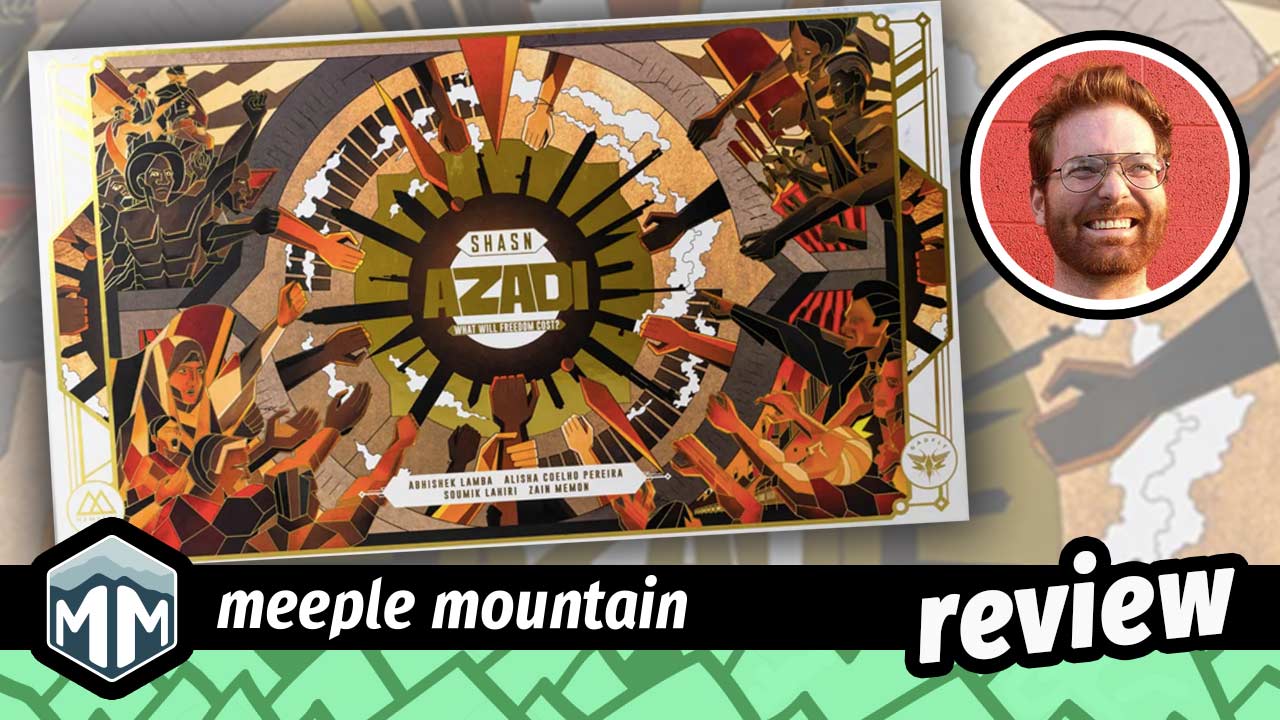
SHASN: AZADI is a box full of gimmicks. Those gimmicks are equal parts corny and high-minded, clever and ham-fisted. The area majority mechanism that is used to tally points is, frankly, pedestrian and simplistic. But, in spite of it all, the game is ambitious, and I admire games that are high-minded, even when that highmindedness has flaws.
Hegemony this ain’t
And that’s a good thing. AZADI is trying for something explicitly political—it is about the construction of political blocs more than it is about forcing players to accept the roles and bounds of its simulation. From where I sit, Hegemony: Lead Your Class to Victory’s conception of political economy and class is at best misguided and ignorant. AZADI doesn’t presume to gamify and fragment class struggle, casting players as some fake-o thinktank concept of the “middle class” and the “state.” Instead, players are a political ideologue constructing their own ideology out of what will best get them into the big chair. More on this in a moment.
The way you win AZADI is by forming majorities. In the version that I’m reviewing, you have a modular dual-layered map with holes in it for player pieces. Each map tile has a crosshair hole (volatile area) and a number reading something like 11/21. Players get points for having majorities, which…
As I have done with my Top 10 Wargames of each year list I am going to do the same with the Top 10 Solitaire Wargames/Games that I played that were published in 2025. I played a total of 17 new published solo games in 2025 so take this list with a grain of salt as I didn’t play all the titles released in 2025 nor even all of the games that I purchased this past year. The games that I played include the following:
Okinawa: The Last Battle of WWII from Solo Game of the Month
Iwo Jima 1945 from Worthington Publishing
The Pursuit of John Wilkes Booth from Blue Panther
Operation Dragoon Travel Game from Worthington Publishing
Crusaders: The Siege of Acre 1291 from Art of Wargames and Blue Panther
SPQR: The Battle of Alesia 52 BC from Art of Wargames and Blue Panther
Siege Works: A Napoleonic Siege Roll & Write from Solo Wargame
War In The Pacific: A WW2 Roll & Write from Solo Wargame
Fields of Fire Deluxe 2nd Edition from GMT Games
Europe at War 1940 Solitaire from Worthington Publishing
Shogun Solitaire from Worthington Publishing
Black Skin Black Shirt: Ethiopia vs Fascist Italy 1935-1937 from White Dog Games
Empire of Grass from White Dog Games
Onoda from Salt & Pepper Games
Iwo Jima: Hell on Earth from Neva Game Press
La Der de Ders – The War to End War from Hexasim
Thermopylae: Last Stand from Solo Wargame
I have really grown to love my solo wargaming and it is partly because there are plenty of well designed and engaging games out there that continue to feed my curiosity and hunger for a tough challenge. Here I present to you my list of the Top 10 Solitaire Wargames of 2025!
10. Crusaders: The Siege of Acre 1291 from Art of Wargames and Blue Panther
A new solitaire game is always welcome on my table…and if that game is about the Crusades, even better! Earlier this year, Blue Panther released a new game designed by Joe Fernandez called Crusaders: The Siege of Acre 1291. The game is what I would call a lite dice-chucker with some very interesting aspects of a siege baked into the game. There are tracks on the board that track the condition of the outer wall, inner wall and accursed tower and the Crusader Knights, including Templars, Hospitallers and Teutonic Knights, inside the city of Acre have to defend against the Mamluk siege for 13 turns.
The game has a random event that kicks off each turn that will do damage to the city walls, kill knights and advance the Mamluk miners who are attempting to tunnel under the walls. There is just one event that if rolled can do a loss to the attackers but this occurs only on a roll of 3 on a 10-sided die.
The rules are very simple clocking in at 5 pages and are easy to understand and once read the game can be played only from the excellent player aid. I very much enjoyed the Deus Vult actions that are special actions that can be used to do things like repair a wall, reverse a Mamluk mining action or sally out of the city to offensively attack the besieging units. But, these actions can be nullified if certain conditions occur so you should use them while you have them and not wait too long or they might disappear.
I feel like this game really scratches that quick playing, easy to get into but intense and difficult game itch. The Crusaders have an uphill battle for sure as they really don’t have as many options or choices as I would like to see but what is there makes sense, is full of historical flavor and plays well. I have not been that successful with the game, meaning that I haven’t won very often, but despite that I still want to come back play after play and that should tell you something about the game and what it is. If your dice luck is really bad, this one can snowball quickly ending in a catastrophic defeat. I think that the other real attractive part of the game is that it is quick to set up, has good rules and plays quickly. This one will not blow your socks off but it is good for what it is and it comes in a small box that is very portable. In fact, I played it first while attending a work conference.
Staying in the small, travel sized wargame department is Shogun Solitaire from Worthington Publishing. I say wargame, but it is probably more of a strategy card game with a war theme being set in the period of the Sengoku Jidai. Shogun Solitaire is a card based dedicated solitaire game where the player is leading a coalition of four clans to unite feudal Japan. These clans are one of 4 different colors in the game including green (Hōjō), purple (Takeda), red (Katō) and blue (Amago). Each of the clans must secure 3 objectives within their territory to achieve unification under a single Shogun including the port, village and castle of that region. To accomplish this, you’ll need to deploy armies in the form of cards in strategic combinations to gain control of those objectives. These cards are built up in the players tableau and you must get a run of 3 same colored cards (not the same type of soldiers although you cannot play 2 of the same soldiers consecutively) played in order to win the next objective. But, there are Enemy cards colored black or gray that represent assassins, Ronin and raids. There are also neutral Envoy cards that are bronze colored that act as dead space in your tableau and represent the court responsibilities and diplomacy of the Shogun with allied clans and if you ever build up too many of them in the area you will have to take a breath and wipe the slate clean by sending them home.
The really great part of this game is that each of the different types of cards have different special abilities and you must deploy them properly in order to gain the greatest advantage before the 102 card deck runs out. There are six types of Shogun cards that represent the available forces that can be deployed to seize objectives. Samurai can protect and will cancel enemy cards before they can do damage. The Ninjas allow the player to search the top 4 cards of the deck and then reorder them in order to finish a run of the same color cards before bad things can happen. And one of the most important cards is that of the Leaders which act as a wild card that can be played like any Shogun card of its color. I found that trying to utilize these cards to their highest effect was very fun and tense and I found myself really trying to utilize each ability at the right time.
This game is fast playing, playing in 20-30 minutes, and is very fun. But it can be very luck dependent as when you draw bad cards a few hands in a row, there is not much that you can do and the game begins to pound you down and it can come to an end very quickly. But, this game is very good and well designed for what it is; a lite, card based, quick playing travel sized game that is also very beautifully produced with gorgeous period art, thick cards and a fantastic board that flips over to show a
A look at a very lucky win! Notice the back of the board turned over the reveal the beautiful art!
A few years ago, Worthington Publishing published their first game in the Island Fight Series called Tarawa 1943. That game was awesome and was truly difficult to win, as it should be. Now, they have published the 2nd volume in the series called Iwo Jima 1945 that covers the only island assault during the Pacific war that the attacking US forces would suffer worse casualties than the Japanese defenders. On February 19, 1945 the USMC would land 30,000 marines on the island against a Japanese defensive force that numbered roughly 21,000 Japanese soldiers. Facing a Japanese commander who had learned valuable lessons from the losses on other Japanese islands, the USMC would eventually land over 70,000 marines and suffer over 25,000 casualties during the 36 day campaign.
In this solitaire game, the player takes on the role of the USMC commander leading the invasion of Iwo Jima. The game system, driven by cards, will simulate the strategies of the Japanese defenders, often referred to as the Japanese AI, adding a layer of historical authenticity to your gaming experience. If you have played Tarawa 1943, you will be familiar with the system.
Iwo Jima’s play deck is larger than that of Tarawa’s, which provides a bit of breathing room in the game but doesn’t necessarily change the difficulty appreciably. There are also added mountain positions on the island where the attacking USMC will roll 1 less attack dice making it very challenging to overtake several of the key positions and that will need the player to use special cards to assist. The USMC player is allowed to play any number of the cards from their hand during their turn as opposed to just 3 from the previous entry in the series. The other rules are almost all the same, and you can begin playing with just a brief read of them.
I have played this one about 10 times and have not even come close to winning. It is tough and the way the dice system for combat works it is truly difficult for the Marines to score hits quickly enough to make significant progress, which is how it should be. But, the game is fun, tactically challenging as you have to manage your Cohesion as well as decide when to deploy and replace front line troops with fresh troops and plays pretty quickly. I have never had a bad play of this system and very much look forward to other entries in the series.
I am always on the lookout for an interesting and different type of historical game. And when that game is solitaire and allows the player to experience and gain insight into the life of a tragic figure then I am very interested. A few years ago, I came across this very interesting looking solitaire game designed by Francisco Gradaille called Onoda from Salt & Pepper Games. Onoda follows the tragic life of Hiroo Onoda who was a Japanese soldier who wouldn’t believe that Japan had lost World War II and stayed at his post on the island of Lubang in the Philippines from 1945-1974 when he finally surrendered after a visit from his commanding officer. I have played this one several times and can say the game is very interesting, educational and also gives the player an opportunity to learn and gain insight into the life of this person who is remembered as an insane criminal and a story of tragedy.
During 6 rounds of variable duration, the player has to obtain a number of resources represented by rice that will allow them to finish the round without suffering penalties, such as reduced health and morale. In each round, the player will have to undertake a series of missions, earning honor points for accomplishing them. During the game, the player will get to experience some of the events that the real-life Onoda had during his stay in Lubang as well as some of the tragedies. The missions includes things like sabotaging key infrastructure, gathering equipment and other useful items all the while trying to evade detection and capture. But the game goes deeper than that as the crux of the game is the management of morale and the level of insanity in the mind of the soldier due to paranoia, death of comrades or illness.
During these missions, the player will have to draw tokens from a draw bag that represent the level of alarm that is present on the island due to his shenanigans. Each time that a player has to perform a check to accomplish a mission or to avoid danger from the random events, the player must take a Resource/Resolution token from the bag and check its number side against the relevant level of alarm or paranoia in the are where the operation is being undertaken. These Checks are successfully passed when the token’s number is higher than the Alarm or Paranoia level so keeping these low and also moving around the island stealthily will spread out the alarm level and keep Onoda safer and more able to accomplish these missions. Failure will lead to negative effects and lost opportunities as the game has only 6 turns.
I very much enjoyed this game and also loved it because it made me think about this tragic “hero” and his motivations and life those 30 years on the island. What commitment he must have had as well as derangement and you have to respect that or at least give it some thought. Just a great little narrative generator with some very gamey mechanics that create an interesting experience.
6. Black Skin Black Shirt: Ethiopia vs Fascist Italy 1935-1937 from White Dog Games
I have really enjoyed my plays of several games designed by R. Ben Madison. He has a knack for including elements of the history into the gameplay while placing the events into the framework of his chosen system, which is usually the States of Siege Series…but not always. His newest offering called Black Skin Black Shirt: Ethiopia vs. Fascist Italy 1935-1937 from White Dog Games uses the States of Siege Series System and delves into pre-WWII conflict in Africa.
First off, this game is very challenging, as is to be expected as the Ethiopians are desperately outmanned and outgunned by the Fascists as they invaded to take over the oil rich area for their own purposes and I have not done well at it at all in my few plays. I normally would have played it a few more times before adding to the list but I just had such a good experience with it and the history that I felt that I needed to add it to the list. It uses the States of Siege Series but in a bit of a different layout as there are not tracks per se but there are paths that lead through various regions of the country of Ethiopia as they converge on the capital of Addis Ababa.
The game is chit pull and the chits that are pulled give instructions about the actions of the AI Italians as they move on each path. The player will also gain a number of action points that can be used to take actions such as attacking to drive back the invaders. I very much like the concept of support of the Fascist invasion as they have the ability to place their support focused bases on the map as they advance and this leads to the player no longer being able to drive them back to beyond that point so the pressure really ratchets up as the game goes along.
As is the case generally with these games, Black Skin Black Shirt is an easy-to-play, straightforward solitaire game that creates a very interesting historical narrative about how the conflict plays out. There are really lots of tough choices and the game is about the management of your resources and assets, such as your Ras warlords who can go out and make devastating ambush attacks but can also be killed in action and removed from the game, The game forces the player to take charge of the defenses, by calling up troops and marshalling resources as well as attempting to call on the League of Nations for aid and support.
Here is a link to my unboxing video:
If you are interested in Black Skin Black Shirt: Ethiopia vs Fascist Italy 1935-1937, you can order a copy for $56.00 from the White Dog Games website at the following link: https://www.whitedoggames.com/ethiopia
5. The Pursuit of John Wilkes Booth from Blue Panther
A few years ago, while attending the WBC, I had the chance to meet Wes Crawford who was demoing his upcoming game Engine Thieves. He was a very nice guy and his game was pretty interesting as well. Since that time, he has another game that has been released designed in partnership with Ryan Heilman in The Pursuit of John Wilkes Booth published by Blue Panther. I had a chance to play the game solitaire (with Wes overseeing the game and giving me guidance and pointers) at WBC in 2024 and have since played the game on my own several times and had a really great time with it. Great little solo game with several other modes where the player uses resources like police and detectives to search for clues in the hunt for Lincoln’s assassin after the events at Ford’s Theater on the evening of April 14, 1865. Definitely not a subject that has been gamed before and it is really refreshing to be able to experience this history in an interesting and engaging game. There really is a lot to like with the way that clues are found and chits are blindly drawn to verify clues from a bag. There is also a great little movement mechanic with police and detectives to try to acquire more clues.
I know that this is not a traditional wargame but the topic is just so very interesting and the variety of modes you can play in is also very cool. I think that this one is a game that will stay in my collection for years to come and I think that you will enjoy the chit pull, use of your special Stanton Cards that give special events or actions and the way that the movement, searching and raiding works when you find Booth.
4. Siege Works: A Napoleonic Siege Roll & Write from Solo Wargame
Until a year or so ago, I had literally never heard of the concept of a Roll & Write game. But, I started seeing these things pop up on Kickstarter from a new company called Solo Wargame and I was immediately intrigued as the topics for the games were so interesting and varied that I thought that there just might be something worth looking into. Since that time, I have played 2 of these Roll & Write games from Solo Wargame and really found that Siege Works: A Napoleonic Siege Roll & Write was my favorite. I say my favorite because who doesn’t like a siege game and a game set during the Napoleonic Wars is always fun!
Roll & Write Games are typically small and portable games, some are even Print ‘n Play games like Siege Works, that involve the player rolling dice and then marking the results on sheets of paper or sometimes erasable boards. These markings can mean several different things including goals being met, pre-requisites being completed or enemies defeated. The genesis or archetype for these Roll & Write Games is Yahtzee, where players roll a handful of dice looking for various combinations of results to mark off on their sheet that then score points in the end. But recently that game genre has started to include a bit more player agency and choice about how they go about reaching goals including dice selection from those that are rolled, choosing results that are needed at the time but may be less than optimal in the long run and in completing certain goals that will open the door for additional future beneficial options for the player. Don’t get me wrong. A Roll & Write Game is very simple and is not a traditional style of wargame with hexes, counters and Combat Results Tables. But the game tells a story of a siege and how it works. So I was initially skeptical about this form of game and just had to give it a try to see what it was about. I have actually played 2 of them and found them to be lite, fun and interesting. And Siege Works is a solitaire Roll & Write Game so I have played it by myself on my gaming table and had a good time with them.
The biggest plus to the game is the simple rules, easy setup and fast onboarding with learning and being able to get the game played. You can play this easily with a simple read of the rules and a bit of review of the Game Sheet before playing. The sequence of play is very good and easy to follow as well and I found that the game is pretty intuitive. My only issue with the rules was that I found that they sometimes needed just a few more words or an additional sentence for clarity. But this is combated somewhat by the fact that the rules contain a lot of good play examples for the different actions in the game.
3. La Der de Ders – The War to End War from Hexasim
La Der des Ders – The War to End War from Hexasim is a 1-2 player slightly abstracted strategic level look at World War I. The game allows the players to relive the First World War at a strategic level, with each player controlling one of the 2 sides either the Entente, consisting of France, England, Russia, Serbia and other minor nations or the Central Powers including Germany, Austria-Hungary, the Ottoman Empire and a few minors. La Der des Ders can also be played solo, with a dedicated solitaire bot called “Athena” who utilizes special Cornflower Cards to make decisions about what technologies to invest in, where to undertake offensives and how to utilize limited resources and reinforcements. Each turn, players gain an amount of Resource Points dependent on what nations are in the war, which they can allocate to different areas to guide their overall strategy. Victory is achieved by launching offensives that drain the morale of enemy nations, forcing them out of the conflict through collapse.
One of the best parts of La Der de Ders, and typically the best part of any strategic level wargame, is the Technology Phase and the player’s ability to spend their limited resources on various types of technologies to improve their performance on the battlefield and in the economic war. But, keep in mind that there is a risk here as resources are limited and you have to pay to develop these technologies and there is no guarantee of success as it is up to a dice roll, albeit a modified one at that. Each of the players has their own Technology Tree board that is used to track their technological progress over the course of the game. There are a total of 6 different Technologies that can be researched including Attack, Defence, Artillery, Aviation, Naval, and Air Raid.
The process of taking Offensives is really pretty simple as players take turns to activate one of their sectors that has not yet been activated this turn. The sector chosen will then be activated and must launch an Offensive against an adjacent enemy sector. There is a cost to the launching of Offensives though as the player will have to pay the appropriate cost by first choosing the size of their Offensive, which in game turns means the number of dice they will pay to roll in the Offensive. The size of the Offensive must be at least 1 and can be up to the current Operational Value of the attacking sector. The player launching the offensive then spends as many Resource Points as the size of the Offensive. Dice rolling is fun and the real key here is how to plan for an prioritize your chosen Offensives as you cannot just do one each turn or you will risk collapse and will be unable to do other things such as invest in technology development.
Victory in the game is well done and I very much like the concept of only calculating the value for those countries who have not Collapsed and who are still in the war when the end game is triggered. We all know that it is easier to negotiate a peace that is favorable to your side when you are still a threat and if too many nations of either side have collapsed then their Prestige Points will reflect this as those countries won’t contribute to the final value. And I also like the simplicity of the scoring system. If certain key countries like France and Germany surrender, then that equates to a victory for the side causing the surrender and if the game continues to grind on through the final turn, then there is this calculation that is really pretty simple and gives importance to each goal with a different value that can be earned. Just a solid method for determining victory that makes sense and fits with the historical aspect of the outcome of the Great War.
The Athena bot is the solitaire mode of the game and it is not just tacked on but is very well done and creates an interesting and challenging game. It is a really well designed system that removes most of the work by the player when playing solitaire. There will be times when you have to make a decision, such as the priority of how Offensives occur from the non-player side, but these decisions are easy and the hard work is done by the simple flipping of a card. I do want to point out one final thing. The sequence of play differs slightly from the 2-player game as it rearranges when the Athena bot does a few of the steps during the Spend Resource Points Phase as shown below. The human player will start by doing their Reinforcements first followed by their Technology investment. Athena will then go and do their Technology investment first followed by Reinforcements. Both players will then move into the Offensive Phase and the player with initiative as shown on the turn track will take the first Offensive of the turn.
I wrote a series of Action Point posts on the game and you can read those at the following links:
Neva Game Press (formerly Neva Wargames) is a new publisher who appeared on the scene 2 years ago. When I started seeing their posts on Twitter and Facebook, I was immediately impressed with their interesting topic choices for their upcoming games as well as the fact that they are trying to make small footprint wargames that pack a punch. And the art is also very appealing and brings an aesthetically pleasing and attractive look to their games! Recently, they released their first game called Iwo Jima: Hell on Earth which is a solitaire look at the amphibious invasion of the island of Iwo Jima in 1945 during the end of WWII.
Iwo Jima: Hell on Earth is the first game in their Neva Skirmish Line and it is a hex and counter wargame with some interesting mechanics for combat and a combination of secondary mechanics to keep the game fresh and replayable. This solitaire game lets you play as the U.S. Marines during Operation Detachment. It offers a challenge for both intermediate and experienced wargamers and is really very, very good. I have only played the game 1 time all the way through but as the year is getting away from me already I had to finish up and decided that this was a very good experience deserving of the position on this list. I hope to play again very soon and put together some video content to share more about the game.
One of the things that I really liked was the focus on the hidden Japanese units that play a significant role in the game. Collecting intelligence for the U.S. as they move up the beaches and onto the mainland ensures more strategic planning and greater success of attacks. Additionally, hidden units, combined with a randomized initial Japanese unit setup, enhance the game’s fog of war and replayability. No play will be the same and I think that is a good way to design a solitaire game. U.S. intelligence has some information about potential Japanese defenses, but it is important to verify on the map that there are actual units at those locations. Additionally, more information about those units should be gathered by revealing them to see their actual composition and plan a better attack. Units can be revealed through successful bombardment, combat or reconnaissance. Making a better attack means that the player has access to different type of weapons and attacking a tank unit with a heavy weapon will give modifiers that will not be gained if the asset is not present.
If you attack a hidden unit or if a hidden unit is supporting the attacked Japanese unit, you will draw Intelligence Chits that provide information about the unit and their combat support value. While attacking hidden units can be risky in certain situations, it is essential to continue advancing to achieve timely victory. Understanding when to attack hidden units or gather intelligence through reconnaissance actions is crucial for success and one of the better parts of the game.
Combat is varied and there is a lot of choice about how to go about attacking the defenders. A unit can engage in combat through Direct Attack, Indirect Attack, or a combination of both. In a Direct Attack (with a maximum of 2 U.S. units adjacent to the target), the combat factor value of these units is utilized. For an Indirect Attack (with a maximum of 3 U.S. units if conditions are met), the units’ combat support type and value are used to participate in the combat. Units involved in a Direct Attack may also be used for Indirect Attacks as needed. The next step of combat involves comparing the combat ratio to determine the appropriate table column for checking the die result. Die Roll Modifiers must then be determined, based on factors such as the type of Japanese defense units, which could include Trenches, Pillboxes, or Caves, the comparison between the combat support from the U.S. player and the Japanese side, and terrain effects. The combat is very crunchy and fairly involved and I will definitely classify this one as a good hex and counter wargame experience.
I need to get this one back to the table soon but this is a keeper and I cannot wait to play again.
1. Okinawa: The Last Battle of WWII from Best with 1
I love a new and interesting way to tell the story of a key battle and I found a very interesting one called Okinawa: The Last Battle of WWII from Best with 1 earlier this year. This is a solitaire only game and for each game the player will draw four objectives from a possible 12 that you must survive and capture before time runs out. On your turn, the player will roll special dice and then spend those to take actions such as movement, attack and take special actions from different unit action cards that will be set up in a square from from 1 to 10. The numbers coincide with the dice of the attacking Japanese and as the player moves through the rondel they will be able to activate and use their different soldiers to attack the Japanese defenders or use their special abilities to gain tokens that can be used for rerolls or healing of wounds
I think that the best part of the game is the concept of resource management as you have to use the dice appropriately to move and fight and also to manage your troops as you can upgrade certain cards as you pass the midway point of the round as well as when special actions are granted via the special resource chits. Upgrading units is very important as this will unlock things like heavy weapons in the form of bazookas, a Sherman tank and planes to be able to take out the Japanese armor units defending the island. The game is about efficiency of movement and doing the most with what you have. The dice determine what you can and can’t do and movement is optional as you don’t have to move unless you feel it is advantageous. But remember, that you have to defeat the defenders and the various objectives to be able to advance to your final objective and sitting in one space too long is not advisable.
The different units have various functions including attack, such as the Rifleman, Machine Gun Team and Sniper but also have secondary functions to remove the fog of war, heal your damaged units or gain additional resources. The Japanese defenders are well hidden and also have various defenses such as pill boxes and caves that will require the player to defeat these before moving to attack the units located inside.
In the end the game is about defeating the Japanese defenders while doing so in a set amount of revolutions around the rondel setup. This can be as few as 2 times around or as many as 4 and knowing when to use your resources to reroll your dice, as you either didn’t get the run of consecutive numbers you were looking for or just need a specific number, you will run out of resources quickly and you must plan them out as best you can to win the game. This one is really fun and I have played it about a dozen times winning about 70% of the time. The game plays in about an hour and the action is fast and furious and you are immediately beset by the staunch Japanese defenders and must act quickly.
Here is a link to our unboxing video:
Here is a link to my playthrough video:
Here also is a link to my video review:
If you are interested in Okinawa: The Last Battle of WWII, you can order a Print and Play copy from the Best with 1 website at the following link: https://bestwith1.com/product/okinawa-pnp/
There you have it. My list of the best solitaire wargames/games that I played in 2025! What a year. There were just so many great games but unfortunately only so much time. There were other games that I was unable to get played that I had acquired and I regret not getting to but there is only so much time.
What were your favorite solitaire wargames from 2025?
The once popular theme of Indiana Jones-like archaeologists plundering the world for ‘treasure’ certainly hasn’t aged well, and you can count me as one of the people who believes that in almost all cases, countries are entitled to display items belonging to their own history and heritage rather than have them stolen by colonialist powers and never returned. But I’ll get off my little soapbox now and say that Archaeology: The New Expedition, despite the slightly long-in-the-tooth theme, is a great little set-collection push-your-luck game that I’ve enjoyed as a light diversion for many years now (the original Archaeology: The Card Game from 2007, that is) and it’s great it got a revamp.
The latest version introduces a little bit more variety to the gameplay, with various monument sites you can set up that shake up the actual plundering part of the thematic framework, represented on small, solid tiles. The artwork is vastly improved and in fact the game is better all round, so it’s a no-brainer if you want a fun little card game to take with you on your travels. Most recently my partner and I played a lot of it on a trip to India, though I was frustrated by the fact she constantly seemed to win, despite the fact it’s a very luck-driven game!
By the way, because this is a very small sheet designed to fit in the box, I’ve put the Setup instructions on the flip side, in order to keep most of the game play information on the front. If you’re wondering …
Poop! Spies! What do they have in common? Both are featured in board games designed by Jon Teixeira Moffat, naturally. On today’s Space-Cast!, we’re joined by Jon to discuss the long development of both Night Soil and Burned, the hidden cost of labor, and cinematic hidden movement games.
Listen here or download here. Timestamps can be found after the jump.
TIMESTAMPS
00:36 — introducing Jon Teixeira Moffat
4:06 — Stone Circle Games
7:00 — Night Soil
21:08 — portraying labor
33:15 — Burned
(If what I’m doing at Space-Biff! is valuable to you in some way, please consider dropping by my Patreon campaign or Ko-fi. Right now, supporters can read my first-quarter update of 2026: the best board games, movies, books, and more!)
Almost a year of uncertainty over the future of board game publisher Greater than Games has been partially resolved, with Flat River Group selling the brand name, and the rights for the Sentinels of the Multiverse titles, to Handelabra Games.
Video game developer Handelabra has a long history with the comics-themed cooperative card game, having spent more than a decade creating digital versions of the title and its expansions – as well as for Greater than Games’ best known release, Spirit Island.
Spirit Island is not part of Handelabra’s deal, however, which the company said only covers the Sentinels of the Multiverse games, the Sentinel Tactics range, the Sentinel Comics RPG, Sentinels miniatures and the cooperative deck-builder Galactic Strike Force.
The distribution and e-commerce specialist was bought six years ago by private equity investor Guardian Capital Partners, which provided capital for a string of tabletop industry acquisitions.
They included an expansion into board game publishing in 2021 with the buyout of Greater than Games, which it followed a year later with deals for Canadian publisher Synapses Games and hobby game distributor Luma Imports.
A statement from Handelabra president and CEO Jaye Handel said the company had made the GtG and Sentinels deal to protect its ability to make digital games in that IP, adding that it was “not interested in becoming a tabletop publisher”.
But the statement added, “But lucky for us, we know a lot of good people who are good at exactly that type of business…”
That is believed to refer to Greater than Games trio Christopher Badell, Paul Bender and Adam Rebottaro, who founded the company in 2011 and were the last remaining employees following Flat River’s downsizing of GtG last year.
Handelabra CEO Handel told BoardGameWire he was unable to share further details, but said that his company was “very excited about the future of Sentinel Comics on digital and analog tabletops and beyond”.
He added, “Handelabra Games’ and Flat River Group’s relationship with regards to Spirit Island has not changed.”
The company’s recent statement from Handel indicated it would be able to provide more information about Greater than Games’ future by April 28, which is National Super Hero Day in the US.
It said, “For your ongoing support and excitement, we remain eternally grateful. We just ask for a little more patience over the coming weeks as we have lots to share, and we can’t wait to embark on the next phase of this journey with you!”
Flat River did not respond to BoardGameWire’s request for comment on the future of Spirit Island or other former Greater than Games-published titles.
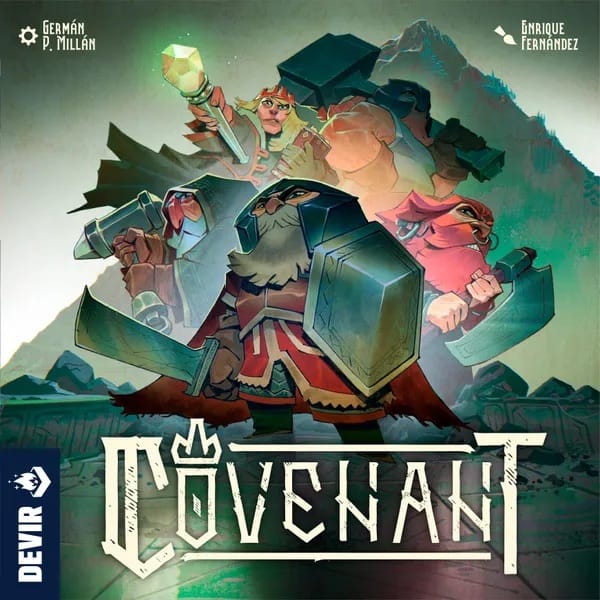
Strohmann Games bringt das Expertenspiel Covenant in der zweiten Jahreshälfte 2026 auf Deutsch heraus. Das Spiel des spanischen Autors Germán Palomar Millán, der unter anderem für „Bitoku" und „Men Nefer" bekannt ist, wurde ursprünglich beim Verlag Devir veröffentlicht. Mit einem Komplexitätswert von 3,71 auf der BGG-Skala richtet es sich an erfahrene Brettspieler, die thematische Tiefe mit anspruchsvollen Mechaniken schätzen. Geeignet ist es für 1 bis 4 Personen ab 14 Jahren bei einer Spielzeit von rund 90 bis 100 Minuten.
Zwerge, Dunkelheit und ein heiliger Berg
In Covenant übernehmen die Spieler die Rolle von Anführern verschiedener Zwergen-Clans. Der König hat alle Clans aufgerufen, den heiligen Berg Karrak-cüm-Kazar zurückzuerobern. Seit Urzeiten die Heimat der Zwerge, wird der Berg schon zu lange vom Dunklen Fürsten und seinen Kreaturen besetzt. Es ist höchste Zeit, dass die Zwerge zurückkehren.
Über drei Runden hinweg weisen die Spieler ihren Zwergen unterschiedliche Aufgaben zu. Sie erkunden die alten Hallen, bekämpfen Feinde und errichten Gebäude, um die legendäre Zwergenstadt wieder zum Leben zu erwecken. Die Spielmechaniken verbinden Worker Placement mit Action Points und Set Collection. Mit Token und Werkzeugen graben sich die Zwerge tiefer in den Berg hinein.
Wer am Ende den meisten Ruhm angesammelt hat, gewinnt nicht nur das Spiel, sondern auch die Anerkennung des Königs. Laut der BGG-Community entfaltet Covenant seine Stärken besonders zu zweit oder zu dritt. Das Spiel hat auf BoardGameGeek eine durchschnittliche Bewertung von 7,74 und liegt im Strategy Game Ranking auf Platz 872.
Erscheinung und offene Fragen
Das Design stammt von Enrique Fernández Peláez, der unter anderem an „B-Sieged" und „Monster Lands" mitgewirkt hat. Der genaue Erscheinungstermin und der deutsche Titel stehen noch nicht fest. Strohmann Games hat bislang nur die zweite Jahreshälfte 2026 als Zeitraum genannt.
Covenant ist bereits in der Originalfassung von Devir erhältlich und kann auf Tabletopia digital ausprobiert werden. Ob die deutsche Ausgabe zusätzliches Material oder Anpassungen enthält, ist derzeit nicht bekannt.
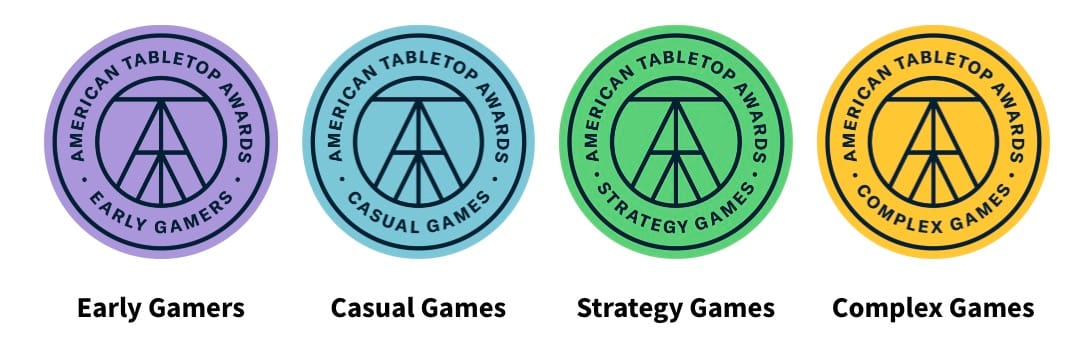
Seit 2019 vergibt eine zehnköpfige Jury in den USA die American Tabletop Awards (ATTA) für herausragende Brettspiele. Die Auszeichnungen decken vier Kategorien ab, von leichten Einstiegsspielen bis hin zu komplexen Strategietiteln. Jetzt stehen die Sieger des Jahrgangs 2026 fest.
Die vier Gewinner im Überblick
In der Kategorie „Early Gamers", die sich an jüngere und neue Spieler richtet, setzt sich Magical Athlete von Richard Garfield und Takashi Ishida (CMYK Games) durch. Das chaotische Rennspiel für 2–6 Personen ab 6 Jahren bietet Partien von rund 30 Minuten. Vor jedem Rennen draften die Spieler Athleten mit unterschiedlichen Fähigkeiten, die das Spielgeschehen gehörig durcheinanderbringen können. Auf BoardGameGeek erreicht der Titel eine durchschnittliche Bewertung von 7,9.
Die Kategorie „Casual Games" geht an Hot Streak von Jon Perry, ebenfalls bei CMYK Games erschienen. Hier wetten 2–8 Spieler auf Maskottchen in einem unberechenbaren Rennen, das in etwa 20 Minuten gespielt ist. Über ein Drafting-System platzieren die Spieler Wetten und beeinflussen gleichzeitig verdeckt den Rennverlauf. Damit sichert sich CMYK Games gleich zwei der vier Auszeichnungen.
Den Preis für das beste „Strategy Game" erhält The Lord of the Rings: Fate of the Fellowship von Matt Leacock (Z-Man Games / Asmodee). In dem kooperativen Spiel für 1–5 Personen steuert jeder Spieler zwei Charaktere, um Frodo auf seinem Weg zu beschützen und den Einen Ring zu vernichten. Mit einer Spielzeit von 60–150 Minuten und einer Komplexitätswertung von 3,1 auf BGG richtet sich der Titel an erfahrene Spieler. Der Pandemic-Erfinder Leacock liefert hier eine thematische Neuinterpretation seiner kooperativen Spielmechaniken.
In der Königskategorie „Complex Games" gewinnt Molly House von Jo Kelly und Cole Wehrle (Wehrlegig Games). Das Spiel versetzt 1–5 Spieler in das London des frühen 18. Jahrhunderts, wo sie als sogenannte Mollies rauschende Feste veranstalten und gleichzeitig den moralistischen Ordnungshütern ausweichen müssen. Mit einer Komplexitätswertung von 3,7 auf BGG und Mechaniken wie Verhandlung, Bluffen und einem Verräterelement zählt Molly House zu den anspruchsvolleren Titeln des Jahrgangs. Die Spielzeit liegt bei 60–120 Minuten.
Nominierungen und Empfehlungen
Neben den Gewinnern vergab die Jury in jeder Kategorie jeweils zwei Nominierungen und zwei Empfehlungen. In der Kategorie „Early Gamers" waren The Sandcastles of Burgundy von Stefan und Susanne Feld (Ravensburger) sowie Splendor Kids von Marc und Catherine André (Space Cowboys / Asmodee) nominiert. Als empfohlen gelten Cascadia Junior von Fertessa Allyse und Randy Flynn (Flatout Games) sowie Duck & Cover von Oussama Khelifati (Captain Games).
In der Kategorie „Strategy Games" nominierten die Jurymitglieder Critter Kitchen von Alex Cutler und Peter C. Hayward (Cardboard Alchemy) sowie Kinfire Council von Kevin Wilson (Incredible Dream). Knitting Circle von Emily Vincent (Flatout Games) und Moon Colony Bloodbath von Donald X. Vaccarino (Rio Grande Games) erhielten eine Empfehlung.
Bei den „Complex Games" gingen die Nominierungen an Tidal Blades 2: Rise of the Unfolders von Tim und Ben Eisner (Druid City Games) sowie Covenant von Germán P. Millán (Devir). Empfohlen wurden Above and Below: Haunted von Ryan Laukat (Red Raven Games) und Galactic Cruise von TK King, Dennis Northcott und Koltin Thompson (Kinson Key Games).
Auffällig in diesem Jahrgang: CMYK Games dominiert die leichteren Kategorien mit zwei Siegen, während Asmodee-Labels sowohl bei den Casual als auch bei den Strategy Games stark vertreten sind. Alle Details zu den ATTA Awards 2026 findest du auf der offiziellen Website.
I played a lot of games in 2023. The best of those games, by a sizable margin, was Hegemony: Lead Your Class to Victory, designed by Vangelis Bagiartakis and Varnavas Timotheou and released by the two men under the Hegemonic Project Games banner. A bold effort in almost every way, Hegemony did an excellent job of simulating a real-world environment and mixing that with a number of different gaming systems. The end result now resides on BoardGameGeek’s top 50 all-time games and has hit my table for nearly a dozen plays; as an event game, it’s tough to beat.
Those accolades put a big target on the back of Hegemonic Project Games’ second design, World Order. Varnavas and Vangelis were kind enough to send a review copy in advance of the game’s full release, and it was pretty easy to get the members of my review crew to line up for plays.
I tempered expectations a bit here. I thought Hegemony was a classic example of “lightning in a bottle”, an asymmetric negotiation game that really did play differently from faction to faction, which landed in a January dead zone after working through a big pile of games from the year before. Could Hegemonic Project Games do it again with World Order? My main hope was that…
With this My Favorite Wargame Cards Series, I hope to take a look at a specific card from the various wargames that I have played and share how it is used in the game. I am not a strategist and frankly I am not that good at games but I do understand how things should work and be used in games. With that being said, here is the next entry in this series.
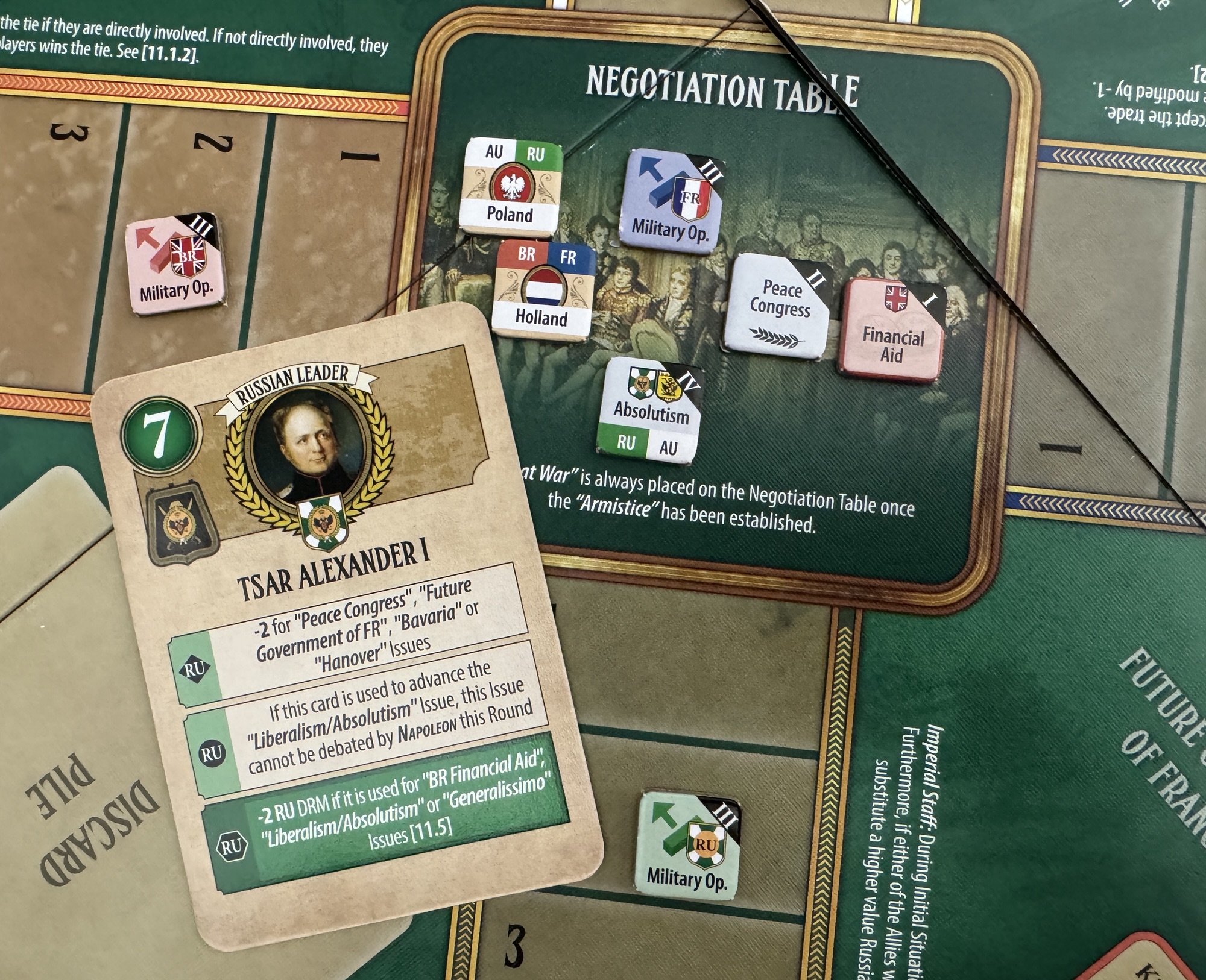
#73: Russian Leader Tsar Alexander I from Congress of Vienna from GMT Games
Congress of Vienna from GMT Games is a diplomatic card driven wargame based on Churchill and is the 4th game in the Great Statesmen Series. The game is set during the years of 1813-1814 and sees players take on the role of the main characters of the struggle between the Napoleonic Empire and the coalition of Russia, Austria, and Great Britain with their Prussian, Spanish, Portuguese, and Swedish allies. Congress of Vienna has two different but related phases including the conference table where players first debate over the control of issues germane to the factions and the period of the war and second these issues are then used on the battlefield to recruit units, attack and take overall command of battles. The players will be playing cards from their hands to “debate” over the various issues that were placed on the table, which include all types of things such as Military Operations, Recruitment, who will lead the combined Coalition forces (Generalissimo), Future of French Government, British Financial Aid, Liberalism vs. Absolutism, Austrian Neutrality and several other issues, and then later the players will use their accumulated Resources gained from the issues to enact action on the Military Map and do things like mobilize troops, place Military Support Markers and the ultimately to conduct warfare.
The game relies on cards and cards can be used to negotiate, i.e. move an issue to your National Track. Cards can provide a particular issue with positive and negative DRM’s depending on which nation plays them and can also be traded with another player during the Diplomacy Phase. Certain cards are better than others for debating an issue moved by another player; and finally, if they are saved for the War Phase, staff cards can be used to modify dice rolling in battles. These are very versatile cards and the players will have to learn them and their benefits in order to be effective at the game.
In this entry, we are going to take a look at the Russian Leader Tsar Alexander I card. The fist thing that you may notice about this Leader Card is that is that it has no benefit for military operations, meaning that Tsar Alexander is watching the war from the sidelines and not directly involved like Napoleon, but does have a potential negative effect if used on certain Issues. But his power lies in the ability to utilize his 7 value to influence issues significantly on the Negotiating table. Particularly, Tsar Alexander I is an ardent believer in the philosophy of Absolutism and wants to retain his crown as the leader of Russia. This concept is played out in the game between the great powers of the time, including Russia and Austria for Absolutism, and the more democratic players including Britain and France for Liberalism. On the board appears this Liberalism/Absolutism Track, which provides the players an opportunity to debate over the Liberalism/Absolutism Issue and gain various advantages and Victory Points from the track. On this Liberalism/Absolutism Track, Europe’s post-war governing philosophy is fought over. This is a double track in green and red with a common At Start area for the use of 2 pawns. Tracks for Liberalism (red: Britain/France) and Absolutism (green: Russia/Austria) each have four boxes and an assigned total Victory Point amount. In order to score the VP from this track though, the player scoring must have their philosophical leaning portion of the track occupying a space at least 1 box ahead of their opponent. Also, if they want to score the maximum Victory Points listed at the top, they have to occupy the top box and their opponent cannot occupy theirs. For the Russia player, this should be a huge part of their strategy as 5VP is nothing to sneeze at in this game. But, in order to do that they will most likely have to try to go first and use Tsar Alexander and his 7 value to try and move that Issue up the track to end under their control. If an Issue every reaches a Track’s Seat, meaning the 7th space, or more after any declared debate is calculated in, then that Issue is considered to be secured and can no longer be moved through negotiation during future rounds. This reminds me a bit of the way that I always plan to use Joseph Stalin in Churchill, to go first and then bring the hammer down on the A-Bomb Research Issue. Getting control of this Absolutism/Liberalism Issue at least 4 times is very important for the Russian player and they will need to utilize this ability as much as possible. But remember that there is a penalty called the “Meddling Tsar” Rule where if Tsar Alexander is used for the negotiation of the British Financial Aid, Liberalism/Absolutism or the Generalissimo Issues, it will inflict a -2 DRM on all battles involving 1 or more Russian units during the upcoming War Phase. This is quite a cost and the player should carefully consider if and when they use the ability throughout the game. If the turn is expected to contain little to no combat for Russian units, then it is safe to use but if France is being aggressive and pushing on Poland and Prussia you might want to consider not going after the Liberalism/Absolutism Issue this turn and instead focus on Recruitment and Military Operation Issues.
The other part of this ability is that if Tsar Alexander I is used to move the Liberalism/Absolutism Issue then Napoleon cannot be used to Debate that movement. I would say that this is not an issue though as typically the France player will be using Napoleon on the battlefield for his DRM abilities.
I also like the historical and personality connection between this card and the game. At the top of the card you will notice that if you use Tsar Alexander I to negotiate the Peace Congress, Future Government of France, Bavaria or Poland Issues, that you will gain a -2 on his value bringing it from a 7 down to a 5. I think that this ability really highlights the philosophy and view of the Tsar regarding the time. He doesn’t believe that France should get to continue to exist as a main player in the power structure of the time and definitely doesn’t want to see France become more democratic. But, he also has a feeling that Bavaria and Poland are Russian vassals and should not be allowed to be turned to any other side’s allegiance. If he has to be used in this manner to defend or negotiate these issues I feel like the -2 Value penalty really shows that leaning in his thinking and probably causes him to be more brunt and less diplomatic thereby losing some of his influence in the court of opinion. Ultimately, Tsar Alexander I thought that monarchy is a noble and viable alternative to the crude and materialistic mob mentality of republicanism and the abilities of his Leader Card definitely cement that view.
After playing now a few times, I am here to say that Congress of Vienna is probably my favorite game in the Great Statesmen Series. I believe that this game has matured the system and made it something that is more than where it started. Congress of Vienna is very much more like a true wargame and was extremely interesting. We are still learning and need to keep playing this one but I did enjoy what it was that we were doing.
Alexander I, nicknamed “the Blessed”, was Emperor of Russia from 1801, the first King of Congress Poland from 1815, and the Grand Duke of Finland from 1809 to his death in 1825. He ruled Russia during the chaotic period of the Napoleonic Wars.
The eldest son of Emperor Paul I and Sophie Dorothea of Württemberg, Alexander succeeded to the throne after his father was murdered. As prince and during the early years of his reign, he often used liberal rhetoric but continued Russia’s absolutist policies in practice. In the first years of his reign, he initiated some minor social reforms and in 1803–04 major liberal educational reforms, such as building more universities. Alexander appointed Mikhail Speransky, the son of a village priest, as one of his closest advisors. The over-centralized Collegium ministries were abolished and replaced by the Committee of Ministers, State Council, and Supreme Court to improve the legal system. Plans were made, but never consummated, to set up a parliament and sign a constitution. In contrast to his westernizing predecessors such as Peter the Great, Alexander was a Russian nationalist and Slavophile who wanted Russia to develop on the basis of Russian rather than European culture.
In foreign policy, he changed Russia’s position towards France four times between 1804 and 1812, shifting among neutrality, opposition, and alliance. In 1805 he joined Britain in the War of the Third Coalition against Napoleon, but after suffering massive defeats at the battles of Austerlitz and Friedland, he switched sides and formed an alliance with Napoleon in the Treaty of Tilsit and joined Napoleon’s Continental System. He fought a small-scale naval war against Britain between 1807 and 1812 and took Finland from Sweden in 1809 after Sweden’s refusal to join the Continental System. Alexander and Napoleon hardly agreed, especially regarding Poland, and the alliance collapsed by 1810. Alexander’s greatest triumph came in 1812 when Napoleon’s invasion of Russia descended into a catastrophe for the French. As part of the winning coalition against Napoleon, he gained territory in Poland. He formed the Holy Alliance to suppress the revolutionary movements in Europe, which he saw as immoral threats to legitimate Christian monarchs.
During the second half of his reign, Alexander became increasingly arbitrary, reactionary, and fearful of plots against him; as a result, he ended many of the reforms he had made earlier on in his reign. He purged schools of foreign teachers, as education became more religiously driven as well as politically conservative. Speransky was replaced as advisor with the strict artillery inspector Aleksey Arakcheyev, who oversaw the creation of military settlements. Alexander died of typhus in December 1825 while on a trip to southern Russia. He left no legitimate children, as his two daughters died in childhood. Neither of his brothers wanted to become emperor. After a period of great confusion (that presaged the failed Decembrist revolt of liberal army officers in the weeks after his death), he was succeeded by his younger brother, Nicholas I.
We have done 2 videos on this game including the following RAW Video after out 1st play at Buckeye Game Fest in May 2025:
We then did the following full Review Video after our 2nd play at WBC last July:
In the next entry in this series, we will take a look at Open Borders from 2024: An American Insurgency from Compass Games.
Board Game Arena hat in der vergangenen Woche zwei neue Titel ins Programm aufgenommen. Mit The Massive-Verse Fighting Card Game kommt ein schnelles Zwei-Personen-Duell mit Superhelden-Thema auf die Plattform. Please Don't Burn My Village! bringt ein Kartenspiel mit Bluff- und Bietmechanismen aus dem Castle-Panic-Universum an den digitalen Tisch.
The Massive-Verse Fighting Card Game – Superhelden-Duell in fünf Minuten
The Massive-Verse Fighting Card Game stammt von Designer Brian McKay und erscheint bei Solis Game Studio. Das Kartenspiel ist ausschließlich für zwei Personen konzipiert und dauert laut BoardGameGeek zwischen 5 und 10 Minuten. Auf Board Game Arena liegt der Durchschnitt bei etwa 5 Minuten.
Im Kern dreht sich alles um das gleichzeitige Ausspielen von Fähigkeitskarten. Beide Spielenden wählen verdeckt eine Karte aus ihrer Hand und decken sie dann gleichzeitig auf. Die Auflösung hängt von der richtigen Einschätzung des Gegenübers ab. Mechanisch verbindet das Spiel Handmanagement, simultane Aktionswahl und Schere-Stein-Papier-Elemente mit variablen Charakterfähigkeiten.
Acht verschiedene Helden aus dem Massive-Verse-Universum stehen zur Wahl. Neben dem Standardmodus mit einem Helden pro Seite bieten der Legacy- und der Conquest-Modus jeweils Teams aus drei Helden. Auf BoardGameGeek erreicht der Titel eine Bewertung von 6,85 aus 10 Punkten bei 124 abgegebenen Stimmen. Das Komplexitätsgewicht liegt bei 1,67 von 5. Das Spiel lässt sich ohne Premium-Abo spielen.
Please Don't Burn My Village! – Drachen bestechen im Castle-Panic-Universum
Please Don't Burn My Village! von Designer Simon Weinberg erscheint bei Fireside Games und ist im Universum von Castle Panic angesiedelt. Das Kartenspiel für 2–5 Personen dauert laut BoardGameGeek 20–30 Minuten. Auf Board Game Arena liegt die durchschnittliche Partiedauer bei 15 Minuten.
Ein Drache bedroht sämtliche Dörfer im Königreich. Durch geschicktes Bieten mit Schatzkarten versuchen die Spielenden, den Drachen gnädig zu stimmen und das eigene Dorf vor der Zerstörung zu bewahren. Drei Aktionen stehen pro Zug zur Wahl: den Drachen bestechen, auf dem Schwarzmarkt einkaufen oder eine Karte nachziehen. Jede Bestechung verändert den Wert der jeweiligen Schätze in der Gunst des Drachen.
Die Mechaniken umfassen Marktspekulation, Push Your Luck und wirtschaftliches Taktieren. Auf BoardGameGeek erreicht der Titel eine Bewertung von 6,58 aus 10 Punkten bei 214 abgegebenen Stimmen. Das Komplexitätsgewicht liegt bei 1,50 von 5. Für die Illustrationen zeichnet Tad Lambert verantwortlich. Das Spiel lässt sich ohne Premium-Abo spielen.
Die postapokalyptische Wiederbesiedlung ist im Brettspielsektor mittlerweile so überlaufen wie die A40 im Berufsverkehr; nach REVIVE und REBIRTH und einigen anderen folgt nun der nächste Versuch einer zivilisatorischen Reanimation. In DAS PHÖNIX-PROJEKT ist eine Nuklearkatastrophe am Untergang der Erde schuld. Wer sich an das Videospiel FALLOUT oder die zugehörige Serien-Adaption erinnert fühlt…
Peter and Will are back with their most famous style of battle report – a War of the Ring one! Beer, laughs and banter ensue.
One day, when the Esoteric Order of Gamers finally comes to its natural end and all about it and concerning it is forgotten, one thing may be remembered – the battle report videos documenting games of War of the Ring between myself and my old gaming buddy, Will. It‘s been quite a while since I’ve had the opportunity to film one, but the day has finally arrived! So grab yourself your beverage of choice, get comfortable someplace where you won’t be interrupted by any non-gamer who just might not understand, relax, and enjoy this hugely fun new session of my favourite board game, War of the Ring!
Making high quality tabletop gaming content at the EOG takes time and money. Please consider becoming a Patreon supporter or making a donation so I can continue this work! Thankyou!
FlipToons was designed by Renato Simões and Jordy Adan, the latter of whom gave us Stonespine Architects and Cartographers, but the real star of the show is Diego Sá, whose animated characters make me want to rate the game significantly higher than I would otherwise. Just look at those little dudes! The camel is two seconds away from winding up a punch. The rabbit wouldn’t feel out of place leaning in for a kiss, only to be rebuffed when the ostrich hides her head in the sand. The sheep is just is out there boppin’ to her tunes.
As a game? Oh, it’s pretty good. Clever at points, nice to play, the usual. My larger reservation is the way it makes me feel during and after a play.
Six cards. In theory.
FlipToons is a game of two halves. Two halves which, when hinged like an aquatic bivalve, form into a united whole that conceals an unexpectedly tasty muscle within. Okay, so I skipped breakfast. Point is, FlipToons is hard to discuss holistically without first establishing how its components function apart from one another.
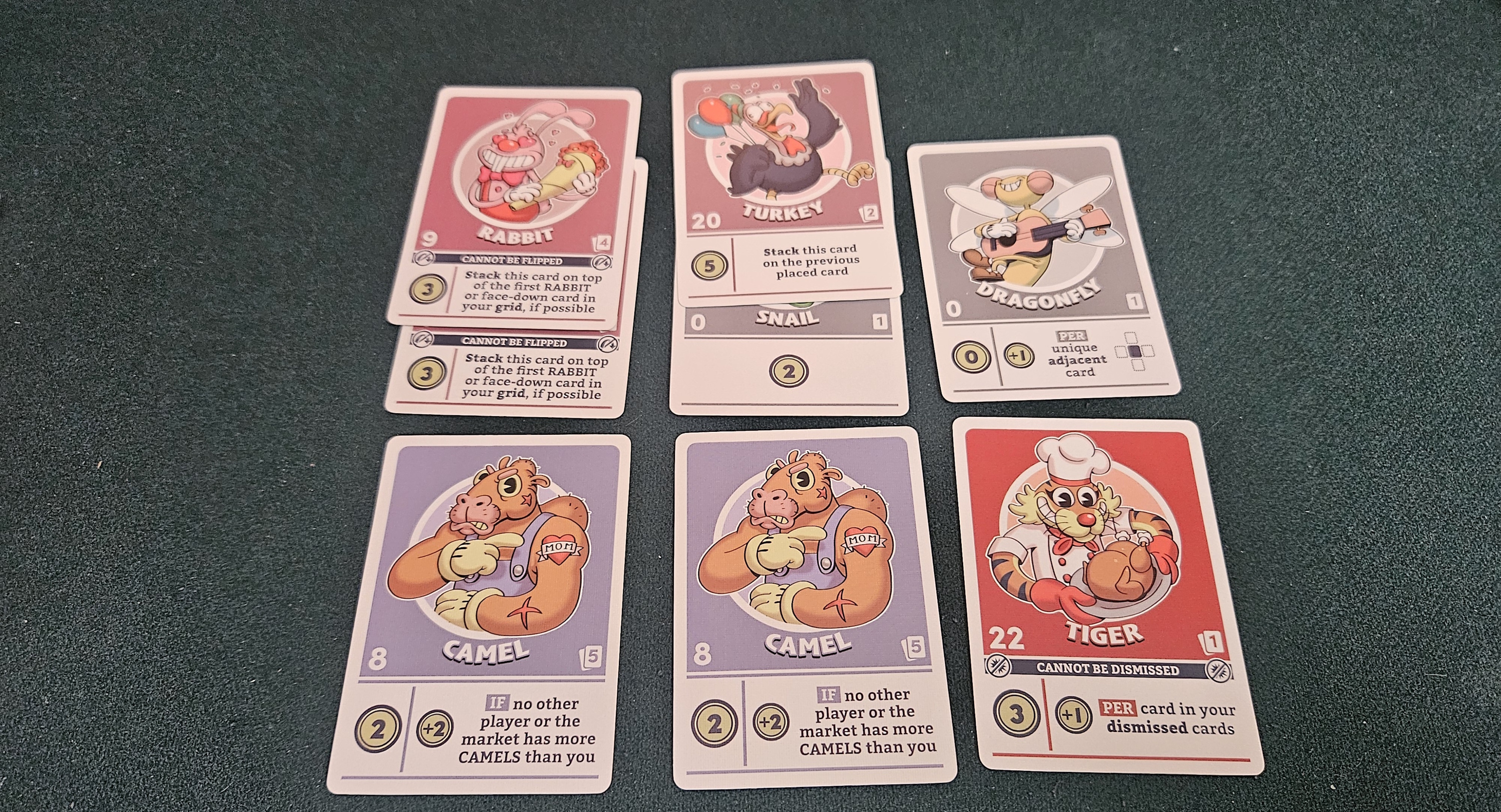
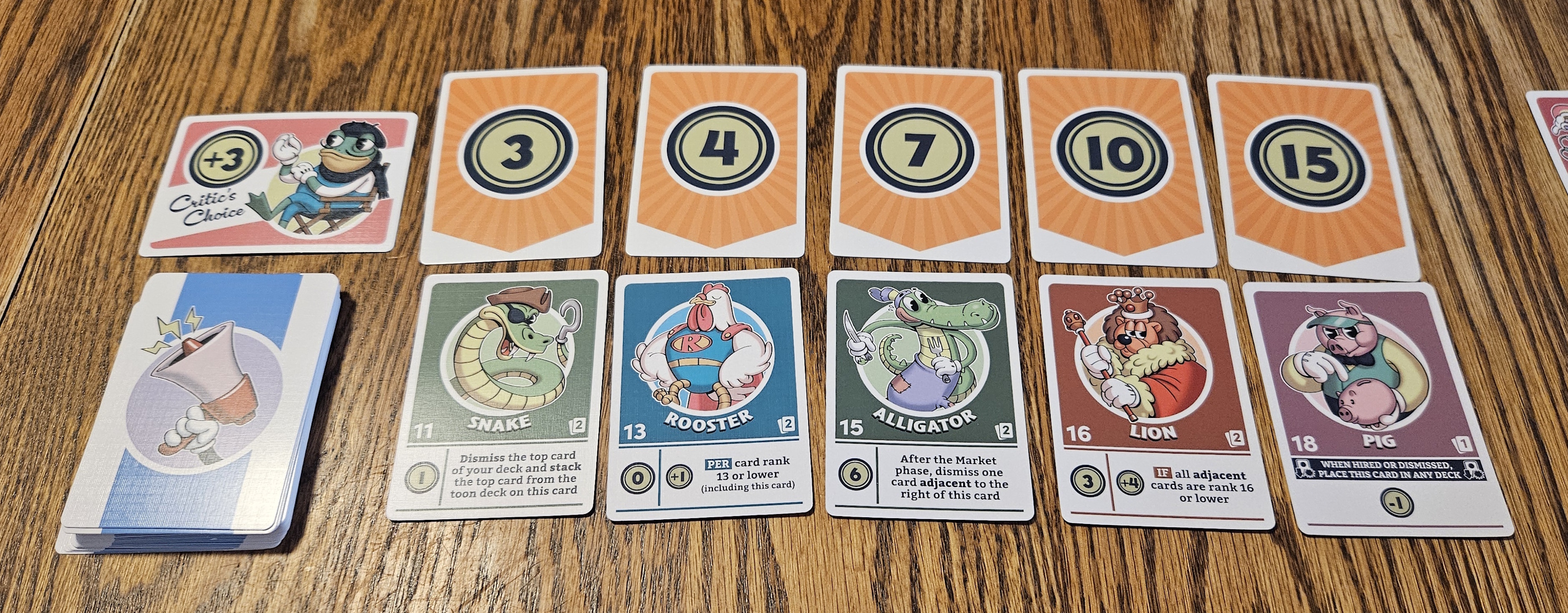
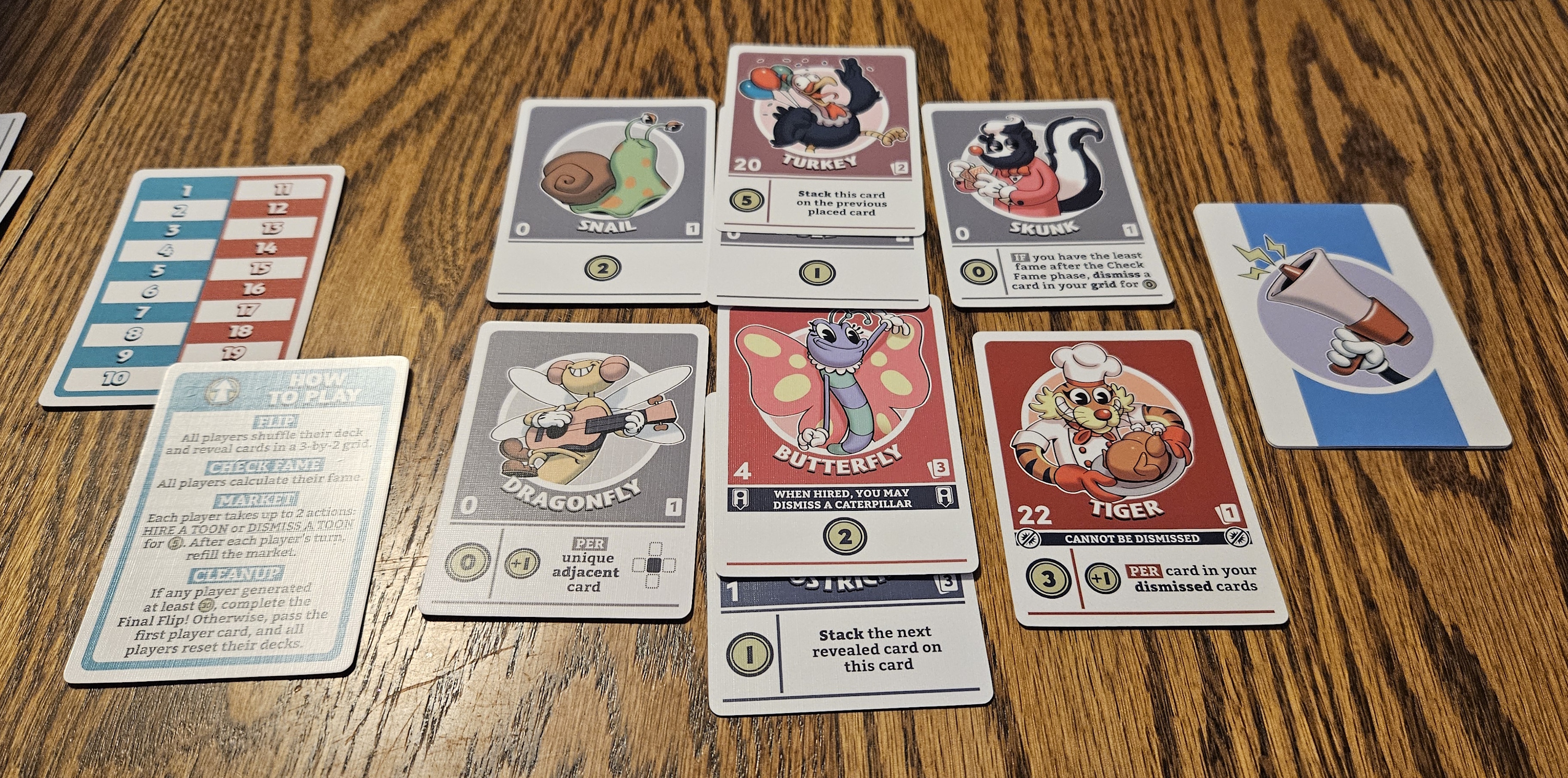
The first part is the deck. When the game begins, you have six cards in total. Two caterpillars, each worth bupkis, but easily dismissed. One skunk, a utility card for winnowing your deck. One bee, worth a single pip of purchasing power. One snail, worth double the bee’s value, making it the single most precious card in your starting lineup. And one dragonfly. Ah, the dragonfly. This guy gives you one point for every unique adjacent card.
What this means requires some explanation. Every round opens with you shuffling your deck and then dealing cards onto the table in front of you to create a three-by-two grid. If you have extra cards, too bad, they remain in your hand. If you have too few cards… well, don’t do that.
Some cards may stack. Rabbits, ostriches, turkeys, these are your chance to get more than six cards into your grid at a time. Others, like sheep or monkeys, trigger benefits if they occupy a particular row or column. Some cards flip, others compare values against other players or the market, and a few, like the pig, are traps that can be gifted to rivals to subtract from their tally.
That tally, then, is taken to the market to shape your deck. Since you’ll only use six-ish cards at a time, keeping your cast trim is a good idea. Fortunately, unlike most deck-builders, the ability to dismiss toons is inbuilt in FlipToons, always available for the low cost of five points.
The toons on display, meanwhile, adjust in cost according to their relative ranking. This ensures that something is always available, and if you’re lucky it’s possible for something unusually precious to slip down in cost. Of course, the opposite often also proves true, with low-value cruft sometimes overwhelming the market.
Regardless, you take your purchases and/or dismissals, shuffle your grid back into your hand, and begin all over again. Bit by bit, your cast improves. That measly starting five to six points becomes twelve, then sixteen, then you break twenty and flip your little tally card to its opposite side. The goal is to score thirty.
Costs are adjusted dynamically, which can result in little surprises.
Okay, not quite. Your actual goal is to score the most on the final round. Hitting a tally of thirty is how you trigger the endgame, and there’s a small plus-three advantage if you’re the one to bring it about, but that’s no guarantee luck will be on your side for the last flip. So, then: hit thirty to lock the game into one final pull of the lever, then hit the jackpot.
The slot-machine analogy is apt here. FlipToons is to deck-building what Balatro was to poker. The titular flip of FlipToons is devoid of decision points. You turn cards in order, left to right and top to bottom, until you’ve produced that three-by-two grid.
There’s more going on in the market portion, but these are minor choices rather than a vast menu. There are five cards available at any given moment, and even when you’re flush with cash in the late-game, you’re limited to two purchases. (And dismissing a card from your deck qualifies, so no double-dipping.) This keeps everyone at the table more or less bungee-corded at the hip, which is probably the right decision for such a light game, but also prevents the table from launching the exponential bottle rockets that were Balatro’s core pleasure.
But about those pleasures…
I have my reservations about these sorts of games. The art and market purchases, while pleasant, aren’t far removed from the lights, illusory choices, and “theming” of a slot machine. I remember as a kid on a trip to Vegas, walking past a slot machine that leaped out of the crowd. I think it was based on Aliens, with those sleek oily monsters I had yet to witness on the screen for myself, but which my friends with the cool parents, the ones who let their kids watch R-rated movies in elementary school, spoke of as the scariest things they’d ever seen. My Dad traced the object of my interest and leaned down to whisper, “That’s how they get you.” It was like somebody had roused me from hypnosis. In that moment, my Dad — who suddenly struck me as cooler than those other dads, or at least cannier — had broken through the social programming of that cigarette-reeking hellhole.
And, look, I don’t think FlipToons is some sort of evil artifact. It isn’t the equivalent of a casino, with its fine-tuned odds to ensure the house always wins and your kid’s college fund becomes another rounding error in a billionaire’s high score. But it produces a similar daze, all submersion and dulled perception. It’s a far cry, too, from some of the sharper auto-battler board games, titles like Tag Team, with its emphasis on attention and preemption, or One-Hit Heroes, which requires constant input from its players. Here, the gameplay comes pre-loaded. All you have to do is pull the lever.
It doesn’t always take much effort to reach those 30 points.
I mean, there’s more to it than that. Just not by as much as I would prefer. Certainly not by enough to make me want to play it more.
Because in the end, FlipToons is a pleasant enough diversion. It’s well-crafted, pretty to look at, and feels good to play. When it hits the table, the fugue it offers is dreamy and warm. But when it’s done, I feel like I binged on steakhouse butter in place of an actual filet. It lacks what brought me to the table in the first place. It doesn’t spark my imagination or help me appreciate my friends. It doesn’t teach me anything. It barely even makes a win feel different from a loss. Most of the time, I hardly remember how I spent the past twenty minutes.
But yeah, the art is lovely. Those lovable goofballs. Those scamps. That’s how they get you.
A complimentary copy of FlipToons was provided by the publisher.
(If what I’m doing at Space-Biff! is valuable to you in some way, please consider dropping by my Patreon campaign or Ko-fi. Right now, supporters can read my first-quarter update of 2026: the best board games, movies, books, and more!)
Cross Bronx Expressway, GMT’s third release in the Irregular Conflicts series, is not for the weak. It is exceptionally complicated, even by the elevated standards of a COIN title. A frequent refrain amongst the GMT faithful, and an accurate refrain at that, is that the rules aren’t all that complicated once you get over the hump of learning them. Not so here. For my first game, I gathered three of the finest gaming minds in New York City, all of whom had read the rules in advance, and it still took an hour or two to get things started. This is no doubt in part a function of the theme, the civic management of The Bronx across the latter half of the 20th century. It’s easier to keep rules in your head when they don’t use words like “coalition,” “partner organization,” and “Census Round Audit.” You may find yourself scratching your head and wondering why you didn’t go back to school to get an MB(oard game)A.
Work your way past the daunting exterior and you’ll find a game that is a fascinating mix of the exceptionally confrontational and the utterly inscrutable. Cross Bronx Expressway is a hard game to talk about as a game, in part because the gamic elements are relatively slight in view of the whole. Designer…
The American Tabletop Awards, an awards scheme launched seven years ago with the aim of being the US equivalent of Germany’s Spiel des Jahres, has unveiled its 2026 winners.
ATTA’s Early Gamers award is focused on titles suitable for younger gamers and players new to modern board gaming, while the Casual Games awards looks at games suitable for all experience levels that can be played in 30 to 60 minutes.
This year’s Strategy Games prize went to Matt Leacock’s pandemic spinoff The Lord of the Rings: Fate of the Fellowship, while the Complex Games title went to Jo Kelly’s and Cole Wehrle’s design Molly House, which explores the joy and fear experienced by gender-defying Londoners in 18th century society.
CMYK was the standout publisher with two wins out of the four categories. Asmodee studios won one award and picked up three other nominations, while Flatout Games picked up recommendations for both Cascadia Junior and Knitting Circle.
Alex Cutler was the only designer to appear twice among the finalists, scoring a nomination for his co-design Critter Kitchen and a recommendation for co-design A Place For All My Books.
The ATTAs are voted on by members of the US board game media, who each submit up to five games from the previous calendar year, which are then ordered according to ranked-choice vote.
Awards co-founder Eric Yurko, who runs board game review site What’s Eric Playing?, said, “The past few years have been great for games, and 2025 was no exception.
“There were great moments and releases throughout, so we’re very excited to present these awards to the best games we played in 2025.”
Early Gamers Winner: Magical Athlete – designed by Richard Garfield and Takashi Ishida (published by CMYK Games) Nominated: The Sandcastles of Burgundy – Stefan Feld and Susanne Feld (Ravensburger) Nominated: Splendor Kids – Marc André and Catherine André (Space Cowboys / Asmodee) Recommended: Cascadia Junior – Fertessa Allyse and Randy Flynn (Flatout Games) Recommended: Duck and Cover – Oussama Khelifati (Captain Games)
Complex Games Winner: Molly House – Jo Kelly and Cole Wehrle (Wehrlegig Games) Nominated: Tidal Blades 2: Rise of the Unfolders – Tim Eisner and Ben Eisner (Druid City Games) Nominated: Covenant – Germán P Millán (Devir) Recommended: Above and Below: Haunted – Ryan Laukat (Red Raven Games) Recommended: Galactic Cruise – TK King, Dennis Northcott and Koltin Thompson (Kinson Key Games)
Watergate is a two player game about the Watergate scandal involving President Nixon. One player is the newspaper editor trying to gather evidence, link them to Nixon and expose the scandal. The other player is the Nixon administration, trying to prevent this and attempting to win by lasting till the end of the presidential term.
The game board is a network of links with
Sea Salt & Paper sure was hot a couple years back, huh? I didn’t think much of this thing the first time I encountered it, perhaps a symptom of having only played it with a single partner; in contrast to some, I find it needs room to stretch out. Perhaps it helps, too, that the expansions, More Salt and More Pepper, both give the game a small kick in its folded shorts.
The basic choice: from where does one draw?
For those who haven’t played Bruno Cathala and Théo Rivière’s small-box card game, Sea Salt & Paper opens with the gentlest of all possible choices: from where to draw? Your options, in this case, are either the deck proper — in which case you’ll draw a pair, keep one, and toss the reminder into either of two discards — or the top offering from one of those castoff piles. Either way, you gain a single card.
Over the course of multiple turns and multiple sessions, however, this choice begins to take on some depth. First, there’s the possibility of playing a duo. Some cards, when paired with a mate, can be deployed to the table. The pair is worth a point either way, but their coming-out provides some small benefit: crabs that let you dig through a discard pile for something previously buried, boats that start your turn anew, a shark and swimmer that swipe something precious from a rival’s hand.
But while duos are potent, there’s more to your picks than pairing cards. There’s the color of the card, entirely separate from its icon, which can amass points as you gain more of a particular hue. Or there are offerings that pose a risk, like octopuses and penguins, worth nothing at first but gradually accumulating points as you build sets — while, of course, signaling to your opponents that you’re angling for something.
Or there’s the risk of throwing away something worthwhile to the others at the table. More than once, I’ve had to take a worthless shell because Adam, who tends to sit to my left, hoards shells by default. If I throw one out, he’ll nab it for certain. And fortune favoring him, he probably already has three in hand.
This is all to say that Sea Salt & Paper is an unassuming little thing. Its choices are diminutive, but no less crucial for their stature.
Cards in hand are hidden, but vulnerable.
Where the game gets interesting, though, is in its scoring. Played over multiple hands, the objective is to accumulate some number of points. Say, thirty points with four players. But rather than ending any given hand at a certain threshold, here players are allowed to keep playing until somebody elects to go out. And then they’re offered another little choice that bends the proceedings. They can declare the hand is over, at which point everybody scores according to what they’re holding and/or the duos they’ve revealed. Or the goer-outer can announce that they have the high score at the table and nobody can match them.
Aha! The contest is on. And the stakes are high. If the player who went out has the highest score, they earn all their points plus a color bonus, points worth the sum of their highest-held suit. That might be a lot or a little, depending on their priorities that round. Everyone else, meanwhile, earns only a color bonus. Again, that might be a tidy sum, but it will almost certainly be less than their normal score. But if the opposite holds true, the pendulum swings the other way. Everybody else scores their hand points, while the shouty player earns nothing but the color bonus.
Like everything else in Sea Salt & Paper, this decision is understated. But it represents a potentially major swing. I say “potentially” because, well, this is a game of subtle wagers and sudden swings, and it’s entirely possible for somebody to quietly amass a solid bar of colors and come out ahead either way.
This gives it a sleepy atmosphere. I might even call it boring, in a largely pleasant way, the sort of game you play with your grandmother while sharing some light chit-chat. In that regard, it reminds me of something like Mexican Train or countless trick-takers played with a regular deck. It doesn’t exactly knock me out of my socks, but it was never meant for sock-rocking. It’s there for quiet evenings on the seaside, the air heavy with the inrush of atmosphere, a storm coming but still out on the horizon. It’s a bedtime game.
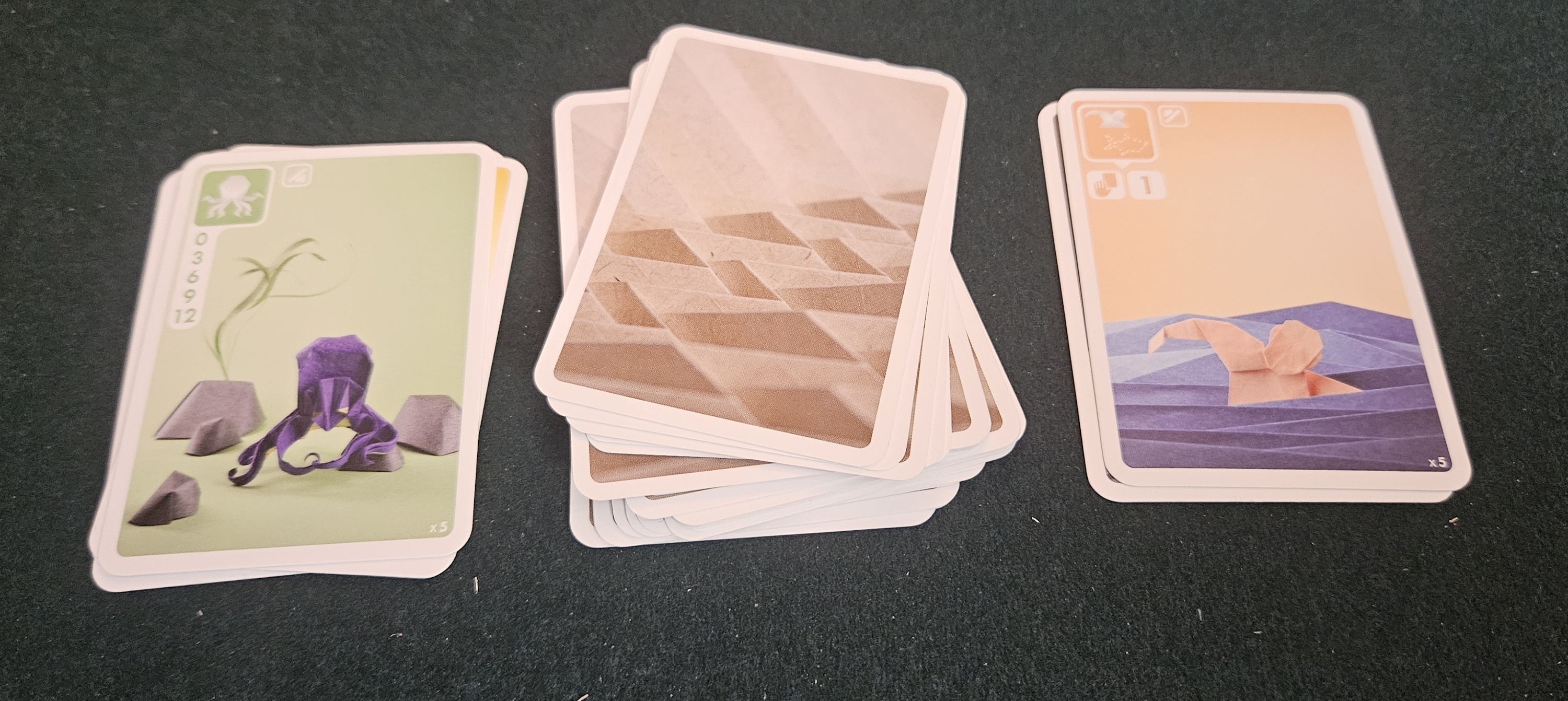
Extra Salt adds a few cards.
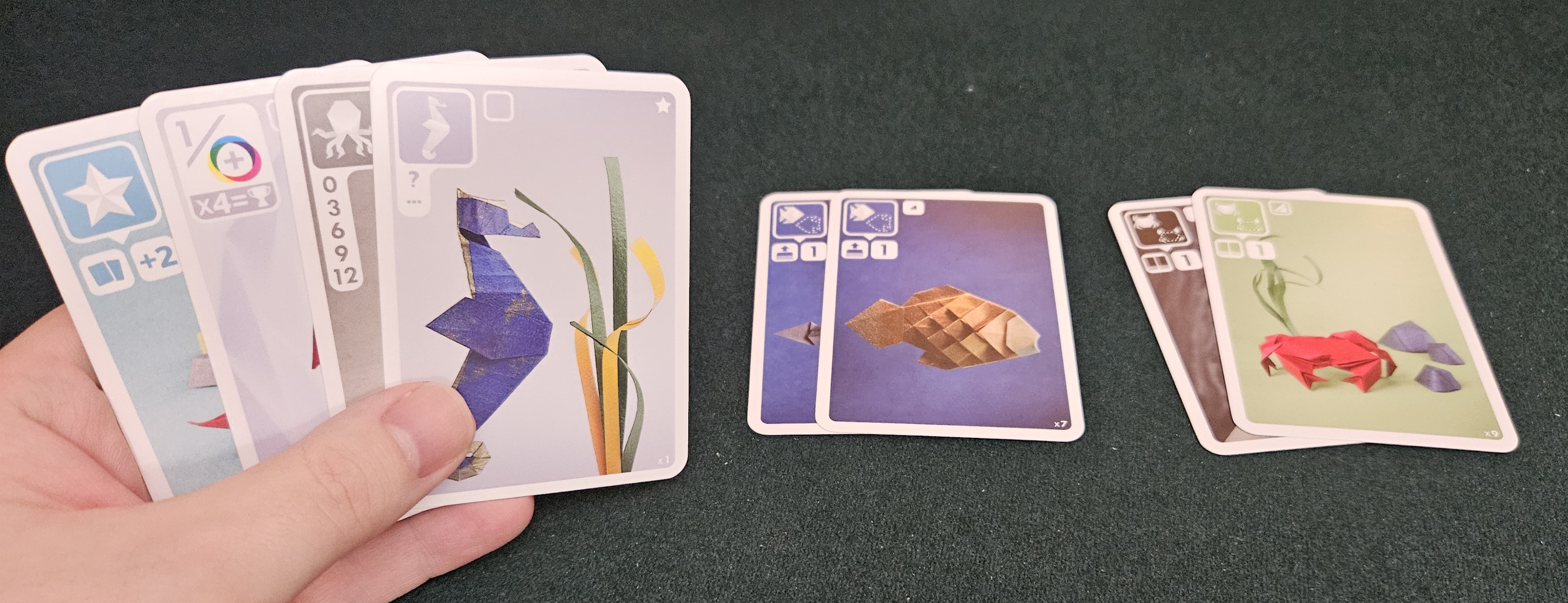
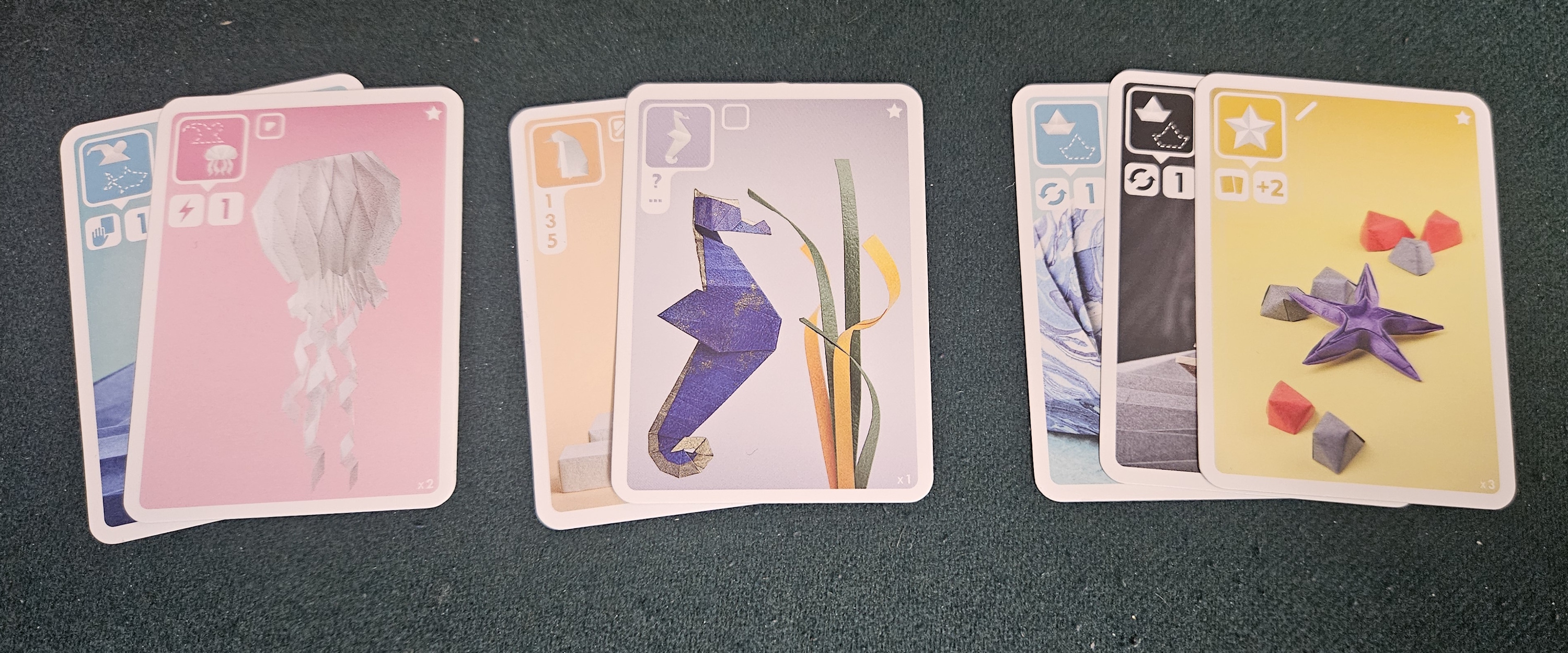
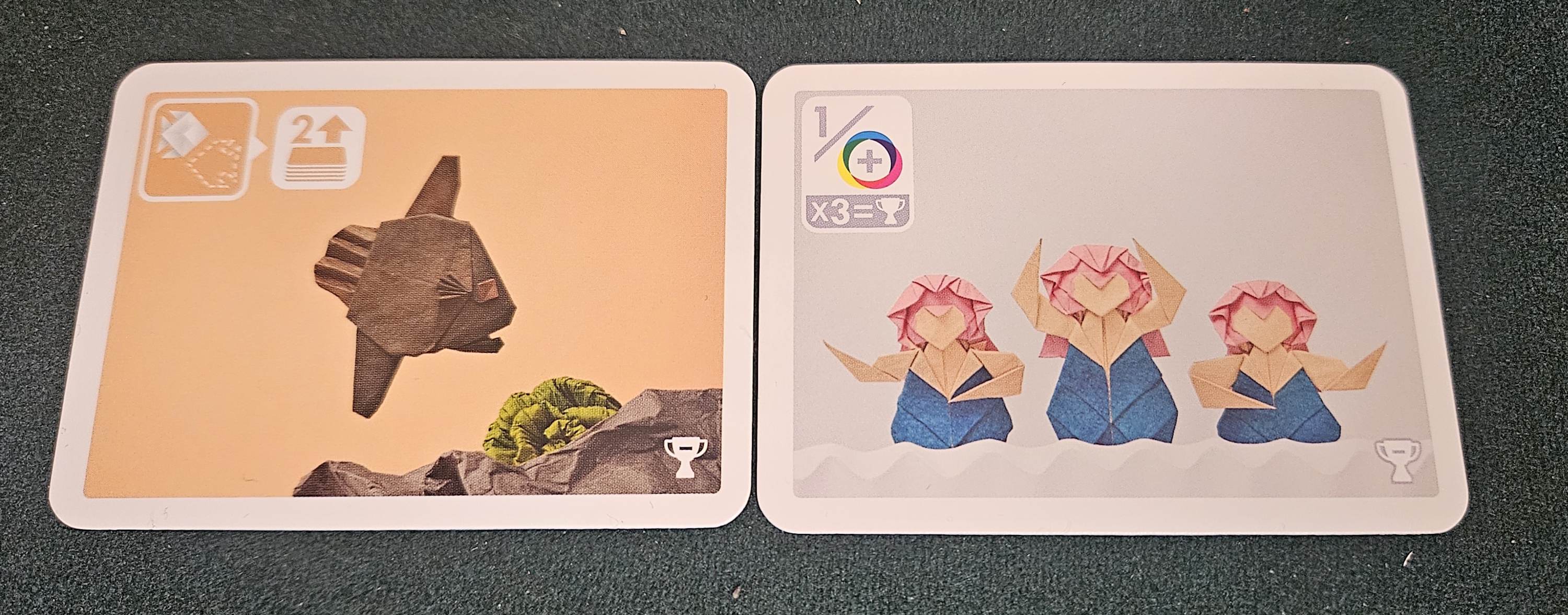
The expansions give it some much-needed kick. The first, Extra Salt, adds only a few cards, not enough to upset the delicate ecosystem of the original game, but sufficient to add at least a few decisions. Extras like a lobster or a jellyfish pair with previously-obvious offerings to produce new effects, while a seahorse makes certain sets more worthwhile and starfish can be added to a duo to drop their ability in exchange for some extra points. The game is still sleepy, but the decision-space is a little denser.
Next is Extra Pepper, the more interesting offering. Every round, an event card is drawn that alters the proceedings. A change to how a certain set is formed, a higher scoring threshold, only needing three mermaids to win outright rather than the usual four… that sort of thing. Everybody plays according to this altered rule, but then — and this is the smart bit — then the winning or losing player receives the event card as a permanent addition to their repertoire. This varies by card, with handicaps going to trailing players and hurdles to winners. Either way, the game receives a nudge that corrects toward the median ever so slightly. Or, better yet, allows somebody to manipulate the rules in their favor by tanking an early session to nab something ultra-potent.
In both cases, the expansions benefit the core game by adding a little more to the turn-by-turn proceedings. If I had to identify an issue with the game — which, again, I’m not sure this is the sort of game that bears a deep critique — it’s that the decision-making process is so muffled. There’s a gap between good and bad play, but good and great play? Eh. I’m not convinced. To their credit, the expansions offer a few more of those small decisions that make it such a pleasant, if still sleepy, game for late nights.
Extra Pepper is more interesting.
On the whole, Sea Salt & Paper is a game that’s nice to play with family, as a filler, or when everybody’s too tired for anything heavier. That’s a crowded field, but, well, this just so happens to be one of the games that’s succeeded in that arena. Call it the king of the sleepers. I doubt Sea Salt & Paper would even take it as an insult.
A complimentary copy of Sea Salt & Paper was provided by the publisher.
(If what I’m doing at Space-Biff! is valuable to you in some way, please consider dropping by my Patreon campaign or Ko-fi. Right now, supporters can read my first-quarter update of 2026: the best board games, movies, books, and more!)
Schon Root hat uns gelehrt, dass wir niedlichen Tierchen nicht trauen sollten. Was ganz harmlos auf Spielkarten abgebildet und ausmodeliert als Holzfiguren auf dem Spielplan steht, das kann auch nur geschickte Tarnung sein. Um uns in ein Spiel zu locken, das dann auf den zweiten Blick und nach dem ersten Spielzug gar nicht mehr so harmlos daherkommt. Das neue Spiel rund um Kartentänze und zu sammelnde Schwerter ist eher im Kennerbereich angesiedelt und hatte für mich eine enorme Einstiegshürde.
Kennt Ihr auch, oder? Ihr macht Euren allerersten Spielzug und wisst genau, dass Ihr schlicht mal so wirklich alles falsch gemacht habt. Zug nachträglich zurücknehmen? Ne, wäre doch blöd. Weil haben wir uns in unserem Blindflug der spielerischen Möglichkeiten schliesslich selbst eingebrockt. Dabei konntet Ihr noch nicht einmal vom Startspieler eine erfolgversprechende Taktik abschauen, dann jeder von Euch hat sein ganz individuelles Set von sechs Startkarten auf der Hand. Die spielen sich alle anders und ganz besonders. Das macht ungezählte Möglichkeiten, mal so richtig in die Grütze zu greifen und aus purer Unwissenheit einen Fehlstart mit Tempoverlust hinzulegen. Denn am Ende geht es doch mal wieder nur um Siegpunkte und alles andere ist nur schön anzusehendes Mittel zum schnöden Zweck.
Aber worum geht es eigentlich und wo sind wir überhaupt? Keine Ahnung, denn in meiner mitgespielten Erstpartie Emberleaf war das Thema leider mal so gar kein Thema. Stattdessen stolperten wir anfangs etwas konfus durchs Regelwerk, was aber auch daran lag, dass noch keiner von uns Spielerfahrung mit an den Dreiertisch gebracht hatte. Also liess ich es ganz entspannt für mich als reine Kennenlernpartie angehen. Einfach mal machen und schon bin ich wieder bei der Spielmechanik angekommen. Die ist recht einfach. Bin ich reihum am Zug, dann spiele ich eine meiner Handkarten in meine persönliche Rasterauslage und führe den Soforteffekt der Karte aus, sofern vorhanden. Alternativ nutze ich den nun abgedeckten Aufdruck meiner Rasterauslage. Was auch immer mir in der aktuellen Situation mehr weiterhilft. Und schon ist der nächste Spieler am Zug.
Emberleaf spielt sich angenehm flott. Ja, wäre da nicht dieser Kartentanz, denn Ihr als alternative Aktion zum Kartenausspielen aufs Parkett legen könnt. Wobei der ganz schnöde „Karten verschieben“ heisst, wie ich später gerafft habe. Der Kartentanz beschreibt nur die Rotation zwischen Eurer Hand und der Auslage. Alles klar, Herr Meister der Abschweifungen? Ihr schiebt also dabei Eure ausliegenden Karten eine Position nach links – in den nächsten Slot des Rasters oder runter vom Raster. Für beide Situationen gibt es Effekte auf den Karten. Auf manchen Karten und ganz verschiedene Effekte, weil da liegt die eigentliche Herausforderung von Emberleaf. Diese Effekte werden ausgeführt und von links nach rechts und immer von oben nach unten arbeitet Ihr so Euer Kartenraster ab. Das können schon mal so sechs Karten dort sein, was dann eben sechs oder mehr Effekte sind im Vergleich zum Ausspielen einer einzigen Karte. Das dauert deshalb etwas länger, und wenn das bis zu vier Mitspieler vor Euch so machen, was im Nebensatz dann auch die maximal mögliche Spielerzahl verrät, dann kann eine Partie schon mal für Euch gefühlt ins Stocken geraten. Zum Glück waren wir nur zu dritt und so hielten sich meine Pausen bei den Mitspielerzügen in enge Grenzen.
Ich hatte allerdings so viel mit mir selbst, sprich meiner Kartenhand und meiner Kartenauslage und potenziellen neue Karten in Form von Helden und Aufträgen sowie der Situation auf dem zentralen Spielbrett zu tun, dass mir keinesfalls langweilig wurde. Stattdessen tüftelte ich meine optimierte Aktionsfolge aus, um doch noch irgendwie meine Pläne umsetzen zu können. Laufen ist toll, aber vorher sollte ich lieber hier bauen, brauche dafür aber noch ein Holz und das will vorab eingesammelt werden. Blöd nur, dass ich die Rasterreihenfolge meiner ausliegenden Karten nicht einfach so durchbrechen kann. Wäre dann auch zu einfach. Wenn die einmal falsch gedacht ausliegen, dann muss ich mit dieser Abarbeitungsreihenfolge in Form des Kartentanzes leben. Wer also schnell seine Karte zurück auf die Hand haben will, sollte die nicht ganz rechts ausspielen. Habe ich auf die harte Tour gelernt. Dann dauert es drei Verschiebe-Aktionen, bis die sich vom Raster zurück auf meine Hand schiebt. Und eventuell war die Sofortaktion beim Ausspielen viel besser als die Aktion beim Verschieben der Karten. Pech gehabt, weil schlecht geplant. Unzureichende Vorplanung bestraft Emberleaf direkt und spürbar. Gut, dass Euer Raster zu Spielbeginn verkürzt, weil mit Startgebäuden belegt ist, die erst noch weggebaut werden wollen.
Im Rückblick und besonders in der Situation betrachtet, empfand ich die Einstiegshürde schon enorm. Ich habe noch keine rechte Ahnung vom Spiel, kenne nur die Spielregeln und soll schon richtungsweisende Entscheidungen treffen. Weil im Idealfall bekomme ich es hin, dass meine Karten-Maschinerie wie geschmiert läuft und eine Kartenaktion in die andere greift. So sähe ein perfektes Spiel aus und davon war ich in meiner Erstpartie arg weit entfernt. Einfach mal machen und so. Tolle Idee, zu vorschnell gedacht und schon steckte ich einige Aktionsrunden fest, weil mir dringend benötigte Rohstoffe fehlten, um eines meiner Gebäude zu bauen, in das ich eine neue Tierart aus meinem Vorrat einziehen lassen kann, was dann wiederum die Aktion auslöst, eine neue Karte aus der offenen Auslage rekrutieren zu können. Hallo Kettenzüge. Ohne Vorausplanung läuft in Emberleaf halt wenig zusammen, aber da wiederhole ich mich. Und genau da liegt auch mein Hauptkritikpunkt an dem optisch so niedlichen Spiel, das im spielerischen Kern eine knallharte Optimieraufgabe ist. Ich prophezeihe, dass Ihr als Erstspieler gegen am Spielbrett erlernte Spielerfahrung keine Chance haben werdet. Ich hätte mir deshalb eine Art von Einsteiger-Kartendeck gewünscht, das etwas mehr unoptimierte Spielweise verzeiht und eventuell noch einen Ratschlag mit auf dem Weg gibt, in welchem Rahmen wir unsere ersten Spielzüge angehen können. Um den kompletten Blindflug zu vermeiden. Frusttoleranz sollte Ihr also mitbringen oder besser noch auf vergleichbarem Erfahrungsniveau Euch in der Welt von Emberleaf bewegen.
So bauen wir mit diversen Rohstoffen, die wir in unserem begrenzten Lager sammeln, diverse Gebäude in diversen Lichtungen des Spielfeldes. Bevölkern diese Gebäude dann mit Holztierchen, die ab sofort und bis Spielende dort wohnen und uns einen Sofortbonus geben, mehr an Sammelsymbolen wie Schwerter oder Holzplanken freispielen oder direkt eine neue Heldenkarte rekrutieren lassen, die dann zwischen Hand und eigenem Kartenraster rotiert. Genau, das ist der Kartentanz. Nebenbei sammeln wir ausliegende Aufträge ein, die uns aber erst am Spielende deren Punkte bringen und die auch erst am Spielende ganz genau erfüllt werden sollen. Ok, in mindestens drei Lichtungen ein Wohnhaus bauen, das kann ich noch recht einfach planen und auch durchziehen. Aber eben genau fünf Heldenkarten ausgespielt zu haben, das erfordert genaues Timing. Tja, und da kommen dann die lieben Mitspieler ins Spiel. Die sind für mich die meiste Zeit leider nur Störfaktoren. Die schnappen mir Helden und Aufträge weg und bekämpfen vor meiner Nase die Wegelagerer-Plättchen per virtuelle Schwerter, um Siegpunkte und Rohstoff-Belohnungen einzusacken. Zudem werden mir Lichtungsplätze mit unpassenden Gebäuden belegt, die ich mal so gar nicht für meine Aufträge dort gebrauchen kann. Diese indirekte Konkurrenz ist überall spürbar. Und bei wem es besonders gut läuft, der ist eben direkt eine noch grössere Konkurrenz, weil dort mehr Aktionen besser ineinander greifen. Bis ich wieder am Zug bin, kann sich eine Menge geändert haben und sogar das Spielende eingeläutet sein.
Auch ja, wir sind übrigens mutige wie einzigartige Emberling, die ihre zerstörte Heimat tief im ältesten Wald der Welt wiederaufbauen wollen. So erforschen wir das Land, wobei es da wenig zu erforschen gibt, weil alles schon offen sichtbar ausliegt. Lasst Euch also nichts erzählen. Wir sammeln ganz viele Ressourcen, die erst zu wenig und dann im Überfluss vorhanden sind, aber von denen stets immer genau ein Rohstoff für den nächsten Zug fehlt. Wir bauen Dörfer auf und rekrutieren neue Helden mit einzigartigen Fähigkeiten. Und diese Fähigkeiten der Helden sind wirklich alle einzigartig und anders und wirken teils unwissend überwältigend. So hatte ich einen Bären ins Spiel gebracht, der aus zwei lumpigen Steinen eine begehrte Honigwabe machen konnte. Klang toll, weil Honig für etliche Startgebäude notwendig ist und später fast egal wird. Ich hatte den viel zu spät rekrutiert und bis zum Spielende kein einziges Mal in seiner Hauptfähigkeit genutzt. Aber da kann das Spiel der Autoren und zeitgleich Illustratoren in Person von James Tomblin und Frank West nichts dafür, wenn ich so dösbatlig aus dem Bauch heraus agiere. Am Ende wurde ich Dritter, obwohl ich im Spielverlauf noch recht gut mithalten konnte. Meine unerfüllbaren Aufträge haben mir das Genick gebrochen. Das Gleichgewicht der Natur habe ich dann wohl nicht wiederherstellen können. Eine Spielerfahrung war es trotzdem wert.
Was taugt nun Emberleaf, das derweil von Skellig Games lokalisiert wurde und seit März 2026 als Retailversion im Handel ist? Retailversion deshalb, weil es noch eine ursprüngliche Kickstarterversion gab. In dem Zuge gab es auch eine Deluxeversion und diverse Erweiterungen wie Ressourcen aus Holz statt Pappe, Kartenraster aus Neopren, diverse Heldenpacks und Eure Spielerfigur in der eigenen Lieblingsfarbe und noch mehr Aufträge, die eigentlich thematisch Gefälligkeiten sind. Ich habe die Retailversion als optisch ausreichend und wirklich schön empfunden. Emberleaf hat eine gewisse Tischpräsenz, die einen mitspielen lassen möchte. Soweit mein positiver Eindruck. Mit der Einstiegshürde und der Falle, seine Kartenhand in unpassener Reihenfolge und an nicht idealer Rasterposition zu spielen, müsst Ihr umgehen können. Oder Ihr nehmt Euch die nötige Bedenkzeit vor Eurem allerersten und entscheidenden Spielzug, was die Gefahr mit sich bringt, dieses Eurogame zu zergrübeln vor lauter Vorplanung, obwohl Ihr den Spielrythmus noch gar nicht einschätzen könnt. Ich persönlich hätte mir mehr direkte Interaktion gewünscht – ob durch die Heldenkarten oder auf dem Spielbrett. Ich habe nur zwei Karten gesehen, bei denen die Mitspieler mitprofitiert hatten. Hier mal gemeinsam zwei Holz einsammeln und dort nacheinander kämpfen dürfen. Das war mir dann doch zu wenig und fühlte sich zu solitär an. Eventuell haben wir vor lauter Unwissenheit auch einfach nur zu sehr nebeneinander hergespielt.
Nochmal mitspielen? Ja, absolut. Nur dann wäre ich wohl derjenige, wer den unfairen Erfahrungsvorteil hätte. Nur kann ich das bequem durch unoptimierte Bauchspieler-Züge locker wieder ausgleichen. Sollte also kein Problem sein. Muss ich Emberleaf hingegen selbst besitzen? Ich glaube eher nicht, weil genauso wie bei Wundersame Wesen und Luthier muss ich nicht jedes schön anzusehende Eurogame selbst besitzen. Dafür fehlte mir dann doch der dauerhaft angespannte Spannungsbogen, während sich die Belohnungen doch nicht interessant genug anfühlten. Einzig die Rekrutierung neuer Heldenkarten war ein wirklicher Höhepunkt, weil eine Überraschung, wie sich diese neuen Karten so ins eigene Deck einfügen werden. Alle Theorie will hier spielerisch erlebt werden und das fand ich gut. Nur kommt diese Rekrutierung pro Mitspieler nur maximal vier Mal im Spiel vor, sodass aus anfänglichen sechs Helden auf der Hand bis zu zehn werden können.
Ist Emberleaf also doch nicht so komplex, wie es anfangs auf mich wirkte? So langsam komme ich ins Grübeln, ob mich zunächst der Niedlichkeitsfaktor und dann nochmal die vielen einzigartigen Helden geblendet haben. Ihr seht mich arg unentschlossen, deshalb macht Euch lieber Euer ganz eigenes Bild im selbsterlebten Partien. Dann mal los mit Euch, denn so richtig verkehrt macht Ihr dann doch nichts mit Emberleaf. Und der Nächste, der das Spiel einfach nur ungespielt niedlich findet, denn solltet Ihr als schnell finden können. Oder doch lieber erstmal irgendwo mitspielen? Als Geheimtipp empfehle ich Euch da die Spiel DOCH! in Dortmund und den SpieleWahnsinn in Herne, sofern Ihr diese Zeilen zeitig vor Ende April 2026 lesen solltet. Ewähnt dann bitte am Skelling Games Messestand, wer Euch dorthin geschickt habt – brettspieltag.de und so. Würde mich freuen, wenn Euch Emberleaf dort eine gute Zeit einbringt. Weil darum geht es doch.
Als Kind habe ich nie einen LÜK-Kasten besessen. Dabei hätte ich so gerne einen gehabt. Erst mit dem vor einigen Jahren veröffentlichten LÜK – Das Spiel hat ein solcher Kasten Einzug in den Haushalt gefunden – als Bestandteil eines überraschend guten Spiels. Für mich bedeutete das quasi die verspätete Erfüllung eines Kindheitstraums. Das Rätselspiel Behind verfolgt nun ein ähnliches Prinzip und hat folglich einen Nerv bei mir getroffen.
Drei unterschiedliche Schwierigkeitsstufen
Die Schachtel beinhaltet drei doppelseitige Puzzle-Rätsel in drei unterschiedlichen Schwierigkeitsstufen. Alle sind alles andere als trivial. Wenn ich die Informationen auf den Teilen der Vorderseite richtig deute und die Teile entsprechend zusammenlege, ergibt auch die Rückseite ein Bild. Das überprüfe ich jedoch erst am Ende eines Rätsels, indem ich jedes einzelne Teil umdrehe.
Auch die Rückzeiten ergeben ein Motiv.
Nun haben die Puzzleteile von Behind nicht die Form klassischer Puzzleteile. Sie weisen keine Nasen und Ausbuchtungen auf, sodass ich schlicht anhand der Form erkennen könnte, was nebeneinander gehört. Hier sind die Puzzleteile viereckig, wie beim LÜK-Kasten. Das Motiv allein muss reichen, um die Lösung zu finden. Jedoch: Viele Teile eines Rätsels geben gar keinen bildlichen Hinweis darauf, was neben ihnen liegt. Was also tun?
Wie ich bei Behind ein Rätsel angehe
Ich fange an, indem ich die Plättchen so aus auslege, dass alle komplett zu sehen sind. Und dann? Die Anweisung zu Beginn ist kurz. Beim Fall „Der Raub“ heißt es beispielsweise: „Ein Raub wurde begangen. Rekonstruiert die Notizen der Ermittler.“ Schnell erkenne ich, dass manche Plättchen zusammengehören, weil Texte oder Grafiken sich ergänzen. Diese zusammenzulegen ist die Pflicht, dann beginnt die Kür: die herausfordernde Aufgabe. Echte Kopfarbeit. Ich versinke im Rätsel und merke nicht, wie die Zeit vergeht.
Ein Puzzleteil aus dem Rätsel „der Professor“.
Wenn am Ende das vollständige Puzzle vor mir liegt, denke ich: „Klar, so muss es aussehen. Warum hat das [beim Blick auf die Uhr] nur solange gedauert, bis es fertig war?“ Es ist wie ein Labyrinth: Steckt man drin, ist der Weg zum Ausgang nicht offensichtlich. Gucke ich von oben auf den Plan, fällt der richtige Weg vergleichsweise schnell ins Auge. So sind Rätsel eben.
Knobeln mit Behind: Mir macht das Spaß
Bei Behind steht die Lösung auf den Puzzleteilen. Ich muss die Texte und Grafiken nur richtig verstehen, die Logik dahinter kapieren und dann einfach machen. Zudem hilft die Form mancher Teilgebilde, um sie im Gesamtkonstrukt richtig zu platzieren. Mir bereitet diese Art der Knobelei Vergnügen – egal, ob ich mich allein daran versuche oder zu zweit. Mit mehr Personen habe ich es nicht ausprobiert. Möchte ich auch gar nicht, denn dann könnte es wuselig werden.
Wer nicht weiterkommt, kann Hinweise erhalten.
Eine kurze Beichte zum Schluss: Ja, ich habe – beim Rätsel, das eine Paralleluniversen-Geschichte als Comic erzählt – zwischendurch mal gelugt, ob die Rückseiten zweier Plättchen zusammenpassen würden. Aber nicht oft. Zudem ich habe ich nicht die Hilfe der Hinweiskarten in Anspruch genommen. Mit einer Ausnahme vielleicht. Am spannendsten war es stets, als Belohnung das fertige Bild auf der Rückseite zu entdecken. Wie beim LÜK-Kasten.
Behind | Strohmann Games | Cédric Millet | 1 oder mehr Personen | ab 10 Jahren | 45 bis 90 Minuten | Meine Bewertung: ★★★★☆ (stark)
A few years ago, I played and very much enjoyed a cool little solitaire WWII card-driven game called Campaign: Fall Blau from Catastrophe Games and designer Martin Melbardis where the player attempted to breach the Soviet defenses on the East Front in the pivotal German summer campaign of 1942. The game system is very playable and simple, but has some strategic depth to it as the player has to make a lot of choices about what to go after, how to manage their scarce resources (fuel) and what generals to use to take advantage of their special abilities to amass enough VP to claim victory over the Soviet Union. They now have the counter punch of that game in a new entry in the series called Campaign: Operation Bagration and it is currently being offered on Kickstarter.
Grant: Welcome back to the blog Martin. What is your current game Campaign: Operation Bagration?
Martin: Thanks for having me back! Campaign: Operation Bagration is the long-awaited successor to my very first published game, Campaign: Fall Blau and tells the story of the Soviet offensive in 1944 to take back the occupied center of Russia gained by the Germans during Operation Barbarossa and is based on the successful Campaign: Fall Blau game system.
Grant: What was your design goal with the game?
Martin: My design goal for Campaign:Operation Bagration was to switch perspectives to the Soviet side using my tried-and-tested Campaign Game System. I wanted players to take command of the Soviets during one of the most devastating offensives of the war….Operation Bagration, which tore through German Army Group Center in 1944. From a design standpoint, I found it very rewarding to adapt new game mechanics and ideas to fit this pivotal WWII Campaign on the Eastern Front, while keeping the core of the system intact.
Grant:What are the hallmarks of this solitaire Campaign Series?
Martin: I’d say a minimalist approach to wargaming. Very streamlined, using only cards, dice, and cubes, with a 6–7 page rulebook. These are light solitaire wargames designed to be fast and furious with no extra fat or bloat, especially when compared to more traditional hex-and-counter wargames that can take hours to play.
Grant: As a follow up to Campaign: Fall Blau, what do you believe you have improved in the gaming experience?
Martin: While the system as a whole is more or less exactly the same as Fall Blau, I injected some new ideas into the experience to better reflect the historical realities of this campaign. The core game, such as defeating Campaign Cards, the Order system and how Generals work, will remain familiar to players of Fall Blau, but the feel is distinctly different.
Grant: What elements from Operation Bagration did you need to model in the design?
Martin: Operation Bagration was a completely different beast to tackle than Fall Blau. In addition to taking control of the Soviet army this time around, the mountainous regions of the Caucasus region have been replaced with the swamps of Belorussia and Poland. You’re also facing a much weaker and mostly static German Army Group Center, desperately trying to rebuild a frontline and stop the Soviet advance from swarming into their rear echelons. This is represented by the new “Rebuild Frontlines” rule, which replaces the old “Local Counter-Attacks” rule from Fall Blau. In Bagration, counter-attacks are now only triggered by Event Cards representing Panzer Divisions trying to blunt the Soviet offensive. In fact, the entire Event Deck has been changed to reflect the research I did on Operation Bagration with all sorts of cool ideas popping up on how to reflect the history, units and tactics of this Campaign.
Grant: As a solitaire game, what type of experience does the game create?
Martin: The game system prides itself on being fast, easy to learn but hard to master. It creates a very similar experience to Fall Blau such as tough decisions weighing the player down each turn on how to best use your limited Orders and finding the right balance between Attacking, Advancing, or stopping for Logistics to catch up.
Grant: What is the goal of the player?
Martin: The goal is to capture enough Campaign Cards before the game ends and earn enough Victory Points from those Campaign Cards to reach the victory or even the Brilliant Victory threshold.
Grant: How does the player go about choosing and managing their Generals?
Martin: Each game starts with the player choosing three Soviet Generals. All of these generals are historically accurate, with options such as Bagramyan, Konev, Rokossovsky, and a few others. Each General has the generic “Hero of the Soviet Union” special ability plus one unique ability. Additionally, each General leads a certain type of army: either a Tank army or a regular Infantry army. Tank armies have fewer manpower cubes but benefit from added mobility, which helps them bring more Campaign Cards to the frontline when using the Advance Order. Infantry armies, on the other hand, have more “meat” and thus more manpower cubes to absorb losses. Each General also has a set number of cubes representing their starting strength in manpower and available forces. Managing your Generals comes down to picking a balanced mixture and using each general’s individual strengths (number of cubes and abilities) to maximum effect.
Grant: What unique abilities do the different Generals possess?
Martin: As mentioned, each General has the “Hero of the Soviet Union” special ability, which allows you to discard a red cube to re-roll a single die. This represents the Soviet ability to historically take massive casualties and still push on. On top of that, each General also has a unique ability reflecting their historical traits. For example, General Bagramyan is an offensive-minded General, while Rokossovsky was known to always plan two steps ahead and this is represented by his ability to draw extra cards from the Event Deck.
Grant: What type of events does the Event Deck contain?
Martin: In addition to the Campaign Cards, the Event Deck is really where the historical aspects of the Bagration Campaign really come to life. I made sure to only include Soviet and German units and tactics that were instrumental to the Bagration campaign. The Event Deck contains mostly cards that help you during the game, such as attached Soviet units like the 3rd Guards Cavalry Corps, which can help you exploit the flanks of the German frontline by removing adjacent defenses, or the 4th Tank Army, which grants extra attack dice when attacking a Campaign Card. These cards not only add flavor to the game but also a strong sense of historical flavor.
Grant: What are the different type of German effects included in the Event Deck?
Martin: The Event Deck also contains cards that hurt the player, such as German Panzer divisions that trigger a counter-attack when drawn, or German reinforcement cards that add additional German cubes to active Campaign Cards on the frontlines. In addition, things like German bombers or bad weather can and will slow your progress.
Grant: What Actions/Orders are available to the player?
Martin: There are three available Orders each turn, and you may perform one per General. The Advance Order (costs 1 supply) brings unlocked Campaign Cards to the frontline. Once a card is on the frontline, an Attack Order (also costs supplies) can be used to attack and remove any cubes (representing German formations or defenses) on that card in order to capture it and gain the VP listed on the card. Finally, the Logistics Order adds supplies and reinforces a General with a cube to replace losses.
Grant: How do they manage their Supplies? How can they obtain additional fuel?
Martin: As mentioned, each Advance and Attack Order costs supplies, and the Logistics Order replenishes supplies as well as lost manpower cubes from attacking. Finding the right balance and knowing when to rest using a Logistics Order instead of Attacking or Advancing is very important. However, resting too long will slow your progress, as the clock is always counting down. A General who uses the Logistics Order adds two supplies to your shared supply pool and adds a single manpower cube to their card.
Grant: How do they manage to defeat the various Campaign Cards?
Martin: After using the Advance Order to bring an unlocked Campaign Card to the frontline in front of a General’s Card, that Campaign Card then immediately deploys a number of grey cubes (listed on the card) onto itself. The card is now available to be attacked using the Attack Order. When you attack, you pay supplies then calculate the number of cubes on the attacking General’s Card and roll that many dice. You need rolls of 4+ to remove a single white (defense) or grey (German units) cube from the Campaign Card. Some Campaign Cards such as fortress cities (Festerplatz) or swamps reduce the attack dice by -1. Rolls of 1–2 result in your General losing a manpower cube (red cube). Once all German cubes are removed from the Campaign Card, it is considered captured and removed from the frontline, and you gain the Victory Points listed on the card. Capturing Campaign Cards also unlocks additional Campaign Cards.
Grant: How do the German forces fight back?
Martin: This time around, the Germans are much more static than in Fall Blau, which better reflects the historical situation in 1944. While you may still lose manpower cubes through bad rolls on Attack Orders, counter-attacks are now only triggered through Event Cards. A Panzer Division drawn as an event will immediately counter-attack by deploying to the frontline and attacking the General directly in front of it. There’s also the Operation Doppelkopf Event Card, which is placed near the end of the Event Deck during setup and represents a large German offensive action late in Operation Bagration, designed to blunt Soviet momentum.
Grant: What strategy should the player use to do well?
Martin: Pick a good, balanced mixture of Generals and learn when to attack versus when to build up supplies and manpower through the Logistics Order. Using Generals with Tank Army abilities to bring multiple Campaign Cards to the frontlines helps a lot but too many Tank Generals will lower your overall manpower total. Also, optimize your use of Event Cards to either prioritize Attacks or to regain manpower cubes. Overall, calculated risk management is the single most important factor in the game.
Grant: What different options are built in to make the game more of a challenge?
Martin: The game is already pretty challenging, but we are also currently planning on developing a Hard-Mode for the Kickstarter that adds 4–5 additional very difficult Event Cards to the deck for those players who love challenges or are even simply masochists.
Grant: What are you most pleased about with the design?
Martin: I’m pleased with the way I’ve adapted the old Fall Blau Game System to incorporate new game mechanics and Events to reflect the different historical aspects of Bagrations’ unique Campaign. Such things such as the German’s use of blocking detachments to try to stop the Soviet steamroller with whatever they could (represented by the rebuilding the frontline mechanic), and the use of Festerplatze or Fortress cities in Belorussia to hold at all cost. Added to this is the liberal use of Soviet tactics such as mine sweeping tanks, the massive God of War bombardment to signal the start of Bagration, Maskirovka deception techniques and American lend-lease trucks to help the Offensive are all well-represented in the game through the Event Deck.
Grant: What has been the response of playtesters?
Martin: Early on, I got some great and positive responses from playtesters when I initially designed the game. Later, I handed off playtesting and development to Catastrophe Games, who further developed the game and ran additional playtests. I’ve heard good things from them as well.
Grant: What other historical campaigns might the series delve into?
Martin: Next up, I am planning to adapt the series to either the North African or the Pacific Theaters in WWII. I also strangely find that representing the Japanese early-war successes against the Allies in the Philippines, Hong Kong, Indonesia and Singapore a very interesting twist and is a subject rarely touched upon in wargaming. This could also be a good option in the future but who really knows where my creativity can take me?
Grant: What other designs are you currently working on?
Martin: As always, I am continuing to design lighter Print & Play wargames with my own independent company, Solo Wargame. I usually release a new wargame every two months or so on Kickstarter and want to continue that trend with a WWII wargame about commanding a Soviet battalion during the Battle of Stalingrad in 1942. I also plan to release a new version of my continuing series on WW2 Roll & Write games, this time focusing on the Torch landings in North Africa in 1942–43 with new ideas about convoy interdiction, diplomacy with the Vichy government and eventually pushing the Germans all the way to Tunisia. Like most other creatives, I honestly have way too many ideas and too little time!
Thanks so much once again for having me on!
If you are interested in learning more about the Campaign Series and how it works, you can watch my preview video for the Campaign: Fall Blau Kickstarter from 2022 at the following link:

 Anmelden