❌

Normale Ansicht

Woodrow Wilson (Presidential Ratings, #5)

01. November 2026 um 16:27

We’ve been assessing the merits of political leaders in (more or less) democratic countries, illustrated by a single board game each, on this blog for a few years now. Today’s subject is another US president – domestic reformer turned foreign policy prophet Woodrow Wilson. And which game could be more appropriate for him than Versailles 1919 (Geoff Engelstein/Mark Herman, GMT Games)?

If you want to read more ratings of historical leaders like this, I strongly recommend you subscribe to the blog – all new posts in your inbox right when they go live!

The Rating System

Some caveats ahead: The presidents will be rated by the knowledge of their time. If they or their contemporaries could not have known about the effects of something, I will not use my hindsight to mark it as a mistake of theirs. The assessment is focused on their conduct as president, but includes their life after holding the office (in which they will still be regarded in the public eye as (ex-)presidents).

Now, to the system itself: There are three policy field categories (foreign, domestic, and economic policy) and three more general ones (vision, pragmatism, integrity). A president can earn from one to five stars in each category (for a total sum of up to 30). In detail, the president is assessed as follows:

Foreign policy: Did the president increase US influence in the world and the security of Americans at home? Did the president wield US power responsibly and with positive results for the regions affected (the latter counting for a greater deal in times of US power being great)?

Domestic policy: Did the president increase the liberty of Americans to express themselves and to participate in the political process? Did the president promote domestic security and shape the framework for fair justice dealing with offenses?

Economic policy: Did the president facilitate the prosperity and economic security of Americans (including in the mid- and long-term)? Was the president’s economic policy based on mutual benefit of those involved or did it unduly burden one side?

Vision: Did the president have an idea of what the United States and the world (the latter counting for more in times of US influence being great) should look like beyond the immediate future? Did the president’s policies steer the United States (and, if applicable, the world) in this direction?

Pragmatism: Did the president succeed in seeing his policy through from inception to completion? How well did the president manage the support from Congress, society, the administration, the media (the latter counting for more in more recent years)?

Integrity: Did the president understand the office as a means to benefit himself, special interest groups, the entire country, or another community? Did the president respect the boundaries of the office?

Wilson’s Life

Receiving and Providing Education

Thomas Woodrow Wilson was born on December 28, 1856 as the son of a Presbyterian pastor in Staunton, Virginia. Wilson grew up in several states of the American South before, during, and after the Civil War. He would be the only American president who had been a citizen of the Confederacy.

Wilson became a lawyer, but found it not to his liking. Instead, he pursued graduate studies in political science with a dissertation on Congressional government at Johns Hopkins University. His PhD, awarded in 1886, makes him to this day the only US president with such an academic distinction. Even though Wilson had never bothered to take a trip from Baltimore to Washington, D.C., to see the object of his study in action, his dissertation was well received. Atypically for a southerner, he advocated for a strong federal government. At the end of his graduate studies, Wilson married Ellen Louise Axson, who came from a southern clergy family like himself.

Wilson’s academic career led him to teach at several universities. Eventually, he became president of Princeton University in 1902. He took the university out of the grip of Presbyterian traditionalists, appointed the first Catholic and Jewish professors, but worked vigorously against the enrolment of Black students. Wilson turned Princeton into one of America’s leading teaching and research institutions, fueled by the large contributions of outside donors which he attracted. At the same time, Wilson advocated – in often fiery rhetoric – for the independence of the university; a contradiction he could never resolve. Both his administrative reforms and his powerful oratory aroused interest in him political circles; and Wilson put out feelers to the Democratic Party.

To the Presidency

The Democrats, perennially shut out of national office since the Civil War, were in dire need of fresh candidates. Wilson seemed like an ideal fit to party bosses due to his reputation as a natural conservative with progressive credentials. He ran for governor of New Jersey in 1910 and was the first Democrat to be elected to the office in 18 years.

Woodrow Wilson was consistent in his support for labor reforms.

Anyone who believed Wilson to be a conservative at heart was swiftly disabused of the notion once he took office. He directed his energy to labor, electoral, and education reform. Within his first two years in office, Wilson had gained nationwide fame as a progressive leader.

That made him a contender for the 1912 presidential election. His campaign was ably run by the Texas businessman Edward M. House, and Wilson entered the 1912 Democratic National Convention second only to Speaker of the House James “Champ” Clark. When Clark gained the support of New York’s Tammany Hall political machine, that threw the liberal wing of the party, led by three-time presidential nominee William Jennings Bryan, into Wilson’s arms. Wilson gained his party’s nomination and went on to run against a split Republican Party in the general election: Incumbent president William H. Taft represented the party’s conservative wing, former president Theodore Roosevelt mounted a progressive challenge. As the Republican vote split, Wilson’s 42% of the popular vote were enough to give him a landslide victory in the electoral college.

Edward M. House ran Wilson’s election campaign, would conduct European diplomacy on Wilson’s behalf during and after World War I. He took great liberties in his diplomatic assignments and would be summarily sacked.

Reforms and Interventions

Wilson started the presidency where he had left off the governorship – with an ambitious domestic reform program. To clinch the reforms, he broke with the tradition that separated the executive and legislative branches of the American government: Wilson was the first president to appear before Congress since John Adams, a precedent which has since become standard practice. In another momentous move, Wilson focused his efforts to build legislative majorities on mobilizing his own party (which held both the Senate and the House), ignoring the Republican opposition. With these measures, Wilson enacted far-reaching economic reforms:

  • He replaced tariffs with a federal income tax as the chief source of federal revenue.
  • He established the Federal Reserve system to stabilize the heretofore decentralized, fragile American finance world.
  • His Antitrust Act clarified that unions and collective bargaining did not constitute a breach of freedom of contract.

Other Wilsonian reforms were less progressive: Wilson introduced segregation in several federal institutions including the Navy Department and the Post Office.

The worst imaginable day for Woodrow Wilson: Having to speak not one, but two people of color with opinions!

Wilson’s belief in a racial hierarchy also carried over into his foreign policy. During his presidency, the United States intervened in Mexico (twice), Nicaragua, the Dominican Republic, and Haiti (where a new constitution imposed on the country reintroduced the forced labor of corvée). The most momentous of these interventions took place in Mexico, where a US-backed coup had brought the authoritarian Victoriano Huerta to the presidency shortly before Wilson’s own accession to power. Wilson opposed Huerta and first imposed an arms embargo on Mexico, then landed forces in the Mexican port of Veracruz. The intervention did not shift the political situation in Mexico, and US forces left Veracruz after seven months of occupation in November 1914.

Wilson’s rhetoric accompanying the intervention was based on lofty principles, but he applied them rather flexibly: He argued both for imposing and for lifting the arms embargo with the “standards of neutrality”; and he justified both beginning and ending the intervention on moral grounds – the former with his commitment to constitutional government, the latter with Mexico’s right to national self-determination.

Self-determination – easy to define in the Americas (no intervention in other countries’ domestic affairs), but a thorny issue in the often ethnically diverse European countries at the Versailles peace negotiations.

Neutrality, Honor, and Prosperity

While the United States had been busy in Mexico, a much bigger conflict had erupted in Europe – the Great War. Over the next years, Wilson pursued a course which would allow the United States to maintain three competing objectives – neutrality, honor, and prosperity.

Wilson was driven by an honest desire to keep the United States out of the war. That did not mean that he was indifferent to its outcome. His sympathies lay clearly with the Allies. Every few months, his administration launched a peace initiative which would invariably come to nothing as they demanded very different things from the belligerents: The Allies were given the idea that Wilson wanted them to win victories before a peace should be negotiated, the Central Powers presented with unacceptable demands (like the cession of Alsace-Lorraine from Germany to France as a precondition for a peace conference).

Honor was an even trickier business than neutrality. Wilson demanded that the belligerent parties adhered to the London Declaration concerning the Laws of Naval War (which none of them had ratified), but in practice complied with the British violations of the Declaration – the harassment of neutral (including American) trade and the blockade of the German coast – while he denounced the German violations – submarine warfare. When a German submarine sunk the British ocean liner Lusitania shortly before it arrived in Liverpool with its cargo of ammunition for the Western front as well as over a thousand passengers – 128 of them American citizens – Wilson was outraged. He declared in a note to the German government that he would hold Germany responsible for any damages to American citizens and property. Secretary of State William Jennings Bryan resigned after the incident, believing Wilson endangered American neutrality with his hardline insistence on German (but not British) respect for trade rights.

“Global Trade” is a mildly isolationist strategy card in Versailles 1919: You focus on industrial growth (icon to the left), your own national happiness (third icon from the left), and try to not have the world blow up (bonus for regions with low unrest, icon to the right).

That brings us the third leg on which Wilson’s stool rested: While he never mentioned prosperity (much unlike neutrality and honor), it was a major motive for his wartime policies. In August 1914, Wilson had publicly opposed bonds for the Allies to be raised by American banks, but when the banks started issuing them, he did not contest it. Consequently, the American economy was effectively mobilized for the Allied cause: US goods were bought with money from US bonds. Allied victory thus became a national interest for the United States to see the bonds repaid.

In the short term, Wilsons’s hard line was successful. He forced Germany to comply with his notions of naval law while the American economy boomed from the war trade to the Allies. America reaped all the benefits of the war at none of the costs.

That made Wilson a strong contender for re-election in 1916. The Democratic Party touted his foreign policy success with “He Kept Us Out of the War” (a slogan which had been adopted without consulting Wilson). Still, Wilson’s main advantage of 1912 – the split Republican field – had evaporated. To beat his Republican opponent Charles Evans Hughes, he had to make inroads in states where Democrats had not fared well over the last decades. As Wilson feared that the new women voters in many of the western and midwestern states might take objection to his marriage to Edith Bolling Galt – just a year after his first wife Ellen had died – he tried to balance it out with publicly supporting women’s suffrage. While we do not have electoral statistics by gender for 1916, Wilson’s strong showing (for a Democrat) in the West and Midwest indicates that his strategy worked. In the end, Wilson’s victory in California by the hair’s breadth of 3,773 voters decided the presidential contest in his favor.

Women’s suffrage remained in the waiting room for a long time thanks to Wilson.

Into the War

In Wilson’s second term, his three-way balancing act between neutrality, honor, and prosperity became ever more precarious. One of them had to give – and the most likely candidate seemed neutrality, whose meaning Wilson had stretched beyond recognition anyway. Ironically, that happened just as Wilson made his first attempt to put pressure on the Allies (by withholding bonds if they did not agree to a peace conference).

Germany, unaware of any rifts between the US and the Allies, played the elephant in the diplomatic China shop again in January 1917: The German Foreign Secretary Arthur Zimmermann secretly instructed the German embassy in Mexico to sound out the Mexicans for an alliance in case the United States entered the war. Two weeks later, Germany resumed unrestricted submarine warfare in the British home waters again. Wilson felt he could not honorably back down from his hardline position of American trade and travel rights which he had taken in 1915, and broke off all diplomatic relations to Germany. A few days later, British naval intelligence relayed the contents of the “Zimmermann Telegram” to Wilson. Its release helped inflame American public opinion against Germany, but the essential decision had been made already: America would enter the war as an “associated power” on the Allied side. Congress voted in favor of a declaration of war at Wilson’s request on April 6, 1917.

Militarily, the United States was a dwarf in 1917. Safe itself due to large oceans and weak neighbors, its armed forces had been minuscule since the end of the Civil War. Expanding and training them would take time. And economically, the awesome might of America had been mobilized for the Allied cause anyway. Thus, the American war entry mattered little for the course of the war in the short term.

It did, however, have immediate domestic repercussions: On the one hand, government spending exploded. The expenses which the federal government accrued in the 19 months of war from April 1917 to November 1918 would exceed those of almost 130 years since the founding of the country. And Wilson cracked down on perceived opponents of the war: The Espionage Act made interference with military operations or recruitment illegal, which in practice meant that any kind of anti-war activism could – and often did – send the protester to prison.  “Illoyal” publications were banned from postal transport which made them practically unavailable at any distance from their printing.

Preparing for the Post-War World

In the meantime, the war raged on. Wilson’s initial lofty rhetoric of a “war without victory” by which the world would be “made safe for democracy” had been largely superseded by the gritty requirements of military buildup and diplomatic compromises with the Allies. The day-to-day realpolitik of the Allies suffered a heavy blow when the October Revolution took Russia out of the Allied coalition in late 1917; and Wilson was subsequently also replaced as the leading visionary by a certain Vladimir Lenin whose radical rejection of imperialist war (along with capitalism as a whole) proved popular with the European masses after three years of carnage – and they set Russia to seal a deal with Germany and leave the war for good.

The second-worst imaginable day for Woodrow Wilson: Having to speak to a person of color with opinions and being usurped as the leading thinker on peace!

Wilson countered by laying out his vision for the post-war world before Congress on January 8, 1918: The Fourteen Points contained a mix of specific territorial changes and universal principles – the freedom of navigation and trade, disarmament, the rejection of secret diplomacy, and the founding of a “general association of nations”.

Wilson’s views condensed into one strategy card: Bonuses for containing Germany, self-determination to various nations, having Japan and Italy sign the Treaty of Versailles (and presumably joining the League of Nations), and for controlling issues pertaining to the League of Nations.

By summer 1918, American forces had arrived in Europe in substantial numbers. They contributed to turning the tide on the Western Front, and their ever-growing numbers (which matched the British and neared the French) and excellent supply situation convinced the German High Command that the war could not be won anymore. The German generals abandoned the sinking ship. Their civilian successors applied for a peace on the basis of the Fourteen Points.

Wilson, meanwhile, urged the American voters to consider the 1918 midterm elections as a plebiscite on his policies, especially the post-war order he had formulated. The voters soundly rejected him by giving majorities in both houses to the Republicans for the first time in eight years.

Germany and the Allies agreed to an armistice on the Western Front on November 11, 1918. While Germany’s new parliamentarian leaders dealt with the turmoil in their new republic, the Allies met on the outskirts of Paris to negotiate the peace treaty, chief of them the “Big Four” France, Britain, Italy, and the United States. Wilson attended the Versailles negotiations in person, which made him the first US president to leave the country on official business. After he had alienated the Republicans by his adversarial rhetoric before the 1918 midterms, he snubbed them even further by not including a single Republican senator in his delegation.

The Big Four on the cover of Versailles 1919. Image ©Rodger B. MacGowan.

Versailles 1919

All of Wilson’s political goals merged at the Versailles peace negotiations. He wanted a new world order which would provide for long-term peace: “I am playing for a hundred years hence”, he told those who asked him why he would forgo short-term American gains. And the US was indeed different as the country did not angle for territorial enlargement – unlike the other major countries, which sought colonial expansion (especially Britain and France in the Middle East and Africa) or direct annexations of regions bordering their mainland (especially France along the Rhine and Italy in the Alps and on the Dalmatian coast). Wilson held mixed views on the territorial changes in Europe, but supported colonial expansion, especially where it benefitted European imperial powers rather than imperial Japan (another expression of his racial views).

Japan, the only non-white major nation at the Versailles peace conference, pushed hard to include a racial equality clause in the League of Nations. Wilson would have none of it.

Make no mistake: The US had direct material interests at stake as well. On the one hand, Wilson’s interest in free trade aligned with American business wanting to sell goods in the European markets, on the other, American finance expected the war bonds to be repaid. In the view of the European debtors, that required large reparations from Germany, so that the vanquished would pay for the costs of the war.

The Iron Bank… er, J.P. Morgan will have its due.

Wilson’s most cherished goal, however, was the establishment of that “association of nations” outlined in the Fourteen Points. In an ironic repudiation of the other principles of the Fourteen Points, Wilson engaged in the secret diplomacy horse-trading of Versailles, making large concessions to the wishes of the other Big Four nations for territorial enlargement, to get them to agree to what would become the League of Nations.

Here the card does not quite grab the nuances of the issue: The “One State, One Vote” camp at least partially had a special notion of it – Britain pushed hard (and eventually was confirmed) in securing a vote not only for its European part, but also for the four settler dominions Canada, Australia, New Zealand, and South Africa, as well as for its colonial possession India. Wilson, a supporter of the British Empire, was sympathetic to this arrangement.

In June 1919, the negotiations were concluded and the Treaty of Versailles presented to Germany. The Germans engaged in some naïve protests and then signed anyway, as the only alternative of resuming hostilities was utterly impossible for the country. Wilson’s task now was to convince his own countrymen that America must join the League of Nations.

The Struggle for Ratification

Initially, popular support for the League was high in America. However, the Senate which needed to ratify the Treaty for America to join the League was not on board with Wilson:

  • A small part of the senators, the “Irreconcilables”, was adamantly against the Treaty. Some of the Irreconcilables were adherents to America’s traditional isolationist foreign policy, others came from (or were supported by) groups which had been against the United States’s entry into the war (chiefly German-Americans and Irish-Americans), a third subset were Republicans eager to get back at Wilson for the hostility he had shown them at least since 1918.
  • A larger, but not sufficiently large group were Wilson’s loyal supporters, who wanted ratification of the Treaty without any changes.
  • Lastly, the largest group were not opposed to the Treaty as such, but wanted changes which would confirm Congress’s sovereignty on foreign policy decisions, ensure that no territorial mandates could be forced on the United States, and that the Monroe Doctrine would be confirmed and its interpretation left to the United States alone.
The fear that America could be forced into militarily intervening on behalf of the League enraged the skeptics of the Treaty of Versailles, but Wilson was adamant on the issue.

Wilson once more relied on public pressure. He embarked on a speaking tour to advocate for the Treaty. When a bipartisan majority of senators, led by Republican Henry Cabot Lodge, put forward a proposal for a Treaty with amendments in November 1919, Wilson rejected it, and the proposal could not find a two-thirds majority in the senate against Wilson’s allies and the Irreconcilables. By then, Wilson had suffered a stroke and was physically unable to partake in competition for hearts and minds in either the Senate or the public arena. The Treaty of Versailles would never be ratified, and America never joined the League of Nations.

The Final Years

Wilson prepared for another presidential run in 1920 (the Twenty-second Amendment limiting presidents to two terms would only be passed under Harry S. Truman). His party, however, had enough of him and chose Ohio governor James M. Cox as their candidate – a mixture of a turn from Wilson’s policies and the simple truth that his poor health made him barely able to discharge the duties of his office in the present, let alone for another four years. Wilson, undeterred by his defeats in 1918 and 1919, framed the 1920 election once more as a plebiscite on his policies, specifically the League of Nations. The American voters had enough of them and gave the Republican party in the person of Warren G. Harding the presidency and enlarged its majorities in both the House and the Senate. The end of Wilson’s presidency also marked the end of the Progressive Era of sweeping in the United States.

Isolationism, or, as Wilson’s successor Warren G. Harding phrased it, “normalcy”, consisted in a retreat to domestic happiness (right), a booming economy (left), and not getting too involved with other countries (bonus VP for self-determination icons and Japan and Italy not signing the Treaty). Notice that Self-Determination appears both on this strategy card and the 14 Points one, which represent diametrically opposed views within American politics.

Four years later, Woodrow Wilson considered another presidential run. Yet just a few days after he had laid out his program, he died on February 3, 1924.

The Rating

Foreign policy:

Woodrow Wilson really pushed America on the global stage with the entry into World War I. From then on, no matter of great importance in the world has been decided without the United States, very much in line with Wilson’s programmatic thinking. His practical policies, however, were disjointed. His interventionism in Latin America infringed on the locals’ freedoms (up to the point of practically reintroducing slave labor in Haiti), but did not come at a high cost for the United States. The entry into World War I, on the other hand, prioritized export opportunities and especially the travel rights of the affluent few over the lives of the American soldiers who then had to defend those rights and opportunities. Despite all these costs, it is hard to find a positive foreign policy outcome for the United States besides its increased global stature.

Rating: 2 out of 5.
John Maynard Keynes is well-known for his scathing criticism of the economic provisions in the Treaty of Versailles, but he also had a few choice words for Wilson’s negotiating skills at Versailles: “[T]he President had thought out nothing; when it came to practice his ideas were nebulous and incomplete. He had no plan, no scheme, no constructive ideas whatever for clothing with the flesh of life the commandments which he had thundered from the White House. He could have preached a sermon on any of them or have addressed a stately prayer to the Almighty for their fulfillment; but he could not frame their concrete application to the actual state of Europe. […] [H]is mind was slow and unadaptable. […] There can seldom have been a statesman of the first rank more incompetent than the President in the agilities of the council chamber.”

Domestic policy:

By 1920, most Americans were less free than they had been eight years before. Wilson’s expansion of segregation shut down opportunities for African Americans, his wartime policies of censorship and oppression limited the traditional American freedom of expression. Women’s suffrage, the great enfranchisement, was brought about during Wilson’s time, but his support for the cause was minimal.

Rating: 1 out of 5.

Economic policy:

Wilson’s early economic reforms (federal income tax replacing tariffs, the Federal Reserve System, and the Antitrust Act) benefitted consumers, workers, and the economy as a whole. Later, Wilson’s interpretation of neutrality meant that the United States enjoyed a long war boom as a supplier of goods to the Allies. This prosperity came with risks, as it relied on the Allies winning the war and eventually being able to repay their loans, which would become a major matter of contentment after the war and endanger both the American and the global economy.

Rating: 4 out of 5.

Vision:

Wilson redefined the presidency. He strengthened the executive and established the president as lawmaker-in-chief, a change which has held up until today.

He looked far beyond the day-to-day issues of politics. While his idea of a liberal internationalist global order was discredited when he left office, and remained so for the next twenty years, it was rehabilitated by Franklin D. Roosevelt and Harry S. Truman. As these later presidents had more political common sense than Wilson, they were able to form them into a bipartisan consensus which only eroded in recent years.

Rating: 4 out of 5.

Pragmatism:

Wilson parlayed his electoral triumph in 1912 into a sweeping reform agenda, which he got through Congress by mobilizing his own party and cowing the opposition with the force of his public oratory. He later found out that there were limits to speaking from the bully pulpit. His electoral success ran out in 1918, and his stubborn intransigence made it impossible for him to reach compromise in Congress. Wilson would rather be right and achieve none of his goals than concede a little and receive a lot – a distinctly unpolitical trait for a politician.

Rating: 2 out of 5.

Integrity:

Wilson was driven by an honest commitment to better his country, and through the means of it, the world. His practical politics were not always this clean. His appointments were often based on loyalty rather than merit, he treated his political opponents as enemies and traitors, and he clung to power even when his health limited his ability to discharge the duties of his office to the point that even his cabinet pondered if to declare him unfit.

Rating: 2 out of 5.

Overall:

Woodrow Wilson was one of the greatest visionaries in the White House. The completion of his visions was left to others due to his own lack of political skills. The great principles for which he strove – prosperity for all, free trade, eternal peace – were mixed with his authoritarian tendencies and his hostility to his political opponents as well as non-whites. His presidency contains the sublime and the ignoble, and calling it middling is charitable.

  1. Abraham Lincoln 28/30
  2. Franklin D. Roosevelt 25/30
  3. Friedrich Ebert 25/30
  4. Winston Churchill 25/30
  5. Robert Walpole 24/30
  6. Willy Brandt 23/30
  7. Konrad Adenauer 22/30
  8. Harry S. Truman 21/30
  9. John F. Kennedy 17/30
  10. Hermann Müller 17/30
  11. Wilhelm Marx 17/30
  12. Woodrow Wilson 15/30
  13. Ludwig Erhard 12/30
  14. Paul von Hindenburg 10/30

How would you rate Wilson? Let me know in the comments!

Further Reading

The most recent full-length biography of Wilson is O’Toole, Patricia: The Moralist. Woodrow Wilson and the World He Made, Simon & Schuster, New York City, NY 2018.

For a snappy, but nuanced biography, see Berg, Manfred: Woodrow Wilson. Amerika und die Neuordnung der Welt. Eine Biographie [Woodrow Wilson. America and the Reshaping of the World. A Biography], C.H. Beck, Munich 2017 (in German).

As always when it comes to American presidents of the 20th century, see the respective chapter in Leuchtenburg, William E.: The American President. From Teddy Roosevelt to Bill Clinton, Oxford University Press, Oxford 2015, pp. 70-116.

GAMA faces fresh leadership shake-up as interim executive director, board vice president announce departures

29. Oktober 2026 um 21:49

Editor’s note: GAMA is one of the sponsors of the BoardGameWire newsletter and an advertiser on the site.

Hobby games trade organisation GAMA is facing another shake-up of its senior leadership, with interim executive director Melinda Prickett and board vice president Ross Thompson both announcing they are leaving their roles.

Prickett’s departure is a significant blow for GAMA, having emerged as a key figure in stabilising the organisation and its finances following the resignation of long-serving executive director John Stacy last year.

She joined GAMA as its first chief operating officer in September 2025, before stepping up to become interim executive director just eight months later – and was understood by BoardGameWire to be under strong consideration for the permanent position.

GAMA said its board of directors scheduled a “rapid response meeting” after being informed of Prickett’s departure on October 26, in an effort to determine its next steps – and would be taking immediate steps to appoint temporary leadership to oversee day-to-day operations.

Prickett is set to leave the organisation in less than two weeks, on November 6 – the day before GAMA’s much publicised Game Store Day, and amid the organisation’s preparations for moving its flagship GAMA Expo trade show to Baltimore for the first time.

Her departure leaves GAMA still hunting for a permanent executive director more than a year after its previous leader, John Stacy, announced his resignation.

A statement provided to BoardGameWire from GAMA board president Meredith Placko and secretary Tiffany Reid said, “Recruiting top talent for an executive position is a laborious process, and finding the right fit for our organization has taken longer than anticipated.

“As well, we have been forthright during public board meetings that the biggest reason for the delay was that we needed to get the foundations of the organization in better order, as we had been advised. To that end, Melinda Prickett did amazing work in bringing our financials from a planned deficit for the year, to a resounding success and raised more money than we anticipated for the organization.

“She also worked on creating stability amongst for the organization, the staff, and membership. Her work helped GAMA grow and succeed in the year she was with us.

“That being said, GAMA’s Board of Director’s had interviewed a strong candidate and we were in negotiations with them, but ultimately it did not work out. Because of that we will need to begin the search again.”

The pair said they could not comment on why Prickett’s notice period was so short, or whether she had been a formal candidate for the permanent executive director role.

They added that GAMA was currently working through a short list of people to bring in a new interim executive director “very soon”, adding that the goal was to “make sure GAMA Expo and Origins are a success, and the overall day to day running of the organization is met”.

The statement said, “To that end, the Board of Directors is currently seeking RFPs from firms that specialize in hiring executives in the trade association and member organization sectors. We feel it will be valuable to have the expertise of a company that knows how to recruit top talent in our search for an Executive Director.”

Placko and Reid said there was currently no estimate on when a permanent executive director would be appointed, but said an interim “to handle the most immediate needs of the organization should be decided upon very soon”.

Prickett’s exit comes after GAMA reported a significant improvement in its financial position during her tenure, with the organisation saying it had moved from a deficit budget at the beginning of 2026 to an expected surplus by the end of the year.

In a statement emailed to GAMA members, the board credited Prickett and treasurer Jamie Mathy with stabilising the organisation’s finances, as well as increasing member participation in events outside GAMA Expo and Origins Game Fair and developing new partnerships.

The statement said, “Though it is a bittersweet announcement to make, we are grateful for Melinda’s tireless work with our organization. She has been an incalculable force in leading GAMA during a transition period, setting us up for success in a way that is visibly reverberating through the organization.”

Prickett previously spent more than a decade at Girl Scouts of Ohio Heartland, including almost five years as chief operating officer, before being hired by GAMA last September to oversee its growing day-to-day operations.

Her appointment came just weeks before Stacy announced he was leaving the organisation after seven years as executive director, having just unveiled an ambitious 10-year plan aimed at expanding its international reach, membership and industry advocacy work.

GAMA appointed veteran leadership consultant Zaria Davis as interim executive director last November, initially saying it expected to find a permanent replacement for Stacy by spring 2026.

But Davis’s contract ended in March, with Prickett subsequently confirming to BoardGameWire that she had taken over as interim executive director on May 21.

The latest leadership departure follows a period of significant change for the organisation’s board.

Former president Nicole Brady lost her re-election bid in April to publisher representative Meredith Placko, who had previously served as GAMA vice president.

Ross Thompson, who was elected as vice president following Placko’s elevation to president, has now also resigned from the board after just over six months in the position.

Thompson only joined GAMA’s board in October last year, winning a special election to replace former secretary Monica Rasso, who had stepped down after five years as a director.

His resignation means the organisation will now hold its second special election for the same Media & Events board seat in little more than a year.

The latest departures also follow a turbulent period for GAMA’s board, which publicly apologised in March after some directors were accused of being rude and disrespectful towards members during a heated annual general meeting over proposed changes to the organisation’s bylaws.

GAMA did not give a reason for Thompson’s departure, but praised his work alongside Prickett in streamlining organisational processes and strengthening representation for its Media & Events members.

Thompson wrote on Facebook, “After being part of GAMA for many years, I was happy to lend my time, energy and experience to GAMA serving on the Board during the past year and a half. It was wonderful to be able to work with passionate people, identfying projects that needed support or upkeep, along with bringing new ideas to life.

“By far, GAMA is one of the best organizations to grow your business in the tabletop game industry. The connections made at events like GAMA Expo can revolutionize the way your work and that is truly special.

“There are things that need attention within GAMA, at the Board level and the Organization as a whole. I hope the membership, staff and current Board are able to continue to support GAMA’s mission and identify the obstacles it faces so the tabletop industry can continue to connect.

“I’ll still be around and am not going anywhere, but needed to end my time on the Board.”

The organisation said it would hold a special election to replace Thompson as Media & Events director, with nominations opening today and closing on November 8. Voting will take place between November 10 and 16, with the successful candidate serving until the next annual election in March 2027.

The changes come at a key time for the organisation’s professional trade show GAMA Expo, which has experienced rapid growth in recent years and is preparing to move from Louisville, Kentucky, to Baltimore, Maryland to accommodate rising demand.

This year’s event attracted a record 3,820 attendees, almost 12% above the previous year’s 3,425, continuing a run of growth that had put pressure on the show’s available exhibition and seminar space.

The first Baltimore edition is scheduled for April 25 to 29 next year. A statement provided to BoardGameWire from GAMA board president Meredith Placko and secretary Tiffany Reid said, “We are currently working to ensure there is no visible impact on the preparations for GAMA Expo.

“GAMA staff has been diligent in doing an excellent job to bring us to our new home in Baltimore. They continue with the work that needs to be done, including finalizing programming, working with vendors on booth placement, and everything that needs to happen to make GAMA Expo a success!

“Melinda has led an amazing team, and even in her absence, they will continue with the work that needs to be done.”

GAMA’s other major convention, Origins Game Fair, is set to return to Columbus in June. That show has struggled to recover its pre-pandemic attendance, with visitor numbers falling 2.5% this year to 18,700 – the show’s first annual decline since Covid-19, and still below its 2019 record of 20,642.

The event could face further pressure next year from the launch of PAX Unplugged Houston, a new tabletop gaming convention scheduled to take place just 12 days after Origins, which could potentially force publishers and exhibitors to choose between the two shows.

The post GAMA faces fresh leadership shake-up as interim executive director, board vice president announce departures first appeared on .

CMON to give up The Adventurers ownership to get delayed project delivered as it works to stabilise finances

06. Oktober 2026 um 20:31

CMON has found a route to getting one of its delayed projects into customers’ hands without having to fund the remaining costs itself, as the financially-troubled publisher continues its attempt to recover from almost $23m of losses across 2024 and 2025.

Long-time CMON manufacturing partner Top Games has agreed to take ownership of The Adventurers in exchange for covering the remaining production and fulfilment costs for the pre-order title, with CMON continuing to “provide support”, a joint statement from the pair said.

They added that production of The Adventurers had now been completed, with finished games packed at the factory and ready for shipment.

Copies of The Adventurers ready for shipment || Photo Credit: CMON / Top Games

CMON said in January that IP sales and licensing deals were among the routes it was pursuing to secure fulfilment of its large backlog of outstanding projects, as part of its efforts to stabilise its finances.

Those undelivered projects comprise eight crowdfunding campaigns which raised more than $14m, including DC Super Heroes United, DCeased and Massive Darkness: Dungeons of Shadowreach, and four pre-order campaigns including The Adventurers.

CMON warned in the summer that its core business was suffering a “prolonged structural downturn” and was still consuming more cash than it generated, despite a drastic restructuring which has seen the company halve its workforce, sell off some of its biggest game IPs and halt new crowdfunding campaigns.

But the publisher received a major financial boost last month by completing a $19m capital raise – having entered August with just $368,000 in bank and cash balances.

That new funding is needed for far more than clearing its project backlog, however. About 40% has been earmarked for “working capital” over the coming 12 months, including staff costs, royalties, shipping and distribution, while another 20% is set to go towards repaying borrowings and other liabilities.

Another 25% of the new money is slated for expansion in existing and new markets, while 15% will go towards potential acquisitions as part of a push into digital gaming.

Top Games has been a major manufacturing partner for CMON over the years, working on more than a dozen of its games including Cthulhu: Death May Die – Fear of the Unknown, Massive Darkness 2: Hellscape and Zombicide: Undead or Alive, as well as Project: ELITE, Munchkin Dungeon and Starcadia Quest.

Its team has worked in tabletop manufacturing since 2009, and the Chinese company established its own plastics manufacturing facility in Dongguan in 2018.

Cthulhu: Death May Die – Fear of the Unknown || Kickstarter image

Top Games stressed in the announcement that manufacturing will remain the foundation of its business, and said its involvement with The Adventurers had the specific goal of getting the project completed and delivered to customers.

The Adventurers is CMON’s revival of the adventure game series from Guillaume Blossier and Frédéric Henry, which began with The Adventurers: The Temple of Chac in 2009 – originally published by AEG and Dust Games. That title was followed by followed by Dust Games and Fantasy Flight Games’ The Adventurers: The Pyramid of Horus in 2011.

CMON launched a Gamefound pre-order in March 2025 featuring new editions of both games alongside a new entry in the series, The Adventurers: Tomb of the Pirate Queen, with delivery of the project estimated for December that year.

Just a month later, however, the publisher announced it was laying off staff and halting new game development and campaign launches, citing the ongoing unpredictability in US tariffs.

A week after that, CMON revealed it had slumped to a loss of more than $3m in 2024 – a figure subsequently dwarfed by the publisher’s 2025 losses, which spiralled to nearly $20m.

Those losses are almost 5.5-times the company’s profits from the preceding nine years combined – although the company’s recent restructuring efforts have seen its losses for the first half of 2026 narrow sharply, to just over $2m.

CMON’s revenue has fallen dramatically from its pandemic-era highs, dropping to $9.9m in 2025 from between $37m and $45m in each of the previous four years.

The company has blamed that decline on factors including a slowdown in crowdfunding, weaker consumer demand and disruption from US tariffs, leaving it trying to cut costs and reshape a business built around significantly higher sales.

Massive Darkness: Dungeons of Shadowreach, which completed a $2.85m crowdfund on Gamefound early last year, was CMON’s last before it scrapped its future crowdfunding plans two months later.

The company has pivoted in the interim to releasing several smaller-box games direct to retail, including Collect!, Peanuts Talent Show, Fairy Perfume, Rocket Punch and Yokai Carnival.

Its 2026 releases continue that trend via Renier Knizia design KumoKumo Park and Atrah from Jérémy Ducret and Johannes Goupy, while the company has also highlighted Grow Sky as another release it says is ‘coming soon’.

KumoKumo Park, designed by Reiner Knizia || Photo Credit: CMON

The company has not completed fulfillment of a crowdfunding project since Zombicide: White Death in mid-2025, but did manage to deliver pre-orders for Cthulhu: Dark Providence, Marvel United: Witching Hour and Dune: Desert War in the first half of this year.

CMON said in March that it planned to resume crowdfunding in the second half of 2026 – although its latest financial report stopped short of repeating that commitment, saying instead that new titles would be launched selectively depending on market conditions, available financial resources and project readiness.

The post CMON to give up The Adventurers ownership to get delayed project delivered as it works to stabilise finances first appeared on .

Paolo Mori seals second designer of the year award in five months with Lucca Comics & Games win

29. September 2026 um 16:21

Italian board game creator Paolo Mori has picked up his second designer of the year prize in the space of five months thanks to Lucca Comics & Games – one of Europe’s biggest comics and tabletop gaming festivals.

Mori, whose recent designs include As d’Or winner Toy Battle, Spiel des Jahres nominee Captain Flip and historical titles Battalion: War of the Ancients and Battlefields of the Napoleonic Wars, took the award amid strong competition from designers including Bruno Cathala, Johannes Goupy, Tomáš Holek and Reiner Knizia.

The win comes just a few months after Mori was named game designer of the year in Italy’s ioGioco Awards, in which Toy Battle also took the prize for best two-player game.

That title, which Mori co-designed with Alessandro Zucchini, has also won France’s high-profile As d’Or main award, a Golden Geek for best 2-player board game, and landed a ‘recommended’ nod in this year’s Spiel des Jahres competition.

Paolo Mori’s award-winning design Toy Battle

Mori has been a published game designer for 20 years, with his highest-profile creations including Ethnos, Libertalia and Pandemic spin-off Fall of Rome.

A statement from Lucca’s judges – which this year included Spiel des Jahres president Harald Schrapers – said, “The two-year period from 2024 to 2026 saw Mori move with rare ease between diverse genres, from historical wargaming, approached in both accessible and more traditional, simulation-based formats, to international family games, and even a foray into narrative puzzles that took his style into entirely new territory.

“In every case, the author has maintained his signature style of essential rules, rich decisions, and a mechanical balance that never fails. Equally significant is the fidelity with which Mori treats his historical and cultural sources, be they meticulously reconstructed wartime events or literary materials transposed into a gaming environment with respect and precision, a trait that makes the setting an integral part of the gaming experience, never merely a framework.

“This variety of registers is accompanied by a remarkable ability to appeal to diverse audiences, from the most demanding historical simulation enthusiasts to the casual gamer. This approach has made its games effective tools for spreading gaming culture, broadening the target audience for modern board games.

“The jury recognizes Paolo Mori as an author who exemplifies the maturity achieved by Italian game design on the international scene.

“The continuity of his output, the versatility demonstrated throughout his career, and the ability to innovate without losing expressive coherence constitute a significant contribution to the evolution of contemporary gaming language.”

Mori was also a finalist for last year’s Lucca designer of the year award, which was won by Castle Combo and Zenith designer Grégory Grard.

The prize was launched by Lucca Comics & Games and board game designer association SAZ Italia in 2024, with Barrage, Tiletum and Nucleum co-designer Simone Luciani taking the inaugural prize.

Rather than rewarding a single game, the international award considers designers’ bodies of work over its reference period, with judging criteria including originality and innovation, sensitivity to current player and market trends, prolificacy and the ability to work successfully across different styles.

This year’s jury also included Fabio Cambiaghi, former Gioco dell’Anno president Paolo Cupola, SAZ Italia representative and game designer Stefania Niccolini and last year’s winner Grard.

Mori also has history with Lucca’s separate Gioco dell’Anno prize, having won the inaugural edition of the award in its current form in 2013 with Rise of Augustus.

This year’s five finalists for that prize have also now been revealed, with Spiel des Jahres winner Bomb Busters, designed by Hisashi Hayashi, up against Mitch Wallace’s Art Society, Simone Luciani and Roberto Pellei’s Echoes of Time, Reiner Knizia’s Rebirth and Brett Myers and Dave Chalker’s Thunder Road: Vendetta.

The shortlist was whittled down from 50 eligible games, with the winner due to be announced on stage during the Lucca Comics & Games festival, which runs from October 28 to November 1.

The current Gioco dell-Anno award succeeded Lucca Games’ long-running Best of Show award, whose history stretches back to 1993.

Recent Gioco dell’Anno winners include Botanicus in 2025, Planet Unknown in 2024 and Challengers in 2023.

The post Paolo Mori seals second designer of the year award in five months with Lucca Comics & Games win first appeared on .

Railway Boom beats Fate of the Fellowship, Take Time to win International Gamers Award

28. September 2026 um 17:29

Bomb Busters designer Hisashi Hayashi has followed up last year’s Spiel des Jahres triumph with another significant award win, after Railway Boom was named the International Gamers Awards’ best multiplayer game for 2026.

The Arclight Games title is a reworking of Hayashi’s 2022 Japanese release of the same name, with Barrage and Darwin’s Journey co-designer Simone Luciani acting as a developer for the new version.

That result means Luciani has been involved in three IGA multiplayer category winners in the last six years, having previously scooped the award for his co-designs Barrage (with Tommaso Battista) in 2020 and Nucleum (with Dávid Turczi) in 2024. He also won with Daniele Tascini co-design The Voyages of Marco Polo in 2015.

Hayashi was also in the running for the IGA multiplayer award last year with Bomb Busters, but missed out to Tomáš Holek’s SETI. His design Yokohama was also a multiplayer finalist back in 2017.

Railway Boom saw off competition from a heavyweight field including Matt Leacock’s The Lord of the Rings: Fate of the Fellowship, huge-selling Asmodee hit Take Time and multiple Dice Tower Award winner Luthier to take the prize.

Railway Boom || Photo Credit: Arclight Games

The Druids of Edora, Nippon: Zaibatsu, Recall, Sanctuary and World Order were all also in the running for this year’s multiplayer award.

While missing out on the multiplayer award, Fate of the Fellowship did secure a win in the best solo game category, beating out Benjamin Amorin’s Ace of Spades, Tyler Brown’s design Hercules and the 12 Labors and Jamey Stegmaier’s Vantage to the prize.

That result marked Leacock’s first IGA win in any category, 18 years after Pandemic earned him his first nomination in 2008. His other nominations have included Pandemic Legacy, which lost out to Mombasa in 2016, and Daybreak, which was beaten by Nucleum in 2024.

Hans im Glück’s Duel for Cardia, designed by Faouzi Boughida and Mathieu Rivero, took this year’s award for best two-player game.

That title beat a six-strong field which also included Trevor Benjamin and David Thompson’s design Moytura, Richard Borg and Adrien Martinot’s Star Wars: Battle of Hoth, Corentin Lebrat and Gricha German’s Tag Team, Israel Cendrero and Sheila Santos’ The White Castle Duel and Stegmaier’s Vantage.

The International Gamers Awards were founded in 1999 with the aim of recognising outstanding games, their designers and publishers, with winners selected by an international panel of board game critics.

Other previous multiplayer winners have included Carnegie, Lost Ruins of Arnak and Root.

The post Railway Boom beats Fate of the Fellowship, Take Time to win International Gamers Award first appeared on .

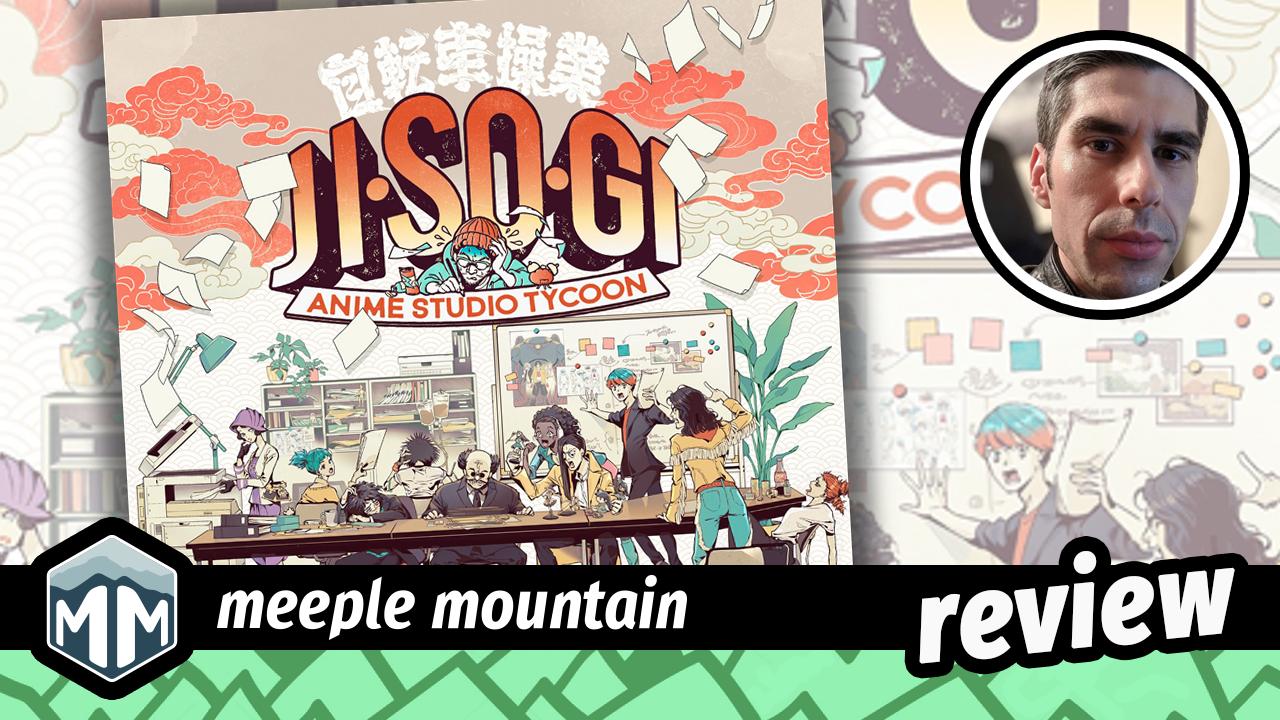
Jisogi: Anime Studio Tycoon Game Review

Board gamers are allergic to anime.

At least, that's the impression I've gotten after reviewing board games for the better part of a decade. I've covered plenty of games from across the ocean that barely made a stir in the West, including the card-based boss battler Testament, the calculating superhero co-operative game Tokyo Sidekick, and WizKids' reprint of the time-traveling one-vs-all game Tragedy Looper: New Tragedies. Search for reviews of any of them, and you’ll only encounter a handful that give these games a fair shake.

Jisogi: Anime Studio appears to have broken free from those chains of tradition. Well-known YouTube channels are talking about, praising it, and gushing over its artwork. I won’t lie, I’m about to do the same. I’ve played this ridiculous number of times despite the short timeframe I’ve had with it. I love this game.

Lights, Camera, Debt

Jisogi’s story is a somewhat familiar one in the animation industry. A massive animation studio lays off its employees, and the government decides to intervene. It will fund the next great small studio, provided someone can prove they have what it takes to run one. That someone is you. You take control of one of these struggling studios and have four rounds to…

The post Jisogi: Anime Studio Tycoon Game Review appeared first on Meeple Mountain.

UK Games Expo creators prep for giant show’s future without them by bringing in AireCon co-founder Mark Cooke

17. September 2026 um 16:35

After 20 years growing the UK Games Expo into one of the largest tabletop gaming conventions in the world, founders Richard Denning and Tony Hyams are preparing for their eventual exit by bringing in AireCon co-founder Mark Cooke as operations director.

Cooke joins following another record year for UKGE, which has seen its annual unique attendance surge almost 65% since 2023 to reach more than 51,000.

The show has already well surpassed Gen Con in terms of trade hall size, with the British event now spanning about 44,000 sq m – about 40% larger than Gen Con’s trade hall area – and hosting around 900 exhibitors in 2026.

That soaring growth has put increasing pressure on the small organising team at UKGE, with Denning telling BoardGameWire last year that the show had strained a full-time workforce which stood at just six people – although UKGE also relies on more than 200 volunteers, GMs, umpires and other helpers to deliver the convention each year.

Cooke is no stranger to growing a UK board game convention, having co-founded and built AireCon with Ben Clarkson from a 28-person gaming weekend in his flat a decade ago into England’s second-largest board game con, with about 5,000 attendees this year.

His hire by UKGE comes just three weeks after AireCon revealed that despite its own soaring growth, its 2027 show in Harrogate would be its last – saying a combination of factors had “made it increasingly challenging to run AireCon in a way that preserves the character and spirit that made it so special in the first place”.

More than 5,500 people are expected at the final AireCon – which has been nicknamed Airemageddon – with Cooke set to continue working on that final show before moving to UKGE full time.

A statement from UKGE emphasised the hire was part of a phased transition for UKGE’s organisers, and was “not a sudden change of leadership or direction”.

UK Games Expo 2026

It said Cooke would work alongside Denning and Hyams “over the next few UK Games Expo events”, ensuring that knowledge, experience and responsibilities the pair have built up over the last 20 years are handed over “gradually and thoughtfully”.

Denning said, “As UKGE has expanded to now one of the world’s largest shows we have gradually grown our team, adding event managers, administrators and logistics support.

“Bringing in Mark as operations director is the next logical step as we put in place plans to ensure UKGE can run far into the future.

UK Games Expo co-founder and director Richard Denning

“We have known Mark through AireCon and other industry roles for many years now and he is an ideal choice bringing both event management experience, energy and fresh ideas to the team as well as a safe pair of hands as and when Tony and I eventually step away from the show we have built together with others.”

Cooke added, “I’m incredibly excited to be joining the UK Games Expo team and to have the opportunity to play a part in the next chapter of such an important event for the tabletop gaming community.

“I have huge respect for what Richard and Tony have built over the years, and I’m looking forward to working alongside them over the coming events.

“This will be a gradual transition, giving us plenty of time to share knowledge, ideas and experience. My aim is to build on the fantastic foundations already in place while helping UKGE continue to grow and thrive for many years to come.”

Denning and Hyams launched UK Games Expo at Birmingham’s Clarendon Suites in 2007, when the convention attracted about 1,000 visitors.

It moved to Birmingham’s National Exhibition Centre in 2013, and had grown to more than 25,000 unique attendees by 2019 before the Covid-19 pandemic interrupted its run of physical events.

Its growth has accelerated since returning, with unique attendance passing 31,000 in 2023, 39,000 in 2024 and 42,000 last year, before jumping beyond 51,000 at its 20th anniversary event this summer.

UK Games Expo attendance figures since launch. Note: no physical show took place in 2020 due to the Covid-19 pandemic

Denning told BoardGameWire last year that building a world-class trade hall in the UK had been a personal ambition stretching back almost two decades, adding at the time that UKGE was “now fully on the world stage of ‘mega-cons'”.

Despite this year’s record attendance, Denning told BoardGameWire after the show that there was still room for further expansion, particularly around the roughly 500 events taking place during the convention.

The next UK Games Expo is scheduled to take place at Birmingham NEC from June 4 to June 6, 2027.

The post UK Games Expo creators prep for giant show’s future without them by bringing in AireCon co-founder Mark Cooke first appeared on .

New Exploding Kittens studio boss sets sights on expanding namesake IP into “long-lasting evergreen brand”

17. September 2026 um 11:33
A kitten on an exploding earth illustrating the Exploding Kittens card game

Exploding Kittens has named chief commercial officer Joeri Hoste as its new head of studio, with the long-time game industry exec eyeing further expansion of the company’s namesake hit into a “long-lasting evergreen brand” beyond its big-selling card game.

Hoste joined Exploding Kittens to lead its international business in 2020, following multi-year stints at companies including Hong Kong based board game publisher and manufacturer Ooba Games, toy company BOTI and trading card and collectibles specialist Upper Deck.

He takes the head of studio role at the Asmodee-owned business as former Exploding Kittens CEO Carly McGinnis was named head of the parent company’s global publishing operation last month.

New Exploding Kittens studio head Joeri Hoste

Hoste said in a LinkedIn post that the past six years at Exploding Kittens had been the most rewarding of his career, adding that he was “ecstatic and humbled” to take responsibility for leading the company into the next stage of its development.

He said, “We’ll continue our mission of making great games and creating experiences that bring people together. Exploding Kittens is the game that built its namesake company, and our next challenge will be to develop the IP into a long-lasting evergreen brand that outgrows its original format.

“Exploding Kittens is unique within Asmodee as we combine deep commercial mass market expertise with publishing quirky and irreverent games that disrupt the games category.

“We did not get here by blending in. We succeed because of the talented team that’s willing to be different.”

Exploding Kittens has been a huge commercial success in the wake of its debut title raising almost $8.8m on Kickstarter in 2015.

Last year Exploding Kittens revealed it had sold more than 60 million games as it marked a decade in business – with the company’s growth having already extended well beyond the tabletop.

That has included a partnership with Netflix which expanded the property into mobile gaming and an animated series.

Asmodee bought a 55% majority stake in Exploding Kittens at the end of 2021, and exercised its option to purchase the remaining 45% minority stake last year.

Exploding Kittens has continued to stand out within Asmodee’s portfolio during a difficult period for parts of the US board game market.

Asmodee CEO Thomas Koegler singled the company out last November as a particularly strong performer amid economic uncertainty caused by rising prices and US tariffs, adding that US consumers were favouring lower-priced games. Asmodee again highlighted strong Exploding Kittens growth while discussing a 23% year-on-year fall in its US quarterly sales earlier this year.

The promotion comes as Asmodee is making a wider push into social and party games – a category where Exploding Kittens has been one of its strongest brands.

In March the company agreed to pay up to €250m for French social and party game publisher ATM Gaming, with Koegler saying the acquisition would combine ATM’s strength in Europe with Exploding Kittens’ strong position in the US. Asmodee has said it expects the social games category to grow at between 4% and 8% annually between 2025 and 2030, compared with about 4% for the broader board games market.

It also launched US party game studio Moodbox Games last year, a move de Barros described at the time as strengthening Asmodee’s presence in a category where Exploding Kittens and Zygomatic were already seeing strong success.

The post New Exploding Kittens studio boss sets sights on expanding namesake IP into “long-lasting evergreen brand” first appeared on .

The Love/Hate Relationship: Wargame Nostalgia

Von: Grant
08. September 2026 um 14:00

There are a few words in our English language that have the ability to assist us with time travel. Traveling back not in physical form but back in our memory vault to a time and place that has long passed and that we have forgotten all of the gory details about. This word is nostalgia and in my opinion the word can bring both a positive and negative response. Nostalgia is simply a bittersweet emotional longing for a past period, person, thing or place in someone’s life. We all have it from time to time and it is a good thing. In fact, I often think back to the “good old guys” of growing up on the farm, high school and my college days. These seemed to be the best times of my life and I have carried those memories and the feelings they engender with me over the years to take me away from my current cares and strife. Nostalgia offers benefits such as a mood boost, fostering deeper social and emotional connection with family and friends and improving our outlook and optimism about our current situation and the world. But, there are also negative side effects as well such as triggering sadness or a longing, causing unhealthy rumination and more often than not idealizing the past and glazing over the hard parts and holding onto only the good. In the end, nostalgia is good but it can distract us from the reality of things and even cause angst or sorrow over the fact that the past won’t return to us. In this edition of The Love/Hate Relationship, I want to share what I love and hate about nostalgia and particularly wargame nostalgia.

Love

There is a lot to love about wargame nostalgia. While my childhood experience with wargames is very different from many of you, I still have very fond memories of my hours upon hours playing Axis & Allies with my brothers. We would always go to the ends of the Earth to finish a game and no one ever wanted to surrender. There was always a chance…that you would roll nothing but 6’s and hit with every attack and they would miss with every one of theirs. I still have those discussions with my brothers from time to time and I think that this is one of my favorite parts about this shared nostalgia. We all can be teleported back to a moment in time and remember where we were, how we were feeling and what the world was like at the time…based on a shared memory of something that we liked. This boosts our mood, as we typically remember only the good parts of the experience, and also deepens and strengthens bonds with family and friends. This is a real mood stabilizer and improver and I very much love that about nostalgia.

I also realize that sometimes when we think back, and have good feelings about a game we played, that it was really the memories created from the play experience and the people that we played with and not necessarily the game. The game could have been good, maybe even great but when revisited it just feels different somehow. And that difference is the people you played it with and the memories you created….with them. Nostalgia. That doesn’t mean the feelings are not valid and that the thing associated with them wasn’t good just that there is more there than just the thing we experienced.

I also very much love how wargame nostalgia can help you build your own taste pallet for games and help you to identify what it is that you liked. Is this a subjective remembrance of the game? Probably, as the play experience is always subjective and is influenced by the people and personalities you are playing it with. But it still can form you and your views on wargaming. What works, what doesn’t and what you liked and disliked.

Finally, I love that nostalgia can be a positive tool to use as you search for and attempt to indoctrinate your friends and prospective players. If you speak favorably about the game or system, and liked it or at least remember that you liked it, the other participants will pick up on your energy and vibe about the game and start the experience out with a positive first impression. After all, you seemed to like it in the past and have convinced them to give it a try. How bad can it be? I think that this is one of the more positive aspects of wargame nostalgia. The transference of feelings and emotions. I think that even Alexander and I can be influenced by each other after a play experience. As we think about and discuss the game, whether we liked it or not and what that was, we can begin to see things from another perspective that we either missed or just didn’t initially pick up, and then it can cause us to see things similarly. After all, what are wargamers if not pushers of a doctrine or system and continually on the hunt from some unsuspecting idiot to throw it at….

Hate

Now that you see what I love about wargame nostalgia, let’s take a look at what I hate. Hate is such a strong word for me but there are many things that are very displeasing about wargame nostalgia. First off, nostalgia leads to a continual comparison of our memories in the past and the reality of today. Nostalgia causes us to ruminate and to get stuck in our own personal echo chamber about certain games or systems. We then dwell too much on the “good old days” and that fondly thought or time and experience and this can lead to unrealistic expectations of a new game. In fact, it can be so strong that we may never give another game in that same line a chance. This can lead to what I call wargame bitterness or a way of thinking that lumps all devotees or followers of other systems into a negative light. This can lead to us not wanting to engage with them because they “think [insert game name] is a bad game” and can lead to us personally self isolate and not being able to make new friends and acquaintances to share games with. In extreme cases, it can lead to feelings of despair and depression about the current state of the hobby and even with your current gaming choices.

I have not experienced these feelings but as a relative newcomer to wargaming have definitely felt judged. Case in point, our experience with Advanced Squad Leader. Not a system that I had ever played until a few years ago and that first experience was with a seasoned ASL gamer who had played it since he was in 7th grade. He loves the system, even though he has some problems with certain rules, and he compares every tactical level wargame against his experience. That is fair but it doesn’t represent the feelings of others. I for one, love Combat Commander! And there are a few main reasons that this game holds such high regard, and in my humble opinion, is the best tactical level game ever created. One is that it is a card-driven strategy game. The cards are what you rely on to take actions, and if you do not wisely manage those cards, you may not have the card you need, such as a fire or advance in your hand when you need it! Some would complain that this is randomness and doesn’t belong in a strategy game but I disagree. I have never been in the service nor had to participate in a battle, but I can only imagine that there is chaos. This chaos changes all of the best laid battle plans and there are certain factors that contribute to that chaos, such as running out of ammo, your guns jamming, being pinned down by a sniper or having your units morale drop leaving them hugging the ground and keeping their heads down, that make battle difficult. The cards represent this part of the chaos and is a genius addition to the game. I also enjoy the way the designer chose to address rolling using the dice printed at the bottom of each order card. This is a very solid way of handling this necessary random determination of combat.

The other favorite part for me with Combat Commander is the narrative that is told as the battles unfold! As I have played Combat Commander, I imagine that I can feel what the squads felt in combat. I have felt as if I was Sergeant Kaminsky trying to inspire his men to move up on a well defended building to engage the enemy and knock them out of that fortification. I have experienced the disappointment of Sergeant Ganz as his troops were forced to retreat to try to repel the Russians who were threatening the German troops in the buildings. I have felt the disgust in my unit’s performance when a very powerful infantry gun or heavy artillery continues to miss its targets. The narrative is the best part and allows my mind to participate in the battle, even though I am not there. It is a similar feeling to a well written book that forces you to take the role of characters and experience their feelings as you read the pages. If a game can do all that, it is definitely good!

And with ASL, I get some of that but just feel too all knowing and too much in control. My friend just thinks it is more realistic and true to the rigors of combat. He also personally hates the cards in CC and cannot stand that he cannot do what he wants because he doesn’t have the right card in his hand. And I get it. But, to me, this is an example of the real problem with wargame nostalgia. The comparisons. Every system out there has its strengths and flaws. There is no perfect system and we just need to accept that our old games, and those positive memories that have formed our opinion of that game, are not the be-all-end-all of wargaming and others can have a different opinion as well as their own struggles with nostalgia.

Finally, I do hate that wargame nostalgia tends to view the past through rose-tinted glasses, filtering out the bad or things we didn’t like or agree with to highlight only the good. This is also human nature and something that we all do and I am not sure we have the capacity to not partake in this reminiscing. But, it is not a good side effect of nostalgia and I wish that we could get away from that. In fact, we have seen a resurgence of what I would call “nostalgia grabs” over the past couple of years from publishers who take an old game, and one that people hold onto the nostalgic memories of playing when they were kids, and then slap “designer signature edition”, “deluxe edition” or “new and improved mechanics” labels on them and then place them on Kickstarter for unsuspecting crazed nostalgia-filled wargamers who know better but bite anyways. A few of these examples recently were the Divine Right Kickstarter in 2023 from Pungo Games (Worthington Publishing) and the more recent Ace of Aces Powerhouse Series Deluxe Edition Kickstarter in 2024 from Mr. B Games. Don’t get me wrong, there is something to both of these games and people really have great memories of them. But, I have played both, and with Divine Right, I am not sure there is a real game there. It is a hollow exercise in fantasy wargaming that just doesn’t work very well and has no real soul. There are symbols on the board that are not used and almost are trying to lure us into buying any future expansion like a Great Northern Pike chases after a shiny lure even though he is not really hungry!

Ace of Aces is fine for what it is, a flip book game with some great concepts and very much upgraded components, but in this present day of modern wargame design it just doesn’t hold a candle to other games that I would rather play. Now both of these games did very well on Kickstarter. Divine Right made $114,609 with 936 backers and Ace of Aces Powerhouse Series Deluxe Edition made $189,374 with 3,247 backers. That is a lot of nostalgia buying! But, Divine Right did a 2nd crowdfunding campaign for the Divine Right X: The Omega Expansion and it did even better with $144,896 in funding from 1,099 backers. Mr. B Games is readying their next Kickstarter Ace of Aces: Handy Rotary & Flying Machines Deluxe Editions that launches this month.

In summary, wargame nostalgia is a real, tangible thing that has a mind of it’s own and causes us to do things that we probably normally wouldn’t do. From buying overpriced reissues of our favorite games to putting other games and systems down with great passion and omniscient thinking about what is right and wrong, good and bad, worthy and not worthy! But, it is not all bad and I think that nostalgia is good in moderation and with some real introspection to get past the initial overreaction and mis-remembrance we have when thinking about and discussing our favorite pet games from yesteryear. Don’t leap before you look….you might end up with a nice shiny turd in a box! What are your thoughts on wargame nostalgia? What do you love and hate about the concept? Is there a real place for this feeling in our hobby?

-Grant

Catan expands sports marketing team-ups with NHL partnership, German handball star deal

07. September 2026 um 17:53

Catan is continuing to push into professional sport in a bid to reach new players, adding a season-long partnership with NHL team the Ottawa Senators and recruiting German handball star Juri Knorr as a brand ambassador.

Asmodee and Catan Studio have teamed with the Senators for a season-long partnership which they said will put the board game in front of hockey fans through arena advertising, “concourse activations” and social media competitions.

The deal will culminate in a dedicated Catan Night at the Senators’ Canadian Tire Centre on November 23, when the team faces the Calgary Flames – including themed decorations and activities, promotional giveaways and special ticket packages.

Senators VP of marketing Peter Shier said the team will be the only Canadian professional sports franchise, and the only NHL team, to host a Catan-themed game this year.

The move comes just under a year after Catan announced its first professional sports partnership with NBA team the Minnesota Timberwolves – which similarly included interactive concourse activations at selected home games, giveaways and community initiatives, and led to a dedicated Catan Night in February.

Catan Studio director of brand development Kevin Hovdestad said at the time the partnership highlighted how the game had become “woven into sports culture”, following years of reports of the game being played by professional athletes including members of the Green Bay Packers, Buffalo Bills, Kansas City Chiefs and Minnesota Twins.

Separately, German Catan publisher Kosmos has named international handball player Juri Knorr as a Catan brand ambassador ahead of the 2027 Handball World Championship, which will be held in Germany next January.

The campaign, running under the slogan Mein Spiel nach dem Spiel – ‘My Game After The Game’ – will feature Knorr prominently on branded retail displays and products, alongside a QR-code competition offering meet-and-play sessions with the handball star and Catan-branded adidas handball shirts.

Kosmos is focusing the campaign on compact forms of the game: new card game release Catan On The Road and the Catan Dice Game.

The publisher is potentially tapping into a sizeable audience: 13 million people watched Germany play Denmark in the 2026 European Handball Championship final, according to Kosmos.

Knorr said, “Catan has been with me since my childhood and still captivates me today. For me, the game is a very good balance and complement to… highly focused competitive sport.

“The game offers a great opportunity to spend quality and intense time with friends and teammates. It involves spending time while also thinking strategically. That’s why I’m very pleased to represent Catan as a brand ambassador in this special campaign.”

The deals add to a growing collection of partnerships putting Catan in front of potential players outside of traditional board game retail and media – with the aim of expanding the audience for a game which has already sold more than 50 million copies and been translated into over 45 languages.

Kosmos is currently involved in one of the most striking examples through a McDonald’s Happy Meal promotion across Germany, Austria and Luxembourg, for which almost seven million specially adapted games have been produced.

The promotion, which runs from August 20 to September 23, includes eight games from the publisher’s portfolio, including Catan Junior, Cascadia Junior, Flip 7 and EXIT: The Game – Kids: Riddles in Monsterville.

Kosmos licensing content and entertainment head Julia Courmont said, “This collaboration is a huge milestone for us. The fact that Kosmos is represented here with eight exclusive titles confirms the great confidence in our brands and their relevance to a broad target group.

“It’s a fantastic opportunity to make these classic games accessible to millions of people and to create valuable shared gaming moments.”

Meanwhile, Netflix revealed last November that it was developing scripted and unscripted projects based on Catan – a development the streaming giant followed in February by picking up exclusive global rights for screen-based adaptations of the huge-selling Ticket to Ride series.

Catan has since held a game night with Linkin Park and Warner Music in Hamburg, while a licensed crossover with children’s entertainment phenomenon Bluey is due to launch across several international markets in 2027.

The post Catan expands sports marketing team-ups with NHL partnership, German handball star deal first appeared on .

Marvel: Crisis Protocol Alliances – Night of the Goblin Review

Green Goblin Crashes the Party

When AMG first announced their foray into the world of board games with the Alliances line as a spinoff from Marvel: Crisis Protocol, I was… skeptical. After all, could they really take a game I love like MCP and spin it off into a team-based co-op experience? Could they capture what makes MCP work? I was dubious. While it’s not a perfect experience, I was completely pleasantly surprised by just how fun the game turned out to be. It’s just an absolute blast.

The quick idea is that each Alliances game brings together a team of four heroes, all with varying superpowers, to take down an iconic villain and their army of goons. Here, we get both Spider-Men (Peter Parker and Miles Morales) along with Black Cat and Ghost-Spider, teaming up to take down the Green Goblin. Together, they’ll fight him across three different chapters (two objective-based chapters and a final boss fight), each lasting roughly 90 minutes each. 

Getting started is simple - each player picks the character they want to be and picks a level 1 upgrade, and then you’re off. It’s worth noting that if you’re a solo player, this game is very easily playable in solo mode with you controlling all four characters, though I can’t speak to that experience…

The post Marvel: Crisis Protocol Alliances – Night of the Goblin Review appeared first on Meeple Mountain.

Trio of board game industry veterans launch full-service agency Best in Play

07. August 2026 um 15:32

A trio of veteran board game industry professionals have launched a new tabletop gaming agency, with the aim of helping businesses within the hobby get their games developed and into the market.

Hues and Cues designer Scott Brady, Sagrada co-creator Daryl Andrews and Friendly Skeleton CEO Jacob Way said Best in Play will offer everything from interim executive leadership and designer representation to publisher submission management and crowdfunding strategy.

Brady said, “Best in Play was created to bring together people and opportunities that should already be working with one another.

“Great intellectual properties need the right designers and publishing partners, designers need better access to decision-makers, and companies sometimes need experienced leadership without the time or resources required to build an entire department.”

Best in Play says its five core service areas comprise IP matchmaking, crowdfunding consultation, interim replacement of key personnel, publisher-inventor relations and identifying publishers and licensing opportunities for individual games, multiple projects or designer catalogues.

The company announced at launch that it has already been hired as a consultant for an unspecified US-based “creator-brand merchandising and e-commerce company”, providing senior-level leadership and games-industry expertise while the client continues its search for a permanent head of games.

Best in Play said that project will run the gamut of product development, licensing, publishing, production, crowdfunding and portfolio strategy.

Andrews said of the assignment, “An important initiative should not lose six months of momentum because a key role is temporarily vacant.

“Our model gives clients access to an experienced team that can step in quickly, evaluate the situation and keep products, partnerships and internal teams moving forward.”

The company is also working on a tabletop project based on an unnamed “major video game intellectual property”, with a crowdfunding launch planned for early 2027.

Way said, “A recognizable property may attract attention, but a successful crowdfunding campaign still needs the right product, positioning, audience strategy and operational plan.

“Our goal is to build campaigns that respect the fans, communicate value clearly and create a foundation for success beyond the initial launch.”

As well as the founding trio of managing directors, the Best in Play team also includes strategic contributors David Gordon, the co-creator of Finspan, Eastar Game Manufacturing founder and CEO David Du, Legend of the Five Rings: The Card Game co-designer Erik Dahlman and Daniel Pesante.

The launch comes hot on the heels of Brady having unveiling his new publishing initiative Proof-of-Play late last month, which is designed to tackle one of the tabletop industry’s growing challenges: promising games sitting unpublished because publisher release schedules are already full.

Brady previously launched his development studio A Game Studio at the start of 2024, following the 2020 release of the big-selling Hues and Cues and the success of his cat-themed abstract strategy Boop in 2022.

Scott Brady’s breakout design Hues and Cues

He is also the co-founder of Play to Z, the publishing house led by former Z-Man Games founder Zev Shlasinger launched by a host of board game industry veterans in 2023.

Fellow Best in Play managing director Daryl Andrews is best known as the co-creator of award-winning tabletop game Sagrada, while his other co-designs include Batman: The Dark Knight Returns – The Game, Donald Duck in Happy Camper and Mistwind.

He previously spent two years as head of talent acquisition at Maestro Media, following several months working in investor relations, before leaving the company in early 2025.

Jacob Way, meanwhile, began his board game career as COO and co-founder of Deep Water Games, which for several years operated as a subsidiary of Ox Eye Media.

Deep Water, which is best known for sketching game MonsDRAWsity, spun out from Ox Eye as an independent business in 2022 under Way before rebranding as Friendly Skeleton.

The publisher is currently in the process of delivering the heavily delayed crowdfunding campaign for Monsdrawsity: Unusual Suspects, created in collaboration with renowned board game review site Shut Up and Sit Down, which was initially estimated to reach backers in May of 2022.

Anyone interested in getting in touch with the team can visit the Best in Play website or email info@thebestinplay.com.

The post Trio of board game industry veterans launch full-service agency Best in Play first appeared on .

French board game distributor, publisher Atalia enters liquidation, blames market saturation and battle for bestsellers

24. Juli 2026 um 12:55

French board game distributor and publisher Atalia has entered compulsory liquidation, saying an increasingly saturated market, the limited capacity of retailers and the loss of distribution rights to bestselling titles left the business unable to remain viable.

A statement posted to Atalia’s Facebook page said the rapid expansion of the tabletop market since the company was founded in 2015 had created a tougher commercial environment for smaller distributors, despite the industry’s continued growth.

Atalia said that despite soaring numbers of players in that time, “so many new games are being released today that the market has become saturated. Shops no longer have the space, the time or the cash flow to stock all the games arriving each week”.

It added, “They therefore naturally turn to distributors with the biggest marketing budgets, some of whom invest sums each year that exceed Atalia’s annual turnover.

“This year, Atalia has lost the distribution rights for its latest bestsellers, as their publisher has chosen to entrust them to a distributor offering greater financial and marketing resources.

“We naturally respect these decisions, but we cannot hide our regret. Without these bestsellers, it has become increasingly difficult to finance new releases and ensure the company’s long-term viability.

French board game distribution is dominated by industry heavyweights Asmodee and Hachette, the latter via its Gigamic and Blackrock subsidiaries.

Atalia was founded in 2015 as a French board game distributor, before expanding into localisation and then publishing in 2021. It distributed games to hundreds of specialist retailers across France and neighbouring francophone territories.

The company says on its website that it deliberately maintained a relatively small catalogue, so individual games entrusted to it would not be “lost amongst an overwhelming number of titles”.

Earlier this year Atalia revealed it was halting its own distribution operations to focus on publishing and localisation, with its distribution being handled by MAD from May.

Atalia’s previously published releases include French localisations of games including Underwater Cities and Lorenzo il Magnifico, while recent titles published by the company include The Royal Society of Archeology and Hands Off!.

The company had also faced financial difficulties in 2019, despite a prior year in which it had generated revenues of more than €1.8m and continued profitability.

Atalia’s decision to double its headcount to six amid that success backfired when the publisher of Limite Limite, a French adaptation of Cards Against Humanity which accounted for about half Atalia’s revenue, switched to a new distributor in 2019 with no prior warning.

The company placed itself into receivership the same year, but emerged intact from that process in early 2020, citing strong sales of its bestsellers including Punto and Dreamscape, and receiving court-ordered compensation from the publisher of Limite Limite for the abrupt termination of its distribution deal.

Atalia founder Cesare Mainardi

The company’s liquidation announcement today came a month after Atalia founder and managing director Cesare Mainardi revealed it was “facing an extremely difficult period”, and cancelled its planned attendance at the Paris est Ludique festival, citing financial difficulties and organisational constraints.

Atalia officially entered compulsory liquidation on July 8 via Nanterre Commercial Court.

The company’s assets, including stock, brand and customer database, will now be offered for sale by the liquidator. Mainardi said interested parties should contact him via private message on Facebook.

He said in the Facebook post, “Today, we turn the page with our heads held high, feeling immense pride in everything we have built together.

“The people we’ve met, the games we’ve played and the memories created during this adventure will remain with us forever.”

The post French board game distributor, publisher Atalia enters liquidation, blames market saturation and battle for bestsellers first appeared on .

Ein paar Tage Hamburg

Von: natokh
11. Juli 2026 um 14:20

Wir waren im Juni (vor der Hitzewelle) mal wieder ein paar Tage in Hamburg und es hat uns wie immer sehr gut gefallen. Angereist sind wir von Frankfurt/Main mit dem ICE und der war sogar 15 Minuten zu früh in Hamburg-Harburg, wo wir dann allerdings auf die Weiterfahrt warten mussten, da der Zug ja nicht vor der fahrplanmäßigen Abfahrtszeit weiterfahren konnte.

Am Hamburger Hauptbahnhof angekommen sind wir dann noch 2 Haltstellen mit dem Bus zu unserem Hotel an der Außenalster gefahren. Im Hotel Bellevue von der Relexa-Gruppe sind wir auch bei unseren letzten Hamburg-Besuchen immer abgestiegen. Es ist sehr gut gelegen, die Zimmer sind okay und es gibt ein gutes und reichhaltiges Frühstücksbüffet. Leider hat während Corona das gute Restaurant im Hotel geschlossen und nicht wieder aufgemacht, aber in der näheren Umgebung findet man genug Möglichkeiten, um Essen zu gehen.

Blick vom Dach des Hotels auf die Außenalster
Unser Zimmer (mit Fenster zur Außenalster)

Hier ist unser Favorit die Gasstätte Frau Möller, in der Langen Reihe, die man vom Hotel aus in 5 Minuten erreicht. Das Essen dort ist gut, reichlich und wirklich günstig. Es gibt täglich wechselnde Tagesgerichte und auch Vegetarier haben hier genügend Auswahl. Sollte man jedoch erst gegen Abend dorthin gehen, dann kann es vorkommen, dass ein Tagesgericht nicht mehr verfügbar ist.

Hier findet ihr u. a. die Speisekarte (unbedingt einen Blick auf die Wochenkarte werfen) https://www.fraumoeller.com

Da die Gaststätte immer sehr gut besucht ist, kann es von Vorteil sein zu reservieren. Wenn man etwas Geduld hat, bekommt man aber auch mit etwas Wartezeit einen Platz. Um so eher, wenn man kein Problem damit hat, den Tisch mit anderen Gästen zu teilen, was ich persönlich sehr gerne mache, da ich da schon oft ins Gespräch gekommen bin.

Ein weiterer Tipp für einen Hamburg-Besuch ist die Nutzung der Hafen-Fähren der HADAG, da diese auch mit dem 63 Euro Ticket genutzt werden können und man so kostengünstig durch den Hamburger Hafen schippern kann. Pläne findet ihr auf deren Webseite: https://hadag.de/de/

Wir sind mit der Fähre von den Landungsbrücken nach Finkenwerder und zurück gefahren. Leider nicht am Wochenende. Dann hätten wir nämlich noch von Finkenwerder mit der Linie 65 weiter bis nach Blankenese fahren können.

Eine weitere Empfehlung ist der Besuch von Planten & Blomen. Das ist eine große Parkanlage, die sich durch das Zentrum von Hamburg zieht. Von Anfang Mai bis Ende September kann man hier am Parksee mittags zwischen 16 und 18 Uhr die Wasserspiele bewundern und abends ab 22 Uhr (im September ab 21 Uhr) die Wasserlichtkonzerte. Die kostenlose 30-minütigen Vorführungen werden live von zwei Künstlern begleitet – einer steuert die Wasserfontänen, der andere spielt das sogenannte „Lichtklavier“ passend zu klassischen, jazzigen oder modernen Klängen. Leider hatten wir das Pech, dass bei uns die Lichtanlage ihren Dienst verweigert hat.

Wir hatten uns frühzeitig (gegen 21 Uhr) einen Platz im Café Seepavillon gesichert und hatten von dort einen tollen Blick auf die Wasserspiele.

An einem Abend war ich auch im Würfel und Zucker. Wenn ich schon mal in Hamburg bin, dann muss ich auch das WuZ besuchen. Ich hatte mich dort mit Bekannten verabredet und wir haben Bounce it und Chimera Station gespielt.

Chimera Station mit Magnus (rechts) und Jope (links)

Bei Chimera Station bauen wir gemeinsam mit unseren Aliens an einer Raumstation. Wir können dabei unsere Aliens mit verschiedenen Körpermodifaktionen verstärken (Klauen, Tentakel, Gehirne und Blätter).

Bounce it

Bounce it ist ein Geschicklichkeitsspiel, bei dem es darum geht möglichst oft seine 3-4 Bällen in die Mitte der Spielschachtel zu werfen. Dabei müssen sie vorher 1 mal auf dem Tisch auftippen.

Mehr Bilder gibt es noch auf meinem Instagram-Konto: https://www.instagram.com/p/DZuXbIrjMfT/?hl=de&img_index=1

Was ich auch empfehlen kann ist ein Besuch der Elbphilharmonie. Der Besuch der Plaza (Balkon rund um das Gebäude) ist hier kostenlos. Man muss sich vorher nur ein Ticket am Ticketschalter vor dem Eingang besorgen. Vom Balkon aus hat man einen sehr schönen Rundumblick auf den Hamburger Hafen, die Innen- und die Speicherstadt .

Ausblick auf die St. Pauli Landungsbrücken (von der Elbphilharmonie aus)

Wir haben während unseres Hamburg-Aufenthalts auch noch 2 Bootstouren gemacht, eine 1-stündige Hafenrundfahrt und eine 1-stündige Alsterrundfahrt, außerdem sind wir einen Tag mit dem Roten Doppeldecker durch die Stadt gefahren. Das Kombiticket „Entdecker Tour“ hat 62 Euro gekostet.

Blick von der Außenalster in Richtung Innenstadt/Hafen

Erst später haben wir den Hamburg All-in-Pass entdeckt, der hier vielleicht noch die bessere Wahl gewesen wäre, da er mehr beinhaltet: Hamburg All-In-Pass Bei dem Pass sind all die genannten Touren auch drin, aber auch noch einiges mehr. Man muss sich hier nur entscheiden wie lange der Pass gelten soll, wovon dann der Preiss abhängt. Ich denke hier wäre der 3-Tage-Pass eine gute Wahl.

Dinge, die wir dieses Mal nicht mehr unterbringen konnten, da wir uns auch nicht stressen wollten, die ich aber jedem empfehlen kann sind:

  • Ein Besuch des Miniatur-Wunderland (am besten die Tickets vorher online buchen). Ich war schon 3 mal hier und könnte es immer wieder besuchen. Ein Tag reicht hier auch nicht aus, um sich alles genau anzuschauen und das Miniatur-Wunderland wird auch ständig erweitert.
  • Ein Besuch des Spicys Gewürzmuseum in der Speicherstadt. Hier kann man Gewürze entdecken und einiges über die Geschichte der Gewürze (Anbau, Handel …) erfahren. Man kann viel der Gewürze auch probieren und am Ende natürlich auch kaufen.
  • Ein Besuch des Planetariums. Hier gibt es viele interessante Shows (Tickets für 12,30 Euro) und man hat von der Aussichtsplattform (Eintritt 2 Euro) einen tollen Blick über den Stadtpark bis zum Fernsehturm, dem Michel und der Elbphilharmonie.
  • Besuch eines Konzertes in der Elbphilharmonie. Das hätten wir uns früher überlegen müssen, da es sehr schwierig ist hier kurzfristig noch Karten zu bekommen. Während wir in Hamburg waren hätten wir aber die Chance gehabt ein kostenloses Konzert in der Laeiszhalle. Hier haben nämlich an einem Tag Absolventen der Musikhochschule gespielt. Weitere kostenlose Konzerte findet man auf der Webseite der Stadt Hamburg: https://www.hamburg.de/freizeit/kostenlos-musik-333640
  • Ein Besuch des alten Hamburger Elbtunnels. Auch dieser Besuch ist kostenlos. Man kann hier von den St. Pauli Landungsbrücken 426 Meter unter der Elbe hindurch zur Elbinsel Steinwerder laufen.
  • Zu guter Letzt will ich auch unbedingt mal in die Mittelalter und Rollenspiel Taverne Zum tanzenden Einhorn. Eine Nerd-Bar für Rollenspieler und Mittelalterfans in der man auch Brettspiele spielen kann. Leider hat die Bar am Montag und Dienstag geschlossen, was dazu geführt hat, dass es nicht mehr in unseren Zeitplan gepasst hat. So wird ein Besuch bis zu meinem nächsten Hamburg-Aufenthalt warten müssen. Der aber sicherlich kommen wird.
Alter Elbtunnel (Foto von meinem Besuch in 2019)

Hamburg und seine Plakate

Zum Abschluss noch etwas was ich an Hamburg auch immer wieder mag sind die Plakate die man dort immer wieder entdeckt. 2 davon musste ich auch einfach fotografieren. Okay, das zweite ist natürlich eine Werbung, aber da steckt viel Wahres drin 😅

Nahverkehr in Hamburg

Wir haben in Hamburg sehr viele Strecken mit dem Bus zurückgelegt, was ich auch durchaus als sehr gut empfand. Dank 63 Euro-Ticket muss ich mir da auch keine Gedanken um einen Fahrschein machen.

Ich musste leider mehrfach feststellen, dass die HVV-App nicht immer die besten Verbindung heraussucht. Vor allem gibt es leider keine Option, eine Fahrt so zu planen, dass man möglichst viel von der Strecke mit dem Bus, der U- oder S-Bahn zurücklegt und nicht immer wieder größere Strecken zu Fuß, obwohl dies durchaus möglich wäre. Vielleicht habe ich die Option aber auch nicht gefunden.

Ich habe mich dann oft damit beholfen, dass ich erst eine Teilstrecke zum Hauptbahnhof (ZOB oder Steintordamm) gesucht habe und dann von dort eine weitere Teilstrecke zu meinem Ziel. Das hat oft besser funktioniert als direkt die gesamte Strecke zu suchen. Auch fand ich, dass die DB-App oft bessere Ergebnisse geliefert hat. Sehr hilfreich finde ich auch den Plan des Hamburger Busliniennetzes parat zu haben: https://www.nimmbus.de/frame.php?doc=busliniennetz.htm

Man kann dann auch immer sehr gut erst einmal in Google Maps nachschauen, welche Haltstelle dem Ziel am nächsten ist und dann im Netzplan schauen, wie man am besten dorthin gelangt.

Nachtrag: Katzencafés

Da hab ich doch glatt noch was vergessen. Wir haben in Hamburg auch noch 2 Katzencafes der Kette Katzentempel besucht. Eines in der Hafencity und das, zu diesem Zeitpunkt, gerade frisch eröffnete am Holstenwall, welches uns besser gefallen hat. Das ´Konzept der Katzentempel ist es vegane Speisen anzubieten und Katzen eine Heimat zu bieten. Die Katzen entscheiden selbst ob sie zu einem kommen oder nicht. Sie haben in dem Katzencafe einige Rückzugsmöglichkeiten, die man auch unbedingt respektieren sollte.

Die oberen beiden Bilder sind aus/vom dem Katzentempel in der Hafencity, die unteren beiden aus dem am Holstenwall.

Die Preise im Katzentempel sind jetzt nicht gerade günstig, aber die Katzen müssen ja auch noch versorgt werden. Es gibt in Hamburg auch noch ein weiteres Katzencafe, das Cat Café in der Wandsbeker Chaussee. Das steht für unseren nächsten Hamburgbesuch auf der Liste.

BGB Podcast #360 – Guessing Golden Geeks Galore

07. Mai 2026 um 10:59


It’s long been said that we’re the foremost experts in knowing which way the awards winds blow, so we’re putting our talents to use guessing, nay, predicting, nay, deciding who the winners in the Golden Geeks are going to be. Before we geek out, we talk about Chronicles of Crime: 2400, Quarto, and Shackleton Base: A Journey to the Moon.

If you don’t want to miss an episode, please subscribe on Apple Podcasts/Google Podcasts/Stitcher/Spotify, or add our RSS feed to your favourite app. Reviews and subscriptions really help us and would be greatly appreciated! To download the episode directly, click here.

If you’d like to discuss anything in the episode, please do so in the comments below, visit our BoardGameGeek guild, join our Discord, or Facebook Group! Any feedback is also always helpful. If you’d like to show your support for the show, we also have a Patreon with some fun rewards, and a merch store!

Timecodes:

04:07 – Chronicles of Crime: 2400
12:00 – Quarto
16:13 – Shackleton Base: A Journey to the Moon
30:16 – Golden Geeks 2025

Thank you to Heart Society for generously letting us use What’s On Your Mind, Kid? from their album Wake the Queens.

The post BGB Podcast #360 – Guessing Golden Geeks Galore appeared first on Board Game Barrage.

Khrushchev and the Pivot from Stalinism (Reform in the Soviet Union, #2)

08. Februar 2026 um 18:25

The Soviet Union was one of the great dictatorships of the 20th century. It applied an immense amount of coercion on its own citizens as well as many of its neighboring countries. Yet the almost seventy years between the Soviet Union’s founding from the ashes of the Russian Civil War in 1922 and its fragmentation into 15 nation-states in 1991 are no monolith of unfreedom. There were two distinct periods of liberalization around a generation apart from each other – one that began under General Secretary Nikita Khrushchev in the 1950s, and one that began under General Secretary Mikhail Gorbachev in the 1980s. Let’s look at them, beginning with Khrushchev’s thaw, in terms of domestic, foreign, and economic policy. The post on Gorbachev’s reforms will follow in two weeks. As always, there will be board games along the way.

Freedom of Thought, Speech, and Political Expression

Joseph Stalin’s Soviet Union curtailed its citizens’ expression dramatically. Historiography has recounted Stalin’s reign of terror in detail, yet the best-known expression of the totalitarian control to which the Soviet Union aspired from the 1930s on is George Orwell’s dystopian novel 1984: Its one-party state does not only control citizens’ access to information (they are being exposed to constant propaganda and expected to keep up with its frequently changing, often contradictory contents), but demands active participation in the daily reconstruction of the system, ranging from institutionalized “two-minute hate” against political enemies to unlimited devotion to the “Big Brother” at the top of the pyramid.

The Soviet equivalent to the “Big Brother,” of course, was Stalin who was exalted in an official cult of personality as a wise and infallible leader, working tirelessly for the security and well-being of the Soviet Union. Whatever went wrong on the Soviet Union’s inexorable march of progress was the fault of an inept underling or a shadowy enemy.

Twilight Struggle (Ananda Gupta/Jason Matthews, GMT Games) has only few events referencing domestic policy, but the paranoia on both sides has made it in as the “Red Scare/Purge” double event which can cripple an opponent’s turn. Of course, the victims of McCarthy’s persecution only lost their jobs and reputations, not their lives like the victims of Stalinist purges. ©GMT Games.

When Stalin died, his lieutenants fought briefly, but viciously over his succession. Nikita Khrushchev emerged victorious. Khrushchev had been as loyal to Stalin as his chief rivals and immediatly used Stalinist methods to depose Lavrentiy Beria, the powerful Minister of Internal Affairs (and thus chief of the domestic security services). Beria was charged with treason, put through a mock trial, and executed.

Khrushchev’s skillful power politics could also swing the other way, though. He prepared a report on Stalin’s crimes which he delivered to a stunned audience at the 20th Congress of the Communist Party of the Soviet Union on February 25, 1956. For four hours, Khrushchev detailed Stalin’s party purges, his deportation of whole peoples deemed unloyal, and, most of all, how Stalin had established a cult of personality in which he was almost worshipped like a god.

Khrushchev’s de-Stalinization drive did not stop at mere proclamations. The late 1950s and early 1960s saw a lessening of censorship: Alexander Solzhenitsyn was allowed to publish his Gulag novel One Day in the Life of Ivan Denisovitch.

There were limits, however: Criticism of Stalin’s Gulags was one thing, criticism of the October Revolution another. Boris Pasternak’s Doctor Zhivago was not published in the USSR. When Pasternak won the Nobel Prize in literature for it, he and his family were threatened by agents of the state. Cowed, Pasternak did not travel to Stockholm to accept the prize.

Still, Khrushchev’s pivot represented an important turn in the state’s relationship with violence. While Soviet citizens were still routinely surveilled and subjected to coercion, it was neither with the overwhelming force of Stalinism nor with its unpredictability. The age of escalating purges, in which the accusers of today would be the accused of tomorrow was over.

Peaceful Coexistence and Khrushchev’s Many Other Schemes

Khrushchev’s 1956 speech was meant to remain secret, known only to its direct recipients and the allied Communist governments in Eastern Europe, but a member of the Polish Communist party smuggled a copy abroad via the Israeli embassy in Warsaw. From there, it soon gained wide circulation, and while Khrushchev had intended it to be a domestic power play only (it delegitimized his rivals Georgy Malenkov and Vyacheslav Molotov), he now also reaped benefits abroad: The post-Stalinist Soviet Union was naturally a more attractive ally and role model for both the socialist movements in Europe and the decolonizing and freshly independent nations in Africa and Asia.

If you draw this card as the US player: Hold it until turn 3 and then space it. If you draw it as the USSR player: ¡Bienvenido a Sudamérica, camarada! Card De-Stalinization from Twilight Struggle. ©GMT Games.

This unintended benefit is the focus of the foreign-policy heavy Twilight Struggle‘s De-Stalinization card: The Soviet player may move up to four points of influence around on the globe. That may seem like a zero-sum game – after all, the influence is not added, but only moved. But the Soviet Union typically has a lot of spare influence in Eastern Europe after the first one or two turns, and De-Stalinization is the earliest and best way to gain access to faraway continents, chiefly South America (and, to a lesser degree, Africa).

Even before Khrushchev’s speech was leaked, his approach to foreign policy markedly differed from Stalin’s last years. When the relationship with the Soviet Union’s erstwhile allies had deteriorated after the end of World War II, Stalin had adopted a confrontational stance based on the assumption that the world was split in two hostile camps. Khrushchev, on the other hand, approached the western powers under the new motto of peaceful coexistence. Socialism and capitalism could both inhabit the same world. Of course, Khrushchev as a convinced Communist believed that his system would eventually triumph. Until then, peaceful coexistence would not only foster peace, but also make socialism more attractive, and free up resources for economic development and consumer goods (more on that below).

The economic (factory icon) and especially ideological (socialist – man with flat cap icon) bonuses are nice, but what sets the Peaceful Coexistence event in Wir sind das Volk! – 2+2 (Richard Sivél/Peer Sylvester, Histogame) apart is the ability to advance peace (dove icon) – indispensable when the world is sliding toward nuclear war!

Khrushchev was always better at initiating things than at seeing them through. Peaceful coexistence gave way to other projects – be that the support of nationalist movements in the global south or a re-newed competition with the West over Central Europe. And while Khrushchev thought that the Soviet Union and the western powers could live next to one another, that tolerance did not extend to heterodox socialist ideas within his own sphere of influence: When the Hungarian Socialist Workers’ Party announced to withdraw the country from the Warsaw Pact and hold free elections, Khrushchev had the reform movement quashed by Soviet tanks.

Let’s break with Stalin! …no, not like that! The Hungarian revolutionaries and Khrushchev would not become fast friends. Image from Days of Ire (Katalin Nimmerfroh/Dávid Turczi/Mihály Vincze, Cloud Island).

Consumer Goods, (Non-)Communal Apartments, …Corn?

The Soviet economy under Stalin had been tuned to increase heavy industrial output to achieve a fast industrialization on the one hand and provide the basis for the country’s military security. This approach was validated by the country’s survival of the Nazi invasion and its eventual military victory in 1945. The proponents of this economic policy which usually went together with ideological mobilization and a confrontational foreign policy were called to adhere to politika. Yet after Stalin’s death, the rival faction of tekhnika gained ground: Its advocates favored a less aggressive foreign policy, less ideological mobilization, and, most of all, more market elements in the economy which would then produce more consumer goods.

Khrushchev positioned himself in the middle: Heavy industry would have priority (the Soviet Union was in a nuclear arms race with the United States whose economy was around three times as large as the Soviet, after all), but more attention would be given to consumer goods than before. Soviet citizens enjoyed a limited amount of prosperity with radios, washing machines, and sometimes even cars. Khrushchev saw this also as an instrument in the systemic competition of the Cold War: Material comfort and personal lifestyles would influence people’s allegiances as much as military strength or ideological treatises.

Khrushchev’s confidence in that regard led him to agree with the United States on mutual national exhibitions which would showcase their respective country to the citizens of the other. The confidence, however, was not quite justified: The Soviet exhibition in New York aroused curiosity, but the American one in Moscow was positively overrun. It also produced one of the iconic pictures of the Cold War with Nikita Khrushchev and US Vice President Richard Nixon debating the merits of their respective systems surrounded by American household appliances – the “Kitchen Debate.”

Richard Nixon stabbing his finger at Nikita Khrushchev (and thus putting himself into the race for the 1960 presidential election). Not pictured: The hottest new kitchen gadgets from America. Card Kitchen Debates from Twilight Struggle. ©GMT Games.

Some Soviet citizens might have dreamed of living in America, but their personal lifestyles already became more akin to those of Americans under Khrushchev. Even more important than the new consumer goods were their living conditions: Housing in big Soviet cities had been dominated by kommunalkas – large apartments from pre-revolutionary times which had been split to accommodate several families, each living in a single room and sharing the kitchen and bathroom with the others. These crammed living spaces afforded their inhabitants no privacy whatsoever. Only the elites of Stalin’s Soviet Union had apartments to themselves. Khrushchev started an ambitious housing program based on prefabricated, concrete-paneled apartment buildings which allowed millions of Soviet citizens to move into an apartment just for their own family for the first time.

As with foreign policy, Khrushchev started more economic reform projects than he saw through. The ambitious “Virgin Lands” campaign which aimed at alleviating Soviet food shortages by cultivating vast swathes of Siberia and northern Kazakhstan petered out after a few years. His scheme to introduce an Iowa-style corn belt fared even worse, discrediting both corn and Khrushchev in the Soviet Union.

Khrushchev’s Ouster

The economic starts and shifts of Khrushchev’s tenure undermined his position, as did his foreign policy unpredictability ranging from arms control to confronting the United States over Cuba. Most damaging to him, however, were his constant shuffles in the Communist Party. Disaffected cadres who feared they might lose their offices overthrew Khrushchev in October 1964. They installed the less fickle Leonid Brezhnev as new General Secretary of the Communist Party of the Soviet Union. The conservative Brezhnev would tone down some of Khrushchev’s domestic reforms, resulting in a more restricted cultural and literary climate, but stuck with Khrushchev’s economic reforms and conducted foreign policy along the lines of détente with the West.

Not everything about Khrushchev was as cuddly as this bear which he received when visiting an East German electronics factory, but his rule made the Soviet Union a better place to live and furthered its international power and prestige. Image from Wir sind das Volk! – 2+2.

In the end, Khrushchev himself was one of the beneficiaries of the liberalization he had pushed: Unlike the victims of the purges of the 1930s (or even Beria), he was not subjected to a mock trial and executed. Instead, he officially resigned for health reasons and was allowed to live out his days at a comfortable dacha in the countryside.

Games Referenced

Twilight Struggle (Ananda Gupta/Jason Matthews, GMT Games)

Wir sind das Volk: 2+2 (Richard Sivél/Peer Sylvester, Histogame)

Days of Ire (Katalin Nimmerfroh/Dávid Turczi/Mihály Vincze, Cloud Island)

Further Reading

The authoritative biography remains Taubman, William: Khrushchev. The Man and His Era, Norton, New York City, NY 2004.

A magisterial mosaic of Soviet social, economic, and cultural life is Schlögel, Karl: The Soviet Century. Archaeology of a Lost World, Princeton University Press, Princeton, NJ 2023.

On the suppression of the Hungarian revolution and its impact on Soviet and western foreign policy, see Békés, Csaba: The 1956 Hungarian Revolution and World Politics, (Cold War International History Project Working Paper No. 16), Washington, D.C. 1996.

On the politika/tekhnika split, see Priestland, David: Cold War Mobilization and Domestic Politics: the Soviet Union, in: Leffler, Melvyn P./Westad, Odd Arne (eds.): The Cambridge History of the Cold War. Volume I. Origins, 5th edition, Cambridge University Press, Cambridge 2013, pp. 442-463.

❌