Seit heute, dem 10. November 2026, 14 Uhr UTC, läuft auf Gamefound die Kampagne zu Red Alert: New World Order, Wolf Storm Entertainments ambitioniertem Echtzeit-Strategie-Wargame, über das wir im August schon vorab berichtet haben. Nach dem ersten Tag stehen laut Kampagnenseite 9.363,31 von 40.000 britischen Pfund, also 23,41 Prozent, bei 21 Unterstützenden. Die Kampagne läuft noch bis zum 1. Dezember 2026.
Pledges zwischen 169 und 739 Pfund
Der Einstieg beginnt bei 169 Pfund für die „Strike Command“-Basisbox für zwei Spielende, über 248 Pfund für die Vier-Spieler-Fassung „Joint Command“ und 327 Pfund für die Sechs-Spieler-Fassung „Coalition Command“ bis zu 739 Pfund für das „World Domination“-Komplettpaket mit Solo-Modus und sechs 3D-Miniaturen-Sets. Dazu kommen einzeln buchbare Zusatzkäufe wie 3D-Geländepakete, Spezialwürfel oder ein deutsches Regelheft. Ob die 3D-Geländepakete und die sechs 3D-Miniaturen-Sets der teuersten Stufe taktisch etwas verändern, etwa Sichtlinien oder Deckung, oder ob sie reine Deluxe-Optik ohne Regelwirkung sind, verrät die Kampagnenbeschreibung bislang nicht, eine offene Frage, die wir nicht beantworten können. Das Preisniveau insgesamt ist, auch für ein materialintensives Miniaturen-Wargame, ungewöhnlich hoch, schon die günstigste Zwei-Spieler-Box kostet mehr als viele komplette Brettspiele im Laden, das ist unsere Einschätzung, keine Bewertung der Kampagne selbst.
Solo-Modus nur als Zusatzkauf
Im August konnten wir nur festhalten, dass BoardGameGeek einen Solo-Modus führt, ohne dass die Kampagne verraten hätte, wie er funktioniert. Jetzt ist zumindest die kommerzielle Seite klar: Der Solo-Modus ist ein eigener Zusatzkauf, von 39 Pfund für die Basisversion bis 79 Pfund für eine Variante mit drei menschlichen Spielenden gegen drei KI-Gegner, kostenlos nur in der teuersten 739-Pfund-Stufe enthalten. Wie die KI-Gegner konkret gesteuert werden, kommuniziert die Kampagne weiterhin nicht in verwertbarer Textform, diese Lücke aus dem August-Artikel bleibt also offen, auch wenn wir jetzt wissen, was der Modus kostet.
Noch keine Stretch-Goals, weiterhin kein Deutsch
Die Kampagnenseite listet am ersten Tag keine Stretch-Goals, das ist nach wenigen Stunden Laufzeit normal und keine Überraschung. Eine vollständige deutsche Ausgabe gibt es weiterhin nicht, lediglich ein optionales deutsches Regelheft für 15 Pfund lässt sich dazubuchen, genau wie Spanisch und Französisch. Das deckt sich mit unserer Einschätzung aus dem August, dass Interessierte das Projekt als englischsprachig behandeln sollten.
Das alte Risiko ist noch dasselbe
Die Punkte, die wir im August benannt haben, bestehen unverändert: ein unabhängiges Studio, ein sehr materialintensives Projekt mit großen Spielplänen und vielen Miniaturen, eine holprige Kampagnen-Historie mit Relaunch-Phasen. 23 Prozent nach einem von 21 Tagen sind weder ein Alarmzeichen noch ein Erfolgsbeleg, dafür ist es zu früh. Auf BoardGameGeek stehen inzwischen zwei Bewertungen mit einem Schnitt von genau 1,00, dem absoluten Minimum, eine Stichprobe, die zu klein ist, um daraus eine Qualitätsaussage abzuleiten. Zwei Stimmen exakt auf dem niedrigsten möglichen Wert wirken für uns eher nach gezielten Protest-Bewertungen als nach echtem Zufallsrauschen, gerade bei einem Projekt mit genau der holprigen Kampagnen-Historie, die wir gerade beschrieben haben, das ist aber unsere Vermutung, keine bestätigte Erklärung.
Eckdaten zu Red Alert: New World Order
Spielerzahl: 1 bis 6
Spielzeit: 90 bis 300 Minuten laut BGG, Gamefound selbst nennt pauschal 120 Minuten (die BGG-Spanne wirkt angesichts des großen Materialumfangs und der Spielerzahl bis sechs glaubwürdiger als die eine Pauschalzahl der Kampagnenseite, auch das unsere Einschätzung)
Alter: ab 14 Jahren
Designer: Krešimir Turčić
Verlag: Wolf Storm Entertainment (unabhängiges Studio, London)
Kampagne: seit 10. November 2026 live auf Gamefound, Laufzeit bis 1. Dezember 2026
Finanzierungsstand nach Tag 1: 9.363,31 von 40.000 Pfund (23,41 Prozent), 21 Unterstützende
Pledge-Preise: 169 bis 739 Pfund je nach Spielerzahl und Umfang
BGG-Wertung: 1,00 bei 2 Stimmen, „Not Ranked“, Stichprobe nicht aussagekräftig (Snapshot 10.11.2026)
Lohnt sich ein früher Pledge?
Wer schon im August von Basisbau, Tech-Baum und asymmetrischen Fraktionen überzeugt war, bekommt jetzt echte Zahlen statt einer reinen Ankündigung, das macht die Entscheidung konkreter, aber nicht einfacher: Der Solo-Modus kostet extra oder verlangt die teuerste Stufe, Stretch-Goals stehen noch aus, und das grundsätzliche Lieferrisiko eines großen Miniaturen-Projekts von einem unabhängigen Studio bleibt bestehen. Wer abwarten kann, sollte das tun, allerdings nur für die Finanzierungsfrage: Ob die Kampagne ihr Ziel erreicht und welche Stretch-Goals dazukommen, zeigt sich im Verlauf der drei Wochen, das eigentliche Lieferrisiko löst sich damit aber nicht auf, das entscheidet sich erst nach Kampagnenende bei der tatsächlichen Auslieferung.
With this My Favorite Wargame Cards Series, I hope to take a look at a specific card from the various wargames that I have played and share how it is used in the game. I am not a strategist and frankly I am not that good at games but I do understand how things should work and be used in games. With that being said, here is the next entry in this series.
#101: Constantinople Sends Aid Core Event from The Shores of Tripoli from Fort Circle Games
I have never played a historical wargame on the First Barbary War, which if you didn’t know was one of the first major wars the young United States of America participated in that was situated far outside their sphere of influence in North and South America. Shortly after the end of the American Revolutionary War, commercial vessels of the United States were being attacked and raided by the pirates of the Barbary coast in the Mediterranean Sea. In 1801, newly inaugurated President Thomas Jefferson was eager to put an end to this threat and sent a “squadron of observation” to the Mediterranean to deal with the threat. The Shores of Tripoli covers this conflict and does so using a card driven game mechanic that works really well in this instance. The game is a little deceiving, as at first it appears to be pretty introductory with simple rules and mechanics, but the depth for the game lies in the strategy for each side and the fact that their victory conditions are asymmetric.
There are two decks of cards in the game and each is unique for the side that is using it. The American Card Deck is blue-backed with a picture of President Thomas Jefferson and the Tripolitan Card Deck is red-backed with a picture of Yusuf Qaramanli. Each deck consists of a total of 27 cards and this is divided up between 21 Event Cards and 6 Battle Cards. The Tripolitan Deck also includes 3 additional cards that are used only for solitaire play. There are three different types of Event Cards included in the decks. These include Core Events, Unique Events, and Common Events. Each player has the same number of each of these type of cards with the only difference being that the Americans have only 10 Common Events and 2 special cards that are called Victory Event Cards.
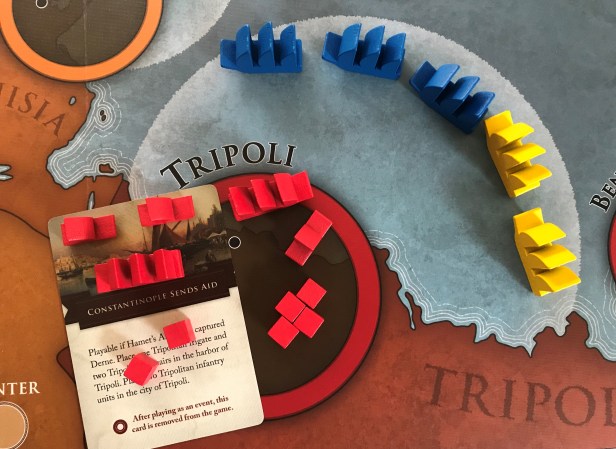
Core Event Cards begin the game face-up in front of the player and do not count against the eight-card hand limit. Core Cards may be played in place of a card in hand at any time during the player’s turn for their event and then are permanently removed from the game. The Constantinople Sends Aid Core Event Card has a condition that must be met in order to be played and that is that Hamet’s Army has captured the city of Derne. This means that this card will have to wait to be played until at least after the Spring of 1804 or even later as the American player must play their Hamet’s Army Created Core Event Card and then invade Derne which will take a turn or two after the Core Event Card is played. This card is a last ditch effort to stop the Americans as they make their eventual drive on Tripoli. The addition of 1 Tripolitan Frigate and 2 Corsairs will beef up the naval defense of the port and the addition of the 2 Tripolitan Infantry in the city of Tripoli will aid in staving off Hamet’s Army.
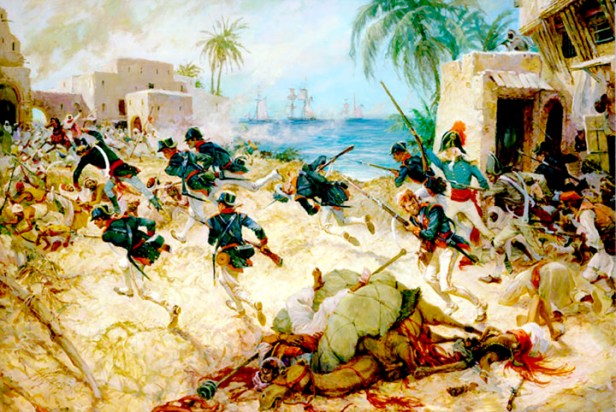
The Constantinople Sends Air Core Event Card is somewhat of an ahistorical event, meaning that it was possibly available if necessary but the anticipated invasion of Tripoli Harbor by the forces of Hamet never occurred. Following the fall of Derne, Hamet Karamanli’s forces held the city and planned to press onward toward Tripoli, which put immense psychological and political pressure on the ruling Bashaw Yusuf Karamanli. But, before a full-scale assault on Tripoli could take place, U.S. Consul General Tobias Lear negotiated and signed a peace treaty with Yusuf Karamanli in June 1805 effectively ending the First Barbary War. The treaty secured the release of American hostages from the USS Philadelphia in exchange for a ransom, ending the military campaign. U.S. forces secretly evacuated Derne, abandoning Hamet Karamanli’s push to take Tripoli and returning him to exile.
Lieutenant Presley O’Bannon at Derne. Painting by Charles Waterhouse.
In the next entry in this series, we will take a look at Austrian Leader Klemens von Metternich from Congress of Vienna from GMT Games.
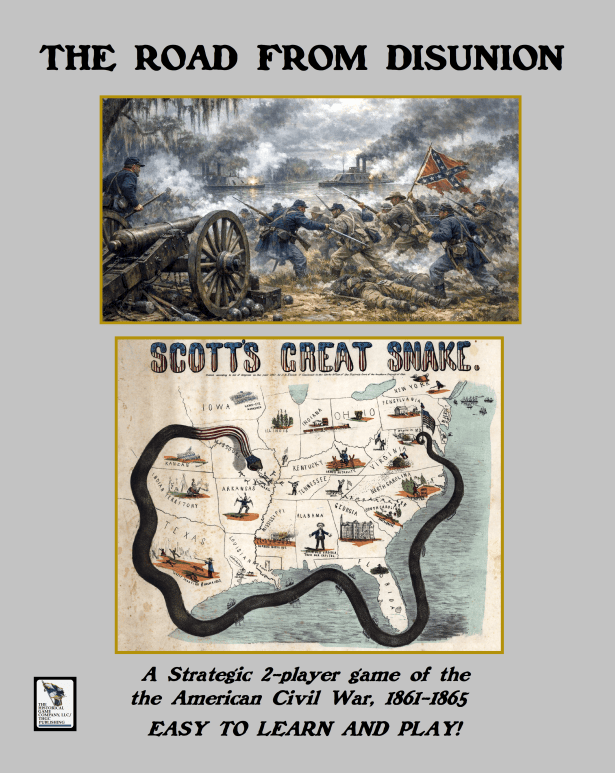
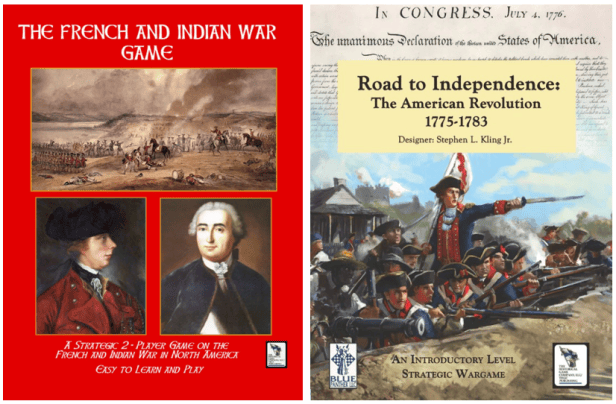
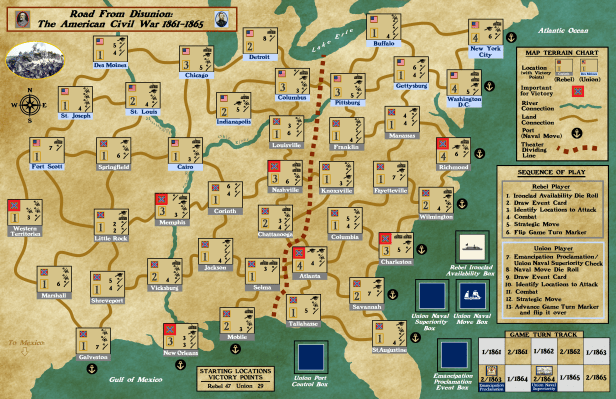
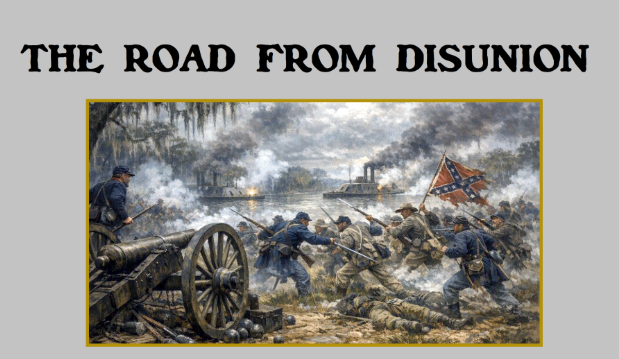
A few years ago, we played a very interesting game designed by Stephen Kling of The Historical Game Company called Road to Independence: The American Revolution, 1775-1783. The game covers the entirety of the American Revolutionary War, including the various campaigns and skirmishes on the frontier, and uses custom battle dice. That game was the 2nd volume in that series and recently I heard that Stephen was working on the next volume set in the American Civil War called Road from Disunion: The American Civil War, 1861-1865. We reached out to the designer and he was more than willing to take the time to answer our questions on the game.
Grant: Stephen welcome back to our blog and thank you for being interested in sharing. What is your upcoming game TheRoad from Disunion about?
Stephen:The Road from Disunion: The American Civil War, 1861-1865 is an introductory level wargame covering the American Civil War using the system I designed and used for several previously published games, which were dice rolling games of conquest using special dice, including The French and Indian War published by The Historical Game Company and Road to Independence published by Blue Panther. The game is a strategic level look at the American Civil War and covers all of the major theaters of the war from its outbreak in 1861 to its conclusion and Lee’s surrender at Appomattox Courthouse in 1865.
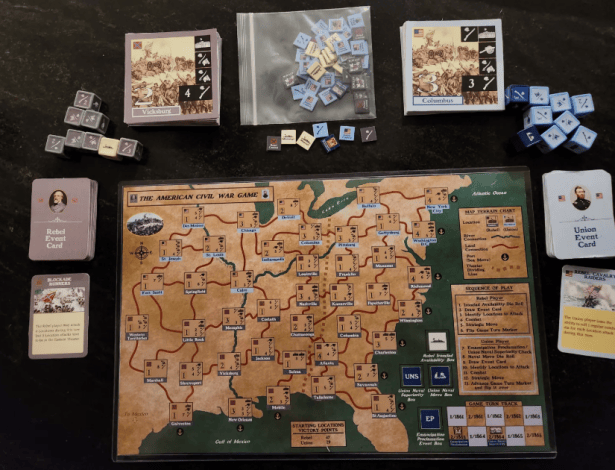
The map contains 42 different locations, some of which count toward meeting victory conditions. Custom dice are rolled matching symbols on the dice with those required to conquer each location and its defenses. Event cards are also included that add in some of the historical elements to the conflict and vary play from game to game. This is a follow up game to Road to Independence and uses similar concepts and game mechanics.
Grant: Why was this a subject that drew your interest?
Stephen: I have always had an interest in the American Civil War particularly at a strategic level. It is a massive contest, and I wanted to see if I could design a fun, easy to play game covering the entire war from 1861-1865.
Grant: You are utilizing the same system you have used for 2 games in the past on the French & Indian War and the American Revolution. How did you change the system to take into account the American Civil War?
Stephen: The American Civil War posed some special challenges as I wanted to incorporate concepts like the naval war and what constituted a rebel victory. Special rules were developed for the naval aspects in the game utilizing ironclads for the Rebel player and naval combat for the Union player before an attack by naval move can occur if an Ironclad is located in the Port Location. There are some special rules reflecting the historical constraints as well. As discussed in the design notes, I took a cue from one of the experts who summarized the rebels’ ability to win the war as making it last long enough with enough casualties for the Union to seek peace. A number of these ideas for changes and some others discussed below came about through playtesting.
Grant: What was your design goal with the game?
Stephen: As with the other games in the system, my main goal was to create a light, fun game that could be played in one setting with sufficient political theming. Of course, factoring in rolling special custom dice was always a goal as well.
Grant: What elements do you feel are most important to model or include from the history of the American Civil War?
Stephen: I wanted to allow players to explore various strategic options. There are a number of different strategies the Union player can develop for victory. The Rebel player has the problem of primarily developing a defensive strategy while taking advantage of opportunities to take or retake Union controlled locations to make it more difficult for the Union player to win.
Grant: What major design challenges did you encounter and how did you overcome them?
Stephen: Simply re-skinning the system from the prior games just was not going to work for this design. I wanted to include the ironclads as their role is interesting and could have had a more pronounced effect on the war. Doing that in a way to not add a lot of complexity went through several variations. Integrating some of the aspects of the Eastern Theater and Western Theater ended up in the event cards and simplifying the far west ended up in a Western Territories Location with some benefits based on card play. Simply put, there was just a whole lot of history I wanted to pack into the game without adding a significant amount of complexity. The game also begged for some additional chrome which ended up in some advanced optional rules covering elite units, commerce raiders and Union ironclads.
Grant: What sources did you consult for the historical details? What one must-read source would you recommend?
Stephen: I have a “Further Reading” list in the rules which includes Battles and Leaders of the Civil War in 4 volumes and The Blue and the Gray in 2 volumes for good reading on the entire war. But two of the 8 books in the Further Reading section cover the naval aspects of the war. On that note, I was able to correspond with one of the experts, Professor Neil Chatelain, who gave me some good information on ironclads and in particular the Laird Ironclads building in Great Britain for the rebels and how those ironclads were intended to be used. Of course, it was such an interesting back story, they ended up as a possibility in the game with potential use following their intended use.
Grant: What is the scale of the design? Force structure of the units?
Stephen: The scale is strategic and somewhat abstract. There are no specific army sized units. The entire war is displayed on an 11” x 17” map. There are individual ironclad counters and some strategic defense counters which are essentially garrisons plus control markers. In the advanced rules, there are new “campaign counters” each named for a unit that was elite during the war that can be used for a placement on a Location card to satisfy or help satisfy a required roll, one per theater each turn with a few others depicting further aspects of the naval war and blockade runners. For example, playing one of the blockade runner campaign counters by the Rebel player can result in the loss of 1 attack for the Union player the following turn. The advanced rules not only include the permanent loss of such units if the attack is not successful but the permanent loss of strategic defense counters too if an attack is successful.
Grant: What is the makeup of the various unit counters?
Stephen: Attack counters, strategic defense counters (garrisons), control markers, ironclad counters and a slew of special campaign counters. There are some variant counters too representing armies and navies of England and France.
Grant: What advantages does each side have? How does this change over the course of the game?
Stephen: The Union player has some slightly better Event Cards and gets an additional die upon the occurrence of the Emancipation Proclamation but has the burden of conquering enough victory points and important locations by the end of the game. The Rebel player has enough good cards to muster a good defense and make opportunistic attacks aided by the ability to work on interior lines. The naval game is sort of a mini game within the game which can alter strategy. So, for example, does the Rebel player preselect naval benefit Event Cards and put more emphasis into protecting ports? Too little port protection can trigger a Union special rule whereby the Rebel player loses one attack each turn as long as the specified number of ports are under Union control.
Grant: What is the function of Location Cards?
Stephen: The Location Cards pair with individual areas on the game map but are used primarily for dice rolling and conquest. While the game map is smaller, we added information of the defenses on each Location Card on the corresponding area of the game map to ease analysis for attack considerations.
Grant: Can you show us a few examples and explain how they work?
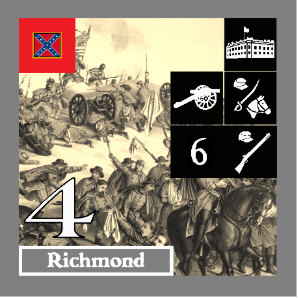
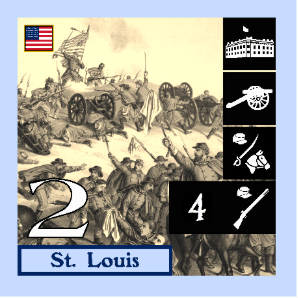
Stephen: Each of the Location Cards has various icons and numbers in black which indicate the defenses that have to be rolled (conquered) during combat. See below for an in-depth description of how combat works. The Rebel flag in red in the upper left hand corner denotes an important Location for victory. As you can see the icons include things such as Artillery (field cannon), a Fortress (building), Cavalry (with a saber in the center of the image and a horse) and Infantry (with a hat and musket). These symbols coincide with the symbols found on the custom combat dice and the player attacking must roll these results on a certain number of dice to conquer or take the Location Card.
Once a Location is attacked and defeated, the physical Location Cards will be collected from the opponent and added to the tableau in front of the attacking player. Then, the player will add their Control Marker to the Location on the Game Board, unless it is one of their starting Locations, at which point no Control Marker is necessary as it is shown in the Location Box.
There are a total of 42 different Locations and each is assigned value shown in the bottom left hand corner for victory purposes and are named after key and important strategic cities during the American Civil War.
Grant: How does combat work?
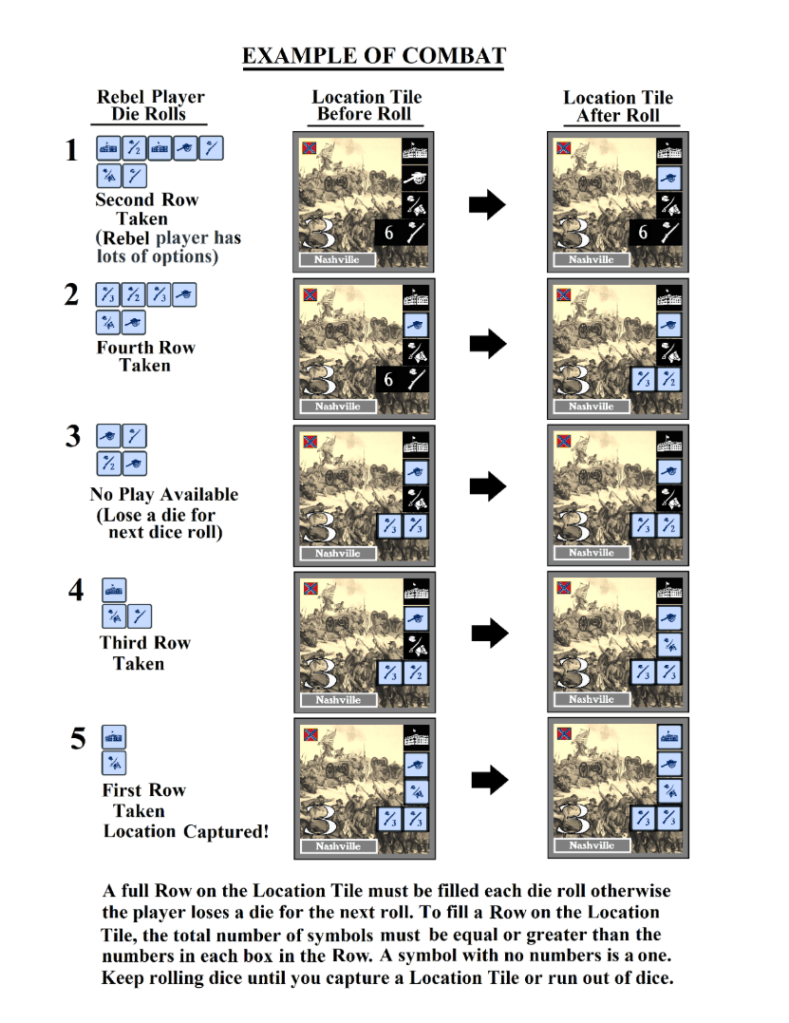
Stephen: Land combat is a function of rolling special dice against each Location selected for attack each turn. The Location must have a connection to a friendly Location unless it is a naval attack against a port Location by the Union player. Naval combat is a bit different and simpler. Here is a graphic from the rules that shows an example of combat.
Grant: What is the makeup of the custom combat dice?
Stephen: There are 17 dice, 7 regular die for each player, an Emancipation Proclamation regular die, 1 Rebel Ironclad Availability die and 1 Union Naval Move die.
Grant: How do Ironclads work? Why were they important to include?
Stephen: Ironclads help protect Port Locations from attack by the Union player by naval move. There can be up to 2 ironclads per Port Location. They are all named for important ironclads, and if eliminated, cannot return to play. They enter play by roll of the Rebel Ironclad Availability die each turn and by Event Cards and are placed by the Rebel player at any available Port Location. They can be eliminated by Union die rolls but if they are not, the attack by the regular die cannot happen and the Union attack is a failure. So, they can make Union naval attacks more difficult. Things like the Union Naval Superiority Event and some Event Cards can soften things up for the Union player as the game progresses. I really wanted this aspect of the war included as it was important and is so interesting.
Grant: What is the makeup of the Event Cards? Can you share a few examples?
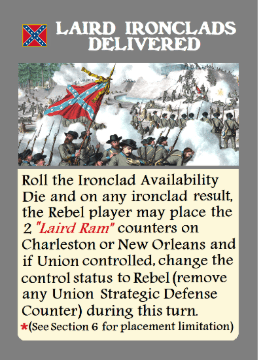
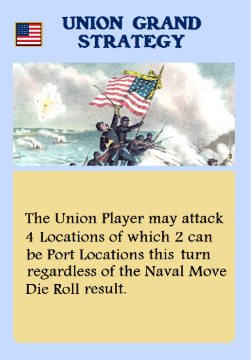
Stephen: These Event Cards do things such as affect attacks and combat in terms of bonuses or penalties and are usually based on historical events. Here are examples of 2 such Event Cards including 1 for the Rebel player and 1 for the Union player.
Grant: I see where players can preselect a few Event Cards. Why was this important to include?
Stephen: It really added to allowing more strategic decisions. Do you select Event Cards that provide benefits in one theater over another, do you select cards that give naval benefits or the possibility of foreign intervention or concentrate on land attacks, etc.
Grant: What is the role of the Emancipation Proclamation and Union Naval Superiority Events?
Stephen: The occurrence of the Emancipation Proclamation Event allows the Union player an additional regular die representing the addition of men of color to the Union army. The Union Naval Superiority Event guarantees a minimum number of naval moves irrespective of the outcome of the Naval Move die roll and a bonus when combating ironclads. These Events are not guaranteed to happen and only happen in the later part of the game if a successful die roll is made on the first and following turns when eligible. There is also a Union Naval Superiority Rule which allows the Union player to cause the Rebel player to lose one attack each turn as long as the Union player controls 6 of the 8 Rebel Port Locations.
Grant: What are Campaign Counters?
Stephen: This is something entirely new. These counters represent elite units, commerce raiders and Union ironclads. One can be chosen for each theater for each game turn. For land combat, they can only be used for 1 Location attack and can satisfy a required die roll (or part of a required roll if multiple infantry are needed) on the Location’s defense. The commerce raider counters can limit Union attacks, and the Union ironclads can aid in naval combat. These units can be lost in game play, so they have to be used judiciously. These counters are optional along with some other rules like Foreign Intervention Counters and are available in the advanced rules. I think they really add to game play and I am in the process of redoing the French and Indian War game in this system adding applicable elements of the underlying concept.
Grant: What area does the map cover? What are the different theaters and how did you decide to split them up in this way?
Stephen: The map covers pretty much the area of the entire American Civil War. As there were differences in the objectives and the way the war was fought, the map was divided into theaters which are mostly important for where certain Event Cards apply. The division was somewhat arbitrary but made to work the best with the Event Cards.
Grant: What do you feel the design excels at?
Stephen: While this game is a bit more complex than its predecessors, most of the additional pages cover the advanced rules and a more detailed section of design notes. I hope this game provides a fun, thematic experience of gaming the American Civil War. My play testers seem to like the ease of play and the dice rolling making it a wargame but one you can enjoy without a big investment of time and learning the rules. In particular, I hope it provides a lot of strategic options and decisions of the type arising in the war while being able to do it in a few hours. Lastly, I hope it encourages players to learn more about this history.
Grant: What other designs are you currently working on?
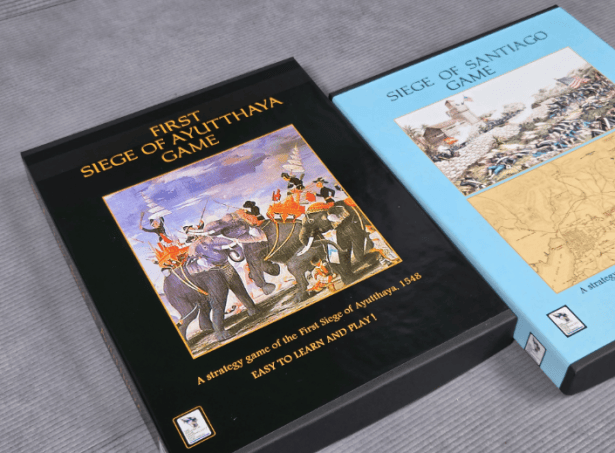
Stephen: As you guys know, I have an extensive line of battle/siege games. I just released 2 new ones on the Siege of Ayutthaya and the Siege of Santiago. The Siege of Plevna should be out by the end of the year and an upgrade or second edition of the French and Indian War using the Road from Disunion enhancements is also in the works. Also, my friend Ed Lengel just published a book entitled Atlas: France’s Wars for Empire and Resistance in North Africa, 1827–1934. I had previously published a game on the Battle of Isly from this period, but his book inspired me to bring my design on the Siege of Constantine to the front of the line which should also be out by year end. My game production has been a bit limited with the publication of my latest book, being the guest curator for the Louisiana State Cabildo Museum for the “Gálvez and Louisiana in the American Revolution” exhibition based on my latest book and being extensively interviewed for a documentary on Spain’s role in the American Revolution, as well as related book and exhibition presentations.
Thank you for the look inside this very cool game on the American Civil War. I can feel your passion for the game and its history and believe that this will shine through in the game play experience. Keep up the good work and we look forward to talking with you about your future upcoming game projects.
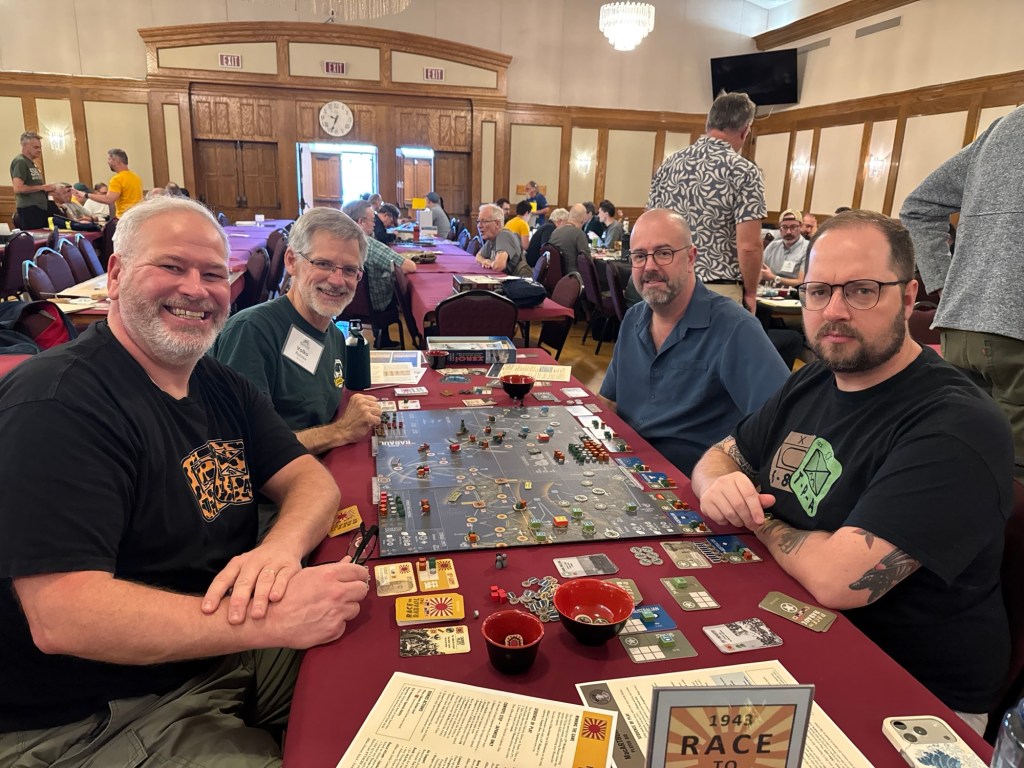
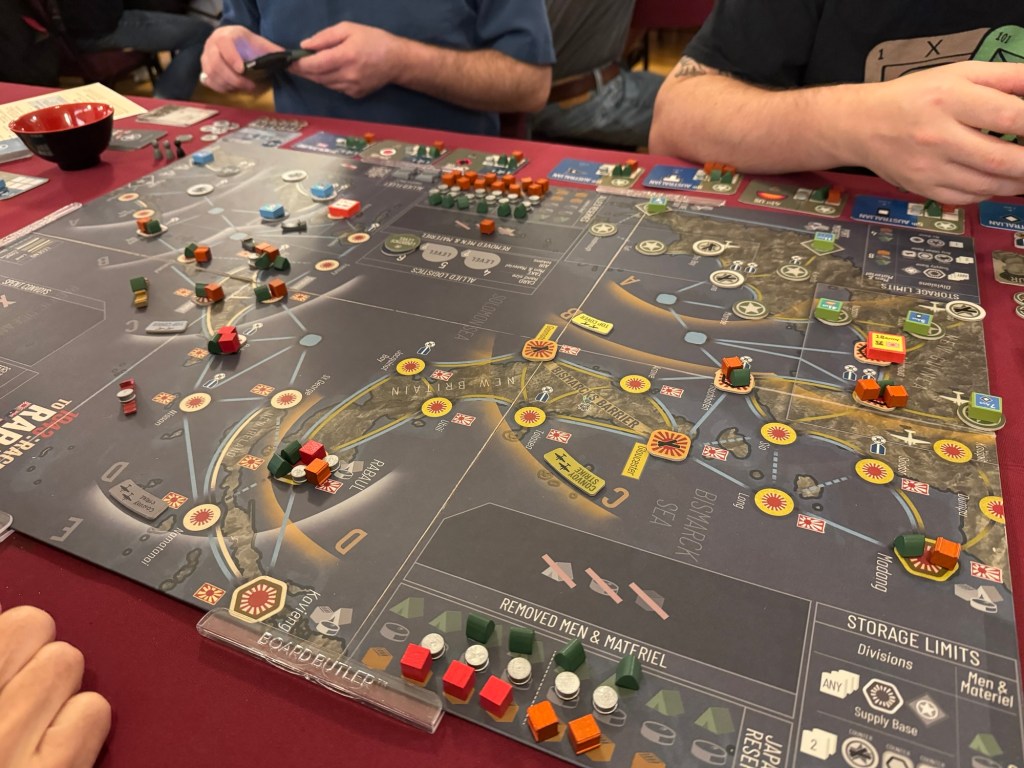
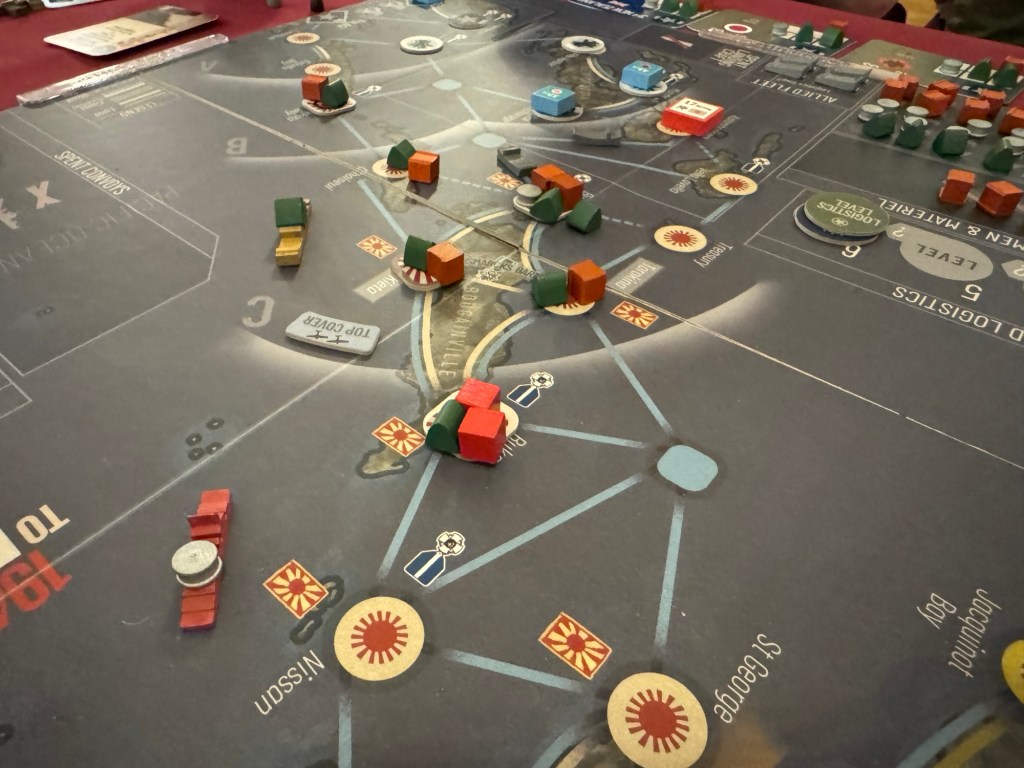
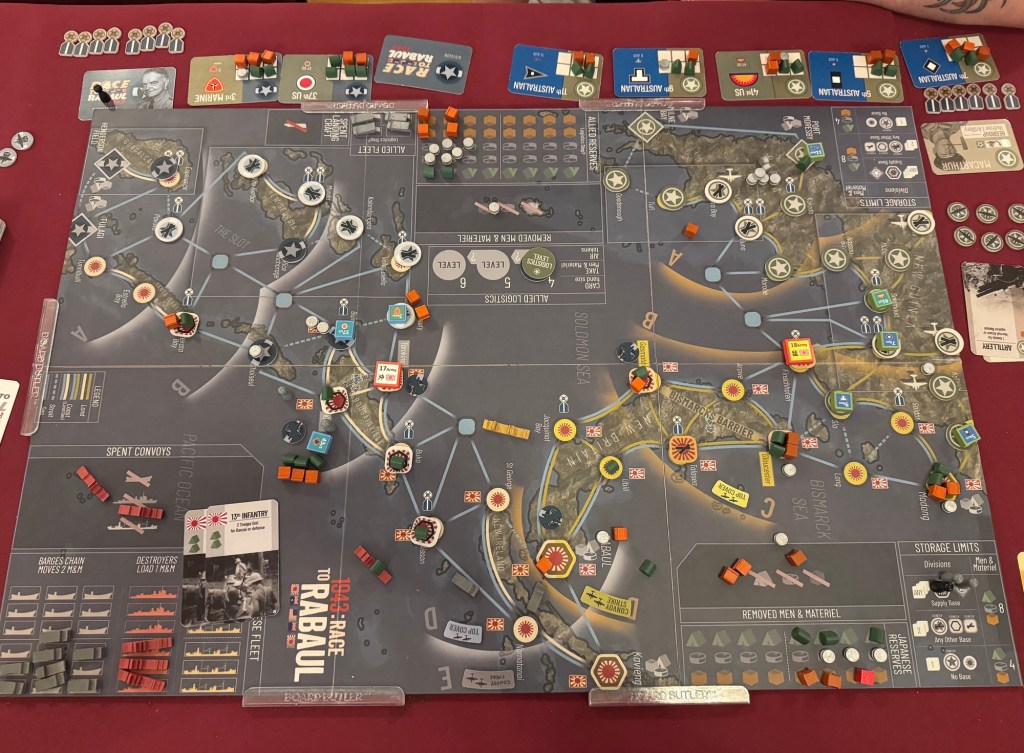
Today was a very busy game filled day. I’m tired tonight so I’m not sure how long this post will be but here goes. We played a total of 4 games today including 1943: Race to Rabaul from PHALANX, Checkpoint Charlie from GMT Games, Coast Watchers from GMT Games and Thirty Years of Misery from VUCA Simulations.
So here is a quick summary of each.
1943: Race to Rabaul is designed by Volko Ruhnke and is a part of Keep ‘Em Rolling Series of logistics focused wargames that includes titles such as 1944: Race to the Rhine and 1941: Race to Moscow. We have played both of the other games in the series but this one is deeper and more involved than the previous volumes. It also feels very much more like a wargame.
The fighting takes place across the South Pacific with the twists that there are 2 teams of players who are fighting each other but also have to contend fur the same pool of supplies and men and have to manage sea, air and land operations.
The Japanese must use Convoys and have to deal Allied Convoy Strikes that eliminate them and the supplies they are trying to deliver. The Allies have it easier as they have an abundance of transports and can move supplies more easily under Air Cover. The problem is that they must take ground and build Air Bases to extend that Air Cover and Convoy Strike range.
Each side has cards that include operations as well as units and these are played to take actions and can be used in battle to increase strength.
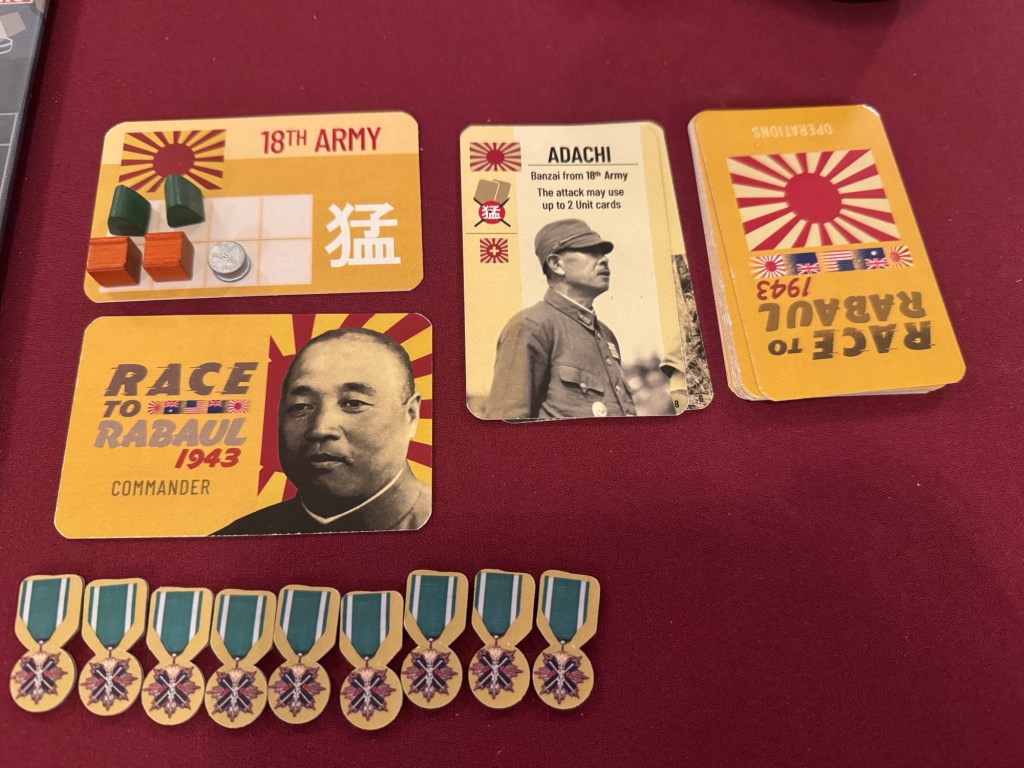
The ultimate goal is to reach a total of 12 medals which come from taking key areas for the Allies and taking Japanese units in battle and for the Japanese preventing the Allies from reaching the Bismarck Barrier and the Japanese causing Allied losses. This one is very well done and we very much enjoyed the experience.
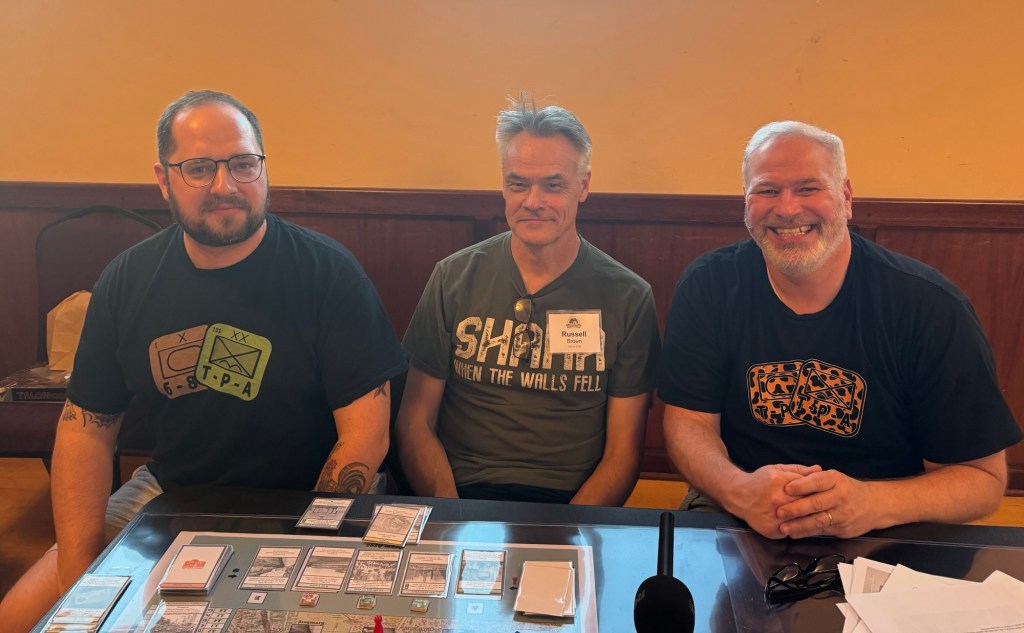
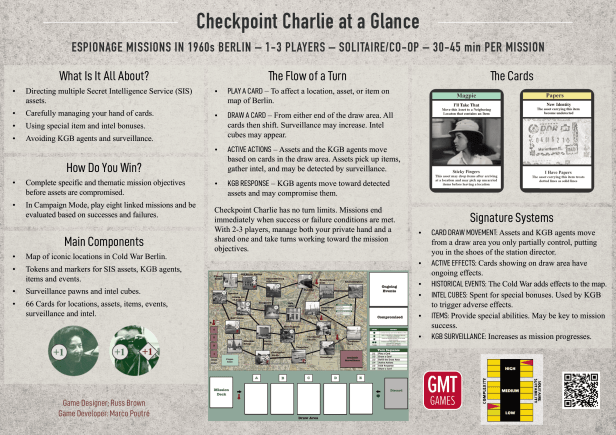
Next up was a look at a prototype game called Checkpoint Charlie with designer Russell Brown and is a solitaire or cooperative game of British Secret Intelligence Service (SIS) espionage missions in Berlin in the early 1960’s.
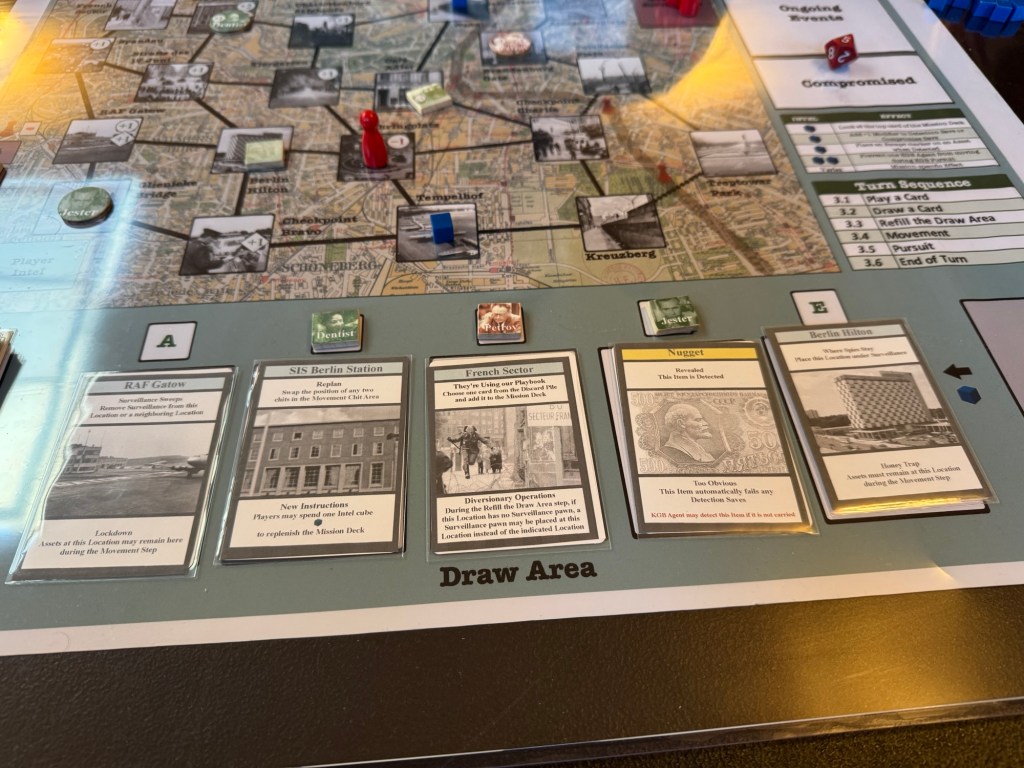
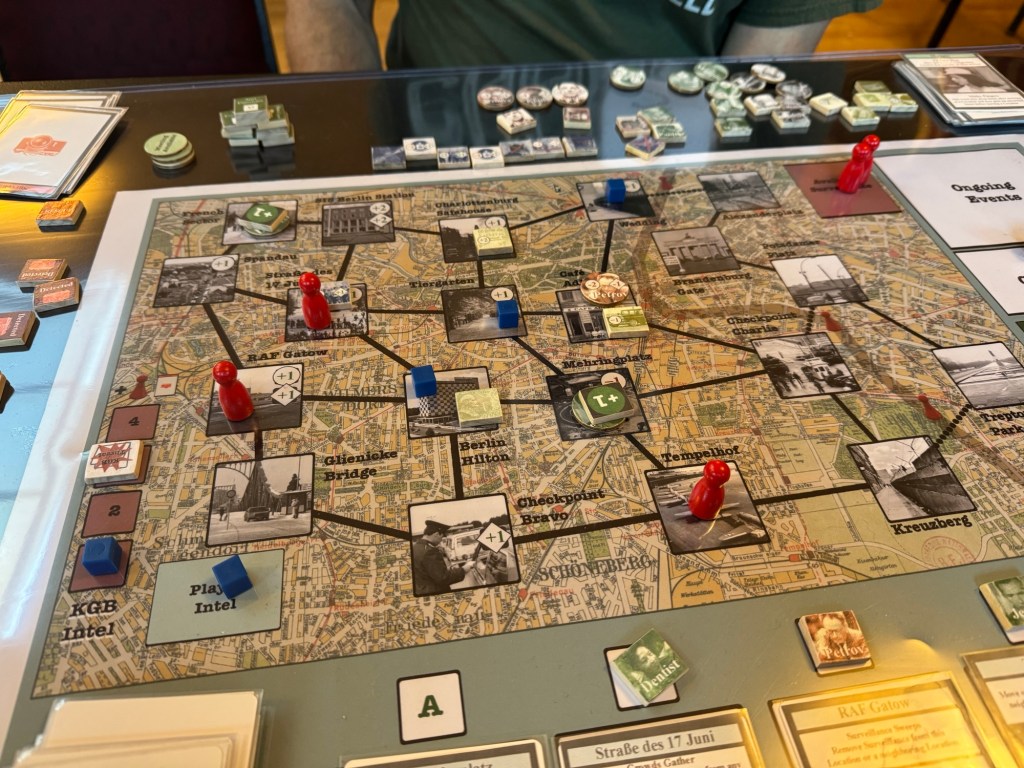
The game is scenario-based, and players must manage a tableau of 5 cards to move their assets and spies around a board showing various locations in Berlin.
Each turn players will draw 1 of the 2 cards on the ends of this row of 5 cards, and then all the other cards shift before refilling the empty position. No card stays in the same location from turn to turn. This is important, because these cards are used to determine where tokens move on the map. Each card location can have a chit above it corresponding to an asset or KGB agent on the map, and every turn, after the cards shift, that asset or KGB agent moves toward the location, item, or asset depicted on the card below their chit. In addition to their role in moving tokens on the map, each card also has an effect printed on the bottom that applies whenever that card is showing in the draw area. As cards are drawn and new cards replace them, these effects come and go and can have significant impacts on the mission.
This is a very good game where players have to plan but these plans are imperfect as you are at the mercy of the lineup of cards. You have to be patient and try to move away from the KGB before your assets are discovered and captured.
We had a great time with this one as we played cooperatively and I think this will be a huge winner.
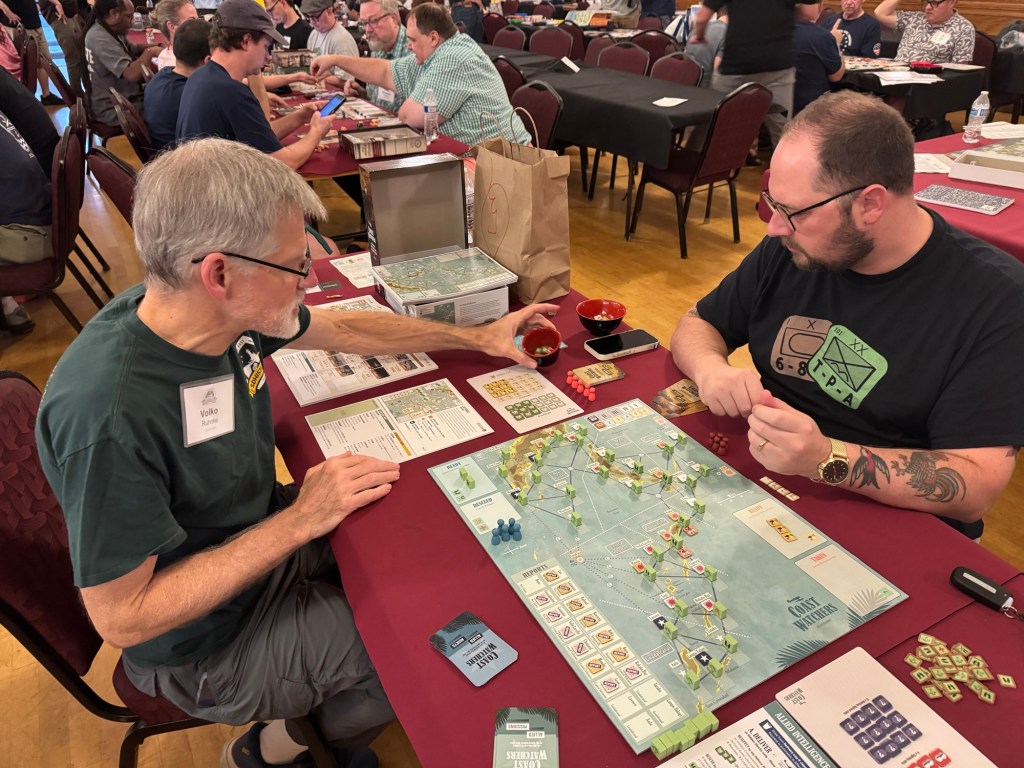
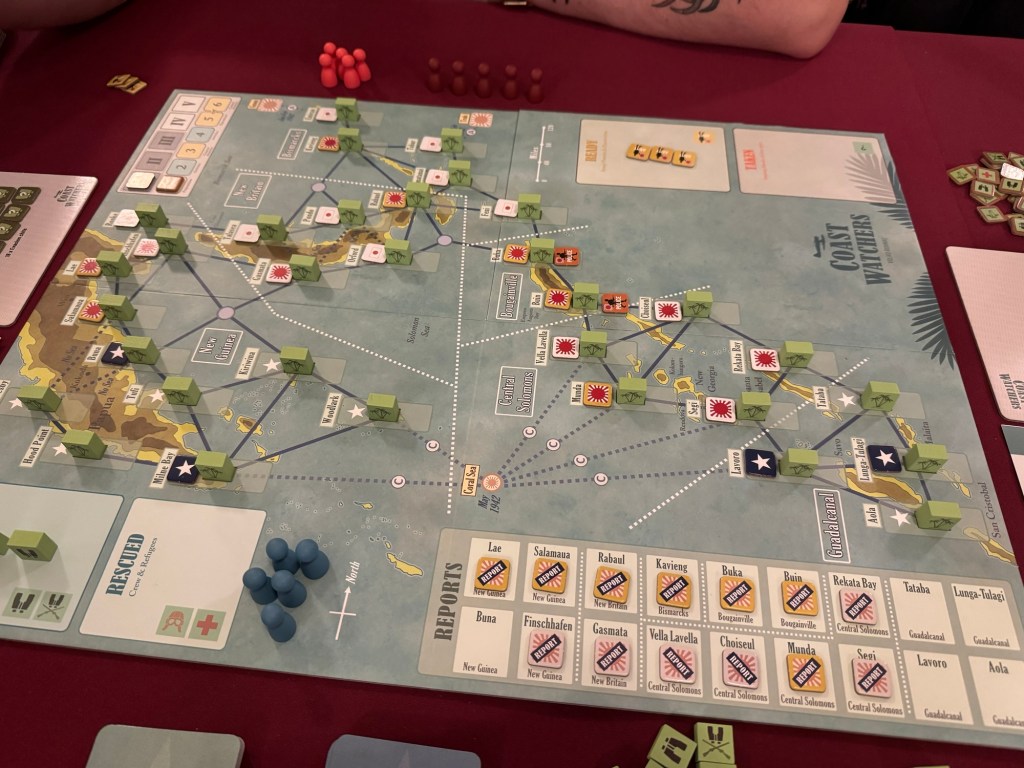
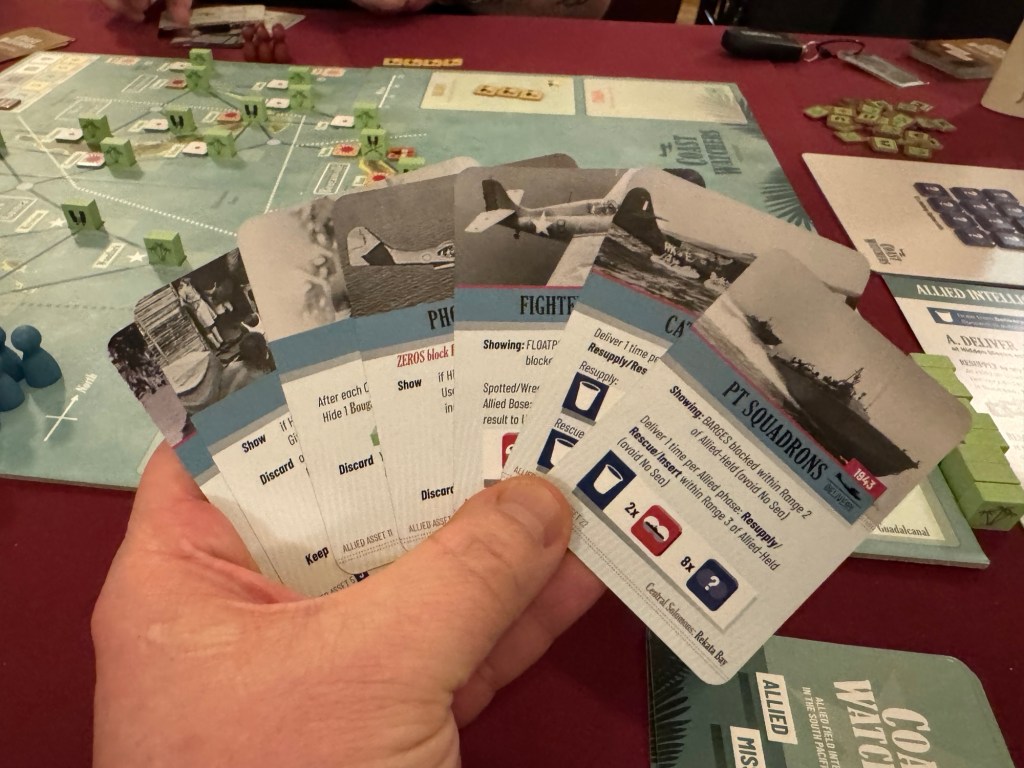
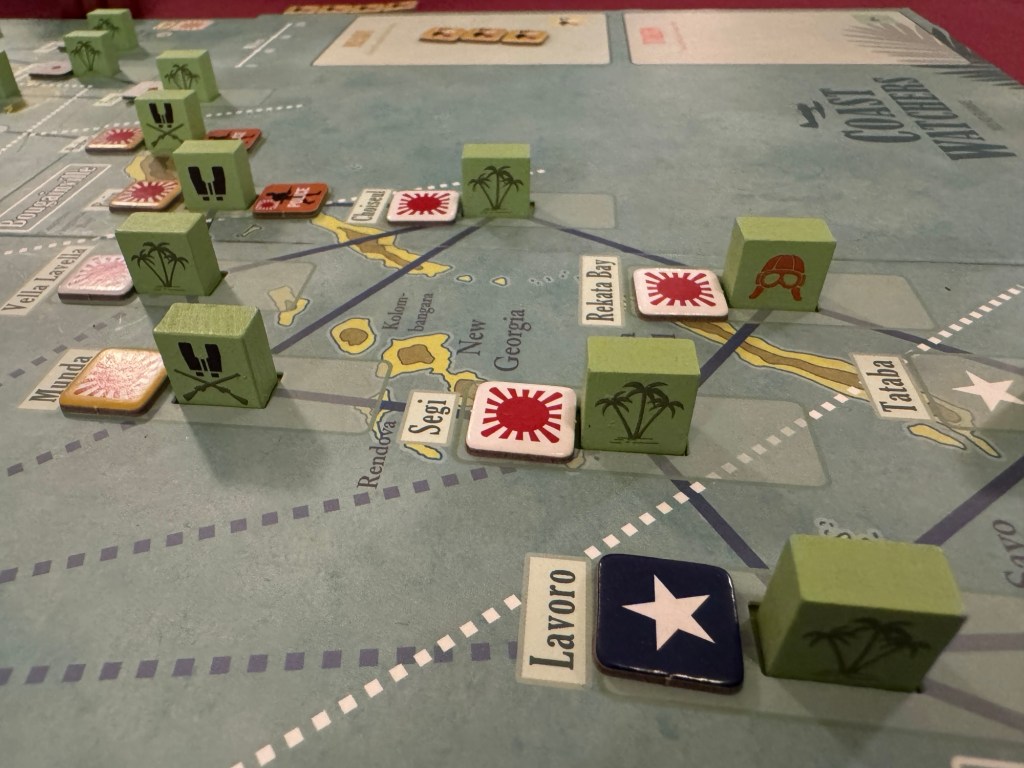
Then we played Coast Watchers from GMT Games with Volko taking us through the game and teaching us. This one was great and I’m looking forward to playing more in the future.
The game is intelligence operations focused with hidden coast watcher units trying to find out information on enemy build-up, movements and to report this information to Allied operations in the South Pacific. The hidden information is via status blocks, secret markers for Japanese movements, blind draw chit cups (Patrol and Delivery) that test success rather than dice and asymmetric objectives.
The game uses cards as well in the firm of missions and assets and players have to choose their cards carefully to be able to have the capabilities and benefits to perform their operations.
I very much enjoyed this one and am still thinking about it several hours later. I think that this one is going to really be a great series as the other games deal with intelligence in different wars and time periods. Just fantastic!
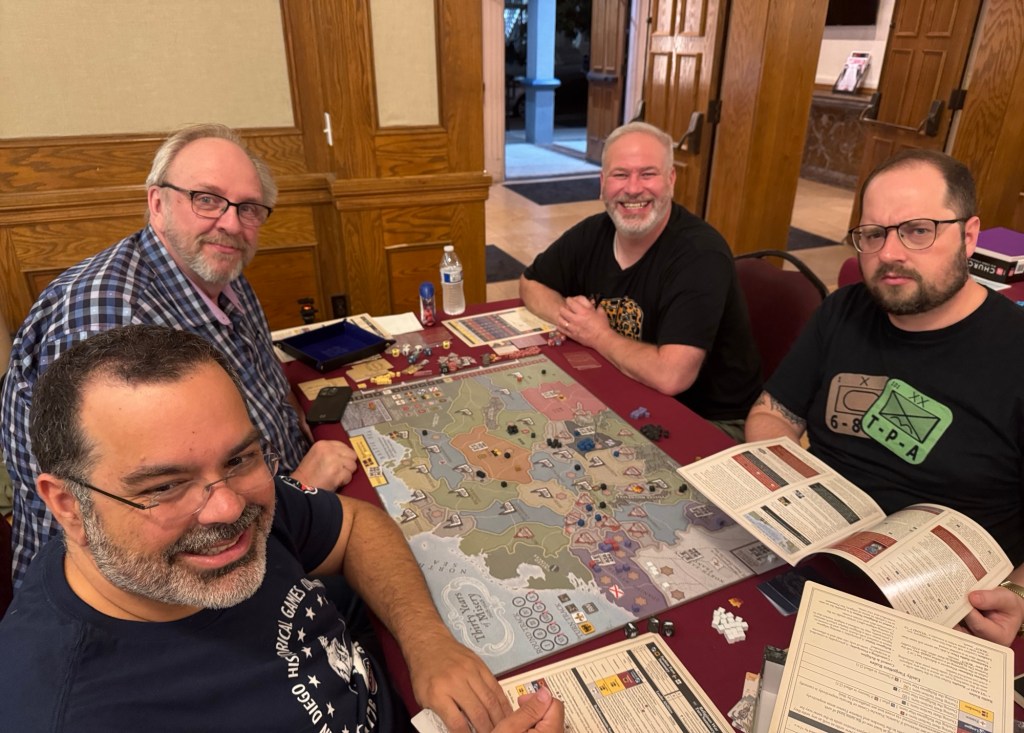
At this point we were tired and enjoyed the USMC birthday celebration and had cake that was cut by a Marine saber. We then played a very short learning game of Thirty Years of Misery from VUCA Simulations.
Th game covers the Thirty Years War of 1618-1648 and plays up to 4 players with 2 teams of 2. Players on the same side, the Imperials or the Protestants, must coordinate and work together to win the war, but the victory conditions only allow a single faction within the alliance to win the game.
The game is card driven and is based on the Birth of America Series from Academy Games. Random chit pull determines turn order and combat resolution uses different custom dice fur each nation.
This is a fun one and it is designed to be very approachable. Simple movement and combat but there is depth here as you have the religious struggle as players can convert spaces and then can lose them later. Lots of fun and we ended up playing just 3 rounds. We will look for a chance to play more in the future.
Tomorrow is our last day and we have a game of The Other Side of the Hill from NAC Wargames planned. See you tomorrow evening!
I love a different style and focus of wargame. A game that takes a look at an important but somewhat obscure or rarely addressed historical topic, such as espionage or intelligence, and creates a gaming experience tailored around the events to highlight and evoke the difficulties and tension that would have been present. In January 2026, GMT Games announced such a game in Checkpoint Charlie, which is a solo or cooperative game focused on SIS espionage missions in Berlin in the 1960’s designed by Russell Brown. We have posted an interview with Russel and it was very well received and he has now agreed to create a series of History Behind the Cards to highlight the events of the 1960’s Cold War struggle in West Germany but also to share aspects about the game play and how it models the history.
*Note: The cards highlighted in this series and their event text, as well as any pictures used showing any of the various components, are still in the design and development process and as such event effects and text might still change prior to final development and publication.Also the art and layout of the cards are only for playtest purposes at this point and the game will enter the art department as it nears publication.
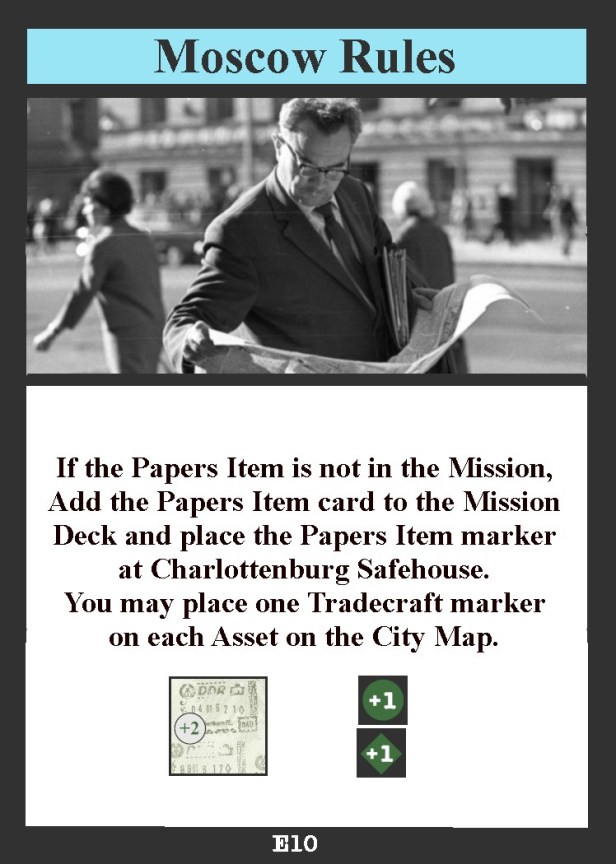
History Behind the Cards – Checkpoint Charliefrom GMT Games – Card #10 Moscow Rules
“Moscow rules meant watch your back. London rules meant cover your arse.”
This quote from Mick Herron’s book, Slow Horses, may be what many people think of when the term Moscow Rules is used today, but there’s a bit more to it than that. Moscow rules were an unwritten set of procedures – spycraft protocols – to keep in mind when operating on the KGB’s home turf. Moscow Rules may have also been used as a cautionary declaration, a spy’s call to arms. In John Le Carrè’s spy novels, George Smiley lets his colleagues know that exceptional caution is warranted just by saying, “Moscow Rules.”
Moscow Rules could include communicating with extra caution, or in code. It could mean keeping a better eye out for someone following you, or being ready to defend yourself. But at its core, it meant that you were effectively operating in enemy territory and could no longer trust the people and places you once took for granted.
In Checkpoint Charlie, the Moscow Rules Event Card puts all of your assets on high alert, giving them a Tradecraft Marker if they don’t already have one. It also adds the Papers Item to the Mission, assuming that your assets dig deeper into their resources, perhaps pulling out old false identities reserved for emergencies. If you’re playing the campaign game, the Moscow Rules Card is not removed when it occurs, so it can show up on almost any mission.
In the next article in this series, we will take a look at ________.
In my opinion, this game looks extremely interesting and I am very much excited to learn more about it. I am appreciative to Russell and his efforts to bring us these cards and to write these entries to share with our readers. I am also very glad that this topic is being covered in a game and look forward to playing this one day soon.
AI giant Anthropic has introduced new restrictions which attempt to stop its Claude coding software from recreating existing games, amid generative AI providing the capability to quickly spin up unauthorised digital clones and reskins.
The changes were spotted in Claude Code’s instructions around October 27, with two new sentences telling the software: “Do build original games, games in a genre, and games from the user’s own designs and assets”, and “Don’t build a recreation of a specific existing game, even if it is renamed or called original”.
Anthropic technical staff member Addy Osmani confirmed the changes in a post on X, saying the company had introduced the restrictions because using Claude to infringe intellectual property rights was already against its usage policy.
Board games are vulnerable to AI-generated imitations because their underlying gameplay mechanics generally cannot be protected by copyright – while generative AI also makes it easier to reproduce those systems digitally, and create alternative imagery and text without directly copying the original game’s protected material.
Unauthorised online versions of board games are not a new phenomenon, with publishers having faced challenges controlling digital recreations of their titles long before AI coding tools became widely available. But generative AI potentially makes such recreations much easier to produce, lowering the technical expertise, time and cost needed to turn an existing tabletop game into a playable digital version.
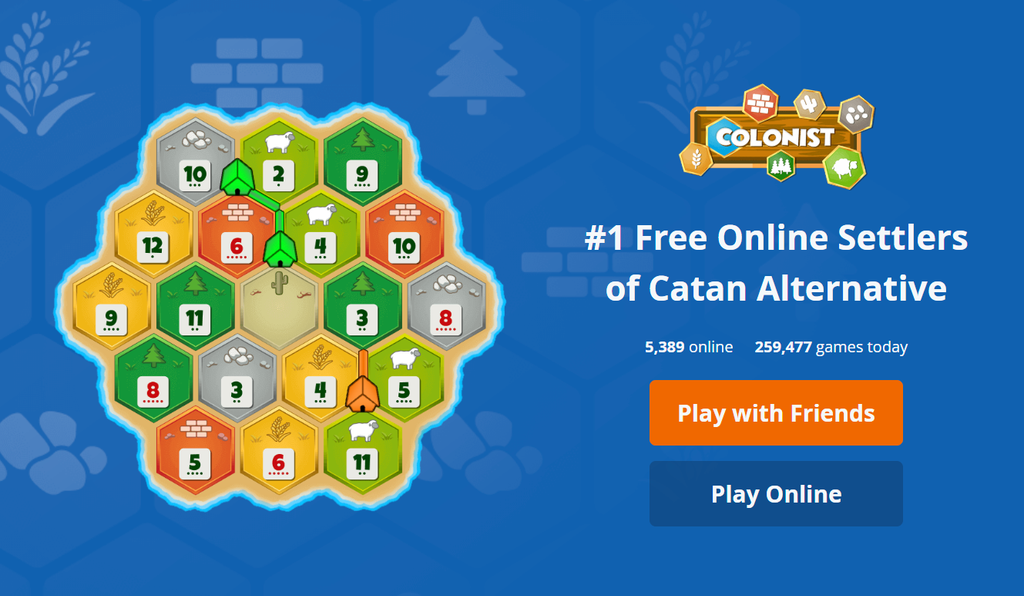
Colonist.io, which was launched in 2017 as Katan.io before rebranding in 2019, openly markets itself as a free alternative to Catan, closely reproducing the original game’s rules, gameplay and visual layout while using different artwork. The platform reported 60 million games played and 3.6 million active players across 2025.
Colonist.io states clearly on its website that it has no association with Catan, and argues that its game is legal under US law, citing guidance from the US Copyright Office that gameplay methods cannot be protected by copyright.
A 2022 study published in the Iowa Law Review highlighted the Catan rights holders’ apparent decision not to pursue legal action against Colonist.io, contrasting it with an earlier incident in which an Android imitation called Island Settlers was withdrawn following a cease-and-desist notice from Catan’s lawyers in 2011.
The new restrictions have already affected attempts to recreate published tabletop games, including a Claude Code user who reported being refused help to build a private online version of an unnamed, commercially released co-op board game.
The user wanted to create a password-protected version allowing friends to play remotely, including one unable to attend in-person sessions, and to introduce AI-controlled players to study the game’s strategy.
Claude refused despite the user specifying that the adaptation would not be publicly distributed, instead offering to help develop an original game using similar co-op and limited-information mechanics.
A separate complaint came from wargame publisher Raymond Weiss, whose Conflict Simulations business has released around 30 tabletop titles since 2017- including three nominees for the Charles S Roberts Awards, one of the longest-running awards honouring conflict-focused tabletop games.
He reported on GitHub that Claude Code had begun refusing to continue work on adaptations it previously supported, although he acknowledged that he did not hold licences from the publishers whose games were being adapted.
The restrictions are, of course, limited to Anthropic’s own software. In a November 2 blog post, Weiss said he had already resumed the work interrupted by Claude’s refusals using rival AI coding tools OpenAI Codex and Kimi.
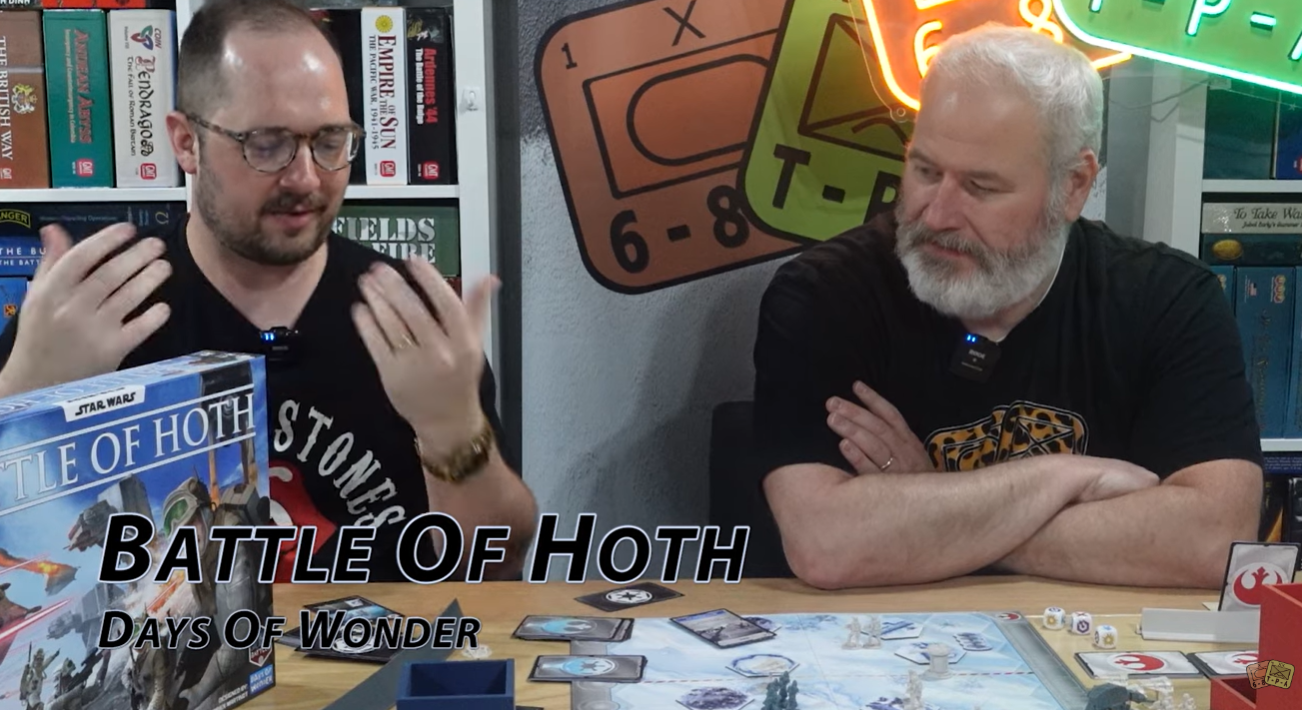
Star Wars: Battle of Hoth is a fast-paced, tactical miniature board game designed by Richard Borg and Adrien Martinot that is a part of the Commands & Colors Series. The game uses cards that will activate units in a certain area of the board, which is divided into 3 areas, to move, attack or perform a special action or ability. The object of the game is usually to be the first to claim a set number of victory medals (usually 4 to 5, depending on the selected battle scenario’s victory conditions). In Battle of Hoth a victory medal is gained for each enemy unit entirely eliminated from the battlefield. Each medal won this way is designated by placing the last miniature of the eliminated unit on any of the available medal stands located on the bottom left of each side of the board. In some scenarios, additional medals may be gained from the board itself, for capturing or holding certain terrain hexes or battlefield objectives. Some scenarios may outline special victory conditions, described in the scenario special rules section.
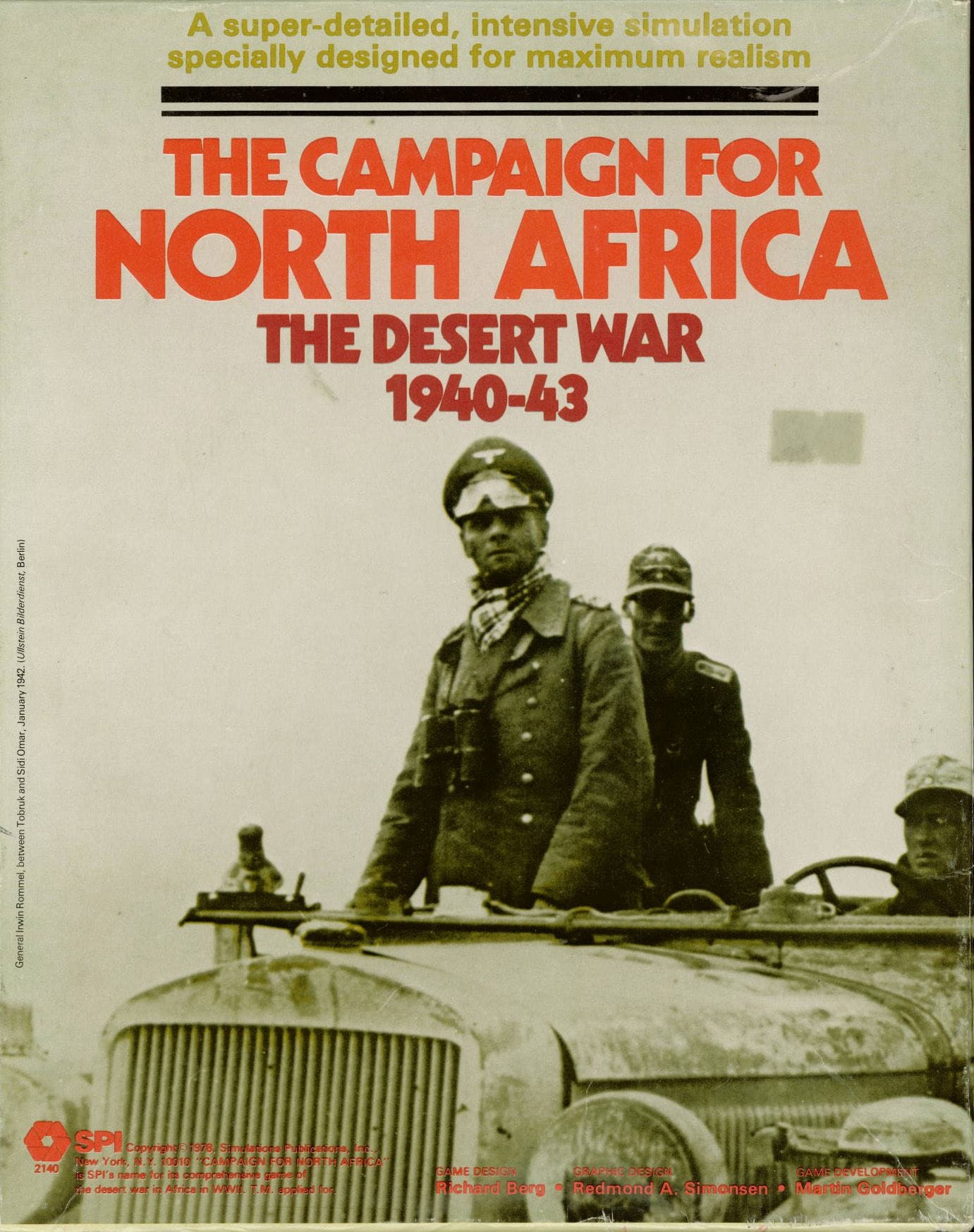
Am 30. Oktober 2026 haben die britischen Podcaster James Purcell und Andy Taeger („War With A Mate“) laut Newcastle Times die echte, 111 Züge umfassende Kampagne von „The Campaign for North Africa“ begonnen, einem bei SPI erschienenen Wargame von Richard H. Berg, das als eines der kompliziertesten Brettspiele überhaupt gilt. Als Erscheinungsjahr nennt BGG 1979, beide Pressequellen unabhängig voneinander dagegen 1978, eine der beiden Angaben dürfte falsch sein. Der Start fiel bewusst auf die 100. Episode ihres Podcasts. Vorab zur Einordnung: Das Spiel ist nie auf Deutsch erschienen und bleibt ein rein englischsprachiges Original, hier geht es um ein internationales Kuriosum für die Wargaming-Szene, nicht um eine deutsche Lokalisierungsmeldung.
Zehn Rollen für ein Spiel, das zwei Leute spielen
Laut BoardGameGeek sieht das Regelwerk pro Seite fünf eigene Kommandorollen vor, vom Oberkommandierenden über Logistik-, Hinterland- und Luftkommandeur bis zum Frontkommandeur, zusammen also zehn Spielende. Verfolgt werden einzelne Flugzeuge und Piloten über die gesamte dreijährige Kampagne, dazu laut Backseat Gamer eine Treibstoffverdunstung von 3 Prozent pro Zug (7 Prozent bei britischen Einheiten) und italienische Nachschubtruppen, die eigens Wasser für die Nudelzubereitung mitführen müssen. Das Material umfasst rund 1.600 bis 1.800 Zähler, fünf Karten von knapp drei Metern Gesamtlänge und, je nach Zählweise, fünf Regelhefte (laut der Website des Duos) oder sechs Regelhefte mit zusammen etwa 200 Seiten (laut einer anderen Zählung). Purcell und Taeger spielen trotzdem zu zweit, mit Magneten, eigenen Tabellenkalkulationen und durchsuchbaren PDF-Regeln als Abkürzung für die fehlenden acht Mitspielenden. Backseat Gamer beschreibt das Spiel wörtlich als „Bergs 1978er Monster für Simulations Publications“, ein Name, der die schiere Dimension des Projekts unterstreicht.
Fast zwei Jahre Training für sechs von 111 Zügen
Vorausgegangen war laut Newcastle Times eine 18-monatige, laut Backseat Gamer eine 20-monatige Testphase mit einem Übungsszenario über sechs Züge, das unentschieden endete. Für die restlichen 105 Züge der echten Kampagne rechnen die beiden nach eigener Aussage mit rund 20 Jahren: „We'll be 20 years older [...] this game is going to be a constant through that“, sagt Purcell laut Newcastle Times. Backseat Gamer kommt mit einer eigenen Hochrechnung aus dem bisherigen Tempo auf eher 30 Jahre, eine der beiden Zahlen dürfte sich als treffender erweisen, keine Quelle kann das heute schon sicher sagen.
Eckdaten zu The Campaign for North Africa
Spielerzahl: 8 bis 10 (BGG-Empfehlung), Purcell/Taeger spielen zu zweit mit Vereinfachungen
Spielzeit: rund 1.200 Stunden laut Regelheft bei zehn Spielenden (BGG), Presseberichte nennen bis zu 1.500 Stunden
Alter: ab 14 Jahren (BGG)
Designer: Richard H. Berg
Verlag: SPI (Simulations Publications, Inc.), 1979 laut BGG beziehungsweise 1978 laut beiden Pressequellen, nie auf Deutsch erschienen
Komplexität: 4,74 von 5 (BoardGameGeek), einer der höchsten je vergebenen Werte
Kampagnenlänge: 111 Züge (ein Zug entspricht einer Woche Kriegsgeschehen 1940 bis 1943)
Lohnt sich das als Kuriosum?
Für uns ist das vor allem eine Geschichte über Besessenheit, nicht über ein Spiel, das man sich ins Regal stellt: Ein seit Jahrzehnten vergriffenes, nie lokalisiertes Wargame, dessen eigentliche Kampagne laut mehreren Quellen noch nie durchgespielt wurde, wird jetzt von zwei Menschen in Eigenregie angegriffen. Wer wissen will, wie Logistik-Simulation aussieht, wenn sie es ernst meint, findet hier den Extremfall, zum Nachspielen eignet sich das für fast niemanden. Selbst eingefleischte Vielspieler, die sonst jede Regelheft-Dicke als Qualitätsmerkmal lesen, dürften bei fünf bis sechs Regelheften, drei Metern Kartenmaterial und einer Spielzeit in Jahrzehnten an ihre eigene Grenze stoßen. Dass ausgerechnet ein Podcast-Duo ohne die vom Verlag vorgesehenen acht weiteren Kommandorollen antritt, macht die Sache für uns noch sympathischer: Es geht hier erkennbar nicht um den Verlagsanspruch an die perfekte Partie, sondern um den eigenen, über Jahre tragenden Witz zwischen zwei Freunden.
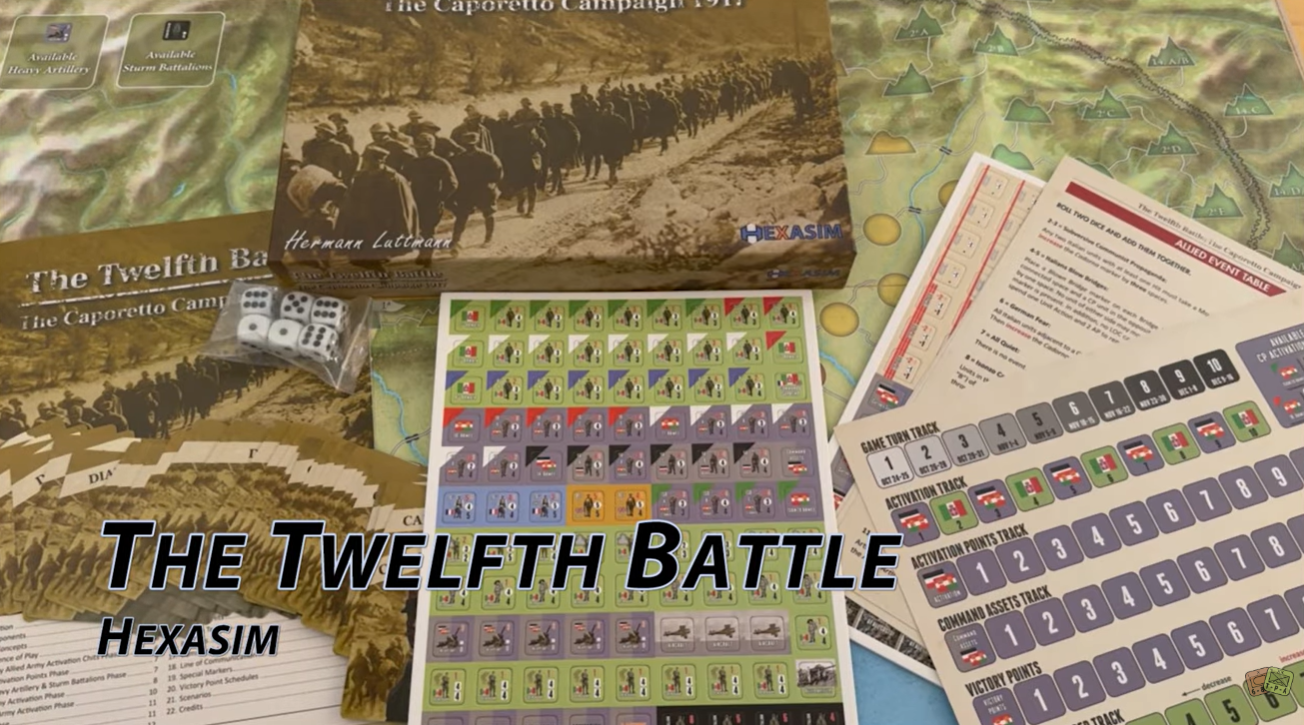
The Twelfth Battle is a solitaire wargame that simulates the Central Powers offensive in Italy that began on October 24, 1917, with an all-out assault around the town of Caporetto. Using gas and stormtroopers, German and Austro-Hungarian formations assaulted the Italian defensive lines along the Isonzo River and around the town of Caporetto, creating a huge breach in their positions. Hundreds of thousands of Italian troops, demoralized and fatigued from the first eleven attritional battles along the Isonzo, were made casualties or surrendered.
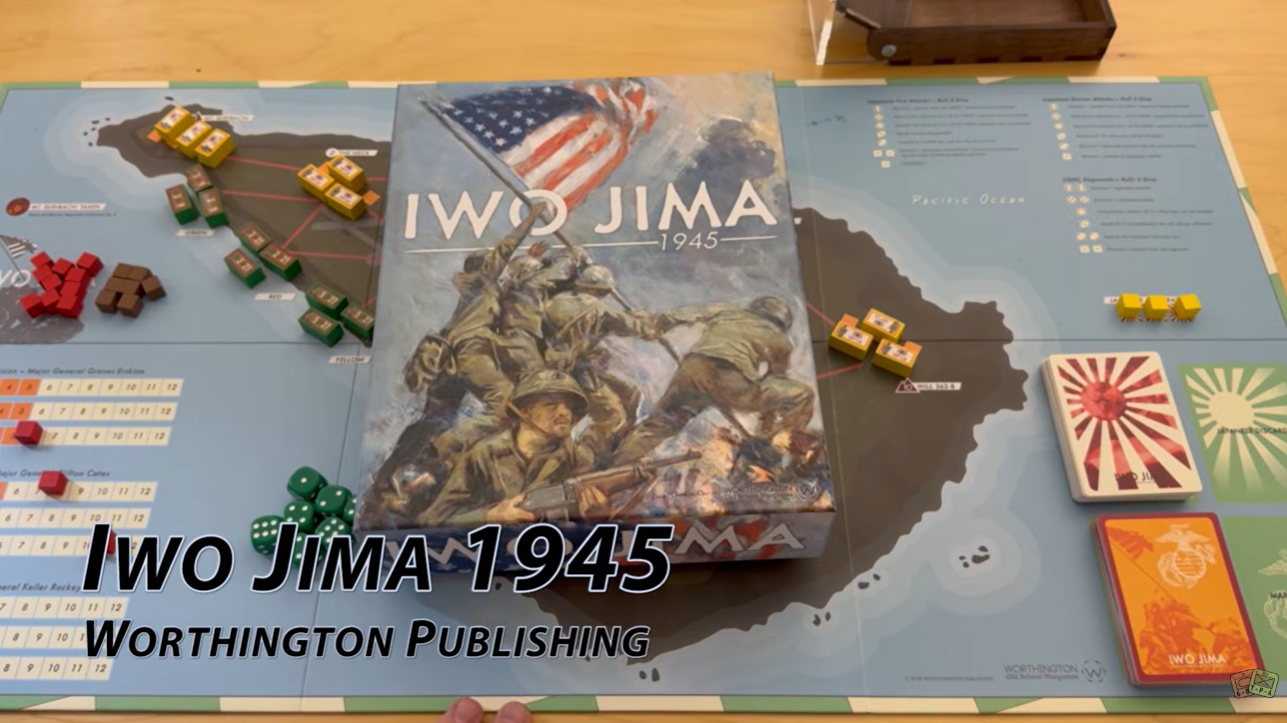
A few years ago, Worthington Publishing published their first game in the Island Fight Series called Tarawa 1943. That game was awesome and was truly difficult to win, as it should be. Now, they have published the 2nd volume in the series called Iwo Jima 1945 that covers the only island assault during the Pacific war that the attacking US forces would suffer worse casualties than the Japanese defenders. On February 19, 1945 the USMC would land 30,000 marines on the island against a Japanese defensive force that numbered roughly 21,000 Japanese soldiers. Facing a Japanese commander who had learned valuable lessons from the losses on other Japanese islands, the USMC would eventually land over 70,000 marines and suffer over 25,000 casualties during the 36 day campaign.
In this solitaire game, the player takes on the role of the USMC commander leading the invasion of Iwo Jima. The game system, driven by cards, will simulate the strategies of the Japanese defenders, often referred to as the Japanese AI, adding a layer of historical authenticity to your gaming experience. If you have played Tarawa 1943, you will be familiar with the system.
With this My Favorite Wargame Cards Series, I hope to take a look at a specific card from the various wargames that I have played and share how it is used in the game. I am not a strategist and frankly I am not that good at games but I do understand how things should work and be used in games. With that being said, here is the next entry in this series.
#100: KSM from Labyrinth: The War on Terror, 2001-? from GMT Games
Labyrinth: The War on Terror, 2001-? from GMT Games is a 2-player asymmetrical Card Driven Game that pits the mighty and powerful United States military and all of its various antiterrorist agencies against the Jihadists in the Middle East whose sole goal is to spread terror, sow the seeds of deceit and ultimately destroy Western civilization. The game is a Card Driven Game where the cards contain Operation Points or Events and each turn the player must strategize and use their cards to their best ability in order to effect the state of the board and further their individual and asymmetric victory conditions. But the game is raw and is tied to the actual events of the early 2000’s as the United States was reeling to recover from the terrorist attacks in New York.
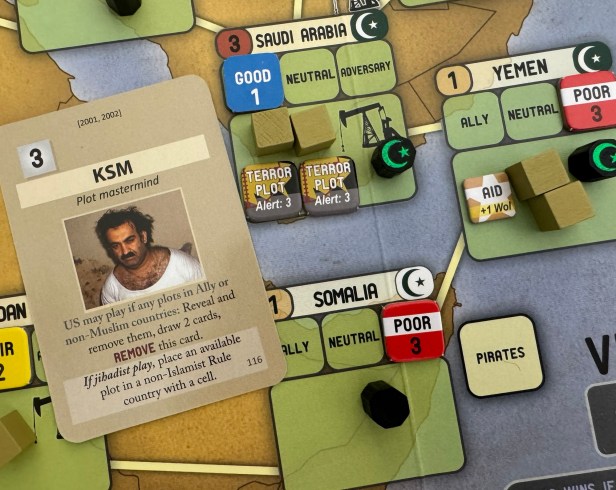
In the game, the Jihadist player is working to destabilize the Middle East through a series of clandestine activities such as destroying stability, toppling governments and forcing the US to react to their actions. One of their biggest strategies is to work to place what are called Plots out on the board in order to destabilize but also to generate local support and funding for their activities from the populace. If left alone, these Plots will go off at the end of a round and cause trouble that will then have to be cleaned up by the US player over the next turn. In order to uncover these Plots, the US player will have to play a 3 Ops card to take the Alert Action and different from most other actions there is no die roll required and the the Plot removal is automatic. But, the cost is steep as a 3 Ops card is pretty rare and spending it on this action is very painful. Jihadists use these Plots to force the US player to have to stamp out fire after fire rather than working to reform and stabilize governments to create allies. And when these Plots appear, the player’s long-term strategy will have to be put aside and a focus will have to change from managing regime change and the Global War on Terror (GWOT) posture to dealing with urgent plots. The KSM card is a very powerful tool in this game as it allows for the US player to remove Plots from an Ally or non-Muslim country but also to replace this investment with drawing 2 cards to replace it. This is specifically tied to the intel that was obtained from the capture of Khalid Sheik Mohammad and how it was then used to defuse several ongoing plots. The Jihadist player also gains a pretty large benefit as they will be allowed to place a Plot Marker into a non-Islamist Rule country with a cell. The process of successfully placing a Plot can be very challenging for the Jihadist player as it takes the play of a card for Operations points, uncovering a cell in a country and then rolling a die equal to or less than that country’s Governance Level to then place a face-down Plot Marker. This takes the need for a roll away and makes the placement of a Plot an automatic success.
I think that one of the other important distinctions and differences with the KSM card is that it is a 3 Ops Neutral Card that can be played by either side but when played by the US player for the event, it will be removed from the game while when being played for the Jihadist portion of the event it will remain and be able to be used in a later turn when it is drawn again. This reflects the important role that KSM played in al-Qaeda’s plans and if allowed to stay at large he will continue to plan and execute plots across the globe.
Khalid Sheik Mohammed was a member of Osama bin Laden’s militant organization al-Qaeda, and was specifically in charge of leading al-Qaeda’s propaganda operations from around 1999 until late 2001. Mohammed was captured on March 1, 2003 in the Pakistani city of Rawalpindi by a combined operation of the U.S. Central Intelligence Agency (CIA) and Pakistan’s Inter-Services Intelligence (ISI). Immediately after his capture, Mohammed was taken to secret CIA prison sites in Afghanistan, then Poland, where he was interrogated by U.S. operatives. By December 2006, he had been transferred to military custody at Guantanamo Bay detention camp. Sensationally nabbed in Pakistan, alleged 9/11 mastermind Khalid Sheikh Mohammed was photographed for the world in a disheveled state immediately after his capture—symbolizing an apparent laying low of the once mighty al-Qaeda network. According to his US captors, he later provided information that thwarted other attacks.
Mohammed is widely regarded as the chief planner of the September 11 attacks. The United States government has alleged that he further participated in planning Richard Reid’s shoe bombing attempt to attack an airliner, the 2002 Bali bombings in Indonesia, the 1993 World Trade Center bombing, the murder of Daniel Pearl and various foiled attacks as well as numerous other crimes. These claims have been criticised by others, such as military prosecutor Moe Davis and journalist Andrew Brown, as inadmissible due to being obtained through torture. He was charged in February 2008 with war crimes and murder by a U.S. military commission at the Guantanamo Bay detention camp, which could carry the death penalty if convicted. A 2008 decision by the United States Supreme Court had also drawn into question the legality of the methods used to gain such admissions and the admissibility of such admissions as evidence in a criminal proceeding.
This image shows Khalid Sheikh Mohammed, the self-proclaimed mastermind of the September 11 terrorist attacks, photographed shortly after his capture during a joint raid in Rawalpindi, Pakistan, on March 1, 2003.
In the next entry in this series, we will take a look at Constantinople Sends Aid Core Event from The Shores of Tripoli from Fort Circle Games.
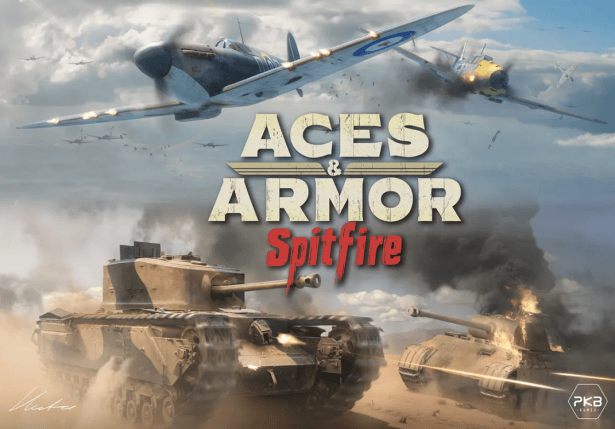
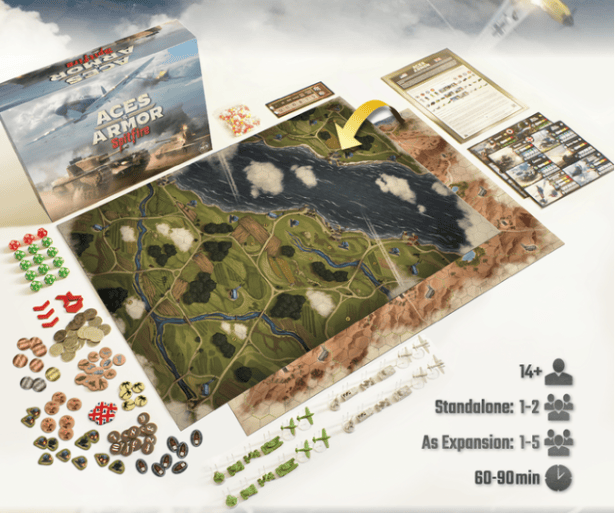
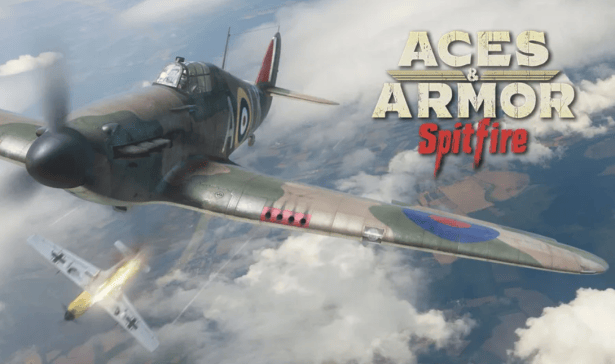
A few years back, we backed a very interesting looking miniatures based board game set in World War II called Aces & Armor from PKB Games. We played it last year and very much enjoyed the combat system as well as the way units gain experience and become more effective. That game did very well on Kickstarter and PKB Games is back with a new addition to the series called Aces & Armor – Spitfire: Battle of Britain & North Africa We reached out to the designer Philipp K. Berger to see if he could give us a look at the game and answer our questions and he was more than willing to accommodate our request.
Grant: Philipp, welcome back to our blog. What is your upcoming game Aces & Armor – Spitfire: Battle of Britain & North Africa about?
Philipp: Thanks for having me back!
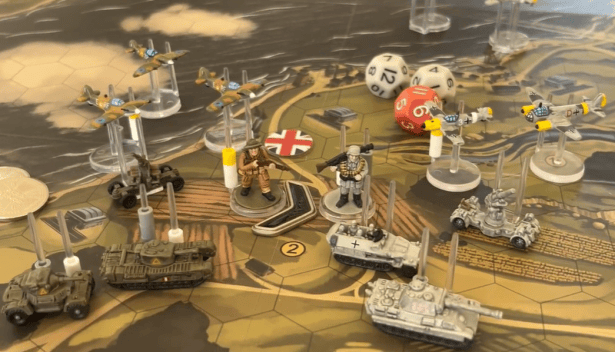
Aces & Armor: Spitfire is a tactical World War II strategy game where players command infantry, tanks, artillery, and aircraft in exciting battles.
This time we’re taking the action to two very different theaters: the Battle of Britain, including the evacuation of Dunkirk, and the North African campaign.
The game combines accessible rules with quite a bit of strategic depth. You need to maneuver your troops, coordinate different unit types, capture strategic positions, and make the most of your resources. Your individual units also gain experience throughout the battle, so a rookie Spitfire pilot might eventually become a highly effective war hero!
Spitfire works as a standalone game for 1–2 players, but you can also combine it with the original Aces & Armor for battles with up to five players.
Grant: Why did you want to take your Aces & Armor System to the skies of Britain and the deserts of North Africa?
Philipp: One of the things I love about the history of World War II is how different the various theaters of war were. The original Aces & Armor focuses on land warfare in continental Europe, while the Battle of Britain and North Africa presented completely different strategic challenges.
The Battle of Britain is particularly fascinating because air superiority was absolutely crucial. Suddenly, protecting airfields, intercepting bombers, and coordinating your fighters become central elements of the game.
North Africa, on the other hand, is all about mobility and logistics. You might have the strongest tanks on the battlefield, but they’re not much use if you’ve run out of fuel and ammunition!
I also wanted to introduce the British as a playable faction. Their iconic units, especially the Spitfire, were simply too good to leave out of the series.
Grant: What is your design goal with the game?
Philipp: My main goal has always been to create games that offer meaningful strategic decisions without requiring players to spend hours studying the rules.
I love complex strategy games, but I don’t particularly enjoy unnecessary complexity. Ideally, players should understand the basic rules within 10–15 minutes while still discovering new strategies after many games.
Another important goal is making every unit feel valuable. I don’t want players to simply throw endless disposable troops at each other. Individual units can gain experience, become more effective, and develop into veterans you really want to protect.
And, of course, the game needs to be fun! Historical accuracy is important to me, but whenever historical detail and enjoyable gameplay conflict, I try to find a sensible compromise.
Grant: How have you modified the Aces & Armor System to tell the story of WWII in the Battle of Britain and North Africa?
Philipp: We kept the core mechanics that players already know from Aces & Armor, particularly the combat system, combined-arms tactics, and individual unit experience.
However, we introduced new gameplay elements to capture the distinctive challenges of each theater.
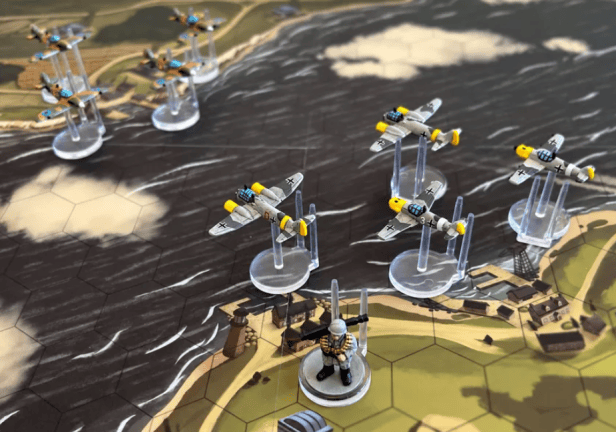
On the Battle of Britain map, aircraft play a much more prominent role. Players fight for control of the skies, defend airfields against bombing raids, and can play scenarios inspired by the evacuation of Dunkirk.
North Africa introduces an entirely new supply mechanic. Your units need access to supplies to operate effectively. This makes supply depots and supply lines strategically important, opening up possibilities such as cutting off enemy forces instead of attacking them head-on.
The result is that the two maps feel quite different, despite using the same underlying game system.
Grant: What elements do you feel are most important to model from the period?
Philipp: I believe it’s more important to capture the strategic realities of a historical conflict than to simulate every technical detail.
For the Battle of Britain, that means air superiority, fighter interception, and the importance of protecting infrastructure such as airfields.
For North Africa, it’s the enormous importance of logistics, mobility, and controlling vital supply routes across a vast desert.
Another major element is combined-arms warfare. Tanks, infantry, artillery, and aircraft become significantly more effective when working together.
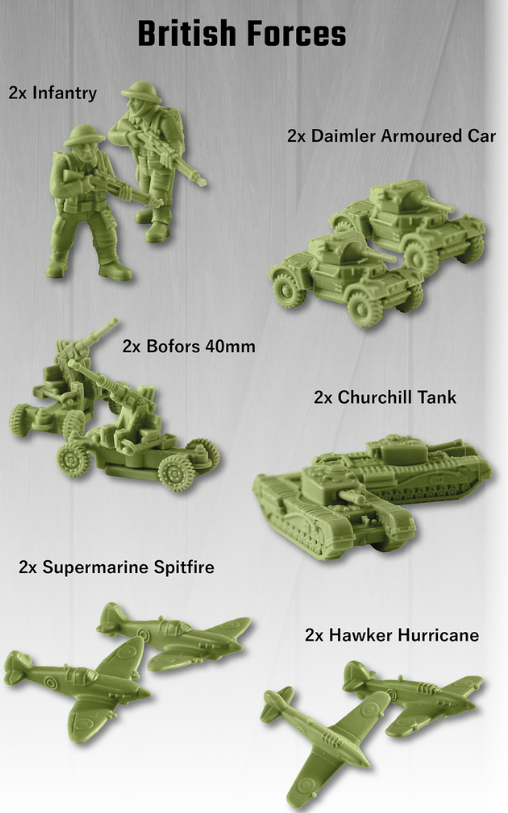
I also wanted the different types of equipment to feel distinct. A heavily armored Churchill tank should play differently from a fast Daimler armored car, just as a Spitfire should serve a different purpose from a Junkers Ju 88 bomber.
Grant: What major design challenges did you encounter and how did you overcome them?
Philipp: One of the biggest challenges was introducing two very different theaters without making the rules significantly more complicated.
For example, supply logistics are fascinating from a strategic perspective, but I certainly didn’t want players to spend half their turns calculating fuel consumption and managing spreadsheets!
The challenge was to reduce these historical realities to mechanics that create interesting decisions while remaining easy to understand and manage.
Another challenge was balancing air and ground combat. Aircraft need to be powerful enough to reflect their historical importance, but not so powerful that ground forces become irrelevant.
I approached both challenges by keeping the successful core mechanics intact and adding specific rules only where they meaningfully change the gameplay. And of course gameplay testing and testing and testing!
Grant: What new units are included in this version of the game?
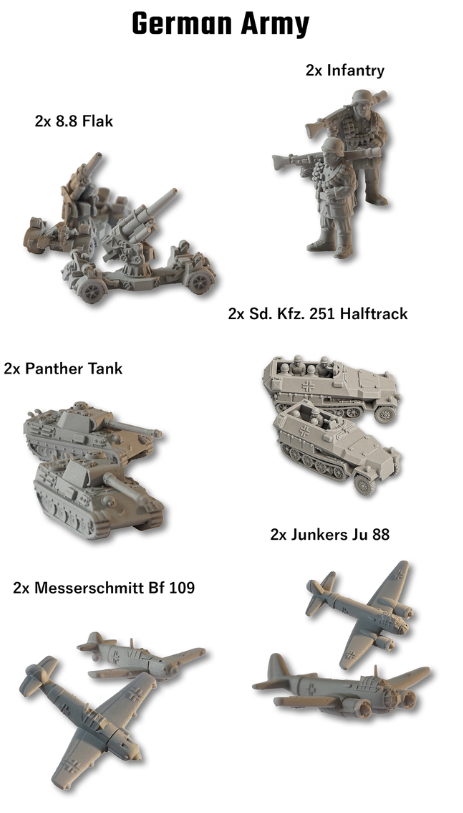
Philipp: Spitfire includes two factions with six different unit types each, represented by 24 detailed miniatures.
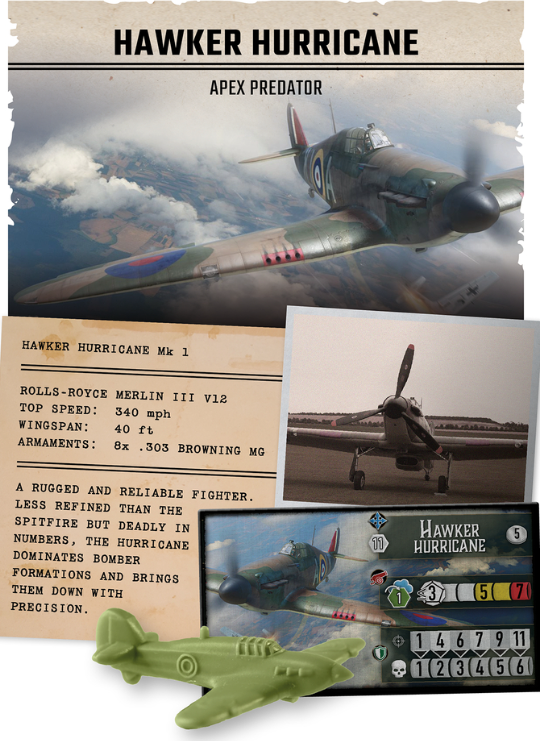
The new British faction includes infantry, the Daimler Armoured Car, the Churchill tank, the Bofors 40 mm anti-aircraft gun, the Hawker Hurricane, and, of course, the legendary Supermarine Spitfire.
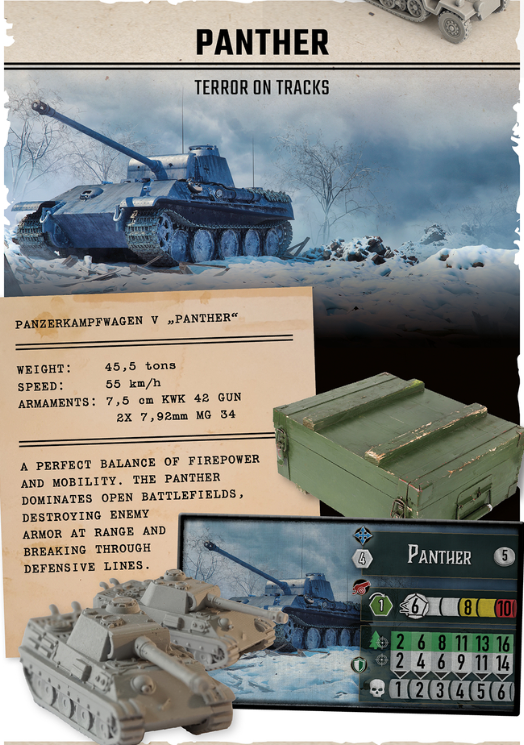
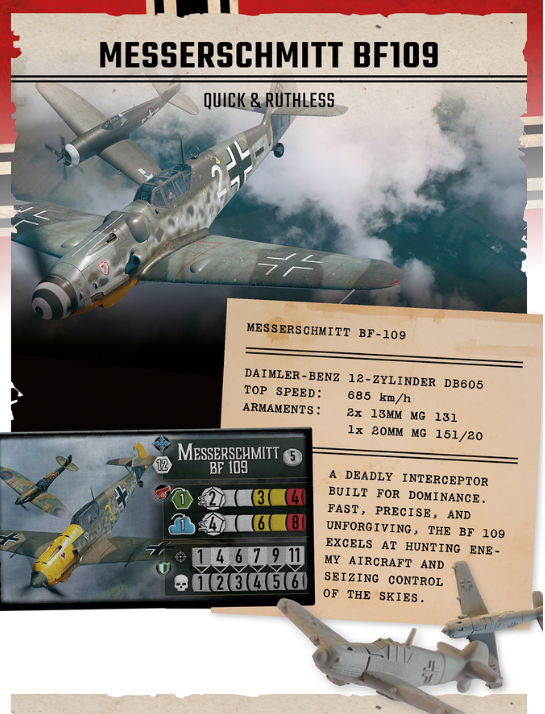
The German faction features infantry, the Sd.Kfz. 251 half-track, the Panther tank, the famous 8.8 cm Flak, the Messerschmitt Bf 109, and the Junkers Ju 88 bomber.
I particularly like the selection of aircraft because it creates some interesting asymmetry between the factions. The British have two different fighter aircraft, while the Germans combine a fighter with a dedicated bomber.
Grant: How have you differentiated the capabilities of the units from those in your great game set in Europe?
Philipp: Every unit has its own characteristics, including movement speed, combat effectiveness, armor, and cost.
The original Aces & Armor includes some powerful late-war equipment, such as the German Tiger tank and Me 262 jet fighter, the American B-17 Flying Fortress, and the Soviet Katyusha rocket artillery.
Spitfire introduces a different selection of units and therefore different tactical possibilities.
The British Churchill, for example, emphasizes protection, while the Daimler Armoured Car provides mobility. The Spitfire is an excellent air-superiority fighter, whereas the German Ju 88 is particularly useful for attacking ground targets.
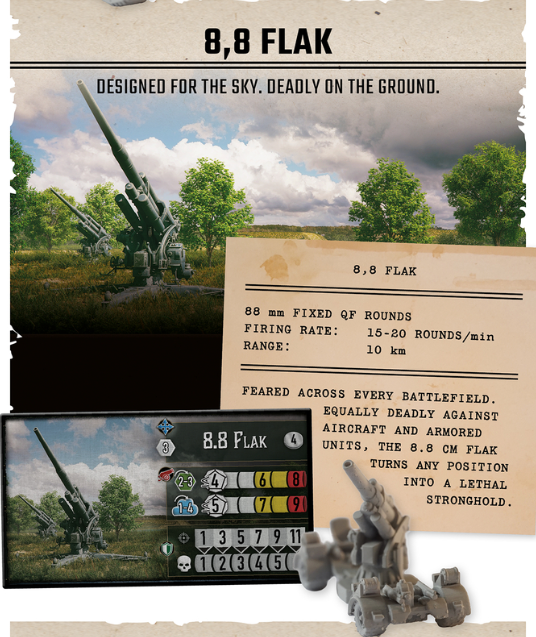
The German 8.8 cm Flak is another very interesting unit because it can threaten both aircraft and armored vehicles.
I wanted each faction to have its own strengths, rather than simply giving every nation the same units with different miniatures.
Grant: How can this game be incorporated into the original Aces & Armor?
Philipp: The two games are fully compatible!
You can play Spitfire completely independently, but you can also combine its factions, miniatures, and gameplay content with the original Aces & Armor.
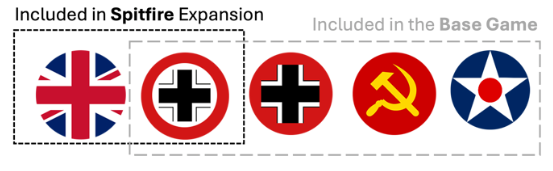
The original game includes American, Soviet, and two German factions. Spitfire adds the British, bringing the total to five playable factions.
This creates opportunities for much larger battles, additional combinations of units, and entirely new scenarios.
I particularly enjoy the flexibility of the system. Players can recreate historically inspired confrontations or experiment with their own hypothetical battles.
Grant: How does the combat system work?
Phlipp: The combat system is probably my favorite mechanic in the game.
Each unit has an individual combat profile that determines how many dice it rolls, its chances of hitting, and how well it withstands incoming fire.
When two units fight, both players can roll their dice simultaneously, provided the defender is able to return fire.
The number of dice depends on how much damage a unit has already suffered. As units take damage, their combat effectiveness decreases. However, as they gain experience, their probability of hitting improves.
Another important element is combined-arms warfare. If your tanks attack an enemy position while supported by infantry, artillery, or aircraft, they can receive additional combat dice.
Finally, terrain and armor determine how much actual damage the hits cause.
So combat involves much more than simply comparing attack and defense values. Positioning, experience, damage, terrain, and supporting units can all significantly influence the outcome.
Grant: What drove your decision to use 12-sided dice for combat? What advantages does this give your system?
Philipp: I wanted a combat system that offers a lot of differentiation between units without requiring complicated calculations.
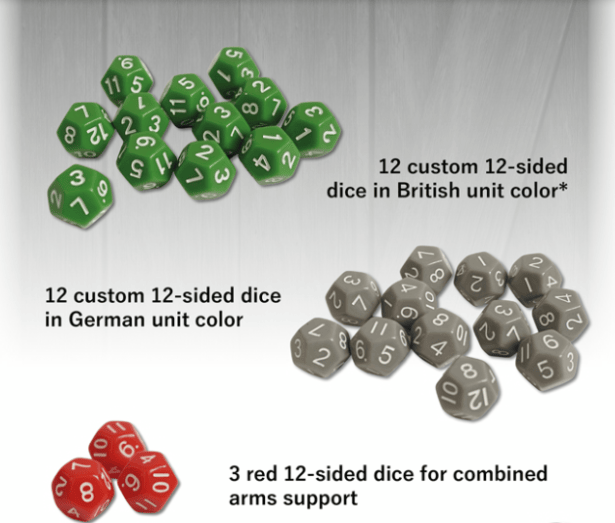
Using 12-sided dice gives us twelve possible outcomes, allowing much finer distinctions in hit probabilities than conventional six-sided dice. This is particularly useful because combat effectiveness changes as units gain experience. Different units can have different hit probabilities, and improving from rookie to veteran or war hero can make a noticeable difference.
Also, a higher number of dice (you roll up to 15 in one attack) and a higher number of sides per die (12) creates roll results closer to the statistical expected value which rewards players estimating the odds well and limits pure dice luck.
At the same time, resolving combat remains straightforward: roll your dice, check which results count as hits, and determine the damage.
I also think rolling a handful of D12’s simply feels great!
Grant: How is experience gained and tracked for individual units?
Philipp: Every unit begins the game as a rookie and gains combat experience by fighting.
When a unit damages an enemy, it gains one experience point. If it destroys an enemy unit, it receives two experience points instead.
After gaining enough experience, a unit advances from rookie to veteran and eventually to war hero, improving its combat effectiveness.
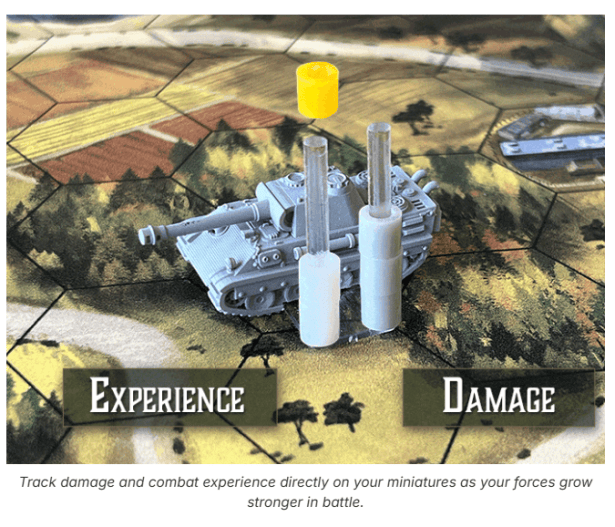
What makes this system special is how we track the experience. Each miniature has a small transparent holder attached to its base, where players insert colored markers for experience and damage.
This means you can immediately see the condition and experience level of every unit directly on the battlefield, without having to consult separate unit sheets.
It also creates some wonderfully memorable moments when an experienced unit survives against overwhelming odds!
Grant: What type of economy does the game use? How is money produced? What can players spend their money on?
Philipp: The game uses a relatively straightforward economy built around controlling strategic production facilities.
Players earn money from factories they have captured. These resources can then be used to recruit new units or repair damaged ones.
This creates an interesting strategic dilemma. Do you spend your resources replacing casualties, invest in additional troops, or repair your experienced veteran units?
Capturing factories is therefore important not just for victory, but also for strengthening your economy and maintaining your army.
I particularly like how the economic and military aspects interact. Sometimes capturing a strategically important factory can achieve more than destroying several enemy units.
Grant: What is the layout of the maps? How does terrain affect the game?
Philipp: Spitfire includes a large double-sided, hex-based game board featuring two very different environments.
One side depicts southern Britain, northern France, and the English Channel. This allows for combined land and air battles, including the Battle of Britain and Dunkirk scenarios.
The other side represents North Africa, with its expansive deserts, roads, mountains, and strategically important supply positions.
Terrain influences movement and combat. Roads allow ground units to move faster, forests provide defensive advantages, and natural obstacles can restrict movement.
Aircraft, of course, aren’t slowed down by ground terrain.
The North African map adds another strategic consideration: supply. With fewer natural obstacles and long distances between important positions, maintaining your logistics becomes crucial.
Grant: What do you feel the design models well from history?
Philipp: I think the game does a particularly good job of modeling the importance of combined-arms tactics.
Historically, even the strongest tanks were vulnerable when operating without adequate infantry, artillery, and air support. The game encourages players to coordinate different unit types rather than relying on one particularly powerful unit.
I also like how the North African scenario illustrates the importance of supply lines. An army can have superior equipment and still lose because it cannot maintain its operations.
And finally, I think the experience system captures something that’s often missing from tactical board games: troops aren’t interchangeable. A battle-hardened veteran unit can be much more valuable than a newly recruited replacement.
Of course, Aces & Armor is a strategy board game rather than a detailed historical simulation, but I hope it captures the important tactical and strategic decisions commanders faced.
Grant: What type of experience does the game create for players?
Philipp: I’d describe it as an accessible strategy game with a surprising amount of tactical depth.
There are plenty of exciting combat moments, but the game isn’t just about rolling dice. You need to plan your movements, coordinate your troops, control strategic locations, and decide when to attack or retreat.
The experience system also creates an emotional connection to your units. Losing a rookie infantry unit is unfortunate, but losing your heavily experienced Spitfire that has survived several battles really hurts!
I also love the way the battlefield evolves. Units move, take damage, gain experience, and new reinforcements enter the fight. The situation can change dramatically within just a few turns.
A typical game takes around 60–90 minutes, so it offers a fairly substantial strategic experience without requiring an entire afternoon.
Grant: What are some general strategies for each of the sides?
Philipp: That depends somewhat on the scenario.
In the Battle of Britain, the British player should pay particular attention to controlling the skies and protecting important airfields. Their Spitfires and Hurricanes provide considerable flexibility, but they need to be positioned carefully to respond to German threats.
The German player can take advantage of the Ju 88’s bombing capabilities while using the Bf 109 to contest British air superiority. Coordinating air attacks with ground operations can be very effective.
In North Africa, both sides need to think carefully about supply. A powerful offensive can quickly become vulnerable if the enemy manages to interrupt your supply lines.
In general, my most important advice is to use combined-arms tactics and not spread your forces too thinly. A well-coordinated group of different unit types is often much more effective than several isolated powerful units.
Grant: What has been the feedback of your playtesters?
Philipp: Playtesting has been particularly important for getting the balance between historical flavor, strategic depth, and accessible gameplay right.
One of the main things I’ve focused on is making sure the two theaters offer genuinely different experiences without forcing players to learn an entirely new game.
The air battles need to feel exciting, and the supply mechanics in North Africa need to create meaningful tactical decisions rather than unnecessary bookkeeping.
We’ve also been refining the balance between individual units and factions.
What I always look for during playtesting is whether players are making interesting decisions, developing strategies, and enjoying the tension of the battle. That’s ultimately much more important to me than adding another layer of rules.
Grant: What other designs are you currently working on?
Philipp: There are always several ideas floating around in my head!
One project I’m currently exploring is bringing the Aces & Armor game mechanics to a SciFi scenario.
I’m also thinking about where to take Aces & Armor next. World War II offers so many interesting factions, units, and theaters that there’s certainly plenty of room for future additions. And I am getting a lot of great ideas from backers of the current Kickstarter campaign. I just love this creative community and couldn’t be more grateful!
For now, though, most of my attention is on making Aces & Armor – Spitfire as good as possible and delivering another successful Kickstarter campaign.
Thank you for your time in answering our questions Phillip and also congratulations with the game funding already. I really like the look of this one and I am sure that it will be a fun gaming experience.
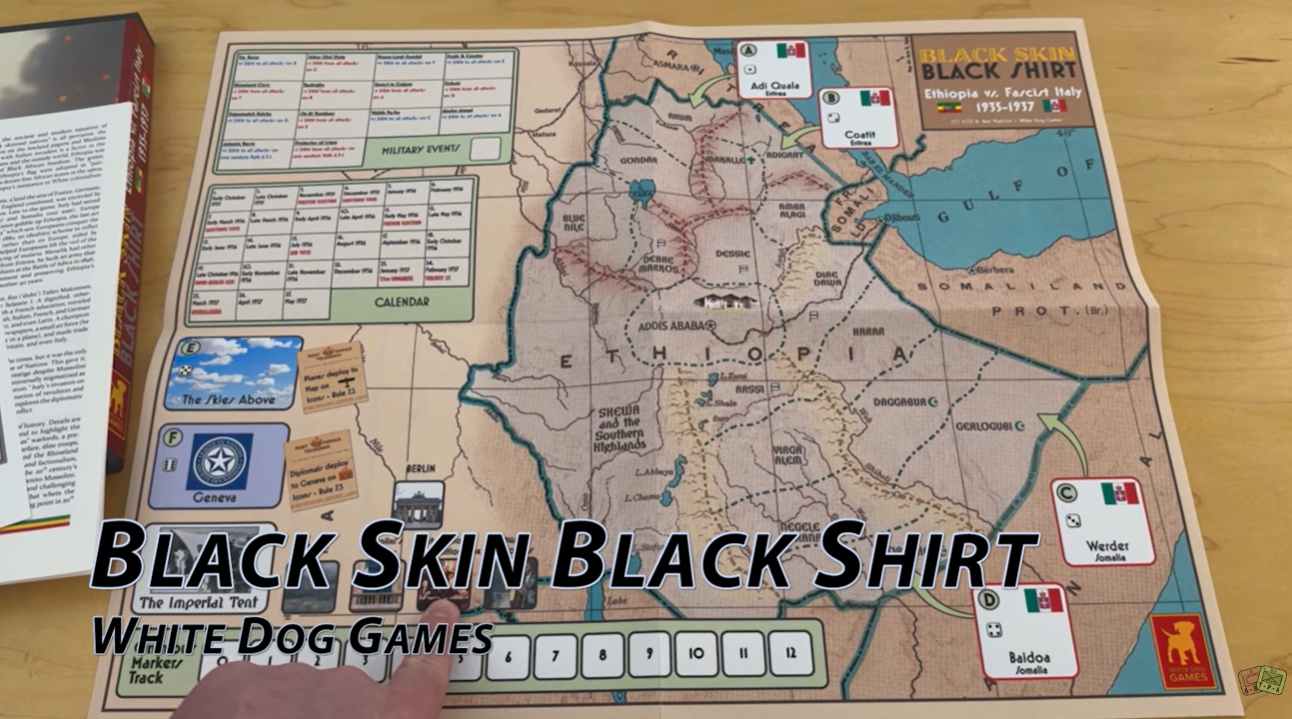
ETHIOPIA VS. FASCIST ITALY 1935-1937 – A Prelude to the Second World War.
Fascist Italy’s 1935 invasion of Ethiopia set the world on course for World War Two. The failure of the League of Nations to deter Fascist aggression led to policies of appeasement, the rise of the Axis, the Spanish Civil War, and Hitler’s march into the Rhineland. In this easy-to-play, straightforward solitaire game, you are the beleaguered Ethiopian Emperor Haile Selassie I (1892-1975). Take charge of Ethiopia’s defenses, call up troops, and call on the League of Nations as Italy tries to enlarge her empire at your expense. Send your regional “Ras” warlords into battle, organize partisans, deploy your limited elite forces, and endure Italy’s criminal use of mustard gas.
Your ancient Black Christian African civilization stands as a defiant symbol of anti-colonial resistance and as the first battlefield of the coming global struggle against Fascist aggression. Can you turn Mussolini’s Blackshirt armies back, prevent the fall of Ethiopia’s capital Addis Ababa, and change the course of history?
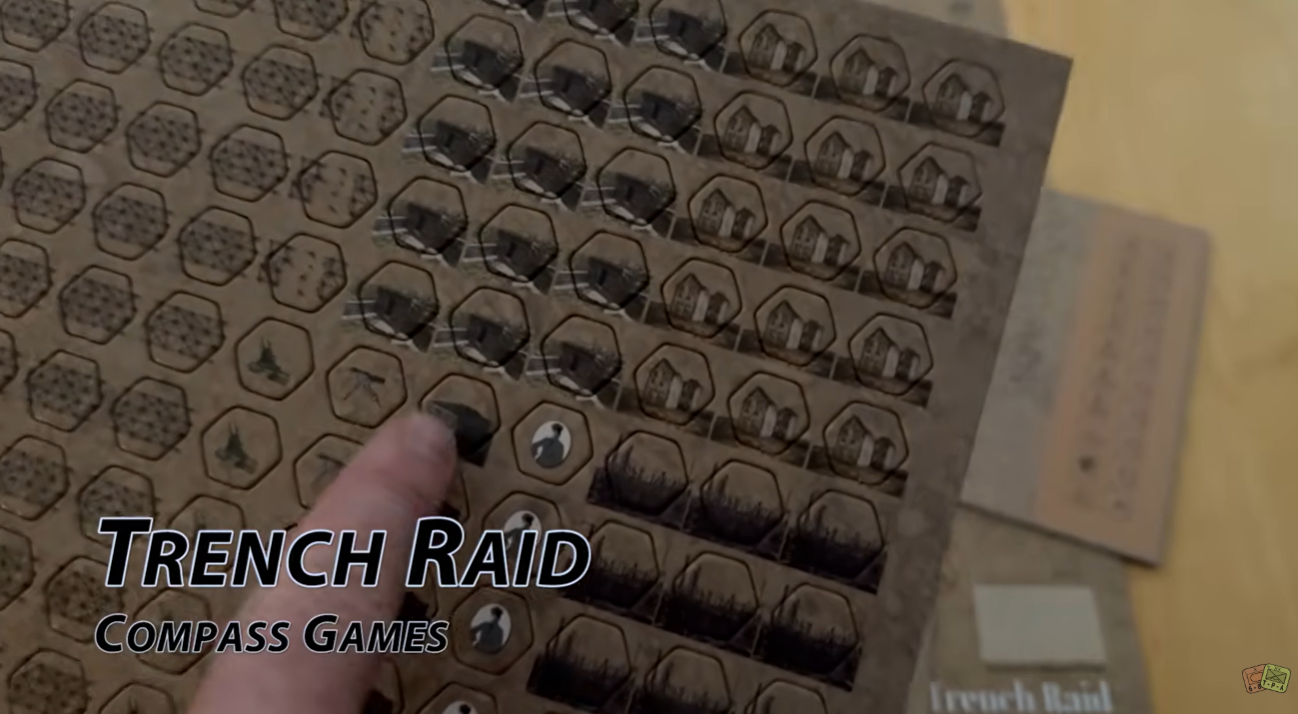
Trench Raid is a single-player game set on the Western Front in World War One. The player assembles a group of 10 raiders and plots their course on a map towards the enemy lines on the other side of No Man’s Land. With 12 different raid objectives and 20 random events that can take place during the crossing, no two playthroughs will be exactly the same.
The game also includes rules for campaign play — whether their raid was successful or not, the soldiers who make it back to their trench lines relatively unscathed will steadily get better at raiding, learning through experience how to survive.
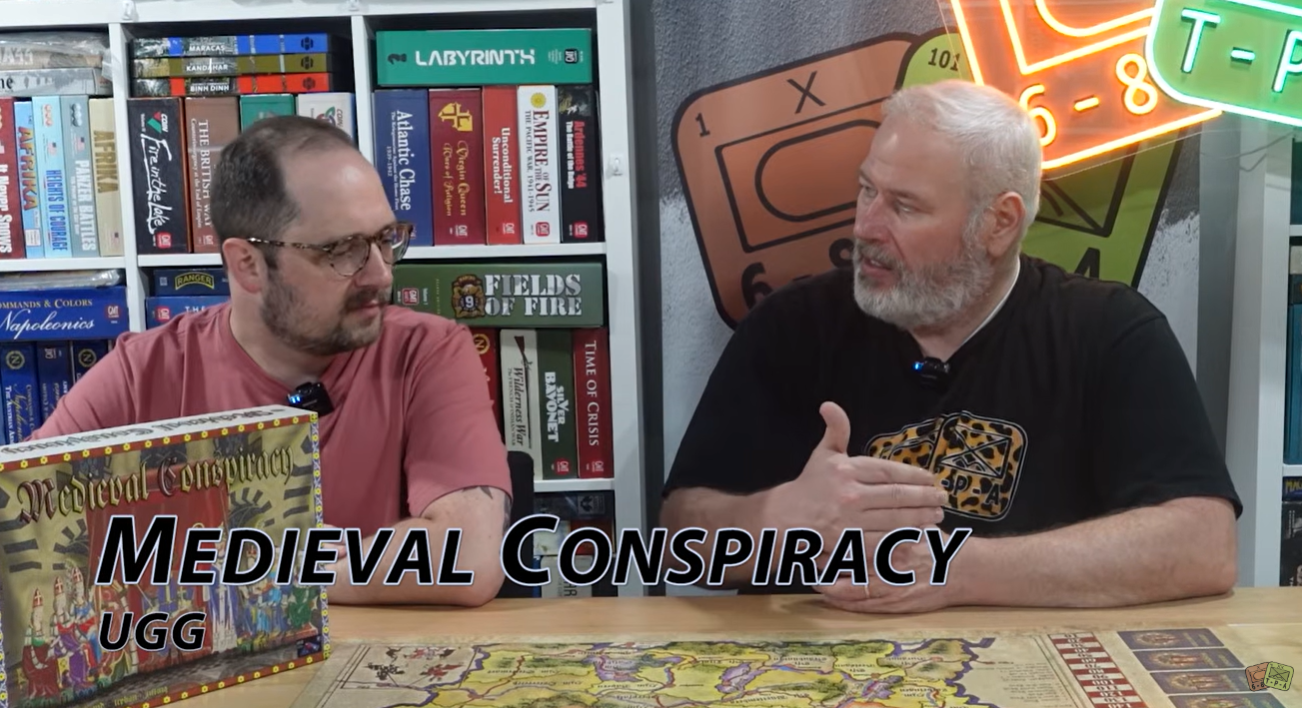
Medieval Conspiracy introduces players to the Holy Roman Empire of Germany, which is divided into numberless small earldoms, principalities and bishoprics. The Ruler of the Empire is the Holy Roman Emperor who is elected by the 7 electoral princes. In Medieval Conspiracy players take the role of a mighty noble family attempting to increase their power, gain new countries, all to gain votes of the electoral princes to finally be elected the new Holy Roman Emperor.
Medieval Conspiracy is run by Action Cards and Event Cards. After collecting income, players bid for Event Cards. 3 Event Cards are displayed on their open side. Thereafter players bid for them in turn order. The player who got an Event Card can use it later during his turn. During a player turn players roll the dice of destiny and play Event and Action Cards. That card play results in numerous effects giving each game a new special course. The goal of the game is to gain new countries or conquer them by force from others in an attempt to influence the vote for the Holy Roman Emperor.
I love a different style and focus of wargame. A game that takes a look at an important but somewhat obscure or rarely addressed historical topic, such as espionage or intelligence, and creates a gaming experience tailored around the events to highlight and evoke the difficulties and tension that would have been present. In January 2026, GMT Games announced such a game in Checkpoint Charlie, which is a solo or cooperative game focused on SIS espionage missions in Berlin in the 1960’s designed by Russell Brown. We have posted an interview with Russel and it was very well received and he has now agreed to create a series of History Behind the Cards to highlight the events of the 1960’s Cold War struggle in West Germany but also to share aspects about the game play and how it models the history.
*Note: The cards highlighted in this series and their event text, as well as any pictures used showing any of the various components, are still in the design and development process and as such event effects and text might still change prior to final development and publication.Also the art and layout of the cards are only for playtest purposes at this point and the game will enter the art department as it nears publication.
History Behind the Cards – Checkpoint Charlie from GMT Games – Card #9 Daily Military Train
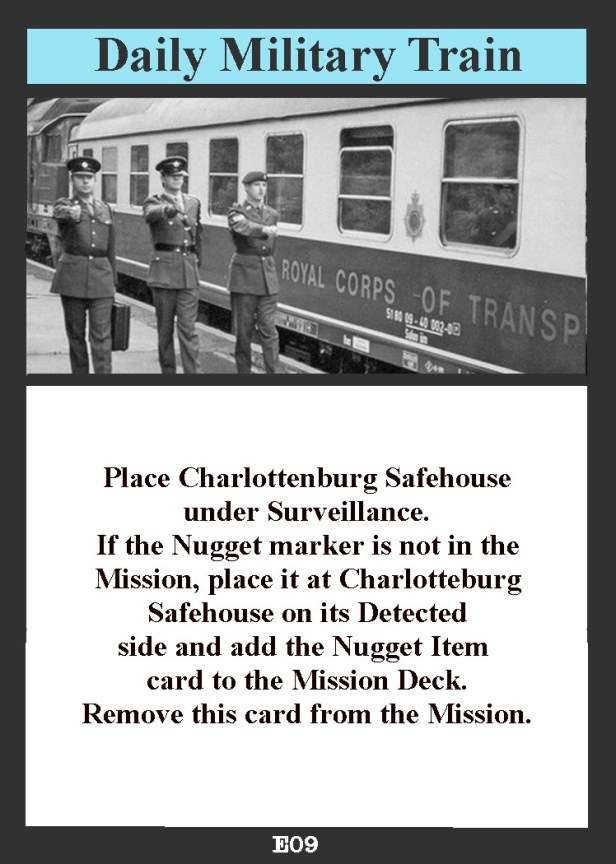
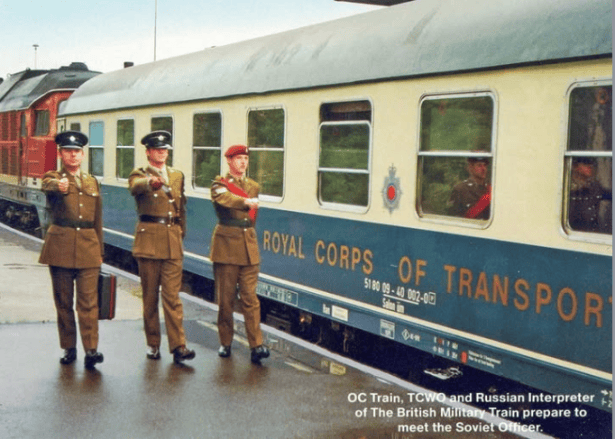
This is one of the cards I added to Checkpoint Charlie based on conversations with my local coffee shop spy, John (see Card #7). I had assumed most significant traffic from West Germany to Berlin used the autobahn corridor from Checkpoint Alpha at Helmstedt, across East Germany, to Checkpoint Bravo in Berlin. However, the military trains, of which there were three – American, French and British – ran every day, back and forth along roughly the same corridor as the automobile traffic. The US Military Duty Train, which my friend John rode, let out at the station in Charlottenburg and is the basis for this Event Card. It was primarily used by US military personnel, but other people associated with the military could get permission to ride.
Cars full of East German police, or vopos, kept vigilant watch over the autobahn access route, but it was more difficult to keep track of the train and whether western passengers were jumping off illegally somewhere in East Germany, or East German citizens were boarding the train as it slowed for one of its scheduled stops along the way, getting free passage into West Berlin. To solve this problem, all doors on the train were chained and padlocked for the duration of the four-hour journey across East Germany. In Checkpoint Charlie, the Daily Military Train Event assumes that the KGB has been tipped off to the arrival of some interesting person or item on the next train and move to intercept. Charlottenburg Safehouse is placed under surveillance and the Nugget Marker, already detected, is placed there. This can be a useful diversion for your assets, or it can draw KGB agents right into the center of your mission.
The Berlin Military Train operated by the Royal Corps of Transport.
In the next article in this series, we will take a look at Moscow Rules.
In my opinion, this game looks extremely interesting and I am very much excited to learn more about it. I am appreciative to Russell and his efforts to bring us these cards and to write these entries to share with our readers. I am also very glad that this topic is being covered in a game and look forward to playing this one day soon.
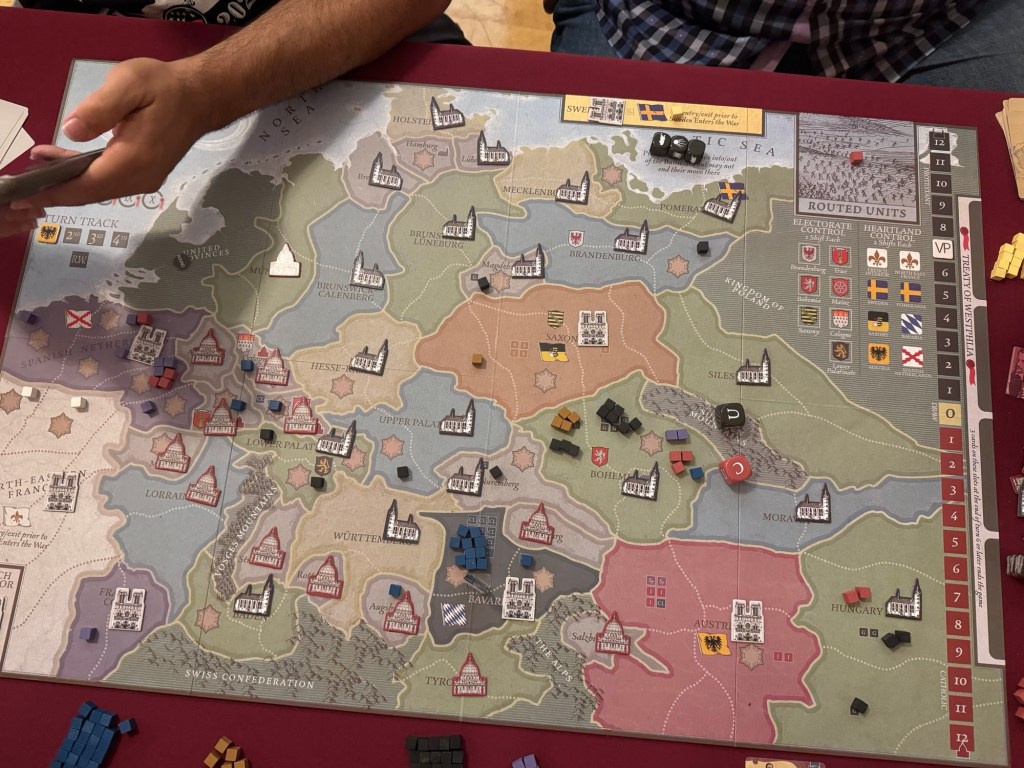
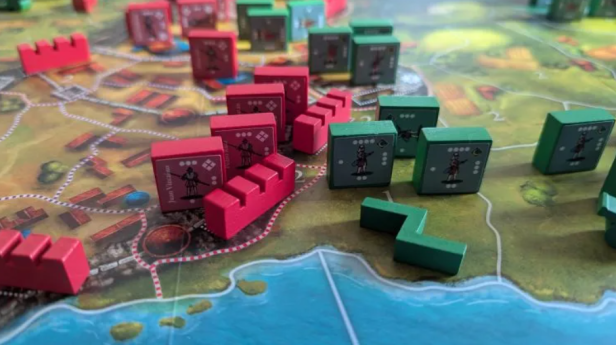
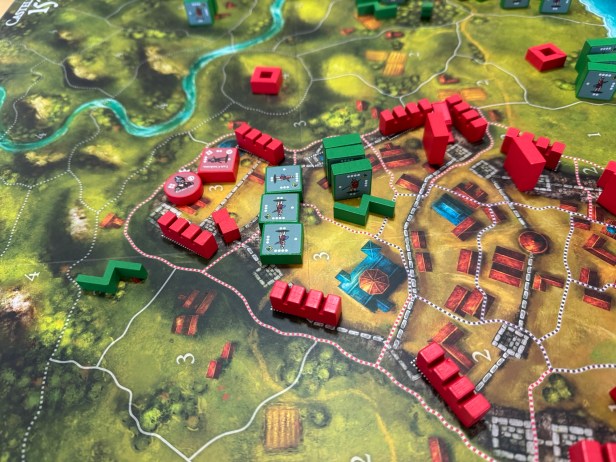
In 1539, a small Spanish garrison of troops numbering 3,500 men held the Albanian village of Castelnuovo for 22 days against the massive Ottoman army consisting of over 54,000 Turk soldiers. This siege took place as a part of the Ottoman-Habsburg struggle for control of the Mediterranean Sea in July 1539 at the walled town of Castelnuovo, which is the location of present-day Herceg Novi, Montenegro. After days of open trench warfare and more than a month of smaller combats, skirmishes, assaults and bombardments from the Turkish navy, the last Spanish defenders fell ending the siege. Castelnuovo 1539 is a wargame that focuses on this siege designed by Francisco Ronco. The defenders are safe behind sturdy walls and battlements but time and continual shelling from the Ottomans will lead to assaults over the walls. The battle is hopeless for the defenders but they can win the game by doing enough damage to the Ottomans to end their campaign and stop them from invading further into the Albania and then onto Spain and the rest of Europe. The game is very well produced using wooden blocks for soldiers, stylized walls, siege trenches and cannon along with ships and the board is also beautifully illustrated. The game is a block wargame where the strength of units are hidden from the opponent and plays pretty quickly in less than 90 minutes and really is a great representation of the battle and its history.
In Action Point 1, we took a look at the beautiful Game Board and its area movement scheme. In Action Point 2, we examined the units available to both sides and compared their relative strengths and weaknesses. In Action Point 3, we took a look at the different types of Command Cards and discussed how they are used. In this Action Point, we will take a look at the 2 different types of rounds including a Siege Round and an Assault Round and how they differ.
In Castelnuovo 1539 there are 2 different types of rounds within the structure of the game including Siege Rounds and Assault Rounds. This 2 type approach is designed to reflect the different preparations and phases of a sustained siege on a fortified location. The Ottoman player is allowed to choose the type of round for the upcoming turn during the Reinforcement Phase, which is the last phase in any round. In this structure, the Ottoman player has the chance to review the previous round, consider their losses and gains on the battlefield, identify their goals and set themselves up for success in the coming round.
Siege Rounds reflect the necessary preparations, concentration of resources of both men and materiel, the progress of mine works and siege trenches and represent 3 or 4 days of the siege. During this time there are small combats and skirmishes, probing of the enemy lines and reconnoitering but no major frontal assaults. In this type of round, each player draws only 4 cards reflecting the slower and more deliberate planning phases of a siege. The first round of the game is always a Siege Round in the main scenario. There also is another mechanic that is added to the Siege Rounds as the Ottoman player can choose to rest during only a Siege Round and no cards are played and the player also places all of their Azab and Sipahi Blocks on the board at full Strength. This reflects the buildup and preparation for the upcoming assault and is a key decision for the Ottoman player who is pushing against time and must complete the siege in their favor before time expires.
Assault Rounds represent moments of decisive assault, with a great amount of movement and activity on both sides. The action is fast and furious and each turn represents only 1 days worth of combat. In this type of round, the hand of both players increases to 7 cards in order to provide the fuel needed to sustain a planned attack. There is a price to pay for the prosecution of an Assault Round though as each time the Ottoman player declares their intention to assault, the Ottoman Casualty Track will be advanced 1 space.
The decision opportunity for an Assault Round versus a Siege Round comes at the end of the Spanish Action Phase. Before drawing any cards, the Ottoman player chooses which type of round to play next. If an Assault Round is chosen and the player has more than 4 cards in their hand, no new cards will be drawn and the player will discard down to 4 cards. One of the key decision points at this time is the makeup of the Ottoman player’s hand. If they have good cards, such as the necessary Order Cards to initiate attacks as well as a Combat Card or 2 to supplement those attacks and make them more effective, the choice is pretty simple. If their hand of cards is not necessarily setup and beneficial for a siege, they may want to move to an Assault Round where they will draw the maximum 7 cards and can continue their preparations for the next round while still engaging in smaller attacks and bombardments to weaken the defenses and demoralize and reduce the defending Spanish Tercios.
I was very impressed by this distinction in the 2 types of rounds in the design but at first had difficulty making the connection to the history and the design choice. But a siege is a very different and particular case in warfare and has some very interesting nuances that must be taken into consideration. As the game is basically decided by the mounting casualties of both sides, the presence of artillery batteries, the obsolete medieval fortifications of the city and the modern earthen fortifications built by the Spanish to reinforce them, casualties are a reality and the Ottoman player needs to be cognizant of this and take it seriously. There has to be a deliberate and planned attack on the city with the proper and measured construction of siege trenches by the Ottomans to realize the benefit of their usefulness in reducing the casualties of the besiegers.
A good Ottoman commander will play a well balanced game with a consistent pattern of incremental movement upon the city, all the while building their siege lines to form a tightening encirclement of the walls like the coils of an anaconda, inching closer and closer to the walls, using their artillery to weaken and break the defenses and create breaches where close-range assaults can be launched that will ultimately decide the outcome. Digging trenches should be one of the Ottomans first tasks, as they must protect their blocks as they are in the open field, an easy target for attack. Once the blocks are protected with trenches, there is a need to plan the advance and bring these trenches and batteries closer to the Spanish fortifications so that they can breached. Once there are open breaches, it is necessary to throw caution to the wind and take the city by assault as the Spanish attempts to repair the walls and build internal fortifications will continue to hinder the Ottoman’s progress. But, the Spanish player must keep in mind their advantages, including the well known Spanish ‘camisado’ attacks (encamisadas in Spanish) to sally forth and inflict damage upon the besieging forces to weaken their strength. The Spanish leaders are better and will provide great benefits to these attacks that should inflict maximum damage and break the will of the Ottoman as they continue the slow and arduous advance on the city. But the understanding of how to use this Siege/Assault process will take a few plays to understand but once you master the rules, you will see that these fortresses were not defended passively, but rather are in the pattern of an active defense that makes calculated sorties to hinder the work of the attackers by destroying artillery batteries and not giving the Ottomans any rest or respite from the action a vital part of the process.
In Action Point 5, we will delve into an example of combat and bombardment.
If you are interested, I was able to shoot the following review/overview/summary video with the designer Francisco Ronco after playing the game earlier this year:
With this My Favorite Wargame Cards Series, I hope to take a look at a specific card from the various wargames that I have played and share how it is used in the game. I am not a strategist and frankly I am not that good at games but I do understand how things should work and be used in games. With that being said, here is the next entry in this series.
#99: Truman Doctrine from Twilight Struggle: The Cold War, 1945-1989 from GMT Games
Twilight Struggle is a 2-player game simulating the forty-five year ideological struggle known as the Cold War between the Soviet Union and the United States which can be played in 2-3 hours. The entire world is the stage on which these two countries “fight” to make the world safe for their own ideologies and way of life. The game starts right after the end of World War II in the midst of the ruins of Europe as the two new “superpowers” of the world squabble over what is left and ends in 1989, when only the United States remained standing.
The map is a world map of the period, where players abstractly move units and exert influence through the placing of Influence Markers in an attempt to build local support and gain allies and control for their superpower. The beauty of the CDG system used here is that each decision of whether to use a card for the event or the operations value is a struggle as if it is the other side’s event, it might go off hurting you very badly. There are mechanics to allow for the ignoring or cancelling of some of the best cards for your opponent in a side game within the game called The Space Race as well as nuclear tensions, with the possibility of game-ending global thermonuclear war (Shall we play a game, anyone?). I have played TS about 30 times and love it more and more with each sitting. The game makes me sweat, cringe, jump with joy and bite my fingernails. To me, a game that can do all of that in one sitting is worth the price.
The Truman Doctrine is an Early War U.S. 1 Op Event Card that removes all Soviet Influence from a single country in Europe where the U.S. has presence. This means that the U.S. at least has 1 Influence in a space and the space must be uncontrolled. I think that players should be judicious and patient with this card and do not rush to play early in the game on Turn 1 or Turn 2 if Europe is stable and the USSR has minimal presence there. The best way to use the card is to wait for a window where you can do the most damage in a key Battleground space where each side has been fighting for control by placing Influence there such as in France or West Germany on the last action round of a turn or playing the card during the Headline Phase to wipe out stacked Soviet Influence as a precursor to bumping up your own Influence there for control. The Truman Doctrine card is such a nice booby trap in many ways and the proper use of it can be very efficient and give you a leg up in Europe.
The Truman Doctrine was a United States foreign policy established by President Harry S. Truman on March 12, 1947, which pledged that the U.S. would provide political, military, and economic assistance to democratic nations threatened by external or internal authoritarian forces. President Harry S. Truman asked for $400 million in military and economic assistance for Greece and Turkey. “It must be the policy of the United States to support free peoples who are resisting attempted subjugation by armed minorities or by outside pressures,” Truman declared. “If we falter in our leadership, we may endanger the peace of the world — and we shall surely endanger the welfare of our own nation.”
In asserting that the U.S. would intervene in faraway conflicts, President Truman dramatically reoriented U.S. foreign policy. The writing of this ground-breaking message went through multiple stages. In his memoir, Truman noted that the State Department’s first draft of the speech “was not at all to my liking.” Rather than asserting a new foreign policy doctrine, the State Department writers had “made the whole thing sound like an investment prospectus.” Truman returned the draft to Secretary of State Dean Acheson “with a note asking for more emphasis on a declaration of general policy.”
The State Department complied, and included a general policy statement in the next draft. But Truman was not satisfied. “It seemed to me half-hearted,” he recalled. President Truman “scratched out” what he deemed equivocations. For example, Truman replaced “should” with “must” in a key sentence that read “I believe that it should be the policy of the United States…” According to Truman, “I wanted no hedging in this speech.” Because this speech “was America’s answer to the surge of expansion of Communist tyranny,” it “had to be clear and free of hesitation or double talk.” A total of eight drafts of Truman’s speech to Congress are featured on the Truman Library’s website. Many include handwritten comments and corrections. Combined, they give readers a sense of the tremendous effort that went into drafting the Truman Doctrine as well as the importance a single word can make when crafting foreign policy.
Truman delivered his address on March 12, 1947. Over the next several weeks, Congress debated the merits of Truman’s proposed foreign policy. On April 22nd, the Senate approved the legislation to provide assistance to Greece and Turkey. The House followed suit, approving the bill on May 9th. On May 22, 1947, Truman signed the bill into law. According to President Truman, the enactment of his bill “served notice that the march of Communists would not be allowed to succeed by default.”
We have played all of the games in the Reivers and Reformers Series designed by Ed Beach, including Here I Stand (multiple times), Virgin Queen (multiple times but not as many as HIS), Tanto Monta (once) and Border Reivers (twice) with our most recent play being a full 5-player game in March while attending Buckeye Game Fest. This series is just special and I very much enjoy our experience with these games each time we play them. The card driven mechanic simply makes the series and it really is a bit of a sandbox as you can win in various and sundry ways. Several months ago, GMT announced the fifth entry in the series called Foxes and Lions:Renaissance City-States in the Age of Machiavelli designed by the duo of Paul Wright and Liz Davidson. This one looks to be epic and is set during warring city-states and dominions of Renaissance Italy during the era known as the Italian Wars (specifically, the period from 1494 to 1527). I am very keen on a new addition to the series and look forward to diving in and learning more about the game over the next year or so. My first step was to reach out to the design team to do a designer interview and Paul Wright was more than willing to answer our questions.
*Note: The pictures used in this interview showing the various components and cards, are still in the design and development process and as such rules,event effects and text might still change prior to final development and publication.Also the art and layout of the components are only for playtest purposes at this point and the game will enter the art department as it nears publication.
Grant: Paul welcome to our blog. First off, please tell us a little about yourself. What are your hobbies? What’s your day job?
Paul: From Chicago originally, I’m a cultural historian by training, having taken my doctorate in Comparative Literature at Princeton and worked with the masterful historian Anthony Grafton. I’m happy if even a tiny percentage of his vast knowledge has lodged itself in me. My focus in my doctoral research was Renaissance humanism in Italy and England, including work on Leonardo Bruni, Pico della Mirandola, Machiavelli, Gabriel Harvey, and John Milton. I have been dialoguing with Machiavelli ever since my undergraduate days at Northwestern, when one of my mentors (the wonderful Albert Ascoli) tasked me with translating long sections of The Prince into English. I’m certain those early efforts were awful and too literal-minded, but what an instructive exercise that has only made me more admiring of great translators. Alongside Machiavelli remaining a key part of my research, I have also been working on the political and social impact of Savonarola.
I taught for three decades in higher education, including my graduate T.A. days at Princeton, as well as teaching posts at Osaka University, Villanova University, and Cabrini University. That last school, sadly, closed in the wake of all the pressures on higher ed in the last fifteen years or so. I then turned to teaching in the independent school world, which brought me to Main Line Classical Academy in Bryn Mawr, PA, where I teach English and History, as well as a games-based learning history elective funded by a grant I recently received from the Renaissance Society of America.
In my games-based learning exercises in my classrooms over the years, I have used analog board games as well as the occasional computer game (Europa Universalis in particular), but I also use role-immersion pedagogies like Reacting to the Past; I serve on the national consortium board for RTTP (for more info, see https://reactingconsortium.org/). I’m currently developing a RTTP game on Florence in the period 1494-1512, the era of the republic with the Medici in exile. In that game students may take on one of over thirty historical roles, including Piero Soderini, Da Vinci, Da Vinci’s portrait subject Ginevra de Benci, followers of Savonarola, condottiere Fabrizio Colonna, or even Machiavelli himself. Think of this as a role-playing game that zooms in even further than does Foxes and Lions. The game has been tested by professors at over a dozen institutions so far; it will be used in a high school setting for the first time this year.
My hobbies include film and media studies. I have taught film and media courses (on everything from the Coen Brothers to Kurosawa to The Sopranos) at the Bryn Mawr Film Institute for some twenty years now. I also have a screenplay (in painfully drafted form) on Machiavelli’s time spent with Cesare Borgia, which certainly informed Machiaveli’s thinking and later writing.
I also treasure any chance to travel abroad, and it was a big part of my higher ed career in international affairs. I hate how expenses have curtailed that experience for so many of us, as well as how the U.S. has become less welcoming to international students. Not surprisingly perhaps, Italy is my favorite destination, with Albania (home country of my wife) and China (home country of my daughter) tied for a close second. I also lived and taught in Japan for four years from 1996-2000, and it was one of the most formative times of my life; I treat any chance to return as a treat.
Grant: What motivated you to break into game design? What have you enjoyed most about the experience thus far?
Paul: I waded into game design after decades of intensive play of wargames, euros, RPGs, and so many other types of games that I’m clearly an omni-gamer—certainly on the heavier side of the complexity scale with a focus on historical games. I’ve always been happy to solo (even multi-handed) because playing more games teaches you so much about how games are put together and how they try to model complex realities, including the past. I’m an admirer of David Lowenthal’s classic book, The Past Is a Foreign Country, which certainly evokes how games draw me into historical eras and crises.
I’ve also been blessed in Philadelphia, my home of 26 years now, with the best gaming group anyone could ask for—a group of people who are kind, seriously competitive yet never obnoxious, while also being sharp and funny as hell. Between my own solo forays and playing with them, it has been an education that led to this first ever design for me. My Philadelphia group are truly shadow co-designers in their way.
What I’ve most enjoyed about design is the sense of something evolving before your eyes that captures the history as I understand it, but I also love designs that challenge or revise my understanding. Collaborating with an amazing co-designer in Liz Davidson and developer extraordinaire Joe Dewhurst has been an absolute treat. I’m spoiled by having these two on my team.
Grant: What have you learned about design over the years?
Paul: Like many designers, I have many designs that never saw the light of day; some of these will come to fruition, I think, once Foxes and Lions is released. What I do know is that I’m a designer by theme and subject who looks far and wide for mechanics that will capture the historical complexities that fascinate me. I know many work in the opposite direction starting with mechanics, but that’s not how I’m wired. I start with a theme or problem that haunts me, then see if a game (mine or someone else’s) can help to illuminate it—or at minimum, reframe my questions more powerfully.
I also see historical game design as a way of testing and modifying (not merely reinforcing) my own interpretive and historiographical assumptions. One of the reasons I began the journey with Foxes and Lions over a decade ago now is that I had deep questions about Machiavelli, his theories, his playful will to narrative, and the era through which he lived, an era that we all too facilely collapse under the rubric of the “Italian Wars” or “The Renaissance.” Game design can be a heuristic tool that can bear fruit eventually in a new interpretation or synthesis that we hadn’t anticipated. At minimum, it clarifies my own tortured thinking and reading of the sources.
Grant: What is your upcoming game Foxes and Lions: Renaissance City-States in the Age of Machiavelli about?
Paul: Foxes and Lions: Renaissance City-States in the Age of Machiavelli is the next game in the GMT series that includes Here I Stand, Virgin Queen, and Tanto Monta. Focused on the warring city-states and dominions of Renaissance Italy during the era known as the “Italian Wars” (specifically, the period from 1494 to 1527), this game zooms in on the Italian peninsula. Unlike many other games on the Italian Wars, Foxes and Lions puts the focus on Italian experiences of this era of enormous upheaval, which also saw some of the greatest cultural splendors that we now associate with the period known, not without controversy, as the Renaissance. The game depicts the political, military, economic, religious, and cultural affairs of five key Italian powers brought to life by players (Florence, Milan, Naples, Venice, and the Papacy).
Players struggle to create political legitimacy for themselves while contending with both Italian rivals and non-player great powers intent on conquest of their own objectives in Italy; namely, France, Spain, the Holy Roman Empire, and the Ottoman Empire. For those who have played other series games, much will be familiar mechanically, but there are many new concepts and mechanics to enjoy, including experimenting with different government types, managing local sentiment, and gathering precious florins to pay for mercenaries and their fickle condottieri captains.
Furthermore, players will be faced with the possibility of collective defeat to the non-player great powers. Players will individually pursue Virtù Points, drawing on Machiavelli’s famously pliable conception of political ability and military strength, while at the same time striving to avoid collective defeat by loss of Italian Virtù Points. Dwindling Italian Virtù embodies Machiavelli’s abiding fear of great power domination of Italy. Players will each attempt to win without Italy falling into the subjection that was historically its fate, and should they fail to prevent that, the game ascribes blame to the specific players viewed as the scourge of Italy and the new lapdog of the great powers. Can you thread the needle between your Italian rivals’ ambitions and the threat posed by the great powers of Europe?
Grant: Why was this a subject that drew your interest in making a game?
Paul: This subject got under my skin as an undergrad as I mentioned above. I first fell in love with Dante in multiple courses with terrific and yet very different teachers. They graciously invited me to join their graduate courses as an undergrad. Milton, Spenser, and a host of political poets in the epic tradition caught my eye there too, but I fell hardest for Dante and his era. As I went on to graduate school, that love of Dante abided, but Machiavelli re-entered the chat, as it were.
After my graduate experience with Machiavelli (thanks especially to one of my teachers, Victoria Kahn), I was never quite the same. Machiavelli embodied someone both deeply troubled and somehow deeply amused by a world that was falling down around him. His political career began in the wake of the 1494 Medici exile, the rise of Savonarola, and the restoration of a republic that had long been under the Medici yoke. His career ended the first time in 1512 with the Medici restoration. It ended again with another Medici exile in 1527, with yet another republic that didn’t really trust Machiavelli anymore given his courting of Medici patronage in the intervening years. Above all, the traumatic Sack of Rome in 1527 really shook Machiavelli. He died just over a month after the Sack, witnessing exactly the kind of Italian nightmare that he had warned about for years. Someone who had lived that much life and turmoil became endlessly fascinating to me. I know Machiavelli will be a part of my scholarship and design life for the duration.
Grant: How did you come to team up with Liz Davidson on this project?
Paul: Liz has become a dear friend as well as collaborator and sounding board on everything from our shared gaming interests to our broader professional and personal lives. We met because I invited her to be a keynote speaker at a Reacting to the Past game design conference at my former institution. She was not only awesome in that role, but we immediately hit it off as people. It wasn’t long till we were talking regularly cross-country and at conventions, then talking about collaborations.
Grant: What strengths did each of you bring to the design process?
Paul: In the case of Foxes and Lions, I obviously brought the historical background and scholarly passion to the project, which I had first formulated about six or seven years before Liz and I met. But in all candor, I was spinning my wheels. I was swamped with the faculty and administration politics of a dying institution, and I was smack dab in the middle of all that drama in a leadership role for our faculty. It took Liz to help me see the real comfort of game design and of throwing myself back into my true passions, especially for Foxes and Lions.
It also helps enormously that Liz is a doctorate-holding historian of religion herself with a focus on the ancient world. And as anyone passionate about the period knows, the Renaissance was defined in many ways by its relationship to the classical world, so while Liz wasn’t an early modernist or medievalist, she understood intuitively and on a deep level why a classicist would enjoy and contribute to a game about the Renaissance. Simply put, without Liz, there is no Foxes and Lions for the world, just the game in my head. Liz also has a sharp sense of end-user needs in game design. How something will play to a more general audience and not just specialists or heavy gamers. To be clear, our game is a heavy game situated within a heavy (yet beloved) series, but Liz is working hard on materials to onboard people as only she can, including training guides, videos, and more. She is doing an amazing service with this in relation not only to our game, but also the series at large. Stay tuned for more of these things in the months to come.
I’d also be remiss not to mention the support and encouragement of Volko Ruhnke. After he visited my former university as keynote panelist for a games-as-scholarship workshop, we talked about Foxes and Lions possibly joining the COIN series in the vein of other pre-modern titles like Falling Sky and Pendragon. Liz and I even prototyped a first COIN version of our game. It was fun and quirky; it could have possibly thrived in COIN world, but at the end of the day GMT’s Jason Carr wisely suggested a retooling to the Here I Stand line. That was preaching to the choir for me given my admiration for Ed Beach and for the series. Ed became yet another guiding light as we got to know him. One of my proudest moments was having Ed participate in a play of the game at WBC this past summer. They say don’t meet your heroes; both Volko and Ed prove that dictum wrong.
Grant: What has been the division of labor between you?
Paul: Liz and I both have day jobs that are very consuming. She as creative director at Leder Games, myself as an educator (a role Liz had also previously played in independent schools). Yet we both get up incredibly early, whether we are meeting or not. We are always busy with our games at every spare moment. Liz has so many games on her plate, including with other collaborators like David Thompson, another designer for whom I’m an unabashed fanboy. I’ve got Foxes and Lions of course as my primary focus, but also a book project on Machiavelli and the Reacting to the Past role-immersion game on Machiavelli’s Florence that I mentioned earlier.
I would call our division of labor something like triage; think ER or The Pitt. We are each picking up the slack when needed, prioritizing one thing or another. If there is a functional division right now, I’m heavy into the rules and component revisions, as well as early TTS testing, about to go wider as of November 2026. Liz is contributing to the InsideGMT articles we are posting on the game; her favorite subject, not surprisingly if you know her, being espionage for an upcoming piece. Liz is also there anytime we need to vet some unusual change or some stubborn holdover of mine from earlier iterations of the game. Liz will give you her most honest take on how something plays and how it will feel in the game experience. Liz has an reliable, sure sense of that. As I mentioned, she is also developing onboarding materials for newbies that I think will be awesome.
The few times we have not seen eye to eye (and I can count them on one hand), we have always had principled discussions of where each of us is coming from, and that has always lit the way to a solution. Like myself, Liz is an omni-gamer with an historian and educator’s perspective on things. That fundamental commonality has always carried us through. Having Joe Dewhurst as our developer has been equally essential as he too is an educator and scholar, and his sharp eye for what will make a game its best is invaluable. As with Liz, no Foxes and Lions in its current exciting form without Joe.
Grant: What is your design goal with the game?
Paul: If I have an historian’s axe to grind with many games on the Italian Wars and Renaissance, they have never quite to my satisfaction captured the cultural dynamism, complexity, and sheer messiness of the period. There are success stories among Renaissance games to be sure. Many games attempt to capture the military picture and do so well; on the tactical front, Rich Berg’s Arquebus comes to mind here as well as the lesser known and under-appreciated Brien Miller game, Fornovo 1495.
Other games attempt to integrate military concerns with politics and economics on a grand scale, and of course Eivind Vetlesen’s Europa Universalis: The Price of Power comes to mind here as a masterful and inspiring example, although the cultural and political front in that game is more driven by events than player agency compared to Foxes and Lions. Pascal Ribrault’s Virtù is also an interesting euro that tackles some of these concerns in an accessible way.
And of course, we have the crowded field of games tapping into Renaissance commercialism. Brasini, Gigli, and Luciani’s Lorenzo il Magnifco and Fabiano Lopiano’s Calimala come to mind here. An underappreciated and roughhewn gem is Mario Papini’s Siena; his better-known De Vulgari Eloquentia is terrific. On the art front, Stefano Groppi’s Florenza looms large in my mind for its attention to both Florentine art and the material and political considerations behind that art; it’s also just a beautiful game to look at.
Yet for all those examples above, Ed Beach’s Here I Stand and Virgin Queen were the guiding lights to Foxes and Lions—alongside the interest in political asymmetry that transcends the traditional wargame fixation on “control,” a paradigm shift displayed so beautifully in Volko’s COIN series. What Morgane Gouyon-Rety attempted so ambitiously in Pendragon also figures in my original thinking about the game. Morgane and I have chatted of late about how the character-driven conceptualization of ever-shifting rulers has serendipitously shaped both her Hubris game and Foxes and Lions.
Yet for my design purposes, what Ed’s work on Here I Stand proved was that a wargame could tackle vitally important and culturally adjacent aspects of the period that impact things happening on the strategic battlefield—in Ed’s case the religious strife of the Reformation and Counter-Reformation. COIN demonstrates to us that the sentiment and shifting support of an administered population is just as important as the intentions of those controlling a space—or trying to convince themselves that they do. This was very much on Machiavelli’s mind too.
In addition to wanting to make a game that captures the overdetermined messiness and intricacy of the Italian Renaissance, especially during the Italian Wars per se, we also wanted a game that “consciously uncoupled” (to riff on Gwyneth Paltrow’s marital breakup language) from reliance on “great power” narratives. Those narratives and the assumptions implicit in them are a recurring feature of most games on the Italian Wars and even of the Here I Stand series to date. We wanted ultimately to put the focus on Italian experiences of those conflicts—in the process creating a HIS series game about underdogs.
This was more than about zooming in on the map of Italy as depicted in earlier series games, something Carlos’s Tanto Monta did to a degree that left me hungry to do far more given my own scholarly interests in Italy. Yet it was above all about letting players personify powers that were otherwise total underdogs (or minor powers at best) in the context of the rest of the series and most other games on the period.
In this way, Avalon Hill’s out-of-print classic Machiavelli comes to mind for its attention to Italian powers alongside the greater powers of Europe and the Ottoman world. Our elevator pitch for Foxes and Lions remains a good formula—the old Machiavelli game brought to life in the mechanical exoskeleton of the Here I Stand system. Finally, as I get into in more detail below, we wanted a game that honored the messy contradictions and true interests of Machiavelli and didn’t simply replicate the many misleading stereotypes about him.
Grant: How have you modified the Here I Stand System to recount the story of the rise and fall of Renaissance City-States in the Age of Machiavelli between 1494-1527?
Paul: In addition to the non-player great powers mentioned earlier, the game features other significant additions or changes to series conventions.
Political traditions—These are the governments (current and past) that define the political character of any given space in the game (featuring merchant republics, feudal aristocracies, princedoms, theocracies, tribute states, and vassals). In keeping with Machiavelli’s respect for founders of institutions, lawgiving will be an available action that permits you to attempt to alter governments in your dominion. Each space under your control may have a very different political arrangement, which affects its prosperity, unit construction capability, and many other things. Your central government (that of your capital) may also change over time.
Sentiment—This captures the current attitude of the local population to the government overseeing it. The scale of sentiment reflects Machiavelli’s own terminology, ranging from “Hated” to “Feared,” to “Feared and Loved” (the latter an ideal Machiavelli thought hard to achieve, opting instead for being “Feared” whenever a choice between fear and love was unavoidable).
New unit types—Regulars are split into citizen militia and feudal levies, alongside a more detailed look at mercenaries (with elite variants including the Swiss reisläufer and the Imperial landsknechte).
Condottieri captains—Twenty of the colorful, talented, and sometimes treacherous mercenary captains of the era will be available to players in competitive blind bidding for their services, with each captain reflecting unique battlefield abilities, vulnerabilities, and other surprising game impacts. Captains are essential to success in the game, and if not properly paid and retained, will go up for auction again; they may even be suborned and taken from you by nefarious rival actions. Among the captains are the infamous Cesare Borgia, Fabrizio Colonna, Giovanni delle Bande Nere, and “El Gran Capitán” himself, Gonzalo Fernández de Córdoba. Yet the captains also include those who are captains for our game, but not condottieri narrowly defined; these include militaristic cardinals like Francesco Alidosi as well as the famously defiant Caterina Sforza.
Money economy—Alongside the high-level political capital of command points (CP) already familiar to CDG players, Foxes and Lions features the cold, hard cash that mercenaries and dominions crave. Florins are collected by a trade action connected to the prosperity of the various governments in one’s dominion. The florin economy will be necessary not only to pay or bribe mercenaries and captains, but also for espionage, government maintenance, and more. Player treasuries are hidden behind a screen, so no one is ever quite sure of a rival’s wealth. Should you run out of florins for a required or desired expenditure, the banks will be available to lend to you at exorbitant interest rates, and failure to repay may cost you dearly.
Espionage available from turn one—Nefarious measures are available to players from the outset of the game, including familiar operations from Virgin Queen like Gain Intel and Assassination, now supplemented with Appeasement, Foment Rebellion, Sabotage Fortifications, and Suborning others’ employed condottieri to your cause.
New patronage systems and figures—For those familiar with Virgin Queen, patronage now features three tracks (artists, scientists, and humanists) with 10 figures of each type. Each patronage target affords unique game effects. Among the 30 patronage subjects are figures such as Michelangelo, Da Vinci, Botticelli, Copernicus, Pacioli, Paracelsus, Machiavelli, Manutius, and even a prying poet-courtesan, Tullia d’Aragona.
New ruler dynamics—Each player will have an often-volatile lineup of rulers who will transition based on circumstances in the game (26 rulers in total across five player powers). In the case of the Papal States, a conclave procedure involving all five players will determine the next pope whenever the current pope dies, however mysteriously.
Variable impulse order—Players may bid their florins to change the impulse order for a given turn, creating dynamic opportunities for surprising your enemies—or lying in deadly wait for them.
More opportunities to declare war mid-action phase—No game about Machiavelli’s era would be complete without the temptations and risks of back-stabbing rivals, even erstwhile allies, including in the middle of a turn. Great coalitions (like the historical “Holy League”) may form, but no alliance is ever truly safe.
Grant: What elements do you feel are most important to model from the period?
Paul: If there was one thing that consumed me more than anything else in formulating this game years ago, it was the desire to make the best possible game on the richness, diversity, and contradictions in Machiavelli’s whole body of work—a game that would capture Machiavelli the writer and, above all, the human being as I’ve come to know him.
I didn’t want a game that just brought The Prince to life, or that just reveled in the skullduggery so often associated with Machiavelli, even in games that somehow invoke him. I wanted a game that also featured the other Machiavelli(s). The celebrator of republics in the Discourses on Livy who also knew just how fragile republics really are, a lesson for today if ever there was one. Machiavelli the historian in his state-sponsored Florentine Histories, an example of urban history compromised by political pressures to dance around certain uncomfortable truths. Machiavelli the military theorist of The Art of War, who appreciated the potentially dangerous impact of militarism on civic life in addition to the positive virtues of citizen soldiers (there is something of both James Madison and Stephen Ambrose in Machiavelli here). And finally, even the Machiavelli of La Mandragola (“The Mandrake Root”), a viciously funny sex comedy about cuckolding with a sly political subtext commenting on the differences between classical virtues and Renaissance realities. Further down in this interview, you can see three event cards that were inspired by Machiavelli’s diverse array of writings.
In all that effort, we also want to be sure that Foxes and Lions never simply takes Machiavelli at his word or at face value. Given his own internal contradictions, that would be unwise. We instead see the game as interrogating Machiavelli’s assumptions and claims. His critique of mercenaries versus citizen militia is explored both in design and in actual play, never simply rehearsed uncritically. His appreciation for the libertà of republics is tempered by his continued recognition of their fragility and their vulnerability to other powers with more direct mechanisms of control and decision-making; think here of today’s debates about democracy and autocracy.
Machiavelli’s sense was that Italy might be doomed by great power intrigue—exacerbated by Italian powers courting the greats to their own ends rather than looking to Italy’s good. This was always balanced with a deep yet tortured belief in the possibility of resuscitating Italian virtù. In addition, we wade in this game into Machiavelli’s discussion of virtù itself, a term almost untranslatable given its variety of uses in his works. The tension between individual and communal greatness was always on Machiavelli’s mind in using that term—with a preference at last for the latter as it was most pursuant to true glory and historical legacy, as well as most compatible with republics. Lawgivers (as opposed to generals and strongmen) were always most admired by Machiavelli, I would say. The serendipity of our victory points in the game easily transmuting into “Virtù Points” was an early discovery, as was realizing that we should also track Italian Virtù Points to gauge the threat of collective defeat.
To say that this is a game of ideas in the crucible of conflict is an understatement, but even more vital to us is that the game’s ideas should be tested in a sandbox of historical conditions that confronted the historical actors, both individual and collective. We want a game that is not on historical rails, but that instead allows for historically plausible surprises and strange developments. So far testing has provided just that. Thankfully, the game allows shockers—the imperial troops of Charles V against Cesare Borgia; Savonarola arranging a cuckolding of the “Warrior Pope” Julius II; Piero de’ Medici lingering on for multiple turns as the hapless ruler of Florence. Testing has seen a lot of these unanticipated “what ifs,” and we imagine even more strange developments over the life of the game. Above all, testers have stressed just how fun and crazy the game can be. Mission accomplished, to my mind.
Grant: What major design challenges did you encounter and how did you overcome them?
Paul: I go into more detail on this below, but one of the challenges I personally faced is the same that confronts any designer—the old “kill your darlings” mantra. This is why I’m especially grateful to Liz and to our amazing Joe Dewhurst on the development end. While there are many things in Foxes and Lions that I deem “thesis-level” in importance and non-negotiable, there are plenty of things I fell in love with early on that it took me time to see were hampering the design and gameplay.
Sometimes you don’t have to kill the “darling” as much as reshape it. One example is sentiment, discussed above. At one point, we really needed to find a way to make sentiment matter more to the game mechanically. We had it as conceptually important, and it truly is, but it wasn’t doing what we needed to make players care about it. Once Liz and Joe encouraged connecting sentiment to espionage, battlefield impacts, and other power-specific concerns, I saw the light. We didn’t jettison sentiment, but we made it matter to players and to the thesis of the game. A similar thing happened with political traditions. Originally, we were tracking up to four governments (current and previous) in each space’s political traditions box. We wisely revised so that now you only trace the current government and any previous dominant political tradition in that space; that simplification kept the interest in government forms without creating a truly unwieldy board state.
In other cases, you do just need to kill the “darling” altogether, as we did with dynamic prosperity management for each space. While each space still has a political traditions box and its current government affords a trade value to that space impacting your power’s florin economy, originally I was foolishly insistent that each space have dynamic prosperity that you could spend CP to raise or lower (subject to caps by government type). That might have worked for a computer version of the game, but it was decidedly awful for a game that already has lots of moving parts and elements new to the series. Dynamic prosperity was not only killing the delicate Command Point economy of the game, but it was also just boring to players. They definitely wanted florins and economics, but they didn’t need that much granularity. Again, so grateful I had Liz and Joe to help me see the light. The game is way better for all these refinements.
Grant: How does designing a game in an established system work? Any constraints on your thoughts for the period?
Paul: One might think designing within an existing series framework is an easier task. There is a template, a style, and a set of mechanics and design assumptions. And to an extent, this is true. It’s nice to “stand on the shoulders of giants” like our predecessors in the series, Ed Beach and Carlos Diaz Narvaez.
The difficulties I encountered, however, were met and overcome thanks to a 2025 game designer retreat hosted on Beaver Island, Michigan by Central Michigan University’s Center for Learning through Games and Simulations, run by my friend and an intrepid scholar of colonial Mexico, Jon Truitt. In that weeklong retreat in a remote, beautiful setting, I spent uninterrupted days studying the entire Here I Stand series and its rulebooks. I wrote the new rules for Foxes and Lions from the ground up there, with an eye toward retaining what was essential to the series while weaving in what was of thesis-level importance to our game and its historical setting.
The real challenge of adapting to an existing series framework is not so much what you will keep, but what you will add or change altogether. If you are standing on that giant’s shoulders, you never want to annoy (let alone topple) the giant carrying you by flailing around thoughtlessly in a shared design space. In this case, the giant isn’t just someone like Ed; it’s a community of dedicated series players who have made HIS games a lifestyle choice. Many of them are making series games of their own, such as the gracious and supportive Luis Rubio, whose game Primus Inter Pares is of great interest to me.
We know this community will put Foxes and Lions through its paces. We know too that GMT is seeking a game about the complexity of Virgin Queen, a design goal we share and think we have met. Things that we don’t fret over in our game (e.g., the religious mechanics of Here I Stand) are replaced by things that we feel we must have (e.g., political traditions).
The way Liz and I have tackled any additions or changes to the sturdy, muscular frame that is this series is always to ask a fundamental question of anything new. Does it support a “thesis-level” contention or historical organizing principle of the game? Does it add something to the series that offers a new, welcome dimension to gameplay that shakes things up for the better? If something didn’t speak to one of those needs, we generally ended up revising it until it did or dumping it.
Ultimately, we never felt the series hamstrung our vision of the period, but it enriched it. What we kept our attention on was how you can redeploy series conventions to treat a more focused region that would be a mere few spaces in the larger scale games like Virgin Queen. This change of scale and perspective was a challenge, but the system opened itself to that. To borrow from my side work as a teacher of film, we think of Foxes and Lions as zooming the camera in from the eagle-eye view of the great powers in the other series games. Like Norma Desmond in Sunset Boulevard, the Italian Wars (and as I keep stressing, the Italian experience of those conflicts) were ready for their closeup.
Grant: What sources did you consult for the historical details? What one must-read source would you recommend?
Paul: I could be here all day talking about the game’s primary and secondary sources, but I’ll keep it brief. Liz and I recently did a video about precisely this topic of sources or ancillary readings for the game and you can watch that at the following link:
The books we mentioned there are terrific places to begin. Some commentary follows the list here.
The Essential Writings of Machiavelli (translated by Peter Constantine)
Foxes and Lions: Machiavelli’s Confidence Men by Wayne A. Rebhorn
The Civilization of the Renaissance in Italy by Jacob Burckhardt
The Beauty and the Terror by Catherine Fletcher
The Machiavellian Moment by J. G. A. Pocock
Niccolo’s Smile by Maurizio Viroli
Inventing the Renaissance by Ada Palmer
Florentine Histories by Machiavelli (translated by Laura Banfield and Harvey Mansfield)
A History of Florence 1200-1575 by John Najemy
Fortune is a Woman by Hanna Pitkin
The Tigress of Forlì by Elizabeth Lev
Fortune is a River by Roger Masters
Mercenaries and their Masters by Michael Mallett
The Italian Wars 1494-1559: War, State and Society in Early Modern Europe by Christine Shaw and Michael Mallett
This is very much a partial list. Of these, the most welcomely irreverent in terms of pieties about the Renaissance is Palmer’s Inventing the Renaissance. Great stuff that explodes many preconceptions and has some great sections on Machiavelli. That side, the pieties deserve their day in court too though, and no one was more influential there than Burckhardt. It has become fashionable to pile on Burckhardt for his missteps, which is a shame because there is much he got right to which it is worth returning.
Mallet and Shaw are terrific on the Italian Wars proper, as well as the role of condottieri, whom they treat evenhandedly and with nuance missing elsewhere. Roger Masters in Fortune Is a River illuminates a lesser-known military plan to deploy terraforming of all things; the book explores a collaboration between Da Vinci and Machiavelli to divert the Arno River to strike at Florence’s favorite obsession, Pisa. The book puts into dialogue two of the most unique figures in the Renaissance; it remains a proud moment for me that I introduced my dissertation Tony Grafton to this book, as it is quite rare to find anything on this period that Tony hasn’t already read.
I’d of course recommend reading Machiavelli himself, but please, read widely, not just The Prince. There is as much to learn in his Discourses on Livy, Florentine Histories, Art of War, and his sex comedy Mandragola as there is anywhere else. Machiavelli even wrote some historical and political poetry (Decennali) on the dramas of his day.
John Najemy offers what I view as the single best modern history of Florence in English. Pocock’s classic, The Machiavellian Moment, is a most ambitious attempt to trace Machiavelli’s ideas about republics backwards to the ancient writer Polybius, but most compellingly forward to the English Civil War and the American Founding. A truly monumental book that loomed large in the conceptualization of the game.
Grant: What are the playable factions?
Paul: The player factions are the Republic of Venice, the Duchy of Milan, the Republic of Florence, the Kingdom of Naples, and the Papacy. These are the “big five” mentioned by Machiavelli in The Prince. They are confronted not only by each other, but also by four non-player “great powers”—France, Spain, the Holy Roman Empire, and the Ottoman Empire. Some have asked why Genoa is not among the playable powers; Machiavelli’s “big five” aside, this is because Genoa finds itself under the thumb of Milan at game start. It is a minor power held hostage by a player power, but it may break free and find new allies. I do have in mind a prequel expansion in which Genoa is playable though (see below for more on that).
Grant: How did you try to differentiate them in their style of gameplay?
Paul: The asymmetry of the playable powers is deeply baked into the game, both in the event deck featuring events drawing on their histories, but also in the mechanics, victory conditions, and play styles.
Venice begins the game leading the pack by a good margin. An economic powerhouse of merchant republican bent, Venice has wealth coming from its colonies abroad, especially the Balkans in our game. Yet, what was often called Venice’s “Long Decline,” which would not be completed until Napoleon’s era, was already in motion at the start of our game. The Ottomans threatening the colonies, combined with Venice’s own dangerous ambitions on the Italian mainland, would lead to disaster at Agnadello in 1509, with what must have felt like the world arrayed against Venice.
Milan begins as a powerful duchy, wherein the Visconti had been replaced by the condottieri family of the Sforzas long before game start. Milan has its thumb on Lombardy, but also Genoa. Genoa is a source of wealth and prestige, but also a constant headache and a state that might break loose. Milan is a viable threat for autowin and may expand south (as they did in the early 15th century), but it is also surrounded by great powers (notably, France and HRE), as well as neighboring Venice, their closest rival at game start.
Naples has the stability of a feudal kingdom to support its military and political cause, but it is also torn between the dynastic claims of the French and Spanish, which go back centuries. Naples is in a great position to keep what it has, but expanding toward victory is a major challenge unless it chooses to cross swords with the Papacy and others. Naples cannot rely on the status quo, even though the French armies of the time were already threatening that.
The Papacy is vexed by a roster of alternately skilled and disappointing rulers, as well as internal divisions in Roma between the Orsini and Colonna families, whose vendetta threatens both the city and papal stability. The Papacy has considerable spiritual powers with material benefits for its allies and punishments for its enemies. Occasionally it boasts military leadership to boot; think Cesare Borgia and Pope Julius II, the “Warrior Pope.” The Papacy’s advantages are often situational and fleeting though, and it is surrounded by rivals, not to mention great power intrigue (above all, from the Holy Roman Emperors, such as Charles V).
Finally, my beloved Florence. It begins with the single greatest mess of any of the powers. Piero de’ Medici, hapless and unprepared son of the late Lorenzo il Magnifico, is alienating citizens left and right. He is in the pocket of French interests and will controversially cede Pisa to King Charles VIII. In his wake comes someone no less controversial, Friar Savonarola, whose apocalyptic vision of Firenze as the “New Jerusalem” will bring it into direct conflict with the Papacy of the Borgia Pope Alexander VI. Their confrontation is an early set-piece in most games. The other rulers who follow the Friar (Piero Soderini and two Medici) offer radically different political visions for Florence. Of all five player powers, Florence must wrestle with the most political instability, particularly in a difficult starting position.
With Venice, Milan, and Naples functioning as the “big dogs” (at least among Italian player powers), both Florence and the Papacy have their work cut out for them, but many avenues to victory. Florence can play the patronage game like few others, and the Papacy will have opportunities for expansion as long as they also maintain their influence over the Christian great powers and keep the Orsini and Colonna in stalemate. Florence and the Papacy also have the game’s only option for a joint victory. Provided a Medici rules both powers (a thing not always easy to coordinate), they can win the game together by one of them achieving an autowin (i.e., military victory) on the map. This assumes of course both players are interested in and capable of this coordination.
Grant: As a CDG, how does the game utilize cards?
Paul: Our game uses the classic CDG framework of multi-use cards pioneered by Mark Herman and used to such great effect in the Here I Stand series. We have added some wrinkles, however. First, there are 26 rulers in the game (4 for Venice, 5 for Florence, 5 for Milan, 6 for Naples, and 6 for the Papacy). There are two home cards for each power, available from game start. Each home card can be used for varying purposes unique to that power, but one of the two home cards benefits more from that player having allies, who will also appreciate that card’s advantages to them. The other home card tends to be best when going it alone with few or no allies, but players are free to use either home card each turn. There are some events that impact this; one (“Well Governed Dominion”) allows a player to use both home cards that turn, while another (“Confused Administration”) allows a rival to force you to pick a home card of the rival’s choosing, while also saddling you with -1 card next turn.
Finally, we introduce an important new type of mandatory event card: Captain auction cards. These 20 figures represent the condottieri and other influential figures (even ostensibly non-military figures who nonetheless have a powerful effect on the battlefield and other arenas). Captains are the subject of aggressive florin bidding wars in secret auctions (or sometimes, assigned to a player with highest influence on a specific great power). As these captains are the most decisive on-map leaders in the game, accumulating them is vitally important, especially given the vagaries of a captain’s fate on the battlefield (a captain is a potential casualty in any battle, even a victory) and off (being subject to assassination attempts or certain events). Being a power without any captain at all is the surest way to be easy prey in a land of many predators.
Grant: Can you share a few examples of individual cards with us and explain how they work?
Paul: Here are some examples of the types of cards in Foxes and Lions, especially those that break with series conventions in one or more ways. Please note that all card images here are prototypes and will undergo further graphics work, refinement, etc. Some commentary follows the images.
First, let’s consider one of our rulers: Venice’s Andrea Gritti, not to be confused with the mind-warping mascot of the Philadelphia Flyers. In addition to typical Admin and Card Bonus ratings familiar to series veterans, each ruler card also includes important additional information. Every ruler in the game has conditions for accession and removal (if a game start ruler, removal only). These conditions are almost always situational in nature, and in Gritti’s case, depends on his predecessor Doge Grimani having been removed. Doges and Popes are most typically removed by failing a survival roll at end of each turn; some, but not all rulers have these rolls. Elderly doges and popes always do. We also see here Gritti’s effects on the game—a helpful boost when paying CP for diplomatic influence. Other leaders may have disadvantages and outright weaknesses (e.g., Piero de’ Medici’s awful Admin rating of 0).
In a sense, you must endure and exploit the ruler you have rather than necessarily embodying that ruler, as is more the role-playing conceit in other HIS series games. For example, in HIS, you feel you are Suleiman the Magnificent, and that’s great for that game with all its high-level great power shenanigans. But in Foxes and Lions, it might be most helpful to think of yourself as a Machiavelli-type advisor behind the scenes, and you certainly won’t relish embodying the weaker and more problematic rulers when navigating their serious tradeoffs. I sometimes think of the role-playing conceit of this game as you portraying no mere ruler or advisor, but perhaps an entire polity, a people weathering the rulers they’ve been dealt. The conceit at last is up to you and your play group.
Alfonso II of Naples is a different ruler example. He is the starting ruler for Naples. Alfonso is awful at Appeasement (formerly “Pacify” as seen here), which is the effort to improve sentiment in your dominion; he is so poor at this that no dominion space may even reach the coveted Feared and Loved status. Note too that while he does have a survival roll, he may also be removed if Napoli (the capital space proper) is enemy-controlled. This is a situational timer on this ruler, and other situational timers apply to many rulers (in Milan, Florence, and Naples especially).
The captain examples here include one conventional condottiere, Paolo Vitelli. You bid on captains when they are played as mandatory events. Some turns there will be few or no captains on which to bid; on other turns, they will appear in great waves. Each game play is very different on this front. Our Paolo, adept at siege assaults, nonetheless has an Achilles’ Heel—if he doesn’t assault at least once a turn, he is executed by his employer! This reflects the curious history of the real Paolo, whom the Florentines accused of treacherously soft-pedaling the siege of Pisa on their behalf. His execution enraged his brother Vitellozzo (another captain in the game), who will become an inveterate enemy of Paolo’s former employer if this happens (and it might be another power that employs Paolo, not necessarily Florence).
Then we have the illustrious Caterina Sforza, scion of a family of condottieri, but not herself one as classically defined. We felt it important that our game have a preponderance of captains who do fit that classic description, but we also wanted a few, unusual “captains” who don’t, but nonetheless had battlefield and even other impacts. Caterina is celebrated in Machiavelli’s Prince as a commanding leader defending the siege of Forlì, with Machiavelli (perhaps apocryphally) crediting her with this infamously defiant statement to her besieging enemies, who had kidnapped her sons and threatened their lives: “To show them that she did not care about her sons, she revealed her genitals, saying that she still had the means to produce more” (trans. Peter Constantine). Accordingly, in the true Man Who Shot Liberty Valance spirit of “printing the legend,” our Caterina excels in siege defense alongside other advantages upon “hiring.” If she has a vulnerability, it is that she will stand down and not fight against her beloved Milan. Every captain has a downside of sorts to go with the silver lining.
Finally, we have two card types familiar to series players, but with wrinkles. “Diplomatic Maneuvers in the Dark” is in one way your typical mandatory event; the event player gets 2 CP to spend after the mandatory event fires. What is important here is the event itself reminds us that a good number of event cards will drive the activities of the non-player great powers. Some of those events are optional, but many are mandatory to ensure regular activity on the part of the greats threatening Italy. This card also nicely pairs activation of one great power with evaluation of one minor power, the latter something quite familiar to series veterans.
The Home card example pairing here is also instructive. Both are from Florence. The first, “Civic Humanism,” exploits Florence’s advantages in patronage, lawgiving, and maintenance of dominion sentiment. The second, “Lucrative Textile Trade,” focuses on Florence’s distinctive economy in wool and cloth, but it also rewards Florence and its allies with additional florin generation beyond what is typical in the trade action. As remarkably different as the home cards of the others player powers are, this template of one ally-focused and one other home card is consistent throughout. Either card can be used with or without allies, but the ally-focused cards are especially attractive to courting, rewarding, and retaining allies. Until of course, they see you as being in the way of their own ambitions.
Grant: What role does Patronage play in the design? How have you modified the system used in Virgin Queen to fit this era and your focus?
Paul: The biggest change to patronage compared to Virgin Queen is the addition of humanists (broadly defined to include literary creators of all kinds) to the original categories of artists and scientists (also more broadly defined for our game’s purposes). We now have thirty patronage subjects (ten in each category), with two figures having different potential contributions in different categories (Michelangelo in both the arts and humanism for his poetry, and Da Vinci in both the arts and sciences for his engineering gifts).
Speaking to the broad definitions by category, a few examples suffice. Among the more predictable artists of the era, off the beaten path we have Jan Cornelisz Vermeyen, a chronicler commissioned by Emperor Charles V. Vermeyen eventually designed the “Conquest of Tunis” tapestry series, and in some ways can be viewed as a proto-journalist. Among scientists in our game, we have Luca Pacioli, often credited as the “father of accounting.” And among our humanists (extended to include classicizing poets), we have Tullia D’Aragona, a brilliant courtesan-poet who can function as an espionage informant inflicted upon a rival; the rival must both pay Tullia and can never shake her off.
Another significant change from VQ is that for the most part, patronage figures are available for any power to patronize. A few have some restrictions; for example, Machiavelli is for Florence only, while Pico della Mirandola is available to any power except the Papacy given his storied troubles with the Church’s reaction to his more provocative ideas about syncretism. These less common examples aside, most patronage subjects are open to all comers.
We also modify the rollout of our many patronage subjects with only three in each category randomly selected from the available pool on turn 1, then three more added each turn thereafter (with all having appeared by turn 4, albeit in a different order each game). This creates a bit of uncertainty about when your preferred patronage target will become available; it also afford players less cognitive overload than were all ten figures of each type available from game start. Each patronage figure has unique game effects, some immediate and some long-term, and the effects run the gamut of applications to war, politics, economics, other patronage endeavors, or entirely different effects.
Unlike VQ where artists offered VP and scientists VP and/or abilities, every subject of each type in Foxes and Lions has a completely unique patronage ability and the capacity to reward VP. No two figures are the same, and each effect is tailored to the historical achievements or longer term influence of that person.
Grant: How important is Espionage? Why is it available early from Turn 1?
Paul: We wanted the cutthroat environment and skullduggery of Renaissance Italy to be captured from game start. We understand why Virgin Queen delays those things, but we felt Foxes and Lions needed it right off to be a believable recreation of that brutal environment in Italy. No one held back historically, so why should our players?
Espionage is one of the most effective tools at any power’s disposal in the game, but only if you really commit to it. We have seen some players go hard on it, while others stay focused on patronage, conquest, their own victory conditions, etc. If you are to make espionage work for you, having informants and (when possible by event) the cypher key (another holdover from VQ) goes a long way toward exploitation of these tools.
In addition to classic VQ-style espionage actions such as Plant Informant, Gain Intelligence, and Assassination, we also have Foment Rebellion to cause sentiment problems and unrest in enemy territory, as well as Appeasement to address or put down such problems.
We also offer a Sabotage Fortifications action that can remove fortified status from a target space—a nice complement we think to the ability in other series games to build fortifications. Successful sabotage doesn’t change a space’s key status (if any), and it can thematically be understood as anything appropriate to the space; in other words, it could be a literal sabotaging of town walls, but it could easily represent traitors in the leadership ranks of that town, undermining of garrison readiness, or anything else imaginatively appropriate. Fortifications themselves should also be understood in our game to be thematically diverse. In Forlì, there may be literal walls at Ravaldino, but in Volterra, this may additionally represent the natural defenses of high ground. In Venice, imagine the natural defensibility of Venice’s storied lagoon.
Lastly, the espionage action Suborn Captain allows a power to attempt corruption of a rival’s captain (i.e., a battlefield leader), causing that captain to join your cause and possibly causing defection of some of his mercenaries too. Our research has shown that, Machiavelli’s opinion notwithstanding, captains did not defect quite as often as is held by some, but we certainly allow for it to happen in the game as it did occasionally take place. It just won’t be a slam dunk without significant effort and investment (including florins).
In sum, we think espionage is especially robust in our game. Many creative uses are already being discovered in testing.
Grant: How is the next Pope decided when a change is called for? What dynamic does this create between players?
Paul: Pope Leo above is a good example of how the Papacy’s rollout of rulers is different from any other player power. You will note Leo becomes Pope by accession in Papal Conclave.
The Papal Conclave process is used anytime a pope has “shuffled off this mortal coil,” for whatever natural or nefarious reason you imagine. Other player powers have a fairly linear progression of rulers, who change based on shifting game conditions and/or survival rolls as specified on each ruler and discussed above. Yet early on, Liz and I decided it would be delicious fun to allow the popes of this era to roll out in a potentially different order based on conclave intrigue.
The short version is that a conclave does favor the Papacy player with some extra voting power, and any ties will be decided by that player. Ties are rare though as each player power in the game will have some voting power, which can be modified by territories lost to or taken from the Papacy. Having high influence on the Christian great powers (France, Spain and the HRE) can help one’s voting power, but having too much Ottoman influence will hurt it since you are viewed as consorting with an enemy of Christendom.
Finally, we allow players to spend their precious florins to bribe their way to an outcome in secret bidding, wherein even the preferred candidate of a player is not known till everyone reveals their pick and any florins spent.
So while the game begins with the Borgia Pope Alexander VI, it may wind its way to out-of-order candidates of the era succeeding him. Sticking the Papacy with a weaker pope (hello, scrupulous Adrian VI, who foregoes espionage altogether) may hinder the Papacy’s efforts, while the Papacy’s desire for the “Warrior Pope” Julius II will often be transparent. That said, sometimes a wise Papacy player will support a weaker candidate in hopes of drawing out financial support for that weaker candidate, with the knowledge that a better pope will come down the road at perhaps a more opportune time. The Conclave, like bidding on Captain auctions, is one of the major “head games” of Foxes and Lions.
You will also note in the Leo example above a great example of a ruler with downsides. Limitations on dominion sentiment are paired with higher costs to trade. The latter reflects Leo’s tendency to spend papal resources on his own extravagances; the saying ascribed to him comes to mind, “Since God has been pleased to give us the Papacy, let us enjoy it.” It doesn’t help either that Leo causes sentiment problems in Roma, in part due to his refusal to take seriously emerging threats to church authority, including Luther as the game reaches its end stage. At least Leo opens the possibility of a joint Florence / Papacy victory as described earlier. As with so many rulers in our game, there are always tradeoffs and always ways to exploit even a troubling ruler.
Grant: How do players bid for Impulse Order? Why was this important to include?
Paul: Impulse order might be the most debated subject among designers, developer, and testers so far. We decided to include secret florin bidding for variable turn order to create yet another arena in which to angle toward your goals and thwart those of others. We also see it as appropriately reflecting the chaos of Italy compared to the great power canvas of other series games.
Variable impulse order also allows us to use the current order (established after bidding each spring) as a tiebreaker for just about any situation in the game. We have found our current group of ten veteran testers to be unanimously in favor of the variable order bidding. Winning a bid only allows you to move one power’s marker (it need not be your own), thereby altering the impulse order in the Action Phase and impacting the tiebreaker mechanic I mentioned above.
That said, some players will surely not like it, and we had some recently who were new to the game at conventions argue that having a set table order is just easier to keep track of with seating, and we acknowledge this is valid concern for some groups. Online it might not matter, but in person with limited table space, it really might. My group of ten is vocal about keeping variable order bidding as a unique feature of the game, but who knows what wider testing will show.
The upshot is that we are most likely to have a set impulse order as the default rule, but with two variants. In one variant, you can embrace the full “wild west” of variable order bidding described above. For groups that like such volatility, they’ll still have the option. Another variant we have in mind is that you can bid, but all you are changing is which player goes first, while the order proper doesn’t change. We are happy for play groups to use whatever approach they prefer. If fully variable order bidding is not used, the tiebreaker that mechanic affords disappears and is replaced by a dice off. The argument for fully variable order could be that its tiebreaker usage will entail less dice rolling in a game series that is already chock full of that.
Grant: I see there are more ways to declare war during mid-turn. How does this work?
Paul: We knew early on that we needed shifting alliances, betrayals, and overall volatile situations of war and peace in the game. While we love the other series games, we tend to find them a bit too stately for Italy in this period. Yes, some of the other games have a card that lets you start a war mid-Action Phase (famously, Machiavelli’s Prince card in HIS), but we wanted more of this to be possible and more of it to happen!
Originally, we had a mechanism that allowed mid-turn betrayal of allies and declarations of war on the fly at any time provided a cost in CP and florins was paid. This still proved to be too easy and common. It was more in keeping with the wildness of the original Machiavelli game from Avalon Hill, itself a nasty and rich Diplomacy variant.
When we discovered that process was making mid-turn betrayal and declaration of war too common and easy for the good of the game, we compromised. Most declarations of war and making of alliances will happen as normal in the Diplomacy Phase in Foxes and Lions. We still want uncertainty about the reliability of an ally (or the intentions of a possible attacker), so we created four event cards that involve the option of a) attempting to suborn a rival captain on the eve of a battle or b) declaring war mid-Action Phase, even against a current ally. The latter is relevant to this discussion.
There are a few other cards that might situationally create such an opportunity, but these are the big four that clearly do. And so long as you haven’t accounted for those four cards in the discard pile (or preferably, your own hand), you just don’t know who might be able to stab you in the back at any moment. This approach has preserved the paranoia that is necessary for the game, while at the same time preventing a betrayal from happening just anytime on a pure whim. Marshaling your hand effectively is always important in any CDG, but arguably even more so in Foxes and Lions. “Suborn” cards (that include the betrayal and DoW option) are worth their weight in gold, and smart players try to hold onto them for future use.
Grant: How is ultimate victory obtained?
Paul: We have a few types of victory, most recognizable to players of other series games. We have the classic, end-of-last turn race to highest VP (Virtù Point) total; our game is 7 turns long maximum. We have the possibility of the series-typical domination victory from turn 4 on, whereby if you are leading all other players by 5 or more VP at turn end, you can claim victory that way. Finally, we have the traditional autowin condition (getting all your key markers out on map), in essence a military victory, although diplomacy and the minor power influence game may play a large role in that outcome too. What we tinkered with was adding to autowin another requirement for each power. For example, for Florence to autowin, it must retain control of Pisa-Livorno, an historical objective that obsessed many a Florentine government. For Venice to autowin, it must have a certain number of Balkans colonies still in it is possession. And so forth with other playable powers. Autowin isn’t automatic unless you meet that power’s sine qua non condition too.
Frankly, the biggest change in our game is not to victory conditions so much as the introduction of collective defeat. Having all players lose to the “great powers” (France, Spain, HRE, and Ottomans) because Italian Virtù has tanked is our favorite innovation and very appropriate to the situation historically. The game also specifies in the rules which one or two players at your table the others get to blame (perhaps unfairly, but who said life or games are always fair). The lapdog in a collective defeat will be the player with the most VP at the time of that outcome. Many in Italy see the lapdog’s ambitious rush to personal glory as the cause of the great power triumph. The scourge in a collective defeat will be the player with the most influence on all four great powers at the time of that outcome. That influence will not reflect all the influence invested over the course of the game, but those looking for an easy scapegoat will find one in the player currently dallying most with the great powers at that moment. It is even possible for one player to be both the scourge and lapdog; no greater infamy in our game is possible.
One inspiration here is another Avalon Hill classic, Republic of Rome (soon to be back in print, it seems). In that game, players are Roman patricians battling each other, but they are also battling the game, which throws challenges at them like the Carthaginians, Gauls, manpower shortages, etc. We felt Foxes and Lions absolutely needed that possible outcome of collective loss. We are also working on variants to calibrate how likely that is to happen in any given play. The default will be collective defeat as a serious threat, but we will have variant options to make that outcome more or less likely depending on a group’s wishes. If a group wants the focus to be on a likely player triumph, they can reduce the impact of the greats; if a group wants players constantly on their heels, they can increase it.
One can reliably argue that the Italian Wars ended in great power triumph by 1559. As our current game ends with the year of the Sack of Rome in 1527, we allow the game to put that writing on the wall sometimes, but it doesn’t have to be that way if players stand tall against the great powers as Machiavelli wished—often far easier said than done. We are estimating collective defeat to be less common an outcome in the game, but a constant worry. Testing will tell on that front, but we will certainly allow play groups to calibrate this possibility to their tastes as mentioned above.
Grant: What are some general strategies for each of the sides?
Paul: We will have eventually have detailed strategy guides for each power in upcoming InsideGMT pieces and of course, in the eventual Playbook. For now, referring to my answer above about player power asymmetry, the short version for strategies would look like this.
Florence
Put your messy house in order early. Try to move past Piero de’ Medici, even if you must play cards and create conditions for that yourself (Piero’s awful 0 Admin rating is a killer). We did once in testing see Piero persist three turns and threaten a joint victory with a Clement-led Papacy, but Piero is overall a drain on your prospects. You will also have to adapt to each of your next rulers in turn; Florence has perhaps the most dizzying political dance to do in the game. They also begin with serious sentiment problems in their dominion (Pisa, for example, is not particularly thrilled about losing its republican liberties to Florence).
Milan
Keep Genoa under thumb at all costs and find ways to expand into the Romagna, Tuscany, or the Veneto Region at the expense of the Venetians. Alternatively, play nice or even ally with Venice until it’s just the two of you with a viable shot at victory, bearing in mind other players will have a lot to say about such an alliance.
Naples
Continue your investment in Feudal Aristocracy in your capital and beyond. While your kingdom is safe on most sides, you need to expand to win. Papal territories seem the best and nearest opportunities for that, but you can get creative. Even Roma itself is calling you, but you must remove some pesky exclaves of Milan and the Papacy from your dominion before you truly commit to broader expansion. You will also need to play the patronage game like anyone else.
Papacy
Manage the flow of your popes through the conclave process to your advantage whenever possible. Don’t rush to get Julius II till you feel you are ready militarily. It would be premature to install him as pope, then have him die due to a survival roll before you can fully exploit him. Learn to manage the weaker popes (Adrian VI and Pius III), sometimes opting for them when your enemies least expect it and may have spent precious resources trying to inflict them on you. And above, make hay while the sun shines with Cesare Borgia. He is called “Darth Vader” by our testers for a reason. He will burn out at some point once Daddy (Alexander VI) dies, but like Roy Batty in Blade Runner, he should burn “so very, very brightly.”
Venice Maintain your top dog status as the game begins. Your bigger problem is growing into actual victory, which will take playing every aspect of the game wisely lest you be overtaken by lesser lights. You must preserve your colonies in the Balkans against often constant Ottoman threats. You need to expand on the mainland where you can without courting the wrath of all others upon you; historically, this was the disaster of Agnadello, which Machiavelli said cost Venice the efforts of eight centuries. You should patronize strategically to boost your VP total and ability profile. And you should always ensure lots of florins in your treasury; each turn end that you have 20+ florins brings VP to you. Weather your weaker doges and exploit your best; above all, the incomparable Leonardo Loredan
Grant: What has been the feedback of your playtesters?
Paul: One recent tester, Stephen Franco, made a comment that was truly gratifying: “Similar to what actually happened historically, the game is a free for all in a confined space, making for entertaining and unexpected outcomes. Great game.” That “knife fight in a phone booth” vibe, which I’ve always loved in games like Cuba Libre, has been shining forth in Foxes and Lions.
There has been a similar reaction from testers both internal and external at select conventions. That said, we are about to extend TTS testing more widely, followed by Vassal testing down the road. There may be very different reactions, concerns, and suggestions there. We look forward to all of it. Like myself, my core testing group of ten people has been very appreciative of the “thesis-level” interests of the game, and they have been amazing with suggesting how to capture the game’s theses in a way that is compelling for players while faithful to the history, as much as any game can be.
The area in which testers have been the most helpful is with implementation of the non-player great powers. That took a lot of play and effort on their part, and their ideas got us to a place where we are now very happy. Joe Dewhurst has also been terrific in helping us calibrate the greats too.
Grant: What do you feel the design excels at?
Paul: Recreating the feeling of the political and cultural climate in which Machiavelli labored, and in which he continually agonized over his beloved Florence’s fate, not to mention Italy’s. The game also has plenty of the paranoia, second-guessing, and treachery that characterized the era, but as I mentioned earlier, above all it’s a game about Machiavelli’s ideas and ideals, however pragmatically or provocatively he expressed them.
That testers have talked mid-game and afterward about Machiavelli’s deepest political concerns—that they have gotten beyond the image of the treacherous Machiavel of the Shakespearean stage in Richard III or the like—is what most gratifies me. Foxes and Lions is meant to stimulate conversation, including about our own political moment when democratic republics are in grave danger indeed. The “Machiavellian moment” is that invoked by John Pocock’s great book—the moment when any state, especially a republic, realizes its utter, temporal fragility in the wake of Fortuna. And when such a state realizes its own contradictions and failings are as dangerous to its survival as any external threat.
An example of how Machiavelli remains front and center in our game is found in three event cards dedicated to his incredible body of work, not just The Prince. Here are these cards, with a brief comment following.
We wanted our game to have some events that reflect the diversity of Machiavelli’s thought and literary output. We also wanted the event effects to tie into those key works and to be usable by any player. With the first card above, the focus is squarely on The Prince and the Discourses on Livy as political explorations of de facto princedoms and republics respectively (bearing in mind that each text explores the ostensible subject of the other too). The second card puts us in the realm of military theory and historiography; the Florentine Histories are in fact the subject of a scholarly book on which I have been working for years now, so I really wanted it to appear. Lastly, the third card always generates the most belly laughs at the table, focused as it is on Machiavelli’s scandalous sex comedy, a tale of cuckoldry and trickery worthy of the ancient comedian, Plautus. The card effect puts quite a hit on a rival, but the mockery the player endures is perhaps even more stinging. This card has had some wonderfully odd uses (e.g., as mentioned above, Savonarola instigating a cuckolding of Julius II has gone down in my tester group as legendary).
Grant: What other designs are you currently working on?
Paul: My next game, a design on my own and not in any existing series framework, is called Catasto. I have a prototype now that I plan to share at Circle DC next spring. This is another Renaissance game, but about something that hasn’t been treated before in games to my knowledge—Renaissance tax evasion. The Florentine catasto of 1427 is an extraordinarily important document in late medieval and Renaissance social history. In essence a combination of census and property assessment, the catasto permitted political appointees the right to dig into their fellow citizens’ wealth and other holdings to be sure everyone was paying their fair share. This was especially important in the context of ongoing military conflicts between Tuscany and the ambitious Visconti of Milan, all of which had to be funded.
The game explores how far Florentine families would go to hide their assets, and how far their enemies would go to expose those assets while protecting their own from scrutiny. An especially influential (yet very different) design is Tyler Brown’s 23 Knives on the conspiracy to eliminate Julius Caesar. That game uses some very clever mechanics to show how Romans hid, revealed, or unwillingly had exposed their positions on Caesar. The game also allows that the assassination may or may not ultimately succeed. This has been helpful in thinking through how my Florentine players in Catasto might go about concealing their wealth (or excusing it somehow once uncovered). There will also be a tension between seeking to be the catasto investigator and effectively hiding your family’s gains, however ill-gotten.
I’m also working on outlines for a prequel and sequel expansion to Foxes and Lions—no promises and don’t take this as anything from GMT! Just exploring so far, but very much on my mind. The prequel would be set in the 1464-1493 timeframe and feature the Italy of Lorenzo il Magnifico. While military matters remain important there (and Genoa would be a playable power too), there is overall less chance of collective defeat to the great powers. There is much more focus on behind the scenes skullduggery and espionage in that one, including conspiracies like the infamous Pazzi Conspiracy to eliminate the Medici hatched by factions across Italy, including Pope Sixtus IV.
As the main Foxes and Lions game covers the 1494-1527 period, any sequel would cover 1528-1559 (the year of the Treaty of Cateau-Cambrésis that in essence ended the Italian Wars). That era would see a very high chance of collective defeat throughout and great transformations in the situation (e.g., Florence and Tuscany morphing into an eventual Grand Duchy, Venice’s overseas position worsening, Naples finally accepting its dependent status, etc.). If this envisioned triptych for Foxes and Lions comes to pass, I imagine it along the lines of the amazing Fire In the Lake with its prequel and sequel, and the last bit of Foxes and Lions would definitely have a “Fall of Saigon” feel of desperation. Again, no promises, but lots of passion and research on my part in these early days. We have to finish the main stage drama of Foxes and Lions first!
And after (or perhaps a bit alongside) all that, I am working on a CDG game on Skanderbeg, hero of my wife’s home country of Albania, as well as a game on Savonarola and the power of Renaissance rhetoric. I have no lack of projects, but of course the contingencies of time and space remain challenges. Still, good challenges to have!
Empire of Grass: The Conquests of Gengis Khan is a solitaire card-wargame of the Mongol invasion of Eurasia in the twelfth century under Genghis (Chinggis) Khan. You play the Great Khan, commanding his armies as he conquers territories, recruits other nomads into his army, and either garrisons or razes cities.
The map of your conquests is made through placing cards which represent the regions of Eurasia that the Mongols conquered (or tried to). As you expand you have to take care as neighbouring kingdoms may appear to challenge you and your allies can desert or even rebel. An optional game allows for an uncertain world with the cards randomised.

 Anmelden