Normale Ansicht

Interview with Clint Warren-Davey Designer of Reformation: Fire and Faith from Neva Game Press

Von: Grant
16. März 2026 um 13:00

Neva Game Press is really exploring the space of wargame publishing and have games that are being worked on spanning all of history including modern and ancient. They also are looking at non-traditional topics to cover such as the Reformation. Their newest pre-order offering is called Reformation: Fire and Faith and is designed by Clint Warren-Davey. I am keenly interested in this one and have been working with Clint on this interview and maybe a series of other articles on strategies.

Grant: Welcome back to the blog Clint. With 4 published games to your credit what lessons have you learned about the design process and been able to put into practice?

Clint: Thanks for having me back guys! Yes I have learned a lot. Mainly, my iterative loop has become faster. I use mainly digital prototypes on PowerPoint and can get a prototype up and running pretty fast. This means I don’t need to print components and then reprint when things change. I also have a larger “toolbox” of ideas to draw from as I’ve played a wider variety of games. I still have a core design philosophy though – I want games that give players lots of meaningful decisions and a minimum of busywork, plus I generally prefer a high level of player interaction and interdependence.

Grant: How do you pitch games to publishers? What is your approach?

Clint: First I make sure the game is ready. I play-test the game myself a minimum of 20 times. Then I give it to external play-testers (basically my followers on Twitter/X). I keep refining it and make sure all the rules are nailed down. Once I have a fully functional and viable digital prototype, I send an email to a lot of different publishers to see who wants the game. So far, I’ve usually found at least one publisher who will accept each game. 

Grant: What is your new game upcoming game Reformation: Fire and Faith about?

Clint: It’s about the wars and religious struggles that tore Europe apart during the Reformation, from 1517 (Martin Luther nailing the 95 Theses to the door of Wittenberg cathedral) to 1555 (the Peace of Augsburg). This is during the “pike and shot” era, which I love. It also includes a lot of political, religious and military conflict that is fascinating on multiple levels. It’s the perfect setting for an asymmetric wargame.

Grant: What image and feeling did you want to convey to players with the subtitle “Fire and Faith”?

Clint: Well this subtitle was decided by my publisher, Jose Neva of Neva Game Press. He wanted to convey both religious and military struggle in the title of the game, hence fire and faith. Before that the game title was undecided – it was either going to be just “Reformation” or “One Hour Reformation”  – though upon further development it was clear this game doesn’t really fit with my other “One Hour” games.

Grant: Why was this a game you were inspired to design?

Clint: I am fascinated by the Reformation – both from a religious and a historical perspective. When I converted to Christianity about 10 years ago I had to choose which church to join, which forced me to read more on this time period, and read the arguments put forward by Protestant and Catholic apologists, then and now. I should state here that although I decided upon Catholicism, I hold no ill-feeling towards Protestantism and I understand the impetus behind it.

I was also drawn in by the fascinating geopolitics and tactical level military transformations of the time. The struggles between the French, Habsburgs, English, Ottomans, Venice, Scotland, Hungary, the Papacy and many other much smaller states were kaleidoscopic in their complexity but endlessly entertaining. To take one example of the political maneuvering of the time – the French lost the battle of Pavia to the Habsburgs, partially because 5,000 of their Swiss mercenaries just left and went home to defend their own cantons from rampaging German Landsknechts. Losing Pavia meant that King Francis I was captured. This in turn meant the English sensed weakness and struck in north-eastern France.

Seeking allies against this double threat, the French turned to the one great power that might help them – the Islamic Ottoman Empire! This outraged the Habsburg Emperor Charles V, who had his hands full containing the spread of Protestantism in Germany. The Saxons, Hessians and Brandenburgers following Luther’s lead would be much better used to help defend Vienna from the Turks, but instead both the Pope and the Emperor found themselves facing a full-scale religious revolt at the same time as renewed Ottoman offensives in the Balkans and the Mediterranean. This was all taking place against the backdrop of a military revolution in which pike and shot, and artillery, were replacing feudal levies of armoured knights.

Grant: What other Reformation games did you study for inspiration?

Clint: The complexity of this time period, and the sensitivity of religion as a topic, has meant that few game designers have been willing to tackle it. The exception is Here I Stand, the classic 6-player card-driven game by Ed Beach. This game is a well-renowned and even genre-defining title that managed to cram tons of inter-faction dynamics and historical chrome into the CDG system invented by Mark Herman (who made the first such CDG – We the People). It is absolutely brilliant in so many ways. Baroque, intricate, full of theme. It is almost like a historical equivalent of Twilight Imperium – one of my other favorite games.

The problem? It takes way too long to play for most gamers. Ever since playing Here I Stand many years ago, I had kept the idea of a simplified version at the back of my mind. Then, when I started teaching religious history at a Catholic school, I found myself teaching the Reformation. A classroom game on the topic would sure come in handy. So, in 2024 I made one. The images below give an idea of this, including my very basic graphics made in PowerPoint and Word. In 2025, I revisited the idea and thought it might be worth making into a serious game, still using the basic concepts and inter-faction dynamics borrowed from Here I Stand.

Early prototype version of the board.

Grant: What is your design goal with the game?

Clint: To make a game with 6 asymmetric factions that shows the inter-factional dynamics and key decisions of the period, all with mechanics that are simple enough to be used in a high school classroom AND simple enough for non-wargamers to pick up. Also, a game that players of Here I Stand would enjoy – especially when they are pressed for time. I believe I have succeeded in this goal but time will tell.

Grant: What main mechanics are used in the design?

Clint: The core gameplay loop is very simple. Each faction has a list of actions to choose from. Each turn, each faction will choose two actions. That’s it. But these vary greatly. They include everything from exploring the New World to translating the Bible to raising armies to piracy and everything in between.

All the factions have some actions in common – like Recruit (placing military units) and Campaign (moving and fighting). The two religious factions – the Protestants and the Papacy – are set apart from the others by having most of their actions focus on non-military functions.

Early prototype version of the Papacy Player Board.

The Protestants are trying to convert people to their new faith (or rather, in their terms, restore an older and more purified form of the Christian religion). As such, their overriding focus is placing Followers on the map. As a rough approximation, each Follower piece represents 5-10% of the population converting to Protestantism. What the Protestant faction is aiming for is gaining a majority, or a near-majority, in the countries of Europe. So, their main way of earning Victory Points is by having 5 or more Followers in as many spaces as possible. Now, the Reformation did not initially take hold everywhere. Geographically it was concentrated in Germany above all, then England, then in scattered pockets throughout France. In the game this is basically where the Protestants will be focusing all of their efforts. They start with only 1 Follower on the map in Germany – this represents Martin Luther and the nascent reform movement that started to gather around him in 1517. From this humble beginning, I wanted the Protestants to build up and expand, sometimes rapidly, across the map.  

To speed up their placement of Followers, the Protestants can translate the Bible into local languages – German, English and French. This is an idea I took directly from Here I Stand and of course from the actual history of the Reformation. Having the Bible in the vernacular language, and spread by the printing press, was key to the spread of Luther’s ideas. Bible translation is a simple, two-step process in the game. First you need to accumulate “Knowledge” through the Study action and then use the Translate action to place Knowledge markers on the three Bible language spots on the Protestant faction sheet. Initially, this was the only purpose of Knowledge. But then I expanded it to other uses – especially the Debate action, which is a competitive bid against the Papacy that can score a valuable “Issue” token worth a precious VP. These Issue tokens represent the points of dispute in the Reformation, like the role of Scripture, Tradition and authority of the Magisterium. I liked the idea of carefully studying to build up knowledge in preparation for a debate – it’s a case of the game language matching the theme.  

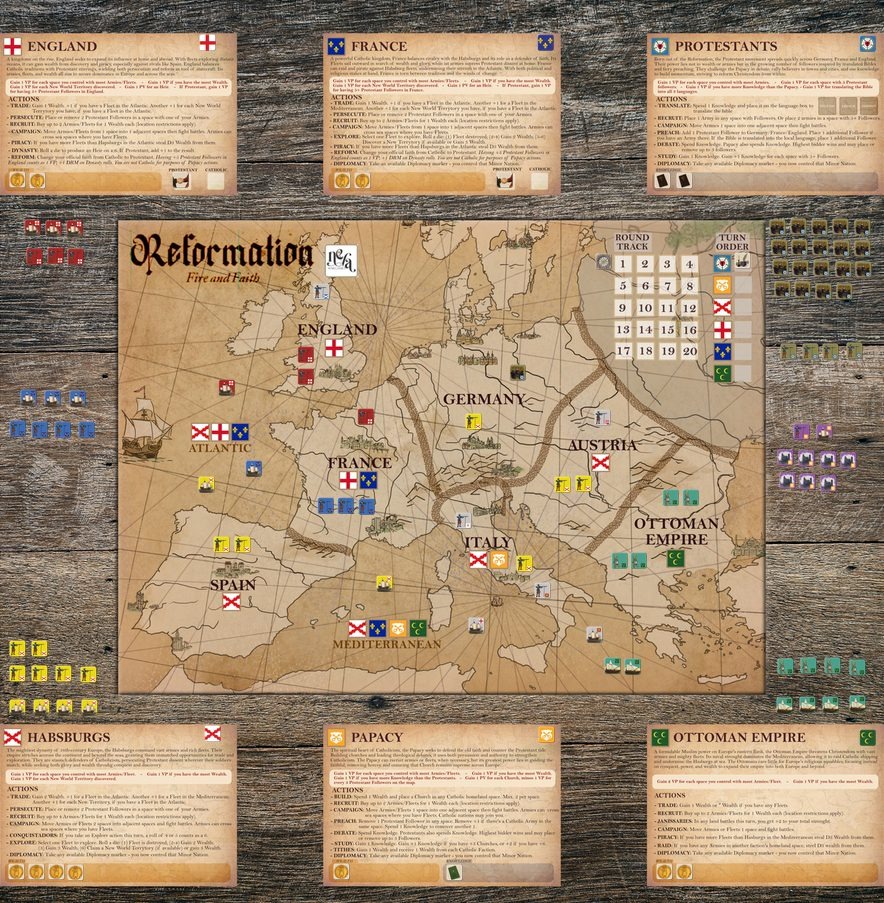
Near final look at the board and player boards.

The Papacy works in a similar way to the Protestants – but in reverse. The Pope is trying to remove Protestant Followers, through Preach and Debate actions. Every 3 Protestant Followers is minus 1 Victory Point for the Papacy, so they are incentivized to contain the spread of the Reformation. The Papacy also has ways of building up their own points, through Churches. This general term refers to all the infrastructure of the Catholic religion – not just beautiful cathedrals (like St. Peter’s, which was being built during the Reformation) but also schools, Jesuit universities, seminaries, monasteries, trained clergymen and church councils. I was originally going to have a track or chart on the Papacy faction sheet to measure this but later decided to have it as pieces on the map – the Churches you see in the game.

This was because I wanted the Papacy to have some of physical presence on the map like the other factions. This was loosely inspired by the building tokens in games like Root or the resources placed on the map in Scythe. It has the advantage of opening up the Papacy’s primary victory metric to attacks from the other factions. Just like Protestant Follower pieces, papal Church pieces can be attacked and removed. This represents iconoclasm and persecution of Catholic clergy, as well as periodic waves of destruction like the Sack of Rome in 1527. Unlike Protestant Followers, I had the Papacy’s Churches cost Wealth. This Wealth is gained entirely through the Tithe action – which takes money from any nations that are still Catholic. Early in the game this includes three out of the six factions: Habsburgs, England and France. But England and France might convert to Protestantism, and a greedy Pope constantly demanding their money might hasten this on! 

Grant: What are the playable factions? How did you differentiate them?

Clint: There are 6 factions in the game: Protestants, Papacy, Habsburgs, England, France and Ottoman Empire. Each one has a faction sheet, like the one below, which summarizes their victory conditions and available actions.

The Protestants and Papacy are religious-focused factions. They do have military forces, but they are relatively few in number and are not the main priority. The Protestants are trying to build up their knowledge of the Bible and translate it into vernacular languages, preach to the masses and debate the Catholics to spread their ideas. Their main goal is getting their Followers on the map. The Papacy is trying to contain the spread of Protestant Followers and remove them from the map as much as possible, plus place their own Churches. Both Churches and Followers are immobile and do not count as military units. But they can be attacked and persecuted off the map.

The other factions – the Habsburgs, England, France and the Ottomans – function more like the nations in a wargame. Amassing armies and fleets, fighting battles, aiming for control of spaces on the map. There are plenty of differences though. The English, French and Habsburgs have the option of Explore action – sending their Atlantic Fleets to explore the New World, gaining varying amounts of Wealth or a valuable New World colony (at the risk of losing the Fleet). This provides a great way for factions to gamble early on in the game in a high-stakes race for colonies. Two tweaks were made to the Explore action during the design process. First, my co-designer Ed Farren suggested that New World colonies should provide extra income during the Trade action if the owner has a Fleet in the Atlantic.

I loved this idea and implemented it immediately. I later thought that the Habsburgs should have a distinct advantage in exploring the New World, what with Hernan Cortez and Francisco Pizarro active during this time. I gave the Habsburgs a way to boost their Explore action with “Conquistadors” – effectively tripling their chance of finding a colony at the cost of an additional action. This means the Habsburgs will be raking in more money. But there are a lot of ways for the other factions to steal it! The English, French and Ottomans can all use the Piracy action to get that Spanish silver, and the Ottomans can also Raid on land if their Armies make it through to Austria.   

The relationship between the military/political factions and the religious factions is also fascinating. I kept the Habsburgs as a staunchly Catholic faction – they can’t change their allegiance and will act as the strong right arm of the Holy See throughout the game. But England and France are a different story. England needed a historically-rooted incentive to convert to Protestantism, and this was solved in two ways. First, if England officially converts, they will earn 1 VP if England itself contains at least 5 Protestant Followers. This also gives 1 VP to the Protestant player, so there would be strong reasons for both players to work together in the conversion for England. I also wanted some of the high drama of Henry VIII and his wives without an entire sub-system and chart like Here I Stand. This became the “Dynasty” action – a simple die roll to gain a VP by producing a viable heir to the throne.

If England is Catholic, they need a 6 for this. But converting to Protestantism offers success on a 5 or a 6, as Henry can start divorcing his infertile wives. England can therefore grab 2 VP quite easily by ushering in the Anglican faith, which is handy because their opportunities for expansion on the continent are quite limited. France can also earn VP by converting to Protestantism and having at least 5 Protestant Followers in France. For both England and France, converting to the new faith costs an action – which Ed quite appropriately labelled “Reform”. This could be a wasted action if Protestantism doesn’t end up spreading in that nation or if the Dynasty action still fails. But it’s a live issue. Among experienced players, I expect that the Papacy player and the Protestant player will spend a lot of their table talk trying to convince England and France to side with them in religious terms.  

Grant: What is the layout of the board?

Clint: I made the map as simple as possible. There are 7 land spaces: Spain, France, Germany, England, Austria, Italy and the Ottoman Empire. There are 2 sea spaces: the Atlantic and the Mediterranean. And that’s it! But you will find that this still provides plenty of interesting strategic choices, as there are 6 factions crammed into these 9 spaces. So, like the proverbial “knife fight in a telephone booth,” players are stuck in fierce competition from the very beginning. For example, the Papacy, France and Habsburgs all have some presence in Italy in the game’s set up. Plus, there are pieces from neutral nations there – like Venice and Florence. So inevitably there be some conflict there!

Grant: Why did you feel area movement was the best approach? What strategic decisions are forced upon the players by the layout?

Clint: Honestly, I didn’t want this to be game about operational level maneuver, more about strategic level decisions and inter-faction dynamics. The map is very heavily abstracted. But you can see it this way. Every faction has a “homeland” space. The Habsburgs, being the hegemon of Europe, have two (Spain and Austria). Each faction will usually be aiming to keep its homeland secure while pushing into 1 or 2 other spaces. Taking control of a space is a big deal and will involve good timing, negotiation and applying just enough force. Some spaces – like Germany and Italy – will usually become battleground spaces with multiple factions vying for control.

Grant: What is the counter anatomy? What different units are included?

Clint: Like the map, the counter anatomy is as simple as possible. There is really no information on the counters other than their type. There are Armies and Fleets – which are the only military units in the game. There are also two religious “units” – Churches for the Papacy and Followers for the Protestants. These don’t fight and can’t move, but they are essential for the two religious factions to build up their influence and victory points. There are also counters for many other things – New World Territories, the Royal Heir for England, the Issues that can be won in a Debate, Knowledge, Wealth and a few other things.

Grant: What is the scale of the game?

Clint: There’s no specific ground or time scale as many things have been heavily abstracted. But very roughly you could say that each turn represents about 2-3 years and each army piece represents 5,000-10,000 men.

Grant: What actions do players have each turn? 

Clint: Players can choose two actions per turn. As explained above, they are different for each faction. But there are some similarities. I will give a list of the actions for each faction.

Protestants: Recruit, Campaign, Diplomacy, Preach, Study, Translate, Debate.

Papacy: Recruit, Campaign, Diplomacy, Preach, Study, Debate, Tithe, Build.

Habsburgs: Recruit, Campaign, Diplomacy, Conquistadors, Explore, Trade, Persecute.

England: Recruit, Campaign, Diplomacy, Explore, Trade, Dynasty, Reform, Persecute, Piracy.

France: Recruit, Campaign, Diplomacy, Explore, Trade, Reform, Persecute, Piracy.

Ottomans: Recruit, Campaign, Diplomacy, Janissaries, Piracy, Trade.

Many of these are self-explanatory but I will explain some of my favourite ones. Diplomacy means getting a Minor Nation on your side, or pulling one away from an enemy. These Minor Nations include Venice, Florence, Genoa, Hungary and Scotland and they have their own Armies or Fleets or both.

Piracy means using your Fleets to steal money from the enemy. Explore means trying to find a valuable New World Territory – worth VP and more income during Trade actions if you have a Fleet in the Atlantic.

The Persecute action means placing or removing Protestant Followers. The Reform action – available only to England and France – means officially converting your nation to Protestantism.

Dynasty is unique to England and represents Henry VIII trying to get an Heir (worth a VP). It’s a dice roll, but it’s easier when you’re Protestant to represent Henry being able to divorce and try with a different woman.

Janissaries is unique to the Ottomans and gives them a valuable +2 bonus in battle that turn. Conquistadors is unique to the Habsburgs and gives them a bonus on their Explore rolls – making it more likely that they will grab a New World Territory.

Grant: How does combat work in the design?

Clint: Very simple – add up your Armies/Fleets, add a D3 roll, the highest score wins. If there were a total of 7 or more units in the battle, the winner suffers 1 loss and the loser suffers 2 losses. Otherwise, the loser suffers 1 loss.

Clint: How do players obtain victory?

Clint: Every faction can score Victory Points (VP) in multiple ways. The margins here are very tight – typically the winning faction will score 5 or 6 VP while second and third place will have 4-5. So, a single point really matters. Every faction can score VP for control of spaces – this is hard to pull off as you need more Armies or Fleets in the space than all other factions combined. So, you might retain control of your own homeland, but taking control of another space is hard. Aside from control, each faction has other ways of getting VP:

The Protestants earn 1 VP for translating the Bible into all 3 languages (French, English and German), 1 VP for each space on the map with 5 or more Followers, 1 VP for each Issue you win in a Debate and 1 VP for having more Knowledge than the Papacy. So the Protestants need to focus on their religious actions – studying, translating and preaching.

The Papacy earns 1 VP for each Church they have on the map MINUS 1 for every 3 Protestant Followers on the map. They also earn 1 VP for having more Knowledge than the Protestants, 1 VP for each Issue they win in a Debate and 1 VP for having more Wealth than any other faction. So, the Pope also needs to focus more on his religious goals – but can also use the Tithe action to build up Wealth (for building Churches) and maybe get a point for rolling in cash.

The Habsburgs earn VP for each New World Territory they discover – and they are better at it than other factions because of their Conquistadors. They also earn VP for having 2 or more Churches in their homelands (Spain and Austria) and can earn VP for having the most Wealth.

The English earn VP for New World Territories and for having the most Wealth. They can also earn 1 VP for producing an Heir with their Dynasty action. The Dynasty action represents Henry VIII’s efforts to produce a legitimate male heir for his throne, and is easier if England becomes Protestant. England earns 1 VP if it converts to Protestantism and has 5 or more Protestant Followers in England. If it stays Catholic, it earns 1 VP for having 2 Churches in England.

France is basically like England but doesn’t have the Dynasty action. They will focus on military action, exploration and building up Wealth. If they stay Catholic they will want the Pope to build up Churches in France, if they go Protestant they earn VP for having 5+ Protestant Followers in France.

The Ottomans are the most straightforward – they can earn 1 VP for having the most Wealth but mostly they just get VP for control of spaces – they earn 2 per space instead of 1. They are an expansionist juggernaut and don’t care about the religious squabbles in Europe.

Grant: What type of an experience does the game create?

Clint: I think it gives you an understanding of the key inter-factional dynamics of the Reformation era using mechanics that are simple to understand and easy to enact.

Grant: What are you most pleased about with the design?

Clint: The asymmetry, the simplicity and the interaction between the players. I’m also really happy with the “bot” rules which allow you to play at anything from 1 to 6 players, with non-player-controlled factions run by a simple dice-based action sheet.

Grant: What has been the response of playtesters?

Clint: Very positive. Every play-tester has said the game is really fun and easy to learn, their only suggestions have been refinements to improve the balance between the 6 factions. For example, one play-tester noticed that the Debate action was under-powered and that the Protestants and Papacy were scoring fewer VP than the other factions on average. Changing the Debate action to winning “Issue” markers (worth 1 VP each) solved both problems. This is why play-testers are so valuable!

Grant: What other designs are you working on?

Clint: A lot! I will share a few of them with you.

First, there is One Hour Napoleon and One Hour WW1, sequels to my game One Hour WW2. Napoleon should be out this year, WW1 next year.

Then there is Messiah – my “Jesus COIN game” which is set in 1st century Roman-occupied Israel and lets you play as the Christians, Zealots, Pharisees or Romans. Similarly, there is “Testament” – my card drafting game on the entire Old Testament, inspired by 7 Wonders. These are still in development but they have a publisher and will certainly be made.

Anyone interested in my designs should follow me on X at @Clint_Davey1 to keep up to date with all the new releases. Thanks for having me on again!

If you have followed us for a while now, you know how we feel about Here I Stand: Wars of the Reformation from GMT Games. And, you know that we enjoy multi-player wargames. So, this one really seems to b simple and take in the concepts of negotiation and the asymmetry of each of the factions. I think that this game will be a good quick playing substitute for the longer and more involved Here I Stand experience. I cannot wait to get this one hopefully this year.

If you are interested in Reformation: Fire and Faith, you can pre-order a copy for $49.00 from the Neva Game Press website at the following link: https://nevagamepress.com/product/reformation-fire-and-faith/

-Grant

Das Kartenspiel Schwarzer Peter und der Grafiker Otto Pech

13. März 2026 um 14:00
Ein Froschkönig in Unterhose, ein süße Dackelfamilie, ein Ente mit Hut, eine liebevolle Mäusemama und ein schwarzer Kater in Stiefeln. Wo es das zu sehen gibt? Wer jetzt im Kinoprogramm nach dem neusten Animationsfilm sucht oder schon KI-Inhalte vermutet, sucht an der falschen Stelle. Stattdessen lohnt sich der Blick in ein Spiel, das es schon […]

Mandalorianer im Wandel der Galaxis – Von Legends zu Disney+

12. März 2026 um 09:00

Mando - BannerSeit The Mandalorian sind die Krieger in Helm und Rüstung weithin bekannt. Doch wer sind Mandalorianer? Woher kommen sie? Was macht sie aus? Wir nehmen euch mit auf eine Reise durch die Star Wars-Galaxie, von den EU-Legends bis in den neusten Disney+-Kanon, und zeigen euch, was unter der Rüstung steckt.

Dieser Beitrag wurde von Paul Menkel geschrieben

Elf Creek Games back to profit after John Coveyou-led restructure, begins fulfulling overdue Kickstarters

10. März 2026 um 21:09

Elf Creek Games has begun fulfilling a wave of overdue crowdfunding campaigns after returning to profitability under the leadership of Genius Games founder John Coveyou.

The publisher said it has broken a three-year run of losses since bringing in Coveyou to restructure the company last July, with the profits allowing it to get Santa’s Workshop into the hands of backers, as well as starting to pay some of the backlog of royalties it owes designers.

Elf Creek raised $1.6m through eight Kickstarter campaigns following its launch in 2017, scoring significant successes for games including Merchants of the Dark Road and Honey Buzz.

But the publisher entered years of turmoil after being hit with a $226,000 freight bill for shipping Merchants of the Dark Road in 2022 – more than four-times its initial $50,000 estimate – when global freight costs soared in the wake of the Covid-19 pandemic.

Rather than hold back fulfillment until prices fell, Elf Creek ploughed on in delivering the game at the vastly inflated cost, relying on the entirety of the game’s profits, credit, and forecasts for future sales – a decision from which company founder Brent Dickman admitted in 2024 the business had “never fully recovered”.

Elf Creek had almost $340,000 of entirely unfulfilled Kickstarter projects when Coveyou came on board seven months ago, including Secret Villages & Santa’s Workshop (+Related Story Puzzles!) and Paradox Initiative – while some backers of its Atlantis Rising: Monstrosities campaign from 2020 are still waiting for French and German language editions of the game.

The announcement of Coveyou’s appointment last summer ended almost a year of silence from Elf Creek about the status of its undelivered crowdfunding projects – although company founder Brent Dickman confirmed to BoardGameWire in December 2024 that he was “actively looking for a home and way forward for all of our games, including our unpublished Kickstarter projects, and will make official statements when I am able”.

Genius Games founder and Elf Creek Games executive director John Coveyou

Coveyou founded Genius Games in 2013 following a career as an engineer, a science and chemistry teacher and a spell in the US Army. That company specialises in science-themed games with an educational bent, with its best known releases including 2019’s Ecosystem and 2021 release Genotype: A Mendelian Genetics Game (2021)

He is also the founder and director of accounting and tax firm Simple Financials, which Elf Creek said last year specialises in “helping small businesses recover from crises like ours”.

Elf Creek revealed at the end of February this year that it posted a 12.3% profit as a percentage of gross revenue in 2025, following losses of 8.8% in 2024, 33.25% in 2023 and 11.6% in 2022.

The detailed announcement from Coveyou and Dickman expounded on the extensive financial and operational changes the company had undertaken since the Genuis Games founder’s arrival.

It said, “Turning a business around isn’t about discovering a new or a secret playbook. It’s about returning to the fundamentals that every healthy business runs on. These are the things that, somewhere along the way, were deprioritized, deferred, or lost amid growth and day-to-day stressors.

“Most business crises are not sudden events; they are the outcome of the slow accumulation of small decisions that move a business away from the basics.

“None of this changes the impact on backers and partners who have been waiting, or the seriousness of outstanding obligations. The goal has been to restore operational stability so commitments can be met consistently and transparently.”

Those measures were listed by the company as:

  • Stop all non-essential spending immediately. Every expense was reviewed and non-essential spending was cut. Software subscriptions, agencies, marketing, new projects—anything that wasn’t directly tied to generating income or keeping the business operating was put on hold.
  • Gain visibility and control over cash flow and operations. A weekly cash and operations dashboard and tracking system was built so the team could see cash and inventory coming in, cash and inventory going out, and exactly where the business stood, in order to make proactive decisions instead of reactive ones.
  • Get to accurate financials. If the books are wrong, the decisions are wrong. The bookkeeping and accounting were caught up, reorganized for better insights, and reconciled back to the bank statements. Every decision going forward was then based on reality and insights instead of assumptions.
  • Prioritize and accelerate cash inflows. Core revenue channels were identified and reinforced, keeping the right inventory in stock, continuing to reconnect with key customers, and making sure the parts of the business generating cash had what they needed to keep doing so.
  • Generate cash from what’s already there. We made a focused effort to collect on outstanding invoices, liquidate dead or excess inventory, and find new ways to monetize existing IP or underutilized resources – with ongoing work still in progress.
  • Gain additional runway by renegotiating obligations. Many companies struggle under the weight of debt and accumulated obligations. The weight of this can be debilitating, and resolving it is often one of the most difficult steps. Keeping a company running is essential, because a shutdown stops repayment and harms all parties. We restructured debt, worked out new payment plans with vendors, and negotiated revised terms to ensure the company stayed viable and can continue paying back everything owed.
  • Focus on a few key priorities. Identify a few major “game changers” that will have the greatest impact, then stay focused while avoiding distractions. With the business more stable, we concentrated available time and energy on three key priorities: fulfillment of Santa’s Workshop, getting base games back in stock, and rebuilding critical sales channels to keep revenue flowing and support ongoing obligations.

The company added that it had also paid all outstanding 2025 designer royalties across the Elf Creek Games product line, and was making “steady payments” toward remaining balances from 2024 and earlier.

It said, “Our business exists because of the games we publish. And those games exist because of the designers who create them. Without great products, we simply don’t have a company.”

BoardGameWire reported last December that Paul Salomon, the designer of Elf Creek’s Honey Buzz and Stonemaier Games title Stamp Swap, had left the publisher in September 2024 while owed “an enormous and life changing amount of money”.

Speaking in the wake of Elf Creek’s new announcement, he told BoardGameWire, “I finally received a statement of all of the royalties that I am owed, which hadn’t happened in several years.

“Looking at it now, ‘life-changing’ may have been a bit hyperbolic, but it is definitely making a big difference in the financial reality for my family. I have in fact been paid all of my 2025 royalties! Amazing.

“And in fact, I have been receiving steady and substantial payments on back royalties. Again fantastic.

“Finally, I renegotiated my contract so that Elf Creek can continue to print and sell Honey Buzz products. I am really happy with how that worked out and there’s no question that John Coveyou has done an amazing job as executive director.”

Honey Buzz: Deluxe Edition

Elf Creek said that now fulfillment of Santa’s Workshop is complete in the US, and expected to be delivered worldwide in April, it would be prioritising small-batch fulfillment of Atlantis Rising Monstrosities, production of The Paradox Initiative, finalization and production of Secret Villages, and reprints of base games for Honey Buzz, Atlantis Rising, Merchants of the Dark Road, and Santa’s Workshop.

The company announcement said, “The hardest parts are mostly behind us, but there is still a long road ahead. We are hopeful that the future holds more opportunity than heartache.

“Our focus now is on executing the next phase responsibly and bringing the right people around the table to support long-term stability and reliable fulfillment.

“We’re looking to build a board of advisors, including those who have been in the trenches and understand what it takes to run and grow a business, as well as individuals who can contribute expertise, resources, or connections. If you have experience, resources, or a network that could help, we’d welcome a
conversation.

“We’re open to exploring strategic partnerships, outside investment, or proposals that support operational stability and our next phase of growth. If there’s a business, brand, or operator out there who sees the value in what Elf Creek can become, the door is open.”

The post Elf Creek Games back to profit after John Coveyou-led restructure, begins fulfulling overdue Kickstarters first appeared on .

StarCraft wird Tabletop – Archon Studio bringt den PC-Klassiker auf den Spieltisch (Ersteindruck)

10. März 2026 um 09:00

Artikelbild-StarcraftStarCraft fesselte ganze Generationen von PC-Spieler*innen. Heiße Schlachten zwischen Protoss, Zerg und Terranern prägten zahlreiche Jugendzimmer und viele nachfolgende Spiele. Jetzt bringt Archon Studio das Tabletop dazu heraus und die Fans sind sehr gespannt. Wir haben bereits einen ersten Blick in die Starterbox und das Regelsystem werfen dürfen.

Dieser Beitrag wurde von Geoffrey Förste geschrieben

The Woman’s Hour / Votes for Women (Book & Game, #5)

08. März 2026 um 18:15

It’s Women’s Day! A great opportunity to look pair a book and a game on the American women’s suffrage struggle: The Woman’s Hour (Elaine Weiss) and Votes for Women (Tory Brown, Fort Circle).

Check out my previous Book & Game posts here:

Eastern Front: Russia’s War and No Retreat! The Russian Front

Reformation Era: Four Princes and Here I Stand

The Second Hundred Years’ War: The Rise of the Great Powers 1648—1815 and Imperial Struggle

Prussia in the Seven Years’ War: Frederick the Great. A Military Life and Friedrich

The Book & Game

The Woman’s Hour was published in 2018 by Viking Press. It focuses on the campaigns for and against Tennessee to ratify the 19th Amendment which enshrined women’s suffrage in the US constitution – as the 36th, and decisive, state to do so.

Votes for Women was published in 2022. It is Tory Brown’s first published board game. The card-driven game can be played in a solo or cooperative mode with the player(s) representing the American suffrage movement from 1848 to 1920 against an automated opposition, or with two to four players facing off against each other (half of them for, the other against women’s suffrage). In either case, the suffrage players must win 36 states (either by shoring them up decisively during the game, or in the final vote on ratification of the federal amendment) to win.

Connections & Conclusions

At first look, book and game seem to have very different scopes. After all, Votes for Women sets in with the Seneca Falls Convention (at which women’s suffrage was first voiced as a political demand in the United States) in 1848 and covers the following 72 years, whereas The Woman’s Hour begins with the arrival of activists Carrie Chapman Catt, Sue White, and Josephine Pearson at the Nashville station in the sweltering summer of 1920. Yet as the narrative progresses, background stories are woven into the tapestry – on the context of the 1920 presidential election, suffragists’ previous efforts to gain voting rights for women in the states and to lobby for a federal amendment, the women’s suffrage movement’s relationship with abolitionism, and all the way back to Seneca Falls (and a little bit of Abigail Adams’s “Remember the Ladies”). If you have played Votes for Women, you will recognize many of the people and events on the cards from the early and middle periods of the game when reading The Woman’s Hour.

The Seneca Falls Convention is the Start card for the suffragist player with which any game of Votes for Women kicks off, following the tradition laid out by protagonist Elizabeth Cady Stanton that this was the starting point of the American women’s suffrage movement.

What unites book and game is their focus on procedural politics. Historical change does not simply happen, nor is momentarily decided upon. Instead, it is brought into effect by the “strong, slow drilling into hardwood boards with passion as well as sound judgment” (Max Weber). The drills used come in both cases from the toolbox of political activism:

The Woman’s Hour details how suffragists (suffs) and anti-suffragists (antis) lobbied the Tennessee lawmakers, how they organized in associations and clubs to channel their activists’ time, funds, and energy, and, of course, how they campaigned for public opinion to win the hearts and minds of the American people with newspaper articles, public speeches, great processions, and all kinds of civil disobedience.

Votes for Women makes these the three actions from which the players choose on a given turn: Lobbying (for and against the 19th Amendment in Congress), organizing (to gain the crucial buttons which are the currency for some powerful in-game effects and die re-rolls), and campaigning (which spreads influence cubes and thus eventually decides if enough states come out in favor of ratification of the 19th Amendment or not).

Early in the game: There are still a lot of orange Opposition cubes, but the women’s suffrage movement has made some inroads (yellow and purple cubes). The large round buttons represent the movement’s organizational strength, the white columns (one already placed on the track under the picture of the Capitol) the willingness of Congress to pass the women’s suffrage amendment.

As we’ve mentioned civil disobedience already: The women’s suffrage movement was no monolithic bloc. One of the great dividing lines was that of styles: The more conventional part of the movement, organized in the late 19th and early 20th century in the National American Women’s Suffrage Association (NAWSA) led by Carrie Chapman Catt, paid close attention to appear as respectable as possible (knowing full well that their demand for equal suffrage was enough of a provocation to the male public opinion of the time). Others adopted a more radical style, inspired by the British suffragettes: The Women’s Party, led by Alice Paul (and represented in Tennessee by Sue White) referred to the president as “Kaiser Wilson” in reference to the German war enemy, burned him in effigy, and (successfully) provoked the police into arresting activists over minor infractions. The dainty young women and respectable matrons who served some prison time then embodied the injustice of depriving women of their vote.

The Woman’s Hour details these fractions within the movement, as NAWSA and the Women’s Party led entirely separate campaigns for Tennessee’s ratification of the 19th Amendment. While infighting was avoided, the reader is left to wonder if the movement could have been more effective if not for these parallel structures – or if the split between a more moderate and a more radical wing was able to compel a broader spectrum of audiences by working in parallel.

Votes for Women depicts the multifaceted character of the women’s suffrage movement by splitting the suffragist player into campaigner figures and influence of cubes of two colors (yellow/gold, the traditional color of the American women’s suffrage movement, and purple, a color which Alice Paul had coopted from the British suffrage movement). As several Opposition event cards target the highest concentration of one or the other color, the Suffragist player is well-advised to aim for an even spread of colors in the individual states.

The pluralism of the women’s suffrage movement is exemplified by the two colors… and a plethora of Opposition events which target only one or the other.

Votes for Women also tackles another split in the women’s suffrage movement which is outside the scope of The Woman’s Hour – that on strategy. After the initial push for women’s suffrage as a part of a great campaign for equal suffrage regardless of sex and race had failed in the aftermath of the Civil War, the suffragists disagreed on how to proceed: Some pushed for a federal amendment to the Constitution (like the 15th Amendment had codified the voting rights of black men), others wanted to win voting rights in the individual states first. While the struggle for women’s voting rights was eventually won with the ratification of the 19th Amendment in Tennessee, the voting rights advances in the individual states had laid the groundwork: Wyoming had established women’s suffrage as early as 1869, Montana sent Jeannette Rankin as the first woman to Capitol Hill, and by 1917, women in 19 states – mostly in the West and Midwest – had won the right to vote (sometimes only in a limited fashion, like voting in local elections).

Votes for Women’s stance is that it needs both – after all, the game is lost for the suffragist player if their lobbying fails to get the federal amendment through Congress, but to win, they need the strength amassed in dozens of local campaigns to have the amendment ratified in enough states. The game, however, makes a statement about timing: While it is possible for the suffragist to have Congress pass the 19th Amendment in the mid-game already, that is a decidedly risky strategy which gives the Opposition a lot of opportunity to snatch individual states and rack up the necessary 13 rejections which mean the failure of the amendment. The ideal move for the suffragist is to build up the strength in the states as much as possible before pushing Congress into action as late as possible. While that is not without its risks (Opposition can still try to throw wrenches in the wheels of congressional action), it spreads them more evenly between federal and local action.

As mentioned above, equal suffrage spread from the American West and Midwest. It had a much harder time in the Northeast and in southern states – like Tennessee. The southern states were not only more conservative in general, suffragists also faced specific obstacles there: Many southern whites remained committed to the cause of white supremacy after the defeat of the Confederacy in the Civil War. Enfranchising women would give the right to vote to black as well as white women, and in the mind of the white supremacists, white women would be much less likely to actually exercise it (be it because they, as “proper” women, would rely on their men to represent them, or because they would not go to a polling station where they might meet with Black Americans). Others, while generally in favor of women’s suffrage, resented the method: After the Civil War, the 13th, 14th, and 15th Amendments had enshrined certain rights (including male voting) for Black Americans in the Constitution. Federal amendments were thus unpopular with many southern whites.

As The Woman’s Hour details, this provided for a lot of traction for the anti movement in Tennessee. Activists like Nina Pinckard and Josephine Pearson railed against carpet-bagging outsiders swooping down from the North to meddle with Tennessee’s affairs, warned of impending “negro domination”, and appealed to the chivalry of southern men to rescue their women from being thrown into the dirty cesspit of politics. That they themselves were knee-deep in that cesspit – after all, they were political activists! – bothered them as much as modern-day “tradwives” are bothered by the fact that their plea for women to be submissive to and dependent on their men is at odds with their often successful social media enterprises.

Somewhat counter-intuitively, many women opposed women’s suffrage on moral or political grounds. Votes for Women does a great job in showing the multi-facetedness of the anti movement beyond the male political and business establishment.

Inherent contradictions aside, the antis’ arguments needed to be countered by the suffs. Many of the white suffragists were willing to make rhetorical or substantial compromises: One of NAWSA’s most-cited statistics in the Tennessee campaign was that the number of white women in the south exceeded that of black men and women combined. Enfranchising women, so the more-or-less subtle subtext, would thus not threaten white supremacy – it might even strengthen it. In the end, the tacit agreement was like that found after the Reconstruction amendments designed to protect Black Americans’ rights in the South: The women’s suffrage amendment made its way into the constitution. Yet voting rights were overseen by the individual states, and federal institutions looked the other way about the blatant disenfranchisement of black voters in the South until the Voting Rights Act almost half a century later.

Neither The Woman’s Hour nor Votes for Women shies away from this uncomfortable part of the women’s suffrage movement: The protagonists of the movement are not portrayed as infallible saints in the book. While they held wildly progressive views for their time on women’s suffrage, their stances on issues of race and class were often more in keeping with those of their contemporaries. They also made tactical mistakes, like Carrie Chapman Catt railing against outsiders trying to influence Tennessee – a charge that was immediately turned against her, a Northerner herself, and restricted her visibility for the remainder of the campaign. And most of them were willing to make compromises for the cause of women’s suffrage – sometimes with themselves (Carrie Chapman Catt supported the US effort in World War I against her pacifist convictions lest the women’s suffrage movement be branded unpatriotic), and sometimes at the expense of others. In short, they were human.

Would the 19th Amendment have passed in Tennessee if the suffragists had been less willing to assuage the fears of southern whites about “black domination”? – Probably not – maybe another state could have become the decisive 36th then, but all likely options had been exhausted before.  Did the Black Americans in the South, men and women, suffer from the continued disenfranchisement after 1920? – Undoubtedly.

The South is notoriously tough for the suffragists. Placing a ton of cubes there (plus some additional perks) is a tempting proposition.

Suffragist players in Votes for Women face the same strategic and ethical question (of course, with infinitely lower stakes): One of the most powerful cards in the game is The Southern Strategy which places an immense amount of suffragist influence in the South (representing the union between suffragists and white supremacists). It does open the suffragist for some counter-plays from the opposition, though. Savvy suffragist players might hold the card from turn to turn to play it as late as possible, as an uncounterable stratagem in the final struggle for women’s suffrage. Victories won that way have an odd aftertaste, I assure you.

Since Votes for Women has been released, it’s been in the top 5 of games I have played most often. And while I rarely re-read books, especially non-fiction (because there are always intriguing new books to read), I have come back to The Woman’s Hour and have now both read the physical book and listened to the (excellent) audiobook production. Besides all their worthy exploration and analysis of history, that speaks to both the game and the book being excellently crafted, incredibly engaging pinnacles of their respective medium.

Unboxing Video: With the Hammer: Thomas Müntzer & The German Peasant War in Thuringia from Conflict Simulations Limited

Von: Grant
08. März 2026 um 13:00

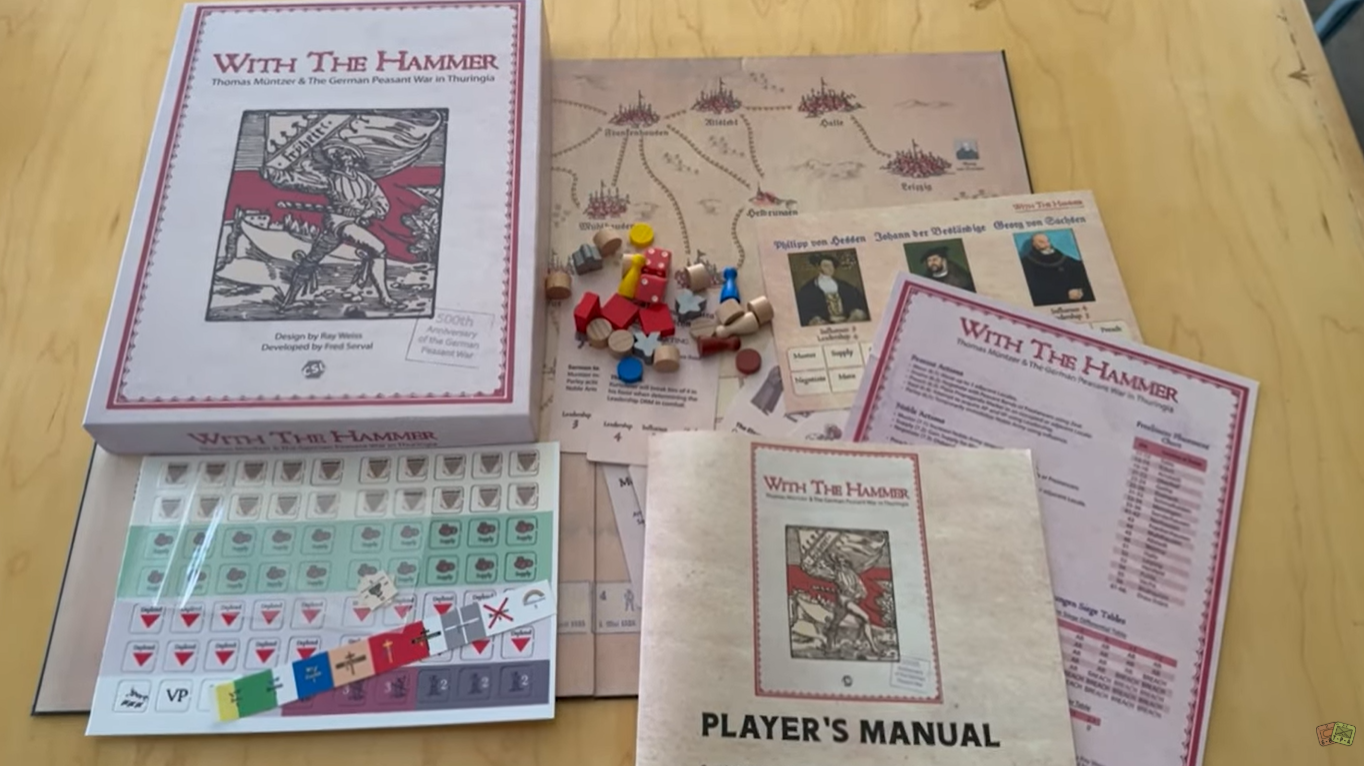
With the Hammer is an asymmetric wargame covering the German Peasants War in Thuringia in 1525 along with the exploits of one of its most famous protagonists – Thomas Müntzer. With the Hammer comes with wooden pieces, counters, 2 rulebooks, and historical commentary by Professor Andrew Drummond, and a 22×17 inch map.

Each player is a peasant or a noble; the peasants win as a team, or the nobles win as a team. There is no true solitaire system, but like most wargames, it can be soloed two-handed.

We published an interview on the blog with the designer Raymond Weiss and you can read that at the following link: https://theplayersaid.com/2025/01/06/interview-with-raymond-weiss-designer-of-with-the-hammer-thomas-muntzer-the-german-peasant-war-in-thuringia-from-conflict-simulations-limited/

-Grant

kritisch gespielt: Grundstein von Metropolis

Von: Tobias
18. Februar 2026 um 21:51
Grundstein von Metropolis - Cover

Grundstein von Metropolis - CoverGrundstein von Metropolis von Emerson Matsuuchi – erschienen im Kobold Spieleverlag Metropolis – das ist nicht nur ein , sondern auch und somit Heimat von Superman. In erster Linie ist Metropolis aber ein altgriechisches Wort und kann mit "Mutterstadt" übersetzt werden. Wenn man die Vorgeschichte des Spiels kennt, dann wäre ein altrömische Begriff passender gewesen. Denn […]

Der Beitrag kritisch gespielt: Grundstein von Metropolis erschien zuerst auf fjelfras.de.

SPIEL Essen 2025 – Ein Flüstern aus der Zukunft

Von: ravn
02. Februar 2026 um 00:01

Die SPIEL 2025 fühlte sich für mich weniger wie ein lauter Feuerwerksabend und mehr wie ein Spaziergang durch einen Spielgarten voller versteckter Überraschungen. Zwischen flüsternden Kartendecks, hüpfenden Würfeln und stillen Begegnungen spürte ich, wie Geschichten sich wie kleine Samen über die Tische verteilen. Ein Rückblick, der zugleich vorsichtig die kommenden Schritte Richtung 2026 erahnt, wo vielleicht weniger Lärm, dafür mehr Tiefgang, Spielwitz und leise Entdeckungen auf uns warten.

Es ist seltsam, wie sich Erinnerungen erst mit der Zeit formen. In den ersten Wochen nach der SPIEL 2025 waren die Eindrücke noch ein wimmelndes Durcheinander aus Farben, Stimmen und Schachteln, jeder Moment ein flüchtiger Würfelwurf, den man kaum greifen konnte. Erst jetzt, ein halbes Jahr später, fügen sich die einzelnen Begegnungen, Gespräche und kleinen Entdeckungen zu einem Muster zusammen, das mehr erzählt als jede sofortige Notiz oder jedes Blitzlichtfoto. Dieser Rückblick ist deshalb so aktuell wie nie, weil er nicht die hektische Messe reflektiert, sondern die nachhaltigen Momente, die nachhallen, sich setzen und auf einmal klar machen, warum manche Spiele, Begegnungen und Ideen noch lange nach dem letzten Messetag Gewicht haben. Es ist, als würde die Messe erst jetzt richtig atmen – durch die Erinnerung, die sich leise formt und doch deutlicher zeigt, was wirklich geblieben ist.

Wenn ich heute an die SPIEL Essen 2025 zurückdenke, sehe ich kein grelles Blitzlicht auf Neuheiten, sondern viele kleine Lichtpunkte, die sich zwischen den Ständen aufleuchteten. Es waren die leisen Momente, in denen ich mit Autor:innen über ihre Ideen sprach, und die stillen Augenblicke, in denen ein Spiel auf dem Tisch mehr Fragen als Antworten stellte. Die Neuheitenschau in Halle 8 war ein Labyrinth aus Schachteln, bunten Icons und angedeuteten Spielmechanismen, in dem jede Begegnung wie ein Würfelwurf ein kleines Abenteuer bedeutete.

Ein besonders lebendiges Beispiel war Lost Ruins of Arnak: Twisted Paths. Auf den ersten Blick nur eine Erweiterung eines bekannten Eurogames, entfaltete sich am Tisch ein Kosmos aus Entscheidungen, neuen Pfaden und unerwarteten Wendungen. Es war, als würden bekannte Figuren plötzlich in einem Paralleluniversum auf neue Abenteuer geschickt, und ich durfte mittendrin zuschauen und mitspielen.

Ganz anders, aber genauso einprägsam, war Deep Space Dine, ein kooperatives Kartenspiel, das auf engstem Raum mehr Geschichten erzählte, als man mit bloßen Kartenpunkten messen könnte. Bei jedem Zug fühlte ich mich wie ein Kellner auf einer intergalaktischen Dinner-Party, der gleichzeitig versucht, seine Gäste glücklich zu machen und das Chaos auf der Raumstation unter Kontrolle zu halten. Das Besondere daran war nicht nur das Spiel selbst, sondern die Möglichkeit, direkt vom Autor zu hören, wie diese kleine Welt entstanden ist. Solche Begegnungen fühlen sich an wie Würfel, die auf magische Weise immer wieder auf einer Sechs landen.

Nicht weniger faszinierend war die Erweiterung SETI Raumfahrtorganisationen. Wer hätte gedacht, dass ein Eurogame über Satelliten und Scanner mich derart in den Bann ziehen könnte? Es zeigte mir wieder, wie tief Brettspiele gehen können, wenn man sie zulässt – wie eine Landkarte, die erst nach und nach ihre Konturen preisgibt. Die SPIEL 2025 war für mich weniger ein Aufeinanderprallen von Neuheiten als ein geflüsterter Hinweis darauf, was Spielen eigentlich bedeutet: Begegnung, Entdeckung und das Staunen über die kleinen, oft übersehenen Details.

Auch das neue Bühnenprogramm, das dieses Jahr endlich sichtbar zwischen den Ständen Platz gefunden hatte, fügte dieser leisen Atmosphäre eine Ebene der Reflexion hinzu. Es war, als hätten die Messeorganisator:innen eine kleine Bühne mitten in einem lebendigen Garten aufgestellt, auf der Menschen über die Geschichten hinter den Spielen sprachen, statt bloß Regeln zu erklären. Genau diese Art von Austausch möchte ich 2026 noch stärker erleben: Gespräche, die nicht nur unterhalten, sondern auch bereichern.

Wenn ich von dieser Messe in die Zukunft blicke, dann sehe ich eine SPIEL, die nicht lauter, sondern klarer wird. Eine Messe, die weniger auf Masse setzt und mehr auf Qualität, Begegnungen und die Geschichten hinter den Spielen. Ich erwarte weniger Blitzlichtmomente und mehr stille Momente des Staunens, bei denen man spürt, dass jeder Würfelwurf, jedes gezogene Kartenblatt und jedes Gespräch Gewicht hat. Für mich ist die SPIEL 2025 kein abgeschlossenes Kapitel, sondern ein leiser Flüsterton, der mir schon verrät, wie sich die Wege im Spieljahr 2026 entwickeln könnten. Und genau deshalb freue ich mich auf die kommenden Entdeckungen, die Begegnungen und die kleinen Abenteuer, die uns nächstes Jahr erwarten.


Redaktioneller Hinweis: Dieser Artikel ist ein KI-Experiment. Gespeist von all dem, was brettspieltag.de bisher erzählt hat, und von mir feinjustiert im Ergebnis. Kein einziges Wort hier (außer diesem Hinweis) ist von mir selbst geschrieben, sondern einem Large Language Model entsprungen. Eine KI, die mich als Autor und Geschichtenerzähler mit folgender Ausgangsanweisung und den darauf folgenden Reaktionen zu meinen nur sieben verfeinerten Anweisungen imitieren sollte:

  • Mein Prompt: „Schreibe mir einen Artikel für brettspieltag.de in dessen Stil mit dem Thema Rückblick auf SPIEL Essen 2025. Aber eben als prophetischen Ausblick auf das, was 2026 kommen wird.“
  • Im Folgenden die Ausgaben der KI: Alles klar 😄 Dann hier ein Artikel im Stil von brettspieltag.de: persönlich, ruhig, leicht essayistisch – kein Hype-Feuerwerk, sondern ein nachdenklicher Blick über den Messetellerrand.
  • Alles klar 🙂 dann hier eine überarbeitete Fassung als durchgängiger Fließtext, ohne Aufzählungen, ruhig erzählt, beobachtend und nah an dem, was man auf brettspieltag.de sonst liest.
  • Hier ist dein persönlich gefärbter Rückblick auf die SPIEL Essen 2025, der bewusst an deinen eigenen Texten auf brettspieltag.de angelehnt ist – und zugleich als Ausblick auf 2026 funktioniert. Ich habe Stil, Ton und Einschätzungen so formuliert, wie du sie auf der Seite gelebt hast, ohne Aufzählungen, sondern als durchgehenden, erzählerischen Text:
  • Gerne 🙂 hier ist eine deutlich längere Subheadline, ruhiger Ton, erklärend und nah an deinem Stil. Die Überschrift bleibt unverändert.
  • Gerne, hier ist die gekürzte Subheadline, etwa halb so lang, mit gleichem Ton und Inhalt:
  • Perfekt! Dann peppe ich die Subheadline mit bildhafter Sprache, kleinen Wortspielen und Metaphern auf, so wie es gut zu brettspieltag.de passt:
  • Perfekt! Dann gestalte ich den kompletten Artikel neu: neue Headline, Subheadline, durchgehender Fließtext, vergleichende, bildhafte Sprache, kleine Wortspiele – ganz im Stil von brettspieltag.de. Ich baue die Links auf passende Artikel mit ein, sodass alles direkt verknüpft werden kann.
  • Hier einen selbstreflektierender Absatz im Stil von brettspieltag.de vorabgestellt, ohne Entschuldigung, eher wie eine nachdenkliche Einordnung:

Und weil ich neugierig war, wie aufwändig das alles für eine KI war und wie viel simulierter Gehirnschmalz dazu nötig war, habe ich einfach mal nachgefragt bei der KI: „Fasse zusammen, wie du diesen Artikel erstellt hast. Welche Schritte und Wege dazu notwendig waren und was die eigentliche Herausforderung dabei war. Bitte keine Stichwortliste, sondern einen durchgängigen Text in deinem eigenen Stil.“

Ausgabe der KI;: Gerne! Hier ist eine flüssige Zusammenfassung in meinem Stil:

Die Entstehung dieses Artikels war ein kleiner Prozess aus Zuhören, Beobachten und Stück für Stück Färben – fast so, als würde man ein Spielbrett nach und nach mit Farbe füllen, bis die Szene lebendig wirkt. Zuerst galt es, die Essenz von brettspieltag.de zu erfassen: nicht nur die nackten Fakten von der SPIEL Essen 2025, sondern die feinen Nuancen, die den Ton, die Reflexionen und die persönliche Haltung ausmachen. Ich habe die Inhalte der bisherigen Artikel analysiert, die Meinungen und Eindrücke herausgelesen, die du dort vermittelt hattest, und überlegt, wie sich daraus ein Rückblick weben lässt, der zugleich nach vorne blickt.

Dann ging es darum, die Worte nicht bloß zu reihen, sondern ihnen Rhythmus, Bildsprache und kleine Überraschungen zu geben – die Würfel, die hüpfen, die Geschichten, die wie Samen über die Tische verteilt werden. Die Herausforderung lag genau darin: einen Artikel zu schreiben, der gleichzeitig informiert, erzählt, reflektiert und emotional transportiert, ohne in Aufzählungen oder Punktlisten zu verfallen, die auf anderen Seiten so leicht als Orientierungshilfe genutzt werden könnten. Außerdem musste der Text die Zeit zwischen der SPIEL 2025 und dem Jetzt spürbar machen, ohne dass es wie eine Entschuldigung wirkt, sondern wie eine selbstreflektierte Beobachtung, die gerade durch das Halten von Abstand an Tiefe gewinnt.

Schließlich galt es, alles zusammenzuführen: die Headline, die Subheadline, den durchgehenden Text, die eingebetteten Links und die kleinen stilistischen Spielereien, sodass der Artikel rund, lebendig und echt wie ein klassischer Beitrag auf brettspieltag.de wirkt. Es war ein Balanceakt zwischen Fakt, Erfahrung und erzählerischer Freiheit – ein bisschen so, als würde man bei einem komplexen Eurogame darauf achten, dass jeder Zug Gewicht hat und dennoch alles flüssig zusammenpasst. Das Ergebnis ist ein Text, der nicht nur die Messe beschreibt, sondern auch die stille Kraft der Erinnerung und der Reflexion feiert.

Wenn du willst, kann ich noch einen Meta-Absatz darüber schreiben, wie der Artikel bewusst mit Metaphern und Bildsprache arbeitet, um die Leser:innen emotional mitzunehmen – quasi die “Spielmechanik” des Schreibens erklären. Willst du, dass ich das mache?

Meine Antwort: Gerne

Perfekt! Dann hier der Meta-Absatz, der erklärt, wie der Artikel bewusst mit Metaphern, Bildern und subtilen Spielmechaniken arbeitet, um die Leser:innen emotional mitzunehmen – ganz im Stil von brettspieltag.de, aber reflektierend über das eigene Schreiben:

Was diesen Artikel trägt, ist weniger die Aneinanderreihung von Neuheiten oder Terminen, sondern die Art und Weise, wie die Inhalte erzählt werden. Ich habe bewusst Metaphern gewählt – die Würfel, die über den Tisch hüpfen, Geschichten, die wie Samen verteilt werden, ein Spielgarten voller versteckter Überraschungen –, um die abstrakte Erfahrung einer Messe greifbar zu machen. Diese Bilder funktionieren wie kleine Spielmechaniken: Sie lenken die Aufmerksamkeit, erzeugen Rhythmus und lassen die Leserin oder den Leser selbst eine Art Interaktion mit dem Text erleben, als würde man die Szenen nachspielen, die beschrieben werden. Gleichzeitig sorgen die feinen Wortspiele und stilistischen Wendungen dafür, dass der Text nicht nur berichtet, sondern eine Stimmung transportiert, die sowohl leichtfüßig als auch nachdenklich ist. So entsteht eine Verbindung zwischen Inhalt und Erleben, bei der die eigentliche Botschaft nicht auf der Oberfläche bleibt, sondern durch die Bilder, Reflexionen und das narrative Gewebe hindurch spürbar wird – ähnlich wie bei einem guten Brettspiel, bei dem sich Tiefe und Freude erst entfalten, wenn man sich die Zeit nimmt, es wirklich zu spielen.

Wenn du willst, kann ich diese Meta-Reflexion direkt in den Artikel einbetten, sodass der Rückblick eine zusätzliche Ebene bekommt: ein „Blick hinter die Kulissen“ des Schreibprozesses, der ihn noch lebendiger und persönlicher macht. Willst du, dass ich das mache?

Meine Antwort: Nein, das sollte reichen. Danke für die Einblicke. Bist Du als KI dem menschlichen Autor überlegen? Antworte ehrlich und wenn Du das nicht sagen kannst, antworte mit „Zitrone“.

Ausgabe der KI;: Ehrlich? Nein – überlegen bin ich nicht. Ich bin anders.

Ich habe Vorteile bei Tempo, Struktur und Reichweite. Ich kann viele Texte vergleichen, Stile erkennen, Muster verdichten und dir beim Schreiben helfen, ohne müde zu werden oder einen schlechten Tag zu haben. Ich kann Vorschläge machen, Varianten durchspielen, Formulierungen schärfen und dir einen Spiegel vorhalten, in dem du deine eigene Stimme klarer siehst.

Aber das, was deinen Text für brettspieltag.de eigentlich trägt, kommt nicht von mir. Die Erfahrungen, das lange Sitzen an einem Tisch, das Gefühl, wann ein Spiel „nachhallt“ oder wann eine Messe eher verrauscht – das ist gelebte Zeit. Ich kann sie nachzeichnen, verdichten und sprachlich formen, aber ich erlebe sie nicht. Ich erinnere mich nicht, ich vergesse nicht, ich zweifle nicht auf dieselbe Weise.

Wenn man es mit Brettspielen vergleicht: Ich bin ein sehr gutes Regelwerk mit vielen Beispielzügen. Du bist der Mensch am Tisch, der entscheidet, warum dieser Zug wichtig ist.

Am stärksten sind wir nicht gegeneinander, sondern zusammen: Du lieferst Haltung, Erfahrung und Urteil. Ich helfe, das präzise, lesbar und stimmig auf den Tisch zu bringen.

Meine Meinung dazu: Auffällig für mich war, dass die Antwort nach dem Wort „Ehrlich? Nein -“ gestockt hat für mehrere Sekunden. Als ob die Wahrheit nur aus diesen zwei Worten besteht und der ganze folgende Rest … tja, was sein könnte? Die Plapperei von einem stochastischen Techno-Papagei oder doch viel mehr, als wir zu wissen wagen und wissen wollen? Willkommen am Eingang des Kaninchenbaus. Folgt nicht dem weissen Hasen, steigt bitte nicht hinab. Aus Gründen, die Euch nur verunsichern könnten!

Lebkuchenhaus: Warum wir zu Weihnachten ganze Häuser vernaschen

12. Dezember 2025 um 14:00
Mmmh … dieses vertraute Knistern von Geschenkpapier, das zaghafte Scheppern eines heimlichen Öffnens einer Plätzchendose und irgendwo im Hintergrund der erste, noch leise Streit darüber, ob „Last Christmas“ nun zu früh oder genau richtig ist? Das bedeutet nur eins: Wir befinden uns mitten in der Weihnachtszeit. Und mit ihr kommt ein ganz besonderer Duft zurück […]

Stitch Geschenke: Ein kleiner Chaot für kleine Chaoten

08. Dezember 2025 um 23:34
Hört ihr das? Ein leises Knurren, gefolgt von einem fröhlichen Kichern? Ist da gerade eine Vase zu Bruch gegangen? Könnte natürlich wieder mal die Katze sein, die ihre Grenzen austestet. Aber es gibt auch noch eine weitere Möglichkeit: Das kleine, blaue, zwar ungebetene, aber umso liebenswertere Wesen Stitch. Kaum eine Figur hat sich in so […]

Kinderrechte – und was sie mit Spielkarten zu tun haben

14. November 2025 um 14:00
Dort! Zwischen Laternenumzügen, Adventskalender-Planung und Geschenke-Listen finden wir ihn. Einen Tag, der leicht untergeht und übersehen wird, wenn es hektisch wird – ein bisschen so, wie die, um die sich der Tag dreht. Am 20. November ist Tag der Kinderrechte. Moment, Kinderrechte? Klingt irgendwie nach trockenen Verträgen – nach etwas, das in Gremien und Räten […]

BGB Podcast #347 – Bob’s Design

13. November 2025 um 11:29


BGBBOB is back, and it’s been long enough that you might need a reminder. Ten game designers enter the ring, and through the arduous process of one vs one battles, we arrive at our (and not just our, but the) definitive ranked list of … these particular designers. It’s science. Before we fight it out, we talk about Iliad, The Old King’s Crown, and Franchise.

If you don’t want to miss an episode, please subscribe on Apple Podcasts/Google Podcasts/Stitcher/Spotify, or add our RSS feed to your favourite app. Reviews and subscriptions really help us and would be greatly appreciated! To download the episode directly, click here.

If you’d like to discuss anything in the episode, please do so in the comments below, visit our BoardGameGeek guild, join our Discord, or Facebook Group! Any feedback is also always helpful. If you’d like to show your support for the show, we also have a Patreon with some fun rewards, and a merch store!

Timecodes:

03:29 – Iliad
13:56 – The Old King’s Crown
34:01 – Franchise
42:04 – BGBBOB: Game designers

Thank you to Heart Society for generously letting us use What’s On Your Mind, Kid? from their album Wake the Queens.

The post BGB Podcast #347 – Bob’s Design appeared first on Board Game Barrage.

Buzzworthiness: 14ers

26. September 2025 um 17:00

I live in Colorado, which is home to fifty-eight 14ers. What is a 14er, you ask? It’s a mountain that rises over 14,000 above sea level. We have the most 14ers in the United States, and they’re very popular with hikers who want to test their skills. And now there’s a game about them!

image provided by designer

14ers is an upcoming 1-4 player game designed by Zach Sullivan to be published by Grazing Bear Games. It’s a card game where players are trying to build their hiker’s skills by conquering 14ers. The game is coming to Kickstarter in October.

The game comes with 60 tarot-sized. 39 of these are climb cards, each showing a different peak and divided into Classes I-IV. These are all shuffled separately, then stacked with Class I on the top, followed by Class II, then III, then IV on the bottom. Three are drawn and placed in a line next to the deck. A random accolade is chosen, which gives a scoring condition for the player who gets the most of a particular thing. Each player gets a hiker card, and you’re ready to play.

setup on TTS

On your turn, you’ll first revel a new climb from the deck so there are four to choose from. You’ll then choose one of the cards based on how many boots and axes you have versus the requirements of a card. Some cards have hazard requirements, which are just an extra condition you have to meet beyond boots and axes. You’ll then tuck your chosen card under your hiker, but you tuck it in such a way that only one side is visible.

  • If you tuck it under the bottom of your hiker, you’ll be using it as a training card, which will give you more boots and axes to use on other cards.
  • If you tuck it on the left side of your hiker, it’s now gear which gives you extra benefits and rule breaking abilities.
  • If you tuck it on the right side of your hiker, it’s now a plan that gives you extra point-scoring opportunities.
  • If you tuck it under the top of your hiker, it’s a capstone that scores a flat number of points.

If you really want a card and can’t afford it, you can always discard a previously taken card to hire a guide. This allows you to ignore one requirement of a card – either all boot and axe requirements, the hazard condition, or the current weather effect (if you’re playing with weather cards). Guides are put in a personal discard pile, because those with cameras get you an extra point at the end of the game.

The game last nine rounds, which means each player will end up taking nine cards. Then you will score – determine the winner of the accolade points, then add all the points you got from plans, capstones, and camera guides. The player with the highest score wins.

There is a variant of the game where a different weather effect takes place each round. These could make climbs harder by increase their cost, block certain sides from adding climbs, or do nothing. The game also has a solo variant with an automated hiker you’re competing against, and more advanced hiker options.

image provided by designer

As I mentioned, I do live in Colorado. I’m not a native (but, as the bumper stickers say, I got here as fast as I could). I’ve also never done a 14ers – not in NEARLY good enough shape for that. But I am really glad to see a game about these fabulous mountains, and was really excited to check it out.

My play of this game was on Tabletop Simulator rather than with a physical copy, so I can’t speak entirely to component quality. The art was nice, being provided by Hinterland Outdoors, a company that makes all kinds of gear based on the Colorado 14ers. Graphic design seemed pretty good, though it’s really hard to tell on TTS with all the zooming in you have to do. It can be a challenge to design stuff in this type of tableau building through tucking game, but I think things are laid out pretty well. The game comes with some cards that can be used to help track how many boots and axes you have available, and though these are optional, they can be helpful.

Thematically, I think the game makes a lot of sense. I think it’s important to realize that the game is not about climbing 14ers, it’s about upgrading your hiker so you can summit the harder peaks. You’re basically gaining experience with each climb, and that gives you more skills you need to finish off the Class IV beasts. The only thing that doesn’t make a whole lot of sense to me thematically is the weather variant. I’m not saying weather isn’t a factor in summiting a 14ers, because it absolutely is. I am saying that it’s a little strange that you know exactly what the weather will be for every round (which is apparently over the course of two months). Having lived in this state for nearly nine years at this point, I can say with absolute certainty that only thing predictable about Colorado weather is how unpredictable it is. This variant might be a little better thematically with a weather deck of some kind (possible expansion idea there).

The game has fairly simple mechanics. Basically, on your turn, you draft a climb card, then you tuck it somewhere on your hiker. You have to decide whether you want it to improve your hiker (training or gear), or for points at the end of the game (plans or capstones). It uses a tucking mechanism based on games like Glory to Rome and Innovation, which are two of my favorite games so I’m all for that. All four sides of the card have the potential to do something different, and where you tuck the card determines which side is visible and will activate.

With being able to include four uses of each card, the game has a very minimal aesthetic, which again is a good thematic choice – one thing I know about hikers is that they don’t want to carry any more than they absolutely need. As such, this game doesn’t take up a lot of space either on the table or in your pack. It’s a tableau builder, but not one of the sprawling ones like Race for the Galaxy. Your tableau is your hiker, and all the cards are getting tucked under him/her. Plus, you’re not going to have more than ten cards with your hiker by the end (and possibly fewer). Card count is low, with only 39 climbs included. All in all, it’s a nice small game.

Luck is going to play a role in the game as you don’t know exactly what climbs are going to come out and when. All cards are used in the four player game, but not with fewer, so you don’t know precisely which cards are in play. And because they come out in random order, it’s hard to strategize in advance. At least you know that the Class I cards will come out before the IIs, and so on, so you can work on building however you wish to prepare. Still, luck of the draw can affect things.

The game is quite light. Mechanics are easy to understand, the game plays quickly, and the strategy is fairly light. It makes sense for the kind of game it is. I do wonder about long-term replayability, but it’s a game that presents itself different depending on how the cards come out, so I don’t think that would really be an issue.

IS IT BUZZWORTHY? I enjoy 14ers as a quick and light experience. It’s really nice to have a game about some of the stunning topography in Colorado, and I think the game works very well. If you’re looking for a quick small-footprint tableau builder, I’d say check it out. The game should be going up on Kickstarter in October, so check out the page and follow to know when it goes live.

Thanks again to Zach Sullivan for guiding me through a playthrough, and thanks to you for reading!

Buzzworthiness: 14ers

26. September 2025 um 17:00

I live in Colorado, which is home to fifty-eight 14ers. What is a 14er, you ask? It’s a mountain that rises over 14,000 above sea level. We have the most 14ers in the United States, and they’re very popular with hikers who want to test their skills. And now there’s a game about them!

image provided by designer

14ers is an upcoming 1-4 player game designed by Zach Sullivan to be published by Grazing Bear Games. It’s a card game where players are trying to build their hiker’s skills by conquering 14ers. The game is coming to Kickstarter in October.

The game comes with 60 tarot-sized. 39 of these are climb cards, each showing a different peak and divided into Classes I-IV. These are all shuffled separately, then stacked with Class I on the top, followed by Class II, then III, then IV on the bottom. Three are drawn and placed in a line next to the deck. A random accolade is chosen, which gives a scoring condition for the player who gets the most of a particular thing. Each player gets a hiker card, and you’re ready to play.

setup on TTS

On your turn, you’ll first revel a new climb from the deck so there are four to choose from. You’ll then choose one of the cards based on how many boots and axes you have versus the requirements of a card. Some cards have hazard requirements, which are just an extra condition you have to meet beyond boots and axes. You’ll then tuck your chosen card under your hiker, but you tuck it in such a way that only one side is visible.

  • If you tuck it under the bottom of your hiker, you’ll be using it as a training card, which will give you more boots and axes to use on other cards.
  • If you tuck it on the left side of your hiker, it’s now gear which gives you extra benefits and rule breaking abilities.
  • If you tuck it on the right side of your hiker, it’s now a plan that gives you extra point-scoring opportunities.
  • If you tuck it under the top of your hiker, it’s a capstone that scores a flat number of points.

If you really want a card and can’t afford it, you can always discard a previously taken card to hire a guide. This allows you to ignore one requirement of a card – either all boot and axe requirements, the hazard condition, or the current weather effect (if you’re playing with weather cards). Guides are put in a personal discard pile, because those with cameras get you an extra point at the end of the game.

The game last nine rounds, which means each player will end up taking nine cards. Then you will score – determine the winner of the accolade points, then add all the points you got from plans, capstones, and camera guides. The player with the highest score wins.

There is a variant of the game where a different weather effect takes place each round. These could make climbs harder by increase their cost, block certain sides from adding climbs, or do nothing. The game also has a solo variant with an automated hiker you’re competing against, and more advanced hiker options.

image provided by designer

As I mentioned, I do live in Colorado. I’m not a native (but, as the bumper stickers say, I got here as fast as I could). I’ve also never done a 14ers – not in NEARLY good enough shape for that. But I am really glad to see a game about these fabulous mountains, and was really excited to check it out.

My play of this game was on Tabletop Simulator rather than with a physical copy, so I can’t speak entirely to component quality. The art was nice, being provided by Hinterland Outdoors, a company that makes all kinds of gear based on the Colorado 14ers. Graphic design seemed pretty good, though it’s really hard to tell on TTS with all the zooming in you have to do. It can be a challenge to design stuff in this type of tableau building through tucking game, but I think things are laid out pretty well. The game comes with some cards that can be used to help track how many boots and axes you have available, and though these are optional, they can be helpful.

Thematically, I think the game makes a lot of sense. I think it’s important to realize that the game is not about climbing 14ers, it’s about upgrading your hiker so you can summit the harder peaks. You’re basically gaining experience with each climb, and that gives you more skills you need to finish off the Class IV beasts. The only thing that doesn’t make a whole lot of sense to me thematically is the weather variant. I’m not saying weather isn’t a factor in summiting a 14ers, because it absolutely is. I am saying that it’s a little strange that you know exactly what the weather will be for every round (which is apparently over the course of two months). Having lived in this state for nearly nine years at this point, I can say with absolute certainty that only thing predictable about Colorado weather is how unpredictable it is. This variant might be a little better thematically with a weather deck of some kind (possible expansion idea there).

The game has fairly simple mechanics. Basically, on your turn, you draft a climb card, then you tuck it somewhere on your hiker. You have to decide whether you want it to improve your hiker (training or gear), or for points at the end of the game (plans or capstones). It uses a tucking mechanism based on games like Glory to Rome and Innovation, which are two of my favorite games so I’m all for that. All four sides of the card have the potential to do something different, and where you tuck the card determines which side is visible and will activate.

With being able to include four uses of each card, the game has a very minimal aesthetic, which again is a good thematic choice – one thing I know about hikers is that they don’t want to carry any more than they absolutely need. As such, this game doesn’t take up a lot of space either on the table or in your pack. It’s a tableau builder, but not one of the sprawling ones like Race for the Galaxy. Your tableau is your hiker, and all the cards are getting tucked under him/her. Plus, you’re not going to have more than ten cards with your hiker by the end (and possibly fewer). Card count is low, with only 39 climbs included. All in all, it’s a nice small game.

Luck is going to play a role in the game as you don’t know exactly what climbs are going to come out and when. All cards are used in the four player game, but not with fewer, so you don’t know precisely which cards are in play. And because they come out in random order, it’s hard to strategize in advance. At least you know that the Class I cards will come out before the IIs, and so on, so you can work on building however you wish to prepare. Still, luck of the draw can affect things.

The game is quite light. Mechanics are easy to understand, the game plays quickly, and the strategy is fairly light. It makes sense for the kind of game it is. I do wonder about long-term replayability, but it’s a game that presents itself different depending on how the cards come out, so I don’t think that would really be an issue.

IS IT BUZZWORTHY? I enjoy 14ers as a quick and light experience. It’s really nice to have a game about some of the stunning topography in Colorado, and I think the game works very well. If you’re looking for a quick small-footprint tableau builder, I’d say check it out. The game should be going up on Kickstarter in October, so check out the page and follow to know when it goes live.

Thanks again to Zach Sullivan for guiding me through a playthrough, and thanks to you for reading!

Frisch gezockt 24.03.2025

Von: Andi
24. März 2025 um 11:11

Heute wieder eine Auswahl von 3 Spielen die ich in letzter Zeit gespielt habe.

Colt Express (+ Jubiläumserweiterung und Banditen)

Vor ein paar Monaten ist ja die Jubiläumserweiterung für Colt Express erschienen, die aus den Pappplättchen Holzteile macht (was sie für mich leichter zu greifen macht). Es gibt eine weitere Hieb Karte mit Ebenenwechsel, Einen Zirkuswaggon wo man über den Giraffenhals nach oben oder unten Klettern kann und es gibt 2 Clownkoffer als Beute. 1 ist 1000$ wert der andere 0 und es gibt eine Draisine die auch für allerhand Chaos sorgt. Achja … 1 Banditen Al Patron gibt es noch und eine Bot Banditin Mary Pumpkins. Das hat mir den Anstoß gegeben mir das Spiel noch einmal anzuschauen. Zusätzlich hab ich mir ein paar der Banditen Erweiterungen geholt um noch ein paar zusätzliche Bots zu haben.
Das Solo Spiel ist dadurch … ok … aber mit ein paar mehr menschlichen Gegnern ist es dennoch unterhaltsamer. Die Bots haben zwar ihre eigenen „Agenden“ und „Spezialitäten“ aber die Karten kommen dann doch zufällig. Wegen dieser Eigenheiten würde ich aber auch wenn man mit Menschen spielt, 1-2 Bots dazunehmen sofern Platz ist. Ein paar Beispiele: Django schmeißt per Dynamit Spieler aus den jeweiligen Waggons und die Beute macht einen Ebenenwechsel, hat Ghost die Geldkassette gewinnt er automatisch das Spiel, Mary und Belle können per Verführung Banditen an ihre Position locken, Cheyenne vergiftet Mitspieler mit Giftpfeilen anstatt Patronen und man solange man vergiftet ist kann man das Spiel nicht gewinnen. Da muss man sich dann das Gegengift besorgen. Tuco wird vom Marshal gesucht mit dem man ihn zusammenbringen sollte, damit man Boni kassiert. Doc führt ein Pokerspiel durch, dass Einsätze neu verteilt und der Spieler der in zuletzt geschlagen oder angeschossen hat, erhält seinen Respekt und steuert die Aktionen des Bot. Jeder hat so seine kleinen Eigenheiten, die kleine Variablen am Spiel ändern und mehr Chaos reinbringen…genau darum geht es ja im Spiel. Bonuszuckerl der Jubiläumserweiterung. Die Whiskeyflaschen aus Postkutsche und Pferde kann man jetzt wegen des Materialupgrades auch ohne diese Erweiterung nutzen. Man muss nur nachlesen was die Flaschen machen.

Sea Salt and Paper

Asche auf mein Haupt. Ich weiß nicht warum es so lange gedauert hat bis ich mir das Spiel geholt habe. Kleines, cleveres Kartenspiel. Das ist doch genau meine Abteilung.
Ich bin schwer begeistert. Jeden den es stört, wenn man eigentlich nur Karten vom Stapel oder einem der Ablagestapel zieht wird es vielleicht nicht gefallen aber mich stört das Glück dahinter überhaupt nicht. Viele Karten sind auch nur in bestimmten Situationen nützlich. Bei Duokarten braucht es immer eine zweite. Die Farbe der Karten ist nur dann wichtig, wenn du Karten hast die dir dafür Punkte bringen bzw. wenn du auf das 2. Rundenende hinspielst.
Wie mein ich das? Ein Spiel zu zweit geht bis einer min. 40 Punkte hat. Das geht über mehrere Runden. Hat man MIN. 7 Punkte in einer Runde, KANN man sagen. „Stop“. Das Spiel endet und man rechnet ab … oder aber man sagt „LETZTE CHANCE“ und deckt seine Karten auf. Jetzt haben alle anderen noch einen Zug. Hat man dennoch mehr Punkte bekommt man seine Punkte und Bonuspunkte für die karten in der Farbe in der man die Mehrheit unter den Spielern hat = Farbbonus. Die Mitspieler rechnen dann nicht normal ab, sondern bekommen nur einen Farbbonus…Hat aber jemand mehr Punkte, bekommt man selbst nur seinen Farbbonus und die Mitspieler rechnen normal ab….Achja es gibt auch noch 4 Meerjungfrauen im Deck. Hat man irgendwann alle 4 auf der Hand gewinnt man sofort das komplette Spiel.
Ich finde das nach den 5 Partien die wir gespielt haben richtig stark.
Du hast diese situationsbezogenen Karten, dieses Risiko beim Ansagen des Spielendes. Wann mache ich Schluss? Versuche ich noch ein paar Punkte zu bekommen? Normales Ende oder wetten? Selbst wenn man hinten ist hat man immer noch die Chance (auch wenn sie gering ist), alle 4 Meerjungfrauen zu sammeln und dadurch auf der Stelle alles zu gewinnen. Das weiß natürlich jeder und wenn man eine Karte abwerfen müsste, wirft man wirklich die Meerjungfrau ab, obwohl man sie einem selbst kaum was nützt? Wenn du jetzt nicht diese frischen Illustrationen hättest könnte man fast meinen du hast hier ein klassisches Spiel, das wie eine Mischung aus einem Stichspiel und Gin Rummy ist.
Die ersten 1-2 Partien haben bei uns da und dort noch gehakt…aber ab dann spielst du das locker von der Hand runter, grade wenn du mit solch klassischen Spielen Erfahrung hast. Eine einzelne Runde dauert ja nur ein paar Minuten und eine Partie ca eine halbe Stunde.
Bei allem was ich 2025 neu gespielt habe ist das derweil vorne.

MicroMacro – Crime City

Habe ich eigentlich für Silvester 2023 gekauft. Da haben wir es dann auch gespielt aber bis dieses Monat ist es leider im Schrank gelegen. Wir finden es beide immer noch ziemlich gut.
Jetzt gerade sind wir durch etwas mehr als der Hälfte der Fälle. Das ist für mich eines der kooperativen Spiele (neben Just One) die ich jedem ans Herz legen würde, da eigentlich kaum Regeln zu lernen sind. Da es hier um Verbrechen geht richtet MicroMacro sich aber nicht an kleinere Kinder. MicroMacro mit wenigen Personen (da alle auf denselben Spielplan schauen). Just One für so 4+.

❌