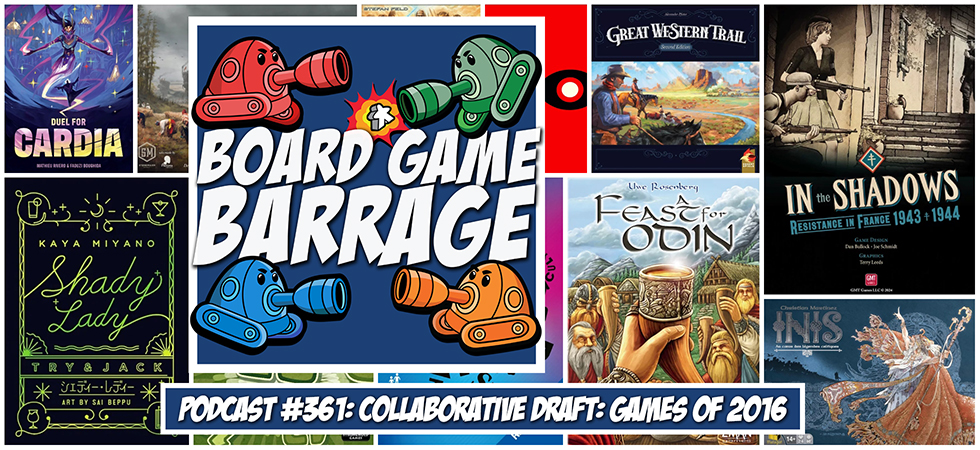
We had such fun collaboratively coming up with our definitive Top 50 list back in December, that we’ve decided to do it again. In the spirit of award season, we’re celebrating the games of yesteryear, or yester-ten-years to be precise. It’s the definitive best games of 2016, as decided cooperatively by us! Before we come together, we talk about Shady Lady, In the Shadows: Resistance in France 1943 – 1944, and Duel for Cardia.
If you don’t want to miss an episode, please subscribe on Apple Podcasts/Google Podcasts/Stitcher/Spotify, or add our RSS feed to your favourite app. Reviews and subscriptions really help us and would be greatly appreciated! To download the episode directly, click here.
If you’d like to discuss anything in the episode, please do so in the comments below, visit our BoardGameGeek guild, join our Discord, or Facebook Group! Any feedback is also always helpful. If you’d like to show your support for the show, we also have a Patreon with some fun rewards, and a merch store!
Timecodes:
03:02 – Shady Lady 09:58 – In the Shadows: Resistance in France 1943 – 1944 20:25 – Duel for Cardia 27:12 – Games of 2016 32:28 – Krazy Wordz 35:00 – New Angeles 37:20 – The Oracle of Delphi 39:50 – Great Western Trail 42:06 – Scythe 44:40 – Fuji Flush 46:38 – A Feast for Odin 51:42 – Insider 53:48 – Inis 55:57 – SiXeS
Thank you to Heart Society for generously letting us use What’s On Your Mind, Kid? from their album Wake the Queens.
Universal Distribution has agreed exclusive rights to distribute Stonemaier Games titles into US hobby retail, which amounts to about $1.5m of business each year.
Universal has become an authorised US hobby distributor for Stonemaier’s games, which include the massive-selling Wingspan series and other popular titles such as Scythe, and will take on sole distribution rights in August of this year.
The deal comes four years after Stonemaier picked GTS as its sole US hobby retailer distributor, in addition to retailers being able to buy directly from the publisher itself – something Stonemaier COO Alex Schmidt told BoardGameWire about half of its US hobby retailers choose to do.
He added that the $1.5m figure depended on the year and the company’s releases, saying that Stonemaier’s US business was “quite a bit larger than that” when also including the publisher’s website, selling direct to retailers, selling through Fulfillment By Amazon and the publisher’s US mass market distribution.
Universal, a long-time major player in Canadian board game, TCG and comics distribution, made a push south of the border last May through a takeover of US peer Alliance Game Distributors, following a tumultuous bankruptcy auction of the latter’s former owner Diamond Comics.
That acquisition has been followed by a recent flurry of exclusive US distribution deals from Universal, including tie-ups with Dice Throne and Isle of Cats publisher City of Games.
Wingspan || Photo Credit: Stonemaier Games
Schmidt told BoardGameWire, “There are certainly some synergies to be had with Universal. They’d already been our sole hobby distributor in Canada and have done a great job of that which made it an obvious choice to use them in the US as well. Them being one company across both countries allows programs to be implemented once in both regions.
“Universal is also supporting a lot of product lines from other companies that retailers want in their stores. While it’s not directly about our products, we want our distributor in a region to be a premier board game distributor who is filling the needs of our retailers across the board.
“One distributor won’t ever have everything, but Universal is doing a great job of being as much of a one-stop-shop for our retailers as they can be.”
Stonemaier CEO Jamey Stegmaier told BoardGameWire the company spent the first few years working with Aldo Ghiozzi as its distribution broker, before switching to Greater Than Games for a similar role – both of which sold to a variety of distributors.
He said Schmidt became the company’s distribution broker when he joined the company from Greater than Games in 2020, with Stonemaier signing up with GTS in the US and Universal in Canada “soon afterwards”.
That total eclipsed the company’s previous annual high from the post-Covid board game boom in 2021, and follows the publisher adding Connie Vogelmann’s Wyrmspan in 2024 and the David Gordon and Michael O’Connell design Finspan last year – creating a hefty boost for its overall sales.
Stonemaier Games’ diversification of its flagship bestseller Wingspan into a trilogy of standalone titles powered the company to record revenues of more than $25m last year – eclipsing its previous annual high from the post-Covid board game boom in 2021.
While the bulk of that lifetime figure is from 2019 release Wingspan and ‘standalone expansion’ Wingspan Asia, at about 2.6 million copies, the addition of Connie Vogelmann’s Wyrmspan in 2024 and the David Gordon and Michael O’Connell design Finspan last year have created a hefty boost for Stonemaier’s overall sales.
The latter pair now have more than 685,000 copies in circulation – a figure which already outstrips the roughly 600,000 copies of Scythe, Stonemaier’s biggest seller outside of the ‘span’ trilogy, despite that game being in print for a decade.
Speaking to BoardGameWire about the latest annual results, company co-founder Jamey Stegmaier reiterated his regular refrain that “number go up” was “simply not on our list of goals at all”, adding, “I understand that the annual revenue is an interesting number to poke at, but honestly that number could go up or down by many millions of dollars and I wouldn’t care as long as we’re bring joy to people.”
He said at the time that he had no concerns about the fall in revenue, saying, “Based on our reach and evergreen sales, I think a ‘normal’ annual revenue for us is somewhere between $15m to $20m, with the exact amount depending on when certain products ship.
“In that way, I think 2021 was an outlier (probably pandemic related) – not only was it a very strong year for Wingspan, but we also saw excellent evergreen sales for Viticulture and Scythe, and we had one of our biggest releases that year in Red Rising.”
But strong sales this year of the ‘span’ trio among a busy slate of other Stonemaier releases has pushed company revenue beyond those 2021 heights, with Stegmaier telling BoardGameWire yesterday, “After hearing from customers for a long time that they wanted the Wingspan model applied to other creatures, I’m really glad we’ve been able to serve them via Wyrmspan and Finspan.
“It also takes pressure off of Wingspan designer Elizabeth Hargrave. Also… it gives us some wiggle room to take on riskier projects, though any game is a risk – we never really know how a game will do.”
One game which could arguably be put in that category is Stonemaier’s 2025 release Vantage – a non-campaign, open-world-style exploration game designed by Stegmaier which was in development for seven years.
Stonemaier printed 64,000 copies of Vantage last year, with Stegmaier telling BoardGameWire: “There’s no other tabletop game that does what Vantage does, so I see it hitting tabletops for years to come.”
He said, “We’re currently initiating Vantage’s fourth reprint, which is remarkable for an expensive game just eight months into its lifecycle.
“I’m so glad this labor of love from the last eight years of my life is resonating with people who want to go on an open-world, first-person adventure without the need to commit to a campaign game.
“Also, unlike all other new releases, Vantage had so much text that it didn’t have any localization partners in 2025 – they needed a lot more time, so 10,000 units of non-English versions are coming in 2026.”
Vantage, published by Stonemaier Games
He also highlighted the success of superhero-themed, tableau-building trick-taker Origin Story, which printed 33,500 copies, and added that more quick-playing, smaller-box titles are on the way from the publisher – including a more lightweight Wingspan title which the company says is playable in about 30 minutes.
Stegmaier said, “I love Origin Story, and I’m excited that we’ve packed so much game into a smaller box that you can teach and play in 45 minutes.
“I would say that’s the realm of the smaller Wingspan game we’re releasing in mid-2026, and I’m wrapping up something kind of in the same realm (in terms of size and length) for 2027.”
Going smaller still, Stonemaier’s 18-card co-operative micro-game Smitten and its sequel also performed well last year, Stegmaier said, with the number of copies printed up 23,000 compared to 2024.
He said, “These are both very small, very humble games that serve well as add-ons, stocking stuffers, and suitcase inclusions for travel. I’m honestly kind of surprised they’ve sold so well, given how different they are from our core offerings.
“That said, they offer more of a trickle of sales through any sales partner – a dozen here each month to distributors, a dozen there to retailers, a few dozen on our webstores.”
Stegmaier added, “The one product for which we probably over-forecasted was Wyrmspan: Dragon Academy. It has sold very well (over 60,000 units for an expansion is remarkable), but I think we probably could have made 75,000 units and later reprinted 25,000 instead of printing 100,000 up front.
“Stamp Swap has done fine [BGW note: 34,000 copies printed in its 2024 release year, but none in 2025], but I think it’s indicative that it’s more difficult than ever for a good game to break through.”
Cards from 2025 Stonemaier release Wyrmspan: Dragon Academy
Stegmaier has been at the vocal forefront of the board game industry’s fight against volatile US tariff policy since President Trump’s inauguration last January, which has seen several board game businessesshutter their operations, lay off staff and hike the prices of their games to cover the unexpected costs.
He said in a blog post at the time, “Every day for the last ten months, I’ve lived in fear that the executive branch of my own country would raise our import taxes to an extreme level that would significantly damage Stonemaier Games and the thousands of small businesses seeking to serve their US customers, retailers, and employees.
“So when the Supreme Court ruled on Friday that the tariff taxes and the way they were implemented were unconstitutional, I had a huge sense of relief. Relief that small businesses can no longer be used as pawns in a global game. Relief that the whim of one person can no longer effectively change the landed cost of our product from $10 to $25.
“Yes, there are still legal ways for the executive branch to impose tariff taxes. They seem really passionate about making small businesses in the US pay more taxes. But these methods have limits: For example, the new tariff tax is 15% (that’s the max it can be), and it needs congressional approval to extend beyond 150 days.
“In the immediate future, I don’t think we’ll see much of an impact on prices, as anything in stock in the US already had its tariff tax paid when it entered the country (if it was manufactured elsewhere). My perception is that many businesses avoided raising prices and instead just ate the extra costs (that’s what we did; we did not increase any prices).
“There is also the possibility of tariff tax refunds. To date, Stonemaier Games has paid just under $300,000 in tariff taxes to the US government. I’m not counting on getting any of that back – it will be nice if we do, and I hope that other businesses do, but the level of uncertainty isn’t something for which we can plan.
“My hope, as always, is that what happens next will help me best serve my coworkers, our independent contractors and partners, and our customers in the US and around the world (consumers, retailers, and distributors). I wish the same for all other small businesses.”
Stegmaier told BoardGameWire that he was “really excited” about the company’s 2026 line-up, which kicked off with the Wingspan Americas and Viticulture: Bordeaux expansions, and also includes a two-player Scythe vs Expeditions duelling game which expands both those titles as well as working as a standalone design.
He said, “I’m excited for the opportunity to serve fans through expansions for Wingspan, Viticulture, Finspan, Scythe, and Expeditions, along with the new Euphoria board.
“The main challenge is communicating what makes these products unique and special. For the first time in a while (since Apiary, as I recall), we’ll have a new game in our original sweet spot of mid-weight euro games – that’s the Smoking Bones game in Q4.”
Stonemaier Lifetime and 2025 Sales
Wingspan & Wingspan Asia: 2,639,429 lifetime units, up 229,686 compared to 2024
Wyrmspan: 451,994 units +148,598
Finspan: 233,584 units (new release)
Vantage: 64,000 units (new release)
Scythe: 601,102 units +41,500
Origin Story: 33,500 units (new release)
Tokaido: 29,500 units (new release)
Tokaido Duo: 27,834 units (new release)
Smitten & Smitten 2: 38,000 units +23,000
Apiary: 55,004 units +8,500
Viticulture: 273,584 units +6,750
Rolling Realms & Rolling Realms Redux: 62,000 units +6,000
Tapestry: 91,650 units +4,000
Between Two Castles: (58,000 units) received an Essential Edition in 2025 – 8,000 copies made, about 5,000 sold
Games which did not receive new printings in 2025:
BGBBOB is back, and it’s been long enough that you might need a reminder. Ten game designers enter the ring, and through the arduous process of one vs one battles, we arrive at our (and not just our, but the) definitive ranked list of … these particular designers. It’s science. Before we fight it out, we talk about Iliad, The Old King’s Crown, and Franchise.
If you don’t want to miss an episode, please subscribe on Apple Podcasts/Google Podcasts/Stitcher/Spotify, or add our RSS feed to your favourite app. Reviews and subscriptions really help us and would be greatly appreciated! To download the episode directly, click here.
If you’d like to discuss anything in the episode, please do so in the comments below, visit our BoardGameGeek guild, join our Discord, or Facebook Group! Any feedback is also always helpful. If you’d like to show your support for the show, we also have a Patreon with some fun rewards, and a merch store!
Timecodes:
03:29 – Iliad 13:56 – The Old King’s Crown 34:01 – Franchise 42:04 – BGBBOB: Game designers
Thank you to Heart Society for generously letting us use What’s On Your Mind, Kid? from their album Wake the Queens.
Scythe ist ein strategisches Brettspiel, das in einer alternativen Vergangenheit in den 1920er Jahren spielt. In einer vom Ersten Weltkrieg geprägten Welt kämpfen verschiedene Fraktionen um Macht, Ressourcen und Kontrolle über Osteuropa. Mit seinem Mix aus Strategie, Ressourcenmanagement und asymmetrischen Fraktionen hat sich Scythe schnell als moderner Klassiker etabliert. Dank der drei Erweiterungen – „Invasoren aus der Ferne“, „Kolosse der Lüfte“ und „Aufstieg der Fenris“ – bleibt das Spiel auch langfristig spannend und bietet vielfältige neue Herausforderungen.
Um was geht es in Scythe?
In Scythe übernehmen die Spieler die Führung über verschiedene Fraktionen in einer alternativen Vergangenheit, die stark von den Ereignissen des Ersten Weltkriegs und den technischen Innovationen dieser Zeit geprägt ist. Das Spiel ist im fiktiven Osteuropa angesiedelt, wo gigantische Mechs das Schlachtfeld dominieren und wertvolle Ressourcen in der Region „Die Fabrik“ gewonnen werden können. Die Spieler wetteifern um die Kontrolle über das Land, indem sie Gebiete erobern, Ressourcen abbauen, militärische Stärke aufbauen und wirtschaftliche Vorteile ausnutzen.
Das zentrale Ziel in Scythe ist es, als erste Fraktion eine bestimmte Anzahl von Erfolgen zu erzielen. Diese können durch den Aufbau von Gebäuden, das Erobern von Gebieten, das Entwickeln von Technologien, den Aufbau von Militärmacht oder das Absolvieren von Kämpfen erreicht werden. Doch das Spiel belohnt nicht nur kriegerische Erfolge, sondern auch ökonomisches Geschick und strategische Planung. Jeder Zug erfordert gut durchdachte Entscheidungen – welche Aktion wird gewählt, welche Ressourcen werden genutzt und wie reagiert man auf die Züge der Gegner?
Was Scythe besonders fesselnd macht, ist der nahtlose Übergang zwischen friedlichem Aufbau und militärischer Eroberung. Spieler müssen geschickt zwischen Wirtschaft und Krieg abwägen, um erfolgreich zu sein. Trotz der thematischen Schwere bleibt das Spiel durch seine klare Struktur und das intuitive Design zugänglich und spannend.
Die 1. Erweiterung: Invasoren aus der Ferne
Die erste Erweiterung, Invasoren aus der Ferne, fügt zwei neue Fraktionen hinzu: die Togawa-Shogunate und das Albion-Königreich. Jede dieser Fraktionen bringt ihre eigenen asymmetrischen Fähigkeiten und Mechaniken ins Spiel, was die strategischen Möglichkeiten erweitert. Diese Fraktionen sind nicht nur optisch und thematisch einzigartig, sondern verändern auch das Spielgeschehen, da sie mit neuen Taktiken und Spielstilen eingeführt werden. „Invasoren aus der Ferne“ verleiht Scythe somit nicht nur mehr Vielfalt, sondern auch eine noch größere strategische Tiefe und Flexibilität. Fans des Grundspiels werden die neuen Herausforderungen und Möglichkeiten zu schätzen wissen.
Die 2. Erweiterung: Kolosse der Lüfte
Mit der zweiten Erweiterung, Kolosse der Lüfte, werden gewaltige Luftschiffe in die Welt von Scythe eingeführt. Diese mächtigen Einheiten bieten den Spielern neue Bewegungs- und Kampfoptionen. Die Luftschiffe sind flexibel einsetzbar und können Truppen schnell über das Spielfeld transportieren, was die taktischen Möglichkeiten noch erweitert. Zudem bringt die Erweiterung neue Auftragskarten ins Spiel, die für zusätzliche strategische Entscheidungen sorgen. „Kolosse der Lüfte“ fügt somit eine neue Dimension der Mobilität und des strategischen Kampfes hinzu, die das Spielgeschehen dynamischer und noch spannender macht.
Die 3. Erweiterung: Aufstieg der Fenris
Aufstieg der Fenris, die dritte Erweiterung, bringt eine völlig neue Spielweise in Scythe: eine Kampagne. Diese Erweiterung besteht aus acht Episoden, die miteinander verbunden sind und eine epische (zurücksetzbare) Geschichte erzählen, die den Spielern die Möglichkeit gibt, ihre Fraktion weiterzuentwickeln und anzupassen. Was diese Erweiterung besonders spannend macht, ist die Möglichkeit, geheime Module und neue Regeln nach und nach freizuschalten, was den Wiederspielwert enorm erhöht. Darüber hinaus können die neuen Module auch außerhalb der Kampagne verwendet werden, um das reguläre Spiel zu erweitern. „Aufstieg der Fenris“ bietet somit nicht nur eine narrative Tiefe, sondern auch vielfältige Anpassungsoptionen für zukünftige Partien.
Fazit zu Scythe
Scythe ist ein Meisterwerk der strategischen Brettspiele, das durch seine asymmetrischen Fraktionen, tiefgründigen Mechaniken und seine spannenden Erweiterungen überzeugt. Egal, ob man sich auf wirtschaftlichen Aufbau oder militärische Eroberung konzentriert, das Spiel bietet unzählige Möglichkeiten und Herausforderungen. Dank der Erweiterungen bleibt es langfristig spannend und abwechslungsreich.
Kein Spiel ist für Jedermann. Ob Scythe etwas für euch ist, entscheidet allein ihr.
Scythe strotzt vor Thema – nicht nur optisch! Alles an diesem Spiel entspricht dem Geist der Zeichnungen von Jakub Rozalski. Scythe fühlt sich in allem sehr thematisch an, bis… ja bis man seine Mechs ins Wasser bewegt um einen Fluss zu überqueren. Denn dann haut einem das Spiel eine Balancing-Regel um die Ohren wie einen sprichwörtlichen Zaunpfahl: Die Mechs können je nach Fraktion, zu der sie gehören, das Wasser nur an bestimmten Terraintypen verlassen. Beispielsweise ist es einem bestimmten Mech nicht gestattet von Wasser aus ein Grasland zu betreten, aber mit Bäumen oder Gebirgen gibt es keine Probleme. Eine Regel, die unthematischer nicht sein könnte. Zum Glück fällt dieses „Problem“ im Gamedesign mit den Kolossen der Lüfte vollends vom Tisch und die ansonsten perfekt inszenierte Welt rettet hier die Wertung.
2. Material
Scythe ist eines der Spiele, die man mit Unmengen an Material aufwerten und verbessern kann. Beschränkt man sich nur auf das originale Material von Stonemaier Games / Feuerland Spiele und die lizensierten Produkte von Meeple Source, kann man dennoch ganz schnell bei über 800 € landen. Sagte mir zumindest… ein Freund! Und das ist eigentlich gar nicht nötig, da das Spiel im Originalzustand schon tolle Holz- und Kunststoffteile dabei hat, hervorragende Kartenqualität und einen Karton so stabil, dass man damit umziehen könnte.
3. Optik
Laut einem Interview kam der Designer Jamey Stegmaier erst durch die fantastischen Artworks von Jakub Rozalski auf die Idee zu Scythe. Und das sieht man dem Spiel an. Alles hier wirkt wie aus einem Guss und versprüht diesen merkwürdig interessanten Vibe von Historie und dennoch fortschrittlicher und uns fremder Technologie. Hervorragend!
4. Setup
Zwar ist Scythe ein großes Spiel, doch das Spielbrett gibt einem lauter Hinweise, wo was zu platzieren ist. Dazu wählt jeder Spieler eine Fraktion sowie eine Ausrichtung und bekommt das Holzmaterial der Farbe, die er (wie angegeben) auf seinem Board platziert. Abgesehen von Ressourcen, Zielkarten und ein paar Kleinigkeiten war es das auch schon. Für ein Spiel dieser Größe und taktischen Tiefe geht das beeindruckend leicht von der Hand!
5. Spieleranzahl
Das Grundspiel ist spielbar mit bis zu 5 Spielern. Durch die Invasion Invasoren aus der Ferne kommen die Möglichkeiten für einen 6. & 7. Spieler dazu. Aus meiner Sicht wird das aber etwas übertrieben sein, denn mehr als 5 Spieler wären mir persönlich zu viel für einen runden Spielablauf – daher gibt es einen Punkt Abzug. Die hohe Punktzahl ist hier – da ich das Gesamtpaket Scythe bewerte – tatsächlich dem modularen Spielplan geschuldet: Erst dieser bringt die nötigen Veränderungen mit sich, um auch bei weniger als 4 Spielern schnell Grenzen zu schaffen und diese knisternde Spannnung zwischen Frieden und militärischer Abschreckung zu provozieren. Der modulare Spielplan ist für mich bei unter 4 Spielern ein MUSS!
6. Zugänglichkeit
Auch hier gibt es eine hohe Punktzahl, denn das Spiel ist sehr einfach gesteuert: Jedes Tableau besteht aus 8 Aktionen, von denen jeweils 2 (von Fraktion zu Fraktion unterschiedlich) gruppiert sind. Ich muss mich jede Runde für eine andere Paarung entscheiden, wobei schon nur noch 3 zur Auswahl stehen. Die obere Aktion bringt mir meist Einkommen, die untere eine Möglichkeit diese Ressourcen auszugeben. Scythe ist im Grundsatz ein leicht zugängliches Spiel, dessen so rundes Bild allerdings durch seine Sonderregeln für Bewegung, Transport und Kampf etwas kränkelt. Nichts, was man sich nicht merken könnte, jedoch definitiv der trägste Regelabschnitt bei Scythe.
7. Spieltiefe
Das Spiel ist an sich recht euro-mäßig gesteuert, obwohl es so nach Kriegsspiel aussieht. Und das gibt dem Spiel seine enorme Tiefe. Scythe glänzt erst dann, wenn Spieler Grenzen zu einander aufbauen. Denn Krieg zu führen ist in Scythe immer schlecht. Er kostet Ansehen und das ist im Endeffekt der Multiplikator für unsere Siegpunkte. Man sollte sich also ganz genau überlegen, wo man eine offene Konfrontation hochkochen lässt und wo man es bei der Abschreckung belässt. Dieses Gefühl ist schon ziemlich gut eingefangen.
8. Spieldauer
Lässt man mögliche Konflikte außer Acht, kann jede Kombination aus Nations- und Spielertableau das Spielende nach derselben Anzahl optimaler Züge erreichen – gut, zwei Kombinationsmöglichkeiten benötigen rechnerisch weniger Runden und sind daher auch offiziell „gebannt“. Jedoch muss man auf dieses Niveau auch erstmal kommen. Scythe ist ein Wettrennen zum Erreichen der Ziele und wenn die Piloten schlafen bzw. nicht wissen, wie sie schnell zum Ziel kommen, dann kann sich auch eine Partie Scythe ziehen. Gerade mit höheren Spielerzahlen kann das ermüdend werden.
9. Downtime
Abgesehen von Kämpfen – die aber sowieso für jeden Spieler interessant sind und schnell ausgeführt werden – gibt es recht schnelle Züge: Eine Kombination auswählen, oben generieren, unten zahlen, der nächste Bitte. So gut, so vereinfacht. Dennoch ist und bleibt Scythe eine sehr thematische Karosse auf einem Euro-Motor. Und der erlaubt und benötigt manchmal etwas Gehirnschmalz. Gerade in den gehobeneren Spielerzahlen und im letzten Drittel des Spiels kann die Downtime dann schon ansteigen.
10. Preis
Mit rund 65 € ist das Grundspiel von Scythe ein echter Kracher! Und selbst mit jeglichem Erweiterungs-Content landet man ohne zusätzliches Blingbling bei nicht einmal 175 € Neupreis. Das ist eine Kampfansage an so viele moderne Kickstarter, die vermutlich in Puncto Qualität mit Scythe nicht mithalten können. Volle Punktzahl!
Ergebnis
Mit 44/50 Punkten ergattert Scythe einen hervorragenden Punktestand und damit das Prädikat „Ausgezeichnet“!
Dieses Spiel ist von der Webseite Boardgamefan.de ausgezeichnet worden.

 Anmelden