Manche Geschicklichkeitsspiele haben eine Einstiegshürde, die Erstspieler klar von Experten trennt und eventuell sogar den Spielspaß verleidet. Das über 22 Jahre alte Einsteiger-Spiel von Randy Nash ist da eine willkommene Ausnahme und deshalb eine Bereicherung für alle, die an diesem Genre Gefallen finde – besonders in großer und entspannt-launiger Runde empfohlen.
Ich habe ein Faible für großformatige Holzspiele. Sei es Crokinole als wohl inzwischen bekanntester Vertreter seines Genres, aber auch solche Exoten wie Le Passe Trappe oder Le Billard Finlandais aus Frankreich. Dazu an einem kommenden Brettspieltag gerne mehr. Die analoge Brettspielkonsole Skitter war mein letzter Neuzugang, der allerdings inzwischen ein Geschwisterchen bekommen hat. Herzlich willkommen an Tumblin-Dice (Great Size) in meiner Ansammlung von Brettspielen aller Art.
Randy Nash hat dieses Einsteiger-Geschicklichkeitsspiel im Jahr 2004 erfunden und im Selbstverlag veröffentlicht. Später kamen dann diverse Varianten von Ferti und Eagle-Gryphon Games dazu, während sich auf dem asiatischen Markt weitere Anbieter mit ihren ganz eigenen Designs tummeln. Im haptischen Kern besteht Tumblin-Dice aus einer treppenartigen Struktur, bei der wir von einem nochmals erhöhten Startrampe einen W6-Würfel so ins Spiel bringen, dass der am möglichst weit unten ankommt, ohne vom Spielbrett zu fallen. Die letzte Treppenstufe hat zudem Aussparungen und zusätzliche Holzstifte, um den Würfel aufzuhalten oder abzulenken. Genau dort wollen wir landen, denn die Augenzahl unseres Würfels wird dort mit der Maximalzahl von 4 multipliziert.
Im Idealfall kann uns unser farbiger Würfel 6×4 und damit 24 Punkte einbringen. So spielen wir zunächst reihum und versuchen ebenso, uns selbst in eine bessere Position zu bringen und die lieben Mitspieler-Würfel vom Brett zu stoßen. Wer die meisten Punkte bisher erreicht hat, der muss die nächste Runde anfangen, sodass wir eine ab dann wechselnde Spielreihenfolge je nach Punktestand haben. Denn wer später dran ist, der hat weitaus größere Chancen, dass seine Würfel in gewünschter Endposition liegen bleiben. Denn abgerechnet wird erst zum Rundenende, wobei sämtliche auf dem Spielbrett verbliebenden Würfel mit ihrem aktuellen Multiplikator aufsummiert werden.
Ein wichtiges Regeldetail, denn so muss sich niemand merken, wer jetzt welchen Würfel neu ins Spiel gebracht hat. Einfach am Rundenende durchzählen, in dem das komplette Spielbrett ausgewertet wird. Wer nach vier Runden dann die meisten Punkte hat, der hat gewonnen. So einfach ist Tumblin-Dice und genauso so einfach will es auch sein. In wenigen Sekunden erklärt und direkt losgespielt. Genau deshalb ist es seit nunmehr 22 Jahren in seinem Genre der großformatigen Geschicklichkeitsspiele so beliebt.
Doch Halt, wie genau darf ein Würfel ins Spiel gebracht werden? Egal bis fast egal, denn das Regelwerk scheint hier für mich eher vage zu sein. Man darf einen Würfel werfen, rollen oder von der Startrampe hin zu den Punktezonen schnalzen und grundsätzlich muss der Würfel zuerst die Startrampe berühren. Die englischsprachige Originalregel ist da eindeutiger mit „slides, rolls, or flicks one die off the landing disc“. Also nur aus der Hand werfen, sofern die Startrampe als erster Punkt auf dem Spielbrett berührt wird oder dort liegend durch irgendeine geschickte Bewegung dem Würfel einen gezielten Impuls verschaffen, sodass der nicht nur am Wunschort liegen bleibt, sondern auch möglichst mit einer hohen Augenzahl.
Also doch nur ein Glücksspiel? Könnte an meinen, aber die Spieleschachtel verspricht immerhin 50% Taktik, 50% Skill und 100% Fun. Allerdings listet Boardgamegeek keinen einzigen Forenbeitrag unter „Strategy“ auf. Diverse Spielberichte beschreiben allerdings unterschiedliche Schnipp-, Roll- und Schusstechniken in Einbeziehung der Holzstifte für gezielte Abpraller. Auf YouTube könnt Ihr diverse „Technique de Lancer“ anschauen und der „Tumblin‘ Dice Championship of the World“ von Tom Vasel beiwohnen. Aber eigentlich ist Tumblin-Dice ein Spiel, das einfach gespielt werden will, aus Freude am Spiel selbst. Alles Weitere ergibt sich dann von selbst je nach Ehrgeiz und taktischer Eigenerwartung.
Aus dem Ferti-Video habe ich allerdings einen guten Tipp mitgenommen: Stellt Euer Tumblin-Dice in ein Crokinole Board, so habt Ihr eine Begrenzung für herunterfallende Würfel, die ansonsten gerne durchs Zimmer und unter die Couch rollen. Ebenso könnt Ihr mit einem Ikea-Drehteller bequem in eigener Sitzposition spielen und die Startrampe zu Euch drehen anstatt fest aufgebaut, reihum um den Tisch zu wandern. Jeder so, wie er es mag.
Noch ein paar abschließende Worte zur Verarbeitungsqualität und der besonderen Herausforderung im Brettspiel-Alltag mit großformatigen Holzspielen: Meine Version von Ferti ist die vierte Auflage, die zyklisch optimiert wurde. Ihr bekommt aktuell für rund 110 Euro ein Spiel in der grösstmöglichen Version, was früher mal nur halb so teuer war. Die Holzpreise sind seitdem arg gestiegen. Die Verarbeitung aus verleimten Schichtholz ist gut und hat eine lackierte Oberfläche. Alles passt und Ihr braucht auch nur vor der allerersten Partie die Holzstifte in ihre vorgesehenen Löcher drücken. Danach bleiben die dort und durch die voluminösen Schaustoffpolster wird alles fest und sicher wieder in die Spieleverpackung verstaut.
Den Stoffbeutel für die Würfel hat Ferti sich allerdings inzwischen weg gespart. Ich empfehle hier für eigenen beliebigen Ersatz zu sorgen. Und auch wenn die Verpackung von 2 bis 6 Spielern spricht, liegt nur Spielmaterial für 4 Spieler bei. Die Extrawürfel könnt Ihr von Ferti oder Drittherstellern nachkaufen, wobei Ihr dabei nicht auf nur 6 Mitspieler begrenzt seid. Je mehr mitspielen, desto turbulenter und chaotisch-lustiger wird es.
Tumblin-Dice ist und bleibt allerdings ein Spiel aus Holz und damit ein wenn auch verarbeitetes Naturprodukt. Das kann durchaus Macken bekommen und sich bei ungünstiger Lagerung verziehen. Kennt Ihr alles von anderen Brettspielen aus Pappe ebenso und ist hier keine Ausnahme. Zudem erwartet kein Präzisionswerkzeug, denn das hier ist nur ein Spiel, das spielerischen Ansprüchen genügen und keine absolute Perfektion bieten soll. Das sollte Euch vor dem Kauf bewusst sein, damit Ihr mit keiner falschen Erwartungshaltung ins Spiel startet.
Wie bei vielen großformatigen Holzspielen, bei denen Materialien durch Spielerhand ganz gewusst aufeinander treffen und auf Kollisionskurs sind, ist auch Tumblin-Dice kein geräuschloses Vergnügen. Es erzeugt schon eine gewisse Lautstärke, wenn die Plastikwürfel die Treppenstufen und bis auf den Fußboden herunter purzeln. Je energischer gespielt wird, was auch einen Teil der Spielfreude ausmacht, desto lauter wird es. Von dem Gejohle über besonders gelungene oder missglückte Schüsse gar nicht mal zu reden. Ich habe mal, hier allerdings ohne eigenes Gejohle, das Klack-Klack von Tumblin-Dice aus Spielerperspektive aufgenommen – reingelauscht und dann wisst Ihr, dass Ihr Euch damit wohl eher nicht direkt neben eine im Eurogame vertiefte Denkergruppe am Nebentisch platzieren solltet.
Bleibt der eigentliche Elefant im Raum und das ist die Transportfähigkeit. Mit 46x56x11 cm von der Spieleschachtel und nachgewogene 3,4 Kg ist Tumblin-Dice nichts, was ich mal ebenso auf Verdacht zu Spieletreffs zu mitschleppen möchte. Da braucht es schon eine Ikea-Taschengröße, weil der Spielekarton selbst keinen Tragegriff hat. Ihr solltet Euch also vorab fragen, ob Ihr ausreichend Mitspieler für Tumblin-Dice bei Euch versammeln könnt. Besonders wenn Ihr die drehbare Variante mit Crokinole Board und Drehteller nutzen wollt. Die funktioniert gut und hält etliche Würfel davon ab, vom Tisch zu rollen. Ich empfehle allerdings eine Stoffabdeckung für Eure Crokinole-Spielfläche, damit Ihr nicht jedes Mal zusammenzuckt, wenn ein kantiger Plastikwürfel dort mit Wucht auftitscht Perfektionisten bauen sich stattdessen eine eigene Holz-Unterlage mit dann auch noch höherer Begrenzung. Oder Ihr erfreut Euch einfach an ein wenig Bewegung am Spieltisch – kann ja auch mal nicht schaden.
Auch Tumblin-Dice zählt zu den großformatigen Holzspielen, die sich in der Anschaffung nur lohnen, wenn es auch dauerhaft und regelmäßig bespielt wird. Wer da Zweifel hat, sollte lieber vorab irgendwo mitspielen. Ferti & Co ist auf etlichen Messen wie der SPIEL in Essen vertreten. Weil am Spieleregal gelehnt und vergessen, während die nächste Spielsession auf irgendwann mal wieder vertagt wird, macht auch bei dieser Anschaffung keinen Sinn, sofern Ihr Spieler und nicht in erster Linie Sammler seid. Was dann mindestens so traurig wäre wie originalverpackte Actionfiguren in ihren Blisterverpackung zu belassen. Tumblin-Dice will bespielt werden und jede Gebrauchsspur am Spiel oder Spielekarton ist nur ein Zeugnis davon, was Ihr damit alles an Spielerlebnissen gehabt habt.
An Impossible War: The First Carlist War in the North, 1834-1838 from Bellica Third Generation is a block wargame that recreates the First Carlist War in the North of Spain which was a civil war between the Carlists who supported the succession of the late king’s brother Carlos de Borbón and the progressive and centralist supporters of the regent Maria Christina acting for Isabella II of Spain who were referred to as the Liberals. The game uses blocks representing units but also includes counters and uses cards. I was able to play the game about a month or so ago with Francisco Ronco who owns the publishing company Bellica Third Generation and very much enjoyed the game and how it represented this interesting struggle.
In Action Point 1, we took a look at the Game Map, discussing the point-to-point movement configuration, the various spaces and the delineation of the Carlist versus the Liberal Zones, as well as explained the use of the Rest of Spain smaller map. In this Action Point, we will examine the units available to both sides and cover the importance of Supply.
Units
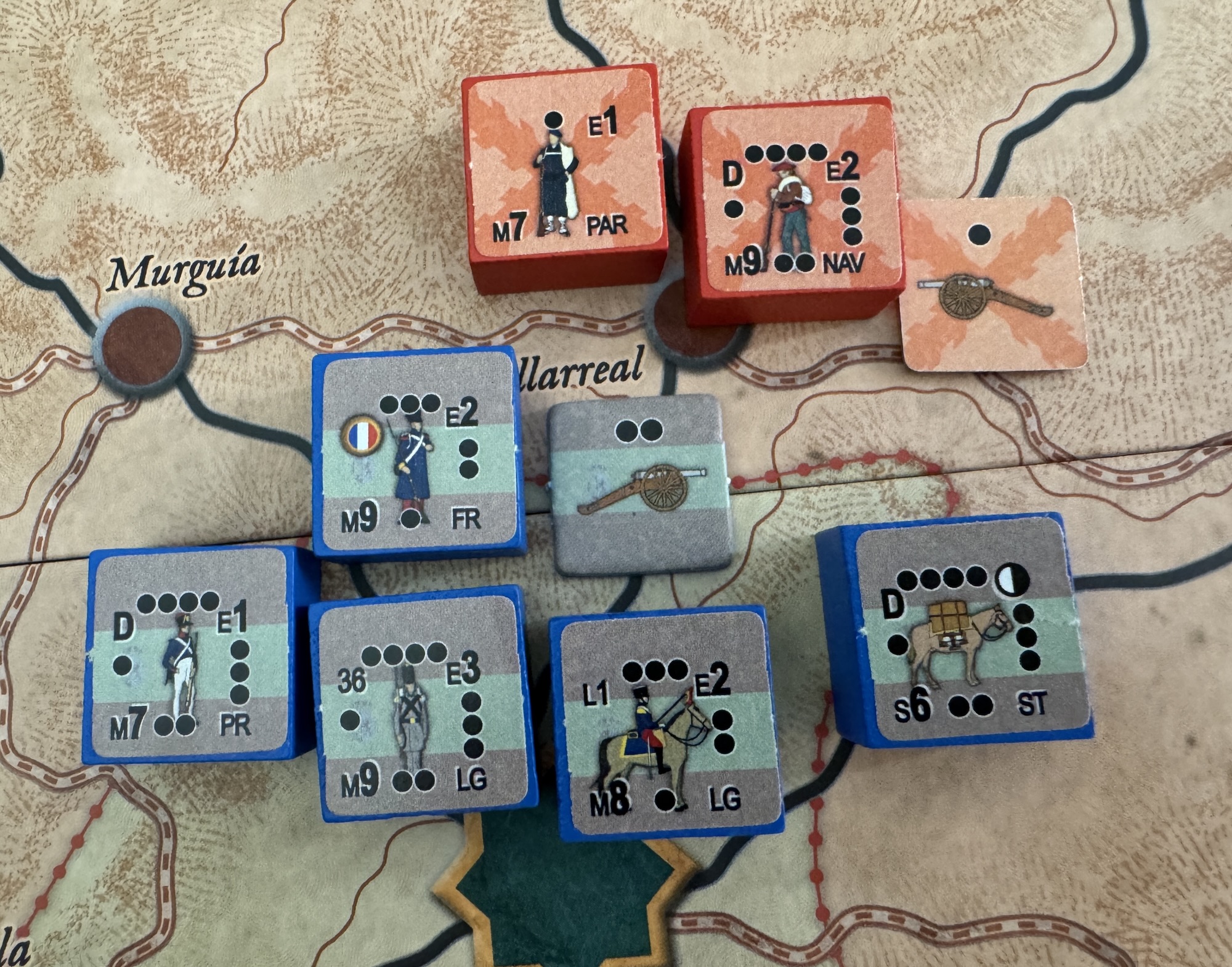
Units in the game represent Carlist (red) and Liberal (blue) armed forces, as well as the logistics needed for these troops to operate in hostile territory. Most of the units are wooden blocks including Infantry, Cavalry, and Supply Trains but there are also cardboard counters representing Artillery, both Field and Mountain, and Knapsack units, which are limited and temporary supplies that are transported by the soldiers themselves.
Let’s first take a look at the scale of the game and the units. With Infantry, a single Strength Point is roughly equivalent to a battalion consisting of between 500 to 800 fighting men. The only difference in the Infantry scale between the sides is a Carlist Partida unit, which represents a variable number of local guerilla fighters who are loosely organized in the amount of about a hundred men. For Cavalry, a Strength Point is equivalent to a squadron consisting of about 100 horsemen. For Artillery, a Strength Point is equivalent to 1 or 2 batteries made up of between 4 to 12 cannons of different calibers. The Supply units for the game are a very interesting and granular approach to supply and I very much enjoyed the juggle of keeping these units in good shape and with large moving armies. A Supply Train, which is represented by a block unit with the picture of a pack horse on it, represents a group of carts and pack animals that transport the needed supplies to keep an army in the field including food, munitions, and baggage. On a smaller scale are the Knapsacks that represents the food and munitions carried by the soldiers themselves.
As a Block Wargame, the Infantry and Cavalry Blocks used have various dots located along the edges of the blocks. Some blocks have 4 steps while others have less but usually no less than 3 steps. The exception to this general rule is the Partida units that only have 1 step. The current combat strength of the units determines how many 6-sided dice will be rolled in combat. During combat, for each hit that a unit receives, its strength is reduced by 1, which is shown by simply rotating the block 90 degrees counterclockwise. If a block is reduced below 1 strength then it will be eliminated.
Supply Train Blocks also have pips located on the block which represent the units ability to provide supply to other units. When the Supply unit provides supply to friendly units located in its space, its strength will be reduced by 1 pip by rotating the block 90 degrees counterclockwise. If the block is reduced below 1 strength then it is eliminated. No dice are rolled for a Supply Train in combat as it is solely a logistics unit rather than a combat unit. Supply Capacity is indicated on the units by the letter “S” and a number, such as S6 or S2. The number is the amount of friendly Infantry and Cavalry units that a Supply Train or Knapsack can supply during the Supply Check. A Supply Train with S6 can supply up to 6 friendly Infantry and Cavalry units in its space. A Knapsack with S2 can only supply a maximum of 2 units
Artillery counters show the current strength with the number of pips on the visible side of the counter. The strength determines how many dice are rolled in a Skirmish and how many points of Artillery it will contribute to a Battle. Artillery units do not receive hits in combat, but they can be eliminated or captured if their side is defeated.
Now that you know the makeup of the units and the various forces represented, let’s take a very quick look at the statistics of each side’s combatants. Before we go any further, I am very hesitant to provide these details as I have gone over them about 10 times and am sure that I miscounted or left out certain units and their abilities. But, this look should give you an overall feel for the differences between the units and their general fighting abilities.
Carlist Units
The Carlist player will have access to a total of 26 units. These include 4 Cavalry, 21 Infantry, amongst this number are a total of 3 Partida units, and 1 Supply unit. The Effectiveness Rating for these units, which as described above equates to their fighting prowess with the higher the number the more likely they are to hit in combat, are shown in the below table with 5 units with an ER1 (20.0%), 16 units with an ER2 (64.0%) and just 4 units with an ER3 (16.0%). Keep in mind that Supply units do not have an ER as they are non-combatants.
Liberal Units
The Liberal player will have access to a total of 48 units. These include 10 Cavalry, 35 Infantry and 3 Supply units. The Effectiveness Rating for these units, which as described above equates to their fighting prowess with the higher the number the more likely they are to hit in combat, are shown in the below table with 12 units with an ER1 (26.6%), 29 units with an ER2 (64.4%) and just 4 units with an ER3 (8.9%). Keep in mind that Supply units do not have an ER as they are non-combatants.
By way of comparison, you can see that the Liberal Units have a slightly better average Effectiveness Rating (1.82 per unit) as compared to the Carlist Units (1.64). This difference is a bit deceiving though as the Carlist player actually has the same amount of ER3 units (4 for the Carlist player vs 4 for the Liberal player) but as a percentage of their total units they have 16.0% of their units as ER3 as compared to just 8.9% ER3 units for the Liberal player. This means that the Carlist units are a bit better and will generally have better units making up their forces than the Liberal player in any given battle.
The real comparison, and where the difference between the 2 sides stands out, is in the area of Morale. Morale is indicated by the letter “M” on the units and is shown as a number, such as M7, M8 or M9. This Morale number is the maximum result of the sum of 2d6 that gives a success in a morale roll. Each time during an activation that a unit receives 1 or more hits, it must then roll a Morale check. Morale checks are only made in Battle and never in a Skirmish, Assault, Pursuit, or Rout. If the Morale check fails, the failing unit will immediately be moved to the Demoralized Units Box. Morale is also key for Infantry that are being charged by Cavalry as they will make a Morale check and if they succeed they can initiate a counter charge. If they succeed the check then the attacking Cavalry will be spent and do no damage but if failed the attacking Cavalry unit fires and adds +1 to its Effectiveness Rating.
The Liberal player has an Average Morale value of their 45 units of 7.97 as compared to the Carlist player Average Morale value of their 25 units of 8.76. While not a huge difference, this slight edge to the Carlist player means that their units will be able to more often counter charge and stay on the battlefield as they will not break and become Demoralized as often.
Also, if you remove the 3 lowest value Carlist units, the 3 Partida units who each have a Morale Value of 7, this average becomes much higher at a 9.0 and really starts to show the significance of the Carlist advantage in Morale. In my play with Franciso Ronco, I felt like he definitely had the advantage on the battlefield, at least value wise in the area of Morale, but all it really took was for 1 of his better units to be demoralized and the odds became much more even.
The other advantage that the Carlist units hold is that they are typically fighting on their home turf and supply is much less stringent on their forces. The Liberal player must make consistent campaigns in the Carlist Zone of the board and this will require them to invest more into Supply units such as Supply Trains and Knapsacks.
I very much enjoyed the asymmetry between the Carlist and Liberal forces. It made for a very interesting tactical challenge for both sides as they have to play to their strengths and not get too overly concerned with the numbers. The Carlists will be much more mobile in their defense and look to exploit every gap in a supply line to move around and stay away from the numerically superior Liberal forces, whereas the Liberal player will have to move more methodically to take outlying towns and settlements to be able to shore up their lines and create less opportunities for end arounds by the Carlists. The disparity in the forces was a very interesting choice by the designer David Gómez Relloso and I am sure is reflective of the historical reality of the First Carlist War.
I also was able to shoot a fairly short video summary of my game play with Francisco Ronco who is the owner of Bellica Third Generation and you can watch that at the following link:
In Action Point 3, we will take a look at the Carlist Uprising Phase and what it means for the game.
Hermann Luttmann is a great designer and I just love his solitaire takes on historical battles. His newest design is a solitaire game called A Hell So Terrible: Verdun 1916 from GMT Games that focuses on the German assault on the city of Verdun in 1916 during World War I. Keep in mind that Hermann is a very creative designer and uses lots of very interesting and chaotic design elements to create a very interesting and satisfying gaming experience. Also, most of his games are just that, with very engaging gameplay and a lot of the unknown that will hit you in the face from time to time! I just love his games. We reached out to Hermann and as always he was more than willing to share more about the design.
*Keep in mind that the design is still undergoing playtesting and development and that any details or component pictures shared in this interview are for prototype purposes and will definitely change prior to final publication as they enter the art department.
Grant: Hermann welcome back to the blog. What is your upcoming game A Hell So Terrible about?
Hermann: Thanks so much for having me back again! This is getting to be a bad habit. A Hell So Terrible is currently on the GMT P500 list and covers the German assault on Verdun during World War I. The offensive was launched on Feb. 21, 1916, and its ultimate goal was, as Chief of Staff Erich von Falkenhayn infamously stated, to “bleed France white”. This design sets up the solitaire player commanding the German army at Verdun. The player must push the various German Corps forward along nine different tracks across three main sectors, all of which converge on the city of Verdun and its last ring of fortresses. But the player only has a limited amount of time to close the noose around Verdun, as at the start of July, the Allies will be launching their huge offensive along the Somme River and vital German resources will need to be diverted to defend that front. So, this game design combines a little bit of push-your-luck with a little bit of tower-offense (reverse States of Siege, if you will), and a dab of historically-weighted chaos, to give you a nice flavorful stew of military simulation and game play fun.
Grant: What is the meaning of the title? What did you hope to convey about the game to the players?
Hermann: We actually went through a number of different titles, and I had this one neat quote I found:
“Humanity is mad! It must be mad to do what it is doing. What a massacre! What scenes of horror and carnage! I cannot find words to translate my impressions. Hell cannot be so terrible. Men are mad!”— Second Lieutenant Alfred Joubaire in his diary during the Battle of Verdun (May 23, 1916).
The BBC also used a version of this quote for the Verdun chapter of their special Great War TV series – “Hell Cannot Be So Terrible”. Gene Billingsley came up with the final, truncated version for the game’s title. I take great pride in my game’s titles, and this is no exception. I want the titles to be poetic, artistic, and memorable and thus are usually portions of famous quotes, book chapter titles, etc. By doing so, the title has a meaning and conveys to the player a hint of what the game is about. In this case, as you may surmise, it is supposed to be a bit depressing and gloomy, preparing the player for a difficult Great War grind. The player will experience, in abstract and harmless form of course, the tough slog and frustrating pace of a WWI offensive against an entrenched enemy.
Grant: I see that you described it as a “tower offense” game. What does this mean?
Hermann: This clever twist on the “tower defense” label was created by the game’s developer, Marco Poutre, and I just love it. A tower defense game traditionally means that a player is located in the relative center of the game board, and they are required to defend that center from a foe advancing from multiple directions. Lose the center and lose the game. A Hell So Terrible flips that dynamic around 180 degrees. You are the approaching German attacker moving along multiple axes of advance and the French enemy “bot” is the central defender, trying desperately to keep you away from Verdun.
A prototype copy of the board with counters. Not final art.
Grant: Furthermore, the player takes on the role of the attacker. How did this change your design focus?
Hermann: Primarily, the game design must provide the player with strategies of offense and exploitation, rather than that of defense and blocking. The game’s mechanics are structured to offer ways and means for the Germans to conduct actions against the enemy, rather than offer just reactions to enemy moves. You are the instigator and thus drive the action with your play. But that’s not to say that the French “bot” sits idly by…it will counterattack and it will generally do that in the spot which least suits you and your plans.
Grant: Why was this a subject that drew your interest?
Hermann: Well, as you may or may not know, World War I has always been a primary interest of mine. It is just so rich with gaming opportunities because there are so many interesting fighting fronts featuring many different armies. The war is loaded with fairly obscure yet fascinating battles and campaigns and making them each “gameable” is a real challenge. Designing a playable game out of trench warfare was one of my earliest self-inflicted gaming challenges and that all lead directly to the In Magnificent Style push-your-luck style system, which has now come full circle to A Forlorn Hope from Wharf Rat Games (which actually does cover trench warfare). In the A Hell So Terrible game design, that aspect of pushing your troops ”against the wind” of enemy fire (but at an operational scale now) seemed to fit really well with what a game about Verdun should simulate.
Grant: What is your ultimate design goal with the game?
Hermann: Simply, to provide the player with as much angst and anxiety as possible! This operation is perfect for the push-your-luck and tower offense approach. The player is placed under a severe time constraint, so the requirement to not only keep moving forward (even when it seems unwise to do so) but also the need to harbor the few resources you have available in the game (more on that later) is a perfect combination of game play juggling. The player must pick the best spots to attack, when to attack, and with what expenditure of assets. And to keep all these moving parts in a playable, accessible format that doesn’t overstay its welcome is the design goal.
Grant: What from trench warfare during WWI and the numerous attacks on Verdun was most important to model?
Hermann: Well, there are quite a few factors that I really wanted to get into the design to make it feel right. Obviously, the French defensive positions are deep, layered, and unpredictable. There are multiple chains of trenches, forts, and terrain features that must be overcome. How do you, as the attacking Germans, go about penetrating these defenses and inflicting as many casualties as you can on the defending French? Well….planning, logistics, bombardment, flanking, reconnaissance, and determination are the tools to overcome those traditional WWI obstacles. Using a design-for-effect principle, there are simple mechanics built into the game that allow the player access to each of those tools, but at the same time, they are not always available and certainly aren’t limitless.
The player must assess each phase of the game and play it to their best ability, utilizing these historic tools to pry loose the French defenses. So, all these factors are important to model to get the best full experience of attacking in WWI.
One other critical thing I wanted to model is the unknown. What I mean is, the French defenses were mostly hidden and they were deep. Though the player can see the French units on the game board, their strengths are unknown until engaged and even the effect of your artillery bombardments is unknown until you actually have units enter those spaces. This is a huge aspect to WWI trench warfare – you are just never sure what the enemy is doing nor what kind of shape they are in. This fog of war really creates a high level of tension and requires the player to try their luck sometimes, even when it might not seem advisable. And the game will constantly be changing the state and makeup of the French defenses, including allowing them to hit back at unexpected times with counterattacks. All these aspects of WWI warfare are critical to include to give the proper experience, and they are all found in this game.
Grant: What sources did you consult about the details of the history? What one must read source would you recommend?
Hermann: The Price of Glory by Alistair Horne is my “must read” source.
Verdun 1916: They Shall Not Pass from Osprey Publishing.
Verdun: The Longest Battle of the Great War from Oxford University Press by Paul Jankowski.
And in addition to published books, I reviewed various online articles and video documentaries.
Grant: What other games did you draw inspiration from?
Hermann: Honestly, none. I know you guys have covered a number of the other Verdun games and I know that there are some really good ones. But A Hell So Terrible is, I feel, a unique wargame approach to this campaign and as such, I don’t like to be influenced by other games when I begin a design. That goes for most of my other designs as well, by the way. Again, that’s not to say that other game designs aren’t great games – most are. But I don’t want to allow myself to be subconsciously swayed one way or the other by another designer’s approach, unless I’m actually using an operating system as my core engine (like States of Siege, for example). That’s not to say that I won’t read the background and historical information that is contained in other games or read the associated historical articles in a game magazine. But for the most part, I do not consult other games to get design ideas.
Grant: What are the Activation dice and how do they work?
Hermann: One of the driving inspirations for this game’s design approach was the idea of using an activation dice mechanic in a wargame. This is a relatively new game mechanic, at least in my experience, and I first encountered it in the Claustrophobia game series. I’ve come to appreciate the fact that it is an almost perfect blend of randomization and player decision making, all in one simple mechanic. You roll a bunch of dice – the random part – and you must then assign those dice to particular tasks – the decision part. My twist on that concept is that I marry that idea with the ability to change the kind of dice you roll and then apply the entire push-your-luck concept on top of that. There are two types of dice – Movement and Casualty – and after all dice are rolled, one of each is assigned to an activated unit. This will tell you how far a unit can move and how many casualties it will suffer just from moving (i.e., representing the constant enemy “wall of fire”).
Grant: How has the dice activation streamlined the game? Why does this work so well?
Hermann: The dice activation system not only tells you how you can move your units but also resolves the persistent enemy fire without needing the player to resolve a dozen separate combats. There are two categories of activation dice – Movement and Casualty. The Movement dice come in two types – Advance (green dice) and Infiltration (black dice) while the Casualty dice also come in two types – Friction (orange dice) and Suppression (red dice).
The Advance die allows normal movement results and is the default movement die unless the player opts to spend Command Points to upgrade one or more of these dice to Infiltration dice. The Infiltration dice represent the deployment of Stosstruppen, highly skilled and specially equipped assault troops, and as such these dice allow more movement. Because Command Points are a limited resource, the player must make that critical decision whether to spend those points to get the more efficient Infiltration dice.
The Friction die is assigned to a unit to represent the amount of enemy fire it is receiving and it is the default die unless the assigned unit has its Support marker (representing the supply trains and supporting local artillery) nearby. If the marker is with or adjacent to the activated unit, the player may automatically substitute the Suppression die for the Friction die. The Suppression die represents the tactical artillery (present with the Support marker) bombarding the enemy and thus suppressing the enemy troops and their defensive fire. The problem is that Support markers are hard to move and rarely are able to keep pace with their associated German unit.
Thus, the player is left with some interesting command decisions, even though a unit’s movement and vulnerability is randomly determined by a simple die roll.
Grant: What time pressure is felt by the player?
Hermann: Like all game designs that have any kind of push-your-luck aspect to them, time has to be of the essence. If there is no time pressure, there is no reason to push and take chances. In this game, each turn is half-a-month and the player must accomplish the German goals by the end of the 10th Game Turn, which is the end of June, 1916. The Somme offensive starts at the beginning of July and this marks the point where the Germans must have achieved a victory at Verdun in order to compromise that offensive. The player will find that it is a long slog to capture the ring of French fortresses and get to the outskirts of Verdun in time. So, they will be compelled to push hard and take risks to get to the inner sanctum before the end of the game.
Grant: What type of experience does this create? What are the toughest decisions forced on the players?
Hermann: The experience will hopefully be, as I said before, one of anxiety and fun all mixed into one package! And despite the random events and numerous dice rolls, there is a parade of tactical and strategic decision-making the player must navigate each and every turn. Just to list the toughest and most critical…
Which Activation dice do you assign to which unit?
In what order do you activate the units? This matters because you can maneuver your units to create flank attack benefits.
How do you spend your limited Command Points?
Where do you place your Bombardment and Big Bertha markers?
How far do you push your combat units forward before you have to slow them down to allow the Support markers to catch up?
Do I spend precious time to do a Reconnaissance before attacking?
Grant: How does the solitaire bot for the French function? How does the AI prioritize its decisions?
Hermann: The French bot works mostly through the Event Cards, though as stated before the French firepower is also inherent in the Casualty dice effect. The events are almost all based on things that actually happened or could have happened during the Battle of Verdun and though they won’t occur in exactly the same order chronologically, many are weighted to have different effects depending on the month in which the card is drawn. The French are always tenaciously defending, but the cards dictate when reinforcements arrive, the deployment of fighter aces, the bombarding of German units, the appearance of random patrols, and the launching of counterattacks. And the location of many of those counterattacks is often influenced by how much progress German units are making on their tracks… r in other words, how close they are to Verdun itself.
Grant: What is the flow of the game?
Hermann: Each Game Turn begins with the draw of an Event Card and this card can affect any position or area across the game board. The player determines if they receive any additional Command Points and then resolve a dogfight procedure to determine which side has Air Superiority this turn. Then the player conducts any desired Artillery Bombardment, placing such markers face down on French units. The player selects which of three sectors to activate – left, center, or right. Before activating units in each sector, another Event Card is drawn and often, its effects apply just to the chosen sector (but not always). Units of the chosen sector move and fight until all are Spent for the turn. Then another eligible sector is chosen, another Event Card is drawn, and its units move and fight until Spent. Once all units on the map are Spent, the player calculates any Victory Points earned, and resets for the next turn.
Grant: What are the Events that start a turn? What are some examples of these events?
Hermann: The Event Card that is drawn to start the turn (during the Initial Event Phase) is the same as the others – they all come from the same deck. But this first card may affect the game differently. If it does, it will say so right at the top of the card. So, for example, the “Shell Shock & Attrition” card is especially devastating if drawn as the Initial Event. If drawn at the start of a Sector activation, it requires the German units of that Sector (only) to each take an immediate Morale Test (which could result in their becoming Spent before they even get to activate). If this card is drawn during the Initial Event Phase, it affects all the German units on the game map and every unit must take an immediate Morale Test!
Grant: How are Command Points used? How are they earned?
Hermann: Command Points (CP) are the currency with which the player can do some really cool bonus actions or get gameplay benefits. Using CP to the best of your ability is a key to winning the game. The player gets 15 CP to start the game and then earns some more each turn, but fewer and fewer as the game progresses. This is an abstract way to simulate the breakdown of communications between German headquarters and the troops, as well as reflecting the degrading of confidence in the operation, especially by Crown Prince Wilhelm himself. Certain Event Cards also grant additional CP. Command Points are used throughout the game to do a number of special actions, including purchasing Infiltration dice, re-rolling combat dice, replacing losses, using Attack Momentum (see below), redeploying units, etc. All powerful tools when used at the right moment in the game.
Grant: What is the need for the dogfighting step? How does this play out?
Hermann: The Dogfight Step is a part of the Air Campaign Phase, which just generally reflects what is happening in the skies above the Verdun battlefield.
The Dogfight is a simple competitive dice roll, with the side who has Dogfight Advantage at the time (as listed on the Turn Record Track) getting to roll two dice and use the higher roll. The winner gets to bump the Air Superiority marker one box in their direction. Who has Air Superiority at any point in the game can affect some events, but most importantly for the player, if the Germans have Air Superiority, they have more Bombardment and Big Bertha markers available to use in the turn (simulating that the German Drachen – balloons – are free to fly to observe and guide artillery fire). Again, a simple thematic mechanic that reflects a complex issue.
Grant: How does heavy bombardment work?
Hermann: During the Heavy Artillery Bombardment Phase, the player deploys a certain number of Bombardment and/or Big Bertha markers onto the game map. At the very start of the game, there is a special step called the Trommelfeuer Step which allows the player to place 20 Bombardment and 5 Big Bertha markers around the map. This is to simulate the massive preliminary barrage the Germans conducted before the assault. During all the other game turns, the player gains a certain number of Bombardment Points, based on where the Air Superiority marker is located. Bombardment Points are spent to purchase Bombardment and Big Bertha markers to place face down on French units or into the special Voie Sacree (Sacred Way) area, which was the logistical lifeline for the French forces. The markers each have variable effects on their back sides, ranging from no effect to utter destruction. But these markers are randomized and the player does not know what effect applies to the targeted French units until a German unit enters their space for combat or the player takes the time to conduct a Reconnaissance action to reveal and apply the marker immediately. A Big Bertha marker placed in the Voie Sacree area can interdict that area and delay French supplies and reinforcements, which is enacted by nerfing certain Event Cards.
Grant: What is the layout of the board?
Hermann: The boards shows the entire area around the Verdun fortress complex. There are nine movement tracks and each track has a dedicated German unit and Support marker. Each of these tracks are made up of a series of eight spaces. Most spaces have a terrain feature associated with them – clear, forest, hills, fortress, or trench. There are also a number of landmark spaces that have special game effects (ex: Fort Douaumont). The tracks are also divided into three Sectors, each representing a major segment of the German army attack zone. The left Sector has only two tracks, the center Sector is the main attack zone with four tracks, and the right Sector has three tracks and is the left bank of the Meuse River, which was manned by the Bavarian Corps. Every German unit starts in its own trench area and must move up the track toward Verdun, encountering and hoping to defeat French units along the way.
A prototype copy of the board. Not final art.
Grant: What dangers are present for the advancing Germans?
Hermann: My goodness…there’s a myriad of dangers for the German player. The French can not only offer a stubborn defense of their trenches and forts, causing you casualties and loss of time, but they can also bombard your units and whittle them down from afar. Logistical considerations are numerous, as the player needs to carefully use the Command Points in the right spots and must have the Support markers keep a steady pace to support their associated German fighting units. The air war has to be won consistently to maximize artillery bombardment. The player is going to be severely curtailed by Event Cards and coping with those while also taking advantage of the few good Event Cards is essential. Finally, the most dangerous factor of all is the passing of time. The player only has ten turns to accomplish a lot and every minute lost during those ten turns can make all the difference between victory and defeat.
Grant: How does Fog of War work? Why was this important to include?
Hermann: Well, as with most of my games, I love dabbling with the three F’s of War…the Fog of War, the Friction of War, and the Fortunes of War. And this design has all those elements in it. The player of course has to deal with the uncertainty of the Activation dice rolls and the unknown of the combat dice rolls (see below). Along with that, the Event Cards are always throwing a new, unexpected wrench into the works. In fact, the player does not even know definitively how effective their artillery bombardment has been! On top of all that, French units are deployed face down and their exact strengths are not revealed until contact is made or until the player spends time to scout out the units with the Reconnaissance action. These are all important elements to include in the game because these are exactly the same challenges the German army and its commanders had to face at Verdun. And as with all games that lean on the historically-weighted chaos theory of design, having this level of Fog of War in a game design not only makes it more realistic, but it makes it a more fun game as well.
Grant: How does combat and losses work?
Hermann: Combat in this game is pretty straightforward. Each side in a combat totals up their SP and rolls a D10 which is added to their SP to get a Combat Score. The French get an extra die to roll (using the higher result) and/or additions to their Combat Score if located in certain terrain. The German units can get re-rolls and/or an extra die if they are using an Infiltration die for their activation, or spend a Command Point, or have a flanking unit. Some Event Cards can affect combat as well. Each side gets a total Combat Score and inflicts Hits on the opponent based on that score…the higher the score, the more casualties are inflicted. This yields interesting combat results as both units scoring high means huge casualties for both sides, regardless of who wins. Then the side with the higher score wins the combat, and the opponent must retreat. The actual difference in scores can affect units differently. For example, if a German unit wins a combat by only one point, it will hold the position as the winner but it will become Spent, meaning it is done for the turn! Too many of these kinds of wins can spell doom for the German player. A large margin win will allow the German unit to choose pursuing the enemy and continuing forward or consolidating and bringing its Support marker up one space. Tough choices!
Grant: What is the concept of Attack Momentum?
Hermann: Ah, that’s my sly little “gamey” mechanic for this design. I wanted to add another twist to the Activation dice assignment mechanic that also acts as a mitigation against bad luck – or in this case, technically a mitigation for good luck. So, the idea is that if the player assigns two good Activation dice to a unit, instead of having to re-roll those dice the next Game Turn, the player can instead spend a Command Point and keep those dice with that unit but must count down each die by one number. So, for example, if you assign a “6” Movement die and a “5” Casualty die for a unit, you could spend a CP and activate that unit again with a “5” Movement die and a “4” Casualty die (assuming the unit was not Spent during its first activation). So, good dice stay with the unit, but lose their potency over time. Historically, this simulates a commander seeing a unit performing well and then directing assets and leadership to that unit to exploit their superior performance.
Grant: How do you model German Command Efficiency?
Hermann: Well, in games where there is significant dice rolling, I do like to use the “doubles = something special” mechanic, because you know that the odds will produce a certain number of doubles rolls during the course of the game. As such, I like to make something special happen when they are rolled that the player can exploit, and in this game the use of a doubles Activation dice roll is actually more in the control of the player because the doubles can be “created”. What do I mean? For example, if you are rolling Activation dice for the right Sector (three tracks, so three German units), you’ll roll a total of six dice – three Movement dice (Advance and/or Infiltration) and three Casualty dice (Friction and/or Suppression). This creates a pool of dice results from which you will assign two dice per German unit – one Movement and one Casualty die for each. Thus, if you have two matching dice, you can grab those two and create a doubles result for that unit. An assigned doubles result triggers German Command Efficiency and it allows you some options for activating that unit. You have one of three options you can apply – increase the Movement result by one type (ex: change the result from Move 1 to Move 2); reduce the strength point loss from the Casualty die by one; or move the unit’s Support marker up one space. The chosen benefit is applied, along with the normal dice roll results, when the unit is activated. Again, a simple bonus to reflect the superior abilities of the German officer corps.
Grant: What type of an experience does the game create?
Hermann: I’m hoping that the game creates an intense gaming experience. One in which the player can exercise tactical and strategic options in an effort to carry out a particular plan, but coupled with the excitement of the unexpected challenges by – and sometimes, assistance from – the Gods of War. This should be a gaming experience of tough decisions and of taking calculated risks. And ultimately, I think this will inevitably come down to a nail biting ending.
Grant: What are you most pleased about with the design?
Hermann: I’m really proud of the fact that I think I got almost every crucial element of simulating the early stages of the Battle of Verdun down to workable and accessible mechanics. The game’s core mechanics and use of historically-based Event Cards drives a narrative that draws the player directly into this era and into the drama of this particular battle. To be able to do that and still keep the game accessible and easily playable is, for me, the ultimate goal and I think A Hell So Terrible achieves that goal.
Grant: What other designs are you working on?
Hermann: My, my… t’s a busy year for sure! Here we go:
They March Against Us: Leipzig 1813: This is the first game in the Bonaparte’s Sword Series, which will essentially be Napoleonic Blind Swords. Roger and Richard at Revolution Games are playtesting it right now and so far, so good. It should be available this year.
A Forlorn Hope: This game is Wharf Rat Games’ first published design and just finished a very successful crowdfunding campaign. We’re now working on getting it all finished up and designing the stretch goals that were achieved. This one is going to be a real beauty and I can’t wait until people actually get to play it.
Dawn of the Zeds: Designer Edition: Yes, Dawn of the Zeds is back and this is the newly redesigned version of the classic. I’ve updated the mechanics, especially the combat system. It will have the traditional map layout and characters of the previous three editions, but I’ve also added a ton of new stuff as well. This is published by Blue Panther and I think (hope) will be a huge hit.
A Primitive Madness: Antietam 1862: The third Black Swan Series game by Flying Pig Games will indeed cover the Battle of Antietam. This one will be a bit different, as the scale has changed to accommodate the smaller battlefield. This will have the same huge maps and elite production of the other games.
At Any Cost: Metz 1870: This game will be republished by Hexasim sometime this year. I am reviewing the original game and probably updating a chunk of mechanics to allow the game to play more smoothly and quickly. And it will have all new artwork.
Kill All Fermitians!: A republication of an older game (Volters Lead the Way!), this is going to be published by Flying Pig Games as a deluxe push-your-luck science fiction game. The new artwork with this one is amazing!
Nemto: A big, multiplayer, cooperative science fiction wargame that will be published by Nuts Publishing. This is going through all original artwork right now and even some professional background story telling to add to the game. It tells the story of human mercenary companies sent to an alien planet to lay claim to its powerful natural element – pinnaclium.
More Brains!: Have you ever wanted to play as a zombie? Of course you have! Well, here’s your chance. Another new company, Jackl Games (run by Randy Lein from Legion Wargames) is going to publish this multiplayer game that I co-designed with Ryan Heilman. Each player controls a team of Alpha Zeds, zombies who are accumulating brain power and with each new brain, a new skill. Very different and very fun.
Thanks so much to Grant and Alex for allowing me to write about A Hell So Terrible! I hope gamers enjoy it. All the best! Hermann
As always it was a pleasure speaking with you Hermann. I am very excited about this one as it sounds very interesting and is a gaming subject that I have a great interest in as you mentioned. I am looking forward to our next opportunity to meet up and play some games!
In 20 Strong Tanglewoods, one takes on the role of their favorite fairytale protagonist in this solo dice-rolling game of adventure. Gamers looking for a card-based, solo, lightweight dungeon crawling experience should check it out. 20 Strong is a series … Continue reading →
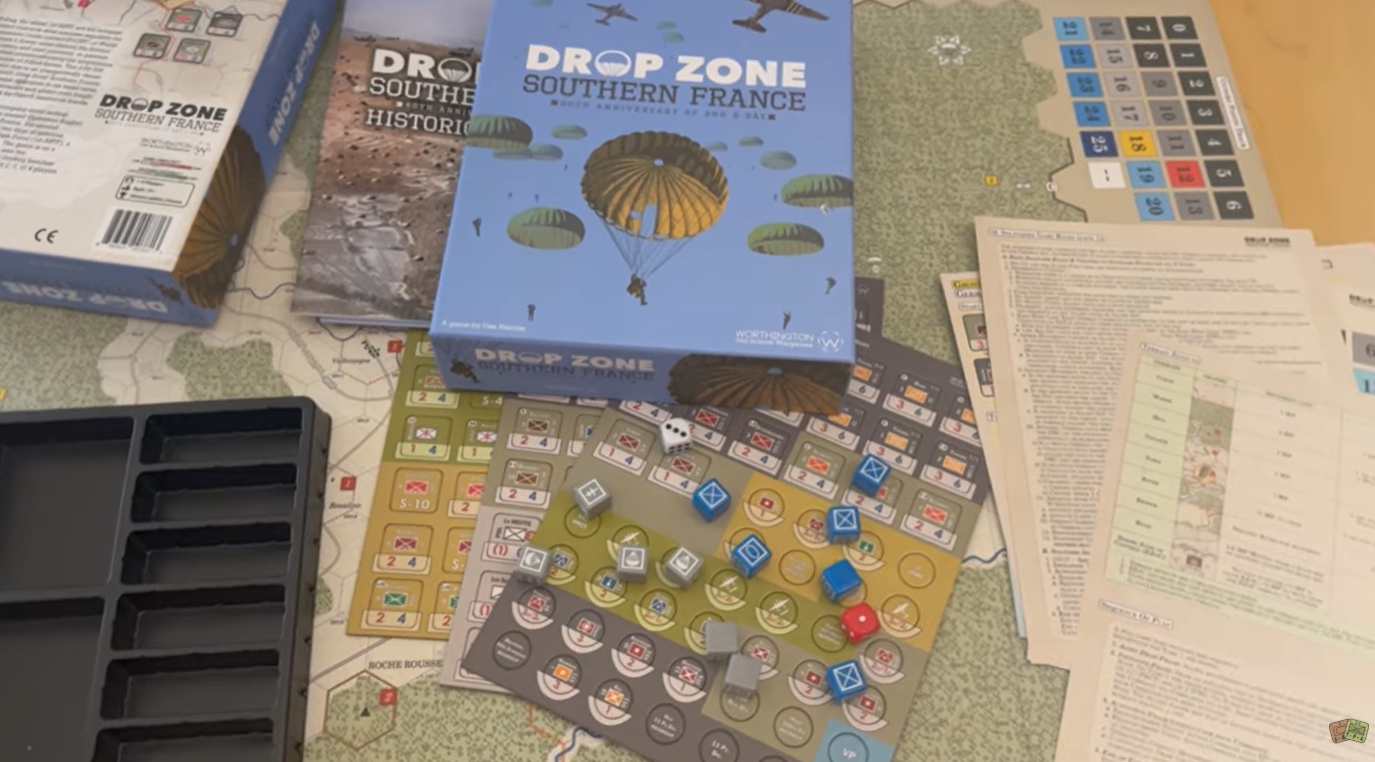
Drop Zone: Southern France is a company-level wargame covering the Allied airborne assault that spearheaded Operation Dragoon, which was the invasion of Southern France or the Second D-Day on August 15, 1944. The history behind this operation is really very interesting as early on the morning of D-Day, the allied First Airborne Task Force (1st ABTF) parachuted a dozen miles behind the Riviera landing beaches to seize key towns and road junctions, to prevent the German occupation forces from counter-attacking the amphibious landing, and to facilitate the advance of Allied forces. The 4:00 AM parachute drop was badly scattered due to an unexpected dense fog bank that blanketed the battlefield. Drop Zone: Southern France covers the first two days of this airborne operation in six game turns, when the American and British paratroopers and glider-men fought surrounded and alone, supported only by French resistance bands. This game is very good and is just a solid wargame.
Drop Zone: Southern France is a company-level wargame covering the Allied airborne assault that spearheaded Operation Dragoon, which was the invasion of Southern France or the Second D-Day on August 15, 1944. The history behind this operation is really very interesting as early on the morning of D-Day, the allied First Airborne Task Force (1st ABTF) parachuted a dozen miles behind the Riviera landing beaches to seize key towns and road junctions, to prevent the German occupation forces from counter-attacking the amphibious landing, and to facilitate the advance of Allied forces. The 4:00 AM parachute drop was badly scattered due to an unexpected dense fog bank that blanketed the battlefield. Drop Zone: Southern France covers the first two days of this airborne operation in six game turns, when the American and British paratroopers and glider-men fought surrounded and alone, supported only by French resistance bands. This game is very good and is just a solid wargame.
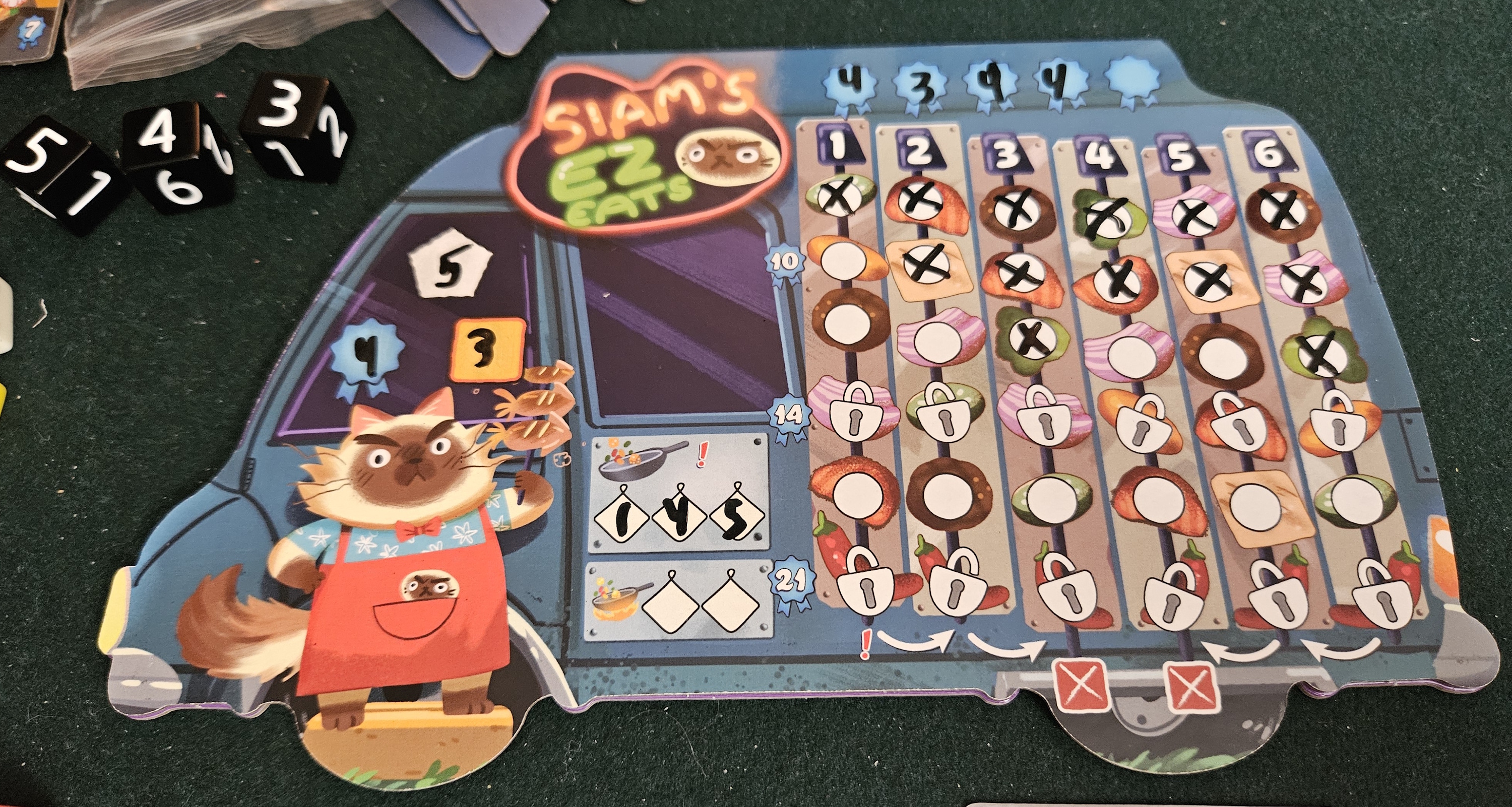
Food trucks, like roll-and-write games, went from unknowns circa 2013 to oversaturated by 2021 to fresh all over again in this the year 2026. At least that’s the hope behind Chicken Fried Dice, a chuck-and-scrawler and food truck simulator from Ashwin Kamath and Rob Newton.
How does it perform? We’ll wait in line together.
Ah, my dream job. (This is a lie.)
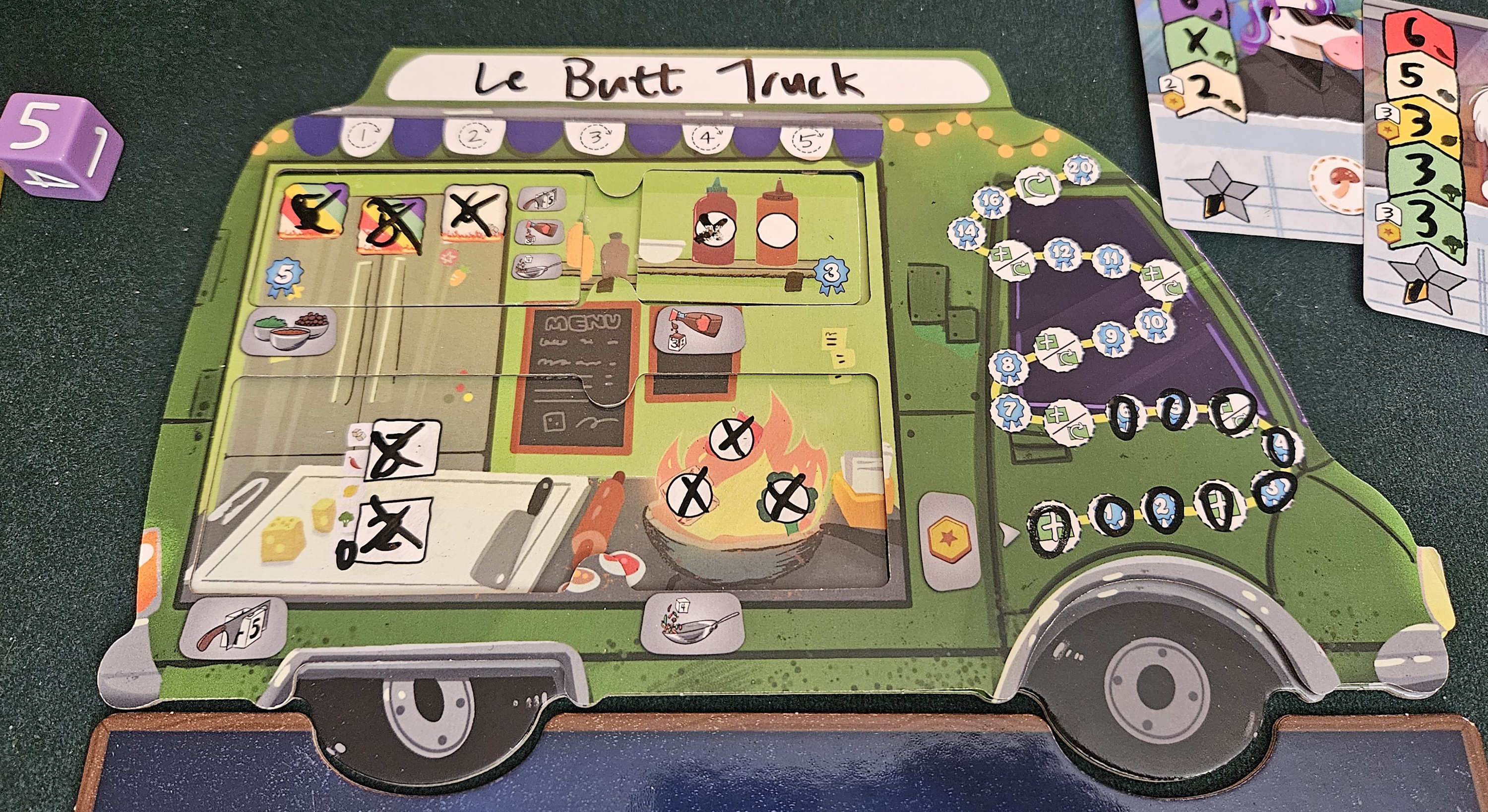
When Chicken Fried Dice opens, you have a food truck not unlike the rolling disaster from Jon Favreau’s Chef. In the language of dice, that means your options are limited, confined to a few rerolls, the ability to “chop” a die to divide a large number into two smaller numbers, and dousing an ingredient in sauce to make it seem like something else entirely. Ah, the secrets of the trade. I always suspected that if I slathered a bread crust in non-gluten barbecue sauce, I could legally label it GF.
Those tools are essential. On the surface, Chicken Fried Dice is another roll-and-write. You roll some dice, you write down their digits.
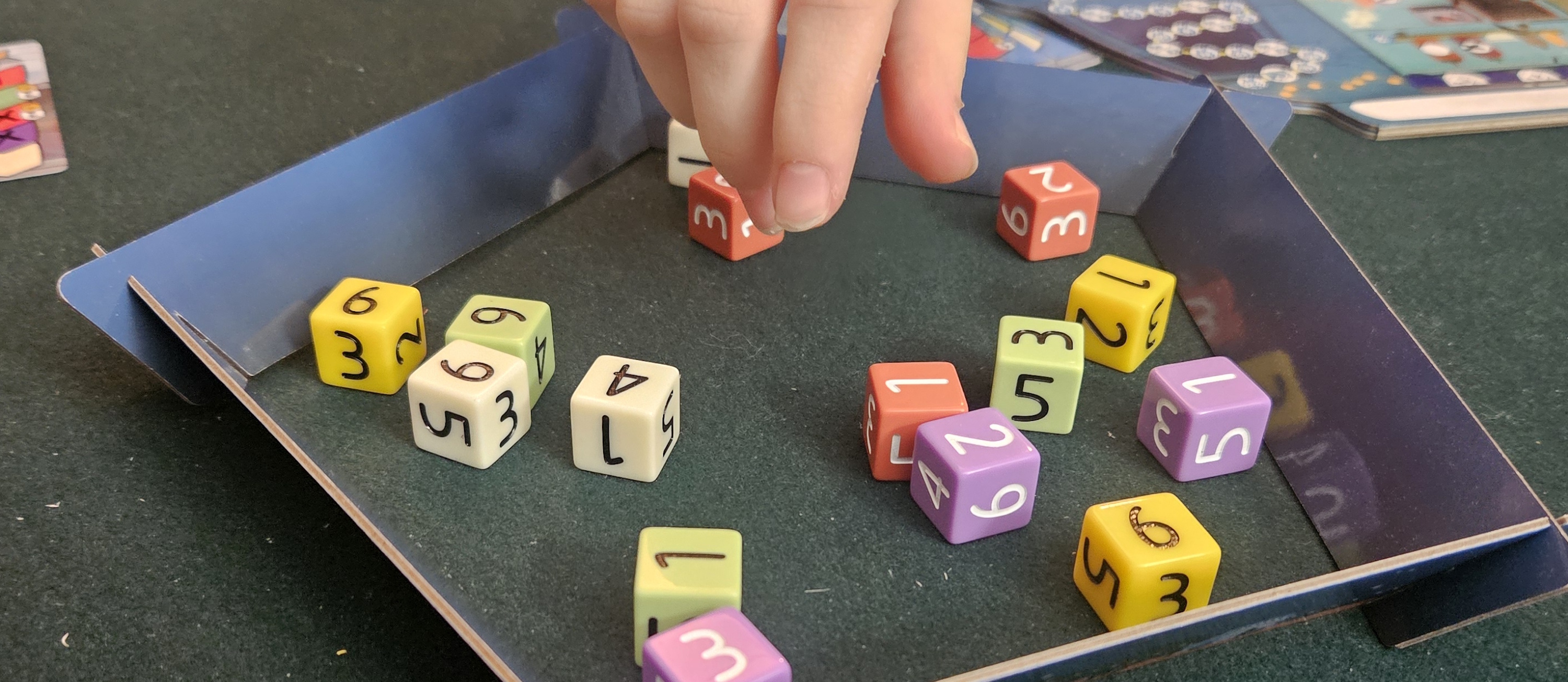
But what sets it apart from the competition is how thoroughly you can knead those rolls. For one thing, this is a simultaneous game. Everybody begins by chucking a handful of dice into a shared pot, then fishing them out one at a time. It’s possible to work fast to secure the best ingredients for yourself, but this is rarely easy. See, for instance, the aforementioned methods for altering your rolls. Getting what you want is often possible, but may require some trimming and/or a dash of luck.
I have never resented an anthropomorphic animal more.
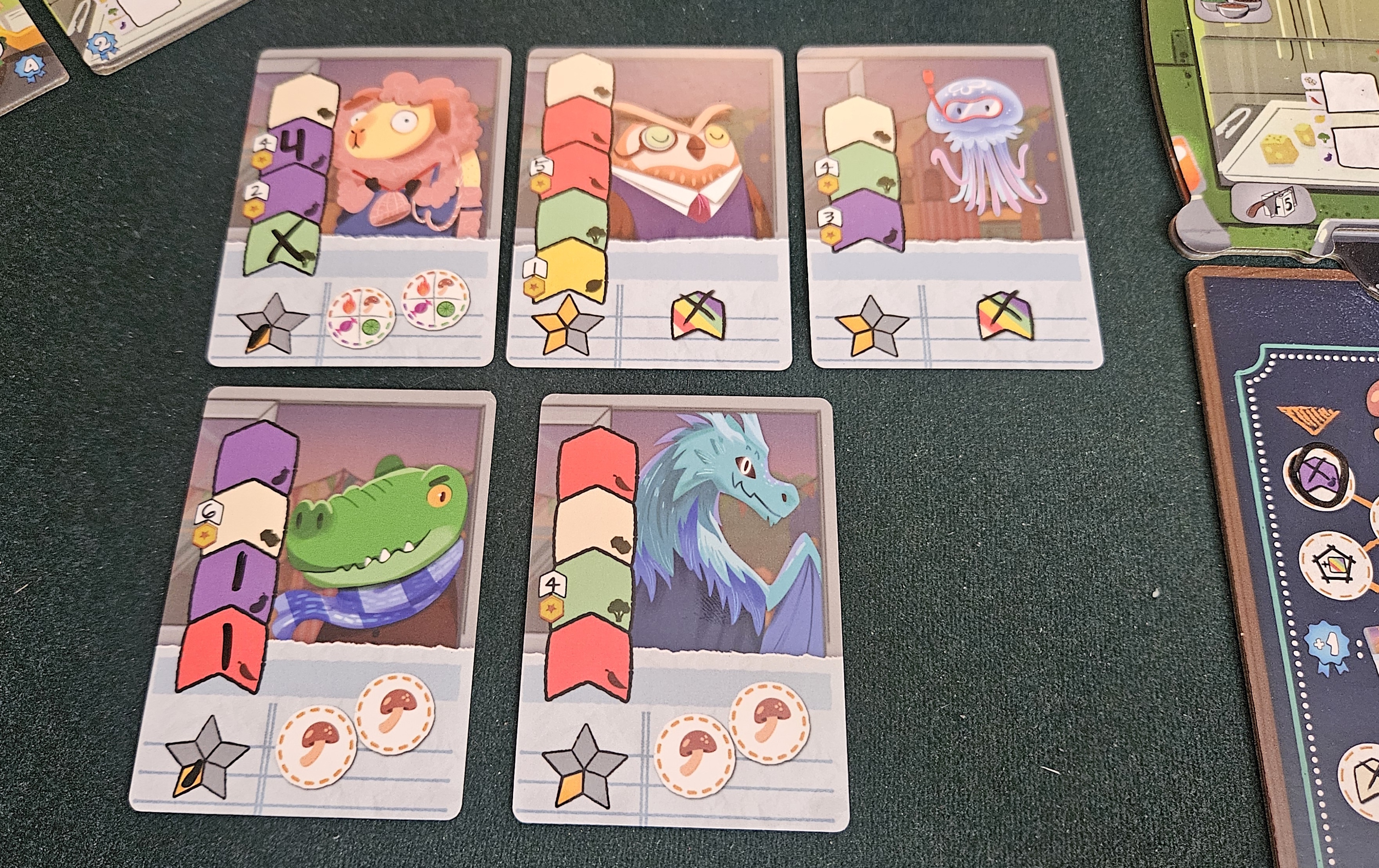
Even more persnickety, though, are the customers lined up outside your truck. I hate them. Everybody hates them. At their most basic, each customer has a list of ingredients they want in their meal. Say, peppers, broccoli, tofu, and more peppers. The first problem is that these represent portions. Each color has to match, of course — bring on the sauce — but each successive digit must also increase, or at the very least match what came before. This turns every order into its own ramen bowl of competing portions, ingredients, and custom instructions.
Naturally, providing customers with their desired meal is how you score points, but there’s so much more to it than that. Customers are willing to stick around between rounds, but the point-earning stars they’ll award your truck diminish over time. Worse, the picky jerks may leave a tip, but only if certain spaces meet their approval. Sometimes this isn’t such a bad thing, like when a number near the bottom requires a low digit. But what about when the bottom-most space demands a 4? And the order is five stonking ingredients long? And the customer doesn’t intend to stick around for more than a few minutes?
As with the best roll-and-writes, Chicken Fried Dice very quickly becomes a game about identifying and enacting one’s priorities. Not every customer will get served, so choosing the best clientele is a must. Those meager tips likely won’t let you improve every station of your food truck, so it becomes necessary to shore up your weak points. Depending on who you feed, little bonuses become available. Free ingredients, various flavors… I’m not sure what’s happening here, because it seems a lot like we’re carving haunches out of satisfied customers to feed the next group, but it does make for some nice combo-building. As your food truck transforms into the renovated sandwich wagon from the latter half of Jon Favreau’s Chef, it becomes possible to serve more and better meals.
Chuck and pluck!
The whole thing is a delight. The race to nab dice works in part because it’s harried but not overly punitive. Barring the occasional bonus, players are only allowed to grab four dice, so it’s rare to find yourself under too much pressure. Upgrading your work stations offers tangible improvements, and we have yet to play without someone showing off the name they invented for their truck. The complexity level can be adjusted, with two modes for using the bonus “flavors” provided by customers, whether a simple cluster of four tracks or a more open-ended picnic minigame. The dice-chopping has even provided a nice way to get my twelve-year-old to think about algebra beyond the confines of her math class.
Oh, and the solo mode is nice. Every truck has a reverse side that shows a different puzzle boss to beat, sort of like the uppity food critic from Jon Favreau’s Chef. I haven’t seen them all yet, in part because the prototype wasn’t content-complete, but the ones I’ve tackled have struck a nice balance between putting up a challenge and affording the player a measure of control over the rival trucker’s moves.
Is it a perfect game? Oh, I dunno. It’s a little airier than I prefer, a little more limited, especially when it comes to things like the upgrades. More often than not, it’s possible to upgrade the entire truck in those five rounds, making the game feel more boxed-in than some of my favorite exemplars of the genre. Chicken Fried Dice is a light game, but not so light that there isn’t some crunch mixed into its rice bowl.
There are five solitaire bots. Or there will be. The prototype only had a few of them.
The short version is that Chicken Fried Dice is something I would play with my sister’s family. They play plenty of games, but require a curated middle ground, neither too light nor as brain-burny as The Anarchy or Fliptown. This is that sort of game: silly but not off-putting, cutely thematic, mathy but not frustratingly so, breezy without zoning me out. To sum it up with a quote by John Leguizamo from Jon Favreau’s Chef: “I’m putting a little corn starch on my huevos, man.”
A prototype copy of Chicken Fried Dice was temporarily provided by the publisher.
(If what I’m doing at Space-Biff! is valuable to you in some way, please consider dropping by my Patreon campaign or Ko-fi. Right now, supporters can read about which films I watched in 2025, including some brief thoughts on each. That’s 44 movies! That’s a lot, unless you see, like, 45 or more movies in a year!)
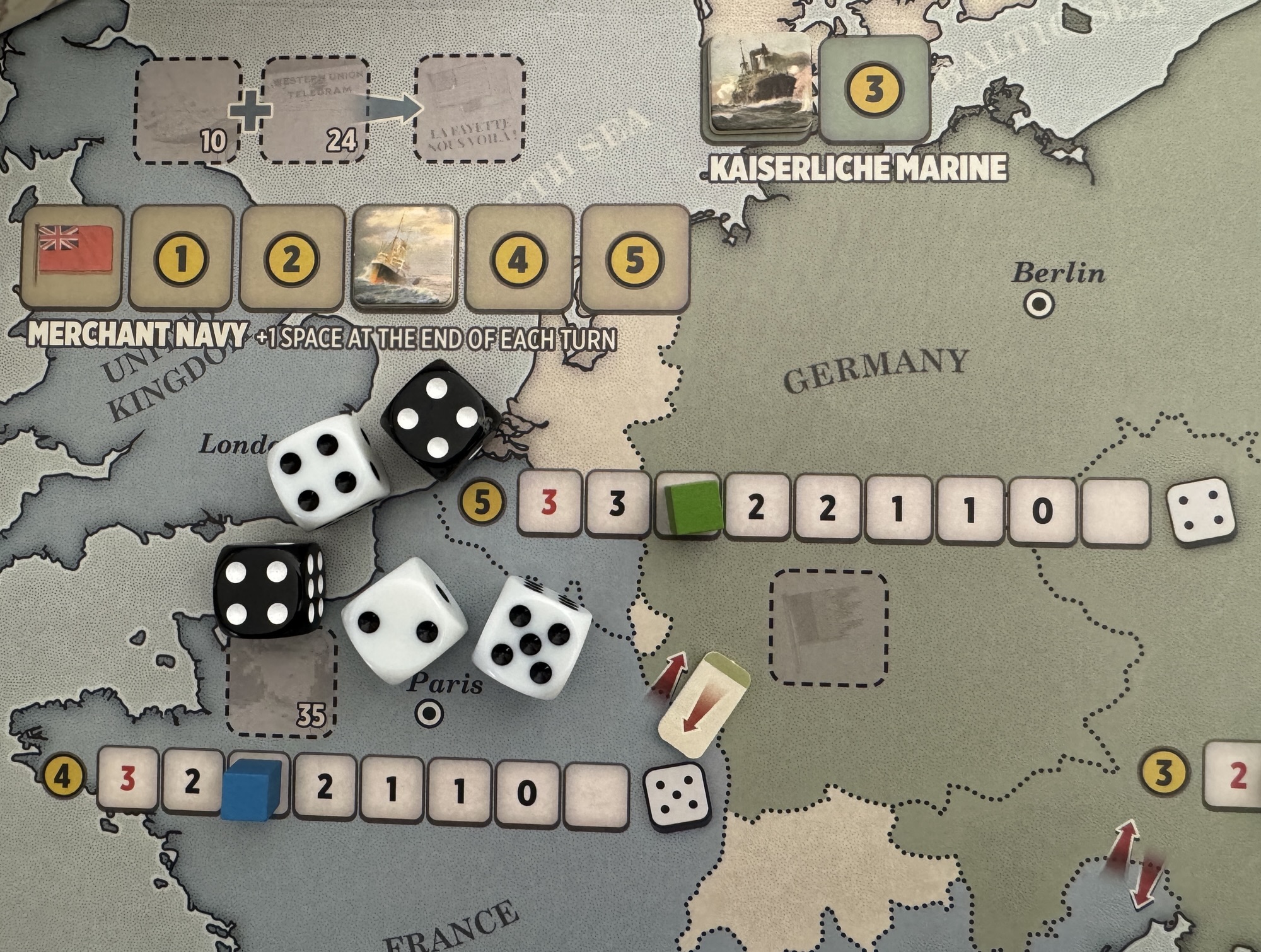
La Der des Ders – The War to End War from Hexasim is a 1-2 player slightly abstracted strategic level look at World War I. The game allows the players to relive the First World War at a strategic level, with each player controlling one of the 2 sides either the Entente, consisting of France, England, Russia, Serbia and other minor nations or the Central Powers including Germany, Austria-Hungary, the Ottoman Empire and a few minors. La Der des Ders can also be played solo, with a dedicated solitaire bot called “Athena” who utilizes special Cornflower Cards to make decisions about what technologies to invest in, where to undertake offensives and how to utilize limited resources and reinforcements. Each turn, players gain an amount of Resource Points dependent on what nations are in the war, which they can allocate to different areas to guide their overall strategy. Victory is achieved by launching offensives that drain the morale of enemy nations, forcing them out of the conflict through collapse.
In Action Point 1, we looked at the Game Board, discussing the Collapse Tracks, Trade Tracks, Russian Revolution Track and Naval Control Table and other various on-board tables and offensive spaces. In Action Point 2, we covered the Technology Phase and the Technology Tree and Technological Improvement Boards. In Action Point 3, we examined the Event Cards and how they inject the historical narrative into the gameplay and also alter the conditions of the game. In this Action Point, we will walk through an example of an Offensive and take a look at the combat procedure.
Offensives
As we discussed in Action Point 1, shown on the board are the Offensive Arrows that will remind the players about what Offensives they can undertake, meaning what Sectors may be attacked, and what Sectors have already taken their one Offensive against that adjacent Sector per turn. These are identified by red arrows connecting adjacent Sectors and will be covered up by the appropriate Offensive Marker when undertaken. In the below picture, we will take a look at Serbia as an example. You can see that Serbia is surrounded by Central Power countries including Austria-Hungary and Bulgaria (Neutral at the start of the war). They also have a few of their Allied nations adjacent including Romania (Neutral at the start of the war) and Greece (Neutral at the start of the war). From each of the adjacent Sectors there are 2 Offensive Arrows represented meaning that this Sector can both be attacked and can attack the adjacent Sector.
The process of taking Offensives is really pretty simple as players take turns to activate one of their sectors that has not yet been activated this turn. The sector chosen will then be activated and must launch an Offensive against an adjacent enemy sector. There is a cost to the launching of Offensives though as the player will have to pay the appropriate cost by first choosing the size of their Offensive, which in game turns means the number of dice they will pay to roll in the Offensive. The size of the Offensive must be at least 1 and can be up to the current Operational Value of the attacking sector. The player launching the offensive then spends as many Resource Points as the size of the Offensive.
For example, The Entente player decides to attack Austria-Hungary from Russia. If Russia’s Operational Value is currently 2, the size of the Offensive must be between 1 and 2. If the Entente player chooses a size 2 Offensive they will have to spend 2 Resource Points. This would allow Russia to roll 2D6 along with any black dice for their Artillery Technology.
Once both of the players have activated a sector, each player may then continue with Offensives by choosing to activate a new sector until no new sectors can be activated. Each of the sectors can make but a single Offensive per turn. I really like this restriction as it reflects the logistical and material difficulties in planning, funding and executing these large Offensives. A player may always decide to pass rather than activate a sector but once you do pass the Resource Spending phase ends for them. The other player can continue to activate the sectors they want and are able to until they decide to pass on their turn or are no longer able to activate a sector.
Now let’s cover the mechanics of how the Offensive resolves with dice. The player will roll as many white dice as the size of the Offensive they funded. These dice are called Attack Dice and it is important to remember that some technologies allow modifiers to be added to Attack Dice or will grant additional dice to be rolled, usually in the form of Artillery Dice. Each level of Attack Technology implemented in the attacking sector grants a DRM (Die Roll Modifier) of +1 to each Attack Die roll. Each level of Defense Technology implemented in the targeted sector inflicts a Die Roll Modifier of -1 to each Attack Die roll. Each level of Artillery Technology implemented in the attacking sector allows the Attacker to roll 1 black Artillery Die. These dice are not subject to the bonuses/penalties conferred by either Attack or Defense Technologies. Also, keep in mind that the number of Artillery dice cannot exceed the size of the Offensive. This is a mistake that I have made many times in my plays of the game and wish there was a better way to remember this. In the case of Artillery Dice, if the player has developed the Aviation Technology, the attacker may re-roll as many Artillery Dice that failed to inflict a loss as the difference between their Aviation Level and the defender’s Aviation Level.
Each result greater than or equal to the attacking player’s Attack Value inflicts one loss on the defender. The Attack Value of a sector is represented by the die depicted at the end of the Collapse Track. Germany has the best value at a 4 while all other countries, with the exception of Greece who is a 6, have a 5. For each loss suffered in an Offensive, the defender moves the cube on the attacked sector’s Collapse Track by one space to the right. If a cube needs to be moved forward on the Collapse Track, but is already on the right-most space and can’t be moved forward, that country immediately surrenders. The Offensives process is really very simple, and it just fits with the chosen format and scale of the game. Nice and easy but fun with lots of dice rolling.
Counter Attacks
One more thing that I need to share about these Offensives is the concept of a Counter Attack. If at least one of the Attack Dice rolled comes up a natural 1, the attacker will suffer one loss and the cube in their own sector is moved forward one space on the Collapse Track. This is not one loss per 1 result but only 1 such loss with an Offensive. With my luck, I could lose my whole army and have to surrender! Also, remember that Artillery Dice are not affected by the Counter Attack rule.
The process of Offensives in La Der des Ders is very simple and straightforward but works very well in the framework of the game to create many tough choices about how to spend your limited Resource Points and who to attack and from where. As the Central Powers, attacking with Germany each turn makes the most sense as they have the best odds of scoring hits and causing losses to France and Russia but they will have to gauge where they stand and who else might be closer to Collapse and surrender. As the Entente, France and Russia should put a heavy focus on Germany and Austria-Hungary and force the Central Powers player to have to replace losses rather than spending on Technology upgrades and replacements. Continually attacking them will lead to results over the course of the game.
In Action Point 5, we will simply review the Victory Conditions.
By the time you’re listening to this, we’re probably already in Vegas for Dice Tower West! We’re going to hang about all day playing games – which naturally leads to the question of what we’re going to play? These are the games we came up with! Before we bite off more than we can chew, we talk about Ghost Lift, Cities, and I, Napoleon.
If you don’t want to miss an episode, please subscribe on Apple Podcasts/Google Podcasts/Stitcher/Spotify, or add our RSS feed to your favourite app. Reviews and subscriptions really help us and would be greatly appreciated! To download the episode directly, click here.
If you’d like to discuss anything in the episode, please do so in the comments below, visit our BoardGameGeek guild, join our Discord, or Facebook Group! Any feedback is also always helpful. If you’d like to show your support for the show, we also have a Patreon with some fun rewards, and a merch store!
Timecodes:
02:31 – Ghost Lift 08:13 – Cities 14:06 – I, Napoleon 24:40 – Dice Tower West anticipated games 26:05 – Biblios 27:04 – Feya’s Swamp / Kaivai 28:26 – Cheese Thief 29:03 – Habemus Papam 31:15 – Wroth 33:33 – Greed Incorporated 35:39 – Dark Pact 38:45 – Secret Tribe 39:52 – Eternal Decks 41:03 – All In: Predictions 42:04 – Cthulhu: Dark Providence 44:14 – Robo Rally Dice
Thank you to Heart Society for generously letting us use What’s On Your Mind, Kid? from their album Wake the Queens.
Ok, der Spruch ist sicher schon abgedroschener als Brahmahaut in Fallout, aber er passt hier einfach wie die Brennstange in den Reaktor. Ich entschuldige mich für nichts! Willkommen im alternativen Deutschland um 1900, in dem Elsa von Frühlingsfeld das Nukleum entdeckt hat. Dadurch bricht ein neues Zeitalter der Stromversorgung an – und Du bist der Motor!
Die tolle Erfindung von Elsa schlägt große Wellen, und irgendwie wollen wir doch alle ein Stück vom uranangereicherten Kuchen abhaben. Industrielle wittern den großen Fortschritt und können vielleicht ganz nebenbei auch noch ordentlich Kohle machen – wobei wir ja eigentlich genau davon wegwollen. Naja, die meinen dann wohl die andere Art Kohle. Und mit „die“ meine ich Dich! Genau Du schlüpfst in die Rolle dieser experimentierfreudigen Gutmenschen.
Mehrzweck-Plättchen, Netzwerk- und Routenbau, Einkommen und Engine-Building, Asymmetrische Spielerfähigkeiten
Spielprinzip
Nukleum ist das Baby von Simone Luciani und Dávid Turczi, diesmal wirklich gemeinsam designt und nicht nur „Luciani baut das Spiel und Turczi schraubt noch einen Solo-Modus dran“.
Also, was machen wir hier eigentlich? Das Ziel ist es, Gebäude in Städten zu errichten und diese mit Schienen an stromerzeugende Kraftwerke sowie die passenden Ressourcen (Kohle oder Uran) anzuschließen. Kurz gesagt: ein Versorgungsnetzwerk hochziehen. Alles klar, aber wie?
Der Kernmechanismus ist gleichzeitig der Clou des Ganzen. Jeder Spieler besitzt Aktionsplättchen mit je zwei Aktionen in unterschiedlichen Kombinationen. Und mit unterschiedlich meine ich, dass Du zum Start andere Möglichkeiten hast als Deine gierige Konkurrenz. Um Aktionen auszuführen, legst Du sie einfach in Dein Spielertableau.
Die Aktionsplättchen haben eine sehr verständliche Ikonografie und die Symbole sind bei den jeweiligen Feldern auf dem Spielfeld/Tableu ebenfalls abgebildet.
ABER: Du kannst die Plättchen ebenfalls zum Schienenbau direkt aufs Spielfeld knallen. Dann ist das Plättchen zwar als Aktion weg, aber eine neue Schiene verbindet Deine Städte was für die Bildung von Netzwerken unumgänglich ist. So entsteht ein ständiger innerer Zwiespalt – Brauche ich die Aktion später noch mal oder opfere ich sie dem Ma-Schienengott?
Zum Glück gibt es Aktionen, mit denen Du neue Aktionen kaufen kannst. Actionsception! Denn wer alles für Schienen rausgeballert hat, schaut sonst schnell in die Röhre. Netterweise besitzt jeder Spieler ein Jokerplättchen, dass nicht als Schiene verbaut werden kann. Hier hast Du zwar nur eine Aktion, dafür aber die freie Wahl.
Wer irgendwann verstanden hat, wie ein Netzwerk funktioniert, und es schafft, ein Gebäude mit einem Kraftwerk und einer Ressource zu verbinden, darf endlich den Schalter umlegen und wertvolle Erfolgssterne sammeln.
Das Spiel benötigt schon ordentlich Platz auf dem Tisch. Allein durch die großen Spielertableus.
Kohle vs. Uran
Am Anfang musst Du noch mit schmutziger Kohle hantieren, da nur ein einziges Kraftwerk mit dem namensgebenden Nukleum ausgestattet ist. Erst dieses Wunderding ermöglicht es, aus Uran Strom zu generieren. Leider brauchst Du dafür auch Uranminen, aber auf Dauer ist Uran nicht nur ergiebiger, sondern auch billiger. Die Kohle vom freien Markt wird nämlich mit jedem Kauf teurer, bis eine reine Kohleversorgung so attraktiv ist wie ein Leben in der Kanalisation.
Im Kern will also jeder einen Reaktor mit Nukleum, jede Menge Uran und eine Leitung zu den eigenen Gebäuden. Blöd nur, dass die anderen das auch wollen. Strategisch wichtige Bauorte sind schneller weg als Freibier auf einer Studentenparty. Da Du Deine Städte nur effektiv verbindest, wenn mindestens eine Schiene dazwischen Dir gehört, kommt es schnell zu spannenden Wettrennen.
Das Tableau-Management
Das Spiel lässt sich textlich schwer in kürze abbilden, da es an allen Ecken und Enden Möglichkeiten bietet. Auf Deinem persönlichen Tableau warten Gebäude, Turbinen und Uranminen auf ihren Einsatz. Gebäude kosten Thaler, Minen und Turbinen verbrauchen Arbeiter. Zusätzlich kannst Du drei Einkommensleisten (Thaler, Arbeiter, Siegpunkte) pushen. Wenn Du passt, weil Du nicht mehr kannst oder willst, bekommst Du genau dieses Einkommen und all Deine Plättchen zurück. Außer die, die nun als Schiene weiterleben. Aber hey, eine Schiene zu sein, ist sicher auch eine erfüllende Karriere.
Die gesammelten Erfolgssterne werden beim Passen auf eine Wertungsleiste gelegt. Je mehr Sterne, desto höher die Position und desto fetter der Multiplikator für die zufälligen Endwertungen.
Zusätzlich hat jeder eigene Experimente, die zum asymmetrischen Charakter gehören. Diese schaltest Du meist durch Aufträge frei. Das bringt permanente Boni, einmalige starke Effekte, oder eine Möglichkeit extra Punkte am Ende zu werten.
Unboxing
HDas Spiel wirkt mit ca. 70 € vielleicht erst mal teuer, aber bei der Materialschlacht ist es jeden Cent wert. Es gibt Double-Layer-Boards und die Schachtel ist so prall gefüllt, dass sie fast die kritische Masse erreicht. Eine kleine Sortierhilfe in Form von Papp-Aufteilern ist dabei – nicht der heilige Gral, aber besser als loses Chaos. Trotzdem schreit alles nach einem Inlay, denn der Aufbau dauert selbst mit guter Sortierung eine Weile.
Die Anleitung ist trotz der enormen Komplexität vernünftig geschrieben (wer mag, kann sich natürlich auch mein Regelvideo dazu anschauen). Das Spielfeld ist vielleicht keine optische Offenbarung, aber funktional top. Besonders die Ikonographie ist hervorragend. Selten konnte ich Symbole so schnell verinnerlichen, ohne alle zwei Minuten in das Glossar zu glotzen.
Bewertung
Nukleum bietet so viele taktische Möglichkeiten, dass das Rumprobieren einfach süchtig macht. Der variable Aufbau verhindert, dass immer die gleiche Strategie gefahren wird. Seit dem Kauf hat es schon ordentlich Partien auf dem Buckel – mehr als jedes andere Spiel zuvor. Obwohl mich das Thema nicht ganz so packt wie etwa Darwin’s Journey vom selben Autor, ballert mir Nukleum einfach eine Vielzahl Atome mehr um die Rübe. Ich bin absolut begeistert! Unsere Ausführlichere und diversere Bewertung gibt es übrigens auch hier als Video.
Wie wir bewerten haben wir euch hier aufgeschrieben.
Erweiterungen
Aktuell gibt es drei Erweiterungen, die das Spiel sinnvoll aufbohren:
Der Große Rat: Fügt die Aktion „Politik machen“ hinzu. Jetzt kannst Du Arbeiter in Politikerklamotten stecken und Parteien dominieren. Wer den Vorsitz hat, kassiert beim Königsbesuch extra Boni. Ich nehme sie immer dazu, weil sie die Zwischenwertungen deutlich spannender macht.
Australien: Australien ist ein Map Pack, das ein neues Spielfeld im Namensgebende Land präsentiert. Inkl. Neuer Mechaniken. In Australien können neben Schienen auch Schiffe gebaut werden. Der besondere Kniff hier, dass auch mehrere Spieler auf eine Route schiffe bauen können, aber jeder nur seine eigenen nutzen kann. Ein weiterer Kniff ist, dass mit Schiffen zwar Kohle und Uran transportiert werden kann, aber kein Strom. Hier musst du also noch ein paar Gedankengänge mehr darbieten, um Netzwerke erfolgreich aufzubauen. Auf dem Spielfeld gibt es auch weniger, bzw. teurere Kohleimporte, dafür können aber nun neben Uranminen auch Kohleminen gebaut werden. Ich mag die Karte der Erweiterung sogar lieber als die des Grundspiels, aber es ist immer gut etwas Abwechslung zu haben.
Institut für Energieforschung: Erhöht die Asymmetrie massiv. Es gibt neue Experimente, die sich teils völlig anders spielen (eines verzichtet z.B. sogar ganz auf eigene Stadtgebäude). Außerdem bekommt jedes Experiment nun ein Gesicht und eine einmalige Sonderfähigkeit. Die sind zwar eher semi-nützlich, aber eine echte Persönlichkeit zu seinem Experiment zu haben ist schön.
Insgesamt sind alle drei bisher erhältlichen Erweiterung lohnenswert, aber auch das Grundspiel alleine bietet einen sehr hohen Wiederspielwert.
(c) Giant Rock
Grafik(en) und Bild(er) von analog rockt
Diese Rezension ist unentgeltlich durchgeführt worden und spiegelt meine persönliche Meinung wider.
Die Australien KarteDer große Rat TableuKarte des Grundspiels
In dieser Kategorie gibt es Aktuelles der drei Kategorien Mäh! (News), Herde (Neuzugänge) und Grasen (Ersteindrücke). Diesen Monat mit der SPIEL'25, aktuellen Auszeichnungen, The Druids of Edora, Thebai, Pulitzer, Waldland und Star Wars - Battle of Hoth .
Michael Will begeistert mit sehr hochwertigen und ansprechenden Videos seine Community!
Wir sind begeistert von seinem Fazit zu SOUL DICE: „Ein großartiges 2-Personenspiel, das grafisch und thematisch hervorragend umgesetzt ist! Wirklich tolle Ausstattung und eine gute Mischung von Würfelglück und Optimierung. Von uns: eine absolute Empfehlung!"
Schaut euch das ausführliche Feedback gerne auf You Tube an.
In dieser Kategorie gibt es Aktuelles der drei Kategorien Mäh! (News), Herde (Neuzugänge) und Grasen (Ersteindrücke). Diesen Monat mit Sleeves, Munchkin, einer Autoren-Auszeichnung, Tiletum - Prospect for Silver und Schafe scheuchen.
Carsten stellt auf seinem You Tube Kanal regelmäßig Spiele vor, diesmal teil erst seine Meinung über SOUL DICE - die hören wir sehr gerne: "Es macht uns unheimlich viel Spaß! Würfel sind einfach immer toll. SOUL DICE ist ein richtig tolles Spiel für zwischendurch und deutlich kniffliger als es erstmal so scheint!"
Wir freuen uns über jede positive Rezension zu unserern Spielen. SOUL DICE vom Nachwuchsautoren Axel Streubel begeistert euch.
Nicht nur die Spieledinos Angelo und Mellie empfehlen es als Zwei-Personenspiel Was sie sagen? "SOUL DICE ist einfach cool gemacht! Eigentlich sehe ich alles was die anderen Seite hat, aber in SOUL DICE überrascht man den Gegner dann doch mal, wenn die Kristalle eingesetzt werden. Bis zum Schluss bleibt das Duell einfach spannend!"
Soul Dice: Engel gegen Teufel
Kai (Meeplecards) ist begeistert vom hochwertigen Material
Basti (geekpunkt) findet das Cover richtig cool!
Viele begeisterte Stimmen
Basti, Twitch-Streamer, Geekpunkt
"Soul Dice kann ich als echt gutes Zweipersonenspiel empfehlen! Kommt direkt in meine TOP 20 der besten Duellspiele. Auch die Solovariante finde ich richtig gelungen."
Dennis, Blogger, staygeeky
"Das Thema finde ich richtig cool und kommt bei SOUL DICE auch echt gut rüber. Natürlich ist es recht glückslastig, aber es gibt ausreichend Manipulationsmöglichkeiten und viele interessante Entscheidungen im Spielverlauf."
Kai, You Tuber, Meeplecards
"Soul Dice hat simple Regeln und eine Partie ist schnell gespielt. Das Material wirkt sehr hochwertig. Vor allem in der fortgeschrittenen Variante hat das Spiel einen sehr hohen Wiederspielreiz und ist schnell auf dem Tisch gebracht!"
Ingo, Blogger, spielkult
"Von uns gibt es ein 7/10: Gutes Taktieren und Optimieren ist hier gefragt! Das hochwertige Material bringt noch mehr Spielfreude! Oft bleibt das Gerangel um die Seelen bis zum Schluss spannend"
Dennis mag vor allem, dass SOUL DICE so thematisch ist!
Sieben kultige Punkte - wir freuen uns teuflisch!
… und immer auf dem Laufenden!
Folge uns in den sozialen Netzwerken und verpasse keine Neuigkeiten!
Beim Nachwuchsautor:innen Treffen 2023 hat uns Axel mit "Engel oder Teufel" begeistert. Wie es ihm erging vom ersten Prototypen hin zum fertigen Spiel? Hier erzählt Axel von seinem Weg!
Axel Streubel unser Nachwuchsautor
So hat uns das Spiel überzeugt!
Ein erster Prototyp von Axel
Corona Lockdown: Die ersten Schritte
Im Lockdown 2021 begann mein Weg als Spieleautor, inspiriert von meiner langjährigen Leidenschaft für Gesellschaftsspiele. Ich fing an, eigene kleine, handliche Spiele zu entwickeln. Mein erstes Projekt war ein Würfelspiel mit Kniffel-Mechanik, gefolgt von einem Kartenspiel, das ich in meiner Schulzeit mit Freunden „erfunden“ und nun weiterentwickelt hatte. Zunächst gebastelt mit eigenen Zeichnungen, später unterstützt durch KI-Bilder. Die kreative Arbeit, das Basteln und vor allem das gemeinsame Spielen meiner eigenen Ideen machten mir so viel Spaß, dass ich dieses Hobby intensiv weiterverfolgte.
2023 nahm ich mir vor, ein Spiel zu veröffentlichen, schickte Spielanleitungen und Prototypen an Verlage und erhielt so motivierendes Feedback, dass ich inzwischen ständig an mehreren Spielen gleichzeitig arbeite.
Frau und Tochter mit an Bord
Anfang 2023 begann ich mit der Entwicklung von Soul Dice, einem schnellen und einfach erklärten Spiel für zwei Personen, das mit bekannten Materialien wie Würfeln und Karten möglichst zugänglich sein sollte. Der erste Prototyp bestand aus gelben und blauen Karten und hieß schlicht „Gelb gegen Blau“, doch durch viele Tests entwickelte ich die Regeln weiter und suchte ein passendes Thema. Dann kam meine Frau mit der Idee „Engel gegen Teufel“, die perfekt zum Spielgefühl passte. Mit Hilfe meiner Tochter gestaltete ich dann einen vollständigen Prototypen samt stilvollen Würfeln, eigenen Karten und passenden Spielboards wie „Würfelhimmel“ und „Würfelhölle“.
Im September 2023 stellte ich das Spiel beim Nachwuchsautor:innentreffen des „Spiel Das Verlags“ vor und bekam tolles Feedback von Julia und Robert. Die Aussicht, dass Engel oder Teufel 2025 veröffentlicht werden könnten, motivierte mich, das Spiel weiter zu optimieren.
Letzter Test und dann die Zusage!
Motiviert vom Erfolg beim Autorentreffen beschloss ich, gemeinsam mit einem anderen Spieleautor die Spieleerfinder Messe 2024 in Nürnberg zu besuchen. Die Rückmeldungen, besonders zu Engel oder Teufel, waren überwältigend, und ich konnte insgesamt neun Prototypen an verschiedene Verlage vermitteln, auch wenn viele Verlage noch nicht aktiv nach 2-Personen-Spielen suchten.
Beim erneuten Nachwuchsautorentreffen 2024 zeigte ich Robert die weiterentwickelte Version von Engel oder Teufel – und nach einer letzten gemeinsamen Partie sagte er mir, dass er es gerne in seinem Verlag veröffentlichen möchte.
Gute Planung ist alles!
So wurde uns Engel oder Teufel vorgestellt!
Ein Traum wird wahr!
Als mir der Spiel Das! Verlag die Veröffentlichung von Engel oder Teufel zusagte, war das Glücksgefühl unbeschreiblich: Ich hatte es geschafft, ein richtiger Verlag bringt eines meiner Spiele heraus. Neben Stolz mischte sich auch Demut dazu, denn ich hörte von vielen anderen Autor:innen, wie lange sie schon versuchen, ein Spiel unterzubringen – und ich konnte innerhalb eines Jahres gleich mehrere Prototypen an Verlage vermitteln.
Noch im selben Jahr bekam ich auch eine Zusage für ein Kartenspiel für Ende 2025 und kurz darauf auch für ein Partyspiel, das ebenfalls 2025 erscheinen soll – drei Spiele in einem Jahr, das war für mich kaum zu fassen. Besonders freut mich, dass Soul Dice mein offizielles Erstlingswerk wird – beim Verlag, bei dem für mich alles angefangen hat.
Die Zusammenarbeit mit Robert und Julia hat dem Spiel zusätzliche Tiefe gegeben, etwa durch neue Varianten, mehr Seelenkarten und spannende asynchrone Fähigkeiten.
Die Idee des Verlags mal ein Cover ohne die üblichen Infos zu gestalten und umzusetzen, fand ich durchaus faszinierend und neu. Aber müssen die das denn ausgerechnet mit meinem Erstlingswerk machen…ich wollte doch im Brettspielladen stehen und … Aber das Spiel steht für mich über Eitelkeiten. Also bestätigte ich Robert, dass ich genau so, wie das Cover jetzt ist, dahinter stehe. Ich bin dann eben der Autor ohne Namen auf der Box….auch was Besonderes!
Soul Dice für 1 - 2 Personen ab 8 Jahren Spielzeit ca. 20min.
Die Freude ist immer groß, wenn eine Neuheit im Lager ankommt: Diesmal haben wir uns über SOUL DICE gefreut! Das 2-Personenspiel von Nachwuchsautor Axel Streubel ist ab sofort erhältlich!
Unser taktisches Duellspiel
Soul Dice kann ab sofort von euch bestellt werden!
Soooo viele Kisten!
Taktische Tiefe und hochwertige Ausstattung
Was beim Nachwuchstreffen 2023 mit einem Prototypen begann ist jetzt bereit, um auf euren Spieletischen zu landen. Ab sofort ist SOUL DICE in unserem Shop und überall wo es gute Brettspiele gibt erhältlich.
Basti vom Twitch und You Tube Kanal geekpunkt ist so richtig gehyped!! "Das Cover? Riesen Pluspunkt! Richtig mutig und cool! Ein absoluter Keeper, denn es ist super kurzweilig. Material ist super hübsch! Tolle Qualität, Grafik catcht so richtig!"
Was er sonst noch zu sagen hat, könnt ihr hier anschauen!
Das Spielecafe der Generationen ist begeistert von unserer Neuheit! "SOUL DICE ist ein cleveres Würfelspiel, bei dem man nicht ausschließlich seinem Glück oder Pech ausgesetzt ist. Die hohe Interaktion und das schöne Material sollten von euch unbedingt mal einen Chance bekommen." schreibt Oli auf der Homepage von jungundaltspielt.de

 Anmelden